US6299721B1 - Coatings for improved resin dust resistance - Google Patents
Coatings for improved resin dust resistance Download PDFInfo
- Publication number
- US6299721B1 US6299721B1 US09/211,283 US21128398A US6299721B1 US 6299721 B1 US6299721 B1 US 6299721B1 US 21128398 A US21128398 A US 21128398A US 6299721 B1 US6299721 B1 US 6299721B1
- Authority
- US
- United States
- Prior art keywords
- metal foil
- solution
- foil
- hydrocarbylsilane
- titanate
- Prior art date
- Legal status (The legal status is an assumption and is not a legal conclusion. Google has not performed a legal analysis and makes no representation as to the accuracy of the status listed.)
- Expired - Fee Related
Links
- 229920005989 resin Polymers 0.000 title claims abstract description 60
- 239000011347 resin Substances 0.000 title claims abstract description 60
- 239000000428 dust Substances 0.000 title claims abstract description 50
- 238000000576 coating method Methods 0.000 title description 3
- 239000011888 foil Substances 0.000 claims abstract description 197
- 229910052751 metal Inorganic materials 0.000 claims abstract description 158
- 239000002184 metal Substances 0.000 claims abstract description 158
- 229910000077 silane Inorganic materials 0.000 claims abstract description 62
- 238000000034 method Methods 0.000 claims abstract description 56
- 150000001875 compounds Chemical class 0.000 claims abstract description 50
- 238000010030 laminating Methods 0.000 claims abstract description 10
- 239000000243 solution Substances 0.000 claims description 48
- -1 triazole compound Chemical class 0.000 claims description 32
- RYGMFSIKBFXOCR-UHFFFAOYSA-N Copper Chemical compound [Cu] RYGMFSIKBFXOCR-UHFFFAOYSA-N 0.000 claims description 30
- 239000000463 material Substances 0.000 claims description 25
- 125000001183 hydrocarbyl group Chemical group 0.000 claims description 22
- 239000011889 copper foil Substances 0.000 claims description 18
- 239000003929 acidic solution Substances 0.000 claims description 13
- XLYOFNOQVPJJNP-UHFFFAOYSA-N water Substances O XLYOFNOQVPJJNP-UHFFFAOYSA-N 0.000 claims description 13
- 229910052802 copper Inorganic materials 0.000 claims description 12
- 239000010949 copper Substances 0.000 claims description 12
- 229920000647 polyepoxide Polymers 0.000 claims description 12
- 239000003822 epoxy resin Substances 0.000 claims description 11
- HCHKCACWOHOZIP-UHFFFAOYSA-N Zinc Chemical compound [Zn] HCHKCACWOHOZIP-UHFFFAOYSA-N 0.000 claims description 6
- 150000001343 alkyl silanes Chemical class 0.000 claims description 6
- 229910052725 zinc Inorganic materials 0.000 claims description 6
- 239000011701 zinc Substances 0.000 claims description 6
- 239000003960 organic solvent Substances 0.000 claims description 5
- ZNOCGWVLWPVKAO-UHFFFAOYSA-N trimethoxy(phenyl)silane Chemical group CO[Si](OC)(OC)C1=CC=CC=C1 ZNOCGWVLWPVKAO-UHFFFAOYSA-N 0.000 claims description 5
- HQYALQRYBUJWDH-UHFFFAOYSA-N trimethoxy(propyl)silane Chemical group CCC[Si](OC)(OC)OC HQYALQRYBUJWDH-UHFFFAOYSA-N 0.000 claims description 5
- 125000000217 alkyl group Chemical group 0.000 claims description 4
- BFXIKLCIZHOAAZ-UHFFFAOYSA-N methyltrimethoxysilane Chemical group CO[Si](C)(OC)OC BFXIKLCIZHOAAZ-UHFFFAOYSA-N 0.000 claims description 4
- 229920001225 polyester resin Polymers 0.000 claims description 4
- 239000004645 polyester resin Substances 0.000 claims description 4
- 229920001721 polyimide Polymers 0.000 claims description 4
- 239000009719 polyimide resin Substances 0.000 claims description 4
- JCVQKRGIASEUKR-UHFFFAOYSA-N triethoxy(phenyl)silane Chemical compound CCO[Si](OCC)(OCC)C1=CC=CC=C1 JCVQKRGIASEUKR-UHFFFAOYSA-N 0.000 claims description 4
- XYJRNCYWTVGEEG-UHFFFAOYSA-N trimethoxy(2-methylpropyl)silane Chemical group CO[Si](OC)(OC)CC(C)C XYJRNCYWTVGEEG-UHFFFAOYSA-N 0.000 claims description 4
- JLGNHOJUQFHYEZ-UHFFFAOYSA-N trimethoxy(3,3,3-trifluoropropyl)silane Chemical compound CO[Si](OC)(OC)CCC(F)(F)F JLGNHOJUQFHYEZ-UHFFFAOYSA-N 0.000 claims description 4
- 229910045601 alloy Inorganic materials 0.000 claims description 3
- 239000000956 alloy Substances 0.000 claims description 3
- SBRXLTRZCJVAPH-UHFFFAOYSA-N ethyl(trimethoxy)silane Chemical group CC[Si](OC)(OC)OC SBRXLTRZCJVAPH-UHFFFAOYSA-N 0.000 claims description 3
- ALVYUZIFSCKIFP-UHFFFAOYSA-N triethoxy(2-methylpropyl)silane Chemical compound CCO[Si](CC(C)C)(OCC)OCC ALVYUZIFSCKIFP-UHFFFAOYSA-N 0.000 claims description 3
- DENFJSAFJTVPJR-UHFFFAOYSA-N triethoxy(ethyl)silane Chemical compound CCO[Si](CC)(OCC)OCC DENFJSAFJTVPJR-UHFFFAOYSA-N 0.000 claims description 3
- CPUDPFPXCZDNGI-UHFFFAOYSA-N triethoxy(methyl)silane Chemical compound CCO[Si](C)(OCC)OCC CPUDPFPXCZDNGI-UHFFFAOYSA-N 0.000 claims description 3
- NBXZNTLFQLUFES-UHFFFAOYSA-N triethoxy(propyl)silane Chemical compound CCC[Si](OCC)(OCC)OCC NBXZNTLFQLUFES-UHFFFAOYSA-N 0.000 claims description 3
- JMTMSDXUXJISAY-UHFFFAOYSA-N 2H-benzotriazol-4-ol Chemical compound OC1=CC=CC2=C1N=NN2 JMTMSDXUXJISAY-UHFFFAOYSA-N 0.000 claims description 2
- KFJDQPJLANOOOB-UHFFFAOYSA-N 2h-benzotriazole-4-carboxylic acid Chemical class OC(=O)C1=CC=CC2=NNN=C12 KFJDQPJLANOOOB-UHFFFAOYSA-N 0.000 claims description 2
- AVZCDBSGOSIHRC-UHFFFAOYSA-N 3-cyclopenta-2,4-dien-1-ylpropyl(triethoxy)silane Chemical compound CCO[Si](OCC)(OCC)CCCC1C=CC=C1 AVZCDBSGOSIHRC-UHFFFAOYSA-N 0.000 claims description 2
- RJBMHACAOZWSRH-UHFFFAOYSA-N 3-cyclopenta-2,4-dien-1-ylpropyl(trimethoxy)silane Chemical compound CO[Si](OC)(OC)CCCC1C=CC=C1 RJBMHACAOZWSRH-UHFFFAOYSA-N 0.000 claims description 2
- QRUDEWIWKLJBPS-UHFFFAOYSA-N benzotriazole Chemical compound C1=CC=C2N[N][N]C2=C1 QRUDEWIWKLJBPS-UHFFFAOYSA-N 0.000 claims description 2
- 239000012964 benzotriazole Substances 0.000 claims description 2
- 150000001565 benzotriazoles Chemical class 0.000 claims description 2
- XGZGKDQVCBHSGI-UHFFFAOYSA-N butyl(triethoxy)silane Chemical compound CCCC[Si](OCC)(OCC)OCC XGZGKDQVCBHSGI-UHFFFAOYSA-N 0.000 claims description 2
- SXPLZNMUBFBFIA-UHFFFAOYSA-N butyl(trimethoxy)silane Chemical group CCCC[Si](OC)(OC)OC SXPLZNMUBFBFIA-UHFFFAOYSA-N 0.000 claims description 2
- FWDBOZPQNFPOLF-UHFFFAOYSA-N ethenyl(triethoxy)silane Chemical compound CCO[Si](OCC)(OCC)C=C FWDBOZPQNFPOLF-UHFFFAOYSA-N 0.000 claims description 2
- NKSJNEHGWDZZQF-UHFFFAOYSA-N ethenyl(trimethoxy)silane Chemical compound CO[Si](OC)(OC)C=C NKSJNEHGWDZZQF-UHFFFAOYSA-N 0.000 claims description 2
- MABAWBWRUSBLKQ-UHFFFAOYSA-N ethenyl-tri(propan-2-yloxy)silane Chemical compound CC(C)O[Si](OC(C)C)(OC(C)C)C=C MABAWBWRUSBLKQ-UHFFFAOYSA-N 0.000 claims description 2
- BQRPSOKLSZSNAR-UHFFFAOYSA-N ethenyl-tris[(2-methylpropan-2-yl)oxy]silane Chemical compound CC(C)(C)O[Si](OC(C)(C)C)(OC(C)(C)C)C=C BQRPSOKLSZSNAR-UHFFFAOYSA-N 0.000 claims description 2
- MYEJNNDSIXAGNK-UHFFFAOYSA-N ethyl-tri(propan-2-yloxy)silane Chemical compound CC(C)O[Si](CC)(OC(C)C)OC(C)C MYEJNNDSIXAGNK-UHFFFAOYSA-N 0.000 claims description 2
- CZWLNMOIEMTDJY-UHFFFAOYSA-N hexyl(trimethoxy)silane Chemical group CCCCCC[Si](OC)(OC)OC CZWLNMOIEMTDJY-UHFFFAOYSA-N 0.000 claims description 2
- NPZTUJOABDZTLV-UHFFFAOYSA-N hydroxybenzotriazole Substances O=C1C=CC=C2NNN=C12 NPZTUJOABDZTLV-UHFFFAOYSA-N 0.000 claims description 2
- HLXDKGBELJJMHR-UHFFFAOYSA-N methyl-tri(propan-2-yloxy)silane Chemical compound CC(C)O[Si](C)(OC(C)C)OC(C)C HLXDKGBELJJMHR-UHFFFAOYSA-N 0.000 claims description 2
- MSRJTTSHWYDFIU-UHFFFAOYSA-N octyltriethoxysilane Chemical compound CCCCCCCC[Si](OCC)(OCC)OCC MSRJTTSHWYDFIU-UHFFFAOYSA-N 0.000 claims description 2
- 229960003493 octyltriethoxysilane Drugs 0.000 claims description 2
- MQVCTPXBBSKLFS-UHFFFAOYSA-N tri(propan-2-yloxy)-propylsilane Chemical compound CCC[Si](OC(C)C)(OC(C)C)OC(C)C MQVCTPXBBSKLFS-UHFFFAOYSA-N 0.000 claims description 2
- CIGLHMQJIHXLPV-UHFFFAOYSA-N triethoxy(3-methoxypropyl)silane Chemical compound CCO[Si](OCC)(OCC)CCCOC CIGLHMQJIHXLPV-UHFFFAOYSA-N 0.000 claims description 2
- WUMSTCDLAYQDNO-UHFFFAOYSA-N triethoxy(hexyl)silane Chemical compound CCCCCC[Si](OCC)(OCC)OCC WUMSTCDLAYQDNO-UHFFFAOYSA-N 0.000 claims description 2
- FTASGXZMPBLJSJ-UHFFFAOYSA-N triethoxy(oct-7-en-2-yl)silane Chemical compound CCO[Si](OCC)(OCC)C(C)CCCCC=C FTASGXZMPBLJSJ-UHFFFAOYSA-N 0.000 claims description 2
- FHVAUDREWWXPRW-UHFFFAOYSA-N triethoxy(pentyl)silane Chemical compound CCCCC[Si](OCC)(OCC)OCC FHVAUDREWWXPRW-UHFFFAOYSA-N 0.000 claims description 2
- UMFJXASDGBJDEB-UHFFFAOYSA-N triethoxy(prop-2-enyl)silane Chemical compound CCO[Si](CC=C)(OCC)OCC UMFJXASDGBJDEB-UHFFFAOYSA-N 0.000 claims description 2
- QQQSFSZALRVCSZ-UHFFFAOYSA-N triethoxysilane Chemical compound CCO[SiH](OCC)OCC QQQSFSZALRVCSZ-UHFFFAOYSA-N 0.000 claims description 2
- JPMBLOQPQSYOMC-UHFFFAOYSA-N trimethoxy(3-methoxypropyl)silane Chemical compound COCCC[Si](OC)(OC)OC JPMBLOQPQSYOMC-UHFFFAOYSA-N 0.000 claims description 2
- WXTQRZZFGZKMQE-UHFFFAOYSA-N trimethoxy(oct-7-en-2-yl)silane Chemical group CO[Si](OC)(OC)C(C)CCCCC=C WXTQRZZFGZKMQE-UHFFFAOYSA-N 0.000 claims description 2
- NMEPHPOFYLLFTK-UHFFFAOYSA-N trimethoxy(octyl)silane Chemical group CCCCCCCC[Si](OC)(OC)OC NMEPHPOFYLLFTK-UHFFFAOYSA-N 0.000 claims description 2
- HILHCDFHSDUYNX-UHFFFAOYSA-N trimethoxy(pentyl)silane Chemical group CCCCC[Si](OC)(OC)OC HILHCDFHSDUYNX-UHFFFAOYSA-N 0.000 claims description 2
- LFRDHGNFBLIJIY-UHFFFAOYSA-N trimethoxy(prop-2-enyl)silane Chemical compound CO[Si](OC)(OC)CC=C LFRDHGNFBLIJIY-UHFFFAOYSA-N 0.000 claims description 2
- XQEGZYAXBCFSBS-UHFFFAOYSA-N trimethoxy-(4-methylphenyl)silane Chemical compound CO[Si](OC)(OC)C1=CC=C(C)C=C1 XQEGZYAXBCFSBS-UHFFFAOYSA-N 0.000 claims description 2
- KLSJWNVTNUYHDU-UHFFFAOYSA-N Amitrole Chemical compound NC1=NC=NN1 KLSJWNVTNUYHDU-UHFFFAOYSA-N 0.000 claims 1
- PADYPAQRESYCQZ-UHFFFAOYSA-N triethoxy-(4-methylphenyl)silane Chemical compound CCO[Si](OCC)(OCC)C1=CC=C(C)C=C1 PADYPAQRESYCQZ-UHFFFAOYSA-N 0.000 claims 1
- RTAQQCXQSZGOHL-UHFFFAOYSA-N Titanium Chemical compound [Ti] RTAQQCXQSZGOHL-UHFFFAOYSA-N 0.000 abstract description 60
- BLRPTPMANUNPDV-UHFFFAOYSA-N Silane Chemical compound [SiH4] BLRPTPMANUNPDV-UHFFFAOYSA-N 0.000 abstract description 52
- 239000010410 layer Substances 0.000 description 24
- 238000011282 treatment Methods 0.000 description 17
- 150000004756 silanes Chemical class 0.000 description 12
- 238000003475 lamination Methods 0.000 description 11
- 230000008569 process Effects 0.000 description 9
- 238000007788 roughening Methods 0.000 description 9
- 239000004593 Epoxy Substances 0.000 description 8
- 125000004432 carbon atom Chemical group C* 0.000 description 8
- 239000000203 mixture Substances 0.000 description 8
- PXHVJJICTQNCMI-UHFFFAOYSA-N Nickel Chemical compound [Ni] PXHVJJICTQNCMI-UHFFFAOYSA-N 0.000 description 7
- 125000001424 substituent group Chemical group 0.000 description 7
- 239000000758 substrate Substances 0.000 description 7
- 239000004215 Carbon black (E152) Substances 0.000 description 6
- LFQSCWFLJHTTHZ-UHFFFAOYSA-N Ethanol Chemical compound CCO LFQSCWFLJHTTHZ-UHFFFAOYSA-N 0.000 description 6
- 238000005530 etching Methods 0.000 description 6
- 229930195733 hydrocarbon Natural products 0.000 description 6
- 150000002430 hydrocarbons Chemical class 0.000 description 6
- 238000005201 scrubbing Methods 0.000 description 6
- 230000003746 surface roughness Effects 0.000 description 6
- 239000002253 acid Substances 0.000 description 5
- 239000000654 additive Substances 0.000 description 5
- 230000004888 barrier function Effects 0.000 description 5
- 125000001971 neopentyl group Chemical group [H]C([*])([H])C(C([H])([H])[H])(C([H])([H])[H])C([H])([H])[H] 0.000 description 5
- 230000006641 stabilisation Effects 0.000 description 5
- 238000011105 stabilization Methods 0.000 description 5
- QAOWNCQODCNURD-UHFFFAOYSA-N Sulfuric acid Chemical compound OS(O)(=O)=O QAOWNCQODCNURD-UHFFFAOYSA-N 0.000 description 4
- 125000003545 alkoxy group Chemical group 0.000 description 4
- 230000002708 enhancing effect Effects 0.000 description 4
- 229910001092 metal group alloy Inorganic materials 0.000 description 4
- 150000007522 mineralic acids Chemical class 0.000 description 4
- 238000007670 refining Methods 0.000 description 4
- 239000002904 solvent Substances 0.000 description 4
- ZWEHNKRNPOVVGH-UHFFFAOYSA-N 2-Butanone Chemical compound CCC(C)=O ZWEHNKRNPOVVGH-UHFFFAOYSA-N 0.000 description 3
- QTBSBXVTEAMEQO-UHFFFAOYSA-N Acetic acid Chemical compound CC(O)=O QTBSBXVTEAMEQO-UHFFFAOYSA-N 0.000 description 3
- OKKJLVBELUTLKV-UHFFFAOYSA-N Methanol Chemical compound OC OKKJLVBELUTLKV-UHFFFAOYSA-N 0.000 description 3
- ZMXDDKWLCZADIW-UHFFFAOYSA-N N,N-Dimethylformamide Chemical compound CN(C)C=O ZMXDDKWLCZADIW-UHFFFAOYSA-N 0.000 description 3
- MUBZPKHOEPUJKR-UHFFFAOYSA-N Oxalic acid Chemical compound OC(=O)C(O)=O MUBZPKHOEPUJKR-UHFFFAOYSA-N 0.000 description 3
- 229910000831 Steel Inorganic materials 0.000 description 3
- ATJFFYVFTNAWJD-UHFFFAOYSA-N Tin Chemical compound [Sn] ATJFFYVFTNAWJD-UHFFFAOYSA-N 0.000 description 3
- 229910052782 aluminium Inorganic materials 0.000 description 3
- XAGFODPZIPBFFR-UHFFFAOYSA-N aluminium Chemical compound [Al] XAGFODPZIPBFFR-UHFFFAOYSA-N 0.000 description 3
- 150000004945 aromatic hydrocarbons Chemical group 0.000 description 3
- KRKNYBCHXYNGOX-UHFFFAOYSA-N citric acid Chemical compound OC(=O)CC(O)(C(O)=O)CC(O)=O KRKNYBCHXYNGOX-UHFFFAOYSA-N 0.000 description 3
- 238000007598 dipping method Methods 0.000 description 3
- 239000000839 emulsion Substances 0.000 description 3
- NBVXSUQYWXRMNV-UHFFFAOYSA-N fluoromethane Chemical group FC NBVXSUQYWXRMNV-UHFFFAOYSA-N 0.000 description 3
- 125000001449 isopropyl group Chemical group [H]C([H])([H])C([H])(*)C([H])([H])[H] 0.000 description 3
- 230000003472 neutralizing effect Effects 0.000 description 3
- 229910052759 nickel Inorganic materials 0.000 description 3
- 150000007524 organic acids Chemical class 0.000 description 3
- 239000002245 particle Substances 0.000 description 3
- 229920002120 photoresistant polymer Polymers 0.000 description 3
- 238000012545 processing Methods 0.000 description 3
- 239000010959 steel Substances 0.000 description 3
- 238000004381 surface treatment Methods 0.000 description 3
- 229910052718 tin Inorganic materials 0.000 description 3
- 239000011135 tin Substances 0.000 description 3
- KRHYYFGTRYWZRS-UHFFFAOYSA-N Fluorane Chemical compound F KRHYYFGTRYWZRS-UHFFFAOYSA-N 0.000 description 2
- VEXZGXHMUGYJMC-UHFFFAOYSA-N Hydrochloric acid Chemical compound Cl VEXZGXHMUGYJMC-UHFFFAOYSA-N 0.000 description 2
- KFZMGEQAYNKOFK-UHFFFAOYSA-N Isopropanol Chemical compound CC(C)O KFZMGEQAYNKOFK-UHFFFAOYSA-N 0.000 description 2
- AFVFQIVMOAPDHO-UHFFFAOYSA-N Methanesulfonic acid Chemical compound CS(O)(=O)=O AFVFQIVMOAPDHO-UHFFFAOYSA-N 0.000 description 2
- GRYLNZFGIOXLOG-UHFFFAOYSA-N Nitric acid Chemical compound O[N+]([O-])=O GRYLNZFGIOXLOG-UHFFFAOYSA-N 0.000 description 2
- NBIIXXVUZAFLBC-UHFFFAOYSA-N Phosphoric acid Chemical compound OP(O)(O)=O NBIIXXVUZAFLBC-UHFFFAOYSA-N 0.000 description 2
- 150000001298 alcohols Chemical class 0.000 description 2
- 125000003118 aryl group Chemical group 0.000 description 2
- 230000008901 benefit Effects 0.000 description 2
- 239000011248 coating agent Substances 0.000 description 2
- 230000000052 comparative effect Effects 0.000 description 2
- 239000007822 coupling agent Substances 0.000 description 2
- 239000008367 deionised water Substances 0.000 description 2
- 229910021641 deionized water Inorganic materials 0.000 description 2
- XBDQKXXYIPTUBI-UHFFFAOYSA-N dimethylselenoniopropionate Natural products CCC(O)=O XBDQKXXYIPTUBI-UHFFFAOYSA-N 0.000 description 2
- 239000002270 dispersing agent Substances 0.000 description 2
- 238000001035 drying Methods 0.000 description 2
- 125000001301 ethoxy group Chemical group [H]C([H])([H])C([H])([H])O* 0.000 description 2
- 239000011521 glass Substances 0.000 description 2
- 239000007788 liquid Substances 0.000 description 2
- 238000004519 manufacturing process Methods 0.000 description 2
- 238000005259 measurement Methods 0.000 description 2
- 150000002736 metal compounds Chemical class 0.000 description 2
- BDAGIHXWWSANSR-UHFFFAOYSA-N methanoic acid Natural products OC=O BDAGIHXWWSANSR-UHFFFAOYSA-N 0.000 description 2
- 125000000956 methoxy group Chemical group [H]C([H])([H])O* 0.000 description 2
- 230000007935 neutral effect Effects 0.000 description 2
- 229910017604 nitric acid Inorganic materials 0.000 description 2
- 235000005985 organic acids Nutrition 0.000 description 2
- 239000011368 organic material Substances 0.000 description 2
- VLTRZXGMWDSKGL-UHFFFAOYSA-N perchloric acid Chemical compound OCl(=O)(=O)=O VLTRZXGMWDSKGL-UHFFFAOYSA-N 0.000 description 2
- 150000003017 phosphorus Chemical class 0.000 description 2
- 230000002787 reinforcement Effects 0.000 description 2
- 239000012487 rinsing solution Substances 0.000 description 2
- 238000005096 rolling process Methods 0.000 description 2
- 238000005507 spraying Methods 0.000 description 2
- HIQAWCBKWSQMRQ-UHFFFAOYSA-N 16-methylheptadecanoic acid;2-methylprop-2-enoic acid;propan-2-ol;titanium Chemical compound [Ti].CC(C)O.CC(=C)C(O)=O.CC(=C)C(O)=O.CC(C)CCCCCCCCCCCCCCC(O)=O HIQAWCBKWSQMRQ-UHFFFAOYSA-N 0.000 description 1
- IEKHISJGRIEHRE-UHFFFAOYSA-N 16-methylheptadecanoic acid;propan-2-ol;titanium Chemical compound [Ti].CC(C)O.CC(C)CCCCCCCCCCCCCCC(O)=O.CC(C)CCCCCCCCCCCCCCC(O)=O.CC(C)CCCCCCCCCCCCCCC(O)=O IEKHISJGRIEHRE-UHFFFAOYSA-N 0.000 description 1
- LBLYYCQCTBFVLH-UHFFFAOYSA-N 2-Methylbenzenesulfonic acid Chemical compound CC1=CC=CC=C1S(O)(=O)=O LBLYYCQCTBFVLH-UHFFFAOYSA-N 0.000 description 1
- JSIAIROWMJGMQZ-UHFFFAOYSA-N 2h-triazol-4-amine Chemical group NC1=CNN=N1 JSIAIROWMJGMQZ-UHFFFAOYSA-N 0.000 description 1
- BMYNFMYTOJXKLE-UHFFFAOYSA-N 3-azaniumyl-2-hydroxypropanoate Chemical compound NCC(O)C(O)=O BMYNFMYTOJXKLE-UHFFFAOYSA-N 0.000 description 1
- OSWFIVFLDKOXQC-UHFFFAOYSA-N 4-(3-methoxyphenyl)aniline Chemical compound COC1=CC=CC(C=2C=CC(N)=CC=2)=C1 OSWFIVFLDKOXQC-UHFFFAOYSA-N 0.000 description 1
- CMGDVUCDZOBDNL-UHFFFAOYSA-N 4-methyl-2h-benzotriazole Chemical compound CC1=CC=CC2=NNN=C12 CMGDVUCDZOBDNL-UHFFFAOYSA-N 0.000 description 1
- 229910001369 Brass Inorganic materials 0.000 description 1
- CZDYPVPMEAXLPK-UHFFFAOYSA-N C[Si](C)(C)C Chemical compound C[Si](C)(C)C CZDYPVPMEAXLPK-UHFFFAOYSA-N 0.000 description 1
- GYIODRUWWNNGPI-UHFFFAOYSA-N C[Si](C)(C)C[Si](C)(C)C Chemical compound C[Si](C)(C)C[Si](C)(C)C GYIODRUWWNNGPI-UHFFFAOYSA-N 0.000 description 1
- OKTJSMMVPCPJKN-UHFFFAOYSA-N Carbon Chemical compound [C] OKTJSMMVPCPJKN-UHFFFAOYSA-N 0.000 description 1
- VYZAMTAEIAYCRO-UHFFFAOYSA-N Chromium Chemical compound [Cr] VYZAMTAEIAYCRO-UHFFFAOYSA-N 0.000 description 1
- 229910000881 Cu alloy Inorganic materials 0.000 description 1
- JPVYNHNXODAKFH-UHFFFAOYSA-N Cu2+ Chemical compound [Cu+2] JPVYNHNXODAKFH-UHFFFAOYSA-N 0.000 description 1
- KKUKTXOBAWVSHC-UHFFFAOYSA-N Dimethylphosphate Chemical compound COP(O)(=O)OC KKUKTXOBAWVSHC-UHFFFAOYSA-N 0.000 description 1
- SNRUBQQJIBEYMU-UHFFFAOYSA-N Dodecane Natural products CCCCCCCCCCCC SNRUBQQJIBEYMU-UHFFFAOYSA-N 0.000 description 1
- 229910001111 Fine metal Inorganic materials 0.000 description 1
- ZOKXTWBITQBERF-UHFFFAOYSA-N Molybdenum Chemical compound [Mo] ZOKXTWBITQBERF-UHFFFAOYSA-N 0.000 description 1
- 241000242532 Polycladida Species 0.000 description 1
- XUIMIQQOPSSXEZ-UHFFFAOYSA-N Silicon Chemical group [Si] XUIMIQQOPSSXEZ-UHFFFAOYSA-N 0.000 description 1
- BQCADISMDOOEFD-UHFFFAOYSA-N Silver Chemical compound [Ag] BQCADISMDOOEFD-UHFFFAOYSA-N 0.000 description 1
- LSNNMFCWUKXFEE-UHFFFAOYSA-N Sulfurous acid Chemical compound OS(O)=O LSNNMFCWUKXFEE-UHFFFAOYSA-N 0.000 description 1
- QCWXUUIWCKQGHC-UHFFFAOYSA-N Zirconium Chemical group [Zr] QCWXUUIWCKQGHC-UHFFFAOYSA-N 0.000 description 1
- 238000005299 abrasion Methods 0.000 description 1
- 235000011054 acetic acid Nutrition 0.000 description 1
- 150000007513 acids Chemical class 0.000 description 1
- 125000002723 alicyclic group Chemical group 0.000 description 1
- 125000001931 aliphatic group Chemical group 0.000 description 1
- 150000001338 aliphatic hydrocarbons Chemical class 0.000 description 1
- 125000003342 alkenyl group Chemical group 0.000 description 1
- 125000002947 alkylene group Chemical group 0.000 description 1
- 229910000147 aluminium phosphate Inorganic materials 0.000 description 1
- 150000001408 amides Chemical class 0.000 description 1
- 125000004429 atom Chemical group 0.000 description 1
- SRSXLGNVWSONIS-UHFFFAOYSA-N benzenesulfonic acid Chemical compound OS(=O)(=O)C1=CC=CC=C1 SRSXLGNVWSONIS-UHFFFAOYSA-N 0.000 description 1
- 229940092714 benzenesulfonic acid Drugs 0.000 description 1
- KGBXLFKZBHKPEV-UHFFFAOYSA-N boric acid Chemical compound OB(O)O KGBXLFKZBHKPEV-UHFFFAOYSA-N 0.000 description 1
- 239000004327 boric acid Substances 0.000 description 1
- 239000010951 brass Substances 0.000 description 1
- 125000000484 butyl group Chemical group [H]C([*])([H])C([H])([H])C([H])([H])C([H])([H])[H] 0.000 description 1
- 229910052799 carbon Inorganic materials 0.000 description 1
- 229910052804 chromium Inorganic materials 0.000 description 1
- 239000011651 chromium Substances 0.000 description 1
- DQIPXGFHRRCVHY-UHFFFAOYSA-N chromium zinc Chemical compound [Cr].[Zn] DQIPXGFHRRCVHY-UHFFFAOYSA-N 0.000 description 1
- 235000015165 citric acid Nutrition 0.000 description 1
- 238000004140 cleaning Methods 0.000 description 1
- 229910017052 cobalt Inorganic materials 0.000 description 1
- 239000010941 cobalt Substances 0.000 description 1
- GUTLYIVDDKVIGB-UHFFFAOYSA-N cobalt atom Chemical compound [Co] GUTLYIVDDKVIGB-UHFFFAOYSA-N 0.000 description 1
- 238000010924 continuous production Methods 0.000 description 1
- 238000001816 cooling Methods 0.000 description 1
- 229910001431 copper ion Inorganic materials 0.000 description 1
- KUNSUQLRTQLHQQ-UHFFFAOYSA-N copper tin Chemical class [Cu].[Sn] KUNSUQLRTQLHQQ-UHFFFAOYSA-N 0.000 description 1
- 238000004132 cross linking Methods 0.000 description 1
- 125000006165 cyclic alkyl group Chemical group 0.000 description 1
- 125000000392 cycloalkenyl group Chemical group 0.000 description 1
- 125000000753 cycloalkyl group Chemical group 0.000 description 1
- 238000000151 deposition Methods 0.000 description 1
- 239000003989 dielectric material Substances 0.000 description 1
- XSRRZAPKQSKLLF-UHFFFAOYSA-N diethoxy-phenyl-propoxysilane Chemical compound CCCO[Si](OCC)(OCC)C1=CC=CC=C1 XSRRZAPKQSKLLF-UHFFFAOYSA-N 0.000 description 1
- GOJNABIZVJCYFL-UHFFFAOYSA-N dimethylphosphinic acid Chemical compound CP(C)(O)=O GOJNABIZVJCYFL-UHFFFAOYSA-N 0.000 description 1
- XPPKVPWEQAFLFU-UHFFFAOYSA-J diphosphate(4-) Chemical compound [O-]P([O-])(=O)OP([O-])([O-])=O XPPKVPWEQAFLFU-UHFFFAOYSA-J 0.000 description 1
- 235000011180 diphosphates Nutrition 0.000 description 1
- 239000006185 dispersion Substances 0.000 description 1
- 238000007606 doctor blade method Methods 0.000 description 1
- 230000000694 effects Effects 0.000 description 1
- 238000004070 electrodeposition Methods 0.000 description 1
- 125000003700 epoxy group Chemical group 0.000 description 1
- CCIVGXIOQKPBKL-UHFFFAOYSA-M ethanesulfonate Chemical compound CCS([O-])(=O)=O CCIVGXIOQKPBKL-UHFFFAOYSA-M 0.000 description 1
- CCGKOQOJPYTBIH-UHFFFAOYSA-N ethenone Chemical group C=C=O CCGKOQOJPYTBIH-UHFFFAOYSA-N 0.000 description 1
- 150000002170 ethers Chemical class 0.000 description 1
- 239000004744 fabric Substances 0.000 description 1
- 239000011152 fibreglass Substances 0.000 description 1
- 125000001153 fluoro group Chemical group F* 0.000 description 1
- 235000019253 formic acid Nutrition 0.000 description 1
- 150000002334 glycols Chemical class 0.000 description 1
- PCHJSUWPFVWCPO-UHFFFAOYSA-N gold Chemical compound [Au] PCHJSUWPFVWCPO-UHFFFAOYSA-N 0.000 description 1
- 229910052737 gold Inorganic materials 0.000 description 1
- 239000010931 gold Substances 0.000 description 1
- 229910052736 halogen Inorganic materials 0.000 description 1
- LNEPOXFFQSENCJ-UHFFFAOYSA-N haloperidol Chemical compound C1CC(O)(C=2C=CC(Cl)=CC=2)CCN1CCCC(=O)C1=CC=C(F)C=C1 LNEPOXFFQSENCJ-UHFFFAOYSA-N 0.000 description 1
- AKRQHOWXVSDJEF-UHFFFAOYSA-N heptane-1-sulfonic acid Chemical compound CCCCCCCS(O)(=O)=O AKRQHOWXVSDJEF-UHFFFAOYSA-N 0.000 description 1
- PYGSKMBEVAICCR-UHFFFAOYSA-N hexa-1,5-diene Chemical group C=CCCC=C PYGSKMBEVAICCR-UHFFFAOYSA-N 0.000 description 1
- FYAQQULBLMNGAH-UHFFFAOYSA-N hexane-1-sulfonic acid Chemical compound CCCCCCS(O)(=O)=O FYAQQULBLMNGAH-UHFFFAOYSA-N 0.000 description 1
- 229910052739 hydrogen Inorganic materials 0.000 description 1
- 239000001257 hydrogen Substances 0.000 description 1
- 125000004435 hydrogen atom Chemical class [H]* 0.000 description 1
- XMBWDFGMSWQBCA-UHFFFAOYSA-N hydrogen iodide Chemical compound I XMBWDFGMSWQBCA-UHFFFAOYSA-N 0.000 description 1
- 125000002887 hydroxy group Chemical group [H]O* 0.000 description 1
- 229910052738 indium Inorganic materials 0.000 description 1
- APFVFJFRJDLVQX-UHFFFAOYSA-N indium atom Chemical compound [In] APFVFJFRJDLVQX-UHFFFAOYSA-N 0.000 description 1
- 125000000959 isobutyl group Chemical group [H]C([H])([H])C([H])(C([H])([H])[H])C([H])([H])* 0.000 description 1
- 150000002576 ketones Chemical class 0.000 description 1
- 229910021645 metal ion Inorganic materials 0.000 description 1
- 229910044991 metal oxide Inorganic materials 0.000 description 1
- 150000004706 metal oxides Chemical class 0.000 description 1
- 150000002739 metals Chemical class 0.000 description 1
- 229940098779 methanesulfonic acid Drugs 0.000 description 1
- 125000002496 methyl group Chemical group [H]C([H])([H])* 0.000 description 1
- 238000012986 modification Methods 0.000 description 1
- 230000004048 modification Effects 0.000 description 1
- 229910052750 molybdenum Inorganic materials 0.000 description 1
- 239000011733 molybdenum Substances 0.000 description 1
- 125000002347 octyl group Chemical group [H]C([*])([H])C([H])([H])C([H])([H])C([H])([H])C([H])([H])C([H])([H])C([H])([H])C([H])([H])[H] 0.000 description 1
- 150000007530 organic bases Chemical class 0.000 description 1
- 235000006408 oxalic acid Nutrition 0.000 description 1
- 230000003647 oxidation Effects 0.000 description 1
- 238000007254 oxidation reaction Methods 0.000 description 1
- 238000010422 painting Methods 0.000 description 1
- RJQRCOMHVBLQIH-UHFFFAOYSA-N pentane-1-sulfonic acid Chemical compound CCCCCS(O)(=O)=O RJQRCOMHVBLQIH-UHFFFAOYSA-N 0.000 description 1
- 125000001997 phenyl group Chemical group [H]C1=C([H])C([H])=C(*)C([H])=C1[H] 0.000 description 1
- 150000003071 polychlorinated biphenyls Chemical class 0.000 description 1
- 230000001737 promoting effect Effects 0.000 description 1
- 235000019260 propionic acid Nutrition 0.000 description 1
- IUVKMZGDUIUOCP-BTNSXGMBSA-N quinbolone Chemical compound O([C@H]1CC[C@H]2[C@H]3[C@@H]([C@]4(C=CC(=O)C=C4CC3)C)CC[C@@]21C)C1=CCCC1 IUVKMZGDUIUOCP-BTNSXGMBSA-N 0.000 description 1
- 238000007761 roller coating Methods 0.000 description 1
- 238000005070 sampling Methods 0.000 description 1
- 229910052709 silver Inorganic materials 0.000 description 1
- 239000004332 silver Substances 0.000 description 1
- 239000002356 single layer Substances 0.000 description 1
- 229910000679 solder Inorganic materials 0.000 description 1
- 239000010935 stainless steel Substances 0.000 description 1
- 229910001220 stainless steel Inorganic materials 0.000 description 1
- 238000003860 storage Methods 0.000 description 1
- 150000003460 sulfonic acids Chemical class 0.000 description 1
- 239000002335 surface treatment layer Substances 0.000 description 1
- 239000004094 surface-active agent Substances 0.000 description 1
- ISIJQEHRDSCQIU-UHFFFAOYSA-N tert-butyl 2,7-diazaspiro[4.5]decane-7-carboxylate Chemical compound C1N(C(=O)OC(C)(C)C)CCCC11CNCC1 ISIJQEHRDSCQIU-UHFFFAOYSA-N 0.000 description 1
- 238000010998 test method Methods 0.000 description 1
- 230000008646 thermal stress Effects 0.000 description 1
- 239000010936 titanium Substances 0.000 description 1
- 229910052719 titanium Inorganic materials 0.000 description 1
- 238000012546 transfer Methods 0.000 description 1
- 125000000725 trifluoropropyl group Chemical group [H]C([H])(*)C([H])([H])C(F)(F)F 0.000 description 1
- JCGDCINCKDQXDX-UHFFFAOYSA-N trimethoxy(2-trimethoxysilylethyl)silane Chemical compound CO[Si](OC)(OC)CC[Si](OC)(OC)OC JCGDCINCKDQXDX-UHFFFAOYSA-N 0.000 description 1
- GFKCWAROGHMSTC-UHFFFAOYSA-N trimethoxy(6-trimethoxysilylhexyl)silane Chemical compound CO[Si](OC)(OC)CCCCCC[Si](OC)(OC)OC GFKCWAROGHMSTC-UHFFFAOYSA-N 0.000 description 1
- MAFQBSQRZKWGGE-UHFFFAOYSA-N trimethoxy-[2-[4-(2-trimethoxysilylethyl)phenyl]ethyl]silane Chemical compound CO[Si](OC)(OC)CCC1=CC=C(CC[Si](OC)(OC)OC)C=C1 MAFQBSQRZKWGGE-UHFFFAOYSA-N 0.000 description 1
- YUYCVXFAYWRXLS-UHFFFAOYSA-N trimethoxysilane Chemical class CO[SiH](OC)OC YUYCVXFAYWRXLS-UHFFFAOYSA-N 0.000 description 1
- 238000009736 wetting Methods 0.000 description 1
- 229910052726 zirconium Inorganic materials 0.000 description 1
Classifications
-
- H—ELECTRICITY
- H05—ELECTRIC TECHNIQUES NOT OTHERWISE PROVIDED FOR
- H05K—PRINTED CIRCUITS; CASINGS OR CONSTRUCTIONAL DETAILS OF ELECTRIC APPARATUS; MANUFACTURE OF ASSEMBLAGES OF ELECTRICAL COMPONENTS
- H05K3/00—Apparatus or processes for manufacturing printed circuits
- H05K3/02—Apparatus or processes for manufacturing printed circuits in which the conductive material is applied to the surface of the insulating support and is thereafter removed from such areas of the surface which are not intended for current conducting or shielding
-
- H—ELECTRICITY
- H05—ELECTRIC TECHNIQUES NOT OTHERWISE PROVIDED FOR
- H05K—PRINTED CIRCUITS; CASINGS OR CONSTRUCTIONAL DETAILS OF ELECTRIC APPARATUS; MANUFACTURE OF ASSEMBLAGES OF ELECTRICAL COMPONENTS
- H05K3/00—Apparatus or processes for manufacturing printed circuits
- H05K3/02—Apparatus or processes for manufacturing printed circuits in which the conductive material is applied to the surface of the insulating support and is thereafter removed from such areas of the surface which are not intended for current conducting or shielding
- H05K3/022—Processes for manufacturing precursors of printed circuits, i.e. copper-clad substrates
-
- H—ELECTRICITY
- H05—ELECTRIC TECHNIQUES NOT OTHERWISE PROVIDED FOR
- H05K—PRINTED CIRCUITS; CASINGS OR CONSTRUCTIONAL DETAILS OF ELECTRIC APPARATUS; MANUFACTURE OF ASSEMBLAGES OF ELECTRICAL COMPONENTS
- H05K3/00—Apparatus or processes for manufacturing printed circuits
- H05K3/38—Improvement of the adhesion between the insulating substrate and the metal
- H05K3/389—Improvement of the adhesion between the insulating substrate and the metal by the use of a coupling agent, e.g. silane
-
- Y—GENERAL TAGGING OF NEW TECHNOLOGICAL DEVELOPMENTS; GENERAL TAGGING OF CROSS-SECTIONAL TECHNOLOGIES SPANNING OVER SEVERAL SECTIONS OF THE IPC; TECHNICAL SUBJECTS COVERED BY FORMER USPC CROSS-REFERENCE ART COLLECTIONS [XRACs] AND DIGESTS
- Y10—TECHNICAL SUBJECTS COVERED BY FORMER USPC
- Y10S—TECHNICAL SUBJECTS COVERED BY FORMER USPC CROSS-REFERENCE ART COLLECTIONS [XRACs] AND DIGESTS
- Y10S428/00—Stock material or miscellaneous articles
- Y10S428/901—Printed circuit
-
- Y—GENERAL TAGGING OF NEW TECHNOLOGICAL DEVELOPMENTS; GENERAL TAGGING OF CROSS-SECTIONAL TECHNOLOGIES SPANNING OVER SEVERAL SECTIONS OF THE IPC; TECHNICAL SUBJECTS COVERED BY FORMER USPC CROSS-REFERENCE ART COLLECTIONS [XRACs] AND DIGESTS
- Y10—TECHNICAL SUBJECTS COVERED BY FORMER USPC
- Y10T—TECHNICAL SUBJECTS COVERED BY FORMER US CLASSIFICATION
- Y10T428/00—Stock material or miscellaneous articles
- Y10T428/12—All metal or with adjacent metals
- Y10T428/12493—Composite; i.e., plural, adjacent, spatially distinct metal components [e.g., layers, joint, etc.]
-
- Y—GENERAL TAGGING OF NEW TECHNOLOGICAL DEVELOPMENTS; GENERAL TAGGING OF CROSS-SECTIONAL TECHNOLOGIES SPANNING OVER SEVERAL SECTIONS OF THE IPC; TECHNICAL SUBJECTS COVERED BY FORMER USPC CROSS-REFERENCE ART COLLECTIONS [XRACs] AND DIGESTS
- Y10—TECHNICAL SUBJECTS COVERED BY FORMER USPC
- Y10T—TECHNICAL SUBJECTS COVERED BY FORMER US CLASSIFICATION
- Y10T428/00—Stock material or miscellaneous articles
- Y10T428/12—All metal or with adjacent metals
- Y10T428/12493—Composite; i.e., plural, adjacent, spatially distinct metal components [e.g., layers, joint, etc.]
- Y10T428/125—Deflectable by temperature change [e.g., thermostat element]
- Y10T428/12507—More than two components
-
- Y—GENERAL TAGGING OF NEW TECHNOLOGICAL DEVELOPMENTS; GENERAL TAGGING OF CROSS-SECTIONAL TECHNOLOGIES SPANNING OVER SEVERAL SECTIONS OF THE IPC; TECHNICAL SUBJECTS COVERED BY FORMER USPC CROSS-REFERENCE ART COLLECTIONS [XRACs] AND DIGESTS
- Y10—TECHNICAL SUBJECTS COVERED BY FORMER USPC
- Y10T—TECHNICAL SUBJECTS COVERED BY FORMER US CLASSIFICATION
- Y10T428/00—Stock material or miscellaneous articles
- Y10T428/12—All metal or with adjacent metals
- Y10T428/12493—Composite; i.e., plural, adjacent, spatially distinct metal components [e.g., layers, joint, etc.]
- Y10T428/125—Deflectable by temperature change [e.g., thermostat element]
- Y10T428/12514—One component Cu-based
-
- Y—GENERAL TAGGING OF NEW TECHNOLOGICAL DEVELOPMENTS; GENERAL TAGGING OF CROSS-SECTIONAL TECHNOLOGIES SPANNING OVER SEVERAL SECTIONS OF THE IPC; TECHNICAL SUBJECTS COVERED BY FORMER USPC CROSS-REFERENCE ART COLLECTIONS [XRACs] AND DIGESTS
- Y10—TECHNICAL SUBJECTS COVERED BY FORMER USPC
- Y10T—TECHNICAL SUBJECTS COVERED BY FORMER US CLASSIFICATION
- Y10T428/00—Stock material or miscellaneous articles
- Y10T428/12—All metal or with adjacent metals
- Y10T428/12493—Composite; i.e., plural, adjacent, spatially distinct metal components [e.g., layers, joint, etc.]
- Y10T428/12535—Composite; i.e., plural, adjacent, spatially distinct metal components [e.g., layers, joint, etc.] with additional, spatially distinct nonmetal component
-
- Y—GENERAL TAGGING OF NEW TECHNOLOGICAL DEVELOPMENTS; GENERAL TAGGING OF CROSS-SECTIONAL TECHNOLOGIES SPANNING OVER SEVERAL SECTIONS OF THE IPC; TECHNICAL SUBJECTS COVERED BY FORMER USPC CROSS-REFERENCE ART COLLECTIONS [XRACs] AND DIGESTS
- Y10—TECHNICAL SUBJECTS COVERED BY FORMER USPC
- Y10T—TECHNICAL SUBJECTS COVERED BY FORMER US CLASSIFICATION
- Y10T428/00—Stock material or miscellaneous articles
- Y10T428/12—All metal or with adjacent metals
- Y10T428/12493—Composite; i.e., plural, adjacent, spatially distinct metal components [e.g., layers, joint, etc.]
- Y10T428/12736—Al-base component
-
- Y—GENERAL TAGGING OF NEW TECHNOLOGICAL DEVELOPMENTS; GENERAL TAGGING OF CROSS-SECTIONAL TECHNOLOGIES SPANNING OVER SEVERAL SECTIONS OF THE IPC; TECHNICAL SUBJECTS COVERED BY FORMER USPC CROSS-REFERENCE ART COLLECTIONS [XRACs] AND DIGESTS
- Y10—TECHNICAL SUBJECTS COVERED BY FORMER USPC
- Y10T—TECHNICAL SUBJECTS COVERED BY FORMER US CLASSIFICATION
- Y10T428/00—Stock material or miscellaneous articles
- Y10T428/14—Layer or component removable to expose adhesive
- Y10T428/1476—Release layer
-
- Y—GENERAL TAGGING OF NEW TECHNOLOGICAL DEVELOPMENTS; GENERAL TAGGING OF CROSS-SECTIONAL TECHNOLOGIES SPANNING OVER SEVERAL SECTIONS OF THE IPC; TECHNICAL SUBJECTS COVERED BY FORMER USPC CROSS-REFERENCE ART COLLECTIONS [XRACs] AND DIGESTS
- Y10—TECHNICAL SUBJECTS COVERED BY FORMER USPC
- Y10T—TECHNICAL SUBJECTS COVERED BY FORMER US CLASSIFICATION
- Y10T428/00—Stock material or miscellaneous articles
- Y10T428/26—Web or sheet containing structurally defined element or component, the element or component having a specified physical dimension
- Y10T428/263—Coating layer not in excess of 5 mils thick or equivalent
- Y10T428/264—Up to 3 mils
- Y10T428/265—1 mil or less
-
- Y—GENERAL TAGGING OF NEW TECHNOLOGICAL DEVELOPMENTS; GENERAL TAGGING OF CROSS-SECTIONAL TECHNOLOGIES SPANNING OVER SEVERAL SECTIONS OF THE IPC; TECHNICAL SUBJECTS COVERED BY FORMER USPC CROSS-REFERENCE ART COLLECTIONS [XRACs] AND DIGESTS
- Y10—TECHNICAL SUBJECTS COVERED BY FORMER USPC
- Y10T—TECHNICAL SUBJECTS COVERED BY FORMER US CLASSIFICATION
- Y10T428/00—Stock material or miscellaneous articles
- Y10T428/31504—Composite [nonstructural laminate]
- Y10T428/31652—Of asbestos
- Y10T428/31663—As siloxane, silicone or silane
Definitions
- the present invention relates to a method for treating metal foil to retain a clean metal foil surface.
- the present invention relates to a method for treating metal foil with an inert silane, titanate or zirconate compound to improve its resistance to resin dust.
- Copper clad laminates are the basic component of the printed circuit boards used in the electronics industry. In the most common processes, a copper foil is bonded to a prepreg of resin, such as epoxy resin, impregnated fiberglass by heat and pressure. The copper foil surface that is pressed against the prepreg is typically an uneven or profiled surface with some kind of additional bonding treatment applied to insure that the laminate remains together under normal processing conditions.
- the opposing foil surface (the surface not bonded to the prepreg) is typically a smooth surface with various treatments that are aimed at preventing oxidation of the foil and allowing solder wettability and adequate photoresist adhesion.
- the opposing foil surface is often scrubbed to remove various debris prior to applying the photoresist.
- resin dust formed during the handling of the prepreg during lay-up of the laminate has a tendency to land on the shiny surface of the copper foil to which it may become undesirably bonded during the lamination cycle.
- any organic material may become undesirably bonded to metal foil during the lamination cycle.
- the first type is double treat foil for multilayer boards, where both sides of the copper foil are given an additional bonding treatment because after the first lamination, another prepreg is placed against the opposing foil surface and pressed to form a prepreg-foil-prepreg “sandwich.” Any scrubbing of this surface would damage the bonding treatment and render it less capable of forming a strong bond to the second prepreg.
- the second type of metal foil is reverse treat foil, where the bonding treatment is applied only to the smooth side of the foil that, in turn, is laminated to the prepreg, leaving the uneven or matte surface exposed to the resin dust. Scrubbing of this surface is an undesirable process that reduces some of the profile desired for photoresist attachment and future processing. Scrubbing certain metal foil surfaces is disfavored.
- the present invention relates to a method of increasing resin dust resistance of metal foil comprising contacting the metal foil with an inert silane, titanate or zirconate compound to form a resin dust resistant film having a thickness from about 0.001 microns to about 1 micron on a surface of the metal foil.
- the present invention relates to a method of treating metal foil comprising contacting a first side of the metal foil with a hydrocarbylsilane solution to form a resin dust resistant film on a surface of the metal foil, the hydrocarbylsilane solution comprising from about 0.01% to about 10% v/v of a hydrocarbylsilane; and laminating a second side of the metal foil to a prepreg.
- the present invention relates to a method of treating copper foil comprising contacting the copper foil with a solution comprising from about 0.05% to about 5% v/v of an alkylsilane and from about 0.1 g/l to about 10 g/l of a triazole compound; and laminating the metal foil to a resin material.
- the present invention provides a coating for application to a metal foil surface that prevents resin dust from sticking and/or accumulating to the exposed side of metal foil which is not adjacent a prepreg.
- a clean metal foil surface after lamination without scrubbing is obtainable due to the present invention. It is also possible to maintain a clean metal foil surface after lamination without scrubbing or cleaning.
- the present invention involves treating metal foil by contacting the surface of a metal foil with an inert silane, titanate or zirconate compound to impart resin dust resistance to the metal foil.
- metal foil is treated by contacting the surface of a metal foil with an inert silane, titanate or zirconate compound to impart reduced resin dust adhesion to the metal foil.
- the silane compounds are preferred.
- the exposed side of metal foil is treated (the side not adjacent the prepreg).
- Resin dust includes various debris, particulates and other small particles which are released or emanate from the use, storage, transfer, wear and/or tear of resin articles, such as resin based dielectric materials and prepregs.
- Resin dust typically comes from organic materials such as epoxy resin materials, polyimide resin materials, and polyester resin materials. Resin dust from epoxy resin materials is particularly troublesome. Treating metal foil by contacting the surface of a metal foil with an inert silane, titanate or zirconate compound in accordance with the present invention forms a dust resistant film on the metal foil surface.
- the metal foil treated in accordance with the present invention is any metal foil that may be laminated with a resin based material, such as an epoxy prepreg.
- the metal foil treated in accordance with the present invention is preferably an electrically conductive foil with copper and copper-based alloy foils being especially preferred. Other examples include aluminum, nickel, tin, silver, gold and alloys thereof.
- the metal foils are made in any suitable manner. Typically, the metal foils are made using one of two techniques. Wrought or rolled metal foil, such as copper foil, is produced by mechanically reducing the thickness of a metal or metal alloy strip or ingot by a process such as rolling. Electrodeposited foil is produced by electrolytically depositing metal ions, such as copper ions, on a rotating cathode drum and then peeling the deposited strip from the cathode. Electrodeposited copper foils are especially preferred.
- the metal foils typically have nominal thicknesses ranging from about 0.0002 inch to about 0.2 inch. Metal foil thickness is sometimes expressed in terms weight and typically the foils of the present invention have weights or thicknesses ranging from, for example, about 1 ⁇ 8to about 14 oz/ft 2 . Especially useful metal foils are those having weights of 1 ⁇ 2, 1 or 2 oz/ft 2 , and in particular, copper foil having weights of 1 ⁇ 2, 1 or 2 oz/ft 2 .
- Electrodeposited metal foils have a smooth or shiny (drum) side and a rough or matte (metal deposit growth front) side.
- the side or sides of the metal foil (electrodeposited or wrought) which may be contacted with an inert silane, titanate or zirconate in accordance with the invention can be the rough or matte side, shiny side, or both sides (standard treated foil, reverse treated foil and double treated foil).
- Standard treated metal foil has its matte side treated
- reverse treated metal foil has its shiny side treated
- double treated metal foil has both matte and shiny sides treated.
- the sides may be a “standard-profile surface,”“low-profile surface” or “very-low-profile surface.”
- standard-profile surface is used herein to refer to a foil surface having an R tm of about 7 microns to about 12 microns.
- low-profile surface refers to a foil surface having an R tm of about 7 microns or less.
- very-low-profile surface refers to a foil surface having an R tm of about 4 microns or less.
- R tm is the mean of the maximum peak-to-valley vertical measurement from each of five consecutive sampling measurements, and can be measured using a Surtronic 3 profilometer marketed by Rank Taylor Hobson, Ltd., Sheffield, England.
- the metal foils of the present invention may be characterized by the absence of any added metal layer containing zinc. This includes layers of zinc as well as layers of metal alloys containing zinc. In a few instances, zinc deleteriously interferes with the inert silane resulting in a treated metal foil having poor properties.
- the metal foils of the present invention may be characterized by the absence or presence of any added surface roughening treatment on the base surface of the side or sides on which the inventive method is practiced.
- base surface of a side of foil refers to a raw foil surface which has not been subjected to any subsequent treatments of the type discussed below for refining or enhancing foil properties and/or increasing surface roughness.
- dded surface roughening refers to any treatment performed on the base surface of the foil for the purpose of increasing the roughness of the surface of the foil not in accordance with the inventive method. In one embodiment, added surface roughening increases the R tm by 3 microns or more; and in another embodiment, added surface roughening increases the R tm by 10 microns or more.
- mechanical roughness imparted to wrought metal foil during rolling or by subsequent abrasion which increases roughness beyond that of a standard profile surface is considered to be an added surface roughening treatment.
- roughness imparted to an electrodeposited metal foil during electrodeposition which increases roughness beyond that of a standard profile surface is considered to be an added surface roughening.
- any roughness imparted to the base surface of a metal foil that increases the roughness of said foil beyond that of a standard profile surface is considered to be added surface roughening.
- any roughness imparted to the base surface of a metal foil that increases the roughness of said foil beyond that of a low-profile surface is considered to be added surface roughening.
- any roughness imparted to the base surface of a metal foil that increases the roughness of said foil beyond that of a very low-profile surface is considered to be added surface roughening.
- the base surface of the side or sides of the metal foil is untreated prior to being subjected to the inventive method.
- the term “untreated” is used herein to refer to the base surface of a metal foil that has not undergone subsequent treatment for the purpose of refining or enhancing the foil properties and/or increasing surface roughness.
- the untreated foils have a naturally occurring, non-dendritic or non-nodular layer of a metal oxide adhered to the base surface thereof. This naturally occurring oxide layer is not an added treatment provided for refining or enhancing foil properties and/or increasing surface roughness.
- the base surface of the side or sides of the foil is treated, prior to being subjected to the inventive method, with one or more surface treatment layers for the purpose of refining or enhancing the foil properties, but not to add surface roughness.
- Any side of the foil which is not subjected to the inventive method can, optionally, also have one or more of such treatment layers applied to it.
- the surface treatments include the application of a metal layer which does not increase the surface roughness wherein the metal is indium, tin, nickel, cobalt, copper alloy such as copper-tin alloy, and mixtures of two or more thereof, prior to practicing the inventive method.
- Metal layers of this type are sometimes referred to as barrier layers. These metal layers preferably have thicknesses in the range of about 0.01 to about 1 micron, more preferably about 0.05 to about 0.1 micron.
- the surface treatments also include the application of a metal layer which does not increase the surface roughness wherein the metal is tin, nickel, molybdenum, chromium, chromium-zinc, aluminum, or a mixture of two or more thereof, prior to practicing the inventive method.
- Metal layers of this type are sometimes referred to as stabilization layers. These stabilization layers can be applied to the base surface of the foil, or they can be applied to a previously applied barrier layer. These stabilization layers preferably have thicknesses in the range of about 0.005 to about 0.05 micron, more preferably about 0.01 to about 0.02 micron.
- one or both sides of the foil are first treated with at least one barrier layer. In another embodiment, one or both sides of the foil are first treated with at least one stabilization layer. In yet another embodiment, one or both sides of the foil are first treated with at least one barrier layer, then at least one of the treated sides is treated with at least one stabilization layer prior to practicing the inventive method.
- the metal foil in accordance with this invention can be a single layer metal foil, such as a copper foil, an aluminum foil or a nickel foil, or a foil of a metal alloy.
- the metal foil in accordance with this invention can be a foil containing multiple layers of a metal or metal alloy, such as a foil made of layers of copper and brass. There is no particular limit to the number of metal layers in any given metal foil.
- the inventive method involves contacting the surface of a metal foil, opposite the surface of which is or will be laminated to a resin material, such as an epoxy prepreg, with an inert silane, titanate or zirconate compound.
- a resin material such as an epoxy prepreg
- an inert silane, titanate or zirconate compound such as an epoxy prepreg
- the surface of a metal foil is treated in accordance with the present invention prior to lamination to a resin material.
- the surface of a metal foil is treated in accordance with the present invention after lamination to a resin material.
- the inventive process optionally involves initially contacting the metal foil with an acidic solution.
- An acidic solution has a pH of less than about 5, and preferably less than about 3, and more preferably less than about 2.
- the acidic solution contains an acid and a solvent such as water, polar organic liquids such as alcohols and glycols, and mixtures thereof.
- Contacting the metal foil with the acidic solution serves to remove surface oxides from the metal foil and otherwise clean the surface of the metal foil. Additionally, in some instances, contact with the acidic solution before application of the inert silane, titanate or zirconate compound facilitates the inventive treatment.
- the metal foil is contacted with the acidic solution in any suitable manner including but not limited to dipping, spraying, wiping, immersing and the like. In a preferred embodiment, the metal foil is immersed in the acidic solution. In another preferred embodiment, the temperature of the acidic solution is from about 20° C. to about 60° C., and more preferably from about 30° C. to about 40° C.
- the acidic solution contains an acid and a suitable solvent, which is typically water, although polar organic liquids can be used, or combinations of water and polar organics. Either inorganic or organic acids can be used, but inorganic acids are preferred. Specific examples of inorganic acids which may be utilized in the acidic solution include halogen acids such as hydrofluoric acid, hydrochloric acid, hydrobromic acid and hydriodic acid, sulfuric acid, sulfurous acid, nitric acid, perchloric acid, boric acid and phosphorus acids such as phosphorous acid and phosphoric acid, and combinations thereof. Nitric acid and sulfuric acid are preferred inorganic acids.
- organic acids include carboxylic and polycarboxylic acids such as formic acid, acetic acid, propionic acid, citric acid, oxalic acid, etc.; organic phosphorus acids such as dimethylphosphoric acid and dimethylphosphinic acid; or sulfonic acids such as methanesulfonic acid, ethanesulfonic acid, 1-pentanesulfonic acid, 1-hexanesulfonic acid, 1-heptanesulfonic acid, benzenesulfonic acid, toluenesulfonic acid, etc, and combinations thereof.
- carboxylic and polycarboxylic acids such as formic acid, acetic acid, propionic acid, citric acid, oxalic acid, etc.
- organic phosphorus acids such as dimethylphosphoric acid and dimethylphosphinic acid
- sulfonic acids such as methanesulfonic acid, ethanesulfonic acid, 1-pentanesulfonic acid, 1-hex
- the metal foil is optionally rinsed with a neutral solution, and in most instances water, and preferably deionized water.
- the neutralizing or rinsing solution serves to remove excess acid from the surface of the metal foil in addition to neutralizing the surface of the metal foil.
- the metal foil is contacted with an inert silane, titanate or zirconate compound, typically via an inert silane, titanate or zirconate compound solution.
- an inert silane, titanate or zirconate compound can be applied directly to the metal foil surface.
- the inert silane compounds include hydrocarbylsilanes, fluorocarbonsilanes and other silane compounds that bond to the metal foil and do not react with the resin dust.
- the titanate and zirconate compounds typically have large (eg., about 5 to about 20 carbon atoms) hydrocarbyl or substantially hydrocarbyl groups attached to a central titanium or zirconium atom.
- These silane, titanate and zirconate compounds typically contain about 5 to about 100 carbon atoms, and in one embodiment about 20 to about 60 carbon atoms.
- hydrocarbyl includes hydrocarbon as well as substantially hydrocarbon groups.
- Substantially hydrocarbon describes groups which contain heteroatom substituents which do not alter the predominantly hydrocarbon nature of the group.
- hydrocarbyl groups include the following: (1) hydrocarbon substituents, i.e., aliphatic (e.g., alkyl or alkenyl), alicyclic (e.g., cycloalkyl, cycloalkenyl) substituents, aromatic-, aliphatic- and alicyclic-substituted aromatic substituents and the like as well as cyclic substituents wherein the ring is completed through another portion of the molecule (that is, for example, any two indicated substituents may together form an alicyclic radical); (2) substituted hydrocarbon substituents, i.e., those substituents containing non-hydrocarbon groups which, in the context of this invention, do not alter the predominantly hydrocarbon nature of the substituent; those skilled in the art will be aware of such groups (e
- the hydrocarbyl group is purely hydrocarbon.
- the hydrocarbyl group is an alkyl group, a cyclic alkyl group, or an aromatic group.
- inert silane compounds include alkylsilanes, cycloalkylsilanes, aromatic silanes, substituted aromatic silanes, and fluorocarbonsilanes.
- the inert silane compound may be represented by the formula
- G 1 , G 2 , G 3 , G 4 , G 5 and G 6 are independently hydrocarbyl, or hydrocar-byloxy groups; R 1 is a hydrocarbyl group; and n is zero or 1.
- each of G 1 , G 2 , G 3 , G 4 , G 5 and G 6 is independently alkoxy, and R 1 is an alkylene or an arene group of up to about 10 carbon atoms, or an arene group of up to about 10 carbon atoms.
- each of G 1 , G 2 , G 3 and G 6 is an alkoxy group of up to about 10 carbon atoms, and n is zero.
- these inert silane compounds include 1,2-bis(trimethoxysilyl)ethane, bis(trimeth-oxysilylethyl)benzene, and 1,6-bis(trimethoxysilyl)hexane.
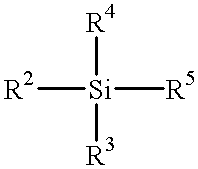
- the inert silane compound may be a compound represented by the formula
- R 2 , R 3 , R 4 and R 5 are independently hydrogen, a hydrocarbyl group, a fluorocarbon group, a hydrocarbyloxy group, or a hydroxy group.
- each of R 3 , R 4 and R 5 are methoxy or ethoxy
- R2 is a hydrocarbyl group or a fluorocarbon group.
- each of R 4 and R 5 are methoxy or ethoxy
- R 2 and R 3 are hydrocarbyl groups.
- inert silane compounds include methyltrimethoxysilane; ethyltrimethoxysilane; propyltrimethoxysilane; n-butyltrimethoxysilane; isobutyltrimethoxysilane; pentyltrimethoxysilane; hexyltrimethoxysilane; octyltrimethoxysilane; 7-oct-1-enyltrimethoxysilane; phenyltrimethoxysilane; hydrocarbyl substituted phenyltrimethoxysilanes such as p-(methyl)phenyltrimethoxysilane; 3-cyclopentadienylpropyltrimethoxysilane; vinyltrimethoxysilane; allyltrimethoxysilane; methoxypropyltrimethoxysilane; methyltriethoxysilane; ethyltriethoxysilane; prop
- the inert silane compound is methyltrimethoxysilane or isobutyltrimethoxysilane in combination with propyltrimethoxysilane.
- the inert silane compound is a fluorocarbonsilane in combination with an alkylsilane.
- the inert silane compound is (3,3,3-trifluoropropyl)trimethoxysilane in combination with propyltrimethoxysilane.
- the titanate compounds that are useful include di(cumyl)phenyl oxoethylene titanate; di(dioctyl)pyrophosphate oxoethylene titanate; isopropyl triisostearoyl titanate; isopropyl dimethacryl isostearoyl titanate; isopropyl tri(dodecyl)benzenesulfonyl titanate; isopropyl tri(dioctyl)phosphato titanate; isopropyl (4-amino)benzenesulfonyl di(dodecyl)benzenesulfonyl titanate; isopropyl tri(dioctyl)pyrophosphato titanate; tetraoctyl di(ditridecyl)phosphito titanate; tetra (2,2 diallyoxymethyl)butyl,di(ditridecyl)phosphito titanate; neopent
- zirconate compounds that are useful include neopentyl(diallyl)oxy,tri(dioctyl)phosphato zirconate. These compounds are sometimes referred to as zirconate coupling agents.
- silane, titanate and/or zirconate compounds can be used.
- the inert silane, titanate or zirconate compound solution may be in the form of a dispersion or solution in water, a mixture of water and alcohol, or a suitable organic solvent, or as an aqueous emulsion of the inert silane, titanate or zirconate compound, or as an aqueous emulsion of a solution of the inert silane, titanate or zirconate compound in a suitable organic solvent.
- Conventional organic solvents may be used. These include alcohols, ethers, ketones, and mixtures of these with aliphatic or aromatic hydrocarbons or with amides such as N,N-dimethylformamide.
- Useful solvents are those having good wetting and drying properties and include, for example, water, methanol, ethanol, isopropanol, and methylethylketone.
- Aqueous emulsions of the inert silane, titanate or zirconate compound may be formed in conventional manner using conventional dispersants and surfactants, including nonionic dispersants.
- the step of contacting the metal foil with the inert silane, titanate or zirconate solution may be repeated, if desired, several times. However, a single step gives generally useful results and, hence, the use of a single step is generally preferred. Contact is accomplished via suitable application methods which include reverse roller coating, doctor blade coating, dipping, immersing, painting and spraying, although immersing the metal foil in the inert silane, titanate or zirconate solution is preferred.
- the inert silane, titanate or zirconate compound is present in the solution in an amount from about 0.01% to about 10% v/v. In another embodiment, the inert silane, titanate or zirconate compound is present in the solution in an amount from about 0.05% to about 5% v/v. In yet another embodiment, the inert silane, titanate or zirconate compound is present in the solution in an amount from about 0.1% to about 2% v/v.
- the inert silane, titanate or zirconate compound and the inert silane, titanate or zirconate compound solution are typically at a temperature from about 10° C. to about 50° C. In another embodiment, the inert silane, titanate or zirconate compound solution is at a temperature from more about 15° C. to about 40° C. In yet another embodiment, the inert silane, titanate or zirconate compound solution is at a temperature from more about 20° C. to about 30° C.
- the metal foil is in contact with the inert silane, titanate or zirconate compound solution for a time sufficient for a dust resistant film to form on a surface of the metal foil.
- the metal foil is in contact with the inert silane, titanate or zirconate compound solution from about 1 second to about 10 minutes. In another embodiment, the metal foil is in contact with the inert silane, titanate or zirconate compound solution from about 5 seconds to about 100 seconds.
- the metal foil is permitted to dry or is optionally heated for a suitable period of time to drive off solvent and form an inert silane, titanate or zirconate compound film.
- the metal foil is heated to a temperature from about 50° C. to about 170° C. In another embodiment, the metal foil is heated to a temperature from about 70° C. to about 150° C. The metal foil is optionally heated for about 1 second to about 5 minutes. In another embodiment, the metal foil is optionally heated for about 10 seconds to about 2 minutes.
- the inventive treatment forms a resin dust resistant film on surface of the metal foil.
- the inventive treatment forms an epoxy resin dust resistant film on surface of the metal foil.
- the resin dust resistant film may be continuous, substantially continuous or non-continuous, so long as the film prevents resin dust from adhering, settling and/or accumulating on the treated metal foil surface.
- the resin dust resistant film is continuous or at least substantially continuous over the treated metal foil surface.
- the resin dust resistant film of the inert silane, titanate or zirconate compound on the metal foil has a thickness from about 0.001 to about 1 micron.
- the resin dust resistant film of the inert silane, titanate or zirconate compound on the metal foil has a thickness from about 0.0025 to about 0.1 microns. In yet another embodiment, the resin dust resistant film of the inert silane, titanate or zirconate compound on the metal foil has a thickness from about 0.005 to about 0.05 microns.
- the inert silane, titanate or zirconate compound solution may optionally contain certain additives.
- the inert silane, titanate or zirconate compound solution does not contain any additives.
- the inert silane, titanate or zirconate compound solution contains additives, such as triazole compounds.
- Triazole compounds include aminotriazoles, benzotriazole, hydroxybenzotriazole, alkyl substituted benzotriazoles such as methylbenzotriazole, and carboxylbenzotriazole.
- the inert silane, titanate or zirconate compound solution contains from about 0.01 g/l to about 10 g/l of one or more of the foregoing additives.
- the inert silane, titanate or zirconate compound solution contains from about 0.1 g/l to about 5 g/l of one or more of the foregoing additives.
- the inert silane, titanate or zirconate compound solution is metal free; that is, the inert silane, titanate or zirconate compound solution is characterized by the absence of added metals or metal compounds. In some instances metal compounds deleteriously affect the resultant inert silane, titanate or zirconate compound film formed.
- no electrolytic step is performed after the metal foil is treated in accordance with the invention. The absence of additional electrolytic steps simplifies methods of making metal foil as well as simplifying the fabrication of laminates for printed circuit boards.
- the metal foil after the metal foil has contacted the inert silane, titanate or zirconate compound, the metal foil is optionally rinsed with a neutral solution, and in most instances water and specifically deionized water.
- the neutralizing or rinsing solution serves to remove excess materials from the surface of the treated metal foil.
- the metal foils treated in accordance with the present invention can be bonded to dielectric substrates to provide dimensional and structural stability thereto.
- either the matte side or shiny side can be effectively bonded to a dielectric substrate, but the side of the foil treated in accordance with the present invention is not initially bonded to a dielectric substrate (however, in the case of double treated foil, both sides are eventually bonded to dielectric substrates).
- Useful dielectric substrates may be prepared by impregnating woven glass reinforcement materials with partially cured epoxy resins (e.g., difunctional, tetrafunctional and multifunctional epoxies), polyimide resins, or polyester resins. These dielectric substrates are sometimes referred to as prepregs, such as epoxy prepregs.
- both the prepreg material and the metal foil are provided in the form of long webs of material rolled up in rolls.
- these long webs of metal foil and prepreg are laminated using a continuous process.
- a continuous web of the treated metal foil often with an adhesion promoting layer adhered thereto is brought into contact with a continuous web of prepreg material under laminating conditions to form a laminate structure.
- This laminate structure is then cut into rectangular sheets and the rectangular sheets are then laid-up or assembled in stacks of assemblages.
- the long webs of treated metal foil and prepreg material are first cut into rectangular sheets and then subjected to lamination.
- rectangular sheets of the treated metal foil and rectangular sheets of the prepreg material are then laid-up or assembled in stacks of assemblages.
- Each assemblage may comprise a prepreg sheet with a sheet of treated metal foil on either side thereof, and in each instance, the adhesion bonding treated side (or one of the sides) of the metal foil is positioned adjacent the prepreg.
- the side of the metal foil processed in accordance with the present invention is facing away from the prepreg.
- the assemblage may be subjected to conventional laminating temperatures and pressures between the plates of laminating presses to prepare laminates comprising sandwiches of a sheet of prepreg between sheets of treated metal foil.
- the prepregs may consist of a woven glass reinforcement fabric impregnated with a resin, such as a partially cured two-stage resin in embodiments where an epoxy resin is employed.
- a resin such as a partially cured two-stage resin in embodiments where an epoxy resin is employed.
- the untreated (in accordance with the present invention) side of the copper foil is pressed tightly against the prepreg and the temperature to which the assemblage is subjected activates the resin to cause curing, that is crosslinking of the resin and thus tight bonding of the foil to the prepreg dielectric substrate.
- the laminating operation will involve pressures in the range of from about 100 to about 1,000 psi, temperatures in the range of from about 150° C. to 250° C. and a laminating cycle of from about 30 minutes to about 3 hours.
- the finished laminate may then be utilized to prepare printed circuit boards (PCB).
- the inert silane, titanate or zirconate compound is removed from the copper surface after lamination.
- the laminate is subjected to a subtractive copper etching process to form electrically conductive lines or an electrically conductive pattern as part of a process for making a multilayered circuit board.
- the inert silane, titanate or zirconate treatment is next removed from the patterned metal.
- a second bonding treatment is then conducted over the etched pattern using the techniques discussed above and then a second prepreg is adhered to the etched pattern.
- the etched pattern exhibits good dimensional control since resin dust does not effect the etching process.
- the techniques for making multilayered circuit boards are well known in the art.
- the treated metal foils obtainable in accordance with the invention exhibit high resin dust resistance when used in connection with prepregs. This is because the inventive method permits the treated metal foil to maintain a resin dust barrier during processing of the treated metal foil. Another advantage is that the treated metal foil exhibits excellent patternability when etching the foil.
- the treated metal foil is contacted with a dilute aqueous or organic acid or base solution.
- the individual inert silane, titanate or zirconate compound molecules are positioned on the surface of the metal foil so that the alkoxy end is adjacent the metal foil surface while the nonpolar substituent (hydrocarbyl or fluorocarbon end) is positioned away from the metal foil surface.
- the nonpolar substituent is believed to at least one of repel resin dust, prevent resin dust from settling on the metal foil surface, prevent resin dust from binding or strongly binding on the metal foil surface, and prevent resin dust from accumulating on the metal foil surface.
- silane solutions (6 inert silane compound solutions and 3 comparative silane solutions) are prepared containing about 1% v/v of the subject silane compound, water, and ethanol as needed to dissolve the silane compounds.
- the silane compounds are applied to the matte side of a drum side treated copper foil by dipping with a dwell time of about 20 seconds, then drying for about 1 minute at about 100° C.
- the coated copper foils (matte side) were then laminated to epoxy prepreg layers (either a 1 oz/ft 2 copper foil to a Polyclad ATS 140° C. T g epoxy prepreg or a 1 oz/ft 2 copper foil to a General Electric TS epoxy prepreg).
- the control does not have any silane compound thereon.
- coated foils are laminated to an epoxy prepreg at 250 psi pressure, heated to 177° C., and held together for about 1 hour, followed by cooling to room temperature. All of the laminates are imaged and etched to give a pattern of lines, all 0.125 inches wide.
- the lines are peeled halfway down to provide an initial peel strength as in the After Thermal Stress section of 2.4.8 of the IPC Test Methods Manual.
- Table 1 reports the peel strengths in pounds per inch. Peel strengths associated with the inert silanes is notably lower than the peel strengths associated with the comparative silanes.
- the silane compounds are trimethoxysilanes with the fourth silicon substituent specified in Table 1.
- a method of evaluating the effectiveness of the inventive resin dust resistant film is to coat a piece of foil on the desired side with one of the silane, titanate or zirconate compounds of the invention.
- the foil is then laid over a stack of the appropriate number of a selected type of prepreg with the desired side up.
- a selected number of resin dust particles is placed on the foil surface and a similar set up made with an identical foil that lacks the inventive resin dust resistant film.
- steel plates are placed on top of the foils and lamination proceeds as above. After lamination, the steel plates are removed and the number of resin dust particles on both foils and both steel plates counted with the aid of a black light source.
Landscapes
- Engineering & Computer Science (AREA)
- Manufacturing & Machinery (AREA)
- Microelectronics & Electronic Packaging (AREA)
- Laminated Bodies (AREA)
- Paints Or Removers (AREA)
Abstract
Description

| TABLE 1 | ||||
| Silane | PCL ATS | GE TS | ||
| control | 0.9 | 1.5 | ||
| methyl | 0.5 | 1.2 | ||
| propyl | 0.2 | 0.6 | ||
| isobutyl | 0.6 | 0.6 | ||
| octyl | 0.7 | 1.1 | ||
| trifluoropropyl | 0.6 | 1.3 | ||
| phenyl | 0.8 | 1.2 | ||
| aminopropyl | 3.7 | 5.4 | ||
| bromopropyl | 3.0 | 4.6 | ||
| glycidoxypropyl | 3.6 | 6.7 | ||
Claims (21)
Priority Applications (9)
| Application Number | Priority Date | Filing Date | Title |
|---|---|---|---|
| US09/211,283 US6299721B1 (en) | 1998-12-14 | 1998-12-14 | Coatings for improved resin dust resistance |
| CA 2286969 CA2286969A1 (en) | 1998-12-14 | 1999-10-20 | Coatings for improved resin dust resistance |
| JP33870699A JP3295404B2 (en) | 1998-12-14 | 1999-11-29 | Coating for improved resin dust resistance |
| CN99126119A CN1256974A (en) | 1998-12-14 | 1999-12-09 | Paint for improving resin stive property |
| EP19990310013 EP1011299A3 (en) | 1998-12-14 | 1999-12-13 | Coatings for improved resin dust resistance |
| KR1019990057635A KR100348410B1 (en) | 1998-12-14 | 1999-12-14 | A method of increasing resin dust resistance |
| US09/714,811 US6537675B1 (en) | 1998-12-14 | 2000-11-15 | Protective coatings for improved tarnish resistance in metal foils |
| US09/829,713 US6589381B2 (en) | 1998-12-14 | 2001-04-10 | Coatings for improved resin dust resistance |
| US10/395,334 US6805964B2 (en) | 1998-12-14 | 2003-03-24 | Protective coatings for improved tarnish resistance in metal foils |
Applications Claiming Priority (1)
| Application Number | Priority Date | Filing Date | Title |
|---|---|---|---|
| US09/211,283 US6299721B1 (en) | 1998-12-14 | 1998-12-14 | Coatings for improved resin dust resistance |
Related Child Applications (2)
| Application Number | Title | Priority Date | Filing Date |
|---|---|---|---|
| US09/714,811 Continuation-In-Part US6537675B1 (en) | 1998-12-14 | 2000-11-15 | Protective coatings for improved tarnish resistance in metal foils |
| US09/829,713 Continuation US6589381B2 (en) | 1998-12-14 | 2001-04-10 | Coatings for improved resin dust resistance |
Publications (1)
| Publication Number | Publication Date |
|---|---|
| US6299721B1 true US6299721B1 (en) | 2001-10-09 |
Family
ID=22786269
Family Applications (4)
| Application Number | Title | Priority Date | Filing Date |
|---|---|---|---|
| US09/211,283 Expired - Fee Related US6299721B1 (en) | 1998-12-14 | 1998-12-14 | Coatings for improved resin dust resistance |
| US09/714,811 Expired - Fee Related US6537675B1 (en) | 1998-12-14 | 2000-11-15 | Protective coatings for improved tarnish resistance in metal foils |
| US09/829,713 Expired - Fee Related US6589381B2 (en) | 1998-12-14 | 2001-04-10 | Coatings for improved resin dust resistance |
| US10/395,334 Expired - Fee Related US6805964B2 (en) | 1998-12-14 | 2003-03-24 | Protective coatings for improved tarnish resistance in metal foils |
Family Applications After (3)
| Application Number | Title | Priority Date | Filing Date |
|---|---|---|---|
| US09/714,811 Expired - Fee Related US6537675B1 (en) | 1998-12-14 | 2000-11-15 | Protective coatings for improved tarnish resistance in metal foils |
| US09/829,713 Expired - Fee Related US6589381B2 (en) | 1998-12-14 | 2001-04-10 | Coatings for improved resin dust resistance |
| US10/395,334 Expired - Fee Related US6805964B2 (en) | 1998-12-14 | 2003-03-24 | Protective coatings for improved tarnish resistance in metal foils |
Country Status (6)
| Country | Link |
|---|---|
| US (4) | US6299721B1 (en) |
| EP (1) | EP1011299A3 (en) |
| JP (1) | JP3295404B2 (en) |
| KR (1) | KR100348410B1 (en) |
| CN (1) | CN1256974A (en) |
| CA (1) | CA2286969A1 (en) |
Cited By (6)
| Publication number | Priority date | Publication date | Assignee | Title |
|---|---|---|---|---|
| WO2002068198A1 (en) * | 2001-02-23 | 2002-09-06 | Gould Electronics Inc. | Corrosion prevention for cac component |
| US6589381B2 (en) * | 1998-12-14 | 2003-07-08 | Gould Electronics, Inc. | Coatings for improved resin dust resistance |
| US6651317B2 (en) * | 2000-11-20 | 2003-11-25 | Nexans | Method for producing an electrical ribbon cable |
| US20060220495A1 (en) * | 2005-03-31 | 2006-10-05 | Canon Kabushiki Kaisha | Power supply apparatus, and image forming apparatus having the same |
| US20090114118A1 (en) * | 2007-11-02 | 2009-05-07 | Richard Moore | Coating solution for metal surfaces |
| CN115261951A (en) * | 2020-04-07 | 2022-11-01 | 巨腾国际控股有限公司 | High-gloss manufacturing method and structure of magnesium alloy object |
Families Citing this family (28)
| Publication number | Priority date | Publication date | Assignee | Title |
|---|---|---|---|---|
| WO2001099127A2 (en) * | 2000-06-19 | 2001-12-27 | The University Of Iowa Research Foundation | Coated metallic particles, methods and applications |
| US6893742B2 (en) * | 2001-02-15 | 2005-05-17 | Olin Corporation | Copper foil with low profile bond enhancement |
| KR20030092349A (en) * | 2002-05-29 | 2003-12-06 | (주)에취앤제이코퍼레이션 | A composite of a silicone coating material |
| JP3520285B1 (en) * | 2002-10-25 | 2004-04-19 | Fcm株式会社 | Aluminum stabilized laminate |
| US20050228745A1 (en) * | 2004-04-09 | 2005-10-13 | Cmarket, Inc. | Method and apparatus for conducting on-line auction events in coordination with incentive promotion for bidders |
| US7307022B2 (en) * | 2004-11-19 | 2007-12-11 | Endicott Interconnect Technologies, Inc. | Method of treating conductive layer for use in a circuitized substrate and method of making said substrate having said conductive layer as part thereof |
| DE102006023768A1 (en) * | 2006-05-20 | 2007-11-22 | Fraunhofer-Gesellschaft zur Förderung der angewandten Forschung e.V. | microgrippers |
| US8303792B1 (en) | 2007-08-29 | 2012-11-06 | Magnecomp Corporation | High strength electrodeposited suspension conductors |
| US20090123656A1 (en) * | 2007-11-13 | 2009-05-14 | Ernest Long | Composition and method for controlling galvanic corrosion in printed circuit boards |
| US20090242081A1 (en) * | 2008-03-26 | 2009-10-01 | Richard Bauer | Aluminum Treatment Composition |
| US10051743B2 (en) * | 2008-04-04 | 2018-08-14 | Hitachi Chemical Company, Ltd. | Two-layered laminate having metal foil cladded on its one surface, method for production of the laminate, single-sided printed wiring board, and method for production of the wiring board |
| CN101699177B (en) * | 2009-01-08 | 2012-05-02 | 上海交通大学 | Regenerative dehumidification heat exchanger |
| CN102341474B (en) | 2009-03-02 | 2014-09-24 | 霍尼韦尔国际公司 | Thermal interface material and methods of making and using it |
| US9333454B2 (en) | 2011-01-21 | 2016-05-10 | International Business Machines Corporation | Silicone-based chemical filter and silicone-based chemical bath for removing sulfur contaminants |
| US8900491B2 (en) | 2011-05-06 | 2014-12-02 | International Business Machines Corporation | Flame retardant filler |
| US9186641B2 (en) | 2011-08-05 | 2015-11-17 | International Business Machines Corporation | Microcapsules adapted to rupture in a magnetic field to enable easy removal of one substrate from another for enhanced reworkability |
| US8741804B2 (en) | 2011-10-28 | 2014-06-03 | International Business Machines Corporation | Microcapsules adapted to rupture in a magnetic field |
| US9716055B2 (en) | 2012-06-13 | 2017-07-25 | International Business Machines Corporation | Thermal interface material (TIM) with thermally conductive integrated release layer |
| US9647272B1 (en) | 2016-01-14 | 2017-05-09 | Chang Chun Petrochemical Co., Ltd. | Surface-treated copper foil |
| MX393621B (en) | 2016-03-08 | 2025-03-24 | Honeywell Int Inc | PHASE CHANGE MATERIAL. |
| CA3024136A1 (en) * | 2016-05-18 | 2017-11-23 | Isola Usa Corp. | Method of manufacturing circuit boards |
| US11041103B2 (en) | 2017-09-08 | 2021-06-22 | Honeywell International Inc. | Silicone-free thermal gel |
| CN108235588A (en) * | 2017-12-28 | 2018-06-29 | 江西鑫力华数码科技有限公司 | Flexible circuit board laminating apparatus and its applying method |
| US11072706B2 (en) | 2018-02-15 | 2021-07-27 | Honeywell International Inc. | Gel-type thermal interface material |
| CN110903684A (en) * | 2018-09-18 | 2020-03-24 | 广东美的白色家电技术创新中心有限公司 | Dustproof coating composition and preparation method and application thereof |
| US11373921B2 (en) | 2019-04-23 | 2022-06-28 | Honeywell International Inc. | Gel-type thermal interface material with low pre-curing viscosity and elastic properties post-curing |
| US10697082B1 (en) * | 2019-08-12 | 2020-06-30 | Chang Chun Petrochemical Co., Ltd. | Surface-treated copper foil |
| CN116041709B (en) * | 2023-01-16 | 2024-07-16 | 安徽立兴新材料有限公司 | Preparation method and application of photo-curing phenyl fluorosilicone modified epoxy paint and coating |
Citations (17)
| Publication number | Priority date | Publication date | Assignee | Title |
|---|---|---|---|---|
| SU1142526A1 (en) * | 1983-08-26 | 1985-02-28 | Владимирский политехнический институт | Method of treating copper foil |
| JPH01149866A (en) * | 1987-12-08 | 1989-06-12 | Yoshio Ichikawa | Method for coating |
| JPH0653651A (en) | 1992-07-28 | 1994-02-25 | Matsushita Electric Works Ltd | Manufacture of multilayer printed wiring board |
| JPH0685417A (en) | 1992-08-28 | 1994-03-25 | Nikko Guurudo Foil Kk | Surface treatment method for copper foil used for printed circuit |
| JPH0685455A (en) | 1992-08-28 | 1994-03-25 | Nikko Guurudo Foil Kk | Surface treatment of copper foil for printed circuit use |
| JPH06177536A (en) | 1992-12-09 | 1994-06-24 | Japan Energy Corp | Metal surface treatment agent |
| US5338619A (en) | 1991-05-16 | 1994-08-16 | Fukuda Metal Foil And Powder Co., Ltd. | Copper foil for printed circuits and method of producing same |
| JPH07258870A (en) | 1994-03-24 | 1995-10-09 | Mitsui Mining & Smelting Co Ltd | Organic anticorrosion treated copper foil and method for producing the same |
| JPH07278883A (en) | 1994-04-15 | 1995-10-24 | Fukuda Metal Foil & Powder Co Ltd | Copper foil for printed circuit and surface treatment method thereof |
| JPH07309846A (en) | 1994-05-20 | 1995-11-28 | Japan Energy Corp | Novel benzotriazole fluorosilane derivative, method for producing the same, and surface treatment agent using the same |
| EP0700238A1 (en) | 1994-08-30 | 1996-03-06 | MITSUI MINING & SMELTING CO., LTD. | Copper foil for use in making printed wiring board |
| JPH0888461A (en) | 1994-09-16 | 1996-04-02 | Ube Ind Ltd | Manufacturing method of wiring board with bending part |
| EP0716164A1 (en) | 1994-12-05 | 1996-06-12 | Mitsui Mining & Smelting Co., Ltd. | Organic rust-proof treated copper foil |
| WO1996025838A1 (en) | 1995-02-16 | 1996-08-22 | Mitsui Mining & Smelting Co., Ltd. | Copper foil and high-density multi-layered printed circuit board using the copper foil for inner layer circuit |
| US5605958A (en) * | 1994-09-21 | 1997-02-25 | Asahi Glass Company Ltd. | Composition for surface treatment |
| JPH10135202A (en) | 1996-10-28 | 1998-05-22 | Internatl Business Mach Corp <Ibm> | Integrated circuit device and manufacturing method thereof |
| US5976702A (en) * | 1995-04-25 | 1999-11-02 | Asahi Glass Company Ltd. | Composition for surface treatment |
Family Cites Families (12)
| Publication number | Priority date | Publication date | Assignee | Title |
|---|---|---|---|---|
| US3644166A (en) * | 1968-03-28 | 1972-02-22 | Westinghouse Electric Corp | Oxide-free multilayer copper clad laminate |
| US4875283A (en) | 1986-11-13 | 1989-10-24 | Johnston James A | Method for manufacturing printed circuit boards |
| US5153050A (en) | 1991-08-27 | 1992-10-06 | Johnston James A | Component of printed circuit boards |
| US5622782A (en) * | 1993-04-27 | 1997-04-22 | Gould Inc. | Foil with adhesion promoting layer derived from silane mixture |
| JP3347457B2 (en) * | 1994-02-24 | 2002-11-20 | 日本電解株式会社 | Non-cyanide copper-zinc electroplating bath, surface treatment method of copper foil for printed wiring board using the same, and copper foil for printed wiring board |
| JPH08311658A (en) * | 1995-05-17 | 1996-11-26 | Nippon Parkerizing Co Ltd | Composition for surface treatment of copper-based metal material |
| US6258156B1 (en) | 1996-04-02 | 2001-07-10 | Saint-Gobain Vitrage | Compound for a non-wettable coating, process for treatment of glass with the aid of the compound and products obtained |
| WO1998020395A1 (en) * | 1996-11-08 | 1998-05-14 | W.L. Gore & Associates, Inc. | Method of applying dry film photoresist |
| US5908544A (en) | 1997-09-04 | 1999-06-01 | Gould Electronics, Inc. | Zinc-chromium stabilizer containing a hydrogen inhibiting additive |
| DE19831461C1 (en) | 1998-07-14 | 2000-02-24 | Dieter Backhaus | Process for the partial connection of copper foils and separating sheets (CuAI process) |
| US6299721B1 (en) * | 1998-12-14 | 2001-10-09 | Gould Electronics Incl | Coatings for improved resin dust resistance |
| US6673471B2 (en) * | 2001-02-23 | 2004-01-06 | Nikko Materials Usa, Inc. | Corrosion prevention for CAC component |
-
1998
- 1998-12-14 US US09/211,283 patent/US6299721B1/en not_active Expired - Fee Related
-
1999
- 1999-10-20 CA CA 2286969 patent/CA2286969A1/en not_active Abandoned
- 1999-11-29 JP JP33870699A patent/JP3295404B2/en not_active Expired - Fee Related
- 1999-12-09 CN CN99126119A patent/CN1256974A/en active Pending
- 1999-12-13 EP EP19990310013 patent/EP1011299A3/en not_active Withdrawn
- 1999-12-14 KR KR1019990057635A patent/KR100348410B1/en not_active Expired - Fee Related
-
2000
- 2000-11-15 US US09/714,811 patent/US6537675B1/en not_active Expired - Fee Related
-
2001
- 2001-04-10 US US09/829,713 patent/US6589381B2/en not_active Expired - Fee Related
-
2003
- 2003-03-24 US US10/395,334 patent/US6805964B2/en not_active Expired - Fee Related
Patent Citations (21)
| Publication number | Priority date | Publication date | Assignee | Title |
|---|---|---|---|---|
| SU1142526A1 (en) * | 1983-08-26 | 1985-02-28 | Владимирский политехнический институт | Method of treating copper foil |
| JPH01149866A (en) * | 1987-12-08 | 1989-06-12 | Yoshio Ichikawa | Method for coating |
| US5338619A (en) | 1991-05-16 | 1994-08-16 | Fukuda Metal Foil And Powder Co., Ltd. | Copper foil for printed circuits and method of producing same |
| JPH0653651A (en) | 1992-07-28 | 1994-02-25 | Matsushita Electric Works Ltd | Manufacture of multilayer printed wiring board |
| JPH0685417A (en) | 1992-08-28 | 1994-03-25 | Nikko Guurudo Foil Kk | Surface treatment method for copper foil used for printed circuit |
| JPH0685455A (en) | 1992-08-28 | 1994-03-25 | Nikko Guurudo Foil Kk | Surface treatment of copper foil for printed circuit use |
| JPH06177536A (en) | 1992-12-09 | 1994-06-24 | Japan Energy Corp | Metal surface treatment agent |
| JPH07258870A (en) | 1994-03-24 | 1995-10-09 | Mitsui Mining & Smelting Co Ltd | Organic anticorrosion treated copper foil and method for producing the same |
| US5567534A (en) | 1994-04-15 | 1996-10-22 | Fukuda Metal Foil And Powder Co., Ltd. | Foil for a printed circuit |
| GB2288992A (en) | 1994-04-15 | 1995-11-08 | Fukuda Metal Foil And Powder C | Coating copper foil for printed circuits |
| JPH07278883A (en) | 1994-04-15 | 1995-10-24 | Fukuda Metal Foil & Powder Co Ltd | Copper foil for printed circuit and surface treatment method thereof |
| US5700362A (en) | 1994-04-15 | 1997-12-23 | Fukuda Metal Foil And Powder Co., Ltd. | Method of treating copper foil for printed circuits |
| JPH07309846A (en) | 1994-05-20 | 1995-11-28 | Japan Energy Corp | Novel benzotriazole fluorosilane derivative, method for producing the same, and surface treatment agent using the same |
| EP0700238A1 (en) | 1994-08-30 | 1996-03-06 | MITSUI MINING & SMELTING CO., LTD. | Copper foil for use in making printed wiring board |
| JPH0888461A (en) | 1994-09-16 | 1996-04-02 | Ube Ind Ltd | Manufacturing method of wiring board with bending part |
| US5605958A (en) * | 1994-09-21 | 1997-02-25 | Asahi Glass Company Ltd. | Composition for surface treatment |
| EP0716164A1 (en) | 1994-12-05 | 1996-06-12 | Mitsui Mining & Smelting Co., Ltd. | Organic rust-proof treated copper foil |
| WO1996025838A1 (en) | 1995-02-16 | 1996-08-22 | Mitsui Mining & Smelting Co., Ltd. | Copper foil and high-density multi-layered printed circuit board using the copper foil for inner layer circuit |
| US5976702A (en) * | 1995-04-25 | 1999-11-02 | Asahi Glass Company Ltd. | Composition for surface treatment |
| JPH10135202A (en) | 1996-10-28 | 1998-05-22 | Internatl Business Mach Corp <Ibm> | Integrated circuit device and manufacturing method thereof |
| US5962113A (en) | 1996-10-28 | 1999-10-05 | International Business Machines Corporation | Integrated circuit device and process for its manufacture |
Non-Patent Citations (2)
| Title |
|---|
| Appelt et al, "Improving Adhesion Between Metal Surfaces and Polymers," IBM TDB, vol. 25 No. 6, 11-1982 (156/326).* |
| Japanese Patent Office Official Action, Application No. 11-338706, dated Mar. 21, 2001. |
Cited By (10)
| Publication number | Priority date | Publication date | Assignee | Title |
|---|---|---|---|---|
| US6589381B2 (en) * | 1998-12-14 | 2003-07-08 | Gould Electronics, Inc. | Coatings for improved resin dust resistance |
| US20030178139A1 (en) * | 1998-12-14 | 2003-09-25 | Clouser Sidney J. | Protective coatings for improved tarnish resistance in metal foils |
| US6805964B2 (en) | 1998-12-14 | 2004-10-19 | Nikko Materials Usa, Inc. | Protective coatings for improved tarnish resistance in metal foils |
| US6651317B2 (en) * | 2000-11-20 | 2003-11-25 | Nexans | Method for producing an electrical ribbon cable |
| WO2002068198A1 (en) * | 2001-02-23 | 2002-09-06 | Gould Electronics Inc. | Corrosion prevention for cac component |
| US6673471B2 (en) * | 2001-02-23 | 2004-01-06 | Nikko Materials Usa, Inc. | Corrosion prevention for CAC component |
| US20060220495A1 (en) * | 2005-03-31 | 2006-10-05 | Canon Kabushiki Kaisha | Power supply apparatus, and image forming apparatus having the same |
| US20090114118A1 (en) * | 2007-11-02 | 2009-05-07 | Richard Moore | Coating solution for metal surfaces |
| US7833332B2 (en) * | 2007-11-02 | 2010-11-16 | Dubois Chemicals, Inc. | Coating solution for metal surfaces |
| CN115261951A (en) * | 2020-04-07 | 2022-11-01 | 巨腾国际控股有限公司 | High-gloss manufacturing method and structure of magnesium alloy object |
Also Published As
| Publication number | Publication date |
|---|---|
| US6537675B1 (en) | 2003-03-25 |
| US20010015257A1 (en) | 2001-08-23 |
| US6589381B2 (en) | 2003-07-08 |
| US6805964B2 (en) | 2004-10-19 |
| EP1011299A2 (en) | 2000-06-21 |
| KR20000057058A (en) | 2000-09-15 |
| JP2000226534A (en) | 2000-08-15 |
| KR100348410B1 (en) | 2002-08-10 |
| CN1256974A (en) | 2000-06-21 |
| EP1011299A3 (en) | 2003-02-05 |
| US20030178139A1 (en) | 2003-09-25 |
| JP3295404B2 (en) | 2002-06-24 |
| CA2286969A1 (en) | 2000-06-14 |
Similar Documents
| Publication | Publication Date | Title |
|---|---|---|
| US6589381B2 (en) | Coatings for improved resin dust resistance | |
| US5861076A (en) | Method for making multi-layer circuit boards | |
| US5622782A (en) | Foil with adhesion promoting layer derived from silane mixture | |
| EP0637902B1 (en) | Metallic foil with adhesion promoting layer | |
| CN107923047B (en) | Roughening of copper foil, copper clad laminates and printed circuit boards | |
| EP0678596A1 (en) | Metallic body with vapor-deposited treatment layer(s) and adhesion-promoting layer | |
| JP6013426B2 (en) | Copper foil for printed circuit | |
| US6086743A (en) | Adhesion enhancement for metal foil | |
| US5908542A (en) | Metal foil with improved bonding to substrates and method for making the foil | |
| JP3072839B2 (en) | Improved zinc-chromium stabilizer containing hydrogen suppression additive | |
| US5885436A (en) | Adhesion enhancement for metal foil | |
| WO2014042412A1 (en) | Method for surface-treating copper foil and copper foil surface-treated thereby | |
| WO2021131359A1 (en) | Surface-treated copper foil and method for manufacturing same | |
| CN108029202B (en) | Manufacturing method of printed circuit board | |
| KR102126611B1 (en) | Method for manufacturing peelable copper foil, coreless substrate and coreless substrate obtained by this method | |
| TWI488998B (en) | And a subsequent layer forming method and a subsequent layer forming method | |
| KR101096638B1 (en) | Strengthening Peel Strength of Copper Laminate | |
| JP5092136B2 (en) | Method for forming laminate | |
| KR20130132424A (en) | Method for manufacturing printed wiring board, and printed wiring board | |
| KR100305160B1 (en) | Metal foil with improved bonding to substrates and metnod for making said foil | |
| KR102868204B1 (en) | Coating solution for adhesion improving and coating method using same | |
| EP2603064A1 (en) | Multilayer printed circuit board manufacture |
Legal Events
| Date | Code | Title | Description |
|---|---|---|---|
| AS | Assignment |
Owner name: GOULD ELECTRONICS INC., OHIO Free format text: ASSIGNMENT OF ASSIGNORS INTEREST;ASSIGNORS:POUTASSE, CHARLES A.;CENTANNI, MICHAEL A.;REEL/FRAME:009654/0722 Effective date: 19981211 |
|
| AS | Assignment |
Owner name: GA-TEK INC., OHIO Free format text: CHANGE OF NAME;ASSIGNOR:GOULD ELECTRONICS INC.;REEL/FRAME:010370/0569 Effective date: 19971218 |
|
| AS | Assignment |
Owner name: NIKKO MATERIALS USA, INC., ARIZONA Free format text: BILL OF SALE AND INSTRUMENT OF ASSIGNMENT AND ASSUMPTION;ASSIGNOR:GOULD ELECTRONICS INC.;REEL/FRAME:014022/0437 Effective date: 20030930 |
|
| FPAY | Fee payment |
Year of fee payment: 4 |
|
| FPAY | Fee payment |
Year of fee payment: 8 |
|
| REMI | Maintenance fee reminder mailed | ||
| LAPS | Lapse for failure to pay maintenance fees | ||
| STCH | Information on status: patent discontinuation |
Free format text: PATENT EXPIRED DUE TO NONPAYMENT OF MAINTENANCE FEES UNDER 37 CFR 1.362 |
|
| FP | Lapsed due to failure to pay maintenance fee |
Effective date: 20131009 |