US6294668B1 - Vinylpyrrolidinone cephalosporin derivatives - Google Patents
Vinylpyrrolidinone cephalosporin derivatives Download PDFInfo
- Publication number
- US6294668B1 US6294668B1 US08/964,640 US96464097A US6294668B1 US 6294668 B1 US6294668 B1 US 6294668B1 US 96464097 A US96464097 A US 96464097A US 6294668 B1 US6294668 B1 US 6294668B1
- Authority
- US
- United States
- Prior art keywords
- oxo
- hydroxy
- thia
- oct
- ene
- Prior art date
- Legal status (The legal status is an assumption and is not a legal conclusion. Google has not performed a legal analysis and makes no representation as to the accuracy of the status listed.)
- Expired - Fee Related
Links
- YQZBFMJOASEONC-UHFFFAOYSA-N CCCC1=C(C)C=CC=C1 Chemical compound CCCC1=C(C)C=CC=C1 YQZBFMJOASEONC-UHFFFAOYSA-N 0.000 description 12
- PGSFBUZYQIPOHG-UHFFFAOYSA-N CCCC(=O)NC1C(=O)N2C(C(C)=O)=C(C=C3CCN(C)C3=O)CSC12 Chemical compound CCCC(=O)NC1C(=O)N2C(C(C)=O)=C(C=C3CCN(C)C3=O)CSC12 PGSFBUZYQIPOHG-UHFFFAOYSA-N 0.000 description 10
- 0 *C(N([C@]([C@@]1NC(CSc2cc3ccccc3cc2)=O)SC2)C1=O)=C2C=C(CCN1Cc2cccc(O)c2)C1=O Chemical compound *C(N([C@]([C@@]1NC(CSc2cc3ccccc3cc2)=O)SC2)C1=O)=C2C=C(CCN1Cc2cccc(O)c2)C1=O 0.000 description 6
- KPZQJTUZFODXEU-UHFFFAOYSA-N CCC.CN1=CC=CC=C1 Chemical compound CCC.CN1=CC=CC=C1 KPZQJTUZFODXEU-UHFFFAOYSA-N 0.000 description 5
- TWMBWGBPDPVLRZ-UHFFFAOYSA-N CC1=C(C=C2CCN(C)C2=O)CSC2C(N=[Rf])C(=O)N12.II Chemical compound CC1=C(C=C2CCN(C)C2=O)CSC2C(N=[Rf])C(=O)N12.II TWMBWGBPDPVLRZ-UHFFFAOYSA-N 0.000 description 3
- PVTSSNVEAIVIOQ-UHFFFAOYSA-N CCCC(=O)[Y] Chemical compound CCCC(=O)[Y] PVTSSNVEAIVIOQ-UHFFFAOYSA-N 0.000 description 3
- LKQLUTYGMMBIPC-UHFFFAOYSA-N C.CCC.CN1=CC=CC=C1 Chemical compound C.CCC.CN1=CC=CC=C1 LKQLUTYGMMBIPC-UHFFFAOYSA-N 0.000 description 2
- HNLPTEKMIFVTCO-AMXULNKQSA-M CCC(=O)N[C@@H]1C(=O)N2C(C)=C(/C=C3\CCN(C)C3=O)CS[C@H]12.[V]I Chemical compound CCC(=O)N[C@@H]1C(=O)N2C(C)=C(/C=C3\CCN(C)C3=O)CS[C@H]12.[V]I HNLPTEKMIFVTCO-AMXULNKQSA-M 0.000 description 2
- URSFMMQBKSICHO-YBFXNURJSA-N O=C(CN1=CC=C(CN2CC/C(=C\C3=C(C(=O)O)N4C(=O)C(NC(=O)CSC5=CC(Cl)=C(Cl)C=C5)C4SC3)C2=O)C=C1)NC1=CC(F)=C(O)C=C1 Chemical compound O=C(CN1=CC=C(CN2CC/C(=C\C3=C(C(=O)O)N4C(=O)C(NC(=O)CSC5=CC(Cl)=C(Cl)C=C5)C4SC3)C2=O)C=C1)NC1=CC(F)=C(O)C=C1 URSFMMQBKSICHO-YBFXNURJSA-N 0.000 description 2
- LGQQCTJWMSPNRQ-YBFXNURJSA-N O=C(CN1=CC=C(CN2CC/C(=C\C3=C(C(=O)O)N4C(=O)C(NC(=O)CSC5=CC(Cl)=C(Cl)C=C5Cl)C4SC3)C2=O)C=C1)NC1=CC=C(O)C=C1 Chemical compound O=C(CN1=CC=C(CN2CC/C(=C\C3=C(C(=O)O)N4C(=O)C(NC(=O)CSC5=CC(Cl)=C(Cl)C=C5Cl)C4SC3)C2=O)C=C1)NC1=CC=C(O)C=C1 LGQQCTJWMSPNRQ-YBFXNURJSA-N 0.000 description 2
- DATFNBZXHSGUKV-MFKUBSTISA-N O=C(CN1=CC=C(CN2CC/C(=C\C3=C(C(=O)O)N4C(=O)C(NC(=O)CSC5=CC=C6C=CC=CC6=C5)C4SC3)C2=O)C=C1)NC1=CC(F)=C(O)C=C1 Chemical compound O=C(CN1=CC=C(CN2CC/C(=C\C3=C(C(=O)O)N4C(=O)C(NC(=O)CSC5=CC=C6C=CC=CC6=C5)C4SC3)C2=O)C=C1)NC1=CC(F)=C(O)C=C1 DATFNBZXHSGUKV-MFKUBSTISA-N 0.000 description 2
- OMFXVGDTHOSLCN-CJLVFECKSA-N O=C(CN1=CC=C(CN2CC/C(=C\C3=C(C(=O)O)N4C(=O)C(NC(=O)CSC5=CC=CC=C5)C4SC3)C2=O)C=C1)NC1=CC=C(O)C=C1 Chemical compound O=C(CN1=CC=C(CN2CC/C(=C\C3=C(C(=O)O)N4C(=O)C(NC(=O)CSC5=CC=CC=C5)C4SC3)C2=O)C=C1)NC1=CC=C(O)C=C1 OMFXVGDTHOSLCN-CJLVFECKSA-N 0.000 description 2
- ILJMALFXTIHHDO-RCCKNPSSSA-N O=C(CN1=CC=C(CN2CC/C(=C\C3=C(C(=O)O)N4C(=O)C(NC(=O)CSC5=CC=NC=C5)C4SC3)C2=O)C=C1)NC1=CC=C(O)C=C1 Chemical compound O=C(CN1=CC=C(CN2CC/C(=C\C3=C(C(=O)O)N4C(=O)C(NC(=O)CSC5=CC=NC=C5)C4SC3)C2=O)C=C1)NC1=CC=C(O)C=C1 ILJMALFXTIHHDO-RCCKNPSSSA-N 0.000 description 2
- UZHSEQBRMYCVBT-RCCKNPSSSA-N O=C(CN1=CC=C(CN2CC/C(=C\C3=C(C(=O)O)N4C(=O)C(NC(=O)CSC5=NC6=C(C=CC=C6)S5)C4SC3)C2=O)C=C1)NC1=CC=C(O)C=C1 Chemical compound O=C(CN1=CC=C(CN2CC/C(=C\C3=C(C(=O)O)N4C(=O)C(NC(=O)CSC5=NC6=C(C=CC=C6)S5)C4SC3)C2=O)C=C1)NC1=CC=C(O)C=C1 UZHSEQBRMYCVBT-RCCKNPSSSA-N 0.000 description 2
- OLYBLURMVBPEFR-VZUCSPMQSA-N O=C(CSC1=CC(Cl)=C(Cl)C=C1Cl)NC1C(=O)N2C(C(=O)O)=C(/C=C3\CCN(C4CCNC4)C3=O)CSC12 Chemical compound O=C(CSC1=CC(Cl)=C(Cl)C=C1Cl)NC1C(=O)N2C(C(=O)O)=C(/C=C3\CCN(C4CCNC4)C3=O)CSC12 OLYBLURMVBPEFR-VZUCSPMQSA-N 0.000 description 2
- MWXMYXZBVPTEMN-VGOFMYFVSA-N O=C(CSC1=CC(Cl)=C(Cl)C=C1Cl)NC1C(=O)N2C(C(=O)O)=C(/C=C3\CCN(CC4=CC(O)=CC=C4)C3=O)CSC12 Chemical compound O=C(CSC1=CC(Cl)=C(Cl)C=C1Cl)NC1C(=O)N2C(C(=O)O)=C(/C=C3\CCN(CC4=CC(O)=CC=C4)C3=O)CSC12 MWXMYXZBVPTEMN-VGOFMYFVSA-N 0.000 description 2
- BCRWMGGSIDJMKS-LFYBBSHMSA-N O=C(CSC1=CC(Cl)=C(Cl)C=C1Cl)NC1C(=O)N2C(C(=O)O)=C(/C=C3\CCN(CC4CC4)C3=O)CSC12 Chemical compound O=C(CSC1=CC(Cl)=C(Cl)C=C1Cl)NC1C(=O)N2C(C(=O)O)=C(/C=C3\CCN(CC4CC4)C3=O)CSC12 BCRWMGGSIDJMKS-LFYBBSHMSA-N 0.000 description 2
- KVEXYKCYLJNGIV-FYJGNVAPSA-N O=C(CSC1=CC=C2C=CC=CC2=C1)NC1C(=O)N2C(C(=O)O)=C(/C=C3\CCN(CC4=CC=CC(O)=C4)C3=O)CSC12 Chemical compound O=C(CSC1=CC=C2C=CC=CC2=C1)NC1C(=O)N2C(C(=O)O)=C(/C=C3\CCN(CC4=CC=CC(O)=C4)C3=O)CSC12 KVEXYKCYLJNGIV-FYJGNVAPSA-N 0.000 description 2
- ZFQDIDOCXAFTLG-NTEUORMPSA-N O=C(CSC1=NC2=C(C=CC=C2)S1)NC1C(=O)N2C(C(=O)O)=C(/C=C3\CCN(CC4CC4)C3=O)CSC12 Chemical compound O=C(CSC1=NC2=C(C=CC=C2)S1)NC1C(=O)N2C(C(=O)O)=C(/C=C3\CCN(CC4CC4)C3=O)CSC12 ZFQDIDOCXAFTLG-NTEUORMPSA-N 0.000 description 2
- NMKMBVQXNQNOGG-YBFXNURJSA-N O=C(C[N+]1=CC=C(CN2CC/C(=C\C3=C(C(=O)[O-])N4C(=O)C(NC(=O)CSC5=C(Cl)C=CC(Cl)=C5)C4SC3)C2=O)C=C1)NC1=CC(F)=C(O)C=C1 Chemical compound O=C(C[N+]1=CC=C(CN2CC/C(=C\C3=C(C(=O)[O-])N4C(=O)C(NC(=O)CSC5=C(Cl)C=CC(Cl)=C5)C4SC3)C2=O)C=C1)NC1=CC(F)=C(O)C=C1 NMKMBVQXNQNOGG-YBFXNURJSA-N 0.000 description 2
- DXSFLCKGPGLBGM-KGENOOAVSA-N O=C(C[N+]1=CC=C(CN2CC/C(=C\C3=C(C(=O)[O-])N4C(=O)C(NC(=O)CSC5=CC=CC=C5)C4SC3)C2=O)C=C1)NC1=CC(F)=C(O)C=C1 Chemical compound O=C(C[N+]1=CC=C(CN2CC/C(=C\C3=C(C(=O)[O-])N4C(=O)C(NC(=O)CSC5=CC=CC=C5)C4SC3)C2=O)C=C1)NC1=CC(F)=C(O)C=C1 DXSFLCKGPGLBGM-KGENOOAVSA-N 0.000 description 2
- XMJCMCGASBLRPC-KMZJGFRYSA-N C.O=C(CSC1=CC=CC=C1)NC1C(=O)N2C(C(=O)O)=C(/C=C3\CCN(C4CCNC4)C3=O)CSC12 Chemical compound C.O=C(CSC1=CC=CC=C1)NC1C(=O)N2C(C(=O)O)=C(/C=C3\CCN(C4CCNC4)C3=O)CSC12 XMJCMCGASBLRPC-KMZJGFRYSA-N 0.000 description 1
- MGAAJSSFNYUKGO-RIYZIHGNSA-N C=CCOC(=O)N1CCC(N2CC/C(=C\C3=C(C(=O)O)N4C(=O)C(NC(=O)CSC5=CC(Cl)=C(Cl)C=C5Cl)C4SC3)C2=O)C1 Chemical compound C=CCOC(=O)N1CCC(N2CC/C(=C\C3=C(C(=O)O)N4C(=O)C(NC(=O)CSC5=CC(Cl)=C(Cl)C=C5Cl)C4SC3)C2=O)C1 MGAAJSSFNYUKGO-RIYZIHGNSA-N 0.000 description 1
- BJMZYKHXAVABSZ-ICSBZGNSSA-M CC(Br)C(=O)NC1C(=O)N2C(C(=O)O[Na])=C(/C=C3\CCN(CC4CC4)C3=O)CSC12 Chemical compound CC(Br)C(=O)NC1C(=O)N2C(C(=O)O[Na])=C(/C=C3\CCN(CC4CC4)C3=O)CSC12 BJMZYKHXAVABSZ-ICSBZGNSSA-M 0.000 description 1
- JHCGULBYNIXHHB-LWRCIUTKSA-N CC(C(N[C@@H]([C@H]1SCC(/C=C(\CCN2CC3CC3)/C2=O)=C(C(O)=O)N11)C1=O)=O)Sc(cc(cc1)Cl)c1Cl Chemical compound CC(C(N[C@@H]([C@H]1SCC(/C=C(\CCN2CC3CC3)/C2=O)=C(C(O)=O)N11)C1=O)=O)Sc(cc(cc1)Cl)c1Cl JHCGULBYNIXHHB-LWRCIUTKSA-N 0.000 description 1
- LZAHBNLUIJZAAN-FLIBITNWSA-N CC(C)=C(/C=C1/CCN(C)C1=O)C(C)C Chemical compound CC(C)=C(/C=C1/CCN(C)C1=O)C(C)C LZAHBNLUIJZAAN-FLIBITNWSA-N 0.000 description 1
- LZAHBNLUIJZAAN-DHZHZOJOSA-N CC(C)=C(/C=C1\CCN(C)C1=O)C(C)C Chemical compound CC(C)=C(/C=C1\CCN(C)C1=O)C(C)C LZAHBNLUIJZAAN-DHZHZOJOSA-N 0.000 description 1
- JHCGULBYNIXHHB-RIYZIHGNSA-N CC(SC1=CC(Cl)=CC=C1Cl)C(=O)NC1C(=O)N2C(C(=O)O)=C(/C=C3\CCN(CC4CC4)C3=O)CSC12 Chemical compound CC(SC1=CC(Cl)=CC=C1Cl)C(=O)NC1C(=O)N2C(C(=O)O)=C(/C=C3\CCN(CC4CC4)C3=O)CSC12 JHCGULBYNIXHHB-RIYZIHGNSA-N 0.000 description 1
- CSCFMIZZZSNPRE-NTEUORMPSA-N CC(SC1=NC=CC=N1)C(=O)NC1C(=O)N2C(C(=O)O)=C(/C=C3\CCN(CC4CC4)C3=O)CSC12 Chemical compound CC(SC1=NC=CC=N1)C(=O)NC1C(=O)N2C(C(=O)O)=C(/C=C3\CCN(CC4CC4)C3=O)CSC12 CSCFMIZZZSNPRE-NTEUORMPSA-N 0.000 description 1
- OTIJFUQJBZFERT-RRAJOLSVSA-M CC(SC1=NN=NN1C)C(=O)NC1C(=O)N2C(C(=O)O[Na])=C(/C=C3\CCN(CC4CC4)C3=O)CSC12 Chemical compound CC(SC1=NN=NN1C)C(=O)NC1C(=O)N2C(C(=O)O[Na])=C(/C=C3\CCN(CC4CC4)C3=O)CSC12 OTIJFUQJBZFERT-RRAJOLSVSA-M 0.000 description 1
- VSYLNUNWMSIBFW-RKXADJTHSA-N CC.CC1=C(/C=C2\CCN(C)C2=O)CSC2C(N[Rf])C(=O)N12.CCC(=O)N[C@@H]1C(=O)N2C(C)=C(/C=C3\CCN(C)C3=O)CS[C@H]12.CCC(C)=O.CCCC(=O)N[C@@H]1C(=O)N2C(C)=C(/C=C3\CCN(C)C3=O)CS[C@H]12.II Chemical compound CC.CC1=C(/C=C2\CCN(C)C2=O)CSC2C(N[Rf])C(=O)N12.CCC(=O)N[C@@H]1C(=O)N2C(C)=C(/C=C3\CCN(C)C3=O)CS[C@H]12.CCC(C)=O.CCCC(=O)N[C@@H]1C(=O)N2C(C)=C(/C=C3\CCN(C)C3=O)CS[C@H]12.II VSYLNUNWMSIBFW-RKXADJTHSA-N 0.000 description 1
- XFSOSQUKLPYPOF-UHFFFAOYSA-N CCC.C[N+]1=CC=CC=C1 Chemical compound CCC.C[N+]1=CC=CC=C1 XFSOSQUKLPYPOF-UHFFFAOYSA-N 0.000 description 1
- IMVOYPATJNRLRA-UHFFFAOYSA-N CCCC(=O)NC1C(=O)N2C(C(C)=O)=C(C=C3CCN(C)C3)CSC12.[V] Chemical compound CCCC(=O)NC1C(=O)N2C(C(C)=O)=C(C=C3CCN(C)C3)CSC12.[V] IMVOYPATJNRLRA-UHFFFAOYSA-N 0.000 description 1
- AYEDWIPGMLOADB-UHFFFAOYSA-N CCCC(=O)NC1C(=O)N2C(C(C)=O)=C(C=C3CCN(C)C3=O)CSC12.[V] Chemical compound CCCC(=O)NC1C(=O)N2C(C(C)=O)=C(C=C3CCN(C)C3=O)CSC12.[V] AYEDWIPGMLOADB-UHFFFAOYSA-N 0.000 description 1
- KPIXTEDTGSAGMQ-BRJUVQQESA-N CCCC(=O)N[C@@H]1C(=O)N2C(C)=C(/C=C3\CCN(C)C3=O)CS[C@H]12.CCCC(=O)[Y].II Chemical compound CCCC(=O)N[C@@H]1C(=O)N2C(C)=C(/C=C3\CCN(C)C3=O)CS[C@H]12.CCCC(=O)[Y].II KPIXTEDTGSAGMQ-BRJUVQQESA-N 0.000 description 1
- IZGZYASYQJJNEA-VCHYOVAHSA-N CN1C=NN=C1SCC(=O)NC1C(=O)N2C(C(=O)[O-])=C(/C=C3\CCN(CC4=CC=[N+](CC(=O)NC5=CC=C(O)C(F)=C5)C=C4)C3=O)CSC12 Chemical compound CN1C=NN=C1SCC(=O)NC1C(=O)N2C(C(=O)[O-])=C(/C=C3\CCN(CC4=CC=[N+](CC(=O)NC5=CC=C(O)C(F)=C5)C=C4)C3=O)CSC12 IZGZYASYQJJNEA-VCHYOVAHSA-N 0.000 description 1
- PYEZXIHWYJDFDZ-GZTJUZNOSA-N COC1=C(OC)C=C(SCC(=O)NC2C(=O)N3C(C(=O)O)=C(/C=C4\CCN(CC5=CC(O)=CC=C5)C4=O)CSC23)C=C1 Chemical compound COC1=C(OC)C=C(SCC(=O)NC2C(=O)N3C(C(=O)O)=C(/C=C4\CCN(CC5=CC(O)=CC=C5)C4=O)CSC23)C=C1 PYEZXIHWYJDFDZ-GZTJUZNOSA-N 0.000 description 1
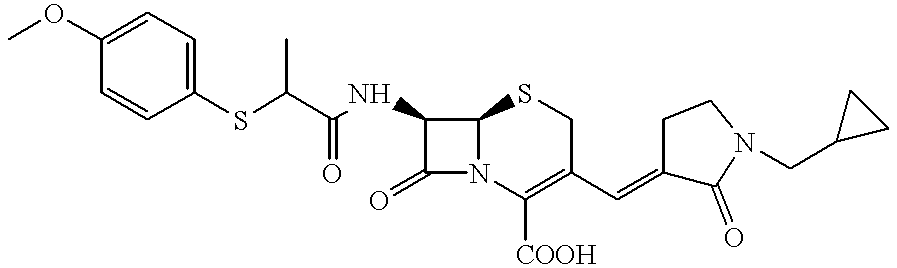
- BRYSLAWYDSINFQ-LFIBNONCSA-N COC1=CC=C(SC(C)C(=O)NC2C(=O)N3C(C(=O)O)=C(/C=C4\CCN(CC5CC5)C4=O)CSC23)C=C1 Chemical compound COC1=CC=C(SC(C)C(=O)NC2C(=O)N3C(C(=O)O)=C(/C=C4\CCN(CC5CC5)C4=O)CSC23)C=C1 BRYSLAWYDSINFQ-LFIBNONCSA-N 0.000 description 1
- WRNYKJUUXMSUQG-VZUCSPMQSA-N NC1=NC(CC(=O)NC2C(=O)N3C(C(=O)O)=C(/C=C4\CCN(CC5CC5)C4=O)CSC23)=CS1 Chemical compound NC1=NC(CC(=O)NC2C(=O)N3C(C(=O)O)=C(/C=C4\CCN(CC5CC5)C4=O)CSC23)=CS1 WRNYKJUUXMSUQG-VZUCSPMQSA-N 0.000 description 1
- AYAWWKPZTJHYLA-WOJGMQOQSA-N NC1=NC(CC(=O)NC2C(=O)N3C(C(=O)[O-])=C(/C=C4\CCN(CC5=CC=[N+](CC(=O)NC6=CC=C(O)C=C6)C=C5)C4=O)CSC23)=CS1 Chemical compound NC1=NC(CC(=O)NC2C(=O)N3C(C(=O)[O-])=C(/C=C4\CCN(CC5=CC=[N+](CC(=O)NC6=CC=C(O)C=C6)C=C5)C4=O)CSC23)=CS1 AYAWWKPZTJHYLA-WOJGMQOQSA-N 0.000 description 1
- PISRYZZVFNBMBY-MDWZMJQESA-N O=C(CC1=CC=CS1)NC1C(=O)N2C(C(=O)O)=C(/C=C3\CCN(CC4CC4)C3=O)CSC12 Chemical compound O=C(CC1=CC=CS1)NC1C(=O)N2C(C(=O)O)=C(/C=C3\CCN(CC4CC4)C3=O)CSC12 PISRYZZVFNBMBY-MDWZMJQESA-N 0.000 description 1
- RKXLRLJTCQVOTL-GIJQJNRQSA-N O=C(CN1=CC=C(CN2CC/C(=C\C3=C(C(=O)O)N4C(=O)C(NC(=O)CSC5=CC(Cl)=C(Cl)C=C5Cl)C4SC3)C2=O)C=C1)NC1=CC(F)=C(O)C=C1 Chemical compound O=C(CN1=CC=C(CN2CC/C(=C\C3=C(C(=O)O)N4C(=O)C(NC(=O)CSC5=CC(Cl)=C(Cl)C=C5Cl)C4SC3)C2=O)C=C1)NC1=CC(F)=C(O)C=C1 RKXLRLJTCQVOTL-GIJQJNRQSA-N 0.000 description 1
- WBFBJNDOCWBNFQ-YBFXNURJSA-N O=C(CSC1=C/C2=CC=CC=C2/C=C\1)NC1C(=O)N2C(C(=O)O)=C(/C=C3\CCN(CC4CC4)C3=O)CSC12 Chemical compound O=C(CSC1=C/C2=CC=CC=C2/C=C\1)NC1C(=O)N2C(C(=O)O)=C(/C=C3\CCN(CC4CC4)C3=O)CSC12 WBFBJNDOCWBNFQ-YBFXNURJSA-N 0.000 description 1
- GOMVZQJUHLIKEG-GZTJUZNOSA-N O=C(CSC1=CC2=C(C=CC=C2)C=C1)NC1C(=O)N2C(C(=O)O)=C(/C=C3\CCN(C4CC4)C3=O)CSC12 Chemical compound O=C(CSC1=CC2=C(C=CC=C2)C=C1)NC1C(=O)N2C(C(=O)O)=C(/C=C3\CCN(C4CC4)C3=O)CSC12 GOMVZQJUHLIKEG-GZTJUZNOSA-N 0.000 description 1
- ZKOPYNGGTRUZKF-SFQUDFHCSA-N O=C(CSC1=CC=CC=C1)NC1C(=O)N2C(C(=O)O)=C(/C=C3\CCN(CC4=CC(O)=CC=C4)C3=O)CSC12 Chemical compound O=C(CSC1=CC=CC=C1)NC1C(=O)N2C(C(=O)O)=C(/C=C3\CCN(CC4=CC(O)=CC=C4)C3=O)CSC12 ZKOPYNGGTRUZKF-SFQUDFHCSA-N 0.000 description 1
- PFUXWCSRMLLTAR-XNTDXEJSSA-N O=C(CSC1=CC=CC=C1)NC1C(=O)N2C(C(=O)O)=C(/C=C3\CCN(CC4CC4)C3=O)CSC12 Chemical compound O=C(CSC1=CC=CC=C1)NC1C(=O)N2C(C(=O)O)=C(/C=C3\CCN(CC4CC4)C3=O)CSC12 PFUXWCSRMLLTAR-XNTDXEJSSA-N 0.000 description 1
- TWMDNWYYWPTNBJ-NTEUORMPSA-N O=C(CSC1=CC=NC=C1)NC1C(=O)N2C(C(=O)O)=C(/C=C3\CCN(CC4CC4)C3=O)CSC12 Chemical compound O=C(CSC1=CC=NC=C1)NC1C(=O)N2C(C(=O)O)=C(/C=C3\CCN(CC4CC4)C3=O)CSC12 TWMDNWYYWPTNBJ-NTEUORMPSA-N 0.000 description 1
- YOLSMHQCNJTMDX-CXUHLZMHSA-N O=C(C[N+]1=CC=C(CN2CC/C(=C\C3=C(C(=O)[O-])N4C(=O)C(NC(=O)CBr)C4SC3)C2=O)C=C1)NC1=CC=C(O)C(F)=C1 Chemical compound O=C(C[N+]1=CC=C(CN2CC/C(=C\C3=C(C(=O)[O-])N4C(=O)C(NC(=O)CBr)C4SC3)C2=O)C=C1)NC1=CC=C(O)C(F)=C1 YOLSMHQCNJTMDX-CXUHLZMHSA-N 0.000 description 1
- BCBWAICQDBADLY-GIJQJNRQSA-N O=C(C[N+]1=CC=C(CN2CC/C(=C\C3=C(C(=O)[O-])N4C(=O)C(NC(=O)CSC5=C(Cl)C=C(Cl)C(Cl)=C5)C4SC3)C2=O)C=C1)NC1=CC=C(O)C(F)=C1 Chemical compound O=C(C[N+]1=CC=C(CN2CC/C(=C\C3=C(C(=O)[O-])N4C(=O)C(NC(=O)CSC5=C(Cl)C=C(Cl)C(Cl)=C5)C4SC3)C2=O)C=C1)NC1=CC=C(O)C(F)=C1 BCBWAICQDBADLY-GIJQJNRQSA-N 0.000 description 1
- NMTJNODTJJXZAE-DEDYPNTBSA-N O=C(C[N+]1=CC=C(CN2CC/C(=C\C3=C(C(=O)[O-])N4C(=O)C(NC(=O)CSC5=CC=C(C(F)(F)F)C=C5)C4SC3)C2=O)C=C1)NC1=CC=C(O)C(F)=C1 Chemical compound O=C(C[N+]1=CC=C(CN2CC/C(=C\C3=C(C(=O)[O-])N4C(=O)C(NC(=O)CSC5=CC=C(C(F)(F)F)C=C5)C4SC3)C2=O)C=C1)NC1=CC=C(O)C(F)=C1 NMTJNODTJJXZAE-DEDYPNTBSA-N 0.000 description 1
- YBEVQUMHLLEAOA-CJLVFECKSA-O O=C(C[N+]1=CC=C(CN2CC/C(=C\C3=C(C(=O)[O-])N4C(=O)C(NC(=O)C[N+]5=CC=CC=C5)C4SC3)C2=O)C=C1)NC1=CC=C(O)C=C1.[Br-] Chemical compound O=C(C[N+]1=CC=C(CN2CC/C(=C\C3=C(C(=O)[O-])N4C(=O)C(NC(=O)C[N+]5=CC=CC=C5)C4SC3)C2=O)C=C1)NC1=CC=C(O)C=C1.[Br-] YBEVQUMHLLEAOA-CJLVFECKSA-O 0.000 description 1
- BWZVBMCPTMTMCA-CJLVFECKSA-N O=C(O)C1=C(/C=C2\CCN(CC3CC3)C2=O)CSC2C(NC(=O)C(CC3=CC=CC=C3)C3=CC=CC=C3)C(=O)N12 Chemical compound O=C(O)C1=C(/C=C2\CCN(CC3CC3)C2=O)CSC2C(NC(=O)C(CC3=CC=CC=C3)C3=CC=CC=C3)C(=O)N12 BWZVBMCPTMTMCA-CJLVFECKSA-N 0.000 description 1
- PISRYZZVFNBMBY-LAMRDFNDSA-N OC(C(N([C@@H]([C@@H]1NC(Cc2ccc[s]2)=O)SC2)C1=O)=C2/C=C(\CCN1CC2CC2)/C1=O)=O Chemical compound OC(C(N([C@@H]([C@@H]1NC(Cc2ccc[s]2)=O)SC2)C1=O)=C2/C=C(\CCN1CC2CC2)/C1=O)=O PISRYZZVFNBMBY-LAMRDFNDSA-N 0.000 description 1
Classifications
-
- C—CHEMISTRY; METALLURGY
- C07—ORGANIC CHEMISTRY
- C07D—HETEROCYCLIC COMPOUNDS
- C07D501/00—Heterocyclic compounds containing 5-thia-1-azabicyclo [4.2.0] octane ring systems, i.e. compounds containing a ring system of the formula:, e.g. cephalosporins; Such ring systems being further condensed, e.g. 2,3-condensed with an oxygen-, nitrogen- or sulfur-containing hetero ring
- C07D501/14—Compounds having a nitrogen atom directly attached in position 7
- C07D501/16—Compounds having a nitrogen atom directly attached in position 7 with a double bond between positions 2 and 3
- C07D501/18—7-Aminocephalosporanic or substituted 7-aminocephalosporanic acids
-
- C—CHEMISTRY; METALLURGY
- C07—ORGANIC CHEMISTRY
- C07D—HETEROCYCLIC COMPOUNDS
- C07D501/00—Heterocyclic compounds containing 5-thia-1-azabicyclo [4.2.0] octane ring systems, i.e. compounds containing a ring system of the formula:, e.g. cephalosporins; Such ring systems being further condensed, e.g. 2,3-condensed with an oxygen-, nitrogen- or sulfur-containing hetero ring
-
- A—HUMAN NECESSITIES
- A61—MEDICAL OR VETERINARY SCIENCE; HYGIENE
- A61P—SPECIFIC THERAPEUTIC ACTIVITY OF CHEMICAL COMPOUNDS OR MEDICINAL PREPARATIONS
- A61P31/00—Antiinfectives, i.e. antibiotics, antiseptics, chemotherapeutics
- A61P31/04—Antibacterial agents
-
- Y—GENERAL TAGGING OF NEW TECHNOLOGICAL DEVELOPMENTS; GENERAL TAGGING OF CROSS-SECTIONAL TECHNOLOGIES SPANNING OVER SEVERAL SECTIONS OF THE IPC; TECHNICAL SUBJECTS COVERED BY FORMER USPC CROSS-REFERENCE ART COLLECTIONS [XRACs] AND DIGESTS
- Y02—TECHNOLOGIES OR APPLICATIONS FOR MITIGATION OR ADAPTATION AGAINST CLIMATE CHANGE
- Y02P—CLIMATE CHANGE MITIGATION TECHNOLOGIES IN THE PRODUCTION OR PROCESSING OF GOODS
- Y02P20/00—Technologies relating to chemical industry
- Y02P20/50—Improvements relating to the production of bulk chemicals
- Y02P20/55—Design of synthesis routes, e.g. reducing the use of auxiliary or protecting groups
Definitions
- This invention is in the field of antibacterial agents which are cephalosporin derivatives.
- cephalosporin derivatives are disclosed in PCT International Publication No.WO 96/26943, published Sep. 6, 1996 (F. Hoffmann-La Roche A G); U.S. Pat. No. 5,523,400, issued Jun. 4, 1996 (Wei et al.); European Patent Publication No. EP 0 699 681 A1, published Mar. 6, 1996 (Bristol-Myers Co.); and European Patent Publication No. EP 0 727 426 A2, published Aug. 21, 1996 (Bristol-Myers Co.).
- the present invention provides cephalosporin derivatives of the formula
- R 1 is halogen, lower alkyl, phenyl, benzyl, styryl, naphthyl or heterocyclyl; the lower alkyl, phenyl, benzyl, styryl, naphthyl and heterocyclyl being optionally substituted by at least one of halogen, hydroxy, optionally substituted lower alkyl, optionally substituted lower alkoxy, optionally substituted phenyl, amino, lower alkylamino, di-lower alkylamino, carboxy, lower alkylcarboxy, carbamoyl or lower alkylcarbamoyl;
- R 4 , R 5 independently are hydrogen, lower alkyl or phenyl
- X is S, O, NH or CH 2 ;
- n 0, 1 or 2;
- n 0 or 1
- s is 0 or 1;
- R 2 is hydrogen, hydroxy, —CH 2 —CONHR 6 , lower alkyl-Q r , cycloalkyl-Q r , lower alkoxy, lower alkenyl, cycloalkenyl-Q r , lower alkynyl, aralkyl-Q r , aryl-Q r , aryloxy, aralkoxy, a heterocyclic ring or a heterocyclyl-Q r , the lower alkyl, cycloalkyl, lower alkoxy, lower alkenyl, cycloalkenyl, lower alkynyl, aralkyl, aryl, aryloxy, aralkoxy and the heterocyclic ring may be substituted with at least one group selected from carboxy, amino, nitro, cyano, —SO 2 NHR 6 , optionally fluoro substituted lower alkyl, lower alkoxy, hydroxy, halogen, —CONR 6 R 7 ,
- R 6 is hydrogen, lower alkyl, cycloalkyl or aryl
- R 7 and R 9 are independently hydrogen or lower alkyl
- R 8 is hydrogen, lower alkyl, lower alkenyl or a carboxylic acid protecting group
- R 10 is hydrogen, ⁇ -hydroxy-alkyl, phenyl, naphthyl or heterocyclyl, the phenyl, naphthyl or heterocyclyl being unsubstituted or substituted with at least one of the groups of optionally protected hydroxy, halogen, optionally substituted lower alkyl or ⁇ -hydroxyalkyl, optionally substituted lower alkoxy and/or cyano, or R 7 and R 10 form together group of formula
- Q is —CHR—, —CO— or —SO 2 —;
- r is 0 or 1;
- R is hydrogen or lower alkyl
- R 3 is hydroxy, —O ⁇ , lower-alkoxy, or —OM and M represents an alkali metal;
- the compounds of formula I possess antibacterial activity against beta-lactam sensitive and resistant gram-positive bacteria, such as staphylococci, pneumococci, and enterococci. These compounds are useful both in vivo in the treatment of infectious diseases caused by such bacteria, as well as ex vivo as a disinfectant.
- This invention also provides a process for producing a compound of the formula
- R 1 is halogen, lower alkyl, phenyl, benzyl, styryl, naphthyl or heterocyclyl; the lower alkyl, phenyl, benzyl, styryl, naphthyl and heterocyclyl being optionally substituted by at least one of halogen, hydroxy, optionally substituted lower alkyl, optionally substituted lower alkoxy, optionally substituted phenyl, amino, lower alkylamino, di-lower alkylamino, carboxy, lower alkylcarboxy, carbamoyl or lower alkylcarbamoyl;
- R 4 , R 5 independently are hydrogen, lower alkyl or phenyl
- X is S, O, NH or CH 2 ;
- n 0, 1 or 2;
- n 0 or 1
- s is 0or 1;
- R 2 is hydrogen, hydroxy, —CH 2 —CONHR 6 , lower alkyl-Q r , cycloalkyl-Q r , lower alkoxy, lower alkenyl, cycloalkenyl-Q r , lower alkynyl, aralkyl-Q r , aryl-Q r , aryloxy, aralkoxy, a heterocyclic ring or a heterocyclyl-Q r , the lower alkyl, cycloalkyl, lower alkoxy, lower alkenyl, cycloalkenyl, lower alkynyl, aralkyl, aryl, aryloxy, aralkoxy and the heterocyclic ring is optionally substituted with at least one group selected from carboxy, amino, nitro, cyano, —SO 2 NHR 6 , optionally fluoro substituted lower alkyl, lower alkoxy, hydroxy, halogen, —CONR 6 R 7
- R 6 is hydrogen, lower alkyl, cycloalkyl or aryl
- R 7 and R 9 are independently hydrogen or lower alkyl
- R 8 is hydrogen, lower alkyl, lower alkenyl or a carboxylic acid protecting group
- R 10 is hydrogen, ⁇ -hydroxy-alkyl, phenyl, naphthyl or heterocyclyl, the phenyl, naphthyl or heterocyclyl being unsubstituted or substituted with at least one of the groups of optionally protected hydroxy, halogen, optionally substituted lower alkyl or ⁇ -hydroxyalkyl, optionally substituted lower alkoxy and/or cyano, or R 7 and R 10 form together group of formula
- Q is —CHR—, —CO— or —SO 2 —;
- r is 0 or 1;
- R is hydrogen or lower alkyl
- R 3 is hydroxy or —O ⁇ ;
- R f is hydrogen or trimethylsilyl
- R g is hydrogen, benzhydryl, p-methoxybenzyl, t-butyl, trimethylsilyl or allyl or salt thereof,
- This invention provides a compound of the formula
- R 1 is halogen, lower alkyl, phenyl, benzyl, styryl, naphthyl or heterocyclyl; the lower alkyl, phenyl, benzyl, styryl, naphthyl and heterocyclyl being optionally substituted by at least one of halogen, hydroxy, optionally substituted lower alkyl, optionally substituted lower alkoxy, optionally substituted phenyl, amino, lower alkylamino, di-lower alkylamino, carboxy, lower alkylcarboxy, carbamoyl or lower alkylcarbamoyl;
- X is S, O, NH or CH 2 ;
- n 0, 1 or 2;
- n 0 or 1
- s is 0 or 1;
- R 2 is hydrogen, hydroxy, —CH 2 —CONHR 6 , lower alkyl-Q r , cycloalkyl-Q r , lower alkoxy, lower alkenyl, cycloalkenyl-Q r , lower alkynyl, aralkyl-Q r , aryl-Q r , aryloxy, aralkoxy, a heterocyclic ring or a heterocyclyl-Q r , the lower alkyl, cycloalkyl, lower alkoxy, lower alkenyl, cycloalkenyl, lower alkynyl, aralkyl, aryl, aryloxy, aralkoxy and the heterocyclic ring is optionally substituted with at least one group selected from carboxy, amino, nitro, cyano, —SO 2 NHR 6 , optionally fluoro substituted lower alkyl, lower alkoxy, hydroxy, halogen, —CONR 6 R 7
- R 6 is hydrogen, lower alkyl, cycloalkyl or aryl
- R 7 and R 9 are independently hydrogen or lower alkyl
- Q is —CHR—, —CO— or —SO 2 —;
- r is 0 or 1;
- R is hydrogen or lower alkyl
- R 3 is hydroxy, —O ⁇ , lower-alkoxy, or —OM and M is an alkali metal;
- n 1
- halogen or “halo” used herein refers to all four forms, that is chlorine or chloro; bromine or bromo; iodine or iodo; and fluorine or fluoro, unless specified otherwise.
- alkyl and lower alkyl refer to both straight and branched chain saturated hydrocarbon groups having 1 to 8, and preferably 1 to 4, carbon atoms, for example, methyl, ethyl, n-propyl, isopropyl, t-butyl and the like.
- optionally substituted lower alkyl is meant a “lower alkyl” moiety as defined above substituted by, for example, halogen, amino, hydroxy, cyano, carboxy etc., such as carboxymethyl, 2-fluoroacetyl, trifluoromethyl, 2,2,2-trifluoroethyl, 2-chloroethyl, 2-hydroxyethyl and like.
- lower alkoxy refers to a straight or branched chain hydrocarbonoxy group wherein the “alkyl” portion is a lower alkyl group as defined above. Examples include methoxy, ethoxy, n-propoxy and the like. The “alkyl” portion may be substituted as defined above.
- alkenyl and “lower alkenyl” refer to unsubstituted or substituted hydrocarbon chain radical having from 2 to 8 carbon atoms, preferably from 2 to 4 carbon atoms, and having at least one olefinic double bond, e.g. allyl, vinyl etc.
- lower alkynyl refers to unsubstituted or substituted hydrocarbon chain radical having from 2 to 8 carbon atoms, preferably 2 to 4 carbon atoms, and having at least one triple bond.
- cycloalkyl is meant a 3-7 membered saturated carbocyclic moiety, e.g., cyclopropyl, cyclobutyl, cyclohexyl, etc.
- cycloalkenyl refers to a carbocyclic ring radical having at least one olefinic double bond.
- aryl is meant a radical derived from an aromatic hydrocarbon by the elimination of one atom of hydrogen and can be substituted or unsubstituted.
- the aromatic hydrocarbon can be mononuclear or polynuclear.
- aryl of the mononuclear type include phenyl, tolyl, xylyl, mesityl, cumenyl, and the like.
- aryl of the polynuclear type include naphthyl, anthryl, phenanthryl, and the like.
- the aryl group can have at least one substituent selected from, as for example, halogen, hydroxy, cyano, carboxy, nitro, amino, lower alkyl, lower alkoxy, carbamoyl, such as in 2,4-difluorophenyl, 4-carboxyphenyl, 4-nitrophenyl, 4-aminophenyl, 4-methoxyphenyl.
- aralkyl is meant an alkyl group containing an aryl group. It is a hydrocarbon group having both aromatic and aliphatic structures, that is, a hydrocarbon group in which a lower alkyl hydrogen atom is substituted by a monocyclic aryl group, e.g., phenyl, tolyl, etc.
- aryloxy is an oxygen radical having an aryl substituent (i.e., —O-aryl).
- aralkoxy is an oxygen radical having an aralkyl substituent.
- lower alkylamino and di-lower alkylamino refers to mono and dialkylamino residues wherein lower alkyl is as defined above, for example, N-methylamino, N-ethylamino, N,N-dimethylamino, N,N-diethylamino and the like.
- heterocyclic ring refers to an unsaturated or saturated, unsubstituted or substituted 4-, 5-, 6-, or 7-membered heterocyclic ring containing at least one hetero atom selected from the group consisting of oxygen, nitrogen, or sulfur.
- heterocyclic rings include, but are not limited to, for example, the following groups: azetidinyl, pyridyl, pyrazinyl, piperidyl, piperidino, N-oxido-pyridyl, pyrimidyl, piperazinyl, pyrrolidinyl, pyridazinyl, N-oxide-pyridazinyl, pyrazolyl, triazinyl, imidazolyl, thiazolyl, 1,2,3-thiadiazolyl, 1,2,4-thiadiazolyl, 1,3,4-thiadiazolyl, 1,2,3-oxadiazolyl, 1,2,4-oxadiazolyl, 1,3,4-oxadiazolyl, 1,2,3-triazolyl, 1,2,4-triazolyl, 1H-tetrazolyl, 2H-tetrazolyl; furyl, 1H-azepinyl, thiophenyl, te
- Substituents for the heterocyclic ring include, for example, lower alkyls such as methyl, ethyl, propyl, etc., lower alkoxys such as methoxy, ethoxy, etc., halogens such as fluorine, chlorine, bromine, etc., halogen substituted alkyls such as trifluoromethyl, trichloroethyl, etc., amino, mercapto, hydroxyl, carbamoyl, or carboxyl groups.
- a further substituent is oxo, such as in 2-oxo-oxazolidin-3-yl, 1,1-dioxo-tetrahydrothiophen-3-yl.
- substituted heterocycles are 6-methoxy-pyridin-3-yl, 5-methyl-isoxazol-3-yl, 1-methyl-pyridinium-2-yl, -3-yl, -4-yl, 1-carbamoylmethyl-pyridinium-2-yl, 1-carbamoylmethyl-pyridinium-3-yl, 1-carbamoylmethyl-pyridinium-2-yl, -3-yl, -4-yl, 1-[N-(3-fluoro-4-hydroxy)phenyl]-carbamoylmethyl-pyridinium-2-yl.
- substituted phenyl phenyl mono or di-substituted by halogen, optionally substituted lower alkyl, optionally protected hydroxy or amino, nitro or trifluoromethyl.
- optionally protected hydroxy refers to hydroxy or hydroxy protected, for example with t-butyloxycarbonyl, trimethylsilyl, t-butyl-dimethylsilyl, tetrahydropyranyl, trifluoroacetyl, and the like, or refers to an ester group, for example, phosphate or sulfonate.
- optionally protected amino refers to amino or amino protected with, for example, BOC [t-butoxycarbonyl; other name: (1,1-dimethylethoxy)carbonyl], benzyloxycarbonyl and allyloxycarbonyl.
- salts means salts derived from metals, the ammonium salt, quaternary ammonium salts derived from organic bases and amino acid salts.
- preferred metal salts are those derived from the alkali metals, for example, lithium (Li + ), sodium (Na + ) and potassium (K + ).
- Examples of quaternary ammonium salts derived from organic bases include tetramethylammonium (N + (CH 3 ) 4 ), tetraethylammonium (N +(CH 2 CH 3 ) 4 ), benzyltrimethylammonium (N + (C 6 H 5 CH 2 )(CH 3 ) 3 ), phenyltriethylammonium (N +(C 6 H 5 )(CH 2 CH 3 ) 3 ), and the like, etc.
- salts derived from amines include salts with N-ethylpiperidine, procaine, dibenzylamine, N,N′-dibenzylethylenediamine, alkylamines or dialkylamines as well as salts with amino acids such as, for example, salts with arginine or lysine.
- Especially preferred are hydrochlorides, sulfates, phosphates, lactates, mesylates or the inner salt.
- amino protecting groups refers to protecting groups conventionally used to replace an acidic proton of an amino group. Examples of such groups are described in Green, T., Protective Groups in Organic Synthesis, Chapter 7, John Wiley and Sons, Inc. (1981), pp. 218-287, herein incorporated by reference. Preferably these examples include carbamates, e.g fluorenylmethyl, 2,2,2-trichloroethyl, 2-haloethyl, 2-(trimethylsilyl)ethyl, t-butyl, allyl, benzyl.
- carbamates e.g fluorenylmethyl, 2,2,2-trichloroethyl, 2-haloethyl, 2-(trimethylsilyl)ethyl, t-butyl, allyl, benzyl.
- Further protecting groups are 3,5-dimethoxybenzyl, p-nitro-benzyl, diphenylmethyl, triphenylmethyl, benzyl, formyl, acetyl, trifluoroacetyl, chloroacetyl, the cyclic imides of N-phthaloyl, N-trimethylsilyl, N-benzenesulfonyl, N-toluenesulfonyl, N-p-methylbenzyl-sulfonyl.
- BOC t-butoxycarbonyl, other name (1,1-dimethylethoxy)carbonyl] benzyloxycarbonyl and allyloxycarbonyl.
- carboxylic acid protecting group refers to protecting groups conventionally used to replace the acidic proton of a carboxylic acid. Examples of such groups are described in Greene, T., Protective Groups in Organic Synthesis, Chapter 5, pp. 152-192 (John Wiley and Sons, Inc. 1981), incorporated herein by reference.
- these examples include methoxymethyl, methylthiomethyl, 2,2,2-trichloroethyl, 2-haloethyl, 2-(trimethylsilyl)ethyl, t-butyl, allyl, benzyl, triphenylmethyl (trityl), benzhydryl, p-nitrobenzyl, p-methoxybenzyl, trimethylsilyl, triethylsilyl, t-butyldimethylsilyl, i-propyl-dimethylsilyl.
- Preferred are benzyhydryl, t-butyl, p-nitrobenzyl, p-methoxybenzyl and allyl.
- hydroxy protecting group refers to protecting groups as conventionally used in the art such as trimethylsilyl, t-butyl-dimethylsilyl, dimethylphenylsilyl, triphenylmethyl, lower alkanoyl, acetyl, tetrahydro-pyranyl, benzyl, p-nitrobenzyl or t-butyloxycarbonyl.
- esters of the compounds of formula I there are to be understood compounds of formula I, the carboxy group(s) of which (for example, the 2-carboxy group) is/are present in the form of readily hydrolyzable ester groups.
- “readily hydrolyzable esters” means the lower alkanoyloxy-alkyl esters (e.g., the acetoxymethyl, pivaloyloxymethyl, 1-acetoxyethyl and 1-pivaloyloxyethyl ester); the lower alkoxycarbonyloxyalkyl esters (e.g., the methoxycarbonyloxymethyl, 1-ethoxycarbonyloxyethyl and 1-isopropoxycarbonyloxyethyl ester); the lactonyl esters (e.g., the phthalidyl and thiophthalidyl ester); the lower alkoxymethyl esters (e.g., the methoxymethyl ester); the lower alkano
- salts of the compounds of formula I are defined under “pharmaceutically acceptable salts” above.
- R 1 is selected from the groups phenyl, 2,4,5-trichlorophenyl, 3,4-dichlorophenyl, 2,5-dichlorophenyl, 4-trifluoromethylphenyl, 4-methoxyphenyl, 4-hydroxymethylphenyl, 3,4-dimethoxyphenyl, 4-methyl-1,2,4-triazol-5-yl, 1-methyl-tetrazol-5-yl, pyrimidin-2-yl, optionally substituted pyridinium-1-yl, 2-yl, -3-yl or -4-yl, benzimidazol-2-yl, 2-benzthiazolyl, 4-pyridinyl, (2-amino)-thiazol-4-yl, 2-naphthyl, benzyl.
- R 2 is methyl
- Q 1 is —CH 2 —
- r is 0 or 1;
- R 11 is hydrogen, lower alkyl, ⁇ -hydroxy alkyl, benzyl or alkyl-heterocyclyl, the benzyl and the heterocyclyl group being unsubstituted or substituted with at least one of the groups cyano, carboxy or hydroxy; or is —CH 2 CONR 7 R 10 ; wherein
- R 7 and R 10 are as defined above.
- both R 1 and R 2 are as defined in the preceding paragraph.
- the compounds of formula I as well as their salts and readily hydrolyzable esters can be hydrated.
- the hydration can be effected in the course of the manufacturing process or can occur gradually as a result of hygroscopic properties of an initially anhydrous product.
- Especially preferred compounds of formula I are (E)-(6R,7R)-3-[1-[1-[(4-Hydroxy-phenylcarbamoyl)-methyl]-pyridin-1-ium-4-ylmethyl]-2-oxo-pyrrolidin-3-ylidenemethyl]-8-oxo-7-[2-(2,4,5-trichloro-phenyl-sulfanyl)-acetylamino]-5-thia-1-aza-bicyclo[4.2.0]oct-2-ene-2-carboxylate
- the compounds of the present invention are useful as antibiotics against beta-lactam sensitive and resistant gram-positive bacteria, such as staphylococci (e.g. methicillin-resistent staphylococci (MRSA)), pneumococci, and enterococci.
- staphylococci e.g. methicillin-resistent staphylococci (MRSA)
- pneumococci e.g. pneumococci
- enterococci enterococci.
- the products in accordance with the invention can be used as medicaments, for example, in the form of pharmaceutical preparations for parenteral administration, and for this purpose are preferably made into preparations as lyophilisates or dry powders for dilution with customary agents, such as water or isotonic common salt solution.
- This invention provides a pharmaceutical composition containing a compound of any of the embodiments of formula I described herein in a daily dosage amount or single dose amount as described in the following paragraph, and a therapeutically inert carrier.
- This invention also provides a method of preventing (prophylaxis) and/or treating a gram-positive bacteria-related infectious disease in a mammalian subject which comprises administering to the subject a compound of any of the embodiments of formula I described herein in a daily dosage amount or single dose amount as described in the following paragraph.
- the pharmaceutical preparations can contain the compound for the prevention and treatment of infectious diseases in mammals, human and non-human, a daily dosage of about 10 mg to about 4000 mg, especially about 50 mg to about 3000 mg, is usual, with those of ordinary skill in the art appreciating that the dosage will depend also upon the age, conditions of the mammals, and the kind of diseases being prevented or treated.
- the daily dosage can be administered in a single dose or can be divided over several doses. An average single dose of about 50 mg, 100 mg, 250 mg, 500 mg, 1000 mg, and 2000 mg can be contemplated.
- This invention also provides compounds of formula I according to each of the embodiments thereof described hereinabove, when prepared according to each of the embodiments of the process described below.
- This invention provides a process for producing a compound of the formula
- R 1 is halogen, lower alkyl, phenyl, benzyl, styryl, naphthyl or heterocyclyl; the lower alkyl, phenyl, benzyl, styryl, naphthyl and heterocyclyl being optionally substituted by at least one of halogen, hydroxy, optionally substituted lower alkyl, optionally substituted lower alkoxy, optionally substituted phenyl, amino, lower alkylamino, di-lower alkylamino, carboxy, lower alkylcarboxy, carbamoyl or lower alkylcarbamoyl;
- R 4 , R 5 independently are hydrogen, lower alkyl or phenyl
- X is S, O, NH or CH 2 ;
- n 0, 1 or 2;
- n 0 or 1
- s is 0 or 1;
- R 2 is hydrogen, hydroxy, —CH 2 —CONHR 6 , lower alkyl-Q r , cycloalkyl-Q r , lower alkoxy, lower alkenyl, cycloalkenyl-Q r , lower alkynyl, aralkyl-Q r , aryl-Q r , aryloxy, aralkoxy, a heterocyclic ring or a heterocyclyl-Q r , the lower alkyl, cycloalkyl, lower alkoxy, lower alkenyl, cycloalkenyl, lower alkynyl, aralkyl, aryl, aryloxy, aralkoxy and the heterocyclic ring is optionally substituted with at least one group selected from carboxy, amino, nitro, cyano, —SO 2 NHR 6 , optionally fluoro substituted lower alkyl, lower alkoxy, hydroxy, halogen, —CONR 6 R 7
- R 6 is hydrogen, lower alkyl, cycloalkyl or aryl
- R 7 and R 9 are independently hydrogen or lower alkyl
- R 8 is hydrogen, lower alkyl, lower alkenyl or a carboxylic acid protecting group
- R 10 is hydrogen, ⁇ -hydroxy-alkyl, phenyl, naphthyl or heterocyclyl, the phenyl, naphthyl or heterocyclyl being unsubstituted or substituted with at least one of the groups of optionally protected hydroxy, halogen, optionally substituted lower alkyl or ⁇ -hydroxyalkyl, optionally substituted lower alkoxy and/or cyano, or R 7 and R 10 form together group of formula
- Q is —CHR—, —CO— or —SO 2 —;
- r is 0 or 1;
- R is hydrogen or lower alkyl
- R 3 is hydroxy or —O ⁇ ;
- R f is hydrogen or trimethylsilyl
- R g is hydrogen, benzhydryl, p-methoxybenzyl, t-butyl, trimethylsilyl or allyl or salt thereof,
- This invention also provides an esterification of the product of the process described above, namely, a process for producing a compound of the formula
- R 1 is halogen, lower alkyl, phenyl, benzyl, styryl, naphthyl or heterocyclyl; the lower alkyl, phenyl, benzyl, styryl, naphthyl and heterocyclyl being optionally substituted by at least one of halogen, hydroxy, optionally substituted lower alkyl, optionally substituted lower alkoxy, optionally substituted phenyl, amino, lower alkylamino, di-lower alkylamino, carboxy, lower alkylcarboxy, carbamoyl or lower alkylcarbamoyl;
- R 4 , R 5 independently are hydrogen, lower alkyl or phenyl
- X is S, O, NH or CH 2 ;
- n 0, 1 or 2;
- n 0 or 1
- s is 0 or 1;
- R 2 is hydrogen, hydroxy, —CH 2 —CONHR 6 , lower alkyl-Q r , cycloalkyl-Q r , lower alkoxy, lower alkenyl, cycloalkenyl-Q r , lower alkynyl, aralkyl-Q r , aryl-Q r , aryloxy, aralkoxy, a heterocyclic ring or a heterocyclyl-Q r , the lower alkyl, cycloalkyl, lower alkoxy, lower alkenyl, cycloalkenyl, lower alkynyl, aralkyl, aryl, aryloxy, aralkoxy and the heterocyclic ring is optionally substituted with at least one group selected from carboxy, amino, nitro, cyano, —SO 2 NHR 6 , optionally fluoro substituted lower alkyl, lower alkoxy, hydroxy, halogen, —CONR 6 R 7
- R 6 is hydrogen, lower alkyl, cycloalkyl or aryl
- R 7 and R 9 are independently hydrogen or lower alkyl
- R 8 is hydrogen, lower alkyl, lower alkenyl or a carboxylic acid protecting group
- R 10 is hydrogen, ⁇ -hydroxy-alkyl, phenyl, naphthyl or heterocyclyl, the phenyl, naphthyl or heterocyclyl being unsubstituted or substituted with at least one of the groups of optionally protected hydroxy, halogen, optionally substituted lower alkyl or ⁇ -hydroxyalkyl, optionally substituted lower alkoxy and/or cyano, or R 7 and R 10 form together group of formula
- Q is —CHR—, —CO— or —SO 2 —;
- r is 0 or 1;
- R is hydrogen or lower alkyl
- R 12 is lower alkoxy
- This invention provides a process for producing a compound of the general formula
- R 1 is halogen, lower alkyl, phenyl, benzyl, styryl, naphthyl or heterocyclyl; the lower alkyl, phenyl, benzyl, styryl, naphthyl and heterocyclyl being optionally substituted by at least one of halogen, hydroxy, optionally substituted lower alkyl, optionally substituted lower alkoxy, optionally substituted phenyl, amino, lower alkylamino, di-lower alkylamino, carboxy, lower alkylcarboxy, carbamoyl or lower alkylcarbamoyl;
- R 4 , R 5 independently are hydrogen, lower alkyl or phenyl
- X is S, O, or NH
- n 0, 1 or 2;
- n 0 or 1
- s is 0 or 1;
- R 2 is hydrogen, hydroxy, —CH 2 —CONHR 6 , lower alkyl-Q r , cycloalkyl-Q r , lower alkoxy, lower alkenyl, cycloalkenyl-Q r , lower alkynyl, aralkyl-Q r , aryl-Q r , aryloxy, aralkoxy, a heterocyclic ring or a heterocyclyl-Q r , the lower alkyl, cycloalkyl, lower alkoxy, lower alkenyl, cycloalkenyl, lower alkynyl, aralkyl, aryl, aryloxy, aralkoxy and the heterocyclic ring is optionally substituted with at least one group selected from carboxy, amino, nitro, cyano, —SO 2 NR 6 , optionally fluoro substituted lower alkyl, lower alkoxy, hydroxy, halogen, —CONR 6 R 7
- R 6 is hydrogen, lower alkyl, cycloalkyl or aryl
- R 7 and R 9 are independently hydrogen or lower alkyl
- R 8 is hydrogen, lower alkyl, lower alkenyl or a carboxylic acid protecting group
- R 10 is hydrogen, ⁇ -hydroxy-alkyl, phenyl, naphthyl or heterocyclyl, the phenyl, naphthyl or heterocyclyl being unsubstituted or substituted with at least one of the groups of optionally protected hydroxy, halogen, optionally substituted lower alkyl or ⁇ -hydroxyalkyl, optionally substituted lower alkoxy and/or cyano, or R 7 and R 10 form together group of formula
- Q is —CHR—, —CO— or —SO 2 —;
- R is hydrogen or lower alkyl
- R 3 is hydroxy or —O ⁇ ,
- Hal is halogen
- This invention also provides an esterification of the product of the process described above, namely a process for producing a compound of the formula
- X is S, O, or NH
- n 0 or 1
- R 7 and R 9 are independently hydrogen or lower alkyl
- R 8 is hydrogen, lower alkyl, lower alkenyl or a carboxylic acid protecting group
- R 10 is hydrogen, ⁇ -hydroxy-alkyl, phenyl, naphthyl or heterocyclyl, the phenyl, naphthyl or heterocyclyl being unsubstituted or substituted with at least one of the groups of optionally protected hydroxy, halogen, optionally substituted lower alkyl or ⁇ -hydroxyalkyl, optionally substituted lower alkoxy and/or cyano, or R 7 and R 10 form together group of formula
- Q is —CHR—, —CO— or —SO 2 —;
- R is hydrogen or lower alkyl
- R 12 is lower alkoxy, which process comprises treating a compound produced by the process of claim 12 with a halide of the formula R 12 —U wherein U is a halogen, thereby producing the compound of formula V.
- R 2 and n are defined above;
- R g is hydrogen, benzhydryl, p-methoxybenzyl, t-butyl, trimethylsilyl or allyl or salt thereof,
- R 1 , X, s, R 4 , R 5 and m are as defined above and Y is —OH, or a reactive functional derivative thereof wherein Y is, for example a halogen as chloride or bromide, or 1-imidazolyl, 2-mercaptobenzotriazolyl, 1-hydroxbenzotriazolyl or pivaloyloxy, or an activating agent as HBTU (ortho-Benzotriazol-1-yl-N,N,N′,N′-tetramethyluronium-hexafluorophosphat), DCC (N,N′-dicylohexylcarbodiimid), CDI (1,1′-carbonyl-diimidazole), CDT (1,1′-carbonyl-1,2,4-ditriazole) or thionylchloride and the like.
- HBTU ortho-Benzotriazol-1-yl-N,N,N′,N′-tetramethylur
- R 4 , R 5 , m, n, R 2 and R g are as defined above and Hal stands for halogen as bromine or chlorine or iodide preferably bromine,
- Compounds of formula II may be prepared as described in U.S. Pat. No. 5,523,400 and WO 96126943.
- Compounds of formula III may be prepared as described in EP 0 727 426 and EP 0 699 681.
- amino groups present in compounds of formula II (in position 7 and/or optionally present in R 2 ) and/or optionally present in R 1 of compounds of formula III can be protected, for example, with protecting groups which are cleavable by acid hydrolysis (e.g. the t-butoxycarbonyl or triphenylmethyl groups), by basic hydrolysis (e.g. the trifluoroacetyl group), by hydrazinolysis (e.g. the phthalimido group) or by catalytic cleavage in presence of Pd (the allyloxycarbonyl group).
- acid hydrolysis e.g. the t-butoxycarbonyl or triphenylmethyl groups
- basic hydrolysis e.g. the trifluoroacetyl group
- hydrazinolysis e.g. the phthalimido group
- catalytic cleavage in presence of Pd the allyloxycarbonyl group
- Preferred protecting groups are the t-butyloxy-carbonyl, allyloxycarbonyl, the chloroacetyl, bromoacetyl and iodoacetyl groups, especially the chloroacetyl group. These last-mentioned protecting groups can be cleaved off by treatment with thiourea. Another preferred protecting group is phenylacetyl which can be cleaved off by treatment with PCl 5 or enzymatic.
- the 7-amino group in compounds II can be protected in situ, for example, by a silyl protecting group such as the trimethylsilyl group.
- a free carboxylic acid in reacting a 7-amino compound of formula II with a carboxylic acid of formula III or a reactive functional derivative thereof, for example, a free carboxylic acid can be reacted with an aforementioned ester of a compound of formula II in the presence of a carbodiimide such as dicyclohexylcarbodiimide in an inert solvent such as ethyl acetate, acetonitrile, dioxane, chloroform, methylene chloride, benzene, dimethylformamide or dimethylacetamide, and subsequently the ester group can be cleaved off.
- a carbodiimide such as dicyclohexylcarbodiimide
- an inert solvent such as ethyl acetate, acetonitrile, dioxane, chloroform, methylene chloride, benzene, dimethylformamide or dimethylacetamide
- a salt of an acid of formula II e.g. a trialkylammonium salt such as the triethylammonium salt
- a reactive functional derivative of a carboxylic acid of formula III in an inert solvent (e.g. dimethylformamide, dimethylacetamide, dimethylsulfoxide and the like).
- reaction of a 7-amino compound of formula II with the carboxylic acid of formula III or a reactive derivative thereof can conveniently be carried out at a temperature between about ⁇ 40° C. and +60° C., e.g. at room temperature.
- Embodiment (b) of the process of the present invention involves treating a compound of formula IV with an appropriate thiol or thiolate or an appropriate alcohol or alcoholate or an appropriate amine in presence of a base, for example, trialkylamine such as trimethylamine, triethylamin sodium bicarbonate, DBU (1,8-diazabicyclo[5,4,0]undec-7-en(1,5—5) to form the corresponding thioether, ether or amine.
- a base for example, trialkylamine such as trimethylamine, triethylamin sodium bicarbonate, DBU (1,8-diazabicyclo[5,4,0]undec-7-en(1,5—5) to form the corresponding thioether, ether or amine.
- a base for example, trialkylamine such as trimethylamine, triethylamin sodium bicarbonate, DBU (1,8-diazabicyclo[5,4,0]undec-7-en(1,5—5)
- the amino protecting groups may be cleaved off by acid hydrolysis (e.g. the t-butoxycarbonyl or triphenylmethyl group), e.g. aqueous formic acid, trifluoroacetic acid or by basic hydrolysis (e.g. the trifluoroacetyl group).
- acid hydrolysis e.g. the t-butoxycarbonyl or triphenylmethyl group
- aqueous formic acid e.g. aqueous formic acid, trifluoroacetic acid or by basic hydrolysis (e.g. the trifluoroacetyl group).
- the chloroacetyl, bromoacetyl and iodoacetyl groups are cleaved off by treatment with thiourea.
- the trimethylsilyl group is cleaved off by hydrolysis or alcoholysis.
- Amino-protecting groups which are cleavable by acid hydrolysis are preferably removed with the aid of a lower alkanecarboxylic acid which may be halogenated.
- a lower alkanecarboxylic acid which may be halogenated.
- formic acid or trifluoroacetic acid is used.
- the reaction is carried out in the acid or in the presence of a co-solvent such as a halogenated lower alkane, e.g. methylene chloride.
- the acid hydrolysis is generally carried out at room temperature, although it can be carried out at a slightly higher or slightly lower temperature (e.g. a temperature in the range of about ⁇ 30° C. to +40° C.).
- Protecting groups which are cleavable under basic conditions are generally hydrolyzed with dilute aqueous caustic alkali at 0° C. to 30° C.
- the chloroacetyl, bromoacetyl and iodoacetyl protecting groups can be cleaved off using thiourea in acidic, neutral or alkaline medium at about 0° C.-30° C.
- the phthalimido group can be cleaved off with hydrazine at ⁇ 20° C. to +50° C.
- Possible hydroxy protecting groups are such as are commonly known in the art, such as trimethylsilyl, t-butyl-dimethylsilyl, dimethylphenylsilyl, triphenylmethyl, lower alkanoyl, acetyl, trifluoroacetyl, tetrahydropyranyl, benzyl, p-nitrobenzyl or t-butoxycarbonyl. These groups are removed in the presence of acidic solvents, weak organic acids or weak inorganic bases like sodium bicarbonate, respectively.
- carboxyl protecting groups one may utilize an ester form which can be easily converted into a free carboxyl group under mild conditions, for example, benzhydryl, t-butyl, p-nitrobenzyl, p-methoxybenzyl, allyl, etc.
- a carboxylic acid of formula I is preferably reacted with a corresponding halide, preferably an iodide, containing the desired ester group.
- the reaction can be accelerated with the aid of a base such as an alkali metal hydroxide, an alkali metal carbonate or an organic amine such as triethylamine.
- the esterification is preferably carried out in an inert organic solvent such as dimethylacetamide, hexamethylphosphoric acid triamide, dimethyl sulfoxide or, especially, dimethylformamide.
- the reaction is preferably carried out at a temperature in the range of about 0-40° C.
- the manufacture of the salts and hydrates of the compounds of formula I or the hydrates of said salts in accordance with embodiment (d) of the process provided by the present invention can be carried out in a manner known per se; for example, by reacting a carboxylic acid of formula I or a salt thereof with an equivalent amount of the desired base, conveniently in a solvent such as water or an organic solvent (e.g. ethanol, methanol, acetone and the like).
- salt formation is brought about by the addition of an organic or inorganic salt or an acid.
- the temperature at which the salt formation is carried out is not critical.
- the salt formation is generally carried out at room temperature, but it can be carried out at a temperature slightly above or below room temperature, for example in the range of 0° C. to +50° C.
- a completely or partially anhydrous carboxylic acid of formula I or salt thereof can be exposed to a moist atmosphere (e.g. at about +10° C. to +40° C.).
- X is —CH 2 —, O, S or NH and the remaining symbols are as defined above.
- X is O, S, NH and X′ accordingly OH or O ⁇ , SH or S ⁇ or NH 2 and the remaining substituent are as defined above.
- the brown solid was purified by column chromatography on MCI gel (75-150 ⁇ , Mitsubishi Kasei Corporation) with a gradient of water: acetonitrile (1:0, 4:1, 3:1, 2:1, 1:1). The organic solvent was stripped off at a rotary evaporator and the aqueous phase was freeze-dried.
- the resulting solid was purified by column chromatography on MCI gel (75-150 ⁇ , Mitsubishi Kasei Corporation) with a gradient of water:acetonitrile (1:0, 4:1, 3:1, 2:1, 1:1). The organic solvent was stripped off at a rotary evaporator and the aqueous phase was freeze-dried.
- the resulting solid was purified by column chromatography on MCI gel (75-150 ⁇ , Mitsubishi Kasei Corporation) with a gradient of water: acetonitrile (1:0, 4:1, 3:1, 2:1, 1:1). The organic solvent was stripped off at a rotary evaporator and the aqueous phase was freeze-dried.
- the resulting solid was purified by column chromatography on MCI gel (75-150 ⁇ , Mitsubishi Kasei Corporation) with a gradient of water: acetonitrile (1:0, 4:1, 3:1, 2:1, 1:1). The organic solvent was stripped off at a rotary evaporator and the aqueous phase was freeze-dried.
- Step a Mixture of (E)-(6R,7R)-3-[(R)- and -[(S)-1′-allyloxycarbonyl-2-oxo-[1,3′]-bipyrrolidinyl-3-ylidenemethyl]-8-oxo-7-[2-(2,4,5-trichloro-phenylsulfanyl)-acetacetylamino]-5-thia-1-aza-bicyclo[4.2.0]oct-2-ene-2-carboxylic acid
- Step b Mixture of (E)-(6R,7R)-8oxo-3-[(R)- and -[(S)-2-oxo-[1,3′]bipyrrolidinyl-3-ylidenemethyl]-8-oxo-7-[2-(2,4,5-trichloro-phenylsulfanyl)-acetylamino]-5-thia-1-aza-bicyclo[4.2.0]oct-2-ene-2-carboxylic acid hydrochloride
- the product prepared in step a (220.0 mg, 0.31 mmol) was suspended in 12 ml dichloromethane and 124 ⁇ l (0.50 mmol) N,O -bis-(trimethylsilyl)-acetamide was added.
- the resulting solid was purified by column chromatography on MCI gel (75-150 ⁇ , Mitsubishi Kasei Corporation) with a gradient of water:acetonitrile (1:0, 4:1, 3:1, 2:1). The organic solvent was stripped off at a rotary evaporator and the aqueous phase was freeze-dried.
- the resulting solid was purified by column chromatography on MCI gel (75-150 ⁇ , Mitsubishi Kasei Corporation) with a gradient of water:acetonitrile (1:0, 4:1, 3:1, 2:1, 1:1). The organic solvent was stripped off at a rotary evaporator and the aqueous phase was freeze-dried.
- the resulting solid was purified by column chromatography on MCI gel (75-150 ⁇ , Mitsubishi Kasei Corporation) with a gradient of water:acetonitrile (1:0, 4:1, 3:1, 2:1, 1:1). The organic solvent was stripped off at a rotary evaporator and the aqueous phase was freeze-dried.
- the resulting solid was purified by column chromatography on MCI gel (75-150 ⁇ , Mitsubishi Kasei Corporation) with a gradient of water:acetonitrile (1:0, 4:1, 3:1). The organic solvent was stripped off at a rotary evaporator and the aqueous phase was freeze-dried.
- the resulting solid was purified by column chromatography on MCI gel (75-150 ⁇ , Mitsubishi Kasei Corporation) with a gradient of water:acetonitrile (1:0, 4:1, 3:1). The organic solvent was stripped off at a rotary evaporator and the aqueous phase was freeze-dried.
- the resulting solid was purified by column chromatography on MCI gel (75-150 ⁇ , Mitsubishi Kasei Corporation) with a gradient of water: acetonitril (2:1, 1:1). The organic solvent was stripped off at a rotary evaporator and the aqueous phase was freeze-dried.
- Acetic acid (0.79 ml, 3.70 mmol), bis(triphenylphosphine)palladium(II) chloride (11.9 mg, 0.017 mmol) and tributyltin hydride (1.86 ml, 6.90 mmol) were added successively. After 45 min the suspension was poured under stirring on 250 ml diethyl ether, containing 3 ml of a hydrochloric acid-saturated diethyl ether solution and was stirred for 1 h. The solid material was collected by filtration, suspended in water:acetonitrile (1:1) and the pH was adjusted to 2 with 1N hydrochloric acid.
- the beige solid was suspended in water and the pH was adjusted to 7 with 1M sodium hydroxide solution.
- the resulting solution was chromatographed on MCI gel (75-150 ⁇ , Mitsubishi Kasei Corporation) with a gradient of water:acetonitrile (9:1, 8:2, 7:3).
- the organic solvent was stripped off at a rotary evaporator and the aqueous phase was freeze-dried.
- the brown powder was suspended in 8 ml water:acetonitrile (3:1), the pH was adjusted to 3 with 1M hydrochloric acid and the suspension was chromatographed on MCI gel (75-150 ⁇ , Mitsubishi Kasei Corporation) with a gradient of water:acetonitrile (4:1, 3:1, 2:1, 1:1 1:2, 1:3). The organic solvent was stripped off at a rotary evaporator and the aqueous phase was freeze-dried.
- the beige solid was suspended in water and the pH was adjusted to 7 with 1M sodium hydroxide solution.
- the resulting solution was chromatographed on MCI gel (75-150 ⁇ , Mitsubishi Kasei Corporation) with a gradient of water: acetonitrile (9:1, 8:2, 7:3).
- the organic solvent was stripped off at a rotary evaporator and the aqueous phase was freeze-dried.
- reaction mixture was stirred for 30 min at 0° C. and for 3 h at room temperature and then concentrated in vacuo.
- the oily residue was suspended in water and the pH was adjusted to 6.8 using 1 N sodium hydroxide solution.
Landscapes
- Chemical & Material Sciences (AREA)
- Organic Chemistry (AREA)
- Health & Medical Sciences (AREA)
- Communicable Diseases (AREA)
- Oncology (AREA)
- Chemical Kinetics & Catalysis (AREA)
- General Chemical & Material Sciences (AREA)
- Medicinal Chemistry (AREA)
- Nuclear Medicine, Radiotherapy & Molecular Imaging (AREA)
- Pharmacology & Pharmacy (AREA)
- Life Sciences & Earth Sciences (AREA)
- Animal Behavior & Ethology (AREA)
- General Health & Medical Sciences (AREA)
- Public Health (AREA)
- Veterinary Medicine (AREA)
- Cephalosporin Compounds (AREA)
- Pharmaceuticals Containing Other Organic And Inorganic Compounds (AREA)
- Plural Heterocyclic Compounds (AREA)
- Photoreceptors In Electrophotography (AREA)
- Separation Using Semi-Permeable Membranes (AREA)
Abstract
Description


| A | B | C | D | E | F | G | H | I | ||
| MIC S. aureus 6538 (MSSA) | ≦0.06 | 0.12 | 0.25 | 0.5 | 0.25 | 0.12 | 0.12 | ≦0.06 | ≦0.06 |
| MIC S. aureus 270A | 1 | 1 | 2 | 4 | 1 | 2 | I | 1 | 1 |
| (MRSA) | |||||||||


| benzhydryl | trifluoroacetic acid with anisol, phenol, cresol or triethyl- |
| silane at about −40° C. to room temperature; hydrogen with | |
| Pd/C in an alcohol such as ethanol or in tetrahydrofuran; | |
| BF3-etherate in acetic acid at about 0 to 50° C.; | |
| t-butyl | formic acid or trifluoroacetic acid with or without anisol, |
| phenol, cresol or triethylsilane and a solvent such as | |
| dichloromethane at about −10° C. to room temperature; | |
| p-nitrobenzyl | sodium sulfide in acetone/water at about 0 to room |
| temperature; or hydrogen with Pd/C in an alcohol such as | |
| ethanol or in tetrahydrofuran; | |
| p-methoxybenzyl | formic acid at about 0 to 50° C.; or trifluoroacetic acid and |
| anisol, phenol or triethylsilane at about −40° C. to room | |
| temperature; | |
| allyl | palladium(O) catalyzed transalkylation reaction in the |
| presence of sodium or potassium salt of 2-ethyl hexanoic acid, | |
| see for example J. Org. Chem. 1982, 47, 587. | |
| trimethylsilyl | by hydrolysis or alcoholysis at room temperature. |



Claims (25)


Applications Claiming Priority (4)
| Application Number | Priority Date | Filing Date | Title |
|---|---|---|---|
| EP96117710 | 1996-11-06 | ||
| EP96117710 | 1996-11-06 | ||
| EP97115996 | 1997-09-15 | ||
| EP97115996 | 1997-09-15 |
Publications (1)
| Publication Number | Publication Date |
|---|---|
| US6294668B1 true US6294668B1 (en) | 2001-09-25 |
Family
ID=26142279
Family Applications (1)
| Application Number | Title | Priority Date | Filing Date |
|---|---|---|---|
| US08/964,640 Expired - Fee Related US6294668B1 (en) | 1996-11-06 | 1997-11-05 | Vinylpyrrolidinone cephalosporin derivatives |
Country Status (18)
| Country | Link |
|---|---|
| US (1) | US6294668B1 (en) |
| EP (1) | EP0841339B1 (en) |
| JP (1) | JP3065289B2 (en) |
| KR (1) | KR100273611B1 (en) |
| CN (1) | CN1081639C (en) |
| AT (1) | ATE354577T1 (en) |
| AU (1) | AU727014B2 (en) |
| CA (1) | CA2220188C (en) |
| CZ (1) | CZ350197A3 (en) |
| DE (1) | DE69737382T2 (en) |
| DK (1) | DK0841339T3 (en) |
| ES (1) | ES2281090T3 (en) |
| HU (1) | HUP9701835A3 (en) |
| IL (1) | IL122098A0 (en) |
| MA (1) | MA26446A1 (en) |
| NO (1) | NO975094L (en) |
| NZ (1) | NZ329106A (en) |
| SG (1) | SG71055A1 (en) |
Cited By (3)
| Publication number | Priority date | Publication date | Assignee | Title |
|---|---|---|---|---|
| WO2006010978A1 (en) * | 2004-06-30 | 2006-02-02 | Wockhardt Limited | Cefdinir polymorphic forms, and imidazole salt |
| US20110187006A1 (en) * | 2000-02-15 | 2011-08-04 | Teiichi Inada | Adhesive composition, process for producing the same, adhesive film using the same, substrate for mounting semiconductor and semiconductor device |
| CN111471058A (en) * | 2019-01-23 | 2020-07-31 | 中国医学科学院药物研究所 | Process for the preparation of cefepime analogs |
Families Citing this family (12)
| Publication number | Priority date | Publication date | Assignee | Title |
|---|---|---|---|---|
| US6150350A (en) * | 1997-09-15 | 2000-11-21 | Hoffman-La Roche Inc. | Antimicrobial compositions |
| JP3872955B2 (en) * | 1998-06-15 | 2007-01-24 | バジリア ファルマスーチカ アーゲー | Derivatives of 3- (2-oxo- [1,3 '] bipyrrolidinyl-3-ylidenemethyl) -cephem |
| US6232306B1 (en) | 1998-06-15 | 2001-05-15 | Hoffmann-La Roche Inc. | Derivatives of 3-(2-oxo-[1,3′]bipyrrolidinyl-3-ylidenemethyl)-cephams |
| CA2335288A1 (en) | 1998-06-22 | 1999-12-29 | F. Hoffmann-La Roche Ag | Propenyl cephalosporin derivatives |
| WO2000032605A1 (en) * | 1998-12-03 | 2000-06-08 | F. Hoffmann-La Roche Ag | Bi-pyrrolidinylvinl (carba) cephalosporins |
| AU6267100A (en) * | 1999-07-07 | 2001-01-30 | F. Hoffmann-La Roche Ag | Vinylpyrrolidinone derivatives with substituted thiazole ring |
| ES2745411T3 (en) * | 2006-07-27 | 2020-03-02 | Wang Nai Fang | Arylsulfanil compounds and compositions for administration of active agents |
| MX2011001333A (en) * | 2008-08-04 | 2011-03-15 | Astrazeneca Ab | Pyrazolo [3,4] pyrimidin-4-yl derivatives and their uses to treat diabetes and obesity. |
| WO2010116176A1 (en) | 2009-04-09 | 2010-10-14 | Astrazeneca Ab | Pyrazolo [4, 5-e] pyrimidine derivative and its use to treat diabetes and obesity |
| AR076220A1 (en) | 2009-04-09 | 2011-05-26 | Astrazeneca Ab | DERIVATIVES OF PIRAZOL [4,5 - E] PYRIMIDINE |
| JP2012528102A (en) | 2009-05-25 | 2012-11-12 | サンド・アクチエンゲゼルシヤフト | Method for producing ceftbiprole medcaryl |
| UY35103A (en) | 2012-10-29 | 2014-05-30 | Glaxo Group Ltd | 2-REPLACED CEFEM COMPOUNDS |
Citations (18)
| Publication number | Priority date | Publication date | Assignee | Title |
|---|---|---|---|---|
| US4255423A (en) | 1977-07-27 | 1981-03-10 | Merck & Co., Inc. | Cephalosporin compounds |
| US4307233A (en) | 1979-05-23 | 1981-12-22 | Rhone-Poulenc Industries | 3-Vinyl-cephalosporin derivatives |
| EP0408034A1 (en) | 1989-07-13 | 1991-01-16 | Eisai Co., Ltd. | 3-Substituted vinyl cephalosporin derivatives |
| WO1992004353A1 (en) | 1990-09-10 | 1992-03-19 | Beecham Group Plc | Cephalosporin derivatives and their homologues |
| US5275816A (en) | 1989-09-04 | 1994-01-04 | Beecham Group P.L.C. | Cephalosporin derivatives |
| WO1994010177A1 (en) | 1992-10-23 | 1994-05-11 | Fujisawa Pharmaceutical Co., Ltd. | Cephem compounds, and their pharmaceutical compositions |
| EP0620225A1 (en) | 1993-04-16 | 1994-10-19 | F. Hoffmann-La Roche Ag | Cephalosporin derivatives |
| EP0699681A1 (en) | 1994-09-02 | 1996-03-06 | Bristol-Myers Company | Cephalosporin derivatives |
| US5504076A (en) | 1989-09-04 | 1996-04-02 | Pfizer Inc. | Cephalosporin compounds |
| US5523400A (en) | 1993-04-16 | 1996-06-04 | Hoffmann-La Roche Inc. | Cephalosporin antibiotics |
| EP0723965A1 (en) | 1993-09-29 | 1996-07-31 | Meiji Seika Kaisha Ltd. | Novel cephalosporin derivative |
| EP0727426A2 (en) | 1995-02-15 | 1996-08-21 | Bristol-Myers Squibb Company | Cephalosporin derivatives |
| WO1996026943A1 (en) | 1995-02-27 | 1996-09-06 | F.Hoffmann-La Roche Ag | Derivatives of 3-pyrrolidylidene-2-one-cephalosporines |
| WO1997003990A1 (en) | 1995-07-19 | 1997-02-06 | Biochemie Gesellschaft Mbh | Isomer separation |
| EP0761673A1 (en) | 1995-09-12 | 1997-03-12 | F. Hoffmann-La Roche Ag | Cephalosporin derivatives |
| EP0774466A1 (en) | 1995-05-25 | 1997-05-21 | Meiji Seika Kabushiki Kaisha | Novel cephem derivatives |
| EP0812846A1 (en) | 1996-06-10 | 1997-12-17 | F. Hoffmann-La Roche Ag | Preparation of cephem- and isooxacephem derivatives |
| EP0831093A1 (en) | 1996-09-23 | 1998-03-25 | F. Hoffmann-La Roche Ag | 1-Carba-(dethia)-Cephalosporin Derivatives |
-
1997
- 1997-10-29 AT AT97118780T patent/ATE354577T1/en active
- 1997-10-29 DK DK97118780T patent/DK0841339T3/en active
- 1997-10-29 DE DE69737382T patent/DE69737382T2/en not_active Expired - Lifetime
- 1997-10-29 ES ES97118780T patent/ES2281090T3/en not_active Expired - Lifetime
- 1997-10-29 EP EP97118780A patent/EP0841339B1/en not_active Expired - Lifetime
- 1997-11-03 MA MA24852A patent/MA26446A1/en unknown
- 1997-11-04 IL IL12209897A patent/IL122098A0/en unknown
- 1997-11-04 NZ NZ329106A patent/NZ329106A/en unknown
- 1997-11-04 CA CA002220188A patent/CA2220188C/en not_active Expired - Fee Related
- 1997-11-05 NO NO975094A patent/NO975094L/en not_active Application Discontinuation
- 1997-11-05 SG SG1997003954A patent/SG71055A1/en unknown
- 1997-11-05 US US08/964,640 patent/US6294668B1/en not_active Expired - Fee Related
- 1997-11-05 CN CN97122431A patent/CN1081639C/en not_active Expired - Fee Related
- 1997-11-05 HU HU9701835A patent/HUP9701835A3/en unknown
- 1997-11-05 KR KR1019970058137A patent/KR100273611B1/en not_active Expired - Fee Related
- 1997-11-05 CZ CZ973501A patent/CZ350197A3/en unknown
- 1997-11-05 AU AU44356/97A patent/AU727014B2/en not_active Ceased
- 1997-11-06 JP JP9304115A patent/JP3065289B2/en not_active Expired - Fee Related
Patent Citations (18)
| Publication number | Priority date | Publication date | Assignee | Title |
|---|---|---|---|---|
| US4255423A (en) | 1977-07-27 | 1981-03-10 | Merck & Co., Inc. | Cephalosporin compounds |
| US4307233A (en) | 1979-05-23 | 1981-12-22 | Rhone-Poulenc Industries | 3-Vinyl-cephalosporin derivatives |
| EP0408034A1 (en) | 1989-07-13 | 1991-01-16 | Eisai Co., Ltd. | 3-Substituted vinyl cephalosporin derivatives |
| US5504076A (en) | 1989-09-04 | 1996-04-02 | Pfizer Inc. | Cephalosporin compounds |
| US5275816A (en) | 1989-09-04 | 1994-01-04 | Beecham Group P.L.C. | Cephalosporin derivatives |
| WO1992004353A1 (en) | 1990-09-10 | 1992-03-19 | Beecham Group Plc | Cephalosporin derivatives and their homologues |
| WO1994010177A1 (en) | 1992-10-23 | 1994-05-11 | Fujisawa Pharmaceutical Co., Ltd. | Cephem compounds, and their pharmaceutical compositions |
| EP0620225A1 (en) | 1993-04-16 | 1994-10-19 | F. Hoffmann-La Roche Ag | Cephalosporin derivatives |
| US5523400A (en) | 1993-04-16 | 1996-06-04 | Hoffmann-La Roche Inc. | Cephalosporin antibiotics |
| EP0723965A1 (en) | 1993-09-29 | 1996-07-31 | Meiji Seika Kaisha Ltd. | Novel cephalosporin derivative |
| EP0699681A1 (en) | 1994-09-02 | 1996-03-06 | Bristol-Myers Company | Cephalosporin derivatives |
| EP0727426A2 (en) | 1995-02-15 | 1996-08-21 | Bristol-Myers Squibb Company | Cephalosporin derivatives |
| WO1996026943A1 (en) | 1995-02-27 | 1996-09-06 | F.Hoffmann-La Roche Ag | Derivatives of 3-pyrrolidylidene-2-one-cephalosporines |
| EP0774466A1 (en) | 1995-05-25 | 1997-05-21 | Meiji Seika Kabushiki Kaisha | Novel cephem derivatives |
| WO1997003990A1 (en) | 1995-07-19 | 1997-02-06 | Biochemie Gesellschaft Mbh | Isomer separation |
| EP0761673A1 (en) | 1995-09-12 | 1997-03-12 | F. Hoffmann-La Roche Ag | Cephalosporin derivatives |
| EP0812846A1 (en) | 1996-06-10 | 1997-12-17 | F. Hoffmann-La Roche Ag | Preparation of cephem- and isooxacephem derivatives |
| EP0831093A1 (en) | 1996-09-23 | 1998-03-25 | F. Hoffmann-La Roche Ag | 1-Carba-(dethia)-Cephalosporin Derivatives |
Non-Patent Citations (6)
| Title |
|---|
| 1 VPAC Namng Rules, 1965, Rule c81.1, pp. 60,65,142,143. |
| Baltza, J. Antibiotics 33, 1183 (10/80). |
| English, J. Med. Chem 33, 344 (1990). |
| Green, T., "Protective Groups in Organic Synthesis", Chapter 7, pp. 218-287 (1981). |
| Heinze-Krauss, et al., Synthesis and Structure-Activity Relationship of (Lactamylvinyl)cephalosporins Exhibiting Activity against Staphylococci, Pneumococci, and Enterococci, J. Med. Chem., vol. 39, pp. 1864-1871 (1996). |
| Ikeda, Chem. Pharm Bull 36 (1) 218 (1988). |
Cited By (4)
| Publication number | Priority date | Publication date | Assignee | Title |
|---|---|---|---|---|
| US20110187006A1 (en) * | 2000-02-15 | 2011-08-04 | Teiichi Inada | Adhesive composition, process for producing the same, adhesive film using the same, substrate for mounting semiconductor and semiconductor device |
| US8119737B2 (en) * | 2000-02-15 | 2012-02-21 | Hitachi Chemical Company, Ltd. | Adhesive composition, process for producing the same, adhesive film using the same, substrate for mounting semiconductor and semiconductor device |
| WO2006010978A1 (en) * | 2004-06-30 | 2006-02-02 | Wockhardt Limited | Cefdinir polymorphic forms, and imidazole salt |
| CN111471058A (en) * | 2019-01-23 | 2020-07-31 | 中国医学科学院药物研究所 | Process for the preparation of cefepime analogs |
Also Published As
| Publication number | Publication date |
|---|---|
| CA2220188C (en) | 2008-04-08 |
| KR100273611B1 (en) | 2000-12-15 |
| KR19980042094A (en) | 1998-08-17 |
| ES2281090T3 (en) | 2007-09-16 |
| IL122098A0 (en) | 1998-04-05 |
| NO975094L (en) | 1998-05-07 |
| NO975094D0 (en) | 1997-11-05 |
| DK0841339T3 (en) | 2007-07-02 |
| HUP9701835A2 (en) | 1999-05-28 |
| EP0841339A1 (en) | 1998-05-13 |
| JP3065289B2 (en) | 2000-07-17 |
| HUP9701835A3 (en) | 2001-04-28 |
| NZ329106A (en) | 1998-12-23 |
| MA26446A1 (en) | 2004-12-20 |
| AU727014B2 (en) | 2000-11-30 |
| DE69737382D1 (en) | 2007-04-05 |
| CN1081639C (en) | 2002-03-27 |
| ATE354577T1 (en) | 2007-03-15 |
| CZ350197A3 (en) | 1998-05-13 |
| HU9701835D0 (en) | 1997-12-29 |
| CA2220188A1 (en) | 1998-05-06 |
| AU4435697A (en) | 1998-05-14 |
| SG71055A1 (en) | 2000-03-21 |
| JPH10139783A (en) | 1998-05-26 |
| EP0841339B1 (en) | 2007-02-21 |
| CN1181382A (en) | 1998-05-13 |
| DE69737382T2 (en) | 2007-10-31 |
Similar Documents
| Publication | Publication Date | Title |
|---|---|---|
| EP0841339B1 (en) | Vinylpyrrolidinon cephalosporin derivatives | |
| KR19990064201A (en) | Cephalosporin antibiotic | |
| JPS6322586A (en) | Acyl derivative | |
| CY1182A (en) | F 7-2-2-amino-4-hetrocyclylthiomethyl-cephems | |
| JP4033630B2 (en) | Propenyl cephalosporin derivatives | |
| JPH0899978A (en) | Cephalosporin derivative | |
| US6150350A (en) | Antimicrobial compositions | |
| EP0128536B1 (en) | Fluoromethylthiooxacephalosporin derivatives | |
| HK1010541A (en) | Vinylpyrrolidinon cephalosporin derivatives | |
| MXPA97008525A (en) | Derivatives of vinilpirrolidinon-cefalospor | |
| CS216937B2 (en) | Method of making the derivatives of 7 beta-aminothiazolylacetamido-3-cefem-4-carboxyle acid | |
| HRP970588A2 (en) | Vinylpyrrolidinon cephalosporin derivatives | |
| FR2696179A1 (en) | Derivatives of thioalkylthiocarbacephalosporin, process for their preparations and pharmaceutical formulation containing them for the treatment or prophylaxis of bacterial infections. | |
| MXPA98007489A (en) | Antimicrobi composition | |
| JP3004954B2 (en) | Cephalosporin pyridinium derivative | |
| MXPA00012689A (en) | Propenyl cephalosporin derivatives | |
| JPS6216487A (en) | Novel cephalosporin derivative, salt thereof, production of said compound, and remedy for infectious disease containing said compound as active component | |
| JPS62175489A (en) | Novel cephalosporin derivative, salt, production thereof and remedy for infectious diseases comprising same as active ingredient | |
| HK1010197A (en) | Pyridinium-substituted (lactamylvinyl) cephalosporin derivatives, their preparation and their use as antibiotics | |
| JPS63185986A (en) | Novel cephalosporin derivative, production thereof and antimicrobial agent comprising said derivative as active ingredient |
Legal Events
| Date | Code | Title | Description |
|---|---|---|---|
| AS | Assignment |
Owner name: HOFFMANN-LA ROCHE INC., NEW JERSEY Free format text: ASSIGNMENT OF ASSIGNORS INTEREST;ASSIGNOR:F.HOFFMANN-LA ROCHE AG;REEL/FRAME:009060/0708 Effective date: 19971029 Owner name: F. HOFFMANN-LA ROCHE AG, SWITZERLAND Free format text: ASSIGNMENT OF ASSIGNORS INTEREST;ASSIGNORS:ANGEHRN, PETER;HEINZE-KRAUSS, INGRID;RICHTER, HANS G.F.;REEL/FRAME:009071/0048 Effective date: 19971028 |
|
| AS | Assignment |
Owner name: BASILEA PHARMACEUTICA AG, SWITZERLAND Free format text: ASSIGNMENT OF ASSIGNORS INTEREST;ASSIGNOR:HOFFMANN-LA ROCHE INC.;REEL/FRAME:012638/0898 Effective date: 20020205 |
|
| CC | Certificate of correction | ||
| FEPP | Fee payment procedure |
Free format text: PAT HOLDER CLAIMS SMALL ENTITY STATUS, ENTITY STATUS SET TO SMALL (ORIGINAL EVENT CODE: LTOS); ENTITY STATUS OF PATENT OWNER: LARGE ENTITY |
|
| FEPP | Fee payment procedure |
Free format text: PAYOR NUMBER ASSIGNED (ORIGINAL EVENT CODE: ASPN); ENTITY STATUS OF PATENT OWNER: LARGE ENTITY Free format text: PAT HOLDER NO LONGER CLAIMS SMALL ENTITY STATUS, ENTITY STATUS SET TO UNDISCOUNTED (ORIGINAL EVENT CODE: STOL); ENTITY STATUS OF PATENT OWNER: LARGE ENTITY Free format text: PAYER NUMBER DE-ASSIGNED (ORIGINAL EVENT CODE: RMPN); ENTITY STATUS OF PATENT OWNER: LARGE ENTITY |
|
| REFU | Refund |
Free format text: REFUND - SURCHARGE, PETITION TO ACCEPT PYMT AFTER EXP, UNINTENTIONAL (ORIGINAL EVENT CODE: R2551); ENTITY STATUS OF PATENT OWNER: LARGE ENTITY |
|
| FPAY | Fee payment |
Year of fee payment: 4 |
|
| SULP | Surcharge for late payment | ||
| FPAY | Fee payment |
Year of fee payment: 8 |
|
| REMI | Maintenance fee reminder mailed | ||
| LAPS | Lapse for failure to pay maintenance fees | ||
| STCH | Information on status: patent discontinuation |
Free format text: PATENT EXPIRED DUE TO NONPAYMENT OF MAINTENANCE FEES UNDER 37 CFR 1.362 |
|
| FP | Lapsed due to failure to pay maintenance fee |
Effective date: 20130925 |