US6294112B1 - Red coloring hyperchromic 3H-naphtho[2,1-B]pyrans - Google Patents
Red coloring hyperchromic 3H-naphtho[2,1-B]pyrans Download PDFInfo
- Publication number
- US6294112B1 US6294112B1 US09/402,355 US40235599A US6294112B1 US 6294112 B1 US6294112 B1 US 6294112B1 US 40235599 A US40235599 A US 40235599A US 6294112 B1 US6294112 B1 US 6294112B1
- Authority
- US
- United States
- Prior art keywords
- group
- naphtho
- pyran
- substituent
- aryl
- Prior art date
- Legal status (The legal status is an assumption and is not a legal conclusion. Google has not performed a legal analysis and makes no representation as to the accuracy of the status listed.)
- Expired - Fee Related
Links
- NICWGXUWHKVAKP-UHFFFAOYSA-N CC.CC1=CC2=C(C=CC(C)(C)O2)C2=C1C=CC=C2 Chemical compound CC.CC1=CC2=C(C=CC(C)(C)O2)C2=C1C=CC=C2 NICWGXUWHKVAKP-UHFFFAOYSA-N 0.000 description 3
- VEMDJSBCNXHSGL-UHFFFAOYSA-N C1=CC=CC=C1.CC.CC.CC.CC(C)(C)C1=CC=C(N)C=C1.CC(C)(C)C1=CC=C(N)C=C1 Chemical compound C1=CC=CC=C1.CC.CC.CC.CC(C)(C)C1=CC=C(N)C=C1.CC(C)(C)C1=CC=C(N)C=C1 VEMDJSBCNXHSGL-UHFFFAOYSA-N 0.000 description 2
- MLHMOTVEJSSFFU-UHFFFAOYSA-N CC(C)(C)C1=CC2=C3C(=C1)CN3C2.II Chemical compound CC(C)(C)C1=CC2=C3C(=C1)CN3C2.II MLHMOTVEJSSFFU-UHFFFAOYSA-N 0.000 description 2
- WZACQYRPNPGGLM-UHFFFAOYSA-N CC.CC.CC.CC.CC.CC.CC(C)(C)C1=CC=C(N2C3=C(C=CC=C3)C3=C2C=CC=C3)C=C1.CC(C)(C)C1=CC=C(N2C=CC3=C2C=CC=C3)C=C1.CC(C)(C)C1=CC=C(N2C=CC=C2)C=C1 Chemical compound CC.CC.CC.CC.CC.CC.CC(C)(C)C1=CC=C(N2C3=C(C=CC=C3)C3=C2C=CC=C3)C=C1.CC(C)(C)C1=CC=C(N2C=CC3=C2C=CC=C3)C=C1.CC(C)(C)C1=CC=C(N2C=CC=C2)C=C1 WZACQYRPNPGGLM-UHFFFAOYSA-N 0.000 description 2
- QZLLCJUFXNSRAV-UHFFFAOYSA-N CC.CC.CC1C2=C(C=CC=C2)N(C2=CC=C(C(C)(C)C)C=C2)C1C Chemical compound CC.CC.CC1C2=C(C=CC=C2)N(C2=CC=C(C(C)(C)C)C=C2)C1C QZLLCJUFXNSRAV-UHFFFAOYSA-N 0.000 description 2
- JPUIWORCIIRWJP-UHFFFAOYSA-N COC1=CC=C(C2(C3=CC=C(OC)C=C3)C=CC3=C(C=C(N4CCOCC4)C4=C3C=CC=C4)O2)C=C1 Chemical compound COC1=CC=C(C2(C3=CC=C(OC)C=C3)C=CC3=C(C=C(N4CCOCC4)C4=C3C=CC=C4)O2)C=C1 JPUIWORCIIRWJP-UHFFFAOYSA-N 0.000 description 2
- 0 Cc(c(OC(C=*1)(N)N)c1c(cc1)c2cc1NC)c2N Chemical compound Cc(c(OC(C=*1)(N)N)c1c(cc1)c2cc1NC)c2N 0.000 description 2
- CEBKHWWANWSNTI-UHFFFAOYSA-N C#CC(C)(C)O Chemical compound C#CC(C)(C)O CEBKHWWANWSNTI-UHFFFAOYSA-N 0.000 description 1
- QWCSWKCTQXLETR-UHFFFAOYSA-N C.C#CC(C)(C)O.CC.CC.CC1=CC(O)=CC2=C1C=CC=C2.CC1=CC2=C(C=CC(C)(C)O2)C2=C1C=CC=C2 Chemical compound C.C#CC(C)(C)O.CC.CC.CC1=CC(O)=CC2=C1C=CC=C2.CC1=CC2=C(C=CC(C)(C)O2)C2=C1C=CC=C2 QWCSWKCTQXLETR-UHFFFAOYSA-N 0.000 description 1
- VCMLCMCXCRBSQO-UHFFFAOYSA-N C1=CC2=C(C=C1)C1=C(C=C2)OCC=C1 Chemical compound C1=CC2=C(C=C1)C1=C(C=C2)OCC=C1 VCMLCMCXCRBSQO-UHFFFAOYSA-N 0.000 description 1
- UJNPGNLVOVBKKM-UHFFFAOYSA-N C1=CC=C(C2(C3=CC=C(N4CCCC4)C=C3)C=CC3=C(C=C(N4CCOCC4)C4=C3C=CC=C4)O2)C=C1 Chemical compound C1=CC=C(C2(C3=CC=C(N4CCCC4)C=C3)C=CC3=C(C=C(N4CCOCC4)C4=C3C=CC=C4)O2)C=C1 UJNPGNLVOVBKKM-UHFFFAOYSA-N 0.000 description 1
- RYAYXLSKRVENJL-UHFFFAOYSA-N C1=CC=C(C2(C3=CC=C(N4CCCCC4)C=C3)C=CC3=C(C=C(N4CCOCC4)C4=C3C=CC=C4)O2)C=C1 Chemical compound C1=CC=C(C2(C3=CC=C(N4CCCCC4)C=C3)C=CC3=C(C=C(N4CCOCC4)C4=C3C=CC=C4)O2)C=C1 RYAYXLSKRVENJL-UHFFFAOYSA-N 0.000 description 1
- ATLCBJKMZQTSQT-UHFFFAOYSA-N C1=CC=C(C2(C3=CC=C(N4CCOCC4)C=C3)C=CC3=C(C=C(N4CCOCC4)C4=C3C=CC=C4)O2)C=C1 Chemical compound C1=CC=C(C2(C3=CC=C(N4CCOCC4)C=C3)C=CC3=C(C=C(N4CCOCC4)C4=C3C=CC=C4)O2)C=C1 ATLCBJKMZQTSQT-UHFFFAOYSA-N 0.000 description 1
- UQLRXKPUGYIEDG-UHFFFAOYSA-N C1=CC=C(C2(C3=CC=C(N4CCOCC4)C=C3)C=CC3=C(C=CC4=C3C=CC=C4)O2)C=C1 Chemical compound C1=CC=C(C2(C3=CC=C(N4CCOCC4)C=C3)C=CC3=C(C=CC4=C3C=CC=C4)O2)C=C1 UQLRXKPUGYIEDG-UHFFFAOYSA-N 0.000 description 1
- UBNNJVRNPJVYBU-UHFFFAOYSA-N C1=CC=C(C2(C3=CC=CC=C3)C=CC3=C(C=CC4=C3C=CC=C4)O2)C=C1 Chemical compound C1=CC=C(C2(C3=CC=CC=C3)C=CC3=C(C=CC4=C3C=CC=C4)O2)C=C1 UBNNJVRNPJVYBU-UHFFFAOYSA-N 0.000 description 1
- HQAKEUMGZPYTNV-UHFFFAOYSA-N CC.CC1=CC(O)=CC2=C1C=CC=C2 Chemical compound CC.CC1=CC(O)=CC2=C1C=CC=C2 HQAKEUMGZPYTNV-UHFFFAOYSA-N 0.000 description 1
- BVWSGERBXAKIKS-UHFFFAOYSA-N COC1=CC=C(C2(C3=CC=C(N4CCCCC4)C=C3)C=CC3=C(C=C(N4CCOCC4)C4=C3C=CC=C4)O2)C=C1 Chemical compound COC1=CC=C(C2(C3=CC=C(N4CCCCC4)C=C3)C=CC3=C(C=C(N4CCOCC4)C4=C3C=CC=C4)O2)C=C1 BVWSGERBXAKIKS-UHFFFAOYSA-N 0.000 description 1
Classifications
-
- C—CHEMISTRY; METALLURGY
- C07—ORGANIC CHEMISTRY
- C07D—HETEROCYCLIC COMPOUNDS
- C07D405/00—Heterocyclic compounds containing both one or more hetero rings having oxygen atoms as the only ring hetero atoms, and one or more rings having nitrogen as the only ring hetero atom
- C07D405/02—Heterocyclic compounds containing both one or more hetero rings having oxygen atoms as the only ring hetero atoms, and one or more rings having nitrogen as the only ring hetero atom containing two hetero rings
- C07D405/10—Heterocyclic compounds containing both one or more hetero rings having oxygen atoms as the only ring hetero atoms, and one or more rings having nitrogen as the only ring hetero atom containing two hetero rings linked by a carbon chain containing aromatic rings
-
- C—CHEMISTRY; METALLURGY
- C07—ORGANIC CHEMISTRY
- C07D—HETEROCYCLIC COMPOUNDS
- C07D311/00—Heterocyclic compounds containing six-membered rings having one oxygen atom as the only hetero atom, condensed with other rings
- C07D311/02—Heterocyclic compounds containing six-membered rings having one oxygen atom as the only hetero atom, condensed with other rings ortho- or peri-condensed with carbocyclic rings or ring systems
- C07D311/78—Ring systems having three or more relevant rings
- C07D311/92—Naphthopyrans; Hydrogenated naphthopyrans
Definitions
- the present invention relates o novel red colouring, hyperchromic 3H-naphtho[2,1-b]pyran photochromes and articles containing them.
- Photochromism is a well-known physical phenomenon and has been detailed in “Photochromism: Molecules and Systems” Studies in Organic Chemistry, 40, Eds. H. Dürr and H. Bouas-Laurent, Elsevier, 1990.
- the 3H-naphtho[2,1-b]pyran system is known to be capable or exerting a photochromic effect as described for example by Y. Hirshberg and E. Fischer, J. Chem. Soc., 1954, 3129 and R. Livingstone et al., J. Chem. Soc., 1958, 2422.
- this C-3 substituent not only provides photochromic materials with highly desirable rates of colouration and bleaching (fade) at ambient temperatures, but gives rise to materials which have a high induced optical density in the coloured form. Furthermore, by judicious choice of this C-3 group on the photochrome, the shade of the red colour which develops on irradiation can be fine tuned throughout the red region of the visible spectrum.
- R 1 represents either H or a group of the formula —NR 2 R 3 or —OR 4 or SR 4 or R 7 , and wherein when R 1 is NR 2 R 3 , each of R 2 and R 3 , which may be the same or different, independently represents an alkyl group or a carobocyclic or heterocyclic group, or R 2 and R 3 taken together with the nitrogen atom to which they are attached represent a heterocyclic ring having one or more hetero atoms and which may be unsubstituted or carry at least one substituent selected from alkyl, aryl and heteroaryl groups; and wherein when R 1 is OR 4 or SR 4 , the substituent R 4 represents an alkyl group, a perhaloalkyl group or an aryl or heteroaryl group;
- R 5 represents a saturated cyclic aminoaryl substituent selected from:
- the size of the saturated nitrogen-containing ring is from 3 to 30 atoms (inclusive of the N atom) and may incorporate one or more of the same or different heteroatoms or groups (X) where X is O, S, NH, N-alkyl, N-aryl or N-heteroaryl; or
- R 5 represents an indolinoaryl substituent of formula
- R 10 and R 11 can, in addition to those functions specified below, be conjoined to form a ring of 5 to 8 atoms (including those which comprise the indoline ring), said ring being carbocyclic or heterocyclic where one or more of the ring carbon atoms is replaced by one or more of the same or different heteroatoms selected from O, S, or N, said nitrogen atom having either an H, alkyl, aryl or heteroaryl substituent; or R 5 may be of formula (II)
- n are integers between 2 and 5 and may be the same or different;
- R 5 represents an unsaturated cyclic aminoaryl substituent selected from:
- R 6 may be the same as or different from R 5 , and when R 6 is different from R 5 it is selected from aryl, naphthyl and heteroaryl groups; and wherein R 7 , R 8 , R 9 , R 10 and R 11 of which there may be multiples of either the same or different, may be selected from hydrogen, alkyl, haloalkyl, alkythio, aryl, arylthio, heteroaryl, halogen, nitrile, carboxylate, ester, nitro in additon to those substituents specified for R 1 , or R 7 may represent a or heterocyclic ring fused to faces f, gh, i, j or k.
- the photochromic properties exhibited by the novel pyran compounds of the present invention render these compounds particularly useful as photochromic materials for incorporation into polymeric host materials so as to impart photochromic properties to the said polymeric host materials.
- Examples of applications of the polymeric host materials containing photochromic materials of the present invention include the manufacture of lenses for sunglasses and ophthalmic lenses, optical filters and windows for vehicles such as cars (including sunroofs), aircraft and ships and architectural uses e.g. windows for homes and for photochromic ‘stained glass’ windows. Additional uses may include incorporation into paints, inks and other like formulations.
- the photochromic pyrans of the present invention may be incorporated into the ‘plastic’ host material by well established protocols for example as described in European patent no. 0254020 or U.S. Pat. No. 5,066,818.
- the high induced optical density of the photochromic compounds of the present invention enables the amount of the photochromic materials required so as to impart a useful degree of photochromism to a polymeric host material or to a solution to be greatly reduced, thereby enabling a considerable saving of synthetic effort and cost. Furthermore, the use of reduced quantities of the photochromic materials of the present invention has the bonus that there is a consequent reduction in any undersirable colour that the photochromic materials may impart in the bleached state, either by way of inherent colour of the material itself or by the formation of coloured fatigue/degradation products through use of the photochromic material.
- Typical host materials are polymer materials, preferably optically clear materials, such as polymers of polyol (allyl carbonate)-monomers, polyacrylates such as polymethylmethacrylates, cellulose acetate cellulose triacetate, cellulose acetate propionate cellulose acetate butyrate, poly(vinyl acetate), poly(vinyl alcohol), polyurethanes, polycarbonate, polyethylene terephthalate, polystyrene, poly(triethyleneglycol dimethylacrylate), poly(diethyleneglycol bis(allyl carbonate)) and various copolymer mixes.
- polymers of polyol (allyl carbonate)-monomers such as polymethylmethacrylates, cellulose acetate cellulose triacetate, cellulose acetate propionate cellulose acetate butyrate, poly(vinyl acetate), poly(vinyl alcohol), polyurethanes, polycarbonate, polyethylene terephthalate, polystyrene, poly(triethylenegly
- the naphtho[2,1-b]pyrans of the present invention may be prepared by a general method which is based on the following, reaction scheme:
- the amino substituted benzophenones required for the synthesis of the propargyl alcohols are either commercially available or obtained by documented procedures involving a nucleophilic aromatic substitution of a halide ion from a halogeno benzophenone by a cyclic secondary amine. Nucleophilic aromatic substitution reactions have been documented see for example: Topics in Current Chemistry, 1975, 59, 33-64; Chimia, 1980, 34, 1-11; Accounts of Chemical Research, 1978, 11, 147-52.
- the 2-naphthols and related hydroxy compounds are either commercially available or obtained by known synthetic methods, or derived from such methods see for example WO 94/22850.
- the acid catalyst may be selected from acidic alumina (Brockmann 1), acetic acid, trifluoroacetic acid, aryl or alkyl sulfonic acids, silica, clays (e.g. montmorillionite, tonsil) or acidic exchange resins.
- Organic solvents frequently employed for the reaction include benzene, toluene, xylene and relatively high boiling alkanes.
- Pyrans of the invention were mixed with polymers to make compositions of the invention.
- polyurethane compositions were made by mixing the pyran with the monomers and then polymerising.
- Coloured polyethylene and polypropylene compositions can be made by blending the pyran with the respective polymer, and then extruding.
- the amount of pyran can vary widely but normally an amount of from 0.1 to 0.3% by weight of the composition is used.
Landscapes
- Chemical & Material Sciences (AREA)
- Organic Chemistry (AREA)
- Pyrane Compounds (AREA)
- Compositions Of Macromolecular Compounds (AREA)
- Plural Heterocyclic Compounds (AREA)
- Paints Or Removers (AREA)
- Inks, Pencil-Leads, Or Crayons (AREA)
- Heterocyclic Carbon Compounds Containing A Hetero Ring Having Oxygen Or Sulfur (AREA)
- Nitrogen Condensed Heterocyclic Rings (AREA)
Abstract
Red coloring hyperchromic compounds have the formula: 
where R1 is H, NR2R3, OR4, SR4 or R7 wherein R2 and R3 are alkyl or carbocyclic groups or together with the nitrogen to which they are attached form a heterocyclic ring; R4 is the same as R1 or is alkyl, perhaloallyl, aryl or heteroaryl; R7 is alkyl, haloalkyl, alkylthio, aryl, arylthio, heteroaryl, halogen, nitrile, carboxylate, ester, nitro, or a carbocyclic or heterocyclic ring fused to faces f, gh, i, j or k; and R5 is a cyclic aminoaryl group, an indolinoaryl group, a tricyclic nitrogen heterocycle, or an unsaturated cyclic aminoaryl group.
Description
The present invention relates o novel red colouring, hyperchromic 3H-naphtho[2,1-b]pyran photochromes and articles containing them.
Photochromism is a well-known physical phenomenon and has been detailed in “Photochromism: Molecules and Systems” Studies in Organic Chemistry, 40, Eds. H. Dürr and H. Bouas-Laurent, Elsevier, 1990.
The 3H-naphtho[2,1-b]pyran system is known to be capable or exerting a photochromic effect as described for example by Y. Hirshberg and E. Fischer, J. Chem. Soc., 1954, 3129 and R. Livingstone et al., J. Chem. Soc., 1958, 2422.
The basic 3H-naphtho[2,1-b]pyran structure is illustrated below: 
The 3H-naphtho[2,1-b]pyran system has been intensively studied, for example 3-spirocycloalkyl substituted 3H-naphtho[2,1-b]pyrans are described in U.S. Pat. No. 4,826,977 (1989), PCT WO 91/00861 (1991) and U.S. Pat. No. 5,532,361 (1996).
The photochromic properties of 3-alkyl or 3-cycloalkyl 3-aryl-3H-naphtho[2,1-b]pyrans have been described e.g. U.S. Pat. No. 4,818,096 (1989) and PCT WO 92/01959 (1992). However, 3,3-diaryl-3H-naphtho[2,1-b]pyrans have been shown to posses superior photochromic properties cf. the 3-spirocycloalkyl and 3-alkyl 3-aryl 3H-naphtho[2,1-b]pyrans, see for example PCT WO 97/06455 (1997) which describes 3-(4-biphenyl)-3-aryl-3H-naphtho[2,1b-]pyrans.
The type and position of substituents on the 3H-naphtho[2,1-b]pyran ring has been shown to be critical in controlling the colour, intensity and speed of the photochromic effect. The following patents illustrate such features: PCT WO 92/09593 (1992) describes 3,3-diaryl-3H-naphtho[2,1-b]pyrans which posses a substituent at the 5-position; PCT WO 95/00867 relates to 3,3-diaryl3H-naphtho[2,1-b]pyrans which contain an alkoxy or aryloxy substituent at the 8-position; U.S. Pat. No. 5,520,853 (1996) describes 3,3-diaryl-3H-naphtho[2,1-b]pyrans which contain an alkoxy or aryloxy function in the 6-position. Two closely related articles, PCT WO 94/22850 (1994) and U.S. Pat. No. 5,552,090 (1996), claim 3,3-diaryl-3H-naphtho[2,1-b]pyrans which have a cyclic amino function at the 6-position.
In addition to the effects of substituents located on the 3H-naphtho[2,1-b]pyrans ring, the presence of an ortho substituent on the 3-aryl function of 3,3-diaryl-3H-naphtho[2,1-b]pyran has been shown to influence the rate of bleaching of the photochromic effect, see U.S. Pat. No. 5,066,818 (1991) and PCT WO 95/00866 (1995).
We have now found that the presence of at least one 3(cyclic amino aryl) group imparts surprising and useful effects on the photochromism of 3H-naphtho[2,1-b]pyrans. In particular, this C-3 substituent not only provides photochromic materials with highly desirable rates of colouration and bleaching (fade) at ambient temperatures, but gives rise to materials which have a high induced optical density in the coloured form. Furthermore, by judicious choice of this C-3 group on the photochrome, the shade of the red colour which develops on irradiation can be fine tuned throughout the red region of the visible spectrum.
According to the present invention, there is provided a red-coloring photochromic naphtho[2,1-b]-pyran of the general formula (I) 
wherein R1 represents either H or a group of the formula —NR2R3 or —OR4 or SR4 or R7, and wherein when R1 is NR2R3, each of R2and R3, which may be the same or different, independently represents an alkyl group or a carobocyclic or heterocyclic group, or R2 and R3taken together with the nitrogen atom to which they are attached represent a heterocyclic ring having one or more hetero atoms and which may be unsubstituted or carry at least one substituent selected from alkyl, aryl and heteroaryl groups; and wherein when R1 is OR4 or SR4, the substituent R4 represents an alkyl group, a perhaloalkyl group or an aryl or heteroaryl group;
R5 represents a saturated cyclic aminoaryl substituent selected from: 
where the size of the saturated nitrogen-containing ring is from 3 to 30 atoms (inclusive of the N atom) and may incorporate one or more of the same or different heteroatoms or groups (X) where X is O, S, NH, N-alkyl, N-aryl or N-heteroaryl; or
R5 represents an indolinoaryl substituent of formula 
wherein R10 and R11 can, in addition to those functions specified below, be conjoined to form a ring of 5 to 8 atoms (including those which comprise the indoline ring), said ring being carbocyclic or heterocyclic where one or more of the ring carbon atoms is replaced by one or more of the same or different heteroatoms selected from O, S, or N, said nitrogen atom having either an H, alkyl, aryl or heteroaryl substituent; or R5 may be of formula (II) 
in which both m and n are integers between 2 and 5 and may be the same or different; or
R5 represents an unsaturated cyclic aminoaryl substituent selected from: 
and wherein R6 may be the same as or different from R5, and when R6 is different from R5 it is selected from aryl, naphthyl and heteroaryl groups; and wherein R7, R8, R9, R10 and R11 of which there may be multiples of either the same or different, may be selected from hydrogen, alkyl, haloalkyl, alkythio, aryl, arylthio, heteroaryl, halogen, nitrile, carboxylate, ester, nitro in additon to those substituents specified for R1, or R7 may represent a or heterocyclic ring fused to faces f, gh, i, j or k.
The photochromic properties exhibited by the novel pyran compounds of the present invention, namely those of a desirable rate of bleaching of the coloured form at ambient temperatures, a nigh induced optical density of the coloured form and control of the shade of red colour, render these compounds particularly useful as photochromic materials for incorporation into polymeric host materials so as to impart photochromic properties to the said polymeric host materials. Examples of applications of the polymeric host materials containing photochromic materials of the present invention include the manufacture of lenses for sunglasses and ophthalmic lenses, optical filters and windows for vehicles such as cars (including sunroofs), aircraft and ships and architectural uses e.g. windows for homes and for photochromic ‘stained glass’ windows. Additional uses may include incorporation into paints, inks and other like formulations.
The photochromic pyrans of the present invention may be incorporated into the ‘plastic’ host material by well established protocols for example as described in European patent no. 0254020 or U.S. Pat. No. 5,066,818.
The high induced optical density of the photochromic compounds of the present invention enables the amount of the photochromic materials required so as to impart a useful degree of photochromism to a polymeric host material or to a solution to be greatly reduced, thereby enabling a considerable saving of synthetic effort and cost. Furthermore, the use of reduced quantities of the photochromic materials of the present invention has the bonus that there is a consequent reduction in any undersirable colour that the photochromic materials may impart in the bleached state, either by way of inherent colour of the material itself or by the formation of coloured fatigue/degradation products through use of the photochromic material.
Typical host materials are polymer materials, preferably optically clear materials, such as polymers of polyol (allyl carbonate)-monomers, polyacrylates such as polymethylmethacrylates, cellulose acetate cellulose triacetate, cellulose acetate propionate cellulose acetate butyrate, poly(vinyl acetate), poly(vinyl alcohol), polyurethanes, polycarbonate, polyethylene terephthalate, polystyrene, poly(triethyleneglycol dimethylacrylate), poly(diethyleneglycol bis(allyl carbonate)) and various copolymer mixes.
The naphtho[2,1-b]pyrans of the present invention may be prepared by a general method which is based on the following, reaction scheme: 
This general synthetic methodology has been described in detail, for example, by L. Merlini in “Advances in Heterocyclic Chemistry”, 1975, vol. 18, page 159, and by R. Guglielmetti in “Photochromism: Molecules and systems,” Studies in Organic Chemistry 40, chap. 8, Eds. H Dürr and H. Bouas-Laurent, Elsevier, 1990, and also in several patent documents, for example, WO 94/22850 and U.S. Pat. No. 5,520,853 (1996). The synthesis of the propargyl alcohols shown in the scheme above are obtained in a known manner, for example, T. F. Rutledge in ‘Acetylenic Compounds,’ Reinhold, New York, 1968.
The amino substituted benzophenones required for the synthesis of the propargyl alcohols are either commercially available or obtained by documented procedures involving a nucleophilic aromatic substitution of a halide ion from a halogeno benzophenone by a cyclic secondary amine. Nucleophilic aromatic substitution reactions have been documented see for example: Topics in Current Chemistry, 1975, 59, 33-64; Chimia, 1980, 34, 1-11; Accounts of Chemical Research, 1978, 11, 147-52.
The 2-naphthols and related hydroxy compounds are either commercially available or obtained by known synthetic methods, or derived from such methods see for example WO 94/22850.
The acid catalyst may be selected from acidic alumina (Brockmann 1), acetic acid, trifluoroacetic acid, aryl or alkyl sulfonic acids, silica, clays (e.g. montmorillionite, tonsil) or acidic exchange resins.
Organic solvents frequently employed for the reaction include benzene, toluene, xylene and relatively high boiling alkanes.
In order that the invention may be more fully understood, the following Examples are given by way of illustration only.
A solution of 4-morpholino-2-naphthol (1.5 g, 6.5 mmol) and 1(4-morpholinophenyl)-1-phenylprop-2-yn-1-ol (1.92 g, 6.5 mmol) in toluene (65 cm3) containing acidic alumina (Brockmann 1), (4.0 g) was refluxed for 60 minutes. The cooled solution was filtered and the alumina was washed well with EtOAc (200 cm3). Removal of the solvent from the filtrate gave an oil which solidified on standing at room temperature. Recrystallisation from EtOAc/hexane gave 6-morpholino-3(4-morpholinophenyl)-3-phenyl-3H-naphtho[2,1-b]pyran (yield=2.4 g, theoretical yield=3.3 g 73%, m.p.=187-188° C. (uncorrected), λmax in toluene=469 nm, i.e. red-orange). 
Using an identical protocol the following 3H-naphtho[2,1-b]pyrans were obtained.
(2) 6-Morphonlino-3(4-piperidinophenyl)-3-phenyl-3H-naphtho [2,1-b]pyran from 4-morpholino-2-naphthol and 1-phenyl-1-(4-piperidinophenyl)-prop-2-yn-1-ol (yield=1.76 g, theoretical yield=2.19 g 80% after recrystallisation from EtOAc and hexane, m.p.=170.5-172° C. (uncorrected), λmax in toluene=485 nm, i.e. red-orange). 
(3) 3(4-Methoxyphenyl)-6-morpholino-3(4-piperidinophenyl)-3H-naphtho-[2,1-b]pyran from 4-morpholino-2-naphthol and 1-(4-methoxyphenyl)-1-(4-piperidinophenyl)-prop-2-yn-1-ol (yield=1.74 g, theoretical yield=2.32 g 75% after recrystallisation from EtOAc, hexane and ethanol, m.p.=247-249° C. (uncorrected), λmax in toluene=489 nm, i.e. red-orange). 
(4) 6-Morpholino-3(4-pyrrolidinophenyl)-3-phenyl-3H-naphtho[2,1-b]pyran from 4-morpholino-2-naphthol and 1-phenyl-1(4-pyrrolidinophenyl)-prop-2-yn-1-ol (yield=1.4 g, theoretical yield=2.13 g 66% after recrystallisation from (uncorrected), λmax in toluene=513 nm, i.e. red). 
(5) 3(4-Morpholinophenyl)-3-phenyl-3H-naphtho[2,1-b]pyran from 2-naphthol and 1(4-morpholinophenyl)-1-phenylprop-2-yn-1-ol (yield=71% after recrystallisation from EtOAc and hexane, m.p.=186-187° C. (uncorrected), λmax in toluene=500 nm, i.e. red). 
By way of comparison the following were prepared. These materials exhibited a yellow colour and fall outside the scope of the accompanying claims.
(6) 3,3-Di(4-methoxyphenyl-6-morpholino-3H-naphtho[2,1-b]pyran from 4-morpholino-2-naphthol and 1,1-di(4-methoxyphenyl)-prop-2-yn-1-ol (m.p.=210-212° C. (uncorrected), λmax in toluene=447 nm). 
(7) 3,3-Diphenyl-3H-naphtho[2,1-b]pyran from 2-naphthol and 1,1-diphenylprop-2-yn-1-ol (m.p.=162-164° C. (uncorrected), λmax in toluene=430 nm). 
Pyrans of the invention were mixed with polymers to make compositions of the invention. For example, polyurethane compositions were made by mixing the pyran with the monomers and then polymerising. Coloured polyethylene and polypropylene compositions can be made by blending the pyran with the respective polymer, and then extruding. The amount of pyran can vary widely but normally an amount of from 0.1 to 0.3% by weight of the composition is used.
Claims (20)
1. A red coloring photochromic naptho[2,1-b]-pryan of the general formula (I) 
wherein R1 represents either H or a group of the formula —NR2R3 or —OR4 or SR4 or R7, and wherein when R1 is NR2R3, each of R2 and R3, which may be the same or different, independently represents an alkyl group or a carobocyclic or heterocyclic group, or R2 and R3 taken together with the nitrogen atom to which they are attached represent a heterocyclic ring having one or more hetero atoms and which may be unsubstituted or carry at least one substituent selected from alkyl, aryl and heteroaryl groups; and wherein when R1 is OR4 or SR4, the substituent R4 represents an alkyl group, a perhaloalkyl group or an aryl or heteroaryl group,
R5 represents a saturated cyclic aminoaryl substituent selected from: 
where the size of the saturated nitrogen-containing ring is from 3 to 30 atoms inclusive of the N atom and optionally may incorporate one or more of the same or different heteroatoms or groups (X) where X is O, S, NH, N-alkyl, N-aryl or N-heteroaryl; or
R5 represents an indolinoaryl substitutent of the formula 
wherein R10 and R11 can, in addition to those functions specified below, be conjoined to form a ring of 5 to 8 atoms including those which comprise the indoline ring, said ring being carbocyclic or heterocyclic where one or more of the ring carbon atoms is replaced by one or more of the same or different heteroatoms selected from O, S, or N, said nitrogen atom having either an H, alkyl, aryl or heteroaryl substituent; or
R5 may be of formula (II) 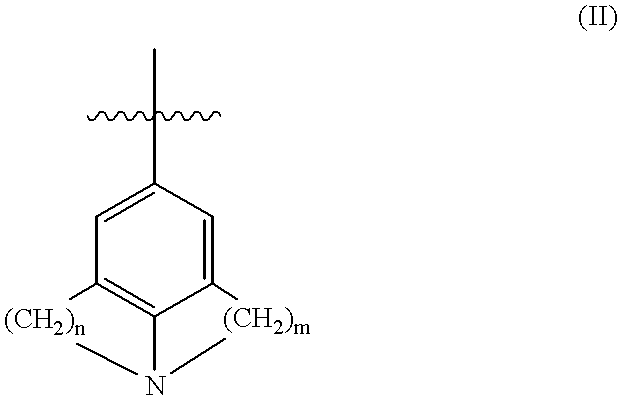
in which both m and n are integers between 2 and 5 and may be the same or different; or
R5 represents an unsaturated cyclic aminoaryl substituent selected from: 
and wherein R6 may be the same as or different from R5, and when R6 is different from R5 it is selected from aryl and heteroaryl groups; and wherein R7, R8, R9, R10 and R11 of which there may be multiples of either the same or different, may be selected from hydrogen, alkyl, haloalkyl, alkythio, aryl, arylthio, heteroaryl, halogen, nitrile, carboxylate, ester, nitro in addition to those substituents specified for R1, or R7 may represent a heterocyclic ring fused to faces f, g, h, i, j or k.
2. A naphthopyran compound according to claim 1, wherein the R1 substituent is a piperidino group.
3. A naphthopyran compound according to claim 1, wherein the R1 substituent is a morpholino group.
4. A naphthopyran compound according to claim 1, wherein the R1 substituent is a N-alkylpiperazino group.
5. A naphthopyran compound according to claim 1, wherein the R1 substituent is a N-indolino group.
6. A naphthopyran compound according to claim 1, where the R5 substituent is a 4-morpholinophenyl group, a 4-pyrrolidinophenyl group or a 4-(4-methylpiperazino)phenyl group, and R6 substituent is a phenyl group, a 4-methoxyphenyl group, a 2,4-dimethoxyphenyl group, a 4-trifluoromethylphenyl group, 2-thienyl or 3-thienyl.
7. A naphthopyran compound according to claim 1, wherein m and n are both 3.
8. 6-morpholino-3(4-morpholinophenyl)-3-phenyl-3H-naphtho-[2,1-b]pyran.
9. 6-morpholino-3(4-piperidinophenyl)-3-phenyl-3H-naphtho-[2,1-b]pyran.
10. 6-morpholino-3(4-morpholinophenyl)-3(2-thienyl)-3H-naphtho-[2,1-b]pyran.
11. 3(4-methoxyphenyl)-6-morpholino-3(4-piperidinophenyl)-3H-naphtho-[2,1-b]pyran.
12. 6-morpholino-3(4-pyrrolidinophenyl)-3-phenyl-3H-naphtho-[2,1-b]pyran.
13. 6-morpholino-3(4-morpholinophenyl)-3(4-trifluoromethyl-phenyl)-3H-naphtho[2,1-b]pyran.
14. 3(4-morpholinophenyl)-3-phenyl-3H-naphtho[2,1-b]pyran.
15. 3(4-morpholinophenyl)-3-(4-methoxyphenyl)-3H-naphtho[2,1-b]pyran.
16. A method of making a red-coloring photochromic naphtho(2,1-b)pyran as defined in claim 1, which comprises reacting an acetylenic derivative of formula 
with a naphthalene derivative of formula 
in the presence of an acid catalyst and a solvent.
17. A composition which comprises a polymeric material; and a naphtho(2,1-b)pyran as defined in claim 1.
18. A composition according to claim 17, wherein the polymeric material comprises a polyol(allyl carbonate) polymer; a polyacrylate; cellulose acetate, triacetate, acetate propionate or acetate butyrate; poly(vinyl acetate); poly(vinyl alcohol); polyurethane; polycarbonate; polyethylene terephthalate; polystyrene; poly-(triethyleneglycol dimethacrylate); poly(diethyleneglycol bis(allyl carbonate)).
19. An ophthalmic lens or sunglasses lens, an optical filter, a window, a paint or an ink which comprises a naphtho(2,1-b)pyran as claimed in claim 1.
20. The red-coloring photochromatic napthyl(2,1-b)-pyran of claim 1, in which when R6 is different from R5, R6 is napthyl.
Applications Claiming Priority (3)
| Application Number | Priority Date | Filing Date | Title |
|---|---|---|---|
| GBGB9706939.7A GB9706939D0 (en) | 1997-04-04 | 1997-04-04 | Red colouring hyperchromic 3H-naptho[2,1-6]pyrans |
| GB9706939 | 1997-04-04 | ||
| PCT/GB1998/000995 WO1998045281A1 (en) | 1997-04-04 | 1998-04-03 | RED COLOURING HYPERCHROMIC 3H-NAPHTHO[2,1-b]PYRANS |
Publications (1)
| Publication Number | Publication Date |
|---|---|
| US6294112B1 true US6294112B1 (en) | 2001-09-25 |
Family
ID=10810343
Family Applications (1)
| Application Number | Title | Priority Date | Filing Date |
|---|---|---|---|
| US09/402,355 Expired - Fee Related US6294112B1 (en) | 1997-04-04 | 1998-04-03 | Red coloring hyperchromic 3H-naphtho[2,1-B]pyrans |
Country Status (8)
| Country | Link |
|---|---|
| US (1) | US6294112B1 (en) |
| EP (1) | EP0973761B1 (en) |
| JP (1) | JP4324661B2 (en) |
| DE (1) | DE69806367T2 (en) |
| DK (1) | DK0973761T3 (en) |
| ES (1) | ES2179480T3 (en) |
| GB (2) | GB9706939D0 (en) |
| WO (1) | WO1998045281A1 (en) |
Cited By (12)
| Publication number | Priority date | Publication date | Assignee | Title |
|---|---|---|---|---|
| US6340766B1 (en) * | 2000-01-12 | 2002-01-22 | Transition Optical, Inc. | Substituted napthopyrans |
| US6525194B1 (en) * | 1999-06-03 | 2003-02-25 | Tokuyama Corporation | Chromene compound |
| US20040228818A1 (en) * | 2002-10-18 | 2004-11-18 | L'oreal | Cosmetic composition combining at least two dyes including at least one photochromic dye |
| US20040228817A1 (en) * | 2002-10-18 | 2004-11-18 | L'oreal | Makeup combining at least one photochromic dye and at least one goniochromatic agent |
| US20050276767A1 (en) * | 2002-10-18 | 2005-12-15 | L'oreal | Composition containing an oily phase and a naphthopyran dye, cosmetic treatment processes |
| US20060219990A1 (en) * | 2003-09-18 | 2006-10-05 | Rodenstock Gmbh | Substituted phenanthropyrans |
| US20090309076A1 (en) * | 2003-07-01 | 2009-12-17 | Transitions Optical, Inc. | Photochromic compounds |
| DE102012100252A1 (en) | 2011-01-26 | 2012-07-26 | Thüringisches Institut für Textil- und Kunststoff-Forschung e.V. | Polymer composition and process for the preparation of products with variable biodegradability |
| US8518546B2 (en) | 2003-07-01 | 2013-08-27 | Transitions Optical, Inc. | Photochromic compounds and compositions |
| US8545984B2 (en) | 2003-07-01 | 2013-10-01 | Transitions Optical, Inc. | Photochromic compounds and compositions |
| US8698117B2 (en) | 2003-07-01 | 2014-04-15 | Transitions Optical, Inc. | Indeno-fused ring compounds |
| US12577454B2 (en) | 2021-11-24 | 2026-03-17 | Nano And Advanced Materials Institute Limited | Photochromic compositions |
Families Citing this family (13)
| Publication number | Priority date | Publication date | Assignee | Title |
|---|---|---|---|---|
| GB9726361D0 (en) * | 1997-12-12 | 1998-02-11 | James Robinson Ltd | Photochromic dyes |
| DE19913687A1 (en) * | 1998-03-25 | 1999-12-02 | Rodenstock Optik G | New photochromic diarylnaphthopyrans useful in plastics, especially for ophthalmic purposes |
| US6478988B1 (en) * | 1998-12-31 | 2002-11-12 | Bmc Vision-Ease Lens, Inc. | Photochromic substituted naphthopyran compounds |
| US6719926B2 (en) * | 1999-06-03 | 2004-04-13 | Tokuyama Corporation | Chromene compound |
| US6312811B1 (en) * | 1999-07-08 | 2001-11-06 | Essilor International Compagnie Generale D'optique | Photochromic naphtho [2,1-b]pyran compounds containing bithienyl or terthienyl substituents, process for their manufacture, and photochromic materials and articles obtained |
| GB9918951D0 (en) * | 1999-08-11 | 1999-10-13 | James Robinson Ltd | Rapid fading photo-responsive materials |
| EP1461330B1 (en) * | 2002-01-03 | 2008-03-12 | Rodenstock GmbH | 3H-NAPHTHO[2,1-b]-PYRANE DERIVATIVES AND THEIR USE |
| ES2528653T3 (en) | 2002-05-22 | 2015-02-11 | Tokuyama Corporation | Photochromic composition |
| DE60310846T2 (en) * | 2002-10-18 | 2007-10-11 | L'oreal | Make-up, combining two compositions, one containing a photochromic dye, the other a goniochromatic agent |
| ES2298483T3 (en) * | 2002-10-18 | 2008-05-16 | L'oreal | COSMETIC COMPOSITION THAT ASSOCIATES AT LEAST TWO COLORING MATTERS, OF WHICH AT LEAST ONE IS A PHOTOCROMA COLORING MATTER. |
| ATE353236T1 (en) * | 2002-10-18 | 2007-02-15 | Oreal | COSMETIC COMPOSITION CONTAINING AN OIL PHASE AND A DYE FROM THE NAPHTHOPYRANE GROUP AND METHOD |
| KR100649959B1 (en) | 2005-08-30 | 2006-11-27 | 한국화학연구원 | Method for preparing naphthopyran-based photochromic dye |
| JP2007091595A (en) * | 2005-09-27 | 2007-04-12 | Tokuyama Corp | Method for producing naphthopyran compound |
Citations (8)
| Publication number | Priority date | Publication date | Assignee | Title |
|---|---|---|---|---|
| EP0250193A2 (en) | 1986-06-17 | 1987-12-23 | Gec-Marconi Limited | Photoreactive lenses |
| WO1995000866A1 (en) | 1993-06-21 | 1995-01-05 | Ppg Industries, Inc. | Photochromic naphthopyran compounds |
| US5466398A (en) * | 1993-06-21 | 1995-11-14 | Transitions Optical, Inc. | Photochromic substituted naphthopyran compounds |
| US5552090A (en) * | 1993-06-21 | 1996-09-03 | Ppg Industries, Inc. | Photochromic naphthopyran compounds |
| US5623005A (en) * | 1993-03-30 | 1997-04-22 | Pilkington Plc | Photochromic naphthopyran compounds |
| US5808100A (en) * | 1995-12-06 | 1998-09-15 | Tokuyama Corporation | Chromene compounds and photochromic materials |
| US5879592A (en) * | 1997-12-10 | 1999-03-09 | Ppg Industries, Inc. | Water soluble photochromic compounds, compositions and optical elements comprising the compounds |
| US6022496A (en) * | 1997-04-30 | 2000-02-08 | Tokuyama Corporation | Chromene compound |
Family Cites Families (3)
| Publication number | Priority date | Publication date | Assignee | Title |
|---|---|---|---|---|
| JPH09124645A (en) * | 1995-11-02 | 1997-05-13 | Tokuyama Corp | Chromene compound |
| GB9726361D0 (en) * | 1997-12-12 | 1998-02-11 | James Robinson Ltd | Photochromic dyes |
| DE19913687A1 (en) * | 1998-03-25 | 1999-12-02 | Rodenstock Optik G | New photochromic diarylnaphthopyrans useful in plastics, especially for ophthalmic purposes |
-
1997
- 1997-04-04 GB GBGB9706939.7A patent/GB9706939D0/en active Pending
-
1998
- 1998-04-03 ES ES98914972T patent/ES2179480T3/en not_active Expired - Lifetime
- 1998-04-03 US US09/402,355 patent/US6294112B1/en not_active Expired - Fee Related
- 1998-04-03 DK DK98914972T patent/DK0973761T3/en active
- 1998-04-03 GB GB9922328A patent/GB2338233B/en not_active Expired - Lifetime
- 1998-04-03 JP JP54249498A patent/JP4324661B2/en not_active Expired - Fee Related
- 1998-04-03 EP EP98914972A patent/EP0973761B1/en not_active Expired - Lifetime
- 1998-04-03 DE DE69806367T patent/DE69806367T2/en not_active Expired - Lifetime
- 1998-04-03 WO PCT/GB1998/000995 patent/WO1998045281A1/en not_active Ceased
Patent Citations (11)
| Publication number | Priority date | Publication date | Assignee | Title |
|---|---|---|---|---|
| EP0250193A2 (en) | 1986-06-17 | 1987-12-23 | Gec-Marconi Limited | Photoreactive lenses |
| US5623005A (en) * | 1993-03-30 | 1997-04-22 | Pilkington Plc | Photochromic naphthopyran compounds |
| WO1995000866A1 (en) | 1993-06-21 | 1995-01-05 | Ppg Industries, Inc. | Photochromic naphthopyran compounds |
| US5458815A (en) * | 1993-06-21 | 1995-10-17 | Transitions Optical, Inc. | Photochromic naphthopyran compounds |
| US5466398A (en) * | 1993-06-21 | 1995-11-14 | Transitions Optical, Inc. | Photochromic substituted naphthopyran compounds |
| US5552090A (en) * | 1993-06-21 | 1996-09-03 | Ppg Industries, Inc. | Photochromic naphthopyran compounds |
| US5637262A (en) * | 1993-06-21 | 1997-06-10 | Transitions Optical, Inc. | Photochromic substituted naphthopyran compounds |
| US5808100A (en) * | 1995-12-06 | 1998-09-15 | Tokuyama Corporation | Chromene compounds and photochromic materials |
| US6022496A (en) * | 1997-04-30 | 2000-02-08 | Tokuyama Corporation | Chromene compound |
| US5879592A (en) * | 1997-12-10 | 1999-03-09 | Ppg Industries, Inc. | Water soluble photochromic compounds, compositions and optical elements comprising the compounds |
| US6080338A (en) * | 1997-12-10 | 2000-06-27 | Transitions Optical, Inc. | Water soluble photochromic compounds, compositions and optical elements comprising the compounds |
Non-Patent Citations (1)
| Title |
|---|
| Chemical Abstracts, vol. 127, No. 3, 1997, Columbus, Ohio US; abstract No. 42375x, p. 1327. |
Cited By (22)
| Publication number | Priority date | Publication date | Assignee | Title |
|---|---|---|---|---|
| US6525194B1 (en) * | 1999-06-03 | 2003-02-25 | Tokuyama Corporation | Chromene compound |
| US6340766B1 (en) * | 2000-01-12 | 2002-01-22 | Transition Optical, Inc. | Substituted napthopyrans |
| US20040228818A1 (en) * | 2002-10-18 | 2004-11-18 | L'oreal | Cosmetic composition combining at least two dyes including at least one photochromic dye |
| US20040228817A1 (en) * | 2002-10-18 | 2004-11-18 | L'oreal | Makeup combining at least one photochromic dye and at least one goniochromatic agent |
| US20050276767A1 (en) * | 2002-10-18 | 2005-12-15 | L'oreal | Composition containing an oily phase and a naphthopyran dye, cosmetic treatment processes |
| US8211338B2 (en) | 2003-07-01 | 2012-07-03 | Transitions Optical, Inc | Photochromic compounds |
| US10532997B2 (en) | 2003-07-01 | 2020-01-14 | Transitions Optical, Inc. | Photochromic compounds |
| US20090309076A1 (en) * | 2003-07-01 | 2009-12-17 | Transitions Optical, Inc. | Photochromic compounds |
| US10005763B2 (en) | 2003-07-01 | 2018-06-26 | Transitions Optical, Inc. | Photochromic compounds |
| US10532998B2 (en) | 2003-07-01 | 2020-01-14 | Transitions Optical, Inc. | Photochromic compounds |
| US10501446B2 (en) | 2003-07-01 | 2019-12-10 | Transitions Optical, Inc. | Photochromic compounds |
| US8518546B2 (en) | 2003-07-01 | 2013-08-27 | Transitions Optical, Inc. | Photochromic compounds and compositions |
| US8545984B2 (en) | 2003-07-01 | 2013-10-01 | Transitions Optical, Inc. | Photochromic compounds and compositions |
| US8698117B2 (en) | 2003-07-01 | 2014-04-15 | Transitions Optical, Inc. | Indeno-fused ring compounds |
| US8705160B2 (en) | 2003-07-01 | 2014-04-22 | Transitions Optical, Inc. | Photochromic compounds |
| US9309455B2 (en) | 2003-07-01 | 2016-04-12 | Transitions Optical, Inc. | Indeno-fused ring compounds |
| US10000472B2 (en) | 2003-07-01 | 2018-06-19 | Transitions Optical, Inc. | Photochromic compounds |
| US20060219990A1 (en) * | 2003-09-18 | 2006-10-05 | Rodenstock Gmbh | Substituted phenanthropyrans |
| US7229576B2 (en) | 2003-09-18 | 2007-06-12 | Rodenstock Gmbh | Substituted phenanthropyrans |
| EP2481771A1 (en) | 2011-01-26 | 2012-08-01 | THÜRINGISCHES INSTITUT FÜR TEXTIL- UND KUNSTSTOFF-FORSCHUNG e.V. | Polymer composition and method for producing products with variable biodegradability |
| DE102012100252A1 (en) | 2011-01-26 | 2012-07-26 | Thüringisches Institut für Textil- und Kunststoff-Forschung e.V. | Polymer composition and process for the preparation of products with variable biodegradability |
| US12577454B2 (en) | 2021-11-24 | 2026-03-17 | Nano And Advanced Materials Institute Limited | Photochromic compositions |
Also Published As
| Publication number | Publication date |
|---|---|
| EP0973761A1 (en) | 2000-01-26 |
| DK0973761T3 (en) | 2002-07-22 |
| JP2001518893A (en) | 2001-10-16 |
| GB9706939D0 (en) | 1997-05-21 |
| GB2338233A (en) | 1999-12-15 |
| EP0973761B1 (en) | 2002-07-03 |
| DE69806367T2 (en) | 2003-04-03 |
| JP4324661B2 (en) | 2009-09-02 |
| ES2179480T3 (en) | 2003-01-16 |
| DE69806367D1 (en) | 2002-08-08 |
| GB2338233B (en) | 2001-09-05 |
| GB9922328D0 (en) | 1999-11-17 |
| WO1998045281A1 (en) | 1998-10-15 |
Similar Documents
| Publication | Publication Date | Title |
|---|---|---|
| EP0973761B1 (en) | RED COLOURING HYPERCHROMIC 3H-NAPHTHO 2,1-b ]PYRANS | |
| US6248264B1 (en) | Neutral coloring photochromic 2H-naphtho[1,2-b] pyrans and heterocyclic pyrans | |
| EP0704067B1 (en) | Photochromic naphthopyran compounds | |
| US5514817A (en) | Substituted phenanthropyrans | |
| EP0560898B1 (en) | Photochromic naphthopyrans | |
| US5527911A (en) | Heterocyclic chromenes | |
| AU719894B2 (en) | Novel homoazaadamantane spirooxazines and their use in the field of ophthalmic optics | |
| CA2130272A1 (en) | Photochromic naphthopyrans | |
| CN1120335A (en) | Photochromic naphthopyran compounds | |
| US5520853A (en) | Photochromic compounds | |
| US6747145B2 (en) | Photochromic bis-naphthopyran compounds and methods for their manufacture | |
| EP1025107B1 (en) | Photochromic compounds | |
| AU2002332520A1 (en) | Photochromic bis-naphthopyran compounds and methods for their manufacture | |
| US6478988B1 (en) | Photochromic substituted naphthopyran compounds | |
| US5759450A (en) | Photochromic naphthopyran compounds | |
| US6113812A (en) | Photochromic articles | |
| EP1558603B1 (en) | Oxyge-containing heterocyclic fused naphthopyrans | |
| US20030092918A1 (en) | Oxygen-containing heterocyclic fused naphthopyrans | |
| EP0975619B1 (en) | INTENSE COLOURING PHOTOCHROMIC 2H-NAPHTHO[1,2-b] PYRANS AND HETEROCYCLIC PYRANS | |
| WO1999031081A1 (en) | Ph sensitive photochromic dyes | |
| US6337409B1 (en) | Photochromic naphthopyran compounds | |
| US5869662A (en) | Photochromic benzopyran compounds | |
| US5847168A (en) | Photochromic compounds | |
| WO1997006455A1 (en) | Photochromic naphthopyran compounds | |
| KR20020008414A (en) | Naphthopyrans annelated in C5-C6 with a lactam-type C6 ring and compositions and (co)polymer containing them |
Legal Events
| Date | Code | Title | Description |
|---|---|---|---|
| AS | Assignment |
Owner name: JAMES ROBINSON LIMITED, UNITED KINGDOM Free format text: ASSIGNMENT OF ASSIGNORS INTEREST;ASSIGNORS:CLARKE, DAVID A.;HERON, BERNARD MARK;GABBUTT, CHRISTOPHER DAVID;AND OTHERS;REEL/FRAME:010489/0237;SIGNING DATES FROM 19991008 TO 19991014 |
|
| FPAY | Fee payment |
Year of fee payment: 4 |
|
| FPAY | Fee payment |
Year of fee payment: 8 |
|
| REMI | Maintenance fee reminder mailed | ||
| LAPS | Lapse for failure to pay maintenance fees | ||
| STCH | Information on status: patent discontinuation |
Free format text: PATENT EXPIRED DUE TO NONPAYMENT OF MAINTENANCE FEES UNDER 37 CFR 1.362 |
|
| FP | Lapsed due to failure to pay maintenance fee |
Effective date: 20130925 |