US6284918B1 - Selective inhibitors of prostaglandin endoperoxide synthase-2 - Google Patents
Selective inhibitors of prostaglandin endoperoxide synthase-2 Download PDFInfo
- Publication number
- US6284918B1 US6284918B1 US09/287,557 US28755799A US6284918B1 US 6284918 B1 US6284918 B1 US 6284918B1 US 28755799 A US28755799 A US 28755799A US 6284918 B1 US6284918 B1 US 6284918B1
- Authority
- US
- United States
- Prior art keywords
- arh
- sulfide
- nmr
- cdcl
- ynyl
- Prior art date
- Legal status (The legal status is an assumption and is not a legal conclusion. Google has not performed a legal analysis and makes no representation as to the accuracy of the status listed.)
- Expired - Fee Related
Links
- 102100038280 Prostaglandin G/H synthase 2 Human genes 0.000 title description 56
- 108050003267 Prostaglandin G/H synthase 2 Proteins 0.000 title description 21
- 229940124639 Selective inhibitor Drugs 0.000 title description 5
- 125000002496 methyl group Chemical group [H]C([H])([H])* 0.000 claims abstract description 153
- 150000001875 compounds Chemical class 0.000 claims abstract description 75
- 125000001495 ethyl group Chemical group [H]C([H])([H])C([H])([H])* 0.000 claims abstract description 12
- 125000000094 2-phenylethyl group Chemical group [H]C1=C([H])C([H])=C(C([H])=C1[H])C([H])([H])C([H])([H])* 0.000 claims abstract description 5
- 125000006519 CCH3 Chemical group 0.000 claims abstract description 5
- 125000001797 benzyl group Chemical group [H]C1=C([H])C([H])=C(C([H])=C1[H])C([H])([H])* 0.000 claims abstract description 5
- 150000003839 salts Chemical class 0.000 claims description 19
- WWYWTMJFMXSYLU-UHFFFAOYSA-N [2-[2-[2-(2-acetyloxyphenyl)-2-butoxyethyl]sulfanyl-1-butoxyethyl]phenyl] acetate Chemical compound C=1C=CC=C(OC(C)=O)C=1C(OCCCC)CSCC(OCCCC)C1=CC=CC=C1OC(C)=O WWYWTMJFMXSYLU-UHFFFAOYSA-N 0.000 claims description 12
- LSRROAHBYWRGQK-UHFFFAOYSA-N [2-[7-[7-(2-acetyloxyphenyl)hept-2-ynylsulfanyl]hept-5-ynyl]phenyl] acetate Chemical compound CC(=O)OC1=CC=CC=C1CCCCC#CCSCC#CCCCCC1=CC=CC=C1OC(C)=O LSRROAHBYWRGQK-UHFFFAOYSA-N 0.000 claims description 11
- SZINEWYJBHKNDL-UHFFFAOYSA-N [2-[7-[7-(2-acetyloxyphenyl)heptylsulfanyl]heptyl]phenyl] acetate Chemical compound CC(=O)OC1=CC=CC=C1CCCCCCCSCCCCCCCC1=CC=CC=C1OC(C)=O SZINEWYJBHKNDL-UHFFFAOYSA-N 0.000 claims description 10
- RDGLYLBHARTGLC-UHFFFAOYSA-N [2-[6-[6-(2-acetyloxyphenyl)hex-2-ynylsulfanyl]hex-4-ynyl]phenyl] acetate Chemical compound CC(=O)OC1=CC=CC=C1CCCC#CCSCC#CCCCC1=CC=CC=C1OC(C)=O RDGLYLBHARTGLC-UHFFFAOYSA-N 0.000 claims description 9
- SIKQZBQPGJTOAK-UHFFFAOYSA-N [2-[6-[6-(2-acetyloxyphenyl)-6-bromohexyl]sulfanyl-1-bromohexyl]phenyl] acetate Chemical compound CC(=O)OC1=CC=CC=C1C(Br)CCCCCSCCCCCC(Br)C1=CC=CC=C1OC(C)=O SIKQZBQPGJTOAK-UHFFFAOYSA-N 0.000 claims description 8
- JKGKVZUDBSFVAE-UHFFFAOYSA-N [2-[3-[3-(2-acetyloxyphenyl)prop-2-ynylsulfanyl]prop-1-ynyl]phenyl] acetate Chemical compound CC(=O)OC1=CC=CC=C1C#CCSCC#CC1=CC=CC=C1OC(C)=O JKGKVZUDBSFVAE-UHFFFAOYSA-N 0.000 claims description 7
- LGTAPSFBYDSMLG-UHFFFAOYSA-N [2-[6-[6-(2-acetyloxyphenyl)-6-iodohexyl]sulfanyl-1-iodohexyl]phenyl] acetate Chemical compound CC(=O)OC1=CC=CC=C1C(I)CCCCCSCCCCCC(I)C1=CC=CC=C1OC(C)=O LGTAPSFBYDSMLG-UHFFFAOYSA-N 0.000 claims description 7
- WBLIXGSTEMXDSM-UHFFFAOYSA-N chloromethane Chemical group Cl[CH2] WBLIXGSTEMXDSM-UHFFFAOYSA-N 0.000 claims description 7
- 239000003937 drug carrier Substances 0.000 claims description 7
- 239000008194 pharmaceutical composition Substances 0.000 claims description 7
- BSOOFMVQJVRWDZ-UHFFFAOYSA-N [2-[10-[10-(2-acetyloxyphenyl)dec-2-ynylsulfanyl]dec-8-ynyl]phenyl] acetate Chemical compound CC(=O)OC1=CC=CC=C1CCCCCCCC#CCSCC#CCCCCCCCC1=CC=CC=C1OC(C)=O BSOOFMVQJVRWDZ-UHFFFAOYSA-N 0.000 claims description 6
- URYHNNVEMRICNK-UHFFFAOYSA-N [2-[2-[2-(2-acetyloxyphenyl)-2-phenylethyl]sulfanyl-1-phenylethyl]phenyl] acetate Chemical compound CC(=O)OC1=CC=CC=C1C(C=1C=CC=CC=1)CSCC(C=1C(=CC=CC=1)OC(C)=O)C1=CC=CC=C1 URYHNNVEMRICNK-UHFFFAOYSA-N 0.000 claims description 6
- GIVGMFMQILQXRS-UHFFFAOYSA-N [2-[2-[2-(2-acetyloxyphenyl)ethylsulfanyl]ethyl]phenyl] acetate Chemical compound CC(=O)OC1=CC=CC=C1CCSCCC1=CC=CC=C1OC(C)=O GIVGMFMQILQXRS-UHFFFAOYSA-N 0.000 claims description 6
- NAUVKVKRWVZITK-UHFFFAOYSA-N [2-[3-[3-(2-acetyloxyphenyl)propylsulfanyl]propyl]phenyl] acetate Chemical compound CC(=O)OC1=CC=CC=C1CCCSCCCC1=CC=CC=C1OC(C)=O NAUVKVKRWVZITK-UHFFFAOYSA-N 0.000 claims description 6
- FMYCPDCNIXTKNZ-UHFFFAOYSA-N [2-[4-[4-(2-acetyloxyphenyl)but-2-ynylsulfanyl]but-2-ynyl]phenyl] acetate Chemical compound CC(=O)OC1=CC=CC=C1CC#CCSCC#CCC1=CC=CC=C1OC(C)=O FMYCPDCNIXTKNZ-UHFFFAOYSA-N 0.000 claims description 6
- RMPRKHUBDAHXGY-UHFFFAOYSA-N [2-[5-[5-(2-acetyloxyphenyl)pent-2-ynylsulfanyl]pent-3-ynyl]phenyl] acetate Chemical compound CC(=O)OC1=CC=CC=C1CCC#CCSCC#CCCC1=CC=CC=C1OC(C)=O RMPRKHUBDAHXGY-UHFFFAOYSA-N 0.000 claims description 6
- REAOQDQVGUEMQL-UHFFFAOYSA-N [2-[5-[5-(2-acetyloxyphenyl)pentylsulfanyl]pentyl]phenyl] acetate Chemical compound CC(=O)OC1=CC=CC=C1CCCCCSCCCCCC1=CC=CC=C1OC(C)=O REAOQDQVGUEMQL-UHFFFAOYSA-N 0.000 claims description 6
- BJZGPJUGRXQMKU-UHFFFAOYSA-N [2-[6-[6-(2-acetyloxyphenyl)hexylsulfanyl]hexyl]phenyl] acetate Chemical compound CC(=O)OC1=CC=CC=C1CCCCCCSCCCCCCC1=CC=CC=C1OC(C)=O BJZGPJUGRXQMKU-UHFFFAOYSA-N 0.000 claims description 6
- OMIPDESOEBKSDV-UHFFFAOYSA-N [2-[8-[8-(2-acetyloxyphenyl)oct-2-ynylsulfanyl]oct-6-ynyl]phenyl] acetate Chemical compound CC(=O)OC1=CC=CC=C1CCCCCC#CCSCC#CCCCCCC1=CC=CC=C1OC(C)=O OMIPDESOEBKSDV-UHFFFAOYSA-N 0.000 claims description 6
- FNUYXOOUZMSRDR-UHFFFAOYSA-N [2-[9-[9-(2-acetyloxyphenyl)non-2-ynylsulfanyl]non-7-ynyl]phenyl] acetate Chemical compound CC(=O)OC1=CC=CC=C1CCCCCCC#CCSCC#CCCCCCCC1=CC=CC=C1OC(C)=O FNUYXOOUZMSRDR-UHFFFAOYSA-N 0.000 claims description 6
- NKCXGLDPNKDUGF-UHFFFAOYSA-N [2-[[(2-acetyloxyphenyl)-phenylmethyl]sulfanyl-phenylmethyl]phenyl] acetate Chemical compound CC(=O)OC1=CC=CC=C1C(C=1C=CC=CC=1)SC(C=1C(=CC=CC=1)OC(C)=O)C1=CC=CC=C1 NKCXGLDPNKDUGF-UHFFFAOYSA-N 0.000 claims description 6
- XOLNROZVURSUHT-UHFFFAOYSA-N [2-[7-[7-(2-acetyloxyphenyl)hept-2-ynoxy]hept-5-ynyl]phenyl] acetate Chemical compound CC(=O)OC1=CC=CC=C1CCCCC#CCOCC#CCCCCC1=CC=CC=C1OC(C)=O XOLNROZVURSUHT-UHFFFAOYSA-N 0.000 claims description 5
- HWGWAYPBWIHOJV-UHFFFAOYSA-N [2-[7-[7-(2-acetyloxyphenyl)heptylselanyl]heptyl]phenyl] acetate Chemical compound CC(=O)OC1=CC=CC=C1CCCCCCC[Se]CCCCCCCC1=CC=CC=C1OC(C)=O HWGWAYPBWIHOJV-UHFFFAOYSA-N 0.000 claims description 5
- AOJDZKCUAATBGE-UHFFFAOYSA-N bromomethane Chemical group Br[CH2] AOJDZKCUAATBGE-UHFFFAOYSA-N 0.000 claims description 5
- BGWLIARRADSEJK-UHFFFAOYSA-N (2-methylsulfanylphenyl) 3,3,3-trifluoropropanoate Chemical compound CSC1=CC=CC=C1OC(=O)CC(F)(F)F BGWLIARRADSEJK-UHFFFAOYSA-N 0.000 claims description 4
- 125000006412 propinylene group Chemical group [H]C#CC([H])([H])* 0.000 claims description 4
- 125000002023 trifluoromethyl group Chemical group FC(F)(F)* 0.000 claims description 4
- HVEBNOSWEDEIGI-UHFFFAOYSA-N (2-methylsulfanylphenyl) 2-bromoacetate Chemical compound CSC1=CC=CC=C1OC(=O)CBr HVEBNOSWEDEIGI-UHFFFAOYSA-N 0.000 claims description 3
- IIIMEEMNTOYVFG-DFEHQXHXSA-N [2-[(e)-7-[(e)-7-(2-acetyloxyphenyl)hept-1-enyl]sulfanylhept-6-enyl]phenyl] acetate Chemical compound CC(=O)OC1=CC=CC=C1CCCCC\C=C\S\C=C\CCCCCC1=CC=CC=C1OC(C)=O IIIMEEMNTOYVFG-DFEHQXHXSA-N 0.000 claims description 3
- OYLIIEZFWPZSIK-UHFFFAOYSA-N [2-[4-[4-(2-acetyloxyphenyl)butylsulfanyl]butyl]phenyl] acetate Chemical compound CC(=O)OC1=CC=CC=C1CCCCSCCCCC1=CC=CC=C1OC(C)=O OYLIIEZFWPZSIK-UHFFFAOYSA-N 0.000 claims description 3
- MOYNOSXICVYPBM-UHFFFAOYSA-N [2-[7-[7-(2-acetyloxyphenyl)hept-3-ynylsulfanyl]hept-4-ynyl]phenyl] acetate Chemical compound CC(=O)OC1=CC=CC=C1CCCC#CCCSCCC#CCCCC1=CC=CC=C1OC(C)=O MOYNOSXICVYPBM-UHFFFAOYSA-N 0.000 claims description 3
- MDFFNEOEWAXZRQ-UHFFFAOYSA-N aminyl Chemical group [NH2] MDFFNEOEWAXZRQ-UHFFFAOYSA-N 0.000 claims description 3
- 150000004677 hydrates Chemical class 0.000 claims description 3
- VKIAHEHMGVSTAD-UHFFFAOYSA-N oct-3-yne Chemical compound [CH2]CC#CCCCC VKIAHEHMGVSTAD-UHFFFAOYSA-N 0.000 claims description 3
- XSXHWVKGUXMUQE-UHFFFAOYSA-N osmium dioxide Chemical group O=[Os]=O XSXHWVKGUXMUQE-UHFFFAOYSA-N 0.000 claims description 3
- HEDRZPFGACZZDS-MICDWDOJSA-N Trichloro(2H)methane Chemical compound [2H]C(Cl)(Cl)Cl HEDRZPFGACZZDS-MICDWDOJSA-N 0.000 description 222
- AVQLMCFSPDGCKF-UHFFFAOYSA-N (2-methylsulfanylphenyl) acetate Chemical compound CSC1=CC=CC=C1OC(C)=O AVQLMCFSPDGCKF-UHFFFAOYSA-N 0.000 description 124
- 238000005160 1H NMR spectroscopy Methods 0.000 description 101
- XEKOWRVHYACXOJ-UHFFFAOYSA-N Ethyl acetate Chemical compound CCOC(C)=O XEKOWRVHYACXOJ-UHFFFAOYSA-N 0.000 description 83
- VLKZOEOYAKHREP-UHFFFAOYSA-N n-Hexane Chemical compound CCCCCC VLKZOEOYAKHREP-UHFFFAOYSA-N 0.000 description 78
- 230000000694 effects Effects 0.000 description 75
- 102000004005 Prostaglandin-endoperoxide synthases Human genes 0.000 description 68
- 108090000459 Prostaglandin-endoperoxide synthases Proteins 0.000 description 68
- CSNNHWWHGAXBCP-UHFFFAOYSA-L Magnesium sulfate Chemical compound [Mg+2].[O-][S+2]([O-])([O-])[O-] CSNNHWWHGAXBCP-UHFFFAOYSA-L 0.000 description 64
- 239000000243 solution Substances 0.000 description 58
- RTZKZFJDLAIYFH-UHFFFAOYSA-N Diethyl ether Chemical compound CCOCC RTZKZFJDLAIYFH-UHFFFAOYSA-N 0.000 description 57
- XLYOFNOQVPJJNP-UHFFFAOYSA-N water Substances O XLYOFNOQVPJJNP-UHFFFAOYSA-N 0.000 description 54
- 229910001868 water Inorganic materials 0.000 description 54
- 230000005764 inhibitory process Effects 0.000 description 48
- 230000015572 biosynthetic process Effects 0.000 description 45
- 239000012230 colorless oil Substances 0.000 description 45
- 238000003786 synthesis reaction Methods 0.000 description 45
- 239000011541 reaction mixture Substances 0.000 description 42
- 235000019439 ethyl acetate Nutrition 0.000 description 41
- IAZDPXIOMUYVGZ-UHFFFAOYSA-N Dimethylsulphoxide Chemical compound CS(C)=O IAZDPXIOMUYVGZ-UHFFFAOYSA-N 0.000 description 39
- 102100038277 Prostaglandin G/H synthase 1 Human genes 0.000 description 39
- 108050003243 Prostaglandin G/H synthase 1 Proteins 0.000 description 37
- YMWUJEATGCHHMB-UHFFFAOYSA-N Dichloromethane Chemical compound ClCCl YMWUJEATGCHHMB-UHFFFAOYSA-N 0.000 description 35
- 229910052943 magnesium sulfate Inorganic materials 0.000 description 32
- VYPSYNLAJGMNEJ-UHFFFAOYSA-N Silicium dioxide Chemical compound O=[Si]=O VYPSYNLAJGMNEJ-UHFFFAOYSA-N 0.000 description 31
- 238000006243 chemical reaction Methods 0.000 description 31
- 239000002904 solvent Substances 0.000 description 31
- 239000000741 silica gel Substances 0.000 description 30
- 229910002027 silica gel Inorganic materials 0.000 description 30
- 239000000203 mixture Substances 0.000 description 29
- XKRFYHLGVUSROY-UHFFFAOYSA-N Argon Chemical compound [Ar] XKRFYHLGVUSROY-UHFFFAOYSA-N 0.000 description 28
- ISWSIDIOOBJBQZ-UHFFFAOYSA-N Phenol Chemical compound OC1=CC=CC=C1 ISWSIDIOOBJBQZ-UHFFFAOYSA-N 0.000 description 26
- WYURNTSHIVDZCO-UHFFFAOYSA-N Tetrahydrofuran Chemical compound C1CCOC1 WYURNTSHIVDZCO-UHFFFAOYSA-N 0.000 description 26
- JUJWROOIHBZHMG-UHFFFAOYSA-N Pyridine Chemical compound C1=CC=NC=C1 JUJWROOIHBZHMG-UHFFFAOYSA-N 0.000 description 24
- 238000000034 method Methods 0.000 description 24
- 239000003921 oil Substances 0.000 description 24
- 235000019198 oils Nutrition 0.000 description 24
- UCKMPCXJQFINFW-UHFFFAOYSA-N Sulphide Chemical compound [S-2] UCKMPCXJQFINFW-UHFFFAOYSA-N 0.000 description 23
- 239000003112 inhibitor Substances 0.000 description 22
- YZXBAPSDXZZRGB-DOFZRALJSA-N arachidonic acid Chemical compound CCCCC\C=C/C\C=C/C\C=C/C\C=C/CCCC(O)=O YZXBAPSDXZZRGB-DOFZRALJSA-N 0.000 description 21
- WFDIJRYMOXRFFG-UHFFFAOYSA-N Acetic anhydride Chemical compound CC(=O)OC(C)=O WFDIJRYMOXRFFG-UHFFFAOYSA-N 0.000 description 20
- XMXXREOVTFBDJF-UHFFFAOYSA-N [2-[1-[2-(2-acetyloxyphenyl)heptylsulfanyl]heptan-2-yl]phenyl] acetate Chemical compound C=1C=CC=C(OC(C)=O)C=1C(CCCCC)CSCC(CCCCC)C1=CC=CC=C1OC(C)=O XMXXREOVTFBDJF-UHFFFAOYSA-N 0.000 description 20
- -1 SC 8076 Chemical compound 0.000 description 19
- 239000000047 product Substances 0.000 description 19
- BSYNRYMUTXBXSQ-UHFFFAOYSA-N Aspirin Chemical compound CC(=O)OC1=CC=CC=C1C(O)=O BSYNRYMUTXBXSQ-UHFFFAOYSA-N 0.000 description 17
- 101000605127 Homo sapiens Prostaglandin G/H synthase 2 Proteins 0.000 description 15
- 229960001138 acetylsalicylic acid Drugs 0.000 description 15
- 229910052786 argon Inorganic materials 0.000 description 14
- 238000004587 chromatography analysis Methods 0.000 description 14
- 239000007787 solid Substances 0.000 description 14
- 238000003756 stirring Methods 0.000 description 13
- YLQBMQCUIZJEEH-UHFFFAOYSA-N tetrahydrofuran Natural products C=1C=COC=1 YLQBMQCUIZJEEH-UHFFFAOYSA-N 0.000 description 13
- 238000001644 13C nuclear magnetic resonance spectroscopy Methods 0.000 description 12
- CSCPPACGZOOCGX-UHFFFAOYSA-N Acetone Chemical compound CC(C)=O CSCPPACGZOOCGX-UHFFFAOYSA-N 0.000 description 12
- LFQSCWFLJHTTHZ-UHFFFAOYSA-N Ethanol Chemical compound CCO LFQSCWFLJHTTHZ-UHFFFAOYSA-N 0.000 description 12
- VEXZGXHMUGYJMC-UHFFFAOYSA-N Hydrochloric acid Chemical compound Cl VEXZGXHMUGYJMC-UHFFFAOYSA-N 0.000 description 12
- 239000007864 aqueous solution Substances 0.000 description 12
- 239000012043 crude product Substances 0.000 description 12
- UMJSCPRVCHMLSP-UHFFFAOYSA-N pyridine Natural products COC1=CC=CN=C1 UMJSCPRVCHMLSP-UHFFFAOYSA-N 0.000 description 12
- 102000004190 Enzymes Human genes 0.000 description 11
- 108090000790 Enzymes Proteins 0.000 description 11
- 230000001419 dependent effect Effects 0.000 description 11
- 150000003180 prostaglandins Chemical class 0.000 description 11
- 230000021736 acetylation Effects 0.000 description 10
- 238000006640 acetylation reaction Methods 0.000 description 10
- 238000003556 assay Methods 0.000 description 10
- 239000000284 extract Substances 0.000 description 10
- BMRLHSQKBFDTKO-UHFFFAOYSA-N 2-[6-[6-(2-hydroxyphenyl)-6-iodohexyl]sulfanyl-1-iodohexyl]phenol Chemical compound OC1=CC=CC=C1C(I)CCCCCSCCCCCC(I)C1=CC=CC=C1O BMRLHSQKBFDTKO-UHFFFAOYSA-N 0.000 description 9
- IEBDOJRMWXPOBH-UHFFFAOYSA-N 2-[7-[7-(2-hydroxyphenyl)hept-2-ynylsulfanyl]hept-5-ynyl]phenol Chemical compound OC1=CC=CC=C1CCCCC#CCSCC#CCCCCC1=CC=CC=C1O IEBDOJRMWXPOBH-UHFFFAOYSA-N 0.000 description 9
- VMKYTRPNOVFCGZ-UHFFFAOYSA-N 2-sulfanylphenol Chemical compound OC1=CC=CC=C1S VMKYTRPNOVFCGZ-UHFFFAOYSA-N 0.000 description 9
- 108010037462 Cyclooxygenase 2 Proteins 0.000 description 9
- PEDCQBHIVMGVHV-UHFFFAOYSA-N Glycerine Chemical compound OCC(O)CO PEDCQBHIVMGVHV-UHFFFAOYSA-N 0.000 description 9
- HEMHJVSKTPXQMS-UHFFFAOYSA-M Sodium hydroxide Chemical compound [OH-].[Na+] HEMHJVSKTPXQMS-UHFFFAOYSA-M 0.000 description 9
- ALTXAJYQMQSQLD-UHFFFAOYSA-N 2-[7-[7-(2-hydroxyphenyl)heptylsulfanyl]heptyl]phenol Chemical compound OC1=CC=CC=C1CCCCCCCSCCCCCCCC1=CC=CC=C1O ALTXAJYQMQSQLD-UHFFFAOYSA-N 0.000 description 8
- QTBSBXVTEAMEQO-UHFFFAOYSA-N Acetic acid Chemical compound CC(O)=O QTBSBXVTEAMEQO-UHFFFAOYSA-N 0.000 description 8
- BLYZFFURKVLLGU-UHFFFAOYSA-N [2-[3-[3-(2-acetyloxyphenyl)-3-ethoxypropyl]sulfanyl-1-ethoxypropyl]phenyl] acetate Chemical compound C=1C=CC=C(OC(C)=O)C=1C(OCC)CCSCCC(OCC)C1=CC=CC=C1OC(C)=O BLYZFFURKVLLGU-UHFFFAOYSA-N 0.000 description 8
- 210000002540 macrophage Anatomy 0.000 description 8
- 102000013415 peroxidase activity proteins Human genes 0.000 description 8
- 108040007629 peroxidase activity proteins Proteins 0.000 description 8
- 238000002360 preparation method Methods 0.000 description 8
- 230000002829 reductive effect Effects 0.000 description 8
- 150000003568 thioethers Chemical class 0.000 description 8
- QKNYBSVHEMOAJP-UHFFFAOYSA-N 2-amino-2-(hydroxymethyl)propane-1,3-diol;hydron;chloride Chemical compound Cl.OCC(N)(CO)CO QKNYBSVHEMOAJP-UHFFFAOYSA-N 0.000 description 7
- BMUDPLZKKRQECS-UHFFFAOYSA-K 3-[18-(2-carboxyethyl)-8,13-bis(ethenyl)-3,7,12,17-tetramethylporphyrin-21,24-diid-2-yl]propanoic acid iron(3+) hydroxide Chemical compound [OH-].[Fe+3].[N-]1C2=C(C)C(CCC(O)=O)=C1C=C([N-]1)C(CCC(O)=O)=C(C)C1=CC(C(C)=C1C=C)=NC1=CC(C(C)=C1C=C)=NC1=C2 BMUDPLZKKRQECS-UHFFFAOYSA-K 0.000 description 7
- 239000012267 brine Substances 0.000 description 7
- 210000004027 cell Anatomy 0.000 description 7
- 238000009472 formulation Methods 0.000 description 7
- 229940109738 hematin Drugs 0.000 description 7
- 230000002401 inhibitory effect Effects 0.000 description 7
- HPALAKNZSZLMCH-UHFFFAOYSA-M sodium;chloride;hydrate Chemical compound O.[Na+].[Cl-] HPALAKNZSZLMCH-UHFFFAOYSA-M 0.000 description 7
- AGMWTTAFEAXDFC-UHFFFAOYSA-N (2-oct-3-yn-2-ylsulfanylphenyl) acetate Chemical compound CCCCC#CC(C)SC1=CC=CC=C1OC(C)=O AGMWTTAFEAXDFC-UHFFFAOYSA-N 0.000 description 6
- GMYQTHWXTKYUAR-UHFFFAOYSA-N 2-[7-[7-(2-hydroxyphenyl)hept-2-ynoxy]hept-5-ynyl]phenol Chemical compound OC1=CC=CC=C1CCCCC#CCOCC#CCCCCC1=CC=CC=C1O GMYQTHWXTKYUAR-UHFFFAOYSA-N 0.000 description 6
- UIMNFSGYKVQLHL-UHFFFAOYSA-N 2-hydroxy-3-(methylsulfanylmethyl)benzoic acid Chemical compound CSCC1=CC=CC(C(O)=O)=C1O UIMNFSGYKVQLHL-UHFFFAOYSA-N 0.000 description 6
- TZRMFKCHBWZNIF-UHFFFAOYSA-N 2-hydroxy-3-methylsulfanylbenzoic acid Chemical compound CSC1=CC=CC(C(O)=O)=C1O TZRMFKCHBWZNIF-UHFFFAOYSA-N 0.000 description 6
- UPVGICBIEGUMOI-UHFFFAOYSA-N 4,6-difluoro-1-(methoxymethyl)-5-trimethylsilylcyclohexa-2,4-dien-1-ol Chemical compound COCC1(O)C=CC(F)=C([Si](C)(C)C)C1F UPVGICBIEGUMOI-UHFFFAOYSA-N 0.000 description 6
- OHJJLZAAUDOQAT-UHFFFAOYSA-N 4,6-difluoro-1-(methoxymethyl)cyclohexa-2,4-dien-1-ol Chemical compound COCC1(O)C=CC(F)=CC1F OHJJLZAAUDOQAT-UHFFFAOYSA-N 0.000 description 6
- CZNUVLJLCMYPHC-UHFFFAOYSA-N 6-fluoro-1-(methoxymethyl)cyclohexa-2,4-dien-1-ol Chemical compound COCC1(O)C=CC=CC1F CZNUVLJLCMYPHC-UHFFFAOYSA-N 0.000 description 6
- WEVYAHXRMPXWCK-UHFFFAOYSA-N Acetonitrile Chemical compound CC#N WEVYAHXRMPXWCK-UHFFFAOYSA-N 0.000 description 6
- NLXLAEXVIDQMFP-UHFFFAOYSA-N Ammonia chloride Chemical class [NH4+].[Cl-] NLXLAEXVIDQMFP-UHFFFAOYSA-N 0.000 description 6
- 239000006144 Dulbecco’s modified Eagle's medium Substances 0.000 description 6
- KTDZCOWXCWUPEO-UHFFFAOYSA-N NS-398 Chemical compound CS(=O)(=O)NC1=CC=C([N+]([O-])=O)C=C1OC1CCCCC1 KTDZCOWXCWUPEO-UHFFFAOYSA-N 0.000 description 6
- 208000002193 Pain Diseases 0.000 description 6
- DNIAPMSPPWPWGF-UHFFFAOYSA-N Propylene glycol Chemical compound CC(O)CO DNIAPMSPPWPWGF-UHFFFAOYSA-N 0.000 description 6
- USEUFCFHURHMNA-UHFFFAOYSA-N [6-(6-acetyloxy-1-methylcyclohexa-2,4-dien-1-yl)sulfonyl-6-methylcyclohexa-2,4-dien-1-yl] acetate Chemical compound CC(=O)OC1C=CC=CC1(C)S(=O)(=O)C1(C)C(OC(C)=O)C=CC=C1 USEUFCFHURHMNA-UHFFFAOYSA-N 0.000 description 6
- 229940114079 arachidonic acid Drugs 0.000 description 6
- 238000004440 column chromatography Methods 0.000 description 6
- 239000002158 endotoxin Substances 0.000 description 6
- 238000011534 incubation Methods 0.000 description 6
- 239000007788 liquid Substances 0.000 description 6
- MZRVEZGGRBJDDB-UHFFFAOYSA-N n-Butyllithium Substances [Li]CCCC MZRVEZGGRBJDDB-UHFFFAOYSA-N 0.000 description 6
- 229940021182 non-steroidal anti-inflammatory drug Drugs 0.000 description 6
- 229940094443 oxytocics prostaglandins Drugs 0.000 description 6
- 239000003208 petroleum Substances 0.000 description 6
- 108090000623 proteins and genes Proteins 0.000 description 6
- 238000000746 purification Methods 0.000 description 6
- 238000004809 thin layer chromatography Methods 0.000 description 6
- 0 **C1=CC=CC=C1OC(C)=O Chemical compound **C1=CC=CC=C1OC(C)=O 0.000 description 5
- GDHCOOSRZBIKHI-UHFFFAOYSA-N 2-[(3,5-difluoro-2-hydroxyphenyl)methylsulfanylmethyl]-4,6-difluorophenol Chemical compound OC1=C(F)C=C(F)C=C1CSCC1=CC(F)=CC(F)=C1O GDHCOOSRZBIKHI-UHFFFAOYSA-N 0.000 description 5
- UGQZSHWRRXWXFC-UHFFFAOYSA-N 2-fluoro-6-[(3-fluoro-2-hydroxyphenyl)methylsulfanylmethyl]phenol Chemical compound OC1=C(F)C=CC=C1CSCC1=CC=CC(F)=C1O UGQZSHWRRXWXFC-UHFFFAOYSA-N 0.000 description 5
- LFOIDLOIBZFWDO-UHFFFAOYSA-N 2-methoxy-6-[6-methoxy-4-[(3-phenylmethoxyphenyl)methoxy]-1-benzofuran-2-yl]imidazo[2,1-b][1,3,4]thiadiazole Chemical compound N1=C2SC(OC)=NN2C=C1C(OC1=CC(OC)=C2)=CC1=C2OCC(C=1)=CC=CC=1OCC1=CC=CC=C1 LFOIDLOIBZFWDO-UHFFFAOYSA-N 0.000 description 5
- QQFMHIQXGVCYEF-UHFFFAOYSA-N 4,6-difluoro-1-(methoxymethyl)-2-methylsulfanyl-5-trimethylsilylcyclohexa-2,4-dien-1-ol Chemical compound COCC1(O)C(F)C([Si](C)(C)C)=C(F)C=C1SC QQFMHIQXGVCYEF-UHFFFAOYSA-N 0.000 description 5
- CPSODAKLZNNHOK-UHFFFAOYSA-N 4,6-difluoro-1-methoxy-5-methyl-2-methylsulfanylcyclohexa-2,4-dien-1-ol Chemical compound COC1(O)C(F)C(C)=C(F)C=C1SC CPSODAKLZNNHOK-UHFFFAOYSA-N 0.000 description 5
- KOKGFHYBEJHTFB-UHFFFAOYSA-N 6-(6-hydroxy-1-methylcyclohexa-2,4-dien-1-yl)sulfonyl-6-methylcyclohexa-2,4-dien-1-ol Chemical compound C1=CC=CC(O)C1(C)S(=O)(=O)C1(C)C=CC=CC1O KOKGFHYBEJHTFB-UHFFFAOYSA-N 0.000 description 5
- KXDHJXZQYSOELW-UHFFFAOYSA-M Carbamate Chemical compound NC([O-])=O KXDHJXZQYSOELW-UHFFFAOYSA-M 0.000 description 5
- MHAJPDPJQMAIIY-UHFFFAOYSA-N Hydrogen peroxide Chemical compound OO MHAJPDPJQMAIIY-UHFFFAOYSA-N 0.000 description 5
- 108010074328 Interferon-gamma Proteins 0.000 description 5
- 241000124008 Mammalia Species 0.000 description 5
- FAPWRFPIFSIZLT-UHFFFAOYSA-M Sodium chloride Chemical class [Na+].[Cl-] FAPWRFPIFSIZLT-UHFFFAOYSA-M 0.000 description 5
- QAPCOSOZHAOXBI-UHFFFAOYSA-N [2-[(2-acetyloxy-3,5-difluorophenyl)methylsulfanylmethyl]-4,6-difluorophenyl] acetate Chemical compound CC(=O)OC1=C(F)C=C(F)C=C1CSCC1=CC(F)=CC(F)=C1OC(C)=O QAPCOSOZHAOXBI-UHFFFAOYSA-N 0.000 description 5
- 239000004480 active ingredient Substances 0.000 description 5
- 239000006196 drop Substances 0.000 description 5
- 238000003818 flash chromatography Methods 0.000 description 5
- LHGVFZTZFXWLCP-UHFFFAOYSA-N guaiacol Chemical compound COC1=CC=CC=C1O LHGVFZTZFXWLCP-UHFFFAOYSA-N 0.000 description 5
- 102000004169 proteins and genes Human genes 0.000 description 5
- 238000010992 reflux Methods 0.000 description 5
- 238000011282 treatment Methods 0.000 description 5
- WOLUYEFMPZAHNN-UHFFFAOYSA-N 1-(2-bromoethoxy)butane Chemical compound CCCCOCCBr WOLUYEFMPZAHNN-UHFFFAOYSA-N 0.000 description 4
- VPYWXCLMHXLEGK-UHFFFAOYSA-N 1-methoxy-2-[7-[7-(2-methoxyphenyl)heptylselanyl]heptyl]benzene Chemical compound COC1=CC=CC=C1CCCCCCC[Se]CCCCCCCC1=CC=CC=C1OC VPYWXCLMHXLEGK-UHFFFAOYSA-N 0.000 description 4
- VMRJLRMAIVKCAK-UHFFFAOYSA-N 2-(2-acetyloxyphenyl)-6-[5-(2-acetyloxyphenyl)-5-carboxypentyl]sulfanylhexanoic acid Chemical compound CC(=O)OC1=CC=CC=C1C(C(O)=O)CCCCSCCCCC(C(O)=O)C1=CC=CC=C1OC(C)=O VMRJLRMAIVKCAK-UHFFFAOYSA-N 0.000 description 4
- PUUPNZAJXBAGCT-UHFFFAOYSA-N 2-[1-butoxy-2-[2-butoxy-2-(2-hydroxyphenyl)ethyl]sulfanylethyl]phenol Chemical compound C=1C=CC=C(O)C=1C(OCCCC)CSCC(OCCCC)C1=CC=CC=C1O PUUPNZAJXBAGCT-UHFFFAOYSA-N 0.000 description 4
- LHSRLFGGOKNBAF-UHFFFAOYSA-N 2-[10-[10-(2-hydroxyphenyl)dec-2-ynylsulfanyl]dec-8-ynyl]phenol Chemical compound OC1=CC=CC=C1CCCCCCCC#CCSCC#CCCCCCCCC1=CC=CC=C1O LHSRLFGGOKNBAF-UHFFFAOYSA-N 0.000 description 4
- CIZBLMZZBIPNBP-UHFFFAOYSA-N 2-[2-[2-(2-hydroxyphenyl)ethylsulfanyl]ethyl]phenol Chemical compound OC1=CC=CC=C1CCSCCC1=CC=CC=C1O CIZBLMZZBIPNBP-UHFFFAOYSA-N 0.000 description 4
- RVUDZQSTVRCDLL-UHFFFAOYSA-N 2-[5-[5-(2-hydroxyphenyl)pentylsulfanyl]pentyl]phenol Chemical compound OC1=CC=CC=C1CCCCCSCCCCCC1=CC=CC=C1O RVUDZQSTVRCDLL-UHFFFAOYSA-N 0.000 description 4
- WZOSRZPTQRDRRV-UHFFFAOYSA-N 2-[7-[7-(2-hydroxyphenyl)hept-3-ynylsulfanyl]hept-4-ynyl]phenol Chemical compound OC1=CC=CC=C1CCCC#CCCSCCC#CCCCC1=CC=CC=C1O WZOSRZPTQRDRRV-UHFFFAOYSA-N 0.000 description 4
- UELMEKGTBCXQCN-UHFFFAOYSA-N 2-[8-[8-(2-hydroxyphenyl)oct-2-ynylsulfanyl]oct-6-ynyl]phenol Chemical compound OC1=CC=CC=C1CCCCCC#CCSCC#CCCCCCC1=CC=CC=C1O UELMEKGTBCXQCN-UHFFFAOYSA-N 0.000 description 4
- HMWSRVDUZJRFRX-UHFFFAOYSA-N 2-[9-[9-(2-hydroxyphenyl)non-2-ynylsulfanyl]non-7-ynyl]phenol Chemical compound OC1=CC=CC=C1CCCCCCC#CCSCC#CCCCCCCC1=CC=CC=C1O HMWSRVDUZJRFRX-UHFFFAOYSA-N 0.000 description 4
- BGLAMXJBTZOWLK-UHFFFAOYSA-N 3-[[4-acetyl-2,3,6-trihydroxy-5-(3-methylbut-2-enyl)phenyl]methyl]-4-hydroxy-5,6-dimethylpyran-2-one Chemical compound OC1=C(C(C)=O)C(CC=C(C)C)=C(O)C(CC=2C(OC(C)=C(C)C=2O)=O)=C1O BGLAMXJBTZOWLK-UHFFFAOYSA-N 0.000 description 4
- ZPJNVQWTJWPYPA-UHFFFAOYSA-N 6-[5-carboxy-5-(2-hydroxyphenyl)pentyl]sulfanyl-2-(2-hydroxyphenyl)hexanoic acid Chemical compound C=1C=CC=C(O)C=1C(C(=O)O)CCCCSCCCCC(C(O)=O)C1=CC=CC=C1O ZPJNVQWTJWPYPA-UHFFFAOYSA-N 0.000 description 4
- XJUZRXYOEPSWMB-UHFFFAOYSA-N Chloromethyl methyl ether Chemical compound COCCl XJUZRXYOEPSWMB-UHFFFAOYSA-N 0.000 description 4
- BHJHPYFAYGAPLS-UHFFFAOYSA-N Guaicyl acetate Chemical compound COC1=CC=CC=C1OC(C)=O BHJHPYFAYGAPLS-UHFFFAOYSA-N 0.000 description 4
- 102000008070 Interferon-gamma Human genes 0.000 description 4
- 108010044467 Isoenzymes Proteins 0.000 description 4
- KANBCACUMIQPCB-UHFFFAOYSA-N [2-[(2-acetyloxy-3-fluorophenyl)methylsulfanylmethyl]-6-fluorophenyl] acetate Chemical compound CC(=O)OC1=C(F)C=CC=C1CSCC1=CC=CC(F)=C1OC(C)=O KANBCACUMIQPCB-UHFFFAOYSA-N 0.000 description 4
- KKAZFEDZHFIMPT-BGPOSVGRSA-N [2-[(e)-7-[(e)-7-(2-acetyloxyphenyl)hept-2-enyl]sulfanylhept-5-enyl]phenyl] acetate Chemical compound CC(=O)OC1=CC=CC=C1CCCC\C=C\CSC\C=C\CCCCC1=CC=CC=C1OC(C)=O KKAZFEDZHFIMPT-BGPOSVGRSA-N 0.000 description 4
- WKSLXDVSUPRLEQ-UHFFFAOYSA-N [2-[5-[5-(2-acetyloxyphenyl)-5-bromopentyl]sulfanyl-1-bromopentyl]phenyl] acetate Chemical compound CC(=O)OC1=CC=CC=C1C(Br)CCCCSCCCCC(Br)C1=CC=CC=C1OC(C)=O WKSLXDVSUPRLEQ-UHFFFAOYSA-N 0.000 description 4
- YDEUIMBXDVGRBW-UHFFFAOYSA-N [2-[7-[7-(2-acetyloxyphenyl)heptylsulfonyl]heptyl]phenyl] acetate Chemical compound CC(=O)OC1=CC=CC=C1CCCCCCCS(=O)(=O)CCCCCCCC1=CC=CC=C1OC(C)=O YDEUIMBXDVGRBW-UHFFFAOYSA-N 0.000 description 4
- VFUSBUIZRCXZFJ-UHFFFAOYSA-N [2-[7-[7-(2-propanoyloxyphenyl)hept-2-ynylsulfanyl]hept-5-ynyl]phenyl] propanoate Chemical compound CCC(=O)OC1=CC=CC=C1CCCCC#CCSCC#CCCCCC1=CC=CC=C1OC(=O)CC VFUSBUIZRCXZFJ-UHFFFAOYSA-N 0.000 description 4
- 235000021342 arachidonic acid Nutrition 0.000 description 4
- QVGXLLKOCUKJST-UHFFFAOYSA-N atomic oxygen Chemical compound [O] QVGXLLKOCUKJST-UHFFFAOYSA-N 0.000 description 4
- 230000008901 benefit Effects 0.000 description 4
- WQOXQRCZOLPYPM-UHFFFAOYSA-N dimethyl disulfide Chemical compound CSSC WQOXQRCZOLPYPM-UHFFFAOYSA-N 0.000 description 4
- 239000006210 lotion Substances 0.000 description 4
- 239000001301 oxygen Substances 0.000 description 4
- 229910052760 oxygen Inorganic materials 0.000 description 4
- 150000002989 phenols Chemical class 0.000 description 4
- 239000011736 potassium bicarbonate Substances 0.000 description 4
- 229910000028 potassium bicarbonate Inorganic materials 0.000 description 4
- TYJJADVDDVDEDZ-UHFFFAOYSA-M potassium hydrogencarbonate Chemical compound [K+].OC([O-])=O TYJJADVDDVDEDZ-UHFFFAOYSA-M 0.000 description 4
- 230000003389 potentiating effect Effects 0.000 description 4
- 230000000770 proinflammatory effect Effects 0.000 description 4
- 210000003491 skin Anatomy 0.000 description 4
- 230000036962 time dependent Effects 0.000 description 4
- KKMUDMXKHAZCFG-UHFFFAOYSA-N 1-bromohept-2-yne Chemical compound CCCCC#CCBr KKMUDMXKHAZCFG-UHFFFAOYSA-N 0.000 description 3
- FXFLQNJPSIYRGC-UHFFFAOYSA-N 2-(2-hydroxyphenyl)sulfanylpropanoic acid Chemical compound OC(=O)C(C)SC1=CC=CC=C1O FXFLQNJPSIYRGC-UHFFFAOYSA-N 0.000 description 3
- ZKPLXPTVKKEEFQ-ACFHMISVSA-N 2-[(e)-7-[(e)-7-(2-hydroxyphenyl)hept-2-enyl]sulfanylhept-5-enyl]phenol Chemical compound OC1=CC=CC=C1CCCC\C=C\CSC\C=C\CCCCC1=CC=CC=C1O ZKPLXPTVKKEEFQ-ACFHMISVSA-N 0.000 description 3
- LFDDJBGJWVUZBR-UHFFFAOYSA-N 2-[1-[1-(2-hydroxyphenyl)-2-methylpropyl]sulfanyl-2-methylpropyl]phenol Chemical compound C=1C=CC=C(O)C=1C(C(C)C)SC(C(C)C)C1=CC=CC=C1O LFDDJBGJWVUZBR-UHFFFAOYSA-N 0.000 description 3
- WEJXFOGSOXIFOB-UHFFFAOYSA-N 2-[1-[1-(2-hydroxyphenyl)cycloheptyl]sulfanylcycloheptyl]phenol Chemical compound OC1=CC=CC=C1C1(SC2(CCCCCC2)C=2C(=CC=CC=2)O)CCCCCC1 WEJXFOGSOXIFOB-UHFFFAOYSA-N 0.000 description 3
- ZNJUBIIWDXYLPA-UHFFFAOYSA-N 2-[1-[1-(2-hydroxyphenyl)cyclohexyl]sulfanylcyclohexyl]phenol Chemical compound OC1=CC=CC=C1C1(SC2(CCCCC2)C=2C(=CC=CC=2)O)CCCCC1 ZNJUBIIWDXYLPA-UHFFFAOYSA-N 0.000 description 3
- KQGUFLWSDRACMR-UHFFFAOYSA-N 2-[1-bromo-5-[5-bromo-5-(2-hydroxyphenyl)pentyl]sulfanylpentyl]phenol Chemical compound OC1=CC=CC=C1C(Br)CCCCSCCCCC(Br)C1=CC=CC=C1O KQGUFLWSDRACMR-UHFFFAOYSA-N 0.000 description 3
- ISYWEWXXJXVCMO-UHFFFAOYSA-N 2-[1-bromo-6-[6-bromo-6-(2-hydroxyphenyl)hexyl]sulfanylhexyl]phenol Chemical compound OC1=CC=CC=C1C(Br)CCCCCSCCCCCC(Br)C1=CC=CC=C1O ISYWEWXXJXVCMO-UHFFFAOYSA-N 0.000 description 3
- RGQRWCNUHMVCRO-UHFFFAOYSA-N 2-[1-ethoxy-3-[3-ethoxy-3-(2-hydroxyphenyl)propyl]sulfanylpropyl]phenol Chemical compound C=1C=CC=C(O)C=1C(OCC)CCSCCC(OCC)C1=CC=CC=C1O RGQRWCNUHMVCRO-UHFFFAOYSA-N 0.000 description 3
- DHCHWDYSTWJCMT-UHFFFAOYSA-N 2-[3-[3-(2-hydroxyphenyl)propylsulfanyl]propyl]phenol Chemical compound OC1=CC=CC=C1CCCSCCCC1=CC=CC=C1O DHCHWDYSTWJCMT-UHFFFAOYSA-N 0.000 description 3
- PXVPGQCFFQDEHU-UHFFFAOYSA-N 2-[6-[6-(2-hydroxyphenyl)hexylsulfanyl]hexyl]phenol Chemical compound OC1=CC=CC=C1CCCCCCSCCCCCCC1=CC=CC=C1O PXVPGQCFFQDEHU-UHFFFAOYSA-N 0.000 description 3
- PXWXXQBETRXHEX-UHFFFAOYSA-N 2-[7-[7-(2-hydroxyphenyl)heptylsulfonyl]heptyl]phenol Chemical compound OC1=CC=CC=C1CCCCCCCS(=O)(=O)CCCCCCCC1=CC=CC=C1O PXWXXQBETRXHEX-UHFFFAOYSA-N 0.000 description 3
- TZONWPXLNPPUCX-UHFFFAOYSA-N 2-[8-[8-(2-hydroxyphenyl)octylsulfanyl]octyl]phenol Chemical compound OC1=CC=CC=C1CCCCCCCCSCCCCCCCCC1=CC=CC=C1O TZONWPXLNPPUCX-UHFFFAOYSA-N 0.000 description 3
- KGMSPXFQJPHEKI-UHFFFAOYSA-N 2-[9-[9-(2-hydroxyphenyl)nonylsulfanyl]nonyl]phenol Chemical compound OC1=CC=CC=C1CCCCCCCCCSCCCCCCCCCC1=CC=CC=C1O KGMSPXFQJPHEKI-UHFFFAOYSA-N 0.000 description 3
- KSNHTGCKCRCBFB-UHFFFAOYSA-N 2-[[(2-hydroxyphenyl)-phenylmethyl]sulfanyl-phenylmethyl]phenol Chemical compound OC1=CC=CC=C1C(C=1C=CC=CC=1)SC(C=1C(=CC=CC=1)O)C1=CC=CC=C1 KSNHTGCKCRCBFB-UHFFFAOYSA-N 0.000 description 3
- HNTDKZDSFARQBT-UHFFFAOYSA-N 2-bromooct-3-yne Chemical compound CCCCC#CC(C)Br HNTDKZDSFARQBT-UHFFFAOYSA-N 0.000 description 3
- HLMLRRKQQXYISM-UHFFFAOYSA-N 2-oct-3-yn-2-ylsulfanylphenol Chemical compound CCCCC#CC(C)SC1=CC=CC=C1O HLMLRRKQQXYISM-UHFFFAOYSA-N 0.000 description 3
- 108091003079 Bovine Serum Albumin Proteins 0.000 description 3
- CURLTUGMZLYLDI-UHFFFAOYSA-N Carbon dioxide Chemical compound O=C=O CURLTUGMZLYLDI-UHFFFAOYSA-N 0.000 description 3
- AVXURJPOCDRRFD-UHFFFAOYSA-N Hydroxylamine Chemical compound ON AVXURJPOCDRRFD-UHFFFAOYSA-N 0.000 description 3
- 206010061218 Inflammation Diseases 0.000 description 3
- OKKJLVBELUTLKV-UHFFFAOYSA-N Methanol Chemical compound OC OKKJLVBELUTLKV-UHFFFAOYSA-N 0.000 description 3
- 241001529936 Murinae Species 0.000 description 3
- MUBZPKHOEPUJKR-UHFFFAOYSA-N Oxalic acid Chemical compound OC(=O)C(O)=O MUBZPKHOEPUJKR-UHFFFAOYSA-N 0.000 description 3
- NQAJVVNVFSBLBR-UHFFFAOYSA-N [2-[1-[1-(2-acetyloxyphenyl)-2-methylpropyl]sulfanyl-2-methylpropyl]phenyl] acetate Chemical compound C=1C=CC=C(OC(C)=O)C=1C(C(C)C)SC(C(C)C)C1=CC=CC=C1OC(C)=O NQAJVVNVFSBLBR-UHFFFAOYSA-N 0.000 description 3
- TVXCZCHAJDLSSK-UHFFFAOYSA-N [2-[1-[1-(2-acetyloxyphenyl)cycloheptyl]sulfanylcycloheptyl]phenyl] acetate Chemical compound CC(=O)OC1=CC=CC=C1C1(SC2(CCCCCC2)C=2C(=CC=CC=2)OC(C)=O)CCCCCC1 TVXCZCHAJDLSSK-UHFFFAOYSA-N 0.000 description 3
- GICIPPZGPPNJGE-UHFFFAOYSA-N [2-[1-[1-(2-acetyloxyphenyl)cyclohexyl]sulfanylcyclohexyl]phenyl] acetate Chemical compound CC(=O)OC1=CC=CC=C1C1(SC2(CCCCC2)C=2C(=CC=CC=2)OC(C)=O)CCCCC1 GICIPPZGPPNJGE-UHFFFAOYSA-N 0.000 description 3
- BJBCTZWOSXWSTA-UHFFFAOYSA-N [2-[3-[3-(2-acetyloxyphenyl)-3-phenoxypropyl]sulfanyl-1-phenoxypropyl]phenyl] acetate Chemical compound CC(=O)OC1=CC=CC=C1C(OC=1C=CC=CC=1)CCSCCC(C=1C(=CC=CC=1)OC(C)=O)OC1=CC=CC=C1 BJBCTZWOSXWSTA-UHFFFAOYSA-N 0.000 description 3
- ZRYJOCMYZVTDRT-UHFFFAOYSA-N [2-[3-[3-(2-acetyloxyphenyl)-3-phenylpropyl]sulfanyl-1-phenylpropyl]phenyl] acetate Chemical compound CC(=O)OC1=CC=CC=C1C(C=1C=CC=CC=1)CCSCCC(C=1C(=CC=CC=1)OC(C)=O)C1=CC=CC=C1 ZRYJOCMYZVTDRT-UHFFFAOYSA-N 0.000 description 3
- LXQHYVLXQQTDBJ-UHFFFAOYSA-N [2-[8-[8-(2-acetyloxyphenyl)octylsulfanyl]octyl]phenyl] acetate Chemical compound CC(=O)OC1=CC=CC=C1CCCCCCCCSCCCCCCCCC1=CC=CC=C1OC(C)=O LXQHYVLXQQTDBJ-UHFFFAOYSA-N 0.000 description 3
- BFANCQVGXQKZMR-UHFFFAOYSA-N [2-[9-[9-(2-acetyloxyphenyl)nonylsulfanyl]nonyl]phenyl] acetate Chemical compound CC(=O)OC1=CC=CC=C1CCCCCCCCCSCCCCCCCCCC1=CC=CC=C1OC(C)=O BFANCQVGXQKZMR-UHFFFAOYSA-N 0.000 description 3
- 229960000583 acetic acid Drugs 0.000 description 3
- 230000004913 activation Effects 0.000 description 3
- 230000000844 anti-bacterial effect Effects 0.000 description 3
- 239000003899 bactericide agent Substances 0.000 description 3
- SISAYUDTHCIGLM-UHFFFAOYSA-N bromine dioxide Inorganic materials O=Br=O SISAYUDTHCIGLM-UHFFFAOYSA-N 0.000 description 3
- 235000011089 carbon dioxide Nutrition 0.000 description 3
- YCIMNLLNPGFGHC-UHFFFAOYSA-N catechol Chemical compound OC1=CC=CC=C1O YCIMNLLNPGFGHC-UHFFFAOYSA-N 0.000 description 3
- KRKNYBCHXYNGOX-UHFFFAOYSA-N citric acid Chemical compound OC(=O)CC(O)(C(O)=O)CC(O)=O KRKNYBCHXYNGOX-UHFFFAOYSA-N 0.000 description 3
- 229940125782 compound 2 Drugs 0.000 description 3
- 238000007796 conventional method Methods 0.000 description 3
- 239000003085 diluting agent Substances 0.000 description 3
- 239000002552 dosage form Substances 0.000 description 3
- 238000002474 experimental method Methods 0.000 description 3
- 239000012091 fetal bovine serum Substances 0.000 description 3
- 229940044627 gamma-interferon Drugs 0.000 description 3
- 238000000338 in vitro Methods 0.000 description 3
- 230000001939 inductive effect Effects 0.000 description 3
- 230000004054 inflammatory process Effects 0.000 description 3
- 239000004615 ingredient Substances 0.000 description 3
- DLEDOFVPSDKWEF-UHFFFAOYSA-N lithium butane Chemical compound [Li+].CCC[CH2-] DLEDOFVPSDKWEF-UHFFFAOYSA-N 0.000 description 3
- 125000000956 methoxy group Chemical group [H]C([H])([H])O* 0.000 description 3
- 230000007420 reactivation Effects 0.000 description 3
- 210000002966 serum Anatomy 0.000 description 3
- 239000012064 sodium phosphate buffer Substances 0.000 description 3
- 238000002560 therapeutic procedure Methods 0.000 description 3
- 239000003981 vehicle Substances 0.000 description 3
- SOOARYARZPXNAL-UHFFFAOYSA-N 2-(Methylthio)phenol Chemical compound CSC1=CC=CC=C1O SOOARYARZPXNAL-UHFFFAOYSA-N 0.000 description 2
- ZYNHEOMLCMDTDW-UHFFFAOYSA-N 2-[2-(9h-fluoren-9-ylmethoxycarbonyl)-3,4-dihydro-1h-isoquinolin-3-yl]acetic acid Chemical compound C12=CC=CC=C2C2=CC=CC=C2C1COC(=O)N1CC2=CC=CC=C2CC1CC(=O)O ZYNHEOMLCMDTDW-UHFFFAOYSA-N 0.000 description 2
- DNHVFZVMFNCEPX-UHFFFAOYSA-N 2-[2-[2-(2-hydroxyphenyl)-2-phenylethyl]sulfanyl-1-phenylethyl]phenol Chemical compound OC1=CC=CC=C1C(C=1C=CC=CC=1)CSCC(C=1C(=CC=CC=1)O)C1=CC=CC=C1 DNHVFZVMFNCEPX-UHFFFAOYSA-N 0.000 description 2
- AKYSERGRIAVRRG-UHFFFAOYSA-N 2-[3-[3-(2-hydroxyphenyl)-3-phenoxypropyl]sulfanyl-1-phenoxypropyl]phenol Chemical compound OC1=CC=CC=C1C(OC=1C=CC=CC=1)CCSCCC(C=1C(=CC=CC=1)O)OC1=CC=CC=C1 AKYSERGRIAVRRG-UHFFFAOYSA-N 0.000 description 2
- WSAQMYVVAWNMNO-UHFFFAOYSA-N 2-[3-[3-(2-hydroxyphenyl)-3-phenylpropyl]sulfanyl-1-phenylpropyl]phenol Chemical compound OC1=CC=CC=C1C(C=1C=CC=CC=1)CCSCCC(C=1C(=CC=CC=1)O)C1=CC=CC=C1 WSAQMYVVAWNMNO-UHFFFAOYSA-N 0.000 description 2
- BVWGQVBDQIKXJY-UHFFFAOYSA-N 2-[3-[3-(2-hydroxyphenyl)prop-2-ynylsulfanyl]prop-1-ynyl]phenol Chemical compound OC1=CC=CC=C1C#CCSCC#CC1=CC=CC=C1O BVWGQVBDQIKXJY-UHFFFAOYSA-N 0.000 description 2
- YPZBGCLRTDXCFD-UHFFFAOYSA-N 2-[4-[4-(2-hydroxyphenyl)but-2-ynylsulfanyl]but-2-ynyl]phenol Chemical compound OC1=CC=CC=C1CC#CCSCC#CCC1=CC=CC=C1O YPZBGCLRTDXCFD-UHFFFAOYSA-N 0.000 description 2
- CIQVVPOMKLNTBY-UHFFFAOYSA-N 2-[5-[5-(2-hydroxyphenyl)pent-2-ynylsulfanyl]pent-3-ynyl]phenol Chemical compound OC1=CC=CC=C1CCC#CCSCC#CCCC1=CC=CC=C1O CIQVVPOMKLNTBY-UHFFFAOYSA-N 0.000 description 2
- SFXPLODSRBPLLZ-UHFFFAOYSA-N 2-[6-[6-(2-hydroxyphenyl)hex-2-ynylsulfanyl]hex-4-ynyl]phenol Chemical compound OC1=CC=CC=C1CCCC#CCSCC#CCCCC1=CC=CC=C1O SFXPLODSRBPLLZ-UHFFFAOYSA-N 0.000 description 2
- IKHGUXGNUITLKF-UHFFFAOYSA-N Acetaldehyde Chemical compound CC=O IKHGUXGNUITLKF-UHFFFAOYSA-N 0.000 description 2
- QTBSBXVTEAMEQO-UHFFFAOYSA-M Acetate Chemical compound CC([O-])=O QTBSBXVTEAMEQO-UHFFFAOYSA-M 0.000 description 2
- 206010058019 Cancer Pain Diseases 0.000 description 2
- HEDRZPFGACZZDS-UHFFFAOYSA-N Chloroform Chemical compound ClC(Cl)Cl HEDRZPFGACZZDS-UHFFFAOYSA-N 0.000 description 2
- 108010037464 Cyclooxygenase 1 Proteins 0.000 description 2
- IAZDPXIOMUYVGZ-WFGJKAKNSA-N Dimethyl sulfoxide Chemical compound [2H]C([2H])([2H])S(=O)C([2H])([2H])[2H] IAZDPXIOMUYVGZ-WFGJKAKNSA-N 0.000 description 2
- AJFTZWGGHJXZOB-UHFFFAOYSA-N DuP 697 Chemical compound C1=CC(S(=O)(=O)C)=CC=C1C1=C(C=2C=CC(F)=CC=2)SC(Br)=C1 AJFTZWGGHJXZOB-UHFFFAOYSA-N 0.000 description 2
- VZCYOOQTPOCHFL-OWOJBTEDSA-N Fumaric acid Chemical compound OC(=O)\C=C\C(O)=O VZCYOOQTPOCHFL-OWOJBTEDSA-N 0.000 description 2
- 206010019233 Headaches Diseases 0.000 description 2
- WTDHULULXKLSOZ-UHFFFAOYSA-N Hydroxylamine hydrochloride Chemical compound Cl.ON WTDHULULXKLSOZ-UHFFFAOYSA-N 0.000 description 2
- 101100109871 Neurospora crassa (strain ATCC 24698 / 74-OR23-1A / CBS 708.71 / DSM 1257 / FGSC 987) aro-8 gene Proteins 0.000 description 2
- 206010030113 Oedema Diseases 0.000 description 2
- 241001494479 Pecora Species 0.000 description 2
- 229910007161 Si(CH3)3 Inorganic materials 0.000 description 2
- 239000007983 Tris buffer Substances 0.000 description 2
- NBZIOSNKZQKFGH-UHFFFAOYSA-N [8-(8-acetyloxy-8-phenyloct-2-ynyl)sulfanyl-1-phenyloct-6-ynyl] acetate Chemical compound C=1C=CC=CC=1C(OC(=O)C)CCCCC#CCSCC#CCCCCC(OC(C)=O)C1=CC=CC=C1 NBZIOSNKZQKFGH-UHFFFAOYSA-N 0.000 description 2
- 125000003668 acetyloxy group Chemical group [H]C([H])([H])C(=O)O[*] 0.000 description 2
- 239000002253 acid Substances 0.000 description 2
- 230000002378 acidificating effect Effects 0.000 description 2
- RDOXTESZEPMUJZ-UHFFFAOYSA-N anisole Chemical compound COC1=CC=CC=C1 RDOXTESZEPMUJZ-UHFFFAOYSA-N 0.000 description 2
- 239000002260 anti-inflammatory agent Substances 0.000 description 2
- 229940121363 anti-inflammatory agent Drugs 0.000 description 2
- 230000003110 anti-inflammatory effect Effects 0.000 description 2
- WPYMKLBDIGXBTP-UHFFFAOYSA-N benzoic acid Chemical compound OC(=O)C1=CC=CC=C1 WPYMKLBDIGXBTP-UHFFFAOYSA-N 0.000 description 2
- 230000033228 biological regulation Effects 0.000 description 2
- 230000037396 body weight Effects 0.000 description 2
- ILAHWRKJUDSMFH-UHFFFAOYSA-N boron tribromide Chemical compound BrB(Br)Br ILAHWRKJUDSMFH-UHFFFAOYSA-N 0.000 description 2
- 239000000872 buffer Substances 0.000 description 2
- 239000000969 carrier Substances 0.000 description 2
- 239000004359 castor oil Substances 0.000 description 2
- 235000019438 castor oil Nutrition 0.000 description 2
- 150000001768 cations Chemical class 0.000 description 2
- 239000003795 chemical substances by application Substances 0.000 description 2
- IJOOHPMOJXWVHK-UHFFFAOYSA-N chlorotrimethylsilane Chemical compound C[Si](C)(C)Cl IJOOHPMOJXWVHK-UHFFFAOYSA-N 0.000 description 2
- 239000006071 cream Substances 0.000 description 2
- 230000002939 deleterious effect Effects 0.000 description 2
- 238000001914 filtration Methods 0.000 description 2
- 229950005722 flosulide Drugs 0.000 description 2
- 230000006870 function Effects 0.000 description 2
- 239000000417 fungicide Substances 0.000 description 2
- 239000007903 gelatin capsule Substances 0.000 description 2
- 238000007429 general method Methods 0.000 description 2
- 239000012362 glacial acetic acid Substances 0.000 description 2
- 125000003976 glyceryl group Chemical group [H]C([*])([H])C(O[H])([H])C(O[H])([H])[H] 0.000 description 2
- 229960001867 guaiacol Drugs 0.000 description 2
- 231100000869 headache Toxicity 0.000 description 2
- 229910052739 hydrogen Inorganic materials 0.000 description 2
- 229960002163 hydrogen peroxide Drugs 0.000 description 2
- 238000001727 in vivo Methods 0.000 description 2
- 230000002779 inactivation Effects 0.000 description 2
- 238000007918 intramuscular administration Methods 0.000 description 2
- 210000003734 kidney Anatomy 0.000 description 2
- JVTAAEKCZFNVCJ-UHFFFAOYSA-N lactic acid Chemical compound CC(O)C(O)=O JVTAAEKCZFNVCJ-UHFFFAOYSA-N 0.000 description 2
- 239000000865 liniment Substances 0.000 description 2
- 238000002844 melting Methods 0.000 description 2
- 230000008018 melting Effects 0.000 description 2
- 238000002156 mixing Methods 0.000 description 2
- CXJONBHNIJFARE-UHFFFAOYSA-N n-[6-(2,4-difluorophenoxy)-1-oxo-2,3-dihydroinden-5-yl]methanesulfonamide Chemical compound CS(=O)(=O)NC1=CC=2CCC(=O)C=2C=C1OC1=CC=C(F)C=C1F CXJONBHNIJFARE-UHFFFAOYSA-N 0.000 description 2
- 230000002232 neuromuscular Effects 0.000 description 2
- QIQXTHQIDYTFRH-UHFFFAOYSA-N octadecanoic acid Chemical compound CCCCCCCCCCCCCCCCCC(O)=O QIQXTHQIDYTFRH-UHFFFAOYSA-N 0.000 description 2
- 239000002674 ointment Substances 0.000 description 2
- 239000004006 olive oil Substances 0.000 description 2
- 235000008390 olive oil Nutrition 0.000 description 2
- 239000012074 organic phase Substances 0.000 description 2
- BSCHIACBONPEOB-UHFFFAOYSA-N oxolane;hydrate Chemical compound O.C1CCOC1 BSCHIACBONPEOB-UHFFFAOYSA-N 0.000 description 2
- 239000006072 paste Substances 0.000 description 2
- 230000001991 pathophysiological effect Effects 0.000 description 2
- 230000000737 periodic effect Effects 0.000 description 2
- WLJVXDMOQOGPHL-UHFFFAOYSA-N phenylacetic acid Chemical compound OC(=O)CC1=CC=CC=C1 WLJVXDMOQOGPHL-UHFFFAOYSA-N 0.000 description 2
- NROKBHXJSPEDAR-UHFFFAOYSA-M potassium fluoride Chemical compound [F-].[K+] NROKBHXJSPEDAR-UHFFFAOYSA-M 0.000 description 2
- 239000000843 powder Substances 0.000 description 2
- 238000011321 prophylaxis Methods 0.000 description 2
- 238000000425 proton nuclear magnetic resonance spectrum Methods 0.000 description 2
- YGSDEFSMJLZEOE-UHFFFAOYSA-N salicylic acid Chemical compound OC(=O)C1=CC=CC=C1O YGSDEFSMJLZEOE-UHFFFAOYSA-N 0.000 description 2
- 210000001625 seminal vesicle Anatomy 0.000 description 2
- 239000011780 sodium chloride Substances 0.000 description 2
- 210000002784 stomach Anatomy 0.000 description 2
- 238000007920 subcutaneous administration Methods 0.000 description 2
- 239000000126 substance Substances 0.000 description 2
- 150000003456 sulfonamides Chemical class 0.000 description 2
- 239000004094 surface-active agent Substances 0.000 description 2
- 239000000725 suspension Substances 0.000 description 2
- 239000006188 syrup Substances 0.000 description 2
- 235000020357 syrup Nutrition 0.000 description 2
- 238000012360 testing method Methods 0.000 description 2
- HJUGFYREWKUQJT-UHFFFAOYSA-N tetrabromomethane Chemical compound BrC(Br)(Br)Br HJUGFYREWKUQJT-UHFFFAOYSA-N 0.000 description 2
- FPGGTKZVZWFYPV-UHFFFAOYSA-M tetrabutylammonium fluoride Chemical compound [F-].CCCC[N+](CCCC)(CCCC)CCCC FPGGTKZVZWFYPV-UHFFFAOYSA-M 0.000 description 2
- 230000001225 therapeutic effect Effects 0.000 description 2
- HNKJADCVZUBCPG-UHFFFAOYSA-N thioanisole Chemical compound CSC1=CC=CC=C1 HNKJADCVZUBCPG-UHFFFAOYSA-N 0.000 description 2
- 238000011200 topical administration Methods 0.000 description 2
- VZCYOOQTPOCHFL-UHFFFAOYSA-N trans-butenedioic acid Natural products OC(=O)C=CC(O)=O VZCYOOQTPOCHFL-UHFFFAOYSA-N 0.000 description 2
- RIOQSEWOXXDEQQ-UHFFFAOYSA-N triphenylphosphine Chemical compound C1=CC=CC=C1P(C=1C=CC=CC=1)C1=CC=CC=C1 RIOQSEWOXXDEQQ-UHFFFAOYSA-N 0.000 description 2
- LENZDBCJOHFCAS-UHFFFAOYSA-N tris Chemical compound OCC(N)(CO)CO LENZDBCJOHFCAS-UHFFFAOYSA-N 0.000 description 2
- 201000010653 vesiculitis Diseases 0.000 description 2
- DQYBNJQWRZNQQM-UHFFFAOYSA-N (2-methylsulfanylphenyl) 2-chloroacetate Chemical compound CSC1=CC=CC=C1OC(=O)CCl DQYBNJQWRZNQQM-UHFFFAOYSA-N 0.000 description 1
- QBYIENPQHBMVBV-HFEGYEGKSA-N (2R)-2-hydroxy-2-phenylacetic acid Chemical compound O[C@@H](C(O)=O)c1ccccc1.O[C@@H](C(O)=O)c1ccccc1 QBYIENPQHBMVBV-HFEGYEGKSA-N 0.000 description 1
- FNHHVPPSBFQMEL-KQHDFZBMSA-N (3S)-5-N-[(1S,5R)-3-hydroxy-6-bicyclo[3.1.0]hexanyl]-7-N,3-dimethyl-3-phenyl-2H-1-benzofuran-5,7-dicarboxamide Chemical compound CNC(=O)c1cc(cc2c1OC[C@@]2(C)c1ccccc1)C(=O)NC1[C@H]2CC(O)C[C@@H]12 FNHHVPPSBFQMEL-KQHDFZBMSA-N 0.000 description 1
- WRIDQFICGBMAFQ-UHFFFAOYSA-N (E)-8-Octadecenoic acid Natural products CCCCCCCCCC=CCCCCCCC(O)=O WRIDQFICGBMAFQ-UHFFFAOYSA-N 0.000 description 1
- BJEPYKJPYRNKOW-REOHCLBHSA-N (S)-malic acid Chemical compound OC(=O)[C@@H](O)CC(O)=O BJEPYKJPYRNKOW-REOHCLBHSA-N 0.000 description 1
- QLIMAARBRDAYGQ-UHFFFAOYSA-N 1,6-diiodohexane Chemical compound ICCCCCCI QLIMAARBRDAYGQ-UHFFFAOYSA-N 0.000 description 1
- RVUPLMBLYQRKNK-UHFFFAOYSA-N 1-hept-2-ynylsulfanylhept-2-yne Chemical compound CCCCC#CCSCC#CCCCC RVUPLMBLYQRKNK-UHFFFAOYSA-N 0.000 description 1
- CGHIBGNXEGJPQZ-UHFFFAOYSA-N 1-hexyne Chemical compound CCCCC#C CGHIBGNXEGJPQZ-UHFFFAOYSA-N 0.000 description 1
- LMHCYRULPLGEEZ-UHFFFAOYSA-N 1-iodoheptane Chemical compound CCCCCCCI LMHCYRULPLGEEZ-UHFFFAOYSA-N 0.000 description 1
- NVWVWEWVLBKPSM-UHFFFAOYSA-N 2,4-difluorophenol Chemical compound OC1=CC=C(F)C=C1F NVWVWEWVLBKPSM-UHFFFAOYSA-N 0.000 description 1
- QEBYEVQKHRUYPE-UHFFFAOYSA-N 2-(2-chlorophenyl)-5-[(1-methylpyrazol-3-yl)methyl]-4-[[methyl(pyridin-3-ylmethyl)amino]methyl]-1h-pyrazolo[4,3-c]pyridine-3,6-dione Chemical compound C1=CN(C)N=C1CN1C(=O)C=C2NN(C=3C(=CC=CC=3)Cl)C(=O)C2=C1CN(C)CC1=CC=CN=C1 QEBYEVQKHRUYPE-UHFFFAOYSA-N 0.000 description 1
- VWSBAUGMCDGBIL-UHFFFAOYSA-N 2-(sulfanylmethyl)phenol Chemical compound OC1=CC=CC=C1CS VWSBAUGMCDGBIL-UHFFFAOYSA-N 0.000 description 1
- GBXVTYBHOFCSSY-UHFFFAOYSA-N 2-[7-[7-(2-hydroxyphenyl)heptylselanyl]heptyl]phenol Chemical compound OC1=CC=CC=C1CCCCCCC[Se]CCCCCCCC1=CC=CC=C1O GBXVTYBHOFCSSY-UHFFFAOYSA-N 0.000 description 1
- LSTRKXWIZZZYAS-UHFFFAOYSA-N 2-bromoacetyl bromide Chemical compound BrCC(Br)=O LSTRKXWIZZZYAS-UHFFFAOYSA-N 0.000 description 1
- POAOYUHQDCAZBD-UHFFFAOYSA-N 2-butoxyethanol Chemical compound CCCCOCCO POAOYUHQDCAZBD-UHFFFAOYSA-N 0.000 description 1
- HFHFGHLXUCOHLN-UHFFFAOYSA-N 2-fluorophenol Chemical compound OC1=CC=CC=C1F HFHFGHLXUCOHLN-UHFFFAOYSA-N 0.000 description 1
- LQJBNNIYVWPHFW-UHFFFAOYSA-N 20:1omega9c fatty acid Natural products CCCCCCCCCCC=CCCCCCCCC(O)=O LQJBNNIYVWPHFW-UHFFFAOYSA-N 0.000 description 1
- BMYNFMYTOJXKLE-UHFFFAOYSA-N 3-azaniumyl-2-hydroxypropanoate Chemical compound NCC(O)C(O)=O BMYNFMYTOJXKLE-UHFFFAOYSA-N 0.000 description 1
- 125000006201 3-phenylpropyl group Chemical group [H]C1=C([H])C([H])=C(C([H])=C1[H])C([H])([H])C([H])([H])C([H])([H])* 0.000 description 1
- CSDQQAQKBAQLLE-UHFFFAOYSA-N 4-(4-chlorophenyl)-4,5,6,7-tetrahydrothieno[3,2-c]pyridine Chemical compound C1=CC(Cl)=CC=C1C1C(C=CS2)=C2CCN1 CSDQQAQKBAQLLE-UHFFFAOYSA-N 0.000 description 1
- RSIWALKZYXPAGW-NSHDSACASA-N 6-(3-fluorophenyl)-3-methyl-7-[(1s)-1-(7h-purin-6-ylamino)ethyl]-[1,3]thiazolo[3,2-a]pyrimidin-5-one Chemical compound C=1([C@@H](NC=2C=3N=CNC=3N=CN=2)C)N=C2SC=C(C)N2C(=O)C=1C1=CC=CC(F)=C1 RSIWALKZYXPAGW-NSHDSACASA-N 0.000 description 1
- UCPCEBUULHPDQX-UHFFFAOYSA-N 6-methyl-6-sulfanylcyclohexa-2,4-dien-1-ol Chemical compound CC1(S)C=CC=CC1O UCPCEBUULHPDQX-UHFFFAOYSA-N 0.000 description 1
- XASOHFCUIQARJT-UHFFFAOYSA-N 8-methoxy-6-[7-(2-morpholin-4-ylethoxy)imidazo[1,2-a]pyridin-3-yl]-2-(2,2,2-trifluoroethyl)-3,4-dihydroisoquinolin-1-one Chemical compound C(N1C(=O)C2=C(OC)C=C(C=3N4C(=NC=3)C=C(C=C4)OCCN3CCOCC3)C=C2CC1)C(F)(F)F XASOHFCUIQARJT-UHFFFAOYSA-N 0.000 description 1
- QSBYPNXLFMSGKH-UHFFFAOYSA-N 9-Heptadecensaeure Natural products CCCCCCCC=CCCCCCCCC(O)=O QSBYPNXLFMSGKH-UHFFFAOYSA-N 0.000 description 1
- 229920001817 Agar Polymers 0.000 description 1
- GUBGYTABKSRVRQ-XLOQQCSPSA-N Alpha-Lactose Chemical compound O[C@@H]1[C@@H](O)[C@@H](O)[C@@H](CO)O[C@H]1O[C@@H]1[C@@H](CO)O[C@H](O)[C@H](O)[C@H]1O GUBGYTABKSRVRQ-XLOQQCSPSA-N 0.000 description 1
- QGZKDVFQNNGYKY-UHFFFAOYSA-O Ammonium Chemical compound [NH4+] QGZKDVFQNNGYKY-UHFFFAOYSA-O 0.000 description 1
- 244000144725 Amygdalus communis Species 0.000 description 1
- 235000011437 Amygdalus communis Nutrition 0.000 description 1
- 108010006591 Apoenzymes Proteins 0.000 description 1
- 235000003911 Arachis Nutrition 0.000 description 1
- 244000105624 Arachis hypogaea Species 0.000 description 1
- 239000005711 Benzoic acid Substances 0.000 description 1
- KAKNMQQXCCRLDR-UHFFFAOYSA-N CCCCC#CCOc(cccc1)c1O Chemical compound CCCCC#CCOc(cccc1)c1O KAKNMQQXCCRLDR-UHFFFAOYSA-N 0.000 description 1
- WYOSUADJFYXYQM-UHFFFAOYSA-N CCCCC#CCOc1ccccc1OC(C)=O Chemical compound CCCCC#CCOc1ccccc1OC(C)=O WYOSUADJFYXYQM-UHFFFAOYSA-N 0.000 description 1
- KRKNYBCHXYNGOX-UHFFFAOYSA-K Citrate Chemical compound [O-]C(=O)CC(O)(CC([O-])=O)C([O-])=O KRKNYBCHXYNGOX-UHFFFAOYSA-K 0.000 description 1
- 108090000695 Cytokines Proteins 0.000 description 1
- 102000004127 Cytokines Human genes 0.000 description 1
- FEWJPZIEWOKRBE-JCYAYHJZSA-N Dextrotartaric acid Chemical compound OC(=O)[C@H](O)[C@@H](O)C(O)=O FEWJPZIEWOKRBE-JCYAYHJZSA-N 0.000 description 1
- 208000009386 Experimental Arthritis Diseases 0.000 description 1
- 108010010803 Gelatin Proteins 0.000 description 1
- 241000238631 Hexapoda Species 0.000 description 1
- 108010025076 Holoenzymes Proteins 0.000 description 1
- 102100037850 Interferon gamma Human genes 0.000 description 1
- GUBGYTABKSRVRQ-QKKXKWKRSA-N Lactose Natural products OC[C@H]1O[C@@H](O[C@H]2[C@H](O)[C@@H](O)C(O)O[C@@H]2CO)[C@H](O)[C@@H](O)[C@H]1O GUBGYTABKSRVRQ-QKKXKWKRSA-N 0.000 description 1
- 239000004166 Lanolin Substances 0.000 description 1
- 240000007472 Leucaena leucocephala Species 0.000 description 1
- 235000010643 Leucaena leucocephala Nutrition 0.000 description 1
- FYYHWMGAXLPEAU-UHFFFAOYSA-N Magnesium Chemical compound [Mg] FYYHWMGAXLPEAU-UHFFFAOYSA-N 0.000 description 1
- AFVFQIVMOAPDHO-UHFFFAOYSA-N Methanesulfonic acid Chemical compound CS(O)(=O)=O AFVFQIVMOAPDHO-UHFFFAOYSA-N 0.000 description 1
- RJUFJBKOKNCXHH-UHFFFAOYSA-N Methyl propionate Chemical compound CCC(=O)OC RJUFJBKOKNCXHH-UHFFFAOYSA-N 0.000 description 1
- 229920000715 Mucilage Polymers 0.000 description 1
- VIHYIVKEECZGOU-UHFFFAOYSA-N N-acetylimidazole Chemical compound CC(=O)N1C=CN=C1 VIHYIVKEECZGOU-UHFFFAOYSA-N 0.000 description 1
- 238000005481 NMR spectroscopy Methods 0.000 description 1
- 229910002651 NO3 Inorganic materials 0.000 description 1
- NHNBFGGVMKEFGY-UHFFFAOYSA-N Nitrate Chemical compound [O-][N+]([O-])=O NHNBFGGVMKEFGY-UHFFFAOYSA-N 0.000 description 1
- ILUJQPXNXACGAN-UHFFFAOYSA-N O-methylsalicylic acid Chemical class COC1=CC=CC=C1C(O)=O ILUJQPXNXACGAN-UHFFFAOYSA-N 0.000 description 1
- 239000005642 Oleic acid Substances 0.000 description 1
- ZQPPMHVWECSIRJ-UHFFFAOYSA-N Oleic acid Natural products CCCCCCCCC=CCCCCCCCC(O)=O ZQPPMHVWECSIRJ-UHFFFAOYSA-N 0.000 description 1
- 235000019483 Peanut oil Nutrition 0.000 description 1
- NBIIXXVUZAFLBC-UHFFFAOYSA-N Phosphoric acid Chemical compound OP(O)(O)=O NBIIXXVUZAFLBC-UHFFFAOYSA-N 0.000 description 1
- 229920003171 Poly (ethylene oxide) Chemical class 0.000 description 1
- OFOBLEOULBTSOW-UHFFFAOYSA-N Propanedioic acid Natural products OC(=O)CC(O)=O OFOBLEOULBTSOW-UHFFFAOYSA-N 0.000 description 1
- 206010037660 Pyrexia Diseases 0.000 description 1
- IWYDHOAUDWTVEP-UHFFFAOYSA-N R-2-phenyl-2-hydroxyacetic acid Natural products OC(=O)C(O)C1=CC=CC=C1 IWYDHOAUDWTVEP-UHFFFAOYSA-N 0.000 description 1
- BUGBHKTXTAQXES-UHFFFAOYSA-N Selenium Chemical compound [Se] BUGBHKTXTAQXES-UHFFFAOYSA-N 0.000 description 1
- 206010070834 Sensitisation Diseases 0.000 description 1
- UIIMBOGNXHQVGW-UHFFFAOYSA-M Sodium bicarbonate Chemical class [Na+].OC([O-])=O UIIMBOGNXHQVGW-UHFFFAOYSA-M 0.000 description 1
- 235000021355 Stearic acid Nutrition 0.000 description 1
- KDYFGRWQOYBRFD-UHFFFAOYSA-N Succinic acid Natural products OC(=O)CCC(O)=O KDYFGRWQOYBRFD-UHFFFAOYSA-N 0.000 description 1
- 229930006000 Sucrose Natural products 0.000 description 1
- CZMRCDWAGMRECN-UGDNZRGBSA-N Sucrose Chemical compound O[C@H]1[C@H](O)[C@@H](CO)O[C@@]1(CO)O[C@@H]1[C@H](O)[C@@H](O)[C@H](O)[C@@H](CO)O1 CZMRCDWAGMRECN-UGDNZRGBSA-N 0.000 description 1
- QAOWNCQODCNURD-UHFFFAOYSA-N Sulfuric acid Chemical compound OS(O)(=O)=O QAOWNCQODCNURD-UHFFFAOYSA-N 0.000 description 1
- FEWJPZIEWOKRBE-UHFFFAOYSA-N Tartaric acid Natural products [H+].[H+].[O-]C(=O)C(O)C(O)C([O-])=O FEWJPZIEWOKRBE-UHFFFAOYSA-N 0.000 description 1
- RHQDFWAXVIIEBN-UHFFFAOYSA-N Trifluoroethanol Chemical compound OCC(F)(F)F RHQDFWAXVIIEBN-UHFFFAOYSA-N 0.000 description 1
- 240000008042 Zea mays Species 0.000 description 1
- 235000005824 Zea mays ssp. parviglumis Nutrition 0.000 description 1
- 235000002017 Zea mays subsp mays Nutrition 0.000 description 1
- BGVIOLANNSICSR-UHFFFAOYSA-N [1-(2-acetyloxyphenyl)-3-[3-(2-acetyloxyphenyl)-3-propanoyloxypropyl]sulfanylpropyl] propanoate Chemical compound C=1C=CC=C(OC(C)=O)C=1C(OC(=O)CC)CCSCCC(OC(=O)CC)C1=CC=CC=C1OC(C)=O BGVIOLANNSICSR-UHFFFAOYSA-N 0.000 description 1
- FTLSQADRFCUMMJ-UHFFFAOYSA-N [10-(10-acetyloxy-10-phenyldec-2-ynyl)sulfanyl-1-phenyldec-8-ynyl] acetate Chemical compound C=1C=CC=CC=1C(OC(=O)C)CCCCCCC#CCSCC#CCCCCCCC(OC(C)=O)C1=CC=CC=C1 FTLSQADRFCUMMJ-UHFFFAOYSA-N 0.000 description 1
- XKDQIBQHAALSEW-UHFFFAOYSA-N [10-(10-acetyloxy-10-phenyldec-2-ynyl)sulfanyl-1-phenyldec-8-ynyl] acetate;[9-(9-acetyloxy-9-phenylnon-2-ynyl)sulfanyl-1-phenylnon-7-ynyl] acetate Chemical compound C=1C=CC=CC=1C(OC(=O)C)CCCCCC#CCSCC#CCCCCCC(OC(C)=O)C1=CC=CC=C1.C=1C=CC=CC=1C(OC(=O)C)CCCCCCC#CCSCC#CCCCCCCC(OC(C)=O)C1=CC=CC=C1 XKDQIBQHAALSEW-UHFFFAOYSA-N 0.000 description 1
- HUZMJZJKKJEYQF-UHFFFAOYSA-N [2-[7-[7-(2-carbamoyloxyphenyl)hept-2-ynylsulfanyl]hept-5-ynyl]phenyl] carbamate Chemical compound NC(=O)OC1=CC=CC=C1CCCCC#CCSCC#CCCCCC1=CC=CC=C1OC(N)=O HUZMJZJKKJEYQF-UHFFFAOYSA-N 0.000 description 1
- UFQTVNXRBKZPNB-UHFFFAOYSA-N [2-[7-[7-(2-methylsulfonyloxyphenyl)hept-2-ynylsulfanyl]hept-5-ynyl]phenyl] methanesulfonate Chemical compound CS(=O)(=O)OC1=CC=CC=C1CCCCC#CCSCC#CCCCCC1=CC=CC=C1OS(C)(=O)=O UFQTVNXRBKZPNB-UHFFFAOYSA-N 0.000 description 1
- KNZWNYVNFONPKO-UHFFFAOYSA-N [2-[7-[7-[2-(2-bromoacetyl)oxyphenyl]hept-2-ynylsulfanyl]hept-5-ynyl]phenyl] 2-bromoacetate Chemical compound BrCC(=O)OC1=CC=CC=C1CCCCC#CCSCC#CCCCCC1=CC=CC=C1OC(=O)CBr KNZWNYVNFONPKO-UHFFFAOYSA-N 0.000 description 1
- JWMJQOLKEXXJDG-UHFFFAOYSA-N [9-(9-acetyloxy-9-phenylnon-2-ynyl)sulfanyl-1-phenylnon-7-ynyl] acetate Chemical compound C=1C=CC=CC=1C(OC(=O)C)CCCCCC#CCSCC#CCCCCCC(OC(C)=O)C1=CC=CC=C1 JWMJQOLKEXXJDG-UHFFFAOYSA-N 0.000 description 1
- 235000011054 acetic acid Nutrition 0.000 description 1
- WETWJCDKMRHUPV-UHFFFAOYSA-N acetyl chloride Chemical compound CC(Cl)=O WETWJCDKMRHUPV-UHFFFAOYSA-N 0.000 description 1
- 239000012346 acetyl chloride Substances 0.000 description 1
- 150000008065 acid anhydrides Chemical class 0.000 description 1
- 150000007513 acids Chemical class 0.000 description 1
- 230000009471 action Effects 0.000 description 1
- 125000002252 acyl group Chemical group 0.000 description 1
- 230000010933 acylation Effects 0.000 description 1
- 238000005917 acylation reaction Methods 0.000 description 1
- 239000000853 adhesive Substances 0.000 description 1
- 239000000443 aerosol Substances 0.000 description 1
- 239000008272 agar Substances 0.000 description 1
- 235000010419 agar Nutrition 0.000 description 1
- 150000001447 alkali salts Chemical class 0.000 description 1
- 150000001350 alkyl halides Chemical class 0.000 description 1
- 230000029936 alkylation Effects 0.000 description 1
- 238000005804 alkylation reaction Methods 0.000 description 1
- 235000020224 almond Nutrition 0.000 description 1
- BJEPYKJPYRNKOW-UHFFFAOYSA-N alpha-hydroxysuccinic acid Natural products OC(=O)C(O)CC(O)=O BJEPYKJPYRNKOW-UHFFFAOYSA-N 0.000 description 1
- PNEYBMLMFCGWSK-UHFFFAOYSA-N aluminium oxide Inorganic materials [O-2].[O-2].[O-2].[Al+3].[Al+3] PNEYBMLMFCGWSK-UHFFFAOYSA-N 0.000 description 1
- 125000000539 amino acid group Chemical group 0.000 description 1
- 239000003708 ampul Substances 0.000 description 1
- 230000000202 analgesic effect Effects 0.000 description 1
- 238000004458 analytical method Methods 0.000 description 1
- 125000000129 anionic group Chemical group 0.000 description 1
- 239000003945 anionic surfactant Substances 0.000 description 1
- 230000001760 anti-analgesic effect Effects 0.000 description 1
- 230000001754 anti-pyretic effect Effects 0.000 description 1
- 239000012300 argon atmosphere Substances 0.000 description 1
- 230000002917 arthritic effect Effects 0.000 description 1
- 206010003246 arthritis Diseases 0.000 description 1
- 235000013871 bee wax Nutrition 0.000 description 1
- 239000012166 beeswax Substances 0.000 description 1
- 230000009286 beneficial effect Effects 0.000 description 1
- 229960000686 benzalkonium chloride Drugs 0.000 description 1
- 229960004365 benzoic acid Drugs 0.000 description 1
- 235000010233 benzoic acid Nutrition 0.000 description 1
- CADWTSSKOVRVJC-UHFFFAOYSA-N benzyl(dimethyl)azanium;chloride Chemical compound [Cl-].C[NH+](C)CC1=CC=CC=C1 CADWTSSKOVRVJC-UHFFFAOYSA-N 0.000 description 1
- KDYFGRWQOYBRFD-NUQCWPJISA-N butanedioic acid Chemical compound O[14C](=O)CC[14C](O)=O KDYFGRWQOYBRFD-NUQCWPJISA-N 0.000 description 1
- OSGAYBCDTDRGGQ-UHFFFAOYSA-L calcium sulfate Chemical compound [Ca+2].[O-]S([O-])(=O)=O OSGAYBCDTDRGGQ-UHFFFAOYSA-L 0.000 description 1
- 125000003178 carboxy group Chemical group [H]OC(*)=O 0.000 description 1
- 150000001732 carboxylic acid derivatives Chemical class 0.000 description 1
- 125000002091 cationic group Chemical group 0.000 description 1
- 239000003093 cationic surfactant Substances 0.000 description 1
- 239000001913 cellulose Substances 0.000 description 1
- 229920002678 cellulose Polymers 0.000 description 1
- 239000003153 chemical reaction reagent Substances 0.000 description 1
- 229960002152 chlorhexidine acetate Drugs 0.000 description 1
- WRJWRGBVPUUDLA-UHFFFAOYSA-N chlorosulfonyl isocyanate Chemical compound ClS(=O)(=O)N=C=O WRJWRGBVPUUDLA-UHFFFAOYSA-N 0.000 description 1
- 229960004106 citric acid Drugs 0.000 description 1
- 235000015165 citric acid Nutrition 0.000 description 1
- 239000002299 complementary DNA Substances 0.000 description 1
- 229940127573 compound 38 Drugs 0.000 description 1
- 230000001276 controlling effect Effects 0.000 description 1
- 235000005822 corn Nutrition 0.000 description 1
- 125000000582 cycloheptyl group Chemical group [H]C1([H])C([H])([H])C([H])([H])C([H])([H])C([H])(*)C([H])([H])C1([H])[H] 0.000 description 1
- 125000000113 cyclohexyl group Chemical group [H]C1([H])C([H])([H])C([H])([H])C([H])(*)C([H])([H])C1([H])[H] 0.000 description 1
- 230000001120 cytoprotective effect Effects 0.000 description 1
- 230000002950 deficient Effects 0.000 description 1
- 235000014113 dietary fatty acids Nutrition 0.000 description 1
- 238000010790 dilution Methods 0.000 description 1
- 239000012895 dilution Substances 0.000 description 1
- XEYBRNLFEZDVAW-ARSRFYASSA-N dinoprostone Chemical compound CCCCC[C@H](O)\C=C\[C@H]1[C@H](O)CC(=O)[C@@H]1C\C=C/CCCC(O)=O XEYBRNLFEZDVAW-ARSRFYASSA-N 0.000 description 1
- AASUFOVSZUIILF-UHFFFAOYSA-N diphenylmethanone;sodium Chemical compound [Na].C=1C=CC=CC=1C(=O)C1=CC=CC=C1 AASUFOVSZUIILF-UHFFFAOYSA-N 0.000 description 1
- 201000010099 disease Diseases 0.000 description 1
- 208000037265 diseases, disorders, signs and symptoms Diseases 0.000 description 1
- 238000001647 drug administration Methods 0.000 description 1
- 238000001035 drying Methods 0.000 description 1
- 150000002066 eicosanoids Chemical class 0.000 description 1
- 239000000839 emulsion Substances 0.000 description 1
- 210000002615 epidermis Anatomy 0.000 description 1
- CCIVGXIOQKPBKL-UHFFFAOYSA-N ethanesulfonic acid Chemical compound CCS(O)(=O)=O CCIVGXIOQKPBKL-UHFFFAOYSA-N 0.000 description 1
- 239000012259 ether extract Substances 0.000 description 1
- DQYBDCGIPTYXML-UHFFFAOYSA-N ethoxyethane;hydrate Chemical compound O.CCOCC DQYBDCGIPTYXML-UHFFFAOYSA-N 0.000 description 1
- 238000000605 extraction Methods 0.000 description 1
- 238000010265 fast atom bombardment Methods 0.000 description 1
- 235000019197 fats Nutrition 0.000 description 1
- 239000000194 fatty acid Substances 0.000 description 1
- 229930195729 fatty acid Natural products 0.000 description 1
- 150000004665 fatty acids Chemical class 0.000 description 1
- 239000000706 filtrate Substances 0.000 description 1
- 239000012530 fluid Substances 0.000 description 1
- 239000001530 fumaric acid Substances 0.000 description 1
- 229960002598 fumaric acid Drugs 0.000 description 1
- 235000011087 fumaric acid Nutrition 0.000 description 1
- 210000001035 gastrointestinal tract Anatomy 0.000 description 1
- 239000008273 gelatin Substances 0.000 description 1
- 229920000159 gelatin Polymers 0.000 description 1
- 235000019322 gelatine Nutrition 0.000 description 1
- 235000011852 gelatine desserts Nutrition 0.000 description 1
- ZEMPKEQAKRGZGQ-XOQCFJPHSA-N glycerol triricinoleate Natural products CCCCCC[C@@H](O)CC=CCCCCCCCC(=O)OC[C@@H](COC(=O)CCCCCCCC=CC[C@@H](O)CCCCCC)OC(=O)CCCCCCCC=CC[C@H](O)CCCCCC ZEMPKEQAKRGZGQ-XOQCFJPHSA-N 0.000 description 1
- 229940093915 gynecological organic acid Drugs 0.000 description 1
- 150000003278 haem Chemical class 0.000 description 1
- 230000036541 health Effects 0.000 description 1
- 229930195733 hydrocarbon Natural products 0.000 description 1
- 150000002430 hydrocarbons Chemical class 0.000 description 1
- 229910010272 inorganic material Inorganic materials 0.000 description 1
- 239000011147 inorganic material Substances 0.000 description 1
- 229960003130 interferon gamma Drugs 0.000 description 1
- 238000007912 intraperitoneal administration Methods 0.000 description 1
- 238000001990 intravenous administration Methods 0.000 description 1
- QXJSBBXBKPUZAA-UHFFFAOYSA-N isooleic acid Natural products CCCCCCCC=CCCCCCCCCC(O)=O QXJSBBXBKPUZAA-UHFFFAOYSA-N 0.000 description 1
- 230000003907 kidney function Effects 0.000 description 1
- 239000004310 lactic acid Substances 0.000 description 1
- 235000014655 lactic acid Nutrition 0.000 description 1
- 229960000448 lactic acid Drugs 0.000 description 1
- 239000008101 lactose Substances 0.000 description 1
- 235000019388 lanolin Nutrition 0.000 description 1
- 229940039717 lanolin Drugs 0.000 description 1
- 230000003902 lesion Effects 0.000 description 1
- 230000000670 limiting effect Effects 0.000 description 1
- 150000002632 lipids Chemical class 0.000 description 1
- 229940057995 liquid paraffin Drugs 0.000 description 1
- 239000006194 liquid suspension Substances 0.000 description 1
- 238000011866 long-term treatment Methods 0.000 description 1
- 239000007937 lozenge Substances 0.000 description 1
- 239000011777 magnesium Substances 0.000 description 1
- 229910052749 magnesium Inorganic materials 0.000 description 1
- 235000001055 magnesium Nutrition 0.000 description 1
- VZCYOOQTPOCHFL-UPHRSURJSA-N maleic acid Chemical compound OC(=O)\C=C/C(O)=O VZCYOOQTPOCHFL-UPHRSURJSA-N 0.000 description 1
- 239000011976 maleic acid Substances 0.000 description 1
- 229940098895 maleic acid Drugs 0.000 description 1
- 239000001630 malic acid Substances 0.000 description 1
- 229940099690 malic acid Drugs 0.000 description 1
- 235000011090 malic acid Nutrition 0.000 description 1
- 229960002510 mandelic acid Drugs 0.000 description 1
- 238000004519 manufacturing process Methods 0.000 description 1
- 238000001819 mass spectrum Methods 0.000 description 1
- 239000000463 material Substances 0.000 description 1
- 230000007246 mechanism Effects 0.000 description 1
- 239000002609 medium Substances 0.000 description 1
- 230000004060 metabolic process Effects 0.000 description 1
- 229940071648 metered dose inhaler Drugs 0.000 description 1
- QARBMVPHQWIHKH-UHFFFAOYSA-N methanesulfonyl chloride Chemical compound CS(Cl)(=O)=O QARBMVPHQWIHKH-UHFFFAOYSA-N 0.000 description 1
- UZKWTJUDCOPSNM-UHFFFAOYSA-N methoxybenzene Substances CCCCOC=C UZKWTJUDCOPSNM-UHFFFAOYSA-N 0.000 description 1
- XMJHPCRAQCTCFT-UHFFFAOYSA-N methyl chloroformate Chemical compound COC(Cl)=O XMJHPCRAQCTCFT-UHFFFAOYSA-N 0.000 description 1
- 229940017219 methyl propionate Drugs 0.000 description 1
- 150000007522 mineralic acids Chemical class 0.000 description 1
- 239000003226 mitogen Substances 0.000 description 1
- 230000004048 modification Effects 0.000 description 1
- 238000012986 modification Methods 0.000 description 1
- UWDDYEVYLGVXLR-UHFFFAOYSA-N n-(1-oxo-2,3-dihydroinden-5-yl)methanesulfonamide Chemical class CS(=O)(=O)NC1=CC=C2C(=O)CCC2=C1 UWDDYEVYLGVXLR-UHFFFAOYSA-N 0.000 description 1
- YGBMCLDVRUGXOV-UHFFFAOYSA-N n-[6-[6-chloro-5-[(4-fluorophenyl)sulfonylamino]pyridin-3-yl]-1,3-benzothiazol-2-yl]acetamide Chemical compound C1=C2SC(NC(=O)C)=NC2=CC=C1C(C=1)=CN=C(Cl)C=1NS(=O)(=O)C1=CC=C(F)C=C1 YGBMCLDVRUGXOV-UHFFFAOYSA-N 0.000 description 1
- 229920001206 natural gum Polymers 0.000 description 1
- 210000000929 nociceptor Anatomy 0.000 description 1
- 239000000041 non-steroidal anti-inflammatory agent Substances 0.000 description 1
- 239000002736 nonionic surfactant Substances 0.000 description 1
- 231100000252 nontoxic Toxicity 0.000 description 1
- 230000003000 nontoxic effect Effects 0.000 description 1
- RRRODBVLAIUQDT-UHFFFAOYSA-N oct-3-yn-2-ol Chemical compound CCCCC#CC(C)O RRRODBVLAIUQDT-UHFFFAOYSA-N 0.000 description 1
- OQCDKBAXFALNLD-UHFFFAOYSA-N octadecanoic acid Natural products CCCCCCCC(C)CCCCCCCCC(O)=O OQCDKBAXFALNLD-UHFFFAOYSA-N 0.000 description 1
- 125000002347 octyl group Chemical group [H]C([*])([H])C([H])([H])C([H])([H])C([H])([H])C([H])([H])C([H])([H])C([H])([H])C([H])([H])[H] 0.000 description 1
- ZQPPMHVWECSIRJ-KTKRTIGZSA-N oleic acid Chemical compound CCCCCCCC\C=C/CCCCCCCC(O)=O ZQPPMHVWECSIRJ-KTKRTIGZSA-N 0.000 description 1
- PIDFDZJZLOTZTM-KHVQSSSXSA-N ombitasvir Chemical compound COC(=O)N[C@@H](C(C)C)C(=O)N1CCC[C@H]1C(=O)NC1=CC=C([C@H]2N([C@@H](CC2)C=2C=CC(NC(=O)[C@H]3N(CCC3)C(=O)[C@@H](NC(=O)OC)C(C)C)=CC=2)C=2C=CC(=CC=2)C(C)(C)C)C=C1 PIDFDZJZLOTZTM-KHVQSSSXSA-N 0.000 description 1
- 150000007524 organic acids Chemical class 0.000 description 1
- 235000005985 organic acids Nutrition 0.000 description 1
- 229940116315 oxalic acid Drugs 0.000 description 1
- 235000006408 oxalic acid Nutrition 0.000 description 1
- 230000003647 oxidation Effects 0.000 description 1
- 238000007254 oxidation reaction Methods 0.000 description 1
- 230000036284 oxygen consumption Effects 0.000 description 1
- FJKROLUGYXJWQN-UHFFFAOYSA-N papa-hydroxy-benzoic acid Natural products OC(=O)C1=CC=C(O)C=C1 FJKROLUGYXJWQN-UHFFFAOYSA-N 0.000 description 1
- 238000007911 parenteral administration Methods 0.000 description 1
- 230000037361 pathway Effects 0.000 description 1
- 239000000312 peanut oil Substances 0.000 description 1
- 239000001814 pectin Substances 0.000 description 1
- 229920001277 pectin Polymers 0.000 description 1
- 235000010987 pectin Nutrition 0.000 description 1
- 239000008188 pellet Substances 0.000 description 1
- 230000035515 penetration Effects 0.000 description 1
- 230000000144 pharmacologic effect Effects 0.000 description 1
- 229960003424 phenylacetic acid Drugs 0.000 description 1
- 239000003279 phenylacetic acid Substances 0.000 description 1
- 239000011698 potassium fluoride Substances 0.000 description 1
- 235000003270 potassium fluoride Nutrition 0.000 description 1
- 239000002244 precipitate Substances 0.000 description 1
- 239000003755 preservative agent Substances 0.000 description 1
- 230000002335 preservative effect Effects 0.000 description 1
- WYVAMUWZEOHJOQ-UHFFFAOYSA-N propionic anhydride Chemical compound CCC(=O)OC(=O)CC WYVAMUWZEOHJOQ-UHFFFAOYSA-N 0.000 description 1
- MCSINKKTEDDPNK-UHFFFAOYSA-N propyl propionate Chemical compound CCCOC(=O)CC MCSINKKTEDDPNK-UHFFFAOYSA-N 0.000 description 1
- 239000002599 prostaglandin synthase inhibitor Substances 0.000 description 1
- 230000009467 reduction Effects 0.000 description 1
- 230000001105 regulatory effect Effects 0.000 description 1
- 238000011160 research Methods 0.000 description 1
- 238000007363 ring formation reaction Methods 0.000 description 1
- 229960004889 salicylic acid Drugs 0.000 description 1
- 150000003872 salicylic acid derivatives Chemical class 0.000 description 1
- 239000011669 selenium Substances 0.000 description 1
- 230000008313 sensitization Effects 0.000 description 1
- 238000010898 silica gel chromatography Methods 0.000 description 1
- 239000000344 soap Substances 0.000 description 1
- DDMGAAYEUNWXSI-XVSDJDOKSA-M sodium;(5z,8z,11z,14z)-icosa-5,8,11,14-tetraenoate Chemical compound [Na+].CCCCC\C=C/C\C=C/C\C=C/C\C=C/CCCC([O-])=O DDMGAAYEUNWXSI-XVSDJDOKSA-M 0.000 description 1
- 238000000638 solvent extraction Methods 0.000 description 1
- 208000010110 spontaneous platelet aggregation Diseases 0.000 description 1
- 239000007858 starting material Substances 0.000 description 1
- 239000008117 stearic acid Substances 0.000 description 1
- 239000011550 stock solution Substances 0.000 description 1
- 125000001424 substituent group Chemical group 0.000 description 1
- 239000005720 sucrose Substances 0.000 description 1
- 229940124530 sulfonamide Drugs 0.000 description 1
- 125000001174 sulfone group Chemical group 0.000 description 1
- 150000003457 sulfones Chemical class 0.000 description 1
- 239000001117 sulphuric acid Substances 0.000 description 1
- 235000011149 sulphuric acid Nutrition 0.000 description 1
- 239000000375 suspending agent Substances 0.000 description 1
- 208000011580 syndromic disease Diseases 0.000 description 1
- 239000000454 talc Substances 0.000 description 1
- 229910052623 talc Inorganic materials 0.000 description 1
- 235000012222 talc Nutrition 0.000 description 1
- 239000011975 tartaric acid Substances 0.000 description 1
- 229960001367 tartaric acid Drugs 0.000 description 1
- 235000002906 tartaric acid Nutrition 0.000 description 1
- CZDYPVPMEAXLPK-UHFFFAOYSA-N tetramethylsilane Chemical compound C[Si](C)(C)C CZDYPVPMEAXLPK-UHFFFAOYSA-N 0.000 description 1
- 125000000101 thioether group Chemical group 0.000 description 1
- 210000001519 tissue Anatomy 0.000 description 1
- 230000000699 topical effect Effects 0.000 description 1
- 231100000419 toxicity Toxicity 0.000 description 1
- 230000001988 toxicity Effects 0.000 description 1
- 125000000026 trimethylsilyl group Chemical group [H]C([H])([H])[Si]([*])(C([H])([H])[H])C([H])([H])[H] 0.000 description 1
- 230000001562 ulcerogenic effect Effects 0.000 description 1
- 241000701447 unidentified baculovirus Species 0.000 description 1
- 239000013598 vector Substances 0.000 description 1
- 239000001993 wax Substances 0.000 description 1
- 210000002268 wool Anatomy 0.000 description 1
Images



Classifications
-
- C—CHEMISTRY; METALLURGY
- C07—ORGANIC CHEMISTRY
- C07C—ACYCLIC OR CARBOCYCLIC COMPOUNDS
- C07C323/00—Thiols, sulfides, hydropolysulfides or polysulfides substituted by halogen, oxygen or nitrogen atoms, or by sulfur atoms not being part of thio groups
- C07C323/10—Thiols, sulfides, hydropolysulfides or polysulfides substituted by halogen, oxygen or nitrogen atoms, or by sulfur atoms not being part of thio groups containing thio groups and singly-bound oxygen atoms bound to the same carbon skeleton
- C07C323/18—Thiols, sulfides, hydropolysulfides or polysulfides substituted by halogen, oxygen or nitrogen atoms, or by sulfur atoms not being part of thio groups containing thio groups and singly-bound oxygen atoms bound to the same carbon skeleton having the sulfur atom of at least one of the thio groups bound to a carbon atom of a six-membered aromatic ring of the carbon skeleton
- C07C323/20—Thiols, sulfides, hydropolysulfides or polysulfides substituted by halogen, oxygen or nitrogen atoms, or by sulfur atoms not being part of thio groups containing thio groups and singly-bound oxygen atoms bound to the same carbon skeleton having the sulfur atom of at least one of the thio groups bound to a carbon atom of a six-membered aromatic ring of the carbon skeleton with singly-bound oxygen atoms bound to carbon atoms of the same non-condensed six-membered aromatic ring
-
- A—HUMAN NECESSITIES
- A61—MEDICAL OR VETERINARY SCIENCE; HYGIENE
- A61P—SPECIFIC THERAPEUTIC ACTIVITY OF CHEMICAL COMPOUNDS OR MEDICINAL PREPARATIONS
- A61P19/00—Drugs for skeletal disorders
- A61P19/02—Drugs for skeletal disorders for joint disorders, e.g. arthritis, arthrosis
-
- A—HUMAN NECESSITIES
- A61—MEDICAL OR VETERINARY SCIENCE; HYGIENE
- A61P—SPECIFIC THERAPEUTIC ACTIVITY OF CHEMICAL COMPOUNDS OR MEDICINAL PREPARATIONS
- A61P21/00—Drugs for disorders of the muscular or neuromuscular system
-
- A—HUMAN NECESSITIES
- A61—MEDICAL OR VETERINARY SCIENCE; HYGIENE
- A61P—SPECIFIC THERAPEUTIC ACTIVITY OF CHEMICAL COMPOUNDS OR MEDICINAL PREPARATIONS
- A61P29/00—Non-central analgesic, antipyretic or antiinflammatory agents, e.g. antirheumatic agents; Non-steroidal antiinflammatory drugs [NSAID]
-
- A—HUMAN NECESSITIES
- A61—MEDICAL OR VETERINARY SCIENCE; HYGIENE
- A61P—SPECIFIC THERAPEUTIC ACTIVITY OF CHEMICAL COMPOUNDS OR MEDICINAL PREPARATIONS
- A61P43/00—Drugs for specific purposes, not provided for in groups A61P1/00-A61P41/00
Definitions
- the present invention relates generally to the fields of molecular pharmacology and the biochemistry of inflammation. More specifically, the present invention relates to a selective 2-acyloxyphenylalkyl, -alkenyl, -alkynyl, and 2-acyloxyphenylaryl sulfide inhibitors of prostaglandin endoperoxide synthase-2.
- Prostaglandins are involved in many diverse physiological and pathophysiological functions. These eicosanoids are produced by the action of prostaglandin endoperoxide synthase (PGHS, EC 1.14.99.1) on arachidonic acid. Prostaglandin endoperoxide synthase activity originates from two distinct and independently regulated isozymes, termed as prostaglandin endoperoxide synthase-1 and prostaglandin endoperoxide synthase-2 and are encoded by two different genes (1,2).
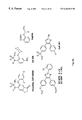
- Prostaglandin endoperoxide synthase-1 is expressed constitutively and is thought to play a physiological role, particularly in platelet aggregation, cytoprotection in the stomach, and regulation of normal kidney function (FIG. 1 ).
- Prostaglandin endoperoxide synthase-2 is the inducible isozyme and expression of prostaglandin endoperoxide synthase-2 is induced by a variety of agents which include endotoxin, cytokines, and mitogens (2,3).
- prostaglandin endoperoxide synthase-2 is induced in vivo to significant levels upon pro-inflammatory stimuli (4).
- prostaglandin endoperoxide synthase-1 and prostaglandin endoperoxide synthase-2 serve different physiological and pathophysiological functions.
- NSAIDs non-steroidal antiinflammatory drugs
- the prior art is deficient in the lack of selective and orally active prostaglandin endoperoxide synthase-2 inhibitors.
- the present invention fulfills this longstanding need and desire in the art.
- R is selected from the group consisting of CH 3 , CH 2 CH 3 , CH 2 Ph, (CH 2 ) 2 Ph, (CH 2 ) 2 CH 3 , (CH 2 ) 3 CH 3 , (CH 2 ) 4 CH 3 , (CH 2 ) 5 CH 3 , (CH 2 ) 6 CH 3 , (CH 2 ) 2 O(CH 2 ) 3 CH 3 , CH 2 HC ⁇ CH(CH 2 ) 3 CH 3 , CH 2 C ⁇ C(CH 2 ) 3 CH 3 , CH 2 C ⁇ C(CH 2 ) 2 CH 3 , CH 2 C ⁇ CCH 2 CH 3 , CH 2 C ⁇ CCH 3 , CH 2 C ⁇ CH, CH 2 C ⁇ C(CH 2 ) 4 CH 3 , CH 2 C ⁇ C(CH 2 ) 5 CH 3 , CH 2 C ⁇ C(CH 2 ) 6 CH 3 , (CH 2 ) 2 C ⁇ C(CH 2 ) 2 CH 3 , CH(CH 3 )C ⁇ C(CH 2 )
- a pharmaceutical composition comprising the novel compounds of the present invention and a pharmaceutically acceptable carrier.
- a method of inhibiting the synthesis of prostaglandin endoperoxide syntase-2 comprising the step of administering to said mammal an effective amount of a compound of Formula (I).
- FIG. 1 shows a schematic of the physiological stimuli which lead to inflammation.
- FIG. 2A shows the structures of flosulide, NS-398, SC 8076, aspirin and DuP 697.
- FIG. 2B shows the synthetic scheme for the synthesis of compounds 2 , 3 , 4 and 6 - 14 .
- FIG. 2C shows the synthetic scheme for the synthesis of compounds 15 , 16 , 17 , 18 and 19 .
- FIG. 2D shows the synthetic scheme for the synthesis of compounds 21 , 22 , 23 , and 24 .
- FIG. 2E shows the synthetic scheme for the synthesis of compounds 26 , 27 , 28 , 29 , 30 and 31 .
- FIG. 2F shows the synthetic scheme for the synthesis of compounds 33 - 48 and 49 - 63 .
- FIG. 2G shows the synthetic scheme for the synthesis of compounds 65 , 66 , 67 , 69 , 70 and 71 .
- FIG. 2H shows the synthetic scheme for the synthesis of compounds 73 , 74 and 75 .
- FIG. 2I shows the synthetic scheme for the synthesis of compounds 79 - 91 .
- FIG. 2J shows the synthetic scheme for the synthesis of compounds 36 , 92 , and 93 .
- FIG. 2K shows the synthetic scheme for the synthesis of compounds 95 , 96 and 97 .
- FIG. 2L synthetic scheme for the synthesis of compounds 106 , 107 , 108 , 109 , 110 , 111 , 114 , and 115 .
- FIG. 2M shows synthetic scheme for the synthesis of compounds 118 , 119 , and 120 .
- FIG. 2N shows the synthetic scheme for the synthesis of compounds 121 , 122 , 123 , and 124 .
- FIG. 2Q shows the synthetic scheme for the synthesis of compounds 126 and 127 .
- FIG. 2P shows the synthetic scheme for the synthesis of compounds 128 , 130 and 131 .
- FIG. 2Q shows the synthetic scheme for the synthesis of compounds 132 , 133 , 134 , 135 , 136 , 137 , 138 , 139 , 140 , and 141 .
- FIG. 3 shows the time- and concentration-dependent inhibition of human PGHS-2 and ovine PGHS-1 by 2-acetoxythioanisole (2).
- HoloPGHS-1 (22 nM) or holoPGHS-2 (88 nM) was incubated with the indicated concentrations of 2 for 3 hours at room temperature.
- Cyclooxygenase reaction was initiated by the addition of 50 ⁇ M [1- 14 C]-arachidonic acid for 30 sec at 37° C. Closed squares, PGHS-2+ 2 ; open squares, PGHS-1+ 2 .
- 2-Acetoxythioanisole (mM) % Remaining Enzyme Activity
- FIG. 4 shows the time-dependent inhibition of the cyclooxygenase activity of Apo and HoloPGHS-2 by 2-Acetoxythioanisole ( 2 ).
- ApoPGHS-2 (5 ⁇ M) or holoPGHS-2 (5 ⁇ M) was incubated with a 1000-fold excess of 2 .
- Periodic 0.16 ⁇ M enzyme aliquots (final inhibitor concentration ⁇ 160 ⁇ M) were analyzed for remaining cyclooxygenase or peroxidase activity as described above.
- FIG. 5 shows the time- and concentration-dependent inhibition of human PGHS-2 and ovine PGHS-1 by aspirin.
- HoloPGHS-1 22 nM
- holoPGHS-2 88 nM
- Cyclooxygenase activity was initiated by the addition of [1- 14 C]-arachidonic acid (50 ⁇ M) for 30 sec at 37° C.
- FIG. 6 shows the inactivation of the cyclooxygenase activities of holo and apoPGHS-2 by 2-acetoxythioanisole ( 2 ).
- Apo or HoloPGHS-2 (5 mM) was inactivated with a 1000-fold excess of 2-acetoxythioanisole ( 2 ) at 22.5° C. in 100 mM Tris-HCl buffer, pH 8 containing 500 mM phenol for the indicated time period, and then hydroxylamine (80 mM) in 10 mM Tris-HCl buffer, pH 7.5 was added as indicated by the arrow.
- FIG. 7 shows the effect of pH on the inhibition of the cyclooxygenase activity of human PGHS-2 by 2-acetoxythioanisole ( 2 ).
- ApoPGHS-2 (5 ⁇ M, 1.62 ⁇ g/ ⁇ L) in 100 mM sodium phosphate buffer of pH 6, 7, 8, and 9 was reconstituted with 2 equivalents of hematin.
- Compound 2 (1000-fold excess) in DMSO was added to the reaction mixture.
- 0.16 ⁇ M enzyme aliquots (final inhibitor concentration ⁇ 178 ⁇ M) were analyzed for remaining cyclooxygenase activity.
- FIG. 8 shows the time- and concentration-dependent inhibition of human PGHS-2 and ovine PGHS-1 by 2-(Trifluoromethylacetoxy)thioanisole ( 6 ).
- HoloPGHS-1 (22 nM) or holoPGHS-2 (88 nM) was incubated with the indicated concentrations of 6 for 3 hours at room temperature.
- Cyclooxygenase reaction was initiated by the addition of [1- 14 C]-arachidonic acid (50 ⁇ M) for 30 sec at 37° C. Open squares, PGHS-1+ 6 ; closed squares, PGHS-2+ 6 .
- FIG. 9 shows the time- and concentration-dependent inhibition of human PGHS-2 and ovine PGHS-1 by 2-acetoxyphenyl heptyl sulfide ( 54 ) and a comparison with 2-Hydroxyphenylheptyl sulfide ( 38 ).
- HoloPGHS-1 (22 nM) or holoPGHS-2 (88 nM) was incubated with the indicated concentrations of 54 and 38 for 3 hours at room temperature.
- Cyclooxygenase reaction was initiated by the addition of [1- 14 C]-arachidonic acid (50 ⁇ M) for 30 seconds at 37° C.
- FIG. 10 shows the effect of pH on the inhibition of the cyclooxygenase activity of human PGHS-2 by 2-Acetoxyphenylheptyl sulfide ( 54 ).
- ApoPGHS-2 (5 ⁇ M, 1.62 ⁇ g/ ⁇ L) in 100 mM sodium phosphate buffer of pH 6, 7, 8, and 9 was reconstituted with 2 equivalents of hematin.
- Compound 54 (181 ⁇ M) in DMSO was added to the reaction mixture. Periodically, 0.16 ⁇ M enzyme aliquots (final inhibitor concentration ⁇ 6 ⁇ M) were analyzed for remaining cyclooxygenase activity.
- FIG. 11 shows the time-dependency and concentration-dependent inhibition of human PGHS-2 and ovine PGHS-1 by 2-Acetoxyphenyl-2-butoxyethyl sulfide ( 67 ) and 2-acetoxyphenyl-3-propionoxypropyl sulfide ( 71 ).
- HoloPGHS-2 (22 nM) or holoPGHS-1 (88 nM) was incubated with the indicated concentrations of 67 or 71 for 3 hours at room temperature.
- Cyclooxygenase reaction was initiated by the addition of [1- 14 C]-arachidonic acid (50 ⁇ M) for 30 sec at 37° C.
- FIG. 12 shows the time- and concentration-dependent inhibition of human PGHS-2 and ovine PGHS-1 by 2-Acetoxyphenyl-hept-2-ynl sulfide (87).
- HoloPGHS-1 (22 nM) or holoPGHS-2 (88 nM) was incubated with the indicated concentrations of 87 for 3 hours at room temperature.
- Cyclooxygenase activity was initiated by the addition of 50 ⁇ M [1-14C]-arachidonic acid for 30 sec at 37° C.
- FIG. 13 shows the time- and concentration-dependent inhibition of human PGHS-2 and ovine PGHS-1 by 2-Acetoxyphenyl-hex-2-ynyl sulfide ( 88 ).
- HoloPGHS-1 (22 nM) or holoPGHS-2 (88 nM) was incubated with the indicated concentrations of ( 88 ) for 3 hours at room temperature.
- Cyclooxygenase activity was initiated by the addition of 50 ⁇ M [1-14C]-arachidonic acid for 30 sec at 37° C. Closed squares, cyclooxygenase activity of PGHS-2; open squares, cyclooxygenase activity of PGHS-1.
- FIG. 14 compares the inhibition of PGHS-2 in activated macrophages by 2-Acetoxythioanisole ( 2 ) with aspirin.
- RAW 264.7 cells were activated for 7 hours at 37° C. in serum free DMEM with LPS (500 ng/mL) and ⁇ -interferon (10 U/mL).
- Vehicle (DMSO) or compound 2 (100 ⁇ M) or aspirin (100 ⁇ M) in DMSO were added for 30 min at 37° C.
- the cyclooxygenase reaction was initiated by adding [1- 14 C]-arachidonic acid (20 ⁇ M) for 15 min at 37° C.
- FIG. 15 compares the inhibition of PGHS-2 in activated macrophages by 2-(Acetoxyphenyl)heptyl sulfide ( 54 ) with aspirin.
- RAW 264.7 cells were activated for 7 hours at 37° C. in serum free DMEM with LPS (500 ng/mL) and ⁇ -interferon (10 U/mL).
- Vehicle (DMSO) or compound 54 or aspirin (100 ⁇ M) in DMSO were added for 30 min at 37° C.
- the cyclooxygenase reaction was initiated by adding [1- 14 C]-arachidonic acid (20 ⁇ M) for 15 min at 37° C.
- FIG. 16 shows the inhibition of PGHS-2 in activated macrophages by 2-(Acetoxyphenyl) hept-2-ynyl Sulfide ( 87 ) and 2-(Acetoxyphenyl)heptyl Sulfide ( 54 ).
- RAW 264.7 cells were activated for 7 hours at 37° C. in serum free DMEM with LPS (500 ng/mL) and ⁇ -interferon (10 U/mL).
- Vehicle (DMSO) or compounds 87 and 54 in DMSO were added for 30 min at 37° C.
- the cyclooxygenase reaction was initiated by adding [1- 14 C]-arachidonic acid (20 ⁇ M) for 15 min at 37° C.
- prostaglandin endoperoxide synthase-2 selective inhibitors Two general structural classes of prostaglandin endoperoxide synthase-2 selective inhibitors are commonly reported in the literature. In addition to selective prostaglandin endoperoxide synthase-2 inhibition in vitro, many of these compounds possess potent anti-inflammatory activity in the rat adjuvant-induced arthritis model along with exceptional safety profiles in comparison with the existing antiinflammatory agents.
- the structural classes include the tricyclic non-acidic arylmethyl sulfones (8-11) (exemplified by DuP 697 and SC 8092) and the acidic sulfonamides (12-15) (exemplified by Flosulide and NS-398) (FIG. 2 ).
- the arylmethyl sulfonyl moiety in the tricyclic non-acidic compounds such as SC 8092 may play a key role in the selective prostaglandin endoperoxide synthase-2 inhibition by these compounds as reduction of the sulfone group in SC 8092 to the corresponding sulfide functionality generates SC 8076, a prostaglandin endoperoxide synthase-l selective inhibitor (11) (FIG. 2 ).
- a variety of substituted acyloxybenzene derivatives were synthesized and examined as selective prostaglandin endoperoxide synthase-2 inhibitors.
- Introduction of a 2-methylthio functionality leads to the corresponding 2-acetoxythioanisole 2 derivative which displays selective inhibition of the cyclooxygenase activity of prostaglandin endoperoxide synthase-2 (IC 50 (PGHS-2) ⁇ 264 ⁇ M; IC 50 (PGHS-1)>5 mM).
- the present invention provides the discovery of a new structural class of selective prostaglandin endoperoxide synthase inhibitors. Subsequent inhibition studies with 14 C-radiolabled inhibitors have established that selective prostaglandin endoperoxide synthase-2 inhibition arises from acetylation of an active site amino acid residue.
- the present invention is the first documentation of a selective covalent modification of prostaglandin endoperoxide synthase-2 by a selective prostaglandin endoperoxide synthase-2 inhibitor.
- a selective prostaglandin endoperoxide synthase-2 inhibitor In addition to the in vitro inhibition studies with purified human prostaglandin endoperoxide synthase-2 and ovine prostaglandin endoperoxide synthase-1, the ability of these new compounds in inhibiting prostaglandin endoperoxide synthase-2 activity in murine macrophages was also examined. Most of the inhibitors displayed potent inhibition of the prostaglandin endoperoxide synthase-2 activity in murine macrophages activated with LPS and IFN- ⁇ indicating that these compounds are active in vivo as well.
- the present invention is directed to a compound of the formula
- R is selected from the group consisting of CH 3 , CH 2 CH 3 , CH 2 Ph, (CH 2 ) 2 Ph, (CH 2 ) 2 CH 3 , (CH 2 ) 3 CH 3 , (CH 2 ) 4 CH 3 , (CH 2 ) 5 CH 3 , (CH 2 ) 6 CH 3 , (CH 2 ) 2 O(CH 2 ) 3 CH 3 , CH 2 HC ⁇ CH(CH 2 ) 3 CH 3 , CH 2 C ⁇ C(CH 2 ) 3 CH 3 , CH 2 C ⁇ C(CH 2 ) 2 CH 3 , CH 2 C ⁇ CCH 2 CH 3 , CH 2 C ⁇ CCH 3 , CH 2 C ⁇ CH, CH 2 C ⁇ C(CH 2 ) 4 CH 3 , CH 2 C ⁇ C(CH 2 ) 5 CH 3 , CH 2 C ⁇ C(CH 2 ) 6 CH 3 , (CH 2 ) 2 C ⁇ C(CH 2 ) 2 CH 3 , CH(CH 3 )C ⁇ C(CH 2 )
- the representative examples of compounds of the present invention are selected from the group consisting of 2-(trifluoromethylacetoxy)thioanisole, 2-( ⁇ -bromoacetoxy)thioanisole, 2-acetoxyphenylbenzyl sulfide, 2-acetoxyphenyl-2-phenylethyl sulfide, 2-acetoxyphenylpropyl sulfide, 2-acetoxyphenylbutyl sulfide, 2-acetoxyphenylpentyl sulfide, 2-acetoxyphenylhexyl sulfide, 2-acetoxyphenylheptyl sulfide, 2-acetoxyphenyl-2-butoxyethyl sulfide, 2-acetoxyphenyl-2-transheptenyl sulfide, 2-acetoxyphenylhept-2-ynyl sulfide, 2-acetoxyphenylhex-2-ynyl sulfide, 2-
- Compounds of Formula (I) are capable of inhibiting inducible proinflammatory proteins, such as cyclooxygenase-2 and are therefore useful in therapy. These proinflammatory lipid mediators of the cyclooxygenase (CO) pathway are produced by the inducible cyclooxygenase-2 enzyme. Regulation, therefore, of cyclooxygenase-2 which is responsible for these products derived from arachidonic acid, such as the prostaglandins affect a wide variety of cells and tissue states and conditions. Expression of cyclooxygenase-1 is not affected by the compounds of Formula (I).
- This selective inhibition of cyclooxygenase-2 may alleviate or spare ulcerogenic liability associated with inhibition of cyclooxygenase-1 thereby inhibiting prostaglandins essential for cytoprotective effects.
- inhibition of the proinflammatory mediators is of benefit in controlling, reducing and alleviating many of these disease states.
- prostaglandins have been implicated in pain (such as in the sensitization of pain receptors) or edema.
- This aspect of pain management includes treatment of neuromuscular pain, headache, cancer pain and arthritis pain.
- Compounds of Formula (I) or a pharmaceutically acceptable salt thereof are of use in the prophylaxis or therapy in a human, or other mammal, by inhibition of the synthesis of the cyclooxygenase-2 enzyme.
- the present invention is also directed to a method of inhibiting the synthesis of prostaglandins by inhibition of prostaglandin endoperoxide syntase-2 (PGHS-2) in a mammal in need of such treatment, comprising the step of administering to said mammal an effective amount of a compound of Formula (I).
- this method is useful in the prophylaxis or therapeutic treatment of edema, fever, algesia, neuromuscular pain, headache, cancer pain or arthritic pain.
- Representative compounds useful in this method include 2-acetoxythioanisole, 2-(trifluoromethylacetoxy)thioanisole, 2-( ⁇ -chloroacetoxy)thioanisole, 2-( ⁇ -bromoacetoxy)thioanisole, 2-acetoxyphenylbenzyl sulfide, 2-acetoxyphenyl-2-phenylethyl sulfide, 2-acetoxyphenylethyl sulfide, 2-acetoxyphenylpropyl sulfide, 2-acetoxyphenylbutyl sulfide, 2-acetoxyphenylpentyl sulfide, 2-acetoxyphenylhexyl sulfide, 2-acetoxyphenylheptyl sulfide, 2-acetoxyphenyl-2-butoxyethyl sulfide, 2-acetoxyphenyl-2-trans-heptenyl sulfide, 2-acetoxyphenylhept-2-
- the present invention is also directed to a pharmaceutical composition, comprising a compound of Formula (I) and a pharmaceutically acceptable carrier or diluent.
- a pharmaceutical composition comprising an effective, non-toxic amount of a compound of Formula (I) and a pharmaceutically acceptable carrier or diluent.
- Compounds of Formula (I), pharmaceutically acceptable salt thereof and pharmaceutical compositions incorporating such may be conveniently administered by any of the routes conventionally used for drug administration, e.g., orally, topically, parenterally, or by inhalation.
- the compounds of Formula (I) may b e administered in conventional dosage forms prepared by combining a compound of Formula (I) with standard pharmaceutical carriers according to conventional procedures.
- the compounds of the present invention may also be administered in conventional dosages in combination with a known, second therapeutically active compound. These procedures may involve mixing, granulating and compressing or dissolving the ingredients as appropriate to the desired preparation.
- the form and character of the pharmaceutically acceptable carrier or diluent is dictated by the amount of active ingredient with which it is to be combined, the route of administration and other well known variable.
- the carrier(s) must be “acceptable” in the sense of being compatible with the other ingredients of the formulation and not deleterious to the recipient thereof.
- the pharmaceutical carrier employed may be, for example, either a solid or a liquid.
- Representative solid carriers are lactose, terra alba, sucrose, talc, gelatin, agar, pectin, acacia, magnesium sterate, stearic acid and the like.
- Representative liquid carriers include syrup, peanut oil, olive oil, water and the like.
- the carrier may include time delay material well known in the art such as glyceryl monosterate or glyceryl disterarate alone or with a wax.
- the preparation can be tableted, placed in a hard gelatin capsule in powder or pellet form or in the form of a troche or lozenge.
- the amount of solid carrier will vary widely but preferably will be from about 25 mg to about 1 gram.
- the preparation will be in the form of a syrup, emulsion, soft gelatin capsule, sterile injectable liquid such as an ampule or nonaqueous liquid suspension.
- Compounds of Formula (I) may be administered topically (non-systemically). This includes the application of a compound externally to the epidermis or the buccal cavity and the instillation of such a compound into the ear, eye and nose, such that the compound does not significantly enter the bloodstream.
- Formulation suitable for topical administration include liquid or semi-liquid preparations suitable for penetration through the skin to the site of inflammation such as liniments, lotions, creams, ointments, pastes and drops suitable for administration to the ear, eye and nose.
- the active ingredient may comprise, for topical administration from 0.001% to 10% w/w, for instance from 1% to 2% by weight of the Formulation. It may however, comprise as much as 10% w/w but preferably will comprise less than 5% w/w, more preferably from 0.1% to 1% w/w of the Formulation.
- Lotions according to the present invention include those suitable for application to the skin and eye.
- An eye lotion may comprise a sterile aqueous solution optionally containing a bactericide and may be prepared by methods similar to those for the preparation of drops.
- Lotions or liniments for application to the skin may include an agent to hasten drying and to cool the skin, such as an alcohol or acetone, and/or a moisterizer such as glycerol or an oil such as castor oil or arachis oil.
- Creams, ointments or pastes according to the present invention are semi-solid formulations of the active ingredient for external application. They may be made by mixing the active ingredient in finely divided or powdered form, alone or in solution or suspension in an aqueous or non-aqueous fluid, with the aid of suitable machinery, with a greasy or non-greasy base.
- the base may comprise hydrocarbons such as hard, soft or liquid paraffin, glycerol, beeswax, a metallic soap, a mucilage, an oil of natural origin such as almond, corn, archis, castor, or olive oil; wool fat or its derivatives or a fatty acid such as steric or oleic acid together with an alcohol such as propylene glycol or a macrogel.
- the formulation may incorporate any suitable surface active agent such as an anionic, cationic or non-ionic surfactant such as a sorbitan ester or a polyoxyethylene derivative thereof.
- suitable surface active agent such as an anionic, cationic or non-ionic surfactant such as a sorbitan ester or a polyoxyethylene derivative thereof.
- Suspending agents such as natural gums, cellulose derivatives or inorganic materials such as silicaceous silicas, and other ingredients such as lanolin may also be included.
- Drops according to the present invention may comprise sterile aqueous or oily solutions or suspensions and may be prepared by dissolving the active ingredient in a suitable aqueous solution of a bactericidal and/or fungicidal agent and/or any other suitable preservative, and preferably including a surface active agent.
- the resulting solution may then be clarified by filtration, transferred to a suitable container which is then sealed and sterilized by autoclaving.
- the solution may be sterilized by filtration and transferred to the container by an aseptic technique.
- bactericidal and fungicidal agents suitable for inclusion in the drops are phenymercuric nitrate or acetate ( ⁇ 0.002%), benzalkonium chloride ( ⁇ 0.01%) and chlorhexidine acetate ( ⁇ 0.01%).
- Suitable solvents for the preparation of an oily solution include glycerol, diluted alcohol and propylene glycol.
- Compounds of formula (I) may be administered parenterally, i.e., by intravenous, intramuscular, subcutaneous, intranasal, intrarectal, intravaginal or intraperitoneal administration.
- the subcutaneous and intramuscular forms of parenteral administration are generally preferred.
- Appropriate dosage forms for such administration may be prepared by conventional techniques.
- Compounds may also be administered by inhalation, e.g., intranasal and oral inhalation administration.
- Appropriate dosage forms for such administration, such as aerosol formulation or a metered dose inhaler may be prepared by conventional techniques well known to those having ordinary skill in this art.
- the daily oral dosage regiment will preferably be from about 0.1 to about 100 mg/kg of total body weight.
- the daily parenteral dosage regiment will preferably be from about 0.1 to about 100 mg/kg of total body weight.
- the daily topical dosage regimen will preferably be from about 0.1 to about 15 mg, administered one to four, preferably two to three times daily. It will also be recognized by one of skill in this art that the optimal quantity and spacing of individual dosages of a compound of the present invention, or a pharmaceutically acceptable salt thereof, will be determined by the nature and extent of the condition being treated and that such optimums can be determined by conventional techniques.
- Suitable pharmaceutically acceptable salts are well known to those skilled in the art and include basic salts of inorganic and organic acids, such as hydrochloric acid, hydrobromic acid, sulphuric acid, phophoric acid, methane sulphonic acid, ethane sulphonic acid, acetic acid, malic acid, tartaric acid, citric acid, lactic acid, oxalic acid, succinic acid, fumaric acid, maleic acid, benzoic acid, salicylic acid, phenylacetic acid and mandelic acid.
- pharmaceutically acceptable salts of compounds of Formula (I) may also be formed with a pharmaceutically acceptable cation, for instance, if a substituent group comprises a carboxy moiety.
- Suitable pharmaceutically acceptable cations are well known in the art and include alkaline, alkaline earth ammonium and quaternary ammonium cations.
- reaction mixture comprising of 16 (0.6 g, 2.47 mmol) in THF (0.23 mL), water (2 mL), and 6 M HCl (5 mL) was heated at 60° C. for 6 hours (FIG. 2 C).
- the reaction mixture was poured into a equal volume of saturated NaCl and the aqueous solution was extracted with diethyl ether (3 ⁇ 20 mL).
- the combined organic solution was dried (MgSO 4 ), filtered and the solvent removed under vacuo.
- the crude product was chromatographed on silica gel and eluted with petroleum ether:EtOAc (95:5) to afford 17 as a crystalline white solid (0.3 g, 61%).
- a reaction mixture containing the methylsalicylate derivative 17 (50 mg, 0.25 mmol), powdered KOH (56 mg, 1 mmol) in EtOH:H 2 O (3.64 mL:0.36 mL) was heated under reflux for 3.5 hours (FIG. 2 C).
- the resultant solution was cooled and acidified with 1 M HCl.
- the aqueous solution was extracted with EtOAc (3 ⁇ 10 mL).
- the combined organic solution was washed with brine, water, and then dried (MgSO 4 ).
- the solvent was removed under reduced pressure to afford the essentially pure salicylic acid derivative 18 as a white solid (38 mg, 82%).
- a reaction mixture containing the trimethylsilyl derivative ( 28 , 0.51 g, 1.74 mmol) in 10 mL of freshly distilled THF was treated with trifluoroethanol (0.18 g, 1.82 mmol) and tetrabutylammonium fluoride (1 M solution in THF, 1.74 mL, 1.74 mmol) at ⁇ 78° C. under argon (FIG. 2 E).
- the reaction mixture was allowed to stir at ⁇ 78° C. for 20 min and at room temperature for 30 minutes.
- the reaction was quenched by the addition of water, followed by extraction with ethyl ether (2 ⁇ 15 mL).
- reaction mixture containing 2-hydroxythiophenol ( 32 , 3.96 mmol) in 4 mL of dry DMF was treated with KHCO 3 (4.52 mmol) and alkyl halide (3.96 mmol) and allowed to stir at room temperature overnight (FIG. 2 F).
- the reaction mixture was diluted with water and extracted with ethyl ether (3 ⁇ 20 mL).
- the combined organic extracts were washed with water (2 ⁇ 50 mL), dried (MgSO 4 ), filtered, and the solvent removed under vacuo. The residue was chromatographed on silica gel and eluted with EtOAc:hexanes (3:97) to afford the desired products.
- 2-Hydroxyphenylhept-3-ynyl sulfide ( 114 ) was prepared by the alkylation of 2-hydroxythiophenol (32) with Hept-3-ynyl-1-bromide as a colorless oil (0.13 g, 50%) (FIG. 2 L).
- Step 1 ( ⁇ )-Oct-3-yn-2-ol ( 117 ).
- n-BuLi 2.5 M solution in hexanes, 11 mL, 27 mmol
- Acetaldehyde ⁇ 2 mL was added to this solution at ⁇ 78° C. and the reaction mixture was allowed to stir at rt for 3 h.
- Step 2 2-Bromooct-3-yne ( 118 ) was prepared according to the procedure described for 1-bromohept-2-yne (FIG. 2 M). Title compound was obtained as a colorless oil (0.9 g, 65%) upon purification on silica gel (EtOAc:hexanes, 1:99).
- Step 3 2-[( ⁇ )-2-Hydroxyphenylmercapto]oct-3-yne ( 119 ) was prepared according to the procedure described for 82 (FIG. 2 M). Title compound was obtained as a colorless oil (0.1 g, 55%) upon purification on silica gel (EtOAc:hexanes, 5:95).
- Step 4 2-[( ⁇ )-2-acetoxyphenylmercapto]oct-3-yne ( 120 ) was prepared according to the procedure described for 87 (FIG. 2 M). Title compound was obtained as a colorless oil (91 mg, 78%) upon purification on silica gel (EtOAc:hexanes, 5:95).
- Step 1 2-Hydroxyphenylhept-2-ynyl ether ( 126 ) (FIG. 20 ).
- catechol 125 , 0.35 g, 3.16 mmol
- KHCO 3 0.33 g, 3.3 mmol
- 1-bromohept-2-yne 79 , 0.5 g, 3.16 mmol
- Step 2 2-Acetoxyphenylhept-2-ynyl ether ( 127 ).
- a reaction mixture containing 126 (0.13 g, 0.64 mmol), dry pyridine (56 ⁇ L, 0.7 mmol) and Ac 2 O (66 ⁇ L, 0.7 mmol) in 2 mL of dry CH 2 Cl 2 was stirred at rt for 4 h.
- the mixture was diluted with water and extracted with CH 2 Cl 2 (2 ⁇ 10 mL).
- the combined organic phase was washed with water, dried (MgSO 4 ), filtered and the solvent was concentrated in vacuo.
- Step 1 2-Methoxyphenylheptyl selenide ( 129 ) (FIG. 2 P).
- anhydrous anisole 128 , 2.5 g, 23.11 mmol
- n-BuLi 2.5 M soln in hexanes, 10 mL, 25 mmol
- the resultant orange solution was stirred at 0° C. for 1 h and at room temperature for 30 min under argon.
- Selenium powder (1.97 g, 25 mmol) was added to this solution at ⁇ 78° C. which was allowed to stir at rt for 2 h. The reaction mixture was then cooled to ⁇ 78° C.
- Step 2 2-Hydroxyphenylheptyl selenide ( 130 ).
- boron tribromide (1 M soln in CH 2 Cl 2 , 8.02 mL, 8.02 mmol) under argon.
- the solution was stirred overnight at room temperature.
- the reaction was carefully quenched with water and extracted with CH 2 Cl 2 (3 ⁇ 20 mL).
- the combined organic solution was washed with water, dried (MgSO 4 ), filtered, and concentrated in vacuo.
- Step 3 2-Acetoxyphenylheptyl selenide ( 131 ). was prepared by the acetylation of 130 with AC 2 O. Title compound was obtained as a colorless oil (0.48 g, 94%) upon purification by chromatography on silica gel (EtOAc:hexanes, 5:95).
- 2-Acetoxyphenyl-(6-iodohexyl) sulfide ( 137 ) was prepared by the acetylation of 132 with Ac 2 O (FIG. 2 Q). Title compound obtained as a colorless oil (0.18 g, 95%) upon chromatography on silica gel (EtOAc:hexanes, 2:98).
- 2-Acetoxyphenyl-5-carboxypentyl sulfide ( 140 ) was prepared by the acetylation of 135 with Ac 2 O (FIG. 2 Q). The title compound was obtained as a white solid (0.82 g, 87%) upon purification by chromatography on silica gel (EtOAc:hexanes, 20:80, then 40:60).
- Sheep seminal vesicles were purchased from Oxford Biomedical Research, Inc. (Oxford, Mich.). Arachdonic acid was purchased from Nu Chek Prep (Elysian, Minn.). Hematin, hydrogen peroxide, and guaiacol were purchased from Sigma Chemical Co. (St. Louis, Mo.). PGHS-1 was purified from sheep seminal vesicles as described earlier. The specific activity of the protein was 20.9 ( ⁇ M O 2 /min/mg), and the percentage of holoenzyme was 13.5%. ApoPGHS was prepared as described earlier. Apoenzyme was reconstituted by the addition of hematin to the assay mixtures. Human PGHS-2 (1.62 ⁇ g/ ⁇ l) was prepared by expression in insect cells from baculovirus vectors. The specific activity of the protein was 10.1 ( ⁇ M O 2 /min/mg).
- Oxygen consumption was measured at 37° C. with a Gilson model 5/6 oxygraph (Gilson Medical Electronics, Inc., Middleton, Wis.) equipped with a clark electrode and a thermostated cuvette. Enzyme aliquots (0.16 ⁇ M) were added to 100 mM Tris-HCl at pH 8.0 containing 500 ⁇ M phenol and 1 RM hematin in a final volume of 1.3 mL. Oxygen uptake was initiated by the addition of 100 ⁇ M sodium arachidonate, and the initial reaction velocity was determined from the linear portion of the oxygen uptake curve.
- Assays were performed at 25° C. on a Shimadzu UV 160U by measuring the initial rates of oxidation of guaiacol at 436 nm. Enzyme aliquots (0.16 ⁇ M) were added to 100 mM Tris-HCl (pH 8) containing 1 ⁇ M heme and 500 ⁇ M guaicol in 1 mL disposible cuvettes. Reaction was initiated by the addition of 400 ⁇ M hydrogen peroxide.
- apoPGHS-1 or apoPGHS-2 (5 ⁇ M) in 100 mM Tris buffer, pH 8.0 containing 500 ⁇ M phenol was treated with 2 equivalents of hematin (500 ⁇ M stock solution in DMSO) and then treated with inhibitor and incubated at room temperature. Periodically, 0.16 ⁇ M apoPGHS-1 or apoPGHS-2 aliquots were analyzed for remaining cyclooxygenase activity or peroxidase activity (FIG. 4 ).
- ApoPGHS-2 (1.62 ⁇ g/ ⁇ l) (5 ⁇ M) in 100 mM sodium phosphate buffer, at pH 6, 7, 8, and 9 containing 500 ⁇ M phenol was treated with inhibitor (2-acetoxythioanisole 10 mM; 2-acetoxyphenylheptylsulfide 181 ⁇ M, or aspirin 32 ⁇ M) and incubated at room temperature. Periodically, 0.16 ⁇ M apoPGHS-1 or apoPGHS-2 aliquots were analyzed for remaining cyclooxygenase activity or peroxidase activity as described.
- FIG. 5 shows that aspirin had a greater inhibitory effect on PGHS-1 than PGHS-2.
- FIG. 7 shows that 2-acetoxythioanisole greatly inhibited cyclooxygenase activity of holoPGHS-2 at pH 9.
- Cyclooxygenase activity of ovine PGHS-1 (22 nM) or human PGHS-2 (88 nM) was assayed by TLC. Reaction mixtures of 200 ⁇ L consisted of hematin-reconstituted protein in 100 mM Tris-HCl, pH 8.0, 500 ⁇ M phenol, and [1- 14 C]arachidonic acid (50 ⁇ M, 57 mCi/mmol). For the time-dependent inhibition assay, hematin-reconstituted PGHS-1 (22 nM) or PGHS-2 (88 nM) was preincubated at room temperature for 2 hours and then at 0° C.
- FIG. 8 shows that 0.1 mM of compound 6 inhibited about 35% of human PGHS-2.
- FIG. 9 shows that compound 54 greatly inhibited cyclooxygenase activity of human holoPGHS-2 whereas compound 38 had very little effect.
- FIG. 10 shows the pH dependency of the effect of compound 54 on cyclooxygenase activity of human holoPGHS-2 with the greatest inhibition seen at pH 9.
- FIG. 11 shows that 8 ⁇ M of compound 67 greatly inhibited cyclooxygenase activity of human holoPGHS-2 where as compound 71 had very little effect.
- FIG. 12 shows that 1-16 ⁇ M compound 87 greatly inhibited cyclooxygenase activity of human holoPGkHS-2 where as compound 82 had very little effect.
- FIG. 13 shows that 1-16 ⁇ M compound 88 greatly inhibited cyclooxygenase activity of human holoPGHS-2.
- Both compound 2 (FIG. 14) and compound 54 (FIG. 15) had a greater inhibitory effect on PGHS-2 in activated macrophages than aspirin.
- FIG. 16 shows that compounds 54 and 87 both greatly inhibited cyclooxygenase activity of human holoPGHS-2 in activated macrophages.
- ApoPGHS-2 (5 ⁇ M) or apoPGHS-2 (5 ⁇ M), reconstituted with 2 equivalents of hematin in 100 mM Tris-HCl, pH 8 at 37° C. containing 500 ⁇ M phenol was treated with 2-acetoxy-1-thioanisole (10 mM). Periodically, 0.16 ⁇ M enzyme aliquots were analyzed for remaining cyclooxygenase activity as described earlier. The cyclooxygenase activity was inhibited by greater than 70% in 2.5 hours.
- the murine macrophage cell line RAW264.7 were seeded overnight for 30% confluency the following morning. Overnight DMEM and fetal bovine serum (FBS) was removed and 2 mL DMEM containing 1.5% FBS ⁇ 500 ng/mL LPS and 10 units/mL interferon- ⁇ were added for 7.5 hours at 37° C. Activation medium was removed and 2.0 mL SF-DMEM and/or aspirin or 2-acetoxyphenylheptyl sulfide ( 54 ) at varying concentrations were added for 30 min at 37° C. Arachidonic acid metabolism was measured by adding 20 ⁇ M 14C-AA for 15 min at room temperature.
- FBS fetal bovine serum
- TABLE 1 shows the time and concentration-dependent inhibition of PGHS-2 and PGHS-1 by 2-acyloxyphenylalkyl and aryl sulfides, including compounds 6 , 7 , 8 , 59 , 60 , 61 , 62 , 63 and 93 .
- TABLE 2 shows the time and concentration-dependent inhibition of PGHS-2 and PGHS-1 by 2-acetoxyphenylalkyl and aryl sulfides, including compounds 2 , 49 , 50 , 51 , 52 , 53 , 54 , 55 , 56 , 57 , 58 , 67 , 71 , 75 , 87 , 88 , 89 , 90 and 91 .
- the cyclooxygenase reaction was initiated by the addition of 14C-arachidonic acid (50 ⁇ M) to the incubation mixtures at 37 C for 30 seconds.
- b ⁇ 25-30% inhibition of PGHS-1 at these concentrations.
- c No significant inhibition discernible at the concentration ranges studies (66 ⁇ M to 1 mM). * ⁇ 30% inhibition of PGHS-1 at 1 mM.
- the fluoroacetoxythioanisole analogs 24 and 31 as well as the aspirin analog 19 did not display significant inhibition of either isozyme. Increments in the length of the acyl group (compounds 9-14) led to inactive compounds.
- the cyclooygenase reaction was initiated by the addition of 14 C-arachidonic acid (50 mM) to the incubation mixtures at 37° C. for 30 sec.
- 14 C-arachidonic acid 50 mM
- c ⁇ 25-30% inhibition of PGHS-1 at these concentrations.
- the corresponding phenol 38 did not inhibit PGHS-1 or PGHS-2; the sulfone 93 was a very poor inhibitor of either isozyme and did not display any selectivity.
- d ⁇ 25% inhibition of PGHS-1 by 75 at 16.5 ⁇ M.
- e The corresponding phenol 82 did not inhibit PGHS-1 or PGHS-2.
- TABLE 3 shows the time and concentration-dependent inhibition of hCOX-2 and oCOX-1 2-Acyloxyphenylhept-2-ynyl sulfides, including compounds 109 , 110 , 111 , 115 , 120 , 121 , 122 , 123 , 124 and 126 .
- TABLE 4 shows the time and concentration-dependent inhibition of hCOX-2 and oCOX-1 2-Acetoxyphenylalkyl sulfides, including compounds 131 , 137 , 138 , 139 , 140 and 141 .
Landscapes
- Health & Medical Sciences (AREA)
- Chemical & Material Sciences (AREA)
- Organic Chemistry (AREA)
- General Health & Medical Sciences (AREA)
- Veterinary Medicine (AREA)
- General Chemical & Material Sciences (AREA)
- Medicinal Chemistry (AREA)
- Nuclear Medicine, Radiotherapy & Molecular Imaging (AREA)
- Chemical Kinetics & Catalysis (AREA)
- Pharmacology & Pharmacy (AREA)
- Life Sciences & Earth Sciences (AREA)
- Animal Behavior & Ethology (AREA)
- Public Health (AREA)
- Engineering & Computer Science (AREA)
- Bioinformatics & Cheminformatics (AREA)
- Rheumatology (AREA)
- Orthopedic Medicine & Surgery (AREA)
- Physical Education & Sports Medicine (AREA)
- Pain & Pain Management (AREA)
- Immunology (AREA)
- Neurology (AREA)
- Acyclic And Carbocyclic Compounds In Medicinal Compositions (AREA)
- Organic Low-Molecular-Weight Compounds And Preparation Thereof (AREA)
- Pharmaceuticals Containing Other Organic And Inorganic Compounds (AREA)
Abstract
The present invention provides a compound of the formulawherein when X is S; R is selected from the group consisting of CH3, CH2CH3, CH2Ph, (CH2)2Ph, (CH2)2CH3, (CH2)3CH3, (CH2)4CH3, CH2)5CH3, (CH2)6CH3, (CH2)2O(CH2)3CH3, CH2HC=CH(CH2)3CH3, CH2C=C(CH2)3CH3, CH2C=C(CH2)2CH3, CH2C=CCH2CH3, CH2C=CCH3, CH2C=CH, CH2C=C(CH2)4CH3, CH2C=C(CH2)5CH3, CH2C=C(CH2)6CH3, (CH2)2C=C(CH2)2CH3, CH(Ch3)C=C(CH2)3CH3, (CH2)6I, (CH2)6Br, (CH2)5Br, (CH2)5COOH and (CH2)5OCOCH3, and R' is selected from the group consisting of CH3, CF<
Description
This application is a continuation-in-part of pending U.S. patent application Ser. No. 08/774,542, filed Dec. 30, 1996.
This invention was produced in part using funds obtained through grant CA47479 from the National Institutes of Health. Consequently, the government has certain rights in this invention.
1. Field of the Invention
The present invention relates generally to the fields of molecular pharmacology and the biochemistry of inflammation. More specifically, the present invention relates to a selective 2-acyloxyphenylalkyl, -alkenyl, -alkynyl, and 2-acyloxyphenylaryl sulfide inhibitors of prostaglandin endoperoxide synthase-2.
2. Description of the Related Art
Prostaglandins, particularly prostaglandin E2 (PGE2), are involved in many diverse physiological and pathophysiological functions. These eicosanoids are produced by the action of prostaglandin endoperoxide synthase (PGHS, EC 1.14.99.1) on arachidonic acid. Prostaglandin endoperoxide synthase activity originates from two distinct and independently regulated isozymes, termed as prostaglandin endoperoxide synthase-1 and prostaglandin endoperoxide synthase-2 and are encoded by two different genes (1,2).
Prostaglandin endoperoxide synthase-1 is expressed constitutively and is thought to play a physiological role, particularly in platelet aggregation, cytoprotection in the stomach, and regulation of normal kidney function (FIG. 1). Prostaglandin endoperoxide synthase-2 is the inducible isozyme and expression of prostaglandin endoperoxide synthase-2 is induced by a variety of agents which include endotoxin, cytokines, and mitogens (2,3). Importantly, prostaglandin endoperoxide synthase-2 is induced in vivo to significant levels upon pro-inflammatory stimuli (4).
These discoveries led to the proposal that prostaglandin endoperoxide synthase-1 and prostaglandin endoperoxide synthase-2 serve different physiological and pathophysiological functions. For example, the disruption of beneficial prostaglandin production by all of the currently used non-steroidal antiinflammatory drugs (NSAIDs) results in a mechanism-based toxicity mainly in the gastrointestinal tract and kidney and thus limits their therapeutic usefulness especially when long-term treatment is involved (5-7). As a result of this critical finding, a major discovery effort has been excecuted in the pharmaceutical industry to identify selective and orally active prostaglandin endoperoxide synthase-2 inhibitors because they may provide the desired anti-inflammatory and analgesic properties without the deleterious and sometimes life threatening side effects commonly associated with the existing non-steroidal antiinflammatory drugs.
The prior art is deficient in the lack of selective and orally active prostaglandin endoperoxide synthase-2 inhibitors. The present invention fulfills this longstanding need and desire in the art.
In one embodiment of the present invention, there is provided a compound of the formula 
wherein when X is S; R is selected from the group consisting of CH3, CH2CH3, CH2Ph, (CH2)2Ph, (CH2)2CH3, (CH2)3CH3, (CH2)4CH3, (CH2)5CH3, (CH2)6CH3, (CH2)2O(CH2)3CH3, CH2HC═CH(CH2)3CH3, CH2C≡C(CH2)3CH3, CH2C≡C(CH2)2CH3, CH2C≡CCH2CH3, CH2C≡CCH3, CH2C≡CH, CH2C≡C(CH2)4CH3, CH2C≡C(CH2)5CH3, CH2C≡C(CH2)6CH3, (CH2)2C≡C(CH2)2CH3, CH(CH3)C≡C(CH2)3CH3, (CH2)6I, (CH2)6Br, (CH2)5Br, (CH2)5COOH and (CH2)5OCOCH3, and R′ is selected from the group consisting of CH3, CF3, CH2Cl, CH2Br, CH2CH3, NH2, and OSO2CH3; wherein when R is CH3, R′ can not be CH3 or CH2Cl; wherein when R is CH2CH3, R′ can not be CH3; or a pharmaceutically acceptable salt or hydrate thereof; wherein when X is Se, R is (CH2)6CH3, and R′ is CH3 or a pharmaceutically acceptable salt or hydrate thereof; and wherein when X is O, R is CH2C≡C(CH2)3CH3, and R′ is CH3 or a pharmaceutically acceptable salt or hydrate thereof.
In another embodiment of the present invention, there is provided a pharmaceutical composition, comprising the novel compounds of the present invention and a pharmaceutically acceptable carrier.
In yet another embodiment of the present invention, there is provided a method of inhibiting the synthesis of prostaglandin endoperoxide syntase-2 (PGHS-2) in a mammal in need of such treatment, comprising the step of administering to said mammal an effective amount of a compound of Formula (I).
Other and further aspects, features, and advantages of the present invention will be apparent from the following description of the presently preferred embodiments of the invention given for the purpose of disclosure.
So that the matter in which the above-recited features, advantages and objects of the invention, as well as others which will become clear, are attained and can be understood in detail, more particular descriptions of the invention briefly summarized above may be had by reference to certain embodiments thereof which are illustrated in the appended drawings. These drawings form a part of the specification. It is to be noted, however, that the appended drawings illustrate preferred embodiments of the invention and therefore are not to be considered limiting in their scope.
FIG. 1 shows a schematic of the physiological stimuli which lead to inflammation.
FIG. 2A shows the structures of flosulide, NS-398, SC 8076, aspirin and DuP 697. FIG. 2B shows the synthetic scheme for the synthesis of compounds 2, 3, 4 and 6-14. FIG. 2C shows the synthetic scheme for the synthesis of compounds 15, 16, 17, 18 and 19. FIG. 2D shows the synthetic scheme for the synthesis of compounds 21, 22, 23, and 24. FIG. 2E shows the synthetic scheme for the synthesis of compounds 26, 27, 28, 29, 30 and 31. FIG. 2F shows the synthetic scheme for the synthesis of compounds 33-48 and 49-63. FIG. 2G shows the synthetic scheme for the synthesis of compounds 65, 66, 67, 69, 70 and 71. FIG. 2H shows the synthetic scheme for the synthesis of compounds 73, 74 and 75. FIG. 2I shows the synthetic scheme for the synthesis of compounds 79-91. FIG. 2J shows the synthetic scheme for the synthesis of compounds 36, 92, and 93. FIG. 2K shows the synthetic scheme for the synthesis of compounds 95, 96 and 97. FIG. 2L synthetic scheme for the synthesis of compounds 106, 107, 108, 109, 110, 111, 114, and 115. FIG. 2M shows synthetic scheme for the synthesis of compounds 118, 119, and 120. FIG. 2N shows the synthetic scheme for the synthesis of compounds 121, 122, 123, and 124. FIG. 2Q shows the synthetic scheme for the synthesis of compounds 126 and 127. FIG. 2P shows the synthetic scheme for the synthesis of compounds 128, 130 and 131. FIG. 2Q shows the synthetic scheme for the synthesis of compounds 132, 133, 134, 135, 136, 137, 138, 139, 140, and 141.
FIG. 3 shows the time- and concentration-dependent inhibition of human PGHS-2 and ovine PGHS-1 by 2-acetoxythioanisole (2). HoloPGHS-1 (22 nM) or holoPGHS-2 (88 nM) was incubated with the indicated concentrations of 2 for 3 hours at room temperature. Cyclooxygenase reaction was initiated by the addition of 50 μM [1-14C]-arachidonic acid for 30 sec at 37° C. Closed squares, PGHS-2+2; open squares, PGHS-1+2. 2-Acetoxythioanisole (mM) % Remaining Enzyme Activity
FIG. 4 shows the time-dependent inhibition of the cyclooxygenase activity of Apo and HoloPGHS-2 by 2-Acetoxythioanisole (2). ApoPGHS-2 (5 μM) or holoPGHS-2 (5 μM) was incubated with a 1000-fold excess of 2. Periodic 0.16 μM enzyme aliquots (final inhibitor concentration ˜160 μM) were analyzed for remaining cyclooxygenase or peroxidase activity as described above. Closed squares, cyclooxygenase activity of holoPGHS-2; open squares, cyclooxygenase activity of apoPGHS-2; closed circles, peroxidase activity of holoPGHS-2; open circles, peroxidase activity of apoPGHS-2.
FIG. 5 shows the time- and concentration-dependent inhibition of human PGHS-2 and ovine PGHS-1 by aspirin. HoloPGHS-1 (22 nM) or holoPGHS-2 (88 nM) was incubated with the indicated concentrations of aspirin for 1 hour at room temperature. Cyclooxygenase activity was initiated by the addition of [1-14C]-arachidonic acid (50 μM) for 30 sec at 37° C. Open squares, PGHS-1+aspirin; closed squares, PGHS-2+aspirin.
FIG. 6 shows the inactivation of the cyclooxygenase activities of holo and apoPGHS-2 by 2-acetoxythioanisole (2). Apo or HoloPGHS-2 (5 mM) was inactivated with a 1000-fold excess of 2-acetoxythioanisole (2) at 22.5° C. in 100 mM Tris-HCl buffer, pH 8 containing 500 mM phenol for the indicated time period, and then hydroxylamine (80 mM) in 10 mM Tris-HCl buffer, pH 7.5 was added as indicated by the arrow. Periodic 0.16 μM aliquots of holoPGHS-2 (open circles), holoPGHS-2+2-acetoxythioanisole (open squares), apoPGHS-2 (closed circles), apoPGHS-2+2-acetoxythioanisole (closed squares) were analyzed for remaining cyclooxygenase activity.
FIG. 7 shows the effect of pH on the inhibition of the cyclooxygenase activity of human PGHS-2 by 2-acetoxythioanisole (2). ApoPGHS-2 (5 μM, 1.62 μg/μL) in 100 mM sodium phosphate buffer of pH 6, 7, 8, and 9 was reconstituted with 2 equivalents of hematin. Compound 2 (1000-fold excess) in DMSO was added to the reaction mixture. Periodically, 0.16 μM enzyme aliquots (final inhibitor concentration ˜178 μM) were analyzed for remaining cyclooxygenase activity. Open circles, cyclooxygenase activity of holoPGHS-2 treated with 2 at pH 6; closed circles, cyclooxygenase activity of holoPGHS-2+2 at pH 7; open squares, cyclooxygenase activity of holoPGHS-2+2 at pH 8; closed squares, cyclooxygenase activity of holoPGHS-2+2 at pH 9. Control experiments in the absence of inhibitor remained linear throughout the assay period.
FIG. 8 shows the time- and concentration-dependent inhibition of human PGHS-2 and ovine PGHS-1 by 2-(Trifluoromethylacetoxy)thioanisole (6). HoloPGHS-1 (22 nM) or holoPGHS-2 (88 nM) was incubated with the indicated concentrations of 6 for 3 hours at room temperature. Cyclooxygenase reaction was initiated by the addition of [1-14C]-arachidonic acid (50 μM) for 30 sec at 37° C. Open squares, PGHS-1+6; closed squares, PGHS-2+6.
FIG. 9 shows the time- and concentration-dependent inhibition of human PGHS-2 and ovine PGHS-1 by 2-acetoxyphenyl heptyl sulfide (54) and a comparison with 2-Hydroxyphenylheptyl sulfide (38). HoloPGHS-1 (22 nM) or holoPGHS-2 (88 nM) was incubated with the indicated concentrations of 54 and 38 for 3 hours at room temperature. Cyclooxygenase reaction was initiated by the addition of [1-14C]-arachidonic acid (50 μM) for 30 seconds at 37° C. Closed squares, cyclooxygenase activity of holoPGHS-2 treated with 54; open squares, cyclooxygenase activity of holoPGHS-1 treated with 54; closed circles, cyclooxygenase activity of holoPGHS-2 treated with 38; open circles, cyclooxygenase activity of holoPGHS-1 treated with 38.
FIG. 10 shows the effect of pH on the inhibition of the cyclooxygenase activity of human PGHS-2 by 2-Acetoxyphenylheptyl sulfide (54). ApoPGHS-2 (5 μM, 1.62 μg/μL) in 100 mM sodium phosphate buffer of pH 6, 7, 8, and 9 was reconstituted with 2 equivalents of hematin. Compound 54 (181 μM) in DMSO was added to the reaction mixture. Periodically, 0.16 μM enzyme aliquots (final inhibitor concentration ˜6 μM) were analyzed for remaining cyclooxygenase activity. Open circles, cyclooxygenase activity of holoPGHS-2 treated with 54 at pH 6; closed circles, cyclooxygenase activity of holoPGHS-2+54 at pH 7; open squares, cyclooxygenase activity of holo PGHS-2+54 at pH 8; closed squares, cyclooxygenase activity of holoPGHS-2+54 at pH 9. Control experiments in the absence of inhibitor remained linear throughout the assay period.
FIG. 11 shows the time-dependency and concentration-dependent inhibition of human PGHS-2 and ovine PGHS-1 by 2-Acetoxyphenyl-2-butoxyethyl sulfide (67) and 2-acetoxyphenyl-3-propionoxypropyl sulfide (71). HoloPGHS-2 (22 nM) or holoPGHS-1 (88 nM) was incubated with the indicated concentrations of 67 or 71 for 3 hours at room temperature. Cyclooxygenase reaction was initiated by the addition of [1-14C]-arachidonic acid (50 μM) for 30 sec at 37° C. Closed squares, cyclooxygenase activity of holoPGHS-2 treated with 67; open squares, cyclooxygenase activity of holoPGHS-1 treated with 67; open circles, cyclooxygenase activity of holoPGHS-1 treated with 71; closed circles, cyclooxygenase activity of holoPGHS-2 treated with 71.
FIG. 12 shows the time- and concentration-dependent inhibition of human PGHS-2 and ovine PGHS-1 by 2-Acetoxyphenyl-hept-2-ynl sulfide (87). HoloPGHS-1 (22 nM) or holoPGHS-2 (88 nM) was incubated with the indicated concentrations of 87 for 3 hours at room temperature. Cyclooxygenase activity was initiated by the addition of 50 μM [1-14C]-arachidonic acid for 30 sec at 37° C. Closed squares, cyclooxygenase activity of PGHS-2; open squares, cyclooxygenase activity of PGHS-1; closed triangles, cyclooxygenase activity of holoPGHS-2 treated with the corresponding 2-hydroxyphenyl-hept-2-ynyl sulfide (82).
FIG. 13 shows the time- and concentration-dependent inhibition of human PGHS-2 and ovine PGHS-1 by 2-Acetoxyphenyl-hex-2-ynyl sulfide (88). HoloPGHS-1 (22 nM) or holoPGHS-2 (88 nM) was incubated with the indicated concentrations of (88) for 3 hours at room temperature. Cyclooxygenase activity was initiated by the addition of 50 μM [1-14C]-arachidonic acid for 30 sec at 37° C. Closed squares, cyclooxygenase activity of PGHS-2; open squares, cyclooxygenase activity of PGHS-1.
FIG. 14 compares the inhibition of PGHS-2 in activated macrophages by 2-Acetoxythioanisole (2) with aspirin. RAW 264.7 cells were activated for 7 hours at 37° C. in serum free DMEM with LPS (500 ng/mL) and γ-interferon (10 U/mL). Vehicle (DMSO) or compound 2 (100 μM) or aspirin (100 μM) in DMSO were added for 30 min at 37° C. the cyclooxygenase reaction was initiated by adding [1-14C]-arachidonic acid (20 μM) for 15 min at 37° C.
FIG. 15 compares the inhibition of PGHS-2 in activated macrophages by 2-(Acetoxyphenyl)heptyl sulfide (54) with aspirin. RAW 264.7 cells were activated for 7 hours at 37° C. in serum free DMEM with LPS (500 ng/mL) and γ-interferon (10 U/mL). Vehicle (DMSO) or compound 54 or aspirin (100 μM) in DMSO were added for 30 min at 37° C. The cyclooxygenase reaction was initiated by adding [1-14C]-arachidonic acid (20 μM) for 15 min at 37° C.
FIG. 16 shows the inhibition of PGHS-2 in activated macrophages by 2-(Acetoxyphenyl) hept-2-ynyl Sulfide (87) and 2-(Acetoxyphenyl)heptyl Sulfide (54). RAW 264.7 cells were activated for 7 hours at 37° C. in serum free DMEM with LPS (500 ng/mL) and γ-interferon (10 U/mL). Vehicle (DMSO) or compounds 87 and 54 in DMSO were added for 30 min at 37° C. The cyclooxygenase reaction was initiated by adding [1-14C]-arachidonic acid (20 μM) for 15 min at 37° C.
Two general structural classes of prostaglandin endoperoxide synthase-2 selective inhibitors are commonly reported in the literature. In addition to selective prostaglandin endoperoxide synthase-2 inhibition in vitro, many of these compounds possess potent anti-inflammatory activity in the rat adjuvant-induced arthritis model along with exceptional safety profiles in comparison with the existing antiinflammatory agents. The structural classes include the tricyclic non-acidic arylmethyl sulfones (8-11) (exemplified by DuP 697 and SC 8092) and the acidic sulfonamides (12-15) (exemplified by Flosulide and NS-398) (FIG. 2). The arylmethyl sulfonyl moiety in the tricyclic non-acidic compounds such as SC 8092 may play a key role in the selective prostaglandin endoperoxide synthase-2 inhibition by these compounds as reduction of the sulfone group in SC 8092 to the corresponding sulfide functionality generates SC 8076, a prostaglandin endoperoxide synthase-l selective inhibitor (11) (FIG. 2).
In the present invention, a variety of substituted acyloxybenzene derivatives were synthesized and examined as selective prostaglandin endoperoxide synthase-2 inhibitors. Introduction of a 2-methylthio functionality leads to the corresponding 2-acetoxythioanisole 2 derivative which displays selective inhibition of the cyclooxygenase activity of prostaglandin endoperoxide synthase-2 (IC50 (PGHS-2) ˜264 μM; IC50 (PGHS-1)>5 mM).
Attempts to improve the potency of 2 as a prostaglandin endoperoxide synthase-2 selective inhibitor has led to the discovery of novel 2-acetoxyphenyl alkyl and aryl sulfides some of which are ˜300 times more potent than 2 as prostaglandin endoperoxide synthase-2 selective inhibitors. Thus, the present invention provides the discovery of a new structural class of selective prostaglandin endoperoxide synthase inhibitors. Subsequent inhibition studies with 14C-radiolabled inhibitors have established that selective prostaglandin endoperoxide synthase-2 inhibition arises from acetylation of an active site amino acid residue. The present invention is the first documentation of a selective covalent modification of prostaglandin endoperoxide synthase-2 by a selective prostaglandin endoperoxide synthase-2 inhibitor. In addition to the in vitro inhibition studies with purified human prostaglandin endoperoxide synthase-2 and ovine prostaglandin endoperoxide synthase-1, the ability of these new compounds in inhibiting prostaglandin endoperoxide synthase-2 activity in murine macrophages was also examined. Most of the inhibitors displayed potent inhibition of the prostaglandin endoperoxide synthase-2 activity in murine macrophages activated with LPS and IFN-γ indicating that these compounds are active in vivo as well.
The present invention is directed to a compound of the formula 
wherein when X is S; R is selected from the group consisting of CH3, CH2CH3, CH2Ph, (CH2)2Ph, (CH2)2CH3, (CH2)3CH3, (CH2)4CH3, (CH2)5CH3, (CH2)6CH3, (CH2)2O(CH2)3CH3, CH2HC═CH(CH2)3CH3, CH2C≡C(CH2)3CH3, CH2C≡C(CH2)2CH3, CH2C≡CCH2CH3, CH2C≡CCH3, CH2C≡CH, CH2C≡C(CH2)4CH3, CH2C≡C(CH2)5CH3, CH2C≡C(CH2)6CH3, (CH2)2C≡C(CH2)2CH3, CH(CH3)C≡C(CH2)3CH3, (CH2)6I, (CH2)6Br, (CH2)5Br, (CH2)5COOH and (CH2)5OCOCH3, and R′ is selected from the group consisting of CH3, CF3, CH2Cl, CH2Br, CH2CH3, NH2, and OSO2CH3; wherein when R is CH3, R′ can not be CH3 or CH2Cl; wherein when R is CH2CH3, R′ can not be CH3; or a pharmaceutically acceptable salt or hydrate thereof; wherein when X is Se, R is (CH2)6CH3, and R′ is CH3 or a pharmaceutically acceptable salt or hydrate thereof; and wherein when X is O, R is CH2C≡C(CH2)3CH3, and R′ is CH3 or a pharmaceutically acceptable salt or hydrate thereof. Preferably, the representative examples of compounds of the present invention are selected from the group consisting of 2-(trifluoromethylacetoxy)thioanisole, 2-(α-bromoacetoxy)thioanisole, 2-acetoxyphenylbenzyl sulfide, 2-acetoxyphenyl-2-phenylethyl sulfide, 2-acetoxyphenylpropyl sulfide, 2-acetoxyphenylbutyl sulfide, 2-acetoxyphenylpentyl sulfide, 2-acetoxyphenylhexyl sulfide, 2-acetoxyphenylheptyl sulfide, 2-acetoxyphenyl-2-butoxyethyl sulfide, 2-acetoxyphenyl-2-transheptenyl sulfide, 2-acetoxyphenylhept-2-ynyl sulfide, 2-acetoxyphenylhex-2-ynyl sulfide, 2-acetoxyphenylpent-2-ynyl sulfide, 2-acetoxyphenylbut-2-ynyl sulfide and 2-acetoxyphenylprop-2-ynyl sulfide, acetoxyphenyloct-2-ynyl sulfide, acetoxyphenylnon-2-ynyl sulfide acetoxyphenyldec-2-ynyl sulfide, 2-acetoxyphenylhept-3-ynyl sulfide, 2-[(±-2-acetoxyphenylmercapto]oct-3-yne, 2-acetoxyphenyl-(6-iodohexyl) sulfide, 2-acetoxyphenyl-6-bromohexyl sulfide, 2-acetoxyphenylheptyl selenide, and 2-acetoxyphenylhept-2-ynyl ether or pharmaceutically acceptable salts or hydrates thereof.
Compounds of Formula (I) are capable of inhibiting inducible proinflammatory proteins, such as cyclooxygenase-2 and are therefore useful in therapy. These proinflammatory lipid mediators of the cyclooxygenase (CO) pathway are produced by the inducible cyclooxygenase-2 enzyme. Regulation, therefore, of cyclooxygenase-2 which is responsible for these products derived from arachidonic acid, such as the prostaglandins affect a wide variety of cells and tissue states and conditions. Expression of cyclooxygenase-1 is not affected by the compounds of Formula (I). This selective inhibition of cyclooxygenase-2 may alleviate or spare ulcerogenic liability associated with inhibition of cyclooxygenase-1 thereby inhibiting prostaglandins essential for cytoprotective effects. Thus, inhibition of the proinflammatory mediators is of benefit in controlling, reducing and alleviating many of these disease states. Most notably, prostaglandins have been implicated in pain (such as in the sensitization of pain receptors) or edema. This aspect of pain management includes treatment of neuromuscular pain, headache, cancer pain and arthritis pain. Compounds of Formula (I) or a pharmaceutically acceptable salt thereof, are of use in the prophylaxis or therapy in a human, or other mammal, by inhibition of the synthesis of the cyclooxygenase-2 enzyme.
Accordingly, the present invention is also directed to a method of inhibiting the synthesis of prostaglandins by inhibition of prostaglandin endoperoxide syntase-2 (PGHS-2) in a mammal in need of such treatment, comprising the step of administering to said mammal an effective amount of a compound of Formula (I). Generally, this method is useful in the prophylaxis or therapeutic treatment of edema, fever, algesia, neuromuscular pain, headache, cancer pain or arthritic pain. Representative compounds useful in this method include 2-acetoxythioanisole, 2-(trifluoromethylacetoxy)thioanisole, 2-(α-chloroacetoxy)thioanisole, 2-(α-bromoacetoxy)thioanisole, 2-acetoxyphenylbenzyl sulfide, 2-acetoxyphenyl-2-phenylethyl sulfide, 2-acetoxyphenylethyl sulfide, 2-acetoxyphenylpropyl sulfide, 2-acetoxyphenylbutyl sulfide, 2-acetoxyphenylpentyl sulfide, 2-acetoxyphenylhexyl sulfide, 2-acetoxyphenylheptyl sulfide, 2-acetoxyphenyl-2-butoxyethyl sulfide, 2-acetoxyphenyl-2-trans-heptenyl sulfide, 2-acetoxyphenylhept-2-ynyl sulfide, 2-acetoxyphenylhex-2-ynyl sulfide, 2-acetoxyphenylpent-2-ynyl sulfide, 2-acetoxyphenylbut-2-ynyl sulfide and 2-acetoxyphenylprop-2-ynyl sulfide, acetoxyphenyloct-2-ynyl sulfide, acetoxyphenylnon-2-ynyl sulfide, acetoxyphenyldec-2-ynyl sulfide, 2-acetoxyphenylhept-3-ynyl sulfide, 2-[(±-2-acetoxyphenylmercapto]oct-3-yne, 2-acetoxyphenyl-(6-iodohexyl) sulfide, 2-acetoxyphenyl-6-bromohexyl sulfide, 2-acetoxyphenylheptyl selenide, and 2-acetoxyphenylhept-2-ynyl ether or pharmaceutically acceptable salts or hydrates thereof.
The present invention is also directed to a pharmaceutical composition, comprising a compound of Formula (I) and a pharmaceutically acceptable carrier or diluent. In order to a use a compound of Formula (I) or a pharmaceutically acceptable salt thereof in therapy, it will normally be formulated into a pharmaceutical composition in accordance with standard pharmaceutical practice. This invention, therefore, also relates to a pharmaceutical composition comprising an effective, non-toxic amount of a compound of Formula (I) and a pharmaceutically acceptable carrier or diluent.
Compounds of Formula (I), pharmaceutically acceptable salt thereof and pharmaceutical compositions incorporating such, may be conveniently administered by any of the routes conventionally used for drug administration, e.g., orally, topically, parenterally, or by inhalation. The compounds of Formula (I) may b e administered in conventional dosage forms prepared by combining a compound of Formula (I) with standard pharmaceutical carriers according to conventional procedures. The compounds of the present invention may also be administered in conventional dosages in combination with a known, second therapeutically active compound. These procedures may involve mixing, granulating and compressing or dissolving the ingredients as appropriate to the desired preparation. It will be appreciated that the form and character of the pharmaceutically acceptable carrier or diluent is dictated by the amount of active ingredient with which it is to be combined, the route of administration and other well known variable. The carrier(s) must be “acceptable” in the sense of being compatible with the other ingredients of the formulation and not deleterious to the recipient thereof.
The pharmaceutical carrier employed may be, for example, either a solid or a liquid. Representative solid carriers are lactose, terra alba, sucrose, talc, gelatin, agar, pectin, acacia, magnesium sterate, stearic acid and the like. Representative liquid carriers include syrup, peanut oil, olive oil, water and the like. Similarly, the carrier may include time delay material well known in the art such as glyceryl monosterate or glyceryl disterarate alone or with a wax.
A wide variety of pharmaceutical forms can be employed. Thus, if a solid carrier is used, the preparation can be tableted, placed in a hard gelatin capsule in powder or pellet form or in the form of a troche or lozenge. The amount of solid carrier will vary widely but preferably will be from about 25 mg to about 1 gram. When a liquid carrier is used, the preparation will be in the form of a syrup, emulsion, soft gelatin capsule, sterile injectable liquid such as an ampule or nonaqueous liquid suspension.
Compounds of Formula (I) may be administered topically (non-systemically). This includes the application of a compound externally to the epidermis or the buccal cavity and the instillation of such a compound into the ear, eye and nose, such that the compound does not significantly enter the bloodstream. Formulation suitable for topical administration include liquid or semi-liquid preparations suitable for penetration through the skin to the site of inflammation such as liniments, lotions, creams, ointments, pastes and drops suitable for administration to the ear, eye and nose. The active ingredient may comprise, for topical administration from 0.001% to 10% w/w, for instance from 1% to 2% by weight of the Formulation. It may however, comprise as much as 10% w/w but preferably will comprise less than 5% w/w, more preferably from 0.1% to 1% w/w of the Formulation.
Lotions according to the present invention include those suitable for application to the skin and eye. An eye lotion may comprise a sterile aqueous solution optionally containing a bactericide and may be prepared by methods similar to those for the preparation of drops. Lotions or liniments for application to the skin may include an agent to hasten drying and to cool the skin, such as an alcohol or acetone, and/or a moisterizer such as glycerol or an oil such as castor oil or arachis oil.
Creams, ointments or pastes according to the present invention are semi-solid formulations of the active ingredient for external application. They may be made by mixing the active ingredient in finely divided or powdered form, alone or in solution or suspension in an aqueous or non-aqueous fluid, with the aid of suitable machinery, with a greasy or non-greasy base. The base may comprise hydrocarbons such as hard, soft or liquid paraffin, glycerol, beeswax, a metallic soap, a mucilage, an oil of natural origin such as almond, corn, archis, castor, or olive oil; wool fat or its derivatives or a fatty acid such as steric or oleic acid together with an alcohol such as propylene glycol or a macrogel. The formulation may incorporate any suitable surface active agent such as an anionic, cationic or non-ionic surfactant such as a sorbitan ester or a polyoxyethylene derivative thereof. Suspending agents such as natural gums, cellulose derivatives or inorganic materials such as silicaceous silicas, and other ingredients such as lanolin may also be included.
Drops according to the present invention may comprise sterile aqueous or oily solutions or suspensions and may be prepared by dissolving the active ingredient in a suitable aqueous solution of a bactericidal and/or fungicidal agent and/or any other suitable preservative, and preferably including a surface active agent. The resulting solution may then be clarified by filtration, transferred to a suitable container which is then sealed and sterilized by autoclaving. Alternatively, the solution may be sterilized by filtration and transferred to the container by an aseptic technique. Examples of bactericidal and fungicidal agents suitable for inclusion in the drops are phenymercuric nitrate or acetate (˜0.002%), benzalkonium chloride (˜0.01%) and chlorhexidine acetate (˜0.01%). Suitable solvents for the preparation of an oily solution include glycerol, diluted alcohol and propylene glycol.
Compounds of formula (I) may be administered parenterally, i.e., by intravenous, intramuscular, subcutaneous, intranasal, intrarectal, intravaginal or intraperitoneal administration. The subcutaneous and intramuscular forms of parenteral administration are generally preferred. Appropriate dosage forms for such administration may be prepared by conventional techniques. Compounds may also be administered by inhalation, e.g., intranasal and oral inhalation administration. Appropriate dosage forms for such administration, such as aerosol formulation or a metered dose inhaler may be prepared by conventional techniques well known to those having ordinary skill in this art.
For all methods of use disclosed herein for the compounds of the present invention, the daily oral dosage regiment will preferably be from about 0.1 to about 100 mg/kg of total body weight. The daily parenteral dosage regiment will preferably be from about 0.1 to about 100 mg/kg of total body weight. The daily topical dosage regimen will preferably be from about 0.1 to about 15 mg, administered one to four, preferably two to three times daily. It will also be recognized by one of skill in this art that the optimal quantity and spacing of individual dosages of a compound of the present invention, or a pharmaceutically acceptable salt thereof, will be determined by the nature and extent of the condition being treated and that such optimums can be determined by conventional techniques.
Suitable pharmaceutically acceptable salts are well known to those skilled in the art and include basic salts of inorganic and organic acids, such as hydrochloric acid, hydrobromic acid, sulphuric acid, phophoric acid, methane sulphonic acid, ethane sulphonic acid, acetic acid, malic acid, tartaric acid, citric acid, lactic acid, oxalic acid, succinic acid, fumaric acid, maleic acid, benzoic acid, salicylic acid, phenylacetic acid and mandelic acid. In addition, pharmaceutically acceptable salts of compounds of Formula (I) may also be formed with a pharmaceutically acceptable cation, for instance, if a substituent group comprises a carboxy moiety. Suitable pharmaceutically acceptable cations are well known in the art and include alkaline, alkaline earth ammonium and quaternary ammonium cations.
The following examples are given for the purpose of illustrating various embodiments of the invention and are not meant to limit the present invention in any fashion.
Melting points were determined using a Gallenkamp melting point apparatus and are uncorrected. Tetrahydrofuran (THF) was distilled from sodium benzophenone ketyl. Acetonitrile was distilled over calcium hydride. Unless stated otherwise, synthetic reactions were carried out under a argon atmosphere. All chemicals (Aldrich, Milwaukee, Wis. or Lancaster, Pa.) were reagent grade or better. 1H NMR spectra were recorded on a Bruker WP-360 or AM 400 spectrometers; chemical shifts are expressed in parts per million relative to internal tetramethylsilane (TMS) standard and spin multiplicities are given as s (singlet), bs (broad singlet), d (doublet), dd (doublet of doublet), t (triplet), q (quartet), and m (multiplet). Fast atom bombardment mass spectra (FAB-MS) were recorded on a Kratos Concept II HH four sector mass spectrometer. Column chromatography was performed using silica gel (60-100 mesh) from Fisher.
To a reaction mixture containing 2-hydroxy-1-methylphenylmercaptan (1, 1 g, 7.13 mmol) in 20 mL of glacial acetic acid was added 30% H2O2 (14 mL) dropwise at 0° C. After the addition was complete, the reaction was warmed to 100° C. and allowed to stir overnight. The mixture was concentrated under reduced pressure and the residue was purified by chromatography on silica gel (EtOAc:pet ether; 90:10) and then recrystallized from EtOH/ H2O to afford 3 as a white crystalline solid in 52% yield: mp 95-97° C.; 1H NMR (CDCl3) δ8.85 (s, 1 H, OH), 7.67-7.71 (dd, 1 H, ArH), 7.51-7.56 (t, 1 H, ArH), 7.02-7.06 (m, 2 H, ArH), 3.13 (s, SO2CH3). FAB-MS 173 (MH+, 55), 157 (55), 93 (30), 79 (100) (FIG. 2B).
2-Hydroxyphenylheptyl sulfone (92) was prepared in a similar manner as a colorless oil (137 mg, 62%). 1H NMR (CDCl3) δ7.62-7.64 (dd, 1 H, ArH), 7.51-7.55 (t, 1 H, ArH), 7.01-7.05 (m, 2 H, ArH), 3.11-3.15 (t, 2 H, CH2), 1.70-1.78 (m, 2 H, CH2), 1.24-1.36 (m, 8 H, CH2), 0.84-0.87 (t, 3 H, CH3) (FIG. 2J).
A reaction mixture containing appropriate arenol (14.26 mmol) in 5 mL of acetic anhydride and 5 drops of H3PO4 was heated on a water bath for 15 min. Water (10 mL) was added dropwise to the hot reaction mixture which was then cooled in an ice-bath. The aqueous solution was extracted with CHCl3 (3×30 mL). The combined organic extracts were washed with water, dried (MgSO4), filtered, and the solvent was removed under vacuo to afford the crude product which was purified on silica gel with EtOAc:petroleum ether (10:90) to afford the desired product in near quantitative yields.
2-Acetoxy-1-methylphenylsulfone (4) White crystalline solid from EtOH/H2O in 91% yield: mp 107-109° C.; 1H NMR (CDCl3) δ8.01-8.04 (dd, 1 H, ArH), 7.65-7.68 (t, 1 H, ArH), 7.41-7.46 (t, 1 H, ArH), 7.25-7.28 (d, 1 H, ArH), 3.12 (s, 3 H, SO2CH3), 2.3 (s, 3 H, COCH3) (FIG. 2B).
2-Acetoxyanisole (5) Colorless oil in 78% yield. 1H NMR (CDCl3) δ7.02-7.05 (t, 1H, ArH), 6.94-6.98 (m, 3 H, ArH), 3.83 (s, 3 H, CH3), 2.31 (s, 3 H, CH3); FAB-MS MH+ 167 (100), 124 (60), 79 (80).
A reaction mixture containing 2-mercaptomethylphenol (1, 0.3 g, 2.14 mmol) in 5 mL of CH2Cl2 was treated with dry pyridine (0.169 g, 2.2 mmol) and appropriate acid anhydride (2.14 mmol). The reaction mixture was stirred overnight and then diluted with water. The aqueous solution was extracted with Et2O (3×10 mL). The combined organic solution was washed with water, dried (MgSO4), filtered, and the solvent was removed under vacuo. The crude product was chromatographed on silica gel and eluted with EtOAc:petroleum ether (2:98) to afford the desired product. Thus, 2-acyloxythioanisole analogs 6-14 were synthesized (FIG. 2B).
2-Acetoxyphenylheptyl sulfone (93) colorless oil in 56% yield. 1H NMR (CDCl3) δ7.98-8.0 (dd, 1 H, ArH), 7.65-7.69 (t, 1 H, ArH), 7.41-7.45 (t, 1 H, ArH), 7.24-7.26 (d, 1 H, ArH), 3.21-3.25 (t, 2 H, CH2), 2.37 (s, 3 H, COCH3), 1.62-1.72 (m, 2 H, CH2), 1.24-1.38 (m, 8 H, CH2), 0.84-0.87 (t, 3 H, CH3); FAB-MS 299 (MH+, 40), 257 (100), 79 (24) (FIG. 2J).
To a reaction mixture containing 2-hydroxythioanisole (1, 1 g, 7.14 mmol) in dry pyridine (0.3 g, 3.9 mmol) was added powdered KOH (0.4 g, 7.09 mmol) (FIG. 2C). The resulting solution was treated with methoxymethylchloride (0.72 g, 9.0 mmol), heated to reflux for 3.5 hours, cooled and partitioned between 1 M NaOH and diethyl ether. The organic solution was washed with 1 M HCl (2×30 mL), brine (50 mL), and then dried (MgSO4). The solvent was removed under vacuo and the crude product was chromatographed on silica gel and eluted with petroleum ether:EtOAc (95:5) to afford the desired product as an colorless oil (1 g, 83%). 1H NMR (CDCl3) δ7.01-7.17 (m, 4 H, ArH), 5.25 (s, 2 H, CH2), 3.52 (s, 3 H, OCH3), 2.43 (s, 3 H, SCH3); FAB-MS 184 (MH+ −1, 20), 167 (25), 149 (100).
To a reaction mixture containing 2-hydroxythioanisole (1, 1 g, 7.14 mmol) in dry acetonitrile (30 mL) was added potassium fluoride activated alumina powder (8 g) and methoxymethylchloride (0.72 g, 9.0 mmol) (FIG. 2C). The mixture was stirred overnight at room temperature. The reaction mixture was filtered over celite and the solvent was evaporated under vacuo. The residue was partitioned between water and diethyl ether. The organic solution was washed with water and then dried (MgSO4). The solvent was removed under vacuo and the crude product was chromatographed on silica gel and eluted with petroleum ether:EtOAc (95:5) to afford the desired product as an colorless oil (1.1 g, 85%).
To 2-(methoxy)methyleneoxy-1-thioanisole (15, 1.06 g, 5.7 mmol) in 30 mL of freshly distilled THF cooled in an ice bath was added n-BuLi (2.6 mL of 2.5 M solution in hexane, 6.27 mmol) and the reaction mixture was stirred at room temperature for 1 hour (FIG. 2C). The bright yellow solution was cooled to −78° C. and methylchloroformate (1.1 g, 11.7 mmol, 0.92 mL) was added all at once, and the mixture was then stirred at room temperature for 14 hours. The reaction mixture was quenched by the addition of saturated NH4Cl and the solution was concentrated under vacuo. The residue was diluted with water (50 mL) and extracted with CH2Cl2 (3×30 mL). The combined organic solution was washed with brine, water, and then dried (MgSO4). The solvent was removed under reduced pressure and the residue was chromatographed on silica gel and eluted with petroleum ether/EtOAc 96:4 (starting material was recovered at this polarity) and then 90:10 to afford the desired product 16 as a oil (0.61 g, 44%). 1H NMR δ7.55-7.58 (dd, 1 H, ArH), 7.28-7.31 (dd, 1 H, ArH), 7.13-7.18 (t, 1 H, ArH), 5.1 (s, 2 H, CH2), 3.90 ( s, 3 H, COOCH3), 3.63 (s, 3 H, OCH3), 2.44 (s, 3 H, SCH3); FAB-MS 243 (MH+ −1, 30), 211 (100).
A reaction mixture comprising of 16 (0.6 g, 2.47 mmol) in THF (0.23 mL), water (2 mL), and 6 M HCl (5 mL) was heated at 60° C. for 6 hours (FIG. 2C). The reaction mixture was poured into a equal volume of saturated NaCl and the aqueous solution was extracted with diethyl ether (3×20 mL). The combined organic solution was dried (MgSO4), filtered and the solvent removed under vacuo. The crude product was chromatographed on silica gel and eluted with petroleum ether:EtOAc (95:5) to afford 17 as a crystalline white solid (0.3 g, 61%). 1H NMR (CDCl3) δ11.38 (s, 1 H, OH), 7.65-7.69 (dd, 1 H, ArH), 7.35-7.38 (dd, 1 H, ArH), 6.86-6.91 (t, 1 H, ArH), 3.96 (s, 3 H, OCH3), 2.46 (s, 3 H, SCH3); FAB-MS 199 (MH+, 70), 198 (M+ 95), 167 (100).
A reaction mixture containing the methylsalicylate derivative 17 (50 mg, 0.25 mmol), powdered KOH (56 mg, 1 mmol) in EtOH:H2O (3.64 mL:0.36 mL) was heated under reflux for 3.5 hours (FIG. 2C). The resultant solution was cooled and acidified with 1 M HCl. The aqueous solution was extracted with EtOAc (3×10 mL). The combined organic solution was washed with brine, water, and then dried (MgSO4). The solvent was removed under reduced pressure to afford the essentially pure salicylic acid derivative 18 as a white solid (38 mg, 82%). 1H NMR (DMSO-d6) δ7.57-7.60 (d, 1H, ArH), 7.39-7.41 (d, 1 H, ArH), 6.92-6.97 (t, 1 H, ArH), 2.41 (s, 3 H, SCH3); FAB-MS 185 (MH+, 20), 184 (MH+ −1, 20), 167 (75), 102 (70), 79 (100).
To solution of 18 (46 mg, 0.25 mmol) in 1 mL of CH2Cl2 was added dry pyridine (20 mg, 50 μL, 0.3 mmol) at 0° C. (FIG. 2C). The solution was stirred at 0° C. for 10 minutes followed by the addition of acetyl chloride (˜30 μL, 0.4 mmol). The reaction mixture was stirred overnight at 0° C. and then the solvent was removed under vacuo. The residue was partioned between water and EtOAc. The organic solution was washed with 1 M HCl (10 mL), water (50 mL), and then dried (MgSO4). The solvent was evaporated to afford a oil which was chromatographed on silica gel and eluted with hexanes:EtOAc (initially 70:30, then 50:50) to afford the desired product as a white solid (11 mg, 20% yield). 1H NMR (CDCl3) δ7.86-7.89 (d, 1 H, ArH), 7.46-7.44 (d, 1 H, ArH), 7.32-7.36 (t, 1 H, ArH), 2.45 (s, 3 H, SCH3), 2.38 (s, 3 H, CH3); FAB-MS 227 (MH+, 15) 226 (MH+ −1, 10), 167 (50), 157 (30), 102 (100).
To a reaction mixture containing 2-fluorophenol (20, 2 g, 17.84 mmol) in 30 mL of dry pyridine was added powdered KOH (1 g, 17.71 mmol) and methoxymethyl chloride (1.8 g, 22.49 mmol) and this reaction mixture was heated under reflux for 3.5 hours (FIG. 2D). The reaction was cooled and partitioned between 1 M NaOH and ethyl ether (2×30 mL). The organic solution was washed with1 M HCl (2×20 mL), water, and then dried (MgSO4), filtered, and the solvent removed under vacuo to afford a oily residue. The crude product was purified by column chromatography (EtOAc:hexanes; 5:95) to afford the desired product as a pale yellow oil in 62% yield. 1H NMR (CDCl3) δ6.95-7.22 (m, 4 H, ArH), 5.21 (s, 2 H, CH2), 3.52 (s, 3 H, CH3).
A flame-dried 3-necked flask was charged with 2-fluoro-1-methoxymethylphenol (21, 1.07 g, 6.4 mmol) in 30 mL of freshly distilled THF under argon and this mixture was cooled to −78° C. (FIG. 2D). nBuLi (2.5 M solution in hexane, 3 mL, 7.25 mmol) was added to this reaction mixture which was allowed to stir at −78° C. for 2.5 hours under argon. Methyldisulfide (0.68 g, 7.25 mmol) was then added to the mixture at −78° C. and then the acetone/dry ice bath was removed and the reaction was allowed to proceed at room temperature for 20 hours. Sat. NH4Cl (˜20 mL) was added to the mixture which was then stirred for an additional 10 min and then extracted with ethyl ether (3×10 mL). The combined organic solution was washed with brine, water and then dried (MgSO4) and filtered. The solvent was removed under vacuo to afford the crude product which was purified by flash chromatography on silica gel (EtOAc:hexanes; 5:95) to yield a yellow oil (0.8 g, 79%). 1H NMR (CDCl3) δ7.0-7.04 (m, 1 H, ArH), 6.89-6.92 (m, 2 H, ArH), 5.18 (s, 2 H, CH2), 3.64 (s, 3 H, CH3), 2.44 (s, 3 H, CH3).
A reaction mixture containing the MOM-protected phenol (22, 0.57 g, 2.8 mmol) and 6 M HCl (˜5 mL) in 10% THF—H2O (2 mL) was heated at 60° C. for 5 hours (FIG. 2D). Sat. NaCl was added to the reaction mixture and the aqueous solution was extracted with ethyl ether (3×10 mL). The combined organic solution was washed with water, dried (MgSO4), filtered and the solvent removed under vacuo to afford a oily residue. The product was purified by flash chromatography (5% EtOAc:hexanes) yielding a pale yellow oil (190 mg, 46%). 1H NMR (CDCl3) δ7.17-7.21 (dd, 1 H, ArH), 7.0-7.06 (m, 1 H, ArH), 6.79-6.86 (m, 1 H, ArH), 6.23-6.24 (d, 1 H, OH), 2.38 (s, 3 H, CH3).
To a solution containing the phenol derivative (23, 140 mg, 0.9 mmol) in CH2Cl2 (2 mL) was added dry pyridine (74 mg, 0.92 mmol) and acetic anhydride (74 mg, 0.92 mmol) and the reaction mixture was allowed to stir overnight at room temperature (FIG. 2D). The solvent was removed under reduced pressure and diluted with water. The aqueous solution was extracted with ethyl ether (2×10 mL) and the ethereal extracts were dried (MgSO4), filtered, and the solvent evaporated. Column chromatography (10% EtOAc:hexanes) of the crude product gave the pure acetoxy derivative as a colorless oil (104 mg, 60%). 1H NMR (CDCl3) δ7.14-7.18 (m, 1 H, ArH), 6.96-7.02 (m, 2 H, ArH), 2.44 (s, 3 H, CH3), 2.37 (s, 3 H, COCH3).
To a reaction mixture containing 2,4-difluorophenol (25, 2 g, 15.37 mmol) in 30 mL of dry pyridine was added powdered KOH (0.854 g, 15.25 mmol) and methoxymethyl chloride (1.6 g, 19.37 mmol) and this reaction mixture was heated under reflux for 3.5 hours (FIG. 2E). The reaction was cooled and partitioned between 1 M NaOH and ethyl ether (2×30 mL). The organic solution was washed with 1 M HCl (2×20 mL), water, and then dried (MgSO4), filtered, and the solvent removed under vacuo to afford a oily residue. The crude product was purified by column chromatography (EtOAc:hexanes; 5:95) to afford the desired product as a pale yellow oil in 71% yield. 1H NMR (CDCl3) δ7.1-7.16 (m, 1 H, ArH), 6.78-6.88 (m, 2 H, ArH), 5.15 (s, 2 H, CH2), 3.52 (s, 3 H, CH3).
A flame-dried 3-necked flask was charged with 2,4-difluoro-1-methoxymethylphenol (26, 0.84 g, 4.8 mmol) in 30 mL of freshly distilled THF under argon and this mixture was cooled to −78° C. (FIG. 2E). nBuLi (2.5 M solution in hexane, 2.2 mL, 5.43 mmol) was added to this reaction mixture which was allowed to stir at −78° C. for 2.5 hours under argon. Chlorotrimethyl silane (1.0 M solution in THF, 5.43 mL, 5.43 mmol) was then added to the deep pink colored mixture at −78° C. and then the acetone/dry ice bath was removed and the reaction was allowed to proceed at room temperature for 14 h. Sat. NH4Cl (˜20 mL) was added to the mixture which was then stirred for an additional 10 minutes and then extracted with ethyl ether (3×10 mL). The combined organic solution was washed with brine, water and then dried (MgSO4) and filtered. The solvent was removed under vacuo to afford the crude product which was purified by flash chromatography on silica gel (EtOAc:hexanes; 5:95) to yield a yellow oil (0.8 g, 79%). 1H NMR (CDCl3) δ7.09-7.17 (m, 1 H, ArH), 6.68-6.74 (m, 1 H, ArH), 5.13 (s, 2 H, CH2), 3.52 (s, 3 H, CH3), 0.36-0.37 (t, 9 H, Si(CH3)3); FAB-MS 247 (MH+, 70), 229 (40), 219 (60), 189 (58), 157 (40), 133 (60), 79 (100).
A flame-dried 3-necked flask was charged with 2,4-difluoro-3-trimethylsilyl-1-methoxymethylphenol (27, 0.63 g, 2.56 mmol) in 15 mL of freshly distilled THF under argon and this mixture was cooled to −78° C. (FIG. 2E). nBuLi (2.5 M solution in hexane, 1.16 mL, 2.9 mmol) was added to this reaction mixture which was allowed to stir at −78° C. for 2.5 h under argon. Methyldisulfide (0.27 g, 2.9 mmol) was then added to the mixture at −78° C. and then the acetone/dry ice bath was removed and the reaction was allowed to proceed at room temperature for 14 hours. Sat. NH4Cl (˜10 mL) was added to the mixture which was then stirred for an additional 10 min and then extracted with ethyl ether (3×10 mL). The combined organic solution was washed with brine, water and then dried (MgSO4) and filtered. The solvent was removed under vacuo to afford the product purified by flash chromatography on silica gel (EtOAc:hexanes; 5:95) to yield a yellow oil (0.51 g, 68%). 1H NMR (CDCl3) δ6.55-6.58 (dd, 1 H, ArH), 5.09 (s, 2 H, CH2), 3.63 (s, 3 H, CH3), 2.41 (s, 3 H, CH3), 0.34-0.35 (t, 9 H, Si(CH3)3); FAB-MS 293 (MH+, 24), 292 (M+, 70), 262 (66), 261 (100).
A reaction mixture containing the trimethylsilyl derivative (28, 0.51 g, 1.74 mmol) in 10 mL of freshly distilled THF was treated with trifluoroethanol (0.18 g, 1.82 mmol) and tetrabutylammonium fluoride (1 M solution in THF, 1.74 mL, 1.74 mmol) at −78° C. under argon (FIG. 2E). The reaction mixture was allowed to stir at −78° C. for 20 min and at room temperature for 30 minutes. The reaction was quenched by the addition of water, followed by extraction with ethyl ether (2×15 mL). The combined organic extracts were washed with water, dried (MgSO4), filtered, and the solvent removed under vacuo. Silica gel chromatography (5% EtOAc:hexanes) gave the pure product as a colorless oil (270 mg, 71%). 1H NMR (CDCl3) δ6.6-6.64 (m, 2 H, ArH), 5.11 (s, 2 H, CH2), 3.63 (s, 3 H, CH3), 2.42 (s, 3 H, CH3).
A reaction mixture containing the MOM-protected phenol (29, 270 mg, 1.22 mmol) and 6 M HCl (˜1 mL) in 10% THF—H2O (1 mL) was heated at 60° C. for 4 hours (FIG. 2E). Sat. NaCl was added to the reaction mixture and the aqueous solution was extracted with ethyl ether (3×10 mL). The combined organic solution was washed with water, dried (MgSO4), filtered and the solvent removed under vacuo to afford a oily residue. The product was purified by flash chromatography (5% EtOAc:hexanes) to yield a pale yellow oil (110 mg, 53%). 1H NMR (CDCl3) δ6.87-6.91 (m, 1 H, ArH), 6.75-6.82 (m, 1 H, ArH), 5.85 (d, 1 H, OH), 2.41 (s, 3 H, CH3).
A reaction mixture consisting of the phenol derivative (30, 110 mg, 0.62 mmol), dry pyridine (58 mg, 0.64 mmol) and acetic anhydride (63 mg, 0.63 mmol), in CH2Cl2 (2 mL) was allowed to stir overnight at room temperature (FIG. 2E). The solvent was removed under reduced pressure and diluted with water. The aqueous solution was extracted with ethyl ether (2×10 mL) and the ethereal extracts were dried (MgSO4), filtered, and the solvent evaporated. Column chromatography (5% EtOAc:hexanes) of the crude product gave the pure acetoxy derivative as a colorless oil (75 mg, 56%). 1H NMR (CDCl3) δ6.67-6.73 (m, 2 H, ArH), 2.43 (s, 3 H, CH3), 2.36 (s, 3 H, COCH3); FAB-MS 219 (MH+, 28), 218 (M+, 30), 176 (84), 157 (70), 149 (42), 121 (46), 79 (100).
A reaction mixture containing 2-hydroxythiophenol (32, 3.96 mmol) in 4 mL of dry DMF was treated with KHCO3 (4.52 mmol) and alkyl halide (3.96 mmol) and allowed to stir at room temperature overnight (FIG. 2F). The reaction mixture was diluted with water and extracted with ethyl ether (3×20 mL). The combined organic extracts were washed with water (2×50 mL), dried (MgSO4), filtered, and the solvent removed under vacuo. The residue was chromatographed on silica gel and eluted with EtOAc:hexanes (3:97) to afford the desired products.
2-Hydroxyphenylethyl sulfide (33) colorless oil in 60% yield. 1H NMR (CDCl3) δ7.44-7.48 (dd, 1 H, ArH), 7.23-7.28 (m, 1 H, ArH), 6.9-7.0 (dd, 1 H, ArH), 6.84-6.89 (m, 1 H, ArH), 6.7 (s, 1 H, OH), 2.67-2.75 (q, 2 H, CH2), 1.19-1.24 (t, 3 H, CH3).
2-Hydroxyphenylpropyl sulfide (34) colorless oil in 77% yield. 1H NMR (CDCl3) δ7.44-7.47 (dd, 1 H, ArH), 7.22-7.26 (m, 1 H, ArH), 6.96-6.99 (dd, 1 H, ArH), 6.83-6.89 (t, 1 H, ArH), 6.76 (s, 1 H, OH), 2.64-2.69 (t, 2 H, CH2), 1.55-1.61 (m, 2 H, CH2), 0.95-1.0 (t, 3 H, CH3); FAB-MS MH+ 169 (25), M+ 168 (60), 93 (22), 79 (100).
2-Hydroxyphenyl-2-methylpropyl sulfide (35) colorless oil in 78% yield. 1H NMR (CDCl3) δ7.44-7.47 (dd, 1 H, ArH), 7.21-7.25 (m, 1 H, ArH), 6.96-6.99 (dd, 1 H, ArH), 6.83-6.88 (t, 1 H, ArH), 6.74 (s, 1 H, OH), 2.58-2.60 (dd, 2 H, CH2), 1.71-1.78 (m, 1 H, CH), 0.99-1.01 (d, 6 H, CH3).
2-Hydroxyphenylpentyl sulfide (36) colorless oil in 89% yield. 1H NMR (CDCl3) δ7.44-7.47 (dd, 1 H, ArH), 7.22-7.28 (m, 1 H, ArH), 6.96-6.99 (dd, 1 H, ArH), 6.83-6.89 (t, 1 H, ArH), 6.75 (s, 1 H, OH), 2.65-2.70 (t, 2 H, CH2), 1.5-1.58 (m, 2 H, CH2), 1.25-1.37 (m, 4 H, CH2), 0.84-0.91 (t, 3 H, CH3).
2-Hydroxyphenylhexyl sulfide (37) colorless oil in 84% yield. 1H NMR (CDCl3) δ7.44-7.47 (dd, 1 H, ArH), 7.22-7.28 (m, 1 H, ArH), 6.96-6.99 (dd, 1 H, ArH), 6.83-6.89 (t, 1 H, ArH), 6.75 (s, 1 H, OH), 2.65-2.70 (t, 2 H, CH2), 1.5-1.59 (m, 2 H, CH2), 1.22-1.41 (complex multiplet, 6 H, CH2), 0.84-0.89 (t, 3 H, CH3).
2-Hydroxyphenylheptyl sulfide (38) colorless oil in 67% yield. 1H NMR (CDCl3) δ7.44-7.47 (dd, 1 H, ArH), 7.22-7.28 (m, 1 H, ArH), 6.96-6.99 (dd, 1 H, ArH), 6.83-6.89 (m, 1 H, ArH), 6.75 (s, 1 H, OH), 2.65-2.70 (t, 2 H, CH2), 1.5-1.59 (m, 2 H, CH2), 1.25-1.35 (complex multiplet, 8 H, CH2), 0.84-0.88 (t, 3 H, CH3).
2-Hydroxyphenyloctyl sulfide (39) colorless oil in 77% yield. 1H NMR (CDCl3) δ7.44-7.47 (dd, 1 H, ArH), 7.22-7.28 (m, 1 H, ArH), 6.96-6.99 (dd, 1 H, ArH), 6.83-6.89 (m, 1 H, ArH), 6.75 (s, 1 H, OH), 2.65-2.70 (t, 2 H, CH2), 1.5-1.59 (m, 2 H, CH2), 1.24-1.38 (complex multiplet, 10 H, CH2), 0.84-0.88 (t, 3 H, CH3).
2-Hydroxyphenylnonyl sulfide (40) colorless oil in 69% yield. 1H NMR (CDCl3) δ7.44-7.47 (dd, 1 H, ArH), 7.23-7.26 (m, 1 H, ArH), 6.97-6.99 (dd, 1 H, ArH), 6.84-6.88 (m, 1 H, ArH), 6.75 (s, 1 H, OH), 2.66-2.70 (t, 2 H, CH2), 1.54-1.56 (m, 2 H, CH2), 1.33-1.37 (m, 2 H, CH2), 1.24-1.28 (complex multiplet, 10 H, CH2), 0.85-0.89 (t, 3 H, CH3).
2-Hydroxyphenylcyclohexyl sulfide (41) colorless oil in 66% yield. 1H NMR (CDCl3) δ7.42-7.48 (dd, 1 H, ArH), 7.24-7.29 (m, 1 H, ArH), 6.97-7.03 (dd, 1 H, ArH), 6.8-7.0 (m, 2 H, ArH & OH), 2.75-2.85 (m, 1 H, CH), 1.90-1.94 (m, 2 H, CH2), 1.74-1.77 (m, 2 H, CH2), 1.15-1.68 (m, 6 H, CH2).
2-Hydroxyphenylcycloheptyl sulfide (42) colorless oil in 66% yield. 1H NMR (CDCl3) δ7.43-7.45 (dd, 1 H, ArH), 7.24-7.29 (m, 1 H, ArH), 6.97-7.0 (dd, 1 H, ArH), 6.83-6.88 (m, 3 H, ArH & OH), 2.97-3.05 (m, 1 H, CH), 1.40-2.27 (m, 12 H, CH2).
2-Hydroxyphenylbenzyl sulfide (43) white solid in 66% yield. 1H NMR (CDCl3) δ7.21-7.27 (m, 5 H, ArH), 7.06-7.09 (m, 2 H, ArH), 6.90-6.93 (dd, 1 H, ArH), 6.77-6.82 (m, 1 H, ArH), 6.52 (s, 1 H, OH), 3.84 (s, 2 H, CH2).
2-Hydroxyphenyl-2-phenethyl sulfide (44): colorless oil in 78% yield. 1H NMR (CDCl3) δ7.46-7.49 (dd, 1 H, ArH), 7.27-7.30 m, 3 H, ArH), 7.13-7.15 (d, 2 H, ArH), 6.98-7.01 (d, 1 H, ArH), 6.88-6.90 (t, 1 H, ArH), 6.64 (s, 1 H, OH), 2.94-2.98 (m, 2 H, CH2), 2.82-2.86 (t, 2 H, CH2).
2-Hydroxyphenyl-3-phenylpropyl sulfide (45): colorless oil in 79% yield. 1 H NMR (CDCl3) δ7.43-7.46 (dd, 1 H, ArH), 7.12-7.29 (m, 6 H, ArH), 6.97-6.99 (dd, 1 H, ArH), 6.83-6.88 (m, 1 H, ArH), 6.72 (s, 1 H, OH), 2.67-2.72 (m, 4 H, CH2), 1.82-1.92 (m, 2 H, CH2).
2-Hydroxyphenyl-3-phenoxypropyl sulfide (46): colorless oil in 72% yield. 1H NMR (CDCl3) δ7.46-7.48 (dd, 1 H, ArH), 7.24-7.29 (m, 3 H, ArH), 6.84-6.98 (m, 5 H, ArH), 4.01-4.05 (t, 2 H, CH2), 2.88-2.92 (t, 2 H, CH2), 1.99-2.06 (m, 2 H, CH2).
2-Hydroxyphenyl-8-(methoxycarbonyl)heptyl sulfide (47): colorless oil in 53% yield. 1H NMR (CDCl3) δ7.43-7.46 (dd, 1 H, ArH), 7.23-7.28 (m, 1 H, ArH), 6.96-6.99 (dd, 1 H, ArH), 6.86-6.87 (m, 1 H, ArH), 6.74 (s, 1 H, ArOH), 3.66 (s, 3 H, CH3), 2.65-2.70 (t, 2 H, CH2), 2.26-2.31 (t, 2 H, CH2), 1.52-1.62 (m, 4 H, CH2), 1.26-1.39 (m, 6 H, CH2); FAB-MS 283 (MH+, 30), 282 (M+, 100), 251 (40), 139 (34), 79 (50).
To a reaction flask containing (47, 0.5 g, 1.77 mmol) in a EtOH:H2O (36mL:4mL) mixture was added powdered KOH (0.4 g, 7.08 mmol) and this reaction was heated under reflux for 3.5 hours (FIG. 2F). The solvent was removed under vacuo and the residue was diluted with 1 M HCl (pH ˜2). The aqueous mixture was extracted with EtOAc (3×20 mL). The combined organic solution was washed with brine, water, and then dried (MgSO4). The solvent was removed under reduced pressure to afford essentially pure carboxylic acid as an oil (89%). 1H NMR (CDCl3) δ7.43-7.46 (dd, 1 H, ArH), 7.22-7.28 (m, 1 H, ArH), 6.96-6.99 (dd, 1 H, ArH), 6.84-6.89 (m, 1 H, ArH), 6.74 (s, 1 H, ArOH), 2.65-2.70 (t, 2 H, CH2), 2.31-2.36 (t, 2 H, CH2), 1.5-1.66 (m, 4 H, CH2), 1.19-1.41 (m, 6 H, CH2).
To a flame-dried flask containing 2-butoxyethanol (64, 0.5 g, 4.23 mmol) in 10 mL of dry THF was added triphenylphosphine (2.66 g, 10.15 mmol), dry pyridine (0.39 g, 4.9 mmol) and carbon tetrabromide (1.4 g, 4.23 mmol) (FIG. 2G). After stirring for 1 hour at room temperature, the reaction mixture was treated with hexanes and the precipitate was filtered. The filtrate was concentrated under reduced pressure and the residue was treated with 1 M HCl. The aqueous solution was extracted with hexanes (3×10 mL). The combined organic solution was washed with water, dried (MgSO4), filtered, and the solvent evaporated under vacuo to afford a oil. 1H NMR analysis revealed the oil to be a mixture of starting alcohol 64 and the desired 2-butoxyethyl bromide (65) and was used in the subsequent reaction without further purification. To a reaction mixture containing 2-hydroxythiophenol (32, 100 mg, 0.8 mmol) in 1 mL of dry DMF was added KHCO3 (95 mg, 0.95 mmol) and the crude 2-butoxyethyl bromide and this reaction mixture was stirred overnight at room temperature. The reaction was diluted with water and extracted with ethyl ether (2×10 mL). The organic solution was washed with water, dried (MgSO4), filtered, and the solvent evaporated under vacuo to afford a oil. The crude phenol was chromatographed on silica gel (EtOAc:hexanes; 2:98) to afford the desired phenol 66 (34% yield based on starting 2-hydroxythiophenol). 1H NMR (CDCl3) δ7.46-7.49 (dd, 1 H, ArH), 7.24-7.29 (m, 1 H, ArH), 7.41 (s, 1 H, OH), 6.96-6.99 (dd, 1 H, ArH), 6.81-6.87 (m, 1 H, ArH), 3.45-3.5 (m, 4 H, CH2), 2.86-2.90 (t, 2 H, CH2), 1.52-1.63 (m, 2 H, CH2), 1.33-1.45 (m, 2 H, CH2), 0.88-0.96 (t, 3 H, CH3).
2-Hydroxyphenyl-3-ethoxypropyl sulfide (70): was prepared in a similar manner as described above in 67% yield (FIG. 2G). 1H NMR (CDCl3) δ7.45-7.47 (dd, 1 H, ArH), 7.23-7.28 (dd, 1 H, ArH), 6.97-6.99 (dd, 1 H, ArH), 6.84-6.89 (s and d of t, 2 H, OH & ArH), 3.43-3.51 (m, 4 H, CH2), 2.77-2.81 (t, 2 H, CH2), 1.77-1.84 (m, 2 H, CH2), 1.17-1.20 (t, 3 H, CH3).
2-Hydroxyphenyl-trans-hept-2-enyl sulfide (74): was prepared in a similar manner as described above in 54% yield (FIG. 2H). 1H NMR (CDCl3) δ7.39-7.42 (dd, 1 H, ArH), 7.22-7.27 (m, 1 H, ArH), 6.95-6.97 (dd, 1 H, ArH), 6.82-6.87 (d of t, 1 H, ArH), 6.7 (s, 1 H, OH), 5.36-5.46 (m, 1 H, olefinic H), 5.19-5.29 (m, 1 H, olefinic H), 3.46-3.49 (d, 2 H, CH2), 1.66-1.93 (m, 2 H, CH2), 1.18-1.39 (m, 4 H, CH2), 0.82-0.94 (t, 3 H, CH3).
2-Hydroxyphenyl-hept-2-ynyl sulfide (82): was prepared in a similar manner as described above in 92% yield (FIG. 2I). 1H NMR (CDCl3) δ7.51-7.54 (dd, 1 H, ArH), 7.27-7.31 (t, 1 H, ArH), 6.98-7.01 (dd, 1 H, ArH), 6.86-6.9 (d of t, 1 H, ArH), 6.78 (s, 1 H, OH), 3.39-3.4 (t, 2 H, CH2), 2.11-2.16 (m, 2 H, CH2), 1.26-1.46 (m, 4 H, CH2), 0.86-0.97 (t, 3 H, CH3).
2-Hydroxyphenylhex-2-ynyl sulfide (83) was prepared in a similar manner as described above in 51% yield (FIG. 2I). 1H NMR (CDCl3) δ7.51-7.54 (dd, 1 H, ArH), 7.26-7.32 (t, 1 H, ArH), 6.98-7.01 (dd, 1 H, ArH), 6.85-6.9 (t, 1 H, ArH), 6.78 (s, 1 H, OH), 3.39-3.41 (t, 2 H, CH2), 2.08-2.15 (m, 2 H, CH2), 1.43-1.55 (m, 2 H, CH2), 0.89-0.95 (t, 3 H, CH3).
2-Hydroxyphenylpent-2-ynyl sulfide (84) was prepared in a similar manner as described above in 59% yield (FIG. 2I). 1H NMR (CDCl3) δ7.51-7.54 (dd, 1 H, ArH), 7.26-7.32 (t, 1 H, ArH), 6.98-7.01 (dd, 1 H, ArH), 6.85-6.9 (t, 1 H, ArH), 6.78 (s, 1 H, OH), 3.39-3.41 (t, 2 H, CH2), 2.08-2.15 (m, 2 H, CH2), 0.89-0.95 (t, 3 H, CH3).
2-Hydroxyphenylbut-2-ynyl sulfide (85) was prepared in a similar manner as described above in 61% yield (FIG. 2I). 1H NMR (CDCl3) δ7.51-7.54 (dd, 1 H, ArH), 7.27-7.32 (t, 1 H, ArH), 6.98-7.01 (dd, 1 H, ArH), 6.86-6.91 (t, 1 H, ArH), 6.78 (s, 1 H, OH), 3.35-3.38 (q, 2 H, CH2), 1.77-1.79 (t, 3 H, CH3).
2-Hydroxyphenyl-prop-2-ynyl sulfide (86): was prepared in a similar manner as described above in 58% yield (FIG. 2I). 1H NMR (CDCl3) δ7.54-7.57 (dd, 1 H, ArH), 7.29-7.34 (t, 1 H, ArH), 7.0-7.02 (dd, 1 H, ArH), 6.87-6.92 (t, 1 H, ArH), 6.72 (s, 1 H, OH), 3.39-3.4 (d, 2 H, CH2), 2.25 (s, 1 H, CH).
2-Hydroxythiophenoxy)methylpropionate (95): colorless oil in 67% yield (FIG. 2K). 1H NMR (CDCl3) δ7.42-7.45 (dd, 1 H, ArH), 7.25-7.3 (m, 1 H, ArH), 7.06 (s, 1 H, OH), 6.9-7.0 (dd, 1 H, ArH), 6.86-6.89 (m, 1 H, ArH), 3.61-3.67 (s and q, 4 H, CH3 and CH), 1.45-1.47 (d, 3 H, CH3); FAB-MS 213 (MH+, 36), 212 (M+, 90), 181 (30), 153 (100), 79 (100).
2-(2-Hydroxythiophenoxy)propionic acid (96): obtained in a similar manner as a colorless oil in 77% yield (FIG. 2K). 1H NMR (CDCl3) δ7.46-7.49 (dd, 1 H, ArH), 7.29-7.34 (m, 1 H, ArH), 6.9-7.01 (dd, 1 H, ArH), 6.85-6.89 (m, 1 H, ArH), 3.59-3.66 (q, 4 H, CH), 1.47-1.50 (d, 3 H, CH3); FAB-MS 199 (MH+, 20), 198 (M+, 52), 185 (60), 153 (60), 137 (50), 93 (82), 79 (100).
A reaction mixture containing appropriate arenol (2.8 mmol) in 1 mL of CH2Cl2 was treated with dry pyridine (2.85 mmol) and acetic anhydride (2.85 mmol) and this reaction mixture was allowed to stir at room temperature overnight. The solvent was removed under vacuo and diluted with water. The aqueous solution was extracted with ethyl ether (2×10 mL) and the combined ether extracts were washed with water, dried (MgSO4), filtered, and the solvent removed under reduced pressure. The crude product was purified by column chromatography on silica gel (EtOAc:hexanes; 5:95).
2-Acetoxyphenylethyl sulfide (49) was obtained in 74% yield (FIG. 2F). 1H NMR (CDCl3) δ7.35-7.38 (m, 1 H, ArH), 7.19-7.22 (m, 2 H, ArH), 7.03-7.06 (m, 1 H, ArH), 2.86-2.93 (q, 2 H, CH2), 2.34 (s, 3 H, CH3), 1.27-1.32 (t, 3 H, CH3); FAB-MS 197 (MH+, 65), 196 (M+, 80), 154 (100), 79 (35), 57 (50).
2-Acetoxyphenylpropyl sulfide (50) was obtained in 68% yield (FIG. 2F). 1H NMR (CDCl3) δ7.36-7.39 (m, 1 H, ArH), 7.19-7.20 (m, 2 H, ArH), 7.03-7.06 (m, 1 H, ArH), 2.82-2.87 (t, 2 H, CH2), 2.34 (s, 3 H, CH3), 1.61-1.69 (q, 2 H, CH2), 0.99-1.0 (t, 3 H, CH3); FAB-MS 211 (MH+, 45), 210 (M+, 60), 168 (100), 79 (30).
2-Acetoxyphenyl-2-methylpropyl sulfide (51) was obtained in 77% yield (FIG. 2F). 1H NMR (CDCl3) δ7.35-7.38 (m, 1 H, ArH), 7.18-7.21 (m, 2 H, ArH), 7.02-7.05 (m, 1 H, ArH), 2.74-2.76 (d, 2 H, CH2), 2.34 (s, 3 H, CH3), 1.82-1.86 (m, 1 H, CH), 1.01-1.03 (d, 6 H, CH3); FAB-MS 225 (MH+, 70), 224 (M+, 98), 183 (100), 79 (30).
2-Acetoxyphenylpentyl sulfide (52) was obtained in 92% yield (FIG. 2F). 1H NMR (CDCl3) δ7.35-7.38 (m, 1 H, ArH), 7.19-7.25 (m, 2 H, ArH), 7.02-7.05 (m, 1 H, ArH), 2.83-2.88 (t, 2 H, CH2), 2.34 (s, 3 H, CH3), 1.54-1.65 (m, 2 H, CH2), 1.31-1.42 (m, 4 H, CH2), 0.86-0.91 (t, 3 H, CH3); FAB-MS 239 (MH+, 65), 238 (M+, 90), 197 (100), 196 (82), 79 (35).
2-Acetoxyphenylhexyl sulfide (53) was obtained in 82% yield (FIG. 2F). 1H NMR (CDCl3) δ7.35-7.38 (m, 1 H, ArH), 7.18-7.22 (m, 2 H, ArH), 7.02-7.06 (m, 1 H, ArH), 2.84-2.89 (t, 2 H, CH2), 2.34 (s, 3 H, CH3), 1.60-1.65 (m, 2 H, CH2), 1.39-1.44 (m, 4 H, CH2), 1.25-1.29 (m, 4 H, CH2), 0.86-0.90 (t, 3 H, CH3); FAB-MS 253 (MH+, 44), 252 (M+, 55), 211 (100), 210 (80).
2-Acetoxyphenylheptyl sulfide (54) was obtained in 67% yield (FIG. 2F). 1H NMR (CDCl3) δ7.35-7.38 (m, 1 H, ArH), 7.17-7.21 (m, 2 H, ArH), 7.02-7.05 (m, 1 H, ArH), 2.83-2.88 (t, 2 H, CH2), 2.34 (s, 3 H, CH3), 1.57-1.67 (m, 2 H, CH2), 1.27-1.41 (m, 8 H, CH2), 0.85-0.90 (t, 3 H, CH3); FAB-MS 267 (MH+, 40), 266 (M+, 55), 225 (100), 224 (84), 79 (32).
2-Acetoxyphenyloctyl sulfide (55) was obtained in 66% yield (FIG. 2F). 1H NMR (CDCl3) δ7.35-7.38 (m, 1 H, ArH), 7.19-7.21 (m, 2 H, ArH), 7.02-7.18 (m, 1 H, ArH), 2.83-2.88 (t, 2 H, CH2), 2.34 (s, 3 H, CH3), 1.57-1.65 (m, 2 H, CH2), 1.38-1.43 (m, 2 H, CH2), 1.26-1.38 (m, 8 H, CH2), 0.85-0.89 (t, 3 H, CH3); FAB-MS 281 (MH+, 32), 280 (M+, 36), 239 (100), 238 (70), 126 (20), 79 (20).
2-Acetoxyphenylnonyl sulfide (56) was obtained in 85% yield (FIG. 2F). 1H NMR (CDCl3) δ7.35-7.37 (m, 1 H, ArH), 7.19-7.21 (m, 2 H, ArH), 7.03-7.05 (m, 1 H, ArH), 2.84-2.88 (t, 2 H, CH2), 2.34 (s, 3 H, CH3), 1.58-1.64 (m, 2 H, CH2), 1.39-1.42 (m, 2 H, CH2), 1.26-1.29 (m, 10 H, CH2), 0.86-0.89 (t, 3 H, CH3); FAB-MS 295 (MH+, 28), 294 (M+, 40), 253 (100), 252 (80), 126 (25), 79 (32).
2-Acetoxyphenylcyclohexyl sulfide (57) was obtained in 78% yield (FIG. 2F). 1H NMR (CDCl3) δ7.45-7.47 (dd, 1 H, ArH), 7.23-7.27 (dd, 1 H, ArH), 7.17-7.21 (t, 1 H, ArH), 7.04-7.07 (dd, 1 H, ArH), 3.07-3.08 (m, 1 H, CH), 2.34 (s, 3 H, CH3), 1.94-1.96 (m, 2 H, CH2), 1.75-1.78 (m, 2 H, CH2), 1.25-1.62 (m, 6 H, CH2); FAB-MS 251 (MH+, 84), 250 (M+, 100), 209 (75), 208 (94), 169 (75), 126 (55), 79 (56).
2-Acetoxyphenylcycloheptyl sulfide (58) was obtained in 64% yield (FIG. 2F). 1H NMR (CDCl3) δ7.41-7.43 (dd, 1 H, ArH), 7.17-7.26 (m, 2 H, ArH), 7.04-7.06 (dd, 1 H, ArH), 3.29-3.34 (m, 1 H, CH), 2.34 (s, 3 H, CH3), 1.95-2.02 (m, 2 H, CH2), 1.69-1.72 (m, 2 H, CH2), 1.46-1.71 (m, 8 H, CH2); FAB-MS 265 (MH+, 55), 264 (M+, 94), 222 (80), 169 (100), 126 (52), 95 (72), 79 (80).
2-Acetoxyphenylbenzyl sulfide (59) was obtained in 75% yield (FIG. 2F). 1H NMR (CDCl3) δ7.21-7.32 (m, 7 H, ArH), 7.13-7.16 (m, 1 H, ArH), 7.06-7.07 (m, 1 H, ArH), 4.05 (s, 2 H, CH2), 2.32 (s, 3 H, CH3); FAB-MS 259 (MH+, 52), 258 (M+, 54), 217 (58), 216 (64), 91 (100).
2-Acetoxyphenyl-2-phenylethyl sulfide (60) was obtained in 96% yield (FIG. 2F). 1H NMR (CDCl3) δ7.40-7.43 (dd, 1 H, ArH), 7.18-7.31 (m, 7 H, ArH), 7.05-7.08 (dd, 1 H, ArH), 3.1-3.13 (t, 2 H, CH2), 2.87-2.91 (t, 2 H, CH2), 2.34 (s, 3 H, CH3); FAB-MS 273 (MH+, 44), 272 (M+, 46), 231 (64), 105 (100).
2-Acetoxyphenyl-3-phenylpropyl sulfide (61) was obtained in 66% yield (FIG. 2F). 1H NMR (CDCl3) δ7.15-7.33 (m, 8 H, ArH), 7.03-7.05 (dd, 1 H, ArH), 2.84-2.89 (t, 2 H, CH2), 2.71-2.76 (t, 2 H, CH2), 2.33 (s, 3 H, CH3), 1.91-1.96 (m, 2 H, CH2); FAB-MS 287 (MH+, 36), 286 (M+, 40), 245 (100), 244 (70), 117 (50), 91 (90).
2-Acetoxyphenyl-3-phenoxypropyl sulfide (62) was obtained in 83% yield (FIG. 2F). 1H NMR (CDCl3) δ7.41-7.43 (dd, 1 H, ArH), 7.18-7.40 (m, 4 H, ArH), 7.04-7.06 (dd, 1 H, ArH), 6.87-7.03 (m, 3 H, ArH), 4.03-4.07 (t, 2 H, CH2), 3.06-3.11 (t, 2 H, CH2), 2.33 (s, 3 H, CH3), 2.05-2.12 (m, 2 H, CH2); FAB-MS 303 (MH+, 34), 302 (M+, 34), 260 (68), 209 (50), 167 (100), 133 (50), 107 (30), 79 (40).
2-Acetoxyphenyl-8-carboxyheptyl sulfide (63) was obtained in 47% yield (FIG. 2F). 1H NMR (CDCl3) δ7.34-7.36 (m, 1 H, ArH), 7.18-7.25 (m, 2 H, ArH), 7.04-7.05 (m, 1 H, ArH), 2.83-2.88 (t, 2 H, CH2), 2.31-2.36 (s merged with a triplet, 5 H, SCH3, and CH2), 1.57-1.64 (m, 4 H, CH2), 1.31-1.44 (m, 6 H, CH2); FAB-MS 311 (MH+, 28), 293 (22), 268 (70), 251 (100), 126 (44), 79 (70).
2-Acetoxyphenyl-2-butoxyethyl sulfide (67) was obtained in 72% yield (FIG. 2G). 1H NMR (CDCl3) δ7.42-7.45 (m,1 H, ArH), 7.20-7.24 (m, 2 H, ArH), 7.04-7.19 (m, 1 H, ArH), 3.55-3.60 (t, 2 H, CH2), 3.40-3.44 (t, 2 H, CH2), 3.04-3.08 (t, 2 H, CH2), 2.34 (s, 3 H, CH3), 1.49-1.56 (m, 2 H, CH2), 1.31-1.39 (m, 2 H, CH2), 0.88-0.93 (t, 3 H, CH3); FAB-MS 269 (MH+, 24), 268 (M+, 40), 226 (44), 195 (100), 125 (24).
2-Acetoxyphenyl-3-ethoxypropyl sulfide (71) was obtained in 70% yield (FIG. 2G). 1H NMR (CDCl3) δ7.39-7.41 (m, 1 H, ArH), 7.19-7.22 (m, 2 H, ArH), 7.03-7.06 (m, 1 H, ArH), 3.43-3.51 (m, 4 H, CH2), 2.96-2.99 (t, 2 H, CH2), 2.34 (s, 3 H, CH3), 1.86-1.89 (m, 2 H, CH2), 1.17-1.21 (t, 3 H, CH3); FAB-MS 255 (MH+, 100), 254 (M+, 90), 212 (84), 209 (54), 167 (66), 85 (30).
2-Acetoxyphenyl-trans-hept-2-enyl sulfide (75) was obtained in 62% yield (FIG. 2H). 1H NMR (CDCl3) δ7.36-7.39 (m, 2 H, ArH), 7.15-7.25 (dd, 1 H, ArH), 7.03-7.06 (dd, 1 H, ArH), 5.41-5.56 (m, 2 H, olefinic H), 3.45-3.47 (d, 2 H, CH2), 2.34 (s, 3 H, CH3), 1.93-2.0 (m, 2 H, CH2), 1.2-1.36 (m, 4 H, CH2), 0.83-0.94 (t, 3 H, CH3).
2-Acetoxyphenyl-hept-2-ynyl sulfide (87) was obtained in 56% yield (FIG. 2I). 1H NMR (CDCl3) δ7.53-7.56 (dd, 1 H, ArH), 7.22-7.27 (m, 2 H, ArH), 7.08-7.09 (dd, 1 H, ArH), 3.57-3.58 (t, 2 H, CH2), 2.34 (s, 3 H, CH3), 2.13-2.17 (m, 2 H, CH2), 1.32-1.45 (m, 4 H, CH2), 0.85-0.89 (t, 3 H, CH3).
2-Acetoxyphenylhex-2-ynyl sulfide (88) was obtained in 56% yield (FIG. 2I). 1H NMR (CDCl3) δ7.53-7.56 (dd, 1 H, ArH), 7.22-7.27 (m, 2 H, ArH), 7.06-7.09 (dd, 1 H, ArH), 3.57-3.59 (t, 2 H, CH2), 2.34 (s, 3 H, CH3), 2.10-2.16 (m, 2 H, CH2), 1.43-1.51 (q, 2 H, CH2), 0.89-0.94 (t, 3 H, CH3).
2-Acetoxyphenylpent-2-ynyl sulfide (89) was obtained in 63% yield (FIG. 2I). 1H NMR (CDCl3) δ7.53-7.56 (dd, 1 H, ArH), 7.22-7.27 (m, 2 H, ArH), 7.06-7.09 (dd, 1 H, ArH), 3.57-3.59 (t, 2 H, CH2), 2.34 (s, 3 H, CH3), 2.10-2.16 (m, 2 H, CH2), 0.89-0.94 (t, 3 H, CH3).
2-Acetoxyphenyl-but-2-ynyl sulfide (90) was obtained in 78% yield (FIG. 2i). 1H NMR (CDCl3) δ7.52-7.54 (dd, 1 H, ArH), 7.2-7.29 (m, 2 H, ArH), 7.06-7.09 (dd, 1 H, ArH), 3.55-3.56 (d, 2 H, CH2), 2.34 (s, 3 H, CH3), 1.8 (s, 3 H, CH3).
2-Acetoxyphenyl-prop-2-ynyl sulfide (91) was obtained in 58% yield (FIG. 2I). 1H NMR (CDCl3) δ7.56-7.59 (dd, 1 H, ArH), 7.22-7.33 (m, 2 H, ArH), 7.08-7.11 (dd, 1 H, ArH), 3.56-3.57 (d, 2 H, CH2), 2.35 (s, 3 H, CH3), 2.22-2.24 (t, 1 H, CH).
1H NMR spectrum and FAB-MS of the oil obtained following chromatography indicated acetylation had not taken place, instead cyclization had occurred to afford compound 85 in 81% yield. 1H NMR (CDCl3) d 7.22-7.33 (m, 2 H, ArH), 7.07-7.12 (m, 2 H, ArH), 3.5-3.57 (q, 1 H, CH), 1.52-1.59 (d, 3 H, CH3); FAB-MS 181 (MH+, 20), 180 (M+, 22), 157 (28), 132 (20), 79 (100).
2-Hydroxyphenyloct-2-ynyl sulfide (106) was obtained as a colorless oil (0.126 g, 49%) (FIG. 2L). 1H NMR (CDCl3) δ7.51-7.54 (dd, 1 H, J=7.7 Hz and 1.5 Hz, ArH), 7.25-7.31 (t, 1 H, J=8.4 Hz and 1.5 Hz, ArH), 6.98-7.00 (d, 1 H, J=8.2 Hz, ArH), 6.85-6.90 (t, 1 H, J=7.3 Hz, ArH), 6.77 (s, 1 H, OH), 3.39-3.40 (t, 2 H, J=2.5 Hz, CH2), 2.10-2.16 (m, 2 H, CH2), 1.42-1.47 (m, 2 H, CH2), 1.25-1.39 (m, 4 H, CH2), 0.86-0.90 (t, 3 H, J=7.0 Hz, CH3).
2-Hydroxyphenylnon-2-ynyl sulfide (107) was obtained as a colorless oil (0.5 g, 48%) (FIG. 2L). 1H NMR (CDCl3) δ7.51-7.54 (dd, 1 H, J=7.7 Hz and 1.5 Hz, ArH), 7.25-7.31 (t, 1 H, J=8.4 Hz and 1.5 Hz, ArH), 6.98-7.00 (d, 1 H, J=8.2 Hz, ArH), 6.85-6.90 (t, 1 H, J=7.3 Hz, ArH), 6.77 (s, 1 H, OH), 3.39-3.40 (t, 2 H, J=2.5 Hz, CH2), 2.10-2.16 (m, 2 H, CH2), 1.42-1.47 (m, 2 H, CH2), 1.25-1.39 (m, 6 H, CH2), 0.86-0.90 (t, 3 H, J=7.0 Hz, CH3).
2-Hydroxyphenyldec-2-ynyl sulfide (108) was obtained as a colorless oil (0.6 g, 54%) (FIG. 2L). 1H NMR (CDCl3) δ7.51-7.54 (dd, 1 H, J=7.7 Hz and 1.5 Hz, ArH), 7.25-7.31 (t, 1 H, J=8.4 Hz and 1.5 Hz, ArH), 6.98-7.00 (d, 1 H, J=8.2 Hz, ArH), 6.85-6.90 (t, 1 H, J=7.3 Hz, ArH), 6.77 (s, 1 H, OH), 3.39-3.40 (t, 2 H, J=2.5 Hz, CH2), 2.10-2.16 (m, 2 H, CH2), 1.42-1.47 (m, 2 H, CH2), 1.25-1.39 (m, 8 H, CH2), 0.86-0.90 (t, 3 H, J=7.0 Hz, CH3).
2-Acetoxyphenyloct-2-ynyl sulfide (109) was obtained as a colorless oil (0.12 g, 75%) (FIG. 2L). 1H NMR (CDCl3) δ7.53-7.56 (dd, 1 H, J=7.2 Hz and 1.5 Hz, ArH), 7.24-7.29 (m, 2 H, ArH), 7.06-7.19 (dd, 1 H, J=7.7 Hz and 1.5 Hz, ArH), 3.57-3.58 (d, 2 H, J=2.3 Hz, CH2), 2.34 (s, 3 H, CH3), 2.12-2.16 (m, 2 H, CH2), 1.40-1.49 (m, 2 H, CH2), 1.18-1.34 (m, 4 H, CH2), 0.85-0.90 (t, 3 H, J=6.5 Hz, CH3); 13C NMR (CDCl3) δ169.12, 149.89, 131.19, 128.12, 127.79, 126.45, 122.51, 84.52, 74.96, 30.91, 28.23, 22.34, 22.13, 20.80, 18.71, 13.92; FAB-MS 277 (MH+, 55), 235 (60), 79 (100); HRMS (CI) calcd for C16H21O2S (MH+) 277.12623, found 277.12615.
2-Acetoxyphenylnon-2-ynyl sulfide (110) was obtained as a colorless oil (0.49 g, 86%) (FIG. 2L). 1H NMR (CDCl3) δ7.53-7.56 (dd, 1 H, J=7.2 Hz and 1.5 Hz, ArH), 7.24-7.29 (m, 2 H, ArH), 7.06-7.19 (dd, 1 H, J=7.7 Hz and 1.5 Hz, ArH), 3.57-3.58 (d, 2 H, J=2.3 Hz, CH2), 2.34 (s, 3 H, CH3), 2.12-2.16 (m, 2 H, CH2), 1.40-1.49 (m, 2 H, CH2), 1.18-1.34 (m, 6 H, CH2), 0.85-0.90 (t, 3 H, J=6.5 Hz, CH3).
2-Acetoxyphenyldec-2-ynyl sulfide (111) was obtained as a colorless oil (0.54 g, 91%) (FIG. 2L). 1H NMR (CDCl3) δ7.53-7.56 (dd, 1 H, J=7.2 Hz and 1.5 Hz, ArH), 7.24-7.29 (m, 2 H, ArH), 7.06-7.19 (dd, 1 H, J=7.7 Hz and 1.5 Hz, ArH), 3.57-3.58 (d, 2 H, J=2.3 Hz, CH2), 2.34 (s, 3 H, CH3), 2.12-2.16 (m, 2 H, CH2), 1.40-1.49 (m, 2 H, CH2), 1.18-1.34 (m, 8 H, CH2), 0.85-0.90 (t, 3 H, J=6.5 Hz, CH3).
2-Hydroxyphenylhept-3-ynyl sulfide (114) was prepared by the alkylation of 2-hydroxythiophenol (32) with Hept-3-ynyl-1-bromide as a colorless oil (0.13 g, 50%) (FIG. 2L). 1H NMR (CDCl3) δ7.46-7.49 (dd, 1 H, J=7.7 Hz and 1.6 Hz, ArH), 7.24-7.30 (m, 1 H, ArH), 6.97-7.00 (dd, 1 H, J=8.2 Hz and 1.2 Hz, ArH), 6.84-6.87 (d of t and s, 2 H, J=7.3 Hz and 1.0 Hz, ArH and OH), 2.78-2.82 (t, 2 H, J=7.0 Hz, CH2), 2.33-2.39 (m, 2 H, CH2), 2.11-2.17 (m, 2 H, CH2), 1.4 5-1.55 (m, 2 H, CH2), 0.94-1.00 (t, 3 H, J=6.8 Hz, CH3).
2-Acetoxyephenylhept-3-ynyl sulfide (115) was prepared by the acetylation of 114 with Ac2O as a colorless s oil (0.15 g, 96%) (FIG. 2L). 1H NMR(CDCl3). δ7.39-7.42 (dd, 1 H, J=w6.9 Hz and 1.8 Hz, ArH), 7.19-7.23 (m, 2 H, ArH), 7.02-7.05 (dd, 1 H, J=7.5 Hz and 1.7 Hz, ArH), 2.94-2.99 (t, 2 H, J=7.5 Hz, CH2), 2.39-2.43 (m, 2 H, CH2), 2.32 (s, 3 H, CH3), 2.06-2.12 (m, 2 H, CH2), 1.44-1.51 (q, 2 H, J=7.2 Hz, CH2), 0.92-0.96 (t, 3 H, J=7.3 Hz, CH3); 13C NMR (CDCl3) δ169.04, 149.85, 131.10, 128.78, 127.63, 126.56, 122.73, 81.74, 77.86, 32.85, 22.26, 20.79, 20.67, 19.68, 13.44; FAB-MS 263 (MH+, 90), 221 (95), 139 (70), 79 (100); HRMS (CI) calcd for C15H19O2S (MH+) 263.11058, found 263.11043.
Step 1: (±)-Oct-3-yn-2-ol (117). To a solution of 1-hexyne (116, 2 g, 24.3 mmol) in 30 mL of freshly distilled THF at −78° C. was added n-BuLi (2.5 M solution in hexanes, 11 mL, 27 mmol) under argon (FIG. 2M). The resultant yellow solution was stirred at −78° C. for 30 min and 0° C. for 15 min. Acetaldehyde (˜2 mL) was added to this solution at −78° C. and the reaction mixture was allowed to stir at rt for 3 h. The reaction was quenched with saturated NH4Cl and extracted with Et2O (3×30 mL). The combined organic solution was washed with water, dried (MgSO4), filtered, and concentrated in vacuo. Chromatography on silica gel (EtOAc:hexanes, 1:99, then 10:90) gave 117 as a colorless oil (2.1 g, 73%). 1H NMR (CDCl3) δ4.48-4.52 (q, 1 H, J=6.0 Hz, CH), 2.17-2.22 (d of t, 2 H, J=6.7 Hz and 1.5 Hz, CH2), 1.37-1.65 (complex m, 7 H, 4 CH2 and 1 CH3), 0.88-0.93 (t, 3 H, J=7.2 Hz, CH3).
Step 2: 2-Bromooct-3-yne (118) was prepared according to the procedure described for 1-bromohept-2-yne (FIG. 2M). Title compound was obtained as a colorless oil (0.9 g, 65%) upon purification on silica gel (EtOAc:hexanes, 1:99). 1H NMR (CDCl3) δ4.64-4.67 (m, 1 H, CH), 2.21-2.26 (m, 2 H, CH2), 1.88-1.9 (d, 3 H, J=6.8 Hz, CH3), 1.36-1.54 (m, 4 H, CH2), 0.88-0.93 (t, 3 H, J=6.9 Hz, CH3).
Step 3: 2-[(±)-2-Hydroxyphenylmercapto]oct-3-yne (119) was prepared according to the procedure described for 82 (FIG. 2M). Title compound was obtained as a colorless oil (0.1 g, 55%) upon purification on silica gel (EtOAc:hexanes, 5:95). 1H NMR (CDCl3) δ7.49-7.52 (dd, 1 H, J=7.7 Hz and 1.4 Hz, ArH), 7.26-7.33 (t, 1 H, J=8.5 Hz and 1.4 Hz, ArH), 6.98-7.01 (dd, 1 H, J=8.1 Hz, 1.4 Hz, ArH), 6.85-6.90 (m and s, 2 H, ArH and OH), 3.69-3.73 (m, 1 H, CH), 2.12-2.21 (m, 2 H, CH2), 1.19-1.49 (d and m 7 H, CH3 and 2 CH2), 0.86-0.97 (t, 3 H, J=7.2 Hz, CH3).
Step 4: 2-[(±)-2-acetoxyphenylmercapto]oct-3-yne (120) was prepared according to the procedure described for 87 (FIG. 2M). Title compound was obtained as a colorless oil (91 mg, 78%) upon purification on silica gel (EtOAc:hexanes, 5:95). 1H NMR (CDCl3) δ7.60-7.65 (dd, 1 H, J=7.6 Hz and 1.6 Hz, ArH), 7.17-7.35 (m, 2 H, ArH), 7.06-7.10 (dd, 1 H, J=7.8 Hz and 1.4 Hz, ArH), 3.90-3.96 (m, 1 H, CH), 2.34 (s, 3 H, CH3), 2.11-2.19 (m, 2 H, CH2), 1.24-1.49 (m merged with d, 7 H, 2 CH2 and CH3), 0.84-0.91 (t, 3 H, J=7.1 Hz, CH3).
2-Propionoxyphenylhept-2-ynyl sulfide (121) was prepared by acylation of 82 with propionic anhydride as a colorless oil (0.13 g, 88%) (FIG. 2N). 1H NMR (CDCl3) δ7.52-7.55 (dd, 1 H, J=7.5 Hz and 2.0 Hz, ArH), 7.19-7.29 (m, 2 H, ArH), 7.05-7.09 (dd, 1 H, J=7.7 Hz and 1.7 Hz, ArH), 3.56-3.58 (t, 2 H, J=2.4 Hz, CH2), 2.61-2.68 (q, 2 H, J=7.6 Hz, CH2), 2.12-2.18 (m, 2 H, CH2), 1.27-1.45 (m, 7 H, 2 CH2 and 1 CH3), 0.85-0.90 (t, 3 H, J=7.1 Hz, CH3); 13C NMR (CDCl3) δ172.47, 149.56, 131.21, 128.64, 127.78, 126.32, 122.53, 84.41, 74.99, 30.59, 27.55, 22.34, 21.79, 18.42, 13.53, 9.07; HRMS (CI) calcd for C16H21O2S (MH+) 277.12623, found 277.12641.
2-Carbamoyloxyphenylhept-2-ynyl sulfide (122). To a solution of 82 (1 g, 4.54 mmol) in 10 mL of anhydrous CH2Cl2 at 0° C. was added chlorosulfonyl isocyanate (1.9 g, 13.5 mmol) under argon (FIG. 2N). The solution was stirred at rt for 3 h. The reaction was carefully quenched with water and extracted with EtOAc (3×10 mL). The combined organic extracts were washed with water, dried (MgSO4), and concentrated in vacuo. Chromatography on silica gel (EtOAc:hexanes, 10:90, then 50:50) gave the desired carbamate 122 as a pale yellow solid (0.5 g, 42%). mp=63° C. 1H NMR (CDCl3) δ7.15-7.30 (m, 4 H, ArH), 4.81-5.10 (bs, 2 H, NH2), 3.60-3.62 (t, 2 H, J=2.2 Hz, CH2), 2.13-2.18 (m, 2 H, CH2), 1.30-1.48 (m, 4 H, CH2), 0.85-0.90 (t, 3 H, J=7.1 Hz, CH3).
2-(α-bromoacetoxy)phenylhept-2-ynyl sulfide (123). To a solution of 82 (0.2 g, 0.9 mmol) in 2 mL of anhydrous CH2Cl2 at 0° C. was added anhydrous pyridine (71 mg, 0.9 mmol) and (α-bromoacetyl bromide (0.18 g, 0.9 mmol) under argon (FIG. 2N). The solution was stirred at rt for 6 h. The reaction was carefully quenched with water and extracted with CH2Cl2 (3×10 mL). The combined organic extracts were washed with water, dried (MgSO4), and concentrated in vacuo. Chromatography on silica gel (EtOAc:hexanes, 2:98) gave 123 as a colorless oil (0.26 g, 84%). 1H NMR (CDCl3) δ7.56-7.59 (dd, 1 H, J=7.2 Hz and 1.9 Hz, ArH), 7.23-7.33 (m, 2 H, ArH), 7.10-7.13 (dd, 1 H, J=7.5 Hz and 2.0 Hz, ArH), 4.12 (s, 2 H, CH2), 3.57-3.59 (t, 2 H, J=2.2 Hz, CH2), 2.12-2.18 (m, 2 H, CH2), 1.27-1.45 (m, 4 H, CH2), 0.85-0.90 (t, 3 H, J=7.1 Hz, CH3); 13C NMR (CDCl3) δ165.28, 149.35, 131.92, 128.40, 128.11, 126.90, 122.05, 84.61, 74.84, 30.55, 25.51, 22.68, 21.77, 18.39, 13.51; FAB-MS 341 (MH+, 65), 221 (50), 95 (70), 79 (100); HRMS (CI) calcd for C15H18BrO2S (MH+) 341.02109, found 341.02081.
2-Methylsulfonyloxyphenylhept-2-ynyl sulfide (124). To a solution of 82 (0.2 g, 0.9 mmol) in 2 mL of anhydrous CH2Cl2 at 0° C. was added anhydrous pyridine (71 mg, 0.9 mmol) and methylsulfonyl chloride (0.1 g, 0.9 mmol) under argon (FIG. 2N). The solution was stirred at room temperature for 6 h. The reaction was carefully quenched with water and extracted with CH2Cl2 (3×10 mL). The combined organic extracts were washed with water, dried (MgSO4), and concentrated in vacuo. Chromatography on silica gel (EtOAc:hexanes, 5:95) gave the desired methylsulfonyloxy derivative 124 as a colorless oil (0.22 g, 84%). 1H NMR (CDCl3) δ7.51-7.53 (dd, 1 H, J=7.6 Hz and 2.6 Hz, ArH), 7.40-7.42 (dd, 1 H, J=7.9 Hz and 2.8 Hz, ArH), 7.26-7.30 (m, 2 H, ArH), 3.66 (t, 2 H, J=1.3 Hz CH2), 3.24 (s, 3 H, CH3), 2.11-2.13 (m, 2 H, CH2), 1.26-1.41 (m, 4 H, CH2), 0.84-0.87 (t, 3 H, J=7.1 Hz, CH3); 13C NMR (CDCl3) δ147.63, 130.77, 129.18, 127.82, 127.59, 123.20, 84.74, 74.54, 38.50, 30.52, 21.97, 21.77, 18.37, 13.53.
Step 1: 2-Hydroxyphenylhept-2-ynyl ether (126) (FIG. 20). To a solution of catechol (125, 0.35 g, 3.16 mmol) in 3 mL of dry DMF was added KHCO3 (0.33 g, 3.3 mmol) and 1-bromohept-2-yne (79, 0.5 g, 3.16 mmol) and this mixture was stirred at room temperature overnight. After dilution with water, the mixture was extracted with Et2O (3×20 mL). The combined organic extracts were washed with water, dried (MgSO4), filtered, and concentrated in vacuo. Chromatography on silica gel (EtOAc:hexanes, 1:99 then 10:90) afforded 126 as a colorless oil (0.22 g, 34%). 1H NMR (CDCl3) δ6.83-6.99 (m, 4 H, ArH), 5.64 (s, 1 H, OH), 4.72-4.73 (t, 2 H, J=2.1 Hz, CH2), 2.19-2.25 (m, 2 H, CH2), 1.33-1.51 (m, 4 H, CH2), 0.87-0.91 (t, 3 H, J=7.2 Hz, CH3); FAB-MS 205 (MH+, 35), 204 (M+, 100), 157 (70), 93 (40), 79 (90).
Step 2: 2-Acetoxyphenylhept-2-ynyl ether (127). A reaction mixture containing 126 (0.13 g, 0.64 mmol), dry pyridine (56 μL, 0.7 mmol) and Ac2O (66 μL, 0.7 mmol) in 2 mL of dry CH2Cl2 was stirred at rt for 4 h. The mixture was diluted with water and extracted with CH2Cl2 (2×10 mL). The combined organic phase was washed with water, dried (MgSO4), filtered and the solvent was concentrated in vacuo. Chromatography on silica gel (EtOAc:hexanes, 5:95) afforded the desired acetate 127 as a pale yellow oil (0.13 g, 83%). 1H NMR (CDCl3) δ7.17-7.19 (t, 1 H, ArH), 7.11-7.16 (dd, 1 H, ArH), 7.00-7.06 (dd, 1 H, ArH), 6.96-6.99 (t, 1 H, ArH), 4.67-4.69 (t, 2 H, J=2.1 Hz, CH2), 2.31 (s, 3 H, CH3), 2.18-2.22 (m, 2 H, CH2), 1.35-1.50 (m, 4 H, CH2), 0.86-0.91 (t, 3 H, J=7.1 Hz, CH3); 13C NMR (CDCl3) δ169.08, 149.45, 140.17, 126.62, 122.92, 121.41, 114.43, 88.67, 74.55, 57.33, 30.40, 21.82, 20.70, 18.43, 13.52; FAB-MS 247 (MH+, 80), 205 (100), 121 (60), 79 (40); HRMS (CI) calcd for C15H19O3 (MH+) 247.13342, found 247.13332.
Step 1: 2-Methoxyphenylheptyl selenide (129) (FIG. 2P). To a solution of anhydrous anisole (128, 2.5 g, 23.11 mmol) in 25 mL of freshly distilled THF at 0° C. was added n-BuLi (2.5 M soln in hexanes, 10 mL, 25 mmol) under argon. The resultant orange solution was stirred at 0° C. for 1 h and at room temperature for 30 min under argon. Selenium powder (1.97 g, 25 mmol) was added to this solution at −78° C. which was allowed to stir at rt for 2 h. The reaction mixture was then cooled to −78° C. and treated with 1-iodoheptane (5.65 g, 25 mmol) and this solution was stirred at room temperature for 12 h. The reaction was quenched with saturated NH4Cl and extracted with Et2O (3×30 mL). The combined organic solution was washed with water, dried (MgSO4), filtered, and concentrated in vacuo. Chromatography on silica gel (EtOAc: hexanes, 4:96) gave 129 as a colorless oil (5.34 g, 85%). 1H NMR (CDCl3) δ7.30-7.33 (d, 1 H, J=7.5 Hz and 1.4 Hz, ArH), 7.16-7.22 (d of t, 1 H, J=7.0 Hz and 1.5 Hz, ArH), 6.90-6.93 (t, 1 H, J=7.5 Hz, ArH), 6.81-6.88 (d, 1 H, J=8.1 Hz, ArH), 3.88 (s, 3 H, CH3), 2.86-2.91 (t, 2 H, J=7.4 Hz, CH2), 1.67-1.77 (m, 2 H, J=7.0 Hz, CH2), 1.37-1.46 (m, 2 H, CH2), 1.27-1.34 (m, 6 H, CH2), 0.85-0.89 (t, 3 H, J=6.9 Hz, CH3); 13C NMR (CDCl3) δ157.51, 130.45, 127.15, 121.34, 120.16, 112.94, 110.22, 55.76, 31.69, 29.97, 29.70, 28.78, 25.03, 22.59, 14.07
Step 2: 2-Hydroxyphenylheptyl selenide (130). To a solution of 129 (2 g, 7.02 mmol) in 20 mL of dry CH2Cl2 at −78° C. was added boron tribromide (1 M soln in CH2Cl2, 8.02 mL, 8.02 mmol) under argon. The solution was stirred overnight at room temperature. The reaction was carefully quenched with water and extracted with CH2Cl2 (3×20 mL). The combined organic solution was washed with water, dried (MgSO4), filtered, and concentrated in vacuo. Chromatography on silica gel (EtOAc:hexanes, 5:95) gave 130 as a pale yellow oil (1.71 g, 89%). 1H NMR (CDCl3) δ7.54-7.57 (dd, 1 H, J=7.6 Hz and 1.5 Hz, ArH), 7.24-7.29 (t, 1 H, ArH), 6.99-7.02 (dd, 1 H, J=8.1 Hz and 1.1 Hz, ArH), 6.81-6.85 (dt, 1 H, J=7.6 Hz and 1.3 Hz, ArH), 6.61 (s, 1 H, OH), 2.65-2.72 (t, 2 H, J=7.5 Hz, CH2), 1.56-1.66 (m, 2 H, CH2), 1.24-1.39 (m, 8 H, CH2), 0.84-0.88 (t, 3 H, J=7.0 Hz, CH3); 13C NMR (CDCl3) δ156.64, 137.50, 131.24, 120.73, 115.47, 114.24, 32.35, 31.65, 30.28, 29.53, 28.67, 22.55. 14.04.
Step 3: 2-Acetoxyphenylheptyl selenide (131). was prepared by the acetylation of 130 with AC2O. Title compound was obtained as a colorless oil (0.48 g, 94%) upon purification by chromatography on silica gel (EtOAc:hexanes, 5:95). 1H NMR (CDCl3) δ7.47-7.50 (dd, 1 H, J=7.6 Hz and 1.4 Hz, ArH), 7.23-7.29 (t, 1 H, ArH), 7.13-7.19 (t, 1 H, J=7.4 Hz and 1.3 Hz, ArH), 7.04-7.07 (dd, 1 H, J=7.9 Hz and 1.1 Hz, ArH), 2.84-2.89 (t, 2 H, J=7.5 Hz, CH2), 2.34 (s, 3 H, CH3), 1.63-1.72 (m, 2 H, CH2), 1.26-1.43 (m, 8 H, CH2), 0.85-0.89 (t, 3 H, J=7.0 Hz, CH3); 13C NMR (CDCl3) δ169.04, 150.31, 132.86, 130.21, 127.75, 126.55, 122.38, 31.61, 29.77, 29.70, 28.64, 26.95, 22.50, 20.88, 13.98.
2-Hydroxyphenyl-(6-iodohexyl) sulfide (132) (FIG. 2Q). To a solution of 31 (0.25 g, 2 mmol) in 4 mL of dry DMF was added KHCO3 (0.2 g, 2 mmol) and 1,6-diiodohexane (0.67 g, 2 mmol). After stirring overnight at room temperature, the solution was diluted with water and extracted with Et2O (3×5 mL). The combined organic extracts were washed with saturated NaHCO3, water, dried (MgSO4), filtered, and concentrated in vacuo. Chromatography on silica gel (EtOAc:hexanes, 2:98) gave 132 as a yellow oil (0.29 g, 44%). 1H NMR (CDCl3) δ7.44-7.47 (dd, 1 H, J=7.7 Hz and 1.6 Hz, ArH), 7.2 3-7.30 (m, 1 H, ArH), 6.97-7.01 (dd, 1 H, J=8.2 Hz and 1.3 Hz, ArH), 6.85-6.90 (m, 1 H, ArH), 6.74 (s, 1 H, OH), 3.14-3.19 (t, 2 H, J=6.9 Hz, CH2), 2.66-2.71 (t, 2 H, J=7.4 Hz, CH2), 1.77-1.84 (m, 2 H, CH2), 1.54-1.59 (m, 2 H, CH2), 1.36-1.47 (m, 4 H, CH2).
2-Hydroxyphenyl-6-bromohexyl sulfide (133) was prepared as described for 132 and obtained as a pale yellow oil (77 mg, 23%) (FIG. 2Q). 1H NMR (CDCl3) δ7.44-7.47 (dd, 1 H, J=7.7 Hz and 1.6 Hz, ArH), 7.23-7.30 (m, 1 H, ArH), 6.97-7.01 (dd, 1 H, J=8.2 Hz and 1.3 Hz, ArH), 6.85-6.90 (m, 1 H, ArH), 6.74 (s, 1 H, OH), 3.14-3.19 (t, 2 H, J=6.9 Hz, CH2), 2.66-2.71 (t, 2 H, J=7.4 Hz, CH2), 1.77-1.84 (m, 2 H, CH2), 1.54-1.59 (m, 2 H, CH2), 1.36-1.47 (m, 4 H, CH2); 13C NMR (CDCl3) δ156.88, 135.91, 131.01, 120.69, 118.86, 114.69, 36.55, 33.70, 32.48, 29.38, 27.63, 27.59.
2-Hydroxyphenyl-5-bromopentyl sulfide (134) was prepared as described for 132 and obtained as a pale yellow oil (75 mg, 23%) (FIG. 2Q). 1H NMR (CDCl3) δ7.44-7.48 (dd, 1 H, J=7.7 Hz and 1.6 Hz, ArH), 7.24-7.30 (m, 1 H, ArH), 6.97-7.01 (dd, 1 H, J=8.2 Hz and 1.3 Hz, ArH), 6.85-6.90 (m, 1 H, ArH), 6.73 (s, 1 H, OH), 3.36-3.40 (t, 2 H, J=6.7 Hz, CH2), 2.67-2.72 (t, 2 H, J=7.1 Hz, CH2), 1.79-1.89 (m, 2 H, CH2), 1.51-1.60 (m, 4 H, CH2).
2-Hydroxyphenyl-5-carboxypentyl sulfide (135) was prepared as described for 132 and obtained as a semi-solid (2.1 g, 75%) (FIG. 2Q). 1H NMR (CDCl3) δ7.43-7.46 (dd, 1 H, J=7.7 Hz and 1.6 Hz, ArH), 7.23-7.39 (m, 1 H, ArH), 6.97-7.00 (dd, 1 H, J=7.0 Hz and 1.0 Hz, ArH), 6.84-6.89 (dt, 1 H, J=7.6 Hz and 1.4 Hz, ArH), 2.34-2.71 (t, 2 H, J=7.1 Hz, CH2), 2.04-2.36 (t, 2 H, J=7.3 Hz, CH2), 1.53-1.67 (m, 4 H, CH2), 1.38-1.48 (m, 2 H, CH2).
2-Hydroxyphenylpentyl-5-acetate sulfide (136) was prepared as described for 132 and obtained as a colorless oil (0.79 g, 78%) (FIG. 2Q). 1H NMR (CDCl3) δ7.44-7.47 (dd, 1 H, J=7.7 Hz and 1.6 Hz, ArH), 7.25-7.26 (m, 1 H, ArH), 6.98-7.00 (dd, 1 H, J=8.2 Hz and 1.2 Hz, ArH), 6.85-6.89 (m, 1 H, ArH), 6.75 (s, 1 H, OH), 4.01-4.04 (t, 2 H, J=6.5 Hz, CH2), 2.67-2.71 (t, 2 H, J=7.3 Hz, CH2), 2.04 (s, 3 H, CH3), 1.43-1.62 (m, 6 H, CH2).
2-Acetoxyphenyl-(6-iodohexyl) sulfide (137) was prepared by the acetylation of 132 with Ac2O (FIG. 2Q). Title compound obtained as a colorless oil (0.18 g, 95%) upon chromatography on silica gel (EtOAc:hexanes, 2:98). 1H NMR (CDCl3) δ7.36-7.39 (m, 1 H, ArH), 7.20-7.26 (m, 2 H, ArH), 7.03-7.07 (m, 1 H, ArH), 3.16-3.20 (t, 2 H, J=7.0 Hz, CH2), 2.85-2.90 (t, 2 H, J=7.3 Hz, CH2), 2.35 (s, 3 H, CH3), 1.77-1.86 (m, 2 H, CH2), 1.60-1.68 (m, 2 H, CH2), 1.42-1.45 (m, 4 H, CH2).
2-Acetoxyphenyl-6-bromohexyl sulfide (138) was obtained as a colorless oil (0.24 g, 91%) (FIG. 2Q). 1H NMR (CDCl3) δ7.35-7.39 (m, 1 H, ArH), 7.20-7.26 (m, 2 H, ArH), 7.03-7.07 (m, 1 H, ArH), 3.38-3.42 (t, 2 H, J=6.7 Hz, CH2), 2.85-2.90 (t, 2 H, J=7.2 Hz, CH2), 2.35 (s, 3 H, CH3), 1.81-1.88 (m, 2 H, CH2), 1.60-1.68 (m, 2 H, CH2), 1.42-1.47 (m, 4 H, CH2); HRMS (CI) calcd for C14H20BrO2S (MH+) 331.03670, found 331.03658.
2-Acetoxyphenyl-5-bromopentyl sulfide (139) pale yellow oil (0.225 g, 100%) (FIG. 2Q). 1H NMR (CDCl3) δ7.36-7.39 (m, 1 H, ArH), 7.18-7.26 (m, 2 H, ArH), 7.03-7.07 (m, 1 H, ArH), 3.37-3.42 (t, 2 H, J=6.7 Hz, CH2), 2.86-2.90 (t, 2 H, J=6.9 Hz, CH2), 2.35 (s, 3 H, CH3), 1.82-1.92 (m, 2 H, CH2), 1.54-1.68 (m, 4 H, CH2); 13C NMR (CDCl3) δ169.06, 149.24, 130.20, 129.59, 127.10, 126.54, 122.66, 33.49, 32.83, 32.18, 28.12, 27.26, 20.82; HRMS (CI) calcd for C13H18BrO2S (MH+) 317.02105, found 317.02093.
2-Acetoxyphenyl-5-carboxypentyl sulfide (140) was prepared by the acetylation of 135 with Ac2O (FIG. 2Q). The title compound was obtained as a white solid (0.82 g, 87%) upon purification by chromatography on silica gel (EtOAc:hexanes, 20:80, then 40:60). 1H NMR (CDCl3) δ7.35-7.38 (m, 1 H, ArH), 7.19-7.23 (m, 2 H, ArH), 7.03-7.06 (m, 1 H, ArH), 2.85-2.89 (t, 2 H, J=7.1 Hz, CH2), 2.33-2.38 (t merged with a s, 5 H, J=7.2 Hz, CH2 and CH3), 1.60-1.70 (m, 4 H, CH2), 1.44-1.52 (m, 2 H, CH2).
2-Acetoxyphenylpentan-5-acetate sulfide (141) was prepared by the acetylation of 136 and obtained as a colorless oil (0.207 g, 59%) (FIG. 2Q). 1H NMR (CDCl3) δ7.36-7.38 (m, 1 H, ArH), 7.20-7.23 (m, 2 H, ArH), 7.04-7.06 (m, 1 H, ArH), 3.62-3.65 (t, 2 H, J=6.3 Hz, CH2), 2.87-2.91 (t, 2 H, J=7.3 Hz, CH2), 2.35 (s, 3 H, CH3), 1.51-1.66 (m, 6 H, CH2); 13C NMR (CDCl3) δ169.18, 149.29, 129.97, 129.79, 126.93, 126.53, 122.60, 62.56, 32.90, 32.10, 28.65, 24.84, 20.80; HRMS (CI) calcd for C13H19O3S (MH+) 255.10549, found 255.10558.
Sheep seminal vesicles were purchased from Oxford Biomedical Research, Inc. (Oxford, Mich.). Arachdonic acid was purchased from Nu Chek Prep (Elysian, Minn.). Hematin, hydrogen peroxide, and guaiacol were purchased from Sigma Chemical Co. (St. Louis, Mo.). PGHS-1 was purified from sheep seminal vesicles as described earlier. The specific activity of the protein was 20.9 (μM O2/min/mg), and the percentage of holoenzyme was 13.5%. ApoPGHS was prepared as described earlier. Apoenzyme was reconstituted by the addition of hematin to the assay mixtures. Human PGHS-2 (1.62 μg/μl) was prepared by expression in insect cells from baculovirus vectors. The specific activity of the protein was 10.1 (μM O2/min/mg).
Oxygen consumption was measured at 37° C. with a Gilson model 5/6 oxygraph (Gilson Medical Electronics, Inc., Middleton, Wis.) equipped with a clark electrode and a thermostated cuvette. Enzyme aliquots (0.16 μM) were added to 100 mM Tris-HCl at pH 8.0 containing 500 μM phenol and 1 RM hematin in a final volume of 1.3 mL. Oxygen uptake was initiated by the addition of 100 μM sodium arachidonate, and the initial reaction velocity was determined from the linear portion of the oxygen uptake curve.
Assays were performed at 25° C. on a Shimadzu UV 160U by measuring the initial rates of oxidation of guaiacol at 436 nm. Enzyme aliquots (0.16 μM) were added to 100 mM Tris-HCl (pH 8) containing 1 μM heme and 500 μM guaicol in 1 mL disposible cuvettes. Reaction was initiated by the addition of 400 μM hydrogen peroxide.
ApoPGHS-1 (2.48 μg/μl) (5 μM) or apoPGHS-2 (1.62 μg/μl) (5 μM) in 100 mM Tris buffer, pH 8.0 containing 500 μM phenol was treated with inhibitor and incubated at room temperature (FIG. 4). Periodically, 0.16 μM apoPGHS-1 or apoPGHS-2 aliquots were analyzed for remaining cyclooxygenase activity or peroxidase activity as described. In a similar fashion apoPGHS-1 or apoPGHS-2 (5 μM) in 100 mM Tris buffer, pH 8.0 containing 500 μM phenol was treated with 2 equivalents of hematin (500 μM stock solution in DMSO) and then treated with inhibitor and incubated at room temperature. Periodically, 0.16 μM apoPGHS-1 or apoPGHS-2 aliquots were analyzed for remaining cyclooxygenase activity or peroxidase activity (FIG. 4).
ApoPGHS-2 (1.62 μg/μl) (5 μM) in 100 mM sodium phosphate buffer, at pH 6, 7, 8, and 9 containing 500 μM phenol was treated with inhibitor (2-acetoxythioanisole 10 mM; 2-acetoxyphenylheptylsulfide 181 μM, or aspirin 32 μM) and incubated at room temperature. Periodically, 0.16 μM apoPGHS-1 or apoPGHS-2 aliquots were analyzed for remaining cyclooxygenase activity or peroxidase activity as described. FIG. 5 shows that aspirin had a greater inhibitory effect on PGHS-1 than PGHS-2. FIG. 7 shows that 2-acetoxythioanisole greatly inhibited cyclooxygenase activity of holoPGHS-2 at pH 9.
Cyclooxygenase activity of ovine PGHS-1 (22 nM) or human PGHS-2 (88 nM) was assayed by TLC. Reaction mixtures of 200 μL consisted of hematin-reconstituted protein in 100 mM Tris-HCl, pH 8.0, 500 μM phenol, and [1-14C]arachidonic acid (50 μM, 57 mCi/mmol). For the time-dependent inhibition assay, hematin-reconstituted PGHS-1 (22 nM) or PGHS-2 (88 nM) was preincubated at room temperature for 2 hours and then at 0° C. for 1 hour with varying concentrations of inhibitor in DMSO followed by the addition of [1-14C]arachidonic acid (50 μM) for 30 seconds at 37° C. Reactions were terminated by solvent extraction in diethyl ether/methanol/1 M citrate, pH 4.0 (30:4:1). The organic phase was spotted on a TLC plate (Amersham Corp.). The plate was developed with ethyl acetate/methylene chloride/glacial acetic acid (75:25:1) at 4° C. Radiolabeled products were quantitated with a radioactivity scanner (Bioscan, Inc., Washington, D.C.). The conversion of arachidonic acid to products was linear with respect to both protein content and incubation time. The percentage of total products observed at different inhibitor concentrations was divided by the percentage of total products observed for protein samples preincubated for the same time with DMSO. FIG. 8 shows that 0.1 mM of compound 6 inhibited about 35% of human PGHS-2. FIG. 9 shows that compound 54 greatly inhibited cyclooxygenase activity of human holoPGHS-2 whereas compound 38 had very little effect. FIG. 10 shows the pH dependency of the effect of compound 54 on cyclooxygenase activity of human holoPGHS-2 with the greatest inhibition seen at pH 9. FIG. 11 shows that 8 μM of compound 67 greatly inhibited cyclooxygenase activity of human holoPGHS-2 where as compound 71 had very little effect. FIG. 12 shows that 1-16 μM compound 87 greatly inhibited cyclooxygenase activity of human holoPGkHS-2 where as compound 82 had very little effect. FIG. 13 shows that 1-16 μM compound 88 greatly inhibited cyclooxygenase activity of human holoPGHS-2. Both compound 2 (FIG. 14) and compound 54 (FIG. 15) had a greater inhibitory effect on PGHS-2 in activated macrophages than aspirin. FIG. 16 shows that compounds 54 and 87 both greatly inhibited cyclooxygenase activity of human holoPGHS-2 in activated macrophages.
ApoPGHS-2 (5 μM) or apoPGHS-2 (5 μM), reconstituted with 2 equivalents of hematin in 100 mM Tris-HCl, pH 8 at 37° C. containing 500 μM phenol was treated with 2-acetoxy-1-thioanisole (10 mM). Periodically, 0.16 μM enzyme aliquots were analyzed for remaining cyclooxygenase activity as described earlier. The cyclooxygenase activity was inhibited by greater than 70% in 2.5 hours. Hydroxylamine hydrochloride (80 mM) in 10 mM Tris-HCl, pH 7.5 was then added to the incubation mixture and 0.16 μM enzyme aliquots were analyzed for reactivation of the inhibited cyclooxygenase-2. A similar reactivation experiment was performed with N-acetylimidazole which inhibits the cyclooxygenase activity of apoPGHS-1 and following addition of hydroxyl amine, the enzyme activity is regenerated. (FIG. 6).
The murine macrophage cell line RAW264.7 were seeded overnight for 30% confluency the following morning. Overnight DMEM and fetal bovine serum (FBS) was removed and 2 mL DMEM containing 1.5% FBS±500 ng/mL LPS and 10 units/mL interferon-γ were added for 7.5 hours at 37° C. Activation medium was removed and 2.0 mL SF-DMEM and/or aspirin or 2-acetoxyphenylheptyl sulfide (54) at varying concentrations were added for 30 min at 37° C. Arachidonic acid metabolism was measured by adding 20 μM 14C-AA for 15 min at room temperature. Aliquots (200 μL) were removed into termination solution and run on TLC plates. In the case of 2-acetoxythioanisole (2), following 8 hours of activation, 500 μM 2 was added for the next 3.5 hours. After 11.5 hours of activation, 20 μM [1-14C]arachidonic acid was incubated with the cells for 20 minutes at room temperature, and total products were determined by TLC.
TABLE 1 shows the time and concentration-dependent inhibition of PGHS-2 and PGHS-1 by 2-acyloxyphenylalkyl and aryl sulfides, including compounds 6, 7, 8, 59, 60, 61, 62, 63 and 93. TABLE 2 shows the time and concentration-dependent inhibition of PGHS-2 and PGHS-1 by 2-acetoxyphenylalkyl and aryl sulfides, including compounds 2, 49, 50, 51, 52, 53, 54, 55, 56, 57, 58, 67, 71, 75, 87, 88, 89, 90 and 91.
| TABLE 1 |
| Time and Concentration-Dependent Inhibition of PGHS-2 and |
| PGHS-1 by 2-acyloxyphenylalkyl and aryl sulfides |
| IC50 μM | IC50 μM | |||
| Compound | R | R′ | PGHS-2a | PGHS-1 |
| 6 | CH3 | CF3 | 260 | 260 | |
| 7 | CH3 | CH2Cl | 360 | 390 | |
| 8 | CH3 | CH2Br | 510 | 320 | |
| 59 | CH2Ph | CH3 | 250 | >400b | |
| 60 | (CH2)2 | CH | 3 | 100 | >150b |
| 61 | (CH2)3Ph | CH3 | —c | —c | |
| 62 | (CH2)3OPh | CH3 | —c | —c | |
| 63 | (CH2)7COOH | CH3 | —c | >1 |
|
| 93 | — | — | —c | —c | |
| aIncubations of inhibitors with PGHS-2 (88 nM) or PGHS-2 (22 nM) were conducted at room temperature for 3 hours. The cyclooxygenase reaction was initiated by the addition of 14C-arachidonic acid (50 μM) to the incubation mixtures at 37 C for 30 seconds. | |||||
| b−25-30% inhibition of PGHS-1 at these concentrations. | |||||
| cNo significant inhibition discernible at the concentration ranges studies (66 μM to 1 mM). | |||||
| *˜30% inhibition of PGHS-1 at 1 mM. The fluoroacetoxythioanisole analogs 24 and 31 as well as the |
|||||
| TABLE 2 |
| Time- and Concentration-Dependent Inhibition of PGHS-2 and |
| PGHS-1 by 2-Acetoxyphenylalkyl and aryl sulfides. |
| IC50 | ||||
| (PGHS-1)/ | ||||
| IC50, μM | IC50, μM | IC50 | ||
| Cmpd | R | (PGHS-2)a | (PGHS-1) | (PGHS-2) |
| 2 | |
250 | >5 mM | >100 |
| 49 | CH2CH3 | 200 | 375 | 1.8 |
| 50 | (CH2)2 |
66 | 66 | 1.0 |
| 51 | (CH2)3 |
40 | 34 | 1.2 |
| 52 | (CH2)4 |
5 | 5 | 1.0 |
| 53 | (CH2)5CH3 | 3.5 | 8 | 2.3 |
| 54 | (CH2)6 |
2* | 6 | 3 |
| 55 | (CH2)7CH3 | —b | —b | — |
| 56 | (CH2)8CH3 | —b | —b | — |
| 57 | cyclohexyl | —b | —b,c | — |
| 58 | cycloheptyl | —b | —b | — |
| 67 | (CH2)2O(CH2)3 |
7 | 22 | 3 |
| 71 | (CH2)3O(CH2)3CH3 | —b | —b | — |
| 75 | CH2CH═CH(CH2)3CH3 | 11 | —d | |
| 87 | CH2CH═C(CH2)3CH3 | 0.8e | >17 | 21 |
| 88 | CH2C≡C(CH2)2 |
3 | 14 | 4.6 |
| 89 | CH2C≡CCH2CH3 | 5 | 20 | 4 |
| 90 | CH2C≡ |
20 | >35 | >2 |
| 91 | CH2C≡ |
25 | 40 | 1.6 |
| aIncubations of inhibitors with PGHS-2 (88 nM) or PGHS-1 (22 nM) were conducted at room temperature for 3 hours. The cyclooygenase reaction was initiated by the addition of 14C-arachidonic acid (50 mM) to the incubation mixtures at 37° C. for 30 sec. | ||||
| bNo significant inhibition discernible at the concentrations ranges (1 mM to 33 mM) studied. | ||||
| c˜25-30% inhibition of PGHS-1 at these concentrations. | ||||
| *The corresponding |
||||
| d˜25% inhibition of PGHS-1 by 75 at 16.5 μM. | ||||
| eThe corresponding |
||||
TABLE 3 shows the time and concentration-dependent inhibition of hCOX-2 and oCOX-1 2-Acyloxyphenylhept-2-ynyl sulfides, including compounds 109, 110, 111, 115, 120, 121, 122, 123, 124 and 126. TABLE 4 shows the time and concentration-dependent inhibition of hCOX-2 and oCOX-1 2-Acetoxyphenylalkyl sulfides, including compounds 131, 137, 138, 139, 140 and 141.
| TABLE 3 |
| Time- and Concentration-Dependent Inhibition of hCOX-2 and |
| oCOX-1 by 2-Acyloxyphenylhept-2-ynyl sulfides |
| IC50, μM |
| Cmpnd | R | R′ | X | hCOX-2 | oCOX-1 |
| 109 | CH2C≡C(CH2)4CH3 | CH3 | S | 7.0 | 33 |
| 110 | CH2C≡C(CH2)5CH3 | CH3 | S | 12.5 | 50 |
| 111 | CH2C≡C(CH2)6CH3 | CH3 | S | 16.0 | >50 |
| 115 | CH2CH2C≡C(CH2)2CH3 | CH3 | S | 6.5 | 18 |
| 120 | CH(CH3)C≡C(CH2)3CH3 | CH3 | S | 7.0 | 15 |
| 121 | CH2C≡C(CH2)3CH3 | CH2CH3 | S | >40 | >40 |
| 122 | CH2C≡C(CH2)3CH3 | NH2 | S | >40 | >40 |
| 123 | CH2C≡C(CH2)3CH3 | CH2Br | S | 26 | 20 |
| 124 | CH2C≡C(CH2)3CH3 | OSO2CH3 | S | >40 | >40 |
| 127 | CH2C≡C(CH2)3CH3 | CH3 | O | >40 | >40 |
| aIC50 values were determined by incubating several inhibitor concentrations in DMSO with purified hCOX-2 or oCOX-1 for 1 h at rt; assays were run in duplicate. IC50 values are average of duplicate determinations for each test compounds. | |||||
| TABLE 4 |
| Time- and Concentration-Dependent Inhibition of hCOX-2 and |
| oCOX-1 by 2-Acetoxyphenylalkyl sulfides |
| IC50, μM |
| Cmpnd | R | X | hCOX-2 | oCOX-1 |
| 131 | (CH2)6CH3 | Se | 7.0 | 33 |
| 137 | (CH2)5CH2I | S | 12.5 | 50 |
| 138 | (CH2)5CH2Br | S | 16.0 | >50 |
| 139 | (CH2)4CH2Br | S | 6.5 | 18 |
| 140 | (CH2)5COOH | S | 7.0 | 15 |
| 141 | (CH2)5OCOCH3 | S | >40 | >40 |
| aIC50 values were determined by incubating several inhibitor concentrations in DMSO with purified hCOX-2 or oCOX-1 for 1 h at rt; assays were run in duplicate. IC50 values are average of duplicate determinations for each test compounds. | ||||
The following references were cited herein:
(1) Hla, T., Neilson, K. Human Cyclooxygenase-2 cDNA. Proc. Natl. Acad. Sci. U.S.A. 1992, 89, 7384-7388.
(2) Xie, W., Chipman, J. G., Robertson, D. L., Erickson, R. L., Simmons, D. L. Expression of a Mitogen-Response Gene Encoding Prostaglandin Synthase is Regulated mRNA splicing. Proc. Natl. Acad. Sci. U.S.A. 1991, 88, 2692-2696.
(3) Kujubu, D. A., Fletcher, B. S., Varnum, B. C., Lim, R. W., Herschman, H. R. TISIO, a Phorbol Ester Tumor Promoter-Inducible mRNA From Swiss 3T3 Cells, Encodes a Novel Prostaglandin Synthase/Cyclooxygenase Homologue. J. Biol. Chem. 1991, 266, 12866-12872.
(4) Masferrer, J. L., Seibert, K., Zweifel, B., Needleman, P. Endogenous Glucocorticoids Regulate an Inducible Cyclooxygenase Enzyme. Proc. Natl. Acad. Sci. U.S.A. 1992, 89, 3917-3921.
(5) Allison, M. C., Howatson, A. G., Torrance, C. J., Lee, F. D., Russell, R. I. G. Gastrointestinal Damage Associated With the Use of Nonsteroidal Antiinflammatory Drugs. N. Engl. J. Med. 1992, 327, 749-754.
(6) Clive, D. M., Stoff, J. S. Renal Syndromes Associated With Nonsteroidal Antiinflammatory Drugs. N. Engl. J. Med. 1984, 310, 563-572.
(7) Pirson, Y., Van Ypersele de Strihou, C. Renal Side Effects of Nonsteroidal Antiinflammatory Drugs: Clinical Relevance. Am. J. Kidney Dis. 1986, 8, 337-344.
(8) Futaki, N., Yoshikawa, K., Hamasaka, Y., Arai, I., Higuchi, S., lizuka, H., Otomo, S. NS-398, A Novel Nonsteroidal Antiinflammatory Drug With Potent Analgesic and Antipyretic Effects, Which Causes Minimal Stomach Lesions. Gen. Pharmacol. 1993, 24, 105-110.
(9) Futaki, N., Takahashi, S., Yokoyama, M., Arai, I., Higuchi, S., Otomo, S. NS-398, A New Anti-Inflammatory Agent, Selectively Inhibits Prostaglandin G/H Synthase/Cyclooxygenase (COX-2) Activity In Vitro. Prostaglandins 1994, 47, 55-59.
(10) Li, C-S., Black, W. C., Chan, C-C., Ford-Hutchinson, A. W., Gauthier, J-Y., Gordon, R., Guay, D., Kargman, S., Lau, C. K., Mancini, J., Quimet, N., Roy, P., Vickers, P., Wong, E., Young, R. N., Zamboni, R., Prasit, P. Cyclooxygenase-2 Inhibitors. Synthesis and Pharmacological Activities of 5-Methanesulfonamido-1-indanone Derivatives. J. Med. Chem. 1995, 38, 4897-4905.
(11) Huff, R., Collins, P., Kramer, S., Seibert, K., Koboldt, C., Gregory, S., Isakson, P. A Structural Feature of N-[2-(Cyclohexyloxy)-4-nitrophenyl]methanesulfonamide (NS-398) That Governs its Selectivity and Affinity for Cyclooxygenase 2 (COX2). Inflamm. Res. 1995, 44:Suppl. 2, S145-S146.
(12) Gan, K. R., Galbraith, W., Roman, R. J., Haber, S. B., Kerr, J. S., Schmidt, W. K., Smith, C., Hewes, W. E., Ackerman, N. R. Anti-Inflammatory and Safety Profile of DuP 697, a Novel Orally Effective Prostaglandin Synthesis Inhibitor. J. Pharmacol. Exp. Ther. 1990, 254, 180-187.
(13) Seibert, K., Zhang, Y., Leahy, K., Hauser, S., Masferrer, P., William, L. L., Isakson, P. C. Pharmacological and Biochemical Demonstration of the Role of Cyclooxygenase-2 in Inflammation. Proc. Natl. Acad. Sci. U.S.A. 1994, 91, 12013-12017.
(14) Kalgutkar, A. S., Crews, B. C., Marnett, L. J. Kinetics of the Interaction of Nonsteroidal Anti-inflammatory Drugs With Prostaglandin Endoperoxide Synthase-1 Studied by Limited Proteolysis. Biochemistry 1996, 35, 9076-9082.
(15) Li, J. J., Norton, M. B., Reinhard, E. J., Anderson, G. D., Gregory, S. A., Isakson, P. C., Koboldt, C. M., Masferrer, J. L., Perkins, W. E., Seibert, K., Zhang, Y., Zweifel, B. S., Reitz, D. B. Novel Terphenyls as Selective Cyclooxygenase-2 Inhibitors and Orally Active Anti-Inflammatory Agents. J. Med. Chem. 1996, 39, 1846-1856.
Any patents or publications mentioned in this specification are indicative of the levels of those skilled in the art to which the invention pertains. These patents and publications are herein incorporated by reference to the same extent as if each individual publication was specifically and individually indicated to be incorporated by reference.
One skilled in the art will readily appreciate that the present invention is well adapted to carry out the objects and obtain the ends and advantages mentioned, as well as those inherent therein. The present examples along with the methods, procedures, treatments, molecules, and specific compounds described herein are presently representative of preferred embodiments, are exemplary, and are not intended as limitations on the scope of the invention. Changes therein and other uses will occur to those skilled in the art which are encompassed within the spirit of the invention as defined by the scope of the claims.
Claims (4)
1. A compound of the formula 
wherein when X is S;
R is selected from the group consisting of CH3, CH2CH3, CH2Ph, (CH2)2Ph, (CH2)2CH3, (CH2)3CH3, (CH2)4CH3, (CH2)5CH3, (CH2)6CH3, (CH,2)2O(CH2)3CH3, CH2HC═CH(CH2)3CH3, CH2C≡C(CH2)3CH3, CH2C≡C(CH2)2CH3, CH2C≡CCH2CH3, CH2C≡CCH3, CH2C≡CH, CH2C≡C(CH2)4CH3, CH2C≡C(CH2)5CH3, CH2C≡C(CH2)6CH3, (CH2)2C≡C(CH2)2CH3, CH(CH3)C≡C(CH2)3CH3, (CH2)6I, (CH2)6Br, (CH2)5Br, (CH2)5COOH and (CH2)5OCOCH3, and
R′ is selected from the group consisting of CH3, CF3, CH2Cl, CH2Br, CH2CH3, NH2, and OSO2CH3;
wherein when R is CH3, R′ can not be CH3 or CH2Cl;
wherein when R is CH2CH3, R′ can not be CH3;
or a pharmaceutically acceptable salt or hydrate thereof;
wherein when X is Se, R is (CH2)6CH3, and R′ is CH3 or a pharmaceutically acceptable salt or hydrate thereof; and
wherein when X is O, R is CH2C≡C(CH2)3CH3, and R′ is CH3 or a pharmaceutically acceptable salt or hydrate thereof.
2. The compound of claim 1, which is 2-acetoxyphenyl-6-bromohexyl sulfide, or a pharmaceutically acceptable salt or hydrate thereof.
3. A pharmaceutical composition, comprising a compound of of claim 1 and a pharmaceutically acceptable carrier.
4. The pharmaceutical composition of claim 3, wherein said compound is selected from the group consisting of 2-(trifluoromethylacetoxy)thioanisole, 2-(α-bromoacetoxy)thioanisole, 2-acetoxyphenylbenzyl sulfide, 2-acetoxyphenyl-2-phenylethyl sulfide, 2-acetoxyphenylethyl sulfide, 2-acetoxyphenylpropyl sulfide, 2-acetoxyphenylbutyl sulfide, 2-acetoxyphenylpentyl sulfide, 2-acetoxyphenylhexyl sulfide, 2-acetoxyphenylheptyl sulfide, 2-acetoxyphenyl-2-butoxyethyl sulfide, 2-acetoxyphenyl-2-transheptenyl sulfide, 2-acetoxyphenylhept-2-ynyl sulfide, 2-acetoxyphenylhex-2-ynyl sulfide, 2-acetoxyphenylpent-2-ynyl sulfide, 2-acetoxyphenylbut-2-ynyl sulfide, 2-acetoxyphenylprop-2-ynyl sulfide, 2-acetoxyphenyloct-2-ynyl sulfide, 2-acetoxyphenylnon-2-ynyl sulfide, 2-acetoxyphenyldec-2-ynyl sulfide, 2-acetoxyphenylhept-3-ynyl sulfide, 2-[(±-2-acetoxyphenylmercapto]oct-3-yne, 2-acetoxyphenyl-(6-iodohexyl) sulfide, 2-acetoxyphenyl-6-bromohexyl sulfide, 2-acetoxyphenylheptyl selenide, and 2-acetoxyphenylhept-2-ynyl ether or pharmaceutically acceptable salts or hydrates thereof.
Priority Applications (1)
| Application Number | Priority Date | Filing Date | Title |
|---|---|---|---|
| US09/287,557 US6284918B1 (en) | 1996-12-30 | 1999-04-06 | Selective inhibitors of prostaglandin endoperoxide synthase-2 |
Applications Claiming Priority (2)
| Application Number | Priority Date | Filing Date | Title |
|---|---|---|---|
| US08/774,542 US5973191A (en) | 1996-12-30 | 1996-12-30 | Selective inhibitors of prostaglandin endoperoxide synthase-2 |
| US09/287,557 US6284918B1 (en) | 1996-12-30 | 1999-04-06 | Selective inhibitors of prostaglandin endoperoxide synthase-2 |
Related Parent Applications (1)
| Application Number | Title | Priority Date | Filing Date |
|---|---|---|---|
| US08/774,542 Continuation-In-Part US5973191A (en) | 1996-12-30 | 1996-12-30 | Selective inhibitors of prostaglandin endoperoxide synthase-2 |
Publications (1)
| Publication Number | Publication Date |
|---|---|
| US6284918B1 true US6284918B1 (en) | 2001-09-04 |
Family
ID=25101558
Family Applications (2)
| Application Number | Title | Priority Date | Filing Date |
|---|---|---|---|
| US08/774,542 Expired - Lifetime US5973191A (en) | 1996-12-30 | 1996-12-30 | Selective inhibitors of prostaglandin endoperoxide synthase-2 |
| US09/287,557 Expired - Fee Related US6284918B1 (en) | 1996-12-30 | 1999-04-06 | Selective inhibitors of prostaglandin endoperoxide synthase-2 |
Family Applications Before (1)
| Application Number | Title | Priority Date | Filing Date |
|---|---|---|---|
| US08/774,542 Expired - Lifetime US5973191A (en) | 1996-12-30 | 1996-12-30 | Selective inhibitors of prostaglandin endoperoxide synthase-2 |
Country Status (6)
| Country | Link |
|---|---|
| US (2) | US5973191A (en) |
| EP (1) | EP0958275A4 (en) |
| JP (1) | JP2001508429A (en) |
| AU (1) | AU732212B2 (en) |
| CA (1) | CA2276398A1 (en) |
| WO (1) | WO1998029382A1 (en) |
Cited By (6)
| Publication number | Priority date | Publication date | Assignee | Title |
|---|---|---|---|---|
| US20090118290A1 (en) * | 2004-04-26 | 2009-05-07 | Vanderbilt University | Indoleacetic acid and indenacetic acid derivatives as therapeutic agents with reduced gastrointestinal toxicity |
| US20090252678A1 (en) * | 2003-06-25 | 2009-10-08 | Vanderbilt University | Cox-2-targeted imaging agents |
| JP2010504281A (en) * | 2006-07-27 | 2010-02-12 | エミスフェアー・テクノロジーズ・インク | Arylsulfanyl compounds and compositions for delivering active agents |
| US20100113643A1 (en) * | 2007-04-09 | 2010-05-06 | Designer Molecules, Inc. | Curatives for epoxy adhesive compositions |
| US20100254910A1 (en) * | 2006-06-19 | 2010-10-07 | Vanderbilt University | Methods and compositions for diagnostic and therapeutic targeting of cox-2 |
| US9346803B2 (en) | 2011-10-17 | 2016-05-24 | Vanderbilt University | Indomethacin analogs for the treatment of castrate-resistant prostate cancer |
Families Citing this family (17)
| Publication number | Priority date | Publication date | Assignee | Title |
|---|---|---|---|---|
| US5973191A (en) * | 1996-12-30 | 1999-10-26 | Vanderbilt University | Selective inhibitors of prostaglandin endoperoxide synthase-2 |
| EP1191929A4 (en) * | 1999-06-16 | 2005-02-16 | Univ Temple | (Z) -STYROL ACETOXYPHENYL SULFIDE AS INHIBITORS OF CYCLOOXYGENASE |
| DE60022047T2 (en) * | 1999-07-02 | 2006-06-29 | Universitair Medisch Centrum Utrecht | ANTIVIRAL THERAPY |
| EP1064940A1 (en) * | 1999-07-02 | 2001-01-03 | Universitair Medisch Centrum Utrecht | Antiviral therapy |
| US6387959B1 (en) * | 1999-07-02 | 2002-05-14 | Universiteit Utrecht | Antiviral therapy |
| US6787573B2 (en) * | 1999-07-02 | 2004-09-07 | Universiteit Utrecht | Antiviral therapy |
| PT1175214E (en) | 1999-12-08 | 2005-04-29 | Pharmacia Corp | COMPOSITIONS OF CYCLE-OXYGENASE-2 INHIBITOR WITH A QUICK START OF ITS THERAPEUTIC EFFECT |
| EP1263429B1 (en) * | 2000-03-17 | 2004-07-14 | Universiteit Utrecht | Antiviral therapy |
| CA2414674A1 (en) * | 2000-07-13 | 2002-01-24 | Pharmacia Corporation | Use of cox-2 inhibitors in the treatment and prevention of ocular cox-2 mediated disorders |
| CA2422306A1 (en) | 2000-08-07 | 2002-02-14 | Vanderbilt University | Compositions and methods for detecting and quantifying cox-2 activity and 2-arachidonylglycerol metabolites |
| US7115565B2 (en) * | 2001-01-18 | 2006-10-03 | Pharmacia & Upjohn Company | Chemotherapeutic microemulsion compositions of paclitaxel with improved oral bioavailability |
| MY137736A (en) | 2001-04-03 | 2009-03-31 | Pharmacia Corp | Reconstitutable parenteral composition |
| UA80682C2 (en) * | 2001-08-06 | 2007-10-25 | Pharmacia Corp | Orally deliverable stabilized oral suspension formulation and process for the incresaing physical stability of thixotropic pharmaceutical composition |
| AR038957A1 (en) | 2001-08-15 | 2005-02-02 | Pharmacia Corp | COMBINATION THERAPY FOR CANCER TREATMENT |
| US7314709B2 (en) * | 2002-08-06 | 2008-01-01 | Vanderbilt University | Compositions and methods for detecting and quantifying COX-2 activity by lipoamino acid metabolism |
| JP5337491B2 (en) * | 2006-01-04 | 2013-11-06 | サザン リサーチ インスティテュート | Sulindac derivatives, their use and their preparation |
| IL305573A (en) | 2021-03-15 | 2023-10-01 | Saul Yedgar | Hyaluronic acid conjugated with dipalmitoyl phosphatidyl ethanolamine in combination with non-steroidal anti-inflammatory drugs (NSAIDs) for the treatment or suppression of inflammatory diseases |
Citations (1)
| Publication number | Priority date | Publication date | Assignee | Title |
|---|---|---|---|---|
| US5973191A (en) * | 1996-12-30 | 1999-10-26 | Vanderbilt University | Selective inhibitors of prostaglandin endoperoxide synthase-2 |
-
1996
- 1996-12-30 US US08/774,542 patent/US5973191A/en not_active Expired - Lifetime
-
1997
- 1997-12-30 EP EP97953558A patent/EP0958275A4/en not_active Withdrawn
- 1997-12-30 AU AU57282/98A patent/AU732212B2/en not_active Ceased
- 1997-12-30 CA CA002276398A patent/CA2276398A1/en not_active Abandoned
- 1997-12-30 JP JP53032898A patent/JP2001508429A/en not_active Ceased
- 1997-12-30 WO PCT/US1997/024203 patent/WO1998029382A1/en not_active Ceased
-
1999
- 1999-04-06 US US09/287,557 patent/US6284918B1/en not_active Expired - Fee Related
Patent Citations (1)
| Publication number | Priority date | Publication date | Assignee | Title |
|---|---|---|---|---|
| US5973191A (en) * | 1996-12-30 | 1999-10-26 | Vanderbilt University | Selective inhibitors of prostaglandin endoperoxide synthase-2 |
Non-Patent Citations (1)
| Title |
|---|
| Kalgutkar et al., Covalent . . . COX-2 Inactivators, J. Med. Chem., vol. 41, No. 24, pp. 4808-4818, Nov. 1998. * |
Cited By (12)
| Publication number | Priority date | Publication date | Assignee | Title |
|---|---|---|---|---|
| US20090252678A1 (en) * | 2003-06-25 | 2009-10-08 | Vanderbilt University | Cox-2-targeted imaging agents |
| US20090118290A1 (en) * | 2004-04-26 | 2009-05-07 | Vanderbilt University | Indoleacetic acid and indenacetic acid derivatives as therapeutic agents with reduced gastrointestinal toxicity |
| US8168656B2 (en) | 2004-04-26 | 2012-05-01 | Vanderbilt University | Indoleacetic acid and indenacetic acid derivatives as therapeutic agents with reduced gastrointestinal toxicity |
| US20100254910A1 (en) * | 2006-06-19 | 2010-10-07 | Vanderbilt University | Methods and compositions for diagnostic and therapeutic targeting of cox-2 |
| US8143302B2 (en) | 2006-06-19 | 2012-03-27 | Vanderbilt University | Methods and compositions for diagnostic and therapeutic targeting of COX-2 |
| US8865130B2 (en) | 2006-06-19 | 2014-10-21 | Vanderbilt University | Methods and compositions for diagnostic and therapeutic targeting of COX-2 |
| JP2010504281A (en) * | 2006-07-27 | 2010-02-12 | エミスフェアー・テクノロジーズ・インク | Arylsulfanyl compounds and compositions for delivering active agents |
| US20100113643A1 (en) * | 2007-04-09 | 2010-05-06 | Designer Molecules, Inc. | Curatives for epoxy adhesive compositions |
| US9346803B2 (en) | 2011-10-17 | 2016-05-24 | Vanderbilt University | Indomethacin analogs for the treatment of castrate-resistant prostate cancer |
| US9895351B2 (en) | 2011-10-17 | 2018-02-20 | Vanderbilt University | Indomethacin analogs for the treatment of castrate-resistant prostate cancer |
| US10398678B2 (en) | 2011-10-17 | 2019-09-03 | Vanderbilt University | Indomethacin analogs for the treatment of castrate-resistant prostate cancer |
| US11738004B2 (en) | 2011-10-17 | 2023-08-29 | Vanderbilt University | Indomethacin analogs for the treatment of castrate-resistant prostate cancer |
Also Published As
| Publication number | Publication date |
|---|---|
| US5973191A (en) | 1999-10-26 |
| CA2276398A1 (en) | 1998-07-09 |
| EP0958275A4 (en) | 2004-12-01 |
| AU5728298A (en) | 1998-07-31 |
| WO1998029382A1 (en) | 1998-07-09 |
| JP2001508429A (en) | 2001-06-26 |
| EP0958275A1 (en) | 1999-11-24 |
| AU732212B2 (en) | 2001-04-12 |
Similar Documents
| Publication | Publication Date | Title |
|---|---|---|
| US6284918B1 (en) | Selective inhibitors of prostaglandin endoperoxide synthase-2 | |
| EP0799198B1 (en) | Anti-inflammatory compounds | |
| AU593606B2 (en) | Novel phenolic thioethers and sulphoxides as inhibitors of 5-lipoxygenase | |
| KR100367378B1 (en) | Novel prostaglandin synthase inhibitors | |
| EP0765305B1 (en) | Anti-inflammatory compounds | |
| WO1995033460A1 (en) | Anti-inflammatory coumpounds | |
| JP2001514167A (en) | Substituted benzene compounds as cytostatics and cholesterol lowering agents | |
| EP0190682B1 (en) | Novel disubstituted 4-hydroxyphenylthio anilides | |
| US5047593A (en) | Lipoxygenase inhibiting compounds | |
| WO1995033458A1 (en) | Anti-inflammatory compounds | |
| US4663333A (en) | Acylaminoalkylpyridines ad use in treatment of inflammation and allergy reactions | |
| PT98466A (en) | PREPARATION PROCESS OF SUBSTITUTED PHENYLACTILENES | |
| US5496855A (en) | Anti-inflammatory compounds | |
| CA1318686C (en) | Catechol derivatives, a process of preparation thereof, and therapeutical compositions containing the same | |
| US5071876A (en) | Novel disubstituted 4-hydroxyphenylthio anilides | |
| US5229421A (en) | Methods and compositions for inhibiting lipoxygenase | |
| WO1995033715A1 (en) | Anti-inflammatory compounds | |
| US5225444A (en) | Disubstituted 4-hydroxyphenylthio anilides | |
| US5019597A (en) | Bicycloalkyl tricycloalkyl, azabicycloalkyl and azatricycoalkyl amides | |
| WO1995033713A1 (en) | Anti-inflammatory compounds | |
| US5244899A (en) | Azabicycloalkyl and azatricycloalkyl amides used to treat inflammation, allergy, asthma and skin disorders | |
| US5198435A (en) | Azabicycloalkyl and azatricycloalkyl amides | |
| US6221860B1 (en) | Beta-lactam inhibitors of CoA-IT | |
| WO1995033713A9 (en) | Anti-inflammatory compounds | |
| CA2288986A1 (en) | Beta-lactam inhibitors of coa-it |
Legal Events
| Date | Code | Title | Description |
|---|---|---|---|
| AS | Assignment |
Owner name: VANDERBILT UNIVERSITY, TENNESSEE Free format text: ASSIGNMENT OF ASSIGNORS INTEREST;ASSIGNORS:MARNETT, LAWRENCE J.;KALGUTKAR, AMIT S.;REEL/FRAME:011623/0280;SIGNING DATES FROM 20010216 TO 20010301 |
|
| REMI | Maintenance fee reminder mailed | ||
| FPAY | Fee payment |
Year of fee payment: 4 |
|
| SULP | Surcharge for late payment | ||
| REMI | Maintenance fee reminder mailed | ||
| LAPS | Lapse for failure to pay maintenance fees | ||
| STCH | Information on status: patent discontinuation |
Free format text: PATENT EXPIRED DUE TO NONPAYMENT OF MAINTENANCE FEES UNDER 37 CFR 1.362 |
|
| FP | Lapsed due to failure to pay maintenance fee |
Effective date: 20090904 |