US6236553B1 - Safety relay - Google Patents
Safety relay Download PDFInfo
- Publication number
- US6236553B1 US6236553B1 US09/319,224 US31922499A US6236553B1 US 6236553 B1 US6236553 B1 US 6236553B1 US 31922499 A US31922499 A US 31922499A US 6236553 B1 US6236553 B1 US 6236553B1
- Authority
- US
- United States
- Prior art keywords
- capacitor
- state
- safety
- relay
- safety relay
- Prior art date
- Legal status (The legal status is an assumption and is not a legal conclusion. Google has not performed a legal analysis and makes no representation as to the accuracy of the status listed.)
- Expired - Lifetime
Links
Images


Classifications
-
- H—ELECTRICITY
- H01—ELECTRIC ELEMENTS
- H01H—ELECTRIC SWITCHES; RELAYS; SELECTORS; EMERGENCY PROTECTIVE DEVICES
- H01H47/00—Circuit arrangements not adapted to a particular application of the relay and designed to obtain desired operating characteristics or to provide energising current
- H01H47/002—Monitoring or fail-safe circuits
- H01H47/004—Monitoring or fail-safe circuits using plural redundant serial connected relay operated contacts in controlled circuit
- H01H47/005—Safety control circuits therefor, e.g. chain of relays mutually monitoring each other
Definitions
- the present invention relates to a safety relay for supervising the operation and ensuring operational safety of a machine or an industrial process and corresponding safety devices and actuators, comprising at least one input monitored for short circuits and open circuits for connection to said safety devices and actuators, at least one output for connection to said machine or process, one or a plurality of stop relays for maintaining and interrupting, respectively, the connection to said machine or process in response to a momentary state of said safety devices and actuators, and a reset circuit with at least one capacitor and a reset input, the capacitor being arranged to receive and store electrical energy in a first state and to supply this energy in a second state for resetting the safety relay to a normal state of operation.
- Safety relays of the type described above are used in many industrial applications, for instance for ensuring safe operation of safety devices and actuators, for achieving safe stops for dangerous machines and processes, and for monitoring stop inputs and the internal safety of machines. These safety relays are used today in a variety of different applications, for instance robots, presses, production systems, paper machines, etc. Generally, machines and industrial processes controlled or monitored by a human operator imply a potential risk of personal injury, in case an unforeseen machine fault or incorrect handling takes place. Several different types of safety devices, such as light bars, contact mats, safety gates, hatches, safety strips or emergency stop buttons, are used for obtaining maximum safety. Such safety devices are commonly monitored by a safety relay of the type described above.
- the purpose of the safety relay is to detect, through its inputs, any changes in the monitored equipment—one example may be a switch, which detects an opened safety gate—and in response thereof cause the stop relays to
- the present invention is particularly aimed at the field of supervised reset, which means that a fault in a reset button, connection wires or other components comprised in the safety relay must not cause an unintentional reset of the safety relay.
- the Swedish patent publication SE-C-465 067 discloses a device for production-adapted safety system for a production unit, such as for instance a robot.
- a safety relay or safety module is provided with double stop relay circuits according to the above.
- a reset relay circuit is arranged, said reset relay circuit being provided with a reset means, which must have been closed as well as opened, before the outputs are closed on the double stop relay circuits.
- the reset relay circuit comprises a capacitor, which is provided with energy in a first state and is arranged to supply energy in a second state to a relay, the latter being arranged to influence the self-energization of the stop relay circuits.
- the device according to SE-C-465 067 comprises two further relays in the reset circuit.
- a common requirement for safety relays is that a single fault (such as an open circuit or short circuit) in any component must force the safety relay to interrupt the power supply to the machine or process in question. Once the power supply has been interrupted, it must not be resumed, unless the fault has been taken care of.
- double stop relays are used, which operate independently from each other and which interrupt the power supply when a fault occurs and prevent unauthorized reset according to the above.
- the reset circuit all components comprised in the circuit must be actively monitored for malfunction, i.e. an erroneous function of any of the components must not cause the reset circuit to reset the stop relays comprised in the safety relay.
- both stop relays must have de-energized (i.e. must have interrupted the power supply) before reset is performed. Additionally, both stop relays must energize (i.e., pull) before power supply to the machine or process in question is possible.
- the main object of the present invention is to provide a safety relay, the reset circuit of which may be realized with a minimum of costly components (i.e. with a minimum number of relays), where all components comprised in the reset circuit are actively monitored.
- Another object of the present invention is to provide an inexpensive and yet secure reset circuit according to the above, which additionally may be used in one-channel safety relays as well as multi-channel safety relays with a constant number of essential components.
- some embodiments of the present invention aim at providing a reset circuit, which does not require any relay at all apart from the two main relays (stop relays).
- Yet another object of some embodiments is to allow reset for a safety relay, despite a condition of under-voltage or large voltage drops in long wires.
- one embodiment of the present invention aims at providing an automatic reset function for the safety relay.
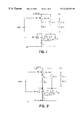
- FIG. 1 is a circuit diagram for the reset circuit in a one-channel safety relay according to a basic embodiment of the invention
- FIG. 2 illustrates a charge procedure in the reset circuit of FIG. 1,
- FIG. 3 illustrates a discharge procedure in the reset circuit of FIG. 1,
- FIG. 4 is a circuit diagram for a semiconductor-based reset circuit in a two-channel safety relay
- FIG. 5 is a circuit diagram for a relay-based reset circuit with a function for voltage doubling
- FIG. 6 is a circuit diagram for a semiconductor-based reset circuit in a safety relay with a function for voltage doubling
- FIG. 7 is a circuit diagram for a reset circuit with an automatic reset function in a safety relay.
- FIG. 1 The purpose of FIG. 1 is to illustrate the basic reset function in a safety relay according to the invention.
- the safety relay input In A is assumed to be connected to any interrupting function in the monitored machine/process or its surroundings.
- the input In A may be connected to a sensor, which detects that a safety gate has been opened.
- Two stop relays K 1 ⁇ 3 and K 2 ⁇ 3 are, for the safety reasons set out above, connected with its contacts in series with the output OUT of the safety relay. These relay contacts K 1 ⁇ 3 and K 2 ⁇ 3 are closed during normal operation, but will de-energize, as soon as the switch In A is activated in response to for instance the safety gate having been opened during ongoing machine operation.
- the safety relay ensures that the machine operation is immediately interrupted so as to avoid a risky situation (such as the operator of the machine coming too close to active machine elements).
- a reset means PB 1 must first be closed and then opened for resetting the safety relay to its normal operating condition. The reset procedure according to a basic embodiment of the present invention will now be described.
- the main principle is that a capacitor C 1 is charged when the reset means is actuated. However, charging is only to take place on condition that the monitored stop relays K 1 ⁇ 3 and K 2 ⁇ 3 have de-energized. If this is the case and if the reset means is actuated (pressed), the current path is closed from the positive voltage supply indicated in the uppermost portion of the drawing via the contacts 1 , 2 of the reset means PB 1 and the relay contacts K 1 ⁇ 1 and K 2 ⁇ 1 down to the positive side of the capacitor C 1 .
- the negative side of the capacitor C 1 is connected to the anode of a diode V 1 , the cathode of which is connected to the zero conductor (or negative supply conductor) indicated as “0 V” in the lowermost most portion of the drawing.
- the capacitor C 1 is supplied with electrical energy, as long as the reset means PB 1 is activated.
- the diode V 1 establishes a virtual zero point between the capacitor C 1 and the actual zero conductor. Furthermore, the diode V 1 forms a common node for the capacitor C 1 and the relays K 1 and K 2 , respectively, which according to the following are activated during the reset procedure.
- the charges are conducted from capacitor C 1 through the diode V 2 and the relay coils K 1 and K 2 to the negative side of capacitor C 1 , relays K 1 and K 2 thereby energizing. Once they have energized, they are able to self-energize through any of their closing contacts (in the drawing: K 1 ⁇ 2), on condition that the input In A is closed.
- the components comprised in the reset circuit must be actively supervised. If for instance a short circuit arises in diode V 1 , the discharge procedure when the reset means PB 1 is released will occur directly through PB 1 , a short distance of the zero conductor and then through the shorted diode V 1 directly back to the negative side of capacitor C 1 , and therefore no current will flow through the relay coils K 1 and K 2 , respectively, and the relay contacts will be prevented from closing.
- the capacitor C 1 cannot be charged, when the reset means PB 1 is activated, since the current from the negative side of capacitor C 1 cannot run through diode V 1 nor from the “reverse side” through the relay coils K 1 and K 2 , thanks to the reverse-biassed diode V 2 .
- diode V 2 is the subject of a short circuit
- a shorted diode V 2 will prevent the relays K 1 and K 2 from being self-energized through the closed input In A, since the current will be conducted past the relays K 1 , K 2 via the shorted diode V 2 .
- V 2 would be subjected to an open circuit, the circuitry according to FIGS. 1-3 will prevent unintentional reset, since the discharge path will also be interrupted.
- a supervised reset function is provided in a safety relay at a minimum of components and costs (particularly at a minimum of relays), wherein the risk of malfunctions (unintentional reset) due to a short circuit or an open circuit in any used component has been eliminated by establishing a controlled discharge path to the stop relays through the zero conductor.
- FIG. 4 there is shown a reset circuit for a safety relay with two inputs In A and In B.
- the same reference numerals as in the preceding figures are used for the same or corresponding components.
- the reset circuit of FIG. 4 is fully semiconductor-based, which gives considerable advantages from a manufacturing point of view.
- the reset procedure starts by activating the reset means PB 1 .
- the relays K 1 ⁇ 3 and K 2 ⁇ 3 have de-energized, a charging current will be conducted from the positive voltage supply via PB 1 , K 1 ⁇ 1, K 2 ⁇ 1 and a diode V 4 down to the positive side of the capacitor C 1 .
- the negative side of C 1 is connected to the second voltage supply conductor (the zero conductor) via the diode V 1 . Similar to the above a closed current loop will be generated as a consequence, wherein the capacitor C 1 is charged.
- a bipolar PNP transistor V 5 is arranged as a valve for controlling the charging and discharging paths, respectively.
- the base terminal of the PNP transistor V 5 is connected to a resistor R 2 , which in turn is connected to a resistor R 1 as well as a common node between the relay contacts K ⁇ 1, K 2 ⁇ 1 and the anode of the diode V 4 .
- the emitter terminal of V 5 is connected to a common node between the cathode of the diode V 4 and the positive side of the capacitor C 1 , while the collector terminal is directly connected to the zero conductor. In the charging state the PNP transistor V 5 is cut off and no current flows through it.
- the PNP transistor V 5 switches to its conductive state, wherein the electrical energy stored in capacitor C 1 may start flowing as an electrical current from the positive side of C 1 , through the transistor V 5 and down to the zero conductor.
- Two diodes V 2 and V 3 respectively, which are biased in the forward direction, conduct the current from the zero conductor to the respective relay coils K 1 and K 2 .
- the current flows through the relay coils and then back to the negative side of C 1 .
- the relays K 1 and K 2 will energize, and they may subsequently energize themselves through their closing contacts, provided that the inputs In A and In B, respectively, are closed.
- the embodiment described above has an advantage in that it allows a realization of the reset circuit, which is completely free from relays (obviously with the exception of the stop relays K 1 and K 2 ).
- the semiconductor-based reset circuit may preferably be realized as a hybride circuit.
- Another advantage is that several channels/inputs (here: two) may be served by one single capacitor circuit, i.e. the leftmost portion of the circuit diagram remains the same regardless of whether the safety relay has one or more than one channel.
- stop relays K 1 and K 2 require relatively large currents—and consequently also high voltages—in order to energize, it is desired to minimize the voltage drops in the reset circuit according to preceding figures.
- One possibility is to use low voltage-drop diodes, such as Schottky diodes (voltage drop ⁇ 0.1 V). However, sometimes this is not enough in reality, for instance due to long wires.
- An alternative embodiment of the present invention solves the problem of insufficient voltages by way of a voltage doubling function, which will be described in more detail below with reference to FIGS. 5 and 6.
- FIG. 5 illustrates an embodiment, which is particularly directed at solving the problem described above as regards undervoltages and long wires.
- the arrangement of FIG. 5 has one channel, but the principle is applicable in all essential details also to multiple channels, such as two channels.
- FIG. 5 illustrates a relay-based reset circuit with a switching relay K 3 ⁇ 1.
- the stop relays K 1 ⁇ 1 and K 2 ⁇ 1, the reset means PB 1 , the input In A and the diodes V 1 and V 2 correspond to the corresponding components in previous figures and are therefore not described in more detail now.
- the relay coil K 3 is connected in series with PB 1 between the two supply conductors, and when PB 1 is activated, a closed current path is formed from the positive supply, via the relay contacts K 1 ⁇ 1, K 2 ⁇ 1 and K 3 ⁇ 1 (since the relay contact K 3 ⁇ 1 assumes its energized position), down through a diode V 3 , across capacitor C 1 and further down through the diode V 1 to the zero conductor.
- the capacitor C 1 is charged in the way described above.
- a second capacitor C 2 is arranged in the reset circuit. A positive side of C 2 is connected to the anode of V 3 , while the negative side connects to the zero conductor via the closing relay contact K 3 ⁇ 2. Therefore, capacitor C 2 is charged simultaneously with capacitor C 1 .
- relay K 3 will energize, wherein the relay contact K 3 ⁇ 1 assumes its second position and wherein the charging of C 1 and C 2 ceases. Instead a discharge path is formed from the positive side of C 1 via the relay contact K 3 ⁇ 1 to the negative side of C 2 , and then from the positive side thereof via the relay contact K 3 ⁇ 2 in its position according to the figure down to the zero conductor. The current continues to flow from this conductor in a normal way through diode V 2 to the relay coils K 1 , K 2 , which are able to energize.
- the two capacitors C 1 , C 2 are discharged in series with each other, which means that the drive voltage available for resetting the safety relay is doubled—provided that the two capacitors are of equal capacitance. Since relays have an inherent hysteresis—they may require for instance 16 V to pull but then only e.g. 5 V for self-energizing—the doubled voltage gives a substantially improved opportunity, at the moment of reset, to overcome any existing problems with undervoltages.
- FIG. 6 illustrates a semiconductor-based embodiment with a voltage doubling function corresponding to that of FIG. 5 .
- the rightmost portion of the circuit diagram i.e. the relays K 1 and K 2 , the diodes V 1 , V 2 , and V 3 , and the capacitor C 1 , corresponds fully to FIG. 5 .
- the difference for FIG. 6 is that a semiconductor-based circuitry is provided as replacement for the relay K 3 .
- Two PNP transistors V 6 , V 8 play an active part, together with an NPN transistor V 7 , during the reset procedure briefly described below.
- the capacitor C 1 is charged as described above through diodes V 3 and V 1 .
- the transistors V 6 and V 8 are cut off in this moment, while transistor V 7 is conductive, wherein a current path parallel to said charging path is formed through the second capacitor C 2 via the diode V 5 and the transistor V 7 .
- the transistor V 7 When the activation of the reset means PB 1 ends, the transistor V 7 is cut off and transistors V 6 and VB start to conduct. A discharge path is formed starting from the positive side of capacitor C 1 , through transistor V 6 and further to the negative side of the capacitor C 2 . From the positive side of the capacitor C 2 the discharge current flows from the transistor V 8 , down to the zero conductor and up through diode V 2 to the relay coils K 1 , K 2 . In the way described above the relay coils K 1 , K 2 are hence supplied with current, thereby causing them to energize and then to self-energize.
- the transistors V 6 and V 8 are conductive simultaneously, the capacitors C 1 and C 2 are connected in series with each other during the discharge, wherein a voltage doubling is achieved and hence a considerably improved opportunity of a successful reset of the safety relay, despite any problems with undervoltages.
- FIG. 7 The circuit of FIG. 7 is based on the semiconductor version of a two-channel safety relay of FIG. 4 . All components and functions are identical to those of FIG. 4, except for what is mentioned below.
- a second PNP transistor V 6 is at its emitter terminal connected to the series connection PB 1 -(K 1 ⁇ 1)-(K 2 ⁇ 1), while the collector terminal of V 6 connects to the anode of diode V 4 and to the input of a hysteresis circuit H 1 , which is symbolically represented by an inverter labelled with a hysteresis sign.
- the output of the hysteresis circuit H 1 is connected to the base input of a third PNP transistor V 7 , the emitter of which is connected to an autostart input.
- the collector terminal of V 7 is connected to the base terminal of the second PNP transistor V 6 and to the zero conductor via a resistor R 3 .
- the embodiment of FIG. 7 is arranged to reset the safety relay, when the reset input PB 1 is closed, on condition that the autostart input is connected to the voltage supply, either by direct connection to the positive supply conductor or by indirect connection via a clamp between the autostart input and PB 1 .
- the hysteresis circuit H 1 will detect the charge level of the capacitor C 1 . Once the charge exceeds a first limit, the output of the hysteresis circuit H 1 will go low, causing the transistor V 7 to open and the transistor V 6 to be cut off.
- the reset circuit will switch to its discharge state, wherein the capacitor C 1 is discharged through the transistor V 5 , the zero conductor, the diodes V 2 and V 3 and the relay coils K 1 and K 2 , which will energize.
- the hysteresis circuit H 1 will switch again, causing the reset circuit to enter a passive idle mode awaiting a forthcoming need for reset due to closed inputs In A, In B, de-energized relay contacts K 1 ⁇ 2 and K 2 ⁇ 2, etc.
- the hysteresis circuit H 1 which has been schematically illustrated herein in the form of an inverter with hysteresis properties, may be realized in a suitable way depending on application.
- To realize a hysteresis circuit with the functionality described above is regarded to be within the field of competence of a skilled person. The important condition to fulfil is that the circuit will actually be given sufficient hysteresis properties, so that oscillation is avoided.
- H 1 may be arranged to operate according to a time measuring approach. First, H 1 will maintain the reset circuit in the charging state according to the above. Once capacitor C 1 has reached a certain amount of charging, H 1 will be triggered, wherein the reset circuit is maintained in its discharge state during a predetermined time period, which preferably corresponds to the discharge time of capacitor C 1 . Then the reset circuit will switch to its normal state.
- the circuit H 1 may first maintain the reset circuit in its charge state during a first predetermined time period, preferably corresponding to the time it takes to charge C 1 up to a certain level. Thereinafter the circuit H 1 will switch to a second state, wherein the capacitor C 1 is discharged during a second predetermined time period.
- the diode V 2 (and for some embodiments also its parallel diode V 3 ), which is used in all embodiments, may alternatively be realized as a thyristor.
- a thyristor has an advantage in that an external switch, such as an opto-switch, may be connected to the control input of the thyristor, wherein an additional dimension of safety is obtained. If this external switch does not supply an expected control signal to the thyristor (because the external switch has detected an abnormal condition, such as an opened safety gate, etc), the thyristor will not operate normally, wherein unintentional reset is prevented in correspondence with the reasoning for the embodiment of FIGS. 1-3. Furthermore, the thyristor and the separate opto-switch may be replaced by an opto-thyristor.
- the bipolar transistors may be replaced by for instance field effect transistors, while the diodes may be replaced by transistors connected as diodes, etc.
- stop relays K 1 , K 2 described in the embodiments above may alternatively be realized as a single relay with only one relay coil but two independent contact halves, wherein each contact half comprises at least one closing and one opening relay contact, which are connected in a controlled arrangement.
- Such a relay may, at least in simple applications, therefore replace the function of the double stop relays K 1 , K 2 disclosed in the drawings with preserved safety.
Landscapes
- Relay Circuits (AREA)
- Control Of Combustion (AREA)
- Air Bags (AREA)
- Safety Devices In Control Systems (AREA)
Abstract
Description
Claims (12)
Applications Claiming Priority (3)
| Application Number | Priority Date | Filing Date | Title |
|---|---|---|---|
| SE9604520 | 1996-12-09 | ||
| SE9604520A SE509479C2 (en) | 1996-12-09 | 1996-12-09 | Safety relay and method when resetting a safety relay |
| PCT/SE1997/001995 WO1998028764A1 (en) | 1996-12-09 | 1997-11-28 | Safety relay |
Publications (1)
| Publication Number | Publication Date |
|---|---|
| US6236553B1 true US6236553B1 (en) | 2001-05-22 |
Family
ID=20404904
Family Applications (1)
| Application Number | Title | Priority Date | Filing Date |
|---|---|---|---|
| US09/319,224 Expired - Lifetime US6236553B1 (en) | 1996-12-09 | 1997-11-28 | Safety relay |
Country Status (9)
| Country | Link |
|---|---|
| US (1) | US6236553B1 (en) |
| EP (1) | EP0944911B1 (en) |
| JP (1) | JP4060369B2 (en) |
| AT (1) | ATE195608T1 (en) |
| AU (1) | AU5421098A (en) |
| DE (2) | DE69702869T2 (en) |
| DK (1) | DK0944911T3 (en) |
| SE (1) | SE509479C2 (en) |
| WO (1) | WO1998028764A1 (en) |
Cited By (9)
| Publication number | Priority date | Publication date | Assignee | Title |
|---|---|---|---|---|
| US20030147180A1 (en) * | 2002-02-07 | 2003-08-07 | Seagate Technology Llc | Flex cable assembly with improved flex cable dynamic loop characteristics |
| US20070231764A1 (en) * | 2006-03-28 | 2007-10-04 | Miura Co., Ltd. | Equipment |
| US20090190282A1 (en) * | 2008-01-25 | 2009-07-30 | Schneider Electric Automation Gmbh | Relay connection |
| US20110012740A1 (en) * | 2009-06-22 | 2011-01-20 | General Atomics | Charged capacitor warning system and method |
| US20130092242A1 (en) * | 2011-10-13 | 2013-04-18 | Kevin Duane Guy | Fluid Leak Detection and Shutdown Apparatus |
| US20140192571A1 (en) * | 2013-01-10 | 2014-07-10 | Michael Gasperi | Wide Input Voltage Range Power Supply Circuit |
| US9618909B2 (en) | 2013-12-20 | 2017-04-11 | Thales Canada Inc | Safety assurance of multiple redundant systems |
| US10427299B2 (en) * | 2016-04-28 | 2019-10-01 | Seiko Epson Corporation | Device for robot, robot control device, and robot system |
| US20240198528A1 (en) * | 2022-12-15 | 2024-06-20 | The Boeing Company | Apparatus and methods to reduce impact of robot collision and/or avoid robot collision |
Families Citing this family (2)
| Publication number | Priority date | Publication date | Assignee | Title |
|---|---|---|---|---|
| DE10037383A1 (en) * | 2000-08-01 | 2002-02-21 | Pilz Gmbh & Co | Safety switching device for safely switching off an electrical consumer, in particular an electrically driven machine |
| WO2006008781A1 (en) * | 2004-05-26 | 2006-01-26 | Mitsubishi Denki Kabushiki Kaisha | Contact switch |
Citations (7)
| Publication number | Priority date | Publication date | Assignee | Title |
|---|---|---|---|---|
| US3749005A (en) * | 1971-09-30 | 1973-07-31 | Danly Machine Corp | Electrical control system for a power press |
| JPH0261930A (en) | 1988-08-26 | 1990-03-01 | Matsushita Electric Works Ltd | Relay drive circuit |
| EP0380089A2 (en) | 1989-01-26 | 1990-08-01 | EURO-Matsushita Electric Works Aktiengesellschaft | A relay driving circuit for a latching relay |
| SE465067B (en) | 1988-03-24 | 1991-07-22 | Jokab Safety Ab | Production-adapted safety system |
| US5689398A (en) * | 1996-01-03 | 1997-11-18 | Allen-Bradley Company, Inc. | Redundant control relay circuits |
| US5825102A (en) * | 1994-04-20 | 1998-10-20 | Gebr. Schmidt Fabrik Fur Feinmechanik | Fail-safe circuit |
| US5912795A (en) * | 1996-02-23 | 1999-06-15 | Ross Operating Valve Company | Circuit reset lockout |
-
1996
- 1996-12-09 SE SE9604520A patent/SE509479C2/en not_active IP Right Cessation
-
1997
- 1997-11-28 US US09/319,224 patent/US6236553B1/en not_active Expired - Lifetime
- 1997-11-28 DE DE69702869T patent/DE69702869T2/en not_active Expired - Lifetime
- 1997-11-28 JP JP52597298A patent/JP4060369B2/en not_active Expired - Lifetime
- 1997-11-28 WO PCT/SE1997/001995 patent/WO1998028764A1/en not_active Ceased
- 1997-11-28 AU AU54210/98A patent/AU5421098A/en not_active Abandoned
- 1997-11-28 EP EP97948064A patent/EP0944911B1/en not_active Expired - Lifetime
- 1997-11-28 DK DK97948064T patent/DK0944911T3/en active
- 1997-11-28 DE DE0944911T patent/DE944911T1/en active Pending
- 1997-11-28 AT AT97948064T patent/ATE195608T1/en not_active IP Right Cessation
Patent Citations (7)
| Publication number | Priority date | Publication date | Assignee | Title |
|---|---|---|---|---|
| US3749005A (en) * | 1971-09-30 | 1973-07-31 | Danly Machine Corp | Electrical control system for a power press |
| SE465067B (en) | 1988-03-24 | 1991-07-22 | Jokab Safety Ab | Production-adapted safety system |
| JPH0261930A (en) | 1988-08-26 | 1990-03-01 | Matsushita Electric Works Ltd | Relay drive circuit |
| EP0380089A2 (en) | 1989-01-26 | 1990-08-01 | EURO-Matsushita Electric Works Aktiengesellschaft | A relay driving circuit for a latching relay |
| US5825102A (en) * | 1994-04-20 | 1998-10-20 | Gebr. Schmidt Fabrik Fur Feinmechanik | Fail-safe circuit |
| US5689398A (en) * | 1996-01-03 | 1997-11-18 | Allen-Bradley Company, Inc. | Redundant control relay circuits |
| US5912795A (en) * | 1996-02-23 | 1999-06-15 | Ross Operating Valve Company | Circuit reset lockout |
Cited By (16)
| Publication number | Priority date | Publication date | Assignee | Title |
|---|---|---|---|---|
| US20030147180A1 (en) * | 2002-02-07 | 2003-08-07 | Seagate Technology Llc | Flex cable assembly with improved flex cable dynamic loop characteristics |
| US6856490B2 (en) | 2002-02-07 | 2005-02-15 | Seagate Technology Llc | Flex cable assembly with improved flex cable dynamic loop characteristics |
| US20070231764A1 (en) * | 2006-03-28 | 2007-10-04 | Miura Co., Ltd. | Equipment |
| DE102008002758B4 (en) * | 2008-01-25 | 2016-04-28 | Schneider Electric Automation Gmbh | relay circuit |
| DE102008002758A1 (en) * | 2008-01-25 | 2009-07-30 | Schneider Electric Gmbh | relay circuit |
| US8369060B2 (en) | 2008-01-25 | 2013-02-05 | Schneider Electric Automation Gmbh | Relay connection |
| US20090190282A1 (en) * | 2008-01-25 | 2009-07-30 | Schneider Electric Automation Gmbh | Relay connection |
| US20110012740A1 (en) * | 2009-06-22 | 2011-01-20 | General Atomics | Charged capacitor warning system and method |
| US8576074B2 (en) * | 2009-06-22 | 2013-11-05 | General Atomics | Charged capacitor warning system and method |
| US20130092242A1 (en) * | 2011-10-13 | 2013-04-18 | Kevin Duane Guy | Fluid Leak Detection and Shutdown Apparatus |
| US8720481B2 (en) * | 2011-10-13 | 2014-05-13 | Kevin Duane Guy | Fluid leak detection and shutdown apparatus |
| US20140192571A1 (en) * | 2013-01-10 | 2014-07-10 | Michael Gasperi | Wide Input Voltage Range Power Supply Circuit |
| US9155232B2 (en) * | 2013-01-10 | 2015-10-06 | Rockwell Automation Technologies, Inc. | Wide input voltage range power supply circuit |
| US9618909B2 (en) | 2013-12-20 | 2017-04-11 | Thales Canada Inc | Safety assurance of multiple redundant systems |
| US10427299B2 (en) * | 2016-04-28 | 2019-10-01 | Seiko Epson Corporation | Device for robot, robot control device, and robot system |
| US20240198528A1 (en) * | 2022-12-15 | 2024-06-20 | The Boeing Company | Apparatus and methods to reduce impact of robot collision and/or avoid robot collision |
Also Published As
| Publication number | Publication date |
|---|---|
| SE9604520L (en) | 1998-06-10 |
| DE944911T1 (en) | 2000-03-09 |
| AU5421098A (en) | 1998-07-17 |
| EP0944911B1 (en) | 2000-08-16 |
| JP2001506050A (en) | 2001-05-08 |
| EP0944911A1 (en) | 1999-09-29 |
| SE9604520D0 (en) | 1996-12-09 |
| DE69702869T2 (en) | 2001-04-05 |
| ATE195608T1 (en) | 2000-09-15 |
| SE509479C2 (en) | 1999-02-01 |
| DK0944911T3 (en) | 2000-12-18 |
| WO1998028764A1 (en) | 1998-07-02 |
| DE69702869D1 (en) | 2000-09-21 |
| JP4060369B2 (en) | 2008-03-12 |
Similar Documents
| Publication | Publication Date | Title |
|---|---|---|
| US6570272B2 (en) | Safety switching device for connection and safe disconnection of an electrical load, in particular an electrically driven machine | |
| US7573693B2 (en) | Safety switching device and method for failsafe shutdown of an electric load | |
| US6236553B1 (en) | Safety relay | |
| CN101305439B (en) | Safety switching apparatus for the failsafe disconnection of an electrical load | |
| EP0513344A1 (en) | Fail-resistant solid state interruption system | |
| US20130264890A1 (en) | Safety switching device for the failsafe shutdown of an electrical load | |
| US11482951B2 (en) | Brake driving control circuit and breakdown detection method thereof | |
| US20020180278A1 (en) | Circuit arrangement and device for safely disconnecting an element in an installation, in particular a machine installation | |
| CS277638B6 (en) | Circuit arrangement for checking of a for power transistor switching state | |
| TW201537326A (en) | Power supply control device and programmable logic controller | |
| US6366434B2 (en) | Apparatus for safely disconnecting an electrical load from an electrical DC voltage supply | |
| US6809911B2 (en) | Safety switching device for safely switching off an electrical load | |
| CA2385434A1 (en) | Control arrangement for power electronic system | |
| JP4176185B2 (en) | Supervisory circuit | |
| EP3358592B1 (en) | Output signal switching device (ossd) | |
| US5825102A (en) | Fail-safe circuit | |
| US12235320B2 (en) | Safety switching apparatus, in particular for the monitored switching on of an electrical and/or electronic load | |
| EP4119400B1 (en) | Power supply management system for a vehicle | |
| US20020011888A1 (en) | Circuit provided with a protective function | |
| JP2000173383A (en) | Load driving circuit | |
| US20250141202A1 (en) | Aircraft electric power supply system and aircraft comprising an electric power supply system | |
| CN109088543B (en) | Unit with power supply circuit and load protection circuit | |
| WO2026019706A1 (en) | Solid state switch for railway equipment | |
| JP2024125275A (en) | Overvoltage protection circuits for electrical equipment | |
| JP2000156144A (en) | Control circuit |
Legal Events
| Date | Code | Title | Description |
|---|---|---|---|
| AS | Assignment |
Owner name: WIDELL, GUNNAR, SWEDEN Free format text: ASSIGNMENT OF ASSIGNORS INTEREST;ASSIGNOR:WIDELL, GUNNAR;REEL/FRAME:010137/0890 Effective date: 19990722 Owner name: LINGER, MATS, SWEDEN Free format text: ASSIGNMENT OF ASSIGNORS INTEREST;ASSIGNOR:WIDELL, GUNNAR;REEL/FRAME:010137/0890 Effective date: 19990722 Owner name: OLSSON, TORNGY, SWEDEN Free format text: ASSIGNMENT OF ASSIGNORS INTEREST;ASSIGNOR:WIDELL, GUNNAR;REEL/FRAME:010137/0890 Effective date: 19990722 |
|
| FEPP | Fee payment procedure |
Free format text: PAYOR NUMBER ASSIGNED (ORIGINAL EVENT CODE: ASPN); ENTITY STATUS OF PATENT OWNER: SMALL ENTITY |
|
| AS | Assignment |
Owner name: JOKAB SAFETY, SWEDEN Free format text: ASSIGNMENT OF ASSIGNORS INTEREST;ASSIGNORS:OLSSON, TORGNY;LINGER, MATS;WIDELL, GUNNAR;REEL/FRAME:011505/0072 Effective date: 20001002 |
|
| STCF | Information on status: patent grant |
Free format text: PATENTED CASE |
|
| FPAY | Fee payment |
Year of fee payment: 4 |
|
| FPAY | Fee payment |
Year of fee payment: 8 |
|
| FPAY | Fee payment |
Year of fee payment: 12 |
|
| SULP | Surcharge for late payment | ||
| AS | Assignment |
Owner name: ABB TECHNOLOGY LTD, SWITZERLAND Free format text: ASSIGNMENT OF ASSIGNORS INTEREST;ASSIGNOR:ABB AB;REEL/FRAME:035498/0241 Effective date: 20150330 Owner name: ABB AB, SWEDEN Free format text: MERGER;ASSIGNOR:JOKAB SAFETY AB;REEL/FRAME:035506/0709 Effective date: 20101222 |
|
| AS | Assignment |
Owner name: ABB SCHWEIZ AG, SWITZERLAND Free format text: MERGER;ASSIGNOR:ABB TECHNOLOGY LTD;REEL/FRAME:040800/0327 Effective date: 20160509 |