US6200654B1 - 1,4-disubstituted 2,6-difluorobenzene compounds, and a liquid-crystalline medium - Google Patents
1,4-disubstituted 2,6-difluorobenzene compounds, and a liquid-crystalline medium Download PDFInfo
- Publication number
- US6200654B1 US6200654B1 US08/917,167 US91716797A US6200654B1 US 6200654 B1 US6200654 B1 US 6200654B1 US 91716797 A US91716797 A US 91716797A US 6200654 B1 US6200654 B1 US 6200654B1
- Authority
- US
- United States
- Prior art keywords
- propyl
- pentyl
- ocf
- compounds
- ethyl
- Prior art date
- Legal status (The legal status is an assumption and is not a legal conclusion. Google has not performed a legal analysis and makes no representation as to the accuracy of the status listed.)
- Expired - Fee Related
Links
- -1 1,4-disubstituted 2,6-difluorobenzene compounds Chemical class 0.000 title claims abstract description 112
- 125000000876 trifluoromethoxy group Chemical group FC(F)(F)O* 0.000 claims abstract description 66
- 229910052731 fluorine Inorganic materials 0.000 claims abstract description 19
- 229910052801 chlorine Inorganic materials 0.000 claims abstract description 7
- KWKAKUADMBZCLK-UHFFFAOYSA-N 1-octene Chemical group CCCCCCC=C KWKAKUADMBZCLK-UHFFFAOYSA-N 0.000 claims abstract description 3
- 229910052757 nitrogen Inorganic materials 0.000 claims abstract description 3
- 150000001875 compounds Chemical class 0.000 claims description 81
- 125000004432 carbon atom Chemical group C* 0.000 claims description 9
- 239000004973 liquid crystal related substance Substances 0.000 claims description 9
- 239000011737 fluorine Substances 0.000 claims description 3
- 125000001153 fluoro group Chemical group F* 0.000 claims description 3
- 229910052736 halogen Inorganic materials 0.000 claims description 2
- 125000004430 oxygen atom Chemical group O* 0.000 claims description 2
- 125000005843 halogen group Chemical group 0.000 claims 1
- 125000000217 alkyl group Chemical group 0.000 abstract description 6
- URLKBWYHVLBVBO-UHFFFAOYSA-N Cc1ccc(C)cc1 Chemical compound Cc1ccc(C)cc1 URLKBWYHVLBVBO-UHFFFAOYSA-N 0.000 description 129
- 125000004123 n-propyl group Chemical group [H]C([H])([H])C([H])([H])C([H])([H])* 0.000 description 91
- 125000001495 ethyl group Chemical group [H]C([H])([H])C([H])([H])* 0.000 description 59
- 125000000484 butyl group Chemical group [H]C([*])([H])C([H])([H])C([H])([H])C([H])([H])[H] 0.000 description 45
- 125000001436 propyl group Chemical group [H]C([*])([H])C([H])([H])C([H])([H])[H] 0.000 description 45
- 125000001147 pentyl group Chemical group C(CCCC)* 0.000 description 44
- 125000000740 n-pentyl group Chemical group [H]C([H])([H])C([H])([H])C([H])([H])C([H])([H])C([H])([H])* 0.000 description 38
- 0 *CCc1cc(F)c(CC*)c(F)c1.C Chemical compound *CCc1cc(F)c(CC*)c(F)c1.C 0.000 description 36
- 125000002023 trifluoromethyl group Chemical group FC(F)(F)* 0.000 description 31
- YXFVVABEGXRONW-UHFFFAOYSA-N Toluene Chemical compound CC1=CC=CC=C1 YXFVVABEGXRONW-UHFFFAOYSA-N 0.000 description 27
- 239000000203 mixture Substances 0.000 description 21
- 229910052739 hydrogen Inorganic materials 0.000 description 19
- ISOOIHCAKZTFBS-UHFFFAOYSA-N CCc1ccc(-c2ccc(C)cc2)cc1 Chemical compound CCc1ccc(-c2ccc(C)cc2)cc1 ISOOIHCAKZTFBS-UHFFFAOYSA-N 0.000 description 16
- 229910052799 carbon Inorganic materials 0.000 description 15
- VLKZOEOYAKHREP-UHFFFAOYSA-N n-Hexane Chemical compound CCCCCC VLKZOEOYAKHREP-UHFFFAOYSA-N 0.000 description 15
- KDLHZDBZIXYQEI-UHFFFAOYSA-N Palladium Chemical compound [Pd] KDLHZDBZIXYQEI-UHFFFAOYSA-N 0.000 description 14
- 238000000034 method Methods 0.000 description 13
- CYFXMOSILZLUQZ-UHFFFAOYSA-N CC1CCC(C)CC1.[HH] Chemical compound CC1CCC(C)CC1.[HH] CYFXMOSILZLUQZ-UHFFFAOYSA-N 0.000 description 11
- WJAVYWPXOXAOBS-UHFFFAOYSA-N Cc1ccc(C)c(F)c1 Chemical compound Cc1ccc(C)c(F)c1 WJAVYWPXOXAOBS-UHFFFAOYSA-N 0.000 description 10
- RHOOLJLEYYXKTK-UHFFFAOYSA-N Cc1cnc(C)nc1 Chemical compound Cc1cnc(C)nc1 RHOOLJLEYYXKTK-UHFFFAOYSA-N 0.000 description 9
- 238000006243 chemical reaction Methods 0.000 description 9
- 239000000126 substance Substances 0.000 description 9
- WYURNTSHIVDZCO-UHFFFAOYSA-N tetrahydrofuran Substances C1CCOC1 WYURNTSHIVDZCO-UHFFFAOYSA-N 0.000 description 9
- WMXQGBZGSROQMX-UHFFFAOYSA-N CCC1CCC(C)CC1.[HH] Chemical compound CCC1CCC(C)CC1.[HH] WMXQGBZGSROQMX-UHFFFAOYSA-N 0.000 description 8
- WSSKNTSVCVWJIT-UHFFFAOYSA-N CCC1CCC(C2CCC(C)CC2)CC1.[HH].[HH] Chemical compound CCC1CCC(C2CCC(C)CC2)CC1.[HH].[HH] WSSKNTSVCVWJIT-UHFFFAOYSA-N 0.000 description 8
- MUAGRDSWSXJZSQ-UHFFFAOYSA-N CCc1ccc(C2CCC(C)CC2)cc1.[HH] Chemical compound CCc1ccc(C2CCC(C)CC2)cc1.[HH] MUAGRDSWSXJZSQ-UHFFFAOYSA-N 0.000 description 8
- XWKFPIODWVPXLX-UHFFFAOYSA-N Cc1ccc(C)nc1 Chemical compound Cc1ccc(C)nc1 XWKFPIODWVPXLX-UHFFFAOYSA-N 0.000 description 8
- RTZKZFJDLAIYFH-UHFFFAOYSA-N Diethyl ether Chemical compound CCOCC RTZKZFJDLAIYFH-UHFFFAOYSA-N 0.000 description 8
- JRNVZBWKYDBUCA-UHFFFAOYSA-N N-Chlorosuccinimide Substances ClN1C(=O)CCC1=O JRNVZBWKYDBUCA-UHFFFAOYSA-N 0.000 description 8
- CDBYLPFSWZWCQE-UHFFFAOYSA-L Sodium Carbonate Chemical compound [Na+].[Na+].[O-]C([O-])=O CDBYLPFSWZWCQE-UHFFFAOYSA-L 0.000 description 8
- 125000002496 methyl group Chemical group [H]C([H])([H])* 0.000 description 8
- 238000010626 work up procedure Methods 0.000 description 8
- MZRVEZGGRBJDDB-UHFFFAOYSA-N N-Butyllithium Chemical compound [Li]CCCC MZRVEZGGRBJDDB-UHFFFAOYSA-N 0.000 description 7
- 238000005859 coupling reaction Methods 0.000 description 7
- 239000012071 phase Substances 0.000 description 7
- WEVYAHXRMPXWCK-UHFFFAOYSA-N Acetonitrile Chemical compound CC#N WEVYAHXRMPXWCK-UHFFFAOYSA-N 0.000 description 6
- QWUROWFAQGWMLL-UHFFFAOYSA-N Cc1ccc(-c2ncc(C)cn2)cc1 Chemical compound Cc1ccc(-c2ncc(C)cn2)cc1 QWUROWFAQGWMLL-UHFFFAOYSA-N 0.000 description 6
- KWYUFKZDYYNOTN-UHFFFAOYSA-M Potassium hydroxide Chemical compound [OH-].[K+] KWYUFKZDYYNOTN-UHFFFAOYSA-M 0.000 description 6
- HEMHJVSKTPXQMS-UHFFFAOYSA-M Sodium hydroxide Chemical compound [OH-].[Na+] HEMHJVSKTPXQMS-UHFFFAOYSA-M 0.000 description 6
- ZMANZCXQSJIPKH-UHFFFAOYSA-N Triethylamine Chemical compound CCN(CC)CC ZMANZCXQSJIPKH-UHFFFAOYSA-N 0.000 description 6
- 230000015572 biosynthetic process Effects 0.000 description 6
- 125000001301 ethoxy group Chemical group [H]C([H])([H])C([H])([H])O* 0.000 description 6
- NFHFRUOZVGFOOS-UHFFFAOYSA-N palladium;triphenylphosphane Chemical compound [Pd].C1=CC=CC=C1P(C=1C=CC=CC=1)C1=CC=CC=C1.C1=CC=CC=C1P(C=1C=CC=CC=1)C1=CC=CC=C1.C1=CC=CC=C1P(C=1C=CC=CC=1)C1=CC=CC=C1.C1=CC=CC=C1P(C=1C=CC=CC=1)C1=CC=CC=C1 NFHFRUOZVGFOOS-UHFFFAOYSA-N 0.000 description 6
- 238000003786 synthesis reaction Methods 0.000 description 6
- XJVVUYAXPOLWNO-UHFFFAOYSA-N Cc1cc(F)c(C)c(F)c1.Cc1ccc(C)c(F)c1 Chemical compound Cc1cc(F)c(C)c(F)c1.Cc1ccc(C)c(F)c1 XJVVUYAXPOLWNO-UHFFFAOYSA-N 0.000 description 5
- QOSSAOTZNIDXMA-UHFFFAOYSA-N Dicylcohexylcarbodiimide Chemical compound C1CCCCC1N=C=NC1CCCCC1 QOSSAOTZNIDXMA-UHFFFAOYSA-N 0.000 description 5
- 150000001502 aryl halides Chemical class 0.000 description 5
- 239000002585 base Substances 0.000 description 5
- 238000002360 preparation method Methods 0.000 description 5
- 230000008569 process Effects 0.000 description 5
- HZNVUJQVZSTENZ-UHFFFAOYSA-N 2,3-dichloro-5,6-dicyano-1,4-benzoquinone Chemical compound ClC1=C(Cl)C(=O)C(C#N)=C(C#N)C1=O HZNVUJQVZSTENZ-UHFFFAOYSA-N 0.000 description 4
- CSCPPACGZOOCGX-UHFFFAOYSA-N Acetone Chemical compound CC(C)=O CSCPPACGZOOCGX-UHFFFAOYSA-N 0.000 description 4
- HBXFIXSFKULBOG-UHFFFAOYSA-N Cc1cc(F)c(C)c(F)c1 Chemical compound Cc1cc(F)c(C)c(F)c1 HBXFIXSFKULBOG-UHFFFAOYSA-N 0.000 description 4
- 230000008878 coupling Effects 0.000 description 4
- 238000010168 coupling process Methods 0.000 description 4
- CSJLBAMHHLJAAS-UHFFFAOYSA-N diethylaminosulfur trifluoride Chemical compound CCN(CC)S(F)(F)F CSJLBAMHHLJAAS-UHFFFAOYSA-N 0.000 description 4
- 229910052740 iodine Inorganic materials 0.000 description 4
- 239000000463 material Substances 0.000 description 4
- 230000003287 optical effect Effects 0.000 description 4
- 239000012074 organic phase Substances 0.000 description 4
- 150000002989 phenols Chemical class 0.000 description 4
- 239000002243 precursor Substances 0.000 description 4
- 229910000029 sodium carbonate Inorganic materials 0.000 description 4
- 150000001608 tolans Chemical class 0.000 description 4
- XLYOFNOQVPJJNP-UHFFFAOYSA-N water Substances O XLYOFNOQVPJJNP-UHFFFAOYSA-N 0.000 description 4
- 125000001140 1,4-phenylene group Chemical group [H]C1=C([H])C([*:2])=C([H])C([H])=C1[*:1] 0.000 description 3
- ZCYVEMRRCGMTRW-UHFFFAOYSA-N 7553-56-2 Chemical compound [I] ZCYVEMRRCGMTRW-UHFFFAOYSA-N 0.000 description 3
- UHOVQNZJYSORNB-UHFFFAOYSA-N Benzene Chemical compound C1=CC=CC=C1 UHOVQNZJYSORNB-UHFFFAOYSA-N 0.000 description 3
- RZTDESRVPFKCBH-UHFFFAOYSA-N Cc1ccc(-c2ccc(C)cc2)cc1 Chemical compound Cc1ccc(-c2ccc(C)cc2)cc1 RZTDESRVPFKCBH-UHFFFAOYSA-N 0.000 description 3
- YMWUJEATGCHHMB-UHFFFAOYSA-N Dichloromethane Chemical compound ClCCl YMWUJEATGCHHMB-UHFFFAOYSA-N 0.000 description 3
- OKKJLVBELUTLKV-UHFFFAOYSA-N Methanol Chemical compound OC OKKJLVBELUTLKV-UHFFFAOYSA-N 0.000 description 3
- KWYHDKDOAIKMQN-UHFFFAOYSA-N N,N,N',N'-tetramethylethylenediamine Chemical compound CN(C)CCN(C)C KWYHDKDOAIKMQN-UHFFFAOYSA-N 0.000 description 3
- 150000001298 alcohols Chemical class 0.000 description 3
- 150000001336 alkenes Chemical class 0.000 description 3
- 125000003342 alkenyl group Chemical group 0.000 description 3
- 239000008346 aqueous phase Substances 0.000 description 3
- KGBXLFKZBHKPEV-UHFFFAOYSA-N boric acid Chemical compound OB(O)O KGBXLFKZBHKPEV-UHFFFAOYSA-N 0.000 description 3
- 239000003054 catalyst Substances 0.000 description 3
- 238000004587 chromatography analysis Methods 0.000 description 3
- 238000011097 chromatography purification Methods 0.000 description 3
- 239000000470 constituent Substances 0.000 description 3
- 238000006880 cross-coupling reaction Methods 0.000 description 3
- 125000000113 cyclohexyl group Chemical group [H]C1([H])C([H])([H])C([H])([H])C([H])(*)C([H])([H])C1([H])[H] 0.000 description 3
- 125000004786 difluoromethoxy group Chemical group [H]C(F)(F)O* 0.000 description 3
- 238000004821 distillation Methods 0.000 description 3
- 230000000694 effects Effects 0.000 description 3
- 238000003379 elimination reaction Methods 0.000 description 3
- 239000012442 inert solvent Substances 0.000 description 3
- 239000011630 iodine Substances 0.000 description 3
- DLEDOFVPSDKWEF-UHFFFAOYSA-N lithium butane Chemical compound [Li+].CCC[CH2-] DLEDOFVPSDKWEF-UHFFFAOYSA-N 0.000 description 3
- 125000006606 n-butoxy group Chemical group 0.000 description 3
- 125000001997 phenyl group Chemical group [H]C1=C([H])C([H])=C(*)C([H])=C1[H] 0.000 description 3
- 239000007858 starting material Substances 0.000 description 3
- 150000001629 stilbenes Chemical class 0.000 description 3
- 125000001424 substituent group Chemical group 0.000 description 3
- BLYJPDYTVKOVCG-UHFFFAOYSA-M (4-ethoxyphenyl)methyl-triphenylphosphanium;iodide Chemical compound [I-].C1=CC(OCC)=CC=C1C[P+](C=1C=CC=CC=1)(C=1C=CC=CC=1)C1=CC=CC=C1 BLYJPDYTVKOVCG-UHFFFAOYSA-M 0.000 description 2
- SJSRFXJWBKOROD-UHFFFAOYSA-N 1,1'-bi(cyclohexyl)-1-carboxylic acid Chemical class C1CCCCC1C1(C(=O)O)CCCCC1 SJSRFXJWBKOROD-UHFFFAOYSA-N 0.000 description 2
- 125000005714 2,5- (1,3-dioxanylene) group Chemical group [H]C1([H])OC([H])([*:1])OC([H])([H])C1([H])[*:2] 0.000 description 2
- ASOFZHSTJHGQDT-UHFFFAOYSA-N 3,5-difluorobenzaldehyde Chemical compound FC1=CC(F)=CC(C=O)=C1 ASOFZHSTJHGQDT-UHFFFAOYSA-N 0.000 description 2
- YMQPKONILWWJQG-UHFFFAOYSA-N 4-bromo-1,2-difluorobenzene Chemical compound FC1=CC=C(Br)C=C1F YMQPKONILWWJQG-UHFFFAOYSA-N 0.000 description 2
- QTBSBXVTEAMEQO-UHFFFAOYSA-M Acetate Chemical compound CC([O-])=O QTBSBXVTEAMEQO-UHFFFAOYSA-M 0.000 description 2
- XKRFYHLGVUSROY-UHFFFAOYSA-N Argon Chemical compound [Ar] XKRFYHLGVUSROY-UHFFFAOYSA-N 0.000 description 2
- QRMPKOFEUHIBNM-UHFFFAOYSA-N CC1CCC(C)CC1 Chemical compound CC1CCC(C)CC1 QRMPKOFEUHIBNM-UHFFFAOYSA-N 0.000 description 2
- KJXXHBQGEBIKCV-UHFFFAOYSA-N CC1CCC(CC2CCC(C)CC2)CC1.[HH].[HH] Chemical compound CC1CCC(CC2CCC(C)CC2)CC1.[HH].[HH] KJXXHBQGEBIKCV-UHFFFAOYSA-N 0.000 description 2
- MQZPRUYWKOPEII-UHFFFAOYSA-N CF.Cc1ccc(C)cc1 Chemical compound CF.Cc1ccc(C)cc1 MQZPRUYWKOPEII-UHFFFAOYSA-N 0.000 description 2
- BINHZDGEYDGQAE-UHFFFAOYSA-N COCC1CCC(C2CCC(C)CC2)CC1.[HH].[HH] Chemical compound COCC1CCC(C2CCC(C)CC2)CC1.[HH].[HH] BINHZDGEYDGQAE-UHFFFAOYSA-N 0.000 description 2
- RINYLKSNGRLNCU-UHFFFAOYSA-N COc1ccc(-c2ccc(C#N)cc2)cc1 Chemical compound COc1ccc(-c2ccc(C#N)cc2)cc1 RINYLKSNGRLNCU-UHFFFAOYSA-N 0.000 description 2
- CGRKJGAKPDOBRB-UHFFFAOYSA-N Cc1ccc(-c2ccc(-c3ccc(C#N)cc3)cc2F)cc1 Chemical compound Cc1ccc(-c2ccc(-c3ccc(C#N)cc3)cc2F)cc1 CGRKJGAKPDOBRB-UHFFFAOYSA-N 0.000 description 2
- XTHFKEDIFFGKHM-UHFFFAOYSA-N Dimethoxyethane Chemical compound COCCOC XTHFKEDIFFGKHM-UHFFFAOYSA-N 0.000 description 2
- IAZDPXIOMUYVGZ-UHFFFAOYSA-N Dimethylsulphoxide Chemical compound CS(C)=O IAZDPXIOMUYVGZ-UHFFFAOYSA-N 0.000 description 2
- 238000007341 Heck reaction Methods 0.000 description 2
- VEXZGXHMUGYJMC-UHFFFAOYSA-N Hydrochloric acid Chemical compound Cl VEXZGXHMUGYJMC-UHFFFAOYSA-N 0.000 description 2
- ZMXDDKWLCZADIW-UHFFFAOYSA-N N,N-Dimethylformamide Chemical compound CN(C)C=O ZMXDDKWLCZADIW-UHFFFAOYSA-N 0.000 description 2
- NQRYJNQNLNOLGT-UHFFFAOYSA-N Piperidine Chemical compound C1CCNCC1 NQRYJNQNLNOLGT-UHFFFAOYSA-N 0.000 description 2
- VYPSYNLAJGMNEJ-UHFFFAOYSA-N Silicium dioxide Chemical compound O=[Si]=O VYPSYNLAJGMNEJ-UHFFFAOYSA-N 0.000 description 2
- 239000004990 Smectic liquid crystal Substances 0.000 description 2
- 238000007239 Wittig reaction Methods 0.000 description 2
- KYWTVNVDDRCNOI-UHFFFAOYSA-N [4-[2-(4-ethoxyphenyl)ethyl]-2,6-difluorophenoxy]boronic acid Chemical compound C1=CC(OCC)=CC=C1CCC1=CC(F)=C(OB(O)O)C(F)=C1 KYWTVNVDDRCNOI-UHFFFAOYSA-N 0.000 description 2
- 239000000654 additive Substances 0.000 description 2
- 125000003545 alkoxy group Chemical group 0.000 description 2
- 239000004327 boric acid Substances 0.000 description 2
- 230000031709 bromination Effects 0.000 description 2
- 238000005893 bromination reaction Methods 0.000 description 2
- 150000001649 bromium compounds Chemical class 0.000 description 2
- INLLPKCGLOXCIV-UHFFFAOYSA-N bromoethene Chemical compound BrC=C INLLPKCGLOXCIV-UHFFFAOYSA-N 0.000 description 2
- 150000001735 carboxylic acids Chemical class 0.000 description 2
- 238000002425 crystallisation Methods 0.000 description 2
- 230000008025 crystallization Effects 0.000 description 2
- NZNMSOFKMUBTKW-UHFFFAOYSA-N cyclohexanecarboxylic acid Chemical compound OC(=O)C1CCCCC1 NZNMSOFKMUBTKW-UHFFFAOYSA-N 0.000 description 2
- NNBZCPXTIHJBJL-UHFFFAOYSA-N decalin Chemical compound C1CCCC2CCCCC21 NNBZCPXTIHJBJL-UHFFFAOYSA-N 0.000 description 2
- 230000008030 elimination Effects 0.000 description 2
- 230000032050 esterification Effects 0.000 description 2
- 238000005886 esterification reaction Methods 0.000 description 2
- 238000006266 etherification reaction Methods 0.000 description 2
- 229930195733 hydrocarbon Natural products 0.000 description 2
- 150000002430 hydrocarbons Chemical class 0.000 description 2
- 238000005984 hydrogenation reaction Methods 0.000 description 2
- 150000004694 iodide salts Chemical class 0.000 description 2
- 125000000959 isobutyl group Chemical group [H]C([H])([H])C([H])(C([H])([H])[H])C([H])([H])* 0.000 description 2
- 125000001972 isopentyl group Chemical group [H]C([H])([H])C([H])(C([H])([H])[H])C([H])([H])C([H])([H])* 0.000 description 2
- 229910052751 metal Inorganic materials 0.000 description 2
- 239000002184 metal Substances 0.000 description 2
- JRZJOMJEPLMPRA-UHFFFAOYSA-N olefin Natural products CCCCCCCC=C JRZJOMJEPLMPRA-UHFFFAOYSA-N 0.000 description 2
- 229910052763 palladium Inorganic materials 0.000 description 2
- BWHMMNNQKKPAPP-UHFFFAOYSA-L potassium carbonate Chemical compound [K+].[K+].[O-]C([O-])=O BWHMMNNQKKPAPP-UHFFFAOYSA-L 0.000 description 2
- 239000011541 reaction mixture Substances 0.000 description 2
- 125000002914 sec-butyl group Chemical group [H]C([H])([H])C([H])([H])C([H])(*)C([H])([H])[H] 0.000 description 2
- 239000000741 silica gel Substances 0.000 description 2
- 229910002027 silica gel Inorganic materials 0.000 description 2
- 239000002904 solvent Substances 0.000 description 2
- 235000021286 stilbenes Nutrition 0.000 description 2
- 238000003756 stirring Methods 0.000 description 2
- 150000003440 styrenes Chemical class 0.000 description 2
- 150000003512 tertiary amines Chemical class 0.000 description 2
- JOXIMZWYDAKGHI-UHFFFAOYSA-N toluene-4-sulfonic acid Chemical compound CC1=CC=C(S(O)(=O)=O)C=C1 JOXIMZWYDAKGHI-UHFFFAOYSA-N 0.000 description 2
- 230000009466 transformation Effects 0.000 description 2
- 238000002604 ultrasonography Methods 0.000 description 2
- VNDYJBBGRKZCSX-UHFFFAOYSA-L zinc bromide Chemical compound Br[Zn]Br VNDYJBBGRKZCSX-UHFFFAOYSA-L 0.000 description 2
- IWIOHRVOBOYWQE-UHFFFAOYSA-N (1-cyclohexylcyclohexyl)benzene Chemical class C1CCCCC1C1(C=2C=CC=CC=2)CCCCC1 IWIOHRVOBOYWQE-UHFFFAOYSA-N 0.000 description 1
- KZPYGQFFRCFCPP-UHFFFAOYSA-N 1,1'-bis(diphenylphosphino)ferrocene Chemical compound [Fe+2].C1=CC=C[C-]1P(C=1C=CC=CC=1)C1=CC=CC=C1.C1=CC=C[C-]1P(C=1C=CC=CC=1)C1=CC=CC=C1 KZPYGQFFRCFCPP-UHFFFAOYSA-N 0.000 description 1
- JYNLTWJPPFIEFR-UHFFFAOYSA-N 1,2-dicyclohexylcyclohexene Chemical class C1CCCCC1C1=C(C2CCCCC2)CCCC1 JYNLTWJPPFIEFR-UHFFFAOYSA-N 0.000 description 1
- 150000005481 1,2-diphenylethanes Chemical class 0.000 description 1
- FXXYPZQMAFUPNQ-UHFFFAOYSA-N 1,3-difluoro-2-iodo-5-(4-pentylcyclohexyl)benzene Chemical compound C1CC(CCCCC)CCC1C1=CC(F)=C(I)C(F)=C1 FXXYPZQMAFUPNQ-UHFFFAOYSA-N 0.000 description 1
- QQFSIGWYINAJOB-UHFFFAOYSA-N 1,4-dicyclohexylbenzene Chemical class C1CCCCC1C1=CC=C(C2CCCCC2)C=C1 QQFSIGWYINAJOB-UHFFFAOYSA-N 0.000 description 1
- DIHPKCMKWXFURJ-UHFFFAOYSA-N 1-(2-cyclohexylethyl)-2-phenylbenzene Chemical class C1CCCCC1CCC1=CC=CC=C1C1=CC=CC=C1 DIHPKCMKWXFURJ-UHFFFAOYSA-N 0.000 description 1
- SEAOBYFQWJFORM-UHFFFAOYSA-N 1-bromo-4-(trifluoromethoxy)benzene Chemical compound FC(F)(F)OC1=CC=C(Br)C=C1 SEAOBYFQWJFORM-UHFFFAOYSA-N 0.000 description 1
- NUPWGLKBGVNSJX-UHFFFAOYSA-N 1-bromo-4-propylbenzene Chemical compound CCCC1=CC=C(Br)C=C1 NUPWGLKBGVNSJX-UHFFFAOYSA-N 0.000 description 1
- RFFCUDDJJDOFLS-UHFFFAOYSA-N 1-cyclohexylcyclohexene Chemical class C1CCCCC1C1=CCCCC1 RFFCUDDJJDOFLS-UHFFFAOYSA-N 0.000 description 1
- SODQFLRLAOALCF-UHFFFAOYSA-N 1lambda3-bromacyclohexa-1,3,5-triene Chemical compound Br1=CC=CC=C1 SODQFLRLAOALCF-UHFFFAOYSA-N 0.000 description 1
- 125000005450 2,3-difluoro-1,4-phenylene group Chemical group [H]C1=C([*:2])C(F)=C(F)C([*:1])=C1[H] 0.000 description 1
- VOGZTSCNIJGTGX-UHFFFAOYSA-N 2-(3,4-difluorophenyl)-5-[2-(4-ethoxyphenyl)ethyl]-1,3-difluorobenzene Chemical group C1=CC(OCC)=CC=C1CCC1=CC(F)=C(C=2C=C(F)C(F)=CC=2)C(F)=C1 VOGZTSCNIJGTGX-UHFFFAOYSA-N 0.000 description 1
- CAWZGYVOHYPGPW-HWKANZROSA-N 2-[(e)-2-(3,4-difluorophenyl)ethenyl]-5-ethoxy-1,3-difluorobenzene Chemical compound FC1=CC(OCC)=CC(F)=C1\C=C\C1=CC=C(F)C(F)=C1 CAWZGYVOHYPGPW-HWKANZROSA-N 0.000 description 1
- YQSAPDQJFZPHOJ-UHFFFAOYSA-N 2-cyclohexyl-1,3-dithiane Chemical class C1CCCCC1C1SCCCS1 YQSAPDQJFZPHOJ-UHFFFAOYSA-N 0.000 description 1
- SMHSPYVJAUGNOI-UHFFFAOYSA-N 2-cyclohexyl-1,4-dioxane Chemical class C1CCCCC1C1OCCOC1 SMHSPYVJAUGNOI-UHFFFAOYSA-N 0.000 description 1
- ZKTFZNPTAJIXMK-UHFFFAOYSA-N 2-cyclohexylbenzoic acid Chemical compound OC(=O)C1=CC=CC=C1C1CCCCC1 ZKTFZNPTAJIXMK-UHFFFAOYSA-N 0.000 description 1
- HYYFAYFMSHAWFA-UHFFFAOYSA-N 2-cyclohexylethylbenzene Chemical class C1CCCCC1CCC1=CC=CC=C1 HYYFAYFMSHAWFA-UHFFFAOYSA-N 0.000 description 1
- IBLVSWYGUFGDMF-UHFFFAOYSA-N 2-cyclohexylethylcyclohexane Chemical class C1CCCCC1CCC1CCCCC1 IBLVSWYGUFGDMF-UHFFFAOYSA-N 0.000 description 1
- HUTHUTALXJNNRS-UHFFFAOYSA-N 2-cyclohexylpyridine Chemical class C1CCCCC1C1=CC=CC=N1 HUTHUTALXJNNRS-UHFFFAOYSA-N 0.000 description 1
- YJDDXMSIMBMMGY-UHFFFAOYSA-N 2-cyclohexylpyrimidine Chemical class C1CCCCC1C1=NC=CC=N1 YJDDXMSIMBMMGY-UHFFFAOYSA-N 0.000 description 1
- 125000004200 2-methoxyethyl group Chemical group [H]C([H])([H])OC([H])([H])C([H])([H])* 0.000 description 1
- 125000004493 2-methylbut-1-yl group Chemical group CC(C*)CC 0.000 description 1
- 125000005916 2-methylpentyl group Chemical group 0.000 description 1
- 125000005917 3-methylpentyl group Chemical group 0.000 description 1
- XYWIPYBIIRTJMM-IBGZPJMESA-N 4-[[(2S)-2-[4-[5-chloro-2-[4-(trifluoromethyl)triazol-1-yl]phenyl]-5-methoxy-2-oxopyridin-1-yl]butanoyl]amino]-2-fluorobenzamide Chemical compound CC[C@H](N1C=C(OC)C(=CC1=O)C1=C(C=CC(Cl)=C1)N1C=C(N=N1)C(F)(F)F)C(=O)NC1=CC(F)=C(C=C1)C(N)=O XYWIPYBIIRTJMM-IBGZPJMESA-N 0.000 description 1
- UKLNPJDLSPMJMQ-UHFFFAOYSA-N 4-pentylcyclohexan-1-one Chemical compound CCCCCC1CCC(=O)CC1 UKLNPJDLSPMJMQ-UHFFFAOYSA-N 0.000 description 1
- RSIYREBNAHYOIO-UHFFFAOYSA-N 5-[2-(4-ethoxyphenyl)ethyl]-1,3-difluoro-2-(4-propylphenyl)benzene Chemical group C1=CC(CCC)=CC=C1C(C(=C1)F)=C(F)C=C1CCC1=CC=C(OCC)C=C1 RSIYREBNAHYOIO-UHFFFAOYSA-N 0.000 description 1
- QNGKGXNZGWIDGS-UHFFFAOYSA-N 6-cyclohexyl-5-ethyl-5-phenylcyclohexa-1,3-diene Chemical class C=1C=CC=CC=1C1(CC)C=CC=CC1C1CCCCC1 QNGKGXNZGWIDGS-UHFFFAOYSA-N 0.000 description 1
- NLXLAEXVIDQMFP-UHFFFAOYSA-N Ammonia chloride Chemical class [NH4+].[Cl-] NLXLAEXVIDQMFP-UHFFFAOYSA-N 0.000 description 1
- 229910015444 B(OH)3 Inorganic materials 0.000 description 1
- CJBVTKGDNHRVFS-WKILWMFISA-N C(CC)[C@@H]1CC[C@H](CC1)CCC1=C(C=CC=C1F)C1=CC(=C(C(=C1)F)Cl)F Chemical compound C(CC)[C@@H]1CC[C@H](CC1)CCC1=C(C=CC=C1F)C1=CC(=C(C(=C1)F)Cl)F CJBVTKGDNHRVFS-WKILWMFISA-N 0.000 description 1
- ZODKQDQSROPWMX-UHFFFAOYSA-N C.COOC1CCC(C2CCC(C)CC2)CC1.[HH].[HH] Chemical compound C.COOC1CCC(C2CCC(C)CC2)CC1.[HH].[HH] ZODKQDQSROPWMX-UHFFFAOYSA-N 0.000 description 1
- JBERIWCXBWWHJU-UHFFFAOYSA-M C.FC(F)(F)Oc1ccc([Zn]Cl)cc1.Fc1cc(Br)cc(F)c1-c1ccc(OC(F)(F)F)cc1.Fc1cc(Br)cc(F)c1I Chemical compound C.FC(F)(F)Oc1ccc([Zn]Cl)cc1.Fc1cc(Br)cc(F)c1-c1ccc(OC(F)(F)F)cc1.Fc1cc(Br)cc(F)c1I JBERIWCXBWWHJU-UHFFFAOYSA-M 0.000 description 1
- IBDVQORGIVNDPM-UHFFFAOYSA-N C=Nc1ccc(-c2ccc(OC(=O)C3CCC(CC)CC3)cc2)cc1.[HH] Chemical compound C=Nc1ccc(-c2ccc(OC(=O)C3CCC(CC)CC3)cc2)cc1.[HH] IBDVQORGIVNDPM-UHFFFAOYSA-N 0.000 description 1
- SHOLKJJGGGQNFM-UHFFFAOYSA-N C=O.CC1CCC(Oc2ccc(C3CCC(C)CC3)cc2)CC1.[HH].[HH] Chemical compound C=O.CC1CCC(Oc2ccc(C3CCC(C)CC3)cc2)CC1.[HH].[HH] SHOLKJJGGGQNFM-UHFFFAOYSA-N 0.000 description 1
- ZEOVXNVKXIPWMS-UHFFFAOYSA-N CC(C)(Cl)Cl Chemical compound CC(C)(Cl)Cl ZEOVXNVKXIPWMS-UHFFFAOYSA-N 0.000 description 1
- OVWCCRUQBGWXKC-UHFFFAOYSA-N CC1=C=C(C)C1 Chemical compound CC1=C=C(C)C1 OVWCCRUQBGWXKC-UHFFFAOYSA-N 0.000 description 1
- HCLLDBKLUJDWCN-UHFFFAOYSA-N CC1=C=C(C)C1.CC1CC(C)C1 Chemical compound CC1=C=C(C)C1.CC1CC(C)C1 HCLLDBKLUJDWCN-UHFFFAOYSA-N 0.000 description 1
- AUKABURRTKFSAP-UHFFFAOYSA-N CC1=CCC(C)CC1.CC1=CCC(C)CC1 Chemical compound CC1=CCC(C)CC1.CC1=CCC(C)CC1 AUKABURRTKFSAP-UHFFFAOYSA-N 0.000 description 1
- WKHRDGKOKYBNDZ-UHFFFAOYSA-N CC1CC(C)C1 Chemical compound CC1CC(C)C1 WKHRDGKOKYBNDZ-UHFFFAOYSA-N 0.000 description 1
- DPFRVAKFUHWGEK-UHFFFAOYSA-N CC1CCC(C(OO)C2CCC(C)CC2)CC1.[HH].[HH] Chemical compound CC1CCC(C(OO)C2CCC(C)CC2)CC1.[HH].[HH] DPFRVAKFUHWGEK-UHFFFAOYSA-N 0.000 description 1
- YXOUHDJTAOYHIC-UHFFFAOYSA-N CC1CCC(C2CCC(C)(C#N)CC2)CC1.[HH] Chemical compound CC1CCC(C2CCC(C)(C#N)CC2)CC1.[HH] YXOUHDJTAOYHIC-UHFFFAOYSA-N 0.000 description 1
- PNOIYRAYBDEAHV-UHFFFAOYSA-N CC1CCC(C2CCC(C)CC2)CC1.[HH].[HH] Chemical compound CC1CCC(C2CCC(C)CC2)CC1.[HH].[HH] PNOIYRAYBDEAHV-UHFFFAOYSA-N 0.000 description 1
- CUISQTGQRDRPIJ-UHFFFAOYSA-N CC1CCC(C2CCC(CCC(F)(F)F)CC2)CC1.[HH].[HH] Chemical compound CC1CCC(C2CCC(CCC(F)(F)F)CC2)CC1.[HH].[HH] CUISQTGQRDRPIJ-UHFFFAOYSA-N 0.000 description 1
- ULKSMWNZUPORNE-UHFFFAOYSA-N CC1CCC(C2CCC(c3cc(F)c(F)c(F)c3)CC2)CC1.[HH].[HH] Chemical compound CC1CCC(C2CCC(c3cc(F)c(F)c(F)c3)CC2)CC1.[HH].[HH] ULKSMWNZUPORNE-UHFFFAOYSA-N 0.000 description 1
- LBXGSQDYWBUPBN-UHFFFAOYSA-N CC1CCC(CCC2CCC(c3cc(F)c(C#N)c(F)c3)CC2)CC1.[HH].[HH] Chemical compound CC1CCC(CCC2CCC(c3cc(F)c(C#N)c(F)c3)CC2)CC1.[HH].[HH] LBXGSQDYWBUPBN-UHFFFAOYSA-N 0.000 description 1
- WOKWDVRLLBTEAX-UHFFFAOYSA-N CC1CCC(CCc2cc(F)c(C#N)c(F)c2)CC1.[HH] Chemical compound CC1CCC(CCc2cc(F)c(C#N)c(F)c2)CC1.[HH] WOKWDVRLLBTEAX-UHFFFAOYSA-N 0.000 description 1
- TVKYRWQWVGRANP-UHFFFAOYSA-N CC1CCC(Cc2ccc(-c3ccc(C4CCC(C)CC4)cc3)cc2)CC1.[HH].[HH] Chemical compound CC1CCC(Cc2ccc(-c3ccc(C4CCC(C)CC4)cc3)cc2)CC1.[HH].[HH] TVKYRWQWVGRANP-UHFFFAOYSA-N 0.000 description 1
- XFDRZMTWDHRSIK-UHFFFAOYSA-N CC1CCC(OC(=O)C2CCC(C3CCC(C)CC3)CC2)CC1.[HH].[HH].[HH] Chemical compound CC1CCC(OC(=O)C2CCC(C3CCC(C)CC3)CC2)CC1.[HH].[HH].[HH] XFDRZMTWDHRSIK-UHFFFAOYSA-N 0.000 description 1
- CMDAZZRKSOMFPQ-UHFFFAOYSA-N CC1CCC(OC(=O)c2ccc(C3CCC(C)CC3)cc2)CC1.[HH].[HH] Chemical compound CC1CCC(OC(=O)c2ccc(C3CCC(C)CC3)cc2)CC1.[HH].[HH] CMDAZZRKSOMFPQ-UHFFFAOYSA-N 0.000 description 1
- BKVHQGXFOWDBSD-UHFFFAOYSA-N CC1CCC(c2cc(F)c(C#N)c(F)c2)CC1.[HH] Chemical compound CC1CCC(c2cc(F)c(C#N)c(F)c2)CC1.[HH] BKVHQGXFOWDBSD-UHFFFAOYSA-N 0.000 description 1
- VDCHGZLRDCDLQH-UHFFFAOYSA-N CC1CCC(c2ccc(-c3cc(F)c(F)c(F)c3)cc2)CC1.[HH] Chemical compound CC1CCC(c2ccc(-c3cc(F)c(F)c(F)c3)cc2)CC1.[HH] VDCHGZLRDCDLQH-UHFFFAOYSA-N 0.000 description 1
- IBSJGXDHDZCIOG-UHFFFAOYSA-N CC1CCC(c2ccc(-c3ccc(C4CCC(C)CC4)cc3)cc2)CC1.[HH].[HH] Chemical compound CC1CCC(c2ccc(-c3ccc(C4CCC(C)CC4)cc3)cc2)CC1.[HH].[HH] IBSJGXDHDZCIOG-UHFFFAOYSA-N 0.000 description 1
- SVXRQVVJYYSTIE-UHFFFAOYSA-N CC1CCC(c2ccc(-c3ccc(C4CCC(C)CC4)cc3F)cc2)CC1.[HH].[HH] Chemical compound CC1CCC(c2ccc(-c3ccc(C4CCC(C)CC4)cc3F)cc2)CC1.[HH].[HH] SVXRQVVJYYSTIE-UHFFFAOYSA-N 0.000 description 1
- KWIXFNQZPVMWLC-UHFFFAOYSA-N CC1CCC(c2ccc(C3CCC(C)CC3)cc2)CC1.[HH].[HH] Chemical compound CC1CCC(c2ccc(C3CCC(C)CC3)cc2)CC1.[HH].[HH] KWIXFNQZPVMWLC-UHFFFAOYSA-N 0.000 description 1
- ZGUHHSPPVKSFBL-UHFFFAOYSA-N CC1CCC(c2ccc(CCc3cc(F)c(C#N)c(F)c3)cc2)CC1.[HH] Chemical compound CC1CCC(c2ccc(CCc3cc(F)c(C#N)c(F)c3)cc2)CC1.[HH] ZGUHHSPPVKSFBL-UHFFFAOYSA-N 0.000 description 1
- PPJWFCAWDWLUSB-UHFFFAOYSA-N CC1CCC(c2ccc(OC(=O)C3CCC(C4CCC(C)CC4)CC3)cc2)CC1.[HH].[HH].[HH] Chemical compound CC1CCC(c2ccc(OC(=O)C3CCC(C4CCC(C)CC4)CC3)cc2)CC1.[HH].[HH].[HH] PPJWFCAWDWLUSB-UHFFFAOYSA-N 0.000 description 1
- WBUQBWQWNDKJJR-UHFFFAOYSA-N CCC(C)COc1ccc(-c2ccc(C#N)cc2)cc1 Chemical compound CCC(C)COc1ccc(-c2ccc(C#N)cc2)cc1 WBUQBWQWNDKJJR-UHFFFAOYSA-N 0.000 description 1
- DNJQGRFZQMOYGM-UHFFFAOYSA-N CCC(C)Cc1ccc(-c2ccc(C#N)cc2)cc1 Chemical compound CCC(C)Cc1ccc(-c2ccc(C#N)cc2)cc1 DNJQGRFZQMOYGM-UHFFFAOYSA-N 0.000 description 1
- IZYWUTKISICVGL-UHFFFAOYSA-N CCCC1CCC(C2CCC(c3cc(F)c(-c4ccc(F)c(F)c4)c(F)c3)CC2)CC1.[HH].[HH] Chemical compound CCCC1CCC(C2CCC(c3cc(F)c(-c4ccc(F)c(F)c4)c(F)c3)CC2)CC1.[HH].[HH] IZYWUTKISICVGL-UHFFFAOYSA-N 0.000 description 1
- QTFXFXPCEBBGRX-UHFFFAOYSA-N CCCCCC1CCC(C2CCC(CBr)CC2)CC1.CCCCCC1CCC(C2CCC(Cc3cc(F)c(-c4cc(F)c(F)c(F)c4)c(F)c3)CC2)CC1.Fc1cc(-c2c(F)cc(Br)cc2F)cc(F)c1F.II Chemical compound CCCCCC1CCC(C2CCC(CBr)CC2)CC1.CCCCCC1CCC(C2CCC(Cc3cc(F)c(-c4cc(F)c(F)c(F)c4)c(F)c3)CC2)CC1.Fc1cc(-c2c(F)cc(Br)cc2F)cc(F)c1F.II QTFXFXPCEBBGRX-UHFFFAOYSA-N 0.000 description 1
- UNHPQFNITFNEHX-QAQDUYKDSA-N CCCCC[C@H]1CC[C@@H](CC1)c1cc(F)c(c(F)c1)-c1ccc(OC(F)(F)F)cc1 Chemical group CCCCC[C@H]1CC[C@@H](CC1)c1cc(F)c(c(F)c1)-c1ccc(OC(F)(F)F)cc1 UNHPQFNITFNEHX-QAQDUYKDSA-N 0.000 description 1
- AITQOXOBSMXBRV-UHFFFAOYSA-N CCCCCc1ccc(-c2ccc(-c3ccc(C#N)cc3)cc2)cc1 Chemical compound CCCCCc1ccc(-c2ccc(-c3ccc(C#N)cc3)cc2)cc1 AITQOXOBSMXBRV-UHFFFAOYSA-N 0.000 description 1
- FOTRMNRKHPXHKS-QAQDUYKDSA-N CCC[C@H]1CC[C@H](CCc2c(F)cccc2-c2cc(F)cc(F)c2)CC1 Chemical compound CCC[C@H]1CC[C@H](CCc2c(F)cccc2-c2cc(F)cc(F)c2)CC1 FOTRMNRKHPXHKS-QAQDUYKDSA-N 0.000 description 1
- WJABMYHGUHGINX-UHFFFAOYSA-N Cc(cc1)cc(F)c1[O](c(cc1F)cc(F)c1I)=C Chemical compound Cc(cc1)cc(F)c1[O](c(cc1F)cc(F)c1I)=C WJABMYHGUHGINX-UHFFFAOYSA-N 0.000 description 1
- RRYAHSVQUSCOMC-UHFFFAOYSA-N Cc1c(C=N)c(N)ccc1-c1ccc(C(CC2)CCC2N)cc1 Chemical compound Cc1c(C=N)c(N)ccc1-c1ccc(C(CC2)CCC2N)cc1 RRYAHSVQUSCOMC-UHFFFAOYSA-N 0.000 description 1
- NGINOAWMGMGBPJ-UHFFFAOYSA-N Cc1c(F)cc(Br)cc1F Chemical compound Cc1c(F)cc(Br)cc1F NGINOAWMGMGBPJ-UHFFFAOYSA-N 0.000 description 1
- AUHZEENZYGFFBQ-UHFFFAOYSA-N Cc1cc(C)cc(C)c1 Chemical compound Cc1cc(C)cc(C)c1 AUHZEENZYGFFBQ-UHFFFAOYSA-N 0.000 description 1
- LBPDBVIFMFLOPZ-UHFFFAOYSA-N Cc1ccc(-c2ccc(-c3c(F)cc(C)cc3F)cc2)cc1 Chemical compound Cc1ccc(-c2ccc(-c3c(F)cc(C)cc3F)cc2)cc1 LBPDBVIFMFLOPZ-UHFFFAOYSA-N 0.000 description 1
- QIBWMVSMTSYUSK-UHFFFAOYSA-N Cc1ccc(-c2ccc(C#N)cc2)cc1 Chemical compound Cc1ccc(-c2ccc(C#N)cc2)cc1 QIBWMVSMTSYUSK-UHFFFAOYSA-N 0.000 description 1
- MOICONFKOMUPCO-UHFFFAOYSA-N Cc1ccc(-c2ccc(C)c(C)c2C)nc1 Chemical compound Cc1ccc(-c2ccc(C)c(C)c2C)nc1 MOICONFKOMUPCO-UHFFFAOYSA-N 0.000 description 1
- BWHGCFDSANHCBY-UHFFFAOYSA-N Cc1ccc(-c2ccc(C)c(F)c2)cc1 Chemical compound Cc1ccc(-c2ccc(C)c(F)c2)cc1 BWHGCFDSANHCBY-UHFFFAOYSA-N 0.000 description 1
- MHWDRWADMYCKKC-UHFFFAOYSA-N Cc1ccc(-c2ccc(C)cc2F)cc1 Chemical compound Cc1ccc(-c2ccc(C)cc2F)cc1 MHWDRWADMYCKKC-UHFFFAOYSA-N 0.000 description 1
- COZVOEWJRCIRIN-UHFFFAOYSA-N Cc1ccc(-c2ccc(C3CCC(C)(C#N)CC3)cc2)cc1 Chemical compound Cc1ccc(-c2ccc(C3CCC(C)(C#N)CC3)cc2)cc1 COZVOEWJRCIRIN-UHFFFAOYSA-N 0.000 description 1
- IHDBIXUEYWZMFS-UHFFFAOYSA-N Cc1ccc(-c2ccc(C3CCC(C)CC3)cc2)c(C)c1C.[HH] Chemical compound Cc1ccc(-c2ccc(C3CCC(C)CC3)cc2)c(C)c1C.[HH] IHDBIXUEYWZMFS-UHFFFAOYSA-N 0.000 description 1
- BBIGGEHUAVOLKD-UHFFFAOYSA-N Cc1ccc(-c2ccc(C3CCC(C)CC3)cc2F)cc1.[HH] Chemical compound Cc1ccc(-c2ccc(C3CCC(C)CC3)cc2F)cc1.[HH] BBIGGEHUAVOLKD-UHFFFAOYSA-N 0.000 description 1
- JIFDWSDJFJXMLK-UHFFFAOYSA-N Cc1ccc(-c2ccc(CC3CCC(C)CC3)cc2)c(C)c1C.[HH] Chemical compound Cc1ccc(-c2ccc(CC3CCC(C)CC3)cc2)c(C)c1C.[HH] JIFDWSDJFJXMLK-UHFFFAOYSA-N 0.000 description 1
- BMAZZNPQGJHSCB-UHFFFAOYSA-N Cc1ccc(-c2ccc(CC3CCC(C)CC3)cc2)c(F)c1.[HH] Chemical compound Cc1ccc(-c2ccc(CC3CCC(C)CC3)cc2)c(F)c1.[HH] BMAZZNPQGJHSCB-UHFFFAOYSA-N 0.000 description 1
- JYAHAGHSRIRQPV-UHFFFAOYSA-N Cc1ccc(C(OO)c2ccc(C3CCC(C)CC3)cc2)c(C)c1C.[HH] Chemical compound Cc1ccc(C(OO)c2ccc(C3CCC(C)CC3)cc2)c(C)c1C.[HH] JYAHAGHSRIRQPV-UHFFFAOYSA-N 0.000 description 1
- PBMZSQJFVDLFCX-UHFFFAOYSA-N Cc1ccc(C2CCC(C)CC2)c(C)c1C.[HH] Chemical compound Cc1ccc(C2CCC(C)CC2)c(C)c1C.[HH] PBMZSQJFVDLFCX-UHFFFAOYSA-N 0.000 description 1
- CPFPBKOFZHRGRY-UHFFFAOYSA-N Cc1ccc(C2CCC(C)CC2)cc1.[HH] Chemical compound Cc1ccc(C2CCC(C)CC2)cc1.[HH] CPFPBKOFZHRGRY-UHFFFAOYSA-N 0.000 description 1
- SGYVRGZHILNOLF-UHFFFAOYSA-N Cc1ccc(C2CCC(C3CCC(C)CC3)CC2)c(C)c1C.[HH].[HH] Chemical compound Cc1ccc(C2CCC(C3CCC(C)CC3)CC2)c(C)c1C.[HH].[HH] SGYVRGZHILNOLF-UHFFFAOYSA-N 0.000 description 1
- BLWOLXVKFWVILS-UHFFFAOYSA-N Cc1ccc(C2CCC(CC3CCC(C)CC3)CC2)c(C)c1C.[HH].[HH] Chemical compound Cc1ccc(C2CCC(CC3CCC(C)CC3)CC2)c(C)c1C.[HH].[HH] BLWOLXVKFWVILS-UHFFFAOYSA-N 0.000 description 1
- XFFBCSFPBMDBNS-UHFFFAOYSA-N Cc1ccc(C2OCC(C)CO2)c(C)c1C Chemical compound Cc1ccc(C2OCC(C)CO2)c(C)c1C XFFBCSFPBMDBNS-UHFFFAOYSA-N 0.000 description 1
- XWQUMTIZQYWDTJ-UHFFFAOYSA-N Cc1ccc(C=CC2CCC(C)CC2)c(C)c1C.[HH] Chemical compound Cc1ccc(C=CC2CCC(C)CC2)c(C)c1C.[HH] XWQUMTIZQYWDTJ-UHFFFAOYSA-N 0.000 description 1
- SSVBLTWWQQZSMT-UHFFFAOYSA-N Cc1ccc(C=Cc2ccc(C3CCC(C)CC3)cc2)c(C)c1C.[HH] Chemical compound Cc1ccc(C=Cc2ccc(C3CCC(C)CC3)cc2)c(C)c1C.[HH] SSVBLTWWQQZSMT-UHFFFAOYSA-N 0.000 description 1
- FBGORWRCSTXLFJ-UHFFFAOYSA-N Cc1ccc(C=Cc2ccc(CC3CCC(C)CC3)cc2)c(C)c1C.[HH] Chemical compound Cc1ccc(C=Cc2ccc(CC3CCC(C)CC3)cc2)c(C)c1C.[HH] FBGORWRCSTXLFJ-UHFFFAOYSA-N 0.000 description 1
- BVQFRNBDEKSSCZ-UHFFFAOYSA-N Cc1ccc(CC2CCC(C)CC2)c(C)c1C.[HH] Chemical compound Cc1ccc(CC2CCC(C)CC2)c(C)c1C.[HH] BVQFRNBDEKSSCZ-UHFFFAOYSA-N 0.000 description 1
- NZPIAJDSKBGQOW-UHFFFAOYSA-N Cc1ccc(CC2CCC(C3CCC(C)CC3)CC2)c(C)c1C.[HH].[HH] Chemical compound Cc1ccc(CC2CCC(C3CCC(C)CC3)CC2)c(C)c1C.[HH].[HH] NZPIAJDSKBGQOW-UHFFFAOYSA-N 0.000 description 1
- KKQOATPESMVMTJ-UHFFFAOYSA-N Cc1ccc(Cc2ccc(C3CCC(C)CC3)cc2)c(C)c1C.[HH] Chemical compound Cc1ccc(Cc2ccc(C3CCC(C)CC3)cc2)c(C)c1C.[HH] KKQOATPESMVMTJ-UHFFFAOYSA-N 0.000 description 1
- RGRRHZBGWYTWDF-UHFFFAOYSA-N Cc1ccc(OC(=O)C2CCC(C)CC2)c(C)c1C.[HH] Chemical compound Cc1ccc(OC(=O)C2CCC(C)CC2)c(C)c1C.[HH] RGRRHZBGWYTWDF-UHFFFAOYSA-N 0.000 description 1
- TVARNKYSLJCCOD-UHFFFAOYSA-N Cc1ccc(OC(=O)C2CCC(C3CCC(C)CC3)CC2)c(C)c1C.[HH].[HH] Chemical compound Cc1ccc(OC(=O)C2CCC(C3CCC(C)CC3)CC2)c(C)c1C.[HH].[HH] TVARNKYSLJCCOD-UHFFFAOYSA-N 0.000 description 1
- GOMJXERRHJXOTD-UHFFFAOYSA-N Cc1cnc(-c2ccc(C)c(C)c2C)nc1 Chemical compound Cc1cnc(-c2ccc(C)c(C)c2C)nc1 GOMJXERRHJXOTD-UHFFFAOYSA-N 0.000 description 1
- GSNUFIFRDBKVIE-UHFFFAOYSA-N DMF Natural products CC1=CC=C(C)O1 GSNUFIFRDBKVIE-UHFFFAOYSA-N 0.000 description 1
- SNRUBQQJIBEYMU-UHFFFAOYSA-N Dodecane Natural products CCCCCCCCCCCC SNRUBQQJIBEYMU-UHFFFAOYSA-N 0.000 description 1
- JDSCKXOFZBRMIO-LCVJQWDTSA-N FC=1C=C(C=CC=1F)\C=C\C1=C(C=C(C=C1F)[C@@H]1CC[C@H](CC1)CCC)F Chemical compound FC=1C=C(C=CC=1F)\C=C\C1=C(C=C(C=C1F)[C@@H]1CC[C@H](CC1)CCC)F JDSCKXOFZBRMIO-LCVJQWDTSA-N 0.000 description 1
- 238000005863 Friedel-Crafts acylation reaction Methods 0.000 description 1
- 238000006785 Fritsch-Buttenberg-Wiechell rearrangement reaction Methods 0.000 description 1
- 229920000106 Liquid crystal polymer Polymers 0.000 description 1
- WHXSMMKQMYFTQS-UHFFFAOYSA-N Lithium Chemical compound [Li] WHXSMMKQMYFTQS-UHFFFAOYSA-N 0.000 description 1
- CSOGSFLQPUMFOB-UHFFFAOYSA-N NC(CC1)CCC1c(cc1)ccc1N Chemical compound NC(CC1)CCC1c(cc1)ccc1N CSOGSFLQPUMFOB-UHFFFAOYSA-N 0.000 description 1
- 239000007832 Na2SO4 Substances 0.000 description 1
- 229910018954 NaNH2 Inorganic materials 0.000 description 1
- CTQNGGLPUBDAKN-UHFFFAOYSA-N O-Xylene Chemical compound CC1=CC=CC=C1C CTQNGGLPUBDAKN-UHFFFAOYSA-N 0.000 description 1
- XYFCBTPGUUZFHI-UHFFFAOYSA-N Phosphine Chemical class P XYFCBTPGUUZFHI-UHFFFAOYSA-N 0.000 description 1
- 229910019020 PtO2 Inorganic materials 0.000 description 1
- PMZURENOXWZQFD-UHFFFAOYSA-L Sodium Sulfate Chemical compound [Na+].[Na+].[O-]S([O-])(=O)=O PMZURENOXWZQFD-UHFFFAOYSA-L 0.000 description 1
- DWAQJAXMDSEUJJ-UHFFFAOYSA-M Sodium bisulfite Chemical compound [Na+].OS([O-])=O DWAQJAXMDSEUJJ-UHFFFAOYSA-M 0.000 description 1
- ADIAPCNCEHFEPJ-UHFFFAOYSA-N [4-(2-cyclohexylethyl)cyclohexyl]benzene Chemical class C1CCCCC1CCC(CC1)CCC1C1=CC=CC=C1 ADIAPCNCEHFEPJ-UHFFFAOYSA-N 0.000 description 1
- 239000002253 acid Substances 0.000 description 1
- 150000007513 acids Chemical class 0.000 description 1
- 125000004423 acyloxy group Chemical group 0.000 description 1
- YKIOKAURTKXMSB-UHFFFAOYSA-N adams's catalyst Chemical compound O=[Pt]=O YKIOKAURTKXMSB-UHFFFAOYSA-N 0.000 description 1
- 239000003513 alkali Substances 0.000 description 1
- 229910052783 alkali metal Inorganic materials 0.000 description 1
- 125000003302 alkenyloxy group Chemical group 0.000 description 1
- 150000001350 alkyl halides Chemical class 0.000 description 1
- 150000008052 alkyl sulfonates Chemical class 0.000 description 1
- 125000000304 alkynyl group Chemical group 0.000 description 1
- 229910052786 argon Inorganic materials 0.000 description 1
- 150000001482 benzyl phenyl ethers Chemical class 0.000 description 1
- 235000010290 biphenyl Nutrition 0.000 description 1
- JRXXLCKWQFKACW-UHFFFAOYSA-N biphenylacetylene Chemical class C1=CC=CC=C1C#CC1=CC=CC=C1 JRXXLCKWQFKACW-UHFFFAOYSA-N 0.000 description 1
- 150000004074 biphenyls Chemical class 0.000 description 1
- SIPUZPBQZHNSDW-UHFFFAOYSA-N bis(2-methylpropyl)aluminum Chemical compound CC(C)C[Al]CC(C)C SIPUZPBQZHNSDW-UHFFFAOYSA-N 0.000 description 1
- 238000009835 boiling Methods 0.000 description 1
- 125000004744 butyloxycarbonyl group Chemical group 0.000 description 1
- 229910002091 carbon monoxide Inorganic materials 0.000 description 1
- 150000007942 carboxylates Chemical group 0.000 description 1
- 238000005660 chlorination reaction Methods 0.000 description 1
- 150000001805 chlorine compounds Chemical class 0.000 description 1
- 235000013985 cinnamic acid Nutrition 0.000 description 1
- WBYWAXJHAXSJNI-UHFFFAOYSA-N cinnamic acid group Chemical class C(C=CC1=CC=CC=C1)(=O)O WBYWAXJHAXSJNI-UHFFFAOYSA-N 0.000 description 1
- 238000001816 cooling Methods 0.000 description 1
- 229920001577 copolymer Chemical group 0.000 description 1
- VZFUCHSFHOYXIS-UHFFFAOYSA-N cycloheptane carboxylic acid Natural products OC(=O)C1CCCCCC1 VZFUCHSFHOYXIS-UHFFFAOYSA-N 0.000 description 1
- DQZKGSRJOUYVPL-UHFFFAOYSA-N cyclohexyl benzoate Chemical class C=1C=CC=CC=1C(=O)OC1CCCCC1 DQZKGSRJOUYVPL-UHFFFAOYSA-N 0.000 description 1
- IGARGHRYKHJQSM-UHFFFAOYSA-N cyclohexylbenzene Chemical class C1CCCCC1C1=CC=CC=C1 IGARGHRYKHJQSM-UHFFFAOYSA-N 0.000 description 1
- WVIIMZNLDWSIRH-UHFFFAOYSA-N cyclohexylcyclohexane Chemical class C1CCCCC1C1CCCCC1 WVIIMZNLDWSIRH-UHFFFAOYSA-N 0.000 description 1
- NXQGGXCHGDYOHB-UHFFFAOYSA-L cyclopenta-1,4-dien-1-yl(diphenyl)phosphane;dichloropalladium;iron(2+) Chemical compound [Fe+2].Cl[Pd]Cl.[CH-]1C=CC(P(C=2C=CC=CC=2)C=2C=CC=CC=2)=C1.[CH-]1C=CC(P(C=2C=CC=CC=2)C=2C=CC=CC=2)=C1 NXQGGXCHGDYOHB-UHFFFAOYSA-L 0.000 description 1
- 125000002704 decyl group Chemical group [H]C([H])([H])C([H])([H])C([H])([H])C([H])([H])C([H])([H])C([H])([H])C([H])([H])C([H])([H])C([H])([H])C([H])([H])* 0.000 description 1
- 238000006704 dehydrohalogenation reaction Methods 0.000 description 1
- 150000008050 dialkyl sulfates Chemical class 0.000 description 1
- 125000003438 dodecyl group Chemical group [H]C([H])([H])C([H])([H])C([H])([H])C([H])([H])C([H])([H])C([H])([H])C([H])([H])C([H])([H])C([H])([H])C([H])([H])C([H])([H])C([H])([H])* 0.000 description 1
- 239000000975 dye Substances 0.000 description 1
- 239000012039 electrophile Substances 0.000 description 1
- 150000002148 esters Chemical class 0.000 description 1
- 229940052296 esters of benzoic acid for local anesthesia Drugs 0.000 description 1
- 150000002170 ethers Chemical class 0.000 description 1
- 125000003754 ethoxycarbonyl group Chemical group C(=O)(OCC)* 0.000 description 1
- 125000005745 ethoxymethyl group Chemical group [H]C([H])([H])C([H])([H])OC([H])([H])* 0.000 description 1
- 125000000816 ethylene group Chemical group [H]C([H])([*:1])C([H])([H])[*:2] 0.000 description 1
- 125000002534 ethynyl group Chemical class [H]C#C* 0.000 description 1
- 239000000284 extract Substances 0.000 description 1
- 230000002349 favourable effect Effects 0.000 description 1
- 239000007789 gas Substances 0.000 description 1
- 150000004820 halides Chemical class 0.000 description 1
- 230000026030 halogenation Effects 0.000 description 1
- 238000005658 halogenation reaction Methods 0.000 description 1
- 150000002367 halogens Chemical group 0.000 description 1
- 125000003187 heptyl group Chemical group [H]C([*])([H])C([H])([H])C([H])([H])C([H])([H])C([H])([H])C([H])([H])C([H])([H])[H] 0.000 description 1
- 125000004051 hexyl group Chemical group [H]C([H])([H])C([H])([H])C([H])([H])C([H])([H])C([H])([H])C([H])([H])* 0.000 description 1
- BHEPBYXIRTUNPN-UHFFFAOYSA-N hydridophosphorus(.) (triplet) Chemical compound [PH] BHEPBYXIRTUNPN-UHFFFAOYSA-N 0.000 description 1
- 125000002887 hydroxy group Chemical group [H]O* 0.000 description 1
- 239000000543 intermediate Substances 0.000 description 1
- 125000001449 isopropyl group Chemical group [H]C([H])([H])C([H])(*)C([H])([H])[H] 0.000 description 1
- XQNUHMQSOMLVGM-UHFFFAOYSA-M magnesium;1,3-difluorobenzene-5-ide;bromide Chemical compound [Mg+2].[Br-].FC1=C[C-]=CC(F)=C1 XQNUHMQSOMLVGM-UHFFFAOYSA-M 0.000 description 1
- 238000004519 manufacturing process Methods 0.000 description 1
- 238000002844 melting Methods 0.000 description 1
- 230000008018 melting Effects 0.000 description 1
- 125000000956 methoxy group Chemical group [H]C([H])([H])O* 0.000 description 1
- 125000001160 methoxycarbonyl group Chemical group [H]C([H])([H])OC(*)=O 0.000 description 1
- 125000004184 methoxymethyl group Chemical group [H]C([H])([H])OC([H])([H])* 0.000 description 1
- 125000001421 myristyl group Chemical group [H]C([*])([H])C([H])([H])C([H])([H])C([H])([H])C([H])([H])C([H])([H])C([H])([H])C([H])([H])C([H])([H])C([H])([H])C([H])([H])C([H])([H])C([H])([H])C([H])([H])[H] 0.000 description 1
- UVEWQKMPXAHFST-UHFFFAOYSA-N n,1-diphenylmethanimine Chemical class C=1C=CC=CC=1C=NC1=CC=CC=C1 UVEWQKMPXAHFST-UHFFFAOYSA-N 0.000 description 1
- FGNGTWFJQFTFGN-UHFFFAOYSA-N n,n,n',n'-tetramethylethane-1,2-diamine Chemical compound CN(C)CCN(C)C.CN(C)CCN(C)C FGNGTWFJQFTFGN-UHFFFAOYSA-N 0.000 description 1
- 125000003136 n-heptyl group Chemical group [H]C([H])([H])C([H])([H])C([H])([H])C([H])([H])C([H])([H])C([H])([H])C([H])([H])* 0.000 description 1
- 150000002825 nitriles Chemical class 0.000 description 1
- 229910000510 noble metal Inorganic materials 0.000 description 1
- 125000001400 nonyl group Chemical group [H]C([*])([H])C([H])([H])C([H])([H])C([H])([H])C([H])([H])C([H])([H])C([H])([H])C([H])([H])C([H])([H])[H] 0.000 description 1
- 125000002347 octyl group Chemical group [H]C([*])([H])C([H])([H])C([H])([H])C([H])([H])C([H])([H])C([H])([H])C([H])([H])C([H])([H])[H] 0.000 description 1
- 125000005740 oxycarbonyl group Chemical group [*:1]OC([*:2])=O 0.000 description 1
- 229910052760 oxygen Inorganic materials 0.000 description 1
- WXHIJDCHNDBCNY-UHFFFAOYSA-N palladium dihydride Chemical compound [PdH2] WXHIJDCHNDBCNY-UHFFFAOYSA-N 0.000 description 1
- PIBWKRNGBLPSSY-UHFFFAOYSA-L palladium(II) chloride Chemical compound Cl[Pd]Cl PIBWKRNGBLPSSY-UHFFFAOYSA-L 0.000 description 1
- 125000002958 pentadecyl group Chemical group [H]C([*])([H])C([H])([H])C([H])([H])C([H])([H])C([H])([H])C([H])([H])C([H])([H])C([H])([H])C([H])([H])C([H])([H])C([H])([H])C([H])([H])C([H])([H])C([H])([H])C([H])([H])[H] 0.000 description 1
- 125000001148 pentyloxycarbonyl group Chemical group 0.000 description 1
- 229940031826 phenolate Drugs 0.000 description 1
- UHZYTMXLRWXGPK-UHFFFAOYSA-N phosphorus pentachloride Chemical compound ClP(Cl)(Cl)(Cl)Cl UHZYTMXLRWXGPK-UHFFFAOYSA-N 0.000 description 1
- 238000006068 polycondensation reaction Methods 0.000 description 1
- 238000006116 polymerization reaction Methods 0.000 description 1
- 229910000027 potassium carbonate Inorganic materials 0.000 description 1
- LPNYRYFBWFDTMA-UHFFFAOYSA-N potassium tert-butoxide Chemical compound [K+].CC(C)(C)[O-] LPNYRYFBWFDTMA-UHFFFAOYSA-N 0.000 description 1
- 125000004742 propyloxycarbonyl group Chemical group 0.000 description 1
- 238000000746 purification Methods 0.000 description 1
- 238000001953 recrystallisation Methods 0.000 description 1
- 230000009467 reduction Effects 0.000 description 1
- 150000003839 salts Chemical class 0.000 description 1
- ODZPKZBBUMBTMG-UHFFFAOYSA-N sodium amide Chemical compound [NH2-].[Na+] ODZPKZBBUMBTMG-UHFFFAOYSA-N 0.000 description 1
- 229910000104 sodium hydride Inorganic materials 0.000 description 1
- 235000010267 sodium hydrogen sulphite Nutrition 0.000 description 1
- 229910052938 sodium sulfate Inorganic materials 0.000 description 1
- UYCAUPASBSROMS-AWQJXPNKSA-M sodium;2,2,2-trifluoroacetate Chemical compound [Na+].[O-][13C](=O)[13C](F)(F)F UYCAUPASBSROMS-AWQJXPNKSA-M 0.000 description 1
- 239000011877 solvent mixture Substances 0.000 description 1
- PJANXHGTPQOBST-UHFFFAOYSA-N stilbene Chemical class C=1C=CC=CC=1C=CC1=CC=CC=C1 PJANXHGTPQOBST-UHFFFAOYSA-N 0.000 description 1
- 239000000725 suspension Substances 0.000 description 1
- 238000001308 synthesis method Methods 0.000 description 1
- 230000002194 synthesizing effect Effects 0.000 description 1
- 150000001911 terphenyls Chemical class 0.000 description 1
- WHRNULOCNSKMGB-UHFFFAOYSA-N tetrahydrofuran thf Chemical compound C1CCOC1.C1CCOC1 WHRNULOCNSKMGB-UHFFFAOYSA-N 0.000 description 1
- 125000005407 trans-1,4-cyclohexylene group Chemical group [H]C1([H])C([H])([H])[C@]([H])([*:2])C([H])([H])C([H])([H])[C@@]1([H])[*:1] 0.000 description 1
- 230000007704 transition Effects 0.000 description 1
- 125000002889 tridecyl group Chemical group [H]C([*])([H])C([H])([H])C([H])([H])C([H])([H])C([H])([H])C([H])([H])C([H])([H])C([H])([H])C([H])([H])C([H])([H])C([H])([H])C([H])([H])C([H])([H])[H] 0.000 description 1
- WRECIMRULFAWHA-UHFFFAOYSA-N trimethyl borate Chemical compound COB(OC)OC WRECIMRULFAWHA-UHFFFAOYSA-N 0.000 description 1
- COIOYMYWGDAQPM-UHFFFAOYSA-N tris(2-methylphenyl)phosphane Chemical compound CC1=CC=CC=C1P(C=1C(=CC=CC=1)C)C1=CC=CC=C1C COIOYMYWGDAQPM-UHFFFAOYSA-N 0.000 description 1
- 238000007514 turning Methods 0.000 description 1
- 125000002948 undecyl group Chemical group [H]C([*])([H])C([H])([H])C([H])([H])C([H])([H])C([H])([H])C([H])([H])C([H])([H])C([H])([H])C([H])([H])C([H])([H])C([H])([H])[H] 0.000 description 1
- 125000000391 vinyl group Chemical group [H]C([*])=C([H])[H] 0.000 description 1
- 229920002554 vinyl polymer Polymers 0.000 description 1
- 239000008096 xylene Substances 0.000 description 1
- 229940102001 zinc bromide Drugs 0.000 description 1
- 150000003752 zinc compounds Chemical class 0.000 description 1
- QGDIJZMKEQCRBX-UHFFFAOYSA-N zinc;ethene Chemical compound [Zn+2].[CH-]=C.[CH-]=C QGDIJZMKEQCRBX-UHFFFAOYSA-N 0.000 description 1
Classifications
-
- C—CHEMISTRY; METALLURGY
- C07—ORGANIC CHEMISTRY
- C07D—HETEROCYCLIC COMPOUNDS
- C07D239/00—Heterocyclic compounds containing 1,3-diazine or hydrogenated 1,3-diazine rings
- C07D239/02—Heterocyclic compounds containing 1,3-diazine or hydrogenated 1,3-diazine rings not condensed with other rings
- C07D239/24—Heterocyclic compounds containing 1,3-diazine or hydrogenated 1,3-diazine rings not condensed with other rings having three or more double bonds between ring members or between ring members and non-ring members
- C07D239/26—Heterocyclic compounds containing 1,3-diazine or hydrogenated 1,3-diazine rings not condensed with other rings having three or more double bonds between ring members or between ring members and non-ring members with only hydrogen atoms, hydrocarbon or substituted hydrocarbon radicals, directly attached to ring carbon atoms
-
- C—CHEMISTRY; METALLURGY
- C07—ORGANIC CHEMISTRY
- C07C—ACYCLIC OR CARBOCYCLIC COMPOUNDS
- C07C17/00—Preparation of halogenated hydrocarbons
- C07C17/093—Preparation of halogenated hydrocarbons by replacement by halogens
- C07C17/10—Preparation of halogenated hydrocarbons by replacement by halogens of hydrogen atoms
- C07C17/12—Preparation of halogenated hydrocarbons by replacement by halogens of hydrogen atoms in the ring of aromatic compounds
-
- C—CHEMISTRY; METALLURGY
- C07—ORGANIC CHEMISTRY
- C07C—ACYCLIC OR CARBOCYCLIC COMPOUNDS
- C07C17/00—Preparation of halogenated hydrocarbons
- C07C17/26—Preparation of halogenated hydrocarbons by reactions involving an increase in the number of carbon atoms in the skeleton
- C07C17/263—Preparation of halogenated hydrocarbons by reactions involving an increase in the number of carbon atoms in the skeleton by condensation reactions
-
- C—CHEMISTRY; METALLURGY
- C07—ORGANIC CHEMISTRY
- C07C—ACYCLIC OR CARBOCYCLIC COMPOUNDS
- C07C17/00—Preparation of halogenated hydrocarbons
- C07C17/26—Preparation of halogenated hydrocarbons by reactions involving an increase in the number of carbon atoms in the skeleton
- C07C17/263—Preparation of halogenated hydrocarbons by reactions involving an increase in the number of carbon atoms in the skeleton by condensation reactions
- C07C17/269—Preparation of halogenated hydrocarbons by reactions involving an increase in the number of carbon atoms in the skeleton by condensation reactions of only halogenated hydrocarbons
-
- C—CHEMISTRY; METALLURGY
- C07—ORGANIC CHEMISTRY
- C07C—ACYCLIC OR CARBOCYCLIC COMPOUNDS
- C07C25/00—Compounds containing at least one halogen atom bound to a six-membered aromatic ring
- C07C25/18—Polycyclic aromatic halogenated hydrocarbons
-
- C—CHEMISTRY; METALLURGY
- C07—ORGANIC CHEMISTRY
- C07C—ACYCLIC OR CARBOCYCLIC COMPOUNDS
- C07C25/00—Compounds containing at least one halogen atom bound to a six-membered aromatic ring
- C07C25/24—Halogenated aromatic hydrocarbons with unsaturated side chains
-
- C—CHEMISTRY; METALLURGY
- C07—ORGANIC CHEMISTRY
- C07C—ACYCLIC OR CARBOCYCLIC COMPOUNDS
- C07C255/00—Carboxylic acid nitriles
- C07C255/49—Carboxylic acid nitriles having cyano groups bound to carbon atoms of six-membered aromatic rings of a carbon skeleton
- C07C255/50—Carboxylic acid nitriles having cyano groups bound to carbon atoms of six-membered aromatic rings of a carbon skeleton to carbon atoms of non-condensed six-membered aromatic rings
-
- C—CHEMISTRY; METALLURGY
- C07—ORGANIC CHEMISTRY
- C07C—ACYCLIC OR CARBOCYCLIC COMPOUNDS
- C07C43/00—Ethers; Compounds having groups, groups or groups
- C07C43/02—Ethers
- C07C43/20—Ethers having an ether-oxygen atom bound to a carbon atom of a six-membered aromatic ring
- C07C43/225—Ethers having an ether-oxygen atom bound to a carbon atom of a six-membered aromatic ring containing halogen
-
- C—CHEMISTRY; METALLURGY
- C07—ORGANIC CHEMISTRY
- C07C—ACYCLIC OR CARBOCYCLIC COMPOUNDS
- C07C69/00—Esters of carboxylic acids; Esters of carbonic or haloformic acids
- C07C69/76—Esters of carboxylic acids having a carboxyl group bound to a carbon atom of a six-membered aromatic ring
-
- C—CHEMISTRY; METALLURGY
- C07—ORGANIC CHEMISTRY
- C07D—HETEROCYCLIC COMPOUNDS
- C07D213/00—Heterocyclic compounds containing six-membered rings, not condensed with other rings, with one nitrogen atom as the only ring hetero atom and three or more double bonds between ring members or between ring members and non-ring members
- C07D213/02—Heterocyclic compounds containing six-membered rings, not condensed with other rings, with one nitrogen atom as the only ring hetero atom and three or more double bonds between ring members or between ring members and non-ring members having three double bonds between ring members or between ring members and non-ring members
- C07D213/04—Heterocyclic compounds containing six-membered rings, not condensed with other rings, with one nitrogen atom as the only ring hetero atom and three or more double bonds between ring members or between ring members and non-ring members having three double bonds between ring members or between ring members and non-ring members having no bond between the ring nitrogen atom and a non-ring member or having only hydrogen or carbon atoms directly attached to the ring nitrogen atom
- C07D213/24—Heterocyclic compounds containing six-membered rings, not condensed with other rings, with one nitrogen atom as the only ring hetero atom and three or more double bonds between ring members or between ring members and non-ring members having three double bonds between ring members or between ring members and non-ring members having no bond between the ring nitrogen atom and a non-ring member or having only hydrogen or carbon atoms directly attached to the ring nitrogen atom with substituted hydrocarbon radicals attached to ring carbon atoms
- C07D213/26—Radicals substituted by halogen atoms or nitro radicals
-
- C—CHEMISTRY; METALLURGY
- C09—DYES; PAINTS; POLISHES; NATURAL RESINS; ADHESIVES; COMPOSITIONS NOT OTHERWISE PROVIDED FOR; APPLICATIONS OF MATERIALS NOT OTHERWISE PROVIDED FOR
- C09K—MATERIALS FOR MISCELLANEOUS APPLICATIONS, NOT PROVIDED FOR ELSEWHERE
- C09K19/00—Liquid crystal materials
- C09K19/04—Liquid crystal materials characterised by the chemical structure of the liquid crystal components, e.g. by a specific unit
- C09K19/0403—Liquid crystal materials characterised by the chemical structure of the liquid crystal components, e.g. by a specific unit the structure containing one or more specific, optionally substituted ring or ring systems
-
- C—CHEMISTRY; METALLURGY
- C09—DYES; PAINTS; POLISHES; NATURAL RESINS; ADHESIVES; COMPOSITIONS NOT OTHERWISE PROVIDED FOR; APPLICATIONS OF MATERIALS NOT OTHERWISE PROVIDED FOR
- C09K—MATERIALS FOR MISCELLANEOUS APPLICATIONS, NOT PROVIDED FOR ELSEWHERE
- C09K19/00—Liquid crystal materials
- C09K19/04—Liquid crystal materials characterised by the chemical structure of the liquid crystal components, e.g. by a specific unit
- C09K19/06—Non-steroidal liquid crystal compounds
- C09K19/08—Non-steroidal liquid crystal compounds containing at least two non-condensed rings
- C09K19/10—Non-steroidal liquid crystal compounds containing at least two non-condensed rings containing at least two benzene rings
- C09K19/12—Non-steroidal liquid crystal compounds containing at least two non-condensed rings containing at least two benzene rings at least two benzene rings directly linked, e.g. biphenyls
-
- C—CHEMISTRY; METALLURGY
- C09—DYES; PAINTS; POLISHES; NATURAL RESINS; ADHESIVES; COMPOSITIONS NOT OTHERWISE PROVIDED FOR; APPLICATIONS OF MATERIALS NOT OTHERWISE PROVIDED FOR
- C09K—MATERIALS FOR MISCELLANEOUS APPLICATIONS, NOT PROVIDED FOR ELSEWHERE
- C09K19/00—Liquid crystal materials
- C09K19/04—Liquid crystal materials characterised by the chemical structure of the liquid crystal components, e.g. by a specific unit
- C09K19/06—Non-steroidal liquid crystal compounds
- C09K19/08—Non-steroidal liquid crystal compounds containing at least two non-condensed rings
- C09K19/10—Non-steroidal liquid crystal compounds containing at least two non-condensed rings containing at least two benzene rings
- C09K19/14—Non-steroidal liquid crystal compounds containing at least two non-condensed rings containing at least two benzene rings linked by a carbon chain
-
- C—CHEMISTRY; METALLURGY
- C09—DYES; PAINTS; POLISHES; NATURAL RESINS; ADHESIVES; COMPOSITIONS NOT OTHERWISE PROVIDED FOR; APPLICATIONS OF MATERIALS NOT OTHERWISE PROVIDED FOR
- C09K—MATERIALS FOR MISCELLANEOUS APPLICATIONS, NOT PROVIDED FOR ELSEWHERE
- C09K19/00—Liquid crystal materials
- C09K19/04—Liquid crystal materials characterised by the chemical structure of the liquid crystal components, e.g. by a specific unit
- C09K19/06—Non-steroidal liquid crystal compounds
- C09K19/08—Non-steroidal liquid crystal compounds containing at least two non-condensed rings
- C09K19/10—Non-steroidal liquid crystal compounds containing at least two non-condensed rings containing at least two benzene rings
- C09K19/14—Non-steroidal liquid crystal compounds containing at least two non-condensed rings containing at least two benzene rings linked by a carbon chain
- C09K19/16—Non-steroidal liquid crystal compounds containing at least two non-condensed rings containing at least two benzene rings linked by a carbon chain the chain containing carbon-to-carbon double bonds, e.g. stilbenes
-
- C—CHEMISTRY; METALLURGY
- C09—DYES; PAINTS; POLISHES; NATURAL RESINS; ADHESIVES; COMPOSITIONS NOT OTHERWISE PROVIDED FOR; APPLICATIONS OF MATERIALS NOT OTHERWISE PROVIDED FOR
- C09K—MATERIALS FOR MISCELLANEOUS APPLICATIONS, NOT PROVIDED FOR ELSEWHERE
- C09K19/00—Liquid crystal materials
- C09K19/04—Liquid crystal materials characterised by the chemical structure of the liquid crystal components, e.g. by a specific unit
- C09K19/06—Non-steroidal liquid crystal compounds
- C09K19/08—Non-steroidal liquid crystal compounds containing at least two non-condensed rings
- C09K19/30—Non-steroidal liquid crystal compounds containing at least two non-condensed rings containing saturated or unsaturated non-aromatic rings, e.g. cyclohexane rings
- C09K19/3001—Cyclohexane rings
-
- C—CHEMISTRY; METALLURGY
- C09—DYES; PAINTS; POLISHES; NATURAL RESINS; ADHESIVES; COMPOSITIONS NOT OTHERWISE PROVIDED FOR; APPLICATIONS OF MATERIALS NOT OTHERWISE PROVIDED FOR
- C09K—MATERIALS FOR MISCELLANEOUS APPLICATIONS, NOT PROVIDED FOR ELSEWHERE
- C09K19/00—Liquid crystal materials
- C09K19/04—Liquid crystal materials characterised by the chemical structure of the liquid crystal components, e.g. by a specific unit
- C09K19/06—Non-steroidal liquid crystal compounds
- C09K19/08—Non-steroidal liquid crystal compounds containing at least two non-condensed rings
- C09K19/30—Non-steroidal liquid crystal compounds containing at least two non-condensed rings containing saturated or unsaturated non-aromatic rings, e.g. cyclohexane rings
- C09K19/3001—Cyclohexane rings
- C09K19/3003—Compounds containing at least two rings in which the different rings are directly linked (covalent bond)
-
- C—CHEMISTRY; METALLURGY
- C09—DYES; PAINTS; POLISHES; NATURAL RESINS; ADHESIVES; COMPOSITIONS NOT OTHERWISE PROVIDED FOR; APPLICATIONS OF MATERIALS NOT OTHERWISE PROVIDED FOR
- C09K—MATERIALS FOR MISCELLANEOUS APPLICATIONS, NOT PROVIDED FOR ELSEWHERE
- C09K19/00—Liquid crystal materials
- C09K19/04—Liquid crystal materials characterised by the chemical structure of the liquid crystal components, e.g. by a specific unit
- C09K19/06—Non-steroidal liquid crystal compounds
- C09K19/08—Non-steroidal liquid crystal compounds containing at least two non-condensed rings
- C09K19/30—Non-steroidal liquid crystal compounds containing at least two non-condensed rings containing saturated or unsaturated non-aromatic rings, e.g. cyclohexane rings
- C09K19/3001—Cyclohexane rings
- C09K19/3028—Cyclohexane rings in which at least two rings are linked by a carbon chain containing carbon to carbon single bonds
-
- C—CHEMISTRY; METALLURGY
- C09—DYES; PAINTS; POLISHES; NATURAL RESINS; ADHESIVES; COMPOSITIONS NOT OTHERWISE PROVIDED FOR; APPLICATIONS OF MATERIALS NOT OTHERWISE PROVIDED FOR
- C09K—MATERIALS FOR MISCELLANEOUS APPLICATIONS, NOT PROVIDED FOR ELSEWHERE
- C09K19/00—Liquid crystal materials
- C09K19/04—Liquid crystal materials characterised by the chemical structure of the liquid crystal components, e.g. by a specific unit
- C09K19/06—Non-steroidal liquid crystal compounds
- C09K19/34—Non-steroidal liquid crystal compounds containing at least one heterocyclic ring
- C09K19/3441—Non-steroidal liquid crystal compounds containing at least one heterocyclic ring having nitrogen as hetero atom
-
- C—CHEMISTRY; METALLURGY
- C09—DYES; PAINTS; POLISHES; NATURAL RESINS; ADHESIVES; COMPOSITIONS NOT OTHERWISE PROVIDED FOR; APPLICATIONS OF MATERIALS NOT OTHERWISE PROVIDED FOR
- C09K—MATERIALS FOR MISCELLANEOUS APPLICATIONS, NOT PROVIDED FOR ELSEWHERE
- C09K19/00—Liquid crystal materials
- C09K19/04—Liquid crystal materials characterised by the chemical structure of the liquid crystal components, e.g. by a specific unit
- C09K19/06—Non-steroidal liquid crystal compounds
- C09K19/34—Non-steroidal liquid crystal compounds containing at least one heterocyclic ring
- C09K19/3441—Non-steroidal liquid crystal compounds containing at least one heterocyclic ring having nitrogen as hetero atom
- C09K19/3444—Non-steroidal liquid crystal compounds containing at least one heterocyclic ring having nitrogen as hetero atom the heterocyclic ring being a six-membered aromatic ring containing one nitrogen atom, e.g. pyridine
-
- C—CHEMISTRY; METALLURGY
- C09—DYES; PAINTS; POLISHES; NATURAL RESINS; ADHESIVES; COMPOSITIONS NOT OTHERWISE PROVIDED FOR; APPLICATIONS OF MATERIALS NOT OTHERWISE PROVIDED FOR
- C09K—MATERIALS FOR MISCELLANEOUS APPLICATIONS, NOT PROVIDED FOR ELSEWHERE
- C09K19/00—Liquid crystal materials
- C09K19/04—Liquid crystal materials characterised by the chemical structure of the liquid crystal components, e.g. by a specific unit
- C09K19/06—Non-steroidal liquid crystal compounds
- C09K19/34—Non-steroidal liquid crystal compounds containing at least one heterocyclic ring
- C09K19/3441—Non-steroidal liquid crystal compounds containing at least one heterocyclic ring having nitrogen as hetero atom
- C09K19/345—Non-steroidal liquid crystal compounds containing at least one heterocyclic ring having nitrogen as hetero atom the heterocyclic ring being a six-membered aromatic ring containing two nitrogen atoms
- C09K19/3458—Uncondensed pyrimidines
- C09K19/3469—Pyrimidine with a specific end-group other than alkyl, alkoxy or -C*-
-
- C—CHEMISTRY; METALLURGY
- C07—ORGANIC CHEMISTRY
- C07C—ACYCLIC OR CARBOCYCLIC COMPOUNDS
- C07C2601/00—Systems containing only non-condensed rings
- C07C2601/12—Systems containing only non-condensed rings with a six-membered ring
- C07C2601/14—The ring being saturated
-
- C—CHEMISTRY; METALLURGY
- C09—DYES; PAINTS; POLISHES; NATURAL RESINS; ADHESIVES; COMPOSITIONS NOT OTHERWISE PROVIDED FOR; APPLICATIONS OF MATERIALS NOT OTHERWISE PROVIDED FOR
- C09K—MATERIALS FOR MISCELLANEOUS APPLICATIONS, NOT PROVIDED FOR ELSEWHERE
- C09K19/00—Liquid crystal materials
- C09K19/04—Liquid crystal materials characterised by the chemical structure of the liquid crystal components, e.g. by a specific unit
- C09K19/0403—Liquid crystal materials characterised by the chemical structure of the liquid crystal components, e.g. by a specific unit the structure containing one or more specific, optionally substituted ring or ring systems
- C09K2019/0407—Liquid crystal materials characterised by the chemical structure of the liquid crystal components, e.g. by a specific unit the structure containing one or more specific, optionally substituted ring or ring systems containing a carbocyclic ring, e.g. dicyano-benzene, chlorofluoro-benzene or cyclohexanone
-
- C—CHEMISTRY; METALLURGY
- C09—DYES; PAINTS; POLISHES; NATURAL RESINS; ADHESIVES; COMPOSITIONS NOT OTHERWISE PROVIDED FOR; APPLICATIONS OF MATERIALS NOT OTHERWISE PROVIDED FOR
- C09K—MATERIALS FOR MISCELLANEOUS APPLICATIONS, NOT PROVIDED FOR ELSEWHERE
- C09K19/00—Liquid crystal materials
- C09K19/04—Liquid crystal materials characterised by the chemical structure of the liquid crystal components, e.g. by a specific unit
- C09K2019/0444—Liquid crystal materials characterised by the chemical structure of the liquid crystal components, e.g. by a specific unit characterized by a linking chain between rings or ring systems, a bridging chain between extensive mesogenic moieties or an end chain group
-
- C—CHEMISTRY; METALLURGY
- C09—DYES; PAINTS; POLISHES; NATURAL RESINS; ADHESIVES; COMPOSITIONS NOT OTHERWISE PROVIDED FOR; APPLICATIONS OF MATERIALS NOT OTHERWISE PROVIDED FOR
- C09K—MATERIALS FOR MISCELLANEOUS APPLICATIONS, NOT PROVIDED FOR ELSEWHERE
- C09K19/00—Liquid crystal materials
- C09K19/04—Liquid crystal materials characterised by the chemical structure of the liquid crystal components, e.g. by a specific unit
- C09K19/06—Non-steroidal liquid crystal compounds
- C09K19/08—Non-steroidal liquid crystal compounds containing at least two non-condensed rings
- C09K19/30—Non-steroidal liquid crystal compounds containing at least two non-condensed rings containing saturated or unsaturated non-aromatic rings, e.g. cyclohexane rings
- C09K19/3001—Cyclohexane rings
- C09K19/3003—Compounds containing at least two rings in which the different rings are directly linked (covalent bond)
- C09K2019/3021—Cy-Ph-Ph-Cy
-
- C—CHEMISTRY; METALLURGY
- C09—DYES; PAINTS; POLISHES; NATURAL RESINS; ADHESIVES; COMPOSITIONS NOT OTHERWISE PROVIDED FOR; APPLICATIONS OF MATERIALS NOT OTHERWISE PROVIDED FOR
- C09K—MATERIALS FOR MISCELLANEOUS APPLICATIONS, NOT PROVIDED FOR ELSEWHERE
- C09K2323/00—Functional layers of liquid crystal optical display excluding electroactive liquid crystal layer characterised by chemical composition
Definitions
- the invention relates to novel 1,4-disubstituted 2,6-difluorobenzene compounds of the formula I
- R is an alkyl or alkenyl radical having 1 to 15 carbon atoms which is unsubstituted or at least monosubstituted by halogen, it also being possible for one or more CH 2 groups in these radicals to be replaced, in each case independently of one another, by —O—, —S—,
- a 1 and A 2 in each case independently of one another, are
- (c) a radical from the group comprising 1,4-cyclohexenylene, 1,4-bicyclo(2,2,2)octylene, piperidine -1,4-diyl, naphthalene-2,6-diyl, decahydronaphthalene -2,6-diyl and 1,2,3,4-tetrahydronaphthalene -2,6-diyl,
- radicals (a) and (b) it being possible for the radicals (a) and (b) to be substituted by CN or monosubstituted or disubstituted by fluorine,
- Z 1 and Z 2 in each case independently of one another, are —CO—O—, —O—CO—, —CH 2 O—, —OCH 2 —, —CH 2 CH 2 —, —CH ⁇ CH—, —C ⁇ C— or a single bond,
- n and n in each case independently of one another, are 0, 1, 2 or 3, where
- X has one of the meanings of R or is F, Cl, —CF 3 , —OCF 3 —, —OCF 2 H, —OC 2 F 5 , —CN or —NCS,
- radicals Z 1 and Z 2 present in the molecule is —CO—O—, —O—CO—, —CH 2 —O—, —OCH 2 —, —CH 2 CH 2 —, —CH ⁇ CH— or —C ⁇ C and/or at least one of the radicals A 1 and A 2 present in the molecule is
- n 1 or 2
- X is F, Cl, —CF 3 , —OCF 3 , —OCF 2 H, —OC 2 F 5 , —CN or —NCS.
- the invention furthermore relates to the use of these compounds as components of liquid-crystalline media, and to liquid-crystal and electrooptical displays which contain the liquid-crystalline media according to the invention.
- the compounds of the formula I can be used as components of liquid-crystalline media, in particular for displays based on the principle of the twisted cell, the guest-host effect, the effect of deformation of aligned phases or the effect of dynamic scattering.
- the invention had the object of finding novel stable liquid-crystalline or mesogenic compounds which are suitable as components of liquid-crystalline media and in particular have at the same time comparatively low viscosity and a relatively high dielectric anisotropy.
- JP 62-103057 discloses compounds of the formulae
- JP 63-216858 describes compounds of the formula
- the compounds of the formula I have a broad field of application. Depending on the choice of substituents, these compounds can be used as base materials from which liquid-crystalline media are predominantly composed; however, compounds of the formula I can also be added to liquid-crystalline base materials from other classes of compound, in order, for example, to influence the dielectric and/or optical anisotropy of a dielectric of this type and/or to optimize its threshold voltage and/or its viscosity.
- the compounds of the formula I are colorless and form liquid-crystalline mesophases in a very favorable temperature range for electrooptical use. They are stable chemically, thermally and to light.
- the invention thus relates to the compounds of the formula I and to the use of these compounds as components of liquid-crystalline media.
- the invention furthermore relates to liquid-crystalline media containing at least one compound of the formula I, and to liquid-crystal display elements, in particular electrooptical display elements, which contain media of this type.
- a 3 is a radical of the formula
- Cyc is a 1,4-cyclohexylene radical
- a 4 is a radical of the formula
- Che is a 1,4-cyclohexenylene radical
- Dio is a 1,3-dioxane-2,5-diyl radical
- Dit is a 1,3-dithiane-2,5-diyl radical
- Phe is a 1,4-phenylene radical
- Pyd is a pyridine-2,5-diyl radical
- Pyr is a pyrimidine-2,5-diyl radical
- Bi is a bicyclo(2,2,2)octylene radical.
- the compounds of the formula I accordingly include the preferred dinuclear compounds of the subformulae Ia and Ib:
- X is preferably —OCF 3 , —OCHF 2 , —CF 3 , F or Cl. Likewise preferred are compounds of the formulae above and below in which X has one of the meanings of R.
- At least one of the radicals A 1 and A 2 present in the molecule of the formula I is preferably
- n 1 or 2.
- R is preferably alkyl, furthermore alkoxy.
- a 1 and/or A 2 are preferably Phe, Cyc, Che, Pyr or Dio.
- the compounds of the formula I preferably contain not more than one of the radicals Bi, Pyd, Pyr, Dio or Dit.
- Preferred compounds of the formula I and of all the sub-formulae are those in which A 1 and/or A 2 are 1,4-phenylene which is monosubstituted or disubstituted by F or monosubstituted by CN. These are, in particular, 2-fluoro-1,4-phenylene, 3-fluoro-1,4-phenylene and 2,3-difluoro-1,4-phenylene, and 2-cyano-1,4-phenylene and 3-cyano-1,4-phenylene.
- Z 1 and Z 2 are preferably a single bond, —CO—O—, —O—CO— and —CH 2 CH 2 —, and secondarily preferably —CH 2 — and —OCH 2 —.
- R is an alkyl radical and/or an alkoxy radical, it may be straight-chain or branched. It is preferably straight-chain, has 2, 3, 4, 5, 6 or 7 C atoms and is accordingly preferably ethyl, propyl, butyl, pentyl, hexyl, heptyl, ethoxy, propoxy, butoxy, pentoxy, hexoxy or heptoxy, furthermore methyl, octyl, nonyl, decyl, undecyl, dodecyl, tridecyl, tetradecyl, pentadecyl, methoxy, octoxy, nonoxy, decoxy, undecoxy, dodecoxy, tridecoxy or tetradecoxy.
- R is an alkyl radical in which one CH 2 group has been replaced by —CH ⁇ CH—, it may be straight-chain or branched. It is preferably straight-chain and has 2 to 10 C atoms. It is accordingly particularly vinyl, prop-1- or -2-enyl, but-1-, -2- or -3-enyl, pent-1-, -2-, -3- or -4-enyl, hex-1-, -2-, -3-, -4- or -5-enyl, hept-1-, -2-, -3-, -4-, -5- or -6-enyl, oct-1-, -2-, -3-, -4-, -5-, -6- or -7-enyl, non-1-, -2-, -3-, -4-, -5-, -6-, -7- or -8-enyl, or dec-1-, -2-, -3-, -4-, -5-, -6-,
- R is an alkyl radical in which one CH 2 group has been replaced by —O— and one has been replaced by —C—, these are preferably adjacent. These thus contain an acyloxy group —CO—O— or an oxycarbonyl group —O—CO—. These are preferably straight-chain and have 2 to 6 C atoms.
- R is an alkyl radical in which one CH 2 group has been replaced by unsubstituted or substituted —CH ⁇ CH— and an adjacent CH 2 group has been replaced by CO or C—O or O—CO—, it may be straight-chain or branched. It is preferably straight-chain and has 4 to 13 C atoms.
- acryloyloxymethyl 2-acryloyloxyethyl, 3-acryloyloxypropyl, 4-acryloyloxybutyl, 5-acryloyloxypentyl, 6-acryloyloxyhexyl, 7-acryloyloxyheptyl, 8-acryloyloxyoctyl, 9-acryloyloxynonyl, 10-acryloyloxydecyl, methacryloyloxymethyl, 2-methacryloyloxyethyl, 3-methacryloyloxypropyl, 4-methacryloyloxybutyl, 5-methacryloyloxypentyl, 6-methacryloyloxyhexyl, 7-methacryloyloxyheptyl, 8-methacryloyloxyoctyl or 9-methacryloyloxynonyl.
- Branched groups of this type generally contain not more than one chain branch.
- R is an alkyl radical in which two or more CH 2 groups have been replaced by —O— and/or —CO—O—, it may be straight-chain or branched. It is preferably branched and has 3 to 12 C atoms. It is accordingly particularly biscarboxymethyl, 2,2-biscarboxyethyl, 3,3-biscarboxypropyl, 4,4-biscarboxybutyl, 5,5-biscarboxypentyl, 6,6-biscarboxyhexyl, 7,7-biscarboxyheptyl, 8,8-biscarboxyoctyl, 9,9-biscarboxynonyl, 10,10-biscarboxydecyl, bis(methoxycarbonyl)methyl, 2,2-bis(methoxycarbonyl)ethyl, 3,3-bis(methoxycarbonyl)propyl, 4,4-bis(methoxycarbonyl)butyl, 5,5-bis(methoxycarbonyl)pentyl, 6,
- the formula I covers the racemates of these compounds and the optical antipodes, and mixtures thereof.
- the 1,4-cyclohexenylene group preferably has the following structures:
- the compounds of the formula I are prepared by methods known per se, as described in the literature (for example in the standard works, such as Houben-Weyl, Methoden der Organischen Chemie [Methods of Organic Chemistry], Georg-Thieme-Verlag, Stuttgart, Vol. IX, pp. 867 ff.), to be precise under reaction conditions which are known and suitable for the reactions mentioned. Use can also be made here of variants which are known per se, but are not described in greater detail here.
- the compounds according to the invention can be prepared, for example, by reacting a compound of the formula II
- appropriately 5-substituted 1,3-difluorobenzene compounds can be converted in accordance with the above scheme into 2-substituted 1,3-difluoro compounds, and the radical R—(A 1 —Z 1 ) m — can subsequently be introduced by customary reactions of liquid-crystal chemistry (for example esterification, etherification or coupling, for example in accordance with the article E. Poetsch, Druckmaschinee (Darmstadt) 1988 (2), p. 15), or vice versa.
- the starting materials are either known or can be prepared analogously to known compounds.
- an aryl halide is reacted with an olefin in the presence of a tertiary amine and a palladium catalyst (cf. R. F. Heck, Acc. Chem. Res. 12 (1979) 146).
- Suitable aryl halides are, for example, chlorides, bromides and iodides, in particular bromides and iodides.
- the tertiary amines which are necessary for the success of the coupling reaction such as, for example, triethylamine, are also suitable as solvents.
- Suitable palladium catalysts are, for example, salts thereof, in particular Pd(II) acetate, with organic phosphorus(III) compounds, such as, for example, triarylphosphines.
- the reaction can be carried out in the presence or absence of an inert solvent at temperatures between 0° and 150°, preferably between 20° and 100°; suitable solvents are, for example, nitriles, such as acetonitrile, or hydrocarbons, such as benzene or toluene.
- suitable solvents are, for example, nitriles, such as acetonitrile, or hydrocarbons, such as benzene or toluene.
- the aryl halides and olefins employed as starting materials are in many cases commercially available or can be prepared by processes known from the literature, for example by halogenation of appropriate parent compounds or by elimination reactions on appropriate alcohols or halides.
- Stilbenes may also be prepared by reacting a 4-substituted benzaldehyde with an appropriate phosphorous ylide by the Wittig method.
- tolans of the formula I by replacing the olefin by monosubstituted acetylene (Synthesis 627 (1980) or Tetrahedron Lett. 27, 1171 (1986)).
- aryl halides can be reacted with aryl zinc compounds for the coupling of aromatics.
- a catalyst such as, for example, a palladium(0) complex
- inert solvents such as hydrocarbons
- Coupling reactions of alkynyl compounds with aryl halides may be carried out analogously to the process described by A. O. King , E. Negishi, F. J. Villani and A. Silveira in J. Org. Chem. 43, 358 (1978).
- Tolans of the formula I can also be prepared by the Fritsch-Buttenberg-Wiechell rearrangement (Ann. 279, 319, 332, 1984), in which 1,1-diaryl-2-haloethylenes are rearranged in the presence of strong bases to give diarylacetylenes.
- Tolans of the formula I can also be prepared by brominating the corresponding stilbenes and subsequently subjecting the bromination products to dehydrohalogenation. Use may be made here of variants of this reaction which are known per se but not described here in greater detail.
- Ethers of the formula I are obtained by etherification of corresponding hydroxyl compounds, preferably corresponding phenols, the hydroxyl compound is expediently first converted into an appropriate metal derivative, for example into the corresponding metal alkali alcoholate or alkali metal phenolate by treatment with NaH, NaNH 2 , NaOH, KOH, Na 2 CO 3 or K 2 CO 3 .
- alkyl halide alkyl sulfonate or dialkyl sulfate
- an inert solvent such as, for example, acetone, 1,2-dimethoxyethane, DMF or dimethyl sulfoxide, or alternatively with an excess of aqueous or aqueous-alcoholic NaOH or KOH at temperatures between about 20° and 100°.
- R, Z 1 , Z 2 and X are as defined above, m is 1 or 2, and L 1 and L 2 , in each case independently of one another, are H or F.
- the two radicals Z 1 are identical or different.
- at least one of the radicals Z 1 and Z 2 present in the molecule of formula Ia is other than a single bond and is preferably —CH 2 CH 2 —, —C ⁇ C— or —CO—O—.
- the compounds can be prepared by methods known per se starting from commercial
- the carboxylate group is introduced analogously to the introduction of the CH 2 CH 2 group (cf. compound 7, formula scheme below) by means of CO 2 .
- the acids formed as intermediates can be esterified using the appropriate phenols, which can be prepared from 1 by synthesis step ba.
- Compound 8 can be converted into 12 in accordance with d) and into 13 analogously to e). 12 is converted into 14 by means of vinyl bromide in accordance with bc) and 13 is converted into 14 by means of divinyl zinc in accordance with c). 15 is obtained from 12 and 1 by cross-coupling in accordance with h) or from 13 and 3 by cross-coupling.
- all the precursors of Ia in which Z is C ⁇ C or a single bond can be synthesized.
- the CH ⁇ CH group can be converted into the CH 2 —CH 2 or —C ⁇ C— group.
- bromobiphenyls can be prepared in a manner known per se by cross-coupling reactions which are catalyzed by noble metals (E. Poetsch, Kunststoffe (Darmstadt) 1988 (2) p. 15).
- X is preferably R.
- Corresponding compounds containing —CH 2 CH 2 — in place of —CH ⁇ CH— can also be obtained by hydrogenation on Pd/C or PtO 2 at 1-4 bar.
- radicals Z 1 and Z 2 are —CO—O—, —O—CO—, —CH 2 CH 2 —, —CH ⁇ CH— or —C ⁇ C— and the other radicals Z 1 and Z 2 are a single bond.
- the liquid-crystalline media according to the invention preferably contain 2 to 40, in particular 4 to 30, components as further constituents besides one or more compounds according to the invention. These media very particularly preferably contain 7 to 25 components besides one or more compounds according to the invention.
- These further constituents are preferably selected from nematic or nematogenic (monotropic or isotropic) substances, in particular substances from the classes of the azoxybenzenes, benzylideneanilines, biphenyls, terphenyls, phenyl or cyclohexyl benzoates, phenyl or cyclohexyl esters of cyclohexanecarboxylic acid, phenyl or cyclohexyl esters of cyclohexylbenzoic acid, phenyl or cyclohexyl esters of cyclohexylcyclohexanecarboxylic acid, cyclohexylphenyl esters of benzoic acid, of
- L and E which may be identical or different, are, in each case independently of one another, a bivalent radical from the group formed by -Phe-, -Cyc-, -Phe-Phe, -Phe-Cyc-, -Cyc-Cyc-, -Pyr-, -Dio-, -G-Phe- and -G-Cyc- and their mirror images, where Phe is unsubstituted or fluorine substituted 1,4-phenylene, Cyc is trans-1,4-cyclohexylene or 1,4-cyclohexenylene, Pyr is pyrimidine-2,5-diyl or pyridine-2,5-diyl, Dio is 1,3-dioxane-2,5-diyl and G is 2-(trans-1,4-cyclohexyl)ethyl, pyrimidine-2,5-diyl, pyridine-2,
- One of the radicals L and E is preferably Cyc, Phe or Pyr. E is preferably Cyc, Phe or Phe-Cyc.
- the media according to the invention preferably contain one or more components selected from the compounds of the formulae 1, 2, 3, 4 and 5 in which L and E are selected from the group comprising Cyc, Phe and Pyr and simultaneously one or more components selected from the compounds of the formulae 1, 2, 3, 4 and 5 in which one of the radicals L and E is selected from the group comprising Cyc, Phe and Pyr and the other radical is selected from the group comprising -Phe-Phe-, -Phe-Cyc-, -Cyc-Cyc-, -G-Phe- and -G-Cyc-, and optionally one or more components selected from the compounds of the formulae 1, 2, 3, 4 and 5 in which the radicals L and E are selected from the group comprising -Phe-Cyc-, -Cyc-Cyc-, -G-Phe- and
- R′ and R′′ are, in each case independently of one another, alkyl, alkenyl, alkoxy, alkenyloxy or alkanoyloxy having up to 8 carbon atoms. In most of these compounds, R′ and R′′ are different from one another, one of these radicals usually being alkyl or alkenyl.
- R′′ is —CN, —CF 3 , F, Cl or —NCS; in this case, R has the meaning given for the compounds of the sub-formulae 1a to 5a and is preferably alkyl or alkenyl.
- R has the meaning given for the compounds of the sub-formulae 1a to 5a and is preferably alkyl or alkenyl.
- R has the meaning given for the compounds of the sub-formulae 1a to 5a and is preferably alkyl or alkenyl.
- R has the meaning given for the compounds of the sub-formulae 1a to 5a and is preferably alkyl or alkenyl.
- R has the meaning given for the compounds of the sub-formulae 1a to 5a and is preferably alkyl or alkenyl.
- the media according to the invention also preferably contain components from the group comprising the compounds 1b, 2b, 3b, 4b and 5b (Group 2), whose proportions are preferably as follows:
- Group 1 20 to 90%, in particular 30 to 90%,
- Group 2 10 to 80%, in particular 10 to 50%, the sum of the proportions of the compounds according to the invention and of the compounds from Groups 1 and 2 adding up to 100%.
- the media according to the invention preferably contain 1 to 40%, in particular preferably 5 to 30%, of compounds according to the invention. Further preferred media are those which contain more than 40%, in particular 45 to 90%, of compounds according to the invention.
- the media preferably contain three, four or five compounds according to the invention.
- the media according to the invention are prepared in a manner which is customary per se.
- the components are dissolved in one another, expediently at elevated temperature.
- the liquid-crystalline phases can be modified in accordance with the invention in a manner such that they can be used in all types of liquid-crystal display elements which have hitherto been disclosed.
- Additives of this type are known to those skilled in the art and are described in detail in the literature (H. Kelker/R. Hatz, Handbook of Liquid Crystals, Verlag Chemie, Weinheim, 1980).
- pleochroic dyes can be added for the production of colored guest-host systems, or substances can be added to modify the dielectric anisotropy, the viscosity and/or the orientation of the nematic phases.
- aqueous phase is extracted twice with toluene and combined with the organic phase.
- Customary aqueous work-up and chromatographic purification of the residue give 4-[2-(p-ethoxyphenyl)ethyl]-2,6,3′,4′-tetrafluorobiphenyl, C 92 I, ⁇ +24.
- a solution of 0.1 mol of p-bromotrifluoromethoxybenzene in 100 ml of THF is added dropwise to a suspension of 0.1 mol of Mg turnings in 50 ml of THF at such a rate that the reaction mixture boils gently.
- 0.1 mol of trimethyl borate is added dropwise at room temperature, and the mixture is stirred for a further hour and hydrolyzed using dilute hydrochloric acid.
- the resultant boric acid (0.05 mol) is refluxed for two hours together with 0.05 mol of 4-(trans-4-n-pentyl cyclohexyl)-2,6-difluoroiodobenzene [obtainable by reacting 4-pentylcyclohexanone with 3,5-difluorophenylmagnesium bromide, eliminating water, and hydrogenating the cyclohexenebenzene on Pd/C.
- the resultant 3,5-difluoropenyl [sic] compound is metallated at ⁇ 70° in THF/TMEDA using n-BuLi and subsequently reacted with iodine in THF at ⁇ 70°], 38 ml of 2 molar aqueous Na 2 CO 3 solution, 0.6 g of tetrakis(triphenylphosphine)palladium(0) and 75 ml of toluene.
- Customary aqueous work-up and chromatographic purification give 4-(trans-4-n-pentylcyclohexyl)-2,6-difluoro-4′-trifluoromethoxybiphenyl.
- R, m, and X are as defined for the formula I, and r is 0 or 1 and L 1 and L 2 are, in each case independently of one another, H or F, are obtained analogously from the corresponding difluoroiodo derivatives and boric acid.
- aqueous phase is extracted twice with toluene and combined with the organic phase.
- Conventional aqueous work-up and chromatographic purification of the residue give 4-[2-(p-ethoxyphenyl)ethyl]-2,6-difluoro-4′-n-propylbiphenyl.
- I 0.1 mol of I are introduced into 150 ml of a solvent mixture of THF/toluene (1:4 ratio by volume), and 11.5 g of anhydrous zinc bromide and then 1.4 g of lithium granules are then added.
- the mixture is treated with ultrasound for 4 hours at between 0° C. and 10° C. under argon and with stirring in order to convert I into the corresponding dialkyl zinc compound.
- the organozinc compound is treated with 0.1 mol of II and 1.5 g (2 mol%) of 1,1′-bis(diphenylphosphino)ferrocene/palladium(II) dichloride (PdCl 2 dppf), and the mixture is stirred at room temperature for 24 hours after the ultrasound bath and the cooling have been removed.
- the mixture is decomposed using 100 ml of saturated NH 4 Cl solution with stirring, the organic phase is separated off, and the aqueous phase is extracted 2 ⁇ with toluene.
- the combined organic extracts are dried, evaporated and chromatographed on silica gel using hexane to give III.
- a liquid-crystalline medium I comprises
- PCH-5F 10.0% PCH-6F 8.0% PCH-7F 6.0% CCP-20CF3 8.0% CCP-30CF3 12.0% CCP-40CF3 9.0% CCP-50CF3 9.0% BCH-3F.F 12.0% BCH-5F.F 10.0% ECCP-30CF3 5.0% ECCP-50CF3 5.0% CBC-33F 2.0% CBC-53F 2.0% CBC-55F 2.0%
- a medium II according to the invention comprises 90% of medium I and 10% of
Landscapes
- Chemical & Material Sciences (AREA)
- Organic Chemistry (AREA)
- Crystallography & Structural Chemistry (AREA)
- Engineering & Computer Science (AREA)
- Materials Engineering (AREA)
- Chemical Kinetics & Catalysis (AREA)
- Organic Low-Molecular-Weight Compounds And Preparation Thereof (AREA)
- Liquid Crystal Substances (AREA)
Abstract
1,4-disubstituted 2,6-difluorobenzene compound of formula I 
wherein
R is an alkyl or alkenyl radical,
A1 and A2, in each case independently of one another, are
(a) a trans-1,4-cyclohexylene radical in which a CH2 group may be replaced by —O— and/or —S,
(b) a 1,4-phenylene radical in which a CH group may be replaced by N,
(c) 1,4-cyclohexenylene, 1,4-bicyclo(2,2,2)octylene, piperidine-1,4-diyl, naphthalene-2,6-diyl, decahydronaphthalene-2,6-diyl or 1,2,3,4-tetrahydronaphthalene-2,6-diyl,
Z1 and Z2 are —CO—O—, —O—CO—, —CH2—O—, —OCH2—, —CH2CH2—, —CH═CH—, —C≡C— or a single bond
m and n are 0, 1, 2 or 3,
(m+n) is 1, 2 or 3,
X is R or F, Cl, CF3, —OCF3, or —OCHF2, —OCF5, —CN or —NCS
with the proviso that at least one of the radicals A1 and A2 present in the molecule is 
are suitable as components of liquid-crystalline media.
Description
This application is a continuation of application Ser. No. 08/449,559, filed May 24, 1995 now abandoned, which is divisional of application Ser. No. 08/402,555, filed Mar.13, 1995 abandoned, which is a continuation of Ser. No. 07/659,320, filed Feb. 22, 1991, now abandoned.
The invention relates to novel 1,4-disubstituted 2,6-difluorobenzene compounds of the formula I 
where
R is an alkyl or alkenyl radical having 1 to 15 carbon atoms which is unsubstituted or at least monosubstituted by halogen, it also being possible for one or more CH2 groups in these radicals to be replaced, in each case independently of one another, by —O—, —S—, 
—CO—, —CO—O—, —O—CO— or —O—CO—O— in such a manner that oxygen atoms are not linked directly to one another,
A1 and A2, in each case independently of one another, are
(a) a trans-1,4-cyclohexylene radical in which, in addition, one or more non-adjacent CH2 groups may be replaced by —O— and/or —S—,
(b) a 1,4-phenylene radical in which, in addition, one or two CH groups may be replaced by N,
(c) a radical from the group comprising 1,4-cyclohexenylene, 1,4-bicyclo(2,2,2)octylene, piperidine -1,4-diyl, naphthalene-2,6-diyl, decahydronaphthalene -2,6-diyl and 1,2,3,4-tetrahydronaphthalene -2,6-diyl,
it being possible for the radicals (a) and (b) to be substituted by CN or monosubstituted or disubstituted by fluorine,
Z1 and Z2 in each case independently of one another, are —CO—O—, —O—CO—, —CH2O—, —OCH2—, —CH2CH2—, —CH═CH—, —C≡C— or a single bond,
m and n in each case independently of one another, are 0, 1, 2 or 3, where
(m+n) is 1, 2 or 3, and
X has one of the meanings of R or is F, Cl, —CF3, —OCF3—, —OCF2H, —OC2F5, —CN or —NCS,
with the proviso that at least one of the radicals Z1 and Z2 present in the molecule is —CO—O—, —O—CO—, —CH2—O—, —OCH2—, —CH2CH2—, —CH═CH— or —C≡C and/or at least one of the radicals A1 and A2 present in the molecule is 
and/or n is 1 or 2,
where, in the case where —(Z2—A2)n= 
X is F, Cl, —CF3, —OCF3, —OCF2H, —OC2F5, —CN or —NCS.
The invention furthermore relates to the use of these compounds as components of liquid-crystalline media, and to liquid-crystal and electrooptical displays which contain the liquid-crystalline media according to the invention.
The compounds of the formula I can be used as components of liquid-crystalline media, in particular for displays based on the principle of the twisted cell, the guest-host effect, the effect of deformation of aligned phases or the effect of dynamic scattering.
The invention had the object of finding novel stable liquid-crystalline or mesogenic compounds which are suitable as components of liquid-crystalline media and in particular have at the same time comparatively low viscosity and a relatively high dielectric anisotropy.
It has now been found that compounds of the formula I are eminently suitable as components of liquid-crystalline media. In particular, they have comparatively low viscosities. Using them, stable liquid-crystalline media which have a broad mesophase range, advantageous values for the optical and dielectric anisotropy and outstanding ultraviolet and temperature stability are obtained.
Liquid crystals of the formula 
have already been disclosed in DE 3209178. JP 62-103057 discloses compounds of the formulae 
and 
Finally, JP 63-216858 describes compounds of the formula 
In view of the very wide range of areas of application of such compounds having very high Δε, it was, however, desirable to have further compounds available which have properties precisely customized to the particular applications.
Liquid crystals of the formula 
have already been disclosed in WO 89/02425 and are distinguished by high birefringence and relatively high viscosity.
In view of the very wide variety of areas of application of such compounds having positive Δε, it was desirable to have further compounds available which have properties precisely customized to the particular applications.
In addition, the provision of the compounds of the formula I very generally considerably extends the range of liquid-crystalline substances which are suitable, from various applicational points of view, for the preparation of liquid-crystalline mixtures.
The compounds of the formula I have a broad field of application. Depending on the choice of substituents, these compounds can be used as base materials from which liquid-crystalline media are predominantly composed; however, compounds of the formula I can also be added to liquid-crystalline base materials from other classes of compound, in order, for example, to influence the dielectric and/or optical anisotropy of a dielectric of this type and/or to optimize its threshold voltage and/or its viscosity.
In the pure state, the compounds of the formula I are colorless and form liquid-crystalline mesophases in a very favorable temperature range for electrooptical use. They are stable chemically, thermally and to light.
The invention thus relates to the compounds of the formula I and to the use of these compounds as components of liquid-crystalline media. The invention furthermore relates to liquid-crystalline media containing at least one compound of the formula I, and to liquid-crystal display elements, in particular electrooptical display elements, which contain media of this type.
For reasons of simplicity below, A3 is a radical of the formula 
Cyc is a 1,4-cyclohexylene radical, A4 is a radical of the formula 
Che is a 1,4-cyclohexenylene radical, Dio is a 1,3-dioxane-2,5-diyl radical, Dit is a 1,3-dithiane-2,5-diyl radical, Phe is a 1,4-phenylene radical, Pyd is a pyridine-2,5-diyl radical, Pyr is a pyrimidine-2,5-diyl radical and Bi is a bicyclo(2,2,2)octylene radical.
The compounds of the formula I accordingly include the preferred dinuclear compounds of the subformulae Ia and Ib: 
Trinuclear compounds of the sub-formulae Ic to If: 
and tetranuclear compounds of the sub-formulae Ig to Ij: 
Of these, those of the sub-formulae Id, Ie, Ih and Ii are particularly preferred.
In the compounds of the formulae above and below, X is preferably —OCF3, —OCHF2, —CF3, F or Cl. Likewise preferred are compounds of the formulae above and below in which X has one of the meanings of R.
In the case where X is F, Cl, —CF3, —OCF3, —OCHF2, —OC2F5, —CN or —NCS, at least one of the radicals A1 and A2 present in the molecule of the formula I is preferably 
and/or n is 1 or 2.
R is preferably alkyl, furthermore alkoxy. A1 and/or A2 are preferably Phe, Cyc, Che, Pyr or Dio. The compounds of the formula I preferably contain not more than one of the radicals Bi, Pyd, Pyr, Dio or Dit.
Preferred compounds of the formula I and of all the sub-formulae are those in which A1 and/or A2 are 1,4-phenylene which is monosubstituted or disubstituted by F or monosubstituted by CN. These are, in particular, 2-fluoro-1,4-phenylene, 3-fluoro-1,4-phenylene and 2,3-difluoro-1,4-phenylene, and 2-cyano-1,4-phenylene and 3-cyano-1,4-phenylene.
Z1 and Z2 are preferably a single bond, —CO—O—, —O—CO— and —CH2CH2—, and secondarily preferably —CH2— and —OCH2—. Preferably, only one of the groups Z1 and Z2 present in the molecule is other than a single bond.
If R is an alkyl radical and/or an alkoxy radical, it may be straight-chain or branched. It is preferably straight-chain, has 2, 3, 4, 5, 6 or 7 C atoms and is accordingly preferably ethyl, propyl, butyl, pentyl, hexyl, heptyl, ethoxy, propoxy, butoxy, pentoxy, hexoxy or heptoxy, furthermore methyl, octyl, nonyl, decyl, undecyl, dodecyl, tridecyl, tetradecyl, pentadecyl, methoxy, octoxy, nonoxy, decoxy, undecoxy, dodecoxy, tridecoxy or tetradecoxy.
Oxaalkyl is preferably straight-chain 2-oxapropyl (=methoxymethyl), 2-(=ethoxymethyl) or 3-oxabutyl (=2-methoxyethyl), 2-, 3- or 4-oxapentyl, 2-, 3-, 4- or 5-oxahexyl, 2-, 3-, 4-, 5- or 6-oxaheptyl, 2-, 3-, 4-, 5-, 6- or 7-oxaoctyl, 2-, 3-, 4-, 5-, 6-, 7- or 8-oxanonyl, or 2-, 3-, 4-, 5-, 6-, 7-, 8- or 9-oxadecyl.
If R is an alkyl radical in which one CH2 group has been replaced by —CH═CH—, it may be straight-chain or branched. It is preferably straight-chain and has 2 to 10 C atoms. It is accordingly particularly vinyl, prop-1- or -2-enyl, but-1-, -2- or -3-enyl, pent-1-, -2-, -3- or -4-enyl, hex-1-, -2-, -3-, -4- or -5-enyl, hept-1-, -2-, -3-, -4-, -5- or -6-enyl, oct-1-, -2-, -3-, -4-, -5-, -6- or -7-enyl, non-1-, -2-, -3-, -4-, -5-, -6-, -7- or -8-enyl, or dec-1-, -2-, -3-, -4-, -5-, -6-, -7-, -8- or -9-enyl.
If R is an alkyl radical in which one CH2 group has been replaced by —O— and one has been replaced by —C—, these are preferably adjacent. These thus contain an acyloxy group —CO—O— or an oxycarbonyl group —O—CO—. These are preferably straight-chain and have 2 to 6 C atoms.
They are accordingly particularly acetyloxy, propionyloxy, butyryloxy, pentanoyloxy, hexanoyloxy, acetyloxymethyl, propionyloxymethyl, butyryloxymethyl, pentanoyloxymethyl, 2-acetyloxyethyl, 2-propionyloxyethyl, 2-butyryloxyethyl, 3-acetyloxypropyl, 3-propionyloxypropyl, 4-acetyloxybutyl, methoxycarbonyl, ethoxycarbonyl, propoxycarbonyl, butoxycarbonyl, pentoxycarbonyl, methoxycarbonylmethyl, ethoxycarbonylmethyl, propoxycarbonylmethyl, butoxycarbonylmethyl, 2-(methoxycarbonyl)ethyl, 2-(ethoxycarbonyl)ethyl, 2-(propoxycarbonyl)ethyl, 3-(methoxycarbonyl)propyl, 3-(ethoxycarbonyl)propyl and 4-(methoxycarbonyl)butyl.
If R is an alkyl radical in which one CH2 group has been replaced by unsubstituted or substituted —CH═CH— and an adjacent CH2 group has been replaced by CO or C—O or O—CO—, it may be straight-chain or branched. It is preferably straight-chain and has 4 to 13 C atoms. It is accordingly particularly acryloyloxymethyl, 2-acryloyloxyethyl, 3-acryloyloxypropyl, 4-acryloyloxybutyl, 5-acryloyloxypentyl, 6-acryloyloxyhexyl, 7-acryloyloxyheptyl, 8-acryloyloxyoctyl, 9-acryloyloxynonyl, 10-acryloyloxydecyl, methacryloyloxymethyl, 2-methacryloyloxyethyl, 3-methacryloyloxypropyl, 4-methacryloyloxybutyl, 5-methacryloyloxypentyl, 6-methacryloyloxyhexyl, 7-methacryloyloxyheptyl, 8-methacryloyloxyoctyl or 9-methacryloyloxynonyl.
Compounds of the formula I which contain wing groups R which are suitable for polymerization reactions are suitable for the preparation of liquid-crystalline polymers.
Compounds of the formula I containing branched wing groups may occasionally be of importance due to better solubility in the customary liquid-crystalline base materials, but in particular as chiral dopes if they are optically active. Smectic compounds of this type are suitable as components of ferroelectric materials.
Compounds of the formula I having SA phases are suitable, for example, for thermally addressed displays.
Branched groups of this type generally contain not more than one chain branch. Preferred branched radicals R are isopropyl, 2-butyl (=1-methylpropyl), isobutyl (=2-methylpropyl), 2-methylbutyl, isopentyl (=3-methylbutyl), 2-methylpentyl, 3-methylpentyl, 2-ethylhexyl, 2-propylpentyl, isopropoxy, 2-methylpropoxy, 2-methylbutoxy, 3-methylbutoxy, 2-methylpentoxy, 3-methylpentoxy, 2-ethylhexoxy, 1-methylhexoxy or 1-methylheptoxy.
If R is an alkyl radical in which two or more CH2 groups have been replaced by —O— and/or —CO—O—, it may be straight-chain or branched. It is preferably branched and has 3 to 12 C atoms. It is accordingly particularly biscarboxymethyl, 2,2-biscarboxyethyl, 3,3-biscarboxypropyl, 4,4-biscarboxybutyl, 5,5-biscarboxypentyl, 6,6-biscarboxyhexyl, 7,7-biscarboxyheptyl, 8,8-biscarboxyoctyl, 9,9-biscarboxynonyl, 10,10-biscarboxydecyl, bis(methoxycarbonyl)methyl, 2,2-bis(methoxycarbonyl)ethyl, 3,3-bis(methoxycarbonyl)propyl, 4,4-bis(methoxycarbonyl)butyl, 5,5-bis(methoxycarbonyl)pentyl, 6,6-bis(methoxycarbonyl)hexyl, 7,7-bis(methoxycarbonyl)heptyl, 8,8-bis(methoxycarbonyl)octyl, bis(ethoxycarbonyl)methyl, 2,2-bis(ethoxycarbonyl)ethyl, 3,3-bis(ethoxycarbonyl)propyl, 4,4-bis(ethoxycarbonyl)butyl or 5,5-bis(ethoxycarbonyl)hexyl.
Compounds of the formula I which contain wing groups R which are suitable for polycondensations are suitable for the preparation of liquid-crystalline polycondensates.
The formula I covers the racemates of these compounds and the optical antipodes, and mixtures thereof.
Of these compounds of the formula I and the subformulae, those are preferred in which at least one of the radicals present therein has one of the preferred meanings indicated.
In the compounds of the formula I, those stereoisomers in which the rings Cyc and piperidine are trans-1,4-disubstituted are preferred. Those of the abovementioned formulae which contain one or more groups Pyd, Pyr and/or Dio in each case include the two 2,5-positional isomers.
The 1,4-cyclohexenylene group preferably has the following structures: 
The compounds of the formula I are prepared by methods known per se, as described in the literature (for example in the standard works, such as Houben-Weyl, Methoden der Organischen Chemie [Methods of Organic Chemistry], Georg-Thieme-Verlag, Stuttgart, Vol. IX, pp. 867 ff.), to be precise under reaction conditions which are known and suitable for the reactions mentioned. Use can also be made here of variants which are known per se, but are not described in greater detail here.
The compounds according to the invention can be prepared, for example, by reacting a compound of the formula II 
in which R, A1, Z1 and m are as defined, in accordance with the following reaction schemes: 
Further synthesis methods are apparent to a person skilled in the art. For example, appropriately 5-substituted 1,3-difluorobenzene compounds can be converted in accordance with the above scheme into 2-substituted 1,3-difluoro compounds, and the radical R—(A1—Z1)m— can subsequently be introduced by customary reactions of liquid-crystal chemistry (for example esterification, etherification or coupling, for example in accordance with the article E. Poetsch, Kontakte (Darmstadt) 1988 (2), p. 15), or vice versa.
The compounds of the formula II can be prepared, for example, in accordance with the following synthetic schemes: 


The starting materials are either known or can be prepared analogously to known compounds.
Esters of the formula I can also be obtained by esterification of appropriate carboxylic acids (or reactive derivatives thereof) using alcohols or phenols (or reactive derivatives thereof) or by the DCC method (DCC=dicyclohexylcarbodiimide).
The corresponding carboxylic acids and alcohols or phenols are known or can be prepared analogously to known processes or alternatively by reacting metallated II with suitable electrophiles (B(OH)3/H2O2 or CO2).
The synthesis of some particularly preferred compounds is given in greater detail below (Y=H or F, Z=H or F): 
In a further process for the preparation of the compounds of the formula I, an aryl halide is reacted with an olefin in the presence of a tertiary amine and a palladium catalyst (cf. R. F. Heck, Acc. Chem. Res. 12 (1979) 146). Suitable aryl halides are, for example, chlorides, bromides and iodides, in particular bromides and iodides. The tertiary amines which are necessary for the success of the coupling reaction, such as, for example, triethylamine, are also suitable as solvents.
Suitable palladium catalysts are, for example, salts thereof, in particular Pd(II) acetate, with organic phosphorus(III) compounds, such as, for example, triarylphosphines. The reaction can be carried out in the presence or absence of an inert solvent at temperatures between 0° and 150°, preferably between 20° and 100°; suitable solvents are, for example, nitriles, such as acetonitrile, or hydrocarbons, such as benzene or toluene. The aryl halides and olefins employed as starting materials are in many cases commercially available or can be prepared by processes known from the literature, for example by halogenation of appropriate parent compounds or by elimination reactions on appropriate alcohols or halides.
In this way, stilbene derivatives, for example, can be prepared. Stilbenes may also be prepared by reacting a 4-substituted benzaldehyde with an appropriate phosphorous ylide by the Wittig method. However, it is also possible to prepare tolans of the formula I by replacing the olefin by monosubstituted acetylene (Synthesis 627 (1980) or Tetrahedron Lett. 27, 1171 (1986)).
Furthermore, aryl halides can be reacted with aryl zinc compounds for the coupling of aromatics. These reactions are preferably carried out with addition of a catalyst, such as, for example, a palladium(0) complex, in inert solvents, such as hydrocarbons, at elevated temperatures, for example in boiling xylene, under a protecive gas.
Coupling reactions of alkynyl compounds with aryl halides may be carried out analogously to the process described by A. O. King , E. Negishi, F. J. Villani and A. Silveira in J. Org. Chem. 43, 358 (1978).
Tolans of the formula I can also be prepared by the Fritsch-Buttenberg-Wiechell rearrangement (Ann. 279, 319, 332, 1984), in which 1,1-diaryl-2-haloethylenes are rearranged in the presence of strong bases to give diarylacetylenes.
Tolans of the formula I can also be prepared by brominating the corresponding stilbenes and subsequently subjecting the bromination products to dehydrohalogenation. Use may be made here of variants of this reaction which are known per se but not described here in greater detail.
Ethers of the formula I are obtained by etherification of corresponding hydroxyl compounds, preferably corresponding phenols, the hydroxyl compound is expediently first converted into an appropriate metal derivative, for example into the corresponding metal alkali alcoholate or alkali metal phenolate by treatment with NaH, NaNH2, NaOH, KOH, Na2CO3 or K2CO3. This can then be reacted with the appropriate alkyl halide, alkyl sulfonate or dialkyl sulfate, expediently in an inert solvent, such as, for example, acetone, 1,2-dimethoxyethane, DMF or dimethyl sulfoxide, or alternatively with an excess of aqueous or aqueous-alcoholic NaOH or KOH at temperatures between about 20° and 100°.
Particular preference is given to the compounds of the formula Ia 
in which R, Z1, Z2 and X are as defined above, m is 1 or 2, and L1 and L2, in each case independently of one another, are H or F. In the case where m=2, the two radicals Z1 are identical or different. Preferably, at least one of the radicals Z1 and Z2 present in the molecule of formula Ia is other than a single bond and is preferably —CH2CH2—, —C≡C— or —CO—O—.
The compounds can be prepared by methods known per se starting from commercial 
Apart from the linking possibilities shown in the above scheme, analogous synthesis processes by Friedel—Crafts acylation or the Wittig reaction with subsequent reduction or hydrogenation are possible for synthesizing the CH2—CH2 linked substances.
The 
compounds can be converted into 
derivatives by chlorination using PCl5 and subsequently into the acetylenes by HCl elimination using a base. The transformation of the —CH═CH— bridged substances, which can be prepared by Heck coupling or the Wittig reaction, is carried out in a conventional manner, for example by bromination and double elimination of HBr.
The carboxylate group is introduced analogously to the introduction of the CH2CH2 group (cf. compound 7, formula scheme below) by means of CO2. The acids formed as intermediates can be esterified using the appropriate phenols, which can be prepared from 1 by synthesis step ba. 

e) 2+BuLi/KOT+Tmeda+Hal2 (Br2 or I2)
f) 2+BuLi/KOT+Tmeda+vinyl bromide+PdO
g) 2+BuLi/KOT+Tmeda+1 bromine, 3,5-difluorobendo+PdO
h) 6+3+pdO
i) 4+BuLi/KOT+Tmeda+Hal2 (Br2 or I2)
j) Dimethlyphenylvinylsilane+5+PdO\NBu4F⊖+MeOH (Heck reaction)
k) 7+5+PdO (Heck reaction)
Compound 8 can be converted into 12 in accordance with d) and into 13 analogously to e). 12 is converted into 14 by means of vinyl bromide in accordance with bc) and 13 is converted into 14 by means of divinyl zinc in accordance with c). 15 is obtained from 12 and 1 by cross-coupling in accordance with h) or from 13 and 3 by cross-coupling.
By a suitable combination of components 1-15, all the precursors of Ia in which Z is C≡C or a single bond can be synthesized. The CH═CH group can be converted into the CH2—CH2 or —C≡C— group.
The end group 
is introduced either using a coupling step with 
or by introducing X into compounds containing the end group 
The preparation of likewise the compounds containing the CO2 and/or C≡C bridging members can be carried out analogously in accordance with analogous formula schemes.
Further synthesis variants are known to those skilled in the art and proceed from appropriately substituted bromobiphenyls. Preferred variants are given in the following schemes. All the starting materials are either known or can be prepared analogously to known compounds.
These bromobiphenyls can be prepared in a manner known per se by cross-coupling reactions which are catalyzed by noble metals (E. Poetsch, Kontakte (Darmstadt) 1988 (2) p. 15).
One variant is given below as an example: 


Some particularly preferred, smaller groups of compounds of the formula I are given below: 

(r=0 or 1, Y and Z each H or F)
In formula 18, X is preferably R.
Particular preference is also given to compounds according to the invention in which one of the radicals Z1 and Z2 is —CH═CH—. These can be prepared, for example, in accordance with the following scheme: 
(Y and Z each H or F)
Corresponding compounds containing —CH2CH2— in place of —CH═CH— can also be obtained by hydrogenation on Pd/C or PtO2 at 1-4 bar.
Particular preference is given to compounds of the formula I, in which one of the radicals Z1 and Z2 is —CO—O—, —O—CO—, —CH2CH2—, —CH═CH— or —C≡C— and the other radicals Z1 and Z2 are a single bond.
Particularly preferred tolan derivatives can be prepared in accordance with the following schemes analogously to the known Heck coupling reactions: 
Further details on the synthesis or on corresponding precursors are given in the International Patent Applications PCT/EP 90/01471, PCT/EP 90/01437 and WO 90/08757.
The liquid-crystalline media according to the invention preferably contain 2 to 40, in particular 4 to 30, components as further constituents besides one or more compounds according to the invention. These media very particularly preferably contain 7 to 25 components besides one or more compounds according to the invention. These further constituents are preferably selected from nematic or nematogenic (monotropic or isotropic) substances, in particular substances from the classes of the azoxybenzenes, benzylideneanilines, biphenyls, terphenyls, phenyl or cyclohexyl benzoates, phenyl or cyclohexyl esters of cyclohexanecarboxylic acid, phenyl or cyclohexyl esters of cyclohexylbenzoic acid, phenyl or cyclohexyl esters of cyclohexylcyclohexanecarboxylic acid, cyclohexylphenyl esters of benzoic acid, of cyclohexanecarboxylic acid and of cyclohexylcyclohexanecarboxylic acid, phenylcyclohexanes, cyclohexylbiphenyls, phenylcyclohexylcyclohexanes, cyclohexylcyclohexanes, cyclohexylcyclohexenes, cyclohexylcyclohexylcyclohexenes, 1,4-bis-cyclohexylbenzenes, 4,4′-bis-cyclohexylbiphenyls, phenyl- or cyclohexylpyrimidines, phenyl- or cyclohexylpyridines, phenyl- or cyclohexyldioxanes, phenyl- or cyclohexyl-1,3-dithianes, 1,2-diphenylethanes, 1,2-dicyclohexylethanes, 1-phenyl-2-cyclohexylethanes, 1-cyclohexyl-2-(4-phenylcyclohexyl)ethanes, 1-cyclohexyl-2-biphenylylethanes, 1-phenyl-2-cyclohexylphenylethanes, optionally halogenated stilbenes, benzyl phenyl ethers, tolans and substituted cinnamic acids. The 1,4-phenylene groups in these compounds may also be fluorinated.
The most important compounds suitable as further constituents of media according to the invention can be characterized by the formulae 1, 2, 3, 4 and 5: 
In the formulae 1, 2, 3, 4 and 5, L and E, which may be identical or different, are, in each case independently of one another, a bivalent radical from the group formed by -Phe-, -Cyc-, -Phe-Phe, -Phe-Cyc-, -Cyc-Cyc-, -Pyr-, -Dio-, -G-Phe- and -G-Cyc- and their mirror images, where Phe is unsubstituted or fluorine substituted 1,4-phenylene, Cyc is trans-1,4-cyclohexylene or 1,4-cyclohexenylene, Pyr is pyrimidine-2,5-diyl or pyridine-2,5-diyl, Dio is 1,3-dioxane-2,5-diyl and G is 2-(trans-1,4-cyclohexyl)ethyl, pyrimidine-2,5-diyl, pyridine-2,5-diyl or 1,3-dioxane-2,5-diyl.
One of the radicals L and E is preferably Cyc, Phe or Pyr. E is preferably Cyc, Phe or Phe-Cyc. The media according to the invention preferably contain one or more components selected from the compounds of the formulae 1, 2, 3, 4 and 5 in which L and E are selected from the group comprising Cyc, Phe and Pyr and simultaneously one or more components selected from the compounds of the formulae 1, 2, 3, 4 and 5 in which one of the radicals L and E is selected from the group comprising Cyc, Phe and Pyr and the other radical is selected from the group comprising -Phe-Phe-, -Phe-Cyc-, -Cyc-Cyc-, -G-Phe- and -G-Cyc-, and optionally one or more components selected from the compounds of the formulae 1, 2, 3, 4 and 5 in which the radicals L and E are selected from the group comprising -Phe-Cyc-, -Cyc-Cyc-, -G-Phe- and -G-Cyc-.
In the compounds of the sub-formulae 1a, 2a, 3a, 4a and 5a, R′ and R″ are, in each case independently of one another, alkyl, alkenyl, alkoxy, alkenyloxy or alkanoyloxy having up to 8 carbon atoms. In most of these compounds, R′ and R″ are different from one another, one of these radicals usually being alkyl or alkenyl. In the compounds of the sub-formulae 1b, 2b, 3b, 4b and 5b, R″ is —CN, —CF3, F, Cl or —NCS; in this case, R has the meaning given for the compounds of the sub-formulae 1a to 5a and is preferably alkyl or alkenyl. However, other variants of the proposed substituents in the compounds of the formulae 1, 2, 3, 4 and 5 are common. Many such substances or alternatively mixtures thereof are commercially available. All these substances can be obtained by methods which are known from the literature or analogously thereto.
Besides components from the group comprising the compounds 1a, 2a, 3a, 4a and 5a (Group 1), the media according to the invention also preferably contain components from the group comprising the compounds 1b, 2b, 3b, 4b and 5b (Group 2), whose proportions are preferably as follows:
Group 1: 20 to 90%, in particular 30 to 90%,
Group 2: 10 to 80%, in particular 10 to 50%, the sum of the proportions of the compounds according to the invention and of the compounds from Groups 1 and 2 adding up to 100%.
The media according to the invention preferably contain 1 to 40%, in particular preferably 5 to 30%, of compounds according to the invention. Further preferred media are those which contain more than 40%, in particular 45 to 90%, of compounds according to the invention. The media preferably contain three, four or five compounds according to the invention.
The media according to the invention are prepared in a manner which is customary per se. In general, the components are dissolved in one another, expediently at elevated temperature. By means of suitable additives, the liquid-crystalline phases can be modified in accordance with the invention in a manner such that they can be used in all types of liquid-crystal display elements which have hitherto been disclosed. Additives of this type are known to those skilled in the art and are described in detail in the literature (H. Kelker/R. Hatz, Handbook of Liquid Crystals, Verlag Chemie, Weinheim, 1980). For example, pleochroic dyes can be added for the production of colored guest-host systems, or substances can be added to modify the dielectric anisotropy, the viscosity and/or the orientation of the nematic phases.
The examples below are intended to illustrate the invention without representing a limitation. Above and below, percentages are percent by weight. Temperatures are given in degrees Celsius. Mp. denotes melting point, Bp.=clear point. Furthermore, C=crystalline stage, N=nematic phase, S=smectic phase arid I=isotropic phase. The data between these symbols represent the transition temperatures. Δn denotes optical anisotropy (589 nm, 20° C.), and the viscosity (mm2/sec) was determined at 20° C.
“Customary work-up” means that water is added if necessary, the mixture is extracted with methylene chloride, diethyl ether or toluene, the organic phase is separated off, dried and evaporated, the product is purified by distillation under reduced pressure or crystallization and/or chromatography. The following abbreviations are used:
| DAST | Diethylaminosulfur trifluoride | ||
| DCC | Dicyclohexylcarbodiimide | ||
| DDQ | Dichlorodicyanobenzoquinone | ||
| DIBALH | Diisobutylaluminum hydride | ||
| KOT | Potassium tertiary-butoxide | ||
| THF | Tetrahydrofuran | ||
| pTSOH | p-Toluenesulfonic acid | ||
| TMEDA | Tetramethylethylenediamine | ||
In the present application and in the examples below, the structures of the liquid-crystal compounds are indicated by acronyms, the transformation into chemical formulae taking place in accordance with Tables A and B below. All the radicals CnH2n+1 and CmH2m+1 are straight-chain alkyl radicals containing n or m carbon atoms respectively. The coding in Table B needs no explanation. In Table A, only the acronym for the parent structure is given. In individual cases, the acronym for the parent structure is followed, separated by a dash, by a code for the substituents R1, R2, L1 and L2:
| Code for R1, R1 | |||
| R2, L1, L2 | R2 | L1 | L |
| nm | CnH2n+1 | CmH2m+1 | H | H |
| nOm | CnH2n+1 | OCmH2m+1 | H | H |
| nO.m | OCnH2n+1 | CmH2m+1 | H | H |
| nT | CnH2n+1 | CN | H | H |
| nN.F | CnH2n+1 | CN | H | F |
| nF | CnH2n+1 | F | H | H |
| nOF | OCnH2n+1 | F | H | H |
| nCl | CnH2n+1 | Cl | H | H |
| nF.F | CnH2n+1 | F | H | F |
| nOmFF | CnH2n+1 | OCmH2m+1 | F | F |
| nmF | CnH2n+1 | CmH2m+1 | F | H |
| nCF3 | CnH2n+1 | CF3 | H | H |
| nOCF3 | CnH2n+1 | OCF3 | H | H |
| nOCF2 | CnH2n+1 | OCHF2 | H | H |
| nS | CnH2n+1 | NCS | H | H |
| rVsN | C4H2r+1-CH═CH—CsH2s— | CN | H | H |
| rEsN | CrH24+1-O—CsH2s— | CN | H | H |
| nNF | CnH2n+1 | CN | F | H |
| nAm | CnH2n+1 | COOCmH2m+1 | H | H |
| TABLE A | |
 |
 |
 |
 |
 |
 |
 |
 |
 |
 |
 |
 |
 |
 |
 |
 |
 |
 |
 |
 |
 |
|
| TABLE B | |
 |
 |
 |
 |
 |
 |
 |
 |
 |
|
 |
|
 |
 |
 |
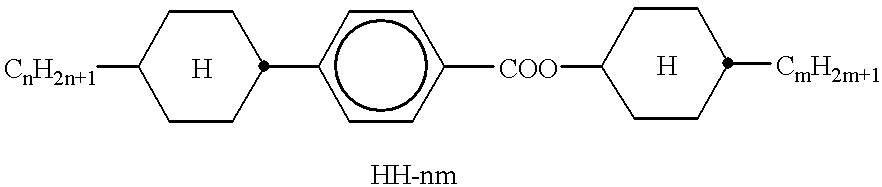 |
 |
 |
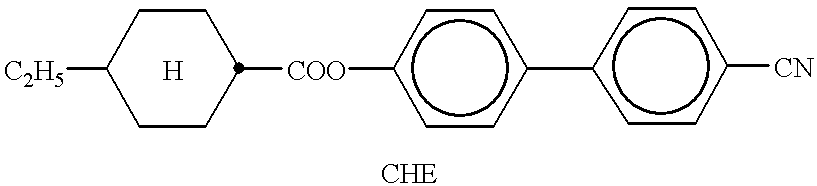 |
 |
 |
 |
 |
 |
 |
 |
 |
 |
 |
|
A mixture of 9.2 g of 2,6-difluoro-4-[2-(p-ethoxyphenyl)ethyl]phenylboric acid (prepared by reacting 3,5-difluorobenzaldehyde with p-ethoxybenzyltriphenylphosphonium iodide by the Wittig method and subsequently hydrogenating the resultant styrene derivative on Pd/C), 5.9 g of 1-bromo-3,4-difluorobenzene, 38 ml of 2 molar aqueous Na2CO3 solution, 0.6 g of tetrakis(triphenylphosphine)palladium(0) and 75 ml of toluene is refluxed for two hours. The aqueous phase is extracted twice with toluene and combined with the organic phase. Customary aqueous work-up and chromatographic purification of the residue give 4-[2-(p-ethoxyphenyl)ethyl]-2,6,3′,4′-tetrafluorobiphenyl, C 92 I, Δε+24.
The following compounds according to the invention are obtained from the appropriate precursors of the formula II analogously to one of the two schemes on page 12:
| R | (A1-Z1)m | (Z2-A2)m | X | |
| (2) | n-Propyl |
 |
 |
F |
| (3) | n-Pentyl |
 |
 |
F |
| (4) | n-Proyl |
 |
 |
OCF3 |
| (5) | n-Pentyl |
 |
 |
OCF3 |
| (6) | n-Propyl |
 |
 |
F |
| (7) | n-Propyl |
 |
 |
Cl |
| (8) | n-Propyl |
 |
 |
Cl |
| (9) | n-Propyl |
 |
 |
CN |
| (10) | n-Propyl |
 |
 |
CN |
| (11) | n-Propyl |
 |
 |
CF3 |
| (12 | n-Propyl |
 |
 |
OCF3 |
| (13) | n-Propyl |
 |
 |
CF3 |
| (14) | n-Propyl |
 |
 |
CN |
| (15) | n-Propyl |
 |
 |
F |
| (16) | n-Propyl |
 |
 |
OCF3 |
| (17) | n-Propyl |
 |
 |
CF3 |
| (18) | n-Propyl |
 |
 |
CN |
| (19) | n-Propyl |
 |
 |
F |
| (20) | n-Propyl |
 |
 |
OCF3 |
| (21) | n-Propyl |
 |
 |
CF3 |
| (22) | n-Propyl |
 |
 |
CN |
| (23) | n-Propyl |
 |
 |
F |
| (24) | n-Propyl |
 |
 |
OCF3 |
| (25) | n-Propyl |
 |
 |
CF3 |
| (26) | n-Propyl |
 |
 |
CN |
| (27) | n-Propyl |
 |
 |
F |
| (28) | n-Pentyl |
 |
 |
CN, C124 N 151 I |
| (29) | n-Pentyl |
 |
 |
F |
| (30) | n-Pentyl |
 |
 |
CF3 |
| (31) | n-Pentyl |
 |
 |
OCF3 |
| (32) | n-Pentyl |
 |
 |
CN |
| (33) | n-Pentyl |
 |
 |
F |
| (34) | n-Pentyl |
 |
 |
CF3 |
| (35) | n-Pentyl |
 |
 |
OCF3 |
| (36) | n-Pentyl |
 |
 |
CN |
| (37) | n-Pentyl |
 |
 |
F |
| (38) | n-Pentyl |
 |
 |
CF3 |
| (39) | n-Pentyl |
 |
 |
OCF3 |
| (40) | n-Propyl | — |
 |
CN |
| (41) | n-Propyl | — |
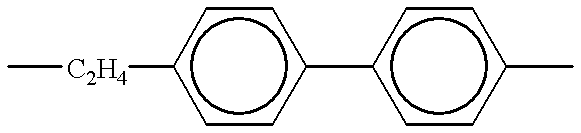 |
CF3 |
| (42) | n-Propyl | — |
 |
F |
| (43) | n-Propyl | — |
 |
OCF3 |
| (44) | n-Propyl |
 |
 |
OCF3 |
| (45) | n-Propyl |
 |
 |
F |
| (46) | n-Propyl |
 |
 |
CN |
| (47) | n-Propyl |
 |
 |
CF3 |
| (48) | n-Propyl |
 |
 |
OCF3 |
| (49) | n-Propyl |
 |
 |
F |
| (50) | Ethoxy |
 |
 |
OCF3, C 112 I |
| (51) | Ethoxy |
 |
 |
F, C 102 I |
| (52) | n-Propyl | — |
 |
CN |
| (53) | n-Propyl | — |
 |
F |
| (54) | n-Propyl | — |
 |
F |
| (55) | n-Propyl | — |
 |
CN |
| (56) | n-Propyl | — |
 |
OCF3 |
| (57) | n-Pentyl | — |
 |
OCF3, C-4 I |
| (57A) | Ethoxy | — |
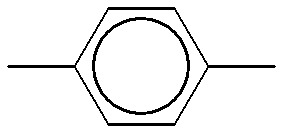 |
OCF3, C 44 I |
| (58) | n-Pentyl | — |
 |
CF3, C 35 I |
| (58a) | Ethoxy | — |
 |
CF2 C 75 I |
A solution of 0.1 mol of p-bromotrifluoromethoxybenzene in 100 ml of THF is added dropwise to a suspension of 0.1 mol of Mg turnings in 50 ml of THF at such a rate that the reaction mixture boils gently. After the mixture has been stirred for one hour, 0.1 mol of trimethyl borate is added dropwise at room temperature, and the mixture is stirred for a further hour and hydrolyzed using dilute hydrochloric acid. After extractive work-up, the resultant boric acid (0.05 mol) is refluxed for two hours together with 0.05 mol of 4-(trans-4-n-pentyl cyclohexyl)-2,6-difluoroiodobenzene [obtainable by reacting 4-pentylcyclohexanone with 3,5-difluorophenylmagnesium bromide, eliminating water, and hydrogenating the cyclohexenebenzene on Pd/C. The resultant 3,5-difluoropenyl [sic] compound is metallated at −70° in THF/TMEDA using n-BuLi and subsequently reacted with iodine in THF at −70°], 38 ml of 2 molar aqueous Na2CO3 solution, 0.6 g of tetrakis(triphenylphosphine)palladium(0) and 75 ml of toluene. Customary aqueous work-up and chromatographic purification give 4-(trans-4-n-pentylcyclohexyl)-2,6-difluoro-4′-trifluoromethoxybiphenyl.
The preferred compounds of the formula 
in which R, m, and X are as defined for the formula I, and r is 0 or 1 and L1 and L2 are, in each case independently of one another, H or F, are obtained analogously from the corresponding difluoroiodo derivatives and boric acid.
| Example | R | m | r | X | L | L2 |
| (60) | Ethyl | 1 | 0 | OCF3 | H | H |
| (61) | Propyl | 1 | 0 | OCF3 | H | H |
| (62) | Butyl | 1 | 0 | OCF3 | H | H |
| (63) | Ethyl | 1 | 1 | OCF3 | H | H |
| (64) | Propyl | 1 | 1 | OCF3 | H | H |
| (65) | Butyl | 1 | 1 | OCF3 | H | H |
| (66) | Pentyl | 1 | 1 | OCF3 | H | H, C 49 N 68,5 I |
| (67) | Ethyl | 2 | 0 | OCF3 | H | H |
| (68) | Propyl | 2 | 0 | OCF3 | H | H, C 112 N 270 I |
| (69) | Butyl | 2 | 0 | OCF3 | H | H |
| (70) | Pentyl | 2 | 0 | OCF3 | H | H |
| (71) | Ethyl | 2 | 1 | OCF3 | H | H |
| (72) | Propyl | 2 | 1 | OCF3 | H | H, C 91 N 213 I |
| (73) | Butyl | 2 | 1 | OCF3 | H | H |
| (74) | Pentyl | 2 | 1 | OCF3 | H | H |
| (75) | Ethyl | 1 | 0 | CF3 | H | H |
| (76) | Propyl | 1 | 0 | CF3 | H | H |
| (77) | Butyl | 1 | 0 | CF3 | H | H |
| (78) | Pentyl | 1 | 0 | CF3 | H | H |
| (79) | Ethyl | 1 | 1 | CF3 | H | H |
| (80) | Propyl | 1 | 1 | CF3 | H | H |
| (81) | Butyl | 1 | 1 | CF3 | H | H |
| (82) | Pentyl | 1 | 1 | CF3 | H | H, C 93 I |
| (83) | Ethyl | 2 | 0 | CF3 | H | H |
| (84) | Propyl | 2 | 0 | CF3 | H | H |
| (85) | Butyl | 2 | 0 | CF3 | H | H |
| (86) | Pentyl | 2 | 0 | CF3 | H | H |
| (87) | Ethyl | 2 | 1 | CF3 | H | H |
| (88) | Propyl | 2 | 1 | CF3 | H | H |
| (89) | Butyl | 2 | 1 | CF3 | H | H |
| (90) | Pentyl | 2 | 1 | CF3 | H | H |
| (91) | Ethyl | 1 | 0 | F | H | H |
| (92) | Propyl | 1 | 0 | F | H | H |
| (93) | Butyl | 1 | 0 | F | H | H |
| (94) | Pentyl | 1 | 0 | F | H | H, C 100 N (64) I |
| (95) | Ethyl | 1 | 1 | F | H | H |
| (96) | Propyl | 1 | 1 | F | H | H |
| (97) | Butyl | 1 | 1 | F | H | H |
| (98) | Pentyl | 1 | 1 | F | H | H, C 91 I |
| viscosity | ||||||
| 18.8 cSt | ||||||
| (99) | Ethyl | 2 | 0 | F | H | H |
| (100) | Propyl | 2 | 0 | F | H | H |
| (101) | Butyl | 2 | 0 | F | H | H |
| (102) | Pentyl | 2 | 0 | F | H | H |
| (103) | Ethyl | 2 | 1 | F | H | H |
| (104) | Propyl | 2 | 1 | F | H | H, C 140 N 212 I |
| (105) | Butyl | 2 | 1 | F | H | H |
| (106) | Pentyl | 2 | 1 | F | H | H |
| (107) | Ethyl | 1 | 0 | F | F | H |
| (108) | Propyl | 1 | 0 | F | F | H, C 81 I, |
| Δε 11.0 | ||||||
| (109) | Butyl | 1 | 0 | F | F | H |
| (110) | Pentyl | 1 | 0 | F | F | H |
| (111) | Ethyl | 1 | 1 | F | F | H |
| (112) | Propyl | 1 | 1 | F | F | H |
| (113) | Butyl | 1 | 1 | F | F | H |
| (114) | Pentyl | 1 | 1 | F | F | H, C 40 N 46.6 I |
| (115) | Ethyl | 2 | 0 | F | F | H |
| (116) | Propyl | 2 | 0 | F | F | H, C 133 N 242 I |
| Δε 12.3 | ||||||
| (117) | Butyl | 2 | 0 | F | F | H |
| (118) | Pentyl | 2 | 0 | F | F | H |
| (119) | Ethyl | 2 | 1 | F | F | H |
| (120) | Propyl | 2 | 1 | F | F | H |
| (121) | Butyl | 2 | 1 | F | F | H |
| (122) | Pentyl | 2 | 1 | F | F | H |
| (123) | Ethyl | 1 | 0 | F | F | F |
| (124) | Propyl | 1 | 0 | F | F | F |
| (125) | Butyl | 1 | 0 | F | F | F |
| (126) | Pentyl | 1 | 0 | F | F | F |
| (127) | Ethyl | 1 | 1 | F | F | F |
| (128) | Propyl | 1 | 1 | F | F | F |
| (129) | Butyl | 1 | 1 | F | F | F |
| (130) | Pentyl | 1 | 1 | F | F | F, C 65.5 I |
| (131) | Ethyl | 2 | 0 | F | F | F |
| (132) | Propyl | 2 | 0 | F | F | F |
| (133) | Butyl | 2 | 0 | F | F | F |
| (134) | Pentyl | 2 | 0 | F | F | F, C 156 N211 I |
| (135) | Ethyl | 2 | 1 | F | F | F |
| (136) | Propyl | 2 | 1 | F | F | F |
| (137) | Butyl | 2 | 1 | F | F | F |
| (138) | Pentyl | 2 | 1 | F | F | F |
| (139) | Ethyl | 1 | 0 | Cl | H | H |
| (140) | Propyl | 1 | 0 | Cl | H | H |
| (141) | Butyl | 1 | 0 | Cl | H | H |
| (142) | Pentyl | 1 | 0 | Cl | H | H |
| (143) | Ethyl | 1 | 1 | Cl | H | H |
| (144) | Propyl | 1 | 1 | Cl | H | H |
| (145) | Butyl | 1 | 1 | Cl | H | H |
| (146) | Pentyl | 1 | 1 | Cl | H | H, C 54 N 91 I |
| (147) | Ethyl | 2 | 0 | Cl | H | H |
| (148) | Propyl | 2 | 0 | Cl | H | H |
| (149) | Butyl | 2 | 0 | Cl | H | H |
| (150) | Pentyl | 2 | 0 | Cl | H | H |
| (151) | Ethyl | 2 | 1 | Cl | H | H |
| (152) | Propyl | 2 | 1 | Cl | H | H |
| (153) | Butyl | 2 | 1 | Cl | H | H |
| (154) | Pentyl | 2 | 1 | Cl | H | H |
| (155) | Ethyl | 1 | 0 | Cl | F | H |
| (156) | Propyl | 1 | 0 | Cl | F | H |
| (157) | Butyl | 1 | 0 | Cl | F | H |
| (158) | Pentyl | 1 | 0 | Cl | F | H |
| (159) | Ethyl | 1 | 1 | Cl | F | H |
| (160) | Propyl | 1 | 1 | Cl | F | H |
| (161) | Butyl | 1 | 1 | Cl | F | H |
| (162) | Pentyl | 1 | 1 | Cl | F | H, C 47 N 74 I |
| Δε 8.8 | ||||||
| (163) | Ethyl | 2 | 0 | Cl | F | H |
| (164) | Propyl | 2 | 0 | Cl | F | H |
| (165) | Butyl | 2 | 0 | Cl | F | H |
| (166) | Pentyl | 2 | 0 | Cl | F | H |
| (167) | Ethyl | 2 | 1 | Cl | F | H |
| (168) | Propyl | 2 | 1 | Cl | F | H |
| (169) | Butyl | 2 | 1 | Cl | F | H |
| (170) | Pentyl | 2 | 1 | Cl | F | H |
| (171) | Ethyl | 1 | 0 | Cl | F | F |
| (172) | Propyl | 1 | 0 | Cl | F | F |
| (173) | Butyl | 1 | 0 | Cl | F | F |
| (174) | Pentyl | 1 | 0 | Cl | F | F |
| (175) | Ethyl | 1 | 1 | Cl | F | F |
| (176) | Propyl | 1 | 1 | Cl | F | F |
| (177) | Butyl | 1 | 1 | Cl | F | F |
| (178) | Pentyl | 1 | 1 | Cl | F | F C 66 I |
| (179) | Ethyl | 2 | 0 | Cl | F | F (N60.3I) |
| (180) | Propyl | 2 | 0 | Cl | F | F |
| (181) | Butyl | 2 | 0 | Cl | F | F |
| (182) | Pentyl | 2 | 0 | Cl | F | F |
| (183) | Ethyl | 2 | 1 | Cl | F | F |
| (184) | Propyl | 2 | 1 | Cl | F | F |
| (185) | Butyl | 2 | 1 | Cl | F | F |
| (186) | Pentyl | 2 | 1 | Cl | F | F |
| (187) | Ethyl | 1 | 0 | CN | H | H |
| (188) | Propyl | 1 | 0 | CN | H | H |
| (189) | Butyl | 1 | 0 | CN | H | H |
| (190) | Pentyl | 1 | 0 | CN | H | H |
| (191) | Ethyl | 1 | 1 | CN | H | H |
| (192) | Propyl | 1 | 1 | CN | H | H |
| (193) | Butyl | 1 | 1 | CN | H | H |
| (194) | Pentyl | 1 | 1 | CN | H | H, C 123 N 131 I |
| (195) | Ethyl | 2 | 0 | CN | H | H |
| (196) | Propyl | 2 | 0 | CN | H | H |
| (197) | Butyl | 2 | 0 | CN | H | H |
| (198) | Pentyl | 2 | 0 | CN | H | H |
| (199) | Ethyl | 2 | 1 | CN | H | H |
| (200) | Propyl | 2 | 1 | CN | H | H |
| (201) | Butyl | 2 | 1 | CN | H | H |
| (202) | Pentyl | 2 | 1 | CN | H | H |
| (203) | Ethyl | 1 | 0 | OCF3 | F | H |
| (204) | Propyl | 1 | 0 | OCF3 | F | H |
| (205) | Butyl | 1 | 0 | OCF3 | F | H |
| (206) | Pentyl | 1 | 0 | OCF3 | F | H |
| (207) | Ethyl | 1 | 1 | OCF3 | F | H |
| (208) | Propyl | 1 | 1 | OCF3 | F | H |
| (209) | Butyl | 1 | 1 | OCF3 | F | H |
| (210) | Pentyl | 1 | 1 | OCF3 | F | H |
| (211) | Ethyl | 2 | 0 | OCF3 | F | H |
| (212) | Propyl | 2 | 0 | OCF3 | F | H |
| (213) | Butyl | 2 | 0 | OCF3 | F | H |
| (214) | Pentyl | 2 | 0 | OCF3 | F | H |
| (215) | Ethyl | 2 | 1 | OCF3 | F | H |
| (216) | Propyl | 2 | 1 | OCF3 | F | H |
| (217) | Butyl | 2 | 1 | OCF3 | F | H |
| (218) | Pentyl | 2 | 1 | OCF3 | F | H |
| (219) | Ethyl | 1 | 0 | OCF3 | F | F |
| (220) | Propyl | 1 | 0 | OCF3 | F | F |
| (221) | Butyl | 1 | 0 | OCF3 | F | F |
| (222) | Pentyl | 1 | 0 | OCF3 | F | F |
| (223) | Ethyl | 1 | 1 | OCF3 | F | F |
| (224) | Propyl | 1 | 1 | OCF3 | F | F |
| (225) | Butyl | 1 | 1 | OCF3 | F | F |
| (226) | Pentyl | 1 | 1 | OCF3 | F | F |
| (227) | Ethyl | 2 | 0 | OCF3 | F | F |
| (228) | Propyl | 2 | 0 | OCF3 | F | F |
| (229) | Butyl | 2 | 0 | OCF3 | F | F |
| (230) | Pentyl | 2 | 0 | OCF3 | F | F |
| (231) | Ethyl | 2 | 1 | OCF3 | F | F |
| (232) | Propyl | 2 | 1 | OCF3 | F | F |
| (233) | Butyl | 2 | 1 | OCF3 | F | F |
| (234) | Pentyl | 2 | 1 | OCF3 | F | F |
A mixture of 9.2 g of 2,6-difluoro-4-[2-(p-ethoxyphenyl)ethyl]phenylboric acid (prepared by reacting 3,5-difluorobenzaldehyde with p-ethoxybenzyltriphenylphosphonium iodide by the Wittig method and subsequently hydrogenating the resulting styrene derivative on Pd/C), 6.0 g of 1-bromo-4-n-propylbenzene, 38 ml of 2 ml [sic] aqueous Na2CO3 solution, 0.6 g of tetrakis(triphenylphosphine)palladium(0) and 75 ml of toluene is refluxed for two hours. The aqueous phase is extracted twice with toluene and combined with the organic phase. Conventional aqueous work-up and chromatographic purification of the residue give 4-[2-(p-ethoxyphenyl)ethyl]-2,6-difluoro-4′-n-propylbiphenyl.
The following compounds according to the invention are obtained analogously from the appropriate precursors of the formula II:
| R | (A1-Z1)m | (Z2-A2)m | X | |
| (236) | n-Propyl |
 |
 |
Ethyl |
| (237) | n-Pentyl |
 |
 |
Ethyl |
| (238) | n-Propyl |
 |
 |
Ethyl |
| (239) | n-Pentyl |
 |
 |
Ethyl |
| (240) | n-Propyl |
 |
 |
n-Propyl |
| (241) | n-Propyl |
 |
 |
n-Pentyl |
| (242) | n-Propyl |
 |
 |
n-Propyl |
| (243) | n-Propyl |
 |
 |
n-Pentyl |
| (244) | n-Propyl |
 |
 |
Ethyl |
| (245) | n-Propyl |
 |
 |
n-Propyl |
| (246) | n-Propyl |
 |
 |
Methyl |
| (247) | n-Propyl |
 |
 |
Ethyl |
| (248) | n-Propyl |
 |
 |
n-Propyl |
| (249) | n-Propyl |
 |
 |
n-Pentyl |
| (250) | n-Propyl |
 |
 |
Methyl |
| (251) | n-Propyl |
 |
 |
Ethyl |
| (252) | n-Propyl |
 |
 |
n-Propyl |
| (253) | n-Propyl |
 |
 |
Methoxy |
| (254) | n-Propyl |
 |
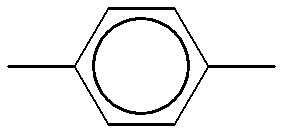 |
Methyl |
| (255) | n-Propyl |
 |
 |
Ethyl |
| (256) | n-Propyl |
 |
 |
n-Propyl |
| (257) | n-Propyl |
 |
 |
n-Pentyl |
| (258) | n-Propyl |
 |
 |
Methyl |
| (259) | n-Propyl |
 |
 |
Ethyl |
| (260) | n-Propyl |
 |
 |
n-Propyl |
| (261) | n-Propyl |
 |
 |
n-Pentyl |
| (262) | n-Pentyl |
 |
 |
n-Propyl |
| (263) | n-Pentyl |
 |
 |
n-Pentyl |
| (264) | n-Butoxy |
 |
 |
n-Propyl |
| (265) | n-Butoxy |
 |
 |
n-Pentyl |
| (266) | n-Pentyl |
 |
 |
Methyl |
| (267) | n-Pentyl |
 |
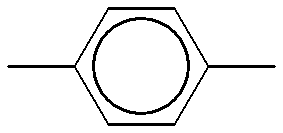 |
Ethyl |
| (268) | n-Pentyl |
 |
 |
n-Propyl |
| (269) | n-Butoxy |
 |
 |
n-Heptyl |
| (270) | n-Pentyl |
 |
 |
Methyl |
| (271) | n-Pentyl |
 |
 |
Ethyl |
| (272) | n-Pentyl |
 |
 |
n-Propyl |
| (273) | n-Pentyl |
 |
 |
n-Pentyl |
| (274) | n-Propyl | — |
 |
Ethyl |
| (275) | n-Propyl | — |
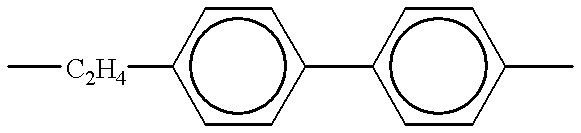 |
n-Propyl |
| (276) | n-Propyl | — |
 |
n-Butyl |
| (277) | n-Propyl | — |
 |
n-Pentyl |
| (278) | n-Propyl |
 |
 |
Ethyl |
| (279) | n-Propyl |
 |
 |
n-Propyl |
| (280) | n-Propyl |
 |
 |
Methyl |
| (281) | n-Propyl |
 |
 |
Ethyl |
| (282) | n-Propyl |
 |
 |
n-Propyl, C 57 N 96 I |
| (283) | n-Propyl |
 |
 |
n-Pentyl |
| (284) | Ethoxy |
 |
 |
n-Propyl |
| (285) | Ethoxy |
 |
 |
n-Pentyl |
| (286) | n-Propyl | — |
 |
n-Propyl |
| (287) | n-Propyl | — |
 |
n-Propyl |
| (288) | n-Propyl | — |
 |
n-Propyl |
| (289) | n-Propyl | — |
 |
n-Pentyl |
| (290) | n-Propyl | — |
 |
n-Heptyl |
| (291) | n-Pentyl |
 |
 |
n-Propyl, C 97 N 270 I |

0.1 mol of I are introduced into 150 ml of a solvent mixture of THF/toluene (1:4 ratio by volume), and 11.5 g of anhydrous zinc bromide and then 1.4 g of lithium granules are then added. The mixture is treated with ultrasound for 4 hours at between 0° C. and 10° C. under argon and with stirring in order to convert I into the corresponding dialkyl zinc compound. The organozinc compound is treated with 0.1 mol of II and 1.5 g (2 mol%) of 1,1′-bis(diphenylphosphino)ferrocene/palladium(II) dichloride (PdCl2 dppf), and the mixture is stirred at room temperature for 24 hours after the ultrasound bath and the cooling have been removed. The mixture is decomposed using 100 ml of saturated NH4Cl solution with stirring, the organic phase is separated off, and the aqueous phase is extracted 2× with toluene. The combined organic extracts are dried, evaporated and chromatographed on silica gel using hexane to give III.

100 mmol of 1 are converted into 3 by reaction with 2 analogously to the above example.
31 ml of n-BuLi (15% in hexane) are added dropwise at −65 to −70° C. to a mixture of 47 mmol of 3, 7.5 ml of TMEDA (50 mmol) and 150 ml of THF, and the mixture is stirred for a further 1 hour at −70° C. A solution of 12.0 g (47 mmol) of iodine in 25 ml of THF is then added dropwise at −65 to −70° C., and the mixture is stirred for a further 0.5 hour at −70° C. The mixture is warmed to −30° C and hydrolyzed during 15 ml of water, and excess iodine is reduced by adding 15 ml of sodium bisulfite solution. Customary work-up and recrystallization from hexane give 4. 400 ml of NMP are removed by distillation from a mixture of 38 mmol of 4, 4.4 g (76 mmol) of KF, 22.8 g (168 mmol) of sodium trifluoroacetate and 800 ml of NMP at 70° C. and 4 mbar. 1.4 g (76 mmol) of dried CuI are then added to the reaction mixture, which is stirred at 160° C. for 5 hours. About 300 ml of NMP are subsequently removed by distillation. The mixture is allowed to cool to RT, and 400 ml of MTB ether are added. The mixture is washed with water, dried using Na2SO4, filtered and evaporated to give a residue. Chromatography on silica gel using hexane gives 5.
A solution of 0.1 m of 1-(trans-4-n-propylcyclohexyl)-2-(3,3′,5′-trifluorobiphenylyl)ethane and 0.1 m of TMEDA in 300 ml of THF is treated dropwise at about −65° with 0.1 m of n-BuLi (1.5 M in hexane). The mixture is stirred at this temperature for a further 30 minutes, and 0.2 m of N-chlorosuccinimide in 70 ml of THF is then slowly added. When the addition is complete, the mixture is allowed to warm to −20° and is hydrolyzed using H2O. The product is dissolved completely by adding diethyl ether. Extractive work-up and purification by chromatography and crystallization give 1-(trans-4-n-propylcyclohexyl)-2-(4′-chloro-3,3′,5′-trifluorobiphenylyl)ethane.
A mixture of 10.5 g of 1-bromo-3,4-difluorobenzene, 17.4 g of 4-(trans-4-4-propylcyclohexyl)-2,6-difluorostyrene (obtainable in accordance with the abovementioned schemes), 0.25 g of Pd acetate, 0.6 g of tri-o-tolylphosphine, 7 g of triethylamine and 125 ml of acetonitrile is refluxed until the reaction is complete. Customary work-up gives trans-1-(3,4-difluorophenyl)-2-[4-(trans-4-propylcyclohexyl)-2,6-difluorophenyl]ethene, C 101 N 156.5 I.
The following are prepared analogously: trans-1-(3,4-difluorophenyl)-2-(2,6-difluoro-4-ethoxyphenyl)ethene, C 92 I.
A liquid-crystalline medium I comprises
| PCH-5F | 10.0% | |||
| PCH-6F | 8.0% | |||
| PCH-7F | 6.0% | |||
| CCP-20CF3 | 8.0% | |||
| CCP-30CF3 | 12.0% | |||
| CCP-40CF3 | 9.0% | |||
| CCP-50CF3 | 9.0% | |||
| BCH-3F.F | 12.0% | |||
| BCH-5F.F | 10.0% | |||
| ECCP-30CF3 | 5.0% | |||
| ECCP-50CF3 | 5.0% | |||
| CBC-33F | 2.0% | |||
| CBC-53F | 2.0% | |||
| CBC-55F | 2.0% | |||
A medium II according to the invention comprises 90% of medium I and 10% of
 |
| Medium I | Medium II | |||
| Clear point | 91° C. | 102.4° C. | ||
| Δn | 0.094 | 0.102 | ||
| Δε | 5.2 | 6.0 | ||
| Viscosity at 20° (cSt) | 15.0 | 16.7 | ||
Claims (4)
1. A 1,4-disubstituted 2,6-difluorobenzene compound of formula I 
wherein
R is an alkyl radical having 1 to 15 carbon atoms which is unsubstituted or at least monosubstituted by halogen, it also being possible for one or more CH2 groups in these radicals to be replaced, in each case independently of one another, by —O—, —S—, 

—CO—, —CO—O, —O—CO— or —O—CO—O— in such a manner that oxygen atoms are not linked directly to one another, A1 and A2, in each case independently of one another, are
(a) a 1,4-phenylene radical in which in addition, one or two CH groups may be replaced by N, or
(b) a radical from the group comprising 1,4-cyclohexenylene, 1,4-bicyclo(2,2,2)octylene, piperidine-1,4-diyl, naphthalene-2,6-diyl, decahydronaphthalene-2,6-diyl and 1,2,3,4-tetrahydronaphthalene-2,6-diyl,
it being possible for the radicals (a) and (b) to be substituted by CN or monosubstituted or disubstituted by fluorine,
Z1 and Z2 in each case independently of one another, are —CO—O—, —O—CO—, —CH2O—, —OCH2—, —CH2CH2—, —CH═CH—, —C≡C— or a single bond
m is 0, 1, or 2 and n is 1 or 2,where
(m+n) is 1, 2 or 3, and
X is F, Cl, —OCF3, or —OCHF2,
with the proviso that at least one of the radicals A1 and A2 present in the molecule is 
2. A liquid-crystalline medium according to claim 1 containing at least two liquid-crystalline components, wherein at least one compound is one of formula I.
3. A liquid-crystal display element, comprising a liquid-crystalline medium according to claim 2.
4. An electrooptical display element, comprising as a dielectric, a liquid-crystalline medium according to claim 2.
Priority Applications (2)
| Application Number | Priority Date | Filing Date | Title |
|---|---|---|---|
| US08/917,167 US6200654B1 (en) | 1989-12-06 | 1997-08-25 | 1,4-disubstituted 2,6-difluorobenzene compounds, and a liquid-crystalline medium |
| US09/514,895 US6326066B1 (en) | 1989-12-06 | 2000-02-28 | 1,4-disubstituted 2,6-difluorobenzene compounds, and a liquid-crystalline medium |
Applications Claiming Priority (14)
| Application Number | Priority Date | Filing Date | Title |
|---|---|---|---|
| DE3940343 | 1989-12-06 | ||
| DEP3940343 | 1989-12-06 | ||
| DEP3941881 | 1989-12-19 | ||
| DE3941881 | 1989-12-19 | ||
| DE4000535A DE4000535B4 (en) | 1989-12-06 | 1990-01-10 | 1,4-disubstituted 2,6-difluorobenzene compounds and liquid-crystalline medium |
| DEP4000534 | 1990-01-10 | ||
| DEP4000535 | 1990-01-10 | ||
| DE4000534A DE4000534C2 (en) | 1989-12-19 | 1990-01-10 | 1,4-disubstituted 2,6-difluorobenzene compounds and liquid-crystalline medium |
| PCT/EP1990/002109 WO1991008184A2 (en) | 1989-12-06 | 1990-12-06 | 1,2-disubstituted 2,6-difluorobenzene compounds and liquid crystal media |
| EPPCT/EP90/02109 | 1990-12-06 | ||
| US65932091A | 1991-02-22 | 1991-02-22 | |
| US40255595A | 1995-03-13 | 1995-03-13 | |
| US44955995A | 1995-05-24 | 1995-05-24 | |
| US08/917,167 US6200654B1 (en) | 1989-12-06 | 1997-08-25 | 1,4-disubstituted 2,6-difluorobenzene compounds, and a liquid-crystalline medium |
Related Parent Applications (1)
| Application Number | Title | Priority Date | Filing Date |
|---|---|---|---|
| US44955995A Continuation | 1989-12-06 | 1995-05-24 |
Related Child Applications (1)
| Application Number | Title | Priority Date | Filing Date |
|---|---|---|---|
| US09/514,895 Division US6326066B1 (en) | 1989-12-06 | 2000-02-28 | 1,4-disubstituted 2,6-difluorobenzene compounds, and a liquid-crystalline medium |
Publications (1)
| Publication Number | Publication Date |
|---|---|
| US6200654B1 true US6200654B1 (en) | 2001-03-13 |
Family
ID=27570618
Family Applications (2)
| Application Number | Title | Priority Date | Filing Date |
|---|---|---|---|
| US08/917,167 Expired - Fee Related US6200654B1 (en) | 1989-12-06 | 1997-08-25 | 1,4-disubstituted 2,6-difluorobenzene compounds, and a liquid-crystalline medium |
| US09/514,895 Expired - Fee Related US6326066B1 (en) | 1989-12-06 | 2000-02-28 | 1,4-disubstituted 2,6-difluorobenzene compounds, and a liquid-crystalline medium |
Family Applications After (1)
| Application Number | Title | Priority Date | Filing Date |
|---|---|---|---|
| US09/514,895 Expired - Fee Related US6326066B1 (en) | 1989-12-06 | 2000-02-28 | 1,4-disubstituted 2,6-difluorobenzene compounds, and a liquid-crystalline medium |
Country Status (2)
| Country | Link |
|---|---|
| US (2) | US6200654B1 (en) |
| KR (1) | KR0184869B1 (en) |
Cited By (7)
| Publication number | Priority date | Publication date | Assignee | Title |
|---|---|---|---|---|
| US20060204677A1 (en) * | 2005-02-25 | 2006-09-14 | Michael Wittek | Liquid-crystalline medium |
| US9181484B2 (en) | 2012-05-15 | 2015-11-10 | Dic Corporation | Compound having 2-fluorophenyloxymethane structure |
| US9573923B2 (en) | 2013-10-03 | 2017-02-21 | Dic Corporation | Liquid crystal compound having 2, 6-difluorophenylether structure, and liquid crystal composition containing the same |
| US9637466B2 (en) | 2013-07-25 | 2017-05-02 | Dic Corporation | Liquid crystal compound having 2, 6-difluorophenyl ether structure and liquid crystal composition thereof |
| US10000700B2 (en) | 2014-07-31 | 2018-06-19 | Dic Corporation | Nematic liquid crystal composition |
| US10253258B2 (en) | 2014-07-31 | 2019-04-09 | Dic Corporation | Nematic liquid crystal composition |
| US10544365B2 (en) | 2013-08-30 | 2020-01-28 | Dic Corporation | Nematic liquid crystal composition |
Families Citing this family (3)
| Publication number | Priority date | Publication date | Assignee | Title |
|---|---|---|---|---|
| KR100323836B1 (en) * | 1993-05-10 | 2002-06-20 | 플레믹 크리스티안 | Electro-optic liquid crystal display comprising benzene derivatives, liquid crystal media containing them and the corresponding liquid crystal media |
| US6939478B2 (en) * | 2002-12-13 | 2005-09-06 | Xerox Corporation | Compounds of formula (2) to stabilize liquid crystal domains |
| US6905633B2 (en) * | 2002-12-13 | 2005-06-14 | Xerox Corporation | Compounds of formula (3) to stabilize liquid crystal domains |
Citations (24)
| Publication number | Priority date | Publication date | Assignee | Title |
|---|---|---|---|---|
| EP0064193A1 (en) | 1981-04-30 | 1982-11-10 | MERCK PATENT GmbH | 4,4'-Bis-(cyclohexyl)-biphenyl derivatives that contain fluorine, dielectrics containing them, and electro-optical indicator element |
| US4551264A (en) | 1982-03-13 | 1985-11-05 | Merck Patent Gesellschaft Mit Beschrankter Haftung | Polyhalogenoaromatic compounds for liquid crystal compositions |
| EP0317175A2 (en) | 1987-11-17 | 1989-05-24 | Seiko Epson Corporation | Pyrimidine derivatives |
| US4834905A (en) | 1982-07-07 | 1989-05-30 | Merck Patent Gesellschaft Mit Beschrankter Haftung | Ring compounds |
| US4853152A (en) | 1987-11-16 | 1989-08-01 | Chisso Corporation | Cyclohexane derivative |
| US4884609A (en) | 1987-10-02 | 1989-12-05 | Ho I Chung | No-flat tire insert |
| EP0387032A1 (en) | 1989-03-07 | 1990-09-12 | Chisso Corporation | Trifluorobenzene derivatives and liquid crystal compositions containing the same |
| US4970022A (en) | 1985-12-20 | 1990-11-13 | Merck Patent Gesellschaft Mit Beschrankter Haftung | Liquid-crystalline mustard oils |
| US5032814A (en) | 1989-04-28 | 1991-07-16 | Valeo Electronique | Mounting assembly for an ignition coil, in particular for an internal combustion engine of an automotive vehicle |
| US5069814A (en) | 1989-03-02 | 1991-12-03 | Chisso Corporation | Benzoic acid derivative having a large positive dielectric anisotropy value |
| US5273680A (en) | 1988-03-10 | 1993-12-28 | Merck Patent Gesellschaft Mit Beschrankter Haftung | Fluorinated oligophenyls and their use in liquid crystal materials |
| US5372746A (en) * | 1991-11-19 | 1994-12-13 | Hoffmann-La Roche Inc. | Fluoro-substituted tolane compounds and liquid crystalline mixtures containing same |
| US5582767A (en) * | 1992-11-16 | 1996-12-10 | Hoffmann-La Roche Inc. | Fluorosubstituted tolane derivatives |
| US5589102A (en) * | 1994-09-06 | 1996-12-31 | Merck Patent Gesellschaft Mit Beschrankter Haftung | Benzene derivatives, and liquid-crystalline medium |
| US5714088A (en) * | 1995-03-23 | 1998-02-03 | Chisso Corporation | Liquid crystalline compound having branched alkyl group at its side chain and liquid crystal composition containing the same |
| US5716543A (en) * | 1993-10-08 | 1998-02-10 | Merck Patent Gesellschaft Mit Beschrankter Haftung | 3,4,5-trifluorobenzenes, and their use in liquid-crystal mixtures |
| US5718840A (en) * | 1993-05-10 | 1998-02-17 | Merck Patent Gesellschaft Mit Beschrankter Haftung | Benzene derivatives, and liquid-crystalline medium |
| US5723068A (en) * | 1995-03-02 | 1998-03-03 | Chisso Corporation | Liquid crystal composition and a liquid crystal display device containing the same |
| US5725799A (en) * | 1995-11-04 | 1998-03-10 | Merck Patent Gesellschaft Mit Beschrankter Haftung | 3,4,5-trifluoropheny 4-cyclohexylbenzoates |
| US5730904A (en) * | 1993-05-19 | 1998-03-24 | Merck Patent Gesellschaft Mit Beschrankter Haftung | Partially fluroinated benzene derivatives, and liquid-crystalline medium |
| US5753142A (en) * | 1995-03-02 | 1998-05-19 | Merck Patent Gesellschaft Mit Beschrankter Haftung | Nematic liquid-crystal composition for active matrix application |
| US5755994A (en) * | 1995-02-22 | 1998-05-26 | Chisso Corporation | Ester derivative, liquid crystal composition and liquid crystal display element |
| US5762828A (en) * | 1996-04-30 | 1998-06-09 | Merck Patent Gesellschaft Mit Beschrankter Haftung | Liquid crystal medium |
| US5855814A (en) * | 1995-02-09 | 1999-01-05 | Chisso Corporation | Liquid crystal compositions and liquid crystal display elements |
-
1990
- 1990-12-06 KR KR1019910700836A patent/KR0184869B1/en not_active Expired - Lifetime
-
1997
- 1997-08-25 US US08/917,167 patent/US6200654B1/en not_active Expired - Fee Related
-
2000
- 2000-02-28 US US09/514,895 patent/US6326066B1/en not_active Expired - Fee Related
Patent Citations (26)
| Publication number | Priority date | Publication date | Assignee | Title |
|---|---|---|---|---|
| US4419264A (en) | 1981-04-30 | 1983-12-06 | Merck Patent Gesellschaft Mit Beschrankter Haftung | Fluorine-containing 4,4'-bis-(cyclohexyl)-biphenyl derivatives, and dielectrics and electro-optical display elements containing them |
| EP0064193A1 (en) | 1981-04-30 | 1982-11-10 | MERCK PATENT GmbH | 4,4'-Bis-(cyclohexyl)-biphenyl derivatives that contain fluorine, dielectrics containing them, and electro-optical indicator element |
| US4551264A (en) | 1982-03-13 | 1985-11-05 | Merck Patent Gesellschaft Mit Beschrankter Haftung | Polyhalogenoaromatic compounds for liquid crystal compositions |
| US4834905A (en) | 1982-07-07 | 1989-05-30 | Merck Patent Gesellschaft Mit Beschrankter Haftung | Ring compounds |
| US4970022A (en) | 1985-12-20 | 1990-11-13 | Merck Patent Gesellschaft Mit Beschrankter Haftung | Liquid-crystalline mustard oils |
| US4884609A (en) | 1987-10-02 | 1989-12-05 | Ho I Chung | No-flat tire insert |
| US4853152A (en) | 1987-11-16 | 1989-08-01 | Chisso Corporation | Cyclohexane derivative |
| EP0317175A2 (en) | 1987-11-17 | 1989-05-24 | Seiko Epson Corporation | Pyrimidine derivatives |
| US5273680A (en) | 1988-03-10 | 1993-12-28 | Merck Patent Gesellschaft Mit Beschrankter Haftung | Fluorinated oligophenyls and their use in liquid crystal materials |
| US5069814A (en) | 1989-03-02 | 1991-12-03 | Chisso Corporation | Benzoic acid derivative having a large positive dielectric anisotropy value |
| US5032313A (en) | 1989-03-07 | 1991-07-16 | Chisso Corporation | Trifluorobenzene derivative and liquid crystal composition containing the same |
| EP0387032A1 (en) | 1989-03-07 | 1990-09-12 | Chisso Corporation | Trifluorobenzene derivatives and liquid crystal compositions containing the same |
| US5032814A (en) | 1989-04-28 | 1991-07-16 | Valeo Electronique | Mounting assembly for an ignition coil, in particular for an internal combustion engine of an automotive vehicle |
| US5372746A (en) * | 1991-11-19 | 1994-12-13 | Hoffmann-La Roche Inc. | Fluoro-substituted tolane compounds and liquid crystalline mixtures containing same |
| US5582767A (en) * | 1992-11-16 | 1996-12-10 | Hoffmann-La Roche Inc. | Fluorosubstituted tolane derivatives |
| US5718840A (en) * | 1993-05-10 | 1998-02-17 | Merck Patent Gesellschaft Mit Beschrankter Haftung | Benzene derivatives, and liquid-crystalline medium |
| US5730904A (en) * | 1993-05-19 | 1998-03-24 | Merck Patent Gesellschaft Mit Beschrankter Haftung | Partially fluroinated benzene derivatives, and liquid-crystalline medium |
| US5716543A (en) * | 1993-10-08 | 1998-02-10 | Merck Patent Gesellschaft Mit Beschrankter Haftung | 3,4,5-trifluorobenzenes, and their use in liquid-crystal mixtures |
| US5589102A (en) * | 1994-09-06 | 1996-12-31 | Merck Patent Gesellschaft Mit Beschrankter Haftung | Benzene derivatives, and liquid-crystalline medium |
| US5855814A (en) * | 1995-02-09 | 1999-01-05 | Chisso Corporation | Liquid crystal compositions and liquid crystal display elements |
| US5755994A (en) * | 1995-02-22 | 1998-05-26 | Chisso Corporation | Ester derivative, liquid crystal composition and liquid crystal display element |
| US5723068A (en) * | 1995-03-02 | 1998-03-03 | Chisso Corporation | Liquid crystal composition and a liquid crystal display device containing the same |
| US5753142A (en) * | 1995-03-02 | 1998-05-19 | Merck Patent Gesellschaft Mit Beschrankter Haftung | Nematic liquid-crystal composition for active matrix application |
| US5714088A (en) * | 1995-03-23 | 1998-02-03 | Chisso Corporation | Liquid crystalline compound having branched alkyl group at its side chain and liquid crystal composition containing the same |
| US5725799A (en) * | 1995-11-04 | 1998-03-10 | Merck Patent Gesellschaft Mit Beschrankter Haftung | 3,4,5-trifluoropheny 4-cyclohexylbenzoates |
| US5762828A (en) * | 1996-04-30 | 1998-06-09 | Merck Patent Gesellschaft Mit Beschrankter Haftung | Liquid crystal medium |
Non-Patent Citations (3)
| Title |
|---|
| Chemical Abstracts, Band 107, No. 20, Nov. 16, 1987. P. 793. |
| Chemical Abstracts, Band 110, No. 14, Apr. 3, 1989, p. 360. |
| Molecular Crystals and Liquid Crystals, Band 172, Jul. 1988, (Chur, CH) G.W. Gray et al., pp. 165-189. |
Cited By (8)
| Publication number | Priority date | Publication date | Assignee | Title |
|---|---|---|---|---|
| US20060204677A1 (en) * | 2005-02-25 | 2006-09-14 | Michael Wittek | Liquid-crystalline medium |
| US7455894B2 (en) * | 2005-02-25 | 2008-11-25 | Merck Patent Gmbh | Liquid-crystalline medium |
| US9181484B2 (en) | 2012-05-15 | 2015-11-10 | Dic Corporation | Compound having 2-fluorophenyloxymethane structure |
| US9637466B2 (en) | 2013-07-25 | 2017-05-02 | Dic Corporation | Liquid crystal compound having 2, 6-difluorophenyl ether structure and liquid crystal composition thereof |
| US10544365B2 (en) | 2013-08-30 | 2020-01-28 | Dic Corporation | Nematic liquid crystal composition |
| US9573923B2 (en) | 2013-10-03 | 2017-02-21 | Dic Corporation | Liquid crystal compound having 2, 6-difluorophenylether structure, and liquid crystal composition containing the same |
| US10000700B2 (en) | 2014-07-31 | 2018-06-19 | Dic Corporation | Nematic liquid crystal composition |
| US10253258B2 (en) | 2014-07-31 | 2019-04-09 | Dic Corporation | Nematic liquid crystal composition |
Also Published As
| Publication number | Publication date |
|---|---|
| KR920701098A (en) | 1992-08-11 |
| US6326066B1 (en) | 2001-12-04 |
| KR0184869B1 (en) | 1999-05-15 |
Similar Documents
| Publication | Publication Date | Title |
|---|---|---|
| JP2935746B2 (en) | 1,4-disubstituted 2,6-difluorobenzene compound and liquid crystal phase | |
| US5389292A (en) | Difluoromethyl compounds | |
| CA2040423C (en) | Fluorobenzene derivatives and liquid-crystalline medium | |
| JP3151216B2 (en) | Vinyl compounds and liquid crystal media | |
| US6630210B2 (en) | Pentafluorosulfuranylbenzene derivatives | |
| US5562858A (en) | Hexafluoropropyl ethers, and liquid-crystalline medium | |
| US5209868A (en) | Trifluoromethylcyclohexane derivatives | |
| US6057006A (en) | Fluorocyclohexane derivatives, and liquid-crystalline medium | |
| JP3683907B2 (en) | 1,2,2,2-Tetrafluoroethyl ether compound and liquid crystal medium | |
| US6200654B1 (en) | 1,4-disubstituted 2,6-difluorobenzene compounds, and a liquid-crystalline medium | |
| US6139773A (en) | Cyclohexane derivatives, and liquid-crystalline medium | |
| US6551666B2 (en) | Cyclohexane derivatives and liquid-crystalline medium | |
| JP3406346B2 (en) | Benzene derivatives and liquid crystalline media | |
| JP4144900B2 (en) | Partially fluorinated benzene derivatives and liquid crystal media | |
| US6056895A (en) | Fluorocyclohexane derivatives, and liquid-crystalline medium | |
| EP0449015B1 (en) | Difluoromethyl compounds and liquid criystal medium | |
| US5968410A (en) | Fluorocyclohexane derivatives, and liquid-crystalline medium | |
| US6444279B1 (en) | Liquid crystal propene or propenyl nitrile derivatives | |
| EP0426815B1 (en) | Fluorinated biphenyl derivatives | |
| EP0721933B1 (en) | 1,4-Disubstituted 2,6-difluorobenzene compounds and liquid crystal media | |
| GB2290787A (en) | Three ring alkoxyphenyl liquid crystalline derivatives | |
| US5637257A (en) | Fluoro-chloro-benzene derivatives | |
| GB2257701A (en) | 1,4 - disubstituted 2,6 - difluorfobenzene compounds | |
| US5635107A (en) | Fluorine-containing five-membered ring compounds, and a liquid-crystaline medium containing them | |
| DE4111991B4 (en) | 1,4-Disubstituted 2,6-difluorobenzene compounds and their uses |
Legal Events
| Date | Code | Title | Description |
|---|---|---|---|
| FEPP | Fee payment procedure |
Free format text: PAYOR NUMBER ASSIGNED (ORIGINAL EVENT CODE: ASPN); ENTITY STATUS OF PATENT OWNER: LARGE ENTITY |
|
| CC | Certificate of correction | ||
| REMI | Maintenance fee reminder mailed | ||
| FPAY | Fee payment |
Year of fee payment: 4 |
|
| SULP | Surcharge for late payment | ||
| FPAY | Fee payment |
Year of fee payment: 8 |
|
| REMI | Maintenance fee reminder mailed | ||
| LAPS | Lapse for failure to pay maintenance fees | ||
| STCH | Information on status: patent discontinuation |
Free format text: PATENT EXPIRED DUE TO NONPAYMENT OF MAINTENANCE FEES UNDER 37 CFR 1.362 |
|
| FP | Lapsed due to failure to pay maintenance fee |
Effective date: 20130313 |