US6186387B1 - Solder collecting capsule and solder extracting desoldering tool using same - Google Patents

Solder collecting capsule and solder extracting desoldering tool using same Download PDF

Info

Publication number
US6186387B1
US6186387B1 US09/289,720 US28972099A US6186387B1 US 6186387 B1 US6186387 B1 US 6186387B1 US 28972099 A US28972099 A US 28972099A US 6186387 B1 US6186387 B1 US 6186387B1
Authority
US
United States
Prior art keywords
solder
capsule
chamber part
filter
vacuum
Prior art date
Legal status (The legal status is an assumption and is not a legal conclusion. Google has not performed a legal analysis and makes no representation as to the accuracy of the status listed.)
Expired - Lifetime
Application number
US09/289,720
Inventor
David W. Lawrence
Dung T. Le
Current Assignee (The listed assignees may be inaccurate. Google has not performed a legal analysis and makes no representation or warranty as to the accuracy of the list.)
Pace Inc
Original Assignee
Pace Inc
Priority date (The priority date is an assumption and is not a legal conclusion. Google has not performed a legal analysis and makes no representation as to the accuracy of the date listed.)
Filing date
Publication date
Application filed by Pace Inc filed Critical Pace Inc
Priority to US09/289,720 priority Critical patent/US6186387B1/en
Assigned to PACE INCORPORATED reassignment PACE INCORPORATED ASSIGNMENT OF ASSIGNORS INTEREST (SEE DOCUMENT FOR DETAILS). Assignors: LAWRENCE, DAVID W., LE, DUNG T.
Priority to US09/510,682 priority patent/US6237831B1/en
Priority to CN00117878A priority patent/CN1277083A/en
Priority to EP00107722A priority patent/EP1044751A1/en
Priority to TW089106778A priority patent/TW445187B/en
Application granted granted Critical
Publication of US6186387B1 publication Critical patent/US6186387B1/en
Anticipated expiration legal-status Critical
Expired - Lifetime legal-status Critical Current

Links

Images

Classifications

    • BPERFORMING OPERATIONS; TRANSPORTING
    • B23MACHINE TOOLS; METAL-WORKING NOT OTHERWISE PROVIDED FOR
    • B23KSOLDERING OR UNSOLDERING; WELDING; CLADDING OR PLATING BY SOLDERING OR WELDING; CUTTING BY APPLYING HEAT LOCALLY, e.g. FLAME CUTTING; WORKING BY LASER BEAM
    • B23K3/00Tools, devices, or special appurtenances for soldering, e.g. brazing, or unsoldering, not specially adapted for particular methods
    • B23K3/02Soldering irons; Bits
    • B23K3/029Solder or residue removing devices
    • BPERFORMING OPERATIONS; TRANSPORTING
    • B23MACHINE TOOLS; METAL-WORKING NOT OTHERWISE PROVIDED FOR
    • B23KSOLDERING OR UNSOLDERING; WELDING; CLADDING OR PLATING BY SOLDERING OR WELDING; CUTTING BY APPLYING HEAT LOCALLY, e.g. FLAME CUTTING; WORKING BY LASER BEAM
    • B23K1/00Soldering, e.g. brazing, or unsoldering
    • B23K1/018Unsoldering; Removal of melted solder or other residues

Definitions

  • the present invention is directed to solder extracting type desoldering tools, and in particular, to such desoldering tools in which the extracted solder is collected in a disposable capsule.
  • solder extracting type desoldering tools a vacuum is used to draw the re-melted solder into the desoldering tool where it is collected in a solder collecting receptacle of one type or another. While, in some cases, a removable porous solder retention pad, liner or baffle has been provided to retain the collected solder in the collecting receptacle and/or to facilitate removal of the collected solder.
  • An example of one such type of desoldering tool is described in U.S. Pat. Nos. 5,143,272 and 5,007,574 in which a tray like receptacle is a removable, but permanent, part of the tool and in which a removable porous solder retention pad is disposed.
  • a desoldering tool was introduced by Weller under Model No. SCD-100 in which solder is collected in a disposable cylindrical capsule which is open at one end for receiving the extracted molten solder and is closed at the opposite end by a filter through which the solder extracting vacuum is drawn.
  • a metal baffle is disposed within the capsule chamber for the purpose of causing the extracted to solder to solidify thereon.
  • the baffle cannot predictably insure that the intended amount of solder is extracted before a vacuum failure occurs, i.e., sometimes the capsule is able to sufficiently fill with solder and other times vacuum failure might occur well before the capsule is adequately filled with extracted solder.
  • the use of such baffles reduces the effective volume of the capsule to such an extent that a low volumetric efficiency is obtainable even under the best of circumstances, thereby causing the rise time (i.e., the time to reduce the pressure sufficiently to draw the solder up into the tool) to be longer than is optimally desirable.
  • the capsule body is formed of the plastic material Kapton® (which has a usable temperature range of up to 800° F.) and the baffle is made of a metal, such as stainless steel (with a melting point of around 2000° F.)
  • Kapton® which has a usable temperature range of up to 800° F.
  • the baffle is made of a metal, such as stainless steel (with a melting point of around 2000° F.)
  • recycling of the extracted solder is not practical since it cannot be easily removed from the capsule, and the capsule and baffle cannot be burnt off at sufficiently low temperatures.
  • exchanging of a filled capsule with new, empty one is not a simple process that can be performed quickly (which is essential in production facilities) since the capsule is hot, all of the extracted solder may not have solidified, and withdrawal of the capsule requires significant manipulation of the desoldering tool and the capsule itself.
  • solder collecting capsule for an extraction type desoldering tool which has a high volumetric efficiency and predictably insures that the intended amount of solder is extracted before a vacuum failure occurs, i.e., failure does not occur until the capsule has reached its intended capacity.
  • Still another object of the present invention is to create a solder collecting capsule and extraction type desoldering tool for use therewith which will enable exchanging of a filled capsule with new, empty one simply and quickly.
  • the first of these objects is obtained in accordance with preferred embodiments of the invention the creation of a capsule having a defined solder receiving space and separate gas extraction flow paths that are constructed, on the one hand, allow the use of a smaller capsule for receiving a given quantity of solder, thereby reducing rise time, and on the other hand, insures that vacuum failure does not occur until the solder receiving space is full.
  • solder receiving capsule being made entirely of materials that can be burnt off at sufficiently low temperatures, e.g., less than about 500° F.
  • the third of these objects is achieved by constructing the solder receiving capsule and its holding structure within the desoldering tool so that a new solder receiving capsule itself can be used to push out the full one as it is installed.
  • FIG. 1 is a diagram depicting the basic concepts embodied in the solder receiving capsule in accordance with the present invention
  • FIG. 2 is a longitudinal cross section of a first embodiment of a solder receiving capsule in accordance with the present invention
  • FIG. 3 is an end view of the solder receiving capsule of FIG. 2;
  • FIG. 4 is a plan view of a corrugated paper blank for forming an insert of the FIG. 2 solder receiving capsule;
  • FIG. 5 is an elevational view of the blank of FIG. 4 rolled into the insert of FIG. 2;
  • FIGS. 6 & 7 are views corresponding to FIGS. 2 & 3, but of a particularly preferred embodiment of solder receiving capsule in accordance with the present invention
  • FIG. 8 is a perspective view of the closed end of the insert of the embodiment of FIGS. 6 and 7;
  • FIGS. 9-12 each show an alternative standoff for supporting an insert in a solder receiving capsule in accordance with the present invention.
  • FIG. 13 is a plan view of a corrugated paper blank for forming the insert of the FIG. 11;
  • FIG. 14 is a longitudinal cross-sectional view of a continuous vacuum desoldering tool in accordance with the present invention for use with any of the solder receiving capsules in accordance with the present invention.
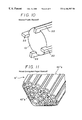
  • FIG. 15 is a diagram illustrating the manner in which a used solder receiving capsule in accordance with the present invention is replaced by a new one.
  • FIG. 1 is a generalized representation of a solder receiving capsule 1 in accordance with the present invention that is designed to separate molten solder from gases in a hand held vacuum solder extracting desoldering tool.
  • Capsule 1 comprises an outer tube 2 which is closed at one end by a porous filter 4 , and is open at its opposite end, either completely or via a riser tube 6 which passes through a seal 8 (as will be described below, preferably the riser tube 6 and seal 8 are part of the desoldering tool, not the capsule 1 , the riser tube being formed as an extension of an exchangeable, hollow desoldering tip).
  • a closed end solder collection chamber part 10 Concentrically positioned within the outer tube 2 (in manners described below for the various embodiments) is a closed end solder collection chamber part 10 creating at least one air chamber 12 (a single annular chamber being shown in FIG. 1) about the collection chamber part 10 and an air plenum 14 between the chamber part 10 and the filter 4 .
  • the volumetrically efficient configurations for the chamber part 10 can be used, maximizing the amount of solder that can be collected in a capsule of given size, thereby allowing the capsule 1 to be made as small as possible with the result that rise times can be minimized since the capsule volume which needs to be evacuated can be reduced.
  • any material that can maintain its shape when exposed to a temperature of 400° F. and is not reactive with either solder or flux may be used to produce the outer tube 2 , filter 4 and collection chamber part 10 .
  • those materials usable for the outer tube 2 are paper, molded paper pulp, cardboard, mylar, Kapton®, Teflon®, Goretex®, silicone, and ceramic paper; however, the use of paper, molded paper pulp, cardboard or any other material which will burn with little or no residue at temperatures less than 800° F. is preferable for recycling of the collected solder.
  • felt, Teflon®, Goretex®, methyl cellulose, steel wool, ceramic paper, and ceramic foam materials are usable, and again, use of a material which will burn with little or no residue at temperatures less than 800° F. is preferable for recycling of the collected solder.
  • the collection chamber part 10 it can be formed of paper, molded paper, cardboard, sheet metal, spring metal, or plastic with preference being given to those materials which will burn with little or no residue at temperatures less than 800° F. is preferable for recycling of the collected solder.
  • the entire filled capsule can simply be thrown into a solder pot which, when full, can be sent to a solder reclamation facility where the capsule materials are burned off and the solder recovered.
  • collection chamber part 10 and the manner in which it is supported in the outer tube 2 raised off of the filter 4 and creating one or more air channels 12 will be described.
  • the filter 4 and outer tube 2 are the same as described above in these examples.
  • FIGS. 2-5 show an embodiment in which a collection chamber part 10 ′ is formed from a blank B (FIG. 4) of corrugated paper which is rolled and inserted within the outer tube 2 .
  • the blank B has a main portion 10 ′ a which is essentially a rectangle, one end of which has been cut at an angle producing a short longitudinal side and a long longitudinal side.
  • a thin strip portion 10 ′ b of the corrugated paper blank B extends perpendicularly from the long longitudinal side at a distance from the angle cut end which corresponds to the height of the plenum 14 to be created.
  • Collection chamber part 10 ′ is formed by rolling up the blank tightly, starting at the free end of the thin strip portion 10 ′ b , until the cylindrical shape shown in FIG. 5 is formed.
  • the resulting chamber part 10 ′ is inserted into the outer tube until the angle cut end of the long longitudinal side hits the filter 4 as shown in FIG. 2 .
  • the corrugations form a ring of longitudinally directed air channels 12 ′ along the length of the chamber part 10 ′ through which the air and fumes can pass to the plenum 14 and out through the filter 4 .
  • the angle cut causes the ends of all except a few of the channels 12 ′ to be axial displaced away from the filter 4 .
  • a capsule 1 in accordance with the embodiment of FIGS. 2-5 may use blank B have a main portion 10 ′ a with a long side 2.75′′ long, 2.12′′ to the strip portion 10 ′ b and 0.25′′ from the strip portion 10 ′ b to the angle cut end, a short side that is 2.6′′ long, and a width of 1.06′′.
  • the strip portion 10 ′ b in this example would have a length of 3.31′′.
  • the corrugations can be 0.09′′ center-to-center with an outside height of 0.04′′. When tightly rolled, the resulting chamber part 10 ′ would have an outside diameter of 0.384′′.
  • FIGS. 6-8 another embodiment of a collection chamber part 10 ′′ for the solder collecting capsule 1 will now be described which is preferred to that of FIGS. 2-5 because it has an even higher volumetric efficiency and is easier to produce.
  • the collection chamber part 10 ′′ is formed of a hollow obelisk-shaped part that can, advantageously be formed of molded paper pulp material.
  • the collection chamber part 10 ′′ is inserted into the outer tube 2 in an inverted orientation so that the point of the obelisk shape rests on the filter 4 and with its base directed toward the open end of the capsule 1 .
  • the collection chamber part 10 ′′ has a polygonal cross section and the outer tube 2 is circular, air channels 12 ′′ are created between the sides of the collection chamber part 10 ′′ and the inner wall of the outer tube 2 .
  • air and fumes can be extracted via these channels 12 ′′ while the solder is collected within the interior of the collection chamber part 10 ′′.
  • the collection chamber part 10 ′′ can have sides of a length of 2.675′′ and width of 0.272′′, and the pyramidal peak (see FIG. 8) can have a height of 0.075′′.
  • Such a collection chamber part 10 ′′ is suitable for use in an outer tube having an inside diameter of 0.384′′.
  • FIGS. 9-12 show other alternatives for the collection chamber part in accordance with the present invention.
  • collection chamber part 10 can be a rolled kraft paper tube 20 , the end of which has been pinched to create a standoff as shown in FIG. 9 .
  • separate molded plastic standoffs can be utilized, such as L-shaped legs 22 of FIG. 10 or the die cut paper table 24 of FIG. 12 .
  • a blank B′ having a fully rectangular main portion 10 ′′ a and having a thin portion 10 ′′ b positioned one end of the main portion, as shown in FIG. 13, can be used.
  • solder receiving capsule 1 in accordance with the present invention, in conjunction with FIGS. 14 & 15, a vacuum desoldering tool 30 in accordance with the present invention for use with any of the described solder receiving capsules with now be described along with the manner in which a new solder receiving capsule is exchanged with a used one.
  • the vacuum desoldering tool 30 shown in FIG. 14 is of the pencil grip type which is normally held in a generally vertical orientation in use.
  • the invention is not limited to this specific type of desoldering tool which is being used as an example, the invention being applicable to pistol grip and other types of solder-extracting vacuum desoldering tools as well.
  • Desoldering tool 30 has an elongated body 31 on one end of which is a heating cartridge 33 into an aperture of which an exchangeable, hollow desoldering tip 35 is inserted with a riser tube 6 of the desoldering tip 35 extending into the seal 8 .
  • a vacuum line connector 37 is at the opposite end of the body 31 of the desoldering tool 30 for connection of the desoldering tool 30 to a vacuum line leading from a pump or other vacuum source (not shown).
  • the body 31 of the desoldering tool 30 is itself formed of a main body part 31 a which carries heating cartridge 33 , vacuum line connector 37 , operating switch wiring, etc., and a detachable capsule holding part 31 b which carries a capsule holding tube 32 for holding a solder receiving capsule 1 in axial alignment between an inner end of the vacuum connector 37 and the seal 8 with riser tube 6 in it.
  • the inner end of the vacuum line connector 37 has a sealing ring 38 which is pressed against the end of the solder receiving capsule 1 having the filter 4 under the action of a spring 39 and also acts to press the open end of the capsule 1 against the seal 8 , the capsule holding tube 32 against a shoulder of seal 8 , and the front end of the removable body part 35 b against the a front end of the main body part 31 a fixing all of these parts in place.
  • the removable body part 31 b is slid in the direction of the arrow shown in FIG. 14 against the force of spring 39 , and after it has been slid sufficiently rearward, it can be swung away from the main body part 31 a and lifted off of the connector 37 , taking the solder collecting capsule 1 with it.
  • FIG. 15 shows the removable body portion 31 b with a longitudinally extending half of the capsule holding tube 32 removed to more clearly demonstrate the capsule exchanging process.
  • the filled (front) capsule is removed from the capsule holding tube 32 simply by pushing a new (rear) capsule 1 into the holding tube 32 and forcing out the filled capsule which, if made of materials that can be burnt off without a significant residue, can be allowed to drop into a solder pot for reclamation of the removed solder. Thereafter, the removable body part 31 b can be quickly and simply remounted with the new capsule 1 , allowing desoldering to continue with minimal downtime.

Landscapes

  • Engineering & Computer Science (AREA)
  • Mechanical Engineering (AREA)
  • Electric Connection Of Electric Components To Printed Circuits (AREA)

Abstract

A disposable solder receiving capsule for a hand held vacuum solder extracting desoldering tool is formed of an outer tube which is closed at one end by a porous filter and is open at its opposite end, and a hollow solder collection chamber part having a tubular member with an open end and a closed end forming a solder receiving space within it. The solder collection chamber part is concentrically positioned within the outer tube with an air plenum disposed between the closed end of the chamber part and the filter and with at least one air channel extending the length of solder collection part for providing a path for gases entering the open end of the outer tube to the plenum and the filter that is separated from said solder receiving space. For facilitating solder reclamation, the capsule can be formed entirely of materials which are shape-sustaining when exposed to a temperature of 400° F., are not reactive with either solder and flux, which will bum with little or no residue at a temperature less than 800° F. A desoldering tool for use with the capsule has a detachable, tubular capsule holding part that is open at each of its opposite ends for enabling a solder receiving capsule received in it to be removed from one of the end of the holding tube by pushing another soldering capsule into the opposite end of the holding tube when the detachable holding part is detached from the body of the desoldering tool.

Description

BACKGROUND OF THE INVENTION
1. Field of the Invention
The present invention is directed to solder extracting type desoldering tools, and in particular, to such desoldering tools in which the extracted solder is collected in a disposable capsule.
2. Description of Related Art
In solder extracting type desoldering tools, a vacuum is used to draw the re-melted solder into the desoldering tool where it is collected in a solder collecting receptacle of one type or another. While, in some cases, a removable porous solder retention pad, liner or baffle has been provided to retain the collected solder in the collecting receptacle and/or to facilitate removal of the collected solder. An example of one such type of desoldering tool is described in U.S. Pat. Nos. 5,143,272 and 5,007,574 in which a tray like receptacle is a removable, but permanent, part of the tool and in which a removable porous solder retention pad is disposed. Among the shortcomings of such desoldering tools are the facts that the tool can only be used in certain orientations and during use the suction flow path can become obstructed with solder and flux, thereby causing the suction force to fall off and the ability of the tool to extract solder is impaired as a result.
Substantially contemporaneous with the present invention, a desoldering tool was introduced by Weller under Model No. SCD-100 in which solder is collected in a disposable cylindrical capsule which is open at one end for receiving the extracted molten solder and is closed at the opposite end by a filter through which the solder extracting vacuum is drawn. To prevent the filter from immediately becoming obstructed by the extracted solder, a metal baffle is disposed within the capsule chamber for the purpose of causing the extracted to solder to solidify thereon. However, in practice, the baffle cannot predictably insure that the intended amount of solder is extracted before a vacuum failure occurs, i.e., sometimes the capsule is able to sufficiently fill with solder and other times vacuum failure might occur well before the capsule is adequately filled with extracted solder. Furthermore, the use of such baffles reduces the effective volume of the capsule to such an extent that a low volumetric efficiency is obtainable even under the best of circumstances, thereby causing the rise time (i.e., the time to reduce the pressure sufficiently to draw the solder up into the tool) to be longer than is optimally desirable. Additionally, since the capsule body is formed of the plastic material Kapton® (which has a usable temperature range of up to 800° F.) and the baffle is made of a metal, such as stainless steel (with a melting point of around 2000° F.), recycling of the extracted solder is not practical since it cannot be easily removed from the capsule, and the capsule and baffle cannot be burnt off at sufficiently low temperatures. Still further, exchanging of a filled capsule with new, empty one is not a simple process that can be performed quickly (which is essential in production facilities) since the capsule is hot, all of the extracted solder may not have solidified, and withdrawal of the capsule requires significant manipulation of the desoldering tool and the capsule itself.
SUMMARY OF THE INVENTION
In view of the foregoing, it is a primary object of the present invention to provide a solder collecting capsule for an extraction type desoldering tool which has a high volumetric efficiency and predictably insures that the intended amount of solder is extracted before a vacuum failure occurs, i.e., failure does not occur until the capsule has reached its intended capacity.
It is another object of the present invention to provide a solder collecting capsule for an extraction type desoldering tool which facilitates recovery and recycling of the extracted solder.
Still another object of the present invention is to create a solder collecting capsule and extraction type desoldering tool for use therewith which will enable exchanging of a filled capsule with new, empty one simply and quickly.
The first of these objects is obtained in accordance with preferred embodiments of the invention the creation of a capsule having a defined solder receiving space and separate gas extraction flow paths that are constructed, on the one hand, allow the use of a smaller capsule for receiving a given quantity of solder, thereby reducing rise time, and on the other hand, insures that vacuum failure does not occur until the solder receiving space is full.
The second of these objects is obtained by the solder receiving capsule being made entirely of materials that can be burnt off at sufficiently low temperatures, e.g., less than about 500° F.
The third of these objects is achieved by constructing the solder receiving capsule and its holding structure within the desoldering tool so that a new solder receiving capsule itself can be used to push out the full one as it is installed.
These and other objects, features and advantages of the present invention will become apparent from the following description when taken in connection with the accompanying drawings which, for purposes of illustration only, show several embodiments in accordance with the present invention.
BRIEF DESCRIPTION OF THE DRAWINGS
FIG. 1 is a diagram depicting the basic concepts embodied in the solder receiving capsule in accordance with the present invention;
FIG. 2 is a longitudinal cross section of a first embodiment of a solder receiving capsule in accordance with the present invention;
FIG. 3 is an end view of the solder receiving capsule of FIG. 2;
FIG. 4 is a plan view of a corrugated paper blank for forming an insert of the FIG. 2 solder receiving capsule;
FIG. 5 is an elevational view of the blank of FIG. 4 rolled into the insert of FIG. 2;
FIGS. 6 & 7 are views corresponding to FIGS. 2 & 3, but of a particularly preferred embodiment of solder receiving capsule in accordance with the present invention;
FIG. 8 is a perspective view of the closed end of the insert of the embodiment of FIGS. 6 and 7;
FIGS. 9-12 each show an alternative standoff for supporting an insert in a solder receiving capsule in accordance with the present invention;
FIG. 13 is a plan view of a corrugated paper blank for forming the insert of the FIG. 11;
FIG. 14 is a longitudinal cross-sectional view of a continuous vacuum desoldering tool in accordance with the present invention for use with any of the solder receiving capsules in accordance with the present invention; and
FIG. 15 is a diagram illustrating the manner in which a used solder receiving capsule in accordance with the present invention is replaced by a new one.
DETAILED DESCRIPTION OF THE INVENTION
FIG. 1 is a generalized representation of a solder receiving capsule 1 in accordance with the present invention that is designed to separate molten solder from gases in a hand held vacuum solder extracting desoldering tool. Capsule 1 comprises an outer tube 2 which is closed at one end by a porous filter 4, and is open at its opposite end, either completely or via a riser tube 6 which passes through a seal 8 (as will be described below, preferably the riser tube 6 and seal 8 are part of the desoldering tool, not the capsule 1, the riser tube being formed as an extension of an exchangeable, hollow desoldering tip). Concentrically positioned within the outer tube 2 (in manners described below for the various embodiments) is a closed end solder collection chamber part 10 creating at least one air chamber 12 (a single annular chamber being shown in FIG. 1) about the collection chamber part 10 and an air plenum 14 between the chamber part 10 and the filter 4.
By exposing the filter 4 to a vacuum source, air in the capsule 1 is evacuated through the filter 4 and once the pressure within the capsule 1 has been lowered sufficiently, molten solder and gases (air and fumes produced during melting of the solder) are drawn from the desoldering site into the desoldering tool, to and through the riser tube 6, the molten solder passing into the interior of the solder collection chamber part 10 (as depicted by the bold arrow solder path in FIG. 1), while the gases pass around the chamber part 10 (as depicted by the thin arrow gas path in FIG. 1) and out through the filter 4. Because of these separate flow paths, a well defined vacuum failure mode is created in that filter will not be blocked until the chamber part 10 is full and overflows blocking the gas path, there being very little decrease in vacuum performance until then. Furthermore, the volumetrically efficient configurations for the chamber part 10 can be used, maximizing the amount of solder that can be collected in a capsule of given size, thereby allowing the capsule 1 to be made as small as possible with the result that rise times can be minimized since the capsule volume which needs to be evacuated can be reduced.
For producing a disposable capsule 1, any material that can maintain its shape when exposed to a temperature of 400° F. and is not reactive with either solder or flux may be used to produce the outer tube 2, filter 4 and collection chamber part 10. Among those materials usable for the outer tube 2 are paper, molded paper pulp, cardboard, mylar, Kapton®, Teflon®, Goretex®, silicone, and ceramic paper; however, the use of paper, molded paper pulp, cardboard or any other material which will burn with little or no residue at temperatures less than 800° F. is preferable for recycling of the collected solder. For producing the filter 4, felt, Teflon®, Goretex®, methyl cellulose, steel wool, ceramic paper, and ceramic foam materials are usable, and again, use of a material which will burn with little or no residue at temperatures less than 800° F. is preferable for recycling of the collected solder. As for the collection chamber part 10, it can be formed of paper, molded paper, cardboard, sheet metal, spring metal, or plastic with preference being given to those materials which will burn with little or no residue at temperatures less than 800° F. is preferable for recycling of the collected solder. With the entire capsule 1 made of material(s) which will burn with little or no residue at temperatures less than 800° F., the entire filled capsule can simply be thrown into a solder pot which, when full, can be sent to a solder reclamation facility where the capsule materials are burned off and the solder recovered.
With the foregoing in mind, specific examples of collection chamber part 10 and the manner in which it is supported in the outer tube 2 raised off of the filter 4 and creating one or more air channels 12 will be described. The filter 4 and outer tube 2 are the same as described above in these examples.
FIGS. 2-5 show an embodiment in which a collection chamber part 10′ is formed from a blank B (FIG. 4) of corrugated paper which is rolled and inserted within the outer tube 2. The blank B has a main portion 10a which is essentially a rectangle, one end of which has been cut at an angle producing a short longitudinal side and a long longitudinal side. A thin strip portion 10b of the corrugated paper blank B extends perpendicularly from the long longitudinal side at a distance from the angle cut end which corresponds to the height of the plenum 14 to be created.
Collection chamber part 10′ is formed by rolling up the blank tightly, starting at the free end of the thin strip portion 10b, until the cylindrical shape shown in FIG. 5 is formed. The resulting chamber part 10′ is inserted into the outer tube until the angle cut end of the long longitudinal side hits the filter 4 as shown in FIG. 2. As is apparent from FIGS. 2 & 3, the corrugations form a ring of longitudinally directed air channels 12′ along the length of the chamber part 10′ through which the air and fumes can pass to the plenum 14 and out through the filter 4. In this regard, it can be seen how the angle cut causes the ends of all except a few of the channels 12′ to be axial displaced away from the filter 4. However, by making the corrugations sufficiently small, solder will solidify on their ends and will not pass through them, so that the rolled thin strip 10b effectively presents a solid bottom to the solder collected in the chamber formed by the rolled main portion 10a.
By way of example only, it is noted that a capsule 1 in accordance with the embodiment of FIGS. 2-5, may use blank B have a main portion 10a with a long side 2.75″ long, 2.12″ to the strip portion 10b and 0.25″ from the strip portion 10b to the angle cut end, a short side that is 2.6″ long, and a width of 1.06″. The strip portion 10b in this example would have a length of 3.31″. The corrugations can be 0.09″ center-to-center with an outside height of 0.04″. When tightly rolled, the resulting chamber part 10′ would have an outside diameter of 0.384″.
Turning now to FIGS. 6-8, another embodiment of a collection chamber part 10″ for the solder collecting capsule 1 will now be described which is preferred to that of FIGS. 2-5 because it has an even higher volumetric efficiency and is easier to produce.
In particular, the collection chamber part 10″ is formed of a hollow obelisk-shaped part that can, advantageously be formed of molded paper pulp material. As can be seen from FIG. 6, the collection chamber part 10″ is inserted into the outer tube 2 in an inverted orientation so that the point of the obelisk shape rests on the filter 4 and with its base directed toward the open end of the capsule 1. Because the collection chamber part 10″ has a polygonal cross section and the outer tube 2 is circular, air channels 12″ are created between the sides of the collection chamber part 10″ and the inner wall of the outer tube 2. Thus, air and fumes can be extracted via these channels 12″ while the solder is collected within the interior of the collection chamber part 10″.
As an example, the collection chamber part 10″ can have sides of a length of 2.675″ and width of 0.272″, and the pyramidal peak (see FIG. 8) can have a height of 0.075″. Such a collection chamber part 10″ is suitable for use in an outer tube having an inside diameter of 0.384″.
FIGS. 9-12 show other alternatives for the collection chamber part in accordance with the present invention. For example, collection chamber part 10 can be a rolled kraft paper tube 20, the end of which has been pinched to create a standoff as shown in FIG. 9. Furthermore, instead of providing a standoff as part of the chamber part 10′, 10″, separate molded plastic standoffs can be utilized, such as L-shaped legs 22 of FIG. 10 or the die cut paper table 24 of FIG. 12. Still further, instead of angle-cutting the corrugated paper blank B of the first embodiment, a blank B′ having a fully rectangular main portion 10a and having a thin portion 10b positioned one end of the main portion, as shown in FIG. 13, can be used. In such a case, by having the thin portion 10b of a width that increases by an amount corresponding to that of the angle cut of blank B at the side that faces oppositely from the open end of the collection chamber so that a standoff as shown in FIG. 11 is produced when the blank B′ is rolled.
Having described the solder receiving capsule 1 in accordance with the present invention, in conjunction with FIGS. 14 & 15, a vacuum desoldering tool 30 in accordance with the present invention for use with any of the described solder receiving capsules with now be described along with the manner in which a new solder receiving capsule is exchanged with a used one.
The vacuum desoldering tool 30 shown in FIG. 14 is of the pencil grip type which is normally held in a generally vertical orientation in use. However, it should be appreciated that the invention is not limited to this specific type of desoldering tool which is being used as an example, the invention being applicable to pistol grip and other types of solder-extracting vacuum desoldering tools as well.
Desoldering tool 30 has an elongated body 31 on one end of which is a heating cartridge 33 into an aperture of which an exchangeable, hollow desoldering tip 35 is inserted with a riser tube 6 of the desoldering tip 35 extending into the seal 8. At the opposite end of the body 31 of the desoldering tool 30 is a vacuum line connector 37 for connection of the desoldering tool 30 to a vacuum line leading from a pump or other vacuum source (not shown). The body 31 of the desoldering tool 30 is itself formed of a main body part 31 a which carries heating cartridge 33, vacuum line connector 37, operating switch wiring, etc., and a detachable capsule holding part 31 b which carries a capsule holding tube 32 for holding a solder receiving capsule 1 in axial alignment between an inner end of the vacuum connector 37 and the seal 8 with riser tube 6 in it. The inner end of the vacuum line connector 37 has a sealing ring 38 which is pressed against the end of the solder receiving capsule 1 having the filter 4 under the action of a spring 39 and also acts to press the open end of the capsule 1 against the seal 8, the capsule holding tube 32 against a shoulder of seal 8, and the front end of the removable body part 35 b against the a front end of the main body part 31 a fixing all of these parts in place. In this arrangement, when a vacuum is drawn on the capsule filter 4 via the connector 37, once the capsule has been evacuated, a suction effect is produced at the inlet of the through passage 31 a of the desoldering tip 35 to thereby draw melted solder and fumes into and through the desoldering tip 35 and its riser tube 6 into the solder collecting capsule 1, the solder being retained in the capsule 1 and the fumes being extracted through the vacuum connector.
Once the solder collecting capsule 1 is full, it needs to be exchanged for a new, empty one. For this purpose, the removable body part 31 b is slid in the direction of the arrow shown in FIG. 14 against the force of spring 39, and after it has been slid sufficiently rearward, it can be swung away from the main body part 31 a and lifted off of the connector 37, taking the solder collecting capsule 1 with it. FIG. 15 shows the removable body portion 31 b with a longitudinally extending half of the capsule holding tube 32 removed to more clearly demonstrate the capsule exchanging process. As can be appreciated from this view, the filled (front) capsule is removed from the capsule holding tube 32 simply by pushing a new (rear) capsule 1 into the holding tube 32 and forcing out the filled capsule which, if made of materials that can be burnt off without a significant residue, can be allowed to drop into a solder pot for reclamation of the removed solder. Thereafter, the removable body part 31 b can be quickly and simply remounted with the new capsule 1, allowing desoldering to continue with minimal downtime.
While various embodiments in accordance with the present invention have been shown and described, it is understood that the invention is not limited thereto, and is susceptible to numerous changes and modifications as known to those skilled in the art. Therefore, this invention is not limited to the details shown and described herein, and includes all such changes and modifications as are encompassed by the scope of the appended claims.

Claims (5)

What is claimed is:
1. A vacuum desoldering tool having a body with a heating cartridge on one end thereof, the heating cartridge having an aperture in which an exchangeable, hollow desoldering tip is inserted with a riser tube extension of the desoldering tip extending into a capsule end seal, a vacuum line connector for connection to a vacuum line being provided at an opposite end of the body from the heating cartridge, and a detachable holding part having a capsule holding tube for holding a cylindrical disposable solder receiving capsule in axial alignment between an inner end of the vacuum connector and the capsule end seal; where said holding tube is open at each of opposite ends thereof for enabling a solder receiving capsule received therein to be removed from one of said opposite ends of the holding tube by pushing another soldering capsule into the other of said opposite ends of the holding tube when the detachable holding part is detached from the body of the desoldering tool.
2. The vacuum desoldering tool according to claim 1, wherein an inner end of the vacuum line connector has a sealing ring; and wherein a spring acts is provided for pressing the sealing ring against a filter end of the solder receiving capsule and also acts to press an open end of the capsule against the seal and a front end of the detachable holding part against a front end of the body.
3. The vacuum desoldering tool according to claim 1, wherein a disposable solder receiving capsule is provided in said holding part for receiving solder extracted via said tip, said capsule comprising an outer tube which is closed at one end by a porous filter and is open at an opposite end, and a hollow solder collection chamber part having a tubular member with an open end and a closed end forming a solder receiving space therein, the solder collection chamber part being concentrically positioned within the outer tube with an air plenum disposed between the closed end of the chamber part and the filter and with at least one air channel extending the length of solder collection part for providing a path for gases entering the open end of the outer tube to the plenum and the filter that is separated from said solder receiving space.
4. The vacuum desoldering tool according to claim 3, wherein the seal is engaged on the open end of the outer tube with the riser tube extension coaxial with the solder collection chamber part and axially spaced from the open end of the chamber part so that solder will pass from the riser tube extension into the chamber part while gases are free to pass around the chamber part.
5. The vacuum desoldering tool according to claim 3, wherein the outer tube, filter and chamber part are all formed of materials which are shape-sustaining when exposed to a temperature of 400° F., are not reactive with either of solder and flux, and which will burn with little or no residue at a temperature less than 800° F.
US09/289,720 1999-04-12 1999-04-12 Solder collecting capsule and solder extracting desoldering tool using same Expired - Lifetime US6186387B1 (en)

Priority Applications (5)

Application Number Priority Date Filing Date Title
US09/289,720 US6186387B1 (en) 1999-04-12 1999-04-12 Solder collecting capsule and solder extracting desoldering tool using same
US09/510,682 US6237831B1 (en) 1999-04-12 2000-02-22 Solder collecting capsule and solder extracting desoldering tool using same
CN00117878A CN1277083A (en) 1999-04-12 2000-04-11 Welding flux collecting hold and welding flux extraction sealing off tool using with the same welding flux collecting hold
EP00107722A EP1044751A1 (en) 1999-04-12 2000-04-11 Solder collecting capsule and solder extracting desoldering tool using the same
TW089106778A TW445187B (en) 1999-04-12 2000-05-26 Solder collecting capsule and solder extracting desoldering tool using same

Applications Claiming Priority (1)

Application Number Priority Date Filing Date Title
US09/289,720 US6186387B1 (en) 1999-04-12 1999-04-12 Solder collecting capsule and solder extracting desoldering tool using same

Publications (1)

Publication Number Publication Date
US6186387B1 true US6186387B1 (en) 2001-02-13

Family

ID=23112781

Family Applications (1)

Application Number Title Priority Date Filing Date
US09/289,720 Expired - Lifetime US6186387B1 (en) 1999-04-12 1999-04-12 Solder collecting capsule and solder extracting desoldering tool using same

Country Status (1)

Country Link
US (1) US6186387B1 (en)

Cited By (7)

* Cited by examiner, † Cited by third party
Publication number Priority date Publication date Assignee Title
US20030183678A1 (en) * 2002-03-26 2003-10-02 Gold Daniel B. Process for disassembling a brazed structure
US6719188B2 (en) 2001-07-24 2004-04-13 International Business Machines Corporation Rework methods for lead BGA/CGA
US20050218197A1 (en) * 2004-03-31 2005-10-06 Toshikazu Mochizuki Solder heating system
US20060157466A1 (en) * 2005-01-14 2006-07-20 Mitsuhiko Miyazaki Control system for battery powered heating device
US20090045245A1 (en) * 2007-08-16 2009-02-19 Fujitsu Limited Solder repairing apparatus and method of repairing solder
US7679032B2 (en) 2003-07-04 2010-03-16 Hakko Corporation Soldering or desoldering iron
US20190321903A1 (en) * 2018-04-18 2019-10-24 Few Fahrzeugelektrikwerk Gmbh & Co. Kg Soldering tool with nozzle-shaped soldering tip and a channel in the soldering tip to feed hot gas

Citations (10)

* Cited by examiner, † Cited by third party
Publication number Priority date Publication date Assignee Title
US3690539A (en) 1970-09-25 1972-09-12 Joseph A Geiger Heat and air action apparatus for electronic circuitry repairs
US4221017A (en) * 1978-11-09 1980-09-09 Fortune William S Vacuum desoldering tool and tool cleaner system
US4274176A (en) * 1979-11-20 1981-06-23 Toolema Ab Vacuum operated desoldering tool
US4439667A (en) 1980-07-11 1984-03-27 Pace Incorporated Desoldering device and improved heater assembly therefor
EP0365034A1 (en) 1988-10-21 1990-04-25 Cooper Industries, Inc. Dissoldering iron
US5007574A (en) 1989-09-14 1991-04-16 Metcal, Inc. Desoldering device
US5143272A (en) 1991-07-09 1992-09-01 Metcal, Inc. Desoldering device
US5579982A (en) * 1995-06-30 1996-12-03 Pace Incorporated Desoldering method and apparatus with minimum vacuum on-time control
US5893992A (en) 1997-09-10 1999-04-13 Cooper Industries, Inc. Portable electric desoldering tool
US5945015A (en) * 1994-10-01 1999-08-31 Feinler; Siegfried Combination soldering and desoldering device with flux and solder storage chambers

Patent Citations (10)

* Cited by examiner, † Cited by third party
Publication number Priority date Publication date Assignee Title
US3690539A (en) 1970-09-25 1972-09-12 Joseph A Geiger Heat and air action apparatus for electronic circuitry repairs
US4221017A (en) * 1978-11-09 1980-09-09 Fortune William S Vacuum desoldering tool and tool cleaner system
US4274176A (en) * 1979-11-20 1981-06-23 Toolema Ab Vacuum operated desoldering tool
US4439667A (en) 1980-07-11 1984-03-27 Pace Incorporated Desoldering device and improved heater assembly therefor
EP0365034A1 (en) 1988-10-21 1990-04-25 Cooper Industries, Inc. Dissoldering iron
US5007574A (en) 1989-09-14 1991-04-16 Metcal, Inc. Desoldering device
US5143272A (en) 1991-07-09 1992-09-01 Metcal, Inc. Desoldering device
US5945015A (en) * 1994-10-01 1999-08-31 Feinler; Siegfried Combination soldering and desoldering device with flux and solder storage chambers
US5579982A (en) * 1995-06-30 1996-12-03 Pace Incorporated Desoldering method and apparatus with minimum vacuum on-time control
US5893992A (en) 1997-09-10 1999-04-13 Cooper Industries, Inc. Portable electric desoldering tool

Cited By (12)

* Cited by examiner, † Cited by third party
Publication number Priority date Publication date Assignee Title
US6719188B2 (en) 2001-07-24 2004-04-13 International Business Machines Corporation Rework methods for lead BGA/CGA
US20030183678A1 (en) * 2002-03-26 2003-10-02 Gold Daniel B. Process for disassembling a brazed structure
US6655576B2 (en) * 2002-03-26 2003-12-02 United Technologies Corporation Process for disassembling a brazed structure
US7679032B2 (en) 2003-07-04 2010-03-16 Hakko Corporation Soldering or desoldering iron
US20050218197A1 (en) * 2004-03-31 2005-10-06 Toshikazu Mochizuki Solder heating system
US7325714B2 (en) 2004-03-31 2008-02-05 Hakko Corporation Solder heating system
US20060157466A1 (en) * 2005-01-14 2006-07-20 Mitsuhiko Miyazaki Control system for battery powered heating device
US7608805B2 (en) 2005-01-14 2009-10-27 Hakko Corporation Control system for battery powered heating device
US20090045245A1 (en) * 2007-08-16 2009-02-19 Fujitsu Limited Solder repairing apparatus and method of repairing solder
US7748594B2 (en) * 2007-08-16 2010-07-06 Fujitsu Limited Solder repairing apparatus and method of repairing solder
US20190321903A1 (en) * 2018-04-18 2019-10-24 Few Fahrzeugelektrikwerk Gmbh & Co. Kg Soldering tool with nozzle-shaped soldering tip and a channel in the soldering tip to feed hot gas
US10974334B2 (en) * 2018-04-18 2021-04-13 Few Fahrzeugelektrikwerk Gmbh & Co. Kg Soldering tool with nozzle-shaped soldering tip and a channel in the soldering tip to feed hot gas

Similar Documents

Publication Publication Date Title
US6186387B1 (en) Solder collecting capsule and solder extracting desoldering tool using same
US6237831B1 (en) Solder collecting capsule and solder extracting desoldering tool using same
CN104812277A (en) Device for preparing beverages by pod infusion having a pivoting cradle
JP7182704B2 (en) aerosol generator including ejector
SE444582B (en) SET AND DEVICE FOR RECYCLING THE LIGHTING LIGHT FROM LIGHT
CN110786555A (en) Heating device convenient for extracting and heating non-combustible cigarettes
EP3806669B1 (en) Water pipe with accurate fit for a capsule
CN117921220A (en) Positioning guide clamp for laser welding of new metal material
JP7434300B2 (en) Water pipe with a mechanism for releasing used capsules
US4120309A (en) Hand operated device for producing tobacco articles low in noxious substances
CN211298441U (en) Heating device convenient for extracting and heating non-combustible cigarettes
CN112944393B (en) A smoke generating device
CN215658471U (en) Laser Tube Cutting Machine
KR101290872B1 (en) Lid opening apparatus
JP2010099582A (en) Bag type dust collector
HK1033658A (en) Solder collecting capsule and solder extracting desoldering tool using same
EP2695564B1 (en) Dust collection unit and vacuum cleaner with the same
CN209031245U (en) Low temperature baking smoke-extracting set
JP2819357B2 (en) Desoldering equipment
CN215775498U (en) Cigarette pocket and cigarette heating device having the same
CN221905989U (en) OMSA medium-high pressure treatment remolding machine
CN209986154U (en) Chip removal device of plug-in machine
CN210457453U (en) Conveniently-disassembled oil gun outer sleeve
US3021849A (en) Cigarette holder
CN213159769U (en) Gas recovery device

Legal Events

Date Code Title Description
AS Assignment

Owner name: PACE INCORPORATED, MARYLAND

Free format text: ASSIGNMENT OF ASSIGNORS INTEREST;ASSIGNORS:LAWRENCE, DAVID W.;LE, DUNG T.;REEL/FRAME:010028/0439

Effective date: 19990609

STCF Information on status: patent grant

Free format text: PATENTED CASE

FPAY Fee payment

Year of fee payment: 4

FEPP Fee payment procedure

Free format text: PAT HOLDER CLAIMS SMALL ENTITY STATUS, ENTITY STATUS SET TO SMALL (ORIGINAL EVENT CODE: LTOS); ENTITY STATUS OF PATENT OWNER: SMALL ENTITY

FPAY Fee payment

Year of fee payment: 8

FPAY Fee payment

Year of fee payment: 12