US6174642B1 - Imaging system employing encapsulated radiation sensitive composition - Google Patents

Imaging system employing encapsulated radiation sensitive composition Download PDF

Info

Publication number
US6174642B1
US6174642B1 US09/257,624 US25762499A US6174642B1 US 6174642 B1 US6174642 B1 US 6174642B1 US 25762499 A US25762499 A US 25762499A US 6174642 B1 US6174642 B1 US 6174642B1
Authority
US
United States
Prior art keywords
microcapsules
bbu
sensitive
forming agent
photosensitive material
Prior art date
Legal status (The legal status is an assumption and is not a legal conclusion. Google has not performed a legal analysis and makes no representation as to the accuracy of the status listed.)
Expired - Fee Related
Application number
US09/257,624
Inventor
Alexander Y. Polykarpov
Joseph C. Camillus
Current Assignee (The listed assignees may be inaccurate. Google has not performed a legal analysis and makes no representation or warranty as to the accuracy of the list.)
Eastman Kodak Co
Original Assignee
Cycolor Inc
Priority date (The priority date is an assumption and is not a legal conclusion. Google has not performed a legal analysis and makes no representation as to the accuracy of the date listed.)
Filing date
Publication date
Application filed by Cycolor Inc filed Critical Cycolor Inc
Priority to US09/257,624 priority Critical patent/US6174642B1/en
Assigned to CYCOLOR, INC. reassignment CYCOLOR, INC. ASSIGNMENT OF ASSIGNORS INTEREST (SEE DOCUMENT FOR DETAILS). Assignors: CAMILLUS, JOSEPH C., POLYKARPOV, ALEXANDER Y.
Application granted granted Critical
Publication of US6174642B1 publication Critical patent/US6174642B1/en
Assigned to EASTMAN KODAK reassignment EASTMAN KODAK ASSIGNMENT OF ASSIGNORS INTEREST (SEE DOCUMENT FOR DETAILS). Assignors: CYCOLOR INC.
Anticipated expiration legal-status Critical
Expired - Fee Related legal-status Critical Current

Links

Classifications

    • GPHYSICS
    • G03PHOTOGRAPHY; CINEMATOGRAPHY; ANALOGOUS TECHNIQUES USING WAVES OTHER THAN OPTICAL WAVES; ELECTROGRAPHY; HOLOGRAPHY
    • G03FPHOTOMECHANICAL PRODUCTION OF TEXTURED OR PATTERNED SURFACES, e.g. FOR PRINTING, FOR PROCESSING OF SEMICONDUCTOR DEVICES; MATERIALS THEREFOR; ORIGINALS THEREFOR; APPARATUS SPECIALLY ADAPTED THEREFOR
    • G03F7/00Photomechanical, e.g. photolithographic, production of textured or patterned surfaces, e.g. printing surfaces; Materials therefor, e.g. comprising photoresists; Apparatus specially adapted therefor
    • G03F7/002Photomechanical, e.g. photolithographic, production of textured or patterned surfaces, e.g. printing surfaces; Materials therefor, e.g. comprising photoresists; Apparatus specially adapted therefor using materials containing microcapsules; Preparing or processing such materials, e.g. by pressure; Devices or apparatus specially designed therefor
    • GPHYSICS
    • G03PHOTOGRAPHY; CINEMATOGRAPHY; ANALOGOUS TECHNIQUES USING WAVES OTHER THAN OPTICAL WAVES; ELECTROGRAPHY; HOLOGRAPHY
    • G03FPHOTOMECHANICAL PRODUCTION OF TEXTURED OR PATTERNED SURFACES, e.g. FOR PRINTING, FOR PROCESSING OF SEMICONDUCTOR DEVICES; MATERIALS THEREFOR; ORIGINALS THEREFOR; APPARATUS SPECIALLY ADAPTED THEREFOR
    • G03F7/00Photomechanical, e.g. photolithographic, production of textured or patterned surfaces, e.g. printing surfaces; Materials therefor, e.g. comprising photoresists; Apparatus specially adapted therefor
    • G03F7/004Photosensitive materials
    • G03F7/027Non-macromolecular photopolymerisable compounds having carbon-to-carbon double bonds, e.g. ethylenic compounds
    • G03F7/028Non-macromolecular photopolymerisable compounds having carbon-to-carbon double bonds, e.g. ethylenic compounds with photosensitivity-increasing substances, e.g. photoinitiators
    • G03F7/029Inorganic compounds; Onium compounds; Organic compounds having hetero atoms other than oxygen, nitrogen or sulfur
    • YGENERAL TAGGING OF NEW TECHNOLOGICAL DEVELOPMENTS; GENERAL TAGGING OF CROSS-SECTIONAL TECHNOLOGIES SPANNING OVER SEVERAL SECTIONS OF THE IPC; TECHNICAL SUBJECTS COVERED BY FORMER USPC CROSS-REFERENCE ART COLLECTIONS [XRACs] AND DIGESTS
    • Y10TECHNICAL SUBJECTS COVERED BY FORMER USPC
    • Y10STECHNICAL SUBJECTS COVERED BY FORMER USPC CROSS-REFERENCE ART COLLECTIONS [XRACs] AND DIGESTS
    • Y10S430/00Radiation imagery chemistry: process, composition, or product thereof
    • Y10S430/145Infrared

Definitions

  • imaging system employs a layer of photosensitive microcapsules.
  • the microcapsules are prepared by microencapsulating a free radical polymerizable composition which contains an electron donating color precursor.
  • the image system assumes two forms.
  • the imaging system is a transfer system in which a support carrying a layer of photosensitive microcapsules is image-wise exposed to radiation and assembled with a developer sheet, e.g., a sheet containing a layer of a Lewis acid such as a phenolic resin.
  • the imaging system is a self-contained imaging system in which the photosensitive microcapsules and the Lewis acid are carried on the surface of a common substrate in one layer or in juxtaposed layers.
  • a layer containing photosensitive microcapsules and a developer material is interposed between two plastic films, at least one of which is transparent. Using a combination of an adhesive and a subbing layer, the films are permanently sealed to provide a film unit. This construction is advantageous because it prevents the chemical reactants in the imaging system from coming into contact with the user.
  • the imaging system is preferably a full color imaging system in which three different sets of microcapsules are used in combination and each set of microcapsules is sensitive to a distinct wavelength band.
  • This full color system is described in U.S. Pat. No. 4,842,976.
  • three sets of microcapsules respectively containing cyan, magenta and yellow color precursors are respectively sensitive to red, green and blue light are employed.
  • these microcapsules are sensitized using a so-called “dye-borate photoinitiator” of the type described in U.S. Pat. No. 4,772,530 to Gottschalk.
  • photoinitiators in one embodiment, are complexes of cationic cyanine dyes and a boranyl anion such as a triphenylbutylboranyl anion.
  • a boranyl anion such as a triphenylbutylboranyl anion.
  • printers can be designed which employ radiation sources which emit at wavelengths outside the visible spectrum, for example, in the infrared region. This presents an opportunity to minimize the problems associated with cross-talk since it is no longer necessary to restrict the sensitivity range of a photosensitive material to the visible region, the sensitivity of the imaging system can be extended into the infrared region at one end of the spectrum and optionally the ultraviolet region at the other end.
  • the foregoing imaging system and, more particularly, the imaging system described in U.S. Pat. No. 4,772,530 is modified to include one or more infrared photosensitive compositions and, more particularly, to include one or more photosensitive compositions in which the photoinitiator is a complex between an infrared-sensitive dye and a boranyl anion of the type mentioned above.
  • one embodiment of the invention resides in an imaging system comprising a support having a layer of at least one set of photosensitive microcapsules on the surface thereof, said microcapsules being sensitive to distinct band of radiation and containing a complex of an infrared sensitive cationic dye and a boranyl anion as photoinitiator.
  • the imaging system includes cyan forming, magenta forming and yellow forming capsules and at least one set of capsules includes an infrared sensitive dye borate compound as a photoinitiator.
  • at least one other set includes a visible light sensitive dye borate compound or an ultraviolet initiator.
  • the imaging system comprises three sets of photohardenable microcapsules with one set being sensitive to infrared radiation, and the second and third sets being sensitive to visible and/or ultraviolet radiation.
  • all three sets of microcapsules contain a photohardenable composition containing a complex of a cationic infrared sensitive dye and a boranyl anion.
  • infrared-sensitive photoinitiators which can be employed in the imaging system of the present invention are described in Japanese Published Applications 3-221506; 4-261405; 8-100011; 8-100012; and 8-34808, all of which are incorporated herein by reference for a description of the cationic dyes and methods for obtaining the photoinitiators.
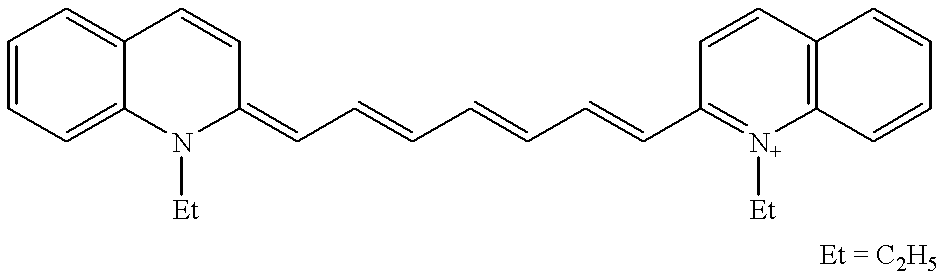
  • a table of the infrared sensitive cationic dyes described in the aforementioned patents is provided in the following Table 1 where “Ph” indicates a phenyl group “Me” indicates a methyl group, “Bu” indicates a butyl group, and “Et” indicates an ethyl group:
  • the infrared dyes in Table 1 are complexed with a borate anion.
  • a borate anion Any of the borate anions described in U.S. Pat. No. 4,772,530 can be used in this invention.
  • the preferred boranyl anion is a triphenyl n-butylboranyl anion.
  • the anions can be represented by the general formula (I):
  • R 1 , R 2 , R 3 , and R 4 are independently selected from the group consisting of alkyl, aryl, alkaryl, allyl, aralkyl, alkenyl, alkynyl, alicyclic and saturated or unsaturated heterocyclic groups.
  • triphenylalkylborate and trianisylalkylborate anions such as triphenylbutylborate and trianisylbutylborate anions because they readily dissociate to triphenylborane or trianisylborane and a butyl radical.
  • tetrabutylborate anion does not work well presumably because the tetrabutylborate radical is not stable and it readily accepts an electron back from the dye in a back electron transfer and does not dissociate efficiently.
  • tetraphenylborate anion is very poor because the phenyl radical is not easily formed.
  • R 1 , R 2 , R 3 , and R 4 is an alkyl group.
  • R 1 , R 2 , R 3 , and R 4 is an alkyl group.
  • R 1 , R 2 , R 3 , and R 4 can contain up to 20 carbon atoms, and they typically contain 1 to 7 carbon atoms. More preferably R 1 -R 4 are a combination of alkyl group(s) and aryl group(s) or aralkyl group(s) and still more preferably a combination of three aryl groups and one alkyl group.
  • alkyl groups represented by R 1 -R 4 are methyl, ethyl, propyl, butyl, pentyl, hexyl, octyl, stearyl, etc. and can be straight or branched chain and possibly cyclic.
  • the alkyl groups may be substituted, for example, by one or more halogen, cyano, acyloxy, acyl, aryl, alkoxy or hydroxy groups.
  • aryl groups represented by R 1 -R 4 include phenyl, naphthyl and substituted aryl groups such as anisyl.
  • Alkaryl groups include methylphenyl, dimethylphenyl, etc.
  • Representative examples of aralkyl groups represented by groups include benzyl.
  • Representative alicyclic groups include cyclobutyl, cyclopentyl, and cyclohexyl groups. Examples of an alkynyl group are propynyl and ethynyl, and examples of alkenyl groups include a vinyl group.
  • an infrared sensitive dye borate in at least one set of the microcapsules enable the sensitivities of the microcapsules to be spaced apart to minimize overlap in their sensitivity curves and thereby minimize crosstalk.
  • Infrared sensitive borates can be used in any or all of the cyan, magenta or yellow forming microcapsules.
  • an imaging system can be designed in which the microcapsules are sensitive at 750, 850 and 1050 nm.
  • the red sensitive capsules described in U.S. Pat. No. 4,772,530 (Gottschalk) are replaced with infrared sensitive microcapsules prepared using one of the dyes in the appendix such as the dye #5 in Table 1.
  • an imaging system can be designed in which the microcapsules are sensitive at 800, 900 and 1100 nm.
  • the cyan, magenta and yellow forming microcapsules are sensitive at 450, 550, 650 nm respectively.
  • any of 450, 550, and 650 sensitizers is replaced with an infrared dye.
  • the magenta 550 initiator is replaced with an infrared dye to achieve the most separation in the absorptions.
  • a 450, 840, 650 nm system might be used.
  • the infrared sensitive compositions can be modified to include an autoxidizer such as N,N-dimethylaniline as described in U.S. Pat. No. 4,772,530 which is incorporated herein by reference.
  • an autoxidizer such as N,N-dimethylaniline
  • microcapsules for encapsulating the photohardenable composition, cyan, magenta and yellow color precursors, developer materials, photohardenable compositions including photopolymerizable acrylate compositions are described in detail in U.S. Pat. No. 4,772,530.
  • the ultraviolet initiator can be selected from among those that are known in the art. Some examples are provided in U.S. Pat. No. 4,399,209.
  • the infrared sensitive dye is normally used in an amount up to 1% by weight based on the weight of the photopolymerizable species and more typically in an amount of about 0.2 to 0.5% by weight. However, those skilled in the art will recognize that the amount is easily adjusted to achieve the desired sensitivity and photographic response in the photosensitive material.

Landscapes

  • Physics & Mathematics (AREA)
  • General Physics & Mathematics (AREA)
  • Chemical & Material Sciences (AREA)
  • Inorganic Chemistry (AREA)
  • Spectroscopy & Molecular Physics (AREA)
  • Materials For Photolithography (AREA)

Abstract

An imaging system comprising a support having a layer of at least one set of photosensitive microcapsules on the surface thereof, wherein the microcapsules are sensitive to a distinct band of radiation and contain a complex of an infrared sensitive cationic dye and a boranyl anion. In a preferred embodiment, the photosensitive microcapsules include a first set of microcapsules containing a cyan color-forming agent, a second set of microcapsules containing a magenta color-forming agent, and a third set of microcapsules containing a yellow color-forming agent, wherein at least one of said first, second and third sets of microcapsules include an infrared sensitive dye borate compound as a photoinitiator. Optionally at least one other set may include a visible light sensitive dye borate compound or an ultraviolet initiator.

Description

CROSS-REFERENCE TO RELATED APPLICATIONS
The present invention claims priority under 35 U.S.C. §119 from Provisional Patent Application Serial No. 60/075,892, filed Feb. 25, 1998.
BACKGROUND OF THE INVENTION
This application is directed to an improvement in the imaging system which is described in U.S. Pat. Nos. 4,399,209, 4,440,846 and 4,772,530 to Cycolor, Inc. These imaging systems employ a layer of photosensitive microcapsules. The microcapsules are prepared by microencapsulating a free radical polymerizable composition which contains an electron donating color precursor. Typically the image system assumes two forms. In one, the imaging system is a transfer system in which a support carrying a layer of photosensitive microcapsules is image-wise exposed to radiation and assembled with a developer sheet, e.g., a sheet containing a layer of a Lewis acid such as a phenolic resin. The assembly is subjected to pressure to rupture the microcapsules and the microcapsules image-wise leak their contents to the developer sheet where the color precursor is colored. In another embodiment, the imaging system is a self-contained imaging system in which the photosensitive microcapsules and the Lewis acid are carried on the surface of a common substrate in one layer or in juxtaposed layers. In a further embodiment of the invention, as described in U.S. application Ser. No. 08/570,658 now U.S. Pat. No. 5,783,353 and published International Application WO 95/34845, a layer containing photosensitive microcapsules and a developer material is interposed between two plastic films, at least one of which is transparent. Using a combination of an adhesive and a subbing layer, the films are permanently sealed to provide a film unit. This construction is advantageous because it prevents the chemical reactants in the imaging system from coming into contact with the user.
The imaging system is preferably a full color imaging system in which three different sets of microcapsules are used in combination and each set of microcapsules is sensitive to a distinct wavelength band. This full color system is described in U.S. Pat. No. 4,842,976. In accordance with one commercial manifestation of the imaging system, three sets of microcapsules respectively containing cyan, magenta and yellow color precursors are respectively sensitive to red, green and blue light are employed. In a further embodiment, these microcapsules are sensitized using a so-called “dye-borate photoinitiator” of the type described in U.S. Pat. No. 4,772,530 to Gottschalk. These photoinitiators, in one embodiment, are complexes of cationic cyanine dyes and a boranyl anion such as a triphenylbutylboranyl anion. For making photocopies and other applications employing visible light sources, imaging systems employing red-sensitive, blue-sensitive and green-sensitive microcapsules are desirable but one of the difficulties that is encountered in designing an imaging system with red, green and blue sensitivity is cross-talk. That is, the absorption spectra of the red and/or green and/or blue photoinitiators may overlap. In this case, it is important that in exposing the microcapsule to limit the amount of light which occurs in an overlapping region. Otherwise, the color quality of the reproduction will not be good. The art discloses a number of approaches that can be taken to mitigate this problem. However, with the proliferation of digital imaging systems, there are a host of applications in which red, green and blue sensitivity is not required. In particular printers can be designed which employ radiation sources which emit at wavelengths outside the visible spectrum, for example, in the infrared region. This presents an opportunity to minimize the problems associated with cross-talk since it is no longer necessary to restrict the sensitivity range of a photosensitive material to the visible region, the sensitivity of the imaging system can be extended into the infrared region at one end of the spectrum and optionally the ultraviolet region at the other end.
SUMMARY OF THE INVENTION
In accordance with the present invention, the foregoing imaging system and, more particularly, the imaging system described in U.S. Pat. No. 4,772,530, is modified to include one or more infrared photosensitive compositions and, more particularly, to include one or more photosensitive compositions in which the photoinitiator is a complex between an infrared-sensitive dye and a boranyl anion of the type mentioned above.
Accordingly, one embodiment of the invention resides in an imaging system comprising a support having a layer of at least one set of photosensitive microcapsules on the surface thereof, said microcapsules being sensitive to distinct band of radiation and containing a complex of an infrared sensitive cationic dye and a boranyl anion as photoinitiator.
In another embodiment, the imaging system includes cyan forming, magenta forming and yellow forming capsules and at least one set of capsules includes an infrared sensitive dye borate compound as a photoinitiator. Optionally at least one other set includes a visible light sensitive dye borate compound or an ultraviolet initiator.
In still another embodiment, the imaging system comprises three sets of photohardenable microcapsules with one set being sensitive to infrared radiation, and the second and third sets being sensitive to visible and/or ultraviolet radiation.
In still another embodiment, all three sets of microcapsules contain a photohardenable composition containing a complex of a cationic infrared sensitive dye and a boranyl anion.
DETAILED DESCRIPTION OF THE INVENTION
Examples of infrared-sensitive photoinitiators which can be employed in the imaging system of the present invention are described in Japanese Published Applications 3-221506; 4-261405; 8-100011; 8-100012; and 8-34808, all of which are incorporated herein by reference for a description of the cationic dyes and methods for obtaining the photoinitiators. A table of the infrared sensitive cationic dyes described in the aforementioned patents is provided in the following Table 1 where “Ph” indicates a phenyl group “Me” indicates a methyl group, “Bu” indicates a butyl group, and “Et” indicates an ethyl group:
TABLE 1
No. Dye Structure λmax (TMPTA)
1
Figure US06174642-20010116-C00001
820 nm
2
Figure US06174642-20010116-C00002
830 nm
3
Figure US06174642-20010116-C00003
822 nm
4
Figure US06174642-20010116-C00004
768 nm
5
Figure US06174642-20010116-C00005
748 nm
6
Figure US06174642-20010116-C00006
785 nm
7
Figure US06174642-20010116-C00007
828 nm
 7A
Figure US06174642-20010116-C00008
813 nm
8
Figure US06174642-20010116-C00009
814 nm
The infrared dyes in Table 1 are complexed with a borate anion. Any of the borate anions described in U.S. Pat. No. 4,772,530 can be used in this invention. The preferred boranyl anion is a triphenyl n-butylboranyl anion. The anions can be represented by the general formula (I):
Figure US06174642-20010116-C00010
where R1, R2, R3, and R4 are independently selected from the group consisting of alkyl, aryl, alkaryl, allyl, aralkyl, alkenyl, alkynyl, alicyclic and saturated or unsaturated heterocyclic groups.
For example particularly preferred anions are triphenylalkylborate and trianisylalkylborate anions such as triphenylbutylborate and trianisylbutylborate anions because they readily dissociate to triphenylborane or trianisylborane and a butyl radical. On the other hand tetrabutylborate anion does not work well presumably because the tetrabutylborate radical is not stable and it readily accepts an electron back from the dye in a back electron transfer and does not dissociate efficiently. Likewise, tetraphenylborate anion is very poor because the phenyl radical is not easily formed.
Preferably, at least one but not more than three of R1, R2, R3, and R4 is an alkyl group. Each of R1, R2, R3, and R4 is an alkyl group. Each of R1, R2, R3, and R4 can contain up to 20 carbon atoms, and they typically contain 1 to 7 carbon atoms. More preferably R1-R4 are a combination of alkyl group(s) and aryl group(s) or aralkyl group(s) and still more preferably a combination of three aryl groups and one alkyl group.
Representative examples of alkyl groups represented by R1-R4 are methyl, ethyl, propyl, butyl, pentyl, hexyl, octyl, stearyl, etc. and can be straight or branched chain and possibly cyclic. The alkyl groups may be substituted, for example, by one or more halogen, cyano, acyloxy, acyl, aryl, alkoxy or hydroxy groups.
Representative examples of aryl groups represented by R1-R4 include phenyl, naphthyl and substituted aryl groups such as anisyl. Alkaryl groups include methylphenyl, dimethylphenyl, etc. Representative examples of aralkyl groups represented by groups include benzyl. Representative alicyclic groups include cyclobutyl, cyclopentyl, and cyclohexyl groups. Examples of an alkynyl group are propynyl and ethynyl, and examples of alkenyl groups include a vinyl group.
Other infrared sensitive complexes useful as photoinitiators in the invention described in Japanese Application 4-261405 are shown in Table 2:
TABLE 2
No. Dye Cation Borate Anion
 9
Figure US06174642-20010116-C00011
2 Ph3BBun Ph = phenyl Bu = butyl
10
Figure US06174642-20010116-C00012
2 Ph3BBun
11
Figure US06174642-20010116-C00013
2 Ph3BBun
12
Figure US06174642-20010116-C00014
2 Ph3BBun
13
Figure US06174642-20010116-C00015
2 Ph3BBun
14
Figure US06174642-20010116-C00016
2 Ph3BBun
15
Figure US06174642-20010116-C00017
2 Ph3BBun
16
Figure US06174642-20010116-C00018
2 Ph3BBun
17
Figure US06174642-20010116-C00019
2 Ph3BBun
18
Figure US06174642-20010116-C00020
2 Ph3BBun
19
Figure US06174642-20010116-C00021
2 Ph3BBun
20
Figure US06174642-20010116-C00022
2 Ph3BBun
21
Figure US06174642-20010116-C00023
2 Ph3BBun
22
Figure US06174642-20010116-C00024
2 Ph3BBun
23
Figure US06174642-20010116-C00025
2 Ph3BBun
24
Figure US06174642-20010116-C00026
2 Ph3BBun
Using an infrared sensitive dye borate in at least one set of the microcapsules enable the sensitivities of the microcapsules to be spaced apart to minimize overlap in their sensitivity curves and thereby minimize crosstalk. Infrared sensitive borates can be used in any or all of the cyan, magenta or yellow forming microcapsules. In one example, an imaging system can be designed in which the microcapsules are sensitive at 750, 850 and 1050 nm. In another embodiment, the red sensitive capsules described in U.S. Pat. No. 4,772,530 (Gottschalk) are replaced with infrared sensitive microcapsules prepared using one of the dyes in the appendix such as the dye #5 in Table 1. In another embodiment an imaging system can be designed in which the microcapsules are sensitive at 800, 900 and 1100 nm. In conventional systems, the cyan, magenta and yellow forming microcapsules are sensitive at 450, 550, 650 nm respectively. In other embodiments of the invention, any of 450, 550, and 650 sensitizers is replaced with an infrared dye. Preferably the magenta 550 initiator is replaced with an infrared dye to achieve the most separation in the absorptions. For example, a 450, 840, 650 nm system might be used.
The infrared sensitive compositions can be modified to include an autoxidizer such as N,N-dimethylaniline as described in U.S. Pat. No. 4,772,530 which is incorporated herein by reference. Likewise, microcapsules for encapsulating the photohardenable composition, cyan, magenta and yellow color precursors, developer materials, photohardenable compositions including photopolymerizable acrylate compositions are described in detail in U.S. Pat. No. 4,772,530. If it is desired to use an ultraviolet initiator in one or more sets of microcapsules, the ultraviolet initiator can be selected from among those that are known in the art. Some examples are provided in U.S. Pat. No. 4,399,209.
The infrared sensitive dye is normally used in an amount up to 1% by weight based on the weight of the photopolymerizable species and more typically in an amount of about 0.2 to 0.5% by weight. However, those skilled in the art will recognize that the amount is easily adjusted to achieve the desired sensitivity and photographic response in the photosensitive material.
Having described the invention in detail and by reference to preferred embodiments thereof, it will be apparent that modifications and variations are possible without departing from the scope of the invention defined in the appended claims.

Claims (8)

What is claimed is:
1. A photosensitive material comprising a support having a layer of microcapsules on one surface thereof, and microcapsules having an internal phase including a photohardenable composition, said composition comprising a free radical addition polymerizable or crosslinkable compound, a photoinitiator, and a color-forming agent, said microcapsules including a first set of microcapsules containing a cyan color-forming agent, a second set of microcapsules containing a magenta color-forming agent and a third set of microcapsules containing a yellow color-forming agent, at least one of said first, second and third sets of microcapsules containing a complex of an infrared sensitive cationic dye and a boranyl anion capable of absorbing infrared radiation and producing free radicals which initiate free radical polymerization or crosslinking of said polymerizable or crosslinkable compound and wherein the other sets of microcapsules are sensitive to visible or ultraviolet radiation.
2. The photosensitive material of claim 1 wherein said boranyl anion is represented by the formula I:
Figure US06174642-20010116-C00027
where R1, R2, R3, and R4 are independently selected from the group consisting of alkyl, aryl, alkaryl, allyl, aralkyl, alkenyl, alkynyl, alicyclic and saturated or unsaturated heterocyclic groups.
3. The photosensitive material of claim 1 wherein said material is capable of being used in forming images by a process which comprises the steps of image-wise exposing said microcapsules to three distinct wavelengths of actinic radiation which respectively harden said first, second and third sets of microcapsules and subjecting said microcapsules to a uniform rupturing force.
4. The photosensitive material of claim 3 wherein at least one of said infrared radiation is greater than 800 nm.
5. The photosensitive material of claim 4 wherein at least one of said sets of microcapsules, other than said set containing said infrared-sensitive complex, contains a visible light sensitive complex of a cationic dye and a boranyl anion.
6. The photosensitive material of claim 4 wherein at least one of said sets of microcapsules, other than said set containing said infrared-sensitive complex, contains an ultraviolet sensitive photoinitiator.
7. The photosensitive material of claim 1 wherein the complex is a complex of a dye selected from the group consisting of:
No. Dye Structure λmax (TMPTA)  1
Figure US06174642-20010116-C00028
820 nm
 2
Figure US06174642-20010116-C00029
830 nm
 3
Figure US06174642-20010116-C00030
822 nm
 4
Figure US06174642-20010116-C00031
768 nm
 5
Figure US06174642-20010116-C00032
748 nm
 6
Figure US06174642-20010116-C00033
785 nm
 7
Figure US06174642-20010116-C00034
828 nm
 7A
Figure US06174642-20010116-C00035
813 nm
 8
Figure US06174642-20010116-C00036
814 nm
 9
Figure US06174642-20010116-C00037
2 Ph3BBun Ph = phenyl Bu = butyl
10
Figure US06174642-20010116-C00038
2 Ph3BBun
11
Figure US06174642-20010116-C00039
2 Ph3BBun
12
Figure US06174642-20010116-C00040
2 Ph3BBun
13
Figure US06174642-20010116-C00041
2 Ph3BBun
14
Figure US06174642-20010116-C00042
2 Ph3BBun
15
Figure US06174642-20010116-C00043
2 Ph3BBun
16
Figure US06174642-20010116-C00044
2 Ph3BBun
17
Figure US06174642-20010116-C00045
2 Ph3BBun
18
Figure US06174642-20010116-C00046
2 Ph3BBun
19
Figure US06174642-20010116-C00047
2 Ph3BBun
20
Figure US06174642-20010116-C00048
2 Ph3BBun
21
Figure US06174642-20010116-C00049
2 Ph3BBun
22
Figure US06174642-20010116-C00050
2 Ph3BBun
23
Figure US06174642-20010116-C00051
2 Ph3BBun
24
Figure US06174642-20010116-C00052
2 Ph3BBun.
8. A photosensitive material comprising a support having a layer of microcapsules on one surface thereof, and microcapsules having an internal phase including a photohardenable composition, said composition comprising a free radical addition polymerizable or crosslinkable compound, a photoinitiator, and a color-forming agent, said microcapsules including a first set of microcapsules containing a cyan color-forming agent, a second set of microcapsules containing a magenta color-forming agent and a third set of microcapsules containing a yellow color-forming agent, at least one of said first, second and third sets of microcapsules containing a complex of an infrared sensitive cationic dye and a boranyl anion capable of absorbing infrared radiation and producing free radicals which initiate free radical polymerization or crosslinking of said polymerizable or crosslinkable compound wherein one set of microcapsules is sensitive at about 800 nm, another set is sensitive at about 900 nm and a third set is sensitive at about 1100 nm.
US09/257,624 1999-02-25 1999-02-25 Imaging system employing encapsulated radiation sensitive composition Expired - Fee Related US6174642B1 (en)

Priority Applications (1)

Application Number Priority Date Filing Date Title
US09/257,624 US6174642B1 (en) 1999-02-25 1999-02-25 Imaging system employing encapsulated radiation sensitive composition

Applications Claiming Priority (1)

Application Number Priority Date Filing Date Title
US09/257,624 US6174642B1 (en) 1999-02-25 1999-02-25 Imaging system employing encapsulated radiation sensitive composition

Publications (1)

Publication Number Publication Date
US6174642B1 true US6174642B1 (en) 2001-01-16

Family

ID=22977047

Family Applications (1)

Application Number Title Priority Date Filing Date
US09/257,624 Expired - Fee Related US6174642B1 (en) 1999-02-25 1999-02-25 Imaging system employing encapsulated radiation sensitive composition

Country Status (1)

Country Link
US (1) US6174642B1 (en)

Cited By (3)

* Cited by examiner, † Cited by third party
Publication number Priority date Publication date Assignee Title
US6465146B1 (en) * 1999-08-09 2002-10-15 Fuji Photo Film Co., Ltd. Radiation-sensitive lithographic printing plate precursor
US20030108708A1 (en) * 2001-10-11 2003-06-12 Anderson Daryl E. Integrated CD/DVD recording and labeling
US20070116910A1 (en) * 2005-11-23 2007-05-24 Polykarpov Alexander Y Multilayer laminated structures

Citations (13)

* Cited by examiner, † Cited by third party
Publication number Priority date Publication date Assignee Title
GB2106181A (en) 1981-09-23 1983-04-07 Lucas Ind Plc Starting aids for internal combustion engines
EP0223587A1 (en) 1985-11-20 1987-05-27 The Mead Corporation Photosensitive materials containing ionic dye compounds as initiators
US4772530A (en) 1986-05-06 1988-09-20 The Mead Corporation Photosensitive materials containing ionic dye compounds as initiators
US4842976A (en) 1982-01-18 1989-06-27 Mead Corp. Color image-forming process
EP0408227A1 (en) 1989-06-30 1991-01-16 The Mead Corporation Photohardenable or photosoftenable compositions
EP0438123A2 (en) 1990-01-16 1991-07-24 Showa Denko Kabushiki Kaisha Near infrared polymerization initiator
JPH03221506A (en) 1990-01-29 1991-09-30 Showa Denko Kk Photosensitive material containing near-infrared photopolymerization initiator
JPH04261405A (en) 1991-02-15 1992-09-17 Showa Denko Kk Photopolymerization initiator
JPH0834808A (en) 1994-07-22 1996-02-06 Showa Denko Kk Photopolymerization initiator
JPH08100012A (en) 1994-09-28 1996-04-16 Showa Denko Kk Near-infrared polymerization initiator
JPH08100011A (en) 1994-09-28 1996-04-16 Showa Denko Kk Photopolymerization initiator
US5783353A (en) 1994-06-10 1998-07-21 Cycolor, Inc. Self-contained imaging assembly
US6022664A (en) * 1996-11-19 2000-02-08 Fuji Photo Film Co., Ltd. Light and heat sensitive recording material

Patent Citations (13)

* Cited by examiner, † Cited by third party
Publication number Priority date Publication date Assignee Title
GB2106181A (en) 1981-09-23 1983-04-07 Lucas Ind Plc Starting aids for internal combustion engines
US4842976A (en) 1982-01-18 1989-06-27 Mead Corp. Color image-forming process
EP0223587A1 (en) 1985-11-20 1987-05-27 The Mead Corporation Photosensitive materials containing ionic dye compounds as initiators
US4772530A (en) 1986-05-06 1988-09-20 The Mead Corporation Photosensitive materials containing ionic dye compounds as initiators
EP0408227A1 (en) 1989-06-30 1991-01-16 The Mead Corporation Photohardenable or photosoftenable compositions
EP0438123A2 (en) 1990-01-16 1991-07-24 Showa Denko Kabushiki Kaisha Near infrared polymerization initiator
JPH03221506A (en) 1990-01-29 1991-09-30 Showa Denko Kk Photosensitive material containing near-infrared photopolymerization initiator
JPH04261405A (en) 1991-02-15 1992-09-17 Showa Denko Kk Photopolymerization initiator
US5783353A (en) 1994-06-10 1998-07-21 Cycolor, Inc. Self-contained imaging assembly
JPH0834808A (en) 1994-07-22 1996-02-06 Showa Denko Kk Photopolymerization initiator
JPH08100012A (en) 1994-09-28 1996-04-16 Showa Denko Kk Near-infrared polymerization initiator
JPH08100011A (en) 1994-09-28 1996-04-16 Showa Denko Kk Photopolymerization initiator
US6022664A (en) * 1996-11-19 2000-02-08 Fuji Photo Film Co., Ltd. Light and heat sensitive recording material

Non-Patent Citations (2)

* Cited by examiner, † Cited by third party
Title
Derwent Abstract of JP 3-221506, Sep. 1991. *
English Translation of JP 3221506, Sep. 1991. *

Cited By (6)

* Cited by examiner, † Cited by third party
Publication number Priority date Publication date Assignee Title
US6465146B1 (en) * 1999-08-09 2002-10-15 Fuji Photo Film Co., Ltd. Radiation-sensitive lithographic printing plate precursor
US20030108708A1 (en) * 2001-10-11 2003-06-12 Anderson Daryl E. Integrated CD/DVD recording and labeling
US20060262178A1 (en) * 2001-10-11 2006-11-23 Anderson Daryl E Integrated recording and labeling with optical recording device
US7172991B2 (en) 2001-10-11 2007-02-06 Hewlett-Packard Development Company, L.P. Integrated CD/DVD recording and labeling
US7501172B2 (en) 2001-10-11 2009-03-10 Hewlett-Packard Development Company, L.P. Integrated recording and labeling with optical recording device
US20070116910A1 (en) * 2005-11-23 2007-05-24 Polykarpov Alexander Y Multilayer laminated structures

Similar Documents

Publication Publication Date Title
US6218076B1 (en) Stabilizer for organic borate salts and photosensitive composition containing the same
KR950000200B1 (en) Radiation-sensing elements, colored halftone imaging methods and exposure apparatus
JPH02289856A (en) Photosensitive and thermosensitive composition and recording material and image forming method using the same
JPH0466017B2 (en)
US5096801A (en) Color image recording method
US3798034A (en) Process for the production of half-tone and line work multi-color photographic images
US6174642B1 (en) Imaging system employing encapsulated radiation sensitive composition
JP2775880B2 (en) Transfer recording medium
JP2776878B2 (en) Microcapsule imaging system with improved dynamic range
EP1058864A1 (en) Imaging system employing encapsulated radiation sensitive composition
JPS6150282B2 (en)
EP0120601B1 (en) Oxidative imaging
EP0900800B1 (en) Stabilizer for organic borate salts and photosensitive composition containing the same
CA1311482C (en) Isocyano group containing polymethine dyes and imaging compositions
JP2614064B2 (en) Solid color image sensor
JP2000109509A (en) Visible light polymerizable composition
US5415984A (en) Image forming element
JP2670858B2 (en) Color image recording method
US2997388A (en) Lippmann emulsion masking process
JP2003504692A (en) Dry photo print process
JP2670843B2 (en) Color image recording method
EP0201836B1 (en) Negative-working, non-swelling resist
JPH08314132A (en) Colored image forming medium and colored image forming method using the same
JPH0477503A (en) Photoinitiator
JP2579225B2 (en) Color image recording method

Legal Events

Date Code Title Description
AS Assignment

Owner name: CYCOLOR, INC., OHIO

Free format text: ASSIGNMENT OF ASSIGNORS INTEREST;ASSIGNORS:POLYKARPOV, ALEXANDER Y.;CAMILLUS, JOSEPH C.;REEL/FRAME:009891/0966

Effective date: 19990323

AS Assignment

Owner name: EASTMAN KODAK, NEW YORK

Free format text: ASSIGNMENT OF ASSIGNORS INTEREST;ASSIGNOR:CYCOLOR INC.;REEL/FRAME:013835/0338

Effective date: 20030123

FEPP Fee payment procedure

Free format text: PAYER NUMBER DE-ASSIGNED (ORIGINAL EVENT CODE: RMPN); ENTITY STATUS OF PATENT OWNER: LARGE ENTITY

Free format text: PAYOR NUMBER ASSIGNED (ORIGINAL EVENT CODE: ASPN); ENTITY STATUS OF PATENT OWNER: LARGE ENTITY

FPAY Fee payment

Year of fee payment: 4

REMI Maintenance fee reminder mailed
LAPS Lapse for failure to pay maintenance fees
STCH Information on status: patent discontinuation

Free format text: PATENT EXPIRED DUE TO NONPAYMENT OF MAINTENANCE FEES UNDER 37 CFR 1.362

FP Lapsed due to failure to pay maintenance fee

Effective date: 20090116