US6172100B1 - Antithrombotic agents - Google Patents
Antithrombotic agents Download PDFInfo
- Publication number
- US6172100B1 US6172100B1 US09/423,125 US42312599A US6172100B1 US 6172100 B1 US6172100 B1 US 6172100B1 US 42312599 A US42312599 A US 42312599A US 6172100 B1 US6172100 B1 US 6172100B1
- Authority
- US
- United States
- Prior art keywords
- compound
- formula
- methoxy
- hydrogen
- group
- Prior art date
- Legal status (The legal status is an assumption and is not a legal conclusion. Google has not performed a legal analysis and makes no representation as to the accuracy of the status listed.)
- Expired - Fee Related
Links
- 239000003146 anticoagulant agent Substances 0.000 title description 18
- 229960004676 antithrombotic agent Drugs 0.000 title description 5
- 150000001875 compounds Chemical class 0.000 claims abstract description 184
- 238000000034 method Methods 0.000 claims abstract description 71
- 239000008194 pharmaceutical composition Substances 0.000 claims abstract description 11
- 108090000190 Thrombin Proteins 0.000 claims description 63
- 229960004072 thrombin Drugs 0.000 claims description 63
- 229910052739 hydrogen Inorganic materials 0.000 claims description 52
- 239000001257 hydrogen Substances 0.000 claims description 52
- -1 pyrrolidino, piperidino Chemical group 0.000 claims description 48
- 150000003839 salts Chemical class 0.000 claims description 44
- 125000000956 methoxy group Chemical group [H]C([H])([H])O* 0.000 claims description 35
- 125000002496 methyl group Chemical group [H]C([H])([H])* 0.000 claims description 33
- SIKJAQJRHWYJAI-UHFFFAOYSA-N Indole Chemical compound C1=CC=C2NC=CC2=C1 SIKJAQJRHWYJAI-UHFFFAOYSA-N 0.000 claims description 32
- 230000002401 inhibitory effect Effects 0.000 claims description 31
- 125000003545 alkoxy group Chemical group 0.000 claims description 28
- 229910003827 NRaRb Inorganic materials 0.000 claims description 27
- 125000002915 carbonyl group Chemical group [*:2]C([*:1])=O 0.000 claims description 24
- 125000003178 carboxy group Chemical group [H]OC(*)=O 0.000 claims description 19
- 150000002431 hydrogen Chemical group 0.000 claims description 19
- 125000004435 hydrogen atom Chemical group [H]* 0.000 claims description 19
- 125000000217 alkyl group Chemical group 0.000 claims description 18
- 125000004356 hydroxy functional group Chemical group O* 0.000 claims description 17
- 125000004573 morpholin-4-yl group Chemical group N1(CCOCC1)* 0.000 claims description 17
- 125000001309 chloro group Chemical group Cl* 0.000 claims description 16
- PZOUSPYUWWUPPK-UHFFFAOYSA-N indole Natural products CC1=CC=CC2=C1C=CN2 PZOUSPYUWWUPPK-UHFFFAOYSA-N 0.000 claims description 16
- RKJUIXBNRJVNHR-UHFFFAOYSA-N indolenine Natural products C1=CC=C2CC=NC2=C1 RKJUIXBNRJVNHR-UHFFFAOYSA-N 0.000 claims description 16
- 125000001797 benzyl group Chemical group [H]C1=C([H])C([H])=C(C([H])=C1[H])C([H])([H])* 0.000 claims description 15
- 125000000325 methylidene group Chemical group [H]C([H])=* 0.000 claims description 15
- UFHFLCQGNIYNRP-UHFFFAOYSA-N Hydrogen Chemical compound [H][H] UFHFLCQGNIYNRP-UHFFFAOYSA-N 0.000 claims description 14
- 125000004029 hydroxymethyl group Chemical group [H]OC([H])([H])* 0.000 claims description 13
- 239000002253 acid Substances 0.000 claims description 11
- 125000005843 halogen group Chemical group 0.000 claims description 11
- 239000003085 diluting agent Substances 0.000 claims description 10
- 239000000546 pharmaceutical excipient Substances 0.000 claims description 10
- 238000005804 alkylation reaction Methods 0.000 claims description 9
- 230000002152 alkylating effect Effects 0.000 claims description 8
- 230000029936 alkylation Effects 0.000 claims description 8
- 239000003153 chemical reaction reagent Substances 0.000 claims description 8
- 125000001997 phenyl group Chemical group [H]C1=C([H])C([H])=C(*)C([H])=C1[H] 0.000 claims description 8
- 125000000051 benzyloxy group Chemical group [H]C1=C([H])C([H])=C(C([H])=C1[H])C([H])([H])O* 0.000 claims description 7
- 125000001246 bromo group Chemical group Br* 0.000 claims description 7
- 239000003937 drug carrier Substances 0.000 claims description 7
- 125000006239 protecting group Chemical group 0.000 claims description 7
- 125000001449 isopropyl group Chemical group [H]C([H])([H])C([H])(*)C([H])([H])[H] 0.000 claims description 6
- 125000001301 ethoxy group Chemical group [H]C([H])([H])C([H])([H])O* 0.000 claims description 5
- 125000000524 functional group Chemical group 0.000 claims description 5
- 238000004519 manufacturing process Methods 0.000 claims description 5
- 125000001495 ethyl group Chemical group [H]C([H])([H])C([H])([H])* 0.000 claims description 4
- 125000002346 iodo group Chemical group I* 0.000 claims description 4
- 125000002924 primary amino group Chemical group [H]N([H])* 0.000 claims description 4
- 125000001436 propyl group Chemical group [H]C([*])([H])C([H])([H])C([H])([H])[H] 0.000 claims description 4
- 239000002168 alkylating agent Substances 0.000 claims description 3
- 229940100198 alkylating agent Drugs 0.000 claims description 3
- 125000001153 fluoro group Chemical group F* 0.000 claims description 3
- 125000001160 methoxycarbonyl group Chemical group [H]C([H])([H])OC(*)=O 0.000 claims description 3
- 230000002378 acidificating effect Effects 0.000 claims description 2
- 150000001412 amines Chemical class 0.000 claims description 2
- 150000001450 anions Chemical class 0.000 claims description 2
- 150000001768 cations Chemical class 0.000 claims description 2
- 150000002148 esters Chemical class 0.000 claims description 2
- 150000002989 phenols Chemical class 0.000 claims description 2
- LMBFAGIMSUYTBN-MPZNNTNKSA-N teixobactin Chemical compound C([C@H](C(=O)N[C@@H]([C@@H](C)CC)C(=O)N[C@@H](CO)C(=O)N[C@H](CCC(N)=O)C(=O)N[C@H]([C@@H](C)CC)C(=O)N[C@@H]([C@@H](C)CC)C(=O)N[C@@H](CO)C(=O)N[C@H]1C(N[C@@H](C)C(=O)N[C@@H](C[C@@H]2NC(=N)NC2)C(=O)N[C@H](C(=O)O[C@H]1C)[C@@H](C)CC)=O)NC)C1=CC=CC=C1 LMBFAGIMSUYTBN-MPZNNTNKSA-N 0.000 claims description 2
- 238000002360 preparation method Methods 0.000 abstract description 19
- 239000003795 chemical substances by application Substances 0.000 abstract description 9
- 229940122388 Thrombin inhibitor Drugs 0.000 abstract description 8
- 239000000543 intermediate Substances 0.000 abstract description 8
- 230000008569 process Effects 0.000 abstract description 8
- 239000003868 thrombin inhibitor Substances 0.000 abstract description 8
- 230000009424 thromboembolic effect Effects 0.000 abstract description 7
- 125000000623 heterocyclic group Chemical group 0.000 abstract description 2
- 239000003130 blood coagulation factor inhibitor Substances 0.000 abstract 1
- 239000000203 mixture Substances 0.000 description 46
- XEKOWRVHYACXOJ-UHFFFAOYSA-N Ethyl acetate Chemical compound CCOC(C)=O XEKOWRVHYACXOJ-UHFFFAOYSA-N 0.000 description 33
- 210000002381 plasma Anatomy 0.000 description 27
- 239000004480 active ingredient Substances 0.000 description 22
- 238000000434 field desorption mass spectrometry Methods 0.000 description 21
- 238000012360 testing method Methods 0.000 description 21
- 238000011282 treatment Methods 0.000 description 19
- XLYOFNOQVPJJNP-UHFFFAOYSA-N water Substances O XLYOFNOQVPJJNP-UHFFFAOYSA-N 0.000 description 19
- LFQSCWFLJHTTHZ-UHFFFAOYSA-N Ethanol Chemical compound CCO LFQSCWFLJHTTHZ-UHFFFAOYSA-N 0.000 description 18
- CSNNHWWHGAXBCP-UHFFFAOYSA-L Magnesium sulfate Chemical compound [Mg+2].[O-][S+2]([O-])([O-])[O-] CSNNHWWHGAXBCP-UHFFFAOYSA-L 0.000 description 18
- OKKJLVBELUTLKV-UHFFFAOYSA-N Methanol Chemical compound OC OKKJLVBELUTLKV-UHFFFAOYSA-N 0.000 description 18
- 239000000243 solution Substances 0.000 description 18
- 238000009472 formulation Methods 0.000 description 17
- 235000019439 ethyl acetate Nutrition 0.000 description 16
- YMWUJEATGCHHMB-UHFFFAOYSA-N Dichloromethane Chemical compound ClCCl YMWUJEATGCHHMB-UHFFFAOYSA-N 0.000 description 15
- ZMANZCXQSJIPKH-UHFFFAOYSA-N Triethylamine Chemical compound CCN(CC)CC ZMANZCXQSJIPKH-UHFFFAOYSA-N 0.000 description 15
- 210000004369 blood Anatomy 0.000 description 15
- 239000008280 blood Substances 0.000 description 15
- IAZDPXIOMUYVGZ-UHFFFAOYSA-N Dimethylsulphoxide Chemical compound CS(C)=O IAZDPXIOMUYVGZ-UHFFFAOYSA-N 0.000 description 14
- 208000007536 Thrombosis Diseases 0.000 description 14
- 238000003556 assay Methods 0.000 description 14
- ZMXDDKWLCZADIW-UHFFFAOYSA-N N,N-Dimethylformamide Chemical compound CN(C)C=O ZMXDDKWLCZADIW-UHFFFAOYSA-N 0.000 description 13
- UHOVQNZJYSORNB-UHFFFAOYSA-N Benzene Chemical compound C1=CC=CC=C1 UHOVQNZJYSORNB-UHFFFAOYSA-N 0.000 description 12
- FAPWRFPIFSIZLT-UHFFFAOYSA-M Sodium chloride Chemical compound [Na+].[Cl-] FAPWRFPIFSIZLT-UHFFFAOYSA-M 0.000 description 12
- WYURNTSHIVDZCO-UHFFFAOYSA-N Tetrahydrofuran Chemical compound C1CCOC1 WYURNTSHIVDZCO-UHFFFAOYSA-N 0.000 description 12
- 108090000373 Tissue Plasminogen Activator Proteins 0.000 description 12
- 102000003978 Tissue Plasminogen Activator Human genes 0.000 description 12
- 229960000187 tissue plasminogen activator Drugs 0.000 description 12
- 241000124008 Mammalia Species 0.000 description 11
- 230000015572 biosynthetic process Effects 0.000 description 11
- 208000037265 diseases, disorders, signs and symptoms Diseases 0.000 description 11
- MUBZPKHOEPUJKR-UHFFFAOYSA-N Oxalic acid Chemical compound OC(=O)C(O)=O MUBZPKHOEPUJKR-UHFFFAOYSA-N 0.000 description 10
- UIIMBOGNXHQVGW-UHFFFAOYSA-M Sodium bicarbonate Chemical compound [Na+].OC([O-])=O UIIMBOGNXHQVGW-UHFFFAOYSA-M 0.000 description 10
- 229940127219 anticoagulant drug Drugs 0.000 description 10
- WPYMKLBDIGXBTP-UHFFFAOYSA-N benzoic acid Chemical compound OC(=O)C1=CC=CC=C1 WPYMKLBDIGXBTP-UHFFFAOYSA-N 0.000 description 10
- 230000015271 coagulation Effects 0.000 description 10
- 238000005345 coagulation Methods 0.000 description 10
- HQKMJHAJHXVSDF-UHFFFAOYSA-L magnesium stearate Chemical compound [Mg+2].CCCCCCCCCCCCCCCCCC([O-])=O.CCCCCCCCCCCCCCCCCC([O-])=O HQKMJHAJHXVSDF-UHFFFAOYSA-L 0.000 description 10
- 230000002537 thrombolytic effect Effects 0.000 description 10
- RWRDLPDLKQPQOW-UHFFFAOYSA-N Pyrrolidine Chemical compound C1CCNC1 RWRDLPDLKQPQOW-UHFFFAOYSA-N 0.000 description 9
- HEMHJVSKTPXQMS-UHFFFAOYSA-M Sodium hydroxide Chemical compound [OH-].[Na+] HEMHJVSKTPXQMS-UHFFFAOYSA-M 0.000 description 9
- 108010023197 Streptokinase Proteins 0.000 description 9
- 238000006243 chemical reaction Methods 0.000 description 9
- 208000035475 disorder Diseases 0.000 description 9
- 230000000694 effects Effects 0.000 description 9
- 230000005764 inhibitory process Effects 0.000 description 9
- 229910052943 magnesium sulfate Inorganic materials 0.000 description 9
- 239000012044 organic layer Substances 0.000 description 9
- 0 Cc1*cc(Cn2c(-c3ccc(C)cc3)c(C)c3cc(C)ccc32)cc1 Chemical compound Cc1*cc(Cn2c(-c3ccc(C)cc3)c(C)c3cc(C)ccc32)cc1 0.000 description 8
- VYPSYNLAJGMNEJ-UHFFFAOYSA-N Silicium dioxide Chemical compound O=[Si]=O VYPSYNLAJGMNEJ-UHFFFAOYSA-N 0.000 description 8
- 102000003990 Urokinase-type plasminogen activator Human genes 0.000 description 8
- 108090000435 Urokinase-type plasminogen activator Proteins 0.000 description 8
- ISWSIDIOOBJBQZ-UHFFFAOYSA-N phenol group Chemical group C1(=CC=CC=C1)O ISWSIDIOOBJBQZ-UHFFFAOYSA-N 0.000 description 8
- 239000003826 tablet Substances 0.000 description 8
- 229960005356 urokinase Drugs 0.000 description 8
- 241000282472 Canis lupus familiaris Species 0.000 description 7
- 208000032843 Hemorrhage Diseases 0.000 description 7
- 229920002472 Starch Polymers 0.000 description 7
- 230000000740 bleeding effect Effects 0.000 description 7
- 239000012267 brine Substances 0.000 description 7
- 239000003593 chromogenic compound Substances 0.000 description 7
- 239000003527 fibrinolytic agent Substances 0.000 description 7
- 239000012458 free base Substances 0.000 description 7
- 238000001802 infusion Methods 0.000 description 7
- 239000010410 layer Substances 0.000 description 7
- 150000003891 oxalate salts Chemical class 0.000 description 7
- 238000011321 prophylaxis Methods 0.000 description 7
- 229920006395 saturated elastomer Polymers 0.000 description 7
- HPALAKNZSZLMCH-UHFFFAOYSA-M sodium;chloride;hydrate Chemical compound O.[Na+].[Cl-] HPALAKNZSZLMCH-UHFFFAOYSA-M 0.000 description 7
- 239000008107 starch Substances 0.000 description 7
- 235000019698 starch Nutrition 0.000 description 7
- 241000700159 Rattus Species 0.000 description 6
- MVPPADPHJFYWMZ-UHFFFAOYSA-N chlorobenzene Chemical compound ClC1=CC=CC=C1 MVPPADPHJFYWMZ-UHFFFAOYSA-N 0.000 description 6
- 238000007820 coagulation assay Methods 0.000 description 6
- 230000009089 cytolysis Effects 0.000 description 6
- 230000020764 fibrinolysis Effects 0.000 description 6
- 229960002897 heparin Drugs 0.000 description 6
- 229920000669 heparin Polymers 0.000 description 6
- WVDDGKGOMKODPV-UHFFFAOYSA-N hydroxymethyl benzene Natural products OCC1=CC=CC=C1 WVDDGKGOMKODPV-UHFFFAOYSA-N 0.000 description 6
- 229940002612 prodrug Drugs 0.000 description 6
- 239000000651 prodrug Substances 0.000 description 6
- 239000011780 sodium chloride Substances 0.000 description 6
- 239000007858 starting material Substances 0.000 description 6
- FYSNRJHAOHDILO-UHFFFAOYSA-N thionyl chloride Chemical compound ClS(Cl)=O FYSNRJHAOHDILO-UHFFFAOYSA-N 0.000 description 6
- 108010049003 Fibrinogen Proteins 0.000 description 5
- 102000008946 Fibrinogen Human genes 0.000 description 5
- VEXZGXHMUGYJMC-UHFFFAOYSA-N Hydrochloric acid Chemical compound Cl VEXZGXHMUGYJMC-UHFFFAOYSA-N 0.000 description 5
- 229910021578 Iron(III) chloride Inorganic materials 0.000 description 5
- 241001465754 Metazoa Species 0.000 description 5
- 102000012479 Serine Proteases Human genes 0.000 description 5
- 108010022999 Serine Proteases Proteins 0.000 description 5
- 210000001367 artery Anatomy 0.000 description 5
- ZYGHJZDHTFUPRJ-UHFFFAOYSA-N benzo-alpha-pyrone Natural products C1=CC=C2OC(=O)C=CC2=C1 ZYGHJZDHTFUPRJ-UHFFFAOYSA-N 0.000 description 5
- 230000035602 clotting Effects 0.000 description 5
- 235000001671 coumarin Nutrition 0.000 description 5
- 125000000332 coumarinyl group Chemical class O1C(=O)C(=CC2=CC=CC=C12)* 0.000 description 5
- 239000003814 drug Substances 0.000 description 5
- 229940012952 fibrinogen Drugs 0.000 description 5
- 238000003818 flash chromatography Methods 0.000 description 5
- XLYOFNOQVPJJNP-ZSJDYOACSA-N heavy water Substances [2H]O[2H] XLYOFNOQVPJJNP-ZSJDYOACSA-N 0.000 description 5
- 230000007062 hydrolysis Effects 0.000 description 5
- 238000006460 hydrolysis reaction Methods 0.000 description 5
- 239000004615 ingredient Substances 0.000 description 5
- 210000004731 jugular vein Anatomy 0.000 description 5
- 230000002934 lysing effect Effects 0.000 description 5
- 235000019359 magnesium stearate Nutrition 0.000 description 5
- VLKZOEOYAKHREP-UHFFFAOYSA-N n-Hexane Chemical class CCCCCC VLKZOEOYAKHREP-UHFFFAOYSA-N 0.000 description 5
- 150000003254 radicals Chemical class 0.000 description 5
- 229910000030 sodium bicarbonate Inorganic materials 0.000 description 5
- 229960005202 streptokinase Drugs 0.000 description 5
- 238000007920 subcutaneous administration Methods 0.000 description 5
- 238000003786 synthesis reaction Methods 0.000 description 5
- PGOHTUIFYSHAQG-LJSDBVFPSA-N (2S)-6-amino-2-[[(2S)-5-amino-2-[[(2S)-2-[[(2S)-2-[[(2S)-2-[[(2S)-4-amino-2-[[(2S)-2-[[(2S)-2-[[(2S)-2-[[(2S)-2-[[(2S)-5-amino-2-[[(2S)-5-amino-2-[[(2S)-2-[[(2S)-2-[[(2S)-2-[[(2S,3R)-2-[[(2S)-5-amino-2-[[(2S)-2-[[(2S)-2-[[(2S,3R)-2-[[(2S)-2-[[(2S)-2-[[(2S)-2-[[(2S)-2-[[(2S)-5-amino-2-[[(2S)-1-[(2S,3R)-2-[[(2S)-2-[[(2S)-2-[[(2R)-2-[[(2S)-2-[[(2S)-2-[[2-[[(2S)-2-[[(2S)-2-[[(2S)-2-[[(2S)-1-[(2S)-2-[[(2S)-2-[[(2S)-2-[[(2S)-2-amino-4-methylsulfanylbutanoyl]amino]-3-(1H-indol-3-yl)propanoyl]amino]-5-carbamimidamidopentanoyl]amino]propanoyl]pyrrolidine-2-carbonyl]amino]-3-methylbutanoyl]amino]-4-methylpentanoyl]amino]-4-methylpentanoyl]amino]acetyl]amino]-3-hydroxypropanoyl]amino]-4-methylpentanoyl]amino]-3-sulfanylpropanoyl]amino]-4-methylsulfanylbutanoyl]amino]-5-carbamimidamidopentanoyl]amino]-3-hydroxybutanoyl]pyrrolidine-2-carbonyl]amino]-5-oxopentanoyl]amino]-3-hydroxypropanoyl]amino]-3-hydroxypropanoyl]amino]-3-(1H-imidazol-5-yl)propanoyl]amino]-4-methylpentanoyl]amino]-3-hydroxybutanoyl]amino]-3-(1H-indol-3-yl)propanoyl]amino]-5-carbamimidamidopentanoyl]amino]-5-oxopentanoyl]amino]-3-hydroxybutanoyl]amino]-3-hydroxypropanoyl]amino]-3-carboxypropanoyl]amino]-3-hydroxypropanoyl]amino]-5-oxopentanoyl]amino]-5-oxopentanoyl]amino]-3-phenylpropanoyl]amino]-5-carbamimidamidopentanoyl]amino]-3-methylbutanoyl]amino]-4-methylpentanoyl]amino]-4-oxobutanoyl]amino]-5-carbamimidamidopentanoyl]amino]-3-(1H-indol-3-yl)propanoyl]amino]-4-carboxybutanoyl]amino]-5-oxopentanoyl]amino]hexanoic acid Chemical compound CSCC[C@H](N)C(=O)N[C@@H](Cc1c[nH]c2ccccc12)C(=O)N[C@@H](CCCNC(N)=N)C(=O)N[C@@H](C)C(=O)N1CCC[C@H]1C(=O)N[C@@H](C(C)C)C(=O)N[C@@H](CC(C)C)C(=O)N[C@@H](CC(C)C)C(=O)NCC(=O)N[C@@H](CO)C(=O)N[C@@H](CC(C)C)C(=O)N[C@@H](CS)C(=O)N[C@@H](CCSC)C(=O)N[C@@H](CCCNC(N)=N)C(=O)N[C@@H]([C@@H](C)O)C(=O)N1CCC[C@H]1C(=O)N[C@@H](CCC(N)=O)C(=O)N[C@@H](CO)C(=O)N[C@@H](CO)C(=O)N[C@@H](Cc1cnc[nH]1)C(=O)N[C@@H](CC(C)C)C(=O)N[C@@H]([C@@H](C)O)C(=O)N[C@@H](Cc1c[nH]c2ccccc12)C(=O)N[C@@H](CCCNC(N)=N)C(=O)N[C@@H](CCC(N)=O)C(=O)N[C@@H]([C@@H](C)O)C(=O)N[C@@H](CO)C(=O)N[C@@H](CC(O)=O)C(=O)N[C@@H](CO)C(=O)N[C@@H](CCC(N)=O)C(=O)N[C@@H](CCC(N)=O)C(=O)N[C@@H](Cc1ccccc1)C(=O)N[C@@H](CCCNC(N)=N)C(=O)N[C@@H](C(C)C)C(=O)N[C@@H](CC(C)C)C(=O)N[C@@H](CC(N)=O)C(=O)N[C@@H](CCCNC(N)=N)C(=O)N[C@@H](Cc1c[nH]c2ccccc12)C(=O)N[C@@H](CCC(O)=O)C(=O)N[C@@H](CCC(N)=O)C(=O)N[C@@H](CCCCN)C(O)=O PGOHTUIFYSHAQG-LJSDBVFPSA-N 0.000 description 4
- TXFPEBPIARQUIG-UHFFFAOYSA-N 4'-hydroxyacetophenone Chemical compound CC(=O)C1=CC=C(O)C=C1 TXFPEBPIARQUIG-UHFFFAOYSA-N 0.000 description 4
- BSYNRYMUTXBXSQ-UHFFFAOYSA-N Aspirin Chemical compound CC(=O)OC1=CC=CC=C1C(O)=O BSYNRYMUTXBXSQ-UHFFFAOYSA-N 0.000 description 4
- 241000283690 Bos taurus Species 0.000 description 4
- RTZKZFJDLAIYFH-UHFFFAOYSA-N Diethyl ether Chemical compound CCOCC RTZKZFJDLAIYFH-UHFFFAOYSA-N 0.000 description 4
- AFVFQIVMOAPDHO-UHFFFAOYSA-N Methanesulfonic acid Chemical compound CS(O)(=O)=O AFVFQIVMOAPDHO-UHFFFAOYSA-N 0.000 description 4
- PCLIMKBDDGJMGD-UHFFFAOYSA-N N-bromosuccinimide Chemical compound BrN1C(=O)CCC1=O PCLIMKBDDGJMGD-UHFFFAOYSA-N 0.000 description 4
- QAOWNCQODCNURD-UHFFFAOYSA-N Sulfuric acid Chemical compound OS(O)(=O)=O QAOWNCQODCNURD-UHFFFAOYSA-N 0.000 description 4
- 108010000499 Thromboplastin Proteins 0.000 description 4
- 102000002262 Thromboplastin Human genes 0.000 description 4
- 229960001138 acetylsalicylic acid Drugs 0.000 description 4
- 239000002585 base Substances 0.000 description 4
- 230000023555 blood coagulation Effects 0.000 description 4
- KRKNYBCHXYNGOX-UHFFFAOYSA-N citric acid Chemical compound OC(=O)CC(O)(C(O)=O)CC(O)=O KRKNYBCHXYNGOX-UHFFFAOYSA-N 0.000 description 4
- AAOVKJBEBIDNHE-UHFFFAOYSA-N diazepam Chemical compound N=1CC(=O)N(C)C2=CC=C(Cl)C=C2C=1C1=CC=CC=C1 AAOVKJBEBIDNHE-UHFFFAOYSA-N 0.000 description 4
- 238000002474 experimental method Methods 0.000 description 4
- 230000003480 fibrinolytic effect Effects 0.000 description 4
- 239000007903 gelatin capsule Substances 0.000 description 4
- 238000000338 in vitro Methods 0.000 description 4
- 239000003112 inhibitor Substances 0.000 description 4
- RBTARNINKXHZNM-UHFFFAOYSA-K iron trichloride Chemical compound Cl[Fe](Cl)Cl RBTARNINKXHZNM-UHFFFAOYSA-K 0.000 description 4
- QPJVMBTYPHYUOC-UHFFFAOYSA-N methyl benzoate Chemical compound COC(=O)C1=CC=CC=C1 QPJVMBTYPHYUOC-UHFFFAOYSA-N 0.000 description 4
- 229940012957 plasmin Drugs 0.000 description 4
- 239000000523 sample Substances 0.000 description 4
- 239000012453 solvate Substances 0.000 description 4
- 239000000758 substrate Substances 0.000 description 4
- 230000001225 therapeutic effect Effects 0.000 description 4
- 229960003766 thrombin (human) Drugs 0.000 description 4
- 201000005665 thrombophilia Diseases 0.000 description 4
- CIOUJKSZZRBSJM-UHFFFAOYSA-N 1-[4-(2-pyrrolidin-1-ylethoxy)phenyl]ethanone Chemical compound C1=CC(C(=O)C)=CC=C1OCCN1CCCC1 CIOUJKSZZRBSJM-UHFFFAOYSA-N 0.000 description 3
- OZAIFHULBGXAKX-UHFFFAOYSA-N 2-(2-cyanopropan-2-yldiazenyl)-2-methylpropanenitrile Chemical compound N#CC(C)(C)N=NC(C)(C)C#N OZAIFHULBGXAKX-UHFFFAOYSA-N 0.000 description 3
- DBQZROFCPLKUTO-UHFFFAOYSA-N 2-(4-phenylmethoxyphenyl)-1h-indole Chemical compound C=1C=C(C=2NC3=CC=CC=C3C=2)C=CC=1OCC1=CC=CC=C1 DBQZROFCPLKUTO-UHFFFAOYSA-N 0.000 description 3
- UOCIQXSFJMFCOI-UHFFFAOYSA-N 2-[4-(2-pyrrolidin-1-ylethoxy)phenyl]-1h-indole Chemical compound C=1C=C(C=2NC3=CC=CC=C3C=2)C=CC=1OCCN1CCCC1 UOCIQXSFJMFCOI-UHFFFAOYSA-N 0.000 description 3
- QTBSBXVTEAMEQO-UHFFFAOYSA-N Acetic acid Chemical compound CC(O)=O QTBSBXVTEAMEQO-UHFFFAOYSA-N 0.000 description 3
- VHUUQVKOLVNVRT-UHFFFAOYSA-N Ammonium hydroxide Chemical compound [NH4+].[OH-] VHUUQVKOLVNVRT-UHFFFAOYSA-N 0.000 description 3
- 102000004411 Antithrombin III Human genes 0.000 description 3
- 108090000935 Antithrombin III Proteins 0.000 description 3
- 206010003178 Arterial thrombosis Diseases 0.000 description 3
- 239000005711 Benzoic acid Substances 0.000 description 3
- VOPWNXZWBYDODV-UHFFFAOYSA-N Chlorodifluoromethane Chemical compound FC(F)Cl VOPWNXZWBYDODV-UHFFFAOYSA-N 0.000 description 3
- KRKNYBCHXYNGOX-UHFFFAOYSA-K Citrate Chemical compound [O-]C(=O)CC(O)(CC([O-])=O)C([O-])=O KRKNYBCHXYNGOX-UHFFFAOYSA-K 0.000 description 3
- DHMQDGOQFOQNFH-UHFFFAOYSA-N Glycine Chemical compound NCC(O)=O DHMQDGOQFOQNFH-UHFFFAOYSA-N 0.000 description 3
- KFZMGEQAYNKOFK-UHFFFAOYSA-N Isopropanol Chemical compound CC(C)O KFZMGEQAYNKOFK-UHFFFAOYSA-N 0.000 description 3
- 108010094028 Prothrombin Proteins 0.000 description 3
- 102100027378 Prothrombin Human genes 0.000 description 3
- 229910006124 SOCl2 Inorganic materials 0.000 description 3
- 239000007983 Tris buffer Substances 0.000 description 3
- 150000007513 acids Chemical class 0.000 description 3
- 230000002785 anti-thrombosis Effects 0.000 description 3
- 229960005348 antithrombin iii Drugs 0.000 description 3
- 239000007864 aqueous solution Substances 0.000 description 3
- 235000010233 benzoic acid Nutrition 0.000 description 3
- 239000000872 buffer Substances 0.000 description 3
- 239000002775 capsule Substances 0.000 description 3
- 210000001715 carotid artery Anatomy 0.000 description 3
- MHDVGSVTJDSBDK-UHFFFAOYSA-N dibenzyl ether Chemical compound C=1C=CC=CC=1COCC1=CC=CC=C1 MHDVGSVTJDSBDK-UHFFFAOYSA-N 0.000 description 3
- 150000005690 diesters Chemical class 0.000 description 3
- DNJIEGIFACGWOD-UHFFFAOYSA-N ethanethiol Chemical compound CCS DNJIEGIFACGWOD-UHFFFAOYSA-N 0.000 description 3
- 238000004128 high performance liquid chromatography Methods 0.000 description 3
- 229940106780 human fibrinogen Drugs 0.000 description 3
- 125000000593 indol-1-yl group Chemical group [H]C1=C([H])C([H])=C2N([*])C([H])=C([H])C2=C1[H] 0.000 description 3
- 238000001990 intravenous administration Methods 0.000 description 3
- 238000005259 measurement Methods 0.000 description 3
- 208000010125 myocardial infarction Diseases 0.000 description 3
- MZRVEZGGRBJDDB-UHFFFAOYSA-N n-Butyllithium Substances [Li]CCCC MZRVEZGGRBJDDB-UHFFFAOYSA-N 0.000 description 3
- 229920000137 polyphosphoric acid Polymers 0.000 description 3
- 239000000047 product Substances 0.000 description 3
- 230000000069 prophylactic effect Effects 0.000 description 3
- 229940039716 prothrombin Drugs 0.000 description 3
- 230000009467 reduction Effects 0.000 description 3
- 238000010992 reflux Methods 0.000 description 3
- 238000011160 research Methods 0.000 description 3
- 239000011734 sodium Substances 0.000 description 3
- 230000002269 spontaneous effect Effects 0.000 description 3
- 238000003756 stirring Methods 0.000 description 3
- 125000001424 substituent group Chemical group 0.000 description 3
- 239000000829 suppository Substances 0.000 description 3
- 239000000725 suspension Substances 0.000 description 3
- 239000006188 syrup Substances 0.000 description 3
- 235000020357 syrup Nutrition 0.000 description 3
- 229960000103 thrombolytic agent Drugs 0.000 description 3
- 229940086542 triethylamine Drugs 0.000 description 3
- DTQVDTLACAAQTR-UHFFFAOYSA-N trifluoroacetic acid Substances OC(=O)C(F)(F)F DTQVDTLACAAQTR-UHFFFAOYSA-N 0.000 description 3
- COBLBNLIWNHDDA-UHFFFAOYSA-N 1-[2-[4-(chloromethyl)phenoxy]ethyl]pyrrolidine;hydrochloride Chemical compound Cl.C1=CC(CCl)=CC=C1OCCN1CCCC1 COBLBNLIWNHDDA-UHFFFAOYSA-N 0.000 description 2
- FPIRBHDGWMWJEP-UHFFFAOYSA-N 1-hydroxy-7-azabenzotriazole Chemical compound C1=CN=C2N(O)N=NC2=C1 FPIRBHDGWMWJEP-UHFFFAOYSA-N 0.000 description 2
- BMYNFMYTOJXKLE-UHFFFAOYSA-N 3-azaniumyl-2-hydroxypropanoate Chemical compound NCC(O)C(O)=O BMYNFMYTOJXKLE-UHFFFAOYSA-N 0.000 description 2
- HBAQYPYDRFILMT-UHFFFAOYSA-N 8-[3-(1-cyclopropylpyrazol-4-yl)-1H-pyrazolo[4,3-d]pyrimidin-5-yl]-3-methyl-3,8-diazabicyclo[3.2.1]octan-2-one Chemical class C1(CC1)N1N=CC(=C1)C1=NNC2=C1N=C(N=C2)N1C2C(N(CC1CC2)C)=O HBAQYPYDRFILMT-UHFFFAOYSA-N 0.000 description 2
- KWOLFJPFCHCOCG-UHFFFAOYSA-N Acetophenone Chemical compound CC(=O)C1=CC=CC=C1 KWOLFJPFCHCOCG-UHFFFAOYSA-N 0.000 description 2
- 102000007469 Actins Human genes 0.000 description 2
- 108010085238 Actins Proteins 0.000 description 2
- 108700023418 Amidases Proteins 0.000 description 2
- 206010003162 Arterial injury Diseases 0.000 description 2
- OYDBIMRQVXZCNV-UHFFFAOYSA-N CC1=CC=C(C2=CC3=CC(C)=CC=C3N2)C=C1.II Chemical compound CC1=CC=C(C2=CC3=CC(C)=CC=C3N2)C=C1.II OYDBIMRQVXZCNV-UHFFFAOYSA-N 0.000 description 2
- PYJMQPXMMURODY-UHFFFAOYSA-N COC1=C(CO)C=CC(CN2C3=CC=CC=C3C=C2C2=CC=C(OCCN3CCCC3)C=C2)=C1 Chemical compound COC1=C(CO)C=CC(CN2C3=CC=CC=C3C=C2C2=CC=C(OCCN3CCCC3)C=C2)=C1 PYJMQPXMMURODY-UHFFFAOYSA-N 0.000 description 2
- STLCUSUSKOKHCB-UHFFFAOYSA-N COC1=CC(CN2C(C3=CC=C(OCCCCO)C=C3)=CC3=C2C=CC=C3)=CC=C1CN1CCCC1 Chemical compound COC1=CC(CN2C(C3=CC=C(OCCCCO)C=C3)=CC3=C2C=CC=C3)=CC=C1CN1CCCC1 STLCUSUSKOKHCB-UHFFFAOYSA-N 0.000 description 2
- UXVMQQNJUSDDNG-UHFFFAOYSA-L Calcium chloride Chemical compound [Cl-].[Cl-].[Ca+2] UXVMQQNJUSDDNG-UHFFFAOYSA-L 0.000 description 2
- 229920000742 Cotton Polymers 0.000 description 2
- QOSSAOTZNIDXMA-UHFFFAOYSA-N Dicylcohexylcarbodiimide Chemical compound C1CCCCC1N=C=NC1CCCCC1 QOSSAOTZNIDXMA-UHFFFAOYSA-N 0.000 description 2
- 102000004190 Enzymes Human genes 0.000 description 2
- 108090000790 Enzymes Proteins 0.000 description 2
- 108010074860 Factor Xa Proteins 0.000 description 2
- WHUUTDBJXJRKMK-UHFFFAOYSA-N Glutamic acid Natural products OC(=O)C(N)CCC(O)=O WHUUTDBJXJRKMK-UHFFFAOYSA-N 0.000 description 2
- 108010090444 Innovin Proteins 0.000 description 2
- 239000005909 Kieselgur Substances 0.000 description 2
- WHUUTDBJXJRKMK-VKHMYHEASA-N L-glutamic acid Chemical compound OC(=O)[C@@H](N)CCC(O)=O WHUUTDBJXJRKMK-VKHMYHEASA-N 0.000 description 2
- AGPKZVBTJJNPAG-WHFBIAKZSA-N L-isoleucine Chemical compound CC[C@H](C)[C@H](N)C(O)=O AGPKZVBTJJNPAG-WHFBIAKZSA-N 0.000 description 2
- ROHFNLRQFUQHCH-YFKPBYRVSA-N L-leucine Chemical compound CC(C)C[C@H](N)C(O)=O ROHFNLRQFUQHCH-YFKPBYRVSA-N 0.000 description 2
- KDXKERNSBIXSRK-YFKPBYRVSA-N L-lysine Chemical compound NCCCC[C@H](N)C(O)=O KDXKERNSBIXSRK-YFKPBYRVSA-N 0.000 description 2
- WMFOQBRAJBCJND-UHFFFAOYSA-M Lithium hydroxide Chemical compound [Li+].[OH-] WMFOQBRAJBCJND-UHFFFAOYSA-M 0.000 description 2
- KDXKERNSBIXSRK-UHFFFAOYSA-N Lysine Natural products NCCCCC(N)C(O)=O KDXKERNSBIXSRK-UHFFFAOYSA-N 0.000 description 2
- 238000003820 Medium-pressure liquid chromatography Methods 0.000 description 2
- 229920000168 Microcrystalline cellulose Polymers 0.000 description 2
- 238000005481 NMR spectroscopy Methods 0.000 description 2
- NBIIXXVUZAFLBC-UHFFFAOYSA-N Phosphoric acid Chemical compound OP(O)(O)=O NBIIXXVUZAFLBC-UHFFFAOYSA-N 0.000 description 2
- 102000001938 Plasminogen Activators Human genes 0.000 description 2
- 108010001014 Plasminogen Activators Proteins 0.000 description 2
- 239000004698 Polyethylene Substances 0.000 description 2
- 208000010378 Pulmonary Embolism Diseases 0.000 description 2
- 206010038563 Reocclusion Diseases 0.000 description 2
- 101000712605 Theromyzon tessulatum Theromin Proteins 0.000 description 2
- 108090000631 Trypsin Proteins 0.000 description 2
- 102000004142 Trypsin Human genes 0.000 description 2
- 206010047249 Venous thrombosis Diseases 0.000 description 2
- DPXJVFZANSGRMM-UHFFFAOYSA-N acetic acid;2,3,4,5,6-pentahydroxyhexanal;sodium Chemical compound [Na].CC(O)=O.OCC(O)C(O)C(O)C(O)C=O DPXJVFZANSGRMM-UHFFFAOYSA-N 0.000 description 2
- 239000000443 aerosol Substances 0.000 description 2
- 102000005922 amidase Human genes 0.000 description 2
- 239000003708 ampul Substances 0.000 description 2
- 238000000540 analysis of variance Methods 0.000 description 2
- 238000002399 angioplasty Methods 0.000 description 2
- 239000005557 antagonist Substances 0.000 description 2
- 230000010100 anticoagulation Effects 0.000 description 2
- 230000004872 arterial blood pressure Effects 0.000 description 2
- 235000019445 benzyl alcohol Nutrition 0.000 description 2
- 230000017531 blood circulation Effects 0.000 description 2
- FJDQFPXHSGXQBY-UHFFFAOYSA-L caesium carbonate Chemical compound [Cs+].[Cs+].[O-]C([O-])=O FJDQFPXHSGXQBY-UHFFFAOYSA-L 0.000 description 2
- 239000001110 calcium chloride Substances 0.000 description 2
- 229910001628 calcium chloride Inorganic materials 0.000 description 2
- 239000001768 carboxy methyl cellulose Substances 0.000 description 2
- 239000001913 cellulose Substances 0.000 description 2
- 229920002678 cellulose Polymers 0.000 description 2
- 235000010980 cellulose Nutrition 0.000 description 2
- 238000004587 chromatography analysis Methods 0.000 description 2
- 210000004351 coronary vessel Anatomy 0.000 description 2
- 238000006264 debenzylation reaction Methods 0.000 description 2
- 201000010099 disease Diseases 0.000 description 2
- 238000004090 dissolution Methods 0.000 description 2
- 238000001035 drying Methods 0.000 description 2
- 229940088598 enzyme Drugs 0.000 description 2
- 238000013213 extrapolation Methods 0.000 description 2
- 238000010265 fast atom bombardment Methods 0.000 description 2
- 239000000706 filtrate Substances 0.000 description 2
- 238000001914 filtration Methods 0.000 description 2
- 239000000796 flavoring agent Substances 0.000 description 2
- 235000019634 flavors Nutrition 0.000 description 2
- 239000008187 granular material Substances 0.000 description 2
- 210000002216 heart Anatomy 0.000 description 2
- XMBWDFGMSWQBCA-UHFFFAOYSA-N hydrogen iodide Chemical compound I XMBWDFGMSWQBCA-UHFFFAOYSA-N 0.000 description 2
- 238000007327 hydrogenolysis reaction Methods 0.000 description 2
- 238000001727 in vivo Methods 0.000 description 2
- 238000011534 incubation Methods 0.000 description 2
- INQOMBQAUSQDDS-UHFFFAOYSA-N iodomethane Chemical compound IC INQOMBQAUSQDDS-UHFFFAOYSA-N 0.000 description 2
- 210000004072 lung Anatomy 0.000 description 2
- 238000001819 mass spectrum Methods 0.000 description 2
- 239000000463 material Substances 0.000 description 2
- 239000002609 medium Substances 0.000 description 2
- PVNKDFKQJZFQSF-UHFFFAOYSA-N methyl 2-methoxy-4-[[2-[4-(2-pyrrolidin-1-ylethoxy)phenyl]indol-1-yl]methyl]benzoate Chemical compound C1=C(OC)C(C(=O)OC)=CC=C1CN1C2=CC=CC=C2C=C1C(C=C1)=CC=C1OCCN1CCCC1 PVNKDFKQJZFQSF-UHFFFAOYSA-N 0.000 description 2
- DCXFLSHDURQRML-UHFFFAOYSA-N methyl 4-(bromomethyl)-2-methoxybenzoate Chemical compound COC(=O)C1=CC=C(CBr)C=C1OC DCXFLSHDURQRML-UHFFFAOYSA-N 0.000 description 2
- ZZUYIRISBMWFMV-UHFFFAOYSA-N methyl 4-chlorobutanoate Chemical compound COC(=O)CCCCl ZZUYIRISBMWFMV-UHFFFAOYSA-N 0.000 description 2
- 229940095102 methyl benzoate Drugs 0.000 description 2
- 235000019813 microcrystalline cellulose Nutrition 0.000 description 2
- 239000008108 microcrystalline cellulose Substances 0.000 description 2
- 229940016286 microcrystalline cellulose Drugs 0.000 description 2
- 150000007522 mineralic acids Chemical class 0.000 description 2
- 238000002156 mixing Methods 0.000 description 2
- 238000012544 monitoring process Methods 0.000 description 2
- 208000031225 myocardial ischemia Diseases 0.000 description 2
- 230000014508 negative regulation of coagulation Effects 0.000 description 2
- 238000001543 one-way ANOVA Methods 0.000 description 2
- 150000007524 organic acids Chemical class 0.000 description 2
- 235000005985 organic acids Nutrition 0.000 description 2
- HKOOXMFOFWEVGF-UHFFFAOYSA-N phenylhydrazine Chemical compound NNC1=CC=CC=C1 HKOOXMFOFWEVGF-UHFFFAOYSA-N 0.000 description 2
- 229940067157 phenylhydrazine Drugs 0.000 description 2
- 229940127126 plasminogen activator Drugs 0.000 description 2
- 239000001267 polyvinylpyrrolidone Substances 0.000 description 2
- 229920000036 polyvinylpyrrolidone Polymers 0.000 description 2
- 235000013855 polyvinylpyrrolidone Nutrition 0.000 description 2
- LJCNRYVRMXRIQR-OLXYHTOASA-L potassium sodium L-tartrate Chemical compound [Na+].[K+].[O-]C(=O)[C@H](O)[C@@H](O)C([O-])=O LJCNRYVRMXRIQR-OLXYHTOASA-L 0.000 description 2
- 230000003389 potentiating effect Effects 0.000 description 2
- 239000000843 powder Substances 0.000 description 2
- 239000002243 precursor Substances 0.000 description 2
- 108010003854 prolyl-phenylalanyl-arginine-4-nitroanilide Proteins 0.000 description 2
- 235000018102 proteins Nutrition 0.000 description 2
- 102000004169 proteins and genes Human genes 0.000 description 2
- 108090000623 proteins and genes Proteins 0.000 description 2
- 230000004088 pulmonary circulation Effects 0.000 description 2
- 238000000746 purification Methods 0.000 description 2
- 230000004044 response Effects 0.000 description 2
- 239000000377 silicon dioxide Substances 0.000 description 2
- 229910052708 sodium Inorganic materials 0.000 description 2
- 235000019812 sodium carboxymethyl cellulose Nutrition 0.000 description 2
- 229920001027 sodium carboxymethylcellulose Polymers 0.000 description 2
- 235000011006 sodium potassium tartrate Nutrition 0.000 description 2
- 239000007787 solid Substances 0.000 description 2
- 239000002904 solvent Substances 0.000 description 2
- 238000013222 sprague-dawley male rat Methods 0.000 description 2
- 238000012453 sprague-dawley rat model Methods 0.000 description 2
- 238000010561 standard procedure Methods 0.000 description 2
- 239000000454 talc Substances 0.000 description 2
- 229910052623 talc Inorganic materials 0.000 description 2
- 238000002560 therapeutic procedure Methods 0.000 description 2
- 238000004809 thin layer chromatography Methods 0.000 description 2
- 210000001519 tissue Anatomy 0.000 description 2
- JOXIMZWYDAKGHI-UHFFFAOYSA-N toluene-4-sulfonic acid Chemical compound CC1=CC=C(S(O)(=O)=O)C=C1 JOXIMZWYDAKGHI-UHFFFAOYSA-N 0.000 description 2
- VZCYOOQTPOCHFL-UHFFFAOYSA-N trans-butenedioic acid Natural products OC(=O)C=CC(O)=O VZCYOOQTPOCHFL-UHFFFAOYSA-N 0.000 description 2
- ITMCEJHCFYSIIV-UHFFFAOYSA-N triflic acid Chemical compound OS(=O)(=O)C(F)(F)F ITMCEJHCFYSIIV-UHFFFAOYSA-N 0.000 description 2
- 125000000025 triisopropylsilyl group Chemical group C(C)(C)[Si](C(C)C)(C(C)C)* 0.000 description 2
- LENZDBCJOHFCAS-UHFFFAOYSA-N tris Chemical compound OCC(N)(CO)CO LENZDBCJOHFCAS-UHFFFAOYSA-N 0.000 description 2
- 239000012588 trypsin Substances 0.000 description 2
- 210000003462 vein Anatomy 0.000 description 2
- 238000005303 weighing Methods 0.000 description 2
- 238000010626 work up procedure Methods 0.000 description 2
- 125000004214 1-pyrrolidinyl group Chemical group [H]C1([H])N(*)C([H])([H])C([H])([H])C1([H])[H] 0.000 description 1
- HCSBTDBGTNZOAB-UHFFFAOYSA-N 2,3-dinitrobenzoic acid Chemical compound OC(=O)C1=CC=CC([N+]([O-])=O)=C1[N+]([O-])=O HCSBTDBGTNZOAB-UHFFFAOYSA-N 0.000 description 1
- 125000003903 2-propenyl group Chemical group [H]C([*])([H])C([H])=C([H])[H] 0.000 description 1
- BQWAJIFVKAXHCO-UHFFFAOYSA-N 4-(1h-indol-2-yl)phenol Chemical compound C1=CC(O)=CC=C1C1=CC2=CC=CC=C2N1 BQWAJIFVKAXHCO-UHFFFAOYSA-N 0.000 description 1
- FCHOGXLJHCTDRT-UHFFFAOYSA-N 4-[4-[1-[[3-methoxy-4-(pyrrolidin-1-ylmethyl)phenyl]methyl]indol-2-yl]phenoxy]butan-1-ol;oxalic acid Chemical compound OC(=O)C(O)=O.C=1C=C(CN2CCCC2)C(OC)=CC=1CN(C1=CC=CC=C1C=1)C=1C1=CC=C(OCCCCO)C=C1 FCHOGXLJHCTDRT-UHFFFAOYSA-N 0.000 description 1
- PXACTUVBBMDKRW-UHFFFAOYSA-N 4-bromobenzenesulfonic acid Chemical compound OS(=O)(=O)C1=CC=C(Br)C=C1 PXACTUVBBMDKRW-UHFFFAOYSA-N 0.000 description 1
- SJZRECIVHVDYJC-UHFFFAOYSA-M 4-hydroxybutyrate Chemical compound OCCCC([O-])=O SJZRECIVHVDYJC-UHFFFAOYSA-M 0.000 description 1
- TYMLOMAKGOJONV-UHFFFAOYSA-N 4-nitroaniline Chemical compound NC1=CC=C([N+]([O-])=O)C=C1 TYMLOMAKGOJONV-UHFFFAOYSA-N 0.000 description 1
- OBKXEAXTFZPCHS-UHFFFAOYSA-N 4-phenylbutyric acid Chemical compound OC(=O)CCCC1=CC=CC=C1 OBKXEAXTFZPCHS-UHFFFAOYSA-N 0.000 description 1
- OZAIFHULBGXAKX-VAWYXSNFSA-N AIBN Substances N#CC(C)(C)\N=N\C(C)(C)C#N OZAIFHULBGXAKX-VAWYXSNFSA-N 0.000 description 1
- QTBSBXVTEAMEQO-UHFFFAOYSA-M Acetate Chemical compound CC([O-])=O QTBSBXVTEAMEQO-UHFFFAOYSA-M 0.000 description 1
- NIXOWILDQLNWCW-UHFFFAOYSA-M Acrylate Chemical compound [O-]C(=O)C=C NIXOWILDQLNWCW-UHFFFAOYSA-M 0.000 description 1
- 101800001401 Activation peptide Proteins 0.000 description 1
- 102400000069 Activation peptide Human genes 0.000 description 1
- 206010002388 Angina unstable Diseases 0.000 description 1
- 108010058207 Anistreplase Proteins 0.000 description 1
- 239000004475 Arginine Substances 0.000 description 1
- 208000031104 Arterial Occlusive disease Diseases 0.000 description 1
- 200000000007 Arterial disease Diseases 0.000 description 1
- LSNNMFCWUKXFEE-UHFFFAOYSA-M Bisulfite Chemical compound OS([O-])=O LSNNMFCWUKXFEE-UHFFFAOYSA-M 0.000 description 1
- 102000015081 Blood Coagulation Factors Human genes 0.000 description 1
- 108010039209 Blood Coagulation Factors Proteins 0.000 description 1
- CPELXLSAUQHCOX-UHFFFAOYSA-M Bromide Chemical compound [Br-] CPELXLSAUQHCOX-UHFFFAOYSA-M 0.000 description 1
- IXYITXLECXCENR-UHFFFAOYSA-N C.COC1=C(CN2CCCC2)C=CC(CN2C3=CC=CC=C3C(Cl)=C2C2=CC=C(OCCN3CCCC3)C=C2)=C1 Chemical compound C.COC1=C(CN2CCCC2)C=CC(CN2C3=CC=CC=C3C(Cl)=C2C2=CC=C(OCCN3CCCC3)C=C2)=C1 IXYITXLECXCENR-UHFFFAOYSA-N 0.000 description 1
- JZUJTNWEHSTMFE-UHFFFAOYSA-N C.COC1=CC(CN2C(C3=CC=C(OCC4=CC=CC=C4)C=C3)=CC3=C2C=CC=C3)=CC=C1CN1CCCC1 Chemical compound C.COC1=CC(CN2C(C3=CC=C(OCC4=CC=CC=C4)C=C3)=CC3=C2C=CC=C3)=CC=C1CN1CCCC1 JZUJTNWEHSTMFE-UHFFFAOYSA-N 0.000 description 1
- CNVACRPMAKOBRT-UHFFFAOYSA-N C1=CC2=C(C=C1)N(CC1=CC=C(OCCN3CCCC3)C=C1)C(C1=CC=C(OCCN3CCCC3)C=C1)=C2 Chemical compound C1=CC2=C(C=C1)N(CC1=CC=C(OCCN3CCCC3)C=C1)C(C1=CC=C(OCCN3CCCC3)C=C1)=C2 CNVACRPMAKOBRT-UHFFFAOYSA-N 0.000 description 1
- UBDWJANRKJLJJC-UHFFFAOYSA-N COC(=O)C1=CC=C(CC2=C(C3=CC=C(OCCN4CCCC4)C=C3)N(CC3=CC=C(C(=O)OC)C(OC)=C3)C3=C2C=CC=C3)C=C1OC.COC(=O)C1=CC=C(CN2C(C3=CC=C(OCCN4CCCC4)C=C3)=CC3=C2C=CC=C3)C=C1OC Chemical compound COC(=O)C1=CC=C(CC2=C(C3=CC=C(OCCN4CCCC4)C=C3)N(CC3=CC=C(C(=O)OC)C(OC)=C3)C3=C2C=CC=C3)C=C1OC.COC(=O)C1=CC=C(CN2C(C3=CC=C(OCCN4CCCC4)C=C3)=CC3=C2C=CC=C3)C=C1OC UBDWJANRKJLJJC-UHFFFAOYSA-N 0.000 description 1
- PEPCGKSBVBGOTC-UHFFFAOYSA-N COC(=O)C1=CC=C(CC2=C(C3=CC=C(OCCN4CCCC4)C=C3)N(CC3=CC=C(C(=O)OC)C(OC)=C3)C3=CC=CC=C32)C=C1OC.O=C(O)C(=O)O Chemical compound COC(=O)C1=CC=C(CC2=C(C3=CC=C(OCCN4CCCC4)C=C3)N(CC3=CC=C(C(=O)OC)C(OC)=C3)C3=CC=CC=C32)C=C1OC.O=C(O)C(=O)O PEPCGKSBVBGOTC-UHFFFAOYSA-N 0.000 description 1
- OMXRECDNSFRIIX-UHFFFAOYSA-N COC(=O)C1=CC=C(CN2C(C3=CC=C(OCC4=CC=CC=C4)C=C3)=CC3=C2C=CC=C3)C=C1OC Chemical compound COC(=O)C1=CC=C(CN2C(C3=CC=C(OCC4=CC=CC=C4)C=C3)=CC3=C2C=CC=C3)C=C1OC OMXRECDNSFRIIX-UHFFFAOYSA-N 0.000 description 1
- LTWWWZHYCOHCJT-UHFFFAOYSA-N COC(=O)CCCOC1=CC=C(C2=CC3=C(C=CC=C3)N2CC2=CC=C(OCCN3CCCC3)C=C2)C=C1 Chemical compound COC(=O)CCCOC1=CC=C(C2=CC3=C(C=CC=C3)N2CC2=CC=C(OCCN3CCCC3)C=C2)C=C1 LTWWWZHYCOHCJT-UHFFFAOYSA-N 0.000 description 1
- NDGHYQPFEZZBEB-UHFFFAOYSA-N COC(=O)CCOC1=CC=C(C2=CC3=C(C=CC=C3)N2CC2=CC=C(CN3CCCC3)C(OC)=C2)C=C1 Chemical compound COC(=O)CCOC1=CC=C(C2=CC3=C(C=CC=C3)N2CC2=CC=C(CN3CCCC3)C(OC)=C2)C=C1 NDGHYQPFEZZBEB-UHFFFAOYSA-N 0.000 description 1
- RIYYTLKDQXPTLB-UHFFFAOYSA-M COC1=C(C(=O)[O-])C=CC(CN2C3=CC=CC=C3C=C2C2=CC=C(OCCN3CCCC3)C=C2)=C1.[Li+] Chemical compound COC1=C(C(=O)[O-])C=CC(CN2C3=CC=CC=C3C=C2C2=CC=C(OCCN3CCCC3)C=C2)=C1.[Li+] RIYYTLKDQXPTLB-UHFFFAOYSA-M 0.000 description 1
- MEEBLZJGNIVCPJ-UHFFFAOYSA-N COC1=CC(CN2C(C3=CC=C(OCC4=CC=CC=C4)C=C3)=CC3=C2C=CC=C3)=CC=C1CN1CCCC1 Chemical compound COC1=CC(CN2C(C3=CC=C(OCC4=CC=CC=C4)C=C3)=CC3=C2C=CC=C3)=CC=C1CN1CCCC1 MEEBLZJGNIVCPJ-UHFFFAOYSA-N 0.000 description 1
- YEDZOBBECGAKIP-UHFFFAOYSA-M COC1=CC(CN2C(C3=CC=C(OCCCC(=O)[O-])C=C3)=CC3=C2C=CC=C3)=CC=C1CN1CCCC1.[Na+] Chemical compound COC1=CC(CN2C(C3=CC=C(OCCCC(=O)[O-])C=C3)=CC3=C2C=CC=C3)=CC=C1CN1CCCC1.[Na+] YEDZOBBECGAKIP-UHFFFAOYSA-M 0.000 description 1
- UTJYSAFNQZPOEE-UHFFFAOYSA-N COC1=CC(CN2C3=CC=CC=C3C=C2C2=CC=C(OCCN3CCCC3)C=C2)=CC=C1CN1CCCC1 Chemical compound COC1=CC(CN2C3=CC=CC=C3C=C2C2=CC=C(OCCN3CCCC3)C=C2)=CC=C1CN1CCCC1 UTJYSAFNQZPOEE-UHFFFAOYSA-N 0.000 description 1
- GXCMKBLTVUTSFS-UHFFFAOYSA-M COC=1C=C(CN2C(=CC3=CC=CC=C23)C2=CC=C(OC(C(=O)[O-])CC)C=C2)C=CC=1CN1CCCC1.[Na+] Chemical compound COC=1C=C(CN2C(=CC3=CC=CC=C23)C2=CC=C(OC(C(=O)[O-])CC)C=C2)C=CC=1CN1CCCC1.[Na+] GXCMKBLTVUTSFS-UHFFFAOYSA-M 0.000 description 1
- PTHCMJGKKRQCBF-UHFFFAOYSA-N Cellulose, microcrystalline Chemical compound OC1C(O)C(OC)OC(CO)C1OC1C(O)C(O)C(OC)C(CO)O1 PTHCMJGKKRQCBF-UHFFFAOYSA-N 0.000 description 1
- 208000021910 Cerebral Arterial disease Diseases 0.000 description 1
- 206010008132 Cerebral thrombosis Diseases 0.000 description 1
- VEXZGXHMUGYJMC-UHFFFAOYSA-M Chloride anion Chemical compound [Cl-] VEXZGXHMUGYJMC-UHFFFAOYSA-M 0.000 description 1
- 206010053567 Coagulopathies Diseases 0.000 description 1
- RYGMFSIKBFXOCR-UHFFFAOYSA-N Copper Chemical compound [Cu] RYGMFSIKBFXOCR-UHFFFAOYSA-N 0.000 description 1
- 206010011091 Coronary artery thrombosis Diseases 0.000 description 1
- FEWJPZIEWOKRBE-JCYAYHJZSA-N Dextrotartaric acid Chemical compound OC(=O)[C@H](O)[C@@H](O)C(O)=O FEWJPZIEWOKRBE-JCYAYHJZSA-N 0.000 description 1
- 238000001061 Dunnett's test Methods 0.000 description 1
- 108010048049 Factor IXa Proteins 0.000 description 1
- 108010071241 Factor XIIa Proteins 0.000 description 1
- 108010080805 Factor XIa Proteins 0.000 description 1
- 102000009123 Fibrin Human genes 0.000 description 1
- 108010073385 Fibrin Proteins 0.000 description 1
- BWGVNKXGVNDBDI-UHFFFAOYSA-N Fibrin monomer Chemical compound CNC(=O)CNC(=O)CN BWGVNKXGVNDBDI-UHFFFAOYSA-N 0.000 description 1
- 101710097382 Fibrinolytic protease Proteins 0.000 description 1
- BDAGIHXWWSANSR-UHFFFAOYSA-M Formate Chemical compound [O-]C=O BDAGIHXWWSANSR-UHFFFAOYSA-M 0.000 description 1
- VZCYOOQTPOCHFL-OWOJBTEDSA-N Fumaric acid Chemical compound OC(=O)\C=C\C(O)=O VZCYOOQTPOCHFL-OWOJBTEDSA-N 0.000 description 1
- WQZGKKKJIJFFOK-GASJEMHNSA-N Glucose Natural products OC[C@H]1OC(O)[C@H](O)[C@@H](O)[C@@H]1O WQZGKKKJIJFFOK-GASJEMHNSA-N 0.000 description 1
- 239000004471 Glycine Substances 0.000 description 1
- 102000001554 Hemoglobins Human genes 0.000 description 1
- 108010054147 Hemoglobins Proteins 0.000 description 1
- HTTJABKRGRZYRN-UHFFFAOYSA-N Heparin Chemical compound OC1C(NC(=O)C)C(O)OC(COS(O)(=O)=O)C1OC1C(OS(O)(=O)=O)C(O)C(OC2C(C(OS(O)(=O)=O)C(OC3C(C(O)C(O)C(O3)C(O)=O)OS(O)(=O)=O)C(CO)O2)NS(O)(=O)=O)C(C(O)=O)O1 HTTJABKRGRZYRN-UHFFFAOYSA-N 0.000 description 1
- 101001091365 Homo sapiens Plasma kallikrein Proteins 0.000 description 1
- 101000635804 Homo sapiens Tissue factor Proteins 0.000 description 1
- 201000001429 Intracranial Thrombosis Diseases 0.000 description 1
- YQEZLKZALYSWHR-UHFFFAOYSA-N Ketamine Chemical compound C=1C=CC=C(Cl)C=1C1(NC)CCCCC1=O YQEZLKZALYSWHR-UHFFFAOYSA-N 0.000 description 1
- ONIBWKKTOPOVIA-BYPYZUCNSA-N L-Proline Chemical compound OC(=O)[C@@H]1CCCN1 ONIBWKKTOPOVIA-BYPYZUCNSA-N 0.000 description 1
- ODKSFYDXXFIFQN-BYPYZUCNSA-N L-arginine Chemical compound OC(=O)[C@@H](N)CCCN=C(N)N ODKSFYDXXFIFQN-BYPYZUCNSA-N 0.000 description 1
- ODKSFYDXXFIFQN-BYPYZUCNSA-P L-argininium(2+) Chemical compound NC(=[NH2+])NCCC[C@H]([NH3+])C(O)=O ODKSFYDXXFIFQN-BYPYZUCNSA-P 0.000 description 1
- COLNVLDHVKWLRT-QMMMGPOBSA-N L-phenylalanine Chemical compound OC(=O)[C@@H](N)CC1=CC=CC=C1 COLNVLDHVKWLRT-QMMMGPOBSA-N 0.000 description 1
- 125000000174 L-prolyl group Chemical group [H]N1C([H])([H])C([H])([H])C([H])([H])[C@@]1([H])C(*)=O 0.000 description 1
- KZSNJWFQEVHDMF-BYPYZUCNSA-N L-valine Chemical compound CC(C)[C@H](N)C(O)=O KZSNJWFQEVHDMF-BYPYZUCNSA-N 0.000 description 1
- JVTAAEKCZFNVCJ-UHFFFAOYSA-M Lactate Chemical compound CC(O)C([O-])=O JVTAAEKCZFNVCJ-UHFFFAOYSA-M 0.000 description 1
- ROHFNLRQFUQHCH-UHFFFAOYSA-N Leucine Natural products CC(C)CC(N)C(O)=O ROHFNLRQFUQHCH-UHFFFAOYSA-N 0.000 description 1
- 239000004472 Lysine Substances 0.000 description 1
- OFOBLEOULBTSOW-UHFFFAOYSA-L Malonate Chemical compound [O-]C(=O)CC([O-])=O OFOBLEOULBTSOW-UHFFFAOYSA-L 0.000 description 1
- 206010027476 Metastases Diseases 0.000 description 1
- 239000012359 Methanesulfonyl chloride Substances 0.000 description 1
- 238000006751 Mitsunobu reaction Methods 0.000 description 1
- 206010028980 Neoplasm Diseases 0.000 description 1
- XBLJRCKCLBOSRY-UHFFFAOYSA-N OC(=O)C(O)=O.OC(=O)C(O)=O.C=1C=C(CN2C3=CC=CC=C3C=C2C=2C=CC(OCCN3CCCC3)=CC=2)C=CC=1OCCN1CCCC1 Chemical compound OC(=O)C(O)=O.OC(=O)C(O)=O.C=1C=C(CN2C3=CC=CC=C3C=C2C=2C=CC(OCCN3CCCC3)=CC=2)C=CC=1OCCN1CCCC1 XBLJRCKCLBOSRY-UHFFFAOYSA-N 0.000 description 1
- 229910019142 PO4 Inorganic materials 0.000 description 1
- 102000035195 Peptidases Human genes 0.000 description 1
- 108091005804 Peptidases Proteins 0.000 description 1
- 208000005764 Peripheral Arterial Disease Diseases 0.000 description 1
- 208000030831 Peripheral arterial occlusive disease Diseases 0.000 description 1
- NBIIXXVUZAFLBC-UHFFFAOYSA-L Phosphate ion(2-) Chemical compound OP([O-])([O-])=O NBIIXXVUZAFLBC-UHFFFAOYSA-L 0.000 description 1
- 108090000113 Plasma Kallikrein Proteins 0.000 description 1
- 102000003827 Plasma Kallikrein Human genes 0.000 description 1
- 102000015795 Platelet Membrane Glycoproteins Human genes 0.000 description 1
- 108010010336 Platelet Membrane Glycoproteins Proteins 0.000 description 1
- ONIBWKKTOPOVIA-UHFFFAOYSA-N Proline Natural products OC(=O)C1CCCN1 ONIBWKKTOPOVIA-UHFFFAOYSA-N 0.000 description 1
- XBDQKXXYIPTUBI-UHFFFAOYSA-M Propionate Chemical compound CCC([O-])=O XBDQKXXYIPTUBI-UHFFFAOYSA-M 0.000 description 1
- 101800004937 Protein C Proteins 0.000 description 1
- 102000017975 Protein C Human genes 0.000 description 1
- 101800001700 Saposin-D Proteins 0.000 description 1
- 235000021355 Stearic acid Nutrition 0.000 description 1
- KDYFGRWQOYBRFD-UHFFFAOYSA-N Succinic acid Natural products OC(=O)CCC(O)=O KDYFGRWQOYBRFD-UHFFFAOYSA-N 0.000 description 1
- QAOWNCQODCNURD-UHFFFAOYSA-L Sulfate Chemical compound [O-]S([O-])(=O)=O QAOWNCQODCNURD-UHFFFAOYSA-L 0.000 description 1
- LSNNMFCWUKXFEE-UHFFFAOYSA-N Sulfurous acid Chemical compound OS(O)=O LSNNMFCWUKXFEE-UHFFFAOYSA-N 0.000 description 1
- 239000004809 Teflon Substances 0.000 description 1
- 229920006362 Teflon® Polymers 0.000 description 1
- 208000007814 Unstable Angina Diseases 0.000 description 1
- KZSNJWFQEVHDMF-UHFFFAOYSA-N Valine Natural products CC(C)C(N)C(O)=O KZSNJWFQEVHDMF-UHFFFAOYSA-N 0.000 description 1
- 208000027418 Wounds and injury Diseases 0.000 description 1
- ZZXDRXVIRVJQBT-UHFFFAOYSA-M Xylenesulfonate Chemical compound CC1=CC=CC(S([O-])(=O)=O)=C1C ZZXDRXVIRVJQBT-UHFFFAOYSA-M 0.000 description 1
- 159000000021 acetate salts Chemical class 0.000 description 1
- IPBVNPXQWQGGJP-UHFFFAOYSA-N acetic acid phenyl ester Natural products CC(=O)OC1=CC=CC=C1 IPBVNPXQWQGGJP-UHFFFAOYSA-N 0.000 description 1
- 125000002777 acetyl group Chemical group [H]C([H])([H])C(*)=O 0.000 description 1
- YTIVTFGABIZHHX-UHFFFAOYSA-L acetylenedicarboxylate(2-) Chemical compound [O-]C(=O)C#CC([O-])=O YTIVTFGABIZHHX-UHFFFAOYSA-L 0.000 description 1
- 230000009471 action Effects 0.000 description 1
- 229910000147 aluminium phosphate Inorganic materials 0.000 description 1
- 125000000539 amino acid group Chemical group 0.000 description 1
- 125000000129 anionic group Chemical group 0.000 description 1
- 239000011260 aqueous acid Substances 0.000 description 1
- ODKSFYDXXFIFQN-UHFFFAOYSA-N arginine Natural products OC(=O)C(N)CCCNC(N)=N ODKSFYDXXFIFQN-UHFFFAOYSA-N 0.000 description 1
- 208000021328 arterial occlusion Diseases 0.000 description 1
- 206010003246 arthritis Diseases 0.000 description 1
- 125000003118 aryl group Chemical group 0.000 description 1
- 230000003143 atherosclerotic effect Effects 0.000 description 1
- VLCKYVBNCHSKIQ-UHFFFAOYSA-M azanium sodium dichloride hydrate Chemical compound [NH4+].O.[Na+].[Cl-].[Cl-] VLCKYVBNCHSKIQ-UHFFFAOYSA-M 0.000 description 1
- 230000008901 benefit Effects 0.000 description 1
- SLUNEGLMXGHOLY-UHFFFAOYSA-N benzene;hexane Chemical class CCCCCC.C1=CC=CC=C1 SLUNEGLMXGHOLY-UHFFFAOYSA-N 0.000 description 1
- AGEZXYOZHKGVCM-UHFFFAOYSA-N benzyl bromide Chemical compound BrCC1=CC=CC=C1 AGEZXYOZHKGVCM-UHFFFAOYSA-N 0.000 description 1
- 239000011230 binding agent Substances 0.000 description 1
- SIPUZPBQZHNSDW-UHFFFAOYSA-N bis(2-methylpropyl)aluminum Chemical compound CC(C)C[Al]CC(C)C SIPUZPBQZHNSDW-UHFFFAOYSA-N 0.000 description 1
- 230000000903 blocking effect Effects 0.000 description 1
- 239000003114 blood coagulation factor Substances 0.000 description 1
- 238000004820 blood count Methods 0.000 description 1
- 238000010241 blood sampling Methods 0.000 description 1
- 229940045348 brown mixture Drugs 0.000 description 1
- KDYFGRWQOYBRFD-NUQCWPJISA-N butanedioic acid Chemical compound O[14C](=O)CC[14C](O)=O KDYFGRWQOYBRFD-NUQCWPJISA-N 0.000 description 1
- 125000000484 butyl group Chemical group [H]C([*])([H])C([H])([H])C([H])([H])C([H])([H])[H] 0.000 description 1
- 229910000024 caesium carbonate Inorganic materials 0.000 description 1
- 201000011510 cancer Diseases 0.000 description 1
- BVKZGUZCCUSVTD-UHFFFAOYSA-N carbonic acid Chemical compound OC(O)=O BVKZGUZCCUSVTD-UHFFFAOYSA-N 0.000 description 1
- 210000001168 carotid artery common Anatomy 0.000 description 1
- 238000005119 centrifugation Methods 0.000 description 1
- 239000003610 charcoal Substances 0.000 description 1
- 239000012069 chiral reagent Substances 0.000 description 1
- 238000005660 chlorination reaction Methods 0.000 description 1
- KVSASDOGYIBWTA-UHFFFAOYSA-N chloro benzoate Chemical compound ClOC(=O)C1=CC=CC=C1 KVSASDOGYIBWTA-UHFFFAOYSA-N 0.000 description 1
- 230000004087 circulation Effects 0.000 description 1
- 229910052681 coesite Inorganic materials 0.000 description 1
- 238000001816 cooling Methods 0.000 description 1
- 208000002528 coronary thrombosis Diseases 0.000 description 1
- 229910052906 cristobalite Inorganic materials 0.000 description 1
- 238000002425 crystallisation Methods 0.000 description 1
- 230000008025 crystallization Effects 0.000 description 1
- 230000006378 damage Effects 0.000 description 1
- GHVNFZFCNZKVNT-UHFFFAOYSA-N decanoic acid Chemical compound CCCCCCCCCC(O)=O GHVNFZFCNZKVNT-UHFFFAOYSA-N 0.000 description 1
- 230000003111 delayed effect Effects 0.000 description 1
- 230000002939 deleterious effect Effects 0.000 description 1
- 238000001212 derivatisation Methods 0.000 description 1
- 238000003795 desorption Methods 0.000 description 1
- 239000008121 dextrose Substances 0.000 description 1
- 206010012601 diabetes mellitus Diseases 0.000 description 1
- 235000005911 diet Nutrition 0.000 description 1
- 230000037213 diet Effects 0.000 description 1
- FAMRKDQNMBBFBR-BQYQJAHWSA-N diethyl azodicarboxylate Substances CCOC(=O)\N=N\C(=O)OCC FAMRKDQNMBBFBR-BQYQJAHWSA-N 0.000 description 1
- NBIIXXVUZAFLBC-UHFFFAOYSA-M dihydrogenphosphate Chemical compound OP(O)([O-])=O NBIIXXVUZAFLBC-UHFFFAOYSA-M 0.000 description 1
- XPPKVPWEQAFLFU-UHFFFAOYSA-J diphosphate(4-) Chemical compound [O-]P([O-])(=O)OP([O-])([O-])=O XPPKVPWEQAFLFU-UHFFFAOYSA-J 0.000 description 1
- 235000011180 diphosphates Nutrition 0.000 description 1
- YFMGHVQBAINRBB-UHFFFAOYSA-L disodium hydrogen carbonate chloride hydrate Chemical compound C([O-])(O)=O.[Na+].Cl.[OH-].[Na+] YFMGHVQBAINRBB-UHFFFAOYSA-L 0.000 description 1
- 238000006073 displacement reaction Methods 0.000 description 1
- 208000009190 disseminated intravascular coagulation Diseases 0.000 description 1
- 238000009826 distribution Methods 0.000 description 1
- 238000011833 dog model Methods 0.000 description 1
- 229940079593 drug Drugs 0.000 description 1
- 238000000921 elemental analysis Methods 0.000 description 1
- 230000008030 elimination Effects 0.000 description 1
- 238000003379 elimination reaction Methods 0.000 description 1
- 239000000839 emulsion Substances 0.000 description 1
- XBRDBODLCHKXHI-UHFFFAOYSA-N epolamine Chemical compound OCCN1CCCC1 XBRDBODLCHKXHI-UHFFFAOYSA-N 0.000 description 1
- DZFYOYRNBGNPJW-UHFFFAOYSA-N ethoxythallium Chemical compound [Tl+].CC[O-] DZFYOYRNBGNPJW-UHFFFAOYSA-N 0.000 description 1
- FAMRKDQNMBBFBR-UHFFFAOYSA-N ethyl n-ethoxycarbonyliminocarbamate Chemical compound CCOC(=O)N=NC(=O)OCC FAMRKDQNMBBFBR-UHFFFAOYSA-N 0.000 description 1
- 239000000284 extract Substances 0.000 description 1
- 210000003191 femoral vein Anatomy 0.000 description 1
- 229950003499 fibrin Drugs 0.000 description 1
- 238000011049 filling Methods 0.000 description 1
- 230000006251 gamma-carboxylation Effects 0.000 description 1
- 210000004195 gingiva Anatomy 0.000 description 1
- 239000011521 glass Substances 0.000 description 1
- 235000013922 glutamic acid Nutrition 0.000 description 1
- 239000004220 glutamic acid Substances 0.000 description 1
- 238000001631 haemodialysis Methods 0.000 description 1
- 210000003709 heart valve Anatomy 0.000 description 1
- 238000005534 hematocrit Methods 0.000 description 1
- 230000000322 hemodialysis Effects 0.000 description 1
- 230000000004 hemodynamic effect Effects 0.000 description 1
- 230000023597 hemostasis Effects 0.000 description 1
- MNWFXJYAOYHMED-UHFFFAOYSA-N heptanoic acid Chemical compound CCCCCCC(O)=O MNWFXJYAOYHMED-UHFFFAOYSA-N 0.000 description 1
- 125000001072 heteroaryl group Chemical group 0.000 description 1
- KKLGDUSGQMHBPB-UHFFFAOYSA-N hex-2-ynedioic acid Chemical compound OC(=O)CCC#CC(O)=O KKLGDUSGQMHBPB-UHFFFAOYSA-N 0.000 description 1
- FUZZWVXGSFPDMH-UHFFFAOYSA-M hexanoate Chemical compound CCCCCC([O-])=O FUZZWVXGSFPDMH-UHFFFAOYSA-M 0.000 description 1
- QAOWNCQODCNURD-UHFFFAOYSA-M hydrogensulfate Chemical compound OS([O-])(=O)=O QAOWNCQODCNURD-UHFFFAOYSA-M 0.000 description 1
- 229940071870 hydroiodic acid Drugs 0.000 description 1
- 125000002887 hydroxy group Chemical group [H]O* 0.000 description 1
- 230000000544 hyperemic effect Effects 0.000 description 1
- 239000007943 implant Substances 0.000 description 1
- 125000002249 indol-2-yl group Chemical group [H]C1=C([H])C([H])=C2N([H])C([*])=C([H])C2=C1[H] 0.000 description 1
- 150000002475 indoles Chemical class 0.000 description 1
- 208000027866 inflammatory disease Diseases 0.000 description 1
- 230000004054 inflammatory process Effects 0.000 description 1
- 238000002329 infrared spectrum Methods 0.000 description 1
- 230000000977 initiatory effect Effects 0.000 description 1
- 238000002347 injection Methods 0.000 description 1
- 239000007924 injection Substances 0.000 description 1
- 208000014674 injury Diseases 0.000 description 1
- 229910052500 inorganic mineral Inorganic materials 0.000 description 1
- 230000003601 intercostal effect Effects 0.000 description 1
- 201000004332 intermediate coronary syndrome Diseases 0.000 description 1
- 238000007918 intramuscular administration Methods 0.000 description 1
- 238000010255 intramuscular injection Methods 0.000 description 1
- 239000007927 intramuscular injection Substances 0.000 description 1
- 239000011630 iodine Substances 0.000 description 1
- 229910052740 iodine Inorganic materials 0.000 description 1
- KQNPFQTWMSNSAP-UHFFFAOYSA-N isobutyric acid Chemical compound CC(C)C(O)=O KQNPFQTWMSNSAP-UHFFFAOYSA-N 0.000 description 1
- 238000002955 isolation Methods 0.000 description 1
- AGPKZVBTJJNPAG-UHFFFAOYSA-N isoleucine Natural products CCC(C)C(N)C(O)=O AGPKZVBTJJNPAG-UHFFFAOYSA-N 0.000 description 1
- 229960000310 isoleucine Drugs 0.000 description 1
- 229960003299 ketamine Drugs 0.000 description 1
- 239000007788 liquid Substances 0.000 description 1
- 239000011344 liquid material Substances 0.000 description 1
- 229910052744 lithium Inorganic materials 0.000 description 1
- 239000012280 lithium aluminium hydride Substances 0.000 description 1
- DLEDOFVPSDKWEF-UHFFFAOYSA-N lithium butane Chemical compound [Li+].CCC[CH2-] DLEDOFVPSDKWEF-UHFFFAOYSA-N 0.000 description 1
- NZCHKHJIEJRQFG-UHFFFAOYSA-M lithium;2-methoxy-4-[[2-[4-(2-pyrrolidin-1-ylethoxy)phenyl]indol-1-yl]methyl]benzoate Chemical compound [Li+].C1=C(C([O-])=O)C(OC)=CC(CN2C3=CC=CC=C3C=C2C=2C=CC(OCCN3CCCC3)=CC=2)=C1 NZCHKHJIEJRQFG-UHFFFAOYSA-M 0.000 description 1
- 210000003141 lower extremity Anatomy 0.000 description 1
- 239000007937 lozenge Substances 0.000 description 1
- 239000000314 lubricant Substances 0.000 description 1
- VZCYOOQTPOCHFL-UPHRSURJSA-N maleic acid Chemical compound OC(=O)\C=C/C(O)=O VZCYOOQTPOCHFL-UPHRSURJSA-N 0.000 description 1
- IWYDHOAUDWTVEP-UHFFFAOYSA-M mandelate Chemical compound [O-]C(=O)C(O)C1=CC=CC=C1 IWYDHOAUDWTVEP-UHFFFAOYSA-M 0.000 description 1
- 230000007246 mechanism Effects 0.000 description 1
- 230000010534 mechanism of action Effects 0.000 description 1
- 125000005341 metaphosphate group Chemical group 0.000 description 1
- 230000009401 metastasis Effects 0.000 description 1
- 229940098779 methanesulfonic acid Drugs 0.000 description 1
- QARBMVPHQWIHKH-UHFFFAOYSA-N methanesulfonyl chloride Chemical compound CS(Cl)(=O)=O QARBMVPHQWIHKH-UHFFFAOYSA-N 0.000 description 1
- BFCOBXULKFUWJL-UHFFFAOYSA-N methyl 2-methoxy-4-[[2-[4-(2-pyrrolidin-1-ylethoxy)phenyl]indol-1-yl]methyl]benzoate;oxalic acid Chemical compound OC(=O)C(O)=O.C1=C(OC)C(C(=O)OC)=CC=C1CN1C2=CC=CC=C2C=C1C(C=C1)=CC=C1OCCN1CCCC1 BFCOBXULKFUWJL-UHFFFAOYSA-N 0.000 description 1
- RTJVSWWFXOXZBF-UHFFFAOYSA-N methyl 4-[4-[1-[[3-methoxy-4-(pyrrolidin-1-ylmethyl)phenyl]methyl]indol-2-yl]phenoxy]butanoate Chemical compound C1=CC(OCCCC(=O)OC)=CC=C1C1=CC2=CC=CC=C2N1CC(C=C1OC)=CC=C1CN1CCCC1 RTJVSWWFXOXZBF-UHFFFAOYSA-N 0.000 description 1
- VHNJLTMBTSAGAY-UHFFFAOYSA-N methyl 4-[4-[1-[[3-methoxy-4-(pyrrolidin-1-ylmethyl)phenyl]methyl]indol-2-yl]phenoxy]butanoate;oxalic acid Chemical compound OC(=O)C(O)=O.C1=CC(OCCCC(=O)OC)=CC=C1C1=CC2=CC=CC=C2N1CC(C=C1OC)=CC=C1CN1CCCC1 VHNJLTMBTSAGAY-UHFFFAOYSA-N 0.000 description 1
- OPXRIIBUJUPOKY-UHFFFAOYSA-N methyl 4-[4-[1-[[4-(2-pyrrolidin-1-ylethoxy)phenyl]methyl]indol-2-yl]phenoxy]butanoate;oxalic acid Chemical compound OC(=O)C(O)=O.C1=CC(OCCCC(=O)OC)=CC=C1C1=CC2=CC=CC=C2N1CC(C=C1)=CC=C1OCCN1CCCC1 OPXRIIBUJUPOKY-UHFFFAOYSA-N 0.000 description 1
- IZYBEMGNIUSSAX-UHFFFAOYSA-N methyl benzenecarboperoxoate Chemical compound COOC(=O)C1=CC=CC=C1 IZYBEMGNIUSSAX-UHFFFAOYSA-N 0.000 description 1
- 150000004702 methyl esters Chemical class 0.000 description 1
- 238000002406 microsurgery Methods 0.000 description 1
- 239000011707 mineral Substances 0.000 description 1
- QQVNCBCBFNWLJX-KCHLEUMXSA-N n-[(2s)-1-[[(2s)-1-[[(2s)-5-(diaminomethylideneamino)-1-(4-nitroanilino)-1-oxopentan-2-yl]amino]-3-methyl-1-oxobutan-2-yl]amino]-1-oxo-3-phenylpropan-2-yl]benzamide Chemical compound C([C@@H](C(=O)N[C@@H](C(C)C)C(=O)N[C@@H](CCCN=C(N)N)C(=O)NC=1C=CC(=CC=1)[N+]([O-])=O)NC(=O)C=1C=CC=CC=1)C1=CC=CC=C1 QQVNCBCBFNWLJX-KCHLEUMXSA-N 0.000 description 1
- PSZYNBSKGUBXEH-UHFFFAOYSA-N naphthalene-1-sulfonic acid Chemical compound C1=CC=C2C(S(=O)(=O)O)=CC=CC2=C1 PSZYNBSKGUBXEH-UHFFFAOYSA-N 0.000 description 1
- KVBGVZZKJNLNJU-UHFFFAOYSA-N naphthalene-2-sulfonic acid Chemical compound C1=CC=CC2=CC(S(=O)(=O)O)=CC=C21 KVBGVZZKJNLNJU-UHFFFAOYSA-N 0.000 description 1
- 238000010534 nucleophilic substitution reaction Methods 0.000 description 1
- QIQXTHQIDYTFRH-UHFFFAOYSA-N octadecanoic acid Chemical compound CCCCCCCCCCCCCCCCCC(O)=O QIQXTHQIDYTFRH-UHFFFAOYSA-N 0.000 description 1
- OQCDKBAXFALNLD-UHFFFAOYSA-N octadecanoic acid Natural products CCCCCCCC(C)CCCCCCCCC(O)=O OQCDKBAXFALNLD-UHFFFAOYSA-N 0.000 description 1
- WWZKQHOCKIZLMA-UHFFFAOYSA-M octanoate Chemical compound CCCCCCCC([O-])=O WWZKQHOCKIZLMA-UHFFFAOYSA-M 0.000 description 1
- 239000003921 oil Substances 0.000 description 1
- 239000004533 oil dispersion Substances 0.000 description 1
- 238000003305 oral gavage Methods 0.000 description 1
- 210000000056 organ Anatomy 0.000 description 1
- 239000003960 organic solvent Substances 0.000 description 1
- 229940021317 other blood product in atc Drugs 0.000 description 1
- 235000006408 oxalic acid Nutrition 0.000 description 1
- 238000010979 pH adjustment Methods 0.000 description 1
- 238000007911 parenteral administration Methods 0.000 description 1
- 230000007170 pathology Effects 0.000 description 1
- 229960001412 pentobarbital Drugs 0.000 description 1
- WEXRUCMBJFQVBZ-UHFFFAOYSA-N pentobarbital Chemical compound CCCC(C)C1(CC)C(=O)NC(=O)NC1=O WEXRUCMBJFQVBZ-UHFFFAOYSA-N 0.000 description 1
- 238000005897 peptide coupling reaction Methods 0.000 description 1
- 230000002093 peripheral effect Effects 0.000 description 1
- 230000000144 pharmacologic effect Effects 0.000 description 1
- DYUMLJSJISTVPV-UHFFFAOYSA-N phenyl propanoate Chemical compound CCC(=O)OC1=CC=CC=C1 DYUMLJSJISTVPV-UHFFFAOYSA-N 0.000 description 1
- 229940049953 phenylacetate Drugs 0.000 description 1
- WLJVXDMOQOGPHL-UHFFFAOYSA-N phenylacetic acid Chemical compound OC(=O)CC1=CC=CC=C1 WLJVXDMOQOGPHL-UHFFFAOYSA-N 0.000 description 1
- COLNVLDHVKWLRT-UHFFFAOYSA-N phenylalanine Natural products OC(=O)C(N)CC1=CC=CC=C1 COLNVLDHVKWLRT-UHFFFAOYSA-N 0.000 description 1
- 229950009215 phenylbutanoic acid Drugs 0.000 description 1
- NBIIXXVUZAFLBC-UHFFFAOYSA-K phosphate Chemical compound [O-]P([O-])([O-])=O NBIIXXVUZAFLBC-UHFFFAOYSA-K 0.000 description 1
- 239000010452 phosphate Substances 0.000 description 1
- 150000003013 phosphoric acid derivatives Chemical class 0.000 description 1
- XNGIFLGASWRNHJ-UHFFFAOYSA-L phthalate(2-) Chemical compound [O-]C(=O)C1=CC=CC=C1C([O-])=O XNGIFLGASWRNHJ-UHFFFAOYSA-L 0.000 description 1
- 239000002504 physiological saline solution Substances 0.000 description 1
- 239000006187 pill Substances 0.000 description 1
- 230000036470 plasma concentration Effects 0.000 description 1
- 239000004033 plastic Substances 0.000 description 1
- 229920003023 plastic Polymers 0.000 description 1
- 229920000573 polyethylene Polymers 0.000 description 1
- 229920001296 polysiloxane Polymers 0.000 description 1
- 230000001323 posttranslational effect Effects 0.000 description 1
- 229940074439 potassium sodium tartrate Drugs 0.000 description 1
- 239000002244 precipitate Substances 0.000 description 1
- 238000004237 preparative chromatography Methods 0.000 description 1
- 238000004262 preparative liquid chromatography Methods 0.000 description 1
- 238000004321 preservation Methods 0.000 description 1
- 230000002265 prevention Effects 0.000 description 1
- KCXFHTAICRTXLI-UHFFFAOYSA-N propane-1-sulfonic acid Chemical compound CCCS(O)(=O)=O KCXFHTAICRTXLI-UHFFFAOYSA-N 0.000 description 1
- 239000003380 propellant Substances 0.000 description 1
- UORVCLMRJXCDCP-UHFFFAOYSA-M propynoate Chemical compound [O-]C(=O)C#C UORVCLMRJXCDCP-UHFFFAOYSA-M 0.000 description 1
- 235000019833 protease Nutrition 0.000 description 1
- 229960000856 protein c Drugs 0.000 description 1
- 230000002797 proteolythic effect Effects 0.000 description 1
- 239000008213 purified water Substances 0.000 description 1
- 238000000163 radioactive labelling Methods 0.000 description 1
- 239000000376 reactant Substances 0.000 description 1
- 239000011541 reaction mixture Substances 0.000 description 1
- 230000010410 reperfusion Effects 0.000 description 1
- 239000011347 resin Substances 0.000 description 1
- 229920005989 resin Polymers 0.000 description 1
- 230000036387 respiratory rate Effects 0.000 description 1
- 238000004007 reversed phase HPLC Methods 0.000 description 1
- 210000005245 right atrium Anatomy 0.000 description 1
- 229940116351 sebacate Drugs 0.000 description 1
- CXMXRPHRNRROMY-UHFFFAOYSA-L sebacate(2-) Chemical compound [O-]C(=O)CCCCCCCCC([O-])=O CXMXRPHRNRROMY-UHFFFAOYSA-L 0.000 description 1
- 239000012056 semi-solid material Substances 0.000 description 1
- 229920000260 silastic Polymers 0.000 description 1
- 239000000741 silica gel Substances 0.000 description 1
- 229910002027 silica gel Inorganic materials 0.000 description 1
- 239000001509 sodium citrate Substances 0.000 description 1
- NLJMYIDDQXHKNR-UHFFFAOYSA-K sodium citrate Chemical compound O.O.[Na+].[Na+].[Na+].[O-]C(=O)CC(O)(CC([O-])=O)C([O-])=O NLJMYIDDQXHKNR-UHFFFAOYSA-K 0.000 description 1
- 239000011343 solid material Substances 0.000 description 1
- 208000010110 spontaneous platelet aggregation Diseases 0.000 description 1
- 229910001220 stainless steel Inorganic materials 0.000 description 1
- 239000010935 stainless steel Substances 0.000 description 1
- 239000008117 stearic acid Substances 0.000 description 1
- 239000012058 sterile packaged powder Substances 0.000 description 1
- 230000004936 stimulating effect Effects 0.000 description 1
- 229910052682 stishovite Inorganic materials 0.000 description 1
- TYFQFVWCELRYAO-UHFFFAOYSA-L suberate(2-) Chemical compound [O-]C(=O)CCCCCCC([O-])=O TYFQFVWCELRYAO-UHFFFAOYSA-L 0.000 description 1
- 239000000126 substance Substances 0.000 description 1
- 238000006467 substitution reaction Methods 0.000 description 1
- KDYFGRWQOYBRFD-UHFFFAOYSA-L succinate(2-) Chemical compound [O-]C(=O)CCC([O-])=O KDYFGRWQOYBRFD-UHFFFAOYSA-L 0.000 description 1
- BDHFUVZGWQCTTF-UHFFFAOYSA-M sulfonate Chemical compound [O-]S(=O)=O BDHFUVZGWQCTTF-UHFFFAOYSA-M 0.000 description 1
- 150000003467 sulfuric acid derivatives Chemical class 0.000 description 1
- 230000002459 sustained effect Effects 0.000 description 1
- 238000012353 t test Methods 0.000 description 1
- 235000012222 talc Nutrition 0.000 description 1
- 229940095064 tartrate Drugs 0.000 description 1
- 125000001981 tert-butyldimethylsilyl group Chemical group [H]C([H])([H])[Si]([H])(C([H])([H])[H])[*]C(C([H])([H])[H])(C([H])([H])[H])C([H])([H])[H] 0.000 description 1
- YLQBMQCUIZJEEH-UHFFFAOYSA-N tetrahydrofuran Natural products C=1C=COC=1 YLQBMQCUIZJEEH-UHFFFAOYSA-N 0.000 description 1
- 208000037816 tissue injury Diseases 0.000 description 1
- 230000009466 transformation Effects 0.000 description 1
- 229910052905 tridymite Inorganic materials 0.000 description 1
- WTVXIBRMWGUIMI-UHFFFAOYSA-N trifluoro($l^{1}-oxidanylsulfonyl)methane Chemical group [O]S(=O)(=O)C(F)(F)F WTVXIBRMWGUIMI-UHFFFAOYSA-N 0.000 description 1
- 230000001960 triggered effect Effects 0.000 description 1
- RIOQSEWOXXDEQQ-UHFFFAOYSA-N triphenylphosphine Chemical compound C1=CC=CC=C1P(C=1C=CC=CC=1)C1=CC=CC=C1 RIOQSEWOXXDEQQ-UHFFFAOYSA-N 0.000 description 1
- 239000004474 valine Substances 0.000 description 1
- 239000003981 vehicle Substances 0.000 description 1
- 230000002861 ventricular Effects 0.000 description 1
- BPICBUSOMSTKRF-UHFFFAOYSA-N xylazine Chemical compound CC1=CC=CC(C)=C1NC1=NCCCS1 BPICBUSOMSTKRF-UHFFFAOYSA-N 0.000 description 1
- 229960001600 xylazine Drugs 0.000 description 1
- 229940071104 xylenesulfonate Drugs 0.000 description 1
Classifications
-
- C—CHEMISTRY; METALLURGY
- C07—ORGANIC CHEMISTRY
- C07D—HETEROCYCLIC COMPOUNDS
- C07D209/00—Heterocyclic compounds containing five-membered rings, condensed with other rings, with one nitrogen atom as the only ring hetero atom
- C07D209/02—Heterocyclic compounds containing five-membered rings, condensed with other rings, with one nitrogen atom as the only ring hetero atom condensed with one carbocyclic ring
- C07D209/04—Indoles; Hydrogenated indoles
- C07D209/10—Indoles; Hydrogenated indoles with substituted hydrocarbon radicals attached to carbon atoms of the hetero ring
- C07D209/12—Radicals substituted by oxygen atoms
-
- A—HUMAN NECESSITIES
- A61—MEDICAL OR VETERINARY SCIENCE; HYGIENE
- A61P—SPECIFIC THERAPEUTIC ACTIVITY OF CHEMICAL COMPOUNDS OR MEDICINAL PREPARATIONS
- A61P43/00—Drugs for specific purposes, not provided for in groups A61P1/00-A61P41/00
-
- A—HUMAN NECESSITIES
- A61—MEDICAL OR VETERINARY SCIENCE; HYGIENE
- A61P—SPECIFIC THERAPEUTIC ACTIVITY OF CHEMICAL COMPOUNDS OR MEDICINAL PREPARATIONS
- A61P7/00—Drugs for disorders of the blood or the extracellular fluid
- A61P7/02—Antithrombotic agents; Anticoagulants; Platelet aggregation inhibitors
-
- C—CHEMISTRY; METALLURGY
- C07—ORGANIC CHEMISTRY
- C07D—HETEROCYCLIC COMPOUNDS
- C07D209/00—Heterocyclic compounds containing five-membered rings, condensed with other rings, with one nitrogen atom as the only ring hetero atom
- C07D209/02—Heterocyclic compounds containing five-membered rings, condensed with other rings, with one nitrogen atom as the only ring hetero atom condensed with one carbocyclic ring
- C07D209/04—Indoles; Hydrogenated indoles
- C07D209/30—Indoles; Hydrogenated indoles with hetero atoms or with carbon atoms having three bonds to hetero atoms with at the most one bond to halogen, directly attached to carbon atoms of the hetero ring
Definitions
- This invention relates to thrombin inhibitors which are useful anticoagulants in mammals.
- it relates to heterocyclic derivatives having high anticoagulant activity, and antithrombotic activity.
- this invention relates to new inhibitors of thrombin, pharmaceutical compositions containing the compounds as active ingredients, and the use of the compounds as anticoagulants for prophylaxis and treatment of thromboembolic disorders such as venous thrombosis, pulmonary embolism, arterial thrombosis, in particular myocardial ischemia, myocardial infarction and cerebral thrombosis, general hypercoagulable states and local hypercoagulable states, such as following angioplasty and coronary bypass operations, and generalized tissue injury as it relates to the inflammatory process.
- the antithrombotic agents are useful as anticoagulants in in vitro applications.
- thrombosis The process of blood coagulation, thrombosis, is triggered by a complex proteolytic cascade leading to the formation of thrombin.
- Anticoagulation currently is achieved by the administration of heparins and coumarins.
- Parenteral pharmacological control of coagulation and thrombosis is based on inhibition of thrombin through the use of heparins.
- Heparins act indirectly on thrombin by accelerating the inhibitory effect of endogenous antithrombin III (the main physiological inhibitor of thrombin). Because antithrombin III levels vary in plasma and because clot-bound thrombin seems resistant to this indirect mechanism, heparins can be an ineffective treatment.
- coagulation assays are believed to be associated with efficacy and with safety, heparin levels must be monitored with coagulation assays (particularly the activated partial thromboplastin time (APTT) assay).
- APTT activated partial thromboplastin time
- Coumarins impede the generation of thrombin by blocking the posttranslational gamma-carboxylation in the synthesis of prothrombin and other proteins of this type. Because of their mechanism of action, the effect of coumarins can only develop slowly, 6-24 hours after administration. Further, they are not selective anticoagulants. Coumarins also require monitoring with coagulation assays (particularly the prothrombin time (PT) assay).
- PT prothrombin time
- heparins and coumarins are effective anticoagulants, no commercial drug has yet emerged from the small synthetic molecules; and despite the continuing promise for this class of compounds, there still exists a need for anticoagulants which act selectively on thrombin, and which, independent of antithrombin III, exert inhibitory action shortly after administration, preferably by an oral route, and do not interfere with lysis of blood clots, as required to maintain hemostasis.
- the present invention is directed to the discovery that the compounds of the present invention, as defined below, are potent thrombin inhibitors that may have high bioavailability following oral administration.
- a method of inhibiting thrombin comprising using an effective amount of a thrombin inhibiting compound of formula I (or a pharmaceutically acceptable salt thereof)
- E is CH or CR e in which R e is methyl, methoxy or halo;
- R 1 is carboxy, [(1-4C)alkoxy]carbonyl, hydroxymethyl or —X 1 —(CH 2 ) s —NR s R t in which X 1 is a direct bond, methylene or O; s is 1 or 2; provided that when s is 1, then X 3 is a direct bond; and R s and R t are independently hydrogen or (1-3C)alkyl or the group NR s R t is pyrrolidino, piperidino, or morpholino;
- R 2 is benzyloxy, —X 2 —(CH 2 ) m —NR a R b in which X 2 is a direct bond, methylene, O or S; m is 1, 2, 3, 4 or 5; provided that when m is 1, then X 2 is a direct bond; and R a and R b are independently hydrogen or (1-3C)alkyl or the group NR a R b is pyrrolidino, piperidino, or morpholino; or
- R 2 is —X 2 —(CH 2 ) n —R f in which X 2 is a direct bond, methylene or O; n is 1, 2 or 3; and R f is 5-tetrazolyl, carboxy, [(1-4C)alkoxy]carbonyl or hydroxymethyl;
- R 3 is hydrogen, chloro or a benzyl group which may bear a methyl or methoxy substituent at the 3-position and a [(1-4C)alkoxy]carbonyl substituent at the 4-position;
- R 5 is hydrogen, hydroxy or methoxy
- R 1 and R 2 includes an amino moiety —NR s R t or —NR a R b .
- the compound of formula I is one in which
- E is CH or CR e in which R e is methyl, methoxy or bromo;
- R 1 is —X 1 —(CH 2 ) s —NR s R t ;
- R 2 is —X 2 —(CH 2 ) m —NR a R b or is —X 2 —(CH 2 ) n —R f in which X 2 is O; n is 3; and R f is carboxy, [(1-4C)alkoxy]carbonyl or hydroxymethyl;
- R 3 is hydrogen or chloro
- R 5 is hydrogen, hydroxy or methoxy.
- the compound of formula I is one in which
- E is CH or CR e in which R e is methoxy
- R 1 is —X 1 —(CH 2 ) s —NR s R t is which X 1 is a direct bond, methylene or O; s is 1 or 2; provided that when s is 1, then X 3 is a direct bond; and R s and R t are independently hydrogen or (1-3C)alkyl or the group NR s R t is pyrrolidino, piperidino, or morpholino;
- R 2 is —X 2 —(CH 2 ) m —NR a R b in which X 2 is O, m is 2, and the group NR a R b is pyrrolidino, piperidino, or morpholino; or
- R 2 is —X 2 —(CH 2 ) n —R f in which X 2 is O; n is 1, 2 or 3; and R f is carboxy or [(1-4C)alkoxy]carbonyl;
- R 3 is hydrogen
- R 5 is hydrogen, hydroxy or methoxy.
- E is CH or CR e in which R e is methoxy.
- R 1 is pyrrolidinomethyl or 2-pyrrolidinoethoxy.
- R 2 is 2-pyrrolidinoethoxy or R 2 is —X 2 —(CH 2 ) n —R f in which X 2 is O, n is 3, and R f is carboxy or methoxycarbonyl;
- R 3 is hydrogen
- R 5 is hydrogen
- a preferred method of the invention includes one herein said compound of formula I is the one described herein at Example 1.
- the present invention also provides a method of inhibiting coagulation in a mammal comprising administering to a mammal in need of treatment, a coagulation inhibiting dose of a thrombin inhibiting compound of formula I having any of the above definitions.
- the present invention further provides a method of inhibiting thrombin comprising administering to a mammal in need of treatment, a thrombin inhibiting dose of a thrombin inhibiting compound of formula I having any of the above definitions.
- the present invention provides a method of treating a thromboembolic disorder comprising administering to a mammal in need of treatment, an effective dose of a thrombin inhibiting compound of formula I having any of the above definitions.
- a pharmaceutical formulation comprising in association with a pharmaceutically acceptable carrier, diluent or excipient, a thrombin inhibiting compound of formula I (or a pharmaceutically acceptable salt thereof) as provided in any of the above descriptions.
- thrombin inhibiting compound of formula I having any of the above definitions for the manufacture of a medicament for treatment of a thromboembolic disorders.
- a prodrug (or a pharmaceutically acceptable salt thereof) of any of the above described thrombin inhibiting compounds of formula I which will form a prodrug.
- a thrombin inhibiting compound of formula I also may serve as a prodrug for a different thrombin inhibiting compound of formula I).
- a pharmaceutical formulation comprising in association with a pharmaceutically acceptable carrier, diluent or excipient, a prodrug of a thrombin inhibiting compound of formula I (or of a pharmaceutically acceptable salt thereof) as provided in any of the above descriptions.
- the thrombin inhibiting compounds of formula I are believed to be novel and, thus, to constitute an additional aspect of the invention.
- European Patent Application, Publication Number 802183 with a publication date of Oct. 22, 1997 (subsequent to the date from which this application claims priority), there may be generic disclosure of an intermediate for synthesis which is a benzylated phenolic (benzyloxyphenyl) compound corresponding to a compound of formula I wherein E is CH or CR e in which R e is methyl, methoxy or halo; R 1 is —X 1 —(CH 2 ) s —NR s R t in which X 1 is O; s is 2; R s and R t are independently hydrogen or (1-3C)alkyl or the group NR s R t is pyrrolidino, piperidino, or morpholino; R 2 is benzyloxy; R 3 is hydrogen or chloro; and R 5 is hydrogen, hydroxy or methoxy.
- a novel compound of formula I (or a pharmaceutically acceptable salt thereof) according to any of the above definitions of a compound of formula I, provided that the compound is not one wherein E is CH or CR e in which R e is methyl, methoxy or halo; R 1 is —X 1 —(CH 2 ) s —NR s R t in which X 1 is O; s is 2; R s and R t are independently hydrogen or (1-3C)alkyl or the group NR s R t is pyrrolidino, piperidino, or morpholino; R 2 is benzyloxy; R 3 is hydrogen or chloro; and R 5 is hydrogen, hydroxy or methoxy.
- a pharmaceutically acceptable salt of an antithrombotic agent of the instant invention includes one which is an acid-addition salt made with an acid which provides a pharmaceutically acceptable anion or a salt made with a base which provides a pharmaceutically acceptable cation.
- a pharmaceutically acceptable salt of a novel compound of formula I as provided above provides a particular aspect of the invention. Examples of such salts are provided hereinbelow.
- a pharmaceutical formulation comprising in association with a pharmaceutically acceptable carrier, diluent or excipient, a novel compound of formula I (or a pharmaceutically acceptable salt thereof) as provided in any of the above descriptions.
- Halo is fluoro, chloro, bromo or iodo.
- Alkyl, alkoxy, etc. denote both straight and branched groups; but reference to an individual radical such as “propyl” embraces only the straight chain (“normal”) radical, a branched chain isomer such as “isopropyl” being specifically denoted.
- the present invention encompasses a compound of formula I as a mixture of diastereomers, as well as in the form of an individual diastereomer, and that the present invention encompasses a compound of formula I as a mixture of enantiomers, as well as in the form of an individual enantiomer, any of which mixtures or form possesses inhibitory properties against thrombin, it being well known in the art how to prepare or isolate particular forms and how to determine inhibitory properties against thrombin by standard tests including those described below.
- a compound of formula I may exhibit polymorphism or may form a solvate with water or an organic solvent.
- the present invention also encompasses any such polymorphic form, any solvate or any mixture thereof.
- a particular value for a (1-3C)alkyl group is methyl, ethyl, propyl or isopropyl; for a (1-4C)alkoxy group is methoxy, ethoxy, isopropoxy or t-butoxy.
- a compound of formula I may be made by processes which include processes known in the chemical art for the production of known compounds of formula I or of structurally analogous compounds or by a novel process described herein.
- a process for a novel compound of formula I (or a pharmaceutically acceptable salt thereof), novel processes for a compound of formula I and novel intermediates for the manufacture of a compound of formula I as defined above provide further features of the invention and are illustrated by the following procedures in which the meanings of the generic radicals are as defined above, unless otherwise specified. It will be recognized that it may be preferred or necessary to prepare a compound of formula I in which a functional group is protected using a conventional protecting group, then to remove the protecting group to provide the compound of formula I.
- a compound of formula I may be prepared according to one of the routes outlined in Scheme I, and described in the examples, in which each of Q 1 , Q 2 , Q 3 and Q 5 , respectively, represents a value defined for the groups R 1 , R 2 , R 3 and R 5 , a protected version of such a group, or moiety which can be further elaborated into such a group.
- Final conversion of a group Q 1 , Q 2 , Q 3 or Q 5 into R 1 , R 2 , R 3 or R 5 is carried out at a convenient point, consistent with the chemistry employed. It will be recognized that a number of other routes which are well precedented in organic synthesis may be employed.
- a pharmaceutically acceptable salt of a compound of formula I when required, it may be obtained by reacting the basic form of such a compound of formula I with an acid affording a physiologically acceptable counterion or by reacting the acidic form of such a compound of formula I with an base affording a physiologically acceptable counterion or by any other conventional procedure.
- a leaving group “X” is a moiety which is displaced in a nucleophilic substitution reaction, for example a halo group (such as chloro, bromo or iodo), a sulfonate ester group (such as methylsulfonyloxy, p-toluyl-sulfonyloxy or trifluoromethylsulfonyloxy), or the reactive species derived from treating an alcohol with triphenyl-phospine, diethyl azodicarboxylate and triethyl amine (in a Mitsunobu reaction).
- a halo group such as chloro, bromo or iodo
- a sulfonate ester group such as methylsulfonyloxy, p-toluyl-sulfonyloxy or trifluoromethylsulfonyloxy
- Novel intermediate or starting material compounds such as an indole of formula II provide a further aspect of the invention.
- a compound corresponding to a compound of formula I but in which a functional group is protected may serve as an intermediate for a compound of formula I. Accordingly, such protected intermediates for a novel compound of formula I provide further aspects of the invention.
- Phenol protecting groups are well known in the art, for example as described in T. W. Greene and P. G. M. Wuts, “Protecting Groups in Organic Synthesis” (1991). Particular values of R p include, for example, benzyl and allyl. Further, R p may denote a functionalized resin, for example as disclosed in H. V. Meyers, et al., Molecular Diversity, (1995), 1, 13-20.
- the invention includes pharmaceutically acceptable salts of the thrombin inhibiting compounds defined by the above formula I.
- a particular compound of this invention possesses one or more sufficiently basic functional groups to react with any of a number of inorganic and organic acids affording a physiologically acceptable counterion to form a pharmaceutically acceptable salt.
- Acids commonly employed to form pharmaceutically acceptable acid addition salts are inorganic acids such as hydrochloric acid, hydrobromic acid, hydroiodic acid, sulfuric acid, phosphoric acid, and the like, and organic acids such as p-toluenesulfonic acid, methanesulfonic acid, oxalic acid, p-bromobenzenesulfonic acid, carbonic acid, succinic acid, citric acid, benzoic acid, acetic acid, and the like.
- inorganic acids such as hydrochloric acid, hydrobromic acid, hydroiodic acid, sulfuric acid, phosphoric acid, and the like
- organic acids such as p-toluenesulfonic acid, methanesulfonic acid, oxalic acid, p-bromobenzenesulfonic acid, carbonic acid, succinic acid, citric acid, benzoic acid, acetic acid, and the like.
- salts thus are the sulfate, pyrosulfate, bisulfate, sulfite, bisulfite, phosphate, monohydrogenphosphate, dihydrogenphosphate, metaphosphate, pyrophosphate, chloride, bromide, iodide, acetate, propionate, decanoate, caprylate, acrylate, formate, isobutyrate, caproate, heptanoate, propiolate, oxalate, malonate, succinate, suberate, sebacate, fumarate, maleate, butyne-1,4-dioate, hexyne-1,6-dioate, benzoate, chlorobenzoate, methylbenzoate, dinitrobenzoate, ydroxybenzoate, methoxybenzoate, phthalate, sulfonate, xylenesulfonate, phenylacetate, phenylpropionate,
- the necessary starting materials for the preparation of a compound of formula I may be prepared by procedures which are selected from standard techniques of organic chemistry, including aromatic and heteroaromatic substitution and transformation, from techniques which are analogous to the syntheses of known, structurally similar compounds, and techniques which are analogous to the above described procedures or procedures described in the Examples. It will be clear to one skilled in the art that a variety of sequences is available for the preparation of the starting materials. Starting materials which are novel provide another aspect of the invention.
- the compounds of the invention are isolated best in the form of acid addition salts.
- Salts of the compounds of formula I formed with acids such as those mentioned above are useful as pharmaceutically acceptable salts for administration of the antithrombotic agents and for preparation of formulations of these agents.
- Other acid addition salts may be prepared and used in the isolation and purification of the compounds.
- optically active isomers and diastereomers of the compounds of formula I are also considered part of this invention.
- Such optically active isomers may be prepared from their respective optically active precursors by the procedures described above, or by resolving the racemic mixtures. This resolution can be carried out by derivatization with a chiral reagent followed by chromatography or by repeated crystallization. Removal of the chiral auxiliary by standard methods affords substantially optically pure isomers of the compounds of the present invention or their precursors. Further details regarding resolutions can be obtained in Jacques, et al., Enantiomers, Racemates, and Resolutions, John Wiley & Sons, 1981.
- the compounds of the invention are believed to selectively inhibit thrombin over other proteinases and nonenzyme proteins involved in blood coagulation without appreciable interference with the body's natural clot lysing ability (the compounds have a low inhibitory effect on fibrinolysis). Further, such selectivity is believed to permit use with thrombolytic agents without substantial interference with thrombolysis and fibrinolysis.
- the invention in one of its aspects provides a method of inhibiting thrombin in mammals comprising administering to a mammal in need of treatment an effective (thrombin inhibiting) dose of a compound of formula I.
- the invention provides a method of treating a thromboembolic disorder comprising administering to a mammal in need of treatment an effective (thromboembolic disorder therapeutic and/or prophylactic amount) dose of a compound of formula I.
- the invention in another of its aspects provides a method of inhibiting coagulation in mammals comprising administering to a mammal in need of treatment an effective (coagulation inhibiting) dose of a compound of formula I.
- the thrombin inhibition, coagulation inhibition and thromboembolic disorder treatment contemplated by the present method includes both medical therapeutic and/or prophylactic treatment as appropriate.
- the invention relates to treatment, in a human or animal, of conditions where inhibition of thrombin is required.
- the compounds of the invention are expected to be useful in animals, including man, in treatment or prophylaxis of thrombosis and hypercoagulability in blood and tissues.
- Disorders in which the compounds have a potential utility are in treatment or prophylaxis of thrombosis and hypercoagulability in blood and tissues.
- Disorders in which the compounds have a potential utility, in treatment and/or prophylaxis include venous thrombosis and pulmonary embolism, arterial thrombosis, such as in myocardial ischemia, myocardial infarction, unstable angina, thrombosis-based stroke and peripheral arterial thrombosis.
- the compounds have expected utility in the treatment or prophylaxis of atherosclerotic disorders (diseases) such as coronary arterial disease, cerebral arterial disease and peripheral arterial disease. Further, the compounds are expected to be useful together with thrombolytics in myocardial infarction. Further, the compounds have expected utility in prophylaxis for reocclusion after thrombolysis, percutaneous transluminal angioplasty (PTCA) and coronary bypass operations. Further, the compounds have expected utility in prevention of rethrombosis after microsurgery. Further, the compounds are expected to be useful in anticoagulant treatment in connection with artificial organs and cardiac valves. Further, the compounds have expected utility in anticoagulant treatment in hemodialysis and disseminated intravascular coagulation.
- atherosclerotic disorders dementias
- the compounds are expected to be useful together with thrombolytics in myocardial infarction.
- the compounds have expected utility in prophylaxis for reocclusion after thrombolysis, percutaneous transluminal
- a further expected utility is in rinsing of catheters and mechanical devices used in patients in vivo, and as an anticoagulant for preservation of blood, plasma and other blood products in vitro. Still further, the compounds have expected utility in other diseases where blood coagulation could be a fundamental contributing process or a source of secondary pathology, such as cancer, including metastasis, inflammatory diseases, including arthritis, and diabetes.
- the anti-coagulant compound is administered orally, parenterally e.g. by intravenous infusion (iv), intramuscular injection (im) or subcutaneously (sc).
- the specific dose of a compound administered according to this invention to obtain therapeutic and/or prophylactic effects will, of course, be determined by the particular circumstances surrounding the case, including, for example, the compound administered, the rate of administration, the route of administration, and the condition being treated.
- a typical daily dose for each of the above utilities is between about 0.01 mg/kg and about 1000 mg/kg.
- the dose regimen may vary e.g. for prophylactic use a single daily dose may be administered or multiple doses such as 3 or 5 times daily may be appropriate.
- a compound of the invention is administered by iv infusion at a rate between about 0.01 mg/kg/h and about 20 mg/kg/h and preferably between about 0.1 mg/kg/h and about 5 mg/kg/h.
- the method of this invention also is practiced in conjunction with a clot lysing agent e.g. tissue plasminogen activator (t-PA), modified t-PA, streptokinase or urokinase.
- a clot lysing agent e.g. tissue plasminogen activator (t-PA), modified t-PA, streptokinase or urokinase.
- tissue plasminogen activator t-PA
- modified t-PA modified t-PA
- streptokinase or urokinase.
- a clot lysing agent is usually employed.
- a compound of the invention can be administered prior to or along with the lysing agent or subsequent to its use, and preferably further is administered along with aspirin to prevent the reoccurrence of clot formation.
- the method of this invention is also practiced in conjunction with a platelet glycoprotein receptor (IIb/IIIa) antagonist, that inhibits platelet aggregation.
- a compound of the invention can be administered prior to or along with the IIb/IIIa antagonist or subsequent to its use to prevent the occurrence or reoccurrence of clot formation.
- a compound of the invention can be administered prior to or along with aspirin or subsequent to its use to prevent the occurrence or reoccurrence of clot formation.
- a compound of the present invention is administered in conjunction with a clot lysing agent and aspirin.
- compositions of the invention comprise an effective thrombin inhibiting amount of a compound of formula I in association with a pharmaceutically acceptable carrier, excipient or diluent.
- a pharmaceutically acceptable carrier e.g. physiological saline (0.9 percent), 5 percent dextrose, Ringer's solution and the like.
- the compound of the present invention can be formulated in unit dosage formulations comprising a dose between about 0.1 mg and about 1000 mg.
- the compound is in the form of a pharmaceutically acceptable salt such as for example the sulfate salt, acetate salt or a phosphate salt.
- An example of a unit dosage formulation comprises 5 mg of a compound of the present invention as a pharmaceutically acceptable salt in a 10 mL sterile glass ampoule.
- Another example of a unit dosage formulation comprises about 10 mg of a compound of the present invention as a pharmaceutically acceptable salt in 20 mL of isotonic saline contained in a sterile ampoule.
- the compounds can be administered by a variety of routes including oral, rectal, transdermal, subcutaneous, intravenous, intramuscular, and intranasal.
- the compounds of the present invention are preferably formulated prior to administration.
- Another embodiment of the present invention is a pharmaceutical formulation comprising an effective amount of a novel compound of formula I or a pharmaceutically acceptable salt or solvate thereof in association with a pharmaceutically acceptable carrier, diluent or excipient therefor.
- the active ingredient in such formulations comprises from 0.1 percent to 99.9 percent by weight of the formulation.
- pharmaceutically acceptable it is meant the carrier, diluent or excipient must be compatible with the other ingredients of the formulation and not deleterious to the recipient thereof.
- compositions of this invention are prepared by known procedures using well known and readily available ingredients.
- the compositions of this invention may be formulated so as to provide quick, sustained, or delayed release of the active ingredient after administration to the patient by employing procedures well known in the art.
- the active ingredient will usually be admixed with a carrier, or diluted by a carrier, or enclosed within a carrier which may be in the form of a capsule, sachet, paper or other container.
- the carrier serves as a diluent, it may be a solid, semi-solid or liquid material which acts as a vehicle, excipient or medium for the active ingredient.
- compositions can be in the form of tablets, pills, powders, lozenges, sachets, cachets, elixirs, suspensions, emulsions, solutions, syrups, aerosols, (as a solid or in a liquid medium), soft and hard gelatin capsules, suppositories, sterile injectable solutions, sterile packaged powders, and the like.
- Active ingredient means a compound according to formula I or a pharmaceutically acceptable salt or solvate thereof.
- Hard gelatin capsules are prepared using the following ingredients:
- Formulation 2 A tablet is prepared using the ingredients below:
- the components are blended and compressed to form tablets each weighing 665 mg.
- Formulation 3 An aerosol solution is prepared containing the following components:
- the active compound is mixed with ethanol and the mixture added to a portion of the propellant 22, cooled to ⁇ 30° C. and transferred to a filling device. The required amount is then fed to a stainless steel container and diluted with the remainder of the propellant. The valve units are then fitted to the container.
- Formulation 4 Tablets, each containing 60 mg of active ingredient, are made as follows:
- the active ingredient, starch and cellulose are passed through a No. 45 mesh U.S. sieve and mixed thoroughly.
- the aqueous solution containing polyvinylpyrrolidone is mixed with the resultant powder, and the mixture then is passed through a No. 14 mesh U.S. sieve.
- the granules so produced are dried at 50° C. and passed through a No. 18 mesh U.S. Sieve.
- the sodium carboxymethyl starch, magnesium stearate and talc, previously passed through a No. 60 mesh U.S. sieve, are then added to the granules which, after mixing, are compressed on a tablet machine to yield tablets each weighing 150 mg.
- Capsules each containing 80 mg of active ingredient, are made as follows:
- the active ingredient, cellulose, starch, and magnesium stearate are blended, passed through a No. 45 mesh U.S. sieve, and filled into hard gelatin capsules in 200 mg quantities.
- Formulation 6 Suppositories, each containing 225 mg of active ingredient, are made as follows:
- the active ingredient is passed through a No. 60 mesh U.S. sieve and suspended in the saturated fatty acid glycerides previously melted using the minimum heat necessary. The mixture is then poured into a suppository mold of nominal 2 g capacity and allowed to cool.
- Formulation 7 Suspensions, each containing 50 mg of active ingredient per 5 ml dose, are made as follows:
- the active ingredient is passed through a No. 45 mesh U.S. sieve and mixed with the sodium carboxymethyl cellulose and syrup to form a smooth paste.
- the benzoic acid solution, flavor and color are diluted with a portion of the water and added, with stirring. Sufficient water is then added to produce the required volume.
- Formulation 8 An intravenous formulation may be prepared as follows:
- Active ingredient 100 mg Isotonic saline 1,000 mL
- the solution of the above ingredients generally is administered intravenously to a subject at a rate of 1 mL per minute.
- the ability of the compounds of the present invention to be an effective and orally active thrombin inhibitor are evaluated in one or more of the following assays.
- the compounds provided by the invention selectively inhibit the action of thrombin in mammals.
- the inhibition of thrombin is demonstrated by in vitro inhibition of the amidase activity of thrombin as measured in an assay in which thrombin hydrolyzes the chromogenic substrate, N-benzoyl-L-phenylalanyl-L-valyl-L-arginyl-p-nitroanilide, N-benzoyl-L-Phe-L-Val-L-Arg-p-nitroanilide.
- the assay is carried out by mixing 50 ⁇ L buffer (0.03M Tris, 0.15M NaCl, pH 7.4) with 25 ⁇ L of human thrombin solution (purified human thrombin, Enzyme Research Laboratories, South Bend, Ind., at 8 NIH units/mL) and 25 ⁇ L of test compound in a solvent (50% aqueous methanol (v:v)). Then 150 ⁇ L of an aqueous solution of the chromogenic substrate (at 0.25 mg/mL) are added and the rates of hydrolysis of the substrate are measured by monitoring the reactions at 405 nm for the release of p-nitroaniline. Standard curves are constructed by plotting free thrombin concentration against hydrolysis rate.
- the hydrolysis rates observed with test compounds are then converted to “free thrombin” values in the respective assays by use of the standard curves.
- the bound thrombin (bound to test compound) is calculated by subtracting the amount of free thrombin observed in each assay from the known initial amount of thrombin used in the assay.
- the amount of free inhibitor in each assay is calculated by subtracting the number of moles of bound thrombin from the number of moles of added inhibitor (test compound).
- the Kass value is the hypothetical equilibrium constant for the reaction between thrombin and the test compound (I).
- Thrombin + I ⁇ ⁇ ⁇ ⁇ Thrombin - I Kass [ Thrombin - I ] [ ( Thrombin ) ⁇ ( I ) ]
- Kass is calculated for a range of concentrations of test compounds and the mean value reported in units of liter per mole.
- a thrombin inhibiting compound of formula I of the instant invention exhibits a Kass of 0.03 ⁇ 10 6 L/mole or much greater.
- Human factors X, Xa, IXa, XIa, and XIIa are purchased from Enzyme Research Laboratories, South Bend, Ind.; human urokinase from Leo Pharmaceuticals, Denmark; and recombinant activated Protein C (aPC) is prepared at Eli Lilly and Co. substantially according to U.S. Pat. No. 4,981,952.
- Chromogenic substrates N-Benzoyl-Ile-Glu-Gly-Arg-p-nitroanilide (for factor Xa); N-Cbz-D-Arg-Gly-Arg-p-nitroanilide (for factor IXa assay as the factor Xa substrate); Pyroglutamyl-Pro-Arg-p-nitroanilide (for Factor XIa and for aPC); H-D-Pro-Phe-Arg-p-nitroanilide (for factor XIIa); and Pyroglutamyl-Gly-Arg-p-nitroanilide (for urokinase); are purchased from Kabi Vitrum, Sweden, or from Midwest Biotech, Fishers, Ind.
- Bovine trypsin is purchased from Worthington Biochemicals, Freehold, N.J., and human plasma kallikrein from Kabi Vitrum, Swiss, Sweden.
- Chromogenic substrate H-D-Pro-Phe-Arg-p-nitroanilide for plasma kallikrein is purchased from Kabi Vitrum, Swiss, Sweden.
- N-Benzoyl-Phe-Val-Arg-p-nitroanilide, the substrate for human thrombin and for trypsin is synthesized according to procedures described above for the compounds of the present invention, using known methods of peptide coupling from commercially available reactants, or purchased from Midwest Biotech, Fishers, Ind.
- plasmin Human plasmin is purchased from Boehringer Mannheim, Indianapolis, Ind.; nt-PA is purchased as single chain activity reference from American Diagnostica, Greenwich, Conn.; modified-t-PA6 (mt-PA6) is prepared at Eli Lilly and Company by procedure known in the art (See, Burck, et al., J. Biol. Chem., 265, 5120-5177 (1990). Plasmin chromogenic substrate H-D-Val-Leu-Lys-p-nitroanilide and tissue plasminogen activator (t-PA) substrate H-D-Ile-Pro-Arg-p-nitroanilide are purchased from Kabi Vitrum, Sweden.
- Thrombin inhibitors preferably should spare fibrinolysis induced by urokinase, tissue plasminogen activator (t-PA) and steptokinase. This would be important to the therapeutic use of such agents as an adjunct to streptokinase, t-PA or urokinase thrombolytic therapy and to the use of such agents as an endogenous fibrinolysis-sparing (with respect to t-PA and urokinase) antithrombotic agents. In addition to the lack of interference with the amidase activity of the fibrinolytic proteases, such fibrinolytic system sparing can be studied by the use of human plasma clots and their lysis by the respective fibrinolytic plasminogen activators.
- Dog plasma is obtained from conscious mixed-breed hounds (either sex Butler Farms, Clyde, New York, U.S.A.) by venipuncture into 3.8 percent citrate.
- Fibrinogen is prepared from fresh dog plasma and human fibrinogen is prepared from in-date ACD human blood at the fraction I-2 according to previous procedures and specifications. Smith, Biochem. J., 185, 1-11 (1980); and Smith, et al., Biochemistry, 11, 2958-2967, (1972).
- Human fibrinogen (98 percent pure/plasmin free) is from American Diagnostica, Greenwich, Conn. Radiolabeling of fibrinogen I-2 preparations is performed as previously reported. Smith, et al., Biochemistry, 11, 2958-2967, (1972).
- Urokinase is purchased from Leo Pharmaceuticals, Denmark, as 2200 Ploug units/vial. Streptokinase is purchased from Hoechst-Roussel Pharmaceuticals, Somerville, N.J.
- Human plasma clots are formed in micro test tubes by adding 50 ⁇ L thrombin (73 NIH unit/mL) to 100 ⁇ L human plasma which contains 0.0229 ⁇ Ci 125-iodine labeled fibrinogen.
- Clot lysis is studied by overlaying the clots with 50 ⁇ L of urokinase or streptokinase (50, 100, or 1000 unit/mL) and incubating for 20 hours at room temperature. After incubation the tubes are centrifuged in a Beckman Microfuge. 25 ⁇ L of supernate is added into 1.0 mL volume of 0.03 M tris/0.15 M NaCl buffer for gamma counting.
- Counting controls 100 percent lysis are obtained by omitting thrombin (and substituting buffer).
- the thrombin inhibitors are evaluated for possible interference with fibrinolysis by including the compounds in the overlay solutions at 1, 5, and 10 ⁇ g/mL concentrations.
- Rough approximations of IC 50 values are estimated by linear extrapolations from data points to a value which would represent 50 percent of lysis for that particular concentration of fibrinolytic agent.
- Dog plasma and rat plasma are obtained from conscious mixed-breed hounds (either sex, Butler Farms, Clyde, New York, U.S.A.) or from anesthetized male Sprague-Dawley rats (Harlan Sprague-Dawley, Inc., Indianapolis, Ind., U.S.A.) by venipuncture into 3.8 percent citrate.
- Fibrinogen is prepared from in-date ACD human blood as the fraction I-2 according to previous procedures and specifications. Smith, Biochem. J., 185, 1-11 (1980); and Smith, et al., Biochemistry, 11, 2958-2967 (1972).
- Human fibrinogen is also purchased as 98 percent pure/plasmin free from American Diagnostica, Greenwich, Conn. Coagulation reagents Actin, Thromboplastin, Innovin and Human plasma are from Baxter Healthcare Corp., Dade Division, Miami, Fla. Bovine thrombin from Parke-Davis (Detroit, Mich.) is used for coagulation assays in plasma.
- Coagulation assay procedures are as previously described. Smith, et al., Thrombosis Research, 50, 163-174 (1988). A CoAScreener coagulation instrument (American LABor, Inc.) is used for all coagulation assay measurements.
- the prothrombin time (PT) is measured by adding 0.05 mL saline and 0.05 mL Thromboplastin-C reagent or recombinant human tissue factor reagent (Innovin) to 0.05 mL test plasma.
- the activated partial thromboplastin time (APTT) is measured by incubation of 0.05 mL test plasma with 0.05 mL Actin reagent for 120 seconds followed by 0.05 mL CaCl 2 (0.02 M).
- the thrombin time is measured by adding 0.05 mL saline and 0.05 mL thrombin (10 NIH units/mL) to 0.05 mL test plasma.
- the compounds of formula I are added to human or animal plasma over a wide range of concentrations to determine prolongation effects on the APTT, PT, and TT assays. Linear extrapolations are performed to estimate the concentrations required to double the clotting time for each assay.
- mice Male Sprague Dawley rats (350-425 gm, Harlan Sprague Dawley Inc., Indianapolis, Ind.) are anesthetized with xylazine (20 mg/kg, s.c.) and ketamine (120 mg/kg, s.c.) and maintained on a heated water blanket (37° C.). The jugular vein(s) is cannulated to allow for infusions.
- the left jugular vein and right carotid artery are cannulated with 20 cm lengths of polyethylene PE 60 tubing.
- Blood is circulated through the shunt for 15 min before the thread is carefully removed and weighed. The weight of a wet thread is subtracted from the total weight of the thread and thrombus (see J. R. Smith, Br J Pharmacol, 77:29, 1982).
- preferred compounds of the instant invention reduce the net clot weight to approximately 25-30% of control, or even lower, at an i.v. dose of 33.176 ⁇ mol/kg/h.
- the carotid arteries are isolated via a midline ventral cervical incision.
- a thermocouple is placed under each artery and vessel temperature is recorded continuously on a strip chart recorder.
- a cuff of tubing (0.058 ID ⁇ 0.077 OD ⁇ 4 mm, Baxter Med. Grade Silicone), cut longitudinally, is placed around each carotid directly above the thermocouple.
- FeCl 3 hexahydrate is dissolved in water and the concentration (20 percent) is expressed in terms of the actual weight of FeCl 3 only.
- 2.85 ⁇ L is pipetted into the cuff to bathe the artery above the thermocouple probe.
- Arterial occlusion is indicated by a rapid drop in temperature. The time to occlusion is reported in minutes and represents the elapsed time between application of FeCl 3 and the rapid drop in vessel temperature (see K. D. Kurz, Thromb. Res., 60:269, 1990).
- thrombin inhibitors inhibit thrombin and, at higher concentrations, may inhibit other serine proteases, such as plasmin and tissue plasminogen activator.
- the rate of spontaneous thrombolysis is determined by implanting a labeled whole blood clot into the pulmonary circulation. Rat blood (1 mL) is mixed rapidly with bovine thrombin (4 IU, Parke Davis) and 125 I human Fibrogen (5 ⁇ Ci, ICN), immediately drawn into silastic tubing and incubated, at 37° C. for 1 hour.
- thrombus is expelled from the tubing, cut into 1 cm segments, washed 3 ⁇ in normal saline and each segment is counted in a gamma counter.
- a segment with known counts is aspirated into a catheter that is subsequently implanted into the jugular vein.
- the catheter tip is advanced to the vicinity of the right atrium and the clot is expelled to float into the pulmonary circulation.
- One hour after implant, the heart and lungs are harvested and counted separately.
- Plasma thrombin time (TT) and activated partial thromboplastin time (APTT) are measured with a fibrometer. Blood is sampled from a jugular catheter and collected in syringe containing sodium citrate (3.8 percent, 1 part to 9 parts blood). To measure TT, rat plasma (0.1 mL) is mixed with saline (0.1 mL) and bovine thrombin (0.1 mL, 30 U/mL in TRIS buffer; Parke Davis) at 37° C.
- APTT For APTT, plasma (0.1 mL) and APTT solution (0.1 mL, Organon Teknika) are incubated for 5 minutes (37° C.) and CaCl 2 (0.1 mL, 0.025 M) is added to start coagulation. Assays are done in duplicate and averaged.
- plasma thrombin time serves as a substitute for the assay of parent compound on the assumption that observed increments in TT resulted from thrombin inhibition by parent only.
- the time course of the effect of the thrombin inhibitor upon TT is determined after i.v bolus administration to anesthetized rats and after oral treatment of fasted conscious rats. Due to limitations of blood volume and the number of points required to determine the time course from time of treatment to the time when the response returns to pretreatment values, two populations of rats are used. Each sample population represents alternating sequential time points. The average TT over the time course is used to calculate area under the curve (AUC).
- AUC area under the curve
- the index of bioavailability is calculated by the formula shown below and is expressed as percent relative activity.
- Compound solutions are prepared fresh daily in normal saline and are injected as a bolus or are infused starting 15 minutes before and continuing throughout the experimental perturbation which is 15 minutes in the arteriovenous shunt model and 60 minutes in the FeCl 3 model of arterial injury and in the spontaneous thrombolysis model.
- Bolus injection volume is 1 mL/kg for i.v., and 5 mL/kg for p.o., and infusion volume is 3 mL/hr.
- Results are expressed as means +/ ⁇ SEM. One-way analysis of variance is used to detect statistically significant differences and then Dunnett's test is applied to determine which means are different. Significance level for rejection of the null hypothesis of equal means is P ⁇ 0.05.
- Test compound is formulated immediately prior to dosing by dissolving in sterile 0.9 percent saline to a 5 mg/mL preparation. Dogs are given a single 2 mg/kg dose of test compound by oral gavage. Blood samples (4.5 mL) are taken from the cephalic vein at 0.25, 0.5, 0.75, 1, 2, 3, 4 and 6 hours after dosing. Samples are collected in citrated Vacutainer tubes and kept on ice prior to reduction to plasma by centrifugation. Plasma samples are analyzed by HPLC MS.
- Plasma concentration of test compound is recorded and used to calculate the pharmacokinetic parameters: elimination rate constant, Ke; total clearance, Clt; volume of distribution, V D ; time of maximum plasma test compound concentration, Tmax; maximum concentration of test compound of Tmax, Cmax; plasma half-life, to 5; and area under the curve, A.U.C.; fraction of test compound absorbed, F.
- Surgical preparation and instrumentation of the dogs are as described in Jackson, et al., Circulation, 82, 930-940 (1990).
- Mixed-breed hounds (aged 6-7 months, either sex, Butler Farms, Clyde, N.Y., U.S.A.) are anesthetized with sodium pentobarbital (30 mg/kg intravenously, i.v.), incubated, and ventilated with room air. Tidal volume and respiratory rates are adjusted to maintain blood PO 2 , PCO 2 , and pH within normal limits.
- Subdermal needle electrodes are inserted for the recording of a lead II ECG.
- the left jugular vein and common carotid artery are isolated through a left mediolateral neck incision.
- Arterial blood pressure (ABP) is measured continuously with a precalibrated Millar transducer (model (MPC-500, Millar Instruments, Houston, Tex., U.S.A.) inserted into the carotid artery.
- the jugular vein is cannulated for blood sampling during the experiment.
- the femoral veins of both hindlegs are cannulated for administration of test compound.
- a left thoracotomy is performed at the fifth intercostal space, and the heart is suspended in a pericardial cradle.
- a 1- to 2-cm segment of the left circumflex coronary artery (LCX) is isolated proximal to the first major diagonal ventricular branch.
- a 26-gauge needle-tipped wire anodal electrode (Teflon-coated, 30-gauge silverplated copper wire) 3-4 mm long is inserted into the LCX and placed in contact with the intimal surface of the artery (confirmed at the end of the experiment).
- the stimulating circuit is completed by placing the cathode in a subcutaneous (s.c.) site.
- An adjustable plastic occluder is placed around the LCX, over the region of the electrode.
- a precalibrated electromagnetic flow probe (Carolina Medical Electronics, King, N.C., U.S.A.) is placed around the LCX proximal to the anode for measurement of coronary blood flow (CBF).
- CBF coronary blood flow
- the occluder is adjusted to produce a 40-50 percent inhibition of the hyperemic blood flow response observed after 10-s mechanical occlusion of the LCX. All hemodynamic and ECG measurements are recorded and analyzed with a data acquisition system (model M3000, Modular Instruments, Malvern, Pa. U.S.A.).
- Electrolytic injury of the intima of the LCX is produced by applying 100- ⁇ A direct current (DC) to the anode. The current is maintained for 60 min and then discontinued whether the vessel has occluded or not. Thrombus formation, proceeds spontaneously until the LCX is totally occluded (determined as zero CBF and an increase in the S-T segment).
- Compound administration is started after the occluding thrombus is allowed to age for 1 hour.
- a 2-hour infusion of the compounds of the present invention at doses of 0.5 and 1 mg/kg/hour is begun simultaneously with an infusion of thrombolytic agent (e.g. tissue plasminogen activator, streptokinase, APSAC). Reperfusion is followed for 3 hour after administration of test compound.
- Reocclusion of coronary arteries after successful thrombolysis is defined as zero CEF which persisted for at least 30 minutes.
- Whole blood cell counts, hemoglobin, and hematocrit values are determined on a 40- ⁇ L sample of citrated (3.8 percent) blood (1 part citrate:9 parts blood) with a hematology analyzer (Cell-Dyn 900, Sequoia-Turner. Mount View, Calif., U.S.A.).
- Gingival template bleeding times are determined with a Simplate II bleeding time device (Organon Teknika Durham, N.C., U.S.A.). The device is used to make 2 horizontal incisions in the gingiva of either the upper or lower left jaw of the dog. Each incision is 3 mm wide ⁇ 2 mm deep. The incisions are made, and a stopwatch is used to determine how long bleeding occurs.
- a cotton swab is used to soak up the blood as it oozes from the incision.
- Template bleeding time is the time from incision to stoppage of bleeding.
- Bleeding times are taken just before administration of test compound (0 min), 60 min into infusion, at conclusion of administration of the test compound (120 min), and at the end of the experiment. All data are analyzed by one-way analysis of variance (ANOVA) followed by Student-Neuman-Kuels post hoc t test to determine the level of significance. Repeated-measures ANOVA are used to determine significant differences between time points during the experiments. Values are determined to be statistically different at least at the level of p ⁇ 0.05. All values are mean ⁇ SEM. All studies are conducted in accordance with the guiding principles of the American Physiological Society. Further details regarding the procedures are described in Jackson, et al., J. Cardiovasc. Pharmacol., (1993), 21, 587-599.
- AIBN azobisisobutyronitrile
- DIBAL-H diisobutyl aluminum hydride
- LAH lithium aluminum hydride
- NBS N-bromosuccinimide
- PPA polyphosphoric acid
- TBS tert-butyldimethylsilyl
- TIPS triisopropylsilyl
- PrepLC indicates preparative liquid chromatography using “Prep Pak (TM)” silica cartridges; radial chromatography indicates preparative chromatography using a “Chromatotron (TM)” instrument.
- the title compound was prepared from 4′-hydroxy-acetophenone (6.80 g, 50 mmol) and 2-(1-pyrrolidinyl)ethanol (5.75 g, 50 mmol) by a Mitsunobu method in 69% yield.
- diester mp 45-49° C.; FDMS 662 (M+); Anal. Calcd for C 40 H 42 N 2 O 7 : C, 72.49; H, 6.39; N, 4.23. Found: C, 72.21; H, 6.29; N, 4.51.
- Example 1-C The title oxalate salt was prepared from the monoester of Example 1-C (97 mg, 0.20 mmol) by the method of Example 1-E in 27% yield.
- Example 1-E The title oxalate salt was prepared from the diester of Example 1-C (127.7 mg, 0.19 mmol) by the method of Example 1-E in 29% yield.
- Example 1-E The title oxalate salt was prepared from the alcohol of Example 1-D (114.2 mg, 0.25 mmol) by the method of Example 1-E in 72% yield.
- Example 8 The title compound was prepared in a quantitative yield from the free base (Example 8, Part C) as described in Example 1-E.
- the title compound was prepared in 70% yield in two steps from LAH reduction of methyl 4-[4-[1-[3-methoxy-4-[(1-pyrrolidinyl)methyl]benzyl]indol-2-yl]phenoxy]butyrate (free base of Example 8) in THF at 0° C. for 1 h, followed by oxalate formation as previously described.
Landscapes
- Chemical & Material Sciences (AREA)
- Organic Chemistry (AREA)
- Health & Medical Sciences (AREA)
- Life Sciences & Earth Sciences (AREA)
- Bioinformatics & Cheminformatics (AREA)
- Veterinary Medicine (AREA)
- Chemical Kinetics & Catalysis (AREA)
- General Chemical & Material Sciences (AREA)
- Medicinal Chemistry (AREA)
- Nuclear Medicine, Radiotherapy & Molecular Imaging (AREA)
- Public Health (AREA)
- Pharmacology & Pharmacy (AREA)
- Engineering & Computer Science (AREA)
- Animal Behavior & Ethology (AREA)
- General Health & Medical Sciences (AREA)
- Hematology (AREA)
- Diabetes (AREA)
- Pharmaceuticals Containing Other Organic And Inorganic Compounds (AREA)
- Indole Compounds (AREA)
Abstract
This application relates to the use as thrombin inhibitors, coagulation inhibitors and thromboembolic disorder agents of heterocyclic derivatives of formula (I) as defined herein. It also provides novel compounds of formula (I), processes and intermediates for their preparation, and pharmaceutical formulations comprising the novel compounds of formula (I). 
Description
This application is a 371 of PCT/US98/08698 filed Apr. 30, 1998 which claims the benefit of provisional application 60/045,136 filed Apr. 30, 1997.
This invention relates to thrombin inhibitors which are useful anticoagulants in mammals. In particular it relates to heterocyclic derivatives having high anticoagulant activity, and antithrombotic activity. Thus, this invention relates to new inhibitors of thrombin, pharmaceutical compositions containing the compounds as active ingredients, and the use of the compounds as anticoagulants for prophylaxis and treatment of thromboembolic disorders such as venous thrombosis, pulmonary embolism, arterial thrombosis, in particular myocardial ischemia, myocardial infarction and cerebral thrombosis, general hypercoagulable states and local hypercoagulable states, such as following angioplasty and coronary bypass operations, and generalized tissue injury as it relates to the inflammatory process. In addition, the antithrombotic agents are useful as anticoagulants in in vitro applications.
The process of blood coagulation, thrombosis, is triggered by a complex proteolytic cascade leading to the formation of thrombin. Thrombin proteolytically removes activation peptides from the Aα-chains and the Bβ-chains of fibrinogen, which is soluble in blood plasma, initiating insoluble fibrin formation.
Anticoagulation currently is achieved by the administration of heparins and coumarins. Parenteral pharmacological control of coagulation and thrombosis is based on inhibition of thrombin through the use of heparins. Heparins act indirectly on thrombin by accelerating the inhibitory effect of endogenous antithrombin III (the main physiological inhibitor of thrombin). Because antithrombin III levels vary in plasma and because clot-bound thrombin seems resistant to this indirect mechanism, heparins can be an ineffective treatment. Because coagulation assays are believed to be associated with efficacy and with safety, heparin levels must be monitored with coagulation assays (particularly the activated partial thromboplastin time (APTT) assay). Coumarins impede the generation of thrombin by blocking the posttranslational gamma-carboxylation in the synthesis of prothrombin and other proteins of this type. Because of their mechanism of action, the effect of coumarins can only develop slowly, 6-24 hours after administration. Further, they are not selective anticoagulants. Coumarins also require monitoring with coagulation assays (particularly the prothrombin time (PT) assay).
Recently, interest has grown in small synthetic molecules which demonstrate potent direct inhibition of thrombin. See, for example Robert M. Scarborough, Annual Reports in Medicinal Chemistry, (1995), 30, 71-80.
Although the heparins and coumarins are effective anticoagulants, no commercial drug has yet emerged from the small synthetic molecules; and despite the continuing promise for this class of compounds, there still exists a need for anticoagulants which act selectively on thrombin, and which, independent of antithrombin III, exert inhibitory action shortly after administration, preferably by an oral route, and do not interfere with lysis of blood clots, as required to maintain hemostasis.
The present invention is directed to the discovery that the compounds of the present invention, as defined below, are potent thrombin inhibitors that may have high bioavailability following oral administration.
According to the invention there is provided a method of inhibiting thrombin comprising using an effective amount of a thrombin inhibiting compound of formula I (or a pharmaceutically acceptable salt thereof) 
wherein
E is CH or CRe in which Re is methyl, methoxy or halo;
R1 is carboxy, [(1-4C)alkoxy]carbonyl, hydroxymethyl or —X1—(CH2)s—NRsRt in which X1 is a direct bond, methylene or O; s is 1 or 2; provided that when s is 1, then X3 is a direct bond; and Rs and Rt are independently hydrogen or (1-3C)alkyl or the group NRsRt is pyrrolidino, piperidino, or morpholino;
R2 is benzyloxy, —X2—(CH2)m—NRaRb in which X2 is a direct bond, methylene, O or S; m is 1, 2, 3, 4 or 5; provided that when m is 1, then X2 is a direct bond; and Ra and Rb are independently hydrogen or (1-3C)alkyl or the group NRaRb is pyrrolidino, piperidino, or morpholino; or
R2 is —X2—(CH2)n—Rf in which X2 is a direct bond, methylene or O; n is 1, 2 or 3; and Rf is 5-tetrazolyl, carboxy, [(1-4C)alkoxy]carbonyl or hydroxymethyl;
R3 is hydrogen, chloro or a benzyl group which may bear a methyl or methoxy substituent at the 3-position and a [(1-4C)alkoxy]carbonyl substituent at the 4-position; and
R5 is hydrogen, hydroxy or methoxy; and
provided that at least one of R1 and R2 includes an amino moiety —NRsRt or —NRaRb.
Particularly, the compound of formula I is one in which
E is CH or CRe in which Re is methyl, methoxy or bromo;
R1 is —X1—(CH2)s—NRsRt;
R2 is —X2—(CH2)m—NRaRb or is —X2—(CH2)n—Rf in which X2 is O; n is 3; and Rf is carboxy, [(1-4C)alkoxy]carbonyl or hydroxymethyl;
R3 is hydrogen or chloro; and
R5 is hydrogen, hydroxy or methoxy.
More particularly, the compound of formula I is one in which
E is CH or CRe in which Re is methoxy;
R1 is —X1—(CH2)s—NRsRt is which X1 is a direct bond, methylene or O; s is 1 or 2; provided that when s is 1, then X3 is a direct bond; and Rs and Rt are independently hydrogen or (1-3C)alkyl or the group NRsRt is pyrrolidino, piperidino, or morpholino;
R2 is —X2—(CH2)m—NRaRb in which X2 is O, m is 2, and the group NRaRb is pyrrolidino, piperidino, or morpholino; or
R2 is —X2—(CH2)n—Rf in which X2 is O; n is 1, 2 or 3; and Rf is carboxy or [(1-4C)alkoxy]carbonyl;
R3 is hydrogen; and
R5 is hydrogen, hydroxy or methoxy.
Particular values for the groups include those in which, independently:
E is CH or CRe in which Re is methoxy.
R1 is pyrrolidinomethyl or 2-pyrrolidinoethoxy.
R2 is 2-pyrrolidinoethoxy or R2 is —X2—(CH2)n—Rf in which X2 is O, n is 3, and Rf is carboxy or methoxycarbonyl;
R3 is hydrogen; and
R5 is hydrogen.
A preferred method of the invention includes one herein said compound of formula I is the one described herein at Example 1.
The present invention also provides a method of inhibiting coagulation in a mammal comprising administering to a mammal in need of treatment, a coagulation inhibiting dose of a thrombin inhibiting compound of formula I having any of the above definitions.
The present invention further provides a method of inhibiting thrombin comprising administering to a mammal in need of treatment, a thrombin inhibiting dose of a thrombin inhibiting compound of formula I having any of the above definitions.
Further, the present invention provides a method of treating a thromboembolic disorder comprising administering to a mammal in need of treatment, an effective dose of a thrombin inhibiting compound of formula I having any of the above definitions.
As an additional aspect of the invention there is provided a pharmaceutical formulation comprising in association with a pharmaceutically acceptable carrier, diluent or excipient, a thrombin inhibiting compound of formula I (or a pharmaceutically acceptable salt thereof) as provided in any of the above descriptions.
In addition, there is provided the use of a thrombin inhibiting compound of formula I having any of the above definitions for the manufacture of a medicament for treatment of a thromboembolic disorders.
As a further aspect of the invention, there is provided a prodrug (or a pharmaceutically acceptable salt thereof) of any of the above described thrombin inhibiting compounds of formula I which will form a prodrug. (It will be recognized that a thrombin inhibiting compound of formula I also may serve as a prodrug for a different thrombin inhibiting compound of formula I).
As an additional feature of the invention there is provided a pharmaceutical formulation comprising in association with a pharmaceutically acceptable carrier, diluent or excipient, a prodrug of a thrombin inhibiting compound of formula I (or of a pharmaceutically acceptable salt thereof) as provided in any of the above descriptions.
In general, the thrombin inhibiting compounds of formula I are believed to be novel and, thus, to constitute an additional aspect of the invention. However, in European Patent Application, Publication Number 802183, with a publication date of Oct. 22, 1997 (subsequent to the date from which this application claims priority), there may be generic disclosure of an intermediate for synthesis which is a benzylated phenolic (benzyloxyphenyl) compound corresponding to a compound of formula I wherein E is CH or CRe in which Re is methyl, methoxy or halo; R1 is —X1—(CH2)s—NRsRt in which X1 is O; s is 2; Rs and Rt are independently hydrogen or (1-3C)alkyl or the group NRsRt is pyrrolidino, piperidino, or morpholino; R2 is benzyloxy; R3 is hydrogen or chloro; and R5 is hydrogen, hydroxy or methoxy. Thus, according to the invention there is provided a novel compound of formula I (or a pharmaceutically acceptable salt thereof) according to any of the above definitions of a compound of formula I, provided that the compound is not one wherein E is CH or CRe in which Re is methyl, methoxy or halo; R1 is —X1—(CH2)s—NRsRt in which X1 is O; s is 2; Rs and Rt are independently hydrogen or (1-3C)alkyl or the group NRsRt is pyrrolidino, piperidino, or morpholino; R2 is benzyloxy; R3 is hydrogen or chloro; and R5 is hydrogen, hydroxy or methoxy.
A pharmaceutically acceptable salt of an antithrombotic agent of the instant invention includes one which is an acid-addition salt made with an acid which provides a pharmaceutically acceptable anion or a salt made with a base which provides a pharmaceutically acceptable cation. Thus, a pharmaceutically acceptable salt of a novel compound of formula I as provided above provides a particular aspect of the invention. Examples of such salts are provided hereinbelow.
As an additional aspect of the invention there is provided a pharmaceutical formulation comprising in association with a pharmaceutically acceptable carrier, diluent or excipient, a novel compound of formula I (or a pharmaceutically acceptable salt thereof) as provided in any of the above descriptions.
In this specification, the following definitions are used, unless otherwise described: Halo is fluoro, chloro, bromo or iodo. Alkyl, alkoxy, etc. denote both straight and branched groups; but reference to an individual radical such as “propyl” embraces only the straight chain (“normal”) radical, a branched chain isomer such as “isopropyl” being specifically denoted.
It will be appreciated that certain compounds of formula I (or salts or prodrugs, etc.) may exist in, and be isolated in, isomeric forms, including cis- or trans-isomers, as well as optically active, racemic, or diastereomeric forms. It is to be understood that the present invention encompasses a compound of formula I as a mixture of diastereomers, as well as in the form of an individual diastereomer, and that the present invention encompasses a compound of formula I as a mixture of enantiomers, as well as in the form of an individual enantiomer, any of which mixtures or form possesses inhibitory properties against thrombin, it being well known in the art how to prepare or isolate particular forms and how to determine inhibitory properties against thrombin by standard tests including those described below.
In addition, a compound of formula I (or salt or prodrug, etc.) may exhibit polymorphism or may form a solvate with water or an organic solvent. The present invention also encompasses any such polymorphic form, any solvate or any mixture thereof.
Particular values are listed below for radicals, substituents, and ranges, for illustration only, and they do not exclude other defined values or other values within defined ranges for the radicals and substituents.
A particular value for a (1-3C)alkyl group is methyl, ethyl, propyl or isopropyl; for a (1-4C)alkoxy group is methoxy, ethoxy, isopropoxy or t-butoxy.
A compound of formula I may be made by processes which include processes known in the chemical art for the production of known compounds of formula I or of structurally analogous compounds or by a novel process described herein. A process for a novel compound of formula I (or a pharmaceutically acceptable salt thereof), novel processes for a compound of formula I and novel intermediates for the manufacture of a compound of formula I as defined above provide further features of the invention and are illustrated by the following procedures in which the meanings of the generic radicals are as defined above, unless otherwise specified. It will be recognized that it may be preferred or necessary to prepare a compound of formula I in which a functional group is protected using a conventional protecting group, then to remove the protecting group to provide the compound of formula I.
In general, a compound of formula I may be prepared according to one of the routes outlined in Scheme I, and described in the examples, in which each of Q1, Q2, Q3 and Q5, respectively, represents a value defined for the groups R1, R2, R3 and R5, a protected version of such a group, or moiety which can be further elaborated into such a group. Final conversion of a group Q1, Q2, Q3 or Q5 into R1, R2, R3 or R5 is carried out at a convenient point, consistent with the chemistry employed. It will be recognized that a number of other routes which are well precedented in organic synthesis may be employed. 
Thus, there is provided a process for preparing a novel compound of formula I (or a pharmaceutically acceptable salt thereof) as provided in any of the above descriptions which is selected from any of those described in the examples, including:
(a) For a compound of formula I in which R3 is hydrogen, alkylating a compound of formula II 
with an alkylating agent of formula III 
in which X is a conventional leaving group, using a standard indole alkylation procedure, for example by using a procedure such as that described in Example 1-C, Example 7, Example 8-A or Example 11.
(b) For a compound of formula I in which R1 or Rf is hydroxymethyl, reducing a corresponding compound of formula I in which R1 or Rf is [(1-4C)alkoxy]carbonyl, for example by using a procedure such as that described in Example 1-D, Example 8-B or Example 12.
(c) For a compound of formula I in which R1 or R2 is —X1—(CH2)s—NRsRt or —X2—(CH2)r—NRaRb, respectively, alkylating an amine of formula H—NRsRt or H—NRaRb, respectively, with a compound corresponding to formula I, but in which R1 or R2 is —X—(CH2)s—X or —X2—(CH2)m—X, respectively, in which X is a conventional leaving group, using a standard alkylation procedure, for example by using a procedure such as that described in Example 1-E, Example 6 or Example 8-C. The requisite alkylating agent is conveniently obtained from the corresponding alcohol by its conversion into a leaving group, for example as described in the examples.
(d) For a compound of formula I in which R3 is chloro, chlorinating a corresponding compound of formula I in which R3 is hydrogen using a conventional procedure, for example as described in the chlorination of the intermediate compound in Example 6.
(e) For a compound of formula I in which X1 or X2 is O, alkylating a phenolic compound corresponding to formula I, but in which R1 or R2, respectively, is hydroxy using a reagent of formula X—(CH2)s—NRsRt or of formula X—(CH2)m—NRaRb or X—(CH2)n—Rf, respectively, in which X is a conventional leaving group, using a standard alkylation procedure, for example by using a procedure such as that described in Example 8-D or Example 11.
(f) For a compound of formula I in which R1 or Rf is carboxy, decomposing the ester of a corresponding compound of formula I in which R1 or Rf is [(1-4C)alkoxy]carbonyl, for example by using a procedure such as that described in Example 2 or Example 10.
(g) For a compound of formula I in which R3 is a benzyl group which may bear a methyl or methoxy substituent at the 3-position and a [(1-4C)alkoxy]carbonyl substituent at the 4-position, alkylating a corresponding compound of formula I in which R3 is hydrogen using a corresponding benzyl reagent bearing a leaving group X at the α-position using a conventional procedure, for example as described in the bis-alkylation of Example 1-C.
Whereafter, for any of the above procedures, when a functional group is protected using a protecting group, removing the protecting group.
Whereafter, for any of the above procedures, when a pharmaceutically acceptable salt of a compound of formula I is required, it may be obtained by reacting the basic form of such a compound of formula I with an acid affording a physiologically acceptable counterion or by reacting the acidic form of such a compound of formula I with an base affording a physiologically acceptable counterion or by any other conventional procedure.
As used herein, a leaving group “X” is a moiety which is displaced in a nucleophilic substitution reaction, for example a halo group (such as chloro, bromo or iodo), a sulfonate ester group (such as methylsulfonyloxy, p-toluyl-sulfonyloxy or trifluoromethylsulfonyloxy), or the reactive species derived from treating an alcohol with triphenyl-phospine, diethyl azodicarboxylate and triethyl amine (in a Mitsunobu reaction).
Novel intermediate or starting material compounds, such as an indole of formula II provide a further aspect of the invention.
As mentioned above, a compound corresponding to a compound of formula I but in which a functional group is protected may serve as an intermediate for a compound of formula I. Accordingly, such protected intermediates for a novel compound of formula I provide further aspects of the invention. Thus, as one particular aspect of the invention, there is provided a compound corresponding to a novel compound of formula I as defined above in which R5 which is hydroxy, but in which the corresponding substituent is —ORp in place of hydroxy, wherein Rp is a phenol protecting group other than methyl. Phenol protecting groups are well known in the art, for example as described in T. W. Greene and P. G. M. Wuts, “Protecting Groups in Organic Synthesis” (1991). Particular values of Rp include, for example, benzyl and allyl. Further, Rp may denote a functionalized resin, for example as disclosed in H. V. Meyers, et al., Molecular Diversity, (1995), 1, 13-20.
As mentioned above, the invention includes pharmaceutically acceptable salts of the thrombin inhibiting compounds defined by the above formula I. A particular compound of this invention possesses one or more sufficiently basic functional groups to react with any of a number of inorganic and organic acids affording a physiologically acceptable counterion to form a pharmaceutically acceptable salt. Acids commonly employed to form pharmaceutically acceptable acid addition salts are inorganic acids such as hydrochloric acid, hydrobromic acid, hydroiodic acid, sulfuric acid, phosphoric acid, and the like, and organic acids such as p-toluenesulfonic acid, methanesulfonic acid, oxalic acid, p-bromobenzenesulfonic acid, carbonic acid, succinic acid, citric acid, benzoic acid, acetic acid, and the like. Examples of such pharmaceutically acceptable salts thus are the sulfate, pyrosulfate, bisulfate, sulfite, bisulfite, phosphate, monohydrogenphosphate, dihydrogenphosphate, metaphosphate, pyrophosphate, chloride, bromide, iodide, acetate, propionate, decanoate, caprylate, acrylate, formate, isobutyrate, caproate, heptanoate, propiolate, oxalate, malonate, succinate, suberate, sebacate, fumarate, maleate, butyne-1,4-dioate, hexyne-1,6-dioate, benzoate, chlorobenzoate, methylbenzoate, dinitrobenzoate, ydroxybenzoate, methoxybenzoate, phthalate, sulfonate, xylenesulfonate, phenylacetate, phenylpropionate, phenylbutyrate, citrate, lactate, gamma-hydroxybutyrate, glycollate, tartrate, methanesulfonate, propanesulfonate, naphthalene-1-sulfonate, naphthalene-2-sulfonate, mandelate, and the like. Preferred pharmaceutically acceptable acid addition salts include those formed with mineral acids such as hydrochloric acid, hydrobromic acid and sulfuric acid.
If not commercially available, the necessary starting materials for the preparation of a compound of formula I may be prepared by procedures which are selected from standard techniques of organic chemistry, including aromatic and heteroaromatic substitution and transformation, from techniques which are analogous to the syntheses of known, structurally similar compounds, and techniques which are analogous to the above described procedures or procedures described in the Examples. It will be clear to one skilled in the art that a variety of sequences is available for the preparation of the starting materials. Starting materials which are novel provide another aspect of the invention.
Generally, the compounds of the invention are isolated best in the form of acid addition salts. Salts of the compounds of formula I formed with acids such as those mentioned above are useful as pharmaceutically acceptable salts for administration of the antithrombotic agents and for preparation of formulations of these agents. Other acid addition salts may be prepared and used in the isolation and purification of the compounds.
As noted above, the optically active isomers and diastereomers of the compounds of formula I are also considered part of this invention. Such optically active isomers may be prepared from their respective optically active precursors by the procedures described above, or by resolving the racemic mixtures. This resolution can be carried out by derivatization with a chiral reagent followed by chromatography or by repeated crystallization. Removal of the chiral auxiliary by standard methods affords substantially optically pure isomers of the compounds of the present invention or their precursors. Further details regarding resolutions can be obtained in Jacques, et al., Enantiomers, Racemates, and Resolutions, John Wiley & Sons, 1981.
The compounds of the invention are believed to selectively inhibit thrombin over other proteinases and nonenzyme proteins involved in blood coagulation without appreciable interference with the body's natural clot lysing ability (the compounds have a low inhibitory effect on fibrinolysis). Further, such selectivity is believed to permit use with thrombolytic agents without substantial interference with thrombolysis and fibrinolysis.
The invention in one of its aspects provides a method of inhibiting thrombin in mammals comprising administering to a mammal in need of treatment an effective (thrombin inhibiting) dose of a compound of formula I.
In another of its aspects, the invention provides a method of treating a thromboembolic disorder comprising administering to a mammal in need of treatment an effective (thromboembolic disorder therapeutic and/or prophylactic amount) dose of a compound of formula I.
The invention in another of its aspects provides a method of inhibiting coagulation in mammals comprising administering to a mammal in need of treatment an effective (coagulation inhibiting) dose of a compound of formula I.
The thrombin inhibition, coagulation inhibition and thromboembolic disorder treatment contemplated by the present method includes both medical therapeutic and/or prophylactic treatment as appropriate.
In a further embodiment the invention relates to treatment, in a human or animal, of conditions where inhibition of thrombin is required. The compounds of the invention are expected to be useful in animals, including man, in treatment or prophylaxis of thrombosis and hypercoagulability in blood and tissues. Disorders in which the compounds have a potential utility are in treatment or prophylaxis of thrombosis and hypercoagulability in blood and tissues. Disorders in which the compounds have a potential utility, in treatment and/or prophylaxis, include venous thrombosis and pulmonary embolism, arterial thrombosis, such as in myocardial ischemia, myocardial infarction, unstable angina, thrombosis-based stroke and peripheral arterial thrombosis. Further, the compounds have expected utility in the treatment or prophylaxis of atherosclerotic disorders (diseases) such as coronary arterial disease, cerebral arterial disease and peripheral arterial disease. Further, the compounds are expected to be useful together with thrombolytics in myocardial infarction. Further, the compounds have expected utility in prophylaxis for reocclusion after thrombolysis, percutaneous transluminal angioplasty (PTCA) and coronary bypass operations. Further, the compounds have expected utility in prevention of rethrombosis after microsurgery. Further, the compounds are expected to be useful in anticoagulant treatment in connection with artificial organs and cardiac valves. Further, the compounds have expected utility in anticoagulant treatment in hemodialysis and disseminated intravascular coagulation. A further expected utility is in rinsing of catheters and mechanical devices used in patients in vivo, and as an anticoagulant for preservation of blood, plasma and other blood products in vitro. Still further, the compounds have expected utility in other diseases where blood coagulation could be a fundamental contributing process or a source of secondary pathology, such as cancer, including metastasis, inflammatory diseases, including arthritis, and diabetes. The anti-coagulant compound is administered orally, parenterally e.g. by intravenous infusion (iv), intramuscular injection (im) or subcutaneously (sc).
The specific dose of a compound administered according to this invention to obtain therapeutic and/or prophylactic effects will, of course, be determined by the particular circumstances surrounding the case, including, for example, the compound administered, the rate of administration, the route of administration, and the condition being treated.
A typical daily dose for each of the above utilities is between about 0.01 mg/kg and about 1000 mg/kg. The dose regimen may vary e.g. for prophylactic use a single daily dose may be administered or multiple doses such as 3 or 5 times daily may be appropriate. In critical care situations a compound of the invention is administered by iv infusion at a rate between about 0.01 mg/kg/h and about 20 mg/kg/h and preferably between about 0.1 mg/kg/h and about 5 mg/kg/h.
The method of this invention also is practiced in conjunction with a clot lysing agent e.g. tissue plasminogen activator (t-PA), modified t-PA, streptokinase or urokinase. In cases when clot formation has occurred and an artery or vein is blocked, either partially or totally, a clot lysing agent is usually employed. A compound of the invention can be administered prior to or along with the lysing agent or subsequent to its use, and preferably further is administered along with aspirin to prevent the reoccurrence of clot formation.
The method of this invention is also practiced in conjunction with a platelet glycoprotein receptor (IIb/IIIa) antagonist, that inhibits platelet aggregation. A compound of the invention can be administered prior to or along with the IIb/IIIa antagonist or subsequent to its use to prevent the occurrence or reoccurrence of clot formation.
The method of this invention is also practiced in conjunction with aspirin. A compound of the invention can be administered prior to or along with aspirin or subsequent to its use to prevent the occurrence or reoccurrence of clot formation. As stated above, preferably a compound of the present invention is administered in conjunction with a clot lysing agent and aspirin.
This invention also provides pharmaceutical formulations for use in the above described therapeutic method. Pharmaceutical formulations of the invention comprise an effective thrombin inhibiting amount of a compound of formula I in association with a pharmaceutically acceptable carrier, excipient or diluent. For oral administration the antithrombotic compound is formulated in gelatin capsules or tablets which may contain excipients such as binders, lubricants, disintegration agents and the like. For parenteral administration the antithrombotic is formulated in a pharmaceutically acceptable diluent e.g. physiological saline (0.9 percent), 5 percent dextrose, Ringer's solution and the like.
The compound of the present invention can be formulated in unit dosage formulations comprising a dose between about 0.1 mg and about 1000 mg. Preferably the compound is in the form of a pharmaceutically acceptable salt such as for example the sulfate salt, acetate salt or a phosphate salt. An example of a unit dosage formulation comprises 5 mg of a compound of the present invention as a pharmaceutically acceptable salt in a 10 mL sterile glass ampoule. Another example of a unit dosage formulation comprises about 10 mg of a compound of the present invention as a pharmaceutically acceptable salt in 20 mL of isotonic saline contained in a sterile ampoule.
The compounds can be administered by a variety of routes including oral, rectal, transdermal, subcutaneous, intravenous, intramuscular, and intranasal. The compounds of the present invention are preferably formulated prior to administration. Another embodiment of the present invention is a pharmaceutical formulation comprising an effective amount of a novel compound of formula I or a pharmaceutically acceptable salt or solvate thereof in association with a pharmaceutically acceptable carrier, diluent or excipient therefor.
The active ingredient in such formulations comprises from 0.1 percent to 99.9 percent by weight of the formulation. By “pharmaceutically acceptable” it is meant the carrier, diluent or excipient must be compatible with the other ingredients of the formulation and not deleterious to the recipient thereof.
The present pharmaceutical formulations are prepared by known procedures using well known and readily available ingredients. The compositions of this invention may be formulated so as to provide quick, sustained, or delayed release of the active ingredient after administration to the patient by employing procedures well known in the art. In making the compositions of the present invention, the active ingredient will usually be admixed with a carrier, or diluted by a carrier, or enclosed within a carrier which may be in the form of a capsule, sachet, paper or other container. When the carrier serves as a diluent, it may be a solid, semi-solid or liquid material which acts as a vehicle, excipient or medium for the active ingredient. Thus, the compositions can be in the form of tablets, pills, powders, lozenges, sachets, cachets, elixirs, suspensions, emulsions, solutions, syrups, aerosols, (as a solid or in a liquid medium), soft and hard gelatin capsules, suppositories, sterile injectable solutions, sterile packaged powders, and the like.
The following formulation examples are illustrative only and are not intended to limit the scope of the invention in any way. “Active ingredient,” of course, means a compound according to formula I or a pharmaceutically acceptable salt or solvate thereof.
Formulation 1: Hard gelatin capsules are prepared using the following ingredients:
| Quantity | ||
| (mg/capsule) | ||
| Active ingredient | 250 | |||
| Starch, dried | 200 | |||
| Magnesium stearate | 10 | |||
| Total | 460 | mg | ||
Formulation 2: A tablet is prepared using the ingredients below:
| Quantity | ||
| (mg/tablet) | ||
| Active ingredient | 250 | |||
| Cellulose, microcrystalline | 400 | |||
| Silicon dioxide, fumed | 10 | |||
| Stearic acid | 5 | |||
| Total | 665 | mg | ||
The components are blended and compressed to form tablets each weighing 665 mg.
Formulation 3: An aerosol solution is prepared containing the following components:
| Weight | ||
| Active ingredient | 0.25 | ||
| Ethanol | 25.75 | ||
| Propellant 22 (Chlorodifluoromethane) | 70.00 | ||
| Total | 100.00 | ||
The active compound is mixed with ethanol and the mixture added to a portion of the propellant 22, cooled to −30° C. and transferred to a filling device. The required amount is then fed to a stainless steel container and diluted with the remainder of the propellant. The valve units are then fitted to the container.
Formulation 4: Tablets, each containing 60 mg of active ingredient, are made as follows:
| Active ingredient | 60 | mg | ||
| Starch | 45 | mg | ||
| Microcrystalline cellulose | 35 | mg | ||
| Polyvinylpyrrolidone (as 10% solution in | 4 | mg | ||
| water) | ||||
| Sodium carboxymethyl starch | 4.5 | mg | ||
| Magnesium stearate | 0.5 | mg | ||
| Talc | 1 | mg | ||
| Total | 150 | mg | ||
The active ingredient, starch and cellulose are passed through a No. 45 mesh U.S. sieve and mixed thoroughly. The aqueous solution containing polyvinylpyrrolidone is mixed with the resultant powder, and the mixture then is passed through a No. 14 mesh U.S. sieve. The granules so produced are dried at 50° C. and passed through a No. 18 mesh U.S. Sieve. The sodium carboxymethyl starch, magnesium stearate and talc, previously passed through a No. 60 mesh U.S. sieve, are then added to the granules which, after mixing, are compressed on a tablet machine to yield tablets each weighing 150 mg.
Formulation 5: Capsules, each containing 80 mg of active ingredient, are made as follows:
| Active ingredient | 80 | mg | ||
| Starch | 59 | mg | ||
| Microcrystalline cellulose | 59 | mg | ||
| Magnesium stearate | 2 | mg | ||
| Total | 200 | mg | ||
The active ingredient, cellulose, starch, and magnesium stearate are blended, passed through a No. 45 mesh U.S. sieve, and filled into hard gelatin capsules in 200 mg quantities.
Formulation 6: Suppositories, each containing 225 mg of active ingredient, are made as follows:
| Active ingredient | 225 | mg | ||
| Saturated fatty acid glycerides | 2,000 | mg | ||
| Total | 2,225 | mg | ||
The active ingredient is passed through a No. 60 mesh U.S. sieve and suspended in the saturated fatty acid glycerides previously melted using the minimum heat necessary. The mixture is then poured into a suppository mold of nominal 2 g capacity and allowed to cool.
Formulation 7: Suspensions, each containing 50 mg of active ingredient per 5 ml dose, are made as follows:
| Active ingredient | 50 | mg | ||
| Sodium carboxymethyl cellulose | 50 | mg | ||
| Syrup | 1.25 | mL | ||
| Benzoic acid solution | 0.10 | mL | ||
| Flavor | q.v. | |||
| Color | q.v. | |||
| Purified water to total | 5 | mL | ||
The active ingredient is passed through a No. 45 mesh U.S. sieve and mixed with the sodium carboxymethyl cellulose and syrup to form a smooth paste. The benzoic acid solution, flavor and color are diluted with a portion of the water and added, with stirring. Sufficient water is then added to produce the required volume.
Formulation 8: An intravenous formulation may be prepared as follows:
| Active ingredient | 100 | mg | ||
| Isotonic saline | 1,000 | mL | ||
The solution of the above ingredients generally is administered intravenously to a subject at a rate of 1 mL per minute.
The ability of the compounds of the present invention to be an effective and orally active thrombin inhibitor are evaluated in one or more of the following assays.
The compounds provided by the invention (formula I) selectively inhibit the action of thrombin in mammals. The inhibition of thrombin is demonstrated by in vitro inhibition of the amidase activity of thrombin as measured in an assay in which thrombin hydrolyzes the chromogenic substrate, N-benzoyl-L-phenylalanyl-L-valyl-L-arginyl-p-nitroanilide, N-benzoyl-L-Phe-L-Val-L-Arg-p-nitroanilide.
The assay is carried out by mixing 50 μL buffer (0.03M Tris, 0.15M NaCl, pH 7.4) with 25 μL of human thrombin solution (purified human thrombin, Enzyme Research Laboratories, South Bend, Ind., at 8 NIH units/mL) and 25 μL of test compound in a solvent (50% aqueous methanol (v:v)). Then 150 μL of an aqueous solution of the chromogenic substrate (at 0.25 mg/mL) are added and the rates of hydrolysis of the substrate are measured by monitoring the reactions at 405 nm for the release of p-nitroaniline. Standard curves are constructed by plotting free thrombin concentration against hydrolysis rate. The hydrolysis rates observed with test compounds are then converted to “free thrombin” values in the respective assays by use of the standard curves. The bound thrombin (bound to test compound) is calculated by subtracting the amount of free thrombin observed in each assay from the known initial amount of thrombin used in the assay. The amount of free inhibitor in each assay is calculated by subtracting the number of moles of bound thrombin from the number of moles of added inhibitor (test compound).
The Kass value is the hypothetical equilibrium constant for the reaction between thrombin and the test compound (I). 
Kass is calculated for a range of concentrations of test compounds and the mean value reported in units of liter per mole. In general, a thrombin inhibiting compound of formula I of the instant invention exhibits a Kass of 0.03×10⁶ L/mole or much greater.
By substantially following the procedures described above for human thrombin, and using other human blood coagulation system serine proteases and using fibrinolytic system serine proteases, with the appropriate chromogenic substrates, identified below, the selectivity of the compounds of the present invention with respect to the coagulation factor serine proteases and to the fibronolytic serine proteases are evaluated as well as their substantial lack of interference with human plasma clot fibrinolysis.
Human factors X, Xa, IXa, XIa, and XIIa are purchased from Enzyme Research Laboratories, South Bend, Ind.; human urokinase from Leo Pharmaceuticals, Denmark; and recombinant activated Protein C (aPC) is prepared at Eli Lilly and Co. substantially according to U.S. Pat. No. 4,981,952. Chromogenic substrates: N-Benzoyl-Ile-Glu-Gly-Arg-p-nitroanilide (for factor Xa); N-Cbz-D-Arg-Gly-Arg-p-nitroanilide (for factor IXa assay as the factor Xa substrate); Pyroglutamyl-Pro-Arg-p-nitroanilide (for Factor XIa and for aPC); H-D-Pro-Phe-Arg-p-nitroanilide (for factor XIIa); and Pyroglutamyl-Gly-Arg-p-nitroanilide (for urokinase); are purchased from Kabi Vitrum, Stockholm, Sweden, or from Midwest Biotech, Fishers, Ind. Bovine trypsin is purchased from Worthington Biochemicals, Freehold, N.J., and human plasma kallikrein from Kabi Vitrum, Stockholm, Sweden. Chromogenic substrate H-D-Pro-Phe-Arg-p-nitroanilide for plasma kallikrein is purchased from Kabi Vitrum, Stockholm, Sweden. N-Benzoyl-Phe-Val-Arg-p-nitroanilide, the substrate for human thrombin and for trypsin, is synthesized according to procedures described above for the compounds of the present invention, using known methods of peptide coupling from commercially available reactants, or purchased from Midwest Biotech, Fishers, Ind.
Human plasmin is purchased from Boehringer Mannheim, Indianapolis, Ind.; nt-PA is purchased as single chain activity reference from American Diagnostica, Greenwich, Conn.; modified-t-PA6 (mt-PA6) is prepared at Eli Lilly and Company by procedure known in the art (See, Burck, et al., J. Biol. Chem., 265, 5120-5177 (1990). Plasmin chromogenic substrate H-D-Val-Leu-Lys-p-nitroanilide and tissue plasminogen activator (t-PA) substrate H-D-Ile-Pro-Arg-p-nitroanilide are purchased from Kabi Vitrum, Stockholm, Sweden.
In the chromogenic substrates described above the three-letter symbols Ile, Glu, Gly, Pro, Arg, Phe, Val, Leu and Lys are used to indicate the corresponding amino acid group isoleucine, glutamic acid, glycine, proline, arginine, phenylalanine, valine, leucine and lysine, respectively.
Thrombin inhibitors preferably should spare fibrinolysis induced by urokinase, tissue plasminogen activator (t-PA) and steptokinase. This would be important to the therapeutic use of such agents as an adjunct to streptokinase, t-PA or urokinase thrombolytic therapy and to the use of such agents as an endogenous fibrinolysis-sparing (with respect to t-PA and urokinase) antithrombotic agents. In addition to the lack of interference with the amidase activity of the fibrinolytic proteases, such fibrinolytic system sparing can be studied by the use of human plasma clots and their lysis by the respective fibrinolytic plasminogen activators.
Materials
Dog plasma is obtained from conscious mixed-breed hounds (either sex Butler Farms, Clyde, New York, U.S.A.) by venipuncture into 3.8 percent citrate. Fibrinogen is prepared from fresh dog plasma and human fibrinogen is prepared from in-date ACD human blood at the fraction I-2 according to previous procedures and specifications. Smith, Biochem. J., 185, 1-11 (1980); and Smith, et al., Biochemistry, 11, 2958-2967, (1972). Human fibrinogen (98 percent pure/plasmin free) is from American Diagnostica, Greenwich, Conn. Radiolabeling of fibrinogen I-2 preparations is performed as previously reported. Smith, et al., Biochemistry, 11, 2958-2967, (1972). Urokinase is purchased from Leo Pharmaceuticals, Denmark, as 2200 Ploug units/vial. Streptokinase is purchased from Hoechst-Roussel Pharmaceuticals, Somerville, N.J.
Methods—Effects on Lysis of Human Plasma Clots by t-PA
Human plasma clots are formed in micro test tubes by adding 50 μL thrombin (73 NIH unit/mL) to 100 μL human plasma which contains 0.0229 μCi 125-iodine labeled fibrinogen. Clot lysis is studied by overlaying the clots with 50 μL of urokinase or streptokinase (50, 100, or 1000 unit/mL) and incubating for 20 hours at room temperature. After incubation the tubes are centrifuged in a Beckman Microfuge. 25 μL of supernate is added into 1.0 mL volume of 0.03 M tris/0.15 M NaCl buffer for gamma counting. Counting controls 100 percent lysis are obtained by omitting thrombin (and substituting buffer). The thrombin inhibitors are evaluated for possible interference with fibrinolysis by including the compounds in the overlay solutions at 1, 5, and 10 μg/mL concentrations. Rough approximations of IC50 values are estimated by linear extrapolations from data points to a value which would represent 50 percent of lysis for that particular concentration of fibrinolytic agent.
Anticoagulant Activity
Materials
Dog plasma and rat plasma are obtained from conscious mixed-breed hounds (either sex, Butler Farms, Clyde, New York, U.S.A.) or from anesthetized male Sprague-Dawley rats (Harlan Sprague-Dawley, Inc., Indianapolis, Ind., U.S.A.) by venipuncture into 3.8 percent citrate. Fibrinogen is prepared from in-date ACD human blood as the fraction I-2 according to previous procedures and specifications. Smith, Biochem. J., 185, 1-11 (1980); and Smith, et al., Biochemistry, 11, 2958-2967 (1972). Human fibrinogen is also purchased as 98 percent pure/plasmin free from American Diagnostica, Greenwich, Conn. Coagulation reagents Actin, Thromboplastin, Innovin and Human plasma are from Baxter Healthcare Corp., Dade Division, Miami, Fla. Bovine thrombin from Parke-Davis (Detroit, Mich.) is used for coagulation assays in plasma.
Methods
Anticoagulation Determinations
Coagulation assay procedures are as previously described. Smith, et al., Thrombosis Research, 50, 163-174 (1988). A CoAScreener coagulation instrument (American LABor, Inc.) is used for all coagulation assay measurements. The prothrombin time (PT) is measured by adding 0.05 mL saline and 0.05 mL Thromboplastin-C reagent or recombinant human tissue factor reagent (Innovin) to 0.05 mL test plasma. The activated partial thromboplastin time (APTT) is measured by incubation of 0.05 mL test plasma with 0.05 mL Actin reagent for 120 seconds followed by 0.05 mL CaCl2 (0.02 M). The thrombin time (TT) is measured by adding 0.05 mL saline and 0.05 mL thrombin (10 NIH units/mL) to 0.05 mL test plasma. The compounds of formula I are added to human or animal plasma over a wide range of concentrations to determine prolongation effects on the APTT, PT, and TT assays. Linear extrapolations are performed to estimate the concentrations required to double the clotting time for each assay.
Animals
Male Sprague Dawley rats (350-425 gm, Harlan Sprague Dawley Inc., Indianapolis, Ind.) are anesthetized with xylazine (20 mg/kg, s.c.) and ketamine (120 mg/kg, s.c.) and maintained on a heated water blanket (37° C.). The jugular vein(s) is cannulated to allow for infusions.
Arterio-Venous shunt model
The left jugular vein and right carotid artery are cannulated with 20 cm lengths of polyethylene PE 60 tubing. A 6 cm center section of larger tubing (PE 190) with a cotton thread (5 cm) in the lumen, is friction fitted between the longer sections to complete the arterio-venous shunt circuit. Blood is circulated through the shunt for 15 min before the thread is carefully removed and weighed. The weight of a wet thread is subtracted from the total weight of the thread and thrombus (see J. R. Smith, Br J Pharmacol, 77:29, 1982). In this model preferred compounds of the instant invention reduce the net clot weight to approximately 25-30% of control, or even lower, at an i.v. dose of 33.176 μmol/kg/h.
FeCl3 model of arterial injury
The carotid arteries are isolated via a midline ventral cervical incision. A thermocouple is placed under each artery and vessel temperature is recorded continuously on a strip chart recorder. A cuff of tubing (0.058 ID×0.077 OD ×4 mm, Baxter Med. Grade Silicone), cut longitudinally, is placed around each carotid directly above the thermocouple. FeCl3 hexahydrate is dissolved in water and the concentration (20 percent) is expressed in terms of the actual weight of FeCl3 only. To injure the artery and induce thrombosis, 2.85 μL is pipetted into the cuff to bathe the artery above the thermocouple probe. Arterial occlusion is indicated by a rapid drop in temperature. The time to occlusion is reported in minutes and represents the elapsed time between application of FeCl3 and the rapid drop in vessel temperature (see K. D. Kurz, Thromb. Res., 60:269, 1990).
Spontaneous thrombolysis model
In vitro data suggests that thrombin inhibitors inhibit thrombin and, at higher concentrations, may inhibit other serine proteases, such as plasmin and tissue plasminogen activator. To assess if the compounds inhibit fibrinolysis in vivo, the rate of spontaneous thrombolysis is determined by implanting a labeled whole blood clot into the pulmonary circulation. Rat blood (1 mL) is mixed rapidly with bovine thrombin (4 IU, Parke Davis) and 125I human Fibrogen (5 μCi, ICN), immediately drawn into silastic tubing and incubated, at 37° C. for 1 hour. The aged thrombus is expelled from the tubing, cut into 1 cm segments, washed 3× in normal saline and each segment is counted in a gamma counter. A segment with known counts is aspirated into a catheter that is subsequently implanted into the jugular vein. The catheter tip is advanced to the vicinity of the right atrium and the clot is expelled to float into the pulmonary circulation. One hour after implant, the heart and lungs are harvested and counted separately. Thrombolysis is expressed as a percentage where: 
The fibrinolytic dissolution of the implanted clot occurs time-dependently (see J. P. Clozel, Cardiovas. Pharmacol., 12:520, 1988).
Coagulation parameters
Plasma thrombin time (TT) and activated partial thromboplastin time (APTT) are measured with a fibrometer. Blood is sampled from a jugular catheter and collected in syringe containing sodium citrate (3.8 percent, 1 part to 9 parts blood). To measure TT, rat plasma (0.1 mL) is mixed with saline (0.1 mL) and bovine thrombin (0.1 mL, 30 U/mL in TRIS buffer; Parke Davis) at 37° C. For APTT, plasma (0.1 mL) and APTT solution (0.1 mL, Organon Teknika) are incubated for 5 minutes (37° C.) and CaCl2 (0.1 mL, 0.025 M) is added to start coagulation. Assays are done in duplicate and averaged.
Index of Bioavailability
For a measure of bioactivity, plasma thrombin time (TT) serves as a substitute for the assay of parent compound on the assumption that observed increments in TT resulted from thrombin inhibition by parent only. The time course of the effect of the thrombin inhibitor upon TT is determined after i.v bolus administration to anesthetized rats and after oral treatment of fasted conscious rats. Due to limitations of blood volume and the number of points required to determine the time course from time of treatment to the time when the response returns to pretreatment values, two populations of rats are used. Each sample population represents alternating sequential time points. The average TT over the time course is used to calculate area under the curve (AUC). The index of bioavailability is calculated by the formula shown below and is expressed as percent relative activity.
The area under the curve (AUC) of the plasma TT time course is determined and adjusted for the dose. This index of bioavailability is termed “% Relative Activity” and is calculated as 
Compounds
Compound solutions are prepared fresh daily in normal saline and are injected as a bolus or are infused starting 15 minutes before and continuing throughout the experimental perturbation which is 15 minutes in the arteriovenous shunt model and 60 minutes in the FeCl3 model of arterial injury and in the spontaneous thrombolysis model. Bolus injection volume is 1 mL/kg for i.v., and 5 mL/kg for p.o., and infusion volume is 3 mL/hr.
Statistics
Results are expressed as means +/− SEM. One-way analysis of variance is used to detect statistically significant differences and then Dunnett's test is applied to determine which means are different. Significance level for rejection of the null hypothesis of equal means is P<0.05.
Animals
Male dogs (Beagles; 18 months-2 years; 12-13 kg, Marshall Farms, North Rose, N.Y. 14516) are fasted overnight and fed Purina certified Prescription Diet (Purina Mills, St. Louis, Mo.) 240 minutes after dosing. Water is available ad libitum. The room temperature is maintained between 66-74 ° F.; 45-50 percent relative humidity; and lighted from 0600-1800 hours.
Pharmacokinetic model
Test compound is formulated immediately prior to dosing by dissolving in sterile 0.9 percent saline to a 5 mg/mL preparation. Dogs are given a single 2 mg/kg dose of test compound by oral gavage. Blood samples (4.5 mL) are taken from the cephalic vein at 0.25, 0.5, 0.75, 1, 2, 3, 4 and 6 hours after dosing. Samples are collected in citrated Vacutainer tubes and kept on ice prior to reduction to plasma by centrifugation. Plasma samples are analyzed by HPLC MS. Plasma concentration of test compound is recorded and used to calculate the pharmacokinetic parameters: elimination rate constant, Ke; total clearance, Clt; volume of distribution, VD; time of maximum plasma test compound concentration, Tmax; maximum concentration of test compound of Tmax, Cmax; plasma half-life, to 5; and area under the curve, A.U.C.; fraction of test compound absorbed, F.
Canine Model of Coronary Artery Thrombosis
Surgical preparation and instrumentation of the dogs are as described in Jackson, et al., Circulation, 82, 930-940 (1990). Mixed-breed hounds (aged 6-7 months, either sex, Butler Farms, Clyde, N.Y., U.S.A.) are anesthetized with sodium pentobarbital (30 mg/kg intravenously, i.v.), incubated, and ventilated with room air. Tidal volume and respiratory rates are adjusted to maintain blood PO2, PCO2, and pH within normal limits. Subdermal needle electrodes are inserted for the recording of a lead II ECG.
The left jugular vein and common carotid artery are isolated through a left mediolateral neck incision. Arterial blood pressure (ABP) is measured continuously with a precalibrated Millar transducer (model (MPC-500, Millar Instruments, Houston, Tex., U.S.A.) inserted into the carotid artery. The jugular vein is cannulated for blood sampling during the experiment. In addition, the femoral veins of both hindlegs are cannulated for administration of test compound.
A left thoracotomy is performed at the fifth intercostal space, and the heart is suspended in a pericardial cradle. A 1- to 2-cm segment of the left circumflex coronary artery (LCX) is isolated proximal to the first major diagonal ventricular branch. A 26-gauge needle-tipped wire anodal electrode (Teflon-coated, 30-gauge silverplated copper wire) 3-4 mm long is inserted into the LCX and placed in contact with the intimal surface of the artery (confirmed at the end of the experiment). The stimulating circuit is completed by placing the cathode in a subcutaneous (s.c.) site. An adjustable plastic occluder is placed around the LCX, over the region of the electrode. A precalibrated electromagnetic flow probe (Carolina Medical Electronics, King, N.C., U.S.A.) is placed around the LCX proximal to the anode for measurement of coronary blood flow (CBF). The occluder is adjusted to produce a 40-50 percent inhibition of the hyperemic blood flow response observed after 10-s mechanical occlusion of the LCX. All hemodynamic and ECG measurements are recorded and analyzed with a data acquisition system (model M3000, Modular Instruments, Malvern, Pa. U.S.A.).
Thrombus Formation and Compound Administration Regimens
Electrolytic injury of the intima of the LCX is produced by applying 100-μA direct current (DC) to the anode. The current is maintained for 60 min and then discontinued whether the vessel has occluded or not. Thrombus formation, proceeds spontaneously until the LCX is totally occluded (determined as zero CBF and an increase in the S-T segment). Compound administration is started after the occluding thrombus is allowed to age for 1 hour. A 2-hour infusion of the compounds of the present invention at doses of 0.5 and 1 mg/kg/hour is begun simultaneously with an infusion of thrombolytic agent (e.g. tissue plasminogen activator, streptokinase, APSAC). Reperfusion is followed for 3 hour after administration of test compound. Reocclusion of coronary arteries after successful thrombolysis is defined as zero CEF which persisted for at least 30 minutes.
Hematology and template bleeding time determinations
Whole blood cell counts, hemoglobin, and hematocrit values are determined on a 40-μL sample of citrated (3.8 percent) blood (1 part citrate:9 parts blood) with a hematology analyzer (Cell-Dyn 900, Sequoia-Turner. Mount View, Calif., U.S.A.). Gingival template bleeding times are determined with a Simplate II bleeding time device (Organon Teknika Durham, N.C., U.S.A.). The device is used to make 2 horizontal incisions in the gingiva of either the upper or lower left jaw of the dog. Each incision is 3 mm wide×2 mm deep. The incisions are made, and a stopwatch is used to determine how long bleeding occurs. A cotton swab is used to soak up the blood as it oozes from the incision. Template bleeding time is the time from incision to stoppage of bleeding. Bleeding times are taken just before administration of test compound (0 min), 60 min into infusion, at conclusion of administration of the test compound (120 min), and at the end of the experiment. All data are analyzed by one-way analysis of variance (ANOVA) followed by Student-Neuman-Kuels post hoc t test to determine the level of significance. Repeated-measures ANOVA are used to determine significant differences between time points during the experiments. Values are determined to be statistically different at least at the level of p<0.05. All values are mean ± SEM. All studies are conducted in accordance with the guiding principles of the American Physiological Society. Further details regarding the procedures are described in Jackson, et al., J. Cardiovasc. Pharmacol., (1993), 21, 587-599.
The following Examples are provided to further describe the invention and are not to be construed as limitations thereof.
The abbreviations, symbols and terms used in the examples have the following meanings.
Ac=acetyl
AIBN=azobisisobutyronitrile
Anal.=elemental analysis
Bn or Bzl=benzyl
Bu=butyl
n-BuLi=butyllithium
calcd=calculated
DCC=dicyclohexylcarbodiimide
DIBAL-H=diisobutyl aluminum hydride
DMF=dimethylformamide
DMSO=dimethylsulfoxide
Et=ethyl
EtOAc=ethyl acetate
Et3N=triethylamine
Et2O=diethyl ether
EtOH=ethanol
EtSH=ethanethiol
FAB=Fast Atom Bombardment (Mass Spectrascopy)
FDMS=field desorption mass spectrum
Hex=hexanes
HOAt=1-hydroxy-7-azabenzotriazole
HPLC=High Performance Liquid Chromatography
HRMS=high resolution mass spectrum
i-PrOH=isopropanol
IR=Infrared Spectrum
LAH=lithium aluminum hydride
Me=methyl
MeI=methyl iodide
MeOH=methanol
MPLC=Medium Pressure Liquid Chromatography
NBS=N-bromosuccinimide
NMR=Nuclear Magnetic Resonance
Ph=phenyl
PPA=polyphosphoric acid
i-Pr=isopropyl
Rochelle's Salt=potassium sodium tartrate
RPHPLC=Reversed Phase High Performance Liquid Chromatography
SiO2=silica gel
SM=starting material
TBS=tert-butyldimethylsilyl
TEA=triethylamine
Temp.=temperature
TFA=trifluoroacetic acid
THF=tetrahydrofuran
TIPS=triisopropylsilyl
TLC=thin layer chromatography
triflic acid=trifluoromethanesulfonic acid
Unless otherwise stated, pH adjustments and work up are with aqueous acid or base solutions. PrepLC indicates preparative liquid chromatography using “Prep Pak (™)” silica cartridges; radial chromatography indicates preparative chromatography using a “Chromatotron (™)” instrument.

A. Methyl 4-[2-(1-Pyrrolidinyl)ethoxy]phenyl Ketone. 
The title compound was prepared from 4′-hydroxy-acetophenone (6.80 g, 50 mmol) and 2-(1-pyrrolidinyl)ethanol (5.75 g, 50 mmol) by a Mitsunobu method in 69% yield.
FDMS 233 (M+); Anal. Calcd for C14H19NO2.0.06 CH2Cl2: C, 70.84; H, 8.08; N, 5.88. Found: C, 70.75; H, 7.88; N, 5.66.
B. 2-[4-[2-(1-Pyrrolidinyl)ethoxy]phenyl]indole. 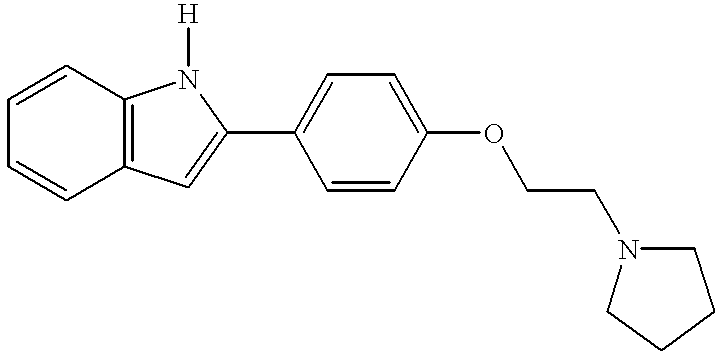
A mixture of phenylhydrazine (1.0 mL, 10 mmol), acetophenone (Part A; 2.35 g, 10 mmol), and polyphosphoric acid (ca. 5 g) in chlorobenzene (50 mL) was heated at ˜145° C. (bath temp) for 1 h. The chlorobenzene layer was decanted off and the tar-like residue was stirred in water (100 mL) overnight. The resultant white suspension was treated with 2.0 N NaOH to pH 8-9. The mixture was taken up in EtOAc (250 mL) and washed with saturated aqueous NaHCO3 and brine (100 mL each). The aqueous layers were back-extracted with EtOAc (250 mL×2). The chlorobenzene layer was also washed with the same aqueous solution. Combined organic layers were dried over MgSO4, concentrated, and purified by PrepLC with 35:6:59 THF-Et3N-hexanes to afford 2.27 g (74%) of the title compound.
mp 173-177° C.; FDMS 306.3 (M+1); Anal. Calcd for C20H22N2O: C, 78.40; H, 7.24; N, 9.14. Found: C, 78.26; H, 7.06; N, 8.97.
C. Methyl 2-Methoxy-4-[[2-[4-[2-(1-pyrrolidinyl)ethoxy]-phenyl]indol-1-yl]methyl]benzoate and Methyl 2-Methoxy-4-[[3-[4-(3-methoxy-4-methoxycarbonyl)benzyl]-2-[4-[2-(1-pyrrolidinyl)ethoxy]phenyl]indol-1-yl]methyl]benzoate. 
A mixture of the above indole (1.599 g, 5.2 mmol) and 60% NaH in oil dispersion (251 mg; 6.3 mmol) in anhydrous DMF (50 mL) was stirred at room temperature for 1 h. To the anionic solution at 0° C. was then cannulated methyl 4-bromomethyl-2-methoxybenzoate (1.3566 g. 5.2 mmol) in 10 mL of DMF. After stirring at room temperature for 2 h, the reaction was quenched with 40 mL of H2O at 0° C. The mixture was taken up in 200 mL of EtOAc and washed with H2O (100 mL×2) and brine (100 mL). The aqueous layers were back-extracted with EtOAc (200 mL×2). Combined extracts were dried over MgSO4, concentrated and purified by flash chromatography to afford 955.8 mg (38%) the title monoester, 586.3 mg of the diester, and 574.5 mg (36%) of the starting indole.
monoester: mp 127-130° C.; FDMS 483.8 (M+); Anal. Calcd for C20H32N2O4: C, 74.36; H, 6.66; N, 5.78. Found: C, 74.24; H, 6.42; N, 5.79.
diester: mp 45-49° C.; FDMS 662 (M+); Anal. Calcd for C40H42N2O7: C, 72.49; H, 6.39; N, 4.23. Found: C, 72.21; H, 6.29; N, 4.51.
D. 2-Methoxy-4-[[2-[4-[2-(1-pyrrolidinyl)ethoxy]phenyl]-indol-1-yl]methyl]benzyl Alcohol. 
A solution of the above monoester (506.6 mg, 1.05 mmol) in 5.0 mL of anhydrous THF was treated with 1.05 mL of 1.0 M LAH in THF at 0° C. for 2 h. After the standard Fieser work-up, a quantitative yield of the title compound (484 mg) was obtained.
mp 36-43° C.; FDMS 456 (M+); Anal. Calcd for C29H32N2O3.0.25C4H8O2: C, 75.29; H, 7.16; N, 5.85. Found: C, 75.34; H, 7.28; N, 5.90.
E. 1-[3-Methoxy-4-(1-pyrrolidinyl)methyl]benzyl-2-[4-[2-(1-pyrrolidinyl)ethoxy]phenyl]indole Dioxalate.
An ice-cold solution of the above alcohol (119.3 mg, 0.26 mmol), Et3N (73 μL, 0.52 mmol), and mesyl chloride (20 μL, 0.26 mmol) in 2.0 mL of THF was stirred for 2 h 20 min. To this was then added pyrrolidine (0.22 mL, 2.6 mmol), and the mixture was stirred at room temperature for 19 h. The mixture was taken up in 25 mL of CH2Cl2 and washed with saturated aqueous NaHCO3 and brine (20 mL each). The aqueous layers were back-extracted with CH2Cl2 (25 mL×2). Combined organic layers were dried over MgSO4, concentrated, and flash chromatographed with 8:92 (10% conc NH4OH in MeOH)—CH2Cl2 to afford 81.9 mg (62%) of the free base of the title compound. The title compound was prepared in a quantitative yield from the free base by formation of the oxalate salt by dissolution in EtOh, and filtration and drying of the resultant solid.
FDMS 510 (M+); Anal. Calcd for C37H43N3O10.0.65C4H8O2: C, 63.67; H, 6.50; N, 5.62. Found: C, 63.72; H, 6.89; N, 5.73.

Hydrolysis of the monoester of Example 1-C (122.0 mg, 0.25 mmol) with 0.5 N LiOH afforded 92% of the desired lithium carboxylate.
FDMS 477.3 (M+1); Anal. Calcd for C29H29N2O4Li.1.3H2O: C, 69.68; H, 6.37; N, 5.60. Found: C, 69.67; H, 6.19; N, 5.67.

The title oxalate salt was prepared from the monoester of Example 1-C (97 mg, 0.20 mmol) by the method of Example 1-E in 27% yield.
FDMS 484 (M+); Anal. Calcd for C30H32N2O4.0.85C2H2O4: C, 67.85; H, 6.05; N, 4.99. Found: C, 67.85; H, 5.96; N, 4.86.

The title oxalate salt was prepared from the diester of Example 1-C (127.7 mg, 0.19 mmol) by the method of Example 1-E in 29% yield.
FDMS 662.1 (M+); Anal. Calcd for C40H42N2O7.0.83C2H2O4: C, 67.85; H, 5.97; N, 3.80. Found: C, 67.83; H, 5.99; N, 3.98.

The title oxalate salt was prepared from the alcohol of Example 1-D (114.2 mg, 0.25 mmol) by the method of Example 1-E in 72% yield.
FDMS 456.1 (M+); Anal. Calcd for C31H34N2O7.1.13C2H2O4: C, 67.25; H, 6.18; N, 5.02. Found: C, 67.26; H, 6.44; N, 4.88.

A solution of the alcohol of Example 1-D (235.8 mg, 0.52 mmol) in 1.0 mL of CH2Cl2 was treated with SOCl2 (75 μL, 1.0 mmol) at room temperature for 3.5 h, followed by another 37.5 mL of SOCl2 addition and stirring for 1 h. The solvent and excess SOCl2 was removed azeotropically with benzene under reduced pressure and the residue was dried under vacuum for 30 min. The dichloride formed was dissolved in 1.0 mL of anhydrous DMF and treated with 0.22 mL (2.6 mmol) of pyrrolidine at room temperature for 1 h. The reaction was quenched with 1.5 mL of saturated aqueous NaHCO3. The mixture was taken up in 30 mL of EtOAc and washed with H2O (20 mL×2) and brine (20 mL). The aqueous layers were back-extracted with EtOAc (30 mL×2). Combined organic layers dried over MgSO4, concentrated and purified by flash chromatography with 8:92 (10% conc NH4OH in MeOH)—CH2Cl2 to yield 91.4 mg (35%) of the free base of the title compound. The oxalate salt was formed in 59% yield by the method of Example 1-E.
FDMS 544 (M+); Anal. Calcd for C37H42N3O10Cl.0.4C2H2O4.0.2C4H8O2: C, 59.60; H, 5.75; N, 5.40; Cl, 4.56. Found: C, 59.25; H, 6.14; N, 5.56; Cl, 4.85.

A mixture of 2-[4-[2-(1-pyrrolidinyl)ethoxy]phenyl]-indole (309.8 mg, 1.0 mmol) and 170.2 mg (3.0 mmol) of KOH in 2.0 mL of anhydrous DMSO was stirred at room temperature for 5-8 min. To this was added in one portion 4-[2-(1-pyrrolidinyl)ethoxy]benzyl chloride hydrochloride (280 mg, 1.0 mmol) and the mixture was stirred for 70 min. The reaction was quenched with 20 mL of H2O and the mixture was extracted with EtOAc (50 mL×3) and CH2Cl2 (30 mL). The organic layers were washed with H2O and brine (25 mL each). Combined organic layers were dried over MgSO4, concentrated and purified by flash chromatography with 6:94 (10% conc NH4OH in MeOH)—CH2Cl2 to afford 79.8 mg (16%) of the desired alkylated product along with 115.3 mg (37%) of the unreacted indole. The oxalate salt was formed in 96% by the method previously described.
FDMS 510 (M+1); Anal. Calcd for C37H43N3O10.0.9C4H8O2: C, 63.41; H, 6.58; N, 5.46. Found: C, 63.64; H, 6.48; N, 5.10.

A. 2-(4-Benzyloxyphenyl)indole. 
To 47.2 g of polyphosphoric acid was added 13.62 g (0.10 mol) of 4′-hydroxyacetophenone and 10.0 mL (0.10 mol) of phenylhydrazine at room temperature. The mixture was heated at 150° C. (oil bath temp) for 1 h. After cooling to room temperature an ice-cold H2O (250 mL) was added and the dark brown mixture was stirred overnight. This was then neutralized with 5.0 N NaOH (100 mL) and extracted with EtOAc (1 L×4) which was washed with saturated aqueous NaHCO3 and brine (500 mL each). Organic layers were dried over MgSO4, filtered through a pad of diatomaceous earth, and concentrated to ca. 200-300 mL. This was treated with charcoal, filtered and concentrated. The crude 2-(4-hydroxyphenyl)indole 12.02 g (57%) was obtained. The crude phenolic indole (10.7 g; 51 mmol) was treated with 33.32 g (0.10 mol) of Cs2CO3 and 6.7 mL (56 mmol) of benzyl bromide in ca. 250 mL of DMF at room temperature overnight. The mixture was filtered through a pad of diatomaceous earth with thorough EtOAc rinse. The filtrate was taken up in to 1 L of EtOAc and washed with H2O (500 mL×2) and brine (500 mL) which were back-extracted with EtOAc (1 L×3). Combined organic layers were dried over MgSO4, concentrated and purified by PrepLC with 10:90 benzene-hexanes and 10:10:80 benzene-Et2O-hexanes to obtain 5.34 g (27%) of N,O-dibenzylated product and 1.94 g (13%) of the named benzyl ether.
FDMS 299 (M+); Anal. Calcd for C21H17NO: C, 84.25; H, 5.72; N, 4.68. Found: C, 84.20; H, 5.71; N, 4.60.
B. Methyl 3-Methoxy-4-[2-(4-benzyloxyphenyl)indol-1-yl]-methyl]benzoate. 
A mixture of 109.4 mg (2.4 mmol) of the above indole (Part A) and 147 mg of KOH in 15 mL of anhydrous DMSO was stirred at room temperature for 1 h. To this was cannulated 614 mg (2.4 mmol) of methyl 4-bromomethyl-2-methoxybenzoate in 5.0 mL of DMSO at room temperature. The mixture was stirred overnight and then the reaction was quenched with 1.1 mL of 2.5 N HCl. The mixture was taken up in 250 mL of EtOAc and washed with H2O (150 mL×2) and 1:1 saturated aqueous NH4Cl-brine (160 mL). The aqueous layers were back-extracted with EtOAc (250 mL×2). Combined organic layers were dried over MgSO4 and concentrated. The residue was crystallized from EtOAc. The precipitate formed was identified as the unreacted indole after filtration and drying (163.5 mg, 23%). The filtrate was concentrated and purified by PrepLC and flash chromatography with 10-30% EtOAc-hexanes to afford 280.6 mg (25%) of the title compound and 246.9 mg (16%) of the N,C3-dialkylated product.
FDMS 477 (M+); Anal. Calcd for C31H27NO4.0.12CH2Cl2: C, 76.63; H, 5.63; N, 2.87. Found: C, 76.60; H, 5.32; N, 2.60.
C. 2-(4-Benzyloxyphenyl)-1-[[3-methoxy-4-(1-pyrrolidinyl)-methyl]benzyl]indole. 
The title compound was obtained in 94% yield in two steps from the methyl benzoate (Part B) via its LAH reduction to the corresponding benzylic alcohol, followed by the displacement of the hydroxy group with pyrrolidine via a mesylate formation as described above in Example 1.
FDMS 502 (M+); Anal. Calcd for C34H34N2O2.0.11CH2Cl2: C, 80.02; H, 6.74; N, 5.47. Found: C, 80.04; H, 6.61; N, 5.64.
D. Methyl 4-[4-[1-[3-Methoxy-4-[(1-pyrrolidinyl)methyl]-benzyl]indol-2-yl]phenoxy]butyrate Oxalate.
The title compound was prepared in 66% yield in three steps from the benzyl ether (Part C) via debenzylation by hydrogenolysis, alkylation of the resultant phenol with methyl 4-chlorobutyrate, and oxalate formation as described in Example 1-E.
FDMS 512.2 (M+); Anal. Calcd for C34H38N2O8.0.3C4H8O2: C, 67.20; H, 6.47; N, 4.45. Found: C, 67.20; H, 6.73; N, 4.55.

The title compound was prepared in a quantitative yield from the free base (Example 8, Part C) as described in Example 1-E.
FDMS 503 (M+1); Anal. Calcd for C34H34N2O2.0.9C2H2O4.0.7C4H8O2: C, 71.84; H, 6.47; N, 4.34. Found: C, 71.91; H, 6.83; N, 4.11.

The title compound was obtained by hydrolysis of the methyl ester (free base of Example 8, Part D) with 1.0 N NaOH as previously described.
FDMS 521 (M+1), 499 (base, —Na); Anal. Calcd for C31H33N2O4.0.7NaOH: C, 67.87; H, 6.19; N, 5.11. Found: C, 67.75; H, 5.98; N, 5.17.

A mixture of 2-(4-benzyloxyphenyl)indole (505.0 mg, 1.7 mmol) and 0.30 mL of TlOEt in 15 mL of anhydrous benzene was heated at reflux while azeotropically removing the EtOH formed by discarding and replenishing benzene (5 mL×3) via a Dean-Stark trap for 30 min. The mixture was heated at reflux for another 1 h and then concentrated to ca. 3-4 mL by distilling off the excess benzene. The mixture was cooled in a water bath, and 465.9 mg (1.7 mmol) of 4-[2-(1-pyrrolidinyl)ethoxy]benzyl chloride hydrochloride was added to the solution in one portion. The reaction mixture was then heated at reflux for 24 h. The reaction was quenched with saturated aqueous NaHCO3 and extracted with CH2Cl2 (50 mL×3). The organic layers were washed with 1:1 saturated aqueous NaHCO3-brine, combined, dried over MgSO4, and concentrated. Purification by flash chromatography three times gave not-yet-pure N-alkylated indole intermediate (90.4 mg). Debenzylation of the benzyl ether by hydrogenolysis, alkylation of the resultant phenol with methyl 4-chlorobutyrate, and oxalate salt formation as before yielded 21.2 mg (2% for 4 steps) of the title compound.
FDMS (M+1); Anal. Calcd for C34H38N2O8: C, 67.76; H, 6.36; N, 4.65. Found: C, 67.32; H, 6.99; N, 4.26.

The title compound was prepared in 70% yield in two steps from LAH reduction of methyl 4-[4-[1-[3-methoxy-4-[(1-pyrrolidinyl)methyl]benzyl]indol-2-yl]phenoxy]butyrate (free base of Example 8) in THF at 0° C. for 1 h, followed by oxalate formation as previously described.
mp (free base) 42-45° C.; FDMS 484.2 (M+); Anal. Calcd for C33H38N2O7.0.5C4H8O2: C, 67.94; H, 6.84; N, 4.53. Found: C, 68.01; H, 7.22; N, 4.33.
Claims (16)
1. A method of inhibiting thrombin comprising using an effective amount of a thrombin inhibiting compound of formula I (or a pharmaceutically acceptable salt thereof) 
wherein
E is CH or CRe in which Re is methyl, methoxy or halo;
R1 is carboxy, [(1-4C)alkoxy]carbonyl, hydroxymethyl or —X1—(CH2)s—NRsRt in which X1 is a direct bond, methylene or O; s is 1 or 2; provided that when s is 1, then X3 is a direct bond; and Rs and Rt are independently hydrogen or (1-3C)alkyl or the group NRsRt is pyrrolidino, piperidino, or morpholino;
R2 is benzyloxy, —X2—(CH2)m—NRaRb in which X2 is a direct bond, methylene, O or S; m is 1, 2, 3, 4 or 5;
provided that when m is 1, then X2 is a direct bond; and Ra and Rb are independently hydrogen or (1-3C)alkyl or the group NRaRb is pyrrolidino, piperidino, or morpholino; or
R2 is —X2—(CH2)n—Rf in which X2 is a direct bond, methylene or O; n is 1, 2 or 3; and Rf is 5-tetrazolyl, carboxy, [(1-4C)alkoxy]carbonyl or hydroxymethyl;
R3 is hydrogen, chloro or a benzyl group which may bear a methyl or methoxy substituent at the 3-position and a [(1-4C)alkoxy]carbonyl substituent at the 4-position; and
R5 is hydrogen, hydroxy or methoxy; and
provided that at least one of R1 and R2 includes an amino moiety —NRsRt or —NRaRb.
2. The method of claim 1 wherein the compound of formula I is one in which
E is CH or CRe in which Re is methyl, methoxy or bromo;
R1 is —X1—(CH2)s—NRsRt;
R2 is —X2—(CH2)m—NRaRb or is —X2—(CH2)n—Rf in which X2 is O; n is 3; and Rf is carboxy, [(1-4C)alkoxy]carbonyl or hydroxymethyl;
R3 is hydrogen or chloro; and
R5 is hydrogen, hydroxy or methoxy.
3. The method of claim 1 or 2 wherein the compound of formula I is one in which
E is CH or CRe in which Re is methoxy;
R1 is —X1—(CH2)s—NRsRt in which X1 is a direct bond, methylene or O; s is 1 or 2; provided that when s is 1, then X3 is a direct bond; and Rs and Rt are independently hydrogen or (1-3C)alkyl or the group NRsRt is pyrrolidino, piperidino, or morpholino;
R2 is —X2—(CH2)m—NRaRb in which X2 is O, m is 2, and the group NRaRb is pyrrolidino, piperidino, or morpholino; or
R2 is —X2—(CH2)n—Rf in which X2 is O; n is 1, 2 or 3; and Rf is carboxy or [(1-4C)alkoxy]carbonyl;
R3 is hydrogen; and
R5 is hydrogen, hydroxy or methoxy.
4. The method of any one of claim 1 wherein halo is fluoro, chloro, bromo or iodo; a (1-3C)alkyl group is methyl, ethyl, propyl or isopropyl; and a (1-4C)alkoxy group is methoxy, ethoxy, isopropoxy or t-butoxy.
5. The method of any one of claim 1 in which, independently:
E is CH or CRe in which Re is methoxy;
R1 is pyrrolidinomethyl or 2-pyrrolidinoethoxy;
R2 is 2-pyrrolidinoethoxy or R2 is —X2—(CH2)n—Rf in which X2 is O, n is 3, and Rf is carboxy or methoxycarbonyl;
R3 is hydrogen; and
R5 is hydrogen.
6. The method of claim 1 wherein said compound of formula I is 1-[3-methoxy-4-(1-pyrrolidinyl)methyl]-benzyl-2-[4-[2-(1-pyrrolidinyl)ethoxy]phenyl]indole.
7. A pharmaceutical formulation comprising in association with a pharmaceutically acceptable carrier, diluent or excipient, a thrombin inhibiting compound of formula I (or a pharmaceutically acceptable salt thereof) 
wherein
E is CH or CRe in which Re is methyl, methoxy or halo;
R1 is carboxy, [(1-4C)alkoxy]carbonyl, hydroxymethyl or —X1—(CH2)s—NRsRt in which X1 is a direct bond, methylene or O, s is 1 or 2; provided that when s is 1, then X3 is a direct bond; and Rs and Rt are independently hydrogen or (1-3C)alkyl or the group NRsRt is pyrrolidino, piperidino, or morpholino;
R2 is benzyloxy, —X2—(CH2)m—NRaRb in which X2 is a direct bond, methylene, O or S; m is 1, 2, 3, 4 or 5;
provided that when m is 1, then X2 is a direct bond; and Ra and Rb are independently hydrogen or (1-3C)alkyl or the group NRaRb is pyrrolidino, piperidino, or morpholino; or
R2 is —X2—(CH2)n—Rf in which X2 is a direct bond, methylene or O; n is 1, 2 or 3; and Rf is 5-tetrazolyl, carboxy, [(1-4C)alkoxy]carbonyl or hydroxymethyl;
R3 is hydrogen, chloro or a benzyl group which may bear a methyl or methoxy substituent at the 3-position and a [(1-4C)alkoxy]carbonyl substituent at the 4-position; and
R5 is hydrogen, hydroxy or methoxy; and
provided that at least one of R1 and R2 includes an amino moiety —NRsRt or —NRaRb.
8. A compound of formula I (or a pharmaceutically acceptable salt thereof) 
wherein
E is CH or CRe in which Re is methyl, methoxy or halo;
R1 is carboxy, [(1-4C)alkoxy]carbonyl, hydroxymethyl or —X1—(CH2)s—NRsRt in which X1 is a direct bond, methylene or O; s is 1 or 2; provided that when s is 1, then X3 is a direct bond; and Rs and Rt are independently hydrogen or (1-3C)alkyl or the group NRsRt is pyrrolidino, piperidino, or morpholino;
R2 is benzyloxy, —X2—(CH2)m—NRaRb in which X2 is a direct bond, methylene, O or S; m is 1, 2, 3, 4 or 5;
provided that when m is 1, then X2 is a direct bond; and Ra and Rb are independently hydrogen or (1-3C)alkyl or the group NRaRb is pyrrolidino, piperidino, or morpholino; or
R2 is —X2—(CH2)n—Rf in which X2 is a direct bond, methylene or O; n is 1, 2 or 3; and Rf is 5-tetrazolyl, carboxy, [(1-4C)alkoxy]carbonyl or hydroxymethyl;
R3 is hydrogen, chloro or a benzyl group which may bear a methyl or methoxy substituent at the 3-position and a [(1-4C)alkoxy]carbonyl substituent at the 4-position; and
R5 is hydrogen, hydroxy or methoxy; and
provided that at least one of R1 and R2 includes an amino moiety —NRsRt or —NRaRb; and further
provided that the compound is not one wherein E is CH or CRe in which Re is methyl, methoxy or halo; R1 is —X1—(CH2)s—NRsRt in which X1 is O; s is 2; Rs and Rt are independently hydrogen or (1-3C)alkyl or the group NRsRt is pyrrolidino, piperidino, or morpholino; R2 is benzyloxy; R3 is hydrogen or chloro; and R5 is hydrogen, hydroxy or methoxy.
9. The compound (or salt thereof) of claim 8 wherein the compound of formula I is one in which
E is CH or CRe in which Re is methyl, methoxy or bromo;
R1 is —X1—(CH2)s—NRsRt;
R2 is —X2—(CH2)m—NRaRb or is —X2—(CH2)n—Rf in which X2 is O; n is 3; and Rf is carboxy, [(1-4C)alkoxy]carbonyl or hydroxymethyl;
R3 is hydrogen or chloro; and
R5 is hydrogen, hydroxy or methoxy.
10. The compound (or salt thereof) of claim 8 or 9 wherein the compound of formula I is one in which
E is CH or CRe in which Re is methoxy;
R1 is —X1—(CH2)s—NRsRt in which X1 is a direct bond, methylene or O; s is 1 or 2; provided that when s is 1, then X3 is a direct bond; and Rs and Rt are independently hydrogen or (1-3C)alkyl or the group NRsRt is pyrrolidino, piperidino, or morpholino;
R2 is —X2—(CH2)m—NRaRb in which X2 is O, m is 2, and the group NRaRb is pyrrolidino, piperidino, or morpholino; or
R2 is —X2—(CH2)n—Rf in which X2 is O; n is 1, 2 or 3; and Rf is carboxy or [(1-4C)alkoxy]carbonyl;
R3 is hydrogen; and
R5 is hydrogen, hydroxy or methoxy.
11. The compound (or salt thereof) of claim 8 wherein halo is fluoro, chloro, bromo or iodo; a (1-3C)alkyl group is methyl, ethyl, propyl or isopropyl; and a (1-4C)alkoxy group is methoxy, ethoxy, isopropoxy or t-butoxy.
12. The compound (or salt thereof) of claim 8 in which, independently:
E is CH or CRe in which Re is methoxy;
R1 is pyrrolidinomethyl or 2-pyrrolidinoethoxy;
R2 is 2-pyrrolidinoethoxy or R2 is —X2—(CH2)n—Rf in which X2 is O, n is 3, and Rf is carboxy or methoxycarbonyl;
R3 is hydrogen; and
R5 is hydrogen.
13. The compound (or salt thereof) of claim 8 wherein said compound of formula I is 1-[3-methoxy-4-(1-pyrrolidinyl)methyl]benzyl-2-[4-[2-(1-pyrrolidinyl)-ethoxy]phenyl]indole.
14. A pharmaceutically acceptable salt of a compound of formula I as claimed in claim 8 which is an acid-addition salt made with an acid which provides a pharmaceutically acceptable anion or a salt made with a base which provides a pharmaceutically acceptable cation.
15. A pharmaceutical formulation comprising in association with a pharmaceutically acceptable carrier, diluent or excipient, a compound of formula I (or a pharmaceutically acceptable salt thereof) as claimed in claim 8.
16. A process for preparing a compound of formula I (or a pharmaceutically acceptable salt thereof) as claimed in any of claims 8-14 which is selected from:
(a) for a compound of formula I in which R3 is hydrogen, alkylating a compound of formula II 
with an alkylating agent of formula III 
in which X is a conventional leaving group, using a standard indole alkylation procedure;
(b) for a compound of formula I in which R1 or Rf is hydroxymethyl, reducing a corresponding compound of formula I in which R1 or Rf is [(1-4C)alkoxy]carbonyl;
(c) for a compound of formula I in which R1 or R2 is —X1—(CH2)s—NRsRt or —X2—(CH2)m—NRaRb, respectively, alkylating an amine of formula H—NRsRt or H—NRaRb, respectively, with a compound corresponding to formula I, but in which R1 or R2 is —X1—(CH2)s—X or —X2—(CH2)m—X, respectively, in which X is a conventional leaving group, using a standard alkylation procedure;
(d) for a compound of formula I in which R3 is chloro, chlorinating a corresponding compound of formula I in which R3 is hydrogen using a conventional procedure;
(e) for a compound of formula I in which X1 or X2 is O, alkylating a phenolic compound corresponding to formula I, but in which R1 or R2, respectively, is hydroxy using a reagent of formula X—(CH2)s—NRsRt or of formula X—(CH2)m—NRaRb or X—(CH2)n—Rf, respectively, in which X is a conventional leaving group, using a standard alkylation procedure;
(f) for a compound of formula I in which R1 or Rf is carboxy, decomposing the ester of a corresponding compound of formula I in which R1 or Rf is [(1-4C)alkoxy]carbonyl;
(g) for a compound of formula I in which R3 is a benzyl group which may bear a methyl or methoxy substituent at the 3-position and a [(1-4C)alkoxy]carbonyl substituent at the 4-position, alkylating a corresponding compound of formula I in which R3 is hydrogen using a corresponding benzyl reagent bearing a leaving group X at the α-position using a conventional procedure;
whereafter, for any of the above procedures, when a functional group is protected using a protecting group, removing the protecting group;
whereafter, for any of the above procedures, when a pharmaceutically acceptable salt of a compound of formula I is required, it is obtained by reacting the basic form of such a compound of formula I with an acid affording a physiologically acceptable counterion or by reacting the acidic form of such a compound of formula I with an base affording a physiologically acceptable counterion or by any other conventional procedure; and
wherein, unless otherwise described, E, R1, R2, R3 and R5 have the values described in any of claim 8.
Priority Applications (1)
| Application Number | Priority Date | Filing Date | Title |
|---|---|---|---|
| US09/423,125 US6172100B1 (en) | 1997-04-30 | 1998-04-30 | Antithrombotic agents |
Applications Claiming Priority (3)
| Application Number | Priority Date | Filing Date | Title |
|---|---|---|---|
| US4513697P | 1997-04-30 | 1997-04-30 | |
| US09/423,125 US6172100B1 (en) | 1997-04-30 | 1998-04-30 | Antithrombotic agents |
| PCT/US1998/008698 WO1998048797A1 (en) | 1997-04-30 | 1998-04-30 | Antithrombotic agents |
Publications (1)
| Publication Number | Publication Date |
|---|---|
| US6172100B1 true US6172100B1 (en) | 2001-01-09 |
Family
ID=21936182
Family Applications (1)
| Application Number | Title | Priority Date | Filing Date |
|---|---|---|---|
| US09/423,125 Expired - Fee Related US6172100B1 (en) | 1997-04-30 | 1998-04-30 | Antithrombotic agents |
Country Status (6)
| Country | Link |
|---|---|
| US (1) | US6172100B1 (en) |
| EP (1) | EP1011666A4 (en) |
| JP (1) | JP2001523254A (en) |
| AU (1) | AU7170798A (en) |
| CA (1) | CA2287980A1 (en) |
| WO (1) | WO1998048797A1 (en) |
Families Citing this family (9)
| Publication number | Priority date | Publication date | Assignee | Title |
|---|---|---|---|---|
| US6005102A (en) * | 1997-10-15 | 1999-12-21 | American Home Products Corporation | Aryloxy-alkyl-dialkylamines |
| JP2001519410A (en) * | 1997-10-15 | 2001-10-23 | アメリカン・ホーム・プロダクツ・コーポレイション | New aryloxy-alkyl-dialkylamines |
| ES2213984T3 (en) * | 1998-10-30 | 2004-09-01 | Eli Lilly And Company | DERIVATIVES OF AZAINDOL AND ITS USE AS ANTITROMBIC AGENTS. |
| WO2001074773A2 (en) * | 2000-03-31 | 2001-10-11 | Ortho Mcneil Pharmaceutical, Inc. | Phenyl-substituted indoles as histamine h3-receptor antagonists |
| US6872834B2 (en) | 2000-03-31 | 2005-03-29 | Ortho-Mcneil Pharmaceutical, Inc. | Phenyl-substituted indoles and indazoles |
| EP1268478B1 (en) | 2000-03-31 | 2007-05-02 | Ortho-McNeil Pharmaceutical, Inc. | Phenyl-substituted imidazopyridines |
| CN1635885A (en) * | 2000-07-06 | 2005-07-06 | 惠氏公司 | Improvement of nitric oxide synthase activity by using substituted indole compound |
| US6358991B2 (en) * | 2000-07-06 | 2002-03-19 | American Home Products Corporation | Methods of treating neuropeptide Y-related conditions |
| US7781478B2 (en) | 2004-07-14 | 2010-08-24 | Ptc Therapeutics, Inc. | Methods for treating hepatitis C |
Citations (4)
| Publication number | Priority date | Publication date | Assignee | Title |
|---|---|---|---|---|
| WO1996003375A1 (en) | 1994-07-27 | 1996-02-08 | Schering Aktiengesellschaft | 2-phenyl indoles as anti-oestrogen drugs |
| US5576343A (en) | 1991-10-31 | 1996-11-19 | Daiichi Pharmaceutical Co., Ltd. | Aromatic amidine derivatives and salts thereof |
| WO1997025033A1 (en) | 1995-10-31 | 1997-07-17 | Eli Lilly And Company | Antithrombotic diamines |
| EP0802183A1 (en) | 1996-04-19 | 1997-10-22 | American Home Products Corporation | Estrogenic agents |
-
1998
- 1998-04-30 CA CA002287980A patent/CA2287980A1/en not_active Abandoned
- 1998-04-30 JP JP54736898A patent/JP2001523254A/en active Pending
- 1998-04-30 US US09/423,125 patent/US6172100B1/en not_active Expired - Fee Related
- 1998-04-30 AU AU71707/98A patent/AU7170798A/en not_active Abandoned
- 1998-04-30 EP EP98918865A patent/EP1011666A4/en not_active Withdrawn
- 1998-04-30 WO PCT/US1998/008698 patent/WO1998048797A1/en not_active Ceased
Patent Citations (5)
| Publication number | Priority date | Publication date | Assignee | Title |
|---|---|---|---|---|
| US5576343A (en) | 1991-10-31 | 1996-11-19 | Daiichi Pharmaceutical Co., Ltd. | Aromatic amidine derivatives and salts thereof |
| WO1996003375A1 (en) | 1994-07-27 | 1996-02-08 | Schering Aktiengesellschaft | 2-phenyl indoles as anti-oestrogen drugs |
| WO1997025033A1 (en) | 1995-10-31 | 1997-07-17 | Eli Lilly And Company | Antithrombotic diamines |
| US6025382A (en) | 1995-10-31 | 2000-02-15 | Eli Lilly And Company | Antithrombotic diamines |
| EP0802183A1 (en) | 1996-04-19 | 1997-10-22 | American Home Products Corporation | Estrogenic agents |
Non-Patent Citations (1)
| Title |
|---|
| Robert M. Scarborough, "Chapter 8. Anticoagulant Strategies Targeting Thrombin and Factor Xa," Annual Reports in Medicinal Chemistry, (1995) 30, pp. 71-80. |
Also Published As
| Publication number | Publication date |
|---|---|
| AU7170798A (en) | 1998-11-24 |
| EP1011666A1 (en) | 2000-06-28 |
| CA2287980A1 (en) | 1998-11-05 |
| WO1998048797A1 (en) | 1998-11-05 |
| JP2001523254A (en) | 2001-11-20 |
| EP1011666A4 (en) | 2004-03-31 |
Similar Documents
| Publication | Publication Date | Title |
|---|---|---|
| EP0999834B1 (en) | Antithrombotic agents | |
| US6214841B1 (en) | Antithrombotic compound | |
| US6541499B1 (en) | Antithrombotic agents | |
| US6924296B2 (en) | Antithrombotic agents | |
| WO1998048797A1 (en) | Antithrombotic agents | |
| US6391901B1 (en) | Thrombin inhibitors | |
| US6265416B1 (en) | Antithrombotic agents | |
| US6620837B1 (en) | Antithrombotic agents | |
| US6271227B1 (en) | Antithrombotic Agents | |
| US6288105B1 (en) | Antithrombotic agents | |
| EP0997460B1 (en) | Benzothiophene compounds as antithrombotic agents and intermediates | |
| US6284756B1 (en) | Antithrombotic agents |
Legal Events
| Date | Code | Title | Description |
|---|---|---|---|
| AS | Assignment |
Owner name: ELI LILLY AND COMPANY, INDIANA Free format text: ASSIGNMENT OF ASSIGNORS INTEREST;ASSIGNORS:CHIRGADZE, NICKOLAY YURI;FISHER, MATTHEW JOSEPH;HARPER, RICHARD WALTZ;AND OTHERS;REEL/FRAME:010568/0026;SIGNING DATES FROM 19980414 TO 19980611 |
|
| FPAY | Fee payment |
Year of fee payment: 4 |
|
| REMI | Maintenance fee reminder mailed | ||
| LAPS | Lapse for failure to pay maintenance fees | ||
| STCH | Information on status: patent discontinuation |
Free format text: PATENT EXPIRED DUE TO NONPAYMENT OF MAINTENANCE FEES UNDER 37 CFR 1.362 |
|
| FP | Lapsed due to failure to pay maintenance fee |
Effective date: 20090109 |