US6159594A - Magnetic recording medium - Google Patents
Magnetic recording medium Download PDFInfo
- Publication number
- US6159594A US6159594A US09/161,988 US16198898A US6159594A US 6159594 A US6159594 A US 6159594A US 16198898 A US16198898 A US 16198898A US 6159594 A US6159594 A US 6159594A
- Authority
- US
- United States
- Prior art keywords
- magnetic recording
- plane
- recording medium
- cobalt
- thin film
- Prior art date
- Legal status (The legal status is an assumption and is not a legal conclusion. Google has not performed a legal analysis and makes no representation as to the accuracy of the status listed.)
- Expired - Fee Related
Links
- 230000005291 magnetic effect Effects 0.000 title claims abstract description 147
- 229910017052 cobalt Inorganic materials 0.000 claims abstract description 99
- 239000010941 cobalt Substances 0.000 claims abstract description 99
- GUTLYIVDDKVIGB-UHFFFAOYSA-N cobalt atom Chemical compound [Co] GUTLYIVDDKVIGB-UHFFFAOYSA-N 0.000 claims abstract description 99
- 239000010409 thin film Substances 0.000 claims abstract description 86
- JEIPFZHSYJVQDO-UHFFFAOYSA-N iron(III) oxide Inorganic materials O=[Fe]O[Fe]=O JEIPFZHSYJVQDO-UHFFFAOYSA-N 0.000 claims abstract description 71
- 239000000758 substrate Substances 0.000 claims abstract description 36
- 229910000480 nickel oxide Inorganic materials 0.000 claims abstract description 35
- GNRSAWUEBMWBQH-UHFFFAOYSA-N oxonickel Chemical compound [Ni]=O GNRSAWUEBMWBQH-UHFFFAOYSA-N 0.000 claims abstract description 35
- 238000002441 X-ray diffraction Methods 0.000 claims abstract description 26
- 238000001228 spectrum Methods 0.000 claims abstract description 26
- 230000005415 magnetization Effects 0.000 claims abstract description 20
- XEEYBQQBJWHFJM-UHFFFAOYSA-N Iron Chemical compound [Fe] XEEYBQQBJWHFJM-UHFFFAOYSA-N 0.000 claims description 26
- PXHVJJICTQNCMI-UHFFFAOYSA-N nickel Substances [Ni] PXHVJJICTQNCMI-UHFFFAOYSA-N 0.000 claims description 6
- 229910052802 copper Inorganic materials 0.000 claims description 4
- 229910052748 manganese Inorganic materials 0.000 claims description 4
- 229910052759 nickel Inorganic materials 0.000 claims description 4
- 229910052719 titanium Inorganic materials 0.000 claims description 4
- 229910052725 zinc Inorganic materials 0.000 claims description 4
- 229910052742 iron Inorganic materials 0.000 claims 6
- 230000000052 comparative effect Effects 0.000 description 42
- UQSXHKLRYXJYBZ-UHFFFAOYSA-N Iron oxide Chemical compound [Fe]=O UQSXHKLRYXJYBZ-UHFFFAOYSA-N 0.000 description 34
- QVGXLLKOCUKJST-UHFFFAOYSA-N atomic oxygen Chemical compound [O] QVGXLLKOCUKJST-UHFFFAOYSA-N 0.000 description 30
- 239000010408 film Substances 0.000 description 27
- 239000001301 oxygen Substances 0.000 description 23
- 229910052760 oxygen Inorganic materials 0.000 description 23
- SZVJSHCCFOBDDC-UHFFFAOYSA-N iron(II,III) oxide Inorganic materials O=[Fe]O[Fe]O[Fe]=O SZVJSHCCFOBDDC-UHFFFAOYSA-N 0.000 description 21
- 238000000151 deposition Methods 0.000 description 18
- 235000013980 iron oxide Nutrition 0.000 description 16
- 230000008021 deposition Effects 0.000 description 11
- XKRFYHLGVUSROY-UHFFFAOYSA-N Argon Chemical compound [Ar] XKRFYHLGVUSROY-UHFFFAOYSA-N 0.000 description 10
- 230000008859 change Effects 0.000 description 9
- 230000015572 biosynthetic process Effects 0.000 description 7
- 239000011521 glass Substances 0.000 description 7
- 238000007254 oxidation reaction Methods 0.000 description 6
- 229910045601 alloy Inorganic materials 0.000 description 5
- 239000000956 alloy Substances 0.000 description 5
- 229910052786 argon Inorganic materials 0.000 description 5
- 230000003647 oxidation Effects 0.000 description 5
- 229910000859 α-Fe Inorganic materials 0.000 description 5
- 238000005259 measurement Methods 0.000 description 4
- 239000000919 ceramic Substances 0.000 description 3
- 230000007797 corrosion Effects 0.000 description 3
- 238000005260 corrosion Methods 0.000 description 3
- 238000002474 experimental method Methods 0.000 description 3
- 230000005294 ferromagnetic effect Effects 0.000 description 3
- 238000010438 heat treatment Methods 0.000 description 3
- 239000002184 metal Substances 0.000 description 3
- 229910052751 metal Inorganic materials 0.000 description 3
- 238000000034 method Methods 0.000 description 3
- 239000000203 mixture Substances 0.000 description 3
- 238000004544 sputter deposition Methods 0.000 description 3
- OKTJSMMVPCPJKN-UHFFFAOYSA-N Carbon Chemical compound [C] OKTJSMMVPCPJKN-UHFFFAOYSA-N 0.000 description 2
- 229910000640 Fe alloy Inorganic materials 0.000 description 2
- 229910017344 Fe2 O3 Inorganic materials 0.000 description 2
- 229910017368 Fe3 O4 Inorganic materials 0.000 description 2
- 230000002411 adverse Effects 0.000 description 2
- 229910052799 carbon Inorganic materials 0.000 description 2
- 239000013078 crystal Substances 0.000 description 2
- 238000004519 manufacturing process Methods 0.000 description 2
- 239000000463 material Substances 0.000 description 2
- 229910001092 metal group alloy Inorganic materials 0.000 description 2
- 230000008569 process Effects 0.000 description 2
- 238000012545 processing Methods 0.000 description 2
- PNEYBMLMFCGWSK-UHFFFAOYSA-N Alumina Chemical compound [O-2].[O-2].[O-2].[Al+3].[Al+3] PNEYBMLMFCGWSK-UHFFFAOYSA-N 0.000 description 1
- 229910000599 Cr alloy Inorganic materials 0.000 description 1
- 229910010293 ceramic material Inorganic materials 0.000 description 1
- 238000006243 chemical reaction Methods 0.000 description 1
- IVMYJDGYRUAWML-UHFFFAOYSA-N cobalt(ii) oxide Chemical compound [Co]=O IVMYJDGYRUAWML-UHFFFAOYSA-N 0.000 description 1
- 238000010276 construction Methods 0.000 description 1
- 230000005347 demagnetization Effects 0.000 description 1
- 230000006866 deterioration Effects 0.000 description 1
- 230000001747 exhibiting effect Effects 0.000 description 1
- 239000007789 gas Substances 0.000 description 1
- 229910052595 hematite Inorganic materials 0.000 description 1
- 239000011019 hematite Substances 0.000 description 1
- VBMVTYDPPZVILR-UHFFFAOYSA-N iron(2+);oxygen(2-) Chemical class [O-2].[Fe+2] VBMVTYDPPZVILR-UHFFFAOYSA-N 0.000 description 1
- LIKBJVNGSGBSGK-UHFFFAOYSA-N iron(3+);oxygen(2-) Chemical compound [O-2].[O-2].[O-2].[Fe+3].[Fe+3] LIKBJVNGSGBSGK-UHFFFAOYSA-N 0.000 description 1
- 239000000314 lubricant Substances 0.000 description 1
- 238000012986 modification Methods 0.000 description 1
- 230000004048 modification Effects 0.000 description 1
- 239000002245 particle Substances 0.000 description 1
- 239000010702 perfluoropolyether Substances 0.000 description 1
- 230000001681 protective effect Effects 0.000 description 1
- 238000005546 reactive sputtering Methods 0.000 description 1
- 230000009467 reduction Effects 0.000 description 1
- 238000005070 sampling Methods 0.000 description 1
- 230000002195 synergetic effect Effects 0.000 description 1
Images
Classifications
-
- G—PHYSICS
- G11—INFORMATION STORAGE
- G11B—INFORMATION STORAGE BASED ON RELATIVE MOVEMENT BETWEEN RECORD CARRIER AND TRANSDUCER
- G11B5/00—Recording by magnetisation or demagnetisation of a record carrier; Reproducing by magnetic means; Record carriers therefor
- G11B5/62—Record carriers characterised by the selection of the material
- G11B5/64—Record carriers characterised by the selection of the material comprising only the magnetic material without bonding agent
- G11B5/65—Record carriers characterised by the selection of the material comprising only the magnetic material without bonding agent characterised by its composition
- G11B5/656—Record carriers characterised by the selection of the material comprising only the magnetic material without bonding agent characterised by its composition containing Co
-
- G—PHYSICS
- G11—INFORMATION STORAGE
- G11B—INFORMATION STORAGE BASED ON RELATIVE MOVEMENT BETWEEN RECORD CARRIER AND TRANSDUCER
- G11B5/00—Recording by magnetisation or demagnetisation of a record carrier; Reproducing by magnetic means; Record carriers therefor
- G11B5/62—Record carriers characterised by the selection of the material
- G11B5/73—Base layers, i.e. all non-magnetic layers lying under a lowermost magnetic recording layer, e.g. including any non-magnetic layer in between a first magnetic recording layer and either an underlying substrate or a soft magnetic underlayer
- G11B5/7368—Non-polymeric layer under the lowermost magnetic recording layer
- G11B5/7371—Non-magnetic single underlayer comprising nickel
-
- Y—GENERAL TAGGING OF NEW TECHNOLOGICAL DEVELOPMENTS; GENERAL TAGGING OF CROSS-SECTIONAL TECHNOLOGIES SPANNING OVER SEVERAL SECTIONS OF THE IPC; TECHNICAL SUBJECTS COVERED BY FORMER USPC CROSS-REFERENCE ART COLLECTIONS [XRACs] AND DIGESTS
- Y10—TECHNICAL SUBJECTS COVERED BY FORMER USPC
- Y10S—TECHNICAL SUBJECTS COVERED BY FORMER USPC CROSS-REFERENCE ART COLLECTIONS [XRACs] AND DIGESTS
- Y10S428/00—Stock material or miscellaneous articles
- Y10S428/90—Magnetic feature
-
- Y—GENERAL TAGGING OF NEW TECHNOLOGICAL DEVELOPMENTS; GENERAL TAGGING OF CROSS-SECTIONAL TECHNOLOGIES SPANNING OVER SEVERAL SECTIONS OF THE IPC; TECHNICAL SUBJECTS COVERED BY FORMER USPC CROSS-REFERENCE ART COLLECTIONS [XRACs] AND DIGESTS
- Y10—TECHNICAL SUBJECTS COVERED BY FORMER USPC
- Y10T—TECHNICAL SUBJECTS COVERED BY FORMER US CLASSIFICATION
- Y10T428/00—Stock material or miscellaneous articles
- Y10T428/26—Web or sheet containing structurally defined element or component, the element or component having a specified physical dimension
-
- Y—GENERAL TAGGING OF NEW TECHNOLOGICAL DEVELOPMENTS; GENERAL TAGGING OF CROSS-SECTIONAL TECHNOLOGIES SPANNING OVER SEVERAL SECTIONS OF THE IPC; TECHNICAL SUBJECTS COVERED BY FORMER USPC CROSS-REFERENCE ART COLLECTIONS [XRACs] AND DIGESTS
- Y10—TECHNICAL SUBJECTS COVERED BY FORMER USPC
- Y10T—TECHNICAL SUBJECTS COVERED BY FORMER US CLASSIFICATION
- Y10T428/00—Stock material or miscellaneous articles
- Y10T428/26—Web or sheet containing structurally defined element or component, the element or component having a specified physical dimension
- Y10T428/263—Coating layer not in excess of 5 mils thick or equivalent
- Y10T428/264—Up to 3 mils
- Y10T428/265—1 mil or less
Definitions
- the present invention relates to a magnetic recording medium, and more particularly, to a magnetic recording medium for high-density recording, having a higher coercive force and a higher saturation magnetization, exhibiting a less amount of noise generated, a large output in a high recording frequency region and a less distortion of a reproduced waveform, and being suitable for use in current magnetic recording systems in which a ring-type magnetic write head is used.
- the magnetic recording media have been strongly required to have as high a coercive force as possible.
- magnetic recording media having a large coercive force there are widely known those comprising a substrate and a magnetic thin film formed on the substrate.
- the magnetic thin films which have been already put into practice, are generally classified into magnetic iron oxide thin films composed of maghemite, etc. (refer to "Technical Report of Electronic Telecommunication Institute", published by Electronic Telecommunication Institute, (1981) MR81-20, pp. 5 to 12), and alloy thin films composed of Co--Cr alloy or the like.
- the magnetic iron oxide thin films are excellent in oxidation resistance or corrosion resistance because maghemite is already oxidized. Therefore, the magnetic iron oxide thin films can show an excellent stability independent to change in passage of time, i.e., less change in magnetic properties with passage of time.
- the coercive force of the magnetic iron oxide thin films is as low as at most about 700 Oe and the saturation magnetization of the magnetic iron oxide thin films is as low as at most about 240 emu/cm 3 .
- the alloy thin films have a coercive force as high as not less than about 2,000 Oe and a saturation magnetization as high as not less than about 300 emu/cm 3 .
- the alloy thin films tend to be readily oxidized, so that the stability independent to change in passage of time is deteriorated.
- a protective film e.g., a carbon film having usually a thickness of about 100 to about 200 ⁇ .
- a distance between a magnetic write head and a magnetic recording layer becomes increased by the thickness of the carbon film, resulting in large loss due to the magnetic spacing, which disables the magnetic recording medium to be applied to high-density recording.
- a single-pole magnetic write head used in a vertical magnetic recording system may be used appropriately.
- the single-pole magnetic write head is still very expensive.
- the magnetic iron oxide thin films have been strongly required not only to have a high coercive force and a large saturation magnetization, but also to exhibit less noise and a large output in a high recording frequency region, and to be free from the distortion of isolated reproduced waveform.
- maghemite films As typical magnetic iron oxide thin films, there are known maghemite films. It is also known that cobalt can be incorporated into the maghemite in order to enhance the coercive force thereof (Japanese Patent Publications (KOKOKU) Nos. 51-4086(1976) and 5-63925(1993), and "CERAMICS", published by Japan Ceramics Institute (1986), Vol. 24, No. 1, pp. 21 to 24).
- the magnetic thin film composed of cobalt-containing maghemite is a so-called perpendicular magnetic film whose a (400) plane is predominantly oriented in parallel with the surface of substrate (Japanese Patent Publication (KOKOKU) No. 7-60768(1995) and Japanese Patent Application Laid-open (KOKAI) No. 7-307022(1995)).
- a magnetic thin film memory comprising a ceramic substrate made of a high-purity alumina ceramic material which has a high density and is free from damaging memory properties of ferrite due to the reaction therewith even at an elevated temperature of 1,000 to 1,300° C. to produce the ferrite, and a cobalt-based spinel-type ferrite film formed on the substrate and having a composition represented by the general formula of Co.sub.(1-x) Fe.sub.(2+x) O 4 where -0.2 ⁇ 0.3, the ferrite film being composed of fine crystalline aggregates of the ferrite.
- a fixed magnetic disc comprising a substrate, an oxide thin film formed on the substrate and having an NaCl-type crystal structure composed of nickel oxide crystallographically predominantly oriented in the (100) plane, and a magnetic cobalt-containing iron oxide thin film formed on the nickel oxide thin film and having a spinel-type crystal structure.
- a magnetic recording medium comprising: a substrate; an NiO underlayer formed on the surface of the substrate, whose a (200) plane is predominantly oriented in parallel with the surface of the substrate; and a cobalt-containing maghemite thin film as a perpendicular magnetic film formed on the surface of the NiO underlayer, whose a (400) plane is predominantly oriented in parallel with the surface of a substrate and which has a molar ratio of Co to Fe of not less than 0.01 and less than 0.10 and a spacing of the (400) plane of not more than 2.082 ⁇ .
- the above-mentioned conventional cobalt-containing maghemite thin films are still unsatisfactory in magnetic properties, especially coercive force thereof.
- it is attempted to obtain a high coercive force, especially not less than 2,000 Oe it is necessary to incorporate a large amount of cobalt thereinto.
- cobalt-containing maghemite thin film tend to be adversely affected by heat and the like, resulting in considerable deterioration in magnetic properties with passage of time.
- the above-mentioned conventional perpendicular magnetic films composed of iron oxides have a problem concerning the distortion of isolated reproduced waveform. Therefore, the perpendicular magnetic films cannot be applied to current magnetic recording systems using a ring-type magnetic write head.
- the obtained magnetic recording medium has a higher coercive force, e.g., not less than 2,000 Oe, a larger saturation magnetization, e.g., not less than 250 emu/cm 3 , exhibits less amount of noise and a large output in a high
- a magnetic recording medium comprising: a substrate; a nickel oxide underlayer formed on the substrate; and a cobalt-containing maghemite thin film formed on the nickel oxide underlayer, having either a spacing of a (311) plane of not more than 2.510 ⁇ , a spacing of a (222) plane of not more than 2.415 ⁇ or a spacing of a (220) plane of not more than 2.950 ⁇ , and having the ratio of either of X-ray diffraction spectrum peak intensities of the (311), (222) or (220) planes of the cobalt-containing maghemite thin film to an X-ray diffraction spectrum peak intensity of a (400) plane of more than 0.5:1.
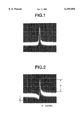
- FIG. 1 shows an isolated reproduced waveform upon reproduced signals recorded at a recording density of 1 kFRPI on a magnetic recording medium in Example 1;
- FIG. 2 shows an isolated reproduced waveform upon reproduced signals recorded at a recording density of 1 kFRPI on a magnetic recording medium obtained in Comparative Example 5.
- the magnetic recording medium according to the present invention comprises a substrate, a nickel oxide underlayer formed on the substrate and a cobalt-containing maghemite thin film formed on the nickel oxide underlayer.
- the substrate used in the present invention may be made of materials ordinarily used for this purpose, such as glass or the like.
- the nickel oxide underlayer of the magnetic recording medium of the present invention has a thickness of usually 0.01 to 0.5 ⁇ m, preferably 0.02 to 0.3 ⁇ m.
- the thickness of the underlayer is less than 0.01 ⁇ m, it may become difficult to obtain the aimed magnetic recording medium having a higher coercive force.
- the thickness of the underlayer is more than 0.5 ⁇ m, the grain size of the cobalt-containing maghemite particles of the magnetic thin film formed on the nickel oxide underlayer may become large, so that the noise from the resultant magnetic recording medium tends to be increased.
- the nickel oxide underlayer of the magnetic recording medium of the present invention be less oriented in its (200) plane parallel with the surface of the substrate, more preferably not oriented at all in the (200) plane.
- the ratio of an X-ray diffraction peak intensity of the (111) plane to that of the (200) plane is preferably more than 0.5:1, more preferably not less than 1.0:1.
- the magnetic thin film of the magnetic recording medium according to the present invention is a cobalt-containing maghemite thin film having a thickness of usually 0.005 to 1.0 ⁇ m, preferably 0.01 to 0.5 ⁇ m.
- maghemite is represented by the formula of ⁇ -Fe 2 O 3 .
- maghemite containing a small amount of Fe 2+ .
- the upper limit of the Fe 2+ content at a molar ratio of Fe 2+ to Fe 3+ is preferably 0.3:1.
- the cobalt-containing maghemite thin film may further contain at least one element selected from the group consisting of Mn, Ni, Cu, Ti and Zn which may be usually used to improve various properties thereof, in such an amount that the molar ratio of these elements to Fe is usually about 0.005:1 to about 0.04:1.
- the cobalt content in the maghemite thin film is usually 0.01:1 to 0.1:1, preferably 0.01:1 to 0.06:1, more preferably 0.03:1 to 0.06:1 at a molar ratio of Co to Fe.
- the molar ratio of Co to Fe is less than 0.01:1, it may become difficult to obtain a magnetic recording medium having a coercive force as high as not less than 2,000 Oe.
- the molar ratio of Co to Fe is more than 0.1:1, it may become difficult to obtain a magnetic recording medium having an excellent stability independent to change in passage of time.
- the cobalt-containing maghemite thin film according to the present invention is controlled to satisfy at least one of the following conditions: i.e., a spacing of a plane (311) is not more than 2.510 ⁇ ; a spacing of a (222) plane is not more than 2.415 ⁇ ; or a spacing of a (220) plane is not more than 2.950 ⁇ . In this case, if any one condition can be satisfied, it is not required to satisfy the other two conditions.
- the spacing of the (311) plane is usually not more than 2.510 ⁇ , preferably not more than 2.509 ⁇ , more preferably not more than 2.506 ⁇ .
- the lower limit of the spacing of the (311) plane is preferably 2.490 ⁇ .
- the spacing of the (222) plane is usually not more than 2.415 ⁇ , preferably not more than 2.400 ⁇ , more preferably not more than 2.399 ⁇ , still more preferably not more than 2.398 ⁇ .
- the lower limit of the spacing of the (222) plane is preferably 2.385 ⁇ .
- the spacing of the (220) plane is usually not more than 2.950 ⁇ , preferably not more than 2.943 ⁇ , more preferably not more than 2.940 ⁇ .
- the lower limit of the spacing of the (220) plane is preferably 2.920 ⁇ .
- the cobalt-containing maghemite thin film of the magnetic recording medium of the present invention is controlled to satisfy such a condition that the ratio of either of X-ray diffraction spectrum peak intensities of the (311), (222) or (220) planes to an X-ray diffraction spectrum peak intensity of the (400) plane is usually more than 0.5:1, preferably not less than 1:1.
- the ratio is not more than 0.5:1, it is not possible to obtain the aimed magnetic recording medium for high density recording which is suitable for use in current magnetic recording systems using a ring-type magnetic write head.
- the magnetic recording medium of the present invention has a saturation magnetization (magnetization value measured at an applied magnetic field of 15 kOe) of preferably 250 to 400 emu/cm 3 , more preferably 300 to 360 emu/cm 3 , and a coercive force of usually not less than 2,000 Oe, preferably not less than 2,200 Oe, more preferably not less than 2,300 Oe.
- a saturation magnetization magnetization value measured at an applied magnetic field of 15 kOe
- a coercive force of usually not less than 2,000 Oe, preferably not less than 2,200 Oe, more preferably not less than 2,300 Oe.
- the upper limit of the coercive force is about 6,500 Oe.
- the upper limit of the coercive force is preferably about 4,000 Oe, more preferably 3,000 Oe.
- the upper limit of the coercive force of the magnetic recording medium of the present invention also means a value measured at an applied magnetic field of 15 kOe which is an upper limit of the coercive force measurable by "vibrating sample magnetometer" described in detail hereinafter.
- the S p-p /N rms is preferably not less than 45 dB, more preferably not less than 47 dB;
- the recording density whose output is one half of an output obtained at a recording density of 1 kFRPI, D 50 is preferably not less than 130 kFRPI, more preferably not less than 140 kFRPI; and the di-pulse ratio is 0 as shown in FIG. 1.
- the magnetic recording medium according to the present invention can be produced by depositing cobalt-containing magnetite on the substrate or on the nickel oxide underlayer formed by depositing nickel oxide on the substrate, by a so-called sputtering method using cobalt-containing iron alloy as a target while controlling a flow rate of oxygen (CCM) as an amount of oxygen introduced and a deposition rate (nm/min) of the cobalt-containing magnetite, to form a cobalt-containing magnetite thin film on the nickel oxide underlayer; and then heat-treating the obtained cobalt-containing magnetite thin film at a temperature of 200 to 450° C. to transform the cobalt-containing magnetite thin film into a cobalt-containing maghemite thin film.
- CCM flow rate of oxygen
- nm/min deposition rate
- the flow rate of oxygen (CCM) relative to the deposition rate (nm/min) of the cobalt-containing magnetite to obtain the aimed magnetic recording medium according to the present invention is varied depending upon various conditions having an influence on the oxidation of the cobalt-containing magnetite thin film, such as kind and construction of apparatus used, a total gas pressure, a substrate temperature or an area of target to be sputtered. Therefore, it is difficult to specifically determine the preferred flow rate of oxygen.
- the deposition rate (nm/min) of the cobalt-containing magnetite and the flow rate of oxygen may be respectively controlled so as to be smaller than the obtained values.
- the flow rate of oxygen is usually not more than 0.35, preferably not more than 0.27, more preferably not more than 0.25.
- the lower limit of the flow rate of oxygen (CCM) is preferably 0.18.
- metal iron (Fe) or wustite (FeO) may tend to be formed in the obtained cobalt-containing maghemite thin film, resulting in decrease in coercive force thereof.
- the important point of the present invention resides in that in the case where the nickel oxide underlayer is formed on the substrate, and the cobalt-containing maghemite thin film formed on the nickel oxide underlayer is adjusted so that any of conditions of a spacing of a (311) plane of not more than 2.510 ⁇ , a spacing of a (222) plane of not more than 2.415 ⁇ and a spacing of a (220) plane of not more than 2.950 ⁇ is satisfied, and the ratio of either of X-ray diffraction spectrum peak intensities of the (311), (222) and (220) planes to an X-ray diffraction spectrum peak intensity of a (400) plane is more than 0.5:1, there can be obtained a magnetic recording medium having a higher coercive force and a larger saturation magnetization, exhibits a less noise and a large output in a high recording frequency region, and is free from the distortion of isolated reproduced waveform.
- the magnetic recording medium having such excellent properties can be obtained by satisfying the above requirements of the present invention, is considered by the present inventors as follows. That is, due to the fact that the aimed magnetic recording medium cannot be obtained in any of the cases where the cobalt-containing maghemite thin film satisfies the specified spacing and the specified ratio between the peak intensities but no nickel oxide underlayer is formed, where the nickel oxide underlayer is formed and the specified spacing of the cobalt-containing maghemite thin film is satisfied but the specified ratio between the peak intensities is not satisfied, and where the nickel oxide underlayer is formed and the specified ratio between the peak intensities is satisfied but the specified spacing is not satisfied, there exists a synergistic effect based on the nickel oxide underlayer, the specified spacing and the specified ratio between the peak intensities in the cobalt-containing maghemite thin film.
- the spacing of each of the (311), (222) and (220) planes is caused to change by varying the flow rate of oxygen upon formation of the cobalt-containing magnetite thin film. Due to this fact, it can be recognized that the change of the spacing is not caused by the difference in thermal expansion coefficient between the substrate, the nickel oxide underlayer and the cobalt-containing maghemite upon the heat treatment, but is caused by reduction in spacing of the cobalt-containing maghemite thin film itself.
- the magnetic recording medium of the present invention can have a higher coercive force and a larger saturation magnetization, exhibits a less noise and a large output in a high recording frequency region, and is free from distortion of isolated reproduced waveform and is, therefore, more suitable for use in current magnetic recording systems using a ring-type magnetic write head.
- the cobalt-containing magnetite thin film can be heat-treated and transformed into the cobalt-containing maghemite thin film at a temperature as low as not more than 450° C., it is not required to use a substrate having a heat-resistance, and ordinarily used materials such as glass, resulting in good productivity with industrial and economical advantages.
- the magnetostatic properties such as coercive force and saturation magnetization (measured under an external magnetic field of 15 kOe) of the magnetic recording medium, are expressed by values measured by "Vibrating Sample Magnetometer VSM” (manufactured by TOEI KOGYO CO., LTD.).
- the measuring conditions of the X-ray diffraction spectrum are as follow: lamp used: Fe; lamp voltage: 40 kV; lamp current: 25 mA; sampling width of goniometer: 0.010°; scanning speed: 1.000°/min; light-emitting (divergent) slit: 1°; scattering slit: 1°; light-receiving slit: 0.30 mm.
- the noise value (N rms ) was analyzed by "Spectrum Analyzer TR4171” (manufactured by ADVANTEST CO., LTD.) at a velocity of 3.0 m/s.
- the reproduced output (S p-p ) and di-pulse ratio were analyzed by "Oscilloscope VP5514A” (manufactured by PANASONIC CO., LTD.) at a velocity of 3.0 m/s.
- the reproduced output is expressed by a sum of the "a” value and the "b” value shown in FIG. 2, and the di-pulse ratio is expressed by the ratio of the "a" value to the "b” value shown in FIG. 2.
- a metal target (Ni) was reactive sputtered at a distance between a glass substrate and the target to 80 mm, at a temperature of 120° C. in an atmosphere of argon and oxygen flow rate of 0.18 CCM, at an oxygen partial pressure of 0.15 mTorr and at a total pressure of 9 mTorr, thereby depositing an NaCl-type NiO film as an underlayer having a thickness of 0.1 ⁇ m on the glass substrate at a deposition rate of 4.0 nm/min.
- the NiO film was subjected to the measurement of X-ray diffraction spectrum, so that it was determined that the ratio of the diffraction peak intensity of the (200) plane to that of the (111) plane was 1:1.
- a metal alloy target Fe+4 wt. % Co
- a metal alloy target Fe+4 wt. % Co
- a metal alloy target was sputtered at a temperature of 250° C. in an atmosphere of argon and oxygen flow rate of 0.27 CCM, at an oxygen partial pressure of 0.23 mTorr and at a total pressure of 9 mTorr, thereby depositing a cobalt-containing magnetite thin film having a thickness of 0.1 ⁇ m on the NiO film at a deposition rate of 4.0 nm/min.
- the resultant two-layered film was heat-treated at a temperature of 270° C. for one hour in an atmosphere, thereby obtaining a cobalt-containing maghemite thin film formed on the NiO underlayer.
- the cobalt-containing maghemite film was subjected to the measurement of X-ray diffraction spectrum, so that diffraction peaks of the (311) plane having a spacing of 2.505 ⁇ and the (220) plane having a spacing of 2.934 ⁇ were observed but no diffraction peak was observed with respect to the (400) plane.
- the magnetostatic properties of the cobalt-containing maghemite were measured, so that it was determined that the coercive force thereof was 3,400 Oe and the saturation magnetization thereof was 300 emu/cm 3 .
- the read-write properties of the cobalt-containing maghemite film were measured, so that it was determined that the S p-p /N rms obtained upon reproduced signals recorded at a recording density of 100 kFRPI was 49 dB, and the recording density whose reproduced output was one half of a reproduced output obtained upon reproduced signals recorded at a recording density of 1 kFRPI, D 50 was 150 kFRPI.
- the isolated reproduced waveform of the cobalt-containing maghemite upon reproduced signals recorded at a recording density of 1 kFRPI was observed by the oscilloscope, so that it was determined that the waveform exhibited a unimodal pulse shape corresponding to a di-pulse ratio of 0.
- Example 2 The same procedure as defined in Example 1 was conducted except that formation or non-formation and orientation condition of the nickel oxide underlayer, cobalt content of the cobalt-containing magnetite thin film, oxygen flow rate and film-depositing rate upon formation of the thin film, and heat-treating temperature and time were changed variously, thereby obtaining magnetic recording media.
- Example 2 In Example 2 and Comparative Examples 1 and 4, no diffraction peak was observed with respect to the plane (400).
- a metal target (Ni) was reactive sputtered at a distance between a glass substrate and the target to 80 mm, at room temperature in an atmosphere of argon and oxygen flow rate of 0.21 CCM, at an oxygen partial pressure of 0.18 mTorr and at a total pressure of 9 mTorr, thereby depositing an NaCl-type NiO film as an underlayer having a thickness of 0.1 ⁇ m on the glass substrate at a deposition rate of 4.0 nm/min.
- the NiO film was subjected to the measurement of X-ray diffraction spectrum, so that it was determined that only one diffraction peak was observed with respect to the (200) plane.
- a metal alloy target Fe+4 wt. % Co
- a metal alloy target Fe+4 wt. % Co
- a metal alloy target was sputtered at a temperature of 250° C. in an atmosphere of argon and oxygen flow rate of 0.27 CCM, at an oxygen partial pressure of 0.23 mTorr and at a total pressure of 9 mTorr, thereby depositing a cobalt-containing magnetite thin film having a thickness of 0.1 ⁇ m on the NiO film at a deposition rate of 4.0 nm/min.
- the resultant two-layered film was heat-treated at a temperature of 300° C. for one hour in an atmosphere, thereby obtaining a cobalt-containing maghemite thin film formed on the NiO underlayer.
- the cobalt-containing maghemite film was subjected to the measurement of X-ray diffraction spectrum, so that only one diffraction peak was observed with respect to the (400) plane.
- the magnetostatic properties of the cobalt-containing maghemite were measured, so that it was determined that the coercive force thereof was 3,300 Oe and the saturation magnetization thereof was 340 emu/cm 3 .
- the read-write properties of the cobalt-containing maghemite were measured, so that it was determined that the S p-p /N rms obtained upon reproduced signals recorded at a recording density of 100 kFRPI was 51 dB, and the recording density whose reproduced output was one half of a reproduced output obtained upon reproduced signals recorded at a recording density of 1 kFRPI, D 50 was 163 kFRPI.
- the isolated reproduced waveform of the cobalt-containing maghemite upon reproduced signals recorded at a recording density of 1 kFRPI was observed by the oscilloscope, so that it was determined that the waveform exhibited a di-pulse shape corresponding to a di-pulse ratio of 0.2, as shown in FIG. 2.
Landscapes
- Magnetic Record Carriers (AREA)
- Thin Magnetic Films (AREA)
Abstract
A magnetic recording medium of the present invention comprises:
a substrate;
a nickel oxide underlayer formed on said substrate; and
a cobalt-containing maghemite thin film formed on said nickel oxide underlayer, having either a spacing of a (311) plane of not more than 2.510 Å, a spacing of a (222) plane of not more than 2.415 Å or a spacing of a (220) plane of not more than 2.950 Å, and having the ratio of either of X-ray diffraction spectrum peak intensities of the (311), (222) or (220) planes of said cobalt-containing maghemite thin film to an X-ray diffraction spectrum peak intensity of the (400) plane of more than 0.5:1.
Such a magnetic recording medium has a higher coercive force, a higher saturation magnetization, less amount of noise generated, a large output in a high recording frequency region and less distortion of a reproduced waveform, and is suitable for use in current magnetic recording systems in which a ring-type magnetic write head is used.
Description
The present invention relates to a magnetic recording medium, and more particularly, to a magnetic recording medium for high-density recording, having a higher coercive force and a higher saturation magnetization, exhibiting a less amount of noise generated, a large output in a high recording frequency region and a less distortion of a reproduced waveform, and being suitable for use in current magnetic recording systems in which a ring-type magnetic write head is used.
In recent years, in magnetic recording apparatuses such as a hard disc drive, there has been a remarkable tendency that information devices or systems used therewith are miniaturized and required to have a high reliability. In association with such a recent tendency, in order to deal with a large capacity data, there is an increasing demand for magnetic recording media on which information can be stored with a high density.
In order to fulfill such requirements, the magnetic recording media have been strongly required to have as high a coercive force as possible.
As magnetic recording media having a large coercive force, there are widely known those comprising a substrate and a magnetic thin film formed on the substrate.
The magnetic thin films which have been already put into practice, are generally classified into magnetic iron oxide thin films composed of maghemite, etc. (refer to "Technical Report of Electronic Telecommunication Institute", published by Electronic Telecommunication Institute, (1981) MR81-20, pp. 5 to 12), and alloy thin films composed of Co--Cr alloy or the like.
The magnetic iron oxide thin films are excellent in oxidation resistance or corrosion resistance because maghemite is already oxidized. Therefore, the magnetic iron oxide thin films can show an excellent stability independent to change in passage of time, i.e., less change in magnetic properties with passage of time. However, the coercive force of the magnetic iron oxide thin films is as low as at most about 700 Oe and the saturation magnetization of the magnetic iron oxide thin films is as low as at most about 240 emu/cm3.
Whereas, the alloy thin films have a coercive force as high as not less than about 2,000 Oe and a saturation magnetization as high as not less than about 300 emu/cm3. However, the alloy thin films tend to be readily oxidized, so that the stability independent to change in passage of time is deteriorated.
In order to prevent magnetic properties of these alloy thin films from being deteriorated due to the oxidation, the surfaces of the alloy thin films have been coated with a protective film, e.g., a carbon film having usually a thickness of about 100 to about 200 Å. However, in such a case, a distance between a magnetic write head and a magnetic recording layer becomes increased by the thickness of the carbon film, resulting in large loss due to the magnetic spacing, which disables the magnetic recording medium to be applied to high-density recording.
In consequence, it has been attempted to enhance the coercive force and saturation magnetization of the above-mentioned magnetic iron oxide thin films which are excellent in oxidation resistance, corrosion resistance and stability independent to change in passage of time, by incorporating cobalt or the like thereinto. The magnetic iron oxide thin films containing cobalt, etc., have been already put into practice. In addition, there have been extensively developed so-called perpendicular magnetic films which are free from demagnetization because these films are magnetized in perpendicular to the surface thereof, and which can be, therefore, recorded with a high density.
In the magnetic cobalt-containing iron oxide thin films, the more the cobalt content, the higher the coercive force thereof becomes. However, with the increase of cobalt content, the stability independent to change in passage of time of these magnetic iron oxide thin films tend to be deteriorated by adverse influences of heat or the like.
In the case where information recorded on the above-mentioned perpendicular magnetic films is read out using a magnetic recording system equipped with a ring-type magnetic write head which have been currently extensively used, there is caused the distortion of isolated reproduced waveform (i.e., a reproduced waveform of so-called "di-pulse"). For this reason, it is necessary to conduct a specific signal processing.
In order to avoid to conduct the specific signal processing, a single-pole magnetic write head used in a vertical magnetic recording system may be used appropriately. However, since the vertical magnetic recording system has not been extensively used yet, the single-pole magnetic write head is still very expensive.
Thus, at the present time, there has been a strong demand for providing magnetic recording media for high-density recording which are suitable for use in current magnetic recording systems equipped with a ring-type magnetic write head. For this reason, various kinds of magnetic recording media mentioned above have been extensively developed. Among them, the magnetic iron oxide thin films having excellent oxidation resistance and corrosion resistance have been considered to be most useful, so that it have been more strongly demanded to improve properties of these magnetic iron oxide thin films.
That is, as described above, the magnetic iron oxide thin films have been strongly required not only to have a high coercive force and a large saturation magnetization, but also to exhibit less noise and a large output in a high recording frequency region, and to be free from the distortion of isolated reproduced waveform.
Conventionally, as typical magnetic iron oxide thin films, there are known maghemite films. It is also known that cobalt can be incorporated into the maghemite in order to enhance the coercive force thereof (Japanese Patent Publications (KOKOKU) Nos. 51-4086(1976) and 5-63925(1993), and "CERAMICS", published by Japan Ceramics Institute (1986), Vol. 24, No. 1, pp. 21 to 24).
Further, it is known that the magnetic thin film composed of cobalt-containing maghemite is a so-called perpendicular magnetic film whose a (400) plane is predominantly oriented in parallel with the surface of substrate (Japanese Patent Publication (KOKOKU) No. 7-60768(1995) and Japanese Patent Application Laid-open (KOKAI) No. 7-307022(1995)).
More specifically, in Japanese Patent Publication (KOKOKU) No. 51-4086(1976), there is described a magnetic thin film memory comprising a ceramic substrate made of a high-purity alumina ceramic material which has a high density and is free from damaging memory properties of ferrite due to the reaction therewith even at an elevated temperature of 1,000 to 1,300° C. to produce the ferrite, and a cobalt-based spinel-type ferrite film formed on the substrate and having a composition represented by the general formula of Co.sub.(1-x) Fe.sub.(2+x) O4 where -0.2≦×≦0.3, the ferrite film being composed of fine crystalline aggregates of the ferrite.
In Japanese Patent Publication (KOKOKU) No. 5-63925(1993), there is described a process for producing a magnetic iron oxide thin film having a high coercive force, comprising reactive sputtering an iron alloy as a target in an oxidization atmosphere of argon and oxygen to directly form ferromagnetic oxide magnetite (Fe3 O4) of a non-stoichiometric composition having a resistivity of 1×10⁻¹ to 8×10⁻¹ Ω·cm, and heat-treating the ferromagnetic oxide magnetite (Fe3 O4) having the above-mentioned resistivity in an atmosphere at a temperature of 280 to 350° C., thereby producing ferromagnetic oxide γ-Fe2 O3 having a high coercive force.
In Japanese Patent Publication (KOKOKU) No. 7-60768(1995), there is described a fixed magnetic disc comprising a substrate, an oxide thin film formed on the substrate and having an NaCl-type crystal structure composed of nickel oxide crystallographically predominantly oriented in the (100) plane, and a magnetic cobalt-containing iron oxide thin film formed on the nickel oxide thin film and having a spinel-type crystal structure.
Further, in Japanese Patent Application Laid-open (KOKAI) No. 7-307022(1995), there is described a magnetic recording medium comprising: a substrate; an NiO underlayer formed on the surface of the substrate, whose a (200) plane is predominantly oriented in parallel with the surface of the substrate; and a cobalt-containing maghemite thin film as a perpendicular magnetic film formed on the surface of the NiO underlayer, whose a (400) plane is predominantly oriented in parallel with the surface of a substrate and which has a molar ratio of Co to Fe of not less than 0.01 and less than 0.10 and a spacing of the (400) plane of not more than 2.082 Å.
At the present time, as the magnetic recording media for high-density recording which are suitable for use in current magnetic recording systems using a ring-type magnetic write head, there have been demanded those having a higher coercive force, a large saturation magnetization, an excellent stability independent to change in passage of time, less noise and a large output in a high recording frequency region, and being free from the distortion of isolated reproduced waveform. However, there have not been provided yet such magnetic recording media having all of the above-mentioned properties.
That is, the above-mentioned conventional cobalt-containing maghemite thin films are still unsatisfactory in magnetic properties, especially coercive force thereof. When it is attempted to obtain a high coercive force, especially not less than 2,000 Oe, it is necessary to incorporate a large amount of cobalt thereinto. In this case, such cobalt-containing maghemite thin film tend to be adversely affected by heat and the like, resulting in considerable deterioration in magnetic properties with passage of time.
Also, there is a problem that the cobalt-containing maghemite thin film cannot show a sufficiently large output in a high recording frequency region.
Further, the above-mentioned conventional perpendicular magnetic films composed of iron oxides have a problem concerning the distortion of isolated reproduced waveform. Therefore, the perpendicular magnetic films cannot be applied to current magnetic recording systems using a ring-type magnetic write head.
As a result of the present inventors' earnest studies to solve the above problems, it has been found that by forming a nickel oxide underlayer on a substrate and then forming a cobalt-containing maghemite thin film on the nickel oxide underlayer so as to control a spacing of a (311) plane to not more than 2.510 Å, a spacing of a (222) plane to not more than 2.415 Å or a spacing of a (220) plane to not more than 2.950 Å and further to control the ratio of either of X-ray diffraction spectrum peak intensities of the (311), (222) and (220) planes to an X-ray diffraction spectrum peak intensity of a (400) plane, to more than 0.5:1, the obtained magnetic recording medium has a higher coercive force, e.g., not less than 2,000 Oe, a larger saturation magnetization, e.g., not less than 250 emu/cm3, exhibits less amount of noise and a large output in a high recording frequency region, and is free from distortion of isolated reproduced waveform. The present invention has been attained on the basis of the finding.
It is an object of the present invention to provide a magnetic recording medium for high density recording, which is suitable for use in current magnetic recording systems using a ring-type magnetic write head, has a high coercive force and a large saturation magnetization, exhibits less noise and a large output in a high recording frequency region, and is free from the distortion of reproduced waveform.
To accomplish the aims, in an aspect of the present invention, there is provided a magnetic recording medium comprising: a substrate; a nickel oxide underlayer formed on the substrate; and a cobalt-containing maghemite thin film formed on the nickel oxide underlayer, having either a spacing of a (311) plane of not more than 2.510 Å, a spacing of a (222) plane of not more than 2.415 Å or a spacing of a (220) plane of not more than 2.950 Å, and having the ratio of either of X-ray diffraction spectrum peak intensities of the (311), (222) or (220) planes of the cobalt-containing maghemite thin film to an X-ray diffraction spectrum peak intensity of a (400) plane of more than 0.5:1.
FIG. 1 shows an isolated reproduced waveform upon reproduced signals recorded at a recording density of 1 kFRPI on a magnetic recording medium in Example 1; and
FIG. 2 shows an isolated reproduced waveform upon reproduced signals recorded at a recording density of 1 kFRPI on a magnetic recording medium obtained in Comparative Example 5.
First, the magnetic recording medium according to the present invention is described.
The magnetic recording medium according to the present invention comprises a substrate, a nickel oxide underlayer formed on the substrate and a cobalt-containing maghemite thin film formed on the nickel oxide underlayer.
The substrate used in the present invention may be made of materials ordinarily used for this purpose, such as glass or the like.
The nickel oxide underlayer of the magnetic recording medium of the present invention has a thickness of usually 0.01 to 0.5 μm, preferably 0.02 to 0.3 μm. When the thickness of the underlayer is less than 0.01 μm, it may become difficult to obtain the aimed magnetic recording medium having a higher coercive force. On the other hand, when the thickness of the underlayer is more than 0.5 μm, the grain size of the cobalt-containing maghemite particles of the magnetic thin film formed on the nickel oxide underlayer may become large, so that the noise from the resultant magnetic recording medium tends to be increased.
It is preferred that the nickel oxide underlayer of the magnetic recording medium of the present invention be less oriented in its (200) plane parallel with the surface of the substrate, more preferably not oriented at all in the (200) plane. When the orientation of the (200) plane becomes large, there is caused a tendency that the (400) plane of the cobalt-containing maghemite thin film is grown, so that the di-pulse ratio is increased. Therefore, in view of the di-pulse ratio, the ratio of an X-ray diffraction peak intensity of the (111) plane to that of the (200) plane is preferably more than 0.5:1, more preferably not less than 1.0:1.
The magnetic thin film of the magnetic recording medium according to the present invention is a cobalt-containing maghemite thin film having a thickness of usually 0.005 to 1.0 μm, preferably 0.01 to 0.5 μm.
In general, maghemite is represented by the formula of γ-Fe2 O3. However, in the present invention, there may also be used such maghemite containing a small amount of Fe2+. The upper limit of the Fe2+ content at a molar ratio of Fe2+ to Fe3+ is preferably 0.3:1.
In addition, the cobalt-containing maghemite thin film may further contain at least one element selected from the group consisting of Mn, Ni, Cu, Ti and Zn which may be usually used to improve various properties thereof, in such an amount that the molar ratio of these elements to Fe is usually about 0.005:1 to about 0.04:1.
The cobalt content in the maghemite thin film is usually 0.01:1 to 0.1:1, preferably 0.01:1 to 0.06:1, more preferably 0.03:1 to 0.06:1 at a molar ratio of Co to Fe. When the molar ratio of Co to Fe is less than 0.01:1, it may become difficult to obtain a magnetic recording medium having a coercive force as high as not less than 2,000 Oe. On the other hand, when the molar ratio of Co to Fe is more than 0.1:1, it may become difficult to obtain a magnetic recording medium having an excellent stability independent to change in passage of time.
The cobalt-containing maghemite thin film according to the present invention is controlled to satisfy at least one of the following conditions: i.e., a spacing of a plane (311) is not more than 2.510 Å; a spacing of a (222) plane is not more than 2.415 Å; or a spacing of a (220) plane is not more than 2.950 Å. In this case, if any one condition can be satisfied, it is not required to satisfy the other two conditions.
When all of the above-mentioned three conditions concerning the spacing of the (311), (222) and (220) planes are not satisfied, it is not possible to obtain a magnetic recording medium having a high coercive force. Further, such a magnetic recording medium undergoes a large amount of noise and cannot exhibit a sufficiently large output in a high recording frequency region.
There is a close relationship between the spacing of the (311) plane, the (222) plane or the (220) plane and the coercive force of the cobalt-containing maghemite thin film. In the case where the molar ratio of Co to Fe is the same, there is a tendency that the smaller the spacing, the larger the coercive force becomes.
The spacing of the (311) plane is usually not more than 2.510 Å, preferably not more than 2.509 Å, more preferably not more than 2.506 Å. The lower limit of the spacing of the (311) plane is preferably 2.490 Å.
The spacing of the (222) plane is usually not more than 2.415 Å, preferably not more than 2.400 Å, more preferably not more than 2.399 Å, still more preferably not more than 2.398 Å. The lower limit of the spacing of the (222) plane is preferably 2.385 Å.
The spacing of the (220) plane is usually not more than 2.950 Å, preferably not more than 2.943 Å, more preferably not more than 2.940 Å. The lower limit of the spacing of the (220) plane is preferably 2.920 Å.
The cobalt-containing maghemite thin film of the magnetic recording medium of the present invention is controlled to satisfy such a condition that the ratio of either of X-ray diffraction spectrum peak intensities of the (311), (222) or (220) planes to an X-ray diffraction spectrum peak intensity of the (400) plane is usually more than 0.5:1, preferably not less than 1:1. When the ratio is not more than 0.5:1, it is not possible to obtain the aimed magnetic recording medium for high density recording which is suitable for use in current magnetic recording systems using a ring-type magnetic write head.
The magnetic recording medium of the present invention, has a saturation magnetization (magnetization value measured at an applied magnetic field of 15 kOe) of preferably 250 to 400 emu/cm3, more preferably 300 to 360 emu/cm3, and a coercive force of usually not less than 2,000 Oe, preferably not less than 2,200 Oe, more preferably not less than 2,300 Oe. In the present invention, especially when the molar ratio of Co to Fe is 0.04, it has been determined that the upper limit of the coercive force is about 6,500 Oe. Incidentally, in the current magnetic recording systems using a ring-type magnetic write head, the upper limit of the coercive force is preferably about 4,000 Oe, more preferably 3,000 Oe.
Besides, the upper limit of the coercive force of the magnetic recording medium of the present invention, also means a value measured at an applied magnetic field of 15 kOe which is an upper limit of the coercive force measurable by "vibrating sample magnetometer" described in detail hereinafter. In addition, with respect to read-write properties of the magnetic recording medium of the present invention when measured by using a tester described in Examples hereinafter, the Sp-p /Nrms is preferably not less than 45 dB, more preferably not less than 47 dB; the recording density whose output is one half of an output obtained at a recording density of 1 kFRPI, D50 is preferably not less than 130 kFRPI, more preferably not less than 140 kFRPI; and the di-pulse ratio is 0 as shown in FIG. 1.
Next, the process for producing the magnetic recording medium according to the present invention, is described.
The magnetic recording medium according to the present invention can be produced by depositing cobalt-containing magnetite on the substrate or on the nickel oxide underlayer formed by depositing nickel oxide on the substrate, by a so-called sputtering method using cobalt-containing iron alloy as a target while controlling a flow rate of oxygen (CCM) as an amount of oxygen introduced and a deposition rate (nm/min) of the cobalt-containing magnetite, to form a cobalt-containing magnetite thin film on the nickel oxide underlayer; and then heat-treating the obtained cobalt-containing magnetite thin film at a temperature of 200 to 450° C. to transform the cobalt-containing magnetite thin film into a cobalt-containing maghemite thin film.
In order to obtain the aimed magnetic recording medium according to the present invention, it is important to control the flow rate of oxygen (CCM) relative to the deposition rate (nm/min) of the cobalt-containing magnetite.
The flow rate of oxygen (CCM) relative to the deposition rate (nm/min) of the cobalt-containing magnetite to obtain the aimed magnetic recording medium according to the present invention, is varied depending upon various conditions having an influence on the oxidation of the cobalt-containing magnetite thin film, such as kind and construction of apparatus used, a total gas pressure, a substrate temperature or an area of target to be sputtered. Therefore, it is difficult to specifically determine the preferred flow rate of oxygen.
However, as a result of many experiments conducted by the present inventors, it has been recognized that there is a tendency that the less the flow rate of oxygen (CCM) relative to the deposition rate (nm/min) of the cobalt-containing magnetite, the smaller the spacing of each of the (311), (222) and (220) planes of the obtained cobalt-containing maghemite thin film becomes.
Accordingly, by conducting various experiments to obtain the flow rate of oxygen (CCM) relative to the deposition rate (nm/min) of the cobalt-containing magnetite at which the spacing of each of (311), (222) and (220) planes becomes smaller than that of the bulk, the deposition rate (nm/min) of the cobalt-containing magnetite and the flow rate of oxygen may be respectively controlled so as to be smaller than the obtained values.
In accordance with the experiments conducted by the present inventors, as described in Examples and Comparative Examples hereinafter, when the deposition rate of the cobalt-containing magnetite is 3.5 nm/min, the flow rate of oxygen (CCM) is usually not more than 0.35, preferably not more than 0.27, more preferably not more than 0.25. The lower limit of the flow rate of oxygen (CCM) is preferably 0.18. When the flow rate of oxygen is more than 0.35, hematite may tend to be formed in the obtained cobalt-containing maghemite thin film, resulting in decrease in saturation magnetization thereof. On the other hand, when the flow rate of oxygen is less than 0.18, metal iron (Fe) or wustite (FeO) may tend to be formed in the obtained cobalt-containing maghemite thin film, resulting in decrease in coercive force thereof.
The important point of the present invention resides in that in the case where the nickel oxide underlayer is formed on the substrate, and the cobalt-containing maghemite thin film formed on the nickel oxide underlayer is adjusted so that any of conditions of a spacing of a (311) plane of not more than 2.510 Å, a spacing of a (222) plane of not more than 2.415 Å and a spacing of a (220) plane of not more than 2.950 Å is satisfied, and the ratio of either of X-ray diffraction spectrum peak intensities of the (311), (222) and (220) planes to an X-ray diffraction spectrum peak intensity of a (400) plane is more than 0.5:1, there can be obtained a magnetic recording medium having a higher coercive force and a larger saturation magnetization, exhibits a less noise and a large output in a high recording frequency region, and is free from the distortion of isolated reproduced waveform.
The reason why the magnetic recording medium having such excellent properties can be obtained by satisfying the above requirements of the present invention, is considered by the present inventors as follows. That is, due to the fact that the aimed magnetic recording medium cannot be obtained in any of the cases where the cobalt-containing maghemite thin film satisfies the specified spacing and the specified ratio between the peak intensities but no nickel oxide underlayer is formed, where the nickel oxide underlayer is formed and the specified spacing of the cobalt-containing maghemite thin film is satisfied but the specified ratio between the peak intensities is not satisfied, and where the nickel oxide underlayer is formed and the specified ratio between the peak intensities is satisfied but the specified spacing is not satisfied, there exists a synergistic effect based on the nickel oxide underlayer, the specified spacing and the specified ratio between the peak intensities in the cobalt-containing maghemite thin film.
With respect to the spacing of the respective lattice planes of the cobalt-containing maghemite thin film according to the present invention, even though the cobalt-containing magnetite thin film is transformed into the cobalt-containing maghemite thin film at the same heating temperature, the spacing of each of the (311), (222) and (220) planes is caused to change by varying the flow rate of oxygen upon formation of the cobalt-containing magnetite thin film. Due to this fact, it can be recognized that the change of the spacing is not caused by the difference in thermal expansion coefficient between the substrate, the nickel oxide underlayer and the cobalt-containing maghemite upon the heat treatment, but is caused by reduction in spacing of the cobalt-containing maghemite thin film itself.
The magnetic recording medium of the present invention can have a higher coercive force and a larger saturation magnetization, exhibits a less noise and a large output in a high recording frequency region, and is free from distortion of isolated reproduced waveform and is, therefore, more suitable for use in current magnetic recording systems using a ring-type magnetic write head.
In addition, in the production of the magnetic recording medium according to the present invention, since the cobalt-containing magnetite thin film can be heat-treated and transformed into the cobalt-containing maghemite thin film at a temperature as low as not more than 450° C., it is not required to use a substrate having a heat-resistance, and ordinarily used materials such as glass, resulting in good productivity with industrial and economical advantages.
The present invention will now be described in more detail with reference to the following examples and comparative examples, but the present invention is not restricted to those examples and various modifications are possible within the scope of the invention.
(1) The magnetostatic properties such as coercive force and saturation magnetization (measured under an external magnetic field of 15 kOe) of the magnetic recording medium, are expressed by values measured by "Vibrating Sample Magnetometer VSM" (manufactured by TOEI KOGYO CO., LTD.).
(2) The X-ray diffraction spectrum of the magnetic recording medium is expressed by values measured by "X-ray Diffractometer RAD-II A" (manufactured by RIGAKU DENKI CO., LTD.).
The measuring conditions of the X-ray diffraction spectrum are as follow: lamp used: Fe; lamp voltage: 40 kV; lamp current: 25 mA; sampling width of goniometer: 0.010°; scanning speed: 1.000°/min; light-emitting (divergent) slit: 1°; scattering slit: 1°; light-receiving slit: 0.30 mm.
The region corresponding to a diffraction angle (2θ) of 30.00° to 60.00° was measured under the above-mentioned conditions.
(3) The read-write properties such as noise, reproduced output or di-pulse of the magnetic recording medium are evaluated as follows.
That is, after a magnetic film was formed on a glass disc and then the surface of the magnetic film was coated with a perfluoropolyether-based lubricant "FOMBLIN Z DOL" (trade name: produced by AUSIMONT CO, LTD.), an MIG head for VCR was run on the resultant magnetic recording medium while contacting therewith at a gap length of about 0.2 μm and a track width of 21 μm. The respective read-write properties were evaluated by using "Recording and Reproducing Tester M-84V" (manufactured by FUJITSU AUTOMATION CO., LTD.).
Specifically, the noise value (Nrms) was analyzed by "Spectrum Analyzer TR4171" (manufactured by ADVANTEST CO., LTD.) at a velocity of 3.0 m/s.
The reproduced output (Sp-p) and di-pulse ratio were analyzed by "Oscilloscope VP5514A" (manufactured by PANASONIC CO., LTD.) at a velocity of 3.0 m/s.
For example, the reproduced output is expressed by a sum of the "a" value and the "b" value shown in FIG. 2, and the di-pulse ratio is expressed by the ratio of the "a" value to the "b" value shown in FIG. 2.
Using a high recording frequency high-rate sputtering apparatus SH-250H-T06 (manufactured by ULVAC JAPAN LTD.), a metal target (Ni) was reactive sputtered at a distance between a glass substrate and the target to 80 mm, at a temperature of 120° C. in an atmosphere of argon and oxygen flow rate of 0.18 CCM, at an oxygen partial pressure of 0.15 mTorr and at a total pressure of 9 mTorr, thereby depositing an NaCl-type NiO film as an underlayer having a thickness of 0.1 μm on the glass substrate at a deposition rate of 4.0 nm/min. The NiO film was subjected to the measurement of X-ray diffraction spectrum, so that it was determined that the ratio of the diffraction peak intensity of the (200) plane to that of the (111) plane was 1:1.
Further, a metal alloy target (Fe+4 wt. % Co) was sputtered at a temperature of 250° C. in an atmosphere of argon and oxygen flow rate of 0.27 CCM, at an oxygen partial pressure of 0.23 mTorr and at a total pressure of 9 mTorr, thereby depositing a cobalt-containing magnetite thin film having a thickness of 0.1 μm on the NiO film at a deposition rate of 4.0 nm/min.
The resultant two-layered film was heat-treated at a temperature of 270° C. for one hour in an atmosphere, thereby obtaining a cobalt-containing maghemite thin film formed on the NiO underlayer.
The cobalt-containing maghemite film was subjected to the measurement of X-ray diffraction spectrum, so that diffraction peaks of the (311) plane having a spacing of 2.505 Å and the (220) plane having a spacing of 2.934 Å were observed but no diffraction peak was observed with respect to the (400) plane.
The magnetostatic properties of the cobalt-containing maghemite were measured, so that it was determined that the coercive force thereof was 3,400 Oe and the saturation magnetization thereof was 300 emu/cm3.
The read-write properties of the cobalt-containing maghemite film were measured, so that it was determined that the Sp-p /Nrms obtained upon reproduced signals recorded at a recording density of 100 kFRPI was 49 dB, and the recording density whose reproduced output was one half of a reproduced output obtained upon reproduced signals recorded at a recording density of 1 kFRPI, D50 was 150 kFRPI.
In addition, the isolated reproduced waveform of the cobalt-containing maghemite upon reproduced signals recorded at a recording density of 1 kFRPI, was observed by the oscilloscope, so that it was determined that the waveform exhibited a unimodal pulse shape corresponding to a di-pulse ratio of 0.
The same procedure as defined in Example 1 was conducted except that formation or non-formation and orientation condition of the nickel oxide underlayer, cobalt content of the cobalt-containing magnetite thin film, oxygen flow rate and film-depositing rate upon formation of the thin film, and heat-treating temperature and time were changed variously, thereby obtaining magnetic recording media.
The production conditions used and various properties of the obtained magnetic recording media are shown in Tables 1 and 2.
Incidentally, in Example 2 and Comparative Examples 1 and 4, no diffraction peak was observed with respect to the plane (400).
              TABLE 1
______________________________________
Examples  Nickel oxide underlayer
and       Formation or           Orientation
Comparative
          non-formation Thickness
                                 of underlayer
Examples  of underlayer (μm)  (111)/(200)
______________________________________
Example 2 Formed        0.15     8
Example 3 Formed        0.1      1
Example 4 Formed        0.1      1
Example 5 Formed        0.1      1
Example 6 Formed        0.1      1
Comparative
          Formed        0.1      1
Example 1
Comparative
          Formed        0.1      1
Example 2
Comparative
          Formed        0.15     8
Example 3
Comparative
          Formed        0.1      1
Example 4
Comparative
          Formed        0.15     0.03
Example 5
______________________________________
       Cobalt-containing magnetite
       thin film
         Cobalt  Oxygen
         content flow      Film-
Examples (molar  rate      deposi-
                                  Heat treatment
and      ratio of
                 upon      tion   Tempera-
Comparative
         Co to   film      rate   ture    Time
Examples Fe)     formation (nm/min)
                                  (° C.)
                                          (min)
______________________________________
Example 2
         0.04    0.23 CCM  3.5    300     60
Example 3
         0.04    0.205     3.1    320     50
                 CCM
Example 4
         0.04    0.22 CCM  3.3    270     120
Example 5
         0.03    0.315     3.0    260     120
                 CCM
Example 6
         0.08    0.315     3.6    300     60
                 CCM
Comparative
         0.04    0.34 CCM  3.3    --      --
Example 1
Comparative
         0       0.22 CCM  4.0    300     60
Example 2
Comparative
         0.04    0.37 CCM  2.5    320     60
Example 3
Comparative
         0.08    0.315     3.6    --
Example 4        CCM
Comparative
         0.04    0.23 CCM  4.0    320     60
Example 5
______________________________________
              TABLE 2
______________________________________
         Magnetic recording medium
Examples                Cobalt
and                     content
Comparative             (molar ratio
                                  Thickness
Examples   Composition  of Co to Fe)
                                  (μm)
______________________________________
Example 2  cobalt-containing
                        0.04      0.1
           maghemite
Example 3  cobalt-containing
                        0.04      0.1
           maghemite
Example 4  cobalt-containing
                        0.04      0.1
           maghemite
Example 5  cobalt-containing
                        0.03      0.1
           maghemite
Example 6  cobalt-containing
                        0.08      0.1
           maghemite
Comparative
           cobalt-containing
                        0.04      0.1
Example 1  maghemite
Comparative
           cobalt-containing
                        0         0.1
Example 2  maghemite
Comparative
           cobalt-containing
                        0.04      0.1
Example 3  maghemite
Comparative
           cobalt-containing
                        0.08      0.1
Example 4  maghemite
Comparative
           cobalt-containing
                        0.04      0.1
Example 5  maghemite
______________________________________
            Magnetic recording medium
Examples    Magnetic thin film
and         Spacing
Comparative (Å)
Examples    (311)        (222)  (220)
______________________________________
Example 2   2.506        2.401  2.934
Example 3   2.504        --     2.933
Example 4   2.505        --     2.934
Example 5   2.510        --     2.938
Example 6   2.508        2.404  2.943
Comparative 2.530        --     2.973
Example 1
Comparative 2.508        --     2.936
Example 2
Comparative 2.518        2.418  --
Example 3
Comparative 2.530        2.424  2.973
Example 4
Comparative --           --     --
Example 5
______________________________________
Magnetic recording medium
                    Magnetostatic
                    properties
Examples
        Magnetic thin film
                          Saturation
and     Peak intensity ratio
                          magneti- Coercive
Comparative
        (311)/   (222)/  (220)/ zation force
Examples
        (400)    (400)   (400)  (emu/cm.sup.3)
                                       (Oe)
______________________________________
Example 2
        4        3       2.5    311    2880
Example 3
        1.5      0       1.1    300    3500
Example 4
        0.8      0       3      293    3430
Example 5
        ∞  --      ∞
                                272    2010
Example 6
        1.2      1.1     1.5    351    3460
Comparative
        ∞  --      ∞
                                345    930
Example 1
Comparative
        1        --      6.5    287    450
Example 2
Comparative
        ∞  --      ∞
                                148    1160
Example 3
Comparative
        1.4      1       1.5    410    1370
Example 4
Comparative
        0        0       0      345    2680
Example 5
______________________________________
Examples   Magnetic recording medium
and        Read-write properties
Comparative
           S.sub.p-p /N.sub.rms
                        D.sub.50
                                Di-pulse
Examples   (dB)         (kFRPI) ratio
______________________________________
Example 2  50           140     0
Example 3  49           151     0
Example 4  49           146     0
Example 5  47           135     0
Example 6  48           150     0
Comparative
           43           110     0
Example 1
Comparative
           39           100     0
Example 2
Comparative
           40           108     0
Example 3
Comparative
           44           115     0
Example 4
Comparative
           50           150     0.2
Example 5
______________________________________
Using a high recording frequency high-rate sputtering apparatus SH-250H-T06 (manufactured by ULVAC JAPAN LTD.), a metal target (Ni) was reactive sputtered at a distance between a glass substrate and the target to 80 mm, at room temperature in an atmosphere of argon and oxygen flow rate of 0.21 CCM, at an oxygen partial pressure of 0.18 mTorr and at a total pressure of 9 mTorr, thereby depositing an NaCl-type NiO film as an underlayer having a thickness of 0.1 μm on the glass substrate at a deposition rate of 4.0 nm/min. The NiO film was subjected to the measurement of X-ray diffraction spectrum, so that it was determined that only one diffraction peak was observed with respect to the (200) plane.
Further, a metal alloy target (Fe+4 wt. % Co) was sputtered at a temperature of 250° C. in an atmosphere of argon and oxygen flow rate of 0.27 CCM, at an oxygen partial pressure of 0.23 mTorr and at a total pressure of 9 mTorr, thereby depositing a cobalt-containing magnetite thin film having a thickness of 0.1 μm on the NiO film at a deposition rate of 4.0 nm/min.
The resultant two-layered film was heat-treated at a temperature of 300° C. for one hour in an atmosphere, thereby obtaining a cobalt-containing maghemite thin film formed on the NiO underlayer.
The cobalt-containing maghemite film was subjected to the measurement of X-ray diffraction spectrum, so that only one diffraction peak was observed with respect to the (400) plane.
The magnetostatic properties of the cobalt-containing maghemite were measured, so that it was determined that the coercive force thereof was 3,300 Oe and the saturation magnetization thereof was 340 emu/cm3.
The read-write properties of the cobalt-containing maghemite were measured, so that it was determined that the Sp-p /Nrms obtained upon reproduced signals recorded at a recording density of 100 kFRPI was 51 dB, and the recording density whose reproduced output was one half of a reproduced output obtained upon reproduced signals recorded at a recording density of 1 kFRPI, D50 was 163 kFRPI.
In addition, the isolated reproduced waveform of the cobalt-containing maghemite upon reproduced signals recorded at a recording density of 1 kFRPI, was observed by the oscilloscope, so that it was determined that the waveform exhibited a di-pulse shape corresponding to a di-pulse ratio of 0.2, as shown in FIG. 2.
Claims (22)
1. A magnetic recording medium consisting essentially of:
a substrate;
a nickel oxide underlayer formed on said substrate; and
a cobalt-containing maghemite thin film formed on said nickel oxide underlayer, and having either a spacing of a (311) plane of not more than 2.510 Å, a spacing of a (222) plane of not more than 2.415 Å or a spacing of a (220) plane of not more than 2.950 Å, and having the ratio of either of X-ray diffraction spectrum peak intensities of the (311), (222) or (220) planes of said cobalt-containing maghemite thin film to an X-ray diffraction spectrum peak intensity of the (400) plane of more than 0.5:1.
2. A magnetic recording medium according to claim 1, wherein said cobalt-containing maghemite thin film further contains at least one element selected from the group consisting of Mn, Ni, Cu, Ti and Zn in such an amount that the molar ratio of said element to iron is 0.005:1 to 0.04:1.
3. A magnetic recording medium according to claim 1, wherein the molar ratio of cobalt to iron in said cobalt-containing maghemite thin film is 0.01:1 to 0.1:1.
4. A magnetic recording medium according to claim 1, wherein said cobalt-containing maghemite thin film has a thickness of 0.005 to 1.0 μm.
5. A magnetic recording medium according to claim 1, wherein the spacing of the (311) plane is 2.490 to 2.509 Å.
6. A magnetic recording medium according to claim 1, wherein the saturation magnetization of said magnetic recording medium is 250 to 400 emu/cm3.
7. A magnetic recording medium according to claim 1, wherein the coercive force of said magnetic recording medium is not less than 2,000 Oe.
8. A magnetic recording medium according to claim 1, wherein the ratio of an X-ray diffraction spectrum peak intensity of a (111) plane of said nickel oxide underlayer to that of a (200) plane thereof is more than 0.5.
9. A magnetic recording medium according to claim 1, wherein said nickel oxide underlayer has a thickness of 0.01 to 0.5 μm.
10. A magnetic recording medium consisting essentially of:
a substrate;
a nickel oxide underlayer formed on said substrate; and
a cobalt-containing maghemite thin film formed on said nickel oxide underlayer, and having either a spacing of a (311) plane of not more than 2.501 Å, a spacing of a (222) plane of 2.385 to 2.400 Å or a spacing of a (220) plane of not more than 2.950 Å, and having the ratio of either of X-ray diffraction spectrum peak intensities of the (311), (222) or (220) plane of said cobalt-containing maghemite thin film to an X-ray diffraction spectrum peak intensity of the (400) plane of more than 0.5:1.
11. A magnetic recording medium according to claim 10, wherein said cobalt-containing maghemite thin film further contains at least one element selected from the group consisting of Mn, Ni, Cu, Ti and Zn in such an amount that the molar ratio of said element to iron is 0.005:1 to 0.04:1.
12. A magnetic recording medium according to claim 10, wherein the molar ratio of cobalt to iron in said cobalt-containing maghemite thin film is 0.01:1 to 0.1:1.
13. A magnetic recording medium according to claim 10, wherein the spacing of the (220) plane is 2.920 to 2.943 Å.
14. A magnetic recording medium according to claim 10, wherein the spacing of the (311) plane is 2.490 to 2.509 Å.
15. A magnetic recording medium according to claim 10, wherein the saturation magnetization of said magnetic recording medium is 250 to 400 emu/cm3.
16. A magnetic recording medium according to claim 10, wherein the ratio of an X-ray diffraction spectrum peak intensity of a (111) plane of said nickel oxide underlayer to that of a (200) plane thereof is more than 0.5.
17. A magnetic recording medium consisting essentially of:
a substrate;
a nickel oxide underlayer formed on said substrate; and
a cobalt-containing maghemite thin film formed on said nickel oxide underlayer, and having either a spacing of a (311) plane of not ore than 2.510 Å, a spacing of a (222) plane of not more than 2.415 Å or a spacing of a (220) plane of 2.920 to 2.943 Å, and having the ratio of either of X-ray diffraction spectrum peak intensities of the (311), (222) or (220) plane of said cobalt-containing maghemite thin film to an X-ray diffraction spectrum peak intensity of the (400) plane of more than 0.5:1.
18. A magnetic recording medium according to claim 17, wherein said cobalt-containing maghemite thin film further contains at least one element selected from the group consisting of Mn, Ni, Cu, Ti and Zn in such an amount that the molar ratio of said element to iron is 0.005:1 to 0.04:1.
19. A magnetic recording medium according to claim 17, wherein the molar ratio of cobalt to iron in said cobalt-containing maghemite thin film is 0.01:1 to 0.1:1.
20. A magnetic recording medium according to claim 17, wherein the spacing of the (311) plane is 2.490 to 2.509 Å.
21. A magnetic recording medium according to claim 17, wherein the saturation magnetization of said magnetic recording medium is 250 to 400 emu/cm3.
22. A magnetic recording medium according to claim 17, wherein the ratio of an X-ray diffraction spectrum peak intensity of a (111) plane of said nickel oxide underlayer to that of a (200) plane thereof is more than 0.5.
Applications Claiming Priority (2)
| Application Number | Priority Date | Filing Date | Title |
|---|---|---|---|
| JP9-284575 | 1997-09-30 | ||
| JP9284575A JPH11110732A (en) | 1997-09-30 | 1997-09-30 | Magnetic recording medium |
Publications (1)
| Publication Number | Publication Date |
|---|---|
| US6159594A true US6159594A (en) | 2000-12-12 |
Family
ID=17680245
Family Applications (1)
| Application Number | Title | Priority Date | Filing Date |
|---|---|---|---|
| US09/161,988 Expired - Fee Related US6159594A (en) | 1997-09-30 | 1998-09-29 | Magnetic recording medium |
Country Status (5)
| Country | Link |
|---|---|
| US (1) | US6159594A (en) |
| EP (1) | EP0907162B1 (en) |
| JP (1) | JPH11110732A (en) |
| DE (1) | DE69821699D1 (en) |
| SG (1) | SG68080A1 (en) |
Cited By (3)
| Publication number | Priority date | Publication date | Assignee | Title |
|---|---|---|---|---|
| SG87798A1 (en) * | 1998-03-20 | 2002-04-16 | Toda Kogyo Corp | Magnetic recording medium and process for producing the same |
| SG103871A1 (en) * | 2001-07-03 | 2004-05-26 | Toda Kogyo Corp | Magnetic recording medium and products for producing the same |
| US20040157085A1 (en) * | 2002-09-13 | 2004-08-12 | Nec Tokin Corporation | Ferrite thin film, method of manufacturing the same and electromagnetic noise suppressor using the same |
Families Citing this family (4)
| Publication number | Priority date | Publication date | Assignee | Title |
|---|---|---|---|---|
| SG87797A1 (en) * | 1998-03-20 | 2002-04-16 | Toda Kogyo Corp | Magnetic recording medium and process for producing the same |
| EP1089262A1 (en) * | 1999-10-01 | 2001-04-04 | Toda Kogyo Corporation | Magnetic recording medium and process for producing same |
| SG93289A1 (en) * | 1999-12-27 | 2002-12-17 | Toda Kogyo Corp | Magnetic recording medium and process for producing the same |
| JP2002260209A (en) | 2001-03-01 | 2002-09-13 | Hitachi Ltd | Amorphous magnetic recording medium, method for producing the same, and magnetic recording / reproducing apparatus |
Citations (4)
| Publication number | Priority date | Publication date | Assignee | Title |
|---|---|---|---|---|
| EP0586142A1 (en) * | 1992-08-26 | 1994-03-09 | Toda Kogyo Corp. | Medium for perpendicular magnetic recording and multi-layered film for this medium |
| US5300314A (en) * | 1991-12-19 | 1994-04-05 | Fuji Photo Film Co., Ltd. | Process for preparing a magnetic recording medium |
| US5384175A (en) * | 1991-10-14 | 1995-01-24 | Fuji Photo Film Co., Ltd. | Magnetic recording disc comprising a non-magnetic underlayer and a magnetic layer comprising ferromagnetic particles and a binder |
| EP0673021A1 (en) * | 1994-03-16 | 1995-09-20 | Toda Kogyo Corp. | Magnetic recording medium and process for producing the same |
-
1997
- 1997-09-30 JP JP9284575A patent/JPH11110732A/en not_active Ceased
-
1998
- 1998-09-24 SG SG1998003820A patent/SG68080A1/en unknown
- 1998-09-28 EP EP98307841A patent/EP0907162B1/en not_active Expired - Lifetime
- 1998-09-28 DE DE69821699T patent/DE69821699D1/en not_active Expired - Lifetime
- 1998-09-29 US US09/161,988 patent/US6159594A/en not_active Expired - Fee Related
Patent Citations (7)
| Publication number | Priority date | Publication date | Assignee | Title |
|---|---|---|---|---|
| US5384175A (en) * | 1991-10-14 | 1995-01-24 | Fuji Photo Film Co., Ltd. | Magnetic recording disc comprising a non-magnetic underlayer and a magnetic layer comprising ferromagnetic particles and a binder |
| US5300314A (en) * | 1991-12-19 | 1994-04-05 | Fuji Photo Film Co., Ltd. | Process for preparing a magnetic recording medium |
| EP0586142A1 (en) * | 1992-08-26 | 1994-03-09 | Toda Kogyo Corp. | Medium for perpendicular magnetic recording and multi-layered film for this medium |
| US5580671A (en) * | 1992-08-26 | 1996-12-03 | Toda Kogyo Corporation | Perpendicular magnetic film and multi-layered film for perpendicular magnetic film |
| EP0673021A1 (en) * | 1994-03-16 | 1995-09-20 | Toda Kogyo Corp. | Magnetic recording medium and process for producing the same |
| US5601904A (en) * | 1994-03-16 | 1997-02-11 | Toda Kogyo Corporation | Magnetic recording medium and process for producing the same |
| US5851582A (en) * | 1994-03-16 | 1998-12-22 | Toda Kogyo Corporation | Magnetic recording medium and process for producing the same |
Cited By (8)
| Publication number | Priority date | Publication date | Assignee | Title |
|---|---|---|---|---|
| SG87798A1 (en) * | 1998-03-20 | 2002-04-16 | Toda Kogyo Corp | Magnetic recording medium and process for producing the same |
| SG103871A1 (en) * | 2001-07-03 | 2004-05-26 | Toda Kogyo Corp | Magnetic recording medium and products for producing the same |
| US20040157085A1 (en) * | 2002-09-13 | 2004-08-12 | Nec Tokin Corporation | Ferrite thin film, method of manufacturing the same and electromagnetic noise suppressor using the same |
| US7160636B2 (en) * | 2002-09-13 | 2007-01-09 | Nec Tokin Corporation | Ferrite thin film, method of manufacturing the same and electromagnetic noise suppressor using the same |
| US20070077369A1 (en) * | 2002-09-13 | 2007-04-05 | Nec Tokin Corporation | Ferrite thin film, method of manufacturing the same and electromagnetic noise suppressor using the same |
| US7438946B2 (en) | 2002-09-13 | 2008-10-21 | Nec Tokin Corporation | Ferrite thin film, method of manufacturing the same and electromagnetic noise suppressor using the same |
| US20090061256A1 (en) * | 2002-09-13 | 2009-03-05 | Nec Tokin Corporation | Ferrite thin film, method of manufacturing the same and electromagnetic noise suppressor using the same |
| US7648774B2 (en) | 2002-09-13 | 2010-01-19 | Nec Tokin Corporation | Ferrite thin film, method of manufacturing the same and electromagnetic noise suppressor using the same |
Also Published As
| Publication number | Publication date |
|---|---|
| JPH11110732A (en) | 1999-04-23 |
| EP0907162A1 (en) | 1999-04-07 |
| SG68080A1 (en) | 1999-10-19 |
| EP0907162B1 (en) | 2004-02-18 |
| DE69821699D1 (en) | 2004-03-25 |
Similar Documents
| Publication | Publication Date | Title |
|---|---|---|
| KR100412256B1 (en) | Multilayer magnetic recording medium and magneto-resistive drive system | |
| US4606971A (en) | Magnetic recording medium | |
| US4886714A (en) | Platelike magnetic powder and a recording medium which uses the platelike magnetic powder | |
| US6689456B2 (en) | Magnetic recording medium, a manufacturing method thereof, and a magnetic recording unit using thereof | |
| US5478661A (en) | Magnetic recording medium and method for its production | |
| US5034286A (en) | Perpendicular magnetic storage medium | |
| US6410133B1 (en) | Magnetic recording disk, method of the magnetic recording disk and magnetic recording apparatus | |
| US6159594A (en) | Magnetic recording medium | |
| US6165608A (en) | Magnetic recording medium | |
| US6221519B1 (en) | Magnetic recording medium and process for producing the same | |
| US6821618B2 (en) | Magnetic recording medium and process for producing the same | |
| US6753077B2 (en) | Magnetic recording medium and process for producing the same | |
| US6916530B2 (en) | Perpendicular magnetic recording medium | |
| US6033792A (en) | Soft magnetic thin film, and magnetic head and magnetic recording device using the same | |
| US4609593A (en) | Magnetic recording medium | |
| US6187462B1 (en) | Magnetic recording medium and process for producing the same | |
| US5244751A (en) | Perpendicular magnetic recording medium, its fabrication method and read-write machine using it | |
| JP2607459B2 (en) | Hexagonal ferrite magnetic powder for magnetic recording and method for producing the same | |
| US5873955A (en) | Soft magnetic thin film, and magnetic head and magnetic recording device using the same | |
| US6746786B2 (en) | Magnetic recording medium and process for producing the same | |
| US5045412A (en) | Perpendicular magnetic storage medium | |
| Turilli et al. | Magneto and magneto-optical recording materials | |
| JPH0315245B2 (en) | ||
| EP1274072B1 (en) | Magnetic recording medium and process for producing the same | |
| JPH02187916A (en) | Perpendicular magnetic recording medium and production thereof |
Legal Events
| Date | Code | Title | Description |
|---|---|---|---|
| AS | Assignment |
Owner name: TODA KOGYO CORPORATION, JAPAN Free format text: ASSIGNMENT OF ASSIGNORS INTEREST;ASSIGNORS:TAMARI, KOUSAKU;DOI, TAKANORI;KAKIHARA, YASUO;AND OTHERS;REEL/FRAME:009602/0430 Effective date: 19981028 |
|
| FPAY | Fee payment |
Year of fee payment: 4 |
|
| FEPP | Fee payment procedure |
Free format text: PAYOR NUMBER ASSIGNED (ORIGINAL EVENT CODE: ASPN); ENTITY STATUS OF PATENT OWNER: LARGE ENTITY |
|
| REMI | Maintenance fee reminder mailed | ||
| LAPS | Lapse for failure to pay maintenance fees | ||
| STCH | Information on status: patent discontinuation |
Free format text: PATENT EXPIRED DUE TO NONPAYMENT OF MAINTENANCE FEES UNDER 37 CFR 1.362 |
|
| FP | Lapsed due to failure to pay maintenance fee |
Effective date: 20081212 |