US6151573A - Source normalization training for HMM modeling of speech - Google Patents
Source normalization training for HMM modeling of speech Download PDFInfo
- Publication number
- US6151573A US6151573A US09/134,775 US13477598A US6151573A US 6151573 A US6151573 A US 6151573A US 13477598 A US13477598 A US 13477598A US 6151573 A US6151573 A US 6151573A
- Authority
- US
- United States
- Prior art keywords
- model
- probability
- speech
- environment
- determined
- Prior art date
- Legal status (The legal status is an assumption and is not a legal conclusion. Google has not performed a legal analysis and makes no representation as to the accuracy of the status listed.)
- Expired - Lifetime
Links
- 238000010606 normalization Methods 0.000 title claims abstract description 16
- 238000012549 training Methods 0.000 title claims description 24
- 238000000034 method Methods 0.000 claims description 25
- 239000013598 vector Substances 0.000 claims description 25
- 239000000203 mixture Substances 0.000 claims description 20
- 230000009466 transformation Effects 0.000 claims description 14
- 230000007704 transition Effects 0.000 claims description 6
- 238000007476 Maximum Likelihood Methods 0.000 abstract description 14
- 238000012417 linear regression Methods 0.000 abstract description 11
- 230000006978 adaptation Effects 0.000 description 16
- 238000009826 distribution Methods 0.000 description 16
- 238000012360 testing method Methods 0.000 description 10
- 230000007613 environmental effect Effects 0.000 description 8
- 230000008859 change Effects 0.000 description 4
- 238000000844 transformation Methods 0.000 description 4
- 230000001419 dependent effect Effects 0.000 description 3
- 230000009467 reduction Effects 0.000 description 3
- 230000008901 benefit Effects 0.000 description 2
- 230000005540 biological transmission Effects 0.000 description 2
- 238000010586 diagram Methods 0.000 description 2
- 230000006872 improvement Effects 0.000 description 2
- 230000008569 process Effects 0.000 description 2
- 238000012545 processing Methods 0.000 description 2
- OKTJSMMVPCPJKN-UHFFFAOYSA-N Carbon Chemical compound [C] OKTJSMMVPCPJKN-UHFFFAOYSA-N 0.000 description 1
- 230000003044 adaptive effect Effects 0.000 description 1
- 239000000654 additive Substances 0.000 description 1
- 230000000996 additive effect Effects 0.000 description 1
- 230000004075 alteration Effects 0.000 description 1
- 229910052799 carbon Inorganic materials 0.000 description 1
- 238000002474 experimental method Methods 0.000 description 1
- 238000009472 formulation Methods 0.000 description 1
- 230000006870 function Effects 0.000 description 1
- 230000002452 interceptive effect Effects 0.000 description 1
- 238000012804 iterative process Methods 0.000 description 1
- 230000007774 longterm Effects 0.000 description 1
- 238000013507 mapping Methods 0.000 description 1
- 239000011159 matrix material Substances 0.000 description 1
- 230000007246 mechanism Effects 0.000 description 1
- 230000004044 response Effects 0.000 description 1
- 230000003595 spectral effect Effects 0.000 description 1
- 230000005477 standard model Effects 0.000 description 1
- 238000006467 substitution reaction Methods 0.000 description 1
- 238000013518 transcription Methods 0.000 description 1
- 230000035897 transcription Effects 0.000 description 1
Images
Classifications
-
- G—PHYSICS
- G10—MUSICAL INSTRUMENTS; ACOUSTICS
- G10L—SPEECH ANALYSIS TECHNIQUES OR SPEECH SYNTHESIS; SPEECH RECOGNITION; SPEECH OR VOICE PROCESSING TECHNIQUES; SPEECH OR AUDIO CODING OR DECODING
- G10L15/00—Speech recognition
- G10L15/06—Creation of reference templates; Training of speech recognition systems, e.g. adaptation to the characteristics of the speaker's voice
- G10L15/065—Adaptation
-
- G—PHYSICS
- G10—MUSICAL INSTRUMENTS; ACOUSTICS
- G10L—SPEECH ANALYSIS TECHNIQUES OR SPEECH SYNTHESIS; SPEECH RECOGNITION; SPEECH OR VOICE PROCESSING TECHNIQUES; SPEECH OR AUDIO CODING OR DECODING
- G10L15/00—Speech recognition
- G10L15/08—Speech classification or search
- G10L15/14—Speech classification or search using statistical models, e.g. Hidden Markov Models [HMMs]
- G10L15/142—Hidden Markov Models [HMMs]
- G10L15/144—Training of HMMs
Definitions
- This invention relates to training for HMM modeling of speech and more particularly to removing environmental factors from speech signal during the training procedure.
- environment in the present application we refer to environment as speaker, handset or microphone, transmission channel, noise background conditions, or combination of these as the environment.
- a speech signal can only be measured in a particular environment. Speech recognizers suffer from environment variability because trained model distributions may be biased from testing signal distributions because environment mismatch and trained model distributions are flat because they are averaged over different environments.
- the first problem the environmental mismatch
- the environmental factors should be removed from the speech signal during the training procedure, mainly by source normalization.
- speaker adaptive training uses linear regression (LR) solutions to decrease inter-speaker variability.
- LR linear regression
- Another technique models mean-vectors as the sum of a speaker-independent bias and a speaker-dependent vector. This is found in A. Acero, et al. entitled, “Speaker and Gender Normalization for Continuous-Density Hidden Markov Models," in Proc. Of IEEE International Conference on Acoustics, Speech and Signal Processing, pages 342-345, Atlanta, 1996.
- Both of these techniques require explicit label of the classes. For example, speaker or gender of the utterance during the training. Therefore, they can not be used to train clusters of classes, which represent acoustically close speaker, hand set or microphone, or background noises. Such inability of discovering clusters may be a disadvantage in application.
- ML maximum likelihood linear regression
- LR linear regression
- An EM-Based training algorithm can generate optimal clusters of environments and therefore it is not necessary to label a database in terms of environment.
- the technique is compared to utterance-by-utterance central mean normalization (CMN) technique and show performance improvement on a noisy speech telephone database.
- CNN central mean normalization
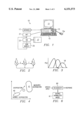
- FIG. 1 is a block diagram of the system according to one embodiment of the present invention.
- FIG. 2 illustrates a speech model
- FIG. 3 illustrates a Gaussian distribution
- FIG. 4 illustrates distortions in the distribution caused by different environments
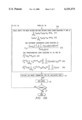
- FIG. 5 is a more detailed flow diagram of the process according to one embodiment of the present invention.
- FIG. 6 is a recognizer according to an embodiment of the present invention using a source normalization model.
- the training is done on a computer workstation which is illustrated in FIG. 1 having a monitor 11, a computer workstation 13, a keyboard 15, and a mouse or other interactive device 15a as shown in FIG. 1.
- the system maybe connected to a separate database represented by database 17 in FIG. 1 for storage and retrieval of models.
- training we mean herein to fix the parameters of the speech models according to an optimum criterion.
- HMM Hidden Markov Models
- FIG. 2 states A, B, and C and transitions E, F, G, H, I and J between states.
- Each of these states has a mixture of Gaussian distributions 18 represented by FIG. 3.
- environment we mean different speaker, handset, transmission channel, and noise background conditions.
- Speech recognizers suffer from environment variability because trained model distributions may be biased from testing signal distributions because of environment mismatch and trained model distributions are flat because they are averaged over different environments.
- the environmental mismatch can be reduced through model adaptation, based on utterances collected in the testing environment.
- Applicant's teaching herein is to solve the second problem by removing the environmental factors from the speech signal during the training procedure. This is source normalization training according to the present invention.
- a maximum likelihood (ML) linear regression (LR) solution to the environmental problem is provided herein where the environment is modeled as hidden (non observable) variable.
- a clean speech pattern distribution 40 will undergo complex distortion with different environments as shown in FIG. 4.
- the two axes represent two parameters which may be, for example, frequency, energy, format, spectral, or cepstral components.
- the FIG. 4 illustrates a change at 41 in the distribution due to background noise or a change in speakers.
- the purpose of the application is to model the distortion.
- the present model assumes the following: 1) the speech signal x is generated by Continuous Density Hidden Markov Model (CDHMM), called source distributions; 2) before being observed, the signal has undergone an environmental transformation, drawn from a set of-transformations, where W je be the transformation on the HMM state j of the environment e; 3) such a transformation is linear, and is independent of the mixture components of the source; and 4) there is a bias vector b ke at the k-th mixture component due to environment e.
- CDHMM Continuous Density Hidden Markov Model
- N be the number of HMM states
- M be the mixture number
- L be the number of environments
- ⁇ s ⁇ ⁇ 1, 2, . . . N ⁇ be the set of states ⁇ m ⁇ ⁇ 1, 2, . . . M ⁇ be the set of mixture indicators
- ⁇ e ⁇ ⁇ 1, 2, . . . L ⁇ be the set of environmental indicators.
- the workstation 13 including a processor contains a program as illustrated that starts with an initial standard HMM model 21 which is to be refined by estimation procedures using Baum-Welch or Estimation-Maximization procedures 23 to get new models 25.
- the program gets training data at database 19 under different environments and this is used in an iterative process to get optimal parameters. From this model we get another model 25 that takes into account environment changes.
- the quantities are defined by probabilities of observing a particular input vector at some particular state for a particular environment given the model.
- the model parameters can be determined by applying generalized EM-procedure with three types of hidden variables: state sequence, mixture component indicators, and environment indicators.
- state sequence e.g., N. M. Laird, and D. B. Rubin, entitled “Maximum Likelihood from Incomplete Data via the EM Algorithm,” Journal of the Royal Statistical Society, 39 (1): 1-38, 1977.
- Applicant teaches the CDHMM formulation from B, Juang, “Maximum-Likelihood Estimation for Mixture Multivariate Stochastic Observation of Markov Chains" (The Bell System Technical Journal, pages 1235-1248, July-August 1985) to be extended to result in the following paragraphs: Denote:
- Equations 7, 8, and 9 are estimations of intermediate quantities.
- Equation 7 is the joint probability of observing the frames from times 1 to t at the state j at time t and for the environment of e given the model ⁇ .
- equations 10-21 are solutions for the quantities in the model.
- the model is specified by the parameters.
- the new model is specified by the new parameters.
- Step 23a the Estimation Maximization 23 procedure starting with (Step 23a) equations 7-9 and re-estimation (Step 23b) equations 10-13 for initial state probability, transition probability, mixture component probability and environment probability.
- the next step (23c) to derive means vector and bias vector by introducing two additional equations 14 and 15 and equation 16-20.
- the next step 23a is to apply linear equations 21 and 22 and solve 21 and 22 jointly for mean vectors and bias vectors and at the same time calculate the variance using equation 23.
- equation 24 which is a system of linear equations will solve for transformation parameters using quantities given by equation 25 and 26. Then we have solved for all the model parameters. Then one replaces the old model parameters by the newly calculated ones (Step 24). Then the process is repeated for all the frames. When this is done for all the frames of the database a new model is formed and then the new models are re-evaluated using the same equation until there is no change beyond a predetermined threshold (Step 27).
- this model is used in a recognizer as shown in FIG. 6 where input speech is applied to a recognizer 60 which used the source normalized HMM model 61 created by the above training to achieve the response.
- the recognition task has 53 commands of 1-4 words. ("call return”, “cancel call return”, “selective call forwarding”, etc.). Utterances are recorded through telephone lines, with a diversity of microphones, including carbon, electret and cordless microphones and hands-free speaker-phones. Some of the training utterances do not correspond to their transcriptions. For example: “call screen” (cancel call screen), “matic call back” (automatic call back), "call tra” (call tracking).
- the speech is 8 kHz sampled with 20 ms frame rate.
- the observation vectors are composed of LPCC (Linear Prediction Coding Coefficients) derived 13-MFCC (Mel-Scale Cepstral Coefficients) plus regression based delta MFCC.
- LPCC Linear Prediction Coding Coefficients
- 13-MFCC Mel-Scale Cepstral Coefficients
- CMN is performed at the utterance level. There are 3505 utterances for training and 720 for speaker-independent testing. The number of utterances per call ranges between 5-30.
- SN performs source-normalized HMM training, where the utterances of a phone-call are assumed to have been generated by a call-dependent acoustic source. Speaker, channel and background noise that are specific to the call is then removed by MLLR. An HMM recognizer is then applied using source parameters. We evaluated a special case, where each call is modeled by one environment.
- AD adapts traditional HMM parameters by unsupervised MLLR.
- 1. Using current HMMs and task grammar to phonetically recognize the test utterances, 2. Mapping the phone labels to a small number (N) of classes, which depends on the amount of data in the test utterances, 3. Estimating the LR using the N-classes and associated test data, 4. Recognizing the test utterances with transformed HMM.
- N small number
- SN+AD refers to AD with initial models trained by SN technique.
- AD using acoustic models trained with SN procedure always gives additional error reduction.
Landscapes
- Engineering & Computer Science (AREA)
- Physics & Mathematics (AREA)
- Multimedia (AREA)
- Health & Medical Sciences (AREA)
- Audiology, Speech & Language Pathology (AREA)
- Human Computer Interaction (AREA)
- Artificial Intelligence (AREA)
- Acoustics & Sound (AREA)
- Computational Linguistics (AREA)
- Machine Translation (AREA)
- Soundproofing, Sound Blocking, And Sound Damping (AREA)
- Interconnected Communication Systems, Intercoms, And Interphones (AREA)
- Measurement Of Mechanical Vibrations Or Ultrasonic Waves (AREA)
- Complex Calculations (AREA)
- Telephonic Communication Services (AREA)
Abstract
Description
o.sub.t =W.sub.je x.sub.t +b.sub.ke (1)
b.sub.jke (o.sub.t)Δp(o.sub.t |θ.sub.t =j,ξ.sub.t =k,φ=e,λ) (3) ##EQU2##
u.sub.i Δp(θ.sub.1 =i),a.sub.ij Δp(θ.sub.t+1 =j|θ.sub.t =i) (5)
c.sub.jk Δp(ξ.sub.t =k|θ.sub.t =j,λ),l.sub.e Δp(φ=e|λ) (6)
α.sub.t (j,e)Δp(o.sub.1.sup.t,θ.sub.t =j,φ=e|λ) (7)
β.sub.t (j,e)Δp(o.sub.t+1.sup.T |θ.sub.t =j,φ=e,λ) (8)
γ.sub.t (j,k,e)Δp(θ.sub.t =j,ξ.sub.t =k,φ=e|O,λ) (9)
Z.sub.je.sup.(m) =W.sub.je.sup.(m) R.sub.je (m) (24)
TABLE 1
______________________________________
Word error rate (%) as function of test configuration and
number of mixture components per state.
4 8 16 32
______________________________________
baseline 7.85 6.94 6.83 5.98
SN 7.53 6.35 6.51 6.03
AD 7.15 6.41 5.61 5.87
SN + AD 6.99 6.03 5.41 4.64
______________________________________
Claims (6)
Priority Applications (2)
| Application Number | Priority Date | Filing Date | Title |
|---|---|---|---|
| US09/134,775 US6151573A (en) | 1997-09-17 | 1998-08-15 | Source normalization training for HMM modeling of speech |
| US09/589,252 US6980952B1 (en) | 1998-08-15 | 2000-06-07 | Source normalization training for HMM modeling of speech |
Applications Claiming Priority (2)
| Application Number | Priority Date | Filing Date | Title |
|---|---|---|---|
| US5918097P | 1997-09-17 | 1997-09-17 | |
| US09/134,775 US6151573A (en) | 1997-09-17 | 1998-08-15 | Source normalization training for HMM modeling of speech |
Related Child Applications (1)
| Application Number | Title | Priority Date | Filing Date |
|---|---|---|---|
| US09/589,252 Division US6980952B1 (en) | 1998-08-15 | 2000-06-07 | Source normalization training for HMM modeling of speech |
Publications (1)
| Publication Number | Publication Date |
|---|---|
| US6151573A true US6151573A (en) | 2000-11-21 |
Family
ID=22021325
Family Applications (1)
| Application Number | Title | Priority Date | Filing Date |
|---|---|---|---|
| US09/134,775 Expired - Lifetime US6151573A (en) | 1997-09-17 | 1998-08-15 | Source normalization training for HMM modeling of speech |
Country Status (3)
| Country | Link |
|---|---|
| US (1) | US6151573A (en) |
| EP (1) | EP0913809B1 (en) |
| DE (1) | DE69823954T2 (en) |
Cited By (21)
| Publication number | Priority date | Publication date | Assignee | Title |
|---|---|---|---|---|
| US20010025240A1 (en) * | 2000-02-25 | 2001-09-27 | Bartosik Heinrich Franz | Speech recognition device with reference transformation means |
| US20020016782A1 (en) * | 1996-05-02 | 2002-02-07 | Cooper David L. | Method and apparatus for fractal computation |
| US6377924B1 (en) * | 1999-03-12 | 2002-04-23 | Texas Instruments Incorporated | Method of enrolling phone-based speaker specific commands |
| US6381571B1 (en) * | 1998-05-01 | 2002-04-30 | Texas Instruments Incorporated | Sequential determination of utterance log-spectral mean by maximum a posteriori probability estimation |
| US20020059068A1 (en) * | 2000-10-13 | 2002-05-16 | At&T Corporation | Systems and methods for automatic speech recognition |
| US6418411B1 (en) * | 1999-03-12 | 2002-07-09 | Texas Instruments Incorporated | Method and system for adaptive speech recognition in a noisy environment |
| US20030065514A1 (en) * | 2001-08-21 | 2003-04-03 | International Business Machines Corporation | Method and apparatus for handset detection |
| US20040059576A1 (en) * | 2001-06-08 | 2004-03-25 | Helmut Lucke | Voice recognition apparatus and voice recognition method |
| US20050071157A1 (en) * | 2001-09-27 | 2005-03-31 | Microsoft Corporation | Method and apparatus for identifying noise environments from noisy signals |
| US6920421B2 (en) * | 1999-12-28 | 2005-07-19 | Sony Corporation | Model adaptive apparatus for performing adaptation of a model used in pattern recognition considering recentness of a received pattern data |
| US20050216266A1 (en) * | 2004-03-29 | 2005-09-29 | Yifan Gong | Incremental adjustment of state-dependent bias parameters for adaptive speech recognition |
| US6980952B1 (en) * | 1998-08-15 | 2005-12-27 | Texas Instruments Incorporated | Source normalization training for HMM modeling of speech |
| US20070198261A1 (en) * | 2006-02-21 | 2007-08-23 | Sony Computer Entertainment Inc. | Voice recognition with parallel gender and age normalization |
| US20070198263A1 (en) * | 2006-02-21 | 2007-08-23 | Sony Computer Entertainment Inc. | Voice recognition with speaker adaptation and registration with pitch |
| US20110035216A1 (en) * | 2009-08-05 | 2011-02-10 | Tze Fen Li | Speech recognition method for all languages without using samples |
| US7970613B2 (en) | 2005-11-12 | 2011-06-28 | Sony Computer Entertainment Inc. | Method and system for Gaussian probability data bit reduction and computation |
| US20120116764A1 (en) * | 2010-11-09 | 2012-05-10 | Tze Fen Li | Speech recognition method on sentences in all languages |
| US8442829B2 (en) | 2009-02-17 | 2013-05-14 | Sony Computer Entertainment Inc. | Automatic computation streaming partition for voice recognition on multiple processors with limited memory |
| US8442833B2 (en) | 2009-02-17 | 2013-05-14 | Sony Computer Entertainment Inc. | Speech processing with source location estimation using signals from two or more microphones |
| US8788256B2 (en) | 2009-02-17 | 2014-07-22 | Sony Computer Entertainment Inc. | Multiple language voice recognition |
| US9153235B2 (en) | 2012-04-09 | 2015-10-06 | Sony Computer Entertainment Inc. | Text dependent speaker recognition with long-term feature based on functional data analysis |
Families Citing this family (10)
| Publication number | Priority date | Publication date | Assignee | Title |
|---|---|---|---|---|
| US6282507B1 (en) | 1999-01-29 | 2001-08-28 | Sony Corporation | Method and apparatus for interactive source language expression recognition and alternative hypothesis presentation and selection |
| US6356865B1 (en) | 1999-01-29 | 2002-03-12 | Sony Corporation | Method and apparatus for performing spoken language translation |
| US6278968B1 (en) | 1999-01-29 | 2001-08-21 | Sony Corporation | Method and apparatus for adaptive speech recognition hypothesis construction and selection in a spoken language translation system |
| US6243669B1 (en) | 1999-01-29 | 2001-06-05 | Sony Corporation | Method and apparatus for providing syntactic analysis and data structure for translation knowledge in example-based language translation |
| US6223150B1 (en) | 1999-01-29 | 2001-04-24 | Sony Corporation | Method and apparatus for parsing in a spoken language translation system |
| US6266642B1 (en) | 1999-01-29 | 2001-07-24 | Sony Corporation | Method and portable apparatus for performing spoken language translation |
| US6442524B1 (en) | 1999-01-29 | 2002-08-27 | Sony Corporation | Analyzing inflectional morphology in a spoken language translation system |
| US6374224B1 (en) | 1999-03-10 | 2002-04-16 | Sony Corporation | Method and apparatus for style control in natural language generation |
| US7089183B2 (en) * | 2000-08-02 | 2006-08-08 | Texas Instruments Incorporated | Accumulating transformations for hierarchical linear regression HMM adaptation |
| US7457750B2 (en) | 2000-10-13 | 2008-11-25 | At&T Corp. | Systems and methods for dynamic re-configurable speech recognition |
Citations (2)
| Publication number | Priority date | Publication date | Assignee | Title |
|---|---|---|---|---|
| US5222146A (en) * | 1991-10-23 | 1993-06-22 | International Business Machines Corporation | Speech recognition apparatus having a speech coder outputting acoustic prototype ranks |
| US5727124A (en) * | 1994-06-21 | 1998-03-10 | Lucent Technologies, Inc. | Method of and apparatus for signal recognition that compensates for mismatching |
-
1998
- 1998-08-15 US US09/134,775 patent/US6151573A/en not_active Expired - Lifetime
- 1998-08-26 DE DE69823954T patent/DE69823954T2/en not_active Expired - Lifetime
- 1998-08-26 EP EP98202871A patent/EP0913809B1/en not_active Expired - Lifetime
Patent Citations (2)
| Publication number | Priority date | Publication date | Assignee | Title |
|---|---|---|---|---|
| US5222146A (en) * | 1991-10-23 | 1993-06-22 | International Business Machines Corporation | Speech recognition apparatus having a speech coder outputting acoustic prototype ranks |
| US5727124A (en) * | 1994-06-21 | 1998-03-10 | Lucent Technologies, Inc. | Method of and apparatus for signal recognition that compensates for mismatching |
Non-Patent Citations (8)
| Title |
|---|
| Alejandro Acero et al., "Speaker and Gender Normalization for Continuous-Density Hidden Markov Models," Proceedings IEEE International Conference on Acoustics, Speech, and Signal Processing, vol. 1, 7-10, pp. 342-345, May 1996. |
| Alejandro Acero et al., Speaker and Gender Normalization for Continuous Density Hidden Markov Models, Proceedings IEEE International Conference on Acoustics, Speech, and Signal Processing, vol. 1, 7 10, pp. 342 345, May 1996. * |
| Anastasakos et al., A Compact Model for Speaker Adaptive Training, BBN Systems and Technologies, pp. 1137 1140, Oct. 1996. * |
| Anastasakos et al., A Compact Model for Speaker-Adaptive Training, BBN Systems and Technologies, pp. 1137-1140, Oct. 1996. |
| Jun Ishii and Masahiro Tonomura, "Speaker Normalization and Adaptation Based on Linear Transformation," Proceedings IEEE International Conference on Acoustics, Speech, and Signal Processing, vol. 2, 21-24, pp. 1055-1058, Apr. 1997. |
| Jun Ishii and Masahiro Tonomura, Speaker Normalization and Adaptation Based on Linear Transformation, Proceedings IEEE International Conference on Acoustics, Speech, and Signal Processing, vol. 2, 21 24, pp. 1055 1058, Apr. 1997. * |
| Tasos Anastasakos et al., "A Compact Model for Speaker-Adaptive Training," Proceedings International Conference on Spoken Language Processing, vol. 2, 3-6, pp. 1137-1140, Oct. 1996. |
| Tasos Anastasakos et al., A Compact Model for Speaker Adaptive Training, Proceedings International Conference on Spoken Language Processing, vol. 2, 3 6, pp. 1137 1140, Oct. 1996. * |
Cited By (35)
| Publication number | Priority date | Publication date | Assignee | Title |
|---|---|---|---|---|
| US20020016782A1 (en) * | 1996-05-02 | 2002-02-07 | Cooper David L. | Method and apparatus for fractal computation |
| US7469237B2 (en) | 1996-05-02 | 2008-12-23 | Cooper David L | Method and apparatus for fractal computation |
| US6381571B1 (en) * | 1998-05-01 | 2002-04-30 | Texas Instruments Incorporated | Sequential determination of utterance log-spectral mean by maximum a posteriori probability estimation |
| US6980952B1 (en) * | 1998-08-15 | 2005-12-27 | Texas Instruments Incorporated | Source normalization training for HMM modeling of speech |
| US6377924B1 (en) * | 1999-03-12 | 2002-04-23 | Texas Instruments Incorporated | Method of enrolling phone-based speaker specific commands |
| US6418411B1 (en) * | 1999-03-12 | 2002-07-09 | Texas Instruments Incorporated | Method and system for adaptive speech recognition in a noisy environment |
| US6920421B2 (en) * | 1999-12-28 | 2005-07-19 | Sony Corporation | Model adaptive apparatus for performing adaptation of a model used in pattern recognition considering recentness of a received pattern data |
| US7043425B2 (en) | 1999-12-28 | 2006-05-09 | Sony Corporation | Model adaptive apparatus and model adaptive method, recording medium, and pattern recognition apparatus |
| US20050171767A1 (en) * | 1999-12-28 | 2005-08-04 | Hongchang Pao | Model adaptive apparatus and model adaptive method, recording medium, and pattern recognition apparatus |
| US20010025240A1 (en) * | 2000-02-25 | 2001-09-27 | Bartosik Heinrich Franz | Speech recognition device with reference transformation means |
| US7146317B2 (en) * | 2000-02-25 | 2006-12-05 | Koninklijke Philips Electronics N.V. | Speech recognition device with reference transformation means |
| US20090063144A1 (en) * | 2000-10-13 | 2009-03-05 | At&T Corp. | System and method for providing a compensated speech recognition model for speech recognition |
| US7451085B2 (en) * | 2000-10-13 | 2008-11-11 | At&T Intellectual Property Ii, L.P. | System and method for providing a compensated speech recognition model for speech recognition |
| US7996220B2 (en) | 2000-10-13 | 2011-08-09 | At&T Intellectual Property Ii, L.P. | System and method for providing a compensated speech recognition model for speech recognition |
| US20020059068A1 (en) * | 2000-10-13 | 2002-05-16 | At&T Corporation | Systems and methods for automatic speech recognition |
| US20040059576A1 (en) * | 2001-06-08 | 2004-03-25 | Helmut Lucke | Voice recognition apparatus and voice recognition method |
| US7219055B2 (en) * | 2001-06-08 | 2007-05-15 | Sony Corporation | Speech recognition apparatus and method adapting best transformation function to transform one of the input speech and acoustic model |
| US6778957B2 (en) * | 2001-08-21 | 2004-08-17 | International Business Machines Corporation | Method and apparatus for handset detection |
| US20030065514A1 (en) * | 2001-08-21 | 2003-04-03 | International Business Machines Corporation | Method and apparatus for handset detection |
| US20050071157A1 (en) * | 2001-09-27 | 2005-03-31 | Microsoft Corporation | Method and apparatus for identifying noise environments from noisy signals |
| US7266494B2 (en) * | 2001-09-27 | 2007-09-04 | Microsoft Corporation | Method and apparatus for identifying noise environments from noisy signals |
| US20050216266A1 (en) * | 2004-03-29 | 2005-09-29 | Yifan Gong | Incremental adjustment of state-dependent bias parameters for adaptive speech recognition |
| US7970613B2 (en) | 2005-11-12 | 2011-06-28 | Sony Computer Entertainment Inc. | Method and system for Gaussian probability data bit reduction and computation |
| US8050922B2 (en) | 2006-02-21 | 2011-11-01 | Sony Computer Entertainment Inc. | Voice recognition with dynamic filter bank adjustment based on speaker categorization |
| US20070198261A1 (en) * | 2006-02-21 | 2007-08-23 | Sony Computer Entertainment Inc. | Voice recognition with parallel gender and age normalization |
| US7778831B2 (en) | 2006-02-21 | 2010-08-17 | Sony Computer Entertainment Inc. | Voice recognition with dynamic filter bank adjustment based on speaker categorization determined from runtime pitch |
| US8010358B2 (en) | 2006-02-21 | 2011-08-30 | Sony Computer Entertainment Inc. | Voice recognition with parallel gender and age normalization |
| US20070198263A1 (en) * | 2006-02-21 | 2007-08-23 | Sony Computer Entertainment Inc. | Voice recognition with speaker adaptation and registration with pitch |
| US8442829B2 (en) | 2009-02-17 | 2013-05-14 | Sony Computer Entertainment Inc. | Automatic computation streaming partition for voice recognition on multiple processors with limited memory |
| US8442833B2 (en) | 2009-02-17 | 2013-05-14 | Sony Computer Entertainment Inc. | Speech processing with source location estimation using signals from two or more microphones |
| US8788256B2 (en) | 2009-02-17 | 2014-07-22 | Sony Computer Entertainment Inc. | Multiple language voice recognition |
| US20110035216A1 (en) * | 2009-08-05 | 2011-02-10 | Tze Fen Li | Speech recognition method for all languages without using samples |
| US8145483B2 (en) * | 2009-08-05 | 2012-03-27 | Tze Fen Li | Speech recognition method for all languages without using samples |
| US20120116764A1 (en) * | 2010-11-09 | 2012-05-10 | Tze Fen Li | Speech recognition method on sentences in all languages |
| US9153235B2 (en) | 2012-04-09 | 2015-10-06 | Sony Computer Entertainment Inc. | Text dependent speaker recognition with long-term feature based on functional data analysis |
Also Published As
| Publication number | Publication date |
|---|---|
| EP0913809A3 (en) | 2000-01-12 |
| DE69823954T2 (en) | 2005-07-14 |
| DE69823954D1 (en) | 2004-06-24 |
| EP0913809A2 (en) | 1999-05-06 |
| EP0913809B1 (en) | 2004-05-19 |
Similar Documents
| Publication | Publication Date | Title |
|---|---|---|
| US6151573A (en) | Source normalization training for HMM modeling of speech | |
| US6980952B1 (en) | Source normalization training for HMM modeling of speech | |
| EP0886263B1 (en) | Environmentally compensated speech processing | |
| US6389393B1 (en) | Method of adapting speech recognition models for speaker, microphone, and noisy environment | |
| Viikki et al. | A recursive feature vector normalization approach for robust speech recognition in noise | |
| Shinoda et al. | Structural MAP speaker adaptation using hierarchical priors | |
| CA2233728C (en) | Multiple models integration for multi-environment speech recognition | |
| CA2177638C (en) | Utterance verification using word based minimum verification error training for recognizing a keyword string | |
| US20080300875A1 (en) | Efficient Speech Recognition with Cluster Methods | |
| US20030115055A1 (en) | Method of speech recognition resistant to convolutive distortion and additive distortion | |
| EP1116219B1 (en) | Robust speech processing from noisy speech models | |
| Anastasakos et al. | The use of confidence measures in unsupervised adaptation of speech recognizers. | |
| Takahashi et al. | Vector-field-smoothed Bayesian learning for fast and incremental speaker/telephone-channel adaptation | |
| Shinoda et al. | Unsupervised adaptation using structural Bayes approach | |
| US20020013697A1 (en) | Log-spectral compensation of gaussian mean vectors for noisy speech recognition | |
| Sankar et al. | Stochastic matching for robust speech recognition | |
| Gong | Source normalization training for HMM applied to noisy telephone speech recognition. | |
| Lawrence et al. | Integrated bias removal techniques for robust speech recognition | |
| Seltzer et al. | Speech-recognizer-based filter optimization for microphone array processing | |
| Gong et al. | Transforming HMMs for speaker-independent hands-free speech recognition in the car | |
| Ming et al. | Union: a model for partial temporal corruption of speech | |
| Rose et al. | A user-configurable system for voice label recognition | |
| Chien et al. | Bayesian affine transformation of HMM parameters for instantaneous and supervised adaptation in telephone speech recognition. | |
| Jung et al. | Speaker Adaptation Using ICA‐Based Feature Transformation | |
| Mizuta et al. | A discriminative training method for continuous mixture density HMMs and its implementation to recognize noisy speech |
Legal Events
| Date | Code | Title | Description |
|---|---|---|---|
| AS | Assignment |
Owner name: TEXAS INSTRUMENTS INCORPORATED, TEXAS Free format text: ASSIGNMENT OF ASSIGNORS INTEREST;ASSIGNOR:GONG, YIFAN;REEL/FRAME:009397/0178 Effective date: 19970929 |
|
| STCF | Information on status: patent grant |
Free format text: PATENTED CASE |
|
| FPAY | Fee payment |
Year of fee payment: 4 |
|
| FPAY | Fee payment |
Year of fee payment: 8 |
|
| FPAY | Fee payment |
Year of fee payment: 12 |
|
| FEPP | Fee payment procedure |
Free format text: PAYER NUMBER DE-ASSIGNED (ORIGINAL EVENT CODE: RMPN); ENTITY STATUS OF PATENT OWNER: LARGE ENTITY Free format text: PAYOR NUMBER ASSIGNED (ORIGINAL EVENT CODE: ASPN); ENTITY STATUS OF PATENT OWNER: LARGE ENTITY |
|
| AS | Assignment |
Owner name: INTEL CORPORATION, CALIFORNIA Free format text: ASSIGNMENT OF ASSIGNORS INTEREST;ASSIGNOR:TEXAS INSTRUMENTS INCORPORATED;REEL/FRAME:041383/0040 Effective date: 20161223 |