US6150656A - Method of assembly and inspection for a gas turbine engine - Google Patents

Method of assembly and inspection for a gas turbine engine Download PDF

Info

Publication number
US6150656A
US6150656A US09/208,642 US20864298A US6150656A US 6150656 A US6150656 A US 6150656A US 20864298 A US20864298 A US 20864298A US 6150656 A US6150656 A US 6150656A
Authority
US
United States
Prior art keywords
lock
wire
component
gas turbine
turbine engine
Prior art date
Legal status (The legal status is an assumption and is not a legal conclusion. Google has not performed a legal analysis and makes no representation as to the accuracy of the status listed.)
Expired - Lifetime
Application number
US09/208,642
Inventor
Michael P. Garrity
Current Assignee (The listed assignees may be inaccurate. Google has not performed a legal analysis and makes no representation or warranty as to the accuracy of the list.)
RTX Corp
Original Assignee
United Technologies Corp
Priority date (The priority date is an assumption and is not a legal conclusion. Google has not performed a legal analysis and makes no representation as to the accuracy of the date listed.)
Filing date
Publication date
Application filed by United Technologies Corp filed Critical United Technologies Corp
Priority to US09/208,642 priority Critical patent/US6150656A/en
Assigned to UNITED TECHNOLOGIES CORPORATION reassignment UNITED TECHNOLOGIES CORPORATION ASSIGNMENT OF ASSIGNORS INTEREST (SEE DOCUMENT FOR DETAILS). Assignors: GARRITY, MICHAEL P.
Application granted granted Critical
Publication of US6150656A publication Critical patent/US6150656A/en
Anticipated expiration legal-status Critical
Expired - Lifetime legal-status Critical Current

Links

Images

Classifications

    • FMECHANICAL ENGINEERING; LIGHTING; HEATING; WEAPONS; BLASTING
    • F16ENGINEERING ELEMENTS AND UNITS; GENERAL MEASURES FOR PRODUCING AND MAINTAINING EFFECTIVE FUNCTIONING OF MACHINES OR INSTALLATIONS; THERMAL INSULATION IN GENERAL
    • F16BDEVICES FOR FASTENING OR SECURING CONSTRUCTIONAL ELEMENTS OR MACHINE PARTS TOGETHER, e.g. NAILS, BOLTS, CIRCLIPS, CLAMPS, CLIPS OR WEDGES; JOINTS OR JOINTING
    • F16B39/00Locking of screws, bolts or nuts
    • F16B39/02Locking of screws, bolts or nuts in which the locking takes place after screwing down
    • F16B39/10Locking of screws, bolts or nuts in which the locking takes place after screwing down by a plate, spring, wire or ring immovable with regard to the bolt or object and mainly perpendicular to the axis of the bolt
    • F16B39/101Locking of screws, bolts or nuts in which the locking takes place after screwing down by a plate, spring, wire or ring immovable with regard to the bolt or object and mainly perpendicular to the axis of the bolt with a plate, spring, wire or ring holding two or more nuts or bolt heads which are mainly in the same plane
    • FMECHANICAL ENGINEERING; LIGHTING; HEATING; WEAPONS; BLASTING
    • F05INDEXING SCHEMES RELATING TO ENGINES OR PUMPS IN VARIOUS SUBCLASSES OF CLASSES F01-F04
    • F05BINDEXING SCHEME RELATING TO WIND, SPRING, WEIGHT, INERTIA OR LIKE MOTORS, TO MACHINES OR ENGINES FOR LIQUIDS COVERED BY SUBCLASSES F03B, F03D AND F03G
    • F05B2260/00Function
    • F05B2260/30Retaining components in desired mutual position
    • F05B2260/301Retaining bolts or nuts
    • GPHYSICS
    • G01MEASURING; TESTING
    • G01NINVESTIGATING OR ANALYSING MATERIALS BY DETERMINING THEIR CHEMICAL OR PHYSICAL PROPERTIES
    • G01N21/00Investigating or analysing materials by the use of optical means, i.e. using sub-millimetre waves, infrared, visible or ultraviolet light
    • G01N21/84Systems specially adapted for particular applications
    • G01N21/88Investigating the presence of flaws or contamination
    • G01N21/91Investigating the presence of flaws or contamination using penetration of dyes, e.g. fluorescent ink

Definitions

  • the invention relates to methods for assembly and inspection of a gas turbine engine and more particularly to methods for assembly and inspection of supplemental restraining devices, e.g., lock-wires, on components of a gas turbine engine.
  • supplemental restraining devices e.g., lock-wires
  • a gas turbine engine has various components, e.g., fasteners, plugs, etc., that unless restrained can loosen and disengage due to vibration. Consequently, it has for many decades been a standard practice in the engine industry to install a supplemental restraining device such as lock-wire to prevent such components from loosening.
  • a supplemental restraining device such as lock-wire to prevent such components from loosening.
  • lock-wire There are various types of lock-wire, including but not limited to types referred to as safety wire and Bergen cable.
  • lock-wire Even though lock-wire has been used for many decades, the installation of lock-wires remains time consuming and difficult.
  • a single engine may have hundreds or thousands of components that require lock-wire.
  • the lock-wires are installed after the components have been attached to the engine.
  • a mechanic uses a manual to determine the part numbers and the locations of the components that require lock-wire. The mechanic must then locate the components and install the lock-wires.
  • most of the components on the engine are metallic or gray in color and thus visually blend together, thereby making it difficult to locate the components that require lock-wire.
  • a number of the components that require lock-wire are underneath the engine or behind other components and thus not readily visible.
  • An object of the present invention is to aid installation and inspection of supplemental restraining devices, e.g., lock-wires, by reducing the difficulty associated with locating the components that require supplemental restraining devices.
  • supplemental restraining devices e.g., lock-wires
  • the present invention is predicated in part on the recognition that the time and the difficulty associated with locating components that require supplemental restraining devices can be reduced by increasing the visibility of the components that require supplemental restraining devices and at the same time decreasing the visibility of the surrounding components that do not require supplemental restraining devices.
  • a method of locating a component requiring a supplemental restraining device on a portion of a gas turbine engine includes applying a fluorescent material to the component, and irradiating the component and surrounding components on the portion of the gas turbine engine with electromagnetic radiation that causes the fluorescent material to emit visible light and thereby increase the visibility of the component, and in addition, the electromagnetic radiation causing a decrease in the visibility of any surrounding components that do not have a fluorescent material.
  • the supplemental restraining device is a lock-wire.
  • applying a fluorescent material includes applying a fluorescent dye coating.
  • the electromagnetic radiation is ultraviolet light generated by a black light.
  • ambient lighting around the portion of the gas turbine engine is maintained at least in part.
  • a method of locating a component requiring a supplemental restraining device on a portion of a gas turbine engine includes applying a fluorescent material to the component, and irradiating the component and surrounding components on the portion of the gas turbine engine with ultraviolet light that causes the fluorescent material to emit visible light and thereby increase the visibility of the component relative to any surrounding components that do not have a fluorescent material.
  • a method of assembly includes locating a component that is to receive a lock-wire and installing a lock-wire that in the presence of the electromagnetic radiation has a visibly contrasting appearance compared to that of the component requiring a lock-wire.
  • a method of inspecting includes locating a component that requires a lock-wire, irradiating with the electromagnetic radiation, and inspecting for the presence of a visibly contrasting appearance.
  • a primary advantage of the present invention is a reduction in the difficulty associated with locating the components that require supplemental restraining devices on gas turbine engines, thereby aiding installation and inspection of the supplemental restraining devices.
  • FIG. 1 is a perspective view of a gas turbine aircraft engine and a fuel manifold thereof;
  • FIG. 2 is a perspective view of a portion of the fuel manifold of FIG. 1 in an assembly stage
  • FIG. 3 is a perspective view of a threaded, collared nut used to retain a fuel line to the fuel manifold of FIG. 1;
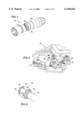
  • FIG. 4 is a perspective view of a portion of the fuel manifold of FIG. 1 showing components that require lock-wire and have a fluorescent dye coating as well as surrounding components that do not require lock-wire and do not have a fluorescent dye coating, and an electromagnetic radiation source that generates electromagnetic radiation to excite the fluorescent dye in the coatings;
  • FIG. 5 is a perspective view of the nut of FIG. 3 and a lock-wire installed in the nut;
  • FIG. 6 is a perspective view of the nut and lock-wire of FIG. 3 during irradiation by the electromagnetic radiation of FIG. 4.
  • the present invention is disclosed herein with respect to an embodiment for use in installing and inspecting lock-wires on fasteners used on a fuel manifold of a gas turbine engine 20 represented in FIG. 1.
  • FIG. 1 is a side elevation view of a gas turbine engine 20 for powering an aircraft.
  • the engine 20 includes a compressor section 24, a combustor section 26, and a turbine section 28.
  • the combustor section 26 has a fuel manifold 30.
  • the fuel manifold 30 has a plurality of components. Some of the plurality of components require but do not yet have lock-wire installed.
  • the components that require lock-wire are of various types including plugs 32, and fasteners (e.g., bolts 34 and nuts 36).
  • One of the components requiring lock-wire is a nut 40 that retains a fuel line 42 to the fuel manifold 30.
  • the nut 40 has one end 44 with a collar and one threaded end 46.
  • the end 44 engages the fuel line 42
  • the threaded end 46 (threads shown in phantom) engages the fuel manifold 30.
  • the nut 40 further has a surface 48 and a hole 50 that extends from one part of the surface to another part of the surface.
  • the hole 50 is to adapted to receive a lock-wire.
  • the components that require lock-wire must be located on the fuel manifold 30 in order to install the lock-wires.
  • most of the components on the fuel manifold 30 are metallic or gray in color and thus visually blend together, thereby making it difficult to locate some or all of the components that require lock-wire.
  • each of such components comprises a fluorescent material preferably in the form of a coating on the surface of the component.
  • the coating comprises a fluorescent dye and is applied in any suitable manner including but not limited to brushing, spraying, dipping, forming, and combinations thereof.
  • the coating is preferably applied prior to assembling the component to the fuel manifold 30.
  • the fluorescent dye may have any suitable color including but not limited to fluorescent green. Fluorescent dyes are typically barely visible in daylight and the ambient light of the assembly area. Note that the ambient light in the assembly area is typical of that found in gas turbine engine assembly areas.
  • At least a portion of the portion of the fuel manifold 30 is irradiated with electromagnetic radiation 60.
  • the ambient lighting in the assembly area is preferably maintained, at least in part, so as not to result in a safety hazard around the engine.
  • an irradiated component has a fluorescent dye coating
  • the electromagnetic radiation excites the fluorescent dye in the coating, resulting in a fluorescent emission from the coating.
  • the fluorescent emission increases the visibility of these component 32, 34, 36, 40 and increases the visibility of these components relative to any surrounding components that do not have a fluorescent material.
  • the electromagnetic radiation 60 may be generated by any suitable electromagnetic radiation source 62 including but not limited to a black light that produces ultraviolet light.
  • the electromagnetic radiation source 62 may be hand held or mounted on a stand 64.
  • the stand 64 may be a stationary stand or a portable one.
  • the electromagnetic radiation source 62 may have any suitable power and may be located it any suitable distance from the portion of the fuel manifold 30.
  • the fuel manifold 30 is moved to a dedicated area outfitted with at least one electromagnetic radiation source.
  • a lock-wire 70 is installed. Although this step may be performed while irradiating with the electromagnetic radiation, it may alternatively be performed without the irradiation if normal visibility is desired.
  • the lock-wire 70 further attaches to at least one other component on the manifold 30 to prevent the component requiring lock-wire, e.g., the nut 40, from loosening due to vibration.
  • Components requiring lock-wire may be located in the same manner as that described above with respect to locating components prior to installation of the lock-wires. Note that the ambient lighting in the area is preferably maintained, at least in part, so as not to result in a safety hazard around the engine.
  • the component After locating a component that requires a lock-wire, the component is inspected to confirm that a lock-wire is properly installed. Although this step may be performed while irradiating with the electromagnetic radiation, it may alternatively be performed without the irradiation if normal visibility is desired. A flashlight (not shown) may be used to produce additional visible light if needed.
  • the above step may be performed while irradiating with the electromagnetic radiation 60 as follows.
  • the electromagnetic radiation 60 causes the coating to produce a fluorescent emission.
  • the lock-wire 70 has a portion 72 having a visibly contrasting appearance on the nut 40, and at least a portion of the lock-wire 70 is within the hole 50 of the component such that the portion is visibly obscured to some degree.
  • the presence of the visibly contrasting appearance and the obscured portion of the lock-wire indicates that a lock-wire is installed.
  • an absence of the contrasting appearance or the obscured portion of the lock-wire indicates that a lock-wire is not installed.
  • the lock-wire comprises a fluorescent material preferably in the form of a fluorescent dye coating.
  • the fluorescent dye in the coating applied to the lock-wire may contrast with the color of the fluorescent dye in the coatings of the components requiring lock-wire. In the latter case, if the components requiring lock-wire have a green colored fluorescent dye, the coating for the lock-wire may for example have an orange colored fluorescent dye.
  • the present invention may be used to identify components that require any type of supplemental restraining device to prevent the component from loosening including but not limited to lock-wire, nuts, bolts, screws, pins, pegs, and springs.
  • the present invention may be used to locate components on any portion of the engine.
  • the portion may be of any size and may or may not be part of a fully assembled engine at the time.

Landscapes

  • Engineering & Computer Science (AREA)
  • General Engineering & Computer Science (AREA)
  • Mechanical Engineering (AREA)
  • Investigating Materials By The Use Of Optical Means Adapted For Particular Applications (AREA)
  • Investigating, Analyzing Materials By Fluorescence Or Luminescence (AREA)

Abstract

A method of locating a component requiring a supplemental restraining device on a portion of a gas turbine engine includes applying a fluorescent material to the component, and irradiating the component and surrounding components on the portion of the gas turbine engine with electromagnetic radiation that causes the fluorescent material to emit visible light and thereby increase the visibility of the component. The method may be used to install and/or inspect a lock-wire that in the presence of the electromagnetic radiation has a visibly contrasting appearance compared to that of the component requiring a lock-wire.

Description

TECHNICAL FIELD
The invention relates to methods for assembly and inspection of a gas turbine engine and more particularly to methods for assembly and inspection of supplemental restraining devices, e.g., lock-wires, on components of a gas turbine engine.
BACKGROUND ART
A gas turbine engine has various components, e.g., fasteners, plugs, etc., that unless restrained can loosen and disengage due to vibration. Consequently, it has for many decades been a standard practice in the engine industry to install a supplemental restraining device such as lock-wire to prevent such components from loosening. There are various types of lock-wire, including but not limited to types referred to as safety wire and Bergen cable.
Even though lock-wire has been used for many decades, the installation of lock-wires remains time consuming and difficult. A single engine may have hundreds or thousands of components that require lock-wire. To avoid having the lock-wires cause obstruction or injury during assembly of the engine, the lock-wires are installed after the components have been attached to the engine. A mechanic uses a manual to determine the part numbers and the locations of the components that require lock-wire. The mechanic must then locate the components and install the lock-wires. However, most of the components on the engine are metallic or gray in color and thus visually blend together, thereby making it difficult to locate the components that require lock-wire. Furthermore, a number of the components that require lock-wire are underneath the engine or behind other components and thus not readily visible.
The inspection of lock-wires is also time consuming and difficult. Inspections are traditionally performed to determine whether lock-wires are installed on all of the components requiring one. However, in the course of the inspection, the inspector must locate each component that requires lock-wire using the same procedure as that used by the mechanic who installs the lock-wires.
DISCLOSURE OF THE INVENTION
An object of the present invention is to aid installation and inspection of supplemental restraining devices, e.g., lock-wires, by reducing the difficulty associated with locating the components that require supplemental restraining devices.
The present invention is predicated in part on the recognition that the time and the difficulty associated with locating components that require supplemental restraining devices can be reduced by increasing the visibility of the components that require supplemental restraining devices and at the same time decreasing the visibility of the surrounding components that do not require supplemental restraining devices.
According to a first aspect of the present invention, a method of locating a component requiring a supplemental restraining device on a portion of a gas turbine engine includes applying a fluorescent material to the component, and irradiating the component and surrounding components on the portion of the gas turbine engine with electromagnetic radiation that causes the fluorescent material to emit visible light and thereby increase the visibility of the component, and in addition, the electromagnetic radiation causing a decrease in the visibility of any surrounding components that do not have a fluorescent material.
In accordance with one detailed aspect of the present invention, the supplemental restraining device is a lock-wire.
In accordance with another detailed aspect of the present invention, applying a fluorescent material includes applying a fluorescent dye coating.
In accordance with another detailed aspect of the present invention, the electromagnetic radiation is ultraviolet light generated by a black light.
In accordance with another detailed aspect of the present invention, ambient lighting around the portion of the gas turbine engine is maintained at least in part.
According to a second aspect of the present invention, a method of locating a component requiring a supplemental restraining device on a portion of a gas turbine engine includes applying a fluorescent material to the component, and irradiating the component and surrounding components on the portion of the gas turbine engine with ultraviolet light that causes the fluorescent material to emit visible light and thereby increase the visibility of the component relative to any surrounding components that do not have a fluorescent material.
According to a third aspect of the present invention, a method of assembly includes locating a component that is to receive a lock-wire and installing a lock-wire that in the presence of the electromagnetic radiation has a visibly contrasting appearance compared to that of the component requiring a lock-wire.
According to a fourth aspect of the present invention a method of inspecting includes locating a component that requires a lock-wire, irradiating with the electromagnetic radiation, and inspecting for the presence of a visibly contrasting appearance.
A primary advantage of the present invention is a reduction in the difficulty associated with locating the components that require supplemental restraining devices on gas turbine engines, thereby aiding installation and inspection of the supplemental restraining devices.
These and other objects, features and advantages of the present invention will become more apparent in the light of the following detailed description, accompanying drawing, and claims.
BRIEF DESCRIPTION OF THE DRAWINGS
FIG. 1 is a perspective view of a gas turbine aircraft engine and a fuel manifold thereof;
FIG. 2 is a perspective view of a portion of the fuel manifold of FIG. 1 in an assembly stage;
FIG. 3 is a perspective view of a threaded, collared nut used to retain a fuel line to the fuel manifold of FIG. 1;
FIG. 4 is a perspective view of a portion of the fuel manifold of FIG. 1 showing components that require lock-wire and have a fluorescent dye coating as well as surrounding components that do not require lock-wire and do not have a fluorescent dye coating, and an electromagnetic radiation source that generates electromagnetic radiation to excite the fluorescent dye in the coatings;
FIG. 5 is a perspective view of the nut of FIG. 3 and a lock-wire installed in the nut; and
FIG. 6 is a perspective view of the nut and lock-wire of FIG. 3 during irradiation by the electromagnetic radiation of FIG. 4.
BEST MODE EMBODIMENT FOR CARRYING OUT THE INVENTION
The present invention is disclosed herein with respect to an embodiment for use in installing and inspecting lock-wires on fasteners used on a fuel manifold of a gas turbine engine 20 represented in FIG. 1.
FIG. 1 is a side elevation view of a gas turbine engine 20 for powering an aircraft. The engine 20 includes a compressor section 24, a combustor section 26, and a turbine section 28. The combustor section 26 has a fuel manifold 30.
Referring now to FIG. 2, in an illustration of a portion of the fuel manifold 30 during an assembly stage, the fuel manifold 30 has a plurality of components. Some of the plurality of components require but do not yet have lock-wire installed. The components that require lock-wire are of various types including plugs 32, and fasteners (e.g., bolts 34 and nuts 36). One of the components requiring lock-wire is a nut 40 that retains a fuel line 42 to the fuel manifold 30.
Referring now to FIG. 3, in a view of the nut 40 and the fuel line 42 detached from the fuel manifold 30, the nut 40 has one end 44 with a collar and one threaded end 46. The end 44 engages the fuel line 42, the threaded end 46 (threads shown in phantom) engages the fuel manifold 30. The nut 40 further has a surface 48 and a hole 50 that extends from one part of the surface to another part of the surface. The hole 50 is to adapted to receive a lock-wire.
Referring again to FIG. 2, the components that require lock-wire must be located on the fuel manifold 30 in order to install the lock-wires. However, most of the components on the fuel manifold 30 are metallic or gray in color and thus visually blend together, thereby making it difficult to locate some or all of the components that require lock-wire.
To assist in locating the components that require lock-wire, each of such components comprises a fluorescent material preferably in the form of a coating on the surface of the component. The coating comprises a fluorescent dye and is applied in any suitable manner including but not limited to brushing, spraying, dipping, forming, and combinations thereof. The coating is preferably applied prior to assembling the component to the fuel manifold 30. The fluorescent dye may have any suitable color including but not limited to fluorescent green. Fluorescent dyes are typically barely visible in daylight and the ambient light of the assembly area. Note that the ambient light in the assembly area is typical of that found in gas turbine engine assembly areas.
Referring now to FIG. 4, at least a portion of the portion of the fuel manifold 30 is irradiated with electromagnetic radiation 60. The ambient lighting in the assembly area is preferably maintained, at least in part, so as not to result in a safety hazard around the engine. If an irradiated component has a fluorescent dye coating, the electromagnetic radiation excites the fluorescent dye in the coating, resulting in a fluorescent emission from the coating. The fluorescent emission increases the visibility of these component 32, 34, 36, 40 and increases the visibility of these components relative to any surrounding components that do not have a fluorescent material. In addition, while one might expect the visibility of an irradiated component to remain constant (for a given ambient lighting condition) if the component does not have a fluorescent coating, it has been found that the visibility of such a component actually decreases upon irradiating with the electromagnetic radiation. Although not exactly understood, the decrease in the visibility of the components that do not have a fluorescent coating may be a consequence of the manner in which the human eye responds to the increase in the visibility of the components that do have a fluorescent dye coating. This decrease in visibility in combination with the increase in the visibility of the components with fluorescent dye coatings cause the components that require lock-wire 32, 34, 36, 40 to visibly "stand out" in a dramatic way, compared to any surrounding components that do not have a fluorescent material, thereby aiding in the location of the components that require lock-wire 32, 34, 36, 40.
The electromagnetic radiation 60 may be generated by any suitable electromagnetic radiation source 62 including but not limited to a black light that produces ultraviolet light. The electromagnetic radiation source 62 may be hand held or mounted on a stand 64. The stand 64 may be a stationary stand or a portable one. The electromagnetic radiation source 62 may have any suitable power and may be located it any suitable distance from the portion of the fuel manifold 30. In some embodiments, the fuel manifold 30 is moved to a dedicated area outfitted with at least one electromagnetic radiation source.
Referring now to FIG. 5, after a component requiring lock-wire, e.g., the nut 40, is located, a lock-wire 70 is installed. Although this step may be performed while irradiating with the electromagnetic radiation, it may alternatively be performed without the irradiation if normal visibility is desired. The lock-wire 70 further attaches to at least one other component on the manifold 30 to prevent the component requiring lock-wire, e.g., the nut 40, from loosening due to vibration.
An inspection is subsequently performed to verify that a lock-wire is properly installed on each component that requires one. Components requiring lock-wire may be located in the same manner as that described above with respect to locating components prior to installation of the lock-wires. Note that the ambient lighting in the area is preferably maintained, at least in part, so as not to result in a safety hazard around the engine.
After locating a component that requires a lock-wire, the component is inspected to confirm that a lock-wire is properly installed. Although this step may be performed while irradiating with the electromagnetic radiation, it may alternatively be performed without the irradiation if normal visibility is desired. A flashlight (not shown) may be used to produce additional visible light if needed.
Referring now to FIG. 6, the above step may be performed while irradiating with the electromagnetic radiation 60 as follows. The electromagnetic radiation 60 causes the coating to produce a fluorescent emission. If a lock-wire is installed, the lock-wire 70 has a portion 72 having a visibly contrasting appearance on the nut 40, and at least a portion of the lock-wire 70 is within the hole 50 of the component such that the portion is visibly obscured to some degree. Thus, the presence of the visibly contrasting appearance and the obscured portion of the lock-wire indicates that a lock-wire is installed. Alternatively, an absence of the contrasting appearance or the obscured portion of the lock-wire indicates that a lock-wire is not installed.
In some embodiments, the lock-wire comprises a fluorescent material preferably in the form of a fluorescent dye coating. The fluorescent dye in the coating applied to the lock-wire may contrast with the color of the fluorescent dye in the coatings of the components requiring lock-wire. In the latter case, if the components requiring lock-wire have a green colored fluorescent dye, the coating for the lock-wire may for example have an orange colored fluorescent dye.
While disclosed with reference to embodiments for locating components that require lock-wire, the present invention may be used to identify components that require any type of supplemental restraining device to prevent the component from loosening including but not limited to lock-wire, nuts, bolts, screws, pins, pegs, and springs.
The present invention may be used to locate components on any portion of the engine. The portion may be of any size and may or may not be part of a fully assembled engine at the time.
Although the present invention has been described with reference to a best mode embodiment, this description is not meant to be construed in a limiting sense. Various modifications of the best mode embodiment, as well as additional embodiments of the invention, will be apparent to persons skilled in the art upon reference to this description, without departing from the spirit of the invention, as recited in the claims appended hereto. It is therefore contemplated that the appended claims will cover any such modifications or embodiments as fall within the true scope of the invention.
Claims (20)

What is claimed is:
1. A method of locating a component requiring a supplemental restraining device on a portion of a gas turbine engine, the method comprising the steps of:
applying a fluorescent material to the component; and
irradiating the portion of the gas turbine engine with an electromagnetic radiation that causes the fluorescent material on the component to emit visible light and thereby increase the visibility of the component, the electromagnetic radiation further causing a decrease in the visibility of any surrounding components that do not have a fluorescent material.
2. The method of claim 1 wherein the supplemental restraining device is a lock-wire.
3. The method of claim 2 wherein the step of applying a fluorescent material comprises the step of applying a coating having a fluorescent dye.
4. The method of claim 3 wherein the electromagnetic radiation is ultraviolet light generated by a black light and the ambient lighting around the portion of the gas turbine engine is maintained at least in part.
5. The method of claim 2 wherein the electromagnetic radiation is ultraviolet light generated by a black light.
6. The method of claim 2 wherein the ambient lighting around the portion of the gas turbine engine is maintained at least in part.
7. The method of claim 1 wherein the step of applying a fluorescent material comprises the step of applying a coating having a fluorescent dye.
8. The method of claim 1 wherein the electromagnetic radiation is ultraviolet light generated by a black light.
9. The method of claim 1 wherein ambient lighting around the portion of the gas turbine engine is maintained at least in part.
10. A method of assembly comprising the steps of claim 1 and further comprising the step of installing a lock-wire that in the presence of the electromagnetic radiation has a visibly contrasting appearance compared to that of the component requiring a lock-wire.
11. The method of claim 10 wherein the lock-wire does not have a coating with a fluorescent dye.
12. The method of claim 10 wherein the lock-wire has a coating with a fluorescent dye.
13. A method for use in inspecting a portion of a gas turbine engine, the method comprising the steps of claim 1 wherein the component requiring a lock-wire has a hole and the lock-wire is inserted into the hole, and further comprising the step of:
irradiating with the electromagnetic radiation;
and inspecting for the presence of a visibly contrasting appearance on the component requiring a lock-wire.
14. The method of claim 13 wherein the step of inspecting further includes inspecting for the presence of a visibly obscured portion of the lock-wire.
15. A method of locating a component requiring a supplemental restraining device on a portion of a gas turbine engine, the method comprising the steps of:
applying a fluorescent material to the component; and
irradiating the portion of the gas turbine engine with ultraviolet light that causes the fluorescent material on the component to emit visible light and thereby causes an increase in the visibility of the component relative to any surrounding components that do not have a fluorescent material.
16. The method of claim 15 wherein the supplemental restraining device is a lock-wire.
17. The method of claim 16 wherein the step of applying a fluorescent material comprises the step of applying a coating having a fluorescent dye, the ultraviolet light is generated by a black light, and the ambient lighting around the portion of the gas turbine engine is maintained at least in part.
18. The method of claim 15 wherein the step of applying a fluorescent material comprises the step of applying a coating having a fluorescent dye.
19. The method of claim 15 wherein the ultraviolet light is generated by a black light.
20. The method of claim 15 wherein ambient lighting around the portion of the gas turbine engine is maintained at least in part.
US09/208,642 1998-12-10 1998-12-10 Method of assembly and inspection for a gas turbine engine Expired - Lifetime US6150656A (en)

Priority Applications (1)

Application Number Priority Date Filing Date Title
US09/208,642 US6150656A (en) 1998-12-10 1998-12-10 Method of assembly and inspection for a gas turbine engine

Applications Claiming Priority (1)

Application Number Priority Date Filing Date Title
US09/208,642 US6150656A (en) 1998-12-10 1998-12-10 Method of assembly and inspection for a gas turbine engine

Publications (1)

Publication Number Publication Date
US6150656A true US6150656A (en) 2000-11-21

Family

ID=22775404

Family Applications (1)

Application Number Title Priority Date Filing Date
US09/208,642 Expired - Lifetime US6150656A (en) 1998-12-10 1998-12-10 Method of assembly and inspection for a gas turbine engine

Country Status (1)

Country Link
US (1) US6150656A (en)

Cited By (10)

* Cited by examiner, † Cited by third party
Publication number Priority date Publication date Assignee Title
US20030189178A1 (en) * 2001-09-17 2003-10-09 Wagoner Daniel E. Pattern method and system for detecting foreign object debris
DE10254545A1 (en) * 2002-11-21 2004-06-09 M.U.T. Gmbh Component correct assembly checking method e.g. for fixing screw inserted in threaded bore, using detection of fluorescence from fluorescent coating applied to component surface
EP1430292A1 (en) * 2001-09-17 2004-06-23 The Boeing Company A method for detecting foreign object debris
US20050076706A1 (en) * 2003-10-08 2005-04-14 The Boeing Company Apparatus and method for use in detecting a seal and paint failure
US20050199832A1 (en) * 2004-03-10 2005-09-15 Siemens Westinghouse Power Corporation In situ combustion turbine engine airfoil inspection
US20100225902A1 (en) * 2006-09-14 2010-09-09 General Electric Company Methods and apparatus for robotically inspecting gas turbine combustion components
FR3068405A1 (en) * 2017-06-30 2019-01-04 Airbus Safran Launchers Sas HEAD FOR TIGHTENING MEMBER COMPRISING AN EVIDENCE FOR PASSING A BRAKE WIRE ORIENTED IN A CLAMPING DIRECTION
EP3521174A1 (en) * 2018-02-06 2019-08-07 Airbus Operations S.A.S. Assembly for an aircraft engine attachment comprising a hinge pin supported by a yoke and immobile in translation
US20220154759A1 (en) * 2020-11-19 2022-05-19 Lisi Aerospace Locking nut and associated fastener
US11480528B2 (en) 2018-09-28 2022-10-25 Hamilton Sundstrand Corporation And inspection method of aircraft drive shafts

Citations (23)

* Cited by examiner, † Cited by third party
Publication number Priority date Publication date Assignee Title
US2382355A (en) * 1942-09-03 1945-08-14 Jr Richard F Warren Luminous rope
US2410277A (en) * 1945-02-07 1946-10-29 Emil M Farris Luminous marker for airports
US2761069A (en) * 1953-03-09 1956-08-28 Ben R Brayer Luminous marker
US2939271A (en) * 1959-03-12 1960-06-07 Standard Yarn Co Inc Phosphorescent rope
US4670298A (en) * 1985-12-09 1987-06-02 Northern Telecom Limited Fluorescent solder paste mixture
US4780925A (en) * 1987-02-17 1988-11-01 Sherman Jay F Dipstick guide with automatic wiper
US4804806A (en) * 1987-06-15 1989-02-14 Woven Electronics Corporation Woven electrical transmission cable for rapid aircraft repair and method
US4918980A (en) * 1988-11-15 1990-04-24 Theofanous Theos E Diesel engine timing apparatus and method
US4928212A (en) * 1988-11-03 1990-05-22 Butch Benavides Phosphorescent vehicle part identification system
US4963752A (en) * 1988-12-30 1990-10-16 Honeywell Inc. Method for detecting missing circuit board components
US5053930A (en) * 1988-11-03 1991-10-01 Butch Benavides Phosphorescent vehicle part identification system
US5149453A (en) * 1985-02-25 1992-09-22 H. B. Fuller Automotive Products, Inc. Method for detecting leakage in a refrigeration system
US5197288A (en) * 1991-12-06 1993-03-30 United Technologies Corporation Detachable fuel manifold for gas turbine engines
US5270116A (en) * 1986-07-10 1993-12-14 Minnesota Mining And Manufacturing Company Process for fluorimetric monitoring of functional coatings and compositions and fluorescent agents therefor
US5286922A (en) * 1992-07-14 1994-02-15 Curtiss Thomas E Fluorescent coated wire
US5451343A (en) * 1991-05-20 1995-09-19 Spectra Group Limited, Inc. Fluorone and pyronin y derivatives
US5531105A (en) * 1995-04-14 1996-07-02 Ford Motor Company Method and system for determining engine oil consumption
US5567051A (en) * 1994-08-08 1996-10-22 Alliedsignal Inc. Thermal testing of ceramic components using a thermal gradient
US5605738A (en) * 1993-09-30 1997-02-25 Angstrom Technologies, Inc. Tamper resistant system using ultraviolet fluorescent chemicals
US5605730A (en) * 1994-06-15 1997-02-25 Westlake Ventures, L.L.C. Label
US5667840A (en) * 1996-02-27 1997-09-16 Becton Dickinson And Company Lubricant soluble fluorescent agent and method for its use in a system for detection of lubricant coatings
US5666725A (en) * 1994-05-31 1997-09-16 Patent Master, Inc. Engine remanufacture by adhesively retained cylinder liners
US5773790A (en) * 1997-01-21 1998-06-30 General Electric Company Beam blocking material and method for beam drilling and inspecting cooling holes

Patent Citations (23)

* Cited by examiner, † Cited by third party
Publication number Priority date Publication date Assignee Title
US2382355A (en) * 1942-09-03 1945-08-14 Jr Richard F Warren Luminous rope
US2410277A (en) * 1945-02-07 1946-10-29 Emil M Farris Luminous marker for airports
US2761069A (en) * 1953-03-09 1956-08-28 Ben R Brayer Luminous marker
US2939271A (en) * 1959-03-12 1960-06-07 Standard Yarn Co Inc Phosphorescent rope
US5149453A (en) * 1985-02-25 1992-09-22 H. B. Fuller Automotive Products, Inc. Method for detecting leakage in a refrigeration system
US4670298A (en) * 1985-12-09 1987-06-02 Northern Telecom Limited Fluorescent solder paste mixture
US5270116A (en) * 1986-07-10 1993-12-14 Minnesota Mining And Manufacturing Company Process for fluorimetric monitoring of functional coatings and compositions and fluorescent agents therefor
US4780925A (en) * 1987-02-17 1988-11-01 Sherman Jay F Dipstick guide with automatic wiper
US4804806A (en) * 1987-06-15 1989-02-14 Woven Electronics Corporation Woven electrical transmission cable for rapid aircraft repair and method
US5053930A (en) * 1988-11-03 1991-10-01 Butch Benavides Phosphorescent vehicle part identification system
US4928212A (en) * 1988-11-03 1990-05-22 Butch Benavides Phosphorescent vehicle part identification system
US4918980A (en) * 1988-11-15 1990-04-24 Theofanous Theos E Diesel engine timing apparatus and method
US4963752A (en) * 1988-12-30 1990-10-16 Honeywell Inc. Method for detecting missing circuit board components
US5451343A (en) * 1991-05-20 1995-09-19 Spectra Group Limited, Inc. Fluorone and pyronin y derivatives
US5197288A (en) * 1991-12-06 1993-03-30 United Technologies Corporation Detachable fuel manifold for gas turbine engines
US5286922A (en) * 1992-07-14 1994-02-15 Curtiss Thomas E Fluorescent coated wire
US5605738A (en) * 1993-09-30 1997-02-25 Angstrom Technologies, Inc. Tamper resistant system using ultraviolet fluorescent chemicals
US5666725A (en) * 1994-05-31 1997-09-16 Patent Master, Inc. Engine remanufacture by adhesively retained cylinder liners
US5605730A (en) * 1994-06-15 1997-02-25 Westlake Ventures, L.L.C. Label
US5567051A (en) * 1994-08-08 1996-10-22 Alliedsignal Inc. Thermal testing of ceramic components using a thermal gradient
US5531105A (en) * 1995-04-14 1996-07-02 Ford Motor Company Method and system for determining engine oil consumption
US5667840A (en) * 1996-02-27 1997-09-16 Becton Dickinson And Company Lubricant soluble fluorescent agent and method for its use in a system for detection of lubricant coatings
US5773790A (en) * 1997-01-21 1998-06-30 General Electric Company Beam blocking material and method for beam drilling and inspecting cooling holes

Cited By (19)

* Cited by examiner, † Cited by third party
Publication number Priority date Publication date Assignee Title
US7064309B2 (en) * 2001-09-17 2006-06-20 The Boeing Company Method for detecting foreign object debris
EP1430292A1 (en) * 2001-09-17 2004-06-23 The Boeing Company A method for detecting foreign object debris
US20030189178A1 (en) * 2001-09-17 2003-10-09 Wagoner Daniel E. Pattern method and system for detecting foreign object debris
US7214925B2 (en) 2001-09-17 2007-05-08 The Boeing Company Pattern method and system for detecting foreign object debris
DE10254545A1 (en) * 2002-11-21 2004-06-09 M.U.T. Gmbh Component correct assembly checking method e.g. for fixing screw inserted in threaded bore, using detection of fluorescence from fluorescent coating applied to component surface
WO2005028308A2 (en) 2003-03-07 2005-03-31 The Boeing Company Method and system for detecting foreign object debris
WO2005028308A3 (en) * 2003-03-07 2005-05-26 Boeing Co Method and system for detecting foreign object debris
US20050076706A1 (en) * 2003-10-08 2005-04-14 The Boeing Company Apparatus and method for use in detecting a seal and paint failure
US6992315B2 (en) 2004-03-10 2006-01-31 Siemens Westinghouse Power Corporation In situ combustion turbine engine airfoil inspection
US20050199832A1 (en) * 2004-03-10 2005-09-15 Siemens Westinghouse Power Corporation In situ combustion turbine engine airfoil inspection
US20100225902A1 (en) * 2006-09-14 2010-09-09 General Electric Company Methods and apparatus for robotically inspecting gas turbine combustion components
FR3068405A1 (en) * 2017-06-30 2019-01-04 Airbus Safran Launchers Sas HEAD FOR TIGHTENING MEMBER COMPRISING AN EVIDENCE FOR PASSING A BRAKE WIRE ORIENTED IN A CLAMPING DIRECTION
EP3521174A1 (en) * 2018-02-06 2019-08-07 Airbus Operations S.A.S. Assembly for an aircraft engine attachment comprising a hinge pin supported by a yoke and immobile in translation
FR3077560A1 (en) * 2018-02-06 2019-08-09 Airbus Operations ASSEMBLY FOR AN AIRCRAFT ENGINE ATTACHMENT COMPRISING A JOINT AXLE SUPPORTED BY A CAP AND IMMOBILE IN TRANSLATION
US10577114B2 (en) 2018-02-06 2020-03-03 Airbus Operations Sas Assembly for an aircraft engine mounting comprising an articulation axis supported by a yoke joint and translationally immobile
US11480528B2 (en) 2018-09-28 2022-10-25 Hamilton Sundstrand Corporation And inspection method of aircraft drive shafts
EP4249760A3 (en) * 2018-09-28 2023-11-22 Hamilton Sundstrand Corporation Design and inspection method of aircraft drive shafts
US20220154759A1 (en) * 2020-11-19 2022-05-19 Lisi Aerospace Locking nut and associated fastener
US12066049B2 (en) * 2020-11-19 2024-08-20 Lisi Aerospace Locking nut and associated fastener

Similar Documents

Publication Publication Date Title
US6150656A (en) Method of assembly and inspection for a gas turbine engine
US7762086B2 (en) Nozzle extension assembly for ground and flight testing
US7214925B2 (en) Pattern method and system for detecting foreign object debris
EP0907077A3 (en) Turbine blade inspection apparatus
US9726628B2 (en) Hardware and method for implementation of in situ acoustic thermograph inspections
DE102015116144B4 (en) Method for checking a painted surface finish of a component
US4995274A (en) Locking pin and nut combination and method for visual inspection thereof
US10821583B2 (en) Spring loaded pilot punch assembly
US20030154785A1 (en) Method and apparatus for balancing a vehicle driveshaft
US5468103A (en) Locking system with an identification mark for threaded fasteners
US8208232B2 (en) Automated anti-explosion system and method for integrated-drive-generator
US7064309B2 (en) Method for detecting foreign object debris
JP6619707B2 (en) System and method for nut swaging verification
US11845569B2 (en) Eddie-bolt inspection tool
US2857950A (en) Removable blind fastener with pivoted securing legs
US20190233137A1 (en) Tool and method for inspecting the quality of assemblies of structural elements of aircraft
EP4227497B1 (en) Flange assembly for fastener retention and method for assembling same
DE102015202368A1 (en) light module
CN118190379A (en) Engine maintenance period test verification method and system and electronic equipment
US9230706B1 (en) Process for forming wire harnesses
CN116204988A (en) Ship functional cabin integrity checking system and method
JPS5930458Y2 (en) Tester for automotive electronic control equipment
JPH04206205A (en) Lighting apparatus
Seymour The Rebuilding of an Aerial Lift and Body with Financial Considerations
CN116833942A (en) Split casing decomposition method

Legal Events

Date Code Title Description
AS Assignment

Owner name: UNITED TECHNOLOGIES CORPORATION, CONNECTICUT

Free format text: ASSIGNMENT OF ASSIGNORS INTEREST;ASSIGNOR:GARRITY, MICHAEL P.;REEL/FRAME:009640/0209

Effective date: 19981204

STCF Information on status: patent grant

Free format text: PATENTED CASE

FEPP Fee payment procedure

Free format text: PAYOR NUMBER ASSIGNED (ORIGINAL EVENT CODE: ASPN); ENTITY STATUS OF PATENT OWNER: LARGE ENTITY

FPAY Fee payment

Year of fee payment: 4

FEPP Fee payment procedure

Free format text: PAYER NUMBER DE-ASSIGNED (ORIGINAL EVENT CODE: RMPN); ENTITY STATUS OF PATENT OWNER: LARGE ENTITY

Free format text: PAYOR NUMBER ASSIGNED (ORIGINAL EVENT CODE: ASPN); ENTITY STATUS OF PATENT OWNER: LARGE ENTITY

FPAY Fee payment

Year of fee payment: 8

FPAY Fee payment

Year of fee payment: 12