US6148822A - Proprioceptive sole or pedal device containing crystals for treatment of statural disorders - Google Patents
Proprioceptive sole or pedal device containing crystals for treatment of statural disorders Download PDFInfo
- Publication number
- US6148822A US6148822A US09/204,300 US20430098A US6148822A US 6148822 A US6148822 A US 6148822A US 20430098 A US20430098 A US 20430098A US 6148822 A US6148822 A US 6148822A
- Authority
- US
- United States
- Prior art keywords
- sole
- pedal device
- mineral
- unoriented
- foot
- Prior art date
- Legal status (The legal status is an assumption and is not a legal conclusion. Google has not performed a legal analysis and makes no representation as to the accuracy of the status listed.)
- Expired - Fee Related
Links
- 239000013078 crystal Substances 0.000 title claims description 26
- 238000011282 treatment Methods 0.000 title description 42
- 230000000272 proprioceptive effect Effects 0.000 title description 6
- 229910052500 inorganic mineral Inorganic materials 0.000 claims abstract description 80
- 239000011707 mineral Substances 0.000 claims abstract description 80
- 238000000034 method Methods 0.000 claims abstract description 22
- 230000011514 reflex Effects 0.000 claims abstract description 19
- NINIDFKCEFEMDL-UHFFFAOYSA-N Sulfur Chemical compound [S] NINIDFKCEFEMDL-UHFFFAOYSA-N 0.000 claims description 38
- 239000000843 powder Substances 0.000 claims description 38
- 239000005864 Sulphur Substances 0.000 claims description 30
- VYPSYNLAJGMNEJ-UHFFFAOYSA-N silicon dioxide Inorganic materials O=[Si]=O VYPSYNLAJGMNEJ-UHFFFAOYSA-N 0.000 claims description 21
- 208000008035 Back Pain Diseases 0.000 claims description 18
- WKBPZYKAUNRMKP-UHFFFAOYSA-N 1-[2-(2,4-dichlorophenyl)pentyl]1,2,4-triazole Chemical compound C=1C=C(Cl)C=C(Cl)C=1C(CCC)CN1C=NC=N1 WKBPZYKAUNRMKP-UHFFFAOYSA-N 0.000 claims description 14
- 108091005950 Azurite Proteins 0.000 claims description 14
- 241001369972 Deudorix epijarbas Species 0.000 claims description 14
- 239000010975 amethyst Substances 0.000 claims description 14
- 239000011046 carnelian Substances 0.000 claims description 14
- 239000010978 jasper Substances 0.000 claims description 14
- 239000010453 quartz Substances 0.000 claims description 14
- 239000000126 substance Substances 0.000 claims description 14
- 239000011031 topaz Substances 0.000 claims description 14
- 229910052853 topaz Inorganic materials 0.000 claims description 14
- GWBUNZLLLLDXMD-UHFFFAOYSA-H tricopper;dicarbonate;dihydroxide Chemical compound [OH-].[OH-].[Cu+2].[Cu+2].[Cu+2].[O-]C([O-])=O.[O-]C([O-])=O GWBUNZLLLLDXMD-UHFFFAOYSA-H 0.000 claims description 14
- 239000004744 fabric Substances 0.000 claims description 11
- 230000004936 stimulating effect Effects 0.000 claims description 11
- 206010028391 Musculoskeletal Pain Diseases 0.000 claims description 9
- 238000012937 correction Methods 0.000 claims description 8
- 239000011593 sulfur Substances 0.000 claims description 8
- 229910052717 sulfur Inorganic materials 0.000 claims description 8
- 239000003086 colorant Substances 0.000 claims description 5
- 229910019142 PO4 Inorganic materials 0.000 claims description 3
- 230000001939 inductive effect Effects 0.000 claims description 3
- 210000003205 muscle Anatomy 0.000 claims description 3
- 230000036314 physical performance Effects 0.000 claims description 3
- -1 arseniates Chemical class 0.000 claims description 2
- 150000001642 boronic acid derivatives Chemical class 0.000 claims description 2
- 150000004649 carbonic acid derivatives Chemical class 0.000 claims description 2
- ZCDOYSPFYFSLEW-UHFFFAOYSA-N chromate(2-) Chemical class [O-][Cr]([O-])(=O)=O ZCDOYSPFYFSLEW-UHFFFAOYSA-N 0.000 claims description 2
- 150000004820 halides Chemical class 0.000 claims description 2
- 150000004679 hydroxides Chemical class 0.000 claims description 2
- 150000002823 nitrates Chemical class 0.000 claims description 2
- 235000021317 phosphate Nutrition 0.000 claims description 2
- 150000003013 phosphoric acid derivatives Chemical class 0.000 claims description 2
- 150000004760 silicates Chemical class 0.000 claims description 2
- 150000004763 sulfides Chemical class 0.000 claims description 2
- 150000003467 sulfuric acid derivatives Chemical class 0.000 claims description 2
- LSGOVYNHVSXFFJ-UHFFFAOYSA-N vanadate(3-) Chemical class [O-][V]([O-])([O-])=O LSGOVYNHVSXFFJ-UHFFFAOYSA-N 0.000 claims description 2
- 239000000203 mixture Substances 0.000 claims 2
- 239000000902 placebo Substances 0.000 description 30
- 229940068196 placebo Drugs 0.000 description 30
- 230000001144 postural effect Effects 0.000 description 28
- 230000000694 effects Effects 0.000 description 15
- 238000009232 chiropractic Methods 0.000 description 14
- 238000011156 evaluation Methods 0.000 description 11
- 230000003247 decreasing effect Effects 0.000 description 9
- 235000012239 silicon dioxide Nutrition 0.000 description 9
- 238000012360 testing method Methods 0.000 description 9
- 230000006872 improvement Effects 0.000 description 8
- 208000002193 Pain Diseases 0.000 description 7
- 230000003387 muscular Effects 0.000 description 7
- 238000004519 manufacturing process Methods 0.000 description 6
- 230000036407 pain Effects 0.000 description 6
- 230000001225 therapeutic effect Effects 0.000 description 6
- 238000002560 therapeutic procedure Methods 0.000 description 6
- 210000004247 hand Anatomy 0.000 description 5
- 210000003128 head Anatomy 0.000 description 5
- 238000000540 analysis of variance Methods 0.000 description 4
- 208000037265 diseases, disorders, signs and symptoms Diseases 0.000 description 4
- 208000035475 disorder Diseases 0.000 description 4
- 239000000463 material Substances 0.000 description 4
- 210000001696 pelvic girdle Anatomy 0.000 description 4
- 238000007619 statistical method Methods 0.000 description 4
- 201000004569 Blindness Diseases 0.000 description 3
- 208000000094 Chronic Pain Diseases 0.000 description 3
- 208000012886 Vertigo Diseases 0.000 description 3
- 230000001174 ascending effect Effects 0.000 description 3
- 230000000295 complement effect Effects 0.000 description 3
- 239000010949 copper Substances 0.000 description 3
- 230000001537 neural effect Effects 0.000 description 3
- 201000008482 osteoarthritis Diseases 0.000 description 3
- 238000002559 palpation Methods 0.000 description 3
- 230000037361 pathway Effects 0.000 description 3
- BASFCYQUMIYNBI-UHFFFAOYSA-N platinum Chemical compound [Pt] BASFCYQUMIYNBI-UHFFFAOYSA-N 0.000 description 3
- 230000005855 radiation Effects 0.000 description 3
- 231100000889 vertigo Toxicity 0.000 description 3
- KEQXNNJHMWSZHK-UHFFFAOYSA-L 1,3,2,4$l^{2}-dioxathiaplumbetane 2,2-dioxide Chemical compound [Pb+2].[O-]S([O-])(=O)=O KEQXNNJHMWSZHK-UHFFFAOYSA-L 0.000 description 2
- 229920000742 Cotton Polymers 0.000 description 2
- 208000008930 Low Back Pain Diseases 0.000 description 2
- 238000001347 McNemar's test Methods 0.000 description 2
- 206010028836 Neck pain Diseases 0.000 description 2
- 229910052924 anglesite Inorganic materials 0.000 description 2
- 238000013459 approach Methods 0.000 description 2
- 229910052964 arsenopyrite Inorganic materials 0.000 description 2
- WUKWITHWXAAZEY-UHFFFAOYSA-L calcium difluoride Chemical compound [F-].[F-].[Ca+2] WUKWITHWXAAZEY-UHFFFAOYSA-L 0.000 description 2
- 238000013461 design Methods 0.000 description 2
- 238000009826 distribution Methods 0.000 description 2
- 238000011067 equilibration Methods 0.000 description 2
- 238000002474 experimental method Methods 0.000 description 2
- 210000005224 forefinger Anatomy 0.000 description 2
- 239000010931 gold Substances 0.000 description 2
- 238000003780 insertion Methods 0.000 description 2
- 230000037431 insertion Effects 0.000 description 2
- 239000013081 microcrystal Substances 0.000 description 2
- 238000012544 monitoring process Methods 0.000 description 2
- 231100000252 nontoxic Toxicity 0.000 description 2
- 208000024335 physical disease Diseases 0.000 description 2
- 230000003389 potentiating effect Effects 0.000 description 2
- 230000002265 prevention Effects 0.000 description 2
- 208000024891 symptom Diseases 0.000 description 2
- 230000000007 visual effect Effects 0.000 description 2
- UKUVVAMSXXBMRX-UHFFFAOYSA-N 2,4,5-trithia-1,3-diarsabicyclo[1.1.1]pentane Chemical compound S1[As]2S[As]1S2 UKUVVAMSXXBMRX-UHFFFAOYSA-N 0.000 description 1
- 229910017113 AlSi2 Inorganic materials 0.000 description 1
- FYEHYMARPSSOBO-UHFFFAOYSA-N Aurin Chemical compound C1=CC(O)=CC=C1C(C=1C=CC(O)=CC=1)=C1C=CC(=O)C=C1 FYEHYMARPSSOBO-UHFFFAOYSA-N 0.000 description 1
- 241001060848 Carapidae Species 0.000 description 1
- RYGMFSIKBFXOCR-UHFFFAOYSA-N Copper Chemical compound [Cu] RYGMFSIKBFXOCR-UHFFFAOYSA-N 0.000 description 1
- 206010019233 Headaches Diseases 0.000 description 1
- 229910000003 Lead carbonate Inorganic materials 0.000 description 1
- 206010067482 No adverse event Diseases 0.000 description 1
- 239000004677 Nylon Substances 0.000 description 1
- BQCADISMDOOEFD-UHFFFAOYSA-N Silver Chemical compound [Ag] BQCADISMDOOEFD-UHFFFAOYSA-N 0.000 description 1
- 241000907663 Siproeta stelenes Species 0.000 description 1
- 238000003639 Student–Newman–Keuls (SNK) method Methods 0.000 description 1
- GWEVSGVZZGPLCZ-UHFFFAOYSA-N Titan oxide Chemical compound O=[Ti]=O GWEVSGVZZGPLCZ-UHFFFAOYSA-N 0.000 description 1
- 230000009471 action Effects 0.000 description 1
- 230000001154 acute effect Effects 0.000 description 1
- 230000000996 additive effect Effects 0.000 description 1
- 238000004026 adhesive bonding Methods 0.000 description 1
- 238000004458 analytical method Methods 0.000 description 1
- 229910052586 apatite Inorganic materials 0.000 description 1
- 229940052288 arsenic trisulfide Drugs 0.000 description 1
- MJLGNAGLHAQFHV-UHFFFAOYSA-N arsenopyrite Chemical compound [S-2].[Fe+3].[As-] MJLGNAGLHAQFHV-UHFFFAOYSA-N 0.000 description 1
- 230000009286 beneficial effect Effects 0.000 description 1
- 230000005540 biological transmission Effects 0.000 description 1
- NFMAZVUSKIJEIH-UHFFFAOYSA-N bis(sulfanylidene)iron Chemical compound S=[Fe]=S NFMAZVUSKIJEIH-UHFFFAOYSA-N 0.000 description 1
- 229910052797 bismuth Inorganic materials 0.000 description 1
- JCXGWMGPZLAOME-UHFFFAOYSA-N bismuth atom Chemical compound [Bi] JCXGWMGPZLAOME-UHFFFAOYSA-N 0.000 description 1
- 210000000988 bone and bone Anatomy 0.000 description 1
- 239000011045 chalcedony Substances 0.000 description 1
- 230000001684 chronic effect Effects 0.000 description 1
- 210000003109 clavicle Anatomy 0.000 description 1
- 229910052802 copper Inorganic materials 0.000 description 1
- 229910001610 cryolite Inorganic materials 0.000 description 1
- 238000007405 data analysis Methods 0.000 description 1
- 239000010432 diamond Substances 0.000 description 1
- 229910003460 diamond Inorganic materials 0.000 description 1
- 230000008034 disappearance Effects 0.000 description 1
- 239000003814 drug Substances 0.000 description 1
- 238000005516 engineering process Methods 0.000 description 1
- 239000010433 feldspar Substances 0.000 description 1
- 238000001914 filtration Methods 0.000 description 1
- 210000003811 finger Anatomy 0.000 description 1
- 239000010436 fluorite Substances 0.000 description 1
- 230000004907 flux Effects 0.000 description 1
- PCHJSUWPFVWCPO-UHFFFAOYSA-N gold Chemical compound [Au] PCHJSUWPFVWCPO-UHFFFAOYSA-N 0.000 description 1
- 229910052737 gold Inorganic materials 0.000 description 1
- 230000036541 health Effects 0.000 description 1
- 230000003993 interaction Effects 0.000 description 1
- 230000002452 interceptive effect Effects 0.000 description 1
- 239000010985 leather Substances 0.000 description 1
- 230000007774 longterm Effects 0.000 description 1
- 238000005259 measurement Methods 0.000 description 1
- 230000007246 mechanism Effects 0.000 description 1
- 229910052618 mica group Inorganic materials 0.000 description 1
- 238000012986 modification Methods 0.000 description 1
- 230000004048 modification Effects 0.000 description 1
- 230000005804 musculo-skeletal problem Effects 0.000 description 1
- 230000008285 neurophysiological mechanism Effects 0.000 description 1
- 230000003000 nontoxic effect Effects 0.000 description 1
- 238000001422 normality test Methods 0.000 description 1
- 238000010606 normalization Methods 0.000 description 1
- 229920001778 nylon Polymers 0.000 description 1
- 230000036961 partial effect Effects 0.000 description 1
- 210000004197 pelvis Anatomy 0.000 description 1
- VSIIXMUUUJUKCM-UHFFFAOYSA-D pentacalcium;fluoride;triphosphate Chemical compound [F-].[Ca+2].[Ca+2].[Ca+2].[Ca+2].[Ca+2].[O-]P([O-])([O-])=O.[O-]P([O-])([O-])=O.[O-]P([O-])([O-])=O VSIIXMUUUJUKCM-UHFFFAOYSA-D 0.000 description 1
- 229910052697 platinum Inorganic materials 0.000 description 1
- 230000008569 process Effects 0.000 description 1
- 229910052968 proustite Inorganic materials 0.000 description 1
- 239000002994 raw material Substances 0.000 description 1
- 230000000306 recurrent effect Effects 0.000 description 1
- 230000002829 reductive effect Effects 0.000 description 1
- 238000011160 research Methods 0.000 description 1
- 230000000717 retained effect Effects 0.000 description 1
- 239000004576 sand Substances 0.000 description 1
- 239000000377 silicon dioxide Substances 0.000 description 1
- 229910052709 silver Inorganic materials 0.000 description 1
- 239000004332 silver Substances 0.000 description 1
- 230000003595 spectral effect Effects 0.000 description 1
- 230000000638 stimulation Effects 0.000 description 1
- 208000011580 syndromic disease Diseases 0.000 description 1
- 229940124597 therapeutic agent Drugs 0.000 description 1
- 229910052905 tridymite Inorganic materials 0.000 description 1
- 238000007492 two-way ANOVA Methods 0.000 description 1
- 230000036642 wellbeing Effects 0.000 description 1
Images

Classifications
-
- A—HUMAN NECESSITIES
- A43—FOOTWEAR
- A43B—CHARACTERISTIC FEATURES OF FOOTWEAR; PARTS OF FOOTWEAR
- A43B7/00—Footwear with health or hygienic arrangements
- A43B7/14—Footwear with health or hygienic arrangements with foot-supporting parts
- A43B7/1405—Footwear with health or hygienic arrangements with foot-supporting parts with pads or holes on one or more locations, or having an anatomical or curved form
- A43B7/1455—Footwear with health or hygienic arrangements with foot-supporting parts with pads or holes on one or more locations, or having an anatomical or curved form with special properties
- A43B7/146—Footwear with health or hygienic arrangements with foot-supporting parts with pads or holes on one or more locations, or having an anatomical or curved form with special properties provided with acupressure points or means for foot massage
-
- A—HUMAN NECESSITIES
- A43—FOOTWEAR
- A43B—CHARACTERISTIC FEATURES OF FOOTWEAR; PARTS OF FOOTWEAR
- A43B1/00—Footwear characterised by the material
- A43B1/0027—Footwear characterised by the material made at least partially from a material having special colours
-
- A—HUMAN NECESSITIES
- A43—FOOTWEAR
- A43B—CHARACTERISTIC FEATURES OF FOOTWEAR; PARTS OF FOOTWEAR
- A43B17/00—Insoles for insertion, e.g. footbeds or inlays, for attachment to the shoe after the upper has been joined
-
- A—HUMAN NECESSITIES
- A43—FOOTWEAR
- A43B—CHARACTERISTIC FEATURES OF FOOTWEAR; PARTS OF FOOTWEAR
- A43B17/00—Insoles for insertion, e.g. footbeds or inlays, for attachment to the shoe after the upper has been joined
- A43B17/003—Insoles for insertion, e.g. footbeds or inlays, for attachment to the shoe after the upper has been joined characterised by the material
-
- A—HUMAN NECESSITIES
- A43—FOOTWEAR
- A43B—CHARACTERISTIC FEATURES OF FOOTWEAR; PARTS OF FOOTWEAR
- A43B7/00—Footwear with health or hygienic arrangements
-
- A—HUMAN NECESSITIES
- A43—FOOTWEAR
- A43B—CHARACTERISTIC FEATURES OF FOOTWEAR; PARTS OF FOOTWEAR
- A43B7/00—Footwear with health or hygienic arrangements
- A43B7/14—Footwear with health or hygienic arrangements with foot-supporting parts
- A43B7/1405—Footwear with health or hygienic arrangements with foot-supporting parts with pads or holes on one or more locations, or having an anatomical or curved form
- A43B7/1455—Footwear with health or hygienic arrangements with foot-supporting parts with pads or holes on one or more locations, or having an anatomical or curved form with special properties
-
- A—HUMAN NECESSITIES
- A61—MEDICAL OR VETERINARY SCIENCE; HYGIENE
- A61H—PHYSICAL THERAPY APPARATUS, e.g. DEVICES FOR LOCATING OR STIMULATING REFLEX POINTS IN THE BODY; ARTIFICIAL RESPIRATION; MASSAGE; BATHING DEVICES FOR SPECIAL THERAPEUTIC OR HYGIENIC PURPOSES OR SPECIFIC PARTS OF THE BODY
- A61H39/00—Devices for locating or stimulating specific reflex points of the body for physical therapy, e.g. acupuncture
-
- A—HUMAN NECESSITIES
- A61—MEDICAL OR VETERINARY SCIENCE; HYGIENE
- A61N—ELECTROTHERAPY; MAGNETOTHERAPY; RADIATION THERAPY; ULTRASOUND THERAPY
- A61N5/00—Radiation therapy
- A61N5/06—Radiation therapy using light
- A61N5/0613—Apparatus adapted for a specific treatment
- A61N5/0619—Acupuncture
-
- A—HUMAN NECESSITIES
- A61—MEDICAL OR VETERINARY SCIENCE; HYGIENE
- A61H—PHYSICAL THERAPY APPARATUS, e.g. DEVICES FOR LOCATING OR STIMULATING REFLEX POINTS IN THE BODY; ARTIFICIAL RESPIRATION; MASSAGE; BATHING DEVICES FOR SPECIAL THERAPEUTIC OR HYGIENIC PURPOSES OR SPECIFIC PARTS OF THE BODY
- A61H39/00—Devices for locating or stimulating specific reflex points of the body for physical therapy, e.g. acupuncture
- A61H2039/005—Devices for locating or stimulating specific reflex points of the body for physical therapy, e.g. acupuncture by means of electromagnetic waves, e.g. I.R., U.V. rays
-
- A—HUMAN NECESSITIES
- A61—MEDICAL OR VETERINARY SCIENCE; HYGIENE
- A61H—PHYSICAL THERAPY APPARATUS, e.g. DEVICES FOR LOCATING OR STIMULATING REFLEX POINTS IN THE BODY; ARTIFICIAL RESPIRATION; MASSAGE; BATHING DEVICES FOR SPECIAL THERAPEUTIC OR HYGIENIC PURPOSES OR SPECIFIC PARTS OF THE BODY
- A61H2205/00—Devices for specific parts of the body
- A61H2205/12—Feet
-
- A—HUMAN NECESSITIES
- A61—MEDICAL OR VETERINARY SCIENCE; HYGIENE
- A61N—ELECTROTHERAPY; MAGNETOTHERAPY; RADIATION THERAPY; ULTRASOUND THERAPY
- A61N5/00—Radiation therapy
- A61N5/06—Radiation therapy using light
- A61N2005/063—Radiation therapy using light comprising light transmitting means, e.g. optical fibres
- A61N2005/0631—Radiation therapy using light comprising light transmitting means, e.g. optical fibres using crystals
-
- A—HUMAN NECESSITIES
- A61—MEDICAL OR VETERINARY SCIENCE; HYGIENE
- A61N—ELECTROTHERAPY; MAGNETOTHERAPY; RADIATION THERAPY; ULTRASOUND THERAPY
- A61N5/00—Radiation therapy
- A61N5/06—Radiation therapy using light
- A61N2005/0635—Radiation therapy using light characterised by the body area to be irradiated
- A61N2005/0643—Applicators, probes irradiating specific body areas in close proximity
- A61N2005/0645—Applicators worn by the patient
Definitions
- the present invention relates to medical devices and a therapeutic method for the treatment and the prevention of physical troubles associated with a statural disequilibrium.
- Spine disequilibrium may also be responsible for various disorders, including muscular and articular pains, vertigos, lumbagos, arthrosis.
- the link between these disorders and the spine was established based on observations that correction of the pelvic and pectoral girdles imbalances resulted in improvements of the symptoms.
- soles incorporating a polarizing substance such as a polarizing or polarizer plate have been described in U.S. Pat. No. 5,158,526. These soles have been marketed in Europe for several years and have been used for the correction of statural disorders. However, they exhibit some major drawbacks, that limit their routine clinical use. Namely, they need to be applied continuously directly at the contact of the skin of the foot sole, their efficacy being almost completely abolished when fabrics such as nylon or stained cotton, found in socks or stockings, are placed between the device and the skin. This continuous application induces increased perspiration in most of the patients, which makes them uncomfortable to wear, resulting in a poor patient's compliance. In addition, the lifetime of the active principles of these soles (superposed polarizer plates) is limited to several months, requiring a regular monitoring of the device's efficacy.
- Bricot teaches a method and an apparatus for treating reflex zones of feet by applying polarized magnetic flux to the reflex zones of feet.
- Bricot teaches that microcrystals may be used in his sole, he also teaches the absolute necessity to process said microcrystals into a polarizer under specific conditions such that the crystals are oriented. This polarizer is used to treat reflex zones of the feet.
- any polarizer such as a sole, a shoe or another pedal apparatus
- the invention relates to a pedal device for treating and/or preventing physical troubles associated with statural disequilibrium, which comprises an article adapted to contact a sole of a foot, said article incorporating within two layers at least one unoriented mineral for stimulating reflex zones located at the sole of the foot, whereby said unoriented mineral does not act as a polarizer.
- the specific minerals are not oriented such that these crystals are not acting as a polarizer.
- the pedal device of the present invention comprises a crystalline substance which is not oriented and processed.
- the unoriented mineral used in accordance with the present invention do not require to be applied directly in contact with the skin of the foot sole to be active as illustrated in Example I.
- the pedal device of the present invention has an unlimited lifetime.
- a method for treating and/or preventing physical troubles associated with statural disequilibrium which comprises placing a pedal device at one or both feet of a person in need of correction of statural disequilibrium, said pedal device comprising an article adapted to contact a sole of a foot, said article incorporating within two layers at least one unoriented mineral which include, without limitation, sulfur powders, jasper, cornelian, topaz safranite, aventurine, azurite, amethyst and quartz for stimulating reflex zones located at the sole of the foot, whereby treating and/or preventing physical troubles associated with statural disequilibrium, whereby said unoriented crystalline substance does not act as a polarizer.
- a method for improving muscle strength and physical performance which comprises placing a pedal device at one or both feet of a person in need of correction of statural disequilibrium, said pedal device comprising an article adapted to contact a sole of a foot, said article incorporating within two layers at least one unoriented mineral which include, without limitation, sulfur powders, jasper, cornelian, topaz safranite, aventurine, azurite, amethyst and quartz for stimulating reflex zones located at the sole of the foot, whereby treating and/or preventing physical troubles associated with statural disequilibrium, whereby said unoriented mineral does not act as a polarizer.
- a method for inducing stress relief which comprises placing a pedal device at one or both feet of a person in need of correction of statural disequilibrium, said pedal device comprising an article adapted to contact a sole of a foot, said article incorporating within two layers at least one unoriented mineral which include, without limitation, sulfur powders, jasper, cornelian, topaz safranite, aventurine, azurite, amethyst and quartz for stimulating reflex zones located at the sole of the foot, whereby treating and/or preventing physical troubles associated with statural disequilibrium, whereby said unoriented mineral does not act as a polarizer.
- the invention therefore has for its object a pedal device, such as a sole, a shoe or any other pedal apparatus, preferably incorporating one or several types of selected crystals such as minerals possibly in powder form, placed, for example, at designated reflex zones of the foot sole.
- a pedal device such as a sole, a shoe or any other pedal apparatus, preferably incorporating one or several types of selected crystals such as minerals possibly in powder form, placed, for example, at designated reflex zones of the foot sole.
- the invention also relates to a therapeutic method consisting in using the aforementioned device to achieve a partial or complete restoration of the spine physiological alignment, and therefore prevent or cure physical disorders associated with spine disequilibrium such as musculoskeletal pain.
- the invention also relates to a therapeutic method consisting in using the aforementioned device as a therapeutic agent to improve the condition of patients suffering from musculoskeletal pain, such as chronic back pain associated or not with spine disequilibrium.
- the active principle of the sole or of the pedal device may be a combination of one or several unoriented minerals, which do not act as polarizer. Both the type and amount of unoriented minerals to be used, alone or in combination, are selected based on their ability to stimulate the reflex zones located at the sole of the foot. Although the exact mechanism involved in alleviating musculoskeletal pains associated or not with spine disequilibrium and troubles associated with statural disequilibrium is not well understood, it is believed that these unoriented minerals produce natural frequencies and radiations which affect the reflex zones.
- the unoriented minerals may be mono-, bi-, or multi-atomic, preferably in the form of powders or crystals. They may be selected from the following groups which are listed as illustrative examples:
- elements in crystal or powder forms such as diamond (C), gold (Au), copper (Cu), platinum (Pt), sulfur (S or S 8 ), silver (Ag), or bismuth (Bi);
- silicon dioxide (SiO 2 ) derivatives (quartz, jasper, topaz safranite, cornelian, aventurine, amethyst, chalcedony, agate, crystobalite, flint, sand, tridymite) or rutile (TiO 2 );
- silicates in the form of crystals or powders, such as Feldspars (AlSi 3 O 8 and AlSi 2 O 6 derivatives), micas (AlSi 3 O 10 and Si 4 O 10 derivatives);
- the pedal device according to the invention consists in a pedal support device which may incorporate selected crystals or powders (the active principle).
- the crystals or powders can be inserted either inside or at the surface of the device, provided they are at the level of the sole.
- the therapeutic method according to the invention consists in applying the pedal device, either at one or at both feet of the patient, in order to induce the expected therapeutic effect.
- the active principle e.g., the crystals or powders
- the active principle possibly due to the natural frequencies and radiations they give out, exert a non-toxic stimulatory action on the reflex zones located at the level of the sole skin, thereby stimulating the proprioceptive ascending chains, and inducing an harmonization of the tonus of the statural muscular system.
- the observed therapeutic effects include the followings:
- the device according to the invention is notable for the fact that it can exert its therapeutic effect whether applied directly at the contact of the skin of the foot sole or under socks or stockings, made of any type of fabric, which improves patient's comfort and compliance. It is also notable for the fact that its active principle (e.g., the crystals or powders) have an unlimited lifetime, which eliminates the need to frequently monitor the quality of the device. In addition, since the crystals or powders used are naturally occurring on earth, no toxic effect can result from the energy, frequencies or radiations they give out.
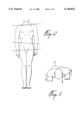
- FIG. 1 is an illustration of the rotation of the pectoral and pelvic girdle
- FIG. 2 is an illustration of the imbalance of the pelvic and pectoral girdles
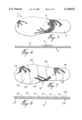
- FIG. 3 is a top view of a sole according to the invention including sulphur powder between the two semi-rigid fabric layers;
- FIG. 4 is a longitudinal cross-section view of the sole illustrated in FIG. 3;
- FIG. 5 is a top view of a sole according to the invention including transverse bands of seven different minerals
- FIG. 6 is a longitudinal cross-section view of the sole illustrated in FIG. 5;
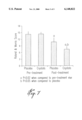
- FIG. 7 is a graph of the Roland and Morris statistical analysis of patient's measurements before and after treatment
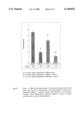
- FIG. 8 is a graph showing the highly significant effect of the mineral insoles on the postural score of 96 patients in a chiropractic clinic.
- FIG. 9 is a graph demonstrating the additive effects of the mineral insoles and the chiropractic treatment on patient's postural score.
- FIG. 1 deals with an improper rotation of the pectoral and pelvic girdle and
- FIG. 2 shows an imbalance of the pelvic and pectoral girdles.
- the unoriented mineral used as active principle in the pedal device is sulphur in the powder form.
- the active principle is a combination of seven types of crystals or powders, namely red jasper, cornelian, topaz safranite, aventurine, azurite, amethyst and white quartz.
- the active principle is a combination of sulphur in the powder form and the seven minerals previously mentioned in the form of crystals.
- the pedal device is a sole 1, in which an amount of 5 mg to 30 g of sulphur powder 3 is incorporated at the level of the arch, between the two semi-rigid fabric layers 5 and 7 used to manufacture the sole, as shown in FIGS. 3 and 4 of the drawings.
- the pedal device is a sole in which a combination of seven crystals with defined colors (one red, one orange, one yellow, one green, one blue, one purple, and one white) is inserted between the two semi-rigid fabric layers used to manufacture the sole.
- the pedal device is a sole 9, in which a combination of seven different crystals or powders with selected colors (red jasper 11, orange cornelian 13, yellow topaz safranite 15, green aventurine 17, blue azurite 19, purple amethyst 21 and white quartz 23) is inserted as seven bands transversely between the two semi-rigid fabric layers 25, 27 used to manufacture the sole, as shown in FIGS. 5 and 6 of the drawings.
- the pedal device is a sole, in which both the sulphur powder and the combination of the seven crystals are incorporated.
- a total of 40 patients (24 in study A and 16 in study B) were included in the protocols. Selected patients ranged between 18 and 65 years of age, and had imbalances of the pectoral and of the pelvic girdles, as evidenced in an initial clinical evaluation. None of them had received any kind of medical sole in the previous 6months.
- the first one was a sole, in which an amount of 50 to 100 mg of sulphur powder was incorporated at the level of the arch, between the two semi-rigid fabric layers used to manufacture the sole, according to one of the preferred embodiment of the present invention.
- the second one was a sole made with the active principle (superposed Polaroid Tm plates) commercialized by the company Statipro (Marseille, France), according to U.S. Pat. No. 5,158,526.
- the third one was a placebo sole, made, as the other test soles, by gluing together two semi-rigid leather layers, but with no active principle placed between both layers at the level of the arch.
- Treatment 1 placebo sole, in contact with the foot skin
- Treatment 2 polarizing sole, in contact with the foot skin
- Treatment 3 sulphur sole, in contact with the foot skin
- Treatment 1 placebo sole, under the socks
- Treatment 2 polarizing sole, under the socks
- Treatment 4 sulphur sole, in contact with the foot skin.
- pelvic tilt detected by a visual examination and a palpation of the pelvis
- shoulder imbalance detected by a visual examination and palpation of the shoulders, and quantified by the following test: patient in standing position, both arms dangling; the clinician joins both hands and measures the distance (cm) between both forefingers;
- pectoral girdle rotation detected and quantified by the following test: patient in standing position, raises both arms parallel, the clinician joins both hands and measures the distance (cm) between both forefingers.
- the objective of this clinical study was to determine the long-term beneficial effect of mineral-containing insoles in patients with chronic back pain.
- the tested insoles contained a combination of 8 different crystals of minerals as described in the preferred embodiments of the present invention.
- the patients were randomly assigned to two treatment groups in a 2:1 ratio (2 mineral insoles for 1 placebo sole).
- the mineral-containing insoles were insoles in which a combination of seven different minerals with selected colors (red jasper, orange cornelian, yellow topaz safranite, green aventurine, blue azurite, purple amethyst and white quartz) was inserted as seven lines transversely between the two semi-rigid fabric layers used to manufacture the sole, according to the drawings in FIGS. 5 and 6 of the present invention; in addition, an amount of 50 to 100 mg sulphur powder was placed at the level of the arch, according to FIGS. 3 and 4 of the present invention.
- the placebo soles were manufactured using the same raw materials, except for the minerals and sulphur powder, which were substituted by sugar. Both placebo and mineral insoles were indistinguishable and coded to ensure the blindness of the study.
- the patients were asked to fill the Roland and Morris questionnaire, which is a validated 24-item questionnaire designed to measure self-rated disability due to back pain (Roland M and Morris R, Spine 8:141-144, 1983).
- the score of the patient is defined as the number of items for which the patient answers "yes” and ranges therefore between 0 (no disability) and 24 (maximum disability).
- the Roland and Morris scores, measured in each patient before and after 6 weeks of treatment were subjected to a two-way ANOVA analysis for repeated measures, with factors of variation being time (before vs. after treatment) and treatment (placebo vs. mineral insoles). When statistical significance was reached, multiple comparisons were performed using the Student-Newman-Keuls method. P ⁇ 0.05 was considered statistically significant.
- the mineral insoles are powerful tools that can be used therapeutically to improve the condition of patients with chronic back pain.
- the goal of the present study was to demonstrate the clinical usefulness of the mineral insoles for chiropractors and other healthcare professionals who routinely treat patients with musculo-skeletal pain.
- the specific objectives were 1) to determine the prevalence of postural imbalances among chiropractic patients and 2) to measure the postural efficacy of the mineral insoles in these patients using a new scoring system for the evaluation of body posture.
- a new scoring system was developed and used for the need of the present study.
- the posture is assessed from 4 different clinical parameters, each of these parameters having a score from 0 to 2:
- Pelvic tilts the physician reports any unevenness of right and left iliac crests, and anterior superior and posterior superior iliac spines by palpation (score: no tilt: 0; small tilt: 1; serious tilt: 2)
- Shoulder Rotation the physician measures the intensity of any shoulder rotation by asking the patient to horizontally extend the arms straight ahead, at shoulder's height, fingers in extension, then bringing both hands together and finally measuring the distance between the tips of both indexes.(Score: rotation less than 1 cm: 0; rotation exceeding 1 cm: 1: rotation exceeding 2 cm: 2).
- Amplitude of head rotation the physician positions himself behind the patient and places his hands on the patient's shoulders to limit shoulder's movements. Then he asks the patient to turn the head on both sides and evaluate the amplitude of rotation by asking whether the patient can see his face and eyes (Score: patient sees examiner's eyes: 0; patient sees only examiner's face, but not eyes: 1; patient does not see examiner's face: 0).
- each patient was subjected to two consecutive postural evaluations.
- the first one was a basal evaluation (without insoles), and the second one was performed within 1 minute following the insertion of test mineral insoles.
- the mineral insoles were insoles in which a combination of seven different minerals with selected colors (red jasper, orange cornelian, yellow topaz safranite, green aventurine, blue azurite, purple amethyst and white quartz) was inserted as seven lines transversely between the two semi-rigid fabric layers used to manufacture the sole, according to FIGS. 5 and 6; in addition, an amount of 50 to 100 mg sulphur powder was placed at the level of the arch, according to FIGS.
- the basal postural evaluation revealed that, among the 96 tested patients, 91 (or 95%) had a pelvic tilt, 94 (or 98%) had a shoulder slump, 83 (or 86%) had a shoulder rotation and 86 (or 90%) had a decreased amplitude of head rotation. No patient had a perfectly balanced posture, as none of them exhibited a total score of 0. The distribution of the total basal score of these patients is shown in Table V.
- the average basal postural score in the 96 patients was 5.40 ⁇ 0.14, and this score was decreased by 61.3% to 2.09 ⁇ 0.15 with the mineral test insoles (P ⁇ 0.001).
- the mineral insoles successfully improved all tested postural parameters.
- the mineral insoles were most efficient on pelvic tilts (81.7% of pelvic tilts were improved or completely corrected), but were also highly active to improve shoulder tilts and rotations, as well as amplitude of head rotation.
- Example 3 The procedures were conducted a described in "Materials and Methods" of Example 3, except that the postural tests, with and without mineral insoles, were performed before and after one month of intensive chiropractic treatment, defined as 3 adjustment sessions per week on a 4 week-period. A total of 22 patients were included and completed the study.
- the statistical analysis of the data indicated an interaction between the chiropractic treatment and the acute postural effect of the mineral insoles.
- the basal postural score (without insoles) was significantly decreased after one month of chiropractic treatment from 5.59 ⁇ 0.30 to 4.05 ⁇ 0.33 (a 27.5% improvement, P ⁇ 0.05).
- the mineral insole induced a highly significant postural effect, both before and after one month of chiropractic treatment (65.8% and 70.9% improvement, respectively, P ⁇ 0.01).
- the "mineral score” i.e. the postural score with the mineral insole was significantly lower after vs before the chiropractic treatment (1.91 ⁇ 0.28 vs 1.18 ⁇ 0.19, a 38.2% improvement, P ⁇ 0.01).
- the best postural score was obtained only with the combination of both the chiropractic treatment and the use of the mineral insoles.
Landscapes
- Health & Medical Sciences (AREA)
- Public Health (AREA)
- General Health & Medical Sciences (AREA)
- Epidemiology (AREA)
- Life Sciences & Earth Sciences (AREA)
- Engineering & Computer Science (AREA)
- Biomedical Technology (AREA)
- Animal Behavior & Ethology (AREA)
- Rehabilitation Therapy (AREA)
- Pain & Pain Management (AREA)
- Veterinary Medicine (AREA)
- Chemical & Material Sciences (AREA)
- Nuclear Medicine, Radiotherapy & Molecular Imaging (AREA)
- Radiology & Medical Imaging (AREA)
- Pathology (AREA)
- Wood Science & Technology (AREA)
- Materials Engineering (AREA)
- Physical Education & Sports Medicine (AREA)
- Pharmaceuticals Containing Other Organic And Inorganic Compounds (AREA)
- Footwear And Its Accessory, Manufacturing Method And Apparatuses (AREA)
- Finger-Pressure Massage (AREA)
Abstract
The present invention relates to an article such as a sole or a shoe adapted to contact the sole of a foot, which incorporates at least one unoriented mineral which is capable of developing a color in the wavelength range between about 400 nm and 900 nm and stimulates the reflex zones located at the sole of the foot. The method of utilizing such article is also disclosed.
Description
This application is a continuation-in-part of application serial number 08/642,634 filed on May 2, 1996 which is now abandoned and herein incorporated by reference.
(a) Field of the Invention
The present invention relates to medical devices and a therapeutic method for the treatment and the prevention of physical troubles associated with a statural disequilibrium.
(b) Description of Prior Art
A major part of the chronic pains of the back or of the neck are caused by spine disequilibrium. This disequilibrium is clinically associated with imbalances or rotations of the pelvic and pectoral girdles.
It has been documented that less than 10% of the population has perfectly balanced pelvic and pectoral girdles, i.e., an equilibrated spine. Those individuals almost never experience back or neck chronic pain in their life span, and are rarely prone to arthrosis. Constitutive or acquired imbalances occur in the remaining 90% of the population, in whom spine curvatures and intervertebral angles are non-physiologic, leading to pain, sequentially at the muscular, articular and ultimately the bone level.
Spine disequilibrium may also be responsible for various disorders, including muscular and articular pains, vertigos, lumbagos, arthrosis. The link between these disorders and the spine was established based on observations that correction of the pelvic and pectoral girdles imbalances resulted in improvements of the symptoms.
Various therapeutic approaches have been developed to restore the spine equilibrium, and thus alleviate chronic pains in patients. Most of these approaches involve the design of pedal devices, mainly soles, since the feet are the points of normal support of the body in human. In fact, it has been proven that the feet are the origin of ascending neural proprioceptive chains that control the tonus of the statural muscular system, of which the spine muscles are one component. Adequate stimulations of particular reflex zones located on the sole of the feet induce a realignment of the ascending proprioceptive chains, and thus a re-equilibration of the skeletal muscular system.
This concept has previously been verified by the design of the following types of soles:
soles with micro-reliefs located at the level of the reflex zones of the foot have been used for several years. However, the routine use of this type of sole is hampered by the fact that the micro-reliefs have to be very meticulously adjusted for each patient, and their precise thickness must be regularly modified. In addition, they are only active when the patient is in a standing position.
soles incorporating a polarizing substance, such as a polarizing or polarizer plate have been described in U.S. Pat. No. 5,158,526. These soles have been marketed in Europe for several years and have been used for the correction of statural disorders. However, they exhibit some major drawbacks, that limit their routine clinical use. Namely, they need to be applied continuously directly at the contact of the skin of the foot sole, their efficacy being almost completely abolished when fabrics such as nylon or stained cotton, found in socks or stockings, are placed between the device and the skin. This continuous application induces increased perspiration in most of the patients, which makes them uncomfortable to wear, resulting in a poor patient's compliance. In addition, the lifetime of the active principles of these soles (superposed polarizer plates) is limited to several months, requiring a regular monitoring of the device's efficacy.
a similar kind of soles incorporating at least one flexible filtering film with a determined spectral transmission curve have been described in Canadian patent No. 1,328,734.
Although several case reports have described the efficacy of the aforementioned types of soles, there exist no data from controlled clinical studies performed to establish their clinical usefulness. Despite the fact that anecdotal research, such as case reports, may provide some valuable information on the activity of a product, it is widely recognized by the scientific and medical communities that only placebo-controlled, double blind studies can help to fully objectively assess the efficacy and the safety of such a medical device, especially when the parameters used to measure efficacy are essentially clinical, qualitative or semi-quantitative parameters.
There is described a sole of superposed polarizing plates in U.S. Pat. No. 5,158,526 (in the name of Bricot). Bricot teaches a method and an apparatus for treating reflex zones of feet by applying polarized magnetic flux to the reflex zones of feet. Although, Bricot teaches that microcrystals may be used in his sole, he also teaches the absolute necessity to process said microcrystals into a polarizer under specific conditions such that the crystals are oriented. This polarizer is used to treat reflex zones of the feet.
Therefore, it is an object of the present invention to provide a pedal device without the use of any polarizer, such as a sole, a shoe or another pedal apparatus, that would allow to rapidly correct spine disequilibrium, and thus alleviate associated physical disorders, such as chronic back or neck pains.
It is another object of the invention to provide a type of sole that could exert a therapeutic effect when worn under socks or stockings, in order to prevent patient's discomfort, and therefore improve compliance.
It is also an object of the invention to provide a type of sole, of which the active principles would have a long lifetime, in order to avoid the need for frequent monitoring of the quality of the sole.
It is also an object of the invention to provide a type of sole with a clinical efficacy proven by data resulting from placebo-controlled, double-blind studies.
The invention relates to a pedal device for treating and/or preventing physical troubles associated with statural disequilibrium, which comprises an article adapted to contact a sole of a foot, said article incorporating within two layers at least one unoriented mineral for stimulating reflex zones located at the sole of the foot, whereby said unoriented mineral does not act as a polarizer.
To the opposite of Bricot (U.S. Pat. No. 5,158,526), in accordance with the present invention, the specific minerals are not oriented such that these crystals are not acting as a polarizer. In fact, the pedal device of the present invention comprises a crystalline substance which is not oriented and processed. In addition, to the opposite of Bricot, the unoriented mineral used in accordance with the present invention do not require to be applied directly in contact with the skin of the foot sole to be active as illustrated in Example I. The pedal device of the present invention has an unlimited lifetime.
In accordance with the present invention, there is also provided a method for treating and/or preventing physical troubles associated with statural disequilibrium which comprises placing a pedal device at one or both feet of a person in need of correction of statural disequilibrium, said pedal device comprising an article adapted to contact a sole of a foot, said article incorporating within two layers at least one unoriented mineral which include, without limitation, sulfur powders, jasper, cornelian, topaz safranite, aventurine, azurite, amethyst and quartz for stimulating reflex zones located at the sole of the foot, whereby treating and/or preventing physical troubles associated with statural disequilibrium, whereby said unoriented crystalline substance does not act as a polarizer.
In accordance with the present invention, there is also provided a method for improving muscle strength and physical performance which comprises placing a pedal device at one or both feet of a person in need of correction of statural disequilibrium, said pedal device comprising an article adapted to contact a sole of a foot, said article incorporating within two layers at least one unoriented mineral which include, without limitation, sulfur powders, jasper, cornelian, topaz safranite, aventurine, azurite, amethyst and quartz for stimulating reflex zones located at the sole of the foot, whereby treating and/or preventing physical troubles associated with statural disequilibrium, whereby said unoriented mineral does not act as a polarizer.
In accordance with the present invention, there is also provided a method for inducing stress relief which comprises placing a pedal device at one or both feet of a person in need of correction of statural disequilibrium, said pedal device comprising an article adapted to contact a sole of a foot, said article incorporating within two layers at least one unoriented mineral which include, without limitation, sulfur powders, jasper, cornelian, topaz safranite, aventurine, azurite, amethyst and quartz for stimulating reflex zones located at the sole of the foot, whereby treating and/or preventing physical troubles associated with statural disequilibrium, whereby said unoriented mineral does not act as a polarizer.
The invention therefore has for its object a pedal device, such as a sole, a shoe or any other pedal apparatus, preferably incorporating one or several types of selected crystals such as minerals possibly in powder form, placed, for example, at designated reflex zones of the foot sole.
The invention also relates to a therapeutic method consisting in using the aforementioned device to achieve a partial or complete restoration of the spine physiological alignment, and therefore prevent or cure physical disorders associated with spine disequilibrium such as musculoskeletal pain.
The invention also relates to a therapeutic method consisting in using the aforementioned device as a therapeutic agent to improve the condition of patients suffering from musculoskeletal pain, such as chronic back pain associated or not with spine disequilibrium.
The active principle of the sole or of the pedal device may be a combination of one or several unoriented minerals, which do not act as polarizer. Both the type and amount of unoriented minerals to be used, alone or in combination, are selected based on their ability to stimulate the reflex zones located at the sole of the foot. Although the exact mechanism involved in alleviating musculoskeletal pains associated or not with spine disequilibrium and troubles associated with statural disequilibrium is not well understood, it is believed that these unoriented minerals produce natural frequencies and radiations which affect the reflex zones. The unoriented minerals may be mono-, bi-, or multi-atomic, preferably in the form of powders or crystals. They may be selected from the following groups which are listed as illustrative examples:
elements in crystal or powder forms, such as diamond (C), gold (Au), copper (Cu), platinum (Pt), sulfur (S or S8), silver (Ag), or bismuth (Bi);
natural and synthetic sulphides and sulphosalts in the form of crystals or powders, such as argentite (AgS), arsenopyrite (FeAsS), arsenic trisulfide (As2 S3), proustite (Ag3 AsS3), pyrite (FeS2);
natural and synthetic halides in the form of crystal or powders, such as fluorite (CaF2) or cryolite (Na3 AlF6);
natural and synthetic oxides and hydroxides in the form of crystals or powders, such as silicon dioxide (SiO2) derivatives (quartz, jasper, topaz safranite, cornelian, aventurine, amethyst, chalcedony, agate, crystobalite, flint, sand, tridymite) or rutile (TiO2);
natural and synthetic nitrates, carbonates and borates in the form of crystals or powders, such as malachite (Cu2 [(OH)2 CO3 ]), azurite (Cu3 [OH/CO3 ]), cerusite (PbCO3);
natural and synthetic sulfates, chromates, molybdates and tungstates in the form of crystals or powders, such as crocoite (PbCrO4) or anglesite (PbSO4);
natural and synthetic phosphates, arseniates and vanadates in the form of crystals or powders, such as apatite (Ca5 [F(PO4)3 ]);
natural and synthetic silicates in the form of crystals or powders, such as Feldspars (AlSi3 O8 and AlSi2 O6 derivatives), micas (AlSi3 O10 and Si4 O10 derivatives);
natural and synthetic organic substances in the form of crystals or powders, such as amber (C10 H16 O) or aurin (C19 H14 O3).
The pedal device according to the invention consists in a pedal support device which may incorporate selected crystals or powders (the active principle). The crystals or powders can be inserted either inside or at the surface of the device, provided they are at the level of the sole.
The therapeutic method according to the invention consists in applying the pedal device, either at one or at both feet of the patient, in order to induce the expected therapeutic effect. According to this therapeutic method, the active principle (e.g., the crystals or powders), possibly due to the natural frequencies and radiations they give out, exert a non-toxic stimulatory action on the reflex zones located at the level of the sole skin, thereby stimulating the proprioceptive ascending chains, and inducing an harmonization of the tonus of the statural muscular system. The observed therapeutic effects include the followings:
a rapid re-equilibration of the spine towards normalization of spine curvatures and intervertebral angles, which can be clinically evidenced by disappearance of imbalances, tilts and rotations of the pelvic and scapular girdles.
the relief of symptoms associated with spine disequilibrium, including chronic back and neck pains, other muscular and articular pains, vertigos, lumbagos, arthrosis.
the prevention of the occurrence of the aforementioned disorders associated with spine disequilibrium.
an energetic action, including an increase of physical performances and a diminution of the stress level.
The device according to the invention is notable for the fact that it can exert its therapeutic effect whether applied directly at the contact of the skin of the foot sole or under socks or stockings, made of any type of fabric, which improves patient's comfort and compliance. It is also notable for the fact that its active principle (e.g., the crystals or powders) have an unlimited lifetime, which eliminates the need to frequently monitor the quality of the device. In addition, since the crystals or powders used are naturally occurring on earth, no toxic effect can result from the energy, frequencies or radiations they give out.
This invention is illustrated by means of the annexed drawings which are given only for the purpose of illustration and without restriction. In the drawings,
FIG. 1 is an illustration of the rotation of the pectoral and pelvic girdle;
FIG. 2 is an illustration of the imbalance of the pelvic and pectoral girdles;
FIG. 3 is a top view of a sole according to the invention including sulphur powder between the two semi-rigid fabric layers;
FIG. 4 is a longitudinal cross-section view of the sole illustrated in FIG. 3;
FIG. 5 is a top view of a sole according to the invention including transverse bands of seven different minerals;
FIG. 6 is a longitudinal cross-section view of the sole illustrated in FIG. 5;
FIG. 7 is a graph of the Roland and Morris statistical analysis of patient's measurements before and after treatment;
FIG. 8 is a graph showing the highly significant effect of the mineral insoles on the postural score of 96 patients in a chiropractic clinic; and
FIG. 9 is a graph demonstrating the additive effects of the mineral insoles and the chiropractic treatment on patient's postural score.
Two examples of rotations and imbalances are illustrated respectively in FIG. 1 and FIG. 2. FIG. 1 deals with an improper rotation of the pectoral and pelvic girdle and FIG. 2 shows an imbalance of the pelvic and pectoral girdles.
According to a preferred embodiment, the unoriented mineral used as active principle in the pedal device is sulphur in the powder form. According to another preferred embodiment, the active principle is a combination of seven types of crystals or powders, namely red jasper, cornelian, topaz safranite, aventurine, azurite, amethyst and white quartz. According to another preferred embodiment, the active principle is a combination of sulphur in the powder form and the seven minerals previously mentioned in the form of crystals.
According to a highly preferred embodiment, the pedal device is a sole 1, in which an amount of 5 mg to 30 g of sulphur powder 3 is incorporated at the level of the arch, between the two semi-rigid fabric layers 5 and 7 used to manufacture the sole, as shown in FIGS. 3 and 4 of the drawings.
According to another highly preferred embodiment the pedal device is a sole in which a combination of seven crystals with defined colors (one red, one orange, one yellow, one green, one blue, one purple, and one white) is inserted between the two semi-rigid fabric layers used to manufacture the sole.
According to another highly preferred embodiment, the pedal device is a sole 9, in which a combination of seven different crystals or powders with selected colors (red jasper 11, orange cornelian 13, yellow topaz safranite 15, green aventurine 17, blue azurite 19, purple amethyst 21 and white quartz 23) is inserted as seven bands transversely between the two semi-rigid fabric layers 25, 27 used to manufacture the sole, as shown in FIGS. 5 and 6 of the drawings.
According to another highly preferred embodiment, the pedal device is a sole, in which both the sulphur powder and the combination of the seven crystals are incorporated.
The present invention will be more readily understood by referring to the following examples which are given to illustrate the invention rather than to limit its scope.
The goal of this study was to assess the efficacy of sulphur-containing soles and to compare it to that of soles containing a previously described (U.S. Pat. No. 5,158,526) active principle, i.e., superposed polarizing plates. Efficacy was judged clinically by the ability of tested soles to correct imbalances and rotations of the pectoral and the pelvic girdles. In study A, soles were tested immediately at the contact of the feet skin, whereas in study B, soles were tested under socks. Both studies were run in a double-blind fashion vs. a placebo sole, in order to prevent any subjective component in the course of the clinical evaluation.
Patients:
A total of 40 patients (24 in study A and 16 in study B) were included in the protocols. Selected patients ranged between 18 and 65 years of age, and had imbalances of the pectoral and of the pelvic girdles, as evidenced in an initial clinical evaluation. None of them had received any kind of medical sole in the previous 6months.
Treatments:
Three pairs of soles were designed for the needs of the present studies. The first one was a sole, in which an amount of 50 to 100 mg of sulphur powder was incorporated at the level of the arch, between the two semi-rigid fabric layers used to manufacture the sole, according to one of the preferred embodiment of the present invention. The second one was a sole made with the active principle (superposed Polaroid Tm plates) commercialized by the company Statipro (Marseille, France), according to U.S. Pat. No. 5,158,526. Finally, the third one was a placebo sole, made, as the other test soles, by gluing together two semi-rigid leather layers, but with no active principle placed between both layers at the level of the arch.
Experimental procedures:
Both studies A and B were prospective, placebo-controlled, double-blind studies. Each selected patient was subjected to 3 consecutive treatments in study A and 4 consecutive treatments in study B. Each treatment consisted in applying a pair of soles, together with a pair of socks and a pair of shoes to the feet of the patient, according to the following experimental plan:
Study A
Treatment 1: placebo sole, in contact with the foot skin
Treatment 2: polarizing sole, in contact with the foot skin
Treatment 3: sulphur sole, in contact with the foot skin
Study B
Treatment 1: placebo sole, under the socks
Treatment 2: polarizing sole, under the socks
Treatment 3: sulphur sole, under the socks
Treatment 4: sulphur sole, in contact with the foot skin.
The blindness of the studies was ensured by the following procedures:
the treatments and the clinical evaluation were performed by two different persons, located in different rooms. In these conditions, the clinician performed clinical evaluations on patients wearing shoes and socks, ensuring the blindness of the clinical examination. In addition, all three types of soles were indistinguishable and coded, so that the technician responsible for the treatments could not know the nature of the sole he was using. Finally, in each study, all 3 or 4 treatments were administered in a random sequence, differing for each patient.
Clinical Evaluation:
Following each treatment, the patient was subjected to a clinical evaluation, that included:
pelvic tilt: detected by a visual examination and a palpation of the pelvis;
shoulder imbalance: detected by a visual examination and palpation of the shoulders, and quantified by the following test: patient in standing position, both arms dangling; the clinician joins both hands and measures the distance (cm) between both forefingers;
pectoral girdle rotation: detected and quantified by the following test: patient in standing position, raises both arms parallel, the clinician joins both hands and measures the distance (cm) between both forefingers.
Statistical Analysis:
The relative efficacies of the different treatments within each study were evaluated by comparing:
1--the effects of the treatments on the number of pelvic tilts, shoulder imbalances and rotations completely corrected, by McNemar tests;
2--the effects of the treatments on the intensities of shoulder imbalances and rotations, by an ANOVA analysis of variance for repeated measures. When normality test did not pass, a repeated measure ANOVA on rank was run.
Study A
As shown in Table I, the results revealed that both the polarizing and the sulphur soles completely resolved a similar number of imbalances and rotations when applied at the foot skin contact. Both treatments were significantly more efficient than the placebo treatment. However, as illustrated in Table II, the sulphur soles was significantly better than the polarizing soles (P<0.05) with respect to their effects on the intensities of the shoulder imbalances and rotations. Namely, the polarizing soles decreased imbalances and rotations intensities by 61% and 73%, respectively, when compared to the placebo soles, whereas sulphur soles decreased imbalances and rotations intensity by 67% and 86%, respectively.
Study B
As shown in Tables III and IV, when applied under cotton socks, the polarizing soles had a very weak effect on statural parameters. These soles did not succeed in completely resolving imbalances or rotations except for 2 pelvic tilts (Table III). Moreover, they exhibited a very low potency, decreasing the intensities of shoulder imbalances and rotations by 15% and 18% respectively. In contrast, the sulphur soles were equipotent, whether applied under socks or directly applied at the foot skin contact, and reduced the intensities of shoulder imbalances and rotations by 72% and 72%, respectively, when applied under socks (Table IV). When applied under socks, the sulphur soles were statistically more potent than the polarizing soles with respect to all measured parameters (Tables III and IV).
In conclusion, the results of both these studies showed that the sulphur soles, which are one of the preferred embodiment of the present invention:
1) were more potent than the polarizing soles in improving statural parameters when applied directly at the contact of the foot skin; and
2) retained their full potency when applied under socks, in contrast to the polarizing soles, that lost almost completely their activity.
              TABLE I
______________________________________
Study A: number of imbalances and rotations
completely resolved following applications of
the tested soles.
         pelvic   shoulder    shoulder
         tilts    imbalances  rotations
______________________________________
placebo soles
            0/24      0/24         0/24
at the skin
contact
polarizing 18/24 (a)  7/24 (a)    13/24 (a)
soles at the
skin contact
sulphur soles
           20/24 (a)  8/24 (a)    17/24 (a)
at the skin
contact
______________________________________
 (a) P < 0.05 when compared to the placebo soles
              TABLE II
______________________________________
Study A: effect of the tested soles on the
intensity of shoulder imbalances and
rotations (mean ± SEM of 24 patients).
            Shoulder   Shoulder
            imbalances rotations
______________________________________
placebo soles at
              2.06 ± 0.11
                           1.60 ± 0.12
the skin contact
polarizing soles
              0.81 ± 0.13 (a)
                           0.43 ± 0.11 (a)
at the skin
contact
sulphur soles at
              0.68 ± 0.55
                           0.23 ± 0.08
the skin contact
              (a,b)        (a,b)
______________________________________
 (a) P < 0.05 when compared to the placebo soles
 (b) P < 0.05 when compared to the polarizing soles
              TABLE III
______________________________________
Study B: number of tilts and rotations
completely resolved following applications of
the tested soles.
          pelvic  shoulder    shoulder
          tilts   imbalances  rotations
______________________________________
placebo soles
             0/16     0/16        0/16
under socks
polarizing   2/16     0/16        0/16
soles under
socks
sulphur soles
            12/16     7/16        8/16
under socks (a,b)     (a,b)       (a,b)
sulphur soles
            11/16     7/16        7/16
at the skin (a,b)     (a,b)       (a,b)
contact
______________________________________
 (a) P < 0.05 when compared to the placebo soles
 (b) P < 0.05 when compared to the polarizing soles
              TABLE IV
______________________________________
Study B: effects of the tested soles on the
intensities of shoulder imbalances rotations
(mean ± SEM of 16 patients)
             Shoulder   Shoulder
             imbalances rotations
______________________________________
placebo soles under
               1.98 ± 0.14
                            2.04 ± 0.17
socks
polarizing soles
               1.68 ± 0.14 (a)
                            1.68 ± 0.17 (a)
under socks
sulphur soles under
               0.56 ± 0.16
                            0.58 ± 0.16
socks          (a,b)        (a,b)
sulphur soles at
               0.61 ± 0.17
                            0.72 ± 0.20
the skin contact
               (a,b)        (a,b)
______________________________________
 (a) P < 0.05 when compared to the placebo soles
 (b) P < 0.05 when compared to the polarizing soles
The objective of this clinical study was to determine the long-term beneficial effect of mineral-containing insoles in patients with chronic back pain. The tested insoles contained a combination of 8 different crystals of minerals as described in the preferred embodiments of the present invention.
With regards to the choice of parameters to measure to evaluate treatment efficacy, there is growing recognition that patient perspectives are essential. Back pain is one of many chronic or recurrent condition for which cure may be impossible, and improving quality of life is often the main goal of therapy. Therefore, we evaluated the effect of a6-week treatment with the mineral-containing insoles on patient's quality of life assessed by a validated questionnaire, specifically designed to measure self-rated disability due to back pain.
Patients:
A total of 35 patients were included in the protocol. Selected patients ranged between 18 and 65 years of age, and had chronic back pain, which was defined as back pain present on at least half of the days in a 12-month period in a single or in multiple episodes over the year. The patients were included in the study only if they had a score of at least 6 in the Roland and Morris questionnaire (see below for description). None of the patients had worn any kind of medical insole in the previous 6 months. All the patients gave informed consent to participate in the study.
Treatments:
The patients were randomly assigned to two treatment groups in a 2:1 ratio (2 mineral insoles for 1 placebo sole). The mineral-containing insoles were insoles in which a combination of seven different minerals with selected colors (red jasper, orange cornelian, yellow topaz safranite, green aventurine, blue azurite, purple amethyst and white quartz) was inserted as seven lines transversely between the two semi-rigid fabric layers used to manufacture the sole, according to the drawings in FIGS. 5 and 6 of the present invention; in addition, an amount of 50 to 100 mg sulphur powder was placed at the level of the arch, according to FIGS. 3 and 4 of the present invention. The placebo soles were manufactured using the same raw materials, except for the minerals and sulphur powder, which were substituted by sugar. Both placebo and mineral insoles were indistinguishable and coded to ensure the blindness of the study.
Measures:
On the day of inclusion in the study and 6 weeks later, the patients were asked to fill the Roland and Morris questionnaire, which is a validated 24-item questionnaire designed to measure self-rated disability due to back pain (Roland M and Morris R, Spine 8:141-144, 1983). In this questionnaire, the score of the patient is defined as the number of items for which the patient answers "yes" and ranges therefore between 0 (no disability) and 24 (maximum disability).
Statistical analysis:
The Roland and Morris scores, measured in each patient before and after 6 weeks of treatment were subjected to a two-way ANOVA analysis for repeated measures, with factors of variation being time (before vs. after treatment) and treatment (placebo vs. mineral insoles). When statistical significance was reached, multiple comparisons were performed using the Student-Newman-Keuls method. P<0.05 was considered statistically significant.
A total of 35 patients were included in the study and were randomized into a placebo group (11 patients) and a mineral insole group (24 patients). As shown in FIG. 7, both groups had a similar initial score (mean+SEM: placebo 14.27±1.25 vs. minerals 14.38±0.85, NS). After 6 weeks of treatment, the score was significantly improved in both groups. The score was decreased by 25% in the placebo group to 10.73±2.05 (P<0.02), whereas it was decreased by 49% in the mineral insoles group to 7.50±1.18 (P<0.01). The 49% improvement observed in the mineral insoles group was statistically greater than the 25% improvement observed in the placebo group (P<0.05).
These results show that the mineral containing insoles significantly improved the quality of life of patients with chronic back pain by decreasing their disability condition by 49%. The observed placebo effect (25%) is not surprising in such a clinical study where subjective parameters are measured such as pain, well-being or quality of life. This emphasizes the need to implement double-blind, placebo-controlled studies to evaluate the clinical efficacy of new treatments for chronic back pain.
In conclusion, the mineral insoles are powerful tools that can be used therapeutically to improve the condition of patients with chronic back pain.
Numerous experimental and scientific data suggest that the foot sole is the starting point for neurophysiological pathways responsible for the control of body posture. The role of these exteroceptive and proprioceptive pathways is to control the tone of the muscular chains controlling the equilibrium.
The efficacy of a new technology, comprising of placing a combination of selected minerals under the foot sole has been demonstrated in previous Examples I and II. Namely, these studies, which were run in placebo-controlled, double blind conditions, have shown that the tested mineral insoles were capable of treating most of pelvic tilts and shoulder slumps, and that the continuous use of such insoles significantly improved the condition of patients with chronic back pain. The observations that the application of the insoles have an immediate effect on body posture strongly indicate that they very likely act by interfering with the neurophysiological pathways involving the exteroceptive and proprioceptive receptors of the foot sole.
The goal of the present study was to demonstrate the clinical usefulness of the mineral insoles for chiropractors and other healthcare professionals who routinely treat patients with musculo-skeletal pain. The specific objectives were 1) to determine the prevalence of postural imbalances among chiropractic patients and 2) to measure the postural efficacy of the mineral insoles in these patients using a new scoring system for the evaluation of body posture.
A total of 96 patients, men and women, aged 10 to 80 years, were selected in two chiropractic clinics. Most of them consulted a chiropractor for musculo-skeletal pain, including back pain, whereas some presented other syndromes such as chronic headache or vertigoes. None of the selected patients had received a chiropractic adjustment in the last 3 months.
A new scoring system was developed and used for the need of the present study. In this scoring system, the posture is assessed from 4 different clinical parameters, each of these parameters having a score from 0 to 2:
Pelvic tilts: the physician reports any unevenness of right and left iliac crests, and anterior superior and posterior superior iliac spines by palpation (score: no tilt: 0; small tilt: 1; serious tilt: 2)
Shoulder slump (tilt): the physician determines shoulder imbalance by detecting any difference in the height of the right and left clavicles. A quantitative measure is obtained by asking the patient to keep both arms dangling, then bringing both hands together and measuring the distance (cm) between the tips of both indexes. (Score: tilt less than 1 cm: 0; tilt exceeding 1 cm: 1: tilt exceeding 2 cm: 2).
Shoulder Rotation: the physician measures the intensity of any shoulder rotation by asking the patient to horizontally extend the arms straight ahead, at shoulder's height, fingers in extension, then bringing both hands together and finally measuring the distance between the tips of both indexes.(Score: rotation less than 1 cm: 0; rotation exceeding 1 cm: 1: rotation exceeding 2 cm: 2).
Amplitude of head rotation: the physician positions himself behind the patient and places his hands on the patient's shoulders to limit shoulder's movements. Then he asks the patient to turn the head on both sides and evaluate the amplitude of rotation by asking whether the patient can see his face and eyes (Score: patient sees examiner's eyes: 0; patient sees only examiner's face, but not eyes: 1; patient does not see examiner's face: 0).
Finally, the scores of each separate parameters are added and the total score therefore ranges between 0 (no postural imbalance) to 8 (severe postural imbalance).
On the day of chiropractic examination, and before any adjustment performed by the chiropractor, each patient was subjected to two consecutive postural evaluations. The first one was a basal evaluation (without insoles), and the second one was performed within 1 minute following the insertion of test mineral insoles. The mineral insoles were insoles in which a combination of seven different minerals with selected colors (red jasper, orange cornelian, yellow topaz safranite, green aventurine, blue azurite, purple amethyst and white quartz) was inserted as seven lines transversely between the two semi-rigid fabric layers used to manufacture the sole, according to FIGS. 5 and 6; in addition, an amount of 50 to 100 mg sulphur powder was placed at the level of the arch, according to FIGS. 3 and 4. In the postural evaluation, with or without the test insoles, the patients were allowed to keep their socks or stockings, since previous studies have shown that the mineral insoles are equally effective whether placed at the direct contact of the foot sole skin or under socks or stockings (see example 1), in contrast to the prior art (Bricot, U.S. Pat. No. 5,158,526).
The postural scores, measured in each patient with (basal score) and without (mineral score) the mineral test insoles, were subjected to a Friedman repeated measures analysis of variance on ranks, a non-parametric test, since the data did not follow the criteria of statistical normality. Multiple comparisons (basal vs mineral scores) were performed using the Dunn's method. In parallel, the effect of the mineral insoles on each specific measured parameter (tilts, rotations) was evaluated by running McNemar tests.
Basal Postural Parameters in a Population of Patients with Various Types of Musculo-skeletal Pain
The basal postural evaluation revealed that, among the 96 tested patients, 91 (or 95%) had a pelvic tilt, 94 (or 98%) had a shoulder slump, 83 (or 86%) had a shoulder rotation and 86 (or 90%) had a decreased amplitude of head rotation. No patient had a perfectly balanced posture, as none of them exhibited a total score of 0. The distribution of the total basal score of these patients is shown in Table V.
              TABLE V
______________________________________
Distribution of the 96 patients as a function of their
basal postural score
______________________________________
Postural Score
           2      3      4     5    6    7    8
Number of patients
           3      3      20    24   23   19   4
______________________________________
These observations show that all the selected patients had minor to severe postural imbalances. Whether these imbalances are related to the musculo-skeletal pain remains to be investigated by comparing the posture of patients with or without pain. In addition, the scoring scale tested was well adapted for the need of the study, since a majority of the patients exhibited scores of 4, 5, 6, i.e. in the middle of the scale.
As shown in FIG. 8, the average basal postural score in the 96 patients was 5.40±0.14, and this score was decreased by 61.3% to 2.09±0.15 with the mineral test insoles (P<0.001). In addition, as shown in Table VI, the mineral insoles successfully improved all tested postural parameters. The mineral insoles were most efficient on pelvic tilts (81.7% of pelvic tilts were improved or completely corrected), but were also highly active to improve shoulder tilts and rotations, as well as amplitude of head rotation.
              TABLE VI
______________________________________
Number of patients improved for each separate
measured postural parameter following
insertion of the mineral insoles
         No improvement
                    Improvement
                              % patients
         (n)        (n)       improved
______________________________________
Pelvic tilts
           14           77        84.6%
(n = 91)                          (P < 0.001)
Shoulder tilts
           23           71        75.5%
(n = 94)                          (P < 0.001)
Shoulder   33           50        60.2%
Rotations (n = 83)                (P < 0.001)
Head amplitude
           21           55        64.0%
(n = 86)                          (P < 0.001)
______________________________________
In conclusion, the results of this study demonstrated that all patients tested exhibited postural imbalance, and that the mineral insoles were highly effective in treating these imbalances. These results underscore the usefulness of this new device, that fulfill a therapeutic need in those patients who a health care professional for musculo-skeletal problems.
The goal of this study was to determine whether the postural effect of the mineral insoles (as reported in examples 1 and 3) is complementary to the chiropractic treatment.
The procedures were conducted a described in "Materials and Methods" of Example 3, except that the postural tests, with and without mineral insoles, were performed before and after one month of intensive chiropractic treatment, defined as 3 adjustment sessions per week on a 4 week-period. A total of 22 patients were included and completed the study.
As shown in FIG. 9, the statistical analysis of the data indicated an interaction between the chiropractic treatment and the acute postural effect of the mineral insoles. Namely, the basal postural score (without insoles) was significantly decreased after one month of chiropractic treatment from 5.59±0.30 to 4.05±0.33 (a 27.5% improvement, P<0.05). The mineral insole induced a highly significant postural effect, both before and after one month of chiropractic treatment (65.8% and 70.9% improvement, respectively, P<0.01). In addition, the "mineral score", i.e. the postural score with the mineral insole was significantly lower after vs before the chiropractic treatment (1.91±0.28 vs 1.18±0.19, a 38.2% improvement, P<0.01). The best postural score was obtained only with the combination of both the chiropractic treatment and the use of the mineral insoles.
In conclusion, these data show that the use of the mineral insole as a postural balancer is complementary to the chiropractic treatment on the patient's body posture. Both treatment very likely act by different and complementary neurophysiological mechanisms.
Although the invention has been described with respect to specific embodiments, it is understood that modifications are possible within the scope of the appended claims without departing from the spirit of the invention.
Claims (21)
1. Pedal device for treating and/or preventing physical troubles associated with statural disequilibrium, which comprises an article adapted to contact a sole of a foot, said article incorporating within two layers at least one unoriented mineral for stimulating reflex zones located at the sole of the foot, whereby said unoriented mineral does not act as a polarizer.
2. Pedal device according to claim 1; wherein said unoriented mineral is in powder form.
3. Pedal device according to claim 1, wherein said article comprises an inner sole to be worn against said sole of a foot.
4. Pedal device according to claim 1, wherein said inner sole is an inner sole of a shoe.
5. Pedal device according to claim 1, wherein said article comprises two semi-rigid fabric layers bonded together, said substance being inserted between said layers of said foot sole.
6. Pedal device according to claim 5, wherein said unoriented mineral substance is selected from the group consisting of crystals and powders selected from elements, natural and synthetic sulfides and sulfosalts, natural and synthetic halides, natural and synthetic oxides and hydroxides, natural and synthetic nitrates, carbonates and borates, natural and synthetic sulfates, chromates, molybdates and tungstates, natural and synthetic phosphates, arseniates, and vanadates, natural and synthetic silicates, and natural and organic substances.
7. Pedal device according to claim 5, wherein said unoriented mineral substance is selected from the group consisting of sulphur powders.
8. Pedal device according to claim 5, wherein said unoriented mineral is a combination of the following different colors: red, orange, yellow, green, blue, purple and white.
9. Pedal device according to claim 8, wherein said unoriented mineral substance is selected from the group consisting of jasper, cornelian, topaz safranite, aventurine, azurite, amethyst and quartz and mixtures thereof.
10. Pedal device according to claim 5, wherein said unoriented mineral substance is disposed between said layers as a plurality of transverse bands of said unoriented mineral substances.
11. Pedal device according to claim 1, wherein said unoriented mineral substance comprises powdered sulphur, said powdered sulphur being incorporated between said fabric layers in amount between about 5 mg to 30 g, at the level of an arch of said foot sole.
12. Pedal device according to claim 11, wherein said unoriented mineral comprises a mixture of sulphur powder, red jasper, orange cornelian, yellow topaz safranite, green aventurine, blue azurite, purple amethyst and white quartz.
13. Pedal device for treating and/or preventing physical troubles associated with statural disequilibrium, which comprises an article adapted to contact a sole of a foot, said article incorporating between two semi-rigid bonded layers at least one unoriented mineral selected from the group consisting of sulfur powders, jasper, cornelian, topaz safranite, aventurine, azurite, amethyst and quartz for stimulating reflex zones located at the sole of the foot, whereby said unoriented crystalline substance does not act as a polarizer.
14. Method for treating and/or preventing physical troubles associated with statural disequilibrium which comprises placing a pedal device at one or both feet of a person in need of correction of statural disequilibrium, said pedal device comprising an article adapted to contact a sole of a foot, said article incorporating within two layers at least one unoriented mineral selected from the group consisting of sulfur powders, jasper, cornelian, topaz safranite, aventurine, azurite, amethyst and quartz for stimulating reflex zones located at the sole of the foot, whereby treating and/or preventing physical troubles associated with statural disequilibrium, whereby said unoriented crystalline substance does not act as a polarizer.
15. The method of claim 14, which further comprises placing a pedal device at one or both feet of said patient.
16. The method of claim 14, wherein the preventing physical troubles associated with statural disequilibrium is musculoskeletal pain.
17. The method of claim 14, wherein the musculoskeletal pain is chronic back pain.
18. The method of claim 14, wherein said pedal device is applied directly to skin of said sole foot.
19. The method of claim 14, wherein said pedal device is placed over socks or stockings worn by said patient.
20. Method for improving muscle strength and physical performance which comprises placing a pedal device at one or both feet of a person in need of correction of statural disequilibrium, said pedal device comprising an article adapted to contact a sole of a foot, said article incorporating within two layers at least one unoriented mineral selected from the group consisting of sulfur powders, jasper, cornelian, topaz safranite, aventurine, azurite, amethyst and quartz for stimulating reflex zones located at the sole of the foot, whereby treating and/or preventing physical troubles associated with statural disequilibrium, whereby said unoriented mineral does not act as a polarizer.
21. Method for inducing stress relief which comprises placing a pedal device at one or both feet of a person in need of correction of statural disequilibrium, said pedal device comprising an article adapted to contact a sole of a foot, said article incorporating within two layers at least one unoriented mineral selected from the group consisting of sulfur powders, jasper, cornelian, topaz safranite, aventurine, azurite, amethyst and quartz for stimulating reflex zones located at the sole of the foot, whereby treating and/or preventing physical troubles associated with statural disequilibrium, whereby said unoriented mineral does not act as a polarizer.
Priority Applications (1)
| Application Number | Priority Date | Filing Date | Title |
|---|---|---|---|
| US09/204,300 US6148822A (en) | 1996-05-02 | 1998-12-03 | Proprioceptive sole or pedal device containing crystals for treatment of statural disorders |
Applications Claiming Priority (2)
| Application Number | Priority Date | Filing Date | Title |
|---|---|---|---|
| US64263496A | 1996-05-02 | 1996-05-02 | |
| US09/204,300 US6148822A (en) | 1996-05-02 | 1998-12-03 | Proprioceptive sole or pedal device containing crystals for treatment of statural disorders |
Related Parent Applications (1)
| Application Number | Title | Priority Date | Filing Date |
|---|---|---|---|
| US64263496A Continuation-In-Part | 1996-05-02 | 1996-05-02 |
Publications (1)
| Publication Number | Publication Date |
|---|---|
| US6148822A true US6148822A (en) | 2000-11-21 |
Family
ID=24577390
Family Applications (2)
| Application Number | Title | Priority Date | Filing Date |
|---|---|---|---|
| US09/180,213 Expired - Fee Related US6024093A (en) | 1996-05-02 | 1997-05-01 | Proprioceptive sole or pedal device containing crystals for treatment of statural disorders |
| US09/204,300 Expired - Fee Related US6148822A (en) | 1996-05-02 | 1998-12-03 | Proprioceptive sole or pedal device containing crystals for treatment of statural disorders |
Family Applications Before (1)
| Application Number | Title | Priority Date | Filing Date |
|---|---|---|---|
| US09/180,213 Expired - Fee Related US6024093A (en) | 1996-05-02 | 1997-05-01 | Proprioceptive sole or pedal device containing crystals for treatment of statural disorders |
Country Status (6)
| Country | Link |
|---|---|
| US (2) | US6024093A (en) |
| EP (1) | EP0902678A1 (en) |
| AU (1) | AU2378197A (en) |
| BR (1) | BR9708885A (en) |
| CA (1) | CA2252770A1 (en) |
| WO (1) | WO1997041819A1 (en) |
Cited By (11)
| Publication number | Priority date | Publication date | Assignee | Title |
|---|---|---|---|---|
| US20020156340A1 (en) * | 2001-02-12 | 2002-10-24 | Blendermann Edward Ludwig | Proprioceptive device that contains nutrients for the treatment of stratural diseases |
| US20030118615A1 (en) * | 1999-01-21 | 2003-06-26 | Blendermann Edward Ludwig | Method for increasing muscle strength |
| US6773391B1 (en) * | 1999-09-24 | 2004-08-10 | Bernard Bricot | Device and method of biostimulating living organisms and/or neutralizing the harmful effects of appliances operating with electric power |
| US20070289160A1 (en) * | 2006-06-19 | 2007-12-20 | David Scott Hansen | Insole With Consumable Element |
| DE202013105743U1 (en) | 2012-12-27 | 2014-04-01 | Helmut Kaiser | sole |
| US20140288471A1 (en) * | 2013-03-19 | 2014-09-25 | Genovus Biotechnologies Inc. | Muscle optimization device and method |
| ES2594490A2 (en) * | 2015-04-15 | 2016-12-20 | Irene LORENZO GÓMEZ | New footwear insole (Machine-translation by Google Translate, not legally binding) |
| US9636310B1 (en) | 1999-02-03 | 2017-05-02 | Edward Ludwig Blendermann | Method for increasing muscle strength |
| US10322063B2 (en) | 2013-03-19 | 2019-06-18 | Genovus Biotechnologies Inc. | Muscle optimization device and method |
| US10888707B2 (en) | 2013-03-19 | 2021-01-12 | Genovus Biotechnologies Inc. | Muscle optimization device and method |
| US12022911B2 (en) | 2021-04-30 | 2024-07-02 | Annette Verpillot | Insole |
Families Citing this family (53)
| Publication number | Priority date | Publication date | Assignee | Title |
|---|---|---|---|---|
| AU2378197A (en) * | 1996-05-02 | 1997-11-26 | Les Laboratoires Asana Inc. | Proprioceptive sole or pedal device containing crystals for treatment of statural disorders |
| FR2778099B1 (en) * | 1998-04-30 | 2000-10-06 | Dominique Mace | DEVICE FOR CORRECTING DISORDERS DUE TO IMBALANCES OF THE POSTURAL TONIC SYSTEM |
| USD710629S1 (en) * | 2013-09-16 | 2014-08-12 | Abraham Franco | Beach towel |
| US9405810B2 (en) | 2014-11-24 | 2016-08-02 | Asana, Inc. | Server side system and method for search backed calendar user interface |
| US10977434B2 (en) | 2017-07-11 | 2021-04-13 | Asana, Inc. | Database model which provides management of custom fields and methods and apparatus therfor |
| US10623359B1 (en) | 2018-02-28 | 2020-04-14 | Asana, Inc. | Systems and methods for generating tasks based on chat sessions between users of a collaboration environment |
| US11138021B1 (en) | 2018-04-02 | 2021-10-05 | Asana, Inc. | Systems and methods to facilitate task-specific workspaces for a collaboration work management platform |
| US10613735B1 (en) | 2018-04-04 | 2020-04-07 | Asana, Inc. | Systems and methods for preloading an amount of content based on user scrolling |
| US20250351922A1 (en) * | 2018-04-22 | 2025-11-20 | Insand Ltd. | Shoe and Footwear with Integrated Insole or Sole Having Sealed Discrete Elastic Chambers Storing a Synthetic Granular Mixture that Mimics Stepping on Natural Sand |
| US12376646B2 (en) * | 2018-04-22 | 2025-08-05 | Insand Ltd. | Shoe and footwear with integrated insole or sole having sand-containing chambers and having sensors and electrical stimulation units |
| WO2019207569A1 (en) * | 2018-04-22 | 2019-10-31 | Insand Ltd. | Insole, insert, sole, and shoes and footwear having such components |
| US10785046B1 (en) | 2018-06-08 | 2020-09-22 | Asana, Inc. | Systems and methods for providing a collaboration work management platform that facilitates differentiation between users in an overarching group and one or more subsets of individual users |
| US10616151B1 (en) | 2018-10-17 | 2020-04-07 | Asana, Inc. | Systems and methods for generating and presenting graphical user interfaces |
| US10956845B1 (en) | 2018-12-06 | 2021-03-23 | Asana, Inc. | Systems and methods for generating prioritization models and predicting workflow prioritizations |
| US11568366B1 (en) | 2018-12-18 | 2023-01-31 | Asana, Inc. | Systems and methods for generating status requests for units of work |
| US11113667B1 (en) | 2018-12-18 | 2021-09-07 | Asana, Inc. | Systems and methods for providing a dashboard for a collaboration work management platform |
| US10684870B1 (en) | 2019-01-08 | 2020-06-16 | Asana, Inc. | Systems and methods for determining and presenting a graphical user interface including template metrics |
| US11782737B2 (en) | 2019-01-08 | 2023-10-10 | Asana, Inc. | Systems and methods for determining and presenting a graphical user interface including template metrics |
| US11204683B1 (en) | 2019-01-09 | 2021-12-21 | Asana, Inc. | Systems and methods for generating and tracking hardcoded communications in a collaboration management platform |
| US11341445B1 (en) | 2019-11-14 | 2022-05-24 | Asana, Inc. | Systems and methods to measure and visualize threshold of user workload |
| US11783253B1 (en) | 2020-02-11 | 2023-10-10 | Asana, Inc. | Systems and methods to effectuate sets of automated actions outside and/or within a collaboration environment based on trigger events occurring outside and/or within the collaboration environment |
| US11599855B1 (en) | 2020-02-14 | 2023-03-07 | Asana, Inc. | Systems and methods to attribute automated actions within a collaboration environment |
| US11763259B1 (en) | 2020-02-20 | 2023-09-19 | Asana, Inc. | Systems and methods to generate units of work in a collaboration environment |
| US11455601B1 (en) | 2020-06-29 | 2022-09-27 | Asana, Inc. | Systems and methods to measure and visualize workload for completing individual units of work |
| US11449836B1 (en) | 2020-07-21 | 2022-09-20 | Asana, Inc. | Systems and methods to facilitate user engagement with units of work assigned within a collaboration environment |
| US11568339B2 (en) | 2020-08-18 | 2023-01-31 | Asana, Inc. | Systems and methods to characterize units of work based on business objectives |
| US11769115B1 (en) | 2020-11-23 | 2023-09-26 | Asana, Inc. | Systems and methods to provide measures of user workload when generating units of work based on chat sessions between users of a collaboration environment |
| US11405435B1 (en) | 2020-12-02 | 2022-08-02 | Asana, Inc. | Systems and methods to present views of records in chat sessions between users of a collaboration environment |
| US11694162B1 (en) | 2021-04-01 | 2023-07-04 | Asana, Inc. | Systems and methods to recommend templates for project-level graphical user interfaces within a collaboration environment |
| US11676107B1 (en) | 2021-04-14 | 2023-06-13 | Asana, Inc. | Systems and methods to facilitate interaction with a collaboration environment based on assignment of project-level roles |
| US11553045B1 (en) | 2021-04-29 | 2023-01-10 | Asana, Inc. | Systems and methods to automatically update status of projects within a collaboration environment |
| US11803814B1 (en) | 2021-05-07 | 2023-10-31 | Asana, Inc. | Systems and methods to facilitate nesting of portfolios within a collaboration environment |
| US11792028B1 (en) | 2021-05-13 | 2023-10-17 | Asana, Inc. | Systems and methods to link meetings with units of work of a collaboration environment |
| US11809222B1 (en) | 2021-05-24 | 2023-11-07 | Asana, Inc. | Systems and methods to generate units of work within a collaboration environment based on selection of text |
| US12141756B1 (en) | 2021-05-24 | 2024-11-12 | Asana, Inc. | Systems and methods to generate project-level graphical user interfaces within a collaboration environment |
| US12093859B1 (en) | 2021-06-02 | 2024-09-17 | Asana, Inc. | Systems and methods to measure and visualize workload for individual users |
| US12182505B1 (en) | 2021-06-10 | 2024-12-31 | Asana, Inc. | Systems and methods to provide user-generated project-level graphical user interfaces within a collaboration environment |
| US11756000B2 (en) | 2021-09-08 | 2023-09-12 | Asana, Inc. | Systems and methods to effectuate sets of automated actions within a collaboration environment including embedded third-party content based on trigger events |
| US12159262B1 (en) | 2021-10-04 | 2024-12-03 | Asana, Inc. | Systems and methods to provide user-generated graphical user interfaces within a collaboration environment |
| US11635884B1 (en) | 2021-10-11 | 2023-04-25 | Asana, Inc. | Systems and methods to provide personalized graphical user interfaces within a collaboration environment |
| US12536503B1 (en) | 2021-12-06 | 2026-01-27 | Asana, Inc. | Systems and methods to track and present navigation through records of a collaboration environment |
| US12093896B1 (en) | 2022-01-10 | 2024-09-17 | Asana, Inc. | Systems and methods to prioritize resources of projects within a collaboration environment |
| US11836681B1 (en) | 2022-02-17 | 2023-12-05 | Asana, Inc. | Systems and methods to generate records within a collaboration environment |
| US11997425B1 (en) | 2022-02-17 | 2024-05-28 | Asana, Inc. | Systems and methods to generate correspondences between portions of recorded audio content and records of a collaboration environment |
| US12118514B1 (en) | 2022-02-17 | 2024-10-15 | Asana, Inc. | Systems and methods to generate records within a collaboration environment based on a machine learning model trained from a text corpus |
| US12190292B1 (en) | 2022-02-17 | 2025-01-07 | Asana, Inc. | Systems and methods to train and/or use a machine learning model to generate correspondences between portions of recorded audio content and work unit records of a collaboration environment |
| US12051045B1 (en) | 2022-04-28 | 2024-07-30 | Asana, Inc. | Systems and methods to characterize work unit records of a collaboration environment based on stages within a workflow |
| US12288171B1 (en) | 2022-07-18 | 2025-04-29 | Asana, Inc. | Systems and methods to provide records for new users of a collaboration environment |
| US12412156B1 (en) | 2022-07-21 | 2025-09-09 | Asana, Inc. | Systems and methods to characterize work unit records of a collaboration environment based on freeform arrangement of visual content items |
| US11863601B1 (en) | 2022-11-18 | 2024-01-02 | Asana, Inc. | Systems and methods to execute branching automation schemes in a collaboration environment |
| US12287849B1 (en) | 2022-11-28 | 2025-04-29 | Asana, Inc. | Systems and methods to automatically classify records managed by a collaboration environment |
| US12401655B1 (en) | 2023-04-24 | 2025-08-26 | Asana, Inc. | Systems and methods to manage access to assets of a computer environment based on user and asset grouping |
| US12423121B1 (en) | 2023-11-09 | 2025-09-23 | Asana, Inc. | Systems and methods to customize a user interface of a collaboration environment based on ranking of work unit records managed by the collaboration environment |
Citations (5)
| Publication number | Priority date | Publication date | Assignee | Title |
|---|---|---|---|---|
| US5158526A (en) * | 1981-05-13 | 1992-10-27 | Bernard Bricot | Method and pedal apparatus for spinal disorders |
| US5766596A (en) * | 1996-08-13 | 1998-06-16 | Gollin Pharmaceutical Co., Ltd. | Aconite tuber-sulphur composite preparation and a process for the preparation thereof |
| US5884639A (en) * | 1996-03-08 | 1999-03-23 | Applied Elastomerics, Inc. | Crystal gels with improved properties |
| US5913313A (en) * | 1998-01-14 | 1999-06-22 | Brunderman; Pamela Jean | Footcare device and method of using same |
| US6024093A (en) * | 1996-05-02 | 2000-02-15 | Asana Laboratories Inc. | Proprioceptive sole or pedal device containing crystals for treatment of statural disorders |
Family Cites Families (3)
| Publication number | Priority date | Publication date | Assignee | Title |
|---|---|---|---|---|
| DE3731560A1 (en) * | 1987-09-19 | 1989-04-06 | Helgard Dr Med Hoffmann | Device for correcting an energy flux interrupted or reduced due to an injury or a scar |
| DE3905989A1 (en) * | 1989-02-25 | 1990-08-30 | Hilmar Bertram | Underlay for massage of the reflex zones of skin areas |
| EP0606512A1 (en) * | 1993-01-15 | 1994-07-20 | Firma Franz Breuning | Device to apply cristals to the human body |
-
1997
- 1997-05-01 AU AU23781/97A patent/AU2378197A/en not_active Abandoned
- 1997-05-01 BR BR9708885-4A patent/BR9708885A/en not_active Application Discontinuation
- 1997-05-01 US US09/180,213 patent/US6024093A/en not_active Expired - Fee Related
- 1997-05-01 EP EP97919231A patent/EP0902678A1/en not_active Withdrawn
- 1997-05-01 WO PCT/CA1997/000303 patent/WO1997041819A1/en not_active Ceased
- 1997-05-01 CA CA002252770A patent/CA2252770A1/en not_active Abandoned
-
1998
- 1998-12-03 US US09/204,300 patent/US6148822A/en not_active Expired - Fee Related
Patent Citations (5)
| Publication number | Priority date | Publication date | Assignee | Title |
|---|---|---|---|---|
| US5158526A (en) * | 1981-05-13 | 1992-10-27 | Bernard Bricot | Method and pedal apparatus for spinal disorders |
| US5884639A (en) * | 1996-03-08 | 1999-03-23 | Applied Elastomerics, Inc. | Crystal gels with improved properties |
| US6024093A (en) * | 1996-05-02 | 2000-02-15 | Asana Laboratories Inc. | Proprioceptive sole or pedal device containing crystals for treatment of statural disorders |
| US5766596A (en) * | 1996-08-13 | 1998-06-16 | Gollin Pharmaceutical Co., Ltd. | Aconite tuber-sulphur composite preparation and a process for the preparation thereof |
| US5913313A (en) * | 1998-01-14 | 1999-06-22 | Brunderman; Pamela Jean | Footcare device and method of using same |
Cited By (18)
| Publication number | Priority date | Publication date | Assignee | Title |
|---|---|---|---|---|
| US20030118615A1 (en) * | 1999-01-21 | 2003-06-26 | Blendermann Edward Ludwig | Method for increasing muscle strength |
| US8617590B2 (en) | 1999-01-21 | 2013-12-31 | Edward Ludwig Blendermann | Method for increasing muscle strength |
| US9636310B1 (en) | 1999-02-03 | 2017-05-02 | Edward Ludwig Blendermann | Method for increasing muscle strength |
| US6773391B1 (en) * | 1999-09-24 | 2004-08-10 | Bernard Bricot | Device and method of biostimulating living organisms and/or neutralizing the harmful effects of appliances operating with electric power |
| US20020156340A1 (en) * | 2001-02-12 | 2002-10-24 | Blendermann Edward Ludwig | Proprioceptive device that contains nutrients for the treatment of stratural diseases |
| US20070289160A1 (en) * | 2006-06-19 | 2007-12-20 | David Scott Hansen | Insole With Consumable Element |
| DE102013113717A1 (en) | 2012-12-27 | 2014-07-03 | Helmut Kaiser | Shoe and/or slipper sole for use as change-insole for stimulating foot reflex zones, has openings provided at reflex zones in sole body on foot side, and stimulating stones i.e. precious and/or semiprecious stones, inserted in openings |
| AT513621B1 (en) * | 2012-12-27 | 2014-06-15 | Helmut Kaiser | Shoe insert |
| AT513621A4 (en) * | 2012-12-27 | 2014-06-15 | Helmut Kaiser | Shoe insert |
| DE202013105743U1 (en) | 2012-12-27 | 2014-04-01 | Helmut Kaiser | sole |
| US20140288471A1 (en) * | 2013-03-19 | 2014-09-25 | Genovus Biotechnologies Inc. | Muscle optimization device and method |
| US10322063B2 (en) | 2013-03-19 | 2019-06-18 | Genovus Biotechnologies Inc. | Muscle optimization device and method |
| US10888707B2 (en) | 2013-03-19 | 2021-01-12 | Genovus Biotechnologies Inc. | Muscle optimization device and method |
| US11246799B2 (en) | 2013-03-19 | 2022-02-15 | Genovus Biotechnologies Inc. | Muscle optimization device and method |
| US11633618B2 (en) | 2013-03-19 | 2023-04-25 | Genovus Biotechnologies Inc. | Muscle optimization device and method |
| US11793716B2 (en) | 2013-03-19 | 2023-10-24 | Genovus Biotechnologies Inc. | Muscle optimization device and method |
| ES2594490A2 (en) * | 2015-04-15 | 2016-12-20 | Irene LORENZO GÓMEZ | New footwear insole (Machine-translation by Google Translate, not legally binding) |
| US12022911B2 (en) | 2021-04-30 | 2024-07-02 | Annette Verpillot | Insole |
Also Published As
| Publication number | Publication date |
|---|---|
| BR9708885A (en) | 2000-01-04 |
| WO1997041819A1 (en) | 1997-11-13 |
| EP0902678A1 (en) | 1999-03-24 |
| US6024093A (en) | 2000-02-15 |
| CA2252770A1 (en) | 1997-11-13 |
| AU2378197A (en) | 1997-11-26 |
Similar Documents
| Publication | Publication Date | Title |
|---|---|---|
| US6024093A (en) | Proprioceptive sole or pedal device containing crystals for treatment of statural disorders | |
| CA2858534C (en) | Device and methods for treating neurological disorders | |
| Stilz et al. | Case history number 96: Reflex sympathetic dystrophy in a 6-year-old: Successful treatment by transcutaneous nerve stimulation | |
| El-Gendy et al. | Multimodal approach of electrotherapy versus myofascial release in patients with chronic mechanical neck pain: a randomized controlled trial | |
| US6607550B1 (en) | Method of treating neuropathy using a photo energy device | |
| US20020156340A1 (en) | Proprioceptive device that contains nutrients for the treatment of stratural diseases | |
| RU2102961C1 (en) | Method to treat cervical osteochondrosis of backbone | |
| Hanlan et al. | Early adjunct treatment with topical lidocaine results in improved pain and function in a patient with complex regional pain syndrome | |
| Böhm et al. | Functional electrical stimulation for foot drop in the upper motor neuron syndrome: does it affect 3D foot kinematics during the stance phase of walking? | |
| Arrieiro et al. | Land-based versus water-based walking programs in elderly women with knee osteoarthritis: preliminary results of a randomized clinical trial | |
| US20020192408A1 (en) | Static electricity reducing /eliminating tool and static electricity reducing/eliminating apparatus | |
| MXPA98009096A (en) | Propioceptive template or pedal device containing crystals for the treatment of stature disorders | |
| Kamalakannan et al. | Influence of Ankle Mobilization and Active Stretching on Low Back Pain in Pronated Foot Subjects | |
| Bek et al. | Immediate effects of different elastic taping techniques on pain, isokinetic muscle strength, proprioception and functional performance in patients with knee osteoarthritis: Placebo controlled, double-blinded cross study | |
| De Aguiar et al. | Effect of mobilization time by maitland method in nonspecific low back pain and neck pain. | |
| Bulley | The podiatron: an adjunct to physiotherapy treatment for Guillain--Barré syndrome? | |
| Lee et al. | The effects of high frequency transcutaneous nerve stimulation on spasticity, proprioception, strength, and balance in patients with stroke: a randomized controlled trial | |
| Kotagiri et al. | Effectiveness of lumbar stabilization exercises with laser therapy in patients with mechanical low back pain | |
| Kim | Effects of Selective Training on the Vastus Medialis Oblique in Patients with Patellofemoral Pain Syndrome | |
| Yang et al. | Balance trainer training with transcutaneous electrical nerve stimulation improves spasticity and balance in persons with chronic stroke | |
| Afridi et al. | Comparing the Effects of Baclofen, Transcutaneous Electrical Nerve Stimulation, and Sustained Stretch for Treating Spasticity After Traumatic Spinal Cord Injury: A Randomized Clinical Trial | |
| RU109959U1 (en) | ORTHOPEDIC FOOTWEAR FOR TREATMENT OF PLATFOOT | |
| Kim | The effect of EMG-stim on upper limb function in chronic stroke patients | |
| RU2128036C1 (en) | Method of treating brain concussion | |
| Davis et al. | Rehabilitation of Patients with Peripheral Nerve Injuries |
Legal Events
| Date | Code | Title | Description |
|---|---|---|---|
| AS | Assignment |
Owner name: ASANA LABORATORIES INC., CANADA Free format text: ASSIGNMENT OF ASSIGNORS INTEREST;ASSIGNORS:CRON, CHRISTOPHE;PAUTROT, THIERRY;ABRIBAT, THIERRY;REEL/FRAME:009783/0680;SIGNING DATES FROM 19990129 TO 19990203 |
|
| REMI | Maintenance fee reminder mailed | ||
| LAPS | Lapse for failure to pay maintenance fees | ||
| LAPS | Lapse for failure to pay maintenance fees |
Free format text: PATENT EXPIRED FOR FAILURE TO PAY MAINTENANCE FEES (ORIGINAL EVENT CODE: EXP.); ENTITY STATUS OF PATENT OWNER: SMALL ENTITY |
|
| STCH | Information on status: patent discontinuation |
Free format text: PATENT EXPIRED DUE TO NONPAYMENT OF MAINTENANCE FEES UNDER 37 CFR 1.362 |
|
| FP | Lapsed due to failure to pay maintenance fee |
Effective date: 20041121 |