US6147721A - Ultraviolet filter for plasma addressed liquid crystal display - Google Patents
Ultraviolet filter for plasma addressed liquid crystal display Download PDFInfo
- Publication number
- US6147721A US6147721A US09/032,041 US3204198A US6147721A US 6147721 A US6147721 A US 6147721A US 3204198 A US3204198 A US 3204198A US 6147721 A US6147721 A US 6147721A
- Authority
- US
- United States
- Prior art keywords
- liquid crystal
- plasma
- glass sheet
- cell
- thin glass
- Prior art date
- Legal status (The legal status is an assumption and is not a legal conclusion. Google has not performed a legal analysis and makes no representation as to the accuracy of the status listed.)
- Expired - Fee Related
Links
Images


Classifications
-
- G—PHYSICS
- G02—OPTICS
- G02F—OPTICAL DEVICES OR ARRANGEMENTS FOR THE CONTROL OF LIGHT BY MODIFICATION OF THE OPTICAL PROPERTIES OF THE MEDIA OF THE ELEMENTS INVOLVED THEREIN; NON-LINEAR OPTICS; FREQUENCY-CHANGING OF LIGHT; OPTICAL LOGIC ELEMENTS; OPTICAL ANALOGUE/DIGITAL CONVERTERS
- G02F1/00—Devices or arrangements for the control of the intensity, colour, phase, polarisation or direction of light arriving from an independent light source, e.g. switching, gating or modulating; Non-linear optics
- G02F1/01—Devices or arrangements for the control of the intensity, colour, phase, polarisation or direction of light arriving from an independent light source, e.g. switching, gating or modulating; Non-linear optics for the control of the intensity, phase, polarisation or colour
- G02F1/13—Devices or arrangements for the control of the intensity, colour, phase, polarisation or direction of light arriving from an independent light source, e.g. switching, gating or modulating; Non-linear optics for the control of the intensity, phase, polarisation or colour based on liquid crystals, e.g. single liquid crystal display cells
- G02F1/133—Constructional arrangements; Operation of liquid crystal cells; Circuit arrangements
- G02F1/1333—Constructional arrangements; Manufacturing methods
- G02F1/13334—Plasma addressed liquid crystal cells [PALC]
-
- G—PHYSICS
- G02—OPTICS
- G02F—OPTICAL DEVICES OR ARRANGEMENTS FOR THE CONTROL OF LIGHT BY MODIFICATION OF THE OPTICAL PROPERTIES OF THE MEDIA OF THE ELEMENTS INVOLVED THEREIN; NON-LINEAR OPTICS; FREQUENCY-CHANGING OF LIGHT; OPTICAL LOGIC ELEMENTS; OPTICAL ANALOGUE/DIGITAL CONVERTERS
- G02F1/00—Devices or arrangements for the control of the intensity, colour, phase, polarisation or direction of light arriving from an independent light source, e.g. switching, gating or modulating; Non-linear optics
- G02F1/01—Devices or arrangements for the control of the intensity, colour, phase, polarisation or direction of light arriving from an independent light source, e.g. switching, gating or modulating; Non-linear optics for the control of the intensity, phase, polarisation or colour
- G02F1/13—Devices or arrangements for the control of the intensity, colour, phase, polarisation or direction of light arriving from an independent light source, e.g. switching, gating or modulating; Non-linear optics for the control of the intensity, phase, polarisation or colour based on liquid crystals, e.g. single liquid crystal display cells
- G02F1/133—Constructional arrangements; Operation of liquid crystal cells; Circuit arrangements
- G02F1/1333—Constructional arrangements; Manufacturing methods
- G02F1/1335—Structural association of cells with optical devices, e.g. polarisers or reflectors
- G02F1/133509—Filters, e.g. light shielding masks
-
- G—PHYSICS
- G02—OPTICS
- G02F—OPTICAL DEVICES OR ARRANGEMENTS FOR THE CONTROL OF LIGHT BY MODIFICATION OF THE OPTICAL PROPERTIES OF THE MEDIA OF THE ELEMENTS INVOLVED THEREIN; NON-LINEAR OPTICS; FREQUENCY-CHANGING OF LIGHT; OPTICAL LOGIC ELEMENTS; OPTICAL ANALOGUE/DIGITAL CONVERTERS
- G02F1/00—Devices or arrangements for the control of the intensity, colour, phase, polarisation or direction of light arriving from an independent light source, e.g. switching, gating or modulating; Non-linear optics
- G02F1/01—Devices or arrangements for the control of the intensity, colour, phase, polarisation or direction of light arriving from an independent light source, e.g. switching, gating or modulating; Non-linear optics for the control of the intensity, phase, polarisation or colour
- G02F1/13—Devices or arrangements for the control of the intensity, colour, phase, polarisation or direction of light arriving from an independent light source, e.g. switching, gating or modulating; Non-linear optics for the control of the intensity, phase, polarisation or colour based on liquid crystals, e.g. single liquid crystal display cells
- G02F1/133—Constructional arrangements; Operation of liquid crystal cells; Circuit arrangements
- G02F1/1333—Constructional arrangements; Manufacturing methods
- G02F1/1337—Surface-induced orientation of the liquid crystal molecules, e.g. by alignment layers
- G02F1/133753—Surface-induced orientation of the liquid crystal molecules, e.g. by alignment layers with different alignment orientations or pretilt angles on a same surface, e.g. for grey scale or improved viewing angle
-
- G—PHYSICS
- G02—OPTICS
- G02F—OPTICAL DEVICES OR ARRANGEMENTS FOR THE CONTROL OF LIGHT BY MODIFICATION OF THE OPTICAL PROPERTIES OF THE MEDIA OF THE ELEMENTS INVOLVED THEREIN; NON-LINEAR OPTICS; FREQUENCY-CHANGING OF LIGHT; OPTICAL LOGIC ELEMENTS; OPTICAL ANALOGUE/DIGITAL CONVERTERS
- G02F1/00—Devices or arrangements for the control of the intensity, colour, phase, polarisation or direction of light arriving from an independent light source, e.g. switching, gating or modulating; Non-linear optics
- G02F1/01—Devices or arrangements for the control of the intensity, colour, phase, polarisation or direction of light arriving from an independent light source, e.g. switching, gating or modulating; Non-linear optics for the control of the intensity, phase, polarisation or colour
- G02F1/13—Devices or arrangements for the control of the intensity, colour, phase, polarisation or direction of light arriving from an independent light source, e.g. switching, gating or modulating; Non-linear optics for the control of the intensity, phase, polarisation or colour based on liquid crystals, e.g. single liquid crystal display cells
- G02F1/133—Constructional arrangements; Operation of liquid crystal cells; Circuit arrangements
- G02F1/1333—Constructional arrangements; Manufacturing methods
- G02F1/1337—Surface-induced orientation of the liquid crystal molecules, e.g. by alignment layers
- G02F1/13378—Surface-induced orientation of the liquid crystal molecules, e.g. by alignment layers by treatment of the surface, e.g. embossing, rubbing or light irradiation
- G02F1/133788—Surface-induced orientation of the liquid crystal molecules, e.g. by alignment layers by treatment of the surface, e.g. embossing, rubbing or light irradiation by light irradiation, e.g. linearly polarised light photo-polymerisation
-
- G—PHYSICS
- G09—EDUCATION; CRYPTOGRAPHY; DISPLAY; ADVERTISING; SEALS
- G09G—ARRANGEMENTS OR CIRCUITS FOR CONTROL OF INDICATING DEVICES USING STATIC MEANS TO PRESENT VARIABLE INFORMATION
- G09G3/00—Control arrangements or circuits, of interest only in connection with visual indicators other than cathode-ray tubes
- G09G3/20—Control arrangements or circuits, of interest only in connection with visual indicators other than cathode-ray tubes for presentation of an assembly of a number of characters, e.g. a page, by composing the assembly by combination of individual elements arranged in a matrix no fixed position being assigned to or needed to be assigned to the individual characters or partial characters
- G09G3/34—Control arrangements or circuits, of interest only in connection with visual indicators other than cathode-ray tubes for presentation of an assembly of a number of characters, e.g. a page, by composing the assembly by combination of individual elements arranged in a matrix no fixed position being assigned to or needed to be assigned to the individual characters or partial characters by control of light from an independent source
- G09G3/36—Control arrangements or circuits, of interest only in connection with visual indicators other than cathode-ray tubes for presentation of an assembly of a number of characters, e.g. a page, by composing the assembly by combination of individual elements arranged in a matrix no fixed position being assigned to or needed to be assigned to the individual characters or partial characters by control of light from an independent source using liquid crystals
- G09G3/3611—Control of matrices with row and column drivers
- G09G3/3648—Control of matrices with row and column drivers using an active matrix
- G09G3/3662—Control of matrices with row and column drivers using an active matrix using plasma-addressed liquid crystal displays
-
- H—ELECTRICITY
- H01—ELECTRIC ELEMENTS
- H01J—ELECTRIC DISCHARGE TUBES OR DISCHARGE LAMPS
- H01J17/00—Gas-filled discharge tubes with solid cathode
- H01J17/38—Cold-cathode tubes
- H01J17/48—Cold-cathode tubes with more than one cathode or anode, e.g. sequence-discharge tube, counting tube, dekatron
- H01J17/485—Plasma addressed liquid crystal displays [PALC]
Definitions
- the present invention relates to a plasma addressed liquid crystal display having a flat panel structure in which a liquid crystal cell is laminated on a plasma cell through an intermediate thin glass sheet, and particularly to a technique for preventing deterioration of the liquid crystal cell due to ultraviolet rays generated on the plasma cell side.
- FIG. 2 shows a structure of the plasma addressed liquid crystal display.
- the plasma addressed liquid crystal display has a flat panel structure including a liquid crystal cell 1, a plasma cell 2, and a common thin glass sheet 3 interposed therebetween.
- the thin glass sheet 3 is as extremely thin as about 50 ⁇ m in thickness, and is called "a microsheet".
- the plasma cell 2 has a lower glass substrate 4 joined to the thin glass sheet 3, and an ionizable gas is sealed in a gap therebetween. Stripe-like discharge electrodes are formed on an inner surface of the lower glass substrate 4.
- These discharge electrodes are composed of anodes A and cathodes K that are alternately arranged with one another.
- the discharge electrodes can be finely printed and baked on the flat glass substrate 4 at a high productivity and a high workability by screen printing or the like.
- Partitioning walls 7 are formed on the anodes A of these discharge electrodes for partitioning the gap filled with the ionizable gas into discharge channels 5.
- the partitioning walls 7 can be also formed and baked by screen printing in such a manner that top portions of the partitioning walls 7 are in contact with one surface side of the thin glass sheet 3. In this way, the discharge channels 5 are surrounded by a horizontal plane of the glass substrate 4, a horizontal plane of the thin glass sheet 3, and vertical side planes of the partitioning walls 7.
- the stripe-like discharge electrodes function as alternately arranged anodes A cathodes K, and generate plasma discharge therebetween.
- the plasma discharge involves generation of ultraviolet rays.
- the thin glass sheet 3 is joined to the lower glass substrate 4 by glass frit or the like.
- the liquid crystal cell 1 has a transparent upper glass substrate 8.
- the glass substrate 8 is adhesively bonded on the other surface side of the thin glass sheet 3 using a sealing material or the like with a specific gap formed therebetween.
- the sealed gap is filled with liquid crystal 9.
- the liquid crystal 9 is composed of nematic liquid crystal, for example, 90° twist-oriented liquid crystal material.
- Signal electrodes 10 are formed on an inner surface of the upper glass substrate 8.
- the signal electrodes 10 are perpendicular to the stripe-like discharge channels 5, and matrix-like pixels are formed at crossing points between the signal electrodes 10 and the discharge channels 5.
- the flat panel structure having the above configuration is of a transmission type, in which the plasma cell 2 is positioned on the light incident side and the liquid crystal cell 1 is positioned on the light outgoing side.
- a polarizer 11 is mounted on an outer surface of the plasma cell 2 for converting illuminating light emitted from a backlight 12 into linearly polarized incident light.
- An analyzer 13 is mounted on an outer surface of the liquid crystal cell 1 for analyzing linearly polarized outgoing light having which has passed through the liquid crystal cell 1.
- display is performed by switching the discharge signal to scan the rows of discharge channels 5 having the function of performing plasma discharge in a line-sequential manner and applying an image signal to the columns of signal electrodes 10 on the liquid crystal cell 1 side in synchronization with the scanning.
- the discharge channel 5 functions as a sampling switch.
- the liquid crystal cell 1 converts polarized incident light into polarized outgoing light on the basis of a signal voltage, to perform image display.
- the liquid crystal 9 is composed of nematic liquid crystal, for example, twist-oriented.
- an alignment film 14 is formed on the inner surface of the upper glass substrate 8, and an alignment film 15 is formed on the surface of the thin glass sheet 3 which surface is in contact with the liquid crystal 9.
- the liquid crystal cell 1 is addressed by scanning the discharge channels 5 on the plasma cell 2 side. Upon scanning of the discharge channels 5, plasma discharge is generated. At this time, the plasma discharge involves generation of ultraviolet rays.
- ultraviolet rays Bring generated by plasma discharge have been made directly incident in the liquid crystal cell 1 through the intermediate thin glass sheet 3.
- the liquid crystal cell 1 contains organic materials constituting the liquid crystal 9, the alignment films 14 and 15, and the like. In general, ultraviolet rays cause deterioration of the organic materials constituting the liquid crystal 9 and the alignment films 14 and 15. This reduces a voltage retention ratio of the liquid crystal 9 and/or changes a pre-tilt angle of the twist-oriented liquid crystal 9. As a result, there occur problems of an after-image phenomenon due to unevenness in voltage retention ratio within a screen and of a variation in voltage/transmittance characteristic of the liquid crystal.
- An object of the present invention is to provide a plasma addressed liquid crystal display that is improved to prevent deterioration of the liquid crystal and an alignment film due to ultraviolet rays generated by the plasma discharge.
- a plasma addressed liquid crystal display including: a liquid crystal cell including columns of signal electrodes; a plasma cell including rows of discharge channels; and an intermediate thin glass sheet through which the liquid crystal cell is joined to the plasma cell; wherein the thin glass sheet includes an ultraviolet ray transmission preventive layer having a function of absorbing or reflecting ultraviolet rays generated in the discharge channels on the plasma cell side thereby preventing the ultraviolet rays from being made incident on the liquid crystal cell side.
- the ultraviolet ray transmission preventive layer preferably includes an ultraviolet ray transmission preventive film applied on at least one surface of the thin glass sheet. Further, the ultraviolet ray transmission preventive film preferably contains at least TiO 2 or ZnO.
- a method of manufacturing a plasma addressed liquid crystal display having the configuration described in the first aspect of the present invention including the steps of: previously forming an ultraviolet ray transmission preventive film having a function of absorbing or reflecting ultraviolet rays on one surface of the thin glass sheet by printing, spin-coating, vapor-deposition or sputtering; joining the plasma cell on one surface side of the thin glass sheet; and joining the liquid crystal cell on the other surface side of the thin glass sheet.
- the above method may include the steps of: previously applying an ultraviolet ray transmission preventive film having a function of absorbing or reflecting ultraviolet rays on both surfaces of the thin glass sheet by dipping, and baking the ultraviolet ray transmission preventive film; joining the plasma cell on one surface side of the thin glass sheet; and joining the liquid crystal cell on the other surface side of the thin glass sheet.
- an ultraviolet ray transmission preventive layer is provided on a thin glass sheet provided to separate a liquid crystal cell from a plasma cell.
- the ultraviolet ray transmission preventive film prevents ultraviolet rays generated by plasma discharge on the plasma cell side from being irradiated on a liquid crystal layer and an alignment film on the liquid crystal cell side. This makes it possible to prevent deterioration of the liquid crystal and the alignment film and hence to keep display characteristics of the liquid crystal cell stably for a long-period of time.
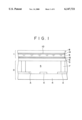
- FIG. 1 is a typical partial sectional view of a first embodiment of a plasma addressed liquid crystal display of the present invention
- FIG. 2 is a partial sectional view showing one example of a related art plasma addressed liquid crystal display
- FIG. 3 is a partial sectional view showing a second embodiment of the plasma addressed liquid crystal display of the present invention.
- FIG. 4 is a typical partial sectional view showing a third embodiment of the plasma addressed liquid crystal display of the present invention.
- FIG. 5 is a graph showing an absorption spectrum of liquid crystal
- FIG. 6 is a graph showing a change in pre-tilt angle of liquid crystal due to irradiation of ultraviolet rays
- FIG. 7A and 7B are graphs each showing an emission spectrum of plasma discharge generated in discharge channels
- FIGS. 8A and 8B are graphs each showing a transmittance characteristic of a thin glass sheet and the thin glass sheet on which the ultraviolet ray transmission preventive film is formed.
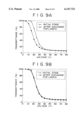
- FIGS. 9A and 9B are graphs each showing a voltage/transmittance characteristic of a liquid crystal cell.
- FIG. 1 is a typical partial sectional view showing a first embodiment of a plasma addressed liquid crystal display of the present invention. It should be noted that parts corresponding to those in the related art plasma addressed liquid crystal display shown in FIG. 2 are indicated by the same reference numerals for ease of understanding.
- the plasma addressed liquid crystal display has a flat panel structure in which a liquid crystal cell 1 including columns of signal electrodes 10 is joined to a plasma cell 2 including rows of discharge channels 5 through an intermediate thin glass sheet 3.
- the intermediate thin glass sheet 3 is previously formed to be as extremely thin as about 50 ⁇ m in thickness.
- the liquid crystal cell 1 has an upper glass substrate 8 adhesively bonded to the thin glass sheet 3 with a specific gap formed put therebetween.
- the gap after being sealed, is filled with nematic liquid crystal 9, for example, twist-oriented.
- an alignment film 14 is formed on an inner surface of the glass substrate 8, and an alignment film 15 is formed on an upper surface side of the thin glass sheet 3.
- Each of the alignment films 14 and 15 is made from an organic material such as a polyimide film.
- the plasma cell 2 has a lower glass substrate 4 jointed to the thin glass sheet 3 with a specific gap formed put therebetween.
- the gap is partitioned by stripe-like partitioning walls 7 to form the discharge channels 5.
- An ionizable gas is sealed in the discharge channels 5.
- An anode A and a cathode K are formed along each discharge channel 5. By applying a specific voltage between these discharge electrodes, a plasma discharge is generated in the discharge channels 5.
- the plasma discharge involves generation of ultraviolet rays.
- the thin glass sheet 3 includes an ultraviolet ray transmission preventive layer having a function of absorbing or reflecting ultraviolet rays generated in the discharge channels 5 on the plasma cell 2 side thereby preventing the ultraviolet rays from being made incident on the liquid crystal cell 1 side.
- the ultraviolet ray transmission preventive layer is composed of an ultraviolet ray transmission preventive film 6 applied on at least one surface of the thin glass sheet 3.
- the ultraviolet ray transmission preventive film 6 contains at least TiO 2 or ZnO.
- the ultraviolet ray transmission preventive layer may be formed by dispersing an ultraviolet ray reflecting or absorbing material in the thin glass sheet 3.
- the ultraviolet ray transmission preventive film 6 is formed on the intermediate thin glass sheet 3 disposed to separate the liquid crystal cell 1 from the plasma cell 2 for preventing ultraviolet rays generated by plasma discharge from being made incident in the liquid crystal 9 and the alignment films 14 and 15.
- the ultraviolet ray transmission preventive film 6 is provided between the thin glass sheet 3 positioned directly over the discharge channels 5 and the alignment film 15.
- the ultraviolet ray transmission preventive film 6 has the function of absorbing or reflecting ultraviolet rays, and thereby it takes a role of reducing deterioration of the liquid crystal 9 and alignment films 14 and 15 due to ultraviolet rays.
- FIG. 3 is a partial sectional view of a second embodiment of the plasma addressed liquid crystal display of the present invention.
- an ultraviolet ray transmission preventive film 6 is formed not on an upper surface side of the thin glass sheet 3 but on a lower surface side thereof.
- the plasma addressed liquid crystal display having the above configuration is manufactured in accordance with the following steps. First, the ultraviolet ray transmission preventive film 6 having a function of absorbing or reflecting ultraviolet rays is previously formed on one surface of a single thin glass sheet by printing, spin-coating, vapor-deposition, or sputtering.
- a liquid coating agent is applied on the surface of the thin glass sheet by printing or spin-coating, and baked by heating.
- the baking temperature for the coating agent occasionally reaches about 300° C. depending on the material of the coating agent. Since the ultraviolet ray transmission preventive film 6 is formed on the single thin glass sheet in this embodiment, it can be baked at such a specific temperature as to reach the above high temperature without any adverse thermal effect exerted on the subsequent steps.
- a plasma cell 2 is joined to one surface side of the thin glass sheet 3.
- anodes A, cathodes K, and partitioning walls 7 are previously formed on a lower glass substrate 4 by screen printing or the like.
- the glass substrate 4 is then joined to a lower surface of the thin glass sheet 3 by glass frit or the like. Further, an ionizable gas is sealed in a gap positioned between the thin glass sheet 3 and the glass substrate 4 and partitioned by the partitioning walls 7, to thereby provide discharge channels 5. Then, the liquid crystal cell 1 is joined on the other surface side of the thin glass sheet 3.
- an alignment film 15 made from a polyimide film or the like is formed on an upper surface of the thin glass sheet 3.
- Signal electrodes 10 formed of a transparent conductive film made from ITO or the like are patterned in a stripe shape on one surface of an upper glass substrate 8.
- An alignment film 14 is also formed.
- the glass substrate 8 is adhesively bonded on the upper surface of the thin glass sheet 3 by a sealing material with a specific gap formed therebetween. Finally, the gap between the glass substrate 8 and the thin glass sheet 3 is sealed and filled with liquid crystal 9, to complete the plasma addressed liquid crystal display.
- the ultraviolet ray transmission preventive film 6 which is the component characterized by the present invention will be described in detail below.
- the ultraviolet ray transmission preventive film 6 is formed, by spin-coating, using a coating agent (produced by Nissan Chemical Industries, Ltd.) containing TiO 2 having a reflecting function to ultraviolet rays.
- the coating agent is applied on the surface of the thin glass sheet 3 at a specific rotational speed by spin-coating, followed by irradiation of ultraviolet rays for about 5 min using a high voltage lamp (140 mW) to be thus temporarily cured.
- the resultant film is baked by heating at a temperature of 300° C. for 30 min.
- the stable ultraviolet ray transmission preventive film 6 having a thickness of about 70nm is formed.
- the ultraviolet ray transmission preventive film 6 is formed, by spin-coating, using a coating agent produced by TONEN CORPORATION.
- the coating agent is formed by dispersing ultra-fine particles of ZnO in a solution in which polysilazane is dissolved in a solvent of xylene/toluene (nor-volatile content: 30 wt %).
- the solution is applied on the surface of the thin glass sheet 3 by spin-coating, and baked at 300° C. for 1 hr.
- the ultraviolet ray transmission preventive film 6 has a mixed composition of SiO 2 and ZnO.
- the ultraviolet ray transmission preventive film 6 having a thickness of 1,000 nm is obtained.
- the ultraviolet ray transmission preventive film 6 having a thickness of 800 nm is obtained by spin-coating of the solution at a rotational speed of 1,000 rpm for 20 sec. Further, the spin-coating of the solution at a rotational speed of 1,500 rpm for 20 sec forms the ultraviolet ray transmission preventive film 6 having a thickness of about 630 nm.
- the ultraviolet ray transmission preventive film 6 formed by such steps is effective to shield ultraviolet rays having wavelengths in a range of about 360 nm or less.
- FIG. 4 is a typical partial sectional view showing a third embodiment of the plasma addressed liquid crystal display of the present invention.
- an ultraviolet ray transmission preventive film 6 is formed on both surfaces of a thin glass sheet 3.
- the ultraviolet ray transmission preventive film 6 having a function of absorbing or reflecting ultraviolet rays is previously applied on both the surfaces of the thin glass sheet 3 in a single substance state by dipping, followed by baking of the film.
- the dipping process is performed by dipping the thin glass sheet 3 in a solution in which particles of TiO 2 or ZnO are dispersed, and drawing, drying and baking the thin glass sheet 3 coated with the coating agent, to form the ultraviolet ray transmission preventive film 6.
- the dipping process is advantageous in that the working steps are simplified as compared with the above-described process using spin-coating or the like.
- FIG. 5 is a graph showing one example of an absorption spectrum of the liquid crystal 9.
- the abscissa indicates wavelength and the ordinate indicates absorbance.
- the liquid crystal absorbs ultraviolet rays having wavelengths in a range of 400 nm or less. It is generally known that the liquid crystal composed of an organic material is deteriorated typically by decomposition of bonding of the liquid crystal due to irradiation of ultraviolet rays. The deterioration of the liquid crystal 9 due to absorption of ultraviolet rays causes a reduction in retention ratio of a signal voltage.
- FIG. 6 is a graph showing a change in pre-tilt angle of the liquid crystal 9 due to irradiation ultraviolet rays.
- the abscissa indicates an irradiation ultraviolet rays and the ordinate indicates a pre-tilt angle.
- the pre-tilt angle represents a tilt angle of molecules of liquid crystal at an interface between the alignment films 14 and 15. In a state before irradiation of ultraviolet rays, the pre-tile angle is about 4°. This means that molecules of liquid crystal are controlled to be oriented nearly along the horizontal direction. However, the alignment film 15 is deteriorated by irradiation of ultraviolet rays, so that the pre-tilt angle is shifted upward.
- the change in pre-tile angle with elapsed time varies the operational characteristics of the liquid crystal cell 1. To be more specific, there occurs a problem that a voltage/transmittance characteristic of the liquid crystal cell 1 is changed with an elapsed time.
- FIGS. 7A and 7B are graphs each showing an emission spectrum of plasma discharge generated in the discharge channels 5.
- the abscissa indicates a wavelength and the ordinate indicates an emission intensity.
- the dimension in FIG. 7A is enlarged along the ordinate.
- the emission spectrum is measured on the thin glass sheet 3.
- two emission peaks (UV) of ultraviolet rays are recognized in a wavelength range of 380 nm or less: one appearing at a wavelength of 254 nm and the other appearing at a wavelength near 365 nm.
- Each of the peaks is the emission spectrum of ultraviolet rays due to a trace of mercury contained in the discharge channels 5.
- the thin glass sheet 3 disposed to separate the plasma cell 2 from the liquid crystal cell 1 is as extremely thin as about 50 ⁇ m, and accordingly, it cannot shield ultraviolet rays generated by the discharge channels 5.
- FIG. 8A is a graph showing a transmittance characteristic of the thin glass sheet 3.
- the abscissa indicates wavelength and the ordinate indicates transmittance.
- the thin glass sheet 3 cannot perfectly shield ultraviolet rays having wavelengths in a range of 380 nm or less.
- the thin glass sheet 3 allows about 60% of ultraviolet rays having a wavelength of 254 nm to pass therethrough.
- FIG. 8B is a graph showing a transmittance characteristic of the thin glass sheet 3 on which the ultraviolet ray transmission preventive film 6 is formed.
- the abscissa indicates wavelength and the ordinate indicates a transmittance.
- the graph shows a transmittance characteristic of the thin glass sheet 3 on which the alignment film 15 is formed in addition to the ultraviolet ray transmission preventive film 6.
- the thin glass sheet 3 there is used a no-alkali glass sheet having a thickness of 50 ⁇ m.
- the ultraviolet ray transmission preventive film 6 is made from a coating agent containing TiO 2 and has a thickness of about 90 nm.
- the alignment films S1 and S2 are different from each other in transmittance characteristic.
- the alignment film S2 is lower in transmittance characteristic than the alignment film S1, and therefore, it is superior to the alignment film S1 in shielding performance of ultraviolet rays.
- the use of the alignment film S1 reduces the transmittance of the ultraviolet rays (wavelength: 254 nm) to 14%; and the use of the alignment film S2 reduces the transmittance of the ultraviolet rays (wavelength: 254 nm) to 11%. In this way, selection of a material of the alignment film is somewhat effective to reduce the transmission of ultraviolet rays.
- the ultraviolet ray transmission preventive film 6 on the thin glass sheet 3 allows the transmittance of ultraviolet rays to be significantly reduced.
- the material of the ultraviolet ray transmission preventive film 6 there can be used TiO 2 (titanium oxide) or ZnO (zinc oxide) described above.
- FIG. 9A is a graph showing a voltage/transmittance characteristic of the related art plasma addressed liquid crystal display.
- the abscissa indicates a signal voltage applied to the signal electrodes 10 of the liquid crystal cell 1 and the ordinate indicates a transmittance of the liquid crystal cell 1.
- Data indicated by a mark ( ⁇ ) represents an initial value and data indicated by a mark ( ⁇ ) represents a characteristic after discharge for 1,400 hr.
- the graph shows that the pre-tilt angle of the liquid crystal 9 is changed due to irradiation of ultraviolet rays as described with reference to FIG. 6, and that the pre-tilt angle of the liquid crystal 9 becomes larger with an increase in irradiation time of ultraviolet rays.
- the pre-tilt angle of the liquid crystal 9 is enlarged and thereby the voltage/transmittance characteristic is shifted on the low voltage side as shown in FIG. 9A. consequently, the repeatability of the setting characteristic with an elapsed time cannot be attained.
- FIG. 9B is a graph showing a voltage/transmittance characteristic of the plasma addressed liquid crystal display including the ultraviolet rays transmission preventive film 6.
- a large change in voltage/transmittance characteristic of the liquid crystal cell 1 is not recognized even after use for a long period of time.
- the ultraviolet ray transmission preventive film 6 exhibits a sufficient effect of stably keeping a long-period operation of the plasma addressed liquid crystal display.
Landscapes
- Physics & Mathematics (AREA)
- Nonlinear Science (AREA)
- Crystallography & Structural Chemistry (AREA)
- Chemical & Material Sciences (AREA)
- General Physics & Mathematics (AREA)
- Mathematical Physics (AREA)
- Optics & Photonics (AREA)
- Engineering & Computer Science (AREA)
- Plasma & Fusion (AREA)
- Spectroscopy & Molecular Physics (AREA)
- Liquid Crystal (AREA)
- Computer Hardware Design (AREA)
- Theoretical Computer Science (AREA)
- Devices For Indicating Variable Information By Combining Individual Elements (AREA)
- Gas-Filled Discharge Tubes (AREA)
Applications Claiming Priority (2)
| Application Number | Priority Date | Filing Date | Title |
|---|---|---|---|
| JPP9-061968 | 1997-02-28 | ||
| JP9061968A JPH10239671A (ja) | 1997-02-28 | 1997-02-28 | プラズマアドレス液晶表示装置 |
Publications (1)
| Publication Number | Publication Date |
|---|---|
| US6147721A true US6147721A (en) | 2000-11-14 |
Family
ID=13186497
Family Applications (1)
| Application Number | Title | Priority Date | Filing Date |
|---|---|---|---|
| US09/032,041 Expired - Fee Related US6147721A (en) | 1997-02-28 | 1998-02-27 | Ultraviolet filter for plasma addressed liquid crystal display |
Country Status (3)
| Country | Link |
|---|---|
| US (1) | US6147721A (https=) |
| JP (1) | JPH10239671A (https=) |
| KR (1) | KR100525148B1 (https=) |
Cited By (3)
| Publication number | Priority date | Publication date | Assignee | Title |
|---|---|---|---|---|
| US6400423B1 (en) * | 1997-10-15 | 2002-06-04 | Koninklijke Philips Electronics N.V. | Channel plates and flat display devices incorporating such |
| US6577356B2 (en) * | 1999-12-08 | 2003-06-10 | Sharp Kabushiki Kaisha | Plasma addressed liquid crystal display device and method for fabricating the same |
| CN104049416A (zh) * | 2014-06-23 | 2014-09-17 | 京东方科技集团股份有限公司 | 一种液晶显示屏、其制备方法与显示装置 |
Families Citing this family (6)
| Publication number | Priority date | Publication date | Assignee | Title |
|---|---|---|---|---|
| KR20010028632A (ko) * | 1999-09-22 | 2001-04-06 | 구자홍 | 플라즈마 어드레스 액정 표시소자 및 그 구동방법 |
| JP3786806B2 (ja) * | 1999-12-08 | 2006-06-14 | シャープ株式会社 | 液晶表示装置およびその製造方法 |
| JP2001272645A (ja) * | 2000-03-27 | 2001-10-05 | Hitachi Ltd | 液晶表示装置 |
| US6831712B1 (en) * | 2003-05-27 | 2004-12-14 | Eastman Kodak Company | Polymer-dispersed liquid-crystal display comprising an ultraviolet blocking layer and methods for making the same |
| CN103091894B (zh) * | 2013-01-18 | 2016-07-06 | 京东方科技集团股份有限公司 | 一种彩膜基板和液晶面板 |
| US10514571B2 (en) | 2018-03-21 | 2019-12-24 | Himax Display, Inc. | Display panel and method of fabricating a display panel |
Citations (4)
| Publication number | Priority date | Publication date | Assignee | Title |
|---|---|---|---|---|
| JPS5246830A (en) * | 1975-10-09 | 1977-04-14 | Matsushita Electric Ind Co Ltd | Liquid crystal panel |
| JPS56116012A (en) * | 1980-02-19 | 1981-09-11 | Sharp Corp | Liquid-crystal cell |
| JPS6428617A (en) * | 1987-07-24 | 1989-01-31 | Fujitsu Ltd | Projection type liquid crystal display device |
| JPH05181624A (ja) * | 1991-12-27 | 1993-07-23 | Nippon Denki Joho Service Kk | データ処理装置 |
Family Cites Families (4)
| Publication number | Priority date | Publication date | Assignee | Title |
|---|---|---|---|---|
| JP3185353B2 (ja) * | 1992-04-21 | 2001-07-09 | ソニー株式会社 | プラズマアドレス電気光学装置 |
| JP3672594B2 (ja) * | 1994-07-21 | 2005-07-20 | ソニー株式会社 | プラズマアドレス液晶表示装置 |
| JP3430666B2 (ja) * | 1994-09-09 | 2003-07-28 | ソニー株式会社 | プラズマアドレス表示装置及びその製造方法 |
| JP3360490B2 (ja) * | 1995-05-12 | 2002-12-24 | ソニー株式会社 | 表示装置 |
-
1997
- 1997-02-28 JP JP9061968A patent/JPH10239671A/ja not_active Abandoned
-
1998
- 1998-02-27 KR KR10-1998-0006429A patent/KR100525148B1/ko not_active Expired - Fee Related
- 1998-02-27 US US09/032,041 patent/US6147721A/en not_active Expired - Fee Related
Patent Citations (4)
| Publication number | Priority date | Publication date | Assignee | Title |
|---|---|---|---|---|
| JPS5246830A (en) * | 1975-10-09 | 1977-04-14 | Matsushita Electric Ind Co Ltd | Liquid crystal panel |
| JPS56116012A (en) * | 1980-02-19 | 1981-09-11 | Sharp Corp | Liquid-crystal cell |
| JPS6428617A (en) * | 1987-07-24 | 1989-01-31 | Fujitsu Ltd | Projection type liquid crystal display device |
| JPH05181624A (ja) * | 1991-12-27 | 1993-07-23 | Nippon Denki Joho Service Kk | データ処理装置 |
Cited By (4)
| Publication number | Priority date | Publication date | Assignee | Title |
|---|---|---|---|---|
| US6400423B1 (en) * | 1997-10-15 | 2002-06-04 | Koninklijke Philips Electronics N.V. | Channel plates and flat display devices incorporating such |
| US6577356B2 (en) * | 1999-12-08 | 2003-06-10 | Sharp Kabushiki Kaisha | Plasma addressed liquid crystal display device and method for fabricating the same |
| CN104049416A (zh) * | 2014-06-23 | 2014-09-17 | 京东方科技集团股份有限公司 | 一种液晶显示屏、其制备方法与显示装置 |
| US9726936B2 (en) | 2014-06-23 | 2017-08-08 | Boe Technology Group Co., Ltd. | Liquid crystal display panel and method for preparing the same, and display device |
Also Published As
| Publication number | Publication date |
|---|---|
| KR100525148B1 (ko) | 2005-12-21 |
| KR19980071807A (ko) | 1998-10-26 |
| JPH10239671A (ja) | 1998-09-11 |
Similar Documents
| Publication | Publication Date | Title |
|---|---|---|
| US7110076B2 (en) | In-plane liquid crystal device with electric field shielding layer | |
| US11327375B2 (en) | Reflective cholesteric liquid crystal display | |
| KR100262376B1 (ko) | 액정표시장치및그제조방법 | |
| KR19980702311A (ko) | 일렉트로크로믹 소자 및 이를 구비한 표시 장치 | |
| JPH05241165A (ja) | 液晶表示装置及びその製造方法 | |
| US6552769B2 (en) | Method for fabricating liquid crystal display panel with sealant on both sides of a peripheral groove | |
| US6147721A (en) | Ultraviolet filter for plasma addressed liquid crystal display | |
| US5499122A (en) | Plasma-addressed liquid crystal display device having a transparent dielectric sheet with a porous layer containing an impregnated liquid crystal | |
| US6517402B1 (en) | Plasma addressed liquid crystal display with etched glass spacers | |
| US6310665B1 (en) | Liquid crystal display apparatus and optical addressing device | |
| US5420706A (en) | Electro-optical device having improved light shielding and method for forming the same | |
| WO1997022962A1 (en) | Plasma addressed liquid crystal display assembled from bonded elements | |
| JP2002533749A (ja) | 暗い縁部を有する反射型lcd | |
| JP3334676B2 (ja) | 液晶表示装置 | |
| WO1996003673A1 (en) | Liquid crystal display device | |
| EP1025461A1 (en) | method of making a colour filter structure | |
| EP0515150B1 (en) | Optical writing type liquid crystal display device | |
| KR100951731B1 (ko) | 티에프티-엘씨디 및 그 제조방법 | |
| JP2871162B2 (ja) | 液晶表示パネルの製造方法 | |
| JPH10253952A (ja) | 液晶表示素子 | |
| JP3224438B2 (ja) | 液晶表示装置 | |
| JPH04361228A (ja) | 液晶表示装置 | |
| JP2945893B1 (ja) | 液晶表示装置 | |
| JP3405519B2 (ja) | 液晶表示装置 | |
| JP3473894B2 (ja) | 液晶表示装置 |
Legal Events
| Date | Code | Title | Description |
|---|---|---|---|
| FPAY | Fee payment |
Year of fee payment: 4 |
|
| FPAY | Fee payment |
Year of fee payment: 8 |
|
| REMI | Maintenance fee reminder mailed | ||
| LAPS | Lapse for failure to pay maintenance fees | ||
| STCH | Information on status: patent discontinuation |
Free format text: PATENT EXPIRED DUE TO NONPAYMENT OF MAINTENANCE FEES UNDER 37 CFR 1.362 |
|
| FP | Lapsed due to failure to pay maintenance fee |
Effective date: 20121114 |