US6147312A - Strain gage bridge circuit with sensitivity equalization and method for sensitivity equalization - Google Patents

Strain gage bridge circuit with sensitivity equalization and method for sensitivity equalization Download PDF

Info

Publication number
US6147312A
US6147312A US09/166,113 US16611398A US6147312A US 6147312 A US6147312 A US 6147312A US 16611398 A US16611398 A US 16611398A US 6147312 A US6147312 A US 6147312A
Authority
US
United States
Prior art keywords
bridge
resistors
bridge circuit
diagonal
strain gage
Prior art date
Legal status (The legal status is an assumption and is not a legal conclusion. Google has not performed a legal analysis and makes no representation as to the accuracy of the status listed.)
Expired - Fee Related
Application number
US09/166,113
Inventor
Harry E. Lockery
Current Assignee (The listed assignees may be inaccurate. Google has not performed a legal analysis and makes no representation or warranty as to the accuracy of the list.)
Flintec Group AB
Original Assignee
Flintec Inc
Priority date (The priority date is an assumption and is not a legal conclusion. Google has not performed a legal analysis and makes no representation as to the accuracy of the date listed.)
Filing date
Publication date
Application filed by Flintec Inc filed Critical Flintec Inc
Priority to US09/166,113 priority Critical patent/US6147312A/en
Assigned to FLINTEC, INC. reassignment FLINTEC, INC. ASSIGNMENT OF ASSIGNORS INTEREST (SEE DOCUMENT FOR DETAILS). Assignors: LOCKERY, HARRY E.
Application granted granted Critical
Publication of US6147312A publication Critical patent/US6147312A/en
Assigned to FLINTEC GROUP AB reassignment FLINTEC GROUP AB ASSIGNMENT OF ASSIGNORS INTEREST (SEE DOCUMENT FOR DETAILS). Assignors: FLINTEC, INC.
Anticipated expiration legal-status Critical
Expired - Fee Related legal-status Critical Current

Links

Images

Classifications

    • GPHYSICS
    • G01MEASURING; TESTING
    • G01LMEASURING FORCE, STRESS, TORQUE, WORK, MECHANICAL POWER, MECHANICAL EFFICIENCY, OR FLUID PRESSURE
    • G01L1/00Measuring force or stress, in general
    • G01L1/20Measuring force or stress, in general by measuring variations in ohmic resistance of solid materials or of electrically-conductive fluids; by making use of electrokinetic cells, i.e. liquid-containing cells wherein an electrical potential is produced or varied upon the application of stress
    • G01L1/22Measuring force or stress, in general by measuring variations in ohmic resistance of solid materials or of electrically-conductive fluids; by making use of electrokinetic cells, i.e. liquid-containing cells wherein an electrical potential is produced or varied upon the application of stress using resistance strain gauges
    • G01L1/2268Arrangements for correcting or for compensating unwanted effects
    • GPHYSICS
    • G01MEASURING; TESTING
    • G01GWEIGHING
    • G01G3/00Weighing apparatus characterised by the use of elastically-deformable members, e.g. spring balances
    • G01G3/12Weighing apparatus characterised by the use of elastically-deformable members, e.g. spring balances wherein the weighing element is in the form of a solid body stressed by pressure or tension during weighing
    • G01G3/14Weighing apparatus characterised by the use of elastically-deformable members, e.g. spring balances wherein the weighing element is in the form of a solid body stressed by pressure or tension during weighing measuring variations of electrical resistance
    • G01G3/142Circuits specially adapted therefor
    • GPHYSICS
    • G01MEASURING; TESTING
    • G01LMEASURING FORCE, STRESS, TORQUE, WORK, MECHANICAL POWER, MECHANICAL EFFICIENCY, OR FLUID PRESSURE
    • G01L1/00Measuring force or stress, in general
    • G01L1/20Measuring force or stress, in general by measuring variations in ohmic resistance of solid materials or of electrically-conductive fluids; by making use of electrokinetic cells, i.e. liquid-containing cells wherein an electrical potential is produced or varied upon the application of stress
    • G01L1/22Measuring force or stress, in general by measuring variations in ohmic resistance of solid materials or of electrically-conductive fluids; by making use of electrokinetic cells, i.e. liquid-containing cells wherein an electrical potential is produced or varied upon the application of stress using resistance strain gauges
    • G01L1/225Measuring circuits therefor
    • G01L1/2262Measuring circuits therefor involving simple electrical bridges

Definitions

  • the present invention is directed to a strain gage bridge circuit with sensitivity equalization and method for sensitivity equalization that are improvements over an invention disclosed in U.S. Pat. No. 4,979,580, issued Dec. 25, 1990 to Lockery, the contents of which patent are incorporated herein by reference.
  • U.S. Pat. No. 4,979,580 to Lockery discloses how to equalize the measuring sensitivity of opposing half-bridges in a strain gage bridge circuit by connecting pairs of shunt resistors of equal resistance cross a pair of bridge arms forming one half-bridge, and describes how this equalization method can be used to eliminate the sensitivity to variations in the location of the point of force application in a planar weighing device with four strain gages. Changes in the shunt resistance affects the sensitivity of one side of the load platform only, and does not affect the zero adjustment of the bridge output signal.
  • the sensitivity adjustment method described in U.S. Pat. No. 4,979,580 to Lockery works well, and it has been used extensively.
  • Sensitivity adjustment is usually done by trial and error, with resistor decade boxes used as shunt resistors.
  • the resistor boxes are replaced with soldered-in combinations of fixed resistors before the load cell is shipped.
  • Accurate replacement of the resistor box values is a rather demanding and time consuming procedure, especially since the two resistors in a pair must always remain exactly equal.
  • the shunt resistor values also affect the adjustments for linearity and temperature compensation in the strain gage bridge circuit.
  • a main object of the present invention is to provide an inexpensive strain gage bridge circuit with equalization of the relative sensitivity of opposing half-bridges in the strain gage bridge circuit.
  • a further object of the present invention is to provide a method for adjusting the relative sensitivity of opposing half bridges in a strain gage bridge circuit that is easier and less time consuming to perform than previously known methods.
  • a still further object of the present invention is to provide a sensitivity equalization method that is particularly suitable for load cell devices and that is as effective and accurate as the method described in U.S. Pat. No. 4,979,580, but which does not cause any interaction between the sensitivity adjustment and the adjustments for linearity or temperature compensation in a load cell device utilizing a strain gage bridge circuit according to the invention.
  • a strain gage bridge circuit comprises four arms including strain gages to form two pairs of opposing half bridges arranged symmetrically with respect to two bridge diagonals, first and second resistors connected in series across a first diagonal of the bridge circuit, and a third resistor connected between one end of a second bridge diagonal and the junction point of the series connected first and second resistors.
  • a method, according to a preferred embodiment of the invention, for sensitivity equalization of opposing half-bridges in a strain gage bridge circuit having four arms forming a first and a second bridge diagonal and pairs of half-bridges arranged symmetrically about each of the first and second bridge diagonal comprises the steps of connecting a pair of substantially equal resistors in series across a first diagonal in the bridge circuit, determining which of the two half-bridges arranged symmetrically about the first bridge diagonal has the highest sensitivity, connecting a third resistor between the junction point of the series-connected resistors and an end point of the second diagonal forming a center tap on the half-bridge having the highest sensitivity, and adjusting the resistance of the third resistor to equalize the sensitivity of the two half bridges about the first bridge diagonal.
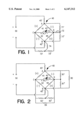
  • FIG. 1 is a schematic diagram of a strain gage bridge circuit, according to a preferred embodiment of the present invention, with two sets of three equalization resistors.
  • FIG. 2 is a schematic diagram of the same strain gage bridge circuit as in FIG. 1, after a Y- ⁇ transformation of the three-resistor network in each set of equalization resistors.
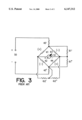
  • FIG. 3 is a schematic diagram of a known strain gage bridge circuit with equalization resistors for two half-bridges as described in U.S. Pat. No. 4,979,580 to Lockery.
  • FIG. 1 shows a strain gage bridge circuit with a strain gage bridge 40 having four arms 41, 42, 43, 44, each including at least one strain gage.
  • One diagonal, with end points A-B, is connected to a power supply source 50 in series with resistor device 45', 45" serving to compensate for temperature variations and non-linearity in the strain gage bridge 40, as is known in the art.
  • the second diagonal, with end points C-D provides an output signal representing the sum of the signals generated by the strain gage device in the four arms 41, 42, 43, 44, and is connected to an indicator 51.
  • resistor networks 71', 71", 72 connected to bridge terminals A, B, D, and 73', 73", 74 connected to bridge terminals C, D, B, are added to the basic strain gage bridge 40 as shown in FIG. 1 for the purpose of equalizing such sensitivity differences.
  • First and second resistors 71' and 71" which have substantially equal resistance values, are connected in series across bridge diagonal A-B, and a third resistor 72 is connected between the junction point between the series connected first and second resistors 71', 71" and junction point D between bridge arms 43, 44.
  • fourth and fifth resistors 73', 73 which also have substantially equal resistance values, are connected in series across bridge diagonal C-D, and a sixth resistor 74 is connected between the junction point between the series connected resistors 73', 73" and junction point B between bridge arms 42, 44.
  • FIG. 2 shows the same circuit as FIG. 1, except that the two Y-connected resistor networks 71', 71", 72 and 73', 72", 74 have been transformed to their equivalent A-configurations.
  • any impedance network with three terminals can be represented by either a Y or a ⁇ configuration of three impedances, and it makes no difference to external circuits which of the two representations is selected.
  • Textbooks on electrical circuits give the following formulae for the transformation of resistance values from a Y configuration, such as 71', 71", 72 in FIG. 1 to an equivalent ⁇ configuration, such as 81', 81", 82 in FIG. 2:
  • Transformation of resistance values 73', 73", 74 in the second Y resistor network to an equivalent ⁇ resistor network 83', 83", 84 follows the same formulae, with 73, 74 replacing 71, 72 and 83, 84 replacing 81, 82.
  • FIG. 3 shows the bridge connection and equalizing resistors for the force measuring device described in U.S. Pat. No. 4,979,580.
  • Resistors 81' and 81" in FIG. 2 affect the sensitivity of half bridge 43, 44 in a similar way as resistors 61', 61" affect the sensitivity of half bridge 43, 44 in FIG. 3.
  • FIGS. 1 and 2 are equivalent, with equations (1b)-(3b) determining the relationships between the resistors 81', 81", 82 and resistors 71', 71", 72, it will be understood that it is possible to vary the effective shunting of bridge arms 43 and 44 by varying a single resistor 72 in the arrangement shown in FIG.1.
  • the third resistor 82 in FIG. 2 does not affect the sensitivity of any bridge arms, but simply acts as a load on the bridge diagonal A-B,
  • Resistor network 73', 73", 74 affects half bridge 42, 44 exactly the same way as resistor network 71', 71", 72 affects the half bridge 43, 44.
  • the conversion formulae are the same, only with 73 replacing 71, 74 replacing 72, 83 replacing 81, and 84 replacing 82 everywhere.
  • R71' and R71" can thus be pre-selected fixed resistors having resistance values low enough to permit maximum anticipated change in sensitivity for a half bridge while the actual adjustment is made by one single resistor 72.
  • the effective shunt resistance values 81' and 81" will always remain equal, independent of the resistance value R72. This makes it possible to use a potentiometer for R72 instead of resistor decade boxes, so the equalization process will be much simpler and less time consuming than equalization by the method described in U.S. Pat. No. 4,979,580.
  • equalization according to a preferred embodiment of the invention is done as follows:
  • a pair of fixed resistors having equal resistance values are connected in series across each of the two bridge diagonals A-B and C-D.
  • the weighing or force measuring device e.g. a load cell device, including the strain gage bridge 40 is loaded at different points of load application, and notice is made of which half bridges have the highest sensitivities.
  • Variable resistors e. g. potentiometers (typically 0-500 kohm), are next connected between each center point of the two series-connected resistors and the center point of each most sensitive half bridge, such as D and B in FIG. 2.
  • variable resistors are adjusted until the output signal remains constant while the load is moved.
  • potentiometers were used as variable resistors, they may be left in the circuit, or they can be replaced by soldered-in resistor combinations. As long as the two series-connected resistors 71' and 71" are equal, the two arms in the equalized half bridge will be guaranteed an equal amount of shunting, as shown by formulae (1b) and (2b), so the equalization will not affect the zero balance of the bridge circuit.
  • the circuit shown in FIGS. 1 and 2 has another advantage over the known circuit according to FIG. 3.
  • the resistance values R82 and R84 in FIG. 2 load the bridge diagonals A-B and C-D, and it can easily be calculated that these resistance values compensate for changes in the load from the resistors 81' and 81", respectively 83' and 83" on the bridge diagonal, so the total load on the bridge diagonals A-B and C-D remains independent of the amount of equalization. This fact can also be seen directly, without calculation, from FIG. 1.
  • resistors 72, 74 are each connected between points with equal potentials, so no current flows in these resistors.
  • the total load on bridge diagonals A-B and C-D is thus determined solely by the fixed series-connected resistors 71', 71", respectively 73', 73". Only when strains in the load cell causes the resistance of bridge arms 41-44 to change so the bridge becomes unbalanced will current flow in resistors 72, 74. Resistors 72 and 74 will thus affect the sensitivity of the bridge arms, even though they do not affect the total load on the bridge diagonals.
  • the constant load on the bridge diagonal A-B ensured by the preferred embodiment of the present invention as described makes certain that changes in equalization adjustment do not cause any change in the voltage drop in resistors 45', 45", which control temperature compensation and/or non-linearity in the strain gage device.
  • the load across diagonal C-D is similarly constant, which ensures that changes in equalization adjustment do not change the output impedance of the bridge.
  • shunt resistors may be connected across either diagonal A-B or diagonal C-D, as required, while the other set is left out of the circuit.
  • both pairs of fixed shunt resistors (71', 71" and 73', 73") may be included as standard in the bridge circuit at all times, but one of the variable value resistors (72, 74) may be left open in some cases, as determined during calibration of the load cell.

Landscapes

  • Physics & Mathematics (AREA)
  • General Physics & Mathematics (AREA)
  • Measurement Of Force In General (AREA)

Abstract

A strain gage bridge circuit and method for sensitivity equalization, particularly suitable for load cell devices for precision measurement. The sensitivity of opposing half-bridges in a strain gage bridge circuit is equalized by a pair of equal, fixed resistors connected across a bridge diagonal formed by the two half-bridges, and a third resistor connecting the junction of the two equal, fixed resistors to the center of the half-bridge with the highest sensitivity. The effective shunting of the most sensitive half bridge can be changed by changing the value of the third resistor, while the ratio of the two equivalent shunting resistance values remain exactly constant. The total load on the bridge diagonal also remains constant when the value of the third resistor is changed. Both sets of orthogonally arranged opposed half-bridges in a strain gage bridge circuit can be equalized independently when two sets of equalizing resistors are used.

Description

BACKGROUND OF THE INVENTION
The present invention is directed to a strain gage bridge circuit with sensitivity equalization and method for sensitivity equalization that are improvements over an invention disclosed in U.S. Pat. No. 4,979,580, issued Dec. 25, 1990 to Lockery, the contents of which patent are incorporated herein by reference.
U.S. Pat. No. 4,979,580 to Lockery discloses how to equalize the measuring sensitivity of opposing half-bridges in a strain gage bridge circuit by connecting pairs of shunt resistors of equal resistance cross a pair of bridge arms forming one half-bridge, and describes how this equalization method can be used to eliminate the sensitivity to variations in the location of the point of force application in a planar weighing device with four strain gages. Changes in the shunt resistance affects the sensitivity of one side of the load platform only, and does not affect the zero adjustment of the bridge output signal. The sensitivity adjustment method described in U.S. Pat. No. 4,979,580 to Lockery works well, and it has been used extensively. Sensitivity adjustment is usually done by trial and error, with resistor decade boxes used as shunt resistors. The resistor boxes are replaced with soldered-in combinations of fixed resistors before the load cell is shipped. Accurate replacement of the resistor box values, however, is a rather demanding and time consuming procedure, especially since the two resistors in a pair must always remain exactly equal. The shunt resistor values also affect the adjustments for linearity and temperature compensation in the strain gage bridge circuit.
SUMMARY OF THE INVENTION
A main object of the present invention is to provide an inexpensive strain gage bridge circuit with equalization of the relative sensitivity of opposing half-bridges in the strain gage bridge circuit.
A further object of the present invention is to provide a method for adjusting the relative sensitivity of opposing half bridges in a strain gage bridge circuit that is easier and less time consuming to perform than previously known methods.
A still further object of the present invention is to provide a sensitivity equalization method that is particularly suitable for load cell devices and that is as effective and accurate as the method described in U.S. Pat. No. 4,979,580, but which does not cause any interaction between the sensitivity adjustment and the adjustments for linearity or temperature compensation in a load cell device utilizing a strain gage bridge circuit according to the invention.
A strain gage bridge circuit, according to a preferred embodiment of the present invention, comprises four arms including strain gages to form two pairs of opposing half bridges arranged symmetrically with respect to two bridge diagonals, first and second resistors connected in series across a first diagonal of the bridge circuit, and a third resistor connected between one end of a second bridge diagonal and the junction point of the series connected first and second resistors.
A method, according to a preferred embodiment of the invention, for sensitivity equalization of opposing half-bridges in a strain gage bridge circuit having four arms forming a first and a second bridge diagonal and pairs of half-bridges arranged symmetrically about each of the first and second bridge diagonal comprises the steps of connecting a pair of substantially equal resistors in series across a first diagonal in the bridge circuit, determining which of the two half-bridges arranged symmetrically about the first bridge diagonal has the highest sensitivity, connecting a third resistor between the junction point of the series-connected resistors and an end point of the second diagonal forming a center tap on the half-bridge having the highest sensitivity, and adjusting the resistance of the third resistor to equalize the sensitivity of the two half bridges about the first bridge diagonal.
BRIEF DESCRIPTION OF THE DRAWINGS
The accompanying drawings, which are incorporated in and constitute a part of the specification, illustrate a preferred embodiment of the invention and, together with the description, serve to explain the principles of the invention.
FIG. 1 is a schematic diagram of a strain gage bridge circuit, according to a preferred embodiment of the present invention, with two sets of three equalization resistors.
FIG. 2 is a schematic diagram of the same strain gage bridge circuit as in FIG. 1, after a Y-Δ transformation of the three-resistor network in each set of equalization resistors.
FIG. 3 is a schematic diagram of a known strain gage bridge circuit with equalization resistors for two half-bridges as described in U.S. Pat. No. 4,979,580 to Lockery.
DETAILED DESCRIPTION OF PREFERRED EMBODIMENTS
Reference will now be made in detail to a preferred embodiment of the invention, examples of which are illustrated in the accompanying drawings.
According to the preferred embodiment of the invention, FIG. 1 shows a strain gage bridge circuit with a strain gage bridge 40 having four arms 41, 42, 43, 44, each including at least one strain gage. One diagonal, with end points A-B, is connected to a power supply source 50 in series with resistor device 45', 45" serving to compensate for temperature variations and non-linearity in the strain gage bridge 40, as is known in the art. The second diagonal, with end points C-D, provides an output signal representing the sum of the signals generated by the strain gage device in the four arms 41, 42, 43, 44, and is connected to an indicator 51.
In many load cell applications, opposing half-bridges, 41-42 and 43-44, or 41-43 and 42-44, will have different sensitivities to an applied load, e.g. as described in U.S. Pat. No. 4,979,580 to Lockery, which is included herein by reference. According to the preferred embodiment of the present invention, resistor networks 71', 71", 72 connected to bridge terminals A, B, D, and 73', 73", 74 connected to bridge terminals C, D, B, are added to the basic strain gage bridge 40 as shown in FIG. 1 for the purpose of equalizing such sensitivity differences. First and second resistors 71' and 71", which have substantially equal resistance values, are connected in series across bridge diagonal A-B, and a third resistor 72 is connected between the junction point between the series connected first and second resistors 71', 71" and junction point D between bridge arms 43, 44. In the same way, fourth and fifth resistors 73', 73", which also have substantially equal resistance values, are connected in series across bridge diagonal C-D, and a sixth resistor 74 is connected between the junction point between the series connected resistors 73', 73" and junction point B between bridge arms 42, 44.
How the two resistor networks 71', 71", 72 and 73', 73", 74 can be used to change the sensitivity of the associated half-bridges will be best understood by reference to FIG. 2, which shows the same circuit as FIG. 1, except that the two Y-connected resistor networks 71', 71", 72 and 73', 72", 74 have been transformed to their equivalent A-configurations.
It is known to those skilled in the art that any impedance network with three terminals can be represented by either a Y or a Δ configuration of three impedances, and it makes no difference to external circuits which of the two representations is selected. Textbooks on electrical circuits give the following formulae for the transformation of resistance values from a Y configuration, such as 71', 71", 72 in FIG. 1 to an equivalent Δ configuration, such as 81', 81", 82 in FIG. 2:
R81'=(R71'*R71"+R71'*R72+R71"*R72)/R71"                    (1)
or:
R81'=R71'+R72(1+R71'/R71")                                 (1a)
R81"=((R71'*R71"+R71'*R72 +R71"*R72)/R71'                  (2)
or:
R81"=R71"+R72(1+R71"/R71')                                 (2a)
R82 =(R71'*R71"+R71'*R72+R71"*R72)/R72                     (3)
If one sets R71'=R71"=R71, then:
R81"=R71+2R72                                              (1b)
R81'=R71+2R72                                              (2b)
R82=R71 (2+R71/R72)                                        (3b)
Transformation of resistance values 73', 73", 74 in the second Y resistor network to an equivalent Δ resistor network 83', 83", 84 follows the same formulae, with 73, 74 replacing 71, 72 and 83, 84 replacing 81, 82.
FIG. 3 shows the bridge connection and equalizing resistors for the force measuring device described in U.S. Pat. No. 4,979,580. Resistors 81' and 81" in FIG. 2 affect the sensitivity of half bridge 43, 44 in a similar way as resistors 61', 61" affect the sensitivity of half bridge 43, 44 in FIG. 3.
Considering that FIGS. 1 and 2 are equivalent, with equations (1b)-(3b) determining the relationships between the resistors 81', 81", 82 and resistors 71', 71", 72, it will be understood that it is possible to vary the effective shunting of bridge arms 43 and 44 by varying a single resistor 72 in the arrangement shown in FIG.1. The third resistor 82 in FIG. 2 does not affect the sensitivity of any bridge arms, but simply acts as a load on the bridge diagonal A-B,
Resistor network 73', 73", 74 affects half bridge 42, 44 exactly the same way as resistor network 71', 71", 72 affects the half bridge 43, 44. The conversion formulae are the same, only with 73 replacing 71, 74 replacing 72, 83 replacing 81, and 84 replacing 82 everywhere.
Formulae (1b)-(3b) show that the effective shunt resistance values R81'=R81"=R81 can be varied in the range R71≦R81≦∞ by changing R72 from 0 to ∞. R71' and R71" can thus be pre-selected fixed resistors having resistance values low enough to permit maximum anticipated change in sensitivity for a half bridge while the actual adjustment is made by one single resistor 72. The effective shunt resistance values 81' and 81" will always remain equal, independent of the resistance value R72. This makes it possible to use a potentiometer for R72 instead of resistor decade boxes, so the equalization process will be much simpler and less time consuming than equalization by the method described in U.S. Pat. No. 4,979,580.
In practice, equalization according to a preferred embodiment of the invention is done as follows:
First, a pair of fixed resistors having equal resistance values (typically 20 kohm each for a strain gage bridge based on 350 ohm gages) are connected in series across each of the two bridge diagonals A-B and C-D. Next, the weighing or force measuring device, e.g. a load cell device, including the strain gage bridge 40 is loaded at different points of load application, and notice is made of which half bridges have the highest sensitivities. Variable resistors, e. g. potentiometers (typically 0-500 kohm), are next connected between each center point of the two series-connected resistors and the center point of each most sensitive half bridge, such as D and B in FIG. 2. A load is then moved across the weighing device, while the variable resistors are adjusted until the output signal remains constant while the load is moved. If potentiometers were used as variable resistors, they may be left in the circuit, or they can be replaced by soldered-in resistor combinations. As long as the two series-connected resistors 71' and 71" are equal, the two arms in the equalized half bridge will be guaranteed an equal amount of shunting, as shown by formulae (1b) and (2b), so the equalization will not affect the zero balance of the bridge circuit.
It can also be shown from equations (1a) and (2a) that the ratio of the effective shunt resistors 81' and 81" will remain equal to the ratio of resistors 71' and 71" even when these are not equal. This may be useful in certain cases when the two arms in a half bridge are slightly unequal, because resistors 71', 71" and/or 73', 73" can be selected to match the slight deviation from equal ratio exhibited by bridge arms 43, 44 and/or 42,44, thereby ensuring constant zero balance during the equalization process even in such a case.
The circuit shown in FIGS. 1 and 2 has another advantage over the known circuit according to FIG. 3. The resistance values R82 and R84 in FIG. 2 load the bridge diagonals A-B and C-D, and it can easily be calculated that these resistance values compensate for changes in the load from the resistors 81' and 81", respectively 83' and 83" on the bridge diagonal, so the total load on the bridge diagonals A-B and C-D remains independent of the amount of equalization. This fact can also be seen directly, without calculation, from FIG. 1. When the bridge 40 is balanced, resistors 72, 74 are each connected between points with equal potentials, so no current flows in these resistors. The total load on bridge diagonals A-B and C-D is thus determined solely by the fixed series-connected resistors 71', 71", respectively 73', 73". Only when strains in the load cell causes the resistance of bridge arms 41-44 to change so the bridge becomes unbalanced will current flow in resistors 72, 74. Resistors 72 and 74 will thus affect the sensitivity of the bridge arms, even though they do not affect the total load on the bridge diagonals. The constant load on the bridge diagonal A-B ensured by the preferred embodiment of the present invention as described makes certain that changes in equalization adjustment do not cause any change in the voltage drop in resistors 45', 45", which control temperature compensation and/or non-linearity in the strain gage device. The load across diagonal C-D is similarly constant, which ensures that changes in equalization adjustment do not change the output impedance of the bridge.
It will be evident to those skilled in the art from this description of the above preferred embodiment that only one set of sensitivity adjusting resistor network (71', 71", 72 or 73', 73", 74) will be required in those cases where only one pair of bridge arm has a sensitivity imbalance. In these cases, shunt resistors (71', 71"or 73', 73") may be connected across either diagonal A-B or diagonal C-D, as required, while the other set is left out of the circuit. Alternatively, both pairs of fixed shunt resistors (71', 71" and 73', 73") may be included as standard in the bridge circuit at all times, but one of the variable value resistors (72, 74) may be left open in some cases, as determined during calibration of the load cell.
It will also be evident to those skilled in the art from this description of the preferred embodiment that the usefulness of the present invention is not limited to planar weighing devices, as described in U.S. Pat. No. 4,979,580. Embodiments of the invention can be applied to any load cell or load cell system where accurate equalization of sensitivity between individual gages is required.
Claims (6)

What is claimed is:
1. A strain gage bridge circuit in a load cell, comprising:
four arms, including strain gages, connected to form first and second diagonals, one of said diagonals being connected to a power supply source and the other of said diagonals providing an output signal representing the sum of the signals from said strain gages;
first and second resistors connected in series across said first diagonal of said bridge circuit; and
a third resistor connected between the junction point of said series connected first and second resistors and one end of said second diagonal of said bridge circuit.
2. A strain gage bridge circuit according to claim 1, further comprising:
fourth and fifth resistors connected in series across said second diagonal of said bridge circuit; and
a sixth resistor connected between the junction point of said series connected fourth and fifth resistors and one end of said first diagonal of said bridge circuit.
3. A strain gage bridge circuit according to claim 1, wherein said first and second resistors have predetermined and substantially equal resistance values.
4. A strain gage bridge circuit according to claim 2, wherein said fourth and fifth resistors have predetermined and substantially equal resistance values.
5. A method for equalizing the sensitivity of opposing half-bridges in a strain gage bridge circuit having four arms forming a first and a second bridge diagonal and pairs of half-bridges arranged symmetrically about each of said first and second bridge diagonal, the method comprising:
connecting first and second resistors in series across the first diagonal in the bridge circuit;
determining which of the two half-bridges arranged symmetrically about the first bridge diagonal has the highest sensitivity;
connecting a third resistor between the junction point of the first and second resistors and the center tap of the half-bridge having the highest sensitivity; and
adjusting the resistance of the third resistor to equalize the sensitivity of the two half bridges about the first bridge diagonal.
6. A method for equalizing the sensitivity of opposing half-bridges in a strain gage bridge circuit according to claim 5, further comprising the act of selecting the ratio of resistance of the first and the second resistor to equal the ratio of the resistance of the two arms constituting the half-bridge to be equalized.
US09/166,113 1998-10-05 1998-10-05 Strain gage bridge circuit with sensitivity equalization and method for sensitivity equalization Expired - Fee Related US6147312A (en)

Priority Applications (1)

Application Number Priority Date Filing Date Title
US09/166,113 US6147312A (en) 1998-10-05 1998-10-05 Strain gage bridge circuit with sensitivity equalization and method for sensitivity equalization

Applications Claiming Priority (1)

Application Number Priority Date Filing Date Title
US09/166,113 US6147312A (en) 1998-10-05 1998-10-05 Strain gage bridge circuit with sensitivity equalization and method for sensitivity equalization

Publications (1)

Publication Number Publication Date
US6147312A true US6147312A (en) 2000-11-14

Family

ID=22601879

Family Applications (1)

Application Number Title Priority Date Filing Date
US09/166,113 Expired - Fee Related US6147312A (en) 1998-10-05 1998-10-05 Strain gage bridge circuit with sensitivity equalization and method for sensitivity equalization

Country Status (1)

Country Link
US (1) US6147312A (en)

Cited By (15)

* Cited by examiner, † Cited by third party
Publication number Priority date Publication date Assignee Title
US6225576B1 (en) * 1999-04-20 2001-05-01 Cts Corporation Shear beam load cell
US6433524B1 (en) 2001-03-15 2002-08-13 Rosemount Aerospace Inc. Resistive bridge interface circuit
US6677538B2 (en) * 2000-02-25 2004-01-13 Siemens Vdo Automotive Corporation Signal processing in a vehicle weight classification system
US20040163481A1 (en) * 2003-02-20 2004-08-26 Flintec, Inc. Bending beam load cell with torque sensitivity compensation
US20050140397A1 (en) * 2001-01-11 2005-06-30 Broadcom Corporation Method and circuit for controlling a resistance of a field effect transistor configured to conduct a signal with a varying voltage
US20050253600A1 (en) * 2004-03-11 2005-11-17 Sarma Garimella R Active sensor circuit with one or more T-network pairs
US20070250276A1 (en) * 2006-04-20 2007-10-25 Mangalam Arun S Temperature-Compensating Sensor System
US20090255736A1 (en) * 2006-09-05 2009-10-15 Kazufumi Naito Load cell unit, weight checker, electronic balance, and balance
US20100307839A1 (en) * 2009-06-09 2010-12-09 James Roy Bradley Counting scale and method of counting
US20110202290A1 (en) * 2008-04-11 2011-08-18 Justtec Corporation Multi-dimension detector with half bridge load cells
US20140299389A1 (en) * 2013-04-04 2014-10-09 Nate J. Coleman System and method to measure force or location on an l-beam
US10365173B2 (en) * 2016-01-01 2019-07-30 Chipsea Technologies (Shenzhen) Corp. Signal processing circuit and method with pressure-sensitive sensor array
CN112816038A (en) * 2021-02-08 2021-05-18 无锡尚合达智能科技有限公司 Flat-plate concave-convex type small-size large-range weighing pressure sensor
US20250076131A1 (en) * 2022-06-29 2025-03-06 Subaru Corporation Load cell and output adjustment method of load cell
US12553782B2 (en) * 2022-06-29 2026-02-17 Subaru Corporation Load cell and output adjustment method of load cell

Citations (8)

* Cited by examiner, † Cited by third party
Publication number Priority date Publication date Assignee Title
US32631A (en) * 1861-06-25 Improvement in lubricating compounds
US3576128A (en) * 1969-03-13 1971-04-27 Blh Electronics Half bridge moment desensitization of parallelogram-type beams
US3899924A (en) * 1973-06-07 1975-08-19 Eaton Corp Strain gauge system
US4061198A (en) * 1975-10-10 1977-12-06 Railweight Inc. (U.K.) Limited Electronic weighing systems
USRE32631E (en) 1984-03-12 1988-03-29 Frazier Precision Instrument Company, Inc. Measurement circuit for load cell
US4958526A (en) * 1989-10-10 1990-09-25 Flintab Ab Force measuring device with zero adjustment
US4979580A (en) * 1989-10-10 1990-12-25 Flintab Force measuring device with sensitivity equalization
US5610343A (en) * 1995-03-28 1997-03-11 Sartorius Ag Balance with one or several wire strain gauge weighing cells

Patent Citations (8)

* Cited by examiner, † Cited by third party
Publication number Priority date Publication date Assignee Title
US32631A (en) * 1861-06-25 Improvement in lubricating compounds
US3576128A (en) * 1969-03-13 1971-04-27 Blh Electronics Half bridge moment desensitization of parallelogram-type beams
US3899924A (en) * 1973-06-07 1975-08-19 Eaton Corp Strain gauge system
US4061198A (en) * 1975-10-10 1977-12-06 Railweight Inc. (U.K.) Limited Electronic weighing systems
USRE32631E (en) 1984-03-12 1988-03-29 Frazier Precision Instrument Company, Inc. Measurement circuit for load cell
US4958526A (en) * 1989-10-10 1990-09-25 Flintab Ab Force measuring device with zero adjustment
US4979580A (en) * 1989-10-10 1990-12-25 Flintab Force measuring device with sensitivity equalization
US5610343A (en) * 1995-03-28 1997-03-11 Sartorius Ag Balance with one or several wire strain gauge weighing cells

Non-Patent Citations (2)

* Cited by examiner, † Cited by third party
Title
Hudson et al. "University Physics", Harcourt Brace Jovanovich, Inc. New York, N.Y., p. 602, 1982.
Hudson et al. University Physics , Harcourt Brace Jovanovich, Inc. New York, N.Y., p. 602, 1982. *

Cited By (21)

* Cited by examiner, † Cited by third party
Publication number Priority date Publication date Assignee Title
US6225576B1 (en) * 1999-04-20 2001-05-01 Cts Corporation Shear beam load cell
US6677538B2 (en) * 2000-02-25 2004-01-13 Siemens Vdo Automotive Corporation Signal processing in a vehicle weight classification system
US20050140397A1 (en) * 2001-01-11 2005-06-30 Broadcom Corporation Method and circuit for controlling a resistance of a field effect transistor configured to conduct a signal with a varying voltage
US7049860B2 (en) * 2001-01-11 2006-05-23 Broadcom Corporation Method and circuit for controlling a resistance of a field effect transistor configured to conduct a signal with a varying voltage
US6433524B1 (en) 2001-03-15 2002-08-13 Rosemount Aerospace Inc. Resistive bridge interface circuit
US20040163481A1 (en) * 2003-02-20 2004-08-26 Flintec, Inc. Bending beam load cell with torque sensitivity compensation
US6910392B2 (en) 2003-02-20 2005-06-28 The Flintec Group, Ltd. Bending beam load cell with torque sensitivity compensation
US20050253600A1 (en) * 2004-03-11 2005-11-17 Sarma Garimella R Active sensor circuit with one or more T-network pairs
US7132838B2 (en) 2004-03-11 2006-11-07 Tao Of Systems Integration, Inc. Active sensor circuit with one or more T-network pairs
US7653503B2 (en) 2006-04-20 2010-01-26 Tao Of Systems Integration, Inc. Temperature-compensating sensor system
US20070250276A1 (en) * 2006-04-20 2007-10-25 Mangalam Arun S Temperature-Compensating Sensor System
US20090255736A1 (en) * 2006-09-05 2009-10-15 Kazufumi Naito Load cell unit, weight checker, electronic balance, and balance
US20110202290A1 (en) * 2008-04-11 2011-08-18 Justtec Corporation Multi-dimension detector with half bridge load cells
US20100307839A1 (en) * 2009-06-09 2010-12-09 James Roy Bradley Counting scale and method of counting
US8530763B2 (en) * 2009-06-09 2013-09-10 James Roy Bradley Counting scale and method of counting involving determination of submultiples by means of a series of divisors
US20140299389A1 (en) * 2013-04-04 2014-10-09 Nate J. Coleman System and method to measure force or location on an l-beam
US9360383B2 (en) * 2013-04-04 2016-06-07 Nate J. Coleman and Aexius, LLC System and method to measure force or location on an L-beam
US10365173B2 (en) * 2016-01-01 2019-07-30 Chipsea Technologies (Shenzhen) Corp. Signal processing circuit and method with pressure-sensitive sensor array
CN112816038A (en) * 2021-02-08 2021-05-18 无锡尚合达智能科技有限公司 Flat-plate concave-convex type small-size large-range weighing pressure sensor
US20250076131A1 (en) * 2022-06-29 2025-03-06 Subaru Corporation Load cell and output adjustment method of load cell
US12553782B2 (en) * 2022-06-29 2026-02-17 Subaru Corporation Load cell and output adjustment method of load cell

Similar Documents

Publication Publication Date Title
US6147312A (en) Strain gage bridge circuit with sensitivity equalization and method for sensitivity equalization
EP2133671B1 (en) A multi-point type weighing equipment and a manufacturing method for the same
US4556115A (en) Method and means for equalizing the measuring sensitivity of a plurality of strain gage transducers
US4796212A (en) Load cell type, weight-measuring device
US4958526A (en) Force measuring device with zero adjustment
US4172389A (en) Temperature compensated bridge circuit
US4261195A (en) Transducer bridge circuit arrangement and method
EP0240556B1 (en) High precision capacitance bridge
JPH067143B2 (en) Electronic badge
US4315211A (en) Preamplifier for voltage measuring instrument with non-interacting zero and span controls
US5693888A (en) Heat conductance vacuum gauge with measuring cell, measuring instrument and connecting cable
US4061198A (en) Electronic weighing systems
JP3081751B2 (en) Electric quantity measuring device
US5369226A (en) Load shift compensation for weighing apparatus
AU613538B2 (en) Microcomputer controlled resistance fault locator circuit
Hiti Resistor network for linearity check of voltage ratio meters by combinatorial calibration technique
RU2620895C1 (en) Signal simulator of strain gauge bridge sensors
US5485100A (en) Automatically balanced and tested bridge measurement circuit, and method
US3443215A (en) Impedance measuring bridge with voltage divider providing constant source impedance to bridge
US5031463A (en) Load cell output correction circuitry
US4278932A (en) A.C. Bridges
US4475608A (en) Weight detection circuit for a load cell scale
US2918270A (en) Weighing scale
US4322679A (en) Alternating current comparator bridge for resistance measurement
US2576059A (en) Limit bridge detector

Legal Events

Date Code Title Description
AS Assignment

Owner name: FLINTEC, INC., MASSACHUSETTS

Free format text: ASSIGNMENT OF ASSIGNORS INTEREST;ASSIGNOR:LOCKERY, HARRY E.;REEL/FRAME:009510/0399

Effective date: 19980925

FEPP Fee payment procedure

Free format text: ENTITY STATUS SET TO SMALL (ORIGINAL EVENT CODE: SMAL); ENTITY STATUS OF PATENT OWNER: SMALL ENTITY

FPAY Fee payment

Year of fee payment: 4

FPAY Fee payment

Year of fee payment: 8

AS Assignment

Owner name: FLINTEC GROUP AB, SWEDEN

Free format text: ASSIGNMENT OF ASSIGNORS INTEREST;ASSIGNOR:FLINTEC, INC.;REEL/FRAME:021217/0993

Effective date: 20080409

REMI Maintenance fee reminder mailed
LAPS Lapse for failure to pay maintenance fees
STCH Information on status: patent discontinuation

Free format text: PATENT EXPIRED DUE TO NONPAYMENT OF MAINTENANCE FEES UNDER 37 CFR 1.362

FP Lapsed due to failure to pay maintenance fee

Effective date: 20121114