US6146966A - Process for forming a capacitor incorporated in a semiconductor device - Google Patents

Process for forming a capacitor incorporated in a semiconductor device Download PDF

Info

Publication number
US6146966A
US6146966A US08/859,210 US85921097A US6146966A US 6146966 A US6146966 A US 6146966A US 85921097 A US85921097 A US 85921097A US 6146966 A US6146966 A US 6146966A
Authority
US
United States
Prior art keywords
temperature
amorphous silicon
silicon film
film
capacitor
Prior art date
Legal status (The legal status is an assumption and is not a legal conclusion. Google has not performed a legal analysis and makes no representation as to the accuracy of the status listed.)
Expired - Lifetime
Application number
US08/859,210
Inventor
Toshiyuki Hirota
Hirohito Watanabe
Fumiki Aiso
Shuji Fujiwara
Masanobu Zenke
Current Assignee (The listed assignees may be inaccurate. Google has not performed a legal analysis and makes no representation or warranty as to the accuracy of the list.)
Renesas Electronics Corp
Original Assignee
NEC Corp
Priority date (The priority date is an assumption and is not a legal conclusion. Google has not performed a legal analysis and makes no representation as to the accuracy of the date listed.)
Filing date
Publication date
Application filed by NEC Corp filed Critical NEC Corp
Assigned to NEC CORPORATION reassignment NEC CORPORATION ASSIGNMENT OF ASSIGNORS INTEREST (SEE DOCUMENT FOR DETAILS). Assignors: AISO, FUMIKI, FUJIWARA, SHUJI, HIROTA, TOSHIYUKI, WATANABE, HIROHITO, ZENKE, MASANOBU
Application granted granted Critical
Publication of US6146966A publication Critical patent/US6146966A/en
Assigned to NEC ELECTRONICS CORPORATION reassignment NEC ELECTRONICS CORPORATION ASSIGNMENT OF ASSIGNORS INTEREST (SEE DOCUMENT FOR DETAILS). Assignors: NEC CORPORATION
Assigned to RENESAS ELECTRONICS CORPORATION reassignment RENESAS ELECTRONICS CORPORATION CHANGE OF NAME (SEE DOCUMENT FOR DETAILS). Assignors: NEC ELECTRONICS CORPORATION
Anticipated expiration legal-status Critical
Expired - Lifetime legal-status Critical Current

Links

Images

Classifications

    • HELECTRICITY
    • H10SEMICONDUCTOR DEVICES; ELECTRIC SOLID-STATE DEVICES NOT OTHERWISE PROVIDED FOR
    • H10BELECTRONIC MEMORY DEVICES
    • H10B12/00Dynamic random access memory [DRAM] devices
    • HELECTRICITY
    • H10SEMICONDUCTOR DEVICES; ELECTRIC SOLID-STATE DEVICES NOT OTHERWISE PROVIDED FOR
    • H10DINORGANIC ELECTRIC SEMICONDUCTOR DEVICES
    • H10D1/00Resistors, capacitors or inductors
    • H10D1/60Capacitors
    • H10D1/68Capacitors having no potential barriers
    • H10D1/692Electrodes
    • H10D1/711Electrodes having non-planar surfaces, e.g. formed by texturisation
    • H10D1/712Electrodes having non-planar surfaces, e.g. formed by texturisation being rough surfaces, e.g. using hemispherical grains
    • HELECTRICITY
    • H10SEMICONDUCTOR DEVICES; ELECTRIC SOLID-STATE DEVICES NOT OTHERWISE PROVIDED FOR
    • H10BELECTRONIC MEMORY DEVICES
    • H10B12/00Dynamic random access memory [DRAM] devices
    • H10B12/01Manufacture or treatment
    • H10B12/02Manufacture or treatment for one transistor one-capacitor [1T-1C] memory cells
    • H10B12/03Making the capacitor or connections thereto
    • H10B12/033Making the capacitor or connections thereto the capacitor extending over the transistor

Definitions

  • the present invention relates to a process for manufacturing a semiconductor device, and more specifically to a process for forming a capacitor incorporated in a semiconductor device.
  • DRAM dynamic random access memory
  • the integration density is increased more and more, namely, a memory capacity is increased more and more in a semiconductor memory.
  • a memory capacity is increased more and more in a semiconductor memory.
  • it is not allowed to increase the size of a semiconductor device chip. Because of this, how small a memory cell is formed, is an important problem to be solved on the semiconductor device.
  • the memory cell having the stacked capacitor As compared with the memory cell having the trench capacitor, the memory cell having the stacked capacitor has an excellent soft-error resistance and an advantage in which no damage is given to a silicon substrate. Therefore, the stacked capacitor type memory cell is expected as next generation memory cell structure.
  • a stacked capacitor formed by utilizing a HSG (hemi-spherical grain) technology As the stacked capacitor, there is proposed a stacked capacitor formed by utilizing a HSG (hemi-spherical grain) technology.
  • This type of stacked capacitor is constituted of a capacitor lower plate (storage node capacitor cell plate), a capacitor insulator film and a capacitor upper plate (common plate), the capacitor lower plate being electrically connected through a contact hole formed in an interlayer insulator film, to a MOSFET (metal-oxide-semiconductor field effect transistor) formed in a semiconductor substrate.
  • MOSFET metal-oxide-semiconductor field effect transistor
  • Japan Patent Application Pre-examination Publication No. JP-A-5-110023 proposes to deposit an amorphous silicon film through a natural oxide film on a silicon film, and to conduct a heat treatment to cause migration in a surface of the amorphous silicon film, so that a surface-roughed polysilicon film having a concave-convex upper surface is formed.
  • This JP-A-5-110023 is so featured in that the formation of the concaves and convexes formed by the HSG technology is limited to only a top surface of the polysilicon film, and therefore, the increase of the capacitance inevitably has certain limit.
  • Japanese Patent Application Pre-examination Publication No. JP-A-5-315543 proposes a process for forming, by the HSG technology, concaves and convexes not only on a top surface of a capacitor lower plate but also on a side surface of the capacitor lower plate.
  • this proposed process after an amorphous silicon film deposited by a CVD (chemical vapor deposition) process is patterned by a selective etching, the patterned amorphous silicon film is heat-treated in an inert gas or vacuum atmosphere, so that the amorphous silicon film is crystallized into a polysilicon film.
  • CVD chemical vapor deposition
  • a so called a “crystal nucleation” has been proposed in which SiH 4 or the like is irradiated to the top surface and the side surface of the amorphous silicon to form nuclei on these surfaces, and then, an annealing is conducted to form the concaves and convexes on the top surface and the side surface of the amorphous silicon. More specifically, in this "crystal nucleation", an amorphous silicon film is formed to electrically connect to a semiconductor device element such as a MOSFET formed in a semiconductor substrate, through a contact hole selectively formed through an interlayer insulator film, and the amorphous silicon film is patterned to form a capacitor lower plate.
  • a semiconductor device element such as a MOSFET formed in a semiconductor substrate
  • a natural oxide film remaining on a surface of the capacitor lower plate is removed by use of HF of the like, and thereafter, SiH 4 is irradiated onto the capacitor lower plate within a reaction chamber which is maintained at a predetermined temperature. After irradiation of SiH 4 , an annealing is conducted for a predetermined length of time.
  • the capacitor lower plate having the concaves and convexes formed on not only the top surface but also the side surface in accordance with the HSG technology.
  • crystal nucleation In the above mentioned “crystal nucleation" process, however, it was observed that, a crystal grows from a boundary between the capacitor lower plate film and the interlayer insulator film, and this crystallization reaches to the exposed top surface and the exposed side surface of the capacitor lower plate before the concaves and convexes are formed on the top surface and the side surface of the capacitor lower plate. If the crystallization reaches to the top surface and the side surface, the HSG formation process no longer advances, with the result that an expected increase of the surface area of the capacitor lower plate cannot be obtained. Actually, in the same wafer, some memory chips can obtain an expected increase of the surface area of the capacitor lower plate, but other memory chips cannot obtain the expected increase of the surface area of the capacitor lower plate, with the result that the production yield is low.
  • Another object of the present invention is to provide a process for manufacturing a semiconductor device, which can minimize, in the "crystal nucleation" process, a crystallization occurring from a boundary between an amorphous semiconductor film and an interlayer insulator film in contact therewith.
  • Still another object of the present invention is to provide a process for forming a capacitor incorporated in a semiconductor device, which has a capacitor lower plate having an increased surface area.
  • the second temperature is not higher than 600° C.
  • the first temperature is not lower than 530° C. and is lower than the second temperature by not less than 5° C.
  • a process for forming a capacitor which is formed on an interlayer insulator film and which is electrically connected to a semiconductor substrate through a contact hole formed through the interlayer insulator film, the process comprising the steps of forming a patterned amorphous silicon film to fill the contact hole and to partially cover the interlayer insulator film, irradiating a crystal nucleus forming gas onto the patterned amorphous silicon film at a temperature which makes a growth rate of crystals growing from a boundary between the patterned amorphous silicon film and the interlayer insulator film, lower than that in a succeeding annealing step, so that crystal nuclei are formed on a surface of the patterned amorphous silicon film, annealing the patterned amorphous silicon film so that hemi-spherical silicon grains are formed from the crystal nuclei on the surface of the patterned amorphous silicon film, forming a capacitor dielectric film to cover the hemi-s
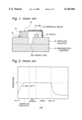
  • FIG. 1 is a diagrammatic section view of the capacitor lower plate formed in accordance with the temperature sequence as shown in FIG. 2;
  • FIG. 2 is a graph showing the temperature sequence, for illustrating the prior art process for forming the HSG structure capacitor lower plate
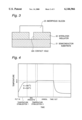
  • FIG. 3 is a diagrammatic section view of the capacitor lower plate to be treated in accordance with the temperature sequence of the process in accordance with the present invention for forming the HSG structure capacitor lower plate;
  • FIG. 4 is a graph showing the temperature sequence of a first embodiment of the process in accordance with the present invention for forming the HSG structure capacitor lower plate;
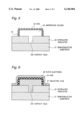
  • FIG. 5 is a diagrammatic section view of the capacitor lower plate on which the hemi-spherical grains are formed on the amorphous silicon film in accordance with the temperature sequence of the process in accordance with the present invention for forming the HSG structure capacitor lower plate;
  • FIG. 6 is a diagrammatic section view of the HSG structure capacitor completed in accordance with the process in accordance with the present invention for forming the HSG structure capacitor lower plate;
  • FIG. 7 is a graph showing the temperature sequence of a second embodiment of the process in accordance with the present invention for forming the HSG structure capacitor lower plate;
  • FIG. 8 is a graph showing the temperature sequence of a third embodiment of the process in accordance with the present invention for forming the HSG structure capacitor lower plate.
  • FIG. 9 is a graph showing the temperature sequence of a first embodiment of the process in accordance with the present invention for forming the HSG structure capacitor lower plate.
  • a capacitor lower plate to be formed with hemi-spherical grains is designated with Reference Numeral 26.
  • the capacitor lower plate 26 is a patterned amorphous silicon film.
  • an interlayer insulator film 22 is formed, and a contact hole 22A is selectively formed to penetrate through the interlayer insulator film 22 and to partially expose the semiconductor substrate 21.
  • the interlayer insulator film 22 is formed of BPSG (borophosphosilicate glass) or NSG (non-doped silicate glass).
  • an impurity-doped, for example, phosphorus-doped, amorphous silicon 23 is formed to fill the contact hole 22A and to cover the interlayer 22, and then, is patterned to have an exposed side surface and an exposed top surface.
  • a natural oxide film covers the surface of the amorphous silicon film 23. Therefore, if the surface of the amorphous silicon film 23 is covered with the natural oxide film, the natural oxide film is removed by an etching or the like.
  • the semiconductor substrate thus prepared is introduced into a reaction chamber, and a treatment is conducted at a temperature shown in FIG. 2 which illustrate a temperature sequence for processing the semiconductor substrate.
  • the semiconductor substrate is heated to a temperature of about 550° C. to 570° C., and then, is maintained at this temperature.
  • SiH 4 is introduced into the reaction chamber, so that SiH 4 is irradiated onto the amorphous silicon film for a predetermined constant period of time.
  • nuclei composed of silicon atoms are formed on the exposed top surface and the exposed side surface of the patterned amorphous silicon film.
  • the patterned amorphous silicon film is annealed at the same temperature for another predetermined period of time.
  • this annealing process on the exposed top surface and the exposed side surface of the patterned amorphous silicon film, migration of amorphous silicon occurs so that silicon atoms in the neighborhood of each nucleus aggregate or flocculate toward each nucleus, with the result that hemi-spherical silicon crystalline grains are formed on the exposed top surface and the exposed side surface of the patterned amorphous silicon film.
  • the semiconductor substrate having the thus formed hemi-spherical silicon crystalline grains is taken out from the reaction chamber.
  • a dielectric film and a common plate electrode both not shown
  • the phenomenon was found out that, a crystal, different from the hemi-spherical grains, grows from a boundary between the amorphous silicon and the interlayer insulator, and if the crystal reaches a top surface and a side surface of the amorphous silicon, no hemi-spherical grain is formed on a surface of the crystallized portion.
  • the co-inventors of the present application found out that the crystallization of the amorphous silicon starting from the boundary between the amorphous silicon and the interlayer insulator film can be suppressed or retarded by changing the temperature sequence. On the basis of this finding, the co-inventors of the present application propose here an improved process for forming a capacitor component.
  • FIGS. 3, 4, 5 and 6 a first embodiment of the process in accordance with the present invention for forming a capacitor component, which can be used as a cell capacitor for the stacked capacitor structure DRAM memory cell, will be described with reference to FIGS. 3, 4, 5 and 6.
  • FIG. 3 illustrates a condition in which on a semiconductor substrate 21 (having for example MOSFTs (not shown) previously formed therein for the purpose of forming memory cells), there are formed an interlayer insulator film 22 (which is formed of for example BPSG or NSG) having a contact hole 22A selectively formed to penetrate through the interlayer insulator film 22 and to partially expose the semiconductor substrate 21, and a patterned phosphorus-doped amorphous silicon 23 formed to fill the contact hole 22A and to partially cover the interlayer 22 and to have an exposed side surface and an exposed top surface.
  • the semiconductor substrate thus prepared is introduced into a reaction chamber.
  • a treatment for the HSG formation is performed in accordance with the temperature sequence as shown in FIG. 4.
  • the semiconductor substrate is heated to a temperature B of about 555° C. (which is lower than an annealing temperature A of about 560° C. by 5° C.) ("TEMPERATURE STABILIZATION 1" in FIG. 4).
  • SiH 4 is introduced into the reaction chamber as a gas for forming crystal nuclei composed of silicon atoms, so that SiH 4 is irradiated onto the phosphorus-doped amorphous silicon film 23. Introduction of SiH 4 is performed for 20 minutes for example.
  • the reaction chamber is maintained at a vacuum degree of for example 0.11997 Pa (0.9 mTorr) during a period of time in which SiH 4 is introduced.
  • a vacuum degree for example 0.11997 Pa (0.9 mTorr) during a period of time in which SiH 4 is introduced.
  • the temperature of the semiconductor substrate is elevated to the temperature A of about 560° C. At this time, a transient time of about five minutes is required until the temperature of the semiconductor substrate has been stabilized at the temperature A ("TEMPERATURE STABILIZATION 2" in FIG. 4). If the temperature of the semiconductor substrate is put in the stabilized temperature A, the semiconductor substrate starts to be annealed in the reaction chamber. Therefore, the temperature A indicates a stabilized temperature in the annealing step. This annealing was conducted for 35 minutes.
  • the semiconductor substrate formed with the hemi-spherical grains (HSG) by the above mentioned annealing process is taken out from the reaction chamber, and then, is cooled down, and thereafter, is introduced into another reaction chamber (not shown).
  • a silicon oxide film or a silicon nitride film having a thickness of 5 nm to 8 nm is formed on the hemi-spherical grains 24 by a conventional process, so as to form a dielectric film 27 of the capacitor. Furthermore, a polysilicon film is deposited to cover the dielectric film 27 to form a capacitor upper plate, namely, a common plate electrode 28. Thus, a capacitor is constituted of the lower plate 22 having the hemi-spherical grains 24, the dielectric film 27 and the upper plate 28. Incidentally, if a heat treatment is conducted after formation of the hemi-spherical grains (HSG), the amorphous silicon 23 becomes polysilicon.
  • HSG hemi-spherical grains
  • FIG. 7 there is shown a temperature sequence illustrating a second embodiment of the process in accordance with the present invention for forming the HSG structure capacitor lower plate.
  • the second embodiment is characterized in that the annealing temperature A' in the annealing step is set to 570° C., which is somewhat higher than that of the first embodiment, and the stabilized temperature B at the time of irradiating SiH 4 is set to 560° C., which is lower than the annealing temperature A' by 10° C.
  • the SiH 4 irradiating time and the annealing time were about 15 minutes and about 20 minutes, respectively.
  • the stabilized temperature B at the time of irradiating SiH 4 and the annealing temperature A' are made higher than those in the first embodiment, it was possible to prevent a crystal growing in the amorphous silicon from reaching the surface of the amorphous silicon film before the hemi-spherical grains are formed on the whole exposed surface of the amorphous silicon film, similarly to the first embodiment.
  • the crystal nucleus formation processing time and the annealing time can be shortened in comparison with the first embodiment, and furthermore, the throughput can be improved.
  • This third embodiment is characterized in that the temperature is caused to change over three steps from the moment the semiconductor substrate is introduced into the reaction chamber to the moment the annealing is completed.
  • the semiconductor substrate is heated to a temperature C of about 550° C., which is lower than by 5° C. the stabilized temperature B of about 555° C. at the time of irradiating SiH 4 , and after the temperature of the semiconductor substrate is stabilized at the temperature C, the semiconductor substrate is heated to the stabilized temperature B for irradiating SiH 4 , and stabilized at the temperature B. During a period that the temperature of the semiconductor substrate is maintained at the stabilized temperature B, SiH 4 is introduced and irradiated. After the irradiation of SiH 4 , the semiconductor substrate is heated to elevate by 5° C. to reach the anneal temperature A of about 560° C.
  • the third embodiment is characterized in that the semiconductor substrate is preliminary heated before the irradiation of SiH 4 , with the result that the semiconductor substrate can be easily heated to the stabilized temperature B for the crystal nucleus formation processing. Therefore, it is considered that the temperature C is lower than the stabilized temperature B by a value preferably not less than 5° C. but not greater than 10° C. so that the semiconductor substrate can be easily heated to the crystal nucleus formation processing temperature.
  • the crystallization rate of amorphous silicon becomes exponentially quick if the temperature exceeds a certain temperature.
  • about 30 minutes are required until it reaches the temperature B for the SiH 4 irradiation, namely, as the period of "TEMPERATURE STABILIZATION 1", and in this period of time, in fact, crystallization advances in the amorphous silicon 23.
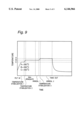
  • a temperature sequence of a fourth embodiment of the process in accordance with the present invention for forming the HSG structure capacitor lower plate will be described with reference to FIG. 9.
  • This fourth embodiment is characterized in that the temperature is caused to change over two steps in the annealing process.
  • the semiconductor substrate is annealed at the same temperature as that the stabilized temperature B for irradiating SiH 4 , for about ten minutes, and succeedingly, in an "ANNEAL 2", the semiconductor substrate is heated to elevate by 5° C. to reach the annealing temperature A, and thereafter, the semiconductor substrate is annealed at the temperature A for about 25 minutes.
  • the silicon atoms are supplied to each crystal nucleus from the amorphous silicon 23.
  • the supply amount is also at constant per time.
  • Silicon atoms are deposited on a surface of the hemi-spherical silicon crystalline grains because of the migration, with the result that the size or diameter of the hemi-spherical silicon crystalline grains becomes large. Therefore, if the supply amount of silicon atoms is at constant, the grain diameter increasing rate or speed lowers with an increase of the surface area of the hemi-spherical silicon crystalline grains 24. Thus, the grain diameter increasing rate or speed of the hemi-spherical silicon crystalline grains 24 lowers with the lapse of time.
  • the HSG formation is caused to advance while maintaining the crystal growth rate at a low level, and if the grain diameter of the hemi-spherical silicon crystalline grains 24 becomes large to some degree, the anneal is transited to the "ANNEAL 2" so that the temperature is elevated to the temperature A. If the temperature is elevated to the temperature A, since the supply amount of silicon atoms increases, the growth of the hemi-spherical silicon crystalline grains 24 is accelerated so that the grains 24 can be further enlarged.
  • the stabilized temperature B for irradiating SiH 4 at a temperature lower than the annealing temperature A or A', advancement of the crystallization in the amorphous silicon, starting from the boundary between the amorphous silicon and the interlayer insulator film, can be suppressed or retarded during the process of the SiH 4 irradiation, namely during the crystal nucleus formation process.
  • the annealing temperature is not higher than 600° C. and the stabilized temperature B for irradiating the crystal nucleus forming gas is not lower than 530° C.
  • the crystals growing into the amorphous silicon from the boundary between the amorphous silicon and the interlayer insulator does not reach the surface of the amorphous silicon film in the annealing process.
  • the crystal growth greatly depends upon both the temperature and the lapse of time.
  • the crystals growing from the boundary between the amorphous silicon and the interlayer insulator continues to grow in the amorphous silicon over the whole period of the crystal nucleus formation process and the annealing process for forming the hemi-spherical grains. Therefore, during the crystal nucleus formation process, the crystals starts to grow from the boundary between the amorphous silicon and the interlayer insulator and continues to grow in the amorphous silicon, but although the silicon nuclei are formed on the surface of the amorphous silicon, the hemi-spherical grains do not grow from the silicon nuclei.
  • the stabilized temperature B for irradiating the crystal nucleus forming gas is lower than 530° C.
  • the crystal nuclei formed of silicon atoms could not be formed on the surface of the amorphous silicon film.
  • the annealing temperature A is higher than 600° C., a crystal generates in the inside of the amorphous silicon film, and it is no longer possible to control the growth of the crystal in the amorphous silicon film.
  • the stabilized temperature B for irradiating the crystal nucleus forming gas is lower than the annealing temperature A by not less than 5° C., although crystals generate, the growth of the generated crystals can be sufficiently suppressed or retarded in the crystal nucleus forming process.
  • the stabilized temperature B for irradiating the crystal nucleus forming gas is lower than the annealing temperature A by less than 5° C., the crystals growing into the amorphous silicon from the boundary between the amorphous silicon and the interlayer insulator could not satisfactory be prevented from reaching the surface of the amorphous silicon film in the annealing process.
  • silane (SiH 4 ) was irradiated as a source gas for forming the crystal nuclei, but in place of the silane, disilane (Si 2 H 6 ) or trisilane (Si 3 H 8 ) can be used.
  • As (arsenic) or B (boron) can be used in place of phosphorus.
  • the process in accordance with the present invention can suppress or retard the growth of the crystals starting from the boundary between the amorphous silicon film and the interlayer insulator film and growing in the amorphous silicon film, in the process for forming the hemi-spherical silicon grains on the basis of the "crystal nucleation" process, with the result that it is possible to prevent formation of hemi-spherical silicon grains from being obstructed by the growth of the crystals growing in the amorphous silicon film. Accordingly, it is possible to form a capacitor lower plate having a large surface area

Landscapes

  • Semiconductor Memories (AREA)
  • Semiconductor Integrated Circuits (AREA)

Abstract

In a process of forming hemi-spherical silicon grains on an amorphous silicon film in accordance with the "crystal nucleation" process, in order to form crystal nuclei on a top surface and a side surface of the amorphous silicon film, SiH4 is irradiated onto the top and side surfaces of the amorphous silicon film at a stabilized temperature which is lower than, by at least 5° C., an annealing temperature for growing the hemi-spherical silicon grains from the crystal nuclei, with the result that it is possible to suppress or retard the growth of the crystals growing into the amorphous silicon film from a boundary between the amorphous silicon film and an interlayer insulator film. Thereafter, the amorphous silicon film having the crystal nuclei thus formed on the surface thereof is annealed at the annealing temperature so that the hemi-spherical silicon grains are formed on the whole surface of the top and side surfaces of the amorphous silicon film.

Description

BACKGROUND OF THE INVENTION
1. Field of the Invention
The present invention relates to a process for manufacturing a semiconductor device, and more specifically to a process for forming a capacitor incorporated in a semiconductor device.
2. Description of Related Art
At present, in semiconductor devices of this type having capacitors, a high integration density is demanded, as can be seen in DRAM (dynamic random access memory). In order to fulfill this demand, an area required for each memory cell in the DRAM has been extremely reduced. For example, in a 1MDRAM or 4MDRAM, a 0.8 μm rule has been adopted in the semiconductor device design, and further, in a 16MDRAM, a 0.6 μm rule has been adopted.
As mentioned above, the integration density is increased more and more, namely, a memory capacity is increased more and more in a semiconductor memory. However, in order to elevate the production efficiency and to lower a production cost, it is not allowed to increase the size of a semiconductor device chip. Because of this, how small a memory cell is formed, is an important problem to be solved on the semiconductor device.
However, if the area of the memory cell is reduced, the amount of electric charges stored in the memory cell correspondingly become small. Therefore, it has become difficult to realize a high integration density of memory cells and at the same time to ensure a necessary amount of electric charge stored in each memory cell.
Under the above mentioned circumstance, a memory cell having a trench capacitor and a memory cell having a stacked capacitor have been proposed and reduced in practice.
As compared with the memory cell having the trench capacitor, the memory cell having the stacked capacitor has an excellent soft-error resistance and an advantage in which no damage is given to a silicon substrate. Therefore, the stacked capacitor type memory cell is expected as next generation memory cell structure.
As the stacked capacitor, there is proposed a stacked capacitor formed by utilizing a HSG (hemi-spherical grain) technology. This type of stacked capacitor is constituted of a capacitor lower plate (storage node capacitor cell plate), a capacitor insulator film and a capacitor upper plate (common plate), the capacitor lower plate being electrically connected through a contact hole formed in an interlayer insulator film, to a MOSFET (metal-oxide-semiconductor field effect transistor) formed in a semiconductor substrate. In this case, a number of hemi-spherical grains are formed on a surface of storage electrode (capacitor lower plate), so that a surface area of the storage electrode is substantially increased, with the result that an increased capacitance is realized.
As one example of the HSG technology for forming concaves and convexes by hemi-spherical grains, Japan Patent Application Pre-examination Publication No. JP-A-5-110023 (an English abstract of which is available from the Japanese Patent Office and is incorporated by reference in its entirety into this application) proposes to deposit an amorphous silicon film through a natural oxide film on a silicon film, and to conduct a heat treatment to cause migration in a surface of the amorphous silicon film, so that a surface-roughed polysilicon film having a concave-convex upper surface is formed.
This JP-A-5-110023 is so featured in that the formation of the concaves and convexes formed by the HSG technology is limited to only a top surface of the polysilicon film, and therefore, the increase of the capacitance inevitably has certain limit.
On the other hand, Japanese Patent Application Pre-examination Publication No. JP-A-5-315543 (an English abstract of which is available from the Japanese Patent Office and is incorporated by reference in its entirety into this application) proposes a process for forming, by the HSG technology, concaves and convexes not only on a top surface of a capacitor lower plate but also on a side surface of the capacitor lower plate. In this proposed process, after an amorphous silicon film deposited by a CVD (chemical vapor deposition) process is patterned by a selective etching, the patterned amorphous silicon film is heat-treated in an inert gas or vacuum atmosphere, so that the amorphous silicon film is crystallized into a polysilicon film. According to this process, since the concaves and convexes are formed not only on the top surface of the capacitor lower plate but also on the side surface of the capacitor lower plate, a large capacitance can be advantageously obtained.
However, the experiments conducted by the co-inventors of the present application showed that, in the process disclosed by JP-A-5-315543, the processing temperature for growing the hemi-spherical silicon crystalline grains is as narrow as ±2.5° C. Therefore, this process is not suitable to a mass production.
In order to eliminate this disadvantage, a so called a "crystal nucleation" has been proposed in which SiH4 or the like is irradiated to the top surface and the side surface of the amorphous silicon to form nuclei on these surfaces, and then, an annealing is conducted to form the concaves and convexes on the top surface and the side surface of the amorphous silicon. More specifically, in this "crystal nucleation", an amorphous silicon film is formed to electrically connect to a semiconductor device element such as a MOSFET formed in a semiconductor substrate, through a contact hole selectively formed through an interlayer insulator film, and the amorphous silicon film is patterned to form a capacitor lower plate. A natural oxide film remaining on a surface of the capacitor lower plate is removed by use of HF of the like, and thereafter, SiH4 is irradiated onto the capacitor lower plate within a reaction chamber which is maintained at a predetermined temperature. After irradiation of SiH4, an annealing is conducted for a predetermined length of time. Thus, there is obtained the capacitor lower plate having the concaves and convexes formed on not only the top surface but also the side surface in accordance with the HSG technology.
In the above mentioned "crystal nucleation" process, however, it was observed that, a crystal grows from a boundary between the capacitor lower plate film and the interlayer insulator film, and this crystallization reaches to the exposed top surface and the exposed side surface of the capacitor lower plate before the concaves and convexes are formed on the top surface and the side surface of the capacitor lower plate. If the crystallization reaches to the top surface and the side surface, the HSG formation process no longer advances, with the result that an expected increase of the surface area of the capacitor lower plate cannot be obtained. Actually, in the same wafer, some memory chips can obtain an expected increase of the surface area of the capacitor lower plate, but other memory chips cannot obtain the expected increase of the surface area of the capacitor lower plate, with the result that the production yield is low.
SUMMARY OF THE INVENTION
Accordingly, it is an object of the present invention to provide a process for manufacturing a semiconductor device, which has overcome the above mentioned defect of the conventional one.
Another object of the present invention is to provide a process for manufacturing a semiconductor device, which can minimize, in the "crystal nucleation" process, a crystallization occurring from a boundary between an amorphous semiconductor film and an interlayer insulator film in contact therewith.
Still another object of the present invention is to provide a process for forming a capacitor incorporated in a semiconductor device, which has a capacitor lower plate having an increased surface area.
The above and other objects of the present invention are achieved in accordance with the present invention by a process of irradiating a crystal nucleus forming gas onto an amorphous silicon film formed on an interlayer insulator film, at a first temperature, for forming crystal nuclei on a surface of the amorphous silicon film, and annealing the amorphous silicon film having the crystal nuclei thus formed on the surface thereof, at a second temperature, for forming hemi-spherical silicon grains on the surface of the amorphous silicon film, the improvement being characterized in that the first temperature is lower than the second temperature.
Specifically, the second temperature is not higher than 600° C., and the first temperature is not lower than 530° C. and is lower than the second temperature by not less than 5° C.
According to another aspect of the present invention, there is provided a process for forming a capacitor which is formed on an interlayer insulator film and which is electrically connected to a semiconductor substrate through a contact hole formed through the interlayer insulator film, the process comprising the steps of forming a patterned amorphous silicon film to fill the contact hole and to partially cover the interlayer insulator film, irradiating a crystal nucleus forming gas onto the patterned amorphous silicon film at a temperature which makes a growth rate of crystals growing from a boundary between the patterned amorphous silicon film and the interlayer insulator film, lower than that in a succeeding annealing step, so that crystal nuclei are formed on a surface of the patterned amorphous silicon film, annealing the patterned amorphous silicon film so that hemi-spherical silicon grains are formed from the crystal nuclei on the surface of the patterned amorphous silicon film, forming a capacitor dielectric film to cover the hemi-spherical silicon grains, and forming a capacitor plate to cover the capacitor dielectric film, so that a capacitor is constituted of the patterned silicon film having the hemi-spherical silicon grains formed on the surface thereof, the capacitor dielectric film covering the hemi-spherical silicon grains, and the capacitor plate covering the capacitor dielectric film.
The above and other objects, features and advantages of the present invention will be apparent from the following description of preferred embodiments of the invention with reference to the accompanying drawings.
BRIEF DESCRIPTION OF THE DRAWINGS
FIG. 1 is a diagrammatic section view of the capacitor lower plate formed in accordance with the temperature sequence as shown in FIG. 2;
FIG. 2 is a graph showing the temperature sequence, for illustrating the prior art process for forming the HSG structure capacitor lower plate;
FIG. 3 is a diagrammatic section view of the capacitor lower plate to be treated in accordance with the temperature sequence of the process in accordance with the present invention for forming the HSG structure capacitor lower plate;
FIG. 4 is a graph showing the temperature sequence of a first embodiment of the process in accordance with the present invention for forming the HSG structure capacitor lower plate;
FIG. 5 is a diagrammatic section view of the capacitor lower plate on which the hemi-spherical grains are formed on the amorphous silicon film in accordance with the temperature sequence of the process in accordance with the present invention for forming the HSG structure capacitor lower plate;
FIG. 6 is a diagrammatic section view of the HSG structure capacitor completed in accordance with the process in accordance with the present invention for forming the HSG structure capacitor lower plate;
FIG. 7 is a graph showing the temperature sequence of a second embodiment of the process in accordance with the present invention for forming the HSG structure capacitor lower plate;
FIG. 8 is a graph showing the temperature sequence of a third embodiment of the process in accordance with the present invention for forming the HSG structure capacitor lower plate; and
FIG. 9 is a graph showing the temperature sequence of a first embodiment of the process in accordance with the present invention for forming the HSG structure capacitor lower plate.
DESCRIPTION OF THE PREFERRED EMBODIMENTS
Before explaining the process in accordance with the present invention, the HSG forming process based on the "crystal nucleation", which has been conducted by the co-inventors of the present application, will be described with reference to FIGS. 1 and 2.
Referring to FIG. 1, a capacitor lower plate to be formed with hemi-spherical grains is designated with Reference Numeral 26. In the example shown in FIG. 1, the capacitor lower plate 26 is a patterned amorphous silicon film. On a semiconductor substrate 21 having for example MOSFETs (not shown) previously formed therein for the purpose of forming memory cells, an interlayer insulator film 22 is formed, and a contact hole 22A is selectively formed to penetrate through the interlayer insulator film 22 and to partially expose the semiconductor substrate 21. For example, the interlayer insulator film 22 is formed of BPSG (borophosphosilicate glass) or NSG (non-doped silicate glass).
In this condition, an impurity-doped, for example, phosphorus-doped, amorphous silicon 23 is formed to fill the contact hole 22A and to cover the interlayer 22, and then, is patterned to have an exposed side surface and an exposed top surface. Incidentally, in the case that hemi-spherical grains are formed in accordance with the "crystal nucleation" process, it is not preferred that a natural oxide film covers the surface of the amorphous silicon film 23. Therefore, if the surface of the amorphous silicon film 23 is covered with the natural oxide film, the natural oxide film is removed by an etching or the like.
The semiconductor substrate thus prepared is introduced into a reaction chamber, and a treatment is conducted at a temperature shown in FIG. 2 which illustrate a temperature sequence for processing the semiconductor substrate. As shown in FIG. 2, the semiconductor substrate is heated to a temperature of about 550° C. to 570° C., and then, is maintained at this temperature. After a temperature of the semiconductor substrate is stabilized at this temperature, SiH4 is introduced into the reaction chamber, so that SiH4 is irradiated onto the amorphous silicon film for a predetermined constant period of time. As a result, nuclei composed of silicon atoms are formed on the exposed top surface and the exposed side surface of the patterned amorphous silicon film.
After the nuclei have been formed, irradiation of SiH4 is stopped, and the patterned amorphous silicon film is annealed at the same temperature for another predetermined period of time. In this annealing process, on the exposed top surface and the exposed side surface of the patterned amorphous silicon film, migration of amorphous silicon occurs so that silicon atoms in the neighborhood of each nucleus aggregate or flocculate toward each nucleus, with the result that hemi-spherical silicon crystalline grains are formed on the exposed top surface and the exposed side surface of the patterned amorphous silicon film. Thereafter, the semiconductor substrate having the thus formed hemi-spherical silicon crystalline grains is taken out from the reaction chamber. Thereafter, a dielectric film and a common plate electrode (both not shown) are formed, and thus, a capacitor is completed.
In the case of adopting the temperature sequence mentioned above, the phenomenon was found out that, a crystal, different from the hemi-spherical grains, grows from a boundary between the amorphous silicon and the interlayer insulator, and if the crystal reaches a top surface and a side surface of the amorphous silicon, no hemi-spherical grain is formed on a surface of the crystallized portion.
Now, this phenomenon will be described in detail with reference to FIG. 1. When the SiH4 irradiaton and the annealing are conducted for the semiconductor substrate as shown in FIG. 1 in accordance with the temperature sequence as shown in FIG. 2, it was found out that, before hemi-spherical silicon crystalline grains 24 are formed on the surface of the patterned amorphous silicon film 23, a crystal 25 grows from the boundary between the interlayer insulator film 22 and the amorphous silicon film 23.
It was also observed that, if the crystal 25 reaches the surface of the amorphous silicon film 23 before the hemi-spherical grains 24 are formed on the surface of the amorphous silicon film 23, the hemi-spherical grains 24 was not formed on the surface of the crystallized portion, as shown by Reference Numeral 26. As a result, the increase of the surface area by the HSG formation is substantially restricted.
The co-inventors of the present application found out that the crystallization of the amorphous silicon starting from the boundary between the amorphous silicon and the interlayer insulator film can be suppressed or retarded by changing the temperature sequence. On the basis of this finding, the co-inventors of the present application propose here an improved process for forming a capacitor component.
Now, a first embodiment of the process in accordance with the present invention for forming a capacitor component, which can be used as a cell capacitor for the stacked capacitor structure DRAM memory cell, will be described with reference to FIGS. 3, 4, 5 and 6.
FIG. 3 illustrates a condition in which on a semiconductor substrate 21 (having for example MOSFTs (not shown) previously formed therein for the purpose of forming memory cells), there are formed an interlayer insulator film 22 (which is formed of for example BPSG or NSG) having a contact hole 22A selectively formed to penetrate through the interlayer insulator film 22 and to partially expose the semiconductor substrate 21, and a patterned phosphorus-doped amorphous silicon 23 formed to fill the contact hole 22A and to partially cover the interlayer 22 and to have an exposed side surface and an exposed top surface. The semiconductor substrate thus prepared is introduced into a reaction chamber.
After the semiconductor substrate is introduced into the reaction chamber, a treatment for the HSG formation is performed in accordance with the temperature sequence as shown in FIG. 4. First, the semiconductor substrate is heated to a temperature B of about 555° C. (which is lower than an annealing temperature A of about 560° C. by 5° C.) ("TEMPERATURE STABILIZATION 1" in FIG. 4). After the temperature of the semiconductor substrate is stabilized at the temperature B, SiH4 is introduced into the reaction chamber as a gas for forming crystal nuclei composed of silicon atoms, so that SiH4 is irradiated onto the phosphorus-doped amorphous silicon film 23. Introduction of SiH4 is performed for 20 minutes for example. In addition, the reaction chamber is maintained at a vacuum degree of for example 0.11997 Pa (0.9 mTorr) during a period of time in which SiH4 is introduced. Thus, during the period of introducing SiH4, crystal nuclei composed of silicon atoms are formed on the exposed side surface and the exposed top surface of the patterned amorphous silicon film 23.
In the case that SiH4 was irradiated at the stabilized temperature B which is lower than the annealing temperature A by not less than 5° C. as mentioned above, a growth rate of the crystal starting from the boundary between the amorphous silicon film 23 and the interlayer insulator film 22 and growing in the amorphous silicon film 23, could be made low, namely, the growth could be retarded.
After irradiation of SiH4, the temperature of the semiconductor substrate is elevated to the temperature A of about 560° C. At this time, a transient time of about five minutes is required until the temperature of the semiconductor substrate has been stabilized at the temperature A ("TEMPERATURE STABILIZATION 2" in FIG. 4). If the temperature of the semiconductor substrate is put in the stabilized temperature A, the semiconductor substrate starts to be annealed in the reaction chamber. Therefore, the temperature A indicates a stabilized temperature in the annealing step. This annealing was conducted for 35 minutes.
In this annealing process, the crystal growth starting from the boundary between the amorphous silicon film 23 and the interlayer insulator film 22 did not reach the surface of the amorphous silicon film 23, and migration causing silicon atoms to aggregate toward each nucleus occurred over the whole surface of the amorphous silicon film 23. As a result, as shown in FIG. 5, hemi-spherical silicon crystalline grains 24 are uniformly formed on the whole surface of the top surface and the side surface of the amorphous silicon film 23. Thus, a capacitor lower plate, namely, a storage node plate, having a large surface area, could be formed. In fact, the capacitor lower plate formed in accordance with the above mentioned temperature sequence, had the surface area which is about 1.8 times to 2.5 times that of a capacitor lower plate having no hemi-spherical grains (HSG).
The semiconductor substrate formed with the hemi-spherical grains (HSG) by the above mentioned annealing process, is taken out from the reaction chamber, and then, is cooled down, and thereafter, is introduced into another reaction chamber (not shown).
In a succeeding processing, as shown in FIG. 6, a silicon oxide film or a silicon nitride film having a thickness of 5 nm to 8 nm is formed on the hemi-spherical grains 24 by a conventional process, so as to form a dielectric film 27 of the capacitor. Furthermore, a polysilicon film is deposited to cover the dielectric film 27 to form a capacitor upper plate, namely, a common plate electrode 28. Thus, a capacitor is constituted of the lower plate 22 having the hemi-spherical grains 24, the dielectric film 27 and the upper plate 28. Incidentally, if a heat treatment is conducted after formation of the hemi-spherical grains (HSG), the amorphous silicon 23 becomes polysilicon.
Referring FIG. 7, there is shown a temperature sequence illustrating a second embodiment of the process in accordance with the present invention for forming the HSG structure capacitor lower plate.
Aa seen from comparison between FIGS. 4 and 7, the second embodiment is characterized in that the annealing temperature A' in the annealing step is set to 570° C., which is somewhat higher than that of the first embodiment, and the stabilized temperature B at the time of irradiating SiH4 is set to 560° C., which is lower than the annealing temperature A' by 10° C. In the time sequence shown in FIG. 7, the SiH4 irradiating time and the annealing time were about 15 minutes and about 20 minutes, respectively.
As seen from the second embodiment, although the stabilized temperature B at the time of irradiating SiH4 and the annealing temperature A' are made higher than those in the first embodiment, it was possible to prevent a crystal growing in the amorphous silicon from reaching the surface of the amorphous silicon film before the hemi-spherical grains are formed on the whole exposed surface of the amorphous silicon film, similarly to the first embodiment.
On the other hand, as shown in FIG. 7, if the stabilized temperature B at the time of irradiating SiH4 and the annealing temperature A' are made higher than those in the first embodiment, the crystal nucleus formation processing time and the annealing time can be shortened in comparison with the first embodiment, and furthermore, the throughput can be improved.
Now, a temperature sequence of a third embodiment of the process in accordance with the present invention for forming the HSG structure capacitor lower plate, will be described with reference to FIG. 8. This third embodiment is characterized in that the temperature is caused to change over three steps from the moment the semiconductor substrate is introduced into the reaction chamber to the moment the annealing is completed.
First, the semiconductor substrate is heated to a temperature C of about 550° C., which is lower than by 5° C. the stabilized temperature B of about 555° C. at the time of irradiating SiH4, and after the temperature of the semiconductor substrate is stabilized at the temperature C, the semiconductor substrate is heated to the stabilized temperature B for irradiating SiH4, and stabilized at the temperature B. During a period that the temperature of the semiconductor substrate is maintained at the stabilized temperature B, SiH4 is introduced and irradiated. After the irradiation of SiH4, the semiconductor substrate is heated to elevate by 5° C. to reach the anneal temperature A of about 560° C.
As seen from the above, the third embodiment is characterized in that the semiconductor substrate is preliminary heated before the irradiation of SiH4, with the result that the semiconductor substrate can be easily heated to the stabilized temperature B for the crystal nucleus formation processing. Therefore, it is considered that the temperature C is lower than the stabilized temperature B by a value preferably not less than 5° C. but not greater than 10° C. so that the semiconductor substrate can be easily heated to the crystal nucleus formation processing temperature.
In general, the crystallization rate of amorphous silicon becomes exponentially quick if the temperature exceeds a certain temperature. In the examples shown in FIGS. 2, 4 and 7, about 30 minutes are required until it reaches the temperature B for the SiH4 irradiation, namely, as the period of "TEMPERATURE STABILIZATION 1", and in this period of time, in fact, crystallization advances in the amorphous silicon 23.
In the process shown in FIG. 8, since the temperature of the semiconductor substrate is stabilized once at the temperature C lower than the temperature B before the temperature of the semiconductor substrate is brought to the crystal nucleus formation processing temperature B, the crystallization of amorphous silicon can be retarded. On the other hand, since a difference between the temperature C and the temperature B is small, the period of timing ("TEMPERATURE STABILIZATION 2" in FIG. 8) for elevating and stabilizing the temperature at the temperature B can be shortened to about five minutes. Accordingly, this process can further retard the crystal growth in comparison with the examples shown in FIGS. 2, 4 and 7.
Next, a temperature sequence of a fourth embodiment of the process in accordance with the present invention for forming the HSG structure capacitor lower plate, will be described with reference to FIG. 9. This fourth embodiment is characterized in that the temperature is caused to change over two steps in the annealing process. First, in an "ANNEAL 1", the semiconductor substrate is annealed at the same temperature as that the stabilized temperature B for irradiating SiH4, for about ten minutes, and succeedingly, in an "ANNEAL 2", the semiconductor substrate is heated to elevate by 5° C. to reach the annealing temperature A, and thereafter, the semiconductor substrate is annealed at the temperature A for about 25 minutes.
In general, crystals in the amorphous silicon become large with the lapse of time, and the higher the temperature is, the higher the crystal growth rate becomes. On the other hand, the grain diameter increasing rate or speed of the hemi-spherical silicon crystalline grains 24 lowers with the lapse of time.
The reason for this is considered as follows: Because of migration, the silicon atoms are supplied to each crystal nucleus from the amorphous silicon 23. The higher the temperature is, the larger the supply amount becomes. Here, assuming that the temperature is at constant, the supply amount is also at constant per time. Silicon atoms are deposited on a surface of the hemi-spherical silicon crystalline grains because of the migration, with the result that the size or diameter of the hemi-spherical silicon crystalline grains becomes large. Therefore, if the supply amount of silicon atoms is at constant, the grain diameter increasing rate or speed lowers with an increase of the surface area of the hemi-spherical silicon crystalline grains 24. Thus, the grain diameter increasing rate or speed of the hemi-spherical silicon crystalline grains 24 lowers with the lapse of time.
Accordingly, in the fourth embodiment, in the "ANNEAL 1", the HSG formation is caused to advance while maintaining the crystal growth rate at a low level, and if the grain diameter of the hemi-spherical silicon crystalline grains 24 becomes large to some degree, the anneal is transited to the "ANNEAL 2" so that the temperature is elevated to the temperature A. If the temperature is elevated to the temperature A, since the supply amount of silicon atoms increases, the growth of the hemi-spherical silicon crystalline grains 24 is accelerated so that the grains 24 can be further enlarged.
As seen from the above, by setting the stabilized temperature B for irradiating SiH4 at a temperature lower than the annealing temperature A or A', advancement of the crystallization in the amorphous silicon, starting from the boundary between the amorphous silicon and the interlayer insulator film, can be suppressed or retarded during the process of the SiH4 irradiation, namely during the crystal nucleus formation process. According to experiments, it was found that, if the annealing temperature is not higher than 600° C. and the stabilized temperature B for irradiating the crystal nucleus forming gas is not lower than 530° C. and but is lower than the annealing temperature by not less than 5° C., the crystals growing into the amorphous silicon from the boundary between the amorphous silicon and the interlayer insulator does not reach the surface of the amorphous silicon film in the annealing process.
As would be apparent from the above mentioned description, since the crystal growth greatly depends upon both the temperature and the lapse of time. In addition, the crystals growing from the boundary between the amorphous silicon and the interlayer insulator continues to grow in the amorphous silicon over the whole period of the crystal nucleus formation process and the annealing process for forming the hemi-spherical grains. Therefore, during the crystal nucleus formation process, the crystals starts to grow from the boundary between the amorphous silicon and the interlayer insulator and continues to grow in the amorphous silicon, but although the silicon nuclei are formed on the surface of the amorphous silicon, the hemi-spherical grains do not grow from the silicon nuclei. Therefore, it is important to suppress or retard, during the crystal nucleus formation process, the growth of the crystals growing in the amorphous silicon from the boundary between the amorphous silicon and the interlayer insulator, at such a degree which can prevent the crystals from reaching the surface of the amorphous silicon before the hemi-spherical grains are uniformly formed on the whole exposed surface of the amorphous silicon in the annealing process.
On the other hand, when the stabilized temperature B for irradiating the crystal nucleus forming gas is lower than 530° C., the crystal nuclei formed of silicon atoms could not be formed on the surface of the amorphous silicon film. When the annealing temperature A is higher than 600° C., a crystal generates in the inside of the amorphous silicon film, and it is no longer possible to control the growth of the crystal in the amorphous silicon film. Furthermore, it was found that, if the stabilized temperature B for irradiating the crystal nucleus forming gas is lower than the annealing temperature A by not less than 5° C., although crystals generate, the growth of the generated crystals can be sufficiently suppressed or retarded in the crystal nucleus forming process. However, it was also found that, when the stabilized temperature B for irradiating the crystal nucleus forming gas is lower than the annealing temperature A by less than 5° C., the crystals growing into the amorphous silicon from the boundary between the amorphous silicon and the interlayer insulator could not satisfactory be prevented from reaching the surface of the amorphous silicon film in the annealing process.
In the above mentioned embodiments, silane (SiH4) was irradiated as a source gas for forming the crystal nuclei, but in place of the silane, disilane (Si2 H6) or trisilane (Si3 H8) can be used. In addition, as impurity doped into the amorphous silicon, As (arsenic) or B (boron) can be used in place of phosphorus.
As mentioned above, the process in accordance with the present invention can suppress or retard the growth of the crystals starting from the boundary between the amorphous silicon film and the interlayer insulator film and growing in the amorphous silicon film, in the process for forming the hemi-spherical silicon grains on the basis of the "crystal nucleation" process, with the result that it is possible to prevent formation of hemi-spherical silicon grains from being obstructed by the growth of the crystals growing in the amorphous silicon film. Accordingly, it is possible to form a capacitor lower plate having a large surface area
The invention has thus been shown and described with reference to the specific embodiments. However, it should be noted that the present invention is in no way limited to the details of the illustrated structures but changes and modifications may be made within the scope of the appended claims.

Claims (6)

What is claimed is:
1. A process of forming hemis-pherical silicon grains on a surface of amorphous silicon film, comprising the steps of:
irradiating a crystal nucleus forming gas onto said amorphous silicon film formed on an interlayer insulator film, at a first temperature of at least 530° C., for forming crystal nuclei on the surface of said amorphous silicon film; and
annealing said amorphous silicon film having said crystal nuclei formed on the surface thereof, at a second temperature of 600° C. or less and that exceeds said first temperature by at least 5° C., for forming hemi-spherical silicon grains over an entire length of a top surface and side surfaces of said amorphous silicon film, wherein before said crystal nucleus forming gas is irradiated onto said amorphous silicon film at said first temperature, said amorphous silicon film is preliminary heated to and maintained at a third temperature which is lower than said first temperature by a temperature difference which is not less than 5° C. but not greater than 10° C., and thereafter, said amorphous silicon film is heated to and maintained at said first temperature, and said crystal nucleus forming gas is irradiated onto said amorphous silicon film at said first temperature.
2. A process for forming a capacitor on an interlayer insulator film, said capacitor being electrically connected to a semiconductor substrate through a contact hole formed through the interlayer insulator film, the process comprising the steps of:
forming a patterned amorphous silicon film to completely fill said contact hole and to partially cover said interlayer insulator film;
irradiating a crystal nucleus forming gas onto said patterned amorphous silicon film at a first temperature of at least 530° C. to form crystal nuclei on a surface thereof, wherein the growth rate of crystals at the first temperature, growing from a boundary between said patterned amorphous silicon film and said interlayer insulator film, is lower than a growth rate of the crystals at a second temperature of 600° C. or less and that exceeds said first temperature by at least 5° C. in a succeeding annealing step, wherein before said crystal nucleus forming gas is irradiated onto said amorphous silicon film at said first temperature, said amorphous silicon film is preliminary heated to and maintained at a third temperature which is lower than said first temperature, and thereafter, said amorphous silicon film is heated to and maintained at said first temperature, and said crystal nucleus forming gas is irradiated onto said amorphous silicon film at said first temperature;
annealing said patterned amorphous silicon film at said second temperature so that hemi-spherical silicon grains are formed from the crystal nuclei over an entire top surface and side surfaces of said patterned amorphous silicon film;
forming a capacitor dielectric film to cover said hemi-spherical silicon grains; and
forming a capacitor plate to cover said capacitor dielectric film, wherein said capacitor is comprised of said patterned amorphous silicon film having said hemi-spherical silicon grains, said capacitor dielectric film, and said capacitor plate.
3. A process claimed in claim 2 wherein before said crystal nucleus forming gas is irradiated onto said amorphous silicon film at said first temperature, said amorphous silicon film is preliminary heated to and maintained at a third temperature which is lower than said first temperature, and thereafter, said amorphous silicon film is heated to and maintained at said first temperate, and said crystal nucleus forming gas is irradiated onto said amorphous silicon film at said first temperature.
4. A process claimed in claim 2 wherein said third temperature is lower than said first temperature by a temperature difference which is not less than 5° C. but not greater than 10° C.
5. A process claimed in claim 2 wherein said annealing is conducted at an initial stage at a temperature lower than a temperature of a final stage of said annealing.
6. A process for forming a capacitor on an interlayer insulator film, said capacitor being electrically connected to a semiconductor substrate through a contact hole formed through the interlayer insulator film, the process comprising the steps of:
forming a patterned amorphous silicon film to completely fill said contact hole and to partially cover said interlayer insulator film;
irradiating a crystal nucleus forming gas onto said patterned amorphous silicon film at a first temperature to form crystal nuclei on a surface thereof, wherein the growth rate of crystals at the first temperature, growing from a boundary between said patterned amorphous silicon film and said interlayer insulator film, is lower than a growth rate of the crystals at a second temperature in a succeeding annealing step;
annealing said patterned amorphous silicon film at an initial temperature equal to said second temperature and a final temperature higher than said initial temperature so that hemi-spherical silicon grains are formed from the crystal nuclei on said surface of said patterned amorphous silicon film;
forming a capacitor dielectric film to cover said hemi-spherical silicon grains; and
forming a capacitor plate to cover said capacitor dielectric film, wherein said capacitor is comprised of said patterned amorphous silicon film having said hemispherical silicon grains, said capacitor dielectric film, and said capacitor plate.
US08/859,210 1996-05-21 1997-05-20 Process for forming a capacitor incorporated in a semiconductor device Expired - Lifetime US6146966A (en)

Applications Claiming Priority (2)

Application Number Priority Date Filing Date Title
JP8-125698 1996-05-21
JP8125698A JP2795316B2 (en) 1996-05-21 1996-05-21 Method for manufacturing semiconductor device

Publications (1)

Publication Number Publication Date
US6146966A true US6146966A (en) 2000-11-14

Family

ID=14916505

Family Applications (1)

Application Number Title Priority Date Filing Date
US08/859,210 Expired - Lifetime US6146966A (en) 1996-05-21 1997-05-20 Process for forming a capacitor incorporated in a semiconductor device

Country Status (3)

Country Link
US (1) US6146966A (en)
JP (1) JP2795316B2 (en)
KR (1) KR100246278B1 (en)

Cited By (5)

* Cited by examiner, † Cited by third party
Publication number Priority date Publication date Assignee Title
FR2782844A1 (en) * 1998-08-28 2000-03-03 Samsung Electronics Co Ltd METHOD FOR MANUFACTURING A CAPACITOR USING SILICON IN THE FORM OF HEMISPHERIC GRAINS
US20030176077A1 (en) * 2002-03-13 2003-09-18 Lee Dong Ho Method for fabricating semiconductor capacitors
US6713371B1 (en) 2003-03-17 2004-03-30 Matrix Semiconductor, Inc. Large grain size polysilicon films formed by nuclei-induced solid phase crystallization
US20050072976A1 (en) * 2003-10-07 2005-04-07 Matrix Semiconductor, Inc. Uniform seeding to control grain and defect density of crystallized silicon for use in sub-micron thin film transistors
US20220319846A1 (en) * 2021-04-06 2022-10-06 Tokyo Electron Limited Method of crystallizing amorphous silicon film and deposition apparatus

Families Citing this family (1)

* Cited by examiner, † Cited by third party
Publication number Priority date Publication date Assignee Title
JP3187364B2 (en) 1998-02-19 2001-07-11 日本電気株式会社 Method for manufacturing semiconductor device

Citations (8)

* Cited by examiner, † Cited by third party
Publication number Priority date Publication date Assignee Title
JPH05110023A (en) * 1991-03-25 1993-04-30 Miyazaki Oki Electric Co Ltd Method for formation of lower electrode of capacitor
JPH05315543A (en) * 1992-05-08 1993-11-26 Nec Corp Semiconductor device and manufacture thereof
JPH0714797A (en) * 1993-06-03 1995-01-17 Micron Semiconductor Inc Method for uniform doping of hemispherical grained polycrystalline silicon
US5385863A (en) * 1991-06-21 1995-01-31 Nec Corporation Method of manufacturing polysilicon film including recrystallization of an amorphous film
US5691228A (en) * 1996-01-18 1997-11-25 Micron Technology, Inc. Semiconductor processing method of making a hemispherical grain (HSG) polysilicon layer
US5721171A (en) * 1996-02-29 1998-02-24 Micron Technology, Inc. Method for forming controllable surface enhanced three dimensional objects
US5759262A (en) * 1995-11-03 1998-06-02 Micron Technology, Inc. Method of forming hemispherical grained silicon
US5770500A (en) * 1996-11-15 1998-06-23 Micron Technology, Inc. Process for improving roughness of conductive layer

Patent Citations (8)

* Cited by examiner, † Cited by third party
Publication number Priority date Publication date Assignee Title
JPH05110023A (en) * 1991-03-25 1993-04-30 Miyazaki Oki Electric Co Ltd Method for formation of lower electrode of capacitor
US5385863A (en) * 1991-06-21 1995-01-31 Nec Corporation Method of manufacturing polysilicon film including recrystallization of an amorphous film
JPH05315543A (en) * 1992-05-08 1993-11-26 Nec Corp Semiconductor device and manufacture thereof
JPH0714797A (en) * 1993-06-03 1995-01-17 Micron Semiconductor Inc Method for uniform doping of hemispherical grained polycrystalline silicon
US5759262A (en) * 1995-11-03 1998-06-02 Micron Technology, Inc. Method of forming hemispherical grained silicon
US5691228A (en) * 1996-01-18 1997-11-25 Micron Technology, Inc. Semiconductor processing method of making a hemispherical grain (HSG) polysilicon layer
US5721171A (en) * 1996-02-29 1998-02-24 Micron Technology, Inc. Method for forming controllable surface enhanced three dimensional objects
US5770500A (en) * 1996-11-15 1998-06-23 Micron Technology, Inc. Process for improving roughness of conductive layer

Non-Patent Citations (1)

* Cited by examiner, † Cited by third party
Title
British Search Report, dated Jul. 30, 1997. *

Cited By (12)

* Cited by examiner, † Cited by third party
Publication number Priority date Publication date Assignee Title
FR2782844A1 (en) * 1998-08-28 2000-03-03 Samsung Electronics Co Ltd METHOD FOR MANUFACTURING A CAPACITOR USING SILICON IN THE FORM OF HEMISPHERIC GRAINS
US6333227B1 (en) * 1998-08-28 2001-12-25 Samsung Electronics Co., Ltd. Methods of forming hemispherical grain silicon electrodes by crystallizing the necks thereof
NL1012544C2 (en) * 1998-08-28 2004-05-26 Samsung Electronics Co Ltd Process for manufacturing a capacitor using hemispherical granular silicon.
US20030176077A1 (en) * 2002-03-13 2003-09-18 Lee Dong Ho Method for fabricating semiconductor capacitors
US6706642B2 (en) * 2002-03-13 2004-03-16 Hynix Semiconductor Inc. Method for fabricating semiconductor capacitors
US6713371B1 (en) 2003-03-17 2004-03-30 Matrix Semiconductor, Inc. Large grain size polysilicon films formed by nuclei-induced solid phase crystallization
US20070105305A1 (en) * 2003-03-17 2007-05-10 Shuo Gu Method to form large grain size polysilicon films by nuclei-induced solid phase crystallization
US7361578B2 (en) 2003-03-17 2008-04-22 Sandisk 3D Llc Method to form large grain size polysilicon films by nuclei-induced solid phase crystallization
US20050072976A1 (en) * 2003-10-07 2005-04-07 Matrix Semiconductor, Inc. Uniform seeding to control grain and defect density of crystallized silicon for use in sub-micron thin film transistors
US7195992B2 (en) 2003-10-07 2007-03-27 Sandisk 3D Llc Method of uniform seeding to control grain and defect density of crystallized silicon for use in sub-micron thin film transistors
US20220319846A1 (en) * 2021-04-06 2022-10-06 Tokyo Electron Limited Method of crystallizing amorphous silicon film and deposition apparatus
US12112947B2 (en) * 2021-04-06 2024-10-08 Tokyo Electron Limited Method of crystallizing amorphous silicon film and deposition apparatus

Also Published As

Publication number Publication date
KR970077673A (en) 1997-12-12
JP2795316B2 (en) 1998-09-10
JPH09312379A (en) 1997-12-02
KR100246278B1 (en) 2000-03-15

Similar Documents

Publication Publication Date Title
JP2795313B2 (en) Capacitive element and method of manufacturing the same
JP2915825B2 (en) Semiconductor memory storage device of storage capacitor structure (STC structure) using vapor phase growth method of titanium nitride (TiN) on hemispherical particle silicon and method of manufacturing the same
JP2843704B2 (en) Method of manufacturing surface capacitor roughened on single crystal semiconductor substrate
US5770500A (en) Process for improving roughness of conductive layer
RU2199168C2 (en) Method for producing integrated-circuit capacitor having improved characteristics of electrode and insulating layers (alternatives) and capacitors produced by this method
US6046083A (en) Growth enhancement of hemispherical grain silicon on a doped polysilicon storage node capacitor structure, for dynamic random access memory applications
JP3493627B2 (en) Method of manufacturing hemispherical granular polysilicon semiconductor structure
US5877052A (en) Resolution of hemispherical grained silicon peeling and row-disturb problems for dynamic random access memory, stacked capacitor structures
US5821152A (en) Methods of forming hemispherical grained silicon electrodes including multiple temperature steps
KR100266760B1 (en) Stacked Semiconductor Capacitive Device Manufacturing Process
US6333227B1 (en) Methods of forming hemispherical grain silicon electrodes by crystallizing the necks thereof
US7351654B2 (en) Semiconductor device and method for producing the same
US6146966A (en) Process for forming a capacitor incorporated in a semiconductor device
US6077573A (en) Plasma enhanced chemical vapor deposition methods of forming hemispherical grained silicon layers
US6632721B1 (en) Method of manufacturing semiconductor devices having capacitors with electrode including hemispherical grains
JP2894361B2 (en) Semiconductor device and manufacturing method thereof
JP2000058790A (en) Semiconductor device and method of manufacturing the same
US6368913B1 (en) Method of manufacturing a semiconductor device and a semiconductor device
GB2313477A (en) Hemispherical grain formation on amorphous silicon
US6403455B1 (en) Methods of fabricating a memory device
KR100379331B1 (en) Bottom electrode of capacitor and fabricating method thereof
US6335242B1 (en) Method for fabricating semiconductor device having a HSG layer
JP3576790B2 (en) Method of manufacturing semiconductor device having hemispherical grain polycrystalline silicon film
JP3407022B2 (en) Semiconductor device, method of manufacturing the same, and semiconductor storage device
TW525294B (en) Fabrication method of bottom storage electrode of capacitor

Legal Events

Date Code Title Description
AS Assignment

Owner name: NEC CORPORATION, JAPAN

Free format text: ASSIGNMENT OF ASSIGNORS INTEREST;ASSIGNORS:HIROTA, TOSHIYUKI;WATANABE, HIROHITO;AISO, FUMIKI;AND OTHERS;REEL/FRAME:008769/0879

Effective date: 19970519

STCF Information on status: patent grant

Free format text: PATENTED CASE

AS Assignment

Owner name: NEC ELECTRONICS CORPORATION, JAPAN

Free format text: ASSIGNMENT OF ASSIGNORS INTEREST;ASSIGNOR:NEC CORPORATION;REEL/FRAME:013757/0384

Effective date: 20021101

FPAY Fee payment

Year of fee payment: 4

FPAY Fee payment

Year of fee payment: 8

AS Assignment

Owner name: RENESAS ELECTRONICS CORPORATION, JAPAN

Free format text: CHANGE OF NAME;ASSIGNOR:NEC ELECTRONICS CORPORATION;REEL/FRAME:025173/0090

Effective date: 20100401

FPAY Fee payment

Year of fee payment: 12