US6146233A - Spinning top - Google Patents

Spinning top Download PDF

Info

Publication number
US6146233A
US6146233A US09/501,117 US50111700A US6146233A US 6146233 A US6146233 A US 6146233A US 50111700 A US50111700 A US 50111700A US 6146233 A US6146233 A US 6146233A
Authority
US
United States
Prior art keywords
hub
tip
catch
recess
string
Prior art date
Legal status (The legal status is an assumption and is not a legal conclusion. Google has not performed a legal analysis and makes no representation as to the accuracy of the status listed.)
Expired - Fee Related
Application number
US09/501,117
Inventor
Clemens V. Hedeen, Jr.
Current Assignee (The listed assignees may be inaccurate. Google has not performed a legal analysis and makes no representation or warranty as to the accuracy of the list.)
Hedeen Toys LLC
Original Assignee
Hedeen Toys LLC
Priority date (The priority date is an assumption and is not a legal conclusion. Google has not performed a legal analysis and makes no representation as to the accuracy of the date listed.)
Filing date
Publication date
Application filed by Hedeen Toys LLC filed Critical Hedeen Toys LLC
Priority to US09/501,117 priority Critical patent/US6146233A/en
Assigned to HEDEEN TOYS, LLC reassignment HEDEEN TOYS, LLC ASSIGNMENT OF ASSIGNORS INTEREST (SEE DOCUMENT FOR DETAILS). Assignors: HEDEEN INTERNATIONAL, LLC
Assigned to HEDEEN INTERNATIONAL, LLC reassignment HEDEEN INTERNATIONAL, LLC ASSIGNMENT OF ASSIGNORS INTEREST (SEE DOCUMENT FOR DETAILS). Assignors: HEDEEN, CLEMENS V., JR.
Application granted granted Critical
Publication of US6146233A publication Critical patent/US6146233A/en
Anticipated expiration legal-status Critical
Expired - Fee Related legal-status Critical Current

Links

Images

Classifications

    • AHUMAN NECESSITIES
    • A63SPORTS; GAMES; AMUSEMENTS
    • A63HTOYS, e.g. TOPS, DOLLS, HOOPS OR BUILDING BLOCKS
    • A63H1/00Tops
    • A63H1/02Tops with detachable winding devices
    • A63H1/04Tops with detachable winding devices with string or band winding devices

Definitions

  • the spinning top a classic children's toy, has existed for centuries.
  • Conventional tops typically have a concentrically balanced body usually tapering to a pointed bottom tip, which allows the top to rotate on a flat surface about a spin axis.
  • body configurations optimizing its balance as well as means for initiating the rotation of the top.
  • a top can be spun by standing it upright on its tip and rotating it by hand (e.g. between a thumb and index finger).
  • a top can be spun with a pull-string wrapped around the outside of the top. With the top standing on its tip, the top may be spun by pulling on a free end of the pull-string to impart a rotation to the top.
  • the top when wound with such a string the top can be thrown outward to a flat surface while holding onto a free end of the string. This also causes the top to spin separately from the string.
  • tops are usually intended for very small children who often do not have great manual dexterity or patience.
  • the top is the type which requires the string to be wrapped in a single layer along a sloped side of the top, young children may be frustrated by the process of winding the string.
  • tops were therefore designed with a deep circumferential groove transverse to the spin axis in which the pull-string was disposed, much like a yo-yo groove. See e.g. U.S. Pat. Nos. 2,610,439; 2,614,364; and 3,413,753. Such grooves permitted the string to be quickly wound around the top even by those having little manual dexterity. However, because the grooves were deep and narrow, there were problems securing the inward end of the pull-string to the top.
  • the first end could be temporarily held outside of the groove and then overlapped by subsequent windings, as mentioned above. However, the string could jerk backward as the trapped first end was released.
  • the present invention provides a spinning top with a body having a vertical spin axis, a bottom tip, and a radial groove extending perpendicular to the spin axis and extending into the body to define a cylindrical hub essentially concentric with the spin axis.
  • a recess formed on the hub which is accessible from the radial groove, and a flexible line windable in the groove about the hub, the line having a catch at one end that is matable with the recess.
  • the line can be used to apply a transverse force to the body so as to rotate the top about the spin axis on its tip, with the catch and recess capable of separating smoothly from each other when the line is completely unwound from the hub.
  • the recess is a vertical groove and the catch has a tooth and an arc head adjacent the tooth.
  • the body is comprised of an upper part including a transverse lower surface and a lower part including a transverse upper surface, the upper and lower parts being joined together such that the lower and upper surfaces define the groove.
  • the hub may be integrally formed with the upper part, or be separately formed.
  • the lower part has a recess sized to receive a portion of the hub in a press fit, and the tip is removable from the body.
  • the tip can include a longitudinal lug sized to fit within the bore.
  • the connection between the replaceable tip and bore can be a frictional fit, a threaded fit, a bayonet connection or other connection permitting the tip to be replaced when desired.
  • the present invention provides a top in which the pull-string can be easily wound by even those having little manual dexterity or patience. Further, the string will release from the top smoothly (e.g. due to the arc shaped configuration and the tooth/groove interaction) so as not to interfere with its rotation.
  • the parts can be formed using mass production molding techniques.
  • the replaceable tip system allows worn tips to be replaced, thus increasing the useful life of the top. Further, different tips can be used for different types of surfaces (e.g. carpet versus pavement).
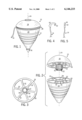
  • FIG. 1 is a perspective view of a preferred embodiment of the present invention, with the string wound in the top groove;
  • FIG. 2 is an exploded perspective view of two parts of the top of FIG. 1;
  • FIG. 3 is a bottom plan view of the upper portion of the top of FIG. 1;
  • FIG. 4 is a partial side view of the catch portion of the pull-string of the present invention.
  • FIG. 5 is an end view of the pull-string of FIG. 4;
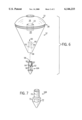
  • FIG. 6 is a schematic view of the top of FIG. 1, shown with a detachable tip separated from the top;
  • FIG. 7 shows an alternate embodiment of a detachable tip.
  • a preferred spinning top of the present invention is referred generally in the drawings by reference 10.
  • the top is comprised primarily of a two-part body 12, a pull-string 14, and a detachable tip 16.
  • the body 12 preferably includes an upper portion 18 and a lower portion 20 joined together by a hub 22, preferably of generally cylindrical configuration (e.g. in a splined form).
  • the upper 18 and lower 20 portions, as well as the hub 22, can be made of a molded plastic, and the pull-string 14 is preferably a nylon cord.
  • suitable materials e.g. wood for the body; natural rope for the cord are also suitable.
  • the body 12 and tip 16 are concentric with a vertical spin axis 24, as is the hub 22.
  • the hub 22 is preferably unitary with the upper portion 18 extending downward from its bottom surface 26 so that, when the top 10 is assembled, the hub 22 is partially received in a recess 28 in an upper surface 30 of the bottom half 20.
  • the recess 28 is suitably sized so that the hub 22 and recess 28 form an interference fit.
  • the upper 18 and lower 20 portions can be of a hollowed construction having inner partitions 32 extending radially inward to respective central cylindrical members 34, 36 concentric with the spin axis 24.
  • the hub 22 is sized so that when seated within the recess 28 of the lower portion 20, the upper 18 and lower 20 portions are left separated to define a deep, washer-shaped radial groove 38 (see FIG. 6) in which the pull-string 14 can be wound.
  • the size of the groove 38 can be such as to permit the pull-string 14 only to be wound in a single width spiral with each winding overlaying the last preceding winding. In this way, the pull-string 14 will not tend to become improperly intertwined such that it could bind during use. Alternatively, the gap could be even wider (e.g. like a yo-yo gap), with multiple windings at the same radial distance.
  • the hub 22 is formed with a series of vertical recesses or grooves 40.
  • the pull string 14 is formed with a catch 44 that has an arc head end with an inwardly projecting tooth 42.
  • the tooth is angled in a way such that it can smoothly catch in a groove 40 when a user grips catch neck 46 and positions the tooth into the groove. This is facilitated by angling the tooth towards the center of the hub.
  • the catch 44 of the pull-string 14 is preferably a suitable rigid plastic. However, it may be metal or other material.
  • the grooves 40 of the hub 22 and the tooth 42 are positively engaged in a rack and pinion type connection when the pull-string 14 is wound in a clockwise or a counterclockwise direction around the hub 22.
  • the arcuate shape and narrow width of the catch 44 allow it to be easily inserted within the radial groove 38 in the proper orientation so that a recess and a tooth mate simply by tugging on the pull-string 14.
  • the pull-string 14 can then be wound quickly and easily within the groove 38.
  • the pull-string 14 unwinds and the engaging members separate so that the pull-string 14 cleanly and smoothly released from the top 10.
  • the tip 16 can be detached from the body 12 of the top 10.
  • the cylindrical member 36 of the lower half 20 defines an axial bore 50 opening at the bottom of the lower part 52 which is sized to receive a generally cylindrical lug 52 of a detachable tip 16A.
  • the tip 16A is connected to the body 12 in a bayonet or slot and pin type connection.
  • the bore 50 includes two opposing transversely projecting pins 54 extending from its inner diameter.
  • the lug preferably has cylindrical walls 56 defining two opposing generally L-shaped slots 58 each having a transverse segment 60 joined at one end to a first axial leg 62 extending longitudinally to the top of the lug 52 and at an opposing end to a second axial leg 64 extending longitudinally toward the top of the lug, but less than that of the first axial leg 62.
  • a compression spring 66 is disposed within the bore 50 which is compressed when the tip lug 52 is inserted into the bore 50.
  • the tip 16A is connected to the body by inserting the lug 52 into the bore 50 so that the pins 54 travel within the slots 58 to the second axial legs 64.
  • the spring 60 keeps the slot and pin connection biased together. It should be noted that the same type of connection can be made with the pins 54 projecting outward from the circumference of a solid lug and the slots being in the inner diameter of the bore.
  • the bore of the lower half 20 and the lug 70 of a tip 16B may be threaded so that the tip 16B can be joined to the body 12 by threaded engagement.
  • the tip 16B may also include nut-like surfaces 72 for loosening and tightening the tip with a wrench.
  • the detachment of a tip allows it to be replaced, thus, increasing the useful life of the rest of the top. Moreover, this allows the top to be used with tips of various colors or profiles for changing the appearance of the top, or when using the top on different surfaces. For example, flatter radius tips may be preferred on carpeted surfaces.
  • the body may instead be one piece with the tip being an integral part of the body.
  • detachable tips may be connected to the body via other types of connections.
  • a replaceable ring with grooves may be fit over a standard hub to create a hub with grooves. The grooves need not be integral with the hub which is part of the body.
  • the above disclosure provides toy tops which are well suited for use by young children.

Landscapes

  • Toys (AREA)

Abstract

Disclosed herein are spinning tops having an improved pull-string attachment system. The pull-string has a toothed catch at one end that engages with a cylindrical hub of the top. The hub is at the center of a deep radial groove transverse to the top's axis of rotation in which the pull-string is wound. When the top is thrown and the pull-string is pulled, the catch smoothly disengages so that the pull-string releases cleanly from the top. Replaceable tips are also provided.

Description

CROSS-REFERENCES TO RELATED APPLICATIONS
Non-applicable.
STATEMENT REGARDING FEDERALLY SPONSORED RESEARCH/DEVELOPMENT
Non-applicable.
BACKGROUND OF THE INVENTION
The spinning top, a classic children's toy, has existed for centuries. Conventional tops typically have a concentrically balanced body usually tapering to a pointed bottom tip, which allows the top to rotate on a flat surface about a spin axis. There have been numerous variations on the basic design, particularly with regard to body configurations optimizing its balance as well as means for initiating the rotation of the top.
A top can be spun by standing it upright on its tip and rotating it by hand (e.g. between a thumb and index finger). Alternatively, a top can be spun with a pull-string wrapped around the outside of the top. With the top standing on its tip, the top may be spun by pulling on a free end of the pull-string to impart a rotation to the top. Alternatively, when wound with such a string the top can be thrown outward to a flat surface while holding onto a free end of the string. This also causes the top to spin separately from the string.
However, such tops are usually intended for very small children who often do not have great manual dexterity or patience. When the top is the type which requires the string to be wrapped in a single layer along a sloped side of the top, young children may be frustrated by the process of winding the string.
Some tops were therefore designed with a deep circumferential groove transverse to the spin axis in which the pull-string was disposed, much like a yo-yo groove. See e.g. U.S. Pat. Nos. 2,610,439; 2,614,364; and 3,413,753. Such grooves permitted the string to be quickly wound around the top even by those having little manual dexterity. However, because the grooves were deep and narrow, there were problems securing the inward end of the pull-string to the top.
For example, the first end could be temporarily held outside of the groove and then overlapped by subsequent windings, as mentioned above. However, the string could jerk backward as the trapped first end was released.
Accordingly, a need exists for an improved spinning top design.
BRIEF SUMMARY OF THE INVENTION
The present invention provides a spinning top with a body having a vertical spin axis, a bottom tip, and a radial groove extending perpendicular to the spin axis and extending into the body to define a cylindrical hub essentially concentric with the spin axis. There is also a recess formed on the hub which is accessible from the radial groove, and a flexible line windable in the groove about the hub, the line having a catch at one end that is matable with the recess.
The line can be used to apply a transverse force to the body so as to rotate the top about the spin axis on its tip, with the catch and recess capable of separating smoothly from each other when the line is completely unwound from the hub.
In preferred forms the recess is a vertical groove and the catch has a tooth and an arc head adjacent the tooth. Also, the body is comprised of an upper part including a transverse lower surface and a lower part including a transverse upper surface, the upper and lower parts being joined together such that the lower and upper surfaces define the groove. The hub may be integrally formed with the upper part, or be separately formed.
In other preferred forms, the lower part has a recess sized to receive a portion of the hub in a press fit, and the tip is removable from the body. To achieve a removable tip, there can be an axial bore in the lower body concentric with the spin axis adjacent its lower end, and the tip can include a longitudinal lug sized to fit within the bore. The connection between the replaceable tip and bore can be a frictional fit, a threaded fit, a bayonet connection or other connection permitting the tip to be replaced when desired.
Thus, the present invention provides a top in which the pull-string can be easily wound by even those having little manual dexterity or patience. Further, the string will release from the top smoothly (e.g. due to the arc shaped configuration and the tooth/groove interaction) so as not to interfere with its rotation. The parts can be formed using mass production molding techniques.
The replaceable tip system allows worn tips to be replaced, thus increasing the useful life of the top. Further, different tips can be used for different types of surfaces (e.g. carpet versus pavement).
The foregoing and other advantages of the invention will appear from the following description. In this description reference is made to the accompanying drawings which form a part hereof and in which there is shown by way of illustration a preferred embodiment of the invention. This embodiment does not represent the full scope of the invention. Thus, the claims should be looked to in order to judge the scope of the invention.
BRIEF DESCRIPTION OF THE DRAWINGS
FIG. 1 is a perspective view of a preferred embodiment of the present invention, with the string wound in the top groove;
FIG. 2 is an exploded perspective view of two parts of the top of FIG. 1;
FIG. 3 is a bottom plan view of the upper portion of the top of FIG. 1;
FIG. 4 is a partial side view of the catch portion of the pull-string of the present invention;
FIG. 5 is an end view of the pull-string of FIG. 4;
FIG. 6 is a schematic view of the top of FIG. 1, shown with a detachable tip separated from the top; and
FIG. 7 shows an alternate embodiment of a detachable tip.
DETAILED DESCRIPTION OF THE PREFERRED EMBODIMENTS
A preferred spinning top of the present invention is referred generally in the drawings by reference 10. Referring to FIGS. 1-3, the top is comprised primarily of a two-part body 12, a pull-string 14, and a detachable tip 16. The body 12 preferably includes an upper portion 18 and a lower portion 20 joined together by a hub 22, preferably of generally cylindrical configuration (e.g. in a splined form). The upper 18 and lower 20 portions, as well as the hub 22, can be made of a molded plastic, and the pull-string 14 is preferably a nylon cord. However, other suitable materials (e.g. wood for the body; natural rope for the cord) are also suitable.
When assembled, the body 12 and tip 16 are concentric with a vertical spin axis 24, as is the hub 22. The hub 22 is preferably unitary with the upper portion 18 extending downward from its bottom surface 26 so that, when the top 10 is assembled, the hub 22 is partially received in a recess 28 in an upper surface 30 of the bottom half 20.
The recess 28 is suitably sized so that the hub 22 and recess 28 form an interference fit. As best seen in FIGS. 2 and 3, the upper 18 and lower 20 portions can be of a hollowed construction having inner partitions 32 extending radially inward to respective central cylindrical members 34, 36 concentric with the spin axis 24.
The hub 22 is sized so that when seated within the recess 28 of the lower portion 20, the upper 18 and lower 20 portions are left separated to define a deep, washer-shaped radial groove 38 (see FIG. 6) in which the pull-string 14 can be wound. The size of the groove 38 can be such as to permit the pull-string 14 only to be wound in a single width spiral with each winding overlaying the last preceding winding. In this way, the pull-string 14 will not tend to become improperly intertwined such that it could bind during use. Alternatively, the gap could be even wider (e.g. like a yo-yo gap), with multiple windings at the same radial distance.
In accordance with the present invention, the hub 22 is formed with a series of vertical recesses or grooves 40. The pull string 14 is formed with a catch 44 that has an arc head end with an inwardly projecting tooth 42. The tooth is angled in a way such that it can smoothly catch in a groove 40 when a user grips catch neck 46 and positions the tooth into the groove. This is facilitated by angling the tooth towards the center of the hub.
The catch 44 of the pull-string 14 is preferably a suitable rigid plastic. However, it may be metal or other material.
The grooves 40 of the hub 22 and the tooth 42 are positively engaged in a rack and pinion type connection when the pull-string 14 is wound in a clockwise or a counterclockwise direction around the hub 22. The arcuate shape and narrow width of the catch 44 allow it to be easily inserted within the radial groove 38 in the proper orientation so that a recess and a tooth mate simply by tugging on the pull-string 14.
The pull-string 14 can then be wound quickly and easily within the groove 38. When the top 10 is thrown and the pull-string 14 is pulled, the pull-string 14 unwinds and the engaging members separate so that the pull-string 14 cleanly and smoothly released from the top 10.
Referring next to FIG. 6, the tip 16 can be detached from the body 12 of the top 10. Specifically, the cylindrical member 36 of the lower half 20 defines an axial bore 50 opening at the bottom of the lower part 52 which is sized to receive a generally cylindrical lug 52 of a detachable tip 16A. Preferably, the tip 16A is connected to the body 12 in a bayonet or slot and pin type connection. The bore 50 includes two opposing transversely projecting pins 54 extending from its inner diameter. The lug preferably has cylindrical walls 56 defining two opposing generally L-shaped slots 58 each having a transverse segment 60 joined at one end to a first axial leg 62 extending longitudinally to the top of the lug 52 and at an opposing end to a second axial leg 64 extending longitudinally toward the top of the lug, but less than that of the first axial leg 62.
A compression spring 66 is disposed within the bore 50 which is compressed when the tip lug 52 is inserted into the bore 50. The tip 16A is connected to the body by inserting the lug 52 into the bore 50 so that the pins 54 travel within the slots 58 to the second axial legs 64. The spring 60 keeps the slot and pin connection biased together. It should be noted that the same type of connection can be made with the pins 54 projecting outward from the circumference of a solid lug and the slots being in the inner diameter of the bore.
Referring to FIG. 7, alternatively, the bore of the lower half 20 and the lug 70 of a tip 16B may be threaded so that the tip 16B can be joined to the body 12 by threaded engagement. The tip 16B may also include nut-like surfaces 72 for loosening and tightening the tip with a wrench.
The detachment of a tip allows it to be replaced, thus, increasing the useful life of the rest of the top. Moreover, this allows the top to be used with tips of various colors or profiles for changing the appearance of the top, or when using the top on different surfaces. For example, flatter radius tips may be preferred on carpeted surfaces.
The above describes preferred embodiments of the top of the present invention. However, the body may instead be one piece with the tip being an integral part of the body. Alternatively, detachable tips may be connected to the body via other types of connections. Also, a replaceable ring with grooves may be fit over a standard hub to create a hub with grooves. The grooves need not be integral with the hub which is part of the body.
INDUSTRIAL APPLICABILITY
The above disclosure provides toy tops which are well suited for use by young children.
Claims (9)

What is claimed is:
1. A spinning top, comprising:
a body having a vertical spin axis, a bottom tip, and a radial groove extending perpendicular to the spin axis and extending into the body to define a cylindrical hub essentially concentric with the spin axis;
a recess formed on the hub which is accessible from the radial groove; and
a flexible line windable in the groove about the hub, the line having a catch at one end that is matable with the recess;
whereby the catch and recess can be mated such that the line can be used to apply a transverse force to the body so as to rotate the top about the spin axis on its tip, with the catch and recess capable of separating from each other when the line is completely unwound from the hub.
2. The top of claim 1, wherein the recess is a vertical groove and the catch has a tooth.
3. The top of claim 2, wherein the catch has an arc head adjacent the tooth.
4. The top of claim 1, wherein the body is comprised of an upper part including a transverse lower surface and a lower part including a transverse upper surface, the upper and lower parts being joined together such that the lower and upper surfaces define the groove.
5. The top of claim 4, wherein the hub is integrally formed with the upper part.
6. The top of claim 5, wherein the lower part has a recess sized to receive a portion of the hub in a press fit.
7. The top of claim 1, wherein the tip is removable from the body, and wherein the body includes an axial bore concentric with the spin axis adjacent its lower end, and the tip includes a longitudinal lug sized to fit within the bore.
8. The top of claim 7, wherein the bore and the lug include matable threads for securing the tip to the body.
9. The top of claim 7, further comprising a spring within the bore and wherein the tip is secured to the body via a slot and pin connection that is biased together by the spring.
US09/501,117 2000-02-09 2000-02-09 Spinning top Expired - Fee Related US6146233A (en)

Priority Applications (1)

Application Number Priority Date Filing Date Title
US09/501,117 US6146233A (en) 2000-02-09 2000-02-09 Spinning top

Applications Claiming Priority (1)

Application Number Priority Date Filing Date Title
US09/501,117 US6146233A (en) 2000-02-09 2000-02-09 Spinning top

Publications (1)

Publication Number Publication Date
US6146233A true US6146233A (en) 2000-11-14

Family

ID=23992203

Family Applications (1)

Application Number Title Priority Date Filing Date
US09/501,117 Expired - Fee Related US6146233A (en) 2000-02-09 2000-02-09 Spinning top

Country Status (1)

Country Link
US (1) US6146233A (en)

Cited By (18)

* Cited by examiner, † Cited by third party
Publication number Priority date Publication date Assignee Title
US6443801B1 (en) 2001-03-20 2002-09-03 Dale L. Bell Spinning top
USD462402S1 (en) 2001-07-23 2002-09-03 Viacheslav Makhotkin Spinning top
AU764822B2 (en) * 2001-01-30 2003-08-28 Takara Co., Ltd. Toy tops
US6666743B2 (en) * 2001-10-23 2003-12-23 Sport Fun, Inc. Spinning top
US20050009437A1 (en) * 2003-07-10 2005-01-13 Hendron Scott Svend Toy top spindle and assembly using compact discs
USD563492S1 (en) * 2006-07-20 2008-03-04 Leslie Becker Crawl ball
US20080214088A1 (en) * 2007-03-02 2008-09-04 Ki Kwan Chu Toy spinning top
US20080274667A1 (en) * 2007-05-01 2008-11-06 Chinyere Okoro Method and Top For Playing Game
USD661435S1 (en) * 2010-10-05 2012-06-05 Absolutely New, Inc. Interactive feline toy
US20140242873A1 (en) * 2013-02-28 2014-08-28 Eli J. Duncan Spinning hand top
CN104043248A (en) * 2014-06-29 2014-09-17 黄平县治刚野生甲鱼养殖场 Novel top
US8851954B2 (en) 2012-08-09 2014-10-07 Jim McCafferty Yo-yo with an accessory attachment system and a movable string bead
US20160220912A1 (en) * 2014-08-16 2016-08-04 Guangdong Alpha Animation & Culture Co., Ltd. Toy gyro having gyro ring that can be assembled at both sides
CN105999712A (en) * 2016-07-08 2016-10-12 广州市三宝玩具有限公司 Top
US9597604B1 (en) * 2016-03-23 2017-03-21 Tomy Company, Ltd. Toy top
US20190134517A1 (en) * 2017-07-07 2019-05-09 Tomy Company, Ltd. Spinning top toy
USD902323S1 (en) * 2019-01-29 2020-11-17 Gymworld Inc. Toy block
US11724207B2 (en) * 2019-02-26 2023-08-15 Flambeau, Inc. Adjustable counterweight for a rotatable performance device

Citations (13)

* Cited by examiner, † Cited by third party
Publication number Priority date Publication date Assignee Title
US245141A (en) * 1881-08-02 Max dannhobn
US521148A (en) * 1894-06-12 Fourth to james i
US1361637A (en) * 1920-03-08 1920-12-07 Melvin O Steen Toy
US1480858A (en) * 1922-04-01 1924-01-15 Goetz William Toy
US2610439A (en) * 1950-02-25 1952-09-16 Steffen P Nemeth Climbing and spinning toy
US2614364A (en) * 1946-11-07 1952-10-21 Wallace F Darden Spinning top
US2616213A (en) * 1949-08-13 1952-11-04 Gus G Kondrath Spinning top
US3044212A (en) * 1958-11-24 1962-07-17 John T Lancaster Whipping top
US3142933A (en) * 1962-09-11 1964-08-04 Max J Ruderian Accessory for a top
US3269053A (en) * 1964-02-10 1966-08-30 Donald F Duncan Inc Spinning top with cord receiving groove
US3413753A (en) * 1964-11-27 1968-12-03 Henry G. Colmer Jr. String suspended aerial toy
US3879887A (en) * 1973-11-15 1975-04-29 Teton Toy Dev Company Inflatable top
US5032101A (en) * 1990-02-12 1991-07-16 Hartman Victor L Spinning toy

Patent Citations (13)

* Cited by examiner, † Cited by third party
Publication number Priority date Publication date Assignee Title
US521148A (en) * 1894-06-12 Fourth to james i
US245141A (en) * 1881-08-02 Max dannhobn
US1361637A (en) * 1920-03-08 1920-12-07 Melvin O Steen Toy
US1480858A (en) * 1922-04-01 1924-01-15 Goetz William Toy
US2614364A (en) * 1946-11-07 1952-10-21 Wallace F Darden Spinning top
US2616213A (en) * 1949-08-13 1952-11-04 Gus G Kondrath Spinning top
US2610439A (en) * 1950-02-25 1952-09-16 Steffen P Nemeth Climbing and spinning toy
US3044212A (en) * 1958-11-24 1962-07-17 John T Lancaster Whipping top
US3142933A (en) * 1962-09-11 1964-08-04 Max J Ruderian Accessory for a top
US3269053A (en) * 1964-02-10 1966-08-30 Donald F Duncan Inc Spinning top with cord receiving groove
US3413753A (en) * 1964-11-27 1968-12-03 Henry G. Colmer Jr. String suspended aerial toy
US3879887A (en) * 1973-11-15 1975-04-29 Teton Toy Dev Company Inflatable top
US5032101A (en) * 1990-02-12 1991-07-16 Hartman Victor L Spinning toy

Non-Patent Citations (2)

* Cited by examiner, † Cited by third party
Title
5 pages of excerpts from a web site entitled "Woodturned Spinning Tops", 7/2/399.
5 pages of excerpts from a web site entitled Woodturned Spinning Tops , 7/2/399. *

Cited By (20)

* Cited by examiner, † Cited by third party
Publication number Priority date Publication date Assignee Title
AU764822B2 (en) * 2001-01-30 2003-08-28 Takara Co., Ltd. Toy tops
US6443801B1 (en) 2001-03-20 2002-09-03 Dale L. Bell Spinning top
USD462402S1 (en) 2001-07-23 2002-09-03 Viacheslav Makhotkin Spinning top
US6666743B2 (en) * 2001-10-23 2003-12-23 Sport Fun, Inc. Spinning top
US20050009437A1 (en) * 2003-07-10 2005-01-13 Hendron Scott Svend Toy top spindle and assembly using compact discs
USD563492S1 (en) * 2006-07-20 2008-03-04 Leslie Becker Crawl ball
US20080214088A1 (en) * 2007-03-02 2008-09-04 Ki Kwan Chu Toy spinning top
US20080274667A1 (en) * 2007-05-01 2008-11-06 Chinyere Okoro Method and Top For Playing Game
USD661435S1 (en) * 2010-10-05 2012-06-05 Absolutely New, Inc. Interactive feline toy
US8851954B2 (en) 2012-08-09 2014-10-07 Jim McCafferty Yo-yo with an accessory attachment system and a movable string bead
US20140242873A1 (en) * 2013-02-28 2014-08-28 Eli J. Duncan Spinning hand top
CN104043248A (en) * 2014-06-29 2014-09-17 黄平县治刚野生甲鱼养殖场 Novel top
US20160220912A1 (en) * 2014-08-16 2016-08-04 Guangdong Alpha Animation & Culture Co., Ltd. Toy gyro having gyro ring that can be assembled at both sides
US9737820B2 (en) * 2014-08-16 2017-08-22 Guangdong Alpha Animation & Culture Co., Ltd. Toy gyro having gyro ring that can be assembled at both sides
US9597604B1 (en) * 2016-03-23 2017-03-21 Tomy Company, Ltd. Toy top
CN105999712A (en) * 2016-07-08 2016-10-12 广州市三宝玩具有限公司 Top
CN105999712B (en) * 2016-07-08 2019-03-05 广州市三宝动漫玩具有限公司 A kind of gyro
US20190134517A1 (en) * 2017-07-07 2019-05-09 Tomy Company, Ltd. Spinning top toy
USD902323S1 (en) * 2019-01-29 2020-11-17 Gymworld Inc. Toy block
US11724207B2 (en) * 2019-02-26 2023-08-15 Flambeau, Inc. Adjustable counterweight for a rotatable performance device

Similar Documents

Publication Publication Date Title
US6146233A (en) Spinning top
US4915320A (en) Kite string reel
US5194031A (en) Toy gear assembly
EP2260914B1 (en) Yo-yo
US5277350A (en) Kite reel assembly
US8075461B2 (en) Reinforced cord well lifting bar assembly
US4560086A (en) Helical elevating dispenser for round objects such as candies
US5664739A (en) Rotatable handle for disposal spool
US4207701A (en) Dismantlable tethered top with reversible halves
US2051961A (en) Golf club
US6988978B1 (en) Exercise bar cord impingement assembly
US3881277A (en) Roll-o-wheel toy device
JP2005514185A (en) A built toy set consisting of a rod and a connector
JP3156926B2 (en) Top
US5254027A (en) Adjustable performance yo-yo
US5755608A (en) Top spindle for use with construction toy
US20140045404A1 (en) Yo-yo with an accessory attachment system and a movable string bead
US20030077977A1 (en) Spinning top
US7305997B2 (en) Dental floss holder
US6443801B1 (en) Spinning top
US5713307A (en) Tug-o-war pull toy for dogs
US1502058A (en) Ball
US1164801A (en) Broom.
JP7821491B2 (en) A hand-held spinning top.
JPH0615669Y2 (en) Rotating tool using pistol-shaped body

Legal Events

Date Code Title Description
AS Assignment

Owner name: HEDEEN INTERNATIONAL, LLC, WISCONSIN

Free format text: ASSIGNMENT OF ASSIGNORS INTEREST;ASSIGNOR:HEDEEN, CLEMENS V., JR.;REEL/FRAME:010611/0571

Effective date: 20000208

Owner name: HEDEEN TOYS, LLC, WISCONSIN

Free format text: ASSIGNMENT OF ASSIGNORS INTEREST;ASSIGNOR:HEDEEN INTERNATIONAL, LLC;REEL/FRAME:010611/0592

Effective date: 20000208

REMI Maintenance fee reminder mailed
LAPS Lapse for failure to pay maintenance fees
STCH Information on status: patent discontinuation

Free format text: PATENT EXPIRED DUE TO NONPAYMENT OF MAINTENANCE FEES UNDER 37 CFR 1.362

FP Expired due to failure to pay maintenance fee

Effective date: 20041114