US6145793A - Robotic MIG clamp - Google Patents

Robotic MIG clamp Download PDF

Info

Publication number
US6145793A
US6145793A US09/298,388 US29838899A US6145793A US 6145793 A US6145793 A US 6145793A US 29838899 A US29838899 A US 29838899A US 6145793 A US6145793 A US 6145793A
Authority
US
United States
Prior art keywords
clamp
threaded stud
spring
base
assembly
Prior art date
Legal status (The legal status is an assumption and is not a legal conclusion. Google has not performed a legal analysis and makes no representation as to the accuracy of the status listed.)
Expired - Fee Related
Application number
US09/298,388
Inventor
Erwin K. Kroulik
Richard J. Balaguer
Current Assignee (The listed assignees may be inaccurate. Google has not performed a legal analysis and makes no representation or warranty as to the accuracy of the list.)
Interservices Inc
Original Assignee
Interservices Inc
Priority date (The priority date is an assumption and is not a legal conclusion. Google has not performed a legal analysis and makes no representation as to the accuracy of the date listed.)
Filing date
Publication date
Application filed by Interservices Inc filed Critical Interservices Inc
Priority to US09/298,388 priority Critical patent/US6145793A/en
Assigned to BALAGUER CORPORATION reassignment BALAGUER CORPORATION ASSIGNMENT OF ASSIGNORS INTEREST (SEE DOCUMENT FOR DETAILS). Assignors: BALAGUER, RICHARD J., KROULIK, ERWIN K.
Assigned to INTERSERVICES, INC. reassignment INTERSERVICES, INC. ASSIGNMENT OF ASSIGNORS INTEREST (SEE DOCUMENT FOR DETAILS). Assignors: BALAGUER CORP
Application granted granted Critical
Publication of US6145793A publication Critical patent/US6145793A/en
Anticipated expiration legal-status Critical
Expired - Fee Related legal-status Critical Current

Links

Images

Classifications

    • FMECHANICAL ENGINEERING; LIGHTING; HEATING; WEAPONS; BLASTING
    • F16ENGINEERING ELEMENTS AND UNITS; GENERAL MEASURES FOR PRODUCING AND MAINTAINING EFFECTIVE FUNCTIONING OF MACHINES OR INSTALLATIONS; THERMAL INSULATION IN GENERAL
    • F16LPIPES; JOINTS OR FITTINGS FOR PIPES; SUPPORTS FOR PIPES, CABLES OR PROTECTIVE TUBING; MEANS FOR THERMAL INSULATION IN GENERAL
    • F16L3/00Supports for pipes, cables or protective tubing, e.g. hangers, holders, clamps, cleats, clips, brackets
    • F16L3/08Supports for pipes, cables or protective tubing, e.g. hangers, holders, clamps, cleats, clips, brackets substantially surrounding the pipe, cable or protective tubing
    • F16L3/10Supports for pipes, cables or protective tubing, e.g. hangers, holders, clamps, cleats, clips, brackets substantially surrounding the pipe, cable or protective tubing divided, i.e. with two members engaging the pipe, cable or protective tubing
    • F16L3/1008Supports for pipes, cables or protective tubing, e.g. hangers, holders, clamps, cleats, clips, brackets substantially surrounding the pipe, cable or protective tubing divided, i.e. with two members engaging the pipe, cable or protective tubing with two members engaging the pipe, cable or tubing, both being made of thin band material completely surrounding the pipe
    • HELECTRICITY
    • H02GENERATION; CONVERSION OR DISTRIBUTION OF ELECTRIC POWER
    • H02GINSTALLATION OF ELECTRIC CABLES OR LINES, OR OF COMBINED OPTICAL AND ELECTRIC CABLES OR LINES
    • H02G3/00Installations of electric cables or lines or protective tubing therefor in or on buildings, equivalent structures or vehicles
    • H02G3/26Installations of cables, lines, or separate protective tubing therefor directly on or in walls, ceilings, or floors

Definitions

  • the present invention relates to clamps for tools and, more specifically to a clamp for retaining a tool on a robot assembly.
  • Robots are now used in many manufacturing facilities for many types of products.
  • the robots generally include arm assemblies that carry many types of tools as well as assemblies to guide cables, hoses and the like.
  • Various cable retainer assemblies are known to deal with the problem of loose cables.
  • Such retainer assemblies generally consist of complementary grooved plates that hold the cable therein in parallel.
  • robots are used to weld various parts such as in automobile manufacturing. Naturally, the robots must positively retain the welder in order that the proper places get welded. As well, fluid hoses and electrical cables associated with the welder must be retained in order to prevent premature wearing of the cables and interference with the welding or robot actions.
  • MIG welders are conventionally held on the robot by plates with Velcro used to hold the associated cables. Needless to say, these arrangements do not provide a positive hold on the welder to accomplish the precise welding of many applications.
  • What is needed is a lightweight but sturdy clamp assembly for fluid hoses and electrical cables that provides a positive hold on the fluid hoses and electrical cables and, additionally provides a positive, but easily unlatchable latching or clasp structure.
  • the present invention provides a clamp assembly for releasably and flexibly retaining a work tool, especially a MIG welder, and associated electrical cables onto a robot.
  • the invention comprises a clamp and mount assembly each preferably having a threaded stud which threads or screws into a respective end of a compression spring.
  • the clamp releasably retains the cable or hose while the mount is secured to the robot assembly. Orientational flexibility for precise movement/alignment of the cable is provided by the spring.
  • the clamp has a base and a pivoting arm.
  • the base and arm together, when latched, surround and positively retain the electrical cables and hoses onto the robot.
  • the threaded stud of the clamp is received into the inner diameter of one end of the compression spring in an interference fit. Threading the stud into the compression spring causes the spring to elongate or expand along its longitudinal axis around the threaded stud and proximate thereto. Attempts to unthread the stud axially compresses the spring making backing out extremely difficult.
  • the mount is securable to the robot and likewise includes a threaded stud.
  • the threaded stud of the mount is received into the inner diameter of the other end of the compression spring in an interference fit. Threading the stud into the compression spring causes the spring to elongate or expand along its longitudinal axis around the threaded stud and proximate thereto. Attempts to unthread the stud axially compresses the spring making backing out extremely difficult.
  • the base of the clamp includes an arcuate portion, a first hinge structure, and a first latch structure.
  • the arm includes an arcuate portion, a second hinge structure, and a second latch structure.
  • the two arcuate portions together define a ring that surrounds the MIG welder and associated cables.
  • the first and second hinge structures are configured to cooperate with each other to allow the arm to open and close around the MIG welder.
  • the first and second latch structures are configured to cooperate with each other to provide a positive, but easily unlatchable latch or clasp structure.
  • a grommet is situated within the arcuate portions.
  • the clamp is made from aluminum.
  • the present clamp is adapted to be mounted to the robot in many fashions.
  • the clamp may be mounted utilizing a spring assembly which allows the associated electrical cables to move as the robot moves but which does not allow the cables to move within the clamp itself.
  • Other mounting configurations include a mounting plate and various pipe mounting brackets. Standoffs may also be utilized in some applications.
  • FIG. 1 is a perspective view of an embodiment of a clamp according to the present invention, the clamp shown in a closed position;
  • FIG. 2 is a front plan view of the clamp of FIG. 1;
  • FIG. 3 is a perspective view of the clamp top of FIGS. 1 and 2;
  • FIG. 4 is a top plan view of the clamp top of FIG. 3;
  • FIG. 5 is a perspective view of the clamp base of FIGS. 1 and 2;
  • FIG. 6 is a front plan view of the clamp base of FIG. 5 showing mounting bores in phantom;
  • FIG. 7 is a perspective view of a grommet utilized in the clamp of FIG. 1;
  • FIG. 8 is an exploded perspective view of various clamp mounting configurations that may be utilized
  • FIG. 9 is an exploded perspective view of an alternative clamp mounting configuration
  • FIG. 10 is an enlarged side view of the spring mount type of mounting configurations shown in FIG. 8, wherein the clamp is coupled to a compression spring which is coupled to a mounting plate;
  • FIG. 11 is an enlarged, partial cross-sectional side view of FIG. 10.
  • clamp assembly 10 having a clamp top or arm 12 and a clamp base 14.
  • Clamp arm 12 is shown in a closed position with respect to clamp base 14.
  • clamp base 14 and clamp arm 12 are fashioned from aluminum, and more preferably from 6061 aluminum.
  • any suitable lightweight and strong material may be utilized.
  • clamp 10 weighs less than one pound, and more specifically 10.5 ounces, and has a reduced width of only 1/8 inches.
  • Opening 15 is generally circular-shaped and is defined between an arcuate or curved inner surface 33 of clamp arm 12 and an arcuate or curved outer surface 39 of clamp base 14. In a preferred embodiment, opening 15 is 21/2 inches. Of course, other opening configurations may be used.
  • Clamp arm 12 is defined by a curved portion 13 which defines an inner curved surface 33.
  • a hinge portion or structure 16 defined at least in part, by a first rounded flange, prong or ear 17 and a second rounded flange, prong or ear 18.
  • Ear 17 includes an axial bore 30.
  • ear 18 includes an axial bore 31.
  • Ear 17 is spaced a distance from ear 18 and thus defines an area 32 therebetween.
  • a latch or clasping structure 34 having a lip or ledge 35 defining a lower surface area 37 and a valley 36 on a top surface adjacent ledge 35.
  • inner curved surface 33 is semi-circular in shape, but can be any shape to accommodate the fluid hose and/or electrical cable (not shown).
  • Clamp base 14 is defined by a generally rectangular bottom 40 having on a top end thereof, a curved or arcuate upper or outer surface 39. Extending through bottom 40 and in communication with outer surface 39 are three mounting bores 54, 55, and 56. Mounting bores 54 and 56 each have a reduced diameter portion 54a and 56a, respectively, that may be threaded for receipt of mounting screws or bolts (not shown) such as 1/4 inch bolts. In a preferred form, mounting bores 54 and 56 are spaced 13/4 inches apart, being what is known as the Robo Com V pattern. Mounting bore 55 may be a 5/8-11 threaded bore.
  • Clamp base 14 further has and extension 41 on a first end of upper surface 39.
  • Extension 41 terminates in a hinge portion or structure 42 defined by a rounded flange 43 having a bore 44.
  • Rounded flange 43 is of a width less than extension 41 and thus ledges 45 and 46 are defined on either sides of rounded flange 43.
  • Clamp base 14 has a squared extension 47 on another end thereof having a latch structure 48.
  • Latch structure consists of a projection or ear 49 defining an upper surface 50 that is complementary in shape to lower surface 37 of clamp arm 12, and a lower surface 51. In this manner, when clamp arm 12 is pivoted into a closed position, surface 37 abuts surface 50.
  • a band or crimp may be fitted around latch structure 48 and latch structure 34 to provide positive retention.
  • grommet 20 that is preferably used with clamp 10.
  • grommet 20 includes a first arcuate or semi-circular portion 21 having a first peripheral rim 23 and a second peripheral rim 24.
  • An arcuate land portion 25 is defined as an inside surface thereof.
  • Grommet 20 also includes a second arcuate or semi-circular portion 22 also having a first peripheral rim 26 and a second peripheral rim 27.
  • An arcuate land portion 28 is defined as an inside surface thereof. Inside surfaces 25 and 28 come into contact with the fluid hose and/or electrical cable (not shown).
  • grommet 20 is of the UHMW type and aids in eliminating straight edges of the clamp that might tend to wear the electrical cables associated with the welder. Further, grommet 20 is sized to be retained within hole 15. The outside surface of portion 21 is adapted to abut inside surface 33 of clamp arm 12, while the outside surface of portion 22 is adapted to abut inside surface 39 of base 14.
  • Clamp 10 preferably should be mounted to the robot in some manner or robot arm as the need may be.
  • clamp 10 is used with grommet 20 and may be mounted by itself onto a robot (not shown) through the use of bolts and/or screws extending through the various bore 54, 55, and 56.
  • Spring assembly 59 includes a generally rectangular mounting plate 61 having a first bolt or screw notch 62 on one end thereof and a second bolt or screw notch 63 on another end thereof. Notches 62 and 63 are utilized for attaching the plate 61 to the robot. If necessary, steel standoffs 58 of 11/4" length or otherwise may be used in conjunction with the mounting bolts or screws (not shown).
  • Mounting plate 61 includes a stud structure 64 onto which is received a spring 65.
  • Spring 65 is preferably a compression spring and, more particularly, a fatigue resistant square wire die spring.
  • Stud structure 64 includes a mounting block 87 into which is disposed a threaded stud, bolt, or screw 89.
  • Threaded stud 89 is threaded into one end of spring 65 which consists of many turns or coils, two turns or coils 90 and 91 of which are numbered.
  • spring 65 axially elongates or expands around and proximate to threaded stud 89, causing the coils thereabout to radially compress against threaded stud 89. This holds spring 65 tight against threaded stud 89 and also makes backing out threaded stud 89 very difficult creating an almost permanent mounting.
  • a threaded stud, bolt, or screw 66 Extending through bore 55 of base 14 is a threaded stud, bolt, or screw 66 that is threaded or received into another end of spring 65.
  • spring 65 axially elongates or expands around and proximate to threaded stud 66 causing the coils thereabout to radially compress against threaded stud 66. This holds spring 65 tight against threaded stud 66 and also makes backing out threaded stud 66 very difficult creating an almost permanent mounting.
  • a generally rectangular mounting plate 67 may be utilized having a central, fixed, perpendicular tube section 70 of any length.
  • Mounting plate 67 includes first and second bolt/screw notches 68 and 69 on either ends thereof. Additionally shown is an angle mounting 75 having a generally rectangular mounting plate 72 having first and second bolt/screw notches 73 and 74 on either ends thereof.
  • Extending perpendicular to mounting plate 72 is a first pipe section 76.
  • Perpendicularly coupled to an end of first pipe section 76 opposite mounting plate 72 is a second pipe section 77.
  • Perpendicularly coupled to an end of second pipe section 77 opposite pipe section 76 is a third pipe section 78.
  • Angle mounting 83 includes a mounting plate 80 having first and second bolt/screw notches 81 and 82 on either ends thereof. Perpendicularly coupled to mounting plate 80 is a first pipe section 84. Perpendicularly coupled to another end of first pipe section 84 is a second pipe section 85. Perpendicularly coupled to an end of second pipe section 85 opposite pipe section 84 is a third pipe section 86. Each pipe section 84, 85, and 86 may be of any length.
  • a mounting block 60 can be utilized with the various mounting plates/configurations in conjunction with bolts or screws.
  • Mounting block 60 may be mounted in various orientations, and may also be used in conjunction with the various mounts shown to retain clamp 10.

Landscapes

  • Engineering & Computer Science (AREA)
  • General Engineering & Computer Science (AREA)
  • Architecture (AREA)
  • Civil Engineering (AREA)
  • Structural Engineering (AREA)
  • Mechanical Engineering (AREA)
  • Supports For Pipes And Cables (AREA)

Abstract

The invention is directed to a clamp for retaining a fluid hose and/or electrical cable on a robot arm assembly. The clamp includes a base adapted to mount to the robot arm assembly and a top. The base and arm cooperate to allow the top to hinge or swing into an open and closed position to retain the welder. A grommet is preferably retained by the opening defined by the arcuate portions of the top and base. The base may be mounted to the robot arm assembly by a spring assembly or otherwise. A spring mount assembly utilizes a compression spring to provide coupling between the clamp and a mounting plate. Threaded studs are received into the ends of the spring which creates axial elongation for a radially inward force to retain the stud.

Description

BACKGROUND OF THE INVENTION
1. Field of the Invention
The present invention relates to clamps for tools and, more specifically to a clamp for retaining a tool on a robot assembly.
2. Description of the Related Art
Robots are now used in many manufacturing facilities for many types of products. The robots generally include arm assemblies that carry many types of tools as well as assemblies to guide cables, hoses and the like. Various cable retainer assemblies are known to deal with the problem of loose cables. Such retainer assemblies generally consist of complementary grooved plates that hold the cable therein in parallel.
In some applications, robots are used to weld various parts such as in automobile manufacturing. Naturally, the robots must positively retain the welder in order that the proper places get welded. As well, fluid hoses and electrical cables associated with the welder must be retained in order to prevent premature wearing of the cables and interference with the welding or robot actions.
In many MIG welding applications, typically smaller cables, smaller welding guns, and smaller robots are used. MIG welders are conventionally held on the robot by plates with Velcro used to hold the associated cables. Needless to say, these arrangements do not provide a positive hold on the welder to accomplish the precise welding of many applications.
What is needed is a lightweight but sturdy clamp assembly for fluid hoses and electrical cables that provides a positive hold on the fluid hoses and electrical cables and, additionally provides a positive, but easily unlatchable latching or clasp structure.
What is further needed is a lightweight but sturdy clamp assembly that provides movement and flexibility while providing a positive attachment to both the robot assembly and the fluid hoses and/or electrical cables.
SUMMARY OF THE INVENTION
The present invention provides a clamp assembly for releasably and flexibly retaining a work tool, especially a MIG welder, and associated electrical cables onto a robot.
The invention comprises a clamp and mount assembly each preferably having a threaded stud which threads or screws into a respective end of a compression spring. The clamp releasably retains the cable or hose while the mount is secured to the robot assembly. Orientational flexibility for precise movement/alignment of the cable is provided by the spring.
In one form thereof, the clamp has a base and a pivoting arm. The base and arm together, when latched, surround and positively retain the electrical cables and hoses onto the robot. The threaded stud of the clamp is received into the inner diameter of one end of the compression spring in an interference fit. Threading the stud into the compression spring causes the spring to elongate or expand along its longitudinal axis around the threaded stud and proximate thereto. Attempts to unthread the stud axially compresses the spring making backing out extremely difficult.
The mount is securable to the robot and likewise includes a threaded stud. The threaded stud of the mount is received into the inner diameter of the other end of the compression spring in an interference fit. Threading the stud into the compression spring causes the spring to elongate or expand along its longitudinal axis around the threaded stud and proximate thereto. Attempts to unthread the stud axially compresses the spring making backing out extremely difficult.
In one form thereof, the base of the clamp includes an arcuate portion, a first hinge structure, and a first latch structure. The arm includes an arcuate portion, a second hinge structure, and a second latch structure. The two arcuate portions together define a ring that surrounds the MIG welder and associated cables. The first and second hinge structures are configured to cooperate with each other to allow the arm to open and close around the MIG welder. The first and second latch structures are configured to cooperate with each other to provide a positive, but easily unlatchable latch or clasp structure.
Preferably, a grommet is situated within the arcuate portions. In a preferred form, the clamp is made from aluminum.
The present clamp is adapted to be mounted to the robot in many fashions. In one form, the clamp may be mounted utilizing a spring assembly which allows the associated electrical cables to move as the robot moves but which does not allow the cables to move within the clamp itself. Other mounting configurations include a mounting plate and various pipe mounting brackets. Standoffs may also be utilized in some applications.
It is an advantage of the present clamp that it is lightweight but strong.
It is another advantage of the present clamp that it has a positive latch, but is easy to open and close.
It is yet another advantage of the present clamp that it is able to positively retain both the fluid hoses and electrical cables.
It is still another advantage of the present clamp assembly that it provides a secure holder yet allows limited movement thereof.
BRIEF DESCRIPTION OF THE DRAWINGS
The above-mentioned and other features and advantages of this invention, and the manner of attaining them, will become more apparent and the invention will be better understood by reference to the following description of embodiments of the invention taken in conjunction with the accompanying drawings, wherein:
FIG. 1 is a perspective view of an embodiment of a clamp according to the present invention, the clamp shown in a closed position;
FIG. 2 is a front plan view of the clamp of FIG. 1;
FIG. 3 is a perspective view of the clamp top of FIGS. 1 and 2;
FIG. 4 is a top plan view of the clamp top of FIG. 3;
FIG. 5 is a perspective view of the clamp base of FIGS. 1 and 2;
FIG. 6 is a front plan view of the clamp base of FIG. 5 showing mounting bores in phantom;
FIG. 7 is a perspective view of a grommet utilized in the clamp of FIG. 1;
FIG. 8 is an exploded perspective view of various clamp mounting configurations that may be utilized;
FIG. 9 is an exploded perspective view of an alternative clamp mounting configuration;
FIG. 10 is an enlarged side view of the spring mount type of mounting configurations shown in FIG. 8, wherein the clamp is coupled to a compression spring which is coupled to a mounting plate; and
FIG. 11 is an enlarged, partial cross-sectional side view of FIG. 10.
Corresponding reference characters indicate corresponding parts throughout the several views. The exemplifications set out herein illustrate one preferred embodiment of the invention, in one form, and such exemplifications are not to be construed as limiting the scope of the invention in any manner.
DETAILED DESCRIPTION OF THE INVENTION
Referring now to the drawings and particularly FIGS. 1 and 2, there is shown a clamp assembly 10 having a clamp top or arm 12 and a clamp base 14. Clamp arm 12 is shown in a closed position with respect to clamp base 14. In a preferred form, clamp base 14 and clamp arm 12 are fashioned from aluminum, and more preferably from 6061 aluminum. However, it should be understood that any suitable lightweight and strong material may be utilized. Further, in a preferred embodiment, clamp 10 weighs less than one pound, and more specifically 10.5 ounces, and has a reduced width of only 1/8 inches. When clamp arm 12 is closed onto clamp base 14, an opening 15 is created in which a fluid hose and/or electrical cable (not shown) are retained. Opening 15 is generally circular-shaped and is defined between an arcuate or curved inner surface 33 of clamp arm 12 and an arcuate or curved outer surface 39 of clamp base 14. In a preferred embodiment, opening 15 is 21/2 inches. Of course, other opening configurations may be used.
Referring now to FIGS. 3 and 4, clamp arm 12 is shown in greater detail. Clamp arm 12 is defined by a curved portion 13 which defines an inner curved surface 33. At one end of clamp arm 12 is a hinge portion or structure 16 defined at least in part, by a first rounded flange, prong or ear 17 and a second rounded flange, prong or ear 18. Ear 17 includes an axial bore 30. Likewise, ear 18 includes an axial bore 31. Ear 17 is spaced a distance from ear 18 and thus defines an area 32 therebetween. On another end of clamp arm 12 is a latch or clasping structure 34 having a lip or ledge 35 defining a lower surface area 37 and a valley 36 on a top surface adjacent ledge 35. Preferably, inner curved surface 33 is semi-circular in shape, but can be any shape to accommodate the fluid hose and/or electrical cable (not shown).
Referring now to FIGS. 5 and 6, clamp base 14 is shown in greater detail. Clamp base 14 is defined by a generally rectangular bottom 40 having on a top end thereof, a curved or arcuate upper or outer surface 39. Extending through bottom 40 and in communication with outer surface 39 are three mounting bores 54, 55, and 56. Mounting bores 54 and 56 each have a reduced diameter portion 54a and 56a, respectively, that may be threaded for receipt of mounting screws or bolts (not shown) such as 1/4 inch bolts. In a preferred form, mounting bores 54 and 56 are spaced 13/4 inches apart, being what is known as the Robo Com V pattern. Mounting bore 55 may be a 5/8-11 threaded bore.
Clamp base 14 further has and extension 41 on a first end of upper surface 39. Extension 41 terminates in a hinge portion or structure 42 defined by a rounded flange 43 having a bore 44. Rounded flange 43 is of a width less than extension 41 and thus ledges 45 and 46 are defined on either sides of rounded flange 43. Clamp base 14 has a squared extension 47 on another end thereof having a latch structure 48. Latch structure consists of a projection or ear 49 defining an upper surface 50 that is complementary in shape to lower surface 37 of clamp arm 12, and a lower surface 51. In this manner, when clamp arm 12 is pivoted into a closed position, surface 37 abuts surface 50. Although not shown, a band or crimp may be fitted around latch structure 48 and latch structure 34 to provide positive retention.
Referring now to FIG. 7 there is shown a grommet 20 that is preferably used with clamp 10. Specifically, grommet 20 includes a first arcuate or semi-circular portion 21 having a first peripheral rim 23 and a second peripheral rim 24. An arcuate land portion 25 is defined as an inside surface thereof. Grommet 20 also includes a second arcuate or semi-circular portion 22 also having a first peripheral rim 26 and a second peripheral rim 27. An arcuate land portion 28 is defined as an inside surface thereof. Inside surfaces 25 and 28 come into contact with the fluid hose and/or electrical cable (not shown).
In one form thereof, grommet 20 is of the UHMW type and aids in eliminating straight edges of the clamp that might tend to wear the electrical cables associated with the welder. Further, grommet 20 is sized to be retained within hole 15. The outside surface of portion 21 is adapted to abut inside surface 33 of clamp arm 12, while the outside surface of portion 22 is adapted to abut inside surface 39 of base 14.
What has been shown and described above is a clamp structure for retaining a work tool such as a welder. Also described was the operation and use of the clamp. Clamp 10 preferably should be mounted to the robot in some manner or robot arm as the need may be.
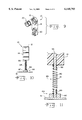
With reference now to FIG. 8 there is depicted clamp 10 and various mounting structures/configurations which can be utilized for mounting clamp 10 onto the robot. Preferably, clamp 10 is used with grommet 20 and may be mounted by itself onto a robot (not shown) through the use of bolts and/or screws extending through the various bore 54, 55, and 56. However, it is generally desirable to utilize a mount to attach or secure clamp 10 to the robot.
One type of mount is a spring assembly 59. Spring assembly 59 includes a generally rectangular mounting plate 61 having a first bolt or screw notch 62 on one end thereof and a second bolt or screw notch 63 on another end thereof. Notches 62 and 63 are utilized for attaching the plate 61 to the robot. If necessary, steel standoffs 58 of 11/4" length or otherwise may be used in conjunction with the mounting bolts or screws (not shown). Mounting plate 61 includes a stud structure 64 onto which is received a spring 65. Spring 65 is preferably a compression spring and, more particularly, a fatigue resistant square wire die spring.
With reference now to FIGS. 10 and 11, spring assembly 59 is depicted in greater detail. Stud structure 64 includes a mounting block 87 into which is disposed a threaded stud, bolt, or screw 89. Threaded stud 89 is threaded into one end of spring 65 which consists of many turns or coils, two turns or coils 90 and 91 of which are numbered. As threaded stud 89 is threaded or received into one end of spring 65, spring 65 axially elongates or expands around and proximate to threaded stud 89, causing the coils thereabout to radially compress against threaded stud 89. This holds spring 65 tight against threaded stud 89 and also makes backing out threaded stud 89 very difficult creating an almost permanent mounting.
Extending through bore 55 of base 14 is a threaded stud, bolt, or screw 66 that is threaded or received into another end of spring 65. As threaded stud 66 is threaded or received into another end of spring 65, spring 65 axially elongates or expands around and proximate to threaded stud 66 causing the coils thereabout to radially compress against threaded stud 66. This holds spring 65 tight against threaded stud 66 and also makes backing out threaded stud 66 very difficult creating an almost permanent mounting.
If a spring is not desired, a generally rectangular mounting plate 67 may be utilized having a central, fixed, perpendicular tube section 70 of any length. Mounting plate 67 includes first and second bolt/ screw notches 68 and 69 on either ends thereof. Additionally shown is an angle mounting 75 having a generally rectangular mounting plate 72 having first and second bolt/ screw notches 73 and 74 on either ends thereof. Extending perpendicular to mounting plate 72 is a first pipe section 76. Perpendicularly coupled to an end of first pipe section 76 opposite mounting plate 72 is a second pipe section 77. Perpendicularly coupled to an end of second pipe section 77 opposite pipe section 76 is a third pipe section 78. Each pipe section 76, 77, and 78 may be of any length. Lastly, another angle mounting 83 is shown. Angle mounting 83 includes a mounting plate 80 having first and second bolt/ screw notches 81 and 82 on either ends thereof. Perpendicularly coupled to mounting plate 80 is a first pipe section 84. Perpendicularly coupled to another end of first pipe section 84 is a second pipe section 85. Perpendicularly coupled to an end of second pipe section 85 opposite pipe section 84 is a third pipe section 86. Each pipe section 84, 85, and 86 may be of any length.
It should be understood that various pipe structures may be utilized. Custom mounting plates may also be utilized. Also, any mounting configuration may be used in combination with others.
With reference now to FIG. 9, a further type of mount is shown. A mounting block 60 can be utilized with the various mounting plates/configurations in conjunction with bolts or screws. Mounting block 60 may be mounted in various orientations, and may also be used in conjunction with the various mounts shown to retain clamp 10.
While this invention has been described as having a preferred design, the present invention can be further modified within the spirit and scope of this disclosure. This application is therefore intended to cover any variations, uses, or adaptations of the invention using its general principles. Further, this application is intended to cover such departures from the present disclosure as come within known or customary practice in the art to which this invention pertains and which fall within the limits of the appended claims.

Claims (18)

What is claimed is:
1. A clamp assembly for releasably retaining one of a welder, a fluid hose and an electrical cable onto a robot, the clamp assembly comprising:
a mount adapted to be secured to the robot assembly, said mount having a first threaded stud;
a clamp adapted to releasably retain said one of said welder, said fluid hose and said electrical cable, said clamp having a second threaded stud, said second threaded stud mounted within said clamp, a threaded portion of said second threaded stud extending beyond said clamp; and
a spring having a first end and a second end, said first threaded stud received in and contacting said first end, and said extending threaded portion of said second threaded stud received in and contacting said second end.
2. The clamp assembly of claim 1, wherein said spring is a compression spring.
3. The clamp assembly of claim 1, wherein said first threaded stud is a bolt.
4. The clamp assembly of claim 1, wherein said clamp comprises:
a base, said base having a first arcuate surface, a first hinge portion on one end of said first arcuate surface, and a first latch portion on another end of said first arcuate surface;
a mounting bore in said base and in communication with said first arcuate surface; and
an arm, said arm having a second arcuate surface, a second hinge portion on one end of said second arcuate surface, and a second latch portion on another end of said second arcuate surface;
said first and second hinge portions defining a pivot allowing said first and second latch portions to abut;
said first and second arcuate surfaces defining an opening when said first and second latch portions abut.
5. The clamp assembly of claim 4, wherein said clamp is made from aluminum.
6. The clamp assembly of claim 4, wherein said first hinge portion is defined by a first projection having an axial bore therethrough, and said second hinge portion is defined by second and third projections each having an axial bore therethrough and defining an area therebetween adapted to receive said first projection, and further comprising a pin extending through said axial bores.
7. A clamp assembly for holding a fluid hose or electrical cable onto a robot, the clamp assembly comprising:
a mount having a first threaded stud;
a clamp having a second threaded stud, said second threaded stud mounted within said clamp, a threaded portion of said second threaded stud extending beyond said clamp; and
a spring defined by a plurality of coils each having a coil diameter, said spring having a first end and a second end, said first threaded stud received into and contacting said first end of said spring and configured for axially expanding a first set of coils of said plurality of coils proximate said first threaded stud and for thereby reducing said coil diameter of said coils in said first set of coils and causing radially inward compression of said first set of coils against said first threaded stud; and said extending threaded portion of said second threaded stud received into and contacting said second end of said spring and configured for axially expanding a second set of coils of said plurality of coils proximate said second threaded stud and for thereby reducing said coil diameter of said coils in said second set of coils and causing radially inward compression of said second set of coils against said second threaded stud.
8. The clamp assembly of claim 7, wherein said clamp is made from aluminum.
9. The clamp assembly of claim 7, wherein said spring is a compression spring.
10. The clamp assembly of claim 7, wherein said clamp comprises:
a base, said base having a first arcuate surface, a first hinge portion on one end of said first arcuate surface, and a first latch portion on another end of said first arcuate surface;
a mounting bore in said base and in communication with said first arcuate surface; and
an arm, said arm having a second arcuate surface, a second hinge portion on one end of said second arcuate surface, and a second latch portion on another end of said second arcuate surface;
said first and second hinge portions defining a pivot allowing said first and second latch portions to abut;
said first and second arcuate surfaces defining an opening when said first and second latch portions abut.
11. The clamp assembly of claim 10, wherein said first hinge portion is defined by a first projection having an axial bore therethrough, and said second hinge portion is defined by second and third projections each having an axial bore therethrough and defining an area therebetween adapted to receive said first projection, and further comprising a pin extending through said axial bores.
12. The clamp assembly of claim 10, wherein said second threaded stud is a bolt that extends through a bore in said base.
13. The clamp assembly of claim 10, further comprising a grommet disposed in said opening.
14. A clamp for releasably retaining a fluid hose or electrical cable onto a robot, the clamp comprising:
a base having a top first retaining portion defining a first contact surface and having a bottom surface opposite said first contact surface, a first pivot portion on one end of said first contact surface, and a first latch portion on another end of said first contact surface, said base further including a mounting bore therethrough, said mounting bore extending from said first contact surface to said bottom surface;
a threaded stud mounted in said mounting bore, a threaded portion of said threaded stud extending beyond said bottom surface of said base; said threaded stud adapted to be retained on the robot via a mounting assembly;
said mounting assembly including a spring;
said spring having a first end and a second end;
said extended threaded portion being received in and contacting said second end;
an arm having a second retaining portion defining a second contact surface, a second pivot portion on one end of said second contact surface, said first and second pivot portions defining a hinge, and a second latch portion adapted to cooperate with said first latch portion to provide a releasable clasp when abutting;
said first and second retaining portions defining a containment area when said first and second latch portions abut; and
a grommet sized to be retained in said containment area.
15. The clamp of claim 14, wherein said base and said arm are made from 6061 aluminum.
16. The clamp assembly of claim 14, wherein said first pivot portion is defined by a first projection having an axial bore therethrough, and said second pivot portion is defined by second and third projections each having an axial bore therethrough and defining an area therebetween adapted to receive said first projection, and further comprising a pin extending through said axial bores.
17. The clamp of claim 14, wherein said mounting assembly includes a mounting plate and a square wire spring.
18. The clamp of claim 14, wherein said first and second contact surfaces define a circle when said first and second latch portions abut.
US09/298,388 1999-04-23 1999-04-23 Robotic MIG clamp Expired - Fee Related US6145793A (en)

Priority Applications (1)

Application Number Priority Date Filing Date Title
US09/298,388 US6145793A (en) 1999-04-23 1999-04-23 Robotic MIG clamp

Applications Claiming Priority (1)

Application Number Priority Date Filing Date Title
US09/298,388 US6145793A (en) 1999-04-23 1999-04-23 Robotic MIG clamp

Publications (1)

Publication Number Publication Date
US6145793A true US6145793A (en) 2000-11-14

Family

ID=23150285

Family Applications (1)

Application Number Title Priority Date Filing Date
US09/298,388 Expired - Fee Related US6145793A (en) 1999-04-23 1999-04-23 Robotic MIG clamp

Country Status (1)

Country Link
US (1) US6145793A (en)

Cited By (9)

* Cited by examiner, † Cited by third party
Publication number Priority date Publication date Assignee Title
US20060226301A1 (en) * 2005-04-12 2006-10-12 Kwilosz Mark J Vibration dampening clip
USD565118S1 (en) * 2006-07-19 2008-03-25 Everbrite, L.L.C. Combined neon tube clip and retainer cap
GB2472263A (en) * 2009-07-31 2011-02-02 Adam Lowe A support for a pipe, cable or similar
US20110260020A1 (en) * 2010-04-21 2011-10-27 Jonathan Isserow Jiggle sign
WO2012073013A3 (en) * 2010-11-29 2012-08-02 Ashley Rumbold Pipe clip
US20140166825A1 (en) * 2011-09-22 2014-06-19 Sumitomo Wiring Systems, Ltd. Clamp
USD747275S1 (en) * 2014-05-27 2016-01-12 Hawken Holdings, Llc Single cable guide for securing a cable
US9791072B2 (en) 2013-07-23 2017-10-17 Hawken Holdings, Llc Conduit guide apparatus, system, and method
CN114566931A (en) * 2022-03-07 2022-05-31 山东大学 Self-adaptive combined type broadband anti-galloping energy consumption device

Citations (12)

* Cited by examiner, † Cited by third party
Publication number Priority date Publication date Assignee Title
US1797899A (en) * 1928-05-24 1931-03-24 Flexlume Corp Insulator post
US1992555A (en) * 1931-07-22 1935-02-26 Aluminum Co Of America Cable vibration inhiritor
US1995620A (en) * 1932-07-09 1935-03-26 Aluminum Co Of America Vibration inhibitor
US2850560A (en) * 1954-11-01 1958-09-02 Neon Engineering Inc Neon tube supports
US3446907A (en) * 1967-04-10 1969-05-27 Raymond R Bouche Vibration damper
US3563504A (en) * 1969-03-05 1971-02-16 Harry K Gordon Die-cast cable pans
US4209659A (en) * 1979-02-15 1980-06-24 Aluminum Company Of America Vibration damper for overhead conductors
US4259541A (en) * 1979-11-20 1981-03-31 Bouche Raymond R Vibration damper for overhead electrical cables
US4291855A (en) * 1976-03-15 1981-09-29 Egli, Fischer & Co. Ag Pipe clamp
US4674720A (en) * 1985-03-28 1987-06-23 Unima Maschinenbau Gmbh Pipe saddle
US5133523A (en) * 1988-06-27 1992-07-28 Creative Systems Engineering, Inc.02 Suspendable conduit bracket lock system
US5257762A (en) * 1990-08-20 1993-11-02 Everbrite, Inc. Neon tube support having molded spring and method of making the support

Patent Citations (12)

* Cited by examiner, † Cited by third party
Publication number Priority date Publication date Assignee Title
US1797899A (en) * 1928-05-24 1931-03-24 Flexlume Corp Insulator post
US1992555A (en) * 1931-07-22 1935-02-26 Aluminum Co Of America Cable vibration inhiritor
US1995620A (en) * 1932-07-09 1935-03-26 Aluminum Co Of America Vibration inhibitor
US2850560A (en) * 1954-11-01 1958-09-02 Neon Engineering Inc Neon tube supports
US3446907A (en) * 1967-04-10 1969-05-27 Raymond R Bouche Vibration damper
US3563504A (en) * 1969-03-05 1971-02-16 Harry K Gordon Die-cast cable pans
US4291855A (en) * 1976-03-15 1981-09-29 Egli, Fischer & Co. Ag Pipe clamp
US4209659A (en) * 1979-02-15 1980-06-24 Aluminum Company Of America Vibration damper for overhead conductors
US4259541A (en) * 1979-11-20 1981-03-31 Bouche Raymond R Vibration damper for overhead electrical cables
US4674720A (en) * 1985-03-28 1987-06-23 Unima Maschinenbau Gmbh Pipe saddle
US5133523A (en) * 1988-06-27 1992-07-28 Creative Systems Engineering, Inc.02 Suspendable conduit bracket lock system
US5257762A (en) * 1990-08-20 1993-11-02 Everbrite, Inc. Neon tube support having molded spring and method of making the support

Cited By (12)

* Cited by examiner, † Cited by third party
Publication number Priority date Publication date Assignee Title
US20060226301A1 (en) * 2005-04-12 2006-10-12 Kwilosz Mark J Vibration dampening clip
US7448579B2 (en) * 2005-04-12 2008-11-11 Illinois Tool Works Inc. Vibration dampening clip
USD565118S1 (en) * 2006-07-19 2008-03-25 Everbrite, L.L.C. Combined neon tube clip and retainer cap
GB2472263A (en) * 2009-07-31 2011-02-02 Adam Lowe A support for a pipe, cable or similar
GB2472263B (en) * 2009-07-31 2014-04-30 Adam Lowe A support
US20110260020A1 (en) * 2010-04-21 2011-10-27 Jonathan Isserow Jiggle sign
WO2012073013A3 (en) * 2010-11-29 2012-08-02 Ashley Rumbold Pipe clip
US20140166825A1 (en) * 2011-09-22 2014-06-19 Sumitomo Wiring Systems, Ltd. Clamp
US9605774B2 (en) * 2011-09-22 2017-03-28 Sumitomo Wiring Systems, Ltd. Clamp
US9791072B2 (en) 2013-07-23 2017-10-17 Hawken Holdings, Llc Conduit guide apparatus, system, and method
USD747275S1 (en) * 2014-05-27 2016-01-12 Hawken Holdings, Llc Single cable guide for securing a cable
CN114566931A (en) * 2022-03-07 2022-05-31 山东大学 Self-adaptive combined type broadband anti-galloping energy consumption device

Similar Documents

Publication Publication Date Title
US5816736A (en) Robot arm assembly
CA1266165A (en) Universal bracket assembly
US6145793A (en) Robotic MIG clamp
EP0590317B1 (en) Snap mounted attachment device
US6854561B2 (en) Hanger systems and methods
KR101137148B1 (en) Pipe handle holding mechanism
CA2464851A1 (en) Mounting member with snap in swivel member
US6056085A (en) Anchorage methods and apparatus
US6126198A (en) Spring strut with steering knuckle
JPS63115990A (en) Fluid coupler
US6325336B1 (en) Hydraulic tubing clamp
JP2020168697A (en) A jig that supports the reducer of the robot, and a method of replacing the reducer using the jig
CA2000724C (en) Joint in fume-extracting welding gun
US5586738A (en) Tubing bracket assembly
KR101914648B1 (en) Distributor for cable guide of industrial robot
US5383636A (en) Bracket system for mounting a cable splicing tool to a pedestal
JP4290848B2 (en) Cable support device for industrial robot
CN222493876U (en) Clamps and product fixings
US6708964B1 (en) Any angle magnetic welding clamp assembly
US5705782A (en) Internal coil spot welding device
US4447032A (en) Multiple-type cable mounting apparatus and method
JPH03272387A (en) Housing for pipe coupling
US11353141B2 (en) Apparatus and method for controlling conduit
CN210359480U (en) Connection structure and elbow subassembly
CA2002499C (en) Swivel joint for welding gun

Legal Events

Date Code Title Description
AS Assignment

Owner name: BALAGUER CORPORATION, MICHIGAN

Free format text: ASSIGNMENT OF ASSIGNORS INTEREST;ASSIGNORS:KROULIK, ERWIN K.;BALAGUER, RICHARD J.;REEL/FRAME:009991/0685

Effective date: 19990527

AS Assignment

Owner name: INTERSERVICES, INC., ILLINOIS

Free format text: ASSIGNMENT OF ASSIGNORS INTEREST;ASSIGNOR:BALAGUER CORP;REEL/FRAME:011060/0001

Effective date: 20000711

CC Certificate of correction
REMI Maintenance fee reminder mailed
LAPS Lapse for failure to pay maintenance fees
STCH Information on status: patent discontinuation

Free format text: PATENT EXPIRED DUE TO NONPAYMENT OF MAINTENANCE FEES UNDER 37 CFR 1.362

FP Expired due to failure to pay maintenance fee

Effective date: 20041114