US6115052A - System for reconstructing the 3-dimensional motions of a human figure from a monocularly-viewed image sequence - Google Patents
System for reconstructing the 3-dimensional motions of a human figure from a monocularly-viewed image sequence Download PDFInfo
- Publication number
- US6115052A US6115052A US09/023,148 US2314898A US6115052A US 6115052 A US6115052 A US 6115052A US 2314898 A US2314898 A US 2314898A US 6115052 A US6115052 A US 6115052A
- Authority
- US
- United States
- Prior art keywords
- sub
- motion
- params
- training
- data
- Prior art date
- Legal status (The legal status is an assumption and is not a legal conclusion. Google has not performed a legal analysis and makes no representation as to the accuracy of the status listed.)
- Expired - Fee Related
Links
Images

Classifications
-
- G—PHYSICS
- G06—COMPUTING OR CALCULATING; COUNTING
- G06T—IMAGE DATA PROCESSING OR GENERATION, IN GENERAL
- G06T13/00—Animation
- G06T13/20—3D [Three Dimensional] animation
- G06T13/40—3D [Three Dimensional] animation of characters, e.g. humans, animals or virtual beings
Definitions
- This invention relates to a system for recognizing body motion and more particularly to a system for reconstructing an estimate of the 3-dimensional positions of a human body from a live or pre-recorded sequence of images of the body.
- an optimizer In order to detect human motion without the use of markers on an individual and without using as many as 6 cameras, an optimizer is used which takes a video input signal and an original training set and outputs optimized 3-d coordinates of body markers corresponding to the video input, the training data and manually input corrections.
- the optimizer finds the most probable linear combination of training data to explain the input video, accomodate user corrections, and be a likely 3-d motion segment. Having derived optimal 3-d coordinates, in one embodiment, realistic cartoon characters can be generated, all without the use of physical markers on the actor's body, and all from a single camera viewing the actor. Not only can the motion of an actor be characterized, archival film can be analyzed as to the motions of actors therein. The result is the ability to create animation for whatever purpose in a simple non-cumbersome manner.
- the optimizer performs its function in accordance with the following formula: ##EQU1## where E( ⁇ ) is the energy function to be minimized by the optimal coefficients ⁇ to be found, R is the vector of sensor responses over time from the image data.
- the function f converts ⁇ body motion coefficients to predicted sensor responses.
- I i is the ith point position specified bye the user, and P i projects the ⁇ coefficients onto the corresponding ith stick figure part 2-d position.
- ⁇ 1 and ⁇ 2 are constants which reflect the weights of the image data, the priors over human motions, and the interactively specified 2-d point matches.
- the 3-d reconstruction in a simplified image rendering domain utilizes a Bayesian analysis to provide analytic solutions to fundamental questions about estimating figural motion from image data.
- Applying the Bayesian method to real images premits reconstruction of human figure motions from archival video, with the subject system accomodating interactive correction of automated 2-d tracking errors that allows reconstruction even from difficult film sequences.
- a stick figure is overlain on an image of a moving human to allow the user to ascertain and correct 2-d motion estimate errors.
- a system for reconstructing the 3-dimensional motions of a human figure from a monocularly viewed image sequence in which a statistical approach is used coupled with the use of a set of motion capture examples to build a gaussian probability model for short human motion sequences.
- this yields an optimal 3-d estimate of human motion used to create realistic animations given a 2-d temporal sequence.
- the subject system is also useful to identify which motion modes are difficult to estimate.
- a stick figure is overlaid on the input video image to allow manual correction of incorrectly tracked body parts. The utilization of stick figure correction permits manual correction for a more accurate 3-d reconstruction of the motion depicted in the input video sequence.
- An interactive tracking system processes real video sequences, and achieves good 3-d reconstructions of the human figure motion.
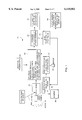
- FIG. 1 is a block diagram of a system having a video or archival film input for providing 3-d motion estimates used for providing realistic animation.
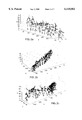
- FIGS. 2a, b, and c are diagrammatic representations showing example motion sequences from a training set of 10 sequences
- FIGS. 3a and b are diagrammatic representations showing approximation of the human motion signal as a linear combination of basis functions, with FIG. 3a showing a 40 basis functions approximation and with FIG. 3b showing the original human motion sequence;
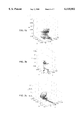
- FIG. 4 is a graph showing prior and posterior covariance matrix diagonal elements, plotted on a semi-log scale, with measurment of the marker positions in the image plane dramatically reducing the prior uncertainty of the human motion;
- FIGS. 5a, b, and c are diagrammatic representations showing three random draws from the gaussian prior distribution over the 37 3-d marker positions, with the results all looking human, and corresponding roughly to human motions;
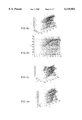
- FIGS. 6a-d are diagrammatic representations showing the original 3-d sequence, the orthographically projected image with markers connected by lines for clarity, 3-d reconstruction omitting prior information, with the representation being the 3-d figure in the eigenspace of the human motions which best accounts for the image data and a full Bayesian reconstruction, noting that the addition of prior information creates a reconstruction more similar to the original, and with the high posterior covariance modes explaining the remaining differences from the original sequence;
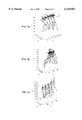
- FIGS. 7a-c are diagrammatic representations showing the three modes with the highest posterior uncertainty
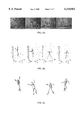
- FIGS. 8a-c are respectively: Samples from a 100 frame sequence of Barishnikov dancing with tracked 2-d stick figure overlaid, inferred 3-d marker positions using the gaussian prior model for 3-d figure motions, and the recovered 3-d moving cylinder figure which captures the 3-d motions of the dancer.
- a system 10 for providing a 3-dimensional estimate of body motion of an individual is used in one embodiment for providing cartoon characters whose motions resemble the motions of an actor. As discussed previously, it is only with difficulty that one can generate realistically moving cartoon characters based on human movement.
- an actor 12 has his movements filmed by a video camera 14 which are digitized at 16 and coupled to an optimizer 20, the purpose of which is to find the optimal 3-d body coordinates, given a 3-d motion training data set 22.
- the training data is divided up into snippets or segments which define so called basis vectors for human motion. Multiplying these values by coefficients and adding the results yields the new motions.
- the basis vector is a vector having the following components: a frame number, the number of each marker in that frame, and the x, y, and z positions of each marker. Note that the markers are obtained from the training data set.
- the markers in the training set indicate the positions of various positions on the body which describe the body part position. These are similar to placing physical markers on the clothing of the individual and measuring the 3-d position of those physical markers by triangulating from multiple cameras.
- Training data for animation is available commercially from Adaptive Optics Associates, Cambridge, Mass., in which datasets are provided with respect to for instance a dancer, indicating body part position in terms of markers. These example motion sequences in the form of a training set provide the a priori data used in subject system.
- a snippet has a pre-determined number of frames. Moreover, in one embodiment there is an offset which describes how many frames are skipped between the start of one snippet and the next.
- optimizer 22 It is the purpose of optimizer 22 to find the set of coefficients of the 3-d motion training data set which (1) best explains the input video data, and (2) accounts for user corrections which will be explained hereinafter. Note that the subject system operates on 2-d data, which is normally insufficient to provide the 3-d data necessary to describe the body motion to be imparted to a cartoon character.
- the 3-d estimates are derived from the 2-d video data through finding the most probable linear combination of the 3-d training data that explains the 2-d image information and the 2-d user corrections.
- Optimizer 20 iteratively searches for an optimum linear combination of training motion snippets and outputs the optimum set of coefficients for the motion under study. As illustrated at 24, this output is referred to herein as the estimated 3-d coordinates of the aforementioned body markers.
- a 3-d to 2-d projection of the recovered marker positions as illustrated at 26 is transformed into a stick figure which is made to overlay the corresponding video as illustrated at 28 where a visual comparison is made at monitor 30.
- the user compares the position of the stick figure with that of the actor in the video to ascertain what adjustments must be made to the stick figure in order to bring it into line with the corresponding body positions of the actor. This is accomplished by unit 32.
- a mouse 34 is utilized in one embodiment to designate what body part of the stick figure is selected, and where that stick figure body part should go. This is accomplished through the selection by the mouse of the marker to be adjusted, and designation by a second mouse click as to where that marker should be moved on the video body image.
- optimizer 20 Because of the operation of optimizer 20, it is not necessary or desireable to manually adjust each marker. Rather, through an iterative process of specifying selected markers for adjustment, optimizer 20 outputs a revised stick figure estimate. Because there are only certain things that a human body can do, there is a limited range of possibilities for the stick figures. This is because a certain amount of a priori knowledge which is implicitly contained in the training data trickles down to the resultant 3-d stick figure coordinates.
- the subject system recovers the same 3-d information just from the video sequence of the unencumbered actor. No longer must the actor be viewed from 6 cameras and be provided with apparatus on his clothing to be able to detect his motions. Rather, digitized video is analyzed to detect his motions and provide a 3-dimensional stick figure representation including markers which is used in the generation of corresponding cartoon characters mimicking the motion of the actor.
- the estimated 3-d coordinates are used in one embodiment to generate a character model by the fitting of a predetermined character model to these 3-d coordinates, as illustrated at 40. Once the character model has been fit to the 3-d coordinates, the character model is displayed at 42. Note that the display of the character may be altered for desired costume, viewpoint of the camera, so as to rotate the figure, or have the figure interact with other characters or scene elements as in a game. The result is that video game generation is simiplified and made more realistic without cumbersome apparatus on the actor and without costly motion capture equipment.
- the same techniques can be utilized to ascertain in a given environment what motions constitute non-normal behavior. For instance, people descending on an escalator can be viewed in real time and should an individual fall, this fact can be detected by the subject apparatus. Moreover, time and motion studies can be generated with the subject techniques.
- the function that the optimizer 20 optimizes can be interpreted as the Bayesian posterior probability of a given 3-d body motion. How this is accomplished is through the utilization of a prior probability for a set of snippet coefficients. It will be appreciated that one represents motions as linear combinations of snippets. The prior probability is thus a mathematical expresion of the probability of a human making the motion described by a given set of snippet coefficients. It will be further appreciated that the prior probability comes from the training data absent the new video, eg, prior to looking at the video.
- the posterior probability refers to the probability of the set after examining the video data, and optionally incorporating the user's corrections.
- Optimizer 20 thus utilizes Bayesian mathematical probability techniques to make sure that the 3-d esimates which are used to describe body motion are optimal. This gives an optimal tradeoff between explaining the video data, accounting for the user's corrections, and estimating likely human 3-d motions.
- the training examples used herein are 10 3-d motion capture sequences, of 5-10 seconds each, obtained commercially.
- the data is position information of 37 markers over 120 to 240 temporal frames for each sequence, sampled at roughly 20 frames per second.
- the motions are an ecclectic set of short activities, presumably designed to illustrate the range and precision of the motion capture equipment.
- FIG. 2 shows subsets of 3 of the 10 motion sequences. As in other motion displays, these figures show a "stroboscopic" display of an animated sequence, temporally subsampled and sometimes spatially offset for clarity. Lines are drawn between markers or circles to create a stick person that is easier to interpret.
- the subject invention seeks a simple and tractable, yet useful, probabilistic model for the 3d motions, learned from these examples.
- the motion signals are divided up into "segments" of a fixed, short temporal length.
- the prior model is a probability distribution over those temporal segments of marker positions over a few frames.
- FIG. 3 shows a typical motion sequence synthesized using 40 eigenvectors, showing an imperfect, but good, reconstruction.
- FIG. 3 shows a typical motion sequence synthesized using 40 eigenvectors, showing an imperfect, but good, reconstruction.
- FIG. 5 shows three random draws from the resulting probability model for 10-frame human motion segments.
- the motions look like plausible human motions, although, of course, random.
- This gaussian distribution provides a useful prior model for how a human moves over time. Yet, as will be seen, it is simple enough to work with easily and to provide some analytic estimation results.
- the goal is to infer 3-dimensional human motion from an image sequence.
- simplified rendering conditions with the simplified rendering conditions being as follows: the body is transparent, and each marker is rendered to the image plane orthographically.
- ⁇ For figural motion described by human motion basis coefficients ⁇ , the rendered image sequence, y, is:
- the posterior distribution is the product of these two gaussians. That yields another gaussian, with mean and covariance found by a matrix generalization of "completing the square", as described by A. Gelb, editor, Applied optimal estimation, MIT Press, 1974.
- the squared error optimal estimate for ⁇ is then
- FIGS. 6a-d illustrate applying this estimate to an overlapped sequence of 3 motion segments of 20 frames, each 10 frame segment offset by 5 frames.
- one of the 10 sequences was omitted from the training data, and a subset of it was used for this test.
- FIG. 6a shows the original sequence
- FIG. 6b the orthographic projection.
- FIG. 6c is the 3-d reconstruction resulting from the likelihood term alone, omitting the gaussian prior information. This finds the coefficients of the human motion basis functions which best explain the visual data. Note that the 3-d reconstruction is poor.
- FIG. 6d is the full Bayesian solution of Eq. 6. Note including the prior information gives a much better 3-d reconstruction.
- the subject gaussian probability model and the simplified rendering conditions allow this analytic solution for the optimal 3-d motion estimate.
- I is the identity matrix, the rows and columns having the dimensionality of the observations.
- FIG. 4 shows a comparison of the diagonal terms of the prior covariance, e.g. the solid line, with those of the posterior covariance, e.g. the dashed line.
- One mode, mode 2 shows virtually no reduction in uncertainty. This corresponds to a rigid translation mode moving nearly along the line of sight of the camera, as shown in FIG. 7a.
- the second highest uncertainty mode, mode 1 is another rigid translation mode, shown in FIG. 7b.
- the non-rigid mode having the highest posterior uncertainty, mode 10 is shown in FIG. 7c. This mode spreads the individual's arms along the line of sight of the camera. Note that this high uncertainty mode reflects the errors observed in the reconstruction of FIG. 6d.
- the prior probability distribution occupies a certain volume in the 50 dimensional parameter space.
- the ratio of that volume to the posterior probability distribution's volume is 10 -14 . While it is hard to gauge high dimensional volumes intuitively, the ratio is small and the posterior uncertainty is considerably reduced.
- post-processing one might expect to also remove the rigid mode ambiguities, either by user interaction, or by applying rigid ground contact constraints.
- the goal was to demonstrate that the reconstruction method developed for the simplified rendering carried over to natural scenes.
- the figure's motion relative to the camera frame was reconstructed, not the background.
- the gradient of the image intensities was taken, and the gradient strengths were normalized by a blurred average of the local contrast strength. These normalized edge strengths were then blurred enough to make a low-resolution sampling of 10 by 8 sensors.
- the user can interactively specify the correct location of any stick figure part at any time frame. This effectively places a spring between the image position and the stick figure part at that particular time.
- the ⁇ being sought is that which minimizes an energy, E( ⁇ ), from the image data.
- the symbol ⁇ -1 is the inverse of the Gaussian probability distribution of the covariance according to Duda as described above.
- R is the vector of sensor responses over time from the image data.
- the function f converts ⁇ body motion coefficients to predicted sensor responses.
- I i is the ith point position specified by the user, and P i projects the ⁇ coefficients onto the corresponding ith stick figure part 2-d position.
- ⁇ 1 and ⁇ 2 are constants which reflect the weights of the image data, the priors over human motions, and the interactively specified 2-d point matches.
- E is interpreted as the negative log of the posterior probability.
- ⁇ 1 and ⁇ 2 then represent observation and user "noise strengths”.
- the quadratic penalty for sensor response differences is the log of the likelihood term, and both the interactively placed springs and the gaussian prior motion model represent prior information about the parameters. Also included is a 90° rotated version of all training data in the calculation of the prior probability. The 3-d body motion parameters are found which maximize the posterior probability.
- the recovered optimal ⁇ yields the recovered marker positions over time. Those marker positions are then fit to cylinder positions in a simple figure model using least squares techniques.
- FIGS. 8a-c show the resulting estimates of the 3-d figure positions from a 100 frame sequence of Barishnikov dancing.
- approximately one interactive location specification per frame were used to ensure the accurate overlay of a stick figure over the motion sequence.
- FIG. 8a shows the input sequence and the overlaid stick figure.
- E in Eq. 1 is minimized to find the ⁇ estimate over each overlapped 10-frame segment. Positions from the overlapped segments were linearly blended together. The offset away from the camera of each segment was set to ensure continuity to the next segment.
- FIG. 8b shows the recovered 3-d marker positions, viewed from 30° away from the camera position.
- FIG. 8c shows the 3-d cylinder model, viewed from that same off-camera position. Given the simple gaussian prior model for human motion, the results are remarkably strong.
- the 3-d dance is rendered as a linear combination of basis motions learned from the motion capture training set.
- the dancing cylinder figure generally captures the 3-d motions of the dancer.
- the cylinder dancer does not point his toes, as Barkshnikov does, but toe pointing was not in the training set.
- a statistical model was used to infer the 3-d positions of a human figure from an image sequence of the human moving.
- the model of human motion was learned from a training set of 3-d motion capture data, obtained from a calibrated tracking system.
- Equation 8 the first term in the sum of Equation 8 can be replaced by ##EQU3## where t is an index of the frame time of each frame of the motion segment. I t is a vector of the image intensities at time t at the 2-d position of its vector argument. M( ⁇ ) is the 2-d positions of each marker for the human motion represented by the linear combination of training segments given by the combination coefficients ⁇ .
- the coefficients ⁇ which minimize this term will correspond to a figure motion in which the image intensities at the marker positions in the image change the least from frame to frame. This will encourage the figure model to track the human figure in the video.
- a 3-d estimate is formed for each segment.
- the 3-d reconstruction for a particular video frame number is computed as the average of estimates of all the overlapping motion segments.
- an initial estimate of the marker positions for various time frames can be calculated from the motion estimates from the previous motion segments.
- the second term can be replaced by ⁇ 1 (( ⁇ - ⁇ )' ⁇ -1 ( ⁇ - ⁇ ), where ⁇ is the prior mean of the coefficients ⁇ .
- ⁇ is set to the average of the small number of selected training segments, ##EQU4## for each of the N selected training segments.
Landscapes
- Physics & Mathematics (AREA)
- General Physics & Mathematics (AREA)
- Engineering & Computer Science (AREA)
- Theoretical Computer Science (AREA)
- Processing Or Creating Images (AREA)
- Image Analysis (AREA)
- Length Measuring Devices By Optical Means (AREA)
- Image Processing (AREA)
Abstract
Description
y=PUα, (2)
P(α\y)=k.sub.1 P(y\α)P(α),(3)
P(α)=k.sub.2 e.sup.-αΛ.spsp.-1.sub.α,(4)
P(y\α)=k.sub.e e.sup.-\y-PUα\.spsp.2.sub./(2σ.spsp.2),(5)
α=SU'P'(PUSU'P'+σI).sup.-1 (y-(Pm)) (6)
Q=S-SU'P'(PUSU'P'+σI).sup.-1 PUS, (7)
__________________________________________________________________________
file: /homes/leventon/Matlab/G2a.m
function v = G2a(x, y)
v = 0.9213*(2*x*x-)*exp(-(x*x+y*y));
file: /homes/leventon/Matlab/G2b.m
function v = G2b(x, y)
v = (0.9213*2)*x*y*exp(-(x*x+y*y));
file: /homes/leventon/Matlab/G2c.m
function v = G2c(x, y)
v = 0.9213*(2*y*y-1)*sxp(-x*x+y*y));
file: /homes/leventon/Matlab/G2theta.m
function v = G2theta(x, y, theta)
v = cos(theta)2* G2a(x, y) - 2*cos(theta)*sin(theta) * G2b(x, y) +
sin(theta) 2 * G2c(x, y);
file: /homes/leventon/Matlab/H2a.m
function v = H2a(x, y)
v = 0.9780*(-2.254*x+x 3)*exp(-(x*x+y*y));
file: /homes/leventon/Matlab/H2b.m
function v = H2d(x, y)
v = 0.9780*(-0.7515+x 2)*y*exp(-(x*x+y*y));
file: /homes/leventon/Matlab/H2c.m
function v = H2d(x, y)
v = 0.9780*(-0.7515+y 2)*x*exp(-(x*x+y*y));
file: /homes/leventon/Matlab/H2d.m
function v = H2d(x, y)
v = 0.9780*(-2.254*y+y 3)*exp(-(x*x+y*y));
file: /homes/leventon/Matlab/H2theta.m
function v = H2theta(x, y, theta)
v = cos(theta) 3 * H2a(x, y);
v = v - 3*cos(theta) 2*sin(theta) * H2b(x,y);
v = v + 3*cos(theta)*sin(theta) 2 * H2c(x,y);
v = v - sin(theta) 3 * H2d(x, y);
file: /homes/leventon/Matlab/H4a.m
function x = H4a(x, y)
x = 0.3975 * (7.189*x - 7.501*x 3 + x 5)*exp(-(x 2+y 2));
file: /homes/leventon/Matlab/aToR.m
function [R, Rx, Ry, Rz] = aToR(a);
c = cos(-a);
s = sin(-a)
Rx = [1 0 0; 0 c(1) s(1); 0 -s(1) c(1)];
Ry = [c(2) 0 s(2); 0 1 0; -s(2) 0 c(2)];
Rz = [c(3) s(3) 0; -s(3) c(3) 0; 0 0 1];
% R = Rz*Ry*Rx;
R = Rx*Ry*Rz;
file: /homes/leventon/Matlab/addConstraints.m
function [ptcor, trackcor, itering, t, times.sub.-- changed] =
addConstraints(seq, seqIm, ptcor, trackcor, t)
% [ptcor, trackcor, itering, t] = addConstraints(seq, seqIm)
% Starting with no constraints, the user interactively adds point or
%
% tracking constraints. Seq is the reconstructed 3d sequence.
% seqIm is the Image sequence. This function returns the
% correspondences in two cells, "ptcor" for the point
% correspondences,
% and "trackcor" for the tracking correspondences.
% The return val itering tells if the user wants to continue
% interating
%, through the svd-loop. (Whether the user clicked "Done" or "Cancel"
%
% and whether the user added anything from the last iteration).
%
% The return val t stores what time step the user left off at.
%
% [ptcor, trackcor, itering, t] = addConstraints(seq, seqIm, ptcor,
%, trackcor, t)
% The ptcor and trackcor inputs allow for constraints to be
% appended.
% The t input deterinines at what time frame the interaction starts.
% global ptcor
% This function has pretty confusing control structure, but
% matlab doesn't have the "continue" command . . .
if (exists(seq, `scale`) == 0), seq.scale = 1; end
if (exists(seqIm, `scale`) == 0), seqIm.scale = 1; end
linecolor = `b`; - scale = seqIm.scale / seq.scale;
%% Display some instructions
disp(`First Click:`);
disp(`Use Left Mouse Button on any window to select marker`);
disp(`Use Middle Button to step backward in time`);
disp(`Use Right Button to step forward in time`);
disp(` `);
disp(`Second Click:`);
disp(`Use Left Mouse Button on image window to select
correspondence`);
disp(`Use Right Button on image window to define a tracking
rectangle`);
disp(` (first click upper left, then click lower right)`);
disp(` Use Middle Mouse Button to CANCEL the first click`);
if (nargin < 5) t = 1; end
if (isempty(t)) t = 1; end
n = size(seq.data, 1);
d = seq.data(2:n, :);
nFr = seq.nframes;
global seqINFO
nmkr = seqINFO.nummkr(seq.subtype);
d = reshape(d', 3, nmkr, nFr);
d = transpose2(d);
if (nargin < 4) trackcor = cell(0); end
if (nargin < 3) ptc9r = cell(0); end
%% Dray Guy #1
if (seq.subtype == 1)
seqDiag = seqCrop(seqGet(6), 9, 9);
elseif (seq.subtype == 2)
seqDiag = seqCrop(seqGet(51), 9, 9);
end
guy1seq = seqConvert(seqDiag, `2d`);
guy1dat = guy1seq.data(2:nmkr+1, :);
guy2seq = seqConvert(seqRotate(seqDiag, pi/2), `2d`);
guy2dat = guy2seq.data(2:nmkr+1, :);
%% Dray Guy #1
subplot(2,2,3);
seqView(guy1seq);
guy1.sub.-- figure = gca;
axis off
%% Dray Guy #2
subplot(2,2,4);
seqView(guy2seq);
guy2.sub.-- figure = gca;
axis off
%% Start off by "showing" the already-established links
showing = 1;
%% We haven't made any changes yet . . .
itering = 0;
%% (There's no "do while" loop, so . . .)
notdone = 1;
%% There's no continue (only break), so . . .
continue = 0;
%% The last things we added (0-nothing, 1-ptcor, 2-trackcor) . . .
lastwas = [ ];
%% Times changed
times.sub.-- changed = zeros(1,nFr);
while (notdone)
subplot(2,1,1);
hold off
%% Overlay the sequence on the image at time t
seqView2({seqIm, seq}, t);
axis off
%% Add our "Buttons" (hee hee)
H1 = text(scale*0, scale*(-5), `Done!`);
H2 = text(scale*40, scale*(-5), `Cancel`);
if (showing)
H3 = text(scale*80, scale*(-5), `Hide`);
else
H3 = text(scale*80, scale*(-5), `Show`);
end
Ht = text(scale*120, scale*(-5), sprintf(`Time = *%d`, t));
H4 = text(scale*160, scale*(-5), `Undo`);
main.sub.-- figure = gca;
% Transfer the 3d data from world to camera coordinates
d2 = worldTocam(d(:,:,t));
if (showing)
%% Display all the Point Correspondences
for i = 1:length(ptcor)
if (ptcor{i}.t == t)
mkr = ptcor{i}.mkr;
p2 = ptcor{i}.pos([2 1]);
subplot(2,1,1);
hold on
plot(scale*[d2(mkr, 1) p2(1)], scale*[d2(mkr, 2) p2(2)], . . .
[linecolor `o`]);
end
end
%% Display all the Tracking Correspondences
for i = i:iength(trackcor)
if (trackcor{i}.t == t)
mkr = trackcor{i}.mkr;
pul = trackcor{i}.pos(i,[2 1]);
plr = trackcor{i}.pos(2,[2 1]);
p2 = (pul+plr)/2;
subplot(2,1,1);
hold on
plot(scale*[d2(mkr, 1) p2(1)], scale*[d2(mkr, 2) p2(2)], . . .
[linecolor `o-`]);
if (trackcor{i}.first == t)
plot(scale*[pul(1) pul(1) plr(1) plr(1) pu1(1)],
scale*[pul(2) plr(2) plr(2) pul(2) pul(2)], `b+-`);
else
plot(scale*[pul(1) pul(1) plr(1) plr(1) pul(1)],
scale*[pul(2) plr(2) plr(2) pul(2) pul(2)], `g+-`);
end
end
end
end
%% "Matlab's control structure" . . . "sucks?" (said like "LSC . . .")
if (continue == 0)
[x, y, b] = ginput(1);
win = gca;
p = [x y];
if (win==main.sub.-- figure), p=p/scale; end
end
continue = 0;
%% While we haven't ciicked to the left of the image
while (p(2) > 0)
%% Check which button we clicked . . . adjust time if necessary
if (b == 2)
t = t - 1;
if (t < 1)
t = 1;
end
break
elseif (b == 3)
t = t + 1;
if (t > nFr)
t = nFr;
end
break
end
%% Find WHICH led we just clicked
if (win == main figure)
[v, which] = min(sum((d2-ones(nmkr,1)*p). 2, 2));
elseif (win == guy1.sub.-- figure)
[v, which] = min(sum((guy1dat-ones(nmkr,1)*p). 2, 2));
elseif (win == guy2.sub.-- figure)
[v, which] = min(sum((guy2dat-ones(nmkr,1)*p). 2, 2));
else
break
end
hold on
%% Highiight the led that was clicked
subplot(2,1,1);
plot(scale*d2(which, 1), scale*d2(which, 2), [linecolor `*`]);
subplot(2,2,3);
seqView(guy1seq, [ ], cons(`viewang`, [0 0], `leds`, which-1));
axis off
subplot (2,2,4);
seqView(guy2seq, [ ], cons(`viewang`, [-90 0], `leds`, which-1));
axis off
%% Get the "New" position
[x, y, b] =ginput(1);
win = gca;
pnew = [x y];
if (win==main.sub.-- figure), pnew=pnew/scale; end
if (b == 2)
%% Middle Button -- cancel!
break;
end
if (win .sup.˜ = main.sub.-- figure)
p = pnew;
continue = 1;
break
end
if ((x < 0) ∥ (y < 0))
break
end
if (b == 3)
%% Right button -- second click means define a tracking
rectangle
pul = pnew;
subplot(2,1,1);
plot(scale*d2(which, 1), scale*d2(which, 2), `b*`);
plot(scale*pul(1), scale*pul(2), `b+`);
[x, y, b] = ginput(1);
win = gca;
plr = [x y];
if (win==main.sub.-- figure), plr=plr/scale; end
if (win .sup.˜ = main.sub.-- figure)
break
end
plot(scale*[pul(1) pul(1) plr(1) plr(1) pul(1)], scale*[pul(2)
plr(2) plr(2) pul(2) pul(2)], `b+-`);
pnew = (pul+plr)/2;
ntcor = length(trackcor)+1;
times.sub.-- changed(t) = 1;
trackcor{ntcor}.mkr = which;
trackcor{ntcor}.t = t;
trackcor{ntcor}.first = t;
trackcor{ntcor}.pos = [pul; plr];
trackcor{ntcor}.pos = trackcor{ntcor}.pos(:, [2 1]);
trackcor{ntcor}.pos
trackcor{ntcor}.cert = 1;
trackcor{ntcor}.hausfrac = 1;
trackcor{ntcor}.weight = 1;
lastwas = [2 lastwas];
else
%% Left button -- second click means define a point
nptcor = length(ptcor)+1;
times.sub.-- changed(t) = 1;
ptcor{nptcor}.mkr = which;
ptcor{nptcor}.t = t;
ptcor{nptcor}.first = t;
ptcor{nptcor}.pos = pnew([2 1]);
ptcor{nptcor}.cert = 1;
ptcor{nptcor}.hausfrac = 1;
ptcor{nptcor}.weight = 1;
lastwas = [1 lastwas];
end
subplot (2,1,1);
plot(scale*[d2(which, 1) pnew(1)], scale*[d2(which, 2) pnew(2)],
. . .
[linecolor `o-`]);
%% We changed something . . . Keep on minimizing when "done" is
clicked
itering = 1;
[x, y, b] = ginput(1);
win = gca;
p = [x y];
if (win==main.sub.-- figure), p=p/scale; end
end
if (p(2) < 0)
if (p(1) < 75)
%% Either "Done" or "Cancel" was clicked
notdone = 0;
elseif (p(1) < 115)
%% Show/Hide was Clicked
showing = ˜showing;
else
%% Undo was Clicked
if (isempty(lastwas) == 0)
if (lastwas(1) == 1)
ptcor = ptcor(1:length(ptcor)-1);
elseif (lastwas(1) == 2)
trackcor = trackcor(1:length(trackcor)-1);
end
lastwas = lastwas(2:length(lastwas));
end
end
end
end
if (p(1) > 35)
%% They Clicked "CANCEL" (not "Done")
%% So let the caller know . . .
itering = 0;
end
delete(H1);
delete(H2);
delete(H3);
delete(H4);
if (isempty(lastwas))
for i = 1:length(ptcor)
times.sub.-- changed(ptcor{i}.t) = 1;
end
for i = 1:length(trackcor)
times.sub.-- changed(trackcor{i}.t) = 1;
end
end
file: /homes/leventon/Matlab/aencode.m
function M = aencode(varargin)
params = varargin{nargin};
n = nargin - 1;
s = params(1);
k = params(2);
M = [ ];
c = 1;
A = varargin{1};
ndeg = 28;
nRows = ndeg * s;
for w = 1:n
A = varargin{w};
nfr = size(A, 2);
for i = 1:k:(nfr-s-1)
v = vectorize(A(1:ndeg, i:i+s-1)`);
M(1:nRows,c) = v;
c = c + 1;
end
end
file: /homes/leventon/Matlab/aencode2.m
function M = aencode2(varargin)
params = varargin{nargin};
n = nargin - 1;
s = params(1);
k = params(2);
M = [ ];
c = 1;
A = varargin{i};
ndeg = 20;
nRows = ndeg * s;
for w = 1:n
A = varargin{w};
nfr = size(A, 2);
for i = i:k:(nfr-s+1)
v = vectorize(A(4:23, i:i+s-1)`);
M(i:nRows,c) = v;
c = c + 1;
end
end
file: /homes/leventon/Matlab/allbut.m
function [Xnx, Mnx, unx, snx, vnx, En] = allbut(ALL, x, nEv)
ISx = ALL{x};
N = size(ALL, 1);
if (x == 1)
ISnx = {ALL{2:N}};
elseif (x == N)
ISnx = {ALL{i:N-1}};
else
ISnx = {ALL{1:x-1}, ALL{x+1:N}};
end
Mnx = mencode(ISnx{1:N-1}, [10 5]);
[unx, snx, vnx, Enx] = decomp(Mnx, 37);
Xnx = project(ISx, unx, nEv);
file: /homes/leventon/Matlab/allbut23.m
function [A23nxp, A2nxp, M2nx, M3nx, u2nx, s2nx, v2nx, E2nx] =
allbut23(ALL2, ALL3, x, r, nEv)
[N, M] = size(ALL2);
M = 3;
IS2x = ALL2{x, r};
IS2nx1 = cell(1, M);
IS3nx1 = cell(1, M);
for m = 1:M
if (x == 1)
IS2nx1{m} = {ALL2{2:N,m}}`;
IS3nx1{m} = {ALL3{2:N,m}}`;
elseif (x == N)
IS2nx1{m} = {ALL2{1:N-1,m}}`;
IS3nx1{m} = {ALL3{1:N-1,m}}`;
else
IS2nx1{m} = {ALL2{1:x-1,m}, ALL2{x+1:N,m}}`;
IS3nx1{m} = {ALL3{1:x-1,m}, ALL3{x+1:N,m}}`;
end
end
IS2nx = cat(2, IS2nx1{1:M});
IS3nx = cat(2, IS3nx1{1:M});
M2nx = mencode2(IS2nx{1:N-1,1:M}, [10 5]);
M3nx = mencode(IS3nx{1:N-1,1:M}, [10 5]);
[u2nx, s2nx, v2nx, E2nx] = decomp2(M2nx, 37);
[A23nxp, A2nxp] = project23(IS2x, M3nx, u2nx, s2nx, v2nx, nEv);
file: /homes/leventon/Matlab/anglesc.m
Maw = aencode(walkloopa, [10 5]);
[u, s, v] = svd(Maw);
viewang(person, matricize(Maw(;,1), 23)`);
viewang(person, matricize(u(:,1), 23)`);
Mp = u(:,1:100) * u(:,1:100)`* Maw(:,1); viewang(person,
matricize(Mp, 23)`);
file: /homes/leventon/Matlab/aoaNegate.m
function M2 = aoaNegate(M)
[n, lose] = size(M);
M2 = [M(1,:); -M(2:n,:)];
file: /homes/leventon/Matlab/aoaerr2.m
function err = aoaerr2(A1, A2)
nfr1 = A1(1,1);
nfr2 = A2(1,1);
n= 37 * min([nfri nfr2]);
B1 = A1(2:n+1, :);
B2 = A2(2:n+1, :);
err = 0;
for i = i:n
err = err + (sum((B1(i,:-B2(i,:)). 2));
end
err = sqrt(err/n);
file: /homes/leventon/Matlab/aoaerr23 .m
function err = aoaerr23(A1, A2)
nfr1 = A1(1,1;
nfr2 = A2(1,1);
t = min([nfr1 nfr2]);
n = 37 * t;
B1 = A1(2:n+1, :);
B2 = A2(2:n+1, :);
err = 0;
for i = 1:t
r = ((i-1)*37+1):i*37;
com1 = (sum(B1(r,:))/37);
com2 = (sum(B2(r,:))/37);
for j = 1:37
err = err + sum(((B1(r(j),:)-com1)-(B2(r(j),:)-com2)). 2);
end
end
err = sqrt(err/n);
file: /homes/leventon/Matlab/aoaerr3.m
function err = aoaerr3(A1, A2)
nfr1 = A1(1,1);
nfr2 = A2(1,1);
n = 37 * min([nfr1 nfr2]);
B1 = A1(2:n+1, :);
B2 = A2(2:n+1, :);
err = 0;
for i = 1:n
err = err + (sum((B1(i,:)-B2(i,:)). 2));
end
err = sqrt(err/n);
file: /homes/leventon/Matlab/args.m
function a = cons(varargin)
n = length(varargin);
if (n==0)
a.struct = [ ];
return
end
if (mod(n, 2) == 0)
a = struct(varargin{:});
else
a = varargin{1};
f = fieldnames(a);
nf = size(f, 1);
for i=2:2:n
found = 0;
for j = 1:nf
if (strcmp(varargin{i}, f(j)))
found = 1;
end
end
if (found == 0)
a = setfield(a, varargin{i}, varargin{i+1});
end
end
end
file: /homes/leventonlMatlab/atan2e.m
function t = atan2e(a, b, e)
if (abs(a) < e)
a = 0;
end
if (abs(b) < e)
b = 0; -
end
t = atan2(a, b);
file: /homes/leventon/Matiab/autocrop.m
function [I, amount] = autocrop(I, val)
if (nargin < 2)
Ib = [I(:,1)' I(1,:) I(:.size(I,2))' I(size(I,1),:)];
val = mode(Ib(:));
end
J = (I .sup.˜ = val);
Jh = find(sum(J,1));
Jv = find(sum(J,2));
if (isempty(Jh))
I = [ ]; - return
end
bx = Jv(1);
ex = Jv(length(Jv));
by = Jh(1);
ey = Jh(length(Jh));
amount = [(bx-1) (by-1) (size(I,i)-ex) (size(I,2)-ey)];
I = I(bx:ex, by:ey);
file: /homes/leventon/Matlab/autocropr.m
function [rx, ry] = autocropr(I, val)
if (nargin < 2)
Ib = [I(:,1)'I(1,:) I(:,size(I,2))' I(size(I,1),:)];
val = mode(Ib(:));
end
J = (I .sup.˜ = val);
Jh = find(sum(J,1));
Jv = find(sum(J,2));
if (isempty(Jh))
rx = [ ];
ry = [ ];
return
end
bx = Jv(1);
ex = Jv(length(Jv));
by = Jh(1);
ey = Jh(length(Jh));
rx = bx:ex;
ry = by:ey;
if (nargout < 2)
rx = {rx, ry};
file: /homes/leventon/Matlab/barish.m
seqInit
load /homes/leventon/Data/barish.mat
SEQUENCES = 1:10;
VIEW.sub.-- ANGLES = (0:7)*pi/4;
sel = seqSelect(SEQUENCSE, VIEW.sub.-- ANGLES);
knlPulse = seqTrain(sel, `pulse`, `submean`, 1, `MtM`, 0, `headalign`,
1);
barish =
seqRecon(
file: /homes/leventon/Matlab/block.m
function MM = block(M, k)
[m, n] = size(M);
MM = zeros(k*m, k*n);
for i=i:k
MM((i-1)*m+1:i*m, (i-1)*n+1:i*n) = M;
end
file: /homes/leventon/Matlab/brent.m
%% brent.m function implements brent's method for 1-d
%% line minimization. see p. 404, num rec. in C.
%% Feb. 3, 1997 freeman typed in and debugged. seems ok.
function [fx, xmin] = brent(ax, bx, cx, FUN, tol)
evalstr = [FUN];
ITMAX = 100;
CGOLD = 0.3819660;
ZEPS = 1.0e-10;
e = 0.0;
if (ax < cx); a = ax; else a = cx; end;
if (ax > cx); b = ax; else b = cx; end;
x = bx; w = bx; v = bx;
fx = eval([evalstr, `(x)`]); fv = fx ; fw = fx;
for iter = 1:ITMAX
xm = 0.5 * (a + b);
toll = tol * abs(x) + ZEPS;
tol2 = 2.0 * toll;
if (abs(x-xm) <= (tol2 - 0.5*(b-a)))
xmin = x;
return;
end
if (abs(e) > toll)
r = (x-w)*(fx-fv);
q = (x-v)*(fx-fw);
p = (x-v)*q-(x-w)*r;
q = 2.0*(q-r);
if (q > 0.0) p = -p; end;
q = abs(q);
etemp = e;
e = d;
if ( (abs(p) >= abs(0.5*q*etemp)) | . . .
(p <= q*(a-x)) | . . .
(p >= q*(b-x)))
if (x >= xm) e = a-x; else e = b-x; end;
d = CGOLD*e;
else
d = p/q;
u = x+d;
if ( (u-x < tol2) | (b-u < tol2) )
d = abs(toli)*sign(xm-x);
end;
end
else
if (x >= xm) e = a-x; else e = b-x; end;
d = CGOLD*e;
end
if (abs(d) >= toli)
u = x+d;
else
u = x+ abs(toli)*sign(d);
end
fu = eval([evalstr, `(u)`]);
if (fu <= fx)
if (u >= x) a = x; else b = x; end;
v = w; w = x; x = u;
fv = fw; fw = fx; fx = fu;
else
if (u < x) a = u; else b = u; end;
if ( (fu <= fw) | (w == x))
v = w; w = u; fv = fw; fw = fu;
else
if ( (fu <= fv) | (v == x) | (v == w) )
v = u; fv = fu;
end;
end;
end
end
disp(sprintf(`Too many iterations in brent`));
xmin = x;
return;
file: /homes/leventon/Matlab/call.sub.-- canny.m
function Ie = call.sub.-- canny(I, smth, canny1, canny2)
SMOOTH.sub.-- CMD = `/homes/leventon/libgregk/bin/smooth`;
CANNY.sub.-- CMD = `/homes/leventon/libgregk/bin/canny`;
PEMTOPGM.sub.-- CMD = `/homes/leventon/libgregk/bin/pbmtopgm`;
if (nargin < 2), smth = 1; end
if (nargin < 3), canny1 = 2; end
if (nargin < 4), canny2 = 5; end
outfn = sprintf(`tmp-%04.out`, round(mod(now, 10000)));
infn = sprintf(`tmp-%04d.in`, round(mod(now, 10000)));
if (size(I,3) == 3)
I = 0.299 * I(:,:,1) + 0.587 * I(:,:,2) + 0.114 * I(:,:,3);
end
pgmWrite(I, outfn);
cmd = sprintf(`%s-g %d < %s | %s -t %d %d | %s >! %s`,
SMOOTH.sub.-- CMD,
%smth, outfn, CANNY.sub.-- CMD, canny1, canny2, PBMTOPGM.sub.-- CMD,
%infn);
unix(cmd);
Ie = pginRead(infn);
cmd = sprintf(`/bin/rm -f %s %s`, outfn, infn);
unix(cmd);
file: /homes/leventon/Matlab/camToWorld.m
function w = camToWorld(c)
% camToWorld Take a list of points in camera coorinates,
% And transform thein into world coordinates.
w = zeros(size(c,1),3);
w(:, 1) = (160-c(:, 1)-54)/(42-125)*(52.19+87.9)+43.19;
w(:, 3) = (c(:, 2)-44)/(473-30)*(40-70)+40;
file: /homes/leventon/Matlab/canny.m
function [E, dx, dy] = canny(I, sd, th1, th0);
%CANNY Edge detection.
% E = canny(I) finds the edges in a gray scaled image I using
% the Canny
% method, and returns an image E where the edges of I are marked
% by
% non-zero intensity values.
% E = canny(I, SD) uses SD as the standard deviation for the
% gaussian
% filtering phase. Default is 1 pixel.
%
% E = canny(I, SD, TH1) uses TH1 for the higher hysteresis
% threshold.
% Default is 0.5 times the strongest edge. Setting TH1 to zero
% will
% avoid the (sometimes time consuming) hysteresis.
%
% E = canny(I, SD, TH1, TH0) uses TH1 for the lower hysteresis
% threshold.
% Default is 0.1 times the strongest edge.
%
% See also EDGE (in the Image Processing toolbox).
if nargin<2 sd= 1; end; if isempty(sd), sd= 1; end;
if nargin<3 th1= .5; end; if isempty(th1), th1= .5; end;
if nargin<4 th0= .1; end; if isempty(th0), th0= .1; end;
x= -5*sd:sd*5;
g= exp(-0.5/sd 2*x 2);
% Create a normalized Gaussian
%
g= g(g>max(g)*.005); g= g/sum(g(:));
dg= diff(g); % Gaussian first derivative
dx= abs(conv2(I, dg, `same`));
% X/Y edges
dy= abs(conv2(I, dg', `same`));
dx = smooth(dx, 1);
dy = smooth(dy, 1);
[ny, nx]= size(I);
% Find maxima
dy0= [dy(2:ny,:); dy(ny,:)]; dy2= [dy(1,:); dy(1:ny-1,:)];
dx0= [dx(:, 2:nx) dx(:,nx)]; dx2= [dx(:,1) dx(:,1:nx-i)];
peaks= find((dy>dy0 & dy>dy2) | (dx>dx0 & dx>dx2));
peaks.sub.-- y = find((dy>dy0 & dy>dy2));
peaks.sub.-- x = find((dx>dx0 & dx>dx2));
e= zeros(size(I));
e(peaks.sub.-- x)= dx(peaks.sub.-- x);
e(peaks.sub.-- y) = max(e(peaks.sub.-- y), dy(peaks.sub.-- y));
e(:,2) = zeros(ny,1); e(2,:)= zeros(1,nx); %, Remove artificial
% edges
e(: ,nx-2)= zeros(ny,1); e(ny-2, :)= zeros(1,nx);
e(:,1) = zeros(ny,1); e(1,:)= zeros(1,nx);
e(:,nx) = zeros(ny,1); e(ny,:)= zeros(1,nx);
e(:,nx-)= zeros(ny,1); e(ny-1,:)= zeros(1,nx);
e= e/max(e(:));
if thi == 0, E= e; return; end
% Perform hysteresis
E(ny,nx)= 0;
p= find(e >= thi);
while length(p)
E(p)= e(p);
e(p)= zeros(size(p));
n= [p+i p-i p+ny p-ny p-ny-1 p-ny+1 p+ny-1 p+ny+1]; % direct
% neighbors
On= zeros(ny,nx); On(n)= n;
p= find(e > tho & On);
end
file: /homes/leventon/Matlab/ccm.m
clear d;
for i = 1:127;
d{i}(: ,2) = (seq.data((i-1)*37+2:i*37+1, 2)-40)*(45.5-30)/(40-70) +
43.5;
d{i}(:,1) = 160-((seq.data((i-1)*37+2:i*37+1,
i)-43.19)*(54-125)/(52.19+87.9) + 57);
d{i} = [1 37; d{i}];
end
file: /homes/leventon/Matlab/circle.m
function c = circle(r, s)
if (nargin < 2)
s = r;
end
n = 2*r+1;
c = zeros(2*s+1);
offset = (s-r);
for i = 1:n
for j = 1:n
if (((i-i-r). 2+(j-1-r). 2) <= r. 2)
c(i+offset,j+offset) = 1;
end
end
end
file: /homes/leventon/Matlab/clickpts.m
T = 94;
step = 1;
figure(1);
colormap (gray)
for i = 1:T
imagesc(seqIm.data{i}(:,: ,2));
title(sprintf(`%d`, i));
head(i,:) = ginput(1);
end
figure(1);
colormap(gray)
for i = 1:T
imagesc(seqIm.data{i}(:,:,2));
title(sprintf(`%d`, i));
lefthand(i,:) = ginput(1);
end
figure(1);
colormap(gray)
for i = 1:T
imagesc(seqIm.data{i}(:,:,2));
title(sprintf(`%d`, i));
leftelbow(i,:) = ginput(1);
end
figure(1);
colormap(gray)
for i = 1:T
imagesc(seqIm.data{i}(:,:,2));
title(sprintf(`%d`, i));
leftknee(i,:) = ginput(1);
end
figure(1);
colormap(gray)
for i = 1:T
imagesc(seqIm.data{i}(:,:,2));
title(sprintf(`%d`, i));
lefthip(i,:) = ginput(1);
end
figure(1);
colormap(gray)
for i = 1:T
imagesc(seqIm.data{i}(:,:,2));
title(sprintf(`%d`, i));
leftfoot(i,:) = ginput(1);
end
figure(1);
colormap(gray)
for i = 1:T
imagesc(seqIm.data{i}(:,:,2));
title(sprintf(`%d`, i));
righthand(i,:) = ginput(1);
end
figure(1);
colormap(gray)
for i = 1:T
imagesc(seqIm.data{i}(:,:,2));
title(sprintf(`%d`, i));
rightelbow(i,:) = ginput(1);
end
figure(1);
colormap(gray)
for i = 1:T
imagesc(seqIm.data{i}(:,:,2));
title(sprintf(`%d`, i));
rightknee(i,:) = ginput(1);
end
figure(1);
colormap(gray)
for i = 1:T
imagesc(seqIm.data{i}(:,:,2));
title(sprintf(`%d`, i));
righthip(i,:) = ginput(1);
end
figure(1);
colormap(gray)
for i = 1:T
imagesc(seqIm.data{i}(:,:,2));
title(sprintf(`%d`, i));
rightfoot(i,:) = ginput(1);
end
T0 = 1;
T = 101;
step = 1;
clear pt.sub.-- head
i = 1;
for t = [TO:step:T-1 T]
pt.sub.-- head{i}.mkr = 20;
pt.sub.-- head{i}.t = t;
pt.sub.-- head{i}.first = 1;
pt.sub.-- head{i}.cert = 1;
pt.sub.-- head{i}.weight = 1;
pt.sub.-- head{i}.hausfrac = 1;
pt.sub.-- head{i}.pos = head(t, [2 1])/4;
i = i + 1;
end
clear pt.sub.-- righthip
i = 1;
for t = [TO:step:T-1 T]
pt.sub.-- righthip{i}.mkr = 8;
pt.sub.-- righthip{i}.t = t;
pt.sub.-- righthip{i}.first = 1;
pt.sub.-- righthip{i}.cert = 1;
pt.sub.-- righthip{i}.weight = 1;
pt.sub.-- righthip{i}.hausfrac = 1;
pt.sub.-- righthip{i}.pos = righthip(t,[2 1])/4;
i = i + 1;
end
clear pt.sub.-- righthand
i = 1;
for t = [TO:step:T-1 T]
pt.sub.-- righthand{i}.mkr = 36;
pt.sub.-- righthand{i}.t = t;
pt.sub.-- righthand{i}.first = 1;
pt.sub.-- righthand{i}.cert = 1;
pt.sub.-- righthand{i}.weight = 1;
pt.sub.-- righthand{i}.hausfrac = 1;
pt.sub.-- righthand{i}.Pos = righthand(t, [2 1])/4;
i = 1 + 1;
end
clear pt.sub.-- rightfoot
i = 1;
for t = [TO:step:T-1 T]
pt.sub.-- rightfoot{i}.mkr = 26;
pt.sub.-- rightfoot{i}.t = t;
pt.sub.-- rightfoot{i}.first = 1;
pt.sub.-- rightfoot{i}.cert = 1;
pt.sub.-- rightfoot{i}.weight = 1;
pt.sub.-- rightfoot{i}.hausfrac = 1;
pt.sub.-- rightfoot{i}.pos = rightfoot(t, [2 1])/4;
i = i + 1;
end
clear pt.sub.-- rightknee
i = 1;
for t = [TO:Step:T-1 T]
pt.sub.-- rightknee{i}.mkr = 25;
pt.sub.-- rightknee{i}.t = t;
pt.sub.-- rightknee{i}.first = 1;
pt.sub.-- rightknee{i}.cert = 1;
pt.sub.-- rightknee{i}.weight = 1;
pt.sub.-- rightknee{i}.hausfrac = 1;
pt.sub.-- rightknee{i}.pos = rightknee(t, [2 1])/4;
i = i + 1;
end
clear pt.sub.-- rightelbow
i = 1;
for t = [TO:step:T-1 T]
pt.sub.-- rightelbow{i}.mkr = 17;
pt.sub.-- rightelbow{i}.t = t;
pt.sub.-- rightelbow{i}.first = 1;
pt.sub.-- rightelbow{i}.cert = 1;
pt.sub.-- rightelbow{i}.weight = 1;
pt.sub.-- rightelbow{i}.hausfrac = 1;
pt.sub.-- rightelbow{i}.pos = rightelbow(t, [2 1])/4,
i = i + 1;
end
clear pt.sub.-- lefthip
i = 1;
for t = [TO:step:T-1 T]
pt.sub.-- lefthip{i}.mkr = 5;
pt.sub.-- lefthip{i}.t = t;
pt.sub.-- lefthip{i}.first = 1;
pt.sub.-- lefthip{i}.cert = 1;
pt.sub.-- lefthip{i}.weight = 1;
pt.sub.-- lefthip{i}.hausfrac = 1;
pt.sub.-- lefthip{i}.pos = lefthip(t, [2 1])/4;
i = i + 1;
end
clear pt.sub.-- leftfoot
i = 1;
for t = [TO:step:T-1 T]
pt.sub.-- leftfoot{i}.mkr = 23;
pt.sub.-- leftfoot{i}.t = t;
pt.sub.-- leftfoot{i}.first = 1;
pt.sub.-- leftfoot{i}.cert = 1;
pt.sub.-- leftfoot{i}.weight = 1;
pt.sub.-- leftfoot{i}.hausfrac = 1;
pt.sub.-- leftfoot{i}.pos = leftfoot(t, [2 1])/4;
i = i + 1;
end
clear pt.sub.-- lefthand
i = 1;
for t = [TO:step:T-1 T]
pt.sub.-- lefthand{i}.mkr = 31;
pt.sub.-- lefthand{i}.t = t;
pt.sub.-- lefthand{i}.first = 1;
pt.sub.-- lefthand{i}.cert = 1;
pt.sub.-- lefthand{i}.weight = 1;
pt.sub.-- lefthand{i}.hausfrac = 1;
pt.sub.-- lefthand{i}.pos = lefthand(t, [2 1])/4;
i = i + 1;
end
clear pt.sub.-- leftknee
i = 1;
for t = [TO:step:T-1 T]
pt.sub.-- leftknee{i}.mkr = 22;
pt.sub.-- leftknee{i}.t = t;
pt.sub.-- leftknee{i}.first = 1;
pt.sub.-- leftknee{i}.cert = 1;
pt.sub.-- leftknee{i}.weight = 1;
pt.sub.-- leftknee{i}.hausfrac = 1;
pt.sub.-- leftknee{i}.pos = leftknee(t, [2 1])/4;
i = i + 1;
end
clear pt.sub.-- leftelbow
i = 1;
for t = [TO:step:T-1 T]
pt.sub.-- leftelbow{i}.mkr = 13;
pt.sub.-- leftelbow{i}.t = t;
pt.sub.-- leftelbow{i}.first = 1;
pt.sub.-- leftelbow{i}.cert = 1;
pt.sub.-- leftelbow{i}.weight = 1;
pt.sub.-- leftelbow{i}.hausfrac = 1;
pt.sub.-- leftelbow{i}.pos = leftelbow(t, [2 1])/4;
i = i + 1;
end
ptcorr = cat(2, pt.sub.-- head, pt.sub.-- leftfoot, pt.sub.-- leftknee,
pt.sub.-- lefthand,
pt.sub.-- leftelbow, pt.sub.-- lefthip, pt.sub.-- rightfoot, pt.sub.--
rightknee, pt.sub.-- righthand,
pt.sub.-- rightelbow, pt.sub.-- righthip);
%% Below is for subtype 2 (20 markers)
TO = 1;
T = 101;
step = 1;
clear pt.sub.-- head
i = 1;
for t = [TO:step:T-1 T]
pt.sub.-- head{i}.mkr = 3;
pt.sub.-- head{i}.t = t;
pt.sub.-- head{i}.first = 1;
pt.sub.-- head{i}.cert = 1;
pt.sub.-- head{i}.weight = 1;
pt.sub.-- head{i}.hausfrac = 1;
pt.sub.-- head{i}.pos = head(t, [2 1])/4;
i = i + 1;
end
clear pt.sub.-- righthip
i = 1;
for t = [TO:step:T-1 T]
pt.sub.-- righthip{i}.mkr = 13;
pt.sub.-- righthip{i}.t = t;
pt.sub.-- righthip{i}.first = 1;
pt.sub.-- righthip{i}.cert = 1;
pt.sub.-- righthip{i}.weight = 1;
pt.sub.-- righthip{i}.hausfrac = 1;
pt.sub.-- righthip{i}.pos = righthip(t, [2 1])/4;
i = i + 1;
end
clear pt.sub.-- righthand
i = 1;
for t = [TO:step:T-1 T]
pt.sub.-- righthand{i}.mkr = 10;
pt.sub.-- righthand{i}.t = t;
pt.sub.-- righthand{i}.first = 1;
pt.sub.-- righthand{i}.cert = 1;
pt.sub.-- righthand{i}.weight = 1;
pt.sub.-- righthand{i}.hausfrac = 1;
pt.sub.-- righthand{i}.pos = righthand(t, [2 1])/4;
i = i + 1;
end
clear pt.sub.-- rightfoot
i = 1;
for t = [TO:step:T-1 T]
pt.sub.-- rightfoot{i}.mkr = 17;
pt.sub.-- rightfoot{i}.t = t;
pt.sub.-- rightfoot{i}.first = 1;
pt.sub.-- rightfoot{i}.cert = 1;
pt.sub.-- rightfoot{i}.weight = 1;
pt.sub.-- rightfoot{i}.hausfrac = 1;
pt.sub.-- rightfoot{i}.pos = rightfoot(t, [2 1])/4;
i = i + 1;
end
clear pt.sub.-- rightknee
i = 1;
for t = [TO:step:T-1 T]
pt.sub.-- rightknee{i}.mkr = 15;
pt.sub.-- rightknee{i}.t = t;
pt.sub.-- rightknee{i}.first = 1;
pt.sub.-- rightknee{i}.cert = 1;
pt.sub.-- rightknee{i}.weight = 1;
pt.sub.-- rightknee{i}.hausfrac = 1;
pt.sub.-- rightknee{i}.pos = rightknee(t, [2 1])/4;
i = i + 1;
end
clear pt.sub.-- rightelbow
i = 1;
for t = [TO:step:T-1 T]
pt.sub.-- rightelbow{i}.mkr = 6;
pt.sub.-- rightelbow{i}.t = t;
pt.sub.-- rightelbow{i}.first = 1;
pt.sub.-- rightelbow{i}.cert = 1;
pt.sub.-- rightelbow{i}.weight = 1;
pt.sub.-- rightelbow{i}.hausfrac = 1;
pt.sub.-- rightelbow{i}.pos = rightelbow(t, [2 i])/4;
i = i + 1;
end
clear pt.sub.-- lefthip
i = 1;
for t = [TO:step:T-1 T]
pt.sub.-- lefthip{i}.mkr = 14;
pt.sub.-- lefthip{i}.t = t;
pt.sub.-- lefthip{i}.first = 1;
pt.sub.-- lefthip{i}.cert = 1;
pt.sub.-- lefthip{i}.weight = 1;
pt.sub.-- lefthip{i}.hausfrac = 1;
pt.sub.-- lefthip{i}.pos = lefthip(t, [2 i])/4;
i = i + 1;
end
clear pt.sub.-- leftfoot
i = 1;
for t = [TO:step:T-1 T]
pt.sub.-- leftfoot{i}.mkr = 18;
pt.sub.-- leftfoot{i}.t = 1;
pt.sub.-- leftfoot{i}.first = 1;
pt.sub.-- leftfoot{i}.cert = 1;
pt.sub.-- leftfoot{i}.weight = 1;
pt.sub.-- leftfoot{i}.hausfrac = 1;
pt.sub.-- leftfoot{i}.pos = leftfoot(t, [2 1])/4;
i = i + 1;
end
clear pt.sub.-- lefthand
i = 1;
for t = [TO:step:T-1 T]
pt.sub.-- lefthand{i}.mkr = 11;
pt.sub.-- lefthand{i}.t = t;
pt.sub.-- lefthand{i}.first = 1;
pt.sub.-- lefthand{i}.cert = 1;
pt.sub.-- lefthand{i}.weight = 1;
pt.sub.-- lefthand{i}.hausfrac = 1;
pt.sub.-- lefthand{i}.pos = lefthand(t, [2 1])/4;
i = i + 1;
end
clear pt.sub.-- leftknee
i = 1;
for t = [TO:step:T-1 T]
pt.sub.-- leftknee{i}.mkr = 16;
pt.sub.-- leftknee{i}.t = t;
pt.sub.-- leftknee{i}.first = 1;
pt.sub.-- leftknee{i}.cert = 1;
pt.sub.-- leftknee{i}.weight = 1;
pt.sub.-- leftknee{i}.hausfrac = 1;
pt.sub.-- leftknee{i}.pos = leftknee(t, [2 1])/4;
i = i + 1;
end
clear pt.sub.-- leftelbow
i = 1;
for t = [TO:step:T-1 T]
pt.sub.-- leftelbow{i}.mkr = 7;
pt.sub.-- leftelbow{i}.t = t;
pt.sub.-- leftelbow{i}.first = 1;
pt.sub.-- leftelbow{i}.cert = 1;
pt.sub.-- leftelbow{i}.weight = 1;
pt.sub.-- leftelbow{i}.hausfrac = 1;
pt.sub.-- leftelbow{i}.pos = lefteibow(t, [2 1])/4;
i = i + 1;
end
ptcorr20 = cat(2, pt.sub.-- head, pt.sub.-- leftfoot, pt.sub.-- leftknee,
pt.sub.-- lefthand,
pt.sub.-- leftelbow, pt.sub.-- lefthip, pt.sub.-- rightfoot, pt.sub.--
rightknee, pt.sub.-- righthand,
pt.sub.-- rightelbow, pt.sub.-- righthip);
file: /homes/leventon/Matlab/clip1Coeff.m
function [xall, xsall] = clip1Coeff(encobs, knl, coeffs, nEv, lambdas,
niter, lambda1)
nSnip = size(coeffs, 2);
%% The training matrix, M
M = knl.enc;
%% And it's singular value decomposition
U = knl.U;
V = knl.V;
S = sparse(knl.S);
%% I only want to use nEv eigenvectors. Zero the remaining eigen
%% values.
S(nEv+1:size(S,1), nEv+1:size(S,2)) = 0;
S = sparse(S);
s2 = diag(S.*S);
%% For each snippet in the observation
for snip = 1:nSnip
CLIPPING1.sub.-- SNIPPET = snip
% Select out the initial guess of coefficients for this snippet
% (computed by SVD)
x0 = coeffs(:,snip);
% Select out the observation for this snippet
y = encobs(:,snip);
% Compute M'y ( M' = V*S'*U')
% The reason only part of S is used is because less than
% the total number of eigenvectors is used.
Mty = V*S(1:size(S,2),1:size(S,2))`*U`*y;
clear xs;
lct = 1;
x = x0;
for lambda = lambdas
% Compute inv(S+lambda*I)
SpLi = sparse(size(S,2), size(S,2));
SpLi(1:length(s2), 1:length(s2)) = diag(1./(s2 + lambda));
SpLi = sparse(SpLi);
MtMpLlpLIi = pinv(M'*M + lambda1 + lambda*eye(294));
for ct = 1:niter
%%% Step 2. Clip the coeffs
xc = x .* (x > 0);
%%% Step 3. Minimize
%% E = (data - [training set]* coeffs) . 2 +
%% lambda * (coeffs - clipped.sub.-- coeffs). 2
%% See derivation, MEL's notes file "Friday, July 18th, 1997"
% x = (V*SpLi*V') * (Mty + lambda*xc);
x = MtMpLlpLIi * (Mty + lambda*xc + lambda1);
xs{lct, ct} = x;
end
lct = lct + 1;
end
xall(:,snip) = x;
xsall{snip} = xs;
end
file: /homes/leventon/Matlab/clipCoeff.m
function [xall, xsall] = clipCoeff(encobs, knl, coeffs, nEv, lambdas,
niter)
nSnip = size(coeffs, 2);
%% The training matrix, M
M = knl.enc;
%% And it's singular value decomposition
U = knl.U;
V = knl.V;
S = sparse(knl.S);
%% I only want to use nEv eigenvectors. Zero the remaining eigen
%% values.
S(nEv+1:size(S,1), nEv+1:size(S,2)) = 0;
S = sparse(S);
s2 = diag(S.*S);
%% For each snippet in the observation
for snip = 1:nSnip
CLIPPING.sub.-- SNIPPET = snip
% Select out the initial guess of coefficients for this snippet
% (computed by SVD)
x0 = coeffs(:,snip);
% Select out the observation for this snippet
y = encobs(:,snip);
% Compute M'y ( M' = V*S'*U')
% The reason only part of S is used is because less than
% the total number of eigenvectors is used.
Mty = V*S(1:size(S,2),1:size(S,2)))`*U`*y;
clear xs;
lct = 1;
x = x0;
for lambda = lambdas
% Compute inv(S+lambda*I)
SpLi = sparse(size(S,2), size(S,2));
SpLi(1:length(s2), 1:length(s2)) = diag(1./(s2 + lambda));
SpLi = sparse(SpLi);
for ct = 1:niter
%%% Step 2. Clip the coeffs
% Computing the clipping of the coefficients
xc = (x > 0) .* x;
%%% Step 3. Minimize
%% E = (data - [training set] * coeffs) . 2 +
%% lambda * (coeffs - clipped.sub.-- coeffs) . 2
%% See derivation, MEL's notes file "Friday, July 18th, 1997"
x = (V*SpLi*V') * (Mty + lambda*xc);
xs{lct, ct} = x;
end
lct = lct + 1;
end
xall(:,snip) = x;
xsall{snip} = xs;
end
file: /homes/leventon/Matlab/compConstr.m
function [MtM, Mty, M.sub.-- s, y.sub.-- s, weight.sub.-- s] = compConstr(
MtM, Mty,
obsLambda, corr, corrLambda, obs, M3d, nmk, encParams, nSnip, M.sub.--
s,
y.sub.`3 s, weight.sub.-- s, M3dMean)
%% compConstr(. . .) -- Computes the matricies with constraints added.
%% MtM -- If M.sub.-- s is the encoded matrix of the observation
%% data,
%% along with the correspondences, then MtM is
%% the weighted M.sub.-- s' times the weighted M.sub.-- s.
%% Mty -- The weighted M.sub.-- s' times the weighted y.sub.-- s.
%% corr -- interactive and tracking correspondences
%% corrLambda -- weight value
%% obs -- The observation snippet (used to get the head-pos
%% data)
%% M3d -- Encoded matrix of 3d training data (used for
%% constraints)
%% nmk -- Number of markers
%% encParams -- Parameters used to encode the sequences
%% nSnip -- Number of snippets in this sequence
%% M.sub.-- s -- List of M's over all snippets
%% y.sub.-- s -- List of y.sub.-- s over all snippets
%% weight.sub.-- s -- List of weight.sub.-- s over all snippets
%%
%% This function takes the current MtM matricies and Mty vectors and
%%
%% weights them by obsLambda, and then adds the correspondence
%% constraints (corr), weighted by corrLambda.
offset = obs.head.data2d;
woff = camToWorld(offset);
s = encParams.fps;
k = encParams.step;
nFr = obs.nframes;
if (nargin < 14), M3dMean = M3d(:,1)*0; end
if (iscell(MtM) == 0)
MtM = {MtM};
for i = 2:nSnip
MtM{i} = MtM{1};
end
end
%% Weight the observation constraints MtM and Mty by obsLambda
Mty = Mty * obsLambda;
for snip = 1:nSnip
MtM{snip} = MtM{snip} * obsLambda;
end
fprintf(1, `Adding Marker Constraints . . .`);
for c = 1:length(corr)
pnew = mean(corr{c}.pos(:,[2 1]), 1);
weight = corr{c}.weight;
which = corr{c}.mkr;
t = corr{c}.t;
for snip = 1:nSnip
b = (snip-1)*k+1;
e = b + s - 1;
pnewW = (camToWorld(pnew) - woff(b,:))';
% pnewW = (camToworld(pnew)');
if ((t >= b) & (t <= e))
i = t-b+1;
x0 = (which-1)*3 + (i-1)*3*nmk + 1;
% disp(sprintf('Marker %d is at (%d, %d) (%f %f, world) in snippet %d
at Time %d (with weight %f)', which, round(pnew(1)),
round(pnew(2)), pnewW(1), pnewW(3), snip, t, weight));
%% Add this constraint to the M.sub.-- s matrix
constr = M3d([x0 x0+2], :) - M3dMean([x0
x0+2])*ones(1,size(M3d,2));
% constr = M3d([x0 x0+2], :);
M.sub.-- s{snip} = {M.sub.-- s{snip}{:}, constr};
%% Add the endpoint of the spring (desired value) to the y.sub.-- s
vector
y.sub.-- s{snip} = {y.sub.-- s{snip}{:}, [pnewW(1); pnewW(3)]-M3dMean([x0
x0+2])};
% y.sub.-- s{snip} = {y.sub.-- s{snip}{:}, [pnewW(1); pnewW(3)]};
%% Add the weight of this correspondence (times the weight
%% of all correspondences (corrLambda)) to the weight array
weight.sub.-- s{snip} = [weight.sub.-- s{snip} weight*corrLambda];
%% Update MtM and Mty for this snippet
MtM{snip} = MtM{snip} + (weight * corrLambda * constr') *
constr;
Mty(:, snip) = Mty(:, snip) + constr' * (weight * corrLambda *
[pnewW(1); pnewW(3)]-M3dMean([x0 x0+2]));
end
end
end
fprintf(1, `Done!\n`);
file: /homes/leventon/Matlab/compForm.m
function F = compForm(I, thetas, smth)
% compForm Compute the oriented edge info of an image
%
% compForm(I, thetas, smth)
%
% Oct. 9, 1997 wtf corrected C computation.
if (nargin < 3), smth = 0.5; end
[X, Y, R, T] = grad(smooth(I, smth));
Rv = vectorize(R);
Rv = Rv(find(Rv>1e1));
thresh = median(Rv);
% thresh = sqrt(max(max(R)));
% thresh = 1000;
c = 1;
for theta = thetas
C = cos(T);
S = sin(T);
G = 2*(C * cos(theta) + S * sin(theta)). 2;
F(:,:,c) = downsample(smooth((C .* (R>thresh)), 0), 0);
c = c + 1;
end
file: /homes/leventon/Matlab/compFormc.m
function F = compFormc(I, thetas, sensor.sub.-- pos, sensor.sub.-- ori
twosigmasq,
cos.sub.-- power)
% compFormc Compute the oriented edge info of an image
%
% compFormc(I, thetas, smth)
%
% Oct. 9, 1997 wtf corrected C computation.
% Oct. 31, 1997 wtf modified from compForm to match the `formc`
% processing of the pulse figures. no orientation,
% for now
% smth = sigma 2 for comparison with twosigmasq
% (2*sigma 2).
if (nargin < 6), cos.sub.-- power = 2; end
%% find gradients
[X, Y, R, T] = grad(I);
-wtf)reshold (why vectorize here?
Rv = vectorize(R);
Rv = Rv(find(Rv>1e1));
thresh = median(Rv);
%% The above can be replaced with thresh = median(R(find(R(:)>1e1)));
%% Need to make sure sensor.sub.-- pos fall on integer grid
%% Should we interpolate?
sensor.sub.-- pos = round(sensor.sub.-- pos);
%% Need to make sure in range:
which.sub.-- in.sub.-- range = find((sensor.sub.-- pos(1,:) >0) &
(sensorpos(2,:) >0) &
. . .
(sensor.sub.-- pos(1,:) < size(T,2)) & . . .
(sensor.sub.-- pos(2,:) < size(T,1)));
%% smooth
R = smooth((R>thresh), twosigmasq/2);
%% sample. add sensor.sub.-- pos to this
c = 1;
F = zeros(length(thetas), length(sensor.sub.-- pos));
for theta = thetas
C = cos(T);
S = sin(T);
C = (c * cos(theta) + S * sin(theta)). cos.sub.-- power;
% (why were the smooth and downsample statements in here in
% compForm.m?)
C = C .* R;
%%% this is real ugly, and only works if sensor.sub.-- pos is on a
%%% rectangular grid. How do it the right way??? wtf oct. 31, 1997
%%%
%%% And why do "2" and "1" subscripts seem to be reversed???
%% F should be a column vector of all the responses at each
%%sensor
%% position, given by sensor.sub.-- pos. Exactly how do that
%% indirection?
%% Loosly, want F(i,:) = C(sensor.sub.-- pos)
F(c,which.sub.-- in.sub.-- range) = C(sub2ind(size(C), . . .
sensorpos(2,which.sub.-- in.sub.-- range),
sensor.sub.-- pos(1,which.sub.-- in.sub.-- range)));
c = c + 1;
end
file: /homes/leventon/Matlab/compNorVel.m
function [V, GH2] = compNorVel(I1, I2, thetas, thresh, GH1)
global tgf1
global tgf2
global tgf3
global thf1
global thf2
global thf3
global thf4
tgf1 = [0.0094 0.1148 0.3964 -0.0601];
tgf1 = [tgf1 -0.9213 tgf1(4:-1:1)];
tgf2 = [0.0008 0.0176 0.1660 0.6383];
tgf2 = [tgf2 1.0 tgf2(4:-1:1)];
tgf3 = [0.0028 0.0480 0.3020 0.5806];
tgf3 = [tgf3 0.0 -tgf3(4:-1:1)];
thf1 = [0.0098 0.0618 -0.0998 -0.7551];
thf1 = [thf1 0.0 -thf1(4:-1:1)];
thf2 = [0.0008 0.0176 0.1660 0.6383];
thf2 = [thf2 1.0 thf2(4:-1:1)];
thf3 = [0.0020 0.0354 0.2225 0.4277];
thf3 = [thf3 0.0 thf3(4:-1:1)];
thf4 = [0.0048 0.0566 0.1695 -0.1889];
thf4 = [thf4 -0.7349 thf4(4:-1:1)];
if (nargin < 5)
GH1 = [ ];
end
if (isempty(GH1))
G2a1 = conv2(tgfl, tgf2, J1);
G2b1 = conv2(tgf3, tgf3, I1);
G2c1 = conv2(tgf2, tgf1, I1);
H2a1 = conv2(thf1, thf2, I1);
H2b1 = conv2(thf4, thf3, I1);
H2c1 = conv2(thf3, thf4, I1);
H2d1 = conv2(thf2, thf1, I1);
else
G2a1 = GH1{1};
G2b1 = GH1{2};
G2c1 = GH1{3};
H2a1 = GH1{4};
H2b1 = GH1{5};
H2c1 = GH1{6};
H2d1 = GH1{7};
end
G2a2 = conv2(tgf1, tgf2, 12);
G2b2 = conv2(tgf3, tgf3, 12);
G2c2 = conv2(tgf2, tgf1, 12);
H2a2 = conv2(thf1, thf2, 12);
H2b2 = conv2(thf4, thf3, 12);
H2c2 = conv2(thf3, thf4, 12);
H2d2 = conv2(thf2, thf1, 12);
[m, n] = size(G2a1);
V = zeros(rn, n, length(thetas));
thetas = thetas + pi/2;
i = 1;
for theta = thetas
G2t1 = (cos(theta) 2 * G2a1) - (2*cos(theta)*sin(theta) * G2b1) +
(sin(theta) 2 * G2c1);
H2t1 = (cos(theta) 3 * H2a1) - (3*cos(theta) 2*sin(theta) * H2b1) +
(3*cos(theta)*sin(theta) 2 * H2c1) - (sin(theta) 3 * H2d1);
G2t2 = (cos(theta) 2 * G2a2) - (2*cos(theta)*sin(theta) * G2b1) +
(sin(theta) 2 * G2c2);
H2t2 = (cos(theta) 3 * H2a2) - (3*cos(theta) 2*sin(theta) * H2b2) +
(3*cos(theta)*sin(theta) 2 * H2c1) - (sin(theta) 3 * H2d2);
V(:,:,i) = atan2(H2t1, G2t1) - atan2(H2t2, G2t2);
V(:,:,i) = V(:,:,i) + 2*pi*(V(:,:,i) < -pi) - 2*pi*(V(:,:,i) > pi);
V(:,:,i) = V(:,:,i) .* ((G2t1. 2 + H2t1. 2) > thresh 2);
V(:,:,i) = V(:,:,i.) .* ((G2t2. 2 + H2t2. 2) > thresh 2);
1 = 1 +1;
end
GH2{1} = G2a2;
GH2{2} = G2b2;
GH2{3} = G2c2;
GH2{4} = H2a2;
GH2{5} = H2b2;
GH2{6} = H2c2,
GH2{7} = H2d2;
file: /homes/leventon/Matlab/compNorVel2.m
function [R, T] = compNorVel2(I1, S1, Td1, I2, S2, Td2, thresh)
[m, n] = size(S1);
Td1 = Td1 .* (S1>thresh);
Td2 = Td2 .* (S2>thresh);
T = Td1;
C1 = cos(Td1);
S1 = sin(Td1);
C2 = cos(Td2);
S2 = sin(Td2);
Dp = (C1.*C2 + S1.*S2)
R = acos(Dp) * (Dp > 0);
dI = I2 - I1;
file: /homes/leventon/Matlab/compNorVel4.m
function [V, GH2] = compNorVel4(I1, I2, thetas, thresh, GH1)
global tg4f1
global tg4f2
global tg4f3
global tg4f4
global tg4f5
global th4f1
global th4f2
global th4f3
global th4f4
global th4f5
global th4f6
tg4f1 = [0.0084 0.0507 0.1084 -0.1231 -0.5729 0.0606];
tg4f1 = [tg4f1 0.9344 tg4f1(6:-1:1)];
tg4f2 = [0.0001 0.0019 0.0183 0.1054 0.3679 0.7788];
tg4f2 = [tg4f2 1.0 tg4f2(6:-:1)];
tg4f3 = [0.0028 0.0229 0.0916 0.1186 -0.1839 -0.4867];
tg4f3 = [tg4f3 0.0 -tg4f3(6:-1:1)];
tg4f4 = [0.0005 0.0060 0.0456 0.1970 0.4583 0.4851];
tg4f4 = [tg4f4 0.0 -tg4f4(6:-1:1)];
tg4f5 = [0.0012 0.0124 0.0715 0.2059 0.2053 -0.2173];
tg4f5 = [tg4f5 -0.5581 tg4f5(6:-1:1)];
if (0)
th4f1 = [0.0030 -0.0012 -0.0993 -0.2908 0.1006 0.8322];
th4f1 = [th4f1 0.0 -th4f1(6:-1:1)];
th4f2 = [0.0001 0.0019 0.0183 0.1054 0.3679 0.7788];
th4f2 = [th4f2 1.0 th4f2(6:-1:1)];
th4f3 = [0.0021 0.0095 -0.0041 -0.1520 -0.3017 0.1161];
th4f3 = [th4f3 0.5715 th4f3(6:-1:1)];
th4f4 = [0.0004 0.0048 0.0366 0.1581 0.3679 0.3894];
th4f4 = [th4f4 0.0 -th4f4(6:-1:1)];
th4f5 = [0.0010 0.0077 0.0258 0.0016 -0.1791 -0.3057];
th4f5 = [th4fs 0.0 -th4fs(6:-1:1)];
th4f6 = [0.0010 0.0108 0.0611 0.1672 0.1237 -0.3223];
th4f6 = [th4f6 -0.6638 th4f6(6:-1:1)];
end
if (nargin < 5)
GH1 = [ ];
end
if (isempty(GH1))
G4a1 = conv2(tg4f1, tg4f2, I1);
G4b1 = conv2(tg4f3, tg4f4, I1);
G4c1 = conv2(tg4f5, tg4f6, I1);
G4d1 = conv2(tg4f4, tg4f3, I1);
G4e1 = conv2(tg4f2, tg4f1, I1);
if (0)
H4al = conv2(th4f1, th4f2, I1);
H4b1 = conv2(th4f3, th4f4, I1);
H4c1 = conv2(th4f5, th4f6, I1);
H4d1 = conv2(th4f6, th4f5, I1);
H4e1 = conv2(th4f4, th4f3, I1);
H4f1 = conv2(th4f2, th4f1, I1);
end
else
G4a1 = GH1{1};
G4b1 = GH1{2};
G4c1 = GH1{3};
G4d1 = GH1{4};
G4e1 = GH1{5};
H4a1 = GH1{6};
H4b1 = GH1{7};
H4c1 = GH1{8};
H4d1 = GH1{9};
H4e1 = GH1{10};
H4f1 = GH1{11};
end
G4a2 = conv2(tg4f1, tg4f2, I2);
G4b2 = conv2(tg4f3, tg4f4, I2);
G4c2 = conv2(tg4fs, tg4fs, I2);
G4d2 = conv2(tg4f4, tg4f3, I2);
G4e2 = conv2(tg4f2, tg4f1, I2);
if (0)
H4a2 = conv2(th4f1, th4f2, I2);
H4b2 = conv2(th4f3, th4f4, I2);
H4c2 = conv2(th4f5, th4f6, I2);
H4d2 = conv2(th4f6, th4f5, I2);
H4e2 = conv2(th4f4, th4f3, I2);
H4f2 = conv2(th4f2, th4f1, I2);
end
[mi, n] = size(I1);
V = zeros(m, n, length(thetas));
thetas = thetas + pi/2;
i = 1;
for theta = thetas
c = cos(theta);
s = sin(theta);
kg4 = [c 4; -4*c 3*s; 6*c 2*s 2; -4*c*s 3; s 4];
G4t1 -
(G4a1*kg4(1))+(G4b1*kg4(2))+(G4c1*kg4(3))+(G4d1*kg4(4))+(G4e1*kg4(5));
G4t2 =
(G4a2*kg4(1))+(G4b2*kg4(2))+(G4c2*kg4(3))+(G4d2*kg4(4))+(G4e2*kg4(5));
if (0)
kh4 = [c 5; -5*c 4*s; 10*c 3*s 2; -10*c 2*s 3; 5*c*s 4; -s 5]
H4t1 =
(H4a1*kh4(1))+(H4b1*kh4(2))+(H4c1*kh4(3))+(H4d1*kh4(4))+(H4e1*kh4(5))+(
H4f1*kh4(6));
H4t2 =
(H4a2*kh4(1))+(H4b2*kh4(2))+(H4c2*kh4(3))+(H4d2*kh4(4))+(H4e2*kh4(5))+(
H4f2*kh4(6));
else
R = [cos(theta) -sin(theta) ; sin(theta) cos(theta)];
si = -3:0.5:3;
hmask = zeros(13,13);
for hi = 1:13
for hj = 1:13
p = (R*[si(hi); si(hj)]);
hmask(hi, hj) = H4a(p(i), p(2));
end
end
H4t1 = conv2(hmask, I1);
H4t2 = conv2(hmask, I2);
H4t1 = imCrop(H4t1, size(hmask, 1), size(hmask, 2), size(I1, 1),
size(I1, 2));
H4t2 = imCrop(H4t2, size(hmask, 1), size(hmask, 2), size(I1, 1),
size(I1, 2));
G4t1 = imCrop(G4t1, size(hmask, 1), size(hmask, 2), size(I1, 1),
size(I1, 2));
G4t2 = imCrop(G4t2, size(hmask, 1), size(hmask, 2), size(I1, 1),
size(I1, 2));
end
V(:,:,i) = atan2(H4t1, G4t1) - atan2(H4t2, G4t2);
V(:,:,i) = V(:,:,i) + 2*pi*(V(:,:,i) < -pi) - 2*pi*(V(:,:,i) > pi);
V(:,:,i) = V(:,:,i) .* ((G4t1. 2 + H4t1. 2) > thresh 2);
V(:,:,i) = V(:,:,i) .* ((G4t2. 2 + H4t2. 2) > thresh 2);
i = i + 1;
end
if (0)
GH2{1} = G4a2;
GH2{2} = G4b2;
GH2{3} = G4c2;
GH2{4} = G4d2;
GH2{5} = G4e2;
GH2{6} = H4a2;
GH2{7} = H4b2;
GH2{8} = H4c2;
GH2{9} = H4d2;
GH2{10} = H4e2;
GH2{11} = H4f2;
end
file: /homes/leventon/Matlab/compOriE.m
function E = compOriE(I1, thetas)
tg4f1 = [0.0084 0.0507 0.1084 -0.1231 -0.5729 0.0606];
tg4f1 = [tg4f1 0.9344 tg4f1(6:-1:1)];
tg4f2 = [0.0001 0.0019 0.0183 0.1054 0.3679 0.7788];
tg4f2 = [tg4f2 1.0 tg4f2(6:-1:1)];
tg4f3 = [0.0028 0.0229 0.0916 0.1186 -0.1839 -0.4867];
tg4f3 = [tg4f3 0.0 -tg4f3(6:-1:1)];
tg4f4 = [0.0005 0.0060 0.0456 0.1970 0.4583 0.4851];
tg4f4 = [tg4f4 0.0 -tg4f4(6:-1:1)];
tg4f5 = [0.0012 0.0124 0.0715 0.2059 0.2053 -0.2173];
tg4f5 = [tg4fs -0.5581 tg4fs(6:-1:1)];
G4a1 = conv2(tg4f1, tg4f2, I1);
G4b1 = conv2(tg4f3, tg4f4, I1);
G4c1 = conv2(tg4f5, tg4f5, I1);
G4d1 = conv2(tg4f4, tg4f3, I1);
G4e1 = conv2(tg4f2, tg4fi, I1);
[m, n] = size(11);
V = zeros(m, n, length(thetas));
thetas = thetas + pi/2;
i = 1;
for theta = thetas
c = cos(theta);
s = sin(theta);
kg4 = [c 4; -4*c 3*s; 6*c 2*s 2; -4*c*s 3; s 4];
G4t1 =
G4a1*kg4(1))+(G4b1*kg4(2) )+(G4c1*kg4(3))+(G4d1*kg4(4) )+(G4e1*kg4(5));
if (0)
kh4 = [c 5; -5*c 4*s; 10*c 3*s 2; -109*c 2*s 3; 5*c*s 4; -s 5];
H4t1 =
(H4a1*kh4(1))+(H4b1*kh4(2))+(H4c1*kh4(3))+(H4d1*kh4(4))+(H4e1*kh4(5))+(
4f1*kh4(6));
else
R = [cos(theta) -sin(theta); sin(theta) cos(theta)];
si = -3:0.5:3;
hmask = zeros(13,13);
for hi = 1:13
for hj = 1:13
p = (R*[si(hi); si(hj)]);
hmask(hi, hj) = H4a(p(1), p(2));
end
end
H4t1 = conv2(hmask, I1);
H4t1 = imCrop(H4t1, size(hmask, 1), size(hmask, 2), size(I1, 1),
size(I1, 2));
G4t1 = imCrop(G4t1, size(hmask, 1), size(hmask, 2), size(I1, 1),
size(I1, 2));
end
E(:,:,i) = H4t1. 2 + G4t1. 2;
i = i + 1;
end
file: /homes/leventon/Matlab/cons.m
function a = cons(varargin)
n = length(varargin);
if (n==0)
a.struct = [ ];
return
end
if (mod(n, 2) == 0)
a = struct(varargin{:});
else
a = varargin{1};
f = fieldnames(a);
nf = size(f, 1);
for i=2:2:n
found = 0;
for j = 1:nf
if (strcmp(varargin{i}, f(j)))
found = 1;
end
end
if (found == 0)
a = setfield(a, varargin{i}, varargin{i+1});
end
end
end
file: /homes/leventon/Matlab/corelCoeff.m
function [xall, xsall] = coreCoeff1(encobs, knl, coeffs, nEv, lambdas,
niter, lambdai)
nSnip = size(coeffs, 2);
%% The training matrix, M
M = knl.enc;
%% And it's singular value decomposition
U = knl.U;
V = knl.V;
S = sparse(knl.S);
%% I only want to use nEv eigenvectors. Zero the remaining eigen
%% values.
S(nEv+1:size(S,1), nEv+1:size(S,2)) = 0;
S = sparse(S);
s2 = diag(S.*S);
%% For each snippet in the observation
for snip = 1:nSnip
CORING.sub.-- SNIPPET = snip
% Select out the initial guess of coefficients for this snippet
% (computed by SVD)
x0 = coeffs(:,snip);
% Select out the observation for this snippet
y = encobs(:,snip);
% Compute M'y ( M' = V*S'*U' )
% The reason only part of S is used is because less than
% the total number of eigenvectors is used.
Mty = V*S(1:size(S,2),1:size(S,2)))'U')*y;
clear xs;
lct = 1;
x = x0;
for iambda = lambdas
% Compute inv(S+lambda*I)
SpLi = sparse(size(S,2), size(S,2));
SpLi(1:length(s2), 1:length(s2)) = diag(1./(s2 + lambda));
SpLi = sparse(SpLi);
MtMpL1pLIi = pinv(M'*M + lambda1 + lambda*eye(294));
for ct = 1:niter
%%% Step 2. Core the coeffs
% Parameters of the amount of coring. . .
ex = 2;
pt = max(x)*3/4;
% Computing the coring of the coefficients
ax = abs(x);
xc = ((ax >= pt) .* x) + (sign(x) .* (ax < pt) .*
(ax) . ex/pt (ex-1));
xc = xc .* (xc > 0);
% k = 6;
% xc = (x < 0) .* (exp(k*(x+log(1/k)/k)) - (1/k)) + (x >= 0) .*
%%% Step 3. Minimize
%% E = (data - [training set] * coeffs). 2 +
%% lambda * (coeffs - cored.sub.-- coeffs). 2
%% See derivation, MEL's notes file "Friday, July 18th, 1997"
% x = (V*SpLi*V') * (Mty + lambda*xc);
x = MtMpL1pLIi * (Mty + lambda*xc + lambda1);
xs{lct, ct} = x;
end
lct = lct + 1;
end
xall(:,snip) = x;
xsall{snip} = xs;
end
file: /homes/leventon/Matlab/coreCoeff.m
function [xall, xsall] = coreCoeff(encobs, knl, coeffs, nEv, lambdas,
niter)
nSnip = size(coeffs, 2);
%% The training matrix, M
M = knl.enc;
%% And it's singular value decomposition
U = knl.U;
V = knl.V;
S = sparse(knl.S);
%% I only want to use nEv eigenvectors. Zero the remaining eigen
%% values.
S(nEv+1:size(S,1), nEv+1:size(S,2)) = 0;
S = sparse(S);
s2 = diag(S.*S);
%% For each snippet in the observation
or snip = 1:nSnip
CORING.sub.-- SNIPPET = snip
% Select out the initial guess of coefficients for this snippet
% (computed by SVD)
x0 = coeffs(:,snip);
% Select out the observation for this snippet
y = encobs(:,snip);
% Compute M'y ( M' = V*S'*U' )
%% The reason only part of S is used is because less than
%% the total number of eigenvectors is used.
Mty = V*S(1:size(S,2),1:size(S,2)))'U'*y;
clear xs;
lct = 1;
x = x0;
for lambda = lambdas
% Compute inv(S+lambda*I)
SpLi = sparse(size(S,2), size(S,2)),
SpLi(1:length(s2), 1:length(s2)) = diag(1./(52 + lambda));
SpLi = sparse(SpLi);
for ct = 1:niter
%%% Step 2. Core the coeffs
% Parameters of the amount of coring . . .
ex = 2;
pt = max(x)*3/4;
% Computing the coring of the coefficients
ax = abs(x);
xc = ((aX >= pt) .* x) + (sign(x) .* (ax < pt) .*
(ax) . ex/pt (ex-1));
%%% Step 3. Minimize
%% E = (data - [training set] * coeffs). 2 +
%% lambda * (coeffs - cored.sub.-- coeffs). 2
%% See derivation, MEL's notes file "Friday, July 18th, 1997"
x = (V*SpLi*V') * (Mty + lambda*xc);
xs{lct, ct}= x;
end
lct = lct + 1;
end
xall(:,snip) = x;
xsall{snip} = xs;
end
file: /homes/leventon/Matlab/data2dToConstr.m
function ptcorr = data2dToConstr(seq, varargin)
data = seqMkrData(seq);
[nmkr, two, T] = size(data);
if (two .sup.˜ = 2)
error(`Only works on 2d mkr data`);
end
frames = 1:T;
markers = 1:nmkr;
noise = 0;
offset = 0;
s = 10;
k = 5;
%%%%%%%%%%%%%%%%%%%%%%%%%%%%%%%%%%%%%%%%%%%%%%%%%%
%%
%%%%%%%%%%%%%%%%%%%%%%%%%%%%%%%%%%%%%%%%%%%%%%%%%%
%%
%% Process Options
argc = 1;
while (argc <= nargin-1)
if (isstr(varargin{argc}) == 0)
disp(`Usage Error: Option is not a string`);
help seqFit
error(`Usage Error: Option is not a string`);
end
switch varargin{argc}
case `frames`
frames = varargin{argc+1};
argc = argc + 2;
case `snippetsize`
s = varargin{argc+1};
argc = argc + 2;
case `snippetoffset`
k = varargin{argc+1};
argc = argc + 2;
case `markers`
markers = varargin{argc+1};
argc = argc + 2;
case `noise`
noise = varargin{argc+1};
argc = argc + 2;
case `offset`
offset = varargin{argc+1};
argc = argc + 2;
otherwise
disp(`Usage Error: Bad Option`);
help seqRecon
error(`Usage Error: Bad Option`);
end
end
ptcorr = { };
woff = 0*camToWorld(seq.head.data2d);
for t = frames
for i = markers
pc.mkr = i;
pc.t = t;
pc.first = t;
pc.pos = worldToCam([data(i,1,t) 0 data(i,2,t)] - woff(t,:));
pc.pos = pc.pos([2 1]);
pc.pos = pc.pos + offset + noise*randn(1,2);
pc.cert = 1;
pc.hausfrac = 1;
pc.weight = 1;
ptcorr{length(ptcorr)+1} = pc;
end
end
file: /homes/leventon/Matlab/decornp.m
function [u, s, v, E] = decomp2(M, nmk)
[u, s, v] = svd(M);
[nrow, ncol] = size(M);
nfr = nrow/nmk/3;
for i = 1:ncol
E{i} = [nfr nmk 30; s(i,i)*matricize(u(:,i), 3)];
end
file: /homes/leventon/Matlab/decomp2.m
function [u, s, v, E] = decomp2(M, nmk)
[u, s, v] = svd(M);
[nrow, ncol] = size(M);
nfr = nrow/nmk/2;
nEv = min([nrow, ncol]);
for i = 1:nEv
E{i} = [nfr nmk; s(i,i)*matricize(u(:,i), 2)];
end
file: /homes/leventon/Matlab/diffpts.m
function [dp, mn, mx] = diffpts(A, p1, p2)
f = A(1,1);
m = A(1,2);
hz = A(1,3);
[n, lose] = size(A);
A = A(2:n,:);
n = n - 1;
if (n != f * m)
error(`Bad AOA`)
end
frames = 1:f;
dp = frames;
for i = frames
b = (i-1)*m+1;
e = i*m;
dp(i) = norm(diff(A([p1+b p2+b], :)));
end
mn = min(dp);
mx = max(dp);
file: /homes/leventon/Matlab/dori.m
function [td, s, C2, C3] = dori(I)
x = linspace(-2, 2, 10);
y = linspace(-2, 2, 10);
for i=1:10
for j=1:10
g2af(i,j) = G2a(x(i), y(j));
g2bf(i,j) = G2b(x(i), y(j));
g2cf(i,j) = G2c(x(i), y(j));
h2af(i,j) = H2a(x(i), y(j));
h2bf(i,j) = H2b(x(i), y(j));
h2cf(i,j) = H2c(x(i), y(j));
h2df(i,j) = H2d(x(i), y(j));
end
end
g2a = conv2(g2af, I);
g2b = conv2(g2bf, I);
g2c = conv2(g2cf, I);
h2a = conv2(h2af, I);
h2b = conv2(h2bf, I);
h2c = conv2(h2cf, I);
h2d = conv2(h2df, I);
C2f = 0.5 * (g2af. 2 - g2cf. 2) + 0.46875 * (h2af. 2 - h2df. 2) +
0.28125 * (h2bf. 2 - h2cf. 2) +0.1875 * (h2af.*h2cf - h2bf.*h2df);
C3f = - g2af.*g2bf - g2bf.*g2cf - 0.9375 * (h2cf.*h2df + h2af.*h2bf) -
1.6875 * h2bf .* h2cf - 0.1875 * h2af.*h2df;
C2a = conv2(C2f, I);
C3a = conv2(C3f, I);
C2 = 0.5 * (g2a. 2 - g2c. 2) + 0.46875 * (h2a. 2 - h2d. 2) +
0.28125 * (h2b. 2 - h2cf. 2) + 0.1875 * (h2af.*h2fc - h2bf.*h2df);
C3f = - g2af.*g2bf - g2bf.*g2cf - 0.9375 * (h2cf.*h2df + h2af.*h2bf) -
1.6875 * h2bf.* h2cf - 0.1875 * h2af.*h2df;
td = atan2(C2, C3)/2;
s = sqrt(C2. 2 + C3. 2);
file: /homes/leventon/Matlab/downssmple.m
function Id = downsample(I, t)
if (nargin < 2)
t = 1;
end
if (t < 1)
Id = I;
return
end
if (t > 1)
I = downsample(I, t-1);
end
[m, n, p] = size(I);
I = I + I([1:m-1], :, :);
I = I(:, [1:n-1], :) + I;
I = I + I(2:m m], :, :);
I = I(;, [2:n n], :) + I;
I = I + I([1 1:m-1], :, :);
I = I(:, [1 1:n-1], :) + I;
I = I + I(`:m m], :, :);
I = I(:, [2:n n], :) + I;
% Id = I(1:2:m, 1:2:n, :)/256;
Id = I(1:2:m, 1:2:n, :)/128;
file: /homes/leventon/Matlab/drawcirc3.m
function [x, y] = drawcirc(c, r)
if (length(c) == 2)
elseif (length(c) == 3)
u = rand(1,3);
v = cross(r, u);
if (norm(v) < 0.001)
u = rand(1,3);
v = cross(r, u);
ACK = 1
end
x = v / norrn(v);
u = cross(r, x);
y = u / norm(u);
x = x * norm(r);
y = y * norm(r);
% T = 1:10;
% for t = T
% p = c + x * cos(2*pi*t/10) + y * sin(2*pi*t/10);
% X(t) = p(1);
% Y(t) = p(2);
% Z(t) = p(3);
% end
% plot3(X, Y, Z);
end
file: /homes/leventon/Matlab/drawcyl.m
function drawcyl(p, o, r)
DCYL = [p; o; r];
p = diag(diag(p));
R = aToR(o);
N = 50;
T = linspace(0, 2*pi, N);
held = ishold;
X0 = zeros(N,1);
Y0 = zeros(N,1);
Z0 = zeros(N,1);
X1 = zeros(N,1);
Y1 = zeros(N,1);
Z1 = zeros(N,1);
P0 = [r(1) * cos(T); r(2) * sin(T); zeros(1,N)];
P1 = [r(1) * cos(T); r(2) * sin(T); r(3)*ones(1,N)];
P0 = R*P0 + (p * ones(1, N));
P1 = R*Pi + (p * ones(1, N));
% X(1:2:2*N) = P0(1,:);
% X(2:2:2*N) = P1(1,:);
% Y(1:2:2*N) = P0(2,:);
% Y(2:2:2*N) = P1(2,:);
% Z(1:2:2*N) = P0(3,:);
% Z(2:2:2*N) = P1(3,:);
X = [P0(1,:) P1(1,:)];
Y = [P0(2,:) P1(2,:)];
Z = [P0(3,:) P1(3,:)];
X = [P0(1,1:N/2) P1(1,N/2:-1:1) P0(1,N:-1:N/2) P1(1,N/2:N)];
Y = [P0(2,1:N/2) P1(2,N/2:-1:1) P0(2,N:-1:N/2) Pi(2,N/2:N)];
Z = [P0(3,1:N/2) P1(3,N/2:-1:1) P0(3,N:-1:N/2) P1(3,N/2:N)];
plot3(X, Y, Z);
if (held == 0)
hold off
end
file: /homes/leventon/Matlab/drawpart.m
function drawpart(part, pg, og, deep)
if (nargin < 4)
deep = 1000000;
end
DRAWING = part{1};
pos1 = zeros(1:6);
for i = 5:10
if (isempty(part{i}) == 0)
pos1(i-4) = part{i};
end
end
p1 = pos1(1:3);
o1 = pos1(4:6);
Rg = aToR(og);
R1 = aToR(ol);
Tg = [[Rg; 0 0 0] [diag(diag(pg)); 1]];
T1 = [[R1; 0 0 0] [diag(diag(pl)); 1]];
T = Tg * T1;
o = rToA(T(1:3,1:3));
p = T(1:3,4)';
r = part{2} part{3} part{4}];
drawcyl(p, o, r);
hold on
deep = deep -1;
if (deep > 0)
subparts = part{11};
[lose, n] = size(subparts);
for i = 1:n
drawpart(subparts{i}, p, o, deep);
end
end
file: /homes/leventon/Matlab/drawrect.m
function drawrect (r)
%% Draw Rectangle
%% r is [p; x; y] where p is center point
%% x is x-direction and width of rect
%% y is y-direction and length of rect
p = r(1, :);
r = r(2,:);
y = r(3,:);
pul = p - x - y;
pur = p + x - y;
pll = p - x + y;
plr = p + x + y;
held = ishold;
plot([pul(1) pur(1)], [pul(2) pur(2)]);
hold on
plot([pur(1) plr(1)], [pur(2) plr(2)]);
plot([plr(1) pll(1)], [plr(2) pll(2)]);
plot([pli(1) pul(1)], [pil(2) pul(2)]),
if (held == 0)
hold off
end
file: /homes/leventon/Matlab/drawrect3.m
function drawrect3(r)
%% Draw 3D Rectangle
%% r is [p; x; y; z] where p is center point
%% x is x-direction and width of rect
%% y is y-direction and length of rect
%% z is z-direction and depth of rect
p = r(1,:);
x = r(2,:);
y = r(3,:);
z = r(4,:);
puli = p - x - y - z;
puri = p + x - y - z;
plli = p - x + y - z;
plri = p + x + y - z;
pulo = p - x - y + z;
puro = p + x - y + z;
pllo = p - x + y + z;
plro = p + x + y + z;
held = ishold;
plot3([puli(1) puri(1)], [puli(2) puri(2)], [puli(3) puri(3)]);
hold on
plot3([puri(1) plri(1)], [puri(2) plri(2)], [puri(3) plri(3)]);
plot3([plri(1) plli(1)], [plri(2) plli(2)], [plri(3) plli(3)]);
plot3([plli(1) puli(1)], [plli(2) puli(2)], [plli(3) puli(3)]);
plot3([pulo(1) puro(1)], [pulo(2) puro(2)], [pulo(3) puro(3)]);
plot3([puro(1) plro(1)], [puro(2) plro(2)], [puro(3) plro(3)]);
plot3([plro(1) pllo(1)], [plro(2) pllo(2)], [plro(3) pllo(3)]);
plot3([pllo(1) pulo(1)], [pllo(2) pulo(2)], [pllo(3) pulo(3)]);
plot3([puli(1) pulo(1)], [puli(2) pulo(2)], [puli(3) pulo(3)]);
plot3([puri(1) plro(1)], [puri(2) puro(2)], [puri(3) puro(3)]);
plot3([plli(1) pllo(1)], [plli(2) pllo(2)], [plli(3) pllo(3)]);
plot3([plri(1) plro(1)], [plri(2) plro(2)], [plri(3) plro(3)]);
if (held == 0)
hold off
end
file: /homes/leventon/Matlab/drawseg3.m
function H = drawseg3(p1, p2, c)
if (nargin > 2)
H = plot3([p1(1) p2(1)], [p1(2) p2(2)], [p1(3) p2(3)], c);
else
H = plot3([p1(1) p2(1)], [p1(2) p2(2)], [p1(3) p2(3)]);
end
file: /homes/leventon/Matlab/encodeVid.m
function [d, frame] = encodeVid(V, s, k, A)
% encodeVid Encode a video sequence
if (iscell(V{1}) == 0)
V = {V};
end
nvid = length(V);
d = [ ]; - for w = 1:nvid
n = length(V{w}),
frame = zeros(30*4, n-1);
for t=1:n-1
t
NV = compNorVel4(V{w}{t:t+1}, [0, pi/4, pi/2, 3*pi/4], 0.1);
for thetai = 1:4
[nvPyr, nvind] = buildGpyr(NV(:, : ,thetai));
vv = vectorize(extractPyr(nvPyr, nvInd, length(nvInd)));
length (vv)
b = (thetai-1)*30+1;
frame(b:b+30-1,t) = vv;
end
end
for i=1:k:(n-s)
i
thissnip = [ ];
for t=((1:s)+i-1)
thissnip = [thissnip; frame(:,t)];
end
d = [d thissnip];
end
end
file: /homes/leventon/Matlab/eraseme.m
seq = seqCrop(seqGet(6, `motion`, pi/2), 23);
enc = seqEncode(seq, knlMo.encParams);
nEvInit = 10;
snips = 1:3;
[rcn, M3d, cc, b, sic] = seqRecon(seq, knlMo, `3d', nEvInit, {10 5 3},
knl1d.enc);
options(1) = 1; options(2) = 1; options(3) = 1; options(14) = 25;
global fEnergy.sub.-- Params
clear bs
bs{1,1} = b;
bs{1,2} = b;
count = 2;
for nEv = [nEvInit 30 50 75 100 125 150 175 200 225 250 275 294]
Si = spdiags(1./diag(knlMo.S), 0, size(knlMo.V,1), nEv);
S = spdiags(diag(knlMo.S), 0, nEv, size(knlMo.V,1));
cc = (S * (knlMo.V'*b));
ccc = reshape(cc(:,snips), length(snips)*nEv, 1);
M3d = knl3d.enc * knlMo.V * Si;
MMo = knlMo.U(:,1:nEv);
fEnergyInit(MMo, M3d, enc(:,snips), nEv, .2, 0);
[e, oe, ke, lene] = fEnergy(ccc);
fEnergy.sub.-- Params.1KE = oe/ke;
cccm = fminu(`fEnergy`, ccc, options, `fdEnergy`);
b = knlMo.V * (Si * reshape(cccm, nEv, length(snips)));
bs{count,1} = b;
bs{count,2} = coreCoeff(enc, knlMo, b, nEv, 1000, 1);
count = count + 1;
end
for i = 1:10
for j = [0 pi/2]
seq = seqGet(i, `3d`, j);
seqi = seqRender(seq);
seqm = seqConvert(seqi, `motion`);
for k=1:seqi.nframes
seqi.data{k} = uint8(seqi.data{k}/4);
end
save(sprintf(`Smed/seq-i-%02d-%03d.mat`, i, round(j*180/pi)),
`seqi')
for k=1:seqm.nframes
seqm.data{k} = uint8((seqm.data{k}+pi)/(2*pi)*255);
end
save(sprintf(`Smed/seq-m-%02d-%03d.mat`, i, round(j*180/pi)),
`seqm`);
end
end
% seqView(seqDecode(knl3d.enc * b, `3d`, {10, 5, 37}));
file: /homes/leventon/Matlab/errSmooth.m
function [e, ea] = errSmooth(f)
f = diag(diag(f));
n = length(f);
M = ones(4,3);
M = [1 1 1; 4 2 1; 9 3 1; 16 4 1];
ea = zeros(1,n-4);
for i = 1:n-4
b = f(i:i+3);
x = M\b;
ea(i) = ea(i) + normsq(M*x - b);
end
e = sqrt(mean(ea));
file: /homes/leventon/Matlab/errplot.m
function errplot(x, ym, ys, args)
n = length(ym);
if (nargin < 4)
args = `x-`;
end
if (isempty(x))
x = 1:n;
end
held = ishold;
ya = ym - ys;
ya = max(0, ya);
yb = ym + ys;
plot(x, ym, args);
hold on;
for i = 1:n
plot([x(i) x(i) x(i)], [ya(i) ym(i) yb(i)], args);
end
if (held == 0)
hold off
end
file: /homes/leventon/Matlab/exists.m
function yn = exists(a, b)
f = fields(a);
nf = size(f);
yn = 0;
for i=1:nf
if (strcmp(b, f(i)))
yn = 1;
end
end
file: /homes/leventon/Matlab/extractpyr.m
function I = extractPyr(pyr, ind, lev)
b0 = 1;
for i = 1:lev-1
b0 = b0 + ind(i,1) * ind(1,2);
end
b1 = b0 + ind(lev,1)*ind(lev,2) - 1;
I = matricize(pyr(b0:b1), ind(lev,1))';
file: /homes/leventon/Matlab/f1.m
function v = f1(x)
alpha = 1;
v = sum(abs(x). alpha);
file: /homes/leventon/Matlab/f1dim.m
%% f1dim.m p. 419, num rec. in c. Form a 1-d function
%% where the input is step along high-dim line, and
%% output is multi-dim function value at that point.
%% Communicate high-d parameters via global variables.
function [f] = f1dim(x);
global pcom xicom nrfunc;
xt = pcom + x * xicom;
f = eval([nrfunc, `(xt)`]);
file: /homes/leventon/Matlab/f2.m
function x = f2(t, R, r, x0)
x = abs((R * [r(1)*cos(t); r(2)*sin(t)]) - x0);
file: /homes/leventon/Matlab/fCorrE.m
function e = fcorrE(y)
% fprintf(1, `o`);
global fGbs.sub.-- Pararns
y = reshape(y, length(y)/fObs.sub.-- Params.nSnip, fObs.sub.-- Params.nSni
p);
x = fObs.sub.-- Params.VpSpi * y;
e = 0;
for i=1:fObs.sub.-- Params.nSnip
nRep = length(fObs.sub.-- Params.Msnip{i});
for j=1:nRep
e2 = fObs.sub.-- Params.weightsnip{i}(j) * (fObs.sub.-- Params.obssnip{i}{
j} -
fObs.sub.-- Params.Msnip{i}{j}* x(:,i));
e = e + sum(e2. 2);
end
end
e = mean(e);
file: /homes/leventon/Matlab/fCorrEInit.m
function fObsEInit(Msnip, obssnip, weightsnip, MtM, Mty, nEv, VpSpi)
global fObs.sub.-- Params
if (nargin < 7), VpSpi = 1; end
% The matrix to multiply x by to get coefficients of training
% snippets.
fObs.sub.-- Params.VpSpi = VpSpi;
% These values are vary from snippet to snippet.
fObs.sub.-- Params.Msnip = Msnip;
fObs.sub.-- Params.obssnip = obssnip;
fObs.sub.-- Params.weightsnip = weightsnip;
nSnip = 1;
if (iscell(MtM) == 0)
MtM = {MtM}
Mty = {Mty}
for snip = 2:nSnip
MtM{snip} = MtM{1};
Mty{snip} = Mty{1};
end
end
fObs.sub.-- Params.MtM = MtM;
fObs.sub.-- Params.Mty = Mty;
fObs.sub.-- Params.nSnip = nSnip;
fObs.sub.-- Params.nEv = nEv;
file: /homes/leventon/Matlab/fEnergy.m
function [e, oe, ke, lene] = fEnergy(x, p)
global fEnergy.sub.-- Params
fprintf(1, `<`);
oe = fObsE(x);
if (fEnergy.sub.-- Params.1KE .sup.˜ = 0)
ke = fKE(x);
else
ke = 0;
end
if (fEnergy.sub.-- Params.lLenE .sup.˜ = 0)
lene = fLenE(x);
else
lene = 0;
end
if (fEnergy.sub.-- Params.1PulseE .sup.˜ = 0)
pulsee = fPulseE(x);
else
pulsee = 0;
end
fprintf(1, `>`);
e = oe + fEnergy.sub.-- Params.1KE*ke + fEnergy.sub.-- Params.1LenE*lene
+ . . .
fEnergy.sub.-- Params.1PulseE*pulsee;
if (nargin == 2)
Es = [oe ke lene pulsee]
end
file: /homes/leventon/Matlab/fEnergy2.m
function e = fEnergy(x)
%% Usage:
%% fEnergyInit(`eName1`), lambda1, {initArgs1}, . . .,
%% `eNameN`, lambdaN, {initArgsN})
%% When fEnergyInit is called, it, in turn, calls
%% f `eName`Init(initArgs1), . . ., f`eNameN(Init(initArgsN)
%%
%% When fEnergy is called with arg x, it computes the total energy:
%% e = lambda1 * f`eName1`(x) + . . . + lambdaN * f`eNameN`(x)
%%
%% When fdEnergy is called with arg x, it computes the total deriv
%% energy:
%% de = lambda1 * fd`eName1`(x) + . . . + lambdaN * fd`eNameN`(x)
global fEnergy.sub.-- Params
global FOO
FOO = FOO + 1;
s = ` `;
e = 0;
for i = 1:fEnergy.sub.-- Params.N
lambda = fEnergy.sub.-- Params.lambdas{i};
if (lambda .sup.˜ = 0)
val = feval([`f` fEnergy.sub.-- Params.names{i}], x);
e = e + lambda * val;
s = [s sprintf(`%s:%e`, fEnergy.sub.-- Params.names{i}, val)];
end
end
s = [s sprintf(`TotE:%e `, e)];
if (FOO > 50)
FOO = 0;
disp(s);
end
file: /homes/leventon/Matlab/fEnergyInit.m
function fEnergyInit(VpSpi, M3d, . . .
Mall, obsall, weightall, . . .
Msnip, obssnip, weightsnip, . . .
MtM, Mty, nEv,. . .
pulse.sub.-- u, pulse.sub.-- goal, pulse.sub.-- stacked.sub.-- rep, . .
.
pulse.sub.-- sensor.sub.-- pos, pulse.sub.-- sensor.sub.-- ori, . . .
pulse.sub.-- twosigmasq, pulse.sub.-- cos.sub.-- power, . . .
lamKE, lamLenE, lamPulse)
global seqINFO
global fEnergy.sub.-- Params
C = seqINFO.clengths;
%% Initialize the Kinetic Energy functions
fKEinit(M3d);
%% Initialize the Length Energy functions
fLenEinit(M3d, C);
%% Initialize the (Observation (+ constraints) Energy Functions
fObsEInit(Mall, obsall, weightall, Msnip, obssnip, weightsnip, MtM,
Mty, . . .
nEv, VpSpi);
%% Initialize the Pulse Energy Functions
fPulseEInit(pulse.sub.-- u, pulse.sub.-- goal, nEv, pulse.sub.-- stacked.s
ub.-- rep,
pulse.sub.-- sensor.sub.-- pos, . . .
pulse.sub.-- sensor.sub.-- ori, pulse.sub.-- twosigmasq, pulse.sub.--
cos.sub.-- power);
%% Set the lambda weighting parameters
fEnergy.sub.-- Params.1KE = lamKE;
fEnergy.sub.-- Params.1LenE = lamLenE;
fEnergy.sub.-- Params.1PulseE = lamPulse;
file: /homes/leventon/Matlab/fEnergyInit2.m
function fEnergyInit (varargin)
%% Usage:
%% fEnergyInit(`eName1`, lambda1, {initArgs1}, . . .,
%% `eNameN`, lambdaN, {initArgsN})
%%
%% When fEnergyInit is called, it, in turn, calls
%% f`eNamel `Init(initArgs1), . . ., f(`NameN`Init(initArgsN)
%%
%% When fEnergy is called with arg x, it computes the total energy:
%% e = lambda1 * f`eName1`(x) + . . . + lambdaN * fs`eNameN`(x)
%%
%% When fdEnergy is called with arg x, it computes the total deriv
%% energy:
%% de = lambda1 * fd`eName1`(x) + . . . + lambdaN * fd`eNameN`(x)
global fEnergy.sub.-- Params
if (mod(nargin, 3) .sup.˜ = 0)
error(`Usage: fEnergyInit(eName1, lambda1, {initArgs1}, . . ., eNameN,
lambdaN, {initArgsN})`);
end
N = nargin / 3;
fEnergy.sub.-- Params.N = N;
for i = 1:N
fEnergy.sub.-- Params.names{i} = varargin{3*(i-1)+1};
fEnergy.sub.-- Params.lambdas{i} = varargin{3*(i-1)+2};
feval([`f` fEnergy.sub.-- Params.names{i}`Init`], varargin{3*i}{:});
end
file:/homes/leventon/Matlab/fISSDE.m
function [e, vals, data] = fISSDE(y)
global fISSD.sub.-- Params
% fISSD.sub.-- Params.count = fISSD.sub.-- Params.count + i;
% global ALL.sub.-- YS
% ALL.sub.-- YS(:,fISSD.sub.-- Params.count) = y;
y = reshape(y, length(y)/fISSD.sub.-- Pararns.nSnip, fISSD.sub.--
Params.nSnip);
x = fISSD.sub.-- Params.VpSpi * y;
e = 0;
nmk = fISSD.sub.-- Params.nmk;
s = fISSD.sub.-- Params.encParams.fps;
% seq = seqDecode(fISSD.sub.-- Params.M * x(:,1) + fISSD.sub.-- Params.MMe
an, . . .,
% `3d`, fISSD.sub.-- Params.encParams, . . .
% fISSD.sub.-- Params. seqIm);
% data = permute(reshape(seq.data(2:size(seq.data,1), :), nmk, s, 3),
% [1 3 2]);
M = fISSD.sub.-- Params.M * x(:,1) + fISSD.sub.-- Params.MMean +
fISSD.sub.-- Params.offsets;
data = permute(reshape(M, 3, nmk, s), [2 1 3]);
imsize = [size(fISSD.sub.-- Params.seqIm.data{1}) 1];
% Use data([16 17 34 35 36],:,i) for just left arm/hand
for i = 1:s
X(:,:) = max(1, worldToCam(data(:,:,i)));
X(:,1) = min(X(:,1), imsize(2));
X(:,2) = min(X(:,2), imsize(1));
for j = 1:size(imsize(3))
vals(:,i,j) = interp2(fISSD.sub.-- Params.seqIm.data{i}(:,:,j), X(:,1),
X(: ,2));
end
end
e = mean(mean(mean(diff(vals, 1, 2). 2)));
return
%%%%%%%%%%%%%%%%%%%%%%%%%%%%%%%%%%%%%%%%%%%%%%%%%
%%
%%%%%%%%%%%%%%%%%%%%%%%%%%%%%%%%%%%%%%%%%%%%%%%%%
%%
global fISSD.sub.-- Params
y = reshape(y, length(y)/fISSD.sub.-- Params.nSnip, fISSD.sub.-- Params.nS
nip);
x = fISSD.sub.-- Params.VpSpi * y;
e = 0;
nmk = 37;
s = 10;
seq = seqDecode(fISSD.sub.-- Params.M * x(:,1) + fISSD.sub.-- Params.MMean
, . . .
`3d`, fISSD.sub.-- Params.encParams, . . .
fISSD.sub.-- Params.seqIm);
data = permute(reshape(seq.data(2:size(seq.data,1), :), nmk, s, 3), [1
3 2]);
for i = 1:2
X = max(1, round(worldToCam(data(:,:,i))));
X(:,1) = min(X(:,i), size(fISSD.sub.-- Params.seqIm.data{i}, 2));
X(:,2) = min(X(:,2), size(fISSD.sub.-- Params.seqIm.data{i}, 1));
ind(: ,i) = sub2ind(size(fISSD.sub.-- Params.seqIm.data{1}), X(: ,2),
X(: ,1));
end
for i = 2:2
e = e + sum((fISSD.sub.-- Params.seqIm.data{i}(ind(:,i))- . . .
fISSD.sub.-- Params.seqIm.data{i-1}(ind(:,i-1))). 2);
end
% e = mean(e);
file: /homes/leventon/Matlab/fISSDEInit.m
function fISSDEInit(M, VpSpi, seqIm, nSnip, MMean, encParams, smth)
global fISSD.sub.-- Params
fISSD.sub.-- Params.M = M;
fISSD.sub.-- Params.nSnip = nSnip;
fISSD.sub.-- Params.scale = seqIm.scale;
fISSD.sub.-- Params.VpSpi = VpSpi;
fISSD.sub.-- Params.MMean = MMean;
fISSD.sub.-- Params.head = camToworld(seqIm.head.data2d);
fISSD.sub.-- Params.encParams = encParams;
fISSD.sub.-- Params.smth = smth;
global seqINFO
nmk = seqINF0.nummkr(seqIm.subtype);
fISSD.sub.-- Params.nmk = nmk;
for i = 1:10
seqIm.data{i} = smooth(seqIm.data{i}, smth);
% seqIm.data{i} = conv2(seqIm.data{i}, [1 4 1; 4 -20 4; 1 4 1],
`same`);
end
fISSD.sub.-- Params.seqIm = seqIm;
fISSD.sub.-- Params.offsets =
reshape(repmat(camToWorld(seqIm.head.data2d(1, :))`, . . .
nmk*encParams.fps, 1), nmk*encParams.fps*3,
1);
file: /homes/leventon/Matlab/fKE-old.m
%% OLD AND OUTDATED
function e = fKE(v)
fprintf(1, `f`);
global fKE.sub.-- Params
Mcon = fKE.sub.-- Params.Mcon;
nmk = fKE.sub.-- Params.nmk;
s = fKE.sub.-- Params.s;
Comb = fKE.sub.-- Params.Comb;
nVec = fKE.sub.-- Params.nVec;
k = fKE.sub.-- Params.k;
nt =- k * nVec + (s-k);
n = nt*nmk*3;
e = 0;
ncoef = size(v, 1)/nVec;
or i=1:nVec
b = (i-1)*ncoef + 1;
Mv(:, i) = Mcon*v(b:b+ncoef-1);
end
mv = vectorize(Mv`);
X = (Comb*mv);
for k = 1:nmk
t = 2;
i = (t-2)*3*nmk + (k-1)*3 + 1;
j = (t-1)*3*nmk + (k-1)*3 + 1;
V = sparse([1 2 3 1 2 3],[i:i+2 j:j+2],[-1 -1 -1 1 1 1], 3, n);
vel1 = V*X;
for t = 2:nt-1
STATUS = [t k];
1 = (t-1)*3*nmk + (k-1)*3 + 1;
j = (t)*3*nmk + (k-1)*3 + 1;
V = sparse([1 2 3 1 2 3],[i:i+2 j:j+2],[-1 -1 -1 1 1 1], 3, n);
vel2 = V*X;
dke = (vel2`*vel2 - vel1'*vel1);
e = e + (dke 2);
vel1 = vel2;
end
end
e = e / nmk / (nt-2);
file: /homes/leventon/Matlab/fKE.m
function [e, Xsdd] = fKE(v)
%% fKE Compute the Kinetic Energy of the coefficient vector v.
fprintf(1, `k`);
global fKE.sub.-- Params
nmk = fKE.sub.-- Params.nmk;
s = fKE.sub.-- Params.s;
nVec = fKE.sub.-- Params.nVec;
k = fKE.sub.-- Params.k;
nt = k * nVec + (s-k);
ncoef = size(v, 1)/nVec;
n = 3*s*nmk*nVec;
mv = reshape(fKE.sub.-- Params.Mcon * reshape(v, ncoef, nVec), n, 1);
X = (fKE.sub.-- Params.Comb*mv);
%% X is an 3*nmk*nt x 1 vector
Xs = reshape(X, 3, nmk, nt);
Xsd = squeeze(sum(diff(Xs, 1, 3). 2, 1));
Xsdd = diff(Xsd, 1, 2). 2;
e = mean(Xsdd(:));
file: /homes/leventon/Matlab/fKE2.m
function e = fKE(v)
fprintf(1, `f`);
global fKE.sub.-- Params
nmk = fKE.sub.-- Params.nmk;
s = fKE.sub.-- Params.s;
nVec = fKE.sub.-- Params.nVec;
k = fKE.sub.-- Params.k;
nt = k * nVec + (s-k);
ncoef = size(v, 1)/nVec;
n = 3*s*nmk*nVec;
mv = reshape(fKE.sub.-- Params.Mcon * reshape(v, ncoef, nVec), n, 1);
X = (fKE.sub.-- Params.Comb*mv);
%% X is an 3*nmk*nt x 1 vector
Xs = reshape(X, 3, nmk, nt);
Xsd = squeeze(sum(diff(Xs, 1, 3). 2, 1));
Xsdd = diff(Xsd, 1, 2). 2;
e = mean(Xsdd(:));
file: /homes/leventon/Matlab/fKE.sub.-- old.m
%% OLD AND OUTDATED
function e = fKE(v)
fprint(1 `f`);
global fKE.sub.-- Params
Mcon = fKE.sub.-- Params.Mcon;
nmk = fKE.sub.-- Params.nmk;
s= fKE.sub.-- Params.s;
Comb = fKE.sub.-- Params.Comb;
nVec = fKE.sub.-- Params.nVec;
k = fKE.sub.-- Params.k;
nt = k * nVec + (s-k);
n = nt*nmk*3;
e = 0;
ncoef n = size(v, 1)/nVec;
for i=1:nVec
b = (i-1)*ncoef + 1;
Mv(:, i) = Mcon*v(b:b+ncoef-1);
end
mv = vectorize(Mv');
X = (Comb*mv);
for k = 1:nmk
t = 2;
i = (t-2)*3*nmk + (k-1)*3 + 1;
j = (t-1)*3*nmk + (k-1)*3 + 1;
V = spars([1 2 3 1 2 3],[i:i:+2 j:j+2],[-1 -1 -1 1 1 1], 3, n);
vel1 = V*X;
for t = 2:nt-1
STATUS = [t k];
i = (t-1)*3*nml + (k-1(*3 + 1;
j = (t)*3*nmk + (k-1)* + 1;
V = sparse([1 2 3 1 2 3],]i:i+2 j:j+2],[-1 -1 -1 1 1 1], 3, n);
vel2 = V*X;
dke = (vel2`*vel2 - vel1`*vel1);
e = e + (dke 2);
vel1 = bel2;
end
end
e = e / nmk / (nt-2);
file: /homes/leventon/Matlab/fKEinit.m
function fKEinit (M)
global fKE.sub.-- Params
fKE.sub.-- Params.Mcon = M;
fKE.sub.-- Params.nmk = 37;
fKE.sub.-- Params.s = 10;
fKE.sub.-- Params.k = 5;
fKE.sub.-- Params.nVec = 3;
nmk = fKE.sub.-- Params.nmk;
s = fKE.sub.-- Params.s;
k = fKE.sub.-- Params.k;
nVec = fKE.sub.-- Params.nVec;
nt = k * nVec + (s-k);
snWidth = nt/s;
z = linspace(-(s-1)/2, (s-1)/2, s)';
sig = s/2-1;
mask = exp(-x.*x/(sig*sig));
v = zeros(nt, 1);
m = mask(1:s/2) ./ (mask(1:s/2)+ mask(s/2+1:s));
m2 = vectorize(m* ones(1,nmk*3));
N = nmk*3*s;
n = nmk*3;
md = spdiags([m2(length(m2):-1:1) m2], [0 k*n], k*n, s*n);
%% Comb combines nVec snippets into
%% e.g.
%% s1 is from t=1 . . . 10
%% s2 is from t=6 . . . 15
%% s3 is from t=16 . . . 20
%%
%% Then Comb*[s1;s2;s3] == [p1;p2; . . .;p20] (smoothly interpolated)
Comb = sparse(snWidth * N, nVec * N);
Comb(1:k*n,1:k*n) = speye(k*n);
for i=2: (snWidth*2)-1
rb = (i-1)*k*n + 1;
cb = (i-1)*s*n + 1 - k*n;
Comb(rb:rb+k*n-1, cb:cb+s*n-1) = md;
end
i = snWidth*2;
rb = (i-1)*k*n + 1;
cb = (i-1)*s*n + 1 - k*n;
Comb(rb:rb+k*n-1, cb:cb+k*n-1) = speye(k*n);
fKE.sub.-- Params.Comb = Comb;
file: /homes/leventon/Matlab/fLenDE.m
function e = fLenDE(y)
global fLenDE.sub.-- Params
global seqINFO
y = reshape(y, length(y)/fLenDE.sub.-- Params.nsnip, fLenDE.sub.--
Params.nSnip);
x = fLenDE.sub.-- Params.VpSpi *y(:,1);
nmk = 37;
s = 10;
data = permute(reshape(fLenDE.sub.-- Params.M * x, 3, nmk, s), [2 1 3]);
e = 0;
for con=seqINFO.fixed.sub.-- connections);
e = e + mean(diff(sum(diff(data(con', :, :)). )). 2);
end
e = sqrt(e / s);
file: /homes/leventon/Matlab/fLenDEInit.m
function fLenDEInit(M, VpSpi, nSnip)
global fLenDE.sub.-- Params
fLenDE.sub.-- Params.M = M;
fLenDE.sub.-- Params.VpSpi = VpSpi;
fLenDE.sub.-- Params.nSnip = nSnip;
file: /homes/leventon/Matlab/fLenE.m
function [e, vv] = fLenE(v)
fprintf(1, `f`);
global fLenE.sub.-- Params
Mcon = fLenE.sub.-- Params.Mcon;
C = fLenE.sub.-- Params.C;
nmk = fLenE.sub.-- Params.nmk;
s = fLenE.sub.-- Params.s;
n = nmk*s*3;
nC = size(C,1);
e = 0;
vv = [0 0 0 0];
c = 1;
for t = 0:s-1
b = t*3*37+1;
for k = 1:nC
1 = 3*(C(k,1)-1) + b;
j = 3*(C(k,2)-1) + b;
dS = C(k,3);
D = sparse([1 2 3 1 2 3],[i:i+2 j:j+2],[-1 -1 -1 1 1 1], 3, n);
dif = ((D*Mcon)*v);
err = sum(dif.*dif)-dS 2;
e = e + (err 2);
end
end
e = e / s;
file: /homes/leventon/Matlab/fLenEinit.m
function fLenEinit(M, C)
global fLenE.sub.-- Params
fLenE.sub.-- Params.Mcon = M;
fLenE.sub.-- Params.C = C;
fLenE.sub.-- Params.nmk = 37;
fLenE.sub.-- Params.s = 10;
file: /homes/leventon/Matlab/fLenEold.m
function e = fLenE(v)
global fLenE.sub.-- Params
Mcon = fLenE.sub.-- Params.Mcon;
C = fLenE.sub.-- Params.connections;
nmk = fLenE.sub.-- Params.nmk;
s = fLenE.sub.-- Params.s;
n = nmk*s*3;
nC = size(C,1);
e = 0;
p = Mcon * v;
for t = 0:s-1
b = t*37;
for i = 1:nC
e = e + normsq(p(b+C(i,3)) - (norm(p(b+C(i,1)) - p(b+C(i,2)))));
end
end
e = e / s;
file: /homes/leventon/Matlab/fObsE.m
function e = fObsE(y)
fprintf(1, `o`);
global fObs.sub.-- Params
y = reshape(y, length(y)/fObs.sub.-- Params.nSnip, fObs.sub.-- Params.nSni
p);
x = fObs.sub.-- Params.VpSpi * y;
e = 0;
nRep = length(fObs.sub.-- Params.Mall);
for j=1:nRep
e = e + sum((fObs.sub.-- Params.weightall(j) * (fObs.sub.-- Params.obsall{
j}-
fObs.sub.-- Params.Mall{j} * x)). 2);
end
for i=1 fObs.sub.-- Params.nSnip
nRep = length(fObs.sub.-- Params.Msnip{i});
for j=1:nRep
e2 = fObs.sub.-- Params.weightsnip{i}(j) * (fObs.sub.-- Params.obssnip{i}{
j} -
fObs.sub.-- Params.Msnip{i}{j} * x(:,i));
e = e + sum(e2. 2);
end
end
e = mean(e);
file: /homes/leventon/Matlab/fObsEInit.m
function fObsEInit(Mall, obsall, weightall, Msnip, obssnip,
weightsnip, MtM, Mty, nEv, VpSpi)
global fObs.sub.-- Params
if (nargin < 10), VpSpi = 1; end
% These values are the same for all snippets.
fObs.sub.-- Params.Mall = Mall;
fObs.sub.-- Params.obsall = obsall;
fObs.sub.-- Params.weightall = weightall;
% The matrix to multiply x by to get coefficients of training
% snippets.
fObs.sub.-- Params.VpSpi = VpSpi;
% These values are vary from snippet to snippet.
fObs.sub.-- Params.Msnip = Msnip;
fObs.sub.-- Params.obssnip = obssnip;
fObs.sub.-- Params.weightsnip = weightsnip;
nSnip = size(obsall{i},2);
if (iscell(MtM) == 0)
MtM = {MtM}
Mty = {Mty}
for snip = 2:nSnip
MtM{snip} = MtM{i};
Mty{snip} = Mty{i};
end
end
fObs.sub.-- Params.MtM = MtM:
fObs.sub.-- Params.Mty = Mty;
fObs.sub.-- Params.nSnip = nSnip;
fObs.sub.-- Params.nEv = nEv;
fObs.sub.-- Params.nElt = size(obsall{1},1) * size(obsall{1},2);
file: /homes/leventon/Matlab/fPriorE.m
function e = fPriorE(alpha3)
global fPrior.sub.-- Params
s = 1:length(alpha3);
e = alpha3' * fPrior.sub.-- Params.Si(s,s) * alpha3;
file: /homes/leventon/Matlab/fPriorEInit.m
function fPriorEInit(Si)
global fPrior.sub.-- Params
fPrior.sub.-- Params.Si = Si;
file: /homes/leventon/Matlab/fPulseE.m
function out = fPulseE(bet)
%% fPulseE (formerly f.sub.-- body.sub.-- bet.m)
%% function to be minimized for body problem gradient
%% descent to find the body pose that comes closest to
%% matching some desired sensor response.
%% bet are the coefficients of the linear parmeterization.
%% Like f.sub.-- line.m, except a function of coefficient, not x.
%% history:
oct. 15 1997 freeman created from f.sub.-- line.sub.-- bet.m
%% oct. 17, 1997 wtf used formc and derivs
%% representations.
%% nov. 2, 1997 mel changed this function to fPulseE to
%% fit in the current energy framework
%% u(:,1:length(bet)) * bet is [pt.sub.-- pos; pt.sub.-- ori] all stacked
into a
%% vector.
% bet the linear weight coefficients for sequence.
%% seq.sub.-- goal
the desired response sequence.
% u matrix goes from linear weights, bet, to stacked pulse
% rep
% stacked.sub.-- rep
is either `stackedpulse no.sub.-- normals`, or
% `stackedpulse`, depending on whether the normals are
% included in the stacking.
% fprintf(1, `p`);
global fPulseE.sub.-- Params
seq3d = seqDecode(fPulseE.sub.-- Params.u(:,1:length(bet)) * bet + . . .
fPulseE.sub.-- Params.M3dMean, . . .
fPulseE.sub.-- Params.encParams,
fPulseE.sub.-- Params.seq.sub.-- goal);
fPulseE.sub.-- Params.seq3d = seq3d;
% convert from stackedpulse to sensor responses.
fPulseE.sub.-- Params.seq.sub.-- response = . . .
seqConvert(seq3d, . . .
`formc`, fPulseE.sub.-- Params.sensor.sub.-- pos,
fPulseE.sub.-- Params.sensor.sub.-- ori, . . .
fPulseE.sub.-- Params.twosigmasq, fPulseE.sub.-- Params.cos.sub.--
power);
% get total squared error.
out = 0;
MY.sub.-- EPS = 1e-8;
for frame=1:fPulseE.sub.-- Params.seq.sub.-- response.nframes
resp = fPulseE.sub.-- Params.seq.sub.-- response.data{frame,1};
goal = fPulseE.sub.-- Params.seq.sub.-- goal.data{frame,1};
% goal = goal / sum(goal) * sum(resp);
out = out + sum(sum((resp - goal). 2));
end
global RESP
global GOAL
RESP = [fPulseE.sub.-- Params.seq.sub.-- response.data{:,1};];
GOAL = [fPulseE.sub.-- Params.seq.sub.-- goal.data{:,1};];
fPulseE.sub.-- Params.count = fPulseE.sub.-- Params.count + 1;
if (mod(fPulseE.sub.-- Params.count, 100) == 0)
clf
for frame=1:fPulseE.sub.-- Params.seq.sub.-- response.nframes
subplot(5,2,frame)
a = fPulseE.sub.-- Params.seq.sub.-- response.data{frame,1}(:);
b = fPulseE.sub.-- Params.seq.sub.-- goal.data{frame,1}(:);
hold off
plot (a/max (a))
% plot(a)
hold on
plot(b/max(b), `r`)
% plot(b, `r`)
title(sprintf(`%0.3f/%0.3f`, max(a),max(b)))
end
pause(0.1);
end
return;
file: /homes/leventon/Matlab/fpulseEInit.m
function fPulseEInit(kn13d, seq.sub.-- goal, nEv, stacked.sub.-- rep, . .
.
sensor.sub.-- pos, sensor.sub.-- ori, twosigmasq, cos.sub.-- power)
global fPulseE.sub.-- Params
% Si = spdiags(1./diag(knlpulse.S), 0, size(knlPulse.V,1), nEv);
% fPulseE.sub.-- Params.u = knlPulse.enc{1} * knlPulse.V * Si;
fPulseE.sub.-- Params.u = knl3d.U;
fPulseE.sub.-- Params.seq.sub.-- goal = seq.sub.-- goal;
fPulseE.sub.-- Params.stacked.sub.-- rep = stacked.sub.-- rep;
fPulseE.sub.-- Params.sensor.sub.-- pos = sensor.sub.-- pos;
fPulseE.sub.-- Params.sensor.sub.-- ori = sensor.sub.-- ori;
fPulseE.sub.-- Params.twosigmasq = twosigmasq;
fPulseE.sub.-- Params.cos.sub.-- power = cos.sub.-- power;
fPulseE.sub.-- Params.count = 0;
fPulseE.sub.-- Params.encparams = knl3d.encParams;
fPulseE.sub.-- Params.M3dMean = knl3d.mean{1};
file: /homes/leventon/Matlab/fPulseKalE.m
function out = fPulseE(bet)
%% fPulseE (formerly f.sub.-- body.sub.-- bet.m)
%% function to be minimized for body problem gradient
%% descent to find the body pose that coines closest to
%% matching some desired sensor response.
%% bet are the coefficients of the linear parmeterization.
%% Like f.sub.-- line.m, except a function of coefficient, not x.
%% history: oct. 15 1997 freeman created from f.sub.-- line.sub.-- bet.m
%% oct. 17, 1997 wtf used formc and derivs
%% representations.
%% nov. 2, 1997 mel changed this function to fPulseE to
%% fit in the current energy framework
%% u(:,1:length(bet)) * bet is [pt.sub.-- pos; pt.sub.-- ori all stacked
into a
%% vector.
% bet the linear weight coefficients for sequence.
% seq.sub.-- goal
the desired response sequence.
% u matrix goes from linear weights, bet, to stacked pulse
% rep
% stacked.sub.-- rep
is either `stackedpulse.sub.-- no.sub.-- normals`, or
`stackedpulse`, depending on whether the normals are
included in the stacking.
fprintf(1, `p`);
global fPulseE.sub.-- Params
% now convert to a stackedpulse sequence for which we can find the
% response, and compare with the goal response.
fPulseE.sub.-- Params.seq.sub.-- response = fPulseE.sub.-- Params.seq.sub.
-- goal;
fPulseE.sub.-- Params.seq.sub.-- response.type = fPulseE.sub.-- Params.sta
cked.sub.-- rep;
fPulseE.sub.-- Params.seq.sub.-- response.data = fPulseE.sub.-- Params.u(:
,1:length(bet)) *
bet;
% convert frorn stackedpulse to sensor responses.
fPulseE.sub.-- Params.seq response = seqConvert(fPulseE.sub.-- Params.seq.
sub.-- response,
. . .
`formc`, fPulseE.sub.-- Params.sensor.sub.-- pos, fPulseE.sub.-- Params.se
nsor.sub.-- ori,
. . .
fPulseE.sub.-- Params.twosigmasq, fPulseE.sub.-- Params.cos.sub.--
power);
% get total squared error.
out = 0;
for frame=1:fPulseE.sub.-- Params.seq.sub.-- response.nframes
out = out + . . .
1/obs.sub.-- noise * . . .
sum(sum((fPulseE.sub.-- Params.seq.sub.-- response.data{frame,1} - . . .
fPulseE.sub.-- Params.seq.sub.-- goal.data{frame,1}). 2));
end
out = out + (bet' * fPulseE.sub.-- Params.Spi(1:length(bet),
1:length(bet)) *
bet);
return;
file: /homes/leventon/Matlab/fRenModelE.m
function 8 err, v] = fRenModelE(b)
global fRenModelE.sub.-- Data
dnsamp = fRenModelE.sub.-- Data.dnsamp;
smth = fRenModelE.sub.-- Data.smth;
fprintf(1, `[`);
dat = stickify(fRenModelE.sub.-- Data.M3d*b);
for i = 1:10
fprintf(1, `.`);
dat{i} = smooth(downsample(dat{i}, dnsamp), smth);
v(:,:,;,i) = transpose2(dat{i});
end
err = sum((v(:)-fRenModelE.sub.-- Data.formv). 2);
fprintf(1, `]`);
file: /homes/leventon/Matlab/fRenModelEInit.m
function fRenModelEInit(M3d, seqFo, dnsamp, smth)
global fRenModelE.sub.-- Data
fRenModelE.sub.-- Data.M3d = M3d;
fRenModelE.sub.-- Data.dnsamp = dnsamp;
fRenModelE.sub.-- Data.smth = smth;
fRenModelE.sub.-- Data.formv = seqEncode(seqFo, `downsample`, dnsamp,
`force`, 1, `smooth`, smth);
file: /homes/leventon/Matiab/fRenModelEcm.m
function [err, v] = fRenModelEcm(b)
global fRenModelE.sub.-- Data
dnsamp = fRenModelE.sub.-- Data.dnsamp;
smth = fRenModelE.sub.-- Data.smth;
fprintf(1, `[`);
pts = fRenModelE.sub.-- Data.M3d*b;
pts = pts - reshape(pts(10:12) * ones(1, 370), 1110, 1);
dat = stickify(pts);
for i = 1:10
fprintf(1, `.`);
dat{i} = smooth(downsample(dat{i}, dnsamp), smth);
v(:,:,:,i) = transpose2(dat{i});
end
err = sum((v(:)-fRenModelE.sub.-- Data.formv). 2);
fprintf(i, `]`);
file: /homes/leventon/Matlab/fRenModelEcmEig.m
function [err, v] = fRenModelEcnEig(c)
global fRenModelE.sub.-- Data
dnsamp = fRenModelE.sub.-- Data.dnsamp;
smth = fRenModelE.sub.-- Data.smth;
nEv = fRenModelE.sub.-- Data.nEv;
fprintf(1, `[`);
pts = fRenModelE.sub.-- Data.M*c;
pts = pts - reshape(pts(10:12) * ones(1, 370), 1110, 1);
dat = stickify(pts, dnsamp);
for i = 1:10
fprintf(1, `.`);
dat{i} = smooth(dat{i}, smth);
v(:,:,:,i) = (dat{i});
end
err = sum((v(:)-fRenModelE.sub.-- Data.formv). 2);
fprintf(1, `]`);
file: /homes/leventon/Matlab/fRenModelEcmEigInit.m
function fRenModelEcmInit(M3d, knl, nEv, seqFo, dnsamp, smth)
global fRenModelE.sub.-- Data
Si = spdiags(1./diag(knl.S), 0, size(knl.V,1), nEv);
fRenModelE.sub.-- Data.M = M3d * knl.V * Si;
fRenModelE.sub.-- Data.nEv = nEv;
fRenModelE.sub.-- Data.dnsamp = dnsamp;
fRenModelE.sub.-- Data.smth = smth;
fRenModelE.sub.-- Data.formv = seqEncode(seqFo, `downsample`, dnsamp,
`force`, 1, `smooth`, smth);
file: /homes/leventonlMatlab/fRenModelEcmInit.m
function fRenModelEcmInit(M3d, seqFo, dnsamp, smth)
global fRenModelE.sub.-- Data
fRenModelE.sub.-- Data.M3d = M3d;
fRenModelE.sub.-- Data.dnsamp = dnsamp;
fRenModelE.sub.-- Data.smth = smth;
fRenModelE.sub.-- Data.formv = seqEncode(seqFo, `downsample`, dnsamp,
`force`, 1, `smooth`, smth);
file: /homes/leventon/Matlab/fdCorrE.m
function de = fdObsE(y)
% fprintf(1, `o`);
global fObs.sub.-- Params
y = reshape(y, length(y)/fObs.sub.-- Params.nSnip, fObs.sub.-- Params.nSni
p);
x = fObs.sub.-- Params.VpSpi * y;
de = zeros(size(x));
for i=1:fObs.sub.-- Params.nSnip
nRep = length(fObs.sub.-- Params.Msnip{i});
for j=1:nRep
if (isempty(fObs.sub.-- Params.Msnip{i}{j}) == 0)
de2 = fObs.sub.-- Params.weightsnip{i}(j) * . . .
(fObs.sub.-- Params.obssnip{i}{j} - fObs.sub.-- Params.Msnip{i}{j} *
x(: ,i));
de2 = fObs.sub.-- Params.Msnip{i}{j}' * de2;
de = de + sum(de2,2);
end
end
end
de = -2 * fObs.sub.-- Params.VpSpi' * mean(de,2);
return
global fObs.sub.-- Params
fprintf(1, `0`);
y = reshape(y, length(y)/fObs.sub.-- Params.nSnip, fObs.sub.-- Params.nSni
p);
x = fObs.sub.-- Params.VpSpi * y;
e = zeros(size(y));
for i = 1:fObs.sub.-- Params.nSnip` * . . .
e(:,i) = e(:,i) + fObs.sub.-- Params.VpSpi' * . . .
(fObs.sub.-- Params.Mty(:,i) - fObs.sub.-- Params.MtM{i} * x(:,i));
end
e = -2 * e(:);
file: /homes/leventon/Matlab/fdEnergy.m
function de = fdEnergy(x)
global fEnergy.sub.-- Params
fprintf(1, `[`);
doe = fdObsE(x);
if (fEnergy.sub.-- Params.1KE .sup.˜ = 0)
dke = fdKE(x);
else
dke = 0;
end
if (fEnergy.sub.-- Params.1LenE .sup.˜ = 0)
dlene = fdLenE(x);
else
dlene = 0;
end
if (fEnergy.sub.-- Params.1PulseE .sup.˜ = 0)
dpulsee = fdPulseE(x);
else
dpulsee = 0;
end
fprintf(1, `]\n`);
de = doe + fEnergy.sub.-- Params.1KE*dke + fEnergy.sub.-- Params.1LenE*dle
ne + . . .
fEnergy.sub.-- Params.lPulseE*dpulsee;
file: /homes/leventon/Matlab/fdEnergy2.m
function de = fdEnergy(x)
%% Usage:
%% fEnergyInit(`eName1`, lambda1, {initArgs1}, . . .,
%% `eNameN`, lambdaN, {initArgsN})
%%
%% When fEnergyInit is called, it, in turn, calls
%% f`eName1`Init(initArgs1), . . ., f`eNameN`Init(initArgsN)
%%
%% When fEnergy is called with arg x, it computes the total energy:
%% e = lambda1 * f`eName1`(x) + . . . + lambdaN * f`eNameN`(x)
%%
%% When fdEnergy is called with arg x, it computes the total deriv
%% energy:
%% de = lambda1 * fd`eName1`(x) + . . . + lambdaN * fd`eNameN`(x)
global fEnergy.sub.-- Params
de = 0;
for i = 1:fEnergy.sub.-- Params.N
lambda = fEnergy.sub.-- Params.lambdas{i};
if (lambda .sup.˜ = 0)
this.sub.-- de = lambda * feval([`fd` fEnergy.sub.-- Params.names{i}],
x);
de = de + this.sub.-- de;
end
end
file: /homes/leventon/Matlab/fdKE.m
function [e, MMCombt] = fdKE(v)
fprintf(i, `k`);
global fKE.sub.-- Params
Mcon = fKE.sub.-- Params.Mcon;
nmk = fKE.sub.-- Params.nmk;
s = fKE.sub.-- Params.s;
Comb = fKE.sub.-- Params.Comb;
nVec = fKE.sub.-- Params.nVec;
k = fKE.sub.-- Params.k;
nt = k * nVec + (s-k);
n = nt*nmk*3;
e = 0;
ncoef = size(v)/nVec;
mv = reshape(fKE.sub.-- Params.Mcon * reshape(v, ncoef, nVec),
3*s*nmk*nVec,
1);
X = (Comb*inv);
e = 0;
for k = 1:nmk
t = 2;
1 = (t-2)*3*nmk + (k-1)*3 + 1;
j = (t-1)*3*nmk + (k-1)*3 + 1;
V1 = sparse([1 2 3 1 2 3],[i:i+2 j:j+2],[-1 -1 -1 1 1 1], 3, n);
vel1 = V1*X;
for t = 2:nt-1
STATUS = [t k];
i = (t-1)*3*nmk + (k-1)*3 + 1;
j = (t)*3*nmk + (k-1)*3 + 1;
V2 = sparse([1 2 3 1 2 3],[i:i+2 j:j+2],[-1 1 -1 1 1 1], 3, n);
vel2 = V2*X;
val = (vel2`*vel2 - vel1`*vel1);
dke = val * (((V2'*V2)-(V1'*V1)) * X);
e = e + dke;
vel1 = vel2;
V1 = V2;
end
end
val = reshape(Mcon'* reshape(Comb'*e, 1110, 3), 294*3, 1);
e = 4 * val / nmk / (nt-2);
file: /homes/leventon/Matlab/fdK(E2.m
function [e, MMCombt] = fdKE(v)
fprintf(1, `d`);
global fKE.sub.-- Params
Mcon = fKE.sub.-- Params.Mcon;
nmk = fKE.sub.-- Params.nmk;
s = fKE.sub.-- Params.s;
Comb = fKE.sub.-- Params.Comb;
nVec = fKE.sub.-- Params.nVec;
k = fKE.sub.-- Params.k;
nt = k * nVec + (s-k);
n = nt*nmk*3;
e = 0;
fprintf(1, `.`);
ncoef = size(v)/nVec;
for i=1:nVec
b = (i-1)*ncoef + 1;
Mv(:, i) = Mcon*v(b:b+ncoef-1);
end
mv = vectorize(Mv');
fprintf(1, `<`);
X = (Comb*mv);
%% X is an 3*nmk*nt x 1 vector
Xs = reshape(X, 3, nmk, nt);
Xsd = squeeze(sum(diff(Xs, 1, 3). 2, 1));
sqrtval = diff(Xsd, 1, 2)
Xsr = reshape(X, 3*nmk, nt);
XsrM1 = [Xsr(:, i) Xsr(:, i:nt)]
XsrP1 = [Xsr(:, i:nt) Xsr(:, nt)]
(Xsr - XsrM1). 2 + (XsrP1 - Xsr). 2 - (XsrP1 - X
vect =
e = 4 * sqrtval * vect / nmk / (nt-2);
n = nt*nmk*3;
e = mean(Xsdd(:));
fprintf(1,`>`);
for k = 1:nmk
fprintf(1,`!`);
t = 2;
1 = (t-2)*3*nmk + (k-1)*3 + 1;
j = (t-1)*3*nmk + (k-1)*3 + 1;
V1 = sparse([1 2 3 1 2 3],[i:i+2 j:j+2],[-1 -1 -1 1 1 1], 3, n);
vel1 = V1*X;
for t = 2:nt-1
STATUS = [t k];
i = (t-1)*3*nmk + (k-1)*3 + 1;
j = (t)*3*nmk + (k-1)*3 + i;
V2 = sparse([1 2 3 1 2 3],[i:i+2 j:j+2],[-1 -1 -1 1 1 1], 3, n);
vel2 = V2*X;
val = (vel2'*vel2 - vel1'*vel1);
dke = val * (((V2'*V2)-(V1'*V1)) * X);
e = e + dke;
vel1 = vel2;
V1 = V2;
end
end
val = reshape(Mcon'* reshape(Comb'*e, 1110, 3), 294*3, 1);
e = 4 * val / nmk / (nt-2);
file: /homes/leventon/Matlab/fdLenE.m
function de = fdLenE(v)
fprintf(i, `d`);
global fLenE.sub.-- Params
Mcon = fLenE.sub.-- Params.Mcon;
C = fLenE.sub.-- Params.C;
nmk = fLenE.sub.-- Params.nmk;
s = fLenE.sub.-- Params.s;
n = nmk*s*3;
nC = size(C,1);
de = zeros(size(v));
for t = 0:s-1
b = t*3*37+1;
for k = 1:nC
i = 3*(C(k,1)-1) +b;
j = 3*(C(k,2)-1) + b;
dS = C(k,3);
D = sparse([1 2 3 1 2 3], [i:i+2 j :j+2],[-1 -1 -1 1 1 1], 3, n);
DM = (D*Mcon);
dif = (DM*v);
de = de + (dif'*dif - dS 2)*(DM'*dif);
end
end
de = 4 * de / s;
file: /homes/leventon/Matlab/fdObsE.m
function e = fdObsE(y)
global fObs.sub.-- Params
fprintf(1, `o`);
y = reshape(y, length(y)/fObs.sub.-- Params.nSnip, fObs.sub.-- Params.nSni
p);
x = fObs.sub.-- Params.VpSpi * y;
e = zeros(size(y));
for i = 1:fObs.sub.-- Params.nSnip
e(:,i) = e(:,i) + fObs.sub.-- Params.VpSpi' * . . .
(fObs.sub.-- Params.Mty(:,i) - fObs.sub.-- Params.MtM{i} * x(:,i));
end
e = -2 * e(:);
file: /homes/leventon/Matlab/fdPriorE.m
function de = fdPriorE(alpha3)
global fPrior.sub.-- Params
s = 1:length(alpha3);
de = 2 * fprior.sub.-- Params.Si(s,s) * alpha3;
file: /homes/leventon/Matlab/fsPulseE.m
function out.sub.-- bet.sub.-- crop = fdpulseE(bet)
%% fdPulseE (formerly grad.sub.-- body.sub.-- bet.rn)
%% gradient function to be minimized for descent work
%% with body linear combination representation.
%% Like grad.sub.-- line bet.m, except as a function of coefficient bet.
%% history: oct. 15, 1997 wtf created from grad.sub.-- line.sub.-- bet.
%% oct. 17, 1997 wtf used formc and derivs
%% representations.
%% note: this prograrn assumes that f.sub.-- body.sub.-- bet has
been
%% called with the same bet value just before this. To
%% provide seq.sub.-- response from common.
%% otherwise, do: seq.sub.-- response = seqConvert(seq.sub.--
derivs,
%% `formc`);
%% Oct. 31, 1997 wtf added sensor.sub.-- pos, etc variables in
%% command line, and removed the call to tmpsetup to read
%% those in.
% stacked.sub.-- rep
is either `stackedpulse.sub.-- no.sub.-- normals`, or
% `stackedpulse`, depending on whether the normals are
% included in the stacking.
global fPulseE.sub.-- Params
fprintf(1, `p`);
% now convert to a stackedpulse sequence for which we can find the
% response, and compare with the goal response.
seq.sub.-- derivs = fPulseE.sub.-- Params.seq.sub.-- goal;
seq.sub.-- derivs.type = fPulseE.sub.-- Params.stacked.sub.-- rep;
seq.sub.-- derivs.data = fPulseE.sub.-- Params.u(:,1:length(bet)) * bet;
%% to make sure we have the correct seq.sub.-- response.
%% But it doesn't seem necessary; performance is faster in the fminu
%% search if I don't repeat this call.
%% PulseE.sub.-- Params.seq.sub.-- response = seqConvert(seq.sub.--
derivs, `formc`, . . .
%% fPulseE.sub.-- Params.sensor.sub.-- pos, fPulseE.sub.-- Params.sensor.s
ub.-- ori, . . .
% fPulseE.sub.-- Params.twosigmasq, fPulseE.sub.-- Params.cos.sub.--
power);
% convert from stackedpulse to sensor derivatives.
seq.sub.-- derivs = seqConvert(seq.sub.-- derivs, `derivs`, . . .
fPulseE.sub.-- Params.sensor.sub.-- pos, fPulseE.sub.-- Params.se
nsor.sub.-- ori,
. . .
fPulseE.sub.-- Params.twosigmasq, fPulseE.sub.-- Params.cos.sub.--
power);
%% the deriv of out = sum(sum((y - y.sub.-- goal). 2));
[a,b] = size(fPulseE.sub.-- Params.seq.sub.-- response.data{1,1});
[c, tmp] = size(seq.sub.-- derivs.data{1,1});
out = [ ];
for frame=1:seq.sub.-- derivs.nframes
resp = fPulseE.sub.-- Params.seq.sub.-- response.data{frame,1};
goal = fPulseE.sub.-- Params.seq.sub.-- goal.data{frame, 1};
% goal = goal / max(goal) * max(resp);
out = [out; . . .
sum(2 * repmat( reshape(resp - goal, 1, a*b), c, 1) .* . . .
seq.sub.-- derivs.data{frame, 1},2)];
end
out.sub.-- bet = fPulseE.sub.-- Params.u' * out;
out.sub.-- bet.sub.-- crop = out.sub.-- bet(1:length(bet),:);
file: /homes/leventon/Matlab/fdpulseKalE .m
function out.sub.-- bet crop = fdpulseE(bet)
%% fdPulseE (formerly grad.sub.-- body.sub.-- bet.m)
%% gradient function to be minimized for descent work
%% with body linear combination representation.
%% Like grad.sub.-- line bet.m, except as a function of coefficient bet.
%% history:
oct. 15, 1997 wtf created from grad.sub.-- line.sub.-- bet.
%% oct. 17, 1997 wtf used formc and derivs
%% representations.
%% note: this program assumes that f.sub.-- body.sub.-- bet has
been
%% called with the same bet value just before this. To
%% provide seq.sub.-- response from common.
%% otherwise, do: seq.sub.-- response = seqConvert(seq.sub.--
derivs,
%% `form`);
%% Oct. 31, 1997 wtf added sensor.sub.-- pos, etc variables in
%% command line, and removed the call to tmpsetup to read
%% those in.
% stacked.sub.-- rep
is either `stackedpulse.sub.-- no.sub.-- normals`, or
% `stackedpulse`, depending on whether the normals are
% included in the stacking.
global fPulseE.sub.-- Params
fprint(1, `p`);
% now convert to a stackedpulse sequence for which we can find the
% response, and compare wiht the goal response.
seq.sub.-- derivs = fPulseE.sub.-- Params,seq.sub.-- goal;
seq.sub.-- derivs.type = fPulseE.sub.-- Params.stacked.sub.-- rep;
seq.sub.-- derivs.data = fOulse.sub.-- Params.u(:,1:length(bet) * bet;
%% to make sure we have the corect seq.sub.-- response.
%% But it doesn't seem necessary; performance is faster in the fminu
%% search if I don't repeat this call. - %% fPulseE.sub.-- Params.seq.sub.
-- response = seqConvert(seq.sub.-- drivs, `formc`);/ - % convert from
stackedpulse to sensor derivatives. - seq.sub.-- derivs
= seqConvert(seq.sub.-- derivs, `derivs`, . . .
fPulseE.sub.-- Params.sensor.sub.-- pos, fPulseE.sub.-- Params.se
nsor.sub.-- ori,
. . .
fPulseE.sub.-- Params.twosigmasq, fPulseE.sub.-- Params.cos.sub.--
power);
%% the deriv of out = sum(sum((y - y.sub.-- goal), 2));
[a,b] = size(fPulseE.sub.-- Params.seq.sub.-- response.data{1,1};
[c, tmp] = size(seq.sub.-- derivs.data{1,1} );
out = [ ];
for frame=1:seq.sub.-- derivs.nframes
out = [out; . . .
sum(2 * repmat( reshape(fPulseE.sub.-- Params.seq.sub.-- response.data{fra
me,1} -
. . .
fPulseE.sub.-- Params.seq.sub.-- goal.data{frame,1} . . .
, 1, a*b), c, 1) .* seq.sub.-- derivs.data{frame,1},2)];
end
out.sub.-- bet = fPulseE.sub.-- Params.u' * out;
out.sub.-- bet.sub.-- crop = out.sub.-- bet(1:length(bet),:);
out.sub.-- bet.sub.-- crop = out.sub.-- bet.sub.-- crop + . . .
fPulseE.sub.-- Params.Spi(1:length(bet), 1:length(bet)) * bet;
file: /homes/leventon/Matlab/field.m
function field(R, T, h)
R=R';
T=T';
[m, n] = size(R);
R = R / max(max(R));
D(:,:,1) = -R.*sin(T);
D(:,:,2) = -R.*cos(T);
if (nargin < 3)
tl,3 hold off
end
plot(0, 0);
hold on
for i = 1:m
for j = 1:n
plot([i i+D(i, j, 1)], -[j j+D(i, j, 2)], `b`)
plot(i, -j, `r.`);
end
end
axis image
file: /homes/leventon/Matlab/foo.m
function foo
global hello
load hello.mat
hello
file: /homes/leventon/Matlab/frameaoa.m
function frameaoa(A, i, cl)
%%
if (nargin < 3)
cl = [ ];
end
f = A(1,1);
m = A(1,2);
hz = A(1,3);
[n, lose] = size(A);
A = A(2:n,:);
n = n - 1;
if (n != f * m)
error(`Bad AOA`)
end
xmin = min(A(:,1));
xmax = max(A(:,1));
ymin = min(A(:,2));
ymax = max(A(:,2));
zmin = min(A(:,3));
zmax = max(A(:,3));
hold off
b = (i-1)*m+1;
e = i*m;
plots(A(b:e,1), A(b:e,2), A(b:e,3), `o`);
axis([xmin xmax ymin ymax zmin zmax]);
% view(0,90);
xlabel(`x`); ylabel(`y`); zlabel(`z`);
hold on
n = size(cl);
for i = 1:n
[c, v, r] = makecyl(A(b+cl(i,1), :), A(b+cl(i,2), :), cl(i,3));
drawcyl(c, v, r);
end
pause(0. 1);
file: /homes/leventon/Matlab/fred.m
seqInit
load /homes/leventon/Data/fred.mat
SEQUENCES = 1:10;
VIEW.sub.-- ANGLES = (0:3)*pi/2;
sel = seqSelect(SEQUENCES VIEW.sub.-- ANGLES);
knlFo = seqTrain(sel, `form`, `submean`, 1, `MtM`, 0, `headalign`, 1);
knlPulse = seqTrain(sel, `pulse`, `submean`, 1, `MtM`, 0, `headalign`,
1);
barisli =
seqRecon (
file: /homes/leventon/Matlab/frprmn.m
%% frprrmn.m fletcher-reeves-polak-ribiere minimization. p. 423, num
%% in C. Conjugate gradient descent.
function [p, fret, iter] = frprmn(p, ftol, func, dfunc);
% ITMAX = 200;
ITMAX = 1;
EPS = 1.0e-10;
fp = eval([func, `(p)`]);
xi = eval([dfunc, `(p)`]);
g = -xi;
h = g; xi = g;
for iter = 1:ITMAX
[p, xi, fret] = linmin(p, xi, func);
if (2.0*abs(fret-fp) <= ftol * (abs(fret)+abs(fp) + EPS))
return;
end;
fp = eval([func, `(p)`]);
xi = eval([dfunc, `(p)`]);
dgg = 0.0; gg = 0.0;
gg = sum(g. 2);
%% for fletcher-reeves:
%% dgg = sum(xi. 2);
%% for polak-ribiere:
dgg = sum((xi+g) .* xi);
if (gg == 0.0) return; end;
gam = dgg / gg;
g = -xi;
h = g + gam * h;
x1 = h;
end
% error(`Too many iterations in frprmn`);
disp(`Warning: Too many iterations in frprmn`);
file: /homes/leventon/Matlab/g2x0.m
function v = g2x0(x, y)
v = 0.9213*(2*x*x-1)*exp(-(x*x+y*y));
file: /homes/leventon/Matlab/gaus.m
function v = gaus(sig)
no2 = sig*4;
x = -no2 : no2;
v = 1/(sqrt(2*pi)*sig) * exp(-(x.*x)/(2*sig*sig));
file: /homes/leventon/Matlab/gaus2.m
function I = gaus2(width, IO)
if (nargin < 2)
IO = 1;
end
I = IO;
for i = 1:width
I = conv2([1 1], [1 1], I)/2;
end
file: /homes/leventon/Matlab/gausintLine.m
function val = gausIntLine(I, p0, sigma, p1, p2, val)
N = size(p1, 1);
for t = 1:N
p0 = p0(:);
p1 = p1(:);
p2 = p2(:);
d1 = norm(p1-p0);
d2 = norm(p2-p0);
dm = norm((p1+p2)/2-p0);
p1p2 = p1.*p2;
p1p1 = p1. 2;
p2p2 = p2. 2;
p1p0mp2p0 = p1.*p0 - p2.*p0;
dp1 = sign(sum(-p1p1 + p1p2 + p1p0mp2p0));
dp2 = sign(sum(-p2p2 + p1p2 - p1p0mp2p0));
if (dp1 == dp2)
p21 = p2-p1;
theta = atan2(p21(2), p21(1));
c = cos(theta);
s = sin(theta);
pmrx = [c s] * (p0-p1);
pm = [c; s] * pmrx + p1;
dm = norm(pm-p0);
val = abs(erf(d2/sigma)-erf(dm/sigma)) +
abs(erf(dm/sigma)-erf(d1/sigma));
else
val = abs (erf(d2/sigma)-erf(dm/sigma));
end
file: /homes/leventon/Matlab/gausline.m
function I = gausline(I, p1, p2, val, combineType, sigma)
% gausLine Add a gaussian line to an image
if (nargin < 5)
combineType = `add`;
end
if (nargin < 6)
sigma = 10;
end
N = size(p1, 1);
p0 = zeros(N, 2);
for x = 1:size(I,1)
fprintf(1, `.`);
p0(:,i) = x;
for y = 1:size(I,2)
fprintf(1, `.`);
p0(:,2) = y;
d1 = sqrt(sum((p1-p0). 2, 2));
d2 = sqrt(sum((p2-p0). 2, 2));
p1p2 = p1.*p2;
p1p1 = p1. 2;
p2p2 = p2. 2;
p1p0mp2p0 = p1.*p0 - p2.*p0;
dp1 = sign(sum(-p1p1 + pip2 + p1p0mp2p0, 2));
dp2 = sign(sum(-p2p2 + pip2 - p1p0mp2p0, 2));
for t = 1:N
if (dp1(t,:) == dp2(t,:))
p21 = p2(t,:)-p1(t,:);
theta = atan2(p21(2), p21(1));
c = cos(theta);
s = sin(theta);
pmrx = (p0(t,:)-p1(t, :)) * [c; s];
pm = [c s] * pmrx + p1(t,:);
dm = norm(pm-p0(t,:));
erfdm = erf(dm/sigma);
vals = val * (abs(erf(d2(t)/sigma)-erfdm) +
abs(erfdm-erf(d1(t)/sigma)));
I(x,y,:) = I(x,y,:) + shiftdim(vals(t,:), -1);
else
vals = val * abs(erf(d2(t)/sigma)-erf(d1(t)/sigma));
I(x,y,:) = I(x,y,:) + shiftdim(vals(t,:), -1);
end
end
end
end
file: /homes/leventon/Matlab/gausmix.m
function [priors, mu, sigma] = gausmix(y, K, nIter, priors, mu, sigma)
%% This code was adapted from the PS3 Solution Set
[N, D] = size(y);
if (nargin < 6)
priors = ones(1, K);
mu = ((rand(D, K)) .* (ones(K,1)*(max(y)-min(y)))' +
(ones(K,1)*min(y))');
sigma = repmat(eye(D), [1, 1, K]) * 20;
end
h = zeros(N, K);
gaussian =
inline('1/((2*pi) (length(sigma)/2) *prod(sigma) )*exp(-1/2*sum((x-mu*ones
(
1,size(x,2))). 2.*(sigma. -2
* ones(1,size(x,2))),1)) ', `x`. `mu`, `sigma`);
gaussian =
inline('1/(2*pi) (lenmgth(sigma)/2)*abs(det(sigma)))*exp(-1/2(*sum((x-repm
at(mu,
1, size(x,2))) .* (inv(sigma) * (x-repmat(mu, 1, size(x,2))))))',
`mu`, `sigma`);
hold off
plot(y(:,1), y(:,2), `.`)
hold on
plot(mu(1,:) , mu(2,:), `r*`)
pause(0.1);
for iter = 1:nIter
for k = 1:K
h(:,k) = priors(k) * gaussian(y', mu(:,k), sigma(:,:,k))';
end
h = h ./ (sum(h,2) * ones(1, K));
priors = sum(h, 1);
for k = 1:K
mu(:,k) = y' * h(:,k) / priors(k);
% sigma(:,k) = sqrt((((y-ones(N,1)*mu(:,k)'). 2)' * h(:,k)) /
priors(k));
val = (y-ones(N,1)*mu(:,k)`)`;
sigma(:,:,k) = val * (val' .* repmat(h(:,k), 1, D)) / priors(k);
end
priors = priors / N;
%% If all sigmas are the same, uncomment this line:
% sigma = mean(sigma(:)) * ones(D, K);
%% If all gaussians are uniform, (but different gaussians have diff
sigmas),
%% then uncomment this line:
% sigma = repmat(mean(sigma), D, 1);
if (iter .sup.˜ = nIter)
% sigma = max(sigma, 20);
end
if (mod(iter, 10) == 0)
hold off
plot(y(:,1) , y(:,2), `.`)
hold on
plot(mu(1,:), mu(2,:), `r*`)
pause(0.1);
iter
priors
mu
sigma
end
end
hold off
plot(y(:,1), y(:,2), `.`)
hold on
plot(mu(1,:), mu(2, :), `r*`)
pause(0.1);
file: /homes/leventon/Matlab/gausmix.sub.-- sample.m
function pts = gausmix.sub.-- sample(n, priors, mu, sigma)
K = length(priors);
D = size(mu, 1);
pts = zeros(D, n);
for i = 1:n
r = rand;
for k = 1:K
if (r < priors(k))
break;
else
r = r - priors(k);
end
end
pts(:, i) = sigma(:,:,k)*randn(2,1) + mu(;,k);
end
file: /homes/leventon/Matlab/getSD.sub.-- no.sub.-- normals.m
%% getSD.sub.-- no.sub.-- normals.m get derivatives of sensor responses
with
%% respect
%% to body point positions. Like getSD, except omits the
%% derivatives with respect to normal directions.
%% Sept. 3, 1997
freeman created and verified that it works. see
%% test.m
%% Sept. 4, 1997
modified to include derivatives with respect to
%% point orientations.
%% oct. 15, 1997
wtf removed derivs wrt point oris, for speed.
%% Removing
%% that calc changed compute time from 54 seconds to 3
%% seconds, for particular parameter settings.
%% oct. 17, 1997
made pt.sub.-- ori.sub.-- mod, exp.sub.-- modulated global
variables, not
%% passed.
%% inputs:
sensor.sub.-- pos
array of sensor positions.
1st row: all x
%% positions;
%% 2nd row: all y
%% positions;
%% num.sub.-- ori
number of orientation tunings for the
%% sensors.
%% pt.sub.-- pos
array of (body) point positions. Same row
%% layout as sensor.sub.-- pos.
%% pt.sub.-- ori.sub.-- mod
array of modulations based on body point
%% orientations.
%% These are respresented as multipliers for the
%% integration strength for each of the num.sub.-- ori
%%orientations.
%% Thus, pt.sub.-- ori has num.sub.-- ori rows, and as many
%% columns as pt.sub.-- pos does. Calculated in
%%getsR.m
%% twosigmasq 2 * sigma 2 for the receptive field
%% fall-offs.
%% outputs:
derivatives of the responses with respect to the pt.sub.-- pos
%% and pt.sub.-- ori values.
%% derivs is a matrix:
num.sub.-- sensors * num.sub.-- ori columns by
%% num.sub.-- pts * 4 (for x and y
%% components of both position and
%% orientation)
%% The ordering of the rows:
%% 1st row: deriv w.r.t. x component of pt 1.
%% 2nd row: deriv w.r.t. y component of pt 1.
%% 3rd row: deriv w.r.t. x component of pt 2.
%% . . .
%% See also the function getSR.m
%% Note: the computation of the orientation derivatives can be
%% speeded-up by using repmat like operations, instead of doing the
%% looping that's done here. Sept. 5, 1997 wtf.
function [derivs] = getSD no.sub.-- normals(sensor.sub.-- pos,
sensor.sub.-- ori, pt.sub.-- pos,
pt.sub.-- ori, . . .
twosigmasq, cos.sub.-- power);
global pt.sub.-- ori.sub.-- mod exp.sub.-- modulated;
[num.sub.-- ori, num.sub.-- pts] = size(pt.sub.-- ori.sub.-- mod);
[tmp, num.sub.-- sensors] = size(sensor.sub.-- pos);
%% pt.sub.-- sensor contains (x.sub.-- point - x.sub.-- sensor) and
(y.sub.-- point - y.sub.-- sensor)
pt.sub.-- sensor =repmat( . . .
reshape(repmat(reshape(sensor.sub.-- pos', 1, 2*num.sub.--
sensors),
num.sub.-- ori, 1) . . .
, num.sub.-- ori * num.sub.-- sensors, 2)', . ..
num.sub.-- pts, 1) - . . .
repmat( reshape(pt.sub.-- pos, num.sub.-- pts*2, 1), 1,
num.sub.-- sensors*num.sub.-- ori);
%% nowform an array of (x.sub.-- point - x.sub.-- sensor) 2 + (y.sub.--
point -
y.sub.-- sensor) 2
tmp.sub.-- arr = pt.sub.-- sensor) 2;
tmp.sub.-- arr = tmp.sub.-- arr + tmp.sub.-- arr([2 : (2*num.sub.--
pts),1], :);
tmp.sub.-- arr(2:2:(2*num.sub.-- pts), :) = tmp.sub.-- arr(1:2:(2*num.sub.
-- pts), :);
%% the derivatives with respect to point x and y positions
derivs = exp(-(tmp.sub.-- arr)/twosigmasq) .* . . .
pt.sub.-- sensor .* . . .
repmat(reshape(repmat(reshape(pt.sub.-- ori.sub.-- mod',
1,num.sub.-- pts*num.sub.-- ori), . . .
2,1), 2*num.sub.-- pts, num.sub.-- ori), 1 num.sub.-- sensors) .
. .
* 2 / twosigmasq;
file: /homes/leventon/Matlab/getSR.m
%% getSR.m get sensor responses.
%% Simulates what the response would be to a particular
%% set of point positions.
%% For now: input is points on oriented segments, and their
%% orientations.
%% Later: modify to let the inputs be coefficient values.
%% Sept. 4, 1997
freeman created.
%% oct. 17, 1997
made pt.sub.-- ori.sub.-- mod, exp.sub.-- modulated global
variables, not
%%
%% passed.
%% inputs:
sensor.sub.-- pos
array of sensor positions.
1st row: all x
%% positions;
%% 2nd row: all y
%% positions;
%% sensor.sub.-- ori
array of the normal vectors for each
%% orientation that all the sensors take on.
%% pt.sub.-- pos
Array of (body) point positions. Same row
%% layout as sensor.sub.-- pos.
%% pt.sub.-- ori Array of normal vectors for each point. Each
%%
%% column is a normal vector of a point.
%% twosigmasq 2 * sigma 2 for the receptive field
%% fail-offs.
%% cos.sub.-- power
Fall-off factor for the orientation tuning.
%% It goes as cos(theta1-theta2) cos.sub.--
power.
%%
%% outputs: response
Array of sensor responses, each row at one of
%% the orientations
%% (2-d array), each column at a different
%% sensor position.
%% pt.sub.-- ori.sub.-- mod
Array of the sensor modulation as a function
%% of orientation of each of the points. Used
%% in calculating
%% derivatives, so output it so we don't have to
%% recompute it.
%% exp.sub.-- modulated
The response modulations between each
%% sensor and each point, due to distance
%% variations. Again, for the
%% derivative calculation we don't want to
%% have to recompute this.
function [response] = getSR(sensor.sub.-- pos, sensor.sub.-- ori,
pt.sub.-- pos, pt.sub.-- ori,
. . .
twosigmasq,
cos.sub.-- power);
global pt.sub.-- ori.sub.-- mod exp.sub.-- modulated;
[tmp, num.sub.-- sensors = size(sensor.sub.-- pos);
[tmp, num.sub.-- ori] = size(sensor.sub.-- ori);
[tmp, num.sub.-- pts] = size(pt.sub.-- pos);
response = zeros(num.sub.-- ori, num.sub.-- sensors);
dist.sub.-- sqr =
( repmat( sensor.sub.-- pos(1,:), num.sub.-- pts,1) - . . .
repmat( pt.sub.-- pos(1,:)', 1,num.sub.-- sensors)) . 2 + . .
.
( repmat( sensor.sub.-- pos(2,:), num.sub.-- pts,1) - . . .
repmat( pt.sub.-- pos(2,:)', 1,num.sub.-- sensors)) . 2;
%% exp.sub.-- modulated is the distance modulated response of ever sensor
to
%% every point of the figure. Doesn't yet take orientation into
account.
exp.sub.-- modulated = exp(- dist.sub.-- sqr / twosigmasq);
%% an array of the modulation based on orientation tuning of each
%% sensor.
pt.sub.-- ori.sub.-- mnod = sensor.sub.-- ori' * pt.sub.-- ori;
pt.sub.-- ori.sub.-- mod = pt.sub.-- ori.sub.-- mod. cos.sub.-- power;
%% fix annoying non-consistant behavior of "sum" for num.sub.-- pts = 1
and
%% otherwise.
for ori = 1:num.sub.-- ori
if (num.sub.-- pts == 1)
response(ori, :) = repmat(pt.sub.-- ori.sub.-- mod(ori,:)', 1, num.sub.--
sensors) .*
exp.sub.-- modulated;
else
response(ori, :) = . . .
sum(repmat(pt.sub.-- ori.sub.-- mod(ori,:)', 1, num.sub.--
sensors) .*
exp.sub.-- modulated);
end
end
file: /homes/leventon/Matlab/grad.m
function [xR, yT, R, T] = grad(I, ang)
[m, n] = size(I);
x = I(2:m,1:n-1)-I(1:m-1,1:n-1);
y = I(1:m-1,2:n)-I(1:m-1,1:n-1);
R = x.*x + y.*y;
T = atan2(y,x);
if (nargin == 1)
xR = x;
yT = y;
else
xR = R;
yT = T;
end
file: /homes/leventon/Matlab/h2x0.m
function v = h2x0(x, y)
v = (-2.205*x + 0.9780*(x 3))*exp(-(x*x+y*y));
file: /homes/leventon/Matlab/halfsize.m
function Mh = halfsize(M)
[m, n] = size(M);
Mh = (M(1:2:m-1, 1:2:n-1) + M((1:2:m-1)+1, (1:2:n-1)+1))/2;
file: /homes/leventon/Matlab/haus.m
function [match, fbest] = haus(model, im, varargin)
x0 = 1;
y0 = 1;
xm = size(im, 1)-size(model,1);
ym = size(im, 2)-size(model,2);
argi = 1;
argc = nargin - 2;
while (argi <= argc)
switch varargin{argi}
case `r`
x0 = max(x0, varargin{argi+i});
y0 = llLax(y0, varargin{argi+2});
xm = min(xm, varargin{argi+3});
ym = min(ym, varargin{argi+4});
argi = argi + 5;
otherwise
error(`Usage Error`);
end
end
model = uint8(model.sup.˜ =1);
im = dilate(uint8(im.sup.˜ =i), ones(3));
% im = dilate(uint8(im.sup.˜ =1), [0 1 0; 1 1 1; 0 1 0]);
% im = dilate(uint8(im.sup.˜ =1), [0 0 1 0 0; 0 1 1 1 0; 1 1 1 1 1;
0 1 1 1
% 0; 0 0 1 0 0]);
% [modelptsX, modelptsY] = ind2sub(size(model), find(model));
% modelpts = [modelptsX modelptsY];
dx = 1;
dy = 1;
vbest = -1;
for y = y0:dy:ym
ys = y:y+size(model, 2)-1;
for x = x0:dx:xm
xs = x:x+size(model, 1)-1;
v = length(find(and(model, im(xs, ys))));
if (v >= vbest)
vbest = v;
match = [x y];
end
xs = xs + 1;
end
ys = ys + 1;
end
fbest = vbest / length(find(model));
file: /homes/leventon/Matlab/headpos.m
function hpos = headpos(seq)
% headpos Compute the head position of a sequence.
global seqINFO
seq = seqconvert(seq, `ang`);
data = seq.data;
model = seqINFO.repAngle.model;
T = size(data, 2);
hpos = zeros(T, 3);
for t = 1:T
model = setModelData(model, data(:,t));
parts = model{8};
pos = zeros(1,6);
for i = 2:7
if (isempty(model{i}) == 0)
pos(i-1) = model{i};
end
end
n = size(parts, 2);
part = parts{1};
pg = pos(1:3);
og = pos(4:6);
pos1 = zeros(1:6);
for i = 5:10
if (isempty(part{i}) == 0)
pos1(i-4) = part{i};
end
end
pl = pos1(1:3);
ol = pos1(4:6);
Rg = aToR(og);
R1 = aToR(ol);
Tg = [[Rg; 0 0 0] [diag(diag(pg)); 1]];
T1 = [[R1; 0 0 0] [diag(diag(pl)); i]]
T = Tg * T1;
o = rToA(T(1:3,1:3));
p = T(1:3,4)
d = T(1:3,4)' T(1:3,3)'];
rx = part{2};
ry = part{3};
rz = part{4};
T2 = T * [1 0 0 0; 0 ry/rx 0 0; 0 0 1 0; 0 0 0 1];
d = [T2(1:3,1) T2(1:3,2) T2(1:3,3) T2(1:3,4)];
subparts = part{11};
part = subpafts{3};
pg = p;
og = o;
pos1 = zeros(1:6);
for i = 5:10
if (isempty(part{i}) == 0)
pos1(i-4) = part{i};
end
end
pl = pos1(1:3);
ol = pos1(4:6);
Rg = aToR(og);
Rl1 = aToR(ol);
Tg = [[Rg; 0 0 0] [diag(diag(pg)); 1]];
T1 = [[R1; 0 0 0] [diag(diag(pi)); 1]];
T = Tg * T1;
o = rToA(T(1:3,1:3));
p = T(1:3,4)'
d = [T(1:3,4)' T(1:3,3)'];
rx = part{2};
ry = part{3};
rz = part{4};
T2 = T * [1 0 0 0; 0 ry/rx 0 0; 0 0 1 0; 0 0 0 1];
d = [T2(1:3,1) T2(1:3,2) T2(1:3,3) T2(1:3,4)];
hpos(t, :) = d(10:12);
end
file: /homes/leventon/Matlab/imCrop.m
function Ic = imcrop(I, x, y, w, h)
[m, n, p] = size(I);
if (p > 1)
Ic = zeros(w, h, p);
for i = i:p
Ic(:,:,i) = imCrop(I(:,:,i), x, y, w, h);
end
return
end
left = [ ];
right = [ ];
top = [ ];
bottom = [ ];
yof = 0;
if (y < 1)
left = zeros(w, -y);
yof = -y;
h = h +y;
y = 1;
end
if (h > n-y+1)
h2 = n-y+1;
right = zeros(w, h-h2);
h = h2;
end
if (x < 1)
top = zeros(-x, h);
w = w + x;
x = 1;
end
if (w > m-x+1)
w2 = m-x+1;
bottom = zeros(w-w2, h);
w = w2;
end
Ic = [left [top; J(x:x+w-1, y:y+h-1); bottom] right];
file: /homes/leventon/Matlab/imDiff.m
function C = imDiff(A, B, thresh)
[m, n] = size(A);
A = A(2:m-1, 2:n-1);
Cul = abs(A-B(1:m-2, 1:n-2));
Cuc = abs(A-B(2:m-1, 1:n-2));
Cur = abs(A-B(3:m, 1:n-2));
Ccl = abs(A-B(1:m-2, 2:n-1));
Ccc = abs(A-B(2:m-1, 2:n-1));
Ccr = abs(A-B(3:m, 2:n-1));
Cll = abs(A-B(1:m-2, 3:n));
Clc = abs(A-B(2:m-1, 3:n));
Clr = abs(A-B(3:m, 3:n));
CC(:,:,1) = Cul;
CC(:,:,2) = Cuc;
CC(:,:,3) = Cur;
CC(:,:,4) = Ccl;
CC(:,:,5) = Ccc;
CC(:,:,6) = Ccr;
CC(:,:,7) = Cll;
CC(:,:,8) = Clc;
CC(:,:,9) = Clr;
C = min(CC, [ ], 3);
% C = ((Cul > thresh) & (Cuc > thresh) & (Cur > thresh) &
% (Ccl > thresh) & (Ccc > thresh) & (Ccr >thresh) &
% (Cll > thresh) & (Clc > thresh) & (Clr > thresh));
C = [zeros(m, 1) [zeros(1, n-2); C; zeros(1,n-2)] zeros(m, 1)];
mask = [0 0 1 0 0; 0 1 1 1 0; 1 1 1 1 1; 0 1 1 1 0; 0 0 1 0 0]
% C = double(dilate(C, mask));
file: /homes/leventon/Matlab/imDiff2.m
function C = imDiff(A, B)
[m, n] = size(A);
D = abs(A-B);
C = D.*A
file: /homes/leventon/Matlab/imRotate.m
function Ir = imRotate(I, theta)
[m, n] = size(I);
Ir = zeros(m,n);
c = cos(theta);
s = sin(theta);
R = [c s; -s c];
mh = round(m/2);
nh = round(n/2);
for i=i:m
for j=1:n
pr = R*[(i - mh); (j - nh)] + [mh; nh];
prf = floor(pr);
dpr = pr-prf;
dpr = pr-prf;
if ((min(prf) < 1) | (prf(1) > m-1) | (prf(2) > n-1))
Ir(i,j) = 0;
else
v = I(prf(1), prf(2))*(1-dpr(1))*(1-dpr(2));
v = v + I(prf(1)+1, prf(2))*(dpr(1))*(1-dpr(2));
v = v + I(prf(1), prf(2)+1)*(1-dpr(1))*(dpr(2));
v = v + I(prf(1)+1, prf(2)+1)*(dpr(1))*(dpr(2));
Ir(i,j) = v;
end
end;
end;
file: /homes/leventon/Matlab/imSelect.m
function [I, p = imSelect(I, p)
if (nargin == 2)
I = I(p(1,1):p(2,1), p(1,2):p(2,2));
else
hold off
imagesc(I);
axis image
p = round(ginput(2));
if (isempty(find(p<=0)) == 0)
I = [ ];
p = [ ];
return
end
p = p(:, [2 1]);
I = I(p(1,1):p(2,1), p(1,2):p(2,2));
end
file: /homes/leventon/Matlab/initSensors.m
%% Where should these initializations go? wtf oct. 21 97
%% set-up array of sensors
sensor.sub.-- rows = 8;
sensor.sub.-- cols = 10;
minx = -30;
maxx = 30;
miny = -10;
maxy = 30;
delx = (maxx - minx) / (sensor.sub.-- rows - 1);
dely = (maxy - miny) / (sensor.sub.-- cols 3- 1);
%% evenly spaced sensors
[tmp.sub.-- x, tmp.sub.-- y] = meshgrid(minx:delx:maxx, miny:dely:maxy);
sensor.sub.-- pos = [reshape(tmp.sub.-- x, 1, sensor.sub.-- rows*sensor.su
b.-- cols); . . .
reshape(tmp.sub.-- y, 1, sensor.sub.-- rows*sensor.sub.-- cols)];
twosigmasq = 2 * 4 2;
cos.sub.-- power = 0;
num.sub.-- ori = 1;
%% evenly spaced between 0 and 180. For one ori, just fillers.
tmp.sub.-- ori = (0:(num.sub.-- ori-1))*pi/num.sub.-- ori;
sensor.sub.-- ori = [cos(tmp.sub.-- ori); sin(tmp.sub.-- ori)];
file: /homes/leventon/Matlab/isKnowledge.m
function res = isKnowledge(a)
if (isstruct(a) == 0)
res = 0;
return
end
f = fields(a);
res = 0;
for i = 1:size(f,1)
if (strcmp(f(i), `enc`))
res = 1;
return
end
end
file: /homes/leventon/Matlab/isseqType.m
function res = isSeqType(a)
res = 0;
if (isstr(a) == 0)
return;
end
switch a
case {`3d`, `2d`, `head`, `motion`, `image`, `form`, `ang`}
res = 1;
end
file: /homes/leventon/Matlab/isSequence.m
function res = isSequence(a)
if (isstruct(a) == 0)
res = 0;
return
end
f = fields(a);
res = 0;
for i = 1:size(f,1)
if (strcmp(f(i), `nframes`))
res = 1;
return
end
end
file: /homes/leventon/Matlab/kth.m
function v = kth(mx, num)
b = (num-1)*mx+1;
v = b:b+mx-1;
file: /homes/leventon/Matlab/laplacian.m
function I = laplacian(I)
mask = [1 4 1; 4 -20 4; 1 4 1];
I = conv2(I, mask, `same`);
file: /homes/leventon/Matlab/linmin.m
%% linmin.m p. 419 num rec in c.
%% do multi-dimensional function minimization along a given high-d
%% line.
%% input variables:
%% p: high dixnensional point. xi: direction along which to search.
%% func: multi-dimensionai function to look at.
%% output variables:
%% p: where func(p) takes a miniuium along the line.
%% xi: the actual vector displacement between start and min points p.
function [p, xi, fret] = linmin(p, xi, func)
global pcom xicom nrfunc;
TOL = 2.0e-4;
nrfunc = func;
pcom = p;
xicom = xi;
ax = 0; xx = 1.0;
[ax, xx, bx, fa, fx, fb] = mnbrak(ax, xx, `fldim`);
[fret, xmin] = brent(ax, xx, bx, `fldim`, TOL);
xi = xmin * xi;
p = p + xi;
file: /homes/leventon/Matlab/maddscale.m
function C = maddscale(A, sa, B, sb)
[n, m] = size(A);
C = [A(1,:); (sa * A(2:n,:) + sb * B(2:n,:))];
file: /homes/leventon/Matlab/make.sub.-- stick.sub.-- figs.m
%% make.sub.-- stick.sub.-- figs.m
%% Generates figures for cvpr paper. For the stick figure part.
%% Nov. 22, 1997
%% nov. 25, 1997 commented out all the postscript file print
%% statements, to not overwrite things I want . . .
fig = 3;
%, Initialize
seqInit
if (fig == 1)
% display several of the sequences.
seq.sub.-- list = [2,3,4];
frames.sub.-- list = {[1:20:200], [1:20:200], [1:15:200], [1:6:100],
[1:10:100]};
offset.sub.-- list = {[0 -20 0], [0 -30 0], [-20 -10 0], [-10 0 0], [-10
0]};
view.sub.-- list = {[-30,30], [-30,10], [-30,30], [-30,30], [-30,30]};
i.sub.-- plot = 0;
for i = seq.sub.-- list
i.sub.-- plot = i.sub.-- plot + 1;
figure(i.sub.-- plot);
seq = seqGet(i);
fprintf(1, `seq: %d n frames: %d\n`, i, seq.nframes);
seqView(seq,frames.sub.-- list{i},`stopani`,1,`expand`, offset.sub.--
list{i},
. . .
`viewang`, view.sub.-- list{i});
call = [`print /homes/freeman/ps/body/cvpr.train` num2str(i) `.ps
-dpsc`];
%%% eval(call);
end
end % fig == 1
if (fig == 2)
%%% train on all sequences, rotated.
train.sub.-- set = [1:10];
for num.sub.-- angles = 2
angle.sub.-- set = [0:pi/num.sub.-- angles:pi-pi/num.sub.-- angles];
sel = seqSelect(train.sub.-- set, angle.sub.-- set};
knl3d = seqTrain(sel, `3d`, `submean`, 1, `MtM`, 0);
%% The encoded training matricies
M3 = knl3d.enc{i};
mean3 = knl3d.mean{i};
%% Taking the SVD of these training matricies
fprintf(1,`pre svd, num.sub.-- angles = %d\n`, num.sub.--
angles);
[U3, S3, V3] = svd(M3, 0);
fprintf(1,`post svd, num.sub.-- angles = %d\n`, num.sub.--
angles);
semilogy(diag(53));
hold on
end
hold off
tmp = diag(S3);
save /homes/freeman/matlab/body/s3diag tmp
nEv = 50;
obs2d = seqGet(3, `2d`, pi/2);
frames = [1:2:10];
offset = [10 0 0];
%% show the gaussian draws
for trial = 1:3
alpha = sqrt(diag(S3(1:nEv,1:nEv))) .* randn(nEv,1);
seqView(seqDecode(mean3 + U3(:,1:nEv) * alpha, `3d`, . . .
knl3d.encParams, obs2d), frames,`stopani`,1, . . .
`expand`, offset);
call = [`print /homes/freeman/ps/body/randn.pca` num2str(trial) `.ps
-dpsc`];
%%% eval(call);
end
%% try the random draw, from no multiple rotation training, just 1.
angle.sub.-- set = pi/2;
sel = seqSelect(train.sub.-- set, angle.sub.-- set);
knl3d1 = seqTrain(sel, `3d`, `submean`, 1, `MtM`, 0);
M31 = knl3d1.enc{1};
mean31 = knl3d1.mean{1};
%% Taking the SVD of these training matricies
[U31, S31, V31] = svd(M31, 0);
%% show the gaussian draws
for trial = 1:3
alpha1 = sqrt(diag(S31(1:nEv,1:nEv))) .* randn(nEv,1);
seqView(seqDecode(mean31 + U31(:,1:nEv) * alpha1, `3d`, . . .
knl3d.encParams, obs2d), frames,`stopani`,1, . . .
`expand`, offset);
call = [`print /homes/freeman/ps/body/randni.pca` num2str(trial)
`.ps -dpsc`];
%%% eval(call);
end
end % fig == 2
%% ***********************************************
%% Code below is to make figures 5 and 6 of the cvpr submission.
% Train on all but one sequence
sel.sub.-- index = 3;
%% all but sel.sub.-- index. Works for 1 and 10, too.
train.sub.-- set = [1:(sel.sub.-- index-1) (sel.sub.-- index+1):10];
sel = seqSelect(train.sub.-- set, pi/2);
knl3d = seqTrain(sel, `3d`);
knl2d = seqTrain(sel, `2d`);
%% The encoded training matricies
M3 = knl3d.enc{1};
%% Get the observation
obs2d = seqGet(sel.sub.-- index, `2d`, pi/2);
obs3d = seqGet(sel.sub.-- index, `3d`, pi/2);
obs2dc = seqcrop(obs2d, 1, 22);
obs3dc = seqcrop(obs3d, 1, 22);
%% Encode the observation (3 snippets worth)
enc2dc = seqEncode(obs2dc);
%% Let y be just the first snippet of the observation
y = enc2dc(:,1);
%% Make a projection matrix that takes a matrix
%% from (3*370 × N) to (2*370 × N)
P = project.sub.-- matrix(370);
%% Set numbers of E-vects
nEv = 50;
%% the true sequence
figure(1)
expand.sub.-- vec = [3 0 0];
seqView(obs3dc, [ ]);
seqView(obs3dc, [ ], `filespec`, . . .
`/homes/freeman/images/body/tmp.sub.-- for.sub.-- cvpr/seq5a-%03d.
ps`);/ -
%%% seqView(obs3dc, [ ], `stopani`, 1, `expand`, expand.sub.-- vec);
%%% print /homes/freeman/ps/bodylorigseq.ps -dpsc;
%%%%%%%%%%%%%%%%%%%%%%%%%%%%%%%%%%%%%%%%%%%%%%%%%
%%
%%%%%%%%%%%%%%%%%%%%%%%%%%%%%%%%%%%%%%%%%%%%%%%%%
%%
%% Try the kalman filter MAP estimate of the 3d.
%% (This should be very similar (identical?) to the "short path",
%% with a prior term included of the proper weight).
%% Work with mean zero training matrix. Just remember to add back
%% in the mean at the end.
mean3 = mean(M3, 2);
M3zeromean = M3 - repmat(mean3, 1, size(M3,2));
[U30, S30, V30] = svd(M3zeromean, 0);
%% do the kalman filter reconstruction (bayesian).
%% From wtf composition book,
obs.sub.-- noise = 100;
g = S30(1:nEv,1:nEv) * U30(:,i:nEv)' * P` * . . .
inv(p*U30(:,1:nEv)*S30(1:nEv,1:nEv)*U30(:,1:nEv)'* P`. . .
+ obs.sub.-- noise*eye(size(y,1)));
%% modify the observations, enc2dc, to be zero mean, too.
alphak = g * (enc2dc - repmat(P * mean3, 1, size(enc2dc,2)));
figure(2)
seq = seqDecode(repmat(mean3,1,size(enc2dc,2)) + . . .
U30(:,1:nEv) * alphak(1:nEv,:), `3d`, . . .
knl2d.encParams, obs2d);
seqview(seq, [ ]);
seqview(seq, [ ], `filespec`, . . .
`/homes/freeman/images/body/tmp.sub.-- for.sub.-- cvpr/seq5d-%03d.
ps`);
%% seqView(seqDecode(repmat(mean3,1,size(enc2dc, 2)) + . . .
%% U30(:,1:nEv) * alphak(1:nEv,:), `3d`, . . .
%% knl2d.encParams, obs2d), [ ], `stopani`, 1, `expand`,
%% expand.sub.-- vec);
%%% print /homes/freeman/ps/body/kal.100.ps -dpsc;
fprintf(1, `kalman fit to 2d data: %f\n`, . . .
norm(enc2dc(:,1) - . . .
P * (mean3 + U30(:,1:nEv) * alphak(1:nEv, 1))));
%% The covariance matrix of the posterior distribution of the
%% 3-d figure. From the standard bayesian/kalman filter completing
%% the square. This posterior covariance should tell you how much
%% uncertainty there is about the figure after the measurement, and
%% in what directions it is.
postCov = S30(1:nEv,1:nEv) - . . .
g * P * U30(:,1:nEv) * S30(1:nEv,1:nEv);
figure (4)
semilogy(diag(S30(1:nEv, 1:nEv)));
v = axis; v(2) = 50; v(3) = 10; v(4) = 100000;
hold on;
semilogy(diag(postcov), `--`);
axis(v);
hold off;
title(`prior: solid posterior: dashed`);
%%% print /homes/freeman/ps/body/svd.ps -dpsc;
%% Dominated by contribution in mode U30(:,2)
%% Display that mode: (or else the next 2 highest: 1 and 10).
figure (5)
%% we don't know how he's sliding;
seq = seqDecode(-10 * U30(:,2) , `3d`, . . .
knl2d.encParams, obs2d);
seqView(seq, [ ]);
seqView(seq, [ ], `filespec`, . . .
`/homes/freeman/images/body/tmp.sub.-- for.sub.-- cvpr/seq6c-%03d.
ps`);
%% seqView(seqDecode(U30(:,10) , `3d`, . . .
%% knl2d.encParams, obs2d), [ ], `stopani`, 1, `expand`, [0 0
0];
%%% print /homes/freeman/ps/body/mode2.ps -dpsc;
figure (6)
we don't know where he's standing
seq = seqDecode(10 * U30(:,i) , `3d`, . . .
%% knl2d.encParams, obs2d),
seqView(seq, [ ]);
seqView(seq, [ ], `filespec`, . . .
`/homes/freeman/images/body/tmp.sub.-- for.sub.-- cvpr/seq6b-%03d.
ps`);
%% seqView(seqDecode(10 * U30(:,1) , `3d`, . . .
%% knl2d.encParams, obs2d), [ ], `stopani`, 1, `expand`, [0 0
0]);
%%% print /homes/freeman/ps/body/model.ps -dpsc;
figure(7)
we don't know how he's moving his arms towards the camera
seq = seqDecode(U30(:,10) , `3d`, . . .
knl2d.encParams, obs2d);
seqView(seq, [ ]);
seqView(seq, [ ], `filespec`, . . .
`/homes/freeman/images/body/tmp.sub.-- for.sub.-- cvpr/seq6c-%03d.
ps`);
%% seqView(seqDecode(U30(:,10) , `3d`, . . .
%% kn12d.encParams, obs2d), [ ], `stopani`, 1, `expand`, [0 0
0]);
%%% print /homes/freeman/ps/body/mode10.ps -dpsc;
%% the 2-d image of the true sequence
figure (8)
expand.sub.-- vec = [3 0 0];
seqView(obs3dc, [ ]);
seqView(obs3dc, [ ], `filespec`, . . .
`/homes/freeman/images/body/tmp.sub.-- for.sub.-- cvpr/seq5b-%03d.
ps`, . . .
`viewang`, [0 0], `axisval`, [-20, 80, 0, 20,0, 70] );
%% seqView(obs3dc, [ ], `stopani`, 1, `expand`, expand.sub.-- vec, . . .
%% `viewang`, [0 0], `axisval`, [-20, 80, 0, 20,0, 70]);
%% print /homes/freeman/ps/body/origseq2d.ps -dpsc;
%% do the kalman filter reconstruction with virtually no prior info
obs.sub.-- noise= 0.0001;
g = S30(1:nEv,1:nEv) * U30(:,1:nEv)'* P' * . . .
inv(P*U30(:,1:nEv)*S30(1:nEv,1:nEv)*U30(:,1:nEv)'* P'. . .
+ obs.sub.-- noise*eye(size(y,1)));
%% modify the observations, enc2dc, to be zero mean, too.
alphak = g * (enc2dc - repmat(P * mean3, 1, size(enc2dc,2)));
figure (3)
seq = seqDecode(repmat(mean3,1,size(enc2dc,2)) + . . .
U30(:,1:nEv) * alphak(1:nEv,:), `3d`, . . .
knl2d.encParams, obs2d);
seqView(seq, [ ];
seqView(seq, [ ], `filespec`, . . .
`/homes/freeman/images/body/tmp.sub.-- for.sub.`3 cvpr/seq5c-%03d.
ps`)
%% seqView(seqDecode(repmat(mean3,1,size(enc2dc,2)) + . . .
%% U30(:,1:nEv) * alphak(1:nEv,:), `3d`, . . .
%% knl2d.encParams, obs2d), [ ], `stopani`, 1, `expand`,
expand.sub.-- vec);
%%% print /homes/freeman/ps/body/kal.0001.ps -dpsc;
%%%%%%%%%%%%%%%%%%%%%%%%%%%%%%%%%%%%%%%%%%%%%%%%%
%%
%%%%%%%%%%%%%%%%%%%%%%%%%%%%%%%%%%%%%%%%%%%%%%%%%
%%
%% print out the covariance numbers
%% volume of the gaussians: proportional to sqrt of det of cov mat.
pri = sqrt(det(S30(1:nEv,1:nEv)));
pos = sqrt(det(postCov));
fprintf(1,`prior volume: %e posterior volume: %e\ratio:
%e\n`, . . .
pri, pos, pos/pri);
%% prior volume: 3.173442e+65 posterior volume: 1.971117e+52
%% ratio: 6.211292e-14
pri2 = sqrt(det(S30(3:nEv,3:nEv)));
pos2 = sqrt(det(postcov(3:nEv, 3:nEv)));
fprintf(1,`excluding those rigid modes: \nprior volume: %e
posterior
%volume:
%%e\nratio:
%%%e\n', . . .
pri2, pos2, pos2/pri2);
%% excluding those rigid modes:
%% prior volume: 3.318102e+61 posterior volume: 3.602475e+49
%% ratio: 1.085704e-12
%% ask: what percent of the variance is explained by the 1st 50
%% eigenvalues??
sum50 = sum(diag(S30(1:nEv, 1:nEv)));
sumall = sum(diag(S30));
fprintf(1,`sum50: %f, sumall: %f, ratio: %f\n`, . . .
sum50, sumall, sum50/sumall);
%% sum50: 45535.571955, sumall: 49956.542129, ratio: 0.911504
%% hmm how about how much energy is in the two signals, prior and
%% posterior?
sumpos = sum(diag(postcov(1:nEv, 1:nEv)));
fprintf(1,`sum50: %f, sumpos: %f, ratio: %f\n`, . . .
sum50, sumpos, sum50/sumpos);
sum502 = sum(diag(S30(3:nEv, 3:nEv)));
sumpos2 = sum(diag(postcov(3:nEv, 3:nEv)));
fprintf(1,`sum502: %f, sumpos2: %f, ratio: %f\n`, . . .
sum502, sumpos2, sum502/sumpos2);
%% sum50: 45535.571955, sumpos: 15312.857358, ratio: 2.973682
%% sum502: 25796.450325, sumpos2: 8314.591388, ratio: 3.102552
return;
file: /homes/leventon/Matlab/makecyl.m
function cyl = makecyl(desc, pts, r)
%%
%%
cyl = cell(1,10);
cyl{1} = desc;
[n, lose] = size(pts);
if (n == 2)
cyl{2} = r;
cyl{3} = r;
cyl{4} = norm(p1-p2);
cyl{5:7} = num2cell(pts(1,1:3));
cyl{
file: /homes/leventon/Matiab/makefigsl.m
start
load plotdata
figure(1)
hoid off
semilogx(logspace(-1, 1, 21), wave2(TimeScErr(:, :, 1), AoaSizes),
`x-`);
xlabel(`Time scale factor`);
ylabel(`Average 2D Error`)
title(`Average 2D Error vs. Time Scale`)
figure(2),
hold off
semilogx(logspace(-1, 1, 21), wave2(TimeScErr(:, :, 2), AoaSizes),
`x-`)
xlabel(`Time scale factor`)
ylabel(`Average 3D Error`)
title(`Average 3D Error vs. Time Scale')
figure(3);
hold off
plot(s2all0d);
hold on;
plot(s2all0s2d, `r`);
plot(s2all0s4d, `g`);
plot(s2all0s8d, `k`);
plot(s2all0n90d, `m`);
axis([0 100 0 1000]);
legend(`Train every 360 degrees`, `Train every 180 degrees`, `Train
every 90 degrees`, `Train every 45 degrees`, `Train on 0 and 90
degrees`);
xlabel(`Eigen vector axis index`);
ylabel(`Length of axis`)
title(`Eigen vector axes for training at different views`)
figure(4);
hold off;
plot(linspace(-180, 179, 72), wave(ViewErr(:, :, 1, 1), AoaSizes, 2));
axis([-180 180 0.7 1.5]);
hold on
plot(linspace(-180, 179, 72), wave(ViewErr(:, :, 1, 2), AoaSizes, 2),
`r`);
plot(linspace(-180, 179, 72), wave(ViewErr(:, :, 1, 3), AoaSizes, 2),
`g`);
plot(linspace(-180, 179, 72), wave(ViewErr(:, :, 1, 4), AoaSizes, 2),
`k-.`);
xlabel(`Rotation (degrees)`);
ylabel(`Average 2D Error (in)`);
legend(`Train every 360 degrees`, `Train every 180 degrees`, `Train
every 90 degrees`, `Train every 45 degrees`);
title(`Average 2D Error vs. Rotation from trained data`)
figure(5);
hold off;
plot(linspace(-180, 179, 72), wave(ViewErr(:, :, 1, 1), AoaSizes, 2));
axis([-180 180 0.7 1.5]);
hold on
plot(linspace(-180, 179, 72), wave(ViewErr(:, :, 1, 2), AoaSizes, 2),
`r`);
plot(linspace(-180, 179, 72), wave(ViewErr(:, :, 1, 3), AoaSizes, 2),
`g`);
plot(linspace(-180, 179, 72), wave(ViewErr(:, :, 1, 4), AoaSizes, 2),
`k-.`);
plot(linspace(-180, 179, 72), wave(ViewErr(:, :, 1, 5), AoaSizes, 2),
`m`);
xlabel(`Rotation (degrees)`);
ylabel(`Average 2D Error (in)`);
legend(`Train every 360 degrees`, `Train every 180 degrees`, `Train
every 90 degrees`, `Train every 45 degrees`, `Train on 0 and 90
degrees`);
title(`Average 2D Error vs. Rotation from trained data`)
figure(6);
hold off;
plot(linspace(-180, 179, 72), wave(ViewErr(:, :, 2, 1), AoaSizes, 2));
axis([-180 180 4 8]);
hold on
plot(linspace(-180, 179, 72), wave(ViewErr(:, :, 2, 2), AoaSizes, 2),
`r`);
plot(linspace(-180, 179, 72), wave(ViewErr(:, :, 2, 3), AoaSizes, 2),
`g`);
plot(linspace(-180, 179, 72), wave(ViewErr(:, :, 2, 4), AoaSizes, 2),
`k-.`);
xlabel(`Rotation (degrees)`);
ylabel(`Average 3D Error (in)`);
legend(`Train every 360 degrees`, `Train every 180 degrees`, `Train
every 90 degrees`, `Train every 45 degrees`);
title(`Average 3D Error vs. Rotation from trained data`)
figure(7);
hold off;
plot(linspace(-180, 179, 72), wave(ViewErr(:, :, 2, 1), AoaSizes, 2));
axis([-180 180 4 8]);
hold on
plot(linspace(-180, 179, 72), wave(ViewErr(:, :, 2, 2), AoaSizes, 2),
`r`);
plot(linspace(-180, 179, 72), wave(ViewErr(:, :, 2, 3), AoaSizes, 2),
`g`);
plot(linspace(-180, 179, 72), wave(ViewErr(:, :, 2, 4), AoaSizes, 2),
`k-.`);
plot(linspace(-180, 179, 72), wave(ViewErr(:, :, 2, 5), AoaSizes, 2),
`m`);
xlabel(`Rotation (degrees)`);
ylabel(`Average 3D Error (in)`);
legend(`Train every 360 degrees`, `Train every 180 degrees`, `Train
every 90 degrees`, `Train every 45 degrees`, `Train on 0 and 90
degrees`);
title(`Average 3D Error vs. Rotation from trained data`)
figure(8);
hold off;
plot(linspace(0,20,41), wave(NoiseScErr(:, :, 1), AoaSizes, 2), `x-`)
xlabel(`Sigma (in)`);
ylabel(`2D Error (in)`);
title(`2D Error vs Amount of Noise`);
figure (9)
hold off;
plot(linspace(0,20,41), wave(NoiseScErr(:, :, 2), AoaSizes, 2), `x-`)
xlabel(`Sigma (in)`);
ylabel(`3D Error (in)`);
title(`3D Error vs Amount of Noise`);
file: /homes/leventon/Matlab/makepacman.m
x0 = linspace(0, 100);
y0 = linspace(0, 0);
k = pi/1.2;
a = pi/4 * ((sin(k*(x0/100)*(2*pi)) + 1) / 2);
a = pi * sin(k*(x0/100)*(2*pi));
a = piI4 * (sin(k*(x0/100)*(2*pi))) + pi;
for i=1:100
while (a(i) > pi)
a(i) = a(i) - 2*pi;
end
end
% a = pi/4 * ((sin(k*(x0/100)*(2*pi)) + 1) / 2);
x1 = x0 + 5 * cos(a);
x2 = x0 + 5 * cos(a);
y1 = y0 + 5 * sin(a);
y2 = y0 - 5 * sin(a);
Ac = [x0; y0; x1; y1; x2; y2];
Aa = [x0; y0; a];
for i = 1:00
hold off
plot([x1(i) x0(i) x2(i)], [y1(i) y0(i) y2(i)]);
hold on
plot([x1(i) x0(i) x2(i)], [y1(i) y0(i) y2(i)], `o`);
axis([0 100 -50 50]);
pause(0.1);
end
k = 5;
s = 10;
ndeg = 6;
nRows = ndeg * s;
nfr = 100;
c = 1;
for i = i:k:(nfr-s+1)
v = vectorize(Ac(:, i:i+s-i)');
Mc(1:nRows,c) = v;
c = c + 1;
end
[uc, sc, vc] = svd(Mc);
if (1)
Mcp = uc(:,1:N) * uc(:,1:N)' * Mc;
figure(1);
x0 = [ ];y0 = [ ];x1 = [ ];y1 = [ ];x2 = [ ];y2 = [ ];
for i = 1:19
v = matricize(Mcp(:,i), 6)';
x0 = [x0 v(1,1:5)];
y0 = [y0 v(2,1:5)];
x1 = [x1 v(3,1:5)];
y1 = [y1 v(4,1:5)];
x2 = [x2 v(5,1:5)];
y2 = [y2 v(6,1:5)];
end
xmin = min(min([x0(:) x1(:) x2(:)]));
xmax = max(max([x0(:) x1(:) x2(:)]));
ymin = min(min([y0(:) y1(:) y2(:)]));
ymax = max(max([y0(:) y1(:) y2(:)]));
axisval = [xmin xmax ymin ymax];
for i = 1:95
hold off
plot([x1(i) x0(i) x2(i)], [y1(i) y0(i) y2(i)] + 30);
hold on
plot([x1(i) x0(i) x2(i)], [y1(i) y0(i) y2(i)] + 30, `o`);
axis([0 100 5 55]);
% axis(axisval);
pause(0.1);
end
end
%%%%%%%%%%%%%%%%%%%%%%%%%%%%%%%%%%%%%%%%%%%%%%%%%
%%
%%%%%%%%%%%%%%%%%%%%%%%%%%%%%%%%%%%%%%%%%%%%%%%%%
%%
if (1)
k = 5;
s = 10;
ndeg = 3;
nRows = ndeg *
nfr = 100;
c = 1;
for i = 1:k:(nfr-s+1)
v = vectorize(Aa(:, i:i+s-1)');
Ma(1:nRows,c) = v;
c = c + 1;
end
[ua, sa, va] = svd(Ma);
if (0)
figure(4);
hold off
plot(sqrt(diag(sa)), `--`);
hold on
plot(sqrt(diag(sc)));
end
Map = ua(:,1:N) * ua(:,1:N)'* Ma;
figure(2);
x0 = [ ];y0 = [ ];x1 = [ ];y1 = [ ];x2 = [ ];y2 = [ ];
for i = 1:19
v = inatricize(Map(:,i), 3)';
x0 = [x0 v(1,1:5)];
y0 = [y0 v(2,1:5)];
x1 = [x1 v(1,1:5) + 5*cos(v(3,1:5))];
y1 = [y1 v(2,1:5) + 5*sin(v(3,1:5))];
x2 = [x2 v(1,1:5) + 5*cos(v(3,1:5))];
y2 = [y2 v(2,1:5) - 5*sin(v(3,1:5))];
end
if (1)
hold off
plot([O], [0]);
axis([0 50 5 55]);
end
hold on
for i = 1:95
plot([x1(i) x0(i) x2(i)], [y1(i) y0(i) y2(i)] + 30);
hold on
plot([x1(i) x0(i) x2(i)], [y1(i) y0(i) y2(i)] + 30, `o`);
axis([0 100 5 55]);
hold off
pause(0.1);
end
end
file: /homes/leventon/Matlab/matricize.m
function M = inatricize(v, ncol)
ncol = round(ncol);
nrow = round(length(v) / ncol);
M = zeros(nrow, ncol);
for i = 1:nrow
b = (i-1)*ncol+1;
e = i*ncol;
M(i,:) = v(b:e)';
end
file: /homes/leventon/Matlab/mcylmodel.m
function person = mcylmodel(A, v)
pts = A(2:38, :);
utorso{1} = `upper torso`,
utorso{2} = norm(pts(29,:)-pts(34,:))/2;
utorso{3} = (norm(pts(29,:)-pts(12,:)) + norm(pts(34,:)-pts(16,:)))
/2;
utorso{4} = norm(pts(1,:)-pts(3,:));
utorso{5} = 0;
utorso{6} = 0;
utorso{7} = 0;
utorso{8} = 0;
utorso{9} = 0;
utorso{10} = [ ];
ltorso{1} = `lower torso`;
ltorso{2} = norm(pts(29, :)-pts(34,:))/2;
ltorso{3} = (norm(pts(29,:)-pts(12,:)) + norm(pts(34,:)-pts(16,:)))
/2;
ltorso{4} = 0;
ltorso{5} = 0;
ltorso{6} = 0;
ltorso{7} = 0;
ltorso{8} = 0;
ltorso{9} = 0;
ltorso{10} = 0;
head{1} = `head`;
head{2} = norm(pts(21,:) - pts(4,:))/2;
head{3} = norm(pts(21,:) - pts(4,:))/2;
head{4} = norm(pts(21,:) - sum(pts([15 11 33 28],:))/4) * 0.7;
head{5} = 0;
head{6} = 0;
head{7} = norm(pts(1,:)-pts(3,:));
head{8} = 0;
head{9} = 0;
head{10} = [ ];
leye{1} = `left eye`;
leye{2} = head{2}/4;
leye{3} = head{2}/4;
leye{4} = head{2}/6;
leye{5} = head{2}/2;
leye{6} = head{2}/sqrt(2);
leye{7} = head{4}*0.7;
leye{8} = pi/2;
leye{9} = 0;
leye{10} = 0;
leye{11} = [ ];
reye{1} = `right eye`;
reye{2} = head{2}/4;
reye{3} = head{2}/4;
reye{4} = head{2}/6;
reye{5} = head{2}/2;
reye{6} = head{2}/sqrt(2);
reye{7} = head{4}*0.7;
reye{8} = pi/2;
reye{9} = 0;
reye{10} = 0;
reye{11} = [ ];
ruarm{1} = `rt upper arm`;
ruarm{2} = (norm(pts(34,:)-pts(16,:)) + norm(pts(35,:)-pts(17,:))) /4;
ruarm{3} = ruarm{2};
ruarm{4} = (norm(pts(34,:)-pts(35,:)) + norm(pts(16,:)-pts(17,:))) /2;
ruarm{5} = utorso{2};
ruarm{6} = 0;
ruarm{7} = utorso{4}-ruarm{2};
ruarm{8} = [ ];
ruarm{9} = [ ];
ruarm{10} = 0;
rlarm{1} = `rt lower arm`;
rlarm{2} = (norm(pts(37,:)-pts(18,:)) + norm(pts(35,:)-pts(17,:))) /4;
rlarm{3} = rlarm{2};
rlarm{4} = (norm(pts(35,:)-pts(37,:)) + norm(pts(17,:)-pts(18,:))) /2;
rlarm{5} = 0;
rlarm{6} = 0;
rlarm{7} = ruarm{4};
rlarm{8} = [ ];
rlarm{9} = [ ];
rlarm{10} = 0;
rhand{1} = `rt hand`;
rhand{2} = norm(pts(36,:)-pts(37,:))/2 * 0.5;
rhand{3} = norm(pts(36,:)-pts(37,:))/2 * 0.5;
rhand{4} = norm(pts(36,:)-pts(37,:));
rhand{5} = 0;
rhand{6} = 0;
rhand{7} = rlarm{4};
rhand{8} = 0;
rhand{9} = 0;
rhand{10} = 0;
luarm{1} = `it upper arm`;
luarm{2} = (norm(pts(29,:)-pts(12,:)) + norm(pts(30,:)-pts(13,:))) /4
luarm{3} = luarm{2};
luarm{4} = (norm(pts(29,:)-pts(30,:)) + norm(pts(12,:)-pts(13,:))) /2;
luarm{5} = -utorso{2};
luarm{6} = 0;
luarm{7} = utorso{4}-luarm{2};
luarm{8} = [ ];
luarm{9} = [ ];
luarm{10} = 0;
llarm{1} = `lt lower arm`;
llarm{2} = (norm(pts(32,:)-pts(14,:)) + norm(pts(30,:)-pts(13,:))) /4;
llarm{3} = llarm{2};
llarm{4} = (norm(pts(30,:)-pts(32,:)) + norm(pts(13,:)-pts(14,:))) /2;
llarm{5} = 0;
llarm{6} = 0;
llarm{7} = luarm{4};
llarm{8} = [ ];
llarm{9} = [ ];
llarm{10} = 0;
lhand{1} = `lt hand`;
lhand{2} = norm(pts(32,:)--pts 31,:) /2 * 0.5;
lhand{3} = norm(pts(32,:)-pts(31,:))/2 * 0.5;
lhand{4} = norm(pts(32,:)-pts(31,:));
lhand{5} = 0;
lhand{6} = 0;
lhand{7} = llarm{4};
lhand{8} = 0;
lhand{9} = 0;
lhand{10} = 0;
ruleg{1} = `rt upper leg`;
ruleg{2} = (norm(pts(1,:)-pts(8,:)) + norm(pts(9,:)-pts(25,:))) /4;
ruleg{3} = ruleg{2};
ruleg{4} = (norm(pts(1,:)-pts(25,:)) + norm(pts(8,:)-pts(9,:))) /2;
ruleg{5} = utorso{2}/2 - ruleg{2};
ruleg{6} = 0;
ruieg{7} = 0;
ruleg{8} = [ ];
ruleg{9} = [ ];
ruleg{10} = 0;
rlleg{1} = `rt lower leg`;
rlleg{2} = (norm(pts(26,:)-pts(10,:)) + norm(pts(25,:)-pts(9,:))) /4;
rlleg{3} = rlleg{2};
rlleg{4} = (norm(pts(25,:)-pts(26,:)) + norm(pts(9,:)-pts(10,:))) /2;
rlleg{5} = 0;
rlleg{6} = 0;
rlleg{7} = ruleg{4};
rlleg{8} = [ ];
rlleg{9} = [ ];
rlleg{10} = 0;
rfoot{1} = `rt foot`;
rfoot{2} = norm(pts(27,:)-pts(26,:))/5;
rfoot{3} = norm(pts(27,:)-pts(26,:))/5;
rfoot{4} = norm(pts(27,:)-pts(26,:));
rfoot{5} = 0;
rfoot{6} = 0;
rfoot{7} = rlleg{4};
rfoot{8} = [ ];
rfoot{9} = [ ];
rfoot{10} = 0;
luleg{1} = `lt upper leg`;
luleg{2} = (norm(pts(1,:)-pts(5,:)) + norm(pts(6,:)-pts(22,:))) /4;
luleg{3} = luleg{2};
luleg{4} = (norm(pts(1,:)-pts(22,:)) + norm(pts(5,:)-pts(6,:))) /2;
luleg{5} = -utorso{2}/2+luleg{2};
luleg{6} = 0;
luleg{7} = 0;
luleg{8} = [ ];
luleg{9} = [ ];
luleg{10} = 0;
llleg{1} = `lt lower leg`;
llleg{2} = (norm(pts(23,:)-pts(7,:)) + norm(pts(22,:)-pts(6,:))) /4;
llleg{3} = llleg{2};
llleg{4} = (norm(pts(22,:)-pts(23,:)) + norm(pts(6,:)-pts(7,:))) /2;
llleg{5} = 0;
llleg{6} = 0;
llleg{7} = luleg{4};
llleg{8} = [ ];
llleg{9} = [ ];
llleg{10} = 0;
lfoot{1} = `rt foot`;
lfoot{2} = norin(pts(24,:)-pts(23,:))/5;
lfoot{3} = norm(pts(24,:)-pts(23, :))/5;
lfoot{4} = norm(pts(24, :)-pts(23, :));
lfoot{5} = 0;
lfoot{6} = 0;
lfoot{7} = rlleg{4};
lfoot{8} = [ ];
lfoot{9} = [ ];
lfoot{10} = 0;
person = cell(1,8);
person{1} = `person`;
if (nargin >= 2)
person{2} = v(1);
person{3} = v(2);
person{4} = v(3);
person{5} = v(4);
person{6} = v(5);
person{7} = v(6);
utorso{10} = v(7);
ruarm{8} = v(8);
ruarm{9} = v(9);
rlarm{8} = v(10);
rlarm{9} = v(11);
luarm{8} = v(12);
luarm{9} = v(13);
llarm{8} = v(14);
llarm{9} = v(15);
ruleg{8} = v(16);
ruleg{9} = v(17);
rlleg{8} = v(18);
rlleg{9} = v(19);
luleg{8} = v(20);
luleg{9} = v(21);
llleg{8} = v(22);
llleg{9} = v(23);
rfoot{8} = v(24);
rfoot{9} = v(25);
lfoot{8} = v(26);
lfoot{9} = v(27);
head{10} = v(28);
end
head{11} = {leye reye};
rhand{11} = { };
rlarm{11} = {rhand};
ruarm{11} = {rlarm};
lhand{11} = { };
llarm{11} = {lhand};
luarm{11} = {llarm};
rfoot{11} = { };
rlleg{11} = {rfoot};
ruleg{11} = {rlleg};
lfoot{11} = { };
llleg{11} = {lfoot};
luleg{11} = {llleg};
utorso{11} = {ruarm luarm head};
ltorso{11} = {ruleg luleg};
% utorso{11} = {ruarm};
% ltorso{11} = { };
person{8} = {utorso ltorso};
file /homes/leventon/Matlab/mdecode.m
function A = mdecode(M, nmk, s, k)
[nrow, ncol] = size(M);
nRows = nmk * 3;
nfr = (ncol-1)*k+s;
MA = zeros(nmk*3*nfr, 1);
MC = zeros(nfr, 1);
x = linspace(-(s-1)/2, (s-1)/2, s)`;
sig = s/2-1;
mask = exp(-x.*x/(sig*sig));
% mask = ones(s,1);
X mask = [ones(s/2,1); 0.000001*ones(s/2,1)];
b = 1;
for i = 1:ncol
MC(b:b+s-1) = MC(b:b+s-1) + mask;
for j = 1:s
b2 = (b - 1) * 3*nmk + 1;
e2 = b2 + nRows -1;
MA(b2:e2) = MA(b2:e2) + mask(j) * M((j-1)*nRows+1:j*nRows, i);
b = b + 1;
end
b = b + -s + k;
end
for i = 1:nfr
b = (i-1)*nmk*3 + 1;
e = i*nmk*3;
MA(b:e) = MA(b:e) / MC(i);
end
A = [nfr nmk 30; matricize(MA, 3)];
file: /homes/leventon/Matlab/xndecode2.m
function A = mdecode2(M, nmk, s, k)
[nrow, ncol] = size(M);
nRows = nmk * 2;
nfr (ncol-1)*k+s;
MA = zeros(nmk*2*nfr, 1);
MC = zeros(nfr, 1);
x = linspace(-(s-1)/2, (s-1)/2, s)';
sig = s/2-1;
mask = exp(-x.*x/(sig*sig));
% mask = ones(s,1);
b = 1;
for i = 1:ncol
MC(b:b+s-1) = MC(b:b+s-1) + mask;
for j = 1:s
b2 = (b - 1) * 2*nmk + 1;
e2 = b2 + nRows - 1;
MA(b2:e2) = MA(b2:e2) + mask(j) * M((j-1)*nRows+1:j*nRows, i);
b = b + 1;
end
b = b + -s + k;
end
for i = 1:nfr
b = (i-1)*nml*2+ 1;
e = i*nmk*2;
MA(b:e) = MA(b:e) / MC(i);
end
A = [nfr nmk; matricize(MA, 2)];
file: /homes/leventon/Matlab/mdecodec.,
function A = mdecodec(M, nmk, s, k)
[nrow, ncol] = size(M);
nRows = nmk * 3;
nfr = (ncol-1)*k+s;
MA = zero(nml*3*nfr, ncol);
MC = zeros(nfr, 1);
x = linspace(-(s-1)/2, (s-1)/2, s)';
sif = s/2-1;
mask = exp(-x.*x/(sig*sig));
% mask = ones(s,1);
% mask = [ones(s/2,1); 0.000001*ones(s/2,1)];
MM = zeros(3, nmk, s, ncol);
for i = 1:ncol
b = 1;
for j = 1:s
for kk = 1:nmk
MM(:, kk, j, i) = M(b:b+2, i);
b = b + 3;
end
end
end
MA = zeros(nmk*3(\*nfr, 1);
cols = [ ];
for t = 1:nfr
rl,3 if (mod(t-1, k) == 0)
newcol = (t-1)/k+1;
if (newcol <= ncol)
if (isempty(cols) == 0)
ycom = 0;
msum = 0;
for i = cols
j = t - (i-1)*k;
ycom = ycom + mask(j) * sum(MM(2, :, j, i),2)/nmk;
msum = msum + mask(j);
end
ycom = ycom / msum;
thisycom = sum(MM(2, :, 1, newcol), 2)/nmk;
MM(2, :, :, newcol) = MM(2, :, :, newcol) - thisycom + ycom;
end
cols = [cols newcol];
end
end
msum = 0;
ycom = 0;
cols2 = cols;
for i = cols2
j = t - (i`1)*k;
if (j == s)
n = length(cols);
cols = cols(2:n);
end
b = (t-1)*nmk*3 + 1;
MA(b:b+nRows-1) = MA(b:b+nRows-1) + mask(j) * vectorize(MM(:, :,
j, i)');
msum = msum + mask(j);
end
MA(b:b+nRows-1) = MA(b:b+nRows-1) / msum;
end
A = [nfr nmk 30; matricize(MA, 3)];
file: /homes/leventon/Matlab/mencode.m
function M = mencode(varargin)
params = varargin{nargin};
n = nargin - 1;
s = params(1);
k = params(2);
M= [ ];
c = 1;
A = varargin{1};
nmk = A(1,2);
ndim = 3;
nRows = nmk * s * ndim;
for w = 1:n
A = varargin{w};
nfr = A(1,1);
nmkchk = A(1,2);
if (nmkchk != nmk)
error(`Bad AOA Matrix!`);
end
[nrowA, ncolA] = size(A);
if (ncolA ⃡= ndim)
error(`Bad AOA Matrix!`);
end
A = A(2:nrowA, :);
ndat = nfr * nmk;
for i = 1:k:(nfr-s+1)
b = (i-1)*nmk+1;
e = b + nmk * s - 1;
v = vectorize(A(b:e, :));
M(i1nRows,c) = v;
c = c + 1;
end
end
file: /homes/leventon/Matlab/mencode2.m
function M = mencode2(varargin)
params = varargin{nargin};
n = nargin - 1;
s = params(1);
k = params(2);
M = [ ];
c = 1;
A = varargin{1};
nmk = A(1,2);
nRowS = nmk * s * 2;
for w = 1:n
A = varargin{w};
nfr = A(1,1);
nmkchk = A(1,2);
if (nmkchk != nmk)
error(`Bad ADA Matrix!`);
end
[nrowA, ncolA] = size(A);
if (ncolA != 2)
error(`Bad ADA Matrix!`);
end
A = A(2:nrowA, :);
ndat = nfr * nmk;
for i = 1:k:(nfr-s+1)
b = (i-1)*nmk+1;
e = b + nmk * s - 1;
v = vectorize(A(b:e, :));
M(1:nRows,c) = v;
c = c + 1;
end
end
file: /homes/leventon/Matlab/mimagesc.m
function mimagesc(I, rlen);
[m, n, p] = size(I);
if (nargin < 2)
py = ceil(sqft(p));
else
py = rlen;
end
px = ceil(p/py);
O = zeros(m*px, n*py);
c = 1;
for i=1:m:(m-1)*px
for j=1:n:(n-1)*py
0(i:i+m-1, j:j+n-1) = I(:,:,c);
c = c + 1;
if (c > p)
break
end
end
if (c > p)
break
end
end
imagesc(O');
axis image
file: /homes/levent/Matlab/mkr2ang.m
function[allv, putor, pltor] = mkr2and(A)
nfr = A(1,1);
nmk = A(1,2);
allpts = A(2:nfr*nmk+1, :);
allv = zeros(28, nfr);
for t = 1:nfr
pts = allpts((t-1)*nmk+1:t*nmk, :);
v= zeros(23, 1);
%% Find the x, y, and z vectors of the body (lower torso / hips)
z = normalize(((pts(12,:)+pts(16,:)+pts(29,:)+pts(34,:))/4) -
pys(1, :));
x2 = normalize(pts(8,:)-pts(1,:));
x = normalize(x2 - dot(x2, z) * z);
y = cross(z, x);
v(1:3) = pts(1,:);
%%
Rlor = [x' y' z'];
v(4:6) = rToA(Rltor);
%% Now, transform the points into a lower-torso-centered coord
%% system.
pltor = (Rltor' * pts')';
%% Compute the upper torso
z = [0 0 1];
x2 = normalize(((pltor(16,:)+pltor(34, :))-
(pltor(12, :)+pltor(29, :)))/2);
x = normalize(x2 - dot(x2, z) * z);
y = cross(z, x);
Rutor = [x' y' z'];
a = rToA(Rutor);
if (abs(a(1)) > pi/2)
a = a + pi;
end
v(7) = a(3);
Rutor = aToR([0 0 a(3)]);
putor = (Rutor' * pltor`)`;
%% Compute the Head Position
z = [0 0 1];
y2 = normalize(putor(20,:)-putor(4,:));
y = normalize(x2 - dot(x2, z) * z);
x = cross(y, z);
Rhead = [x' y' z'];
a = rToA(Rhead);
if (abs(a(i)) > pi/2)
a = a + pi;
end
v(28) = a(3) + pi/2;
%% Compute the Right Upper Arm
z = normalize((putor(17, :)+putor(35, :))/2 -
(putor(16, :)+putor(34, :))/2);
x2 = normalize(putor(17,:)-putor(35,:));
x = normalize(x2 - dot(x2, z) *
y = cross(z, x);
Rruarm = [x' y' z'];
prua = rToA(Rruarm);
v(8:9) = a(1:2);
Rruarm = aToR([a(1:2) 0]);
prua = (Rruarm' * putor`)`;
%% Compute the Right Lower Arm
z = normalize((prua(18,:)+prua(37,:)) - (prua(17,:)+prua(35,:)));
x2 = normalize(prua(18,:)-prua(37,:));
x = normalize(x2 - dot(x2, z) * z);
y = cross(z, x);
Rrlarm = [x' y' z'];
a = rToA(Rrlarm);
v(10:11) = a(1:2);
%% Compute Left Upper Arm
z = normalize((putor(13, :)+putor(30, :))/2 -
(putor(12, :)+putor(29, :))/2);
x2 = normalize(putor(13, :)-putor(30,:));
x = normalize(x2 - dot(x2, z) * z);
y = cross(z, x);
Rluarm = [x' y' z'];
a = rToA(Rluarm);
v(12:13) = a(1:2);
Rluarm = aToR([a(1:2) 0]);
plua = (Rluarm'* putor`)`;
%% Compute the Left Lower Arm
z = normalize((plua(14,:)+plua(32,:)) - (plua(13,:)+plua(30,:)));
x2 = normalize(plua(32, :)-plua(14,:));
x = normalize(x2 - dot(x2, z) * z);
y = cross(z, x);
Rllarm = [x' y' z'];
a = rToA(Rllarm);
v(14:15) = a(1:2);
%% Compute Right Upper Leg
z = normalize((pltor(9,:)+pltor(25,:))12 - (pltor(1,:)+pltor(8,:))/2);
x2 = normalize(pltor(9, :)-pltor(25,:));
x = normalize(x2 - dot(x2, z) * z);
y = cross(z, x);
Rrlleg = [x' y' z'];
a = rToA(Rrlleg);
v(16:17) = a(1:2);
Rrlleg = aToR([a(1:2) 0]);
prll = (Rrlleg' * pltor`)`;
%% Compute the Right Lower Leg
z = normalize((prul(10,:)+prul(26,:)) - (prul(9,:)+prul(25,:)));
x2 = normalize(prul(10,:)-prul(26,:));
x = normalize(x2 - dot(x2, z) * z);
y = cross(z, x);
Rrlleg = [x' y' z'];
a = rToA(Rrlleg);
v(18:19) = a(1:2);
Rrlleg = aToR([a(1:2) 0]);
prll = (Rrlleg'* prul`)`;
%% Compute the Right Foot
z = normalize(prll(27,:)-prll(26,:));
x2 = normalize(prll(26,:)-prll(10,:));
x = normalize(x2 - dot(x2, z) *
y = cross(z, x);
Rrfoot = [x' y' z'];
a = rToA(Rrfoot);
v(24:25) = a(1:2);
%% Compute Left Lower Leg
z = normalize((pltor(6,:)+pltor(22,:))/2 - (pltor(1,:)+pltor(5,:))/2);
x2 = normalize(pltor(6,:)-pltor(22,:));
x = normalize(x2 - dot(x2, z) *
y = cross(z, x);
Rluleg = [x' y' z'];
a = rToA(Rluleg);
v(20:21) = a(1:2);
Rluleg = aToR([a(1:2) 0]);
plul = (Rluleg' * pltor`)`;
%% Compute the Left Lower Leg
z = normalize((plul(7,:)+plul(23,:)) - (plul(6,:)+plul(22,:)));
x2 = normalize(plul(23,:)-plul(7,:));
x = normalize(x2 - dot(x2, z) *
y = cross(z, x);
Rllleg = [x' y' z'];
a = rToA(Rllleg);
v(22:23) = a(1:2);
Rllleg = aToR([a(1:2) 0]);
plll = (Rllleg' * plul`)`;
%% Compute the Left Foot
z = normalize(plll(24,:)-plll(23,:));
x2 = normalize(plll(23,:)-plll(7,:));
x = normalize(x2 - dot(x2, z) * z);
y = cross(z, x);
Rlfoot = [x' y' z'];
a = rToA(Rlfoot);
v(26:27) = a(1:2);
allv(:,t) = v;
end
file: /homes/leventon/Matlab/mnbrak.m
%% mnbrak.m algo from p. 400 on num rec. in C.
function [ax, bx, cx, fa, fb, fc] = mnbrak(ax, bx, FUN);
GOLD = 1.618034;
GLIMIT = 100.0;
TINY = 1.0e-20;
evalstr = [FUN];
fa = eval([evalstr, `(ax)`]);
fb = eval([evalstr, `(bx)`]);
if (fb > fa)
dum = ax; ax = bx; bx = dum;
dum = fa; fa = fb; fb = dum;
end
cx = bx + GOLD * (bx - ax);
fc = eval([evalstr, `(cx)`]);
while (fb > fc)
r = (bx - ax) * (fb - fc);
q = (bx - cx) * (fb - fa);
u = bx - ((bx - cx) * q - (bx - ax)*r) / . . .
(2.0*abs(max(abs(q-r) ,TINY)) * sign(q-r));
ulim = bx + GLIMIT*(cx-bx);
if ( (bx-u)*(u-cx) > 0.0)
fu = eval([evalstr, `(u)`]);
if (fu < fc)
ax = bx; bx = u; fa = fb; fb = fu;
return;
elseif (fu > fb)
cx = u; fc = fu;
return;
end
u = cx + GOLD*(cx - bx);
fu = eval([evalstr, `(u)`]);
elseif ( (cx-u)*(u-ulim) > 0.0)
fu = eval([evalstr, `(u)`]);
if (fu < fc)
bx = cx; cx = u; u = cx + GOLD*(cx-bx);
fb = fc; fc = fu; fu = eval([evalstr, `(u)`]);
end
elseif ( (u-ulim)*(ulim-cx) >= 0.0)
u=ulim;
fu = eval([evalstr, `(u)`]);
end
ax = bx; bx = cx; cx = u;
fa = fb; fb = fc; fc = fu;
end
file: /homes/leventon/Matlab/mode.m
function [m, c] = mode(I, d, bucket)
%% MODE Mode computation
%%
%% m = mode(x) computes the mode of vector x
%% m = mode(I) computes the mode along the columns of matrix I
%% m = mode(I, dim) computes the mode along dimension dim of I
%%
if (nargin < 2), d = 1; end
if (nargin < 3), bucket = 1; end
if (bucket > 1)
I = round(I / bucket);
end
if ((ndims(squeeze(I)) == 1) & (nargin < 2))
I = I(:);
end
nd = ndims(I);
if ((d < 1) | (d > nd))
error(`Bad Dimension`)
end
%% Permute the input so that the dimension we want to work over is
first
p = [d 1:d-1 d+1:nd];
I = permute(I, p);
if (0)
%% This is way too slow . . . (Using HIST)
%% Make sure it's not completely uniform
flr = floor(min(I(:)));
cel = cell(max(I(:)));
if (flr == cel)
m = I(1);
c = 1;
return
end
[N, X] = hist(I(:,:), flr:cel);
[c, which] = max(N);
m = X(which);
else
%% Try this: (believe it or not, it's faster by 10x)
%% Idea: sort by columns, and traverse each row looking for
%% most occurances of the same number
J = I(:,:);
J = sort(J, 1);
[a, b] = size(J);
m = zeros(1,b);
c = zeros(1,b);
for j = 1:b
bestc = 0;
count = 1;
m(j) = J(1, j);
for i = 2:a
rl,7 if (J(i, j) == J(i-1, j))
count = count + 1;
if (count > bestc)
bestc = count;
m(j) = J(i, j);
end
else
count = 1;
end
end
c(j) = bestc;
end
end
%% Need to reshape it back
isize = size(I);
newshape = num2cell(isize(2:nd));
m = reshape(m, newshape{:}, 1);
m = shiftdim(m, -1);
m = ipermute(m, p);
c = reshape(c, newshape{:}, 1);
c = shiftdim(c, -1);
c = ipermute(c, p);
c = c / size(I(:,:), 1);
if (bucket > 1)
m = m * bucket + floor(bucket/2);
end
file: /homes/leventon/Matlab/multiproj.m
function P = multiproj(A, U, ns)
M = mencode(A, [10 5]);
j = 0;
[nrow, ncol] = size(A);
minx = min(A(2:nrow, 1));
maxx = max(A(2:nrow, 1));
difx = maxx-minx;
for i = ns
if (i == 0)
Ap = mdecode(M, 37, 10, 5);
else
Mp = U(:,1:i) * U(:,1:i)' * M;
Ap = mdecode(Mp, 37, 10, 5);
end
j = j + 1;
[nrow, ncol] = size(Ap);
Ap(2:nrow, 1) = Ap(2:nrow, 1) + (difx * j * 2);
P{j} = Ap;
end
file: /homes/leventon/Matlab/noisescaoa.m
function A2 = noisescaoa(A1, s)
if (s == 0)
A2 = A1;
return
end
nfr = A1(1,1);
n = nfr * 37;
A2 = A1(2:n+1, :);
for i = 1:n
theta = rand * 2 * pi - pi;
v = [cos(theta) sin(theta)] * s * randn(1);
A2(1, :) = A2(j, :) + v;
end
A2 = [[nfr 37]; A2];
file: /homes/leventon/Matlab/normalize.m
function v = normalize(u)
nu = norm(u);
if (nu == 0)
v = u;
else
v = u / norm(u);
end
file: /homes/leventon/Matlab/normsq.m
function n = normsq(v)
n = sum(v.*v);
file: /homes/leventon/Matlab/pad.m
function I = pad(I, xp, yp, val)
I = [val*ones(size(I,1), xp) I val*ones(size(I,1), xp)];
I = [val*ones(yp, size(I,2)); I; val*ones(yp, size(I,2))];
file: /homes/leventon/Matlab/pnmRead.m
% IM = pnmRead( FILENAME )
%
% Load a pgm or ppm image into a MatLab matrix.
% This format is accessible from the XV image browsing utility.
% Works for 8bit gray images (raw or ascii)
% and 24bit rgb images.
% Hany Farid, Spring '96. Modified by Eero Simoricelli, 6/96.
% Modified Leventon '98
function im = ppmRead( fname );
[fid,msg] = fopen( fname, `r`);
if (fid == -1)
error(msg);
end
%%% First line contains ID string:
%%% "P1" = ascii bitmap, "P" = ascii greymap,
%%% "P3" = ascii pixmap, "P4" = raw bitmap,
%%% "P5" = raw greymap, "P6" = raw pixmap
TheLine = fgetl(fid);
format = TheLine;
if (format(i) .sup.˜ = `P`)
error(`Not a PNM image`);
end
%%% Any number of comment lines
TheLine = = fgetl(fid);
while (isempty(TheLine) | (TheLine(1) == `#`))
TheLine = fgetl(fid);
end
%%% dimensions
szv = sscanf(TheLine,`%d`,3);
xdim = szv(1);
ydim = szv(2);
sz = xdim * ydim;
if (length(szv) == 3)
maxcal = szv(3);
else
%%% Maximum pixel value
TheLine = fgetl(fid);
maxval = sscanf(TheLine, `%d`,1);
end
%%im = zeros(dim,1);
if ((format(2) == `2`) | (format(2) == `5`))
if (format(2) == `2`)
[im,count] = fscanf(fid, `%d`,sz);
else
[im,count] = fread(fid,sz, `uchar`);
end
fclose(fid);
if (count == sz)
im = reshape( im, xdim, ydim )';
else
fprintf(1, `Warning: File ended early!`);
im = reshape( [im ; zeros(sz-count,1)], xdim, ydim)`;
end
elseif ((format(2) == `3`) | (format(2) == `6`))
sz = sz*3;
if (format(2) == `3`)
[im,count] = fscanf(fid,`%d`,sz);
else
[im,count] = fread(fid,sz,`uchar`);
end
fclose(fid);
if (count == sz)
im = permute(reshape( im, 3, xdim, ydim), [3 2 1]);
else
fprintf(1, `Warning: File ended early!`);
im = perinute(reshape( [im ; zeros(sz-count,1)], 3, xdim, ydim), [3
2 1]);
end
end
file: /homes/ieventon/Matlab/ppmWrite.m
% RANGE = ppmWrite(MTX, FILENAME, RANGE, TYPE)
% Write a MatLab matrix to a pgm (graylevel image) file.
% This format is accessible from the XV image browsing utility.
% RANGE (optional) is a 2-vector specifying the values that map to
% black and white, respectiveiy. Passing a value of `auto` (default)
% sets RANGE=[min,max] (as in MatLab's imagesc). `auto2` sets
% RANGE=[mean-2*stdev, mean+2*stdev]. `auto3` sets
% RANGE=[p1-(p2-p1)/8, p2+(p2-p1)/8], where p1 is the 10th percentile
% value of the sorted MATRIX samples, and p2 is the 90th percentile
% value.
%
% TYPE (optional) should be `raw` or `ascii`. Defaults to `raw`.
% Hany Farid, Spring '96. Modified by Eero Simoncelli, 6/96.
function range = pgrnWrite(mtx, fname, range, type );
[fid,msg] = fopen( fname, `w` );
if (fid == -1)
error(msg);
end
%-----------------------------------------------------------------
file: %% optional ARGS:
if (exist(`range`) .sup.˜ = 1)
range = `auto`;
end
if (exist(`type`) .sup.˜ = 1)
type = `raw`;
end
file:
%% Automatic range calculation:
if (strcmp(range,`auto1`) | strcmp(range,`auto`))
[mn,mx] = range2(mtx);
range = [mn,mx];
elseif strcmp(range,`auto2`)
stdev = sqrt(var2(mtx));
av = mean2(mtx);
range = [av-2*stdev,av+2*stdev]; % MAGIC NUMBER: 2 stdevs
elseif strcmp(range, `auto3`)
percentile = 0.1; % MAGIC NUMBER: 0<p<0.5
[N,X] = histo(mtx);
binsz = X(2)-X(1);
N = N+1e-10; % Ensure cumsum will be monotonic for call to interpl
cumN = [0, cumsum(N)]/sum(N);
cumX = [X(1)-binsz, X] + (binsz/2);
ctrRange = interp1(cumN,cumX, [percentile, 1-percentile]);
range = mean(ctrRange) + (ctrRange-mean(ctrRange))/(1-2*percentile);
elseif isstr(range)
error(sprintf(`Bad RANGE argument: %s`,range))
end
if ((range(2) - range(1)) <= eps)
range(1) = range(1) - 0.5;
range(2) = range(2) + 0.5;
end
%%% First line contains ID string:
%%% "P1" = ascii bitmap, "P2" = ascii greymap,
%%% "P3" = ascii pixmap, "P4" = raw bitmap,
%%% "P5" = raw greymap, "P6" = raw pixmap
if strcmp(type, `raw`)
fprintf(fid, `P6\n`);
format = 6;
elseif strcmp(type, `ascii`)
fprintf(fid, `P3\n`);
format = 3;
else
error(sprintf(`PGMWRITE: Bad type argument: %s`,type));
end
fprintf(fid,`# MatLab PGMWRITE file, saved %s\n`,date);
%%% dimensions
fprintf(fid,`%d %d\n`,size(mtx,2),size(mtx,1));
%%% Maximum pixel value
fprintf(fid, `255\n`);
%% MatLab's "fprintf" floors when writing floats, so we compute
%% (mtx-r1)*255/(r2-r1)+0.5
mult = (255 / (range(2)-range(1)));
mtx = (mult * mtx) + (0.5 - mult * range(1));
mtx = max(-0.5+eps,min(255.5-eps,mtx));
mtx = reshape(permute(mtx, [3 2 1]), 3*size(mtx,2), size(mtx,1));
if (format == 3)
count = fprintf(fid,`%d `,mtx);
elseif (format == 6)
count = fwrite(fid,mtx,`uchar`);
end
fclose(fid);
if (count .sup.˜ = size(mtx,1)*size(mtx,2))
fprintf(1,`Warning: File output terminated early!`);
end
%%% TEST:
% foo = 257*rand(100)-1;
% pgmWrite(foo,`foo.pgm`,[0 255]);
% f002=pgmRead(`foo.pgm`);
% size(find((foo2-round(foo)).sup.˜ =0))
% foo(find((foo2-round(foo)).sup.˜ =0))
file: /homes/leventon/Matlab/proj2d.m
function A2 = proj2d(A3)
n = size(A3, 1);
A3a = A3(2:n, :);
A2a = [A3a(:,1) A3a(:,3)];
A2 = [A3(1, 1:2); A2a];
file: /homes/leventon/Matlab/project.m
function [Ap, v, Mp, M] = project(A, U, n)
M = mencode(A, [10 5]);
v = U(:,1:n)' * M;
Mp = U(:,1:n) * v;
Ap = mdecode(Mp, 37, 10, 5);
file: /homes/leventon/Matlab/project2.m
function [Ap, v, Mp, M] = project2(A, U, n)
M = mencode2(A, [10 5]);
v = U(:,1:n)' * M;
Mp = U(:,1:n) * v;
Ap = mdecode2(Mp, 37, 10, 5);
file: /homes/leventon/Matlab/project23.m
function [A3p, A2p, Mp3] = project23(A2, M3, U, S, V, n)
M2 = mencode2(A2, [10 5]);
nEx = size(V, 1);
a = U(:,1:n)' * M2;
Si = [(diag(1./(diag(S(:,1:n))))); zeros(nEx-n, n)];
Mp2 = U(:, 1:n) * a;
A2p = mdecode2(Mp2, 37, 10, 5);
Mp3 = M3 * V * Si * a;
A3p = mdecodec(Mp3, 37, 10, 5);
file: /homes/leventon/Matlab/project23a.m
function [A3p, A2p, Q] = project23a(A2, M3, U, S, V, nEv, lambda)
M2 = mencode2(A2, [10 5]);
[m, n] = size(M3);
nmk = 37;
s = m / nmk / 3;
k = nmk * 3 * (s-2);
nEx = size(V, 1);
uP = U(:, 1 :nEv);
a = Up' * M2;
Si = [(diag(1./(diag(S(:,1:nEv))))); zeros(nEx-nEv, nEv)];
if (0)
CM = zeros(3*s, m);
mtmp1 = vectorize([ones(1,nmk)/nmk; zeros(2, nmk)]`)`;
mtmp2 = vectorize([zeros(1,nmk); ones(1,nmk)/nmk; zeros(1, nmk)]`)`;
mtmp3 = vectorize([zeros(2, nmk); ones(1,nmk)/nmk]`)`;
for i=1:s
CM((i-1)*3+1,:) = [zeros(1, (i-1)*xnmk*3) mtmp1 zeros(1,
(s-i)*nmk*3)];
CM((i-1)*3+2,:) = [zeros(1, (i-1)*nmk*3) mtmp2 zeros(1,
(s-i)*nmk*3)];
CM((i-1)*3+3,:) = [zeros(1, (i-1)*nmk*3) mtmp3 zeros(1,
(s-i)*nmk*3)];
end
e = ones(k,1);
D = spdiags([-e/2 e/2], [0 6], k, s*3);
A = spdiags([e -2*e e], [0 3 6], k, s*3);
M4 = M3 * V * Si;
Q = M4'*CM'*A'*D*CM*M4;
else
e = ones(k,1);
D = spdiags([-e/2 e/2], [0 nmk*6], k, m);
A = spdiags([e -2*e e], [0 nmk*3 nmk*6], k, m);
M4 = M3 * V * Si;
Q = M4'*A'*D*M4;
end
aw = inv(Up'*Up + lambda * Q) * Up' * M2;
Mp2 = Up * aw;
A2p = mdecode2(Mp2, 37, 10, 5);
Mp3 = M3 * V * Si * aw;
A3p = mdecode(Mp3, 37, 10, 5);
file: /homes/leventon/Matlab/project23d.m
function [A3p, A2p, Q] = project23d(A2, M3, U, S, V, nEv, lambda)
M2 = mencode2(A2, [10 5]);
[m, n] = size(M3);
nmk = 37;
s = m / nmk / 3;
k = nmk * 3 * (s-2);
nEx = size(V, i);
Up = U(:, i:nEv);
a = Up' * M2;
Si = [(diag(1./(diag(S(:,1:nEv))))); zeros(nEx-nEv, nEv)];
if (0)
CM = zeros(3*s, m);
mtmp1 = vectorize([ones(1,nmk)/nmk; zeros(2, nmk)] `)`;
mtmp2 = vectorize([zeros(1,nmk); ones(1,nmk)/nmk; zeros(1, nmk)`)`;
mtmp3 = vectorize([zeros(2, nmk); ones(1,nmk)/nmk]`)`;
for i=1:s
CM((i-1)*3+1,:) = [zeros(1, (i-1)*nmk*3) mtmp1 zeros(1,
(s-i)*nmk*3)];
CM((i-1)*3+2,:) = [zeros(1, (i-1)*nmk*3) mtmp2 zeros(1,
(s-i)*nmk*3)];
CM((i-1)*3+3,:) = [zeros(1, (i-1)*nmk*3) mtmp3 zeros(1,
(s-i)*nmk*3)];
end
e = ones(k,1);
D = spdiags([-e/2 e/2], [0 6], k, s*3);
A = spdiags([e -2*e e], [0 3 6], k, s*3);
M4 = M3 * V * Si;
Q = M4'*CM'*A'*D*CM*M4;
else
e = ones(k,1);
D = spdiags([-e/2 e/2], [0 nmk*6], k, m);
A = spdiags([e -2*e e], [0 nmk*3 nmk*6], k, m);
M4 = M3 * V * Si;
Q = M4'*D'*D*M4;
end
aw = inv(Up'*Up + lambda * Q) * Up' * M2;
Mp2 = Up * aw;
A2p = mdecode2(Mp2, 37, 10, 5);
Mp3 = M3 * V * Si * aw;
A3p = mdecodec(Mp3, 37, 10, 5);
file: /homes/leventon/Matlab/project23dy.m
function [A3p, A2p, Q] = project23dy(A2, M3, U, S, V, nEv, lambda)
M2 = mencode2(A2, [10 5]);
]m, n] = size(M3);
nmk = 37;
s = m / nmk / 3;
k = nmk * 3 * (s-2);
nEx = size(V, 1);
Up = U(:, 1:nEv);
a = Up' * M2;
Si = (diag(1./(diag(S(:,1:nEv))))); zeros(nEx-nEv, nEv)];
if (0)
CM = zeros(3*s, m);
mtmp1 = vectorize([ones(1,nmk)/nmk; zeros(2, nmk)]`)`;
mtmp2 = vectorize([zeros(1,nmk); ones(1,nmk)/nmk; zeros(1, nmk)]`)`;
mtmp3 = vectorize([zeros(2, nmk); ones(1,nmk)/nmk]`)`;
for i=1:s
CM((i-1)*3+1,:) = [zeros(1, (i-1)*nmk*3) mtmp1 zeros(1,
(s-i)*nmk*3)]
CM((i-1)*3+2,:) = [zeros(1, (i-1)*nmk*3) mtmp2 zeros(1,
(s-i)*nmk*3)]
CM((i-1)*3+3,:) = [zeros(1, (i-1)*nmk*3) mtmp3 zeros(1,
(s-i)*nmk*3)];
end
vectorize([zeros(k/3,1) ones(k/3,1) zeros(k/3)]);
D 342 spdiags([-e/2 e/2], [0 6], k, s*3);
M4 = M3 * V * Si;
Q = M4'*C'*D'*D*CM*M4;
else
e = vectorize([zeros(k/3,1) ones(k/3,1) zeros(k/3)]);
D = spdiags([-e/2 e/2], [0 nmk*6], k, m);
M4 = M3 * V * Si;
Q = M4'*D'*D*M4;
end
aw = inv(Up'*Up + lambda * Q) * Up' * M2;
Mp = Up * aw;
A2p = mdecode2(Mp2, 37, 10, 5);
Mp3 = M3 * V * Si * aw;
A3p = mdecodec(Mp3, 37, 10, 5);
file: /homes/leventon/Matlab/project23w.m
function [A3p, A2p, Q] = project23w(A2, M3, U, S, V, nEv, lambda)
M2 = mencode2(A2, [10 5]);
[m, n] = size(M3);
nmk = 37;
s = m / nmk / 3;
k = nmk * 3 * (s-2);
nEx = size(V, 1);
Up = U(:, 1:nEv);
a = Up' * M2;
Si = [(diag(1./(diag(S(:,1:nEv))))); zeros(nEx-nEv, nEv)];
if (0)
CM = zeros(3*s, m);
mtmp1 = vectorize([ones(1,nmk)/nmk; zeros(2, nmk)]`)`;
mtmp2 = vectorize([zeros(1,nmk); ones(1,nmk)/nmk; zeros(1, nmk)]`)`;
mtmp3 = vectorize([zeros(2,nmk); ones(1,nmk)/nmk]`)`;
for i=1:s
CM((i-1)*3+1,:) = [zeros(1, (i-1)*nmk*3) mtmp1 zeros(1,
(s-1)*nmk*3)];
CM((i-1)*3+2,:) = [zeros(1, (i-1)*nmk*3) mtmp2 zeros(1,
(s-i)*nmk*3)];
CM((i-1)*3+3,:) = [zeros(1, (i-1)*nmk*3) mtmp3 zeros(1,
(s-i)*nmk*3)];
end
e = ones(k,1);
D = spdiags([-e/2 e/2],[0 6], k, s*3);
A = spdiags([e -2*e e], [0 3 6], k, s*3);
M4 = M3 * V * Si;
Q = M4'*CM'*A'*D*CM*M4;
else
e = ones(k,1);
D = spdiags([-e/2 e/2], [0 nmk*6], k, m);
A = spdiags([e -2*e e], [0 nmk*3 nmk*6], k, m);
M4 = M3 * V * Si;
Q = M4'*A'*D*M4;
end
aw = inv(Up'*Up + lamLbda * Q) * Up' * M2;
Mp2 = Up * aw;
A2p = mdecode2(Mp2, 37, 10, 5);
Mp3 = M3 * V * Si * aw;
A3p = mdecode(Mp3, 37, 10, 5);
file: /homes/leventon/Matlabproject23wM.m
function [A3p, A2p, Q] = project23wM(A2, M3, U, S, V, nEv, lambda)
%% Handles multiple gammas . . .
M2 = mencode2(A2, [10 5]);
[m, n] = size(M3);
nmk = 37;
s = m / nmk / 3;
k = nmk * 3 * (s-2);
nEx = size(V, 1);
Up = U(:, i:nEv);
a = Up' * M2;
Si = [(diag(1./(diag(S(:,i:nEv))))); zeros(nEx-nEv, nEv)];
if (0)
CM = zeros(3*s, m);
mtmp1 = vectorize([ones(1,nmk)/nmk; zeros(2, nmk)]`)`;
mtmp2 = vectorize([zeros(1,nmk); ones(1,nmk)/nmk; zeros(1, nmk)]`)`;
mtmp3 = vectorize([zeros(2, nmk); ones(1,nmk)/nmk]`)`;
for i=1:s
CM((i-1)*3+1,:) = [zeros(1, (i-1)*nmk*3) mtmp1 zeros(1,
(s-i)*nmk*3)];
CM((i-1)*3+2,:) = [zeros(1, (i-1)*nmk*3) mtmp2 zeros(1,
(s-i)*nmk*3)];
CM((i-1)*3+3,:) = [zeros(1, (i-1)*nmk*3) mtmp3 zeros(1,
(s-i)*nmk*3)];
end
e = ones(k,1);
D = spdiags([-e/2 e/2], [0 6], k, s*3);
A = spdiags([-e 2*e -e], [0 3 6], k, s*3);
M4 = M3 * V * Si;
Q = M4'*CM'*A'*D*CM*M4;
else
e = ones(k,1);
D = spdiags([-e/2 e/2], [0 nmk*6], k, m);
A = spdiags([-e 2*e -e], [0 nmk*3 nmk*6], k, m);
M4 = M3 * V * Si;
Q = M4'*A'*D*M4;
end
aw = inv(Up'*Up + lambda * Q) * Up' * M2;
Mp2 = Up * aw;
A2p = mdecode2(Mp2, 37, 10, 5);
Mp3 = M3 * V * Si * aw;
A3p = mdecode(Mp3, 37, 10, 5);
file: /homes/leventon/Matlab/projectV.m
function A3p = projectV(VObs, MV, M3, n)
[U, S, V] = svd(MV);
% Mo = encodeVis(VObs, 10, 5);
Mo = VObs;
nEx = size(V,1);
a = U(:,1:n)' * Mo;
Si = [(diag(1./(diag(S(:,1:n))))); zeros(nEx-n, n)];
% Mop = U(:, i:n) * a;
% A2p = mdecode2(Mp2, 37, 10, 5);
M3p = M3 * V * Si *
A3p = mdecodec(M3p, 37, 10, 5);
file: /homes/leventon/Matlab/project.sub.-- matrix.m
function P = project.sub.-- matrix(npts)
P = speye(npts*3, npts*3);
P = P(sort([1:3:npts*3 3:3:npts*3]), :);
file: /homes/leventon/Matlab/pulseify.m
function [out] = pulseify(seq, pulses.sub.-- per.sub.-- segment, dnsamp)
% I = pulseify(seq, pulses.sub.-- per.sub.-- segment, dnsamp)
% Converts to a pulse representation for the sequence.
% Each line segment of the figure is given pulses.sub.-- per.sub.--
segment
% point emitters of orientation energy (which will then be sensed
% by sensors). The idea is to make a representation which is fast
% to render into sensor responses, and easy to get the derivative of
% sensor responses with respect to body pose parameters.
%
% pulses.sub.-- per.sub.-- segment is how many of these point sources
there are on
% each line segment.
% pt.sub.-- pos is a n.sub.-- segments*pulses.sub.-- per.sub.-- segment*nu
mber.sub.-- of.sub.-- temporal.sub.-- frames
% by 2 (x,y)
% array of the positions of each pulse. (Stack pts from
% different times on top of each other. To be consistent with
% how
% marker data is stored in other programs.
% pt.sub.-- ori same dimensions, but giving the orientation of each
pulse.
%
% output: out is a cell array of pt.sub.-- pos and pt.sub.-- ori over
different
% times:
% {pt.sub.-- pos.sub.-- t1}, {pt.sub.-- ori.sub.-- t1},
% {pt.sub.-- pos.sub.-- t2}, {pt.sub.-- ori.sub.-- t2},
% {pt.sub.-- pos.sub.-- t3}, {pt.sub.-- ori.sub.-- t3},
%
%
% Convert pt.sub.-- ori values to angles consistantly with MEL by
treating
% pt.sub.-- ori as "np" in the following, from stickify.m:
% thetas = ((np * [cos(oris); sin(oris)])`)`;
% val = cos(2*thetas). 2;
% I{t} = renderLine2(I{t}, pi(:,[2 1]), p2(:,[2 1]), val);
%
% A note on coordinate systems: to overlay pulseify outputs on vtk
% images, you need to pump the data through worldtocam. that will
% invert it (to accomodate matlab image array format annoying position
%
% of the origin) and scale it properly so that the data could be
% overlaid.
% For now: give the output in camera coordinates.
% To change that to world coordinates, you'd change the lines
%% p1 = dc((t-1)*nmk + c(:,1) + 1, :);
%% p2 = dc((t-1)*nmk + c(:,2) + 1, :);
%% to
%% p1 = d((t-1)*nmk + c(:,1) + 1, :);
%% p2 = d((t-1)*nmk + c(:,2) + 1, :);
% 9/29/97 wtf wrote it, based on stickify.m
% 10/10/97
wtf converted output to cell array, rather than
% stacked numeric array
% 10/15/97
wtf removed reference to oris and Noris.
if (nargin < 3)
dnsamp = 0;
end
global seqINFO
if (issequence(seq))
%% It's a sequence
switch seq.type
case `3d`
seq = seqConvert(seq, `2d`);
case `2d`
otherwise
error(`Only can pulseify 2d or 3d seqences`);
end
n = size(seq.data, 1);
d = seq.data(2:n, :);
N = seq.nframes;
nmk = seqINFO.nummkr(seq.subtype);
% data in the camera coordinates.
dc = worldTocam(d);
elseif (size(seq, 2) == 1)
%% It's a snippet
N = 10;
nmk = 37;
d = reshape(seq, 3, nmk * N)';
% data in the camera coordinates.
dc = worldToCam(d) + ones(nmk*N, 1) * ([40 40] - worldToCam([0 0
0]));
end
% size of p1 and p2. Initialize this out of the loop, to help save
memory (?)
% Introduce variable nsegments, which gives the size of p1 and p2.
c = seqINFO.connections{1};
p1 = zeros(size(c)); p2 = zeros(size(c)); tmp.sub.-- pt
= zeros(size(c));
nSegments = size(c, 1);
out = cell(N,2);
for t = i:N
% n.sub.-- segments*pulses.sub.-- per.sub.-- segment by 2, for (x,y)
pt.sub.-- pos = zeros(nsegments*pulses.sub.-- per.sub.-- segment, 2);
pt.sub.-- ori = zeros(nsegments*pulses.sub.-- per.sub.-- segment, 2);
% Return output in camera coordinates. See note at top of file.
p1 = dc((t-1)*nmk + c(:,1) + 1, :);
p2 = dc((t-1)*nmk + c(:,2) + 1, :);
p1 = p1 / (2 dnsamp);
p2 = p2 / (2 dnsamp);
% p1 and p2 are the end points for each segment. Put desired
% number of pulses on each. Stack them.
for pulse = 1:pulses.sub.-- per.sub.-- segment
pt.sub.-- pos((pulse-i)*nSegments+(1:nSegments), :) . . .
= p1 + pulse*(p2 - p1)/(pulses.sub.-- per.sub.-- segment+1);
end
% normalize the orientation vector to unit length, and replicate
% for all pulse points on this line segment (same orientation).
tmp.sub.-- pt = p2 - p1;
tmp.sub.-- pt = tmp.sub.-- pt ./ repmat(sqrt(sum(tmp.sub.-- pt. 2,2)),1,2)
;
pt.sub.-- ori(1:nSegments*pulses.sub.-- per.sub.-- segment, :) . . .
= repmat(tmp.sub.-- pt,pulses.sub.-- per.sub.-- segment, 1);
out(t,1) = {pt.sub.-- pos};
out(t,2) = {pt.sub.-- ori};
end
file: /homes/leventon/Matlab/rToA.m
function [ang, Rx, Ry, Rz] = rToA(r0, flip)
r = r0([3 2 1], :)
r = r(:,[3 2 1]);
if (nargin < 2)
flip = 0;
end
flip = pi * flip;
ang = [0 0 0];
e = 1e-6;
a = atan2e(r(2,1), r(1,1), e) + flip;
c = cos(a);
s = sin(a);
ang(3) = -a;
Rz = [c s 0; -s c 0; 0 0 1];
Rxy = Rz * r;
if (norm([Rxy([1 3], 2)]) < e)
c = Rxy(1,1);
s = Rxy(3,1);
a = atan2e(s, c, e);
else
a = atan2e(-Rxy(1,2),Rxy(3,2), e);
c = cos(a);
s = sin(a);
end
ang(2) = -a;
Ry = [c 0 s; 0 1 0; -s 0 c];
Rx = (Ry * Rxy)';
if (Rx(1,1) < 0)
[ang, Rx, Ry, Rz] = rToA(r0, 1);
else
ang(1) = atan2e(Rx(3,2), Rx(2,2), e);
ang = ang([3 2 1]);
end
% for i=1:3
% while (ang(i) < -pi)
% ang(i) = ang(i) + pi;
% end
% while (ang(i) > pi)
% ang(i) = ang(i) - pi;
% end
%end
file: /homes/leventon/Matlab/randTrans.m
function T = randTrans( )
t = rand(3, 1) * 10;
theta = rand * 2 * pi;
phi = rand * 2 * pi;
alpha = rand * 2 * pi;
R1 = [cos(theta) sin(theta) 0; -sin(theta) cos(theta) 0; 0 0 1];
R2 = [cos(phi) 0 sin(phi); 0 1 0; -sin(phi) 0 cos(phi)];
R3 = [1 0 0; 0 cos(alpha) sin(alpha); 0 -sin(alpha) cos(alpha)];
R = R1 * R2 * R3;
T = [R t; 0 0 0 1];
file: /homes/ieventon/Matlab/rbf.m
%% rbf.m radial basis function
%% Aug. 1, 1997 freeman created.
%% alpha is matrix of alpha coefficients.
%% alpha has # training examples columns, and
%% the function output dimension number of rows.
%% x is input vector.
%% x.sub.-- train is a matrix of training input vectors.
%% x.sub.-- train is of dimension [input dimensionality, #training
%% examples].
%% sigma is stiffness parameter.
function [y, v, sq.sub.-- dist = rbf(x, x.sub.-- train, alpha, sigma);
%% Make a matrix with each column the column vector x,
%% and subtract that from the training data.
%% Then sum squares, to form a vector of distances from the inputs.
sq.sub.-- dist = sum((x.sub.-- train - x * ones(1, size(x.sub.-- train,2))
). 2);
v = (exp(- sq.sub.-- dist / (2 * sigma) 2))';
y = alpha * v;
file: /homes/leventon/Matlab/regularize.m
function [xall, xsall] = regularize(encobs, MtMs, coeffs, nEv,
lambdas, niter, core, clip, sum1)
niter = max(niter, 1);
if ((core == 0) & (clip == 0) & (sum1 == 0.3))
xall = coeffs;
return
end
nSnip = size(coeffs, 2);
size(MtMs);
lambda1 = sum1;
%% For each snippet in the observation
MtM = MtMs;
for snip = 1:nSnip
if (iscell(MtMs))
MtM = MtMs{snip};
end
REGULARIZING.sub.-- SNIPPET = snip
% Select out the initial guess of coefficients for this snippet
% (computed by SVD)
x0 = coeffs(:,snip);
% Select out the observation for this snippet
Mty = encobs(:,snip);
clear xs;
lct = 1;
x = x0;
for lambda = lambdas
%% MtMpL1pLIi = pinv(MtM + lambda1 + lambda*eye(size(MtM)));
%% Change: instead of using pinv, let's compute this with svd . . .
[U, S, V] = svd(MtM + lambda1 + lambda*eye(size(MtM)));
Si = spdiags(1./diag(S), 0, size(V,1), nEv);
MtMpL1pLIi = V * (Si * U(:,i:nEv)');
for ct = 1:niter
%%% Step 2. Core / Clip the coeffs
% Parameters of the amount of coring . . .
ex = 2;
pt = max(x)*3/4;
% Computing the coring of the coefficients
ax = abs(x);
xc = x;
if (core)
xc = ((ax >= pt) .* x) + (sign(x) .* (ax < pt) .*
(ax) . ex/pt (ex-1));
end
if (clip)
xc = xc .* (xc > 0);
end
%%% Step 3. Minimize
%% E = (data - [training set] * coeffs) . 2 +
%% lambda * (coeffs - clipped.sub.-- coeffs) . 2
x = MtMpL1pLIi * (Mty + lambda*xc + lambda1);
xs{lct, ct} = x;
end
lct = lct + 1;
end
xall(:,snip) = x;
xsall{snip} = xs;
end
file: /homes/leventon/Matlab/render.m
function [im, zbuf] = render(cyl, camera, im, zbuf)
%% Default Image Size is 256×256
if (nargin < 4)
im = [ ];
zbuf = [ ];
end
if (isempty(im))
im = zeros(256);
end
if (isempty(zbuf))
zbuf = ones(256) * inf;
end
file: /homes/leventon/Matlab/renderGuy.m
%% . . ./Vtk/renderguy.tcl Temp/person.mdl Temp/tmp.seq
Temp/tmp-%03d.ppm
%% 90 1 1
rc = seqINFO.defaults.rendercmd;
m = seqINF0.defaults.model;
s = seqINFO.defaults.seq;
f = seqINFO.defaults.framespec;
model = seqINFO.repAngle.model;
display = [`-display ` seqINFO.defaults.display];
cmd = sprintf(`%s %s %s %s %S 0 &`, rc, display, m, s, f);
disp(`renderGuy: Starting Tcl Prograiu (in background)`);
unix(cmd);
file: /homes/leventon/Matlab/renderLine.m
function [I, errs] = renderLine(I, pt1, pt2, val, combineType)
if (nargin < 5)
combineType = `max`;
end
errs = 0;
x1 = pt1(1);
x2 = pt2(1);
y1 = pt1(2);
y2 = pt2(2);
%% Iterate over axis with greater range
delta = 1.0;
dx = x2 - x1;
dy = y2 - y1;
if ((dx == 0.0) & (dy == 0.0))
[I, errs] = renderpoint(I, x1, y1, val, combineType);
elseif (abs(dx) > abs(dy))
%% iterate over x
m = dy/dx;
%% make sure x1 <= x2
if (x1 > x2)
tmp = x1; x1 = x2; x2 = tmp;
tmp = y1; y1 = y2; y2 = tmp;
end
%% plot each point
for i = x1:delta:x2
[I, err] = renderPoint(I, i, y1 + (i - x1)*m, val, combineType);
errs = errs + err;
end
else
%% iter over y
m = dx/dy;
%% make sure y1 <= y2
if (y1 > y2)
tmp = x1; x1 = x2; x2 = tmp;
tmp = y1; y1 = y2; y2 = tmp;
end
%% plot each point
for i = y1:delta:y2
]I, err = renderpoint(I, x1 + (i - y1)*m, i, val, combineType);
errs = errs + err;
end
end
file: /homes/leventon/Matlab/renderLine2.m
function [I, errs] = renderLine(I, pt1, pt2, val, combineType)
if (nargin < 5)
combineType = `max`;
end
errs = 0;
%% Iterate over axis with greater range
delta = 1.0;
dp = pt2 - pt1;
N = size(pt1, 1);
X = [ ];
Y = [ ];
V = [ ];
adp = abs(dp);
for t = 1:N
if (dp(t, :) == 0)
X = [X; pt1(t,1)];
Y = [Y; pt1(t,2)];
V = [V; val(t, :)];
elseif (adp(t, 1) > adp(t, 2))
%% iterate over x
m = dp(t, 2)/dp(t, 1);
%% make sure x1 <= x2
xs = (pt1(t,1):delta:pt2(t,1))';
if (isempty(xs))
xs = (pt2(t,1):delta:pt1(t,1))';
end
X = [X; xs];
Y = [Y; pt1(t,2) + (xs - pt1(t,1))*m];
V = [V; ones(length(xs), 1) * val(t, :)];
else
%% iterate over y
m = dp(t, 1)/dp(t, 2);
%% make sure y1 <= y2
ys = (pt1(t,2):delta:pt2(t,2))';
if (isempty(ys))
ys = (pt2(t,2):delta:pt1(t,2))';
end
Y = [Y; ys];
X = [X; pti(t,1) + (ys - pt1(t,2))*m];
V = [V; ones(length(ys), 1) * val(t, :)];
end
end
X = round(X);
Y = round(Y);
indx = find( (X>0) & (Y>0) & (X<size(I,1)) & (Y<size(I,2)) );
X = X(indx);
Y = Y(indx);
V = V(indx, :);
N = length(X);
for t = 1:N
I(X(t), Y(t), :) = max(I(X(t), Y(t), :), shiftdim(V(t, :), -1));
end
file: /homes/leventon/Matlab/renderPoint .m
function [I, err] = renderPoint(I, x, y, val, combineType)
x = round(x);
y = round(y);
if ((x < i) | (y < 1) | (x > size(I,1)) | (y >
size(I, 2)))
err = 1;
else
err = 0;
switch combineType
case `clobber`
I(x, y) = val;
case `max`
I(x, y) = max(I(x, y), val);
case `add`
I(x, y) = I(x, y) + val;
end
end
file: /homes/leventon/Matlab/rendercyl.m
function [im, zbuf] = rendercyl(cyl, color, camera, light, im, zbuf)
%% Default Image Size is 256×256
if (nargin < 5)
im = zeros(256);
zbuf = ones(256) * inf;
end
p = cyl(:,1);
R = aToR(cyl(:,2)');
r = cyl(:,3)';
N = 50;
T = linspace(0, 2*pi, N);
P0 =
P0 = R*[r(1) * cos(T); r(2) * sin(T); zeros(1,N)] + (p * ones(1, N));
minv = min(P0);
maxv = max(P0);
minv = max([minv; 1 1 0]);
maxv = min([maxv; 256 256 inf]);
for y = minv(2):maxv(2)
for x = minv(1):maxv(1)
end
end
file: /homes/leventon/Matlab/renderdisc.m
function [im, zbuf] = rendercyl(cyl, color, camera, light, im, zbuf)
%% Default Image Size is 256×256
if (nargin < 5)
im = zeros(256);
zbuf = ones(256) * inf;
end
p = cyl(:,1);
R = aToR(cyl(:,2)');
r = cyl(:,3)';
N = 50;
T = linspace(0, 2*pi, N);
P0 = [r(1) * cos(T); r(2) * sin(T); zeros(1,N)];
P0 = R*P0 + (p * ones(1, N));
minv = min(P0);
maxv = max(P0);
minv = max([minv; 1 1 0]);
maxv = min([maxv; 256 256 inf]);
file: /homes/leventon/Matlab/rgbimagesc.m
function J0 = rgbimagesc(I, t);
if (nargin < 2)
t = 1.
end
if (iscell(I))
I = I{t};
t = 1;
end
[m, n, p, q] = size(I);
I = I(:,:,:,t);
J = zeros(m, n, 3);
which = 0;
for i = 1:p
w = ((which == 3) + (which .sup.˜ = 3) * which) + 1;
J (:,:,w) = max (J (:,:,w), I(:,:,i));
which = mod(which + 1, 4);
end
for i = 1:3
J(:,:,i) = J(:,:,i) + min(min(J(:,:,i)));
val = max(max(J(:,:,i)));
if (val > eps)
J(:,:,i) = J(:,:,i) / val;
end
end
% J = transpose2(J);
if (nargout == 1)
J0 = J;
else
imagesc(J);
axis image
end
file: /homes/leventon/Matlab/rotaoa.m
function B = rotaoa(A, theta)
n = size(A, 1);
A1 = A(2:n, :);
B1 = [(cos(theta)*A1(:,i) + sin(theta)*A1(:,2)) (-sin(theta)*A1(:,1)
+ cos(theta)*A1(:,2)) A1(:,3)];
B = [A(1, :) ; B1];
file: /homes/leventon/Matlab/rotateMovie.m
11 = linspace(0, 360);
for i = 1:100
view(11(i), 30);
pause(0.1);
end
file: /homes/leventon/Matlab/saveModelPart.m
function saveModelpart(part, fid)
r = [part{2} part{3} part{4}];
fprintf(fid, `0\t%0.3f\t%0.3f\t%0.3f.backsla
sh.n`, r);/ - subparts = part{11};
n = size(subparts, 2);
for i = 1:n
saveModelPart(subparts{i}, fid);
end
file: /homes/leventon/Matlab/saveang.m
function saveang(model, data, fname, deep)
if (nargin < 4)
deep = 1000000;
end
T = size(data, 2);
fid = fopen(fname,`wb`);
if fid==-1
disp([`ERROR: fopen failed on filename: ` fname])
return;
end;
fprintf(fid, `%d 17\n`, T);
for t = i:T
model = setModelData(model, data(: ,t));
parts = model{8};
pos = zeros(1,6);
for i = 2:7
if (isempty(model{i}) == 0)
pos(i-1) = model{i};
end
end
n = size(parts, 2);
for i = 1:n
savepart(parts{i}, pos(1:3), pos(4:6), fid, deep);
end
end
fclose(fid);
file: /homes/leventon/Matlab/savemodel.m
function savemodel(model, fname)
fid = fopen(fname,`wb`);
if fid==-1
disp([`ERROR: fopen failed on filename: ` fname])
return;
end;
fprintf(fid, `17\n`);
parts = model{8};
n = size(parts, 2);
for i = 1:n
saveModelPart(parts{i}, fid);
end
file: /homes/leventon/Matlab/savepart.m
function savepart(part, pg, og, fid, deep)
if (nargin < 4)
deep = 1000000;
end
posl = zeros(1:6);
for i = 5:10
if (isempty(part{i}) == 0)
posl(i-4) = part{i};
end
end
pl = posl(1:3);
ol = posl(4:6);
Rg = aToR(og);
Rl = aToR(ol);
Tg = [[Rg; 0 0 0] [diag(diag(pg)); 1]];
Tl = [[R1; 0 0 0] [diag(diag(pl)); 1]];
T = Tg * T1;
o = rToA(T(1:3,1:3));
p = T(1:3,4)';
d = [T(1:3,4)' T(1:3,3)'];
rx = part{2};
ry = part{3};
rz = part{4};
T2 = T * [1 0 0 0; 0 ry/rx 0 0; 0 0 1 0; 0 0 0 1];
d = [T2(1:3,1) T2(1:3,2) T2(1:3,3) T2(1:3,4)];
fprintf(fid, `%0.5f %0.5f %0.5f %0.5f %0.5f %0.5f %0.5f %0.5f %0.5f
$$0.2f %0.2f %0.2f\n`, d);
deep = deep - 1;
if (deep > 0)
subparts = part{11};
[lose, n] = size(subparts);
for i = 1:n
savepart(subparts{i}, p, o, fid, deep);
end
end
file: /homes/leventon/Matlab/scl.m
FOO = 1
M3n4 = mencode(dance01, dance02, dance03, destroy, walkloop, runloop,
fwalk, frun, thief, dance01r45, dance02r45, dance03r45, destroyr45,
walkloopr45, runloopr45, fwalkr45, frunr45, thiefr4S, dance01r90,
dance02r90, dance03r90, destroyr90, walkloopr90, runloopr90, fwalkr90,
frunr90, thiefr90, [10 5]);
FOO = 2
% [u3n4, s3n4, v3n4, E3n4] = decomp(M3n4, nmk);
FOO = 3
% M3n4p = project(walkloop, u3n4, 100);
FOO = 4
M2n4 = mencode2(dance01p00, dance02p00, dance03p00, destroyp00,
walkloopp00, runloopp00, fwalkp00, frunp00, thiefp00, dance01p45,
dance02p45, dance03p45, destroyp45, walkloopp45, runloopp45, fwalk45,
frunp45, thiefp45, dance01p90, dance02p90, dance03p90, destroyp90,
walkloopp90, runloopp90, fwalkp90, frunp90, thiefp90, [10 5]);
FOO = 5
[u2n4, s2n4, v2n4, E2n4] = decomp2(M2n4, nmk);
FOO = 6
% M2n4p = project2(walkloopp45, u2n4, 50);
FOO = 7
[M23n4p, M2n4p] = project23(walkloopp45, M3n4, u2n4, s2n4, v2n4, 50);
FOO = 8
file: /homes/leventon/Matlab/sc2.m
N3w = mencode(walkloop, [10 5]);
M2w = mencode2(walkloopp90, [10 5]);
[u2w, s2w, v2w, E2w] = decomp2(M2w, nmk);
A2wp = project2(walkloopp90, u2w, 15);
A23wp = project23(walkloopp90, M3w, u2w, s2w, v2w, 15);
file: /homes/leventon/Matlab/sc3.m
[Xn1, Mn1, un1, sn1, vn1, En1] = allbut(IS, 1, 50);
[Xn2, Mn2, un2, sn2, vn2, En2] = allbut(IS, 2, 50);
[Xn3, Mn3, un3, sn3, vn3, En3] = allbut(IS, 3, 50);
[Xn4, Mn4, un4, sn4, vn4, En4] = allbut(IS, 4, 50);
[Xn5, MnS, un5, sn5, vn5, En5] = allbut(IS, 5, 50);
[Xn6, Mn6, un6, sn6, vn6, En6] = allbut(IS, 6, 50);
[Xn7, Mn7, un7, sn7, vn7, En7] = allbut(IS, 7, 50);
[Xn8, Mn8, un8, sn8, vn8, En8] = allbut(IS, 8, 50);
[Xn9, Mn9, un9, sn9, vn9, En9] = allbut(IS, 9, 50);
[Xn10, Mn10, un10, sn10, vn10, En10] = allbut(IS, 10, 50);
viewaoa(Xn1, dancecl, [ ], [ ], [ ], [ ], ``, `allbut1-%03d.pgm`)
viewaoa(Xn2, dancecl, [ ], [ ], [ ], [ ], ``, `allbut2-%03d.pgm`)
viewaoa(Xn3, dancecl, [ ], [ ], [ ], [ ], ``, `allbut3-%03d.pgm`)
viewaoa(Xn4, dancecl, [ ], [ ], [ ], [ ], ``, `allbut4-%03d.pgm`)
viewaoa(XnS, dancecl, [ ], [ ], [ ], [ ], ``, `allbut5-%03d.pgm`)
viewaoa(Xn6, dancecl, [ ], [ ], [ ], [ ], ``, `allbut6-%03d.pgm`)
viewaoa(Xn7, dancecl, [ ], [ ], [ ], [ ], ``, `allbut7-%03d.pgm`)
viewaoa(Xn8, dancecl, [ ], [ ], [ ], [ ], ``, `allbut8-%03d.pgm`))
viewaoa(Xn9, dancecl, [ ], [ ], [ ], [ ], ``, `allbut9-%03d.pgm`)
viewaoa(Xn10, dancecl, [ ],[ ], [ ], [ ], ``, `allbut10-%03d.pgm`)
file: /homes/leventon/Matlab/sc3d.m
sel = seqSelect(1:10, pi/2);
diff3d = seqPairDiff(sel, `3d`);
save diff3d.mat diff3d
FOO = 1
diff2d = seqPairDiff(sel, `2d`);
save diff2d.mat diff2d
FDD = 2
err3d = seqLeave1Out(sel, `3d`);
save err3d.mat err3d
FOO = 3
err2d = seqLeave1Out(sel, `2d`);
save err2d.mat err2d
FOO = 4
file: /homes/leventon/Matlab/sc4.m
FOO = 1
[A23n1p, A2n1p, M2n1, M3n1, u2n1, s2n1, v2n1] = allbut23(IS2, IS3, 1,
2, 50);
FOO = FOO + 1
[A23n2p, A2n2p, M2n2, M3n2, u2n2, s2n2, v2n2] = allbut23(IS2, IS3, 2,
2, SD);
FOO = FDD + 1
[A23n3p, A2n3p, M2n3, M3n3, u2n3, s2n3, v2n3] = allbut23(IS2, IS3, 3,
2, 5D);
FOO = FDD + 1
[A23n4p, A2n4p, M2n4, M3n4, u2n4, s2n4, v2n4] = allbut23(IS2, IS3, 4,
2, 5D);
FOO = FOO + 1
[A23n5p, A2n5p, M2n5, M3n5, u2n5, s2n5, v2n5] = allbut23(IS2, IS3, 5,
2, SD);
FOO = FOO + 1
[A23n6p, A2n6p, M2n6, M3n6, u2n6, s2n6, v2n6] = allbut23(IS2, IS3, 6,
2, SD);
FOO = FOO + 1
[A23n7p, A2n7p, M2n7, M3n7, u2n7, s2n7, v2n7] = allbut23(IS2, IS3, 7,
2, 50);
FOO = FOO + 1
[A23n8p, A2n8p, M2n8, M3n8, u2n8, s2n8, v2n8] = allbut23(IS2, IS3, 8,
2, 50);
FOO = FOO + 1
[A23n9p, A2n9p, M2n9, M3n9, u2n9, s2n9, v2n9] = allbut23(IS2, 1S3, 9,
2, 50);
FOO = FOO + 1
[A23n10p, A2n10p, M2n10, M3n10, u2n10, s2n10, v2n10] = allbut23(IS2,
IS3, 10, 2, 50);
FOO = FOO + 1
if (0)
viewaoa({A23n1p, IS3{1,2}}, dancecl, [ ], [ ], [ ], [ ], ``,
`allx1-%03d.ppm`)
viewaoa({A23n2p, IS3{2,2}}, dancecl, [ ], [ ], [ ], [ ], ``,
`allx2-%03d.ppm`)
viewaoa({A23n3p, IS3{3,2}}, dancecl, [ ], [ ], [ ], [ ], ``,
`allx3-%03d.ppm`)
viewaoa({A23n4p, IS3{4,2}}, dancecl, [ ], [ ], [ ], [ ], ``,
`allx4-%03d.ppm`)
viewaoa({A23n5p, IS3{5,2}}, dancecl, [ ], [ ], [ ], [ ], ``,
`allx5-%03d.ppm`)
viewaoa({A23n6p, IS3{6,2}}, dancecl, [ ], [ ], [ ], [ ], ``,
`allx6-%03d.ppm`)
viewaoa({A23n7p, IS3{7,2}}, dancecl, [ ], [ ], [ ], [ ], ``,
`allx7-%03d.ppm`)
viewaoa({A23n8p, IS3{8,2}}, dancecl, [ ], [ ], [ ], [ ], ``,
`allx8-%03d.ppm`)
viewaoa({A23n9p, IS3{9,2}}, dancecl, [ ], [ ], [ ], [ ], ``,
`allx9-%03d.ppm`)
viewaoa({A23n10p, IS3{10,2}}, dancecl, [ ],[ ], [ ], [ ], ``,
`allx10-%3d.ppm`)
end
file: /homes/leventon/Matlab/scCore.m
%%% Try to "Core" the coeffs . . .
if (0)
%%% Step 1 Compute the initial coeffs
seqInit
sel = seqSelect([1:5 7:10], pi/2);
knl = seqTrain(sel, `3d`);
Y = seqEncode(seqGet(6, `3d`, pi/2), {10, 5});
end
% nEv = 10;
x0 = betai(:,1),
y = Y(:,1);
M = knl.enc;
U = knl.U;
S = sparse(knl.S);
S(nEv+1:size(S,1), nEv+1:size(S,2)) = 0;
S = sparse(S);
V = knl.V;
MtM = V*S'*S*V';
Mty = V*S(1:size(S,2),1:size(S,2))'*U'*y;
Im = speye(size(MtM));
s2 = diag(S.*S);
clear xs;
pct = 1;
lct = 1;
for lambda = [1e3 1e4 1e5 1e6]
SpLi = sparse(size.(S,2), size(S,2));
SpLi(1:length(s2), 1:length(s2)) = diag(1./(s2 + lambda));
SpLi = sparse(SpLi);
x = x0;
ct = 1;
for ct = 1:5
%%% Step 2. Core the coeffs
ex = 2;
pt = max(x)*3/4;
ax = abs(x);
xc = ((ax >= pt) .* x) + (sign(x) .* (ax < pt) .* (ax). ex/pt (ex-1));
%%% Step 3. Minimize
%% E = (data - [training set] * coeffs). 2 + lambda * (coeffs -
%% cored.sub.-- coeffs). 2
x = (V*SpLi*V') * (Mty + lambda*xc);
xs{lct, ct} = x;
subplot(4,5,pct);
hold off; plot(x0,`c`); hold on; plot(xc, `r`); plot(x, `b`)
axis([0 300 -0.1 0.25]);
axis off;
plot([0 0 300 300 0], [-0.1 .25 .25 -0.1 -0.1], `k`)
title(sprintf(`Lmbda=10 %d, i=%d, lct+2, ct));
pct = pct + 1;
pause(0.1);
end
lct = lct + 1;
end
file: /homes/leventon/Matlab/scCorrespTest.m
numPtsAll = [1 2 5 10 20 50 75 100 200 300 400 500 600 700 740];
noiseSigAll = [0 1 2 4 8 16];
% numPtsAll = [1 200 740];
% noiseSigAll = [4];
if (0)
enc2d = seqEncode(seq2d);
seqMo.encoded = seqEncode(seqMo);
seqFo.encoded = seqEncode(seqFo);
knlMoFo = seqTrain(sel, {knlMo, knlFo}, [1 1]);
seq = seqRecon(seqMo, knlMo, `3d`, 100);
ErrorMo = seqError(seq, seq3d, `2d`);
seq = seqRecon(seqFo, knlFo, `3d`, 100);
ErrorFo = seqError(seq, seq3d, `2d`);
seq = seqRecon(seqMo, seqFo, knlMoFo, `3d`, 100);
ErrorMoFo = seqError(seq, seq3d, `2d`);
end
datan = size(enc2d, 2);
for i.sub.-- numPts = 1 :length(numPtsAll)
numPts = numPtsAll(i.sub.-- numpts);
zv = [ones(numpts,1); zeros(740-numpts,1)];
zv = zv(randperm(740));
for i.sub.-- noiseSig = 1:length(noiseSigAll)
noiseSig = noiseSigAll(i.sub.-- noiseSig);
STATUS = [i.sub.-- numPts i.sub.-- noiseSig]
seq2dN = seqNoise(seq2d, noiseSig);
enc2dN = seqEncode(seq2dN);
enc2dNZ = enc2dN .* (zv * ones(1, datan));
knl2dZ = knl2d;
trainn = size(knl2dZ.enc{1}, 2);
knl2dZ.enc{1} = knl2dZ.enc{1}.* (zv * ones(1, trainn));
MM = knl2dZ.enc{1}` * knl2dZ.enc{1};
[knl2dZ.U, knl2dZ.S, knl2dZ.V] = svd(MM, 0);
knlMo2dZ = seqTrain(sel, {knlMo, knl2dZ}, [1 1]);
knlFo2dZ = seqTrain(sel, {knlFo, knl2dZ}, [1 1]);
knlMoFo2dZ = seqTrain(sel, {knlMo, knlFo, knl2dZ}, [1 1 1]);
seq2dNZ = seq2d;
seq2dNZ.encoded = enc2dNZ;
seq1 = seqRecon(seqMo, seq2dNz, knlMo2dZ, `3d`, 100);
Error{i.sub.-- numPts, i.sub.-- noiseSig, 1} = seqError(seq1, seq3d,
`2d`);
seq2 = seqRecon(seqFo, seq2dNz, knlFo2dZ, `3d', 100);
Error{i.sub.-- numPts, i.sub.-- noiseSig, 2} = seqError(seq2, seq3d,
`2d`);
seq3 = seqRecon(seqMo, seqFo, seq2dNZ, knlMoFo2dZ, `3d`, 100);
Error{i.sub.-- numPts, i.sub.-- noiseSig, 3} = seqError(seq3, seq3d,
`2d`);
seq4 = seqRecon(seq2dNZ, knl2dZ, `3d`, 100);
Error{i.sub.-- numPts, i.sub.-- noiseSig, 4} = seqError(seq4, seq3d,
`2d`);
save errordat.mat Error
end
end
file: /homes/leventon/Matlab/scFullSeqEnMin.m
seq = seqGet(6, `motion`, pi/2);
enc = seqEncode(seq, knlMo.encParams);
nEvlnit = 10;
[rcn, M3d, cc, b0, sic] = seqRecon(seq, knlMo, `3d`, nEvInit, {10 5
3}, knl3d.enc);
options(1) = 1; options(2) = 1; options(3) = 1; options(14) = 25;
global fEnergy.sub.-- Params
snips = 1:3;
clear bs
for snipnum = 0:13
bs{snipnum+1,1,1} = b0(:,snips + snipnum);
bs{snipnum+1,1,2} = b0(:,snips + snipnum);
count = 2;
b = b0(:,snips + snipnum);
for nEv = [nEvInit 30 50 75 100]
Si = spdiags(1./diag(knlMo.S), 0, size(knlMo.V,1), nEv);
S = spdiags(doag(knlMo.S), O, nEv, size(knlMo,V,1));
cc = (S * (knlMo.V'*b);
ccc = reshape(cc(:,snips), lentgh(snips)*nEv, 1);
M3d = knl3.enc * knlMo.V * Si;
MMo = knlMo.U(:,1:nEv);
fEnergyInit(MMo, M3d, enc(:,snips+snipnum), nEv, .2, 0);
[e, oe, ke, lene] = fEnergy(ccc);
fEnergy.sub.-- Params.1KE = oe/ke;
cccm = fminu(`fEnergy`, ccc, options, `fEnergy`);
b = knlMo.V * (Si * reshape(cccm, nEv, length(snips)));
bs{snipnum+1, count,1} = b;
bs{snipnum+1,count,2} = coreCoeff(enc(:,snips+snipnum), knlMo, b,
nEv, 1000, 1);
count = count + 1;
save bs2.mat bs
end
end
knlFo = seqTrain(sel, `form`);
seqf = seqConvert(seqCrop(seqGet(6, `image`, pi/2), 23), `form`);
[rcnf, M3df, ccf, bf, sicf] = sewrecon(seqf, knlFo, `3d`, 100, {10 5
3}, knl3d.enc)
save form.mat ccf bf sicf
% seqView(seqDecode(knl3d.enc *b, `3d`, {10, 5, 37}));
file: /homes/leventon/Matlab/scManySnip.m
nEv '2 100;
core = {10 5 3};
obsMo1 = seqCrop(seqGet(6, `motion`, pi/2), 1, 13);
obsMo2 = seqCrop(seqGet(6, `motion`, pi/2),5, 18);
obsMo3 = seqCrop(seqGet(6, `motion`, pi/2), 10, 23);
[rec1, m, c1, b1, sic1] = seqRecon*obsMo1, knlMo, `3d`, nEv, core,
knl3d.enc)
[rec2, M, c2, b2, sic2] = seqRecon(obcMo2, knlMo, `3d`, nEv, core,
knl3d.enc)
[rec3, M, c3, b3, sic3] = seqRecon(obsMo3, knlMo, `3d`, nEv, core,
kl3d.enc)
file: /homes/leventon/Matlab/scMo.m
sel = seqselect(1:10, pi/2);
diffMo6 = seqPairDiff(sel, `motion`, 6);
save diffMo6.mat diffMo6
FOO = 1
diffMo2 = seqPairDiff(sel, `motion`, 2);
save diffMo2.mat diffMo2
FOO = 2
errMo6 = seqLeave1Out(sel, `motion`, 6);
save errMo6.mat errMo6
FOO = 3
errMo2 = seqLeave1Out(sel, `motion`, 2);
save errMo2.mat errMo2
FOO = 4
diffMo3 = seqPairDiff(sel, `motion`, 3);
save diffMo3.mat diffMo3
FOO = 5
errMo3 = seqLeave1Out(sel, `motion`, 3);
save errMo3.mat errMo3
FOO = 6
file: /homes/leventon/Matlab/scoTest.m
if (0)
nEv = 50;
dnsamp = 2;
smth = 1;
core{1} = [1e4];
core{2} = 3;
end
if (0)
obs3d = seqCrop(seqGet(6, `3d`, pi/2), 14)
obsMo = seqcrop(seqGet(6, `motion`, pi/2), 14)
sel = seqSelect([1:5 7:10], pi/2)
knl3d = seqTrain(sel, `3d`)
knlMo = seqTrain(sel, `motion`, 10, 5, 37, dnsamp, smth)
end
%%% (1) Rendered Original Sequence
REN{1} = obsMo
%%% (2) Rendered 3d recon 3d train
rec3d3d = seqRecon(obs3d, knl3d, `3d`, nEv, core, knl3d.enc)
ren3d3d = seqRender(rec3d3d)
REN{2} seqConvert(ren3d3d, `motion`)
%%% (3) Motion recon 3d train
recMo3d = seqRecon(obs3d, knl3d, `motion`, nEv, core, knlMo.enc);
REN{3} = recMo3d
%%% (4) Motion Recon Motion Train
recMoMo = seqRecon(obsMo, knlMo, `motion`, nEv, core, knlMo.enc);
REN{4} = recMoMo
%%% (5) Rendered 3d Recon Motion Train
rec3dMo = seqRecon(obsMo, knlMo, `3d`, nEv, core, knl3d.enc)
ren3dMo = seqRender(rec3dMo);
REN{5} = seqConvert(ren3dMo, `motion`)
file: /homes/leventon/Matlab/sCMultScaleEnMin.m
seq = seqCrop(seqGet(6, `motion`, pi/2), 23);
enc = seqEncode(seq, kn1Mo.encParams);
nEvInit = 10;
snips = 1:3;
[rcn, M3d, cc, b, sic] = seqRecon(seq, knlMo, `3d`, nEvInit, {10 5 3},
knl3d.enc);
options(1) = 1; options(2) = 1; options(3) = 1; options(14) = 25;
global fEnergy.sub.-- Params
clear bs
bs{1,1} = b;
bs{1,2} = b;
count = 2;
for nEv = [nEvInit 30 50 75 100 125 150 175 200 225 250 275 294]
Si = spdiags(1./diag(knlMo.S), O, size(knlMo.V,1), nEv);
S = spdiags(diag(knlMo.S), O, nEv, size(knIMo.V,1));
cc = (S * (knlMo.V'*b));
ccc = reshape(cc(:,snips), length(snips)*nEv, 1);
M3d = knl3d.enc * knlMo.V * Si;
MMo = knlMo.U(:,1:nEv);
fEnergyInit(MMo, M3d, enc(:,snips), nEv, .2, 0);
[e, oe, ke, lene] = fEnergy(ccc);
fEnergy.sub.-- Params.1KE = oe/ke;
cccm = fminu(`fEnergy`, ccc, options, `fdEnergy`);
b = knlMo.V * (Si * reshape(cccm, nEv, length(snips)));
bs{count,1} = b;
bs{count,2} = coreCoeff(enc, knlMo, b, nEv, 1000, 1);
count = count + 1;
save bs.mat bs
end
for i = 1:10
for j = [0 pi/2]
seq = seqGet(1, `3d`, j);
seqi = seqRender(seq);
seqm = seqconvert(seqi, `motion`);
for k=1:seqi.nfraines
seqi.data{k} = uint8(seqi.data{k}/4);
end
save(sprintf(`Smed/seq-i-%02d-%03d.mat`, i, round(j*180/pi)),
`seqm`);
for k=1:seqm.nframes
seqm.data{k} = uints((seqm.data{k}+pi)/(2*pi)*255);
end
save(sprintf(`Smed/seq-m-%02d-%03d.mat`, i, round(j*180/pi)),
`seqm`);
end
end
% seqview(seqDecode(knl3d.enc * b, `3d`, {10, 5, 37}));
file: /homes/leventon/Matlab/scNoiseScale.m
if (0)
% Encode all data at zero degrees
M2all0 = mencode2(IS2{:,i}, [10 5]);
M3all0 = mencode(IS3{:,i}, [10 5]);
[u2all0, s2all0, v2all0, E2all0] = decomp2(M2all0, 37);
end
M3 = M3all0; u2 = u2all0; s2 = s2all0; v2 = v2all0;
nEv = 50;
scales = linspace(0, 20, 41);
NoiseScErr = zeros(41, 10, 2);
for j = 1:10
for i = 1:41
A2 = noisescaoa(proj2d(IS3{j}), scales(i));/ - [A23p, A2p] = project23(A2,
M3, u2, s2, v2, nEv);
E2 = aoaerr2(A2p, proj2d(IS3{j}));
NoiseScErr(i, j, 1) = E2;
E23 = aoaerr23(A23p, IS3{j});
NoiseScErr(i, j, 2) = E23;
STATUS = [i j E2 E23]
end
end
file: /homes/leventon/Matlab/scRBF.m
sigmas = [10 30 100 300 1000 3000];
nsig = length(sigmas);/ - ncols = 4;
nEv = 100;
coreLambdas = [10e3 10e4];
coreNIter = 3;
lamba1 = 10e4;
sigct '°0;
for sigma = sigmas
rl,3 sigct = sigct + 1;
subplot(1,1,1);
pause(0.1);
subplot(2,2,1);
[alpha, D] = train.sub.-- rbf(knl3d.enc., knlFo.enc, signa, sq.sub.--
dist.sub.-- fo);
[y, v] = ebf(encFo(:,1), knlFo.enc, alpha, sigma);
corig = (pinv(D) * v);
plot(corig);
title(sprintf(`RBF (signma = %d)`, sigma));
axis([0 300 -0.5 0.5]);
pause(0.1);
print(`-dpsc`, sprintf(`Generate/rbf-fo-orig-%d.ps`, sigct));
core = coreCoeff(encFo(:,1), knlFo, corig, nEv, coreLambdas,
coreNIter);
plot(core);
title(sprintf(`Cored`, sigmas));
axis([0 300 -0.5 0.5]);
pause(0.1);
print(`-dpsc`, sprintf(`Generate/rbf-fo-core-%d.ps`, sigct));
clip = clipCoeff(encFo(:,i), knlFo, corig, nEv, coreLambdas,
coreNIter);
plot(clip);
title(sprintf(`Clipped`, sigma));
axis([0 300 -0.5 0.5]);
pause(0.1);
print(`-dpsc`, sprintf(`Generate/rbf-fo-clip-%d.ps`, sigct));
clip1 = clip1Coeff(encFo(:,1), knlFo, corig, nEv, coreLambdas,
coreNIter, lambda1);
plot(clip1);
title(sprintf(`Clipped, Sum=1`, sigma));
axis([0 300 -0.5 0.5]);
pause(0.1);
print(`-dpsc`, sprintf(`Generate/rbf-fo-clipi-%d.ps`, sigct));
subplot(1,1,1);
s = sprintf(`Generate/rbf-fo-orig-%d-%%02d.ps`, sigct);
seqview(seqDecode(knl3d.enc * corig, `3d`, {10, 5, 37}), [ ],
cons(`filespec`, s));
s = sprintf(`Generate/rbf-fo-core-%d-%%02d.ps`, sigct);
seqview(seqDecode(knl3d.enc * core, `3d`, {10, 5, 37}), [ ],
cons(`filespec`, s));
s = sprintf(`Generate/rbf-fo-clip-%d-%%02d.ps`, sigct);
seqview(seqDecode(knl3d.enc * clip, `3d`, {10, 5, 37}), [ ],
cons(`filespec`, s));
s = sprintf(`Generate/rbf-fo-clip1-%d-%%02d.ps`, sigct);
seqview(seqDecode(knl3d.enc * clip1, `3d`, {10, 5, 37}), [ ],
cons(`filespec`, s));
end
sigct = 0;
for sigma = sigmas
sigct = sigct + 1;
subplot(1,1,1);
pause(0.1);
subplot(2,2,1);
[alpha, D] = train.sub.-- rbf(knl3d.enc, knlMo.enc, sigma, sq.sub.--
dist.sub.-- mo);
[y, v] = rbf(encMo(:,1), knlMo.enc, alpha, sigma);
corig = (pinv(D) * v);
plot(corig);
title(sprintf(`HBF (sigma = %d)`, sigma));
axis([0 300 -0.5 0.5]);
pause(0.1);
print(`-dpsc`, sprintf(`Generate/rbf-mo-orig-%d.ps`, sigct));
core = coreCoeff(encMo(:,1), knlMo, corig, nEv, coreLambdas,
coreNIter);
plot (core);
title(sprintf(`Cored`, sigma));
axis([0 300 -0.5 0.5]);
pause(0.1);
print(`-dpsc`, sprintf(`Generate/rbf-mo-core-%d.ps`, sigct));
clip = clipCoeff(encMo(:,1), knlMo, corig, nEv, coreLambdas,
coreNIter);
plot(clip);
title(sprintf(`Clipped`, sigrna));
axis([0 300 -0.5 0.5]);
pause(0.1);
print(`-dpsc`, sprintf(`Generate/rbf-mo-clip-%d.ps`, sigct));
clip1 = clip1Coeff(encMo(:,1), knlMo, corig, nEv, coreLambdas,
coreNIter, lambda1);
plot(clip1);
title(sprintf(`Clipped, Sum=1`, sigma));
axis([0 300 -0.5 0.5]);
pause(0.1);
print(`-dpsc`, sprintf(`Generate/rbf-mo-clip1-%d.ps`, sigct));
subplot(1,1,1);
s = sprintf(`Generate/rbf-mo-orig-%d-%%02d.ps`, sigct);
seqView(seqDecode(knl3d.enc * corig, `3d`, {10, 5, 37}), [ ],
cons(`filespec`, s));
s = sprintf(`Generate/rbf-mo-core-%d-%%02d.ps`, sigct);
seqView(seqDecode(knl3d.enc * core, `3d`, {10, 5, 37}), [ ],
cons(`filespec`, s));
s = sprintf(`Generate/rbf-mo-clip-%d-%%02d.ps`, sigct);
seqView(seqDecode(knl3d.enc * clip, `3d`, {10, 5, 37}), [ ],
cons (`filespec`, s));
s = sprintf(`Generate/rbf-mo-clip1-%d-%%02d.ps`, sigct);
seqView(seqDecode(kn13d.enc * clip1, `3d`, {10, 5, 37}), [ ],
cons(`filespec`, s));
end
file: /homes/leventon/Matlab/scRenMin.m
seqInit
global fRenModelE.sub.-- Data
load Data/knlFo-090-2.mat
seqFo = seqGet(6, `form`, pi/2);
seq3d = seqCrop(seqGet(6, `3d`, pi/2), 12);
seqFoc = seqCrop(seqFo, 12);
sel = seqSelect([1:5 7:10], pi/2);
knl3dh = seqTrain(sel, `3d`, `headalign`, 1);
[rcn3d, b3d] = seqRecon(seq3d, knl3dh, `3d`, 100, `reg`, 1e4, 1, 0, 1,
1e8);
[rcnFo, bFo] = seqRecon(seqFoc, knlFo, `3d`, 100, `reg`, 1e4, 1, 0, 1,
1e8);
c3d = knlFo.S * knlFo.V' * b3d(:,1);
cFo = knlFo.S * knlFo.V' * bFo;
henc = knl3dh.enc{1};
nEvs = [2 5 10 15 20 25];
smth = 1;
dnsamp = 2;
options(1) = 1; options(2) = 0.01; options(3) = 0.01; options(14) =
50;
cFo = 0 * c3d;
cFo(1) = c3d(1);
for i.sub.-- nEv=1:length(nEvs)
nEv = nEvs(i.sub.-- nEv);
fRenModelEcmEigInit(henc, knlFo, nEv, seqFoc, dnsamp, smth);
[lose, v] = fRenModelEcmEig(c3d(1:nEv));
fRenModelE.sub.-- Data.formv = v(:);
cFou = fminu(`fRenModelEcmEig`, cFo(1 :nEv), options);
[x3d, v3d] = fRenModelEcmEig(c3d(1:nEv));
[xFo, vFo] = fRenModelEcmEig(cFo(1:nEv));
[xFou, vFou] = fRenModelEcmEig(cFou);
[x3d xFo xFou]
Si = spdiags(1./diag(knlFo.S), 0, size(knlFo.V,1), nEv);
rcn3d = seqDecode(henc * knlFo.V * Si * c3d(1:nEv), `3d`,
knlFo.encParams);
rcnFo = seqDecode(henc * knlFo.V * Si * cFou, `3d`,
knlFo.encParams);
for i = 1:10
subplot(2,2,1);
rgbimagesc(v3d, i);
subplot(2,2,2);
rgbimagesc(vFou, i);
subplot(2,2,3);
seqview(rcn3d, i);
subplot(2,2,4);
seqview(rcnFo, i);
pause(0.1);
print(`-dpsc`, sprintf(`minres-2-1-%02d-%d.ps`, nEv, i-1));
end
bFo = kniFo.V * Si * cFou;
cFo = kniFo.S * kniFo.V' * bFo;
end
subplot(3,1,1);
rgbimagesc(v3d, 1);
subplot(3,1,2);
rgbimagesc(vFo);
subplot(3,1,3);
rgbimagesc (vFou);
file: /homes/leventon/Matiab/scSpatialScale.m
if (0)
% Encode all data at zero degrees
M2all0 = mencode2(IS2{:,1}, [10 5]);
M3all0 = mencode(IS3{:,1}, [10 5]);
[u2all0, s2all0, v2all0, E2all0] = decomp2(M2all0, 37);
end
M3 = M3all0; u2 = u2all0; s2 = s2all0; v2 = v2all0;
nEv = 50;
scales = logspace(-1, 1, 21);
ViewErr = zeros(21, 10, 2);
for j = 1:10
for i = 1:21
A3s = spscaoa(IS3{j}, scales(i));
A2 = proj2d(A3s);
[A23p, A2p] = project23(A2, M3, u2, s2, v2, nEv);
E2 = aoaerr2(A2p, A2);
SpScErr(i, j, 1) = E2;
E23 = aoaerr23(A23p, A3s);
SpScErr(i, j, 2) = E23;
STATUS = [i j E2 E23]
end
end
file: /homes/leventon/Matlab/scTimeScale.m
if (0)
% Encode all data at zero degrees
M2all0 = mencode2(IS2{:,1}, [10 5]);
M3all0 = mencode(IS3{:,1}, [10 5]);
[u2all0, s2all0, v2all0, E2all0] = decomp2(M2all0, 37);
end
M3 = M3all0; u2 = u2all0; s2 = s2all0; v2 = v2all0;
nEv = 50;
scales = logspace(-1, 1, 21);
TimeScErr = zeros(21, 10, 2);
for j = 1:10
for i = 1:21
A3s = timescaoa(IS3{j}, scales(i));
A2 = proj2d(A3s);
[A23p, A2p] = project23(A2, M3, u2, s2, v2, nEv);
E2 = aoaerr2(A2p, A2);
TimeScErr(i, j, 1) = E2;
E23 = aoaerr23(A23p, A3s);
TimeScErr(i, j, 2) = E23;
STATUS = [i j E2 E23]
end
end
file: /homes/leventon/Matlab/scViewAngle.m
if (0)
% Encode all data at zero degrees
M2all0 = mencode2(IS2{:,1}, [10 5]);
M3all0 = mencode(IS3{:,1}, [10 5]);
[u2all0, s2all0 v2all0] = decomp2(M2all0, 37);
FOO = 1
M2all0s2 = mencode2(IS2{:,[1 5]}, [10 5]);
M3all0s2 = mencode(IS3{:,[1 5]}, [10 5]);
[u2all0s2, s2all0s2, v2all0s2] = decomp2(M2all0s2, 37);
FOO = 2
M2all0s4 = mencode2(IS2{:,[1 3 5 7]}, [10 5]);
M3all0s4 = mencode(IS3{:,[1 3 5 7]}, [10 5]);
[u2all0s4, s2all0s4, v2all0s4] = decomp2(M2all0s4, 37);
FOO = 3
M2all0s8 = mencode2(IS2{:,1:8}, [10 5]);
M3all0s8 = mencode(IS3{:,1:8}, [10 5]);
[u2all0s8, s2all0s8, v2all0s8] = decomp2(M2all0s8, 37);
FOO = 4
M2all0n90 = mencode2(IS2{:,[1 3}, [10 5]);
M3all0n90 = mencode(IS3{:,[1 3}, [10 5]);
[u2all0n90, s2all0n90, v2all0n90] = decomp2(M2all0n90, 37);
s2all0d = diag(s2all0);
s2all0s2d = diag(s2all0s2);
s2all0s4d = diag(s2all0s4);
s2all0s8d = diag(s2all0s8);
s2all0n90d = diag(s2all0n90);
end
nEv = 50;
%% ViewErr(angle, sequence, 2dor3d, numslices)
ViewErr = zeros(72, 10, 2, 5);
for k = 1:5
if (k == 1)
M3 = M3all0; u2 = u2all0; s2 = s2all0; v2 = v2all0;
elseif (k == 2)
M3 = M3all0s2; u2 = u2all0s2; s2 = s2all0s2; v2 = v2all0s2;
elseif (k == 3)
M3 = M3all0s4; u2 = u2all0s4; s2 = s2all0s4; v2 = v2all0s4;
elseif (k == 4)
M3 = M3all0s8; u2 = u2all0s8; s2 = s2all0s8; v2 = v2all0s8;
elseif (k == 5)
M3 = M3all0n90; u2 = u2all0n90; s2 = s2all0n90; v2 =
v2all0n90;
end
for j = 1:100
for i = -180:5:179
A3r = rotaoa(IS3{j}, 1/180*pi);
A2 = proj2d(A3r);
[A23p, A2p] = project23(A2, M3, u2, s2, v2, nEv);
E2 = aoaerr2(A2p, A2);
ViewErr((1+180)/5+1, j, 1, k) = E2;
E23 = aoaerr23(A23p, A3r);
ViewErr((1+180)/5+1, j, 2, k) = E23;
STATUS = [i j k E2 E23]
end
end
end
file: /homes/leventon/Matlab/segtorect3.m
function r3 = segtorect3(p1, p2, rad)
% Take two 3d points and a radius and make a rectangle
% between them.
c = (p1+p2)/2;
z = (p1-p2)/2;
file: /homes/leventon/Matlab/selectMarker.m
% function which = selectMarker(M3d, MoldRep, obs, betai, offset, t)
t = 10.
offset = seqMo.head.dat.sub.-- d;
obs = {seqMo};
nEv = 100;
knl = knlMo;
MtM = knl.U * knl.S * knl.V';
lambda = 1e3;
lambdal = 1e9;
lambdac = 1e6;
rcn2 = seqDecode(M3d * betai, `3d`, knl.encParams, seqMo);
seqView2({seqIm, rcn2}, t);
d = M3d * betai;
d = reshape(d, 3, 37, 10);
d = d(:,:,t)';
woff = camToWorld(offset);
d(:,1) = d(:, 1) + woff(1,1);
d(:,3) = d(:, 3) + woff(1,3);
d2 = worldToCam(d);
NumTrainRep = length(obs);
if (0)
for i = 1:NumTrainRep
Mobs{i} = seqEncode(obs{j}, knl.encParams);
end
Mty = 0;
for i = 1:NumTrainRep
Mty = Mty + knl.weights(i) * knl.enc{i}' * Mobs{i};
end
end
p = ginput(1);
CCterms = 0;
CtPterms = 0;
while (p(1) > 0)
[v, which] = min(sum((d2-ones(37,1)*p). 2, 2));
hold on
plot(d2(which, 1), d2(which, 2), `y*`);
pnew = ginput(1);
pnewW = camToWorld(pnew)';
plot([d2(which, 1) pnew(1)], Ld2(which, 2) pnew(2)], `yo-`);
Co = sparse([1 3], [(which-1)*3+1+(t-1)*37*3,
(which-1)*3+3+(t-1)*37*3], [1 1], 3, 1110);
C = Co * henc;
CtC = C'*C;
pneww = (camToWorld(pnew) - woff(1,:))';
CCterms = CCterms + lambda * CtC;
CtPterms = CtPterms + C' * (lambda * pnewW);
p = ginput(1);
end
MtMpLCtCi = pinv(MtM + CCterms + lambda1);
x = MtMpLCtCi * (Mty + CtPterms + lambda1);
ex = 2;
pt = max(x)*3/4;
% Computing the coring of the coefficients
ax = abs(x);
xc = x;
xc = ((ax >= pt) .* x) + (sign(x) .* (ax < pt) **
(ax). ex/pt (ex-1));
xc = xc .* (xc > 0);
MtMpLCtCi = pinv(MtM + CCterms + lambda1 + lambdac * eye(size(MtM)));
x = MtMpLCtCi * (Mty + CtPtems + lambda1 + lambdac * xc);
betai2 = x;
rcn2 = seqDecode(M3d * betai2, `3d`, knl.encParams, seqMo);
seqView2({seqIm, rcn2}, t);
file: /homes/leventon/Matlab/seqConvert.m
function seqn = seqConvert(seq, rep, varargin)
% seqConvert Convert a Sequence from One Representation to Another
%
% seqNew = seqConvert(seq, rep) converts the sequence
%`seq`
% into the new representation `rep`
%
% seqNew = seqConvert(seq, rep, theta) rotates the
% sequence by theta before converting.
%
% seqNew = seqConvert(seq, rep; {theta}, {pps}) uses pps
%
% pulses per segment.
% Valid Conversions are as follows:
%
% `3s` to `3d`, `2d`, `stick`, `ang`, `pulse` (*)
% `2d` to `stick`, `pulse`
% `image` to `form`, `edge`, `motion`
% `pulse` to `formc`, `stackedpulse`, `stackedpulse.sub.-- no.sub.--
normals`
% `stackedpulse`to `pulse`, `formc`, `derivs`
% `stackedpulse.sub.-- no.sub.-- normals`to `pulse`, `formc`,
`derivs`
%
%
% To convert from `3d` to `image`, `form`, `edge`, or `motion`,
% first use seqRender to convert it to `image`.
%
% 10/9/97 wtf added conversion from 2d to pulse.
% to convert from 2d to pulse, at 2 pulses per line segment,
% viewed from theta = 0, for a sequence of 20 frames:
% seqpulse = seqconvert(seqCrop(seq2d,20), `pulse`, {0}, {2});
% Added varargin2.
% To do: clean up this varargin1, vargagin2 call, with the cells.
% Why are cells needed for pps?
% 10/10/97 added pulse to formb conversion. formb is sensor
% responses, stacked in a form convenient for me to work with
% for right now, and combined with derivative information.
% For now, formb assumes only one contrast sensor,
% not an array of different sensors at different
% orientations.
% 10/15/97 wtf added `stackedpulse`. that is all the pulse info,
% stacked into one tall column vector. Its purpose:
% for taking linear combinations of sequences in pulse rep.
% To do: omit the orientation component??
% 10/19/97 wtf removed formb. added pulse to formc conversion.
% (formb rep. had both sensor response and derivs. formc
% just has sensor response. derivs rep. has derivatives.)
global seqINFO
%% this handles conversion of multiple sequences at once (cell-list of
%% seqs)
if (iscell(seq))
n = length(seq);
seqn = cell(size(seq));
for i=1:n
seqn{i} = seqconvert(seq, rep, varargin{1:length(varargin)});
end
return
end
oldtype = seq.type;
newtype = rep;
switch oldtype
case `3d`
switch newtype
case `3d`
seqn = seq;
case `2d`
seqn = seq;
seqn.type = `2d`;
A3 = seqn.data;
n = size(A3, 1);
A3a = A3(2:n, :);
A2a = [A3a(:,1) A3a(:,3)];
A2 = [A3(1, 1:2); A2a];
seqn.data = A2;
case `stick`
seqn = seq;
seqn.data = stickify(seq);
seqn.type = `stick`;
seqn.name = [`Stick ` seq.name];
case `image`
error(`Use seqRender to do this`);
case `motion`
error(`Use seqRender to convert to image then Matlab for
image->motion`);
case `form`
error(`Use seqRender to convert to image then Matlab for
image->form`);
case `ang`
if (seq.subtype == 1)
seqn = seq;
seqn.type = `ang`;
seqn.data = mkr2ang(seq.data);
seqn.model = seqINFO.repAngle.model;
else
error(`Can only convert subtype 1 to angle representation`);
end
case `pulse`
seqn = seqconvert(seqconvert(seq, `2d`, varargin{:}), . . .
`pulse`, varargin{:});
case `formc`
seqn = seqConvert(seqConvert(seq, `pulse`), . . .
`formc`, varargin{:});
otherwise
error(`Bad Representation`);
end
case `2d`
switch newtype
case `2d`
seqn = seq;
case `stick`
seqn = seq;
seqn.data = stickify(seq);
case `pulse`
seqn = seq;
seqn.type = `pulse`;
if (nargin < 3)
pps = 1;
else
pps = varargin{1};
end
seqn.data = pulseify(seq, pps);
case `formc`
seqn = seqConvert(seqConvert(seq, `pulse`), . . .
`formc`, varargin{:});
otherwise
error(`Cannot convert from 2d to anything`);
end
case `pulse`
switch newtype
case `formc`
seqn = seq;
seqn.type = `formc`;
% setup blank array for data. {frame, 1} is sensor response;
seqn.data = cell(seq.nframes, 1);
if (nargin < 3)
error(`need sensor.sub.-- pos, sensor.sub.-- ori, twosigmasq, cos.sub.--
power
arguments`);
return
else
sensor.sub.-- pos = varargin{1};
sensor.sub.-- ori = varargin{2};
twosigmasq = varargin{3};
cos.sub.-- power = varargin{4};
end
% load data with cells (one per time frame) of sensor response
info
for frame = 1:seq.nframes
% Subtracting the head position here.
headaln = seq.data{frame,1}- . . .
ones(size(seq.data{frame,1},1), 1) *
seq.head.data2d(1, :);
seqn.data{frame,1} = . . .
getSR(sensor.sub.-- pos, sensor.sub.-- ori,
headaln',seq.data{frame,2}', . . .
twosigmasq, cos.sub.-- power);
end
seqn.sensor.sub.-- pos = sensor.sub.-- pos;
seqn.sensor.sub.-- ori = sensor.sub.-- ori;
seqn.twosigmasq = twosigmasq;
seqn.cos.sub.-- power = cos.sub.-- power;
case `stackedpulse`
seqn = seq;
seqn.type = `stackedpulse`;
seqn.data = [ ];
for frame = 1:seq.nframes
seqn.data = [seqn.data; . . .
reshape(seq.data{frame,1}',
size(seq.data{frame,1},1)*2,1); . . .
reshape(seq.data{frame,2}),
size(seq.data{frame,2},1)*2,1)];
end
case `stackedpulse no.sub.-- normals`
seqn = seq;
seqn.type = `stackedpulse.sub.-- no.sub.-- normals';
seqn.data = [ ];
for frame = 1:seq.nframes
seqn.data = [seqn.data; . . .
reshape(seq.data{frame,1})',
size(seq.data{frame,1},1)*2,1)];
end
end
case `stackedpulse`
switch newtype
case `pulse`
seqn = seq;
seqn.type = `pulse`;
seqn.data = cell(seq.nframes,2);
[col, lose] = size(seq.data);
npts = col/(4*seq.nframes);
tmp = zeros(npts*4,1);
for frame = 1:seq.nframes
tmp = seq.data((frame-1)*npts*4+(1:npts*4),1);
seqn.data(frame,1) = {reshape(tmp(1:2*npts),2,npts))};
seqn.data(frame,2) =
{reshape(tmp((2*npts+1):4*npts),2,npts)'};
end
% formc is the response to spatial information. not
derivatives.
case `formc`
seqn = seq;
seqn.type = `formc`;
% setup blank array for data. {frame, 1} is sensor response;
seqn.data = cell(seq.nframes,1);
if (nargin < 3)
error(`need sensor.sub.-- pos, sensor.sub.-- ori, twosigmasq, cos.sub.--
power
arguments`);
return
else
sensor.sub.-- pos = varargin{1};
sensor.sub.-- ori = varargin{2};
twosigmasq = varargin{3};
cos.sub.-- power = varargin{4};
end
[col, lose] = size(seq.data);
npts = col/(4*seq.nframes);
tmp = zeros(npts*4,1);
for frame = 1:seq.nframes
tmp = seq.data((frame-1)*npts*4+(1:npts*4) ,1);
%% Subtracting the head position here.
headaln = reshape(tmp(1:2*npts),2,npts)';
headaln = headaln - . . .
ones(size(headaln, 1), 1) * seq.head.data2d(1,:);
seqn.data{frame,1} = . . .
getSR(sensor.sub.-- pos, sensor.sub.-- ori, headaln', . .
reshape(tmp((2*npts+1):4*npts),2,npts),
. . .
twosigmasq, cos.sub.-- power);
end
seqn.sensor.sub.-- pos = sensor.sub.-- pos;
seqn.sensor.sub.-- ori = sensor.sub.-- ori;
seqn.twosigmasq = twosigmasq;
seqn.cos.sub.-- power = cos.sub.-- power;
% derivs are the derivatives w.r.t. pulse parameters.
case `derivs`
seqn = seq;
seqn.type = `derivs`;
% setup blank array for data. {frame, 2} are sensor
derivatives;
seqn.data = cell(seq.nframes,1);
if (nargin < 3)
error(`need sensor.sub.-- pos, sensor.sub.-- ori, twosigmasq, cos.sub.--
power
arguments`);
return
else
sensor.sub.-- pos = varargin{1};
sensor.sub.-- ori = varargin{2};
twosigmasq = varargin{3};
cos.sub.-- power = varargin{4};
end
[col, lose] = size(seq.data);
npts = col/(4*seq.nframes);
tmp = zeros(npts*4,1);
for frame = 1:seq.nframes
tmp = seq.data((frame-1)*npts*4+(1:npts*4),1);
seqn.data{frame,1} = . . .
getSD(sensor.sub.-- pos, sensor.sub.-- ori, . . .
reshape(tmp(1:2*npts),2,npts), . . .
reshape(tmp((2*npts+1):4*npts),2,npts), . . .
twosigmasq, cos.sub.-- power);
end
end
case `stackedpulse.sub.-- no.sub.-- normals`
switch newtype
case `pulse`
seqn = seq;
seqn.type = `pulse`;
seqn.data = cell(seq.nframes,2);
[col, lose] = size(seq.data);
npts = col/(2*seq.nframes);
tmp = zeros(npts*2,1);
for frame = 1:seq.nframes
tmp = seq.data((frame-1)*npts*2+(1:npts*2),1);
seqn.data(frame,1) = {reshape(tmp(1:2*npts),2,npts)'};
%% just make up some orientation data, so that sizes match.
seqn.data(frame,2) = {sqrt(2)*ones(npts,2)};
end
% formc is the response to spatial information.not
derivatives.
case `formc`
seqn = seq;
seqn.type = `formc`;
% setup blank array for data. {frame, 1} is sensor response;
seqn.data = cell(seq.nframes,1);
if (nargin < 3)
error(`need sensor.sub.-- pos, sensor.sub.-- ori, twosigmasq, cos.sub.--
power
arguments`);
return
else
sensor.sub.-- pos = varargin{1};
sensor.sub.-- ori = varargin{2};
twosigmasq = varargin{3};
cos.sub.-- power = varargin{4};
end
[col, lose] = size(seq.data);
col
seq.nframes
npts = col/(2*seq.nframes);
tmp = zeros(npts*2,1);
for frame = 1:seq.nframes
tmp = seq.data((frame-1)*npts*2+(1:npts*2),1);
%% Subtracting the head position here.
headaln = reshape(tmp(1:2*npts),2,npts)';
headaln = headaln - . . .
ones(size(headaln, 1), 1) * seq.head.data2d(1,:);
seqn.data{frame,1} = . . .
getSR(sensor.sub.-- pos, sensor.sub.-- ori, headaln', . . .
sqrt(2)*ones(2,npts), . . .
twosigmasq, cos.sub.-- power);
end
seqn.sensor.sub.-- pos = sensor.sub.-- pos;
seqn.sensor.sub.-- ori = sensor.sub.-- ori;
seqn.twosigmasq = twosigmasq;
seqn.cos.sub.-- power = cos.sub.-- power;
% derivs are the derivatives w.r.t. pulse parameters.
case `derivs`
seqn = seq;
seqn.type = `derivs`;
% setup blank array for data. {frame, 1} are sensor
derivatives;
seqn.data = cell(seq.nframes,1);
if (nargin < 3)
error(`need sensor.sub.-- pos, sensor.sub.-- ori, twosigmasq, cos.sub.--
power
arguments`);
return
else
sensor.sub.-- pos = varargin{1};
sensor.sub.-- ori = varargin{2};
twosigmasq = varargin{3};
cos.sub.-- power = varargin{4};
end
[col, lose] = size(seq.data);
npts = col/(2*seq.nframes);
tmp = zeros(npts*2,1);
for frame = 1:seq.nframes
tmp = seq.data((frame-1)*npts*2+(1:npts*2),1);
seqn.data{frame,1} = . . .
getSD.sub.-- no.sub.-- normals(sensor.sub.-- pos, sensor.sub.-- ori, . .
.
reshape(tmp(1:2*npts) ,2,npts), . . .
sqrt(2)*ones(2,npts), . . .
twosigmasq, cos.sub.-- power);
end
end
case `image`
switch newtype
case `image`
seqn = seq;
case `form`
seqn = seq;
nfr = length(seq.data);
for t = 1:nfr
datan{t} = compForm(seq.data{t}, pi/4*[0:3]);
end
seqn.data = datan;
seqn.type = `form`;
seqn.params.angles = pi/4*[0:3];
%% sensor reponses with sensor positions and orientations
%% explicitly described,
case `formc`
seqn = seq;
nfr = length(seq.data);
if (nargin < 3)
error(`need sensor.sub.-- pos, sensor.sub.-- ori, twosigmasq, cos.sub.--
power
arguments`);
return
else
sensor.sub.-- pos = varargin{1};
sensor.sub.-- ori = varargin{2};
twosigmasq = varargin{3};
cos.sub.-- power = varargin{4};
end
% setup blank array for data. {frame, 1} is sensor response;
seqn.data = cell(seq.nframes,1);
sensor.sub.-- pos = sensor.sub.-- pos + . . .
seq.head.data2d(1, :)' * ones(1, size(sensor.sub.-- pos,2));
for t = 1:nfr
seqn.data{t,1} = compFormc(seq.data{t}, 0, . . .
sensor.sub.-- pos, sensor.sub.-- ori, twosigmasq, cos.sub.--
power);
end
seqn.type = `formc`;
seqn.params.angles = 0;
seqn.sensor.sub.-- pos = sensor.sub.-- pos;
seqn.sensor.sub.-- ori = sensor.sub.-- ori;
seqn.twosigmasq = twosigmasq;
seqn.cos.sub.-- power = cos.sub.-- power;
case `edge`
seqn = seq;
nfr = length(seq.data);
for t = 1:nfr
seqn.data{t} = call.sub.-- canny(upscale(seq.data{i}, 2), 2, 2,
5);
end
seqn.type = `edge`;
case `motion`
seqn = seq;
nfr = length(seq.data);
for t = 1:nfr-1
t
datan{t} = .compNorVel4(seq.data{t:t+1}, [0 pi/4 pi/2
3*pi/4], 0.1);
end
seqn.data = datan;
seqn.type = `motion`;
seqn.params.angles = [0 pi/4 pi/2 3*pi/4];
seqn.params.thresh = 0.1;
seqn.nframes = nfr-1;
otherwise
error(`Can only convert from image to motion`);
end
case `motion`
switch newtype
case `motion`
seqn = seq;
otherwise
error(`Cannot convert from motion to anything`);
end
case `ang`
switch newtype
case `ang`
seqn = seq;
otherwise
error(`Cannot convert from angle to anything');
end
case `form`
switch newtype
case `form`
seqn = seq;
otherwise
error(`Cannot convert from form to anything');
end
otherwise
error(`Bad Representation`);
end
file: /homes/leventon/Matlab/seqCrop.m
function seqc = seqCrop(seq, mn, mx)
% seqCrop Crop a sequence
%
% seqc = seqCrop(seq, nfr) crops out the first nfr frames of the
% sequence seq.
%
% seqc = seqCrop(seq, first, last) crops out the frames of the
% sequence between #first and #last (inclusive).
%
% BUGS: Doesn't completely work for all representations yet.
% oct. 15, 1997 wtf added pulse representation.
if (nargin < 3)
mx = mn;
mn = 1;
end
global seqINFO
nmkr = seqINF0.nurnmkr(seq.subtype);
switch seq.type
case {`3d`, `3dc`, `2d'}
seqc = seq;
seqc.nframes = mx-mn+1;
nb = (mn-1) * nmkr + 2;
ne = nmkr*mx + 1;
seqc.data = [seqc.data(1, :); seqc.data(nb:ne,:)];
seqc.data(1,1) = mx-mn+1;
seqc.name = [`Cropped ` seq.name];
seqc.head = seqCrop(seq.head, mn, mx);
case {`image`, `motion`, `form`, `edge`}
seqc = seq;
seqc.nframes = mx-mn+1;
seqc.data = {seqc.data{mn:mx}};
seqc.name = [`Cropped ` seq.name];
seqc.head = seqcrop(seq.head, mn, mx);
case {`pulse`}
seqc = seq;
seqc.nframes = mx-mn+1;
seqc.data = seqc.data(mn:mx,:);
seqc.name = [`Cropped ` seq.name];
seqc.head = seqCrop(seq.head, mn, mx);
case {`head`}
seqc = seq;
seqc.nframes = mx-mn+1;
seqc.data2d = seq.data2d(mn:mx, :);
if (exists(seq, `data3d`))
seqc.data3d = seq.data3d(mn:mx, :);
end
seqc.name = [`Cropped ` seq.name];
case `ang`
end
file: /homes/leventon/Matlab/seqData.m
function d = seqData(s)
seqData Accessor function returning the raw sequence data
%
% d = seqData(seq) returns the raw data of the sequence seq.
d = s.data;
file: /homes/leventon/Matlab/seqDecode.m
function seq = seqDecode(M, rep, params, seq, meanval)
% seqDecode Decode raw data into a sequence
%
%
%
global seqINFO
if (nargin < 4)
offsets = [ ];
disp(`Warning: assuming subtype 1`);
seq.subtype = 1;
else
offsets = seq.head.data2d;
end
if (nargin < 5), meanval = zeros(size(M,1), 1); end
if ((exists(params, `submean`)==0) | (params.submean == 0))
meanval = zeros(size(M,1), 1);
end
if (params.headalign == 0)
offsets = [ ];
end
[nrow, ncol] = size(M);
switch rep
case `3d`
s = params.fps;
k = params.step;
nmk = seqINFO.nummkr(seq.subtype);
nRows = nmk * 3;
nfr = (ncol-1)*k+s;
MA = zeros(nmk*3*nfr, ncol);
MC = zeros(nfr, 1);
x = linspace(-(s-1)/2, (s-1)/2, s)`;
sig = s/2-1;
mask = exp(-x.*x/(sig*sig));
% mask = ones(s,1);
% mask = [ones(s/2,1); 0.000001*ones(s/2,1)];
M = M + meanval*ones(1, size(M, 2));
MM = zeros(3, nmk, s, ncol);
for i = 1:ncol
b = 1;
for j = 1:s
for kk = 1:nmk
MM(:, kk, j, i) = M(b:b+2, i);
b = b + 3;
end
end
end
if (isempty(offsets) == 0)
%% Hack. hack. Camera Coords to World
p = camToWorld(offsets);
for i=1:ncol
t = (i-1)*k+1;
MM(1, :, :, i) = MM(1, :, :, i) + p(t,1);
MM(3, :, :, i) = MM(3, :, :, i) + p(t,3);
end
end
MA = zeros(nmk*3*nfr, 1);
cols = [ ];
for t = 1:nfr
if (mod(t-1, k) == 0)
newcol = (t-1)/k+1;
if (newcol <= ncol)
if (isempty(cols) == 0)
ycom = 0;
msum = 0;
for i = cols
j = t - (i-1)*k;
ycom = ycom + mask(j) * sum(MM(2, :, j, i),2)/nmk;
msum = msum + mask(j);
end
ycom = ycom / msum;
thisycom = sum(MM(2, :, 1, newcol), 2)/nmk;
MM(2, :, :, newcol) = MM(2, :, :, newcol) - thisycom +
ycom;
end
cols = [cols newcol];
end
end
msum = 0;
ycom = 0;
cols2 = cols;
for i = cols2
j = t - (i-1)*k;
if (j == s)
n = length(cols);
cols = cols(2:n);
end
b = (t-1)*nmk*3 + 1;
MA(b:b+nRows-1) = MA(b:b+nRows-1) + mask(j) *
vectorize(MM(:, :, j, i)');
msum = msum + mask(j);
end
MA(b:b+nRows-1) = MA(b:b+nRows-1) / msum;
end
A = [nfr nmk 30; matricize(MA, 3)];
seq.type = `3d`;
seq.name = `Reconstructed`;
seq.data = A;
seq.angle = 0;
seq.nframes = nfr;
case `2d`
s = params.fps;
k = params.step;
nmk = seqINFO.nummkr(seq.subtype);
nRows = nmk * 2;
nfr = (ncol-1)*k+s;
MA = zeros(nmk*2*nfr, 1);
MC = zeros(nfr, 1);
x = linspace(-(s-1)/2, (s-1)/2, s)';
sig = s/2-1;
mask = exp(-x.*x/(sig*sig));
% mask = ones(s,1);
b = 1;
for i = 1:ncol
MC(b:b+s-1) = MC(b:b+s-1) + mask;
for j = 1:s
b2 = (b - 1) * 2*nmk + 1;
e2 = b2 + nRows - 1;
MA(b2:e2) = MA(b2:e2) + mask(j) * M((j-1)*nRows+1:j*nRows, i);
b = b + 1;
end
b = b + -s + k;
end
for i = 1:nfr
b = (i-1)*nmk*2 + 1;
e = i*nmk*2;
MA(b:e) = MA(b:e) / MC(i);
end
A = [nfr nmk; matricize(MA, 2)];
seq.type = `2d`;
seq.name = `Reconstructed`;
seq.data = A;
seq.angle = 0;
seq.nframes = nfr;
case `image`
case `motion`
xxx = (reshape(M, 20, 20, 4, 10));
for i = 1:10
for j = 1:4
data{i}(:,:,j) = xxx(:,:,j,i)';
end
end
seq.type = `motion`;
seq.name = `Reconstructed`;
seq.data = data;
seq.angle = 0;
seq.nframes = 10;
case `form`
seq.data = [ ];
case `ang`
otherwise
error(`Bad Representation`);
end
file: /homes/leventon/Matlab/seqDownsample.m
function seq = seqDownsample(seq, times)
% seqDownsample Downsample an image sequence
if (nargin < 2), times = 1; end
n = seq.nframes;
switch seq.type
case {`image`, `motion`, `form`, `stick`}
for i = 1:nfr
seq.data{i} = downsample(seq.data{i}, times);
end
seq.head.data2d = seq.head.data2d / (2 times);
otherwise
error(`Cannot downsample this type of sequence`);
end
seq.name = `Downsampled ` seq.name];
if (exists(seq, `scale`))
seq.scale = seq.scale / (2 times);
else
seq.scale = 1 / (2 times);
end
file: /homes/leventon/Matlab/seqEdge.m
function seqEd = seqEdge(seqIm, smth, cannyl, canny2, supersamp)
% SeqEdge Canny Edge Detect a sequence
%
% seqEd = seqEdge(seqIm) edge detects the sequence
%
% Note: There are parameters here that I didn't have time to make as
% options
scale = 1;
if (exists(seqIm, `scale`)), scale = seqIm.scale; end
if (nargin < 2), smth = 2; end
if (nargin < 3), cannyl = 3; end
if (nargin < 4), canny2 = 6; end
if (nargin < 5), supersamp = 2; end
nfr = seqIm.nframes;
seqEd = seqIm;
for i = 1:nfr
ON.sub.-- FRAME = i
I = upsample(seqIm.data{i}, supersamp);
I = call.sub.-- canny(I, smth, canny1, canny2);
seqEd.data{i} = uint8(J.sup.˜ =0);
end
seqEd.name = `Edge Detected ` seqIm.name];
seqEd.type = `edge`;
seqEd.scale = supersamp * scale;
file: /homes/leventon/Matlab/seqEncode.m
% seqEncode Encode a Sequence as a Matrix of snippets
%
% seqEncode(seq, . . . options . . .
%
% Options:
% `fps`, fps "Frames Per Snippet" Default = 10
% `step`, step "Step sizes between Snippets" Default = 5
% `smooth`, sm "Amount of Smoothing" Default = 0
% `downsample`, dnsamp "Amount of Downsampling" Default = 2
% `headalign`, headalign "Whether or not to zero the head
%position"
% Default = 1 when rep == "image","motion","form"
% Default = 0 otherwise
% `force`, force "Force encoding . . ."
function M = seqEncode(seq, varargin)
global seqINFO
if (iscell(seq) == 0)
seq = {seq};
end
headalign = 0;
for i = 1:length(seq)
switch seq{i}.type
case {`image`, `motion`, `form`}
headalign = 1;
end
end
options = args(varargin{1 :length(varargin)});
options = args(options, `fps`, 10, `step`, 5, `smooth`, 0,
`downsample`, 2, `headalign`, headalign,. `force`, 0, `normals`, 0);
s = options.fps;
k = options.step;
dnsamp = options.downsample;
smth = options.smooth;
nseq = length(seq);
rep = seq{1}.type;
if (seqINFO.defaults.debug)
disp(sprintf(`Encoding seq %s of rep %s . . .`, seq{1}.name, rep));
end
switch rep
case {`3d`, `2d`}
if (options.headalign == 0)
if (rep == `3d`)
ndim = 3;
else
ndim = 2;
end
nmk = seqINFO.nummkr(seq{1}.subtype);
nRows = nmk * s * ndim;
c = 1;
for w = 1:nseq
A = seq{w}.data;
nfr = A(1,1);
nmkchk = A(1,2);
if (nmkchk .sup.˜ = nmk)
error(`Bad AOA Matrix!`);
end
[nrowA, ncolA] = size(A);
if (ncolA .sup.˜ = ndim)
error(`Bad AOA Matrix!`);
end
A = A(2:nrowA, :);
ndat = nfr * nmk;
if (options.force)
last = (nfr-s+1);
else
last = (nfr-s-1);
end
for i = 1:k:last
b = (i-1)*nmk+1;
e = b + nmk * s - 1;
v = vectorize(A(b:e, :));
M(1:nRows,c) = v;
c = c + 1;
end
end
else
FOO = 1;
if (rep == `3d`)
ndim = 3;
else
ndim = 2;
end
nmk = seqINFO.nummkr(seq{1}.subtype);
nRows = nmk * s * ndim;
c = 1;
for w = 1:nseq
A = seq{w}.data;
nfr = A(1,1);
nmkchk = A(1,2);
if (nmkchk .sup.˜ = nmk)
error(`Bad AOA Matrix!`);
end
[nrowA, ncolA] = size(A);
if (ncolA .sup.˜ = ndim)
error(`Bad AOA Matrix!`);
end
A = A(2:nrowA, :);
ndat = nfr * nmk;
if (options.force)
last = (nfr-s+1);
else
last = (nfr-s-1);
end
for i = 1:k:last
b = (i-1)*nmk+1;
e = b + nmk * s - 1;
pos = seq{w}.head.dat.sub.-- d(i,:);
v = vectorize(A(b:e, :) - ones(nmk*s,1)*pos);
M(1:nRows,c) = v;
c = c + 1;
end
end
end
case `image`
M = [ ];
for w = 1:nseq
ENCODING.sub.-- SEQ = w
data = seq{w}.data;
nfr = length(data);
for i=1:k:(nfr-s)
thissnip = [ ];
posx = seq{w}.head.data2d(i,1);
posy = seq{w}.head.data2d(i,2);
for t=((1:s)+i-1)
Ic = imCrop(data{t}, round(posy)-40, round(posx)-40, 80,
80);
Icp = downsample(Ic, dnsamp);
thissnip = [thissnip; vectorize(Icp)];
end
M = [M thissnip];
end
end
`motion`
M = [ ];
for w = 1:nseq
ENCODING.sub.-- SEQ = [w dnsamp smth]
data = seq{w}.data;
nfr = length(data);
for i=1:k:(nfr-s)
thissnip = [ ];
posx = seq{w}.head.data2d(i,1);
posy = seq{w}.head.data2d(i,2);
for t=((1:s)+i-1)
Ic = imCrop(data{t}, round(posy)-40, round(posx)-40, 80,
80);
Icp = downsample(Ic, dnsamp);
Icp = smooth(Icp, smth);
for d = 1:4
STATUS = [w i t d];
thissnip = [thissnip; vectorize(Icp(:,:,d))];
end
end
M = [M thissnip];
end
end
case `form`
M = [ ]; - for w = 1:nseq
ENCODING.sub.-- SEQ = [w dnsamp smth]
data = seq{w}.data;
nfr = length(data);
if (options.force)
last = (nfr-s+1);
else
last = (nfr-s-1);
end
for i = 1:k:last
thissnip = [ ];
posx = seq{w}.head.data2d(i,1);
posy = seq{w}.head.data2d(i,2);
for t=((1:s)+i-1)
Ic = imCrop(data{t}, round(posy)-40, round(posx)-40, 80,
80);
Icp = downsample(Ic, dnsamp);
Icp = smooth(Icp, smth);
for d = 1:4
STATUS = [w i t d];
thissnip = [thissnip; vectorize(Icp(:, :,d))];
end
end
M = [M thissnip];
end
end
case `pulse`
M = [ ];
for w = 1:nseq
data = seq{w}.data;
nfr = seq{w}.nframes;
if (options.force)
last = (nfr-s+1);
else
last = (nfr-s-1);
end
for i = 1:k:last
thissnip = [ ];
for t=((1:s)+i-1)
thissnip = [thissnip; seq{w}.data{t,1}(:)];
if (options.normals)
thissnip = [thissnip; seq{w}.data{t,2}(:)];
end
end
M = [M thissnip];
end
end
case `stick`
M = [ ];
for w = 1:nseq
ENCODING.sub.-- SEQ = [w dnsamp smth]
data = seq{w}.data;
nfr = seq{w}.nframes;
if (options.force)
last = (nfr-s+1);
else
last = (nfr-s-1);
end
for i = 1:k:last
thissnip = [ ];
posx = seq{w}.head.data2d(i,1);
posy = seq{w}.head.data2d(i,2);
for t=((1:s)+i-1)
Ic = imCrop(data{t}, round(posy)-40, round(posx)-40, 80,
80);
Icp = downsample(Ic, dnsamp);
Icp = smooth(Icp, smth);
for d = 1:4
STATUS = [w i t d];
thissnip = [thissnip; vectorize(Icp(:,:d))];
end
end
M = [M thissnip];
end
end
case `ang`
M = aencode(seq{i}.data, [10, 5]);
otherwise
error(`seqEncode: Bad Representation`);
end
if (isempty(M))
disp(`seqEncode: WARNING: Returning empty encoded matrix`);
disp(` Perhaps (num.sub.-- time.sub.-- steps.sub.-- per.sub.-- snippet >
num.sub.-- time.sub.-- steps) ?`);
end
if (seqINFO.defaults.debug)
disp(sprintf(`Done`));
end
file: /homes/leventon/Matlab/seqError.m
function [err, seqicen, errvals] = seqError(seq1, seq2, rep, cenalign)
% seqError Compute the 2d error between to sequences
%
% err = seqError(seq1, seq2) returns the rms error between the two
% seqs.
%
errvals = [ ];
if (nargin < 3), rep = `2d`; end
if (nargin < 4), cenalign = 0; end
switch rep
case `3d`
seq1a = seqConvert(seq1, `3d`);
seq2a = seqconvert(seq2, `3d`);
A = seq1a.data;
B = seq2a.data;
n = size(A, 1);
nmk = A(1,2);
nfr = A(1,1);
A = A(2:n,:);
B = B(2:n,:);
if (cenalign == 0)
err = mean(sqrt(sum((A-B). 2, 2)));
elseif (cenalign == 1)
A = permute(reshape(A, nmk, nfr, 3), [1 3 2]);
B = permute(reshape(B, nmk, nfr, 3), [1 3 2]);
Am = mean(A, 1);
Bm = mean(B, 1);
err = 0;
for t = 1:nfr
At = A(:,:,t) - ones(nmk,1)*Am(:,:,t);
Bt = B(:,:,t) - ones(nmk,1)*Bm(:,:,t);
C(:,:,t) = At + ones(nmk,1)*Bm(:,:,t);
err = err + mean(sqrt(sum((At-Bt). 2, 2)));
errvals = [errvals sqrt(sum((At-Bt). 2, 2))];
end
C = reshape(permute(C, [1 3 2]), nmk * nfr, 3);
seq1cen = seq1;
seq1cen.data = [seq1a.data(1,:); C];
err = err / nfr;
elseif (cenalign == 2)
A = permute(reshape(A, nmk, nfr, 3), [1 3 2]);
B = permute(reshape(B, nmk, nfr, 3), [1 3 2]);
Am = mean(mean(A, 1), 3);
Bm = mean(mean(B, 1), 3);
err = 0;
for t = 1:nfr
At = A(:,:,t) - ones(nmk,1)*Am(:,:);
Bt = B(:,:,t) - ones(nmk,1)*Bm(:,:);
C(:,:,t) = At + ones(nmk,1)*Bm(:,:);
err = err + mean(sqrt(sum((At-Bt). 2, 2)));
errvals = [errvals sqrt(sum((At-Bt). 2, 2))];
end
C = reshape(permute(C, [1 3 2]), nmk * nfr, 3);
seq1cen = seq1;
seq1cen.data = [seq1a.data(1,:); C];
err = err / nfr;
end
case `2d`
seq1a = seqConvert(seq1, `2d`);
seq2a = seqConvert(seq2, `2d`);
A = seq1a.data;
B = seq2a.data;
n = size(A, 1);
A = A(2:n,:);
B = B(2:n,:);
err = mean(sqrt(sum((A-B). 2, 2)));
otherwise
error(`Not Implemented`);
end
file: /homes/leventon/Matlab/seqExampleTest.m
% seqTest Script with some test examples
seqInit
seqView(seqGet(1));
seqView(seqGet(1, `2d`));
seqView(seqGet(1, `2d`, pi/2));
seqView(seqGet(1, `image`));
sel = seqSelect([1:5 7:10]);
knl = seqTrain(sel, `2d`);
obs = seqGet(6);
rcn = seqRecon(obs, knl);
seqView(rcn);
sel = seqSelect([1:5 7:10]);
knl = seqTrain(sel, `2d`);
obs = seqGet(6, `2d`);
rcn = seqRecon(obs, knl, `3d`);
seqView(rcn);
sel = seqSelect(6);
knl = seqTrain(sel, `motion`);
obs = seqGet(6, `motion`);
rcn = seqRecon(obs, knl, `3d`);
seqView(rcn);
file: /homes/leventon/Matlab/seqExamples.m
function seqExamples (which)
% seqExamples Show some examples on how to use the code
%
% seqExamples(which) goes through example #which.
%
% (**) Be sure to have called seqInit before calling any seqFoo
% functions.
% (including this one)
if (nargin < 1)
help seqExamples
error(`Which example?`)
end
switch which
%%%%%%%%%%%%%%%%%%%%%%%%%%%%%%%%%%%%%%%%%%%%%%%%%
%%%%%%%%%%%%%%%%%%%%%%%%%%%%%%%%%%%%%%%%%%%%%%%%%
%% Simple example to get and view sequences
case 1
disp(`Get sequence number 9`);
seq= seqGet(9);
disp(`View it`);
seqView(seq);
pause(2);
disp(`Get sequence number 4`);
seq = seqGet(4);
disp(`View part of it (frames 20-40)`);
seqView(seq, 20:40);
pause(2);
disp(`Get it from a different angle (pi/2)`);
seq = seqGet(4, pi/2);
disp(`View part of it (frames 20-40)`);
seqView(seq, 20:40);
pause(2);
disp(`Get a sequence in 3d (default)`);
seq3d = seqGet(6, `3d`, pi/2);
disp(`Convert it to 2d`);
seq2d = seqConvert(seq3d, `2d`);
% Note: "seq2d = seqGet(6, '2d, pi/2)" is equiv to the
above . . .
disp(`View the 2d sequence, highlighting leds #4, #10 (in
red)`);
seqView(seq2d, [ ], `leds`, [4 10])
pause(2);
disp(`Get the sequence as an image`);
seqIm = seqGet(9, `image`);
disp(`And view it.`);
seqView (seqIm)
pause(2);
disp(`Get the sequence in 3d`);
seq3d = seqGet(9);
disp(`View them overlaid`);
seqView2({seqIm, seq3d})
pause(2);
disp(`Get the sequence as form data`);
seqFo = seqGet(9, `form`, pi/2);
disp(`and view it.`);
seqView(seqFo);
%%%%%%%%%%%%%%%%%%%%%%%%%%%%%%%%%%%%%%%%%%%%%%%%%
% Training and Reconstruction of 3d and 2d data
case 2
disp(`Select out all but sequence #6 at 90 degrees`);
sel = seqselect([1:5 7:10], pi/2);
disp(`Train on these sequences in 2d`);
knl = seqTrain(sel, `2d`);
disp(`Get an observation (in the same representation as training!
(2d))`);
obs = seqGet(6, `2d`, pi/2);
disp(`Reconstruct that observation (into 3d with 100 e-vects)`);
rcn = seqRecon(obs, knl, `3d`, 100);
disp(`View the reconstructed sequence (in 3d)`);
seqView(rcn)
%%%%%%%%%%%%%%%%%%%%%%%%%%%%%%%%%%%%%%%%%%%%%%%%%
%% Rendering 3d Data
%% WARNING: Only call this once you've set the Vtk Display using
%% seqSetVtkDisplay.
case 3
disp(`Get sequence #9`);
seq = seqGet(9);
disp(`Crop out the first 5 frames`);
seq = seqCrop(seq, 5);
disp(`Render at pi/4 degrees`);
ren = seqRender(seq, pi/4);
disp(`And view the result`);
seqview(ren);
%%%%%%%%%%%%%%%%%%%%%%%%%%%%%%%%%%%%%%%%%%%%%%%%%
%% Image processing on New Data
%% WARNING: This example is VERY SLOW!
%%
%% ANOTHER WARNING: I HAVENT HAD TIME TO TEST THIS **
case 4
disp(`Import a new sequence of pgm images`);
seqIm = seqImport(`/homes/leventon/Images/Bill/wave.sub.-- %%05d.pgm',
0:2:224);
disp(`View it`);
seqView(seqIm);
disp(`Do foreground computation (SLOW!)`);
seqFg = seqForeground(seqIm);
disp(`View the first few frames`);
seqView(seqFg, 1: 10);
disp(`Downsample the result`);
seqSm = seqDownsample(seqFg, 2);
disp(`Convert the downsampled foreground image to form
representation`);
seqFo = seqconvert(seqSm, `form`);
disp(`Edge detect the regular-sized foreground image`);
seqEd = seqEdge(seqFg);
disp(`View the first few frames`);
seqView(seqEd, 1:10);
%%%%%%%%%%%%%%%%%%%%%%%%%%%%%%%%%%%%%%%%%%%%%%%%%
%% Image processing on Bill's Data
case 5
global seqIm
global seqFg
giobal seqSm
global seqFo
global seqEd
global rcnFo
global bFo
global ptcorr
global trackcorr
if (0)
seqIm = seqImport(`/homes/leventon/Images/Bill/wave.sub.-- %05d.pgm`,
0:2:224)
seqFg = seqForeground(seqIm);
seqsm = seqDownsample(seqFg, 2);
seqFo = seqconvert(seqsm, `form`);
seqEd = seqEdge(seqFg);
else
disp(`Loading Bills Sequence Data`);
load Data/billwave.mat
end
seqFoc = seqCrop(seqFo, 27);
if (0)
% starting with no correspondences
[rcnFo, bFo] = seqRecon(seqFoc, knlFo, `3d`, 100, `reg`, 1e4, 1,
0, 1, 1e8, `track`, seqEd, `interactive`, 1, seqIm);
else
% starting with the correspondences I set.
disp(`Load Trainign Data`);
load Data/knlFo-000-2.mat
disp(`Loading Bills Tracking Data`);
load Data/billtrack.mat
disp (`Reconstructing`);
[rcnFo, bFo, ptcorr, trackcorr] = seqRecon(seqFoc, knlFo, `3d`,
100, `reg`, 1e4, 1, 0, 1, 1e8, `track`, seqEd, `interactive`, 1,
seqIm, `ptcorr`, ptcorr, `trackcorr`, trackcorr);
end
%%%%%%%%%%%%%%%%%%%%%%%%%%%%%%%%%%%%%%%%%%%%%%%%%
%% Image processing on Barish's Data with new training data
%% See the file Fit-Example.trans to see a transcript.
case 6
global seqIm
global seqFg
global seqSm
global seqFo
global seqEd
global rcnFo
global bFo
global ptcorr
global trackcorr
disp(`Now, calling seqGet with no args prints out a list of`);
disp(`3d sequences that can be loaded:`);
seqGet
disp(`You should be able to use all the new data in the same`);
disp(`way that we used the old data, just by doing seqGet(53),
etc . . .`);
disp(`.`)
disp(`Ive got the following image sequences saved in a .mat
format.`);
disp(`Assuming you want to use one of these, just load the
appropriate`);
disp(`.mat file from .sup.˜ leventon/Data. The sequences I have
are`);
disp(` barish.mat, billwave.mat, fred.mat, seqme.mat, trav.ma,`);
disp(` wiz.mat, wiz2.mat`);
disp(`.`);
disp(`Loading barishs image data (please wait)`);
load Data/barish.mat
disp(`.`);
whos
disp(`seqEd -- edge-dectected image`);
disp(`seqIm -- Full size (320x240 image)`);
disp(`seqsm -- Smaller image (80x60 image)`);
disp(`.`);
disp(`Below, find the best fit of the image sequence (seqSm) `);
disp(`to subtype 2 (new data). Train on sequence # 60 at 0
degrees.`);
disp(`(You could also do 60:65, [0 pi/2 to train on sequences
60-65`);
disp(` on both 0 and pi/2 rotations). Set interactive to 1,
allowing`);
disp(`the user to specify constraints. Supply a high-res image
seq`);
disp(`seqIm for better viewing of the image when adding
correspondences.`);
disp(`Also, Im setting the ISSD (Intensity SumSqDiff) energy to 0`);
disp(`for speed purposes during this first interactive phase.`);
disp(`Im also setting the fminiter to 1000 (max # iterations)`);
disp(`When the interactive window appears, click on a handful `);
disp(`od corresp. in the first frame and then click "Done"`);
[seq, alpha, beta, ptcorr, trackcorr, knl3d] = . . .
seqFit(seqSm, `seqIm`, seqIm, `interactive`, 1, . . .
`subtype`, 2, `train`, 60, 0, . . .
`ISSDELambda`, 0, `fminiter`, 1000);
disp(`Ok, lets look at what seqFit returned: `);
disp(`[seq, alpha, beta, ptcorr, trackcorr, knl3d] = seqFit(. . .)`);
disp(`seq == the reconstruction sequence`);
disp(`alpha == matrix nEv x nSnip. Each colm vector is the set of
e-vect coeffs`);
disp(`beta == matrix n x nSnip. Each colm vector is the set of
training coeffs`);
disp(` where N is the number of training snippets . . .`);
disp(` and nSnip id the number of snippets in the input
image seq.`);
disp(`ptcorr == the list of pt correspondences that I clicked`);
disp(`trackcorr == the list of tracking correspondences (null in
this example)`);
disp(`knl3d == the knowledge base computed from the training
data.`);
disp(`.`);
disp(`Note that now, I can rerun seqFit non-interactively using `);
disp(`the correspondences from last time (with different fmin lambda
params)');
disp(`Also I replaced "train" with "knl3d", since we already have the
`);
disp(`training data.`);
disp(`I also passed in "alpha" (the coeffs) as a new initialization
vector. . .`);
disp(`.`);
disp(`Finally, I passed in a parameter "snips" which tells it which
snippets`);
disp(`compute on (in the interactive mode, it only computes
snippets');
disp(`that you edit . . . Here, it would try to compute all 19
snippets`);
disp(`otherwise -- slow!). I told it just to compute snippet 1.
`);
disp(`You could pass in ( . . ., "snip", 1:4) to compute snips 1
through 4, etc.`);
[seq, alpha, beta] = . . .
seqFit(seqSm, `seqIm`, seqIm, `interactive`, 0, . . .
`subtype`, 2, `knl3d`, knl3d, . . .
`ISSDELambda`, 0.05, `fminiter`, 500, . . .
`alpha`, alpha, `snips`, 1);
%%%%%%%%%%%%%%%%%%%%%%%%%%%%%%%%%%%%%%%%%%%%%%%%%
otherwise
error(`That example isnt available`);
end
file: /homes/leventomn/Matlab/seqFit.m
function [seq. alpha, beta, ptcorr, trackcorr, knkl3d] = seqFit(seqSm,
varargin
% seqFit Fit the 3D representation to an image sequence
%
% seqFit(seqIm, . . . options . . .);
%
% Options:
% The initial sequence can be supplied as either a sequence
% (using `seq`), a set of eigen-coefficients (using `alpha`),
% or a set of training-snippet-coefficients (using `beta`).
% If none are supplied, then the initial sequence is taken
% from a training sequence of the appropriate subtype.
% `seq`, seq
% `alpha`, alpha
% `beta`, beta
% If the sequence is not supplied, then the subtype must
% be given (otherwise it is assumed to be 1)
% `subtype`, subtype
% One of the following two must be supplied. knl3d i sthe
% knowledge
% based returned from a call to seqTrain. Otherwise, whichseq
% and whichchang are used to call seqTrain. - % `knl3d`, knl3d
% `train`, whichseq, whichang
% Snips is an array of snippet numbers to operate on (i.e. 1:6)
% `snips`, snips
% seqIm is the full-resolution image sequence to use to display
% `seqIm`, seqIm
% If you want to track using Hausdorff distance, supply an edge
% sequence
% `track`, seqEdge
% Starting point correspondences
% `ptcorr`, ptcorr
% Starting tracking correspondences
% `trackcorr`, trackcorr
% Interactive (1 or 0) if you want to allow the user to click
% points
% `interactive`, interactive
% Number of e-values to use
% `nEv`, nEv
% Verbose messages (1 or 0)
% `verbose`, verbose
% Lambdas for minimization
% `corrLambda`, corrLambda
% `LenDELambda`, LenDELambda
% `priorLambda`, priorLambda
% `ISSDELambda`, ISSDELambda
% Max number of minization iterations.
% `fminiter`, fminiter
%
% Defaults
seqIm = seqSm;
interactive = 0;
ptcorr = { };
trackcorr = { };
seqEdge = [ ];
nEv = 50;
knl3d = [ ];
whichseq = 1:10;
whichang = pi/2;
seq = [ ];
alpha = [ ];
beta = [ ];
corrLambda = 0.5;
priorLambda = 0.1;
%% LenDELambda = 0.1;
LenDELambda = 0;
ISSDELambda = 0.05;
verbose = 1;
snips = [ ];
fminiter = 500;
subtype = 1;
%%%%%%%%%%%%%%%%%%%%%%%%%%%%%%%%%%%%%%%%%%%%%%%%%
%%
%%%%%%%%%%%%%%%%%%%%%%%%%%%%%%%%%%%%%%%%%%%%%%%%%
%%
%% Process Options
argc = 1;
while (argc <= nargin-1)
if (isstr(varargin{argc}) == 0)
disp(`Usage Error: Option is not a string`);
help seqFit
error(`Usage Error: Uption is not a string`);
end
switch varargin{argc}
case `verbose`
verbose = varargin{argc+1};
argc = argc + 2;
case `corrLambda`
corrLambda = varargin{argc+1};
argc = argc + 2;
case `LenDELambda`
LenDELambda = varargin{argc+1};
argc = argc + 2;
case `priorLambda`
priorLambda = varargin{argc+1};
argc = argc + 2;
case `ISSDELambda`
ISSDELambda = varargin{argc+1};
argc = argc + 2;
case `fminiter`
fminiter = varargin{argc+1};
argc = argc + 2;
case `seq`
seq = varargin{argc+1};
argc = argc + 2;
case `alpha`
alpha = varargin{argc+1};
argc = argc + 2;
case `beta`
beta = varargin{argc+1};
argc = argc + 2;
case `knl3d`
knl3d = varargin{argc+1};
argc = argc + 2;
case `snips`
snips = varargin{argc+1};
argc = argc + 2;
case `train`
whichseq = varargin{argc+1};
whichang = varargin{argc+2};
argc = argc + 3;
case `seqIm`
%% Include a high resolution image
seqIm = varargin{argc+1};
argc = argc + 2;
case `track`
seqEdge = varargin{argc+1},
argc = argc + 2;
case `ptcorr`
ptcorr = varargin{argc+1};
argc = argc + 2;
case `trackcorr`
trackcorr = varargin{argc+1};
argc = argc + 2;
case `interactive`
interactive = varargin{argc+1};
argc = argc + 2;
case `nEv`
nEv = varargin{argc+1};
argc = argc + 2;
case `subtype`
subtype = varargin{argc+1};
argc = argc + 2;
otherwise
disp(`Usage Error: Bad Option`);
help seqRecon
error(`Usage Error: Bad Option`);
end
end
seqIm.subtype = subtype;
seqSm.subtype = subtype;
if isempty(knl3d)
if (verbose) disp(`Training . . .`); end
knl3d = seqTrain(seqSelect(whichseq, whichang), `3d`, . . .
`MtM`, 0, `submean`, 1, `headalign`, 1);
end
encParams = knl3d.encParams;
Mnewrep = knl3d.enc{1};
global seqINFO
%%% HACK!
nmk = seqINFO.nummkr(encParams.subtype);
k = encParams.step;
s = encParams.fps;
numSnip = size(seqEncode(seqCrop(seqGet(10), seqSm.nframes), `force`,
1) , 2)
init = cell(numSnip,1);
for i=1:numSnip; init{i}=cell(0); end
if (isempty(snips)), snips = 1:numSnip; end
S3i = spdiags(1./diag(knl3d.S), 0, size(knl3d.V,1), nEv);
V3S3i = knl3d.V * S3i;
if (isempty(alpha) | (size(alpha, 1) < nEv))
if (isempty(beta))
if (isempty(seq))
if (subtype == 1)
seq = seqCrop(seqGet(10), 1, seqSm.nframes);
elseif (subtype == 2)
seq = seqCrop(seqGet(51), 1, seqSm.nframes);
end
seq.scale = seqSm.scale;
enc = seqEncode(seq, `force`, 1);
beta = knl3d.V * S3i(:,1:nEv) * knl3d.U(:,i:nEv)' * enc;
alpha = knl3d.S(1:nEv,:) * knl3d.V' * beta;
else
%% Seq exists. Encode, and compute alpha.
enc = seqEncode(seq, `force`, 1);
beta = knl3d.V * S3i(:,1:nEv) * knl3d.U(:,1:nEv)' * enc;
alpha = knl3d.S(1:nEv,:) * knl3d.V' * beta;
end
else
%% Beta exists. Compute alpha from beta.
alpha = knl3d.S(1:nEv,:) * knl3d.V' * beta;
end
end
alpha = alpha(1:nEv, :);
%% At this point, we have a valid alpha.
beta = V3S3i * alpha;
Mrecon = Mnewrep * beta;
if (exists(knl3d, `mean`))
Mrecon = Mrecon + knl3d.mean{1} * ones(1, size(Mrecon, 2));
end
seq = seqDecode(Mrecon, `3d`, encParams, seqSm);
foptions(1) = 1;
foptions(2) = 0.001;
foptions(3) = 0.001;
foptions(14) = fminiter;
% foptions(16) = 0.00001;
itering = 1;
last.sub.-- t = 1;
itercount = 1;
if (isempty(seqEdge) .sup.˜ = 1)
edgeScale = seqEdge.scale / seqSm.scale;
end
nFr = seqSm.nframes;
times.sub.-- changed = ones(1,seqsm.nframes);
while (itering)
%% Reset all the data matrices
MtM = zeros(size(knl3d.S, 2));
Mty = zeros(size(knl3d.S, 2), numSnip);
M.sub.-- s = init;
y.sub.-- s = init;
weight.sub.-- s = cell(numSnip, 1);
%% Interactive Editing
if (interactive == 1)
[ptcorr, trackcorr, itering, last.sub.-- t, times.sub.-- changed] = . .
.
addconstraints(seq, seqIm, ptcorr, trackcorr, last.sub.-- t);
disp(`Saving ptcorr . . . Done`);
save ptcorr.mat ptcorr
if (itercount == 1), itering = 1; end
if (itering == 0), break; end
else
itering = 0;
end
%% Add the correspondence constraints to the observation
[MtM, Mty, M.sub.-- s, y.sub.-- s, weight.sub.-- s] = compConstr(MtM,
Mty, 0, . . .
ptcorr, 1, seqSm, Mnewrep, nmk, encparams, numSnip, . . .
M.sub.-- s, y.sub.-- s, weight.sub.-- s, knl3d.mean{1});
if (isempty(seqEdge) .sup.˜ = 1)
%% Track based on the initial constraints
[trackcorr, Models, Range, HausFrac, Certainty] = . . .
seqTrack(seqEd, trackcorr, edgeScale);
addconstraints(seq, seqIm, ptcorr, trackcorr, last.sub.-- t);
%% Add the tracking constraints to the observation
[MtM, Mty, M.sub.-- s, y.sub.-- s, weight.sub.-- s] = compConstr(MtM,
Mty, 1,
trackcorr, . . .
1, seqSm, Mnewrep, nmk, encParams, numSnip, . . .
M.sub.-- s, y.sub.-- s, weight.sub.-- s, knl3d.mean{1});
end
snips.sub.-- changed = [ ];
times.sub.-- changed = [times.sub.-- changed zeros(1,nFr)];
for snip = snips
if (sum(times.sub.-- changed((k*(snip-1)+1):(k*(snip-1)+s))))
snips.sub.-- changed = [snips.sub.-- changed snip];
end
end
for snip = snips.sub.-- changed
seqSmCrop = seqCrop(seqSm, k*(snip-1)+1, k*(snip-1)+s);
fEnergyInit2(`PriorE`, priorLambda, {S3i}, . . .
`ISSDE`, ISSDELambda, {Mnewrep, V3S3i, seqSmCrop, 1,
knl3d.mean{1}, encParams, 0.5}, . . .
`LenDE`, LenDELambda, {Mnewrep, V3S3i, 1}, . . .
`CorrE`, corrLambda, {M.sub.-- s(snip), y.sub.-- s(snip), . . .
weight.sub.-- s(snip), MtM(snip), Mty(:,snip), nEv,
V3S3i});
alpha(:,snip) = fminu(`fEnergy2`, alpha(:,snip), foptions);
beta(:,snip) = V3S3i * alpha(:,snip);
end
%% Projecting
Mrecon = Mnewrep * beta;
if (exists(knl3d, `mean`))
Mrecon = Mrecon + knl3d.mean{1} * ones(1, size(Mrecon, 2));
end
%% Decode
seq = seqDecode(Mrecon, `3d`, encParams, seqSm);
itercount = itercount + 1;
end
file: /homes/leventon/Matlab/seqForeground.m
function [seqIm, bgimage] = seqForeground(seqIm, bgimage, bgmotion)
% seqForeground Compute the Foreground of an Image Sequence
%
% [seqIm, bgimage] = seqForeground(seqIm) computes the mode
% background image
% and then segments out the foreground from the background
%
% [seqIm, bgimage] = seqForeground(seqIm, bgimage) uses the bgimage
% to segment out the foreground from the background.
%
% [seqIm, bgimage] = seqForeground(seqIm, [ ], 1) first computes the
% best
% affine transform between every frame and the middle frame,
% and then computes the mode background image
% and then segments out the foreground from the background.
%
mode.sub.-- width = 8;
if (nargin < 2)
bgimage = [ ];
end
if (nargin < 3)
bgmotion = 0;
end
nfr = seqIm.nframes;
for i = 1:nfr
I(:,:,i) = seqIm.data{i};
end
[m, n, lose] = size(I);
if (bgmotion)
disp(`seqForeground: Factoring out image motion (slow!)`);
reffn = sprintf(`tmp-%04.ref`, round(mod(now, 10000)));
tmpfn = sprintf(`tmp-%04.tmp`, round(mod(now, 10000)));
outfn = sprintf(`tmp-%04.out`, round(mod(now, 10000)));
infn = sprintf(`tmp-%04d.in`, round(mod(now, 10000)));
ref = floor((nfr+1)/2);
I = I + min(I(:));
mI = max(I(:));
if (mI .sup.˜ = 0), I = I * 255 / mI; end
fid = fopen(reffn, `w`);
fwrite(fid, I(:,:,ref), `uchar`);
fclose(fid);
w = size(I,1);
h = size(I,2);
for i = [1:ref-1 ref+1:nfr]
fid = fopen(tmpfn, `w`);
fwrite(fid, I(:,:,i), `uchar`);
fclose(fid);
cmd = sprintf(`cat %s %s |
/homes/leventon/DYNAMO/src/shell-src/affine-estimate-level 4
intype ib -xdim %d -ydim %d -start 0 -track -mask "r: %d %d %d
%d" >! %s', reffn, tmpfn, w, h, 10, 10, w-10, h-10, outfn)
unix(cmd);
cmd = sprintf(`cat %s |
/homes/leventon/DYNAMO/src/shell-src/warp-image -intype ib -xdim
%d -ydim %d -rxdim %od -rydim %d -paramfile %s -n 1 -zoom 1 -xzoom
1 -yzoom 1 -adjust "0 0 0 0 0 0"-invert -outtype ib > ! %s',
tmpfn, w, h, w, h, outfn, infn)
unix(cmd);
fid = fopen(infn, `r`);
I(:,:,i) = reshape(fread(fid, w*h, `uchar`), w, h);
fclose(fid);
cmd = sprintf(`/bin/rm -f %s %s %s`, tmpfn, outfn, infn);
unix(cmd);
end
end
if (0)
for i = 1:nfr
seqIm.data{i} = I(:,;,i);
end
return
end
if (isempty(bgimage))
disp(`seqForeground: Finding the Mode Background Image (a little
slow) `)
bgimage = mode(I, 3, mode.sub.-- width);
end
bgimage = bgimage - median(bgimage(:));
disp(`seqForeground: Segmenting person (slow! (Get a drink))`);
for i = 1:nfr
ON.sub.-- FRAME = i
Im = I(:,:,i) - median(vectorize(I(:,:,i)));
Id = imDiff(Im, bgimage, 10);
Id = Id / max(max(Id));
Ithresh = Id>0.10;
Ierode = erode(Ithresh, ones(3));
Idilate = double(dilate(Ierode, circle(6)));
Ismooth(:,:,i) = smooth(Idilate,8);
end
FG = reshape(Ismooth, m*n, nfr);
FG = conv2(1, [1 4 6 4 1], FG, `same`);
FG = reshape(FG, m, n, nfr);
FG = FG .* I;
for i = 1:nfr
seqIm.data{i} = FG(:,:,i);
end
file: /homes/leventon/Matlab/seqGet.m
function seq = seqGet(n, rep, varargin)
% seqGet Get a Sequence from the sequence database
%
% seq = seqGet(n, rep, theta, texture) returns the nth sequence of
% the
% database in representation `rep`, with rotation theta.
%
% The texture is not currently used (but allowed adding texture to
% the
% Vtk rendered figures)
%
% Defaults: rep = `3d`, theta = 0, texture = 0
%
% Valid representations include:
% `3d`, `2d`, `ang`, `image`, `motion`, `form`, `stick`, `edge`,
% `head`
% `pulse`
%
global seqINFO
if (nargin < 1)
%% Don't get anything . . . Print Descriptions
for i = 1:length(seqINFO.seqs.names)
if (isempty(seqINFO.seqs.names{i})==0)
disp(sprintf(`# %3d is %-10s\%4d frames)`, i, . . .
seqINFO.seqs.names{i}, seqINF0.seqs.nframes(i)));
end
end
return
end
if (nargin < 2), rep = `3d`; end
params = varargin;
if (length(params) < 1)
theta = seqINFO.defaults.orientation;
else
theta = params{1};
end
if (length(params) < 2)
texture = seqINFO.defaults.texture;
else
texture = params{2};
end
if (isstr(rep) == 0)
if (isstr(theta) == 1)
tmp = rep;
rep = theta;
theta = tmp;
params{1} = theta;
else
theta = rep;
rep = `3d`;
end
end
if (seqINFO.defaults.debug)
disp(sprintf(`Getting seq #%d in rep %s at angle %d . . .`, n, rep,
. . .
round(theta*180/pi)));
end
switch rep
case `3d`
if (isempty(seqINFO.rep3d. data{n}))
fn = sprintf(seqINFO.rep3d.filespec, n);
load(fn);
newdata = seq;
if (n > 10)
newdata = newdata/30;
newdata(1,:) = seq(1,:);
end
clear seq
seq.type = `3d`;
seq.subtype = seqINFO.seqs.subtypes(n);
seq.name = seqINFO.seqs.names{n};
seq.data = newdata;
seq.angle = 0;
seq.nframes = newdata(1,1);
seq.head = seqGet(n, `head`, theta);
if (seqINFO.defaults.cache3d)
seqINFO.rep3d.data{n} = seq;
end
else
seq = seqINFO.rep3d.data{n};
end
seq = seqRotate(seq, theta);
case `
2d`
seq = seqconvert(seqGet(n, `3d`, params{1:length(params)}), `2d`);
case `image`
nStored length(seqINFO.repImage.data{n});
found = 0;
for i=1:nStored
if (seqINFo.repImage.data{n}{i}.angle == theta)
if (seqINFO.repImage.data{n}{i}.texture == texture)
found = 1;
seq = seqINFO.repImage.data{n}{i};
end
end
end
if (found == 0)
s = sprintf(seqINFO.repImage.filespec, n, round(theta/pi*180));
fprintf(1, `seqGet: Reading image sequence: %s\n`, s);
load(s);
for i = 1:seq.nframes
seq.data{i} = double(seq.data{i});
end
if (seqINFO.defaults cacheImage)
seqINFO.repImage.data{n}{nStored+1} = seq;
end
end
case `motion`
nStored = length(seqINFO.repMotion.data{n});
found = 0;
for i=1:nStored
if (seqINFO.repMotion.data{n}{i}.angle == theta)
if (seqINFO,repMotion.data{n}{i}.texture == texture)
found = 1;
seq = seqINFO.repMotion.data{n}{i};
end
end
end
if (found == 0)
s = sprintf(seqINFO.repMotion.filespec, n, round(theta/pi*180));
if (exist(s) == 2)
fprintf(i, `seqGet: Loading motion sequence: %s\n`,
s);
load(s);
for i = i:seq.nframes
seq.data{i} = double(seq.data{i})/255*(2*pi) - pi;
end
return
end
seq = seqConvert(seqGet(n, `image`, params{1:length(params)}),
`motion`);
seq.nframes = length(seq.data);
if (seqINFO.defaults. cacheMotion)
seqINFO.repMotion.data{n}{nStored+1} = seq;
end
end
case `form`
nStored = length(seqINFO.repForm.data{n});
found = 0;
for i=1:nStored
if (seqINFO.repForm.data{n}{i}.angle == theta)
if (seqINFO.repForm.data{n}{i}.texture == texture)
found = 1;
seq = seqINFO.repForm.data{n}{i};
end
end
end
if (found == 0)
s = sptintf(seqINFO.repForm.filespec, n, round(theta/pi*180));
if (exist(s) == 2)
fprintf(1, `seqGet: Loading form sequence: %s\n`, s);
load(s);
return
end
seq = seqConvert(seqGet(n, `image`, params{1:length(params)}),
`form`);
seq.nframes = length(seq.data);
if (seqINFO.defaults.cacheForm)
seqINFO.repForm.data{n}{nstored+1} = seq;
end
end
case `pulse`
nStored = length(seqINFO.repPulse.data{n});
found = 0;
for i=1:nStored
if (seqINFo.repPulse.data{n}{i}.angle == theta)
found = 1;
seq = seqINFO.repPulse.data{n}{i};
end
end
if (found == 0)
s = sprintf(seqINFO.repPulse.filespec, n, round(theta/pi*180));
if (exist(s) == 2)
fprintf(1, `seqGet: Loading pulse sequence: %0s\n`,
s);
load(s);
if (seqINFO.defaults.cachePulse)
seqINFO.repPulse.data{n}{nStored+1} = seq;
end
return
end
seq = seqZConvert(seqGet(n, `2d`, params{1:length(params)}),
`pulse`);
seq.nframes = length(seq.data);
if (seqINFO.defaults.cachePulse)
seqINFO.repPulse.data{n}{nstored+1} = seq;
end
end
case `stick`
nStored = length(seqlNFO.repStick.data{n});
found = 0;
for i=1:nStored
if (seqINFO.repstick.data{n}{i}.angle == theta)
if(seqINFO.repstick.data{n}{i}.texture == texture)
found = 1;
seq = seqINFO.repStick.data{n}{i};
end
end
end
if (found == 0)
s = sprintf(seqINFO.repStick.filespec, n, round(theta/pi*iBO));
if (exist(s) == 2)
fprintf(1, `seqGet: Loading stick sequence: %s\n`, s);
load(s);
return
end
seq = seqConvert(seqGet(n, `3d`, params{1:length(params)}),
`stick`)
seq.nframes = length(seq.data);
if (seqINFO.defaults.cacheStick)
seqINFO.repStick.data{n}{nStored+1} = seq;
end
end
case `edge`
nStored = length(seqINFO.repEdge.data{n});
found = 0;
for i=1:nStored
if (seqINFO.repEdge.data{n}{i}.angle == theta)
if (seqINFO.repEdge.data{n}{i}.texture == texture)
found = 1;
seq = seqINFO.repEdge.data{n}{i};
end
end
end
if (found == 0)
s = sprintf(seqINFo.repEdge.filespec, n, round(theta/pi*i80));
if (exist(s) == 2)
fprintf(1, `seqGet: Loading edge sequence: %s\n`, s);
load(s);
return
end
seq = seqConvert(seqGet(n, `3d`, params{1:length(params)}),
`edge`);
seq.nframes = length(seq.data);
if (seqINFO.defaults.cacheEdge)
seqINFO.repEdge.data{n}{nStored+1} = seq;
end
end
case `head`
nStored = length(seqINFO.repHead.data{n});
found = 0;
for i=1:nStored
if (seqINFO.repHead.data{n}{i}.angle == theta)
found = 1;
seq = seqINFO.repHead.data{n}{i};
end
end
if (found == 0)
fn = sprintf(seqINFO.repHead.filespec, n);
load(fn);
if (n > 10)
head = head / 30;
end
seq.data3d(:,1) = cos(theta) * head(:,1) + -sin(theta) *
head(:,2);
seq.data3d(:,2) = sin(theta) * head(:,1) + cos(theta) *
head(: ,2);
seq.data3d(:,3) = head(:,3);
seq.data2d = worldToCam(seq.data3d, 0);
seq.type = `head`;
seq.subtype = seqINFO.seqs.subtypes(n);
seq.name = seqINFO.seqs.names{n};
seq.angle = theta;
seq.nframes = size(head,1);
clear head
if (seqINFO.defaults.cacheHead)
seqINFO.repHead.data{n}{nStored+1} = seq;
end
end
case `ang`
seq = seqConvert(seqGet(n, `3d`, params{1:length(params)}),
`ang`);
otherwise
error(`seqGet: Bad Representation`);
end
if (seqINFO.defaults.debug)
disp(sprintf(`Done`));
end
file: /homes/leventon/Matlab/seqHelp.m
%--------------------------------------------------------
file: %Human Motion Tracking Project Prototype for Matlab
% Michael Leventon MERL Summer 1997
% leventon#ai.mit.edu
%----------------------------------------------------------
file: %Sequence Abstraction
%
% seqInit - Initialize all Sequence Functions
% seqExamples - Examples how to use the abstraction
%
% seqGet - Get a sequence from sequence database
% seqConvert - Convert a sequence frorn one representation to
% another
% seqCrop - Crop a sequence (in time) or select out frames.
% seqRotate - Rotate a sequence
%
% seqSelect - Select which sequences and directions to train from
% seqTrain - Train on a set of sequences
% seqRecon - Reconstruct an observation into a new representation
%
%
% seqView - View a sequence
% seqView2 - View multiple sequences together (ALPHA!)
%
% seqData - Accessor function returning the raw sequence data
%
% seqRender - Render a 3d sequence as a cyiinder model with VTk
% seqSetVtkDisplay - Set the display for Vtk to use in seqRender
%
% seqImport - Import a bunch of pgm frames as an image sequence
% seqForeground - Segment the foreground (person) in an image
% sequence
% seqDownsample - Downsample an image sequence
%
% seqEdge - Canny Edge Detect an image sequence
% seqTrack - Track parts of an edge sequence over time
%
% seqPaste - Paste two image sequences side by side (for
% visualization)
% seqImSave - Save an image sequence as a series of pgm frames
%
% seqDecode - Decode raw data into a sequence (used internally)
% seqEncode - Encode a sequence as a matrix of snippets (used
% internally)
%
% seqError - Compute the 2d error between two sequences
% seqKE - Compute the abs change in Kinetic Energy of a 3d
% sequence
% seqLengthE - Compute the length energy of a 3d sequence
% seqSmoothE - Compute the smoothness energy of a 3d sequence
% seqTorqueE - Compute the torque energy of a 3d sequence
help seqHelp
file: /homes/leventon/Matlab/seqImSave.m
function seqImSave(seq, filespec, frames)
if (strcmp(seq.type, `image`) == 0)
error(`Can only write out image sequences`);
end
nfr = seq.nframes;
if (nargin < 3), frames = 1:nfr; end
minval = seq.data{1}(1,1);
maxval = seq.data{1}(1,1);
for i = frames
minval = min(minval, min(seq.data{i}(:)));
maxval = max(maxval, max(seq.data{i}(:)));
end
for i = frames
s = sprintf(filespec, i);
pgmWrite(seq.data{i}, s, [minval maxval]);
end
file: /homes/leventon/Matlab/seqImport.m
function seqIm = seqImport(fn, range, desc, subtype, pos)
% seqImnport Import an image sequence frorn a series of pgm images
%
% seqIm = seqImport(fn, range, desc) reads in the sequence of pgm
%
% images. "fn" should have a %d (or %05d, etc) specifier.
% Range is a vector of image numbers (1:10, 30:50, 1:2:100,
%etc),
% for the images to be read. Desc is a name for the sequence.
% By default, desc is set to the file name.
%
% The user is asked to click on the head of the person in
% each frame. We should be able to do something better than
%this
% (like track the head, since we're doing it anyway).
if (nargin < 3), desc = [ ]; end
if (isempty(desc)), desc = fn; end
if (nargin < 4)
disp(`Warning: Assuming subtype equals 1`);
subtype = 1;
end
if (nargin < 5), pos = [ ]; end
seqIm.type = `image`;
seqIm.name = desc;
seqlrn.subtype = subtype;
seqIm.angle = 0;
seqIm.texture = 0;
seqIm.nframes = length(range);
seqIm.scale = 1;
disp(`With each new frame, please click on the head of the person`);
disp(`(yeah, we could track it, but I am running out of time)`);
count = 1;
clf
needtoclick = isempty(pos);
for i = range
s = sprintf(fn, i);
seqIm.data{count} = pnmRead(s);
if (size(seqIm.data{count}, 3) == 1)
colormap (gray);
imagesc(seqIm.data{count});
else
% rgbimagesc(seqIm.data{count});
imagesc(seqIm.data{count}(:,:,2));
end
axis image;
if (needtoclick)
pos(count,:) = ginput(1);
end
count = count + 1;
end
seqIm.head.data2d = pos;
seqIm.head.type = `head`;
seqIm.head.subtype = subtype;
seqIm.head.name = desc;
seqIm.head.angle = 0;
seqIm.head.nframes = length(range);
file: /homes/leventon/Matlab/seqInit.m
%% Initialization file for the sequence functions
%% This must be called before any other are called
clear seqINFO
global seqINFO
path(path, `/homes/leventon/matlabpyrTools`);
seqINFO.defaults.debug = 0;
seqINFO.defaults.texture = 0;
seqINFO.defaults.orientation = 0;
seqINFO.defaults.snipsize = 10;
seqINFO.defaults.snipstep = 5;
seqINFO.defaults.rendercmd = `/homes/leventon/Vtk/renderguy.tcl`;
seqINFO.defaults.model = `homes/leventon/Matlab/Temp/person.mdl`;
seqINFO.defaults.seq = `/homes/leventon/Matlab/Temp/seq.seq`;
seqINFO.defaults.framespec =
`/homes/leventon/Matlab/Temp/tmp-%03d ppm`;
seqINFO.defaults.display = ``;
seqINFO.defaults.cacheImage = 0;
seqINFO.defaults.cacheMotion = 0;
seqINFO.defaults.cacheForm = 0;
seqINFO.defaults.cache3d = 0;
seqINFO.defaults.cacheHead = 0;
seqINFO.defaults.cacheAngle = 0;
seqINFO.defaults.cachestick = 0;
seqINFO.defaults.cachePulse = 0;
%% Subscripted by subtype
seqINFO.nummkr(1) = 37;
seqINFO.connections{1} = [0 5; 5 6; 0 8; 8 9; 0 1; 0 4; 0 7; 4 7; 7
24; 24 25; 25 26; 9 25; 6 22; 4 21; 21 22; 22 23; 10 11; 11 12; 12 13;
13 31; 27 28; 28 29; 29 31; 30 31; 32 33; 14 15; 15 16; 16 17; 17 36;
33 34; 34 36; 35 36; 3 19; 19 20; 20 3; 7 15; 15 33; 33 7; 4 28; 28
11; 11 4; 1 15; 1 11; 17 35; 13 30]
seqINFO.connections{1} = [0 5; 5 6; 0 8; 8 9; 0 4; 0 7; 4 7; 7 24; 24
25; 25 26; 9 25; 6 22; 4 21; 21 22; 22 23; 10 11; 11 12; 12 13; 13 31;
27 28; 28 29; 29 31; 30 31; 32 33; 14 15; 15 16; 16 17; 17 36; 33 34;
34 36; 35 36; 3 19; 19 20; 20 3; 7 15; 15 33; 33 7; 4 28; 28 11; 11 4;
17 35; 13 30];
seqINFO.nummkr(2) = 20;
seqINFO.connections{2} = [1,2; 1,3; 2,3; 3,4; 3,5; 4,5; 4,6; 5,7; 6,8;
. . .
7,9; 8,10; . . .
9,11; 4,13; 5,14; 13,14; 13,12; 12,14; 13,15; 14,16;
. . .
15,17; 16,18; 17,19; 18,20]-1;
seqINFO.reps = {`3d`, `2d`, `image`, `motion`, `form`, `head`, `ang`,
`pulse`};
seqINFO.nseqs = 70;
seqINFO.seqs.subtypes(1:10) = 1;
seqINFO.seqs.subtypes(51:67) = 2;
seqINFO.seqs.nframes(1:10) = [222 219 209 127 288 89 26 142 22 287];
seqINFO.seqs.nframes(51:67) = [600 1500 2700 1479 600 2760 1620 1200
600 1400 1500 1500 1500 2400 2700 2700 2700];
seqINFO.seqs.names(1:10) = {`dance01`, `dance02`, `dance03`,
`dance04`, `destroy`, `walkloop`, `runloop`, `fwalk`, `frun`
`thief`};
seqINFO.seqs.names(51:67) = {`BillCal`, `Bill20`, `Bill45`, `BillImp`,
. . .
`EgonCal`, `Egon45a`, `Egon45b`, `EgonImp`, `MarthaCal`, . . .
`MarthaBal20`, `MarthaLLBal20`, `MarthaModern20`, . . .
`MarthaRobot20`, `MarthaBal45`, `MarthaLBal45`,
`MarthaLLBal45`,
`MarthaRobot45`};
%%%%%%%%%%%%%%%%%%%%%%%%%%%%%%%%%%%%%%%%%%%%%%%%%
%%
%%%%%%%%%%%%%%%%%%%%%%%%%%%%%%%%%%%%%%%%%%%%%%%%%
%%
% 3d Representation
%%%%%%%%%%%%%%%%%%%%%%%%%%%%%%%%%%%%%%%%%%%%%%%%%
%%
%
seqINFO.rep3d.name = `3d`;
seqINFO.rep3d.filespec = `/homes/leventon/Data/Pts/seq.%02d`;
seqINFO.rep3d.data = cell(seqINFO.nseqs,1);
%%%%%%%%%%%%%%%%%%%%%%%%%%%%%%%%%%%%%%%%%%%%%%%%%
%%
%%%%%%%%%%%%%%%%%%%%%%%%%%%%%%%%%%%%%%%%%%%%%%%%%
%%
%
% 2d Representation
%%%%%%%%%%%%%%%%%%%%%%%%%%%%%%%%%%%%%%%%%%%%%%%%%
%%
%
seqINFO.rep2d.name = `2d`;
seqINFO.rep2d.data = cell(seqINFO.nseqs,1);
%%%%%%%%%%%%%%%%%%%%%%%%%%%%%%%%%%%%%%%%%%%%%%%%%
%%
%%%%%%%%%%%%%%%%%%%%%%%%%%%%%%%%%%%%%%%%%%%%%%%%%
%%
% Image Representation
%%%%%%%%%%%%%%%%%%%%%%%%%%%%%%%%%%%%%%%%%%%%%%%%%
%%
%
seqINFO.repImage.name = `image`;
seqINFO.repImage.data = cell(seqINFO.nseqs,1);
seqINFO.repImage.filespec =
`/homes/leventon/Data/Images/seq-i-%02-%03d.mat`;
%%%%%%%%%%%%%%%%%%%%%%%%%%%%%%%%%%%%%%%%%%%%%%%%%
%%
%%%%%%%%%%%%%%%%%%%%%%%%%%%%%%%%%%%%%%%%%%%%%%%%%
%%
% Motion Representation
%%%%%%%%%%%%%%%%%%%%%%%%%%%%%%%%%%%%%%%%%%%%%%%%%
%%
%
seqINFO.repMotion.name = `motion`;
seqINFO.repMotion.data = cell(seqINFO.nseqs, 1);
seqINFO.repMotion.filespec =
`/homes/leventon/Data/Motion/seq-m-%02d-%03d.mat`;
%%%%%%%%%%%%%%%%%%%%%%%%%%%%%%%%%%%%%%%%%%%%%%%%%
%%
%%%%%%%%%%%%%%%%%%%%%%%%%%%%%%%%%%%%%%%%%%%%%%%%%
%%
% Form Representation
%%%%%%%%%%%%%%%%%%%%%%%%%%%%%%%%%%%%%%%%%%%%%%%%%
%%
%
seqINFo.repForm.flame = `form`;
seqINFO.repForm.data = cell(seqINFO.nseqs,1);
seqINFO.repForm.filespec =
`/homes/leventon/Data/Form/seq-%02d-%03d.mat`;
%%%%%%%%%%%%%%%%%%%%%%%%%%%%%%%%%%%%%%%%%%%%%%%%%
%%
%%%%%%%%%%%%%%%%%%%%%%%%%%%%%%%%%%%%%%%%%%%%%%%%%
%%
% Pulse Representation
%%
%
seqINFO.repPulse.name = `pulse`;
seqINFO.repPulse.data = cell(seqINFO.nseqs,1);
seqINFO.repPulse.filespec =
`/homes/leventon/Data/Pulse/seq-%02d-%03d.mat`;/ - %%%%%%%%%%%%%%%%%%%%%%%
%%%%%%%%%%%%%%%%%%%%%%%%%%
%%
%%%%%%%%%%%%%%%%%%%%%%%%%%%%%%%%%%%%%%%%%%%%%%%%%
%%
% Stick Representation
%%%%%%%%%%%%%%%%%%%%%%%%%%%%%%%%%%%%%%%%%%%%%%%%%
%%
%
seqINFO.repStick.name = `stick`;
seqINFO.repstick.data = cell(seqINFO.nseqs,1);
seqINFO.repstick.filespec =
`/homes/leventon/Data/Stick/seq-%02d-%03d.mat`;
%%%%%%%%%%%%%%%%%%%%%%%%%%%%%%%%%%%%%%%%%%%%%%%%%
%%
%%%%%%%%%%%%%%%%%%%%%%%%%%%%%%%%%%%%%%%%%%%%%%%%%
%%
% Edge Representation
%%%%%%%%%%%%%%%%%%%%%%%%%%%%%%%%%%%%%%%%%%%%%%%%%
%%
%
seqINFO.repEdge.name = `edge`;
seqINFO.repEdge.data = cell(seqINFO.nseqs,1);
seqINFO.repEdge.filespec =
`/homes/leventon/Data/Edge/seq-%02d-%03d.mat`;
%%%%%%%%%%%%%%%%%%%%%%%%%%%%%%%%%%%%%%%%%%%%%%%%%
%%
%%%%%%%%%%%%%%%%%%%%%%%%%%%%%%%%%%%%%%%%%%%%%%%%%
%%
% Head Representation
%%%%%%%%%%%%%%%%%%%%%%%%%%%%%%%%%%%%%%%%%%%%%%%%%
%%
%
seqINFO.repHead.filespec = `/homes/leventon/Data/Head/head.%02d`;
seqINFO.repHead.data = cell(seqINFO.nseqs, 1);
%%%%%%%%%%%%%%%%%%%%%%%%%%%%%%%%%%%%%%%%%%%%%%%%%
%%
%%%%%%%%%%%%%%%%%%%%%%%%%%%%%%%%%%%%%%%%%%%%%%%%%
%%
% Angle Representation
%%%%%%%%%%%%%%%%%%%%%%%%%%%%%%%%%%%%%%%%%%%%%%%%%
%%
%
tmp = seqGet(9);
seqINFO.repAngle.model = mcylmodel(tmp.data);
seqINFO.rep2d.data = cell(seqINFO.nseqs,1);
clear tmp
%%%%%%%%%%%%%%%%%%%%%%%%%%%%%%%%%%%%%%%%%%%%%%%%%
%%
%%%%%%%%%%%%%%%%%%%%%%%%%%%%%%%%%%%%%%%%%%%%%%%%%
%%
% Joint Length Data
%%%%%%%%%%%%%%%%%%%%%%%%%%%%%%%%%%%%%%%%%%%%%%%%%
%%
%
dancecl = [0 5; 5 6; 0 8; 8 9; 0 1; 0 4; 0 7; 4 7; 7 24; 24 25; 25 26;
9 25; 6 22; 4 21; 21 22; 22 23; 10 11; 11 12; 12 13; 13 31; 27 28; 28
29; 29 31; 30 31; 32 33; 14 15; 15 16; 16 17; 17 36; 33 34; 34 36; 35
36; 3 19; 19 20; 20 3; 7 15; 15 33; 33 7; 4 28; 28 11; 11 4; 1 15; 1
11; 17 35; 13 30];
seqINFO.clengths = [2 3 18.1593; 2 11 15.9428; 2 15 15.9429;2 19
20.3029; 3 4 5.3262; 3 11 3.1710; 3 15 3.1710; 3 19 9.0798; 4 20
3.9984; 4 21 7.5175; 5 6 18.4018; 6 7 17.6462; 6 22 4.4117; 6 23
21.2940; 7 22 18.1893; 8 9 18.1921; 9 10 17.3450; 9 25 4.3363; 9 26
21.2032; 10 25 17.8786; 11 12 5.6688; 11 15 2.1829; 11 19 7.7130; 11
28 5.6685; 12 13 12.0170; 12 28 8.0166; 12 29 3.0044; 13 14 9.8775; 13
29 12.3870; 13 30 2.4694; 13 31 17.0529; 13 32 13.6592; 14 30 10.1815;
14 31 7.1763; 14 32 4.2993; 15 16 6.0651; 15 19 7.7131; 15 33 6.0653;
16 17 11.8582; 16 33 8.5775; 16 34 2.9644; 17 34 12.2232; 17 36
17.1757; 18 36 7.0667; 18 37 4.2336; 20 21 8.5148; 25 26 21.4875; 30
31 17.2230; 30 32 13.4479; 31 32 4.2991; 35 36 17.3783; 36 37 4.2336];
seqINFO.fixed.sub.-- connections = [2 3; 2 11; 2 15; 2 19; 3 4; 3 11; 3
15; 3
19; 4 20; 4 21; 5 6; 6 7; 6 22; 6 23; 7 22; 8 9; 9 10; 9 25; 9 26; 10
25; 11 12; 11 15; 11 19; 11 28; 12 13; 12 28; 12 29; 13 14; 13 29; 13
30; 13 31; 13 32; 14 30; 14 31; 14 32; 15 16; 15 19; 15 33; 16 17; 16
33; 16 34; 17 34; 17 36; 18 36; 18 37; 20 21; 25 26; 30 31; 30 32; 31
32; 35 36; 36 37];
file: /homes/leventon/Matlab/seqKE.m
function [e, ea] = seqKE(seq)
d = seq.data;
nfr = d(1,1);
n = size(d,1);
d = d(2:n, :);
e = 0;
ea = zeros(37,nfr-2);
for t = 2:nfr-1
b = [(t-2)*37 (t-1)*37 t*37];
for i = 1:37
p = [d(b(1)+i, :) ; d(b(2)+i, :); d(b(3)+i,:)];
ei = ( normsq(p(3, :)-p(2, :)) - normsq(p(2, :)-p(1, :)) ). 2;
ea(i, t-1) = ei;
end
end
e = mean(ea(:));
file: /homes/leventon/Matlab/seqLeave1Out.m
function errs = seqLeave1Out(sel, rep, nEv, dnsamp)
if (nargin < 2)
rep = `motion`;
end
if (nargin < 3)
nEv = 50;
end
if (nargin < 4)
dnsamp = 3;
end
encParams{1} = 10;
encParams{2} = 5;
encParams{3} = 37;
encParams{4} = dnsamp;
nums = sel.seq;
ori = sel.ori;
txtr = sel.texture;
global M3d
global MMo1
global MMo3
global MMo6
global errs
if (1)
c = 1;
for n = nums;
for j = ori;
for k = txtr;
seqs{c} = seqGet(n, `3d`, j, k);
c = c + 1;
end
end
end
[M3d, encParams] = seqEncode(seqs, encParams);
end
c = 1;
for n = nums;
for j = ori;
for k = txtr;
seqs{c} = seqGet(n, rep, j, k);
c = c + 1;
end
end
end
if (1)
encParams{4} = 1;
[MMo1, encParams] = seqEncode(seqs, encParams);
end
if (strcmp(rep,`2d`) == 0)
ENCODING = 3
encparams{4} = 3;
[MMo3, encParams] = seqEncode(seqs, encParams);
ENCODING = 6
encParams{4} = 6;
[MMo6, encParams] = seqEncode(seqs, encParams);
ENCODING = 0
end
seqs = 0;
nSnip = size(M3d, 2);
errs = zeros(4,nsnip);
n = size(M3d, 1)
for i = 1:5:nSnip
[U, S, V] = svd(M3d(:, [1:(i-1) (i+1):nSnip]), 0);
Si = spdiags(1./diag(S), 0, size(V,1), nEv);
S = 0;
if (nEv > size(U,2))
nEv = size(U,2);
fprintf(1, `nEv = %d\n`, nEv);
end
coeff = (U(:,1:nEv)` * M3d(:, i));
Mp3d = U(:, 1:nEv) * coeff;
pi = [M3d(1:3:n, i) M3d(2:3:n, i) M3d(3:3:n, i)];
pj = [Mp3d(1:3:n) Mp3d(2:3:n) Mp3d(3:3:n)];
errs(1,i) = mean(vrnNorm(pi - pj, 2). 2);
X = (V * (Si * coeff));
if (strcmp(rep, `2d`))
MpMo1 = MMo1(:, [1:(i-1) (i+1):nSnip]) * X;
n2 = size(MMo1, 1)
pi = [MMo1(1:2:n2, i) MMo1(2:2:n2, i)];
pj = [MpMo1(1i:2:n2) MpMo1(2:2:n2)];
errs(2,i) = mean(vmNorm(pi - pj, 2). 2);
else
MpMo1 = MMo1(:, [1:(i-1) (i+1):nSnip]) * X;
errs(2,i) = mean(normsq(MpMo1-MMo1(:,i)));
MpMo3 = MMo3(:, [i:(i-1) (i+1):nSnip]) * X;
errs(3,i) = mean(normsq(MpMo3-MMo3(:,i)));
MpMo6 = MMo6(:, [i:(i-1) (i+1):nSnip]) * X;
errs(4,i) = mean(normsq(MpMo6-MMo6(:,i)));
end
fprintf(1, `%d . . . ', nSnip-i);
end
fprintf(1, `\n`);
file: /homes/leventon/Matlab/seqLengthE.m
function e = seqLengthE(seq)
global LENDATA
d = seq.data;
nfr = d(1,1);
n = size(d,1);
d = d(2:n, :);
e = 0;
len = LENDATA;
for t = 1:nfr
b = (t-1)*37;
for i = 1:size(len,1)
1 = norm((d(b+len(i,1),:) - d(b+len(i,2),:)));
ei = normsq(1 - len(i,3));
e = e + ei;
end
end
e = sqrt(e/t);
file: /homes/leventon/Matlab/seqMkrData.m
function data = seqMkrData(seq);
data = seq.data(2:size(seq.data,1), :);
data = reshape(data, seq.data(1,2), seq.data(1,1), size(seq.data, 2));
data = permute(data, [1 3 2]);
file: /homes/leventon/Matlab/seqNoise.m
function seqn = seqNoise(seq, s)
seqn = seq;
if (s == 0)
return
end
switch seq.type
case `2d`
nfr = seq.data(1,1);
n = nfr * 37;
A2 = seq.data(2:n+1, :);
for i = 1:n
theta = rand * 2 * pi - pi;
v = [cos(theta) sin(theta)] * s * randn(1);
A2(i, :) = A2(i, :) + v;
end
seqn.data(2:n+1, :) = A2;
case {`3d`, `ang`, `image`, `motion`}
error(`Not implemented`);
end
file: /homes/leventon/Matlab/seqPairDiff.m
function errs = seqpairDiff(sel, rep, dnsamp)
if (nargin < 2)
rep = `3d`;
end
nums = sel.seq;
ori = sel.ori;
txtr = sel.texture;
c = 1;
for n = nums;
for j = ori;
for k = txtr;
seqs{c} = seqGet(n, rep, j, k);
c = c + 1;
end
end
end
if (nargin < 3)
dnsamp = 3;
end
encParams{1} 10;
encParams{2} 5;
encParams{3} 37;
encParams{4} = dnsamp;
[M, encParams] = seqEncode(seqs, encParams);
nSnip = size(M, 2);
errs = zeros(nSnip,nSnip);
switch rep
case `3d`
n = size(M, 1);
for i = 1:nSnip
fprintf(1, `%d . . .`, nSnip-i);
for j = i+1:nSnip
pi = [M(1:3:n, i) M(2:3:n, i) M(3:3:n, i)];
pj = [M(1:3:n, j) M(2:3:n, j) M(3:3:n, j)];
errs(i,j) = mean(vmNorm(pi - pj, 2));
end
end
case `2d`
for i = 1:nSnip
fprintf(1, `%d . . `, nSnip-i);
for j = i+1:nSnip
pi = [M(1:2:n, i) M(2:2:n, i)];
pj = [M(1:2:n, j) M(2:2:n, j)];
errs(i,j) = mean(vmNorm(pi - pj, 2));
end
end
case `motion`
for i = 1:nSnip
fprintf(1, `%d . . .`, nSnip-i);
for j = i+1:nSnip
errs(i,j) = mean(abs(M(:, i) - M(:, j)));
end
end
end
fprintf(1, `\n`);
file: /homes/leventon/Matlab/seqPaste.m
function seq = seqPaste(seq1, seq2)
% seqPaste Paste two image sequences together side by side
% (for display purposes only)
%
% seq = seqpaste(seq1, seq2)
%
if ((strcmp(seq1.type, `image`) == 0) | (strcmp(seq2.type,
`image`) ==
0))
error(`Both seqs must be of type image`);
end
nfr = min(seq1.nframes, seq2.nframes);
h = min(size(seq1.data{1}, 1), size(seq2.data{1}, 1));
w = min(size(seq1.data{1}, 2), size(seq2.data{1}, 2));
seq = seq1;
seq.data = cell(0);
for i = 1:nfr
seq.data{i} = [imselect(seq1.data{i}, [1 1; h w])
imSelect(seq2.data{i}, [1 1; h w])];
end
seq.name = [`Pasted (`seq1.name `) and (`seq2.name `)`];
seq.nframes = nfr;
file: /homes/leventon/Matlab/seqRecon.m
function [seq, betai, ptcorr, trackcorr, Mnewrep, coeffs] =
seqRecon (varargin)
% seqRecon sequence Reconstruction
% seqRecon(obs, knl, newrep, nEv, . . . options . . .)
%
% seqRecon(obs1, . . ., obsN, knls, newrep, nEv, . . . options . . .)
%
% Options:
% `core`, coreLambda, coreNumIter
% `clip`, clipLambda, clipNumIter
% `sumi`, sum1Lambda, sum1NumIter
% `reg`, lambdas, nIter, core?, clip?, sum1
% `weights`, weights (not used)
% `Mnewrep`, Mnewrep
% `interactive`, corrLambda, seqIm
% `track`, seqEdge
% `energymin`, lambdaKE, lambdaLenE
% `pulse`, knlPulse, seqIm, pulse.sub.-- stacked.sub.-- rep, pulse.sub.--
sensor.sub.-- pos,
% . . .
% pulse.sub.-- sensor.sub.-- ori, . . .
% pulse.sub.-- twosigmasq, pulse.sub.-- cos.sub.-- power
% `gausprior`, lambdaGausPrior
% `trackcorr`, trackcorr
% `ptcor`, ptcorr
%
% Return values: [seq, betai, ptcorr, trackcorr] = seqRecon(. . .)
% seq -- the reconstructed sequence
% betai -- the coefficients of the training data
% ptcorr -- the point correpondences
% trackcorr -- the tracking correpondences
if (nargin < 2)
disp(`Usage Error 1`);
help seqRecon
error(`Usage Error`);
end
global MtM MtMO Mty MtyO M.sub.-- s y.sub.-- s weight.sub.-- s seqPulse
encPulse obsLambda
lamPulse pulse.sub.-- goal bet0 Mnewrep Mrecon betai coeffs Mobs bet
%%%%%%%%%%%%%%%%%%%%%%%%%%%%%%%%%%%%%%%%%%%%%%%%%
%%
%%%%%%%%%%%%%%%%%%%%%%%%%%%%%%%%%%%%%%%%%%%%%%%%%
%%
%% DEFAULTS
% Reconstruct in 3d
newrep = `3d`;
% Using 50 Eigenvectors
nEv = 50;
% Assume no regularization {lammbdas, nIter, core?, clip?, sum1}
reg = {0 1 0 0 0};
% Don't Track
track = 0;
% Assume we have to encode the training data in the new representation
%
Mnewrep = [ ];
% Assume we don't have any point correspondences
ptcorr = cell(0);
% Assume we don't have any tracking correspondences
trackcorr = cell(0);
% Assume we don't want to energy minimize
energymin = 0;
% Default lambda for correlations
corrLambda = 1;
% Assume we don't want interactive
interactive = 0;
% Assume we aren't using pulse minimization
pulse = 0; - % Assume no gaussian prior on the coefficients
lambdaGausPrior = 0;
betai.sub.-- given = [ ];
%
lamLenE = 0;
lamKE = 0;
%%%%%%%%%%%%%%%%%%%%%%%%%%%%%%%%%%%%%%%%%%%%%%%%%
%%
%%%%%%%%%%%%%%%%%%%%%%%%%%%%%%%%%%%%%%%%%%%%%%%%%
%%
%% Read the observation sequence(s)
argc = 1;
while (argc <= nargin)
if (isSequence(varargin{argc}) == 0)
break;
end
argc = argc + 1;
end
if (argc == 1)
disp(`Usage Error 2`);
help seqRecon
error(`Usage Error`);
end
obs = {varargin{1:argc-1}};
%%%%%%%%%%%%%%%%%%%%%%%%%%%%%%%%%%%%%%%%%%%%%%%%%
%%
%%%%%%%%%%%%%%%%%%%%%%%%%%%%%%%%%%%%%%%%%%%%%%%%%
%%
%% Read the knowledge base
if (isKnowledge(varargin{argc}) == 0)
disp(`Usage Error 3');
help seqRecon
error(`Usage Error');
end
knl = varargin{argc};
argc = argc + 1;
sel = knl.sel;
rep = knl.rep;
if (length(rep) .sup.˜ = length(obs))
disp(`Usage Error 4`);
help seqRecon
error(`Usage Error`);
end
NumTrainRep = length(obs);
for i = 1:NumTrainRep
if (strcmp(knl.rep{i}, obs{i}.type) == 0)
error(`Error: Corresponding observations and knowledge bases must
be in the same representation`);
end
end
%%%%%%%%%%%%%%%%%%%%%%%%%%%%%%%%%%%%%%%%%%%%%%%%%
%%
%%%%%%%%%%%%%%%%%%%%%%%%%%%%%%%%%%%%%%%%%%%%%%%%%
%%
%% Process Representation and NumEigVect
for i = 1:2
if (argc <= nargin)
if (isSeqType(varargin{argc}))
newrep = varargin{argc};
argc = argc + 1;
elseif (isstr(varargin{argc}) == 0)
nEv = varargin{argc};
argc = argc + 1;
end
end
end
%%%%%%%%%%%%%%%%%%%%%%%%%%%%%%%%%%%%%%%%%%%%%%%%%
%%
%% Process Remaining Options
while (argc <= nargin)
if (isstr(varargin{argc}) == 0)
disp(`Usage Error 6`);
help seqRecon
error (`Usage Error`);
end
switch varargin{argc}
case `betai`
betai.sub.-- given = varargin{argc+1};
argc = argc + 2;
case `gausprior`
lambdaGausPrior = varargin{argc+1};
argc = argc + 2;
case `pulse`
pulse = 1;
knlPulse = varargin{argc+1};
seqIm = varargin{argc+2};
pulse.sub.-- stacked.sub.-- rep = varargin{argc+3};
pulse.sub.-- sensor.sub.-- pos = varargin{argc+4};
pulse.sub.-- sensor.sub.-- ori = varargin{argc+5};
pulse.sub.-- twosigmasq = varargin{argc+6};
pulse.sub.-- cos.sub.-- power = varargin{argc+7};
argc = argc + 8;
case `core`
reg{1} = varargin{argc+1};
reg{2} = varargin{argc+2};
reg{3} = 1;
argc = argc + 3;
case `clip`
reg{1} = varargin{argc+1};
reg{2} = varargin{argc+2};
reg{4} = 1;
argc = argc + 3;
case `sum1`
reg{5} = varargin{argc+1};
reg{2} = varargin{argc+2};
argc = argc + 3;
case `reg`
reg = {varargin{argc+1:argc+5}};
argc = argc + 2;
case `weights`
weights = varargin{argc+1};
argc = argc + 2;
case `Mnewrep`
Mnewrep = varargin{argc+1};
argc = argc + 2;
case `interactive`
interactive = 1;
corrLambda = varargin{argc+1};
seqlxn = varargin{argc+2};
argc = argc + 3;
case `track`
track = 1;
seqEdge = varargin{argc+1};
argc = argc + 2;
case `ptcorr`
ptcorr = varargin{argc+1};
argc = argc + 2;
case `trackcorr`
trackcorr = varargin{argc+1};
argc = argc + 2;
case `energymin`
energymin = 1;
lamKE = varargin{argc+1};
lamLenE = varargin{argc+2};
argc = argc + 3;
otherwise
disp(`Usage Error 5`);
help seqRecon
error(`Usage Error`);
end
nd
nums = sel.seq;
ori = sel.ori;
txtr = sel.texture;
encParams = knl.encParams;
%%%%%%%%%%%%%%%%%%%%%%%%%%%%%%%%%%%%%%%%%%%%%%%%%
%%
%%%%%%%%%%%%%%%%%%%%%%%%%%%%%%%%%%%%%%%%%%%%%%%%%
%%
%% Encode the Training Matrix in the New Representation (if not
%% supplied)
if (isempty(Mnewrep))
if ((strcmp(rep{1}, newrep)) & (isempty(Mnewrep)))
Mnewrep = knl.enc{1};
if (exists(knl, `mean`))
MnewrepMean = knl.mean{1};
end
else
c = 1;
for n = nums;
for j = ori;
for k = txtr;
if (n > 10)
nseq = seqsubSample(seqGet(n, newrep, j, k), 2);
else
nseq = seqGet(n, newrep, j, k);
end
if (isempty(Mnewrep))
Mnewrep = seqEncode(nseq, encParams);
else
Mnewrep = [Mnewrep seqEncode(nseq, encParams)];
end
c = c + 1;
end
end
end
%% See if we're doing the mean alignment
if (exists(knl, `mean`))
%% If so, subtract the mean of the M newrep . . .
MnewrepMean = mean(Mnewrep, 2);
Mnewrep = Mnewrep - MnewrepMean * ones(1, size(Mnewrep, 2));
end
end
else
%% See if we're doing the mean alignment
if (exists(knl, `mean`))
%% If so, subtract the mean of the M newrep . . .
MnewrepMean = mean(Mnewrep, 2);
Mnewrep = Mnewrep - MnewrepMean * ones(1, size(Mnewrep, 2));
end
end
%%%%%%%%%%%%%%%%%%%%%%%%%%%%%%%%%%%%%%%%%%%%%%%%%
%%
%% Encode the observations
for i = 1:NumTrainRep
if (exists(obs{i}, `encoded`))
Mobs{i} = obs{i}.encoded;
else
Mobs{i} = seqEncode(obs{i}, knl.encParams);
end
if (exists(knl, `mean`))
Mobs{i} = Mobs{i} - knl.mean{i} * ones(1, size(Mobs{i}, 2));
end
end
%%%%%%%%%%%%%%%%%%%%%%%%%%%%%%%%%%%%%%%%%%%%%%%%%
%%
%% Compute M'y, given the encoded observations
Mty = 0;
numTrainSnip = size(knl.enc{1}, 2);
for i = 1:NumTrainRep
Mty = Mty + knl.weights(i) * knl.enc{i}' * Mobs{i};
end
if (nEv > min(size(knl.S)))
nEv = min(size(knl.S));
disp(sprintf(`seqRecon: Warning: Can only use %d eigenvectors`,
nEv));
end
% Si is pinv(S) (S is diag, so it 1/diag(S))
Si = spdiags(1./diag(knl.S), 0, size(knl.V,1), nEv);
% Coeffs are coefficients of the eigen vectors.
coeffs = knl.U(:,1:nEv)' * Mty;
% betai are coeffiecients of training data
betai = knl.V * (Si * coeffs);
numSnip = size(betai, 2);
if (exists(knl, `MtM`) == 0)
disp(`seqRecon: Warning: MtM does not exist. Computing. (slow!)`);
knl.MtM = knl.U * knl.S * knl.V';
end
%%%%%%%%%%%%%%%%%%%%%%%%%%%%%%%%%%%%%%%%%%%%%%%%%
%%
%% Minimization Loop
MtM = knl.MtM;
MtM0 = MtM;
Mty0 = Mty;
itering = 1;
global seqINFO
nmk = seqINFO.nummkr(obs{1}.subtype);
%% Initialize
init = cell(numSnip,1);
for i=1:numSnip; init{i}=cell(0); end
last.sub.-- t = 1;
% MtM0, Mty0 contain the observation constraint (no correpondence
% constraints)
first.sub.-- iter = 1;
while (itering)
itering = 0;
%% Initialize for this iteration
MtM = MtM0;
Mty = Mty0;
M.sub.-- s = init;
y.sub.-- s = init;
weight.sub.-- s = cell(numSnip, 1);
%% Include the point correspondence constraints
LMtM, Mty, M.sub.-- s, y.sub.-- s, weight.sub.-- s] = compConstr(MtM,
Mty, 1, ptcorr,
corrLambda, obs{1}, Mnewrep, nmk, encParams, numSnip, M.sub.-- s,
y.sub.-- s,
weight.sub.-- s);
if (track)
%% Track based on the initial constraints
trackcorr = seqTrack(seqEdge, trackcorr);
%% Include the point correspondence constraints
[MtM, Mty, M.sub.-- s, y.sub.-- s, weight.sub.-- s] = compConstr(MtM,
Mty, 1,
trackcorr, corrLambda, obs{1}, Mnewrep, nmk, encParams, numSnip,
M.sub.-- s, y.sub.-- s, weight.sub.-- s);
end
if ((first.sub.-- iter == 1) & (isempty(betai.sub.-- given)==0))
first.sub.-- iter = 0;
betai = betai.sub.-- given;
else
%% Regularizing
betai = regularize(Mty, MtM, betai, nEv, reg{1:5});
end
%% Projecting
Mrecon = Mnewrep * betai;
if (exists(knl, `mean`))
Mrecon = Mrecon + MnewrepMean * ones(1, size(Mrecon, 2));
end
%% Decode
seq = seqDecode(Mrecon, newrep, encParams, obs{1});
%% Minimize with pulse
if (pulse)
%% Reset all the data matrices
MtM = MtM0;
Mty = Mty0;
M.sub.-- s = init;
y.sub.-- s = init;
weight.sub.-- s = cell(numSnip, 1);
s = knlPulse.encParams.fps;
k = knlPulse.encParams.step;
seqPulse = seqConvert(seq, `pulse`);
encPulse = seqEncode(seqPulse, knlPulse.encParams);
pulse.sub.-- u = knlpulse.U;
%% Should be made (another) parameter
obsLambda = 0;
lamPulse = 100000;
Sip = spdiags(1./diag(knlPulse.S), 0, size(knlPulse.V,1), nEv);
VpSpi = knlPulse.V * Sip;
for snip = 1:numSnip
pulse.sub.-- goal = seqConvert(seqCrop(seqIm, k*(snip-1)+1,
k*(snip-1)+s), . . .
`formc`, pulse.sub.-- sensor.sub.-- pos, pulse.sub.-- sensor.sub.-- ori,
. . .
pulse.sub.-- twosigmasq, pulse.sub.-- cos.sub.-- power);
% bet0 = knlPulse.U(:,i:nEv)' * (knlpulse.enc{1}' * encPulse);
bet0 = knlPulse.S(1:nEv,:) * knlPulse.V' * betai(:,snip);
%% Add the correspondence constraints to the observation
[MtM, Mty, M.sub.-- s, y.sub.-- s, weight.sub.-- s] = compConstr(MtM,
Mty, obsLambda,
. . .
ptcorr, corrLambda, obs{1}, Mnewrep, nmk, encParams, numSnip, . . .
M.sub.-- s, y.sub.-- s, weight.sub.-- s);
%% Add the tracking constraints to the observation
[MtM, Mty, M.sub.-- s, y.sub.-- s, weight.sub.-- s] = compConstr(MtM,
Mty, 1,
trackcorr, . . .
corrLambda, obs{1}, Mnewrep, nmk, encParams, numSnip, . . .
M.sub.-- s, y.sub.-- s, weight.sub.-- s);
Mobs.sub.-- snip = Mobs;
for i = 1:length(Mobs)
Mobs.sub.-- snip{i} = Mobs{i}(:,snip);
end
%% Initialize the energy function
fEnergyInit(VpSpi, Mnewrep, . . .
knl.enc, Mobs.sub.-- snip, knl.weights, . . .
M.sub.-- s(snip), y.sub.-- s(snip), weight.sub.-- s(snip), . . .
MtM(snip), Mty(:,snip), nEv, . . .
knlPulse, pulse.sub.-- goal, pulse.sub.-- stacked.sub.-- rep, . . .
pulse.sub.-- sensor.sub.-- pos, pulse.sub.-- sensor.sub.-- ori, . . .
pulse.sub.-- twosigmasq, pulse.sub.-- cos.sub.-- power, . . .
lamKE, lamLenE, lamPulse);
options(1) = 1;
options(2) = 0.001;
options(3) = 0.001;
options(14) = 100;
bet = fminu(`fEnergy`, bet0, options, `fdEnergy`);
betai(:,snip) = VpSpi * bet;
end
%% Projecting
Mrecon = Mnewrep * betai;
%% Decode
seq = seqDecode(Mrecon, newrep, encParams, obs{1});
end
%% Interactive Editing
if (interactive)
[ptcorr, trackcorr, itering, last.sub.-- t] = addConstraints(seq, seqIm,
. . .
ptcorr, trackcorr,
last.sub.-- t);
end
end
%%%%%%%%%%%%%%%%%%%%%%%%%%%%%%%%%%%%%%%%%%%%%%%%%
%%
%%%%%%%%%%%%%%%%%%%%%%%%%%%%%%%%%%%%%%%%%%%%%%%%%
%%
%% Set fields of the result sequence
origRep = obs{1}.type;
seq.angle = obs{1}.angle;
seq.subtype = obs{1}.subtype;
seq.recfrom = origRep;
seq.trainedOn = knl.sel;
seq.trainType = knl.rep;
seq.name = `Reconstruction of "` obs{1}.name `"`];
file: /homes/leventon/Matlab/seqReconISSD.m
% nEv = 50;
pulse.sub.-- stacked.sub.-- rep = `stackedpulse.sub.-- no.sub.-- normals`;
pulse.sub.-- sensor.sub.-- pos = sensor.sub.-- pos;
pulse.sub.-- sensor.sub.-- ori = sensor.sub.-- ori;
pulse.sub.-- twosigmasq = twosigmasq;
pulse.sub.-- cos.sub.-- power = cos.sub.-- power;
numSnip = 18;
init = cell(numSnip,1);
for i=1:numSnip; init{i}=cell(0); end
S3i = spdiags(1./diag(knl3d.S), 0, size(knl3d.V,1), nEv);
V3S3i = knl3d.V * 53i;
Mnewrep = knl3d.enc{1};
global M3dMean
M3dMean = knl3d.mean{1};
nmk = 37;
encParams = knl3d.encParams;
s = knl3d.encParams.fps;
k = knl3d.encParams.step;
last.sub.-- t = 1;
track = 0;
% seq = seqCrop(seqGet(10), 1, seqSm.nframes);
% seq = seqCrop(seqGet(10), 1, 113);
% seq.scale = seqSm.scale;
% enc = seqEncode(seq, `force`, 1);
% betai = knl3d.V * S31(:,i:nEv) * knl3d.U(:,i:nEv)' * enc;
%ptcorr = ptcorr.sub.-- bill;
%trackcorr = trackcorr.sub.-- bill;
ptcorr = ptcorr.sub.-- barish;
trackcorr = { };
interactive = 0;
% betai0 = betai;
% alpha3 = knl3d.S(1:nEv,:) * knl3d.V' * betai;
itering = 1;
while (itering)
%% Reset all the data matrices
MtM = zeros(sizeknl3d.S, 2));
Mty = zeros(size(knl3d.S, 2), numSnip);
M.sub.-- s = init;
y.sub.-- s = init;
weight.sub.-- s = cell(numSnip, 1);
%% Interactive Editing
if (interactive == 1)
[ptcorr, trackcorr, itering, last.sub.-- t] = addConstraints(seq, seqIm,
. . .
ptcorr, trackcorr, last.sub.-- t);
if (itering == 0), break; end
else
itering = 0;
end
%% Add the correspondence constraints to the observation
[MtM, Mty, M.sub.-- s, y.sub.-- s, weight.sub.-- s] = compConstr(MtM,
Mty, 0, . . ./ - ptcorr, 1, seqSm, Mnewrep, nmk, encParams, numSnip, . .
.
M.sub.-- s, y.sub.-- s, weight.sub.-- s, M3dMean);
if (track)
%% Track based on the initial constraints
[trackcorr, Models, Range, HausFrac, Certainty] = . . .
seqTrack(seqEd, trackcorr, 0.25);
addConstraints(seq, seqIm, ptcorr, trackcorr, last.sub.-- t);
%% Add the tracking constraints to the observation
[MtM, Mty, M.sub.-- s, y.sub.-- s, weight.sub.-- s] = compConstr(MtM,
Mty, 1, trackcorr,
. . .
1, seqSm, Mnewrp, nmk, encParams, numSnip, . . .
M.sub.-- s, y.sub.-- s, weight.sub.-- s, M3dMean);
end
for snip = 1:2
seqSmCrop = seqCrop(seqSm, k*(snip-1)+1, k*(snip-1)+s);
% pulse.sub.-- goal = seqConvert(seqSmCrop, . . .
% `formc`, pulse.sub.-- sensor.sub.-- pos, pulse.sub.-- sensor.sub.--
ori, . . .
% pulse.sub.-- twosigmasq, pulse.sub.-- cos.sub.-- power);
fEnergyInit2(`PulseE`, 0, {knl3d, pulse.sub.-- goal, nEV,
pulse.sub.-- stacked.sub.-- rep, . . .
pulse.sub.-- sensor.sub.-- pos, pulse.sub.-- sensor.sub.-- ori, . . .
pulse.sub.-- twosigmasq, pulse.sub.-- cos.sub.-- power}, . . .
`PriorE`, 0.1, {S31}, . . .
`ISSDE`, 0.05, {Mnewrep, V3S3i, seqSmCrop, 1, . . .
knl3d.mean{1}, encParams, 1}, . . .
`CorrE`, 0.5, {M.sub.-- s(snip), y.sub.-- s(snip), weight.sub.-- s(snip),
. . .
MtM(snip), Mty(:,snip), nEv, V3S3i});
options(1) = 1;
options(2) = 0.001;
options(3) = 0.001;
options(14) = 1000;
% options(16) = 0.00001;
alpha3(:,snip) = fminu(`fEnergy2`, alpha3(:,snip), options);
betai(:,snip) = V3S3i * alpha3(:,snip);
end
%% Projecting
Mrecon = Mnewrep * betai(:, i:snip);
if (exists(knl3d, `mean`))
Mrecon = Mrecon + knl3d.mean{1} * ones(1, size(Mrecon, 2));
end
%% Decode
seq = seqDecode(Mrecon, `3d`, encParams, seqSm);
end
% addConstraints(seq, seqIm, ptcorr, trackcorr, last.sub.-- t);
ptcorrLast = ptcorr;
trackcorrLast = trackcorr;
return
nEv = 50;
S31 = spdiags(1./diag(knl3d.S), 0, size(knl3d.V,1), nEv);
V3S3i = knl3d.V * S3i;
alpha3 = knl3d.S(1:nEv,:) * knl3d.V' * betai;
betai(:,snip) = V3S31 * alpha3(:,snip);
Mrecon = Mnewrep * betai(:, 1:snip);
if (exists(knl3d, `mean`))
Mrecon = Mrecon + knl3d.mean{1} * ones(1, size(Mrecon, 2));
end
seq = seqDecode(Mrecon, `3d`, encParams, seqSm);
% nev i 1P 1C 1I fIter
%--------------------------------
% 50 1 0.1 0.5 0
500
% 25 0 0.1 0.5 0
1000
% 25 0 0.1 0.5 0.05
1000
% 50 0 0.1 0.5 0.05
1000
file: /homes/leventon/Matlab/seqReconPulse.m
nEv = 50;
pulse.sub.-- stacked.sub.-- rep = `stackedpulse.sub.-- no.sub.-- normals`;
pulse.sub.-- sensor.sub.-- pos = sensor.sub.-- pos;
pulse.sub.-- sensor.sub.-- ori = sensor.sub.-- ori;
pulse.sub.-- twosigmasq = twosigmasq;
pulse.sub.-- cos.sub.-- power = cos.sub.-- power;
numSnip = 18;
init = cell(numSnip,1);
for i=1:numSnip; init{i}=cell(0); end
S3i = spdiags(1./diag(knl3d.S), 0, size(knl3d.V,1), nEv);
V3S3i = knl3d.V * S3i;
Mnewrep = knl3d.enc{1};
global M3dMean
M3dMean = knl3d.mean{1};
nmk =37;
encParams = kn13d.encParams;
s = knl3d.encParams.fps;
k = knl3d.encparams.step;
last.sub.-- t = 1;
track = 1;
% seq = seqcrop(seqGet(10), i, seqsm.nframes);
% seq = seqcrop(seqGet(10), 1, 113);
% seq.scale = seqSm.scale;
% enc = seqEncode(seq, `force`, 1);
% betai = knl3d.V * S3i(:,1:nEv) * knl3d.U(:,i:nEv)' * enc;
ptcorr = ptcorr.sub.-- bill;
trackcorr = trackcorr.sub.-- bill;
interactive = 0;
% betai0 = betai;
% alpha3 = kn13d.S(1:nEv,:) * knl3d.V' * betai;
itering = 1;
while (itering)
%% Reset all the data matrices
MtM = zeros(size(knl3d.S, 2));
Mty = zeros(size(kn13d.S, 2), numSnip);
M.sub.-- s = init;
y.sub.-- s = init;
weight.sub.-- s = cell(numSnip, 1);
%% Interactive Editing
if (interactive == 1)
[ptcorr, trackcorr, itering, last.sub.-- t] = addconstraints(seq, seqIm,
. . .
ptcorr, trackcorr, last.sub.-- t);
if (itering == 0), break; end
else
itering = 0;
end
%% Add the correspondence constraints to the observation
[MtM, Mty, M.sub.-- s, y.sub.-- s, weight.sub.-- s] = compConstr(MtM,
Mty, 0, . . .
ptcorr, 1, seqSm, Mnewrep, nmk, encParams, numSnip, . . .
M.sub.-- s, y.sub.-- s, weight.sub.-- s);
if (track)
%% Track based on the initial constraints
[trackcorr, Models, Range, HausFrac, Certainty] = . . .
seqTrack(seqEd, trackcorr, 0.25);
addConstraints(seq, seqIm, ptcorr, trackcorr, last.sub.-- t);
%% Add the tracking constraints to the observation
[MtM, Mty, M.sub.-- s, y.sub.-- s, weight.sub.-- s] = compConstr(MtM,
Mty, 1, trackcorr,
. . .
1, seqSm, Mnewrep, nmk, encParams, numSnip, . . .
M.sub.-- s, y.sub.-- s, weight.sub.-- s);
end
for snip = 1:3
pulse.sub.-- goal = seqConvert(seqCrop(seqSm, k*(snip-1)+1,
k*(snip-1)+s),
. . .
`formc`, pulse.sub.-- sensor.sub.-- pos, pulse.sub.-- sensor.sub.-- ori,
pulse.sub.-- twosigmasq, pulse.sub.-- cos.sub.-- power);
fEnergyInit2(`PulseE`, 1, {knl3d, pulse.sub.-- goal, nEv,
pulse.sub.-- stacked.sub.-- rep, . . .
pulse.sub.-- sensor.sub.-- pos, pulse.sub.-- sensor.sub.-- ori, . . .
pulse.sub.-- twosigmasq, pulse cos.sub.-- power}, . . .
`PriorE`,1, {S3i}, . . .
`CorrE`, 5, {M.sub.-- s(snip), y.sub.-- s(snip), weight.sub.-- s(snip), .
. .
MtM(snip), Mty(:,snip), nEv, V3S3i});
options(1) = 1;
options(2) = 0.001;
options(3) = 0.001;
options(14) = 500;
alpha3(:,snip) = fminu(`Energy2`, alpha3(:,snip), options);
betai(:,snip) = V3S3i * alpha3(:,snip);
end
%% Projecting
Mrecon = Mnewrep * betai(:, 1:snip);
if (exists(knl3d, `mean`))
Mrecon = Mrecon + MnewrepMean * ones(1, size(Mrecon, 2));
end
%% Decode
seq = seqDecode(Mrecon, `3d`, encParams, seqSm);
end
% addConstraints(seq, seqIm, ptcorr, trackcorr last.sub.-- t);
ptcorrLast = ptcorr;
trackcorrLast = trackcorr;
return
file: /homes/leventon/Matlab/seqReconTry.m
% function seq = seqReconTry(seqIm, knl3d)
%%%%%%%%%%%%%%%%%%%%%%%%%%%%%%%%%%%%%%%%%%%%%%%%%
%%
%%%%%%%%%%%%%%%%%%%%%%%%%%%%%%%%%%%%%%%%%%%%%%%%%
%%
%% DEFAULTS
% Reconstruct in 3d
newrep = `3d`;
% Using 50 Eigenvectors
nEv = 50;
% Assume no regularization {lambdas, nIter, core?, clip?, sum1}
reg = {0 0 0 0 0};
reg = {1e3 1 0 1 1e5};
% Don't Track
track = 0;
% Assume we have to encode the training data in the new representation
Mnewrep = [ ];
% Assume we don't have any point correspondences
ptcorr = cell(0);
% Assume we don't have any tracking correspondences
trackcorr = cell(0);
% Assume we don't want to energy minimize
energymin = 0;
% Default lambda for correlations
corrLambda = 1e6;
% Assume we don't want interactive
interactive = 1;
% Assume we aren't using pulse minimization
pulse = 0;
% Assume no gaussian prior on the coefficients
lambdaGausPrior = 0;
%
lamLenE = 0;
lamKE = 0;
knl = knl3d;
Mnewrep = knl.enc{1};
MnewrepMean = knl.mean{1};
%%%%%%%%%%%%%%%%%%%%%%%%%%%%%%%%%%%%%%%%%%%%%%%%%
%%
%%%%%%%%%%%%%%%%%%%%%%%%%%%%%%%%%%%%%%%%%%%%%%%%%
%%
%% Minimization Loop
obs{1} = seqIm;
obs{1}.scale = 0.25;
numSnip = 22;
encParams = knl3d.encParams;
MtM = zeros(size(Mnewrep,2), size(Mnewrep,2));
MtM0 = MtM;
Mty0 = zeros(size(Mnewrep,2), numSnip);
itering = 1;
global seqINFO
nmk = 37;
%% Initialize
init = cell(numSnip,1);
for i=1:numSnip; init{i}=cell(0); end
last.sub.-- t = 1;
% MtM0, Mty0 contain the observation constraint (no correpondence
% constraints)
while (itering)
itering = 0;
%% Initialize for this iteration
MtM = MtM0;
Mty = Mty0;
M.sub.-- s= init;
y.sub.-- s = init;
weight.sub.-- s = cell(numSnip, 1);
%% Include the point correspondence constraints
[MtM, Mty, M.sub.-- s, y.sub.-- s, weight.sub.-- s] = compConstr(MtM,
Mty, 0, ptcorr,
corrLambda, obs{1}, Mnewrep, nmk, encParams, numSnip, M.sub.-- s,
y.sub.-- s,
weight.sub.-- s);
if (track)
%% Track based on the initial constraints
trackcorr = seqTrack(seqEdge, trackcorr);
Include the point correspondence constraints
[MtM, Mty, M.sub.-- s, y.sub.-- s, weight.sub.-- s] = compConstr(MtM,
Mty, 1,
trackcorr, corrLambda, obs{1}, Mnewrep, nmk, encParams, numSnip,
M.sub.-- s, y.sub.-- s, weight.sub.-- s);
end
%% Regularizing
if (xxx)
tic
betai = regularize(Mty, MtM, betai, nEv, reg{1:5});
toc
end
%% Projecting
Mrecon = Mnewrep * betai;
if (exists(kni, `mean`))
Mrecon = Mrecon + MnewrepMean * ones(1, size(Mrecon, 2));
end
%% Decode
seq = seqDecode(Mrecon, newrep, encParams, obs{1});
%% Minimize with pulse
if (pulse)
%% Reset all the data matrices
MtM = MtM0;
Mty = Mty0;
M.sub.-- s = init;
y.sub.-- s = init;
weight.sub.-- s = cell(numSnip, 1);
s = knlpulse.encParams.fps;
k = knlpulse.encParams.step;
seqPulse = seqConvert(seq, `pulse`);
encPulse = seqEncode(seqPulse, knlPulse. encParams);
pulse.sub.-- u = knlpulse.U;
%% Should be made (another) parameter
obsLambda = 0;
lamPulse = 100000;
Sip = spdiags(1./diag(knlPulse.S), 0, size(knlPulse.V,1), nEv);
VpSpi = knlpulse.V * Sip;
for snip = 1:numSnip
pulse.sub.-- goal = seqConvert(seqCrop(seqIm, k*(snip-1)+1,
k*(snip-1)+s), . . .
`formc`, pulse sensor.sub.-- pos, pulse.sub.-- sensor.sub.-- ori, . . .
pulse.sub.-- twosigmasq, pulse.sub.-- cos.sub.-- power);
% bet0 = knlPulse.U(:,1:nEv)' * (knlPulse.enc{1}' * encPulse);
bet0 = knlpulse.S(1:nEv,:) * knlPulse.V' * betai(:,snip);
%% Add the correspondence constraints to the observation
[MtM, Mty, M.sub.-- s, y.sub.-- s, weight.sub.-- s] = compConstr(MtM,
Mty, obsLambda,
. . .
ptcorr, corrLambda, obs{1}, Mnewrep, nmk, encParams, numSnip,
. . .
M.sub.-- s, y.sub.-- s, weight.sub.-- s);
%% Add the tracking constraints to the observation
[MtM, Mty, M.sub.-- s, y.sub.-- s, weight.sub.-- s] = compConstr(MtM,
Mty, 1,
trackcorr, . . .
corrLambda, obs{1}, Mnewrep, nmk, encParams, numSnip, . . .
M.sub.-- s, y.sub.-- s, weight.sub.-- s);
Mobs.sub.-- snip = Mobs;
for i = 1:length(Mobs)
Mobs.sub.-- snip{i} = Mobs{i}(:,snip);
end
%% Initialize the energy function
fEnergyInit(VpSpi, Mnewrep, . . .
knl.enc, Mobs.sub.-- snip, knl.weights, . . .
M.sub.-- s(snip), y.sub.-- s(snip), weight.sub.-- s(snip), . . .
MtM(snip), Mty(:,snip), nEv,
knlPulse, pulse.sub.-- goal, pulse.sub.-- stacked.sub.-- rep, . . .
pulse.sub.-- sensor.sub.-- pos, pulse.sub.-- sensor.sub.-- ori, . . .
pulse.sub.-- twosigmasq, pulse.sub.-- cos.sub.-- power, . . .
lamKE, lamLenE, lamPulse);
options(1) = 1;
options(2) = 0.001;
options(3) = 0.001;
options(14) = 100;
bet = fminu(`fEnergy`, bet0, options, `fdEnergy`);
betai(:,snip) = VpSpi * bet;
end
%% Projecting
Mrecon = Mnewrep * betai;
%% Decode
seq = seqDecode(Mrecon, newrep, encParams, obs{1});
end
%% Interactive Editing
if (interactive)
[ptcorr, trackcorr, itering, last.sub.-- t] = addConstraints(seq, seqIm,
. . .
ptcorr, trackcorr,
last.sub.-- t);
end
end
%%%%%%%%%%%%%%%%%%%%%%%%%%%%%%%%%%%%%%%%%%%%%%%%%
%%
%%%%%%%%%%%%%%%%%%%%%%%%%%%%%%%%%%%%%%%%%%%%%%%%%
%%
%% Set fields of the result sequence
origRep = obs{1}.type;
seq.angle = obs{1}.angle;
seq.subtype = obs{1}.subtype;
seq.recfrom = origRep;
seq.trainedOn = knl.sel;
seq.trainType = knl.rep;
seq.name = [`Reconstruction of "` obs{1}.name `"`];
file: /homes/leventon/Matlab/seqRecon.sub.-- old.m
function [seq, M, coeffs, betai, sic] = seqRecon(obs, knl, newrep,
nEv, core, Mnewrep, forcei)
if (nargin < 3)
newrep = `3d`;
end
if (nargin < 4)
nEv = 50;
end
if (nargin < 6)
Mnewrep = [ ];
end
if (nargin < 5)
core = [ ];
end
if (nargin < 6)
force1 = 0;
end
sel = knl.sel;
nums = sel.seq;
ori = sel.ori;
txtr = sel.texture;
rep = knl.rep;
encParams = knl.encParams;
if (isempty(Mnewrep))
c = 1;
for n = nums;
for j = ori;
for k = txtr;
nseq = seqGet(n, newrep, j, k);
if (isempty(Mnewrep))
Mnewrep = seqEncode(nseq, encParams);
else
Mnewrep = [Mnewrep seqEncode(nseq, encParams)];
end
c = c + 1;
end
end
end
end
origRep = obs.type;
obs = seqconvert(obs, rep);
Mobs = seqEncode(obs, encParams);
S = knl.S;
U = knl.U;
V = knl.V;
if (nEv > min(size(S)))
nEv = min(size(S));
end
coeffs = U(:,1:nEv)' * Mobs;
Si = spdiags(1./diag(S), 0, size(V,1), nEv);
if (0)
SIZE.sub.-- Mnewrep = size(Mnewrep)
SIZE.sub.-- V = size(V)
SIZE.sub.-- Si = size(Si)
SIZE.sub.-- coeefs = size(coeffs)
end
sic = Si * coeffs;
betai = V * sic;
if (isempty(core) == 0)
if (force1)
betai = corelCoeff(Mobs, knl, betai, nEv, core{1}, core{2}, 1e5);
% betai = clip1Coeff(Mobs, knl, betai, nEv, core{1}, core{2}, 1e5);
else
betai = coreCoeff(Mobs, knl, betai, nEv, core{1}, core{2});
end
end
M = Mnewrep * V * Si;
% Mrecon = M * coeffs;
Mrecon = Mnewrep * betai;
if (strcmp(rep, `image`) | strcmp(rep, `motion`))
offsets = obs.head.data2d;
else
offsets = [ ];
end
seq = seqDecode(Mrecon, newrep, encParams, offsets);
seq.angle = obs.angle;
seq.subtype = obs.subtype;
seq.recfrom = origRep;
seq.trainedOn = knl.sel;
seq.trainType = knl.rep;
seq.name = [`Reconstruction of "`obs.name `"`];
file: /homes/leventon/Matlab/seqRender.m
function seqr = seqRender(seq, angle, step, dnsamp)
% step == 0: `Do all three`
% step == 1: `Fit and Render (don't load images)`
% step == 2: `Load images (don't fit or render)`
% step == 3: `Fit only`
global seqINFO
if (isempty(seqINFO.defaults.display))
error(`Need to set the display for Vtk. Use seqsetvtkDisplay`);
end
if (nargin < 2)
angle = 0;
end
if (nargin < 3)
step = 0;
end
if (nargin < 4)
dnsamp = 2;
end
if (iscell(seq))
if (strcmp(seq{1}, `Rendering Process`))
angle = seq{3};
seq = seq{2};
step = 2;
end
end
%% . . ./Vtk/renderguy.tcl Temp/person.mdl Temp/tmp.seq
Temp/tmp-%03d.ppm
90 1 1
angle = round(angle * 180 / pi);
rc = seqINFO.defaults.rendercmd;
m = seqINFO.defaults.model;
s = seqINFO.defaults.seq;
f = seqINFO.defaults.framespec;
model = seqINFO.repAngle.model;
display ` seqINFO.defaults.display];
if (step .sup.˜ = 2)
disp(`seqRender: Fitting Cylinders`);
seq = seqConvert(seq, `ang`);
saveang(model, seq.data, s);
if (step == 3)
return
end
if (step == 0)
cmd = sprintf(`%s %s %s %s %s %d 1 1`, rc, display, m, s, f,
angle);
else
cmd = sprintf(`%s %s %s %s %s %d 1 1 &`, rc, display, m, s, f,
angle);
end
disp(`seqRender: Rendering`);
unix(cmd);
seqr = {`Rendering Process`, seq, angle};
end
N = seq.nframes;
if (step.sup.˜ = 1)
disp(`seqRender: Loading Images`);
for 1=1:N
s = sprintf(f, i);
data{i} = downsample(ppInRead(s), dnsamp);
end
seqr.type = `image`;
seqr.name = [`Rendered ` seq.name];
seqr.subtype = seq.subtype;
seqr.data = data;
seqr.angle = angle;
seqr.texture = 0;
seqr.nframes = N;
% seqr.headpos = worldToCa m(headpos(seq));
%% Still broken . . . Should rotate the head sequence . . .
seqr.head = seq.head;
end
file: /homes/leventon/Matlab/seqRotate.m
function seq = seqRotate(seq, theta)
if (theta == 0)
return
end
switch seq.type
case `3d`
A = seq.data;
n = size(A, 1);
A1 = A(2:n, :);
B1 = [(cos(theta)*A1(:,1) + -sin(theta)*A1(:,2))
(sin(theta)*A1(:,1) + cos(theta)*A1(:,2)) A1(:,3)];
B = [A(1, :); B1]
seq.data = B;
seq.angle = seq.angle + theta;
seq.angle = seq.angle +
sign(seq.angle)*(2*pi)*floor(seq.angle/(2*pi));
otherwise
error(sprintf(`Cannot rotate Sequences of type %s.`, seq.type));
end
file: /homes/leventon/Matlab/seqSelect.m
function sel = seqselect(seqnums, ori, texture)
% seqSelect Select out sequences to train on
%
% sel = seqSelect(which.sub.-- seq, which.sub.-- ori) selects out all
sequences in
% the
% vector which.sub.-- seq in all orientations in the vector which.sub.--
ori.
%
% For exmaple seqSelect(1:10, [0, pi/2]) selects all 10 sequences at
% both
% 0 and 90 degrees.
global seqINFO
if (nargin < 3)
texture = seqINFO.defaults.texture;
end
if (nargin < 2)
ori = seqINFO.defaults.orientation;
end
sel.seq = seqnums;
sel.ori = ori;
sel.texture = texture;
file: /homes/leventon/Matlab/seqSetvtkDisplay.m
function seqSetvtkDisplay(display)
% seqSetvtkDisplay Set the display to use for seqRender
%
% seqsetvtkDisplay(display) where display is of the form
% "computer:0"
%
global seqINFO
seqINFO.defaults.display = display;
file: /homes/leventon/Matlab/seqSmoothE.m
function [e, ea, a] = seqsmoothE(seq, a)
if (nargin < 2)
a = mkr2ang(seq.data);
end
e = 0;
ea = zeros(1, size(a,2)-4);
for i = 8:2:26
t = a(i,:);
p = a(i+1,:);
f = (cos(t).*cos(p)-1). 2 + (cos(t).*cos(p)). 2 + sin(t). 2;
[ei, eas] = errSmooth(f);
ea = ea + eas;
e = e + ei;
end
file: /homes/leventon/Matlab/seqSubSample.m
function seqn = seqSubsample(seq, factor)
seqn = seq;
N = seq.nframes;
seqn.nframes = floor(N/factor);
Nn = length(1:factor:N);
seqn.name = [`Subsampled` seq.name];
global seqINFO
nmk = seqINFO.nummkr(seq.subtype);
switch seq.type
case {`3d', `3dc`, `2d`}
data = seqn.data(2:size(seqn.data,1), :);
data = reshape(data, nmk, N, size(seq.data,2));
data = data(:, i:factor:N, :);
seqn.data = [seq.data(1,:); reshape(data, nmk*Nn,
size(seq.data,2))];
seqn.data(1,1) = Nn;
seqn.head = seqsubSample(seq.head, factor);
case {`image`, `motion`, `form`, `edge`}
seqn.data = seq.data(1:factor:N);
seqn.head = seqSubSample(seq.head, factor);
case {`head`}
seqn.data2d = seq.data2d(1:factor:N, :);
if (exists(seq, `data3d`))
seqn.data3d = seq.data3d(1:factor:N, :);
end
end
file: /homes/leventon/Matlab/seqTorqueE.m
function [e, ea, a] = seqTorqueE(seq, a)
if (nargin < 2)
a = mkr2ang(seq.data);
end
e = 0;
ea = zeros(10, size(a,2)-1);
c = 1;
for i = 8:2:26
t = a(i,:);
p = a(i+1,:);
f = (cos(t).*cos(p)-1). 2 + (cos(t).*cos(p)). 2 + sin(t). 2;
for t = 1:length(f)-1
ea(c, t) = ea(c, t) + (f(t+1)-f(t)) 2;
end
c = c+1;
end
e = mean(mean(ea));
file: /homes/leventon/Matlab/seqTrack.m
function [trackcor, Models, Range, HausFrac, Certainty] =
seqTrack(seqEd, trackcor, scale)
%%
scale =1;
Params.FracThresh = [0.85 0.7 0.6 0.5 0.4 0.4 0.4 0.4 0.4 0.4 0.4
0.4];
Params.CertainThresh = [0.8 0.6 0.5 0.4 0.3 0.3 0.3 0.3 0.3 0.3 0.3
0.3];
Params.ModelGenDil = ones(5);
Params.ModelSizeFrac = 0.5;
Params.SearchRange = 10;
global seqINFO
nmkr = seqINFO.nuiftmkr(seqEd. subtype);
nFr = seqEd.nframes;
Models = cell(nFr, nmkr);
nCor = length(trackcor);
ModelPoints = zeros(nFr, nmkr);
FirstTime = zeros(nFr, nmkr);
Range = cell(nFr, nmkr);
Certainty = zeros(nFr, nmkr);
HausFrac = zeros(nFr, nmkr);
global G2
G2 = trackcor;
for i = 1:nCor
mkr = trackcor{i}.mkr;
t = trackcor{i}.t;
pos = round(seqEd.scale * trackcor{i}.pos / scale);
model = imSelect(seqEd.data{t}, pos);
npts = length(find(model==0));
if (npts > 0)
Models{t, mkr} = model;
HausFrac(t, mkr) = trackcor{i}.hausfrac;
FirstTime(t, mkr) = trackcor{i}.first;
Range{t, mkr} = pos;
Certainty(t, mkr) = trackcor{i}.cert;
ModelPoints(t, mkr) = npts;
else
disp(sprintf(`Warning: Model for marker %d at time %d is empty!`,
mkr, t));
end
end
for t = 2:nFr
TRACKING.sub.-- AT.sub.-- TIME = t
for mkr = 1:nmkr
if ((isempty(Models{t-1, mkr}) == 0) & (isempty(Range{t, mkr})) &
(Certainty(t-1, mkr) > 0) & (isempty(Range(t-1,mkr))==0))
p = Range{t-1, mkr}(i,:);
del = Params.SearchRange;
[pos, frac] = haus(Models{t-1, mkr}, seqEd.data{t}, `r`,
p(1)-del, p(2)-del, p(1)+del, p(2)+del);
frac
HausFrac(t, mkr) = frac;
Certainty(t, mkr) = Certainty(t-1, mkr) * frac;
mp = min(ModelPoints(t-1, mkr), ModelPoints(FirstTime(t-1, mkr),
mkr));
if (frac < Params.FracThresh(cell(mp/50)))
disp(`Lost!`)
Certainty(t, mkr) = 0;
end
if (Certainty(t, mkr) < Params.CertainThresh(cell(mp/50)))
disp(`Lost!`)
Certainty(t, mkr) = 0;
end
FirstTime(t, mkr) = FirstTime(t-1, mkr);
t0 = FirstTime(t, mkr);
if (ModelPoints(t-1, mkr) > ModelPoints(t0, mkr))
Range{t, mkr} = [pos-1; (pos+size(Models{t-1, mkr}))]
m = imSelect(seqEd.data{t}, Range{t, mkr});
Models{t, mkr} = autocrop(and(dilate(pad(Models{t-1,mkr}, 1,
1, 1)==0, Params.ModelGenDil), m==0) == 0, 1);
else
Range{t, mkr} = [pos; (pos+size(Models{t-1, mkr})-1]
m = imselect(seqEd.data{t}, Range{t, mkr});
Models{t, mkr} = autocrop(and(dilate(Models{t-1,mkr}==0,
Params.ModelGenDil), m==0) == 0, 1);
end
ModelPoints(t, mkr) = length(find(Models{t, mkr}==0));
if (ModelPoints(t, mkr) / Modelpoints(t0, mkr) <
Params.ModelSizeFrac)
disp(`Lost2!`)
Certainty(t, mkr) = 0;
end
end
end
if (t > 3000)
superimp({Models{t, :}}, seqEd.data{t}, {Range{t, :}}, 1);
pause(0.1);
end
end
trackcor = cell(0);
c = 1;
for t = 1:nFr
for mkr = 1:nmkr
if (Certainty(t, mkr) > 0)
trackcor{c}.mkr = mkr;
trackcor{c}.t = t;
trackcor{c}.pos = Range{t, mkr}/ seqEd.scale * scale;
trackcor{c}.cert = Certainty(t, mkr);
trackcor{c},hausfrac = HausFrac(t, mkr);
trackcor{c}.first = FirstTime(t, mkr);
mp = min(ModelPoints(t, mkr), ModelPoints(FirstTime(t, mkr),
mkr));
mincert = Params.CertainThresh(cell(mp/50));
trackcor{c}.weight = (Certainty(t, mkr) - mincert)/(1-mincert);
c = c + 1;
end
end
end
file: /homes/leventon/Matlab/seqTrain.m
% seqTrain Train on a set of sequences
%
% seqTrain(sel, rep, . . . options . . .)
%, seqTrain(sel, reps, weights, . . . options . . .)
% seqTrain(sel, knls, weights, . . .options. . .)
% seq Train(sel, knls, weights, . . . options . . .)
%
% sel is a selection of sequences (see seqSelect)
% rep -- is a representation to train on
% (e.g. `3d`, `2d`, `ang`, `motion`, `image`, `form`,
%`stick`, . . .)
%
% OPTIONS:
% `fps`, fps "Frames Per Snippet" Default = 10
% `step`, step "Step sizes between Snippets" Default = 5
% `smooth`, sm "Amount of Smoothing" Default = 0
% `downsample`, dnsamp "Amount of Downsampling" Default = 2
% `headalign`, headalign "Whether or not to zero the head
%position"
% Default = 1 when rep == "image", "motion", "form"
% Default = 0 otherwise
% `submean`, submean "Whether or not to subtract the mean"
% `keepenc`, keepenc "Whether to keep the encoded matrix" Def
% = 1
% `MtM`, MtM "Whether to do svd on M or on M'*M
% 0 <==> svd(M);
% Default: 1 <==> svd(M'*M);
function knl = seqTrain(sel, repknl, varargin)
if (nargin < 2)
repknl = `3d`;
end
if (iscell(repknl))
if (nargin ( 3)
weights = ones(1,length(repknl));
options = cell(0);
else
weights = varargin{1};
options = {varargin{2 :length(varargin)}};
if (length(weights) .sup.˜ = length(repknl))
error(`Length of weights must be equal to length of rep/knl`);
end
end
else
options = varargin;
repknl = {repknl};
weights = 1;
end
N = length(repknl);
if (isstr(repknl{1}))
rep = repknl;
headalign = 0;
for i = 1:N
switch rep{i}
case {`image`, `motion`, `form`}
headalign = 1;
end
end
nums = sel.seq;
ori = sel.ori;
txtr = sel.texture;
encParams = args(options{1:length(options)});
encParams = args(encParams, `fps`, 10, `step`, 5, `smooth`, 0,
`downsample`, 2, `headalign`, headalign, `keepenc`, 1, `submean`, 0,
`MtM`, 1);
headalign = encParams.headalign;
encParams.subtype = [ ];
clear repknl
for i = 1:N
repknl{i}.enc{1} = [ ];
c = 1;
for n = nums;
for j = ori;
for k = txtr;
if (n > 10)
seq = seqSubSample(seqGet(n, rep{i}, j, k), 2);
else
seq = seqGet(n, rep{i}, j, k);
end
if (isempty(encParams.subtype))
encParams.subtype = seq.subtype;
elseif (encParams.subtype .sup.˜ = seq.subtype)
error(`Cannot encode sequences of different subtypes!`);
end
if (isempty(repknl{i}))
repknl{i}.enc{1} = seqEncode(seq, encParams);
else
repknl{i}.enc{i} = [repknl{i}.enc{i}seqEncode(seq,
encParams)];
end
c = c + 1;
end
end
end
if (encParams submean)
repknl{i}.mean{1} = mean(repknl{i}.enc{i}, 2);
repknl{i}.enc{1} = repknl{i}.enc{i} - . . .
repknl{i}.mean{1} * ones(1, size(repknl{i}.enc{i},2));
end
end
else
for i = 1:N
rep{i} = repknl{i}.rep{1};
end
encParams = repknl{1}.encParams;
end
if ((encParams.MtM == 0) & (N .sup.˜ = 1))
error(`Cannot train on multiple representations if doing svd on M`);
end
if (encParams.MtM == 1)
MtM = 0;
knl.enc = cell(N);
for i = 1:N
MtM = MtM + weights(i) * repknl{i}.enc{1}' * repknl{i}.enc{1};
if (encParams.keepenc)
knl.enc{i} = repknl{i}.enc{1};
end
if (encParams.submean)
knl.mean{i} = repknl{i}.mean{i};
end
end
[U, S, V] = svd(MtM, 0);
knl.MtM = MtM;
else
M = 0;
knl.enc = cell(1);
M = weights(i) * repknl{i}.enc{1};
if (encParams.keepenc)
knl.enc{i} = repknl{i}.enc{1};
end
if (encParams.submean)
knl.mean{i} = repknl{i}.mean{1};
end
% knl = M;
% return
[U, S, V] = svd(M, 0);
end
S = spdiags(diag(S), 0, size(U,1), size(V,1));
knl.sel = sel;
knl.rep = rep;
knl.weights = weights;
knl.U = U;
knl.S = S;
knl.V = V;
knl.encParams = encParams;
knl.headalign = encParams.headalign;
file: /homes/leventon/Matlab/seqView.m
function Iout = seqView(seq, frames, varargin)
% seqView View a Sequence
%
% seqView(seq) views the sequence.
% seqView(seq, frames) views selected frames of the sequence
% (frames = [ ] --> all frames)
% seqView(seq, frames, options)
%
% Options:
% `viewang`, [az, el]
% Set the view angle of the 3d display
% [0 0] displays along optical axis (what the camera
%sees)
% [90 0] displays perpen to the optical axis.
%
% `titleval`, title
% Place a title on the figure.
%
% `filespec`, filespec
% Save each frame to a color postscript file.
% "filespec" should be of the form "foo-%d.ps" or
% "foo-%02d.ps", etc.
%
% `connect`, connect?
% Whether or not to connect the 3d or 2d markers with
%lines.
% (connect? = 0 or 1)
%
% `headalign`, headalign?
% Whether or not to align the head to the center of the
%image.
% (headalign? = 0 or 1)
%
% `leds`, ledlist
% List of led numbers to highlight
%
% `axisval`, axis ([x0 x1 y0 y1 z0 z1] or [x0 x1 y0 y1])
%
% Set the axes of the display.
% By default, the axes are set to tightly fit the data
%
% `snippetwise`, interval
% If aligning the head, how often to re-align it
% (every "interval" frames). For example, in our
% training data, we align once per snippet, which
% is every 10 frames. Setting interval to 10
% will realign just as the training data does.
%
% `downsample`, level
% Downsample the images by 2 level
%
% `smooth`, sigma
% Smooth the images by a gaussian with sigma "sigma"
%
% `color`, color?
% For the multi-orientation representations
% (form and stick), whether to render multiple
% images for each orientation or to render
% one color image with different changes as different
% orientations
%
% See Also: seqView2
%
% 10/10/97 wtf added viewing for pulse representation. little
% orientation elernents, in addition to points.
% to view a sequence with 2 pluses per segment, from theta = 0
% over 20 frames:
% seqpulse = seqConvert(seqCrop(seq2d,20), `pulse`, {0}, {2});
% seqView(seqpulse, 1:20);
global seqINFO
if (nargin > 2)
if (iscell (varargin{1}))
args = varargin{1};
else
args = cons(varargin{:});
end
end
if (nargin < 2)
frames = [ ];
end
if (nargin < 3)
args.array = 1;
end
switch seq.type
case `3d`
args = cons(args, `leds`, [ ], `viewang`, [ ], `axisval`, [ ],
`titleval`, [ ], `filespec`, [ ], `connect`, 1, `stopani`, 0,
`expand`, [0 0 0]);
if (args.connect)
connect = seqINFO.connections{seq.subtype};
else
connect = [ ];
end
if (args.stopani == 0)
viewaoa(seq.data, connect, frames, args.leds, args.viewang, . . .
args.axisval, args.titleval, args.filespec);
else
if (isempty(frames))
colormap (gray (seq. nframes+6));
else
colormap(gray(length(frames)+6));
end
c = colormap;
colormap(c(size(c,1)-3:-1:1, :));
viewaoa.sub.-- hacked(seq.data, connect, frames, args.leds,
args.viewang, . . .
args.axisval, args.titleval, args.filespec,
args.expand);
end
case `2d`
args = cons(args, `leds`, [ ], `axisval`, [ ], `titleval`, [ ],
`filespec`, [ ], `connect`, 1);
if (args.connect)
connect = seqINFO.connections{seq.subtype};
else
connect = [ ];
end
viewaoa2(seq.data, connect, frames, args.leds, args.axisval,
args.titleval, args.filespec);
case `pulse`
args = cons(args, `leds`, [ ], `axisval`, [ ], `titleval`, [ ],
`filespec`, [ ], `connect`, 0);
if (args.connect)
connect seqINFO.connections{seq.subtype};
else
connect = [ ];
end
% prepare seq.data. Need to append the cells, one per time frame,
% into one large array. And add header info.
data.sub.-- arr = zeros(seq.nframes*size(seq.data{1},1)+1, 4);
data.sub.-- arr(1,:) = [seq.nframes, size(seq.data{1},1), 0, 0];
for t = 1:seq.nframes
data.sub.-- arr(1+(t-1)*size(seq.data{1},1) +
(1:size(seq.data{1},1)),1:2) = seq.data{t,1};
data.sub.-- arr(1+(t-1)*size(seq.data{1},1) +
(1:size(seq.data{1},1)),3:4) = seq.data{t,2};
end
viewaoa2(data.sub.-- arr, connect, frames, args.leds, args .axisval,
args.titleval, args.filespec);
case {`image`, `edge`}
args = cons(args, `titleval`, [ ], `filespec`, [ ], `headalign`, 0,
`snippetwise`, 1, `downsample`, 0, `smooth`, 0);
nfr = length(seq.data);
if (isempty(frames))
frames = 1:nfr;
end
hold off;
colormap(gray);
if (args.headalign)
for t = frames
if (mod(t-1, args.snippetwise) == 0)
posx = seq.head.data2d(t,1);
posy = seq.head.data2d(t,2);
end
I = imcrop(seq.data{t}, round(posy)-40, round(posx)-40, 80,
80);
if (size(1, 3) == 1)
imagesc(smooth(downsample(I, args.downsample),
args.smooth));
else
rgbimagesc(smooth(downsample(I, args.downsample),
args.smooth));
end
axis image;
title(args.titleval);
if (isempty(args.filespec) == 0)
fn = sprintf(args.filespec, t);
print(`-dpsc`, fn);
end
if (length(frames) > 1)
pause(0.1);
end
end
else
for t = frames
I = seq.data{t};
if (size(I, 3) == 1)
images(smooth(downsample(I, args.downsample),
args.smooth));
else
rgbimagesc(smooth(downsample(I, args.downsample),
args.smooth));
end
axis image;
title(args.titleval);
if (isempty(args.filespec) == 0)
fn = sprintf(args.filespec, t);
print(`-dpsc`, fn);
end
if (length(frames) > 1)
pause(0.1);
end
end
end
case `formc`
args = cons(args, `titleval`, [ ], `filespec`, [ ], `headalign`, 0,
`snippetwise`, 1, `downsample`, 0, `smooth`, 0);
nfr = length(seq.data);
if (isempty(frames))
frames = 1:nfr;
end
hold off;
colormap (gray);
forr t = fraxnes
I = seq.data{t};
imagesc(reshape(I, 10) 8));
axis image;
title(args.titleval);
if (isempty(args.filespec) == 0)
fn = sprintf(args.filespec, t);
print(`-dpsc`, fn);
end
if (length(frames) > 1)
pause(0.1);
end
end
case `motion`
args = cons(args, `titleval`, [ ], `filespec`, [ ], `headalign`,
0, `snippetwise`, 1);
nfr = length(seq.data);
if (isempty(frames))
frames = 1:nfr;
end
hold off;
colormap(`default`);
if (args.headalign)
args = cons(args, `titleval`, [ ], `filespec`, [ ], `headalign`,
0, `snippetwise`, 1, `downsample`, 2, `smooth`, 1);
for t = frames
if (mod(t-1, args.snippetwise) == 0)
posx = seq.head.data2d(t,1);
posy = seq.head.data2d(t,2);
end
I = imCrop(seq.data{t}, round(posy)-40, round(posx)-40, 80,
80);
I22 = [I(:,:,1) I(:,:,2); I(:,:,3) I(:,:,4)];
imagesc(smooth(downsample(I22,args.downsample), args.smooth));
caxis([-pi pi]);
axis image;
hold on
f = 2 args.downsample;
plot([0 2*size(I, 1)]/f+0.5, [size(I,2) size(I,2)]/f+0.5,
`k`);/ -
plot([size(I,1) size(I,1)]/f+0.5, [0 2*size(I,2)]/f+0.5, `k`);
hold off
title(args.titleval);
if (isempty(args.filespec) == 0)
fn = sprintf(args.filespec, t);
print(`-dpsc`, fn);
end
if (length(frames) > 1)
pause(0.1);
end
end
else
args = cons(args, `titleval`, [ ], `filespec`, [ ], `headalign',
0, `snippetwise`, 1, `downsample`, 0, `smooth`, 0);
for t = frames
I22 = [seq.data{t}(:,:,i) seq.data{t}(:,:,2);
seq.data{t}(:,:,3) seq.data{t}(:,:,4)];
imagesc(smooth(downsample(I22,args.downsample), args.smooth));
caxis([-pi pi]);
axis image;
title(args.titleval);
if (isempty(args.filespec) == 0)
fn = sprintf(args.filespec, t);
print(`-dpsc`, fn);
end
if (length(frames) > 1)
pause(0.1);
end
end
end
case `form`
args = cons(args, `titleval`, [ ], `filespec`, [ ], `headalign`, 0,
`snippetwise`, 1, `downsample`, 0, `smooth`, 0, `color`, 1);
nfr = length(seq.data);
if (isempty(frames))
frames = 1:nfr;
end
hold off;
colormap(gray);
if (args.headalign)
for t = frames
if (mod(t-1, args.snippetwise) == 0)
posx = seq.head.data2d(t,1);
posy = seq.head.data2d(t,2);
end
I = imcrop(seq.data{t}, round(posy)-40, round(posx)-40, 80,
80);
I22 = ]I(:,:,1) I(:,:,2); I(:,:,3) I(:,:4)];
if (args.coior)
rgbimagesc(downsample(smooth(I ,args.smooth),
args.downsample));
else
imagesc(downsample(smooth(I22,args.smooth),
args.downsample));
end
axis image;
hold off
title(args.titleval);
if (isempty(args.filespec) == 0)
fn = sprintf(args.filespec, t);
print(`-dpsc`, fn);
end
if (length(frames) > 1)
pause(0.1);
end
end
else
for t = frames
I = seq.data{t};
I22 = [I(:,:,1) I(:,:,2); I(:,:,3) I(:,:,4)];
if (args.color)
rgbimagesc(downsample(smooth(I,args.smooth),
args.downsample));
else
imagesc(downsample(smooth(I22,args.smooth),
args.downsample));
end
axis image;
title(args.titleval);
if (isempty(args.filespec) == 0)
fn = sprintf(args.filespec, t);
print (`-dpsc`, fn);
end
if (length(frames) > 1)
pause(0.1);
end
end
end
case `stick`
args = cons(args, `titleval`, [ ], `filespec`, [ ], `headalign`, 0,
`snippetwise`, 1, `downsample`, 0, `smooth`, 0, `color`, 1);
nfr = length(seq.data);
if (isempty(frames))
frames = 1:nfr;
end
hold off;
colormap(gray);
if (args.headalign)
for t = frames
if (mod(t-1, args.snippetwise) == 0)
posx = seq.head.data2d(t,1);
posy = seq.head.data2d(t,2);
end
I = imCrop(seq.data{t}, round(posy)-40, round(posx)-40, 80,
80);
I22 = [I(:,:,1) I(:,:,2); I(:,:,3) I(:,:,4)];
if (args.color)
rgbimagesc(transpose2(downsample(smooth(I,args.smooth),
args.downsample)));
else
imagesc(downsample(smooth(I22,args.smooth),
args.downsample));
end
axis image;
hold off
title(args.titleval);
if (isempty(args.filespec) == 0)
fn = sprintf(args.filespec, t);
print(`-dpsc`, fn);
end
if (length(frames) > 1)
pause(0.1);
end
end
else
for t = frames
I = seq.data{t};
I22 = [I(:,:,1) I(:,:,2); I(:,:,3) I(:,:,4)];
if (args.color)
rgbimagesc(transpose2(downsample(smooth(I, args.smooth),
args.downsample)));
else
imagesc(downsample(smooth(I22,args.smooth),
args.downsample));
end
axis image;
title(args.titleval);
if (isempty(args.filespec) == 0)
fn = sprintf(args.filespec, t);
print(`-dpsc`, fn);
end
if (length(frames) > 1)
pause(0.1);
end
end
end
case `ang`
viewang(seq.model, seq.data, frames);
otherwise
error(`Bad Representation`);
end
if (nargout > 0)
Iout = 1;
end
hold off
file: /homes/leventon/Matlab/seqview2.m
function Iout = seqview2(seq, frames, args)
global seqINFO
if (nargin < 2)
frames = [];
end
if (nargin < 3)
args.array = 1;
end
if (iscell(seq) == 0)
seq = {seq};
end
Nseq = length(seq);
reps.r3d = 0;
reps.r2d = 0;
reps.image = 0;
reps.motion = 0;
reps.angle = 0;
maxT = 0;
args = cons(args, `leds`, [ ], `viewang`, [ ], `axisval`, [ ],
`titleval`, [ ], `filespec`, [ ], `connect`, 1, `headalign`, 0,
`snippetwise`, 1, `subplots`, 0, `downsample`, 0, `smooth`, 0);
scale = 1;
for i = 1:Nseq
maxT = max(maxT, seq{i}.nframes);
conns{i} = [ ];
nmk{i} = 0;
switch seq{i}.type
case `3d`
reps.r3d = 1;
conns{i} = seqINFO.connections{seq{i}.subtype};
nmk{i} = seq{i}.data(1,2);
case `2d`
reps.r2d = 1;
conns{i} = seqINFO.connections{seq{i}.subtype};
nmk{i} = seq{i}.data(1,2);
case `motion`
reps.motion = 1;
case `image`
reps.image = 1;
if (exists(seq{i}, `scale`))
scale = seq{i}.scale;
end
case `ang`
reps.angle = 1;
end
if (args.connect == 0)
conns{i} = [ ];
end
end
if (args.subplots == 0)
if (reps.angle == 1)
if (sum([reps.motion reps.image reps.r2d]) .sup.˜ = 0)
args.subplots = 1;
end
end
if (reps.image == 1)
if (reps.motion == 1)
args.subplots = 1;
end
end
end
if (reps.image == 1)
disp = `image`;
elseif (reps.motion == 1)
disp = `motion`;
elseif (reps.r2d == 1)
disp = `2d`;
else
disp = `3d`;
end
if (args.subplots == 1)
rnplots(1) = cell(sqrt(Nseq));
rnplots(2) = cell(Nseq/rnplots(1));
subplot(rnplots(1), rnplots(2), 1);
end
colori = `brbgmckybrgmckybrgmckybrgmckybrgmcky`;
if (isempty(frames))
frames = 1:maxT;
else
j = 1;
for i=1:length(frames)
if (frames(i) <= maxT)
nframes(j) = frames(i);
j = j + 1;
end
end
frames = nframes;
end
for t = frames
if (args.subplots == 1)
for i = i:Nseq
subplot(rnplots(1), rnplots(2), i);
hold off
end
else
hold off
end
for i = 1:Nseq
if (args.subplots == 1)
disp = seq{i}.type;
subplot(rnplots(1), rnplots(2), i);
end
switch seq{i}.type
case `3d`
b = (t-1i)*nmk{i}+2;
e = t*nmk{i}+1;
switch disp
case `3d`
p = seq{i}.data(b:e, :);
plot3(p(:,1), p(:,2), p(:,3), [colori(i) `0`]);
hold on
for j = args.leds
p = seq{i}.data(j+b, :);
plot3(p(1), p(2), p(3), [colori(i) `*`]);
end
for j = 1:size(conns{i})
p1 = seq{i}.data(b+conns{i}(j,1), :);
p2 = seq{i}.data(b+conns{i}(j,2), :);
drawseg3(p1, p2, colori(i));
end
case `2d`
p = seq{i}.data(b:e, :);
plot(p(:,1), p(:,3), [colori(i) `o`]);
for j = args.leds
p = seq{i}.data(j+b, :);
plot3(p(1), p(3), [colori(i) `*`]);
end
for j = 1:size(conns{i})
p1 = seq{i}.data(b+conns{i}(j,1), :);
p2 = seq{i}.data(b+conns{i}(j,2), :);
plot([p1(1) p2(1)], [p1(3) p2(3)], colori(i));
end
case `image`
if (exists(seq{i}, `scale`))
myscale = scale / seq{i}.scale;
else
myscale = scale;
end
p = seq{i}.data(b:e, :);
p = worldToCam(p);
plot(myscale*p(:,1), myscale*p(:,2), [colori(i) `o`]);
hold on
for j = args.leds
p = seq{i}.data(j+b, :);
p = worldToCam(p);
plot3(myscale*p(:,1), myscale*p(:,2), [colori(i) `*`]);
end
for j = 1:size(conns{i})
p1 = seq{i}.data(b+conns{i}(j,1), :);
p2 = seq{i}.data(b+conns{i}(j,2), :);
p1 = worldToCam(p1);
p2 = worldToCam(p2);
plot(myscale*[p1(1) p2(1)], myscale*[p1(2) p2(2)],
colori(i));
end
case `motion`
end
case `2d`
b = (t-1)*nmk{i}+2;
e = t*nmk{i}+1;
switch disp
case `2d`
p = seq{i}.data(b:e, :);
plot(p(1), p(2), [colori(i) `o`]);
for j = args.leds
p = seq{i}.data(j+b, :);
plot3(p(1), p(2), [colori(i) `*`]);
end
for j = 1:size(conns{i})
p1 = seq{i}.data(b+conns{i}(j,i), :);
p2 = seq{i}.data(b+conns{i}(j,2), :);
plot([p1(i) p2(i)], [pi(2) p2(2)], colori(i));
end
case `image`
case `motion`
end
case `image`
colormap(gray);
if (args.headalign)
if (mod(t-1, args.snippetwise) == 0)
posx = seq{i}.head.dat.sub.-- d(t,1);
posy = seq{i}.head.dat.sub.-- d(t,2);
end
I = imcrop(seq{i}.data{t}, round(posy)-40, round(posx)-40,
80, 80);
else
I = seq{i}.data{t};
end
if (size(I,3)==1)
imagesc(downsample(I, args.downsample));
else
rgbimagesc(downsample(I, args .downsample));
% imagesc(downsample(I(:,:,1), args.downsample));
end
axis image;
case `motion`
% colormap(`default`);
if ((args.headalign) & (exists(seq{i}, `headpos`)))
if (mod(t-1, args.snippetwise) == 0)
posx = seq{i}.head.dat.sub.-- d(t,1);
posy = seq{i}.head.dat.sub.-- d(t,2);
end
I = imCrop(seq{i}.data{t}, round(posy)-40, round(posx)-40,
80, 80);
I22 = [I(:,:,1) I(:,:,2); I(:,:,3) I(:,:4)];
imagesc(smooth(downsample(I22,args.downsample),
args.smooth));
caxis([-pi pi]);
axis image;
hold on
f = 2 args.downsample;
plot([0 2*size(I, 1)]/f+.5, [size(I,2) size(I,2)]/f+.5,
`k`);
plot([size(I,1) size(I,1)]/f+.5, [0 2*size(I,2)]/f+.5, `k`);
else
I = [seq{i}.data{t}(:,:,1) seq{i}.data{t}(:,:,2);
seq{i}.data{t}(:,:,3) seq{i}.data{t}(:,:,4)];
imagesc(downsample(I,args.downsample));
caxis([-pi pi]);
axis image;
end
case `ang`
end
title(args.titleval);
hold on
end
xlabel(`x`); ylabel(`y`); zlabel(`z`);
if (length(frames) > 1)
pause(0.1);
end
if (isempty(args.filespec) == 0)
fn = sprintf(args.filespec, i);
print(`-dpsc`, fn);
end
end
file: /homes/leventon/Matlab/seqtest.m
%% seqtest.m
%% descend on solutions of body data. This is analogous
%% to the toy problem test of test.m, except for body data.
%%
%% Sept. 29, 1997 freeman created.
% oct. 1, 1997 wtf test plan: do things at just 1 time frame.
% see if the descent works. Then increase to more time.
% oct. 10, 1997 added seqView, and seqConvert modifications to
% include pulse representation. Present problem: calc of form and
% deriv response takes 8 seconds per frame, for 2 pulses per segment.
% Just form only takes: 0.25 seconds per frame.
% to do: run with a high dimensional search variable x
% have grad function check that the f.sub.-- body evaluation one just
% called was at the right position. else, call f.sub.-- body again.
% remove extra zeros stored in the derivs for nori = 1.
% put in form information.
% oct. 18, 1997 wtf
% %% formb contains both the form and the derivative information.
% tic
% seqR = seqConvert(seqpulse, `formb`);
% toc
% %% takes 160 seconds, with derivatives. 2 seconds without
% derivatives.
% %% omitting the exponential calculation from getsD, gives 160
% seconds,
% %% also.
% % With one orientation, takes a lot less time.
%
% oct. 20, 1997 added stacked.sub.-- rep variable. Remember tmpsetup.m
% Starting from a reasonable starting point (mean of s*v' values for
% all eigenvectors), converges in 30 sec for 10-d vector.
% oct. 20, 1997 yet to do: debug why the orientation version doesn't
%
% work. ie, doesn't do descent properly in the bet coordinates when
% I operate on sensor orientation responses and pulse orientations,
% too. ie, for stackedpulse.sub.-- no normals, it works, for
stackedpulse,
% it doesn't. Well, sometimes it does.
% TODO: get rid of the "tmpsetup.m" file that I use to pass
% variables into seqConvert.m
% See bottom of file debug case for where the derivatives don't
% work for the orientation case. Something's wrong somewhere . . .
clear
%% initializations
seqInit
disp(`Get sequence number 4`);
seq3d = seqGet(4);
seq2d = seqConvert(seq3d, `2d`);
DISPLAY = 0;
if (DISPLAY == 1)
figure(1);
subplot(2,1,1)
seqView(seq3d, 1:1);
subplot(2,1,2)
seqView(seq2d, 1:1, `connect`, 0);
% display this in 2-d.
viewaoa2(seq2d.data);
end
if (DISPLAY == 1)
figure(2)
end
% view from 0 degrees, 2 pulses per segment.
%% seqpulse = seqConvert(seq2d, `pulse`, {0}, {2});
seqpulse = seqConvert(seq2d, `pulse`, 2);
if (DISPLAY == 1)
seqView(seqpulse);
end
%% Where should these initializations go? wtf oct. 21 97
%% set-up array of sensors
%% sensor.sub.-- rows = 8;
sensor.sub.-- cols = 10;
%% evenly spaced sensors
[tmp.sub.-- x, tmp.sub.-- y] = meshgrid(1:sensor.sub.-- rows,
1:sensor.sub.-- cols) ;
sensor.sub.-- pos = [reshape(tmp.sub.-- x, 1, sensor.sub.-- rows*sensor.su
b.-- cols); . . .
reshape(tmp.sub.-- y, 1, sensor.sub.-- rows*senso.sub.-- cols)];
sensor.sub.-- pos = repmat([85;50],1,sensor.sub.-- rows*sensor.sub.--
cols) + sensor.sub.-- pos;
%% standard deviation of sensor gaussian response, in pixels.
twosigmasq = 2 * 4 2;
initSensors
%% setup for only one orientation.
num.sub.-- ori = 1;
cos.sub.-- power = 0;
%% evenly spaced between 0 and 180. For one ori, just fillers.
tmp.sub.-- ori = (0:(num.sub.-- ori-1))*pi/num.sub.-- ori;
sensor.sub.-- ori = [cos(tmp.sub.-- ori); sin(tmp.sub.-- ori)];
stacked.sub.-- rep = `stackedpulse.sub.-- no.sub.-- normals`;
%% stacked.sub.-- rep = `stackedpulse`;
%% get observations
snip = 8;
seq1 = seqCrop(seqpulse,1,8);
seq.sub.-- goal = seqConvert(seq1, `formc`, sensor.sub.-- pos,
sensor.sub.-- ori,
twosigmasq, cos.sub.-- power);
all = [ ];
nseqmax = 10;
for nseq = 1:nseqmax
seq = seqCrop(seqpulse,snip*(nseq-1)+1,snip*nseq);
if (DISPLAY == 1)
seqView(seq);
end
seq = seqConvert(seq,stacked.sub.-- rep, sensor.sub.-- pos, sensor.sub.--
ori, twosigmasq,
cos.sub.-- power);
all = [all, seq.data];
end
[u,s,v] = svd(all,0);
bet = s * v';
%% you start at one body position, and arrive at the other, as you
%% should.
tic
[bet.sub.-- stop,options] = . . .
fminu(`f.sub.-- body.sub.-- bet`, mean(bet,2), [ ], `grad.sub.-- body.sub.
-- bet`, u, . . .
seq.sub.-- goal, stacked.sub.-- rep, sensor.sub.-- pos,
sensor.sub.-- ori, twosigmasq,
cos.sub.-- power);
toc
disp([`num iterations: ` num2str(options(10))]);
fprintf(1,` goal coefficients: %f\n`, bet(:,1))
fprintf(1,` \n`)
fprintf(1,` found coefficients: %f\n`, bet.sub.-- stop)
%% Oct. 31, 1997
%% this shows how to convert an image sequence to `formc`
%% representation. Note: whether the data that comes out of this
%% is reasonable or not, I haven't tested yet.
disp(`Get the sequence as an image`);
seqim = seqGet(9, `image`);
disp(`And view it.`);
seqView(seqIm)
disp(`Convert this image to a form representation`);
seq.sub.-- formc = seqConvert(seqIm, `formc`, sensor.sub.-- pos,
sensor.sub.-- ori,
twosigmasq, cos.sub.-- power);
%%%%%%%%%%%%%%%%%%%%%%%%%%%%%%%%%%%
%% debugging: test that the derivatives all work.
%% (they do, oct. 16, 1997 wtf).
% testing of the derivatives
f.sub.-- body.sub.-- bet(:,2), u, seq.sub.-- goal, stacked.sub.--,
sensor.sub.-- pos, sensot.sub.-- ori,
twosigmasq, cos.sub.-- power);
out = grad.sub.-- body.sub.-- bet(bet(:,2), u, seq.sub.-- goal,
stacked.sub.-- rep, sensor.sub.-- pos,
sensor.sub.-- ori, twosigmasq, cos.sub.-- power);
del = zeros(size(bet):,2)));
del(1,1) = 0.0001;
%% yes, this all agrees, as it should
(f.sub.-- body.sub.-- bet(bet(:,2)+del, u, seq.sub.-- goal,
stacked.sub.-- rep, sensor.sub.-- pos,
sensor.sub.-- ori, twosigmasq, cos.sub.-- power) - . . .
f.sub.-- body.sub.-- bet(bet(:,2), u, seq.sub.-- goal, stacked.sub.--
rep, sensor.sub.-- pso,
sensor.sub.-- ori, twosigmasq, cos.sub.-- power)) / 0.0001
% this also works. for no ori case.
f.sub.-- body.sub.-- bet(bet(:,2), u, seq.sub.-- goal, stacked.sub.--
rep, sensor.sub.-- pso, sensot.sub.-- ori,
twosigmasq, cos.sub.-- power);
out = grad.sub.-- body.sub.-- bet(bet(:,2), u, seq.sub.-- goal,
stacked.sub.-- rep, sensor.sub.-- pos,
sensor.sub.-- ori, twosigmasq, cos.sub.-- power);
del = 0.0001 * rand(size(bet(:,2)));
%% yes, this all agrees, as it should
num = (f.sub.-- body.sub.-- bet(bet(:,2)+del, u, seq.sub.-- goasl,
stacked.sub.-- rep, sensor.sub.-- pos,
sensor.sub.-- ori, twosigmasq, cos.sub.-- power) - . . .
f.sub.-- body.sub.-- bet(bet(:,2), u, seq.sub.-- goal, stacked.sub.--
rep, sensor.sub.-- pos,
sensor.sub.-- ori, twosigmasq, cos.sub.-- power))
anal = out' * del
% test the derivative. These results are in perfect agreement
% for the stackedpulse.sub.-- no.sub.-- normals case, but with
.sup.˜ 10-50% error
% for the stackedpulse case.
results = [ ];
for j = 2:nseqmax
% initialize
f.sub.-- body.sub.-- bet(bet(: ,j), u, seq.sub.-- goal, stacked.sub.--
rep, sensor.sub.-- pos,
sensor.sub.-- ori, twosigmaasq, cos.sub.-- power);
% compute gradient
out = grad.sub.-- body.sub.-- bet(bet(:,j), u, seq.sub.-- goal,
stacked.sub.-- rep, sensor.sub.-- pos,
sensor.sub.-- ori, twosigmasq, cos.sub.-- power);
del = 0.0001 * rand(size(bet(:,j)));
num = (f.sub.-- body.sub.-- bet(bet(:,j)+del, u, seq.sub.-- goal,
stacked.sub.-- rep,
sensor.sub.-- pos, sensor.sub.-- ori, twosigmasq, cos.sub.-- power) - . .
.
f.sub.-- body.sub.-- bet(bet(:,j), u, seq.sub.-- goal,
stacked.sub.-- rep, sensor.sub.-- pos,
sensor.sub.-- ori, twosigmasq, cos.sub.-- power)) ;
anal = out' * del;
results = [results; num, anal];
end
file: /homes/leventon/Matlab/setModelData.m
function model = setModelData(model, data)
%% This is a mess. Hacked from mcylmodel.
% data = [0; 0; 0; data];
% data(4:6) = [0 0 0]';
model{2} = data(1);
model{3} = data(2);
model{4} = data(3);
model{5} = data(4);
model{6} = data(5);
model{7} = data(6);
model{8}{1}{10} = data(7);
model{8}{1}{11}{1}{8} = data(8);
model{8}{1}{11}{1}{9} = data(9);
model{8}{1}{11}{1}{11}{1}{8} = data(10);
model{8}{1}{11}{1}{11}{1}{9} = data(11);
model{8}{1}{11}{2}{8} = data(12);
model{8}{1}{11}{2}{9} = data(13);
model{8}{1}{11}{2}{11}{1}{8} = data(14);
model{8}{1}{11}{2}{11}{1}{9} = data(15);
model{8}{2}{11}{1}{8} = data(16);
model{8}{2}{11}{1}{9} = data(17);
model{8}{2}{11}{1}{11}{1}{8} = data(18);
model{8}{2}{11}{1}{11}{1}{9} = data(19);
model{8}{2}{11}{2}{8} = data(20);
model{8}{2}{11}{2}{9} = data(21);
model{8}{2}{11}{2}{11}{1}{8} = data(22);
model{8}{2}{11}{2}{11}{1}{9} = data(23);
model{8}{2}{11}{1}{11}{1}{11}{1}{8} = data(24);
model{8}{2}{11}{1}{11}{1}{11}{1}{9} = data(25);
model{8}{2}{11}{2}{11}{1}{11}{1}{8} = data(26);
model{8}{2}{11}{2}{11}{1}{11}{1}{9} = data(27);
model{8}{1}{11}{3}{10} = data(28);
file: /homes/leventon/Matlab/showConstraints.m
function showConstraints(seq, seqIm, ptcor, trackcor, frames)
%
% [ptcor, trackcor, itering, t] = addConstraints(seq, seqIm)
% Starting with no constraints, the user interactively adds point or
% tracking constraints. Seq is the reconstructed 3d sequence.
% seqIm is the Image sequence. This function returns the
% correspondences in two cells, "ptcor" for the point
% correspondences,
% and "trackcor" for the tracking correspondences.
%
% The return val itering tells if the user wants to continue
% interating
% through the svd-loop. (Whether the user clicked "Done" or "Cancel"
%
% and whether the user added anything from the last iteration).
%
% The return val t stores what time step the user left off at.
%
% [ptcor, trackcor, itering, t] = addConstraints(seq, seqIm, ptcor,
% trackcor, t)
% The ptcor and trackcor inputs allow for constraints to be
% appended.
% The t input determines at what time frame the interaction starts.
% This function has pretty confusing control structure, but
% matlab doesn't have the "continue" command . ..
if (exists(seq, `scale`) == 0), seq.scale = 1; end
if (exists(seqIm, `scale`) == 0), seqIm.scale = 1; end
scale = seqIm.scale / seq.scale;
if (nargin < 5) t = 1:min(seqIm.nframes,seq.nframes); end
n = size(seq.data, 1);
d = seq.data(2:n, :);
nFr = min(seq.nframes, seqIm.nframes);
d = reshape(d', 3, 37, nFr);
d = transpose2(d);
if (nargin < 4) trackcor = cell(0); end
if (nargin < 3) ptcor = cell(0); end
%% Dray Guy #1
seqDiag = seqCrop(seqGet(6), 9, 9);
guy1seq = seqconvert(seqDiag, `2d`);
guy1dat = guy1seq.data(2:38,:);
guy2seq = seqconvert(seqRotate(seqDiag, pi/2), `2d`);
guy2dat = guy2seq.data(2:38,:);
%% Start off by "showing" the already-established links
showing = 1;
%% We haven't made any changes yet . . .
itering = 0;
%% (There's no "do while" loop, so . . .)
notdone = 1;
%% There's no continue (only break), so . . .
continue = 0;
for t = frames
%% Overlay the sequence on the image at time t
seqView2({seqIm, seq}, t);
axis off
% Transfer the 3d data from world to camera coordinates
d2 = worldToCam(d(:,:,t));
if (showing)
%% Display all the Point Correspondences
for i = 1:length(ptcor)
if (ptcor{i}.t == t)
mkr = ptcor{i}.mkr;
p2 = ptcor{i}.pos([2 1]);
hold on
plot(scale*[d2(mkr, 1) p2(1)], scale*[d2(mkr, 2) p2(2)],
`yo-`);
end
end
%% Display all the Tracking Correspondences
for i = 1:length(trackcor)
if (trackcor{i},t == t)
mkr = trackcor{i}.mkr;
pul = trackcor{i}.pos(1,[2 1]);
plr = trackcor{i}.pos(2,[2 1]);
p2 = (pul+plr)/2;
hold on
plot(scale*[d2(mkr, 1) p2(1)], scale*[d2(mkr, 2) p2(2)],
`yo-`);
if (trackcor{i}.first == t)
plot(scale*[pul(1) pul(1) plr(1) plr(1) pul(1)],
scale*[pul(2) plr(2) plr(2) pul(2) pul(2)], `b+-`);
else
plot(scale*[pul(1) pul(1) plr(1) plr(1) pul(1)],
scale*[pul(2) plr(2) plr(2) pul(2) pul(2)], `g+-`);
end
end
end
end
if (length(frames) > 1), pause(0.1); end
end
file: /homes/leventon/Matlab/showOverlay.m
function showOverlay(seq, seqIm, ptcor, trackcor, frames, filespec)
% showOverlay Show an Overlay of a reconstructed 3d sequence on an
% image
% sequence, with the point and tracking correspondences
%
% (See addConstraints -- this is similar except only a viewer)
if (exists(seqIm, `scale`) == 0), seqIm.scale = 1; end
scale = seqIm.scale / seq.scale;
t = 1.; - n = size(seq.data, 1);
d = seq.data(2:n, :);
nFr = seq.nframes;
global seqINFo
nmkr = seqINFO.nurnmkr(seq.subtype);
d = reshape(d', 3, nmkr, nFr);
d = transpose2(d);
if (nargin < 4) trackcor = cell(0); end
if (nargin < 3) ptcor = cell(0); end
if (nargin < 6) filespec = [ ]; end
if (nargin < 5) frames = 1:nFr; end
% clf
for t = frames
hold off
seqView2({seqIm, seq}, t);
axis off
d2 = worldToCam(d(:,:,t));
for i = 1:length(ptcor)
if (ptcor{i}.t == t)
mkr = ptcor{i}.mkr;
p2 = ptcor{i}.pos([2 1]);
hold on
plot(scale*[d2(mkr, 1) p2(1)], scale*[d2(mkr, 2) p2(2)], `yo-`);
end
end
for i = 1:length(trackcor)
if (trackcor{ii}.t == t)
mkr = trackcor{i}.mkr;
pul = trackcor{i}.pos(1,[2 1]);
plr = trackcor{i}.pos(2,[2 1]);
p2 = (pul+plr)/2;
hold on
plot(scale*[d2(mkr, 1) p2(1)], scale*[d2(mkr, 2) p2(2)], `yo-`);
if (trackcor{i}.first == t)
plot(scale*[pul(1) pul(1) plr(1) plr(1) pul(1)], scale*[pul(2)
plr(2) plr(2) pul(2) pul(2)], `b+-`);
else
plot(scale*[pul(1) pul(1) plr(1) plr(1) pul(1)], scale*[pul(2)
plr(2) plr(2) pul(2) pul(2)], `g+-`);
end
end
end
if (length(frames)>1), pause(0.1); end
if (isempty(filespec)==0)
s = sprintf(filespec, t);
print(`-dpsc`, s);
end
end
file: /homes/leventon/Matlab/showcurves.m
function showcurves(A)
n = size(A, 2);
for i=4:23
for j = 1:n
while (A(i,j)<-pi)
A(i,j) = A(i,j) + 2*pi;
end;
while (A(i,j)>pi)
A(i,j) = A(i,j) - 2*pi;
end;
end
end
figure(1);
for i = 4:23
hold off;
subplot(5,4,i-3);
;plot([0 1], [pi pi], `k`);
hold on
plot([0 1], [-pi -pi], `k`);
plot([0 0], [-pi pi], `k`);
plot([1 1], [-pi pi], `k`);;
plot(linspace(0, 1, n), A(i,:));
axis([0 1 -3.2 3.2]);
axis off
pause(0.1);
end;
subplot(5,4,1); title(`Body X`)
subplot(5,4,2); title(`Body Y`)
subplot(5,4,3); title(`Body Z`)
subplot(5,4,4); title(`Torso Z`)
subplot(5,4,5); title(`Rt Up Arm X`)
subplot(5,4,6); title(`Rt Up Arm Y`)
subplot(S,4,7); title(`Rt Lo Arm X`)
subplot(5,4,8); title(`Rt Lo Arm Y`)
subplot(5,4,9); title(`Lt Up Arm X`)
subplot(5,4,10); title(`Lt Up Arm Y`)
subplot(5,4,11); title(`Lt Lo Arm X`)
subplot(S,4,12); title(`Lt Lo Arm Y`)
subplot(5,4,13); title(`Rt Up Leg X`)
subplot(5,4,14); title(`Rt Up Leg Y`)
subplot(5,4,15); title(`Rt Lo Leg X`)
subplot(5,4,16); title(`Rt Lo Leg Y`)
subplot(5,4,17); title(`Lt Up Leg X`)
subplot(5,4,18); title(`Lt Up Leg Y`)
subplot(5,4,19); title(`Lt Lo Leg X`)
subplot(5,4,20); title(`Lt Lo Leg Y`)
file: /homes/leventon/Matlab/showit.m
function showit(d, seq, is, ti, fn, smth)
if (nargin < 3)
is = 1:10;
end
if (nargin < 4)
ti = {[ ], [ ]};
end
if (nargin < 5)
fn = [ ];
end
if (nargin < 6)
smth = 0;
end
n = size(d, 1);
n = n / 10 / 4;
n2 = n;
= sqrt(n);
for i = is
t = (i-1)*n*n*4;
subplot(1,2,2);
I = [matricize(d(t+(1:n2)), n) matricize(d(n2+t+(1:n2)), n);
matricize(d(2*n2+t+(1:n2)), n) matricize(d(3*n2+t+(1:n2)), n)];
imagesc(smooth(I,smth));
axis image
caxis([-pi pi]);
title(ti{2});
subplot(1,2,1);
seqView(seq, i, cons(`headalign`, 1, `snippetsize`, 10,
`downsample`, 2, `smooth`, smth))
title(ti{1});
pause(0.1);
if (isempty(fn) == 0)
s = sprintf(fn, i);
print(`-dpsc`, s);
end
end
file: /homes/leventon/Matlab/smed.m
% Initialize
seqInit
WHICH.sub.-- SEQ = 1:10;
WHICH.sub.-- NEV = [20 50 100 200];
WHICH.sub.-- NOISE = [10 100 1000];
WHICH.sub.-- SEQ = 1:10;
WHICH.sub.-- NEV = [50 100];
WHICH.sub.-- NOISE = 100;
ERROR.sub.-- SHORT = zeros(4, length(WHICH.sub.-- SEQ),
length(WHICH.sub.-- NEV));
ERROR.sub.-- LONG = zeros(4, length(WHICH.sub.-- SEQ), length(WHICH.sub.--
NEV));
ERROR.sub.-- KAL = zeros(4, length(WHICH.sub.-- SEQ), length(WHICH.sub.--
NEV),
length(WHICH.sub.-- NOISE));
SEQS.sub.-- SHORT = cell(length(WHICH.sub.-- SEQ), length(WHICH.sub.--
NEV));
SEQS.sub.-- LONG = cell(length(WHICH.sub.-- SEQ), length(WHICH.sub.--
NEV));
SEQS.sub.-- KAL = cell(length(WHICH.sub.-- SEQ), length(WHICH.sub.--
NEV),
length(WHICH.sub.-- NOISE));
for i.sub.-- sel.sub.-- index = 2:length(WHICH.sub.-- SEQ)
sel.sub.-- index = WHICH.sub.-- SEQ(i.sub.-- sel.sub.-- index);
for i.sub.-- nEv = 1:length(WHICH.sub.-- NEV)
nEv = WHICH.sub.-- NEV(i.sub.-- nEv);
%% Set numbers of E-vects
% nEv = 50;
disp(sprintf(`*** Leaving out sequence #%d`, sel.sub.-- index));
% Train on all but one sequence
% sel.sub.-- index = 3;
%% all but sel.sub.-- index. Works for 1 and 10, too.
train.sub.-- set = [1:(sel.sub.-- index-1) (sel.sub.-- index+1):10];
sel = seqSelect(train.sub.-- set, pi/2);
knl3d = seqTrain(sel, `3d`);
knl2d = seqTrain(sel, `2d`);
%% The encoded training matricies
M2 = knl2d.enc{1};
M3 = knl3d.enc{1};
%% Taking the SVD of these training matricies
[U2, S2, V2] = svd(M2, 0);
[U3, S3, V3] = svd(M3, 0);
%% Get the observation
obs2d = seqGet(sel.sub.-- index, `2d`, pi/2);
obs3d = seqGet(sel.sub.-- index, `3d`, pi/2);
% obs2dc = seqCrop(obs2d, 1, 22);
% obs3dc = seqCrop(obs3d, 1, 22);
obs2dc = obs2d;
obs3dc = obs3d;
%% Encode the observation (3 snippets worth)
enc2dc = seqEncode(obs2dc);
%% Let y be just the first snippet of the observation
y = enc2dc(:,1);
%% Make a projection matrix that takes a matrix
%% from (3*370 × N) to (2*370 × N)
P = project.sub.-- matrix(370);
S3i = sparse(pinv(full(S3)));
S2i = sparse(pinv(full(S2)));
%% the true sequence
% figure(1)
% seqView(obs3dc);
%%%%%%%%%%%%%%%%%%%%%%%%%%%%%%%%%%%%%%%%%%%%%%%%%
%%
%%%%%%%%%%%%%%%%%%%%%%%%%%%%%%%%%%%%%%%%%%%%%%%%%
%%
%% This is the short path around the diagram (P * U3)
% figure(2)
[U, S, V] = svd(P * U3(:,1:nEv), 0);
Si = sparse(pinv(full(S)));
alpha = V * Si(:, 1:nEv) * U(:,1:nEv)' * enc2dc;
fprintf(1, `short path fit to 2d data: %f\n`, . . .
norm(enc2dc(:,1) - P * U3(:,1:nEv) * alpha(1:nEv, 1)));
seqShort = seqDecode(U3(:,1:nEv) * alpha(1:nEv,:), `3d`, . . .
kn12d.encParams, obs2d);
% seqView(seqSshort, [ ]);
ERROR.sub.-- SHORT(1, i.sub.-- sel.sub.-- index, i.sub.-- nEv)
= seqError(seqShort, obs3d, `2d`);
ERROR.sub.-- SHORT(2, i.sub.-- sel.sub.-- index, i.sub.-- nEv)
= seqError(seqshort, obs3d, `3d`,
0);
ERROR.sub.-- SHORT(3, i.sub.-- sel.sub.-- index, i.sub.-- nEv)
= seqError(seqShort, obs3d, `3d`,
1);
ERROR.sub.-- SHORT(4, i.sub.-- sel.sub.-- index, i.sub.-- nEv)
= seqError(seqshort, obs3d, `3d`,
2);
SEQS.sub.-- SHORT{i.sub.-- sel.sub.-- index, i.sub.-- nEv} = seqShort;
%%%%%%%%%%%%%%%%%%%%%%%%%%%%%%%%%%%%%%%%%%%%%%%%%
%%
%%%%%%%%%%%%%%%%%%%%%%%%%%%%%%%%%%%%%%%%%%%%%%%%%
%%
%% This is the long path around the diagram (that works)
%% figure(3)
alpha.sub.-- star = 53(1:nEv,:) * V3' * V2 * S21(:,1:nEv) * U2(:, 1:nEv)'
*
enc2dc;
fprintf(1, `long path fit to 2d data: %f\n`, . . .
norm(enc2dc(:,1) - P * U3(:,1:nEv) * alpha.sub.-- star(1:nEv,
1)));
seqLong = seqDecode(U3(:,1:nEv) * alpha.sub.-- star(1:nEv,:), `3d`, . .
.
knl2d.encParams, obs2d);
% seqView(seqLong, [ ]);
ERROR.sub.-- LONG(1, i.sub.-- sel.sub.-- index, i.sub.-- nEv)
= seqError(seqLong, obs3d, `2d`);
ERROR.sub.-- LONG(2, i.sub.-- sel.sub.-- index, i.sub.-- nEv)
= seqError(seqLong, obs3d, `3d`, 0);
ERROR.sub.-- LONG(3, i.sub.-- sel.sub.-- index, i.sub.-- nEv)
= seqError(seqLong, obs3d, `3d`, 1);
ERROR.sub.-- LONG(4, i.sub.-- sel.sub.-- index, i.sub.-- nEv)
= seqError(seqLong, obs3d, `3d`, 2);
SEQS.sub.-- LONG{i.sub.-- sel.sub.-- index, i.sub.-- nEv} = seqShort;
%%%%%%%%%%%%%%%%%%%%%%%%%%%%%%%%%%%%%%%%%%%%%%%%%
%%
%%%%%%%%%%%%%%%%%%%%%%%%%%%%%%%%%%%%%%%%%%%%%%%%%
%%
%% Try the kalman filter MAP estimate of the 3d.
%% (This should be very similar (identical?) to the "short path",
%% with a prior term included of the proper weight).
%% Work with mean zero training matrix. Just remember to add back
%% in the mean at the end.
mean3 = mean(M3, 2);
M3zeromean = M3 - repmat(mean3, 1, size(M3,2));
[U3O, S30, V30] = svd(M3zeromean, 0);
%% do the kalman filter reconstruction (bayesian).
%% From wtf composition book,
for i.sub.-- obs.sub.-- noise = 1:length(WHICH.sub.-- NOISE)
obs.sub.-- noise = WHICH.sub.-- NOISE(i.sub.-- obs.sub.-- noise);
% obs.sub.-- noise = 100;
g = S30(1:nEv,1:nEv) * U30(:,1:nEv)' * P' * . . .
inv(P*U30(:,1:nEv)*S30(1:nEv,1:nEv)*U30(:,1:nEv))' * P' . . .
+ obs.sub.-- noise*eye(size(y,1)));
%% modify the observations, enc2dc, to be zero mean, too.
alphak = g * (enc2dc - repmat(P * mean3, 1, size(enc2dc,2)));
% figure(4)
seqKal = seqDecode(repmat(mean3,1,size(enc2dc,2)) + . . .
U30(:,1:nEv) * alphak(1:nEv,:), `3d`, . . .
knl2d.encParams, obs2d);
% seqView(seqKal, [ ]);
fprintf(1, `kalman fit to 2d data: %f\n`, . . .
norm(enc2dc(:,1) - . . .
P * (mean3 + U30(:,1:nEv) * alphak(1:nEv, 1))));
KalError3d = seqError(seqKal, obs3d, `3d`, 1)
ERROR.sub.-- KAL(1, i.sub.-- sel.sub.-- index, i.sub.-- nEv, i.sub.--
obs.sub.-- noise) = seqError(seqKal,
obs3d, `2d`);
ERROR.sub.-- KAL(2, i.sub.-- sel.sub.-- index, i.sub.-- nEv, i.sub.--
obs.sub.-- noise) = seqError(seqKal,
obs3d, `3d`, 0);
ERROR.sub.-- KAL(3, i.sub.-- sel.sub.-- index, i.sub.-- nEv, i.sub.--
obs.sub.-- noise) = seqError(seqKal,
obs3d, `3d`, 1);
ERROR.sub.-- KAL(4, i.sub.-- sel.sub.-- index i.sub.-- nEv, i.sub.--
obs.sub.-- noise) = seqError(seqKal,
obs3d, `3d`, 2);
SEQS.sub.-- KAL{i.sub.-- sel.sub.-- index, i.sub.-- nEv, i.sub.--
obs.sub.-- noise} = seqKal;
postCovDiag = diag(S30(1:nEv,1:nEv) - . . .
g * P * U30(:,1:nEv) * S30(1:nEv,1:nEv));
POST.sub.-- COV.sub.-- DIAG{i.sub.-- sel.sub.-- index, i.sub.-- nEv,
i.sub.-- obs.sub.-- noise} = postCovDiag;
end
end
end
file: /homes/leventonlMatlab/smooth.m
function Id = smooth(I, t)
% Id = smooth(I, t)
% Does smoothing on the 2 or 3-d array, I.
% Recursively smooths with a 1 2 1 filter, in each dimension.
% Inefficient (should make a pyramid version of this).
%
% summer 97
mel wrote it.
% 9/29/97 wtf wrote these comments.
% 10/31/97
wtf empirically, I find that the smoothing factor t
% is sigma 2 in a gaussian.
if (nargin < 2)
t = 1;
end
if (t < 0.5)
Id = 1;
return
end
if (t > 1)
I = smooth(I, t-1);
end
[m, n, p] = size(I);
I = I + I([1 1:m-1], :, :);
I = I(:, [1 1:n-1], :) + I;
I = I + I([2:m m], :, :);
I = I(:, [2:n n], :) + I;
if (t < 1)
Id = I/16;
return
end
I = I + I([1 1:m-1], :, :);
I = I(:, [1 1:n-1], :) + I;
I = I + I([2:m m], : , :)
I = I(:, [2:n n], :) + I;
% Id = I(1:2:m, 1:2:n, :)/256;
Id = I/256;
file: /homes/leventon/Matlab/spscaoa.m
function A2 = spscaoa(A1, s)
if (s == 1)
A2 = A1;
return
NO = 1
end
nfr = A1(1,1);
n = nfr * 37;
ndim = size(A1, 2);
B1 = A1(2:n+1, :);
B2 = s * B1;
if (ndim == 2)
A2 = [[nfr 37]; B2];
else
A2 = [[nfr 37 30]; B2];
end
file: /homes/leventon/Matlab/start.m
load /homes/leventon/Snowman/dance01.mdt
load /homes/leventon/Snowman/dance02.mdt
load /homes/leventon/Snowman/dance03.mdt
load /homes/leventon/Snowman/dance04.mdt
load /homes/leventon/Snowman/destroy.mdt
load /homes/leventon/Snowman/walkloop.mdt
load /homes/leventon/Snowman/runloop.mdt
load /homes/leventon/Snowman/fwalk.mdt
load /homes/leventon/Snowman/frun.mdt
load /homes/leventon/Snowrnan/thief.mdt
dancec1 = [0 5; 5 6; 0 8; 8 9; 0 1; 0 4; 0 7; 4 7; 7 24; 24 25; 25 26;
9 25; 6 22; 4 21; 21 22; 22 23; 10 11; 11 12; 12 13; 13 31; 27 28; 28
29; 29 31; 30 31; 32 33; 14 15; 15 16; 16 17; 17 36; 33 34; 34 36; 35
36; 3 19; 19 20; 20 3; 7 15; 15 33; 33 7; 4 28; 28 11; 11 4; 1 15; 1
11; 17 35; 13 30]
load /homes/leventon/AOA/ballet.mdt
foo = ballet(2:9181,[3 2]);
ballet(2:9181,[2 3]) = foo;
load /homes/leventon/AOA/kicke.mdt
foo = kicke(2:4643, [3 2]);
kicke(2:4643,[2 3]) = foo;
if (0)
clear IS
IS{1} = dance01;
IS{2} = dance02;
IS{3} = dance03;
IS{4} = dance04;
IS{5} = destroy;
IS{6} = walkloop;
IS{7} = runloop;
IS{8} = fwalk;
IS{9} = frun;
IS{10} = thief;
end
nmk = 37;
% M1 = mencode(IS{1}, IS{2}, IS{3}, IS{4}, IS{5}, IS{6}, IS{7}, IS{8},
% IS{9}, IS{10}, [10 5]);
% [u1, s1, v1, E1] = decomp(M1, nmk);
if (1)
clear ISa
ISa{1} = mkr2ang(dance01);
ISa{2} = mkr2ang(dance02);
ISa{3} = mkr2ang(dance03);
ISa{4} = mkr2ang(dance04);
ISa{5} = mkr2ang(destroy);
ISa{6} = mkr2ang(walkloop);
ISa{7} = mkr2ang(runloop);
ISa{8} = mkr2ang(fwalk);
ISa{9} = mkr2ang(frun);
ISa{10} = mkr2ang(thief);
person = mcylmodel(walkloop);
end
if (0)
dance01r45 = rotaoa(dance01, pi/4);
dance02r45 = rotaoa(dance02, pi/4);
dance03r45 = rotaoa(dance03, pi/4);
dance04r45 = rotaoa(dance04, pi/4);
destroyr4s = rotaoa(destroy, pi/4);
walkloopr45 = rotaoa(walkloop, pi/4);
runloopr45 = rotaoa(runloop, pi/4);
fwalkr45 = rotaoa(fwalk, pi/4);
frunr45 = rotaoa(frun, pi/4);
thiefr45 = rotaoa(thief, pi/4);
dance01r90 = rotaoa(dance01, pi/2);
dance02r90 = rotaoa(dance02, pi/2);
dance03r90 = rotaoa(dance03, pi/2);
dance04r90 = rotaoa(dance04, pi/2);
destroyr90 = rotaoa(destroy, pi/2);
walkloopr90 = rotaoa(walkloop, pi/2);
runloopr90 = rotaoa(runloop, pi/2);
fwalkr90 = rotaoa(fwalk, pi/2);
frunr90 = rotaoa(frun, pi/2);
thiefr90 = rotaoa(thief, pi/2);
dance01p00 = proj2d(dance01);
dance02p00 = proj2d(dance02);
dance03p00 = proj2d(dance03);
dance04p00 = proj2d(dance04);
destroyp00 = proj2d(destroy);
walkloopp00 = proj2d(walkloop);
runloopp00 = proj2d(ninloop);
fwalkp00 = proj2d(fwaik);
frunp00 = proj2d(frun);
thiefp00 proj2d(thief);
dance01p4s = proj2d(dance01r45);
dance02p45 = proj2d(dance02r45);
dance03p45 = proj2d(dance03r4s);
dance04p45 = proj2d(dance04r45);
destroyp4s = proj2d(destroyr4s);
walkloopp45 = proj2d(walkloopr45);
runloopp45 = proj2d(runloopr4s);
fwalkp45 = proj2d(fwalkr4s);
frunp4s = proj2d(frunr4s);
thiefp4s = proj2d(thiefr4s);
dance01p90 = proj2d(dance01r90);
dance02p90 = proj2d(dance02r90);
dance03p90 = proj2d(dance03r90);
dance04p90 = proj2d(dance04r90);
destroyp90 = proj2d(destroyr90);
walkloopp90 = proj2d(walkloopr90);
runloopp90 = proj2d(runloopr90);
fwalkp90 = proj2d(fwalkr90);
frunp90 = proj2d(frunr90),
thiefp90 = proj2d(thiefr90);
end
IS2 = cell(10,3);
IS3 = cell(10,8);
theta = 0;
for i=1:8
IS3{1,i} = rotaoa(dance01, theta);
IS3{2,i} = rotaoa(dance02, theta);
IS3{3,i} = rotaoa(dance03, theta);
IS3{4,i} = rotaoa(dance04, theta);
IS3{5,i} = rotaoa(destroy, theta);
IS3{6,i} = rotaoa(walkloop, theta);
1I3{7,i} = rotaoa(runloop, theta);
IS3{8,i} = rotaoa(fwalk, theta);
IS3{9,i} = rotaoa(frun, theta);
IS3{10,i} = rotaoa(thief, theta);
for j = 1:10
I52{j,i} = proj2d(IS3{j,i});
end
theta = theta + pi/4;
end
for i = 1:10
AoaSizes(i) = IS3{i}(1,1);
end
global tgf1
global tgf2
global tgf3
global thf1
global thf2
global thf3
global thf4
tgf1 = [0.0094 0.1148 0.3964 -0.0601];
tgf1 = [tgf1 -0.9213 tgfi(4:-1:1)];
tgf2 = [0.0008 0.0176 0.1660 0.6383];
tgf2 = [tgf2 1.0 tgf2(4:-1:1)];
tgf3 = [0.0028 0.0480 0.3020 0.5806];
tgf3 = [tgf3 0.0 -tgf3(4:-1:1)];
thf1 = [0.0098 0.0618 -0.0998 -0.7551];
thf1 = [thf1 0.0 -thfi(4:-1:1)];
thf2 = [0.0008 0.0176 0.1660 0.6383];
thf2 = [thf2 1.0 thf2(4:'11:1)];
thf3 = [0.0020 0.0354 0.2225 0.4277];
thf3 = [thf3 0.0 -thf3(4:-1:1)];
thf4 = [0.0048 0.0566 0.1695 -0.1889];
thf4 = [thf4 -0.7349 thf4(4:-1:1)];
path(`/homes/leventon/matlabpyrTools', path);
file: /homes/leventon/Matlab/stickify.m
function I = stickify(seq, dnsamp)
% I = stickify(seq, dnsamp)
% Makes an image sequence of a stick figure of the body.
%
% summer, 1997 mel wrote it
% 9/29/97 wtf wrote this comment.
if (nargin < 2)
dnsamp = 0;
end
global seqINFO
if (isSequence(seq))
%% It's a sequence
switch seq.type
case `3d`
seq = seqConvert(seq, `2d`);
case `2d`
otherwise
error(`Only can stickify 2d or 3d seqences');
end
n = size(seq.data, 1);
d = seq.data(2:n, :);
N = seq.nframes;
nmk = seqINFO.nummkr(seq.subtype);
imsize = [90 160];
dc = worldToCam(d);
elseif (size(seq, 2) == 1)
%% It's a snippet
N = 10;
nmk = 37;
d = reshape(seq, 3, nmk * N)';
imsize = [80 80];
dc = worldToCam(d) + ones(nmk*N, 1) * ([40 40] - worldToCam([0 0
0]));
end
oris = [0 pi/4 pi/2 3*pi/4];
nOris = length(oris);
imsize = imsize / (2 dnsamp);
for t = 1:N
I{t} = zeros(imsize(1), imsize(2), nOris);
c = seqINFO.connections{1};
p1 = dc((t-1)*nmk + c(:,1) + 1, :);
p2 = dc((t-1)*nmk + c(:,2) + 1, :);
p1 = p1 / (2 dnsamp);
p2 = p2 / (2 dnsamp);
np = (p2-p1);
np = np ./ (sqrt(sum(np. 2, 2)) * ones(1,2));
thetas = ((np * [cos(oris); sin(oris)])`)`;
val = cos(2*thetas). 2;
I{t} = renderLine2(I{t}, p1(:,[2 1]), p2(:,[2 1]), val);
end
file: /homes/leventon/Matlab/stickify0.m
function I = stickify(seq)
global seqINFO
switch seq.type
case `3d`
seq = seqConvert(seq, `2d`);
case `2d`
otherwise
error(`Only can stickify 2d or 3d seqences`);
end
oris = [0 pi/4 pi/2 3*pi/4]
nOris = length(oris);
imsize = [90 160];
n = size(seq.data, 1);
d = seq.data(2:n, :);
dc = worldToCam(d);
nmk = 37;
for t = 1:seq.nframes
I{t} = zeros(imsize(1), imsize(2), nOris);
for c = seqINFO.connections{1}'
% p1 = dc((t-1)*nmk + c(:,1) + 1, :);
% p2 = dc((t-1)*nmk + c(:,2) + 1, :);
% np = (p2-p1). 2;
% np = sqrt(sum(np, 2));
p1 = dc((t-)*nmk + c(i) + 1, :);
p2 = dc((t-)*nmk + c(2) + 1, :);
np = normalize(p2-p1)
for i.sub.-- o = 1:nOris
theta = oris(i.sub.-- o);
theta = dot([cos(theta) sin(theta)], np);
val = cos(2*theta) 2;
J = I{t}(:,:,i.sub.-- o);
J = renderLine2(J, p1([2 1]), p2([2 1]), val);
I{t}(:,:,i.sub.-- o) = J;
end
end
end
file: /homes/leventon/Matlab/stickify2.m
function I = stickify(seq)
global seqINFO
if (isSequence(seq))
%% It's a sequence
switch seq.type
case `3d`
seq = seqconvert(seq, `2d`);
case `2d`
otherwise
error(`Only can stickify 2d or 3d seqences`);
end
n = size(seq.data, 1);
d = seq.data(2:n, :);
N = seq.nframes;
nmk = seqINFO.nummkr(seq.subtype);
imsize = [90 160];
dc = worldToCam(d);
elseif (size(seq, 2) == 1)
%% It's a snippet
N = 1;
nmk = 37;
d = reshape(seq, 3, nmk * N)';
imsize = [80 80];
dc = worldToCam(d) + ones(nmk*N, 1) * ([40 40] - worldToCam([0 0
0]));
end
oris = [0 pi/4 pi/2 3*pi/4];
nOris = length(oris);
for t = 1:1
I{t} = zeros(imsize(1), imsize(2), nOris);
c = seqINFO.connections{1};
p1 = dc((t-)*nmk + c(:,1) + 1, :);
p2 = dc((t-)*nmk + c(:,2) + 1, :);
np = (p2-p1);
np = np ./ (sqrt(sum(np. 2, 2)) * ones(1,2));
thetas = ((np * [cos(oris); sin(oris)])`)`;
val = cos(2*thetas). 2;
I{t} = gausline(I{t}, p1(:,[2 1]), p2(:,[2 1]), val);
end
file: /homes/leventon/Matlab/stop.sub.-- ani.sub.-- fig.m
WHICH.sub.-- SEQ = 4;
WHICH.sub.-- FRAMES = 50:5:95;
WHAT.sub.-- ANG = pi/2;
% WHICH.sub.-- SEQ = 6;
% WHICH.sub.-- FRAMES = 1:7:46;
% WHAT.sub.-- ANG = pi/2;
NUM.sub.-- EVS = [10 20 40];
NUM.sub.-- EVS.sub. 2D = 40;
n = 1:10;
sel = seqselect(n(find(n .sup.˜ = WHICH.sub.-- SEQ)), WHAT.sub.--
ANG);
knl3d = seqTrain(sel, `3d`);
obs3d = seqGet(WHICH.sub.-- SEQ, `3d`, WHAT.sub.-- ANG);
for nev = NUM.sub.-- EVS
rcn = seqRecon(obs3d, knl3d, `3d`, nev);
seqView(rcn, WHICH.sub.-- FRAMES, `stopani`, 1);
end
knl2d = seqTrain(sel, `2d`);
obs2d = seqGet(WHICH.sub.-- SEQ, `2d`, WHAT.sub.-- ANG);
rcn2d = seqRecon(obs2d, knl2d, `3d`, NUM.sub.-- EVS.sub.-- 2D);
globa.sub.-- hack.sub.-- override.sub.-- viewaoa = [ ];
seqView(rcn, WHICH.sub.-- FRAMES, `stopani`, 1);
axis( [-121.9112 82.3015 -75.5499 33.1390 -5.5572 104.2409])
colormap(gray(50))
c = colormap;
colormap(c(50:-1:1, :));
file: /homes/leventon/Matlab/subbg.m
function FG = subbg(IM, BG)
[m, n, N] = size(IM);
for i = 1:N
STATUS= i
Id = imDiff(IM(:,:,i)-median(vectorize(IM(:,:,i))),
BG-median(vectorize(BG)), 10);
Id = Id / max(max(Id));
Ithresh = Id>0.10;
Ierode = erode(Ithresh, ones(3));
Idilate = double(dilate(Ierode, circle(6)));
Ismooth(:,:,i) = smooth(Idilate,8);
end
FG = reshape(Ismooth, m*n, N);
FG = conv2(1, [1 4 6 4 1], FG);
FG = FG(:,3:N+2);
FG = reshape(FG, m, n, N);
FG = FG .* IM;
file: /homes/leventon/Matlab/superimp.m
function I = superimp(model, im, trans, star)
if (nargin < 4)
star = 0;
end
Im = zeros(Lsize(im) 3);
Im(:,:,1) = double(im);
Im(:,:,2) = double(im);
Im(:,:,3) = double(im);
if (iscell(model) == 0)
model = {model};
trans = {trans};
end
for i = 1:length(model)
if (isempty(trans{i}) == 0)
w = size(model{i}, 1);
h = size(model{i}, 2);
trans{i} = trans{i}';
xs = trans{i}(1):trans{i}(1)+w-1;
ys = trans{i}(2):trans{i}(2)+h-1;
Im(xs, ys, 1) = max(Im(xs, ys, 1), double((model{i}.sup.˜ =1)));
Im(xs, ys, 2) = min(Im(xs, ys, 2), double((model{i}==1)));
end
end
if (nargout == 1)
I = Im;
else
imagesc(Im);
axis irnage;
hold on
for i = 1:length(model)
if (isempty(trans{i}) == 0)
w = size(model{i}, 1);
h = size(model{i}, 2);
xm = trans{i}(1) + w/2;
ym = trans{i}(2) + h/2;
plot(ym, xm, `b*`);
end
end
hold off
axis off
end
file: /homes/leventon/Matlab/svdinv.m
function Ai = svdinv(A, nEv)
if (nargin < 2)
nEv = min(size(A));
end
nEv = min(nEv, min(size(A)));
[U, S, V] = svd(A, 0);
Si = spdiags(1./diag(S), 0, size(V,1), nEv);
Ai = V*Si*U(:,1:nEv));
file: /homes/leventon/Matlab/temp.m
function h2 = temp(h)
h2 = zeros(size(h));
h2(:,1) = 160-((h(:,1)-43.19)*(55-125)/(52.19+87.9) + 57);
h2(:,2) = (h(:,2)-43.19)*(55-125)/(52.19+87.9) + 57;
h2(:,3) = (h(:,3)-40)*(45-30)/(40-70) + 44;
file: /homes/leventon/Matlab/test.sub.-- script.m
% Initialize
seqInit
% Train on all but one sequence
sel.sub.-- index = 3;
%% all but sel.sub.-- index. Works for 1 and 10., too.
train.sub.-- set = [1:(sel.sub.-- index-1) (sel.sub.-- index+1):10];
sel = seqSelect(train.sub.-- set, pi/2);
knl3d = seqTrain(sel, `3d`);
knl2d = seqTrain(sel, `2d`);
%% The encoded training matricies
M2 = knl2d.enc{1};
M3 = knl3d.enc{1};
%% Taking the SVD of these training matricies
[U2, S2, V2] = svd(M2, 0);
[U3, S3, V3] = svd(M3, 0);
%% Get the observation
obs2d = seqGet(sel.sub.-- index, `2d`, pi/2);
obs3d = seqGet(sel.sub.-- index, `3d`, pi/2);
obs2dc = seqcrop(obs2d, 1, 22);
obs3dc = seqcrop(obs3d, 1, 22);
%% Encode the observation (3 snippets worth)
enc2dc = seqEncode(obs2dc);
%% Let y be just the first snippet of the observation
y = enc2dc(:,1);
%% Make a projection matrix that takes a matrix
%% from (3*370 × N) to (2*370 × N)
P = project.sub.-- matrix(370);
%% Set numbers of E-vects
nEv = 50;
S3i = sparse(pinv(full(S3)));
S2i = sparse(pinv(full(S2)));
%% the true sequence
figure (1)
seqView(obs3dc);
%%%%%%%%%%%%%%%%%%%%%%%%%%%%%%%%%%%%%%%%%%%%%%%%%
%%
%%%%%%%%%%%%%%%%%%%%%%%%%%%%%%%%%%%%%%%%%%%%%%%%%
%%
%% This is the short path around the diagram (P * U3)
figure(2)
[U, S, V] = svd(P * U3(:,1:nEv), 0);
Si = sparse(pinv(full(S)));
alpha = V * Si(:, 1:nEv) * U(:,1:nEv)' * enc2dc;
fprintf(1, `short path fit to 2d data: %f\n`, . . .
norm(enc2dc(:,1) - P * U3(:,1:nEv) * alpha(1:nEv, 1)));
seqView(seqDecode(U3(:,1:nEv) * alpha(1:nEv,:), `3d`, . . .
knl2d.encParams, obs2d), [ ])
%%%%%%%%%%%%%%%%%%%%%%%%%%%%%%%%%%%%%%%%%%%%%%%%%
%%
%%%%%%%%%%%%%%%%%%%%%%%%%%%%%%%%%%%%%%%%%%%%%%%%%
%%
%% This is the long path around the diagram (that works)
figure (3)
alpha.sub.-- star = S3(1:nEv,:) * V3' * V2 * S21(:,1:nEv) * U2(:, 1:nEv)'
*
enc2dc;
fprintf(1, `long path fit to 2d data: %.f\n`, . . .
norm(enc2dc(:,1) - P * U3(:,1:nEv) * alpha.sub.-- star(1:nEv,
1)));
seqView(seqDecode(U3(:,1:nEv) * alpha.sub.-- star(1:nEv,:), `3d`, . . .
knl2d.encParams, obs2d), [ ])
%%%%%%%%%%%%%%%%%%%%%%%%%%%%%%%%%%%%%%%%%%%%%%%%%
%%
%%%%%%%%%%%%%%%%%%%%%%%%%%%%%%%%%%%%%%%%%%%%%%%%%
%%
%% Try the kalman filter MAP estimate of the 3d.
%% (This should be very similar (identical?) to the "short path",
%% with a prior term included of the proper weight).
%% Work with mean zero training matrix. Just remember to add back
%% in the mean at the end.
mean3 = mean(M3, 2);
M3zeromean = M3 - repmat(mean3, 1, size(M3,2));
[U30, S30, V30] = svd(M3zeromean, 0);
%% do the kalman filter reconstruction (bayesian).
%% From wtf composition book,
obs.sub.-- noise = 100;
g = S30(1:nEv,1:nEv) * U30(:,1:nEv)' * P' * . . .
inv(P*U30(:,1:nEv)*S30(1:nEv,1:nEv)*U30(:,1:nEv))'* P' . . .
+ obs.sub.-- noise*eye(size(y,1)));
%% modify the observations, enc2dc, to be zero mean, too.
alphak = g * (enc2dc - repmat(P * mean3, 1, size(enc2dc,2)));
figure (4)
seqView(seqDecode(repmat(mean3,1,size(enc2dc,2)) + . . .
U30(:,1:nEv) * alphak(1:nEv,:); `3d`, . . .
knl2d.encParams, obs2d), [])
fprintf(1, `kalman fit to 2d data: %f\n`, . . .
norm(enc2dc(:,1) - . . .
P * (mean3 + U30(:,1:nEv) * alphak(1:nEv, 1))));
%% The covariance matrix of the posterior distribution of the
%% 3-d figure. From the standard bayesian/kalman filter completing
%% the square. This posterior covariance should tell you how much
%% uncertainty there is about the figure after the measurement, and
%% in what directions it is.
postCov = S30(1:nEv,1:nEv) - . . .
g * P * U30(:,1:nEv) * S30(1:nEv,1:nEv);
figure (5)
semilogy(diag(S30), `r`);
v = axis; v(2) = 50; v(3) = 10; v(4) = 100000;
hold on;
semilogy(diag(postCov), `g`);
axis(v);
hold off;
title(`prior: r posterior: g`);
%% Dominated by contribution in mode U30(:,2)
%% Display that mode: (or else the next 2 highest: 1 and 10).
figure (6)
subplot(3,1,1)
%% we don't know how he's sliding;
seqView(seqDecode(-10 * U30(:,2), `3d`, . . .
knl2d.encParams, obs2d), [])
subplot(3,1,2)
%% we don't know where he's standing
seqView(seqDecode(10 * U30(:,1), `3d`, . . .
knl2d.encParams, obs2d), [ ])
subplot(3,1,3)
%% we don't know how he's moving his arms towards the camera
seqView(seqDecode(U30(:,10) , `3d`, . . .
knl2d.encParams, obs2d), [ ])
%%%%%%%%%%%%%%%%%%%%%%%%%%%%%%%%%%%%%%%%%%%%%%%%%
%%
return;
%% redisplay all the results
figure(1)
seqView(obs3dc);
figure (2)
seqView(seqDecode(U3(:,1:nEv) * alpha(1:nEv,:), `3d`, . . .
knl2d.encParams, obs2d), [ ])
figure(3)
seqView(seqDecode(U3(:,1:nEv) * alpha.sub.-- star(1:nEv,:), `3d`, . . .
knl2d.encParams, obs2d), [ ])
figure (4)
seqView(seqDecode(repmat(mean3,1,size(enc2dc,2)) + . . .
U30(:,1:nEv) * alphak(1:nEv,:), `3d`,
kn12d.encParams, obs2d), [ ])
return
%%%%%%%%%%%%%%%%%%%%%%%%%%%%%%%%%%%%%%%%%
%%
%%%%%%%%%%%%%%%%%%%%%%%%%%%%%%%%%%%%%%%%%
%%
%%% This is an attempt to add the alpha' * S2i * alpha
constraint
%% to the short path around the diagram
lambda = 1;
[Up, Sp, Vp] = svd(U3' * P' * P * U3 - lambda * S2i, 0);
Spi = sparse(pinv(full(Sp)));
alpha = Vp * Spi(:,1:nEv) * Up(:,1:nEv)' * U3' * P' * enc2dc;
seqView(seqDecode(U3(:,1:nEv) * alpha(1:nEv,:), . . .
`3d`, knl2d.encParams, obs2d), []);
%%%%%%%%%%%%%%%%%%%%%%%%%%%%%%%%%%%%%%%%%%%%%%%%%
%%
%%%%%%%%%%%%%%%%%%%%%%%%%%%%%%%%%%%%%%%%%%%%%%%%%
%%
%%
%% This is an attempt to add the alpha' * S2i * alpha constraint
%% to the long path around the diagram
B = U2(:, 1:nEv) * S2(1:nEv, :) * V2' * V3 * S3i;
BiStar = S3 * V3' * V2 * S2i(:,1:nEv) * U2(:, 1:nEv)';
%% Solve: (B'*B - S3i) * alpha = B'*y
%% (*) Bill, I just found a bug in my derivation: The line
%% above and below this are not equivalent. I should not
%% have factored out a B' from the - S3i . . .
%% Solve: B' * (U2 * S2 * V2' * V3 - I) * S3i * alpha = ' * y
%% Solve: (U2 * S2 * V2' * V3 - I) * S3i * alpha = y
%% Solve: (S2 * V2' * V3 - I) * S3i * alpha = U2' * y
%% Solve: S3i * alpha = pinv(S2 * V2' * V3 - I) * U2' * y
%% Solve:alpha = S3 * pinv(S2 * V2' * V3 - I) * U2' * y
%% However, what's below seems to work? ? (even given the bug (*))
lambda = 10;
S2.sub.-- V2t.sub.-- V3.sub.-- m.sub.-- U2t.sub.-- pinv = pinv((S2(1:nEv,
:) * V2' * V3) - . . .
lambda * U2(:, 1:nEv)' * eye(740, 294));
alpha = (S3 * S2.sub.-- V2t.sub.-- V3.sub.-- m.sub.-- U2t.sub.-- pinv *
U2(:,1:nEv)' * enc2dc);
seqView(seqDecode(U3(: ,1:nEv) * alpha(1:nEv,:), `3d`, . . .
knl2d.encParams, obs2d), [ ])
%%%%%%%%%%%%%%%%%%%%%%%%%%%%%%%%%%%%%%%%%%%%%%%%%
%%
%%%%%%%%%%%%%%%%%%%%%%%%%%%%%%%%%%%%%%%%%%%%%%%%%
%%
file: /homes/leventon/Matlab/test.sub.-- script.sub.-- loop.m
% Initialize
seqInit
WHICH.sub.-- SEQ = 1:10;
WHICH.sub.-- NEV = [20 50 100 200];
WHICH.sub.-- NOISE = [10 100 1000];
WHICH.sub.-- SEQ = 9;
WHICH.sub.-- NEV = 50;
WHICH.sub.-- NOISE = 100;
ERROR.sub.-- SHORT = zeros(4, length(WHICH.sub.-- SEQ),
length(WHICH.sub.-- NEV));
ERROR.sub.-- LONG = zeros(4, length(WHICH.sub.-- SEQ), length(WHICH.sub.--
NEV));
ERROR.sub.-- KAL = zeros(4, length(WHICH.sub.-- SEQ), length(WHICH.sub.--
NEV),
length(WHICH.sub.-- NOISE));
for i.sub.-- sel.sub.-- index = 1:length(WHICH.sub.-- SEQ)
sel.sub.-- index = WHICH.sub.-- SEQ(i.sub.-- sel.sub.-- index);
for i.sub.-- nEv = 1:length(WHICH.sub.-- NEV)
nEv = WHICH.sub.-- NEV(i.sub.-- nEv);
*%% Set numbers of E-vects
% nEv = 50;
disp(sprintf(`*** Leaving out sequence #%d`, sel.sub.-- index));
% Train on all but one sequence
% sel.sub.-- index = 3;
%% all but sel.sub.-- index. Works for 1 and 10, too.
train.sub.-- set = [1: (sel.sub.-- index-1) (sel.sub.-- index+1):10];
sel = seqSelect(train.sub.-- set, pi/2);
knl3d = seqTrain(sel, `3d`);
knl2d = seqTrain(sel, `2d`);
%% The encoded training matricies
M2 = knl2d.enc{1};
M3 = knl3d.enc{1};
% Taking the SVD of these training matricies
[U2, S2, V2] = svd(M2, 0);
[U3, S3, V3] = svd(M3, 0);
%% Get the observation
obs2d = seqGet(sel.sub.-- index, `2d`, pi/2);
obs3d = seqGet(sel.sub.-- index, `3d`, pi/2);
% obs2dc = seqcrop(obs2d, 1, 22);
% obs3dc = seqcrop(obs3d, 1, 22);
obs2dc = obs2d;
obs3dc = obs3d;
%% Encode the observation (3 snippets worth)
enc2dc = seqEncode(obs2dc);
%% Let y be just the first snippet of the observation
y = enc2dc(:,1);
%% Make a projection matrix that takes a matrix
%% from (3*370 × N) to (2*370 × N)
P = project.sub.-- matrix(370);
S3i = sparse(pinv(full(S3)));
S2i = sparse(pinv(full(S2)));
%% the true sequence
figure(1)
% seqView(obs3dc);
%%%%%%%%%%%%%%%%%%%%%%%%%%%%%%%%%%%%%%%%%%%%%%%%%
%%
%%%%%%%%%%%%%%%%%%%%%%%%%%%%%%%%%%%%%%%%%%%%%%%%%
%%
%% This is the short path around the diagram (P * U3)
figure(2)
[U, S, V] = svd(P * U3(:,1:nEv), 0);
Si = sparse(pinv(full(S)));
alpha V * Si(:, 1:nEv) * U(:,1:nEv)' * enc2dc;
fprintf(1, `short path fit to 2d data: %f\n`, . . .
norm(enc2dc(:,1) - P * U3(:,1:nEv) * alpha(1:nEv, 1)));
seqShort = seqDecode(U3(:,1:nEv) * alpha(1:nEv,:), `3d`, . . .
knl2d.encParams, obs2d);
% seqView(seqShort, [ ]);
ERROR.sub.-- SHORT(1, i.sub.-- sel.sub.-- index, i.sub.-- nEv)
= seqError(seqShort, obs3d, `2d`);
ERROR.sub.-- SHORT(2, i.sub.-- sel.sub.-- index, i.sub.-- nEv)
= seqError(seqShort, obs3d, `3d`,
0);
ERROR.sub.-- SHORT(3, i.sub.-- sel.sub.-- index, i.sub.-- nEv)
= seqError(seqShort, obs3d, `3d`,
1);
ERROR.sub.-- SHORT(4, i.sub.-- sel.sub.-- index, i.sub.-- nEv)
= seqError(seqShort, obs3d, `3d`,
2);
%%%%%%%%%%%%%%%%%%%%%%%%%%%%%%%%%%%%%%%%%%%%%%%%%
%%
%%%%%%%%%%%%%%%%%%%%%%%%%%%%%%%%%%%%%%%%%%%%%%%%%
%%
%% This is the long path around the diagram (that works)
figure (3)
alpha.sub.-- star = S3(1:nEv,:) * V3' * V2 * S2i(:,1:nEv) * U2(:, 1:nEv)'
*
enc2dc;
fprintf(1, `long path fit to 2d data: %f\n`, . . .
norm(enc2dc(:,1) - P * U3(:,1:nEv) * alpha.sub.-- star(1:nEv,
1)));
seqLong = seqDecode(U3(:,1:nEv) * alpha.sub.-- star(1:nEv,:), `3d`, . .
.
knl2d.encParams, obs2d);
% seqView(seqLong, [ ]);
ERROR.sub.-- LONG(1, i.sub.-- sel.sub.-- index, i.sub.-- nEv)
= seqError(seqLong, obs3d, `2d`);
ERROR.sub.-- LONG(2, i.sub.-- sel.sub.-- index, i.sub.-- nEv)
= seqError(seqLong, obs3d, `3d`, 0);
ERROR.sub.-- LONG(3, i.sub.-- sel.sub.-- index, i.sub.-- nEv)
= seqError(seqLong, obs3d, `3d`, 1);
ERROR.sub.-- LONG(4, i.sub.-- sel.sub.-- index, i.sub.-- nEv)
= seqError(seqLong, obs3d, `3d`, 2);
%%%%%%%%%%%%%%%%%%%%%%%%%%%%%%%%%%%%%%%%%%%%%%%%%
%%
%%%%%%%%%%%%%%%%%%%%%%%%%%%%%%%%%%%%%%%%%%%%%%%%%
%%
%% Try the kalman filter MAP estimate of the 3d.
%% (This should be very similar (identical?) to the "short path",
%% with a prior term included of the proper weight).
%% Work with mean zero training matrix. Just remember to add back
%% in the mean at the end.
mean3 = rnean(M3, 2);
M3zeromean = M3 - repmat(mean3, 1, size(M3,2));
[U30, S30, V30] = svd(M3zeromean, 0);
%% do the kalman filter reconstruction (bayesian)
%% From wtf composition book,
for i.sub.-- obs.sub.-- noise = 1:length(WHICH.sub.-- NOISE)
obs.sub.-- noise = WHICH.sub.-- NOISE(i.sub.-- obs.sub.-- noise);
% obs.sub.-- noise = 100;
g = S30(1:nEv,1:nEv) * U30(:,1:nEv)' * P' * . . .
inv(P*U30(:,1:nEv)*S30(1:nEv,1:nEv)*U30(:,1:nEv)'* P' . . .
+ obs.sub.-- noise*eye(size(y,1)));
%% modify the observations, enc2dc, to be zero mean, too.
alphak = g * (enc2dc - repmat(P * mean3, 1, size(enc2dc,2)));
figure (4)
seqKal = seqDecode(repmat(mean3,1,size(enc2dc,2)) + . . .
U30(:,1:nEv) * alphak(1:nEv,:), `3d`, . . .
knl2d.encParams, obs2d);
% seqView(seqKal, [ ]);
fprintf(1, `kalman fit to 2d data: %f\n', . . .
norm(enc2dc(:,1) - . . .
P * (mean3 + U30(:,1:nEv) * alphak(1:nEv, 1))));
KalError3d = seqError(seqKal, obs3d, `3d`, 1)
ERROR.sub.-- KAL(1, i.sub.-- sel.sub.-- index, i.sub.-- nEv, i.sub.--
obs.sub.-- noise) = seqError(seqKal,
obs3d, `2d`);
ERROR.sub.-- KAL(2, i.sub.-- sel.sub.-- index, i.sub.-- nEv, i.sub.--
obs.sub.-- noise) = seqError(seqKal,
obs3d, `3d`, 0);
ERROR.sub.-- KAL(3, i.sub.-- sel.sub.-- index, i.sub.-- nEv, i.sub.--
obs.sub.-- noise) = seqError(seqKal,
obs3d, `3d`, 1);
ERROR.sub.-- KAL(4, i.sub.-- sel.sub.-- index, i.sub.-- nEv, i.sub.--
obs.sub.-- noise) = seqError(seqKal,
obs3d, `3d`, 2);
end
end
end
file: /homes/leventon/Matlab/timescaoa.m
function A2 = timescaoa(A1, s)
if (s == 1)
A2 = A1;
return
NO = 1
end
nfr = A1(1,1);
n = nfr * 37;
ndim = size(A1, 2);
nfr2 = size(1:s:nfr, 2);
n2 = nfr2 * 37;
B1 = A1(2:n+1, :);
B2 = zeros(n2, ndim);
i = 1;
for x = 1:s:nfr
ri = ((i-1)*37+1):(i*37);
xf = floor(x);
rf = ((xf-1)*37+1):(xf*37);
xc = cell(x);
rc = ((xc-1)*37+1):(xc*37);
if (xf == xc)
B2(ri, :) = B1(rc, :);
else
df = x - xf;
dc = xc - x;
B2(ri, :) = (dc * B1(rf, :)) + (df * B1(rc, :));
end
i = i + 1;
end
if (ndim == 2)
A2 = [[nfr2 37]; B2];
else
A2 = [[nfr2 37 30]; B2];
end
file: /homes/leventon/Matlab/tmpstart.m
seqInit
initSensors
sel = seqselect(1:10, pi/2);
knl3d = seqTrain(sel, `3d`, `MtM`, 0, `submean`, 1, `headalign`, 1);
load . . ./Data/barishpts.mat
load . . ./Data/barish.mat
nEv = 50;
S3i = spdiags(1./diag(knl3d.S), 0, size(knl3d.V,1), nEv);
seq = seqcrop(seqGet(10), 1, seqSrn.nframes);
seq.scale = seqsm.scale;
enc = seqEncode(seq, `force`, 1);
betai = knl3d.V * S3i(:,1:nEv) * knl3d.U(:,1:nEv)' * enc;
betai0 = betai;
alpha3 = knl3d.S(1:nEv,:) * knl3d.V' * betai;
file: /homes/leventon/Matlab/tmpstart2.m
seqInit
sel = seqSelect(1:10, pi);
knl3d = seqTrain(sel, `3d`, `MtM`, 0, `submean`, 1, `headalign`, 1);
load . . ./Data/wiz.mat
if (0)
load . . . /Data/dorthypts.mat
ptcorr = ptcorr.sub.-- dorthy;
else
[seq0, alplia0, beta0, ptcorr] = seqFit(seqSm, `knl3d`, knl3d, . . .
`snips`, 1:18, `fminiter`, 1000, `corrLambda`, 0.5, . . .
`priorLambda`, 0.2, `ISSDELambda`, 0 `LenDELambda`, 0, . . .
`nEv`, 50, `interactive`, 1);
end
[seq1, alpha1, beta1, ptcorr] = seqFit(seqSm, `knl3d`, knl3d, . . .
`snips`, 1:18, `ptcorr`, ptcorr, `fminiter`, 2000, . . .
`corrLambda`, 0.5, `priorLambda`, 0.2, `ISSDELambda`, 0, . . .
`LenDELambda`, 0, `nEv`, 25, `interactive`, 0);
[seq2, alpha2, beta2, ptcorr] = seqFit(seqSm, `knl3d`, knl3d, . . .
`snips`, 1:18, `ptcorr`, ptcorr, `fminiter`, 1000, . . .
`corrLambda`, 0.5, `priorLambda`, 0.2, `ISSDELambda`, 0.05,
. . .
`LenDELambda`, 0, `nEv`, 25, `interactive`, 0, `beta`, beta1);
[seq3, alpha3, beta3, ptcorr] = seqFit(seqSm, `knl3d`, knl3d, . . .
`snips`, 1:18, `ptcorr`, ptcorr, `fminiter`, 1000, . . .
`corrLambda`, 0.5, `priorLambda`, 0.2, `ISSDELambrda`, 0.05,
. . .
`LenDELambda`, 0, `nEv`, 50, `interactive`, 0, `beta`, beta2);
file: /homes/leventon/Matlab/tp.m
%% tp.m test prior
%% Check out different priors for the coefficients, to see if
%% you can pose an optimization problem which gives the particular
%% reconstruction that we want, in cases of overdetermined
%% reconstructions. Just use a few training vectors. Not lots.
%% Find the solution to the energy function,
%% energy = sum((y - M * x). 2) + lambda * sum(abs(x). alpha);
%% July 16, 1997 freeman created, starting from MEL posed problem.
%% to pass to optimization calls
global y M lambda alpha;
n.sub.-- col = 10; n.sub.-- row = 10;
%% make a rank deficient matrix. Let w be the last column.
M = rand(n.sub.-- row, n.sub.-- col);
M = [M sum(M`)`/n.sub.-- col];
w = M(:, n.sub.-- col+1);
[U, S, V] = svd(M);
beta1 = V * pinv(S) * U' * w;
beta2 = 1/(n.sub.-- col) * ones(n.sub.-- col+1, 1); beta2(n.sub.--
col+1,1) = 0;
beta3 = zeros(n.sub.-- col+1, 1); beta3(n.sub.-- col+1,1) = 1;
val1 = M * beta1 - w;
val2 = M * beta2 - w;
val3 = M * beta3 - w;
%% The energy function we want to optimize:
lambda = 0.01; alpha = 0.5; y = w;
disp(sprintf(`energy for lambda=%f and alpha=%f: soln1 %f, soln2 %f,
%soln3 %,f`, . . .
lambda, alpha, tp.sub.-- energy(beta1), tp.sub.-- energy(beta2),
tp.sub.-- energy (beta3)));
%% set-up for optimization
options(1) = 0; options(2) = 1e-8; options(3) = 1e-8; options(14) =
50000;
x0 = rand(n.sub.-- col+1, 1);
xmin = x0;
%% for frprmn optimization:
%% ftol = 1e-12;
figure(1); i.sub.-- plot = 0; j.sub.-- plot = 0;
lambda.sub.-- list = [0 0.01 0.1 1];
alpha.sub.-- list = [2 1 0.5 0.25 0.12];
for lambda = lambda.sub.-- list
fit = [ ];
for alpha = alpha.sub.-- list
i.sub.-- plot = i.sub.-- plot + 1;
xmin = fmins(`tp.sub.-- energy`, xmin, options, `tp.sub.-- grad`);
%%% For some reason, frprmn gives consistantly poorer results than
fmins,
%%% for cases where alpha < 2. Why is that?
%%% [xmin, cost, iter] = frprmn(xmin, ftol, `tp.sub.-- energy`,
%%% `tp.sub.-- grad`);
figure(1);
subplot(size(lambda.sub.-- list, 2), size(alpha.sub.-- list, 2), i.sub.--
plot);
plot(xmin, `r*`);
title([`wgt: ` num2str(lambda) `exp: ` num2str(alpha)]);
axis([1, n.sub.-- col+1, -0.1, 1.1]);
tmp.sub.-- lambda = lambda; lambda = 0;
fit = [fit; sqrt(tp.sub.-- energy(xmin)) / (n.sub.-- col+1)];
lambda = tmp.sub.-- lambda;
end
j.sub.-- plot = j.sub.-- plot + 1;
figure (2)
subplot(size(lambda list, 2), 1, j.sub.-- plot);
plot (fit)
title([`rms error, for weight: ` num2str(lambda)]);
end
file: /homes/leventon/Matlab/tp.sub.-- energy.m
%% tp.sub.-- energy.m
%% The energy function we want to optimize
%% July 16, 1997 freeman created
function energy = tp.sub.-- energy(x)
% fprintf(1,`f`);
global y M lambda alpha ncalls;
e1 = sum((y - M * x). 2);
e2 = lambda * sum(abs(x) . alpha);
energy = e1 + e2;
ncalls = ncalls + 1;
if (mod(ncalls-1,100)==0)
disp(sprintf(`%d %e %e %e`, ncalls, e1, e2, energy))
end
file: /homes/leventon/Matlab/tp.sub.-- energy2.m
%% tp.sub.-- energy.m
%% The energy function we want to optimize
%% July 16, 1997 freeman created
function energy = tp.sub.-- energy(x)
% fprintf(1,`f`);
global y M lambda alpha VSi
beta = VSi * x;
energy = sum((y - M * x). 2) + lambda * sum(abs(beta). alpha);
% energy = sum(abs(beta). alpha);
% energy = 0;
file: /homes/leventon/Matlab/tp.sub.-- grad.m
%% tp.sub.-- grad.m
%% The gradient of the energy function we want to optimize
%% July 16, 1997 freeman created
function grad = tp.sub.-- grad(x)
global y M lambda alpha
fprintf(1, `d`);
grad = 2 * M' * M * x - 2 * M' * y + lambda * alpha *
(abs(x). (alpha-1)) .* sign(x);
file: /homes/leventon/Matlab/trackobj.m
function [DATA, MODELS] = trackobj(Im, 10, iM)
figure(1);
N = length(Im);
count = 1;
while (1)
[m, p] = imSelect(Im{i0});
if (isempty(m))
break;
end
model{count} = m;
range{count} = p(1,:);
numModelpts(count) = length(find(m==0));
count = count + 1;
end
nObj = count - 1;
maxModels = 7;
numModels = ones(nfOj, 1);
saveModels = ones(nObj, 1);
objectMode = ones(nObj, 1);
figure(2);
clf
colormap (gray (16));
for i = i0:iM
for j = 1:nObj
p = range{j};
MODELS{i-i0+1, j} = model{j};
[range{j}, v] = haus(model{j}, Im{i}, `r`, p(1)-10, p(2)-10,
p(1)+10, p(2)+10);
DATA(i-i0+1, j, 1) = v;
% if (v < 0.4)
if (v < 0.6)
disp(`Lost track of an object!`);
objectMode(j) = 0;
end
end
superimp({model{find(objectMode)}}, Im{i},
{range{find(objectMode)}}, 1);
hold on
plot([0.501 size(Im{i},2)], [0.501 size(Im{i},1)], `k.`);
print(`-dpsc`, sprintf(`track-%02d.ps`, i-i0+1));
hold off
figure (2)
i
for j = 1:nObj
p = range{j};
if (objectMode(j))
oldn = length(find(model{j}==0));
if (oldn < numModelPts(j))
m = imSelect(Im{i}, [p-1; (p+size(model{j}))]);
[newmodel, amt] = autocrop(and(dilate(pad(model{j}==0, 1, 1,
1), ones(5)), m==0) == 0, 1);
else
m = imSelect(Im{i}, [p; (p+size(model{j})-1)]);
[newmodel, amt] = autocrop(and(dilate(model{j}==0, ones(5))
m==0) == 0, 1);
end
newn = length(find(newmodel==0));
DATA(i-i0+1, j, 2) = newn;
if (((sum(amt) > 3) | (DATA(i-i0+1,j,1) < 0.7) |
(newn/old >=
0.85)) & (isempty(newmodel)==0))
subplot(nObj,maxModels, (j-1)*maxModels+numModels(j));
imagesc(model{j});
axis image
axis off
numModels(j) = numModels(j)+1;
saveModels(j, numModels(j)) = i;
if (numModels(j) > maxModels)
numModels(j) = numModels(j) - 1;
end
end
if (newn/numModelpts(j) >= 0.5)
model{j} = newmodel;
else
disp(`Warning: Model cut in half: considered lost!`);
objectMode(j) = 0;
end
subplot(nObj ,maxModels,(j-1)*maxModels+numModels(j));
imagesc(model{j});
axis image
axis off
end
end
figure(3);
plot(DATA(:,:,1));
axis([1 iM-i0+1 0 1]);
figure(4);
plot(DATA(:,:,2));
axis([1 iM-i0+1 0 max(numModelpts)]);
figure(1)
pause(0.1);
end
file: /homes/leventon/Matlab/train.sub.-- rbf.m
%% train.sub.-- rbf.m
%% Find the coefficients for a radial basis function network.
%% Aug. 1, 1997 freeman created.
%% Inputs:
%% x.sub.-- train: a matrix of input variable training vectors.
%% y.sub.-- train a matrix of the corresponding output training vectors.
%% sigma: the regularization (stiffness) parameter.
function [alpha, D, sq.sub.-- dist] = train.sub.-- rbf(y.sub.-- train,
x.sub.-- train, sigma,
sq.sub.-- dist.sub.-- orig);
%% set up matrix D. Each column is the column of expontiated
%% distances to the ith input training vector from each of the
%% others.
n.sub.-- train = size(x.sub.-- train,2);
D = zeros(n.sub.-- train, n.sub.-- train);
if (nargin < 4)
sq.sub.-- dist.sub.-- orig = [ ];
end
if (isempty(sq.sub.-- dist.sub.-- orig))
for j = 1:n.sub.-- train
sq.sub.-- dist(:,j) = sum((xtrain - x.sub.-- train(:,j) * ones(1,
size(x.sub.-- train,2)) ). 2));
D(:,j) = (exp(- sq.sub.-- dist(:,j) / (2 * sigma) 2));
end
else
sq.sub.-- dist = sq.sub.-- dist.sub.-- orig;
for j = 1:n.sub.-- train
D(:,j) = (exp(- sq.sub.-- dist(:,j) / (2 * sigma) 2));
end
end
BACKSOLVING = 1
alpha = y.sub.-- train / D;
file: /homes/leventon/Matlab/transpose2.m
function B = transpose2(A)
ndim = length(size(A));
p = 1:ndim;
p([1 2]) = p([2 1]);
B = permute(A, p);
file: /homes/leventon/Matlab/upsample.m
function J = upsample(I, s)
[m, n, p] = size(I);
J = zeros(s*m, s*n, p);
for i = 0:s-1
J((1:s:s*m)+i, 1:s:s*n, :) = I;
end
for i = 1:s-1
J(1:s*m, (i:s:s*n)+i, :) = J(1:s*m, 1:s:s*n, :)
end
file: /homes/leventon/Matlab/vectorize.m
function v = vectorize(M)
[nr, nc] = size(M);
v = zeros(nr * nc, 1);
for i = 1:nr;
b = (i - 1) * nc + 1;
e = i * nc;
v(b:e) = M(i, :);
end
file: /homes/leventon/Matlab/viewang.m
function viewang(model, data, T, deep)
if ((nargin < 2) | (isempty(data)))
data = zeros(23, 1);
end
if (nargin < 3)
T = 1:size(data, 2);
end
if (nargin < 4)
deep = 1000000;
end
held = ishold;
xmin = min(data(1,:)) - 50;
xmax = max(data(1,:)) + 50;
ymin = min(data(2,:)) - 50;
ymax = max(data(2,:)) + 50;
zmin = min(data(3,:)) - 50;
zmax = max(data(3,:)) + 50;
xdif = xmax - xmin;
ydif = ymax - ymin;
zdif = zmax - zmin;
[lose, which] = sort([xdif ydif zdif]);
which(3) = 6;
if (which(3) == 1)
add = (xdif - ydif)/2;
ymin = ymin - add;
ymax = ymax + add;
add = (xdif - zdif)/2;
zmin = zmin - add;
zmax = zmax + add;
end
if (which(3) == 2)
add = (ydif - xdif)/2;
xinin = xmin - add;
xmax = xmax + add;
add = (ydif - zdif)/2;
zmin = zmin - add;
zmax = zmax + add;
end
if (which(3) == 3)
add = (zdif - xdif)/2;
xmin = xmin - add;
xmax = xxnax + add;
add = (zdif - ydif)/2;
ymin = yinin - add;
ymax = ymax + add;
end
axisdat = [xmin xmax ymin ymax zmin zmax];
for t = T
model = setModelData(model, data(:,t));
parts = model{8};
pos = zeros(1,6);
for i = 2:7
if (isempty(model{i}) == 0)
pos(i-1) = model{i};
end
end
n = size(parts, 2);
for i = 1:n
drawpart(parts{i}, pos(1:3), pos(4:6), deep);
hold on
end
axis(axisdat);
view(190, 30);
grid on
pause(0.1);
hold off
end
file: /homes/leventon/Matlab/viewaoa.m
function viewaoa(Ac, cl, frames, lednum, viewang, axisval, titleval,
filespec)
%%
if (iscell(Ac))
Al = Ac{1};
else
A1 = Ac;
clear Ac
Ac{1} = A1;
end
[lose, ncells] = size(Ac);
f = A1(1,1);
m = A1(1,2);
hz = A1(1,3);
[n, lose] = size(A1);
A1 = A1(2:n,:);
xmin = min(A1(:,1));
xmax = max(A1(:,1))+ 0.1;
ymin = min(A1(:,2));
ymax = max(A1(:,2))+ 0.1;
zmin = min(A1(:,3));
zmax = max(A1(:,3))+ 0.1;
for ci = 1:ncells
Ac{ci} = Ac{ci}(2:n,:);
xmin = min(xmin, min(Ac{ci}(:,1)));
xmax = max(xmax, max(Ac{ci}(:,1)));
ymin = min(ymin, min(Ac{ci}(:,2)));
ymax = max(ymax, max(Ac{ci}(:,2)));
zmin = min(zmin, min(Ac{ci}(:,3)));
zmax = max(zmax, max(Ac{ci}(:,3)));
end
n = n - 1;
if (n .sup.˜ = f * m)
error(`Bad AOA`)
end
if (nargin < 2)
cl = [ ];
end
if (nargin < 3)
frames = 1:f;
end
if (nargin < 4)
lednum = [ ];
end
if (nargin < 5)
viewang [-37.5 30];
end
if (nargin < 6)
axisval = [xmin xmax ymin ymax zmin zmax];
end
if (nargin < 7)
titleval = ` `;
end
if (nargin < 8)
filespec = [ ];
end
if (isempty(frames))
frames = 1:f;
end
if (isempty(axisval))
axisval = [xmin xmax ymin ymax zmin zmax];
end
if (isempty(viewang))
viewang = [-37.5 30];
end
colori = `brgmckybrgmckybrgmckybrgmckybrgmcky`;
% colori = `gbrgmckybrgmckybrgmckybrgmckybrgmcky`;
% colori = `crgmckybrgmckybrgmckybrgmckybrgmcky`);
for i = frames
b = (i-1)*m+1;
e = i*m;
hold off
for ci = 1 : ncells
A = Ac{ci};
% A(:,[2 3]) = A(:,[3 2]);
Plot3(axisval(1:2), axisval(3:4), axisval(5:6), `k.`);
hold on
plot3(axisval([1 1]), axisval(3:4), axisval(5:6), `k.`);
plot3(axisval([1 1]), axisval(3:4), axisval(5:6), `k.`);
plot3(axisval([1 1]), axisval(3:4), axisval(5:6), `k.`);
plot3(axisval([2 2]), axisval(3:4), axisval(5:6), `k.`);
plot3(axisval([2 2]), axisval(3:4), axisval(5:6), `k.`);
plot3(axisval([2 2]), axisval(3:4), axisval(5:6), `k.`);
axis equal;
grid on
% axis off
plot3(A(b:e,1), A(b:e,2), A(b:e,3), [colori(ci) `o`]);
title(titleval);
% title(sprintf(`Frame %d`, i));
for j = lednum
plot3(A(j+b,1), A(j+b,2), A(j+b,3), `r*`);
end
n = size(cl);
for j = 1:n
drawseg3(A(b+cl(j,1), :), A(b+cl(j,2), :), colori(ci));
end
end
view(viewang(1), viewang(2));
xiabel(`x`); ylabel(`y`); zlabel(`z`);
if (length(fraxnes) > 1)
pause(0.1);
end
if (isempty(filespec) == 0)
fn = sprintf(filespec, i);
print(`-dpsc`, fn);
end
end
file: /homes/leventon/Matlab/viewaoa2.m
function viewaoa2(Ac, cl, frames, lednum, axisval, titleval, filespec)
%%
%% 10/10/97 wtf modified to plot orientation elements, too.
%% Add two columns to the input data for the orientation of each
% of the input points to be plotted. Will plot line segments oriented
%%
%% that way. For the array A1 below: [f, m, dontcare,
% dontcare;
% pix.sub.-- t1, ply.sub.-- t1, ori1x.sub.-- t1,
% ori1y.sub.-- t1;
% p2x.sub.-- t1, p2y.sub.-- t1, ori2x.sub.-- t1,
% ori2y.sub.-- t1;
% . . .
% p1x.sub.-- t2, p1y.sub.-- t2, ori1x.sub.-- t2,
% ori1y.sub.-- t2;
% p2x.sub.-- t2, p2y.sub.-- t2, ori2x.sub.-- t2,
% ori2y.sub.-- t2;
% . . .
% . . .
% ]
if (iscell(Ac))
A1 = Ac{1};
else
A1 = Ac;
clear Ac
Ac{1} = A1;
end
[lose, ncells] = size(Ac);
f = A1(1,1);
m = A1(1,2);
[n, width] = size(A1);
A1 = A1(2:n, :)
xmin = min(A1(:,1));
xmax = max(A1(:,1));
xmin = min(A1(:,2));
xmax = max(A1(:,2));
for ci = 1:ncells
Ac{ci} = Ac{ci}(2:n,:);
xmin = min(xmin, min(Ac{ci}(:,1)));
xmax = max(xmax, max(Ac{ci}(:,1)));
ymin = min(ymin, min(Ac{ci}(:,2)));
ymax = max(ymax, max(Ac{ci}(:,2)));
end
n = n - 1;
if (n .sup.˜ = f * m)
error(`Bad AOA`)
end
if (nargin < 2)
cl = [ ];
end
if (nargin < 3)
frames = 1:f;
end
if (nargin < 4)
lednum = [ ];
end
if (nargin < 5)
axisval = [xmin xmax ymin ymax];
end
if (nargin < 6)
titleval = ` `;
end
if (nargin < 7)
filespec = [ ];
end
if (isempty(frames))
frames = 1:f;
end
if (isempty(axisval))
axisval = [xmin xmax ymin ymax];
end
colori = `brgmckybrgmckybrgmckybrgmckybrgmcky`;
% colori = `gbrgmckybrgmckybrgrackybrgmckybrgmcky`;
% colori = `ybcrgmckybrgmckybrgmckybrgmckybrgmcky`;
for i = frames
b = (i-1)*m+1;
e = i*m;
hold off
for ci = 1 : ncells
A = Ac{ci};
plot(axisval(1:2), axisval(3:4), `w.`);
hold on
axis image;
grid on
plot(A(b:e,1), A(b:e,2), [colori(ci) `o`]);
%% width == 4 means we're ploting "pulses"--orientations as well as
%% points.
if (width == 4)
line([A(b:e, 1) + A(b:e, 3), A(b:e, 1) - A(b:e, 3)]`, . . .
[A(b:e, 2) + A(b:e, 4), A(b:e, 2) - A(b:e, 4)]`);
set(gca, `YDir`, `reverse`);
end
title(titleval);
for j = lednum
plot(A(j+b,1), A(j+b,2), [`r*`]);
end
n = size(cl);
for j = 1:n
plot([A(b+cl(j,1), 1) A(b+cl(j,2), 1)], [A(b+cl(j,1), 2)
A(b+cl(j,2), 2)], colori(ci));
end
end
xlabel(`x`); ylabel(`y`);
if (length(frames) > 1)
pause(0.1);
end
if (isempty(filespec) == 0)
fn = sprintf(filespec, i);
print(`-dpsc`, fn);
end
end
file: /homes/leventon/MatlabIviewaoa.sub.-- hacked.m
function viewaoa(Ac, cl, frames, lednum, viewang, axisval, titleval,
filespec, expand)
%%
if (iscell(Ac))
A1 = Ac{i};
else
A1 = Ac;
clear Ac
Ac{1} = A1;
end
[lose, ncells] = size(Ac);
f = A1(1,1);
m = A1(1,2);
hz = A1(1,3);
[n, lose] = size(A1);
A1 = A1(2:n,:);
xmin = inin(A1(:,1));
xmax(A1(:,1))+0.1;
ymin = min(A1(:,2));
ymax = max(A1(:,2))+0.1;
zmin = min(A1(:,3));
zmax = zmax(A1(:,3))+0.1;
for ci = 1:ncells
Ac{ci} = Ac{ci}(2:n,:);
xmin = min(xmin, min(Ac{ci}(:,1)));
xmax = max(xmax, max(Ac{ci}(:,1)));
ymin = min(ymin, min(Ac{ci}(:,2)));
ymax = max(ymax, max(Ac{ci}(:,2)));
zmin = min(zmin, min(Ac{ci}(:,3)));
zmax = max(zmax, max(Ac{ci}(:,3)));
end
n = n - 1;
if (n .sup.˜ = f * m)
error(`Bad AOA`)
end
if (nargin < 2)
cl = [ ];
end
if (nargin < 3)
frames = 1:f;
end
if (nargin < 4)
lednum = [ ];
end
if (nargin < 5)
viewang = [-37.5 30];
end
if (nargin < 6)
axisval = [xmin xmax ymin ymax zmin zmax];
end
if (nargin < 7)
titleval = ` 2 ;
end
if (nargin < 8)
filespec = [ ];
end
if (nargin < 9)
expand = [0 0 0];
end
if (isempty(frames))
frames = 1:f;
end
if (isempty(axisval))
axisval = [xmin xmax ymin ymax zmin zmax];
end
if (isempty(viewang))
viewang = [-37.5 30];
end
colori = `brgmckybrgmckybrgmckybrgmckybrgmcky`;
% colori = `gbrgmckybrgmckybrgmckybrgmckybrgmcky`;
% colori = `crgmckybrgmckybrgmckybrgmckybrgmcky`;
colors = colormap;
count = 0;
for i = frames
count = count + 1;
factor = expand * count;
b = (i-1)*m+1;
e = i*m;
for ci = 1 : ncells
A = Ac{ci};
plot3(axisval(1:2), axisval(3:4), axisval(5:6), `k.`);
hold on
plot3(axisval([1 1]), axisval(3:4), axisval(5:6), `k.`);
plot3(axisval([1 1]), axisval(3:4), axisval(5:6), `k.`);
plot3(axisval([1 1]), axisval(3:4)) axisval(5:6), `k.`);
plot3(axisval([2 2]), axisval(3:4), axisval(5:6), `k.`);
plot3(axisval([2 2]), axisval(3:4), axisval(5:6), `k.`);
plot3(axisval([2 2]), axisval(3:4), axisval(5:6), `k.`);
axis equal;
grid on
H = plot3(A(b:e,1)+factor(#), A(b:e,2)+factor(2), . . .
A(b:e,3)+factor(3),[colori(ci) `o`]);
set(H, `Color`, colors(count,:));
title(titleval);
for j = lednum
plot3(A(j+b,1), A(j+b,2), A(j+b,3), `r*`);
end
n = size(cl);
for j = 1:n
H = drawseg3(A(b+cl(j,1), :) + factor, . . .
A(b+cl(j,2), :) + factor, colori(ci));
set(H, `Color`, colors(count, :));
end
end
view(viewang(1), viewang(2));
xlabel(`x`); ylabel(`y`); zlabel(`z`);
if (length(frames) > 1)
pause(0.1);
end
if (isempty(filespec) == 0)
fn = sprintf(filespec, i);
print(`-dpsc`, fn);
end
end
file: /homes/leventon/Matlab/viewthem.m
viewaoa(E1{1}, dancecl, [ ], [ ], [30 30], [ ], `E-vector 1`);
pause(1)
viewaoa(E1{2}, dancecl, [ ], [ ], [30 30], [ ], `E-vector 2`);
pause(1)
viewaoa(E1{3}, dancecl, [ ], [ ], [60 30], [ 295.6468 511.9456
-59.3639 156.9350 -49.5598 66.7390], `E-vector 3`);
pause(1)
viewaoa(E1{4}, dancecl, [ ], [ ], [250 30], [-197.3705 250.5825
-223.0159 224.9371 -63.0932 60.8598], `E-vector 4`);
viewaoa(Ei{5}, dancecl, [ ], [ ], [-37 30], [ ], `E-vector 5`);
pause(1)
viewaoa(aoaNegate(E1{6}), dancecl, [ ], [ ], [-37 30], [ ], `E-vector
6`);
pause(1)
viewaoa(E1{7}, dancecl, [ ], [ ], [-37 30], [ ], `E-vector 7`);
pause(1)
viewaoa(E1{8}, dancecl, [ ], [ ], [-37 30], [ ], `E-vector 8`);
pause(1)
viewaoa(E1{9}, dancecl, [ ], [ ], [-37 30], [ ], `E-vector 9`);
pause(1)
viewaoa(E1{10}, dancecl, [ ], [ ], [-37 30], [ ], `E-vector 10`);
pause(1)
file: /homes/leventon/Matlab/vmNorm.m
function v = vmNorm(M, dim)
% Take the norm of each row (colm) of M and return them in v
% By default dim=1, which means the norm is taken over the rows.
if (nargin < 2)
dim = 1;
end
[m, n] = size(M);
if (dim == 1)
for i=1:n
v(i) = norm(M(:,i));
end
else
for i=1:m
v(i) = norm(M(i,:));
end
v = v';
end
file: /homes/leventon/Matlab/wave.m
function b = wave(a, w, d)
%% Weighted AVErage . . .
nd = ndims(a);
if ((d < 1) | (d >nd))
error(`Bad Dimension`)
elseif (d == 1)
p = 1:nd;
elseif (d == nd)
p = [nd 1:nd-1];
else
p = [d 1:d-1 d+1:nd];
end
b = permute(a, p);
w = diag(diag(w));
n = length(w);
s = size(b);
s(1) = 1;
c = zeros(s);
for i=1:n
c(1, :, :, :, :, :, :, :, :, :) = c(1, :, :, :, :, :, :, :, :, :) +
w(i) * b(i, :, :, :, :, :, :, :, :, :);
end
c = c / sum(w);
b = ipermute(c, p);
file: /homes/leventon/Matlab/wave2.m
function b = wave(a, w)
[n, m] = size(a)
b = zeros(n, 1);
for i = 1:n
tw = 0;
for j = 1:m
if (isnan(a(i,j)) == 0)
tw = tw + w(j);
b(i) = b(i) + w(j) * a(i,j);
end
end
if (tw == 0)
b(i) = 0;
else
b(i) = b(i) / tw;
end
end
file: /homes/leventon/Matlab/workaoa.m
function w = workaoa(A)
nfr = A(1,1);
nmk = A(1,2);
n = size(A,1);
A = A(2:n, :);
B = zeros(3, nmk, nfr);
for t = 1:nfr
B(L,Lt) = A((t-1)*nmk+1:t*nmk, :)`;
end
if (1)
w = 0;
for t = 2:nfr-1
for i = 1:nmk
a = B(:,i,t+1) - 2*B(:,i,t) + B(L,i,t-1);
d = (B(:,i,t+1) - B(:,i,t-1))/2;
w = w + dot(a,d);
end
end
end
if (0)
w = 0;
for t = 2:nfr-1
a = - sum(B(:,:,t+1),2) + 2*sum(B(:,:,t),2) - sum(B(:,:,t-1),2);
d = (sum(B(:,:,t+1),2) - sum(B(:,:,t-1), 2))/2;
w = w + dot(a,d);
end
w = w / nmk / nmk;
end
file: /homes/leventon/Matlab/worldToCam.m
function c = worldToCam(w, theta)
if (nargin < 2)
theta = 0;
end
if (size(w, 2) == 3)
p = zeros(size(w, 1), 3);
p(:,1) = 160-((w(:,1)-43.19)*(42-125)/(52.19+87.9) + 54);
p(:,2) = (w(:,2)-43.19)*(42-125)/(52.19+879) + 54;
p(:,3) = (w(:,3)-40)*(47-30)/(40-70) + 44;
c = zeros(size(w,1), 2);
c(:,2) = p(:,3);
c(:,1) = p(:,1)*cos(theta) + p(:,2)*sin(theta);
elseif (size(w, 2) == 2)
p = zeros(size(w, 1), 3);
p(:,1) = 160-((w(:,1)-43.19)*(42-125)/(52.19+87.9) + 54);
p(:,3) = (w(:,2)-40)*(47-30)/(40-70) + 44;
c = zeros(size(w, 1), 2);
c(: ,2) = p(: ,3)
c(:,1) = (p:,1);
end
file: /homes/leventon/Matlab/wsum.m
function b = wsum(a, w, d)
nd = ndims(a);
if ((d < 1) | (d > nd))
error(`Bad Dimension`)
elseif (d == 1)
p = 1:nd;
elseif (d == nd)
p = [nd 1:nd-1];
else
p = [d 1:d-1 d+1:nd];
end
b = permute(a, p);
w = diag(diag(w));
n = length(w);
s = size(b);
s(1) = 1;
c = zeros(s);
for i=1:n
c(1, :, :, :, :, :, :, :, :, :) = c(1, :, :, :, :, :, :, :, :, :) +
w(i) * b(i, :, :, :, :, :, :, :, :, :);
b = ipermute(c, p);
__________________________________________________________________________
Claims (10)
Priority Applications (4)
| Application Number | Priority Date | Filing Date | Title |
|---|---|---|---|
| US09/023,148 US6115052A (en) | 1998-02-12 | 1998-02-12 | System for reconstructing the 3-dimensional motions of a human figure from a monocularly-viewed image sequence |
| EP98117766A EP0936576B1 (en) | 1998-02-12 | 1998-09-18 | A system for reconstructing the 3-dimensional motions of a human figure from a monocularly-viewed image sequence |
| DE69823001T DE69823001T2 (en) | 1998-02-12 | 1998-09-18 | Method and apparatus for reconstructing the three-dimensional motion of a human body from monocular image sequences |
| JP26991298A JP4202479B2 (en) | 1998-02-12 | 1998-09-24 | 3D motion restoration system |
Applications Claiming Priority (1)
| Application Number | Priority Date | Filing Date | Title |
|---|---|---|---|
| US09/023,148 US6115052A (en) | 1998-02-12 | 1998-02-12 | System for reconstructing the 3-dimensional motions of a human figure from a monocularly-viewed image sequence |
Publications (1)
| Publication Number | Publication Date |
|---|---|
| US6115052A true US6115052A (en) | 2000-09-05 |
Family
ID=21813398
Family Applications (1)
| Application Number | Title | Priority Date | Filing Date |
|---|---|---|---|
| US09/023,148 Expired - Fee Related US6115052A (en) | 1998-02-12 | 1998-02-12 | System for reconstructing the 3-dimensional motions of a human figure from a monocularly-viewed image sequence |
Country Status (4)
| Country | Link |
|---|---|
| US (1) | US6115052A (en) |
| EP (1) | EP0936576B1 (en) |
| JP (1) | JP4202479B2 (en) |
| DE (1) | DE69823001T2 (en) |
Cited By (142)
| Publication number | Priority date | Publication date | Assignee | Title |
|---|---|---|---|---|
| WO2001011570A1 (en) * | 1999-08-10 | 2001-02-15 | Motek Motion Technology, Inc. | Customizable animation system |
| US6192360B1 (en) * | 1998-06-23 | 2001-02-20 | Microsoft Corporation | Methods and apparatus for classifying text and for building a text classifier |
| US20020118195A1 (en) * | 1998-04-13 | 2002-08-29 | Frank Paetzold | Method and system for generating facial animation values based on a combination of visual and audio information |
| WO2002086752A1 (en) * | 2001-04-19 | 2002-10-31 | Open Visual Inc. | Method and apparatus for visualization and manipulation of real 3-d objects in networked environments |
| WO2002093491A1 (en) * | 2001-05-17 | 2002-11-21 | The Trustees Of Columbia University In The City Of New York | System and method for view management in three dimensional space |
| US20030228135A1 (en) * | 2002-06-06 | 2003-12-11 | Martin Illsley | Dynamic replacement of the face of an actor in a video movie |
| US6674877B1 (en) * | 2000-02-03 | 2004-01-06 | Microsoft Corporation | System and method for visually tracking occluded objects in real time |
| US20040017372A1 (en) * | 2002-07-18 | 2004-01-29 | Park Min Je | Motion reconstruction method from inter-frame feature correspondences of a singular video stream using a motion library |
| US6738065B1 (en) | 1999-08-10 | 2004-05-18 | Oshri Even-Zohar | Customizable animation system |
| US20040131248A1 (en) * | 1998-06-11 | 2004-07-08 | Kabushiki Kaisha Topcon | Image forming apparatus, image forming method and computer-readable storage medium having an image forming program |
| US20040178955A1 (en) * | 2003-03-11 | 2004-09-16 | Alberto Menache | Radio Frequency Motion Tracking System and Mehod. |
| US6831603B2 (en) | 2002-03-12 | 2004-12-14 | Menache, Llc | Motion tracking system and method |
| US20040263693A1 (en) * | 2003-06-30 | 2004-12-30 | Ralf Herbrich | Mixture model for motion lines in a virtual reality environment |
| WO2004027685A3 (en) * | 2002-09-19 | 2005-01-13 | Penn State Res Found | Prosody based audio/visual co-analysis for co-verbal gesture recognition |
| US20050094879A1 (en) * | 2003-10-31 | 2005-05-05 | Michael Harville | Method for visual-based recognition of an object |
| US20050114079A1 (en) * | 2003-05-02 | 2005-05-26 | Microsoft Corporation | System and process for tracking an object state using a particle filter sensor fusion technique |
| US20050190204A1 (en) * | 2000-07-21 | 2005-09-01 | Microsoft Corporation | Shape and animation methods and systems using examples |
| WO2005125210A1 (en) * | 2004-06-14 | 2005-12-29 | Arizona Board Of Regents For And On Behalf Of Arizona State University | Methods and apparatus for motion capture |
| US7006683B2 (en) | 2001-02-22 | 2006-02-28 | Mitsubishi Electric Research Labs., Inc. | Modeling shape, motion, and flexion of non-rigid 3D objects in a sequence of images |
| US20060098093A1 (en) * | 2002-09-12 | 2006-05-11 | Stefan Hahn | Stereo night vision system for vehicles |
| US20060187193A1 (en) * | 2005-02-22 | 2006-08-24 | Esquilin Eileen C | System and method for generating a virtual reality presentation |
| US20060262959A1 (en) * | 2005-05-20 | 2006-11-23 | Oncel Tuzel | Modeling low frame rate videos with bayesian estimation |
| US20070052711A1 (en) * | 2005-08-26 | 2007-03-08 | Demian Gordon | Reconstruction render farm used in motion capture |
| US20070104383A1 (en) * | 2002-11-14 | 2007-05-10 | Microsoft Corporation | Stabilization of objects within a video sequence |
| US20070104351A1 (en) * | 2005-10-28 | 2007-05-10 | Ming-Hsuan Yang | Monocular tracking of 3d human motion with a coordinated mixture of factor analyzers |
| US7262778B1 (en) | 2000-02-11 | 2007-08-28 | Sony Corporation | Automatic color adjustment of a template design |
| US20080012866A1 (en) * | 2006-07-16 | 2008-01-17 | The Jim Henson Company | System and method of producing an animated performance utilizing multiple cameras |
| US20080037838A1 (en) * | 2006-08-11 | 2008-02-14 | Fotonation Vision Limited | Real-Time Face Tracking in a Digital Image Acquisition Device |
| US20080037840A1 (en) * | 2006-08-11 | 2008-02-14 | Fotonation Vision Limited | Real-Time Face Tracking in a Digital Image Acquisition Device |
| US7349578B2 (en) | 2000-02-11 | 2008-03-25 | Sony Corporation | System and method for editing digital images |
| US20080170777A1 (en) * | 2007-01-16 | 2008-07-17 | Lucasfilm Entertainment Company Ltd. | Combining multiple session content for animation libraries |
| US20080170077A1 (en) * | 2007-01-16 | 2008-07-17 | Lucasfilm Entertainment Company Ltd. | Generating Animation Libraries |
| US20080170078A1 (en) * | 2007-01-16 | 2008-07-17 | Lucasfilm Entertainment Company Ltd. | Using animation libraries for object identification |
| US20080278497A1 (en) * | 2007-05-11 | 2008-11-13 | Commissariat A L'energie Atomique | Processing method for capturing movement of an articulated structure |
| US20090003652A1 (en) * | 2006-08-11 | 2009-01-01 | Fotonation Ireland Limited | Real-time face tracking with reference images |
| US20090037841A1 (en) * | 2000-04-24 | 2009-02-05 | Bell Blaine A | System And Method For Dynamic Space Management Of A Display Space |
| US20090041422A1 (en) * | 2003-05-02 | 2009-02-12 | Megamedia, Llc | Methods and systems for controlling video compositing in an interactive entertainment system |
| US20090051690A1 (en) * | 2003-06-30 | 2009-02-26 | Microsoft Corporation | Motion line switching in a virtual environment |
| US7616233B2 (en) | 2003-06-26 | 2009-11-10 | Fotonation Vision Limited | Perfecting of digital image capture parameters within acquisition devices using face detection |
| US7623115B2 (en) | 2002-07-27 | 2009-11-24 | Sony Computer Entertainment Inc. | Method and apparatus for light input device |
| US7627139B2 (en) | 2002-07-27 | 2009-12-01 | Sony Computer Entertainment Inc. | Computer image and audio processing of intensity and input devices for interfacing with a computer program |
| US7630527B2 (en) | 2003-06-26 | 2009-12-08 | Fotonation Ireland Limited | Method of improving orientation and color balance of digital images using face detection information |
| US7634109B2 (en) | 2003-06-26 | 2009-12-15 | Fotonation Ireland Limited | Digital image processing using face detection information |
| US20100002934A1 (en) * | 2005-03-16 | 2010-01-07 | Steve Sullivan | Three-Dimensional Motion Capture |
| US7646372B2 (en) | 2003-09-15 | 2010-01-12 | Sony Computer Entertainment Inc. | Methods and systems for enabling direction detection when interfacing with a computer program |
| US7663689B2 (en) | 2004-01-16 | 2010-02-16 | Sony Computer Entertainment Inc. | Method and apparatus for optimizing capture device settings through depth information |
| US20100039447A1 (en) * | 2008-08-18 | 2010-02-18 | Sony Corporation | Image processing apparatus, image processing method, and program |
| US7684630B2 (en) | 2003-06-26 | 2010-03-23 | Fotonation Vision Limited | Digital image adjustable compression and resolution using face detection information |
| US7693311B2 (en) | 2003-06-26 | 2010-04-06 | Fotonation Vision Limited | Perfecting the effect of flash within an image acquisition devices using face detection |
| US20100164862A1 (en) * | 2008-12-31 | 2010-07-01 | Lucasfilm Entertainment Company Ltd. | Visual and Physical Motion Sensing for Three-Dimensional Motion Capture |
| US7760248B2 (en) | 2002-07-27 | 2010-07-20 | Sony Computer Entertainment Inc. | Selective sound source listening in conjunction with computer interactive processing |
| US20100238182A1 (en) * | 2009-03-20 | 2010-09-23 | Microsoft Corporation | Chaining animations |
| US20100277483A1 (en) * | 2007-07-23 | 2010-11-04 | Snu R&Db Foundation | Method and system for simulating character |
| US7844135B2 (en) | 2003-06-26 | 2010-11-30 | Tessera Technologies Ireland Limited | Detecting orientation of digital images using face detection information |
| US7844076B2 (en) | 2003-06-26 | 2010-11-30 | Fotonation Vision Limited | Digital image processing using face detection and skin tone information |
| US20100302257A1 (en) * | 2009-05-29 | 2010-12-02 | Microsoft Corporation | Systems and Methods For Applying Animations or Motions to a Character |
| US20100306685A1 (en) * | 2009-05-29 | 2010-12-02 | Microsoft Corporation | User movement feedback via on-screen avatars |
| US20100303302A1 (en) * | 2009-05-29 | 2010-12-02 | Microsoft Corporation | Systems And Methods For Estimating An Occluded Body Part |
| AU2006252146B2 (en) * | 2005-12-23 | 2010-12-16 | Northern Sydney And Central Coast Area Health Service | Behaviour modification through personal identification |
| US7874917B2 (en) | 2003-09-15 | 2011-01-25 | Sony Computer Entertainment Inc. | Methods and systems for enabling depth and direction detection when interfacing with a computer program |
| US7883415B2 (en) | 2003-09-15 | 2011-02-08 | Sony Computer Entertainment Inc. | Method and apparatus for adjusting a view of a scene being displayed according to tracked head motion |
| US7916897B2 (en) | 2006-08-11 | 2011-03-29 | Tessera Technologies Ireland Limited | Face tracking for controlling imaging parameters |
| US20110119332A1 (en) * | 2007-11-14 | 2011-05-19 | Cybersports Limited | Movement animation method and apparatus |
| US20110122297A1 (en) * | 2004-10-28 | 2011-05-26 | Eran Steinberg | Method and apparatus for detection and correction of flash-induced eye defects within digital images using preview or other reference images |
| US7962629B2 (en) | 2005-06-17 | 2011-06-14 | Tessera Technologies Ireland Limited | Method for establishing a paired connection between media devices |
| US7965875B2 (en) | 2006-06-12 | 2011-06-21 | Tessera Technologies Ireland Limited | Advances in extending the AAM techniques from grayscale to color images |
| US7974475B1 (en) * | 2009-08-20 | 2011-07-05 | Thomas Cecil Minter | Adaptive bayes image correlation |
| US7974714B2 (en) | 1999-10-05 | 2011-07-05 | Steven Mark Hoffberg | Intelligent electronic appliance system and method |
| US20110205337A1 (en) * | 2010-02-25 | 2011-08-25 | Hariraam Varun Ganapathi | Motion Capture with Low Input Data Constraints |
| US20110208685A1 (en) * | 2010-02-25 | 2011-08-25 | Hariraam Varun Ganapathi | Motion Capture Using Intelligent Part Identification |
| US20110206273A1 (en) * | 2010-02-25 | 2011-08-25 | Christian Plagemann | Intelligent Part Identification for Use with Scene Characterization or Motion Capture |
| US8035629B2 (en) | 2002-07-18 | 2011-10-11 | Sony Computer Entertainment Inc. | Hand-held computer interactive device |
| US8046313B2 (en) | 1991-12-23 | 2011-10-25 | Hoffberg Steven M | Ergonomic man-machine interface incorporating adaptive pattern recognition based control system |
| US8055067B2 (en) | 2007-01-18 | 2011-11-08 | DigitalOptics Corporation Europe Limited | Color segmentation |
| US8072470B2 (en) | 2003-05-29 | 2011-12-06 | Sony Computer Entertainment Inc. | System and method for providing a real-time three-dimensional interactive environment |
| US8081820B2 (en) | 2003-07-22 | 2011-12-20 | Cognex Technology And Investment Corporation | Method for partitioning a pattern into optimized sub-patterns |
| US8103085B1 (en) | 2007-09-25 | 2012-01-24 | Cognex Corporation | System and method for detecting flaws in objects using machine vision |
| US8144153B1 (en) | 2007-11-20 | 2012-03-27 | Lucasfilm Entertainment Company Ltd. | Model production for animation libraries |
| US8142288B2 (en) | 2009-05-08 | 2012-03-27 | Sony Computer Entertainment America Llc | Base station movement detection and compensation |
| US8155397B2 (en) | 2007-09-26 | 2012-04-10 | DigitalOptics Corporation Europe Limited | Face tracking in a camera processor |
| US8213737B2 (en) | 2007-06-21 | 2012-07-03 | DigitalOptics Corporation Europe Limited | Digital image enhancement with reference images |
| US8229222B1 (en) | 1998-07-13 | 2012-07-24 | Cognex Corporation | Method for fast, robust, multi-dimensional pattern recognition |
| US8287373B2 (en) | 2008-12-05 | 2012-10-16 | Sony Computer Entertainment Inc. | Control device for communicating visual information |
| US8310656B2 (en) | 2006-09-28 | 2012-11-13 | Sony Computer Entertainment America Llc | Mapping movements of a hand-held controller to the two-dimensional image plane of a display screen |
| US8313380B2 (en) | 2002-07-27 | 2012-11-20 | Sony Computer Entertainment America Llc | Scheme for translating movements of a hand-held controller into inputs for a system |
| US8323106B2 (en) | 2008-05-30 | 2012-12-04 | Sony Computer Entertainment America Llc | Determination of controller three-dimensional location using image analysis and ultrasonic communication |
| US8330831B2 (en) | 2003-08-05 | 2012-12-11 | DigitalOptics Corporation Europe Limited | Method of gathering visual meta data using a reference image |
| US8345979B2 (en) | 2003-07-22 | 2013-01-01 | Cognex Technology And Investment Corporation | Methods for finding and characterizing a deformed pattern in an image |
| US8342963B2 (en) | 2009-04-10 | 2013-01-01 | Sony Computer Entertainment America Inc. | Methods and systems for enabling control of artificial intelligence game characters |
| US8345114B2 (en) | 2008-07-30 | 2013-01-01 | DigitalOptics Corporation Europe Limited | Automatic face and skin beautification using face detection |
| US8358691B1 (en) * | 2009-10-30 | 2013-01-22 | Adobe Systems Incorporated | Methods and apparatus for chatter reduction in video object segmentation using a variable bandwidth search region |
| US8368753B2 (en) | 2008-03-17 | 2013-02-05 | Sony Computer Entertainment America Llc | Controller with an integrated depth camera |
| US8379917B2 (en) | 2009-10-02 | 2013-02-19 | DigitalOptics Corporation Europe Limited | Face recognition performance using additional image features |
| US8393964B2 (en) | 2009-05-08 | 2013-03-12 | Sony Computer Entertainment America Llc | Base station for position location |
| US8437502B1 (en) | 2004-09-25 | 2013-05-07 | Cognex Technology And Investment Corporation | General pose refinement and tracking tool |
| US8498452B2 (en) | 2003-06-26 | 2013-07-30 | DigitalOptics Corporation Europe Limited | Digital image processing using face detection information |
| US8527657B2 (en) | 2009-03-20 | 2013-09-03 | Sony Computer Entertainment America Llc | Methods and systems for dynamically adjusting update rates in multi-player network gaming |
| US8532367B2 (en) * | 2010-08-17 | 2013-09-10 | Raytheon Company | System and method for 3D wireframe reconstruction from video |
| US8542907B2 (en) | 2007-12-17 | 2013-09-24 | Sony Computer Entertainment America Llc | Dynamic three-dimensional object mapping for user-defined control device |
| US8547401B2 (en) | 2004-08-19 | 2013-10-01 | Sony Computer Entertainment Inc. | Portable augmented reality device and method |
| US8570378B2 (en) | 2002-07-27 | 2013-10-29 | Sony Computer Entertainment Inc. | Method and apparatus for tracking three-dimensional movements of an object using a depth sensing camera |
| US8593542B2 (en) | 2005-12-27 | 2013-11-26 | DigitalOptics Corporation Europe Limited | Foreground/background separation using reference images |
| US8675991B2 (en) | 2003-06-26 | 2014-03-18 | DigitalOptics Corporation Europe Limited | Modification of post-viewing parameters for digital images using region or feature information |
| US8682097B2 (en) | 2006-02-14 | 2014-03-25 | DigitalOptics Corporation Europe Limited | Digital image enhancement with reference images |
| US8686939B2 (en) | 2002-07-27 | 2014-04-01 | Sony Computer Entertainment Inc. | System, method, and apparatus for three-dimensional input control |
| US20140093135A1 (en) * | 2012-09-28 | 2014-04-03 | Zoll Medical Corporation | Systems and methods for three-dimensional interaction monitoring in an ems environment |
| US20140185945A1 (en) * | 2012-12-31 | 2014-07-03 | Caterpillar Inc. | Modified dp search for 2d/3d map compression |
| US20140185944A1 (en) * | 2012-12-31 | 2014-07-03 | Caterpillar Inc. | Gradient Search For 2D/3D Map Compression |
| US8781151B2 (en) | 2006-09-28 | 2014-07-15 | Sony Computer Entertainment Inc. | Object detection using video input combined with tilt angle information |
| US8797260B2 (en) | 2002-07-27 | 2014-08-05 | Sony Computer Entertainment Inc. | Inertially trackable hand-held controller |
| US8840470B2 (en) | 2008-02-27 | 2014-09-23 | Sony Computer Entertainment America Llc | Methods for capturing depth data of a scene and applying computer actions |
| RU2534892C2 (en) * | 2010-04-08 | 2014-12-10 | Самсунг Электроникс Ко., Лтд. | Apparatus and method of capturing markerless human movements |
| US8948447B2 (en) | 2011-07-12 | 2015-02-03 | Lucasfilm Entertainment Companyy, Ltd. | Scale independent tracking pattern |
| US8961313B2 (en) | 2009-05-29 | 2015-02-24 | Sony Computer Entertainment America Llc | Multi-positional three-dimensional controller |
| US8989453B2 (en) | 2003-06-26 | 2015-03-24 | Fotonation Limited | Digital image processing using face detection information |
| US9129381B2 (en) | 2003-06-26 | 2015-09-08 | Fotonation Limited | Modification of post-viewing parameters for digital images using image region or feature information |
| US9177387B2 (en) * | 2003-02-11 | 2015-11-03 | Sony Computer Entertainment Inc. | Method and apparatus for real time motion capture |
| CN105403143A (en) * | 2015-10-28 | 2016-03-16 | 苏州西博三维科技有限公司 | Measurement method and system thereof for acquiring displacement changes of earthquake simulator |
| US9393487B2 (en) | 2002-07-27 | 2016-07-19 | Sony Interactive Entertainment Inc. | Method for mapping movements of a hand-held controller to game commands |
| US9474968B2 (en) | 2002-07-27 | 2016-10-25 | Sony Interactive Entertainment America Llc | Method and system for applying gearing effects to visual tracking |
| US9508176B2 (en) | 2011-11-18 | 2016-11-29 | Lucasfilm Entertainment Company Ltd. | Path and speed based character control |
| USRE46310E1 (en) | 1991-12-23 | 2017-02-14 | Blanding Hovenweep, Llc | Ergonomic man-machine interface incorporating adaptive pattern recognition based control system |
| US9573056B2 (en) | 2005-10-26 | 2017-02-21 | Sony Interactive Entertainment Inc. | Expandable control device via hardware attachment |
| US9659236B2 (en) | 2013-06-28 | 2017-05-23 | Cognex Corporation | Semi-supervised method for training multiple pattern recognition and registration tool models |
| US9682319B2 (en) | 2002-07-31 | 2017-06-20 | Sony Interactive Entertainment Inc. | Combiner method for altering game gearing |
| US9692964B2 (en) | 2003-06-26 | 2017-06-27 | Fotonation Limited | Modification of post-viewing parameters for digital images using image region or feature information |
| US9747668B2 (en) | 2016-01-21 | 2017-08-29 | Disney Enterprises, Inc. | Reconstruction of articulated objects from a moving camera |
| US9830703B2 (en) * | 2015-08-12 | 2017-11-28 | Nvidia Corporation | Model-based three-dimensional head pose estimation |
| US20180165576A1 (en) * | 2016-12-09 | 2018-06-14 | Cisco Technology, Inc. | Scalable Deep Learning Video Analytics |
| US10279254B2 (en) | 2005-10-26 | 2019-05-07 | Sony Interactive Entertainment Inc. | Controller having visually trackable object for interfacing with a gaming system |
| US10361802B1 (en) | 1999-02-01 | 2019-07-23 | Blanding Hovenweep, Llc | Adaptive pattern recognition based control system and method |
| USRE47908E1 (en) | 1991-12-23 | 2020-03-17 | Blanding Hovenweep, Llc | Ergonomic man-machine interface incorporating adaptive pattern recognition based control system |
| USRE48056E1 (en) | 1991-12-23 | 2020-06-16 | Blanding Hovenweep, Llc | Ergonomic man-machine interface incorporating adaptive pattern recognition based control system |
| CN111694429A (en) * | 2020-06-08 | 2020-09-22 | 北京百度网讯科技有限公司 | Virtual object driving method and device, electronic equipment and readable storage |
| USRE48417E1 (en) | 2006-09-28 | 2021-02-02 | Sony Interactive Entertainment Inc. | Object direction using video input combined with tilt angle information |
| US10964058B2 (en) * | 2019-06-21 | 2021-03-30 | Nortek Security & Control Llc | Camera auto-calibration system |
| US11109816B2 (en) | 2009-07-21 | 2021-09-07 | Zoll Medical Corporation | Systems and methods for EMS device communications interface |
| CN113795867A (en) * | 2021-08-09 | 2021-12-14 | 百果园技术(新加坡)有限公司 | Object posture detection method and device, computer equipment and storage medium |
| US20220036644A1 (en) * | 2018-12-19 | 2022-02-03 | Sony Group Corporation | Image processing apparatus, image processing method, and program |
| CN114581571A (en) * | 2022-03-04 | 2022-06-03 | 杭州像衍科技有限公司 | Monocular human body reconstruction method and device based on IMU and forward deformation field |
| US12482559B2 (en) | 2009-07-21 | 2025-11-25 | Zoll Medical Corporation | Systems and methods for EMS device communications interface |
| US12488887B2 (en) | 2009-07-21 | 2025-12-02 | Zoll Medical Corporation | Systems and methods for EMS device communications interface |
Families Citing this family (8)
| Publication number | Priority date | Publication date | Assignee | Title |
|---|---|---|---|---|
| WO2003025842A1 (en) * | 2001-09-19 | 2003-03-27 | Barry George Blundell | An image recognition method and system |
| CN100361070C (en) * | 2004-10-29 | 2008-01-09 | 中国科学院计算技术研究所 | A Skeleton Motion Extraction Method Based on Optical Motion Capture Data |
| ES2320826B1 (en) * | 2006-12-27 | 2010-02-25 | Universidad Nacional De Educacion A Distancia (Uned) | PROCEDURE TO DESCRIBE THE GEOMETRIC BEHAVIOR OF HUMANS ON A SCENE CATCHED BY AN ARTIFICIAL VISION SYSTEM, BASED ON A MODEL OF BLOCKS AND, SPECIAL, ORIENTED TO THE VIDEO-SURVEILLANCE TASK. |
| CN101609552B (en) * | 2009-03-30 | 2012-12-19 | 浙江工商大学 | Method for detecting characteristics of video object in finite complex background |
| EP2395478A1 (en) * | 2010-06-12 | 2011-12-14 | Toyota Motor Europe NV/SA | Monocular 3D pose estimation and tracking by detection |
| US10005639B2 (en) | 2013-08-15 | 2018-06-26 | Otis Elevator Company | Sensors for conveyance control |
| CN112308952B (en) * | 2020-10-15 | 2022-11-18 | 复旦大学 | System and method for 3D character motion generation that imitates the motion of a character in a given video |
| CN115327979A (en) * | 2022-08-11 | 2022-11-11 | 河南中能智慧大数据科技有限公司 | Condition monitoring method and components based on Gaussian modeling and linear Bayesian estimation |
Citations (2)
| Publication number | Priority date | Publication date | Assignee | Title |
|---|---|---|---|---|
| US5767861A (en) * | 1994-08-11 | 1998-06-16 | Kabushiki Kaisha Sega Enterprises | Processing apparatus and method for displaying a moving figure constrained to provide appearance of fluid motion |
| US5930379A (en) * | 1997-06-16 | 1999-07-27 | Digital Equipment Corporation | Method for detecting human body motion in frames of a video sequence |
Family Cites Families (3)
| Publication number | Priority date | Publication date | Assignee | Title |
|---|---|---|---|---|
| JP3179474B2 (en) * | 1990-11-28 | 2001-06-25 | 株式会社日立製作所 | Computer graphic display method and information processing apparatus |
| US5623428A (en) * | 1990-12-25 | 1997-04-22 | Shukyohoji, Kongo Zen Sohozan Shoriji | Method for developing computer animation |
| EP1012791A1 (en) * | 1996-04-04 | 2000-06-28 | Katrix Inc. | Limb coordination system for interactive computer animation of articulated characters with blended motion data |
-
1998
- 1998-02-12 US US09/023,148 patent/US6115052A/en not_active Expired - Fee Related
- 1998-09-18 DE DE69823001T patent/DE69823001T2/en not_active Expired - Lifetime
- 1998-09-18 EP EP98117766A patent/EP0936576B1/en not_active Expired - Lifetime
- 1998-09-24 JP JP26991298A patent/JP4202479B2/en not_active Expired - Fee Related
Patent Citations (2)
| Publication number | Priority date | Publication date | Assignee | Title |
|---|---|---|---|---|
| US5767861A (en) * | 1994-08-11 | 1998-06-16 | Kabushiki Kaisha Sega Enterprises | Processing apparatus and method for displaying a moving figure constrained to provide appearance of fluid motion |
| US5930379A (en) * | 1997-06-16 | 1999-07-27 | Digital Equipment Corporation | Method for detecting human body motion in frames of a video sequence |
Cited By (281)
| Publication number | Priority date | Publication date | Assignee | Title |
|---|---|---|---|---|
| USRE47908E1 (en) | 1991-12-23 | 2020-03-17 | Blanding Hovenweep, Llc | Ergonomic man-machine interface incorporating adaptive pattern recognition based control system |
| US8046313B2 (en) | 1991-12-23 | 2011-10-25 | Hoffberg Steven M | Ergonomic man-machine interface incorporating adaptive pattern recognition based control system |
| USRE46310E1 (en) | 1991-12-23 | 2017-02-14 | Blanding Hovenweep, Llc | Ergonomic man-machine interface incorporating adaptive pattern recognition based control system |
| USRE48056E1 (en) | 1991-12-23 | 2020-06-16 | Blanding Hovenweep, Llc | Ergonomic man-machine interface incorporating adaptive pattern recognition based control system |
| USRE49387E1 (en) | 1991-12-23 | 2023-01-24 | Blanding Hovenweep, Llc | Ergonomic man-machine interface incorporating adaptive pattern recognition based control system |
| US20020118195A1 (en) * | 1998-04-13 | 2002-08-29 | Frank Paetzold | Method and system for generating facial animation values based on a combination of visual and audio information |
| US6940454B2 (en) * | 1998-04-13 | 2005-09-06 | Nevengineering, Inc. | Method and system for generating facial animation values based on a combination of visual and audio information |
| US7116818B2 (en) * | 1998-06-11 | 2006-10-03 | Kabushiki Kaisha Topcon | Image forming apparatus, image forming method and computer-readable storage medium having an image forming program |
| US20040131248A1 (en) * | 1998-06-11 | 2004-07-08 | Kabushiki Kaisha Topcon | Image forming apparatus, image forming method and computer-readable storage medium having an image forming program |
| US6192360B1 (en) * | 1998-06-23 | 2001-02-20 | Microsoft Corporation | Methods and apparatus for classifying text and for building a text classifier |
| US8363972B1 (en) * | 1998-07-13 | 2013-01-29 | Cognex Corporation | Method for fast, robust, multi-dimensional pattern recognition |
| US8335380B1 (en) | 1998-07-13 | 2012-12-18 | Cognex Corporation | Method for fast, robust, multi-dimensional pattern recognition |
| US8867847B2 (en) | 1998-07-13 | 2014-10-21 | Cognex Technology And Investment Corporation | Method for fast, robust, multi-dimensional pattern recognition |
| US8320675B1 (en) | 1998-07-13 | 2012-11-27 | Cognex Corporation | Method for fast, robust, multi-dimensional pattern recognition |
| US8244041B1 (en) * | 1998-07-13 | 2012-08-14 | Cognex Corporation | Method for fast, robust, multi-dimensional pattern recognition |
| US8254695B1 (en) | 1998-07-13 | 2012-08-28 | Cognex Corporation | Method for fast, robust, multi-dimensional pattern recognition |
| US8295613B1 (en) | 1998-07-13 | 2012-10-23 | Cognex Corporation | Method for fast, robust, multi-dimensional pattern recognition |
| US8363942B1 (en) | 1998-07-13 | 2013-01-29 | Cognex Technology And Investment Corporation | Method for fast, robust, multi-dimensional pattern recognition |
| US8363956B1 (en) | 1998-07-13 | 2013-01-29 | Cognex Corporation | Method for fast, robust, multi-dimensional pattern recognition |
| US8229222B1 (en) | 1998-07-13 | 2012-07-24 | Cognex Corporation | Method for fast, robust, multi-dimensional pattern recognition |
| US8270748B1 (en) | 1998-07-13 | 2012-09-18 | Cognex Corporation | Method for fast, robust, multi-dimensional pattern recognition |
| US8265395B1 (en) | 1998-07-13 | 2012-09-11 | Cognex Corporation | Method for fast, robust, multi-dimensional pattern recognition |
| US10361802B1 (en) | 1999-02-01 | 2019-07-23 | Blanding Hovenweep, Llc | Adaptive pattern recognition based control system and method |
| WO2001011570A1 (en) * | 1999-08-10 | 2001-02-15 | Motek Motion Technology, Inc. | Customizable animation system |
| US6738065B1 (en) | 1999-08-10 | 2004-05-18 | Oshri Even-Zohar | Customizable animation system |
| US7974714B2 (en) | 1999-10-05 | 2011-07-05 | Steven Mark Hoffberg | Intelligent electronic appliance system and method |
| US6674877B1 (en) * | 2000-02-03 | 2004-01-06 | Microsoft Corporation | System and method for visually tracking occluded objects in real time |
| US8184124B2 (en) | 2000-02-11 | 2012-05-22 | Sony Corporation | Automatic color adjustment of a template design |
| US7262778B1 (en) | 2000-02-11 | 2007-08-28 | Sony Corporation | Automatic color adjustment of a template design |
| US7538776B2 (en) | 2000-02-11 | 2009-05-26 | Sony Corporation | Automatic color adjustment of a template design |
| US7349578B2 (en) | 2000-02-11 | 2008-03-25 | Sony Corporation | System and method for editing digital images |
| US7843464B2 (en) | 2000-02-11 | 2010-11-30 | Sony Corporation | Automatic color adjustment of template design |
| US7710436B2 (en) | 2000-02-11 | 2010-05-04 | Sony Corporation | Automatic color adjustment of a template design |
| US8345062B2 (en) | 2000-02-11 | 2013-01-01 | Sony Corporation | Automatic color adjustment of a template design |
| US8049766B2 (en) | 2000-02-11 | 2011-11-01 | Sony Corporation | Automatic color adjustment of a template design |
| US8234580B2 (en) | 2000-04-24 | 2012-07-31 | The Trustees Of Columbia University In The City Of New York | System and method for dynamic space management of a display space |
| US20090037841A1 (en) * | 2000-04-24 | 2009-02-05 | Bell Blaine A | System And Method For Dynamic Space Management Of A Display Space |
| US20050190204A1 (en) * | 2000-07-21 | 2005-09-01 | Microsoft Corporation | Shape and animation methods and systems using examples |
| US7091975B1 (en) * | 2000-07-21 | 2006-08-15 | Microsoft Corporation | Shape and animation methods and systems using examples |
| US7242405B2 (en) * | 2000-07-21 | 2007-07-10 | Microsoft Corporation | Shape and animation methods and systems using examples |
| US20050270295A1 (en) * | 2000-07-21 | 2005-12-08 | Microsoft Corporation | Shape and animation methods and systems using examples |
| US7420564B2 (en) * | 2000-07-21 | 2008-09-02 | Microsoft Corporation | Shape and animation methods and systems using examples |
| US7006683B2 (en) | 2001-02-22 | 2006-02-28 | Mitsubishi Electric Research Labs., Inc. | Modeling shape, motion, and flexion of non-rigid 3D objects in a sequence of images |
| WO2002086752A1 (en) * | 2001-04-19 | 2002-10-31 | Open Visual Inc. | Method and apparatus for visualization and manipulation of real 3-d objects in networked environments |
| US8681146B2 (en) | 2001-05-17 | 2014-03-25 | The Trustees Of Columbia University In The City Of New York | System and method for view management in three dimensional space |
| US7643024B2 (en) | 2001-05-17 | 2010-01-05 | The Trustees Of Columbia University In The City Of New York | System and method for view management in three dimensional space |
| WO2002093491A1 (en) * | 2001-05-17 | 2002-11-21 | The Trustees Of Columbia University In The City Of New York | System and method for view management in three dimensional space |
| US20100141648A1 (en) * | 2001-05-17 | 2010-06-10 | Bell Blaine A | System And Method For View Management In Three Dimensional Space |
| US20040233171A1 (en) * | 2001-05-17 | 2004-11-25 | Bell Blaine A. | System and method for view management in three dimensional space |
| US6831603B2 (en) | 2002-03-12 | 2004-12-14 | Menache, Llc | Motion tracking system and method |
| US20030228135A1 (en) * | 2002-06-06 | 2003-12-11 | Martin Illsley | Dynamic replacement of the face of an actor in a video movie |
| US7697787B2 (en) * | 2002-06-06 | 2010-04-13 | Accenture Global Services Gmbh | Dynamic replacement of the face of an actor in a video movie |
| US8035629B2 (en) | 2002-07-18 | 2011-10-11 | Sony Computer Entertainment Inc. | Hand-held computer interactive device |
| US7099494B2 (en) * | 2002-07-18 | 2006-08-29 | Korea Advanced Institute Of Science And Technology | Motion reconstruction method from inter-frame feature correspondences of a singular video stream using a motion library |
| US20040017372A1 (en) * | 2002-07-18 | 2004-01-29 | Park Min Je | Motion reconstruction method from inter-frame feature correspondences of a singular video stream using a motion library |
| US9682320B2 (en) | 2002-07-22 | 2017-06-20 | Sony Interactive Entertainment Inc. | Inertially trackable hand-held controller |
| US7760248B2 (en) | 2002-07-27 | 2010-07-20 | Sony Computer Entertainment Inc. | Selective sound source listening in conjunction with computer interactive processing |
| US8686939B2 (en) | 2002-07-27 | 2014-04-01 | Sony Computer Entertainment Inc. | System, method, and apparatus for three-dimensional input control |
| US10406433B2 (en) | 2002-07-27 | 2019-09-10 | Sony Interactive Entertainment America Llc | Method and system for applying gearing effects to visual tracking |
| US10099130B2 (en) | 2002-07-27 | 2018-10-16 | Sony Interactive Entertainment America Llc | Method and system for applying gearing effects to visual tracking |
| US8976265B2 (en) | 2002-07-27 | 2015-03-10 | Sony Computer Entertainment Inc. | Apparatus for image and sound capture in a game environment |
| US8570378B2 (en) | 2002-07-27 | 2013-10-29 | Sony Computer Entertainment Inc. | Method and apparatus for tracking three-dimensional movements of an object using a depth sensing camera |
| US8313380B2 (en) | 2002-07-27 | 2012-11-20 | Sony Computer Entertainment America Llc | Scheme for translating movements of a hand-held controller into inputs for a system |
| US9474968B2 (en) | 2002-07-27 | 2016-10-25 | Sony Interactive Entertainment America Llc | Method and system for applying gearing effects to visual tracking |
| US9393487B2 (en) | 2002-07-27 | 2016-07-19 | Sony Interactive Entertainment Inc. | Method for mapping movements of a hand-held controller to game commands |
| US10220302B2 (en) | 2002-07-27 | 2019-03-05 | Sony Interactive Entertainment Inc. | Method and apparatus for tracking three-dimensional movements of an object using a depth sensing camera |
| US8797260B2 (en) | 2002-07-27 | 2014-08-05 | Sony Computer Entertainment Inc. | Inertially trackable hand-held controller |
| US7623115B2 (en) | 2002-07-27 | 2009-11-24 | Sony Computer Entertainment Inc. | Method and apparatus for light input device |
| US7627139B2 (en) | 2002-07-27 | 2009-12-01 | Sony Computer Entertainment Inc. | Computer image and audio processing of intensity and input devices for interfacing with a computer program |
| US9381424B2 (en) | 2002-07-27 | 2016-07-05 | Sony Interactive Entertainment America Llc | Scheme for translating movements of a hand-held controller into inputs for a system |
| US8188968B2 (en) | 2002-07-27 | 2012-05-29 | Sony Computer Entertainment Inc. | Methods for interfacing with a program using a light input device |
| US9682319B2 (en) | 2002-07-31 | 2017-06-20 | Sony Interactive Entertainment Inc. | Combiner method for altering game gearing |
| US20060098093A1 (en) * | 2002-09-12 | 2006-05-11 | Stefan Hahn | Stereo night vision system for vehicles |
| WO2004027685A3 (en) * | 2002-09-19 | 2005-01-13 | Penn State Res Found | Prosody based audio/visual co-analysis for co-verbal gesture recognition |
| US7680353B2 (en) * | 2002-11-14 | 2010-03-16 | Microsoft Corporation | Stabilization of objects within a video sequence |
| US20070104383A1 (en) * | 2002-11-14 | 2007-05-10 | Microsoft Corporation | Stabilization of objects within a video sequence |
| US9177387B2 (en) * | 2003-02-11 | 2015-11-03 | Sony Computer Entertainment Inc. | Method and apparatus for real time motion capture |
| US20040178955A1 (en) * | 2003-03-11 | 2004-09-16 | Alberto Menache | Radio Frequency Motion Tracking System and Mehod. |
| US7009561B2 (en) | 2003-03-11 | 2006-03-07 | Menache, Llp | Radio frequency motion tracking system and method |
| US20060125691A1 (en) * | 2003-03-11 | 2006-06-15 | Alberto Menache | Radio frequency tags for use in a motion tracking system |
| US7432810B2 (en) | 2003-03-11 | 2008-10-07 | Menache Llc | Radio frequency tags for use in a motion tracking system |
| US20050114079A1 (en) * | 2003-05-02 | 2005-05-26 | Microsoft Corporation | System and process for tracking an object state using a particle filter sensor fusion technique |
| US7035764B2 (en) * | 2003-05-02 | 2006-04-25 | Microsoft Corporation | System and process for tracking an object state using a particle filter sensor fusion technique |
| US20090040385A1 (en) * | 2003-05-02 | 2009-02-12 | Megamedia, Llc | Methods and systems for controlling video compositing in an interactive entertainment system |
| US20090041422A1 (en) * | 2003-05-02 | 2009-02-12 | Megamedia, Llc | Methods and systems for controlling video compositing in an interactive entertainment system |
| US11010971B2 (en) | 2003-05-29 | 2021-05-18 | Sony Interactive Entertainment Inc. | User-driven three-dimensional interactive gaming environment |
| US8072470B2 (en) | 2003-05-29 | 2011-12-06 | Sony Computer Entertainment Inc. | System and method for providing a real-time three-dimensional interactive environment |
| US7630527B2 (en) | 2003-06-26 | 2009-12-08 | Fotonation Ireland Limited | Method of improving orientation and color balance of digital images using face detection information |
| US8326066B2 (en) | 2003-06-26 | 2012-12-04 | DigitalOptics Corporation Europe Limited | Digital image adjustable compression and resolution using face detection information |
| US7844135B2 (en) | 2003-06-26 | 2010-11-30 | Tessera Technologies Ireland Limited | Detecting orientation of digital images using face detection information |
| US7702136B2 (en) | 2003-06-26 | 2010-04-20 | Fotonation Vision Limited | Perfecting the effect of flash within an image acquisition devices using face detection |
| US7844076B2 (en) | 2003-06-26 | 2010-11-30 | Fotonation Vision Limited | Digital image processing using face detection and skin tone information |
| US8675991B2 (en) | 2003-06-26 | 2014-03-18 | DigitalOptics Corporation Europe Limited | Modification of post-viewing parameters for digital images using region or feature information |
| US8498452B2 (en) | 2003-06-26 | 2013-07-30 | DigitalOptics Corporation Europe Limited | Digital image processing using face detection information |
| US7693311B2 (en) | 2003-06-26 | 2010-04-06 | Fotonation Vision Limited | Perfecting the effect of flash within an image acquisition devices using face detection |
| US7848549B2 (en) | 2003-06-26 | 2010-12-07 | Fotonation Vision Limited | Digital image processing using face detection information |
| US7853043B2 (en) | 2003-06-26 | 2010-12-14 | Tessera Technologies Ireland Limited | Digital image processing using face detection information |
| US8948468B2 (en) | 2003-06-26 | 2015-02-03 | Fotonation Limited | Modification of viewing parameters for digital images using face detection information |
| US7860274B2 (en) | 2003-06-26 | 2010-12-28 | Fotonation Vision Limited | Digital image processing using face detection information |
| US8989453B2 (en) | 2003-06-26 | 2015-03-24 | Fotonation Limited | Digital image processing using face detection information |
| US9053545B2 (en) | 2003-06-26 | 2015-06-09 | Fotonation Limited | Modification of viewing parameters for digital images using face detection information |
| US9129381B2 (en) | 2003-06-26 | 2015-09-08 | Fotonation Limited | Modification of post-viewing parameters for digital images using image region or feature information |
| US7912245B2 (en) | 2003-06-26 | 2011-03-22 | Tessera Technologies Ireland Limited | Method of improving orientation and color balance of digital images using face detection information |
| US9692964B2 (en) | 2003-06-26 | 2017-06-27 | Fotonation Limited | Modification of post-viewing parameters for digital images using image region or feature information |
| US8055090B2 (en) | 2003-06-26 | 2011-11-08 | DigitalOptics Corporation Europe Limited | Digital image processing using face detection information |
| US8126208B2 (en) | 2003-06-26 | 2012-02-28 | DigitalOptics Corporation Europe Limited | Digital image processing using face detection information |
| US8131016B2 (en) | 2003-06-26 | 2012-03-06 | DigitalOptics Corporation Europe Limited | Digital image processing using face detection information |
| US7684630B2 (en) | 2003-06-26 | 2010-03-23 | Fotonation Vision Limited | Digital image adjustable compression and resolution using face detection information |
| US8224108B2 (en) | 2003-06-26 | 2012-07-17 | DigitalOptics Corporation Europe Limited | Digital image processing using face detection information |
| US7616233B2 (en) | 2003-06-26 | 2009-11-10 | Fotonation Vision Limited | Perfecting of digital image capture parameters within acquisition devices using face detection |
| US7634109B2 (en) | 2003-06-26 | 2009-12-15 | Fotonation Ireland Limited | Digital image processing using face detection information |
| US7809162B2 (en) | 2003-06-26 | 2010-10-05 | Fotonation Vision Limited | Digital image processing using face detection information |
| US8005265B2 (en) | 2003-06-26 | 2011-08-23 | Tessera Technologies Ireland Limited | Digital image processing using face detection information |
| US7965295B2 (en) | 2003-06-30 | 2011-06-21 | Microsoft Corporation | Mixture model for motion lines in a virtual reality environment |
| US7358973B2 (en) * | 2003-06-30 | 2008-04-15 | Microsoft Corporation | Mixture model for motion lines in a virtual reality environment |
| US20090225087A1 (en) * | 2003-06-30 | 2009-09-10 | Microsoft Corporation | Mixture model for motion lines in a virtual reality environment |
| US7525546B2 (en) | 2003-06-30 | 2009-04-28 | Microsoft Corporation | Mixture model for motion lines in a virtual reality environment |
| US20090051690A1 (en) * | 2003-06-30 | 2009-02-26 | Microsoft Corporation | Motion line switching in a virtual environment |
| US20080129874A1 (en) * | 2003-06-30 | 2008-06-05 | Microsoft Corporation | Mixture model for motion lines in a virtual reality environment |
| US8456475B2 (en) | 2003-06-30 | 2013-06-04 | Microsoft Corporation | Motion line switching in a virtual environment |
| US20040263693A1 (en) * | 2003-06-30 | 2004-12-30 | Ralf Herbrich | Mixture model for motion lines in a virtual reality environment |
| US9147252B2 (en) | 2003-07-22 | 2015-09-29 | Cognex Technology And Investment Llc | Method for partitioning a pattern into optimized sub-patterns |
| US8081820B2 (en) | 2003-07-22 | 2011-12-20 | Cognex Technology And Investment Corporation | Method for partitioning a pattern into optimized sub-patterns |
| US8345979B2 (en) | 2003-07-22 | 2013-01-01 | Cognex Technology And Investment Corporation | Methods for finding and characterizing a deformed pattern in an image |
| US8330831B2 (en) | 2003-08-05 | 2012-12-11 | DigitalOptics Corporation Europe Limited | Method of gathering visual meta data using a reference image |
| US8251820B2 (en) | 2003-09-15 | 2012-08-28 | Sony Computer Entertainment Inc. | Methods and systems for enabling depth and direction detection when interfacing with a computer program |
| US7874917B2 (en) | 2003-09-15 | 2011-01-25 | Sony Computer Entertainment Inc. | Methods and systems for enabling depth and direction detection when interfacing with a computer program |
| US8303411B2 (en) | 2003-09-15 | 2012-11-06 | Sony Computer Entertainment Inc. | Methods and systems for enabling depth and direction detection when interfacing with a computer program |
| US8758132B2 (en) | 2003-09-15 | 2014-06-24 | Sony Computer Entertainment Inc. | Methods and systems for enabling depth and direction detection when interfacing with a computer program |
| US7646372B2 (en) | 2003-09-15 | 2010-01-12 | Sony Computer Entertainment Inc. | Methods and systems for enabling direction detection when interfacing with a computer program |
| US7883415B2 (en) | 2003-09-15 | 2011-02-08 | Sony Computer Entertainment Inc. | Method and apparatus for adjusting a view of a scene being displayed according to tracked head motion |
| US7831087B2 (en) * | 2003-10-31 | 2010-11-09 | Hewlett-Packard Development Company, L.P. | Method for visual-based recognition of an object |
| US20050094879A1 (en) * | 2003-10-31 | 2005-05-05 | Michael Harville | Method for visual-based recognition of an object |
| US7663689B2 (en) | 2004-01-16 | 2010-02-16 | Sony Computer Entertainment Inc. | Method and apparatus for optimizing capture device settings through depth information |
| WO2005125210A1 (en) * | 2004-06-14 | 2005-12-29 | Arizona Board Of Regents For And On Behalf Of Arizona State University | Methods and apparatus for motion capture |
| US8547401B2 (en) | 2004-08-19 | 2013-10-01 | Sony Computer Entertainment Inc. | Portable augmented reality device and method |
| US10099147B2 (en) | 2004-08-19 | 2018-10-16 | Sony Interactive Entertainment Inc. | Using a portable device to interface with a video game rendered on a main display |
| US8437502B1 (en) | 2004-09-25 | 2013-05-07 | Cognex Technology And Investment Corporation | General pose refinement and tracking tool |
| US7953251B1 (en) | 2004-10-28 | 2011-05-31 | Tessera Technologies Ireland Limited | Method and apparatus for detection and correction of flash-induced eye defects within digital images using preview or other reference images |
| US20110122297A1 (en) * | 2004-10-28 | 2011-05-26 | Eran Steinberg | Method and apparatus for detection and correction of flash-induced eye defects within digital images using preview or other reference images |
| US8320641B2 (en) | 2004-10-28 | 2012-11-27 | DigitalOptics Corporation Europe Limited | Method and apparatus for red-eye detection using preview or other reference images |
| US8135184B2 (en) | 2004-10-28 | 2012-03-13 | DigitalOptics Corporation Europe Limited | Method and apparatus for detection and correction of multiple image defects within digital images using preview or other reference images |
| US20060187193A1 (en) * | 2005-02-22 | 2006-08-24 | Esquilin Eileen C | System and method for generating a virtual reality presentation |
| US8908960B2 (en) | 2005-03-16 | 2014-12-09 | Lucasfilm Entertainment Company Ltd. | Three-dimensional motion capture |
| US20100002934A1 (en) * | 2005-03-16 | 2010-01-07 | Steve Sullivan | Three-Dimensional Motion Capture |
| US9424679B2 (en) | 2005-03-16 | 2016-08-23 | Lucasfilm Entertainment Company Ltd. | Three-dimensional motion capture |
| US10269169B2 (en) | 2005-03-16 | 2019-04-23 | Lucasfilm Entertainment Company Ltd. | Three-dimensional motion capture |
| US8019137B2 (en) * | 2005-03-16 | 2011-09-13 | Lucasfilm Entertainment Company Ltd. | Three-dimensional motion capture |
| US20060262959A1 (en) * | 2005-05-20 | 2006-11-23 | Oncel Tuzel | Modeling low frame rate videos with bayesian estimation |
| US7466842B2 (en) * | 2005-05-20 | 2008-12-16 | Mitsubishi Electric Research Laboratories, Inc. | Modeling low frame rate videos with bayesian estimation |
| US7962629B2 (en) | 2005-06-17 | 2011-06-14 | Tessera Technologies Ireland Limited | Method for establishing a paired connection between media devices |
| US20070052711A1 (en) * | 2005-08-26 | 2007-03-08 | Demian Gordon | Reconstruction render farm used in motion capture |
| WO2007025298A3 (en) * | 2005-08-26 | 2008-04-17 | Sony Corp | Reconstruction render farm used in motion capture |
| US8780119B2 (en) * | 2005-08-26 | 2014-07-15 | Sony Corporation | Reconstruction render farm used in motion capture |
| US10279254B2 (en) | 2005-10-26 | 2019-05-07 | Sony Interactive Entertainment Inc. | Controller having visually trackable object for interfacing with a gaming system |
| US9573056B2 (en) | 2005-10-26 | 2017-02-21 | Sony Interactive Entertainment Inc. | Expandable control device via hardware attachment |
| US20070104351A1 (en) * | 2005-10-28 | 2007-05-10 | Ming-Hsuan Yang | Monocular tracking of 3d human motion with a coordinated mixture of factor analyzers |
| US7450736B2 (en) * | 2005-10-28 | 2008-11-11 | Honda Motor Co., Ltd. | Monocular tracking of 3D human motion with a coordinated mixture of factor analyzers |
| WO2007053484A3 (en) * | 2005-10-28 | 2007-12-21 | Honda Motor Co Ltd | Monocular tracking of 3d human motion with a coordinated mixture of factor analyzers |
| AU2006252146B2 (en) * | 2005-12-23 | 2010-12-16 | Northern Sydney And Central Coast Area Health Service | Behaviour modification through personal identification |
| US8593542B2 (en) | 2005-12-27 | 2013-11-26 | DigitalOptics Corporation Europe Limited | Foreground/background separation using reference images |
| US8682097B2 (en) | 2006-02-14 | 2014-03-25 | DigitalOptics Corporation Europe Limited | Digital image enhancement with reference images |
| US7965875B2 (en) | 2006-06-12 | 2011-06-21 | Tessera Technologies Ireland Limited | Advances in extending the AAM techniques from grayscale to color images |
| US8339402B2 (en) * | 2006-07-16 | 2012-12-25 | The Jim Henson Company | System and method of producing an animated performance utilizing multiple cameras |
| US8633933B2 (en) * | 2006-07-16 | 2014-01-21 | The Jim Henson Company | System and method of producing an animated performance utilizing multiple cameras |
| US20130100141A1 (en) * | 2006-07-16 | 2013-04-25 | Jim Henson Company, Inc. | System and method of producing an animated performance utilizing multiple cameras |
| US20080012866A1 (en) * | 2006-07-16 | 2008-01-17 | The Jim Henson Company | System and method of producing an animated performance utilizing multiple cameras |
| US7469055B2 (en) | 2006-08-11 | 2008-12-23 | Fotonation Vision Limited | Real-time face tracking in a digital image acquisition device |
| US7403643B2 (en) | 2006-08-11 | 2008-07-22 | Fotonation Vision Limited | Real-time face tracking in a digital image acquisition device |
| US20080037840A1 (en) * | 2006-08-11 | 2008-02-14 | Fotonation Vision Limited | Real-Time Face Tracking in a Digital Image Acquisition Device |
| US8385610B2 (en) | 2006-08-11 | 2013-02-26 | DigitalOptics Corporation Europe Limited | Face tracking for controlling imaging parameters |
| US7460694B2 (en) | 2006-08-11 | 2008-12-02 | Fotonation Vision Limited | Real-time face tracking in a digital image acquisition device |
| US7916897B2 (en) | 2006-08-11 | 2011-03-29 | Tessera Technologies Ireland Limited | Face tracking for controlling imaging parameters |
| US8422739B2 (en) | 2006-08-11 | 2013-04-16 | DigitalOptics Corporation Europe Limited | Real-time face tracking in a digital image acquisition device |
| US20080037839A1 (en) * | 2006-08-11 | 2008-02-14 | Fotonation Vision Limited | Real-Time Face Tracking in a Digital Image Acquisition Device |
| US7864990B2 (en) | 2006-08-11 | 2011-01-04 | Tessera Technologies Ireland Limited | Real-time face tracking in a digital image acquisition device |
| US20080037838A1 (en) * | 2006-08-11 | 2008-02-14 | Fotonation Vision Limited | Real-Time Face Tracking in a Digital Image Acquisition Device |
| US8055029B2 (en) | 2006-08-11 | 2011-11-08 | DigitalOptics Corporation Europe Limited | Real-time face tracking in a digital image acquisition device |
| US8509496B2 (en) | 2006-08-11 | 2013-08-13 | DigitalOptics Corporation Europe Limited | Real-time face tracking with reference images |
| US8050465B2 (en) | 2006-08-11 | 2011-11-01 | DigitalOptics Corporation Europe Limited | Real-time face tracking in a digital image acquisition device |
| US7460695B2 (en) | 2006-08-11 | 2008-12-02 | Fotonation Vision Limited | Real-time face tracking in a digital image acquisition device |
| US7620218B2 (en) | 2006-08-11 | 2009-11-17 | Fotonation Ireland Limited | Real-time face tracking with reference images |
| US20090003652A1 (en) * | 2006-08-11 | 2009-01-01 | Fotonation Ireland Limited | Real-time face tracking with reference images |
| US8270674B2 (en) | 2006-08-11 | 2012-09-18 | DigitalOptics Corporation Europe Limited | Real-time face tracking in a digital image acquisition device |
| US8310656B2 (en) | 2006-09-28 | 2012-11-13 | Sony Computer Entertainment America Llc | Mapping movements of a hand-held controller to the two-dimensional image plane of a display screen |
| USRE48417E1 (en) | 2006-09-28 | 2021-02-02 | Sony Interactive Entertainment Inc. | Object direction using video input combined with tilt angle information |
| US8781151B2 (en) | 2006-09-28 | 2014-07-15 | Sony Computer Entertainment Inc. | Object detection using video input combined with tilt angle information |
| US8542236B2 (en) | 2007-01-16 | 2013-09-24 | Lucasfilm Entertainment Company Ltd. | Generating animation libraries |
| US20080170078A1 (en) * | 2007-01-16 | 2008-07-17 | Lucasfilm Entertainment Company Ltd. | Using animation libraries for object identification |
| US8928674B1 (en) | 2007-01-16 | 2015-01-06 | Lucasfilm Entertainment Company Ltd. | Combining multiple session content for animation libraries |
| US20080170777A1 (en) * | 2007-01-16 | 2008-07-17 | Lucasfilm Entertainment Company Ltd. | Combining multiple session content for animation libraries |
| US8681158B1 (en) | 2007-01-16 | 2014-03-25 | Lucasfilm Entertainment Company Ltd. | Using animation libraries for object identification |
| US8130225B2 (en) | 2007-01-16 | 2012-03-06 | Lucasfilm Entertainment Company Ltd. | Using animation libraries for object identification |
| US20080170077A1 (en) * | 2007-01-16 | 2008-07-17 | Lucasfilm Entertainment Company Ltd. | Generating Animation Libraries |
| US8199152B2 (en) | 2007-01-16 | 2012-06-12 | Lucasfilm Entertainment Company Ltd. | Combining multiple session content for animation libraries |
| US8055067B2 (en) | 2007-01-18 | 2011-11-08 | DigitalOptics Corporation Europe Limited | Color segmentation |
| US20080278497A1 (en) * | 2007-05-11 | 2008-11-13 | Commissariat A L'energie Atomique | Processing method for capturing movement of an articulated structure |
| US8890875B2 (en) * | 2007-05-11 | 2014-11-18 | Commissariat A L'energie Atomique | Processing method for capturing movement of an articulated structure |
| US10733472B2 (en) | 2007-06-21 | 2020-08-04 | Fotonation Limited | Image capture device with contemporaneous image correction mechanism |
| US9767539B2 (en) | 2007-06-21 | 2017-09-19 | Fotonation Limited | Image capture device with contemporaneous image correction mechanism |
| US8213737B2 (en) | 2007-06-21 | 2012-07-03 | DigitalOptics Corporation Europe Limited | Digital image enhancement with reference images |
| US8896725B2 (en) | 2007-06-21 | 2014-11-25 | Fotonation Limited | Image capture device with contemporaneous reference image capture mechanism |
| US20100277483A1 (en) * | 2007-07-23 | 2010-11-04 | Snu R&Db Foundation | Method and system for simulating character |
| US8350861B2 (en) * | 2007-07-23 | 2013-01-08 | Snu R&Db Foundation | Method and system for simulating character |
| US8103085B1 (en) | 2007-09-25 | 2012-01-24 | Cognex Corporation | System and method for detecting flaws in objects using machine vision |
| US8155397B2 (en) | 2007-09-26 | 2012-04-10 | DigitalOptics Corporation Europe Limited | Face tracking in a camera processor |
| US20110119332A1 (en) * | 2007-11-14 | 2011-05-19 | Cybersports Limited | Movement animation method and apparatus |
| US8941665B1 (en) | 2007-11-20 | 2015-01-27 | Lucasfilm Entertainment Company Ltd. | Model production for animation libraries |
| US8144153B1 (en) | 2007-11-20 | 2012-03-27 | Lucasfilm Entertainment Company Ltd. | Model production for animation libraries |
| US8542907B2 (en) | 2007-12-17 | 2013-09-24 | Sony Computer Entertainment America Llc | Dynamic three-dimensional object mapping for user-defined control device |
| US8840470B2 (en) | 2008-02-27 | 2014-09-23 | Sony Computer Entertainment America Llc | Methods for capturing depth data of a scene and applying computer actions |
| US8368753B2 (en) | 2008-03-17 | 2013-02-05 | Sony Computer Entertainment America Llc | Controller with an integrated depth camera |
| US8323106B2 (en) | 2008-05-30 | 2012-12-04 | Sony Computer Entertainment America Llc | Determination of controller three-dimensional location using image analysis and ultrasonic communication |
| US9007480B2 (en) | 2008-07-30 | 2015-04-14 | Fotonation Limited | Automatic face and skin beautification using face detection |
| US8345114B2 (en) | 2008-07-30 | 2013-01-01 | DigitalOptics Corporation Europe Limited | Automatic face and skin beautification using face detection |
| US8384793B2 (en) | 2008-07-30 | 2013-02-26 | DigitalOptics Corporation Europe Limited | Automatic face and skin beautification using face detection |
| US9955038B2 (en) | 2008-08-18 | 2018-04-24 | Sony Corporation | Image processing apparatus, image processing method, and program |
| US20100039447A1 (en) * | 2008-08-18 | 2010-02-18 | Sony Corporation | Image processing apparatus, image processing method, and program |
| US9165389B2 (en) * | 2008-08-18 | 2015-10-20 | Sony Corporation | Image processing apparatus, image processing method, and program |
| US8287373B2 (en) | 2008-12-05 | 2012-10-16 | Sony Computer Entertainment Inc. | Control device for communicating visual information |
| US9142024B2 (en) | 2008-12-31 | 2015-09-22 | Lucasfilm Entertainment Company Ltd. | Visual and physical motion sensing for three-dimensional motion capture |
| US9401025B2 (en) | 2008-12-31 | 2016-07-26 | Lucasfilm Entertainment Company Ltd. | Visual and physical motion sensing for three-dimensional motion capture |
| US20100164862A1 (en) * | 2008-12-31 | 2010-07-01 | Lucasfilm Entertainment Company Ltd. | Visual and Physical Motion Sensing for Three-Dimensional Motion Capture |
| US9824480B2 (en) | 2009-03-20 | 2017-11-21 | Microsoft Technology Licensing, Llc | Chaining animations |
| US9478057B2 (en) | 2009-03-20 | 2016-10-25 | Microsoft Technology Licensing, Llc | Chaining animations |
| US20100238182A1 (en) * | 2009-03-20 | 2010-09-23 | Microsoft Corporation | Chaining animations |
| US8988437B2 (en) | 2009-03-20 | 2015-03-24 | Microsoft Technology Licensing, Llc | Chaining animations |
| US8527657B2 (en) | 2009-03-20 | 2013-09-03 | Sony Computer Entertainment America Llc | Methods and systems for dynamically adjusting update rates in multi-player network gaming |
| US8342963B2 (en) | 2009-04-10 | 2013-01-01 | Sony Computer Entertainment America Inc. | Methods and systems for enabling control of artificial intelligence game characters |
| US8393964B2 (en) | 2009-05-08 | 2013-03-12 | Sony Computer Entertainment America Llc | Base station for position location |
| US8142288B2 (en) | 2009-05-08 | 2012-03-27 | Sony Computer Entertainment America Llc | Base station movement detection and compensation |
| US8961313B2 (en) | 2009-05-29 | 2015-02-24 | Sony Computer Entertainment America Llc | Multi-positional three-dimensional controller |
| US8803889B2 (en) | 2009-05-29 | 2014-08-12 | Microsoft Corporation | Systems and methods for applying animations or motions to a character |
| US20100306685A1 (en) * | 2009-05-29 | 2010-12-02 | Microsoft Corporation | User movement feedback via on-screen avatars |
| US9182814B2 (en) * | 2009-05-29 | 2015-11-10 | Microsoft Technology Licensing, Llc | Systems and methods for estimating a non-visible or occluded body part |
| US20100303302A1 (en) * | 2009-05-29 | 2010-12-02 | Microsoft Corporation | Systems And Methods For Estimating An Occluded Body Part |
| US9861886B2 (en) | 2009-05-29 | 2018-01-09 | Microsoft Technology Licensing, Llc | Systems and methods for applying animations or motions to a character |
| US20100302257A1 (en) * | 2009-05-29 | 2010-12-02 | Microsoft Corporation | Systems and Methods For Applying Animations or Motions to a Character |
| US11109816B2 (en) | 2009-07-21 | 2021-09-07 | Zoll Medical Corporation | Systems and methods for EMS device communications interface |
| US12488887B2 (en) | 2009-07-21 | 2025-12-02 | Zoll Medical Corporation | Systems and methods for EMS device communications interface |
| US12482559B2 (en) | 2009-07-21 | 2025-11-25 | Zoll Medical Corporation | Systems and methods for EMS device communications interface |
| US7974475B1 (en) * | 2009-08-20 | 2011-07-05 | Thomas Cecil Minter | Adaptive bayes image correlation |
| US8379917B2 (en) | 2009-10-02 | 2013-02-19 | DigitalOptics Corporation Europe Limited | Face recognition performance using additional image features |
| US8971584B2 (en) | 2009-10-30 | 2015-03-03 | Adobe Systems Incorporated | Methods and apparatus for chatter reduction in video object segmentation using a variable bandwidth search region |
| US8358691B1 (en) * | 2009-10-30 | 2013-01-22 | Adobe Systems Incorporated | Methods and apparatus for chatter reduction in video object segmentation using a variable bandwidth search region |
| US8520975B2 (en) | 2009-10-30 | 2013-08-27 | Adobe Systems Incorporated | Methods and apparatus for chatter reduction in video object segmentation using optical flow assisted gaussholding |
| US20110208685A1 (en) * | 2010-02-25 | 2011-08-25 | Hariraam Varun Ganapathi | Motion Capture Using Intelligent Part Identification |
| US20110206273A1 (en) * | 2010-02-25 | 2011-08-25 | Christian Plagemann | Intelligent Part Identification for Use with Scene Characterization or Motion Capture |
| US20110205337A1 (en) * | 2010-02-25 | 2011-08-25 | Hariraam Varun Ganapathi | Motion Capture with Low Input Data Constraints |
| US8611670B2 (en) | 2010-02-25 | 2013-12-17 | The Board Of Trustees Of The Leland Stanford Junior University | Intelligent part identification for use with scene characterization or motion capture |
| US9087241B2 (en) | 2010-02-25 | 2015-07-21 | The Board Of Trustees Of The Leland Stanford Junior University | Intelligent part identification for use with scene characterization or motion capture |
| US8994790B2 (en) | 2010-02-25 | 2015-03-31 | The Board Of Trustees Of The Leland Stanford Junior University | Motion capture with low input data constraints |
| RU2534892C2 (en) * | 2010-04-08 | 2014-12-10 | Самсунг Электроникс Ко., Лтд. | Apparatus and method of capturing markerless human movements |
| US8532367B2 (en) * | 2010-08-17 | 2013-09-10 | Raytheon Company | System and method for 3D wireframe reconstruction from video |
| US9256778B2 (en) | 2011-07-12 | 2016-02-09 | Lucasfilm Entertainment Company Ltd. | Scale independent tracking pattern |
| US8948447B2 (en) | 2011-07-12 | 2015-02-03 | Lucasfilm Entertainment Companyy, Ltd. | Scale independent tracking pattern |
| US9672417B2 (en) | 2011-07-12 | 2017-06-06 | Lucasfilm Entertainment Company, Ltd. | Scale independent tracking pattern |
| US9508176B2 (en) | 2011-11-18 | 2016-11-29 | Lucasfilm Entertainment Company Ltd. | Path and speed based character control |
| US9911166B2 (en) | 2012-09-28 | 2018-03-06 | Zoll Medical Corporation | Systems and methods for three-dimensional interaction monitoring in an EMS environment |
| US20140093135A1 (en) * | 2012-09-28 | 2014-04-03 | Zoll Medical Corporation | Systems and methods for three-dimensional interaction monitoring in an ems environment |
| US20140185945A1 (en) * | 2012-12-31 | 2014-07-03 | Caterpillar Inc. | Modified dp search for 2d/3d map compression |
| US20140185944A1 (en) * | 2012-12-31 | 2014-07-03 | Caterpillar Inc. | Gradient Search For 2D/3D Map Compression |
| US9659236B2 (en) | 2013-06-28 | 2017-05-23 | Cognex Corporation | Semi-supervised method for training multiple pattern recognition and registration tool models |
| US9679224B2 (en) | 2013-06-28 | 2017-06-13 | Cognex Corporation | Semi-supervised method for training multiple pattern recognition and registration tool models |
| US10311589B2 (en) * | 2015-08-12 | 2019-06-04 | Nvidia Corporation | Model-based three-dimensional head pose estimation |
| US20180075611A1 (en) * | 2015-08-12 | 2018-03-15 | Nvidia Corporation | Model-based three-dimensional head pose estimation |
| US9830703B2 (en) * | 2015-08-12 | 2017-11-28 | Nvidia Corporation | Model-based three-dimensional head pose estimation |
| CN105403143A (en) * | 2015-10-28 | 2016-03-16 | 苏州西博三维科技有限公司 | Measurement method and system thereof for acquiring displacement changes of earthquake simulator |
| CN105403143B (en) * | 2015-10-28 | 2017-10-13 | 苏州西博三维科技有限公司 | A kind of measuring method and its system of the change in displacement for obtaining simulated earthquake vibration stand |
| US9747668B2 (en) | 2016-01-21 | 2017-08-29 | Disney Enterprises, Inc. | Reconstruction of articulated objects from a moving camera |
| US10740675B2 (en) * | 2016-12-09 | 2020-08-11 | Cisco Technology, Inc. | Scalable deep learning video analytics |
| US10121103B2 (en) * | 2016-12-09 | 2018-11-06 | Cisco Technologies, Inc. | Scalable deep learning video analytics |
| US20180165576A1 (en) * | 2016-12-09 | 2018-06-14 | Cisco Technology, Inc. | Scalable Deep Learning Video Analytics |
| US20220036644A1 (en) * | 2018-12-19 | 2022-02-03 | Sony Group Corporation | Image processing apparatus, image processing method, and program |
| US11557087B2 (en) * | 2018-12-19 | 2023-01-17 | Sony Group Corporation | Image processing apparatus and image processing method for generating a strobe image using a three-dimensional model of an object |
| US10964058B2 (en) * | 2019-06-21 | 2021-03-30 | Nortek Security & Control Llc | Camera auto-calibration system |
| US11694361B2 (en) | 2019-06-21 | 2023-07-04 | Nortek Security & Control Llc | Camera auto-calibration system |
| US12272101B2 (en) | 2019-06-21 | 2025-04-08 | Nice North America Llc | Camera auto-calibration system |
| CN111694429A (en) * | 2020-06-08 | 2020-09-22 | 北京百度网讯科技有限公司 | Virtual object driving method and device, electronic equipment and readable storage |
| CN113795867A (en) * | 2021-08-09 | 2021-12-14 | 百果园技术(新加坡)有限公司 | Object posture detection method and device, computer equipment and storage medium |
| CN114581571A (en) * | 2022-03-04 | 2022-06-03 | 杭州像衍科技有限公司 | Monocular human body reconstruction method and device based on IMU and forward deformation field |
Also Published As
| Publication number | Publication date |
|---|---|
| JP4202479B2 (en) | 2008-12-24 |
| DE69823001T2 (en) | 2005-05-04 |
| EP0936576A2 (en) | 1999-08-18 |
| DE69823001D1 (en) | 2004-05-13 |
| EP0936576B1 (en) | 2004-04-07 |
| EP0936576A3 (en) | 2003-01-02 |
| JPH11259660A (en) | 1999-09-24 |
Similar Documents
| Publication | Publication Date | Title |
|---|---|---|
| US6115052A (en) | System for reconstructing the 3-dimensional motions of a human figure from a monocularly-viewed image sequence | |
| Xu et al. | Denserac: Joint 3d pose and shape estimation by dense render-and-compare | |
| Lahner et al. | Deepwrinkles: Accurate and realistic clothing modeling | |
| US11158121B1 (en) | Systems and methods for generating accurate and realistic clothing models with wrinkles | |
| Siarohin et al. | Appearance and pose-conditioned human image generation using deformable gans | |
| Chai et al. | Vision-based control of 3 D facial animation | |
| Lee et al. | LA-VITON: A network for looking-attractive virtual try-on | |
| Davis et al. | A sketching interface for articulated figure animation | |
| Howe et al. | Bayesian reconstruction of 3d human motion from single-camera video | |
| CA2676166C (en) | Method of capturing, processing, and rendering images | |
| Minar et al. | Cloth-vton: Clothing three-dimensional reconstruction for hybrid image-based virtual try-on | |
| WO2022197024A1 (en) | Point-based modeling of human clothing | |
| Raffiee et al. | Garmentgan: Photo-realistic adversarial fashion transfer | |
| Guo et al. | Handnerf: Neural radiance fields for animatable interacting hands | |
| JPH0689342A (en) | Moving picture processor | |
| Bregler et al. | Video motion capture | |
| Esser et al. | Towards learning a realistic rendering of human behavior | |
| Yao et al. | Neural radiance field-based visual rendering: A comprehensive review | |
| Poggio et al. | A novel approach to graphics | |
| Liang et al. | Machine learning for digital try-on: Challenges and progress | |
| Nguyen et al. | Swifttry: Fast and consistent video virtual try-on with diffusion models | |
| Ma et al. | Dressing 3d humans using a conditional mesh-vae-gan | |
| CN117351082A (en) | Visual positioning control system and method for industrial camera | |
| US12165260B2 (en) | Garment rendering techniques | |
| Wu et al. | Image comes dancing with collaborative parsing-flow video synthesis |
Legal Events
| Date | Code | Title | Description |
|---|---|---|---|
| AS | Assignment |
Owner name: MITSUBISHI ELECTRIC INFORMATION TECHNOLOGY CENTER Free format text: ASSIGNMENT OF ASSIGNORS INTEREST;ASSIGNORS:FREEMAN, WILLIAM T.;LEVENTON, MICHAEL E.;REEL/FRAME:008990/0128 Effective date: 19980206 |
|
| AS | Assignment |
Owner name: MITSUBISHI ELECTRIC RESEARCH LABORATORIES, INC., M Free format text: CHANGE OF NAME;ASSIGNOR:MITSUBISHI ELECTRIC INFORMATION TECHNOLOGY CENTER AMERICA, INC.;REEL/FRAME:011564/0329 Effective date: 20000828 |
|
| REMI | Maintenance fee reminder mailed | ||
| FPAY | Fee payment |
Year of fee payment: 4 |
|
| SULP | Surcharge for late payment | ||
| FPAY | Fee payment |
Year of fee payment: 8 |
|
| REMI | Maintenance fee reminder mailed | ||
| LAPS | Lapse for failure to pay maintenance fees | ||
| STCH | Information on status: patent discontinuation |
Free format text: PATENT EXPIRED DUE TO NONPAYMENT OF MAINTENANCE FEES UNDER 37 CFR 1.362 |
|
| FP | Lapsed due to failure to pay maintenance fee |
Effective date: 20120905 |