US6101043A - Zoom lens system - Google Patents
Zoom lens system Download PDFInfo
- Publication number
- US6101043A US6101043A US09/257,169 US25716999A US6101043A US 6101043 A US6101043 A US 6101043A US 25716999 A US25716999 A US 25716999A US 6101043 A US6101043 A US 6101043A
- Authority
- US
- United States
- Prior art keywords
- lens unit
- focal length
- condition
- ymax
- object side
- Prior art date
- Legal status (The legal status is an assumption and is not a legal conclusion. Google has not performed a legal analysis and makes no representation as to the accuracy of the status listed.)
- Expired - Lifetime
Links
- 230000003287 optical effect Effects 0.000 claims abstract description 184
- 238000006073 displacement reaction Methods 0.000 claims abstract description 31
- 239000002131 composite material Substances 0.000 claims description 6
- 230000004075 alteration Effects 0.000 description 98
- 230000005499 meniscus Effects 0.000 description 68
- 238000010586 diagram Methods 0.000 description 20
- 238000010276 construction Methods 0.000 description 18
- 238000000034 method Methods 0.000 description 13
- 230000002093 peripheral effect Effects 0.000 description 6
- 210000001747 pupil Anatomy 0.000 description 5
- 201000009310 astigmatism Diseases 0.000 description 2
- 238000003384 imaging method Methods 0.000 description 2
- 239000008186 active pharmaceutical agent Substances 0.000 description 1
- 230000002301 combined effect Effects 0.000 description 1
- 230000011514 reflex Effects 0.000 description 1
Images




Classifications
-
- G—PHYSICS
- G02—OPTICS
- G02B—OPTICAL ELEMENTS, SYSTEMS OR APPARATUS
- G02B15/00—Optical objectives with means for varying the magnification
- G02B15/14—Optical objectives with means for varying the magnification by axial movement of one or more lenses or groups of lenses relative to the image plane for continuously varying the equivalent focal length of the objective
- G02B15/144—Optical objectives with means for varying the magnification by axial movement of one or more lenses or groups of lenses relative to the image plane for continuously varying the equivalent focal length of the objective having four groups only
- G02B15/1441—Optical objectives with means for varying the magnification by axial movement of one or more lenses or groups of lenses relative to the image plane for continuously varying the equivalent focal length of the objective having four groups only the first group being positive
- G02B15/144113—Optical objectives with means for varying the magnification by axial movement of one or more lenses or groups of lenses relative to the image plane for continuously varying the equivalent focal length of the objective having four groups only the first group being positive arranged +-++
Definitions
- the present invention relates to a zoom lens system, and more particularly to a compact and high-zoom-ratio zoom lens system suitable for use in digital still cameras.
- a taking optical system of the VGA class it is possible to employ an optical system designed for use in a home-use video camera, because it offers a high zoom ratio at low cost.
- a VGA class taking optical system it is impossible to obtain satisfactorily high image quality, because the image quality it offers is far inferior to that obtained with a silver-halide film camera.
- To obtain satisfactorily high image quality it is necessary to use at least 1,000,000 pixels, and the greater the number of pixels, the higher optical performance is required in the taking optical system.
- the problem here is that most taking optical systems that offer image quality as high as would be required to cope with 1,000,000 or more pixels are built as fixed-focal-length lens systems.
- zoom lens system in particular, a high-zoom-ratio zoom lens system
- an interchangeable lens designed for use with a single-lens reflex camera or a zoom lens designed for use with a professional-use video camera.
- zoom lenses are extremely large and expensive.
- high optical performance is required not only for an object at infinity but also for an object at a close distance, and therefore the focusing method employed therein greatly affects the overall optical performance.
- An object of the present invention is to provide a compact, low-cost, and high-zoom-ratio zoom lens system that offers high image quality.
- a zoom lens system is provided with, from the object side, a first lens unit having a positive optical power, a second lens unit having a negative optical power, a third lens unit having a positive optical power, and a fourth lens unit having a positive optical power.
- the first, second, and fourth lens units are moved during zooming.
- the third lens unit is kept in a fixed position during zooming.
- M1 represents the displacement amount of the first lens unit from the shortest focal length condition (the wide-angle end) to the longest focal length condition (the telephoto end) (the direction pointing to the object side is negative);
- M2 represents the displacement amount of the second lens unit from the shortest focal length condition to the longest focal length condition (the direction pointing to the object side is negative);
- M4 represents the displacement amount of the fourth lens unit from the shortest focal length condition to the longest focal length condition (the direction pointing to the object side is negative);
- Ymax represents the maximum image height (the radius of the effective image on the image plane).
- a zoom lens system is provided with, from the object side, a first lens unit having a positive optical power, a second lens unit having a negative optical power, a third lens unit having a positive optical power, and a fourth lens unit having a positive optical power.
- the first, second, and fourth lens units are moved during zooming.
- the third lens unit is kept in a fixed position during zooming.
- M1 represents the displacement amount of the first lens unit from the shortest focal length condition to the longest focal length condition (the direction pointing to the object side is negative);
- Ymax represents the maximum image height (the radius of the effective image on the image plane);
- ⁇ 2W represents the lateral magnification of the second lens unit in the shortest focal length condition
- ⁇ 2T represents the lateral magnification of the second lens unit in the longest focal length condition
- Z represents the zoom ratio (which equals fT/fW, where fT represents the focal length of the entire zoom lens system in the longest focal length condition; and fW represents the focal length of the entire zoom lens system in the shortest focal length condition).
- a zoom lens system is provided with, from the object side, a first lens unit having a positive optical power, a second lens unit having a negative optical power, a third lens unit having a positive optical power, and a fourth lens unit having a positive optical power.
- the first lens unit is moved monotonically forward to the object side during zooming from the shortest focal length condition to the longest focal length condition.
- the second lens unit is moved monotonically backward to the image side during zooming from the shortest focal length condition to the longest focal length condition.
- the third lens unit is kept in a fixed position during zooming.
- the fourth lens unit is moved monotonically forward to the object side during zooming from the shortest focal length condition to the longest focal length condition.
- the second lens unit has an aspherical surface that fulfills the condition below:
- x represents the deviation of the aspherical surface in a direction perpendicular to the optical axis direction of the aspherical surface (in millimeters, the direction pointing to the object side is negative);
- x0 represents the deviation of the reference spherical surface in a direction perpendicular to the optical axis direction of the reference spherical surface (in millimeters, the direction pointing to the object side is negative);
- N represents the refractive index of the object-side medium of the aspherical surface for the d-line
- N' represents the refractive index of the image-side medium of the aspherical surface for the d-line.
- a zoom lens system is provided with, from the object side, a first lens unit having a positive optical power, a second lens unit having a negative optical power, a third lens unit having a positive optical power, and a fourth lens unit having a positive optical power.
- the first and fourth lens units are moved monotonically forward to the object side during zooming from the shortest focal length condition to the longest focal length condition.
- the second lens unit is moved monotonically backward to the image side during zooming from the shortest focal length condition to the longest focal length condition.
- the third lens unit is kept in a fixed position during zooming.
- the fourth lens unit has an aspherical surface that fulfills the condition below:
- x represents the deviation of the aspherical surface in a direction perpendicular to the optical axis direction of the aspherical surface (in millimeters, the direction pointing to the object side is negative);
- x0 represents the deviation of the reference spherical surface in a direction perpendicular to the optical axis direction of the reference spherical surface (in millimeters, the direction pointing to the object side is negative);
- N represents the refractive index of the object-side medium of the aspherical surface for the d-line
- N' represents the refractive index of the image-side medium of the aspherical surface for the d-line.
- a zoom lens system is provided with, from the object side, a first lens unit having a positive optical power, a second lens unit having a negative optical power, a third lens unit having a positive optical power, and a fourth lens unit having a positive optical power.
- the first and fourth lens units are moved during zooming.
- the second lens unit is moved during zooming and is moved for focusing.
- the third lens unit is kept in a fixed position during zooming.
- ⁇ 2T represents the lateral magnification of the second lens unit in the longest focal length condition
- fW represents the focal length of the entire zoom lens system in the shortest focal length condition
- f2 represents the focal length of the second lens unit
- M1 represents the displacement amount of the first lens unit from the shortest focal length condition to the longest focal length condition (the direction pointing to the object side is negative);
- Ymax represents the maximum image height (the radius of the effective image on the image plane).
- a zoom lens system is provided with, from the object side, a first lens unit having a positive optical power, a second lens unit having a negative optical power, a third lens unit having a positive optical power, and a fourth lens unit having a positive optical power.
- the first and fourth lens units are moved during zooming.
- the second lens unit is moved during zooming and is moved for focusing.
- the third lens unit is kept in a fixed position during zooming.
- M1 represents the displacement amount of the first lens unit from the shortest focal length condition to the longest focal length condition (the direction pointing to the object side is negative);
- M4 represents the displacement amount of the fourth lens unit from the shortest focal length condition to the longest focal length condition (the direction pointing to the object side is negative).
- a zoom lens system is provided with, from the object side, a first lens unit having a positive optical power, a second lens unit having a negative optical power, a third lens unit having a positive optical power, and a fourth lens unit having a positive optical power.
- the first and third lens units are kept in fixed positions during zooming.
- the second lens unit is moved during zooming.
- the fourth lens unit is moved forward to the object side during zooming.
- f1 represents the focal length of the first lens unit
- fW represents the focal length of the entire zoom lens system in the shortest focal length condition
- ⁇ 34W represents the composite lateral magnification of the third and fourth lens units in the shortest focal length condition
- ⁇ 34T represents the composite lateral magnification of the third and fourth lens units in the longest focal length condition
- ⁇ 2W represents the lateral magnification of the second lens unit in the shortest focal length condition
- ⁇ 2T represents the lateral magnification of the second lens unit in the longest focal length condition.
- a zoom lens system is provided with, from the object side, a first lens unit having a positive optical power, a second lens unit having a negative optical power, a third lens unit having a positive optical power, and a fourth lens unit having a positive optical power.
- the first and third lens units are kept in fixed positions during zooming.
- the second lens unit is moved monotonically backward to the image side during zooming from the shortest focal length condition to the longest focal length condition.
- the fourth lens unit is moved monotonically forward to the object side during zooming from the shortest focal length condition to the longest focal length condition.
- f1 represents the focal length of the first lens unit
- fW represents the focal length of the entire zoom lens system in the shortest focal length condition.
- a zoom lens system is provided with, from the object side, a first lens unit having a positive optical power, a second lens unit having a negative optical power, a third lens unit having a positive optical power, and a fourth lens unit having a positive optical power.
- the first and third lens units are kept in fixed positions during zooming.
- the second lens unit is moved during zooming.
- the fourth lens unit is moved forward to the object side during zooming.
- ⁇ 2W represents the lateral magnification of the second lens unit in the shortest focal length condition
- ⁇ 2T represents the lateral magnification of the second lens unit in the longest focal length condition
- Z represents the zoom ratio (which equals fT/fW, where fT represents the focal length of the entire zoom lens system in the longest focal length condition; and fW represents the focal length of the entire zoom lens system in the shortest focal length condition).
- a zoom lens system is provided with, from the object side, a first lens unit having a positive optical power, a second lens unit having a negative optical power, a third lens unit having a positive optical power, and a fourth lens unit having a positive optical power.
- the first and third lens units are kept in fixed positions during zooming.
- the second lens unit is moved from the object side to the image side during zooming from the shortest focal length condition to the longest focal length condition, and is also moved for focusing.
- the fourth lens unit is moved forward to the object side during zooming so that the fourth lens unit compensates the movement of the image plane in the optical axis direction caused by moving the second lens unit.
- this zoom lens system fulfills the conditions below:
- ⁇ 2T represents the lateral magnification of the second lens unit in the longest focal length condition
- fW represents the focal length of the entire zoom lens system in the shortest focal length condition
- f1 represents the focal length of the first lens unit.
- a zoom lens system is provided with, from the object side, a first lens unit having a positive optical power, a second lens unit having a negative optical power, a third lens unit having a positive optical power, and a fourth lens unit having a positive optical power.
- the first and third lens units are kept in fixed positions during zooming.
- the second lens unit is moved monotonically from the object side to the image side during zooming from the shortest focal length condition to the longest focal length condition, and is also moved for focusing.
- the fourth lens unit is moved monotonically from the image side to the object side during zooming from the shortest focal length condition to the longest focal length condition.
- M2 represents the displacement amount of the second lens unit from the shortest focal length condition to the longest focal length condition (the direction pointing to the object side is negative);
- M4 represents the displacement amount of the fourth lens unit from the shortest focal length condition to the longest focal length condition (the direction pointing to the object side is negative);
- ⁇ 2W represents the lateral magnification of the second lens unit in the shortest focal length condition
- ⁇ 2T represents the lateral magnification of the second lens unit in the longest focal length condition
- Z represents the zoom ratio (which equals fT/fW, where fT represents the focal length of the entire zoom lens system in the longest focal length condition; and fW represents the focal length of the entire zoom lens system in the shortest focal length condition).
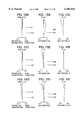
- FIG. 1 is a lens arrangement diagram of the zoom lens system of a first embodiment (Example 1) of the present invention
- FIG. 2 is a lens arrangement diagram of the zoom lens system of a second embodiment (Example 2) of the present invention
- FIG. 3 is a lens arrangement diagram of the zoom lens system of a third embodiment (Example 3) of the present invention.
- FIGS. 4A to 4I are graphic representations of the aberrations observed in the zoom lens system of Example 1;
- FIGS. 5A to 5I are graphic representations of the aberrations observed in the zoom lens system of Example 2.
- FIGS. 6A to 6I are graphic representations of the aberrations observed in the zoom lens system of Example 3.
- FIG. 7 is a lens arrangement diagram of the zoom lens system of a fourth embodiment (Example 4) of the present invention.
- FIG. 8 is a lens arrangement diagram of the zoom lens system of a fifth embodiment (Example 5) of the present invention.
- FIG. 9 is a lens arrangement diagram of the zoom lens system of a sixth embodiment (Example 6) of the present invention.
- FIG. 10 is a lens arrangement diagram of the zoom lens system of a seventh embodiment (Example 7) of the present invention.
- FIGS. 11A to 11I are graphic representations of the aberrations observed in the infinite-distance shooting condition in Example 4.
- FIGS. 13A to 13I are graphic representations of the aberrations observed in the infinite-distance shooting condition in Example 5;
- FIGS. 15A to 15I are graphic representations of the aberrations observed in the infinite-distance shooting condition in Example 6;
- FIGS. 17A to 17I are graphic representations of the aberrations observed in the infinite-distance shooting condition in Example 7;
- FIG. 19 is a lens arrangement diagram of the zoom lens system of an eighth embodiment (Example 8) of the present invention.
- FIG. 20 is a lens arrangement diagram of the zoom lens system of a ninth embodiment (Example 9) of the present invention.
- FIG. 21 is a lens arrangement diagram of the zoom lens system of a tenth embodiment (Example 10) of the present invention.
- FIGS. 22A to 22I are graphic representations of the aberrations observed in the zoom lens system of Example 8.
- FIGS. 23A to 23I are graphic representations of the aberrations observed in the zoom lens system of Example 9;
- FIGS. 24A to 24I are graphic representations of the aberrations observed in the zoom lens system of Example 10.
- FIG. 25 is a lens arrangement diagram of the zoom lens system of an eleventh embodiment (Example 11) of the present invention.
- FIG. 26 is a lens arrangement diagram of the zoom lens system of a twelfth embodiment (Example 12) of the present invention.
- FIG. 27 is a lens arrangement diagram of the zoom lens system of a thirteenth embodiment (Example 13) of the present invention.
- FIGS. 28A to 28I are graphic representations of the aberrations observed in the infinite-distance shooting condition in Example 11;
- FIGS. 30A to 30I are graphic representations of the aberrations observed in the infinite-distance shooting condition in Example 12;
- FIGS. 32A to 32I are graphic representations of the aberrations observed in the infinite-distance shooting condition in Example 13.
- FIGS. 1 to 3, FIGS. 7 to 10, FIGS. 19 to 21, and FIGS. 25 to 27 show the lens arrangement of the zoom lens systems of the first to thirteenth embodiments, respectively, as observed at the wide-angle end [W].
- a surface ri marked with an asterisk (*) is an aspherical surface.
- the lens units are composed solely of refracting lens elements that deflect incoming rays through refraction.
- the lens units may include, for example, diffracting lens elements that deflect incoming rays through diffraction, refracting-diffracting hybrid-type lens elements that deflect incoming rays through the combined effect of refraction and diffraction, or the like.
- applications of the zoom lens systems of the first to thirteenth embodiments although they are designed originally for use in digital still cameras, are not limited to cameras. These zoom lens systems, with their characteristic optical arrangement, can also be used as a zoom lens system or as a part of a zooming optical system (such as the objective unit of an a focal optical system) for use in optical apparatuses other than cameras.
- the zoom lens systems of the first to third embodiments are each composed of, from the object side, a first lens unit having a positive optical power (Gr1), a second lens unit having a negative optical power (Gr2), a third lens unit having a positive optical power (Gr3), and a fourth lens unit having a positive optical power (Gr4).
- the first and third lens units (Gr1 and Gr3) are kept in fixed positions, the second lens unit (Gr2) is moved monotonically from the object side to the image side, and the fourth lens unit (Gr4) is moved monotonically from the image side to the object side.
- the fourth lens unit (Gr4) has at its image-side end a low-pass filter (LPF) having the shape of a flat plate.
- LPF low-pass filter
- the lens units are each composed, from the object side, as follows.
- the first lens unit (Gr1) is composed of a doublet lens element formed by cementing together a negative meniscus lens element convex to the object side and a biconvex lens element, and a positive meniscus lens element convex to the object side.
- the second lens unit (Gr2) is composed of a negative meniscus lens element convex to the object side, and a doublet lens element formed by cementing together a biconcave lens element and a biconvex lens element.
- the third lens unit (Gr3) is composed of an aperture stop (S), and a doublet lens element formed by cementing together a biconvex lens element and a biconcave lens element.
- the fourth lens unit (Gr4) is composed of a positive meniscus lens element convex to the object side, a biconvex lens element, and a biconcave lens element.
- the lens units are each composed, from the object side, as follows.
- the first lens unit (Gri) is composed of a negative meniscus lens element convex to the object side, and a positive meniscus lens element convex to the object side.
- the second lens unit (Gr2) is composed of two biconcave lens elements, and a positive meniscus lens element convex to the object side.
- the third lens unit (Gr3) is composed of an aperture stop (S), and a doublet lens element formed by cementing together a positive meniscus lens element convex to the object side and a negative meniscus lens element convex to the object side.
- the fourth lens unit (Gr4) is composed of a biconvex lens element, and a negative meniscus lens element convex to the image side.
- the lens units are each composed, from the object side, as follows.
- the first lens unit (Gr1) is composed of a doublet lens element formed by cementing together a negative meniscus lens element convex to the object side and a biconvex lens element, and a positive meniscus lens element convex to the object side.
- the second lens unit (Gr2) is composed of a negative meniscus lens element convex to the object side, and a doublet lens element formed by cementing together a biconcave lens element and a biconvex lens element.
- the third lens unit (Gr3) is composed of an aperture stop (S), and a doublet lens element formed by cementing together a biconvex lens element and a biconcave lens element.
- the fourth lens unit (Gr4) is composed of a positive meniscus lens element convex to the object side, a biconvex lens element, and a biconcave lens element.
- a zoom lens system like those of the first to third embodiments, that consists of a positive, a negative, a positive, and a positive lens unit and in which, during zooming, the first and third lens units (Gr1 and Gr3) are kept in fixed positions and the second and fourth lens units (Gr2 and Gr4) are moved (in particular, those of the type in which, during zooming from the wide-angle end [W] to the telephoto end [T], the second lens unit (Gr2) is moved monotonically from the object side to the image side and the fourth lens unit (Gr4) is moved monotonically from the image side to the object side), it is preferable that Condition (1) below be fulfilled.
- f1 represents the focal length of the first lens unit (Gri).
- fW represents the focal length of the entire zoom lens system at the wide-angle end [W].
- Condition (1) defines the ratio of the focal length of the first lens unit (Gr1) to the focal length of the entire zoom lens system to be preferably fulfilled to strike a proper balance between the total length and the aberration characteristics. If the lower limit of Condition (1) is exceeded, the focal length of the first lens unit (Gr1) is so short that the optical power of the first lens unit (Gr1) is too strong. This helps reduce the total length of the zoom lens system, but simultaneously increases aberrations (in particular, the spherical aberration and the longitudinal chromatic aberration on the telephoto side). In contrast, if the upper limit of Condition (1) is exceeded, the focal length of the first lens unit (Gr1) is so long that the optical power of the first lens unit (Gr1) is too weak. This helps reduce aberrations, but simultaneously makes the total length of the zoom lens system unduly long. An unduly long total length demands an unduly large diameter in the front-end lens unit, and thus makes the zoom lens system as a whole unduly large.
- a zoom lens system like those of the first to third embodiments, that consists of a positive, a negative, a positive, and a positive lens unit and in which, during zooming, the first and third lens units (Gr1 and Gr3) are kept in fixed positions and the second and fourth lens units (Gr2 and Gr4) are moved (in particular, those of the type in which, during zooming from the wide-angle end [W] to the telephoto end [T], the second lens unit (Gr2) is moved monotonically from the object side to the image side and the fourth lens unit (Gr4) is moved monotonically from the image side to the object side), it is preferable that Condition (2) below be fulfilled. Moreover, it is more preferable that Condition (1) noted above be additionally fulfilled.
- ⁇ 2W represents the lateral magnification of the second lens unit (Gr2) at the wide-angle end [W];
- ⁇ 2T represents the lateral magnification of the second lens unit (Gr2) at the telephoto end [T];
- ⁇ 34W represents the composite lateral magnification of the third and fourth lens units (Gr3 and Gr4) at the wide-angle end [W];
- ⁇ 34T represents the composite lateral magnification of the third and fourth lens units (Gr3 and Gr4) at the telephoto end [T].
- Condition (2) defines the relationship to be preferably fulfilled between the second lens unit (Gr2) and the lens units disposed on the image side thereof in terms of how far they are responsible for zooming. If the lower limit of Condition (2) is exceeded, the responsibility of the second lens unit (Gr2) for zooming is too light (that is, the responsibility of the lens units disposed on the image side of the second lens unit (Gr2) for zooming is too heavy). This increases the variation of aberrations (in particular, the variation of spherical aberration) that accompanies zooming. In contrast, if the upper limit of Condition (2) is exceeded, the responsibility of the second lens unit (Gr2) for zooming is so heavy that the second lens unit (Gr2) needs to be moved for an unduly long distance for zooming. This causes the entrance pupil to be positioned very far at or near the wide-angle end [W], and thus requires that the front-end lens unit have an unduly large diameter.
- a zoom lens system like those of the first to third embodiments, that consists of a positive, a negative, a positive, and a positive lens unit and in which, during zooming, the first and third lens units (Gr1 and Gr3) are kept in fixed positions and the second and fourth lens units (Gr2 and Gr4) are moved (in particular, those of the type in which, during zooming from the wide-angle end [W] to the telephoto end [T], the second lens unit (Gr2) is moved monotonically from the object side to the image side and the fourth lens unit (Gr4) is moved monotonically from the image side to the object side), it is preferable that Condition (3) below be fulfilled. Moreover, it is more preferable that Condition (1) noted above be additionally fulfilled.
- M2 represents the displacement amount of the second lens unit (Gr2) during zooming from the wide-angle end [W] to the telephoto end [T];
- Z represents the zoom ratio (which equals fT/fW, where fT represents the focal length of the entire zoom lens system at the telephoto end [T], and fW represents the focal length of the entire zoom lens system at the wide-angle end [W]).
- Condition (3) defines the relationship to be preferably fulfilled between the amount of movement of the second lens unit (Gr2) during zooming from the wide-angle end [W] to the telephoto end [T] and the zoom ratio. Note that, in general, the greater the zoom ratio, the larger the amount of movement. Thus, it can be said that Condition (3) defines the range of the preferable amount of movement of the second lens unit (Gr2) to obtain satisfactory optical performance in a compact optical system. If the upper limit of Condition (3) is exceeded, the amount of movement of the second lens unit (Gr2) is too large relative to the zoom ratio, and thus, at the wide-angle end [W], the gap between the second lens unit (Gr2) and the aperture stop (S) is so large that the entrance pupil is positioned very far.
- the front-end lens unit have unduly large diameters.
- the lower limit of Condition (3) is exceeded, the amount of movement of the second lens unit (Gr2) is too small relative to the zoom ratio.
- a reduction in the amount of movement of the second lens unit (Gr2) is necessarily accompanied by an increase in the optical power in the second lens unit (Gr2).
- an unduly strong optical power in the second lens unit (Gr2) increases the aberrations that occur in the second lens unit (Gr2) (in particular, the distortion and the curvature of field on the wide-angle side).
- a zoom lens system like those of the first to third embodiments, that consists of a positive, a negative, a positive, and a positive lens unit and in which, during zooming, the first and third lens units (Gr1 and Gr3) are kept in fixed positions and the second and fourth lens units (Gr2 and Gr4) are moved (in particular, those of the type in which, during zooming from the wide-angle end [W] to the telephoto end [T], the second lens unit (Gr2) is moved monotonically from the object side to the image side and the fourth lens unit (Gr4) is moved monotonically from the image side to the object side), it is preferable that Condition (4) below be fulfilled. Moreover, it is more preferable that Conditions (1), and further, Condition (3) noted above be additionally fulfilled.
- f3 represents the focal length of the third lens unit (Gr3)
- f4 represents the focal length of the fourth lens unit (Gr4).
- Condition (4) defines the preferable ratio of the focal length of the third lens unit (Gr3) to the focal length of the fourth lens unit (Gr4). If the lower limit of Condition (4) is exceeded, the focal length of the fourth lens unit (Gr4) is relatively short, and thus the optical power of the fourth lens unit (Gr4) is relatively strong. Accordingly, if the lower limit of Condition (4) is exceeded, it is difficult to correct off-axial optical performance (in particular, the curvature of field at the wide-angle end [W]) properly. In contrast, if the upper limit of Condition (4) is exceeded, the focal length of the third lens unit (Gr3) is relatively short, and thus the optical power of the third lens unit (Gr3) is relatively strong. Accordingly, if the upper limit of Condition (4) is exceeded, it is difficult to correct the spherical aberration properly over the entire zoom range.
- a zoom lens system like those of the first to third embodiments, that consists of a positive, a negative, a positive, and a positive lens unit and in which, during zooming, the first and third lens units (Gr1 and Gr3) are kept in fixed positions and the second and fourth lens units (Gr2 and Gr4) are moved (in particular, those of the type in which, during zooming from the wide-angle end [W] to the telephoto end [T], the second lens unit (Gr2) is moved monotonically from the object side to the image side and the fourth lens unit (Gr4) is moved monotonically from the image side to the object side), it is preferable that Condition (5) below be fulfilled.
- ⁇ 2W represents the lateral magnification of the second lens unit (Gr2) at the wide-angle end [W];
- ⁇ 2T represents the lateral magnification of the second lens unit (Gr2) at the telephoto end [T].
- Condition (5) the term "log( ⁇ 2T/ ⁇ 2W)/log(Z)" defines how far the second lens unit (Gr2) is responsible for the zooming achieved by the entire zoom lens system.
- Condition (5) assumes that the second lens unit (Gr2) is responsible for zooming substantially to the same extent as the lens units other than the second lens unit (Gr2) are. If the lower limit of Condition (5) is exceeded, the responsibility of the lens units disposed on the image side of the second lens unit (Gr2) for zooming is so heavy that spherical aberration cannot be corrected properly. In contrast, if the upper limit of Condition (5) is exceeded, the responsibility of the second lens unit (Gr2) for zooming is so heavy that distortion and curvature of field cannot be corrected properly.
- a zoom lens system like those of the first to third embodiments, that consists of a positive, a negative, a positive, and a positive lens unit and in which, during zooming, the first and third lens units (Gr1 and Gr3) are kept in fixed positions and the second and fourth lens units (Gr2 and Gr4) are moved (in particular, those of the type in which, during zooming from the wide-angle end [W] to the telephoto end [T], the second lens unit (Gr2) is moved monotonically from the object side to the image side and the fourth lens unit (Gr4) is moved monotonically from the image side to the object side), the use of an aspherical surface makes it possible to obtain more satisfactory optical performance effectively. For example, it is preferable to use an aspherical surface that fulfills Condition (6) below at least on one surface in the second lens unit (Gr2).
- x represents the deviation (mm) of the aspherical surface in a direction perpendicular to the optical axis (AX) direction of the aspherical surface;
- x0 represents the deviation (mm) of the reference spherical surface in a direction perpendicular to the optical axis (AX) direction of the reference spherical surface;
- C0 represents the curvature of the reference spherical surface (i.e. the nominal curvature of the aspherical surface (mm -1 ));
- N represents the refractive index of the object-side medium of the aspherical surface for the d-line
- N' represents the refractive index of the image-side medium of the aspherical surface for the d-line
- f2 represents the focal length (mm) of the second lens unit (Gr2), where x and x0 are defined respectively by Formulae (AS) and (RE) below.
- x represents the shape of the aspherical surface
- x0 represents the shape of the reference spherical surface.
- y represents the height in a direction perpendicular to the optical axis (AX);
- ⁇ represents the quadric surface parameter
- Ai represents the aspherical coefficient of the ith order.
- Condition (6) defines the aspherical surface as being so shaped as to weaken the negative optical power of the second lens unit (Gr2). Fulfillment of Condition (6) makes it possible to achieve proper correction of aberrations, in particular the distortion and the curvature of field on the wide-angle side. If the lower limit of Condition (6) is exceeded, the positive distortion increases on the wide-angle side, and simultaneously the inclination of the image plane in the positive direction becomes unduly large. In contrast, if the upper limit of Condition (6) is exceeded, the negative distortion increases on the wide-angle side, and simultaneously the inclination of the image plane in the negative direction becomes unduly large.
- the second lens unit (Gr2) includes a plurality of aspherical surfaces
- at least one of those aspherical surfaces needs to fulfill Condition (6) above; that is, the other aspherical surfaces do not necessarily have to fulfill Condition (6) above, if that is advantageous for the correction of other aberrations.
- the fourth lens unit (Gr4) include at least one aspherical surface that fulfills Condition (7) below.
- Condition (7) defines the aspherical surface as being so shaped as to weaken the positive optical power of the fourth lens unit (Gr4). Fulfillment of Condition (7) makes it possible to achieve proper correction of aberrations, in particular the distortion and the curvature of field on the wide-angle side as well as the spherical aberration on the telephoto side. If the lower limit of Condition (7) is exceeded, the positive distortion increases on the wide-angle side, and simultaneously the inclination of the image plane in the positive direction becomes unduly large. Moreover, spherical aberration appears notably in the positive direction on the telephoto side.
- the zoom lens systems of the fourth to seventh embodiments are each composed of, from the object side, a first lens unit having a positive optical power (Gr1), a second lens unit having a negative optical power (Gr2), a third lens unit having a positive optical power (Gr3), and a fourth lens unit having a positive optical power (Gr4).
- the first and third lens units (Gr1 and Gr3) are kept in fixed positions, the second lens unit (Gr2) is moved monotonically from the object side to the image side, and the fourth lens unit (Gr4) is moved monotonically from the image side to the object side.
- the fourth lens unit (Gr4) has at its image-side end a low-pass filter (LPF) having the shape of a flat plate.
- LPF low-pass filter
- the lens units are each composed, from the object side, as follows.
- the first lens unit (Gr1) is composed of a doublet lens element formed by cementing together a negative meniscus lens element convex to the object side and a biconvex lens element, and a positive meniscus lens element convex to the object side.
- the second lens unit (Gr2) is composed of a negative meniscus lens element convex to the object side, and a doublet lens element formed by cementing together a biconcave lens element and a biconvex lens element.
- the third lens unit (Gr3) is composed of an aperture stop (S), and a doublet lens element formed by cementing together a biconvex lens element and a biconcave lens element.
- the fourth lens unit (Gr4) is composed of a biconvex lens element, and a negative meniscus lens element convex to the object side.
- the lens units are each composed, from the object side, as follows.
- the first lens unit (Gri) is composed of a doublet lens element formed by cementing together a negative meniscus lens element convex to the object side and a biconvex lens element, and a positive meniscus lens element convex to the object side.
- the second lens unit (Gr2) is composed of a negative meniscus lens element convex to the object side, and a doublet lens element formed by cementing together a biconcave lens element and a biconvex lens element.
- the third lens unit (Gr3) is composed of an aperture stop (S), and a doublet lens element formed by cementing together a biconvex lens element and a biconcave lens element.
- the fourth lens unit (Gr4) is composed of a biconvex lens element, a negative meniscus lens element convex to the object side, and a positive meniscus lens element convex to the object side.
- the lens units are each composed, from the object side, as follows.
- the first lens unit (Gr1) is composed of a negative meniscus lens element convex to the object side, and a positive meniscus lens element convex to the object side.
- the second lens unit (Gr2) is composed of a negative meniscus lens element convex to the object side, a biconcave lens element, and a plano-convex lens element convex to the object side.
- the third lens unit (Gr3) is composed of an aperture stop (S), and a doublet lens element formed by cementing together a positive meniscus lens element convex to the object side and a negative meniscus lens element convex to the object side.
- the fourth lens unit (Gr4) is composed of a biconvex lens element, and a biconcave lens element.
- the lens units are each composed, from the object side, as follows.
- the first lens unit (Gri) is composed of a doublet lens element formed by cementing together a negative meniscus lens element convex to the object side and a biconvex lens element, and a positive meniscus lens element convex to the object side.
- the second lens unit (Gr2) is composed of a negative meniscus lens element convex to the object side, and a doublet lens element formed by cementing together a biconcave lens element and a biconvex lens element.
- the third lens unit (Gr3) is composed of an aperture stop (S), and a doublet lens element formed by cementing together a biconvex lens element and a biconcave lens element.
- the fourth lens unit (Gr4) is composed of a biconvex lens element, a biconcave lens element, and a positive meniscus lens element convex to the object side.
- Two examples of focusing methods that are considered fit for a zoom lens system like those of the fourth to seventh embodiments are: a front-end-unit-focusing method in which focusing is achieved by moving the first lens unit (Gr1), and an inner-unit-focusing method in which focusing is achieved by moving the fourth lens unit (Gr4).
- the first lens unit (Gr1) is moved out toward the object side for focusing on a close-distance object, and therefore the front-end lens unit needs to be given a comparatively large diameter in order to secure sufficient amount of peripheral light.
- the lens unit that is moved for focusing is kept in a fixed position during zooming. This is inefficient.
- the zoom lens systems of the fourth to seventh embodiments adopt the inner-unit-focusing method, and thus perform focusing by moving the second lens unit (Gr2); more precisely, for focusing on a close-distance object, it moves the second lens unit (Gr2) toward the object side.
- focusing is performed by moving the second lens unit (Gr2) in this way, the first and second lens units (Gr1 and Gr2) come closest to each other at the wide-angle end [W], where a minimum amount of movement of the second lens unit (Gr2) is required for focusing. This makes it possible to secure a space for focusing very efficiently.
- a zoom lens system like those of the fourth to seventh embodiments, that consists of a positive, a negative, a positive, and a positive lens unit and in which, during zooming from the wide-angle end [W] to the telephoto end [T], the first and third lens units (Gr1 and Gr3) are kept in fixed positions, the second lens unit (Gr2) is moved from the object side to the image side, and simultaneously the fourth lens unit (Gr4) is so moved as to compensate the movement of the image plane properly, and in which the second lens unit (Gr2) is moved for focusing, it is preferable that Condition (8) below be fulfilled.
- ⁇ 2T represents the lateral magnification of the second lens unit (Gr2) at the telephoto end [T].
- Condition (8) defines the lateral magnification of the second lens unit (Gr2) at the telephoto end [T] to be preferably fulfilled. If the lower limit of Condition (8) is exceeded, the total length is too long and the diameter of the front-end lens unit is too large, and simultaneously, spherical aberration appears notably toward the positive side. In contrast, if the upper limit of Condition (8) is exceeded, spherical aberration appears notably toward the negative side.
- a zoom lens system like those of the fourth to seventh embodiments, that consists of a positive, a negative, a positive, and a positive lens unit and in which, during zooming from the wide-angle end [W] to the telephoto end [T], the first and third lens units (Gr1 and Gr3) are kept in fixed positions, the second lens unit (Gr2) is moved from the object side to the image side, and simultaneously the fourth lens unit (Gr4) is so moved as to compensate the movement of the image plane properly, and in which the second lens unit (Gr2) is moved for focusing, it is preferable that Condition (9) below be fulfilled. Moreover, it is more preferable that Condition (8) noted above be additionally fulfilled.
- f1 represents the focal length of the first lens unit (Gr1)
- fW represents the focal length of the entire zoom lens system at the wide-angle end [W].
- Condition (9) defines the ratio of the focal length of the first lens unit (Gr1) to the focal length of the entire zoom lens system to be preferably fulfilled to strike a proper balance between the total length and the aberration characteristics. If the lower limit of Condition (9) is exceeded, the focal length of the first lens unit (Gr1) is so short that the optical power of the first lens unit (Gr1) is too strong. This helps reduce the total length of the zoom lens system, but simultaneously increases aberrations (in particular, the spherical aberration and the longitudinal chromatic aberration on the telephoto side). In contrast, if the upper limit of Condition (9) is exceeded, the focal length of the first lens unit (Gr1) is so long that the optical power of the first lens unit (Gr1) is too weak. This helps reduce aberrations, but simultaneously makes the total length of the zoom lens system unduly long. An unduly long total length demands an unduly large diameter in the front-end lens unit, and thus makes the zoom lens system as a whole unduly large.
- a zoom lens system like those of the fourth to seventh embodiments, that consists of a positive, a negative, a positive, and a positive lens unit and in which, during zooming from the wide-angle end [W] to the telephoto end [T], the first and third lens units (Gr1 and Gr3) are kept in fixed positions, the second lens unit (Gr2) is moved monotonically from the object side to the image side, and simultaneously the fourth lens unit (Gr4) is moved monotonically from the image side to the object side, and in which the second lens unit (Gr2) is moved for focusing, it is preferable that Condition (10) below be fulfilled.
- M2 represents the displacement amount of the second lens unit (Gr2) during zooming from the wide-angle end [W] to the telephoto end [T];
- M4 represents the displacement amount of the fourth lens unit (Gr4) during zooming from the wide-angle end [W] to the telephoto end [T].
- Condition (10) defines the ratio of the amount of movement of the fourth lens unit (Gr4) to that of the second lens unit (Gr2) during zooming from the wide-angle end [W] to the telephoto end [T]. Fulfillment of Condition (10) makes it possible to keep the ratio of the responsibility of the second lens unit (Gr2) for zooming to the responsibility of the lens units other than the second lens unit (Gr2) for zooming in an appropriate range, and thereby strike a proper balance between the size of the zoom lens system and the aberration characteristics. If the lower limit of Condition (10) is exceeded, the amount of movement of the second lens unit (Gr2) is too large, and thus the entrance pupil is positioned too far. This requires that the front-end lens unit have an unduly large diameter.
- the responsibility of the second lens unit (Gr2) for zooming is so heavy that distortion and curvature of field cannot be corrected properly.
- the upper limit of Condition (10) is exceeded, the amount of movement of the second lens unit (Gr2) is too small, and thus the responsibility of the lens units disposed on the image side of the second lens unit (Gr2) for zooming is so heavy that spherical aberration cannot be corrected properly.
- a zoom lens system like those of the fourth to seventh embodiments, that consists of a positive, a negative, a positive, and a positive lens unit and in which, during zooming from the wide-angle end [W] to the telephoto end [T], the first and third lens units (Gr1 and Gr3) are kept in fixed positions, the second lens unit (Gr2) is moved monotonically from the object side to the image side, and simultaneously the fourth lens unit (Gr4) is moved monotonically from the image side to the object side, and in which the second lens unit (Gr2) is moved for focusing, it is preferable that Condition (11) below be fulfilled. Moreover, it is more preferable that Condition (10) noted above be additionally fulfilled.
- ⁇ 2W represents the lateral magnification of the second lens unit (Gr2) at the wide-angle end [W];
- Z represents the zoom ratio (which equals fT/fW, where fW represents the focal length of the entire zoom lens system at the wide-angle end [W]; and fT represents the focal length of the entire zoom lens system at the telephoto end [T].
- Condition (11) assumes that the second lens unit (Gr2) is responsible for zooming substantially to the same extent as the lens units other than the second lens unit (Gr2) are. If the lower limit of Condition (11) is exceeded, the responsibility of the lens units disposed on the image side of the second lens unit (Gr2) for zooming is so heavy that spherical aberration cannot be corrected properly. In contrast, if the upper limit of Condition (11) is exceeded, the responsibility of the second lens unit (Gr2) for zooming is so heavy that distortion and curvature of field cannot be corrected properly.
- a zoom lens system like those of the fourth to seventh embodiments, that consists of a positive, a negative, a positive, and a positive lens unit and in which, during zooming from the wide-angle end [W] to the telephoto end [T], the first and third lens units (Gr1 and Gr3) are kept in fixed positions, the second lens unit (Gr2) is moved from the object side to the image side, and simultaneously the fourth lens unit (Gr4) is so moved as to compensate the movement of the image plane properly, and in which the second lens unit (Gr2) is moved for focusing
- the use of an aspherical surface makes it possible to obtain more satisfactory optical performance.
- an aspherical surface that fulfills Condition (12) below at least on one surface in the second lens unit (Gr2).
- x represents the deviation (mm) of the aspherical surface in a direction perpendicular to the optical axis (AX) direction of the aspherical surface;
- x0 represents the deviation (mm) of the reference spherical surface in a direction perpendicular to the optical axis (AX) direction of the reference spherical surface;
- C0 represents the curvature of the reference spherical surface (i.e. the nominal curvature of the aspherical surface (mm -1 ));
- N represents the refractive index of the object-side medium of the aspherical surface for the d-line
- N' represents the refractive index of the image-side medium of the aspherical surface for the d-line
- f2 represents the focal length (mm) of the second lens unit (Gr2), where x and x0 are defined respectively by Formulae (AS) and (RE) noted previously. Note that x represents the shape of the aspherical surface, and x0 represents the shape of the reference spherical surface.
- Condition (12) defines the aspherical surface as being so shaped as to weaken the negative optical power of the second lens unit (Gr2). Fulfillment of Condition (12) makes it possible to achieve proper correction of aberrations, in particular the distortion and the curvature of field on the wide-angle side in a close-distance shooting condition. If the lower limit of Condition (12) is exceeded, the positive distortion increases on the wide-angle side, in particular in the close-distance shooting condition, and simultaneously the inclination of the image plane in the positive direction becomes unduly large. In contrast, if the upper limit of Condition (12) is exceeded, the negative distortion increases on the wide-angle side, in particular in the close-distance shooting condition, and simultaneously the inclination of the image plane in the negative direction becomes unduly large.
- the second lens unit (Gr2) includes a plurality of aspherical surfaces
- at least one of those aspherical surfaces needs to fulfill Condition (12) above; that is, the other aspherical surfaces do not necessarily have to fulfill Condition (12) above, if that is advantageous for the correction of other aberrations.
- the fourth lens unit (Gr4) include at least one aspherical surface that fulfills Condition (13) below.
- f4 represents the focal length (mm) of the fourth lens unit (Gr4).
- Condition (13) defines the aspherical surface as being so shaped as to weaken the positive optical power of the fourth lens unit (Gr4). Fulfillment of Condition (13) makes it possible to achieve proper correction of aberrations, in particular the distortion and the curvature of field on the wide-angle side as well as the spherical aberration on the telephoto side. If the lower limit of Condition (13) is exceeded, the positive distortion increases on the wide-angle side, and simultaneously the inclination of the image plane in the positive direction becomes unduly large. Moreover, spherical aberration appears notably in the positive direction on the telephoto side.
- the zoom lens systems of the eighth to tenth embodiments are each composed of, from the object side, a first lens unit having a positive optical power (Gr1), a second lens unit having a negative optical power (Gr2), a third lens unit having a positive optical power (Gr3), and a fourth lens unit having a positive optical power (Gr4).
- the third lens unit (Gr3) is kept in a fixed position, the first and fourth lens units (Gr1 and Gr4) are moved monotonically toward the object side, and the second lens unit (Gr2) is moved monotonically toward the image side.
- the fourth lens unit (Gr4) has at its image-side end a low-pass filter (LPF) having the shape of a flat plate.
- LPF low-pass filter
- the lens units are each composed, from the object side, as follows.
- the first lens unit (Gr1) is composed of a doublet lens element formed by cementing together a negative meniscus lens element convex to the object side and a biconvex lens element, and a positive meniscus lens element convex to the object side.
- the second lens unit (Gr2) is composed of a negative meniscus lens element convex to the object side, and a doublet lens element formed by cementing together a biconcave lens element and a biconvex lens element.
- the third lens unit (Gr3) is composed of an aperture stop (S), a biconvex lens element, and a negative meniscus lens element convex to the object side.
- the fourth lens unit (Gr4) is composed of a biconvex lens element, a negative meniscus lens element convex to the object side, and a positive meniscus lens element convex to the object side.
- the lens units are each composed, from the object side, as follows.
- the first lens unit (Gr1) is composed of a doublet lens element formed by cementing together a negative meniscus lens element convex to the object side and a biconvex lens element, and a positive meniscus lens element convex to the object side.
- the second lens unit (Gr2) is composed of a negative meniscus lens element convex to the object side, a biconcave lens element, and a biconvex lens element.
- the third lens unit (Gr3) is composed of an aperture stop (S), a biconvex lens element, and a negative meniscus lens element convex to the object side.
- the fourth lens unit (Gr4) is composed of a biconvex lens element, a negative meniscus lens element convex to the object side, and a positive meniscus lens element convex to the object side.
- the lens units are each composed, from the object side, as follows.
- the first lens unit (Gr1) is composed of a doublet lens element formed by cementing together a negative meniscus lens element convex to the object side and a biconvex lens element, and a positive meniscus lens element convex to the object side.
- the second lens unit (Gr2) is composed of a negative meniscus lens element convex to the object side, and a doublet lens element formed by cementing together a biconcave lens element and a biconvex lens element.
- the third lens unit (Gr3) is composed of an aperture stop (S), and a doublet lens element formed by cementing together a biconvex lens element and a biconcave lens element.
- the fourth lens unit (Gr4) is composed of a positive meniscus lens element convex to the object side, a biconvex lens element, and a biconcave lens element.
- a zoom lens system like those of the eighth to tenth embodiments, that consists of a positive, a negative, a positive, and a positive lens unit and in which, during zooming, the third lens unit (Gr3) is kept in a fixed position and the first, second, and fourth lens units (Gr1, Gr2, and Gr4) are moved, it is preferable that Condition (14) below be fulfilled.
- M1 represents the displacement amount of the first lens unit (Gr1) from the wide-angle end [W] to the telephoto end [T] (assuming that the direction pointing to the object side is negative);
- Ymax represents the maximum image height
- Condition (14) defines the amount of movement of the first lens unit (Gr1) during zooming to be preferably fulfilled to strike a proper balance between the total length and the diameter of the front-end lens unit. If the lower limit of Condition (14) is exceeded, the amount of movement of the first lens unit (Gr1) during zooming is so large that the total length of the zoom lens system becomes unduly long at the telephoto end [T], and simultaneously the diameter of the front-end lens unit needs to be unduly large in order to secure sufficient amount of peripheral light at the telephoto end [T].
- a zoom lens system like those of the eighth to tenth embodiments, that consists of a positive, a negative, a positive, and a positive lens unit and in which, during zooming, the third lens unit (Gr3) is kept in a fixed position and the first, second, and fourth lens units (Gr1, Gr2, and Gr4) are moved, it is preferable that Condition (15) below be fulfilled. Moreover, it is more preferable that Condition (14) noted above be additionally fulfilled.
- M2 represents the displacement amount of the second lens unit (Gr2) from the wide-angle end [W] to the telephoto end [T] (assuming that the direction pointing to the object side is negative);
- M4 represents the displacement amount of the fourth lens unit (Gr4) from the wide-angle end [W] to the telephoto end [T] (assuming that the direction pointing to the object side is negative).
- Condition (15) defines the ratio of the amount of movement of the fourth lens unit (Gr4) to that of the second lens unit (Gr2) during zooming to be preferably fulfilled. If the lower limit of Condition (15) is exceeded, the amount of movement of the fourth lens unit (Gr4) is too large. As a result, the responsibility of the fourth lens unit (Gr4) for zooming is so heavy that spherical aberration cannot be corrected properly. In contrast, if the upper limit of Condition (15) is exceeded, the amount of movement of the second lens unit (Gr2) is too large. This increases the distance between the second lens unit (Gr2) and the aperture stop (S) at the wide-angle end [W].
- the entrance pupil is positioned too far, and thus the front-end lens unit needs to be given an unduly large diameter.
- the responsibility of the second lens unit (Gr2) for zooming is so heavy that distortion and curvature of field cannot be corrected properly.
- a zoom lens system like those of the eighth to tenth embodiments, that consists of a positive, a negative, a positive, and a positive lens unit and in which, during zooming, the third lens unit (Gr3) is kept in a fixed position and the first, second, and fourth lens units (Gr1, Gr2, and Gr4) are moved, it is preferable that Condition (16) below be fulfilled. Moreover, it is more preferable that Condition (14) noted above be additionally fulfilled.
- ⁇ 2W represents the lateral magnification of the second lens unit (Gr2) at the wide-angle end [W];
- ⁇ 2T represents the lateral magnification of the second lens unit (Gr2) at the telephoto end [T];
- Z represents the zoom ratio (which equals fT/fW, where fr represents the focal length of the entire zoom lens system at the telephoto end [T]; and fW represents the focal length of the entire zoom lens system at the wide-angle end [W]).
- the term "log( ⁇ 2T/ ⁇ 2W)/log(Z)" defines how far the second lens unit (Gr2) is responsible for the zooming achieved by the entire zoom lens system. If the lower limit of Condition (16) is exceeded, the responsibility of the lens units disposed on the image side of the second lens unit (Gr2) for zooming is so heavy that spherical aberration cannot be corrected properly. In contrast, if the upper limit of Condition (16) is exceeded, the responsibility of the second lens unit (Gr2) for zooming is so heavy that distortion and curvature of field cannot be corrected properly.
- a zoom lens system like those of the eighth to tenth embodiments, that consists of a positive, a negative, a positive, and a positive lens unit and in which, during zooming, the third lens unit (Gr3) is kept in a fixed position and the first, second, and fourth lens units (Gr1, Gr2, and Gr4) are moved (in particular, those of the type in which, during zooming from the wide-angle end [W] to the telephoto end [T], the first and fourth lens units (Gr1 and Gr4) are moved monotonically to the object side and the second lens unit (Gr2) is moved monotonically to the image side), the use of an aspherical surface makes it possible to obtain more satisfactory optical performance.
- an aspherical surface that fulfills Condition (17) below in the second lens unit (Gr2).
- Conditions (14) and (15), or Conditions (14) and (16) noted above be additionally fulfilled.
- x represents the deviation of the aspherical surface in a direction perpendicular to the optical axis (AX) direction of the aspherical surface (in millimeters, assuming that the direction pointing to the object side is negative);
- x0 represents the deviation of the reference spherical surface in a direction perpendicular to the optical axis (AX) direction of the reference spherical surface (in millimeters, assuming that the direction pointing to the object side is negative);
- N represents the refractive index of the object-side medium of the aspherical surface for the d-line
- N' represents the refractive index of the image-side medium of the aspherical surface for the d-line
- x and x0 are defined respectively by Formulae (AS) and (RE) noted previously. Note that x represents the shape of the aspherical surface, and x0 represents the shape of the reference spherical surface.
- Condition (17) defines the aspherical surface as being so shaped as to weaken the negative optical power of the second lens unit (Gr2). Fulfillment of Condition (17) makes it possible to achieve proper correction of aberrations, in particular the distortion and the curvature of field on the wide-angle side. If the lower limit of Condition (17) is exceeded, the positive distortion increases on the wide-angle side, and simultaneously the inclination of the image plane in the positive direction becomes unduly large. In contrast, if the upper limit of Condition (17) is exceeded, the negative distortion increases on the wide-angle side, and simultaneously the inclination of the image plane in the negative direction becomes unduly large.
- the second lens unit (Gr2) includes a plurality of aspherical surfaces
- at least one of those aspherical surfaces needs to fulfill Condition (17) above; that is, the other aspherical surfaces do not necessarily have to fulfill Condition (17) above, if that is advantageous for the correction of other aberrations.
- Condition (18) defines the aspherical surface as being so shaped as to weaken the positive optical power of the third lens unit (Gr3). Fulfillment of Condition (18) makes it possible to achieve proper correction of aberrations, in particular spherical aberration. If the lower limit of Condition (18) is exceeded, in particular, spherical aberration appears notably in the positive direction on the telephoto side. In contrast, if the upper limit of Condition (18) is exceeded, in particular, spherical aberration appears notably in the negative direction on the telephoto side.
- the third lens unit (Gr3) includes a plurality of aspherical surfaces
- at least one of those aspherical surfaces needs to fulfill Condition (18) above; that is, the other aspherical surfaces do not necessarily have to fulfill Condition (18) above, if that is advantageous for the correction of other aberrations.
- Condition (19) defines the aspherical surface as being so shaped as to weaken the positive optical power of the fourth lens unit (Gr4). Fulfillment of Condition (19) makes it possible to achieve proper correction of aberrations, in particular the distortion and the curvature of field on the wide-angle side as well as the spherical aberration on the telephoto side. If the lower limit of Condition (19) is exceeded, the positive distortion increases on the wide-angle side, and simultaneously the inclination of the image plane in the positive direction becomes unduly large. Moreover, spherical aberration appears notably in the positive direction on the telephoto side.
- the zoom lens systems of the eleventh to thirteenth embodiments are each composed of, from the object side, a first lens unit having a positive optical power (Gr1), a second lens unit having a negative optical power (Gr2), a third lens unit having a positive optical power (Gr3), and a fourth lens unit having a positive optical power (Gr4).
- the third lens unit (Gr3) is kept in a fixed position, the first and fourth lens units (Gr1 and Gr4) are moved monotonically to the object side, and the second lens unit (Gr2) is moved monotonically to the image side.
- the fourth lens unit (Gr4) has at its image-side end a low-pass filter (LPF) having the shape of a flat plate.
- the lens units are each composed, from the object side, as follows.
- the first lens unit (Gr1) is composed of a doublet lens element formed by cementing together a negative meniscus lens element convex to the object side and a biconvex lens element, and a positive meniscus lens element convex to the object side.
- the second lens unit (Gr2) is composed of a negative meniscus lens element convex to the object side, a biconcave lens element, and a biconvex lens element.
- the third lens unit (Gr3) is composed of an aperture stop (S), a positive meniscus lens element convex to the object side, and a negative meniscus lens element convex to the object side.
- the fourth lens unit (Gr4) is composed of a positive meniscus lens element convex to the object side, a negative meniscus lens element convex to the object side, and a positive meniscus lens element convex to the object side.
- the lens units are each composed, from the object side, as follows.
- the first lens unit (Gr1) is composed of a doublet lens element formed by cementing together a negative meniscus lens element convex to the object side and a biconvex lens element, and a positive meniscus lens element convex to the object side.
- the second lens unit (Gr2) is composed of a negative meniscus lens element convex to the object side, and a doublet lens element formed by cementing together a biconcave lens element and a biconvex lens element.
- the third lens unit (Gr3) is composed of an aperture stop (S), a biconvex lens element, and a negative meniscus lens element convex to the object side.
- the fourth lens unit (Gr4) is composed of a biconvex lens element, a negative meniscus lens element convex to the object side, and a positive meniscus lens element convex to the object side.
- the lens units are each composed, from the object side, as follows.
- the first lens unit (Gr1) is composed of a doublet lens element formed by cementing together a negative meniscus lens element convex to the object side and a biconvex lens element, and a positive meniscus lens element convex to the object side.
- the second lens unit (Gr2) is composed of a negative meniscus lens element convex to the object side, and a doublet lens element formed by cementing together a biconcave lens element and a biconvex lens element.
- the third lens unit (Gr3) is composed of an aperture stop (S), and a doublet lens element formed by cementing together a biconvex lens element and a negative meniscus lens element concave to the object side.
- the fourth lens unit (Gr4) is composed of a positive meniscus lens element convex to the object side, a biconvex lens element, and a negative meniscus lens element convex to the object side.
- Two examples of focusing methods that are considered fit for a zoom lens system like those of the eleventh to thirteenth embodiments are: a front-end-unit-focusing method in which focusing is achieved by moving the first lens unit (Gr1), and an inner-unit-focusing method in which focusing is achieved by moving the fourth lens unit (Gr4).
- the first lens unit (Gr1) is moved out toward the object side for focusing on a close-distance object, and therefore the front-end lens unit needs to be given a comparatively large diameter in order to secure sufficient amount of peripheral light.
- the zoom lens systems of the eleventh to thirteenth embodiments adopt the inner-unit-focusing method, and thus perform focusing by moving the second lens unit (Gr2); more precisely, for focusing on a close-distance object, it moves the second lens unit (Gr2) toward the object side.
- focusing is performed by moving the second lens unit (Gr2) in this way, the first and second lens units (Gr1 and Gr2) come closest to each other at the wide-angle end [W], where a minimum amount of movement of the second lens unit (Gr2) is required for focusing. This makes it possible to secure a space for focusing very efficiently.
- a zoom lens system like those of the eleventh to thirteenth embodiments, that consists of a positive, a negative, a positive, and a positive lens unit and in which, during zooming, the first, second, and fourth lens units (Gr1, Gr2, and Gr4) are moved and the second lens unit (Gr2) is moved for focusing, it is preferable that Condition (20) below be fulfilled.
- ⁇ 2T represents the lateral magnification of the second lens unit (Gr2) at the telephoto end [T].
- Condition (20) defines the lateral magnification of the second lens unit (Gr2) at the telephoto end [T] to be preferably fulfilled. If the lower limit of Condition (20) is exceeded, the total length is too long and the diameter of the front-end lens unit is too large, and simultaneously, spherical aberration appears notably toward the positive side. In contrast, if the upper limit of Condition (20) is exceeded, spherical aberration appears notably toward the negative side.
- a zoom lens system like those of the eleventh to thirteenth embodiments, that consists of a positive, a negative, a positive, and a positive lens unit and in which, during zooming, the first, second, and fourth lens units (Gr1, Gr2, and Gr4) are moved and the second lens unit (Gr2) is moved for focusing, it is preferable that Condition (21) below be fulfilled. Moreover, it is more preferable that Condition (20) noted above be additionally fulfilled.
- fW represents the focal length of the entire zoom lens system at the wide-angle end [W]
- f2 represents the focal length of the second lens unit (Gr2).
- Condition (21) defines the ratio of the focal length of the second lens unit (Gr2) to the focal length of the entire zoom lens system to be preferably fulfilled to strike a proper balance between the total length and the aberration characteristics. If the lower limit of Condition (21) is exceeded, the focal length of the second lens unit (Gr2) is so long that the optical power of the second lens unit (Gr2) is too weak. This helps reduce aberrations, but simultaneously makes the total length of the zoom lens system unduly long. An unduly long total length demands an unduly large diameter in the front-end lens unit, and thus makes the zoom lens system as a whole unduly large.
- the focal length of the second lens unit (Gr2) is so short that the optical power of second lens unit (Gr2) is too strong. This helps reduce the total length of the zoom lens system, but simultaneously increases aberrations (in particular, the negative distortion increases on the wide-angle side). Moreover, the inclination of the image plane in the positive direction becomes unduly large.
- a zoom lens system like those of the eleventh to thirteenth embodiments, that consists of a positive, a negative, a positive, and a positive lens unit and in which, during zooming, the first, second, and fourth lens units (Gr1, Gr2, and Gr4) are moved and the second lens unit (Gr2) is moved for focusing, it is preferable that Condition (22) below be fulfilled. Moreover, it is more preferable that Condition (20), and further, Condition (21) noted above be additionally fulfilled.
- M1 represents the displacement amount of the first lens unit (Gr1) from the wide-angle end [W] to the telephoto end [T] (assuming that the direction pointing to the object side is negative).
- Ymax represents the maximum image height
- Condition (22) defines the amount of movement of the first lens unit (Gr1) during zooming to be preferably fulfilled to strike a proper balance between, in particular the total length and the diameter of the front-end lens unit. If the lower limit of Condition (22) is exceeded, the amount of movement of the first lens unit (Gr1) during zooming is so large that the total length of the zoom lens system becomes unduly long at the telephoto end [T], and simultaneously the diameter of the front-end lens unit needs to be unduly large in order to secure sufficient amount of peripheral light at the telephoto end [T].
- a zoom lens system like those of the eleventh to thirteenth embodiments, that consists of a positive, a negative, a positive, and a positive lens unit and in which, during zooming, the first, second, and fourth lens units (Gr1, Gr2, and Gr4) are moved and the second lens unit (Gr2) is moved for focusing
- the use of an aspherical surface makes it possible to obtain more satisfactory optical performance.
- x represents the deviation of the aspherical surface in a direction perpendicular to the optical axis (AX) direction of the aspherical surface (in millimeters, assuming that the direction pointing to the object side is negative);
- x0 represents the deviation of the reference spherical surface in a direction perpendicular to the optical axis (AX) direction of the reference spherical surface (in millimeters, assuming that the direction pointing to the object side is negative);
- N represents the refractive index of the object-side medium of the aspherical surface for the d-line
- N' represents the refractive index of the image-side medium of the aspherical surface for the d-line
- x and x0 are defined respectively by Formulae (AS) and (RE) noted previously. Note that x represents the shape of the aspherical surface, and x0 represents the shape of the reference spherical surface.
- Condition (23) defines the aspherical surface as being so shaped as to weaken the negative optical power of the second lens unit (Gr2). Fulfillment of Condition (23) makes it possible to achieve proper correction of aberrations, in particular the distortion and the curvature of field on the wide-angle side. If the lower limit of Condition (23) is exceeded, the positive distortion increases on the wide-angle side, and simultaneously the inclination of the image plane in the positive direction becomes unduly large. In contrast, if the upper limit of Condition (23) is exceeded, the negative distortion increases on the wide-angle side, and simultaneously the inclination of the image plane in the negative direction becomes unduly large.
- the second lens unit (Gr2) includes a plurality of aspherical surfaces
- at least one of those aspherical surfaces needs to fulfill Condition (23) above; that is, the other aspherical surfaces do not necessarily have to fulfill Condition (23) above, if that is advantageous for the correction of other aberrations.
- Condition (24) defines the aspherical surface as being so shaped as to weaken the positive optical power of the third lens unit (Gr3). Fulfillment of Condition (24) makes it possible to achieve proper correction of aberrations, in particular spherical aberration. If the lower limit of Condition (24) is exceeded, in particular, spherical aberration appears notably in the positive direction on the telephoto side. In contrast, if the upper limit of Condition (24) is exceeded, in particular, spherical aberration appears notably in the negative direction on the telephoto side.
- the third lens unit (Gr3) includes a plurality of aspherical surfaces
- at least one of those aspherical surfaces needs to fulfill Condition (24) above; that is, the other aspherical surfaces do not necessarily have to fulfill Condition (24) above, if that is advantageous for the correction of other aberrations.
- Condition (25) defines the aspherical surface as being so shaped as to weaken the positive optical power of the fourth lens unit (Gr4). Fulfillment of Condition (25) makes it possible to achieve proper correction of aberrations, in particular the distortion and the curvature of field on the wide-angle side as well as the spherical aberration on the telephoto side. If the lower limit of Condition (25) is exceeded, the positive distortion increases on the wide-angle side, and simultaneously the inclination of the image plane in the positive direction becomes unduly large. Moreover, spherical aberration appears notably in the positive direction on the telephoto side.
- a zoom lens system like those of the eleventh to thirteenth embodiments, that consists of a positive, a negative, a positive, and a positive lens unit and in which, during zooming, the first, second, and fourth lens units (Gr1, Gr2, and Gr4) are moved and the second lens unit (Gr2) is moved for focusing, it is preferable that Condition (26) below be fulfilled,
- M1 represents the displacement amount of the first lens unit (Gr1) from the wide-angle end [W] to the telephoto end [T] (assuming that the direction pointing to the object side is negative);
- M4 represents the displacement amount of the fourth lens unit (Gr4) from the wide-angle end [W] to the telephoto end [T] (assuming that the direction pointing to the object side is negative).
- Condition (26) defines the ratio of the amount of movement of the fourth lens unit (Gr4) to that of the first lens unit (Gr1) during zooming to be preferably fulfilled.
- the upper limit of Condition (26) If the upper limit of Condition (26) is exceeded, the amount of movement of the fourth lens unit (Gr4) is too large, and thus the responsibility of the fourth lens unit (Gr4) for zooming is too heavy. This makes it difficult to correct spherical aberration properly.
- the lower limit of Condition (26) is exceeded, the amount of movement of the first lens unit (Gr1) is too large, and thus the entrance pupil is positioned too far away from the image plane in the longest focal length condition. As a result, the front-end lens unit needs to have an unduly large diameter.
- Tables 1 to 13 list the construction data of Examples 1 to 13, which respectively correspond to the first to thirteenth embodiments described above and have lens arrangements as shown in FIGS. 1 to 3, FIGS. 7 to 10, FIGS. 19 to 21, and FIGS. 25 to 27.
- Nd refractive index
- vd Abbe number
- a surface whose radius of curvature ri is marked with an asterisk (*) is an aspherical surface, whose surface shape is defined by Formula (AS) noted earlier.
- AS Formula
- Also listed for each Example together with the construction data are the data of the aspherical surfaces, and the values corresponding to Condition (6), (7), (12), (13), (17) to (19), and (23) to (25) that define conditions to be fulfilled by the aspherical surface (note that, there, ymax represents the maximum height of an aspherical surface in a direction perpendicular to its optical axis (AX) (i.e. the maximum effective radius)).
- Table 14 lists the values corresponding to Conditions (1) to (5) noted above as observed in Examples 1 to 3;
- Table 16 lists the values corresponding to Conditions (8) to (11) noted above as observed in Examples 4 to 7;
- Table 17 lists the values corresponding to Conditions (14) to (16) noted above as observed in Examples 8 to 10;
- Table 19 lists the values corresponding to Conditions (20) to (22) and (26) noted above as observed in Examples 11 to 13.
- FIGS. 4A to 4I, 5A to 5I, and 6A to 6I are graphic representations of the aberrations observed in Examples 1 to 3, respectively;
- FIGS. 11A to 11I and 12A to 12I, 13A to 13I and 14A to 14I, 15A to 15I and 16A to 16I, and 17A to 17I and 18A to 18I are graphic representations of the aberrations observed in Examples 4 to 7, respectively;
- FIGS. 22A to 22I, 23A to 23I, and 24A to 24I are graphic representations of the aberrations observed in Examples 8 to 10, respectively; and FIGS.
- FIGS. 11A to 11I, 13A to 13I, 15A to 15I, and 17A to 17I show the aberrations observed in the infinite-distance shooting condition in Examples 4 to 7;
- FIGS. 12A to 12I, 14A to 14I, 16A to 16I, and 18A to 18I show the aberrations observed in the close-distance shooting condition (the object distance D equals 1m) in Examples 4 to 7;
- FIGS. 29A to 29I, 31A to 31I, and 33A to 33I show the aberrations observed in the close-distance shooting condition (the object distance D equals 1m) in Examples 11 to 13.
- FIGS. 4A, 4D, 4G, 5A, 5D, 5G, 6A, 6D, 6G, 11A, 11D, 11G, 12A, 12D, 12G, 13A, 13D, 13G, 14A, 14D, 14G, 15A, 15D, 15G, 16A, 16D, 16G, 17A, 17D, 17G, 18A, 18D, 18G, 22A, 22D, 22G, 23A, 23D, 23G, 24A, 24D, 24G, 28A, 28D, 28G, 29A, 29D, 29G, 30A, 30D, 30G, 31A, 31D, 31G, 32A, 32D, 32G, 33A, 33D, and 33G show spherical aberration and sine condition.
Landscapes
- Physics & Mathematics (AREA)
- General Physics & Mathematics (AREA)
- Optics & Photonics (AREA)
- Lenses (AREA)
Abstract
-5.0<M1 Ymax<-1.0
-1.0<M4 M2 <-0.1
Description
-5.0<M1/Ymax<-1.0
-1.0<M4/M2<-0.1
-5.0<M1/Ymax<-1.0
0.2<log(β2T/β2W)/log(Z)<0.9
0<(x-x0)/(N'-N)<0.9
-0.85<(x-x0)/(N'-N)<0
0.1<|β2T|<1.0
0.2<↑fW/f2|<1.5
-5.0<M1/Ymax<-1.0
0.1<M4/M1<1.0
2.5<f1/fW<8.0
0.7×(β34T/β34W)<β2T/β2W<2.3×(β34T/.beta.34W)
2.5<f1/fW<8.0
0.4<log(β2T/β2W)/log(Z)<0.75
0.5<|β2T|<0.98
3.0<f1/fW<9.0
0.15<M4/M2<0.55
0.4<log(β2T/β2W)log(Z)<0.75
2.5<f1/fW<8.0 (1)
0.7×(β34T/β34W)<β2T/β2W<2.3×(β34T/.beta.34W) (2)
0.9<M2/Z<2.7 (3)
0.2<f4/f3<1.0 (4)
0.4<log(β2T/β2W)/log(Z)<0.75 (5)
0.45<(|x|-|x0|)/{C0(N'-N)·f2}<0(6)
0.8<(|x|-|x0|)/{C0(N'-N)·f4}<0(7)
0.5<|β2T<0.98 (8)
3.0<f1/fW<9.0 (9)
0.15<M4/M2<0.55 (10)
0.4<log(β2T/β2W)/log(Z)<0.75 (11)
-0.45<(|x|-|x0|)/{C0(N'-N)·f2}<0 (12)
-0.8<(|x|-|x0|)/{C0(N'-N)·f4}<0(13)
-5.0<M1/Ymax<-1.0 (14)
1.0<M4/M2<-0.1 (15)
0.2<log(β2T/β2W)/log(Z)<0.9 (16)
0<(x-x0)/(N'-N)<0.9 (17)
-0.35<(x-x0)/(N'-N)<0 (18)
0.85<(x-x0)/(N'-N)<0 (19)
0.1<|β2T|<1.0 (20)
0.2<fW/f2<1.5 (21)
-5.0<M1/Ymax<-1.0 (22)
0<(x-x0)/(N'-N)<0.9 (23)
0.35<(x-x0)/(N'-N)<0 (24)
-0.85<(x-x0)/(N'-N)<0 (25)
0.1<M4/M<1.0 (26)
              TABLE 1
______________________________________
Construction Data of Example 1
  f = 5.1˜12.0˜29.5
  FNO = 2.47˜2.88˜3.5
______________________________________
Radius of Axial         Refractive Abbe
  Curvature Distance Index Number
______________________________________
  r1 = 43.996 d1 = 0.800 N1 = 1.83350 ν1 = 21.00
  r2 = 21.914 d2 = 3.302 N2 = 1.60311 ν2 = 60.74
  r3 = -73.535 d3 = 0.100
  r4 = 13.657 d4 = 1.660 N3 = 1.71300 ν3 = 53.93
  r5 = 22.983 d5 =
   0.500˜6.229˜10.540
  r6 = 23.565 d6 = 0.650 N4 = 1.77250 ν4 = 49.77
  r7 = 5.746 d7 = 3.043
  r8* = -7.343 d8 = 0.700 N5 = 1.77250 ν5 = 49.77
  r9 = 8.300 d9 = 1.434 N6 = 1.84666 ν6 = 23.82
  r10* = -31.736 d10 =
   10.540˜4.811˜0.500
  r11 = ∞ d11 = 0.500
  (Aperture Stop S)
  r12* = 10.624 d12 = 1.643 N7 = 1.69680 ν7 = 56.47
  r13 = -28.755 d13 = 0.600 N8 = 1.84666 ν8 = 23.82
  r14* = 45.584 d14 =
   5.020˜2.671˜0.200
  r15 = 6.982 d15 = 2.727 N9 = 1.68828 ν9 = 52.89
  r16 = 118.458 d16 = 0.100
  r17 = 10.853 d17 = 1.772 N10 = 1.48749 ν10 = 70.44
  r18 = -61.268 d18 = 0.100
  r19* = -611.273 d19 = 1.000 N11 = 1.84666 ν11 = 23.82
  r20* = 10.062 d20 =
   1.000˜3.349˜5.820
  r21 = ∞ d21 = 3.400 N12 = 1.51680 ν12 = 64.20
  r22 = ∞
[Aspherical Data of Eighth Surface (r8)]
  ε = 1.0000
  A4 = 0.58736 × 10.sup.-3
  A6 = -0.37613 × 10.sup.-4
  A8 = 0.15455 × 10.sup.-5
     [Aspherical Data of Tenth Surface (r10)]
  ε = 1.0000
  A4 = 0.27038 × 10.sup.-3
  A6 = -0.12672 × 10.sup.-4
  A8 = -0.52313 × 10.sup.-6
  A10 = 0.83144 × 10.sup.-7
         [Aspherical Data of Twelfth Surface (r12)]
  ε = 1.0000
  A4 = -0.10024 × 10.sup.-3
  A6 = 0.22829 × 10.sup.-4
  A8 = -0.38887 × 10.sup.-5
  A10 = 0.24924 × 10.sup.-6
             [Aspherical Data of Fourteenth Surface (r14)]
  ε = 1.0000
  A4 = 0.79577 × 10.sup.-4
  A6 = 0.83193 × 10.sup.-5
  A8 = -0.12804 × 10.sup.-5
  A10 = 0.89044 × 10.sup.-7
               [Aspherical Data of Nineteenth Surface (r19)]
  ε = 1.0000
  A4 = 0.10674 × 10.sup.-2
  A6 = -0.83586 × 10.sup.-4
  A8 = 0.11200 × 10.sup.-5
                 [Aspherical Data of Twentieth Surface (r20)]
  ε = 1.0000
  A4 = 0.29367 × 10.sup.-2
  A6 = -0.32238 × 10.sup.-4
  A8 = 0.24911 × 10.sup.-5
                   [Values of Condition (6) on Eighth Surface (r8)]
                    y = 0.00 ymax . . . (|x| - .vertline
                   .x0|)/{C0(N' - N) · f2} = 0.00000
                    y = 0.20 ymax . . . (|x| - .vertline
                   .x0|)/{C0(N' - N) · f2} = -0.00015
                    y = 0.40 ymax . . . (|x| - .vertline
                   .x0|)/{C0(N' - N) · f2} = -0.00218
                    y = 0.60 ymax . . . (|x| - .vertline
                   .x0|)/{C0(N' - N) · f2} = -0.00985
                    y = 0.80 ymax . . . (|x| - .vertline
                   .x0|)/{C0(N' - N) · f2} = -0.02713
                    y = 1.00 ymax . . . (|x| - .vertline
                   .x0|)/{C0(N' - N) · f2} = -0.05890
                     [Values of Condition (6) on Tenth Surface (r10)]
                      y = 0.00 ymax . . . (|x| -
                     |x0|)/{C0(N' - N) · f2} =
                     0.00000
  y = 0.20 ymax . . . (|x| - |x0|)/{C0
                     (N' - N) · f2} = 0.00018
  y = 0.40 ymax . . . (|x| - |x0|)/{C0
                     (N' - N) · f2} = 0.00273
  y = 0.60 ymax . . . (|x| - |x0|)/{C0
                     (N' - N) · f2} = 0.01263
  y = 0.80 ymax . . . (|x| - |x0|)/{C0
                     (N' - N) · f2} = 0.03506
  y = 1.00 ymax . . . (|x| - |x0|)/{C0
                     (N' - N) · f2} = 0.07505
                       [Values of Condition (7) on Nineteenth Surface
                       (r19)]
  y = 0.00 ymax . . . (|x| - |x0|)/{C0
                       (N' - N) · f4} = -0.00000
  y = 0.20 ymax . . . (|x| - |x0|)/{C0
                       (N' - N) · f4} = 0.01309
  y = 0.40 ymax . . . (|x| - |x0|)/{C0
                       (N' - N) · f4} = -0.00325
  y = 0.60 ymax . . . (|x| - |x0|)/{C0
                       (N' - N) · f4} = -0.35412
  y = 0.80 ymax . . . (|x| - |x0|)/{C0
                       (N' - N) · f4} = -0.96012
  y = 1.00 ymax . . . (|x| - |x0|)/{C0
                       (N' - N) · f4} = -0.95819
                         [Values of Condition (7) on Twentieth Surface
                         (r20)]
  y = 0.00 ymax . . . (|x| - |x0|)/{C0
                         (N' - N) · f4} = -0.00000
  y = 0.20 ymax . . . (|x| - |x0|)/{C0
                         (N' - N) · f4} = -0.00037
  y = 0.40 ymax . . . (|x| - |x0|)/{C0
                         (N' - N) · f4} = -0.00580
  y = 0.60 ymax . . . (|x| - |x0|)/{C0
                         (N' - N) · f4} = -0.02900
  y = 0.80 ymax . . . (|x| - |x0|)/{C0
                         (N' - N) · f4} = -0.09082
  y = 1.00 ymax . . . (|x| - |x0|)/{C0
                         (N' - N) · f4} = -0.22259
______________________________________
              TABLE 2
______________________________________
Construction Data of Example 2
  f = 5.3˜9.2˜15.3
  FNO = 3.8˜3.95˜4.1
______________________________________
Radius of Axial         Refractive Abbe
  Curvature Distance Index Number
______________________________________
  r1 = 15.662 d1 = 0.750 N1 = 1.84666 ν1 = 23.82
  r2 = 9.499 d2 = 0.176
  r3 = 9.726 d3 = 2.869 N2 = 1.77250 ν2 = 49.77
  r4 = 1208.226 d4 =
   0.600˜4.439˜7.518
  r5 = -173.591 d5 = 0.550 N3 = 1.77250 ν3 = 49.77
  r6 = 6.399 d6 = 1.275
  r7* = -40.319 d7 = 0.600 N4 = 1.77250 ν4 = 49.77
  r8* = 6.348 d8 = 0.116
  r9 = 7.236 d9 = 1.313 N5 = 1.84666 ν5 = 23.82
  r10 = 70.504 d10 =
   7.418˜3.578˜0.500
  r11 = ∞ d11 = 0.500
  (Aperture Stop S)
  r12* = 2.954 d12 = 1.299 N6 = 1.77250 ν6 = 49.77
  r13 = 6.854 d13 = 0.500 N7 = 1.84666 ν7 = 23.82
  r14* = 3.296 d14 =
   3.142˜2.287˜1.757
  r15* = 5.968 d15 = 2.100 N8 = 1.51728 ν8 = 69.43
  r16* = -5.999 d16 = 0.138
  r17 = -5.519 d17 = 0.600 N9 = 1.80518 ν9 = 25.43
  r18 = -8.350 d18 =
   1.206˜2.061˜2.591
  r19 = ∞ d19 = 3.400 N10 = 1.51680 ν10 = 64.20
  r20 = ∞
[Aspherical Data of Seventh Surface (r7)]
  ε = 1.0000
  A4 = -0.13314 × 10.sup.-2
  A6 = 0.12578 × 10.sup.-3
  A8 = -0.29071 × 10.sup.-5
     [Aspherical Data of Eighth Surface (r8)]
  ε = 1.0000
  A4 = -0.19343 × 10.sup.-2
  A6 = 0.11548 × 10.sup.-3
  A8 = -0.18660 × 10.sup.-5
         [Aspherical Data of Twelfth Surface (r12)]
  ε = 1.0000
  A4 = -0.87387 × 10.sup.-3
  A6 = -0.76491 × 10.sup.-3
  A8 = 0.44346 × 10.sup.-3
  A10 = -0.83383 × 10.sup.-4
             [Aspherical Data of Fourteenth Surface (r14)]
  ε = 1.0000
  A4 = 0.29659 × 10.sup.-2
  A6 = -0.86284 × 10.sup.-4
  A8 = 0.62922 × 10.sup.-3
  A10 = -0.91345 × 10.sup.-4
               [Aspherical Data of Fifteenth Surface (r15)]
  ε = 1.0000
  A4 = -0.17705 × 10.sup.-2
  A6 = -0.10599 × 10.sup.-3
  A8 = -0.16088 × 10.sup.-4
  A10 = 0.23640 × 10.sup.-5
  A12 = -0.28239 × 10.sup.-6
                 [Aspherical Data of Sixteenth Surface (r16)]
  ε = 1.0000
  A4 = 0.69986 × 10.sup.-3
  A6 = -0.68554 × 10 .sup.-4
  A8 = -0.16895 × 10 .sup.-4
                   [Values of Condition (6) on Seventh Surface (r7)]
                    y = 0.00 ymax . . . (|x| - .vertline
                   .x0|)/{C0(N' - N) · f2} = 0.00000
                    y = 0.20 ymax . . . (|x| - .vertline
                   .x0|)/{C0(N' - N) · f2} = 0.00115
                    y = 0.40 ymax . . . (|x| - .vertline
                   .x0|)/{C0(N' - N) · f2} = 0.01671
                    y = 0.60 ymax . . . (|x| - .vertline
                   .x0|)/{C0(N' - N) · f2} = 0.07146
                    y = 0.80 ymax . . . (|x| - .vertline
                   .x0|)/{C0(N' - N) · f2} = 0.17348
                    y = 1.00 ymax . . . (|x| - .vertline
                   .x0|)/{C0(N' - N) · f2} = 0.28312
                     [Values of Condition (6) on Eighth Surface (r8)]
                      y = 0.00 ymax . . . (|x| -
                     |x0|)/{C0(N' - N) · f2} =
                     0.00000
  y = 0.20 ymax . . . (|x| - |x0|)/{C0
                     (N' - N) · f2} = -0.00019
  y = 0.40 ymax . . . (|x| - |x0|)/{C0
                     (N' - N) · f2} = -0.00294
  y = 0.60 ymax . . . (|x| - |x0|)/{C0
                     (N' - N) · f2} = -0.01365
  y = 0.80 ymax . . . (|x| - |x0|)/{C0
                     (N' - N) · f2} = -0.03805
  y = 1.00 ymax . . . (|x| - |x0|)/{C0
                     (N' - N) · f2} = -0.07816
                       [Values of Condition (7) on Fifteenth Surface
                       (r15)]
  y = 0.00 ymax . . . (|x| - |x0|)/{C0
                       (N' - N) · f4} = 0.00000
  y = 0.20 ymax . . . (|x| - |x0|)/{C0
                       (N' - N) · f4} = -0.00016
  y = 0.40 ymax . . . (|x| - |x0|)/{C0
                       (N' - N) · f4} = -0.00272
  y = 0.60 ymax . . . (|x| - |x0|)/{C0
                       (N' - N) · f4} = -0.01511
  y = 0.80 ymax . . . (|x| - |x0|)/{C0
                       (N' - N) · f4} = -0.05492
  y = 1.00 ymax . . . (|x| - |x0|)/{C0
                       (N' - N) · f4} = -0.16599
                         [Values of Condition (7) on Sixteenth Surface
                         (r16)]
  y = 0.00 ymax . . . (|x| - |x0|)/{C0
                         (N' - N) · f4} = 0.00000
  y = 0.20 ymax . . . (|x| - |x0|)/{C0
                         (N' - N) · f4} = -0.00017
  y = 0.40 ymax . . . (|x| - |x0|)/{C0
                         (N' - N) · f4} = -0.00233
  y = 0.60 ymax . . . (|x| - |x0|)/{C0
                         (N' - N) · f4} = -0.00813
  y = 0.80 ymax . . . (|x| - |x0|)/{C0
                         (N' - N) · f4} = -0.00220
  y = 1.00 ymax . . . (|x| - |x0|)/{C0
                         (N' - N) · f4} = -0.09842
______________________________________
              TABLE 3
______________________________________
Construction Data of Example 3
  f = 5.1˜16.0˜48.9
  FNO = 2.2˜2.7˜4.1
______________________________________
Radius of Axial         Refractive Abbe
  Curvature Distance Index Number
______________________________________
  r1 = 47.735 d1 = 0.800 N1 = 1.84666 ν1 = 23.82
  r2 = 23.658 d2 = 3.072 N2 = 1.59286 ν2 = 59.50
  r3 = -113.204 d3 = 0.100
  r4 = 16.286 d4 = 2.151 N3 = 1.49310 ν3 = 83.58
  r5 = 52.129 d5 =
   0.500˜9.086˜13.505
  r6 = 32.852 d6 = 0.650 N4 = 1.77250 ν4 = 49.77
  r7 = 7.245 d7 = 2.565
  r8* = -8.386 d8 = 0.700 N5 = 1.77250 ν5 = 49.77
  r9 = 6.514 d9 = 1.860 N6 = 1.84666 ν6 = 23.82
  r10* = -67.944 d10 =
   13.505˜4.919˜0.500
  r11 = ∞ d11 = 0.500
  (Aperture Stop S)
  r12* = 8.994 d12 = 1.803 N7 = 1.70490 ν7 = 53.41
  r13 = -757.679 d13 = 0.600 N8 = 1.84666 ν8 = 23.82
  r14* = 16.350 d14 =
   9.617˜5.891˜0.200
  r15 = 6.901 d15 = 2.778 N9 = 1.48749 ν9 = 70.44
  r16 = 42.197 d16 = 0.100
  r17 = 7.060 d17 = 2.808 N10 = 1.48749 ν10 = 70.44
  r18 = -25.612 d18 = 0.100
  r19* = 68.296 d19 = 2.499 N11 = 1.84922 ν11 = 34.59
  r20* = 6.757 d20 =
   1.000˜4.726˜10.417
  r21 = ∞ d21 = 3.400 N12 = 1.51680 ν12 = 64.20
  r22 = ∞
[Aspherical Data of Eighth Surface (r8)]
  ε = 1.0000
  A4 = 0.87732 × 10.sup.-3
  A6 = -0.13530 × 10.sup.-4
  A8 = 0.31574 × 10.sup.-6
     [Aspherical Data of Tenth Surface (r10)]
  ε = 1.0000
  A4 = 0.58793 × 10.sup.-3
  A6 = -0.47078 × 10.sup.-5
  A8 = -0.25169 × 10.sup.-6
  A10 = 0.18773 × 10.sup.-7
         [Aspherical Data of Twelfth Surface (r12)]
  ε = 1.0000
  A4 = -0.17364 × 10.sup.-3
  A6 = 0.14615 × 10.sup.-4
  A8 = -0.13173 × 10.sup.-5
  A10 = 0.54342 × 10.sup.-7
             [Aspherical Data of Fourteenth Surface (r14)]
  ε = 1.0000
  A4 = -0.44606 × 10.sup.-4
  A6 = 0.17082 × 10.sup.-4
  A8 = -0.15023 × 10.sup.-5
  A10 = 0.64066 × 10.sup.-7
               [Aspherical Data of Nineteenth Surface (r19)]
  ε = 1.0000
  A4 = -0.12211 × 10.sup.-2
  A6 = 0.11329 × 10.sup.-4
  A8 = -0.12342 × 10.sup.-6
                 [Aspherical Data of Twentieth Surface (r20)]
  ε = 1.0000
  A4 = -0.91492 × 10.sup.-4
  A6 = 0.58137 × 10.sup.-4
  A8 = 0.11083 × 10.sup.-5
                   [Values of Condition (6) on Eighth Surface (r8)]
                    y = 0.00 ymax . . . (|x| - .vertline
                   .x0|)/{C0(N' - N) · f2} = 0.00000
                    y = 0.20 ymax . . . (|x| - .vertline
                   .x0|)/{C0(N' - N) · f2} = -0.00050
                    y = 0.40 ymax . . . (|x| - .vertline
                   .x0|)/{C0(N' - N) · f2} = -0.00787
                    y = 0.60 ymax . . . (|x| - .vertline
                   .x0|)/{C0(N' - N) · f2} = -0.03833
                    y = 0.80 ymax . . . (|x| - .vertline
                   .x0|)/{C0(N' - N) · f2} = -0.11575
                    y = 1.00 ymax . . . (|x| - .vertline
                   .x0|)/{C0(N' - N) · f2} = -0.27118
                     [Values of Condition (6) on Tenth Surface (r10)]
                      y = 0.00 ymax . . . (|x| -
                     |x0|)/{C0(N' - N) · f2} =
                     0.00000
  y = 0.20 ymax . . . (|x| - |x0|)/{C0
                     (N' - N) · f2} = 0.00171
  y = 0.40 ymax . . . (|x| - |x0|)/{C0
                     (N' - N) · f2} = 0.02696
  y = 0.60 ymax . . . (|x| - |x0|)/{C0
                     (N' - N) · f2} = 0.13328
  y = 0.80 ymax . . . (|x| - |x0|)/{C0
                     (N' - N) · f2} = 0.40716
  y = 1.00 ymax . . . (|x| - |x0|)/{C0
                     (N' - N) · f2} = 0.961251
                       [Values of Condition (7) on Nineteenth Surface
                       (r19)]
  y = 0.00 ymax . . . (|x| - |x0|)/{C0
                       (N' - N) · f4} = 0.00000
  y = 0.20 ymax . . . (|x| - |x0|)/{C0
                       (N' - N) · f4} = -0.00298
  y = 0.40 ymax . . . (|x| - |x0|)/{C0
                       (N' - N) · f4} = -0.04686
  y = 0.60 ymax . . . (|x| - |x0|)/{C0
                       (N' - N) · f4} = -0.23111
  y = 0.80 ymax . . . (|x| - |x0|)/{C0
                       (N' - N) · f4} = -0.25716
  y = 1.00 ymax . . . (|x| - |x0|)/{C0
                       (N' - N) · f4} = 0.14946
                         [Values of Condition (7) on Twentieth Surface
                         (r20)]
  y = 0.00 ymax . . . (|x| - |x0|)/{C0
                         (N' - N) · f4} = 0.00000
  y = 0.20 ymax . . . (|x| - |x0|)/{C0
                         (N' - N) · f4} = 0.00000
  y = 0.40 ymax . . . (|x| - |x0|)/{C0
                         (N' - N) · f4} = 0.00000
  y = 0.60 ymax . . . (|x| - |x0|)/{C0
                         (N' - N) · f4} = -0.00082
  y = 0.80 ymax . . . (|x| - |x0|)/{C0
                         (N' - N) · f4} = -0.00665
  y = 1.00 ymax . . . (|x| - |x0|)/{C0
                         (N' - N) · f4} = -0.03019
______________________________________
              TABLE 4
______________________________________
Construction Data of Example 4
  f = 5.1˜12.0˜29.5
  FNO = 2.9˜3.38˜4.1
______________________________________
Radius of Axial         Refractive Abbe
  Curvature Distance Index Number
______________________________________
  r1 = 43.378 d1 = 0.800 N1 = 1.83350 ν1 = 21.00
  r2 = 21.278 d2 = 3.321 N2 = 1.60311 ν2 = 60.74
  r3 = -69.047 d3 = 0.100
  r4 = 13.046 d4 = 1.674 N3 = 1.71300 ν3 = 53.93
  r5 = 22.328 d5 =
   0.500˜5.897˜9.983
  r6 = 22.712 d6 = 0.650 N4 = 1.77250 ν4 = 49.77
  r7 = 5.535 d7 = 2.790
  r8* = -7.538 d8 = 0.700 N5 = 1.77250 ν5 = 49.77
  r9 = 7.065 d9 = 1.428 N6 = 1.84666 ν6 = 23.82
  r10* = -50.971 d10 =
   9.983˜4.586˜0.500
  r11 = ∞ d11 = 0.500
  (Aperture Stop S)
  r12* = 11.185 d12 = 1.630 N7 = 1.69680 ν7 = 56.47
  r13 = -17.692 d13 = 0.600 N8 = 1.84666 ν8 = 23.82
  r14* = 325.535 d14 =
   5.144˜2.684˜0.200
  r15 = 5.637 d15 = 3.627 N9 = 1.62280 ν9 = 56.88
  r16 = -21.578 d16 = 0.509
  r17* = 116.000 d17 = 1.000 N10 = 1.84666 ν10 = 23.82
  r18* = 9.196 d18 =
   1.000˜3.459˜5.944
  r19 = ∞ d19 = 3.400 N11 = 1.51680 ν11 = 64.20
  r20 = ∞
[Aspherical Data of Eighth Surface (r8)]
  ε = 1.0000
  A4 = 0.40767 × 10.sup.-3
  A6 = -0.34613 × 10.sup.-4
  A8 = 0.14147 × 10.sup.-5
     [Aspherical Data of Tenth Surface (r10)]
  ε = 1.0000
  A4 = 0.18081 × 10.sup.-3
  A6 = -0.94386 × 10.sup.-5
  A8 = -0.46661 × 10.sup.-6
  A10 = 0.79702 × 10.sup.-7
         [Aspherical Data of Twelfth Surface (r12)]
  ε = 1.0000
  A4 = 0.27751 × 10.sup.-4
  A6 = -0.29005 × 10.sup.-4
  A8 = 0.58934 × 10.sup.-5
  A10 = -0.42363 × 10.sup.-6
             [Aspherical Data of Fourteenth Surface (r14)]
  ε = 1.0000
  A4 = 0.11060 × 10.sup.-3
  A6 = -0.37336 × 10.sup.-5
  A8 = 0.53196 × 10.sup.-7
  A10 = 0.36713 × 10.sup.-7
               [Aspherical Data of Seventeenth Surface (r17)]
  ε = 1.0000
  A4 = -0.65248 × 10.sup.-3
  A6 = -0.17220 × 10.sup.-4
  A8 = -0.18944 × 10.sup.-5
                 [Aspherical Data of Eighteenth Surface (r18)]
  ε = 1.0000
  A4 = 0.14749 × 10.sup.-2
  A6 = 0.60592 × 10.sup.-4
  A8 = 0.94892 × 10.sup.-6
                   [Values of Condition (12) on Eighth Surface (r8)]
                    y = 0.00 ymax . . . (|x| - .vertline
                   .x0|)/{C0(N' - N) · f2} = 0.00000
                    y = 0.10 ymax . . . (|x| - .vertline
                   .x0|)/{C0(N' - N) · f2} = -0.00001
                    y = 0.20 ymax . . . (|x| - .vertline
                   .x0|)/{C0(N' - N) · f2} = -0.00009
                    y = 0.30 ymax . . . (|x| - .vertline
                   .x0|)/{C0(N' - N) · f2} = -0.00044
                    y = 0.40 ymax . . . (|x| - .vertline
                   .x0|)/{C0(N' - N) · f2} = -0.00133
                    y = 0.50 ymax . . . (|x| - .vertline
                   .x0|)/{C0(N' - N) · f2} = -0.00305
                    y = 0.60 ymax . . . (|x| - .vertline
                   .x0|)/{C0(N' - N) · f2} = -0.00584
                    y = 0.70 ymax . . . (|x| - .vertline
                   .x0|)/{C0(N' - N) · f2} = -0.00987
                    y = 0.80 ymax . . . (|x| - .vertline
                   .x0|)/{C0(N' - N) · f2} = -0.01525
                    y = 0.90 ymax . . . (|x| - .vertline
                   .x0|)/{C0(N' - N) · f2} = -0.02209
                    y = 1.00 ymax . . . (|x| - .vertline
                   .x0|)/{C0(N' - N) · f2} = -0.03074
                     [Values of Condition (12) on Tenth Surface (r10)]
                      y = 0.00 ymax . . . (|x| -
                     |x0|)/{C0(N' - N) · f2} =
                     -0.00000
  y = 0.10 ymax . . . (|x| - |x0|)/{C0
                     (N' - N) · f2} = 0.00001
  y = 0.20 ymax . . . (|x| - |x0|)/{C0
                     (N' - N) · f2} = 0.00018
  y = 0.30 ymax . . . (|x| - |x0|)/{C0
                     (N' - N) · f2} = 0.00088
  y = 0.40 ymax . . . (|x| - |x0|)/{C0
                     (N' - N) · f2} = 0.00270
  y = 0.50 ymax . . . (|x| - |x0|)/{C0
                     (N' - N) · f2} = 0.00633
  y = 0.60 ymax . . . (|x| - |x0|)/{C0
                     (N' - N) · f2} = 0.01246
  y = 0.70 ymax . . . (|x| - |x0|)/{C0
                     (N' - N) · f2} = 0.02165
  y = 0.80 ymax . . . (|x| - |x0|)/{C0
                     (N' - N) · f2} = 0.03437
  y = 0.90 ymax . . . (|x| - |x0|)/{C0
                     (N' - N) · f2} = 0.05118
  y = 1.00 ymax . . . (|x| - |x0|)/{C0
                     (N' - N) · f2} = 0.07356
                       [Values of Condition (13) 0n Seventeenth Surface
                       (r17)]
  y = 0.00 ymax . . . (|x| - |x0|)/{C0
                       (N' - N) · f4} = 0.00000
  y = 0.10 ymax . . . (|x| - |x0|)/{C0
                       (N' - N) · f4} = -0.00008
  y = 0.20 ymax . . . (|x| - |x0|)/{C0
                       (N' - N) · f4} = -0.00135
  y = 0.30 ymax . . . (|x| - |x0|)/{C0
                       (N' - N) · f4} = -0.00695
  y = 0.40 ymax . . . (|x| - |x0|)/{C0
                       (N' - N) · f4} = -0.02250
  y = 0.50 ymax . . . (|x| - |x0|)/{C0
                       (N' - N) · f4} = -0.05690
  y = 0.60 ymax . . . (|x| - |x0|)/{C0
                       (N' - N) · f4} = -0.12379
  y = 0.70 ymax . . . (|x| - |x0|)/{C0
                       (N' - N) · f4} = -0.24412
  y = 0.80 ymax . . . (|x| - |x0|)/{C0
                       (N' - N) · f4} = -0.20652
  y = 0.90 ymax . . . (|x| - |x0|)/{C0
                       (N' - N) · f4} = -0.03851
  y = 1.00 ymax . . . (|x| - |x0|)/{C0
                       (N' - N) · f4} = 0.32291
                         [Values of Condition (13) on Eighteenth Surface
                         (r18)]
  y = 0.00 ymax . . . (|x| - |x0|)/{C0
                         (N' - N) · f4} = 0.00000
  y = 0.10 ymax . . . (|x| - |x0|)/{C0
                         (N' - N) · f4} = -0.00001
  y = 0.20 ymax . . . (|x| - |x0|)/{C0
                         (N' - N) · f4} = -0.00015
  y = 0.30 ymax . . . (|x| - |x0|)/{C0
                         (N' - N) · f4} = -0.00076
  y = 0.40 ymax . . . (|x| - |x0|)/{C0
                         (N' - N) · f4} = -0.00247
  y = 0.50 ymax . . . (|x| - |x0|)/{C0
                         (N' - N) · f4} = -0.00621
  y = 0.60 ymax . . . (|x| - |x0|)/{C0
                         (N' - N) · f4} = -0.01337
  y = 0.70 ymax . . . (|x| - |x0|)/{C0
                         (N' - N) · f4} = -0.02585
  y = 0.80 ymax . . . (|x| - |x0|)/{C0
                         (N' - N) · f4} = -0.04632
  y = 0.90 ymax . . . (|x| - |x0|)/{C0
                         (N' - N) · f4} = -0.07838
  y = 1.00 ymax . . . (|x| - |x0|)/{C0
                         (N' - N) · f4} = -0.12686
______________________________________
              TABLE 5
______________________________________
Construction Data of Example 5
  f = 5.1˜16.0˜48.8
  FNO = 2.4˜3.0˜4.1
______________________________________
Radius of Axial         Refractive Abbe
  Curvature Distance Index Number
______________________________________
  r1 = 53.056 d1 = 0.800 N1 = 1.84666 ν1 = 23.82
  r2 = 27.610 d2 = 4.290 N2 = 1.72579 ν2 = 52.59
  r3 = -748.094 d3 = 0.100
  r4 = 20.898 d4 = 2.420 N3 = 1.49310 ν3 = 83.58
  r5 = 47.005 d5 =
   0.500˜11.370˜17.892
  r6 = 21.952 d6 = 0.650 N4 = 1.77250 ν4 = 49.77
  r7 = 7.817 d7 = 5.500
  r8* = -9.045 d8 = 0.700 N5 = 1.77250 ν5 = 49.77
  r9 = 9.919 d9 = 1.784 N6 = 1.84666 ν6 = 23.82
  r10* = -53.111 d10 =
   17.892˜7.023˜0.500
  r11 = ∞ d11 = 0.500
  (Aperture Stop S)
  r12* = 12.961 d12 = 1.642 N7 = 1.75450 ν7 = 51.57
  r13 = -90.941 d13 = 0.600 N8 = 1.84666 ν8 = 23.82
  r14* = 30.925 d14 =
   7.976˜4.481˜0.200
  r15 = 6.170 d15 = 4.342 N9 = 1.54762 ν9 = 63.26
  r16 = -20.156 d16 = 0.100
  r17* = 78.855 d17 = 1.154 N10 = 1.84879 ν10 = 32.11
  r18* = 8.123 d18 = 0.231
  r19 = 5.787 d19 = 3.589 N11 = 1.48749 ν11 = 70.44
  r20 = 6.522 d20 =
   1.311˜4.806˜9.087
  r21 = ∞ d21 = 3.400 N12 = 1.51680 ν12 = 64.20
  r22 = ∞
[Aspherical Data of Eighth Surface (r8)]
  ε = 1.0000
  A4 = 0.54279 × 10.sup.-3
  A6 = -0.15745 × 10.sup.-4
  A8 = 0.33159 × 10.sup.-6
     [Aspherical Data of Tenth Surface (r10)]
  ε = 1.0000
  A4 = 0.30792 × 10.sup.-3
  A6 = -0.76564 × 10.sup.-5
  A8 = -0.42745 × 10.sup.-7
  A10 = 0.76414 × 10.sup.-8
         [Aspherical Data of Twelfth Surface (r12)]
  ε = 1.0000
  A4 = -0.96656 × 10.sup.-4
  A6 = 0.19736 × 10.sup.-4
  A8 = -0.19467 × 10.sup.-5
  A10 = 0.74168 × 10.sup.-7
             [Aspherical Data of Fourteenth Surface (r14)]
  ε = 1.0000
  A4 = -0.15998 × 10.sup.-4
  A6 = 0.14448 × 10.sup.-4
  A8 = -0.12448 × 10.sup.-5
  A10 = 0.45183 × 10.sup.-7
               [Aspherical Data of Seventeenth Surface (r17)]
  ε = 1.0000
  A4 = 0.16025 × 10.sup.-3
  A6 = -0.26009 × 10.sup.-4
  A8 = -0.35539 × 10.sup.-6
                 [Aspherical Data of Eighteenth Surface (r18)]
  ε = 1.0000
  A4 = 0.15014 × 10.sup.-2
  A6 = 0.57682 × 10.sup.-5
  A8 = 0.15747 × 10.sup.-5
                   [Values of Condition (12) on Eighth Surface (r8)]
                    y = 0.00 ymax . . . (|x| - .vertline
                   .x0|)/{C0(N' - N) · f2} = 0.00000
                    y = 0.10 ymax . . . (|x| - .vertline
                   .x0|)/{C0(N' - N) · f2} = -0.00003
                    y = 0.20 ymax . . . (|x| - .vertline
                   .x0|)/{C0(N' - N) · f2} = -0.00050
                    y = 0.30 ymax . . . (|x| - .vertline
                   .x0|)/{C0(N' - N) · f2} = -0.00247
                    y = 0.40 ymax . . . (|x| - .vertline
                   .x0|)/{C0(N' - N) · f2} = -0.00752
                    y = 0.50 ymax . . . (|x| - .vertline
                   .x0|)/{C0(N' - N) · f2} = -0.01753
                    y = 0.60 ymax . . . (|x| - .vertline
                   .x0|)/{C0(N' - N) · f2} = -0.03446
                    y = 0.70 ymax . . . (|x| - .vertline
                   .x0|)/{C0(N' - N) · f2} = -0.06021
                    y = 0.80 ymax . . . (|x| - .vertline
                   .x0|)/{C0(N' - N) · f2} = -0.09678
                    y = 0.90 ymax . . . (|x| - .vertline
                   .x0|)/{C0(N' - N) · f2} = -0.14675
                    y = 1.00 ymax . . . (|x| - .vertline
                   .x0|)/{C0(N' - N) · f2} = -0.21437
                     [Values of Condition (12) on Tenth Surface (r10)]
                      y = 0.00 ymax . . . (|x| -
                     |x0|)/{C0(N' - N) · f2} =
                     -0.00000
  y = 0.10 ymax . . . (|x| - |x0|)/{C0
                     (N' - N) · f2} = 0.00007
  y = 0.20 ymax . . . (|x| - |x0|)/{C0
                     (N' - N) · f2} = 0.00115
  y = 0.30 ymax . . . (|x| - |x0|)/{C0
                     (N' - N) · f2} = 0.00570
  y = 0.40 ymax . . . (|x| - |x0|)/{C0
                     (N' - N) · f2} = 0.01748
  y = 0.50 ymax . . . (|x| - |x0|)/{C0
                     (N' - N) · f2} = 0.04099
  y = 0.60 ymax . . . (|x| - |x0|)/{C0
                     (N' - N) · f2} = 0.08084
  y = 0.70 ymax . . . (|x| - |x0|)/{C0
                     (N' - N) · f2} = 0.14110
  y = 0.80 ymax . . . (|x| - |x0|)/{C0
                     (N' - N) · f2} = 0.22524
  y = 0.90 ymax . . . (|x| - |x0|)/{C0
                     (N' - N) · f2} = 0.33726
  y = 1.00 ymax . . . (|x| - |x0|)/{C0
                     (N' - N) · f2} = 0.48552
                       [Values of Condition (13) on Seventeenth Surface
                       (r17)]
  y = 0.00 ymax . . . (|x| - |x0|)/{C0
                       (N' - N) · f4} = 0.00000
  y = 0.10 ymax . . . (|x| - |x0|)/{C0
                       (N' - N) · f4} = 0.00002
  y = 0.20 ymax . . . (|x| - |x0|)/{C0
                       (N' - N) · f4} = 0.00032
  y = 0.30 ymax . . . (|x| - |x0|)/{C0
                       (N' - N) · f4} = 0.00139
  y = 0.40 ymax . . . (|x| - |x0|)/{C0
                       (N' - N) · f4} = 0.00346
  y = 0.50 ymax . . . (|x| - |x0|)/{C0
                       (N' - N) · f4} = 0.00537
  y = 0.60 ymax . . . (|x| - |x0|)/{C0
                       (N' - N) · f4} = 0.00308
  y = 0.70 ymax . . . (|x| - |x0|)/{C0
                       (N' - N) · f4} = -0.01269
  y = 0.80 ymax . . . (|x| - |x0|)/{C0
                       (N' - N) · f4} = -0.05952
  y = 0.90 ymax . . . (|x| - |x0|)/{C0
                       (N' - N) · f4} = -0.16762
  y = 1.00 ymax . . . (|x| - |x0|)/{C0
                       (N' - N) · f4} = -0.38533
                         [Values of Condition (13) on Eighteenth Surface
                         (r18)]
  y = 0.00 ymax . . . (|x| - |x0|)/{C0
                         (N' - N) · f4} = -0.00000
  y = 0.10 ymax . . . (|x| - |x0|)/{C0
                         (N' - N) · f4} = -0.00001
  y = 0.20 ymax . . . (|x| - |x0|)/{C0
                         (N' - N) · f4} = -0.00020
  y = 0.30 ymax . . . (|x| - |x0|)/{C0
                         (N' - N) · f4} = -0.00099
  y = 0.40 ymax . . . (|x| - |x0|)/{C0
                         (N' - N) · f4} = -0.00315
  y = 0.50 ymax . . . (|x| - |x0|)/{C0
                         (N' - N) · f4} = -0.00775
  y = 0.60 ymax . . . (|x| - |x0|)/{C0
                         (N' - N) · f4} = -0.01628
  y = 0.70 ymax . . . (|x| - |x0|)/{C0
                         (N' - N) · f4} = -0.03072
  y = 0.80 ymax . . . (|x| - |x0|)/{C0
                         (N' - N) · f4} = -0.05375
  y = 0.90 ymax . . . (|x| - |x0|)/{C0
                         (N' - N) · f4} = -0.08910
  y = 1.00 ymax . . . (|x| - |x0|)/{C0
                         (N' - N) · f4} = -0.14192
______________________________________
              TABLE 6
______________________________________
Construction Data of Example 6
  f = 5.3˜9.2˜15.3
  FNO = 3.75˜3.9˜4.1
______________________________________
Radius of Axial         Refractive Abbe
  Curvature Distance Index Number
______________________________________
  r1 = 13.020 d1 = 0.750 N1 = 1.84666 ν1 = 23.82
  r2 = 7.963 d2 = 0.269
  r3 = 8.178 d3 = 3.014 N2 = 1.77250 ν2 = 49.77
  r4 = 155.044 d4 =
   0.600˜3.950˜6.618
  r5 = 806.822 d5 = 0.550 N3 = 1.77250 ν3 = 49.77
  r6 = 5.025 d6 = 1.349
  r7* = -20.229 d7 = 0.600 N4 = 1.77250 ν4 = 49.77
  r8* = 6.666 d8 = 0.105
  r9 = 7.156 d9 = 1.260 N5 = 1.84666 ν5 = 23.82
  r10 = ∞ d10 =
   6.518˜3.168˜0.500
  r11 = ∞ d11 = 0.500
  (Aperture Stop S)
  r12* = 3.179 d12 = 1.428 N6 = 1.77250 ν6 = 49.77
  r13 = 10.090 d13 = 0.519 N7 = 1.84666 ν7 = 23.82
  r14* = 3.914 d14 =
   3.328˜2.360˜1.783
  r15* = 6.243 d15 = 3.000 N8 = 1.51728 ν= 69.43
  r16* = -5.478 d16 = 0.100
  r17 = -12.214 d17 = 0.600 N9 = 1.70146 ν9 = 27.28
  r18 = 715.610 d18 =
   0.600˜1.568˜2.145
  r19 = ∞ d19 = 3.400 N10 = 1.51680 ν10 = 64.20
  r20 = ∞
[Aspherical Data of Seventh Surface (r7)]
  ε = 1.0000
  A4 = -0.93462 × 10.sup.-3
  A6 = 0.16333 × 10.sup.-3
  A8 = -0.62263 × 10.sup.-5
     [Aspherical Data of Eighth Surface (r8)]
  ε = 1.0000
  A4 = -0.15378 × 10.sup.-2
  A6 = 0.15463 × 10.sup.-3
  A8 = -0.57430 × 10.sup.-5
         [Aspherical Data of Twelfth Surface (r12)]
  ε = 1.0000
  A4 = -0.36978 × 10.sup.-3
  A6 = -0.50889 × 10.sup.-3
  A8 = 0.31290 × 10.sup.-3
  A10 = -0.55754 × 10.sup.-4
             [Aspherical Data of Fourteenth Surface (r14)]
  ε = 1.0000
  A4 = 0.37389 × 10.sup.-2
  A6 = -0.10426 × 10.sup.-3
  A8 = 0.55997 × 10.sup.-3
  A10 = -0.81568 × 10.sup.-4
               [Aspherical Data of Fifteenth Surface (r15)]
  ε = 1.0000
  A4 = -0.27883 × 10.sup.-2
  A6 = -0.13786 × 10.sup.-3
  A8 = -0.30248 × 10.sup.-4
  A10 = 0.54205 × 10.sup.-5
  A12 = -0.57990 × 10.sup.-6
                 [Aspherical Data of Sixteenth Surface (r16)]
  ε = 1.0000
  A4 = 0.81443 × 10.sup.-3
  A6 = -0.14194 × 10.sup.-3
  A8 = -0.80358 × 10.sup.-5
                   [Values of Condition (12) on Seventh Surface (r7)]
                    y = 0.00 ymax . . . (|x| - .vertline
                   .x0|)/{C0(N' - N) · f2} = 0.00000
                    y = 0.10 ymax . . . (|x| - .vertline
                   .x0|)/{C0(N' - N) · f2} = 0.00003
                    y = 0.20 ymax . . . (|x| - .vertline
                   .x0|)/{C0(N' - N) · f2} = 0.00050
                    y = 0.30 ymax . . . (|x| - .vertline
                   .x0|)/{C0(N' - N) · f2} = 0.00234
                    y = 0.40 ymax . . . (|x| - .vertline
                   .x0|)/{C0(N' - N) · f2} = 0.00659
                    y = 0.50 ymax . . . (|x| - .vertline
                   .x0|)/{C0(N' - N) · f2} = 0.01371
                    y = 0.60 ymax . . . (|x| - .vertline
                   .x0|)/{C0(N' - N) · f2} = 0.02284
                    y = 0.70 ymax . . . (|x| - .vertline
                   .x0|)/{C0(N' - N) · f2} = 0.03126
                    y = 0.80 ymax . . . (|x| - .vertline
                   .x0|)/{C0(N' - N) · f2} = 0.03425
                    y = 0.90 ymax . . . (|x| - .vertline
                   .x0|)/{C0(N' - N) · f2} = 0.02580
                    y = 1.00 ymax . . . (|x| - .vertline
                   .x0|)/{C0(N' - N) · f2} = 0.00051
                     [Values of Condition (12) on Eighth Surface (r8)]
                      y = 0.00 ymax . . . (|x| -
                     |x0|)/{C0(N' - N) · f2} =
                     0.00000
  y = 0.10 ymax . . . (|x| - |x0|)/{C0
                     (N' - N) · f2} = -0.00001
  y = 0.20 ymax . . . (|x| - |x0|)/{C0
                     (N' - N) · f2} = -0.00021
  y = 0.30 ymax . . . (|x| - |x0|)/{C0
                     (N' - N) · f2} = -0.00102
  y = 0.40 ymax . . . (|x| - |x0|)/{C0
                     (N' - N) · f2} = -0.00307
  y = 0.50 ymax . . . (|x| - |x0|)/{C0
                     (N' - N) · f2} = -0.00699
  y = 0.60 ymax . . . (|x| - |x0|)/{C0
                     (N' - N) · f2} = -0.01333
  y = 0.70 ymax . . . (|x| - |x0|)/{C0
                     (N' - N) · f2} = -0.02231
  y = 0.80 ymax . . . (|x| - |x0|)/{C0
                     (N' - N) · f2} = -0.03384
  y = 0.90 ymax . . . (|x| - |x0|)/{C0
                     (N' - N) · f2} = -0.04750
  y = 1.00 ymax . . . (|x| - |x0|)/{C0
                     (N' - N) · f2} = -0.06281
                       [Values of Condition (13) on Fifteenth Surface
                       (r15)]
  y = 0.00 ymax . . . (|x| - |x0|)/{C0
                       (N' - N) · f4} = 0.00000
  y = 0.10 ymax . . . (|x| - |x0|)/{C0
                       (N' - N) · f4} = -0.00001
  y = 0.20 ymax . . . (|x| - |x0|)/{C0
                       (N' - N) · f4} = -0.00019
  y = 0.30 ymax . . . (|x| - |x0|)/{C0
                       (N' - N) · f4} = -0.00097
  y = 0.40 ymax . . . (|x| - |x0|)/{C0
                       (N' - N) · f4} = -0.00315
  y = 0.50 ymax . . . (|x| - |x0|)/{C0
                       (N' - N) · f4} = -0.00793
  y = 0.60 ymax . . . (|x| - |x0|)/{C0
                       (N' - N) · f4} = -0.01712
  y = 0.70 ymax . . . (|x| - |x0|)/{C0
                       (N' - N) · f4} = -0.03330
  y = 0.80 ymax . . . (|x| - |x0|)/{C0
                       (N' - N) · f4} = -0.06021
  y = 0.90 ymax . . . (|x| - |x0|)/{C0
                       (N' - N) · f4} = -0.10340
  y = 1.00 ymax . . . (|x| - |x0|)/{C0
                       (N' - N) · f4} = -0.17192
                         [Values of Condition (13) on Sixteenth Surface
                         (r16)]
  y = 0.00 ymax . . . (|x| - |x0|)/{C0
                         (N' - N) · f4} = 0.00000
  y = 0.10 ymax . . . (|x| - |x0|)/{C0
                         (N' - N) · f4} = -0.00001
  y = 0.20 ymax . . . (|x| - |x0|)/{C0
                         (N' - N) · f4} = -0.00009
  y = 0.30 ymax . . . (|x| - |x0|)/{C0
                         (N' - N) · f4} = -0.00043
  y = 0.40 ymax . . . (|x| - |x0|)/{C0
                         (N' - N) · f4} = -0.00118
  y = 0.50 ymax . . . (|x| - |x0|)/{C0
                         (N' - N) · f4} = -0.00234
  y = 0.60 ymax . . . (|x| - |x0|)/{C0
                         (N' - N) · f4} = -0.00336
  Y = 0.70 ymax . . . (|x| - |x0|)/{C0
                         (N' - N) · f4} = -0.00268
  y = 0.80 ymax . . . (|x| - |x0|)/{C0
                         (N' - N) · f4} = 0.00304
  y = 0.90 ymax . . . (|x| - |x0|)/{C0
                         (N' - N) · f4} = 0.02000
  y = 1.00 ymax . . . (|x| - |x0|)/{C0
                         (N' - N) · f4} = 0.05877
______________________________________
              TABLE 7
______________________________________
Construction Data of Example 7
  f = 5.1˜12.0˜29.5
  FNO = 2.1˜2.44˜2.88
______________________________________
Radius of Axial         Refractive Abbe
  Curvature Distance Index Number
______________________________________
  r1 = 58.305 d1 = 0.800 N1 = 1.84666 ν1 = 23.82
  r2 = 23.626 d2 = 3.907 N2 = 1.70986 ν2 = 53.21
  r3 = -111.097 d3 = 0.100
  r4 = 16.699 d4 = 1.803 N3 = 1.71897 ν3 = 52.85
  r5 = 26.234 d5 =
   0.500˜7.841˜13.405
  r6 = 23.840 d6 = 0.650 N4 = 1.77250 ν4 = 49.77
  r7 = 6.746 d7 = 4.365
  r8* = -7.561 d8 = 0.700 N5 = 1.77250 ν5 = 49.77
  r9 = 13.086 d9 = 1.508 N6 = 1.84666 ν6 = 23.82
  r10* = -23.505 d10 =
   13.405˜6.064˜0.500
  r11 = ∞ d11 = 0.500
  (Aperture Stop S)
  r12* = 14.624 d12 = 1.699 N7 = 1.75450 ν7 = 51.57
  r13 = -33.093 d13 = 0.600 N8 = 1.84666 ν8 = 23.82
  r14* = 63.509 d14 =
   4.485˜2.327˜0.200
  r15 = 6.186 d15 = 4.237 N9 = 1.67350 ν9 = 48.38
  r16 = -20.662 d16 = 0.116
  r17* = -55.968 d17 = 1.000 N10 = 1.84666 ν10 = 23.82
  r18* = 8.991 d18 = 1.261
  r19 = 11.736 d19 = 1.326 N11 = 1.48749 ν11 = 70.44
  r20 = 46.541 d20 =
   1.669˜3.827˜5.954
  r21 = ∞ d21 = 3.400 N12 = 1.51680 ν12 = 64.20
  r22 = ∞
[Aspherical Data of Eighth Surface (r8)]
  ε = 1.0000
  A4 = 0.66406 × 10.sup.-3
  A6 = -0.22116 × 10.sup.-4
  A8 = 0.63051 × 10.sup.-6
     [Aspherical Data of Tenth Surface (r10)]
  ε = 1.0000
  A4 = 0.30803 × 10.sup.-3
  A6 = -0.87997 × 10.sup.-5
  A8 = -0.19583 × 10.sup.-6
  A10 = 0.19600 × 10.sup.-7
         [Aspherical Data of Twelfth Surface (r12)]
  ε = 1.0000
  A4 = -0.16926 × 10.sup.-3
  A6 = 0.12252 × 10.sup.-4
  A8 = -0.13532 × 10.sup.-5
  A10 = 0.46314 × 10.sup.-7
             [Aspherical Data of Fourteenth Surface (r14)]
  ε = 1.0000
  A4 = -0.11449 × 10.sup.-3
  A6 = 0.11354 × 10.sup.-4
  A8 = -0.11571 × 10.sup.-5
  A10 = 0.37393 × 10.sup.-7
               [Aspherical Data of Seventeenth Surface (r17)]
  ε = 1.0000
  A4 = 0.43509 × 10.sup.-3
  A6 = -0.43010 × 10.sup.-4
  A8 = 0.22007 × 10.sup.-6
                 [Aspherical Data of Eighteenth Surface (r18)]
  ε = 1.0000
  A4 = 0.21202 × 10.sup.-2
  A6 = -0.64354 × 10.sup.-6
  A8 = 0.31309 × 10.sup.-5
                   [Values of Condition (12) on Eighth Surface (r8)]
                    y = 0.00 ymax . . . (|x| - .vertline
                   .x0|)/{C0(N' - N) · f2} = 0.00000
                    y = 0.10 ymax . . . (|x| - .vertline
                   .x0|)/{C0(N' - N) · f2} = -0.00002
                    y = 0.20 ymax . . . (|x| - .vertline
                   .x0|)/{C0(N' - N) · f2} = -0.00029
                    y = 0.30 ymax . . . (|x| - .vertline
                   .x0|)/{C0(N' - N) · f2} = -0.00144
                    y = 0.40 ymax . . . (|x| - .vertline
                   .x0|)/{C0(N' - N) · f2} = -0.00442
                    y = 0.50 ymax . . . (|x| - .vertline
                   .x0|)/{C0(N' - N) · f2} = -0.01039
                    y = 0.60 ymax . . . (|x| - .vertline
                   .x0|)/{C0(N' - N) · f2} = -0.02062
                    y = 0.70 ymax . . . (|x| - .vertline
                   .x0|)/{C0(N' - N) · f2} = -0.03644
                    y = 0.80 ymax . . . (|x| - .vertline
                   .x0|)/{C0(N' - N) · f2} = -0.05926
                    y = 0.90 ymax . . . (|x| - .vertline
                   .x0|)/{C0(N' - N) · f2} = -0.09084
                    y = 1.00 ymax . . . (|x| - .vertline
                   .x0|)/{C0(N' - N) · f2} = -0.13375
                     [Values of Condition (12) on Tenth Surface (r10)]
                      y = 0.00 ymax . . . (|x| -
                     |x0|)/{C0(N' - N) · f2} =
                     -0.00000
  y = 0.10 ymax . . . (|x| - |x0|)/{C0
                     (N' - N) · f2} = 0.00002
  y = 0.20 ymax . . . (|x| - |x0|)/{C0
                     (N' - N) · f2} = 0.00031
  y = 0.30 ymax . . . (|x| - |x0|)/{C0
                     (N' - N) · f2} = 0.00153
  y = 0.40 ymax . . . (|x| - |x0|)/{C0
                     (N' - N) · f2} = 0.00471
  y = 0.50 ymax . . . (|x| - |x0|)/{C0
                     (N' - N) · f2} = 0.01108
  y = 0.60 ymax . . . (|x| - |x0|)/{C0
                     (N' - N) · f2} = 0.02193
  y = 0.70 ymax . . . (|x| - |x0|)/{C0
                     (N' - N) · f2} = 0.03839
  y = 0.80 ymax . . . (|x| - |x0|)/{C0
                     (N' - N) · f2} = 0.06136
  y = 0.90 ymax . . . (|x| - |x0|)/{C0
                     (N' - N) · f2} = 0.09168
  y = 1.00 ymax . . . (|x| - |x0|)/{C0
                     (N' - N) · f2} = 0.13106
                       [Values of Condition (13) on Seventeenth Surface
                       (r17)]
  y = 0.00 ymax . . . (|x| - |x0|)/{C0
                       (N' - N) · f4} = -0.00000
  y = 0.10 ymax . . . (|x| - |x0|)/{C0
                       (N' - N) · f4} = 0.00003
  y = 0.20 ymax . . . (|x| - |x0|)/{C0
                       (N' - N) · f4} = 0.00047
  y = 0.30 ymax . . . (|x| - |x0|)/{C0
                       (N' - N) · f4} = 0.00226
  y = 0.40 ymax . . . (|x| - |x0|)/{C0
                       (N' - N) · f4} = 0.00650
  y = 0.50 ymax . . . (|x| - |x0|)/{C0
                       (N' - N) · f4} = 0.01390
  y = 0.60 ymax . . . (|x| - |x0|)/{C0
                       (N' - N) · f4} = 0.02392
  y = 0.70 ymax . . . (|x| - |x0|)/{C0
                       (N' - N) · f4} = 0.03372
  y = 0.80 ymax . . . (|x| - |x0|)/{C0
                       (N' - N) · f4} = 0.03703
  y = 0.90 ymax . . . (|x| - |x0|)/{C0
                       (N' - N) · f4} = 0.02289
  y = 1.00 ymax . . . (|x| - |x0|)/{C0
                       (N' - N) · f4} = -0.02571
                         [Values of Condition (13) on Eighteenth Surface
                         (r18)]
  y = 0.00 ymax . . . (|x| - |x0|)/{C0
                         (N' - N) · f4} = -0.00000
  y = 0.10 ymax . . . (|x| - |x0|)/{C0
                         (N' - N) · f4} = -0.00002
  y = 0.20 ymax . . . (|x| - |x0|)/{C0
                         (N' - N) · f4} = -0.00024
  y = 0.30 ymax . . . (|x| - |x0|)/{C0
                         (N' - N) · f4} = -0.00123
  y = 0.40 ymax . . . (|x| - |x0|)/{C0
                         (N' - N) · f4} = -0.00391
  y = 0.50 ymax . . . (|x| - |x0|)/{C0
                         (N' - N) · f4} = -0.00959
  y = 0.60 ymax . . . (|x| - |x0|)/{C0
                         (N' - N) · f4} = -0.02004
  y = 0.70 ymax . . . (|x| - |x0|)/{C0
                         (N' - N) · f4} = -0.03762
  y = 0.80 ymax . . . (|x| - |x0|)/{C0
                         (N' - N) · f4} = -0.06549
  y = 0.90 ymax . . . (|x| - |x0|)/{C0
                         (N' - N) · f4} = -0.10794
  y = 1.00 ymax . . . (|x| - |x0|)/{C0
                         (N' - N) · f4} = -0.17102
______________________________________
              TABLE 8
______________________________________
Construction Data of Example 8
  f = 5.1˜16.0˜48.7
  FNO = 2.8˜3.60˜4.10
______________________________________
Radius of Axial         Refractive Abbe
  Curvature Distance Index Number
______________________________________
  r1 = 33.531 d1 = 0.800 N1 = 1.84666 ν1 = 23.82
  r2 = 24.327 d2 = 2.746 N2 = 1.49310 ν2 = 83.58
  r3 = -368.533 d3 = 0.100
  r4 = 22.561 d4 = 1.895 N3 = 1.48749 ν3 = 70.44
  r5 = 55.959 d5 =
   0.500˜13.189˜22.883
  r6* = 58.967 d6 = 0.700 N4 = 1.77250 ν4 = 49.77
  r7* = 7.392 d7 = 4.083
  r8 = -8.182 d8 = 0.600 N5 = 1.77250 ν5 = 49.77
  r9 = 10.789 d9 = 1.180 N6 = 1.84666 ν6 = 23.82
  r10 = -29.369 d10 =
   12.294˜5.109˜0.500
  r11 = ∞ d11 = 0.500
  (Aperture Stop S)
  r12* = 5.894 d12 = 1.873 N7 = 1.60647 ν7 = 58.56
  r13* = -291.584 d13 = 0.100
  r14 = 9.110 d14 = 0.500 N8 = 1.84666 ν8 = 23.82
  r15 = 5.333 d15 =
   5.668˜1.785˜0.200
  r16 = 5.057 d16 = 2.915 N9 = 1.48749 ν9 = 70.44
  r17 = -20.386 d17 = 0.100
  r18* = 7.187 d18 = 0.720 N10 = 1.84722 ν10 = 40.27
  r19* = 3.624 d19 = 0.500
  r20 = 4.906 d20 = 2.360 N11 = 1.48749 ν11 = 70.44
  r21 = 6.236 d21 =
   1.164˜5.047˜6.632
  r22 = ∞ d22 = 3.400 N12 = 1.51680 ν12 = 64.20
  r23 = ∞
[Aspherical Data of Sixth Surface (r6)]
  ε = 1.0000
  A4 = 0.24880 × 10.sup.-3
  A6 = 0.69912 × 10.sup.-5
  A8 = -0.12045 × 10.sup.-6
      [Aspherical Data of Seventh Surface (r7)]
  ε = 1.0000
  A4 = 0.19486 × 10.sup.-3
  A6 = 0.16546 × 10.sup.-4
  A8 = 0.68213 × 10.sup.-6
          [Aspherical Data of Twelfth Surface (r12)]
  ε = 1.0000
  A4 = -0.63905 × 10.sup.-3
  A6 = -0.20691 × 10.sup.-4
  A8 = 0.38158 × 10.sup.-7
  A10 = -0.16639 × 10.sup.-6
              [Aspherical Data of Thirteenth Surface (r13)]
  ε = 1.0000
  A4 = -0.28812 × 10.sup.-3
  A6 = -0.69833 × 10.sup.-5
  A8 = -0.13085 × 10.sup.-5
  A10 = -0.95789 × 10.sup.-7
                [Aspherical Data of Eighteenth Surface (r18)]
  ε = 1.0000
  A4 = -0.47322 × 10.sup.-2
  A6 = 0.17987 × 10 .sup.-3
  A8 = -0.10821 × 10.sup.-4
  A10 = 0.28645 × 10.sup.-6
                  [Aspherical Data of Nineteenth Surface (r19)]
  ε = 1.0000
  A4 = -0.53795 × 10.sup.-2
  A6 = 0.20587 × 10.sup.-3
  A8 = -0.14591 × 10.sup.-4
                    [Values of Condition (17) on Sixth Surface (r6)]
                     y = 0.00 ymax . . . (x - x0)/(N' - N) = 0.00000
                     y = 0.25 ymax . . . (x - x0)/(N' - N) = 0.00106
                     y = 0.50 ymax . . . (x - x0)/(N' - N) = 0.01900
                     y = 0.75 ymax . . . (x - x0)/(N' - N) = 0.10847
                     y = 1.00 ymax . . . (x - x0)/(N' - N) = 0.36418
                      [Values of Condition (17) on Seventh Surface (r7)]
                       y = 0.00 ymax . . . (x - x0)/(N' - N) = -0.00000
                       y = 0.25 ymax . . . (x - x0)/(N' - N) = -0.00032
                       y = 0.50 ymax . . . (x - x0)/(N' - N) = -0.00661
                       y = 0.75 ymax . . . (x - x0)/(N' - N) = -0.05024
                       y = 1.00 ymax . . . (x - x0)/(N' - N) = -0.25799
                        [Values of Condition (18) on Twelfth Surface
                        (r12)]
  y = 0.00 ymax . . . (x - x0)/(N' - N) = 0.00000
  y = 0.25 ymax . . . (x - x0)/(N' - N) = -0.00025
  y = 0.50 ymax . . . (x - x0)/(N' - N) = -0.00414
  y = 0.75 ymax . . . (x - x0)/(N' - N) = -0.02287
  y = 1.00 ymax . . . (x - x0)/(N' - N) = -0.08500
                          [Values of Condition (18) on Thirteenth Surface
                          (r13)]
  y = 0.00 ymax . . . (x - x0)/(N' - N) = -0.00000
  y = 0.25 ymax . . . (x - x0)/(N' - N) = 0.00011
  y = 0.50 ymax . . . (x - x0)/(N' - N) = 0.00179
  y = 0.75 ymax . . . (x - x0)/(N' - N) = 0.01032
  y = 1.00 ymax . . . (x - x0)/(N' - N) = 0.04267
                            [Values of Condition (19) on Eighteenth
                            Surface (r18)]
  y = 0.00 ymax . . . (x - x0)/(N' - N) = 0.00000
  y = 0.25 ymax . . . (x - x0)/(N' - N) = -0.00222
  y = 0.50 ymax . . . (x - x0)/(N' - N) = -0.03335
  y = 0.75 ymax . . . (x - x0)/(N' - N) = -0.15571
  y = 1.00 ymax . . . (x - x0)/(N' - N) = -0.45732
                              [Values of Condition (19) on Nineteenth
                              Surface (r19)]
  y = 0.00 ymax . . . (x - x0)/(N' - N) = -0.00000
  y = 0.25 ymax . . . (x - x0)/(N' - N) = 0.00157
  y = 0.50 ymax . . . (x - x0)/(N' - N) = 0.02395
  y = 0.75 ymax . . . (x - x0)/(N' - N) = 0.11457
  y = 1.00 ymax . . . (x - x0)/(N' - N) = 0.35603
______________________________________
              TABLE 9
______________________________________
Construction Data of Example 9
  f = 5.1˜16.0˜48.7
  FNO = 2.82˜3.63˜4.10
______________________________________
Radius of Axial         Refractive Abbe
  Curvature Distance Index Number
______________________________________
  r1 = 33.825 d1 = 0.800 N1 = 1.84666 ν1 = 23.82
  r2 = 24.649 d2 = 2.772 N2 = 1.49310 ν2 = 83.58
  r3 = -463.265 d3 = 0.100
  r4 = 22.909 d4 = 1.910 N3 = 1.48749 ν3 = 70.44
  r5 = 55.909 d5 =
   0.500˜13.310˜23.516
  r6* = 69.207 d6 = 0.700 N4 = 1.77250 ν4 = 49.77
  r7* = 8.157 d7 = 3.891
  r8 = -7.863 d8 = 0.600 N5 = 1.77250 ν5 = 49.77
  r9 = 11.112 d9 = 0.137
  r10 = 12.158 d10 = 1.142 N6 = 1.84666 ν6 = 23.82
  r11 = -26.794 d11 =
   12.670˜5.178˜0.500
  r12 = ∞ d12 = 0.500
  (Aperture Stop S)
  r13* = 5.800 d13 = 1.862 N7 = 1.59148 ν7 = 59.60
  r14* = 796.451 d14 = 0.100
  r15 = 8.439 d15 = 0.500 N8 = 1.84666 ν8 = 23.82
  r16 = 5.171 d16 =
   5.590˜1.650˜0.200
  r17 = 5.002 d17 = 2.912 N9 = 1.48749 ν9 = 70.44
  r18 = -19.633 d18 = 0.100
  r19* = 7.476 d19 = 0.720 N10 = 1.84963 ν10 = 40.07
  r20* = 3.658 d20 = 0.500
  r21 = 4.899 d21 = 2.295 N11 = 1.49659 ν11 = 68.88
  r22 = 6.256 d22 =
   1.180˜5.120˜6.570
  r23 = ∞ d23 = 3.400 N12 = 1.51680 ν12 = 64.20
  r24 = ∞
[Aspherical Data of Sixth Surface (r6)]
  ε = 1.0000
  A4 = 0.34989 × 10.sup.-3
  A6 = 0.29550 × 10.sup.-5
  A8 = -0.39655 × 10.sup.-7
      [Aspherical Data of Seventh Surface (r7)]
  ε = 1.0000
  A4 = 0.26226 × 10.sup.-3
  A6 = 0.12936 × 10.sup.-4
  A8 = 0.40863 × 10.sup.-6
          [Aspherical Data of Thirteenth Surface (r13)]
  ε = 1.0000
  A4 = -0.64004 × 10.sup.-3
  A6 = -0.20905 × 10.sup.-4
  A8 = 0.14240 × 10.sup.-6
  A10 = -0.17189 × 10.sup.-6
              [Aspherical Data of Fourteenth Surface (r14)]
  ε = 1.0000
  A4 = -0.30103 × 10.sup.-3
  A6 = -0.74213 × 10.sup.-5
  A8 = -0.10894 × 10.sup.-5
  A10 = -0.10624 × 10.sup.-6
                [Aspherical Data of Nineteenth Surface (r19)]
  ε = 1.0000
  A4 = -0.47646 × 10.sup.-2
  A6 = 0.18766 × 10.sup.-3
  A8 = -0.10271 × 10.sup.-4
  A10 = 0.22819 × 10.sup.-6
                  [Aspherical Data of Twentieth Surface (r20)]
  ε = 1.0000
  A4 = -0.53163 × 10.sup.-2
  A6 = 0.22027 × 10.sup.-3
  A8 = -0.13269 × 10.sup.-4
                    [Values of Condition (17) on Sixth Surface (r6)]
                     y = 0.00 ymax . . . (x - x0)/(N' - N) = 0.00000
                     y = 0.25 ymax . . . (x - x0)/(N' - N) = 0.00153
                     y = 0.50 ymax . . . (x - x0)/(N' - N) = 0.02548
                     y = 0.75 ymax . . . (x - x0)/(N' - N) = 0.13541
                     y = 1.00 ymax . . . (x - x0)/(N' - N) = 0.44412
                      [Values of Condition (17) on Seventh Surface (r7)]
                       y = 0.00 ymax . . . (x - x0)/(N' - N) = -0.00000
                       y = 0.25 ymax . . . (x - x0)/(N' - N) = -0.00047
                       y = 0.50 ymax . . . (x - x0)/(N' - N) = -0.00894
                       y = 0.75 ymax . . . (x - x0)/(N' - N) = -0.06020
                       y = 1.00 ymax . . . (x - x0)/(N' - N) = -0.27574
                        [Values of Condition (18) on Thirteenth Surface
                        (r13)]
  y = 0.00 ymax . . . (x - x0)/(N' - N) = 0.00000
  y = 0.25 ymax . . . (x - x0)/(N' - N) = -0.00026
  y = 0.50 ymax . . . (x - x0)/(N' - N) = -0.00432
  y = 0.75 ymax . . . (x - x0)/(N' - N) = -0.02382
  y = 1.00 ymax . . . (x - x0)/(N' - N) = -0.08851
                          [Values of Condition (18) on Fourteenth Surface
                          (r14)]
  y = 0.00 ymax . . . (x - x0)/(N' - N) = -0.00000
  y = 0.25 ymax . . . (x - x0)/(N' - N) = 0.00011
  y = 0.50 ymax . . . (x - x0)/(N' - N) = 0.00192
  y = 0.75 ymax . . . (x - x0)/(N' - N) = 0.01094
  y = 1.00 ymax . . . (x - x0)/(N' - N) = 0.04456
                            [Values of Condition (19) on Nineteenth
                            Surface (r19)]
  y = 0.00 ymax . . . (x - x0)/(N' - N) = 0.00000
  y = 0.25 ymax . . . (x - x0)/(N' - N) = -0.00224
  y = 0.50 ymax . . . (x - x0)/(N' - N) = -0.03347
  y = 0.75 ymax . . . (x - x0)/(N' - N) = -0.15514
  y = 1.00 ymax . . . (x - x0)/(N' - N) = -0.45265
                              [Values of Condition (19) on Twentieth
                              Surface (r20)]
  y = 0.00 ymax . . . (x - x0)/(N' - N) = -0.00000
  y = 0.25 ymax . . . (x - x0)/(N' - N) = 0.00156
  y = 0.50 ymax . . . (x - x0)/(N' - N) = 0.02354
  y = 0.75 ymax . . . (x - x0)/(N' - N) = 0.11104
  y = 1.00 ymax . . . (x - x0)/(N' - N) = 0.33662
______________________________________
              TABLE 10
______________________________________
Construction Data of Example 10
  f = 5.1˜16.0˜48.9
  FNO = 2.5˜3.10˜4.10
______________________________________
Radius of Axial         Refractive Abbe
  Curvature Distance Index Number
______________________________________
  r1 = 42.418 d1 = 0.800 N1 = 1.84823 ν1 = 29.42
  r2 = 23.948 d2 = 3.442 N2 = 1.48749 ν2 = 70.44
  r3 = -157.257 d3 = 0.100
  r4 = 19.745 d4 = 2.460 N3 = 1.49310 ν3 = 83.58
  r5 = 71.793 d5 =
   0.500˜13.232˜20.307
  r6 = 25.259 d6 = 0.650 N4 = 1.77250 ν4 = 49.77
  r7 = 6.903 d7 = 3.256
  r8* = -8.565 d8 = 0.700 N5 = 1.77250 ν5 = 49.77
  r9 = 7.817 d9 = 1.712 N6 = 1.84666 ν6 = 23.82
  r10* = -51.478 d10 =
   12.722˜5.490˜0.500
  r11 = ∞ d11 = 0.500
  (Aperture Stop S)
  r12* = 8.881 d12 = 1.710 N7 = 1.75106 ν7 = 51.69
  r13 = -447.355 d13 = 0.600 N8 = 1.84666 ν8 = 23.82
  r14* = 15.336 d14 =
   6.807˜3.687˜0.200
  r15 = 6.974 d15 = 2.615 N9 = 1.48749 ν9 = 70.44
  r16 = 74.803 d16 = 0.100
  r17 = 7.833 d17 = 3.107 N10 = 1.48749 ν10 = 70.44
  r18 = -16.439 d18 = 0.125
  r19* = -89.359 d19 = 2.269 N11 = 1.84951 ν11 = 38.38
  r20* = 8.210 d20 =
   1.000˜4.120˜7.607
  r21 = ∞ d21 = 3.400 N12 = 1.51680 ν12 = 64.20
  r22 = ∞
[Aspherical Data of Eighth Surface (r8)]
  ε = 1.0000
  A4 = 0.70923 × 10.sup.-3
  A6 = -0.16701 × 10.sup.-4
  A8 = 0.44246 × 10.sup.-6
      [Aspherical Data of Tenth Surface (r10)]
  ε = 1.0000
  A4 = 0.42937 × 10.sup.-3
  A6 = -0.62961 × 10.sup.-5
  A8 = -0.22968 × 10.sup.-6
  A10 = 0.19206 × 10.sup.-7
          [Aspherical Data of Twelfth Surface (r12)]
  ε = 1.0000
  A4 = -0.22084 × 10.sup.-3
  A6 = 0.24082 × 10.sup.-4
  A8 = -0.30206 × 10.sup.-5
  A10 = 0.14784 × 10.sup.-6
              [Aspherical Data of Fourteenth Surface (r14)]
  ε = 1.0000
  A4 = -0.67988 × 10.sup.-4
  A6 = 0.23632 × 10.sup.-4
  A8 = -0.28969 × 10.sup.-5
  A10 = 0.14902 × 10.sup.-6
                [Aspherical Data of Nineteenth Surface (r19)]
  ε = 1.0000
  A4 = -0.13544 × 10.sup.-2
  A6 = 0.13398 × 10.sup.-4
  A8 = -0.21612 × 10.sup.-6
                  [Aspherical Data of Twentieth Surface (r20)]
  ε = 1.0000
  A4 = -0.58348 × 10.sup.-4
  A6 = 0.59161 × 10.sup.-4
  A8 = -0.48072 × 10.sup.-6
                    [Values of Condition (17) on Eighth Surface (r8)]
                     y = 0.00 ymax . . . (x - x0)/(N' - N) = 0.00000
                     y = 0.25 ymax . . . (x - x0)/(N' - N) = 0.00077
                     y = 0.50 ymax . . . (x - x0)/(N' - N) = 0.01161
                     y = 0.75 ymax . . . (x - x0)/(N' - N) = 0.05406
                     y = 1.00 ymax . . . (x - x0)/(N' - N) = 0.15895
                      [Values of Condition (17) on Tenth Surface (r10)]
                       y = 0.00 ymax . . . (x - x0)/(N' - N) = -0.00000
                       y = 0.25 ymax . . . (x - x0)/(N' - N) = -0.00028
                       y = 0.50 ymax . . . (x - x0)/(N' - N) = -0.00428
                       y = 0.75 ymax . . . (x - x0)/(N' - N) = -0.02026
                       y = 1.00 ymax . . . (x - x0)/(N' - N) = -0.05928
                        [Values of Condition (18) on Twelfth Surface
                        (r12)]
  y = 0.00 ymax . . . (x - x0)/(N' - N) = 0.00000
  y = 0.25 ymax . . . (x - x0)/(N' - N) = -0.00009
  y = 0.50 ymax . . . (x - x0)/(N' - N) = -0.00120
  y = 0.75 ymax . . . (x - x0)/(N' - N) = -0.00531
  y = 1.00 ymax . . . (x - x0)/(N' - N) = -0.01508
                          [Values of Condition (18) on Fourteenth Surface
                          (r14)]
  y = 0.00 ymax . . . (x - x0)/(N' - N) = -0.00000
  y = 0.25 ymax . . . (x - x0)/(N' - N) = 0.00002
  y = 0.50 ymax . . . (x - x0)/(N' - N) = 0.00017
  y = 0.75 ymax . . . (x - x0)/(N' - N) = 0.00010
  y = 1.00 ymax . . . (x - x0)/(N' - N) = -0.00179
                            [Values of Condition (19) on Nineteenth
                            Surface (r19)]
  y = 0.00 ymax . . . (x - x0)/(N' - N) = 0.00000
  y = 0.25 ymax . . . (x - x0)/(N' - N) = -0.00101
  y = 0.50 ymax . . . (x - x0)/(N' - N) = -0.01579
  y = 0.75 ymax . . . (x - x0)/(N' - N) = -0.07723
  y = 1.00 ymax . . . (x - x0)/(N' - N) = -0.23431
                              [Values of Condition (19) on Twentieth
                              Surface (r20)]
  y = 0.00 ymax . . . (x - x0)/(N' - N) = -0.00000
  y = 0.25 ymax . . . (x - x0)/(N' - N) = 0.00001
  y = 0.50 ymax . . . (x - x0)/(N' - N) = -0.00042
  y = 0.75 ymax . . . (x - x0)/(N' - N) = -0.00673
  y = 1.00 ymax . . . (x - x0)/(N' - N) = -0.04052
______________________________________
              TABLE 11
______________________________________
Construction Data of Example 11
  f = 5.1˜16.0˜48.7
  FNO = 2.9˜3.74˜4.10
______________________________________
Radius of Axial         Refractive Abbe
  Curvature Distance Index Number
______________________________________
  r1 = 34.217 d1 = 0.800 N1 = 1.84666 ν1 = 23.82
  r2 = 24.902 d2 = 2.968 N2 = 1.49310 ν2 = 83.58
  r3 = -395.465 d3 = 0.100
  r4 = 23.286 d4 = 2.048 N3 = 1.48749 ν3 = 70.44
  r5 = 58.161 d5 =
   0.500˜12.971˜23.475
  r6* = 83.573 d6 = 0.700 N4 = 1.77250 ν4 = 49.77
  r7* = 9.371 d7 = 3.909
  r8 = -7.275 d8 = 0.600 N5 = 1.77250 ν5 = 49.77
  r9 = 9.509 d9 = 0.165
  r10 = 10.889 d10 = 1.166 N6 = 1.84666 ν6 = 23.82
  r11 = -29.625 d11 =
   12.284˜4.883˜0.500
  r12 = ∞ d12 = 0.500
  (Aperture Stop S)
  r13* = 5.757 d13 = 1.862 N7 = 1.59897 ν7 = 59.07
  r14* = 997.208 d14 = 0.100
  r15 = 8.468 d15 = 0.500 N8 = 1.84666 ν8 = 23.82
  r16 = 5.153 d16 =
   5.529˜1.347˜0.200
  r17 = 5.837 d17 = 1.923 N9 = 1.48749 ν9 = 70.44
  r18 = 36.246 d18 = 0.100
  r19 = 5.995 d19 = 0.720 N10 = 1.84778 ν10 = 27.58
  r20 = 4.073 d20 = 0.500
  r21* = 4.261 d21 = 2.463 N11 = 1.49926 ν11 = 62.44
  r22* = 6.138 d22 =
   1.832˜6.013˜7.161
  r23 = ∞ d23 = 3.400 N12 = 1.51680 ν12 = 64.20
  r24 = ∞
[Aspherical Data of Sixth Surface (r6)]
  ε = 1.0000
  A4 = 0.41216 × 10.sup.-3
  A6 = -0.32215 × 10.sup.-5
  A8 = 0.90023 × 10.sup.-7
     [Aspherical Data of Seventh Surface (r7)]
  ε = 1.0000
  A4 = 0.27744 × 10.sup.-3
  A6 = 0.24211 × 10.sup.-5
  A8 = 0.16608 × 10.sup.-6
         [Aspherical Data of Thirteenth Surface (r13)]
  ε = 1.0000
  A4 = -0.66034 × 10.sup.-3
  A6 = -0.21659 × 10.sup.-4
  A8 = 0.53081 × 10.sup.-6
  A10 = -0.18714 × 10.sup.-6
             [Aspherical Data of Fourteenth Surface (r14)]
  ε = 1.0000
  A4 = -0.29541 × 10.sup.-3
  A6 = -0.59954 × 10.sup.-5
  A8 = -0.12127 × 10.sup.-5
  A10 = -0.77251 × 10.sup.-7
               [Aspherical Data of Twenty-first Surface (r21)]
  ε = 1.0000
  A4 = -0.32651 × 10.sup.-3
  A6 = -0.22504 × 10.sup.-4
  A8 = -0.20624 × 10.sup.-5
  A10 = -0.44963 × 10.sup.-6
                 [Aspherical Data of Twenty-second Surface (r22)]
                  ε = 1.0000
  A4 = 0.18461 × 10.sup.-2
  A6 = 0.55914 × 10.sup.-4
  A8 = -0.13108 × 10.sup.-4
  A10 = -0.89500 × 10.sup.-7
                   [Values of Condition (23) on Sixth Surface (r6)]
                    y = 0.00 ymax . . . (x - x0)/(N' - N) = 0.00000
                    y = 0.25 ymax . . . (x - x0)/(N' - N) = 0.00234
                    y = 0.50 ymax . . . (x - x0)/(N' - N) = 0.03604
                    y = 0.75 ymax . . . (x - x0)/(N' - N) = 0.17875
                    y = 1.00 ymax . . . (x - x0)/(N' - N) = 0.59806
                     [Values of Condition (23) on Seventh Surface (r7)]
                      y = 0.00 ymax . . . (x - x0)/(N' - N) = -0.00000
                      y = 0.25 ymax . . . (x - x0)/(N' - N) = -0.00066
                      y = 0.50 ymax . . . (x - x0)/(N' - N) = -0.01114
                      y = 0.75 ymax . . . (x - x0)/(N' - N) = -0.06327
                      y = 1.00 ymax . . . (x - x0)/(N' - N) = -0.24571
                       [Values of Condition (24) on Thirteenth Surface
                       (r13)]
  y = 0.00 ymax . . . (x - x0)/(N' - N) = 0.00000
  y = 0.25 ymax . . . (x - x0)/(N' - N) = -0.00024
  y = 0.50 ymax . . . (x - x0)/(N' - N) = -0.00405
  y = 0.75 ymax . . . (x - x0)/(N' - N) = -0.02215
  y = 1.00 ymax . . . (x - x0)/(N' - N) = -0.08057
                         [Values of Condition (24) on Fourteenth Surface
                         (r14)]
  y = 0.00 ymax . . . (x - x0)/(N' - N) = -0.00000
  y = 0.25 ymax . . . (x - x0)/(N' - N) = 0.00011
  Y = 0.50 ymax . . . (x - x0)/(N' - N) = 0.00178
  y = 0.75 ymax . . . (x - x0)/(N' - N) = 0.01005
  y = 1.00 ymax . . . (x - x0)/(N' - N) = 0.04005
                           [Values of Condition (25) on Twenty-first
                           Surface (r21)]
  y = 0.00 ymax . . . (x - x0)/(N' - N) = 0.00000
  y = 0.25 ymax . . . (x - x0)/(N' - N) = -0.00024
  y = 0.50 ymax . . . (x - x0)/(N' - N) = -0.00447
  y = 0.75 ymax . . . (x - x0)/(N' - N) = -0.03262
  y = 1.00 ymax . . . (x - x0)/(N' - N) = -0.19925
                             [Values of Condition (25) on Twenty-second
                             Surface (r22)]
  y = 0.00 ymax . . . (x - x0)/(N' - N) = -0.00000
  y = 0.25 ymax . . . (x - x0)/(N' - N) = -0.00084
  y = 0.50 ymax . . . (x - x0)/(N' - N) = -0.01370
  y = 0.75 ymax . . . (x - x0)/(N' - N) = -0.06700
  y = 1.00 ymax . . . (x - x0)/(N' - N) = -0.17012
______________________________________
              TABLE 12
______________________________________
Construction Data of Example 12
  f = 5.1˜16.0˜48.7
  FNO = 2.81˜3.62˜4.10
______________________________________
Radius of Axial         Refractive Abbe
  Curvature Distance Index Number
______________________________________
  r1 = 33.573 d1 = 0.800 N1 = 1.84666 ν1 = 23.82
  r2 = 24.414 d2 = 2.746 N2 = 1.49310 ν2 = 83.58
  r3 = -381.263 d3 = 0.100
  r4 = 22.675 d4 = 1.904 N3 = 1.48749 ν3 = 70.44
  r5 = 55.836 d5 =
   0.500˜13.356˜23.059
  r6* = 75.409 d6 = 0.700 N4 = 1.77250 ν4 = 49.77
  r7* = 7.577 d7 = 4.153
  r8 = -8.104 d8 = 0.600 N5 = 1.77250 ν5 = 49.77
  r9 = 11.284 d9 = 1.170 N6 = 1.84666 ν6 = 23.82
  r10 = -27.352 d10 =
   12.417˜5.161˜0.500
  r11 = ∞ d11 = 0.500
  (Aperture Stop S)
  r12* = 5.838 d12 = 1.882 N7 = 1.60021 ν7 = 58.99
  r13* = -368.366 d13 = 0.100
  r14 = 8.835 d14 = 0.500 N8 = 1.84666 ν8 = 23.82
  r15 = 5.247 d15 =
   5.685˜1.809˜0.200
  r16 = 5.021 d16 = 2.899 N9 = 1.48749 ν9 = 70.44
  r17 = -19.996 d17 = 0.100
  r18* = 7.465 d18 = 0.720 N10 = 1.84530 ν10 = 40.44
  r19* = 3.677 d19 = 0.500
  r20 = 4.985 d20 = 2.292 N11 = 1.48749 ν11 = 70.44
  r21 = 6.356 d21 =
   1.150˜5.026˜6.635
  r22 = ∞ d22 = 3.400 N12 = 1.51680 ν12 = 64.20
  r23 = ∞
[Aspherical Data of Sixth Surface (r6)]
  ε = 1.0000
  A4 = 0.33469 × 10.sup.-3
  A6 = 0.39659 × 10.sup.-5
  A8 = -0.85661 × 10.sup.-7
      [Aspherical Data of Seventh Surface (r7)]
  ε = 1.0000
  A4 = 0.28413 × 10.sup.-3
  A6 = 0.15690 × 10.sup.-4
  A8 = 0.56334 × 10.sup.-6
          [Aspherical Data of Twelfth Surface (r12)]
  ε = 1.0000
  A4 = -0.64367 × 10.sup.-3
  A6 = -0.20690 × 10.sup.-4
  A8 = 0.96767 × 10.sup.-7
  A10 = -0.17214 × 10.sup.-6
              [Aspherical Data of Thirteenth Surface (r13)]
  ε = 1.0000
  A4 = -0.28758 × 10.sup.-3
  A6 = -0.72834 × 10.sup.-5
  A8 = -0.11256 × 10.sup.-5
  A10 = -0.10975 × 10.sup.-6
                [Aspherical Data of Eighteenth Surface (r18)]
  ε = 1.0000
  A4 = -0.47552 × 10.sup.-2
  A6 = 0.18708 × 10.sup.-3
  A8 = -0.10431 × 10.sup.-4
  A10 = 0.24544 × 10.sup.-6
                  [Aspherical Data of Nineteenth Surface (r19)]
  ε = 1.0000
  A4 = -0.53185 × 10.sup.-2
  A6 = 0.21778 × 10.sup.-3
  A8 = -0.13316 × 10.sup.-4
                    [Values of Condition (23) on Sixth Surface (r6)]
                     y = 0.00 ymax . . . (x - x0)/(N' - N) = 0.00000
                     y = 0.25 ymax . . . (x - x0)/(N' - N) = 0.00146
                     y = 0.50 ymax . . . (x - x0)/(N' - N) = 0.02452
                     y = 0.75 ymax . . . (x - x0)/(N' - N) = 0.13023
                     y = 1.00 ymax . . . (x - x0)/(N' - N) = 0.41267
                      [Values of Condition (23) on Seventh Surface (r7)]
                       y = 0.00 ymax . . . (x - x0)/(N' - N) = -0.00000
                       y = 0.25 ymax . . . (x - x0)/(N' - N) = -0.00048
                       y = 0.50 ymax . . . (x - x0)/(N' - N) = -0.00929
                       y = 0.75 ymax . . . (x - x0)/(N' - N) = -0.06401
                       y = 1.00 ymax . . . (x - x0)/(N' - N) = -0.30124
                        [Values of Condition (24) on Twelfth Surface
                        (r12)]
  y = 0.00 ymax . . . (x - x0)/(N' - N) = 0.00000
  y = 0.25 ymax . . . (x - x0)/(N' - N) = -0.00026
  y = 0.50 ymax . . . (x - x0)/(N' - N) = -0.00429
  y = 0.75 ymax . . . (x - x0)/(N' - N) = -0.02365
  y = 1.00 ymax . . . (x - x0)/(N' - N) = -0.08799
                          [Values of Condition (24) on Thirteenth Surface
                          (r13)]
  y = 0.00 ymax . . . (x - x0)/(N' - N) = -0.00000
  y = 0.25 ymax . . . (x - x0)/(N' - N) = 0.00011
  y = 0.50 ymax . . . (x - x0)/(N' - N) = 0.00182
  y = 0.75 ymax . . . (x - x0)/(N' - N) = 0.01043
  y = 1.00 ymax . . . (x - x0)/(N' - N) = 0.04310
                            [Values of Condition (25) on Eighteenth
                            Surface (r18)]
  y = 0.00 ymax . . . (x - x0)/(N' - N) = 0.00000
  y = 0.25 ymax . . . (x - x0)/(N' - N) = -0.00226
  y = 0.50 ymax . . . (x - x0)/(N' - N) = -0.03388
  y = 0.75 ymax . . . (x - x0)/(N' - N) = -0.15712
  y = 1.00 ymax . . . (x - x0)/(N' - N) = -0.45821
                              [Values of Condition (25) on Nineteenth
                              Surface (r19)]
  y = 0.00 ymax . . . (x - x0)/(N' - N) = -0.00000
  y = 0.25 ymax . . . (x - x0)/(N' - N) = 0.00159
  y = 0.50 ymax . . . (x - x0)/(N' - N) = 0.02405
  y = 0.75 ymax . . . (x - x0)/(N' - N) = 0.11362
  y = 1.00 ymax . . . (x - x0)/(N' - N) = 0.34557
______________________________________
              TABLE 13
______________________________________
Construction Data of Example 13
  f = 5.1˜16.0˜48.8
  FNO = 2.88˜3.74˜4.10
______________________________________
Radius of Axial         Refractive Abbe
  Curvature Distance Index Number
______________________________________
  r1 = 44.089 d1 = 0.800 N1 = 1.84947 ν1 = 36.15
  r2 = 22.689 d2 = 3.368 N2 = 1.48749 ν2 = 70.44
  r3 = -268.849 d3 = 0.100
  r4 = 20.608 d4 = 2.606 N3 = 1.49310 ν3 = 83.58
  r5 = 103.926 d5 =
   0.500˜13.388˜23.790
  r6 = 18.124 d6 = 0.650 N4 = 1.77250 ν4 = 49.77
  r7 = 6.084 d7 = 4.870
  r8* = -6.916 d8 = 0.700 N5 = 1.77250 ν5 = 49.77
  r9 = 13.205 d9 = 1.411 N6 = 1.84666 ν6 = 23.82
  r10* = -21.602 d10 =
   12.440˜4.980˜0.500
  r11 = ∞ d11 = 0.500
  (Aperture Stop S)
  r12* = 15.792 d12 = 1.575 N7 = 1.75450 ν7 = 51.57
  r13 = -23.111 d13 = 0.600 N8 = 1.84666 ν8 = 23.82
  r14* = 213.351 d14 =
   5.822˜1.575˜0.200
  r15 = 5.730 d15 = 2.725 N9 = 1.48749 ν9 = 70.44
  r16 = 141.739 d16 = 0.100
  r17 = 14.740 d17 = 1.783 N10 = 1.48749 ν10 = 70.44
  r18 = -16.220 d18 = 0.100
  r19* = 318.459 d19 = 1.000 N11 = 1.84889 ν11 = 32.66
  r20* = 8.319 d20 =
   1.000˜5.247˜6.622
  r21 = ∞ d21 = 3.400 N12 = 1.51680 ν12 = 64.20
  r22 = ∞
[Aspherical Data of Eighth Surface (r8)]
  ε = 1.0000
  A4 = 0.91360 × 10.sup.-3
  A6 = -0.38654 × 10.sup.-4
  A8 = 0.13085 × 10.sup.-5
      [Aspherical Data of Tenth Surface (r10)]
  ε = 1.0000
  A4 = 0.40438 × 10.sup.-3
  A6 = -0.16170 × 10.sup.-4
  A8 = -0.20488 × 10.sup.-6
  A10 = 0.36662 × 10.sup.-7
          [Aspherical Data of Twelfth Surface (r12)]
  ε = 1.0000
  A4 = -0.14855 × 10.sup.-3
  A6 = 0.27632 × 10.sup.-4
  A8 = -0.38928 × 10.sup.-5
  A10 = 0.19997 × 10.sup.-6
              [Aspherical Data of Fourteenth Surface (r14)]
  ε = 1.0000
  A4 = -0.53448 × 10.sup.-4
  A6 = 0.15480 × 10.sup.-4
  A8 = -0.18236 × 10.sup.-5
  A10 = 0.80884 × 10.sup.-7
                [Aspherical Data of Nineteenth Surface (r19)]
  ε = 1.0000
  A4 = -0.11631 × 10.sup.-2
  A6 = 0.32367 × 10.sup.-5
  A8 = -0.10732 × 10.sup.-5
                  [Aspherical Data of Twentieth Surface (r20)]
  ε = 1.0000
  A4 = 0.26988 × 10.sup.-3
  A6 = 0.37732 × 10.sup.-4
  A8 = 0.13560 × 10.sup.-5
                    [Values of Condition (23) on Eighth Surface (r8)]
                     y = 0.00 ymax . . . (x - x0)/(N' - N) = 0.00000
                     y = 0.25 ymax . . . (x - x0)/(N' - N) = 0.00075
                     y = 0.50 ymax . . . (x - x0)/(N' - N) = 0.01090
                     y = 0.75 ymax . . . (x - x0)/(N' - N) = 0.04825
                     y = 1.00 ymax . . . (x - x0)/(N' - N) = 0.13750
                      [Values of Condition (23) on Tenth Surface (r10)]
                       y = 0.00 ymax . . . (x - x0)/(N' - N) = -0.00000
                       y = 0.25 ymax . . . (x - x0)/(N' - N) = -0.00019
                       y = 0.50 ymax . . . (x - x0)/(N' - N) = -0.00280
                       y = 0.75 ymax . . . (x - x0)/(N' - N) = -0.01220
                       y = 1.00 ymax . . . (x - x0)/(N' - N) = -0.03179
                        [Values of Condition (24) on Twelfth Surface
                        (r12)]
  y = 0.00 ymax . . . (x - x0)/(N' - N) = 0.00000
  y = 0.25 ymax . . . (x - x0)/(N' - N) = -0.00003
  y = 0.50 ymax . . . (x - x0)/(N' - N) = -0.00045
  y = 0.75 ymax . . . (x - x0)/(N' - N) = -0.00180
  y = 1.00 ymax . . . (x - x0)/(N' - N) = -0.00499
                          [Values of Condition (24) on Fourteenth Surface
                          (r14)]
  y = 0.00 ymax . . . (x - x0)/(N' - N) = -0.00000
  y = 0.25 ymax . . . (x - x0)/(N' - N) = 0.00001
  y = 0.50 ymax . . . (x - x0)/(N' - N) = 0.00012
  y = 0.75 ymax . . . (x - x0)/(N' - N) = 0.00030
  y = 1.00 ymax . . . (x - x0)/(N' - N) = 0.00039
                            [Values of Condition (25) on Nineteenth
                            Surface (r19)]
  y = 0.00 ymax . . . (x - x0)/(N' - N) = 0.00000
  y = 0.25 ymax . . . (x - x0)/(N' - N) = -0.00063
  y = 0.50 ymax . . . (x - x0)/(N' - N) = -0.01011
  y = 0.75 ymax . . . (x - x0)/(N' - N) = -0.05213
  y = 1.00 ymax . . . (x - x0)/(N' - N) = -0.17470
                              [Values of Condition (25) on Twentieth
                              Surface (r20)]
  y = 0.00 ymax . . . (x - x0)/(N' - N) = -0.00000
  y = 0.25 ymax . . . (x - x0)/(N' - N) = -0.00010
  y = 0.50 ymax . . . (x - x0)/(N' - N) = -0.00201
  y = 0.75 ymax . . . (x - x0)/(N' - N) = -0.01383
  y = 1.00 ymax . . . (x - x0)/(N' - N) = -0.06294
______________________________________
                                  TABLE 14
__________________________________________________________________________
<<Values Corresponding to Conditions (1) to (5)>>
                               Cond. (5)
  Cond. (1) Cond. (2) Cond. (3) Cond. (4) log(β2T/β
Examples
     f1/fW
          β2T/β2W
               β34T/β34W
                     M2/Z f4/f3
                               2W)/log(Z)
__________________________________________________________________________
1    5.01 2.735
               2.108 1.75 0.51 0.574
  2 4.22 2.087 1.374 2.39 0.69 0.698
  3 5.92 2.978 3.207 1.36 0.37 0.483
__________________________________________________________________________
                                  TABLE 15
__________________________________________________________________________
<<Distances Varying with Focusing in Close-Distance Condition (D = 1 m)>>
focal-length
       Ex. 4   Ex. 5   Ex. 6   Ex. 7
conditions
       d5  d10 d5  d10 d4  d10 d5  d11
__________________________________________________________________________
[W]    0.419
           10.063
               0.362
                   17.892
                       0.497
                           6.621
                               0.376
                                   13.529
  [M] 5.666 4.817 10.889 7.503 3.694 3.424 7.484 6.421
  [T] 8.719 1.764 15.527 2.865 5.573 1.545 11.538 2.367
__________________________________________________________________________
              TABLE 16
______________________________________
<<Values Corresponding to Conditions (8) to (11)>>
            Cond. (8)
                     Cond. (9)
                            Cond. (10)
                                   Cond. (11)
  Examples |β2T| f1/fW M4/M2 log(β2T/β2W)
                                   /log(Z)
______________________________________
4       0.949    4.752    0.522  0.577
  5 0.949 7.610 0.448 0.531
  6 0.950 3.751 0.272 0.701
  7 0.951 6.159 0.334 0.601
______________________________________
              TABLE 17
______________________________________
<<Values Corresponding to Conditions (14) to (16)>>
            Cond. (14)  Cond. (15)
                               Cond. (16)
   M1/Ymax M4/M2 log(β2T/β2W)/log(Z)
______________________________________
Ex. 8   -3.42       -0.46    0.67
  Ex. 9 -3.50 -0.44 0.67
  Ex. 10 -2.45 -0.54 0.59
______________________________________
              TABLE 18
______________________________________
<<Distances Varying with Focusing in Close-Distance Condition
  (D = 1 m)>>
  focal-length
             Ex. 11      Ex. 12    Ex. 13
conditions
         d5      d11     d5    d10   d5    d10
______________________________________
[W]      0.424   12.360  0.423 12.494
                                     0.423 12.517
  [M] 12.733 5.121 13.097 5.420 13.141 5.227
  [T] 21.220 21.220 20.826 2.733 21.517 2.774
______________________________________
              TABLE 19
______________________________________
<<Values Corresponding to Conditions (20) to (22), and (26)>>
         Cond. (20)
                  Cond. (21) Cond. (22)
                                    Cond. (26)
  |β2T| |fW/f2| M1/Ymax M4/M1
______________________________________
Ex. 11   0.95     0.84       -3.61  0.48
  Ex. 12 0.95 0.83 -3.43 0.52
  Ex. 13 0.95 0.84 -3.66 0.50
______________________________________
Claims (20)
-5.0<M1/Ymax<-1.0
1.0<M4/M2<-0.1
0<(x-x0)/(N'-N)<0.9
-0.35<(x-x0)/(N'-N)<0
-0.85<(x-x0)/(N'-N)<0
-5.0<M1/Ymax<-1.0
0.2<log(β2T/β2W)/log(Z)<0.9
0<(x-x0)/(N'-N)<0.9
-0.35<(x-x0)/(N'-N)<0
-0.85<(x-x0)/(N'-N)<0
0<(x-x0)/(N'-N)<0.9
-0.85<(x-x0)/(N'-N)<0
0.1<|β2T|<1.0
0.2<|fW/f2|<1.5
-5.0<M1/Ymax<-1.0
0.1<M4/M1<1.0
2.5<f1/fW<8.0
0.7×(β34T/β34W)<β2T/β2W<2.3×(β34T/.beta.34W)
2.5<f1/fW<8.0
0.9<M2/Z<2.7
0.2<f4/f3<1.0
0.4<log(β2T/β2W)/log(Z)<0.75
0.5<|β2T|<0.98
3.0<f1/fW<9.0
0.15<M4/M2<0.55
0.4<log(β2T/β2W)/log(Z)<0.75
Applications Claiming Priority (8)
| Application Number | Priority Date | Filing Date | Title |
|---|---|---|---|
| JP10-044812 | 1998-02-26 | ||
| JP4481698A JPH11242159A (en) | 1998-02-26 | 1998-02-26 | Zoom lens |
| JP04509798A JP3458692B2 (en) | 1998-02-26 | 1998-02-26 | Zoom lens device |
| JP10-045133 | 1998-02-26 | ||
| JP4481298A JPH11242158A (en) | 1998-02-26 | 1998-02-26 | Zoom lens |
| JP10-045097 | 1998-02-26 | ||
| JP10-044816 | 1998-02-26 | ||
| JP4513398A JPH11242161A (en) | 1998-02-26 | 1998-02-26 | Zoom lens |
Publications (1)
| Publication Number | Publication Date |
|---|---|
| US6101043A true US6101043A (en) | 2000-08-08 |
Family
ID=27461597
Family Applications (1)
| Application Number | Title | Priority Date | Filing Date |
|---|---|---|---|
| US09/257,169 Expired - Lifetime US6101043A (en) | 1998-02-26 | 1999-02-24 | Zoom lens system |
Country Status (1)
| Country | Link |
|---|---|
| US (1) | US6101043A (en) |
Cited By (13)
| Publication number | Priority date | Publication date | Assignee | Title |
|---|---|---|---|---|
| US6249383B1 (en) * | 1998-10-20 | 2001-06-19 | Minolta Co., Ltd. | Image taking optical system |
| US6317272B2 (en) * | 2000-02-04 | 2001-11-13 | Fuji Photo Optical Co., Ltd. | Zoom lens |
| US6519094B1 (en) * | 1999-10-07 | 2003-02-11 | Matsushita Electric Industrial Co., Ltd. | Zoom lens and video camera comprising the same |
| US20030072087A1 (en) * | 2001-09-28 | 2003-04-17 | Koji Hoshi | Zoom lens and camera with the zoom lens |
| US20030169510A1 (en) * | 2000-05-31 | 2003-09-11 | Kazutake Boku | Zoom lens and video camera comprising the same |
| US6674580B2 (en) | 2001-06-06 | 2004-01-06 | Canon Kabushiki Kaisha | Zoom lens and camera using the same |
| US20040223070A1 (en) * | 2003-05-06 | 2004-11-11 | Takashi Shirasuna | Zoom lens system |
| US20050134968A1 (en) * | 2003-12-22 | 2005-06-23 | Yasuji Ogata | Taking lens, and imaging device incorporating the same |
| EP1717626A1 (en) * | 2005-04-28 | 2006-11-02 | Ricoh Company, Ltd. | Zoom lens and information device |
| US20100302648A1 (en) * | 2009-05-26 | 2010-12-02 | Canon Kabushiki Kaisha | Zoom lens with high optical performance and image pickup apparatus having the same |
| US20110085251A1 (en) * | 2009-10-13 | 2011-04-14 | Samsung Electronics Co., Ltd. | Compact zoom lens |
| CN102193173A (en) * | 2010-03-19 | 2011-09-21 | 松下电器产业株式会社 | Zoom lens system, interchangeable lens apparatus and camera system |
| US20130148005A1 (en) * | 2010-08-24 | 2013-06-13 | Panasonic Corporation | Zoom lens system, interchangeable lens apparatus and camera system |
Citations (8)
| Publication number | Priority date | Publication date | Assignee | Title |
|---|---|---|---|---|
| US4113355A (en) * | 1974-06-17 | 1978-09-12 | Canon Kabushiki Kaisha | Macro zoom lens |
| US4691513A (en) * | 1986-08-11 | 1987-09-08 | James Gillilan | Rotary power transducer system |
| US4818083A (en) * | 1986-11-13 | 1989-04-04 | Olympus Optical Co., Ltd. | Vari-focal lens system |
| US4859042A (en) * | 1986-03-17 | 1989-08-22 | Canon Kabushiki Kaisha | Zoom lens |
| US4952039A (en) * | 1986-10-24 | 1990-08-28 | Asahi Kogaku Kogyo Kabushiki Kaisha | Macro-adapted zoom lens system capable of high zoom ratio while covering wide angles |
| US5100223A (en) * | 1989-06-26 | 1992-03-31 | Matsushita Electric Industrial Co., Ltd. | Zoom lens |
| US5528423A (en) * | 1993-10-19 | 1996-06-18 | Minolta Co., Ltd. | Inner focusing zoom lens system |
| US5546231A (en) * | 1994-01-18 | 1996-08-13 | Konica Corporation | Zoom lens employing plastic lenses |
-
1999
- 1999-02-24 US US09/257,169 patent/US6101043A/en not_active Expired - Lifetime
Patent Citations (8)
| Publication number | Priority date | Publication date | Assignee | Title |
|---|---|---|---|---|
| US4113355A (en) * | 1974-06-17 | 1978-09-12 | Canon Kabushiki Kaisha | Macro zoom lens |
| US4859042A (en) * | 1986-03-17 | 1989-08-22 | Canon Kabushiki Kaisha | Zoom lens |
| US4691513A (en) * | 1986-08-11 | 1987-09-08 | James Gillilan | Rotary power transducer system |
| US4952039A (en) * | 1986-10-24 | 1990-08-28 | Asahi Kogaku Kogyo Kabushiki Kaisha | Macro-adapted zoom lens system capable of high zoom ratio while covering wide angles |
| US4818083A (en) * | 1986-11-13 | 1989-04-04 | Olympus Optical Co., Ltd. | Vari-focal lens system |
| US5100223A (en) * | 1989-06-26 | 1992-03-31 | Matsushita Electric Industrial Co., Ltd. | Zoom lens |
| US5528423A (en) * | 1993-10-19 | 1996-06-18 | Minolta Co., Ltd. | Inner focusing zoom lens system |
| US5546231A (en) * | 1994-01-18 | 1996-08-13 | Konica Corporation | Zoom lens employing plastic lenses |
Cited By (27)
| Publication number | Priority date | Publication date | Assignee | Title |
|---|---|---|---|---|
| US6249383B1 (en) * | 1998-10-20 | 2001-06-19 | Minolta Co., Ltd. | Image taking optical system |
| US6519094B1 (en) * | 1999-10-07 | 2003-02-11 | Matsushita Electric Industrial Co., Ltd. | Zoom lens and video camera comprising the same |
| US6317272B2 (en) * | 2000-02-04 | 2001-11-13 | Fuji Photo Optical Co., Ltd. | Zoom lens |
| US20030169510A1 (en) * | 2000-05-31 | 2003-09-11 | Kazutake Boku | Zoom lens and video camera comprising the same |
| US6710933B2 (en) | 2000-05-31 | 2004-03-23 | Matsushita Electric Industrial Co., Ltd. | Zoom lens and video camera comprising the same |
| US6674580B2 (en) | 2001-06-06 | 2004-01-06 | Canon Kabushiki Kaisha | Zoom lens and camera using the same |
| US20030072087A1 (en) * | 2001-09-28 | 2003-04-17 | Koji Hoshi | Zoom lens and camera with the zoom lens |
| US7106521B2 (en) * | 2001-09-28 | 2006-09-12 | Canon Kabushiki Kaisha | Zoom lens and camera with the zoom lens |
| US20040223070A1 (en) * | 2003-05-06 | 2004-11-11 | Takashi Shirasuna | Zoom lens system |
| US7268811B2 (en) * | 2003-05-06 | 2007-09-11 | Canon Kabushiki Kaisha | Zoom lens system |
| US7215481B2 (en) * | 2003-12-22 | 2007-05-08 | Olympus Corporation | Taking lens, and imaging device incorporating the same |
| US20050134968A1 (en) * | 2003-12-22 | 2005-06-23 | Yasuji Ogata | Taking lens, and imaging device incorporating the same |
| EP1717626A1 (en) * | 2005-04-28 | 2006-11-02 | Ricoh Company, Ltd. | Zoom lens and information device |
| US20080198477A1 (en) * | 2005-04-28 | 2008-08-21 | Kazuyasu Ohashi | Zoom lens and information device |
| US7420745B2 (en) | 2005-04-28 | 2008-09-02 | Ricoh Company, Ltd. | Zoom lens and information device |
| US7554746B2 (en) | 2005-04-28 | 2009-06-30 | Ricoh Company, Ltd. | Zoom lens and information device |
| US20060262422A1 (en) * | 2005-04-28 | 2006-11-23 | Kazuyasu Ohashi | Zoom lens and information device |
| US8467135B2 (en) * | 2009-05-26 | 2013-06-18 | Canon Kabushiki Kaisha | Zoom lens with high optical performance and image pickup apparatus having the same |
| US20100302648A1 (en) * | 2009-05-26 | 2010-12-02 | Canon Kabushiki Kaisha | Zoom lens with high optical performance and image pickup apparatus having the same |
| US8988785B2 (en) | 2009-05-26 | 2015-03-24 | Canon Kabushiki Kaisha | Zoom lens with high optical performance and image pickup apparatus having the same |
| US8503100B2 (en) | 2009-10-13 | 2013-08-06 | Samsung Electronics Co., Ltd. | Compact zoom lens |
| US20110085251A1 (en) * | 2009-10-13 | 2011-04-14 | Samsung Electronics Co., Ltd. | Compact zoom lens |
| US20110228159A1 (en) * | 2010-03-19 | 2011-09-22 | Panasonic Corporation | Zoom lens system, interchangeable lens apparatus and camera system |
| CN102193173A (en) * | 2010-03-19 | 2011-09-21 | 松下电器产业株式会社 | Zoom lens system, interchangeable lens apparatus and camera system |
| US8837055B2 (en) * | 2010-03-19 | 2014-09-16 | Panasonic Corporation | Zoom lens system, interchangeable lens apparatus and camera system |
| US20130148005A1 (en) * | 2010-08-24 | 2013-06-13 | Panasonic Corporation | Zoom lens system, interchangeable lens apparatus and camera system |
| US8934177B2 (en) * | 2010-08-24 | 2015-01-13 | Panasonic Intellectual Property Managment Co., Ltd | Zoom lens system, interchangeable lens apparatus and camera system |
Similar Documents
| Publication | Publication Date | Title |
|---|---|---|
| US5056900A (en) | Zoom lens | |
| US5253113A (en) | Wide-angle zoom lens having five lens units | |
| US6147810A (en) | Zoom lens having focusing subunit in second lens unit and optical apparatus equipped with the same | |
| JP3352240B2 (en) | High zoom ratio zoom lens | |
| US6038084A (en) | Zoom lens system | |
| US5574599A (en) | Zoom lens and zooming method | |
| US6061186A (en) | Zoom lens | |
| JP2001343588A (en) | Image pickup lens device | |
| US5568321A (en) | Zoom lens | |
| US5325236A (en) | Ultra-wide-angle type zoom lens | |
| JP2001350092A (en) | Image pickup lens device | |
| JP2000089110A (en) | Zoom lens | |
| US6002526A (en) | Zoom lens system | |
| US4812024A (en) | Zoom lens | |
| JP4462247B2 (en) | Zoom lens | |
| JPH11109233A (en) | Zoom lens system | |
| US5963377A (en) | Taking optical system for video shooting | |
| US5933283A (en) | Zoom lens | |
| US4621905A (en) | Fast compact zoom lens | |
| JPH0815608A (en) | Zoom lens | |
| JPH07151975A (en) | Zoom lens | |
| US20030123157A1 (en) | Zoom lens and camera having the zoom lens | |
| JPH10133113A (en) | Zoom lens | |
| US4618219A (en) | Zoom lens | |
| US5999324A (en) | Optical system for focusing an object up on an image surface of a solid-state image device |
Legal Events
| Date | Code | Title | Description |
|---|---|---|---|
| AS | Assignment |
Owner name: MINOLTA CO., LTD., JAPAN Free format text: ASSIGNMENT OF ASSIGNORS INTEREST;ASSIGNORS:KOHNO, TETSUO;ISONO, MASASHI;REEL/FRAME:009963/0074 Effective date: 19990315 |
|
| STCF | Information on status: patent grant |
Free format text: PATENTED CASE |
|
| FEPP | Fee payment procedure |
Free format text: PAYOR NUMBER ASSIGNED (ORIGINAL EVENT CODE: ASPN); ENTITY STATUS OF PATENT OWNER: LARGE ENTITY |
|
| CC | Certificate of correction | ||
| FPAY | Fee payment |
Year of fee payment: 4 |
|
| FPAY | Fee payment |
Year of fee payment: 8 |
|
| FEPP | Fee payment procedure |
Free format text: PAYOR NUMBER ASSIGNED (ORIGINAL EVENT CODE: ASPN); ENTITY STATUS OF PATENT OWNER: LARGE ENTITY Free format text: PAYER NUMBER DE-ASSIGNED (ORIGINAL EVENT CODE: RMPN); ENTITY STATUS OF PATENT OWNER: LARGE ENTITY |
|
| FPAY | Fee payment |
Year of fee payment: 12 |