US6096624A - Method for forming ETOX cell using self-aligned source etching process - Google Patents

Method for forming ETOX cell using self-aligned source etching process Download PDF

Info

Publication number
US6096624A
US6096624A US08/992,884 US99288497A US6096624A US 6096624 A US6096624 A US 6096624A US 99288497 A US99288497 A US 99288497A US 6096624 A US6096624 A US 6096624A
Authority
US
United States
Prior art keywords
etching
forming
spacers
gate
oxide layer
Prior art date
Legal status (The legal status is an assumption and is not a legal conclusion. Google has not performed a legal analysis and makes no representation as to the accuracy of the status listed.)
Expired - Lifetime
Application number
US08/992,884
Inventor
Hwi-Huang Chen
Gary Hong
Current Assignee (The listed assignees may be inaccurate. Google has not performed a legal analysis and makes no representation or warranty as to the accuracy of the list.)
United Microelectronics Corp
Original Assignee
United Microelectronics Corp
Priority date (The priority date is an assumption and is not a legal conclusion. Google has not performed a legal analysis and makes no representation as to the accuracy of the date listed.)
Filing date
Publication date
Application filed by United Microelectronics Corp filed Critical United Microelectronics Corp
Assigned to UNITED SEMICONDUCTOR CORP. reassignment UNITED SEMICONDUCTOR CORP. ASSIGNMENT OF ASSIGNORS INTEREST (SEE DOCUMENT FOR DETAILS). Assignors: CHEN, HWI-HUANG, HONG, GARY
Assigned to UNITED MICROELECTRONICS CORP. reassignment UNITED MICROELECTRONICS CORP. ASSIGNMENT OF ASSIGNORS INTEREST (SEE DOCUMENT FOR DETAILS). Assignors: UNITED SEMICONDUCTOR CORP.
Application granted granted Critical
Publication of US6096624A publication Critical patent/US6096624A/en
Anticipated expiration legal-status Critical
Expired - Lifetime legal-status Critical Current

Links

Images

Classifications

    • HELECTRICITY
    • H10SEMICONDUCTOR DEVICES; ELECTRIC SOLID-STATE DEVICES NOT OTHERWISE PROVIDED FOR
    • H10BELECTRONIC MEMORY DEVICES
    • H10B69/00Erasable-and-programmable ROM [EPROM] devices not provided for in groups H10B41/00 - H10B63/00, e.g. ultraviolet erasable-and-programmable ROM [UVEPROM] devices
    • HELECTRICITY
    • H10SEMICONDUCTOR DEVICES; ELECTRIC SOLID-STATE DEVICES NOT OTHERWISE PROVIDED FOR
    • H10BELECTRONIC MEMORY DEVICES
    • H10B41/00Electrically erasable-and-programmable ROM [EEPROM] devices comprising floating gates
    • H10B41/30Electrically erasable-and-programmable ROM [EEPROM] devices comprising floating gates characterised by the memory core region

Definitions

  • the present invention relates to a flash EPROM structure. More particularly, the present invention relates to a method for forming ETOX cells (Intel Type Flash EPROM Cells) using a self-aligned source etching process.
  • ETOX cells Intel Type Flash EPROM Cells
  • EPROM Erasable programmable ROM
  • UV ultraviolet
  • flash EPROM a kind of memory known as flash EPROM to the market. Data in the flash EPROM will not be completely wiped out in a single erase operation.
  • FIG. 1A is a layout diagram for a collection of ETOX cells formed by the conventional self-aligned source etching process. As shown in FIG. 1A, the labeled items include floating gates 13, control gates 15, masks 18, field oxide layers 17, drain regions 16b and a common source region 16a, which is patterned out according to masks 18. The area labeled 9 within a dotted rectangle is the location of an ETOX cell.
  • FIG. 1B is a cross-section along line I-I' in FIG. 1A.
  • the ETOX cell comprises a gate, a common source region 16a and a drain region 16b.
  • the gate is a four-layered stack including a tunnel oxide layer 12, a floating gate 13, an ONO layer 14 and a controlling gate 15.
  • the controlling gate 15 and the floating gate 13 together constitute a gate terminal.
  • the common source region 16a and the drain region 16b are formed in a substrate 11 on each side of the gate.
  • FIG. 1C is a cross-section along line II-II' in FIG. 1A. As shown in FIG. 1C, a field oxide layer is formed above the substrate 11, and that the controlling gate 15 is formed above the field oxide layer 17.
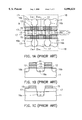
  • FIGS. 2A and 2B are cross-sectional views showing the progression of manufacturing steps in the production of ETOX cell by a conventional self-aligned source etching process.
  • the cross-sectional line along which FIGS. 2A and 2B are derived from is the same as in FIG. 1C.
  • a substrate structure having gates 15 and field oxide layers 17 already formed thereon is provided.
  • the substrate structure here is similar to the one shown in FIG. 1C. The only difference between them is that a common source region 16a has not been formed in the substrate structure in FIG. 2A.
  • a photomask 18 is formed to cover the substrate and patterned such that locations of the common source regions 16a are exposed to get ready for subsequent processing operations.
  • the exposed field oxide layer 17 is etched using a dry etching method having a high selectivity ratio. Thereafter, the photomask 18 is removed. This is followed by ion doping operations to form the common source region 16a and the drain region 16b. Because subsequent processes are familiar to those skilled in the art, detailed description is omitted here.
  • the present invention is directed to provide a method for forming ETOX cells using a self-aligned source etching process that can alleviate the charge retention and reliability problems due to in-process plasma damage of the ONO layer.
  • the invention provides a method for forming ETOX cells by a self-aligned source etching process comprising the steps of first depositing a layer of dielectric, preferably a silicon nitride (Si 3 N 4 ) layer, to a thickness of 100 ⁇ to 700 ⁇ , then etching back the layer to form a silicon nitride spacer. Thereafter, the common source region is defined using a patterned photomask. Subsequently, the field oxide layer is etched using a wet etching method or a dry etching method having a high selectivity ratio.
  • a self-aligned source etching process comprising the steps of first depositing a layer of dielectric, preferably a silicon nitride (Si 3 N 4 ) layer, to a thickness of 100 ⁇ to 700 ⁇ , then etching back the layer to form a silicon nitride spacer. Thereafter, the common source region is defined using a patterned photomask. Subsequent
  • the characteristic of this invention is the ability to protect the oxide/nitride/oxide layer against any damages by plasma during the self-aligned source etching process that may lead to charge retention and reliability problems.
  • FIG. 1A is a layout diagram for a collection of ETOX cells formed by a conventional self-aligned source etching process
  • FIG. 1B is a cross-section along line I-I' in FIG. 1A;
  • FIG. 1C is a cross-section along line II-II' in FIG. 1A;
  • FIGS. 2A and 2B are cross-sectional views showing the progression of manufacturing steps in the production of an ETOX cell using a conventional self-aligned source etching process
  • FIG. 3A is a layout diagram for a collection of ETOX cells formed by a self-aligned source etching process according to one preferred embodiment of this invention
  • FIG. 3B is a cross-section along line III-III' in FIG. 3A;
  • FIG. 3C is a cross-section along line IV-IV' in FIG. 3A;
  • FIGS. 4A through 4C are cross-sectional views along line III-III' of FIG. 3A showing the progression of manufacturing steps in the production of ETOX cell using a self-aligned source etching process according to one preferred embodiment of this invention.
  • FIGS. 5A through 5C are cross-sectional views along line IV-IV' of FIG. 3A showing the progression of manufacturing steps in the production of ETOX cell using a self-aligned source etching process according to one preferred embodiment of this invention.
  • FIG. 3A is a layout diagram for a collection of ETOX cells formed by a self-aligned source etching process according to one preferred embodiment of this invention.
  • the labeled items include floating gates 23, control gates 25, spacers 28, masks 29, field oxide layers 27, drain regions 26b and common source region 26a, which is patterned out according to masks 29.
  • the area labeled 30 within a dotted rectangle is the location of an ETOX cell.
  • FIG. 3B is a cross-section along line III-III' in FIG. 3A.
  • the ETOX cell comprises a gate, a common source region 26a and a drain region 26b.
  • the gate is a four-layered stack including a tunnel oxide layer 22, a floating gate 23, an ONO layer 24 and a controlling gate 25.
  • the controlling gate 25 and the floating gate 23 together constitute a gate terminal.
  • the common source region 26a and the drain region 26b are formed in a substrate 21 on each side of the gate.
  • FIG. 3C is a cross-section along line IV-IV' in FIG. 3A. As shown in FIG. 3C, a field oxide layer is formed above the substrate 21, and that the controlling gate 25 is formed above the field oxide layer 27.
  • FIGS. 4A through 4C are cross-sectional views along line III-III' of FIG. 3A showing the progression of manufacturing steps in the production of ETOX cell using a self-aligned source etching process according to one preferred embodiment of this invention.
  • a substrate structure that has gates 25 and field oxide layers 27 already formed thereon is provided.
  • the substrate structure here is similar to the one shown in FIG. 3B.
  • the cross-sectional line along which FIGS. 4A through 4C are derived from is the same as in FIG. 3B. The only difference between them is that a common source region 26a, drain regions 26b, and spacers 28 has not yet been formed in the substrate structure in FIG. 4A.
  • the spacers 28 are formed by depositing a dielectric layer, preferably a silicon nitride (Si 3 N 4 ) layer, to a thickness of 100 to 700, over the substrate structure, then etching back the dielectric layer to form a silicon nitride spacer 28 on the two sidewalls of a gate stack. Therefore, the ONO layer 24 is being protected by the spacer layer 28 as shown in FIG. 4B.
  • a dielectric layer preferably a silicon nitride (Si 3 N 4 ) layer
  • FIGS. 5A through 5C are cross-sectional views along line IV-IV' of FIG. 3A showing the progression of manufacturing steps in the production of ETOX cell using a self-aligned source etching process according to one preferred embodiment of this invention.
  • the substrate structure is the same as in FIGS. 4A through 4C.
  • the cross-sectional line along which FIGS. 5A through 5C are derived from is the same as in FIG. 3C.
  • a photomask 29 is used to form a pattern of the desired common source regions in the substrate 21.
  • either a dry etching method having a high selectivity ratio such as a plasma etching method, or a wet etching method using a buffered oxide etchant (BOE) is used to etch away the exposed field oxide layer 27.
  • the field oxide layer 27 is etched until the substrate surface 21 is reached, thereby exposing the desired common source locations. Thereafter, the photomask 29 is removed, and then ions are doped to form the common source region 26a and the drain regions 26b. Finally, subsequent conventional processes are performed.

Landscapes

  • Non-Volatile Memory (AREA)
  • Internal Circuitry In Semiconductor Integrated Circuit Devices (AREA)
  • Semiconductor Memories (AREA)

Abstract

A method for forming ETOX cells (Intel Type Flash EPROM Cell) using a self-aligned source etching process comprising the steps of depositing a silicon nitride layer up to a thickness of 100 Å to 700 Å, and then etching back the layer to form spacers. Thereafter, common source regions are defined using a photomask, and then the field oxide layer is etched using either a wet etching method or a dry etching method having a high selectivity ratio. The spacers are capable of protecting the oxide/nitride/oxide ONO layer against any damages during processing, thereby avoiding charge retention and reliability problems.

Description

BACKGROUND OF THE INVENTION
1. Field of Invention
The present invention relates to a flash EPROM structure. More particularly, the present invention relates to a method for forming ETOX cells (Intel Type Flash EPROM Cells) using a self-aligned source etching process.
2. Description of Related Art
Erasable programmable ROM (EPROM) is a type of memory circuit commonly used in computer and electronic products. The advantage of EPROM is that stored data or programs will not be erased under normal circumstances. However, if the data or program really need to be erased, this can be done by shining an ultraviolet (UV) light source onto the EPROM for a period. Once the data or programs have been removed, new data or programs can then be entered and stored. Because all the old data and programs are lost during the EPROM erasing process and everything needs to be re-entered from scratch, much time is wasted in the process. In view of this, Intel Corp. has developed and introduced a kind of memory known as flash EPROM to the market. Data in the flash EPROM will not be completely wiped out in a single erase operation. Instead, data can be locally amended block by block. When the dimensions of flash EPROM are miniaturized, a self-aligned source etching process becomes the obvious choice for forming the ETOX cells. However, in a conventional method of producing ETOX cells, the plasma-etching operation will damage the oxide/nitride/oxide (ONO) layer. This will result in charge retention and reliability problems.
FIG. 1A is a layout diagram for a collection of ETOX cells formed by the conventional self-aligned source etching process. As shown in FIG. 1A, the labeled items include floating gates 13, control gates 15, masks 18, field oxide layers 17, drain regions 16b and a common source region 16a, which is patterned out according to masks 18. The area labeled 9 within a dotted rectangle is the location of an ETOX cell.
FIG. 1B is a cross-section along line I-I' in FIG. 1A. As shown in FIG. 1B, the ETOX cell comprises a gate, a common source region 16a and a drain region 16b. The gate is a four-layered stack including a tunnel oxide layer 12, a floating gate 13, an ONO layer 14 and a controlling gate 15. The controlling gate 15 and the floating gate 13 together constitute a gate terminal. The common source region 16a and the drain region 16b are formed in a substrate 11 on each side of the gate.
FIG. 1C is a cross-section along line II-II' in FIG. 1A. As shown in FIG. 1C, a field oxide layer is formed above the substrate 11, and that the controlling gate 15 is formed above the field oxide layer 17.
FIGS. 2A and 2B are cross-sectional views showing the progression of manufacturing steps in the production of ETOX cell by a conventional self-aligned source etching process. The cross-sectional line along which FIGS. 2A and 2B are derived from is the same as in FIG. 1C. First, a substrate structure having gates 15 and field oxide layers 17 already formed thereon is provided. The substrate structure here is similar to the one shown in FIG. 1C. The only difference between them is that a common source region 16a has not been formed in the substrate structure in FIG. 2A. Then, a photomask 18 is formed to cover the substrate and patterned such that locations of the common source regions 16a are exposed to get ready for subsequent processing operations.
Next, with reference to FIG. 1A, FIG. 1C and FIG. 2B, the exposed field oxide layer 17 is etched using a dry etching method having a high selectivity ratio. Thereafter, the photomask 18 is removed. This is followed by ion doping operations to form the common source region 16a and the drain region 16b. Because subsequent processes are familiar to those skilled in the art, detailed description is omitted here.
Because the conventional self-aligned source etching technique in forming the ETOX cells can easily damage the oxide/nitride/oxide layer of the gate, charge retention and reliability problems are quite common.
In light of the foregoing, there is a need in the art to improve the method of forming ETOX cells.
SUMMARY OF THE INVENTION
Accordingly, the present invention is directed to provide a method for forming ETOX cells using a self-aligned source etching process that can alleviate the charge retention and reliability problems due to in-process plasma damage of the ONO layer.
To achieve these and other advantages and in accordance with the purpose of the invention, as embodied and broadly described herein, the invention provides a method for forming ETOX cells by a self-aligned source etching process comprising the steps of first depositing a layer of dielectric, preferably a silicon nitride (Si3 N4) layer, to a thickness of 100 Å to 700 Å, then etching back the layer to form a silicon nitride spacer. Thereafter, the common source region is defined using a patterned photomask. Subsequently, the field oxide layer is etched using a wet etching method or a dry etching method having a high selectivity ratio.
The characteristic of this invention is the ability to protect the oxide/nitride/oxide layer against any damages by plasma during the self-aligned source etching process that may lead to charge retention and reliability problems.
It is to be understood that both the foregoing general description and the following detailed description are exemplary, and are intended to provide further explanation of the invention as claimed.
BRIEF DESCRIPTION OF THE DRAWINGS
The accompanying drawings are included to provide a further understanding of the invention and are incorporated in and constitute a part of this specification. The drawings illustrate embodiments of the invention and, together with the description, serve to explain the principles of the invention. In the drawings,
FIG. 1A is a layout diagram for a collection of ETOX cells formed by a conventional self-aligned source etching process;
FIG. 1B is a cross-section along line I-I' in FIG. 1A;
FIG. 1C is a cross-section along line II-II' in FIG. 1A;
FIGS. 2A and 2B are cross-sectional views showing the progression of manufacturing steps in the production of an ETOX cell using a conventional self-aligned source etching process;
FIG. 3A is a layout diagram for a collection of ETOX cells formed by a self-aligned source etching process according to one preferred embodiment of this invention;
FIG. 3B is a cross-section along line III-III' in FIG. 3A;
FIG. 3C is a cross-section along line IV-IV' in FIG. 3A;
FIGS. 4A through 4C are cross-sectional views along line III-III' of FIG. 3A showing the progression of manufacturing steps in the production of ETOX cell using a self-aligned source etching process according to one preferred embodiment of this invention; and
FIGS. 5A through 5C are cross-sectional views along line IV-IV' of FIG. 3A showing the progression of manufacturing steps in the production of ETOX cell using a self-aligned source etching process according to one preferred embodiment of this invention.
DESCRIPTION OF THE PREFERRED EMBODIMENTS
Reference will now be made in detail to the present preferred embodiments of the invention, examples of which are illustrated in the accompanying drawings. Wherever possible, the same reference numbers are used in the drawings and the description to refer to the same or like parts.
FIG. 3A is a layout diagram for a collection of ETOX cells formed by a self-aligned source etching process according to one preferred embodiment of this invention. As shown in FIG. 3A, the labeled items include floating gates 23, control gates 25, spacers 28, masks 29, field oxide layers 27, drain regions 26b and common source region 26a, which is patterned out according to masks 29. The area labeled 30 within a dotted rectangle is the location of an ETOX cell.
FIG. 3B is a cross-section along line III-III' in FIG. 3A. As shown in FIG. 3B, the ETOX cell comprises a gate, a common source region 26a and a drain region 26b. The gate is a four-layered stack including a tunnel oxide layer 22, a floating gate 23, an ONO layer 24 and a controlling gate 25. The controlling gate 25 and the floating gate 23 together constitute a gate terminal. The common source region 26a and the drain region 26b are formed in a substrate 21 on each side of the gate.
FIG. 3C is a cross-section along line IV-IV' in FIG. 3A. As shown in FIG. 3C, a field oxide layer is formed above the substrate 21, and that the controlling gate 25 is formed above the field oxide layer 27.
FIGS. 4A through 4C are cross-sectional views along line III-III' of FIG. 3A showing the progression of manufacturing steps in the production of ETOX cell using a self-aligned source etching process according to one preferred embodiment of this invention. As shown in FIG. 4A, a substrate structure that has gates 25 and field oxide layers 27 already formed thereon is provided. The substrate structure here is similar to the one shown in FIG. 3B. The cross-sectional line along which FIGS. 4A through 4C are derived from is the same as in FIG. 3B. The only difference between them is that a common source region 26a, drain regions 26b, and spacers 28 has not yet been formed in the substrate structure in FIG. 4A. The spacers 28 are formed by depositing a dielectric layer, preferably a silicon nitride (Si3 N4) layer, to a thickness of 100 to 700, over the substrate structure, then etching back the dielectric layer to form a silicon nitride spacer 28 on the two sidewalls of a gate stack. Therefore, the ONO layer 24 is being protected by the spacer layer 28 as shown in FIG. 4B.
FIGS. 5A through 5C are cross-sectional views along line IV-IV' of FIG. 3A showing the progression of manufacturing steps in the production of ETOX cell using a self-aligned source etching process according to one preferred embodiment of this invention. The substrate structure is the same as in FIGS. 4A through 4C. Moreover, the cross-sectional line along which FIGS. 5A through 5C are derived from is the same as in FIG. 3C.
Next, with reference to FIG. 4B and FIG. 5B, a photomask 29 is used to form a pattern of the desired common source regions in the substrate 21.
Next, with reference to FIG. 3C and FIG. 5C, either a dry etching method having a high selectivity ratio such as a plasma etching method, or a wet etching method using a buffered oxide etchant (BOE) is used to etch away the exposed field oxide layer 27. The field oxide layer 27 is etched until the substrate surface 21 is reached, thereby exposing the desired common source locations. Thereafter, the photomask 29 is removed, and then ions are doped to form the common source region 26a and the drain regions 26b. Finally, subsequent conventional processes are performed.
Since the sequence of steps in the production of ETOX cells by the self-aligned source etching process in this invention involves forming spacers 28 first, then etching the field oxide layer 27, and finally performing an ion doping operation, damages to the ONO layer 24 during the plasma etching step is minimal. Hence, charge retention and reliability problems can be avoided.
It will be apparent to those skilled in the art that various modifications and variations can be made to the structure of the present invention without departing from the scope or spirit of the invention. In view of the foregoing, it is intended that the present invention cover modifications and variations of this invention provided they fall within the scope of the following claims and their equivalents.
Claims (10)

What is claimed is:
1. A method for manufacturing Intel Type Flash EPROM (erasable programming read-only memory) (ETOX) cells using a self-aligned source etching process comprising the steps of:
providing a substrate that has a plurality of gate stacks and a plurality of field oxide layers already formed thereon, each of the stack includes a tunnel oxide layer, a floating gate, a oxide/nitride/oxide layer and a controlling gate, wherein the controlling gates and the floating gates together constitute a plurality of gate terminals for a number of ETOX cells;
forming a plurality of spacers on each side of the gate stack sidewalls and next to the gate stacks;
forming a photomask over the substrate with a pattern exposing portions of the substrate and common source regions of the ETOX cells; and
etching an exposed portion of the field oxide layer to expose the substrate, wherein the spacers remain exposed to this step of etching.
2. The method of claim 1, wherein step of forming the spacers includes depositing a dielectric layer, and then etching back the dielectric layer to form the spacers.
3. The method of claim 1, wherein after the step of removing the field oxide layer, further includes the substeps of:
removing the photomask; and
performing an ion implantation operation to define the common source region and forming drain regions in the substrate.
4. The method of claim 1, wherein the step of removing the field oxide layer includes dry etching.
5. The method of claim 4, wherein the step of dry etching includes using a plasma etching method.
6. The method of claim 1, wherein the step of removing the field oxide layer includes wet etching.
7. The method of claim 6, wherein the step of wet etching includes using a buffered oxide etchant.
8. The method of claim 1, wherein the step of forming spacers includes depositing silicon nitride.
9. The method of claim 2, wherein the step of depositing dielectric layer includes coating a silicon nitride layer.
10. The method of claim 2, wherein the step of depositing dielectric layer includes depositing up to a thickness of about 100 Å to 700 Å.
US08/992,884 1997-09-10 1997-12-18 Method for forming ETOX cell using self-aligned source etching process Expired - Lifetime US6096624A (en)

Applications Claiming Priority (2)

Application Number Priority Date Filing Date Title
TW86113088 1997-09-10
TW086113088A TW360955B (en) 1997-09-10 1997-09-10 Method for producing ETOX cell by self-aligned source etching

Publications (1)

Publication Number Publication Date
US6096624A true US6096624A (en) 2000-08-01

Family

ID=21626981

Family Applications (1)

Application Number Title Priority Date Filing Date
US08/992,884 Expired - Lifetime US6096624A (en) 1997-09-10 1997-12-18 Method for forming ETOX cell using self-aligned source etching process

Country Status (2)

Country Link
US (1) US6096624A (en)
TW (1) TW360955B (en)

Cited By (3)

* Cited by examiner, † Cited by third party
Publication number Priority date Publication date Assignee Title
US6303437B1 (en) * 1998-03-30 2001-10-16 Advanced Micro Devices, Inc. Trenched gate semiconductor method for low power applications
EP1786036A1 (en) * 2005-11-11 2007-05-16 STMicroelectronics S.r.l. Floating gate non-volatile memory cell and process for manufacturing
EP1191597A3 (en) * 2000-09-21 2007-06-06 Texas Instruments Inc. Sidewall process to improve the flash memory cell performance

Citations (5)

* Cited by examiner, † Cited by third party
Publication number Priority date Publication date Assignee Title
US5445981A (en) * 1992-11-12 1995-08-29 Micron Technology Inc Method of making shallow trench source EPROM cell
US5464784A (en) * 1992-09-30 1995-11-07 Sgs-Thomson Microelectronics S.R.L. Method of fabricating integrated devices
US5661057A (en) * 1992-03-18 1997-08-26 Fujitsu Limited Method of making flash memory
US5741735A (en) * 1995-07-27 1998-04-21 Micron Technology, Inc. Local ground and VCC connection in an SRAM cell
US5882973A (en) * 1997-01-27 1999-03-16 Advanced Micro Devices, Inc. Method for forming an integrated circuit having transistors of dissimilarly graded junction profiles

Patent Citations (5)

* Cited by examiner, † Cited by third party
Publication number Priority date Publication date Assignee Title
US5661057A (en) * 1992-03-18 1997-08-26 Fujitsu Limited Method of making flash memory
US5464784A (en) * 1992-09-30 1995-11-07 Sgs-Thomson Microelectronics S.R.L. Method of fabricating integrated devices
US5445981A (en) * 1992-11-12 1995-08-29 Micron Technology Inc Method of making shallow trench source EPROM cell
US5741735A (en) * 1995-07-27 1998-04-21 Micron Technology, Inc. Local ground and VCC connection in an SRAM cell
US5882973A (en) * 1997-01-27 1999-03-16 Advanced Micro Devices, Inc. Method for forming an integrated circuit having transistors of dissimilarly graded junction profiles

Non-Patent Citations (2)

* Cited by examiner, † Cited by third party
Title
S. Wolf Silicon Processing for the VSLI Era vol. 3 Lattice Press pp. 504, 514, 595 596, 634 635, 1990. *
S. Wolf Silicon Processing for the VSLI Era vol. 3 Lattice Press pp. 504, 514, 595-596, 634-635, 1990.

Cited By (3)

* Cited by examiner, † Cited by third party
Publication number Priority date Publication date Assignee Title
US6303437B1 (en) * 1998-03-30 2001-10-16 Advanced Micro Devices, Inc. Trenched gate semiconductor method for low power applications
EP1191597A3 (en) * 2000-09-21 2007-06-06 Texas Instruments Inc. Sidewall process to improve the flash memory cell performance
EP1786036A1 (en) * 2005-11-11 2007-05-16 STMicroelectronics S.r.l. Floating gate non-volatile memory cell and process for manufacturing

Also Published As

Publication number Publication date
TW360955B (en) 1999-06-11

Similar Documents

Publication Publication Date Title
US6339006B1 (en) Flash EEPROM cell and method of manufacturing the same
US6143606A (en) Method for manufacturing split-gate flash memory cell
EP0680080A2 (en) Method for protecting a stacked gate edge from self-aligned source (SAS) etch in a semiconductor device
EP0581312A1 (en) Non-volatile memory device and method of its manufacture
KR0161402B1 (en) Nonvolatile Memory Manufacturing Method
US6245614B1 (en) Method of manufacturing a split-gate flash memory cell with polysilicon spacers
US6159860A (en) Method for etching layers on a semiconductor wafer in a single etching chamber
US6258669B1 (en) Methods and arrangements for improved formation of control and floating gates in non-volatile memory semiconductor devices
KR100357185B1 (en) Nonvolatile memory device and method for fabricating the same
US6046085A (en) Elimination of poly stringers with straight poly profile
US6096624A (en) Method for forming ETOX cell using self-aligned source etching process
US6034395A (en) Semiconductor device having a reduced height floating gate
US5789295A (en) Method of eliminating or reducing poly1 oxidation at stacked gate edge in flash EPROM process
US6242773B1 (en) Self-aligning poly 1 ono dielectric for non-volatile memory
US5998262A (en) Method for manufacturing ETOX cell having damage-free source region
US6518103B1 (en) Method for fabricating NROM with ONO structure
US6812098B2 (en) Method for manufacturing non-volatile memory device
US6362048B1 (en) Method of manufacturing floating gate of flash memory
US7429511B2 (en) Method of forming a tunneling insulating layer in nonvolatile memory device
US6300195B1 (en) Process for manufacturing semiconductor integrated memory devices with cells matrix having virtual ground
US7049195B2 (en) Methods of fabricating non-volatile memory devices
US6458659B1 (en) Method of fabricating non-volatile memory devices integrated in a semiconductor substrate and organized into memory matrices
KR100187679B1 (en) Method of making flash memory cell
KR19990008860A (en) Nonvolatile Memory Device and Manufacturing Method Thereof
US7537992B2 (en) Method for manufacturing flash memory device

Legal Events

Date Code Title Description
AS Assignment

Owner name: UNITED SEMICONDUCTOR CORP., TAIWAN

Free format text: ASSIGNMENT OF ASSIGNORS INTEREST;ASSIGNORS:CHEN, HWI-HUANG;HONG, GARY;REEL/FRAME:008941/0043

Effective date: 19971008

AS Assignment

Owner name: UNITED MICROELECTRONICS CORP., TAIWAN

Free format text: ASSIGNMENT OF ASSIGNORS INTEREST;ASSIGNOR:UNITED SEMICONDUCTOR CORP.;REEL/FRAME:010579/0570

Effective date: 19991230

STCF Information on status: patent grant

Free format text: PATENTED CASE

FEPP Fee payment procedure

Free format text: PAYOR NUMBER ASSIGNED (ORIGINAL EVENT CODE: ASPN); ENTITY STATUS OF PATENT OWNER: LARGE ENTITY

FPAY Fee payment

Year of fee payment: 4

FPAY Fee payment

Year of fee payment: 8

FPAY Fee payment

Year of fee payment: 12