US6096452A - Retaining device for one-piece battery - Google Patents

Retaining device for one-piece battery Download PDF

Info

Publication number
US6096452A
US6096452A US09/122,797 US12279798A US6096452A US 6096452 A US6096452 A US 6096452A US 12279798 A US12279798 A US 12279798A US 6096452 A US6096452 A US 6096452A
Authority
US
United States
Prior art keywords
strip
plates
walls
casing
recess
Prior art date
Legal status (The legal status is an assumption and is not a legal conclusion. Google has not performed a legal analysis and makes no representation as to the accuracy of the status listed.)
Expired - Fee Related
Application number
US09/122,797
Inventor
Claude Gilabert
Michel Leturque
Roclof Verhoog
Current Assignee (The listed assignees may be inaccurate. Google has not performed a legal analysis and makes no representation or warranty as to the accuracy of the list.)
Alcatel Lucent SAS
Original Assignee
Alcatel SA
Priority date (The priority date is an assumption and is not a legal conclusion. Google has not performed a legal analysis and makes no representation as to the accuracy of the date listed.)
Filing date
Publication date
Application filed by Alcatel SA filed Critical Alcatel SA
Assigned to ALCATEL ALSTHOM COMPAGNIE GENERALE D'ELECTRICITE reassignment ALCATEL ALSTHOM COMPAGNIE GENERALE D'ELECTRICITE ASSIGNMENT OF ASSIGNORS INTEREST (SEE DOCUMENT FOR DETAILS). Assignors: VERHOOG, ROELOF, GILABERT, CLAUDE, LETURQUE, MICHEL
Assigned to ALCATEL reassignment ALCATEL CHANGE OF NAME (SEE DOCUMENT FOR DETAILS). Assignors: ALCATEL ALSTHOM COMPAGNIE GENERALE D'ELECTRICITE
Application granted granted Critical
Publication of US6096452A publication Critical patent/US6096452A/en
Assigned to ENERGY, UNITED STATES DEPARTMENT OF reassignment ENERGY, UNITED STATES DEPARTMENT OF CONFIRMATORY LICENSE (SEE DOCUMENT FOR DETAILS). Assignors: SAFT AMERICA, INC.
Anticipated expiration legal-status Critical
Expired - Fee Related legal-status Critical Current

Links

Images

Classifications

    • HELECTRICITY
    • H01ELECTRIC ELEMENTS
    • H01MPROCESSES OR MEANS, e.g. BATTERIES, FOR THE DIRECT CONVERSION OF CHEMICAL ENERGY INTO ELECTRICAL ENERGY
    • H01M10/00Secondary cells; Manufacture thereof
    • H01M10/04Construction or manufacture in general
    • H01M10/0481Compression means other than compression means for stacks of electrodes and separators
    • HELECTRICITY
    • H01ELECTRIC ELEMENTS
    • H01MPROCESSES OR MEANS, e.g. BATTERIES, FOR THE DIRECT CONVERSION OF CHEMICAL ENERGY INTO ELECTRICAL ENERGY
    • H01M50/00Constructional details or processes of manufacture of the non-active parts of electrochemical cells other than fuel cells, e.g. hybrid cells
    • H01M50/20Mountings; Secondary casings or frames; Racks, modules or packs; Suspension devices; Shock absorbers; Transport or carrying devices; Holders
    • H01M50/202Casings or frames around the primary casing of a single cell or a single battery
    • HELECTRICITY
    • H01ELECTRIC ELEMENTS
    • H01MPROCESSES OR MEANS, e.g. BATTERIES, FOR THE DIRECT CONVERSION OF CHEMICAL ENERGY INTO ELECTRICAL ENERGY
    • H01M50/00Constructional details or processes of manufacture of the non-active parts of electrochemical cells other than fuel cells, e.g. hybrid cells
    • H01M50/20Mountings; Secondary casings or frames; Racks, modules or packs; Suspension devices; Shock absorbers; Transport or carrying devices; Holders
    • H01M50/262Mountings; Secondary casings or frames; Racks, modules or packs; Suspension devices; Shock absorbers; Transport or carrying devices; Holders with fastening means, e.g. locks
    • H01M50/264Mountings; Secondary casings or frames; Racks, modules or packs; Suspension devices; Shock absorbers; Transport or carrying devices; Holders with fastening means, e.g. locks for cells or batteries, e.g. straps, tie rods or peripheral frames
    • HELECTRICITY
    • H01ELECTRIC ELEMENTS
    • H01MPROCESSES OR MEANS, e.g. BATTERIES, FOR THE DIRECT CONVERSION OF CHEMICAL ENERGY INTO ELECTRICAL ENERGY
    • H01M50/00Constructional details or processes of manufacture of the non-active parts of electrochemical cells other than fuel cells, e.g. hybrid cells
    • H01M50/10Primary casings; Jackets or wrappings
    • HELECTRICITY
    • H01ELECTRIC ELEMENTS
    • H01MPROCESSES OR MEANS, e.g. BATTERIES, FOR THE DIRECT CONVERSION OF CHEMICAL ENERGY INTO ELECTRICAL ENERGY
    • H01M50/00Constructional details or processes of manufacture of the non-active parts of electrochemical cells other than fuel cells, e.g. hybrid cells
    • H01M50/10Primary casings; Jackets or wrappings
    • H01M50/102Primary casings; Jackets or wrappings characterised by their shape or physical structure
    • H01M50/103Primary casings; Jackets or wrappings characterised by their shape or physical structure prismatic or rectangular
    • YGENERAL TAGGING OF NEW TECHNOLOGICAL DEVELOPMENTS; GENERAL TAGGING OF CROSS-SECTIONAL TECHNOLOGIES SPANNING OVER SEVERAL SECTIONS OF THE IPC; TECHNICAL SUBJECTS COVERED BY FORMER USPC CROSS-REFERENCE ART COLLECTIONS [XRACs] AND DIGESTS
    • Y02TECHNOLOGIES OR APPLICATIONS FOR MITIGATION OR ADAPTATION AGAINST CLIMATE CHANGE
    • Y02EREDUCTION OF GREENHOUSE GAS [GHG] EMISSIONS, RELATED TO ENERGY GENERATION, TRANSMISSION OR DISTRIBUTION
    • Y02E60/00Enabling technologies; Technologies with a potential or indirect contribution to GHG emissions mitigation
    • Y02E60/10Energy storage using batteries

Definitions

  • the present invention relates to a retaining device for a one-piece battery. Such batteries are used to power electric vehicles.
  • the capacity of a nickel-cadmium or nickel-hydridable metal one-piece battery is in the range 5 Ah to 250 Ah.
  • the plate groups are contained in compartments in a single casing.
  • the casing is usually made of a plastics material and prismatic in shape.
  • Each plate group is constituted by an assembly of alternate positive and negative planar electrodes separated from each other by a separator and impregnated with an electrolyte.
  • the plate group has two small faces corresponding to the edges of the stacked electrodes and two large faces parallel to the electrode surface.
  • the longitudinal walls of the battery correspond to the small faces of the group and the transverse walls correspond to the large faces of the group.
  • the electrodes undergo dimensional variations which exert a thrust on the casing walls opposite the large faces of the group. Further, the internal gas pressure bears on all of the casing walls. In order to prevent the battery from expanding and deforming, a device must be provided which will retain the walls.
  • U.S. Pat. No. 4,020,244 describes a battery composed of a plurality of sealed parallelepipedal rechargeable cells, in particular nickel-cadmium type cells, provided with a device intended to prevent the battery from deforming.
  • the fixing system comprises a pair of compression plates at the ends of the stack of cells and a plurality of bands passing around the stack and the plates. The bands are cinched tight and their ends are welded together.
  • Patent FR-1 267 153 describes a battery made up of a plurality of rechargeable cells.
  • the groups are contained in boxes which are juxtaposed and connected by belts associated with the plates.
  • the device includes plate groups perpendicular to their plane.
  • the belts are closed up on themselves by tensioning devices to make it possible to release the belt if it is necessary to remove or introduce a box.
  • the present invention aims to provide a device for retaining a one-piece battery which is less bulky, easier to implement and cheaper than known devices.
  • the present invention provides a device for retaining a one-piece battery with a prismatic casing having two longitudinal walls and two transverse walls.
  • the device comprises two plates respectively pressed against each of the transverse walls and at least one cinching means for the plates consisting of at least one flat strip closed on itself surrounding the longitudinal walls and the transverse walls provided with the plates.
  • the device of the invention is characterized in that at least one of the plates comprises at least one recessed housing and in that a portion of the length of the strip penetrates into the housing in order to tension the strip.
  • the deformation of the strip which is necessary to make it enter the housing uses up a portion of the length of the strip.
  • the strip then fits closely against the end plates and the longitudinal walls of the container.
  • the cinching force applied by the strip after deformation depends on the length of the strip and on the portion of this length used for the deformation.
  • the strip In order to take on and keep the shape conferred on it, the strip must be semi-rigid.
  • the strip is preferably cut from a metal sheet.
  • the strip is a steel strip which is protected against corrosion, for example by a coating of nickel or another metal, and has a thickness of over 0.2 mm.
  • the cinching means comprises two 1 mm thick stainless steel strips 22 mm wide giving a cross-section of 44 mm 2 .
  • the cinching means comprises two 0.3 mm thick strips 132 mm wide giving a cross-section of 40 mm 2 .
  • the strip is of stainless steel and is at least 0.6 mm thick, preferably having a thickness in the range 0.8 mm to 1.2 mm, when the large face of the group has a surface area of the order of 1.5 dm 2 .
  • an aluminum strip would be thicker than a stainless steel strip.
  • the depth of said housing is of the same order as the thickness of the strip. In this case, deformation of the strip is practically irreversible.
  • the housing is preferably provided on the section of said plate aligned with said longitudinal wall.
  • the plate is then used as a die for the press tool.
  • said longitudinal walls have grooves the width and thickness of said strip over their entire length.
  • the grooves act to guide the strip and absorb any extra thickness resulting from its presence.
  • the batteries can then be coupled together without loss of space.
  • said plates have grooves the width and thickness of the strip on their outer face.
  • the transverse walls of the batteries can thus also be juxtaposed without loss of space.
  • the plates are placed against the transverse walls of the battery and immobilized in translation in a plane parallel to the electrodes.
  • housings for the plates can be made in the transverse wall.
  • the transverse wall is concave in shape and the face of said plate turned towards said casing closely follows the shape of said transverse wall. This shape enables the transverse wall to resist the thrust of the electrodes, the thickness of which varies during cycling.
  • the invention also relates to a process for producing the retaining device comprising the following steps.
  • a respective plate is applied to each of the transverse walls.
  • the closed strip is then placed around the longitudinal walls and the plates on the outer periphery of the battery.
  • thrust is exerted on the strip to cause it to penetrate into the housing, shortening the strip to cinch the plates against the battery casing.
  • An appropriate tool is used to exert a limited force on the strip without causing it to deform. When the thrusting force of the tool on the strip is reached, the force is removed and the strip is tensioned. If the excess length of the strip is sufficient, it will closely follow the shape of the housing.
  • the strip is preferably deformed by compression, in particular using a press tool.
  • FIG. 1 is a perspective view of a one-piece battery including a retaining device according to the present invention
  • FIG. 2 is a partial bottom view of the battery showing one embodiment of the device of the present invention
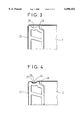
  • FIGS. 3 and 4 are an enlargement of zone IV showing the method of producing the embodiment of FIG. 2, wherein FIG. 3 represents the belt before pressing and FIG. 4, analogous to FIG. 3, represents the belt after pressing;
  • FIG. 5 is a perspective view of a one-piece battery showing another development of the present invention.
  • FIG. 6 is a perspective view of a one-piece battery showing a further development of the present invention.
  • FIG. 1 shows a one-piece nickel-hydridable metal (Ni-MH) battery 1 in accordance with the present invention with a capacity of about 100 Ah.
  • the battery includes a thermoplastics polymer casing 2 of prismatic shape and closing means for the casing constituting a base 3.
  • the upper portion of the casing 2 carries a positive terminal 4 and a negative terminal 5 for electrically connecting the battery to an external connection and a lid 6 protecting the electrical connections between the plate groups.
  • Plates 7 in contact with transverse walls 8 of the casing are disposed at each end of the casing. Plates 7 are held in place by two flat metallic belts 9 consisting of two nickel plated steel strips 0.3 mm thick and 132 mm wide. Belts 9 are applied along the length of the longitudinal walls 10 and passing over plates 7.
  • plate section 20 carries a housing 21 forming a recess.
  • a metal strip is cut and closed on itself by welding its ends to form a belt 22 with a length which is slightly greater than the perimeter of the casing provided with plates 20 to allow sufficient clearance for positioning the belt.
  • Belt 22 is then placed around the one-piece battery provided with plates 20.
  • a force is then exerted on belt 22 in the direction of the arrow shown in FIG. 3 to cause it to deform at 23.
  • the deformed portion 24 of belt 22 closely follows the shape of housing 21 as shown in FIG. 4, thus causing belt 22 to cinch onto longitudinal walls 10 of casing 2 and plates 20.
  • Belt 22 is under tension and holds casing 2 and plates 20 together. No clearance is envisaged between the plate group and transverse walls 8 of casing 2; thus the thrust exerted by bulging of the group is completely taken up by plates 20 and not by casing 2, which might otherwise rupture.
  • FIG. 5 shows another embodiment of the invention in which the one-piece battery comprises two grooves 51, 51' over the entire length of the longitudinal wall 50.
  • the upper groove 51 and a nickel-plated steel belt 52 1 mm thick and 22 mm wide in groove 51' are shown.
  • Groove 51' is about the same width as belt 52 and its depth is of the same order as the thickness of belt 52.
  • groove 51, 51' extends over plate 53 via a groove 54, 54' of substantially the same dimensions.
  • This groove, which houses the belt, means that the retaining device does not increase the bulk of the battery.
  • the thrust of the electrodes on the transverse walls 61 of the casing is compensated by giving these walls 61 a concave shape.
  • transverse wall 61 bend toward a planar shape when pushed out by the electrodes.
  • Face 62 of plates 63 applied against transverse wall 61 has a convex profile closely following the concavity of wall 61.
  • the opposed face 64 has a profile parallel to that of face 62.

Landscapes

  • Chemical & Material Sciences (AREA)
  • Chemical Kinetics & Catalysis (AREA)
  • Electrochemistry (AREA)
  • General Chemical & Material Sciences (AREA)
  • Engineering & Computer Science (AREA)
  • Manufacturing & Machinery (AREA)
  • Sealing Battery Cases Or Jackets (AREA)
  • Secondary Cells (AREA)
  • Battery Mounting, Suspending (AREA)

Abstract

The present invention consists of a device for retaining a one-piece battery with a prismatic casing having two longitudinal walls and two transverse walls. The device contains two plates applied to respective transverse walls and at least one cinching mechanism for the plates consisting of at least one flat strip closed on itself surrounding the longitudinal walls and the transverse walls are provided with the plates. The device is characterized in that at least one of the plates contains at least one recessed housing and the strip closely follows the shape of the housing.

Description

BACKGROUND OF THE INVENTION
1. Field of the Invention
The present invention relates to a retaining device for a one-piece battery. Such batteries are used to power electric vehicles. The capacity of a nickel-cadmium or nickel-hydridable metal one-piece battery is in the range 5 Ah to 250 Ah.
2. Description of the Related Art
In a one-piece battery, the plate groups are contained in compartments in a single casing. The casing is usually made of a plastics material and prismatic in shape. Each plate group is constituted by an assembly of alternate positive and negative planar electrodes separated from each other by a separator and impregnated with an electrolyte. The plate group has two small faces corresponding to the edges of the stacked electrodes and two large faces parallel to the electrode surface. The longitudinal walls of the battery correspond to the small faces of the group and the transverse walls correspond to the large faces of the group.
During cycling, the electrodes undergo dimensional variations which exert a thrust on the casing walls opposite the large faces of the group. Further, the internal gas pressure bears on all of the casing walls. In order to prevent the battery from expanding and deforming, a device must be provided which will retain the walls.
U.S. Pat. No. 4,020,244 describes a battery composed of a plurality of sealed parallelepipedal rechargeable cells, in particular nickel-cadmium type cells, provided with a device intended to prevent the battery from deforming. The fixing system comprises a pair of compression plates at the ends of the stack of cells and a plurality of bands passing around the stack and the plates. The bands are cinched tight and their ends are welded together.
The inevitable release of heat caused by welding necessitates the presence of heatsinks. When the welding is carried out at the ends of the battery, the mass of the plates may be sufficient to fulfil this role; however, if the welding is carried out on one of the sides, heatsinks must be added to protect the rechargeable cells.
Patent FR-1 267 153 describes a battery made up of a plurality of rechargeable cells. The groups are contained in boxes which are juxtaposed and connected by belts associated with the plates. The device includes plate groups perpendicular to their plane. The belts are closed up on themselves by tensioning devices to make it possible to release the belt if it is necessary to remove or introduce a box.
For a one-piece battery, the problem of replacing a box does not arise. A tensioning device would unnecessarily increase the bulk and cost of the battery.
SUMMARY OF THE INVENTION
The present invention aims to provide a device for retaining a one-piece battery which is less bulky, easier to implement and cheaper than known devices.
The present invention provides a device for retaining a one-piece battery with a prismatic casing having two longitudinal walls and two transverse walls. The device comprises two plates respectively pressed against each of the transverse walls and at least one cinching means for the plates consisting of at least one flat strip closed on itself surrounding the longitudinal walls and the transverse walls provided with the plates.
The device of the invention is characterized in that at least one of the plates comprises at least one recessed housing and in that a portion of the length of the strip penetrates into the housing in order to tension the strip.
The deformation of the strip which is necessary to make it enter the housing uses up a portion of the length of the strip. The strip then fits closely against the end plates and the longitudinal walls of the container. The cinching force applied by the strip after deformation depends on the length of the strip and on the portion of this length used for the deformation.
In order to take on and keep the shape conferred on it, the strip must be semi-rigid. The strip is preferably cut from a metal sheet.
The thickness and width of the strip depends on the thrust to be contained. In a first embodiment, the strip is a steel strip which is protected against corrosion, for example by a coating of nickel or another metal, and has a thickness of over 0.2 mm.
In a preferred embodiment of the invention the cinching means comprises two 1 mm thick stainless steel strips 22 mm wide giving a cross-section of 44 mm2.
In a second embodiment of the invention the cinching means comprises two 0.3 mm thick strips 132 mm wide giving a cross-section of 40 mm2.
In a second implementation, the strip is of stainless steel and is at least 0.6 mm thick, preferably having a thickness in the range 0.8 mm to 1.2 mm, when the large face of the group has a surface area of the order of 1.5 dm2. In the same case an aluminum strip would be thicker than a stainless steel strip.
Advantageously, the depth of said housing is of the same order as the thickness of the strip. In this case, deformation of the strip is practically irreversible.
The housing is preferably provided on the section of said plate aligned with said longitudinal wall. The plate is then used as a die for the press tool.
Advantageously, said longitudinal walls have grooves the width and thickness of said strip over their entire length. The grooves act to guide the strip and absorb any extra thickness resulting from its presence. The batteries can then be coupled together without loss of space.
Advantageously, said plates have grooves the width and thickness of the strip on their outer face. The transverse walls of the batteries can thus also be juxtaposed without loss of space.
The plates are placed against the transverse walls of the battery and immobilized in translation in a plane parallel to the electrodes. As an example, housings for the plates can be made in the transverse wall.
Advantageously, the transverse wall is concave in shape and the face of said plate turned towards said casing closely follows the shape of said transverse wall. This shape enables the transverse wall to resist the thrust of the electrodes, the thickness of which varies during cycling.
The invention also relates to a process for producing the retaining device comprising the following steps.
Firstly, a respective plate is applied to each of the transverse walls.
Then a flat strip is cut and closed upon itself so that the length of the closed strip is slightly greater than the perimeter of the casing between the plates. This provides sufficient clearance for positioning the strip.
The closed strip is then placed around the longitudinal walls and the plates on the outer periphery of the battery.
Finally, thrust is exerted on the strip to cause it to penetrate into the housing, shortening the strip to cinch the plates against the battery casing. An appropriate tool is used to exert a limited force on the strip without causing it to deform. When the thrusting force of the tool on the strip is reached, the force is removed and the strip is tensioned. If the excess length of the strip is sufficient, it will closely follow the shape of the housing.
The strip is preferably deformed by compression, in particular using a press tool.
BRIEF DESCRIPTION OF THE DRAWINGS
The invention will be better understood and other advantages and features will become apparent from the following description which is given by way of non limiting illustration and with reference to the accompanying drawings, in which:
FIG. 1 is a perspective view of a one-piece battery including a retaining device according to the present invention;
FIG. 2 is a partial bottom view of the battery showing one embodiment of the device of the present invention;
FIGS. 3 and 4 are an enlargement of zone IV showing the method of producing the embodiment of FIG. 2, wherein FIG. 3 represents the belt before pressing and FIG. 4, analogous to FIG. 3, represents the belt after pressing;
FIG. 5 is a perspective view of a one-piece battery showing another development of the present invention; and
FIG. 6 is a perspective view of a one-piece battery showing a further development of the present invention.
DESCRIPTION OF THE PREFERRED EMBODIMENTS
FIG. 1 shows a one-piece nickel-hydridable metal (Ni-MH) battery 1 in accordance with the present invention with a capacity of about 100 Ah. The battery includes a thermoplastics polymer casing 2 of prismatic shape and closing means for the casing constituting a base 3. The upper portion of the casing 2 carries a positive terminal 4 and a negative terminal 5 for electrically connecting the battery to an external connection and a lid 6 protecting the electrical connections between the plate groups.
Plates 7 in contact with transverse walls 8 of the casing are disposed at each end of the casing. Plates 7 are held in place by two flat metallic belts 9 consisting of two nickel plated steel strips 0.3 mm thick and 132 mm wide. Belts 9 are applied along the length of the longitudinal walls 10 and passing over plates 7.
As shown in FIG. 2, plate section 20 carries a housing 21 forming a recess. A metal strip is cut and closed on itself by welding its ends to form a belt 22 with a length which is slightly greater than the perimeter of the casing provided with plates 20 to allow sufficient clearance for positioning the belt. Belt 22 is then placed around the one-piece battery provided with plates 20. A force is then exerted on belt 22 in the direction of the arrow shown in FIG. 3 to cause it to deform at 23. The deformed portion 24 of belt 22 closely follows the shape of housing 21 as shown in FIG. 4, thus causing belt 22 to cinch onto longitudinal walls 10 of casing 2 and plates 20. Belt 22 is under tension and holds casing 2 and plates 20 together. No clearance is envisaged between the plate group and transverse walls 8 of casing 2; thus the thrust exerted by bulging of the group is completely taken up by plates 20 and not by casing 2, which might otherwise rupture.
FIG. 5 shows another embodiment of the invention in which the one-piece battery comprises two grooves 51, 51' over the entire length of the longitudinal wall 50. The upper groove 51 and a nickel-plated steel belt 52 1 mm thick and 22 mm wide in groove 51' are shown. Groove 51' is about the same width as belt 52 and its depth is of the same order as the thickness of belt 52. Preferably, groove 51, 51' extends over plate 53 via a groove 54, 54' of substantially the same dimensions. This groove, which houses the belt, means that the retaining device does not increase the bulk of the battery.
In another embodiment, shown in FIG. 6, the thrust of the electrodes on the transverse walls 61 of the casing is compensated by giving these walls 61 a concave shape. Thus, transverse wall 61 bend toward a planar shape when pushed out by the electrodes. Face 62 of plates 63 applied against transverse wall 61 has a convex profile closely following the concavity of wall 61. Advantageously, the opposed face 64 has a profile parallel to that of face 62.

Claims (13)

What is claimed is:
1. A device for retaining a one-piece battery with a casing having two longitudinal walls and two transverse walls, said device comprising two plates respectively disposed against said transverse walls and at least one cinching means for securing said plates to said casing said cinching means including at least one flat strip closed on itself surrounding said longitudinal walls and said transverse walls provided with said plates, wherein at least one of said plates has at least one recess and in that a portion of the length of said strip penetrates into said recess in order to tension said strip.
2. A device according to claim 1 wherein said strip is metallic.
3. A device according to claim 1 wherein said strip is steel and is over 0.2 mm thick.
4. A device according to claim 1 wherein said cinching means comprises two steel strips 1 mm thick and 22 mm wide.
5. A device according to claim 1 wherein said cinching means comprises two steel strips 0.3 mm thick and 132 mm wide.
6. A device according to claim 1 wherein said strip is of stainless steel and is at least 0.6 mm thick.
7. A device according to claim 1 wherein the depth of said recess is of the same order as the thickness of said strip.
8. A device according to claim 1 wherein said recess is provided in a section of said plate aligned with said longitudinal wall.
9. A device according to claim 1 wherein said longitudinal walls have grooves equal to the width and thickness of said strip over their entire length.
10. A device according to claim 1 wherein said plates have grooves equal to the width and thickness of said strip on their outer face.
11. A device according to claim 1 wherein said transverse wall is concave in shape and the face of said plate towards said casing closely follows the shape of said transverse wall.
12. A process for producing a retaining device according to claim 1 comprising the steps of:
applying a respective plate to each of said transverse walls;
cutting a flat strip and closing said strip on itself;
disposing said closed strip around said longitudinal walls and said plates; and
deforming said strip to cause it to penetrate into said recess.
13. A process for producing a retaining device according to claim 8 wherein said strip is deformed by compression.
US09/122,797 1998-06-29 1998-07-27 Retaining device for one-piece battery Expired - Fee Related US6096452A (en)

Applications Claiming Priority (2)

Application Number Priority Date Filing Date Title
FR9808205A FR2780555B1 (en) 1998-06-29 1998-06-29 HOLDING DEVICE FOR MONOBLOCK BATTERY
FR9808205 1998-06-29

Publications (1)

Publication Number Publication Date
US6096452A true US6096452A (en) 2000-08-01

Family

ID=9527972

Family Applications (1)

Application Number Title Priority Date Filing Date
US09/122,797 Expired - Fee Related US6096452A (en) 1998-06-29 1998-07-27 Retaining device for one-piece battery

Country Status (4)

Country Link
US (1) US6096452A (en)
EP (1) EP0969533A1 (en)
JP (1) JP2000030677A (en)
FR (1) FR2780555B1 (en)

Cited By (5)

* Cited by examiner, † Cited by third party
Publication number Priority date Publication date Assignee Title
US20050053824A1 (en) * 2001-11-23 2005-03-10 Raimund Strobel Fuel cell system
US20080268325A1 (en) * 2005-10-11 2008-10-30 Luc Bianchi Sealed Fuel Cell Stack
US20110151312A1 (en) * 2009-12-23 2011-06-23 Kim Tae-Yong Battery module having improved structure for fixing end plate and method of fixing the same
WO2012120107A1 (en) * 2011-03-09 2012-09-13 Avl List Gmbh Electrical energy store
DE102017216782A1 (en) * 2017-09-22 2019-03-28 Volkswagen Aktiengesellschaft Battery module housing for a vehicle

Families Citing this family (2)

* Cited by examiner, † Cited by third party
Publication number Priority date Publication date Assignee Title
CN101673814B (en) * 2009-08-26 2011-06-08 力帆实业(集团)股份有限公司 Power cell box used for electric vehicle
WO2012009145A2 (en) * 2010-06-28 2012-01-19 A123 Systems, Inc. Battery module having retention band and method of assembly

Citations (8)

* Cited by examiner, † Cited by third party
Publication number Priority date Publication date Assignee Title
BE645735A (en) * 1964-03-26 1964-07-16
JPS55143775A (en) * 1979-04-27 1980-11-10 Japan Storage Battery Co Ltd Storage battery
US4345009A (en) * 1979-08-17 1982-08-17 United Technologies Corporation Fuel cell stack compressive loading system
EP0065349A1 (en) * 1981-05-11 1982-11-24 General Motors Corporation Battery container and pack
JPS61126764A (en) * 1984-11-22 1986-06-14 Shin Kobe Electric Mach Co Ltd Enclosed lead battery
DE9210668U1 (en) * 1992-08-10 1992-12-17 Meßmer, Friedhelm, 7801 Hartheim Mechanical clamping device for thermoplastic battery blocks
JPH10125349A (en) * 1996-10-18 1998-05-15 Shin Kobe Electric Mach Co Ltd Sealed monoblock lead-acid battery
US5789091A (en) * 1996-11-19 1998-08-04 Ballard Power Systems Inc. Electrochemical fuel cell stack with compression bands

Patent Citations (9)

* Cited by examiner, † Cited by third party
Publication number Priority date Publication date Assignee Title
BE645735A (en) * 1964-03-26 1964-07-16
JPS55143775A (en) * 1979-04-27 1980-11-10 Japan Storage Battery Co Ltd Storage battery
US4345009A (en) * 1979-08-17 1982-08-17 United Technologies Corporation Fuel cell stack compressive loading system
EP0065349A1 (en) * 1981-05-11 1982-11-24 General Motors Corporation Battery container and pack
JPS61126764A (en) * 1984-11-22 1986-06-14 Shin Kobe Electric Mach Co Ltd Enclosed lead battery
DE9210668U1 (en) * 1992-08-10 1992-12-17 Meßmer, Friedhelm, 7801 Hartheim Mechanical clamping device for thermoplastic battery blocks
JPH10125349A (en) * 1996-10-18 1998-05-15 Shin Kobe Electric Mach Co Ltd Sealed monoblock lead-acid battery
US5789091A (en) * 1996-11-19 1998-08-04 Ballard Power Systems Inc. Electrochemical fuel cell stack with compression bands
US5789091C1 (en) * 1996-11-19 2001-02-27 Ballard Power Systems Electrochemical fuel cell stack with compression bands

Cited By (9)

* Cited by examiner, † Cited by third party
Publication number Priority date Publication date Assignee Title
US20050053824A1 (en) * 2001-11-23 2005-03-10 Raimund Strobel Fuel cell system
US20080268325A1 (en) * 2005-10-11 2008-10-30 Luc Bianchi Sealed Fuel Cell Stack
US8062806B2 (en) * 2005-10-11 2011-11-22 Commissariat A L'energie Atomique Sealed fuel cell stack
US20110151312A1 (en) * 2009-12-23 2011-06-23 Kim Tae-Yong Battery module having improved structure for fixing end plate and method of fixing the same
US9425479B2 (en) * 2009-12-23 2016-08-23 Samsung Sdi Co., Ltd Battery module having improved structure for fixing end plate and method of fixing the same
WO2012120107A1 (en) * 2011-03-09 2012-09-13 Avl List Gmbh Electrical energy store
DE102017216782A1 (en) * 2017-09-22 2019-03-28 Volkswagen Aktiengesellschaft Battery module housing for a vehicle
CN109546023A (en) * 2017-09-22 2019-03-29 大众汽车有限公司 Battery module housings for vehicles
CN109546023B (en) * 2017-09-22 2022-05-13 大众汽车有限公司 Battery module housing for a vehicle

Also Published As

Publication number Publication date
EP0969533A1 (en) 2000-01-05
FR2780555A1 (en) 1999-12-31
JP2000030677A (en) 2000-01-28
FR2780555B1 (en) 2000-08-11

Similar Documents

Publication Publication Date Title
US11909062B2 (en) Battery pack comprising battery pack frame capable of preventing welding defect and pressing jig for preparing the same
KR100612364B1 (en) Secondary battery
EP3859816A1 (en) Battery pack
MX2012014397A (en) Battery module.
CN109155380B (en) Battery module including cover assembly
KR20020062753A (en) Flat square battery
US11050103B2 (en) Pouch cell and method of forming same
US20220294070A1 (en) Buffer member, electrical storage module, and method for manufacturing buffer member
US11777169B2 (en) Method of manufacturing power storage module
KR102263480B1 (en) Pouch-type Secondary Battery Having Preliminary Cutting Line
KR102912445B1 (en) Terminal component and secondary battery and assembled battery each including the terminal component
EP3363058B1 (en) Electrode stack restraint
CN112864525A (en) Nonaqueous electrolyte secondary battery
WO2020114708A1 (en) Deep pouch cell and method of manufacturing same
US6096452A (en) Retaining device for one-piece battery
JP2014086291A (en) Square secondary battery and battery pack using the same
CN104871339B (en) Battery module
Gilabert et al. Retaining Device For One-Piece Battery
EP3975326A1 (en) Power storage device and method of manufacturing same
RU2319254C2 (en) Battery and its manufacturing process
KR20220068070A (en) Secondary battery and manufacturing method thereof
JP7782062B2 (en) Secondary battery and method of manufacturing the same
JP7723692B2 (en) Electricity storage device and method for manufacturing the same
EP4428994A2 (en) Power storage device and method for producing the power storage device
JP7749297B2 (en) Electricity storage device and method for manufacturing the same

Legal Events

Date Code Title Description
AS Assignment

Owner name: ALCATEL ALSTHOM COMPAGNIE GENERALE D'ELECTRICITE,

Free format text: ASSIGNMENT OF ASSIGNORS INTEREST;ASSIGNORS:GILABERT, CLAUDE;LETURQUE, MICHEL;VERHOOG, ROELOF;REEL/FRAME:009511/0338;SIGNING DATES FROM 19980817 TO 19980824

AS Assignment

Owner name: ALCATEL, FRANCE

Free format text: CHANGE OF NAME;ASSIGNOR:ALCATEL ALSTHOM COMPAGNIE GENERALE D'ELECTRICITE;REEL/FRAME:010084/0223

Effective date: 19980914

FEPP Fee payment procedure

Free format text: PAYOR NUMBER ASSIGNED (ORIGINAL EVENT CODE: ASPN); ENTITY STATUS OF PATENT OWNER: LARGE ENTITY

REMI Maintenance fee reminder mailed
AS Assignment

Owner name: ENERGY, UNITED STATES DEPARTMENT OF, DISTRICT OF C

Free format text: CONFIRMATORY LICENSE;ASSIGNOR:SAFT AMERICA, INC.;REEL/FRAME:015223/0073

Effective date: 20040406

LAPS Lapse for failure to pay maintenance fees
FP Lapsed due to failure to pay maintenance fee

Effective date: 20040801

STCH Information on status: patent discontinuation

Free format text: PATENT EXPIRED DUE TO NONPAYMENT OF MAINTENANCE FEES UNDER 37 CFR 1.362