US6091572A - Connector contact assembly with high normal force compression - Google Patents
Connector contact assembly with high normal force compression Download PDFInfo
- Publication number
- US6091572A US6091572A US09/016,746 US1674698A US6091572A US 6091572 A US6091572 A US 6091572A US 1674698 A US1674698 A US 1674698A US 6091572 A US6091572 A US 6091572A
- Authority
- US
- United States
- Prior art keywords
- connector
- pin
- contact
- distal end
- spindle motor
- Prior art date
- Legal status (The legal status is an assumption and is not a legal conclusion. Google has not performed a legal analysis and makes no representation as to the accuracy of the status listed.)
- Expired - Fee Related
Links
Images


Classifications
-
- G—PHYSICS
- G11—INFORMATION STORAGE
- G11B—INFORMATION STORAGE BASED ON RELATIVE MOVEMENT BETWEEN RECORD CARRIER AND TRANSDUCER
- G11B33/00—Constructional parts, details or accessories not provided for in the other groups of this subclass
- G11B33/12—Disposition of constructional parts in the apparatus, e.g. of power supply, of modules
- G11B33/121—Disposition of constructional parts in the apparatus, e.g. of power supply, of modules the apparatus comprising a single recording/reproducing device
- G11B33/122—Arrangements for providing electrical connections, e.g. connectors, cables, switches
-
- G—PHYSICS
- G11—INFORMATION STORAGE
- G11B—INFORMATION STORAGE BASED ON RELATIVE MOVEMENT BETWEEN RECORD CARRIER AND TRANSDUCER
- G11B25/00—Apparatus characterised by the shape of record carrier employed but not specific to the method of recording or reproducing, e.g. dictating apparatus; Combinations of such apparatus
- G11B25/04—Apparatus characterised by the shape of record carrier employed but not specific to the method of recording or reproducing, e.g. dictating apparatus; Combinations of such apparatus using flat record carriers, e.g. disc, card
- G11B25/043—Apparatus characterised by the shape of record carrier employed but not specific to the method of recording or reproducing, e.g. dictating apparatus; Combinations of such apparatus using flat record carriers, e.g. disc, card using rotating discs
Definitions
- the present invention relates generally to electronic connectors and more particularly, but without limitation, to an electrical connector contact assembly that provides a high normal force suitable for use in relatively high current applications, such as for example, a spindle motor of a disc drive storage device.
- Such connectors are commonly used to establish mechanical and electrical interconnections in modern electronic devices. Such connectors typically comprise a male connector portion having a rigid, fixed pin which interconnects with a corresponding female connector portion having a spring-biased, moveable contact. Such connectors may include a single pin/contact pair, but more typically comprise several (or even several tens of) pin/contact pairs.
- one well known variety relates to signal interconnection, whereby data in the form of analog or digital voltages and corresponding currents are transferred from one electronic device to another.
- Another well known variety of electrical connectors relates to power delivery, whereby voltage and current are applied from a source device to a load device by way of the electrical connector.
- a connector contact typically includes a conductive portion that is fashioned so that a solid mechanical connection is established when the associated connector pin is brought to bear thereagainst when the connector pair is mated. It is common to form at least a portion of the contact as a spring so that the conductive portion of the contact is forced against the pin.
- both contacts and pins are often relatively easy to bend or deform, especially when the pins are improperly inserted or after the connector has been mated and unmated a number of times.
- connector reliability is crucial to facilitate reliable device operation, it is often difficult to ensure that adequate contact force has been established and will be subsequently maintained during device operation.
- the present invention is directed to an improved connector contact assembly for use in the interconnection of electronic devices.
- the contact assembly is utilized to provide current to a spindle motor of a disc drive storage device by engaging a corresponding connector pin of the spindle motor.
- the contact assembly comprises a rigid, nonconductive housing having a first surface substantially parallel to a pin insertion axis along which the connector pin is inserted, and an electrically conductive contact adjacent the housing which pressingly engages the connector pin when the connector pin is inserted.
- the contact preferably comprises a contact base which is rigidly affixed adjacent the first surface, a central flexure which extends from the contact base along a curvilinear path at a selected distance from the surface, and a distal end which is affixed relative to a second surface of the housing, the second surface preferably extending in a direction substantially normal to the pin insertion axis.
- the second surface limits movement of the distal end of the contact when the connector pin is inserted, causing the central flexure of the contact to be deflected in a direction toward the first surface as the pin is brought to bear thereagainst. Hence, the contact base and the distal end are captured, preventing damage to the contact during handling. Moreover, a readily controllable contact force is exerted by the central flexure upon the connector pin during and after insertion.
- FIG. 1 provides a top plan view of a disc drive constructed in accordance with a preferred embodiment of the present invention.
- FIG. 2 provides an elevational, partial cross-sectional view of relevant portions of the disc drive of FIG. 1, including a spindle motor connector which houses three connector contact assemblies constructed in accordance with a preferred embodiment.
- FIGS. 3 and 4 provide top and bottom plan views, respectively, of the spindle motor connector of FIG. 2.
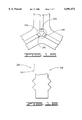
- FIG. 5 provides a plan view of a shaft of the spindle motor of FIG. 2, illustrating the general orientation of three corresponding connector pins which are inserted into the connector contact assemblies of the spindle motor connector.
- FIG. 6 provides an elevational, cross-sectional view of a selected one of the connector contact assemblies in conjunction with the corresponding connector pin in an uninserted state.
- FIG. 7 shows the connector contact assembly of FIG. 6 in a mated state.
- FIG. 8 provides an elevational partial cross-sectional view of a prior art connector contact assembly, provided for purposes of comparison with the connector contact assembly shown in FIGS. 6 and 7.
- FIGS. 9 through 11 provide cross-sectional views of alternative constructions for a central flexure portion of the connector contact assembly shown in FIGS. 6 and 7.
- FIG. 12 provides a partial cross-sectional view of tabs of a distal end of an alternative connector contact assembly, the tabs locking into a corresponding retention slot in the connector housing in order to facilitate the immobilization of the distal end during insertion of the connector pin.
- FIG. 13 provides an elevational, partial cross-sectional view of the connector contact assembly of FIG. 12, showing one of the tabs of the distal end of FIG. 12, as well as barbs of the contact base which serve to secure the contact base relative to the connector housing.
- FIG. 14 provides an elevational, partial cross-sectional view of FIG. 13 in greater detail, showing the retention slot of the connector housing and one of the tabs of the distal end to illustrate how the distal end is captured in the connector housing.
- FIG. 15 provides a bottom plan view of a portion of a spindle motor connector assembly, similar to the view of FIG. 4, illustrating the retention slots in the connector housing. For clarity, the associated connector contact assembly of FIGS. 12-14 has been omitted from FIG. 15.
- FIG. 16 provides a view of the barbs used to secure the distal end relative to the connector housing.
- FIG. 1 provides a top plan view of disc drive, which has been generally identified therein at 100.
- the disc drive 100 includes a base deck 102 on which various disc drive components are mounted.
- a top cover which has been omitted from FIG. 1 to facilitate the present discussion, cooperates with the base deck 102 to form an internal, sealed environment for the disc drive 100.
- spindle motor 104 Of particular interest is a spindle motor 104, the interconnection of which is accomplished in accordance with a preferred embodiment of the present invention and will be discussed below in greater detail. Initially, however, it will be understood that the spindle motor 104 is provided in order to rotate a stack of axially aligned magnetic discs 106 at a constant high speed. A conventional disc clamp 108 is used to secure the discs 106 to the spindle motor 104.
- remaining portions of the disc drive 100 include a controllably positionable actuator assembly 110 which rotates about a cartridge bearing assembly 112 in response to currents applied to a coil 113 of a voice coil motor 114.
- Actuator arms 116 extend from the actuator assembly 110 and are interposed adjacent the discs 106, with flexures 118 extending from distal ends of the actuator arms 116 as shown. Heads 120 used to transfer data to the discs 106 are suspended by the flexures 118.
- a latch 122 is used to secure the actuator assembly 110 when the disc drive 100 is non-operational and a flex circuit assembly 124 facilitates the transfer of data and power between the actuator assembly 110 and a disc drive printed wiring assembly (PWA) mounted to the underside of the disc drive 100 (the PWA is not shown in FIG. 1).
- PWA disc drive printed wiring assembly
- FIG. 2 shown therein is a side elevational, partial cross-sectional view of relevant portions of the disc drive 100 of FIG. 1, including the spindle motor 104, which is mounted to the base deck 102 as shown.
- the discs 106 and the disc clamp 108 of FIG. 1 have been omitted from FIG. 2.
- spindle motor connector 130 constructed in accordance with a preferred embodiment of the present invention. Top and bottom views of the spindle motor connector 130 are shown in FIGS. 3 and 4.
- the spindle motor connector 130 is mounted to the disc drive PWA (denoted at 132) and interconnects with the spindle motor 104 in order to facilitate the passage of drive current from the PWA 132 to the spindle motor 104.
- the spindle motor connector 130 Before discussing the spindle motor connector 130 in detail, however, various features of the construction of the spindle motor 104 will first be briefly reviewed in order to facilitate the present discussion.
- the spindle motor 104 includes a rotatable rotor housing 134 which rotates by way of ball bearing assemblies 136 about a stationary shaft assembly 138.
- a series of coils 140 mounted to the shaft assembly 138 magnetically interact with a series of permanent magnets 142 mounted to the rotor housing 134 in response to the application of current to the coils 140 during back electromagnetic force (bemf) commutation of the spindle motor 104 by spindle motor circuitry (not shown) on the PWA 132.
- spindle motor circuitry not shown
- the coils 140 are wrapped around laminated pole pieces 144 in a conventional manner.
- Coil wires 146 are routed from the coils 140 down a central opening (not designated) in the shaft assembly 138 to three connector pins 150, which are inserted into the spindle motor connector 130.
- the spindle motor connector 130 is provided with an outer ring 152 which supports a central housing 154 by way of three spoke arms 156, all of which are fabricated from insulative plastic.
- the central housing 154 extends upwardly from the spoke arms 156 for receipt into the shaft assembly 138, as shown more clearly in FIG. 2.
- Electrical leads 158 are supported by the spoke arms 156 and terminate at connector contact assemblies 160 (also referred to as "contact assemblies") which cooperate with the aforementioned pins 150 of the spindle motor 104 to establish electrical interconnections between the PWA 132 and the spindle motor 104. Ends 162 of the electrical leads 158 opposite the contact assemblies 160 are soldered to the PWA 132 and serve to secure the spindle motor connector 130 to the PWA 132.
- Support arms 164 are disposed adjacent the ends 162 and pin features 166 are additionally provided, as desired, to further assist in properly orienting the spindle motor connector 130 on the PWA 132.
- pin features 166 are additionally provided, as desired, to further assist in properly orienting the spindle motor connector 130 on the PWA 132.
- the pins 150 extending from the shaft 138 of the spindle motor 104 are supported by an insulative plug 168, the plug 168 further serving to seal interior portions of the spindle motor 104.
- the pins 150 are located at positions closely adjacent an inside surface (not designated) of the shaft assembly 138, as shown in FIG. 5; hence, the central housing 154 does not extend completely around the connector contact assemblies 160 of the spindle motor connector 130.
- FIG. 6 shows a selected one of the connector contact assemblies 160 of the spindle motor connector 130 in greater detail, the connector contact assembly 160 being constructed in accordance with a preferred embodiment of the present invention.
- the connector contact assembly 160 includes a first surface 170 of the central housing 154, the first surface 170 preferably extending in a direction that is substantially parallel to a pin insertion axis along which the connector pin 150 is inserted.
- a second surface 171 of the central housing 154 is shown to extend in a direction substantially toward the pin 150.
- the central housing 154 is formed from a rigid, nonconductive material (such as injection molded plastic) so as to provide electrical insulation for the spindle motor connector 130.
- the contact assembly 160 further comprises a contact base 172 which is rigidly secured to the first surface 170 of the contact housing 154. More particularly, the contact base 172 abuts the surface 170 and remains affixed thereto during (and after) insertion of the connector pin 150. This is because the contact base 172 is electrically connected to the associated electrical lead 158 (previously discussed with respect to FIGS. 3 and 4), which tends to retain the contact base 172 against the surface 170. Other methodologies including barbs can additionally be used to ensure the contact base 172 remains rigidly secured relative to the surface 170.
- Attached to the contact base 172 is a central flexure 174 which extends from the contact base 172 along a curvilinear path away from the surface 170 and upward in a direction substantially toward the pin 150, as shown.
- a distal end 176 is placed adjacent the second surface 171, the second surface 171 limiting movement of the distal end 176 when the connector pin 150 is inserted.
- insertion of the connector pin 150 into the contact assembly 160 causes the central flexure 174 to be deflected in a direction toward the surface 170. More particularly, because the contact base 172 and the distal end 176 are rigidly retained by the first and second surfaces 170, 171, respectively, the central flexure 174 is the only portion of the contact assembly 160 that is allowed to move in response to the insertion of the connector pin 150. Thus, as the central flexure 174 is deformed by insertion of the connector pin 150 along the pin insertion axis (as indicated by arrow 180), the central flexure 174 exerts a substantial normal force against the pin 150, thereby providing a reliable electrical interconnection between the connector pin 150 and the central flexure 174. Such a reliable interconnection is particularly desirable to accommodate the passage of currents as high as five to ten amps in peak magnitude, which are commonly provided to spindle motors such as shown at 104 during start-up.
- the central flexure 174 includes first, second and third curved sections which are denoted at 182, 184 and 186, respectively, with the first and third curved sections 182, 186 maintaining a generally convex orientation with respect to the pin insertion axis (along arrow 180) and the second curved section 184 maintaining a generally concave orientation with respect to the pin insertion axis.
- the connector pin 150 after moving past the distal end 176, initially contacts the first curved section 182 and deflects the first and second curved sections 182, 184 toward the first surface 170.
- the second curved section 184 may or may not actually contact the first surface 170, depending upon the configuration of the contact assembly 160, as discussed in greater detail below.
- the connector assembly 160 provides significant advantages over the prior art, in that the contact base 172 is immobilized by the first surface 170 and the distal end 176 is limited to rotational movement by the second surface 171. Because the contact base 172 and the distal end 176 are so fixed during (and after) insertion, the central flexure 174 is substantially the only portion of the contact assembly 160 which is allowed to move. This results in the exertion of a highly controllable normal force by the central flexure 174 against the connector pin 150 in accordance with the tensile strength and shape of the central flexure 174. Further, stresses in the central flexure 174 are distributed substantially over the length of the central flexure 174, unlike typical connectors of the prior art. Such advantages of the connector assembly 160 can be readily observed when viewed in contrast with a typical prior art contact assembly, such as shown at 190 in FIG. 8.
- the prior art contact assembly 190 is shown to include a contact base 192 placed against a housing 194, a contact spring 196 extending from the contact base 192 and a tab 198 extending from the contact spring 196 toward the housing 194.
- a distal end of the contact spring 196 is identified at 200 and is free to move with respect to the housing 194.
- the tab 198 is contiguous with the contact spring 196 and bent forward therefrom as a result of an upside-down unshaped cut in the contact spring 196.
- FIGS. 9-11 shown therein are cross-sectional representations of alternative preferred embodiments for the first curved section 182 of the central flexure 174 shown in FIGS. 6 and 7, in conjunction with the connector pin 150.
- the first curved section 182 can be formed as a contiguous ribbon as discussed above, the first curved section can be alternatively provided with a central channel 204 (as shown in FIG. 9) so that two discrete portions 206 contact the connector pin 150.
- the first curved section 182 comprises a v-shaped portion 208 which contacts the connector pin 150.
- the first curved section 182 is provided with a dimple 210. It will be recognized that these alternative embodiments serve to provide improved interconnection between the first curved section 182 and the connector pin 150.
- FIG. 12 shown therein is a top plan, partial cross-sectional view of an alternative configuration for a connector contact assembly 220 generally similar to the contact assembly 160 discussed above, in order to illustrate another preferred embodiment of the present invention. More particularly, FIG. 12 shows tabs 222 extending from a distal end 224 and locking into a t-shaped retention slot 226 extending through an associated, alternative connector housing 228.
- FIG. 13 provides an elevational, partial cross-sectional view of the connector contact assembly 220 of FIG. 12, showing the cooperative relationship of the distal end 224 (with locking tabs 222) and the retention slot 226.
- FIG. 13 provides an elevational, partial cross-sectional view of the connector contact assembly 220 of FIG. 12, showing the cooperative relationship of the distal end 224 (with locking tabs 222) and the retention slot 226.
- FIG. 14 provides an elevational, partial cross-sectional view of FIG. 13, showing the retention slot 226 and the distal end 226 with one of the locking tabs 222.
- a second surface 234 of the retention slot 226 serves to limit movement, and thereby capture, the distal end 226 of the connector contact assembly 220.
- FIG. 15 provides a bottom plan view of a portion of a spindle motor connector assembly (not numerically designated), similar to the view of FIG. 4, illustrating the t-shaped retention slots 226 extending into the connector housing 228. It will be understood that the contact portion of the contact assembly 220 (comprising the distal end 224, the central flexure 230 and the contact base 232) has been omitted from FIG. 15.
- the distal end 224 (with the tabs 222) are inserted into the retention slot 226 from the bottom of the connector housing 228 and slid up until the distal end 224 contacts the second surface 234 of the retention slot 226.
- the distal end 232 is then secured in place against a first surface 236 (shown in broken line fashion in FIG. 16) of the retention slot 226 through an interference fit between the first surface 236 and barbs 238 extending from the contact base 232 (said barbs further shown back in FIG. 13). Accordingly, the contact base 232 and the distal end 224 are secured against the first and second surfaces 236, 234 so that insertion of the connector pin 150 causes deflection of the central flexure 230 toward the connector housing 228.
- the present invention is directed to a connector contact assembly (such as 160, 220) for receiving insertion of a corresponding connector pin (such as 150) to establish an interconnected electrically conductive path.
- the connector contact assembly is suitable for use, for example, to provide drive current to a spindle motor (such as 104) of a disc drive (such as 100).
- the connector contact assembly comprises a rigid, nonconductive housing (such as 154, 228) having a first surface (such as 170, 236) and a second surface (such as 171, 234).
- the contact comprises a contact base (such as 172, 232) which is rigidly secured to the first surface, a central flexure (such as 174, 230) which extends from the contact base along a curvilinear path apart from the first surface, and a distal end (such as 176, 224) which is adjacent the second surface, with the second surface limiting movement of the distal end in a direction parallel to the pin insertion axis (such as along 180).
- the first and second surfaces capture the contact base and the distal end, respectively, as the connector pin contacts and deflects the central flexure.
Landscapes
- Coupling Device And Connection With Printed Circuit (AREA)
Abstract
Description
Claims (12)
Priority Applications (1)
| Application Number | Priority Date | Filing Date | Title |
|---|---|---|---|
| US09/016,746 US6091572A (en) | 1998-01-30 | 1998-01-30 | Connector contact assembly with high normal force compression |
Applications Claiming Priority (1)
| Application Number | Priority Date | Filing Date | Title |
|---|---|---|---|
| US09/016,746 US6091572A (en) | 1998-01-30 | 1998-01-30 | Connector contact assembly with high normal force compression |
Publications (1)
| Publication Number | Publication Date |
|---|---|
| US6091572A true US6091572A (en) | 2000-07-18 |
Family
ID=21778739
Family Applications (1)
| Application Number | Title | Priority Date | Filing Date |
|---|---|---|---|
| US09/016,746 Expired - Fee Related US6091572A (en) | 1998-01-30 | 1998-01-30 | Connector contact assembly with high normal force compression |
Country Status (1)
| Country | Link |
|---|---|
| US (1) | US6091572A (en) |
Cited By (4)
| Publication number | Priority date | Publication date | Assignee | Title |
|---|---|---|---|---|
| US6278573B1 (en) * | 1998-01-16 | 2001-08-21 | Mitsumi Electric Co., Ltd. | Floppy disk drive having dustproof structure for high capacity floppy disk |
| US6652324B2 (en) * | 2000-07-10 | 2003-11-25 | Seagate Technology Llc | Self-biasing spindle motor connector |
| US20050018352A1 (en) * | 2003-07-24 | 2005-01-27 | Samsung Electronics Co., Ltd. | Flexible printed circuit for spindle motor and disk drive having the same |
| US20130149879A1 (en) * | 2011-12-12 | 2013-06-13 | Tyco Electronics Japan G.K. | Connector |
Citations (5)
| Publication number | Priority date | Publication date | Assignee | Title |
|---|---|---|---|---|
| US4679890A (en) * | 1984-06-25 | 1987-07-14 | American Telephone And Telegraph Company, At&T Bell Laboratories | Connector contact terminal |
| US5083927A (en) * | 1991-01-03 | 1992-01-28 | International Business Machines Corporation | Solderless compliant socket |
| US5154621A (en) * | 1991-07-29 | 1992-10-13 | Zierick Manufacturing Corporation | Printed circuit board contact system |
| US5631999A (en) * | 1995-09-06 | 1997-05-20 | Seagate Technology Inc. | Adaptive compensation for hard disc drive spindle motor manufacturing tolerances |
| US5705868A (en) * | 1996-04-25 | 1998-01-06 | Seagate Technology, Inc. | Spindle motor connector having supported electrical leads |
-
1998
- 1998-01-30 US US09/016,746 patent/US6091572A/en not_active Expired - Fee Related
Patent Citations (5)
| Publication number | Priority date | Publication date | Assignee | Title |
|---|---|---|---|---|
| US4679890A (en) * | 1984-06-25 | 1987-07-14 | American Telephone And Telegraph Company, At&T Bell Laboratories | Connector contact terminal |
| US5083927A (en) * | 1991-01-03 | 1992-01-28 | International Business Machines Corporation | Solderless compliant socket |
| US5154621A (en) * | 1991-07-29 | 1992-10-13 | Zierick Manufacturing Corporation | Printed circuit board contact system |
| US5631999A (en) * | 1995-09-06 | 1997-05-20 | Seagate Technology Inc. | Adaptive compensation for hard disc drive spindle motor manufacturing tolerances |
| US5705868A (en) * | 1996-04-25 | 1998-01-06 | Seagate Technology, Inc. | Spindle motor connector having supported electrical leads |
Cited By (6)
| Publication number | Priority date | Publication date | Assignee | Title |
|---|---|---|---|---|
| US6278573B1 (en) * | 1998-01-16 | 2001-08-21 | Mitsumi Electric Co., Ltd. | Floppy disk drive having dustproof structure for high capacity floppy disk |
| US6652324B2 (en) * | 2000-07-10 | 2003-11-25 | Seagate Technology Llc | Self-biasing spindle motor connector |
| US20050018352A1 (en) * | 2003-07-24 | 2005-01-27 | Samsung Electronics Co., Ltd. | Flexible printed circuit for spindle motor and disk drive having the same |
| US7187518B2 (en) * | 2003-07-24 | 2007-03-06 | Samsung Electronics Co., Ltd. | Flexible printed circuit for spindle motor and disk drive having the same |
| US20130149879A1 (en) * | 2011-12-12 | 2013-06-13 | Tyco Electronics Japan G.K. | Connector |
| US9054450B2 (en) * | 2011-12-12 | 2015-06-09 | Tyco Electronics Japan G.K. | Connector |
Similar Documents
| Publication | Publication Date | Title |
|---|---|---|
| US6528914B2 (en) | Snap on flexible printed circuit connector | |
| US5705868A (en) | Spindle motor connector having supported electrical leads | |
| US6702592B1 (en) | Printed circuit board assembly with secondary side rigid electrical pin to mate with compliant contact | |
| US5815345A (en) | Support flange having electrical contacts to provide electrical continuity upon spindle motor mounting to base | |
| US5966267A (en) | Long arm compression connector with bump header | |
| US5600193A (en) | Motor | |
| US20040164642A1 (en) | Slip ring unit with a printed circuit board | |
| JP2001085131A (en) | Electrical connector | |
| US6529350B1 (en) | Head assembly and suspension having a terminal section with a bend for contact | |
| JPH05115148A (en) | Small motor | |
| PL178956B1 (en) | Electric motor rotor PL PL | |
| JP4134273B1 (en) | Rotating connector | |
| CA2021889A1 (en) | Electrical connector with attachment for automatically shorting select conductors upon disconnection of connector | |
| US6445535B1 (en) | Disk drive with spindle motor and electrical connection arrangement | |
| US6617742B2 (en) | Star connected rotor | |
| US6188155B1 (en) | Spindle motor | |
| TWM276361U (en) | Cable assembly having power contacts | |
| KR100346665B1 (en) | Cordless compression motor connector for a hard disk drive | |
| US5941739A (en) | Electrical connection system for a full erase head assembly of a video cassette recorder | |
| JPH01137577A (en) | Zif connector | |
| US6210196B1 (en) | Electrical connector | |
| JP3011150B2 (en) | Connector device | |
| US7149051B2 (en) | Hard disk drive with connector assembly | |
| MY127018A (en) | Electric motor with connector element on foil-shaped insulating substrate. | |
| EP0463889A2 (en) | Electric-powered tool |
Legal Events
| Date | Code | Title | Description |
|---|---|---|---|
| AS | Assignment |
Owner name: SEAGATE TECHNOLOGY, INC., CALIFORNIA Free format text: ASSIGNMENT OF ASSIGNORS INTEREST;ASSIGNOR:COX, ALVIN E.;REEL/FRAME:009000/0663 Effective date: 19980130 |
|
| AS | Assignment |
Owner name: SEAGATE TECHNOLOGY LLC, CALIFORNIA Free format text: ASSIGNMENT OF ASSIGNORS INTEREST;ASSIGNOR:SEAGATE TECHNOLOGY, INC.;REEL/FRAME:010979/0309 Effective date: 20000628 |
|
| AS | Assignment |
Owner name: JPMORGAN CHASE BANK, AS COLLATERAL AGENT, NEW YORK Free format text: SECURITY AGREEMENT;ASSIGNOR:SEAGATE TECHNOLOGY LLC;REEL/FRAME:013177/0001 Effective date: 20020513 Owner name: JPMORGAN CHASE BANK, AS COLLATERAL AGENT,NEW YORK Free format text: SECURITY AGREEMENT;ASSIGNOR:SEAGATE TECHNOLOGY LLC;REEL/FRAME:013177/0001 Effective date: 20020513 |
|
| FEPP | Fee payment procedure |
Free format text: PAYOR NUMBER ASSIGNED (ORIGINAL EVENT CODE: ASPN); ENTITY STATUS OF PATENT OWNER: LARGE ENTITY |
|
| FPAY | Fee payment |
Year of fee payment: 4 |
|
| AS | Assignment |
Owner name: SEAGATE TECHNOLOGY LLC, CALIFORNIA Free format text: RELEASE OF SECURITY INTERESTS IN PATENT RIGHTS;ASSIGNOR:JPMORGAN CHASE BANK, N.A., AS ADMINISTRATIVE AGENT (FORMERLY KNOWN AS THE CHASE MANHATTAN BANK);REEL/FRAME:016945/0763 Effective date: 20051130 |
|
| FPAY | Fee payment |
Year of fee payment: 8 |
|
| REMI | Maintenance fee reminder mailed | ||
| AS | Assignment |
Owner name: WELLS FARGO BANK, NATIONAL ASSOCIATION, AS COLLATERAL AGENT AND SECOND PRIORITY REPRESENTATIVE, CALIFORNIA Free format text: SECURITY AGREEMENT;ASSIGNORS:MAXTOR CORPORATION;SEAGATE TECHNOLOGY LLC;SEAGATE TECHNOLOGY INTERNATIONAL;REEL/FRAME:022757/0017 Effective date: 20090507 Owner name: JPMORGAN CHASE BANK, N.A., AS ADMINISTRATIVE AGENT AND FIRST PRIORITY REPRESENTATIVE, NEW YORK Free format text: SECURITY AGREEMENT;ASSIGNORS:MAXTOR CORPORATION;SEAGATE TECHNOLOGY LLC;SEAGATE TECHNOLOGY INTERNATIONAL;REEL/FRAME:022757/0017 Effective date: 20090507 Owner name: JPMORGAN CHASE BANK, N.A., AS ADMINISTRATIVE AGENT Free format text: SECURITY AGREEMENT;ASSIGNORS:MAXTOR CORPORATION;SEAGATE TECHNOLOGY LLC;SEAGATE TECHNOLOGY INTERNATIONAL;REEL/FRAME:022757/0017 Effective date: 20090507 Owner name: WELLS FARGO BANK, NATIONAL ASSOCIATION, AS COLLATE Free format text: SECURITY AGREEMENT;ASSIGNORS:MAXTOR CORPORATION;SEAGATE TECHNOLOGY LLC;SEAGATE TECHNOLOGY INTERNATIONAL;REEL/FRAME:022757/0017 Effective date: 20090507 |
|
| AS | Assignment |
Owner name: SEAGATE TECHNOLOGY INTERNATIONAL, CALIFORNIA Free format text: RELEASE;ASSIGNOR:JPMORGAN CHASE BANK, N.A., AS ADMINISTRATIVE AGENT;REEL/FRAME:025662/0001 Effective date: 20110114 Owner name: MAXTOR CORPORATION, CALIFORNIA Free format text: RELEASE;ASSIGNOR:JPMORGAN CHASE BANK, N.A., AS ADMINISTRATIVE AGENT;REEL/FRAME:025662/0001 Effective date: 20110114 Owner name: SEAGATE TECHNOLOGY LLC, CALIFORNIA Free format text: RELEASE;ASSIGNOR:JPMORGAN CHASE BANK, N.A., AS ADMINISTRATIVE AGENT;REEL/FRAME:025662/0001 Effective date: 20110114 Owner name: SEAGATE TECHNOLOGY HDD HOLDINGS, CALIFORNIA Free format text: RELEASE;ASSIGNOR:JPMORGAN CHASE BANK, N.A., AS ADMINISTRATIVE AGENT;REEL/FRAME:025662/0001 Effective date: 20110114 |
|
| AS | Assignment |
Owner name: THE BANK OF NOVA SCOTIA, AS ADMINISTRATIVE AGENT, CANADA Free format text: SECURITY AGREEMENT;ASSIGNOR:SEAGATE TECHNOLOGY LLC;REEL/FRAME:026010/0350 Effective date: 20110118 Owner name: THE BANK OF NOVA SCOTIA, AS ADMINISTRATIVE AGENT, Free format text: SECURITY AGREEMENT;ASSIGNOR:SEAGATE TECHNOLOGY LLC;REEL/FRAME:026010/0350 Effective date: 20110118 |
|
| REMI | Maintenance fee reminder mailed | ||
| LAPS | Lapse for failure to pay maintenance fees | ||
| STCH | Information on status: patent discontinuation |
Free format text: PATENT EXPIRED DUE TO NONPAYMENT OF MAINTENANCE FEES UNDER 37 CFR 1.362 |
|
| FP | Lapsed due to failure to pay maintenance fee |
Effective date: 20120718 |
|
| AS | Assignment |
Owner name: SEAGATE TECHNOLOGY US HOLDINGS, INC., CALIFORNIA Free format text: TERMINATION AND RELEASE OF SECURITY INTEREST IN PATENT RIGHTS;ASSIGNOR:WELLS FARGO BANK, NATIONAL ASSOCIATION, AS COLLATERAL AGENT AND SECOND PRIORITY REPRESENTATIVE;REEL/FRAME:030833/0001 Effective date: 20130312 Owner name: EVAULT INC. (F/K/A I365 INC.), CALIFORNIA Free format text: TERMINATION AND RELEASE OF SECURITY INTEREST IN PATENT RIGHTS;ASSIGNOR:WELLS FARGO BANK, NATIONAL ASSOCIATION, AS COLLATERAL AGENT AND SECOND PRIORITY REPRESENTATIVE;REEL/FRAME:030833/0001 Effective date: 20130312 Owner name: SEAGATE TECHNOLOGY LLC, CALIFORNIA Free format text: TERMINATION AND RELEASE OF SECURITY INTEREST IN PATENT RIGHTS;ASSIGNOR:WELLS FARGO BANK, NATIONAL ASSOCIATION, AS COLLATERAL AGENT AND SECOND PRIORITY REPRESENTATIVE;REEL/FRAME:030833/0001 Effective date: 20130312 Owner name: SEAGATE TECHNOLOGY INTERNATIONAL, CAYMAN ISLANDS Free format text: TERMINATION AND RELEASE OF SECURITY INTEREST IN PATENT RIGHTS;ASSIGNOR:WELLS FARGO BANK, NATIONAL ASSOCIATION, AS COLLATERAL AGENT AND SECOND PRIORITY REPRESENTATIVE;REEL/FRAME:030833/0001 Effective date: 20130312 |
|
| AS | Assignment |
Owner name: SEAGATE TECHNOLOGY PUBLIC LIMITED COMPANY, CALIFORNIA Free format text: RELEASE BY SECURED PARTY;ASSIGNOR:THE BANK OF NOVA SCOTIA;REEL/FRAME:072193/0001 Effective date: 20250303 Owner name: SEAGATE TECHNOLOGY, CALIFORNIA Free format text: RELEASE BY SECURED PARTY;ASSIGNOR:THE BANK OF NOVA SCOTIA;REEL/FRAME:072193/0001 Effective date: 20250303 Owner name: SEAGATE TECHNOLOGY HDD HOLDINGS, CALIFORNIA Free format text: RELEASE BY SECURED PARTY;ASSIGNOR:THE BANK OF NOVA SCOTIA;REEL/FRAME:072193/0001 Effective date: 20250303 Owner name: I365 INC., CALIFORNIA Free format text: RELEASE BY SECURED PARTY;ASSIGNOR:THE BANK OF NOVA SCOTIA;REEL/FRAME:072193/0001 Effective date: 20250303 Owner name: SEAGATE TECHNOLOGY LLC, CALIFORNIA Free format text: RELEASE BY SECURED PARTY;ASSIGNOR:THE BANK OF NOVA SCOTIA;REEL/FRAME:072193/0001 Effective date: 20250303 Owner name: SEAGATE TECHNOLOGY INTERNATIONAL, CAYMAN ISLANDS Free format text: RELEASE BY SECURED PARTY;ASSIGNOR:THE BANK OF NOVA SCOTIA;REEL/FRAME:072193/0001 Effective date: 20250303 Owner name: SEAGATE HDD CAYMAN, CAYMAN ISLANDS Free format text: RELEASE BY SECURED PARTY;ASSIGNOR:THE BANK OF NOVA SCOTIA;REEL/FRAME:072193/0001 Effective date: 20250303 Owner name: SEAGATE TECHNOLOGY (US) HOLDINGS, INC., CALIFORNIA Free format text: RELEASE BY SECURED PARTY;ASSIGNOR:THE BANK OF NOVA SCOTIA;REEL/FRAME:072193/0001 Effective date: 20250303 Owner name: SEAGATE TECHNOLOGY PUBLIC LIMITED COMPANY, CALIFORNIA Free format text: RELEASE OF SECURITY INTEREST;ASSIGNOR:THE BANK OF NOVA SCOTIA;REEL/FRAME:072193/0001 Effective date: 20250303 Owner name: SEAGATE TECHNOLOGY, CALIFORNIA Free format text: RELEASE OF SECURITY INTEREST;ASSIGNOR:THE BANK OF NOVA SCOTIA;REEL/FRAME:072193/0001 Effective date: 20250303 Owner name: SEAGATE TECHNOLOGY HDD HOLDINGS, CALIFORNIA Free format text: RELEASE OF SECURITY INTEREST;ASSIGNOR:THE BANK OF NOVA SCOTIA;REEL/FRAME:072193/0001 Effective date: 20250303 Owner name: I365 INC., CALIFORNIA Free format text: RELEASE OF SECURITY INTEREST;ASSIGNOR:THE BANK OF NOVA SCOTIA;REEL/FRAME:072193/0001 Effective date: 20250303 Owner name: SEAGATE TECHNOLOGY LLC, CALIFORNIA Free format text: RELEASE OF SECURITY INTEREST;ASSIGNOR:THE BANK OF NOVA SCOTIA;REEL/FRAME:072193/0001 Effective date: 20250303 Owner name: SEAGATE TECHNOLOGY INTERNATIONAL, CAYMAN ISLANDS Free format text: RELEASE OF SECURITY INTEREST;ASSIGNOR:THE BANK OF NOVA SCOTIA;REEL/FRAME:072193/0001 Effective date: 20250303 Owner name: SEAGATE HDD CAYMAN, CAYMAN ISLANDS Free format text: RELEASE OF SECURITY INTEREST;ASSIGNOR:THE BANK OF NOVA SCOTIA;REEL/FRAME:072193/0001 Effective date: 20250303 Owner name: SEAGATE TECHNOLOGY (US) HOLDINGS, INC., CALIFORNIA Free format text: RELEASE OF SECURITY INTEREST;ASSIGNOR:THE BANK OF NOVA SCOTIA;REEL/FRAME:072193/0001 Effective date: 20250303 |