US6079525A - Brake unit consisting of a brake disk and a brake lining - Google Patents
Brake unit consisting of a brake disk and a brake lining Download PDFInfo
- Publication number
- US6079525A US6079525A US09/106,219 US10621998A US6079525A US 6079525 A US6079525 A US 6079525A US 10621998 A US10621998 A US 10621998A US 6079525 A US6079525 A US 6079525A
- Authority
- US
- United States
- Prior art keywords
- brake
- lining
- disk
- brake lining
- brake disk
- Prior art date
- Legal status (The legal status is an assumption and is not a legal conclusion. Google has not performed a legal analysis and makes no representation as to the accuracy of the status listed.)
- Expired - Fee Related
Links
Images




Classifications
-
- F—MECHANICAL ENGINEERING; LIGHTING; HEATING; WEAPONS; BLASTING
- F16—ENGINEERING ELEMENTS AND UNITS; GENERAL MEASURES FOR PRODUCING AND MAINTAINING EFFECTIVE FUNCTIONING OF MACHINES OR INSTALLATIONS; THERMAL INSULATION IN GENERAL
- F16D—COUPLINGS FOR TRANSMITTING ROTATION; CLUTCHES; BRAKES
- F16D69/00—Friction linings; Attachment thereof; Selection of coacting friction substances or surfaces
- F16D69/02—Composition of linings ; Methods of manufacturing
-
- C—CHEMISTRY; METALLURGY
- C04—CEMENTS; CONCRETE; ARTIFICIAL STONE; CERAMICS; REFRACTORIES
- C04B—LIME, MAGNESIA; SLAG; CEMENTS; COMPOSITIONS THEREOF, e.g. MORTARS, CONCRETE OR LIKE BUILDING MATERIALS; ARTIFICIAL STONE; CERAMICS; REFRACTORIES; TREATMENT OF NATURAL STONE
- C04B35/00—Shaped ceramic products characterised by their composition; Ceramics compositions; Processing powders of inorganic compounds preparatory to the manufacturing of ceramic products
- C04B35/515—Shaped ceramic products characterised by their composition; Ceramics compositions; Processing powders of inorganic compounds preparatory to the manufacturing of ceramic products based on non-oxide ceramics
- C04B35/56—Shaped ceramic products characterised by their composition; Ceramics compositions; Processing powders of inorganic compounds preparatory to the manufacturing of ceramic products based on non-oxide ceramics based on carbides or oxycarbides
- C04B35/565—Shaped ceramic products characterised by their composition; Ceramics compositions; Processing powders of inorganic compounds preparatory to the manufacturing of ceramic products based on non-oxide ceramics based on carbides or oxycarbides based on silicon carbide
- C04B35/573—Shaped ceramic products characterised by their composition; Ceramics compositions; Processing powders of inorganic compounds preparatory to the manufacturing of ceramic products based on non-oxide ceramics based on carbides or oxycarbides based on silicon carbide obtained by reaction sintering or recrystallisation
-
- C—CHEMISTRY; METALLURGY
- C04—CEMENTS; CONCRETE; ARTIFICIAL STONE; CERAMICS; REFRACTORIES
- C04B—LIME, MAGNESIA; SLAG; CEMENTS; COMPOSITIONS THEREOF, e.g. MORTARS, CONCRETE OR LIKE BUILDING MATERIALS; ARTIFICIAL STONE; CERAMICS; REFRACTORIES; TREATMENT OF NATURAL STONE
- C04B35/00—Shaped ceramic products characterised by their composition; Ceramics compositions; Processing powders of inorganic compounds preparatory to the manufacturing of ceramic products
- C04B35/71—Ceramic products containing macroscopic reinforcing agents
- C04B35/78—Ceramic products containing macroscopic reinforcing agents containing non-metallic materials
- C04B35/80—Fibres, filaments, whiskers, platelets, or the like
-
- F—MECHANICAL ENGINEERING; LIGHTING; HEATING; WEAPONS; BLASTING
- F16—ENGINEERING ELEMENTS AND UNITS; GENERAL MEASURES FOR PRODUCING AND MAINTAINING EFFECTIVE FUNCTIONING OF MACHINES OR INSTALLATIONS; THERMAL INSULATION IN GENERAL
- F16D—COUPLINGS FOR TRANSMITTING ROTATION; CLUTCHES; BRAKES
- F16D69/00—Friction linings; Attachment thereof; Selection of coacting friction substances or surfaces
- F16D69/02—Composition of linings ; Methods of manufacturing
- F16D69/023—Composite materials containing carbon and carbon fibres or fibres made of carbonizable material
-
- F—MECHANICAL ENGINEERING; LIGHTING; HEATING; WEAPONS; BLASTING
- F16—ENGINEERING ELEMENTS AND UNITS; GENERAL MEASURES FOR PRODUCING AND MAINTAINING EFFECTIVE FUNCTIONING OF MACHINES OR INSTALLATIONS; THERMAL INSULATION IN GENERAL
- F16D—COUPLINGS FOR TRANSMITTING ROTATION; CLUTCHES; BRAKES
- F16D69/00—Friction linings; Attachment thereof; Selection of coacting friction substances or surfaces
- F16D2069/003—Selection of coacting friction materials
-
- Y—GENERAL TAGGING OF NEW TECHNOLOGICAL DEVELOPMENTS; GENERAL TAGGING OF CROSS-SECTIONAL TECHNOLOGIES SPANNING OVER SEVERAL SECTIONS OF THE IPC; TECHNICAL SUBJECTS COVERED BY FORMER USPC CROSS-REFERENCE ART COLLECTIONS [XRACs] AND DIGESTS
- Y10—TECHNICAL SUBJECTS COVERED BY FORMER USPC
- Y10T—TECHNICAL SUBJECTS COVERED BY FORMER US CLASSIFICATION
- Y10T428/00—Stock material or miscellaneous articles
- Y10T428/24—Structurally defined web or sheet [e.g., overall dimension, etc.]
- Y10T428/24942—Structurally defined web or sheet [e.g., overall dimension, etc.] including components having same physical characteristic in differing degree
-
- Y—GENERAL TAGGING OF NEW TECHNOLOGICAL DEVELOPMENTS; GENERAL TAGGING OF CROSS-SECTIONAL TECHNOLOGIES SPANNING OVER SEVERAL SECTIONS OF THE IPC; TECHNICAL SUBJECTS COVERED BY FORMER USPC CROSS-REFERENCE ART COLLECTIONS [XRACs] AND DIGESTS
- Y10—TECHNICAL SUBJECTS COVERED BY FORMER USPC
- Y10T—TECHNICAL SUBJECTS COVERED BY FORMER US CLASSIFICATION
- Y10T428/00—Stock material or miscellaneous articles
- Y10T428/24—Structurally defined web or sheet [e.g., overall dimension, etc.]
- Y10T428/24942—Structurally defined web or sheet [e.g., overall dimension, etc.] including components having same physical characteristic in differing degree
- Y10T428/24992—Density or compression of components
-
- Y—GENERAL TAGGING OF NEW TECHNOLOGICAL DEVELOPMENTS; GENERAL TAGGING OF CROSS-SECTIONAL TECHNOLOGIES SPANNING OVER SEVERAL SECTIONS OF THE IPC; TECHNICAL SUBJECTS COVERED BY FORMER USPC CROSS-REFERENCE ART COLLECTIONS [XRACs] AND DIGESTS
- Y10—TECHNICAL SUBJECTS COVERED BY FORMER USPC
- Y10T—TECHNICAL SUBJECTS COVERED BY FORMER US CLASSIFICATION
- Y10T428/00—Stock material or miscellaneous articles
- Y10T428/30—Self-sustaining carbon mass or layer with impregnant or other layer
Definitions
- the present invention relates to a brake unit comprising a brake disk made of a fiber-reinforced ceramic C/SiC composite, which can be produced from a C/C pre-body, and a brake lining that tribologically interacts with the ceramic C/SiC composite.
- Brake disks of the above-mentioned type are known, for example, from German Patent Document DE 44 38 455.
- Another fiber-reinforced ceramic composite is described in German Patent Application 197 11 829.1, which is a prior publication.
- a fiber-reinforced ceramic C/SiC composite has high temperature stability and can therefore be very highly thermally stressed. It therefore presents a problem to find a suitable brake lining that can also be thermally stressed and is sufficiently resistant to wear. Because of the high temperatures occurring in the contact area, the use of conventional brake linings with an organic binder system or of conventional inorganically bound brake linings is particularly difficult.
- the brake lining is made of a fiber-reinforced ceramic C/SiC composite and can be produced from a C/C pre-body, whose density, before silicating, at least in the area close to the surface, is higher than the density of the C/C pre-body of the brake disk.
- the material of the brake lining is therefore basically the same material of which the brake disk is made.
- the production of the material is known to a person skilled in the art, for example, from German Patent Document DE 197 11 829.1.
- carbon fibers are mixed with a carbon precursor, for example, pyrolizable synthetic materials and optionally additional substances and are pressed to form a pre-body, the so-called "green compact".
- the green compact is subjected to a pyrolysis, in which the synthetic materials change to pyrolysis carbon.
- the C/C pre-body is finally infiltrated with liquid silicon and is heat-treated. This results in a ceramic, carbon-fiber-reinforced C/SiC body.
- the C/SiC brake disk is therefore paired with a brake lining which is of the same type of material, but is less hard.
- the lower hardness is the result of the lower silicon or silicon carbide fraction, which is lower than in the brake disk.
- the ceramic fraction is therefore lower and the carbon fraction is higher.
- the brake lining is therefore softer than the brake disk. It surprisingly exhibits a considerably longer service life and lower rates of wear than a lining of the same type that has approximately the same hardness.
- the lower hardness of the lining is therefore achieved by a higher density of the C/C pre-body.
- This density is generated by a lower pore volume of the C/C pre-body which is to be infiltrated with liquid silicon.
- the silicon carbide fraction in the ceramized brake lining is relatively small and finely distributed, and the carbon fraction is relatively high. Low porosity results in fewer and finer pore channels into which the silicon can penetrate.
- the resulting ceramic material exhibits a behavior that is similar to that of the C/C material; it is softer than the ceramic composite.
- the carbon causes the hardness, which is lower in comparison to completely ceramic silicon carbide bodies, and the mechanical adaptability of the brake lining with respect to the micro form of the irregularities of the brake disk surface.
- the remaining silicon carbide content causes a higher resistance to wear and thermal stressability of the brake lining.
- a C/C pre-body that has a lower density and a higher porosity in comparison to the pre-body of the brake lining.
- the liquid silicon can enter through many small pores so that finally the silicon fraction will be high and the resulting ceramic material will have a comparatively high density.
- the brake lining therefore consists of a fiber-reinforced ceramic material that has a tribologically optimized behavior which is adjusted to the brake disk in a targeted manner. It exhibits low wear, a high service life, a high damage tolerance and mainly a surprisingly high coefficient of friction.
- the high coefficient of friction has the result that the pressure to be exercised during a braking maneuver can be reduced. The wear is therefore reduced again.
- the brake unit according to the present invention can be individually adapted to the respective requirements. If it is found, for example, that the C/SiC brake disk has a wear that is too high for a special application, the fraction of silicon carbide in the disk can be lowered. Inversely, in the pertaining lining, the silicon carbide fraction should then be increased in order to ensure an optimal braking action, a high service life and a low wear. The hardness of the brake disk and the hardness of the brake lining can therefore be optimally adjusted to one another so that the whole brake unit will have a high service life while the wear is low. "Optimally" means, for example, that the brake disk has a wear that can hardly be measured and the brake linings exhibit a wear behavior that can be compared with that of conventional brake linings.
- the porosity of the C/C pre-body of the brake lining is at least in the area close to the surface approximately 20 to 30% lower than the porosity of the C/C pre-body of the brake disk.
- a preferred value for the density of the pre-body of the brake lining in the area close to the surface amounts to approximately 1.2-1.5 g/cm 3 , preferably 1.3 g/cm 3 .
- the brake lining and/or the brake disk consist of a material whose fibers are essentially isotropically oriented.
- a uniformly high thermal conductivity can be achieved transversely to the braking surface of the brake disk and the brake lining. This results in a lowering of the surface temperature in the case of stress. Excessive surface temperatures may lead to an excessive heating of the brake fluid.
- comfort stabilizers such as Cu, CaF 2 , MoS 2 , and SbS 3 .
- a carbon fiber body is produced which has a specific pore and/or capillary volume; this carbon fiber body is infiltrated by carbon and/or a carbon precursor; and by pyrolysis, a porous C/C pre-body is produced which, in turn, is infiltrated by liquid silicon, in which case the carbon is ceramized to silicon carbide at least in the area of the pores and capillaries close to the surface.
- the open pore and capillary volume of the C/C pre-body before the liquid silicating should be adjusted to maximally approximately 60% by volume, preferably approximately 40 to 50% by volume.
- the adjustment is essentially influenced by the temperature during the pressing of the green compact, the applied pressing pressure and the used raw materials.
- Another possibility of adjusting the capillary volume consists of entering the carbon precursor by means of resin transfer molding; that is, to act upon it by means of a certain pressure, charge it into the fiber body; and simultaneously evacuate the pores and capillaries of the carbon fiber body. A defined capillary size is reached according to the adjustment of the pressure or of the vacuum. The thus obtained green compact is then pyrolized.
- the adjustment can take place by means of the type of the mixing of the constituents during the manufacturing of the homogenate to be pressed.
- a powder or a paste of carbon particles can be doctored into the pores and capillaries.
- only areas close to the surface are changed into pyrolysis carbon and silicated in the next process step.
- the untreated surface areas and the interior remain as a C/C body.
- carbon powders, suspensions or pastes of carbon powders, graphite or pitch are suitable for being used as the carbon precursor, but also pyrolyzable polymers, such as vinyl resins or silicon-containing polymers, for example, from the group of polysilanes, polycarbosilanes, polyborosilazanes, polysilazanes, polycarbosilazanes and polyborocarbosilizanes.
- pyrolyzable polymers such as vinyl resins or silicon-containing polymers, for example, from the group of polysilanes, polycarbosilanes, polyborosilazanes, polysilazanes, polycarbosilazanes and polyborocarbosilizanes.
- FIG. 1 is a light-microscopical micrograph of a brake disk of a brake unit according to the present invention
- FIG. 2 is a light-microscopical micrograph of a brake lining with a high C/C content and a low SiC content;
- FIGS. 3a, b are microsections in various directions of a C/C material, which is optimized with respect to the lining, before the silicating, specifically in the pressing direction (FIG. 3a) and perpendicularly to the pressing direction (FIG. 3b);
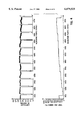
- FIG. 4 is a view of results of braking tests by means of a brake unit according to the present invention.
- FIG. 5 is a view of results of braking tests by means of a C--SiC brake disk and a brake lining made of the same material;
- FIG. 6 is a view of results of braking tests by means of a C--SiC brake disk and a C/C brake lining.
- FIG. 1 is a view of the micrograph of a brake disk of approximately 35 to 45% by volume fibers, approximately 40 to 50% by volume SiC and maximally approximately 15% by volume silicon.
- the structure is homogeneous; the fibers are arranged isotropically.
- the density amounts to approximately 2.25 g/cm 3 .
- FIG. 2 is a view of a C--SiC brake lining with a low SiC content.
- the density amounts to approximately 2.15 g/cm 3 .
- a green compact made of carbon fibers, carbon precursor and additional substances is pressed at pressures above 100 bar.
- FIGS. 3a and 3b Another optimized brake lining is illustrated in FIGS. 3a and 3b.
- FIG. 3a very clearly shows the relatively small channels through which only a little silicon has entered. The fiber structure has been retained, and the C-fraction is high.
- FIG. 3b shows that the fibers are essentially isotropically distributed. The density of the material amounts to approximately 2.15 g/cm 3 . The pressure during the pressing amounted to approximately 100 to 200 bar. In this case, the pore channels are pressed relatively tightly together.
- FIGS. 4 to 6 show test stand measurements with different combinations of materials of the brake disk and the brake lining.
- FIG. 4 shows the results obtained by means of the lining illustrated in FIGS. 3a and 3b.
- a brake disk according to FIG. 1 was used, which has a diameter of 285 mm.
- the linings measured 80 ⁇ 65 mm and were thermally shrunk into metallic holding devices.
- the applied pressures amounted to 10-30 bar, at points up to 50 bar.
- the speeds were at 60-200 km/h.
- the measured coefficient of friction was above 0.5.
- the temperature in the disk center was below 400° C.
- the measured values exhibited a very good constancy as a function of the applied pressures and speeds.
- the constancy of the temperature was also very good. A fading could not be observed.
- the measured overall wear after the conclusion of the complete measuring program amounted to 0.05 mm in the case of the brake disk and 1 g in the case of the brake lining.
- FIG. 5 shows the same measurement by means of a C/SiC brake disk and a C/SiC brake lining.
- the coefficient of friction was at a very good 0.6.
- the temperature in the disk center did not rise above 300° C.
- the wear data were unsatisfactory.
- the wear was 0.25 mm; in the case of the brake lining, 1.0 g.
- the hard and brittle brake lining causes a measurable abrasion on the brake disk. This is accompanied by a considerable loss of material in the case of the brake lining itself.
- FIG. 6 shows another comparative measurement by means of a C/SiC brake disk and a C/C brake lining.
- the coefficient of friction clearly was poorer.
- the brake disk exhibited no measurable wear.
- the loss of material amounted to 2.5 g.
- the brake lining is too soft in order to withstand the effect of the hard and brittle brake disk over time.
Landscapes
- Engineering & Computer Science (AREA)
- Chemical & Material Sciences (AREA)
- Ceramic Engineering (AREA)
- General Engineering & Computer Science (AREA)
- Materials Engineering (AREA)
- Chemical Kinetics & Catalysis (AREA)
- Mechanical Engineering (AREA)
- Manufacturing & Machinery (AREA)
- Structural Engineering (AREA)
- Organic Chemistry (AREA)
- Composite Materials (AREA)
- Braking Arrangements (AREA)
- Ceramic Products (AREA)
Abstract
Description
Claims (7)
Priority Applications (1)
| Application Number | Priority Date | Filing Date | Title |
|---|---|---|---|
| US09/474,135 US6248269B1 (en) | 1997-06-28 | 1999-12-29 | Process for manufacturing a brake lining |
Applications Claiming Priority (2)
| Application Number | Priority Date | Filing Date | Title |
|---|---|---|---|
| DE19727586 | 1997-06-28 | ||
| DE19727586A DE19727586C2 (en) | 1997-06-28 | 1997-06-28 | Brake unit consisting of brake disc and brake pad |
Related Child Applications (1)
| Application Number | Title | Priority Date | Filing Date |
|---|---|---|---|
| US09/474,135 Division US6248269B1 (en) | 1997-06-28 | 1999-12-29 | Process for manufacturing a brake lining |
Publications (1)
| Publication Number | Publication Date |
|---|---|
| US6079525A true US6079525A (en) | 2000-06-27 |
Family
ID=7833973
Family Applications (2)
| Application Number | Title | Priority Date | Filing Date |
|---|---|---|---|
| US09/106,219 Expired - Fee Related US6079525A (en) | 1997-06-28 | 1998-06-29 | Brake unit consisting of a brake disk and a brake lining |
| US09/474,135 Expired - Fee Related US6248269B1 (en) | 1997-06-28 | 1999-12-29 | Process for manufacturing a brake lining |
Family Applications After (1)
| Application Number | Title | Priority Date | Filing Date |
|---|---|---|---|
| US09/474,135 Expired - Fee Related US6248269B1 (en) | 1997-06-28 | 1999-12-29 | Process for manufacturing a brake lining |
Country Status (5)
| Country | Link |
|---|---|
| US (2) | US6079525A (en) |
| EP (1) | EP0887572B1 (en) |
| JP (1) | JP2964456B2 (en) |
| DE (2) | DE19727586C2 (en) |
| ES (1) | ES2178797T3 (en) |
Cited By (21)
| Publication number | Priority date | Publication date | Assignee | Title |
|---|---|---|---|---|
| US20020179225A1 (en) * | 2000-03-24 | 2002-12-05 | Thomas Behr | Fiber-reinforced structural component |
| US6531011B2 (en) * | 1998-09-15 | 2003-03-11 | Daimler Benz Ag | Brake unit having a nonmetallic brake disc of ceramic and a hub of a different material |
| US6668985B2 (en) * | 2000-09-14 | 2003-12-30 | Inventio Ag | Safety braking device for elevator |
| US20040038032A1 (en) * | 2002-08-20 | 2004-02-26 | Walker Terence B. | High temperature oxidation inhibitors for carbon-carbon friction materials |
| US6703117B2 (en) | 2000-09-26 | 2004-03-09 | Sgl Carbon Ag | Friction body or sliding body formed from composite materials reinforced with fiber bundles and containing a ceramics matrix and process for the production of a friction or sliding body |
| US6723193B2 (en) * | 2000-12-01 | 2004-04-20 | Dr. Ing. H.C.F. Porsche Ag | Friction body of silicon-infiltrated, carbon fiber-reinforced porous carbon and method for making same |
| EP1416185A1 (en) * | 2002-07-24 | 2004-05-06 | Sgl Carbon Ag | Fibre-reinforced ceramic brake lining |
| US6749937B2 (en) | 2002-03-19 | 2004-06-15 | Honeywell International Inc. | Melt-infiltrated pitch-pan preforms |
| EP1457472A1 (en) * | 2003-03-11 | 2004-09-15 | ARC Seibersdorf research GmbH | Composite material and process for its production |
| US20050011706A1 (en) * | 2003-07-15 | 2005-01-20 | Dunlop Aerospace Limited | Composite article |
| US6855428B2 (en) | 2000-09-29 | 2005-02-15 | B. F. Goodrich Company | Boron carbide based ceramic matrix composites |
| US20050040004A1 (en) * | 2003-08-20 | 2005-02-24 | Sgl Carbon Ag | Clutch linings comprising fiber-reinforced ceramic materials |
| US20050072637A1 (en) * | 2003-10-02 | 2005-04-07 | Sgl Carbon Ag | Friction pairing for parking brakes in motor vehicles |
| US20050181209A1 (en) * | 1999-08-20 | 2005-08-18 | Karandikar Prashant G. | Nanotube-containing composite bodies, and methods for making same |
| US20050183909A1 (en) * | 2004-01-21 | 2005-08-25 | Rau Charles B.Iii | Disc brake rotor assembly and method for producing same |
| US20060062985A1 (en) * | 2004-04-26 | 2006-03-23 | Karandikar Prashant G | Nanotube-containing composite bodies, and methods for making same |
| US7169465B1 (en) | 1999-08-20 | 2007-01-30 | Karandikar Prashant G | Low expansion metal-ceramic composite bodies, and methods for making same |
| US7244034B1 (en) | 1999-08-20 | 2007-07-17 | M Cubed Technologies, Inc. | Low CTE metal-ceramic composite articles, and methods for making same |
| US10081171B2 (en) | 2015-07-30 | 2018-09-25 | Diehl Metall Stiftung & Co. Kg | Method for producing a synchronizer ring |
| CN108662050A (en) * | 2018-03-26 | 2018-10-16 | 武汉理工大学 | Carbon fiber brake block material with porous structure and preparation method thereof |
| US20240309922A1 (en) * | 2021-02-10 | 2024-09-19 | Plansee Se | Brake disc for a disc brake |
Families Citing this family (26)
| Publication number | Priority date | Publication date | Assignee | Title |
|---|---|---|---|---|
| US6387834B1 (en) * | 1999-06-02 | 2002-05-14 | Bridgestone Corporation | Sintered silicon carbide body and method for producing the same |
| DE19939545A1 (en) * | 1999-08-20 | 2001-02-22 | Volkswagen Ag | Friction coupling has pressure element, friction linings of clutch disc, counter surfaces of carbon fiber reinforced silicon carbide |
| DE19940570B4 (en) * | 1999-08-26 | 2005-03-03 | Dr.Ing.H.C. F. Porsche Ag | braking system |
| DE19940569A1 (en) * | 1999-08-26 | 2001-03-29 | Porsche Ag | Friction pairing for disc brakes |
| GB0112893D0 (en) | 2001-05-25 | 2001-07-18 | Dunlop Aerospace Ltd | Refractory-carbon composite brake friction elements |
| DE10131769C5 (en) * | 2001-06-30 | 2010-02-18 | Audi Ag | Brake system with composite brake disc |
| DE10154334B4 (en) * | 2001-11-06 | 2005-06-09 | Hinrich Habenicht | wheel brake |
| DE10210175B4 (en) * | 2002-03-07 | 2005-02-24 | Sgl Carbon Ag | Ceramic materials for friction linings |
| DE10212486A1 (en) * | 2002-03-21 | 2003-10-16 | Sgl Carbon Ag | Composite with carbon reinforcing fibers |
| EP1382879B1 (en) * | 2002-07-16 | 2009-06-10 | SGL Carbon SE | Use of friction materials for wet friction couples |
| US6699427B2 (en) | 2002-07-26 | 2004-03-02 | Ucar Carbon Company Inc. | Manufacture of carbon/carbon composites by hot pressing |
| US20040067316A1 (en) * | 2002-10-04 | 2004-04-08 | Paul Gray | Method for processing silicon-carbide materials using organic film formers |
| JP4425548B2 (en) * | 2003-01-24 | 2010-03-03 | イーグル工業株式会社 | Sliding member for sealing and manufacturing method thereof |
| DE10307179B4 (en) * | 2003-02-20 | 2007-02-08 | Dr.Ing.H.C. F. Porsche Ag | Friction lining for a caliper |
| DE10338199B4 (en) * | 2003-08-20 | 2006-06-08 | Audi Ag | Clutch linings made of fiber-reinforced ceramic materials |
| DE10359484A1 (en) * | 2003-12-18 | 2005-07-14 | Deutsches Zentrum für Luft- und Raumfahrt e.V. | Method for producing a component from a fiber composite material and fiber composite material |
| CA2484405C (en) * | 2004-10-12 | 2011-03-22 | Armatec Survivability Corp. | Disc brake system |
| US20060244165A1 (en) * | 2005-04-27 | 2006-11-02 | Dai Huang | Manufacturing carbon fiber reinforced ceramics as brake discs |
| DE102007044783A1 (en) * | 2007-09-19 | 2009-04-09 | Audi Ag | Method and apparatus for siliconising carbonaceous materials |
| JP5678332B2 (en) * | 2009-09-04 | 2015-03-04 | 東洋炭素株式会社 | Ceramic carbon composite material and manufacturing method thereof, ceramic-coated ceramic carbon composite material and manufacturing method thereof |
| WO2011078269A1 (en) | 2009-12-22 | 2011-06-30 | 曙ブレーキ工業株式会社 | Friction material and method for producing friction material |
| US20110221084A1 (en) * | 2010-03-10 | 2011-09-15 | Trex Enerprises Corp. | Honeycomb composite silicon carbide mirrors and structures |
| JP6061592B2 (en) * | 2011-10-11 | 2017-01-18 | 曙ブレーキ工業株式会社 | Friction material and friction material manufacturing method |
| CN107879758B (en) * | 2016-09-30 | 2020-08-04 | 中国科学院金属研究所 | C/C-SiC composite material with sandwich structure and preparation method thereof |
| US11053168B2 (en) | 2018-03-20 | 2021-07-06 | Goodrich Corporation | Systems and methods for carbon structures incorporating silicon carbide |
| WO2022087606A1 (en) | 2020-10-21 | 2022-04-28 | Continuous Composites Inc. | Additive manufacturing system and method |
Citations (7)
| Publication number | Priority date | Publication date | Assignee | Title |
|---|---|---|---|---|
| EP0300756A1 (en) * | 1987-07-24 | 1989-01-25 | Parker Hannifin Corporation | Brake element |
| US5007508A (en) * | 1986-02-05 | 1991-04-16 | Societe Europeenne De Propulsion | Friction system using refractory composite materials |
| EP0515193A2 (en) * | 1991-05-21 | 1992-11-25 | Nissin Kogyo Co., Ltd. | Disc brake for vehicles |
| DE4438456A1 (en) * | 1994-10-28 | 1996-05-02 | Deutsche Forsch Luft Raumfahrt | Friction unit |
| DE4438455C1 (en) * | 1994-10-28 | 1996-05-02 | Deutsche Forsch Luft Raumfahrt | Process for producing a friction unit by infiltration of a porous carbon body with liquid silicon |
| EP0835853A1 (en) * | 1996-10-14 | 1998-04-15 | Societe Europeenne De Propulsion | Friction element made of carbon/carbon-silicon carbide composite material and method of making it |
| DE19711829C1 (en) * | 1997-03-21 | 1998-09-03 | Daimler Benz Ag | Process for the production of a fiber-reinforced composite ceramic |
Family Cites Families (4)
| Publication number | Priority date | Publication date | Assignee | Title |
|---|---|---|---|---|
| US4513030A (en) * | 1982-06-18 | 1985-04-23 | The United States Of America As Represented By The United States Department Of Energy | Method of producing silicon carbide articles |
| US5209950A (en) * | 1989-06-19 | 1993-05-11 | Bp Chemicals (Hitco) Inc. | Composition for sic pack cementation coating of carbonaceous substrates |
| US5422322A (en) * | 1993-02-10 | 1995-06-06 | The Stackpole Corporation | Dense, self-sintered silicon carbide/carbon-graphite composite and process for producing same |
| DE19710105A1 (en) * | 1997-03-12 | 1998-09-17 | Sgl Technik Gmbh | Silicon carbide body reinforced with short graphite fibers |
-
1997
- 1997-06-28 DE DE19727586A patent/DE19727586C2/en not_active Revoked
-
1998
- 1998-05-16 DE DE59804775T patent/DE59804775D1/en not_active Revoked
- 1998-05-16 ES ES98108972T patent/ES2178797T3/en not_active Expired - Lifetime
- 1998-05-16 EP EP98108972A patent/EP0887572B1/en not_active Revoked
- 1998-06-26 JP JP10216379A patent/JP2964456B2/en not_active Expired - Fee Related
- 1998-06-29 US US09/106,219 patent/US6079525A/en not_active Expired - Fee Related
-
1999
- 1999-12-29 US US09/474,135 patent/US6248269B1/en not_active Expired - Fee Related
Patent Citations (7)
| Publication number | Priority date | Publication date | Assignee | Title |
|---|---|---|---|---|
| US5007508A (en) * | 1986-02-05 | 1991-04-16 | Societe Europeenne De Propulsion | Friction system using refractory composite materials |
| EP0300756A1 (en) * | 1987-07-24 | 1989-01-25 | Parker Hannifin Corporation | Brake element |
| EP0515193A2 (en) * | 1991-05-21 | 1992-11-25 | Nissin Kogyo Co., Ltd. | Disc brake for vehicles |
| DE4438456A1 (en) * | 1994-10-28 | 1996-05-02 | Deutsche Forsch Luft Raumfahrt | Friction unit |
| DE4438455C1 (en) * | 1994-10-28 | 1996-05-02 | Deutsche Forsch Luft Raumfahrt | Process for producing a friction unit by infiltration of a porous carbon body with liquid silicon |
| EP0835853A1 (en) * | 1996-10-14 | 1998-04-15 | Societe Europeenne De Propulsion | Friction element made of carbon/carbon-silicon carbide composite material and method of making it |
| DE19711829C1 (en) * | 1997-03-21 | 1998-09-03 | Daimler Benz Ag | Process for the production of a fiber-reinforced composite ceramic |
Cited By (33)
| Publication number | Priority date | Publication date | Assignee | Title |
|---|---|---|---|---|
| US6531011B2 (en) * | 1998-09-15 | 2003-03-11 | Daimler Benz Ag | Brake unit having a nonmetallic brake disc of ceramic and a hub of a different material |
| US7169465B1 (en) | 1999-08-20 | 2007-01-30 | Karandikar Prashant G | Low expansion metal-ceramic composite bodies, and methods for making same |
| US7244034B1 (en) | 1999-08-20 | 2007-07-17 | M Cubed Technologies, Inc. | Low CTE metal-ceramic composite articles, and methods for making same |
| US20050181209A1 (en) * | 1999-08-20 | 2005-08-18 | Karandikar Prashant G. | Nanotube-containing composite bodies, and methods for making same |
| US20020179225A1 (en) * | 2000-03-24 | 2002-12-05 | Thomas Behr | Fiber-reinforced structural component |
| US6818085B2 (en) * | 2000-03-24 | 2004-11-16 | Daimlerchrysler Ag | Fiber-reinforced structural component |
| US6668985B2 (en) * | 2000-09-14 | 2003-12-30 | Inventio Ag | Safety braking device for elevator |
| AU784019B2 (en) * | 2000-09-14 | 2006-01-12 | Inventio Ag | Safety device for lifts |
| US6703117B2 (en) | 2000-09-26 | 2004-03-09 | Sgl Carbon Ag | Friction body or sliding body formed from composite materials reinforced with fiber bundles and containing a ceramics matrix and process for the production of a friction or sliding body |
| US6855428B2 (en) | 2000-09-29 | 2005-02-15 | B. F. Goodrich Company | Boron carbide based ceramic matrix composites |
| US6723193B2 (en) * | 2000-12-01 | 2004-04-20 | Dr. Ing. H.C.F. Porsche Ag | Friction body of silicon-infiltrated, carbon fiber-reinforced porous carbon and method for making same |
| US6749937B2 (en) | 2002-03-19 | 2004-06-15 | Honeywell International Inc. | Melt-infiltrated pitch-pan preforms |
| US7067077B2 (en) * | 2002-03-19 | 2006-06-27 | Honeywell International Inc. | Process for manufacturing friction material suitable for use as brake lining |
| US20040202896A1 (en) * | 2002-03-19 | 2004-10-14 | Gray Paul E. | Melt-infiltrated pitch-pan preforms |
| US20040127600A1 (en) * | 2002-07-24 | 2004-07-01 | Moritz Bauer | Fiber-reinforced ceramic brake linings |
| US7261846B2 (en) | 2002-07-24 | 2007-08-28 | Audi Ag | Fiber-reinforced ceramic brake linings |
| EP1416185A1 (en) * | 2002-07-24 | 2004-05-06 | Sgl Carbon Ag | Fibre-reinforced ceramic brake lining |
| US20040038032A1 (en) * | 2002-08-20 | 2004-02-26 | Walker Terence B. | High temperature oxidation inhibitors for carbon-carbon friction materials |
| US6884467B2 (en) | 2002-08-20 | 2005-04-26 | Honeywell International Inc. | Method for simultaneously protecting carbon-containing components against catalytic oxidation and high temperature non-catalytic oxidation |
| US20050170182A1 (en) * | 2002-08-20 | 2005-08-04 | Honeywell International, Inc. | High temperature oxidation inhibitors for carbon-carbon friction materials |
| US7118805B2 (en) | 2002-08-20 | 2006-10-10 | Honeywell International Inc. | High temperature oxidation inhibitors for carbon-carbon friction materials |
| EP1457472A1 (en) * | 2003-03-11 | 2004-09-15 | ARC Seibersdorf research GmbH | Composite material and process for its production |
| US7938236B2 (en) * | 2003-07-15 | 2011-05-10 | Meggitt Aerospace Limited | Composite article |
| US20050011706A1 (en) * | 2003-07-15 | 2005-01-20 | Dunlop Aerospace Limited | Composite article |
| US20050040004A1 (en) * | 2003-08-20 | 2005-02-24 | Sgl Carbon Ag | Clutch linings comprising fiber-reinforced ceramic materials |
| US7441635B2 (en) | 2003-10-02 | 2008-10-28 | Audi Ag | Friction pairing for parking brakes in motor vehicles |
| US20050072637A1 (en) * | 2003-10-02 | 2005-04-07 | Sgl Carbon Ag | Friction pairing for parking brakes in motor vehicles |
| US20050183909A1 (en) * | 2004-01-21 | 2005-08-25 | Rau Charles B.Iii | Disc brake rotor assembly and method for producing same |
| US20060062985A1 (en) * | 2004-04-26 | 2006-03-23 | Karandikar Prashant G | Nanotube-containing composite bodies, and methods for making same |
| US10081171B2 (en) | 2015-07-30 | 2018-09-25 | Diehl Metall Stiftung & Co. Kg | Method for producing a synchronizer ring |
| CN108662050A (en) * | 2018-03-26 | 2018-10-16 | 武汉理工大学 | Carbon fiber brake block material with porous structure and preparation method thereof |
| CN108662050B (en) * | 2018-03-26 | 2019-06-28 | 武汉理工大学 | Carbon fiber brake pad material with porous structure and preparation method thereof |
| US20240309922A1 (en) * | 2021-02-10 | 2024-09-19 | Plansee Se | Brake disc for a disc brake |
Also Published As
| Publication number | Publication date |
|---|---|
| DE19727586C2 (en) | 2002-10-24 |
| EP0887572B1 (en) | 2002-07-17 |
| DE59804775D1 (en) | 2002-08-22 |
| ES2178797T3 (en) | 2003-01-01 |
| EP0887572A1 (en) | 1998-12-30 |
| US6248269B1 (en) | 2001-06-19 |
| JP2964456B2 (en) | 1999-10-18 |
| DE19727586A1 (en) | 1999-02-04 |
| JPH11132270A (en) | 1999-05-18 |
Similar Documents
| Publication | Publication Date | Title |
|---|---|---|
| US6079525A (en) | Brake unit consisting of a brake disk and a brake lining | |
| TWI338611B (en) | Manufacture of carbon/carbon composites by hot pressing | |
| US5441799A (en) | Porous silicon carbide | |
| KR980001966A (en) | Silicon Carbide Sintered Body and Manufacturing Method Thereof | |
| US20050163988A1 (en) | Composite ceramic body and method for producing the same | |
| JPH11292662A (en) | Fiber composite material and its use | |
| EP1831129B1 (en) | A shaped composite material | |
| JP2002326873A (en) | Ceramic composite material, its manufacturing method and use | |
| US6265071B1 (en) | Brake unit including brake disc and brake lining | |
| US20050271876A1 (en) | Method for producing carbon-carbon brake material with improved initial friction coefficient or 'bite' | |
| EP1943300B1 (en) | Carbon friction materials | |
| US7045207B2 (en) | Friction bodies comprising metal-infiltrated, fiber-reinforced porous carbon | |
| EP1284251B1 (en) | Silicon carbide-based, porous, lightweight, heat-resistant structural material and manufacturing method therefor | |
| EP0985647B2 (en) | A member for brakes | |
| JP2010030888A (en) | Silicon carbide-based ceramic porous material and its manufacturing method | |
| US20020176990A1 (en) | Refractory-carbon composite brake friction elements | |
| JP3938558B2 (en) | Brake disc manufacturing method | |
| US20030035901A1 (en) | Silicon carbide-based, porous, lightweight, heat-resistant structural material and manufacturing method therefor | |
| EP0238790A2 (en) | Method of providing improved static friction for carbon brake material | |
| CA2279469A1 (en) | Kiln tool with good workability | |
| EP0379328B1 (en) | Carbon fiber reinforced carbon | |
| KR100291068B1 (en) | Method for producing composite molded body for reaction sintered silicon carbide | |
| JPH09170629A (en) | Carbon fiber reinforced carbonaceous sintered body clutch | |
| JPH07115958B2 (en) | Carbon fiber reinforced carbon composite material with high friction coefficient | |
| WO2025098779A1 (en) | Process for producing a ceramic brake component |
Legal Events
| Date | Code | Title | Description |
|---|---|---|---|
| AS | Assignment |
Owner name: DAIMLER-BENZ AKTIENGESELLSCHAFT, GERMANY Free format text: ASSIGNMENT OF ASSIGNORS INTEREST;ASSIGNORS:DIETRICH, GERD;GROSS, GERHARD;HAUG, DR. TILMANN;AND OTHERS;REEL/FRAME:009455/0115;SIGNING DATES FROM 19980818 TO 19980902 |
|
| AS | Assignment |
Owner name: DAIMLERCHRYSLER AG, GERMANY Free format text: CHANGE OF NAME;ASSIGNOR:DAIMLER-BENZ AKTIENGESELLSCHAFT;REEL/FRAME:010289/0024 Effective date: 19990108 |
|
| FEPP | Fee payment procedure |
Free format text: PAYOR NUMBER ASSIGNED (ORIGINAL EVENT CODE: ASPN); ENTITY STATUS OF PATENT OWNER: LARGE ENTITY |
|
| FEPP | Fee payment procedure |
Free format text: PAYOR NUMBER ASSIGNED (ORIGINAL EVENT CODE: ASPN); ENTITY STATUS OF PATENT OWNER: LARGE ENTITY Free format text: PAYER NUMBER DE-ASSIGNED (ORIGINAL EVENT CODE: RMPN); ENTITY STATUS OF PATENT OWNER: LARGE ENTITY |
|
| FPAY | Fee payment |
Year of fee payment: 4 |
|
| FPAY | Fee payment |
Year of fee payment: 8 |
|
| REMI | Maintenance fee reminder mailed | ||
| LAPS | Lapse for failure to pay maintenance fees | ||
| STCH | Information on status: patent discontinuation |
Free format text: PATENT EXPIRED DUE TO NONPAYMENT OF MAINTENANCE FEES UNDER 37 CFR 1.362 |
|
| FP | Lapsed due to failure to pay maintenance fee |
Effective date: 20120627 |