US6078464A - Drum base on which a drum of a magnetic tape recorder is mounted - Google Patents

Drum base on which a drum of a magnetic tape recorder is mounted Download PDF

Info

Publication number
US6078464A
US6078464A US08/622,380 US62238096A US6078464A US 6078464 A US6078464 A US 6078464A US 62238096 A US62238096 A US 62238096A US 6078464 A US6078464 A US 6078464A
Authority
US
United States
Prior art keywords
drum
drum base
pair
hole
annular frame
Prior art date
Legal status (The legal status is an assumption and is not a legal conclusion. Google has not performed a legal analysis and makes no representation as to the accuracy of the status listed.)
Expired - Fee Related
Application number
US08/622,380
Inventor
Hidekazu Takeda
Shinya Fujimori
Kenmei Masuda
Atsushi Inoue
Fukuyasu Abe
Hisashi Ichikawa
Masashi Ueda
Yoshiharu Yamashita
Kazuyuki Kodama
Current Assignee (The listed assignees may be inaccurate. Google has not performed a legal analysis and makes no representation or warranty as to the accuracy of the list.)
Hitachi Ltd
Original Assignee
Hitachi Ltd
Priority date (The priority date is an assumption and is not a legal conclusion. Google has not performed a legal analysis and makes no representation as to the accuracy of the date listed.)
Filing date
Publication date
Priority claimed from JP06957695A external-priority patent/JP3439566B2/en
Application filed by Hitachi Ltd filed Critical Hitachi Ltd
Assigned to HITACHI, LTD. reassignment HITACHI, LTD. ASSIGNMENT OF ASSIGNORS INTEREST (SEE DOCUMENT FOR DETAILS). Assignors: ABE, FUKUYASU, FUJIMORI, SHINYA, ICKIKAWA, HISASHI, INOUE, ATSUSHI, MASUDA, KENMEI, TAKEDA, HIDEKAZU, UEDA, MASASHI, YAMASHITA, YOSHIHARU, KODAMA, KAZUYUKI
Application granted granted Critical
Publication of US6078464A publication Critical patent/US6078464A/en
Anticipated expiration legal-status Critical
Expired - Fee Related legal-status Critical Current

Links

Images

Classifications

    • GPHYSICS
    • G11INFORMATION STORAGE
    • G11BINFORMATION STORAGE BASED ON RELATIVE MOVEMENT BETWEEN RECORD CARRIER AND TRANSDUCER
    • G11B25/00Apparatus characterised by the shape of record carrier employed but not specific to the method of recording or reproducing, e.g. dictating apparatus; Combinations of such apparatus
    • G11B25/06Apparatus characterised by the shape of record carrier employed but not specific to the method of recording or reproducing, e.g. dictating apparatus; Combinations of such apparatus using web-form record carriers, e.g. tape
    • G11B25/063Apparatus characterised by the shape of record carrier employed but not specific to the method of recording or reproducing, e.g. dictating apparatus; Combinations of such apparatus using web-form record carriers, e.g. tape using tape inside container
    • GPHYSICS
    • G11INFORMATION STORAGE
    • G11BINFORMATION STORAGE BASED ON RELATIVE MOVEMENT BETWEEN RECORD CARRIER AND TRANSDUCER
    • G11B15/00Driving, starting or stopping record carriers of filamentary or web form; Driving both such record carriers and heads; Guiding such record carriers or containers therefor; Control thereof; Control of operating function
    • G11B15/60Guiding record carrier
    • G11B15/61Guiding record carrier on drum, e.g. drum containing rotating heads

Definitions

  • the present invention relates to a drum base on which a drum of a magnetic tape recorder such as a VTR and a DAT is mounted.
  • a drum 4 of a magnetic tape recorder comprises a lower drum 8 and an upper drum 9.
  • the lower drum 8 is mounted on a drum base 15, which is fixed at a predetermined position of a chassis, not shown.
  • the upper drum 9 is rotatably supported coaxially with the lower drum 8.
  • a magnetic tape 2 is obliquely wound on the peripheries of the drum 4 by tape-guides 10, 11, 12, 13. Specifically, the tape 2 is wound on the lower drum 8 and the upper drum 9.
  • the lower edge of the tape 2 is guided by a step 3 called as a lead formed on the surface of the lower drum 8.
  • the tape 2 runs at a predetermined speed in the direction shown by an arrow A.
  • a head 1 is projectingly provided through a gap formed between the lower and upper drums 8, outward from drum surfaces by a predetermined amount.
  • the head 1 rotates coaxially with the drum 9 at high speed in the direction shown by an arrow B.
  • a tip of the head 1 obliquely scans the tape 2 to record signals thereon or reproduce the signals recorded on the tape.
  • the drum base 15 has three annular drum seats 7' formed on its top and three holes 16 formed through it. Each of the seats 7' is coaxial with one of the holes 16. A bottom 6 of the lower drum 8 rests on the seats 7'.
  • the drum 4 is fixed on the drum base 15 by screws 5, which extend through the holes 16 and the seats 7' and are tightened into the lower drum 8 in the direction shown.
  • the seats 7' are positioned on the same plane, and determine the height, inclination and direction of inclination of the drum 4 by coming into contact with the bottom surface 6 of the lower drum 8.
  • a projection 17 may be formed.
  • the bottom surface 6 of the lower drum 8 cannot come into contact with the whole surface of the drum seat 7' and further as a tightening force f of the screw 5 is applied in the direction shown in FIG. 4, a bending moment, which is the product of the tightening force f multiplied by the distance between the projection 17 and the center of the hole 16, is applied.
  • magnetic tape recorder drums have been smaller and more lightweight, they have become thinner and less rigid. As a result, the lower drum 8 is distorted locally inward as shown by an arrow C by the bending moment, so that the lead 3 formed on the lower drum 8 is also distorted.
  • the projection 17 is located radially outwardly of the drum base 15 with respect to the associated screw 5. If the projection 17 is located radially inwardly of the drum base 15 with respect to the screw 5, the tightening force f of the screw 5 locally distorts the lower drum 8 radially outwardly of the lower drum 8 (reversely to the arrow C), so that the lead 3 is distorted.
  • the tape 2 follows the deformation of the lead 3 as it is guided by the lead 3 and as a result, a recording track 19 formed on the tape 2 becomes wavy and less linear as shown in FIG. 5B.
  • Japanese Patent Unexamined Publication No. 2-254663 proposes drum base structure for correcting drum deformation.
  • the drum base has seats, and a drum is mounted on the top surfaces of the seats.
  • Each top surface has a linear boundary extending through an axis of an associated hole in the drum base. The extending direction of the boundary is selectively determined so as to correct the drum deformation, when the drum having the drum deformation is mounted on the seats.
  • the publication does not include any disclosure to prevent the drum from being locally deformed when it is fixed to the drum base.
  • An object of the present invention is to provide a drum base of a magnetic tape recorder to prevent occurrence of a locally deformation of the drum, that is, a locally deformation of a lead to guide running of the magnetic tape when the drum is mounted on the drum base.
  • a drum base according to the invention on which a drum of a magnetic tape recorder is mounted, comprises a substantially annular frame having a fixing surface to which the drum is fixed; at least one through hole extending through the fixing surface for allowing a screw which is to be threadably attached to a threaded hole formed in the drum to pass therethrough; and a pair of mounting surfaces provided on the fixing surface on which the drum is mounted, the mounting surfaces being located adjacent to the at least one through hole so as to have a symmetrical relationship in a circumferential direction of the annular frame with respect to the at least one through hole and within a range of a diameter dimension of the at least one through hole in a radial direction of the annular frame.
  • the pair of mounting surfaces are located such that first centerlines thereof extending in the circumferential direction of the annular frame are located so as to coincide with a second centerline of the at least one through hole extending in the circumferential direction of the annular frame.
  • the pair of mounting surfaces may be provided only for one through hole.
  • the pair of mounting surfaces are located near the through hole in symmetrical relationship with respect to the through hole in the circumferential direction of the annular frame.
  • the pair of mounting surfaces are located within the range of the dimension of the diameter of the through hole in the radial direction of the annular frame.
  • FIG. 1 is a perspective view showing a magnetic tape recorder drum, on which a magnetic tape is wound;
  • FIG. 2 is an exploded perspective view showing the assembly of the drum and the drum base of a prior art magnetic tape recorder
  • FIG. 3 is a plan view of the drum base of the prior art
  • FIG. 4 is an enlarged sectional view taken along line IV--IV of FIG. 3, additionally showing part of the drum;
  • FIG. 5A is a fragmentary view showing a track pattern being recorded on a magnetic tape guided by a distorted drum lead according to the prior art
  • FIG. 5B is a fragmentary view showing a track pattern recorded on a magnetic tape guided by a distorted drum lead according to the prior art
  • FIG. 5C is a graph showing the reading characteristic of the track pattern shown in FIG. 5B;
  • FIG. 6 is a plan view of an embodiment of a drum base, on which a drum of a magnetic tape recorder is mounted, according to the invention.
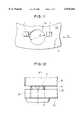
  • FIG. 7 is an enlarged view of portion D of FIG. 6;
  • FIG. 8 is a fragmentary side view viewed from the direction of an arrow X in FIG. 7;
  • FIG. 9 is a view similar to FIG. 7, but showing a modified form of the embodiment.
  • FIG. 10 is a fragmentary side view viewed from the direction of an arrow X in FIG. 9;
  • FIG. 11 is a view similar to FIGS. 7 and 9, but showing a further modified form of the embodiment
  • FIG. 12 is a fragmentary side view viewed from the direction of an arrow X in FIG. 11;
  • FIG. 13 is a graph showing a relation between an areas of drum-mounting surfaces and the deviations of recorded tracks from a straight line;
  • FIGS. 14 and 15 are each a plan view of other embodiment of the drum base according to the invention.
  • the drum base 15 comprises a substantially annular frame 21 having a fixing surface 18, to which a lower drum 8 of a magnetic tape recorder is fixed.
  • the frame 21 is formed with three holes 16 extending through the fixing surface 18. As shown in FIG. 8, a screw 5 passes through each hole 16, and engages with a threaded hole (not shown) formed in the bottom of the lower drum 8.
  • a pair of seats 7 on which the lower drum 8 is mounted are formed on the fixing surface 18 near each hole 16.
  • the terms "circumferential direction” and “radial direction” used hereinafter respectively denote a circumferential direction and a radial direction of the annular frame 21.
  • Each pair of seats or mounting surfaces 7 are arranged symmetrically with respect to the associated hole 16 in a circumferential direction.
  • Each seat 7 is so sized and located in the radial direction that it is within a range of a dimension of a diameter of the hole 16.
  • the seats 7 are located so that their centerlines extending in the circumferential direction coincide with a centerline, in the circumferential direction, of the through hole 16.
  • the seats 7 are located radially outwardly from the centerline, in the circumferential direction, of the through hole 16.
  • the seats 7 are located radially inwardly from the centerline, in the circumferential direction, of the through hole 16.
  • the lower drum 8 is fixed to the drum base 15 by mounting its bottom 6 on the seats 7 and tightening the screws 5 through the holes 16 into the threaded holes in the bottom 6 (not shown).
  • the seats 7 are located within the range of the dimension of the diameter of the holes 16 in the radial direction. Therefore, even if a projection is formed on the seat 7, a distance in the radial direction between the projection and a center of the associated screw 5 is small. Accordingly, a component in the radial direction of a bending moment due to the tightening force f of the screw 5 is small. As a result, the lower drum 8 cannot be locally deformed in the radial direction.
  • the pair of seats 7 are arranged symmetrically with respect to the associated hole 16 in the circumferential direction and outwardly from the diameter of the hole 16. Accordingly, a component in the circumferential direction of the bending moment is larger than the component in the radial direction of the bending moment.
  • the lower drum 8, however, has large rigidity in the circumferential direction due to the existence of its peripheral wall (22 in FIG. 4). As a result, the lower drum 8 cannot be locally deformed in the circumferential direction. Therefore, the lead 3 of the lower drum 8 cannot be distorted.
  • FIGS. 7 to 10 The structures shown in FIGS. 7 to 10 in which the centerlines of the seats 7 extending in the circumferential direction coincide with a centerline, in the circumferential direction, of the through hole 16 or the seats 7 are located radially outwardly from the centerline, in the circumferential direction, of the through hole 16 are preferable from the view point of preventing the drum from being floated, because the component in the radial direction of the bending moment acts to urge the lower drum 8 against the fixing surface 18.
  • the top area of the pair of seats 7 is smaller. If the area is too small, however, the tightening force may break the seat 7, so that the lower drum 8 may be locally deformed.
  • FIG. 13 shows the relations between the seat top areas and the deviations of the recorded track patterns each from the straight line. Provided that the practically negligible deviation of the track patterns from the straight line is 1 ⁇ m or less, it is preferable that the total top area of a pair of seats 7 be 0.3 mm 2 or more.
  • the lower drum 8 is fixed to the drum base 15 with the three screws 5.
  • one pair of seats 7 are formed near each hole 16. It should, however, be understood that the present invention is not limited to the embodiment.
  • a drum base 15 shown in FIG. 14 has two through holes 16 and 16'.
  • a pair of seats 7 are formed near the hole 16 only.
  • Seats 7' and 7" in the form of truncated cones are located away from the holes 16 and 16'.
  • a drum base 15 shown in FIG. 15 has a through hole 16, a pair of seats 7 near the hole 16, and seats 7' and 7" in the form of truncated cones.
  • the hole 16 and the associated pair of seats 7 are located nearly in the middle location of the portion of a magnetic tape wound on the drum 4. This location is one affecting the local deformation of the lead 3 of the lower drum 8 most. If the tape is wound on the drum by an angle of about 180°, it is practically sufficient to merely form in this location a through hole and a pair of seats according to the invention.

Landscapes

  • Magnetic Record Carriers (AREA)

Abstract

A drum base according to he invention, on which a drum of a magnetic tape recorder is mounted, comprises a substantially annular frame having a fixing surface to which the drum is fixed; at least one through hole extending through the fixing surface for allowing a screw which is to be threadably attached to a threaded hole formed in the drum to pass therethrough; and a pair of mounting surfaces provided on the fixing surface on which the drum is mounted, the mounting surfaces being located adjacent to the at least one through hole so as to have a symmetrical relationship in a circumferential direction of the annular frame with respect to the at least one through hole and within a range of a diameter dimension of the at least one through hole in a radial direction of the annular frame.

Description

BACKGROUND OF THE INVENTION
The present invention relates to a drum base on which a drum of a magnetic tape recorder such as a VTR and a DAT is mounted.
As shown in FIGS. 1 and 2 of the accompanying drawings, a drum 4 of a magnetic tape recorder comprises a lower drum 8 and an upper drum 9. The lower drum 8 is mounted on a drum base 15, which is fixed at a predetermined position of a chassis, not shown. The upper drum 9 is rotatably supported coaxially with the lower drum 8. A magnetic tape 2 is obliquely wound on the peripheries of the drum 4 by tape- guides 10, 11, 12, 13. Specifically, the tape 2 is wound on the lower drum 8 and the upper drum 9. The lower edge of the tape 2 is guided by a step 3 called as a lead formed on the surface of the lower drum 8. For normal recording and reproduction, the tape 2 runs at a predetermined speed in the direction shown by an arrow A. A head 1 is projectingly provided through a gap formed between the lower and upper drums 8, outward from drum surfaces by a predetermined amount. The head 1 rotates coaxially with the drum 9 at high speed in the direction shown by an arrow B. A tip of the head 1 obliquely scans the tape 2 to record signals thereon or reproduce the signals recorded on the tape.
With reference to FIGS. 2-4, the drum base 15 has three annular drum seats 7' formed on its top and three holes 16 formed through it. Each of the seats 7' is coaxial with one of the holes 16. A bottom 6 of the lower drum 8 rests on the seats 7'. The drum 4 is fixed on the drum base 15 by screws 5, which extend through the holes 16 and the seats 7' and are tightened into the lower drum 8 in the direction shown. The seats 7' are positioned on the same plane, and determine the height, inclination and direction of inclination of the drum 4 by coming into contact with the bottom surface 6 of the lower drum 8.
If the working precision of a drum seat 7' is low, as shown in FIG. 4, a projection 17 may be formed. When the drum 4 is mounted and fixed on the drum seat 7' having such projection 17, the bottom surface 6 of the lower drum 8 cannot come into contact with the whole surface of the drum seat 7' and further as a tightening force f of the screw 5 is applied in the direction shown in FIG. 4, a bending moment, which is the product of the tightening force f multiplied by the distance between the projection 17 and the center of the hole 16, is applied. Meanwhile, as magnetic tape recorder drums have been smaller and more lightweight, they have become thinner and less rigid. As a result, the lower drum 8 is distorted locally inward as shown by an arrow C by the bending moment, so that the lead 3 formed on the lower drum 8 is also distorted.
In the example shown in FIG. 4, the projection 17 is located radially outwardly of the drum base 15 with respect to the associated screw 5. If the projection 17 is located radially inwardly of the drum base 15 with respect to the screw 5, the tightening force f of the screw 5 locally distorts the lower drum 8 radially outwardly of the lower drum 8 (reversely to the arrow C), so that the lead 3 is distorted.
If the lead 3 is deformed as shown in FIG. 5A, the tape 2 follows the deformation of the lead 3 as it is guided by the lead 3 and as a result, a recording track 19 formed on the tape 2 becomes wavy and less linear as shown in FIG. 5B.
When a tape on which recording has been made by a recorder with a normal lead is reproduced by a recorder with a deformed lead 3 as shown in FIG. 5A, or when a tape on which recording has been made by a recorder with a deformed lead 3 as shown in FIG. 5A is reproduced by a recorder with a normal lead, the reproduction output of the tracks fluctuates, as shown in FIG. 5C (where the broken lines show normal values). Accordingly, the reproduced wave forms 20 are worse, so that the performance is remarkably low. In addition, under such a condition, part of the signal on an adjacent track may be read, causing cross talk. As a result, the quality of the reproduced signals is remarkably low. Furthermore, the deformation of lead 3 is a factor of unstable tape running or movement, which may prevent signals from being precisely recorded or reproduced.
Japanese Patent Unexamined Publication No. 2-254663 proposes drum base structure for correcting drum deformation. The drum base has seats, and a drum is mounted on the top surfaces of the seats. Each top surface has a linear boundary extending through an axis of an associated hole in the drum base. The extending direction of the boundary is selectively determined so as to correct the drum deformation, when the drum having the drum deformation is mounted on the seats. The publication does not include any disclosure to prevent the drum from being locally deformed when it is fixed to the drum base.
SUMMARY OF THE INVENTION
An object of the present invention is to provide a drum base of a magnetic tape recorder to prevent occurrence of a locally deformation of the drum, that is, a locally deformation of a lead to guide running of the magnetic tape when the drum is mounted on the drum base.
A drum base according to the invention, on which a drum of a magnetic tape recorder is mounted, comprises a substantially annular frame having a fixing surface to which the drum is fixed; at least one through hole extending through the fixing surface for allowing a screw which is to be threadably attached to a threaded hole formed in the drum to pass therethrough; and a pair of mounting surfaces provided on the fixing surface on which the drum is mounted, the mounting surfaces being located adjacent to the at least one through hole so as to have a symmetrical relationship in a circumferential direction of the annular frame with respect to the at least one through hole and within a range of a diameter dimension of the at least one through hole in a radial direction of the annular frame.
It is preferable that the pair of mounting surfaces are located such that first centerlines thereof extending in the circumferential direction of the annular frame are located so as to coincide with a second centerline of the at least one through hole extending in the circumferential direction of the annular frame.
Furthermore, the pair of mounting surfaces may be provided only for one through hole.
As stated above, the pair of mounting surfaces are located near the through hole in symmetrical relationship with respect to the through hole in the circumferential direction of the annular frame. In addition, the pair of mounting surfaces are located within the range of the dimension of the diameter of the through hole in the radial direction of the annular frame. This arrangement reduces a component in the radial direction of a bending moment which may be resulted from the surface irregularity of each mounting surface when the drum is fixed with the screw, and the component which tends to deform the drum locally in the radial direction of the frame. Although another component in the circumferential direction of the bending moment is also resulted which tends to deform the drum locally in the circumferential direction of the frame, the circumferential local deformation of the drum is practically negligible since the rigidity of the drum in the circumferential direction is large. As a result, the drum lead is not locally deformed, so that a good track linearity is obtained.
BRIEF DESCRIPTION OF THE DRAWINGS
FIG. 1 is a perspective view showing a magnetic tape recorder drum, on which a magnetic tape is wound;
FIG. 2 is an exploded perspective view showing the assembly of the drum and the drum base of a prior art magnetic tape recorder;
FIG. 3 is a plan view of the drum base of the prior art;
FIG. 4 is an enlarged sectional view taken along line IV--IV of FIG. 3, additionally showing part of the drum;
FIG. 5A is a fragmentary view showing a track pattern being recorded on a magnetic tape guided by a distorted drum lead according to the prior art;
FIG. 5B is a fragmentary view showing a track pattern recorded on a magnetic tape guided by a distorted drum lead according to the prior art;
FIG. 5C is a graph showing the reading characteristic of the track pattern shown in FIG. 5B;
FIG. 6 is a plan view of an embodiment of a drum base, on which a drum of a magnetic tape recorder is mounted, according to the invention;
FIG. 7 is an enlarged view of portion D of FIG. 6;
FIG. 8 is a fragmentary side view viewed from the direction of an arrow X in FIG. 7;
FIG. 9 is a view similar to FIG. 7, but showing a modified form of the embodiment;
FIG. 10 is a fragmentary side view viewed from the direction of an arrow X in FIG. 9;
FIG. 11 is a view similar to FIGS. 7 and 9, but showing a further modified form of the embodiment;
FIG. 12 is a fragmentary side view viewed from the direction of an arrow X in FIG. 11;
FIG. 13 is a graph showing a relation between an areas of drum-mounting surfaces and the deviations of recorded tracks from a straight line;
FIGS. 14 and 15 are each a plan view of other embodiment of the drum base according to the invention.
DESCRIPTION OF THE PREFERRED EMBODIMENTS
With reference to FIGS. 6-12, a first embodiment of a drum base of the invention will be described. The drum base 15 comprises a substantially annular frame 21 having a fixing surface 18, to which a lower drum 8 of a magnetic tape recorder is fixed. The frame 21 is formed with three holes 16 extending through the fixing surface 18. As shown in FIG. 8, a screw 5 passes through each hole 16, and engages with a threaded hole (not shown) formed in the bottom of the lower drum 8.
A pair of seats 7 on which the lower drum 8 is mounted are formed on the fixing surface 18 near each hole 16. It should be noted that the terms "circumferential direction" and "radial direction" used hereinafter respectively denote a circumferential direction and a radial direction of the annular frame 21. Each pair of seats or mounting surfaces 7 are arranged symmetrically with respect to the associated hole 16 in a circumferential direction. Each seat 7 is so sized and located in the radial direction that it is within a range of a dimension of a diameter of the hole 16.
In the structure shown in FIGS. 7 and 8, the seats 7 are located so that their centerlines extending in the circumferential direction coincide with a centerline, in the circumferential direction, of the through hole 16. In the structure shown in FIGS. 9 and 10 the seats 7 are located radially outwardly from the centerline, in the circumferential direction, of the through hole 16. In the structure shown in FIGS. 11 and 12, the seats 7 are located radially inwardly from the centerline, in the circumferential direction, of the through hole 16.
The lower drum 8 is fixed to the drum base 15 by mounting its bottom 6 on the seats 7 and tightening the screws 5 through the holes 16 into the threaded holes in the bottom 6 (not shown). As described above, the seats 7 are located within the range of the dimension of the diameter of the holes 16 in the radial direction. Therefore, even if a projection is formed on the seat 7, a distance in the radial direction between the projection and a center of the associated screw 5 is small. Accordingly, a component in the radial direction of a bending moment due to the tightening force f of the screw 5 is small. As a result, the lower drum 8 cannot be locally deformed in the radial direction.
Meanwhile, the pair of seats 7 are arranged symmetrically with respect to the associated hole 16 in the circumferential direction and outwardly from the diameter of the hole 16. Accordingly, a component in the circumferential direction of the bending moment is larger than the component in the radial direction of the bending moment. The lower drum 8, however, has large rigidity in the circumferential direction due to the existence of its peripheral wall (22 in FIG. 4). As a result, the lower drum 8 cannot be locally deformed in the circumferential direction. Therefore, the lead 3 of the lower drum 8 cannot be distorted.
The structures shown in FIGS. 7 to 10 in which the centerlines of the seats 7 extending in the circumferential direction coincide with a centerline, in the circumferential direction, of the through hole 16 or the seats 7 are located radially outwardly from the centerline, in the circumferential direction, of the through hole 16 are preferable from the view point of preventing the drum from being floated, because the component in the radial direction of the bending moment acts to urge the lower drum 8 against the fixing surface 18.
In order to reduce possibility of the formation of projection, it is preferable that the top area of the pair of seats 7 is smaller. If the area is too small, however, the tightening force may break the seat 7, so that the lower drum 8 may be locally deformed.
In experiments, a lower drum 8 was fixed to each of drum bases 15, which were aluminum die-castings, with screws 5 each tightened at a torque of 0.5 Kg·cm. The bases 15 had seats 7 of different top areas, respectively. FIG. 13 shows the relations between the seat top areas and the deviations of the recorded track patterns each from the straight line. Provided that the practically negligible deviation of the track patterns from the straight line is 1 μm or less, it is preferable that the total top area of a pair of seats 7 be 0.3 mm2 or more.
In the above embodiment, the lower drum 8 is fixed to the drum base 15 with the three screws 5. In addition, one pair of seats 7 are formed near each hole 16. It should, however, be understood that the present invention is not limited to the embodiment.
A drum base 15 shown in FIG. 14 has two through holes 16 and 16'. A pair of seats 7 are formed near the hole 16 only. Seats 7' and 7" in the form of truncated cones are located away from the holes 16 and 16'.
A drum base 15 shown in FIG. 15 has a through hole 16, a pair of seats 7 near the hole 16, and seats 7' and 7" in the form of truncated cones. The hole 16 and the associated pair of seats 7 are located nearly in the middle location of the portion of a magnetic tape wound on the drum 4. This location is one affecting the local deformation of the lead 3 of the lower drum 8 most. If the tape is wound on the drum by an angle of about 180°, it is practically sufficient to merely form in this location a through hole and a pair of seats according to the invention.

Claims (12)

What is claimed is:
1. A drum base on which a drum of a magnetic tape recorder is mounted, comprising:
a substantially annular frame having a drum opposing surface;
at least one through hole extending through said drum opposing surface for allowing a screw which is to be threadably attached to a threaded hole formed in the drum to pass therethrough; and
a pair of mounting seats provided on said drum opposing surface on which the drum is mounted, said mounting seats being located adjacent to said at least one through hole and being symetrically disposed on opposite sides of said at least one through hole as defined in a circumferential direction of said annular frame, and being disposed within a range defined between an inner-most diameter and an outer-most diameter of said at least one through hole as measured in a radial direction from a center of said annular frame.
2. A drum base according to claim 1, wherein said pair of mounting seats are located such that centerlines thereof extending in a circumferential direction of said annular frame and dividing an area of each seat into two equal areas substantially coincide with a centerline of said at least one through hole extending in said circumferential direction.
3. A drum base according to claim 1, wherein said drum base more specifically comprises two through holes, and said pair of mounting surfaces are provided adjacent only one of said two through holes.
4. A drum base according to claim 2, wherein said drum base more specifically comprises two through holes, and said pair of mounting surfaces are provided adjacent only one of said two through holes.
5. A drum base according to claim 1, wherein said drum base more specifically comprises three through holes, and separate pairs of mounting surfaces are respectively provided adjacent to all three said through holes.
6. A drum base according to claim 2, wherein said drum base more specifically comprises three through holes, and separate pairs of mounting surfaces are respectively provided adjacent to all three said through holes.
7. The drum base of claim 1, wherein said annular frame is an aluminum die-cast frame, and a total area of said pair of mounting surfaces is 0.3 mm2 or more when a fixing torque of said screw is 0.5 Kgcm.
8. The drum base of claim 2, wherein said annular frame is an aluminum die-cast frame, and a total area of said pair of mounting surfaces is 0.3 mm2 or more when a fixing torque of said screw is 0.5 Kgcm.
9. The drum base of claim 3, wherein said annular frame is an aluminum die-cast frame, and a total area of said pair of mounting surfaces is 0.3 mm2 or more when a fixing torque of said screw is 0.5 Kgcm.
10. The drum base of claim 4, wherein said annular frame is an aluminum die-cast frame, and a total area of said pair of mounting surfaces is 0.3 mm2 or more when a fixing torque of said screw is 0.5 Kgcm.
11. The drum base of claim 5, wherein said annular frame is an aluminum die-cast frame, and a total area of said pair of mounting surfaces is 0.3 mm2 or more when a fixing torque of said screw is 0.5 Kgcm.
12. The drum base of claim 6, wherein said annular frame is an aluminum die-cast frame, and a total area of said pair of mounting surfaces is 0.3 mm2 or more when a fixing torque of said screw is 0.5 Kgcm.
US08/622,380 1995-03-28 1996-03-27 Drum base on which a drum of a magnetic tape recorder is mounted Expired - Fee Related US6078464A (en)

Applications Claiming Priority (2)

Application Number Priority Date Filing Date Title
JP06957695A JP3439566B2 (en) 1995-01-25 1995-03-28 Recording and playback device
JP7-069576 1995-03-28

Publications (1)

Publication Number Publication Date
US6078464A true US6078464A (en) 2000-06-20

Family

ID=13406766

Family Applications (1)

Application Number Title Priority Date Filing Date
US08/622,380 Expired - Fee Related US6078464A (en) 1995-03-28 1996-03-27 Drum base on which a drum of a magnetic tape recorder is mounted

Country Status (1)

Country Link
US (1) US6078464A (en)

Cited By (3)

* Cited by examiner, † Cited by third party
Publication number Priority date Publication date Assignee Title
EP1237156A1 (en) * 2001-03-01 2002-09-04 Thomson Licensing S.A. Laser welding for drum base
EP1239470A1 (en) * 2001-03-01 2002-09-11 Thomson Licensing S.A. Laser welding for drum base
CN109612867A (en) * 2018-11-22 2019-04-12 中国科学院理化技术研究所 Method and system for evaluating the dimensional stability of materials

Citations (6)

* Cited by examiner, † Cited by third party
Publication number Priority date Publication date Assignee Title
US4686597A (en) * 1985-09-27 1987-08-11 Rca Corporation Rotating head apparatus including a flying tape edge guide
US4761696A (en) * 1986-02-21 1988-08-02 U.S. Philips Corporation Helical scan type apparatus with readily aligned scanning unit
US4959742A (en) * 1987-09-11 1990-09-25 Yamaha Corporation Rotary head mounting device
JPH02254663A (en) * 1989-03-29 1990-10-15 Hitachi Ltd Cylinder placing structure
US5089921A (en) * 1988-02-17 1992-02-18 Sanyo Electric Co., Ltd. Inclined rail cassette tape loading and guiding mechanism
US5459625A (en) * 1992-05-19 1995-10-17 Sony Corporation Rotary head drum device

Patent Citations (6)

* Cited by examiner, † Cited by third party
Publication number Priority date Publication date Assignee Title
US4686597A (en) * 1985-09-27 1987-08-11 Rca Corporation Rotating head apparatus including a flying tape edge guide
US4761696A (en) * 1986-02-21 1988-08-02 U.S. Philips Corporation Helical scan type apparatus with readily aligned scanning unit
US4959742A (en) * 1987-09-11 1990-09-25 Yamaha Corporation Rotary head mounting device
US5089921A (en) * 1988-02-17 1992-02-18 Sanyo Electric Co., Ltd. Inclined rail cassette tape loading and guiding mechanism
JPH02254663A (en) * 1989-03-29 1990-10-15 Hitachi Ltd Cylinder placing structure
US5459625A (en) * 1992-05-19 1995-10-17 Sony Corporation Rotary head drum device

Cited By (5)

* Cited by examiner, † Cited by third party
Publication number Priority date Publication date Assignee Title
EP1237156A1 (en) * 2001-03-01 2002-09-04 Thomson Licensing S.A. Laser welding for drum base
US20020122277A1 (en) * 2001-03-01 2002-09-05 Philippe Berthaud Laser welding for drum base
EP1239470A1 (en) * 2001-03-01 2002-09-11 Thomson Licensing S.A. Laser welding for drum base
US6961220B2 (en) 2001-03-01 2005-11-01 Thomson Licensing Laser welded head drum for VCR
CN109612867A (en) * 2018-11-22 2019-04-12 中国科学院理化技术研究所 Method and system for evaluating the dimensional stability of materials

Similar Documents

Publication Publication Date Title
US5490022A (en) Data storage apparatus and disk fixing method for preventing the deformation of disks by regulating where the storage apparatus is fixed to the disk
US7167338B2 (en) Magnetic disk apparatus
US6504674B2 (en) Recording disk apparatus and clamp therefor
US6078464A (en) Drum base on which a drum of a magnetic tape recorder is mounted
US4616280A (en) Mechanism for adjusting magnetic head
JPS61253679A (en) Magnetic disk device
US5719726A (en) Magnetic head for recording signals on and reproducing signals from magnetic media and mounted on a support plate having stress reducing grooves
JPH01251468A (en) Magnetic disk device
JP2591606B2 (en) Rotating head assembly
JP3439566B2 (en) Recording and playback device
JPH02254663A (en) Cylinder placing structure
JPH0430361A (en) Cylinder for magnetic recording and reproduction
KR0174449B1 (en) Voice control head assembly of tape recorder
US4837649A (en) Improvements to rotating head assembly in a video tape recording machine
JPH0734250B2 (en) Composite magnetic head
JPH061536B2 (en) Rotating head assembly
KR970003248Y1 (en) Upper drum assembly structure of vcr head drum
US4263633A (en) Combined magnetic tape head
JPS619818A (en) Magnetic disk device
JPH03224156A (en) Head drum device
JPH0713049Y2 (en) Base structure of magnetic head
US4870523A (en) Magnetic head apparatus used for movable magnetic medium with head gap positioning
JP2757325B2 (en) Magnetic head support mechanism
KR950006329Y1 (en) Drum unit of tape recorder
JP3120636B2 (en) Method for arranging magnetic head in magnetic recording / reproducing apparatus

Legal Events

Date Code Title Description
AS Assignment

Owner name: HITACHI, LTD., JAPAN

Free format text: ASSIGNMENT OF ASSIGNORS INTEREST;ASSIGNORS:TAKEDA, HIDEKAZU;FUJIMORI, SHINYA;MASUDA, KENMEI;AND OTHERS;REEL/FRAME:008331/0265;SIGNING DATES FROM 19950704 TO 19960704

FPAY Fee payment

Year of fee payment: 4

FEPP Fee payment procedure

Free format text: PAYOR NUMBER ASSIGNED (ORIGINAL EVENT CODE: ASPN); ENTITY STATUS OF PATENT OWNER: LARGE ENTITY

FPAY Fee payment

Year of fee payment: 8

FEPP Fee payment procedure

Free format text: PAYER NUMBER DE-ASSIGNED (ORIGINAL EVENT CODE: RMPN); ENTITY STATUS OF PATENT OWNER: LARGE ENTITY

FEPP Fee payment procedure

Free format text: PAYOR NUMBER ASSIGNED (ORIGINAL EVENT CODE: ASPN); ENTITY STATUS OF PATENT OWNER: LARGE ENTITY

REMI Maintenance fee reminder mailed
LAPS Lapse for failure to pay maintenance fees
STCH Information on status: patent discontinuation

Free format text: PATENT EXPIRED DUE TO NONPAYMENT OF MAINTENANCE FEES UNDER 37 CFR 1.362

FP Lapsed due to failure to pay maintenance fee

Effective date: 20120620