US6067378A - Lip contour signal reconstruction method - Google Patents
Lip contour signal reconstruction method Download PDFInfo
- Publication number
- US6067378A US6067378A US09/108,550 US10855098A US6067378A US 6067378 A US6067378 A US 6067378A US 10855098 A US10855098 A US 10855098A US 6067378 A US6067378 A US 6067378A
- Authority
- US
- United States
- Prior art keywords
- lcs
- corrected
- slcs
- contour
- standard
- Prior art date
- Legal status (The legal status is an assumption and is not a legal conclusion. Google has not performed a legal analysis and makes no representation as to the accuracy of the status listed.)
- Expired - Lifetime
Links
Images


Classifications
-
- G—PHYSICS
- G06—COMPUTING OR CALCULATING; COUNTING
- G06T—IMAGE DATA PROCESSING OR GENERATION, IN GENERAL
- G06T9/00—Image coding
- G06T9/20—Contour coding, e.g. using detection of edges
-
- H—ELECTRICITY
- H04—ELECTRIC COMMUNICATION TECHNIQUE
- H04N—PICTORIAL COMMUNICATION, e.g. TELEVISION
- H04N19/00—Methods or arrangements for coding, decoding, compressing or decompressing digital video signals
- H04N19/20—Methods or arrangements for coding, decoding, compressing or decompressing digital video signals using video object coding
Definitions
- the present invention relates to a face image signal coding system; and, more particularly, to a lip contour signal reconstruction method and apparatus for use in a face image signal coding system.
- model based coding technique is gaining wide acceptance in various fields such as video phone, video conference, virtual reality and computer graphics industry and the like.
- the physical image of a speaker shown in the video phone or the video conference screen is the upper body of the speaker.
- the majority of video data therefor pertains to the face of the speaker.
- other data than the face of the speaker e.g., background image data, can be ignored and only image data for the face is transmitted, thereby greatly reducing the amount of transmission data thereof.
- the main part of the information transmitted and processed is that for the face image of the speaker, especially for the lip image of the speaker since the picture of lip movement during the speech is crucial to recognizing the characteristics of speech and emotional expressions of the speaker.
- a lip image signal (LIS) included in a face image signal and a corresponding voice signal are simultaneously coded and transmitted.
- a composed or reconstructed lip image signal in lieu of a corresponding lip image signal is coded and then transmitted to further reduce the amount of transmission data thereof.
- a lip image signal includes a lip contour signal and a texture signal.
- the lip contour signal (LCS) has N number of inter-connected edge points, wherein N is a predetermined positive integer.
- the lip contour signal represents the position and shape of a lip image within a face image.
- the texture signal has luminance data with or without chrominance data for the lip image.
- a LCS may be divided into an upper LCS and a lower LCS, wherein each of the upper LCS and the lower LCS has an inner LCS and an outer LCS, respectively. It is well known in the art that a LCS reconstruction process is most important in a LIS reconstruction or composition process.
- FIG. 1 there is shown a block diagram of a conventional LCS reconstruction apparatus, 100 for use in a face image signal coding system.
- the apparatus 100 comprises a LCS extraction circuit 30, a standard lip contour signal (SLCS) providing circuit 20 and an edge point motion detection circuit 40.
- the apparatus 100 reconstructs a LCS by employing a conventional LCS reconstruction method described below.
- a face image signal including a LIS having a LCS is fed to the LCS extraction circuit 30 from a face image signal supplying circuit in the face image signal coding system.
- the LCS extraction circuit 30, by employing a predetermined known LCS extraction method, extracts the LCS from the LIS in the face image signal to thereby provide the LCS to the edge point motion detection circuit 40 via a line L11.
- the SLCS providing circuit 20 provides a predetermined SLCS of a standard lip image signal to the edge point motion detection circuit 40 through a line L13.
- the SLCS has N number of inter-connected standard edge points corresponding to the edge points of the LCS, respectively.
- the SLCS represents the position and shape of a standard lip image.
- the SLCS is usually stored in a memory within the SLCS providing circuit 20 and the SLCS includes an upper SLCS and a lower SLCS, wherein each of the upper SLCS and the lower SLCS has an inner SLCS and an outer SLCS, respectively.
- FIG. 2 there is represented a schematic diagram depicting an outer SLCS 250 within an upper SLCS of a SLCS and an outer LCS 270 within an upper LCS of a LCS for use in explaining the LCS reconstruction process performed by the conventional lip contour signal reconstruction apparatus 100 shown in FIG. 1.
- the outer SLCS 250 is expressed in a solid line having standard edge points P1 to P11 represented by small black circles thereon and the outer LCS 270 is represented in a dotted line having edge points Q1 to Q11 represented by small black circles thereon.
- the edge point motion detection circuit 40 first matches the center point of the LCS as an origin of a two dimensional xy-plane with the center point of the SLCS.
- the edge point motion detection circuit 40 detects N number of corresponding motion vectors (MV's) for the N number of edge points of the LCS by using the N number of edge points of the LCS inputted thereto via the line L11 and the N number of standard edge points of the SLCS inputted thereto via the line L13.
- MV's motion vectors
- Coordinates of a standard edge point P7 and an edge point Q7 are (p,p') and (q,q'), respectively.
- a motion vector MV7 for the edge point P7 is represented as (q-p,q'-p').
- the edge point motion detection circuit 40 provides a reconstructed LCS for the LCS to a transmitter for the transmission thereof, the reconstructed LCS including N number of reconstructed edge points, wherein each of the reconstructed edge points is obtained by moving a corresponding edge point by a corresponding MV.
- the conventional LCS reconstruction or composition apparatus employing the conventional LCS reconstruction method described above needs a considerable amount of memory capacity, and substantial amounts of transmission data and calculation time to detect corresponding MV's for all of the edge points of a LCS, thereby rendering difficult the real time processing of a LIS, together with a corresponding audio signal, e.g., a voice signal.
- a method for reconstructing a lip contour signal having N number of inter-connected edge points (EP's) representing the position and shape of a lip image in a face image, wherein the lip image and the LCS are symmetrical, respectively, and N is a predetermined positive integer
- the method comprising the steps of: (a) providing a standard lip contour signal (SLCS) having N number of inter-connected standard edge points (SEP's) corresponding to the N number of edge points (EP's) of the LCS, respectively, the SLCS representing the position and shape of a predetermined standard lip image, wherein the standard lip image and SLCS are symmetrical, respectively; (b) matching the center point of the LCS as an origin of a two dimensional xy-plane with the center point of the SLCS; (c) correcting the coordinates of the N number of EP's of the LCS to generate a corrected LCS having N number of corrected EP's by stretching the x-coordinate
- FIG. 1 shows a block diagram of a conventional lip contour signal (LCS) reconstruction apparatus for use in a face image signal coding system;
- LCD lip contour signal
- FIG. 2 represents a schematic diagram depicting an outer standard lip contour signal (SLCS) within an upper SLCS of a SLCS and an outer LCS within an upper LCS of a LCS for use in explaining a LCS reconstruction process performed by the conventional LCS reconstruction apparatus shown in FIG. 1;
- SLCS outer standard lip contour signal
- FIGS. 3A to 3F illustrate schematic graphs representing lip contour signals (LCS's) and/or standard lip contour signals (SLCS's) for use in describing a lip contour signal reconstruction method in accordance with a preferred embodiment of the present invention
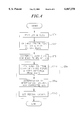
- FIG. 4 depicts a flow chart for use in explaining a lip contour signal reconstruction method in accordance with a preferred embodiment of the present invention.
- FIGS. 3A to 3B there are illustrated schematic graphs representing lip contour signals (LCS's) and/or standard lip contour signals (SLCS's) for use in describing a lip contour signal reconstruction method in accordance with a preferred embodiment of the present invention.
- LCS's lip contour signals
- SLCS's standard lip contour signals
- FIG. 4 there is depicted a flow chart for use in explaining a lip contour signal reconstruction method in accordance with a preferred embodiment of the present invention.
- a LCS and a predetermined SLCS are read. And then the process proceeds to step ST2.
- the LCS has N number of inter-connected edge points (EP's) representing the position and shape of a lip image in a face image, wherein the lip image and the LCS are symmetrical, respectively and N is a predetermined positive integer.
- EP's inter-connected edge points
- the SLCS has N number of inter-connected standard edge points (SEP's) corresponding to the N number of edge points (EP's) of the LCS, respectively, the SLCS representing the position and shape of a predetermined standard lip image, wherein the predetermined standard lip image and the SLCS are symmetrical, respectively.
- the term "symmetrical" represents that a signal, e.g., the LCS or an image, e.g., the lip image, is a mirror image with respect to the y-axis (i.e., the vertical center line) thereof.
- step ST2 the center point of the LCS is matched as an origin of a two dimensional xy-plane with the center point of the SLCS. Thereafter, the process goes to step ST3.
- step ST3 coordinates of the N number of EP's of the LCS are corrected to generate a corrected LCE having N number of corrected EP's by stretching the x-coordinates of the N number of EP's in accordance with a predetermined stretching rule under the condition that a horizontal left end EP (HLEP) and a horizontal right end EP (HREP) of the corrected LCS coincide with a horizontal left end SEP (HLSEP) and a horizontal right end SEP (HRSEP) of the SLCS, respectively.
- HLEP horizontal left end EP
- HREP horizontal right end EP
- HRSEP horizontal right end SEP
- N number of reconstructed edge points are obtained based on the N number of corrected EP's of the corrected LCS and the N number of SEP's of the SLCS.
- a reconstructed LCS having the N number of REP's is generated. And then, the process is ended.
- the step ST4 includes steps ST41, ST42 and ST43.
- K number of feature points (FP's) are detected from the N number of corrected EP's and at the same time, K number of corresponding standard feature points (SFP's) are detected from the N number of SEP's with K being a predetermined positive integer less than N.
- FP's and each of the SFP's are a corrected EP and a SEP essential to defining the LCS and the SLCS, respectively.
- the process goes to step ST42.
- step ST42 first to 4th modification functions MF1 to MF4 are determined based on the K number of FP's, the K number of SFP's and first to 4th predetermined standard modification functions SMF1 to SMF4. And then, the process flows to step ST43.
- the MF1 and SMF1 are functions used to obtain corrected EP's on an outer contour of a corrected upper LCS of the corrected LCS and SEP's on an outer standard contour of an upper SLCS of the SLCS, respectively.
- the MF2, MF3 and MF4 are functions used to obtain corrected EP's on an inner contour of the corrected upper LCS, corrected EP's on an inner contour of the corrected lower LCS of the corrected LCS and corrected EP's on an outer contour of a corrected lower LCS, respectively.
- the SMF2, SMF3 and SMF4 are functions used to obtain SEP's on an inner standard contour of the upper SLCS, SEP's on an inner standard contour of a lower SLCS of the SLCS and SEP's on an outer standard contour of the lower SLCS, respectively.
- the N number of reconstructed edge points (REP's) are obtained by using the MF1 to MF4 based on the N number of SEP's to thereby generate the reconstructed LCS having the N number of REP's. And then, the process is ended.
- FIGS. 3A to 3F a method for reconstructing a LCS in accordance with preferred embodiments of the present invention will be described in more details. It should be noted that like points and like curves appearing in FIGS. 3A to 3F are represented by like reference numerals.
- FIG. 3A illustrates a LCS having an upper LCS and a lower LCS and a SLCS having an upper SLCS and a lower SLCS.
- the upper LCS contains an outer contour 330 and an inner contour 340 thereof;
- the lower LCS contains an outer contour 370 and an inner contour 380 thereof;
- the upper SLCS contains an outer standard contour 310 and an inner standard contour 320 thereof;
- the lower SLCS contains an outer standard contour 350 and an inner standard contour 360 thereof.
- the center point of the LCS as an origin of a two dimensional xy-plane is matched with that of the SLCS.
- the HRSEP of the ALCS and the HREP of the LCS are represented as A1 and A2, respectively;
- the HLSEP of the SLCS and the HLEP of the LCS are represented as A1' and A2', respectively and coordinates of A1, A2, A1' and A2' are expressed as (a1,o), (a2, 0), (-a1, 0) and (-a2, 0), respectively, wherein a1 is a predetermined positive integer and a2 is a positive integer less than a1.
- a1 and a2 are x-intercepts of the graphs of the SLCS and the LCS on the xy-plane, respectively.
- FIG. 3B there is shown a schematic diagram for use in describing a predetermined stretching rule in accordance with a preferred embodiment of the present invention. It should be noted that in FIGS. 3A to 3B, bold dot lines, dotted lines and solid lines represent the graphs of a LCS, a corrected LCS and a SLCS, respectively.
- the graph of the outer contour of the upper LCS has relative maximum edge points MEP-I and MEP-II in the quadrant I and the quadrant II on the xy-plane, respectively and the graph of the outer standard contour of the upper SLCS has relative maximum standard edge points MSEP-I and MSEP-II in the quadrant I and the quadrant II on the xy-plane, respectively.
- the graph of the outer contour 330 of the upper LCS has a MEP-I represented by Q.
- the coordinate of Q is expressed as (q,p2).
- coordinates of the EP's of the LCS are corrected to render the relative maximum corrected edge point (MCEP-I) in the quadrant I of the graph of the corrected upper LCS and the relative maximum corrected edge point (MCEP-II) in the quadrant II of the graph of the corrected upper LCS on the xy-plane being coincided with the MSEP-I and MSEP-II on the xy-plane, respectively.
- P2 as a MCEP-I is obtained based on the Q in accordance with the above mentioned equation.
- the coordinate of P2 is expressed as (p,p2).
- the coordinate of each of the corrected EP's on the graphs of the inner contour of the corrected upper LCS, the inner contour of the corrected lower LCS and the outer contour of the corrected lower LCS is obtained by the following equation: ##EQU2##
- the K number of FP's include the MCEP-I, MCEP-II and respective y-intercept points of the outer contour of the corrected upper LCS, the inner contour of the corrected upper LCS, the outer contour of the corrected lower LCS and the inner contour of the corrected lower LCS.
- the K number of SFP's include the HLSEP, HRSEP, MSEP-I, MSEP-II and respective y-intercept points of the outer standard contour of the upper SLCS, the inner standard contour of the upper SLCS, the outer standard contour of the lower SLCS and the inner standard contour of the lower SLCS, respectively.
- the SMF1 and MF1 are biquadratic functions satisfying the following boundary conditions:
- a1 and p are a positive x-intercept and an x-coordinate of the MSEP-I of the outer standard contour of the upper SLCS, respectively;
- the MF2, SMF2, MF3, SMF3, MF4 and SMF4 are quadratic functions satisfying the following boundary conditions:
- outer standard contour 310 and the inner standard contour 320 of the upper SLCS there are illustrated the outer standard contour 310 and the inner standard contour 320 of the upper SLCS; the outer standard contour 350 and the inner standard contour 360 of the lower SLCS; an outer corrected contour 335 and an inner corrected contour 345 of the corrected upper LCS; and an outer corrected contour 375 and an inner corrected contour 385 of the corrected lower LCS.
- F and F' represent y-intercepts of the graphs of the inner standard contour 320 and the inner corrected contour 345, respectively; and the coordinates of F and F' are (0,f) and (0,f'), respectively.
- B and B' represent y-intercepts of the graphs of the inner standard contour 360 and the inner corrected contour 385, respectively; and the coordinates of B and B' are (0,b) and (0,b'), respectively.
- C and C' represent y-intercepts of the graphs of the outer standard contour 350 and the outer corrected contour 375, respectively; and the coordinates of C and C' are (0,c) and (0,c'), respectively. It should be noted that in FIGS. 3C to 3F, dotted lines and solid lines represent the graphs of corrected LCS's and SLCS's, respectively.
- the MF2, MF3, MF4, SMF2, SMF3 and SMF4 are either hyperbolic functions or ellipsoidal functions satisfying the above mentioned boundary conditions therefor.
- the SMF1 is represented as the following equation:
- d is a positive y-intercept of the outer standard contour of the upper SLCS on the xy-plane; and k1 is a constant obtained by the following equation: ##EQU3##
- MF1 is represented as the following equation:
- e is a positive y-intercept of the outer contour of the corrected upper LCS on the xy-plane;
- k2 is a constant obtained by the following equation: ##EQU4##
- the SMF2, SMF3 and SMF4 are represented by the following equations: ##EQU5## Further, the MF2, MF3 and MF4 are represented as the following equations: ##EQU6##
- the MF1(x) to MF4(x) can be obtained by using SMF1(x) to SMF4(x), respectively, based on the y-intercepts (b', c', e and f') among the K number of FP's detected from the N number of corrected EP's of the corrected LCS and the y-intercepts (b, c, d and f) among the K number of SFP's detected from the N number of SEP's of the SLCS.
- the N number of reconstructed edge points (REP's) are obtained by using the MF1 to MF4 based on the N number of SEP's to thereby generate the reconstructed LCS having the N number of REP's.
- an x-coordinate (r1) and a y-coordinate (r2) of each of the REP's of the reconstructed LCS are by setting the x-coordinate of a corresponding SEP as the r1 and setting a corresponding one of values MF1 (r1), MF2 (r2), MF3(r1) and MF4(r1) as the r2, respectively.
- a lip contour signal is effectively reconstructed by using predetermined modification functions, thereby decreasing the reconstruction time for the lip contour signal, the amount of transmission data thereof and enhancing the reconstruction efficiency thereof.
Landscapes
- Engineering & Computer Science (AREA)
- Multimedia (AREA)
- Physics & Mathematics (AREA)
- General Physics & Mathematics (AREA)
- Theoretical Computer Science (AREA)
- Image Analysis (AREA)
- Image Processing (AREA)
- Image Generation (AREA)
- Processing Or Creating Images (AREA)
- Compression Or Coding Systems Of Tv Signals (AREA)
Abstract
Description
SMF1(a1)=SMF1(-a1)=0, [SMF1(x)].sub.x=p =[SMF1(x)].sub.x=-p =0,
MF1(a1)=MF1(-a1)=0, [MF1(x)].sub.x=p =[MF1(x)].sub.x=-p =0,
MF2(a1)=MF2(-a1)=0, MF2(0)=f',
SMF2(a1)=SMF2(-a1)=0, SMF2(0)=f,
MF3(a1)=MF3(-a1)=0, MF3(0)=b',
SMF3(a1)=SMF3(-a1)=0, SMF3(0)=b,
MF4(a1)=MF4(-a1)=0, MF4(0)=c',
SMF4(a1)=SMF4(-a1)=0, SMF4('0)=c,
SMF1(x)=k1(x.sup.4 -2p.sup.2 x.sup.2)+d,
MF1(x)=k2(x.sup.4 -2p.sup.2 x.sup.2)+e=(k2/K1) SMF1(x)+e-(k2/K1)d=e/dESMF1(x),
Claims (14)
SMF1(a1)=SMF1(-a1)=0, [SMF1(x)].sub.x=p =[SMF1(x)].sub.x=-p =0,
MF1(a1)=MF1(-a1)=0, [MF1(x)].sub.x=p =[MF1(x)].sub.x=-p =0,
MF2(a1)=MF2(-a1)=0, MF2(0)=f',
SMF2(a1)=SMF2(-a1)=0, SMF2(0)=f,
MF3(a1)=MF3(-a1)=0, MF3(0)=b',
SMF3(a1)=SMF3(-a1)=0, SMF3(0)=b,
MF4(a1)=MF4(-a1)=0, MF4(0)=c',
SMF4(a1)=SMF4(-a1)=0, SMF4(0)=c,
SMF1(x)=k1(x.sup.4 -2p.sup.2 x.sup.2)+d,
Applications Claiming Priority (2)
| Application Number | Priority Date | Filing Date | Title |
|---|---|---|---|
| KR1019970059817A KR19990039650A (en) | 1997-11-13 | 1997-11-13 | Texture Mapping Method for Lip Animation |
| KR97-59817 | 1997-11-13 |
Publications (1)
| Publication Number | Publication Date |
|---|---|
| US6067378A true US6067378A (en) | 2000-05-23 |
Family
ID=19524669
Family Applications (1)
| Application Number | Title | Priority Date | Filing Date |
|---|---|---|---|
| US09/108,550 Expired - Lifetime US6067378A (en) | 1997-11-13 | 1998-07-01 | Lip contour signal reconstruction method |
Country Status (3)
| Country | Link |
|---|---|
| US (1) | US6067378A (en) |
| KR (1) | KR19990039650A (en) |
| GB (1) | GB2331425B (en) |
Cited By (3)
| Publication number | Priority date | Publication date | Assignee | Title |
|---|---|---|---|---|
| US20040227856A1 (en) * | 2003-05-16 | 2004-11-18 | Cooper J. Carl | Method and apparatus for determining relative timing of image and associated information |
| US20090139536A1 (en) * | 2004-10-22 | 2009-06-04 | Shiseido Co., Ltd. | Lip categorizing method, makeup method, categorizing map, and makeup tool |
| US20160316108A1 (en) * | 2003-05-16 | 2016-10-27 | James Carl Cooper | System and Method for AV Sync Correction by Remote Sensing |
Citations (5)
| Publication number | Priority date | Publication date | Assignee | Title |
|---|---|---|---|---|
| US4260229A (en) * | 1978-01-23 | 1981-04-07 | Bloomstein Richard W | Creating visual images of lip movements |
| US5313522A (en) * | 1991-08-23 | 1994-05-17 | Slager Robert P | Apparatus for generating from an audio signal a moving visual lip image from which a speech content of the signal can be comprehended by a lipreader |
| US5500673A (en) * | 1994-04-06 | 1996-03-19 | At&T Corp. | Low bit rate audio-visual communication system having integrated perceptual speech and video coding |
| US5960099A (en) * | 1997-02-25 | 1999-09-28 | Hayes, Jr.; Carl Douglas | System and method for creating a digitized likeness of persons |
| US6014625A (en) * | 1996-12-30 | 2000-01-11 | Daewoo Electronics Co., Ltd | Method and apparatus for producing lip-movement parameters in a three-dimensional-lip-model |
-
1997
- 1997-11-13 KR KR1019970059817A patent/KR19990039650A/en not_active Withdrawn
-
1998
- 1998-07-01 US US09/108,550 patent/US6067378A/en not_active Expired - Lifetime
- 1998-07-06 GB GB9814644A patent/GB2331425B/en not_active Expired - Fee Related
Patent Citations (5)
| Publication number | Priority date | Publication date | Assignee | Title |
|---|---|---|---|---|
| US4260229A (en) * | 1978-01-23 | 1981-04-07 | Bloomstein Richard W | Creating visual images of lip movements |
| US5313522A (en) * | 1991-08-23 | 1994-05-17 | Slager Robert P | Apparatus for generating from an audio signal a moving visual lip image from which a speech content of the signal can be comprehended by a lipreader |
| US5500673A (en) * | 1994-04-06 | 1996-03-19 | At&T Corp. | Low bit rate audio-visual communication system having integrated perceptual speech and video coding |
| US6014625A (en) * | 1996-12-30 | 2000-01-11 | Daewoo Electronics Co., Ltd | Method and apparatus for producing lip-movement parameters in a three-dimensional-lip-model |
| US5960099A (en) * | 1997-02-25 | 1999-09-28 | Hayes, Jr.; Carl Douglas | System and method for creating a digitized likeness of persons |
Cited By (5)
| Publication number | Priority date | Publication date | Assignee | Title |
|---|---|---|---|---|
| US20040227856A1 (en) * | 2003-05-16 | 2004-11-18 | Cooper J. Carl | Method and apparatus for determining relative timing of image and associated information |
| US7499104B2 (en) * | 2003-05-16 | 2009-03-03 | Pixel Instruments Corporation | Method and apparatus for determining relative timing of image and associated information |
| US20160316108A1 (en) * | 2003-05-16 | 2016-10-27 | James Carl Cooper | System and Method for AV Sync Correction by Remote Sensing |
| US20090139536A1 (en) * | 2004-10-22 | 2009-06-04 | Shiseido Co., Ltd. | Lip categorizing method, makeup method, categorizing map, and makeup tool |
| US8082926B2 (en) * | 2004-10-22 | 2011-12-27 | Shiseido Co., Ltd. | Lip categorizing method, makeup method, categorizing map, and makeup tool |
Also Published As
| Publication number | Publication date |
|---|---|
| GB2331425B (en) | 2002-01-16 |
| GB2331425A (en) | 1999-05-19 |
| GB9814644D0 (en) | 1998-09-02 |
| KR19990039650A (en) | 1999-06-05 |
Similar Documents
| Publication | Publication Date | Title |
|---|---|---|
| JP4335449B2 (en) | Method and system for capturing and representing 3D geometry, color, and shading of facial expressions | |
| US6181805B1 (en) | Object image detecting method and system | |
| JP3040466B2 (en) | Image processing method | |
| JPH08287263A (en) | Motion estimation method for moving images using moving object segmentation method | |
| US20130170703A1 (en) | Image processing device and image processing method, and program | |
| JP2002511617A (en) | Face recognition from video images | |
| KR20030036747A (en) | Method and apparatus for superimposing a user image in an original image | |
| CN118570054B (en) | Training method, related device and medium for image generation model | |
| Maître et al. | Improving dynamic programming to solve image registration | |
| US20240135956A1 (en) | Method and apparatus for measuring speech-image synchronicity, and method and apparatus for training model | |
| CN111667400A (en) | Human face contour feature stylization generation method based on unsupervised learning | |
| WO2023284401A1 (en) | Image beautification processing method and apparatus, storage medium, and electronic device | |
| JP2025538281A (en) | Apparatus, method, and program | |
| CN118298090A (en) | Object contour and texture enhanced SLAM method based on NeRF | |
| US6067378A (en) | Lip contour signal reconstruction method | |
| CN120894500A (en) | A Non-Static Scene Reconstruction Method and System Based on Multimodal Occlusion Perception Scoring | |
| US6931145B1 (en) | Method and apparatus for measuring motion of an object surface by multi-resolution analysis using a mesh model | |
| EP3809372A1 (en) | Method of real-time generation of 3d imaging | |
| Eveno et al. | Key points based segmentation of lips | |
| Koumparoulis et al. | Audio-assisted image inpainting for talking faces | |
| GB2330973A (en) | Lip image signal reconstruction | |
| CN119600190B (en) | A method for generating talking face videos based on Gaussian splattering | |
| Kouzani et al. | A morphing technique for facial image representation | |
| US20020057273A1 (en) | Method of and apparatus for reproducing facial expressions | |
| CN121505109A (en) | A method, system, device, and medium for rapid speaking face generation based on audio-driven principles. |
Legal Events
| Date | Code | Title | Description |
|---|---|---|---|
| AS | Assignment |
Owner name: DAEWOO ELECTRONICS CO., LTD., KOREA, REPUBLIC OF Free format text: ASSIGNMENT OF ASSIGNORS INTEREST;ASSIGNOR:LEE, CHANG-BUHM;REEL/FRAME:009302/0491 Effective date: 19980612 |
|
| STCF | Information on status: patent grant |
Free format text: PATENTED CASE |
|
| FEPP | Fee payment procedure |
Free format text: PAYOR NUMBER ASSIGNED (ORIGINAL EVENT CODE: ASPN); ENTITY STATUS OF PATENT OWNER: LARGE ENTITY |
|
| AS | Assignment |
Owner name: DAEWOO ELECTRONICS CORPORATION, KOREA, REPUBLIC OF Free format text: ASSIGNMENT OF ASSIGNORS INTEREST;ASSIGNOR:DAEWOO ELECTRONICS CO., LTD.;REEL/FRAME:013645/0159 Effective date: 20021231 |
|
| FPAY | Fee payment |
Year of fee payment: 4 |
|
| FPAY | Fee payment |
Year of fee payment: 8 |
|
| FEPP | Fee payment procedure |
Free format text: PAYER NUMBER DE-ASSIGNED (ORIGINAL EVENT CODE: RMPN); ENTITY STATUS OF PATENT OWNER: LARGE ENTITY Free format text: PAYOR NUMBER ASSIGNED (ORIGINAL EVENT CODE: ASPN); ENTITY STATUS OF PATENT OWNER: LARGE ENTITY |
|
| FPAY | Fee payment |
Year of fee payment: 12 |
|
| AS | Assignment |
Owner name: MAPLE VISION TECHNOLOGIES INC., CANADA Free format text: ASSIGNMENT OF ASSIGNORS INTEREST;ASSIGNOR:DAEWOO ELECTRONICS CORPORATION;REEL/FRAME:027437/0446 Effective date: 20111215 |
|
| AS | Assignment |
Owner name: QUARTERHILL INC., CANADA Free format text: MERGER AND CHANGE OF NAME;ASSIGNORS:MAPLE VISION TECHNOLOGIES INC.;QUARTERHILL INC.;REEL/FRAME:042936/0464 Effective date: 20170601 |
|
| AS | Assignment |
Owner name: WI-LAN INC., CANADA Free format text: ASSIGNMENT OF ASSIGNORS INTEREST;ASSIGNOR:QUARTERHILL INC.;REEL/FRAME:043181/0001 Effective date: 20170601 |