US5978628A - Highlight color read printing using additive toners - Google Patents
Highlight color read printing using additive toners Download PDFInfo
- Publication number
- US5978628A US5978628A US09/205,979 US20597998A US5978628A US 5978628 A US5978628 A US 5978628A US 20597998 A US20597998 A US 20597998A US 5978628 A US5978628 A US 5978628A
- Authority
- US
- United States
- Prior art keywords
- image
- toner
- last
- wavelength
- printing machine
- Prior art date
- Legal status (The legal status is an assumption and is not a legal conclusion. Google has not performed a legal analysis and makes no representation as to the accuracy of the status listed.)
- Expired - Lifetime
Links
- 239000000654 additive Substances 0.000 title abstract description 13
- 230000000996 additive effect Effects 0.000 title abstract description 13
- 108091008695 photoreceptors Proteins 0.000 claims abstract description 23
- 239000003086 colorant Substances 0.000 claims description 10
- 230000002238 attenuated effect Effects 0.000 claims description 4
- 238000000151 deposition Methods 0.000 claims description 4
- 238000001429 visible spectrum Methods 0.000 claims description 3
- 239000000758 substrate Substances 0.000 description 17
- 238000011161 development Methods 0.000 description 11
- 238000000034 method Methods 0.000 description 10
- 230000008569 process Effects 0.000 description 8
- 239000002245 particle Substances 0.000 description 4
- 238000012546 transfer Methods 0.000 description 4
- 239000002131 composite material Substances 0.000 description 3
- MCSXGCZMEPXKIW-UHFFFAOYSA-N 3-hydroxy-4-[(4-methyl-2-nitrophenyl)diazenyl]-N-(3-nitrophenyl)naphthalene-2-carboxamide Chemical compound Cc1ccc(N=Nc2c(O)c(cc3ccccc23)C(=O)Nc2cccc(c2)[N+]([O-])=O)c(c1)[N+]([O-])=O MCSXGCZMEPXKIW-UHFFFAOYSA-N 0.000 description 2
- 230000009286 beneficial effect Effects 0.000 description 2
- 238000005516 engineering process Methods 0.000 description 2
- 238000003384 imaging method Methods 0.000 description 2
- 150000002500 ions Chemical class 0.000 description 2
- 238000002360 preparation method Methods 0.000 description 2
- 230000006978 adaptation Effects 0.000 description 1
- 238000004140 cleaning Methods 0.000 description 1
- 235000019646 color tone Nutrition 0.000 description 1
- 230000001276 controlling effect Effects 0.000 description 1
- 230000000694 effects Effects 0.000 description 1
- 230000002401 inhibitory effect Effects 0.000 description 1
- 238000004519 manufacturing process Methods 0.000 description 1
- 239000000463 material Substances 0.000 description 1
- 239000011159 matrix material Substances 0.000 description 1
- 238000012986 modification Methods 0.000 description 1
- 230000004048 modification Effects 0.000 description 1
- 238000012545 processing Methods 0.000 description 1
- 230000001105 regulatory effect Effects 0.000 description 1
- 230000004044 response Effects 0.000 description 1
- 229920006395 saturated elastomer Polymers 0.000 description 1
- 238000000926 separation method Methods 0.000 description 1
Images
Classifications
-
- G—PHYSICS
- G03—PHOTOGRAPHY; CINEMATOGRAPHY; ANALOGOUS TECHNIQUES USING WAVES OTHER THAN OPTICAL WAVES; ELECTROGRAPHY; HOLOGRAPHY
- G03G—ELECTROGRAPHY; ELECTROPHOTOGRAPHY; MAGNETOGRAPHY
- G03G15/00—Apparatus for electrographic processes using a charge pattern
- G03G15/01—Apparatus for electrographic processes using a charge pattern for producing multicoloured copies
- G03G15/0142—Structure of complete machines
- G03G15/0147—Structure of complete machines using a single reusable electrographic recording member
- G03G15/0152—Structure of complete machines using a single reusable electrographic recording member onto which the monocolour toner images are superposed before common transfer from the recording member
-
- G—PHYSICS
- G03—PHOTOGRAPHY; CINEMATOGRAPHY; ANALOGOUS TECHNIQUES USING WAVES OTHER THAN OPTICAL WAVES; ELECTROGRAPHY; HOLOGRAPHY
- G03G—ELECTROGRAPHY; ELECTROPHOTOGRAPHY; MAGNETOGRAPHY
- G03G15/00—Apparatus for electrographic processes using a charge pattern
- G03G15/01—Apparatus for electrographic processes using a charge pattern for producing multicoloured copies
- G03G15/0142—Structure of complete machines
- G03G15/0147—Structure of complete machines using a single reusable electrographic recording member
- G03G15/0152—Structure of complete machines using a single reusable electrographic recording member onto which the monocolour toner images are superposed before common transfer from the recording member
- G03G15/0163—Structure of complete machines using a single reusable electrographic recording member onto which the monocolour toner images are superposed before common transfer from the recording member primary transfer to the final recording medium
-
- G—PHYSICS
- G03—PHOTOGRAPHY; CINEMATOGRAPHY; ANALOGOUS TECHNIQUES USING WAVES OTHER THAN OPTICAL WAVES; ELECTROGRAPHY; HOLOGRAPHY
- G03G—ELECTROGRAPHY; ELECTROPHOTOGRAPHY; MAGNETOGRAPHY
- G03G2215/00—Apparatus for electrophotographic processes
- G03G2215/01—Apparatus for electrophotographic processes for producing multicoloured copies
- G03G2215/0167—Apparatus for electrophotographic processes for producing multicoloured copies single electrographic recording member
- G03G2215/017—Apparatus for electrophotographic processes for producing multicoloured copies single electrographic recording member single rotation of recording member to produce multicoloured copy
Definitions
- This invention relates to electrophotographic color printers that use inhibited image-on-image technology.
- this invention relates to such printers that utilize additive toners and visible or very near infrared wavelengths.
- Electrophotographic marking is a well-known, commonly used method of copying or printing documents. Electrophotographic marking is performed by exposing a charged photoreceptor with a light image representation of a desired document. In response to that light image the photoreceptor discharges, creating an electrostatic latent image of the desired document on the photoreceptor's surface. Toner particles are then deposited onto that latent image, forming a toner image. That toner image is then transferred from the photoreceptor onto a substrate, such as a sheet of paper. The transferred toner image is then fused to the substrate, usually using heat and/or pressure, thereby creating a permanent image. The surface of the photoreceptor is then cleaned of residual developing material and recharged in preparation for the production of another image.
- Electrophotographic marking can also produce color images by repeating the above process once for each color of toner that is used to make a final color image.
- REaD IOI Recharge, Expose, and Develop, Image On Image
- a charged photoreceptor is exposed to a light image which represents a first color image, say black.
- the resulting electrostatic latent image is then developed with black toner to produce a black toner image.
- the charge, expose, and develop process is then repeated for a second color (say yellow), and then possibly for a third color (say magenta) and a fourth color (say cyan). If the various colors of toner particles are suitably registered a desired composite color image results.
- Highlight color machines typically use at least black and an additive toner such as red. For example, most of a bill might be printed in black, but the payment due might be printed in red so as to stand out from the rest of the bill. In any event, the final image is then transferred and fused onto a substrate.
- the REaD IOI electrophotographic printing process described above is usually performed in a machine in which "subtractive" color toners, usually cyan, magenta, and yellow, are overlaid to result in a final image having various colors and color tones.
- Subtractive colors absorb one third of the visible spectrum. While this process, referred to hereinafter as image-on-image color printing is very useful when producing image pictorials, image-on-image color printing is not optimum for highlight color printing. In highlight color printing a highly saturated color, such as deep red, is usually desired. Unfortunately, image-on-image color printing is inefficient when producing colors such as deep red because subtractive toners are usually not able to produce the desired color hue and chroma.
- Red, green, and blue are "additive" colors. Additive colors absorb two thirds of the visible spectrum. For this reason they are unsuitable for image-on-image color printing because placing two colors of toner on top of each other results in black (or dark brown). Thus additive color toners cannot be used in image-on-image color REaD IOI printing. Thus with additive color toners it is very important to suppress, rather than to enhance image-on-image (IOI) development.
- U.S. Pat. No. 5,828,933 which issued on OCT. 27, 1998 entitled “ADDITIVE COLOR RECHARGE, EXPOSE, AND DEVELOP ELECTROPHOTOGRAPHIC PRINTING” teaches how to perform additive color REaD printing. That patent discloses three basic ways of inhibiting image-on-image printing. First, by setting the exposure set point (threshold) such that exposure losses when imaging through an existing toner layer reduces the electrostatic developing potential such that toner is only deposited on "bare" (no toner) areas of a photoreceptor. Second, by using a DC corona system (such as a DC scorotron) for recharging so as to enhance the voltage drop across previously developed toner. Third, by increasing the developed toner mass so as to increase the dielectric properties of developed toner. However, this process is somewhat complicated and difficult to implement.
- a DC corona system such as a DC scorotron
- the principles of the present invention provide for inhibited image-on-image REaD printing when using additive toners.
- the present invention is particularly useful when using visible or very near infrared exposing light.
- the invention includes first developing toner or toners that are non-transmissive to the exposing light using inhibited image-on-image printing. Then, exposing the photoreceptor for a color of toner that transmits the exposing light. Finally, developing the toner that transmits the exposing light.
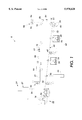
- FIG. 1 shows an electrophotographic printing machine that incorporates the principles of the present invention.
- FIG. 1 wherein a preferred embodiment of the present invention is implemented in a black plus two highlight color electrophotographic printing machine 8 which beneficially uses additive color toners. While the printing machine 8 includes a plurality of individual subsystems that are known in the art, they are implemented in a new, non-obvious, and useful way.
- the printing machine 8 includes an Active Matrix (AMAT) photoreceptor belt 10 which travels in the direction indicated by the arrow 12.
- the belt is mounted about a driven roller 14 and tension rollers 16 and 18.
- the driven roller 14 is then rotated by a motor 20, causing the belt to travel in the direction 12.
- AMAT Active Matrix
- the image area is that part of the photoreceptor belt which is to receive the various actions and toner layers that produce the final color image. While the photoreceptor belt may have numerous image areas, since each image area is processed in the same way a description of the processing of one image area suffices to explain the operation of the printing machine 8.
- the imaging process begins with the image area passing a "precharge" erase lamp 21 that illuminates the image area so as to cause any residual charges which might exist on the image area to be discharged.
- a "precharge” erase lamp 21 that illuminates the image area so as to cause any residual charges which might exist on the image area to be discharged.
- Such erase lamps are common in high quality systems.
- a charging station comprised of a DC corotron 22 that charges the image area in preparation for exposure to create a latent image. It should be understood that the actual charge placed on the photoreceptor depends upon many variables, such as the toner mass that is to be developed and the settings of the development stations (see below).
- the image area After passing through the charging station the image area advances until it reaches a first exposure station 24. At that exposure station the charged image area is exposed to a modulated laser beam 26 from a raster output scanner 27 that raster scans the image area such that an electrostatic latent representation of a black image is produced. Alternatively, an LED printbar might be used.
- the laser beam 26 itself has a wavelength of 675 nanometers.
- Many currently available toners pass light at that wavelength with little attenuation.
- a wavelength of 675 nanometers readily passes through commonly available red, yellow, and magenta toners.
- light at that wavelength does not pass through other colors of toner.
- commonly available black, green, and cyan toners highly attenuate light at that wavelength.
- black development station 32 After passing the exposure station 24 the now exposed image area with its black latent image passes a black development station 32. That station deposits black toner 34 onto the image area so as to develop the black latent image. Electrical biasing is such as to effect discharged area development (DAD). While the black development station 32 could be a magnetic brush developer as shown in FIG. 1, a scavengeless developer may actually be somewhat better, primarily because subsequent developers must use a non-contacting developer, such as a scavengeless developer. It is simply easier to produce a printing machine with a smaller number of different parts.
- DAD discharged area development
- a DC scorotron 42 recharges the image area and its black toner layer.
- the recharged image area with its black toner layer then advances to an exposure station 44, which is similar to the black exposure station 24.
- the exposure station 44 exposes the image area with a laser beam 46 so as to produce an electrostatic latent representation of a green image.
- the laser beam 46 also has a wavelength of 675 nanometers and is therefore highly attenuated as it attempts to pass through the black toner 34.
- the green development station 56 After passing the exposure station 44 the now re-exposed image area advances past a green development station 56 that deposits green toner 58 onto the image area. Since a layer of black toner may already exist on the image area, the green development station is beneficially a scavengeless developer. Since the black toner blocked the exposing laser beam 46, no area under the black toner is discharged. Thus, the green toner is prevented from depositing over the black toner and inhibited image-on-image printing is achieved.
- the image area After passing the green development station 56 the image area is recharged by a DC scorotron 60.
- the recharged image area with its black and green toner layers then advances to an exposure station 64.
- That exposure station is very much like the exposure stations 24 and 44, except that the exposure station 64 exposes the image area to produce an electrostatic latent representation of a red image.
- the red exposure station exposes the image area using a laser beam 66 having a wavelength of 675 nanometers. That laser beam is therefore highly attenuated as it attempts to pass through the black toner layer and the green toner layer.
- the exposure station 64 After passing the exposure station 64 the now re-exposed image area advances past a red development station 68 that deposits red toner 70 onto the image area.
- the exposure station exposes the image area using a laser beam 66 with a wavelength (675 nanometers) that readily passes through red toner.
- the red toner is the last toner layer that is developed, this is of no importance when marking with only three toners. Therefore, by arranging the architecture of the printing machine 8 such that earlier developed toners significantly attenuate exposing light, the last developed toner can significantly transmit the exposing light while still using inhibited image-on-image printing. This architecture is highly useful when using red and/or near-infrared laser diodes.
- the final toner image is comprised of toner particles that have charge potentials that vary widely. Directly transferring such a toner image onto a substrate would result in a degraded final image. Therefore it is beneficial to prepare the composite color toner image for transfer.
- a pretransfer erase lamp 72 discharges the image area to produce a relatively low charge level on the image area.
- the image area then passes a pretransfer DC corotron 80 that performs a pre-transfer charging function.
- the image area continues to advance in the direction 12 past the driven roller 14.
- a substrate 82 is then placed over the image area using a sheet feeder (which is not shown).
- a detack corotron 86 that corotron neutralizes some of the charge on the substrate to assist separation of the substrate from the photoreceptor 10.
- the substrate is then directed into a fuser 90 where a heated fuser roller 92 and a pressure roller 94 create a nip through which the substrate 82 passes.
- the combination of pressure and heat at the nip causes the composite color toner image to fuse into the substrate.
- a chute guides the substrate to a catch tray, also not shown, for removal by an operator.
- the image area continues its travel and passes a preclean corotron 97 that neutralizes most of the residual charges on the photoreceptor.
- the image area then passes a preclean erase lamp 98. That lamp neutralizes most of the charges remaining on the photoreceptor belt
- the preclean erase lamp the residual toner and/or debris on the photoreceptor is removed at a cleaning station 99.
- the image area then passes once again to the precharge erase lamp 21 and the start of another cycle.
Landscapes
- Physics & Mathematics (AREA)
- General Physics & Mathematics (AREA)
- Color Electrophotography (AREA)
- Exposure Or Original Feeding In Electrophotography (AREA)
Abstract
Description
Claims (10)
Priority Applications (2)
| Application Number | Priority Date | Filing Date | Title |
|---|---|---|---|
| US09/205,979 US5978628A (en) | 1998-12-04 | 1998-12-04 | Highlight color read printing using additive toners |
| JP11321942A JP2000172042A (en) | 1998-12-04 | 1999-11-12 | Highlight color read printer device using additive color mixing toner |
Applications Claiming Priority (1)
| Application Number | Priority Date | Filing Date | Title |
|---|---|---|---|
| US09/205,979 US5978628A (en) | 1998-12-04 | 1998-12-04 | Highlight color read printing using additive toners |
Publications (1)
| Publication Number | Publication Date |
|---|---|
| US5978628A true US5978628A (en) | 1999-11-02 |
Family
ID=22764469
Family Applications (1)
| Application Number | Title | Priority Date | Filing Date |
|---|---|---|---|
| US09/205,979 Expired - Lifetime US5978628A (en) | 1998-12-04 | 1998-12-04 | Highlight color read printing using additive toners |
Country Status (2)
| Country | Link |
|---|---|
| US (1) | US5978628A (en) |
| JP (1) | JP2000172042A (en) |
Cited By (4)
| Publication number | Priority date | Publication date | Assignee | Title |
|---|---|---|---|---|
| US6278855B1 (en) * | 1996-10-17 | 2001-08-21 | Oce Printing Systems Gmbh | Multicolor electrophotographic printing device with bipolar toner |
| US6480212B1 (en) * | 1999-07-02 | 2002-11-12 | Seiko Epson Corporation | Printer |
| US20070122198A1 (en) * | 2005-11-30 | 2007-05-31 | Konica Minolta Business Technologies, Inc. | Image forming apparatus and image forming method |
| US20120027442A1 (en) * | 2010-07-29 | 2012-02-02 | Canon Kabushiki Kaisha | Image forming apparatus |
Citations (18)
| Publication number | Priority date | Publication date | Assignee | Title |
|---|---|---|---|---|
| US4661703A (en) * | 1984-08-09 | 1987-04-28 | Fuji Xerox Co., Ltd. | Two-color copying machine |
| US5023632A (en) * | 1987-12-23 | 1991-06-11 | Matsushita Electric Industrial Co., Ltd. | Electrophotographic image forming method |
| US5032852A (en) * | 1989-01-27 | 1991-07-16 | Canon Kabushiki Kaisha | Image forming apparatus |
| US5045420A (en) * | 1988-12-09 | 1991-09-03 | Canon Kabushiki Kaisha | Color image forming method and particulate developer for developing electrostatic latent image |
| US5053821A (en) * | 1987-10-06 | 1991-10-01 | Seiko Epson Corporation, A Corporation Of Japan | Electrophotographic image forming apparatus using photoconductive toner |
| US5184146A (en) * | 1989-07-29 | 1993-02-02 | Konica Corporation | Color image forming method and apparatus |
| US5208796A (en) * | 1991-01-03 | 1993-05-04 | Xerox Corporation | Method and apparatus for transverse image registration on photoreceptive belts |
| US5252995A (en) * | 1992-09-03 | 1993-10-12 | Hewlett-Packard Company | Color boundary enhancement in a multi-color electrostatic printer |
| US5272493A (en) * | 1992-04-02 | 1993-12-21 | Xerox Corporation | Method and apparatus for registration of sequential images in a single pass, multi-LED printbar printer |
| US5386223A (en) * | 1989-10-12 | 1995-01-31 | Hitachi, Ltd. | Method of apparatus for recording color image by overlapping toner images of different colors |
| US5418097A (en) * | 1992-04-07 | 1995-05-23 | Fuji Xerox Co., Ltd. | Color image recording method and apparatus |
| US5438401A (en) * | 1991-12-09 | 1995-08-01 | Ricoh Company, Ltd. | Multicolor image forming method and apparatus therefor |
| US5515155A (en) * | 1995-06-07 | 1996-05-07 | Xerox Corporation | Method and apparatus for establishing exposure and developer set points for color image formation |
| US5537198A (en) * | 1994-12-12 | 1996-07-16 | Xerox Corporation | Double split recharge method and apparatus for color image formation |
| US5581330A (en) * | 1994-11-30 | 1996-12-03 | Xerox Corporation | Method and apparatus for reducing residual toner voltage |
| US5600430A (en) * | 1994-11-30 | 1997-02-04 | Xerox Corporation | Split recharge method and apparatus for color image formation |
| US5752137A (en) * | 1995-06-09 | 1998-05-12 | Konica Corporation | Multi-color image forming apparatus having a plurality of detachable units |
| US5828933A (en) * | 1997-11-24 | 1998-10-27 | Xerox Corporation | Additive color recharge, expose, and develop electrophotographic printing |
-
1998
- 1998-12-04 US US09/205,979 patent/US5978628A/en not_active Expired - Lifetime
-
1999
- 1999-11-12 JP JP11321942A patent/JP2000172042A/en not_active Withdrawn
Patent Citations (18)
| Publication number | Priority date | Publication date | Assignee | Title |
|---|---|---|---|---|
| US4661703A (en) * | 1984-08-09 | 1987-04-28 | Fuji Xerox Co., Ltd. | Two-color copying machine |
| US5053821A (en) * | 1987-10-06 | 1991-10-01 | Seiko Epson Corporation, A Corporation Of Japan | Electrophotographic image forming apparatus using photoconductive toner |
| US5023632A (en) * | 1987-12-23 | 1991-06-11 | Matsushita Electric Industrial Co., Ltd. | Electrophotographic image forming method |
| US5045420A (en) * | 1988-12-09 | 1991-09-03 | Canon Kabushiki Kaisha | Color image forming method and particulate developer for developing electrostatic latent image |
| US5032852A (en) * | 1989-01-27 | 1991-07-16 | Canon Kabushiki Kaisha | Image forming apparatus |
| US5184146A (en) * | 1989-07-29 | 1993-02-02 | Konica Corporation | Color image forming method and apparatus |
| US5386223A (en) * | 1989-10-12 | 1995-01-31 | Hitachi, Ltd. | Method of apparatus for recording color image by overlapping toner images of different colors |
| US5208796A (en) * | 1991-01-03 | 1993-05-04 | Xerox Corporation | Method and apparatus for transverse image registration on photoreceptive belts |
| US5438401A (en) * | 1991-12-09 | 1995-08-01 | Ricoh Company, Ltd. | Multicolor image forming method and apparatus therefor |
| US5272493A (en) * | 1992-04-02 | 1993-12-21 | Xerox Corporation | Method and apparatus for registration of sequential images in a single pass, multi-LED printbar printer |
| US5418097A (en) * | 1992-04-07 | 1995-05-23 | Fuji Xerox Co., Ltd. | Color image recording method and apparatus |
| US5252995A (en) * | 1992-09-03 | 1993-10-12 | Hewlett-Packard Company | Color boundary enhancement in a multi-color electrostatic printer |
| US5581330A (en) * | 1994-11-30 | 1996-12-03 | Xerox Corporation | Method and apparatus for reducing residual toner voltage |
| US5600430A (en) * | 1994-11-30 | 1997-02-04 | Xerox Corporation | Split recharge method and apparatus for color image formation |
| US5537198A (en) * | 1994-12-12 | 1996-07-16 | Xerox Corporation | Double split recharge method and apparatus for color image formation |
| US5515155A (en) * | 1995-06-07 | 1996-05-07 | Xerox Corporation | Method and apparatus for establishing exposure and developer set points for color image formation |
| US5752137A (en) * | 1995-06-09 | 1998-05-12 | Konica Corporation | Multi-color image forming apparatus having a plurality of detachable units |
| US5828933A (en) * | 1997-11-24 | 1998-10-27 | Xerox Corporation | Additive color recharge, expose, and develop electrophotographic printing |
Non-Patent Citations (2)
| Title |
|---|
| Japan Patent Office (JP) 3 202869, Color Image Forming Apparatus, Sep. 1991 15 pages. * |
| Japan Patent Office (JP) 3-202869, Color Image Forming Apparatus, Sep. 1991 15 pages. |
Cited By (9)
| Publication number | Priority date | Publication date | Assignee | Title |
|---|---|---|---|---|
| US6278855B1 (en) * | 1996-10-17 | 2001-08-21 | Oce Printing Systems Gmbh | Multicolor electrophotographic printing device with bipolar toner |
| US6480212B1 (en) * | 1999-07-02 | 2002-11-12 | Seiko Epson Corporation | Printer |
| US6573920B2 (en) | 1999-07-02 | 2003-06-03 | Seiko Epson Corporation | Method of manufacturing a printer with an electroluminescent (EL) pixel array |
| US20070122198A1 (en) * | 2005-11-30 | 2007-05-31 | Konica Minolta Business Technologies, Inc. | Image forming apparatus and image forming method |
| US20080292336A1 (en) * | 2005-11-30 | 2008-11-27 | Konica Minolta Business Technologies, Inc. | Image forming apparatus and image forming method |
| US7522864B2 (en) * | 2005-11-30 | 2009-04-21 | Konica Minolta Business Technologies, Inc. | Image forming apparatus and image forming method |
| US7676163B2 (en) | 2005-11-30 | 2010-03-09 | Konica Minolta Business Technologies, Inc. | Image forming apparatus and image forming method |
| US20120027442A1 (en) * | 2010-07-29 | 2012-02-02 | Canon Kabushiki Kaisha | Image forming apparatus |
| US8532518B2 (en) * | 2010-07-29 | 2013-09-10 | Canon Kabushiki Kaisha | Image forming apparatus |
Also Published As
| Publication number | Publication date |
|---|---|
| JP2000172042A (en) | 2000-06-23 |
Similar Documents
| Publication | Publication Date | Title |
|---|---|---|
| JPH0675436A (en) | Method and apparatus for forming color picture | |
| US5241356A (en) | Method and apparatus for minimizing the voltage difference between a developed electrostatic image area and a latent electrostaic non-developed image | |
| US5828933A (en) | Additive color recharge, expose, and develop electrophotographic printing | |
| EP0717324B1 (en) | Corona generating recharge method and apparatus for color image formation | |
| CA2044319C (en) | Highlight printing apparatus | |
| US5576824A (en) | Five cycle image on image printing architecture | |
| EP1099985A2 (en) | A method for applying a uniform gloss | |
| EP1076268B1 (en) | Pretransfer toner treatment | |
| US4959286A (en) | Two-pass highlight color imaging with developer housing bias switching | |
| EP0892316B1 (en) | Colour printing machine | |
| US20020067929A1 (en) | High voltage developer bias multiplexer | |
| EP0361851B1 (en) | Photoreceptor edge erase system especially for tri-level xerography | |
| EP0735433B1 (en) | Penta-level xerographic unit | |
| US5480751A (en) | Tri-level background suppression scheme using an AC scorotron with front erase | |
| US5749034A (en) | Transfer, cleaning and imaging stations spaced within an interdocument zone | |
| US5574540A (en) | Dual use charging devices | |
| JP2000172042A (en) | Highlight color read printer device using additive color mixing toner | |
| US6292645B1 (en) | Apparatus and method for minimizing the halo effect in an electrostatographic printing system | |
| US5794106A (en) | Erase before D.C. recharge in color electrophotographic printing | |
| US5809382A (en) | DAD, DAD, DAD single-pass color printing | |
| US5991579A (en) | High slope DC/AC combination charging device | |
| EP0892317B1 (en) | Method of operating a colour printing machine | |
| US5999790A (en) | Five cycle color printing architecture with a camming mechanism for engaging and disengaging a transfer and cleaning stations | |
| US5926674A (en) | Reverse polarity split recharge in recharge-expose-and-develop image on imaging printing | |
| EP0892318B1 (en) | Method of operating a colour printing machine |
Legal Events
| Date | Code | Title | Description |
|---|---|---|---|
| AS | Assignment |
Owner name: XEROX CORPORATION, CONNECTICUT Free format text: ASSIGNMENT OF ASSIGNORS INTEREST;ASSIGNOR:REES, JAMES D.;REEL/FRAME:009636/0580 Effective date: 19981201 |
|
| STCF | Information on status: patent grant |
Free format text: PATENTED CASE |
|
| AS | Assignment |
Owner name: BANK ONE, NA, AS ADMINISTRATIVE AGENT, ILLINOIS Free format text: SECURITY INTEREST;ASSIGNOR:XEROX CORPORATION;REEL/FRAME:013153/0001 Effective date: 20020621 |
|
| FPAY | Fee payment |
Year of fee payment: 4 |
|
| AS | Assignment |
Owner name: JPMORGAN CHASE BANK, AS COLLATERAL AGENT, TEXAS Free format text: SECURITY AGREEMENT;ASSIGNOR:XEROX CORPORATION;REEL/FRAME:015134/0476 Effective date: 20030625 Owner name: JPMORGAN CHASE BANK, AS COLLATERAL AGENT,TEXAS Free format text: SECURITY AGREEMENT;ASSIGNOR:XEROX CORPORATION;REEL/FRAME:015134/0476 Effective date: 20030625 |
|
| REMI | Maintenance fee reminder mailed | ||
| FPAY | Fee payment |
Year of fee payment: 8 |
|
| SULP | Surcharge for late payment |
Year of fee payment: 7 |
|
| AS | Assignment |
Owner name: XEROX CORPORATION, NEW YORK Free format text: RELEASE BY SECURED PARTY;ASSIGNOR:JP MORGAN CHASE BANK, NA;REEL/FRAME:020031/0800 Effective date: 20061204 |
|
| AS | Assignment |
Owner name: XEROX CORPORATION, NEW YORK Free format text: RELEASE BY SECURED PARTY;ASSIGNOR:BANK ONE, NA;REEL/FRAME:020045/0638 Effective date: 20030625 |
|
| FPAY | Fee payment |
Year of fee payment: 12 |
|
| AS | Assignment |
Owner name: XEROX CORPORATION, CONNECTICUT Free format text: RELEASE BY SECURED PARTY;ASSIGNOR:JPMORGAN CHASE BANK, N.A. AS SUCCESSOR-IN-INTEREST ADMINISTRATIVE AGENT AND COLLATERAL AGENT TO JPMORGAN CHASE BANK;REEL/FRAME:066728/0193 Effective date: 20220822 |