US5930593A - Method for formating device on wafer without peeling - Google Patents

Method for formating device on wafer without peeling Download PDF

Info

Publication number
US5930593A
US5930593A US08/895,430 US89543097A US5930593A US 5930593 A US5930593 A US 5930593A US 89543097 A US89543097 A US 89543097A US 5930593 A US5930593 A US 5930593A
Authority
US
United States
Prior art keywords
layer
dielectric layer
forming
edge area
area
Prior art date
Legal status (The legal status is an assumption and is not a legal conclusion. Google has not performed a legal analysis and makes no representation as to the accuracy of the status listed.)
Expired - Lifetime
Application number
US08/895,430
Inventor
Cheng-Hsun Tsai
Yui-Ping Huang
Mao-Song Tseng
Yuan-Lung Lin
Current Assignee (The listed assignees may be inaccurate. Google has not performed a legal analysis and makes no representation or warranty as to the accuracy of the list.)
Promos Technologies Inc
Original Assignee
Mosel Vitelic Inc
Priority date (The priority date is an assumption and is not a legal conclusion. Google has not performed a legal analysis and makes no representation as to the accuracy of the date listed.)
Filing date
Publication date
Application filed by Mosel Vitelic Inc filed Critical Mosel Vitelic Inc
Assigned to MOSEL VITELIC INC. reassignment MOSEL VITELIC INC. ASSIGNMENT OF ASSIGNORS INTEREST (SEE DOCUMENT FOR DETAILS). Assignors: HUANG, YUI-PING, LIN, YUAN-LUNG, TSAI, CHENG-HAUN, TSENG, MAO-SONG
Application granted granted Critical
Publication of US5930593A publication Critical patent/US5930593A/en
Assigned to PROMOS TECHNOLOGIES INC. reassignment PROMOS TECHNOLOGIES INC. ASSIGNMENT OF ASSIGNORS INTEREST (SEE DOCUMENT FOR DETAILS). Assignors: MOSEL VITELIC, INC.
Anticipated expiration legal-status Critical
Expired - Lifetime legal-status Critical Current

Links

Images

Classifications

    • H10W42/00

Definitions

  • the present invention is related to a method for forming device on wafer without peeling, and more particularly to a method for forming device on wafer without peeling on edge area.
  • This area includes many basic units, such as MOS structures.
  • the edge area of wafer is not concerned and raw materials of processing are left on it. This leftover does not affect performance of the units.
  • high temperature reaction however, it is transformed into other material which has different thermal expansion coefficient from dielectric materials under it.
  • thermal treat process it causes peeling phenomenon on the edge area of wafer and contaminates the whole system.
  • Titanium film is deposited over the polysilicon layer as glue layer. Titanium nitride (TiN) film is formed by rapid thermal nitridation (RTN) procedure, but titanic film and polysilicon layer will react to form titanium silicide (TiSi 2 ) film simultaneously. Titanium silicide film has much different thermal expansion coefficient from dielectric layer, so titanium silicide film and titanic film will peel off dielectric layer on edge area of wafer during thermal treat process. These contaminants trouble manufacturers very much.
  • Polysilicon layer is left on edge area of wafer because of the use of etcher with clamps. Etching process is hampered by these clamps and a width of 2 mm polysilicon can not be etched. It is useful to employ clampless etchers in factory. But this idea does not work in practice because that it costs too much to restock new equipments. Rearranging equipments is neither suitable because of complexity of semiconductor processing.
  • An objective of the present invention is to provide a method for forming devices on wafer without peeling during thermal treat process by isolating the leftover layer on edge area.
  • Another objective of the present invention is to provide a method for forming devices on wafer without peeling during thermal treat process by removing the leftover on edge area.
  • a method for forming a device on a wafer without peeling in which the wafer has a substrate forming thereon a first dielectric layer forming thereon a first conducting layer having thereon a first device area and an edge area, includes steps of a) forming a second dielectric layer on the first device area and the edge area, b) forming a photoresist layer on the second dielectric layer, c) selectively removing the second dielectric layer, the photoresist layer, and the first conducting layer from and presenting thereby the first device area and the edge area with a desired dielectric layer, d) forming a metal film on the first device area and the edge area, and e) forming a titanium nitride (TiN) film on the titanic film.
  • TiN titanium nitride
  • step c) includes the following sub-steps, c1) executing a photolithography and etching procedure to etch the second dielectric layer on the first device area, and c2) removing the remaining photoresist layer on the first device area and the edge area.
  • the first dielectric layer is preferably one selected from a group consisting of a silicon dioxide (SiO 2 ) layer, a phosphosilicate glass (PSG) layer, a borophosphosilicate glass (BPSG) layer, a thermal oxide layer, and a non-doped silicate glass (NSG) layer.
  • the first conducting layer is a polysilicon layer.
  • the first device area is defined by the first conducting layer forming thereon a third dielectric layer forming thereon a second conducting layer forming thereon the second dielectric layer.
  • the step a) is preferably executed by a chemical vapor deposition (CVD) method
  • the second dielectric layer is removed by a dry etching
  • the titanium nitride film is formed by rapid thermal nitridation (RTN) procedure or reactive sputtering deposition procedure.
  • RTN rapid thermal nitridation
  • the first device area preferably forms thereon a contact hole which is covered by the metal film, e.g. titanic film.
  • the contact hole is formed by etching the second dielectric layer, and the metal film is formed by a magnetron DC sputtering.
  • a step of forming a contact plug is preferably formed by blanket tungsten deposition or selective tungsten deposition in the contact hole.
  • a second device area which is preferably defined by the substrate forming thereon a third conducting layer forming thereon a fourth dielectric layer forming thereon a fourth conducting layer forming thereon the first dielectric layer.
  • the step c) preferably further includes the following sub-steps, c3) removing the photoresist layer on the second dielectric layer on the edge area, and c4) executing a photolithography and etching procedure to etch the second dielectric layer on the first device area with an etcher having a clamp in order to maintain the second dielectric layer on the edge area.
  • the step c) preferably further includes the following sub-steps, c5) removing the photoresist layer on the second dielectric layer on the edge area, c6) executing a photolithography and etching procedure to etch the second dielectric layer on the first device area and the edge area, and c7) simultaneously etching away the photoresist layer remained on the second dielectric layer and the first conducting layer on the edge area by a dry etching, e.g. a plasma etching technique using ozone (O 3 ).
  • a dry etching e.g. a plasma etching technique using ozone (O 3 ).
  • a method for forming a device on a wafer without peeling in which the wafer has a substrate forming thereon a first dielectric layer forming thereon a first conducting layer having thereon a device area and an edge area, includes steps of a) removing the first conducting layer on the edge area by dry etching, b) forming a second dielectric layer on the device area and the edge area, c) forming a photoresist layer on the second dielectric layer, d) removing the photoresist layer on the second dielectric layer on the edge area, e) executing a photolithography and etching procedure to etch the second dielectric layer, and f) forming a metal film on the device area and the edge area.
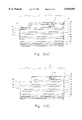
  • FIGS. 1(a)-(f) is a schematic diagram showing a preferred embodiment of a contact plug manufacturing process according to the present invention
  • FIGS. 2(a)-(f) is a schematic diagram showing another preferred embodiment of a contact plug manufacturing process according to the present invention.
  • FIGS. 3(a)-(g) is a schematic diagram showing a third preferred embodiment of a contact plug manufacturing process according to the present inventing.
  • FIGS. 4(a)-(g) is a schematic diagram showing a fourth preferred embodiment of a contact plug manufacturing process according to the present invention.
  • CVD chemical vapor deposition
  • the dielectric layers 1O, 2O, and 3O are selected among a silicon dioxide (SiO 2 ) layer, a phosphosilicate glass (PSG) layer, a borophosphosilicate glass (BPSG) layer, a thermal oxide layer, and a non-doped silicate glass (NSG) layer.
  • the conducting layers 1P, 2P, 3P, and 4P are polysilicon layers. There are two regions on the wafer. They are device area D and edge area E respectively. The present invention brings the edge area E into focus.
  • FIGS. 1(b) and 1(c) indicate the forming of a fourth dielectric layer 4O and a photoresist layer R on both areas D and E.
  • FIG. 1(d) shows the next steps.
  • a photolithography and etching procedure such as dry etching is executed to etch the fourth dielectric layer 4O to form a contact hole C on device area D.
  • the key point is to leave the fourth dielectric layer 4O on edge area E.
  • FIGS. 1(e) and 1(f) indicate the removing of the remaining photoresist layer on both areas D and E. Then magnetron DC sputtering and blanket tungsten deposition method are executed to form a metal film M and a tungsten film W on both areas D and E.
  • This metal film M is selected as titanic or titanic/titanium nitride (Ti/TiN) film.
  • Ti/TiN titanic or titanic/titanium nitride
  • this titanium nitride film is formed by rapid thermal nitridation (RTN) or reactive sputtering deposition procedure. At last, execute a etchback procedure to form a contact plug in the contact hole C.
  • the difference between conventional technique and present invention is to make metal film M break contact with the third conducting layer 3P on edge area E.
  • Titanic film will react with the third conducting layer 3P to form titanium silicide (TiSi 2 ) film, and titanium silicide has much different thermal expansion coefficient from dielectric materials.
  • titanium silicide film and titanic film peel off dielectric layer on edge area E. Introducing the fourth dielectric layer 40 solves this problem properly.
  • FIGS. 2(a) and 2(b) show a chemical vapor deposition method used to form dielectric layers 1O, 2O, 3O, and 4O and conducting layers 1P, 2P, 3P, and 4P on substrate S.
  • FIG. 2(c) shows the forming of a photoresist layer R on both areas D and E and the stripping of the photoresist layer R on edge area E.
  • FIG. 2(d) illustrates the following steps. Executing a photolithography and etching procedure such as dry etching to etch the fourth dielectric layer 4O to form a contact hole C on device area D. An etcher with clamps is used to keep the fourth dielectric layer 4O on edge area E.
  • a photolithography and etching procedure such as dry etching to etch the fourth dielectric layer 4O to form a contact hole C on device area D.
  • An etcher with clamps is used to keep the fourth dielectric layer 4O on edge area E.
  • FIGS. 2(e) and 2(f) indicates the methods including magnetron DC sputtering, blanket tungsten deposition, and etchback to form a tungsten plug.
  • This example has the same effect as example 1.
  • Metal film M has no contact with the third conducting layer 3P due to the introduction of the fourth dielectric layer 4O.
  • the generation of titanium silicide layer is impossible in this case. Peeling on edge area E due to the generation of titanium silicide layer does not occur even during thermal treat process.
  • FIGS. 3(a)-3(c) show the forming of dielectric layers 1O, 2O, 3O, and 4O, conducting layers 1P, 2P, 3P, and 4P, and photoresist layer R on substrate S, and the removing of the photoresist layer R on edge area E.
  • FIG. 3(d) Shown in FIG. 3(d) is a photolithography and etching procedure such as dry etching executed to form a contact C on device area D and to remove the fourth dielectric layer 4O entirely on edge area E. An etcher without clamps is used in this case.
  • FIG. 3(e) shows that a dry etching by means of a plasma etching technique using ozone (O 3 ) is executed to remove the photoresist layer R remained on the fourth dielectric layer 4O and the third conducting layer 3P on edge area.
  • FIGS. 3(f) and 3(g) indicate the methods including magnetron DC sputtering, blanket tungsten deposition, and etchback to form a tungsten plug.
  • the difference between conventional technique and this sample is to make metal film M break contact with the third conducting layer 3P on edge area E. Titanic film will react with the third conducting layer 3P to form titanium silicide film, and titanium silicide has much different thermal expansion coefficient from dielectric materials. During thermal treat process, titanium silicide film and titanic film peel off dielectric layer on edge area E. Removing the third conducting layer 3P solves this problem properly.
  • FIG. 4(a) shows a chemical vapor deposition method executed to form dielectric layers 1O, 2O, and 3O and conducting layers 1P, 2P, 3P, and 4P on substrate S.
  • FIG. 4(b) Shown in FIG. 4(b) is a dry etching procedure executed to remove the third conducting layer 3P on edge area E, and in FIG. 4(c) is the chemical vapor deposition executed to form the fourth dielectric layer 4O on both areas D and E.
  • FIG. 4(d) shows the steps of forming a photoresist layer R over the fourth dielectric 4O, and stripping the photoresist layer R over the fourth dielectric 4O on edge area E.
  • FIG. 4(e) indicates that a photolithography and etching procedure such as dry etching is executed to form a contact hole C on device area D and to remove the fourth dielectric layer 4O entirely on edge area E. An etcher without clamps is used in this case.
  • FIGS. 4(f) and 4(g) indicate the methods including magnetron DC sputtering, blanket tungsten deposition, and etchback to form a tungsten plug.
  • This example has the same effect as example 3.
  • the metal film M has no contact with the third conducting layer 3P due to the removing of the third conducting layer 3P on edge area E.
  • the generation of titanium silicide layer is impossible in this case. Peeling on edge area E due to the generation of titanium silicide layer does not occur even during thermal treat process.

Landscapes

  • Internal Circuitry In Semiconductor Integrated Circuit Devices (AREA)

Abstract

The present invention provides a method for forming a device on a wafer without peeling, in which the wafer has a substrate forming thereon a first dielectric layer forming thereon a first conducting layer having thereon a device area and an edge area. This method includes steps of a) forming a second dielectric layer on the device area and the edge area, b) forming a photoresist layer on the second dielectric layer, c) selectively removing the second dielectric layer, the photoresist layer, and the first conducting layer from and presenting thereby the device area and the edge area with a desired dielectric layer, and d) forming a metal film on the device area and the edge area.

Description

FIELD OF THE INVENTION
The present invention is related to a method for forming device on wafer without peeling, and more particularly to a method for forming device on wafer without peeling on edge area.
BACKGROUND OF THE INVENTION
For processing semiconductors, hundreds of steps will be taken on the center region to form a device area. This area includes many basic units, such as MOS structures. The edge area of wafer is not concerned and raw materials of processing are left on it. This leftover does not affect performance of the units. During high temperature reaction, however, it is transformed into other material which has different thermal expansion coefficient from dielectric materials under it. During thermal treat process, it causes peeling phenomenon on the edge area of wafer and contaminates the whole system.
For example, in tungsten plug manufacturing process, dielectric layer and polysilicon layer which is over the dielectric layer are left on edge area of wafer. Titanic film is deposited over the polysilicon layer as glue layer. Titanium nitride (TiN) film is formed by rapid thermal nitridation (RTN) procedure, but titanic film and polysilicon layer will react to form titanium silicide (TiSi2) film simultaneously. Titanium silicide film has much different thermal expansion coefficient from dielectric layer, so titanium silicide film and titanic film will peel off dielectric layer on edge area of wafer during thermal treat process. These contaminants trouble manufacturers very much.
Polysilicon layer is left on edge area of wafer because of the use of etcher with clamps. Etching process is hampered by these clamps and a width of 2 mm polysilicon can not be etched. It is useful to employ clampless etchers in factory. But this idea does not work in practice because that it costs too much to restock new equipments. Rearranging equipments is neither suitable because of complexity of semiconductor processing.
SUMMARY OF THE INVENTION
An objective of the present invention is to provide a method for forming devices on wafer without peeling during thermal treat process by isolating the leftover layer on edge area.
Another objective of the present invention is to provide a method for forming devices on wafer without peeling during thermal treat process by removing the leftover on edge area.
In accordance with the present invention, a method for forming a device on a wafer without peeling, in which the wafer has a substrate forming thereon a first dielectric layer forming thereon a first conducting layer having thereon a first device area and an edge area, includes steps of a) forming a second dielectric layer on the first device area and the edge area, b) forming a photoresist layer on the second dielectric layer, c) selectively removing the second dielectric layer, the photoresist layer, and the first conducting layer from and presenting thereby the first device area and the edge area with a desired dielectric layer, d) forming a metal film on the first device area and the edge area, and e) forming a titanium nitride (TiN) film on the titanic film.
The method in step c) includes the following sub-steps, c1) executing a photolithography and etching procedure to etch the second dielectric layer on the first device area, and c2) removing the remaining photoresist layer on the first device area and the edge area.
In accordance with another aspect of the present invention, the first dielectric layer is preferably one selected from a group consisting of a silicon dioxide (SiO2) layer, a phosphosilicate glass (PSG) layer, a borophosphosilicate glass (BPSG) layer, a thermal oxide layer, and a non-doped silicate glass (NSG) layer. The first conducting layer is a polysilicon layer.
In accordance with another aspect of the present invention, the first device area is defined by the first conducting layer forming thereon a third dielectric layer forming thereon a second conducting layer forming thereon the second dielectric layer.
In accordance with another aspect of the present invention, the step a) is preferably executed by a chemical vapor deposition (CVD) method, in the step c), the second dielectric layer is removed by a dry etching, and in the step e), the titanium nitride film is formed by rapid thermal nitridation (RTN) procedure or reactive sputtering deposition procedure.
In accordance with another aspect of the present invention, the first device area preferably forms thereon a contact hole which is covered by the metal film, e.g. titanic film. The contact hole is formed by etching the second dielectric layer, and the metal film is formed by a magnetron DC sputtering.
In accordance with another aspect of the present invention, after the step d), a step of forming a contact plug, e.g. tungsten plug, is preferably formed by blanket tungsten deposition or selective tungsten deposition in the contact hole.
In accordance with another aspect of the present invention, further includes a second device area which is preferably defined by the substrate forming thereon a third conducting layer forming thereon a fourth dielectric layer forming thereon a fourth conducting layer forming thereon the first dielectric layer.
In accordance with another aspect of the present invention, the step c) preferably further includes the following sub-steps, c3) removing the photoresist layer on the second dielectric layer on the edge area, and c4) executing a photolithography and etching procedure to etch the second dielectric layer on the first device area with an etcher having a clamp in order to maintain the second dielectric layer on the edge area.
In accordance with another aspect of the present invention, the step c) preferably further includes the following sub-steps, c5) removing the photoresist layer on the second dielectric layer on the edge area, c6) executing a photolithography and etching procedure to etch the second dielectric layer on the first device area and the edge area, and c7) simultaneously etching away the photoresist layer remained on the second dielectric layer and the first conducting layer on the edge area by a dry etching, e.g. a plasma etching technique using ozone (O3).
In accordance with the present invention, a method for forming a device on a wafer without peeling, in which the wafer has a substrate forming thereon a first dielectric layer forming thereon a first conducting layer having thereon a device area and an edge area, includes steps of a) removing the first conducting layer on the edge area by dry etching, b) forming a second dielectric layer on the device area and the edge area, c) forming a photoresist layer on the second dielectric layer, d) removing the photoresist layer on the second dielectric layer on the edge area, e) executing a photolithography and etching procedure to etch the second dielectric layer, and f) forming a metal film on the device area and the edge area.
The present invention may best be understood through the following description with reference to the accompanying drawings, in which:
BRIEF DESCRIPTION OF THE DRAWINGS
FIGS. 1(a)-(f) is a schematic diagram showing a preferred embodiment of a contact plug manufacturing process according to the present invention;
FIGS. 2(a)-(f) is a schematic diagram showing another preferred embodiment of a contact plug manufacturing process according to the present invention; and
FIGS. 3(a)-(g) is a schematic diagram showing a third preferred embodiment of a contact plug manufacturing process according to the present inventing; and
FIGS. 4(a)-(g) is a schematic diagram showing a fourth preferred embodiment of a contact plug manufacturing process according to the present invention.
DETAILED DESCRIPTION OF THE PREFERRED EMBODIMENT
The present invention will now be described more specifically with reference to the following embodiments. It is to be noted that the following descriptions of preferred embodiments of this invention are presented herein for the purpose of illustration and description only; it is not intended to be exhaustive or to be limited to the precise form disclosed.
EXAMPLE 1.
Referring to FIG. 1(a), chemical vapor deposition (CVD) method is executed to form a first conducting layer 1P, a first dielectric layer 1O, a second conducting layer 2P, a second dielectric layer 2O, a third conducting layer 3P, a third dielectric layer 3O, and a fourth conducting layer 4P respectively on substrate S of a wafer. The dielectric layers 1O, 2O, and 3O are selected among a silicon dioxide (SiO2) layer, a phosphosilicate glass (PSG) layer, a borophosphosilicate glass (BPSG) layer, a thermal oxide layer, and a non-doped silicate glass (NSG) layer. The conducting layers 1P, 2P, 3P, and 4P are polysilicon layers. There are two regions on the wafer. They are device area D and edge area E respectively. The present invention brings the edge area E into focus.
FIGS. 1(b) and 1(c) indicate the forming of a fourth dielectric layer 4O and a photoresist layer R on both areas D and E.
FIG. 1(d) shows the next steps. A photolithography and etching procedure such as dry etching is executed to etch the fourth dielectric layer 4O to form a contact hole C on device area D. The key point is to leave the fourth dielectric layer 4O on edge area E.
FIGS. 1(e) and 1(f) indicate the removing of the remaining photoresist layer on both areas D and E. Then magnetron DC sputtering and blanket tungsten deposition method are executed to form a metal film M and a tungsten film W on both areas D and E. This metal film M is selected as titanic or titanic/titanium nitride (Ti/TiN) film. And this titanium nitride film is formed by rapid thermal nitridation (RTN) or reactive sputtering deposition procedure. At last, execute a etchback procedure to form a contact plug in the contact hole C.
As stated above, the difference between conventional technique and present invention is to make metal film M break contact with the third conducting layer 3P on edge area E. Titanic film will react with the third conducting layer 3P to form titanium silicide (TiSi2) film, and titanium silicide has much different thermal expansion coefficient from dielectric materials. During thermal treat process, titanium silicide film and titanic film peel off dielectric layer on edge area E. Introducing the fourth dielectric layer 40 solves this problem properly.
EXAMPLE 2.
Similar to FIGS. 1(a) and 1(b), FIGS. 2(a) and 2(b) show a chemical vapor deposition method used to form dielectric layers 1O, 2O, 3O, and 4O and conducting layers 1P, 2P, 3P, and 4P on substrate S. FIG. 2(c) shows the forming of a photoresist layer R on both areas D and E and the stripping of the photoresist layer R on edge area E.
FIG. 2(d) illustrates the following steps. Executing a photolithography and etching procedure such as dry etching to etch the fourth dielectric layer 4O to form a contact hole C on device area D. An etcher with clamps is used to keep the fourth dielectric layer 4O on edge area E.
Corresponding to FIGS. 1(e) and 1(f), FIGS. 2(e) and 2(f) indicates the methods including magnetron DC sputtering, blanket tungsten deposition, and etchback to form a tungsten plug.
This example has the same effect as example 1. Metal film M has no contact with the third conducting layer 3P due to the introduction of the fourth dielectric layer 4O. Thus, the generation of titanium silicide layer is impossible in this case. Peeling on edge area E due to the generation of titanium silicide layer does not occur even during thermal treat process.
EXAMPLE 3.
Corresponding to FIGS. 2(a)-2(c), FIGS. 3(a)-3(c) show the forming of dielectric layers 1O, 2O, 3O, and 4O, conducting layers 1P, 2P, 3P, and 4P, and photoresist layer R on substrate S, and the removing of the photoresist layer R on edge area E.
Shown in FIG. 3(d) is a photolithography and etching procedure such as dry etching executed to form a contact C on device area D and to remove the fourth dielectric layer 4O entirely on edge area E. An etcher without clamps is used in this case. FIG. 3(e) shows that a dry etching by means of a plasma etching technique using ozone (O3) is executed to remove the photoresist layer R remained on the fourth dielectric layer 4O and the third conducting layer 3P on edge area.
Similar to FIGS. 1(e) and 1(f), FIGS. 3(f) and 3(g) indicate the methods including magnetron DC sputtering, blanket tungsten deposition, and etchback to form a tungsten plug.
The difference between conventional technique and this sample is to make metal film M break contact with the third conducting layer 3P on edge area E. Titanic film will react with the third conducting layer 3P to form titanium silicide film, and titanium silicide has much different thermal expansion coefficient from dielectric materials. During thermal treat process, titanium silicide film and titanic film peel off dielectric layer on edge area E. Removing the third conducting layer 3P solves this problem properly.
EXAMPLE 4.
Corresponding to FIG. 1(a), FIG. 4(a) shows a chemical vapor deposition method executed to form dielectric layers 1O, 2O, and 3O and conducting layers 1P, 2P, 3P, and 4P on substrate S.
Shown in FIG. 4(b) is a dry etching procedure executed to remove the third conducting layer 3P on edge area E, and in FIG. 4(c) is the chemical vapor deposition executed to form the fourth dielectric layer 4O on both areas D and E.
FIG. 4(d) shows the steps of forming a photoresist layer R over the fourth dielectric 4O, and stripping the photoresist layer R over the fourth dielectric 4O on edge area E. Corresponding to FIG. 3(d), FIG. 4(e) indicates that a photolithography and etching procedure such as dry etching is executed to form a contact hole C on device area D and to remove the fourth dielectric layer 4O entirely on edge area E. An etcher without clamps is used in this case.
Corresponding to FIGS. 1(e) and 1(f), FIGS. 4(f) and 4(g) indicate the methods including magnetron DC sputtering, blanket tungsten deposition, and etchback to form a tungsten plug.
This example has the same effect as example 3. The metal film M has no contact with the third conducting layer 3P due to the removing of the third conducting layer 3P on edge area E. The generation of titanium silicide layer is impossible in this case. Peeling on edge area E due to the generation of titanium silicide layer does not occur even during thermal treat process.
In conclusion, Peeling of raw materials due to different thermal expansion coefficient will contaminate the whole system and the present invention is thus developed to prevent the contamination. Insulating metal film from contacting with conducting layer or removing the conducting layer, as suggested by the present invention, can solve this problem well. Present invention also provides a procedure without need of equipment rearrangement inherent in conventional technique. This invention is practicable in terms of the concern for production cost and quality control.
While the invention has been described in terms of what are presently considered to be the most practical and preferred embodiments, it is to be understood that the invention need not be limited to the disclosed embodiment. On the contrary, it is intended to cover various modifications and similar arrangements included within the spirit and scope of the appended claims which are to be accorded with the broadest interpretation so as to encompass all such modifications and similar structures.

Claims (23)

What is claimed is:
1. A method for forming a device on a wafer without peeling, said wafer having a substrate forming thereon a first dielectric layer forming thereon a first conducting layer having thereon a first device area and an edge area, comprising:
a) forming a second dielectric layer on said first device area and said edge area;
b) forming a photoresist layer on said second dielectric layer;
c) selectively removing said second dielectric layer, said photoresist layer, and said first conducting layer from and presenting thereby said first device area and said edge area with a desired dielectric layer; and
d) forming a metal film on said first device area and said edge area.
2. A method according to claim 1 wherein said step c) includes the following sub-steps:
c1) executing a photolithography and etching procedure to etch said second dielectric layer on said first device area; and
c2) removing the remaining photoresist layer on said first device area and said edge area.
3. A method according to claim 1 wherein said first dielectric layer is one selected from a group consisting of a silicon dioxide (SiO2) layer, a phosphosilicate glass (PSG) layer, a borophosphosilicate glass (BPSG) layer, a thermal oxide layer, and a non-doped silicate glass (NSG) layer.
4. A method according to claim 1 wherein said first conducting layer is a polysilicon layer.
5. A method according to claim 1 wherein said first device area is defined by said first conducting layer forming thereon a third dielectric layer forming thereon a second conducting layer forming thereon said second dielectric layer.
6. A method according to claim 1 wherein said step a) is executed by a chemical vapor deposition (CVD) method.
7. A method according to claim 1 wherein in said step c), said second dielectric layer is removed by a dry etching.
8. A method according to claim 1 wherein said first device area forms thereon a contact hole by etching said second dielectric layer.
9. A method according to claim 8 wherein said contact hole is covered by said metal film.
10. A method according to claim 9 wherein said metal film is titanic.
11. A method according to claim 10 wherein said titanic film is formed by a magnetron DC sputtering.
12. A method according to claim 10, further comprising after said step d) a step of e) forming a titanium nitride (TiN) film on said titanic film.
13. A method according to claim 12 wherein said titanium nitride film is formed by one of a rapid thermal nitridation (RTN) procedure and a reactive sputtering deposition procedure.
14. A method according to claim 8, further comprising after said step d) a step of forming a contact plug in said contact hole.
15. A method according to claim 14 wherein said contact plug is a tungsten plug.
16. A method according to claim 15 wherein said tungsten plug is formed by one of a blanket tungsten deposition and a selective tungsten deposition.
17. A method according to claim 1, further comprising a second device area provided between said first dielectric layer and said substrate.
18. A method according to claim 17 wherein said second device area is defined by said substrate forming thereon a third conducting layer forming thereon a fourth dielectric layer forming thereon a fourth conducting layer forming thereon said first dielectric layer.
19. A method according to claim 1 wherein said step c) further includes the following sub-steps:
c3) removing said photoresist layer on said second dielectric layer on said edge area; and
c4) executing a photolithography and etching procedure to etch said second dielectric layer on said first device area with an etcher having a clamp in order to maintain said second dielectric layer on said edge area.
20. A method according to claim 1 wherein said step c) further includes the following sub-steps:
c5) removing said photoresist layer on said second dielectric layer on said edge area;
c6) executing a photolithography and etching procedure to etch said second dielectric layer on said first device area and said edge area; and
c7) simultaneously etching away said photoresist layer remained on said second dielectric layer and said first conducting layer on said edge area.
21. A method according to claim 20 wherein said step c7) is executed by a dry etching by means of a plasma etching technique using ozone (O3).
22. A method for forming a device on a wafer without peeling, said wafer having a substrate forming thereon a first dielectric layer forming thereon a first conducting layer having thereon a device area and an edge area, comprising:
a) removing said first conducting layer on said edge area;
b) forming a second dielectric layer on said device area and said edge area;
c) forming a photoresist layer on said second dielectric layer;
d) removing said photoresist layer on said second dielectric layer on said edge area;
e) executing a photolithography and etching procedure to etch said second dielectric layer; and
f) forming a metal film on said device area and said edge area.
23. A method according to claim 22 wherein said step a) is executed by a dry etching.
US08/895,430 1996-12-19 1997-07-16 Method for formating device on wafer without peeling Expired - Lifetime US5930593A (en)

Applications Claiming Priority (2)

Application Number Priority Date Filing Date Title
TW85115719 1996-12-19
TW085115719A TW317651B (en) 1996-12-19 1996-12-19 Method of preventing wafer edge region from generating peeling phenomena

Publications (1)

Publication Number Publication Date
US5930593A true US5930593A (en) 1999-07-27

Family

ID=21625624

Family Applications (1)

Application Number Title Priority Date Filing Date
US08/895,430 Expired - Lifetime US5930593A (en) 1996-12-19 1997-07-16 Method for formating device on wafer without peeling

Country Status (2)

Country Link
US (1) US5930593A (en)
TW (1) TW317651B (en)

Families Citing this family (1)

* Cited by examiner, † Cited by third party
Publication number Priority date Publication date Assignee Title
TW201043856A (en) 2009-06-12 2010-12-16 Sheng-Yi Zhuang Method for manufacturing light cover

Citations (10)

* Cited by examiner, † Cited by third party
Publication number Priority date Publication date Assignee Title
US4188258A (en) * 1978-05-18 1980-02-12 Gulton Industries, Inc. Process for fabricating strain gage transducer
US5164338A (en) * 1988-04-28 1992-11-17 U.S. Philips Corporation Method of manufacturing a polycrystalline semiconductor resistance layer of silicon on a silicon body and silicon pressure sensor having such a resistance layer
US5472916A (en) * 1993-04-05 1995-12-05 Siemens Aktiengesellschaft Method for manufacturing tunnel-effect sensors
US5520785A (en) * 1994-01-04 1996-05-28 Motorola, Inc. Method for enhancing aluminum nitride
US5571746A (en) * 1995-10-19 1996-11-05 Chartered Semiconductor Manufacturing Pte Ltd. Method of forming a back end capacitor with high unit capacitance
US5616523A (en) * 1993-05-06 1997-04-01 Robert Bosch Gmbh Method of manufacturing sensor
US5618380A (en) * 1995-12-18 1997-04-08 Vlsi Technology, Inc. Wafer edge sealing
US5620929A (en) * 1994-02-23 1997-04-15 Honda Giken Kogyo Kabushiki Kaisha Method of manufacturing a gas flow type sensor
US5620931A (en) * 1990-08-17 1997-04-15 Analog Devices, Inc. Methods for fabricating monolithic device containing circuitry and suspended microstructure
US5783482A (en) * 1997-09-12 1998-07-21 Taiwan Semiconductor Manufacturing Company, Ltd. Method to prevent oxide peeling induced by sog etchback on the wafer edge

Patent Citations (10)

* Cited by examiner, † Cited by third party
Publication number Priority date Publication date Assignee Title
US4188258A (en) * 1978-05-18 1980-02-12 Gulton Industries, Inc. Process for fabricating strain gage transducer
US5164338A (en) * 1988-04-28 1992-11-17 U.S. Philips Corporation Method of manufacturing a polycrystalline semiconductor resistance layer of silicon on a silicon body and silicon pressure sensor having such a resistance layer
US5620931A (en) * 1990-08-17 1997-04-15 Analog Devices, Inc. Methods for fabricating monolithic device containing circuitry and suspended microstructure
US5472916A (en) * 1993-04-05 1995-12-05 Siemens Aktiengesellschaft Method for manufacturing tunnel-effect sensors
US5616523A (en) * 1993-05-06 1997-04-01 Robert Bosch Gmbh Method of manufacturing sensor
US5520785A (en) * 1994-01-04 1996-05-28 Motorola, Inc. Method for enhancing aluminum nitride
US5620929A (en) * 1994-02-23 1997-04-15 Honda Giken Kogyo Kabushiki Kaisha Method of manufacturing a gas flow type sensor
US5571746A (en) * 1995-10-19 1996-11-05 Chartered Semiconductor Manufacturing Pte Ltd. Method of forming a back end capacitor with high unit capacitance
US5618380A (en) * 1995-12-18 1997-04-08 Vlsi Technology, Inc. Wafer edge sealing
US5783482A (en) * 1997-09-12 1998-07-21 Taiwan Semiconductor Manufacturing Company, Ltd. Method to prevent oxide peeling induced by sog etchback on the wafer edge

Also Published As

Publication number Publication date
TW317651B (en) 1997-10-11

Similar Documents

Publication Publication Date Title
US7157351B2 (en) Ozone vapor clean method
US5948702A (en) Selective removal of TixNy
US5346586A (en) Method for selectively etching polysilicon to gate oxide using an insitu ozone photoresist strip
US6165881A (en) Method of forming salicide poly gate with thin gate oxide and ultra narrow gate width
US20050106888A1 (en) Method of in-situ damage removal - post O2 dry process
US4808259A (en) Plasma etching process for MOS circuit pregate etching utiliizing a multi-step power reduction recipe
US5792672A (en) Photoresist strip method
US6221772B1 (en) Method of cleaning the polymer from within holes on a semiconductor wafer
US5872063A (en) Self-aligned contact structures using high selectivity etching
US5622899A (en) Method of fabricating semiconductor chips separated by scribe lines used for endpoint detection
JPH1168095A (en) Method for manufacturing semiconductor device
US6054377A (en) Method for forming an inlaid via in a semiconductor device
US6860275B2 (en) Post etching treatment process for high density oxide etcher
US6554004B1 (en) Method for removing etch residue resulting from a process for forming a via
JP2001060672A (en) Etching method and etching mask
US6239006B1 (en) Native oxide removal with fluorinated chemistry before cobalt silicide formation
US6043206A (en) Solutions for cleaning integrated circuit substrates
US6333250B1 (en) Method of forming gate electrode in semiconductor device
EP0731501A1 (en) Method for plasma etching an oxide/polycide structure
US5930593A (en) Method for formating device on wafer without peeling
WO1996027899A1 (en) Method for plasma etching an oxide/polycide structure
EP0967640A2 (en) Method of making a self-aligned contact
JPH11121621A (en) Method for forming self-aligned contact hole
WO2005048342A1 (en) Method for preventing an increase in contact hole width during contact formation
JPH11354503A (en) Etching apparatus, operating method thereof, and method of manufacturing semiconductor device

Legal Events

Date Code Title Description
AS Assignment

Owner name: MOSEL VITELIC INC., TAIWAN

Free format text: ASSIGNMENT OF ASSIGNORS INTEREST;ASSIGNORS:TSAI, CHENG-HAUN;HUANG, YUI-PING;TSENG, MAO-SONG;AND OTHERS;REEL/FRAME:008648/0479

Effective date: 19970530

STCF Information on status: patent grant

Free format text: PATENTED CASE

FEPP Fee payment procedure

Free format text: PAYOR NUMBER ASSIGNED (ORIGINAL EVENT CODE: ASPN); ENTITY STATUS OF PATENT OWNER: LARGE ENTITY

Free format text: PAYER NUMBER DE-ASSIGNED (ORIGINAL EVENT CODE: RMPN); ENTITY STATUS OF PATENT OWNER: LARGE ENTITY

FPAY Fee payment

Year of fee payment: 4

AS Assignment

Owner name: PROMOS TECHNOLOGIES INC., TAIWAN

Free format text: ASSIGNMENT OF ASSIGNORS INTEREST;ASSIGNOR:MOSEL VITELIC, INC.;REEL/FRAME:015334/0772

Effective date: 20040427

FPAY Fee payment

Year of fee payment: 8

REMI Maintenance fee reminder mailed
FPAY Fee payment

Year of fee payment: 12

SULP Surcharge for late payment

Year of fee payment: 11