US5924334A - Device for moving cam relative to its driving shaft - Google Patents
Device for moving cam relative to its driving shaft Download PDFInfo
- Publication number
- US5924334A US5924334A US08/905,962 US90596297A US5924334A US 5924334 A US5924334 A US 5924334A US 90596297 A US90596297 A US 90596297A US 5924334 A US5924334 A US 5924334A
- Authority
- US
- United States
- Prior art keywords
- driving shaft
- cam
- shaft
- intermediate member
- link
- Prior art date
- Legal status (The legal status is an assumption and is not a legal conclusion. Google has not performed a legal analysis and makes no representation as to the accuracy of the status listed.)
- Expired - Fee Related
Links
Images




Classifications
-
- F—MECHANICAL ENGINEERING; LIGHTING; HEATING; WEAPONS; BLASTING
- F01—MACHINES OR ENGINES IN GENERAL; ENGINE PLANTS IN GENERAL; STEAM ENGINES
- F01L—CYCLICALLY OPERATING VALVES FOR MACHINES OR ENGINES
- F01L13/00—Modifications of valve-gear to facilitate reversing, braking, starting, changing compression ratio, or other specific operations
- F01L13/0015—Modifications of valve-gear to facilitate reversing, braking, starting, changing compression ratio, or other specific operations for optimising engine performances by modifying valve lift according to various working parameters, e.g. rotational speed, load, torque
- F01L13/0021—Modifications of valve-gear to facilitate reversing, braking, starting, changing compression ratio, or other specific operations for optimising engine performances by modifying valve lift according to various working parameters, e.g. rotational speed, load, torque by modification of rocker arm ratio
-
- F—MECHANICAL ENGINEERING; LIGHTING; HEATING; WEAPONS; BLASTING
- F01—MACHINES OR ENGINES IN GENERAL; ENGINE PLANTS IN GENERAL; STEAM ENGINES
- F01L—CYCLICALLY OPERATING VALVES FOR MACHINES OR ENGINES
- F01L13/00—Modifications of valve-gear to facilitate reversing, braking, starting, changing compression ratio, or other specific operations
- F01L13/0015—Modifications of valve-gear to facilitate reversing, braking, starting, changing compression ratio, or other specific operations for optimising engine performances by modifying valve lift according to various working parameters, e.g. rotational speed, load, torque
- F01L13/0021—Modifications of valve-gear to facilitate reversing, braking, starting, changing compression ratio, or other specific operations for optimising engine performances by modifying valve lift according to various working parameters, e.g. rotational speed, load, torque by modification of rocker arm ratio
- F01L13/0026—Modifications of valve-gear to facilitate reversing, braking, starting, changing compression ratio, or other specific operations for optimising engine performances by modifying valve lift according to various working parameters, e.g. rotational speed, load, torque by modification of rocker arm ratio by means of an eccentric
-
- Y—GENERAL TAGGING OF NEW TECHNOLOGICAL DEVELOPMENTS; GENERAL TAGGING OF CROSS-SECTIONAL TECHNOLOGIES SPANNING OVER SEVERAL SECTIONS OF THE IPC; TECHNICAL SUBJECTS COVERED BY FORMER USPC CROSS-REFERENCE ART COLLECTIONS [XRACs] AND DIGESTS
- Y10—TECHNICAL SUBJECTS COVERED BY FORMER USPC
- Y10T—TECHNICAL SUBJECTS COVERED BY FORMER US CLASSIFICATION
- Y10T74/00—Machine element or mechanism
- Y10T74/21—Elements
- Y10T74/2101—Cams
-
- Y—GENERAL TAGGING OF NEW TECHNOLOGICAL DEVELOPMENTS; GENERAL TAGGING OF CROSS-SECTIONAL TECHNOLOGIES SPANNING OVER SEVERAL SECTIONS OF THE IPC; TECHNICAL SUBJECTS COVERED BY FORMER USPC CROSS-REFERENCE ART COLLECTIONS [XRACs] AND DIGESTS
- Y10—TECHNICAL SUBJECTS COVERED BY FORMER USPC
- Y10T—TECHNICAL SUBJECTS COVERED BY FORMER US CLASSIFICATION
- Y10T74/00—Machine element or mechanism
- Y10T74/21—Elements
- Y10T74/2101—Cams
- Y10T74/2102—Adjustable
Definitions
- the present invention relates to a device for moving a cam relative to its driving shaft.
- the invention can be used for a camshaft of an internal combustion engine for varying duration of opening of an intake or exhaust valve or phase of opening and closing of the valve in a dual overhead camshaft internal combustion engine.
- U.S. Pat. No. 5,365,896 discloses a device for moving a hollow cam relative to its driving shaft that is driven by a crankshaft of an engine for rotation about a shaft axis.
- the device includes a drive member connected to the driving shaft, a driven member connected to the hollow cam and an intermediate member operatively connected between the drive and driven members.
- a support has mounted therein the intermediate member.
- the intermediate member has an axis and a central hole that is wide enough to allow limited movement of the support to vary eccentricity of the axis thereof with respect to the shaft axis.
- the drive member is coupled with the intermediate member by a first coupling at a first position spaced from the shaft axis.
- the driven member is coupled with the intermediate member by a second coupling at a second position that is spaced in angular direction with respect to the shaft axis.
- Each of the first and second couplings has a movable connection with the intermediate member to permit variation in its distance from the axis of the intermediate member during operation.
- the support is pivoted via a pivot shaft to a framing structure for movement within a plane perpendicular to the shaft axis.
- the framing structure is fixedly mounted to a cylinder head of the associated engine.
- an actuator rotates via a control rod an eccentric cam that is received in a hole of the support. Both the actuator and control rod are also mounted to the framing structure.
- the pivot shaft is needed for the support, thus increasing the number of component parts and requiring increased installation space.
- the reaction is transmitted via the first and second couplings to the intermediate member and then to the support.
- the support must bear stress due to the valve spring.
- the support bends at a portion between the two spaced points, causing undesired deviation of the axis of the intermediate member from the shaft axis, causing a deviation from desired valve timing.
- An object of the present invention is to improve the device of the above kind such that the support for the intermediate member is not employed.
- a device for moving a cam relative to a driving shaft comprising:
- a driving shaft having a shaft axis
- said intermediate member having a central bore through which said driving shaft extends;
- cam ring disposed within said central bore between said driving shaft and said intermediate member, said cam ring supporting said intermediate member.
- FIG. 1 is a fragmentary view, partly broken away, of a first embodiment of a device according to the present invention
- FIG. 2 is a section taken through the line 2--2 in FIG. 1;
- FIG. 3 is a top plan view of the device
- FIG. 4 is a section taken through the line 4--4 in FIG. 1;
- FIG. 5(A) is a graph illustrating the variation of the angular speed of a hollow cam relative to the angular speed of a driving shaft
- FIG. 5(B) is a graph illustrating the variation of the phase of the hollow cam
- FIG. 5(C) is a valve lift diagram
- FIG. 6 is a similar view to FIG. 1, illustrating a second embodiment
- FIG. 7 is a section taken through the line 7--7 in FIG. 6;
- FIG. 8 is a perspective view of a driving shaft
- FIG. 9 is a perspective view of a torque transmission member
- FIG. 10 is a similar view to FIG. 1, illustrating a third embodiment
- FIG. 11 is a top plan view of the third embodiment
- FIG. 12 is a section taken though the line 12--12 in FIG. 10;
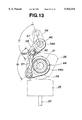
- FIG. 13 is a section taken though the line 13--13 in FIG. 10;
- FIG. 14 is a section similar to FIG. 12;
- FIG. 15(A) is a graph illustrating the variation of the angular speed of a hollow cam relative to the angular speed of a driving shaft
- FIG. 15(B) is a graph illustrating the variation of the phase of the hollow cam.
- FIG. 15(C) is a valve lift diagram.
- the reference numeral 7 indicates a portion of a cylinder head of a dual overhead cam internal combustion engine.
- the engine has four cylinders arranged in line.
- four cylinder valves are arranged. They can be divided into a first group of eight cylinder valves and a second group of eight cylinder valves.
- the cylinder valves belonging to the first group are biased closed by valve springs, respectively, and are lifted by intake cams, respectively, against their valve springs to perform intake phase of the corresponding cylinders.
- the cylinder valves belonging to second group are biased closed by valve springs, respectively, and are lifted by exhaust cams, respectively, against their valve springs to perform exhaust phase of the corresponding cylinders.
- the present invention is applied to a phase changing mechanism incorporated in intake cam drive gear for intake valves 23 (see FIG. 2).
- the invention may be equally applicable to the exhaust valves.
- the intake valves 23 have valve lifters 25, respectively.
- Each of the hollow cams 22 has two axially spaced cam lobes 26 for cooperation with the two valve lifters 25 of the associated one of the cylinders.
- the hollow cams 22 are supported by spaced cam bearings 24 that are secured to the cylinder head 7.
- Extending through a central tore 22a of each of the hollow cams 22 is a driving shaft 21.
- the driving shaft 21 is driven to rotate about a shaft axis X by conventional means such as a sprocket and a chain.
- Each of the cam bearings 24 includes a main bracket cooperating with one of bearing surfaces formed on the cylinder head 7 and a sub bracket 28 on top of the main bracket 27.
- Two bolts 29 and 30 extend through the sub bracket 28 and the man bracket 27.
- the main bracket 27 has a bearing surface 27a recessed from the top thereof, while the sub bracket 28 has a bearing surface 28a recessed from the bottom thereof. These bearing surfaces 27a and 28a cooperate with each other to form a bearing supporting a control rod 46.
- the hollow cams 22 are maintained in concentric relation with the driving shaft 21 for rotation about the shaft axis X.
- a plurality of, four in this embodiment, drive members 33 are fixedly coupled with the driving shaft 21 and arranged to drive the hollow cams 22, respectively.
- drive members 33 there are a plurality, four in this embodiment, driven members 31, which are integrally formed at axial end portions of the hollow cams 22, respectively.
- driven members 31 which are integrally formed at axial end portions of the hollow cams 22, respectively.
- Each of the drive members 33 mates with one of driven members 31.
- Disposed between the mated drive and driven members 33 and 31 is an intermediate member 38.
- the drive member 33 is in the form of a drive disc and includes an integral sleeve 33a fixedly coupled with the driving shaft 21 for unitary rotation by a cotter pin 34.
- the driven member 31 is in the form of a driven disc integral with the one end of the corresponding hollow sleeve 22.
- the intermediate member 38 is in the form of an annular disc that has a central hole 38a, through which the driving shaft 21 to pass.
- the central hole 38a is wide enough to allow insertion of a cam ring 44, in the form of an eccentric cam ring, within a space defined between the central hole 38a defining inner wall of the annular disc 38 and the outer surface of the driving shaft 21.
- This cam ring 44 supports the annular disc 38 for rotation about an axis Y. Rotational movement of the cam ring 44 about the shaft axis X causes movement of the annular disc 38 in a plane perpendicular to the shaft axis X and alters direction of eccentricity of the axis Y with respect to the shaft axis X.
- the radial, with respect to the shaft axis X, dimension of the cam ring 44 varies gradually in a direction of the circumference of an outer circle of the cam ring 44.
- the radial dimension gradually decreases from the maximum to the minimum over 180 degrees angular displacement about the shaft axis X, and gradually increases from the minimum to the maximum over the next 180 degrees angular displacement about the shaft axis X.
- the reference numeral 44a indicates a maximum thickened portion at which the radial dimension is maximized.
- a first coupling couples the drive member 33 with the intermediate 38 at a first position spaced from the shaft axis X.
- a second coupling couples the driven member 31 with the intermediate member 38 at a second position spaced from the shaft axis X.
- the first and second positions are displaced in an angular direction about the axis Y of the intermediate member 38. In this embodiment, the second position is displaced in the angular direction from the first position through 180 degrees.
- the first coupling has a movable connection with the intermediate member 38 to permit variation in a distance of the first position.
- the first coupling has a movable connection with the intermediate member 38 to permit variation in a distance of the first position from the shaft axis X.
- the second coupling has a movable connection with the intermediate member 38 to permit variation in a distance of the second position from the shaft axis X.
- the first coupling includes a first radial 35 formed in the face of the drive member 33 which is opposed to the intermediate member 38 and a first pin 37 received at one end in a pin receiving bore 40 of the intermediate member 38. At the opposite end portion, the first pin 37 engages in the first radial groove 35.
- the second coupling includes a second radial groove 32 in the face of the driven member 31 which is opposed to the intermediate member 38 and a second pin 36 received at one end in a pin receiving bore 39 of the intermediate member 38. At the opposite end portion, the second pin 36 engages in the second radial groove 32.
- the first and second radial grooves 35 and 32 end radially outwardly from the shaft axis X in the opposite direction
- the intermediate member 38 rotates eccentrically with respect to the shaft axis X.
- the first pin 37 moves along the radial groove 35 varying its distance from the shaft axis X
- the second pin 36 moved along the radial groove 32 varying its distance from the shaft axis X.
- the first coupling couples the drive member 33 with the intermediate member 38 at the first position where the first pin 37 is and has the movable connection defined by the first pin 37 and the radial groove 35.
- the second coupling couples the driven member 31 with the intermediate member 38 at the second position where the second pin 36 is and has the movable connection defined by the second pin 36 and the radial groove 32.
- the cam ring 44 has a first position where the thickened portion 44a assumes the lowest position with respect to the shaft axis X as illustrated in FIG. 2 and a second position where the thickened portion 44a assumes the highest position.
- a driver mechanism 43 controls the angular position of each of the cam rings 44 via the corresponding one of transfer mechanisms 41.
- the transfer mechanism 41 includes a torque transmission member 42 that is disposed between the outer surface of the driving shaft 21 and the inner surface of the hollow cam 22.
- the torque transmission member 42 is connected at one end 42a to the cam ring 44.
- the sleeve 42 fixedly carries a gear 45.
- the transfer mechanism 41 also includes a gear 48 of a control rod or shaft 46. The gears 45 and 48 are intermeshed.
- the torque transmission member 42 is in the form of a sleeve.
- the sleeve 42 is integrated with the cam ring 44.
- the sleeve 42 is press fitted into the central bore of the gear 45.
- the gear 45, sleeve 42 and cam ring 44 can rotate as a unit.
- the gear 45 is disposed between the sleeve 33a of the drive member 33 and the adjacent end of the hollow cam 22.
- the driver mechanism 43 includes the control shaft 46 and an actuator, in the form of a stepping motor 47.
- the control shaft 46 is supported at longitudinally spaced diametrically enlarged portions 46a by cam bearings 24.
- the mating bearing surfaces 27a and 28a of each of the cam bearings 24 surround the corresponding one of the diametrically enlarged portions 46a.
- the above-mentioned gear 48 is disposed and forms an integral part of the control shaft 46.
- the stepping motor 47 is connected to a controller 49.
- the controller 49 receives information from various sensors, such as a crankshaft angle sensor and an airflow meter, determines which angular position the cam ring 44 should take and outputs a control signal on which the stepping motor 47 operates.
- the driving shaft 21 is formed with a supply passage 21a.
- the driving shaft 21 is formed with first radial passages, only one being shown and indicated at 50.
- the first radial passages 50 communicate at their inner ends with the supply passage 21a.
- the driving shaft 21 is formed with second radial passages, only one being shown and indicated at 51.
- the second radial passages 51 communicate at their inner ends with the supply passage 21a.
- the cam ring 44 is formed with a radial passage 52 that communicates at its inner end with the outer end of the radial passage 50.
- the radial passage 52 extends through the thickened portion 44a of the cam ring 44.
- the sleeve 42 is formed with a radial port 53 that is opposed to the outer end of the radial passage 51.
- the radial port 53 is smaller in diameter than the radial passage 51.
- the driving shaft 21 is recessed from the outer surface thereof at spaced portions that are covered by the sleeves 42, respectively, to form first oil reservoirs, only one being and indicated at 54 in FIG. 1.
- Each of the first oil reservoirs 53 establishes flow communication between the adjacent radial passage 51 and its mating radial opening 53.
- Each of the sleeves 42 is recessed from the outer surface thereof at the portion that is covered by the associated hollow cam 22 to form a second oil reservoir 55.
- Each of the second oil reservoirs 55 communicates with the corresponding radial opening 53.
- the second oil reservoir 55 extends between the one and the opposite end portions 42a and 42b of the sleeve 42 in a direction along the shaft axis X. Besides, the second oil reservoir 55 extends continuously about the shaft axis X.
- the first oil reservoir 54 extends continuously about the shaft axis X and has an axial extension along the shaft axis X shorter than the axial distance between which the one portion 42a and the opposite end portion 42b of the sleeve 42 are spaced.
- the provision of the first oil reservoir 54 allows contact of the sleeve 42 with the outer surface of the driving shaft 21 at two axially spaced inner surfaces of the one and the opposite end portions 42a and 42b.
- the provision of the second oil reservoir 55 allows contact of the sleeve 42 with the bore 22a defining inner surface of the hollow cam 22 at two axially spaced outer surfaces of the one and the opposite end portions 42a and 42b.
- the controller 49 outputs a control signal to cause the stepping motor 47 to adjust the cam ring 44 to the first position as illustrated in FIG. 2.
- the thickened portion 44a is directed downwards, viewing in FIG. 2.
- the thickened portion 44a is the nearest the associated valve lifter 25, and the axis Y is displaced from the shaft axis X toward the associated valve lifter 25.
- the angular speed of the intermediate member 38 is no longer equal to the angular speed ⁇ d of the driving shaft 21.
- FIG. 6(A) shows the variation of the angular speed ⁇ c of the hollow cam 22, and the dotted line shown in FIG. 6(B) the variation of the phase of the hollow cam 22.
- the hollow cam 22 is retarded during the acceleration phase of the hollow cam 22, while it is advanced during the deceleration phase of the hollow cam 22.
- the top of each of the cam lobes 26 is diametrically opposed, with respect to the shaft axis X, to the radial groove 32 of the driven member 31.
- the duration of opening of the valve becomes the shortest at the angular position of the cam ring 44 as illustrated in FIG. 2.
- the dotted line in FIG. 5(C) illustrates the valve lift diagram under this condition.
- the controller 49 Upon shift from low engine speed operation to high engine speed operation, the controller 49 instructs the stepping motor 47 to turn the control shaft 46 through predetermined angles, for example 180 degrees. This turns the gear 45 and sleeve 42 until the cam ring 44 turns 180 degrees from the position illustrated in FIG. 2 to the second position. In the second position, the thickened portion 44a is directed upwards, viewing in FIG. 2. In other words, the thickened portion 44a is the remotest from the associated valve lifter 25, and the axis Y is displaced from the shaft axis X away from the associated valve lifter 25.
- the fully drawn line shown in FIG. 5(A) illustrates the variation of the angular speed of the hollow cam 22.
- the fully drawn line shown in FIG. 5(A) illustrates the variation of the angular speed of the hollow cam 22.
- FIG. 5(B) illustrates the variation of the phase of the hollow cam 22. It is noted that the hollow cam 22 is advanced during the deceleration phase of the hollow cam 22, while it is retarded during the acceleration phase of the hollow cam 22.
- the fully drawn line shown in FIG. 5(C) shows the valve lift diagram. From this, it is appreciated that the duration of opening of the valve becomes the longest under this condition.
- the intermediate member 38 is supported via the cam ring 44 on the driving shaft 21.
- the pivot shaft and its associated structure which are required in the prior art devices, are no longer needed.
- the driving shaft 21 bears all of load imparted to the intermediate member 38 during operation.
- undesired displacement of the intermediate member 38 which has been encountered in the prior art device, upon application of large load has been eliminated or at least greatly suppressed.
- the cam ring 44 and the intermediate member 38 are sufficiently lubricated.
- the torque transmission sleeve 42 and the cam ring 44 are sufficiently lubricated.
- Each of the hollow cams 22 is supported by the cam bearings 24. Besides, it is supported via the torque transmission sleeve 42 by the driving shaft 21. Thus, undesired movement of the hollow cams 22 during operation is sufficiently suppressed.
- the hollow cam 22 and the torque transmission sleeve 42 are supported at two axially spaced portions, respectively. Sticking of such components is prevented. It is no more necessary to hold required machining accuracy over the whole longitudinal length of them although such accuracy is required on each of the end portions or them.
- This second embodiment is substantially the same as the first embodiment except the constructions of first and second oil reservoirs of driving shaft and toque transmission sleeve, respectively.
- the first oil reservoir includes two axial oil grooves 54, first one being communicating with a radial passage 51, the other or second one being spaced in an angular direction from the first one.
- the first oil reservoir also includes a circumference groove 56 interconnecting the first and second axial grooves 54.
- the second oil reservoir includes two axial grooves 55, first one being communicating with a radial port 53, the other or second one being spaced in an angular direction from the first one.
- the second oil reservoir also includes a circumference groove 57 interconnecting the first and second axial grooves 55.
- This embodiment is substantially the same as the first embodiment except the employment of a link mechanism, instead of the gears 45 and 48, as each of transfer mechanisms 41.
- the link mechanism includes a rain drop like first link 56 fixedly coupled at one end portion 56a with a torque transmission sleeve 42 at its end portion 42b.
- a rod like second link 57 is pivoted at one end 57a to the opposite end portion 56b of the first link 56.
- a rain drop like third link 58 is pivoted at one end portion 58a to the second link 57 at the opposite end portion 57b thereof.
- the third link 58 is fixedly coupled with a control rod or shaft 46.
- the first link 56 is enlarged in diameter at the one end portion 56a as compared to a small diameter at the opposite end portion 56b.
- the enlarged diameter one end portion 56a is formed with a bore receiving the opposite end portion 42b of the sleeve 42.
- a first support pin 59 is fixedly connected to the opposite end portion 56b of the first link 56.
- the one end portion 57a of the second link 57 is formed with a pin-receiving hole 57c that receives the first support pin 59. This connection allows pivotal relation between the second link 57 and the first link 56.
- the opposite end portion 57b of the second link 57 is formed with a pin receiving hole 57d that receives a second support pin 60 fixed to the one end portion 58a of the third link 58.
- the third link 58 is fixedly coupled with the control shaft 46. Pivotal relation between the second and third links 57 and 58 is established by the second support pin 60 within the pin-receiving hole 57d.
- the first and send links 56 and 58 are generally parallel.
- the first link 56 is adjusted to a downwardly angled first position as illustrated in FIG. 12.
- the first link 56 is adjusted to an upwardly is angled second position as illustrated in FIG. 14.
- Turning the first link from the first position (FIG. 12) to the second position (FIG. 14) causes a cam ring 44 to turn clockwise, viewing in FIG. 12, through an angle ⁇ 2 of 90 degrees (see FIG. 13 also) to the second position shown in FIG. 14.
- the axis Y of an intermediate member 38 is displaced laterally from the shaft axis X although in the first position the axis Y is displaced downwardly from the shaft axis.
- Turning the third link 58 via the control shaft 46 through an angle ⁇ 1 causes the first link 56 to turn through the angle of ⁇ 2.
- the fully drawn line in FIG. 15(A) illustrates the variation of angle speed of a hollow cam 22 at high engine speeds when the link mechanism assume the second position as illustrated in FIG. 14.
- the fully drawn line in FIG. 15(B) illustrates the variation of the phase of the hollow cam 22 at high engine speed.
- the fully drawn line in FIG. 15(C) illustrates the valve lift diagram at high engine speeds.
- the dotted line in FIG. 15(A) illustrates the variation of the angle speed of the hollow cam 22 at low engine speeds when the link mechanism assume the first position as illustrated in FIG. 12.
- the dotted line in FIG. 15(B) illustrates the variation of the phase of the hollow cam 22 at low engine speed.
- the dotted line in FIG. 15(C) illustrates the valve lift diagram at low engine speeds.
Landscapes
- Engineering & Computer Science (AREA)
- Mechanical Engineering (AREA)
- General Engineering & Computer Science (AREA)
- Valve-Gear Or Valve Arrangements (AREA)
Abstract
Description
Claims (12)
Applications Claiming Priority (6)
| Application Number | Priority Date | Filing Date | Title |
|---|---|---|---|
| JP8-205141 | 1996-08-05 | ||
| JP20514196 | 1996-08-05 | ||
| JP23026296A JPH10103026A (en) | 1996-08-05 | 1996-08-30 | Intake and exhaust valve drive control device for internal combustion engine |
| JP8-230262 | 1996-08-30 | ||
| JP13625297A JPH10325311A (en) | 1997-05-27 | 1997-05-27 | Intake and exhaust valve drive control device for internal combustion engine |
| JP9-136252 | 1997-05-27 |
Publications (1)
| Publication Number | Publication Date |
|---|---|
| US5924334A true US5924334A (en) | 1999-07-20 |
Family
ID=27317239
Family Applications (1)
| Application Number | Title | Priority Date | Filing Date |
|---|---|---|---|
| US08/905,962 Expired - Fee Related US5924334A (en) | 1996-08-05 | 1997-08-05 | Device for moving cam relative to its driving shaft |
Country Status (1)
| Country | Link |
|---|---|
| US (1) | US5924334A (en) |
Cited By (55)
| Publication number | Priority date | Publication date | Assignee | Title |
|---|---|---|---|---|
| US6041746A (en) * | 1997-12-09 | 2000-03-28 | Nissan Motor Co., Ltd. | Variable valve actuation apparatus |
| US6055949A (en) * | 1997-12-26 | 2000-05-02 | Nissan Motor Co., Ltd. | Variable valve actuator apparatus |
| US6123053A (en) * | 1998-05-21 | 2000-09-26 | Unisia Jecs Corporation | Variable valve actuation apparatus for internal combustion engines |
| US6305242B1 (en) * | 1998-09-04 | 2001-10-23 | Cummins Engine Company Ltd. | Camshaft alignment |
| US6427653B1 (en) * | 1999-10-29 | 2002-08-06 | Unisia Jecs Corporation | System for driving and controlling CAM for internal combustion engine |
| EP1236870A3 (en) * | 2001-02-28 | 2003-06-25 | Unisia Jecs Corporation | Variable-valve-actuation apparatus for internal combustion engine |
| US6595172B2 (en) * | 2001-05-14 | 2003-07-22 | Delphi Technologies, Inc. | Variable valve actuator assembly having a secondary actuator |
| US6698177B1 (en) * | 1999-01-28 | 2004-03-02 | Delta Kogyo Co, Ltd | Cam mechanism for translation of circular motion into reciprocal motion |
| FR2853001A1 (en) * | 2003-03-27 | 2004-10-01 | Hitachi Unisia Automotive Ltd | DEVICE FOR OPERATING THE VALVES OF AN INTERNAL COMBUSTION ENGINE |
| FR2866385A1 (en) * | 2004-02-17 | 2005-08-19 | Hitachi Ltd | MECHANISM FOR CONTROLLING THE VALVES OF AN INTERNAL COMBUSTION ENGINE |
| US20110180029A1 (en) * | 2010-01-25 | 2011-07-28 | Iav Gmbh Ingenieurgesellschaft Auto Und Verkehr | Valve drive for activation of gas exchange valves of internal combustion engines |
| US20120138003A1 (en) * | 2010-12-01 | 2012-06-07 | Caterpillar Inc. | Engine With Stub Shaft Supported Cam Gear And Machine Using Same |
| CN105697082A (en) * | 2014-12-09 | 2016-06-22 | 现代自动车株式会社 | continuously variable valve timing apparatus and engine provided with the same |
| US9512748B2 (en) | 2014-09-30 | 2016-12-06 | Hyundai Motor Company | Continuous variable valve duration apparatus and engine provided with the same |
| US9574467B2 (en) | 2013-12-18 | 2017-02-21 | Hyundai Motor Company | Continuous variable valve duration apparatus |
| US9611768B2 (en) | 2013-12-18 | 2017-04-04 | Hyundai Motor Company | Continuous variable valve duration apparatus |
| RU2618984C1 (en) * | 2015-01-15 | 2017-05-11 | Тойота Дзидося Кабусики Кайся | Gas distribution unit for internal combustion engines control |
| US9651133B2 (en) * | 2015-02-04 | 2017-05-16 | Google Inc. | Phased joint cam |
| US9739183B2 (en) | 2015-06-19 | 2017-08-22 | Hyundai Motor Company | Continuous variable valve duration system and engine provided with the same |
| US9752466B2 (en) | 2014-12-09 | 2017-09-05 | Hyundai Motor Company | Continuous variable valve duration apparatus and engine provided with the same |
| US9822674B2 (en) | 2015-06-22 | 2017-11-21 | Hyundai Motor Company | Continuous variable valve duration apparatus and engine provided with the same |
| US9835057B2 (en) | 2014-12-09 | 2017-12-05 | Hyundai Motor Company | Continuous variable valve duration apparatus and engine provided with the same |
| US9850789B2 (en) | 2015-09-24 | 2017-12-26 | Hyundai Motor Company | Continuous variable valve duration apparatus and engine provided with the same |
| US9856758B2 (en) | 2015-07-07 | 2018-01-02 | Hyundai Motor Company | Continuous variable valve timing apparatus and engine provided with the same |
| US9869215B2 (en) | 2014-12-10 | 2018-01-16 | Hyundai Motor Company | Continuous variable valve duration apparatus and engine provided with the same |
| US9874119B2 (en) | 2014-12-09 | 2018-01-23 | Hyundai Motor Company | Continuous variable valve duration apparatus and engine provided with the same |
| US9915182B2 (en) | 2014-12-09 | 2018-03-13 | Hyundai Motor Company | Continuous variable valve duration apparatus and engine provided with the same |
| US20180100454A1 (en) * | 2015-12-09 | 2018-04-12 | Hyundai Motor Company | System and method for controlling valve timing of continuous variable valve duration engine |
| US9982578B2 (en) | 2015-12-11 | 2018-05-29 | Hyundai Motor Company | Continuous variable valve duration apparatus and engine provided with the same |
| US9988948B2 (en) | 2015-12-14 | 2018-06-05 | Hyundai Motor Company | Continuous variable valve duration apparatus and engine provided with the same |
| US10006377B2 (en) | 2015-12-14 | 2018-06-26 | Hyundai Motor Company | Continuous variable valve duration apparatus and engine provided with the same |
| US10054017B2 (en) | 2015-12-14 | 2018-08-21 | Hyundai Motor Company | Continuous variable valve duration apparatus and engine provided with the same |
| US10060306B2 (en) | 2015-12-14 | 2018-08-28 | Hyundai Motor Company | Continuous variable valve duration apparatus and engine provided with the same |
| US10060307B2 (en) | 2015-12-14 | 2018-08-28 | Hyundai Motor Company | Continuous variable valve duration apparatus and engine provided with the same |
| US10072536B2 (en) | 2015-12-14 | 2018-09-11 | Hyundai Motor Company | Continuous variable valve duration apparatus and engine provided with the same |
| US10082053B2 (en) | 2016-03-31 | 2018-09-25 | Hyundai Motor Company | Continuous variable valve duration apparatus and engine provided with the same |
| US10132209B2 (en) | 2015-12-11 | 2018-11-20 | Hyundai Motor Company | Continuous variable valve duration apparatus and engine provided with the same |
| US10132248B2 (en) | 2016-03-31 | 2018-11-20 | Hyundai Motor Company | Continuous variable valve duration apparatus and engine provided with the same |
| US10138764B2 (en) | 2016-03-31 | 2018-11-27 | Hyundai Motor Company | Continuous variable valve duration apparatus and engine provided with the continuous variable valve duration apparatus |
| US10208681B2 (en) | 2016-03-31 | 2019-02-19 | Hyundai Motor Company | Continuous variable valve timing apparatus and engine provided with the same |
| US10316763B2 (en) | 2015-12-11 | 2019-06-11 | Hyundai Motor Company | System and method for controlling valve timing of continuous variable valve duration engine |
| US10323585B2 (en) | 2015-12-11 | 2019-06-18 | Hyundai Motor Company | Method for controlling of valve timing of continuous variable valve duration engine |
| US10393037B2 (en) | 2015-12-09 | 2019-08-27 | Hyundai Motor Company | Method for controlling of valve timing of continuous variable valve duration engine |
| US10415485B2 (en) | 2015-12-10 | 2019-09-17 | Hyundai Motor Company | Method for controlling of valve timing of continuous variable valve duration engine |
| US10428747B2 (en) | 2015-12-11 | 2019-10-01 | Hyundai Motor Company | System and method for controlling valve timing of continuous variable valve duration engine |
| US10443514B2 (en) | 2015-12-11 | 2019-10-15 | Hyundai Motor Company | Method for controlling of valve timing of continuous variable valve duration engine |
| US10480358B2 (en) | 2015-06-22 | 2019-11-19 | Hyundai Motor Company | Continuously variable valve timing apparatus and engine provided with the same |
| US10533464B2 (en) | 2015-07-07 | 2020-01-14 | Hyundai Motor Company | Valve duration control apparatus and engine provided with the same |
| US10544716B2 (en) | 2014-12-09 | 2020-01-28 | Hyundai Motor Company | Valve duration control apparatus and engine provided with the same |
| US10550738B2 (en) | 2017-11-20 | 2020-02-04 | Hyundai Motor Company | Continuously variable valve duration apparatus and engine provided with the same |
| US10563551B2 (en) | 2016-12-14 | 2020-02-18 | Hyundai Motor Company | Continuous variable valve duration apparatus and engine provided with the same |
| US10563550B2 (en) | 2014-12-09 | 2020-02-18 | Hyundai Motor Company | Valve duration control apparatus and engine provided with the same |
| US10634066B2 (en) | 2016-03-16 | 2020-04-28 | Hyundai Motor Company | System and method for controlling valve timing of continuous variable valve duration engine |
| US10634067B2 (en) | 2015-12-11 | 2020-04-28 | Hyundai Motor Company | System and method for controlling valve timing of continuous variable valve duration engine |
| US10920679B2 (en) | 2015-12-11 | 2021-02-16 | Hyundai Motor Company | Method for controlling of valve timing of continuous variable valve duration engine |
Citations (14)
| Publication number | Priority date | Publication date | Assignee | Title |
|---|---|---|---|---|
| US3633555A (en) * | 1969-06-27 | 1972-01-11 | Ass Eng Ltd | Variable camshaft mechanism |
| JPH01285611A (en) * | 1988-05-10 | 1989-11-16 | Honda Motor Co Ltd | Valve working state switching device for internal combustion engine |
| US5056478A (en) * | 1988-04-30 | 1991-10-15 | Ford Motor Company | Variable camshaft phasing mechanism |
| JPH0443805A (en) * | 1990-06-12 | 1992-02-13 | Honda Motor Co Ltd | Variable timing valve system for multicylinder internal combustion engine |
| US5161493A (en) * | 1989-03-15 | 1992-11-10 | Ford Motor Company | Phase change mechanism |
| US5333579A (en) * | 1992-01-27 | 1994-08-02 | Unisia Jecs Corporation | Control device for controlling intake and exhaust valves of internal combustion engine |
| US5361736A (en) * | 1990-07-13 | 1994-11-08 | Lancelot Phoenix | Variable valve timing |
| US5365896A (en) * | 1992-06-17 | 1994-11-22 | Unisia Jecs Corporation | Cam shaft assembly for use in internal combustion engine |
| JPH0734831A (en) * | 1993-07-27 | 1995-02-03 | Unisia Jecs Corp | Intake and exhaust valve drive control device for internal combustion engine |
| US5494009A (en) * | 1993-02-15 | 1996-02-27 | Unisia Jecs Corporation | Valve control device for internal combustion engine |
| US5553573A (en) * | 1994-08-08 | 1996-09-10 | Unisia Jecs Corporation | Valve duration control system for four-cycle engine |
| US5557983A (en) * | 1992-06-17 | 1996-09-24 | Unisia Jecs Corporation | Device for moving cam relative to its driving shaft |
| US5592908A (en) * | 1993-09-28 | 1997-01-14 | Unisia Jecs Corporation | Engine cylinder valve control system |
| US5687681A (en) * | 1995-10-18 | 1997-11-18 | Unisia Jecs Corporation | Phase changing mechanism for camshaft of internal combustion engine |
-
1997
- 1997-08-05 US US08/905,962 patent/US5924334A/en not_active Expired - Fee Related
Patent Citations (14)
| Publication number | Priority date | Publication date | Assignee | Title |
|---|---|---|---|---|
| US3633555A (en) * | 1969-06-27 | 1972-01-11 | Ass Eng Ltd | Variable camshaft mechanism |
| US5056478A (en) * | 1988-04-30 | 1991-10-15 | Ford Motor Company | Variable camshaft phasing mechanism |
| JPH01285611A (en) * | 1988-05-10 | 1989-11-16 | Honda Motor Co Ltd | Valve working state switching device for internal combustion engine |
| US5161493A (en) * | 1989-03-15 | 1992-11-10 | Ford Motor Company | Phase change mechanism |
| JPH0443805A (en) * | 1990-06-12 | 1992-02-13 | Honda Motor Co Ltd | Variable timing valve system for multicylinder internal combustion engine |
| US5361736A (en) * | 1990-07-13 | 1994-11-08 | Lancelot Phoenix | Variable valve timing |
| US5333579A (en) * | 1992-01-27 | 1994-08-02 | Unisia Jecs Corporation | Control device for controlling intake and exhaust valves of internal combustion engine |
| US5365896A (en) * | 1992-06-17 | 1994-11-22 | Unisia Jecs Corporation | Cam shaft assembly for use in internal combustion engine |
| US5557983A (en) * | 1992-06-17 | 1996-09-24 | Unisia Jecs Corporation | Device for moving cam relative to its driving shaft |
| US5494009A (en) * | 1993-02-15 | 1996-02-27 | Unisia Jecs Corporation | Valve control device for internal combustion engine |
| JPH0734831A (en) * | 1993-07-27 | 1995-02-03 | Unisia Jecs Corp | Intake and exhaust valve drive control device for internal combustion engine |
| US5592908A (en) * | 1993-09-28 | 1997-01-14 | Unisia Jecs Corporation | Engine cylinder valve control system |
| US5553573A (en) * | 1994-08-08 | 1996-09-10 | Unisia Jecs Corporation | Valve duration control system for four-cycle engine |
| US5687681A (en) * | 1995-10-18 | 1997-11-18 | Unisia Jecs Corporation | Phase changing mechanism for camshaft of internal combustion engine |
Cited By (60)
| Publication number | Priority date | Publication date | Assignee | Title |
|---|---|---|---|---|
| US6041746A (en) * | 1997-12-09 | 2000-03-28 | Nissan Motor Co., Ltd. | Variable valve actuation apparatus |
| US6055949A (en) * | 1997-12-26 | 2000-05-02 | Nissan Motor Co., Ltd. | Variable valve actuator apparatus |
| US6123053A (en) * | 1998-05-21 | 2000-09-26 | Unisia Jecs Corporation | Variable valve actuation apparatus for internal combustion engines |
| US6305242B1 (en) * | 1998-09-04 | 2001-10-23 | Cummins Engine Company Ltd. | Camshaft alignment |
| US6698177B1 (en) * | 1999-01-28 | 2004-03-02 | Delta Kogyo Co, Ltd | Cam mechanism for translation of circular motion into reciprocal motion |
| US6427653B1 (en) * | 1999-10-29 | 2002-08-06 | Unisia Jecs Corporation | System for driving and controlling CAM for internal combustion engine |
| EP1236870A3 (en) * | 2001-02-28 | 2003-06-25 | Unisia Jecs Corporation | Variable-valve-actuation apparatus for internal combustion engine |
| US6595172B2 (en) * | 2001-05-14 | 2003-07-22 | Delphi Technologies, Inc. | Variable valve actuator assembly having a secondary actuator |
| FR2853001A1 (en) * | 2003-03-27 | 2004-10-01 | Hitachi Unisia Automotive Ltd | DEVICE FOR OPERATING THE VALVES OF AN INTERNAL COMBUSTION ENGINE |
| FR2866385A1 (en) * | 2004-02-17 | 2005-08-19 | Hitachi Ltd | MECHANISM FOR CONTROLLING THE VALVES OF AN INTERNAL COMBUSTION ENGINE |
| US20110180029A1 (en) * | 2010-01-25 | 2011-07-28 | Iav Gmbh Ingenieurgesellschaft Auto Und Verkehr | Valve drive for activation of gas exchange valves of internal combustion engines |
| US8596235B2 (en) * | 2010-01-25 | 2013-12-03 | Iav Gmbh Ingenieurgesellschaft Auto Und Verkehr | Valve drive for activation of gas exchange valves of internal combustion engines |
| US20120138003A1 (en) * | 2010-12-01 | 2012-06-07 | Caterpillar Inc. | Engine With Stub Shaft Supported Cam Gear And Machine Using Same |
| US8555838B2 (en) * | 2010-12-01 | 2013-10-15 | Caterpillar Inc. | Engine with stub shaft supported cam gear and machine using same |
| US9574467B2 (en) | 2013-12-18 | 2017-02-21 | Hyundai Motor Company | Continuous variable valve duration apparatus |
| US9611768B2 (en) | 2013-12-18 | 2017-04-04 | Hyundai Motor Company | Continuous variable valve duration apparatus |
| US9512748B2 (en) | 2014-09-30 | 2016-12-06 | Hyundai Motor Company | Continuous variable valve duration apparatus and engine provided with the same |
| US10563550B2 (en) | 2014-12-09 | 2020-02-18 | Hyundai Motor Company | Valve duration control apparatus and engine provided with the same |
| CN105697082B (en) * | 2014-12-09 | 2019-08-30 | 现代自动车株式会社 | Continuous variable valve timing apparatus and engine equipped with the device |
| US9752466B2 (en) | 2014-12-09 | 2017-09-05 | Hyundai Motor Company | Continuous variable valve duration apparatus and engine provided with the same |
| US10544716B2 (en) | 2014-12-09 | 2020-01-28 | Hyundai Motor Company | Valve duration control apparatus and engine provided with the same |
| US9835057B2 (en) | 2014-12-09 | 2017-12-05 | Hyundai Motor Company | Continuous variable valve duration apparatus and engine provided with the same |
| US9915182B2 (en) | 2014-12-09 | 2018-03-13 | Hyundai Motor Company | Continuous variable valve duration apparatus and engine provided with the same |
| CN105697082A (en) * | 2014-12-09 | 2016-06-22 | 现代自动车株式会社 | continuously variable valve timing apparatus and engine provided with the same |
| US9874119B2 (en) | 2014-12-09 | 2018-01-23 | Hyundai Motor Company | Continuous variable valve duration apparatus and engine provided with the same |
| US9909467B2 (en) | 2014-12-09 | 2018-03-06 | Hyundai Motor Company | Continuous variable valve timing apparatus and engine provided with the same |
| US9869215B2 (en) | 2014-12-10 | 2018-01-16 | Hyundai Motor Company | Continuous variable valve duration apparatus and engine provided with the same |
| RU2618984C1 (en) * | 2015-01-15 | 2017-05-11 | Тойота Дзидося Кабусики Кайся | Gas distribution unit for internal combustion engines control |
| US9651133B2 (en) * | 2015-02-04 | 2017-05-16 | Google Inc. | Phased joint cam |
| US9739183B2 (en) | 2015-06-19 | 2017-08-22 | Hyundai Motor Company | Continuous variable valve duration system and engine provided with the same |
| US9822674B2 (en) | 2015-06-22 | 2017-11-21 | Hyundai Motor Company | Continuous variable valve duration apparatus and engine provided with the same |
| US10480358B2 (en) | 2015-06-22 | 2019-11-19 | Hyundai Motor Company | Continuously variable valve timing apparatus and engine provided with the same |
| US9856758B2 (en) | 2015-07-07 | 2018-01-02 | Hyundai Motor Company | Continuous variable valve timing apparatus and engine provided with the same |
| US10533464B2 (en) | 2015-07-07 | 2020-01-14 | Hyundai Motor Company | Valve duration control apparatus and engine provided with the same |
| US9850789B2 (en) | 2015-09-24 | 2017-12-26 | Hyundai Motor Company | Continuous variable valve duration apparatus and engine provided with the same |
| US20180100454A1 (en) * | 2015-12-09 | 2018-04-12 | Hyundai Motor Company | System and method for controlling valve timing of continuous variable valve duration engine |
| US10393037B2 (en) | 2015-12-09 | 2019-08-27 | Hyundai Motor Company | Method for controlling of valve timing of continuous variable valve duration engine |
| US10415488B2 (en) * | 2015-12-09 | 2019-09-17 | Hyundai Motor Company | System and method for controlling valve timing of continuous variable valve duration engine |
| US10415485B2 (en) | 2015-12-10 | 2019-09-17 | Hyundai Motor Company | Method for controlling of valve timing of continuous variable valve duration engine |
| US10634067B2 (en) | 2015-12-11 | 2020-04-28 | Hyundai Motor Company | System and method for controlling valve timing of continuous variable valve duration engine |
| US10428747B2 (en) | 2015-12-11 | 2019-10-01 | Hyundai Motor Company | System and method for controlling valve timing of continuous variable valve duration engine |
| US10443514B2 (en) | 2015-12-11 | 2019-10-15 | Hyundai Motor Company | Method for controlling of valve timing of continuous variable valve duration engine |
| US9982578B2 (en) | 2015-12-11 | 2018-05-29 | Hyundai Motor Company | Continuous variable valve duration apparatus and engine provided with the same |
| US10316763B2 (en) | 2015-12-11 | 2019-06-11 | Hyundai Motor Company | System and method for controlling valve timing of continuous variable valve duration engine |
| US10323585B2 (en) | 2015-12-11 | 2019-06-18 | Hyundai Motor Company | Method for controlling of valve timing of continuous variable valve duration engine |
| US10132209B2 (en) | 2015-12-11 | 2018-11-20 | Hyundai Motor Company | Continuous variable valve duration apparatus and engine provided with the same |
| US10920679B2 (en) | 2015-12-11 | 2021-02-16 | Hyundai Motor Company | Method for controlling of valve timing of continuous variable valve duration engine |
| US10060306B2 (en) | 2015-12-14 | 2018-08-28 | Hyundai Motor Company | Continuous variable valve duration apparatus and engine provided with the same |
| US10072536B2 (en) | 2015-12-14 | 2018-09-11 | Hyundai Motor Company | Continuous variable valve duration apparatus and engine provided with the same |
| US10060307B2 (en) | 2015-12-14 | 2018-08-28 | Hyundai Motor Company | Continuous variable valve duration apparatus and engine provided with the same |
| US10054017B2 (en) | 2015-12-14 | 2018-08-21 | Hyundai Motor Company | Continuous variable valve duration apparatus and engine provided with the same |
| US10006377B2 (en) | 2015-12-14 | 2018-06-26 | Hyundai Motor Company | Continuous variable valve duration apparatus and engine provided with the same |
| US9988948B2 (en) | 2015-12-14 | 2018-06-05 | Hyundai Motor Company | Continuous variable valve duration apparatus and engine provided with the same |
| US10634066B2 (en) | 2016-03-16 | 2020-04-28 | Hyundai Motor Company | System and method for controlling valve timing of continuous variable valve duration engine |
| US10208681B2 (en) | 2016-03-31 | 2019-02-19 | Hyundai Motor Company | Continuous variable valve timing apparatus and engine provided with the same |
| US10138764B2 (en) | 2016-03-31 | 2018-11-27 | Hyundai Motor Company | Continuous variable valve duration apparatus and engine provided with the continuous variable valve duration apparatus |
| US10132248B2 (en) | 2016-03-31 | 2018-11-20 | Hyundai Motor Company | Continuous variable valve duration apparatus and engine provided with the same |
| US10082053B2 (en) | 2016-03-31 | 2018-09-25 | Hyundai Motor Company | Continuous variable valve duration apparatus and engine provided with the same |
| US10563551B2 (en) | 2016-12-14 | 2020-02-18 | Hyundai Motor Company | Continuous variable valve duration apparatus and engine provided with the same |
| US10550738B2 (en) | 2017-11-20 | 2020-02-04 | Hyundai Motor Company | Continuously variable valve duration apparatus and engine provided with the same |
Similar Documents
| Publication | Publication Date | Title |
|---|---|---|
| US5924334A (en) | Device for moving cam relative to its driving shaft | |
| US5687681A (en) | Phase changing mechanism for camshaft of internal combustion engine | |
| US5494009A (en) | Valve control device for internal combustion engine | |
| EP0675265B1 (en) | Valve driving system for internal combustion engine | |
| US6041746A (en) | Variable valve actuation apparatus | |
| US5992361A (en) | Variable valve timing mechanism | |
| US5333579A (en) | Control device for controlling intake and exhaust valves of internal combustion engine | |
| US20090241877A1 (en) | Variable valve gear for an internal combustion engine | |
| US5645020A (en) | CAM assembly installation in engine | |
| US5345898A (en) | Valve operating mechanism for an internal-combustion engine | |
| US6253720B1 (en) | Variable phase coupling | |
| EP1030036B1 (en) | Variable phase coupling | |
| EP1619360B1 (en) | Valve gear of engine | |
| EP0816643B1 (en) | Hydraulic actuator in an internal combustion engine | |
| US5913292A (en) | Variable valve timing and lift mechanism of internal combustion engine | |
| US7913657B2 (en) | Variable valve timing mechanism | |
| US7644691B2 (en) | Device for modifying the control times of an internal combustion engine | |
| EP1229217B1 (en) | Variable valve drive apparatus for internal combustion engine | |
| EP1179657B1 (en) | Variable event timing mechanism | |
| JP4461437B2 (en) | Lubrication structure of variable valve mechanism | |
| KR0157016B1 (en) | Valve lift device of car | |
| JP3394390B2 (en) | Intake and exhaust valve drive control device for internal combustion engine | |
| KR200173158Y1 (en) | Variable valve timing structure | |
| JP4151519B2 (en) | Engine valve gear | |
| JPH0941923A (en) | Variable valve mechanism for internal combustion engine |
Legal Events
| Date | Code | Title | Description |
|---|---|---|---|
| AS | Assignment |
Owner name: UNISIA JECS CORPORATION, JAPAN Free format text: ASSIGNMENT OF ASSIGNORS INTEREST;ASSIGNORS:HARA, SEINOSUKE;HIDAKA, AKIRA;YAMADA, YOSHIHIKO;AND OTHERS;REEL/FRAME:008985/0418;SIGNING DATES FROM 19970923 TO 19971001 |
|
| FEPP | Fee payment procedure |
Free format text: PAYOR NUMBER ASSIGNED (ORIGINAL EVENT CODE: ASPN); ENTITY STATUS OF PATENT OWNER: LARGE ENTITY |
|
| FPAY | Fee payment |
Year of fee payment: 4 |
|
| AS | Assignment |
Owner name: HITACHI, LTD., JAPAN Free format text: MERGER;ASSIGNOR:HITACHI UNISIA AUTOMOTIVE, LTD.;REEL/FRAME:016256/0342 Effective date: 20040927 |
|
| FPAY | Fee payment |
Year of fee payment: 8 |
|
| REMI | Maintenance fee reminder mailed | ||
| LAPS | Lapse for failure to pay maintenance fees | ||
| STCH | Information on status: patent discontinuation |
Free format text: PATENT EXPIRED DUE TO NONPAYMENT OF MAINTENANCE FEES UNDER 37 CFR 1.362 |
|
| FP | Lapsed due to failure to pay maintenance fee |
Effective date: 20110720 |