US5874029A - Methods for particle micronization and nanonization by recrystallization from organic solutions sprayed into a compressed antisolvent - Google Patents
Methods for particle micronization and nanonization by recrystallization from organic solutions sprayed into a compressed antisolvent Download PDFInfo
- Publication number
- US5874029A US5874029A US08/723,463 US72346396A US5874029A US 5874029 A US5874029 A US 5874029A US 72346396 A US72346396 A US 72346396A US 5874029 A US5874029 A US 5874029A
- Authority
- US
- United States
- Prior art keywords
- antisolvent
- nozzle
- particles
- droplets
- solution
- Prior art date
- Legal status (The legal status is an assumption and is not a legal conclusion. Google has not performed a legal analysis and makes no representation as to the accuracy of the status listed.)
- Expired - Lifetime
Links
- 239000002245 particle Substances 0.000 title claims abstract description 145
- 239000012296 anti-solvent Substances 0.000 title claims abstract description 90
- 238000000034 method Methods 0.000 title claims abstract description 88
- 238000001953 recrystallisation Methods 0.000 title description 32
- 239000012530 fluid Substances 0.000 claims abstract description 58
- 239000002904 solvent Substances 0.000 claims abstract description 46
- 239000000203 mixture Substances 0.000 claims abstract description 29
- 238000004519 manufacturing process Methods 0.000 claims abstract description 17
- -1 electronics Substances 0.000 claims abstract description 3
- CURLTUGMZLYLDI-UHFFFAOYSA-N Carbon dioxide Chemical compound O=C=O CURLTUGMZLYLDI-UHFFFAOYSA-N 0.000 claims description 79
- 239000007789 gas Substances 0.000 claims description 75
- 229910002092 carbon dioxide Inorganic materials 0.000 claims description 73
- JYGXADMDTFJGBT-VWUMJDOOSA-N hydrocortisone Chemical compound O=C1CC[C@]2(C)[C@H]3[C@@H](O)C[C@](C)([C@@](CC4)(O)C(=O)CO)[C@@H]4[C@@H]3CCC2=C1 JYGXADMDTFJGBT-VWUMJDOOSA-N 0.000 claims description 56
- 230000008569 process Effects 0.000 claims description 50
- 229940079593 drug Drugs 0.000 claims description 31
- 229960000890 hydrocortisone Drugs 0.000 claims description 28
- VSJKWCGYPAHWDS-FQEVSTJZSA-N camptothecin Chemical compound C1=CC=C2C=C(CN3C4=CC5=C(C3=O)COC(=O)[C@]5(O)CC)C4=NC2=C1 VSJKWCGYPAHWDS-FQEVSTJZSA-N 0.000 claims description 14
- KLWPJMFMVPTNCC-UHFFFAOYSA-N Camptothecin Natural products CCC1(O)C(=O)OCC2=C1C=C3C4Nc5ccccc5C=C4CN3C2=O KLWPJMFMVPTNCC-UHFFFAOYSA-N 0.000 claims description 13
- 229940127093 camptothecin Drugs 0.000 claims description 13
- VSJKWCGYPAHWDS-UHFFFAOYSA-N dl-camptothecin Natural products C1=CC=C2C=C(CN3C4=CC5=C(C3=O)COC(=O)C5(O)CC)C4=NC2=C1 VSJKWCGYPAHWDS-UHFFFAOYSA-N 0.000 claims description 13
- 238000005507 spraying Methods 0.000 claims description 10
- PMATZTZNYRCHOR-CGLBZJNRSA-N Cyclosporin A Chemical compound CC[C@@H]1NC(=O)[C@H]([C@H](O)[C@H](C)C\C=C\C)N(C)C(=O)[C@H](C(C)C)N(C)C(=O)[C@H](CC(C)C)N(C)C(=O)[C@H](CC(C)C)N(C)C(=O)[C@@H](C)NC(=O)[C@H](C)NC(=O)[C@H](CC(C)C)N(C)C(=O)[C@H](C(C)C)NC(=O)[C@H](CC(C)C)N(C)C(=O)CN(C)C1=O PMATZTZNYRCHOR-CGLBZJNRSA-N 0.000 claims description 9
- 108010036949 Cyclosporine Proteins 0.000 claims description 9
- ATUOYWHBWRKTHZ-UHFFFAOYSA-N Propane Chemical compound CCC ATUOYWHBWRKTHZ-UHFFFAOYSA-N 0.000 claims description 8
- 229960001265 ciclosporin Drugs 0.000 claims description 8
- NNPPMTNAJDCUHE-UHFFFAOYSA-N isobutane Chemical compound CC(C)C NNPPMTNAJDCUHE-UHFFFAOYSA-N 0.000 claims description 8
- 239000003570 air Substances 0.000 claims description 7
- IJGRMHOSHXDMSA-UHFFFAOYSA-N Atomic nitrogen Chemical compound N#N IJGRMHOSHXDMSA-UHFFFAOYSA-N 0.000 claims description 6
- 229930105110 Cyclosporin A Natural products 0.000 claims description 6
- HEFNNWSXXWATRW-UHFFFAOYSA-N Ibuprofen Chemical compound CC(C)CC1=CC=C(C(C)C(O)=O)C=C1 HEFNNWSXXWATRW-UHFFFAOYSA-N 0.000 claims description 6
- 239000001569 carbon dioxide Substances 0.000 claims description 6
- 229960001680 ibuprofen Drugs 0.000 claims description 6
- 239000001273 butane Substances 0.000 claims description 4
- 229910052734 helium Inorganic materials 0.000 claims description 4
- 239000001282 iso-butane Substances 0.000 claims description 4
- IJDNQMDRQITEOD-UHFFFAOYSA-N n-butane Chemical compound CCCC IJDNQMDRQITEOD-UHFFFAOYSA-N 0.000 claims description 4
- OFBQJSOFQDEBGM-UHFFFAOYSA-N n-pentane Natural products CCCCC OFBQJSOFQDEBGM-UHFFFAOYSA-N 0.000 claims description 4
- 239000001294 propane Substances 0.000 claims description 4
- SFZCNBIFKDRMGX-UHFFFAOYSA-N sulfur hexafluoride Chemical compound FS(F)(F)(F)(F)F SFZCNBIFKDRMGX-UHFFFAOYSA-N 0.000 claims description 4
- XPDWGBQVDMORPB-UHFFFAOYSA-N Fluoroform Chemical compound FC(F)F XPDWGBQVDMORPB-UHFFFAOYSA-N 0.000 claims description 3
- QVGXLLKOCUKJST-UHFFFAOYSA-N atomic oxygen Chemical compound [O] QVGXLLKOCUKJST-UHFFFAOYSA-N 0.000 claims description 3
- 239000001307 helium Substances 0.000 claims description 3
- SWQJXJOGLNCZEY-UHFFFAOYSA-N helium atom Chemical compound [He] SWQJXJOGLNCZEY-UHFFFAOYSA-N 0.000 claims description 3
- 229910052757 nitrogen Inorganic materials 0.000 claims description 3
- 239000001301 oxygen Substances 0.000 claims description 3
- 229910052760 oxygen Inorganic materials 0.000 claims description 3
- KIUKXJAPPMFGSW-DNGZLQJQSA-N (2S,3S,4S,5R,6R)-6-[(2S,3R,4R,5S,6R)-3-Acetamido-2-[(2S,3S,4R,5R,6R)-6-[(2R,3R,4R,5S,6R)-3-acetamido-2,5-dihydroxy-6-(hydroxymethyl)oxan-4-yl]oxy-2-carboxy-4,5-dihydroxyoxan-3-yl]oxy-5-hydroxy-6-(hydroxymethyl)oxan-4-yl]oxy-3,4,5-trihydroxyoxane-2-carboxylic acid Chemical class CC(=O)N[C@H]1[C@H](O)O[C@H](CO)[C@@H](O)[C@@H]1O[C@H]1[C@H](O)[C@@H](O)[C@H](O[C@H]2[C@@H]([C@@H](O[C@H]3[C@@H]([C@@H](O)[C@H](O)[C@H](O3)C(O)=O)O)[C@H](O)[C@@H](CO)O2)NC(C)=O)[C@@H](C(O)=O)O1 KIUKXJAPPMFGSW-DNGZLQJQSA-N 0.000 claims description 2
- 229920001577 copolymer Polymers 0.000 claims description 2
- JJTUDXZGHPGLLC-UHFFFAOYSA-N lactide Chemical compound CC1OC(=O)C(C)OC1=O JJTUDXZGHPGLLC-UHFFFAOYSA-N 0.000 claims description 2
- 239000004094 surface-active agent Substances 0.000 claims description 2
- GQPLMRYTRLFLPF-UHFFFAOYSA-N Nitrous Oxide Chemical compound [O-][N+]#N GQPLMRYTRLFLPF-UHFFFAOYSA-N 0.000 claims 4
- 229910018503 SF6 Inorganic materials 0.000 claims 3
- 229960000909 sulfur hexafluoride Drugs 0.000 claims 3
- 239000001272 nitrous oxide Substances 0.000 claims 2
- 239000007921 spray Substances 0.000 abstract description 40
- 229920000642 polymer Polymers 0.000 abstract description 20
- 239000002105 nanoparticle Substances 0.000 abstract description 11
- 238000000576 coating method Methods 0.000 abstract description 6
- 239000011859 microparticle Substances 0.000 abstract description 6
- 239000011248 coating agent Substances 0.000 abstract description 5
- 239000000126 substance Substances 0.000 abstract description 5
- 239000002360 explosive Substances 0.000 abstract description 4
- 239000003054 catalyst Substances 0.000 abstract description 3
- 235000013305 food Nutrition 0.000 abstract description 3
- 239000000575 pesticide Substances 0.000 abstract description 3
- 239000000243 solution Substances 0.000 description 84
- IAZDPXIOMUYVGZ-UHFFFAOYSA-N Dimethylsulphoxide Chemical compound CS(C)=O IAZDPXIOMUYVGZ-UHFFFAOYSA-N 0.000 description 76
- XEKOWRVHYACXOJ-UHFFFAOYSA-N Ethyl acetate Chemical compound CCOC(C)=O XEKOWRVHYACXOJ-UHFFFAOYSA-N 0.000 description 36
- 238000012546 transfer Methods 0.000 description 35
- 239000003814 drug Substances 0.000 description 29
- 239000012071 phase Substances 0.000 description 28
- 238000000889 atomisation Methods 0.000 description 21
- 210000004027 cell Anatomy 0.000 description 21
- 238000002425 crystallisation Methods 0.000 description 18
- 230000008025 crystallization Effects 0.000 description 18
- 238000001878 scanning electron micrograph Methods 0.000 description 17
- 230000015572 biosynthetic process Effects 0.000 description 13
- 230000001965 increasing effect Effects 0.000 description 13
- 239000003960 organic solvent Substances 0.000 description 13
- 239000007788 liquid Substances 0.000 description 11
- 239000004005 microsphere Substances 0.000 description 9
- 238000001046 rapid expansion of supercritical solution Methods 0.000 description 9
- XLYOFNOQVPJJNP-UHFFFAOYSA-N water Substances O XLYOFNOQVPJJNP-UHFFFAOYSA-N 0.000 description 9
- 230000000694 effects Effects 0.000 description 8
- 238000002474 experimental method Methods 0.000 description 7
- 238000000278 gas antisolvent technique Methods 0.000 description 7
- 230000016507 interphase Effects 0.000 description 7
- 230000009467 reduction Effects 0.000 description 7
- OKKJLVBELUTLKV-UHFFFAOYSA-N Methanol Chemical compound OC OKKJLVBELUTLKV-UHFFFAOYSA-N 0.000 description 6
- 230000008901 benefit Effects 0.000 description 6
- 238000004581 coalescence Methods 0.000 description 6
- 238000010899 nucleation Methods 0.000 description 6
- 230000006911 nucleation Effects 0.000 description 6
- 238000001556 precipitation Methods 0.000 description 6
- 230000002028 premature Effects 0.000 description 6
- 150000001875 compounds Chemical class 0.000 description 5
- 238000004090 dissolution Methods 0.000 description 5
- 238000009826 distribution Methods 0.000 description 5
- 238000004626 scanning electron microscopy Methods 0.000 description 5
- 238000013270 controlled release Methods 0.000 description 4
- 239000002552 dosage form Substances 0.000 description 4
- 238000001035 drying Methods 0.000 description 4
- 239000000463 material Substances 0.000 description 4
- 238000002156 mixing Methods 0.000 description 4
- 239000010935 stainless steel Substances 0.000 description 4
- 229910001220 stainless steel Inorganic materials 0.000 description 4
- CSCPPACGZOOCGX-UHFFFAOYSA-N Acetone Chemical compound CC(C)=O CSCPPACGZOOCGX-UHFFFAOYSA-N 0.000 description 3
- YMWUJEATGCHHMB-UHFFFAOYSA-N Dichloromethane Chemical compound ClCCl YMWUJEATGCHHMB-UHFFFAOYSA-N 0.000 description 3
- LFQSCWFLJHTTHZ-UHFFFAOYSA-N Ethanol Chemical compound CCO LFQSCWFLJHTTHZ-UHFFFAOYSA-N 0.000 description 3
- 241000700159 Rattus Species 0.000 description 3
- 238000005054 agglomeration Methods 0.000 description 3
- 230000002776 aggregation Effects 0.000 description 3
- 238000004458 analytical method Methods 0.000 description 3
- 238000007796 conventional method Methods 0.000 description 3
- 239000013078 crystal Substances 0.000 description 3
- 230000003247 decreasing effect Effects 0.000 description 3
- 238000011161 development Methods 0.000 description 3
- 238000000769 gas chromatography-flame ionisation detection Methods 0.000 description 3
- 239000007791 liquid phase Substances 0.000 description 3
- 239000006193 liquid solution Substances 0.000 description 3
- 239000000546 pharmaceutical excipient Substances 0.000 description 3
- 239000007787 solid Substances 0.000 description 3
- 208000023275 Autoimmune disease Diseases 0.000 description 2
- HEDRZPFGACZZDS-UHFFFAOYSA-N Chloroform Chemical compound ClC(Cl)Cl HEDRZPFGACZZDS-UHFFFAOYSA-N 0.000 description 2
- 239000002246 antineoplastic agent Substances 0.000 description 2
- 229940041181 antineoplastic drug Drugs 0.000 description 2
- 239000012298 atmosphere Substances 0.000 description 2
- 230000008859 change Effects 0.000 description 2
- 238000011109 contamination Methods 0.000 description 2
- 229930182912 cyclosporin Natural products 0.000 description 2
- 238000012377 drug delivery Methods 0.000 description 2
- 238000004108 freeze drying Methods 0.000 description 2
- 230000002496 gastric effect Effects 0.000 description 2
- 239000011521 glass Substances 0.000 description 2
- CGIGDMFJXJATDK-UHFFFAOYSA-N indomethacin Chemical compound CC1=C(CC(O)=O)C2=CC(OC)=CC=C2N1C(=O)C1=CC=C(Cl)C=C1 CGIGDMFJXJATDK-UHFFFAOYSA-N 0.000 description 2
- 238000002347 injection Methods 0.000 description 2
- 239000007924 injection Substances 0.000 description 2
- 239000000543 intermediate Substances 0.000 description 2
- 238000010253 intravenous injection Methods 0.000 description 2
- 210000003734 kidney Anatomy 0.000 description 2
- 238000001000 micrograph Methods 0.000 description 2
- 210000004877 mucosa Anatomy 0.000 description 2
- 239000002077 nanosphere Substances 0.000 description 2
- 231100000252 nontoxic Toxicity 0.000 description 2
- 230000003000 nontoxic effect Effects 0.000 description 2
- 238000010951 particle size reduction Methods 0.000 description 2
- 239000000825 pharmaceutical preparation Substances 0.000 description 2
- 239000008389 polyethoxylated castor oil Substances 0.000 description 2
- 239000002244 precipitate Substances 0.000 description 2
- 239000000047 product Substances 0.000 description 2
- 238000000746 purification Methods 0.000 description 2
- 230000009257 reactivity Effects 0.000 description 2
- 239000011347 resin Substances 0.000 description 2
- 229920005989 resin Polymers 0.000 description 2
- 230000000717 retained effect Effects 0.000 description 2
- 238000002560 therapeutic procedure Methods 0.000 description 2
- 210000005239 tubule Anatomy 0.000 description 2
- RKDVKSZUMVYZHH-UHFFFAOYSA-N 1,4-dioxane-2,5-dione Chemical compound O=C1COC(=O)CO1 RKDVKSZUMVYZHH-UHFFFAOYSA-N 0.000 description 1
- 229910001020 Au alloy Inorganic materials 0.000 description 1
- OKTJSMMVPCPJKN-UHFFFAOYSA-N Carbon Chemical compound [C] OKTJSMMVPCPJKN-UHFFFAOYSA-N 0.000 description 1
- 108010069514 Cyclic Peptides Proteins 0.000 description 1
- 102000001189 Cyclic Peptides Human genes 0.000 description 1
- 206010020751 Hypersensitivity Diseases 0.000 description 1
- 229910001252 Pd alloy Inorganic materials 0.000 description 1
- 229920001244 Poly(D,L-lactide) Polymers 0.000 description 1
- 238000010521 absorption reaction Methods 0.000 description 1
- 238000009825 accumulation Methods 0.000 description 1
- NIXOWILDQLNWCW-UHFFFAOYSA-N acrylic acid group Chemical group C(C=C)(=O)O NIXOWILDQLNWCW-UHFFFAOYSA-N 0.000 description 1
- 150000001298 alcohols Chemical class 0.000 description 1
- 208000026935 allergic disease Diseases 0.000 description 1
- 230000007815 allergy Effects 0.000 description 1
- XAGFODPZIPBFFR-UHFFFAOYSA-N aluminium Chemical compound [Al] XAGFODPZIPBFFR-UHFFFAOYSA-N 0.000 description 1
- 229910052782 aluminium Inorganic materials 0.000 description 1
- 239000012080 ambient air Substances 0.000 description 1
- 150000001412 amines Chemical class 0.000 description 1
- 230000003466 anti-cipated effect Effects 0.000 description 1
- 229940121363 anti-inflammatory agent Drugs 0.000 description 1
- 239000002260 anti-inflammatory agent Substances 0.000 description 1
- 238000013459 approach Methods 0.000 description 1
- 150000004945 aromatic hydrocarbons Chemical class 0.000 description 1
- 210000000988 bone and bone Anatomy 0.000 description 1
- 210000001185 bone marrow Anatomy 0.000 description 1
- 229910052799 carbon Inorganic materials 0.000 description 1
- 239000000969 carrier Substances 0.000 description 1
- 230000015556 catabolic process Effects 0.000 description 1
- 210000002421 cell wall Anatomy 0.000 description 1
- 238000002144 chemical decomposition reaction Methods 0.000 description 1
- 238000006243 chemical reaction Methods 0.000 description 1
- 150000008280 chlorinated hydrocarbons Chemical class 0.000 description 1
- 238000000975 co-precipitation Methods 0.000 description 1
- 238000013267 controlled drug release Methods 0.000 description 1
- 239000006184 cosolvent Substances 0.000 description 1
- 238000006731 degradation reaction Methods 0.000 description 1
- 230000003111 delayed effect Effects 0.000 description 1
- 230000001419 dependent effect Effects 0.000 description 1
- 238000001514 detection method Methods 0.000 description 1
- 206010012601 diabetes mellitus Diseases 0.000 description 1
- 238000009792 diffusion process Methods 0.000 description 1
- 230000003292 diminished effect Effects 0.000 description 1
- 229940126534 drug product Drugs 0.000 description 1
- 230000008030 elimination Effects 0.000 description 1
- 238000003379 elimination reaction Methods 0.000 description 1
- 230000002708 enhancing effect Effects 0.000 description 1
- 230000003628 erosive effect Effects 0.000 description 1
- 150000002148 esters Chemical class 0.000 description 1
- 150000002170 ethers Chemical class 0.000 description 1
- 125000004494 ethyl ester group Chemical group 0.000 description 1
- 238000001704 evaporation Methods 0.000 description 1
- 230000008020 evaporation Effects 0.000 description 1
- 230000002349 favourable effect Effects 0.000 description 1
- 239000000835 fiber Substances 0.000 description 1
- 238000011010 flushing procedure Methods 0.000 description 1
- 238000009472 formulation Methods 0.000 description 1
- 230000008014 freezing Effects 0.000 description 1
- 238000007710 freezing Methods 0.000 description 1
- 238000000227 grinding Methods 0.000 description 1
- 210000002216 heart Anatomy 0.000 description 1
- 230000020169 heat generation Effects 0.000 description 1
- 229920002674 hyaluronan Polymers 0.000 description 1
- 229960003160 hyaluronic acid Drugs 0.000 description 1
- 229960003444 immunosuppressant agent Drugs 0.000 description 1
- 230000001861 immunosuppressant effect Effects 0.000 description 1
- 239000003018 immunosuppressive agent Substances 0.000 description 1
- 238000000338 in vitro Methods 0.000 description 1
- 238000001727 in vivo Methods 0.000 description 1
- 229960000905 indomethacin Drugs 0.000 description 1
- 238000010255 intramuscular injection Methods 0.000 description 1
- 239000007927 intramuscular injection Substances 0.000 description 1
- 238000001990 intravenous administration Methods 0.000 description 1
- 238000011835 investigation Methods 0.000 description 1
- 150000002576 ketones Chemical class 0.000 description 1
- 239000002502 liposome Substances 0.000 description 1
- 210000004185 liver Anatomy 0.000 description 1
- 238000011068 loading method Methods 0.000 description 1
- 210000004072 lung Anatomy 0.000 description 1
- 210000000713 mesentery Anatomy 0.000 description 1
- 238000003801 milling Methods 0.000 description 1
- 239000003595 mist Substances 0.000 description 1
- 238000012544 monitoring process Methods 0.000 description 1
- 230000003589 nefrotoxic effect Effects 0.000 description 1
- 231100000381 nephrotoxic Toxicity 0.000 description 1
- 239000003921 oil Substances 0.000 description 1
- 239000012074 organic phase Substances 0.000 description 1
- 229940124641 pain reliever Drugs 0.000 description 1
- 210000000496 pancreas Anatomy 0.000 description 1
- 230000036961 partial effect Effects 0.000 description 1
- 210000001986 peyer's patch Anatomy 0.000 description 1
- 239000012450 pharmaceutical intermediate Substances 0.000 description 1
- 229940127557 pharmaceutical product Drugs 0.000 description 1
- 238000005191 phase separation Methods 0.000 description 1
- 229920001432 poly(L-lactide) Polymers 0.000 description 1
- 229920001606 poly(lactic acid-co-glycolic acid) Polymers 0.000 description 1
- 229920005594 polymer fiber Polymers 0.000 description 1
- 239000000843 powder Substances 0.000 description 1
- 230000002265 prevention Effects 0.000 description 1
- 108090000623 proteins and genes Proteins 0.000 description 1
- 102000004169 proteins and genes Human genes 0.000 description 1
- 238000011084 recovery Methods 0.000 description 1
- 230000002829 reductive effect Effects 0.000 description 1
- 206010039073 rheumatoid arthritis Diseases 0.000 description 1
- 229910052594 sapphire Inorganic materials 0.000 description 1
- 239000010980 sapphire Substances 0.000 description 1
- 229920006395 saturated elastomer Polymers 0.000 description 1
- 239000012047 saturated solution Substances 0.000 description 1
- 238000013341 scale-up Methods 0.000 description 1
- 230000035945 sensitivity Effects 0.000 description 1
- 230000035939 shock Effects 0.000 description 1
- 210000003491 skin Anatomy 0.000 description 1
- 159000000000 sodium salts Chemical class 0.000 description 1
- 230000003381 solubilizing effect Effects 0.000 description 1
- 238000000935 solvent evaporation Methods 0.000 description 1
- 238000000638 solvent extraction Methods 0.000 description 1
- 238000001694 spray drying Methods 0.000 description 1
- 239000003206 sterilizing agent Substances 0.000 description 1
- 150000003431 steroids Chemical class 0.000 description 1
- 239000000725 suspension Substances 0.000 description 1
- 238000013268 sustained release Methods 0.000 description 1
- 239000012730 sustained-release form Substances 0.000 description 1
- 230000001839 systemic circulation Effects 0.000 description 1
- 230000008685 targeting Effects 0.000 description 1
- 238000012360 testing method Methods 0.000 description 1
- 230000001225 therapeutic effect Effects 0.000 description 1
- 210000001519 tissue Anatomy 0.000 description 1
- 231100000331 toxic Toxicity 0.000 description 1
- 230000002588 toxic effect Effects 0.000 description 1
- 231100000419 toxicity Toxicity 0.000 description 1
- 230000001988 toxicity Effects 0.000 description 1
- 238000002054 transplantation Methods 0.000 description 1
- 239000012808 vapor phase Substances 0.000 description 1
- 239000003981 vehicle Substances 0.000 description 1
Images




Classifications
-
- B—PERFORMING OPERATIONS; TRANSPORTING
- B05—SPRAYING OR ATOMISING IN GENERAL; APPLYING FLUENT MATERIALS TO SURFACES, IN GENERAL
- B05D—PROCESSES FOR APPLYING FLUENT MATERIALS TO SURFACES, IN GENERAL
- B05D1/00—Processes for applying liquids or other fluent materials
- B05D1/02—Processes for applying liquids or other fluent materials performed by spraying
- B05D1/025—Processes for applying liquids or other fluent materials performed by spraying using gas close to its critical state
-
- A—HUMAN NECESSITIES
- A61—MEDICAL OR VETERINARY SCIENCE; HYGIENE
- A61K—PREPARATIONS FOR MEDICAL, DENTAL OR TOILETRY PURPOSES
- A61K9/00—Medicinal preparations characterised by special physical form
- A61K9/14—Particulate form, e.g. powders, Processes for size reducing of pure drugs or the resulting products, Pure drug nanoparticles
- A61K9/16—Agglomerates; Granulates; Microbeadlets ; Microspheres; Pellets; Solid products obtained by spray drying, spray freeze drying, spray congealing,(multiple) emulsion solvent evaporation or extraction
- A61K9/167—Agglomerates; Granulates; Microbeadlets ; Microspheres; Pellets; Solid products obtained by spray drying, spray freeze drying, spray congealing,(multiple) emulsion solvent evaporation or extraction with an outer layer or coating comprising drug; with chemically bound drugs or non-active substances on their surface
- A61K9/1676—Agglomerates; Granulates; Microbeadlets ; Microspheres; Pellets; Solid products obtained by spray drying, spray freeze drying, spray congealing,(multiple) emulsion solvent evaporation or extraction with an outer layer or coating comprising drug; with chemically bound drugs or non-active substances on their surface having a drug-free core with discrete complete coating layer containing drug
-
- A—HUMAN NECESSITIES
- A61—MEDICAL OR VETERINARY SCIENCE; HYGIENE
- A61K—PREPARATIONS FOR MEDICAL, DENTAL OR TOILETRY PURPOSES
- A61K9/00—Medicinal preparations characterised by special physical form
- A61K9/14—Particulate form, e.g. powders, Processes for size reducing of pure drugs or the resulting products, Pure drug nanoparticles
- A61K9/16—Agglomerates; Granulates; Microbeadlets ; Microspheres; Pellets; Solid products obtained by spray drying, spray freeze drying, spray congealing,(multiple) emulsion solvent evaporation or extraction
- A61K9/1682—Processes
- A61K9/1688—Processes resulting in pure drug agglomerate optionally containing up to 5% of excipient
-
- B—PERFORMING OPERATIONS; TRANSPORTING
- B01—PHYSICAL OR CHEMICAL PROCESSES OR APPARATUS IN GENERAL
- B01J—CHEMICAL OR PHYSICAL PROCESSES, e.g. CATALYSIS OR COLLOID CHEMISTRY; THEIR RELEVANT APPARATUS
- B01J2/00—Processes or devices for granulating materials, e.g. fertilisers in general; Rendering particulate materials free flowing in general, e.g. making them hydrophobic
- B01J2/02—Processes or devices for granulating materials, e.g. fertilisers in general; Rendering particulate materials free flowing in general, e.g. making them hydrophobic by dividing the liquid material into drops, e.g. by spraying, and solidifying the drops
- B01J2/04—Processes or devices for granulating materials, e.g. fertilisers in general; Rendering particulate materials free flowing in general, e.g. making them hydrophobic by dividing the liquid material into drops, e.g. by spraying, and solidifying the drops in a gaseous medium
-
- A—HUMAN NECESSITIES
- A61—MEDICAL OR VETERINARY SCIENCE; HYGIENE
- A61K—PREPARATIONS FOR MEDICAL, DENTAL OR TOILETRY PURPOSES
- A61K9/00—Medicinal preparations characterised by special physical form
- A61K9/14—Particulate form, e.g. powders, Processes for size reducing of pure drugs or the resulting products, Pure drug nanoparticles
- A61K9/16—Agglomerates; Granulates; Microbeadlets ; Microspheres; Pellets; Solid products obtained by spray drying, spray freeze drying, spray congealing,(multiple) emulsion solvent evaporation or extraction
- A61K9/1682—Processes
- A61K9/1694—Processes resulting in granules or microspheres of the matrix type containing more than 5% of excipient
-
- A—HUMAN NECESSITIES
- A61—MEDICAL OR VETERINARY SCIENCE; HYGIENE
- A61K—PREPARATIONS FOR MEDICAL, DENTAL OR TOILETRY PURPOSES
- A61K9/00—Medicinal preparations characterised by special physical form
- A61K9/48—Preparations in capsules, e.g. of gelatin, of chocolate
- A61K9/50—Microcapsules having a gas, liquid or semi-solid filling; Solid microparticles or pellets surrounded by a distinct coating layer, e.g. coated microspheres, coated drug crystals
- A61K9/5089—Processes
-
- B—PERFORMING OPERATIONS; TRANSPORTING
- B05—SPRAYING OR ATOMISING IN GENERAL; APPLYING FLUENT MATERIALS TO SURFACES, IN GENERAL
- B05D—PROCESSES FOR APPLYING FLUENT MATERIALS TO SURFACES, IN GENERAL
- B05D2401/00—Form of the coating product, e.g. solution, water dispersion, powders or the like
- B05D2401/90—Form of the coating product, e.g. solution, water dispersion, powders or the like at least one component of the composition being in supercritical state or close to supercritical state
-
- Y—GENERAL TAGGING OF NEW TECHNOLOGICAL DEVELOPMENTS; GENERAL TAGGING OF CROSS-SECTIONAL TECHNOLOGIES SPANNING OVER SEVERAL SECTIONS OF THE IPC; TECHNICAL SUBJECTS COVERED BY FORMER USPC CROSS-REFERENCE ART COLLECTIONS [XRACs] AND DIGESTS
- Y10—TECHNICAL SUBJECTS COVERED BY FORMER USPC
- Y10S—TECHNICAL SUBJECTS COVERED BY FORMER USPC CROSS-REFERENCE ART COLLECTIONS [XRACs] AND DIGESTS
- Y10S977/00—Nanotechnology
- Y10S977/70—Nanostructure
- Y10S977/773—Nanoparticle, i.e. structure having three dimensions of 100 nm or less
Definitions
- the present invention relates to a method and an apparatus for particle micronization and nanonization (i.e., the creation of particles having sizes smaller than 100 ⁇ m and 1 ⁇ m, respectively) by recrystallization or precipitation from solutions using near-critical and supercritical antisolvents. More particularly, the method and apparatus of the present invention involve spraying the solution into a supercritical antisolvent using a spray nozzle.
- the present invention is especially suited for the production of particles having an average diameter of 0.6 ⁇ m or less.
- the drugs are dispersed within a polymeric phase and released by diffusion and/or surface erosion (Heller, J., 1984, In Medical Applications of Controlled Release, pp. 69-101, Langer, R. S. and Wise, D. L., Eds., CRC Press, Boca Raton, Fla.). Pure drugs and drug-loaded microspheres smaller that 150 ⁇ m are suitable for injection (Yeo, S.-D., Lim, G.-B., Debenedetti, P. G., and Bernstein, H., 1993, Formation of microparticulate protein powders using supercritical fluid antisolvents. Biotech. & Bioeng. 41:341-346).
- Nanoparticles are especially suitable for intravenous injection and are more desirable if drug bioavailability is particle-size dependent, as in the case of poorly water-soluble drugs with low dissolution rates.
- the dissolution rates can be enhanced by increasing the mass-transfer area (i.e., by reducing particle size or by increasing particle surface area).
- nanoparticles smaller than 0.5 ⁇ m could cross Peyer's patches and the mesentery on the surface of gastrointestinal mucosa to deliver a drug to the systemic circulation (Jani, P., Halbert, G. W., Langbridge, J., and Florence, A. T., 1990, Nanoparticle uptake by the rat gastrointestinal mucosa: quantitation and particle-size dependency.
- Cyclosporin A is a highly lipophilic cyclic peptide poorly soluble in water. It is the immunosuppressant of choice for the prevention of allograft rejection of transplanted bone marrow, kidney, heart, liver, lung, pancreas, and skin, and appears to be efficacious in the treatment of autoimmune diseases such as diabetes mellitus and rheumatoid arthritis (Borel, J. F. and Gunn, H. C., 1985, Cyclosporine as a new approach to therapy of autoimmune diseases. Ann.
- camptothecin A variety of other poorly water-soluble drugs whose bioavailability depends on particle size exist, including camptothecin, piposulfam, steroid A, and indomethacin.
- Camptothecin for instance, is an anti-cancer drug; however, its poor water solubility also limits its effectiveness and can induce toxicity.
- Other soluble derivatives of camptothecin are in their second phase of clinical trials; however, derivatives may not have the therapeutic effectiveness of the parent drug. For instance, the sodium salt of camptothecin is only 10% as active as camptothecin.
- the high compressibility of supercritical fluids (implying that large changes in fluid density can be brought about by relatively small changes in pressure, making solvent power highly controllable) coupled with their liquid-like solvent power and better-than-liquid transport properties (higher diffusivity, lower viscosity and lower surface tension compared with liquids), provide a means for controlling mass transfer (mixing) between the solvent containing the solutes (such as a drug or polymer, or both) and the supercritical fluid.
- a solute from which the particles are formed
- a solution is then solubilized in supercritical CO 2 to form a solution.
- the solution is then sprayed through a nozzle into a lower pressure gaseous medium. Expansion of the solution across this nozzle at supersonic velocities causes rapid depressurization of the solution. This rapid expansion and reduction in CO 2 density and solvent power leads to supersaturation of the solution and subsequent recrystallization of virtually contaminant-free particles.
- the RESS process is not suited for particle formation from polar compounds because such compounds, which include drugs, exhibit little solubility in supercritical CO 2 .
- Cosolvents e.g., methanol
- Cosolvents may be added to CO 2 to enhance solubility of polar compounds; this, however, affects product purity and the otherwise environmentally benign nature of the RESS process.
- the RESS process also suffers from operational and scale-up problems associated with nozzle plugging due to particle accumulation in the nozzle and to freezing of CO 2 caused by the Joule-Thompson effect accompanying the large pressure drop.
- a solute of interest typically a drug, polymer or both
- a conventional solvent to form a solution is sprayed, typically through conventional spray nozzles, such as an orifice or capillary tube, into supercritical CO 2 which diffuses into the spray droplets causing expansion of the solvent.
- the CO 2 -expanded solvent has a lower solubilizing capacity than pure solvent, the mixture can become highly supersaturated and the solute is forced to precipitate or crystallize.
- the GAS process enjoys many advantages over the RESS process.
- the advantages include higher solute loading (throughput), flexibility of solvent choice, and fewer operational problems in comparison to the RESS process.
- the GAS technique is more flexible in the setting of its process parameters, and has the potential to recycle many components, and is therefore more environmentally acceptable.
- the high pressure used in this process up to 2,500 psig
- the selected supercritical fluid should be at least partially miscible with the organic solvent, and the solute should be preferably insoluble in the supercritical fluid.
- Gallagher et al. (1989) teach the use of supercritical CO 2 to expand a batch volume of a solution of nitroguanadine and recrystallize particles of the dissolved solute.
- Subsequent studies disclosed by Yeo et al. (1993) used laser-drilled, 25-30 ⁇ m capillary nozzles for spraying an organic solution into CO 2 .
- Use of 100 ⁇ m and 151 ⁇ m capillary nozzles also has been reported (Dixon, D. J. and Johnston, K. P., 1993, Formation of microporous polymer fibers and oriented fibrils by precipitation with a compressed fluid antisolvent.
- capillary nozzles are not adequate for forming extremely small droplets necessary to produce sub-micron particles having an average diameter less than 0.6 ⁇ m.
- spray solution denotes a spray that has exited a nozzle or orifice which may or may not have undergone some degree of atomization.
- nucleation takes place prior to secondary atomization and/or, (2) relatively large spray droplets are formed resulting in the formation of relatively large particles (i.e., particles having an average size greater than one ⁇ m).
- the electrical atomizer was viewed as a means to impart more energy into the solution for the purpose of improving atomization, and therefore for reducing particle size.
- Randolph et al. (1993) report no significant reduction in particle size obtained using the electrically-activated, Sono-tek atomizer compared to the process using a 75- ⁇ m capillary nozzle.
- Randolph et al. (1993) concluded that mass transfer between the spray droplets and the antisolvent phase, rather than initial droplet size, controls particle size.
- the main impediments for the production of sub-micron particles using the conventional GAS process are premature expansion of the liquid solution spray droplets which result in premature solute crystallization, and low mass transfer rates.
- Premature crystallization (or precipitation) can be especially hindering to the atomization process when spraying solutions with high polymer and/or drug concentrations.
- Low interphase mass transfer rates can result in drop coalescence or agglomeration before nucleation and crystallization can occur.
- Conventional GAS recrystallization processes also do not provide means for controlling or substantially increasing mass transfer rates, and therefore for controlling particle size.
- the present invention substantially overcomes the impediments noted above, and provides a method and an apparatus useful for the production of microparticles and nanoparticles.
- the invention can be used in the pharmaceutical, food, chemical, electronics, catalyst, polymer, pesticide, explosive, and coating industries, all of which can benefit from a decrease in particle size and concomitant increase in particle surface area.
- the present invention provides a method and apparatus that may be employed to produce rapidly an extremely fine spray of droplets at a rate of atomization that exceeds the rate of solvent mass transfer (i.e., the transfer of antisolvent into the droplet phase and the contemporaneous solvent depletion from the spray droplet into the antisolvent).
- the present invention further provides a method and an apparatus that may be employed to cause the mass transfer rate at which solvent depletion occurs (1) to be fast enough to cause nucleation and crystallization, and (2) to exceed the rate at which substantial coalescence of finer droplets into larger droplets can occur.
- mass transfer rates For secondary atomization to take place, mass transfer rates should be slower than atomization rates in order to prevent crystallization from taking place prior to secondary atomization. However, mass transfer rates should not be so slow as to allow droplet coalescence to occur prior to solute crystallization. Thus, an optimum mass transfer rate exists for producing sub-micron particles.
- the invention provides means for both increasing atomization rates as well as for controlling and/or maximizing mass transfer rates between the antisolvent and the solvent.
- Atomization rates are increased through the use of a spray nozzle.
- Mass transfer rates are increased both by (1) reducing the atomized spray droplet size (resulting in an increase in specific surface area), and (2) increasing the concentration gradients between the droplet phase and the antisolvent phase by passing a turbulent flow of solvent-free CO 2 over the spray droplets.
- the driving force for mass transfer is maintained at a maximum level since the phase surrounding the droplet is continuously replenished with virtually solvent-free carbon dioxide.
- a method and apparatus for forming particles include the steps of: (1) introducing a solution (including solute(s) dissolved in a solvent) and a compressed gas (i.e., an energizing gas) into a nozzle; and (2) causing the compressed gas to flow through the nozzle under conditions such that the solution forms a spray of atomized droplets at the nozzle exit.
- the solution and compressed gas flow through separate channels of the nozzle.
- the compressed gas exits the nozzle at a velocity such that the spray is shattered into extremely small droplets at the nozzle exit.
- the wave-front established at the nozzle exit as a result of the high velocity can be near-sonic or ultrasonic.
- the atomized spray of droplets is brought into contact with the supercritical antisolvent to cause depletion of the solvent in the atomized spray droplets so that particles are formed from the solute.
- Contact between the extremely small spray droplets and a turbulent stream of virtually pure antisolvent results in high solvent depletion rates, i.e. high mass transfer rates, and low probability for droplet coalescence.
- the method and apparatus of the present invention are suitable for the production of particles having an average particle diameter of up to 10 ⁇ m, and preferably may be used in the production of particles having an average diameter of up to 0.6 ⁇ m.
- the antisolvent such as CO 2
- the antisolvent may be employed as both the antisolvent and the compressed gas which flows through the nozzle.
- a "buffer" gas consisting of helium, air, nitrogen, oxygen, or a mixture of these gases with carbon dioxide or some other supercritical fluid, may be used as an energizing gas.
- This energizing gas which may have a lower antisolvent power than pure antisolvent, thus forms a buffer zone (i.e., a boundary layer) between the atomized spray exiting the nozzle and the antisolvent into which the atomized spray is directed.
- An important purpose of this buffer zone is to control the mass-transfer rate between the dispersed droplet phase and the antisolvent phase. The ability to control the mass-transfer rate translates into an ability to control particle size.
- the buffer zone extends from the tip of the nozzle to the boundary between the energizing gas and the antisolvent phase, and may be defined as the region around the nozzle where local concentrations of energizing gas, solvent, and solute are substantially different (more than a 10% difference) from those of the background antisolvent phase.
- the energizing gas is pure antisolvent, then the fluid phase in the vicinity of the nozzle tip will be nearly pure antisolvent and mass transfer rates between the spray droplets and the antisolvent phase will be high. If the energizing gas is either a light gas or a supercritical fluid with substantially lower antisolvent power than the bulk phase, little solvent expansion, and therefore little crystallization, occurs within the buffer zone. Crystallization is thus delayed until the droplets reach the antisolvent phase, preferably when secondary atomization has taken place. This flexibility in the nature and antisolvent power of the energizing gas also provides a means to control the rate of interphase mass transfer in the buffer zone, close to the tip of the nozzle where atomization takes place.
- Mass transfer rates in the buffer zone, where the atomization process takes place, can thus be optimized. Mass transfer rates are highest if the compressed gas consists of pure antisolvent, lowest if the compressed gas is light gas, and intermediate if the compressed gas consists of a mixture of antisolvent/light gases. This flexibility is especially attractive when recrystallizing particles from highly viscous or nearly saturated solutions.
- FIG. 1 is a schematic of the apparatus for the conventional GAS recrystallization from organic solutions.
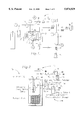
- FIG. 2 is a schematic representation of an apparatus useful in the practice of the invention.
- FIG. 3 is a schematic cross-sectional view of the nozzle employed in the practice of the invention.
- FIG. 4 is an SEM micrograph (10,000 ⁇ magnification) of hydrocortisone micronized by recrystallization from a 5 mg/ml DMSO solution using the conventional GAS process with a 100 ⁇ m capillary nozzle.
- FIG. 5 is an SEM micrograph of hydrocortisone micronized by recrystallization from a 30 mg/ml DMSO solution using the conventional GAS process with a 100 ⁇ m capillary nozzle.
- FIG. 6 is a GC-FID analysis of hydrocortisone recrystallized from a 30 mg/ml DMSO solution using the conventional GAS process with a 100 ⁇ m capillary nozzle.
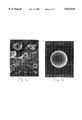
- FIGS. 7a and b are a pair of SEM micrographs (5,000 ⁇ and 9,900 ⁇ magnification, respectively) of hydrocortisone nanonized by recrystallization from a 30 mg/ml DMSO solution using the nozzle of the present invention (compressed CO 2 is used as energizing gas and as antisolvent).
- FIG. 8 is an SEM micrograph (3,000 ⁇ magnification) of hydrocortisone micronized by recrystallization from a 30 mg/ml DMSO solution using the nozzle of the present invention (He is used as energizing gas and compressed CO 2 is used as antisolvent).
- FIG. 10 is an SEM micrograph (1,000 ⁇ magnification) of RG503H micronized by recrystallization from a 10 mg/ml ethyl acetate solution using the nozzle of the present invention (compressed CO 2 is used as energizing gas and as antisolvent).
- FIGS. 11a and b are a pair of SEM micrographs (1,000 ⁇ and 10,000 ⁇ magnification, respectively) of Ibuprofen nanonized by recrystallization from a 30 mg/ml DMSO solution using the nozzle of the present invention (compressed CO 2 is used as energizing gas and as antisolvent).
- FIG. 12 is an SEM micrograph (1,000 ⁇ magnification) of micronized camptothecin by recrystallization from a 5 mg/ml DMSO solution using the nozzle of the present invention (compressed CO 2 is used as energizing gas and as antisolvent).
- FIG. 13a and b are a pair of SEM micrographs (2,000 ⁇ and 15,000 ⁇ magnification, respectively) of camptothecin nanonized by recrystallization from a 5 mg/ml DMSO solution using the nozzle of the present invention (compressed CO 2 is used as energizing gas and as antisolvent).
- the term "supercritical fluid” means either a fluid simultaneously above its critical temperature (T c ) and pressure (P c ), or a fluid suitable for use as a supercritical antisolvent.
- “supercritical fluid” means the temperature of the fluid is in the range of 1.01 T c to 5.0 T c and the pressure of the fluid is in the range of 1.01 P c to 8.0 P c .
- the temperature and pressure of a "near-critical fluid" are in the range of 0.8 T c to 0.99 T c and 0.8 P c to 0.99 P c , respectively.
- compressed gas As used herein, the terms “compressed gas,” “energizing gas,” and “compressed fluid” are interchangeable.
- micronization means the production of particles having an average diameter of 1-100 ⁇ m.
- nanonanonization means the production of particles having an average diameter of less than 1 ⁇ m.
- the term "diameter” refers to the average diameter of the particles as inferred from SEM micrographs.
- FIG. 1 shows a schematic of the apparatus 10 used for particle recrystallization from organic solvents using the conventional GAS process.
- the experimental unit 10 allows GAS experiments to be conducted in either batch or semi-continuous mode at pressures up to 5,000 psi and temperatures up to 70° C.
- the mixing of solvent and antisolvent occurs at two different locations 12, 14 within the unit.
- Unit 10 provides versatility in setting the operating parameters.
- the unit 10 is built around a 65 ml high pressure Jerguson gauge (Burlington, Mass.) view cell 16.
- the cell 16 is equipped with a sapphire window that allows viewing of the expansion and crystallization process.
- the cell 16 is housed in a heated, isothermal, transparent acrylic water bath 18. This water bath 18 is used for maintaining the cell 16 at a desired temperature (20°-70° C.).
- CO 2 is pumped through the top side port 20 of the cell 16 with an ISCO (Lincoln, Nebr.) 260D syringe pump 22 at a constant rate (typically 5 ml/min. of liquid CO 2 ) until the pressure in the cell 16 reaches a desired level (1,500 psi).
- the organic solution (DMSO or ethyl acetate solution of drug and/or polymer) is metered from the top central port 24 of the cell 16 through a stainless steel, 1/16" O.D., 100 ⁇ m I.D. capillary nozzle tubing 26 using a Milton Roy (Riviera Beach, Fla.) 396-89 minipump 28. It is found that a minimum solution flow rate of 2.5 ml/min. is needed to consistently obtain a jet spray. Both fluids are preheated to operating temperature by passing through heat exchangers 30, 32 housed together with the cell 16 in the water bath 18.
- Fresh CO 2 and the organic solution streams thus mix at location 14, which is just downstream of the nozzle tip 33 at the top of the cell 16.
- a cloudy zone about 1 cm long is seen to form in this area indicating intimate mixing of the fluids and particle formation.
- Solvent depletion from the spray droplets causes the drug and/or polymer dissolved in the organic solvent to nucleate. The resulting particles descend down the cell.
- the streams can be premixed prior to reaching the nozzle tip 33 using the two-way valve 34.
- Particles descending down the cell 16 either adhere to the cell walls or are collected on a 6" long glass rod 36. Particles larger than 0.5 ⁇ m leaving the view cell chamber are retained on a 0.5 ⁇ m stainless steel frit housed in the T-shaped fitting at the central bottom port 38. A thermocouple inserted through this fitting is used to monitor the cell temperature.
- the drug and/or polymer depleted mixture of CO 2 and organic solution then flows through a step-motor controlled, heated micrometering valve assembly 40. Upon expansion to a subcritical pressure (typically close to atmospheric pressure), the mixture separates into an organic liquid phase and a CO 2 gas phase. Phase separation takes place in the flash drum 42; the organic solution flows through a micrometering valve 44 and is collected in a vessel 46. The solution then may be analyzed for drug and polymer content.
- CO 2 is vented through a second micrometering valve 48, a rotameter 51, and an electronic mass flowmeter 50.
- the solution is pumped for 15 minutes in order to produce a statistically representative sample of drug and/or polymer microparticles.
- the flow of organic solution is stopped while the CO 2 flow is continued for another 1.5 hours in order to flush out any organic phase left in the cell, and to dry the collected particles. It is found that flowing CO 2 at 1,500 psig for 1.5 hours is adequate for flushing out the organic solvent present in the cell and for drying the particles.
- the pressure is decreased to atmospheric level at a rate of -50 psi/min.
- Particle samples are collected from the cell window, the porous frit, and the glass tube, and are analyzed by scanning electron microscopy (SEM) to estimate particle size and morphology.
- FIG. 2 shows schematically an apparatus 110 according to the present invention.
- Apparatus 110 is identical to apparatus 10 with the exception that the view cell serving as crystallization chamber is replaced with a larger (450 ml), stainless steel vessel that can house the nozzle.
- the crystallization chamber was housed in an isothermal water bath, and pressure is controlled as described previously with regard to the conventional GAS process (FIG. 1).
- an organic solvent such as dimethyl sulfoxide (DMSO), in which solutes such as drug, polymer, and/or excipient materials are solubilized, is also sprayed as a fine mist into a chamber containing a near-critical or supercritical antisolvent.
- DMSO dimethyl sulfoxide
- apparatus 110 of the present invention includes an isothermal and isobaric recrystallization chamber 120, a spray nozzle 124, a source of supercritical (sc) or near-critical (nc) CO 2 126, a source of compressed gas 127 which serves to energize the nozzle 124, a drug and excipient solution 128, an organic solvent collection vessel 156, and a CO 2 outlet header 130.
- sc supercritical
- nc near-critical
- the drug and excipient solution is drawn from vessel 140 through line 142 by pump 144 and is discharged through line 146 into chamber 120 through line 146 as shown in FIG. 2.
- the nozzle 124 is attached to the end of line 146 within chamber 120.
- Energizing gas for the nozzle consisting of He, N 2 , O 2 , air, CO 2 , other supercritical fluids, or a mixture thereof, from source 127 is admitted through line 150 into chamber 120, as shown in FIG. 2.
- the near-critical or supercritical fluid (antisolvent) is admitted from source 126.
- source 127 also can be used for admitting the supercritical fluid into chamber 120; source 126 then may be either not employed, or used for admitting a supercritical fluid in the same composition as in source 124, or a supercritical fluid of different composition. This latter alternative can be used for either increasing or decreasing the concentration gradients between the antisolvent phase and the buffer zone.
- the solute-depleted organic solvent and solvent-loaded CO 2 are removed from chamber 120 via outlet 122 through line 152 and metering valve 154 into flash drum 156, in which CO 2 is allowed to separate from the liquid organic solvent.
- the CO 2 is allowed to vent from vessel 156 through vent line 158.
- FIG. 3 is a schematic of a nozzle (Sonimist, Farmingdale, N.Y., Model 600-1) employed in apparatus 110.
- This nozzle is of the convergent-divergent type. It is energized by compressed gas (conventionally a light gas such as air, He, O 2 , or N 2 ).
- compressed gas conventionally a light gas such as air, He, O 2 , or N 2 .
- a sonic field is created at the throat of the nozzle as the compressed gas accelerates and reaches the velocity of sound.
- These sound waves impinge upon the entrance of a resonator cavity.
- This resonator cavity serves to produce high frequency waves which produce a chopping effect that breaks up the liquid jet comprising the solute-loaded solvent into extremely small droplets.
- the Sonimist nozzle When spraying into ambient air, with 20-100 psig back pressure of energizing gas, the Sonimist nozzle produces a fine, evenly dispersed spray of droplets having diameters in the range of 0.1-50 ⁇ m depending on operating conditions. This size range is orders of magnitude smaller than that of conventional air atomizers. Mean droplet diameters of 1-10 ⁇ m are obtained when spraying water into ambient atmosphere. If interphase mass transfer does not significantly interfere with the atomization process, droplet sizes are expected to be even smaller when spraying into a higher pressure gaseous environment or when using organic solvents with lower surface tension and viscosity than water.
- the nozzle illustrated in FIG. 3 can be used in a wide range of operating conditions in order to substantially reduce particle size and to increase surface area. Furthermore, the invention may be practiced without the use of the nozzle illustrated in FIG. 3.
- the invention may be practiced with any nozzle that provides a means for using a gaseous (or near-critical or supercritical fluid) stream as energizing medium to atomize the sprayed solution into smaller droplets and/or to create turbulence around the spray droplets which increases the mass transfer rates between the droplet and antisolvent phases.
- a gaseous (or near-critical or supercritical fluid) stream as energizing medium to atomize the sprayed solution into smaller droplets and/or to create turbulence around the spray droplets which increases the mass transfer rates between the droplet and antisolvent phases.
- converging-diverging nozzles as well as converging nozzles may be employed in the present invention.
- Hydrocortisone is a common anti-inflammatory agent and Ibuprofen is a common pain reliever. They were acquired from Sigma Chemical Co., St. Louis, Mo., and were used without further purification. Camptothecin is an anti-cancer drug with a very low aqueous solubility; reduction in its particle size or an increase in its particle surface area can substantially increase its dissolution rate and render it therapeutically more useful.
- RG503H was acquired from Henley, Montvale, N.J. It contains a 1:1 molar ratio of lactide and glycolide and has an inherent viscosity in chloroform of 0.3.
- RG503H is FDA approved for administration to humans, is non-toxic, non-tissue reactive, biodegrades to non-toxic products, and is particularly suited for surgical sutures.
- PLGA copolymers have been the subject of intense micronization and microencapsulation studies.
- Hydro-cortisone particles were redissolved in ethyl acetate, and analyzed by GC-FID for trace DMSO contamination. Effluent solutions recovered in the flash drum were also analyzed for hydrocortisone content.
- Particle size for whisker particles refers to their thickness or width.
- the data in Table 1 demonstrates that the average particle size for all solutes studied, including HYAFF-7 (the ethyl ester of hyaluronic acid) is reproducible, indicating that the GAS technique is a controllable and reproducible recrystallization technique.
- Particles size is fairly reproducible. For three runs under these same conditions (30 mg/ml), particle thickness is narrowly distributed and is in the order of 1 ⁇ m. The amount of DMSO in the hydrocortisone particles was below the detection limit of the GC-FID ( ⁇ 10 ppm) (FIG. 6). It thus appears that the particles are virtually solvent-free.
- Hydrocortisone loss to the CO 2 /solvent phase thus amounts to roughly 8% of all the hydrocortisone pumped into the view cell. Hydrocortisone loss could be due to (1) its partial solubility in the CO 2 /solvent phase, or (2) a small amount of entrained, sub-micron particles not being retained by the 0.5 ⁇ m stainless steel filter frit.
- FIGS. 7a and b show a pair of SEM micrographs of hydrocortisone particles recrystallized from a 30 mg/ml DMSO solution using the nozzle in FIG. 3, and CO 2 as energizing gas.
- the pressure of CO 2 at line 50 (FIG. 2) was equal to 1,850 psig, thereby providing 600 psi of back pressure.
- CO 2 temperature in source 24 FIG.
- FIG. 8 demonstrates that it is possible to use a light gas to energize the nozzle. Although these conditions are not optimum, the process still produces particles that are relatively small. Some particles appear to be even smaller than 1 ⁇ m.
- the merits of using He as opposed to CO 2 as energizing gas are not evident from FIG. 8; however, it is anticipated that as the solute concentration and viscosity of the solution is increased, it may be necessary to introduce a gaseous buffer such as He to avoid premature nucleation.
- the flow rate of the supercritical fluid relative to that of the light gas should be high enough to provide sufficient antisolvent power for the supercritical fluid/light gas mixture.
- Use of CO 2 as both antisolvent and energizing gas, when possible, is advantageous over the use of a light gas as energizing gas because (a) chances for contamination are reduced, (b) the antisolvent power of CO 2 is not diminished, (c) required CO 2 flow rates are lower, and (d) solvent recovery is efficient.
- RG503H was recrystallized from solutions of DMSO and ethyl acetate at a pressure of 1,500 psig and a temperature of 35° C. using a 100 ⁇ m capillary nozzle. Neat RG503H particles, as supplied by the vendor, are relatively large, agglomerated precipitates (>50 ⁇ m). Table 2 depicts the effect of RG503H concentration on size and morphology of RG503H recrystallized from solution. RG503H in DMSO appears to recrystallize as tubules at low concentrations, as a mixture of flakes and tubules at medium concentrations, and as precipitates of large amorphous material at higher concentrations.
- FIGS. 9a and b show that a reduction in the viscosity and/or surface tension of the solution through a change of solvent, i.e. from DMSO (1.9 cp and 41 dyn/cm) to ethyl acetate (0.46 cp and 24 dyn/cm) led to the formation of discrete microspheres (in FIGS.
- the inability to attain sub-micron particles of average size smaller than 0.6 ⁇ m using the conventional GAS process is attributed to mass transfer limitations.
- FIG. 10 shows an SEM micrograph of RG503H particles recrystallized from a 10 mg/ml ethyl acetate solution. These particles are compared with particles shown in FIGS. 19a and b, which are obtained using the conventional GAS process. Both experiments were conducted at identical conditions of pressure, temperature, and solution flow rate (1,500 psig, 35° C., and 2.5 ml/min, respectively) within the crystallization chamber, except that the particles shown in FIG. 10 were obtained using the present invention in which compressed CO 2 was used as energizing gas. The CO 2 supply pressure was 1,600 psig. Similar to the particles seen in FIGS. 9a and b, the RG503H particles in FIG.
- the particles obtained using the present invention appear more discrete and are an order of magnitude smaller than particles in FIGS. 9a and b.
- particle diameter is again narrowly distributed around 1 ⁇ m.
- the present invention produces smaller particles than the conventional process with less agglomeration, a property that is desirable, especially in the pharmaceutical industry.
- FIGS. 11a and b show a pair of SEM micrographs of Ibuprofen particles recrystallized from a 30 mg/ml DMSO solution under the same operating conditions as in Example 2, section 2.2. Once again, particles appear to be discrete, particle sizes are small and, except for a fraction of micron-sized particles, most particles are smaller and in the range of 0.6 ⁇ m or less.
- Camptothecin appears as amorphous particles with diameters ranging from 1-10 ⁇ m.
- Example 1 where favorable operating conditions were used, nanoparticles were produced.
- the chamber contains liquid CO 2 or other liquid antisolvent as opposed to supercritical CO 2 or another antisolvent in its supercritical form.
- the volume above the liquid phase i.e., the vapor phase
- the volume above the liquid phase contains mostly the light gas or the antisolvent which powers the nozzle of the present invention, and recrystallization takes place in either the liquid phase (when a light gas is used to power the spray nozzle) or in both phases (when an antisolvent is used to power the spray nozzle).
- the antisolvent itself is used to power the nozzle
- operating conditions are such that the energizing gas at its near-critical or supercritical state will nearly attain the conditions in the recrystallization chamber upon expansion through the nozzle.
- This invention finds application in areas where reduction in particle size to below 1 ⁇ m is desired for the purpose of increasing the surface area, the rate of dissolution, reactivity, or bioavailability.
- the disclosed invention also finds application in areas where recrystallization of microparticles or nanoparticles from organic solutions is desirable. These applications can find use in the production of foods, electronic equipment, explosives, pharmaceutical products or intermediates (micronization, nanonization, coating, microencapsulation, lyophilization, and co-precipitation), catalysts (micronization and nanonization to increase the surface area of active sites or support), explosives (improved reactivity), coating (finer coatings), polymers (micronization and nanonization), pesticides (micronication, nanonization, and microencapsulation), and other chemicals (micronization, nanonization, and microencapsulation).
- Antisolvents useful in the application of this invention include, but are not limited to, CO 2 , propane, butane, isobutane, CHF 3 , SF 6 , and N 2 O.
- Organic solvents may be either of the class of aromatic hydrocarbons, alcohols, esters, ethers, ketones, amines, or nitrated or chlorinated hydrocarbons.
- Preferred solvents include acetone, ethanol, methanol, dichloromethane, ethyl acetate and DMSO.
- the method and apparatus of the present invention overcome the disadvantages associated with conventional GAS processes in several ways.
- the high-velocity wave-front and/or turbulence established at the exit of the nozzle by the energizing gas breaks up the solution exiting the nozzle into a fine spray of droplets.
- the mass transfer rate between the spray droplets and the surrounding antisolvent phases is essentially proportional to the surface area of the spray droplets, and the antisolvent and solute concentration gradients.
- Use of the nozzle of the present invention provides a means for enhancing mass transfer rates through an increase in both the surface area of the spray and the interphase concentration gradients.
- One effect of the creation of the small size droplets is to increase the specific surface area of the droplets, that in turn increases the rate of mass transfer.
- the compressed energizing gas passes the atomized droplets as it enters the supercritical antisolvent at high velocity and thereby creates a turbulence which prevents a build-up of depleted solvent in the proximity of the atomized spray.
- An increase in the concentration gradients between the droplet phase and the antisolvent phase provides an increased driving force for interphase mass transfer.
- the same fluid can be used for both energizing the spray nozzle as well as an anti-solvent.
- the high velocity of the energizing gas stream imparts a high velocity to the spray droplets, and therefore reduces the tendency for droplet coalescence which can lead to the formation of larger particles.
- the high velocity of the gas or supercritical fluid energizing stream provides a buffer zone at the tip of the nozzle that is either a gas or a low-density supercritical fluid. If the gas has little or no antisolvent power, the buffer zone at the tip of the nozzle serves to delay recrystallization until after secondary atomization of the spray has been achieved. This case is most attractive when using highly viscous or concentrated (nearly saturated or supersaturated) solutions.
- the buffer zone is a highly turbulent zone of nearly pure antisolvent, thereby maximizing mass transfer rates between the droplets and the antisolvent while minimizing the droplet coalescence rate. This case is most attractive when recrystallizing drugs or polymers from solutions with low solute concentrations.
- Use of a compressed gas with intermediate antisolvent power i.e. a mixture of light gas and antisolvent provides a means for controlling interphase mass transfer rates, and therefore means for controlling particle size.
Landscapes
- Bioinformatics & Cheminformatics (AREA)
- Engineering & Computer Science (AREA)
- Health & Medical Sciences (AREA)
- Chemical & Material Sciences (AREA)
- Medicinal Chemistry (AREA)
- Pharmacology & Pharmacy (AREA)
- Epidemiology (AREA)
- Life Sciences & Earth Sciences (AREA)
- Animal Behavior & Ethology (AREA)
- General Health & Medical Sciences (AREA)
- Public Health (AREA)
- Veterinary Medicine (AREA)
- Chemical Kinetics & Catalysis (AREA)
- Organic Chemistry (AREA)
- Medicinal Preparation (AREA)
Abstract
Description
                                  TABLE 1
__________________________________________________________________________
Reproducibility of Morphology and Size of Particles Formed by the
Conventional GAS Recrystallization Method, as Estimated from SEM
Micrographs. P = 1,500 psig; CO.sub.2 Flow Rate = 5 ml/min.; Solution
Flow Rate =
2.5 ml/min; Capillary Nozzle I.D. = 100 μm.
                                  Average
                 Concentration
                        Temp.
                            Particle
                                  Particle
Run
   Solvent
          Solute (mg/ml)
                        (°C.)
                            Morphology
                                  Size (μm)
__________________________________________________________________________
4-12
   DMSO   Hydrocortisone
                 30     35  Whisker
                                  1
4-14
   DMSO   Hydrocortisone
                 30     35  Whisker
                                  1
4-16
   DMSO   Hydrocortisone
                 30     35  Whisker
                                  1
12-1
   Ethyl Acetate
          RG503H 10     35  Microsphere
                                  5-50
5-8
   Ethyl Acetate
          RG503H 10     35  Microsphere
                                  10-20
12-16
   DMSO   RG503H 2      35  Tubes/Flakes
                                  25-100
12-20
   DMSO   RG503H 2      35  Tubes/Flakes
                                  25-100
6-6
   DMSO   HYAFF-7
                 0.5    40  Resin >100
6-8
   DMSO   HYAFF-7
                 0.5    40  Resin >100
__________________________________________________________________________
              TABLE 2
______________________________________
Micronization of RG503H by Conventional GAS Recrystallization. P =
1,500 psig; T = 35° C.; CO.sub.2 flow rate = 5 ml/min.; Solution
Flow
Rate = 2.5 ml/min.; Capillary I.D. = 100 μm; Solvent is DMSO except
for Run 6.
                       Particle
                       Size       RG503H!
Run #    Shape         (μm)   (mg/ml)
______________________________________
1        whiskers      15        0.5
2        whiskers/flakes
                       15/50     2.0
3        whiskers/flakes
                         25/>100 2.0
4        flakes        100       10.0
5        amorphous     >500      100.0
6        hollow micro- <50       10.0*
         spheres
7        flakes with bub-
                       >500      10.0
         bles
______________________________________
 *Solvent is ethyl acetate.  : Premixing of solvent and CO.sub.2.
Claims (22)
Priority Applications (8)
| Application Number | Priority Date | Filing Date | Title |
|---|---|---|---|
| US08/723,463 US5874029A (en) | 1996-10-09 | 1996-10-09 | Methods for particle micronization and nanonization by recrystallization from organic solutions sprayed into a compressed antisolvent |
| US08/805,215 US5833891A (en) | 1996-10-09 | 1997-02-27 | Methods for a particle precipitation and coating using near-critical and supercritical antisolvents |
| AU21936/97A AU709384B2 (en) | 1996-03-01 | 1997-02-28 | Methods and apparatus for particle precipitation and coating using near-critical and supercritical antisolvents |
| PCT/US1997/003207 WO1997031691A1 (en) | 1996-03-01 | 1997-02-28 | Methods and apparatus for particle precipitation and coating using near-critical and supercritical antisolvents |
| CA002247900A CA2247900C (en) | 1996-03-01 | 1997-02-28 | Methods and apparatus for particle precipitation and coating using near-critical and supercritical antisolvents |
| JP53117497A JP3986086B2 (en) | 1996-03-01 | 1997-02-28 | Particle precipitation method and coating method using near-critical and supercritical anti-solvents |
| EP97914827A EP0885038B1 (en) | 1996-03-01 | 1997-02-28 | Methods and apparatus for particle precipitation and coating using near-critical and supercritical antisolvents |
| AT97914827T ATE512702T1 (en) | 1996-03-01 | 1997-02-28 | METHODS AND DEVICES FOR PARTICLE PRECIPITATION AND COATING WITH NEAR-CRITICAL OR SUPERCRITICAL ANTI-SOLVENTS |
Applications Claiming Priority (1)
| Application Number | Priority Date | Filing Date | Title |
|---|---|---|---|
| US08/723,463 US5874029A (en) | 1996-10-09 | 1996-10-09 | Methods for particle micronization and nanonization by recrystallization from organic solutions sprayed into a compressed antisolvent |
Related Child Applications (1)
| Application Number | Title | Priority Date | Filing Date |
|---|---|---|---|
| US08/805,215 Continuation-In-Part US5833891A (en) | 1996-03-01 | 1997-02-27 | Methods for a particle precipitation and coating using near-critical and supercritical antisolvents |
Publications (1)
| Publication Number | Publication Date |
|---|---|
| US5874029A true US5874029A (en) | 1999-02-23 |
Family
ID=24906381
Family Applications (1)
| Application Number | Title | Priority Date | Filing Date |
|---|---|---|---|
| US08/723,463 Expired - Lifetime US5874029A (en) | 1996-03-01 | 1996-10-09 | Methods for particle micronization and nanonization by recrystallization from organic solutions sprayed into a compressed antisolvent |
Country Status (1)
| Country | Link |
|---|---|
| US (1) | US5874029A (en) |
Cited By (130)
| Publication number | Priority date | Publication date | Assignee | Title |
|---|---|---|---|---|
| US6039970A (en) * | 1991-05-31 | 2000-03-21 | Fidia S.P.A. | Process for the preparation of microspheres containing biologically active components |
| WO2000015329A1 (en) * | 1998-09-15 | 2000-03-23 | Henkel Kommanditgesellschaft Auf Aktien | Method for producing nanoparticles |
| EP1090894A1 (en) * | 1999-10-06 | 2001-04-11 | Fraunhofer-Gesellschaft zur Förderung der angewandten Forschung e.V. | Process for making fine particles of explosives |
| US6221435B1 (en) * | 1998-11-18 | 2001-04-24 | Union Carbide Chemicals & Plastics Technology Corporation | Method for the spray application of polymeric-containing liquid coating compositions using subcritical compressed fluids under choked flow spraying conditions |
| US6221153B1 (en) * | 1998-06-09 | 2001-04-24 | Trevor Percival Castor | Method for producing large crystals of complex molecules |
| WO2002021222A1 (en) * | 2000-09-08 | 2002-03-14 | Ferro Corporation | Orthopedic mixtures prepared by supercritical fluid processing techniques |
| US6403672B1 (en) * | 1998-11-30 | 2002-06-11 | University Technology Corporation | Preparation and use of photopolymerized microparticles |
| US6426136B1 (en) * | 1998-02-10 | 2002-07-30 | R & D Technology, Inc. | Method of reducing material size |
| WO2002078863A1 (en) * | 2001-03-30 | 2002-10-10 | Picoliter Inc. | Generation of pharmaceutical agent particles using focused acoustic energy |
| WO2002068107A3 (en) * | 2001-02-26 | 2002-12-05 | Dompe Spa | Apparatus and method for micron and submicron particle formation |
| US20020189454A1 (en) * | 1999-12-15 | 2002-12-19 | Michel Perrut | Method for capturing fine particles by percolation in a bed of granules |
| US20030012892A1 (en) * | 2001-03-30 | 2003-01-16 | Lee David Soong-Hua | Precipitation of solid particles from droplets formed using focused acoustic energy |
| WO2002093132A3 (en) * | 2001-05-16 | 2003-02-13 | Univ Auburn | Method for manufacture of fine particles |
| US6521258B1 (en) * | 2000-09-08 | 2003-02-18 | Ferro Corporation | Polymer matrices prepared by supercritical fluid processing techniques |
| US20030045597A1 (en) * | 1998-11-30 | 2003-03-06 | Theodore Randolph | Preparation and use of photopolymerized microparticles |
| US20030047824A1 (en) * | 1997-02-21 | 2003-03-13 | Bradford Particle Design Plc | Method and apparatus for the formation of particles |
| US20030066800A1 (en) * | 2001-10-10 | 2003-04-10 | Boehringer Ingelheim Pharmaceuticals, Inc. | Powder processing with pressurized gaseous fluids |
| US20030072801A1 (en) * | 2001-06-22 | 2003-04-17 | Pfizer Inc. | Pharmaceutical compositions comprising drug and concentration-enhancing polymers |
| US20030072690A1 (en) * | 1999-11-12 | 2003-04-17 | Royer Joseph R. | Continuous method and apparatus for separating polymer from a high pressure carbon dioxide fluid stream |
| US6555156B1 (en) * | 1998-01-29 | 2003-04-29 | Kinerton Limited | Process for making absorbable microparticles |
| US20030082236A1 (en) * | 2000-01-14 | 2003-05-01 | Edith Mathiowitz | Micronized freeze-dried particles |
| WO2003035673A1 (en) | 2001-10-22 | 2003-05-01 | Dompe S.P.A. | Supercritical fluids processing: preparation of protein microparticles and their stabilisation |
| US20030087837A1 (en) * | 2001-10-15 | 2003-05-08 | Jonas Jeffrey M. | Compositions and methods for delivery of poorly water soluble drugs and methods of treatment |
| US6562952B1 (en) | 2000-10-31 | 2003-05-13 | The University Of Kansas | Precipitation of proteins from organic solutions |
| US6576264B1 (en) * | 1995-10-17 | 2003-06-10 | Skyepharma Canada Inc. | Insoluble drug delivery |
| US20030109421A1 (en) * | 2001-07-20 | 2003-06-12 | Srinivas Palakodaty | Particle formation |
| US20030124193A1 (en) * | 2001-11-01 | 2003-07-03 | Inhale Therapeutic System, Inc. | Spray drying methods and related compositions |
| US20030146529A1 (en) * | 2001-08-09 | 2003-08-07 | Ching-Jen Chen | Polymeric encapsulation of nanoparticles |
| US20030157031A1 (en) * | 2002-02-08 | 2003-08-21 | Lalit Chordia | Method of and apparatus for forming and administering fine particles |
| US6610223B2 (en) | 2001-03-30 | 2003-08-26 | Picoliter Inc. | Focused acoustic energy in the generation of solid particles |
| US20030223939A1 (en) * | 2002-04-17 | 2003-12-04 | Andreas Kordikowski | Particulate materials |
| US20030232020A1 (en) * | 2002-04-24 | 2003-12-18 | Peter York | Particulate materials |
| US20030234466A1 (en) * | 2000-07-14 | 2003-12-25 | Rasmussen Thomas Buch | Method of moulding a pharmaceutical composition in a packaging material |
| US20040015519A1 (en) * | 2001-10-15 | 2004-01-22 | Yukitoshi Maeda | Content delivery server and content delivery system having the same |
| WO2003094694A3 (en) * | 2002-05-08 | 2004-03-18 | Medihale Ltd | Hand held device for inhalation therapy and method of use thereof |
| US20040057977A1 (en) * | 1999-09-22 | 2004-03-25 | Ecolab Inc. | Water-based pest bait compositions having water-sensitive insecticides and methods of making and use thereof |
| US20040065969A1 (en) * | 2002-10-02 | 2004-04-08 | Jhunu Chatterjee | Microencapsulation of magentic material using heat stabilization |
| US20040071783A1 (en) * | 1998-05-15 | 2004-04-15 | Hanna Mazen Hermiz | Methods and apparatus for particle formation |
| US20040086544A1 (en) * | 1999-09-30 | 2004-05-06 | Chienna B.V. | Polymers with bioactive agents |
| US20040119179A1 (en) * | 2000-10-19 | 2004-06-24 | Michel Perrut | Method for making very fine particles consisting of a principle inserted in a host molecule |
| US20040134885A1 (en) * | 2003-01-14 | 2004-07-15 | Iyer Subramanyam A. | Etching and cleaning of semiconductors using supercritical carbon dioxide |
| US20040140374A1 (en) * | 2002-12-30 | 2004-07-22 | Nektar Therapeutics | Prefilming atomizer |
| US20040156911A1 (en) * | 2003-02-07 | 2004-08-12 | Ferro Corporation | Method and apparatus for continuous particle production using supercritical fluid |
| US20040156905A1 (en) * | 2002-08-12 | 2004-08-12 | Pfizer Inc. | Pharmaceutical compositions of semi-ordered drugs and polymers |
| US6777706B1 (en) | 1998-07-14 | 2004-08-17 | Cambridge Display Technologies | Optical devices |
| US20040178529A1 (en) * | 2001-07-02 | 2004-09-16 | Ernesto Reverchon | Process for the production of micro and/or nano particles |
| JP2004534648A (en) * | 2001-07-20 | 2004-11-18 | ネクター セラピューティクス ユーケー リミティド | Method and apparatus for forming particles |
| EP1499297A2 (en) | 2001-03-14 | 2005-01-26 | Lek Pharmaceutical and Chemical Co. D.D. | Pharmaceutical formulation comprising atorvastatin calcium |
| WO2005016485A1 (en) * | 2002-10-11 | 2005-02-24 | Ferro Corporation | Composite particles and method for preparing |
| US20050051917A1 (en) * | 2001-07-10 | 2005-03-10 | Willy Grothe | Devices and methods for the production of particles |
| WO2004108265A3 (en) * | 2003-06-03 | 2005-03-24 | Ferro Corp | Nanoparticles from supercritical fluid antisolvent process using particle growth and agglomeration retardants |
| US20050070477A1 (en) * | 2002-04-25 | 2005-03-31 | The Scripps Research Institute | Treatment and prevention of pulmonary conditions |
| US20050085409A1 (en) * | 2003-01-08 | 2005-04-21 | Andreas Kordikowski | Particle formation |
| US20050089476A1 (en) * | 2003-10-22 | 2005-04-28 | MONTERESEARCH S.r.I. | Process for the preparation of pharmaceutical suspensions for inhalation |
| US6914105B1 (en) | 1999-11-12 | 2005-07-05 | North Carolina State University | Continuous process for making polymers in carbon dioxide |
| US20050170000A1 (en) * | 2003-05-08 | 2005-08-04 | Walker Stephen E. | Particulate materials |
| US20050170063A1 (en) * | 2004-01-29 | 2005-08-04 | Lalit Chordia | Production of powder and viscous material |
| US20050181059A1 (en) * | 2003-09-30 | 2005-08-18 | Spherics, Inc. | Nanoparticulate therapeutic biologically active agents |
| US20050202072A1 (en) * | 1999-04-16 | 2005-09-15 | Novo Nordisk A/S | Dry mouldable drug formulation |
| US20050249817A1 (en) * | 2004-05-10 | 2005-11-10 | Yousef Haik | Magnetic particle composition for therapeutic hyperthermia |
| US20060008531A1 (en) * | 2003-05-08 | 2006-01-12 | Ferro Corporation | Method for producing solid-lipid composite drug particles |
| US20060008498A1 (en) * | 2004-07-12 | 2006-01-12 | Chen Tzer-Fen D | Nano-particle production |
| US20060046947A1 (en) * | 2003-11-18 | 2006-03-02 | Hon Hai Precision Industry Co., Ltd. | Supercritical fluid with nanoparticles |
| US20060138687A1 (en) * | 2003-10-24 | 2006-06-29 | Ferro Corporation | Method of forming particles |
| US20070004838A1 (en) * | 2005-07-01 | 2007-01-04 | Dimanshteyn Felix A | Ultra-low petroleum plastics |
| US20070031342A1 (en) * | 2005-06-22 | 2007-02-08 | Nektar Therapeutics | Sustained release microparticles for pulmonary delivery |
| US20070065372A1 (en) * | 2003-02-21 | 2007-03-22 | Robert Price | Process for the production of particles |
| US20070134338A1 (en) * | 2005-06-08 | 2007-06-14 | Bala Subramaniam | Methods for producing nanoparticulate metal complexes and altering nanoparticle morphology |
| US20070158266A1 (en) * | 2003-02-07 | 2007-07-12 | Ferro Corporation | Method And Apparatus For Producing Particles Via Supercritical Fluid Processing |
| US20070231360A1 (en) * | 2006-03-28 | 2007-10-04 | Minu, L.L.C. | Neural conduit agent dissemination |
| US20070237829A1 (en) * | 2004-10-05 | 2007-10-11 | Ekaterina Dadachova | Melanin nanoshells for protection against radiation and electronic pulses |
| US20070253913A1 (en) * | 2003-09-10 | 2007-11-01 | Nahed Mohsen | Aerosol formulations for delivery of dihydroergotamine to the systemic circulation via pulmonary inhalation |
| US20080026062A1 (en) * | 2006-07-31 | 2008-01-31 | Isaac Farr | Pharmaceutical compositions including nano-sized active agent |
| US20080026040A1 (en) * | 2006-07-31 | 2008-01-31 | Isaac Farr | Active agent-releasing dosage forms |
| WO2008032328A2 (en) | 2006-09-14 | 2008-03-20 | Yissum Research Development Company Of The Hebrew University Of Jerusalem | Pesticide nanoparticles obtained from microemulsions and nanoemulsions |
| US20080075777A1 (en) * | 2006-07-31 | 2008-03-27 | Kennedy Michael T | Apparatus and methods for preparing solid particles |
| US20080305161A1 (en) * | 2005-04-13 | 2008-12-11 | Pfizer Inc | Injectable depot formulations and methods for providing sustained release of nanoparticle compositions |
| US20090004282A1 (en) * | 2005-07-15 | 2009-01-01 | Linda Sze Tu | Method of Particle Formation |
| US20090285905A1 (en) * | 1996-12-31 | 2009-11-19 | Gordon Marc S | Systems and processes for spray drying hydrophobic drugs with hydrophilic excipients |
| US20100003331A1 (en) * | 2003-09-02 | 2010-01-07 | Pfizer Inc. | Sustained release dosage forms of ziprasidone |
| US20100018853A1 (en) * | 2007-03-19 | 2010-01-28 | Prosonix Limited | Process for Making Crystals |
| US20100034910A1 (en) * | 2000-06-30 | 2010-02-11 | Novartis Pharma Ag | Spray drying process control of drying kinetics |
| US20100081663A1 (en) * | 2007-02-11 | 2010-04-01 | Map Pharmaceuticals, Inc. | Method of therapeutic administration of dhe to enable rapid relief of migraine while minimizing side effect profile |
| US20100183725A1 (en) * | 2005-07-15 | 2010-07-22 | Map Pharmaceuticals, Inc. | Multiple active pharmaceutical ingredients combined in discrete inhalation particles and formulations thereof |
| US20100190760A1 (en) * | 2007-06-18 | 2010-07-29 | Prosonix Limited | Process for Making Crystals |
| US20100222220A1 (en) * | 2000-11-09 | 2010-09-02 | Hanna Mazen H | Compositions of particulate coformulation |
| US20100276827A1 (en) * | 2009-04-29 | 2010-11-04 | Kevin Smith | Method for Producing Nanoparticles |
| US20100291221A1 (en) * | 2009-05-15 | 2010-11-18 | Robert Owen Cook | Method of administering dose-sparing amounts of formoterol fumarate-budesonide combination particles by inhalation |
| US20110021592A1 (en) * | 2006-09-14 | 2011-01-27 | Shlomo Magdassi | Organic nanoparticles obtained from microemulsions by solvent evaporation |
| US20110028456A1 (en) * | 2008-01-11 | 2011-02-03 | Cipla Limited | Solid Pharmaceutical Dosage Form |
| US20110171141A1 (en) * | 2009-06-26 | 2011-07-14 | Kellerman Donald J | Administration of dihydroergotamine mesylate particles using a metered dose inhaler |
| US8080236B2 (en) | 2002-04-17 | 2011-12-20 | Nektar Therapeutics Uk, Ltd | Particulate materials |
| US8268048B2 (en) | 2008-10-14 | 2012-09-18 | University Of Kansas | Oxygen binding of nanoparticulate metal complexes |
| US8454997B2 (en) | 2001-12-18 | 2013-06-04 | Novo Nordisk A/S | Solid dose micro implant |
| RU2513623C1 (en) * | 2012-11-14 | 2014-04-20 | Евгений Александрович Лебедев | Superdispersed powder production plant |
| US8734898B2 (en) | 2012-09-21 | 2014-05-27 | E I Du Pont De Nemours And Company | Method for producing encapsulated nanoparticles |
| US8778181B1 (en) | 2013-03-14 | 2014-07-15 | Crititech, Inc. | Equipment assembly for and method of processing particles |
| US20150043943A1 (en) * | 2012-03-26 | 2015-02-12 | Keiko Osaka | Method for producing particles, toner, developer, and image forming apparatus |
| EP2796129B1 (en) | 2009-09-07 | 2015-06-17 | Epitech Group S.r.l. | Composition containing ultra - micronized palmitoyl - ethanolamide |
| US9259396B2 (en) | 2012-01-20 | 2016-02-16 | Nano And Advanced Materials Institute Limited | Method of preparing soy isoflavone nanoparticles by precipitation with compressed antisolvent (PCA) using a supercritical fluid |
| EP3141248A1 (en) | 2006-03-24 | 2017-03-15 | Auxilium International Holdings, Inc. | Stabilized compositions containing alkaline labile drugs |
| US9700529B2 (en) | 2002-05-03 | 2017-07-11 | Nektar Therapeutics | Particulate materials |
| US9808030B2 (en) | 2011-02-11 | 2017-11-07 | Grain Processing Corporation | Salt composition |
| US9814685B2 (en) | 2015-06-04 | 2017-11-14 | Crititech, Inc. | Taxane particles and their use |
| US9925512B2 (en) | 2013-03-14 | 2018-03-27 | Crititech, Inc. | Equipment assembly for and method of processing particles |
| WO2018170210A1 (en) | 2017-03-15 | 2018-09-20 | Dfb Soria, Llc | Topical therapy for the treatment of vulvar intraepithelial neoplasia (vin) and genital warts using nanoparticles of taxanes |
| WO2018170196A1 (en) | 2017-03-15 | 2018-09-20 | Dfb Soria, Llc | Topical therapy for the treatment of skin malignancies using nanoparticles of taxanes |
| WO2018170207A1 (en) | 2017-03-15 | 2018-09-20 | Dfb Soria, Llc | Topical therapy for the treatment of skin keratoses using nanoparticles of taxanes |
| WO2018227037A1 (en) | 2017-06-09 | 2018-12-13 | Crititech, Inc. | Treatment of epithelial cysts by intracystic injection of antineoplastic particles |
| WO2018231908A1 (en) | 2017-06-14 | 2018-12-20 | Crititech, Inc. | Methods for treating lung disorders |
| WO2019067851A1 (en) | 2017-09-29 | 2019-04-04 | Crititech, Inc. | Ciprofloxacin polymorph and its use |
| WO2019070850A1 (en) | 2017-10-03 | 2019-04-11 | Crititech, Inc. | Local delivery of antineoplastic particles in combination with systemic delivery of immunotherapeutic agents for the treatment of cancer |
| WO2019136187A1 (en) | 2018-01-05 | 2019-07-11 | Crititech, Inc. | Treatment of bladder cancer by local administration of taxane particles |
| US10391090B2 (en) | 2016-04-04 | 2019-08-27 | Crititech, Inc. | Methods for solid tumor treatment |
| US10449162B2 (en) | 2015-09-16 | 2019-10-22 | Dfb Soria Llc | Delivery of drug nanoparticles and methods of use thereof |
| WO2019231567A1 (en) | 2018-05-31 | 2019-12-05 | Crititech, Inc. | Methods for isolating tumor-specific immune cells from a subject for adoptive cell therapy and cancer vaccines |
| WO2019231499A1 (en) | 2018-05-31 | 2019-12-05 | Crititech, Inc. | Use of antineoplastic agents to stimulate the immune system for treatment of cancer |
| WO2019231498A1 (en) | 2018-05-31 | 2019-12-05 | Crititech, Inc. | Treatment of kidney tumors by intratumoral injection of taxane particles |
| WO2020072090A1 (en) | 2018-10-03 | 2020-04-09 | Crititech, Inc. | Use of antineoplastic agents to stimulate the immune system for production of tertiary lymphoid structures (tls) |
| CN113756126A (en) * | 2021-09-16 | 2021-12-07 | 赣州龙邦材料科技有限公司 | Aramid nanofiber, preparation method and application thereof, and preparation method of aramid paper |
| EP3917500A2 (en) * | 2019-01-31 | 2021-12-08 | Elektrofi, Inc. | Particle formation and morphology |
| WO2022020449A1 (en) | 2020-07-23 | 2022-01-27 | Crititech, Inc. | Sorafenib particles and uses thereof |
| WO2022020455A1 (en) | 2020-07-23 | 2022-01-27 | Crititech, Inc. | Lapatinib particles and uses thereof |
| CN114009734A (en) * | 2021-10-21 | 2022-02-08 | 肇东星湖生物科技有限公司 | Method for producing IMP + GMP through anti-solvent cooling crystallization based on solvent spraying oscillation |
| WO2022232024A1 (en) | 2021-04-26 | 2022-11-03 | Crititech, Inc. | Cisplatin particles and uses thereof |
| US11497726B2 (en) | 2018-03-16 | 2022-11-15 | Dfb Soria, Ll. | Topical therapy for the treatment of cervical intraepithelial neoplasia (CIN) and cervical cancer using nanoparticles of taxanes |
| WO2023086779A1 (en) | 2021-11-10 | 2023-05-19 | Crititech, Inc. | Niraparib particles and uses thereof |
| WO2023086784A1 (en) | 2021-11-10 | 2023-05-19 | Crititech, Inc. | Rucaparib particles and uses thereof |
| US20250033010A1 (en) * | 2021-12-03 | 2025-01-30 | Sitec Pharmabio, S.L. | Process and apparatus for the manufacture of solid microparticles |
| US12600763B2 (en) | 2019-09-13 | 2026-04-14 | Halozyme Hypercon, Inc. | Compositions and methods for the delivery of therapeutic biologics for treatment of disease |
Citations (11)
| Publication number | Priority date | Publication date | Assignee | Title |
|---|---|---|---|---|
| US4900558A (en) * | 1986-08-01 | 1990-02-13 | Aps Research Limited | Sustained release ibuprofen formulation including a core of ibuprofen and a microcrystalline cellulose and a covering of acrylic polymer and hydroxylated cellulose derivative |
| US5043280A (en) * | 1987-12-28 | 1991-08-27 | Schwarz Pharma Ag | Method and apparatus for the manufacture of a product having a substance embedded in a carrier |
| WO1992001446A1 (en) * | 1990-07-20 | 1992-02-06 | Aps Research Limited | Sustained-release formulations |
| EP0542314A1 (en) * | 1991-11-14 | 1993-05-19 | The Trustees Of Princeton University | Formation of protein microparticles by antisolvent precipitation |
| US5301664A (en) * | 1992-03-06 | 1994-04-12 | Sievers Robert E | Methods and apparatus for drug delivery using supercritical solutions |
| US5308648A (en) * | 1992-09-30 | 1994-05-03 | Union Carbide Chemicals & Plastics Technology Corporation | Spray application of plastics additives to polymers |
| US5344676A (en) * | 1992-10-23 | 1994-09-06 | The Board Of Trustees Of The University Of Illinois | Method and apparatus for producing nanodrops and nanoparticles and thin film deposits therefrom |
| US5360478A (en) * | 1989-10-16 | 1994-11-01 | Phasex Corporation | Gas anti-solvent recrystallization process |
| WO1995001221A1 (en) * | 1993-07-01 | 1995-01-12 | University Of Bradford | Method and apparatus for the formation of particles |
| WO1995001324A1 (en) * | 1993-07-01 | 1995-01-12 | Glaxo Group Limited | Salmeterol xinafoate with controlled particle size |
| US5389263A (en) * | 1992-05-20 | 1995-02-14 | Phasex Corporation | Gas anti-solvent recrystallization and application for the separation and subsequent processing of RDX and HMX |
-
1996
- 1996-10-09 US US08/723,463 patent/US5874029A/en not_active Expired - Lifetime
Patent Citations (11)
| Publication number | Priority date | Publication date | Assignee | Title |
|---|---|---|---|---|
| US4900558A (en) * | 1986-08-01 | 1990-02-13 | Aps Research Limited | Sustained release ibuprofen formulation including a core of ibuprofen and a microcrystalline cellulose and a covering of acrylic polymer and hydroxylated cellulose derivative |
| US5043280A (en) * | 1987-12-28 | 1991-08-27 | Schwarz Pharma Ag | Method and apparatus for the manufacture of a product having a substance embedded in a carrier |
| US5360478A (en) * | 1989-10-16 | 1994-11-01 | Phasex Corporation | Gas anti-solvent recrystallization process |
| WO1992001446A1 (en) * | 1990-07-20 | 1992-02-06 | Aps Research Limited | Sustained-release formulations |
| EP0542314A1 (en) * | 1991-11-14 | 1993-05-19 | The Trustees Of Princeton University | Formation of protein microparticles by antisolvent precipitation |
| US5301664A (en) * | 1992-03-06 | 1994-04-12 | Sievers Robert E | Methods and apparatus for drug delivery using supercritical solutions |
| US5389263A (en) * | 1992-05-20 | 1995-02-14 | Phasex Corporation | Gas anti-solvent recrystallization and application for the separation and subsequent processing of RDX and HMX |
| US5308648A (en) * | 1992-09-30 | 1994-05-03 | Union Carbide Chemicals & Plastics Technology Corporation | Spray application of plastics additives to polymers |
| US5344676A (en) * | 1992-10-23 | 1994-09-06 | The Board Of Trustees Of The University Of Illinois | Method and apparatus for producing nanodrops and nanoparticles and thin film deposits therefrom |
| WO1995001221A1 (en) * | 1993-07-01 | 1995-01-12 | University Of Bradford | Method and apparatus for the formation of particles |
| WO1995001324A1 (en) * | 1993-07-01 | 1995-01-12 | Glaxo Group Limited | Salmeterol xinafoate with controlled particle size |
Non-Patent Citations (28)
| Title |
|---|
| Bodmeier et al.; Polymeric Microspheres Prepared by Spraying into Compressed Carbon Dioxide; Pharmaceutical Research, vol. 12, No. 8, 1995. * |
| DeBenedetti; Supercritical Fluids as Particle Formation Media; NATO ASI Series, E: Applied Sciences, vol. 273 (1994). * |
| Dixon et al.; Polymeric Materials Formed by Precipitation with a Compressed Fluid Antisolvent; AIChE Journal, Jan. 1993, vol. 39, No. 1, pp. 127 139. * |
| Dixon et al.; Polymeric Materials Formed by Precipitation with a Compressed Fluid Antisolvent; AIChE Journal, Jan. 1993, vol. 39, No. 1, pp. 127-139. |
| Dixon et al; Formation of Microporous Polymer Fibers and Oriented Fibrils by Precipitation with a Compressed Fluid Antisolvent; J. Applied Polymer Science, vol. 50, 1929 1942 (1993). * |
| Dixon et al; Formation of Microporous Polymer Fibers and Oriented Fibrils by Precipitation with a Compressed Fluid Antisolvent; J. Applied Polymer Science, vol. 50, 1929-1942 (1993). |
| Dixon, Microcelluar Microspheres and Microballoons by Precipitation with a Vapour liquid Compressed Fluid Antisolvent; Polymer, vol. 35, No. 18 (1994). * |
| Dixon, Microcelluar Microspheres and Microballoons by Precipitation with a Vapour-liquid Compressed Fluid Antisolvent; Polymer, vol. 35, No. 18 (1994). |
| Heat Systems Ultrasonics, Inc. brochure; Sonimist Ultrasonic Spray Nozzles. * |
| Lefebvre; Arthur H.; Atomization and Sprays; pp. 136 153 (1989). * |
| Lefebvre; Arthur H.; Atomization and Sprays; pp. 136-153 (1989). |
| Niwa et al.; Preparations of Biodegradable Nanospheres of Water soluble and Insoluble Drugs with D, L lactide/glycolide Copolymer by a Novel Spontaneous Emulsification Solvent Diffusion Method, and the Drug Release Behavior, Journal of Controlled Release, 25 (1993) 89 98. * |
| Niwa et al.; Preparations of Biodegradable Nanospheres of Water-soluble and Insoluble Drugs with D, L-lactide/glycolide Copolymer by a Novel Spontaneous Emulsification Solvent Diffusion Method, and the Drug Release Behavior, Journal of Controlled Release, 25 (1993) 89-98. |
| Randolph et al.; Sub Micrometer Sized Biodegradable Particles of Poly(L Lactic Acid) via the Gas Antisolvent Spray Precipitation Process; Biotechnol. Prog. 1993, vol. 9, No. 4. * |
| Randolph et al.; Sub-Micrometer-Sized Biodegradable Particles of Poly(L-Lactic Acid) via the Gas Antisolvent Spray Precipitation Process; Biotechnol. Prog. 1993, vol. 9, No. 4. |
| Sanchez et al.; Development of Biodegradable Microspheres and Nanospheres for the Controlled Release of Cyclosporin A; International Journal of Pharmaceutics, 99 (1993) 263 273. * |
| Sanchez et al.; Development of Biodegradable Microspheres and Nanospheres for the Controlled Release of Cyclosporin A; International Journal of Pharmaceutics, 99 (1993) 263-273. |
| Tom et al.; Formation of Bioerodible Polymeric Microspheres and Microparticles by Rapid Expansion of Supercritical Solutions; Biotechnol. Prog. 1991, 7, 403 411. * |
| Tom et al.; Formation of Bioerodible Polymeric Microspheres and Microparticles by Rapid Expansion of Supercritical Solutions; Biotechnol. Prog. 1991, 7, 403-411. |
| Wilcox et al; Liquid Atomization in a High Intensity Sound Field; A.I.Ch.E. Journal; vol. 11, No. 1, pp. 69 72 (1965). * |
| Wilcox et al; Liquid Atomization in a High Intensity Sound Field; A.I.Ch.E. Journal; vol. 11, No. 1, pp. 69-72 (1965). |
| Yeo et al. Secondary Structure Characterization of Microparticulate Insulin Powders; J. Pharmaceutical Sciences, vol. 83, No.12, Dec. 1994. * |
| Yeo et al.; Formation of Microparticulate Protein Powders Using a Supercritical Fluid Antisolvent; Biotechnology and Bioengineering, vol. 41, pp. 341 346 (1993). * |
| Yeo et al.; Formation of Microparticulate Protein Powders Using a Supercritical Fluid Antisolvent; Biotechnology and Bioengineering, vol. 41, pp. 341-346 (1993). |
| Yeo et al.; Supercritical Antisolvent Process for Substituted Para linked Aromatic Polyamides: Phase Equilibrium and Morphology Study; Macromolecules 1993, 26, 6207 6210. * |
| Yeo et al.; Supercritical Antisolvent Process for Substituted Para-linked Aromatic Polyamides: Phase Equilibrium and Morphology Study; Macromolecules 1993, 26, 6207-6210. |
| York et al.; Particle Engineering by Supercritical Fluid Technologies for Powder Inhalation Drug Delivery Respiratory Drug Delivery V, 1996, pp. 231 239. * |
| York et al.; Particle Engineering by Supercritical Fluid Technologies for Powder Inhalation Drug Delivery Respiratory Drug Delivery V, 1996, pp. 231-239. |
Cited By (250)
| Publication number | Priority date | Publication date | Assignee | Title |
|---|---|---|---|---|
| US6066340A (en) * | 1991-05-31 | 2000-05-23 | Fidia S.P.A. | Process for the preparation of microspheres containing biologically active components |
| US6039970A (en) * | 1991-05-31 | 2000-03-21 | Fidia S.P.A. | Process for the preparation of microspheres containing biologically active components |
| US20040018229A1 (en) * | 1995-10-17 | 2004-01-29 | Henriksen Inge B. | Insoluble drug delivery |
| US6576264B1 (en) * | 1995-10-17 | 2003-06-10 | Skyepharma Canada Inc. | Insoluble drug delivery |
| US6974593B2 (en) * | 1995-10-17 | 2005-12-13 | Jagotec Ag | Insoluble drug delivery |
| US20090285905A1 (en) * | 1996-12-31 | 2009-11-19 | Gordon Marc S | Systems and processes for spray drying hydrophobic drugs with hydrophilic excipients |
| US8802149B2 (en) | 1996-12-31 | 2014-08-12 | Novartis Pharma Ag | Systems and processes for spray drying hydrophobic and hydrophilic components |
| US20030047824A1 (en) * | 1997-02-21 | 2003-03-13 | Bradford Particle Design Plc | Method and apparatus for the formation of particles |
| US6555156B1 (en) * | 1998-01-29 | 2003-04-29 | Kinerton Limited | Process for making absorbable microparticles |
| US6426136B1 (en) * | 1998-02-10 | 2002-07-30 | R & D Technology, Inc. | Method of reducing material size |
| US20040071783A1 (en) * | 1998-05-15 | 2004-04-15 | Hanna Mazen Hermiz | Methods and apparatus for particle formation |
| US6221153B1 (en) * | 1998-06-09 | 2001-04-24 | Trevor Percival Castor | Method for producing large crystals of complex molecules |
| US6777706B1 (en) | 1998-07-14 | 2004-08-17 | Cambridge Display Technologies | Optical devices |
| WO2000015329A1 (en) * | 1998-09-15 | 2000-03-23 | Henkel Kommanditgesellschaft Auf Aktien | Method for producing nanoparticles |
| US6221435B1 (en) * | 1998-11-18 | 2001-04-24 | Union Carbide Chemicals & Plastics Technology Corporation | Method for the spray application of polymeric-containing liquid coating compositions using subcritical compressed fluids under choked flow spraying conditions |
| US20030045597A1 (en) * | 1998-11-30 | 2003-03-06 | Theodore Randolph | Preparation and use of photopolymerized microparticles |
| US6864301B2 (en) | 1998-11-30 | 2005-03-08 | The Regents Of The University Of Colorado | Preparation and use of photopolymerized microparticles |
| US20050192371A1 (en) * | 1998-11-30 | 2005-09-01 | Theodore Randolph | Preparation and use of photopolymerized microparticles |
| US6403672B1 (en) * | 1998-11-30 | 2002-06-11 | University Technology Corporation | Preparation and use of photopolymerized microparticles |
| US20100196477A1 (en) * | 1999-04-16 | 2010-08-05 | Novo Nordisk A/S | Dry Mouldable drug formulation |
| US7666844B2 (en) | 1999-04-16 | 2010-02-23 | Novo Nordisk A/S | Dry mouldable drug formulation |
| US8518430B2 (en) | 1999-04-16 | 2013-08-27 | Novo Nordisk A/S | Dry mouldable drug formulation |
| US8084053B2 (en) | 1999-04-16 | 2011-12-27 | Novo Nordisk A/S | Dry mouldable drug formulation |
| US20050202072A1 (en) * | 1999-04-16 | 2005-09-15 | Novo Nordisk A/S | Dry mouldable drug formulation |
| US20040057977A1 (en) * | 1999-09-22 | 2004-03-25 | Ecolab Inc. | Water-based pest bait compositions having water-sensitive insecticides and methods of making and use thereof |
| US20040086544A1 (en) * | 1999-09-30 | 2004-05-06 | Chienna B.V. | Polymers with bioactive agents |
| EP1090894A1 (en) * | 1999-10-06 | 2001-04-11 | Fraunhofer-Gesellschaft zur Förderung der angewandten Forschung e.V. | Process for making fine particles of explosives |
| US6914105B1 (en) | 1999-11-12 | 2005-07-05 | North Carolina State University | Continuous process for making polymers in carbon dioxide |
| US20030072690A1 (en) * | 1999-11-12 | 2003-04-17 | Royer Joseph R. | Continuous method and apparatus for separating polymer from a high pressure carbon dioxide fluid stream |
| US6806332B2 (en) | 1999-11-12 | 2004-10-19 | North Carolina State University | Continuous method and apparatus for separating polymer from a high pressure carbon dioxide fluid stream |
| US20050192415A1 (en) * | 1999-11-12 | 2005-09-01 | North Carolina State University | Continuous process for making polymers in carbon dioxide |
| US7410620B2 (en) | 1999-11-12 | 2008-08-12 | North Carolina State University | Apparatus for continuous production of polymers in carbon dioxide |
| US20020189454A1 (en) * | 1999-12-15 | 2002-12-19 | Michel Perrut | Method for capturing fine particles by percolation in a bed of granules |
| US20030082236A1 (en) * | 2000-01-14 | 2003-05-01 | Edith Mathiowitz | Micronized freeze-dried particles |
| US7029700B2 (en) | 2000-01-14 | 2006-04-18 | Brown University Research Foundation | Micronized freeze-dried particles |
| US6620351B2 (en) | 2000-05-24 | 2003-09-16 | Auburn University | Method of forming nanoparticles and microparticles of controllable size using supercritical fluids with enhanced mass transfer |
| US20040026804A1 (en) * | 2000-05-24 | 2004-02-12 | Auburn University | Generation of nanoparticles and microparticles of controllable size using acoustic and ultrasonic vibration |
| US8337895B2 (en) | 2000-06-30 | 2012-12-25 | Novartis Ag | Spray drying process control of drying kinetics |
| US20100034910A1 (en) * | 2000-06-30 | 2010-02-11 | Novartis Pharma Ag | Spray drying process control of drying kinetics |
| US20030234466A1 (en) * | 2000-07-14 | 2003-12-25 | Rasmussen Thomas Buch | Method of moulding a pharmaceutical composition in a packaging material |
| US6521258B1 (en) * | 2000-09-08 | 2003-02-18 | Ferro Corporation | Polymer matrices prepared by supercritical fluid processing techniques |
| WO2002021222A1 (en) * | 2000-09-08 | 2002-03-14 | Ferro Corporation | Orthopedic mixtures prepared by supercritical fluid processing techniques |
| US20040119179A1 (en) * | 2000-10-19 | 2004-06-24 | Michel Perrut | Method for making very fine particles consisting of a principle inserted in a host molecule |
| US7291296B2 (en) * | 2000-10-19 | 2007-11-06 | Separex (Societe Anonyme) | Method for making very fine particles consisting of a principle inserted in a host molecule |
| US6562952B1 (en) | 2000-10-31 | 2003-05-13 | The University Of Kansas | Precipitation of proteins from organic solutions |
| US20100222220A1 (en) * | 2000-11-09 | 2010-09-02 | Hanna Mazen H | Compositions of particulate coformulation |
| US10798955B2 (en) | 2000-11-09 | 2020-10-13 | Nektar Therapeutics | Compositions of particulate coformulation |
| US9120031B2 (en) | 2000-11-09 | 2015-09-01 | Nektar Therapeutics | Compositions of particulate coformulation |
| US20040107901A1 (en) * | 2001-02-26 | 2004-06-10 | Giovanni Del Re | Apparatus and method for micron and submicron particle formation |
| WO2002068107A3 (en) * | 2001-02-26 | 2002-12-05 | Dompe Spa | Apparatus and method for micron and submicron particle formation |
| US7635442B2 (en) | 2001-02-26 | 2009-12-22 | Dompe Pha.R.Ma S.P.A. | Apparatus and method for micron and submicron particle formation |
| US20080093757A1 (en) * | 2001-02-26 | 2008-04-24 | Dompe Pha. R. Ma S.P.A. | Apparatus and method for micron and submicron particle formation |
| US7175886B2 (en) | 2001-02-26 | 2007-02-13 | Dompe' Pha.R.Ma S.P.A. | Apparatus and method for micron and submicron particle formation |
| CN100531886C (en) * | 2001-02-26 | 2009-08-26 | 多姆普Pha.R.Ma公司 | Apparatus and method for micron and submicron particle formation |
| RU2296002C2 (en) * | 2001-02-26 | 2007-03-27 | ДОМПЕ ФА.Р.МА С.п.А. | Method of production of the micronic and submicronic particles and the device intended for the method realization |
| EP1499297A2 (en) | 2001-03-14 | 2005-01-26 | Lek Pharmaceutical and Chemical Co. D.D. | Pharmaceutical formulation comprising atorvastatin calcium |
| US6596206B2 (en) | 2001-03-30 | 2003-07-22 | Picoliter Inc. | Generation of pharmaceutical agent particles using focused acoustic energy |
| US20030012892A1 (en) * | 2001-03-30 | 2003-01-16 | Lee David Soong-Hua | Precipitation of solid particles from droplets formed using focused acoustic energy |
| US6610223B2 (en) | 2001-03-30 | 2003-08-26 | Picoliter Inc. | Focused acoustic energy in the generation of solid particles |
| US6869551B2 (en) | 2001-03-30 | 2005-03-22 | Picoliter Inc. | Precipitation of solid particles from droplets formed using focused acoustic energy |
| WO2002078863A1 (en) * | 2001-03-30 | 2002-10-10 | Picoliter Inc. | Generation of pharmaceutical agent particles using focused acoustic energy |
| WO2002093132A3 (en) * | 2001-05-16 | 2003-02-13 | Univ Auburn | Method for manufacture of fine particles |
| US7887840B2 (en) | 2001-06-22 | 2011-02-15 | Bend Research, Inc. | Pharmaceutical compositions comprising drug and concentration-enhancing polymers |
| US20030072801A1 (en) * | 2001-06-22 | 2003-04-17 | Pfizer Inc. | Pharmaceutical compositions comprising drug and concentration-enhancing polymers |
| US20040178529A1 (en) * | 2001-07-02 | 2004-09-16 | Ernesto Reverchon | Process for the production of micro and/or nano particles |
| US7276190B2 (en) * | 2001-07-02 | 2007-10-02 | Micro & Nano Materials Sagl | Process for the production of micro and/or nano particles |
| US20050051917A1 (en) * | 2001-07-10 | 2005-03-10 | Willy Grothe | Devices and methods for the production of particles |
| US7332111B2 (en) | 2001-07-10 | 2008-02-19 | The Regents Of The University Of Colorado | Devices and methods for the production of particles |
| US7087197B2 (en) * | 2001-07-20 | 2006-08-08 | Nektar Therapeutics | Particle formation |
| JP2004534648A (en) * | 2001-07-20 | 2004-11-18 | ネクター セラピューティクス ユーケー リミティド | Method and apparatus for forming particles |
| US20060279011A1 (en) * | 2001-07-20 | 2006-12-14 | Srinivas Palakodaty | Particle formation |
| US20060280823A1 (en) * | 2001-07-20 | 2006-12-14 | Srinivas Palakodaty | Particle formation |
| US20030109421A1 (en) * | 2001-07-20 | 2003-06-12 | Srinivas Palakodaty | Particle formation |
| US20030146529A1 (en) * | 2001-08-09 | 2003-08-07 | Ching-Jen Chen | Polymeric encapsulation of nanoparticles |
| US7081489B2 (en) | 2001-08-09 | 2006-07-25 | Florida State University Research Foundation | Polymeric encapsulation of nanoparticles |
| US20030066800A1 (en) * | 2001-10-10 | 2003-04-10 | Boehringer Ingelheim Pharmaceuticals, Inc. | Powder processing with pressurized gaseous fluids |
| US6858166B2 (en) | 2001-10-10 | 2005-02-22 | Boehringer Ingelheim Pharmaceuticals, Inc. | Powder processing with pressurized gaseous fluids |
| US8221779B2 (en) | 2001-10-15 | 2012-07-17 | Crititech, Inc. | Compositions and methods for the delivery of poorly water soluble drugs and methods of treatment |
| US20040015519A1 (en) * | 2001-10-15 | 2004-01-22 | Yukitoshi Maeda | Content delivery server and content delivery system having the same |
| US20090197821A1 (en) * | 2001-10-15 | 2009-08-06 | Crititech, Inc. | Compositions and methods for the delivery of poorly water soluble drugs and methods of treatment |
| US20030087837A1 (en) * | 2001-10-15 | 2003-05-08 | Jonas Jeffrey M. | Compositions and methods for delivery of poorly water soluble drugs and methods of treatment |
| US7250152B2 (en) | 2001-10-22 | 2007-07-31 | Dompé Pha.R.Ma S.P.A. | Supercritical fluids processing: preparation of protein microparticles and their stablilisation |
| US20050065063A1 (en) * | 2001-10-22 | 2005-03-24 | Marco Gentile | Supercritical fluids processing: preparation of protein microparticles and their stabilisation |
| US20070293655A1 (en) * | 2001-10-22 | 2007-12-20 | Suzanne Noakes | Supercritical fluids processing: preparation of protein microparticles and their stabilisation |
| RU2309160C2 (en) * | 2001-10-22 | 2007-10-27 | Домпе фа. р. ма с.п.а. | Method for production of protein or polypeptide microparticles and product |
| WO2003035673A1 (en) | 2001-10-22 | 2003-05-01 | Dompe S.P.A. | Supercritical fluids processing: preparation of protein microparticles and their stabilisation |
| US8936813B2 (en) | 2001-11-01 | 2015-01-20 | Novartis Ag | Spray drying methods and related compositions |
| US20030124193A1 (en) * | 2001-11-01 | 2003-07-03 | Inhale Therapeutic System, Inc. | Spray drying methods and related compositions |
| US8524279B2 (en) * | 2001-11-01 | 2013-09-03 | Novartis Ag | Spray drying methods and related compositions |
| US8454997B2 (en) | 2001-12-18 | 2013-06-04 | Novo Nordisk A/S | Solid dose micro implant |
| US20030157031A1 (en) * | 2002-02-08 | 2003-08-21 | Lalit Chordia | Method of and apparatus for forming and administering fine particles |
| US7582284B2 (en) | 2002-04-17 | 2009-09-01 | Nektar Therapeutics | Particulate materials |
| US20030223939A1 (en) * | 2002-04-17 | 2003-12-04 | Andreas Kordikowski | Particulate materials |
| US20190175591A1 (en) * | 2002-04-17 | 2019-06-13 | Nektar Therapeutics | Particulate materials |
| US10251881B2 (en) | 2002-04-17 | 2019-04-09 | Nektar Therapeutics | Particulate materials |
| US8080236B2 (en) | 2002-04-17 | 2011-12-20 | Nektar Therapeutics Uk, Ltd | Particulate materials |
| US9616060B2 (en) | 2002-04-17 | 2017-04-11 | Nektar Therapeutics | Particulate materials |
| US8828359B2 (en) | 2002-04-17 | 2014-09-09 | Nektar Therapeutics | Particulate materials |
| US8470301B2 (en) | 2002-04-17 | 2013-06-25 | Nektar Therapeutics | Particulate materials |
| US20030232020A1 (en) * | 2002-04-24 | 2003-12-18 | Peter York | Particulate materials |
| US20050070477A1 (en) * | 2002-04-25 | 2005-03-31 | The Scripps Research Institute | Treatment and prevention of pulmonary conditions |
| US8273330B2 (en) | 2002-04-25 | 2012-09-25 | Nektar Therapeutics | Particulate materials |
| US7863241B2 (en) | 2002-04-25 | 2011-01-04 | The Scripps Research Institute | Compositions for treatment and prevention of pulmonary conditions |
| US10188614B2 (en) | 2002-05-03 | 2019-01-29 | Nektar Therapeutics | Particulate materials |
| US10945972B2 (en) | 2002-05-03 | 2021-03-16 | Nektar Therapeutics | Particulate materials |
| US9700529B2 (en) | 2002-05-03 | 2017-07-11 | Nektar Therapeutics | Particulate materials |
| WO2003094694A3 (en) * | 2002-05-08 | 2004-03-18 | Medihale Ltd | Hand held device for inhalation therapy and method of use thereof |
| US20040156905A1 (en) * | 2002-08-12 | 2004-08-12 | Pfizer Inc. | Pharmaceutical compositions of semi-ordered drugs and polymers |
| US8257739B2 (en) | 2002-08-12 | 2012-09-04 | Bend Research, Inc. | Pharmaceutical compositions of semi-ordered drugs and polymers |
| US8491933B2 (en) | 2002-08-12 | 2013-07-23 | Bend Research, Inc. | Pharmaceutical compositions of semi-ordered drugs and polymers |
| WO2004024343A1 (en) * | 2002-09-13 | 2004-03-25 | Picoliter Inc. | Precipitation of solid particles from droplets formed using focused acoustic energy |
| AU2003267271B2 (en) * | 2002-09-13 | 2009-03-12 | Picoliter Inc. | Precipitation of solid particles from droplets formed using focused acoustic energy |
| US6989196B2 (en) | 2002-10-02 | 2006-01-24 | Florida State University Research Foundation | Microencapsulation of magnetic material using heat stabilization |
| US20040065969A1 (en) * | 2002-10-02 | 2004-04-08 | Jhunu Chatterjee | Microencapsulation of magentic material using heat stabilization |
| WO2005016485A1 (en) * | 2002-10-11 | 2005-02-24 | Ferro Corporation | Composite particles and method for preparing |
| US7967221B2 (en) | 2002-12-30 | 2011-06-28 | Novartis Ag | Prefilming atomizer |
| US8616464B2 (en) | 2002-12-30 | 2013-12-31 | Novartis Ag | Prefilming atomizer |
| US20040140374A1 (en) * | 2002-12-30 | 2004-07-22 | Nektar Therapeutics | Prefilming atomizer |
| US20050085409A1 (en) * | 2003-01-08 | 2005-04-21 | Andreas Kordikowski | Particle formation |
| US20040134885A1 (en) * | 2003-01-14 | 2004-07-15 | Iyer Subramanyam A. | Etching and cleaning of semiconductors using supercritical carbon dioxide |
| US7083748B2 (en) | 2003-02-07 | 2006-08-01 | Ferro Corporation | Method and apparatus for continuous particle production using supercritical fluid |
| US20070158266A1 (en) * | 2003-02-07 | 2007-07-12 | Ferro Corporation | Method And Apparatus For Producing Particles Via Supercritical Fluid Processing |
| US20040156911A1 (en) * | 2003-02-07 | 2004-08-12 | Ferro Corporation | Method and apparatus for continuous particle production using supercritical fluid |
| US20070065372A1 (en) * | 2003-02-21 | 2007-03-22 | Robert Price | Process for the production of particles |
| US20080286365A1 (en) * | 2003-05-08 | 2008-11-20 | Ferro Corporation | Method For Producing Solid-Lipid Composite Drug Particles |
| US20060008531A1 (en) * | 2003-05-08 | 2006-01-12 | Ferro Corporation | Method for producing solid-lipid composite drug particles |
| US20050170000A1 (en) * | 2003-05-08 | 2005-08-04 | Walker Stephen E. | Particulate materials |
| US7354601B2 (en) | 2003-05-08 | 2008-04-08 | Walker Stephen E | Particulate materials |
| US8642091B2 (en) | 2003-05-08 | 2014-02-04 | Ferro Corporation | Method for producing solid-lipid composite drug particles |
| WO2004108265A3 (en) * | 2003-06-03 | 2005-03-24 | Ferro Corp | Nanoparticles from supercritical fluid antisolvent process using particle growth and agglomeration retardants |
| US7767118B2 (en) * | 2003-06-03 | 2010-08-03 | Ferro Corporation | Nanoparticles from supercritical fluid antisolvent process using particle growth and agglomeration retardants |
| US20060039983A1 (en) * | 2003-06-03 | 2006-02-23 | Ferro Corporation | Nanoparticles from supercritical fluid antisolvent process using particle growth and agglomeration retardants |
| US20100003331A1 (en) * | 2003-09-02 | 2010-01-07 | Pfizer Inc. | Sustained release dosage forms of ziprasidone |
| US20070253913A1 (en) * | 2003-09-10 | 2007-11-01 | Nahed Mohsen | Aerosol formulations for delivery of dihydroergotamine to the systemic circulation via pulmonary inhalation |
| US20050181059A1 (en) * | 2003-09-30 | 2005-08-18 | Spherics, Inc. | Nanoparticulate therapeutic biologically active agents |
| US9155700B2 (en) | 2003-10-22 | 2015-10-13 | Chiesi Farmaceutici S.P.A. | Process for the preparation of pharmaceutical suspensions for inhalation |
| US20050089476A1 (en) * | 2003-10-22 | 2005-04-28 | MONTERESEARCH S.r.I. | Process for the preparation of pharmaceutical suspensions for inhalation |
| US7208106B2 (en) * | 2003-10-24 | 2007-04-24 | Ferro Corporation | Method of forming particles |
| US20060138687A1 (en) * | 2003-10-24 | 2006-06-29 | Ferro Corporation | Method of forming particles |
| US20060046947A1 (en) * | 2003-11-18 | 2006-03-02 | Hon Hai Precision Industry Co., Ltd. | Supercritical fluid with nanoparticles |
| US20050170063A1 (en) * | 2004-01-29 | 2005-08-04 | Lalit Chordia | Production of powder and viscous material |
| US7842281B2 (en) | 2004-05-10 | 2010-11-30 | The Florida State University Research Foundation | Magnetic particle composition for therapeutic hyperthermia |
| US20050249817A1 (en) * | 2004-05-10 | 2005-11-10 | Yousef Haik | Magnetic particle composition for therapeutic hyperthermia |
| US20100099941A1 (en) * | 2004-05-10 | 2010-04-22 | Florida State University Research Foundation | Method of hyperthemia treatment |
| US20060008498A1 (en) * | 2004-07-12 | 2006-01-12 | Chen Tzer-Fen D | Nano-particle production |
| US20070237829A1 (en) * | 2004-10-05 | 2007-10-11 | Ekaterina Dadachova | Melanin nanoshells for protection against radiation and electronic pulses |
| US8586090B2 (en) * | 2004-10-05 | 2013-11-19 | Albert Einstein College Of Medicine Of Yeshiva University | Melanin nanoshells for protection against radiation and electronic pulses |
| US20080305161A1 (en) * | 2005-04-13 | 2008-12-11 | Pfizer Inc | Injectable depot formulations and methods for providing sustained release of nanoparticle compositions |
| US20070134338A1 (en) * | 2005-06-08 | 2007-06-14 | Bala Subramaniam | Methods for producing nanoparticulate metal complexes and altering nanoparticle morphology |
| US20070031342A1 (en) * | 2005-06-22 | 2007-02-08 | Nektar Therapeutics | Sustained release microparticles for pulmonary delivery |
| US20070004838A1 (en) * | 2005-07-01 | 2007-01-04 | Dimanshteyn Felix A | Ultra-low petroleum plastics |
| US20090004282A1 (en) * | 2005-07-15 | 2009-01-01 | Linda Sze Tu | Method of Particle Formation |
| US8475845B2 (en) | 2005-07-15 | 2013-07-02 | Map Pharmaceuticals, Inc. | Method of particle formation |
| US20100183725A1 (en) * | 2005-07-15 | 2010-07-22 | Map Pharmaceuticals, Inc. | Multiple active pharmaceutical ingredients combined in discrete inhalation particles and formulations thereof |
| EP3141248A1 (en) | 2006-03-24 | 2017-03-15 | Auxilium International Holdings, Inc. | Stabilized compositions containing alkaline labile drugs |
| US20070231360A1 (en) * | 2006-03-28 | 2007-10-04 | Minu, L.L.C. | Neural conduit agent dissemination |
| US20080075777A1 (en) * | 2006-07-31 | 2008-03-27 | Kennedy Michael T | Apparatus and methods for preparing solid particles |
| US20080026040A1 (en) * | 2006-07-31 | 2008-01-31 | Isaac Farr | Active agent-releasing dosage forms |
| US20080026062A1 (en) * | 2006-07-31 | 2008-01-31 | Isaac Farr | Pharmaceutical compositions including nano-sized active agent |
| US9095133B2 (en) | 2006-09-14 | 2015-08-04 | Yissum Research Development Company Of The Hebrew University Of Jerusalem | Pesticide nanoparticles obtained from microemulsions and nanoemulsions |
| US20100015236A1 (en) * | 2006-09-14 | 2010-01-21 | Shlomo Magdassi | Pesticide nanoparticles obtained from microemulsions and nanoemulsions |
| WO2008032328A2 (en) | 2006-09-14 | 2008-03-20 | Yissum Research Development Company Of The Hebrew University Of Jerusalem | Pesticide nanoparticles obtained from microemulsions and nanoemulsions |
| US20110021592A1 (en) * | 2006-09-14 | 2011-01-27 | Shlomo Magdassi | Organic nanoparticles obtained from microemulsions by solvent evaporation |
| US20100081663A1 (en) * | 2007-02-11 | 2010-04-01 | Map Pharmaceuticals, Inc. | Method of therapeutic administration of dhe to enable rapid relief of migraine while minimizing side effect profile |
| US20100081664A1 (en) * | 2007-02-11 | 2010-04-01 | Map Pharmaceuticals, Inc. | Method of therapeutic administration of dhe to enable rapid relief of migraine while minimizing side effect profile |
| US20100284940A1 (en) * | 2007-02-11 | 2010-11-11 | Map Pharmaceuticals, Inc. | Method of therapeutic administration of dhe to enable rapid relief of migraine while minimizing side effect profile |
| US9833451B2 (en) | 2007-02-11 | 2017-12-05 | Map Pharmaceuticals, Inc. | Method of therapeutic administration of DHE to enable rapid relief of migraine while minimizing side effect profile |
| US10172853B2 (en) | 2007-02-11 | 2019-01-08 | Map Pharmaceuticals, Inc. | Method of therapeutic administration of DHE to enable rapid relief of migraine while minimizing side effect profile |
| US8148377B2 (en) | 2007-02-11 | 2012-04-03 | Map Pharmaceuticals, Inc. | Method of therapeutic administration of DHE to enable rapid relief of migraine while minimizing side effect profile |
| US8119639B2 (en) | 2007-02-11 | 2012-02-21 | Map Pharmaceuticals, Inc. | Method of therapeutic administration of DHE to enable rapid relief of migraine while minimizing side effect profile |
| US7994197B2 (en) | 2007-02-11 | 2011-08-09 | Map Pharmaceuticals, Inc. | Method of therapeutic administration of DHE to enable rapid relief of migraine while minimizing side effect profile |
| US9162160B2 (en) * | 2007-03-19 | 2015-10-20 | Prosonix Limited | Process for making crystals |
| US20100018853A1 (en) * | 2007-03-19 | 2010-01-28 | Prosonix Limited | Process for Making Crystals |
| US10143991B2 (en) | 2007-03-19 | 2018-12-04 | Circassia Limited | Process for making crystals |
| US9278323B2 (en) * | 2007-06-18 | 2016-03-08 | Prosonix Limited | Process for making crystals |
| US20100190760A1 (en) * | 2007-06-18 | 2010-07-29 | Prosonix Limited | Process for Making Crystals |
| US20110028456A1 (en) * | 2008-01-11 | 2011-02-03 | Cipla Limited | Solid Pharmaceutical Dosage Form |
| US8268048B2 (en) | 2008-10-14 | 2012-09-18 | University Of Kansas | Oxygen binding of nanoparticulate metal complexes |
| US20100276827A1 (en) * | 2009-04-29 | 2010-11-04 | Kevin Smith | Method for Producing Nanoparticles |
| US20100291221A1 (en) * | 2009-05-15 | 2010-11-18 | Robert Owen Cook | Method of administering dose-sparing amounts of formoterol fumarate-budesonide combination particles by inhalation |
| US20110171141A1 (en) * | 2009-06-26 | 2011-07-14 | Kellerman Donald J | Administration of dihydroergotamine mesylate particles using a metered dose inhaler |
| EP2796129B1 (en) | 2009-09-07 | 2015-06-17 | Epitech Group S.r.l. | Composition containing ultra - micronized palmitoyl - ethanolamide |
| EP2475352B1 (en) | 2009-09-07 | 2015-06-17 | Epitech Group S.r.l. | Composition containing ultra-micronized palmitoyl - ethanolamide |
| US9808030B2 (en) | 2011-02-11 | 2017-11-07 | Grain Processing Corporation | Salt composition |
| US9259396B2 (en) | 2012-01-20 | 2016-02-16 | Nano And Advanced Materials Institute Limited | Method of preparing soy isoflavone nanoparticles by precipitation with compressed antisolvent (PCA) using a supercritical fluid |
| US20150043943A1 (en) * | 2012-03-26 | 2015-02-12 | Keiko Osaka | Method for producing particles, toner, developer, and image forming apparatus |
| US8734898B2 (en) | 2012-09-21 | 2014-05-27 | E I Du Pont De Nemours And Company | Method for producing encapsulated nanoparticles |
| RU2513623C1 (en) * | 2012-11-14 | 2014-04-20 | Евгений Александрович Лебедев | Superdispersed powder production plant |
| US9925512B2 (en) | 2013-03-14 | 2018-03-27 | Crititech, Inc. | Equipment assembly for and method of processing particles |
| US8778181B1 (en) | 2013-03-14 | 2014-07-15 | Crititech, Inc. | Equipment assembly for and method of processing particles |
| US9233348B2 (en) | 2013-03-14 | 2016-01-12 | Crititech, Inc. | Equipment assembly for and method of processing particles |
| WO2014152978A1 (en) | 2013-03-14 | 2014-09-25 | Crititech, Inc. | Equipment assembly and method of processing particles |
| US9814685B2 (en) | 2015-06-04 | 2017-11-14 | Crititech, Inc. | Taxane particles and their use |
| US11291646B2 (en) | 2015-06-04 | 2022-04-05 | Crititech, Inc. | Nozzle assembly and methods for use |
| US9918957B2 (en) | 2015-06-04 | 2018-03-20 | Crititech, Inc. | Methods for making compound particles |
| US10729673B2 (en) | 2015-06-04 | 2020-08-04 | Crititech, Inc. | Taxane particles and their use |
| US10993927B2 (en) | 2015-06-04 | 2021-05-04 | Crititech, Inc. | Taxane particles and their use |
| US10507195B2 (en) | 2015-06-04 | 2019-12-17 | Crititech, Inc. | Taxane particles and their use |
| EP3838264A1 (en) | 2015-06-04 | 2021-06-23 | Crititech, Inc. | Taxane particles and their use |
| US11123322B2 (en) | 2015-06-04 | 2021-09-21 | Crititech, Inc. | Taxane particles and their use |
| US11331278B2 (en) | 2015-09-16 | 2022-05-17 | Dfb Soria, Llc | Delivery of drug nanoparticles and methods of use thereof |
| US10918606B2 (en) | 2015-09-16 | 2021-02-16 | Dfb Soria, Llc | Delivery of drug nanoparticles and methods of use thereof |
| US10449162B2 (en) | 2015-09-16 | 2019-10-22 | Dfb Soria Llc | Delivery of drug nanoparticles and methods of use thereof |
| US10874660B2 (en) | 2016-04-04 | 2020-12-29 | CritlTech, Inc. | Methods for solid tumor treatment |
| US12390459B2 (en) | 2016-04-04 | 2025-08-19 | Crititech, Inc. | Methods for solid tumor treatment |
| EP3854381A1 (en) | 2016-04-04 | 2021-07-28 | Crititech, Inc. | Methods for solid tumor treatment |
| US10894045B2 (en) | 2016-04-04 | 2021-01-19 | Crititech, Inc. | Methods for solid tumor treatment |
| US11458133B2 (en) | 2016-04-04 | 2022-10-04 | Crititech, Inc. | Methods for solid tumor treatment |
| US11033542B2 (en) | 2016-04-04 | 2021-06-15 | Crititech, Inc. | Methods for solid tumor treatment |
| US10391090B2 (en) | 2016-04-04 | 2019-08-27 | Crititech, Inc. | Methods for solid tumor treatment |
| US10555898B2 (en) | 2017-03-15 | 2020-02-11 | Dfb Soria, Llc | Topical therapy for the treatment of skin malignancies using nanoparticles of taxanes |
| US11633349B2 (en) | 2017-03-15 | 2023-04-25 | Dfb Soria, Llc | Topical therapy for the treatment of skin malignancies using nanoparticles of taxanes |
| WO2018170207A1 (en) | 2017-03-15 | 2018-09-20 | Dfb Soria, Llc | Topical therapy for the treatment of skin keratoses using nanoparticles of taxanes |
| US10842736B2 (en) | 2017-03-15 | 2020-11-24 | Dfb Soria, Llc | Topical therapy for the treatment of skin malignancies using nanoparticles of taxanes |
| WO2018170196A1 (en) | 2017-03-15 | 2018-09-20 | Dfb Soria, Llc | Topical therapy for the treatment of skin malignancies using nanoparticles of taxanes |
| WO2018170210A1 (en) | 2017-03-15 | 2018-09-20 | Dfb Soria, Llc | Topical therapy for the treatment of vulvar intraepithelial neoplasia (vin) and genital warts using nanoparticles of taxanes |
| US11191717B2 (en) | 2017-03-15 | 2021-12-07 | Dfb Soria, Llc | Topical therapy for the treatment of skin malignancies using nanoparticles of taxanes |
| WO2018227037A1 (en) | 2017-06-09 | 2018-12-13 | Crititech, Inc. | Treatment of epithelial cysts by intracystic injection of antineoplastic particles |
| US11523983B2 (en) | 2017-06-09 | 2022-12-13 | Crititech, Inc. | Treatment of epithelial cysts by intracystic injection of antineoplastic particles |
| US11737972B2 (en) | 2017-06-09 | 2023-08-29 | Crititech, Inc. | Treatment of epithelial cysts by intracystic injection of antineoplastic particles |
| US12128131B2 (en) | 2017-06-09 | 2024-10-29 | Crititech, Inc. | Treatment of epithelial cysts by intracystic injection of antineoplastic particles |
| US11160754B2 (en) | 2017-06-14 | 2021-11-02 | Crititech, Inc. | Methods for treating lung disorders |
| US10507181B2 (en) | 2017-06-14 | 2019-12-17 | Crititech, Inc. | Methods for treating lung disorders |
| US10398646B2 (en) | 2017-06-14 | 2019-09-03 | Crititech, Inc. | Methods for treating lung disorders |
| WO2018231908A1 (en) | 2017-06-14 | 2018-12-20 | Crititech, Inc. | Methods for treating lung disorders |
| WO2019067851A1 (en) | 2017-09-29 | 2019-04-04 | Crititech, Inc. | Ciprofloxacin polymorph and its use |
| WO2019070850A1 (en) | 2017-10-03 | 2019-04-11 | Crititech, Inc. | Local delivery of antineoplastic particles in combination with systemic delivery of immunotherapeutic agents for the treatment of cancer |
| US11918691B2 (en) | 2017-10-03 | 2024-03-05 | Crititech, Inc. | Local delivery of antineoplastic particles in combination with systemic delivery of immunotherapeutic agents for the treatment of cancer |
| US12329858B2 (en) | 2017-10-03 | 2025-06-17 | Crititech, Inc. | Local delivery of antineoplastic particles in combination with systemic delivery of immunotherapeutic agents for the treatment of cancer |
| US11583499B2 (en) | 2017-10-03 | 2023-02-21 | Crititech, Inc. | Local delivery of antineoplastic particles in combination with systemic delivery of immunotherapeutic agents for the treatment of cancer |
| US11058639B2 (en) | 2017-10-03 | 2021-07-13 | Crititech, Inc. | Local delivery of antineoplastic particles in combination with systemic delivery of immunotherapeutic agents for the treatment of cancer |
| WO2019136187A1 (en) | 2018-01-05 | 2019-07-11 | Crititech, Inc. | Treatment of bladder cancer by local administration of taxane particles |
| WO2019136188A1 (en) | 2018-01-05 | 2019-07-11 | Crititech, Inc. | Treatment of bladder cancer by intratumoral injection of taxane particles |
| US11497726B2 (en) | 2018-03-16 | 2022-11-15 | Dfb Soria, Ll. | Topical therapy for the treatment of cervical intraepithelial neoplasia (CIN) and cervical cancer using nanoparticles of taxanes |
| WO2019231499A1 (en) | 2018-05-31 | 2019-12-05 | Crititech, Inc. | Use of antineoplastic agents to stimulate the immune system for treatment of cancer |
| WO2019231498A1 (en) | 2018-05-31 | 2019-12-05 | Crititech, Inc. | Treatment of kidney tumors by intratumoral injection of taxane particles |
| WO2019231567A1 (en) | 2018-05-31 | 2019-12-05 | Crititech, Inc. | Methods for isolating tumor-specific immune cells from a subject for adoptive cell therapy and cancer vaccines |
| WO2020072090A1 (en) | 2018-10-03 | 2020-04-09 | Crititech, Inc. | Use of antineoplastic agents to stimulate the immune system for production of tertiary lymphoid structures (tls) |
| US12558323B2 (en) | 2019-01-31 | 2026-02-24 | Elektrofi, Inc. | Particle formation and morphology |
| EP3917500A2 (en) * | 2019-01-31 | 2021-12-08 | Elektrofi, Inc. | Particle formation and morphology |
| US12600763B2 (en) | 2019-09-13 | 2026-04-14 | Halozyme Hypercon, Inc. | Compositions and methods for the delivery of therapeutic biologics for treatment of disease |
| WO2022020455A1 (en) | 2020-07-23 | 2022-01-27 | Crititech, Inc. | Lapatinib particles and uses thereof |
| WO2022020449A1 (en) | 2020-07-23 | 2022-01-27 | Crititech, Inc. | Sorafenib particles and uses thereof |
| WO2022232024A1 (en) | 2021-04-26 | 2022-11-03 | Crititech, Inc. | Cisplatin particles and uses thereof |
| CN113756126B (en) * | 2021-09-16 | 2023-02-10 | 赣州龙邦材料科技有限公司 | Aramid nanofiber, preparation method and application thereof, and preparation method of aramid paper |
| CN113756126A (en) * | 2021-09-16 | 2021-12-07 | 赣州龙邦材料科技有限公司 | Aramid nanofiber, preparation method and application thereof, and preparation method of aramid paper |
| CN114009734A (en) * | 2021-10-21 | 2022-02-08 | 肇东星湖生物科技有限公司 | Method for producing IMP + GMP through anti-solvent cooling crystallization based on solvent spraying oscillation |
| WO2023086784A1 (en) | 2021-11-10 | 2023-05-19 | Crititech, Inc. | Rucaparib particles and uses thereof |
| WO2023086779A1 (en) | 2021-11-10 | 2023-05-19 | Crititech, Inc. | Niraparib particles and uses thereof |
| US20250033010A1 (en) * | 2021-12-03 | 2025-01-30 | Sitec Pharmabio, S.L. | Process and apparatus for the manufacture of solid microparticles |
Similar Documents
| Publication | Publication Date | Title |
|---|---|---|
| EP0885038B1 (en) | Methods and apparatus for particle precipitation and coating using near-critical and supercritical antisolvents | |
| US5833891A (en) | Methods for a particle precipitation and coating using near-critical and supercritical antisolvents | |
| US7537803B2 (en) | Polymer coating/encapsulation of nanoparticles using a supercritical antisolvent process | |
| Thies et al. | Size controlled production of biodegradable microparticles with supercritical gases | |
| Sheth et al. | Nanoparticles in the pharmaceutical industry and the use of supercritical fluid technologies for nanoparticle production | |
| Ginty et al. | Drug delivery goes supercritical | |
| Shariati et al. | Recent developments in particle design using supercritical fluids | |
| JP3839042B2 (en) | Salmeterol xinafoate with sized particles | |
| EP1549410B1 (en) | Method for preparing composite particles | |
| US6858166B2 (en) | Powder processing with pressurized gaseous fluids | |
| CA2454331C (en) | Method and apparatus for preparing particles | |
| US7332111B2 (en) | Devices and methods for the production of particles | |
| He et al. | Precipitation of ephedrine by SEDS process using a specially designed prefilming atomizer | |
| Subra et al. | Powders elaboration in supercritical media: comparison with conventional routes | |
| US20060138687A1 (en) | Method of forming particles | |
| RU2296002C2 (en) | Method of production of the micronic and submicronic particles and the device intended for the method realization | |
| US7279181B2 (en) | Method for preparation of particles from solution-in-supercritical fluid or compressed gas emulsions | |
| EP1401563A1 (en) | Process for the production of micro and/or nano particles | |
| Tan et al. | Particle formation using supercritical fluids: pharmaceutical applications | |
| Charbit et al. | Methods of particle production | |
| Gupta | Supercritical fluid technology for particle engineering | |
| Zhong et al. | Liposomal preparation by supercritical fluids technology | |
| US20060147535A1 (en) | Methods for and compositions of anticancer medicaments | |
| Foster et al. | Particle engineering by dense gas technologies applied to pharmaceuticals | |
| CA2247900C (en) | Methods and apparatus for particle precipitation and coating using near-critical and supercritical antisolvents |
Legal Events
| Date | Code | Title | Description |
|---|---|---|---|
| FPAY | Fee payment |
Year of fee payment: 4 |
|
| SULP | Surcharge for late payment | ||
| FPAY | Fee payment |
Year of fee payment: 8 |
|
| FEPP | Fee payment procedure |
Free format text: PAYOR NUMBER ASSIGNED (ORIGINAL EVENT CODE: ASPN); ENTITY STATUS OF PATENT OWNER: SMALL ENTITY |
|
| REMI | Maintenance fee reminder mailed | ||
| LAPS | Lapse for failure to pay maintenance fees | ||
| REIN | Reinstatement after maintenance fee payment confirmed | ||
| FP | Lapsed due to failure to pay maintenance fee |
Effective date: 20110223 |
|
| FEPP | Fee payment procedure |
Free format text: PETITION RELATED TO MAINTENANCE FEES FILED (ORIGINAL EVENT CODE: PMFP); ENTITY STATUS OF PATENT OWNER: SMALL ENTITY Free format text: PETITION RELATED TO MAINTENANCE FEES GRANTED (ORIGINAL EVENT CODE: PMFG); ENTITY STATUS OF PATENT OWNER: SMALL ENTITY |
|
| PRDP | Patent reinstated due to the acceptance of a late maintenance fee |
Effective date: 20120522 |
|
| FPAY | Fee payment |
Year of fee payment: 12 |
|
| STCF | Information on status: patent grant |
Free format text: PATENTED CASE |
|
| SULP | Surcharge for late payment |