US5813237A - Cryogenic apparatus and method for spraying a cryogen incorporating generation of two phase flow - Google Patents

Cryogenic apparatus and method for spraying a cryogen incorporating generation of two phase flow Download PDF

Info

Publication number
US5813237A
US5813237A US08/884,423 US88442397A US5813237A US 5813237 A US5813237 A US 5813237A US 88442397 A US88442397 A US 88442397A US 5813237 A US5813237 A US 5813237A
Authority
US
United States
Prior art keywords
temperature
cryogen
heat conductive
conductive element
liquid
Prior art date
Legal status (The legal status is an assumption and is not a legal conclusion. Google has not performed a legal analysis and makes no representation as to the accuracy of the status listed.)
Expired - Fee Related
Application number
US08/884,423
Inventor
Mark Thomas Grace
Michael Bruce Pooley
David G. Wardle
Ron C. Lee
Current Assignee (The listed assignees may be inaccurate. Google has not performed a legal analysis and makes no representation or warranty as to the accuracy of the list.)
Messer LLC
Original Assignee
BOC Group Inc
Priority date (The priority date is an assumption and is not a legal conclusion. Google has not performed a legal analysis and makes no representation as to the accuracy of the date listed.)
Filing date
Publication date
Application filed by BOC Group Inc filed Critical BOC Group Inc
Priority to US08/884,423 priority Critical patent/US5813237A/en
Assigned to BOC GROUP, INC., THE reassignment BOC GROUP, INC., THE ASSIGNMENT OF ASSIGNORS INTEREST (SEE DOCUMENT FOR DETAILS). Assignors: WARDLE, DAVID G., POOLEY, MICHAEL BRUCE, GRACE, MARK THOMAS, LEE, RON C.
Priority to DE69830873T priority patent/DE69830873T2/en
Priority to EP98303373A priority patent/EP0887604B1/en
Priority to CA002236702A priority patent/CA2236702A1/en
Priority to NZ330398A priority patent/NZ330398A/en
Priority to ZA984434A priority patent/ZA984434B/en
Priority to JP18244598A priority patent/JP4074376B2/en
Publication of US5813237A publication Critical patent/US5813237A/en
Application granted granted Critical
Anticipated expiration legal-status Critical
Expired - Fee Related legal-status Critical Current

Links

Images

Classifications

    • AHUMAN NECESSITIES
    • A23FOODS OR FOODSTUFFS; TREATMENT THEREOF, NOT COVERED BY OTHER CLASSES
    • A23BPRESERVATION OF FOODS, FOODSTUFFS OR NON-ALCOHOLIC BEVERAGES; CHEMICAL RIPENING OF FRUIT OR VEGETABLES
    • A23B2/00Preservation of foods or foodstuffs, in general
    • A23B2/80Freezing; Subsequent thawing; Cooling
    • A23B2/803Materials being transported through or in the apparatus, with or without shaping, e.g. in the form of powders, granules or flakes
    • A23B2/8033Materials being transported through or in the apparatus, with or without shaping, e.g. in the form of powders, granules or flakes with packages or with shaping in the form of blocks or portions
    • AHUMAN NECESSITIES
    • A23FOODS OR FOODSTUFFS; TREATMENT THEREOF, NOT COVERED BY OTHER CLASSES
    • A23BPRESERVATION OF FOODS, FOODSTUFFS OR NON-ALCOHOLIC BEVERAGES; CHEMICAL RIPENING OF FRUIT OR VEGETABLES
    • A23B2/00Preservation of foods or foodstuffs, in general
    • A23B2/80Freezing; Subsequent thawing; Cooling
    • A23B2/85Freezing; Subsequent thawing; Cooling with addition of or treatment with chemicals
    • A23B2/88Freezing; Subsequent thawing; Cooling with addition of or treatment with chemicals with direct contact between the food and the chemical, e.g. liquid N2 at cryogenic temperature
    • FMECHANICAL ENGINEERING; LIGHTING; HEATING; WEAPONS; BLASTING
    • F25REFRIGERATION OR COOLING; COMBINED HEATING AND REFRIGERATION SYSTEMS; HEAT PUMP SYSTEMS; MANUFACTURE OR STORAGE OF ICE; LIQUEFACTION SOLIDIFICATION OF GASES
    • F25DREFRIGERATORS; COLD ROOMS; ICE-BOXES; COOLING OR FREEZING APPARATUS NOT OTHERWISE PROVIDED FOR
    • F25D29/00Arrangement or mounting of control or safety devices
    • F25D29/001Arrangement or mounting of control or safety devices for cryogenic fluid systems
    • FMECHANICAL ENGINEERING; LIGHTING; HEATING; WEAPONS; BLASTING
    • F25REFRIGERATION OR COOLING; COMBINED HEATING AND REFRIGERATION SYSTEMS; HEAT PUMP SYSTEMS; MANUFACTURE OR STORAGE OF ICE; LIQUEFACTION SOLIDIFICATION OF GASES
    • F25DREFRIGERATORS; COLD ROOMS; ICE-BOXES; COOLING OR FREEZING APPARATUS NOT OTHERWISE PROVIDED FOR
    • F25D3/00Devices using other cold materials; Devices using cold-storage bodies
    • F25D3/10Devices using other cold materials; Devices using cold-storage bodies using liquefied gases, e.g. liquid air
    • F25D3/11Devices using other cold materials; Devices using cold-storage bodies using liquefied gases, e.g. liquid air with conveyors carrying articles to be cooled through the cooling space

Definitions

  • the present invention relates to an apparatus and method for spraying an article with a cryogen from one or more spray nozzles. More particularly, the present invention relates to such an apparatus and method in which a heat conductive element, positioned beneath the article, contacts liquid overspray to vaporize such overspray through direct heat transfer with the conductive element. In other aspects the present invention relates to such an apparatus and method in which a liquid flow of the cryogen is converted into a two phase flow prior to being sprayed. More particularly, in such aspects, the present invention relates to such apparatus and method in which the two phase flow conversion is effected by vaporizing a subsidiary flow of the liquid flow and combining the resultant vapor with another subsidiary flow of liquid to produce the two phase flow.
  • cryogenic refrigerant for example, liquid nitrogen or liquid air
  • articles are sprayed with a cryogenic refrigerant in order to produce a crust freezing effect that acts as a protective layer to prevent dehydration.
  • crust freezing may take place in a tunnel freezer or at the vestibule portion of a spiral freezer.
  • the spiral freezer may be of the type in which freezing the article is completed by a mechanical refrigeration cycle or alternatively, by cryogenic refrigeration means.
  • concrete slabs are cured by spraying the slabs with a cryogen.
  • Articles to be cleansed of paint or grease are also sprayed with a cryogen in order to break up surface matter to be removed.
  • cryogenic refrigerants such as liquid air or synthetic mixtures of oxygen and nitrogen which are meant to be breathable, yet safe, the lower volatility of the nitrogen will cause the liquid to continually enrich in oxygen.
  • the oxygen enrichment coupled with a hydrocarbon containing product to be sprayed, such as food, can make whole proposition dangerous.
  • the temperature at the outlet of the venturi-like device is sensed so that when the temperature drops to a pre-set temperature (at or above the temperature of a liquid phase of the cryogenic refrigerant) a control system activates a control valve to cut off the flow of the cryogenic refrigerant. After the container sufficiently warms, the control valve is opened to allow resumption of the flow of the cryogen.
  • the present invention also provides an apparatus and method in which any overspray that is nevertheless produced, vaporizes in a controlled manner in order to prevent pooling.
  • An apparatus for spraying a cryogen having a liquid content.
  • the apparatus includes at least one spray nozzle positioned to spray a heat load located within a spray zone.
  • a heat conductive element is positioned below the spray zone and has a surface sized to catch overspray formed from the liquid content of the cryogen, thereby to vaporize the overspray through direct heat transfer with the heat conductive element.
  • the present invention provided a method of spraying a cryogen having a liquid content. In accordance with the method, a heat load is sprayed with the cryogen within a spray zone.
  • Overspray formed from the liquid content of the cryogen is vaporized through direct heat transfer with a heat conductive element positioned beneath the spray zone and having a surface sized to catch the overspray. The vaporization of the overspray prevents pooling.
  • an apparatus for spraying the liquid cryogen as a two phase flow.
  • a flow system having first and second legs to divide the liquid cryogen into first and second subsidiary streams.
  • a vaporizer is located within the second leg to vaporize the second subsidiary stream.
  • a mixing device is connected to the first and second legs to mix the second subsidiary stream, after having been vaporized, with the first subsidiary stream, thereby to form the two phase flow.
  • At least one spray nozzle is connected to the mixing device to spray the two phase flow.
  • the present invention provides a method of spraying a liquid cryogen in which the liquid cryogen is divided into first and second subsidiary streams.
  • the second subsidiary stream is vaporized and the first and second subsidiary streams are mixed, after vaporization of the second subsidiary stream, to form the two phase flow.
  • the resultant two phase flow is then sprayed.
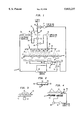
  • FIG. 1 is a schematic view of an apparatus for carrying out a method in accordance with the present invention
  • FIG. 2 is a fragmentary sectional view of FIG. 1 taken along line 2--2 of FIG. 1;
  • FIG. 3 is a fragmentary view of an alternative embodiment of a heat conductive element
  • FIG. 4 is a fragmentary view of an additional alternative embodiment of a conductive element to be used in connection with the apparatus shown in FIG. 1.
  • cryogenic refrigerant can be liquid air or a synthetic mixture of oxygen and nitrogen.
  • other liquid cryogenic refrigerants can be used, such as liquid nitrogen.
  • cryogen as used herein and in the claims means any substance that normally exists as a vapor at standard atmospheric temperature and pressure.
  • Apparatus 1 includes a conveyor 10 which is an endless belt used in conveying articles 12 to be refrigerated. As such, articles 12 are the heat load that interact with the cryogen to be sprayed.
  • a manifold 14 is provided having spray nozzles 16 to spray the cryogen as spray 18 against articles 12 within a spray zone 20.
  • spray nozzle or nozzles as used herein and in the claims encompasses any device from which a spray could emanate.
  • a spray nozzle used in the present invention could be a hole in a pipe.
  • Spray zone 20 is defined by the spatial region taken up by sprays 18.
  • conveyor 10 is an open structure (for instance a belt having openings such as holes or slots) to allow spray 18 to pass from nozzle 16 through spray zone 20 onto the articles and through conveyor 10.
  • conveyor 10 is shown for exemplary purposes only and other conveyances such as hooks, rollers and etc. are possible.
  • heat conductive element 22 is positioned below spray zone 20 and is provided with a surface 24 sized to contact the oversprayed liquid cryogenic refrigerant.
  • heat conductive element 22 should be fabricated from aluminum, copper or other heat conductive material.
  • heat conductive element 22 conducts heat from the surroundings. For instance, in many freezers that use liquid cryogen as a refrigerant, the interior of the freezer is approximately 50° C. warmer than the liquid cryogen. Thus, the heat to be conducted by conductive element 22 originates in the environment that apparatus 1 operates.
  • heat conductive element 22 downwardly slopes to a warmer end of the process so that any liquid cryogen that does not immediately vaporize upon contact with conductive element 22 will tend to flow down the slope of surface 24 of heat conductive element 22 to eventually be vaporized.
  • a known vibrator 26 can be provided to produce a standing vibration within surface 24 of conductive element 22.
  • peripheral lip sections 28 can preferably be provided to confine liquid to surface 24.
  • surface 24 of heat conductive element should be sized to catch the overspray.
  • sizing in practice requires both the width and length of surface 24 of heat conductive element 22 to be sized larger than spray zone 20.
  • cryogenic liquid refrigerant should be sprayed as a two phase flow in order to produce the most efficient heat transfer.
  • a liquid-vapor ratio of about 60-40 is preferred.
  • the cryogenic liquid refrigerant is routed through a flow network having first and second legs 30 and 32 to divide the flow of the liquid cryogenic refrigerant into a first subsidiary stream within first leg 30 and a second subsidiary stream within second leg 32.
  • the liquid cryogenic refrigerant is vaporized within second leg 32 by provision of a vaporizer 34 which can be fabricated from a coil of tubing of sufficient dimension to cause the required vaporization.
  • vaporizer 34 would be positioned within the confines of such a device to avoid heat gain through such vaporizer 34 and hence, reduced thermal efficiency.
  • the now vaporized second subsidiary stream is combined with the first stream by a mixing device 36 which could be simply a piping Tee.
  • piping Tee could be provided with an orifice or preferably a spray nozzle to produce a jet of liquid to draw the vaporized second subsidiary stream into a turbulent mixture with the liquid of the first subsidiary stream and thereby produce a two phase flow to be introduced into manifold 14.
  • Another option is to use an atomizing nozzle in which the second subsidiary stream acts as the atomizing fluid to atomize the liquid.
  • apparatus 1 could be designed for steady state operation, preferably flexibility is built into its operation by a control system.
  • the spray zone temperature of spray zone 20 is measured by a temperature sensor 38.
  • a spray zone temperature signal representing the sensed temperature is introduced as an input into a temperature controller 40 which is preferably a programmable PID type of controller.
  • An orifice plate 42 sets the maximum liquid flow rate within first leg 30. Orifice plate 42 together with the position of a proportional valve 66 (to be discussed hereinafter) produces a mostly constant ratio of flow passing through first and second legs 30 and 32 and thus, a designed normal operating ratio of liquid to vapor within the cryogen sprayed into spray zone 20 depending on the degree to which proportion valve 66 is open.
  • mixing Tee 36 can itself incorporate an orifice or spray nozzle, a separate orifice plate could be dispensed with in a proper embodiment.
  • the designed normal operating ratio can be 60-40 as discussed above.
  • the use of an orifice plate acts to set the maxim flow which is a necessary design criteria for heat conductive element 22.
  • the piping and valves contained within first and second legs 30 and 32 will contribute to the actual flow split.
  • Temperature controller 40 has provision for setting a preset, desired temperature within spray zone 20. Temperature controller 40 in turn controls a proportional valve 44 to meter the flow of cryogen being introduced into spray zone 20. As temperature increases within spray zone 20, as measured by temperature sensor 38, temperature controller 40 commands proportional valve 44 to open to increase the flow rate of cryogen entering spray zone 20 and vice-versa. In such manner the temperature of spray zone 20 is maintained at a substantially constant preselected spray zone temperature.
  • a heat conductive element temperature is sensed as an average temperature of heat conductive element 22. This is accomplished by separate temperature measurements effected by three temperature sensors 54, 56 and 58 positioned at the ends and center of heat conductive element 22. With less effect, a single, centrally located temperature sensor can be used. These temperatures are averaged in a multi-channel temperature monitor 60 which produces an output signal referable to such average temperature and thus, the heat conductive element temperature. The output signal is fed as an input to a temperature controller 64, another programmable PID controller.
  • Temperature controller 64 preferably has provision for registering a preset, reference percentage opening that is used to control the amount a proportional valve 66 is open.
  • proportional valve 66 can represent an adjustable flow coefficient to control the desired liquid-vapor ratio (e.g. 60-40) of the cryogenic refrigerant to be sprayed.
  • Temperature controller 64 also has provision for registering a preset reference temperature which is preferably about 10° C. above the temperature to be maintained within spray zone 20. Temperature controller 64 is preferably programmed in the following manner: In the event that the temperature as developed by temperature monitor 60 is warmer than the preset reference temperature, proportional valve 66 will remain at its preset, reference percentage of opening.
  • proportional valve 66 will be commanded by temperature controller 64 to open and thereby increase the amount of vapor within the cryogenic refrigerant to be sprayed.
  • proportional valve 66 returns to its preset percentage of opening as registered within temperature controller 64.
  • a control valve 68 closes.
  • the temperature at the lowest point of conductive element 22 is sensed by a temperature sensor 70 that produces an output signal referable to such sensed temperature which is fed as an input to temperature controller 72, preferably an on/off or thermostat controller.
  • Temperature controller 72 is preset with a temperature that is selected to be above the boiling point temperature of the cryogen by a margin of typically about 80° C. When the sensed temperature is above the present temperature, controller 72 functions as an interlock to activate closure of valve 68.
  • the conductive heat transfer coefficient of heat conductive element 24 can be modified by imparting motion thereto. For instance, an oscillatory motion could be imparted to heat conductive element 24.
  • FIG. 3 an embodiment of the present invention is illustrated in which a disc-like heat conductive element 74 having an upturned brim is provided. Heat conductive element 74 is rotated by a motor 76. In such illustration although no control system is illustrated, the same could be provided.
  • a temperature sensor 84 is provided in such embodiment to sense the temperature of conductive element 82 and to supply such signal as an input to a controller 86, a programmable PID controller. Controller 86 regulates a power supply 88 to in turn regulate the power input to heating elements 80, thereby to control surface temperature of conductive element 82 to be above the boiling point temperature of the liquid cryogen.
  • Controller 86 regulates a power supply 88 to in turn regulate the power input to heating elements 80, thereby to control surface temperature of conductive element 82 to be above the boiling point temperature of the liquid cryogen.
  • This foregoing embodiment could also be used with apparatus 1 by its simple addition thereto. In such case heat conductive element 82 having embedded heating coils would be used in place of heat conductive element 22. On this point, the output of temperature sensor 70 would be used to control both the heating elements 80 and valve 68. Thus, at a preset temperature not only would valve 68 close but power would be applied to heating elements 80.
  • controllers 40, 64, and 86 are readily available PID (Proportional, Integral, Differential) controllers with no specific manufacturer being preferred.
  • PID Proportional, Integral, Differential
  • the proportional, integral, and differential constants for each controller is in practice determined experimentally, in a manner known in the art.
  • analogue controllers are also possible, but less preferred.
  • heat conductive elements 24, 74 and 82 are illustrated as providing flat surfaces to contact the overspray, irregular surfaces could be provided to increase heat transfer. However, such irregular surfaces such as provided by a mesh or by ridges and etc. might tend to trap particles of the articles to be frozen. This could present a danger in case of a food freezing application of apparatus 1.
  • the present invention encompasses embodiments with simply heat conductive elements alone without control systems, sprays of pure liquid rather than two phase flows, or partial controls such as control valve 68 to cut off the flow of liquid when surface temperature of the heat conductive element approaches the boiling point temperature of the cryogen.
  • Any heat conductive element designed in accordance with the present invention must be massive enough to retain enough sensible heat energy to fully vaporize any transient overspray of liquid when the temperature a sensed by temperature sensor 70 falls below the preset temperature of controller 72.
  • the required mass of the conductive element it is necessary to first make an assessment of the amount of liquid which could potentially spill onto the conductive element before any control system closes the control valve 68. This of course would be a function of: the response time of sensor 70, the speed with which control valve 68 closes, and the amount of any remaining liquid remaining as a simple equation as follows:
  • Me is the mass of the conductive element
  • M 1 is the mass of the liquid in the line downstream from control valve 68
  • Ms is the safety margin allowed for the element
  • Tr is the response time of the temperature sensor
  • Tv is the response time of control valve 68
  • Fc is the mass flow rate of the cryogen
  • Vc is the energy of vaporization of the cryogen per unit mass
  • Ce is the specific heat capacity of the element material
  • ⁇ Temp Preset Reference Temperature-Boiling Point Temperature of the Cryogen.
  • the maximum flow rate of the liquid content of the cryogen is set by an orifice plate 42 or the orifice or spray nozzle within mixing Tee 36. and such maximum flow rate that is used as a value for M 1 .

Landscapes

  • Engineering & Computer Science (AREA)
  • Life Sciences & Earth Sciences (AREA)
  • Chemical & Material Sciences (AREA)
  • Polymers & Plastics (AREA)
  • Zoology (AREA)
  • Food Science & Technology (AREA)
  • Wood Science & Technology (AREA)
  • Combustion & Propulsion (AREA)
  • Physics & Mathematics (AREA)
  • Mechanical Engineering (AREA)
  • Thermal Sciences (AREA)
  • General Engineering & Computer Science (AREA)
  • Filling Or Discharging Of Gas Storage Vessels (AREA)
  • Coating By Spraying Or Casting (AREA)

Abstract

An apparatus and method for spraying a cryogen in which a heat load is sprayed with a cryogen from one or more spray nozzles within a spray zone. A heat conductive element is positioned below the article and is provided with a surface sized to catch the liquid content of the cryogen that has been oversprayed, thereby to vaporize the overspray through direct heat transfer with the conductive element. In another aspect the present invention provides an apparatus and method in which a flow network a flow of a liquid cryogen is divided into first and second subsidiary streams. The second subsidiary stream is vaporized within a branch of the network and then mixed back into the first subsidiary stream to produce a two phase flow of the cryogen. The cryogen is then sprayed as the two phase flow. The flow rate of the second subsidiary stream can be controlled with a proportional valve to adjust the quality of the cryogen being sprayed so that pooling of overspray on said heat conductive element is inhibited.

Description

BACKGROUND OF THE INVENTION
The present invention relates to an apparatus and method for spraying an article with a cryogen from one or more spray nozzles. More particularly, the present invention relates to such an apparatus and method in which a heat conductive element, positioned beneath the article, contacts liquid overspray to vaporize such overspray through direct heat transfer with the conductive element. In other aspects the present invention relates to such an apparatus and method in which a liquid flow of the cryogen is converted into a two phase flow prior to being sprayed. More particularly, in such aspects, the present invention relates to such apparatus and method in which the two phase flow conversion is effected by vaporizing a subsidiary flow of the liquid flow and combining the resultant vapor with another subsidiary flow of liquid to produce the two phase flow.
There are many industrial applications that require a cryogen having a liquid content to be sprayed against an article. For instance, in the food processing industry, a cryogenic refrigerant, for example, liquid nitrogen or liquid air, is sprayed against an article for refrigeration purposes. In a specific food processing application, articles are sprayed with a cryogenic refrigerant in order to produce a crust freezing effect that acts as a protective layer to prevent dehydration. Such crust freezing may take place in a tunnel freezer or at the vestibule portion of a spiral freezer. The spiral freezer may be of the type in which freezing the article is completed by a mechanical refrigeration cycle or alternatively, by cryogenic refrigeration means. In non-food arts, concrete slabs are cured by spraying the slabs with a cryogen. Articles to be cleansed of paint or grease are also sprayed with a cryogen in order to break up surface matter to be removed.
The problem common to all of types of cryogenic applications in which a cryogen having a liquid content is sprayed, is that the overspray, that is, the cryogen that does not actually vaporize upon contact with the article, will tend to pool beneath the article. With any cryogen, this can present a problem in that underlying structure (for instance the bottom of a food freezer) can be damaged and in case of a substance such as nitrogen, the liquid can seep out of a closed structure and present a suffocation hazard. In case of cryogenic refrigerants such as liquid air or synthetic mixtures of oxygen and nitrogen which are meant to be breathable, yet safe, the lower volatility of the nitrogen will cause the liquid to continually enrich in oxygen. The oxygen enrichment coupled with a hydrocarbon containing product to be sprayed, such as food, can make whole proposition dangerous.
The problem of pooling has been addressed in prior art refrigeration devices in which it is desired to produce freezing with a cold gaseous refrigerant. For instance, in U.S. Pat. No. 2,479,821 a liquid cryogen is sprayed onto an arrangement of plates located within the top of a railroad car. The plates ensure that all liquid vaporizes so that the rail cargo is not directly sprayed with the liquid. Also, U.S. Pat. No. 4,726,195 provides a cryogenic refrigeration system in which a liquid cryogen is sprayed through a venturi-like device so that the liquid provides a motive force to produce circulation within the container. In the course of effecting such object, warm vapor is drawn into the liquid flow to in turn vaporize the liquid. The temperature at the outlet of the venturi-like device is sensed so that when the temperature drops to a pre-set temperature (at or above the temperature of a liquid phase of the cryogenic refrigerant) a control system activates a control valve to cut off the flow of the cryogenic refrigerant. After the container sufficiently warms, the control valve is opened to allow resumption of the flow of the cryogen.
Neither of these foregoing patents, or the prior art for that matter, contemplate the prevention of pooling when the liquid cryogen is to be directly applied as a spray and an overspray is produced from the liquid that is not vaporized by the heat load. For instance, in the '821 patent, the cryogen is vaporized prior to being sprayed and then used as a vapor. In the '195 patent, as the content of the cryogen tends toward a liquid, the supply of cryogen is cut off to prevent utilization of the cryogen as a liquid and thereby also to prevent pooling.
It has been found by the inventors herein that it is desirable from a heat transfer standpoint to spray the cryogen as a two phase flow and to control the quality (that is the vapor content) of such flow in order to in turn control the process from a refrigeration standpoint. Control of the quality can also be used to prevent pooling. As will be discussed, the present invention also provides an apparatus and method in which any overspray that is nevertheless produced, vaporizes in a controlled manner in order to prevent pooling.
SUMMARY OF THE INVENTION
An apparatus is provided for spraying a cryogen having a liquid content. The apparatus includes at least one spray nozzle positioned to spray a heat load located within a spray zone. A heat conductive element is positioned below the spray zone and has a surface sized to catch overspray formed from the liquid content of the cryogen, thereby to vaporize the overspray through direct heat transfer with the heat conductive element. In another aspect, the present invention provided a method of spraying a cryogen having a liquid content. In accordance with the method, a heat load is sprayed with the cryogen within a spray zone. Overspray formed from the liquid content of the cryogen is vaporized through direct heat transfer with a heat conductive element positioned beneath the spray zone and having a surface sized to catch the overspray. The vaporization of the overspray prevents pooling.
As has been discussed above, the cryogen is preferably sprayed as a two phase flow rather than as a liquid flow. Thus, in accordance with still another aspect of the present invention, an apparatus is provided for spraying the liquid cryogen as a two phase flow. In accordance with such aspect, a flow system is provided having first and second legs to divide the liquid cryogen into first and second subsidiary streams. A vaporizer is located within the second leg to vaporize the second subsidiary stream. A mixing device is connected to the first and second legs to mix the second subsidiary stream, after having been vaporized, with the first subsidiary stream, thereby to form the two phase flow. At least one spray nozzle is connected to the mixing device to spray the two phase flow. In accordance with yet still another aspect, the present invention provides a method of spraying a liquid cryogen in which the liquid cryogen is divided into first and second subsidiary streams. The second subsidiary stream is vaporized and the first and second subsidiary streams are mixed, after vaporization of the second subsidiary stream, to form the two phase flow. The resultant two phase flow is then sprayed. As will be discussed, these forgoing aspects of the present invention can be used in connection with those aspects of the present invention incorporating the heat conductive element to prevent pooling and also, to regulate the refrigeration supplied by the cryogen.
BRIEF DESCRIPTION OF THE DRAWINGS
While the specification concludes with claims distinctly pointing out the subject matter that Applicants regard as their invention, it is believed the invention will be better understood when taken in connection with the accompanying drawings in which:
FIG. 1 is a schematic view of an apparatus for carrying out a method in accordance with the present invention;
FIG. 2 is a fragmentary sectional view of FIG. 1 taken along line 2--2 of FIG. 1;
FIG. 3 is a fragmentary view of an alternative embodiment of a heat conductive element; and
FIG. 4 is a fragmentary view of an additional alternative embodiment of a conductive element to be used in connection with the apparatus shown in FIG. 1.
DETAILED DESCRIPTION
With reference to FIG. 1, an apparatus 1 in accordance with the present invention is illustrated in a refrigeration application. Such apparatus could be housed within a tunnel freezer or as illustrated, might be utilized without a housing in a cold storage room. In applications that are open or where it is desired to allow egress by operational personnel, the cryogenic refrigerant can be liquid air or a synthetic mixture of oxygen and nitrogen. In completely closed environments, other liquid cryogenic refrigerants can be used, such as liquid nitrogen. In this regard, the term, "cryogen" as used herein and in the claims means any substance that normally exists as a vapor at standard atmospheric temperature and pressure.
Apparatus 1 includes a conveyor 10 which is an endless belt used in conveying articles 12 to be refrigerated. As such, articles 12 are the heat load that interact with the cryogen to be sprayed. In order to effect the spraying, a manifold 14 is provided having spray nozzles 16 to spray the cryogen as spray 18 against articles 12 within a spray zone 20. It is to be pointed out here that the term "spray nozzle or nozzles" as used herein and in the claims encompasses any device from which a spray could emanate. As such, a spray nozzle used in the present invention could be a hole in a pipe. Spray zone 20 is defined by the spatial region taken up by sprays 18. As can be appreciated from the illustration, not all of the liquid content of the cryogen will be vaporized on contact with articles 12. Thus, conveyor 10 is an open structure (for instance a belt having openings such as holes or slots) to allow spray 18 to pass from nozzle 16 through spray zone 20 onto the articles and through conveyor 10. As can be appreciated, conveyor 10 is shown for exemplary purposes only and other conveyances such as hooks, rollers and etc. are possible. The liquid content of the cryogen not vaporized within spray zone 20, either before or after contact with articles 12 or for that matter, conveyor 10, constitutes an overspray that is caught by a heat conductive element 22.
With additional reference to FIG. 2, heat conductive element 22 is positioned below spray zone 20 and is provided with a surface 24 sized to contact the oversprayed liquid cryogenic refrigerant. Thus, heat conductive element 22 should be fabricated from aluminum, copper or other heat conductive material. As will be discussed, heat conductive element 22 conducts heat from the surroundings. For instance, in many freezers that use liquid cryogen as a refrigerant, the interior of the freezer is approximately 50° C. warmer than the liquid cryogen. Thus, the heat to be conducted by conductive element 22 originates in the environment that apparatus 1 operates.
As can be seen in the illustration preferably, heat conductive element 22 downwardly slopes to a warmer end of the process so that any liquid cryogen that does not immediately vaporize upon contact with conductive element 22 will tend to flow down the slope of surface 24 of heat conductive element 22 to eventually be vaporized. In order to produce motion in unvaporized liquid droplets and also, to prevent droplets from agglomerating into larger puddles, a known vibrator 26 can be provided to produce a standing vibration within surface 24 of conductive element 22. In order to confine liquid to surface 24 of heat conductive element 22, peripheral lip sections 28 can preferably be provided to confine liquid to surface 24. Thus heat conductive element 22 can be said to have a tray-like configuration.
As can be appreciated, in order to catch the overspray, surface 24 of heat conductive element should be sized to catch the overspray. In this regard such sizing in practice requires both the width and length of surface 24 of heat conductive element 22 to be sized larger than spray zone 20.
As has been discussed above, it has been found by the inventors herein that cryogenic liquid refrigerant should be sprayed as a two phase flow in order to produce the most efficient heat transfer. A liquid-vapor ratio of about 60-40 is preferred. In order to produce the two-phase flow, the cryogenic liquid refrigerant is routed through a flow network having first and second legs 30 and 32 to divide the flow of the liquid cryogenic refrigerant into a first subsidiary stream within first leg 30 and a second subsidiary stream within second leg 32. The liquid cryogenic refrigerant is vaporized within second leg 32 by provision of a vaporizer 34 which can be fabricated from a coil of tubing of sufficient dimension to cause the required vaporization. In an application of the present invention to a refrigeration device, vaporizer 34 would be positioned within the confines of such a device to avoid heat gain through such vaporizer 34 and hence, reduced thermal efficiency. The now vaporized second subsidiary stream is combined with the first stream by a mixing device 36 which could be simply a piping Tee. Such piping Tee could be provided with an orifice or preferably a spray nozzle to produce a jet of liquid to draw the vaporized second subsidiary stream into a turbulent mixture with the liquid of the first subsidiary stream and thereby produce a two phase flow to be introduced into manifold 14. Another option is to use an atomizing nozzle in which the second subsidiary stream acts as the atomizing fluid to atomize the liquid.
Although apparatus 1 could be designed for steady state operation, preferably flexibility is built into its operation by a control system. The spray zone temperature of spray zone 20 is measured by a temperature sensor 38. A spray zone temperature signal representing the sensed temperature is introduced as an input into a temperature controller 40 which is preferably a programmable PID type of controller. An orifice plate 42 sets the maximum liquid flow rate within first leg 30. Orifice plate 42 together with the position of a proportional valve 66 (to be discussed hereinafter) produces a mostly constant ratio of flow passing through first and second legs 30 and 32 and thus, a designed normal operating ratio of liquid to vapor within the cryogen sprayed into spray zone 20 depending on the degree to which proportion valve 66 is open. Given that mixing Tee 36 can itself incorporate an orifice or spray nozzle, a separate orifice plate could be dispensed with in a proper embodiment. The designed normal operating ratio can be 60-40 as discussed above. Moreover, as will be discussed, the use of an orifice plate acts to set the maxim flow which is a necessary design criteria for heat conductive element 22. As can be appreciated, the piping and valves contained within first and second legs 30 and 32 will contribute to the actual flow split.
Temperature controller 40 has provision for setting a preset, desired temperature within spray zone 20. Temperature controller 40 in turn controls a proportional valve 44 to meter the flow of cryogen being introduced into spray zone 20. As temperature increases within spray zone 20, as measured by temperature sensor 38, temperature controller 40 commands proportional valve 44 to open to increase the flow rate of cryogen entering spray zone 20 and vice-versa. In such manner the temperature of spray zone 20 is maintained at a substantially constant preselected spray zone temperature.
In the event that the temperature within spray zone 20 becomes too cold, not enough liquid will vaporize on articles 12. This can occur if there were a substantial decrease in the heat load. As a result, liquid may be retained on articles 12 and thus, not vaporized on heat conductive element 22. In order to prevent this, preferably, another heat exchanger 50 is connected to manifold 14 to produce a spray of vapor 52 which will act to blow liquid off of articles 12.
In order to inhibit liquid from pooling on heat conductive element 22, the quality of sprays 18 is adjusted to maintain the temperature of the conductive element above the temperature of spray zone 20. To this end, a heat conductive element temperature is sensed as an average temperature of heat conductive element 22. This is accomplished by separate temperature measurements effected by three temperature sensors 54, 56 and 58 positioned at the ends and center of heat conductive element 22. With less effect, a single, centrally located temperature sensor can be used. These temperatures are averaged in a multi-channel temperature monitor 60 which produces an output signal referable to such average temperature and thus, the heat conductive element temperature. The output signal is fed as an input to a temperature controller 64, another programmable PID controller.
Temperature controller 64 preferably has provision for registering a preset, reference percentage opening that is used to control the amount a proportional valve 66 is open. Thus, proportional valve 66 can represent an adjustable flow coefficient to control the desired liquid-vapor ratio (e.g. 60-40) of the cryogenic refrigerant to be sprayed. Temperature controller 64 also has provision for registering a preset reference temperature which is preferably about 10° C. above the temperature to be maintained within spray zone 20. Temperature controller 64 is preferably programmed in the following manner: In the event that the temperature as developed by temperature monitor 60 is warmer than the preset reference temperature, proportional valve 66 will remain at its preset, reference percentage of opening. If, the temperature as developed by temperature monitor 60 is colder than the preset reference temperature, proportional valve 66 will be commanded by temperature controller 64 to open and thereby increase the amount of vapor within the cryogenic refrigerant to be sprayed. When the temperature developed by monitor 60 is again warmer than the preset reference temperature, proportional valve 66 returns to its preset percentage of opening as registered within temperature controller 64.
Even with the use of the control system of the present invention, transients can occur in which cryogenic liquid refrigerant forms a pool on conductive element 22. In such case, a control valve 68 closes. Preferably the temperature at the lowest point of conductive element 22 is sensed by a temperature sensor 70 that produces an output signal referable to such sensed temperature which is fed as an input to temperature controller 72, preferably an on/off or thermostat controller. Temperature controller 72 is preset with a temperature that is selected to be above the boiling point temperature of the cryogen by a margin of typically about 80° C. When the sensed temperature is above the present temperature, controller 72 functions as an interlock to activate closure of valve 68.
In any embodiment of the present invention, the conductive heat transfer coefficient of heat conductive element 24 can be modified by imparting motion thereto. For instance, an oscillatory motion could be imparted to heat conductive element 24. Alternatively, as shown in FIG. 3, an embodiment of the present invention is illustrated in which a disc-like heat conductive element 74 having an upturned brim is provided. Heat conductive element 74 is rotated by a motor 76. In such illustration although no control system is illustrated, the same could be provided.
With reference to FIG. 4, another possible embodiment would be provided by embedded heating coils 80 within a heat conductive element 82. A temperature sensor 84 is provided in such embodiment to sense the temperature of conductive element 82 and to supply such signal as an input to a controller 86, a programmable PID controller. Controller 86 regulates a power supply 88 to in turn regulate the power input to heating elements 80, thereby to control surface temperature of conductive element 82 to be above the boiling point temperature of the liquid cryogen. This foregoing embodiment could also be used with apparatus 1 by its simple addition thereto. In such case heat conductive element 82 having embedded heating coils would be used in place of heat conductive element 22. On this point, the output of temperature sensor 70 would be used to control both the heating elements 80 and valve 68. Thus, at a preset temperature not only would valve 68 close but power would be applied to heating elements 80.
It is to be noted that controllers 40, 64, and 86 are readily available PID (Proportional, Integral, Differential) controllers with no specific manufacturer being preferred. The proportional, integral, and differential constants for each controller is in practice determined experimentally, in a manner known in the art. As can be appreciated, analogue controllers are also possible, but less preferred.
Although the various embodiments of heat conductive elements 24, 74 and 82 are illustrated as providing flat surfaces to contact the overspray, irregular surfaces could be provided to increase heat transfer. However, such irregular surfaces such as provided by a mesh or by ridges and etc. might tend to trap particles of the articles to be frozen. This could present a danger in case of a food freezing application of apparatus 1. Furthermore, the present invention encompasses embodiments with simply heat conductive elements alone without control systems, sprays of pure liquid rather than two phase flows, or partial controls such as control valve 68 to cut off the flow of liquid when surface temperature of the heat conductive element approaches the boiling point temperature of the cryogen.
Any heat conductive element designed in accordance with the present invention must be massive enough to retain enough sensible heat energy to fully vaporize any transient overspray of liquid when the temperature a sensed by temperature sensor 70 falls below the preset temperature of controller 72. In order to calculate the required mass of the conductive element it is necessary to first make an assessment of the amount of liquid which could potentially spill onto the conductive element before any control system closes the control valve 68. This of course would be a function of: the response time of sensor 70, the speed with which control valve 68 closes, and the amount of any remaining liquid remaining as a simple equation as follows:
Me=Ms+ ({Tr+Tv}×Fc)+M.sub.1 !×Vc/Ce/ΔTemp.
Where:
Me is the mass of the conductive element
M1 is the mass of the liquid in the line downstream from control valve 68
Ms is the safety margin allowed for the element
Tr is the response time of the temperature sensor
Tv is the response time of control valve 68
Fc is the mass flow rate of the cryogen
Vc is the energy of vaporization of the cryogen per unit mass
Ce is the specific heat capacity of the element material
ΔTemp=Preset Reference Temperature-Boiling Point Temperature of the Cryogen.
As has been mentioned, the maximum flow rate of the liquid content of the cryogen is set by an orifice plate 42 or the orifice or spray nozzle within mixing Tee 36. and such maximum flow rate that is used as a value for M1.
While the present has been described with reference to a preferred embodiment, as will occur to those skilled in the art, numerous changes, additions and omissions may be made without departing from the spirit and scope of the present invention.
Claims (23)

We claim:
1. An apparatus for spraying a cryogen having a liquid content, said apparatus comprising:
at least one spray nozzle positioned to spray a heat load located within a spray zone; and
a heat conductive element positioned beneath the spray zone and having a surface sized to catch overspray formed from the liquid content of the cryogen, thereby to vaporize said overspray through direct heat transfer with said heat conductive element.
2. The apparatus of claim 1, further comprising a vaporizer in communication with said at least one spray nozzle for at least partly vaporizing said cryogenic refrigerant.
3. The apparatus of claim 2, further comprising:
a flow network having first and second legs to divide a flow of said cryogenic refrigerant into a major stream and a subsidiary stream;
said vaporizer is located in said second leg to vaporize said subsidiary stream;
a mixing device connected to said first and second legs to combine said subsidiary stream with said major stream, thereby to produce a two-phase flow of said cryogenic refrigerant; and
said at least one spray nozzle in communication with said mixing device.
4. The apparatus of claim 3, further comprising:
a proportional valve interposed between said mixing device and said at least one nozzle;
a temperature sensor to sense spray zone temperature; and
a spray zone temperature controller responsive to said temperature sensor to control the proportional valve and thus, the flow of said cryogenic refrigerant entering said spray zone so that said spray zone remains at substantially a constant preset, spray zone temperature.
5. The apparatus of claim 4, further comprising:
a boundary temperature sensor to sense boundary temperature of said conductive element and generate a second temperature signal referable to said boundary layer temperature;
a control valve connected to both of said first and second legs; and
an interlock controller response to said third temperature signal and configured to close said control valve at a temperature greater than boiling point temperature of said cryogen.
6. The apparatus of claim 4, further comprising:
said temperature sensor and said proportional valve comprises a first temperature sensor and a first proportional valve;
said second leg having a second proportional valve to control vapor content of said cryogenic refrigerant sprayed within said spray zone; and
a control system to inhibit pooling of said overspray on said heat conductive element, said control system including:
at least one second temperature sensor to sense heat conductive temperature of said heat conductive element;
a second temperature controller to control the position of said second proportional valve, said second controller having means for registering a preset percentage of opening of said second proportional valve and a preset reference temperature for said heat conductive element, and configured such that if said heat conductive temperature of said heat conductive element is warmer than said preset reference temperature, said second temperature controller positions said second proportional valve at said preset percentage of opening and if said heat conductive temperature of said heat conductive element is colder than said preset reference temperature, said second temperature controller re-positions said second proportional valve so that it opens to a greater percentage of opening than said preset percentage of opening until said heat conductive temperature is again above said preset reference temperature.
7. The apparatus of claim 1, wherein said surface of said conductive element downwardly slopes.
8. The apparatus of claim 1, wherein said conductive member has a tray-like configuration with peripheral lip sections to retain said overspray.
9. The apparatus of claim 1, wherein said conductive member is fabricated from sheet material and further includes a vibrator to prevent any oversprayed liquid from agglomerating.
10. The apparatus of claim 1 further comprising a heater embedded in said conductive element.
11. The apparatus of claim 1, wherein said conductive element comprises a spinning disk.
12. The apparatus of claim 1, further comprising:
another vaporizer to vaporize a portion of said cryogen; and
a nozzle connected to said another vaporizer to form a vapor stream directed at said heat load to blow off spray retained on said heat load.
13. An apparatus for spraying a liquid cryogen as a two phase flow, said apparatus comprising:
a flow system having first and second legs to divide said liquid cryogen into first and second subsidiary streams;
a vaporizer located within said second leg to vaporize said second subsidiary stream;
a mixing device connected to said first and second legs to mix said second subsidiary stream, after having been vaporized, with said first subsidiary stream, thereby to form said two phase flow; and
at least one spray nozzle in communication with said mixing device to spray said two phase flow.
14. The apparatus of claim 13, wherein a control valve is located within said second leg to adjust quality of said two phase flow.
15. A method of spraying a cryogen having a liquid content, said method comprising:
spraying a heat load with said cryogen within a spray zone; and
vaporizing overspray formed from the liquid content of the cryogen through direct heat transfer with a heat conductive element positioned beneath said spray zone and having a surface sized to catch the overspray.
16. The method of claim 15, further comprising partially vaporizing said cryogenic refrigerant prior to being sprayed.
17. The method of claim 16, further comprising:
dividing a flow of said cryogenic refrigerant into first and second subsidiary streams;
vaporizing said second subsidiary stream;
mixing said first and second subsidiary streams, after vaporization of the second subsidiary stream, thereby to produce a two-phase flow of said cryogenic refrigerant; and
spraying said two-phase flow.
18. The method of claim 17, further comprising further comprising controlling the flow rate the cryogenic refrigerant to control spray zone temperature.
19. The method of claim 18, further comprising:
sensing boundary temperature of the heat conductive element; and
cutting off the major and subsidiary streams so that the boundary temperature does not fall below boiling point temperature of the cryogen.
20. The method of claim 18, further comprising:
sensing heat conductive temperature of said heat conductive element;
controlling the vapor content of the two-phase flow by comparing said heat conductive temperature with a reference temperature for said heat conductive element, if said heat conductive temperature is warmer than said reference temperature, maintaining said vapor content substantially constant, and if said heat conductive temperature is colder than said reference temperature, increasing said vapor content until said heat conductive temperature is again above said preset reference temperature.
21. The method of claim 15, further comprising:
vaporizing a portion of the cryogen prior to its being sprayed to produce a vapor stream; and
directing the vapor stream against the heat load to blow spray off the heat load.
22. A method of spraying a liquid cryogen, said method comprising:
dividing said liquid cryogen into first and second subsidiary streams;
vaporizing the second subsidiary stream;
mixing the first and second subsidiary streams, after vaporization of the second subsidiary stream, thereby to produce a two phase flow; and
spraying said two phase flow.
23. The method of claim 22, further comprising controlling flow rate of the second subsidiary stream to in turn adjust quality of the two phase flow.
US08/884,423 1997-06-27 1997-06-27 Cryogenic apparatus and method for spraying a cryogen incorporating generation of two phase flow Expired - Fee Related US5813237A (en)

Priority Applications (7)

Application Number Priority Date Filing Date Title
US08/884,423 US5813237A (en) 1997-06-27 1997-06-27 Cryogenic apparatus and method for spraying a cryogen incorporating generation of two phase flow
DE69830873T DE69830873T2 (en) 1997-06-27 1998-04-30 Spraying a cryogenic liquid
EP98303373A EP0887604B1 (en) 1997-06-27 1998-04-30 Cryogen spraying
CA002236702A CA2236702A1 (en) 1997-06-27 1998-05-05 Cryogenic apparatus and method for spraying a cryogen incorporating generation of two phase flow
NZ330398A NZ330398A (en) 1997-06-27 1998-05-11 Cryogenic apparatus and method for spraying a cryogen incorporating generation of two phase flow
ZA984434A ZA984434B (en) 1997-06-27 1998-05-25 Cryogenic apparatus and method for spraying a cryogen incorporating generation of two phase flow
JP18244598A JP4074376B2 (en) 1997-06-27 1998-06-29 Apparatus and method for spraying cryogen

Applications Claiming Priority (1)

Application Number Priority Date Filing Date Title
US08/884,423 US5813237A (en) 1997-06-27 1997-06-27 Cryogenic apparatus and method for spraying a cryogen incorporating generation of two phase flow

Publications (1)

Publication Number Publication Date
US5813237A true US5813237A (en) 1998-09-29

Family

ID=25384598

Family Applications (1)

Application Number Title Priority Date Filing Date
US08/884,423 Expired - Fee Related US5813237A (en) 1997-06-27 1997-06-27 Cryogenic apparatus and method for spraying a cryogen incorporating generation of two phase flow

Country Status (7)

Country Link
US (1) US5813237A (en)
EP (1) EP0887604B1 (en)
JP (1) JP4074376B2 (en)
CA (1) CA2236702A1 (en)
DE (1) DE69830873T2 (en)
NZ (1) NZ330398A (en)
ZA (1) ZA984434B (en)

Cited By (20)

* Cited by examiner, † Cited by third party
Publication number Priority date Publication date Assignee Title
US6457321B1 (en) * 1999-09-13 2002-10-01 Hewlett-Packard Company Spray cooling system
FR2853403A1 (en) * 2003-04-07 2004-10-08 Air Liquide Food product total or partial freezing procedure, uses cryogenic liquid temperature probe just before treatment tank outlet
US20050241331A1 (en) * 2004-04-22 2005-11-03 Linde Aktiengesellschaft Method and device for refrigerating and/or freezing articles
US20060248913A1 (en) * 2005-05-06 2006-11-09 Gasteyer Theodore H Iii Cooling or heating with multi-pass fluid flow
EP1731861A1 (en) * 2005-06-09 2006-12-13 L'air Liquide, Societe Anonyme Pour L'etude Et L'exploitation Des Procedes Georges Claude Verfahren zur kryogenen Abkühlung eines Pulvers
US20070124011A1 (en) * 2003-04-07 2007-05-31 Bernard Delpuech Method for determining the operating parameters of a system comprising a cooling chamber
US20100031689A1 (en) * 2006-09-22 2010-02-11 Rudolf Erwin Berghoff Device for the rapid freezing of substances
WO2011149701A3 (en) * 2010-05-27 2012-05-03 Air Products And Chemicals, Inc. Method for cutting cooling a cutting surface and apparatus for providing a temperature-controlled cooling gas
US20140069119A1 (en) * 2012-09-12 2014-03-13 Cell Tronix Method and Scalable Devices for Hyper-Fast Cooling and Warming
WO2013077934A3 (en) * 2011-11-22 2014-05-08 Linde Aktiengesellschaft Ultrasonic impingement plate atomizer apparatus
EP2875734A1 (en) * 2013-11-21 2015-05-27 Messer Slovenija d.o.o. Device and method for producing ice cream
EP2982249A1 (en) * 2014-08-04 2016-02-10 Linde Aktiengesellschaft Freezer apparatus and method for treating a product
WO2017023468A1 (en) * 2015-08-03 2017-02-09 Linde Aktiengesellchaft Pulsed liquid-gas entrained cryogen flow generator
WO2017023477A1 (en) * 2015-08-03 2017-02-09 Linda Aktiengesellschaft Pulsed liquid cryogen flow generator
US20170127706A1 (en) * 2014-06-13 2017-05-11 John Bean Technologies Ab Temperature treatment apparatus and method for solidifying portions of fluid
US20180269080A1 (en) * 2017-03-17 2018-09-20 Tel Fsi, Inc. System and method for monitoring treatment of microelectronic substrates with fluid sprays such as cryogenic fluid sprays
CN108889568A (en) * 2018-09-03 2018-11-27 东山欧凯金属塑料制品有限公司 Material painting machine
CN109269182A (en) * 2018-08-31 2019-01-25 李明守 It is a kind of that suitable for improving, food is soft or the cooling equipment of crisp uniformity
US20190170424A1 (en) * 2017-12-01 2019-06-06 Shanghai Ocean University Jet nozzle structure of impact-type freezer
CN113560061A (en) * 2020-04-29 2021-10-29 南京航太机电有限公司 Temperature-adjustable low-temperature gas spray gun system

Families Citing this family (1)

* Cited by examiner, † Cited by third party
Publication number Priority date Publication date Assignee Title
DE102008008827A1 (en) * 2008-02-12 2009-08-27 Hupfer Metallwerke Gmbh & Co. Kg Device for distributing refrigerated food, in particular for commercial kitchens

Citations (14)

* Cited by examiner, † Cited by third party
Publication number Priority date Publication date Assignee Title
US3421336A (en) * 1967-06-05 1969-01-14 Union Carbide Corp Intransit liquefied gas refrigeration system
US3788825A (en) * 1970-10-06 1974-01-29 Black Sivalls & Bryson Inc Method of vaporizing and combining a liquefied cryogenic fluid stream with a gas stream
US4171625A (en) * 1977-11-02 1979-10-23 Formax, Inc. Cryogenic freezing tunnel
US4813245A (en) * 1988-01-13 1989-03-21 Liquid Air Corporation High efficiency linear freezer
US4934151A (en) * 1989-07-07 1990-06-19 Kyokujitsu Company., Ltd. Continuous multistage thermal processing apparatus, freezing control method for use by the apparatus, and apparatus for preparing a recording medium for the control method
US5040374A (en) * 1988-12-28 1991-08-20 L'air Liquide, Societe Anonyme Pour L'etude Et L'exploitation Des Procedes Georges Claude Process and device for regulating a flow of liquid CO2, and application thereof in a cooling tunnel
US5054292A (en) * 1990-07-13 1991-10-08 Air Products And Chemicals, Inc. Cryogenic freezer control
US5186008A (en) * 1991-11-25 1993-02-16 The Boc Group, Inc. Cryogenic freezer apparatus and method
US5417074A (en) * 1993-07-26 1995-05-23 Air Products And Chemicals, Inc. Liquid nitrogen immersion/impingement freezing method and apparatus
US5454232A (en) * 1992-01-21 1995-10-03 L'air Liquide, Societe Anonyme Pour L'etude Et L'exploitation Des Procedes Georges Claude Freezing process and device
US5460015A (en) * 1994-04-28 1995-10-24 Liquid Carbonic Corporation Freezer with imperforate conveyor belt
US5467612A (en) * 1994-04-29 1995-11-21 Liquid Carbonic Corporation Freezing system for fragible food products
US5630321A (en) * 1993-02-17 1997-05-20 Air Products And Chemicals, Inc. Method and apparatus for freezing
US5740678A (en) * 1995-05-24 1998-04-21 The Boc Group, Inc. Impingement jet freezer and method

Family Cites Families (11)

* Cited by examiner, † Cited by third party
Publication number Priority date Publication date Assignee Title
US2479821A (en) 1946-03-30 1949-08-23 Shell Dev Process and apparatus for refrigeration
US3277657A (en) * 1965-09-15 1966-10-11 Integral Process Syst Inc Method and apparatus for flash freezing various products
FR1471319A (en) * 1966-03-05 1967-03-03 Ts Lab Chlodnictwa Process for cooling or freezing products in a cold room using azoteliquide
US3403527A (en) * 1967-06-01 1968-10-01 Air Prod & Chem Transverse-parallel flow cryogenic freezer
US3611738A (en) * 1970-04-15 1971-10-12 Union Carbide Corp Frozen product refrigeration and dehumidification system
US3871186A (en) * 1973-08-23 1975-03-18 Integral Process Syst Inc Apparatus and method for refrigerating articles
US4350027A (en) * 1981-10-05 1982-09-21 Lewis Tyree Jr Cryogenic refrigeration apparatus
US4481780A (en) * 1984-01-06 1984-11-13 Union Carbide Corporation Process for the generation of a cold gas
US4726195A (en) 1986-08-22 1988-02-23 Air Products And Chemicals, Inc. Cryogenic forced convection refrigerating system
US4783972A (en) * 1987-10-29 1988-11-15 Liquid Carbonic Corporation N2 tunnel freezer
US5394704A (en) * 1993-11-04 1995-03-07 The United States Of America As Represented By The Administrator Of The National Aeronautics And Space Administration Alternate method for achieving temperature control in the -160 to +90 degrees Celcius range

Patent Citations (15)

* Cited by examiner, † Cited by third party
Publication number Priority date Publication date Assignee Title
US3421336A (en) * 1967-06-05 1969-01-14 Union Carbide Corp Intransit liquefied gas refrigeration system
US3788825A (en) * 1970-10-06 1974-01-29 Black Sivalls & Bryson Inc Method of vaporizing and combining a liquefied cryogenic fluid stream with a gas stream
US4171625A (en) * 1977-11-02 1979-10-23 Formax, Inc. Cryogenic freezing tunnel
US4813245A (en) * 1988-01-13 1989-03-21 Liquid Air Corporation High efficiency linear freezer
US5040374A (en) * 1988-12-28 1991-08-20 L'air Liquide, Societe Anonyme Pour L'etude Et L'exploitation Des Procedes Georges Claude Process and device for regulating a flow of liquid CO2, and application thereof in a cooling tunnel
US4966003A (en) * 1989-07-07 1990-10-30 Kyokujitsu Company, Ltd. Continuous multistage thermal processing apparatus, freezing control method for use by the apparatus, and apparatus for preparing a recording medium for the control method
US4934151A (en) * 1989-07-07 1990-06-19 Kyokujitsu Company., Ltd. Continuous multistage thermal processing apparatus, freezing control method for use by the apparatus, and apparatus for preparing a recording medium for the control method
US5054292A (en) * 1990-07-13 1991-10-08 Air Products And Chemicals, Inc. Cryogenic freezer control
US5186008A (en) * 1991-11-25 1993-02-16 The Boc Group, Inc. Cryogenic freezer apparatus and method
US5454232A (en) * 1992-01-21 1995-10-03 L'air Liquide, Societe Anonyme Pour L'etude Et L'exploitation Des Procedes Georges Claude Freezing process and device
US5630321A (en) * 1993-02-17 1997-05-20 Air Products And Chemicals, Inc. Method and apparatus for freezing
US5417074A (en) * 1993-07-26 1995-05-23 Air Products And Chemicals, Inc. Liquid nitrogen immersion/impingement freezing method and apparatus
US5460015A (en) * 1994-04-28 1995-10-24 Liquid Carbonic Corporation Freezer with imperforate conveyor belt
US5467612A (en) * 1994-04-29 1995-11-21 Liquid Carbonic Corporation Freezing system for fragible food products
US5740678A (en) * 1995-05-24 1998-04-21 The Boc Group, Inc. Impingement jet freezer and method

Cited By (37)

* Cited by examiner, † Cited by third party
Publication number Priority date Publication date Assignee Title
US6457321B1 (en) * 1999-09-13 2002-10-01 Hewlett-Packard Company Spray cooling system
EP1991041A3 (en) * 1999-09-13 2009-12-23 Hewlett-Packard Company Spray cooling system
US20070124011A1 (en) * 2003-04-07 2007-05-31 Bernard Delpuech Method for determining the operating parameters of a system comprising a cooling chamber
FR2853403A1 (en) * 2003-04-07 2004-10-08 Air Liquide Food product total or partial freezing procedure, uses cryogenic liquid temperature probe just before treatment tank outlet
US20060196194A1 (en) * 2003-04-07 2006-09-07 L'air Liquid Societe Anonyme A Directoire Et Conse Method and system for treating rind formation/cooling/deep freezing-products
US7805951B2 (en) 2003-04-07 2010-10-05 L'air Liquide Societe Anonyme A Directoire Et Conseil De Surveillance Pour L'etude Et L'exploitation Des Procedes Georges Claude Method and apparatus for the crust-freezing/cooling/deep-freezing treatment of products
US7330778B2 (en) * 2003-04-07 2008-02-12 L'air Liquide, Societe Anonyme A Directoire Et Conseil De Surveillance Pour L'etude Et L'exploitation Des Procedes Georges Claude Method for determining the operating parameters of a system comprising a cooling chamber
US20050241331A1 (en) * 2004-04-22 2005-11-03 Linde Aktiengesellschaft Method and device for refrigerating and/or freezing articles
EP1589306A3 (en) * 2004-04-22 2007-07-25 Linde Aktiengesellschaft Method and apparatus for cooling and/or freezing of items
US20060248913A1 (en) * 2005-05-06 2006-11-09 Gasteyer Theodore H Iii Cooling or heating with multi-pass fluid flow
US7197883B2 (en) 2005-05-06 2007-04-03 Praxair Technology, Inc. Cooling or heating with multi-pass fluid flow
US20060288712A1 (en) * 2005-06-09 2006-12-28 L'air Liquide, Societe Anonyme A Directoire Et Conseil De Surveillance Pour L'etude Et L'exploita Method for the cryogenic cooling of powders using an early control strategy
FR2887019A1 (en) * 2005-06-09 2006-12-15 Air Liquide PROCESS FOR CRYOGENIC COOLING OF POWDERS USING ANTICIPATED CONTROL STRATEGY
US7739878B2 (en) * 2005-06-09 2010-06-22 L'air Liquide, Societe Anonyme A Directoire Et Conseil De Surveillance Pour L'etude Et L'exploitation Des Procedes Georges Claude Method for the cryogenic cooling of powders using an early control strategy
EP1731861A1 (en) * 2005-06-09 2006-12-13 L'air Liquide, Societe Anonyme Pour L'etude Et L'exploitation Des Procedes Georges Claude Verfahren zur kryogenen Abkühlung eines Pulvers
AU2006202435B2 (en) * 2005-06-09 2011-02-10 L'air Liquide, Societe Anonyme Pour L'etude Et L'exploitation Des Procedes Georges Claude Method for the cryogenic cooling of powders using an early control strategy
US20100031689A1 (en) * 2006-09-22 2010-02-11 Rudolf Erwin Berghoff Device for the rapid freezing of substances
WO2011149701A3 (en) * 2010-05-27 2012-05-03 Air Products And Chemicals, Inc. Method for cutting cooling a cutting surface and apparatus for providing a temperature-controlled cooling gas
WO2013077934A3 (en) * 2011-11-22 2014-05-08 Linde Aktiengesellschaft Ultrasonic impingement plate atomizer apparatus
US20140069119A1 (en) * 2012-09-12 2014-03-13 Cell Tronix Method and Scalable Devices for Hyper-Fast Cooling and Warming
US9638452B2 (en) * 2012-09-12 2017-05-02 Celltronix Method and scalable devices for hyper-fast cooling and warming
EP2875734A1 (en) * 2013-11-21 2015-05-27 Messer Slovenija d.o.o. Device and method for producing ice cream
US11026440B2 (en) * 2014-06-13 2021-06-08 John Bean Technologies Ab Temperature treatment apparatus and method for solidifying portions of fluid
US20170127706A1 (en) * 2014-06-13 2017-05-11 John Bean Technologies Ab Temperature treatment apparatus and method for solidifying portions of fluid
EP2982249A1 (en) * 2014-08-04 2016-02-10 Linde Aktiengesellschaft Freezer apparatus and method for treating a product
EP3177157A4 (en) * 2014-08-04 2018-03-07 Linde Aktiengesellschaft Heat flux control for liquid nitrogen sprays
WO2017023468A1 (en) * 2015-08-03 2017-02-09 Linde Aktiengesellchaft Pulsed liquid-gas entrained cryogen flow generator
WO2017023477A1 (en) * 2015-08-03 2017-02-09 Linda Aktiengesellschaft Pulsed liquid cryogen flow generator
US20170038117A1 (en) * 2015-08-03 2017-02-09 Michael D. Newman Pulsed liquid-gas entrained cryogen flow generator
US20180269080A1 (en) * 2017-03-17 2018-09-20 Tel Fsi, Inc. System and method for monitoring treatment of microelectronic substrates with fluid sprays such as cryogenic fluid sprays
US10748788B2 (en) * 2017-03-17 2020-08-18 Tel Fsi, Inc. System and method for monitoring treatment of microelectronic substrates with fluid sprays such as cryogenic fluid sprays
US20190170424A1 (en) * 2017-12-01 2019-06-06 Shanghai Ocean University Jet nozzle structure of impact-type freezer
CN109269182A (en) * 2018-08-31 2019-01-25 李明守 It is a kind of that suitable for improving, food is soft or the cooling equipment of crisp uniformity
CN109269182B (en) * 2018-08-31 2021-01-08 枣庄市永兴板栗加工有限公司 Cooling device suitable for improving softness or crispness uniformity of food
CN108889568A (en) * 2018-09-03 2018-11-27 东山欧凯金属塑料制品有限公司 Material painting machine
CN108889568B (en) * 2018-09-03 2024-04-12 东山欧凯金属塑料制品有限公司 Material coloring machine
CN113560061A (en) * 2020-04-29 2021-10-29 南京航太机电有限公司 Temperature-adjustable low-temperature gas spray gun system

Also Published As

Publication number Publication date
ZA984434B (en) 1998-12-02
NZ330398A (en) 2000-01-28
CA2236702A1 (en) 1998-12-27
EP0887604A2 (en) 1998-12-30
EP0887604B1 (en) 2005-07-20
JP4074376B2 (en) 2008-04-09
EP0887604A3 (en) 1999-12-22
JPH1194421A (en) 1999-04-09
DE69830873T2 (en) 2006-04-20
DE69830873D1 (en) 2005-08-25

Similar Documents

Publication Publication Date Title
US5813237A (en) Cryogenic apparatus and method for spraying a cryogen incorporating generation of two phase flow
CA1085178A (en) Apparatus for refrigeration treatment
Kim et al. Study on ice slurry production by water spray
US5090209A (en) Enthalpy control for co2 refrigeration system
US6038868A (en) Freezer apparatus
US4726195A (en) Cryogenic forced convection refrigerating system
EP0704661B1 (en) Liquid cryogen delivery system with subcooler
US4866946A (en) Spiral cryogenic freezer
US4272014A (en) Humidification system
US5335503A (en) Cooling method and apparatus
JPS61105070A (en) Cooling or refrigerating method and device
CA2142585A1 (en) Tunnel freezer
KR20030029523A (en) Cryogenic processor for liquid feed preparation of a free-flowing frozen product
CN1160165A (en) Impingement jet freezer and method
US3986846A (en) Fuel supply apparatus
US7062926B2 (en) Snow making
US7021065B2 (en) Special effects cloud generation system
US5349828A (en) Conveyor belt cleaning apparatus for food freezing
Toledo Dehydration
US3824806A (en) Apparatus for refrigerating articles
US20130255295A1 (en) Spiral freezer with precooler
CN1182867A (en) Method and equipment for preparing liquefied mixture of oxygen and nitrogen
JPS5827351Y2 (en) Refrigerated showcase for fruits and vegetables
JPH031455Y2 (en)
WO2026020093A1 (en) Modular, containerized armospheric water generator

Legal Events

Date Code Title Description
AS Assignment

Owner name: BOC GROUP, INC., THE, NEW JERSEY

Free format text: ASSIGNMENT OF ASSIGNORS INTEREST;ASSIGNORS:GRACE, MARK THOMAS;POOLEY, MICHAEL BRUCE;WARDLE, DAVID G.;AND OTHERS;REEL/FRAME:008960/0266;SIGNING DATES FROM 19970630 TO 19980203

FEPP Fee payment procedure

Free format text: PAYOR NUMBER ASSIGNED (ORIGINAL EVENT CODE: ASPN); ENTITY STATUS OF PATENT OWNER: LARGE ENTITY

FPAY Fee payment

Year of fee payment: 4

REMI Maintenance fee reminder mailed
FPAY Fee payment

Year of fee payment: 8

REMI Maintenance fee reminder mailed
LAPS Lapse for failure to pay maintenance fees
STCH Information on status: patent discontinuation

Free format text: PATENT EXPIRED DUE TO NONPAYMENT OF MAINTENANCE FEES UNDER 37 CFR 1.362

FP Lapsed due to failure to pay maintenance fee

Effective date: 20100929