US5808471A - Method and system for verifying solenoid operation - Google Patents

Method and system for verifying solenoid operation Download PDF

Info

Publication number
US5808471A
US5808471A US08/691,255 US69125596A US5808471A US 5808471 A US5808471 A US 5808471A US 69125596 A US69125596 A US 69125596A US 5808471 A US5808471 A US 5808471A
Authority
US
United States
Prior art keywords
output signal
solenoid
detecting
sampled output
predetermined
Prior art date
Legal status (The legal status is an assumption and is not a legal conclusion. Google has not performed a legal analysis and makes no representation as to the accuracy of the status listed.)
Expired - Fee Related
Application number
US08/691,255
Inventor
Alan Michael Rooke
David Andrew Franchock
Stephen Michael Cicala
Myron Ihor Senyk
Kyle Shawn Williams
Roberto Anthony Rossi
Christopher David Tebbe
Current Assignee (The listed assignees may be inaccurate. Google has not performed a legal analysis and makes no representation or warranty as to the accuracy of the list.)
Ford Global Technologies LLC
Original Assignee
Ford Global Technologies LLC
Priority date (The priority date is an assumption and is not a legal conclusion. Google has not performed a legal analysis and makes no representation as to the accuracy of the date listed.)
Filing date
Publication date
Application filed by Ford Global Technologies LLC filed Critical Ford Global Technologies LLC
Priority to US08/691,255 priority Critical patent/US5808471A/en
Assigned to FORD MOTOR COMPANY reassignment FORD MOTOR COMPANY ASSIGNMENT OF ASSIGNORS INTEREST (SEE DOCUMENT FOR DETAILS). Assignors: CICALA, STEPHEN MICHAEL, FRANCHOCK, DAVID ANDREW, ROOKE, ALAN MICHAEL, ROSSI, ROBERTO ANTHONY, SENYK, MYRON IHOR, TEBBE, CHRISTOPHER DAVID, WILLIAMS, KYLE SHAWN
Assigned to FORD GLOBAL TECHNOLOGIES, INC. reassignment FORD GLOBAL TECHNOLOGIES, INC. ASSIGNMENT OF ASSIGNORS INTEREST (SEE DOCUMENT FOR DETAILS). Assignors: FORD MOTOR COMPANY
Priority to DE19730594A priority patent/DE19730594C2/en
Priority to GB9715169A priority patent/GB2316181B/en
Application granted granted Critical
Publication of US5808471A publication Critical patent/US5808471A/en
Anticipated expiration legal-status Critical
Expired - Fee Related legal-status Critical Current

Links

Images

Classifications

    • HELECTRICITY
    • H01ELECTRIC ELEMENTS
    • H01FMAGNETS; INDUCTANCES; TRANSFORMERS; SELECTION OF MATERIALS FOR THEIR MAGNETIC PROPERTIES
    • H01F7/00Magnets
    • H01F7/06Electromagnets; Actuators including electromagnets
    • H01F7/08Electromagnets; Actuators including electromagnets with armatures
    • H01F7/18Circuit arrangements for obtaining desired operating characteristics, e.g. for slow operation, for sequential energisation of windings, for high-speed energisation of windings
    • H01F7/1844Monitoring or fail-safe circuits
    • GPHYSICS
    • G01MEASURING; TESTING
    • G01RMEASURING ELECTRIC VARIABLES; MEASURING MAGNETIC VARIABLES
    • G01R31/00Arrangements for testing electric properties; Arrangements for locating electric faults; Arrangements for electrical testing characterised by what is being tested not provided for elsewhere
    • G01R31/50Testing of electric apparatus, lines, cables or components for short-circuits, continuity, leakage current or incorrect line connections
    • G01R31/72Testing of electric windings
    • GPHYSICS
    • G01MEASURING; TESTING
    • G01RMEASURING ELECTRIC VARIABLES; MEASURING MAGNETIC VARIABLES
    • G01R19/00Arrangements for measuring currents or voltages or for indicating presence or sign thereof
    • G01R19/25Arrangements for measuring currents or voltages or for indicating presence or sign thereof using digital measurement techniques
    • G01R19/2506Arrangements for conditioning or analysing measured signals, e.g. for indicating peak values ; Details concerning sampling, digitizing or waveform capturing

Definitions

  • This invention relates to methods and systems for verifying proper operation of a solenoid.
  • the electric solenoid includes a field coil that develops a magnetic field in response to current flow through the coil.
  • the magnetic field causes movement of an actuator positioned within the field coil that in turn is attached to a mechanical or hydraulic device such as a valve or gear.
  • a switching circuit By activating a switching circuit, current flows through the field coil to develop the magnetic field and move the actuator.
  • solenoids are often used to shift gears in the transmission or engage emission control subsystems.
  • the solenoid may be used to open and close valves in hydraulic lines.
  • solenoids are subject to degraded operation.
  • the actuator sensing has been accomplished by pressure sensors, Hall-effect sensors and opto-electronic sensors.
  • the pressure sensor detects pressures on opposite sides of the valve.
  • the prior art sensors may be less effective than desired in some situations.
  • the known prior art also includes a solenoid movement detector circuit as disclosed in U.S. Pat. No. 5,442,671 issued to Wollschlager et al.
  • the current flowing through the field coil of the solenoid is converted to a voltage signal which is stored across a capacitor.
  • a first peak value of the voltage signal is determined.
  • a counter must count to a predetermined value during the low peak before the voltage signal returns to its first peak value. If the counter reaches at least the predetermined value before returning to its first peak value and counts back down to zero before reaching steady state within a predetermined amount of time, the solenoid is considered engaged.
  • This method employs slope detection, which is time-dependent and requires calibration for proper operation. A given calibration does not cover a wide range of waveform characteristics.
  • Varying parameters which affect the slope include temperature, battery voltage, hydraulic fluid viscosity and pressure, solenoid properties (electrical and mechanical), production machining tolerances, etc. Furthermore, the method disclosed in Wollschlager et al. senses the rise in the voltage signal only after the voltage signal has exceeded the peak current value. This reduces the amount of signal available for detection purposes and increases the circuit's susceptibility to noise.
  • a method for verifying the operation of a solenoid.
  • the method includes the step of sampling an output signal of the solenoid at predetermined time intervals.
  • the method also includes the step of detecting a maximum value of the sampled output signal.
  • the method includes the step of detecting a minimum value of the sampled output signal subsequent to the detection of the maximum value.
  • the method includes the step of detecting a predetermined increase in the sampled output signal from the detected minimum value to indicate operation of the solenoid.
  • a system for carrying out the steps of the above described method.
  • the system includes means for sampling an output signal of the solenoid at predetermined time intervals.
  • the system also includes means for detecting a maximum value of the sampled output signal.
  • the system includes means for detecting a minimum value of the sampled output signal subsequent to the detection of the maximum value.
  • the system includes means for detecting a predetermined increase in the sampled output signal from the detected minimum value to indicate operation of the solenoid.
  • the present invention provides the advantage of avoiding noise and calibration for various applications and operating conditions.
  • the present invention also provides the advantage of detecting operation of a solenoid that exhibits a slow rate of change.
  • FIG. 1 illustrates a waveform of a typical valid solenoid signature plotted as voltage versus time for a low-sided driver configuration
  • FIG. 2 illustrates a waveform of a typical defective solenoid signature plotted as voltage versus time for a low-sided driver configuration
  • FIG. 3 is a block diagram of a detector circuit employed in the system of the present invention.
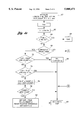
  • FIGS. 4a-4b is a flow diagram illustrating the general sequence of steps associated with the operation of the present invention.
  • the computer control system in an automobile needs to know when the transmission shifts gears in order to adjust fuel supply and engine RPMs.
  • the current through the solenoid starts at zero and then exponentially increases.
  • the voltage starts at battery voltage and immediately drops to a value near ground potential.
  • the voltage or current increases exponentially to a peak value and then takes a dip because the field has moved the solenoid armature thereby increasing the solenoid inductance and inducing a negative rate of change of current per unit time (di/dt).
  • FIG. 1 A waveform of a typical valid solenoid signature for a low-sided driver configuration is shown in FIG. 1.
  • a waveform of a typical signature of a defective solenoid in a low-sided driver configuration is shown in FIG. 2 where there is no dip in the voltage or current signal indicating that the field has not moved the solenoid armature.
  • a solenoid 12 includes an armature 14 that in turn is coupled to a mechanical device such as a gear or valve (not shown).
  • a field coil 16 surrounds the armature 14 with one end coupled to a power supply 18 operating at a potential Vpower such as 12.0 volts output potential from an automotive battery.
  • the other end of the field coil 16 is coupled to the drain of a transistor 20 that receives a solenoid driver signal at its gate.
  • the source of the transistor 20 is coupled to a ground potential 22.
  • the transistor 20 may be replaced with a resistor and switching circuit (not shown) or any other suitable method of switching and current sensing.
  • a high solenoid driver signal turns on the transistor 20 and causing a current flow (i) through the field coil 16.
  • the current (i) develops a magnetic field that moves the armature 14.
  • the computer control system in an automobile needs to know when the transmission shifts gears in order to adjust fuel supply and engine RPMs.
  • the potential at the end of the field coil connected to the drain (hereinafter called the SOLENOID OUTPUT signal) of the transistor 20 immediately drops to a value near ground potential as shown at t 0 in FIG. 1.
  • the SOLENOID OUTPUT signal increases exponentially to a first peak value at time t 1 and then takes a dip because the field has moved the armature thereby increasing the solenoid inductance and inducing a negative rate of change of current per unit time (di/dt). After reaching a bottom of the dip, as shown at time t 2 , the SOLENOID OUTPUT signal increases again to a steady state value at time t 3 .
  • the detector circuit 10 begins operation at the initial activation of transistor 20 and monitors the output potential to detect the first peak value, e.g., at time t 1 . If the SOLENOID OUTPUT signal reaches a first peak followed by a dip that has at least a minimum duration followed by a predetermined rise after reaching the bottom of the dip, then the current through the field coil 16 exhibits the expected electrical behavior for the device and the solenoid 12 is considered working properly. Otherwise, the solenoid 12 is determined to be degraded because the current through the field coil 16 is not following the electrical behavior of a properly operating solenoid.
  • the detector circuit 10 will further be described.
  • the detector circuit 10 of the present invention includes a 2 volt comparator 24 coupled to the solenoid 12 for determining when the solenoid 12 is turned on. Upon detecting the SOLENOID OUTPUT signal transitioning below 2 volts, the detector circuit 10 is activated.
  • the SOLENOID OUTPUT signal is sampled during a predetermined time period following a predetermined amount of delay so that the initial voltage drop at time t 0 is not included in the sampling time period. This is accomplished via a delay 26, such as a 250 ⁇ s delay, and a one-shot timer circuit 28, such as a 45 ms one-shot circuit.
  • the detector circuit 10 further includes a buffer amplifier 30 coupled to the output of solenoid 12 to amplify and buffer the SOLENOID OUTPUT signal.
  • the detector circuit 10 includes a dip bottom detection circuit 32 coupled to the one-shot circuit 28 and the output of the buffer amplifier 30.
  • the dip bottom detection circuit 32 includes a comparator 34 for comparing a current value of the SOLENOID OUTPUT signal to a previous value of the SOLENOID OUTPUT signal to determine the direction of the waveform generated by the SOLENOID OUTPUT signal.
  • the comparator 34 is used to determine when the SOLENOID OUTPUT signal is rising and falling.
  • the comparator 34 is a ⁇ 1 mV comparator.
  • the previous value of the SOLENOID OUTPUT signal is stored in a sample and hold circuit 36 which is also coupled to the buffer amplifier 30.
  • a logic circuit 38 is coupled to the output of the comparator 34 and the input of the sample and hold circuit 36 for enabling the sample and hold circuit 36. As the SOLENOID OUTPUT signal rises, the sample and hold circuit 36 is repeatedly enabled so that a peak in the SOLENOID OUTPUT signal can be detected.
  • the dip bottom detector circuit 32 begins looking for the dip by detecting a predetermined number of samples below the peak of the SOLENOID OUTPUT signal via the comparator 34. After detecting a negative change in the SOLENOID OUTPUT signal, an up counter flag 40 is set to true. After a predetermined number of samples below the peak of the SOLENOID OUTPUT signal have occurred, e.g., three, it is determined that the SOLENOID OUTPUT signal has transitioned into the "dip" portion of the waveform.
  • the output of the up counter flag 40 is also coupled to the logic circuit 38 to indicate that the dip in the SOLENOID OUTPUT signal has occurred.
  • the logic circuit 38 continues to repeatedly enable the sample and hold circuit 36 until the SOLENOID OUTPUT signal begins to rise again and a rise comparator 46 detects a positive change in the SOLENOID OUTPUT signal, as discussed below.
  • the circuit 10 of the present invention validates the dip after the first peak in the SOLENOID OUTPUT signal but then proceeds to find the bottom of the dip. A predetermined amount of increase in the SOLENOID OUTPUT signal is now detected.
  • a post dip rise detection circuit 42 Upon determining that the bottom of the dip has occurred, a post dip rise detection circuit 42 is enabled.
  • the post dip rise detection circuit 42 is enabled via an AND gate 44 coupled to the one-shot circuit 28 and the output of the up counter 40 and the logic circuit 38.
  • the AND gate 44 enables the rise comparator 46 which is coupled to the output of the buffer amplifier 30 and the output of the sample and hold circuit 36.
  • the rise comparator 46 compares the current value of the SOLENOID OUTPUT signal with a previous value of the SOLENOID OUTPUT signal to determine if the SOLENOID OUTPUT signal has risen by a predetermined amount, e.g., 4.5 mV.
  • a larger threshold for the post dip rise detection is utilized to improve noise immunity.
  • a second up counter flag 48 is set to true. After a predetermined number of positive changes in the SOLENOID OUTPUT signal have occurred, e.g., three, it is determined that the SOLENOID OUTPUT signal has risen by a sufficient amount to indicate a valid solenoid signature.
  • the rise in the SOLENOID OUTPUT signal may occur over multiple samples since the circuit 10 is detecting amplitude changes rather than slope changes.
  • the system of the present invention may be used with solenoids that exhibit various rates of change.
  • FIGS. 4a-4b there is shown a flow diagram illustrating the general sequence of steps associated with the operation of the present invention.
  • the method begins with the step of initializing solenoid parameters, as shown at block 50. These parameters include i (time at which the method is operating), Delta (the amount of time between sample periods, e.g., 90 usec), TIME -- OUT (the maximum pre-set period of time for which the method can run, e.g., 45 msec), UCF (a "flag” which is set when the method initially counts up to a maximum count), Peak (PK) (a value of current which the method "stores” for comparison purposes and for use in calculations), MAX -- COUNT (a specified number of maximum counts, e.g., 3 counts), P.T. (a variable, positive voltage for comparison purposes), N.T. (a variable, negative voltage for comparison purposes) and Rds (the operating resistance of the transistor 20 which energizes the solenoid 12).
  • i time at which the method is operating
  • Delta the amount
  • the method increments the time i by Delta, as shown at block 52, and compares the time to the maximum pre-set period of time, TIME -- OUT, as shown at conditional block 54. If the current time exceeds TIME -- OUT, an indication that the solenoid is not functioning properly is generated, as shown at block 56.
  • the method continues to determine if there has been a decrease in the SOLENOID OUTPUT signal, as shown at conditional block 58.
  • the current of the solenoid 12 at time i is compared to the negative threshold.
  • the method is looking for the dip in the SOLENOID OUTPUT signal.
  • the current is increasing, so the method continues to determine if the current at time i exceeds the value PK+(P.T./Rds), as shown at conditional block 60. If so, the Peak (PK), or stored value, of current is replaced with the present value of the solenoid current, as shown at block 62.
  • the method is detecting the initial ascent of the SOLENOID OUTPUT signal prior to the dip.
  • UCF Up Count Flag
  • This flag is set when the method detects the solenoid current has decreased below a value PK--(N.T./Rds) for a predetermined number of counts. Since the solenoid 12 is still at the initial stage of the solenoid 12 actuation, the UCF is not true yet and the counter is reset, as shown at block 66. The method then returns to the top of the process, as shown at block 68. The method steps illustrated by blocks 52-54 and 58-68 are repeated until the peak of the SOLENOID OUTPUT signal is reached.
  • the current value of the solenoid current will not exceed the negative threshold or the positive threshold, and the method will return to the top of the process, as shown at block 70, and repeat blocks 52-54 and 58-70 until the SOLENOID OUTPUT signal exceeds the negative threshold signifying its descent into the dip portion of the waveform.
  • block 58 will be true and the method proceeds to determine if the UCF is true and the counter is equal to zero, as shown at conditional block 72. Since the current has not stayed below the peak for a predetermined number of samples, the method proceeds to determine if the UCF is true and the count is not equal to zero, as shown at conditional block 74. Again, the current has not stayed below the peak for a predetermined number of samples, therefore, the method continues to increment the counter, as shown at block 76.
  • the value of the counter is then compared with the maximum count value, MAX -- COUNT, as shown at conditional block 78. If the predetermined number of samples have not been detected yet, the method returns to the top of the process, as shown at block 80.
  • the method steps illustrated by blocks 52-54, 58, and 72-80 are repeated until the maximum number of voltage decreases, i.e., three, have been detected.
  • the UCF is set to true, the stored value, PK, of the solenoid current is replaced with the present value of the solenoid current, the positive threshold is reset to a larger value, e.g., from 1.0 mV to 4.5 mV, and the counter is reset to zero, as shown at block 82.
  • a dip in the SOLENOID OUTPUT signal has now been detected for a minimum duration.
  • Blocks 58 and 72 will be true as long as the SOLENOID OUTPUT signal is decreasing, and the stored value, PK, of the solenoid current is repeatedly replaced with the current value of the solenoid current, as shown at block 83, until the SOLENOID OUTPUT signal begins to rise again.
  • the stored value, PK, of the solenoid current will represent the value of the solenoid current at the bottom of the dip when block 58 is false.
  • Block 60 will be true when the current increase exceeds the positive threshold (PK+(P.T./Rds)) and blocks 62 and 64 are executed.
  • the UCF is true and the method continues to increment the counter, as shown at block 84.
  • the value of the counter is then compared with the MAX -- COUNT, as shown at conditional block 86.
  • the SOLENOID OUTPUT signal is not validated until a minimum number of voltage increases have followed the bottom of the dip. Therefore, method steps outlined in blocks 52-54, 58-64, 84-86 and 80 are repeated until the counter reaches the MAX -- COUNT. At this time, a signal is provided indicating that the solenoid 12 has exhibited a valid electrical signature, as shown at block 88.
  • the method of the present invention provides immunity to system noise at block 74 when a dip in the SOLENOID OUTPUT signal is detected while the SOLENOID OUTPUT signal is rising from the bottom of the dip. If the UCF is true and the counter is not equal to zero, the method simply returns to the beginning of the process without incrementing any counters or resetting any flags.
  • the method and system of the present invention is generic and can be used on all types of solenoids. Changes in operating conditions and mechanical variances which cause solenoid signature changes do not have an effect on the method and system of the present invention. Thus, test time, calibration time, expenses and complexity are reduced.

Landscapes

  • Physics & Mathematics (AREA)
  • Electromagnetism (AREA)
  • Engineering & Computer Science (AREA)
  • Power Engineering (AREA)
  • General Physics & Mathematics (AREA)
  • Magnetically Actuated Valves (AREA)

Abstract

A method and system for detecting degraded operation of a solenoid. A current through the solenoid is sampled at predetermined time intervals within a predetermined time period. A maximum value of the sampled current is first detected. Next, a minimum value of the sampled current subsequent to the maximum value is detected. Finally, a predetermined increase in the sampled current from the minimum value is detected to verify operation of the solenoid.

Description

TECHNICAL FIELD
This invention relates to methods and systems for verifying proper operation of a solenoid.
BACKGROUND ART
Electrical solenoids form an integral part of many types of mechanical systems. The electric solenoid includes a field coil that develops a magnetic field in response to current flow through the coil. The magnetic field causes movement of an actuator positioned within the field coil that in turn is attached to a mechanical or hydraulic device such as a valve or gear. By activating a switching circuit, current flows through the field coil to develop the magnetic field and move the actuator. For example, in automotive applications, solenoids are often used to shift gears in the transmission or engage emission control subsystems. In industrial applications, the solenoid may be used to open and close valves in hydraulic lines.
As with most physical devices, solenoids are subject to degraded operation. In the prior art, the actuator sensing has been accomplished by pressure sensors, Hall-effect sensors and opto-electronic sensors. In the pressure sensor approach, the pressure sensor detects pressures on opposite sides of the valve. The prior art sensors may be less effective than desired in some situations.
The known prior art also includes a solenoid movement detector circuit as disclosed in U.S. Pat. No. 5,442,671 issued to Wollschlager et al. The current flowing through the field coil of the solenoid is converted to a voltage signal which is stored across a capacitor. A first peak value of the voltage signal is determined. After the first peak, a counter must count to a predetermined value during the low peak before the voltage signal returns to its first peak value. If the counter reaches at least the predetermined value before returning to its first peak value and counts back down to zero before reaching steady state within a predetermined amount of time, the solenoid is considered engaged. This method, however, employs slope detection, which is time-dependent and requires calibration for proper operation. A given calibration does not cover a wide range of waveform characteristics. Varying parameters which affect the slope include temperature, battery voltage, hydraulic fluid viscosity and pressure, solenoid properties (electrical and mechanical), production machining tolerances, etc. Furthermore, the method disclosed in Wollschlager et al. senses the rise in the voltage signal only after the voltage signal has exceeded the peak current value. This reduces the amount of signal available for detection purposes and increases the circuit's susceptibility to noise.
Thus, a need exists for a method and circuit for detecting the operation of a solenoid that is immune to noise and free from calibration for various applications or operating conditions. A need also exists for a method and circuit for detecting the operation of a solenoid that exhibits a slow rate of change.
DISCLOSURE OF THE INVENTION
It is thus a general object of the present invention to provide a method and system for verifying the operation of a solenoid.
In carrying out the above object and other objects, features and advantages, of the present invention, a method is provided for verifying the operation of a solenoid. The method includes the step of sampling an output signal of the solenoid at predetermined time intervals. The method also includes the step of detecting a maximum value of the sampled output signal. Still further, the method includes the step of detecting a minimum value of the sampled output signal subsequent to the detection of the maximum value. Finally, the method includes the step of detecting a predetermined increase in the sampled output signal from the detected minimum value to indicate operation of the solenoid.
In further carrying out the above objects and other objects, features and advantages, of the present invention, a system is also provided for carrying out the steps of the above described method. The system includes means for sampling an output signal of the solenoid at predetermined time intervals. The system also includes means for detecting a maximum value of the sampled output signal. Still further, the system includes means for detecting a minimum value of the sampled output signal subsequent to the detection of the maximum value. Finally, the system includes means for detecting a predetermined increase in the sampled output signal from the detected minimum value to indicate operation of the solenoid.
The present invention provides the advantage of avoiding noise and calibration for various applications and operating conditions. The present invention also provides the advantage of detecting operation of a solenoid that exhibits a slow rate of change.
The above objects and other objects, features and advantages of the present invention are readily apparent from the following detailed description of the best mode for carrying out the invention when taken in connection with the accompanying drawings.
BRIEF DESCRIPTION OF THE DRAWINGS
FIG. 1 illustrates a waveform of a typical valid solenoid signature plotted as voltage versus time for a low-sided driver configuration;
FIG. 2 illustrates a waveform of a typical defective solenoid signature plotted as voltage versus time for a low-sided driver configuration;
FIG. 3 is a block diagram of a detector circuit employed in the system of the present invention; and
FIGS. 4a-4b is a flow diagram illustrating the general sequence of steps associated with the operation of the present invention.
BEST MODES FOR CARRYING OUT THE INVENTION
In many applications, it is important to monitor operation of a solenoid. For example, the computer control system in an automobile needs to know when the transmission shifts gears in order to adjust fuel supply and engine RPMs. When a solenoid is commanded on, the current through the solenoid starts at zero and then exponentially increases. In a low-sided driver configuration, the voltage starts at battery voltage and immediately drops to a value near ground potential. The voltage or current increases exponentially to a peak value and then takes a dip because the field has moved the solenoid armature thereby increasing the solenoid inductance and inducing a negative rate of change of current per unit time (di/dt). After reaching the bottom of the dip, or valley, the voltage or current waveform then increases again to a steady state value above the value of the previous peak. A waveform of a typical valid solenoid signature for a low-sided driver configuration is shown in FIG. 1. A waveform of a typical signature of a defective solenoid in a low-sided driver configuration is shown in FIG. 2 where there is no dip in the voltage or current signal indicating that the field has not moved the solenoid armature.
Turning now to FIG. 3, there is shown a block diagram of the detector circuit employed in the system of the present invention, denoted generally by reference numeral 10. A solenoid 12 includes an armature 14 that in turn is coupled to a mechanical device such as a gear or valve (not shown). A field coil 16 surrounds the armature 14 with one end coupled to a power supply 18 operating at a potential Vpower such as 12.0 volts output potential from an automotive battery. The other end of the field coil 16 is coupled to the drain of a transistor 20 that receives a solenoid driver signal at its gate. The source of the transistor 20 is coupled to a ground potential 22. Alternatively, the transistor 20 may be replaced with a resistor and switching circuit (not shown) or any other suitable method of switching and current sensing. A high solenoid driver signal turns on the transistor 20 and causing a current flow (i) through the field coil 16. The current (i) develops a magnetic field that moves the armature 14.
In many applications, it is important to verify the proper displacement of the armature of the solenoid 12. For example, the computer control system in an automobile needs to know when the transmission shifts gears in order to adjust fuel supply and engine RPMs. When properly operating, the potential at the end of the field coil connected to the drain (hereinafter called the SOLENOID OUTPUT signal) of the transistor 20 immediately drops to a value near ground potential as shown at t0 in FIG. 1. The SOLENOID OUTPUT signal increases exponentially to a first peak value at time t1 and then takes a dip because the field has moved the armature thereby increasing the solenoid inductance and inducing a negative rate of change of current per unit time (di/dt). After reaching a bottom of the dip, as shown at time t2, the SOLENOID OUTPUT signal increases again to a steady state value at time t3.
The detector circuit 10 begins operation at the initial activation of transistor 20 and monitors the output potential to detect the first peak value, e.g., at time t1. If the SOLENOID OUTPUT signal reaches a first peak followed by a dip that has at least a minimum duration followed by a predetermined rise after reaching the bottom of the dip, then the current through the field coil 16 exhibits the expected electrical behavior for the device and the solenoid 12 is considered working properly. Otherwise, the solenoid 12 is determined to be degraded because the current through the field coil 16 is not following the electrical behavior of a properly operating solenoid.
Referring again to FIG. 3, the detector circuit 10 will further be described. One skilled in the art should appreciate that the detector circuit 10 can be implemented either in hardware using discrete components or can be implemented with software using any processor. The detector circuit 10 of the present invention includes a 2 volt comparator 24 coupled to the solenoid 12 for determining when the solenoid 12 is turned on. Upon detecting the SOLENOID OUTPUT signal transitioning below 2 volts, the detector circuit 10 is activated.
The SOLENOID OUTPUT signal is sampled during a predetermined time period following a predetermined amount of delay so that the initial voltage drop at time t0 is not included in the sampling time period. This is accomplished via a delay 26, such as a 250 μs delay, and a one-shot timer circuit 28, such as a 45 ms one-shot circuit. The detector circuit 10 further includes a buffer amplifier 30 coupled to the output of solenoid 12 to amplify and buffer the SOLENOID OUTPUT signal.
To detect the dip in the SOLENOID OUTPUT signal, including the bottom of the dip, the detector circuit 10 includes a dip bottom detection circuit 32 coupled to the one-shot circuit 28 and the output of the buffer amplifier 30. The dip bottom detection circuit 32 includes a comparator 34 for comparing a current value of the SOLENOID OUTPUT signal to a previous value of the SOLENOID OUTPUT signal to determine the direction of the waveform generated by the SOLENOID OUTPUT signal. Thus, the comparator 34 is used to determine when the SOLENOID OUTPUT signal is rising and falling. Preferably, the comparator 34 is a ±1 mV comparator.
The previous value of the SOLENOID OUTPUT signal is stored in a sample and hold circuit 36 which is also coupled to the buffer amplifier 30. A logic circuit 38 is coupled to the output of the comparator 34 and the input of the sample and hold circuit 36 for enabling the sample and hold circuit 36. As the SOLENOID OUTPUT signal rises, the sample and hold circuit 36 is repeatedly enabled so that a peak in the SOLENOID OUTPUT signal can be detected.
Once the peak of the SOLENOID OUTPUT signal has been found, the dip bottom detector circuit 32 begins looking for the dip by detecting a predetermined number of samples below the peak of the SOLENOID OUTPUT signal via the comparator 34. After detecting a negative change in the SOLENOID OUTPUT signal, an up counter flag 40 is set to true. After a predetermined number of samples below the peak of the SOLENOID OUTPUT signal have occurred, e.g., three, it is determined that the SOLENOID OUTPUT signal has transitioned into the "dip" portion of the waveform.
The output of the up counter flag 40 is also coupled to the logic circuit 38 to indicate that the dip in the SOLENOID OUTPUT signal has occurred. At this point, the logic circuit 38 continues to repeatedly enable the sample and hold circuit 36 until the SOLENOID OUTPUT signal begins to rise again and a rise comparator 46 detects a positive change in the SOLENOID OUTPUT signal, as discussed below. Thus, the circuit 10 of the present invention validates the dip after the first peak in the SOLENOID OUTPUT signal but then proceeds to find the bottom of the dip. A predetermined amount of increase in the SOLENOID OUTPUT signal is now detected.
Upon determining that the bottom of the dip has occurred, a post dip rise detection circuit 42 is enabled. The post dip rise detection circuit 42 is enabled via an AND gate 44 coupled to the one-shot circuit 28 and the output of the up counter 40 and the logic circuit 38. The AND gate 44 enables the rise comparator 46 which is coupled to the output of the buffer amplifier 30 and the output of the sample and hold circuit 36. The rise comparator 46 compares the current value of the SOLENOID OUTPUT signal with a previous value of the SOLENOID OUTPUT signal to determine if the SOLENOID OUTPUT signal has risen by a predetermined amount, e.g., 4.5 mV. A larger threshold for the post dip rise detection is utilized to improve noise immunity.
After detecting a rise, or positive change, in the SOLENOID OUTPUT signal, a second up counter flag 48 is set to true. After a predetermined number of positive changes in the SOLENOID OUTPUT signal have occurred, e.g., three, it is determined that the SOLENOID OUTPUT signal has risen by a sufficient amount to indicate a valid solenoid signature. The rise in the SOLENOID OUTPUT signal may occur over multiple samples since the circuit 10 is detecting amplitude changes rather than slope changes. Thus, the system of the present invention may be used with solenoids that exhibit various rates of change.
Turning now to FIGS. 4a-4b, there is shown a flow diagram illustrating the general sequence of steps associated with the operation of the present invention. The method begins with the step of initializing solenoid parameters, as shown at block 50. These parameters include i (time at which the method is operating), Delta (the amount of time between sample periods, e.g., 90 usec), TIME-- OUT (the maximum pre-set period of time for which the method can run, e.g., 45 msec), UCF (a "flag" which is set when the method initially counts up to a maximum count), Peak (PK) (a value of current which the method "stores" for comparison purposes and for use in calculations), MAX-- COUNT (a specified number of maximum counts, e.g., 3 counts), P.T. (a variable, positive voltage for comparison purposes), N.T. (a variable, negative voltage for comparison purposes) and Rds (the operating resistance of the transistor 20 which energizes the solenoid 12).
First, the method increments the time i by Delta, as shown at block 52, and compares the time to the maximum pre-set period of time, TIME-- OUT, as shown at conditional block 54. If the current time exceeds TIME-- OUT, an indication that the solenoid is not functioning properly is generated, as shown at block 56.
If the TIME-- OUT has not been exceeded, the method continues to determine if there has been a decrease in the SOLENOID OUTPUT signal, as shown at conditional block 58. The current of the solenoid 12 at time i is compared to the negative threshold. At this point, the method is looking for the dip in the SOLENOID OUTPUT signal. Upon initialization, the current is increasing, so the method continues to determine if the current at time i exceeds the value PK+(P.T./Rds), as shown at conditional block 60. If so, the Peak (PK), or stored value, of current is replaced with the present value of the solenoid current, as shown at block 62. Thus, the method is detecting the initial ascent of the SOLENOID OUTPUT signal prior to the dip.
Next, a check is made to determine if the Up Count Flag (UCF) is set to true, as shown at conditional block 64. This flag is set when the method detects the solenoid current has decreased below a value PK--(N.T./Rds) for a predetermined number of counts. Since the solenoid 12 is still at the initial stage of the solenoid 12 actuation, the UCF is not true yet and the counter is reset, as shown at block 66. The method then returns to the top of the process, as shown at block 68. The method steps illustrated by blocks 52-54 and 58-68 are repeated until the peak of the SOLENOID OUTPUT signal is reached.
Upon nearing the peak of the SOLENOID OUTPUT signal, the current value of the solenoid current will not exceed the negative threshold or the positive threshold, and the method will return to the top of the process, as shown at block 70, and repeat blocks 52-54 and 58-70 until the SOLENOID OUTPUT signal exceeds the negative threshold signifying its descent into the dip portion of the waveform.
Once the SOLENOID OUTPUT signal begins descending, block 58 will be true and the method proceeds to determine if the UCF is true and the counter is equal to zero, as shown at conditional block 72. Since the current has not stayed below the peak for a predetermined number of samples, the method proceeds to determine if the UCF is true and the count is not equal to zero, as shown at conditional block 74. Again, the current has not stayed below the peak for a predetermined number of samples, therefore, the method continues to increment the counter, as shown at block 76.
The value of the counter is then compared with the maximum count value, MAX-- COUNT, as shown at conditional block 78. If the predetermined number of samples have not been detected yet, the method returns to the top of the process, as shown at block 80. The method steps illustrated by blocks 52-54, 58, and 72-80 are repeated until the maximum number of voltage decreases, i.e., three, have been detected.
Once the counter has reached the MAX-- COUNT, the UCF is set to true, the stored value, PK, of the solenoid current is replaced with the present value of the solenoid current, the positive threshold is reset to a larger value, e.g., from 1.0 mV to 4.5 mV, and the counter is reset to zero, as shown at block 82. A dip in the SOLENOID OUTPUT signal has now been detected for a minimum duration.
Once the characteristic dip has been found, the method continues to search for the bottom of the dip. Blocks 58 and 72 will be true as long as the SOLENOID OUTPUT signal is decreasing, and the stored value, PK, of the solenoid current is repeatedly replaced with the current value of the solenoid current, as shown at block 83, until the SOLENOID OUTPUT signal begins to rise again.
The stored value, PK, of the solenoid current will represent the value of the solenoid current at the bottom of the dip when block 58 is false. Block 60 will be true when the current increase exceeds the positive threshold (PK+(P.T./Rds)) and blocks 62 and 64 are executed. At block 64, the UCF is true and the method continues to increment the counter, as shown at block 84. The value of the counter is then compared with the MAX-- COUNT, as shown at conditional block 86. The SOLENOID OUTPUT signal is not validated until a minimum number of voltage increases have followed the bottom of the dip. Therefore, method steps outlined in blocks 52-54, 58-64, 84-86 and 80 are repeated until the counter reaches the MAX-- COUNT. At this time, a signal is provided indicating that the solenoid 12 has exhibited a valid electrical signature, as shown at block 88.
The method of the present invention provides immunity to system noise at block 74 when a dip in the SOLENOID OUTPUT signal is detected while the SOLENOID OUTPUT signal is rising from the bottom of the dip. If the UCF is true and the counter is not equal to zero, the method simply returns to the beginning of the process without incrementing any counters or resetting any flags.
The method and system of the present invention is generic and can be used on all types of solenoids. Changes in operating conditions and mechanical variances which cause solenoid signature changes do not have an effect on the method and system of the present invention. Thus, test time, calibration time, expenses and complexity are reduced.
While the best modes for carrying out the invention have been described in detail, those familiar with the art to which this invention relates will recognize various alternative designs and embodiments for practicing the invention as defined by the following claims.

Claims (12)

What is claimed is:
1. A method for verifying operation of a solenoid generating an output signal having a predetermined waveform, the solenoid being one of a plurality of solenoids that generate varying output signals, the method comprising:
sampling the output signal of the solenoid at predetermined time intervals;
detecting a maximum value of the sampled output signal;
detecting a minimum value of the sampled output signal subsequent to the detection of the maximum value; and
detecting a predetermined in crease in the sampled output signal subsequent to the detected minimum value so as to verify operation of the solenoid.
2. The method as recited in claim 1 wherein detecting the maximum value includes:
(a) comparing the sampled output signal to a peak signal to determine when the output signal is increasing by a first predetermined amount, the peak signal representing the output signal sampled during a previous time interval;
(b) storing the sampled out-out signal as said peak signal when the output signal increases by the first predetermined amount; and
(c) repeating steps (a) and (b) until the sampled output signal begins to decrease by an amount greater than the first predetermined amount.
3. The method as recited in claim 2 wherein detecting the minimum value includes:
(d) comparing the sampled output signal to said peak signal to determine when the output signal is decreasing by the first predetermined amount;
(e) storing the sampled output signal as said peak signal when the sampled output signal decreases by the first predetermined amount; and
(f) repeating steps (d) and (e) until the sampled output signal begins to increase by an amount greater than a second predetermined amount.
4. The method as recited in claim 3 wherein the step of comparing the sampled output signal to determine when the output signal is decreasing by the first predetermined amount includes detecting a predetermined number of sampled output signals being less than the peak signal.
5. The method as recited in claim 4 wherein detecting the predetermined increase includes comparing the sampled output signal to the peak signal to determine the sampled output signal is increasing by said second predetermined amount.
6. The method as recited in claim 1 further comprising determining the operation of the solenoid is degraded if detecting the maximum value, detecting the minimum value and detecting the predetermined increase are not completed within a predetermined period of time.
7. A system for verifying operation of a solenoid generating an output signal having a predetermined waveform, the solenoid being one of a plurality of solenoids that generate varying output waveforms, the system comprising:
means for sampling the output signal of the solenoid at predetermined time intervals to generate corresponding sampled output signals;
means for detecting a maximum value of the sampled output signals;
means for detecting a minimum value of the sampled output signals subsequent to the detection of the maximum value; and
means for detecting a predetermined increase in the sampled output signals subsequent to the detected minimum value so as to verify proper operation of the solenoid.
8. The system as recited in claim 7 wherein the means for detecting the maximum value includes:
a first comparator for comparing each of the sampled output signals to a peak signal to determine when the sampled output signals are increasing by a first predetermined amount, the peak signal representing the output signal sampled during a previous time interval;
means for storing the sampled output signal as the peak signal when the output signal increases by the first predetermined amount; and
means for repeatedly comparing each of the sampled output signals to the peak signal until the sampled output signals begin to decrease by an amount greater than the first predetermined amount.
9. The system as recited in claim 8 wherein the means for detecting the minimum value includes:
a second comparator for comparing each of the sampled output signals to the peak signal to determine when the sampled output signals are decreasing by the first predetermined amount;
means for storing the sampled output signal as the peak signal when the sampled output signal decreases by the first predetermined amount; and
means for repeatedly comparing the sampled output signals to the peak signal until the sampled output signals begin to increase by an amount greater than a second predetermined amount.
10. The system as recited in claim 9 further comprising means for detecting a predetermined number of sampled output signals being less than the peak signal.
11. The system as recited in claim 10 wherein the means for detecting the predetermined increase includes the second comparator for comparing each of the sampled output signals to the peak signal to determine when the sampled output signals are increasing by the second predetermined amount.
12. The system of claim 7 further comprising means for signifying improper operation of the solenoid when the means for detecting the maximum value, the means for detecting the minimum value and the means for detecting the predetermined increase fail to find the maximum value, the minimum value and the predetermined increase, respectively, within a predetermined period of time.
US08/691,255 1996-08-02 1996-08-02 Method and system for verifying solenoid operation Expired - Fee Related US5808471A (en)

Priority Applications (3)

Application Number Priority Date Filing Date Title
US08/691,255 US5808471A (en) 1996-08-02 1996-08-02 Method and system for verifying solenoid operation
DE19730594A DE19730594C2 (en) 1996-08-02 1997-07-17 Method and device for verifying the operation of solenoids
GB9715169A GB2316181B (en) 1996-08-02 1997-07-21 Method and system for verifying solenoid operation

Applications Claiming Priority (1)

Application Number Priority Date Filing Date Title
US08/691,255 US5808471A (en) 1996-08-02 1996-08-02 Method and system for verifying solenoid operation

Publications (1)

Publication Number Publication Date
US5808471A true US5808471A (en) 1998-09-15

Family

ID=24775775

Family Applications (1)

Application Number Title Priority Date Filing Date
US08/691,255 Expired - Fee Related US5808471A (en) 1996-08-02 1996-08-02 Method and system for verifying solenoid operation

Country Status (3)

Country Link
US (1) US5808471A (en)
DE (1) DE19730594C2 (en)
GB (1) GB2316181B (en)

Cited By (23)

* Cited by examiner, † Cited by third party
Publication number Priority date Publication date Assignee Title
US6233132B1 (en) 1998-09-03 2001-05-15 Ranco Incorporated Of Delaware Zero cross relay actuation method and system implementing same
US6262620B1 (en) 1999-11-02 2001-07-17 Ranco Incorporated Of Delaware Driver circuitry for latching type valve and the like
WO2002053896A3 (en) * 2001-01-04 2003-02-13 Siemens Vdo Automotive Corp Internal energizable voltage or current source for fuel injector identification
US6836121B2 (en) * 2001-06-06 2004-12-28 Abb Inc. Apparatus for controlling a magnetically actuated power switching device and method of controlling the same
US6917203B1 (en) 2001-09-07 2005-07-12 The United States Of America As Represented By The Administrator Of The National Aeronautics And Space Administration Current signature sensor
US20080093172A1 (en) * 2006-09-01 2008-04-24 Albertson William C Engine oil change detection systems and methods
US20080129347A1 (en) * 2006-11-30 2008-06-05 Kyle Shawn Williams Methods and systems for driving a load
US7432721B2 (en) 2006-12-18 2008-10-07 Temic Automotive Of North America, Inc. Solenoid actuator motion detection
US20090107682A1 (en) * 2007-10-23 2009-04-30 Vetco Gray Controls Limited Monitoring A Solenoid of A Directional Control Valve
US20090188755A1 (en) * 2008-01-28 2009-07-30 Gm Global Technology Operations, Inc. Oil condition sensing methods and systems
US20090260829A1 (en) * 2008-04-18 2009-10-22 Schlumberger Technology Corporation Subsea tree safety control system
US20100127718A1 (en) * 2008-11-24 2010-05-27 Gm Global Technology Operations, Inc. Electro-mechanical fluid sensor
US20100217545A1 (en) * 2009-02-20 2010-08-26 Gm Global Technology Operations, Inc. Method and Apparatus for Monitoring Solenoid Health
US20120105065A1 (en) * 2010-10-29 2012-05-03 GM Global Technology Operations LLC Diagnosis of hev/ev battery disconnect system
EP2650517A1 (en) 2012-04-11 2013-10-16 TI Automotive Fuel Systems SAS Method for monitoring a fluid injection system and system thereof
JP2015092077A (en) * 2013-10-29 2015-05-14 コンチネンタル オートモーティブ システムズ インコーポレイテッドContinental Automotive Systems, Inc. Method and apparatus for detecting the open time of a selective catalytic reduction injector
US20160125993A1 (en) * 2014-11-03 2016-05-05 Texas Instruments Incorporated Detection of plunger movement in dc solenoids through current sense technique
US20160186707A1 (en) * 2013-08-02 2016-06-30 Denso Corporation Control device for high-pressure pump
US20160358732A1 (en) * 2014-02-27 2016-12-08 Omron Corporation Abnormality detection method for electromagnetic relay, abnormality detection circuit for electromagnetic relay, and abnormality detection system
US20180258771A1 (en) * 2015-04-17 2018-09-13 Continental Automotive Systems, Inc. Method, system and apparatus for detecting injector closing time
US11335492B2 (en) 2019-04-15 2022-05-17 Maxim Integrated Products, Inc. Solenoid plunger movement detection system
US20230373452A1 (en) * 2021-01-07 2023-11-23 Robert Bosch Gmbh Hydraulic pressure control unit
US12398615B2 (en) 2023-04-21 2025-08-26 Halliburton Energy Services, Inc. Characterization and diagnosis of solenoids used in well equipment

Families Citing this family (6)

* Cited by examiner, † Cited by third party
Publication number Priority date Publication date Assignee Title
DE10118583A1 (en) * 2001-04-12 2002-10-17 Aweco Appliance Sys Gmbh & Co Multiple-way valve, especially for coolant circuit, has sensor arrangement for valve body position detection, with valve body being at least partly magnetic and a Hall sensor being provided
GB0901947D0 (en) * 2009-02-09 2009-03-11 Rolls Royce Plc Determining solenoid health
US9453488B2 (en) 2013-10-29 2016-09-27 Continental Automotive Systems, Inc. Direct injection solenoid injector opening time detection
JP7035625B2 (en) 2018-02-28 2022-03-15 株式会社デンソー Electronic control device for exhaust purification system
US11525523B2 (en) * 2020-01-31 2022-12-13 Fisher Controls International Llc Open circuit diagnostic for pulsed solenoid I/P
DE102021003261B4 (en) 2021-06-25 2025-04-17 Truma Gerätetechnik GmbH & Co. KG Heating device with monitoring device for assigning different error states of a pump device

Citations (16)

* Cited by examiner, † Cited by third party
Publication number Priority date Publication date Assignee Title
US4321946A (en) * 1980-03-31 1982-03-30 Paulos Louis B Armature position monitoring and control device
US4481473A (en) * 1981-11-13 1984-11-06 International Business Machines Corporation Electromagnet drop time detection method
US4764840A (en) * 1986-09-26 1988-08-16 Motorola, Inc. Dual limit solenoid driver control circuit
US4814937A (en) * 1986-06-09 1989-03-21 Mitsubishi Denki Kabushiki Kaisha Defect detector circuit for inductive load driving circuit
US4833565A (en) * 1987-02-19 1989-05-23 Westinghouse Electric Corp. Electromagnetic contactor with algorithm controlled closing system
US4953056A (en) * 1987-01-16 1990-08-28 Honda Giken Kogyo Kabushiki Kaisha Current detection apparatus for use in electromagnetic actuator drive circuit
US4970622A (en) * 1986-12-03 1990-11-13 Buechl Josef Method and apparatus for controlling the operation of an electromagnet
US5053911A (en) * 1989-06-02 1991-10-01 Motorola, Inc. Solenoid closure detection
US5196983A (en) * 1991-10-07 1993-03-23 Eastman Kodak Company Solenoid engagement sensing circuit
US5204633A (en) * 1992-02-25 1993-04-20 International Business Machines Corporation Electromagnetic contactor with closure fault indicator
US5222011A (en) * 1991-11-04 1993-06-22 Motorola, Inc. Load driver circuit
US5241218A (en) * 1991-02-09 1993-08-31 Norgren Martonair Limited Armature movement detection circuit
US5243296A (en) * 1990-11-06 1993-09-07 Tokimec Inc. Method and apparatus for checking operation of solenoid
US5293551A (en) * 1988-03-18 1994-03-08 Otis Engineering Corporation Monitor and control circuit for electric surface controlled subsurface valve system
US5442671A (en) * 1994-09-06 1995-08-15 Motorola, Inc. Circuit and method of detecting actuator movement
US5548210A (en) * 1993-05-21 1996-08-20 Dittrich; Ehrenfried System and procedure for the check-up solenoid valves

Family Cites Families (2)

* Cited by examiner, † Cited by third party
Publication number Priority date Publication date Assignee Title
DE3817770A1 (en) * 1988-05-26 1989-11-30 Daimler Benz Ag Device for the timed operation of an electromagnetic valve
JP3105007B2 (en) * 1990-07-06 2000-10-30 ジヤトコ・トランステクノロジー株式会社 Failure detection device for solenoid valve

Patent Citations (16)

* Cited by examiner, † Cited by third party
Publication number Priority date Publication date Assignee Title
US4321946A (en) * 1980-03-31 1982-03-30 Paulos Louis B Armature position monitoring and control device
US4481473A (en) * 1981-11-13 1984-11-06 International Business Machines Corporation Electromagnet drop time detection method
US4814937A (en) * 1986-06-09 1989-03-21 Mitsubishi Denki Kabushiki Kaisha Defect detector circuit for inductive load driving circuit
US4764840A (en) * 1986-09-26 1988-08-16 Motorola, Inc. Dual limit solenoid driver control circuit
US4970622A (en) * 1986-12-03 1990-11-13 Buechl Josef Method and apparatus for controlling the operation of an electromagnet
US4953056A (en) * 1987-01-16 1990-08-28 Honda Giken Kogyo Kabushiki Kaisha Current detection apparatus for use in electromagnetic actuator drive circuit
US4833565A (en) * 1987-02-19 1989-05-23 Westinghouse Electric Corp. Electromagnetic contactor with algorithm controlled closing system
US5293551A (en) * 1988-03-18 1994-03-08 Otis Engineering Corporation Monitor and control circuit for electric surface controlled subsurface valve system
US5053911A (en) * 1989-06-02 1991-10-01 Motorola, Inc. Solenoid closure detection
US5243296A (en) * 1990-11-06 1993-09-07 Tokimec Inc. Method and apparatus for checking operation of solenoid
US5241218A (en) * 1991-02-09 1993-08-31 Norgren Martonair Limited Armature movement detection circuit
US5196983A (en) * 1991-10-07 1993-03-23 Eastman Kodak Company Solenoid engagement sensing circuit
US5222011A (en) * 1991-11-04 1993-06-22 Motorola, Inc. Load driver circuit
US5204633A (en) * 1992-02-25 1993-04-20 International Business Machines Corporation Electromagnetic contactor with closure fault indicator
US5548210A (en) * 1993-05-21 1996-08-20 Dittrich; Ehrenfried System and procedure for the check-up solenoid valves
US5442671A (en) * 1994-09-06 1995-08-15 Motorola, Inc. Circuit and method of detecting actuator movement

Cited By (39)

* Cited by examiner, † Cited by third party
Publication number Priority date Publication date Assignee Title
US6233132B1 (en) 1998-09-03 2001-05-15 Ranco Incorporated Of Delaware Zero cross relay actuation method and system implementing same
US6262620B1 (en) 1999-11-02 2001-07-17 Ranco Incorporated Of Delaware Driver circuitry for latching type valve and the like
WO2002053896A3 (en) * 2001-01-04 2003-02-13 Siemens Vdo Automotive Corp Internal energizable voltage or current source for fuel injector identification
US6651629B2 (en) 2001-01-04 2003-11-25 Mccoy John C. Internal energizable voltage or current source for fuel injector identification
US6836121B2 (en) * 2001-06-06 2004-12-28 Abb Inc. Apparatus for controlling a magnetically actuated power switching device and method of controlling the same
US6917203B1 (en) 2001-09-07 2005-07-12 The United States Of America As Represented By The Administrator Of The National Aeronautics And Space Administration Current signature sensor
US20080093172A1 (en) * 2006-09-01 2008-04-24 Albertson William C Engine oil change detection systems and methods
US8746408B2 (en) * 2006-09-01 2014-06-10 GM Global Technology Operations LLC Engine oil change detection systems and methods
US20080129347A1 (en) * 2006-11-30 2008-06-05 Kyle Shawn Williams Methods and systems for driving a load
US8299771B2 (en) 2006-11-30 2012-10-30 Infineon Technologies Ag Methods and systems for driving a load
US7432721B2 (en) 2006-12-18 2008-10-07 Temic Automotive Of North America, Inc. Solenoid actuator motion detection
US20090107682A1 (en) * 2007-10-23 2009-04-30 Vetco Gray Controls Limited Monitoring A Solenoid of A Directional Control Valve
US8122963B2 (en) * 2007-10-23 2012-02-28 Vetco Gray Controls Limited Monitoring a solenoid of a directional control valve
US20090188755A1 (en) * 2008-01-28 2009-07-30 Gm Global Technology Operations, Inc. Oil condition sensing methods and systems
US8127597B2 (en) 2008-01-28 2012-03-06 GM Global Technology Operations LLC Oil condition sensing methods and systems
US20090260829A1 (en) * 2008-04-18 2009-10-22 Schlumberger Technology Corporation Subsea tree safety control system
US8347967B2 (en) * 2008-04-18 2013-01-08 Sclumberger Technology Corporation Subsea tree safety control system
US8602108B2 (en) * 2008-04-18 2013-12-10 Schlumberger Technology Corporation Subsea tree safety control system
US8115501B2 (en) 2008-11-24 2012-02-14 GM Global Technology Operations LLC Electro-mechanical fluid sensor
US20100127718A1 (en) * 2008-11-24 2010-05-27 Gm Global Technology Operations, Inc. Electro-mechanical fluid sensor
US8055460B2 (en) 2009-02-20 2011-11-08 GM Global Technology Operations LLC Method and apparatus for monitoring solenoid health
US20100217545A1 (en) * 2009-02-20 2010-08-26 Gm Global Technology Operations, Inc. Method and Apparatus for Monitoring Solenoid Health
US20120105065A1 (en) * 2010-10-29 2012-05-03 GM Global Technology Operations LLC Diagnosis of hev/ev battery disconnect system
US8901934B2 (en) * 2010-10-29 2014-12-02 GM Global Technology Operations LLC Diagnosis of HEV/EV battery disconnect system
EP2650517A1 (en) 2012-04-11 2013-10-16 TI Automotive Fuel Systems SAS Method for monitoring a fluid injection system and system thereof
US20160186707A1 (en) * 2013-08-02 2016-06-30 Denso Corporation Control device for high-pressure pump
US10330064B2 (en) * 2013-08-02 2019-06-25 Denso Corporation Control device for high-pressure pump
JP2015092077A (en) * 2013-10-29 2015-05-14 コンチネンタル オートモーティブ システムズ インコーポレイテッドContinental Automotive Systems, Inc. Method and apparatus for detecting the open time of a selective catalytic reduction injector
US9759116B2 (en) 2013-10-29 2017-09-12 Continental Automotive Systems, Inc. Method and apparatus for detecting selective catalytic reduction injector opening time
US10424449B2 (en) * 2014-02-27 2019-09-24 Omron Corporation Abnormality detection method for electromagnetic relay, abnormality detection circuit for electromagnetic relay, and abnormality detection system
US20160358732A1 (en) * 2014-02-27 2016-12-08 Omron Corporation Abnormality detection method for electromagnetic relay, abnormality detection circuit for electromagnetic relay, and abnormality detection system
US10317453B2 (en) 2014-11-03 2019-06-11 Texas Instruments Incorporated Detection of plunger movement in DC solenoids through current sense technique
US20160125993A1 (en) * 2014-11-03 2016-05-05 Texas Instruments Incorporated Detection of plunger movement in dc solenoids through current sense technique
US10895608B2 (en) 2014-11-03 2021-01-19 Texas Instruments Incorporated Detection of plunger movement in DC solenoids through current sense technique
US20180258771A1 (en) * 2015-04-17 2018-09-13 Continental Automotive Systems, Inc. Method, system and apparatus for detecting injector closing time
US10871120B2 (en) * 2015-04-17 2020-12-22 Vitesco Technologies USA, LLC. Method, system and apparatus for detecting injector closing time
US11335492B2 (en) 2019-04-15 2022-05-17 Maxim Integrated Products, Inc. Solenoid plunger movement detection system
US20230373452A1 (en) * 2021-01-07 2023-11-23 Robert Bosch Gmbh Hydraulic pressure control unit
US12398615B2 (en) 2023-04-21 2025-08-26 Halliburton Energy Services, Inc. Characterization and diagnosis of solenoids used in well equipment

Also Published As

Publication number Publication date
GB9715169D0 (en) 1997-09-24
GB2316181A (en) 1998-02-18
GB2316181B (en) 2001-02-14
DE19730594C2 (en) 1999-08-12
DE19730594A1 (en) 1998-02-05

Similar Documents

Publication Publication Date Title
US5808471A (en) Method and system for verifying solenoid operation
US5592921A (en) Method and device for actuating an electromagnetic load
EP3676860B1 (en) Diagnostic device and method for solenoid valves
US5381297A (en) System and method for operating high speed solenoid actuated devices
EP0821160B1 (en) Method and apparatus for accurately determining opening and closing times for automotive fuel injectors
US5245501A (en) Process and apparatus for controlling and measuring the movement of an armature of an electromagnetic switching member
AU2010224395B2 (en) Apparatus and method for accurate detection of locomotive fuel injection pump solenoid closure
US5442671A (en) Circuit and method of detecting actuator movement
KR20140031867A (en) Modified electrical actuation of an actuator for determining the time at which an armature stops
EP2674726B1 (en) VRS interface with 1/t arming function
US5270900A (en) Solenoid response detector
US4140084A (en) Process and apparatus for the stabilization of the period of opening of electromagnetic fuel injector
GB2279829A (en) Method of and equipment for determining a control parameter for an electromagnetic device
US5880920A (en) Method and apparatus for controlling an electromagnetic switching member
US6188224B1 (en) Process for the diagnosis of an ignition device of an internal combustion engine
US20020097120A1 (en) Method for determining the position of an armature
US5384539A (en) Process for monitoring inductive loads for faults on the control line using sampling techniques
WO2001006162A2 (en) Method and apparatus for measuring the position of a solenoid valve stem
US6318182B1 (en) Measurement of transmission oil pressure by monitoring solenoid current
US4563995A (en) Method of and circuit for analyzing output signals from a sensor installed in an internal combustion engine
GB2104664A (en) Apparatus for indicating injection timing and fuel per stroke in an internal combustion engine
US4448066A (en) Fuel per pulse indicator for a pulse engine fuel injection system
GB2377025A (en) A valve closure detection method and means
US5119683A (en) Solenoid controller with flyback pulses useful for diagnostics and/or control
CA1297526C (en) Solenoid response detector

Legal Events

Date Code Title Description
AS Assignment

Owner name: FORD MOTOR COMPANY, MICHIGAN

Free format text: ASSIGNMENT OF ASSIGNORS INTEREST;ASSIGNORS:ROOKE, ALAN MICHAEL;FRANCHOCK, DAVID ANDREW;CICALA, STEPHEN MICHAEL;AND OTHERS;REEL/FRAME:008189/0333

Effective date: 19960725

AS Assignment

Owner name: FORD GLOBAL TECHNOLOGIES, INC., MICHIGAN

Free format text: ASSIGNMENT OF ASSIGNORS INTEREST;ASSIGNOR:FORD MOTOR COMPANY;REEL/FRAME:008564/0053

Effective date: 19970430

FPAY Fee payment

Year of fee payment: 4

REMI Maintenance fee reminder mailed
LAPS Lapse for failure to pay maintenance fees
STCH Information on status: patent discontinuation

Free format text: PATENT EXPIRED DUE TO NONPAYMENT OF MAINTENANCE FEES UNDER 37 CFR 1.362

FP Lapsed due to failure to pay maintenance fee

Effective date: 20060915