US5785107A - Apparatus and method for producing multiple cores - Google Patents

Apparatus and method for producing multiple cores Download PDF

Info

Publication number
US5785107A
US5785107A US08/581,071 US58107195A US5785107A US 5785107 A US5785107 A US 5785107A US 58107195 A US58107195 A US 58107195A US 5785107 A US5785107 A US 5785107A
Authority
US
United States
Prior art keywords
core
core box
drag
cope
ejector
Prior art date
Legal status (The legal status is an assumption and is not a legal conclusion. Google has not performed a legal analysis and makes no representation as to the accuracy of the status listed.)
Expired - Fee Related
Application number
US08/581,071
Inventor
Pheroze J. Nagarwalla
Scott Hendrie
Raymond F. Witte
Current Assignee (The listed assignees may be inaccurate. Google has not performed a legal analysis and makes no representation or warranty as to the accuracy of the list.)
Georg Fischer Disa Inc
Disa Technologies Inc
Original Assignee
Georg Fischer Disa Inc
Priority date (The priority date is an assumption and is not a legal conclusion. Google has not performed a legal analysis and makes no representation as to the accuracy of the date listed.)
Filing date
Publication date
Application filed by Georg Fischer Disa Inc filed Critical Georg Fischer Disa Inc
Priority to US08/581,071 priority Critical patent/US5785107A/en
Assigned to DISA TECHNOLOGIES, INC. reassignment DISA TECHNOLOGIES, INC. ASSIGNMENT OF ASSIGNORS INTEREST (SEE DOCUMENT FOR DETAILS). Assignors: HENDRIE, SCOTT, NAGARWALLA, PHEROZE J., WITTE, RAYMOND F.
Assigned to GEORG FISCHER DISA, INC. reassignment GEORG FISCHER DISA, INC. CHANGE OF NAME (SEE DOCUMENT FOR DETAILS). Assignors: DISA TECHNOLOGIES, INC.
Priority to EP96307623A priority patent/EP0782893A1/en
Priority to JP8314990A priority patent/JPH09182934A/en
Priority to CA002196033A priority patent/CA2196033A1/en
Application granted granted Critical
Publication of US5785107A publication Critical patent/US5785107A/en
Anticipated expiration legal-status Critical
Expired - Fee Related legal-status Critical Current

Links

Images

Classifications

    • BPERFORMING OPERATIONS; TRANSPORTING
    • B22CASTING; POWDER METALLURGY
    • B22CFOUNDRY MOULDING
    • B22C13/00Moulding machines for making moulds or cores of particular shapes
    • B22C13/12Moulding machines for making moulds or cores of particular shapes for cores

Definitions

  • the present invention relates generally to core making machines, and more particularly to an apparatus and method for producing multiple cores.
  • Core making machines are employed to produce sand cores that are in turn used to produce voids or recesses in cast parts.
  • Such molding machines typically inject core sand (i.e., sand mixed with resin) into a core box having mating core box halves.
  • core sand i.e., sand mixed with resin
  • a horizontal parting line core box an upper mating half or cope is disposed atop a lower mating half or drag.
  • a vertical parting line core box one mating half is disposed to one side of the other mating half.
  • Cavities for molding cores are defined, in both types of core boxes, between the mating halves.
  • cores are produced in a core box having a single horizontal or vertical parting line.
  • cores are produced in an apparatus having multiple vertical parting lines. That is, the apparatus includes at least three core box portions wherein cores are produced in cavities coincident with the vertical parting lines.
  • a core making machine capable of manufacturing cores in such an apparatus includes a plurality of injection devices (otherwise referred to as injection heads), each of which injects core sand in a downward direction into an associated core box cavity.
  • the technique is only available for use in connection with core boxes having vertical parting lines. This is because the core sand must be injected downwardly owing to the design of the injection head. Such a filling direction cannot accommodate production of cores in a core box having more than one horizontal parting line. Thus, the technique is usable only to produce those cores that can be formed inside a box having vertical parting lines.
  • horizontal parting line core boxes are more suitable when large cores or a large number of cores are to be produced in one core box so that the cavities for forming the cores extend relatively far from the core sand injection apparatus.
  • Horizontal parting line core boxes are also more suitable when the invest area cannot be on the casting surface of the core.
  • the size of the horizontal parting line core box may be increased to increase the number of cores that can be produced during one machine cycle.
  • the area of the top of the horizontal parting line core box determines the amount of pressure required to keep the core box from parting during injection of core sand. Larger areas require higher pressure.
  • Core making machines capable of subjecting core boxes to high pressure are generally more expensive and larger than core making machines capable of subjecting core boxes to only low pressure.
  • increasing the size of the horizontal parting line core box has the undesirable effect of increasing the size, and thus the cost of the core making machine required to accommodate the larger core box.
  • an apparatus for producing cores includes a first or lower core box and a second or upper core box disposed above the lower core box.
  • the lower core box may include a first or lower drag and a first or lower cope disposed above the lower drag.
  • the upper core box may include a second or upper drag and a second or upper cope disposed above the upper drag.
  • the ejecting means may include an upper ejector plate disposed between the upper drag and the lower cope and a lower ejector plate disposed below the lower drag.
  • the ejecting means may also include an ejector pin.
  • a passage extends through the upper core box and into the lower core box for receiving core material.
  • the passage is in fluid communication with first and second core cavities located in the lower and upper core boxes, respectively.
  • a lower core box includes a lower core cavity and an upper core box is disposed above the lower core box and has an upper core cavity therein.
  • Delivery apparatus is provided including a core material delivery passage extending through the second core box into the first core box and delivery ports in fluid communication with the lower and upper core cavities.
  • a further aspect of the present invention comprises a method for producing cores utilizing a core making machine and first and second core boxes.
  • the method includes the steps of placing the second core box above the first core box, lowering the injection head into a passage extending through the second core box into the first core box, injecting sand through the passage into cavities in the first and second core boxes to form cores, and ejecting the cores from the first and second core boxes.
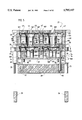
  • FIGS. 1 and 2 are elevational views, with portions broken away, illustrating a core making machine adapted to accommodate a multiple core box assembly according to the present invention during various stages of operation thereof;
  • FIG. 3 comprises an elevational view illustrating the core making machine of FIGS. 1 and 2 following ejection of the cores;
  • FIG. 4 comprises a sectional view taken generally along the lines 4--4 of FIG. 3 illustrating the core box assembly of the present invention with portions broken away;
  • FIGS. 5-9 comprise full sectional views, with portions broken away, of the core box assembly of FIG. 4 during various stages of core production;
  • FIG. 10 comprises a sectional view taken generally along the lines 10--10 of FIG. 5;
  • FIG. 11 comprises a sectional view, with portions broken away, of a core box assembly in accordance with the present invention above an alternative ejector mechanism;
  • FIG. 12 comprises a view similar to FIG. 11 following ejection of cores from the core box assembly.
  • a core making machine 20 useful in the production of sand cores 22 (seen in FIGS. 2-4) and adapted to accommodate a multiple core box assembly 23 includes a shuttle system 24 having a frame 26 and disposed below the core box assembly 23. A ram 28 for lifting the core box assembly 23 is also disposed below the core box assembly 23. Disposed above the core box assembly 23 is an injection head 29 for injecting sand 30 into the core box assembly 23.
  • FIG. 5 shows the core box assembly 23 in a closed position.
  • the core box assembly 23 has a first or lower core box 32 having a lower cope 33, a mating lower drag 35 disposed below the lower cope 33, lower core cavities 38 defined therebetween and a lower stool 39 disposed below the lower drag 35 for supporting the lower drag 35 and the remaining elements of the lower core box 32.
  • a second or upper core box 40 Located above the lower core box 32 is a second or upper core box 40 having an upper cope 41, a mating upper drag 44 disposed below the upper cope 41, and upper core cavities 47 defined between the upper cope 41 and the upper drag 44.
  • the upper core box 40 further includes an upper stool 48 disposed between the upper drag 44 and the lower cope 33 for supporting the upper drag 44 and the remaining elements of the upper core box 40.
  • the core box assembly 23 further includes passages 50 extending from a top surface 52 of the upper cope 41 into the lower drag 35 for receiving injection tubes 55. As shown in FIG. 6, the injection tubes 55 are attached to an injection plate 57 and have delivery ports 60 for passing core material into the cavities 38, 47.
  • a core making cycle begins by clamping the upper cope 41 with a clamp 61 (FIGS. 1-3).
  • a frame 64 is disposed above the cope 41 for preventing upward movement of the upper cope 41.
  • the ram 28 is raised until the core box assembly 23 is closed (seen in FIG. 1), at which point the upper cope 41 is in contact with the upper drag 44 and the lower cope 33 is in contact with the lower drag 35 (as seen in FIG. 5).
  • the injection head 29 is lowered, causing the injection tubes 55 to enter the passages 50 in the core box assembly 23 as shown in FIG. 6.
  • the injection tubes 55 stop lowering when spacer blocks 66 attached to the injection plate 57 contact the top surface 52 of the upper cope 41.
  • the delivery ports 60 in the injection tubes 55 are in fluid communication with and adjacent the lower core cavities 38 and upper core cavities 47.
  • the sand 30 is forced into the injection tubes 55 under pressure by the injection head 29, which may be an extruding head, a blowhead or any other conventional structure for forcing sand into core boxes.
  • the sand 30 exits the injection tubes 55 laterally at the delivery ports 60 and flows into the cavities 38, 47.
  • FIG. 7 shows the injection tubes 55 in the core box assembly 23 following injection of the sand 30 into the lower and upper cavities 38, 47.
  • the core box assembly 23 be capable of making cores 22 of different shapes. It will be appreciated that the number, size, shape and arrangement of the delivery ports 60 may be varied in order to optimally pass core material into different configurations of the cavities 38, 47.
  • the injection head 29 is raised, raising the injection tubes 55 above the core box assembly 23 (the raised tubes 55 are shown in FIG. 8 after opening of the core box portions).
  • a gassing plate (not shown) is then placed into engagement with the core box assembly 23. Once engaged, the gassing plate gasses and thereby cures the cores 22.
  • the ram 28 is lowered, lowering the core box assembly 23 (except for the upper cope 41) toward the shuttle system 24 in a unitary fashion.
  • the upper cope 41 is still held by the clamp 61, and thus the upper drag 44 is lowered relative to the upper cope 41, thereby exposing the cores in the upper core cavities 47.
  • guide rods 73 fixed to the lower cope 33 and slidably engaged in bushing blocks 74 contact the frame 26 of the shuttle system 24.
  • the frame 26, which is stationary, prevents further downward movement of the guide rods 73 which, in turn, prevent further downward movement of the lower cope 33.
  • the lower core box 32 opens as the lower drag 35 continues to lower relative to the lower cope 33.
  • Components of the core box assembly 23 which are located above the lower cope 33, such as the upper core box 40 (without the upper cope 41), are also prevented from further downward movement when the lower cope 33 is prevented from further downward movement by the frame 26.
  • FIG. 8 shows the core box assembly 23 in an open position supported by the frame 26 after the lower drag 35 has lowered relative to the remaining portions of the core box assembly 23. At this point, the upper cope 41 is clamped above the remaining core box portions by the clamps 61 (not shown in FIG. 8 but seen in FIGS. 1-3).
  • a lower ejector plate 79 Disposed below the lower drag 35 in the lower core box 32 is a lower ejector plate 79. Attached to a bottom portion 81 of the lower ejector plate 79 are lower push rods 83 having bottom ends 85.
  • an upper ejector plate 88 Disposed below the upper drag 44 in the upper core box 40 is an upper ejector plate 88. Attached to a bottom portion 91 of the upper ejector plate 88 are upper push rods 94 having bottom ends 97. If desired, only a single upper push rod 94 and a single lower push rod 83 may be provided and function similarly to the embodiment having multiple upper and lower push rods described below.
  • the upper push rods 94 are lifted while the lower cope 33 is being raised relative to the lower drag 35 (i.e., when the core box assembly 23 is being opened).
  • the bottom ends 85 of the lower push rods 83 are even with the bottom ends 97 of the upper push rods 94.
  • the shuttle system 24 then shuttles the core box assembly 23 from under the injection head 29 into the ejector position (FIG. 3).
  • a machine ejector 99 (FIGS. 1, 2, and 9) for ejecting the cores 22 is located below the lower drag 35.
  • the machine ejector 99 raised relative to the core box assembly 23 by a hydraulic ram or similar structure, contacts the bottom ends 97 of the upper push rods 94 and also contacts the bottom ends 85 of the lower push rods 83.
  • the rising machine ejector 99 raises the upper and lower push rods 94, 83, the upper and lower ejector plates 88, 79 are raised.
  • upper ejector pins 105 Attached to a top portion 100 of the upper ejector plate 88 are upper ejector pins 105 for ejecting the cores 22.
  • the upper ejector pins 105 extend into holes 106 in the upper drag 44 and, when the core box assembly 23 is in a closed position, tops 107 of the upper ejector pins 105 are adjacent the bottoms of the upper cavities 47.
  • lower ejector pins 108 Attached to a top portion 103 of the lower ejector plate 79 are lower ejector pins 108 for ejecting the cores 22.
  • the lower ejector pins 108 extend into holes 109 in the lower drag 35 and, when the core box assembly 23 is in a closed position, tops 111 of the lower ejector pins 108 are adjacent the bottoms of the lower cavities 38.
  • the upper and lower ejector pins 105, 108 push the cores 22 up above the respective drags 35, 44.
  • the relative positions of the lower ejector pins 108, the upper push rods 94, and the guide rods 73 in a horizontal plane are shown in FIG. 10.
  • FIG. 9 shows the assembly 114 adjacent the core box assembly 23. In that position, fingers 116 extending from the assembly 114 support the cores 22 as the machine ejector 99 is lowered. As the core box assembly 23 lowers with the machine ejector 99, the cores 22 are left upon the fingers 116.
  • the shuttle system 24 then shuttles the core box assembly 23 back under the injection head 29 and the assembly 114 retracts, carrying the cores 22 to a location where the cores 22 may be further processed, stored, or transferred.
  • the core making sequence begins again starting with the clamping of the upper cope 41 by the raising of the ram 28 to close the core box assembly 23.
  • FIGS. 11 and 12 An alternative embodiment of the present invention, shown in FIGS. 11 and 12, includes structure for ejecting the cores 22 while the core box assembly 23 is located above a ram 125 similar to the ram 28.
  • the core box assembly 23 is not shuttled to the machine ejector 99.
  • an ejector plate 128 disposed below the ram 125 is raised by an actuator (not shown), forcing ejector rods 131 upwardly through passages 134 in the ram 125.
  • the ejector rods 131 may be attached to the ejector plate 128 by any suitable means.
  • the ejector rods 131 contact the bottom ends 85, 97 of the lower and upper push rods 83, 94, respectively.
  • the lower and upper push rods 83, 94 are lifted, the lower and upper ejector plates 79, 88 are lifted and the upper and lower ejector pins 105, 108 are lifted as well.
  • the cores 22 are raised with respect to the lower and upper drags 35, 44.
  • the ejector plate 128 and the attached ejector rods 131 are raised with respect to the ram 125 prior to the core box assembly 23 being opened.
  • the core box assembly 23 opens by contacting the frame 26.
  • the ram 125, and thus the core box assembly 23, continue to lower.
  • the bottom ends 85, 97 of the lower and upper push rods 83, 94, respectively, contact the already-raised ejector rods 131.
  • the push rods 83, 94 are held stationary by the ejector rods 131 and, as the ram 125 continues to lower, the ram 125 lowers with respect to the push rods 83, 94.
  • the lower and upper drags 35, 44 are lowered with respect to the cores 22.
  • the operation of the assembly 114 is similar in this embodiment to the operation of the assembly 114 in the embodiment discussed earlier. In this embodiment, however, the cores 22 are left supported by the fingers 116 of the assembly 114 when the ejector plate 128 is lowered rather than when the machine ejector 99 is lowered.

Landscapes

  • Engineering & Computer Science (AREA)
  • Mechanical Engineering (AREA)
  • Molds, Cores, And Manufacturing Methods Thereof (AREA)
  • Casting Devices For Molds (AREA)

Abstract

A core box assembly for molding cores includes a first core box and a second core box disposed above the first core box. Each of the core boxes has a cavity. A passage for delivering core material to the cavities in the core boxes extends through the second core box and into the first core box. The second core box is placed above the first core box and core material is injected into the core boxes.

Description

TECHNICAL FIELD
The present invention relates generally to core making machines, and more particularly to an apparatus and method for producing multiple cores.
BACKGROUND ART
Core making machines are employed to produce sand cores that are in turn used to produce voids or recesses in cast parts. Such molding machines typically inject core sand (i.e., sand mixed with resin) into a core box having mating core box halves. In a horizontal parting line core box, an upper mating half or cope is disposed atop a lower mating half or drag. In a vertical parting line core box, one mating half is disposed to one side of the other mating half. Cavities for molding cores are defined, in both types of core boxes, between the mating halves.
In conventional sand core production processes, cores are produced in a core box having a single horizontal or vertical parting line. In a further known sand core production process, cores are produced in an apparatus having multiple vertical parting lines. That is, the apparatus includes at least three core box portions wherein cores are produced in cavities coincident with the vertical parting lines. Such a production technique results in a desirable increase in the number of cores that can be produced per machine cycle, thereby allowing greater productivity. A core making machine capable of manufacturing cores in such an apparatus includes a plurality of injection devices (otherwise referred to as injection heads), each of which injects core sand in a downward direction into an associated core box cavity.
While the above-described technique for increasing core production is found to be effective, its applicability to core production processes is limited. In particular, as noted above, the technique is only available for use in connection with core boxes having vertical parting lines. This is because the core sand must be injected downwardly owing to the design of the injection head. Such a filling direction cannot accommodate production of cores in a core box having more than one horizontal parting line. Thus, the technique is usable only to produce those cores that can be formed inside a box having vertical parting lines.
Some core shapes, however, are more suited for production in horizontal parting line core boxes than in vertical parting line core boxes. For example, horizontal parting line core boxes are more suitable when large cores or a large number of cores are to be produced in one core box so that the cavities for forming the cores extend relatively far from the core sand injection apparatus. Horizontal parting line core boxes are also more suitable when the invest area cannot be on the casting surface of the core.
The size of the horizontal parting line core box may be increased to increase the number of cores that can be produced during one machine cycle. The area of the top of the horizontal parting line core box, however, determines the amount of pressure required to keep the core box from parting during injection of core sand. Larger areas require higher pressure. Core making machines capable of subjecting core boxes to high pressure are generally more expensive and larger than core making machines capable of subjecting core boxes to only low pressure. Thus, increasing the size of the horizontal parting line core box has the undesirable effect of increasing the size, and thus the cost of the core making machine required to accommodate the larger core box.
SUMMARY OF THE INVENTION
The above-described problems with the prior art machines are overcome by a horizontal parting line core box assembly and a core making method in accordance with the present invention.
More particularly, an apparatus for producing cores includes a first or lower core box and a second or upper core box disposed above the lower core box. The lower core box may include a first or lower drag and a first or lower cope disposed above the lower drag. Similarly, the upper core box may include a second or upper drag and a second or upper cope disposed above the upper drag.
Preferably, means are included for lifting each cope above the corresponding drag as well as means for ejecting cores produced in the upper and lower core boxes. The ejecting means may include an upper ejector plate disposed between the upper drag and the lower cope and a lower ejector plate disposed below the lower drag. The ejecting means may also include an ejector pin.
Also preferably, a passage extends through the upper core box and into the lower core box for receiving core material. The passage is in fluid communication with first and second core cavities located in the lower and upper core boxes, respectively.
In accordance with a further aspect of the present invention, a lower core box includes a lower core cavity and an upper core box is disposed above the lower core box and has an upper core cavity therein. Delivery apparatus is provided including a core material delivery passage extending through the second core box into the first core box and delivery ports in fluid communication with the lower and upper core cavities.
A further aspect of the present invention comprises a method for producing cores utilizing a core making machine and first and second core boxes. The method includes the steps of placing the second core box above the first core box, lowering the injection head into a passage extending through the second core box into the first core box, injecting sand through the passage into cavities in the first and second core boxes to form cores, and ejecting the cores from the first and second core boxes.
The foregoing and other advantages of the invention will appear more fully hereinafter from a consideration of the detailed description which follows taken together with the accompanying drawings. It is to be expressly understood, however, that the drawings are for illustration purposes only and are not to be construed as defining the limits of the invention, reference being had to the appended claims for that purpose.
BRIEF DESCRIPTION OF THE DRAWINGS
FIGS. 1 and 2 are elevational views, with portions broken away, illustrating a core making machine adapted to accommodate a multiple core box assembly according to the present invention during various stages of operation thereof;
FIG. 3 comprises an elevational view illustrating the core making machine of FIGS. 1 and 2 following ejection of the cores;
FIG. 4 comprises a sectional view taken generally along the lines 4--4 of FIG. 3 illustrating the core box assembly of the present invention with portions broken away;
FIGS. 5-9 comprise full sectional views, with portions broken away, of the core box assembly of FIG. 4 during various stages of core production;
FIG. 10 comprises a sectional view taken generally along the lines 10--10 of FIG. 5;
FIG. 11 comprises a sectional view, with portions broken away, of a core box assembly in accordance with the present invention above an alternative ejector mechanism; and
FIG. 12 comprises a view similar to FIG. 11 following ejection of cores from the core box assembly.
DESCRIPTION OF THE PREFERRED EMBODIMENTS
Referring now to FIGS. 1-4, a core making machine 20 useful in the production of sand cores 22 (seen in FIGS. 2-4) and adapted to accommodate a multiple core box assembly 23 includes a shuttle system 24 having a frame 26 and disposed below the core box assembly 23. A ram 28 for lifting the core box assembly 23 is also disposed below the core box assembly 23. Disposed above the core box assembly 23 is an injection head 29 for injecting sand 30 into the core box assembly 23.
FIG. 5 shows the core box assembly 23 in a closed position. The core box assembly 23 has a first or lower core box 32 having a lower cope 33, a mating lower drag 35 disposed below the lower cope 33, lower core cavities 38 defined therebetween and a lower stool 39 disposed below the lower drag 35 for supporting the lower drag 35 and the remaining elements of the lower core box 32.
Located above the lower core box 32 is a second or upper core box 40 having an upper cope 41, a mating upper drag 44 disposed below the upper cope 41, and upper core cavities 47 defined between the upper cope 41 and the upper drag 44. The upper core box 40 further includes an upper stool 48 disposed between the upper drag 44 and the lower cope 33 for supporting the upper drag 44 and the remaining elements of the upper core box 40.
The core box assembly 23 further includes passages 50 extending from a top surface 52 of the upper cope 41 into the lower drag 35 for receiving injection tubes 55. As shown in FIG. 6, the injection tubes 55 are attached to an injection plate 57 and have delivery ports 60 for passing core material into the cavities 38, 47.
A core making cycle begins by clamping the upper cope 41 with a clamp 61 (FIGS. 1-3). A frame 64 is disposed above the cope 41 for preventing upward movement of the upper cope 41. After the upper cope 41 has been clamped, the ram 28 is raised until the core box assembly 23 is closed (seen in FIG. 1), at which point the upper cope 41 is in contact with the upper drag 44 and the lower cope 33 is in contact with the lower drag 35 (as seen in FIG. 5).
Once the core box assembly 23 is closed, the injection head 29 is lowered, causing the injection tubes 55 to enter the passages 50 in the core box assembly 23 as shown in FIG. 6. The injection tubes 55 stop lowering when spacer blocks 66 attached to the injection plate 57 contact the top surface 52 of the upper cope 41. At that point, the delivery ports 60 in the injection tubes 55 are in fluid communication with and adjacent the lower core cavities 38 and upper core cavities 47.
During injection, the sand 30 is forced into the injection tubes 55 under pressure by the injection head 29, which may be an extruding head, a blowhead or any other conventional structure for forcing sand into core boxes. The sand 30 exits the injection tubes 55 laterally at the delivery ports 60 and flows into the cavities 38, 47. FIG. 7 shows the injection tubes 55 in the core box assembly 23 following injection of the sand 30 into the lower and upper cavities 38, 47.
It is preferred that the core box assembly 23 be capable of making cores 22 of different shapes. It will be appreciated that the number, size, shape and arrangement of the delivery ports 60 may be varied in order to optimally pass core material into different configurations of the cavities 38, 47.
Following injection, the injection head 29 is raised, raising the injection tubes 55 above the core box assembly 23 (the raised tubes 55 are shown in FIG. 8 after opening of the core box portions). A gassing plate (not shown) is then placed into engagement with the core box assembly 23. Once engaged, the gassing plate gasses and thereby cures the cores 22.
Following curing, the ram 28 is lowered, lowering the core box assembly 23 (except for the upper cope 41) toward the shuttle system 24 in a unitary fashion. The upper cope 41 is still held by the clamp 61, and thus the upper drag 44 is lowered relative to the upper cope 41, thereby exposing the cores in the upper core cavities 47.
Also as the ram 28 is lowered, guide rods 73 fixed to the lower cope 33 and slidably engaged in bushing blocks 74 contact the frame 26 of the shuttle system 24. The frame 26, which is stationary, prevents further downward movement of the guide rods 73 which, in turn, prevent further downward movement of the lower cope 33. The lower core box 32 opens as the lower drag 35 continues to lower relative to the lower cope 33. Components of the core box assembly 23 which are located above the lower cope 33, such as the upper core box 40 (without the upper cope 41), are also prevented from further downward movement when the lower cope 33 is prevented from further downward movement by the frame 26.
FIG. 8 shows the core box assembly 23 in an open position supported by the frame 26 after the lower drag 35 has lowered relative to the remaining portions of the core box assembly 23. At this point, the upper cope 41 is clamped above the remaining core box portions by the clamps 61 (not shown in FIG. 8 but seen in FIGS. 1-3).
Disposed below the lower drag 35 in the lower core box 32 is a lower ejector plate 79. Attached to a bottom portion 81 of the lower ejector plate 79 are lower push rods 83 having bottom ends 85.
Disposed below the upper drag 44 in the upper core box 40 is an upper ejector plate 88. Attached to a bottom portion 91 of the upper ejector plate 88 are upper push rods 94 having bottom ends 97. If desired, only a single upper push rod 94 and a single lower push rod 83 may be provided and function similarly to the embodiment having multiple upper and lower push rods described below.
The upper push rods 94 are lifted while the lower cope 33 is being raised relative to the lower drag 35 (i.e., when the core box assembly 23 is being opened). When the raising of the lower cope 33 is complete, the bottom ends 85 of the lower push rods 83 are even with the bottom ends 97 of the upper push rods 94.
Once the core box assembly 23 has been opened, it is in the position shown in FIG. 2. The shuttle system 24 then shuttles the core box assembly 23 from under the injection head 29 into the ejector position (FIG. 3). Once in the ejector position, a machine ejector 99 (FIGS. 1, 2, and 9) for ejecting the cores 22 is located below the lower drag 35. The machine ejector 99, raised relative to the core box assembly 23 by a hydraulic ram or similar structure, contacts the bottom ends 97 of the upper push rods 94 and also contacts the bottom ends 85 of the lower push rods 83. As the rising machine ejector 99 raises the upper and lower push rods 94, 83, the upper and lower ejector plates 88, 79 are raised.
Attached to a top portion 100 of the upper ejector plate 88 are upper ejector pins 105 for ejecting the cores 22. The upper ejector pins 105 extend into holes 106 in the upper drag 44 and, when the core box assembly 23 is in a closed position, tops 107 of the upper ejector pins 105 are adjacent the bottoms of the upper cavities 47.
Attached to a top portion 103 of the lower ejector plate 79 are lower ejector pins 108 for ejecting the cores 22. The lower ejector pins 108 extend into holes 109 in the lower drag 35 and, when the core box assembly 23 is in a closed position, tops 111 of the lower ejector pins 108 are adjacent the bottoms of the lower cavities 38. As shown in FIG. 9, the upper and lower ejector pins 105, 108 push the cores 22 up above the respective drags 35, 44. The relative positions of the lower ejector pins 108, the upper push rods 94, and the guide rods 73 in a horizontal plane are shown in FIG. 10.
After the ejector pins 105, 108 have raised the upper and lower cores 22 above their respective drags 35, 44, a finger pick-off assembly 114 (FIGS. 1-3) for removing the cores 22 moves toward the core box assembly 23. FIG. 9 shows the assembly 114 adjacent the core box assembly 23. In that position, fingers 116 extending from the assembly 114 support the cores 22 as the machine ejector 99 is lowered. As the core box assembly 23 lowers with the machine ejector 99, the cores 22 are left upon the fingers 116.
The shuttle system 24 then shuttles the core box assembly 23 back under the injection head 29 and the assembly 114 retracts, carrying the cores 22 to a location where the cores 22 may be further processed, stored, or transferred. The core making sequence begins again starting with the clamping of the upper cope 41 by the raising of the ram 28 to close the core box assembly 23.
An alternative embodiment of the present invention, shown in FIGS. 11 and 12, includes structure for ejecting the cores 22 while the core box assembly 23 is located above a ram 125 similar to the ram 28. In such an embodiment, after the cores 22 have been formed and the frame 26 has opened the core box assembly 23 (i.e., once the lower cope 33 has been lifted upwardly relative to the lower drag 35), the core box assembly 23 is not shuttled to the machine ejector 99. Instead, an ejector plate 128 disposed below the ram 125 is raised by an actuator (not shown), forcing ejector rods 131 upwardly through passages 134 in the ram 125. The ejector rods 131 may be attached to the ejector plate 128 by any suitable means. Eventually, as seen in FIG. 12, the ejector rods 131 contact the bottom ends 85, 97 of the lower and upper push rods 83, 94, respectively. As the lower and upper push rods 83, 94 are lifted, the lower and upper ejector plates 79, 88 are lifted and the upper and lower ejector pins 105, 108 are lifted as well. As a result, the cores 22 are raised with respect to the lower and upper drags 35, 44.
In an alternative core ejection sequence, the ejector plate 128 and the attached ejector rods 131 are raised with respect to the ram 125 prior to the core box assembly 23 being opened. As the ram 125 is lowered, the core box assembly 23 opens by contacting the frame 26. The ram 125, and thus the core box assembly 23, continue to lower. Eventually, the bottom ends 85, 97 of the lower and upper push rods 83, 94, respectively, contact the already-raised ejector rods 131. The push rods 83, 94 are held stationary by the ejector rods 131 and, as the ram 125 continues to lower, the ram 125 lowers with respect to the push rods 83, 94. As a result, the lower and upper drags 35, 44 are lowered with respect to the cores 22.
The operation of the assembly 114 is similar in this embodiment to the operation of the assembly 114 in the embodiment discussed earlier. In this embodiment, however, the cores 22 are left supported by the fingers 116 of the assembly 114 when the ejector plate 128 is lowered rather than when the machine ejector 99 is lowered.
Numerous modifications and alternative embodiments of the invention will be apparent to those skilled in the art in view of the foregoing description. Accordingly, this description is to be construed as illustrative only and is for the purpose of teaching those skilled in the art the best mode of carrying out the invention. The details of the structure may be varied substantially without departing from the spirit of the invention, and the exclusive use of all modifications which come within the scope of the appended claims is reserved.

Claims (15)

We claim:
1. A core box assembly, comprising:
a lower core box having a lower core cavity;
an upper core box having an upper core cavity;
the upper core box being disposed above the lower core box; and
a passage through the upper core box and into the lower core box for passing core material, the passage being in fluid communication with the upper and lower core cavities.
2. The core box assembly of claim 1 wherein:
the lower core box includes a lower cope and a lower drag disposed below the lower cope, the lower core cavity being defined between the lower cope and the lower drag; and
the upper core box includes an upper cope and an upper drag disposed below the upper cope, the upper core cavity being defined between the upper cope and the upper drag.
3. The core box assembly of claim 2, in combination with means for lifting the upper cope above the upper drag, means for lifting the lower cope above the lower drag, and means for ejecting cores from the upper drag and the lower drag.
4. The core box assembly of claim 3, wherein the ejecting means includes an upper ejector plate disposed between the upper drag and the lower cope and a lower ejector plate disposed below the lower drag.
5. The core box assembly of claim 3, wherein the ejecting means comprises an ejector pin.
6. The core box assembly of claim 2, further including an upper ejector plate disposed between the upper drag and the lower cope and a lower ejector plate disposed below the lower core box.
7. An apparatus for producing cores, comprising:
a lower core box having a lower core cavity therein;
an upper core box disposed above the lower core box and having an upper core cavity therein; and
delivery apparatus having a core material delivery passage extending through the upper core box into the lower core box and delivery ports in fluid communication with the lower and upper core cavities.
8. The apparatus of claim 7, wherein each of the lower and upper core boxes includes a cope disposed above a mating drag.
9. The apparatus of claim 8, further including an upper ejector mechanism extending into the upper drag.
10. The apparatus of claim 9, wherein the upper ejector mechanism includes an ejector plate disposed between the drag of the upper core box and the cope of the lower core box and an ejector pin disposed on the ejector plate.
11. The apparatus of claim 9, wherein the upper ejector mechanism includes a push rod extending below the lower core box.
12. A method for producing cores utilizing a core making machine accommodating first and second core boxes, the first core box including a first cope disposed adjacent a first drag and a cavity therebetween and the second core box including a second cope disposed adjacent a second drag and a cavity therebetween, the method comprising the steps of:
placing the second core box above the first core box;
providing a passage in the first and second core boxes to accept an injection head;
lowering the injection head into the passage;
injecting sand into the cavities in the first and second core boxes to form cores therein; and
ejecting the cores from the first and second core boxes.
13. The method of claim 12, wherein the ejecting step includes the step of raising a first ejector member disposed in the first core box and a second ejector member disposed in the second core box.
14. The method of claim 12, wherein the ejecting step includes the step of raising the first cope relative to the first drag.
15. The method of claim 12, wherein the ejecting step includes the step of raising the second cope relative to the second drag.
US08/581,071 1995-12-29 1995-12-29 Apparatus and method for producing multiple cores Expired - Fee Related US5785107A (en)

Priority Applications (4)

Application Number Priority Date Filing Date Title
US08/581,071 US5785107A (en) 1995-12-29 1995-12-29 Apparatus and method for producing multiple cores
EP96307623A EP0782893A1 (en) 1995-12-29 1996-10-21 Apparatus and method for producing multiple cores
JP8314990A JPH09182934A (en) 1995-12-29 1996-11-26 Device and method for manufacturing plural core
CA002196033A CA2196033A1 (en) 1995-12-29 1997-01-27 Apparatus and method for producing multiple cores

Applications Claiming Priority (2)

Application Number Priority Date Filing Date Title
US08/581,071 US5785107A (en) 1995-12-29 1995-12-29 Apparatus and method for producing multiple cores
CA002196033A CA2196033A1 (en) 1995-12-29 1997-01-27 Apparatus and method for producing multiple cores

Publications (1)

Publication Number Publication Date
US5785107A true US5785107A (en) 1998-07-28

Family

ID=25679007

Family Applications (1)

Application Number Title Priority Date Filing Date
US08/581,071 Expired - Fee Related US5785107A (en) 1995-12-29 1995-12-29 Apparatus and method for producing multiple cores

Country Status (4)

Country Link
US (1) US5785107A (en)
EP (1) EP0782893A1 (en)
JP (1) JPH09182934A (en)
CA (1) CA2196033A1 (en)

Cited By (2)

* Cited by examiner, † Cited by third party
Publication number Priority date Publication date Assignee Title
US20100276106A1 (en) * 2009-05-04 2010-11-04 Ivo Herzog Casting tool and casting machine comprising a casting tool
CN105033175A (en) * 2015-08-09 2015-11-11 共享装备股份有限公司 Core shooting core box for producing rod-shaped sand cores

Citations (29)

* Cited by examiner, † Cited by third party
Publication number Priority date Publication date Assignee Title
SU310728A1 (en) * В. Гнеушев , Yu. V. VozhinG ^; / - ^ | ^; ..- Ch., -
DE285837C (en) * 1900-01-01
DE346370C (en) * 1919-12-20 1921-12-30 Willy Schmitz Forming machine for the production of cores for mowing machine fingers with rotatable two-part core box and ejectors for the finished cores
DE396813C (en) * 1924-06-07 John Harries Warlow Device for filling casting molds stored on top of one another
DE646304C (en) * 1936-01-24 1937-06-11 Fischer Ag Georg Device for blowing sand cores
US2899724A (en) * 1959-08-18 peterson
US2911691A (en) * 1955-08-29 1959-11-10 Edwin F Peterson Spray head core box blow tube
US3556195A (en) * 1968-06-14 1971-01-19 Pettibone Mulliken Corp Apparatus and method for making foundry and articles
US4158381A (en) * 1977-04-05 1979-06-19 Ashland Oil, Inc. Core box assembly
CH620382A5 (en) * 1975-06-27 1980-11-28 Dansk Ind Syndikat
US4560281A (en) * 1984-04-16 1985-12-24 Foundry Automation, Inc. Foundry apparatus for mixing sand with binder
US4598759A (en) * 1984-01-20 1986-07-08 Grede Foundries Inc. Apparatus for automated mixing and transport of chemically bonded sand mixtures for casting
EP0238771A1 (en) * 1984-12-03 1987-09-30 Naniwa Products Co, Ltd A moulding machine equipped with longitudinal laminating core boxes and U-shaped die plate
US4714100A (en) * 1986-12-03 1987-12-22 Roberts Corporation Method and apparatus for changing a mold box on a molding machine
US4718474A (en) * 1986-12-03 1988-01-12 Roberts Corporation Mold transfer mechanism for a molding machine
EP0278716A2 (en) * 1987-02-09 1988-08-17 Deere & Company Machine and method for forming a moulding core
US4809763A (en) * 1986-06-04 1989-03-07 Eisenwerk Bruhl Gmbh Method of and apparatus for producing molds and mold sections and cores
US4830082A (en) * 1986-12-03 1989-05-16 Roberts Corporation Machine and method for making molds using an activating gas
US4899802A (en) * 1988-03-25 1990-02-13 Erana Agustin Arana System for changing and cleaning blowing plates in core blowing machines
US4942916A (en) * 1988-07-18 1990-07-24 Equipment Merchants International Core blowing machine
US5038845A (en) * 1990-08-31 1991-08-13 Roberts Sinto Corporation Blow tube arrangement for core and mold making machinery
DE4006031A1 (en) * 1990-02-26 1991-08-29 Rexroth Mannesmann Gmbh Two-part core box - has facing hollow moulding zones to use all surfaces of the core box
SU1678503A1 (en) * 1989-04-14 1991-09-23 Производственное Объединение "Ровенский Завод Тракторных Агрегатов Им.Хху Съезда Кпсс" Method and apparatus for making hollow cores from plated sands
US5148851A (en) * 1990-06-29 1992-09-22 Sintokogio Ltd. Method of charging sand and molding machine utilizing thereof
DE4213845A1 (en) * 1992-04-28 1993-11-04 Hottinger Adolf Masch Equipment for gassing of porous foundry cores used in foundry industry - comprising core shooting mould with top, bottom and sealed gassing hood attached to top
US5355929A (en) * 1992-06-10 1994-10-18 Dansk Industri Syndikat A/S Method of and apparatus for making casting moulds
EP0635322A2 (en) * 1993-07-22 1995-01-25 Heinrich Wagner Sinto Maschinenfabrik GmbH Multi-part casting mould
EP0640418A1 (en) * 1991-07-08 1995-03-01 Metalogenia, S.A. Improvements in the production of cast steel parts provided with inner cavities
US5520240A (en) * 1993-05-03 1996-05-28 Peterle; Guido Device for supporting lower half-molds in sand core molding machines

Family Cites Families (1)

* Cited by examiner, † Cited by third party
Publication number Priority date Publication date Assignee Title
DE4113181A1 (en) * 1991-04-23 1992-10-29 Hottinger Adolf Masch Core blowing installation - utilising two faces of the core box

Patent Citations (29)

* Cited by examiner, † Cited by third party
Publication number Priority date Publication date Assignee Title
SU310728A1 (en) * В. Гнеушев , Yu. V. VozhinG ^; / - ^ | ^; ..- Ch., -
DE285837C (en) * 1900-01-01
DE396813C (en) * 1924-06-07 John Harries Warlow Device for filling casting molds stored on top of one another
US2899724A (en) * 1959-08-18 peterson
DE346370C (en) * 1919-12-20 1921-12-30 Willy Schmitz Forming machine for the production of cores for mowing machine fingers with rotatable two-part core box and ejectors for the finished cores
DE646304C (en) * 1936-01-24 1937-06-11 Fischer Ag Georg Device for blowing sand cores
US2911691A (en) * 1955-08-29 1959-11-10 Edwin F Peterson Spray head core box blow tube
US3556195A (en) * 1968-06-14 1971-01-19 Pettibone Mulliken Corp Apparatus and method for making foundry and articles
CH620382A5 (en) * 1975-06-27 1980-11-28 Dansk Ind Syndikat
US4158381A (en) * 1977-04-05 1979-06-19 Ashland Oil, Inc. Core box assembly
US4598759A (en) * 1984-01-20 1986-07-08 Grede Foundries Inc. Apparatus for automated mixing and transport of chemically bonded sand mixtures for casting
US4560281A (en) * 1984-04-16 1985-12-24 Foundry Automation, Inc. Foundry apparatus for mixing sand with binder
EP0238771A1 (en) * 1984-12-03 1987-09-30 Naniwa Products Co, Ltd A moulding machine equipped with longitudinal laminating core boxes and U-shaped die plate
US4809763A (en) * 1986-06-04 1989-03-07 Eisenwerk Bruhl Gmbh Method of and apparatus for producing molds and mold sections and cores
US4718474A (en) * 1986-12-03 1988-01-12 Roberts Corporation Mold transfer mechanism for a molding machine
US4714100A (en) * 1986-12-03 1987-12-22 Roberts Corporation Method and apparatus for changing a mold box on a molding machine
US4830082A (en) * 1986-12-03 1989-05-16 Roberts Corporation Machine and method for making molds using an activating gas
EP0278716A2 (en) * 1987-02-09 1988-08-17 Deere & Company Machine and method for forming a moulding core
US4899802A (en) * 1988-03-25 1990-02-13 Erana Agustin Arana System for changing and cleaning blowing plates in core blowing machines
US4942916A (en) * 1988-07-18 1990-07-24 Equipment Merchants International Core blowing machine
SU1678503A1 (en) * 1989-04-14 1991-09-23 Производственное Объединение "Ровенский Завод Тракторных Агрегатов Им.Хху Съезда Кпсс" Method and apparatus for making hollow cores from plated sands
DE4006031A1 (en) * 1990-02-26 1991-08-29 Rexroth Mannesmann Gmbh Two-part core box - has facing hollow moulding zones to use all surfaces of the core box
US5148851A (en) * 1990-06-29 1992-09-22 Sintokogio Ltd. Method of charging sand and molding machine utilizing thereof
US5038845A (en) * 1990-08-31 1991-08-13 Roberts Sinto Corporation Blow tube arrangement for core and mold making machinery
EP0640418A1 (en) * 1991-07-08 1995-03-01 Metalogenia, S.A. Improvements in the production of cast steel parts provided with inner cavities
DE4213845A1 (en) * 1992-04-28 1993-11-04 Hottinger Adolf Masch Equipment for gassing of porous foundry cores used in foundry industry - comprising core shooting mould with top, bottom and sealed gassing hood attached to top
US5355929A (en) * 1992-06-10 1994-10-18 Dansk Industri Syndikat A/S Method of and apparatus for making casting moulds
US5520240A (en) * 1993-05-03 1996-05-28 Peterle; Guido Device for supporting lower half-molds in sand core molding machines
EP0635322A2 (en) * 1993-07-22 1995-01-25 Heinrich Wagner Sinto Maschinenfabrik GmbH Multi-part casting mould

Cited By (3)

* Cited by examiner, † Cited by third party
Publication number Priority date Publication date Assignee Title
US20100276106A1 (en) * 2009-05-04 2010-11-04 Ivo Herzog Casting tool and casting machine comprising a casting tool
CN105033175A (en) * 2015-08-09 2015-11-11 共享装备股份有限公司 Core shooting core box for producing rod-shaped sand cores
CN105033175B (en) * 2015-08-09 2017-05-10 共享装备股份有限公司 Core shooting core box for producing rod-shaped sand cores

Also Published As

Publication number Publication date
EP0782893A1 (en) 1997-07-09
CA2196033A1 (en) 1998-07-27
JPH09182934A (en) 1997-07-15

Similar Documents

Publication Publication Date Title
US8252214B2 (en) Gas extraction method from mold cavity
CN105818333B (en) Slim Coinjection molding apparatus
US5785107A (en) Apparatus and method for producing multiple cores
CN110193916B (en) Double-inclined-top structure of injection mold for automobile back door
US3164864A (en) Metallic mold for forming a shaped article
US5962042A (en) Injection mold
CN216804206U (en) New forms of energy high temperature multiple metal insert in-mold injection mold
JPH02127957A (en) Method for casting cylinder head
JPS5839425A (en) Low pressure injection molding method
US6884381B1 (en) Injection molding method and device
CN215903900U (en) Box injection mold of installation upset lid
KR100391574B1 (en) Mold Device for Projection Forming and the Process Utilizing Thereof
CN213530677U (en) Machining die structure of box body
MXPA97001176A (en) Apparatus and method to produce multip nucleos
JPS6037776B2 (en) injection molding equipment
CN219724523U (en) A coated sand shell mold
CN120862980B (en) Mold and process for producing automobile interior injection molding part
CN220784735U (en) A special mold for producing a commander's box
CN223030255U (en) Flash-proof switch panel injection mold
CN212241865U (en) Semi-automatic and manual mould of placing copper bar inserts production of moulding plastics
CN217834529U (en) Thin-wall framework part forming mechanism with no burrs at winding positions
CN215587837U (en) Casting demolding system for commercial vehicle wheel hub
CN217514445U (en) Glue injection opening structure of glue injection mold
CN207682852U (en) A kind of abnormal shape shoulder set injection mold
JPH06262652A (en) Injection molding method and injection molding die

Legal Events

Date Code Title Description
AS Assignment

Owner name: DISA TECHNOLOGIES, INC., ILLINOIS

Free format text: ASSIGNMENT OF ASSIGNORS INTEREST;ASSIGNORS:NAGARWALLA, PHEROZE J.;HENDRIE, SCOTT;WITTE, RAYMOND F.;REEL/FRAME:007909/0609

Effective date: 19960110

AS Assignment

Owner name: GEORG FISCHER DISA, INC., ILLINOIS

Free format text: CHANGE OF NAME;ASSIGNOR:DISA TECHNOLOGIES, INC.;REEL/FRAME:007908/0792

Effective date: 19951222

REMI Maintenance fee reminder mailed
LAPS Lapse for failure to pay maintenance fees
STCH Information on status: patent discontinuation

Free format text: PATENT EXPIRED DUE TO NONPAYMENT OF MAINTENANCE FEES UNDER 37 CFR 1.362

FP Lapsed due to failure to pay maintenance fee

Effective date: 20020728