US5772413A - Bellows type pump - Google Patents

Bellows type pump Download PDF

Info

Publication number
US5772413A
US5772413A US08/816,535 US81653597A US5772413A US 5772413 A US5772413 A US 5772413A US 81653597 A US81653597 A US 81653597A US 5772413 A US5772413 A US 5772413A
Authority
US
United States
Prior art keywords
bellows
pump chamber
check valve
fill
pump
Prior art date
Legal status (The legal status is an assumption and is not a legal conclusion. Google has not performed a legal analysis and makes no representation as to the accuracy of the status listed.)
Expired - Fee Related
Application number
US08/816,535
Inventor
Toshikazu Oshidari
Current Assignee (The listed assignees may be inaccurate. Google has not performed a legal analysis and makes no representation or warranty as to the accuracy of the list.)
Nissan Motor Co Ltd
Original Assignee
Nissan Motor Co Ltd
Priority date (The priority date is an assumption and is not a legal conclusion. Google has not performed a legal analysis and makes no representation as to the accuracy of the date listed.)
Filing date
Publication date
Application filed by Nissan Motor Co Ltd filed Critical Nissan Motor Co Ltd
Assigned to NISSAN MOTOR CO., LTD. reassignment NISSAN MOTOR CO., LTD. ASSIGNMENT OF ASSIGNORS INTEREST (SEE DOCUMENT FOR DETAILS). Assignors: OSHIDARI, TOSHIKAZU
Application granted granted Critical
Publication of US5772413A publication Critical patent/US5772413A/en
Anticipated expiration legal-status Critical
Expired - Fee Related legal-status Critical Current

Links

Images

Classifications

    • FMECHANICAL ENGINEERING; LIGHTING; HEATING; WEAPONS; BLASTING
    • F16ENGINEERING ELEMENTS AND UNITS; GENERAL MEASURES FOR PRODUCING AND MAINTAINING EFFECTIVE FUNCTIONING OF MACHINES OR INSTALLATIONS; THERMAL INSULATION IN GENERAL
    • F16FSPRINGS; SHOCK-ABSORBERS; MEANS FOR DAMPING VIBRATION
    • F16F1/00Springs
    • F16F1/02Springs made of steel or other material having low internal friction; Wound, torsion, leaf, cup, ring or the like springs, the material of the spring not being relevant
    • F16F1/025Springs made of steel or other material having low internal friction; Wound, torsion, leaf, cup, ring or the like springs, the material of the spring not being relevant characterised by having a particular shape
    • FMECHANICAL ENGINEERING; LIGHTING; HEATING; WEAPONS; BLASTING
    • F02COMBUSTION ENGINES; HOT-GAS OR COMBUSTION-PRODUCT ENGINE PLANTS
    • F02MSUPPLYING COMBUSTION ENGINES IN GENERAL WITH COMBUSTIBLE MIXTURES OR CONSTITUENTS THEREOF
    • F02M37/00Apparatus or systems for feeding liquid fuel from storage containers to carburettors or fuel-injection apparatus; Arrangements for purifying liquid fuel specially adapted for, or arranged on, internal-combustion engines
    • F02M37/0011Constructional details; Manufacturing or assembly of elements of fuel systems; Materials therefor
    • F02M37/0017Constructional details; Manufacturing or assembly of elements of fuel systems; Materials therefor related to fuel pipes or their connections, e.g. joints or sealings
    • FMECHANICAL ENGINEERING; LIGHTING; HEATING; WEAPONS; BLASTING
    • F02COMBUSTION ENGINES; HOT-GAS OR COMBUSTION-PRODUCT ENGINE PLANTS
    • F02MSUPPLYING COMBUSTION ENGINES IN GENERAL WITH COMBUSTIBLE MIXTURES OR CONSTITUENTS THEREOF
    • F02M37/00Apparatus or systems for feeding liquid fuel from storage containers to carburettors or fuel-injection apparatus; Arrangements for purifying liquid fuel specially adapted for, or arranged on, internal-combustion engines
    • F02M37/04Feeding by means of driven pumps
    • FMECHANICAL ENGINEERING; LIGHTING; HEATING; WEAPONS; BLASTING
    • F04POSITIVE - DISPLACEMENT MACHINES FOR LIQUIDS; PUMPS FOR LIQUIDS OR ELASTIC FLUIDS
    • F04BPOSITIVE-DISPLACEMENT MACHINES FOR LIQUIDS; PUMPS
    • F04B43/00Machines, pumps, or pumping installations having flexible working members
    • F04B43/0009Special features
    • F04B43/0045Special features with a number of independent working chambers which are actuated successively by one mechanism
    • FMECHANICAL ENGINEERING; LIGHTING; HEATING; WEAPONS; BLASTING
    • F04POSITIVE - DISPLACEMENT MACHINES FOR LIQUIDS; PUMPS FOR LIQUIDS OR ELASTIC FLUIDS
    • F04BPOSITIVE-DISPLACEMENT MACHINES FOR LIQUIDS; PUMPS
    • F04B43/00Machines, pumps, or pumping installations having flexible working members
    • F04B43/08Machines, pumps, or pumping installations having flexible working members having tubular flexible members
    • FMECHANICAL ENGINEERING; LIGHTING; HEATING; WEAPONS; BLASTING
    • F02COMBUSTION ENGINES; HOT-GAS OR COMBUSTION-PRODUCT ENGINE PLANTS
    • F02MSUPPLYING COMBUSTION ENGINES IN GENERAL WITH COMBUSTIBLE MIXTURES OR CONSTITUENTS THEREOF
    • F02M37/00Apparatus or systems for feeding liquid fuel from storage containers to carburettors or fuel-injection apparatus; Arrangements for purifying liquid fuel specially adapted for, or arranged on, internal-combustion engines
    • F02M37/0011Constructional details; Manufacturing or assembly of elements of fuel systems; Materials therefor
    • F02M37/0023Valves in the fuel supply and return system

Definitions

  • This invention relates to a bellows type pump such as is used for supplying fuel to an engine.
  • This pump comprises a cylindrical bellows capable of elongating and contracting, and a pump chamber which is formed in a cavity inside this bellows.
  • a spring is also provided inside the bellows which presses the bellows in such a direction as to elongate it.
  • a drive mechanism comprising a rotating cam at a movable end of the bellows contracts the bellows by pressing against the force of the spring, and thereby pressurizes fuel inside the pump chamber.
  • a suction passage and discharge passage are respectively connected to the pump chamber via check valves. Fuel is aspirated into the pump chamber via the suction passage in a suction stroke when the bellows elongates, and is discharged from the chamber in a compression stroke when the bellows contracts.
  • the overall length of the bellows is set larger than the stroke length that is used for pumping so as to maintain the elasticity of the bellows at a suitable level. This increases the total capacity of the pump chamber, and the total fuel amount inside the pump chamber therefore largely exceeds the discharge amount.
  • the pressure variation in the pump chamber accompanying contraction of the chamber is also damped due to the bubbles.
  • pressure variations in the pump chamber are increasingly delayed due to the bubbles, and the timing with which the suction check valve closes is delayed. If the closing of the suction check valve overlaps with part of the compression stroke of the bellows, the pressure in the intake passage fluctuates and the suction amount of fuel to the pump chamber becomes unstable.
  • the discharge pressure of the pump is adjusted by a high pressure regulator and the suction pressure of the pump is adjusted by a low pressure regulator, but as part of the discharged fuel is returned to the suction passage via a relief valve which is a part of the high pressure regulator, pressure variations in the suction passage also cause a pressure fluctuation of the high pressure regulator.
  • this invention provides a bellows type pump comprising a cylindrical bellows capable of elongating and contracting, a member for fixing the one end of the bellows, a mechanism for moving the other end of the bellows backwards and forwards in the direction of elongation and contraction, a pump chamber formed inside the bellows which expands and contracts with the elongation and contraction of the bellows, a suction passage for aspirating a liquid to the pump chamber, a suction check valve for preventing outflow of liquid from the pump chamber into the suction passage, a discharge passage for discharging the liquid in the pump chamber, a discharge check valve for preventing inflow of liquid to the pump chamber from the discharge passage, and a fill member for eliminating a dead space in the pump chamber, and wherein the fill member is fixed to the fixing member.
  • the pump chamber is formed between the fill member and the other end of the bellows, and a connecting passage which connects the suction check valve, discharge check valve and pump chamber is formed in the fill member.
  • the bellows type pump further comprises a suction port connecting the suction check valve with the connecting passage and a discharge port connecting the discharge check valve with the connecting passage, wherein the connecting passage comprises a notch formed in an end of the fill member which faces openings of the ports.
  • the fixing member comprises an annular member which engages with the one end of the bellows, and the fill member is fixed to the fixing member by pressing the fill member into the annular member.
  • the fixing member comprises an annular member which engages with the one end of the bellows and a member for supporting the annular member
  • the fill member comprises a flange at an end
  • the fill member is fixed to the fixing member by gripping the flange between the annular member and the supporting member.
  • suction check valve or the discharge check valve is disposed inside the fill member.
  • the fill member comprises an elastic material which is filled inside the bellows while it is in a liquid state.
  • the fill member comprises a fluoride rubber. It is also preferable that the bellows is driven by a cam device which converts a rotation of an engine to an axial movement.
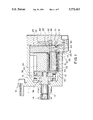
  • FIG. 1 is a vertical sectional view of a fuel pump according to a first embodiment of this invention.
  • FIG. 2 is a vertical sectional view of a bellows and a fill member used in the fuel pump.
  • FIG. 3 is a front view of the fill member.
  • FIG. 4 is a vertical sectional view of a bellows and a fill member according to a second embodiment of this invention.
  • FIG. 5 is a front view of the fill member according to the second embodiment.
  • FIG. 6 is a vertical sectional view of a bellows and a fill member according to a third embodiment of this invention.
  • FIG. 7 is a vertical sectional view of a bellows and a fill member according to a fourth embodiment of this invention.
  • FIG. 8 is a front view of the fill member according to the fourth embodiment.
  • FIG. 9 is a vertical sectional view of a bellows and a fill member according to a fifth embodiment of this invention.
  • FIG. 10 is a front view of the fill member according to the fifth embodiment.
  • FIG. 11 is a vertical sectional view of a bellows and a fill member according to a sixth embodiment of this invention.
  • FIG. 12 is a vertical sectional view of a bellows and a fill member according to a seventh embodiment of this invention.
  • FIG. 13 is a vertical sectional view of a bellows and a fill member according to an eighth embodiment of this invention.
  • a bellows type fuel pump 10 for a direct injection spark ignition engine supplies fuel to fuel injection valves which are displaced to inject fuel to respective engine cylinders.
  • the fuel pump 10 comprises a pump housing 11 joined to a cylinder head, not shown, of the engine, a pump shaft 12 supported free to rotate in the pump housing 11, an axial cam 13 formed in a one-piece construction with the pump shaft 12, and a plurality of bellows 20 which move back and forth in synchronism with the axial cam 13.
  • a key 14 is provided at one end of the pump shaft 12, and as this key 14 is coaxially engaged with a cutout formed at one end of the cam shaft, not shown, of the engine, the pump shaft 12 rotates together with the cam shaft.
  • the axial cam 13 has a cam surface inclined with respect to a plane perpendicular to the pump shaft 12, and comprises a center axis perpendicular to this inclined cam surface at its center.
  • a swash plate 32 is supported by this cam surface via a thrust bearing 35 and by the center axis via a radial bearing 36.
  • a block 24 is fixed inside the pump housing 11 relative to the swash plate 32, and another block 25 is fixed in the pump housing 11 adjacent to the block 24.
  • a plurality of cylinders 26 are formed parallel to the pump shaft 12 inside the block 24, and a bellows 20 is provided in each of the cylinders 26.
  • the bellows 20 is a cylindrically-shaped elastic member having a vertical section folded over in numerous layers.
  • One end of the bellows 20 is joined to an annular fixing member 23.
  • This annular member 23 is gripped between the blocks 24 and 25 so that the end of the bellows 20 is fixed to the block 25.
  • the other end of the bellows 20 is sealed by an annular member 33 and cover 34.
  • This annular member 33, cover 34 and part of the bellows 20 are inserted in a cylindrical bellows guide 31 having a base.
  • the bellows guide 31 engages such that it is free to slide on the inner circumference of the aforesaid cylinder 26.
  • the bellows guide 31 projects outside the cylinder 26 due to the elasticity of the bellows 20, and its base surface is in contact with the swash plate 32.
  • a radial cam having a rotation axis perpendicular to the center axis of the bellows 20 may be provided instead of the axial cam 13.
  • the housing 11 is sealed by a cover 49 on the outside of the block 25.
  • a port 43 connected to the pump chamber 40 is formed in the block 25.
  • the port 43 connects with a suction passage 21 formed in the cover 49 via a suction check valve 41, and it is also connected to a discharge passage 22 formed in the cover 49 via an discharge check valve 42.
  • These check valves 41 and 42 are pushed by springs 44 and 46, and seal the port 43 when they are respectively seated in valve seats 45 gripped between the block 25 and cover 49.
  • the fuel pump 10 aspirates fuel into the pump chamber 40 from the suction passage 21 via the inlet check valve 41 according to the elongation of the bellows 20.
  • the fuel is pressurized, and is discharged to the discharge passage 22 via the discharge check valve 42.
  • Fuel in the suction passage 21 is adjusted to constant pressure by a low pressure regulator, not shown, and fuel in the discharge passage 22 is adjusted to constant pressure by a high pressure regulator, not shown.
  • a seal ring 29 is interposed between the block 25 and annular member 23 so that fuel does not leak from the pump chamber 40 into the housing 11.
  • the contracting length of the bellows 20 i.e. the length difference between the extended length and contracted length of the bellows, is shorter than their overall length, so only part of the fuel in the pump chamber 40 is discharged from the discharge passage 42. A considerable volume of fuel therefore remains in the pump chamber 40 even when the bellows are contracted.
  • a fill member 50 is provided in the dead space of the bellows 20 to reduce this residual fuel amount.
  • the fill member 50 is a material of high bulk elastic modulus.
  • the fill member 50 is formed in the shape of a circular column of which the outer diameter is slightly smaller than the inner diameter of the bellows 20. One end of the fill member 50 is pressed into the annular member 23 so as to penetrate it. One end of the fill member 50 is thereby fixed to the fixed end of the bellows 20.
  • the fill member 50 is made as long as is possible to the extent that the cover 34 does not come in contact with the fill member 50 when the bellows 20 is most contracted.
  • a gap formed between the cover 34 and the fill member 50 is the actual pump chamber 40 as shown in FIG. 1.
  • a connecting passage 51 connecting the pump chamber 40 and port 43 is formed in the fill member 50.
  • This connecting passage 51 is a groove 57 in the outer circumferential surface of the fill member 50, as shown in FIG. 2.
  • a knock pin 52 projects from one end of the fill member 50 as shown in FIGS. 2 and 3.
  • a positioning hole, not shown, which engages with the knock pin 52, is formed in the block 25.
  • the knock pin 52 and positioning hole are offset with respect to the center of the fill member 50. Positioning of the fill member 50 in the rotation direction is achieved by the engaging of the knock pin 52 with the block 25 so that the connecting passage 51 and port 43 are connected.
  • the fill member 50 By providing the fill member 50 to fill dead space in the bellows 20 in this way, the sum of the volume changes of the pump chamber 40 increases relative to the total volume of the pump chamber 40.
  • the fuel amount aspirated into the pump chamber 40 via the suction check valve 41 is therefore sufficient, and the predetermined pump discharge amount is obtained.
  • FIGS. 4 and 5 show a second embodiment of this invention.
  • the connecting passage 51 has an L-shaped vertical section formed by the groove 57 in the outer circumferential surface of the fill member 50 and the groove 58 in the end face of the fill member 50.
  • a suction port 54 and discharge port 55 are respectively formed in the block 25.
  • the suction port 54 and discharge port 55 both open out onto the groove 58.
  • the suction port 54 is connected to the suction passage 21 via the suction check valve 41, and the discharge port 55 is connected to the discharge passage 22 via the discharge check valve 42.
  • the knock pin 52 is installed away from the groove 58. According to this embodiment, the suction port 54 and discharge port 55 are independent from one another, so the pressure loss in the fuel pump 10 can be further reduced.
  • FIG. 6 shows a third embodiment of this invention.
  • the fill member 50 has a center projection 60 which projects in an axial direction from the end face.
  • An annular gap 59 connected to the groove 57 is formed around the center projection 60.
  • the connecting passage 51 is formed by this annular gap 59 and the groove 57 in the outer circumferential surface of the fill member 50.
  • the center projection 60 is pressed into a hollow, not shown, provided in the block 25 of the aforesaid first and second embodiments. One end of the fill member 50 is thereby fixed to the block 25. A suction port and discharge port similar to those of the second embodiment are also formed near the annular gap 59.
  • the suction port and discharge port are independent so pressure losses in the fuel pump may be considerably suppressed.
  • FIGS. 7 and 8 show a fourth embodiment of this invention.
  • the fill member 50 comprises a flange 63.
  • the flange 63 is gripped by the annular member 26 and block 25 so that one end of the fill member 50 is fixed to the block.
  • the connecting passage 51 is formed from the groove 57 in the outer circumferential surface of the fill member 50, and a hole 64 in the base surface of the fill member 50.
  • a seal ring 67 is interposed between the flange 63 and block 25.
  • a suction port 66 and discharge port 65 are formed in the block 25 so that they connect with the hole 64.
  • the knock pin 52 is disposed such that it does not overlap with the center of the fill member 50, and such that it is situated away from the hole 64.
  • FIGS. 9 and 10 show a fifth embodiment of this invention.
  • the fill member 50 according to this embodiment comprises the same flange 63 as in the fourth embodiment.
  • the connecting passage 51 comprises the groove 57 in the outer circumferential surface of the fill member 50, the hole 64 in the base surface of the fill member 50, and a hollow 68 formed in a disk shape in the base surface of the fill member 50.
  • a suction port 54 and discharge port 55 are formed in the block 25 as in the case of the second embodiment.
  • the suction port 54 and discharge port 55 both open out onto the hollow 68.
  • Part of the knock pin 52 projects into the hollow 68.
  • the suction port 54 and discharge port 55 can be made to open into the hollow 68 separately so that pressure losses in the fuel pump are suppressed to a low level.
  • FIG. 11 shows a sixth embodiment of this invention.
  • the fill member 50 comprises the flange 63 at one of its ends.
  • the flange 63 is gripped between the annular member 23 and the same type of block as the block 25 of the fifth embodiment.
  • a suction check valve 71 and discharge check valve 72 are provided in the fill member 50.
  • the suction check valve 71 is seated in a valve seat 75 due to the spring force of a spring 74, and allows flow of fuel only from the suction passage in the block to the pump chamber 40.
  • the discharge check valve 72 is seated in the valve seat 73 due to the spring force of a spring 76, and allows flow of fuel only from the pump chamber 40 to the discharge passage.
  • the inlet check valve 71 and outlet check valve 72 may be supplied as a unit together with the bellows 20 in the fill member 50. As there is no need to provide a check valve in the block or cover, it is unnecessary to machine these parts.
  • FIG. 12 shows a seventh embodiment according to this invention.
  • a fill member 80 fixed to the cover 34 is provided without fixing to the block 25.
  • the fill member 80 is formed in the shape of a cylinder having an outer diameter slightly less than the inner diameter of the bellows 20.
  • An engaging hole is formed in the fill member 80 and the end face, and a projection 81 is formed which engages with the engaging hole in the cover 34.
  • One end of the fill member 80 is pressed into the inner circumference of the annular member 33 so that this projection 81 engages with the engaging hole.
  • One end of the fill member 80 is thereby fixed to the movable end of the bellows 20 via the annular member 33, and it moves together with the movable end of the bellows 20, i.e. together with the cover 34.
  • the length of the fill member 80 is arranged to be slightly less than the distance between the block 25 and the cover 34 when the bellows 20 is most contracted.
  • the gap between the block 25 and one end of the fill member 80 forms the pump chamber 40.
  • the suction port 54 and discharge port 55 are separately formed in the block 25, and they both open out into the pump chamber 40.
  • the suction port 54 is connected to the suction passage 21 via the suction check valve 41, and the discharge port 55 is connected to the discharge passage 22 via the discharge check valve 42.
  • the pump chamber 40 is formed by the block 25, there is no need to form a connecting passage in the fill member as in the aforesaid first to sixth embodiments, and pressure losses in the fuel pump are therefore reduced by a corresponding amount.
  • the suction port 54 and discharge port 55 can be separately provided without forming a groove or hollow in the fill member.
  • FIG. 13 shows an eighth embodiment of this invention.
  • the interior of the bellows 20 is first filled with fluoride rubber or the like to act as a fill member 90.
  • this member 90 may also be a material which is a liquid during filling, which functions as an elastic material after solidifying, and which is not deteriorated by gasoline.
  • the solidified fill member 90 elongates and contracts together with the bellows 20.
  • the fill member 90 is filled from the fixed end of the bellows 20.
  • the filling amount of the fluoride rubber is determined according to the capacity of the pump chamber 40 formed between the block 25 and fill member 90.
  • suction port 54, discharge port 55 and check valves 41, 42 have an identical construction to that of the aforesaid seventh embodiment. According to this embodiment, it is unnecessary to press the fill member 90 in or position it.
Landscapes

  • Engineering & Computer Science (AREA)
  • General Engineering & Computer Science (AREA)
  • Mechanical Engineering (AREA)
  • Chemical & Material Sciences (AREA)
  • Combustion & Propulsion (AREA)
  • Reciprocating Pumps (AREA)
  • Check Valves (AREA)

Abstract

A pump chamber for compressing a liquid such as engine fuel is formed inside a bellows, and the liquid is aspirated into the pump chamber from a suction check valve when the bellows elongates. After the liquid in the pump chamber is pressurized by the contraction of the bellows, it is discharged from a discharge check valve. By providing a fill member for eliminating a dead space in the pump chamber, the formation of air bubbles in the pump chamber is suppressed.

Description

FIELD OF THE INVENTION
This invention relates to a bellows type pump such as is used for supplying fuel to an engine.
BACKGROUND OF THE INVENTION
In a direct injection type engine wherein fuel is supplied to a cylinder via an injector facing the cylinder, a compact fuel pump is required which can deliver sufficient fuel injection pressure, such as is disclosed for example in Tokkai Hei 4-187865 published by the Japanese Patent Office in 1992.
This pump comprises a cylindrical bellows capable of elongating and contracting, and a pump chamber which is formed in a cavity inside this bellows.
A spring is also provided inside the bellows which presses the bellows in such a direction as to elongate it. A drive mechanism comprising a rotating cam at a movable end of the bellows contracts the bellows by pressing against the force of the spring, and thereby pressurizes fuel inside the pump chamber. A suction passage and discharge passage are respectively connected to the pump chamber via check valves. Fuel is aspirated into the pump chamber via the suction passage in a suction stroke when the bellows elongates, and is discharged from the chamber in a compression stroke when the bellows contracts.
In this bellows type fuel pump, the overall length of the bellows is set larger than the stroke length that is used for pumping so as to maintain the elasticity of the bellows at a suitable level. This increases the total capacity of the pump chamber, and the total fuel amount inside the pump chamber therefore largely exceeds the discharge amount.
When the pump rotation speed increases, numerous air bubbles are generated in the suction stroke, and expand into the pump chamber.
The pressure drop of the pump chamber in the suction stroke accordingly decreases,
As a result, the fuel amount aspirated into the pump chamber is insufficient, and the pump discharge amount is also insufficient.
The pressure variation in the pump chamber accompanying contraction of the chamber is also damped due to the bubbles. As the cam rotation speed increases, pressure variations in the pump chamber are increasingly delayed due to the bubbles, and the timing with which the suction check valve closes is delayed. If the closing of the suction check valve overlaps with part of the compression stroke of the bellows, the pressure in the intake passage fluctuates and the suction amount of fuel to the pump chamber becomes unstable. The discharge pressure of the pump is adjusted by a high pressure regulator and the suction pressure of the pump is adjusted by a low pressure regulator, but as part of the discharged fuel is returned to the suction passage via a relief valve which is a part of the high pressure regulator, pressure variations in the suction passage also cause a pressure fluctuation of the high pressure regulator.
SUMMARY OF THE INVENTION
It is therefore an object of this invention to prevent air bubbles from forming inside the pressure chamber of a bellows type pump.
It is a further object of this invention to reduce pressure losses inside a bellows type pump.
In order to achieve the above objects, this invention provides a bellows type pump comprising a cylindrical bellows capable of elongating and contracting, a member for fixing the one end of the bellows, a mechanism for moving the other end of the bellows backwards and forwards in the direction of elongation and contraction, a pump chamber formed inside the bellows which expands and contracts with the elongation and contraction of the bellows, a suction passage for aspirating a liquid to the pump chamber, a suction check valve for preventing outflow of liquid from the pump chamber into the suction passage, a discharge passage for discharging the liquid in the pump chamber, a discharge check valve for preventing inflow of liquid to the pump chamber from the discharge passage, and a fill member for eliminating a dead space in the pump chamber, and wherein the fill member is fixed to the fixing member.
It is preferable that the pump chamber is formed between the fill member and the other end of the bellows, and a connecting passage which connects the suction check valve, discharge check valve and pump chamber is formed in the fill member.
In this case it is further preferable that the bellows type pump further comprises a suction port connecting the suction check valve with the connecting passage and a discharge port connecting the discharge check valve with the connecting passage, wherein the connecting passage comprises a notch formed in an end of the fill member which faces openings of the ports.
It is also preferable that the fixing member comprises an annular member which engages with the one end of the bellows, and the fill member is fixed to the fixing member by pressing the fill member into the annular member.
It is also preferable that the fixing member comprises an annular member which engages with the one end of the bellows and a member for supporting the annular member, the fill member comprises a flange at an end, and the fill member is fixed to the fixing member by gripping the flange between the annular member and the supporting member.
It is also preferable that either the suction check valve or the discharge check valve is disposed inside the fill member.
It is also preferable that the fill member comprises an elastic material which is filled inside the bellows while it is in a liquid state.
In this case it is further preferable that the fill member comprises a fluoride rubber. It is also preferable that the bellows is driven by a cam device which converts a rotation of an engine to an axial movement.
The details as well as other features and advantages of this invention are set forth in the remainder of the specification and are shown in the accompanying drawings.
BRIEF DESCRIPTION OF THE DRAWINGS
FIG. 1 is a vertical sectional view of a fuel pump according to a first embodiment of this invention.
FIG. 2 is a vertical sectional view of a bellows and a fill member used in the fuel pump.
FIG. 3 is a front view of the fill member.
FIG. 4 is a vertical sectional view of a bellows and a fill member according to a second embodiment of this invention.
FIG. 5 is a front view of the fill member according to the second embodiment.
FIG. 6 is a vertical sectional view of a bellows and a fill member according to a third embodiment of this invention.
FIG. 7 is a vertical sectional view of a bellows and a fill member according to a fourth embodiment of this invention.
FIG. 8 is a front view of the fill member according to the fourth embodiment.
FIG. 9 is a vertical sectional view of a bellows and a fill member according to a fifth embodiment of this invention.
FIG. 10 is a front view of the fill member according to the fifth embodiment.
FIG. 11 is a vertical sectional view of a bellows and a fill member according to a sixth embodiment of this invention.
FIG. 12 is a vertical sectional view of a bellows and a fill member according to a seventh embodiment of this invention.
FIG. 13 is a vertical sectional view of a bellows and a fill member according to an eighth embodiment of this invention.
DESCRIPTION OF THE PREFERRED EMBODIMENTS
Referring to FIG. 1 of the drawings, a bellows type fuel pump 10 for a direct injection spark ignition engine supplies fuel to fuel injection valves which are displaced to inject fuel to respective engine cylinders.
The fuel pump 10 comprises a pump housing 11 joined to a cylinder head, not shown, of the engine, a pump shaft 12 supported free to rotate in the pump housing 11, an axial cam 13 formed in a one-piece construction with the pump shaft 12, and a plurality of bellows 20 which move back and forth in synchronism with the axial cam 13. A key 14 is provided at one end of the pump shaft 12, and as this key 14 is coaxially engaged with a cutout formed at one end of the cam shaft, not shown, of the engine, the pump shaft 12 rotates together with the cam shaft.
The axial cam 13 has a cam surface inclined with respect to a plane perpendicular to the pump shaft 12, and comprises a center axis perpendicular to this inclined cam surface at its center. A swash plate 32 is supported by this cam surface via a thrust bearing 35 and by the center axis via a radial bearing 36.
A block 24 is fixed inside the pump housing 11 relative to the swash plate 32, and another block 25 is fixed in the pump housing 11 adjacent to the block 24.
A plurality of cylinders 26 are formed parallel to the pump shaft 12 inside the block 24, and a bellows 20 is provided in each of the cylinders 26. The bellows 20 is a cylindrically-shaped elastic member having a vertical section folded over in numerous layers.
It is pushed in the elongating direction by its own elasticity, and contracts when it is subject to a compressive force in the axial direction in the opposite sense.
One end of the bellows 20 is joined to an annular fixing member 23. This annular member 23 is gripped between the blocks 24 and 25 so that the end of the bellows 20 is fixed to the block 25.
The other end of the bellows 20 is sealed by an annular member 33 and cover 34. This annular member 33, cover 34 and part of the bellows 20 are inserted in a cylindrical bellows guide 31 having a base.
The bellows guide 31 engages such that it is free to slide on the inner circumference of the aforesaid cylinder 26. The bellows guide 31 projects outside the cylinder 26 due to the elasticity of the bellows 20, and its base surface is in contact with the swash plate 32.
Hence when the pump shaft 12 and axial cam 13 rotate together, the swash plate 32 supported by the axial cam 13 via the thrust bearing 35 and radial bearing 36 swings around without rotating, and the bellows 20 periodically contracts via the bellows guide 31. A radial cam having a rotation axis perpendicular to the center axis of the bellows 20 may be provided instead of the axial cam 13.
The housing 11 is sealed by a cover 49 on the outside of the block 25.
A port 43 connected to the pump chamber 40 is formed in the block 25. The port 43 connects with a suction passage 21 formed in the cover 49 via a suction check valve 41, and it is also connected to a discharge passage 22 formed in the cover 49 via an discharge check valve 42. These check valves 41 and 42 are pushed by springs 44 and 46, and seal the port 43 when they are respectively seated in valve seats 45 gripped between the block 25 and cover 49.
The fuel pump 10 aspirates fuel into the pump chamber 40 from the suction passage 21 via the inlet check valve 41 according to the elongation of the bellows 20. When the bellows 20 contracts, the fuel is pressurized, and is discharged to the discharge passage 22 via the discharge check valve 42.
Fuel in the suction passage 21 is adjusted to constant pressure by a low pressure regulator, not shown, and fuel in the discharge passage 22 is adjusted to constant pressure by a high pressure regulator, not shown.
A seal ring 29 is interposed between the block 25 and annular member 23 so that fuel does not leak from the pump chamber 40 into the housing 11.
However the contracting length of the bellows 20, i.e. the length difference between the extended length and contracted length of the bellows, is shorter than their overall length, so only part of the fuel in the pump chamber 40 is discharged from the discharge passage 42. A considerable volume of fuel therefore remains in the pump chamber 40 even when the bellows are contracted.
According to this invention, a fill member 50 is provided in the dead space of the bellows 20 to reduce this residual fuel amount. The fill member 50 is a material of high bulk elastic modulus.
The fill member 50 is formed in the shape of a circular column of which the outer diameter is slightly smaller than the inner diameter of the bellows 20. One end of the fill member 50 is pressed into the annular member 23 so as to penetrate it. One end of the fill member 50 is thereby fixed to the fixed end of the bellows 20.
The fill member 50 is made as long as is possible to the extent that the cover 34 does not come in contact with the fill member 50 when the bellows 20 is most contracted.
A gap formed between the cover 34 and the fill member 50 is the actual pump chamber 40 as shown in FIG. 1.
A connecting passage 51 connecting the pump chamber 40 and port 43 is formed in the fill member 50. This connecting passage 51 is a groove 57 in the outer circumferential surface of the fill member 50, as shown in FIG. 2.
A knock pin 52 projects from one end of the fill member 50 as shown in FIGS. 2 and 3. A positioning hole, not shown, which engages with the knock pin 52, is formed in the block 25.
The knock pin 52 and positioning hole are offset with respect to the center of the fill member 50. Positioning of the fill member 50 in the rotation direction is achieved by the engaging of the knock pin 52 with the block 25 so that the connecting passage 51 and port 43 are connected.
By providing the fill member 50 to fill dead space in the bellows 20 in this way, the sum of the volume changes of the pump chamber 40 increases relative to the total volume of the pump chamber 40.
Consequently the amount of fuel in the pump chamber 40 decreases, so the amount of bubbles produced in the fuel in the pump chamber during the suction stroke when the bellows 20 elongates, decreases.
As the amount of air bubbles in the pump chamber 40 is reduced, the pressure drop in the chamber 40 due to elongation of the bellows 20 also increases.
The fuel amount aspirated into the pump chamber 40 via the suction check valve 41 is therefore sufficient, and the predetermined pump discharge amount is obtained.
Due to the lesser amount of air bubbles, the pressure variation delay in the pump chamber 40 when the bellows 20 elongate and contract is less, so the timing with which the suction check valve 41 closes is maintained within a suitable range even when the pump rotation speed increases. Therefore, pressure variations in the suction passage 21 tend to occur less.
As the connecting passage 51 is connected with the port 43, fuel flows smoothly between the pump chamber 40 and port 43, and pressure losses in the fuel pump 1 are also suppressed.
FIGS. 4 and 5 show a second embodiment of this invention.
According to this embodiment, the connecting passage 51 has an L-shaped vertical section formed by the groove 57 in the outer circumferential surface of the fill member 50 and the groove 58 in the end face of the fill member 50. A suction port 54 and discharge port 55 are respectively formed in the block 25. The suction port 54 and discharge port 55 both open out onto the groove 58. The suction port 54 is connected to the suction passage 21 via the suction check valve 41, and the discharge port 55 is connected to the discharge passage 22 via the discharge check valve 42.
The knock pin 52 is installed away from the groove 58. According to this embodiment, the suction port 54 and discharge port 55 are independent from one another, so the pressure loss in the fuel pump 10 can be further reduced.
FIG. 6 shows a third embodiment of this invention.
The fill member 50 according to this embodiment has a center projection 60 which projects in an axial direction from the end face. An annular gap 59 connected to the groove 57 is formed around the center projection 60. The connecting passage 51 is formed by this annular gap 59 and the groove 57 in the outer circumferential surface of the fill member 50.
The center projection 60 is pressed into a hollow, not shown, provided in the block 25 of the aforesaid first and second embodiments. One end of the fill member 50 is thereby fixed to the block 25. A suction port and discharge port similar to those of the second embodiment are also formed near the annular gap 59.
According also to this embodiment, the suction port and discharge port are independent so pressure losses in the fuel pump may be considerably suppressed.
FIGS. 7 and 8 show a fourth embodiment of this invention.
According to this embodiment, the fill member 50 comprises a flange 63. The flange 63 is gripped by the annular member 26 and block 25 so that one end of the fill member 50 is fixed to the block.
The connecting passage 51 is formed from the groove 57 in the outer circumferential surface of the fill member 50, and a hole 64 in the base surface of the fill member 50. A seal ring 67 is interposed between the flange 63 and block 25. A suction port 66 and discharge port 65 are formed in the block 25 so that they connect with the hole 64.
The knock pin 52 is disposed such that it does not overlap with the center of the fill member 50, and such that it is situated away from the hole 64.
According to this embodiment, positioning in an axial direction of the fill member 50 is performed via the flange 63, so assembly precision of the fill member is enhanced.
FIGS. 9 and 10 show a fifth embodiment of this invention.
The fill member 50 according to this embodiment comprises the same flange 63 as in the fourth embodiment.
The connecting passage 51 comprises the groove 57 in the outer circumferential surface of the fill member 50, the hole 64 in the base surface of the fill member 50, and a hollow 68 formed in a disk shape in the base surface of the fill member 50. A suction port 54 and discharge port 55 are formed in the block 25 as in the case of the second embodiment. The suction port 54 and discharge port 55 both open out onto the hollow 68. Part of the knock pin 52 projects into the hollow 68.
According to this embodiment, due to the hollow 68, the suction port 54 and discharge port 55 can be made to open into the hollow 68 separately so that pressure losses in the fuel pump are suppressed to a low level.
FIG. 11 shows a sixth embodiment of this invention.
The fill member 50 comprises the flange 63 at one of its ends. The flange 63 is gripped between the annular member 23 and the same type of block as the block 25 of the fifth embodiment. A suction check valve 71 and discharge check valve 72 are provided in the fill member 50. The suction check valve 71 is seated in a valve seat 75 due to the spring force of a spring 74, and allows flow of fuel only from the suction passage in the block to the pump chamber 40.
The discharge check valve 72 is seated in the valve seat 73 due to the spring force of a spring 76, and allows flow of fuel only from the pump chamber 40 to the discharge passage.
According to this embodiment, the inlet check valve 71 and outlet check valve 72 may be supplied as a unit together with the bellows 20 in the fill member 50. As there is no need to provide a check valve in the block or cover, it is unnecessary to machine these parts.
FIG. 12 shows a seventh embodiment according to this invention.
According to this embodiment, a fill member 80 fixed to the cover 34 is provided without fixing to the block 25.
The fill member 80 is formed in the shape of a cylinder having an outer diameter slightly less than the inner diameter of the bellows 20. An engaging hole is formed in the fill member 80 and the end face, and a projection 81 is formed which engages with the engaging hole in the cover 34. One end of the fill member 80 is pressed into the inner circumference of the annular member 33 so that this projection 81 engages with the engaging hole. One end of the fill member 80 is thereby fixed to the movable end of the bellows 20 via the annular member 33, and it moves together with the movable end of the bellows 20, i.e. together with the cover 34.
The length of the fill member 80 is arranged to be slightly less than the distance between the block 25 and the cover 34 when the bellows 20 is most contracted. The gap between the block 25 and one end of the fill member 80 forms the pump chamber 40. The suction port 54 and discharge port 55 are separately formed in the block 25, and they both open out into the pump chamber 40. The suction port 54 is connected to the suction passage 21 via the suction check valve 41, and the discharge port 55 is connected to the discharge passage 22 via the discharge check valve 42.
According to this embodiment, as the pump chamber 40 is formed by the block 25, there is no need to form a connecting passage in the fill member as in the aforesaid first to sixth embodiments, and pressure losses in the fuel pump are therefore reduced by a corresponding amount. Further, the suction port 54 and discharge port 55 can be separately provided without forming a groove or hollow in the fill member.
FIG. 13 shows an eighth embodiment of this invention.
According to this embodiment, the interior of the bellows 20 is first filled with fluoride rubber or the like to act as a fill member 90. However this member 90 may also be a material which is a liquid during filling, which functions as an elastic material after solidifying, and which is not deteriorated by gasoline. The solidified fill member 90 elongates and contracts together with the bellows 20. The fill member 90 is filled from the fixed end of the bellows 20. The filling amount of the fluoride rubber is determined according to the capacity of the pump chamber 40 formed between the block 25 and fill member 90.
The suction port 54, discharge port 55 and check valves 41, 42 have an identical construction to that of the aforesaid seventh embodiment. According to this embodiment, it is unnecessary to press the fill member 90 in or position it.

Claims (13)

The embodiments of this invention in which an exclusive property or privilege is claimed are defined as follows:
1. A bellows type pump comprising:
a cylindrical bellows capable of elongating and contracting,
a fixing member to which one end of said bellows is connected,
a mechanism for moving the other end of said bellows backwards and forwards with respect to said fixing member in the direction of elongation and contraction,
a pump chamber formed inside the bellows which expands and contracts with the elongation and contraction of said bellows,
a suction passage for aspirating a liquid to the pump chamber,
a suction check valve for preventing outflow of liquid from said pump chamber into said suction passage,
a discharge check valve for preventing inflow of liquid to said pump chamber form said discharge passage, and
a fill member for eliminating a dead space in said pump chamber, wherein said fill member is fixed to the fixing member.
2. A bellows type pump as defined in claim 1, wherein said bellows type pump is driven by a cam.
3. A bellows type pump as defined in claim 1, wherein said bellows is driven by a cam device which converts a rotation of an engine to reciprocal movement of said bellows.
4. A bellows type pump as defined in claim 1, wherein said fill member is essentially cylindrical and is connected to said fixing member by a pin, said pin being eccentric with respect to the essentially cylindrical fill member and such to locate the fill member in a predetermined position within said bellows.
5. A bellows type pump as defined in claim 1, wherein said fill member is made of a material having a high bulk elastic modulus.
6. A bellows type pump comprising:
a cylindrical bellows capable of elongating and contracting,
a fixing member to which one end of said bellows is connected,
a mechanism for moving the other end of said bellows backwards and forwards in the direction of elongation and contraction,
a pump chamber formed inside the bellows which expands and contracts with the elongation and contraction of said bellows,
a suction passage for aspirating a liquid to the pump chamber,
a suction check valve for preventing outflow of liquid from said pump chamber into said suction passage,
a discharge check valve for preventing inflow of liquid to said pump chamber from said discharge passage, and
a fill member for eliminating a dead space in said pump chamber,
wherein said fill member is fixed to the fixing member, said pump chamber is formed between said fill member and the other end of said bellows, and a connecting passage which connects said suction check valve, discharge check valve and pump chamber is formed in said fill member.
7. A bellows type pump as defined in claim 6, further comprising a suction port connecting said suction check valve with said connecting passage and a discharge port connecting said discharge check valve with said connecting passage, wherein said connecting passage comprises a notch formed in an end of said fill member which faces openings of said ports.
8. A bellows type pump as defined in claim 6, wherein said fixing member comprises an annular member which engages with the one end of said bellows, and said fill member is fixed to said fixing member by pressing said fill member into said annular member.
9. A bellows type pump as defined in claim 6, wherein said fixing member comprises an annular member which engages with the one end of said bellows and a member for supporting said annular member, said fill member comprises a flange at an end, and said fill member is fixed to said fixing member by gripping said flange between said annular member and said supporting member.
10. A bellows type pump comprising:
a cylindrical bellows capable of elongating and contracting,
a fixing member to which one end of said bellows is connected,
a mechanism for moving the other end of said bellows backwards and forwards in the direction of elongation and contraction,
a pump chamber formed inside the bellows which expands and contracts with the elongation and contraction of said bellows,
a suction passage for aspirating a liquid to the pump chamber,
a suction check valve for preventing outflow of liquid from said pump chamber into said suction passage,
a discharge check valve for preventing inflow of liquid to said pump chamber from said discharge passage, and
a fill member for eliminating a dead space in said pump chamber,
wherein one of said suction check valve and said discharge check valve is disposed inside said fill member.
11. A bellows type pump comprising:
a cylindrical bellows capable of elongating and contracting,
a fixing member to which one end of said bellows is connected,
a mechanism for moving the other end of said bellows backwards and forwards in the direction of elongation and contraction,
a pump chamber formed inside the bellows which expands and contracts with the elongation and contraction of said bellows,
a suction passage for aspirating a liquid to the pump chamber,
a suction check valve for preventing outflow of liquid from said pump chamber into said suction passage,
a discharge check valve for preventing inflow of liquid to said pump chamber from said discharge passage, and
a fill member for eliminating a dead space in said pump chamber,
wherein said fill member is formed of a material which is made of one of a material of high bulk elastic modulus and rubber fixed to the other end of said bellows, and said pump chamber is formed between said fill member and said fixing member.
12. A bellows type pump comprising:
a cylindrical bellows capable of elongating and contracting,
a fixing member to which one end of said bellows is connected,
a mechanism for moving the other end of said bellows backwards and forwards in the direction of elongation and contraction,
a pump chamber formed inside the bellows which expands and contracts with the elongation and contraction of said bellows,
a suction passage for aspirating a liquid to the pump chamber,
a suction check valve for preventing outflow of liquid from said pump chamber into said suction passage,
a discharge check valve for preventing inflow of liquid to said pump chamber from said discharge passage, and
a fill member for eliminating a dead space in said pump chamber,
wherein said fill member comprises an elastic material which is filled into said bellows while it is in a liquid state.
13. A bellows type pump as defined in claim 12, wherein said fill member comprises a fluoride rubber.
US08/816,535 1996-03-21 1997-03-13 Bellows type pump Expired - Fee Related US5772413A (en)

Applications Claiming Priority (2)

Application Number Priority Date Filing Date Title
JP06464196A JP3757459B2 (en) 1996-03-21 1996-03-21 Bellows type fuel pump
JP8-064641 1996-03-21

Publications (1)

Publication Number Publication Date
US5772413A true US5772413A (en) 1998-06-30

Family

ID=13264105

Family Applications (1)

Application Number Title Priority Date Filing Date
US08/816,535 Expired - Fee Related US5772413A (en) 1996-03-21 1997-03-13 Bellows type pump

Country Status (3)

Country Link
US (1) US5772413A (en)
JP (1) JP3757459B2 (en)
DE (1) DE19711727C2 (en)

Cited By (8)

* Cited by examiner, † Cited by third party
Publication number Priority date Publication date Assignee Title
US6024345A (en) * 1996-09-25 2000-02-15 Nippon Pillar Packing Co., Ltd. Resin-made spring and a bellows type constant volume pump using the same
US6036448A (en) * 1998-09-11 2000-03-14 Chrysler Corporation Fuel pump sealed in a bellows
US6544005B2 (en) 2000-11-28 2003-04-08 Wade Metal Products Limited Diaphragm for a diaphragm pump
US20050189727A1 (en) * 2002-04-10 2005-09-01 Smith Robert W. Bellows seals for thermoacoustic devices and reciprocating machinery
US20080060442A1 (en) * 2002-04-10 2008-03-13 Smith Robert W Bellows with alternating layers of high and low compliance material for dynamic applications
US20100178184A1 (en) * 2009-01-09 2010-07-15 Simmons Tom M Bellows plungers having one or more helically extending features, pumps including such bellows plungers, and related methods
US20100178182A1 (en) * 2009-01-09 2010-07-15 Simmons Tom M Helical bellows, pump including same and method of bellows fabrication
GB2481524A (en) * 2010-06-22 2011-12-28 Bosch Gmbh Robert Piston pump with bellows

Families Citing this family (14)

* Cited by examiner, † Cited by third party
Publication number Priority date Publication date Assignee Title
DE10035625A1 (en) * 2000-07-21 2002-02-28 Siemens Ag Pump with a bellows as a seal
DE102008045022A1 (en) * 2008-08-29 2010-04-08 Continental Mechanical Components Germany Gmbh Sealing arrangement for cylindrical housing of high-pressure pump for motor vehicle, has sealing seat part for cooperating with closure part, where fluid flow from recess section into region between housing body parts is controlled
DE102008056001B4 (en) 2008-11-05 2022-04-21 Vialle Group B.V. Internal combustion engine with flow-optimized high-pressure fuel pump
DE102024202251A1 (en) * 2024-03-11 2025-09-11 Robert Bosch Gesellschaft mit beschränkter Haftung Piston compressor
DE102024202248A1 (en) * 2024-03-11 2025-09-11 Robert Bosch Gesellschaft mit beschränkter Haftung Piston compressor
DE102024202255A1 (en) * 2024-03-11 2025-09-11 Robert Bosch Gesellschaft mit beschränkter Haftung Piston compressor
DE102024202268A1 (en) * 2024-03-11 2025-09-11 Robert Bosch Gesellschaft mit beschränkter Haftung Piston compressor system
DE102024202262A1 (en) * 2024-03-11 2025-09-11 Robert Bosch Gesellschaft mit beschränkter Haftung Piston compressor
DE102024202257A1 (en) * 2024-03-11 2025-09-11 Robert Bosch Gesellschaft mit beschränkter Haftung Piston compressor
DE102024202258A1 (en) * 2024-03-11 2025-09-11 Robert Bosch Gesellschaft mit beschränkter Haftung Piston compressor
DE102024202260A1 (en) * 2024-03-11 2025-09-11 Robert Bosch Gesellschaft mit beschränkter Haftung Piston compressor
DE102024202259A1 (en) 2024-03-11 2025-09-11 Robert Bosch Gesellschaft mit beschränkter Haftung Piston compressor
DE102024202247A1 (en) * 2024-03-11 2025-09-11 Robert Bosch Gesellschaft mit beschränkter Haftung Piston compressor
DE102024202250A1 (en) * 2024-03-11 2025-09-11 Robert Bosch Gesellschaft mit beschränkter Haftung Piston compressor

Citations (5)

* Cited by examiner, † Cited by third party
Publication number Priority date Publication date Assignee Title
SU509730A1 (en) * 1974-02-11 1976-04-05 Минский Завод Холодильников Piston compressor
SU578487A2 (en) * 1976-01-20 1977-10-30 Минский Завод Холодильников Piston compressor
DE2941830A1 (en) * 1974-10-05 1981-04-30 Horst-Werner Ing.(Grad.) 7707 Engen Michel Bellows pump for metering small amounts - has bellows under constant external pressure and actuated by double-acting stepped piston
US4836756A (en) * 1986-08-28 1989-06-06 Nippon Pillar Packing Co., Ltd. Pneumatic pumping device
JPH04187865A (en) * 1990-11-22 1992-07-06 Toyota Motor Corp gasoline pressure pump

Family Cites Families (2)

* Cited by examiner, † Cited by third party
Publication number Priority date Publication date Assignee Title
DE2447646C3 (en) * 1974-10-05 1981-01-29 Horst-Werner Ing.(Grad.) 7707 Engen Michel Device for volume dosing of small amounts of liquid
DE7814463U1 (en) * 1978-05-12 1978-09-14 Buesing & Fasch Kg, 2900 Oldenburg DOSING PUMP, IN PARTICULAR FOR LIQUID PLASTICS

Patent Citations (6)

* Cited by examiner, † Cited by third party
Publication number Priority date Publication date Assignee Title
SU509730A1 (en) * 1974-02-11 1976-04-05 Минский Завод Холодильников Piston compressor
DE2941830A1 (en) * 1974-10-05 1981-04-30 Horst-Werner Ing.(Grad.) 7707 Engen Michel Bellows pump for metering small amounts - has bellows under constant external pressure and actuated by double-acting stepped piston
SU578487A2 (en) * 1976-01-20 1977-10-30 Минский Завод Холодильников Piston compressor
US4836756A (en) * 1986-08-28 1989-06-06 Nippon Pillar Packing Co., Ltd. Pneumatic pumping device
US5158439A (en) * 1986-08-28 1992-10-27 Nippon Pillar Packing Co., Ltd. Pneumatic pumping device
JPH04187865A (en) * 1990-11-22 1992-07-06 Toyota Motor Corp gasoline pressure pump

Cited By (13)

* Cited by examiner, † Cited by third party
Publication number Priority date Publication date Assignee Title
US6024345A (en) * 1996-09-25 2000-02-15 Nippon Pillar Packing Co., Ltd. Resin-made spring and a bellows type constant volume pump using the same
US6036448A (en) * 1998-09-11 2000-03-14 Chrysler Corporation Fuel pump sealed in a bellows
US6544005B2 (en) 2000-11-28 2003-04-08 Wade Metal Products Limited Diaphragm for a diaphragm pump
US8025297B2 (en) 2002-04-10 2011-09-27 The Penn State Research Foundation Bellows with alternating layers of high and low compliance material for dynamic applications
US20050189727A1 (en) * 2002-04-10 2005-09-01 Smith Robert W. Bellows seals for thermoacoustic devices and reciprocating machinery
US7290771B2 (en) 2002-04-10 2007-11-06 The Penn State Research Foundation Bellows seals for thermoacoustic devices and reciprocating machinery
US20080060442A1 (en) * 2002-04-10 2008-03-13 Smith Robert W Bellows with alternating layers of high and low compliance material for dynamic applications
US20100178184A1 (en) * 2009-01-09 2010-07-15 Simmons Tom M Bellows plungers having one or more helically extending features, pumps including such bellows plungers, and related methods
US20100178182A1 (en) * 2009-01-09 2010-07-15 Simmons Tom M Helical bellows, pump including same and method of bellows fabrication
US8636484B2 (en) 2009-01-09 2014-01-28 Tom M. Simmons Bellows plungers having one or more helically extending features, pumps including such bellows plungers, and related methods
GB2481524A (en) * 2010-06-22 2011-12-28 Bosch Gmbh Robert Piston pump with bellows
CN102297119A (en) * 2010-06-22 2011-12-28 罗伯特·博世有限公司 Piston pump
CN102297119B (en) * 2010-06-22 2015-07-08 罗伯特·博世有限公司 Piston pump

Also Published As

Publication number Publication date
JPH09256955A (en) 1997-09-30
JP3757459B2 (en) 2006-03-22
DE19711727C2 (en) 2002-05-08
DE19711727A1 (en) 1997-11-06

Similar Documents

Publication Publication Date Title
US5772413A (en) Bellows type pump
US4838233A (en) Pilot injection system for fuel injection pump
JP4681119B2 (en) Radial piston pump for high pressure fuel generation
US5957674A (en) Variable-discharge high pressure pump
US6210127B1 (en) Fuel pump
KR19990030160A (en) High pressure fuel pump body of internal injection engine
US6250893B1 (en) Radial piston pump for feeding high-pressure fuel supply
KR20010013938A (en) Radial piston pump
US6705297B2 (en) Fuel pump for an internal combustion engine
JP2004537005A (en) High pressure supply pump
US5358383A (en) Radial-piston pump for internal combustion engine fuel
JP2002322959A (en) Valve for control of liquid
US5700135A (en) Bellows cam plate pump
US6059547A (en) Cylinder injection high-pressure fuel pump
JP2000097343A (en) Sealing device
JPH09250427A (en) Fuel injection pump
GB2178112A (en) Distributor-type injection pump for an internal combustion engine
JPS5912131A (en) Injection rate controlling apparatus for fuel injection pump
EP0182159B1 (en) Fuel injection pump
US4404943A (en) Fuel system for internal combustion engines
JPH01318758A (en) Fuel injection pump device
US6582203B2 (en) Radial piston pump
US5383436A (en) Fuel injection pump for internal combustion engines
US20040213689A1 (en) Fuel injection pump and rotation-linear motion transforming mechanism with safeguard
US20040025684A1 (en) Guided shoe for radial piston pump

Legal Events

Date Code Title Description
AS Assignment

Owner name: NISSAN MOTOR CO., LTD., JAPAN

Free format text: ASSIGNMENT OF ASSIGNORS INTEREST;ASSIGNOR:OSHIDARI, TOSHIKAZU;REEL/FRAME:008448/0473

Effective date: 19970227

FPAY Fee payment

Year of fee payment: 4

FPAY Fee payment

Year of fee payment: 8

REMI Maintenance fee reminder mailed
LAPS Lapse for failure to pay maintenance fees

Free format text: PATENT EXPIRED FOR FAILURE TO PAY MAINTENANCE FEES (ORIGINAL EVENT CODE: EXP.); ENTITY STATUS OF PATENT OWNER: LARGE ENTITY

STCH Information on status: patent discontinuation

Free format text: PATENT EXPIRED DUE TO NONPAYMENT OF MAINTENANCE FEES UNDER 37 CFR 1.362

FP Lapsed due to failure to pay maintenance fee

Effective date: 20100630