US5753909A - High resolution postselector for time-of-flight mass spectrometery - Google Patents
High resolution postselector for time-of-flight mass spectrometery Download PDFInfo
- Publication number
- US5753909A US5753909A US08/560,404 US56040495A US5753909A US 5753909 A US5753909 A US 5753909A US 56040495 A US56040495 A US 56040495A US 5753909 A US5753909 A US 5753909A
- Authority
- US
- United States
- Prior art keywords
- ions
- ion
- postselector
- flight
- time
- Prior art date
- Legal status (The legal status is an assumption and is not a legal conclusion. Google has not performed a legal analysis and makes no representation as to the accuracy of the status listed.)
- Expired - Lifetime
Links
- 150000002500 ions Chemical class 0.000 claims abstract description 244
- 238000004458 analytical method Methods 0.000 claims description 24
- 230000004913 activation Effects 0.000 claims description 9
- 238000010494 dissociation reaction Methods 0.000 claims description 6
- 230000005593 dissociations Effects 0.000 claims description 6
- 239000000376 reactant Substances 0.000 claims description 6
- 229910052751 metal Inorganic materials 0.000 claims description 3
- 239000002184 metal Substances 0.000 claims description 3
- 238000000034 method Methods 0.000 abstract description 18
- 238000006062 fragmentation reaction Methods 0.000 abstract description 16
- 238000013467 fragmentation Methods 0.000 abstract description 15
- 150000001793 charged compounds Chemical class 0.000 description 23
- 239000012634 fragment Substances 0.000 description 13
- 238000003795 desorption Methods 0.000 description 11
- 238000000605 extraction Methods 0.000 description 9
- 238000001228 spectrum Methods 0.000 description 9
- 239000007789 gas Substances 0.000 description 8
- 238000010884 ion-beam technique Methods 0.000 description 8
- 230000011514 reflex Effects 0.000 description 8
- 238000001819 mass spectrum Methods 0.000 description 7
- 238000013459 approach Methods 0.000 description 6
- 230000001419 dependent effect Effects 0.000 description 6
- 238000009826 distribution Methods 0.000 description 6
- 108090000765 processed proteins & peptides Proteins 0.000 description 6
- 239000000523 sample Substances 0.000 description 6
- 241000894007 species Species 0.000 description 6
- 238000001360 collision-induced dissociation Methods 0.000 description 5
- 238000004949 mass spectrometry Methods 0.000 description 5
- 102000004169 proteins and genes Human genes 0.000 description 5
- 108090000623 proteins and genes Proteins 0.000 description 5
- 239000000126 substance Substances 0.000 description 5
- 238000004885 tandem mass spectrometry Methods 0.000 description 5
- CUKWUWBLQQDQAC-VEQWQPCFSA-N (3s)-3-amino-4-[[(2s)-1-[[(2s)-1-[[(2s)-1-[[(2s,3s)-1-[[(2s)-1-[(2s)-2-[[(1s)-1-carboxyethyl]carbamoyl]pyrrolidin-1-yl]-3-(1h-imidazol-5-yl)-1-oxopropan-2-yl]amino]-3-methyl-1-oxopentan-2-yl]amino]-3-(4-hydroxyphenyl)-1-oxopropan-2-yl]amino]-3-methyl-1-ox Chemical compound C([C@@H](C(=O)N[C@@H]([C@@H](C)CC)C(=O)N[C@@H](CC=1NC=NC=1)C(=O)N1[C@@H](CCC1)C(=O)N[C@@H](C)C(O)=O)NC(=O)[C@@H](NC(=O)[C@H](CCCN=C(N)N)NC(=O)[C@@H](N)CC(O)=O)C(C)C)C1=CC=C(O)C=C1 CUKWUWBLQQDQAC-VEQWQPCFSA-N 0.000 description 4
- 102400000345 Angiotensin-2 Human genes 0.000 description 4
- 101800000733 Angiotensin-2 Proteins 0.000 description 4
- 229950006323 angiotensin ii Drugs 0.000 description 4
- 230000008901 benefit Effects 0.000 description 4
- 238000010586 diagram Methods 0.000 description 4
- 102000004196 processed proteins & peptides Human genes 0.000 description 4
- 239000007787 solid Substances 0.000 description 4
- 230000001133 acceleration Effects 0.000 description 3
- 230000015572 biosynthetic process Effects 0.000 description 3
- 230000003247 decreasing effect Effects 0.000 description 3
- 239000007788 liquid Substances 0.000 description 3
- 238000000816 matrix-assisted laser desorption--ionisation Methods 0.000 description 3
- 230000007935 neutral effect Effects 0.000 description 3
- CURLTUGMZLYLDI-UHFFFAOYSA-N Carbon dioxide Chemical compound O=C=O CURLTUGMZLYLDI-UHFFFAOYSA-N 0.000 description 2
- 238000005056 compaction Methods 0.000 description 2
- 150000001875 compounds Chemical class 0.000 description 2
- 230000002596 correlated effect Effects 0.000 description 2
- 230000000875 corresponding effect Effects 0.000 description 2
- 238000013461 design Methods 0.000 description 2
- 238000001514 detection method Methods 0.000 description 2
- 238000010894 electron beam technology Methods 0.000 description 2
- 238000002474 experimental method Methods 0.000 description 2
- 238000004519 manufacturing process Methods 0.000 description 2
- 239000011159 matrix material Substances 0.000 description 2
- 239000000203 mixture Substances 0.000 description 2
- 230000008569 process Effects 0.000 description 2
- 230000035945 sensitivity Effects 0.000 description 2
- 238000003860 storage Methods 0.000 description 2
- 238000012916 structural analysis Methods 0.000 description 2
- 229930186217 Glycolipid Natural products 0.000 description 1
- 108010015899 Glycopeptides Proteins 0.000 description 1
- 102000002068 Glycopeptides Human genes 0.000 description 1
- 241000102542 Kara Species 0.000 description 1
- 102000035195 Peptidases Human genes 0.000 description 1
- 108091005804 Peptidases Proteins 0.000 description 1
- 102000007079 Peptide Fragments Human genes 0.000 description 1
- 108010033276 Peptide Fragments Proteins 0.000 description 1
- 239000004365 Protease Substances 0.000 description 1
- ATJFFYVFTNAWJD-UHFFFAOYSA-N Tin Chemical compound [Sn] ATJFFYVFTNAWJD-UHFFFAOYSA-N 0.000 description 1
- 150000001413 amino acids Chemical group 0.000 description 1
- 229910052792 caesium Inorganic materials 0.000 description 1
- 229910002092 carbon dioxide Inorganic materials 0.000 description 1
- 239000001569 carbon dioxide Substances 0.000 description 1
- -1 cesium ions Chemical class 0.000 description 1
- 238000006243 chemical reaction Methods 0.000 description 1
- ATDGTVJJHBUTRL-UHFFFAOYSA-N cyanogen bromide Chemical compound BrC#N ATDGTVJJHBUTRL-UHFFFAOYSA-N 0.000 description 1
- 230000007423 decrease Effects 0.000 description 1
- 238000001212 derivatisation Methods 0.000 description 1
- 230000005684 electric field Effects 0.000 description 1
- 238000000132 electrospray ionisation Methods 0.000 description 1
- 230000005686 electrostatic field Effects 0.000 description 1
- 238000010265 fast atom bombardment Methods 0.000 description 1
- 238000005194 fractionation Methods 0.000 description 1
- 239000011261 inert gas Substances 0.000 description 1
- 150000002605 large molecules Chemical class 0.000 description 1
- 229920002521 macromolecule Polymers 0.000 description 1
- 238000005259 measurement Methods 0.000 description 1
- MYWUZJCMWCOHBA-VIFPVBQESA-N methamphetamine Chemical compound CN[C@@H](C)CC1=CC=CC=C1 MYWUZJCMWCOHBA-VIFPVBQESA-N 0.000 description 1
- 239000002245 particle Substances 0.000 description 1
- 230000003094 perturbing effect Effects 0.000 description 1
- 238000006303 photolysis reaction Methods 0.000 description 1
- 230000005855 radiation Effects 0.000 description 1
- 230000009467 reduction Effects 0.000 description 1
- 230000000717 retained effect Effects 0.000 description 1
- 230000000979 retarding effect Effects 0.000 description 1
- 238000012163 sequencing technique Methods 0.000 description 1
- 238000004611 spectroscopical analysis Methods 0.000 description 1
- 238000010183 spectrum analysis Methods 0.000 description 1
- 238000001269 time-of-flight mass spectrometry Methods 0.000 description 1
- 230000009466 transformation Effects 0.000 description 1
Images



Classifications
-
- H—ELECTRICITY
- H01—ELECTRIC ELEMENTS
- H01J—ELECTRIC DISCHARGE TUBES OR DISCHARGE LAMPS
- H01J49/00—Particle spectrometers or separator tubes
- H01J49/02—Details
- H01J49/06—Electron- or ion-optical arrangements
- H01J49/061—Ion deflecting means, e.g. ion gates
-
- H—ELECTRICITY
- H01—ELECTRIC ELEMENTS
- H01J—ELECTRIC DISCHARGE TUBES OR DISCHARGE LAMPS
- H01J49/00—Particle spectrometers or separator tubes
- H01J49/004—Combinations of spectrometers, tandem spectrometers, e.g. MS/MS, MSn
-
- H—ELECTRICITY
- H01—ELECTRIC ELEMENTS
- H01J—ELECTRIC DISCHARGE TUBES OR DISCHARGE LAMPS
- H01J49/00—Particle spectrometers or separator tubes
- H01J49/26—Mass spectrometers or separator tubes
- H01J49/34—Dynamic spectrometers
- H01J49/40—Time-of-flight spectrometers
Definitions
- This invention relates generally to ion beam handling and more particularly to a gate for use in time-of-flight mass spectrometry.
- This invention relates in general to ion beam handling in mass spectrometers and more particularly to ion gating in time-of-flight mass spectrometers (TOFMS).
- TOFMS time-of-flight mass spectrometers
- mass spectrometers are instruments that are used to determine the chemical structures of molecules. In these instruments, molecules become positively or negatively charged in an ionization source and the masses of the resultant ions are determined in vacuum by a mass analyzer that measures their mass/charge (m/z) ratio.
- Mass analyzers come in a variety of types, including magnetic field (B), combined (double-focusing) electrical (E) and magnetic field (B), quadrupole (Q), ion cyclotron resonance (ICR), quadrupole ion storage trap, and time-of-flight (TOF) mass analyzers, which are of particular importance with respect to the invention disclosed herein. Each mass spectrometric method has a unique set of attributes. Thus, TOFMS is one mass spectrometric method that arose out of the evolution of the larger field of mass spectrometry.
- TOFMS The analysis of ions by TOFMS is, as the name suggests, based on the measurement of the flight times of ions from an initial position to a final position. Ions which have the same initial kinetic energy but different masses will separate when allowed to drift through a field free region.
- Ions are conventionally extracted from an ion source in small packets.
- the ions acquire different velocities according to the mass-to-charge ratio of the ions.
- Lighter ions will arrive at a detector prior to high mass ions. Determining the time-of-flight of the ions across a propagation path permits the determination of the masses of different ions.
- the propagation path may be circular or helical, as in cyclotron resonance spectrometry, but typically linear propagation paths are used for TOFMS applications.
- TOFMS is used to form a mass spectrum for ions contained in a sample of interest.
- the sample is divided into packets of ions that are launched along the propagation path using a pulse-and-wait approach.
- a pulse-and-wait approach In releasing packets, one concern is that the lighter and faster ions of a trailing packet will pass the heavier and slower ions of a preceding packet.
- the release of an ion packet as timed to ensure that the ions of a preceding packet reach the detector before any overlap can occur.
- the periods between packets is relatively long. If ions are being generated continuously, only a small percentage of the ions undergo detection. A significant amount of sample material is thereby wasted. The loss in efficiency and sensitivity can be reduced by storing ions that are generated between the launching of individual packets, but the storage approach carries some disadvantages.
- Resolution is an important consideration in the design and operation of a mass spectrometer for ion analysis.
- the traditional pulse-and-wait approach in releasing packets of ions enables resolution of ions of different masses by separating the ions into discernible groups.
- other factors are also involved in determining the resolution of a mass spectrometry system.
- "Space resolution” is the ability of the system to resolve ions of different masses despite an initial spatial position distribution within an ion source from which the packets are extracted. Differences in starting position will affect the time required for traversing a propagation path.
- “Energy resolution” is the ability of the system to resolve ions of different mass despite an initial velocity distribution. Different starting velocities will affect the time required for traversing the propagation path.
- Tandem mass spectrometers have a particular advantage for structural analysis in that the first mass analyzer (MS1) can be used to measure and select molecular ion from a mixture of molecules, while the second mass analyzer (MS2) can be used to record the structural fragments.
- a means is provided to induce fragmentation in the region between the two mass analyzers.
- the most common method employs a collision chamber filled with an inert gas, and is known as collision induced dissociation CID. Such collisions can be carried out at high (5-10 keV) or low (10-100 eV) kinetic energies, or may involve specific chemical (ion-molecule) reactions.
- Fragmentation may also be induced using laser beams (photodissociation), electron beams (electron induced dissociation), or through collisions with surfaces (surface induced dissociation). It is possible to perform such an analysis using a variety of types of mass analyzers including TOF mass analysis.
- the time required for a particular ion to traverse the drift region is directly proportional to the square root of the mass/charge ratio: ##EQU2##
- the mass/charge ratios of ions can be determined from their flight times according to the equation: ##EQU3## where a and b are constants which can be determined experimentally from the flight times of two or more ions of known mass/charge ratios.
- TOF mass spectrometers have limited mass resolution. This arises because there may be uncertainties in the time that the ions were formed (time distribution), in their location in the accelerating field at the time they were formed (spatial distribution), and in their initial kinetic energy distributions prior to acceleration (energy distribution).
- the first commercially successful TOFMS was based on an instrument described by Wiley and McLaren in 1955 (Wiley, W. C.; McLaren, I. H., Rev. Sci. Instrumen. 26 1150 (1955)). That instrument utilized electron impact (EI) ionization (which is limited to volatile samples) and a method for spatial and energy focusing known as time-lag focusing. In brief, molecules are first ionized by a pulsed (1-5 microsecond) electron beam. Spatial focusing was accomplished using multiple-stage acceleration of the ions.
- EI electron impact
- a low voltage (-150 V) drawout pulse is applied to the source region that compensates for ions formed at different locations, while the second (and other) stages complete the acceleration of the ions to their final kinetic energy (-3 keV ).
- a short time-delay (1-7 microseconds) between the ionization and drawout pulses compensates for different initial kinetic energies of the ions, and is designed to improve mass resolution. Because this method required a very fast (40 ns) rise time pulse in the source region, it was convenient to place the ion source at ground potential, while the drift region floats at -3 kV.
- Muga TOFTEC, Gainsville
- Chatfield et al. Chatfield FT-TOF
- This method was designed to improve the duty cycle.
- Plasma desorption mass spectrometers have been constructed at Rockefeller (Chait, B. T.; Field, F. H., J. Amer. Chem. Soc. 106 (1984) 193), Orsay (LeBeyec, Y.; Della Negra, S.; Deprun, C.; Vigny, P.; Giont, Y. M., Rev. Phys. Appl 15 (1980) 1631), Paris (Viari, A.; Ballini, J. P.; Vigny, P.; Shire, D.; Dousset, P., Biomed. Environ.
- Matrix-assited laser desorption introduced by Tanaka et al. (Tanaka, K.; Waki, H.; Ido, Y.; Akita, S.; Yoshida, Y.; Yoshica, T., Rapid Commun. Mass Spectrom. 2 (1988) 151) and by Karas and Hillenkamp (Karas, M.; Hillenkamp, F., Anal. Chem. 60 (1988) 2299) utilizes TOFMS to measure the molecular weights of proteins in excess of 100,000 daltons.
- An instrument constructed at Rockefeller (Beavis, R. C.; Chait, B. T., Rapid Commun. Mass Spectrom. 3 (1989) 233) has been commercialized by VESTEC (Houston, Tex.), and employs prompt two-stage extraction of ions to an energy of 30 keV.
- Time-of-flight instruments with a constant extraction field have also been utilized with multi-photon ionization, using short pulse lasers.
- the reflectron (or ion mirror) was first described by Mamyrin (Mamyrin, B. A.; Karatajev. V. J.; Shmikk, D. V.; Zagulin, V. A., Sov. Phys., JETP 37 (1973) 45).
- ions enter a retarding field from which they are reflected back through the drift region at a slight angle.
- Improved mass resolution results from the fact that ions with larger kinetic energies must penetrate the reflecting field more deeply before being turned around. These faster ions than catch up with the slower ions at the detector and are focused. Reflectrons were used on the laser microprobe instrument introduced by Hillenkamp et al.
- Lebeyec (Della-Negra, S.; Lebeyec, Y., in Ion Formation from Organic Solids IFOS III, ed. by A. Benninghoven, pp 42-45, Springer-Verlag, Berlin (1986)) described a coaxial reflectron time-of-flight that reflects ions along the same path in the drift tube as the incoming ions, and records their arrival times on a channelplate detector with a centered hole that allows passage of the initial (unreflected) beam.
- This geometry was also utilized by Tanaka et al. (Tanaka, K.; Waki, H.; Ido, Y.; Akita, S.; Yoshida, T., Rapid Cons. Mass Spectrom.
- Lebeyec et al. (Della-Negra, S.; Lebeyec, Y., in Ion Formation from Organic Solids IFOS III, ed. by A. Benninghoven, pp 42-45, Springer-Verlag, Berlin (1986)) have described a technique known as correlated reflex spectra, which can provide information on the fragment ion arising from a selected molecular ion.
- the neutral species arising from fragmentation in the flight tube are recorded by a detector behind the reflectron at the same flight time as their parent masses. Reflected ions are registered only when a neutral species is recorded within a preselected time window.
- the resultant spectra provide fragment ion (structural) information for a particular molecular ion.
- This technique has also been utilized by Standing (Standing, K. G.; Beavis, R.; Bollbach, G.; Ens, W.; Lafortune, F.; Main, D.; Schueler, B.; Tang, X.; Westmore, J. B., Anal. Instrumen. 16 (1987) 173).
- TOF mass spectrometers do not scan the mass range, but record ions of all masses following each ionization event, this mode of operation has some analogy with the linked scans obtained on double-focusing sector instruments. In both instruments, MS/MS information is obtained at the expense of high resolution. In addition correlated reflex spectra can be obtained only on instruments which record single ions on each TOF cycle, and are therefore not compatible with methods (such as laser desorption) which produce high ion currents following each laser pulse.
- New ionization techniques such as plasma desorption (Macfarlane, R. D.; Skowronski, R. P.; Torgerson, D. F.; Biochem. Bios. Res. Commun. 60 (1974) 616), laser desorption (VanBreemen, R. B.; Snow, M.; Cotter, R. J., Int. J. Mass Spectrom. Ion Phys. 49 (1983) 35; Van der Peyl, G.J.Q.; Isa, K.; Haverkamp, J.; Kistemaker, P. G., Org. Mass Spectrom. 16 (1981) 416), fast atom bombardment (Barber, M.; Bordoli, R. S.; Sedwick, R.
- proteins are generally cleaved chemically using CNBr or enzymatically using trypsinor other proteases.
- the resultant fragments depending upon size, can be mapped using MALDI, plasma desorption or fast atom bombardment.
- the mixture of peptide fragments (digest) is examined directly resulting in a mass spectrum with a collection of molecular ion corresponding to the masses of each of the peptides.
- the amino acid sequences of the individual peptides which make up the whole protein can be determined by fractionation of the digest, followed by mass spectral analysis of each peptide to observe fragment ions that correspond to its sequence.
- tandem mass spectrometry It is the sequencing of peptides for which tandem mass spectrometry has its major advantages. Generally, most of the new ionization techniques are successful in producing intact molecular ions, but not in producing fragmentation.
- the first mass analyzer passes parent ions (also referred to as "reactant ions") corresponding to molecules of the peptide of interest. These ions are activated toward fragmented in a collision chamber, and their fragmentation products extracted and focused into the second mass analyzer which records a fragment ion (or daughter ion) spectrum.
- a conventional tandem TOFMS consists of two TOF analysis regions with an ion gate and a collision chamber between the two regions. Ions of interest may be selected with the ion gate before being activated in the collision cell.
- ions of increasing mass have decreasing velocities and increasing flight times.
- the arrival time of ions at the ion gate at the end of the first TOF analysis region is dependent on the mass-to-charge ratio of the ions. If one opens the ion gate only at the arrival time of the ion mass of interest, then only ions of that mass-to-charge will be passed into the collision cell and the second TOF analysis region.
- the arrival times of product ions at the end of the second TOF analysis region is dependent on the product ion mass because a reflectron is used. Because the flight time of an ion through a reflectron is dependent on the kinetic energy of the ion, and the kinetic energy of the product ions are dependent on their masses, the flight time of the product ions through the reflectron is dependent on their masses.
- One of the advantages in using tandem TOFMS in a collisionally activated dissociation (CAD) type of experiment is that the molecular ions may fragment over a long period of time following activation. Useful fragmentations may occur for up to 10 us or even 100 us after activation in tandem TOFMS rather than typically 1 us in other types of tandem spectrometers. As a result, a lower activation energy is required and a greater percentage of the parent ions are observed to fragment. This results in a higher signal intensity in the daughter ion spectrum. To obtain such long useful fragmentation times, the activation step (which occurs in the collision cell) should occur near the source. Because the molecular ion is selected before collisional activation in a typical tandem spectrometer, the selector must also be near the source. This limits the ion selection resolution which can be obtained because in TOFMS the resolution is directly related to the distance between the ion source and the selector.
- CAD collisionally activated dissociation
- molecular ion selection is typically achieved by the use of pulsed deflection plates.
- mass resolution of such selection is typically low (.sup. ⁇ 25).
- resolution refers to the ability of the selector to pass a given mass ion--without perturbing its trajectory or flight time--while deflecting ions of greater or lesser mass out of the ion beam.
- the purpose of the present invention is to achieve higher mass resolution selection than is available by conventional means without reduction in sensitivity.
- the present invention places the pulsed deflection plates at a position after the collision cell (as encountered by the ions).
- the products of an ion dissociation that occurs after the molecular ion has left the source will have the same velocity as the original ion.
- the product ions will therefore arrive at the ion selector at the same time as the original ion and will be passed by the gate (or not) just as the original ion would have been.
- the selector By placing the selector at a greater distance from the source, the resolution of molecular ion selection is increased and the long useful fragmentation time inherent to TOFMS is retained.
- the invention is a specific design for a tandem TOF mass spectrometer incorporating two analyzers.
- This instrument incorporates Einsel lens focusing, a collision cell, and a patented (U.S. Pat. No. 4,731,532) two stage gridless reflector.
- FIG. 1 is a schematic view of prior art commonly referred to as a REFLEX spectrometer
- FIG. 2 is a diagram of an ion source, as used with the present invention.
- FIG. 3 is a graph of the mass spectrum of angiotensin II showing the molecular ion at mass 1047 amu, using a prior art TOF system;
- FIG. 4 is a view of the plate arrangement according to a conventional ion deflector, used in TOFMS;
- FIG. 5A is a cross sectional view of a collision cell as used with a time-of-flight mass spectrometer
- FIG. 5B is an end view of the collision cell as used with a time-of-flight mass spectrometer
- FIG. 6A is a plot of the resolution of molecular ion selection as a function of length (l) of the deflection plates
- FIG. 6B is a plot of the resolution of molecular ion selection as a function of the length, L, between the ion source and the deflection plates;
- FIG. 7 is a schematic view of the REFLEX spectrometer including the postselector
- FIG. 8 is an example timing diagram of the use of the postselector in the REFLEX spectrometer.
- FIG. 9 is a graph of a daughter ion spectrum of angiotensin II, obtained using a postselector according to the present invention.
- a prior art TOFMS 1 is shown, with a laser system 2, ion source 3, deflector 4, collision cell 16, reflector 5, linear detector 6, reflector detector 7 and a data acquisition unit 8.
- laser system 2 produces short (.sup. ⁇ 3 ns wide) pulses of laser radiation.
- the laser pulses generate ion packets from a solid sample in the source. These ion packets are accelerated through, and out of, the ion source 3 by an electrostatic field.
- the molecular ion of interest can be selected using the deflector 4. While deflector 4 is energized, ions passing through it are deflected to a path which does not lead to detection. When deflector 4 is deenergized, ions may pass through it without being perturbed. As given by equation 2, the ions require some time to travel the distance L between the point of generation and the deflector. This time is dependent on the ion mass according to equation 2. Thus, by energizing and deenergizing deflector at appropriate times after the laser pulse, a given mass ion may be passed unperturbed whereas ions of greater or lesser mass are deflected out of the beam. Alternatively, all or a range of ion masses may be selected.
- Selected ions enter collision cell 16.
- collision cell 16 is filled to some pressure with a collision gas.
- the selected ions undergo collisions with the collision gas molecules and may become activated toward fragmentation.
- Selected ions and their fragments then drift through the spectrometer until they arrive at the linear detector 6.
- the reflector 5 may be used to reflect the ions so that they travel to the reflector detector 7.
- the mass and abundance of the ions is measured via the data acquisition system 8 as the flight time of the ions from the source 2 to one of the detectors 6 or 7 and the signal intensity at the detectors respectively.
- FIG. 2 a diagram of an ion source 3 as used with the present invention is shown.
- Ion packets are generated by a laser pulse at the surface of the sample plate 9 which is biased to a high voltage (e.g. 20 kV).
- Extraction plate 10 is held at ground potential.
- the electric field resulting from the potential difference between elements 9 and 10 accelerates the generated ions toward extraction plate 10.
- Ions are focused by the electrostatic lens system 11, and steered in two dimensions by plates 12.
- deflection plates 4 are used to select ions of interest.
- FIG. 3 a graph of the mass spectrum of angiotensin II showing the molecular ion at mass 1047 amu, using a prior art TOF system (REFLEX) is shown. This spectrum was recorded using reflector 5 and detector 7. As a result, it is possible to observe some ions (at apparent masses 902, 933, and 1030 amu) which are products of the dissociation of the molecular ions.
- FIG. 4 is a view of the deflection plate arrangement according to the present invention.
- TOFMS ions of greater or lesser masses than the ion of interest are removed from the ion beam by deflecting these ions from the principal beam axis 15. This is accomplished by using deflection plates 13 and 14.
- two metal plates 13 and 14 are adjacent to one another, on opposite sides of the ion beam, and approximately parallel to the ion beam, to form the complete deflector assembly as shown in FIG. 4.
- ion packets are deflected from path 15 to path 15'. Ions deflected to path 15' are not detected and so are considered to be deselected. Ions which continue along path 15 are eventually detected and so are considered to be selected.
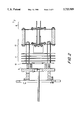
- Ions passing between plates 13 and 14 are deflected by an angle: ##EQU4## where ⁇ is the angle of deflection (as shown in FIG. 4), V is the voltage on the plates, and l is the length of the plates in the flight direction 15, q is the elemental charge, d is the distance between plates 13 and 14, and ⁇ is the kinetic energy of the ion. Note that under a given set of conditions, one can obtain the same degree of deflection at, for example, half the voltage by doubling l or decreasing d by a factor of 2.
- FIG. 5A is a cross sectional view of collision cell 16. As depicted in FIG. 5A, ions pass through collision cell 16 along a path which is parallel to path 19. Collision gas is fed into the collision cell through inlet 20 and exits the collision cell through orifices 17 and 18. Ions passing through the collision cell may have collisions with the collision gas in accordance with the collisional cross section of the ions and the pressure of the collision gas.
- N c is the average number of collisions
- r is the cross sectional radius of the ion
- x is the length of the collision cell
- P is the pressure in the collision cell
- N is Avagadro's number
- R is the universal gas constant
- T is the temperature of the gas.
- P of 0.1 mbar
- N c would be about 6 collision depending on the cross section of the ion and the length, x, of the collision cell.
- ions continue to drift through the spectrometer until arriving at a detector.
- Activated ions may undergo fragmentation at some point between the collision cell and the detector. Fragmentation of an ion will typically lead to the production of one ion and one neutral species. The process of fragmentation will release a few eV of kinetic energy, so the product species may move somewhat faster or slower in the time of flight direction.
- the molecular ions typically have a kinetic energy of 5-30 keV the few eV of kinetic energy released via fragmentation will have no practical influence on the mass analysis of the products. That is, the product species will have practically the same velocity as the molecular ion from which they were formed.
- both the parent and the daughter ions will pass through the deflector unperturbed. In this way, both the daughter ions and the parents from which they are formed are simultaneously selected or deselected.
- the ion selector may be inserted into any position in a TOFMS system, between the source and analyzer region.
- a gate may be located in the position of deflection plates 4 at the end of source 3 or anywhere between collision cell 16 and reflector 5.
- FIGS. 6A and 6B shows plots relating the resolution of molecular ion selection to the length, l, of the selector deflection plates, and to the distance, L, between the source and the selector, respectively.
- the resolution of molecular ion selection can be approximated as: ##EQU6## where R is the mass resolution of the gating device, L is the distance from the source to the gating device, and l is the effective length of the deflection plates--including its associated electric field--in the direction of ion motion.
- the resolution decreases rapidly with increasing deflection plate length.
- the resolution increases linearly with the distance between the source and deflector.
- improved ion selection resolution can be achieved only by postselecting ions--i.e. by placing the deflector after the collision cell--rather than by preselecting the ions--i.e. by placing the deflector before the collision cell.
- Postselector 100 is located between two TOF analysis regions 200 and 201.
- deflector 4 is still present, it remains inactive or is used only for coarse ion gating.
- the parent ion of interest is selected by gating the ion beam using postselector 100.
- postselector 100 it is possible to allow only those parent ions of interest to pass from the first to the second analysis region.
- analysis region 201 the daughter ions--generated by the dissociation of the selected parent ion--are mass analyzed and recorded via reflector 5, detector 7, and data acquisition system 8.
- the preselector was located before the collision cell at a distance from the source of about 25 cm. Also, the effective length l of the device was about 5 mm. As a result, the resolution of the device was only about 25. As depicted in FIG. 7, the postselector is positioned farther from the source than the collision cell 16. By placing the postselector about 60 cm from the source and decreasing its effective length to about 3 mm, a molecular ion selection resolution of better than 110 is obtained.
- an example timing diagram is shown. From the time of ion generation until a short time before the ion of interest enters the postselector 100, the potentials on the plates 13 and 14 are held at +700 V and -700 V respectively as discussed with respect to FIG. 4. This causes all ions of lower mass than the ions of interest to be deflected out of the beam.
- the ions of interest arrive at the gate 100 and at time tout, the ions exit the gate.
- Some time td before the ions of interest arrive at gate 100 the potential on plates 13 and 14 are brought to ground potential. Plates 13 and 14 are held at ground potential until some short time td after the ions of interest leave the gate. Thereafter, the potentials on the plates 13 and 14 are maintained at +/-700 V. This causes all ions of higher mass than the ions of interest to be deflected out of the beam.
- FIG. 9 a graph of a daughter ion spectrum of angiotensin II, obtained using a postselector in a similar manner as described above is shown.
- the mass of the daughter ions are determined via their flight time from source 2 to detector 7.
- L 1 is the distance from the source to the reflectron
- L 2 is the length of the reflectron
- L 3 is the distance from the reflectron to the detector
- V 1 is the source potential
- V 2 is the reflectron potential
- M the parent ion mass
- m is the daughter ion mass
- q is the elemental charge.
Landscapes
- Chemical & Material Sciences (AREA)
- Analytical Chemistry (AREA)
- Other Investigation Or Analysis Of Materials By Electrical Means (AREA)
Abstract
Description
Claims (20)
Priority Applications (1)
| Application Number | Priority Date | Filing Date | Title |
|---|---|---|---|
| US08/560,404 US5753909A (en) | 1995-11-17 | 1995-11-17 | High resolution postselector for time-of-flight mass spectrometery |
Applications Claiming Priority (1)
| Application Number | Priority Date | Filing Date | Title |
|---|---|---|---|
| US08/560,404 US5753909A (en) | 1995-11-17 | 1995-11-17 | High resolution postselector for time-of-flight mass spectrometery |
Publications (1)
| Publication Number | Publication Date |
|---|---|
| US5753909A true US5753909A (en) | 1998-05-19 |
Family
ID=24237669
Family Applications (1)
| Application Number | Title | Priority Date | Filing Date |
|---|---|---|---|
| US08/560,404 Expired - Lifetime US5753909A (en) | 1995-11-17 | 1995-11-17 | High resolution postselector for time-of-flight mass spectrometery |
Country Status (1)
| Country | Link |
|---|---|
| US (1) | US5753909A (en) |
Cited By (28)
| Publication number | Priority date | Publication date | Assignee | Title |
|---|---|---|---|---|
| US5880466A (en) * | 1997-06-02 | 1999-03-09 | The Regents Of The University Of California | Gated charged-particle trap |
| WO2000018496A1 (en) * | 1998-09-25 | 2000-04-06 | The State Of Oregon Acting By And Through The State Board Of Higher Education On Behalf Of Oregon State University | Tandem time-of-flight mass spectrometer |
| US6057543A (en) * | 1995-05-19 | 2000-05-02 | Perseptive Biosystems, Inc. | Time-of-flight mass spectrometry analysis of biomolecules |
| US6274866B1 (en) * | 1999-06-17 | 2001-08-14 | Agilent Technologies, Inc. | Systems and methods of mass spectrometry |
| US6348688B1 (en) | 1998-02-06 | 2002-02-19 | Perseptive Biosystems | Tandem time-of-flight mass spectrometer with delayed extraction and method for use |
| WO2000077823A3 (en) * | 1999-06-11 | 2002-02-21 | Perseptive Biosystems Inc | Tandem time-of-flight mass spectometer with damping in collision cell and method for use |
| WO2001051917A3 (en) * | 2000-01-10 | 2002-04-04 | Mds Inc | An apparatus for and method of discriminating against unwanted ionized species in mass spectrometry with collision and reaction devices |
| US6369384B1 (en) | 1999-06-23 | 2002-04-09 | Agilent Technologies, Inc. | Time-of-flight mass spectrometer with post-deflector filter assembly |
| WO2001078106A3 (en) * | 2000-04-10 | 2003-02-06 | Perseptive Biosystems Inc | Preparation of ion pulse for time-of-flight and for tandem time-of-flight mass analysis |
| US6518569B1 (en) | 1999-06-11 | 2003-02-11 | Science & Technology Corporation @ Unm | Ion mirror |
| US20030052267A1 (en) * | 2000-09-29 | 2003-03-20 | Marcel Devienne | Method for determining the molecular mass of constituents of a chemical element |
| US20030141445A1 (en) * | 2002-01-29 | 2003-07-31 | Yuri Glukhoy | Mass spectrometer based on the use of quadrupole lenses with angular gradient of the electrostatic field |
| US6661001B2 (en) * | 1995-10-25 | 2003-12-09 | Bruker Daltonics Inc. | Extended bradbury-nielson gate |
| US20040079878A1 (en) * | 1995-05-19 | 2004-04-29 | Perseptive Biosystems, Inc. | Time-of-flight mass spectrometry analysis of biomolecules |
| WO2004008470A3 (en) * | 2002-07-17 | 2004-07-01 | Univ Johns Hopkins | Time-of-flight mass spectrometers for improving resolution and mass range employing an impulse extraction ion source |
| US6770871B1 (en) | 2002-05-31 | 2004-08-03 | Michrom Bioresources, Inc. | Two-dimensional tandem mass spectrometry |
| WO2004068531A1 (en) * | 2003-01-28 | 2004-08-12 | Comet Holding Ag | Time-of-flight mass spectrometer |
| US6781121B1 (en) * | 1998-07-17 | 2004-08-24 | Thermo Finnigan, Llc | Time-of-flight mass spectrometer |
| US6815689B1 (en) | 2001-12-12 | 2004-11-09 | Southwest Research Institute | Mass spectrometry with enhanced particle flux range |
| US20050189484A1 (en) * | 2004-02-28 | 2005-09-01 | Yuri Glukhoy | Aerosol mass spectrometer for operation in a high-duty mode and method of mass-spectrometry |
| US20050230614A1 (en) * | 2004-04-19 | 2005-10-20 | Yuri Glukhoy | Mass spectrometry system for continuous control of environment |
| US6974957B2 (en) | 2004-02-18 | 2005-12-13 | Nanomat, Inc. | Ionization device for aerosol mass spectrometer and method of ionization |
| US20060255289A1 (en) * | 2005-05-13 | 2006-11-16 | Cygan Thomas R | Sample handling mechanisms and methods for mass spectometry |
| US20060255256A1 (en) * | 2005-05-13 | 2006-11-16 | Hayden Kevin M | Mass analyzer systems and methods for their operation |
| US20060273252A1 (en) * | 2005-05-13 | 2006-12-07 | Mds Inc. | Methods of operating ion optics for mass spectrometry |
| CN100521064C (en) * | 2007-12-03 | 2009-07-29 | 厦门大学 | Matrix auxiliary laser decomposition-absorption-particle bundle collision decomposition flying time mass spectrograph |
| US20120126112A1 (en) * | 2009-04-29 | 2012-05-24 | Academia Sinica | Molecular ion accelerator |
| EP1668364A4 (en) * | 2003-09-03 | 2012-06-06 | Zyomix Inc | ION DETECTION USING COLUMN CHIP |
Citations (6)
| Publication number | Priority date | Publication date | Assignee | Title |
|---|---|---|---|---|
| US3634683A (en) * | 1969-04-18 | 1972-01-11 | Shell Oil Co | Time-of-flight mass spectrometer with step-function-controlled field |
| US4733073A (en) * | 1983-12-23 | 1988-03-22 | Sri International | Method and apparatus for surface diagnostics |
| US4894536A (en) * | 1987-11-23 | 1990-01-16 | Iowa State University Research Foundation, Inc. | Single event mass spectrometry |
| US5045694A (en) * | 1989-09-27 | 1991-09-03 | The Rockefeller University | Instrument and method for the laser desorption of ions in mass spectrometry |
| US5144127A (en) * | 1991-08-02 | 1992-09-01 | Williams Evan R | Surface induced dissociation with reflectron time-of-flight mass spectrometry |
| US5160840A (en) * | 1991-10-25 | 1992-11-03 | Vestal Marvin L | Time-of-flight analyzer and method |
-
1995
- 1995-11-17 US US08/560,404 patent/US5753909A/en not_active Expired - Lifetime
Patent Citations (6)
| Publication number | Priority date | Publication date | Assignee | Title |
|---|---|---|---|---|
| US3634683A (en) * | 1969-04-18 | 1972-01-11 | Shell Oil Co | Time-of-flight mass spectrometer with step-function-controlled field |
| US4733073A (en) * | 1983-12-23 | 1988-03-22 | Sri International | Method and apparatus for surface diagnostics |
| US4894536A (en) * | 1987-11-23 | 1990-01-16 | Iowa State University Research Foundation, Inc. | Single event mass spectrometry |
| US5045694A (en) * | 1989-09-27 | 1991-09-03 | The Rockefeller University | Instrument and method for the laser desorption of ions in mass spectrometry |
| US5144127A (en) * | 1991-08-02 | 1992-09-01 | Williams Evan R | Surface induced dissociation with reflectron time-of-flight mass spectrometry |
| US5160840A (en) * | 1991-10-25 | 1992-11-03 | Vestal Marvin L | Time-of-flight analyzer and method |
Cited By (44)
| Publication number | Priority date | Publication date | Assignee | Title |
|---|---|---|---|---|
| US6057543A (en) * | 1995-05-19 | 2000-05-02 | Perseptive Biosystems, Inc. | Time-of-flight mass spectrometry analysis of biomolecules |
| US6281493B1 (en) | 1995-05-19 | 2001-08-28 | Perseptive Biosystems, Inc. | Time-of-flight mass spectrometry analysis of biomolecules |
| US20040079878A1 (en) * | 1995-05-19 | 2004-04-29 | Perseptive Biosystems, Inc. | Time-of-flight mass spectrometry analysis of biomolecules |
| US6661001B2 (en) * | 1995-10-25 | 2003-12-09 | Bruker Daltonics Inc. | Extended bradbury-nielson gate |
| US5880466A (en) * | 1997-06-02 | 1999-03-09 | The Regents Of The University Of California | Gated charged-particle trap |
| US6348688B1 (en) | 1998-02-06 | 2002-02-19 | Perseptive Biosystems | Tandem time-of-flight mass spectrometer with delayed extraction and method for use |
| US6770870B2 (en) * | 1998-02-06 | 2004-08-03 | Perseptive Biosystems, Inc. | Tandem time-of-flight mass spectrometer with delayed extraction and method for use |
| US6781121B1 (en) * | 1998-07-17 | 2004-08-24 | Thermo Finnigan, Llc | Time-of-flight mass spectrometer |
| WO2000018496A1 (en) * | 1998-09-25 | 2000-04-06 | The State Of Oregon Acting By And Through The State Board Of Higher Education On Behalf Of Oregon State University | Tandem time-of-flight mass spectrometer |
| US6489610B1 (en) | 1998-09-25 | 2002-12-03 | The State Of Oregon Acting By And Through The State Board Of Higher Education On Behalf Of Oregon State University | Tandem time-of-flight mass spectrometer |
| US6518569B1 (en) | 1999-06-11 | 2003-02-11 | Science & Technology Corporation @ Unm | Ion mirror |
| WO2000077823A3 (en) * | 1999-06-11 | 2002-02-21 | Perseptive Biosystems Inc | Tandem time-of-flight mass spectometer with damping in collision cell and method for use |
| US6534764B1 (en) | 1999-06-11 | 2003-03-18 | Perseptive Biosystems | Tandem time-of-flight mass spectrometer with damping in collision cell and method for use |
| JP2003525515A (en) * | 1999-06-11 | 2003-08-26 | パーセプティブ バイオシステムズ,インコーポレイテッド | Tandem time-of-flight mass spectrometer with attenuation in a collision cell and method for its use |
| US6274866B1 (en) * | 1999-06-17 | 2001-08-14 | Agilent Technologies, Inc. | Systems and methods of mass spectrometry |
| US6369384B1 (en) | 1999-06-23 | 2002-04-09 | Agilent Technologies, Inc. | Time-of-flight mass spectrometer with post-deflector filter assembly |
| WO2001051917A3 (en) * | 2000-01-10 | 2002-04-04 | Mds Inc | An apparatus for and method of discriminating against unwanted ionized species in mass spectrometry with collision and reaction devices |
| WO2001078106A3 (en) * | 2000-04-10 | 2003-02-06 | Perseptive Biosystems Inc | Preparation of ion pulse for time-of-flight and for tandem time-of-flight mass analysis |
| US20030052267A1 (en) * | 2000-09-29 | 2003-03-20 | Marcel Devienne | Method for determining the molecular mass of constituents of a chemical element |
| US6815689B1 (en) | 2001-12-12 | 2004-11-09 | Southwest Research Institute | Mass spectrometry with enhanced particle flux range |
| US6791079B2 (en) | 2002-01-29 | 2004-09-14 | Yuri Glukhoy | Mass spectrometer based on the use of quadrupole lenses with angular gradient of the electrostatic field |
| US20030141445A1 (en) * | 2002-01-29 | 2003-07-31 | Yuri Glukhoy | Mass spectrometer based on the use of quadrupole lenses with angular gradient of the electrostatic field |
| US6770871B1 (en) | 2002-05-31 | 2004-08-03 | Michrom Bioresources, Inc. | Two-dimensional tandem mass spectrometry |
| WO2004008470A3 (en) * | 2002-07-17 | 2004-07-01 | Univ Johns Hopkins | Time-of-flight mass spectrometers for improving resolution and mass range employing an impulse extraction ion source |
| US20040195501A1 (en) * | 2002-07-17 | 2004-10-07 | Cornish Timothy J | Time-of-flight mass spectrometers for improving resolution and mass range employing an impulse extraction ion source |
| US7115859B2 (en) | 2002-07-17 | 2006-10-03 | The Johns Hopkins University | Time- of flight mass spectrometers for improving resolution and mass employing an impulse extraction ion source |
| WO2004068531A1 (en) * | 2003-01-28 | 2004-08-12 | Comet Holding Ag | Time-of-flight mass spectrometer |
| US20060138316A1 (en) * | 2003-01-28 | 2006-06-29 | Robert Seydoux | Time-of-flight mass spectrometer |
| EP1668364A4 (en) * | 2003-09-03 | 2012-06-06 | Zyomix Inc | ION DETECTION USING COLUMN CHIP |
| US6974957B2 (en) | 2004-02-18 | 2005-12-13 | Nanomat, Inc. | Ionization device for aerosol mass spectrometer and method of ionization |
| US7148472B2 (en) | 2004-02-28 | 2006-12-12 | Ngx, Inc. | Aerosol mass spectrometer for operation in a high-duty mode and method of mass-spectrometry |
| US20050189484A1 (en) * | 2004-02-28 | 2005-09-01 | Yuri Glukhoy | Aerosol mass spectrometer for operation in a high-duty mode and method of mass-spectrometry |
| US20050230614A1 (en) * | 2004-04-19 | 2005-10-20 | Yuri Glukhoy | Mass spectrometry system for continuous control of environment |
| US7071466B2 (en) | 2004-04-19 | 2006-07-04 | Ngx, Inc. | Mass spectrometry system for continuous control of environment |
| US7385186B2 (en) | 2005-05-13 | 2008-06-10 | Applera Corporation | Methods of operating ion optics for mass spectrometry |
| US20060273252A1 (en) * | 2005-05-13 | 2006-12-07 | Mds Inc. | Methods of operating ion optics for mass spectrometry |
| US7351959B2 (en) * | 2005-05-13 | 2008-04-01 | Applera Corporation | Mass analyzer systems and methods for their operation |
| US20060255256A1 (en) * | 2005-05-13 | 2006-11-16 | Hayden Kevin M | Mass analyzer systems and methods for their operation |
| US7405396B2 (en) | 2005-05-13 | 2008-07-29 | Applera Corporation | Sample handling mechanisms and methods for mass spectrometry |
| US20060255289A1 (en) * | 2005-05-13 | 2006-11-16 | Cygan Thomas R | Sample handling mechanisms and methods for mass spectometry |
| CN100521064C (en) * | 2007-12-03 | 2009-07-29 | 厦门大学 | Matrix auxiliary laser decomposition-absorption-particle bundle collision decomposition flying time mass spectrograph |
| US20120126112A1 (en) * | 2009-04-29 | 2012-05-24 | Academia Sinica | Molecular ion accelerator |
| US8344317B2 (en) * | 2009-04-29 | 2013-01-01 | Academia Sinica | Molecular ion accelerator |
| US8637814B2 (en) * | 2009-04-29 | 2014-01-28 | Academia Sinica | Molecular ion accelerator |
Similar Documents
| Publication | Publication Date | Title |
|---|---|---|
| US5753909A (en) | High resolution postselector for time-of-flight mass spectrometery | |
| US5696375A (en) | Multideflector | |
| US5986258A (en) | Extended Bradbury-Nielson gate | |
| US6576895B1 (en) | Coaxial multiple reflection time-of-flight mass spectrometer | |
| CA2103038C (en) | Tandem time-of-flight mass spectrometer | |
| US5464985A (en) | Non-linear field reflectron | |
| US6469295B1 (en) | Multiple reflection time-of-flight mass spectrometer | |
| Cornish et al. | A curved‐field reflectron for improved energy focusing of product ions in time‐of‐flight mass spectrometry | |
| US9984862B2 (en) | Electrostatic mass spectrometer with encoded frequent pulses | |
| US6770870B2 (en) | Tandem time-of-flight mass spectrometer with delayed extraction and method for use | |
| US7709789B2 (en) | TOF mass spectrometry with correction for trajectory error | |
| US6777671B2 (en) | Time-of-flight/ion trap mass spectrometer, a method, and a computer program product to use the same | |
| US5861623A (en) | Nth order delayed extraction | |
| US8604423B2 (en) | Method for enhancement of mass resolution over a limited mass range for time-of-flight spectrometry | |
| US4851669A (en) | Surface-induced dissociation for mass spectrometry | |
| US7504621B2 (en) | Method and system for mass analysis of samples | |
| CA2519601A1 (en) | Distance of flight spectrometer for ms and simultaneous scanless ms/ms | |
| WO1995033279A1 (en) | Tandem mass spectrometry apparatus | |
| US5821534A (en) | Deflection based daughter ion selector | |
| US5744797A (en) | Split-field interface | |
| O'Connor et al. | MALDI mass spectrometry instrumentation | |
| US5942758A (en) | Shielded lens | |
| US7277799B2 (en) | Isotope correlation filter for mass spectrometry | |
| US20010054684A1 (en) | Surface induced dissociation with pulsed ion extraction | |
| WO2003103007A1 (en) | Mass spectrometer |
Legal Events
| Date | Code | Title | Description |
|---|---|---|---|
| AS | Assignment |
Owner name: BRUKER ANALYTICAL INSTRUMENTS, INC., MASSACHUSETTS Free format text: ASSIGNMENT OF ASSIGNORS INTEREST;ASSIGNORS:PARK, MELVIN;WRONKA, JOHN;FURSEY, VICTOR;REEL/FRAME:009131/0860;SIGNING DATES FROM 19980328 TO 19980329 |
|
| STCF | Information on status: patent grant |
Free format text: PATENTED CASE |
|
| FEPP | Fee payment procedure |
Free format text: PAT HOLDER NO LONGER CLAIMS SMALL ENTITY STATUS, ENTITY STATUS SET TO UNDISCOUNTED (ORIGINAL EVENT CODE: STOL); ENTITY STATUS OF PATENT OWNER: LARGE ENTITY |
|
| REMI | Maintenance fee reminder mailed | ||
| FPAY | Fee payment |
Year of fee payment: 4 |
|
| SULP | Surcharge for late payment | ||
| AS | Assignment |
Owner name: BRUKER DALTONICS, INC., MASSACHUSETTS Free format text: ASSIGNMENT OF ASSIGNORS INTEREST;ASSIGNORS:FURSEY, VICTOR;PARK, MELVIN A.;WRONKA, JOHN;REEL/FRAME:015562/0450 Effective date: 20040623 |
|
| REMI | Maintenance fee reminder mailed | ||
| FPAY | Fee payment |
Year of fee payment: 8 |
|
| SULP | Surcharge for late payment |
Year of fee payment: 7 |
|
| FPAY | Fee payment |
Year of fee payment: 12 |