US5731805A - Method and apparatus for eyetrack-driven text enlargement - Google Patents
Method and apparatus for eyetrack-driven text enlargement Download PDFInfo
- Publication number
- US5731805A US5731805A US08/670,057 US67005796A US5731805A US 5731805 A US5731805 A US 5731805A US 67005796 A US67005796 A US 67005796A US 5731805 A US5731805 A US 5731805A
- Authority
- US
- United States
- Prior art keywords
- article
- interest
- display
- displayed
- computer
- Prior art date
- Legal status (The legal status is an assumption and is not a legal conclusion. Google has not performed a legal analysis and makes no representation as to the accuracy of the status listed.)
- Expired - Lifetime
Links
Images



Classifications
-
- G—PHYSICS
- G06—COMPUTING OR CALCULATING; COUNTING
- G06F—ELECTRIC DIGITAL DATA PROCESSING
- G06F3/00—Input arrangements for transferring data to be processed into a form capable of being handled by the computer; Output arrangements for transferring data from processing unit to output unit, e.g. interface arrangements
- G06F3/01—Input arrangements or combined input and output arrangements for interaction between user and computer
- G06F3/011—Arrangements for interaction with the human body, e.g. for user immersion in virtual reality
- G06F3/013—Eye tracking input arrangements
-
- G—PHYSICS
- G06—COMPUTING OR CALCULATING; COUNTING
- G06F—ELECTRIC DIGITAL DATA PROCESSING
- G06F3/00—Input arrangements for transferring data to be processed into a form capable of being handled by the computer; Output arrangements for transferring data from processing unit to output unit, e.g. interface arrangements
- G06F3/01—Input arrangements or combined input and output arrangements for interaction between user and computer
- G06F3/048—Interaction techniques based on graphical user interfaces [GUI]
- G06F3/0481—Interaction techniques based on graphical user interfaces [GUI] based on specific properties of the displayed interaction object or a metaphor-based environment, e.g. interaction with desktop elements like windows or icons, or assisted by a cursor's changing behaviour or appearance
-
- G—PHYSICS
- G06—COMPUTING OR CALCULATING; COUNTING
- G06F—ELECTRIC DIGITAL DATA PROCESSING
- G06F3/00—Input arrangements for transferring data to be processed into a form capable of being handled by the computer; Output arrangements for transferring data from processing unit to output unit, e.g. interface arrangements
- G06F3/01—Input arrangements or combined input and output arrangements for interaction between user and computer
- G06F3/048—Interaction techniques based on graphical user interfaces [GUI]
- G06F3/0484—Interaction techniques based on graphical user interfaces [GUI] for the control of specific functions or operations, e.g. selecting or manipulating an object, an image or a displayed text element, setting a parameter value or selecting a range
- G06F3/0485—Scrolling or panning
-
- G—PHYSICS
- G06—COMPUTING OR CALCULATING; COUNTING
- G06F—ELECTRIC DIGITAL DATA PROCESSING
- G06F2203/00—Indexing scheme relating to G06F3/00 - G06F3/048
- G06F2203/048—Indexing scheme relating to G06F3/048
- G06F2203/04805—Virtual magnifying lens, i.e. window or frame movable on top of displayed information to enlarge it for better reading or selection
Definitions
- This invention relates generally to the field of computer-human user interface technology and more particularly to a method, apparatus, system and computer program product for allowing a computer to automatically determine what aspect of the computer's operation has the user's interest and to optimize that aspect.
- GUI graphical user interface
- a GUI equipped computer communicates with a user by displaying graphics, including text and icons, on a display screen and the user communicates with the machine both by typing in textual information in response to dialogs and by manipulating the displayed icons with a pointing device, such as a mouse.
- GUIs provide a window environment.
- the graphical display portrayed on the display screen is arranged to resemble the surface of an electronic "desktop” and each application program running on the computer is represented as one or more electronic “paper sheets” displayed as rectangular regions on the display screen. These rectangular regions are called “windows”.
- Each window may include a multitude of panes. Each pane being an area for a particular type of information (textual, still image, moving image, etc.).
- Each window displays information generated by an associated application or system program. Further, there may be several windows simultaneously present on the desktop with each containing information generated by a program.
- a program presents information to the user through each window by drawing or "painting" images, graphics or text within the window. The user can also move a window to a different location on the display screen and change its size and appearance to arrange the desktop in a convenient manner.
- the user communicates with the program by "pointing at" objects displayed in the window with a cursor controlled by a pointing device and manipulating the objects as desired.
- the program requests additional information from the user in response to a manipulation. This request is presented as a "dialog" that allows the user to provide the requested information to the dialog from the keyboard.
- Each window typically includes a number of standard graphical objects such as sizing boxes, buttons and scroll bars. These features represent user interface controls that the user can manipulate with the pointing device. When the controls are selected or manipulated, the GUI invokes program logic in the underlying program to effect a corresponding command.
- GUI is only responsive to a user's explicit manipulation of the pointing device or keyboard.
- the user physically moves the mouse device and a cursor on the display moves accordingly.
- Some pointing devices actually track the user's gaze and move the cursor to where the user "looks" on the display screen.
- the GUI only responds to the user's explicit commands whether that command be a button press, a blink, or a shift of view.
- the computer remains a tool that the user operates by issuing explicit commands.
- Prior art in computer-human interfaces does not determine the user's immediate interest.
- Prior art computer-human interfaces simply respond to a user's command, whether input by typing the command at a keyboard, by manipulating a mouse to move a cursor, or by using a gaze tracking device to move a cursor.
- the computer is unable to detect or anticipate what characteristic of the computer's operation is of most interest to the user at any given time.
- gaze tracking devices operate based upon the principal that the direction of a person's gaze is directly related to the relative positions of the pupil and the reflection of an object off the cornea (gaze tracking is often termed eye tracking).
- eye tracking is often termed eye tracking.
- These devices often include image processing capabilities that operate on a video image of an eye to determine the gaze direction of the eye. These image processing capabilities are enhanced by using the bright eye affect.
- the bright eye affect is a result of the highly reflective nature of the retina.
- This characteristic of the retina means that a significant amount of the light that enters an eye is reflected back through the pupil.
- the retina reflects a significant portion of the light back to the camera.
- the pupil appears as a bright disk to the camera. This affect allows the pupil to be more readily imaged from a video of an eye.
- an eye gaze eyetracking system has been developed as described in The Eyegaze Eyetracking System--Unique Example of a Multiple-Use Technology, 4th Annual 1994 IEEE Dual-Use Technologies and Applications Conference, May, 1994.
- This system comprises a video camera located below a computer display that monitors one of the user's eyes.
- the device also contains an infrared light emitting diode (LED) located at the center of the camera's lens to maximize the bright-eye affect.
- Image processing software on the computer computes the user's gazepoint on the display sixty times a second with an accuracy of about a quarter inch.
- Gaze tracking devices have been used for weapon control, operator training, usability analysis, market research, and as an enablement for the disabled. However, gaze tracking devices have not been used to determine what characteristic of a computer's operation interests the computer user at a particular time or to allow the computer to adapt to a user's interest as demonstrated by where on the display screen the user is looking.
- WWW World Wide Web
- WWW browsers are well described by reference to the first chapter of Instant HTML Web Pages, by Wayne Ause, Ziff-Davis Press, ISBN 1-56276-363-6, Copyright 1995, pages 1-15, hereby incorporated by reference as illustrative of the prior art.
- the Internet Using the Internet, a computer user has access to an immense amount of information. However, retrieving this information over the Internet often takes significant time because of the limited bandwidth of the communication channel.
- the bandwidth is limited by many factors. Some of these factors are the bandwidth of the communication link from the user's computer to the Internet, the bandwidth of the communication link from the information provider's computer to the Internet, the existence of other communication traffic on these links, and the bandwidth of the Internet itself. Often, the primary bandwidth limitation is at the user's computer.
- Prior art WWW browsers for example, generally attempt to equally allocate bandwidth to all the data transfers directed towards visible views in a window. Although this approach is clearly better then simply sequentially retrieving data for each view, this approach delays retrieving data that is of the most interest to the user because the available channel bandwidth is divided between the data streams supplying data to the views. Thus, the user must wait an additional time because of uninteresting information using bandwidth that could have been applied to the information of interest.
- a program During the transmission of large amounts of data, a program generally provides some indication of the progress of the transmission. This indication is provided by indicators such as bar indicators, numerical percentage indicators, or in the case of images often just the amount of detail available in the displayed image. While waiting for the transfer to complete, the user often watches the progress of the indicator or of the partially-filled image.
- the invention addresses these problems.
- images such as pictures and illustrations
- additional information such as captions explaining or enhancing the image.
- Those who view the image cannot look at the image and read an associated caption at the same time.
- the viewer's attention is diverted from the image while searching for, and reading, the associated caption.
- Audio captioning presents additional information though an audio speaker allowing the user to receive additional information auditorally without distracting the viewer's gaze from the image of interest.
- Systems that allow a user to select which image to view, from a plurality of images require the user to explicitly trigger the vocal caption. Thus, the user is again distracted from looking at the image by the need to seek out and activate the caption.
- the invention addresses these problems.
- magnification process reduces the amount of the page that can be displayed on the computer display at the same time because the percentage of the page that is displayed to the user is reduced when the page is magnified. This problem is exacerbated with applications that display WYSIWYG versions of newspapers and magazines because these applications generally attempt to maintain the WYSIWYG page layout and the displayed page is uniformly magnified. To see the entire page, the article text is generally reduced to unreadable size.
- mapping the content of a newspaper onto a display screen reduces the size of the type used for the articles to the point where the text of the article is extremely difficult to read.
- magnification method used by word processing programs for globally expanding the displayed text does not work well when presenting many articles on a page because magnifying the entire page, and providing a limited view into the page distances the structure of the page from the viewer.
- globally expanding the text is incompatible with presenting as many articles as is desired on the page.
- globally expanding the page also expands the larger title and headline text more than is needed to make this text readable and at a cost of consuming undue display space that could otherwise be used to present additional information.
- the invention addresses these problems.
- Information content includes both articles about particular items of interest and advertising information.
- Information content is a major reason why people select different paper-based magazines and newspapers. These traditional information providers present the information that they believe interest their readers.
- Traditional newspapers and magazines are static once printed. Thus, each edition is the same for all those who read it and each copy of a particular edition distributed to a particular region has the same articles, the same layout and the same advertising as all the other copies distributed to the region.
- This advertising and information content can be customized to the particular region. However, this regionalization can only be carried so far as it is extremely expensive to customize a newspaper or magazine to the particular individual interests of each reader. Thus, some of the information selected for a region will not interest some readers.
- Intangible electronic newspapers need not be constrained by the above mentioned limitations inherent in using a tangible paper medium.
- electronic newspapers still target most advertising and information content to a particular market and not to the particular interests of an individual reader.
- the invention addresses these problems.
- the present invention provides an economical, apparatus, method, system and computer program product for providing enhanced facilities to computer users.
- This invention provides a way for a computer to monitor the user to determine what aspect of the computer operation the user is interested in and to respond accordingly.
- One aspect of the invention is a computer controlled method for displaying a portion of some of a plurality of articles to a computer user.
- the computer is equipped with a display device and a gaze-tracking device.
- the gaze-tracking device being capable of determining a gaze position on said display device.
- the computer controlled method displays portions of articles on the display device.
- the method detects an article of interest by determining an intersection between the gaze position and a portion of one of the articles.
- the method expands the displayed portion of the article of interest on the display.
- an information presentation apparatus having a central processing unit, memory, a display device and a gaze tracking device capable of determining a gaze position on the display device.
- the apparatus includes a display mechanism than is configured to display portions of a plurality of articles on the display device.
- the apparatus also includes a detection mechanism that detects an intersection of a portion of one of the displayed articles with the user's gaze and thus determines an article of interest to the user.
- the apparatus includes an expansion mechanism that expands the portion of the article of interest on the display device.
- the system includes a gaze-tracking device that determines a gaze position on the display device where the user is looking.
- the system includes a display mechanism that displays portions of articles on a display device. Additionally, the system includes a detection mechanism that determines an article of interest by detecting an intersection between the gaze position and a portion of a displayed article. Finally, the system includes an expansion mechanism that expands the displayed portion of the article of interest.
- a final aspect of the invention discloses a computer program product having computer readable code embodied in a computer usable storage medium.
- the computer readable code causes a computer to effect a gaze position determination mechanism used to determine a gaze position from gaze coordinates returned from a gaze-tracking device.
- the invention includes code that displays portions of a number of articles on a display device and detects when the gaze position intersects one of these portions. This article containing that intersected portion is the article of interest.
- the invention includes code that expands the intersected portion of the article of interest.
- FIG. 1 illustrates a portion of a computer system, including a CPU and a conventional memory in which the present invention may be embodied;
- FIG. 2 illustrates a display device fitted with gaze tracking equipment
- FIG. 3 illustrates aspects of a gaze position in accordance with a preferred embodiment
- FIG. 4 illustrates the process for determining a gaze position as used in accordance with a preferred embodiment
- FIG. 5 illustrates the operation of the invention to allocate bandwidth to an area of interest in accordance with a preferred embodiment
- FIG. 6 illustrates the process used to change the bandwidth of a data stream based upon a gaze position in accordance with a preferred embodiment
- FIGS. 7a&b illustrate audio captioning in accordance with a preferred embodiment
- FIG. 8 illustrates extraction of an image caption from a page of text in accordance with a preferred embodiment
- FIGS. 9 illustrates the process used to implement captioning in accordance with a preferred embodiment
- FIG. 10 illustrates the form of an electronic newspaper
- FIG. 11 illustrates text magnification and page layout in accordance with a preferred embodiment
- FIG. 12 illustrates text magnification and page layout in accordance with a second preferred embodiment
- FIG. 13 illustrates the process of expanding text in response to the users interest in the text in accordance with a preferred embodiment
- FIG. 14 illustrates the process for adjusting the layout of a display as a result of expanded text in accordance with a preferred embodiment
- FIG. 15 illustrates a possible first page of an electronic newspaper showing articles and an advertisement in accordance with a preferred embodiment
- FIG. 16 illustrates a possible second page of an electronic newspaper showing information determined to be of interest to the reader in accordance with a preferred embodiment
- FIG. 17 illustrates the process used to evaluate the information of interest to a reader and to select new information matching the readers interest in accordance with a preferred embodiment.
- Advertisement--Information provided about a commercial product or service with the purpose of informing the viewer about the product or service so as to lead to a commercial transaction.
- Dialog--A specialized window that is used to obtain additional information from the user.
- a dialog is often used to obtain options and parameters that are computer dependent.
- a good example is a print dialog that is evoked by a print menu command.
- the print dialog allows the user to specify what printer options are to be used for a particular print job.
- the dialog allows the user to specify specific parameters and then to either affirm or cancel the command that evoked the dialog. If the user cancels the command, the dialog window is removed and the command that evoked the dialog is aborted. If the user confirms the command the user provided information acquired by the dialog is used in the execution of the command that evoked the dialog.
- E-mail system--Electronic mail system A system of computers generally connected by a network that allow a sender (being a user of a first computer) to compose and send data making up a message to a recipient (being a user of either the first computer or of a second computer).
- GUI Graphical User Interface
- Gaze position--An area of interest on the screen providing a boundary of the user's gaze over a limited period of time.
- Gaze coordinates (raw)--The coordinates that represent the instantaneous intersection of the user's gaze with the display screen.
- Image--Any information displayed on a display screen such as, but not limited to, pictures, drawings, illustrations, text, and video.
- An image generally displayed in a view contained in a window.
- a still image is a picture.
- a moving image is comprised of a number of frames of still images that are played in sequence similar to a video.
- Pointing device--A device responsive to a computer user's input that moves an indicator on a computer display screen.
- Such an indicator has an active point such that if the pointing device is activated (e.g., by a button push for a mouse device) a command associated with the selectable control area covered by the active point is invoked.
- Pointing devices are generally used with graphical user interfaces.
- Selectable control area--An area on a computer display that is sensitive to activation of a pointing device. On activation of the pointing device over the selectable control area, a command or computer operation associated with the selectable control area is invoked.
- Most computer systems that provide a Graphical User Interface (GUI) also provide other methods for invoking these commands or computer operations such as keyboard function keys or command lines.
- GUI Graphical User Interface
- URLs are used to access information on the World Wide Web.
- Window--An area usually rectangular, on a computer display screen controlled by an application.
- Procedure--A self-consistent sequence of steps leading to a desired result are those requiring physical manipulation of physical quantities.
- these quantities take the form of electrical or magnetic signals capable of being stored, transferred, combined, compared, and otherwise manipulated. These signals are referred to as bits, values, elements, symbols, characters, terms, numbers, or the like. It will be understood by those skilled in the art that all of these and similar terms are associated with the appropriate physical quantities and are merely convenient labels applied to these quantities.
- the manipulations performed by a computer in executing opcodes are often referred to in terms, such as adding or comparing, that are commonly associated with mental operations performed by a human operator. In the present invention no such capability of a human operator is necessary in any of the operations described herein.
- the operations are machine operations. Useful machines for performing the operations of the invention include programmed general purpose digital computers or similar devices. In all cases the method of computation is distinguished from the method of operation in operating a computer.
- the present invention relates to method steps for operating a computer in processing electrical or other (e.g., mechanical, chemical) physical signals to generate other desired physical signals.
- the invention also relates to apparatus for performing these operations.
- This apparatus may be specially constructed for the required purposes or it may comprise a general purpose computer as selectively activated or reconfigured by a computer program stored in the memory of a computer.
- the procedures presented herein are not inherently related to a particular computer or other apparatus.
- various general purpose machines may be used with programs written in accordance with the teachings herein, or it may prove more convenient to construct more specialized apparatus to perform the required method steps. The required structure for a variety of these machines will appear from the following description.
- the invention may be embodied in a computer readable storage medium encoded with a program that causes a computer to perform the programmed logic.
- FIG. 1 illustrates a computer system referenced to by the general reference character 102, configured to support the invention.
- the system 102 includes a processor 133 having an Input/Output ("I/O") section 135, a central processing unit (“CPU”) 137 and a memory section 139.
- the I/O section 135 is connected to a keyboard 141, a disk storage unit 143, a network interface 145 to provide access to a network 117, a display unit 147, a pointing device 148, a gaze-tracker device 155, a speaker 157 and a CD-ROM drive unit 149.
- the CD-ROM unit 149 can read a CD-ROM medium 151 that typically contains a plurality of programs 153 and data.
- the CD-ROM 149 and the disk storage unit 143 comprising a filestorage mechanism.
- the filestorage mechanism may comprise read only memory, RAM or other storage technology that allows a computer to access data.
- Such a computer system is capable of executing programmed logic that embodies the invention.
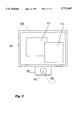
- FIG. 2 illustrates a gaze tracking device 201 attached to a computer display device 203.
- the gaze tracking device 201 is mounted below the computer display 203 and comprises a video lens 205, with an infrared LED 207 mounted on the center of the lens 205.
- the computer display device 203 has a display area 209 that the computer can access to display information.
- the computer generally creates a plurality of windows 211 and 213 for this informational display.
- the gaze tracking device determines the users gaze position.
- the gaze coordinate (raw) is an ordered pair of values providing the immediate two dimensional coordinates of where the user's gaze is positioned on the screen.
- a number of gaze coordinates can be used to develop a gaze position that is a two dimensional coordinate of a time weighted average of the gaze coordinates.
- the invention need not have precise gaze coordinates. In fact the gaze coordinates need only be accurate to approximately a 1/4 inch.
- the gaze position could also be returned as a rectangle, polygon, circle or other shape representing an area of interest.
- the gaze tracking device 201 may be configured to provide the gaze position only when the user has shown interest in a displayed area for a sufficient time, or that application or system program logic may be utilized to detect when the user has shown an interest by monitoring the gaze coordinates over some period of time.
- the gaze position is developed when the system detects that the user has become interested in a particular area of the display. The system detects this condition by recognizing that the user's gaze has been limited to a particular region of the displayable area 209 for a period of time.
- FIG. 3 illustrates aspects of a gaze position determined from gaze coordinates returned from a gaze tracking device.
- the dashed rectangle labeled as 301 indicates the boundaries of an image (not shown).
- this embodiment of the invention provides the gaze position as an area 305 where the user's gaze is fixed.
- the provided area 305 indicates that the user's gaze did not leave the specified area for a given time such as a half second.
- the application program that uses the returned circular area 305 is able to determine that the user's gaze is well within the image 301 because the provided circle is completely contained within the area of the image.
- the gaze would be more diffused is resulting in a larger circle.
- the user viewing the image 301 has focused in on a particular aspect of the image as indicated by the circle labeled as 305.
- the user viewing the image 311 has indicated more interest in the totality of the image as compared to a particular aspect of the image as indicated by the circle labeled as 309.
- a rectangle or other area indication can be used as well as a circle.
- the gaze tracker returns the gaze position as a point.
- a dashed rectangle labeled as 303 indicates the boundaries of a different image (again this image is not shown).
- the gaze tracker after processing gaze movements over some period of time, simply returns a point that is a time weighted average of the position of the gaze. This point is indicated by the arrow labeled as 307.
- FIG. 4 illustrates the process used to develop a gaze position from a plurality of gaze coordinates.
- the process starts at a terminal 401.
- the process performs any necessary setup or initialization. This includes initializing timer program logic to periodically gather instantaneous gaze coordinate data from the gaze tracker apparatus, acquiring user preference data and other one-time initializations.
- the process receives a plurality of gaze coordinates (raw). These gaze coordinates (raw) indicate the position of the user's gaze over a given time. After a sufficient number of gaze coordinates (raw) are gathered, the process examines the gaze coordinates (raw) for a focus pattern at a branch point 407.
- a focus pattern occurs when the gaze coordinates (raw) are all within some boundary without gaze coordinates (raw) being statistically far from the others. If the gaze coordinates (raw) do not show a focused gaze, the gathering of instantaneous gaze coordinates (raw) continues as shown by an arrow 406. If at the branch point 407 a focus pattern is found then a step 409 determines an area of focus that contains the statistically significant gaze coordinates (raw). Finally, in a step 411 the gaze position is made available to the program logic for use. Finally, the process repeats as shown by an arrow 412. In the case where the gaze position is presented as an area instead of a simple coordinate pair, the receiving program logic determines which view is overlapped by the gaze position.
- An executing computer program can modify its operation to best suit the user's interest by using a gaze tracking device to determine which area of a display screen is the object of a user's attention. Specific embodiments using this capability of the gaze tracker are described below.
- prior art communication programs such as WWW browsers and other data transfer programs that provide multiple data streams do not allocate bandwidth depending on the user's specific interest. At best, these programs will allocate bandwidth to images and data that is presented to the user on the display device.
- the invention enables a computer to detect which data stream the user is interested in and to allocate more bandwidth to that data stream without an explicit command from the user.
- FIG. 5 illustrates how a preferred embodiment of the invention is used in a WWW browser.
- the browser application displays a window 501 on the display device.
- the user invokes a URL to present a webpage containing information encoded in HTML in the window 501.
- the webpage shows a plurality of three areas of text 503, 511 and 517 along with a plurality of areas of images 505, 513 and 519.
- Each of these images are displayed in a view.
- these images are constructed from "large data entities".
- Each large date entity is composed of a large amount of data that is used to define the entity. Examples of large data entities, among others, are high resolution graphical images, sound and video entities.
- a plurality of shaded areas 507, 509 and 521 of the images 505, 513 and 519 indicate the amount of the image that has been downloaded at some particular point in time prior to completion. If the user is interested in the image labeled as 513, the user will watch that image 513 fill. Thus, a gaze position area 515 intersects the image 513 thus identifying the image 513 as an area of interest.
- a complementary approach to determining which image 505, 513 or 519 is of interest is to have the text 503, 511 or 517 associated with each image. Thus, when the user reads the text 511 linked (associated) with an image 513 a gaze position 512 is found on the text. Once the user shows interest in the text, the application can properly assume that the area of interest is the linked image 513.
- the system obtains the bandwidth allocated to the area of interest and, if possible, increases the bandwidth allocation of the data stream directed to the area of interest using techniques well understood in the art.
- FIG. 6 illustrates the process used to allocate bandwidth to a data stream supplying data to an area of interest.
- the process starts at a terminal 601.
- the process receives the gaze position from a gaze tracking device as described above.
- the gaze position is used to determine what information or view on the display device intersects with the gaze position.
- the process checks whether the displayed information that intersects the gaze position is relevant.
- Information that is relevant comprises information that is in the process of being transferred to the display device. In other words, a completely loaded image is not relevant and has no bandwidth allocation because there is no need to increase the bandwidth for an image that has been completely transmitted. Contrast this situation where there is zero bandwidth allocated to a yet-to-be-loaded image.
- yet-to-be-loaded image has a bandwidth allocation, but the current allocation is zero whereas there is no bandwidth allocation at all for an image that has been completely downloaded.
- Text is another example of displayed information that usually is not relevant because the user cannot read the text as fast as it is transmitted even with limited bandwidth.
- step 607 the displayed information is relevant then, in a step 609 the process determines the area of interest on the display and in a step 611 increases the bandwidth allocated to the data flow associated with the area of interest. Finally, the process completes through a terminal 613.
- the source of the displayed information is checked in a decision block step 615 to determine whether the source indicates that the displayed information is associated with an area of interest.
- An example of this situation is where text is associated with an image. If at the decision block step 615 the source is not associated with an area of interest processing completes through the terminal labeled as 613. However, if 615 the source is associated with an area of interest, the process 611 increases the bandwidth of data flowing to that area of interest. Finally, the process completes through the terminal 613.
- the process illustrated in FIG. 6 determines what area of the display device the user is interested in. If that area is a partially downloaded image, the invention increases the bandwidth allocated to the data flow for completing the image. If the area is a textual area whose defining source HTML provides an association with an image (for example, by providing an attribute within the paragraph element that associates a large data entity with the paragraph) the invention increases the bandwidth allocated to the data flow for completing that specific image.
- embodiments utilizing the invention are not limited to WWW browsers. Any application that presents information that is downloaded across a limited bandwidth network onto a display device can use the invention. This includes detecting interest on data transfer status displays generated by programs such as, among others, FTP, Kermit, or x- y- and zmodem applications.
- Audio captioning detects the user's interest in a displayed image and automatically provides additional audio information to the user about the displayed image while video captioning provides additional video information.
- FIG. 7a illustrates captioning.
- An image of a phone 701 is displayed to the user. If the user is interested in the phone, the user looks at the image 701 thus generating a gaze position from the gaze tracking device.
- the invention then presents additional information about the phone to the user.
- the additional information is electronic information attached to the image by a data structure within the underlying application such as the one shown in FIG. 7b.
- Such additional information may include text, text that is converted to audio, recorded audio data, video data, or another image.
- the additional information is a textual caption 703 displayed with the image 701 but without a direct electronic linkage to the captioned image 701.
- the invention detects that a textual caption 703 exists for the image 701, extracts that textual caption 703 and passes the extracted text string to a text-to-speech process that presents the caption text to the user in audio form.
- Some page markup languages support a ⁇ CAPTION> tag.
- SGML and HTML support such a tag (note however, that although HTML supports a ⁇ CAPTION> tag, it is currently only used for table captions and not for figures).
- HTML supports a ⁇ CAPTION> tag, it is currently only used for table captions and not for figures).
- one of the preferred embodiments of the invention uses the ⁇ CAPTION> tag to detect the textual caption 703 of an image 701.
- All of these methods provide additional information to the user about an image-of-interest.
- the audio methods allow the user to maintain his/her attention on the image while receiving additional information auditorally.
- Many of the other methods of presenting the additional information result in the user removing her/his gaze from the image-of-interest.
- FIG. 7b illustrates a representative data structure 710 that can be used to associate additional electronic information with an image as mentioned above.
- An "Image ID” field 711 identifies the image displayed to the user.
- a "Pointer to Image Data” field 713 contains the image data, or data that directly or indirectly references the image data used to create the displayed image 701.
- a “Pointer to Additional Information” field 715 contains the additional electronic information data, or data that directly or indirectly references the additional electronic information data.
- This data structure is one of many that can be used by programmed applications that provide an explicit link between an image and additional information. Some programmed applications do not provide such an explicit linkage.
- FIG. 8 illustrates a window 801 displaying an example page 803.
- the page 803 includes text and an image 805 of a phone.
- the phone image 805 has an associated textual caption 807.
- the image 805 and the caption 807 are offset from the text by a plurality of blank areas 809, 811 and 813. These blank areas 809, 811, 813 delimit the image 805 and its associated textual caption 807 from the rest of the displayed text.
- This separation allows the underlying application program to determine a linkage between the image and its associated textual caption.
- other programmed applications can scan the window 801. After scanning the window these programmed applications then isolate and pass the caption text 807 through a text-to-speech facility to convert the caption text 807 to audio and present the audio to the user.
- FIG. 9 illustrates the process used to present additional information.
- the process starts at a terminal 951 when it receives a gaze position from a gaze-tracking device at a step 953. If at a decision block step 955 the gaze position does not intersect an image, the process completes through a terminal 957. If at the decision block step 955 the gaze position intersects an image and if at a decision block step 959 the image has an electronic caption, the process accesses and presents the additional information at a step 961. Finally, the process completes through the terminal 957.
- the process extracts the caption text and passes the resulting text string to a text-to-speech facility for auditory presentation to the user in a step 965. Finally, the process completes through the terminal 957. If in the decision block step 963 the image does not have a textual caption, or if such a caption cannot be determined, the process completes through the terminal 957.
- FIG. 10 A page from an electronic newspaper is illustrated in FIG. 10. This information is displayed on a computer display screen generally in a window as discussed above.
- a window 1001 contains a headline 1003, a plurality of four article titles 1005, 1009, 1013 and 1017 and a partial text 1007, 1011, 1015, and 1019 of the titled articles.
- a computer for displaying the electronic newspaper that is equipped with a gaze tracking device can rely on the normal reading pattern of a user. That is, that the user first reads the major headline 1003, then the article title 1005, 1009, 1013 or 1017 followed by the article itself 1007, 1011, 1015, or 1019.
- the invention starts expanding the article text by a magnification factor to an optimal size for the user.
- FIG. 11 illustrates two possible embodiments of the invention.
- a plurality of four article titles 1105, 1109, 1113, 1117 are displayed.
- the window 1101 also includes a headline 1103.
- An article 1107 has been expanded by the invention to a comfortable size for reading. This expansion has occurred without increasing the size of the window 1101 within which the article 1107 is displayed.
- the view containing the article 1107 and the text of the article 1107 have been expanded.
- the view containing an article 1115 along with its title 1113 have been reduced in size and shifted towards the edge of the window 1101.
- the articles associated with the titles 1109 and 1117 have been shifted completely off of the window 1101 leaving only their associated titles 1109 and 1117.
- the computer detects that the user's gaze has moved from the expanded article 1107, to a different title 1113, 1109, or 1117, the text of the associated article is expanded. At the same time, the text and title of the previously expanded article 1105, 1107 is slowly reduced so that the user's gaze is not attracted by the apparent movement caused by the reduction.
- the user may utilize computer commands to cause the reduction and expansion of the articles and their associated title to be instantaneous. Further, the expansion can be to a predetermined user preference. Finally, the expansion of the article can be dynamically determined by monitoring the user's reading speed of the article (by determining how the gaze position changes over time) so as to maximize the reading speed.
- Another embodiment of the invention retains the original size of the view, but magnifies the text within the view by a magnification factor.
- This embodiment does not is require the reduction and repositioning of the other articles as does the preferred embodiment.
- the maximum magnification of the text is limited in that the essential structure of the left to right reading pattern (for Latin based languages) should be retained for comfortable reading. Too much magnification of the text within a limited space results in a column of words that is difficult to read.
- FIG. 12 illustrates another approach to managing the information displayed in a window 1201.
- a title 1205 and text of an article AA 1207 is expanded and simply overlays a plurality of other articles 1211, 1215, and 1219 in the window 1201.
- the text is reduced when the user's gaze leaves the window 1201 or when the user invokes a command function either by use of a pointing device, a command line or other command invocation method.
- a preferred embodiment places the magnified view within a boarder 1217 to separate the magnified view from the other views.
- FIG. 13 illustrates the process used to determine when to expand an article.
- the following description references FIG. 10 as an illustrative example.
- the process starts at a terminal 1301. At this time the user's gaze has not focused in on a window 1001. When the user's gaze enters the window 1001, the process, at a step 1305, monitors which text is read s by the user. So long as the gaze position indicates that the user is reading one of the plurality of titles 1005, 1009, 1013, and 1017 as determined by a decision block step 1307 the monitoring step 1305 continues as indicated by an arrow 1306.
- step 1307 detects that the user's gaze changed to a subtitle or the plurality of article text 1007, 1011, 1015, 1019
- the process starts to expand the view and text of the contained article at a step 1309.
- the process continues to monitor the user's gaze position at a step 1311 to determine the user's reading speed.
- step 1315 the process adjusts the size of the article text to maximize the user's reading speed possibly continuing the expansion of the view started in the step 1311.
- This adjustment uses a magnification factor having a value that is a function of the reading speed. This magnification factor controls the view and the text is within the view.
- the process determines whether the user's gaze position continues to intersect the view containing the article (that is, to verify that the user continues to read the article). If at the decision block 1317 the user continues to read the article, the monitoring process of the step 1311 continues as indicated by an arrow 1313. However if at the decision block 1317, the user has stopped reading the article, the process starts reducing the size of the abandoned article at a step 1319 and the entire process is repeated as indicated by an arrow 1321.
- the invention allows the user to reacquire the abandoned article simply by bringing the user's gaze back to the text of the abandoned article. This stops the reduction of the size of the article text and restarts the expansion of the article text at the step 1309 and leading to the text adjustment step 1315.
- the text is slowly enlarged and reduced so as not to be a distraction to the user.
- the change in size does not attract the user's gaze from the article being read.
- the invention also provides the user with commands that accelerate these scaling processes.
- the maximum size of an expanded article can be specified as a user preference.
- FIG. 14 illustrates the process used to size the views impacted by the magnification of the view containing the article being read by the user--the active view.
- the process starts at a terminal 1401.
- the process first determines the new position and size of the active view in response to the change of scale. Based on this new position and size, at a step 1405 the process determines which other views displayed in the window 1001 will be affected by the change in size and position of the active view.
- each affected view is determined and adjusted in a step 1409 to make room for the enlarged active view (where the active view is expanding), or to take up room released by a reduced active view (where the active view is contracting).
- FIG. 15 illustrates a typical electronic newspaper display.
- the invention also applies to data search engine displays.
- a number of articles 1507, 1511, 1515 and 1519 along with their associated titles 1505, 1509, 1513 and 1517 are displayed in views within a window 1501.
- a major headline 1503 is also displayed along with a selection of advertising material 1521.
- the information provider does not know what subjects interest the user, the information provider presents a mixture of articles.
- the "New Chemical Reaction" article 1507, and the "Quarks" article 1519 are both science and technology related.
- the other two articles 1515 and 1511 are not.
- Each article and advertisement contains information that can be categorized in multiple ways. This categorization includes at least one topic classifying the information. These topics are developed and maintained by the information provider.
- the information provider can determine the user's interest in each displayed article 1505, 1509, 1513 and 1517 and advertisement 1521. Then, by using the topics categorizing the presented information, the information provider can dynamically adjust the selection of subsequent information presented to this user.
- the information provider populates the next page of information presented to the user with articles and advertisements that have similar topics as the previously read information.
- FIG. 16 illustrates a possible second page of information. Again, the information is provided within views contained in a window 1601. Now a plurality of articles 1607, 1611, 1615 and 1619 are all scientific or technology based, but with different levels of difficulty extending from articles of interest to the lay reader to those that are directed toward the advanced elemental particle physicist. Further, both a Major Scientific Headline 1603 and an advertising 1621 can be selected to be of interest to the user. This allows the information provider to narrowly target advertising and articles to each user.
- the information provider can continue to refine and narrow the selection of information presented to the user on subsequent pages depending on the interest shown in a plurality of article titles 1605, 1609, 1613, 1617, the time spent with reading each article 1607, 1611, 1615 and 1619 and the time spent looking at the advertisement 1621 of the current page.
- FIG. 17 illustrates the process used to select information for presentation to a user.
- the process starts at a terminal 1701 after an initial selection of information is displayed to the user.
- a step 1705 monitors the user's reading pattern.
- a step 1709 determines the amount of interest shown by the user in the displayed information. This interest is determined by measuring the user's reading speed, determining whether the user only skimmed the information or read the information in depth, and by measuring the amount of time spent with each article and advertisement.
- the process retrieves the topics associated with each displayed information and in a step 1713 correlates these topics with the user's interest.
- the process selects additional information based on this correlation. This selection of information is displayed in a step 1717 for the user.
- the process completes through a terminal 1719. In this manner, the user is presented with a customized set of information that reflects the user's interest.
Landscapes
- Engineering & Computer Science (AREA)
- General Engineering & Computer Science (AREA)
- Theoretical Computer Science (AREA)
- Human Computer Interaction (AREA)
- Physics & Mathematics (AREA)
- General Physics & Mathematics (AREA)
- User Interface Of Digital Computer (AREA)
- Processing Or Creating Images (AREA)
- Digital Computer Display Output (AREA)
- Position Input By Displaying (AREA)
- Controls And Circuits For Display Device (AREA)
Abstract
Description
Claims (36)
Priority Applications (3)
| Application Number | Priority Date | Filing Date | Title |
|---|---|---|---|
| US08/670,057 US5731805A (en) | 1996-06-25 | 1996-06-25 | Method and apparatus for eyetrack-driven text enlargement |
| EP97304473A EP0816983A3 (en) | 1996-06-25 | 1997-06-25 | Method and apparatus for eyetrack-driven text enlargement |
| JP9183267A JPH1078845A (en) | 1996-06-25 | 1997-06-25 | Method and apparatus for eye-tracking-driven text expansion |
Applications Claiming Priority (1)
| Application Number | Priority Date | Filing Date | Title |
|---|---|---|---|
| US08/670,057 US5731805A (en) | 1996-06-25 | 1996-06-25 | Method and apparatus for eyetrack-driven text enlargement |
Publications (1)
| Publication Number | Publication Date |
|---|---|
| US5731805A true US5731805A (en) | 1998-03-24 |
Family
ID=24688806
Family Applications (1)
| Application Number | Title | Priority Date | Filing Date |
|---|---|---|---|
| US08/670,057 Expired - Lifetime US5731805A (en) | 1996-06-25 | 1996-06-25 | Method and apparatus for eyetrack-driven text enlargement |
Country Status (3)
| Country | Link |
|---|---|
| US (1) | US5731805A (en) |
| EP (1) | EP0816983A3 (en) |
| JP (1) | JPH1078845A (en) |
Cited By (153)
| Publication number | Priority date | Publication date | Assignee | Title |
|---|---|---|---|---|
| WO1998035468A3 (en) * | 1997-01-27 | 1998-12-03 | Benjamin Slotznick | System for delivering and displaying primary and secondary information |
| US5892919A (en) * | 1997-06-23 | 1999-04-06 | Sun Microsystems, Inc. | Spell checking universal resource locator (URL) by comparing the URL against a cache containing entries relating incorrect URLs submitted by users to corresponding correct URLs |
| US5898423A (en) * | 1996-06-25 | 1999-04-27 | Sun Microsystems, Inc. | Method and apparatus for eyetrack-driven captioning |
| US6078310A (en) * | 1996-06-26 | 2000-06-20 | Sun Microsystems, Inc. | Eyetracked alert messages |
| US6088466A (en) * | 1995-12-29 | 2000-07-11 | Proni; Lucio | Audio voice coil adaptor ring |
| US6118888A (en) * | 1997-02-28 | 2000-09-12 | Kabushiki Kaisha Toshiba | Multi-modal interface apparatus and method |
| US6195640B1 (en) * | 1999-01-29 | 2001-02-27 | International Business Machines Corporation | Audio reader |
| US6243076B1 (en) | 1998-09-01 | 2001-06-05 | Synthetic Environments, Inc. | System and method for controlling host system interface with point-of-interest data |
| US6282548B1 (en) * | 1997-06-21 | 2001-08-28 | Alexa Internet | Automatically generate and displaying metadata as supplemental information concurrently with the web page, there being no link between web page and metadata |
| US6351273B1 (en) * | 1997-04-30 | 2002-02-26 | Jerome H. Lemelson | System and methods for controlling automatic scrolling of information on a display or screen |
| US6377284B1 (en) | 1998-12-10 | 2002-04-23 | International Business Machines Corporation | Method of geometrically expanding vertically compressed lists of data |
| US20020089520A1 (en) * | 2000-12-19 | 2002-07-11 | Baar David J.P. | Method and system for enhanced detail-in-context viewing |
| US6456262B1 (en) * | 2000-05-09 | 2002-09-24 | Intel Corporation | Microdisplay with eye gaze detection |
| US20020175924A1 (en) * | 1998-05-27 | 2002-11-28 | Hideaki Yui | Image display system capable of displaying images on plurality of image sources and display control method therefor |
| US20030068088A1 (en) * | 2001-10-04 | 2003-04-10 | International Business Machines Corporation | Magnification of information with user controlled look ahead and look behind contextual information |
| US20030103165A1 (en) * | 2000-05-19 | 2003-06-05 | Werner Bullinger | System for operating a consumer electronics appaliance |
| US20030122777A1 (en) * | 2001-12-31 | 2003-07-03 | Grover Andrew S. | Method and apparatus for configuring a computer system based on user distance |
| US6603491B2 (en) | 2000-05-26 | 2003-08-05 | Jerome H. Lemelson | System and methods for controlling automatic scrolling of information on a display or screen |
| US20030151626A1 (en) * | 2002-02-05 | 2003-08-14 | Robert Komar | Fast rendering of pyramid lens distorted raster images |
| US20030225591A1 (en) * | 2002-06-04 | 2003-12-04 | International Business Machines Corporation | Client opportunity modeling tool |
| US6670967B2 (en) | 2001-02-26 | 2003-12-30 | The United States Of America As Represented By The National Security Agency | Method of efficiently increasing readability of framemaker graphical user interface |
| US6704034B1 (en) | 2000-09-28 | 2004-03-09 | International Business Machines Corporation | Method and apparatus for providing accessibility through a context sensitive magnifying glass |
| US20040125138A1 (en) * | 2002-10-10 | 2004-07-01 | Zeenat Jetha | Detail-in-context lenses for multi-layer images |
| US20040174497A1 (en) * | 2003-03-07 | 2004-09-09 | Manish Sharma | Method and system for controlling the movement of a device |
| US20040205651A1 (en) * | 2001-09-13 | 2004-10-14 | International Business Machines Corporation | Transferring information over a network related to the content of user's focus |
| US20040227699A1 (en) * | 2003-05-15 | 2004-11-18 | Mitchell Brian T. | Foveated display eye-tracking system and method |
| US20050047629A1 (en) * | 2003-08-25 | 2005-03-03 | International Business Machines Corporation | System and method for selectively expanding or contracting a portion of a display using eye-gaze tracking |
| US20050066165A1 (en) * | 2002-12-31 | 2005-03-24 | Vidius Inc. | Method and system for protecting confidential information |
| US6876397B2 (en) * | 1997-07-03 | 2005-04-05 | Funai Electric Co., Ltd. | Menu display apparatus |
| US6938073B1 (en) * | 1997-11-14 | 2005-08-30 | Yahoo! Inc. | Method and apparatus for re-formatting web pages |
| US6968379B2 (en) * | 1997-05-30 | 2005-11-22 | Sun Microsystems, Inc. | Latency-reducing bandwidth-prioritization for network servers and clients |
| US20050264894A1 (en) * | 2004-05-28 | 2005-12-01 | Idelix Software Inc. | Graphical user interfaces and occlusion prevention for fisheye lenses with line segment foci |
| US20050285861A1 (en) * | 2004-06-23 | 2005-12-29 | Idelix Software, Inc. | Detail-in-context lenses for navigation |
| US20060050091A1 (en) * | 2004-09-03 | 2006-03-09 | Idelix Software Inc. | Occlusion reduction and magnification for multidimensional data presentations |
| US20060093998A1 (en) * | 2003-03-21 | 2006-05-04 | Roel Vertegaal | Method and apparatus for communication between humans and devices |
| US20060112334A1 (en) * | 2004-11-22 | 2006-05-25 | Serguei Endrikhovski | Diagnostic system having gaze tracking |
| US20060232585A1 (en) * | 2005-04-13 | 2006-10-19 | Idelix Software Inc. | Detail-in-context terrain displacement algorithm with optimizations |
| US7169113B1 (en) * | 1997-09-05 | 2007-01-30 | Hello-Hello, Inc. | Portrayal of human information visualization |
| US20070083819A1 (en) * | 2005-10-12 | 2007-04-12 | Idelix Software Inc. | Method and system for generating pyramid fisheye lens detail-in-context presentations |
| US20070097109A1 (en) * | 2005-10-18 | 2007-05-03 | Idelix Software Inc. | Method and system for generating detail-in-context presentations in client/server systems |
| US20070136064A1 (en) * | 2003-04-16 | 2007-06-14 | Carroll David W | Mobile personal computer with movement sensor |
| US20070198941A1 (en) * | 2001-06-12 | 2007-08-23 | David Baar | Graphical user interface with zoom for detail-in-context presentations |
| US20070236507A1 (en) * | 2006-04-11 | 2007-10-11 | Idelix Software Inc. | Method and system for transparency adjustment and occlusion resolution for urban landscape visualization |
| US20080036790A1 (en) * | 2004-06-18 | 2008-02-14 | Nec Corporation | Image Display System, Image Display Method and Image Display Program |
| US20080077871A1 (en) * | 2002-09-30 | 2008-03-27 | David Baar | Detail-in-context lenses for interacting with objects in digital image presentations |
| US20080079753A1 (en) * | 2003-12-01 | 2008-04-03 | Volvo Technology Corporation | Method and system for presenting information |
| US20080097854A1 (en) * | 2006-10-24 | 2008-04-24 | Hello-Hello, Inc. | Method for Creating and Analyzing Advertisements |
| US20080215417A1 (en) * | 2007-02-26 | 2008-09-04 | Hello-Hello, Inc. | Mass Comparative Analysis of Advertising |
| US7447738B1 (en) * | 1997-03-14 | 2008-11-04 | International Business Machines Corporation | Component download selection mechanism for web browsers |
| US7460150B1 (en) | 2005-03-14 | 2008-12-02 | Avaya Inc. | Using gaze detection to determine an area of interest within a scene |
| US20090112656A1 (en) * | 2007-10-24 | 2009-04-30 | Searete Llc, A Limited Liability Corporation Of The State Of Delaware | Returning a personalized advertisement |
| US20090112713A1 (en) * | 2007-10-24 | 2009-04-30 | Searete Llc, A Limited Liability Corporation Of The State Of Delaware | Opportunity advertising in a mobile device |
| US20090112696A1 (en) * | 2007-10-24 | 2009-04-30 | Jung Edward K Y | Method of space-available advertising in a mobile device |
| US20090113297A1 (en) * | 2007-10-24 | 2009-04-30 | Searete Llc, A Limited Liability Corporation Of The State Of Delaware | Requesting a second content based on a user's reaction to a first content |
| US20090112694A1 (en) * | 2007-10-24 | 2009-04-30 | Searete Llc, A Limited Liability Corporation Of The State Of Delaware | Targeted-advertising based on a sensed physiological response by a person to a general advertisement |
| US20090112693A1 (en) * | 2007-10-24 | 2009-04-30 | Jung Edward K Y | Providing personalized advertising |
| US20090141044A1 (en) * | 2004-04-14 | 2009-06-04 | Noregin Assets N.V., L.L.C. | Fisheye lens graphical user interfaces |
| US20090141895A1 (en) * | 2007-11-29 | 2009-06-04 | Oculis Labs, Inc | Method and apparatus for secure display of visual content |
| US20090164896A1 (en) * | 2007-12-20 | 2009-06-25 | Karl Ola Thorn | System and method for dynamically changing a display |
| US20090172587A1 (en) * | 2007-07-26 | 2009-07-02 | Idelix Software Inc. | Dynamic detail-in-context user interface for application access and content access on electronic displays |
| US7564476B1 (en) | 2005-05-13 | 2009-07-21 | Avaya Inc. | Prevent video calls based on appearance |
| US20090279793A1 (en) * | 2008-05-08 | 2009-11-12 | Canon Kabushiki Kaisha | Image processing apparatus and method for controlling the same |
| US20090284542A1 (en) * | 2001-06-12 | 2009-11-19 | Noregin Assets N.V., L.L.C. | Lens-defined adjustment of displays |
| US20100026718A1 (en) * | 2002-07-16 | 2010-02-04 | Noregin Assets N.V., L.L.C. | Detail-in-context lenses for digital image cropping, measurement and online maps |
| US7706576B1 (en) | 2004-12-28 | 2010-04-27 | Avaya Inc. | Dynamic video equalization of images using face-tracking |
| US20100146461A1 (en) * | 2008-12-04 | 2010-06-10 | Samsung Electronics Co., Ltd. | Electronic apparatus and displaying method thereof |
| DE102008060702A1 (en) * | 2008-12-05 | 2010-06-10 | Siemens Aktiengesellschaft | Method for view-protected representation of screen content on screen surface of e.g. automatic teller machine, involves alienating selected area on surface depending on viewing direction, such that recognition of contents is impossible |
| US7737976B2 (en) | 2001-11-07 | 2010-06-15 | Maria Lantin | Method and system for displaying stereoscopic detail-in-context presentations |
| US7761713B2 (en) | 2002-11-15 | 2010-07-20 | Baar David J P | Method and system for controlling access in detail-in-context presentations |
| US20100199179A1 (en) * | 2007-07-11 | 2010-08-05 | Access Co., Ltd. | Portable information terminal |
| US20100231504A1 (en) * | 2006-03-23 | 2010-09-16 | Koninklijke Philips Electronics N.V. | Hotspots for eye track control of image manipulation |
| US20100241992A1 (en) * | 2009-03-21 | 2010-09-23 | Shenzhen Futaihong Precision Industry Co., Ltd. | Electronic device and method for operating menu items of the electronic device |
| US20110043617A1 (en) * | 2003-03-21 | 2011-02-24 | Roel Vertegaal | Method and Apparatus for Communication Between Humans and Devices |
| US20110050656A1 (en) * | 2008-12-16 | 2011-03-03 | Kotaro Sakata | Information displaying apparatus and information displaying method |
| US20110078567A1 (en) * | 2009-09-30 | 2011-03-31 | Pantech Co., Ltd. | Apparatus and method for providing virtual keyboard |
| US20110102320A1 (en) * | 2007-12-05 | 2011-05-05 | Rudolf Hauke | Interaction arrangement for interaction between a screen and a pointer object |
| US20110111384A1 (en) * | 2009-11-06 | 2011-05-12 | International Business Machines Corporation | Method and system for controlling skill acquisition interfaces |
| US7966570B2 (en) | 2001-05-03 | 2011-06-21 | Noregin Assets N.V., L.L.C. | Graphical user interface for detail-in-context presentations |
| US7978210B2 (en) | 2002-07-16 | 2011-07-12 | Noregin Assets N.V., L.L.C. | Detail-in-context lenses for digital image cropping and measurement |
| US7995078B2 (en) | 2004-09-29 | 2011-08-09 | Noregin Assets, N.V., L.L.C. | Compound lenses for multi-source data presentation |
| US20110262887A1 (en) * | 2010-04-21 | 2011-10-27 | Lc Technologies Inc. | Systems and methods for gaze based attention training |
| US8139089B2 (en) | 2003-11-17 | 2012-03-20 | Noregin Assets, N.V., L.L.C. | Navigating digital images using detail-in-context lenses |
| US8165282B1 (en) | 2006-05-25 | 2012-04-24 | Avaya Inc. | Exploiting facial characteristics for improved agent selection |
| US20120162603A1 (en) * | 2010-12-27 | 2012-06-28 | Casio Computer Co., Ltd. | Information processing apparatus, method, and storage medium storing program |
| US20120173999A1 (en) * | 2009-09-11 | 2012-07-05 | Paolo Invernizzi | Method and apparatus for using generic software applications by means of ocular control and suitable methods of interaction |
| US8225225B2 (en) | 2002-07-17 | 2012-07-17 | Noregin Assets, N.V., L.L.C. | Graphical user interface having an attached toolbar for drag and drop editing in detail-in-context lens presentations |
| WO2012153213A1 (en) | 2011-05-09 | 2012-11-15 | Nds Limited | Method and system for secondary content distribution |
| GB2490865A (en) * | 2011-05-09 | 2012-11-21 | Nds Ltd | User device with gaze tracing to effect control |
| GB2490864A (en) * | 2011-05-09 | 2012-11-21 | Nds Ltd | A device with gaze tracking and zoom |
| GB2491092A (en) * | 2011-05-09 | 2012-11-28 | Nds Ltd | A method and system for secondary content distribution |
| US8416266B2 (en) | 2001-05-03 | 2013-04-09 | Noregin Assetts N.V., L.L.C. | Interacting with detail-in-context presentations |
| WO2013059647A1 (en) * | 2011-10-21 | 2013-04-25 | New York University | Reducing visual crowding, increasing attention and improving visual span |
| US8434001B2 (en) | 2010-06-03 | 2013-04-30 | Rhonda Enterprises, Llc | Systems and methods for presenting a content summary of a media item to a user based on a position within the media item |
| US20130131849A1 (en) * | 2011-11-21 | 2013-05-23 | Shadi Mere | System for adapting music and sound to digital text, for electronic devices |
| US8463075B2 (en) | 2010-08-11 | 2013-06-11 | International Business Machines Corporation | Dynamically resizing text area on a display device |
| US20130300634A1 (en) * | 2012-05-09 | 2013-11-14 | Nokia Corporation | Method and apparatus for determining representations of displayed information based on focus distance |
| US20130307762A1 (en) * | 2012-05-17 | 2013-11-21 | Nokia Corporation | Method and apparatus for attracting a user's gaze to information in a non-intrusive manner |
| US20130318457A1 (en) * | 2004-06-18 | 2013-11-28 | Tobii Technology Ab | Arrangement, method and computer program for controlling a computer apparatus based on eye-tracking |
| KR101351487B1 (en) * | 2009-08-13 | 2014-01-14 | 엘지전자 주식회사 | Mobile terminal and control method thereof |
| US20140019136A1 (en) * | 2012-07-12 | 2014-01-16 | Canon Kabushiki Kaisha | Electronic device, information processing apparatus,and method for controlling the same |
| US20140062853A1 (en) * | 2012-09-05 | 2014-03-06 | Imran Chaudhri | Delay of display event based on user gaze |
| CN103718149A (en) * | 2013-08-31 | 2014-04-09 | 华为技术有限公司 | A text processing method and touch screen device |
| CN103959205A (en) * | 2012-01-23 | 2014-07-30 | 三菱电机株式会社 | Information display device |
| US20140247232A1 (en) * | 2013-03-01 | 2014-09-04 | Tobii Technology Ab | Two step gaze interaction |
| US20140280565A1 (en) * | 2013-03-15 | 2014-09-18 | Emily Grewal | Enabling photoset recommendations |
| US20140375544A1 (en) * | 2013-06-25 | 2014-12-25 | Morgan Kolya Venable | User interface navigation |
| WO2015037767A1 (en) * | 2013-09-16 | 2015-03-19 | Lg Electronics Inc. | Image display apparatus and method for operating the same |
| US9002701B2 (en) | 2010-09-29 | 2015-04-07 | Rhonda Enterprises, Llc | Method, system, and computer readable medium for graphically displaying related text in an electronic document |
| US20150169048A1 (en) * | 2013-12-18 | 2015-06-18 | Lenovo (Singapore) Pte. Ltd. | Systems and methods to present information on device based on eye tracking |
| WO2015116217A1 (en) * | 2014-01-31 | 2015-08-06 | Hewlett-Packard Development Company, L.P. | Camera included in display |
| US20150309565A1 (en) * | 2014-04-28 | 2015-10-29 | Adobe Systems Incorporated | Method and apparatus for controlling display of digital content using eye movement |
| EP2825945A4 (en) * | 2012-03-13 | 2015-12-09 | Amazon Tech Inc | Approaches for highlighting active interface elements |
| US9265458B2 (en) | 2012-12-04 | 2016-02-23 | Sync-Think, Inc. | Application of smooth pursuit cognitive testing paradigms to clinical drug development |
| US9274598B2 (en) | 2003-08-25 | 2016-03-01 | International Business Machines Corporation | System and method for selecting and activating a target object using a combination of eye gaze and key presses |
| US9326116B2 (en) | 2010-08-24 | 2016-04-26 | Rhonda Enterprises, Llc | Systems and methods for suggesting a pause position within electronic text |
| US9355366B1 (en) | 2011-12-19 | 2016-05-31 | Hello-Hello, Inc. | Automated systems for improving communication at the human-machine interface |
| US20160171299A1 (en) * | 2014-12-11 | 2016-06-16 | Samsung Electronics Co., Ltd. | Apparatus and method for computer aided diagnosis (cad) based on eye movement |
| US9380976B2 (en) | 2013-03-11 | 2016-07-05 | Sync-Think, Inc. | Optical neuroinformatics |
| US9478143B1 (en) * | 2011-03-25 | 2016-10-25 | Amazon Technologies, Inc. | Providing assistance to read electronic books |
| US9535497B2 (en) | 2014-11-20 | 2017-01-03 | Lenovo (Singapore) Pte. Ltd. | Presentation of data on an at least partially transparent display based on user focus |
| US9633252B2 (en) | 2013-12-20 | 2017-04-25 | Lenovo (Singapore) Pte. Ltd. | Real-time detection of user intention based on kinematics analysis of movement-oriented biometric data |
| JP2017516333A (en) * | 2014-03-13 | 2017-06-15 | グーグル インコーポレイテッド | Video chat picture-in-picture |
| US9811161B2 (en) * | 2016-04-05 | 2017-11-07 | Telefonaktiebolaget Lm Ericsson (Publ) | Improving readability of content displayed on a screen |
| US9864498B2 (en) | 2013-03-13 | 2018-01-09 | Tobii Ab | Automatic scrolling based on gaze detection |
| US10180716B2 (en) | 2013-12-20 | 2019-01-15 | Lenovo (Singapore) Pte Ltd | Providing last known browsing location cue using movement-oriented biometric data |
| DE102017213005A1 (en) * | 2017-07-27 | 2019-01-31 | Audi Ag | Method for displaying a display content |
| US10242379B2 (en) | 2015-01-30 | 2019-03-26 | Adobe Inc. | Tracking visual gaze information for controlling content display |
| US10317995B2 (en) | 2013-11-18 | 2019-06-11 | Tobii Ab | Component determination and gaze provoked interaction |
| US10345898B2 (en) | 2016-09-22 | 2019-07-09 | International Business Machines Corporation | Context selection based on user eye focus |
| US10394316B2 (en) * | 2016-04-07 | 2019-08-27 | Hand Held Products, Inc. | Multiple display modes on a mobile device |
| US10558262B2 (en) | 2013-11-18 | 2020-02-11 | Tobii Ab | Component determination and gaze provoked interaction |
| US10747312B2 (en) | 2018-03-14 | 2020-08-18 | Apple Inc. | Image enhancement devices with gaze tracking |
| US20210303107A1 (en) * | 2020-03-27 | 2021-09-30 | Apple Inc. | Devices, methods, and graphical user interfaces for gaze-based navigation |
| US11188147B2 (en) * | 2015-06-12 | 2021-11-30 | Panasonic Intellectual Property Corporation Of America | Display control method for highlighting display element focused by user |
| US11294565B2 (en) * | 2020-08-05 | 2022-04-05 | Lenovo (Singapore) Pte. Ltd. | Presenting on a portion of a foldable display |
| US20220236797A1 (en) * | 2021-01-22 | 2022-07-28 | Blink O.G. Ltd. | Gaze estimation systems and methods using relative points of regard |
| US11615205B2 (en) | 2020-05-28 | 2023-03-28 | Bank Of America Corporation | Intelligent dynamic data masking on display screens based on viewer proximity |
| CN116225217A (en) * | 2023-01-06 | 2023-06-06 | 北京小米移动软件有限公司 | Notification display method, device, device, and computer-readable storage medium |
| WO2023114079A1 (en) * | 2021-12-14 | 2023-06-22 | Chinook Labs Llc | User interactions and eye tracking with text embedded elements |
| US12443736B2 (en) | 2023-08-21 | 2025-10-14 | Bank Of America Corporation | System and method for controlling generative artificial intelligence output based on user entitlements |
| US12443273B2 (en) | 2021-02-11 | 2025-10-14 | Apple Inc. | Methods for presenting and sharing content in an environment |
| US12461641B2 (en) | 2022-09-16 | 2025-11-04 | Apple Inc. | System and method of application-based three-dimensional refinement in multi-user communication sessions |
| US12511847B2 (en) | 2023-06-04 | 2025-12-30 | Apple Inc. | Methods for managing overlapping windows and applying visual effects |
| US12524142B2 (en) | 2023-01-30 | 2026-01-13 | Apple Inc. | Devices, methods, and graphical user interfaces for displaying sets of controls in response to gaze and/or gesture inputs |
| US12524956B2 (en) | 2022-09-24 | 2026-01-13 | Apple Inc. | Methods for time of day adjustments for environments and environment presentation during communication sessions |
| US12524977B2 (en) | 2022-01-12 | 2026-01-13 | Apple Inc. | Methods for displaying, selecting and moving objects and containers in an environment |
| US12535931B2 (en) | 2022-09-24 | 2026-01-27 | Apple Inc. | Methods for controlling and interacting with a three-dimensional environment |
| US12541280B2 (en) | 2022-02-28 | 2026-02-03 | Apple Inc. | System and method of three-dimensional placement and refinement in multi-user communication sessions |
| US12566532B2 (en) | 2020-09-25 | 2026-03-03 | Apple Inc. | Methods for interacting with virtual controls and/or an affordance for moving virtual objects in virtual environments |
| US12596472B2 (en) | 2022-09-24 | 2026-04-07 | Apple Inc. | Methods for displaying a visual indication in a user interface based on user interaction |
| US12608877B2 (en) | 2024-06-09 | 2026-04-21 | Apple Inc. | Methods of interacting with content in a virtual environment |
| US12608890B2 (en) | 2022-04-20 | 2026-04-21 | Apple Inc. | Obstructed objects in a three-dimensional environment |
| US12632157B2 (en) | 2025-04-29 | 2026-05-19 | Apple Inc. | Method of grouping user interfaces in an environment |
Families Citing this family (35)
| Publication number | Priority date | Publication date | Assignee | Title |
|---|---|---|---|---|
| JP2002157060A (en) * | 2000-11-20 | 2002-05-31 | Fuji Xerox Co Ltd | Document design conversion system, document design conversion method, and storage medium |
| JP2002169637A (en) * | 2000-12-04 | 2002-06-14 | Fuji Xerox Co Ltd | Document display mode conversion device, document display mode conversion method, recording medium |
| EP1816553B1 (en) * | 2000-12-21 | 2011-08-31 | Xerox Corporation | Systems and computer program products for the display and operation of virtual three-dimensional books |
| US7068813B2 (en) | 2001-03-28 | 2006-06-27 | Koninklijke Philips Electronics N.V. | Method and apparatus for eye gazing smart display |
| GB0116877D0 (en) | 2001-07-10 | 2001-09-05 | Hewlett Packard Co | Intelligent feature selection and pan zoom control |
| US20030038754A1 (en) * | 2001-08-22 | 2003-02-27 | Mikael Goldstein | Method and apparatus for gaze responsive text presentation in RSVP display |
| US20030067476A1 (en) * | 2001-10-04 | 2003-04-10 | Eastman Kodak Company | Method and system for displaying an image |
| US6712468B1 (en) * | 2001-12-12 | 2004-03-30 | Gregory T. Edwards | Techniques for facilitating use of eye tracking data |
| DE10209087A1 (en) * | 2002-03-01 | 2003-09-11 | Siemens Ag | Method for optical highlighting of information on a computer output screen to improve legibility, whereby the active area of a screen is determined and enlarged so that a user can easily view or read its contents |
| DE10224948A1 (en) | 2002-06-05 | 2004-05-27 | Egner, Steffen, Dr. | Device and method for examining images |
| JP4495518B2 (en) * | 2004-05-21 | 2010-07-07 | 日本放送協会 | Program selection support apparatus and program selection support program |
| EP1679577A1 (en) * | 2005-01-10 | 2006-07-12 | Tobii Technology AB | Adaptive display of eye controllable objects |
| GB2428153A (en) * | 2005-07-08 | 2007-01-17 | Sharp Kk | Interactive multiple view display |
| US8120577B2 (en) | 2005-10-28 | 2012-02-21 | Tobii Technology Ab | Eye tracker with visual feedback |
| JP5423183B2 (en) | 2009-07-03 | 2014-02-19 | ソニー株式会社 | Display control apparatus and display control method |
| JP5678643B2 (en) * | 2010-12-21 | 2015-03-04 | ソニー株式会社 | Information processing apparatus, information processing method, and program |
| US20130054377A1 (en) * | 2011-08-30 | 2013-02-28 | Nils Oliver Krahnstoever | Person tracking and interactive advertising |
| JP6007712B2 (en) * | 2012-09-28 | 2016-10-12 | ブラザー工業株式会社 | Head mounted display, method and program for operating the same |
| US9612656B2 (en) | 2012-11-27 | 2017-04-04 | Facebook, Inc. | Systems and methods of eye tracking control on mobile device |
| EP3047363B1 (en) * | 2013-09-17 | 2019-11-06 | Amazon Technologies, Inc. | Approaches for three-dimensional object display |
| US9766702B2 (en) | 2014-06-19 | 2017-09-19 | Apple Inc. | User detection by a computing device |
| JP6904722B2 (en) * | 2017-02-15 | 2021-07-21 | アンリツ株式会社 | Goods inspection equipment |
| FR3099837A1 (en) | 2019-08-09 | 2021-02-12 | Orange | Establishment of communication by analyzing eye movements |
| CN116438510A (en) | 2020-06-26 | 2023-07-14 | 苹果公司 | Apparatus, method and graphical user interface for content application |
| KR102833872B1 (en) | 2020-09-25 | 2025-07-15 | 애플 인크. | Methods for manipulating objects in an environment |
| WO2022067302A1 (en) | 2020-09-25 | 2022-03-31 | Apple Inc. | Methods for navigating user interfaces |
| CN117555417B (en) | 2020-09-25 | 2024-07-19 | 苹果公司 | Method for adjusting and/or controlling immersion associated with a user interface |
| CN116670627A (en) | 2020-12-31 | 2023-08-29 | 苹果公司 | Methods for Grouping User Interfaces in Environments |
| JP7702573B2 (en) | 2021-09-25 | 2025-07-03 | アップル インコーポレイテッド | DEVICE, METHOD, AND GRAPHICAL USER INTERFACE FOR PRESENTING VIRTUAL OBJECTS IN A VIRTUAL ENVIRONMENT - Patent application |
| US12456271B1 (en) | 2021-11-19 | 2025-10-28 | Apple Inc. | System and method of three-dimensional object cleanup and text annotation |
| KR20240134030A (en) | 2022-01-19 | 2024-09-05 | 애플 인크. | Methods for displaying and repositioning objects within an environment. |
| US12272005B2 (en) | 2022-02-28 | 2025-04-08 | Apple Inc. | System and method of three-dimensional immersive applications in multi-user communication sessions |
| WO2023196258A1 (en) | 2022-04-04 | 2023-10-12 | Apple Inc. | Methods for quick message response and dictation in a three-dimensional environment |
| US12620187B2 (en) | 2022-05-17 | 2026-05-05 | Apple Inc. | Systems, methods, and user interfaces for generating a three-dimensional virtual representation of an object |
| US12394167B1 (en) | 2022-06-30 | 2025-08-19 | Apple Inc. | Window resizing and virtual object rearrangement in 3D environments |
Citations (5)
| Publication number | Priority date | Publication date | Assignee | Title |
|---|---|---|---|---|
| US4479784A (en) * | 1981-03-03 | 1984-10-30 | The Singer Company | Eye line-of-sight responsive wide angle visual system |
| US4513317A (en) * | 1982-09-28 | 1985-04-23 | The United States Of America As Represented By The Administrator Of The National Aeronautics And Space Administration | Retinally stabilized differential resolution television display |
| US4789962A (en) * | 1984-10-31 | 1988-12-06 | International Business Machines Corporation | Methods of displaying help information nearest to an operation point at which the help information is requested |
| US5008946A (en) * | 1987-09-09 | 1991-04-16 | Aisin Seiki K.K. | System for recognizing image |
| JPH03189683A (en) * | 1989-12-19 | 1991-08-19 | Mita Ind Co Ltd | Information processor |
Family Cites Families (1)
| Publication number | Priority date | Publication date | Assignee | Title |
|---|---|---|---|---|
| JPH0643851A (en) * | 1992-07-27 | 1994-02-18 | Olympus Optical Co Ltd | Device for displaying image |
-
1996
- 1996-06-25 US US08/670,057 patent/US5731805A/en not_active Expired - Lifetime
-
1997
- 1997-06-25 EP EP97304473A patent/EP0816983A3/en not_active Ceased
- 1997-06-25 JP JP9183267A patent/JPH1078845A/en active Pending
Patent Citations (5)
| Publication number | Priority date | Publication date | Assignee | Title |
|---|---|---|---|---|
| US4479784A (en) * | 1981-03-03 | 1984-10-30 | The Singer Company | Eye line-of-sight responsive wide angle visual system |
| US4513317A (en) * | 1982-09-28 | 1985-04-23 | The United States Of America As Represented By The Administrator Of The National Aeronautics And Space Administration | Retinally stabilized differential resolution television display |
| US4789962A (en) * | 1984-10-31 | 1988-12-06 | International Business Machines Corporation | Methods of displaying help information nearest to an operation point at which the help information is requested |
| US5008946A (en) * | 1987-09-09 | 1991-04-16 | Aisin Seiki K.K. | System for recognizing image |
| JPH03189683A (en) * | 1989-12-19 | 1991-08-19 | Mita Ind Co Ltd | Information processor |
Non-Patent Citations (12)
| Title |
|---|
| "Eye Controlled Media: Present and Future State", http://www.diku.dk/npanic/eyegaze/, by Arne John Glenstrup and Theo Engell-Neilsen, University of Copenhagen, Jun. 1, 1995, 16 pages. |
| "Fourward Eyetrack", Warren Ward, Fourward Technologies, 2 Pages. |
| "Instant HTML Web Pages", by Wayne Ause, 1995, Ziff-Davis Press, Chapter 1, pp. 1-15. |
| "Noncommand USer Interfaces", by Jakob Nielsen, Communications of the ACM, Apr. 1993, vol. 36, No. 4, pp. 83-99. |
| "The Eyegaze Eyetracking System Unique Example of a Multiple-Use Technology", by Joseph A. Lahound and Dixon Cleveland, LC Technologies, Inc., 4th Annual 1994 IEEE Dual-Use Technologies and applications Conference, May 23-24, 6 pages. |
| "The Eyegaze Eyetracking System", by Dixon Cleveland and Nancy Cleveland, LC Technologies, Inc., Imagina Images Beyond Imagination Eleventh Monte-Carlo International Forum on New Images, Jan. 29-31, 1992, 8 Pages. |
| Eye Controlled Media: Present and Future State , http://www.diku.dk/npanic/eyegaze/, by Arne John Glenstrup and Theo Engell Neilsen, University of Copenhagen, Jun. 1, 1995, 16 pages. * |
| Fourward Eyetrack , Warren Ward, Fourward Technologies, 2 Pages. * |
| Instant HTML Web Pages , by Wayne Ause, 1995, Ziff Davis Press, Chapter 1, pp. 1 15. * |
| Noncommand USer Interfaces , by Jakob Nielsen, Communications of the ACM, Apr. 1993, vol. 36, No. 4, pp. 83 99. * |
| The Eyegaze Eyetracking System , by Dixon Cleveland and Nancy Cleveland, LC Technologies, Inc., Imagina Images Beyond Imagination Eleventh Monte Carlo International Forum on New Images, Jan. 29 31, 1992, 8 Pages. * |
| The Eyegaze Eyetracking System Unique Example of a Multiple Use Technology , by Joseph A. Lahound and Dixon Cleveland, LC Technologies, Inc., 4th Annual 1994 IEEE Dual Use Technologies and applications Conference, May 23 24, 6 pages. * |
Cited By (261)
| Publication number | Priority date | Publication date | Assignee | Title |
|---|---|---|---|---|
| US6088466A (en) * | 1995-12-29 | 2000-07-11 | Proni; Lucio | Audio voice coil adaptor ring |
| US5898423A (en) * | 1996-06-25 | 1999-04-27 | Sun Microsystems, Inc. | Method and apparatus for eyetrack-driven captioning |
| US6078310A (en) * | 1996-06-26 | 2000-06-20 | Sun Microsystems, Inc. | Eyetracked alert messages |
| WO1998035468A3 (en) * | 1997-01-27 | 1998-12-03 | Benjamin Slotznick | System for delivering and displaying primary and secondary information |
| US6011537A (en) * | 1997-01-27 | 2000-01-04 | Slotznick; Benjamin | System for delivering and simultaneously displaying primary and secondary information, and for displaying only the secondary information during interstitial space |
| US6118888A (en) * | 1997-02-28 | 2000-09-12 | Kabushiki Kaisha Toshiba | Multi-modal interface apparatus and method |
| US6345111B1 (en) | 1997-02-28 | 2002-02-05 | Kabushiki Kaisha Toshiba | Multi-modal interface apparatus and method |
| US7447738B1 (en) * | 1997-03-14 | 2008-11-04 | International Business Machines Corporation | Component download selection mechanism for web browsers |
| US6421064B1 (en) | 1997-04-30 | 2002-07-16 | Jerome H. Lemelson | System and methods for controlling automatic scrolling of information on a display screen |
| US6351273B1 (en) * | 1997-04-30 | 2002-02-26 | Jerome H. Lemelson | System and methods for controlling automatic scrolling of information on a display or screen |
| US6968379B2 (en) * | 1997-05-30 | 2005-11-22 | Sun Microsystems, Inc. | Latency-reducing bandwidth-prioritization for network servers and clients |
| US6282548B1 (en) * | 1997-06-21 | 2001-08-28 | Alexa Internet | Automatically generate and displaying metadata as supplemental information concurrently with the web page, there being no link between web page and metadata |
| US5892919A (en) * | 1997-06-23 | 1999-04-06 | Sun Microsystems, Inc. | Spell checking universal resource locator (URL) by comparing the URL against a cache containing entries relating incorrect URLs submitted by users to corresponding correct URLs |
| US6876397B2 (en) * | 1997-07-03 | 2005-04-05 | Funai Electric Co., Ltd. | Menu display apparatus |
| US8027906B2 (en) | 1997-09-05 | 2011-09-27 | Hello-Hello, Inc. | Portrayal of human information visualization |
| US7169113B1 (en) * | 1997-09-05 | 2007-01-30 | Hello-Hello, Inc. | Portrayal of human information visualization |
| US20070197933A1 (en) * | 1997-09-05 | 2007-08-23 | Hello-Hello, Inc. | Portrayal of human information visualization |
| US6938073B1 (en) * | 1997-11-14 | 2005-08-30 | Yahoo! Inc. | Method and apparatus for re-formatting web pages |
| US20020175924A1 (en) * | 1998-05-27 | 2002-11-28 | Hideaki Yui | Image display system capable of displaying images on plurality of image sources and display control method therefor |
| US7148909B2 (en) * | 1998-05-27 | 2006-12-12 | Canon Kabushiki Kaisha | Image display system capable of displaying and scaling images on plurality of image sources and display control method therefor |
| US6243076B1 (en) | 1998-09-01 | 2001-06-05 | Synthetic Environments, Inc. | System and method for controlling host system interface with point-of-interest data |
| US6377284B1 (en) | 1998-12-10 | 2002-04-23 | International Business Machines Corporation | Method of geometrically expanding vertically compressed lists of data |
| US6195640B1 (en) * | 1999-01-29 | 2001-02-27 | International Business Machines Corporation | Audio reader |
| US6456262B1 (en) * | 2000-05-09 | 2002-09-24 | Intel Corporation | Microdisplay with eye gaze detection |
| US20030103165A1 (en) * | 2000-05-19 | 2003-06-05 | Werner Bullinger | System for operating a consumer electronics appaliance |
| US6603491B2 (en) | 2000-05-26 | 2003-08-05 | Jerome H. Lemelson | System and methods for controlling automatic scrolling of information on a display or screen |
| US6704034B1 (en) | 2000-09-28 | 2004-03-09 | International Business Machines Corporation | Method and apparatus for providing accessibility through a context sensitive magnifying glass |
| USRE43742E1 (en) | 2000-12-19 | 2012-10-16 | Noregin Assets N.V., L.L.C. | Method and system for enhanced detail-in-context viewing |
| US7106349B2 (en) * | 2000-12-19 | 2006-09-12 | Idelix Software Inc. | Method and system for enhanced detail-in-context viewing |
| US20020089520A1 (en) * | 2000-12-19 | 2002-07-11 | Baar David J.P. | Method and system for enhanced detail-in-context viewing |
| US6670967B2 (en) | 2001-02-26 | 2003-12-30 | The United States Of America As Represented By The National Security Agency | Method of efficiently increasing readability of framemaker graphical user interface |
| US7966570B2 (en) | 2001-05-03 | 2011-06-21 | Noregin Assets N.V., L.L.C. | Graphical user interface for detail-in-context presentations |
| US8416266B2 (en) | 2001-05-03 | 2013-04-09 | Noregin Assetts N.V., L.L.C. | Interacting with detail-in-context presentations |
| US20090284542A1 (en) * | 2001-06-12 | 2009-11-19 | Noregin Assets N.V., L.L.C. | Lens-defined adjustment of displays |
| US20070198941A1 (en) * | 2001-06-12 | 2007-08-23 | David Baar | Graphical user interface with zoom for detail-in-context presentations |
| US9323413B2 (en) | 2001-06-12 | 2016-04-26 | Callahan Cellular L.L.C. | Graphical user interface with zoom for detail-in-context presentations |
| US9760235B2 (en) | 2001-06-12 | 2017-09-12 | Callahan Cellular L.L.C. | Lens-defined adjustment of displays |
| US20040205651A1 (en) * | 2001-09-13 | 2004-10-14 | International Business Machines Corporation | Transferring information over a network related to the content of user's focus |
| US20030068088A1 (en) * | 2001-10-04 | 2003-04-10 | International Business Machines Corporation | Magnification of information with user controlled look ahead and look behind contextual information |
| US6956979B2 (en) * | 2001-10-04 | 2005-10-18 | International Business Machines Corporation | Magnification of information with user controlled look ahead and look behind contextual information |
| US8947428B2 (en) | 2001-11-07 | 2015-02-03 | Noreign Assets N.V., L.L.C. | Method and system for displaying stereoscopic detail-in-context presentations |
| US7737976B2 (en) | 2001-11-07 | 2010-06-15 | Maria Lantin | Method and system for displaying stereoscopic detail-in-context presentations |
| US20100201785A1 (en) * | 2001-11-07 | 2010-08-12 | Maria Lantin | Method and system for displaying stereoscopic detail-in-context presentations |
| US8400450B2 (en) | 2001-11-07 | 2013-03-19 | Noregin Assets, N.V., L.L.C. | Method and system for displaying stereoscopic detail-in-context presentations |
| US20030122777A1 (en) * | 2001-12-31 | 2003-07-03 | Grover Andrew S. | Method and apparatus for configuring a computer system based on user distance |
| US7667699B2 (en) | 2002-02-05 | 2010-02-23 | Robert Komar | Fast rendering of pyramid lens distorted raster images |
| US20030151626A1 (en) * | 2002-02-05 | 2003-08-14 | Robert Komar | Fast rendering of pyramid lens distorted raster images |
| US7624023B2 (en) | 2002-06-04 | 2009-11-24 | International Business Machines Corporation | Client opportunity modeling tool |
| US20030225591A1 (en) * | 2002-06-04 | 2003-12-04 | International Business Machines Corporation | Client opportunity modeling tool |
| US7978210B2 (en) | 2002-07-16 | 2011-07-12 | Noregin Assets N.V., L.L.C. | Detail-in-context lenses for digital image cropping and measurement |
| US9804728B2 (en) | 2002-07-16 | 2017-10-31 | Callahan Cellular L.L.C. | Detail-in-context lenses for digital image cropping, measurement and online maps |
| US8120624B2 (en) | 2002-07-16 | 2012-02-21 | Noregin Assets N.V. L.L.C. | Detail-in-context lenses for digital image cropping, measurement and online maps |
| US20100026718A1 (en) * | 2002-07-16 | 2010-02-04 | Noregin Assets N.V., L.L.C. | Detail-in-context lenses for digital image cropping, measurement and online maps |
| US9400586B2 (en) | 2002-07-17 | 2016-07-26 | Callahan Cellular L.L.C. | Graphical user interface having an attached toolbar for drag and drop editing in detail-in-context lens presentations |
| US8225225B2 (en) | 2002-07-17 | 2012-07-17 | Noregin Assets, N.V., L.L.C. | Graphical user interface having an attached toolbar for drag and drop editing in detail-in-context lens presentations |
| US20100033503A1 (en) * | 2002-09-30 | 2010-02-11 | David Baar | Detail-in-Context Lenses for Interacting with Objects in Digital Image Presentations |
| US8311915B2 (en) | 2002-09-30 | 2012-11-13 | Noregin Assets, N.V., LLC | Detail-in-context lenses for interacting with objects in digital image presentations |
| US8577762B2 (en) | 2002-09-30 | 2013-11-05 | Noregin Assets N.V., L.L.C. | Detail-in-context lenses for interacting with objects in digital image presentations |
| US20080077871A1 (en) * | 2002-09-30 | 2008-03-27 | David Baar | Detail-in-context lenses for interacting with objects in digital image presentations |
| US20040125138A1 (en) * | 2002-10-10 | 2004-07-01 | Zeenat Jetha | Detail-in-context lenses for multi-layer images |
| US7761713B2 (en) | 2002-11-15 | 2010-07-20 | Baar David J P | Method and system for controlling access in detail-in-context presentations |
| US20050066165A1 (en) * | 2002-12-31 | 2005-03-24 | Vidius Inc. | Method and system for protecting confidential information |
| US9348984B2 (en) | 2002-12-31 | 2016-05-24 | Portauthority Technologies, Inc. | Method and system for protecting confidential information |
| US8141159B2 (en) | 2002-12-31 | 2012-03-20 | Portauthority Technologies Inc. | Method and system for protecting confidential information |
| US20040174497A1 (en) * | 2003-03-07 | 2004-09-09 | Manish Sharma | Method and system for controlling the movement of a device |
| US10296084B2 (en) | 2003-03-21 | 2019-05-21 | Queen's University At Kingston | Method and apparatus for communication between humans and devices |
| US20110043617A1 (en) * | 2003-03-21 | 2011-02-24 | Roel Vertegaal | Method and Apparatus for Communication Between Humans and Devices |
| US8096660B2 (en) | 2003-03-21 | 2012-01-17 | Queen's University At Kingston | Method and apparatus for communication between humans and devices |
| US8672482B2 (en) | 2003-03-21 | 2014-03-18 | Queen's University At Kingston | Method and apparatus for communication between humans and devices |
| US8292433B2 (en) * | 2003-03-21 | 2012-10-23 | Queen's University At Kingston | Method and apparatus for communication between humans and devices |
| US20060093998A1 (en) * | 2003-03-21 | 2006-05-04 | Roel Vertegaal | Method and apparatus for communication between humans and devices |
| US8322856B2 (en) | 2003-03-21 | 2012-12-04 | Queen's University At Kingston | Method and apparatus for communication between humans and devices |
| US20070136064A1 (en) * | 2003-04-16 | 2007-06-14 | Carroll David W | Mobile personal computer with movement sensor |
| US7872635B2 (en) | 2003-05-15 | 2011-01-18 | Optimetrics, Inc. | Foveated display eye-tracking system and method |
| US20040227699A1 (en) * | 2003-05-15 | 2004-11-18 | Mitchell Brian T. | Foveated display eye-tracking system and method |
| US9274598B2 (en) | 2003-08-25 | 2016-03-01 | International Business Machines Corporation | System and method for selecting and activating a target object using a combination of eye gaze and key presses |
| US20050047629A1 (en) * | 2003-08-25 | 2005-03-03 | International Business Machines Corporation | System and method for selectively expanding or contracting a portion of a display using eye-gaze tracking |
| US9129367B2 (en) | 2003-11-17 | 2015-09-08 | Noregin Assets N.V., L.L.C. | Navigating digital images using detail-in-context lenses |
| US8139089B2 (en) | 2003-11-17 | 2012-03-20 | Noregin Assets, N.V., L.L.C. | Navigating digital images using detail-in-context lenses |
| US20080079753A1 (en) * | 2003-12-01 | 2008-04-03 | Volvo Technology Corporation | Method and system for presenting information |
| US8497880B2 (en) * | 2003-12-01 | 2013-07-30 | Volvo Technology Corporation | Method and system for presenting information |
| US20090141044A1 (en) * | 2004-04-14 | 2009-06-04 | Noregin Assets N.V., L.L.C. | Fisheye lens graphical user interfaces |
| US7773101B2 (en) | 2004-04-14 | 2010-08-10 | Shoemaker Garth B D | Fisheye lens graphical user interfaces |
| US8350872B2 (en) | 2004-05-28 | 2013-01-08 | Noregin Assets N.V., L.L.C. | Graphical user interfaces and occlusion prevention for fisheye lenses with line segment foci |
| US20050264894A1 (en) * | 2004-05-28 | 2005-12-01 | Idelix Software Inc. | Graphical user interfaces and occlusion prevention for fisheye lenses with line segment foci |
| US8106927B2 (en) | 2004-05-28 | 2012-01-31 | Noregin Assets N.V., L.L.C. | Graphical user interfaces and occlusion prevention for fisheye lenses with line segment foci |
| US8711183B2 (en) | 2004-05-28 | 2014-04-29 | Noregin Assets N.V., L.L.C. | Graphical user interfaces and occlusion prevention for fisheye lenses with line segment foci |
| US20180329510A1 (en) * | 2004-06-18 | 2018-11-15 | Tobii Ab | Arrangement, method and computer program for controlling a computer apparatus based on eye-tracking |
| US20130321270A1 (en) * | 2004-06-18 | 2013-12-05 | Tobii Technology Ab | Arrangement, method and computer program for controlling a computer apparatus based on eye-tracking |
| US10025389B2 (en) | 2004-06-18 | 2018-07-17 | Tobii Ab | Arrangement, method and computer program for controlling a computer apparatus based on eye-tracking |
| US9996159B2 (en) * | 2004-06-18 | 2018-06-12 | Tobii Ab | Arrangement, method and computer program for controlling a computer apparatus based on eye-tracking |
| US20130318457A1 (en) * | 2004-06-18 | 2013-11-28 | Tobii Technology Ab | Arrangement, method and computer program for controlling a computer apparatus based on eye-tracking |
| US7839423B2 (en) * | 2004-06-18 | 2010-11-23 | Nec Corporation | Image display system with gaze directed zooming |
| US10203758B2 (en) * | 2004-06-18 | 2019-02-12 | Tobii Ab | Arrangement, method and computer program for controlling a computer apparatus based on eye-tracking |
| US20130326431A1 (en) * | 2004-06-18 | 2013-12-05 | Tobii Technology Ab | Arrangement, method and computer program for controlling a computer apparatus based on eye-tracking |
| US20080036790A1 (en) * | 2004-06-18 | 2008-02-14 | Nec Corporation | Image Display System, Image Display Method and Image Display Program |
| US20050285861A1 (en) * | 2004-06-23 | 2005-12-29 | Idelix Software, Inc. | Detail-in-context lenses for navigation |
| US9317945B2 (en) | 2004-06-23 | 2016-04-19 | Callahan Cellular L.L.C. | Detail-in-context lenses for navigation |
| US9299186B2 (en) | 2004-09-03 | 2016-03-29 | Callahan Cellular L.L.C. | Occlusion reduction and magnification for multidimensional data presentations |
| US8907948B2 (en) | 2004-09-03 | 2014-12-09 | Noregin Assets N.V., L.L.C. | Occlusion reduction and magnification for multidimensional data presentations |
| US20060050091A1 (en) * | 2004-09-03 | 2006-03-09 | Idelix Software Inc. | Occlusion reduction and magnification for multidimensional data presentations |
| US7714859B2 (en) | 2004-09-03 | 2010-05-11 | Shoemaker Garth B D | Occlusion reduction and magnification for multidimensional data presentations |
| US7995078B2 (en) | 2004-09-29 | 2011-08-09 | Noregin Assets, N.V., L.L.C. | Compound lenses for multi-source data presentation |
| US7396129B2 (en) * | 2004-11-22 | 2008-07-08 | Carestream Health, Inc. | Diagnostic system having gaze tracking |
| US20060112334A1 (en) * | 2004-11-22 | 2006-05-25 | Serguei Endrikhovski | Diagnostic system having gaze tracking |
| US20080062382A1 (en) * | 2004-11-22 | 2008-03-13 | Serguei Endrikhovski | Diagnostic system having gaze tracking |
| US20080062383A1 (en) * | 2004-11-22 | 2008-03-13 | Serguei Endrikhovski | Diagnostic system having gaze tracking |
| US7503653B2 (en) | 2004-11-22 | 2009-03-17 | Carestream Health, Inc. | Diagnostic system having gaze tracking |
| US7706576B1 (en) | 2004-12-28 | 2010-04-27 | Avaya Inc. | Dynamic video equalization of images using face-tracking |
| US7460150B1 (en) | 2005-03-14 | 2008-12-02 | Avaya Inc. | Using gaze detection to determine an area of interest within a scene |
| US7580036B2 (en) | 2005-04-13 | 2009-08-25 | Catherine Montagnese | Detail-in-context terrain displacement algorithm with optimizations |
| USRE44348E1 (en) | 2005-04-13 | 2013-07-09 | Noregin Assets N.V., L.L.C. | Detail-in-context terrain displacement algorithm with optimizations |
| US20060232585A1 (en) * | 2005-04-13 | 2006-10-19 | Idelix Software Inc. | Detail-in-context terrain displacement algorithm with optimizations |
| US7564476B1 (en) | 2005-05-13 | 2009-07-21 | Avaya Inc. | Prevent video calls based on appearance |
| US8031206B2 (en) | 2005-10-12 | 2011-10-04 | Noregin Assets N.V., L.L.C. | Method and system for generating pyramid fisheye lens detail-in-context presentations |
| US8687017B2 (en) | 2005-10-12 | 2014-04-01 | Noregin Assets N.V., L.L.C. | Method and system for generating pyramid fisheye lens detail-in-context presentations |
| US20070083819A1 (en) * | 2005-10-12 | 2007-04-12 | Idelix Software Inc. | Method and system for generating pyramid fisheye lens detail-in-context presentations |
| US20070097109A1 (en) * | 2005-10-18 | 2007-05-03 | Idelix Software Inc. | Method and system for generating detail-in-context presentations in client/server systems |
| US20100231504A1 (en) * | 2006-03-23 | 2010-09-16 | Koninklijke Philips Electronics N.V. | Hotspots for eye track control of image manipulation |
| US7983473B2 (en) | 2006-04-11 | 2011-07-19 | Noregin Assets, N.V., L.L.C. | Transparency adjustment of a presentation |
| US8194972B2 (en) | 2006-04-11 | 2012-06-05 | Noregin Assets, N.V., L.L.C. | Method and system for transparency adjustment and occlusion resolution for urban landscape visualization |
| US8675955B2 (en) | 2006-04-11 | 2014-03-18 | Noregin Assets N.V., L.L.C. | Method and system for transparency adjustment and occlusion resolution for urban landscape visualization |
| US8478026B2 (en) | 2006-04-11 | 2013-07-02 | Noregin Assets N.V., L.L.C. | Method and system for transparency adjustment and occlusion resolution for urban landscape visualization |
| US20070236507A1 (en) * | 2006-04-11 | 2007-10-11 | Idelix Software Inc. | Method and system for transparency adjustment and occlusion resolution for urban landscape visualization |
| US8165282B1 (en) | 2006-05-25 | 2012-04-24 | Avaya Inc. | Exploiting facial characteristics for improved agent selection |
| US20080097854A1 (en) * | 2006-10-24 | 2008-04-24 | Hello-Hello, Inc. | Method for Creating and Analyzing Advertisements |
| US20080215417A1 (en) * | 2007-02-26 | 2008-09-04 | Hello-Hello, Inc. | Mass Comparative Analysis of Advertising |
| US8359552B2 (en) * | 2007-07-11 | 2013-01-22 | Access Co., Ltd. | Portable information terminal |
| US20100199179A1 (en) * | 2007-07-11 | 2010-08-05 | Access Co., Ltd. | Portable information terminal |
| US9026938B2 (en) | 2007-07-26 | 2015-05-05 | Noregin Assets N.V., L.L.C. | Dynamic detail-in-context user interface for application access and content access on electronic displays |
| US20090172587A1 (en) * | 2007-07-26 | 2009-07-02 | Idelix Software Inc. | Dynamic detail-in-context user interface for application access and content access on electronic displays |
| US9582805B2 (en) | 2007-10-24 | 2017-02-28 | Invention Science Fund I, Llc | Returning a personalized advertisement |
| US9513699B2 (en) | 2007-10-24 | 2016-12-06 | Invention Science Fund I, LL | Method of selecting a second content based on a user's reaction to a first content |
| US20090112693A1 (en) * | 2007-10-24 | 2009-04-30 | Jung Edward K Y | Providing personalized advertising |
| US20090112656A1 (en) * | 2007-10-24 | 2009-04-30 | Searete Llc, A Limited Liability Corporation Of The State Of Delaware | Returning a personalized advertisement |
| US20090112713A1 (en) * | 2007-10-24 | 2009-04-30 | Searete Llc, A Limited Liability Corporation Of The State Of Delaware | Opportunity advertising in a mobile device |
| US20090112696A1 (en) * | 2007-10-24 | 2009-04-30 | Jung Edward K Y | Method of space-available advertising in a mobile device |
| US20090112694A1 (en) * | 2007-10-24 | 2009-04-30 | Searete Llc, A Limited Liability Corporation Of The State Of Delaware | Targeted-advertising based on a sensed physiological response by a person to a general advertisement |
| US20090113298A1 (en) * | 2007-10-24 | 2009-04-30 | Searete Llc, A Limited Liability Corporation Of The State Of Delaware | Method of selecting a second content based on a user's reaction to a first content |
| US20090113297A1 (en) * | 2007-10-24 | 2009-04-30 | Searete Llc, A Limited Liability Corporation Of The State Of Delaware | Requesting a second content based on a user's reaction to a first content |
| US8462949B2 (en) | 2007-11-29 | 2013-06-11 | Oculis Labs, Inc. | Method and apparatus for secure display of visual content |
| US20090141895A1 (en) * | 2007-11-29 | 2009-06-04 | Oculis Labs, Inc | Method and apparatus for secure display of visual content |
| WO2009073584A1 (en) * | 2007-11-29 | 2009-06-11 | Oculis Labs, Inc. | Method and apparatus for display of secure visual content |
| US9582115B2 (en) * | 2007-12-05 | 2017-02-28 | Almeva Ag | Interaction arrangement for interaction between a screen and a pointer object |
| US20110102320A1 (en) * | 2007-12-05 | 2011-05-05 | Rudolf Hauke | Interaction arrangement for interaction between a screen and a pointer object |
| US20090164896A1 (en) * | 2007-12-20 | 2009-06-25 | Karl Ola Thorn | System and method for dynamically changing a display |
| US8209635B2 (en) * | 2007-12-20 | 2012-06-26 | Sony Mobile Communications Ab | System and method for dynamically changing a display |
| US8818110B2 (en) * | 2008-05-08 | 2014-08-26 | Canon Kabushiki Kaisha | Image processing apparatus that groups object images based on object attribute, and method for controlling the same |
| US20090279793A1 (en) * | 2008-05-08 | 2009-11-12 | Canon Kabushiki Kaisha | Image processing apparatus and method for controlling the same |
| US20100146461A1 (en) * | 2008-12-04 | 2010-06-10 | Samsung Electronics Co., Ltd. | Electronic apparatus and displaying method thereof |
| DE102008060702A1 (en) * | 2008-12-05 | 2010-06-10 | Siemens Aktiengesellschaft | Method for view-protected representation of screen content on screen surface of e.g. automatic teller machine, involves alienating selected area on surface depending on viewing direction, such that recognition of contents is impossible |
| US8421782B2 (en) | 2008-12-16 | 2013-04-16 | Panasonic Corporation | Information displaying apparatus and information displaying method |
| US20110050656A1 (en) * | 2008-12-16 | 2011-03-03 | Kotaro Sakata | Information displaying apparatus and information displaying method |
| US20100241992A1 (en) * | 2009-03-21 | 2010-09-23 | Shenzhen Futaihong Precision Industry Co., Ltd. | Electronic device and method for operating menu items of the electronic device |
| KR101351487B1 (en) * | 2009-08-13 | 2014-01-14 | 엘지전자 주식회사 | Mobile terminal and control method thereof |
| US20120173999A1 (en) * | 2009-09-11 | 2012-07-05 | Paolo Invernizzi | Method and apparatus for using generic software applications by means of ocular control and suitable methods of interaction |
| US9372605B2 (en) * | 2009-09-11 | 2016-06-21 | Sr Labs S.R.L. | Method and apparatus for controlling the operation of an operating system and application programs by ocular control |
| US20110078567A1 (en) * | 2009-09-30 | 2011-03-31 | Pantech Co., Ltd. | Apparatus and method for providing virtual keyboard |
| US9039419B2 (en) * | 2009-11-06 | 2015-05-26 | International Business Machines Corporation | Method and system for controlling skill acquisition interfaces |
| US20110111384A1 (en) * | 2009-11-06 | 2011-05-12 | International Business Machines Corporation | Method and system for controlling skill acquisition interfaces |
| US20110262887A1 (en) * | 2010-04-21 | 2011-10-27 | Lc Technologies Inc. | Systems and methods for gaze based attention training |
| US8434001B2 (en) | 2010-06-03 | 2013-04-30 | Rhonda Enterprises, Llc | Systems and methods for presenting a content summary of a media item to a user based on a position within the media item |
| US9495344B2 (en) | 2010-06-03 | 2016-11-15 | Rhonda Enterprises, Llc | Systems and methods for presenting a content summary of a media item to a user based on a position within the media item |
| US8463075B2 (en) | 2010-08-11 | 2013-06-11 | International Business Machines Corporation | Dynamically resizing text area on a display device |
| US9326116B2 (en) | 2010-08-24 | 2016-04-26 | Rhonda Enterprises, Llc | Systems and methods for suggesting a pause position within electronic text |
| US9002701B2 (en) | 2010-09-29 | 2015-04-07 | Rhonda Enterprises, Llc | Method, system, and computer readable medium for graphically displaying related text in an electronic document |
| US9069754B2 (en) | 2010-09-29 | 2015-06-30 | Rhonda Enterprises, Llc | Method, system, and computer readable medium for detecting related subgroups of text in an electronic document |
| US9087043B2 (en) | 2010-09-29 | 2015-07-21 | Rhonda Enterprises, Llc | Method, system, and computer readable medium for creating clusters of text in an electronic document |
| US20120162603A1 (en) * | 2010-12-27 | 2012-06-28 | Casio Computer Co., Ltd. | Information processing apparatus, method, and storage medium storing program |
| US8523358B2 (en) * | 2010-12-27 | 2013-09-03 | Casio Computer Co., Ltd. | Information processing apparatus, method, and storage medium storing program |
| US9478143B1 (en) * | 2011-03-25 | 2016-10-25 | Amazon Technologies, Inc. | Providing assistance to read electronic books |
| GB2491092A (en) * | 2011-05-09 | 2012-11-28 | Nds Ltd | A method and system for secondary content distribution |
| WO2012153213A1 (en) | 2011-05-09 | 2012-11-15 | Nds Limited | Method and system for secondary content distribution |
| GB2490865A (en) * | 2011-05-09 | 2012-11-21 | Nds Ltd | User device with gaze tracing to effect control |
| GB2490864A (en) * | 2011-05-09 | 2012-11-21 | Nds Ltd | A device with gaze tracking and zoom |
| US9672788B2 (en) | 2011-10-21 | 2017-06-06 | New York University | Reducing visual crowding, increasing attention and improving visual span |
| US10438560B2 (en) | 2011-10-21 | 2019-10-08 | New York University | Reducing visual crowding, increasing attention and improving visual span |
| WO2013059647A1 (en) * | 2011-10-21 | 2013-04-25 | New York University | Reducing visual crowding, increasing attention and improving visual span |
| US20130131849A1 (en) * | 2011-11-21 | 2013-05-23 | Shadi Mere | System for adapting music and sound to digital text, for electronic devices |
| US9355366B1 (en) | 2011-12-19 | 2016-05-31 | Hello-Hello, Inc. | Automated systems for improving communication at the human-machine interface |
| CN103959205B (en) * | 2012-01-23 | 2016-10-26 | 三菱电机株式会社 | Information display device |
| CN103959205A (en) * | 2012-01-23 | 2014-07-30 | 三菱电机株式会社 | Information display device |
| EP2825945A4 (en) * | 2012-03-13 | 2015-12-09 | Amazon Tech Inc | Approaches for highlighting active interface elements |
| US20130300634A1 (en) * | 2012-05-09 | 2013-11-14 | Nokia Corporation | Method and apparatus for determining representations of displayed information based on focus distance |
| US20150220144A1 (en) * | 2012-05-17 | 2015-08-06 | Nokia Technologies Oy | Method and apparatus for attracting a user's gaze to information in a non-intrusive manner |
| US20130307762A1 (en) * | 2012-05-17 | 2013-11-21 | Nokia Corporation | Method and apparatus for attracting a user's gaze to information in a non-intrusive manner |
| US9030505B2 (en) * | 2012-05-17 | 2015-05-12 | Nokia Technologies Oy | Method and apparatus for attracting a user's gaze to information in a non-intrusive manner |
| US9257114B2 (en) * | 2012-07-12 | 2016-02-09 | Canon Kabushiki Kaisha | Electronic device, information processing apparatus,and method for controlling the same |
| US20140019136A1 (en) * | 2012-07-12 | 2014-01-16 | Canon Kabushiki Kaisha | Electronic device, information processing apparatus,and method for controlling the same |
| US9189064B2 (en) * | 2012-09-05 | 2015-11-17 | Apple Inc. | Delay of display event based on user gaze |
| US10162478B2 (en) | 2012-09-05 | 2018-12-25 | Apple Inc. | Delay of display event based on user gaze |
| US20140062853A1 (en) * | 2012-09-05 | 2014-03-06 | Imran Chaudhri | Delay of display event based on user gaze |
| US9265458B2 (en) | 2012-12-04 | 2016-02-23 | Sync-Think, Inc. | Application of smooth pursuit cognitive testing paradigms to clinical drug development |
| US20140247232A1 (en) * | 2013-03-01 | 2014-09-04 | Tobii Technology Ab | Two step gaze interaction |
| US20170177078A1 (en) * | 2013-03-01 | 2017-06-22 | Tobii Ab | Gaze based selection of a function from a menu |
| US10545574B2 (en) | 2013-03-01 | 2020-01-28 | Tobii Ab | Determining gaze target based on facial features |
| US11853477B2 (en) | 2013-03-01 | 2023-12-26 | Tobii Ab | Zonal gaze driven interaction |
| US9619020B2 (en) | 2013-03-01 | 2017-04-11 | Tobii Ab | Delay warp gaze interaction |
| US9380976B2 (en) | 2013-03-11 | 2016-07-05 | Sync-Think, Inc. | Optical neuroinformatics |
| US9864498B2 (en) | 2013-03-13 | 2018-01-09 | Tobii Ab | Automatic scrolling based on gaze detection |
| US10534526B2 (en) | 2013-03-13 | 2020-01-14 | Tobii Ab | Automatic scrolling based on gaze detection |
| US10362126B2 (en) | 2013-03-15 | 2019-07-23 | Facebook, Inc. | Enabling photoset recommendations |
| US9282138B2 (en) * | 2013-03-15 | 2016-03-08 | Facebook, Inc. | Enabling photoset recommendations |
| US20140280565A1 (en) * | 2013-03-15 | 2014-09-18 | Emily Grewal | Enabling photoset recommendations |
| US20140375544A1 (en) * | 2013-06-25 | 2014-12-25 | Morgan Kolya Venable | User interface navigation |
| US8988344B2 (en) * | 2013-06-25 | 2015-03-24 | Microsoft Technology Licensing, Llc | User interface navigation |
| RU2663477C2 (en) * | 2013-06-25 | 2018-08-06 | МАЙКРОСОФТ ТЕКНОЛОДЖИ ЛАЙСЕНСИНГ, ЭлЭлСи | User interface navigation |
| EP3002664A4 (en) * | 2013-08-31 | 2016-07-20 | Huawei Tech Co Ltd | TEXT PROCESSING METHOD AND TOUCH SCREEN DEVICE |
| CN103718149A (en) * | 2013-08-31 | 2014-04-09 | 华为技术有限公司 | A text processing method and touch screen device |
| WO2015037767A1 (en) * | 2013-09-16 | 2015-03-19 | Lg Electronics Inc. | Image display apparatus and method for operating the same |
| US10055016B2 (en) * | 2013-09-16 | 2018-08-21 | Lg Electronics Inc. | Image display apparatus and method for operating the same |
| US20160224109A1 (en) * | 2013-09-16 | 2016-08-04 | Lg Electronics Inc. | Image display apparatus and method for operating the same |
| US10317995B2 (en) | 2013-11-18 | 2019-06-11 | Tobii Ab | Component determination and gaze provoked interaction |
| US10558262B2 (en) | 2013-11-18 | 2020-02-11 | Tobii Ab | Component determination and gaze provoked interaction |
| US20150169048A1 (en) * | 2013-12-18 | 2015-06-18 | Lenovo (Singapore) Pte. Ltd. | Systems and methods to present information on device based on eye tracking |
| US10180716B2 (en) | 2013-12-20 | 2019-01-15 | Lenovo (Singapore) Pte Ltd | Providing last known browsing location cue using movement-oriented biometric data |
| US9633252B2 (en) | 2013-12-20 | 2017-04-25 | Lenovo (Singapore) Pte. Ltd. | Real-time detection of user intention based on kinematics analysis of movement-oriented biometric data |
| US9756257B2 (en) | 2014-01-31 | 2017-09-05 | Hewlett-Packard Development Company, L.P. | Camera included in display |
| WO2015116217A1 (en) * | 2014-01-31 | 2015-08-06 | Hewlett-Packard Development Company, L.P. | Camera included in display |
| JP2017516333A (en) * | 2014-03-13 | 2017-06-15 | グーグル インコーポレイテッド | Video chat picture-in-picture |
| US9998707B2 (en) | 2014-03-13 | 2018-06-12 | Google Llc | Video chat picture-in-picture |
| US20150309565A1 (en) * | 2014-04-28 | 2015-10-29 | Adobe Systems Incorporated | Method and apparatus for controlling display of digital content using eye movement |
| US10409366B2 (en) * | 2014-04-28 | 2019-09-10 | Adobe Inc. | Method and apparatus for controlling display of digital content using eye movement |
| US9535497B2 (en) | 2014-11-20 | 2017-01-03 | Lenovo (Singapore) Pte. Ltd. | Presentation of data on an at least partially transparent display based on user focus |
| US20160171299A1 (en) * | 2014-12-11 | 2016-06-16 | Samsung Electronics Co., Ltd. | Apparatus and method for computer aided diagnosis (cad) based on eye movement |
| US9818029B2 (en) * | 2014-12-11 | 2017-11-14 | Samsung Electronics Co., Ltd. | Apparatus and method for computer aided diagnosis (CAD) based on eye movement |
| US10242379B2 (en) | 2015-01-30 | 2019-03-26 | Adobe Inc. | Tracking visual gaze information for controlling content display |
| US11188147B2 (en) * | 2015-06-12 | 2021-11-30 | Panasonic Intellectual Property Corporation Of America | Display control method for highlighting display element focused by user |
| US9811161B2 (en) * | 2016-04-05 | 2017-11-07 | Telefonaktiebolaget Lm Ericsson (Publ) | Improving readability of content displayed on a screen |
| US10394316B2 (en) * | 2016-04-07 | 2019-08-27 | Hand Held Products, Inc. | Multiple display modes on a mobile device |
| US10345898B2 (en) | 2016-09-22 | 2019-07-09 | International Business Machines Corporation | Context selection based on user eye focus |
| DE102017213005A1 (en) * | 2017-07-27 | 2019-01-31 | Audi Ag | Method for displaying a display content |
| US10747312B2 (en) | 2018-03-14 | 2020-08-18 | Apple Inc. | Image enhancement devices with gaze tracking |
| US11810486B2 (en) | 2018-03-14 | 2023-11-07 | Apple Inc. | Image enhancement devices with gaze tracking |
| US12230173B2 (en) | 2018-03-14 | 2025-02-18 | Apple Inc. | Image enhancement devices with gaze tracking |
| US20210303107A1 (en) * | 2020-03-27 | 2021-09-30 | Apple Inc. | Devices, methods, and graphical user interfaces for gaze-based navigation |
| US11615205B2 (en) | 2020-05-28 | 2023-03-28 | Bank Of America Corporation | Intelligent dynamic data masking on display screens based on viewer proximity |
| US11294565B2 (en) * | 2020-08-05 | 2022-04-05 | Lenovo (Singapore) Pte. Ltd. | Presenting on a portion of a foldable display |
| US12566532B2 (en) | 2020-09-25 | 2026-03-03 | Apple Inc. | Methods for interacting with virtual controls and/or an affordance for moving virtual objects in virtual environments |
| US11947717B2 (en) * | 2021-01-22 | 2024-04-02 | Blink Technologies Inc. | Gaze estimation systems and methods using relative points of regard |
| US20220236797A1 (en) * | 2021-01-22 | 2022-07-28 | Blink O.G. Ltd. | Gaze estimation systems and methods using relative points of regard |
| US12443273B2 (en) | 2021-02-11 | 2025-10-14 | Apple Inc. | Methods for presenting and sharing content in an environment |
| WO2023114079A1 (en) * | 2021-12-14 | 2023-06-22 | Chinook Labs Llc | User interactions and eye tracking with text embedded elements |
| US12524977B2 (en) | 2022-01-12 | 2026-01-13 | Apple Inc. | Methods for displaying, selecting and moving objects and containers in an environment |
| US12541280B2 (en) | 2022-02-28 | 2026-02-03 | Apple Inc. | System and method of three-dimensional placement and refinement in multi-user communication sessions |
| US12608890B2 (en) | 2022-04-20 | 2026-04-21 | Apple Inc. | Obstructed objects in a three-dimensional environment |
| US12461641B2 (en) | 2022-09-16 | 2025-11-04 | Apple Inc. | System and method of application-based three-dimensional refinement in multi-user communication sessions |
| US12625608B2 (en) | 2022-09-24 | 2026-05-12 | Apple Inc. | Methods for interacting with user interfaces based on attention |
| US12524956B2 (en) | 2022-09-24 | 2026-01-13 | Apple Inc. | Methods for time of day adjustments for environments and environment presentation during communication sessions |
| US12608115B2 (en) | 2022-09-24 | 2026-04-21 | Apple Inc. | Methods for controlling and interacting with a three-dimensional environment |
| US12535931B2 (en) | 2022-09-24 | 2026-01-27 | Apple Inc. | Methods for controlling and interacting with a three-dimensional environment |
| US12596472B2 (en) | 2022-09-24 | 2026-04-07 | Apple Inc. | Methods for displaying a visual indication in a user interface based on user interaction |
| EP4398076A1 (en) * | 2023-01-06 | 2024-07-10 | Beijing Xiaomi Mobile Software Co., Ltd. | Notification displaying method and apparatus, and computer-readable storage medium |
| CN116225217A (en) * | 2023-01-06 | 2023-06-06 | 北京小米移动软件有限公司 | Notification display method, device, device, and computer-readable storage medium |
| US12524142B2 (en) | 2023-01-30 | 2026-01-13 | Apple Inc. | Devices, methods, and graphical user interfaces for displaying sets of controls in response to gaze and/or gesture inputs |
| US12511847B2 (en) | 2023-06-04 | 2025-12-30 | Apple Inc. | Methods for managing overlapping windows and applying visual effects |
| US12443736B2 (en) | 2023-08-21 | 2025-10-14 | Bank Of America Corporation | System and method for controlling generative artificial intelligence output based on user entitlements |
| US12632170B2 (en) | 2023-09-22 | 2026-05-19 | Apple Inc. | Methods for interacting with user interfaces based on attention |
| US12633044B2 (en) | 2023-09-24 | 2026-05-19 | Apple Inc. | Methods for time of day adjustments for environments and environment presentation during communication sessions |
| US12608877B2 (en) | 2024-06-09 | 2026-04-21 | Apple Inc. | Methods of interacting with content in a virtual environment |
| US12632157B2 (en) | 2025-04-29 | 2026-05-19 | Apple Inc. | Method of grouping user interfaces in an environment |
Also Published As
| Publication number | Publication date |
|---|---|
| EP0816983A3 (en) | 1998-06-10 |
| EP0816983A2 (en) | 1998-01-07 |
| JPH1078845A (en) | 1998-03-24 |
Similar Documents
| Publication | Publication Date | Title |
|---|---|---|
| US5898423A (en) | Method and apparatus for eyetrack-driven captioning | |
| US5886683A (en) | Method and apparatus for eyetrack-driven information retrieval | |
| US6437758B1 (en) | Method and apparatus for eyetrack—mediated downloading | |
| EP0816983A2 (en) | Method and apparatus for eyetrack-driven text enlargement | |
| EP0816985B1 (en) | Method, system and computer program product for assisting a user of a computer to re-establish a lost context | |
| CA2797231C (en) | System and method for internet meta-browser for users with disabilities | |
| US5806077A (en) | Hypertext display system | |
| KR100323969B1 (en) | Highlighting tool for search specification in a user interface of a computer system | |
| US20180329510A1 (en) | Arrangement, method and computer program for controlling a computer apparatus based on eye-tracking | |
| KR100880473B1 (en) | Improved browser user interface | |
| US6115482A (en) | Voice-output reading system with gesture-based navigation | |
| JP5042490B2 (en) | Personalization of user accessibility options | |
| Toyama et al. | A mixed reality head-mounted text translation system using eye gaze input | |
| EP1050010A1 (en) | Voice-output reading system with gesture-based navigation | |
| Dondi et al. | A gaze-based interactive system to explore artwork imagery | |
| US20030076344A1 (en) | Controller selectable hyperlinks | |
| Hyrskykari | Eyes in attentive interfaces: Experiences from creating iDict, a gaze-aware reading aid | |
| JP2940846B2 (en) | Hypertext display system | |
| JP2001356855A (en) | Grammar and meaning of user selectable application | |
| Atkinson et al. | Microsoft Windows XP® accessibility features | |
| Menges et al. | Eye tracking for interaction: adapting multimedia interfaces | |
| Catarci et al. | Non-Visual Interfaces | |
| Silva et al. | A novel application to aid low vision computer users | |
| Räihä et al. | adaptive applications | |
| Zhang | User Interface Design with New Techniques |
Legal Events
| Date | Code | Title | Description |
|---|---|---|---|
| AS | Assignment |
Owner name: SUN MICROSYSTEMS, INC., CALIFORNIA Free format text: ASSIGNMENT OF ASSIGNORS INTEREST;ASSIGNORS:TOGNAZZINI, BRUCE;NIELSEN, JAKOB;REEL/FRAME:008055/0870;SIGNING DATES FROM 19960624 TO 19960625 |
|
| AS | Assignment |
Owner name: SUN MICROSYSTEMS, INC., CALIFORNIA Free format text: ASSIGNMENT OF ASSIGNORS INTEREST;ASSIGNOR:GLASS, ROBERT;REEL/FRAME:008371/0480 Effective date: 19960910 |
|
| STCF | Information on status: patent grant |
Free format text: PATENTED CASE |
|
| FPAY | Fee payment |
Year of fee payment: 4 |
|
| FPAY | Fee payment |
Year of fee payment: 8 |
|
| FPAY | Fee payment |
Year of fee payment: 12 |
|
| AS | Assignment |
Owner name: ORACLE AMERICA, INC., CALIFORNIA Free format text: MERGER AND CHANGE OF NAME;ASSIGNORS:ORACLE USA, INC.;SUN MICROSYSTEMS, INC.;ORACLE AMERICA, INC.;REEL/FRAME:037254/0771 Effective date: 20100212 |