US5674481A - Electrostatically charged nasal topical application product - Google Patents
Electrostatically charged nasal topical application product Download PDFInfo
- Publication number
- US5674481A US5674481A US08/560,659 US56065995A US5674481A US 5674481 A US5674481 A US 5674481A US 56065995 A US56065995 A US 56065995A US 5674481 A US5674481 A US 5674481A
- Authority
- US
- United States
- Prior art keywords
- carrier
- product
- application product
- electrostatic
- nasal
- Prior art date
- Legal status (The legal status is an assumption and is not a legal conclusion. Google has not performed a legal analysis and makes no representation as to the accuracy of the status listed.)
- Expired - Lifetime
Links
- 230000000699 topical effect Effects 0.000 title claims 4
- 239000000356 contaminant Substances 0.000 claims abstract description 42
- 230000005686 electrostatic field Effects 0.000 claims abstract description 25
- 239000000758 substrate Substances 0.000 claims abstract description 23
- 239000000853 adhesive Substances 0.000 claims abstract description 10
- 230000001070 adhesive effect Effects 0.000 claims abstract description 10
- 239000007921 spray Substances 0.000 claims abstract description 7
- 239000002674 ointment Substances 0.000 claims description 23
- 239000000499 gel Substances 0.000 claims description 21
- 239000006071 cream Substances 0.000 claims description 14
- XLYOFNOQVPJJNP-UHFFFAOYSA-N water Substances O XLYOFNOQVPJJNP-UHFFFAOYSA-N 0.000 claims description 12
- 239000000203 mixture Substances 0.000 claims description 11
- 235000019441 ethanol Nutrition 0.000 claims description 8
- 229920000642 polymer Polymers 0.000 claims description 7
- 239000000017 hydrogel Substances 0.000 claims description 6
- 229920001223 polyethylene glycol Polymers 0.000 claims description 5
- 239000001993 wax Substances 0.000 claims description 5
- 239000003921 oil Substances 0.000 claims description 4
- 239000004094 surface-active agent Substances 0.000 claims description 4
- 150000001298 alcohols Chemical class 0.000 claims description 3
- 239000000969 carrier Substances 0.000 claims description 3
- 229920001296 polysiloxane Polymers 0.000 claims description 3
- 239000002904 solvent Substances 0.000 claims description 3
- 229920001577 copolymer Polymers 0.000 claims description 2
- 150000002148 esters Chemical class 0.000 claims description 2
- 150000002334 glycols Chemical class 0.000 claims description 2
- 229920005615 natural polymer Polymers 0.000 claims description 2
- 239000006072 paste Substances 0.000 claims description 2
- 229920001059 synthetic polymer Polymers 0.000 claims description 2
- 239000003085 diluting agent Substances 0.000 claims 2
- 239000006210 lotion Substances 0.000 claims 2
- 125000005909 ethyl alcohol group Chemical group 0.000 claims 1
- 235000011187 glycerol Nutrition 0.000 claims 1
- PEDCQBHIVMGVHV-UHFFFAOYSA-N glycerol group Chemical class OCC(O)CO PEDCQBHIVMGVHV-UHFFFAOYSA-N 0.000 claims 1
- 235000021122 unsaturated fatty acids Nutrition 0.000 claims 1
- 150000004670 unsaturated fatty acids Chemical class 0.000 claims 1
- 239000000463 material Substances 0.000 abstract description 52
- 239000007787 solid Substances 0.000 abstract description 10
- 238000000034 method Methods 0.000 abstract description 4
- 239000012876 carrier material Substances 0.000 abstract description 3
- 229940100613 topical solution Drugs 0.000 abstract description 3
- 239000004615 ingredient Substances 0.000 description 8
- DNIAPMSPPWPWGF-UHFFFAOYSA-N Propylene glycol Chemical compound CC(O)CO DNIAPMSPPWPWGF-UHFFFAOYSA-N 0.000 description 7
- -1 polyethylene Polymers 0.000 description 7
- 239000006260 foam Substances 0.000 description 6
- 239000003344 environmental pollutant Substances 0.000 description 5
- 231100000719 pollutant Toxicity 0.000 description 5
- VBICKXHEKHSIBG-UHFFFAOYSA-N 1-monostearoylglycerol Chemical compound CCCCCCCCCCCCCCCCCC(=O)OCC(O)CO VBICKXHEKHSIBG-UHFFFAOYSA-N 0.000 description 4
- 239000002202 Polyethylene glycol Substances 0.000 description 4
- 238000013459 approach Methods 0.000 description 4
- 239000003814 drug Substances 0.000 description 4
- 230000005684 electric field Effects 0.000 description 4
- 230000001815 facial effect Effects 0.000 description 4
- 229930195733 hydrocarbon Natural products 0.000 description 4
- 150000002430 hydrocarbons Chemical class 0.000 description 4
- 239000007788 liquid Substances 0.000 description 4
- CHHHXKFHOYLYRE-UHFFFAOYSA-M 2,4-Hexadienoic acid, potassium salt (1:1), (2E,4E)- Chemical compound [K+].CC=CC=CC([O-])=O CHHHXKFHOYLYRE-UHFFFAOYSA-M 0.000 description 3
- 239000008367 deionised water Substances 0.000 description 3
- 229910021641 deionized water Inorganic materials 0.000 description 3
- 229940079593 drug Drugs 0.000 description 3
- 230000009931 harmful effect Effects 0.000 description 3
- 238000002483 medication Methods 0.000 description 3
- 229940069338 potassium sorbate Drugs 0.000 description 3
- 235000010241 potassium sorbate Nutrition 0.000 description 3
- 239000004302 potassium sorbate Substances 0.000 description 3
- 229960004063 propylene glycol Drugs 0.000 description 3
- 235000013772 propylene glycol Nutrition 0.000 description 3
- 208000024891 symptom Diseases 0.000 description 3
- HFFGOURGAIOQBU-FOWHCLFSSA-N (8r,9s,10r,13s,14s,17r)-17-ethynyl-17-hydroxy-13-methyl-1,2,6,7,8,9,10,11,12,14,15,16-dodecahydrocyclopenta[a]phenanthren-3-one;(8r,9s,13s,14s,17r)-17-ethynyl-3-methoxy-13-methyl-7,8,9,11,12,14,15,16-octahydro-6h-cyclopenta[a]phenanthren-17-ol Chemical compound O=C1CC[C@@H]2[C@H]3CC[C@](C)([C@](CC4)(O)C#C)[C@@H]4[C@@H]3CCC2=C1.C1C[C@]2(C)[C@@](C#C)(O)CC[C@H]2[C@@H]2CCC3=CC(OC)=CC=C3[C@H]21 HFFGOURGAIOQBU-FOWHCLFSSA-N 0.000 description 2
- VTYYLEPIZMXCLO-UHFFFAOYSA-L Calcium carbonate Chemical compound [Ca+2].[O-]C([O-])=O VTYYLEPIZMXCLO-UHFFFAOYSA-L 0.000 description 2
- 239000004215 Carbon black (E152) Substances 0.000 description 2
- LFQSCWFLJHTTHZ-UHFFFAOYSA-N Ethanol Chemical compound CCO LFQSCWFLJHTTHZ-UHFFFAOYSA-N 0.000 description 2
- 206010020751 Hypersensitivity Diseases 0.000 description 2
- 239000004166 Lanolin Substances 0.000 description 2
- 229920001214 Polysorbate 60 Polymers 0.000 description 2
- 206010039085 Rhinitis allergic Diseases 0.000 description 2
- 208000036071 Rhinorrhea Diseases 0.000 description 2
- 206010039101 Rhinorrhoea Diseases 0.000 description 2
- XLOMVQKBTHCTTD-UHFFFAOYSA-N Zinc monoxide Chemical compound [Zn]=O XLOMVQKBTHCTTD-UHFFFAOYSA-N 0.000 description 2
- 239000002253 acid Substances 0.000 description 2
- 150000007513 acids Chemical class 0.000 description 2
- 239000011149 active material Substances 0.000 description 2
- 201000010105 allergic rhinitis Diseases 0.000 description 2
- 230000007815 allergy Effects 0.000 description 2
- 150000003868 ammonium compounds Chemical class 0.000 description 2
- HVYWMOMLDIMFJA-DPAQBDIFSA-N cholesterol Chemical compound C1C=C2C[C@@H](O)CC[C@]2(C)[C@@H]2[C@@H]1[C@@H]1CC[C@H]([C@H](C)CCCC(C)C)[C@@]1(C)CC2 HVYWMOMLDIMFJA-DPAQBDIFSA-N 0.000 description 2
- 150000001875 compounds Chemical class 0.000 description 2
- 230000000694 effects Effects 0.000 description 2
- 239000012530 fluid Substances 0.000 description 2
- 238000009472 formulation Methods 0.000 description 2
- BXWNKGSJHAJOGX-UHFFFAOYSA-N hexadecan-1-ol Chemical compound CCCCCCCCCCCCCCCCO BXWNKGSJHAJOGX-UHFFFAOYSA-N 0.000 description 2
- IPCSVZSSVZVIGE-UHFFFAOYSA-N hexadecanoic acid Chemical compound CCCCCCCCCCCCCCCC(O)=O IPCSVZSSVZVIGE-UHFFFAOYSA-N 0.000 description 2
- 229940039717 lanolin Drugs 0.000 description 2
- 235000019388 lanolin Nutrition 0.000 description 2
- 239000011159 matrix material Substances 0.000 description 2
- GLDOVTGHNKAZLK-UHFFFAOYSA-N octadecan-1-ol Chemical compound CCCCCCCCCCCCCCCCCCO GLDOVTGHNKAZLK-UHFFFAOYSA-N 0.000 description 2
- QIQXTHQIDYTFRH-UHFFFAOYSA-N octadecanoic acid Chemical compound CCCCCCCCCCCCCCCCCC(O)=O QIQXTHQIDYTFRH-UHFFFAOYSA-N 0.000 description 2
- 229920000136 polysorbate Polymers 0.000 description 2
- 229950008882 polysorbate Drugs 0.000 description 2
- 239000011148 porous material Substances 0.000 description 2
- 238000002360 preparation method Methods 0.000 description 2
- 239000003380 propellant Substances 0.000 description 2
- 239000000126 substance Substances 0.000 description 2
- DNIAPMSPPWPWGF-GSVOUGTGSA-N (R)-(-)-Propylene glycol Chemical compound C[C@@H](O)CO DNIAPMSPPWPWGF-GSVOUGTGSA-N 0.000 description 1
- 229920001817 Agar Polymers 0.000 description 1
- 208000035285 Allergic Seasonal Rhinitis Diseases 0.000 description 1
- 229920002134 Carboxymethyl cellulose Polymers 0.000 description 1
- 241000206575 Chondrus crispus Species 0.000 description 1
- 239000004909 Moisturizer Substances 0.000 description 1
- 206010028735 Nasal congestion Diseases 0.000 description 1
- 206010028740 Nasal dryness Diseases 0.000 description 1
- 235000021314 Palmitic acid Nutrition 0.000 description 1
- 239000004698 Polyethylene Substances 0.000 description 1
- 229920002472 Starch Polymers 0.000 description 1
- 235000021355 Stearic acid Nutrition 0.000 description 1
- 206010043521 Throat irritation Diseases 0.000 description 1
- NWGKJDSIEKMTRX-BFWOXRRGSA-N [(2r)-2-[(3r,4s)-3,4-dihydroxyoxolan-2-yl]-2-hydroxyethyl] (z)-octadec-9-enoate Chemical compound CCCCCCCC\C=C/CCCCCCCC(=O)OC[C@@H](O)C1OC[C@H](O)[C@H]1O NWGKJDSIEKMTRX-BFWOXRRGSA-N 0.000 description 1
- 238000010521 absorption reaction Methods 0.000 description 1
- 239000000654 additive Substances 0.000 description 1
- 239000000443 aerosol Substances 0.000 description 1
- 239000008272 agar Substances 0.000 description 1
- 238000004378 air conditioning Methods 0.000 description 1
- 208000026935 allergic disease Diseases 0.000 description 1
- 239000010775 animal oil Substances 0.000 description 1
- 230000003266 anti-allergic effect Effects 0.000 description 1
- 229940125715 antihistaminic agent Drugs 0.000 description 1
- 239000000739 antihistaminic agent Substances 0.000 description 1
- 239000003963 antioxidant agent Substances 0.000 description 1
- 229910000019 calcium carbonate Inorganic materials 0.000 description 1
- 125000004432 carbon atom Chemical group C* 0.000 description 1
- 239000001768 carboxy methyl cellulose Substances 0.000 description 1
- 235000010948 carboxy methyl cellulose Nutrition 0.000 description 1
- 239000008112 carboxymethyl-cellulose Substances 0.000 description 1
- 229960000541 cetyl alcohol Drugs 0.000 description 1
- 238000010382 chemical cross-linking Methods 0.000 description 1
- 235000012000 cholesterol Nutrition 0.000 description 1
- 238000010586 diagram Methods 0.000 description 1
- GQOKIYDTHHZSCJ-UHFFFAOYSA-M dimethyl-bis(prop-2-enyl)azanium;chloride Chemical compound [Cl-].C=CC[N+](C)(C)CC=C GQOKIYDTHHZSCJ-UHFFFAOYSA-M 0.000 description 1
- 239000006185 dispersion Substances 0.000 description 1
- 239000012717 electrostatic precipitator Substances 0.000 description 1
- 239000000839 emulsion Substances 0.000 description 1
- 230000007613 environmental effect Effects 0.000 description 1
- 230000005713 exacerbation Effects 0.000 description 1
- 150000002191 fatty alcohols Chemical class 0.000 description 1
- 229940124582 fever medication Drugs 0.000 description 1
- 239000007789 gas Substances 0.000 description 1
- YQEMORVAKMFKLG-UHFFFAOYSA-N glycerine monostearate Natural products CCCCCCCCCCCCCCCCCC(=O)OC(CO)CO YQEMORVAKMFKLG-UHFFFAOYSA-N 0.000 description 1
- SVUQHVRAGMNPLW-UHFFFAOYSA-N glycerol monostearate Natural products CCCCCCCCCCCCCCCCC(=O)OCC(O)CO SVUQHVRAGMNPLW-UHFFFAOYSA-N 0.000 description 1
- 238000010438 heat treatment Methods 0.000 description 1
- 230000002209 hydrophobic effect Effects 0.000 description 1
- 238000010348 incorporation Methods 0.000 description 1
- 150000008040 ionic compounds Chemical class 0.000 description 1
- 239000002563 ionic surfactant Substances 0.000 description 1
- 230000007794 irritation Effects 0.000 description 1
- 150000002632 lipids Chemical class 0.000 description 1
- 239000007791 liquid phase Substances 0.000 description 1
- 230000007774 longterm Effects 0.000 description 1
- 238000002844 melting Methods 0.000 description 1
- 230000008018 melting Effects 0.000 description 1
- 239000012528 membrane Substances 0.000 description 1
- 229920000609 methyl cellulose Polymers 0.000 description 1
- 239000001923 methylcellulose Substances 0.000 description 1
- 239000002480 mineral oil Substances 0.000 description 1
- 235000010446 mineral oil Nutrition 0.000 description 1
- 238000002156 mixing Methods 0.000 description 1
- 238000012986 modification Methods 0.000 description 1
- 230000004048 modification Effects 0.000 description 1
- 230000001333 moisturizer Effects 0.000 description 1
- 210000003097 mucus Anatomy 0.000 description 1
- WQEPLUUGTLDZJY-UHFFFAOYSA-N n-Pentadecanoic acid Natural products CCCCCCCCCCCCCCC(O)=O WQEPLUUGTLDZJY-UHFFFAOYSA-N 0.000 description 1
- GOQYKNQRPGWPLP-UHFFFAOYSA-N n-heptadecyl alcohol Natural products CCCCCCCCCCCCCCCCCO GOQYKNQRPGWPLP-UHFFFAOYSA-N 0.000 description 1
- 239000002736 nonionic surfactant Substances 0.000 description 1
- 239000000820 nonprescription drug Substances 0.000 description 1
- OQCDKBAXFALNLD-UHFFFAOYSA-N octadecanoic acid Natural products CCCCCCCC(C)CCCCCCCCC(O)=O OQCDKBAXFALNLD-UHFFFAOYSA-N 0.000 description 1
- 239000011368 organic material Substances 0.000 description 1
- 239000011236 particulate material Substances 0.000 description 1
- 229940023462 paste product Drugs 0.000 description 1
- 239000001814 pectin Substances 0.000 description 1
- 235000010987 pectin Nutrition 0.000 description 1
- 229920001277 pectin Polymers 0.000 description 1
- 239000003209 petroleum derivative Substances 0.000 description 1
- 239000012071 phase Substances 0.000 description 1
- 229920002239 polyacrylonitrile Polymers 0.000 description 1
- 229920000573 polyethylene Polymers 0.000 description 1
- 230000002265 prevention Effects 0.000 description 1
- 230000003449 preventive effect Effects 0.000 description 1
- 102000004169 proteins and genes Human genes 0.000 description 1
- 108090000623 proteins and genes Proteins 0.000 description 1
- 230000029058 respiratory gaseous exchange Effects 0.000 description 1
- 150000003839 salts Chemical class 0.000 description 1
- 230000001932 seasonal effect Effects 0.000 description 1
- 206010041232 sneezing Diseases 0.000 description 1
- 239000011343 solid material Substances 0.000 description 1
- 239000008107 starch Substances 0.000 description 1
- 235000019698 starch Nutrition 0.000 description 1
- 239000008117 stearic acid Substances 0.000 description 1
- 229940012831 stearyl alcohol Drugs 0.000 description 1
- 229940094908 stearyl myristate Drugs 0.000 description 1
- 150000003431 steroids Chemical class 0.000 description 1
- 238000003756 stirring Methods 0.000 description 1
- 239000000725 suspension Substances 0.000 description 1
- 239000000454 talc Substances 0.000 description 1
- 229910052623 talc Inorganic materials 0.000 description 1
- 238000012360 testing method Methods 0.000 description 1
- 239000010409 thin film Substances 0.000 description 1
- 238000009834 vaporization Methods 0.000 description 1
- 230000008016 vaporization Effects 0.000 description 1
- 239000008158 vegetable oil Substances 0.000 description 1
- 235000013311 vegetables Nutrition 0.000 description 1
- 238000010792 warming Methods 0.000 description 1
- 238000005406 washing Methods 0.000 description 1
- 239000011787 zinc oxide Substances 0.000 description 1
Images

Classifications
-
- A—HUMAN NECESSITIES
- A62—LIFE-SAVING; FIRE-FIGHTING
- A62B—DEVICES, APPARATUS OR METHODS FOR LIFE-SAVING
- A62B23/00—Filters for breathing-protection purposes
- A62B23/06—Nose filters
-
- A—HUMAN NECESSITIES
- A61—MEDICAL OR VETERINARY SCIENCE; HYGIENE
- A61K—PREPARATIONS FOR MEDICAL, DENTAL OR TOILETRY PURPOSES
- A61K9/00—Medicinal preparations characterised by special physical form
- A61K9/0012—Galenical forms characterised by the site of application
- A61K9/0043—Nose
-
- A—HUMAN NECESSITIES
- A62—LIFE-SAVING; FIRE-FIGHTING
- A62B—DEVICES, APPARATUS OR METHODS FOR LIFE-SAVING
- A62B23/00—Filters for breathing-protection purposes
- A62B23/02—Filters for breathing-protection purposes for respirators
Definitions
- the present invention is directed to products for restricting the flow of airborne contaminants into a nasal passage. More particularly, it is directed to such a product which includes the ability to create an artificial electrostatic field in an area close to, at, or within the nasal passage to either repel or attract airborne contaminants, or both, to prevent such contaminants from entering the nasal passage and body of a user.
- the present invention is a product for restricting the flow of airborne contaminants into a nasal passage. It involves, in its most general terms, means for creating an electrostatic field in an area near a nasal passage.
- the electrostatic field may either repel or attract airborne contaminants or both.
- the product may take the form of a plurality of masses of one or more electrostatic materials, the masses have an average cross-sectional area of about one square millimeter to about 50,000 square millimeters, the mass being of sufficient charge to create an electrostatic field which will prevent at least some airborne contaminants from passing into a nasal passage. Also included in these embodiments would be a carrier material with the plurality of masses dispersed there through.
- the product may be a topical solution, a semisolid, a solid, a spray solution or a vaporizable solution.
- it may be in a form which includes a substrate for the carrier and, in one preferred embodiment, the substrate would be an adhesive material such as a bandage.
- the present invention also includes methods of preventing airborne contaminants from entering nasal passages utilizing the aforesaid products.
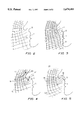
- FIG. 1 shows schematically the product concept of the present invention
- FIG. 2 shows a side partial stylized view of a human illustrating a typical electrostatic field around a human nasal passage
- FIG. 3 shows the same stylized human outline as in FIG. 2 but with an artificially created electrostatic field near a persons nose to restrict the flow of airborne contaminants into the nasal passages;
- FIG. 4 shows another alternative present invention embodiment wherein a combination of artificially created electrostatic fields are shown.
- FIG. 5 shows a mild artificially created electrostatic field.
- the present invention is primarily directed to the prevention of harmful effects caused by airborne contaminants which enter the human nasal passage during breathing.
- the prior art is lacking in means for protecting the human from harmful effects of airborne contaminants in a practical manner rather than treating the affects of such contaminants.
- the present invention is directed to the creation of an artificial electrostatic field in an area near a human nasal passage.
- the present invention product may be in the form of a solution, a semisolid or a solid.
- the solution may be a topical solution, a spray solution or a vaporizable solution.
- Semisolids may take the form of an ointment, a paste, a cream or a gel.
- a gel may likewise be in the form of a spreadable gel or a hydrogel.
- the electrostatic material constitutes the means for creating the electrostatic field and need not be dispersed within a carrier or applied to a substrate.
- the electrostatic material itself may be a polymeric material which could come in the form of a flexible, semirigid or rigid strip which could have an adhesive applied to one side for adhering to a facial area near a nasal passage.
- the electrostatic material could be a flexible, semirigid or rigid, open pore or closed pore foam which, in and of itself would not require any carrier or substrate and could include adhesive for attachment to a facial area.
- the present invention product may be applied in its particular physical form directly to a nasal passage or in the area of a nasal passage for example, by using the finger or by using an applicator which may be provided by the manufacturer.
- the present invention product may take the form of a carrier with the active electrostatic material dispersed throughout at least a portion of the carrier.
- the electrostatic material may be a plurality of masses of one or more electrostatic materials. These masses have an average cross-sectional area of about 1 square millimeter to about 50,000 square millimeters and are sufficient to create such an electrostatic field which will prevent at least some airborne contaminants from entering into a human nasal passage.
- the present invention product includes the aforementioned carrier and active material, as well as a substrate.
- the substrate may be one which could be attached to the face or nasal area in general and may be rigid or flexible, but it is preferably flexible and includes adhesive material and thus may take the form of something similar to a bandaid.
- a flexible substrate may hold the carrier with the active material dispersed therein and this flexible substrate will advantageously have adhesive material for adherence at or near the nasal passages.
- the plurality of masses of one or more electrostatic materials is created by combining one or more electrostatic materials with an appropriate carrier.
- electrostatic materials may be organic or inorganic such as polymers, salts, ionic compounds, compound ionic/compound non-ionic mixtures, copolymers having hydrophobic and/or hydrophilic linkages etc.
- specific electrostatic materials which may be used in the present invention are: Quarternary Cellulosic Derivatives, Quarternary Ammonium Compounds, Quarternized Proteins, Fatty or Polymer derived Quarternary Ammonium Compounds, and their equivalents.
- the carrier used in the present invention may be a single material or a combination of materials and the choice of carrier depends upon the physical form of the present invention product desired. Thus, the carrier will depend on whether or not one desires a liquid, a solid or a semisolid, whether the liquid is to be sprayed, vaporized or applied with an applicator, whether or not the semisolid is to be in paste or cream or ointments or other form; whether or not the solid material is to be flexible or rigid or semi flexible.
- the carrier may be taken from many different materials or combinations of materials and may include other ingredients which would enhance the carrier and/or electrostatic materials.
- hydrocarbon-based semisolids containing dissolved or suspended electrostatic materials may be used. These typically contain fluid hydrocarbons having about 16 to about 30 carbon atoms and may be straight chained or branched. Other semisolid hydrocarbons may involve entrapment of particulate electrostatic materials and may have from 30 to 50 carbons and likewise may be straight chained or branched.
- the preparation of the present invention product which is in the form of ointments simply involves the preparation of the ointment material which may involve melting various waxes and/or oils and crystallizing followed by physically mixing the electrostatic materials therein.
- Such semisolids include petroleum distillates which act as typical ointments macroscopically.
- Commercially available mineral oil bases which are gelled with polyethylene may be useful in the present invention, as may other hydrocarbon ointments.
- silicone based ointments and these may contain polysiloxanes to impart wax like or ointment like properties.
- polyethylene glycol ointments may be used and short chain polyethylene glycol polymers are well known as well as long chain polyethylene glycol polymers, depending upon the particular feel and consistency of the product.
- Water-in-oil emulsions may likewise be created to have an ointment which would include electrostatic materials of the present invention.
- Additives to emulsify water, including cholesterol, lanolin, semi synthetic lanolin derivatives and various ionic and non-ionic surfactants may be included alone or in combination.
- the present invention product may take the form of a paste and these are basically ointments which have a higher percentage of insoluble solids.
- insoluble solids may comprise as much as 50 percent by weight and render the pastes stiffer than the ointments due to the presence of these solids.
- Ingredients such as starch, zinc oxide, calcium carbonate, talc and other somewhat inert particulate may be added to the typical ointment materials to create pastes which are useful in the present invention.
- the pastes may be less greasy than the ointments and may have a better feel and are less likely to be accidentally removed or otherwise deteriorated through exposure to weather or otherwise.
- the present invention product may also take the form of a cream and the use of the word cream is generally recognized in the pharmaceutical and related arts to take the form of ointments which have a white appearance, although the term has been applied to both absorption bases containing emulsified water and to semisolid systems. Nonetheless, creams may contain lipids and other moisturizers and might include nonvolatile water-miscible solvents such as polyethylene glycol. They may also include solubilized waxy acids and wax like materials. Thus, creams may contain long chain alcohols, long chain esters and long chain acids such as cetyl alcohol, stearyl alcohol and myristate alcohols, palmitate alcohols and stearate alcohols, as well as palmitic acid and stearic acid. Additionally, vegetable and animal oils and assorted waxes may be included to form creams used in the present invention products.
- Gels may be used in the present invention products and these are semisolid systems in which a liquid phase is constrained within an interlocked three dimensional polymeric matrix of a natural or synthetic polymers such as a natural or synthetic gum. Typically, significant physical or chemical cross linking or interweaving is involved. Gel chemistry is now well established and hydrogels are well known for the application of facial makeup formulations. Hydrogels may include bases of many different types of organic materials and including carrageen, agar, pectin, methylcellulose, hydrocellulose, carboxymethylcellulose, polyacrylonitrile polymers etc.
- gels may either be spreadable gels in the sense of being very small groupings of polymers in the semisolid system which render the gels easily spreadable or they may be microencapsulations which are separate from one another or macroencapsulations which could form a layer of material which may or may not be spreadable.
- spreadable gels would be referred to herein as gels whereas nonspreadable gels would be referred to herein as hydrogels.
- the present invention product may be in the form of a flexible, semiflexible or rigid foam based carrier and an electrostatic material.
- the chemistry of creating foams is well known and the electrostatic materials may be intricately formed therewith or added thereto afterward by physical incorporation.
- the present invention carriers may take the form of materials which could be in the liquid or semisolid phase and may be vaporizable or sprayable.
- Sprayable solutions may well be suspension systems and may include various alcohols such as ethyl alcohol, glycols and water and may include solubilizers or surfactants as well as antioxidants, as needed.
- Propellants are used with aerosol solutions and propellants are well known in the industry.
- the product may contain electrostatic materials which have size considerations based directly on the nature of the substrate to be used.
- foam substrates should have small enough electrostatic materials within the carriers to allow significant electrostatic material to be spread into foam open cells with sufficient carrier to create significant electrostatic charge.
- the present invention product is on a substrate or simply used in its carrier and applied directly, there may be one or more masses of electrostatic fields and the charges may be positive, negative or combination of both positive and negative charges.
- One interesting embodiment would be to have a matrix of squares, rectangles, circles or other random configurations where positive and negative charge groupings alternate.
- Necon LO A surfactant
- the ingredients are added one by one, at room temperature, in the order listed to water, while stirring. No new ingredient is added until the one added before was dispersed completely.
- Polawax and Arlacel were dispersed by warming the mixture, to 60 degrees C., over a water bath. After all ingredients were added, the contents were mixed well for uniformity, let cool to room temperature and bottled.
- Each patient was provided with the gel along with directions for use which included that a very thin film should be applied with the finger on the outside of the nostril and above the upper lip and to repeat the application four times a day.
- the patient was supposed to blow, rinse, and dry nose before applying the gel. All patients were instructed to avoid contact with eyes.
- patient was instructed not to use other anti-allergy medicine including antihistamines, steroids, or over the counter drugs. Patients used the gel for four days.
- the present invention product is applied at or near the nasal passage by either being attached to the face externally or being placed within the accessible regions of the nasal passages. These areas shall be taken to include one or more areas of:
- the electrostatic material will be operable for a predetermined time or for a predetermined quantity of contaminants to be attracted.
- the present invention product may subsequently be removed once it is used up, for example, by being wiped away or may just wear away through material functions, incidental wipings, other touchings and routine washing habits.
- the carrier may be placed strategically in the nasal passage or on the face or across the nose as desired or recommended and may then be removed after a predetermined period of time and replaced with a fresh product.
- the present invention product is formulated to, as mentioned, have adequate electrostatic charge to prevent at least some airborne contaminants from entering the nasal passages and to cause harmful affects on the user.
- the electrostatic charge will have a minimum desired initial charge of 10 -8 .
- the electrostatic field will have a charge in the range of 10 -9 and 10 -3 . While these ranges are quantified, it should be recognized that highly concentrated product will require a small surface area or application and thus may have a greater charge than the ranges set forth herein and, likewise, for materials that are spread over large surface areas, such as around the cheeks, above the upper lip, and over the nose, the charge for square millimeter may be significantly less and yet still may be effective to achieve the objectives of the present invention.
- FIG. 1 there is shown a block diagram which summarizes the present invention parameters.
- the electrostatic material may be solid, foam, semisolid, gel, hydrogel, a solution, an ointment, a cream, a paste or sol.
- the solution may be a liquid or a dispersion, one for spray application or even vaporization.
- the electrostatic material may be used alone or with a carrier. "Carrier” is described above as taken to mean a somewhat fluid material into which electrostatic material may be dispersed.
- the electrostatic material may be with or without a substrate, that is with the electrostatic material applied directly to a substrate or in a carrier and then applied to a substrate.
- the product of the present invention with the electrostatic material for creating the field in the area of nasal passages may be with or without an adhesive. If it is in a solid form which is rigid or semirigid or like a flexible tape or bandage, then an adhesive may be necessary for maintaining the product in the area of the nasal passages.
- FIG. 2 shows a partial side stylized view of a face 1 including a nasal passage 3. This facial representation is repeated in FIGS. 3, 4, and 5 and like parts are like numbered and will not be repeated in the discussion below.
- an electrostatic field is represented as typical by grid 5.
- Grid 5 simply represents electrostatic charged concentration with some fixed but arbitrary number of charges of ionically charged pollutants per grid block. Thus, if the grid blocks are larger, the electrostatic charge is smaller and if the grid blocks are smaller, the electrostatic charge is larger because there are more charges in a given area.
- FIG. 3 represents one possible arrangement for a present invention product.
- face 1 includes the application of a cream or paste product of the present invention which is developed to attract pollen as a result of the electrostatic charge.
- the cream or paste is applied in areas 7, 8 and 9, that is, over the nose, above the lips, and in the chin and face area.
- a large concentrated grid 10 is shown, which has an artificial electrostatic field of much higher concentration than the typical field shown in FIG. 2.
- the airborne contaminants such as pollen will be attracted to and adhere to the cream or paste and, once the cream or paste is loaded with ionically charged pollutants, for example, after four hours of use, the cream or paste may be wiped off and new material applied.
- FIG. 4 shows an alternative embodiment where two different types of ointments are used.
- ointment 21 is positively charged and is applied to the mucus membrane of the nasal passage area directly while ointment 23 is negatively charged and is applied to the nose, as shown.
- Below the line 11-12 is a positive field and above the line 11-12 is a negative field.
- Arrows 13 and 14 illustrate a feature of the present invention as shown in FIG. 4.
- arrow 13 suggests that contaminants would be repelled by ointment 23, whereas, arrow 14 shows that similar contaminants would be attracted to ointment 21. This would be the case where the contaminants are essentially negatively charged.
- FIG. 5 shows yet another alternative present invention embodiment.
- product 31 is a bandage material applied around the nasal area with a cut out or hole therein for nasal passage 3.
- This has a normal bandage material as substrate, with an adhesive against the skin areas and with an electrostatic material in a carrier on the outer surface of the bandage.
- Electrostatic grid 33 is a typical or normal electrostatic field grid as is grid 37.
- directly opposite product 31 is highly concentrated artificial electrostatic field 35 which, in this case, is to repel contaminants, attract contaminants or both.
- product 31 would be an array of squares, as shown thereon, wherein alternative squares would have positive and negative electrostatic fields so that airborne contaminants, whether negative or positive would migrate to product 31 and particularly to the area of its opposite charge, thereby preventing both positive and negative airborne contaminants from entering the nasal passage.
Landscapes
- Health & Medical Sciences (AREA)
- General Health & Medical Sciences (AREA)
- Business, Economics & Management (AREA)
- Emergency Management (AREA)
- Otolaryngology (AREA)
- Chemical & Material Sciences (AREA)
- Medicinal Chemistry (AREA)
- Pharmacology & Pharmacy (AREA)
- Epidemiology (AREA)
- Life Sciences & Earth Sciences (AREA)
- Animal Behavior & Ethology (AREA)
- Public Health (AREA)
- Veterinary Medicine (AREA)
- Medicinal Preparation (AREA)
- Peptides Or Proteins (AREA)
- Medicines That Contain Protein Lipid Enzymes And Other Medicines (AREA)
Abstract
Description
______________________________________
Ingredient     % age composition by weight
______________________________________
1. Deionized Water
               80.9
2. Potassium Sorbate
               0.1
3. Celquat SC 240 C
               3.9
4. Polawax 5% in water
               4.9
5. Agestat 400 7.9
6. Arlacel 165 1.0
7. Tween 60    0.1
8. Propylene Glycol
               1.2
               100.0
______________________________________
______________________________________
Ingredient       % age composition
______________________________________
1. Deionized water
                 78.5
2. Celquat SC 240 C
                 3.8
3. Agestat 400   7.6
4. Polawax 5% in water
                 9.5
5. Potassium Sorbate
                 0.1
6. Necon LO      0.5
                 100.0
______________________________________
______________________________________
1. Deionized water
                 89.9
2. Celquat SC 240 C
                 4.0
3. Agestat 400   6.0
4. Potassium Sorbate
                 0.1
                 100.0
______________________________________
Claims (11)
Priority Applications (10)
| Application Number | Priority Date | Filing Date | Title |
|---|---|---|---|
| US08/560,659 US5674481A (en) | 1993-06-24 | 1995-11-20 | Electrostatically charged nasal topical application product |
| PCT/US1996/018441 WO1997018797A1 (en) | 1995-11-20 | 1996-11-07 | Electrostatically charged nasal application device and process |
| CA002236864A CA2236864A1 (en) | 1995-11-20 | 1996-11-07 | Electrostatically charged nasal application device and process |
| AU11603/97A AU1160397A (en) | 1995-11-20 | 1996-11-07 | Electrostatically charged nasal application device and process |
| EP96942765A EP0892637A4 (en) | 1995-11-20 | 1996-11-07 | Electrostatically charged nasal application device and process |
| US15/390,227 US9737497B2 (en) | 1993-06-24 | 2016-12-23 | Electrostatically charged nasal application method and product for micro-filtration |
| US15/458,952 US9750706B2 (en) | 1993-06-24 | 2017-03-14 | Electrostatically charged nasal application method and product for micro-filtration |
| PCT/US2017/048386 WO2018118146A1 (en) | 1993-06-24 | 2017-08-24 | Electrostatically charged nasal application method and product for microfiltration |
| CN201780078389.3A CN110087645A (en) | 1993-06-24 | 2017-08-24 | The nose application method and product of static electrification lotus for micro-filtration |
| KR1020197014177A KR20190082800A (en) | 1993-06-24 | 2017-08-24 | Electrostatically charged nasal application methods and products for microfiltration |
Applications Claiming Priority (2)
| Application Number | Priority Date | Filing Date | Title |
|---|---|---|---|
| US08/080,775 US5468488A (en) | 1993-06-24 | 1993-06-24 | Electrostatically charged nasal application product and method |
| US08/560,659 US5674481A (en) | 1993-06-24 | 1995-11-20 | Electrostatically charged nasal topical application product |
Related Parent Applications (1)
| Application Number | Title | Priority Date | Filing Date |
|---|---|---|---|
| US08/080,775 Continuation-In-Part US5468488A (en) | 1993-06-24 | 1993-06-24 | Electrostatically charged nasal application product and method |
Publications (1)
| Publication Number | Publication Date |
|---|---|
| US5674481A true US5674481A (en) | 1997-10-07 |
Family
ID=24238766
Family Applications (1)
| Application Number | Title | Priority Date | Filing Date |
|---|---|---|---|
| US08/560,659 Expired - Lifetime US5674481A (en) | 1993-06-24 | 1995-11-20 | Electrostatically charged nasal topical application product |
Country Status (5)
| Country | Link |
|---|---|
| US (1) | US5674481A (en) |
| EP (1) | EP0892637A4 (en) |
| AU (1) | AU1160397A (en) |
| CA (1) | CA2236864A1 (en) |
| WO (1) | WO1997018797A1 (en) |
Cited By (36)
| Publication number | Priority date | Publication date | Assignee | Title |
|---|---|---|---|---|
| USD433193S (en) * | 1999-08-18 | 2000-10-31 | The Procter & Gamble Company | Sprayer |
| USD437978S1 (en) | 1999-08-18 | 2001-02-20 | The Procter & Gamble Company | Sprayer |
| US6209541B1 (en) * | 1998-02-25 | 2001-04-03 | Sims Portex Inc. | Hydrophobic electrostatic breathing filters, and methods of manufacturing the same |
| USD443728S1 (en) | 1999-08-18 | 2001-06-12 | The Procter & Gamble Company | Sprayer cartridge |
| US20010020653A1 (en) * | 1999-08-18 | 2001-09-13 | Wilson David Edward | Electrostatic spray device |
| US6311903B1 (en) | 1999-08-18 | 2001-11-06 | The Procter & Gamble Company | Hand-held electrostatic sprayer apparatus |
| US20010038047A1 (en) * | 1999-08-18 | 2001-11-08 | Wilson David Edward | Electrostatic spray device |
| US6318647B1 (en) | 1999-08-18 | 2001-11-20 | The Procter & Gamble Company | Disposable cartridge for use in a hand-held electrostatic sprayer apparatus |
| US6443164B1 (en) | 2000-09-22 | 2002-09-03 | Spectrum Products, Inc. | Apparatus for automatic application of compositions to the skin |
| USD464564S1 (en) | 1999-08-18 | 2002-10-22 | The Procter & Gamble Company | Sprayer cartridge |
| US6514504B1 (en) | 1999-08-18 | 2003-02-04 | The Procter & Gamble Company | Discontinuous films from skin care compositions |
| US6531142B1 (en) | 1999-08-18 | 2003-03-11 | The Procter & Gamble Company | Stable, electrostatically sprayable topical compositions |
| US6558682B2 (en) | 1999-08-18 | 2003-05-06 | The Procter & Gamble Company | Discontinuous films from skin care compositions |
| US20030161790A1 (en) * | 2002-02-25 | 2003-08-28 | Trutek Corp. | Electrostatically charged nasal application product with increased strength |
| US20030223934A1 (en) * | 2002-06-04 | 2003-12-04 | Trutek Corp | Electrostatically charged nasal application diagnotic product and method |
| US6682004B2 (en) | 1999-08-18 | 2004-01-27 | The Procter & Gamble Company | Electrostatic spray device |
| US20040073186A1 (en) * | 2002-10-15 | 2004-04-15 | Cameron Mickey G. | Apparatus for automatic application of compositions to the skin |
| US6814318B2 (en) | 1999-08-18 | 2004-11-09 | The Procter & Gamble Company | Disposable cartridge for electrostatic spray device |
| US20040261798A1 (en) * | 2003-06-24 | 2004-12-30 | Ron Rimkus | Nose filter |
| US20050043253A1 (en) * | 2003-08-19 | 2005-02-24 | Cook Bradley R. | Use of wound healing compositions for prevention of infections and allergies |
| WO2005070242A3 (en) * | 2004-01-13 | 2005-11-10 | Jong T Huang | Personal inhalation filter |
| US20060016450A1 (en) * | 2004-06-29 | 2006-01-26 | Pearson Alfred E | Air filter device for the nose |
| US7078046B1 (en) | 1999-08-18 | 2006-07-18 | The Procter & Gamble Company | Electrostatically-sprayable topical compositions having insulating external phase and conductive internal phase |
| WO2006099651A1 (en) * | 2005-03-24 | 2006-09-28 | Unipack Ges.M.B.H. | Liquid aqueous dosage forms for sub-lingual or nasal applications of active agents with amino groups |
| US20080223371A1 (en) * | 2007-03-14 | 2008-09-18 | Guillory Samuel L | Nose guard mask |
| US20090174100A1 (en) * | 2007-11-17 | 2009-07-09 | James Rolfe | Methods of encapsulating a substance |
| US20090235933A1 (en) * | 2008-08-26 | 2009-09-24 | Trutek Corp. | Electrostatically charged mask filter products and method for increased filtration efficiency |
| US20090246163A1 (en) * | 2008-08-26 | 2009-10-01 | Trutek Corp. | Anti-static skin products and method |
| US20090258946A1 (en) * | 2008-07-07 | 2009-10-15 | Trutek Corp. | Electrostatically charged nasal application multipurpose products and method |
| US20100004337A1 (en) * | 2008-07-07 | 2010-01-07 | Trutek Corp. | Electrostatically charged multi-acting nasal application, product, and method |
| US20100055152A1 (en) * | 2008-08-26 | 2010-03-04 | Trutek Corporation | Antihistamine and antihistamine-like nasal application, products, and method |
| EP1701677A4 (en) * | 2003-08-20 | 2011-12-14 | Ashok L Wahi | Electrostatically charged nasal application product with increased strength |
| US9463340B1 (en) | 2015-05-20 | 2016-10-11 | Marc Irwin Epstein | Draping particulate filter for the nostrils and mouth and method of manufacture thereof |
| US9468783B1 (en) | 2015-05-20 | 2016-10-18 | Marc Irwin Epstein | Draping particulate filter for the nostrils and mouth and method of manufacture thereof |
| US9737497B2 (en) | 1993-06-24 | 2017-08-22 | Trutek Corp. | Electrostatically charged nasal application method and product for micro-filtration |
| US20230321158A1 (en) * | 2022-04-08 | 2023-10-12 | Holista Biotech Sdn Bhd | Compositions for protection against pathogen infection and method thereof |
Citations (1)
| Publication number | Priority date | Publication date | Assignee | Title |
|---|---|---|---|---|
| US5468488A (en) * | 1993-06-24 | 1995-11-21 | Wahi; Ashok L. | Electrostatically charged nasal application product and method |
Family Cites Families (2)
| Publication number | Priority date | Publication date | Assignee | Title |
|---|---|---|---|---|
| US4874659A (en) * | 1984-10-24 | 1989-10-17 | Toray Industries | Electret fiber sheet and method of producing same |
| LU86429A1 (en) * | 1986-05-16 | 1987-12-16 | Oreal | COSMETIC COMPOSITIONS CONTAINING A CATIONIC POLYMER AND AN ANIONIC POLYMER AS A THICKENING AGENT |
-
1995
- 1995-11-20 US US08/560,659 patent/US5674481A/en not_active Expired - Lifetime
-
1996
- 1996-11-07 AU AU11603/97A patent/AU1160397A/en not_active Abandoned
- 1996-11-07 WO PCT/US1996/018441 patent/WO1997018797A1/en not_active Ceased
- 1996-11-07 EP EP96942765A patent/EP0892637A4/en not_active Withdrawn
- 1996-11-07 CA CA002236864A patent/CA2236864A1/en not_active Abandoned
Patent Citations (1)
| Publication number | Priority date | Publication date | Assignee | Title |
|---|---|---|---|---|
| US5468488A (en) * | 1993-06-24 | 1995-11-21 | Wahi; Ashok L. | Electrostatically charged nasal application product and method |
Cited By (41)
| Publication number | Priority date | Publication date | Assignee | Title |
|---|---|---|---|---|
| WO2018118146A1 (en) * | 1993-06-24 | 2018-06-28 | Trutek Corp. | Electrostatically charged nasal application method and product for microfiltration |
| US9737497B2 (en) | 1993-06-24 | 2017-08-22 | Trutek Corp. | Electrostatically charged nasal application method and product for micro-filtration |
| US6209541B1 (en) * | 1998-02-25 | 2001-04-03 | Sims Portex Inc. | Hydrophobic electrostatic breathing filters, and methods of manufacturing the same |
| US6558682B2 (en) | 1999-08-18 | 2003-05-06 | The Procter & Gamble Company | Discontinuous films from skin care compositions |
| USD437978S1 (en) | 1999-08-18 | 2001-02-20 | The Procter & Gamble Company | Sprayer |
| US6311903B1 (en) | 1999-08-18 | 2001-11-06 | The Procter & Gamble Company | Hand-held electrostatic sprayer apparatus |
| US20010038047A1 (en) * | 1999-08-18 | 2001-11-08 | Wilson David Edward | Electrostatic spray device |
| US6318647B1 (en) | 1999-08-18 | 2001-11-20 | The Procter & Gamble Company | Disposable cartridge for use in a hand-held electrostatic sprayer apparatus |
| US20010020653A1 (en) * | 1999-08-18 | 2001-09-13 | Wilson David Edward | Electrostatic spray device |
| USD464564S1 (en) | 1999-08-18 | 2002-10-22 | The Procter & Gamble Company | Sprayer cartridge |
| US6514504B1 (en) | 1999-08-18 | 2003-02-04 | The Procter & Gamble Company | Discontinuous films from skin care compositions |
| US6531142B1 (en) | 1999-08-18 | 2003-03-11 | The Procter & Gamble Company | Stable, electrostatically sprayable topical compositions |
| US7152817B2 (en) | 1999-08-18 | 2006-12-26 | The Procter & Gamble Company | Electrostatic spray device |
| US7712687B2 (en) | 1999-08-18 | 2010-05-11 | The Procter & Gamble Company | Electrostatic spray device |
| US7078046B1 (en) | 1999-08-18 | 2006-07-18 | The Procter & Gamble Company | Electrostatically-sprayable topical compositions having insulating external phase and conductive internal phase |
| US6682004B2 (en) | 1999-08-18 | 2004-01-27 | The Procter & Gamble Company | Electrostatic spray device |
| USD433193S (en) * | 1999-08-18 | 2000-10-31 | The Procter & Gamble Company | Sprayer |
| US6814318B2 (en) | 1999-08-18 | 2004-11-09 | The Procter & Gamble Company | Disposable cartridge for electrostatic spray device |
| USD443728S1 (en) | 1999-08-18 | 2001-06-12 | The Procter & Gamble Company | Sprayer cartridge |
| US6443164B1 (en) | 2000-09-22 | 2002-09-03 | Spectrum Products, Inc. | Apparatus for automatic application of compositions to the skin |
| US6844005B2 (en) * | 2002-02-25 | 2005-01-18 | Trutek Corp | Electrostatically charged nasal application product with increased strength |
| US20030161790A1 (en) * | 2002-02-25 | 2003-08-28 | Trutek Corp. | Electrostatically charged nasal application product with increased strength |
| US20030223934A1 (en) * | 2002-06-04 | 2003-12-04 | Trutek Corp | Electrostatically charged nasal application diagnotic product and method |
| US20040073186A1 (en) * | 2002-10-15 | 2004-04-15 | Cameron Mickey G. | Apparatus for automatic application of compositions to the skin |
| US20040261798A1 (en) * | 2003-06-24 | 2004-12-30 | Ron Rimkus | Nose filter |
| US20050043253A1 (en) * | 2003-08-19 | 2005-02-24 | Cook Bradley R. | Use of wound healing compositions for prevention of infections and allergies |
| EP1701677A4 (en) * | 2003-08-20 | 2011-12-14 | Ashok L Wahi | Electrostatically charged nasal application product with increased strength |
| WO2005070242A3 (en) * | 2004-01-13 | 2005-11-10 | Jong T Huang | Personal inhalation filter |
| US20060016450A1 (en) * | 2004-06-29 | 2006-01-26 | Pearson Alfred E | Air filter device for the nose |
| WO2006099651A1 (en) * | 2005-03-24 | 2006-09-28 | Unipack Ges.M.B.H. | Liquid aqueous dosage forms for sub-lingual or nasal applications of active agents with amino groups |
| US20080223371A1 (en) * | 2007-03-14 | 2008-09-18 | Guillory Samuel L | Nose guard mask |
| US20090174100A1 (en) * | 2007-11-17 | 2009-07-09 | James Rolfe | Methods of encapsulating a substance |
| US8163802B2 (en) | 2008-07-07 | 2012-04-24 | Trutek Corp. | Electrostatically charged multi-acting nasal application, product, and method |
| US20090258946A1 (en) * | 2008-07-07 | 2009-10-15 | Trutek Corp. | Electrostatically charged nasal application multipurpose products and method |
| US20100004337A1 (en) * | 2008-07-07 | 2010-01-07 | Trutek Corp. | Electrostatically charged multi-acting nasal application, product, and method |
| US20090246163A1 (en) * | 2008-08-26 | 2009-10-01 | Trutek Corp. | Anti-static skin products and method |
| US20100055152A1 (en) * | 2008-08-26 | 2010-03-04 | Trutek Corporation | Antihistamine and antihistamine-like nasal application, products, and method |
| US20090235933A1 (en) * | 2008-08-26 | 2009-09-24 | Trutek Corp. | Electrostatically charged mask filter products and method for increased filtration efficiency |
| US9463340B1 (en) | 2015-05-20 | 2016-10-11 | Marc Irwin Epstein | Draping particulate filter for the nostrils and mouth and method of manufacture thereof |
| US9468783B1 (en) | 2015-05-20 | 2016-10-18 | Marc Irwin Epstein | Draping particulate filter for the nostrils and mouth and method of manufacture thereof |
| US20230321158A1 (en) * | 2022-04-08 | 2023-10-12 | Holista Biotech Sdn Bhd | Compositions for protection against pathogen infection and method thereof |
Also Published As
| Publication number | Publication date |
|---|---|
| WO1997018797A1 (en) | 1997-05-29 |
| EP0892637A4 (en) | 2000-08-30 |
| EP0892637A1 (en) | 1999-01-27 |
| AU1160397A (en) | 1997-06-11 |
| CA2236864A1 (en) | 1997-05-29 |
Similar Documents
| Publication | Publication Date | Title |
|---|---|---|
| WO1997018797A1 (en) | Electrostatically charged nasal application device and process | |
| US5468488A (en) | Electrostatically charged nasal application product and method | |
| US6103245A (en) | Topical barrier composition containing silicone and bentonite | |
| EP0336901B1 (en) | Anesthetic skin moisturizing composition and method of preparing same | |
| CA2208068C (en) | Medicated tissue paper product | |
| CN1203842C (en) | Arificial tear replacement solution | |
| EP1301180A2 (en) | Film dermatics | |
| JPH01305012A (en) | Skin moisturizing composition and method for producing the same | |
| US6844005B2 (en) | Electrostatically charged nasal application product with increased strength | |
| EP1675572B1 (en) | Coated metal pyrithione particles for treatment of microorganisms | |
| US9750706B2 (en) | Electrostatically charged nasal application method and product for micro-filtration | |
| DE602004010130T2 (en) | MICROEMULSIONS AND THEIR USE FOR THE PREVENTION OF RESPIRATORY DISEASES | |
| WO1998006395A1 (en) | Topical composition for burn healing | |
| KR20110036919A (en) | Electrostatic Nasal Applications Multipurpose Products and Methods | |
| Ricciatti-Sibbald et al. | Dermatologic vehicles | |
| CA2538163C (en) | Eletrostatically charged nasal application product with increased strength | |
| JP2000016941A (en) | Pollen prevention agent | |
| KR102243050B1 (en) | Preparation method of skin cosmetic adjuvant mixed raw material composition using purified water and gelatin and skin cosmetic adjuvant mixed raw material composition | |
| US3452139A (en) | Method of treating seborrheic dermatitis with n,n-diethyl-m-toluamide | |
| CN116712354A (en) | A gel solution for removing pet tear stains | |
| US20250302713A1 (en) | Product and Method For Preparing of Cationic Nanoparticle Formulation For Dermal Treatment | |
| TWI292325B (en) | Composition for dry eye treatmentand use of an emulsion in preparing the same | |
| CN117159396A (en) | Antipruritic liquid for mosquito bite | |
| DE1617564A1 (en) | Drug carrier | |
| EP0826371A4 (en) | EXTERNAL PREPARATION CONTAINING EMEDASTINE |
Legal Events
| Date | Code | Title | Description |
|---|---|---|---|
| FPAY | Fee payment |
Year of fee payment: 4 |
|
| AS | Assignment |
Owner name: TRUTEK CORP., NEW JERSEY Free format text: ASSIGNMENT OF ASSIGNORS INTEREST;ASSIGNOR:WAHI, ASHOK;REEL/FRAME:013949/0928 Effective date: 20021104 |
|
| REMI | Maintenance fee reminder mailed | ||
| REIN | Reinstatement after maintenance fee payment confirmed | ||
| FEPP | Fee payment procedure |
Free format text: PETITION RELATED TO MAINTENANCE FEES FILED (ORIGINAL EVENT CODE: PMFP); ENTITY STATUS OF PATENT OWNER: SMALL ENTITY |
|
| FP | Lapsed due to failure to pay maintenance fee |
Effective date: 20051007 |
|
| FEPP | Fee payment procedure |
Free format text: PETITION RELATED TO MAINTENANCE FEES GRANTED (ORIGINAL EVENT CODE: PMFG); ENTITY STATUS OF PATENT OWNER: SMALL ENTITY |
|
| SULP | Surcharge for late payment | ||
| FPAY | Fee payment |
Year of fee payment: 8 |
|
| PRDP | Patent reinstated due to the acceptance of a late maintenance fee |
Effective date: 20060918 |
|
| STCF | Information on status: patent grant |
Free format text: PATENTED CASE |
|
| FPAY | Fee payment |
Year of fee payment: 12 |