US5616855A - Method and apparatus for measuring viscosity - Google Patents
Method and apparatus for measuring viscosity Download PDFInfo
- Publication number
- US5616855A US5616855A US08/544,863 US54486395A US5616855A US 5616855 A US5616855 A US 5616855A US 54486395 A US54486395 A US 54486395A US 5616855 A US5616855 A US 5616855A
- Authority
- US
- United States
- Prior art keywords
- duct
- chamber
- viscometer
- viscosity
- heater
- Prior art date
- Legal status (The legal status is an assumption and is not a legal conclusion. Google has not performed a legal analysis and makes no representation as to the accuracy of the status listed.)
- Expired - Lifetime
Links
- 238000000034 method Methods 0.000 title description 7
- 239000007788 liquid Substances 0.000 claims abstract description 28
- 238000010438 heat treatment Methods 0.000 claims abstract description 4
- 238000005259 measurement Methods 0.000 claims description 13
- 238000012360 testing method Methods 0.000 claims description 5
- XAGFODPZIPBFFR-UHFFFAOYSA-N aluminium Chemical compound [Al] XAGFODPZIPBFFR-UHFFFAOYSA-N 0.000 description 6
- 229910052782 aluminium Inorganic materials 0.000 description 6
- 239000003921 oil Substances 0.000 description 6
- RYGMFSIKBFXOCR-UHFFFAOYSA-N Copper Chemical compound [Cu] RYGMFSIKBFXOCR-UHFFFAOYSA-N 0.000 description 4
- 229910052802 copper Inorganic materials 0.000 description 4
- 239000010949 copper Substances 0.000 description 4
- 239000011888 foil Substances 0.000 description 4
- XLYOFNOQVPJJNP-UHFFFAOYSA-N water Substances O XLYOFNOQVPJJNP-UHFFFAOYSA-N 0.000 description 4
- 239000004593 Epoxy Substances 0.000 description 2
- XEEYBQQBJWHFJM-UHFFFAOYSA-N Iron Chemical compound [Fe] XEEYBQQBJWHFJM-UHFFFAOYSA-N 0.000 description 2
- 239000002131 composite material Substances 0.000 description 2
- 230000009977 dual effect Effects 0.000 description 2
- 230000008020 evaporation Effects 0.000 description 2
- 238000001704 evaporation Methods 0.000 description 2
- 239000011152 fibreglass Substances 0.000 description 2
- 238000009413 insulation Methods 0.000 description 2
- 238000012423 maintenance Methods 0.000 description 2
- 229910001120 nichrome Inorganic materials 0.000 description 2
- 239000002904 solvent Substances 0.000 description 2
- 239000004677 Nylon Substances 0.000 description 1
- 239000004698 Polyethylene Substances 0.000 description 1
- 239000004793 Polystyrene Substances 0.000 description 1
- BQCADISMDOOEFD-UHFFFAOYSA-N Silver Chemical compound [Ag] BQCADISMDOOEFD-UHFFFAOYSA-N 0.000 description 1
- 238000007792 addition Methods 0.000 description 1
- 230000005791 algae growth Effects 0.000 description 1
- 230000001580 bacterial effect Effects 0.000 description 1
- 238000009529 body temperature measurement Methods 0.000 description 1
- 229920002678 cellulose Polymers 0.000 description 1
- 239000001913 cellulose Substances 0.000 description 1
- 238000012512 characterization method Methods 0.000 description 1
- 238000010276 construction Methods 0.000 description 1
- 238000012217 deletion Methods 0.000 description 1
- 230000037430 deletion Effects 0.000 description 1
- 230000001419 dependent effect Effects 0.000 description 1
- 238000001514 detection method Methods 0.000 description 1
- 238000010586 diagram Methods 0.000 description 1
- 230000000694 effects Effects 0.000 description 1
- 229920001971 elastomer Polymers 0.000 description 1
- 239000000835 fiber Substances 0.000 description 1
- 239000006260 foam Substances 0.000 description 1
- 239000011521 glass Substances 0.000 description 1
- 238000007373 indentation Methods 0.000 description 1
- 229910052742 iron Inorganic materials 0.000 description 1
- 239000000314 lubricant Substances 0.000 description 1
- 239000010687 lubricating oil Substances 0.000 description 1
- 238000004519 manufacturing process Methods 0.000 description 1
- 239000000463 material Substances 0.000 description 1
- 238000012986 modification Methods 0.000 description 1
- 230000004048 modification Effects 0.000 description 1
- 229920001778 nylon Polymers 0.000 description 1
- 229920000728 polyester Polymers 0.000 description 1
- -1 polyethylene Polymers 0.000 description 1
- 229920000573 polyethylene Polymers 0.000 description 1
- 229920000642 polymer Polymers 0.000 description 1
- 229920002223 polystyrene Polymers 0.000 description 1
- 229920002635 polyurethane Polymers 0.000 description 1
- 239000004814 polyurethane Substances 0.000 description 1
- 229920000915 polyvinyl chloride Polymers 0.000 description 1
- 239000004800 polyvinyl chloride Substances 0.000 description 1
- 239000005060 rubber Substances 0.000 description 1
- 229910052709 silver Inorganic materials 0.000 description 1
- 239000004332 silver Substances 0.000 description 1
- 239000007787 solid Substances 0.000 description 1
- 230000001360 synchronised effect Effects 0.000 description 1
- 210000002268 wool Anatomy 0.000 description 1
Images

Classifications
-
- G—PHYSICS
- G01—MEASURING; TESTING
- G01N—INVESTIGATING OR ANALYSING MATERIALS BY DETERMINING THEIR CHEMICAL OR PHYSICAL PROPERTIES
- G01N11/00—Investigating flow properties of materials, e.g. viscosity, plasticity; Analysing materials by determining flow properties
- G01N11/02—Investigating flow properties of materials, e.g. viscosity, plasticity; Analysing materials by determining flow properties by measuring flow of the material
- G01N11/04—Investigating flow properties of materials, e.g. viscosity, plasticity; Analysing materials by determining flow properties by measuring flow of the material through a restricted passage, e.g. tube, aperture
-
- B—PERFORMING OPERATIONS; TRANSPORTING
- B01—PHYSICAL OR CHEMICAL PROCESSES OR APPARATUS IN GENERAL
- B01L—CHEMICAL OR PHYSICAL LABORATORY APPARATUS FOR GENERAL USE
- B01L7/00—Heating or cooling apparatus; Heat insulating devices
- B01L7/02—Water baths; Sand baths; Air baths
-
- G—PHYSICS
- G01—MEASURING; TESTING
- G01N—INVESTIGATING OR ANALYSING MATERIALS BY DETERMINING THEIR CHEMICAL OR PHYSICAL PROPERTIES
- G01N11/00—Investigating flow properties of materials, e.g. viscosity, plasticity; Analysing materials by determining flow properties
- G01N2011/0006—Calibrating, controlling or cleaning viscometers
Definitions
- the present invention relates to methods and apparatuses for measuring the viscosity of liquids.
- Viscosity measurement of liquids is an essential tool used in the characterization of many products. For instance, the suitability of lubricating oils for a particular purpose is closely related to viscosity and to the variation of viscosity with temperature. Most polymers, including nylon, polyester, rubber, polyethylene, cellulose, polyvinylchloride, and polystyrene are routinely characterized during production by dissolving them in a suitable solvent and then measuring the viscosity of the resulting solution.
- the viscosity of liquids is strongly dependent on temperature. As the temperature of a liquid changes, the viscosity also changes. An accurate measurement of viscosity therefore requires accurate and stable temperature control. If viscosity is to be measured to within an accuracy of 1%, the temperature must be highly controlled.
- Measurement of viscosity is often performed in thermostatic baths using a liquid as the thermostatic media. Such baths often have an accuracy of +/-0.01° Celsius.
- This method relies on the high heat capacity of a liquid to provide a stable temperature environment during viscosity measurement.
- a vessel of water or oil is stirred and heated using a highly accurate thermostatic controller.
- the rate of change of the temperature is low and the viscosity measurement can be performed with relative ease.
- Liquid baths however, have several disadvantages. For instance, a liquid bath requires constant maintenance. If water is used as the bath medium, evaporation can pose a problem. Bacterial and algae growth in water necessitates frequent changes of the water media.
- oil is normally chosen as the liquid medium. As the oil becomes hot and starts to oxidize, an objectionable odor is created in the laboratory. Another disadvantage of oil baths is the risk of dripping the oil media onto laboratory surfaces once the viscosity measurement apparatus is removed from the bath. Also, liquid baths are subject to leaks. In the case of hot oil baths, operators are exposed to the danger of burns in the event that the bath container, which often is glass, is broken.
- liquid baths utilized in the prior art as part of viscosity measurement apparatuses require high maintenance and care to operate. Additionally, numerous baths are required to measure a wide range of temperatures.
- an apparatus for measuring the viscosity of liquids in an ultra stable temperature environment has a thermally insulated test chamber.
- a support tray for supporting open top containers of liquids to be tested within the chamber is mounted in the chamber.
- a thermally insulated duct having an inlet and outlet is mounted within the chamber, as is a fan for circulating air through the duct and chamber.
- a heater for heating air flowing through the duct is mounted adjacent to the fan.
- a viscometer is mounted at least partially within the duct downstream of the heater for measuring the viscosity of liquids in containers supported upon the tray.
- a thermal ballast of high heat conductivity and high surface area is also preferably mounted in the duct between the heater and viscometer.
- FIG. 1 is a perspective view of an apparatus for measuring viscosity that embodies principles of the invention in a preferred form with a portion shown broken away to reveal internal components.
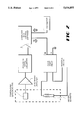
- FIG. 2 is a block diagram illustrating the relationship between the temperature sensor, the heating element, and a computer control system.
- FIG. 1 has a thermally insulated external chamber 10 having a side wall 11.
- External chamber 10 is preferably formed of aluminum with an outer polyurethane layer of foam insulation having a thickness of 25 mm.
- An insulated access door 17 for allowing entry to the interior of external chamber 10 is attached to side wall 11.
- An internal chamber or duct 20 having an inlet 21 and an outlet 22 is mounted within the external chamber 10 suspended from the chamber top.
- Internal chamber 20 is formed of aluminum sheeting approximately 3 mm thick with epoxy fiberglass composite insulation.
- Internal chamber 20 has an access door 26 adjacent to external chamber access door 17.
- a fan 30 is mounted in the external chamber 10 to the inlet 21 of duct 20.
- An electric heater 40 is mounted in duct 20 downstream from the fan 30, and is connected through a solid state relay to a computer as shown in FIG. 2.
- a thermal ballast 50 is mounted in the duct between the heater 40 and the duct outlet 22. Thermal ballast 50 is made of a series of thin copper plates 0.5 millimeters thick spaced 3 millimeters apart.
- a viscometer 72 and a temperature sensor 60 are mounted in mutual proximity within the duct between the thermal ballast 50 and the duct outlet 22.
- Viscometer 72 is connected by a threaded drive shaft to a motor M3 for movement of viscometer 72 in a vertical direction.
- a sample tray 80 is mounted within the duct 20 for movement in a horizontal plane in both X and Y directions below the viscometer 72.
- the sample tray 80 is coupled by unshown means with threaded drive shafts of motors M1 and M2, respectively, which respectively drive the tray in X and Y axes directions.
- the duct section that houses the temperature sensor, viscometer and sample tray has a door 26 aligned with the external chamber access door 17.
- the temperature sensor 60 is coupled with the computer through an electronic amplifier and an analog to digital converter.
- the viscometer 72 is also coupled to the computer.
- the heater 40 is also controlled by the computer.
- any number of computers may be used, an IBM-PC compatible computer with a 80486 microprocessor is preferred.
- the internal chamber is preferably aluminum in order to minimize the time required to heat up the chamber to its operating temperature.
- the fan 30 is a centrifugal type fan with 5 cubic meters of air per minute capacity.
- the heater 40 comprises a gang of nichrome heater wires having low mass in the shape of a series of wire turns.
- the nichrome heater provides for a temperature range between 35 to 150 degrees Celsius. If an external cooler is added to the apparatus, the temperature range can be between -10 and +150 degrees Celsius. That portion of the duct that houses the heater is preferably coated with an epoxy fiberglass composite to achieve insulative effect as well as to secure the wiring connections.
- the thermal ballast 50 is made of a material that has high heat conductivity such as silver, iron, aluminum, or copper.
- the ballast is shaped to have a high surface area to mass ratio allowing air to access all of the surface area generally uniformly. Given this factor, the shape selected may be a series of adjacent parallel plates as seen in FIG. 1, or as a gang of spirals, or in filamentous wool forms.
- the viscometer 72 may be of the conventional single capillary bulb type. In the preferred embodiment though, the viscometer has two viscosity measuring bulbs, namely a lower capillary and measuring bulb 71, and an upper, double capillary and measuring bulb 70.
- a viscometer of the double bulb type provides for a more extended viscosity measurement range. Once its lower bulb is filled and raised, the viscosity of the sample in the bulb is measured as it gravitates back into a container. Sample detection is made with fiber optic cables using an infrared light source. The computer monitors the data generated by the viscometer and calculates viscosity utilizing conventional calculation software. In the dual bulb type viscometer, as a sample is drawn into its lower bulb, pressure and time are recorded by the computer. If the time-pressure product is low, the sample is drawn further into the upper capillary. Conversely, if the time-pressure product is high, the sample is released through the lower capillary back into the container. The dual type viscometer allows for the measurement of viscosity over a range of 1 to 100 centistokes. By changing viscometers the entire range of viscosity from 0.3 to 30,000 centistokes can be analyzed.
- access doors 17 and 26 are opened.
- the samples are placed in disposable vials which are loaded onto tray 80 in individual checkerboard arrayed receptacles or indentations along the tray top.
- the vials are covered with aluminum foil to inhibit evaporation once the access doors are closed and the chamber is heated.
- Access doors 17 and 26 are then closed and the computer activated which energizes the heater and fan. Once the desired chamber temperature is achieved, the heater is activated intermittently by the computer in order to maintain the preselected temperature level.
- the air temperature within the apparatus can be changed from 40° Celsius to 100° Celsius in approximately 16 to 18 minutes.
- the air temperature Downstream of the ballast the air temperature is continuously measured by the temperature sensor 60 and monitored by the computer. After the air stream in the duct passes over the viscometer and temperature sensor, it is returned outside of the duct to the intake of the fan 30 to complete a cycle. With this unique construction and operation of the apparatus, temperature fluctuations about the viscometer and sampler have been found to be limited to within 0.01 degrees Celsius.
- Movement of the viscometer is controlled by the computer in synchronous with movements of the tray.
- the viscometer is lowered by motor M3 causing it to puncture the foil cover and enter into the vial directly beneath it and its sample liquid.
- the sample is then drawn into the viscometer and its viscosity measured. Each time this is done the viscometer is cleansed by an unshown cleansing device and solvent.
- the tray 80 is then indexed so as to bring another vial into position directly beneath the viscometer.
- the viscometer is then driven down into that vial, again puncturing the aluminum foil, and the process repeated until all of the vial samples have been tested and the viscosity measurement for each vial recorded.
- FIGS. 1 and 2 The apparatus of FIGS. 1 and 2 was tested with a thermal ballast 50 consisting of 32 sheets of copper each having a dimension of 8 cm ⁇ 23 cm by 0.5 cm.
- the total mass of the copper used was about 2.5 kg and the total surface area exposed to the air stream about 11,776 sq. cm. Twelve samples were tested. During the period of time in which the samples were tested, the temperature was found not to vary more than 0.01 degrees Celsius. As shown in Table A, viscosity percent deviation from average was maintained at a low level. Notwithstanding movement of the tray and samples, and the puncturing of foil under these conditions, this did not distract from the effectiveness of the apparatus, in maintaining a highly thermally stable environment.
Landscapes
- Chemical & Material Sciences (AREA)
- Health & Medical Sciences (AREA)
- General Health & Medical Sciences (AREA)
- Life Sciences & Earth Sciences (AREA)
- Analytical Chemistry (AREA)
- Biochemistry (AREA)
- Physics & Mathematics (AREA)
- General Physics & Mathematics (AREA)
- Immunology (AREA)
- Pathology (AREA)
- Clinical Laboratory Science (AREA)
- Chemical Kinetics & Catalysis (AREA)
- Investigating Or Analyzing Materials Using Thermal Means (AREA)
Abstract
Description
              TABLE A
______________________________________
Sample    Viscosity
(Position)
          (Centistokes)
                     % Deviation From Average
______________________________________
A         37.23      +0.05
B         37.17      -0.11
C         37.23      +0.05
D         37.09      -0.34
E         37.15      -0.16
F         37.33      +0.32
G         37.22      +0.03
H         37.16      -0.13
I         37.28      +0.19
J         37.23      +0.05
K         37.30      +0.24
L         37.11      -0.27
______________________________________
 Average 37.21 Max % Deviation: +0.32, -0.27
Claims (10)
Priority Applications (5)
| Application Number | Priority Date | Filing Date | Title |
|---|---|---|---|
| US08/544,863 US5616855A (en) | 1995-10-18 | 1995-10-18 | Method and apparatus for measuring viscosity |
| US08/724,860 US5696315A (en) | 1995-10-18 | 1996-10-03 | Method and apparatus for measuring viscosity |
| EP96936625A EP0800646A4 (en) | 1995-10-18 | 1996-10-18 | Method and apparatus for measuring viscosity |
| JP9515995A JPH10503599A (en) | 1995-10-18 | 1996-10-18 | Method and apparatus for measuring viscosity |
| PCT/US1996/016641 WO1997014949A1 (en) | 1995-10-18 | 1996-10-18 | Method and apparatus for measuring viscosity |
Applications Claiming Priority (1)
| Application Number | Priority Date | Filing Date | Title |
|---|---|---|---|
| US08/544,863 US5616855A (en) | 1995-10-18 | 1995-10-18 | Method and apparatus for measuring viscosity |
Related Child Applications (1)
| Application Number | Title | Priority Date | Filing Date |
|---|---|---|---|
| US08/724,860 Continuation-In-Part US5696315A (en) | 1995-10-18 | 1996-10-03 | Method and apparatus for measuring viscosity |
Publications (1)
| Publication Number | Publication Date |
|---|---|
| US5616855A true US5616855A (en) | 1997-04-01 |
Family
ID=24173916
Family Applications (2)
| Application Number | Title | Priority Date | Filing Date |
|---|---|---|---|
| US08/544,863 Expired - Lifetime US5616855A (en) | 1995-10-18 | 1995-10-18 | Method and apparatus for measuring viscosity |
| US08/724,860 Expired - Lifetime US5696315A (en) | 1995-10-18 | 1996-10-03 | Method and apparatus for measuring viscosity |
Family Applications After (1)
| Application Number | Title | Priority Date | Filing Date |
|---|---|---|---|
| US08/724,860 Expired - Lifetime US5696315A (en) | 1995-10-18 | 1996-10-03 | Method and apparatus for measuring viscosity |
Country Status (2)
| Country | Link |
|---|---|
| US (2) | US5616855A (en) |
| JP (1) | JPH10503599A (en) |
Cited By (5)
| Publication number | Priority date | Publication date | Assignee | Title |
|---|---|---|---|---|
| US5847268A (en) * | 1997-03-19 | 1998-12-08 | Ball; Dean M. | Viscosity measuring apparatus and method |
| US20050066710A1 (en) * | 2003-09-30 | 2005-03-31 | Yingjie Lin | Viscosity measurement apparatus |
| US20100242577A1 (en) * | 2009-03-27 | 2010-09-30 | Ofi Testing Equipment, Inc. | Test Sample Heating Apparatus and Method |
| US10545079B2 (en) * | 2015-11-24 | 2020-01-28 | Industrial Cooperation Foundation Chonbuk National University | Portable blood viscosity measurement apparatus |
| CN112044481A (en) * | 2020-09-11 | 2020-12-08 | 上海志勤环境技术有限公司 | High-low temperature damp-heat test box |
Families Citing this family (2)
| Publication number | Priority date | Publication date | Assignee | Title |
|---|---|---|---|---|
| DE102004050751B4 (en) * | 2004-10-16 | 2014-07-10 | Thermo Electron (Karlsruhe) Gmbh | Rheometer and method for tempering his measuring chamber |
| KR101981189B1 (en) * | 2012-12-17 | 2019-05-22 | 에스케이케미칼 주식회사 | Lift device for auto viscosity measuring device |
Citations (7)
| Publication number | Priority date | Publication date | Assignee | Title |
|---|---|---|---|---|
| US1549898A (en) * | 1921-10-07 | 1925-08-18 | Texas Co | Viscosimeter bath |
| US2227938A (en) * | 1938-06-06 | 1941-01-07 | Krebs Rudolph | Constant temperature bath |
| US3071961A (en) * | 1959-12-22 | 1963-01-08 | Exxon Research Engineering Co | Automatic viscometer and process of using same |
| US3798960A (en) * | 1972-06-19 | 1974-03-26 | Mobil Oil Corp | Automatic viscometer with multiple capillary viscometer tube |
| US3992150A (en) * | 1974-05-08 | 1976-11-16 | Compur-Werk Gesellschaft Mit Beschrankter Haftung & Co. | Method and equipment for speedy preparation of test liquids |
| US4495149A (en) * | 1981-09-18 | 1985-01-22 | Toa Medical Electronic Co., Ltd. | Optical-type automatic analyzing and measuring apparatus |
| US4530234A (en) * | 1983-06-30 | 1985-07-23 | Mobil Oil Corporation | Method and system for measuring properties of fluids |
-
1995
- 1995-10-18 US US08/544,863 patent/US5616855A/en not_active Expired - Lifetime
-
1996
- 1996-10-03 US US08/724,860 patent/US5696315A/en not_active Expired - Lifetime
- 1996-10-18 JP JP9515995A patent/JPH10503599A/en active Pending
Patent Citations (7)
| Publication number | Priority date | Publication date | Assignee | Title |
|---|---|---|---|---|
| US1549898A (en) * | 1921-10-07 | 1925-08-18 | Texas Co | Viscosimeter bath |
| US2227938A (en) * | 1938-06-06 | 1941-01-07 | Krebs Rudolph | Constant temperature bath |
| US3071961A (en) * | 1959-12-22 | 1963-01-08 | Exxon Research Engineering Co | Automatic viscometer and process of using same |
| US3798960A (en) * | 1972-06-19 | 1974-03-26 | Mobil Oil Corp | Automatic viscometer with multiple capillary viscometer tube |
| US3992150A (en) * | 1974-05-08 | 1976-11-16 | Compur-Werk Gesellschaft Mit Beschrankter Haftung & Co. | Method and equipment for speedy preparation of test liquids |
| US4495149A (en) * | 1981-09-18 | 1985-01-22 | Toa Medical Electronic Co., Ltd. | Optical-type automatic analyzing and measuring apparatus |
| US4530234A (en) * | 1983-06-30 | 1985-07-23 | Mobil Oil Corporation | Method and system for measuring properties of fluids |
Cited By (8)
| Publication number | Priority date | Publication date | Assignee | Title |
|---|---|---|---|---|
| US5847268A (en) * | 1997-03-19 | 1998-12-08 | Ball; Dean M. | Viscosity measuring apparatus and method |
| US20050066710A1 (en) * | 2003-09-30 | 2005-03-31 | Yingjie Lin | Viscosity measurement apparatus |
| EP1521074A1 (en) * | 2003-09-30 | 2005-04-06 | Delphi Technologies, Inc. | Viscosity measurement apparatus |
| US7013714B2 (en) | 2003-09-30 | 2006-03-21 | Delphi Technologies, Inc. | Viscosity measurement apparatus |
| US20100242577A1 (en) * | 2009-03-27 | 2010-09-30 | Ofi Testing Equipment, Inc. | Test Sample Heating Apparatus and Method |
| US8739609B2 (en) | 2009-03-27 | 2014-06-03 | Ofi Testing Equipment, Inc. | Test sample heating apparatus and method |
| US10545079B2 (en) * | 2015-11-24 | 2020-01-28 | Industrial Cooperation Foundation Chonbuk National University | Portable blood viscosity measurement apparatus |
| CN112044481A (en) * | 2020-09-11 | 2020-12-08 | 上海志勤环境技术有限公司 | High-low temperature damp-heat test box |
Also Published As
| Publication number | Publication date |
|---|---|
| JPH10503599A (en) | 1998-03-31 |
| US5696315A (en) | 1997-12-09 |
Similar Documents
| Publication | Publication Date | Title |
|---|---|---|
| CA1192755A (en) | Cryogenic device and method | |
| US3884640A (en) | Apparatus to analyze fluids | |
| US5696315A (en) | Method and apparatus for measuring viscosity | |
| US6727480B2 (en) | Waterless vessel heating system and method | |
| US20110216805A1 (en) | Dissolution testing with infrared temperature measurement | |
| JPH01500295A (en) | Temperature control device for automated clinical analyzers | |
| JP3863845B2 (en) | Heater element, container heating system and method | |
| US6009748A (en) | Rapidly cyclable foam testing oven | |
| JP4183597B2 (en) | Thermostatic bath device | |
| CN208632547U (en) | Cancer in digestive system gene detecting kit | |
| US6329645B2 (en) | Apparatus for dampening standing wave pattern generation in microwave oven | |
| US3660242A (en) | Incubator | |
| WO2003050508A1 (en) | Method and device for preparing sample slide | |
| JP2001074646A (en) | Heat aging tester | |
| WO1997014949A1 (en) | Method and apparatus for measuring viscosity | |
| US7157270B2 (en) | Lightweight chamber having variable configurations and a method for making such | |
| CN204945150U (en) | For the full-automatic determinator of moisture of coal and ore | |
| CN105067829A (en) | Full-automatic measuring device for moisture in coal and ore | |
| JP2547970B2 (en) | Constant temperature bath device | |
| US5540088A (en) | Rheometer and method of measuring rheological properties | |
| CN220657569U (en) | Incubator for biological detection | |
| CN112212909A (en) | Instrument temperature and humidity tester | |
| CN108917350A (en) | Multifunctional oven is used in a kind of production | |
| CN210252317U (en) | Medicine stability test box | |
| Merlone et al. | A liquid bath for accurate temperature measurements |
Legal Events
| Date | Code | Title | Description |
|---|---|---|---|
| AS | Assignment |
Owner name: CANNON INSTRUMENT COMPANY, PENNSYLVANIA Free format text: ASSIGNMENT OF ASSIGNORS INTEREST;ASSIGNOR:DESIGN SCIENTIFIC, INC.;REEL/FRAME:008397/0189 Effective date: 19970307 Owner name: DESIGN SCIENTIFIC, INC., GEORGIA Free format text: ASSIGNMENT OF ASSIGNORS INTEREST;ASSIGNOR:BALL, DEAN M.;REEL/FRAME:008397/0178 Effective date: 19970306 |
|
| STCF | Information on status: patent grant |
Free format text: PATENTED CASE |
|
| FEPP | Fee payment procedure |
Free format text: PAYOR NUMBER ASSIGNED (ORIGINAL EVENT CODE: ASPN); ENTITY STATUS OF PATENT OWNER: LARGE ENTITY |
|
| FEPP | Fee payment procedure |
Free format text: PAT HLDR NO LONGER CLAIMS SMALL ENT STAT AS INDIV INVENTOR (ORIGINAL EVENT CODE: LSM1); ENTITY STATUS OF PATENT OWNER: LARGE ENTITY |
|
| FPAY | Fee payment |
Year of fee payment: 4 |
|
| FPAY | Fee payment |
Year of fee payment: 8 |
|
| FPAY | Fee payment |
Year of fee payment: 12 |
|
| REMI | Maintenance fee reminder mailed |