US5610064A - Bacterium useful in the removal of sulphur black dye from a substrate - Google Patents
Bacterium useful in the removal of sulphur black dye from a substrate Download PDFInfo
- Publication number
- US5610064A US5610064A US08/198,044 US19804494A US5610064A US 5610064 A US5610064 A US 5610064A US 19804494 A US19804494 A US 19804494A US 5610064 A US5610064 A US 5610064A
- Authority
- US
- United States
- Prior art keywords
- sulphur black
- sulphur
- cells
- black dye
- dye
- Prior art date
- Legal status (The legal status is an assumption and is not a legal conclusion. Google has not performed a legal analysis and makes no representation as to the accuracy of the status listed.)
- Expired - Lifetime
Links
- PGYZAKRTYUHXRA-UHFFFAOYSA-N 2,10-dinitro-12h-[1,4]benzothiazino[3,2-b]phenothiazin-3-one Chemical compound S1C2=CC(=O)C([N+]([O-])=O)=CC2=NC2=C1C=C1SC3=CC=C([N+](=O)[O-])C=C3NC1=C2 PGYZAKRTYUHXRA-UHFFFAOYSA-N 0.000 title claims abstract description 211
- 239000000758 substrate Substances 0.000 title claims abstract description 30
- 241000894006 Bacteria Species 0.000 title claims abstract description 13
- 238000006065 biodegradation reaction Methods 0.000 claims abstract description 31
- 210000004027 cell Anatomy 0.000 description 88
- 239000000975 dye Substances 0.000 description 87
- HEMHJVSKTPXQMS-UHFFFAOYSA-M Sodium hydroxide Chemical compound [OH-].[Na+] HEMHJVSKTPXQMS-UHFFFAOYSA-M 0.000 description 34
- AKHNMLFCWUSKQB-UHFFFAOYSA-L sodium thiosulfate Chemical compound [Na+].[Na+].[O-]S([O-])(=O)=S AKHNMLFCWUSKQB-UHFFFAOYSA-L 0.000 description 33
- 235000019345 sodium thiosulphate Nutrition 0.000 description 33
- 230000000694 effects Effects 0.000 description 31
- 239000002609 medium Substances 0.000 description 31
- 238000000034 method Methods 0.000 description 29
- 244000005700 microbiome Species 0.000 description 25
- 239000000243 solution Substances 0.000 description 25
- 229920001817 Agar Polymers 0.000 description 24
- 239000008272 agar Substances 0.000 description 24
- XLYOFNOQVPJJNP-UHFFFAOYSA-N water Substances O XLYOFNOQVPJJNP-UHFFFAOYSA-N 0.000 description 23
- 238000011282 treatment Methods 0.000 description 20
- 102000004190 Enzymes Human genes 0.000 description 19
- 108090000790 Enzymes Proteins 0.000 description 19
- 229940088598 enzyme Drugs 0.000 description 19
- 230000001580 bacterial effect Effects 0.000 description 17
- 239000002699 waste material Substances 0.000 description 16
- 239000000872 buffer Substances 0.000 description 14
- 238000010561 standard procedure Methods 0.000 description 14
- 239000012153 distilled water Substances 0.000 description 11
- 230000008569 process Effects 0.000 description 11
- 239000004753 textile Substances 0.000 description 11
- RTZKZFJDLAIYFH-UHFFFAOYSA-N Diethyl ether Chemical compound CCOCC RTZKZFJDLAIYFH-UHFFFAOYSA-N 0.000 description 10
- FAPWRFPIFSIZLT-UHFFFAOYSA-M Sodium chloride Chemical compound [Na+].[Cl-] FAPWRFPIFSIZLT-UHFFFAOYSA-M 0.000 description 10
- 230000015556 catabolic process Effects 0.000 description 10
- 238000006731 degradation reaction Methods 0.000 description 10
- 108090000623 proteins and genes Proteins 0.000 description 10
- 238000001179 sorption measurement Methods 0.000 description 10
- 238000012512 characterization method Methods 0.000 description 9
- 239000000203 mixture Substances 0.000 description 9
- 239000000126 substance Substances 0.000 description 9
- SRBFZHDQGSBBOR-IOVATXLUSA-N D-xylopyranose Chemical compound O[C@@H]1COC(O)[C@H](O)[C@H]1O SRBFZHDQGSBBOR-IOVATXLUSA-N 0.000 description 8
- VEXZGXHMUGYJMC-UHFFFAOYSA-N Hydrochloric acid Chemical compound Cl VEXZGXHMUGYJMC-UHFFFAOYSA-N 0.000 description 8
- PYMYPHUHKUWMLA-UHFFFAOYSA-N arabinose Natural products OCC(O)C(O)C(O)C=O PYMYPHUHKUWMLA-UHFFFAOYSA-N 0.000 description 8
- SRBFZHDQGSBBOR-UHFFFAOYSA-N beta-D-Pyranose-Lyxose Natural products OC1COC(O)C(O)C1O SRBFZHDQGSBBOR-UHFFFAOYSA-N 0.000 description 8
- 238000002955 isolation Methods 0.000 description 8
- 239000006228 supernatant Substances 0.000 description 8
- WQZGKKKJIJFFOK-GASJEMHNSA-N Glucose Natural products OC[C@H]1OC(O)[C@H](O)[C@@H](O)[C@@H]1O WQZGKKKJIJFFOK-GASJEMHNSA-N 0.000 description 7
- 230000008859 change Effects 0.000 description 7
- 230000003247 decreasing effect Effects 0.000 description 7
- 238000011534 incubation Methods 0.000 description 7
- 238000004519 manufacturing process Methods 0.000 description 7
- 230000000284 resting effect Effects 0.000 description 7
- 238000004043 dyeing Methods 0.000 description 6
- XUPLQGYCPSEKNQ-UHFFFAOYSA-H hexasodium dioxido-oxo-sulfanylidene-lambda6-sulfane Chemical compound [Na+].[Na+].[Na+].[Na+].[Na+].[Na+].[O-]S([O-])(=O)=S.[O-]S([O-])(=O)=S.[O-]S([O-])(=O)=S XUPLQGYCPSEKNQ-UHFFFAOYSA-H 0.000 description 6
- WQYVRQLZKVEZGA-UHFFFAOYSA-N hypochlorite Chemical compound Cl[O-] WQYVRQLZKVEZGA-UHFFFAOYSA-N 0.000 description 6
- 238000012360 testing method Methods 0.000 description 6
- WCUXLLCKKVVCTQ-UHFFFAOYSA-M Potassium chloride Chemical compound [Cl-].[K+] WCUXLLCKKVVCTQ-UHFFFAOYSA-M 0.000 description 5
- 229920002472 Starch Polymers 0.000 description 5
- 238000007792 addition Methods 0.000 description 5
- 230000000593 degrading effect Effects 0.000 description 5
- 239000008103 glucose Substances 0.000 description 5
- 239000011780 sodium chloride Substances 0.000 description 5
- 239000008107 starch Substances 0.000 description 5
- 235000019698 starch Nutrition 0.000 description 5
- DHMQDGOQFOQNFH-UHFFFAOYSA-N Glycine Chemical compound NCC(O)=O DHMQDGOQFOQNFH-UHFFFAOYSA-N 0.000 description 4
- JGSARLDLIJGVTE-MBNYWOFBSA-N Penicillin G Chemical compound N([C@H]1[C@H]2SC([C@@H](N2C1=O)C(O)=O)(C)C)C(=O)CC1=CC=CC=C1 JGSARLDLIJGVTE-MBNYWOFBSA-N 0.000 description 4
- DBMJMQXJHONAFJ-UHFFFAOYSA-M Sodium laurylsulphate Chemical compound [Na+].CCCCCCCCCCCCOS([O-])(=O)=O DBMJMQXJHONAFJ-UHFFFAOYSA-M 0.000 description 4
- UYXTWWCETRIEDR-UHFFFAOYSA-N Tributyrin Chemical compound CCCC(=O)OCC(OC(=O)CCC)COC(=O)CCC UYXTWWCETRIEDR-UHFFFAOYSA-N 0.000 description 4
- 239000002253 acid Substances 0.000 description 4
- PYMYPHUHKUWMLA-WDCZJNDASA-N arabinose Chemical compound OC[C@@H](O)[C@@H](O)[C@H](O)C=O PYMYPHUHKUWMLA-WDCZJNDASA-N 0.000 description 4
- WQZGKKKJIJFFOK-VFUOTHLCSA-N beta-D-glucose Chemical compound OC[C@H]1O[C@@H](O)[C@H](O)[C@@H](O)[C@@H]1O WQZGKKKJIJFFOK-VFUOTHLCSA-N 0.000 description 4
- 235000014113 dietary fatty acids Nutrition 0.000 description 4
- 239000000194 fatty acid Substances 0.000 description 4
- 229930195729 fatty acid Natural products 0.000 description 4
- 150000004665 fatty acids Chemical class 0.000 description 4
- 239000007789 gas Substances 0.000 description 4
- 125000001475 halogen functional group Chemical group 0.000 description 4
- 239000012452 mother liquor Substances 0.000 description 4
- 235000015097 nutrients Nutrition 0.000 description 4
- NLKNQRATVPKPDG-UHFFFAOYSA-M potassium iodide Chemical compound [K+].[I-] NLKNQRATVPKPDG-UHFFFAOYSA-M 0.000 description 4
- 238000012545 processing Methods 0.000 description 4
- 239000000523 sample Substances 0.000 description 4
- 241000588724 Escherichia coli Species 0.000 description 3
- 229910017917 NH4 Cl Inorganic materials 0.000 description 3
- 229910002651 NO3 Inorganic materials 0.000 description 3
- NHNBFGGVMKEFGY-UHFFFAOYSA-N Nitrate Chemical compound [O-][N+]([O-])=O NHNBFGGVMKEFGY-UHFFFAOYSA-N 0.000 description 3
- 239000013504 Triton X-100 Substances 0.000 description 3
- 229920004890 Triton X-100 Polymers 0.000 description 3
- 102000004142 Trypsin Human genes 0.000 description 3
- 108090000631 Trypsin Proteins 0.000 description 3
- 150000001413 amino acids Chemical group 0.000 description 3
- 238000004061 bleaching Methods 0.000 description 3
- 229940041514 candida albicans extract Drugs 0.000 description 3
- 238000005119 centrifugation Methods 0.000 description 3
- 239000003153 chemical reaction reagent Substances 0.000 description 3
- DKAGJZJALZXOOV-UHFFFAOYSA-N hydrate;hydrochloride Chemical compound O.Cl DKAGJZJALZXOOV-UHFFFAOYSA-N 0.000 description 3
- 239000007788 liquid Substances 0.000 description 3
- 239000002773 nucleotide Substances 0.000 description 3
- 125000003729 nucleotide group Chemical group 0.000 description 3
- 239000008188 pellet Substances 0.000 description 3
- 238000002203 pretreatment Methods 0.000 description 3
- 235000018102 proteins Nutrition 0.000 description 3
- 102000004169 proteins and genes Human genes 0.000 description 3
- 230000002829 reductive effect Effects 0.000 description 3
- 238000012216 screening Methods 0.000 description 3
- 239000004094 surface-active agent Substances 0.000 description 3
- LENZDBCJOHFCAS-UHFFFAOYSA-N tris Chemical compound OCC(N)(CO)CO LENZDBCJOHFCAS-UHFFFAOYSA-N 0.000 description 3
- 239000012137 tryptone Substances 0.000 description 3
- 239000012138 yeast extract Substances 0.000 description 3
- OWEGMIWEEQEYGQ-UHFFFAOYSA-N 100676-05-9 Natural products OC1C(O)C(O)C(CO)OC1OCC1C(O)C(O)C(O)C(OC2C(OC(O)C(O)C2O)CO)O1 OWEGMIWEEQEYGQ-UHFFFAOYSA-N 0.000 description 2
- GUBGYTABKSRVRQ-XLOQQCSPSA-N Alpha-Lactose Chemical compound O[C@@H]1[C@@H](O)[C@@H](O)[C@@H](CO)O[C@H]1O[C@@H]1[C@@H](CO)O[C@H](O)[C@H](O)[C@H]1O GUBGYTABKSRVRQ-XLOQQCSPSA-N 0.000 description 2
- NLXLAEXVIDQMFP-UHFFFAOYSA-N Ammonia chloride Chemical compound [NH4+].[Cl-] NLXLAEXVIDQMFP-UHFFFAOYSA-N 0.000 description 2
- IJGRMHOSHXDMSA-UHFFFAOYSA-N Atomic nitrogen Chemical compound N#N IJGRMHOSHXDMSA-UHFFFAOYSA-N 0.000 description 2
- 108010001478 Bacitracin Proteins 0.000 description 2
- OKTJSMMVPCPJKN-UHFFFAOYSA-N Carbon Chemical compound [C] OKTJSMMVPCPJKN-UHFFFAOYSA-N 0.000 description 2
- 102000016938 Catalase Human genes 0.000 description 2
- 108010053835 Catalase Proteins 0.000 description 2
- 108020004705 Codon Proteins 0.000 description 2
- 229920000742 Cotton Polymers 0.000 description 2
- FBPFZTCFMRRESA-KVTDHHQDSA-N D-Mannitol Chemical compound OC[C@@H](O)[C@@H](O)[C@H](O)[C@H](O)CO FBPFZTCFMRRESA-KVTDHHQDSA-N 0.000 description 2
- RWSOTUBLDIXVET-UHFFFAOYSA-N Dihydrogen sulfide Chemical compound S RWSOTUBLDIXVET-UHFFFAOYSA-N 0.000 description 2
- 241000233866 Fungi Species 0.000 description 2
- 230000005526 G1 to G0 transition Effects 0.000 description 2
- 108010010803 Gelatin Proteins 0.000 description 2
- 239000004471 Glycine Substances 0.000 description 2
- GUBGYTABKSRVRQ-QKKXKWKRSA-N Lactose Natural products OC[C@H]1O[C@@H](O[C@H]2[C@H](O)[C@@H](O)C(O)O[C@@H]2CO)[C@H](O)[C@@H](O)[C@H]1O GUBGYTABKSRVRQ-QKKXKWKRSA-N 0.000 description 2
- GUBGYTABKSRVRQ-PICCSMPSSA-N Maltose Natural products O[C@@H]1[C@@H](O)[C@H](O)[C@@H](CO)O[C@@H]1O[C@@H]1[C@@H](CO)OC(O)[C@H](O)[C@H]1O GUBGYTABKSRVRQ-PICCSMPSSA-N 0.000 description 2
- 229930195725 Mannitol Natural products 0.000 description 2
- 241000192017 Micrococcaceae Species 0.000 description 2
- 229910021204 NaH2 PO4 Inorganic materials 0.000 description 2
- 229930193140 Neomycin Natural products 0.000 description 2
- 102000004316 Oxidoreductases Human genes 0.000 description 2
- 108090000854 Oxidoreductases Proteins 0.000 description 2
- 239000004100 Oxytetracycline Substances 0.000 description 2
- 229910019142 PO4 Inorganic materials 0.000 description 2
- 108010093965 Polymyxin B Proteins 0.000 description 2
- 229930006000 Sucrose Natural products 0.000 description 2
- CZMRCDWAGMRECN-UGDNZRGBSA-N Sucrose Chemical compound O[C@H]1[C@H](O)[C@@H](CO)O[C@@]1(CO)O[C@@H]1[C@H](O)[C@@H](O)[C@H](O)[C@@H](CO)O1 CZMRCDWAGMRECN-UGDNZRGBSA-N 0.000 description 2
- QAOWNCQODCNURD-UHFFFAOYSA-L Sulfate Chemical compound [O-]S([O-])(=O)=O QAOWNCQODCNURD-UHFFFAOYSA-L 0.000 description 2
- 239000004098 Tetracycline Substances 0.000 description 2
- 238000002835 absorbance Methods 0.000 description 2
- 229960000723 ampicillin Drugs 0.000 description 2
- AVKUERGKIZMTKX-NJBDSQKTSA-N ampicillin Chemical compound C1([C@@H](N)C(=O)N[C@H]2[C@H]3SC([C@@H](N3C2=O)C(O)=O)(C)C)=CC=CC=C1 AVKUERGKIZMTKX-NJBDSQKTSA-N 0.000 description 2
- 239000003242 anti bacterial agent Substances 0.000 description 2
- 229940088710 antibiotic agent Drugs 0.000 description 2
- 229960003071 bacitracin Drugs 0.000 description 2
- 229930184125 bacitracin Natural products 0.000 description 2
- CLKOFPXJLQSYAH-ABRJDSQDSA-N bacitracin A Chemical compound C1SC([C@@H](N)[C@@H](C)CC)=N[C@@H]1C(=O)N[C@@H](CC(C)C)C(=O)N[C@H](CCC(O)=O)C(=O)N[C@@H]([C@@H](C)CC)C(=O)N[C@@H]1C(=O)N[C@H](CCCN)C(=O)N[C@@H]([C@@H](C)CC)C(=O)N[C@H](CC=2C=CC=CC=2)C(=O)N[C@@H](CC=2N=CNC=2)C(=O)N[C@H](CC(O)=O)C(=O)N[C@@H](CC(N)=O)C(=O)NCCCC1 CLKOFPXJLQSYAH-ABRJDSQDSA-N 0.000 description 2
- GUBGYTABKSRVRQ-QUYVBRFLSA-N beta-maltose Chemical compound OC[C@H]1O[C@H](O[C@H]2[C@H](O)[C@@H](O)[C@H](O)O[C@@H]2CO)[C@H](O)[C@@H](O)[C@@H]1O GUBGYTABKSRVRQ-QUYVBRFLSA-N 0.000 description 2
- 230000015572 biosynthetic process Effects 0.000 description 2
- 239000007853 buffer solution Substances 0.000 description 2
- 239000005018 casein Substances 0.000 description 2
- BECPQYXYKAMYBN-UHFFFAOYSA-N casein, tech. Chemical compound NCCCCC(C(O)=O)N=C(O)C(CC(O)=O)N=C(O)C(CCC(O)=N)N=C(O)C(CC(C)C)N=C(O)C(CCC(O)=O)N=C(O)C(CC(O)=O)N=C(O)C(CCC(O)=O)N=C(O)C(C(C)O)N=C(O)C(CCC(O)=N)N=C(O)C(CCC(O)=N)N=C(O)C(CCC(O)=N)N=C(O)C(CCC(O)=O)N=C(O)C(CCC(O)=O)N=C(O)C(COP(O)(O)=O)N=C(O)C(CCC(O)=N)N=C(O)C(N)CC1=CC=CC=C1 BECPQYXYKAMYBN-UHFFFAOYSA-N 0.000 description 2
- 235000021240 caseins Nutrition 0.000 description 2
- 230000001413 cellular effect Effects 0.000 description 2
- 229960001927 cetylpyridinium chloride Drugs 0.000 description 2
- YMKDRGPMQRFJGP-UHFFFAOYSA-M cetylpyridinium chloride Chemical compound [Cl-].CCCCCCCCCCCCCCCC[N+]1=CC=CC=C1 YMKDRGPMQRFJGP-UHFFFAOYSA-M 0.000 description 2
- 239000003795 chemical substances by application Substances 0.000 description 2
- 238000007796 conventional method Methods 0.000 description 2
- 239000013078 crystal Substances 0.000 description 2
- 239000012634 fragment Substances 0.000 description 2
- 239000008273 gelatin Substances 0.000 description 2
- 229920000159 gelatin Polymers 0.000 description 2
- 235000019322 gelatine Nutrition 0.000 description 2
- 235000011852 gelatine desserts Nutrition 0.000 description 2
- 239000001963 growth medium Substances 0.000 description 2
- 238000010438 heat treatment Methods 0.000 description 2
- 230000002147 killing effect Effects 0.000 description 2
- 239000008101 lactose Substances 0.000 description 2
- 239000000594 mannitol Substances 0.000 description 2
- 235000010355 mannitol Nutrition 0.000 description 2
- 239000000463 material Substances 0.000 description 2
- 230000000813 microbial effect Effects 0.000 description 2
- 229960000210 nalidixic acid Drugs 0.000 description 2
- MHWLWQUZZRMNGJ-UHFFFAOYSA-N nalidixic acid Chemical compound C1=C(C)N=C2N(CC)C=C(C(O)=O)C(=O)C2=C1 MHWLWQUZZRMNGJ-UHFFFAOYSA-N 0.000 description 2
- 229960004927 neomycin Drugs 0.000 description 2
- 229960000625 oxytetracycline Drugs 0.000 description 2
- IWVCMVBTMGNXQD-PXOLEDIWSA-N oxytetracycline Chemical compound C1=CC=C2[C@](O)(C)[C@H]3[C@H](O)[C@H]4[C@H](N(C)C)C(O)=C(C(N)=O)C(=O)[C@@]4(O)C(O)=C3C(=O)C2=C1O IWVCMVBTMGNXQD-PXOLEDIWSA-N 0.000 description 2
- 235000019366 oxytetracycline Nutrition 0.000 description 2
- 229940056360 penicillin g Drugs 0.000 description 2
- 239000008363 phosphate buffer Substances 0.000 description 2
- 239000013612 plasmid Substances 0.000 description 2
- 229920000024 polymyxin B Polymers 0.000 description 2
- 229960005266 polymyxin b Drugs 0.000 description 2
- 239000001103 potassium chloride Substances 0.000 description 2
- 235000011164 potassium chloride Nutrition 0.000 description 2
- 239000000843 powder Substances 0.000 description 2
- ZCCUUQDIBDJBTK-UHFFFAOYSA-N psoralen Chemical compound C1=C2OC(=O)C=CC2=CC2=C1OC=C2 ZCCUUQDIBDJBTK-UHFFFAOYSA-N 0.000 description 2
- 230000001105 regulatory effect Effects 0.000 description 2
- 230000000717 retained effect Effects 0.000 description 2
- 229960001225 rifampicin Drugs 0.000 description 2
- JQXXHWHPUNPDRT-WLSIYKJHSA-N rifampicin Chemical compound O([C@](C1=O)(C)O/C=C/[C@@H]([C@H]([C@@H](OC(C)=O)[C@H](C)[C@H](O)[C@H](C)[C@@H](O)[C@@H](C)\C=C\C=C(C)/C(=O)NC=2C(O)=C3C([O-])=C4C)C)OC)C4=C1C3=C(O)C=2\C=N\N1CC[NH+](C)CC1 JQXXHWHPUNPDRT-WLSIYKJHSA-N 0.000 description 2
- OARRHUQTFTUEOS-UHFFFAOYSA-N safranin Chemical compound [Cl-].C=12C=C(N)C(C)=CC2=NC2=CC(C)=C(N)C=C2[N+]=1C1=CC=CC=C1 OARRHUQTFTUEOS-UHFFFAOYSA-N 0.000 description 2
- 239000010865 sewage Substances 0.000 description 2
- 239000010802 sludge Substances 0.000 description 2
- 238000010186 staining Methods 0.000 description 2
- UCSJYZPVAKXKNQ-HZYVHMACSA-N streptomycin Chemical compound CN[C@H]1[C@H](O)[C@@H](O)[C@H](CO)O[C@H]1O[C@@H]1[C@](C=O)(O)[C@H](C)O[C@H]1O[C@@H]1[C@@H](NC(N)=N)[C@H](O)[C@@H](NC(N)=N)[C@H](O)[C@H]1O UCSJYZPVAKXKNQ-HZYVHMACSA-N 0.000 description 2
- 239000005720 sucrose Substances 0.000 description 2
- DHCDFWKWKRSZHF-UHFFFAOYSA-N sulfurothioic S-acid Chemical compound OS(O)(=O)=S DHCDFWKWKRSZHF-UHFFFAOYSA-N 0.000 description 2
- 229910021653 sulphate ion Inorganic materials 0.000 description 2
- IWVCMVBTMGNXQD-UHFFFAOYSA-N terramycin dehydrate Natural products C1=CC=C2C(O)(C)C3C(O)C4C(N(C)C)C(O)=C(C(N)=O)C(=O)C4(O)C(O)=C3C(=O)C2=C1O IWVCMVBTMGNXQD-UHFFFAOYSA-N 0.000 description 2
- 229960002180 tetracycline Drugs 0.000 description 2
- 229930101283 tetracycline Natural products 0.000 description 2
- 235000019364 tetracycline Nutrition 0.000 description 2
- 150000003522 tetracyclines Chemical class 0.000 description 2
- 239000012588 trypsin Substances 0.000 description 2
- UFBJCMHMOXMLKC-UHFFFAOYSA-N 2,4-dinitrophenol Chemical compound OC1=CC=C([N+]([O-])=O)C=C1[N+]([O-])=O UFBJCMHMOXMLKC-UHFFFAOYSA-N 0.000 description 1
- VXGRJERITKFWPL-UHFFFAOYSA-N 4',5'-Dihydropsoralen Natural products C1=C2OC(=O)C=CC2=CC2=C1OCC2 VXGRJERITKFWPL-UHFFFAOYSA-N 0.000 description 1
- ZCYVEMRRCGMTRW-UHFFFAOYSA-N 7553-56-2 Chemical compound [I] ZCYVEMRRCGMTRW-UHFFFAOYSA-N 0.000 description 1
- 241001112741 Bacillaceae Species 0.000 description 1
- 241000193830 Bacillus <bacterium> Species 0.000 description 1
- 241000194106 Bacillus mycoides Species 0.000 description 1
- 108010059892 Cellulase Proteins 0.000 description 1
- VEXZGXHMUGYJMC-UHFFFAOYSA-M Chloride anion Chemical compound [Cl-] VEXZGXHMUGYJMC-UHFFFAOYSA-M 0.000 description 1
- 108700010070 Codon Usage Proteins 0.000 description 1
- 241000192125 Firmicutes Species 0.000 description 1
- UFHFLCQGNIYNRP-UHFFFAOYSA-N Hydrogen Chemical compound [H][H] UFHFLCQGNIYNRP-UHFFFAOYSA-N 0.000 description 1
- BAVYZALUXZFZLV-UHFFFAOYSA-N Methylamine Chemical compound NC BAVYZALUXZFZLV-UHFFFAOYSA-N 0.000 description 1
- 241000191951 Micrococcus lylae Species 0.000 description 1
- MSFSPUZXLOGKHJ-UHFFFAOYSA-N Muraminsaeure Natural products OC(=O)C(C)OC1C(N)C(O)OC(CO)C1O MSFSPUZXLOGKHJ-UHFFFAOYSA-N 0.000 description 1
- IOVCWXUNBOPUCH-UHFFFAOYSA-M Nitrite anion Chemical compound [O-]N=O IOVCWXUNBOPUCH-UHFFFAOYSA-M 0.000 description 1
- 102000057297 Pepsin A Human genes 0.000 description 1
- 108090000284 Pepsin A Proteins 0.000 description 1
- 108010013639 Peptidoglycan Proteins 0.000 description 1
- 244000082204 Phyllostachys viridis Species 0.000 description 1
- ZLMJMSJWJFRBEC-UHFFFAOYSA-N Potassium Chemical compound [K] ZLMJMSJWJFRBEC-UHFFFAOYSA-N 0.000 description 1
- 241000872198 Serjania polyphylla Species 0.000 description 1
- 238000002105 Southern blotting Methods 0.000 description 1
- 241000191984 Staphylococcus haemolyticus Species 0.000 description 1
- 241000194018 Streptococcaceae Species 0.000 description 1
- 238000010521 absorption reaction Methods 0.000 description 1
- 239000013543 active substance Substances 0.000 description 1
- 238000001261 affinity purification Methods 0.000 description 1
- 238000013019 agitation Methods 0.000 description 1
- 239000003513 alkali Substances 0.000 description 1
- 239000002168 alkylating agent Substances 0.000 description 1
- 229940100198 alkylating agent Drugs 0.000 description 1
- 235000019270 ammonium chloride Nutrition 0.000 description 1
- 239000012736 aqueous medium Substances 0.000 description 1
- 238000003556 assay Methods 0.000 description 1
- 238000007664 blowing Methods 0.000 description 1
- 238000009835 boiling Methods 0.000 description 1
- 125000002091 cationic group Chemical group 0.000 description 1
- 230000004663 cell proliferation Effects 0.000 description 1
- 229940106157 cellulase Drugs 0.000 description 1
- 229960004830 cetylpyridinium Drugs 0.000 description 1
- NEUSVAOJNUQRTM-UHFFFAOYSA-N cetylpyridinium Chemical compound CCCCCCCCCCCCCCCC[N+]1=CC=CC=C1 NEUSVAOJNUQRTM-UHFFFAOYSA-N 0.000 description 1
- 239000013599 cloning vector Substances 0.000 description 1
- 239000002131 composite material Substances 0.000 description 1
- 239000000470 constituent Substances 0.000 description 1
- 239000000356 contaminant Substances 0.000 description 1
- 238000004132 cross linking Methods 0.000 description 1
- 239000003599 detergent Substances 0.000 description 1
- 229940061607 dibasic sodium phosphate Drugs 0.000 description 1
- 238000010790 dilution Methods 0.000 description 1
- 239000012895 dilution Substances 0.000 description 1
- 230000003292 diminished effect Effects 0.000 description 1
- BNIILDVGGAEEIG-UHFFFAOYSA-L disodium hydrogen phosphate Chemical compound [Na+].[Na+].OP([O-])([O-])=O BNIILDVGGAEEIG-UHFFFAOYSA-L 0.000 description 1
- 238000005516 engineering process Methods 0.000 description 1
- 230000007613 environmental effect Effects 0.000 description 1
- 238000002474 experimental method Methods 0.000 description 1
- 239000013604 expression vector Substances 0.000 description 1
- 239000007986 glycine-NaOH buffer Substances 0.000 description 1
- 238000003306 harvesting Methods 0.000 description 1
- IXCSERBJSXMMFS-UHFFFAOYSA-N hcl hcl Chemical compound Cl.Cl IXCSERBJSXMMFS-UHFFFAOYSA-N 0.000 description 1
- 229910001385 heavy metal Inorganic materials 0.000 description 1
- 238000004128 high performance liquid chromatography Methods 0.000 description 1
- 229910000037 hydrogen sulfide Inorganic materials 0.000 description 1
- 230000007062 hydrolysis Effects 0.000 description 1
- 238000006460 hydrolysis reaction Methods 0.000 description 1
- 238000011081 inoculation Methods 0.000 description 1
- 230000010354 integration Effects 0.000 description 1
- 239000000138 intercalating agent Substances 0.000 description 1
- 229910052740 iodine Inorganic materials 0.000 description 1
- 239000011630 iodine Substances 0.000 description 1
- 150000002632 lipids Chemical class 0.000 description 1
- 239000006166 lysate Substances 0.000 description 1
- 238000012423 maintenance Methods 0.000 description 1
- 230000007246 mechanism Effects 0.000 description 1
- 230000002503 metabolic effect Effects 0.000 description 1
- 238000012986 modification Methods 0.000 description 1
- 230000004048 modification Effects 0.000 description 1
- 238000010369 molecular cloning Methods 0.000 description 1
- BDRTVPCFKSUHCJ-UHFFFAOYSA-N molecular hydrogen;potassium Chemical compound [K].[H][H] BDRTVPCFKSUHCJ-UHFFFAOYSA-N 0.000 description 1
- 229940045641 monobasic sodium phosphate Drugs 0.000 description 1
- 229910000402 monopotassium phosphate Inorganic materials 0.000 description 1
- 235000019796 monopotassium phosphate Nutrition 0.000 description 1
- 229910000403 monosodium phosphate Inorganic materials 0.000 description 1
- 235000019799 monosodium phosphate Nutrition 0.000 description 1
- 239000003471 mutagenic agent Substances 0.000 description 1
- 231100000707 mutagenic chemical Toxicity 0.000 description 1
- 230000035772 mutation Effects 0.000 description 1
- 230000007935 neutral effect Effects 0.000 description 1
- 229910052757 nitrogen Inorganic materials 0.000 description 1
- 231100000252 nontoxic Toxicity 0.000 description 1
- 230000003000 nontoxic effect Effects 0.000 description 1
- 230000003287 optical effect Effects 0.000 description 1
- 229940111202 pepsin Drugs 0.000 description 1
- 238000005325 percolation Methods 0.000 description 1
- PJNZPQUBCPKICU-UHFFFAOYSA-N phosphoric acid;potassium Chemical compound [K].OP(O)(O)=O PJNZPQUBCPKICU-UHFFFAOYSA-N 0.000 description 1
- 229910052700 potassium Inorganic materials 0.000 description 1
- 239000011591 potassium Substances 0.000 description 1
- 239000000047 product Substances 0.000 description 1
- 230000002062 proliferating effect Effects 0.000 description 1
- 239000008262 pumice Substances 0.000 description 1
- 230000009467 reduction Effects 0.000 description 1
- 230000029058 respiratory gaseous exchange Effects 0.000 description 1
- 239000007320 rich medium Substances 0.000 description 1
- 238000012163 sequencing technique Methods 0.000 description 1
- AJPJDKMHJJGVTQ-UHFFFAOYSA-M sodium dihydrogen phosphate Chemical compound [Na+].OP(O)([O-])=O AJPJDKMHJJGVTQ-UHFFFAOYSA-M 0.000 description 1
- HYHCSLBZRBJJCH-UHFFFAOYSA-N sodium polysulfide Chemical compound [Na+].S HYHCSLBZRBJJCH-UHFFFAOYSA-N 0.000 description 1
- DJIKQWNNMSCYPY-UHFFFAOYSA-M sodium;3,9-diethyltridecan-6-yl sulfate Chemical compound [Na+].CCCCC(CC)CCC(OS([O-])(=O)=O)CCC(CC)CC DJIKQWNNMSCYPY-UHFFFAOYSA-M 0.000 description 1
- 239000007787 solid Substances 0.000 description 1
- 238000000638 solvent extraction Methods 0.000 description 1
- 241000894007 species Species 0.000 description 1
- 229940037649 staphylococcus haemolyticus Drugs 0.000 description 1
- 230000001954 sterilising effect Effects 0.000 description 1
- 238000003756 stirring Methods 0.000 description 1
- 229960005322 streptomycin Drugs 0.000 description 1
- 230000002103 transcriptional effect Effects 0.000 description 1
- 241001515965 unidentified phage Species 0.000 description 1
- 239000013598 vector Substances 0.000 description 1
- 238000005406 washing Methods 0.000 description 1
- 239000003643 water by type Substances 0.000 description 1
Images



Classifications
-
- D—TEXTILES; PAPER
- D06—TREATMENT OF TEXTILES OR THE LIKE; LAUNDERING; FLEXIBLE MATERIALS NOT OTHERWISE PROVIDED FOR
- D06P—DYEING OR PRINTING TEXTILES; DYEING LEATHER, FURS OR SOLID MACROMOLECULAR SUBSTANCES IN ANY FORM
- D06P5/00—Other features in dyeing or printing textiles, or dyeing leather, furs, or solid macromolecular substances in any form
- D06P5/15—Locally discharging the dyes
-
- C—CHEMISTRY; METALLURGY
- C12—BIOCHEMISTRY; BEER; SPIRITS; WINE; VINEGAR; MICROBIOLOGY; ENZYMOLOGY; MUTATION OR GENETIC ENGINEERING
- C12N—MICROORGANISMS OR ENZYMES; COMPOSITIONS THEREOF; PROPAGATING, PRESERVING, OR MAINTAINING MICROORGANISMS; MUTATION OR GENETIC ENGINEERING; CULTURE MEDIA
- C12N1/00—Microorganisms, e.g. protozoa; Compositions thereof; Processes of propagating, maintaining or preserving microorganisms or compositions thereof; Processes of preparing or isolating a composition containing a microorganism; Culture media therefor
- C12N1/20—Bacteria; Culture media therefor
- C12N1/205—Bacterial isolates
-
- C—CHEMISTRY; METALLURGY
- C12—BIOCHEMISTRY; BEER; SPIRITS; WINE; VINEGAR; MICROBIOLOGY; ENZYMOLOGY; MUTATION OR GENETIC ENGINEERING
- C12P—FERMENTATION OR ENZYME-USING PROCESSES TO SYNTHESISE A DESIRED CHEMICAL COMPOUND OR COMPOSITION OR TO SEPARATE OPTICAL ISOMERS FROM A RACEMIC MIXTURE
- C12P1/00—Preparation of compounds or compositions, not provided for in groups C12P3/00 - C12P39/00, by using microorganisms or enzymes
- C12P1/04—Preparation of compounds or compositions, not provided for in groups C12P3/00 - C12P39/00, by using microorganisms or enzymes by using bacteria
-
- D—TEXTILES; PAPER
- D06—TREATMENT OF TEXTILES OR THE LIKE; LAUNDERING; FLEXIBLE MATERIALS NOT OTHERWISE PROVIDED FOR
- D06P—DYEING OR PRINTING TEXTILES; DYEING LEATHER, FURS OR SOLID MACROMOLECULAR SUBSTANCES IN ANY FORM
- D06P1/00—General processes of dyeing or printing textiles, or general processes of dyeing leather, furs, or solid macromolecular substances in any form, classified according to the dyes, pigments, or auxiliary substances employed
- D06P1/30—General processes of dyeing or printing textiles, or general processes of dyeing leather, furs, or solid macromolecular substances in any form, classified according to the dyes, pigments, or auxiliary substances employed using sulfur dyes
-
- D—TEXTILES; PAPER
- D06—TREATMENT OF TEXTILES OR THE LIKE; LAUNDERING; FLEXIBLE MATERIALS NOT OTHERWISE PROVIDED FOR
- D06P—DYEING OR PRINTING TEXTILES; DYEING LEATHER, FURS OR SOLID MACROMOLECULAR SUBSTANCES IN ANY FORM
- D06P5/00—Other features in dyeing or printing textiles, or dyeing leather, furs, or solid macromolecular substances in any form
- D06P5/02—After-treatment
-
- C—CHEMISTRY; METALLURGY
- C12—BIOCHEMISTRY; BEER; SPIRITS; WINE; VINEGAR; MICROBIOLOGY; ENZYMOLOGY; MUTATION OR GENETIC ENGINEERING
- C12R—INDEXING SCHEME ASSOCIATED WITH SUBCLASSES C12C - C12Q, RELATING TO MICROORGANISMS
- C12R2001/00—Microorganisms ; Processes using microorganisms
- C12R2001/01—Bacteria or Actinomycetales ; using bacteria or Actinomycetales
Definitions
- the field of this invention is bioremoval of sulphur black dye from a substrate.
- Sulphur black is a popular black dye. Because it is very stable and does not fade, even under strong sunlight, it has become a major dyestuff, particularly used for the manufacture of black denim and similar cotton textiles. It is estimated that annual production of sulphur black dye is about 12,000 tons per year. Use of sulphur black dye is prominent in third world and developing countries because it is cheap and particularly suited for cotton textile production, e.g. black denim jeans.
- Sulphur black dye is produced by heating 2,4-dinitrophenol with sodium polysulfide at elevated temperatures under pressure. The resultant "melt” may then be diluted with water and air blown to oxidize the reduced form to an insoluble dye. During air blowing, sodium thiosulfate is formed and remains in the mother liquor.
- a proposed structure for sulphur black dye involves a substituted dibenzthiazine. For the most part, sulphur black is water insoluble, but can be solubilized by various treatments.
- Sulphur black dye is removed from substrates, particularly liquids, through bioremoval.
- the microorganisms employed in the bioremoval process are capable of bioadsorption and/or biodegradation of the sulphur black dyes.
- Of particular interest are bacteria capable of efficient bioadsorption of sulphur black dye or biodegradation of sulphur black dye.
- FIG. 1 is a representation of the fatty acid profile for strains W2, W3 and W16.
- FIG. 2 is a representation of the fatty acid profile for strains L5 and L25.
- FIG. 3 is a graph representing the growth curve of W3 in IM medium
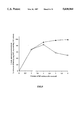
- FIG. 4 is a graph indicating the relationship between the amount of cells and the removal of sulphur black dye
- FIG. 5 is a graph of the effect of the concentration of sulphur black dye on the removal capacity and efficiency of resting bacterial cells
- FIG. 6 is a graph of the effect of concentration of sodium thiosulfate on sulphur black dye removal efficiency of resting bacterial cells
- FIG. 7 is a graph of the effect of variations in pH on the sulphur black dye removal efficiency of resting bacterial cells
- FIG. 8 is a graph showing the removal of sulphur black dye by repeated treatments of the same amount of the bacterial cells
- FIG. 9 is a graph representing the growth curve of L5.
- Methods and cellular compositions are provided for the bioremoval of sulphur black dye from substrates, including liquids, solids and the like of particular interest are waste streams associated with the production of sulphur black dye and waste streams produced by textile dyeing manufacturers.
- Bioremoval of sulphur black from substrates is accomplished by microorganisms through the processes of bioadsorption or biodegradation.
- Bioremoval as used in the subject invention refers to the reduction in the concentration of sulphur black dye in substrates by microorganisms which are capable of one or both of the following processes: bioadsorption and biodegradation.
- bioadsorption component of the subject invention will be discussed first. Following that, the biodegradation component of the subject invention will be described.
- Bioadsorption refers to the uptake of sulphur black dye molecules by a microorganism from the ambient medium of the microorganism. Though not wishing to be limited to a particular theory, one possible mechanism by which bioadsorption is accomplished by the microorganisms of the subject invention is the adsorption of the dye molecules from the ambient solution of the microorganism onto the cell surface.
- a variety of microorganisms may find use in bioadsorption. These microorganisms may include bacteria, fungi and the like.
- the microorganisms which find use in the subject invention may be screened using any convenient means. The following process is exemplary of a suitable screening process.
- a sulphur black dye containing rich growth medium is prepared, e.g. IM medium.
- the sulphur black dye which is commercially available as a powder or in solution referred to as Sodyesul Black
- Sodyesul Black can be dissolved in the medium.
- the medium is inoculated with a candidate cell population, incubated at 37° C. and any change in color observed.
- sulphur black dye containing media where the media is combined with agar and the candidate cell population.
- This sulphur black agar containing media inoculated with the candidate cell population is then poured onto solidified agar containing medium lacking the sulphur black dye. Change in color is then monitored, where the formation of a lightly shaded ring or halo in the otherwise dark background is indicative of the location of a bioadsorprtion strain.
- Bioadsorption candidate cell populations are obtained from any convenient source, e.g. sulphur black dye polluted waters.
- microorganisms of interest in the bioadsorption component of the subject invention are those shown to be able to strongly adsorb sulphur black dye so as to substantially accumulate the sulphur black dye with the cells, leaving the substrate being treated substantially free of the sulphur black dye, particularly free of the dark coloration associated with the dye.
- microorganisms have the following general characteristics. They are gram positive rods and cocci. They are facultatively aerobic and can absorb sulphur black dye from a solution. They grow aerobically on an IM agar plate at 37° C. They are classified in the families Bacillaceae and Micrococcaceae. Bacterial strains which are useful in the bioadsorption component of the subject invention include the bacterial strains referred to as W2, W3, W11 and W16.
- Strains W2, W3 and W16 display the characteristic fatty acid profiles shown in FIG. 1 as determined using the methodology of Microcheck, Inc. (Microcheck, Inc., P.O. Box 456, 48 South Main Street, Northfield, Vt 05663).
- W3 has a similarity index, as determined by Microcheck, Inc., of 0.074 with Bacillus cirulans GC subgroup B and an ATCC number of 55566, deposited on May 3, 1994.
- W2 has a similarity index of 0.414 with Bacillus mycoides GC subgroup A.
- W16 has a similarity index of 0.297 with Micrococcus lylae GC subgroup A.
- W3 is further characterized by the following features.
- W3 is aerobic and achieves an optimal growth rate at a pH of 7.
- W3 is gram positive, and upon staining with crystal violet or safranin, appears as a short, rod-like shape.
- W3 grows at pH values ranging from 6 to 10, generally 6-9, and preferably at a pH value of 7.
- W3 grows at temperatures ranging from 20° to 48° C., preferably at 37° C.
- W3 displays tolerance to NaCl concentrations up to and including 5% concentration.
- W3 metabolizes glucose, xylose and arabinose.
- W3 utilizes nitrate.
- Bioremoval of sulphur black from substrates through use of bioadsorption microorganisms generally involves contacting the substrate with the microorganism for a sufficient time to reduce the concentration of sulphur black present in the substrate.
- the conditions for bioadsorption will be selected to substantially optimize the amount and rate at which sulphur black dye is removed from the substrate.
- the time for treatment will vary greatly, depending upon the amount and concentration of the sulphur black dye in the substrate, the other constituents in the medium, the temperature, pH, and the efficiency with which the particular cell strain adsorbs the sulphur black dye.
- treatment may vary from passing through a column for a period of minutes to batch treatment, filter percolation, activated sludge treatment into which the subject strain is inoculated, or the like.
- the total amount of cells used in the bioremoval process will depend on the particular treatment employed.
- the bioadsorption microorganisms of the subject invention can be grown in any appropriate growth medium, depending on the total cell population required for a particular medium, preferably a rich medium such as IM medium.
- the cells may be grown for a time period of 0-30 hours, preferably 5-20 hours, more preferably 5-15 hours.
- the cells may be incubated at temperatures ranging from about 20° to 48° C., preferably at 37° C.
- thiosulfate augments the removal of the sulphur black dye by bioadsorption strains. Therefore, when appropriate, in the absence of sodium thiosulfate, small amounts of a thiosulfate may be added to the medium, generally at a concentration in the range of from about 0.05 to 1.0M, preferably about 0.05 to 0.2M.
- the cell dosage will vary widely, where the dry weight of the cells may vary from about 10 to 1000 times the weight of sulphur black dye in the medium, more usually being at least about 10 to 100 times the weight of sulphur black dye present in the medium to be treated.
- the pH will generally be in the range of about 6 to 12, preferably about 6 to 9.
- the temperature will generally be in the range of about 10°-60° C., preferably in the range of about 20°-40° C.
- Mechanical agitation may be employed and the medium may be aerated to support the maintenance of the cells. For the most part, nutrients will not be added to the medium, rather, the cells will be substantially non-proliferating during the treatment, although if desired, sufficient nutrients may be added to allow for cell proliferation.
- the cells whether alive or dead, provide for strong adsorption of sulphur black dye.
- the cells, or fragments thereof may be used for adsorption of sulphur black dye, without concomitant biodegradation or with biodegradation, depending upon the particular need. For example, one may wish to reduce the total concentration of sulphur black dye in a waste source.
- a first step one may use the cellular composition to adsorb a significant proportion of the total amount of sulphur black dye present. This first step may be followed by a bioadsorption and biodegradation second step, which may require a greater time period.
- Substrates suitable for bioremoval treatment through contact with bioadsorption microorganisms include any substrate in which one desires to reduce the concentration of sulphur black dye.
- Substrates of interest include processing waste streams, textile dyeing waste streams and the like.
- bioadsorption microorganism are useful in treating sulphur black processing streams. By contacting the waste stream with a suitable amount of bioadsorption cells, the concentration of sulphur black dye in the waste stream is reduced to a level where sodium thiosulfate can be isolated. Further, the subject cells can be used to remove sulphur black molecules from the waste streams of textile dyeing facilities before disposal of these streams into conventional sewage treatment streams.
- Bioremoval of sulphur black dye from a substrate may also be accomplished through biodegradation of the sulphur black dye molecules.
- Biodegradation refers to the process of converting sulphur black dye molecules to acceptable products, e.g. non-chromogenic and non-toxic.
- microorganisms that are suitable for biodegradation include bacteria, fungi and the like.
- Isolation of microorganisms that display biodegradation activity may be accomplished by any convenient means, e.g. the process described previously for the isolation of bioadsorption microorganisms.
- a second test may be employed.
- a second test which may be employed is the test commonly referred to as the top agar plate method (TAP) and is described in detail in the working exemplification section.
- TAP top agar plate method
- microorganisms suitable for biodegradation may be aerobic and are facultatively anaerobic. They are gram-positive rods or cocci classified in the families Micrococcaceae and Streptococcaceae. They grow in IM medium at 37° C. and degrade sulphur black dye.
- Bacterial strains that display the above characteristics and are suitable for biodegradation include the strain designated L5 and the strain designated L25.
- L5 and L25 exhibit characteristic fatty acid profiles shown in FIG. 2 as determined by Microcheck.
- L25 has a Microcheck similarity index of 0.292 with Staphylococcus haemolyticus
- L5 has a Microcheck similarity index with Enteroccocus durans of 0.528.
- L5 has an ATCC number of 55565, deposited on May 3, 1994.
- Biodegradation cells capable of biodegradation can be used for bioremoval in substantially the same manner as bioadsorption cells are used, as described above.
- the substrate to be treated is generally contacted with the biodegradation cells for a sufficient time to reduce the concentration of the sulphur black in the substrate.
- biodegradation cells can be used in place of traditional substrate bleaching reagents, e.g. hypochlorite.
- the subject cells can be used in place of pumice stones or cellulase that are traditionally used in the "stone-wash" process of the textile industry.
- the subject microorganisms of interest may be modified in a variety of ways, so as to change their growth characteristics, enhance their sulphur black dye degrading capabilities, improve their growth characteristics and the like.
- genes from other strains may be isolated and screened for improving one or more traits of the subject strain of interest.
- the subject strain may be randomly mutagenized using conventional mild techniques, such as x-ray irradiation, mutagens, such as alkylating agents, cross-linking intercalating agents, such as psoralen, nitrogen mustards, or the like. These mutagenizing agents have found extensive use and do not require description here.
- the conditions are selected to minimize the number of mutations to a few, usually at an efficiency of at least about 1 per 10 2 cells.
- the mutagenized cell lines may then be screened as described above for their ability to degrade sulphur black.
- the gene or the portion of the gene relevant to sulphur black dye degradation derived from the sulphur black dye degradation microorganisms mentioned above can be isolated and cloned into other organisms for such applications.
- the isolation and identification of the gene can be performed by sequencing the enzyme to determine the amino acid sequence.
- Various commercially available sequencers may be used.
- From the amino acid sequence probes may be prepared with the appropriate redundancy for the codons encoding the selected sequence. Usually the probe will be at least 12 nucleotides, preferably at least 16 nucleotides, and not more than about 40 nucleotides and will be a mixture providing for the codon degeneracy encoding the individual amino acids.
- a genomic DNA library is prepared according to known methods, usually inserting restriction fragments of at least about 0.5 knt into a cloning vector. See, for example, Sambrook et al., Molecular Cloning: A Laboratory Manual, CSHL, Cold Spring Harbor, N.Y., 1989.
- the DNA library is screened with the probes employing Southern hybridization, and hybridizing DNA isolated, conveniently inserted into a convenient expression vector, either plasmid or phage, and the vector transformed into an expression host having a negative background for sulphur black dye degradation.
- a convenient expression vector either plasmid or phage
- the transformants are then expanded and assayed for sulphur black degradation.
- Positive clones may then be harvested, the DNA isolated and characterized, e.g. sequenced, and the DNA used for expression of the enzyme.
- the DNA may be used as a probe with the DNA library to determine whether the entire gene has been isolated.
- an expression cassette may be prepared, where the natural promoter is substituted with a more active promoter.
- a wide variety of strong bacterial promoters are available, particularly from bacteriophage genes, such as T7, ⁇ , and the like.
- the expression cassette may be introduced into the expression host as a plasmid or linear DNA for integration. The expression host is then grown in an appropriate nutrient medium, the cells separated from the medium and the enzyme isolated from the nutrient medium, as described previously.
- Any convenient bacterial host may be employed, depending upon the use of the sulphur black degrading host. Thus, one need not be restricted to the native host, but may use more convenient hosts for use as organisms for sulphur black degradation or for use for the production of the enzyme. Conveniently, E. coli or other well characterized and acceptable organisms may be employed as the expression host.
- the enzymes present in the subject cells may employ the enzymes present in the subject cells.
- the biodegradation enzymes of the subject invention find use in any substrate in which it is desired to reduce the concentration of sulphur black dye.
- the biodegradation enzymes are suitable for the treatment of textile substrates, e.g. enzyme washing.
- the enzyme may be isolated from the native host or produced recombinantly.
- a crude mixture, e.g. lysate, containing the enzyme may be employed, where the enzyme is at least about 1 weight % of total protein or an enriched mixture may be employed, where the enzyme is at least 10 weight % of total protein, preferably at least 25 weight % of total protein.
- the enzyme may be isolated and purified by conventional techniques, e.g. HPLC, solvent extraction, affinity purification, etc., to at least 50 weight %, usually at least 90 weight %, or substantially total purity.
- Sulphur black dye (water soluble) was obtained from Chek Tak dyeing factory Ltd.
- Sodium thiosulfate Na 2 S 2 O 3
- Potassium iodide (KI) was obtained from Merck.
- Starch was obtained from Merck.
- Iodine I 2
- Tryptone was obtained from Difco Laboratories.
- Glucose was obtained from BDH Chemical Ltd.
- Yeast extract was obtained from Difco Laboratories.
- Ammonium chloride (NH 4 Cl) was obtained from Merck.
- Agar was obtained from Sigma Chemical Company.
- Dibasic sodium phosphate Na 2 HPO 4 .12H 2 O
- Monobasic sodium phosphate (NaH 2 PO 4 ) was obtained from Merck. Tris-(hydroxymethyl)aminomethane was obtained from Sigma Chemical Company. Sodium hydroxide (NaOH) was obtained from Merck. Potassium chloride (KCl) was obtained from Merck. Potassium dihydrogen phosphate (KH 2 PO 4 ) was obtained from Merck. Glycine was obtained from Merck. Hydrochloric acid (HCl) was obtained from Merck. Sodium dodecyl sulfate (SDS) was obtained from Sigma Chemical Company. Triton X-100 was obtained from Sigma Chemical Company. Cetylpyridinium chloride was obtained from CalBioChem. Trypsin was obtained from Merck. Diethyl ether was obtained from Merck. Sodium chloride (NaCl) was obtained from Merck. Activated charcoal was obtained from BDH Chemical Ltd.
- IM medium 10 g tryptone, 1 g D-glucose, 1 g yeast extract, 1 g NH 4 Cl in 1 liter distilled water.
- IM agar 15 g agar, 10 g tryptone, 1 g D-glucose, 1 g yeast extract, 1 g NH 4 Cl in 1 liter distilled water.
- Starch solution 1 g starch in 100 ml boiling water with vigorous stirring.
- Phosphate buffer pH 7, 39 ml 0.2M NaH 2 PO 4 , 61 ml 0.2M Na 2 HPO 4 .12H 2 O; diluted to 200 ml with H 2 O.
- Tris-(hydroxymethyl)aminomethane buffer pH 9, 50 ml 0.2M tris-(hydroxylmethyl)aminomethane, 5 ml 0.2M HCl; diluted to 200 ml with H 2 O.
- Phosphate-NaOH buffer pH 11, 50 ml 0.5M Na 2 HPO 4 , 4.1 ml 0.1M NaOH; diluted to 100 ml with H 2 O.
- Hydroxide-chloride buffer pH 13, 25 ml 0.2M KCl, 6 ml 0.2M NaOH; diluted to 100 ml with H 2 O.
- Potassium dihydrogen phosphate-NaOH buffer pH 7, 50 ml 0.1 KH 2 PO 4 , 29.1 ml 0.1M NaOH; diluted to 100 ml with H 2 O.
- Glycine-NaOH buffer pH 9, 25 ml 0.2M glycine, 4.4 ml 0.2M NaOH; diluted to 100 ml with H 2 O.
- Sulphur black agar plates were formed by first dissolving 0.5 g of sulphur black dye powder into 500 ml of distilled water. The resultant solution was autoclaved and then cooled to 50° C.. The solution was then combined with 500 ml of IM agar solution resulting in a 0.05% sulphur black agar solution. 25-30 ml of the sulphur black agar solution was poured into agar plates.
- 0.1 ml of the polluted water samples were spread evenly on the sulphur black plates in a manner which formed well separated colonies, e.g. 30-300 colonies per plate.
- the agar plates were then incubated for 3-4 days at 37° C.
- Colonies which were surrounded by a clear halo in the agar medium were chosen as indicative of those colonies capable of bio-adsorption, i.e. could adsorb sulphur black dye. These chosen colonies were then diluted and re-spread on additional sulphur black IM agar plates in order to obtain pure colonies and confirm bioadsorption activity of the selected colonies. Form this process, twenty strains were selected.
- strains from these twenty strains which exhibited the greatest bioadsorption activity were selected using the following procedure. Each strain was cultured in IM medium for one day at 37° C.. Sulphur black dye was then added (approximately 3586 ⁇ g/ml) to each culture to obtain an optical density reading of 1.0 at 620 nm (the OD 620 value). The cultures were then spun in a microfuge 13,000 rpm for 5 min. The following results were obtained.
- strain W3, W2, W11 and W16 displayed significant bioadsorption activity. From these strains, W3 was selected for further characterization and study. W3 was shown to reduce the dark color in the agar method by about one half in one day, by comparing the agar plate with a plate inoculated with E. coli and having a 0.3% concentration of sulphur black dye.
- W3 is stainable with crystal violet or safranin and upon staining, appears as a short rod;
- W3 grows best a pH 7, but also at pH 9, but will not grow at pH 3, pH 5 or pH 11;
- W3 can ferment glucose, xylose and arabinose and is capable of nitrate utilization.
- the cultures were incubated at 37° C. in IM medium and shaken at 200 rpm (Gyrotory Water Bath Shaker, New Brunswick Scientific). Experimental cultures were harvested after 20 hours incubation, then spun down at 10,000 rpm for 10 minutes at 4° C. (High Speed Centrifuge RC5C, Sorvall Instrument). The centrifuged cells were washed with distilled water once.
- the growth curve of W3 was constructed by inoculating 1% overnight culture (18 hours) of W3 into a 250 ml conical flask containing 50 ml IM medium. Incubated at 37° C. and shaken at 200 rpm. The cell density of W3 was determined by the plate count method (viable cell count) and by a haemotocytometer (total cell count).
- a very short lag phase about 1 to 2 hours, was found in both counting methods. Stationary phase was reached at 7 to 9 hours of cultivation. The cell density in stationary phase was 1 ⁇ 10 9 cells/ml by viable cell count and 1.25 ⁇ 10 9 cells/ml total cell count. The culture entered the death phase after 10 hours of cultivation. There was no significant decrease in the total cell density in the death phase. However, a significant decrease of cell density was found in death phase by viable cell count. Viable cells per ml was about 1 ⁇ 10 6 cells/ml at 24 hours of incubation. See FIG. 3.
- the concentration of sulphur black could be calculated from the following equation.
- the efficiency of sulphur black removal by resting cells of W3 was determined in the following mediums: distilled water, IM medium and 0.1M sodium thiosulfate solution. Resting cells of W3 (10 mg in corresponding dry wt.) were resuspended in 2 ml of medium containing 0.05 mg/ml of sulphur black dye. The cells were then incubated at room temperature for 1 hour. Sulphur black dye removal efficiency was determined using the formula of D.2.
- the sulphur black removal efficiency of W3 increased as the medium changed from distilled water to IM medium and to 0.1M sodium thiosulfate.
- the sulphur black removal efficiency of W3 in 0.1M sodium thiosulfate (about 93% ) was much higher than that in distilled water (about 27%). It was concluded that the presence of sodium thiosulfate positively affected the sulphur black uptake by W3.
- the sulphur black removal efficiency and capacity of W3 was determined for the following amounts of W3 cells (in corresponding dry wt.): 1 mg, 10 mg, 50 mg and 100 mg.
- the various amounts of W3 were resuspended in 2 ml of 0.1M sodium thiosulfate with 0.05 mg/ml of sulphur black dye.
- the resuspensions were incubated at room temperature for 1 hour.
- the amount of sulphur black removed by W3 was determined by the standard method of D.2.
- the sulphur black removal efficiency increased with increasing amounts of W3 (from 1 mg to 100 mg of corresponding dry cells).
- the increase in sulphur black removal efficiency was much sharper upon addition of 10 mg of W3 than upon addition of 1 mg of W3.
- the rate of increase of sulphur black removal efficiency decreased as the amount of W3 increased from 10 mg to 100 mg.
- Sulphur black removal capacity decreased with increasing the amounts of applied W3. See FIG. 4.
- the sulphur black removal capacity of 10 mg of W3 increased gradually as the concentration of sulphur black increased from 0.01 to 0.5 mg/ml.
- the rate of increase of sulphur black removal capacity slowed as the concentration of sulphur black increased from 0.5 to 1.0 mg/ml.
- Sulphur black removal efficiency of W3 increased slightly to a maximum (about 99% ) when the concentration of sulphur black increased from 0.01 to 0.2 mg/ml and then decreased when the sulphur black concentration rose to 1.0 mg/ml. See FIG. 5.
- the sulphur black removal efficiency of W3 remained high (about 90%) and was not affected by changes in the concentration of Na 2 S 2 O 3 that ranged from 0.05 to 1.0M. See FIG. 6.
- Buffer system I included phosphate buffer pH 7, tris-(hydroxymethyl)aminomethane buffer pH 9, phosphate-NaOH buffer pH 11 and hydroxide-chloride buffer pH 13.
- Buffer system II included potassium hydrogen phosphate-NaOH buffer pH 7, glycine-NaHO buffer pH 9, phosphate-NaOH buffer pH 11 and hydroxide-chloride buffer pH 13.
- the untreated W3 was used as a control and assigned 100 as relative sulphur black removal efficiency.
- the relative sulphur black removal efficiency of the various pretreated W3 was about 89 to 102%. The results are found in the table following the descriptions of the various pretreatments that were employed.
- Alkali treatment incubate cells in 50 mM NaOH at room temperature for 30 minutes.
- Ether treatment Resuspend cells in diethyl ether at room temperature for 10 minutes.
- Control--Cells were kept in distilled water and stored on ice for 10 or 30 minutes.
- the sulphur black removal efficiency of 10 mg of W3 was about 94% in 2 ml 25% (w/v) sodium thiosulfate (1M), 0.1 mg/ml of sulphur black and 5 (w/v) NaCl (0.86M) at pH 8 after incubation at room temperature for 30 minutes.
- the concentration of sulphur black used in this experiment was 10 times higher than that in standard method D.2.
- 10 mg of W3 (in corresponding dry wt.) was resuspended in 4 ml of 0.1M sodium thiosulfate solution containing 0.5 mg/ml of sulphur black.
- the resuspension was incubated at room temperature for 30 minutes.
- the supernatant was separated from the cells following centrifugation of the resuspension at 10,000 rpm at 4° C. for 10 minutes.
- the cell pellet was discarded and the supernatant was retained for determination of sulphur black concentration by the standard method of D.2.10 mg of W3 was then added to the supernatant and the procedure was repeated until 99% of the sulphur black was removed.
- the maximum sulphur black removal capacity of W3 resting cells was evaluated using the following procedure. 10 mg of W3 (in dry wt.) was resuspended in 2 ml of 0.1M sodium thiosulfate with 0.05 mg/ml of sulphur black. The resuspension was incubated at room temperature for 15 minutes. The resuspension was centrifuged at 10,000 rpm for 10 minutes and the concentration of sulphur black left in the supernatant was measure by the standard method of D.2. The supernatant was then discarded. The cell pellet was saved and resuspended in 2 ml of 0.1M sodium thiosulfate with 0.05 mg/ml of sulphur black. The resuspension was then incubated at room temperature for 15 minutes. This procedure was repeated 15 times. The total amount of sulphur black removed by W3 was determined by the standard method of D.2.
- the amount of sulphur black adsorbed is not affected by killing the W3, regardless of how the cells are killed, e.g. by heating, acid, or detergents. It was therefore concluded that sulphur black binding by W3 cells is independent of respiration or other cell metabolic activity. In repeated bioadsorption studies, it was consistently found that the sulphur black binding efficiency of W3 was not influenced by killing the cells.
- Triton X-100 a nonionic nondenaturing surfactant
- cetylpyridinium chloride a cationic denaturing surfactant
- the halo forming test was employed. A sulphur black IM plate was spotted with an L5 culture. The plate was incubated at 37° C. for one week. Following incubation, no clear halo in the otherwise black color of the plate was observed. It was concluded that either adsorption or absorption was necessary for biodegradation of sulphur black by L5. In other words, the biodegradation enzyme was not secreted by the L5 into the ambient medium.
- L5 is a gram positive cocci
- L5 is facultatively anaerobic
- L5 ferments glucose, arabinose and xylose to produce acid and gas
- L5 ferments lactose, maltose, sucrose and mannitol to produce gas
- L5 hydrolyzes starch, tributyrin and casein but does not hydrolyze gelatin
- k) L5 possesses both rennin and pepsin like enzymes
- L5 displays resistance to the following antibiotics: ampicillin, bacitracin, neomycin, penicillin G, polymyxin B, rifampin, streptotnycin, tetracycline, oxytetracycline, as well as intermediate resistance to nalidixic acid.
- the subject method and microorganisms may be used for treating a wide variety of composites through either bioadsorption or biodegradation.
- Bioadsorption may find particular use in the treatment of waste streams, such as the thiosulfate waste stream resulting from the production of sulphur black dye. Bioadsorption may also be used for other waste streams, particularly associated with the dying of textile.
- the method may comprise one or more stages. As already indicated, the cells can be grown and killed and used for adsorption. This may be particularly useful, where one wishes to reduce the concentration level of the sulphur black dye, prior to using viable cells to both adsorb and degrade the sulphur black dye. By reducing the amount of sulphur black dye present in the waste stream one may reduce the time for the processing of the resulting stream by viable cells.
- Biodegradation provides further methods for treatment of compositions in which sulphur black dye is a contaminant.
- the subject hosts may be modified to provide for multiple capacities.
- the gene obtained as described above may be used to transform other hosts which may be more convenient as to growth properties, harvesting, safety or the like. In this manner, different bacterial organisms may be employed for one or more purposes.
Landscapes
- Engineering & Computer Science (AREA)
- Life Sciences & Earth Sciences (AREA)
- Chemical & Material Sciences (AREA)
- Organic Chemistry (AREA)
- Textile Engineering (AREA)
- Zoology (AREA)
- Wood Science & Technology (AREA)
- Health & Medical Sciences (AREA)
- Biotechnology (AREA)
- Genetics & Genomics (AREA)
- Bioinformatics & Cheminformatics (AREA)
- General Engineering & Computer Science (AREA)
- General Health & Medical Sciences (AREA)
- Microbiology (AREA)
- Biochemistry (AREA)
- Mycology (AREA)
- Chemical Kinetics & Catalysis (AREA)
- General Chemical & Material Sciences (AREA)
- Medicinal Chemistry (AREA)
- Tropical Medicine & Parasitology (AREA)
- Virology (AREA)
- Biomedical Technology (AREA)
- Micro-Organisms Or Cultivation Processes Thereof (AREA)
Abstract
Description
              TABLE 1
______________________________________
Microbial
        OD at   OD at   OD at 15        OD at 72
Strain  1 min.  5 min.  min.   OD at 24 hr.
                                        hr.
______________________________________
W2      .26     .25     .27    .38      .75
W3      .20     .25     .16    .12      .14
W4      1.45    .96     1.03   .58      .54
W6      .77     .69     .68    .45      .51
W7      1.02    1.04    1.03   .78      .74
W8      1.01    1.03    1.02   .96      .84
W9      1.00    1.02    1.00   .93      .75
W10     .44     .41     .43    .74      .69
W11     .26     .26     .23    .46      .47
W12     1.08    1.03    1.04   1.02     .83
W13     .96     .84     .90    .85      .85
W14     .56     .64     .63    .59      .84
W15     .88     .89     .88    .90      .90
W16     .17     .18     .20    .36      .59
W17     .92     .91     .90    .88      .89
W18     1.05    1.00    .99    .96      .97
W19     .80     .78     .52    .81      .33
W20     .89     .89     .91    .87      .92
E. Coli .86     .84     .83    .69      .79
H12     .94     .92     .95    .80      .79
No cells
        1.06    1.05    1.05   1.06     1.08
______________________________________
sulphur black (mg/ml)=(A.sub.625 -1.79×10.sup.-3)/17.56
              TABLE 2
______________________________________
                          Relative removal
Treatment    Target component
                          efficiency(%)
______________________________________
Control      --           100(assumed)
HCl(R.T.)    non-specific 97.2
HCl(100° C.)
             non-specific 89.4
NaOH         non-specific 40.4
SDS          non-specific 101.7
Triton X-100 non-specific 99.7
Cetylpyridinium
             non-specific 99.2
Chloride
100° C.
             non-specific 101.5
Autoclave    non-specific 101.4
Trypsin      protein and  97.2
             peptidoglycan
Ether        primarily lipids
                          101.2
______________________________________
Claims (2)
Priority Applications (1)
| Application Number | Priority Date | Filing Date | Title |
|---|---|---|---|
| US08/198,044 US5610064A (en) | 1994-02-16 | 1994-02-16 | Bacterium useful in the removal of sulphur black dye from a substrate |
Applications Claiming Priority (1)
| Application Number | Priority Date | Filing Date | Title |
|---|---|---|---|
| US08/198,044 US5610064A (en) | 1994-02-16 | 1994-02-16 | Bacterium useful in the removal of sulphur black dye from a substrate |
Publications (1)
| Publication Number | Publication Date |
|---|---|
| US5610064A true US5610064A (en) | 1997-03-11 |
Family
ID=22731779
Family Applications (1)
| Application Number | Title | Priority Date | Filing Date |
|---|---|---|---|
| US08/198,044 Expired - Lifetime US5610064A (en) | 1994-02-16 | 1994-02-16 | Bacterium useful in the removal of sulphur black dye from a substrate |
Country Status (1)
| Country | Link |
|---|---|
| US (1) | US5610064A (en) |
Citations (1)
| Publication number | Priority date | Publication date | Assignee | Title |
|---|---|---|---|---|
| SU1592330A1 (en) * | 1988-05-17 | 1990-09-15 | Институт коллоидной химии и химии воды им.А.В.Думанского | Consortium of strains of microorganisms-destructors pseudomonas putida, bacillus subtilis u bacillus subtilis for treating waste water |
-
1994
- 1994-02-16 US US08/198,044 patent/US5610064A/en not_active Expired - Lifetime
Patent Citations (1)
| Publication number | Priority date | Publication date | Assignee | Title |
|---|---|---|---|---|
| SU1592330A1 (en) * | 1988-05-17 | 1990-09-15 | Институт коллоидной химии и химии воды им.А.В.Думанского | Consortium of strains of microorganisms-destructors pseudomonas putida, bacillus subtilis u bacillus subtilis for treating waste water |
Non-Patent Citations (28)
| Title |
|---|
| "Biodegradable Process for Indigo Dyeing Claimed in Hong Kong", Womens Wear Daily, (Jun. 4, 1991) p. 10. |
| "New Biodegration Technology for Textile Dyes Developed", Southern Textile News 47(29):6 (1991). |
| Biodegradable Process for Indigo Dyeing Claimed in Hong Kong , Womens Wear Daily , (Jun. 4, 1991) p. 10. * |
| Bujak H., Effectiveness of Biochemical . . . Przegl Wlok (1979) 33 (4) 214 217. * |
| Bujak H., Effectiveness of Biochemical . . . Przegl Wlok (1979) 33 (4) 214-217. |
| Bujak, H., Effectiveness of Biochemical . . . Przegl Wlok (1979) 33 (4) 214 217 English Translation. * |
| Bujak, H., Effectiveness of Biochemical . . . Przegl Wlok (1979) 33 (4) 214-217 English Translation. |
| Doh a nyos et al., Removal of Organic Dyes by Activated Sludge , Prog. Wat. Tech. 10(5/6):559 575 (1978). * |
| Dohanyos et al., "Removal of Organic Dyes by Activated Sludge", Prog. Wat. Tech. 10(5/6):559-575 (1978). |
| Gwynne, "Biotech Grows in Hong Kong", Nature 352:273 (1991). |
| Gwynne, "Pollution Eaters", Far Eastern Economic Review (Jul. 11, 1991) p. 58. |
| Gwynne, Biotech Grows in Hong Kong , Nature 352:273 (1991). * |
| Gwynne, Pollution Eaters , Far Eastern Economic Review (Jul. 11, 1991) p. 58. * |
| Hitz et al., "Publication Sponsored by ETAD The Adsorption of Dyes on Activated Sludge", J. Soc. of Deyers & Colorists pp. 71-76 Feb. 1978. |
| Hitz et al., Publication Sponsored by ETAD The Adsorption of Dyes on Activated Sludge , J. Soc. of Deyers & Colorists pp. 71 76 Feb. 1978. * |
| Mou et al., "Microbial Agents for Decolorization of Dye Wastewater", Biotech. Adv. 9:613-622 (1991). |
| Mou et al., Microbial Agents for Decolorization of Dye Wastewater , Biotech. Adv. 9:613 622 (1991). * |
| Mou, D., Microbial Agents for Decolorization of Dye . . . Biotech Adv 9: 613 622 (1991). * |
| Mou, D., Microbial Agents for Decolorization of Dye . . . Biotech Adv 9: 613-622 (1991). |
| Mullen et al., "Bacterial Sorption of Heavy Metals", Applied and Environmental Microbiology 55(12):3143-3149 (1989). |
| Mullen et al., Bacterial Sorption of Heavy Metals , Applied and Environmental Microbiology 55(12):3143 3149 (1989). * |
| New Biodegration Technology for Textile Dyes Developed , Southern Textile News 47(29):6 (1991). * |
| Pagga and Brown, "The Degradation of Dyestuffs: Part II Behavior of Dyestuffs in Aerobic Biodegradation Tests" Chemosphere 15(4):479-491 (1986). |
| Pagga and Brown, The Degradation of Dyestuffs: Part II Behavior of Dyestuffs in Aerobic Biodegradation Tests Chemosphere 15(4):479 491 (1986). * |
| Wan, "Discovery to Attack Dye Pollution", South China Sunday Morning Post, Hong Kong, Sunday, Jun. 10, 1990. |
| Wan, Discovery to Attack Dye Pollution , South China Sunday Morning Post , Hong Kong, Sunday, Jun. 10, 1990. * |
| Women s Wear Daily, Biodegradable Process for Indigo . . . Jun. 4, 1991, p. 10. * |
| Women's Wear Daily, Biodegradable Process for Indigo . . . Jun. 4, 1991, p. 10. |
Similar Documents
| Publication | Publication Date | Title |
|---|---|---|
| JP2859393B2 (en) | Cellulase and method for producing the same | |
| US4002572A (en) | Alkaline protease produced by a bacillus | |
| Saba et al. | Purification and characterization of a cold active alkaline protease from Stenotrophomonas sp., isolated from Kashmir, India | |
| US5518917A (en) | Bacillus proteolyticus species which produce an alkaline protease | |
| Dangmann et al. | Degradation of 4-aminobenzenesulfonate by a two-species bacterial coculture: Physiological interactions between Hydrogenophaga palleronii S1 and Agrobacterium radiobacter S2 | |
| AU657527B2 (en) | Alkaline protease and microorganism producing the same | |
| JP2001037469A (en) | Biodegradation of epichlorohydrin | |
| Oppong et al. | Cultural and biochemical diversity of pink-pigmented bacteria isolated from paper mill slimes | |
| US4734365A (en) | Process for liquefying starch | |
| JPS60224488A (en) | Production of l-calnitine by microbiological means | |
| Germida et al. | Myceloid growth of Arthrobacter globiformis and other Arthrobacter species | |
| US5610064A (en) | Bacterium useful in the removal of sulphur black dye from a substrate | |
| Du et al. | Production of polyvinyl alcohol‐degrading enzyme with Janthinobacterium sp. and its application in cotton fabric desizing | |
| Takahashi et al. | Production of (S, S)-Ethylenediamine-N, N′-disuccinic Acid from Ethylenediamine and Fumaric Acid by Bacteria. | |
| Kawai et al. | Bacterial assimilation of polytetramethylene glycol | |
| FI86557B (en) | FOERFARANDE FOER FRAMSTAELLNING AV ALFAAMYLAS MEDELST EN MICROORGANISM AV ARTEN BACILLUS SUBTILIS. | |
| US20020064864A1 (en) | Microbial composition and a process useful for the neutralization of alkaline waste-waters | |
| JP2000093164A (en) | New microorganism and dye decoloration using the same | |
| KR100466264B1 (en) | Bacillus producing oxidant and detergent-resistant protease | |
| Tejaswini et al. | Production and optimization studies of protease by soil isolate actinomycetes using mixed substrate of pomegranate peel powder and banana peel powder under solid state fermentation | |
| KR0170107B1 (en) | New Microorganisms Acinetobacter Species KRC-K4 and Bioemulsifying Method Using the Same | |
| US3787289A (en) | Method of producing dextranase | |
| Deviga et al. | Studies on the optimization of protease production by thermophilic Bacillus subtilis isolated from raw milk sample | |
| JP2731212B2 (en) | Novel cellulase and method for producing the same | |
| JPH0630578B2 (en) | Alkaline Cellulase K |
Legal Events
| Date | Code | Title | Description |
|---|---|---|---|
| STCF | Information on status: patent grant |
Free format text: PATENTED CASE |
|
| REMI | Maintenance fee reminder mailed | ||
| REIN | Reinstatement after maintenance fee payment confirmed | ||
| FP | Lapsed due to failure to pay maintenance fee |
Effective date: 20010311 |
|
| FEPP | Fee payment procedure |
Free format text: PAYOR NUMBER ASSIGNED (ORIGINAL EVENT CODE: ASPN); ENTITY STATUS OF PATENT OWNER: SMALL ENTITY |
|
| FEPP | Fee payment procedure |
Free format text: PETITION RELATED TO MAINTENANCE FEES FILED (ORIGINAL EVENT CODE: PMFP); ENTITY STATUS OF PATENT OWNER: SMALL ENTITY |
|
| FEPP | Fee payment procedure |
Free format text: PETITION RELATED TO MAINTENANCE FEES GRANTED (ORIGINAL EVENT CODE: PMFG); ENTITY STATUS OF PATENT OWNER: SMALL ENTITY |
|
| FPAY | Fee payment |
Year of fee payment: 4 |
|
| SULP | Surcharge for late payment | ||
| PRDP | Patent reinstated due to the acceptance of a late maintenance fee |
Effective date: 20030204 |
|
| AS | Assignment |
Owner name: CHINESE UNIVERSITY OF HONG KONG, THE, HONG KONG Free format text: ASSIGNMENT OF ASSIGNORS INTEREST;ASSIGNOR:MARK, KAI KEUNG;REEL/FRAME:014119/0237 Effective date: 20030128 |
|
| FPAY | Fee payment |
Year of fee payment: 8 |
|
| CC | Certificate of correction | ||
| REMI | Maintenance fee reminder mailed | ||
| FPAY | Fee payment |
Year of fee payment: 12 |
|
| SULP | Surcharge for late payment |
Year of fee payment: 11 |