US5529489A - Locking orthodontic band gauge - Google Patents
Locking orthodontic band gauge Download PDFInfo
- Publication number
- US5529489A US5529489A US08/248,681 US24868194A US5529489A US 5529489 A US5529489 A US 5529489A US 24868194 A US24868194 A US 24868194A US 5529489 A US5529489 A US 5529489A
- Authority
- US
- United States
- Prior art keywords
- locking
- gauge
- probe
- head
- orthodontic band
- Prior art date
- Legal status (The legal status is an assumption and is not a legal conclusion. Google has not performed a legal analysis and makes no representation as to the accuracy of the status listed.)
- Expired - Fee Related
Links
- 239000000523 sample Substances 0.000 claims abstract description 97
- 230000000994 depressogenic effect Effects 0.000 claims description 4
- 238000003780 insertion Methods 0.000 claims description 3
- 230000037431 insertion Effects 0.000 claims description 3
- 238000003466 welding Methods 0.000 claims description 2
- 230000007704 transition Effects 0.000 claims 1
- 238000005259 measurement Methods 0.000 description 13
- 206010048685 Oral infection Diseases 0.000 description 8
- 238000000034 method Methods 0.000 description 4
- 230000003247 decreasing effect Effects 0.000 description 3
- 239000000463 material Substances 0.000 description 3
- 210000003813 thumb Anatomy 0.000 description 3
- 210000004763 bicuspid Anatomy 0.000 description 2
- 208000015181 infectious disease Diseases 0.000 description 2
- 238000012986 modification Methods 0.000 description 2
- 230000004048 modification Effects 0.000 description 2
- 230000001954 sterilising effect Effects 0.000 description 2
- 238000004659 sterilization and disinfection Methods 0.000 description 2
- 241000668842 Lepidosaphes gloverii Species 0.000 description 1
- 206010030973 Oral discomfort Diseases 0.000 description 1
- 230000001154 acute effect Effects 0.000 description 1
- 239000004568 cement Substances 0.000 description 1
- 230000000881 depressing effect Effects 0.000 description 1
- 210000005224 forefinger Anatomy 0.000 description 1
- 210000004247 hand Anatomy 0.000 description 1
- 208000014674 injury Diseases 0.000 description 1
- 239000002184 metal Substances 0.000 description 1
- 229910001220 stainless steel Inorganic materials 0.000 description 1
- 239000010935 stainless steel Substances 0.000 description 1
- 230000008733 trauma Effects 0.000 description 1
Images



Classifications
-
- A—HUMAN NECESSITIES
- A61—MEDICAL OR VETERINARY SCIENCE; HYGIENE
- A61C—DENTISTRY; APPARATUS OR METHODS FOR ORAL OR DENTAL HYGIENE
- A61C7/00—Orthodontics, i.e. obtaining or maintaining the desired position of teeth, e.g. by straightening, evening, regulating, separating, or by correcting malocclusions
- A61C7/02—Tools for manipulating or working with an orthodontic appliance
-
- G—PHYSICS
- G01—MEASURING; TESTING
- G01B—MEASURING LENGTH, THICKNESS OR SIMILAR LINEAR DIMENSIONS; MEASURING ANGLES; MEASURING AREAS; MEASURING IRREGULARITIES OF SURFACES OR CONTOURS
- G01B5/00—Measuring arrangements characterised by the use of mechanical techniques
- G01B5/02—Measuring arrangements characterised by the use of mechanical techniques for measuring length, width or thickness
- G01B5/025—Measuring of circumference; Measuring length of ring-shaped articles
Definitions
- the field of the invention relates to orthodontistry, and, more particularly, to an orthodontic prefabricated band gauge for determining the correct orthodontic band size for a tooth.
- the orthodontic treatment of the posterior part of the orthodontic cavity is similar to the treatment for molar and pre-molar teeth.
- the use of pre-fabricated orthodontic bands cannot be prescinded or put aside because these teeth are the basis of movement performed over other teeth. Because these teeth differ in measurement and shape, a measurer of pre-fabricated orthodontic bands must determine the exact measurement of the tooth in order to choose the exact band needed for the tooth in orthodontic treatment.
- An orthodontic pre-fabricated band is a ring shaped band usually made of metal. The orthodontist places the orthodontic pre-fabricated band around the tooth and selects the bands to be used. The selected pre-fabricated orthodontic band is then cemented. The band is then crimped tightly about the tooth and the cement is let dry, completing the procedure.
- orthodontic bands come in different shapes to accommodate different types of teeth, such as bicuspids, and molars. Since the teeth vary in size and shape, an orthodontist cannot rely on judgment alone, but must measure the circumference of the particular tooth fitted for an orthodontic band with an orthodontic instrument.
- a circular micrometer is commonly used as an orthodontic instrument to measure the millimeter circumference of a tooth in order to aid an orthodontist in selecting the size of an orthodontic band.
- a circular micrometer is a device used to measure any cylindrical object, the micrometer having one end of a flexible tape measure fixed to an elongated bar and the other end slidably mounted along the bar such that a loop is formed at an end of the micrometer. The loop is placed around an object and the tape is slidably adjusted along the bar to tighten the loop about the object.
- the micrometer includes a scale so that an operator may read the circumference measurement of the object. In orthodontic practice, the circumference of a tooth is measured and an orthodontic pre-fabricated band size is selected to be fitted on the tooth.
- orthodontic instruments should be designed to reduce the possibility of oral infection.
- the instrument should be easily sterilized, and also should increase the efficiency of orthodontic procedures so that less time is required working within a patient's mouth, therefore creating less of a chance for an oral infection to occur.
- An orthodontic instrument must especially aid in preventing oral infections because this device is in direct contact with the traumatized orthodontic tissue. Repeated placement of orthodontic bands during a fitting on a patient's tooth will cause the gums to be irritated, further increasing the risk of infection. In the case where a cemented orthodontic band needs to be replaced, greater trauma is caused to the orthodontic tissue and the risk of infection is again increased.
- an orthodontic instrument for more accurately determining an orthodontic band size should be designed to be comfortable to a patient.
- an orthodontic instrument for more accurately determining an orthodontic band size should reduce the cost of the orthodontic procedure.
- Each orthodontic band that is fitted on a tooth and is found to be the incorrect size must be thrown away at cost for purposes of sanitation.
- an orthodontic band gauge with an indicator is needed to indicate the correct size of prefabricated orthodontic bands for a particular tooth thereby decreasing the likelihood of oral infection, discomfort to the patient and cost.
- a gauge should lock the indicator in place so that a correct reading of the orthodontic band size is achieved despite removing the gauge or shifting of the patient.
- the gauge must allow an operator to tighten the gauge loop firmly about the tooth to achieve a correct reading because the loop material may be substantially rigid to fit between tightly spaced teeth.
- the indicator should be easily read.
- U.S. Pat. No. 2,231,121 issued to Hormann discloses a band-type micrometer that does not consider the above objectives.
- This device consists of the common features of a circular micrometer, having a loop for measuring the circumference of teeth and a slidable member that adjusts the size of the loop.
- a circular micrometer similar to the disclosed Hormann device is inadequate as an orthodontic instrument for more accurately determining an orthodontic band size. Hormann nowhere teaches the use of this micrometer for determining correct orthodontic band sizes. Further, this device utilizes mere friction forces to lock the slidable member in place.
- an orthodontic band gauge must be able to indicate the correct orthodontic band size even when fitted between tightly spaced teeth, removed from the teeth or jostled by the patient.
- the arrangement disclosed by Hormann is inadequate to indicate an orthodontic band size accurately under these conditions because the friction force is not sufficient to lock the slidable member in place for a correct measurement.
- Hormann does not disclose any device that pulls the loop sufficiently tight about the tooth.
- the slidable member is operated manually and is inadequate to tighten the device, especially when an orthodontist must operate from within the patient's mouth.
- a particular problem with the Hormann device is that it discloses a loop that has one end attached to the device. If the loop is pinched between teeth, the loop will be unable to tighten past the pinching point because the loop only tightens from one side.
- Hormann does not disclose any means by which the device is easily read. An orthodontist must read the measurement while the Hormann device is within the mouth, attached to a tooth. This increases the likelihood of an incorrect orthodontic band fitting because the device is difficult to read inside a mouth or might be thrown off due to the orthodontist's relocating the device in order to read the measurement.
- the Hormann device does not fulfill the requirements of an orthodontic band gauge and, therefore, would not adequately measure the correct band size for a particular tooth. As a result, this device would not be adequately sanitary, painless and inexpensive.
- a locking orthodontic band gauge for determining an orthodontic band size is provided that fulfills the above requirements and adequately measures the correct band size for a particular tooth.
- an elongated main portion is provided with a locking indicator assembly slidably mounted thereon.
- a loop cooperates with the main portion and indicator assembly such that when the indicator assembly is slid along the main portion, the size of the loop circumference changes.
- a series of locking portions are provided and spaced along the length of the elongated main portion at discrete positions and cooperating with said locking indicator assembly to selectively lock the indicator assembly at the discrete positions.
- the locking orthodontic band gauge includes probe means for supporting a gauge tape such that the gauge tape can be fitted around a tooth by insertion of the probe means into a patient's mouth.
- Indicating means are associated with the probe means and movable relative therewith for indicating the orthodontic band size of a patient's tooth when the gauge tape is fitted around the tooth.
- Locking means positively lock the indicating means relative to said probe means such that the indicating means is maintained stationary during an orthodontic band fitting.
- one object of the present invention is to provide a novel and more accurate orthodontic band gauge so that the selection of the prefabricated orthodontic band is made more efficient, thereby reducing the likelihood of oral infection, discomfort to the patient and cost;
- Another object of the present invention is to provide an orthodontic band gauge that accurately measures an orthodontic band size
- Another object of the present invention is to provide an orthodontic band gauge that fits between tightly spaced teeth
- Another object of the present invention is to provide an orthodontic band gauge that allows an operator to fasten the band gauge loop tightly about a tooth;
- Another object of the present invention is to provide an orthodontic band gauge with an indicator that is easily read.
- Another object of the present invention is to provide an orthodontic band gauge that locks the band gauge tape into place.
- a locking orthodontic band gauge that satisfies the above objects, particularly, the locking element allows an orthodontist to perform an orthodontic band fitting more efficiently and thereby reduce the likelihood of oral infection, discomfort to the patient and cost.
- This same locking element allows accurate measurement of an orthodontic band size because this element positively locks the indicator assembly inplace, thereby avoiding misreading from movement of the orthodontic band gauge.
- This locking element also allows an operator to remove the locking orthodontic band gauge from tightly spaced teeth with no space out disturbing the orthodontic band size indicated.
- the elongated main portion or probe means cooperates with the indicator assembly such that an operator is able to assert leverage on the locking indicating assembly, thereby fastening the gauge loop tightly about a tooth.
- the elongated main portion and probe means are sufficiently long to be inserted deep into a patient's mouth, allowing the indicator to be easily read. Therefore, the locking element enables an operator of the locking orthodontic band gauge to lock the band gauge tape in place, thereby satisfying the above objectives.
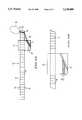
- FIG. 1 is a perspective view of the locking orthodontic band gauge
- FIG. 2a depicts a bottom view of the locking orthodontic band gauge of FIG. 1;
- FIG. 2b is a magnified view of a locking indicator assembly as shown in FIG. 2a mounted on the orthodontic band gauge;
- FIG. 3 is an enlarged perspective view of the orthodontic band gauge loop
- FIG. 4a depicts the front view of the locking orthodontic band gauge of FIG. 1;
- FIG. 4b is an enlarged vertical cross-sectional view of the locking indicator assembly taken substantially on the line 4b--4b of FIG. 4c;
- FIG. 4c is a vertical cross-sectional view of the locking indicator assembly mounted taken substantially on the line 4c--4c of FIG. 4b;
- FIG. 5 is a perspective view of a second embodiment of the locking orthodontic band gauge
- FIG. 6a depicts a front view of a third embodiment
- FIG. 6b illustrates the-use of the second alternate embodiment of FIG. 6a
- FIG. 6c shows a cross-section of the right side view of the second embodiment in FIG. 6a
- FIG. 6d shows a top view of the second embodiment in FIG. 6a.
- FIG. 7 depicts a fourth embodiment of the locking orthodontic band gauge including different sets of scales.
- FIG. 1 a locking orthodontic band gauge is shown that more accurately measures an orthodontic band size.
- FIG. 1 shows the locking orthodontic band gauge 10 and its general dimensions.
- the gauge 10 should be elongated such that the gauge may be inserted deep into a patient's mouth. Although this figure depicts the gauge 10 as rectangular, any shape may be employed so long as the gauge 10 is sufficiently thin, allowing an operator to easily manipulate the gauge 10 within the limited space of a patient's mouth.
- the gauge 10 should be manufactured using materials that are easily sterilized, such as plastic and stainless steel.
- the gauge 10 of FIG. 1 comprises an elongated main portion or probe 12, a locking indicator assembly 14 and a gauge loop 16.
- the probe 12 is placed in a patient's mouth and the loop 16 is secured around a tooth.
- the loop 16 is fixed to the locking indicator assembly 14 so that as the assembly is moved along the probe 12, the loop 16 tightens about the tooth.
- the probe 12 includes a scale 18 on one side and teeth-like locking portions at discrete positions 20 on the opposite side.
- the scale indicates the band size and the teeth lock the indicator in place.
- the locking indicator assembly 14 functions as a positive lock, is slidable mounted on the probe 12, and is kept from sliding off the gauge 10 by screw stop 22.
- the locking indicator assembly 14 includes a depressible head 23 having an indicator needle 24, positioned adjacent to the scale 18, to indicate an orthodontic band size.
- the locking indicator assembly 14 further includes a locking tooth head 25 connected to the depressible head 23 and having a locking tooth 26 that engages any of the teeth 20 along the probe 12 thereby positively locking the assembly 14 in place at discrete positions.
- the locking indicator assembly 14 is unlocked by depressing the depressible head 23 into the depressible head recess area 28 causing the connected locking tooth head 25 to move away from the probe 12 and disengage the locking tooth 26 from the teeth 20.
- the unlocking indicator assembly 14 then may be repositioned to other points along the probe 12.
- the gauge loop 16 extends from the loop dispenser 29 and is connected to the locking indicator assembly 14. As the indicator assembly 14 advances toward the screw stop 22, the loop 16 is pulled into the dispenser 29 and the loop circumference is decreased. Conversely, as the indicator assembly advances toward the loop 16, the loop 16 is dispensed from the dispenser 29 and its circumference is increased.
- FIGS. 2a and 2b demonstrate how the gauge loop 16 is connected to the locking indicator assembly 14.
- Loop 16 comprises gauge tape 30 that is fitted into locking indicator assembly 14 by threading the tape 30 into the indicator tape slot 32.
- the tape 30 is held within the indicator tape slot 32 by a holding screw 34.
- the tape 30 exits the indicator assembly 14, travels along the probe 12, and feeds into the probe head 35 through the probe tape slot 36 of the probe 12.
- the tape 30 exits the probe 12 from the dispenser 29 and forms loop 16.
- Indicator tape slot 32 and probe tape slot 36 have an opening on one side of the band gauge 10 to allow an operator to easily thread the tape 30. These openings may be on alternate sides of the band gauge 10 so that the tape 30 does not easily slip out.
- the holding screw 34 holds the tape 30 within the locking indicator assembly 14. Further, the screw 34 may be loosened to allow an operator to adjust the length of the tape 30 within the indicator tape slot 32 or thread an entirely new lengthened tape into the band gauge 10. By changing the length between the indicator assembly 14 and the loop 16, an operator is able to set the indicator assembly at any point along the probe 12. In this manner, an operator may adjust the indicator assembly 14 to a point where the orthodontic band gauge 10 is comfortable when held. In addition indicator assembly 14 may be positioned substantially outside a patient's mouth to allow an operator to easily read a band size from the orthodontic band gauge 10.
- indicator tape slot 32 and probe head tape slot 36 openings allowing an operator to easily replace the tape 30, also provide easy sterilization of the tape 30 and loop 16. An orthodontist simply removes an already used tape 30 and replaces it with a sterilized one.
- the tape 30 should be made out of a material that is flexible yet sufficiently rigid since the tape 30 is forced through the probe tape slot 36 by a translational force from the indicator assembly 14, advanced toward the probe head 35 by an operator.
- the loop 16 should also be flexible yet sufficiently rigid so that the loop 16 can close about an irregularly shaped tooth, fit between tightly spaced teeth, and be removed while enclosed about a tooth.
- the indicator tape slot 32 and probe tape slot 36 should be angled such that the tape 30 enters the probe tape slot 36 at an obtuse angle, not a radical acute angle. In this fashion, the tape 30 will not pucker when passing from the indicator tape slot 32 through the probe tape slot 36.
- FIG. 3 is a perspective view of the gauge loop 16 that is placed around a tooth for measurement of an orthodontic band size.
- the loop is not fixed at one end of the orthodontic band gauge 10. Instead, the loop is welded at a weld point 37, chosen at a point that is sufficient to allow the loop 16 to fit around any human tooth size.
- the orthodontic band gauge 10 is superior to circular micrometers, typically having one end of a loop fixed to the micrometer, because the band gauge 10 pulls on both sides of the loop 16 evenly when placed around a tooth and tightened.
- the band gauge 10 pulls on both sides of the loop 16 evenly when placed around a tooth and tightened.
- the weld point 37 is chosen at a point to allow the loop 16 to easily fit around a 45 millimeter circumference tooth.
- a 45 millimeter marking 38 is made on the circumference of the loop 16 to allow an operator to quickly determine the approximate size of the loop 16.
- the 45 millimeter marking 38 also allows an operator to calibrate the orthodontic band gauge 10.
- the locking indicator assembly 14 may be set at different points along the probe 12 using different lengthened gauge bands 30.
- an operator may simply set the indicator 14 to the desired position, pulling the tape 30 through the probe tape slot 36 until the 45 millimeter marking 38 is flush with the dispenser 29, and tightening the holding screw 34.
- the indicator needle 24 will point to a point on the scale corresponding to a gauge loop 16 with a circumference of 45 millimeters.
- the indicator 14 may be advanced away from the probe head 35, enclosing the loop 16 about a tooth. The difference between the calibrated position and an enclosed position is then subtracted from the calibrated position, indicating the correct orthodontic band size.
- FIG. 4a shows the locking orthodontic band gauge 10 with the locking tooth 26 of the locking tooth head 25 engaging the teeth 20.
- the indicator needle 24 of the depressible head 23 is shown pointing to one of the scales 18.
- the depressible head 23 is depressed toward the probe 12 causing the connected locking tooth head 25 and locking tooth 26 to translationally disengage the teeth 28. Once disengaged, an operator may reposition the indicator assembly 14 at any point along the probe 12.
- the spacing between the teeth is proportional to the increment at which the loop 16 circumference changes.
- the finite increments of the teeth do not substantially decrease the accuracy of the orthodontic band size measurement.
- the exact measurement of a tooth in millimeters is not required because orthodontic bands are not manufactured with every millimeter circumference, but in standard sizes. Therefore, measuring a tooth in millimeters does not aid in determining a standard orthodontic band size, but only provides an orthodontist with an approximation.
- the preferred embodiment employs teeth that are spaced at intervals corresponding to standard orthodontic band sizes. Therefore, an orthodontic band size is indicated by the present invention, not a millimeter circumference, taking the guess work out of choosing orthodontic band sizes.
- FIG. 4b shows a magnified cross-section of the locking indicator assembly 14 engaging the teeth 20 as shown in FIG. 4a.
- the depressible head 23 is kept tensionally distant from the probe by spring 40 and dowel 42.
- the spring 40 is positioned in dowel recess 44 having one end in contact with the depressible head 23.
- a dowel 42, with a portion extending into the dowel recess 44, is positioned in contact between the other end of the spring 40 and the probe 12.
- the dowel 42 and spring 40 causes the depressible head 123 to resist entering the depressible head recess 28.
- the locking tooth head 25 and locking tooth 26 are connected to the depressible head and are caused to engage the teeth 20 through translational tension of the dowel 42 and spring 40. This engagement causes the locking indicator assembly 14 to be locked into position and prevents the depressible head 23 from springing off the probe 12.
- the dowel recess 44 is shown to be slightly longer than the length of the locking tooth 26 to ensure that the locking tooth 26 will completely disengage the teeth 20 when the depressible head 23 is depressed.
- FIG. 4c is a cross-sectional view from the right side of the orthodontic band gauge as shown in FIGS. 4a and 4c, showing the components comprising the locking indicator assembly 14.
- the indicator tape slot 32 is shown having an opening 45 on one side of the indicator assembly 14 for easily threading the gauge tape 30.
- the holding screw 34 is shown adjacent the tape slot 32.
- the depressible head 23 and locking tooth head 25 with locking tooth 26 are clearly shown connected and enclosed about the probe 12.
- the indicator assembly 14 may also include a crossbar 46 that extends from the depressible head 23 across the probe 12 and through a crossbar opening 47 in the locking tooth head 25.
- FIG. 5 is a perspective view of a second embodiment including a probe head platform 49.
- the platform 49 is positioned at one end of the probe 12 in close proximity with the probe head 35 such that a space is left therebetween forming the probe tape slot 36.
- the platform 49 includes a band access area 50 that allows a gauge tape 30 to enter the probe head slot 36 closer to the dispenser 29. This arrangement allows the tape 30 to enter the probe tape slot 36 at an even greater obtuse angle than in the previous embodiment, providing a smoother path for the tape 30 to travel.
- the band access area is angled in the direction toward the dispenser to further facilitate a smooth path for the tape 30.
- the band access area 50 further includes an opening 51 on one side of the band gauge 10 allowing ease of threading the tape 30.
- the platform 49 also includes stops 52 for stopping the locking tooth head 25 from advancing past the probe head 35.
- a locking tooth head recess 54 is incorporated into the platform 49 to receive a portion of the locking tooth head 25, allowing the tooth head 25 to advance as far as possible until the locking tooth 26 meets the stops 52.
- FIGS. 6a, 6b, 6c and 6d show a third embodiment providing a locking orthodontic band gauge 10 that is easy to operate using one hand and provides excellent leverage on the gauge loop 16.
- FIG. 6a shows a front view of the third embodiment, clearly showing the locking tooth head 56, depressible head 58 and the gauge loop 30 all in parallel planes.
- a locking indicator assembly 14 comprises a locking tooth head 56 with a locking tooth 57 connected to a depressible head 58.
- the indicator assembly 14 is unlocked and repositioned along the probe 12.
- a holding screw 34 is also provided for purposes of calibration and sterilization.
- the depressible head 58 is mounted in a spring mounting cover 60 including a spring 62 for tensionally forcing the depressible head 58 away from the probe 12.
- the depressible head 58 is connected to the tooth locking head 56 by an indicator arm 63 causing the locking tooth 57 to tensionally engage the teeth 20 and locking the indicator assembly 14.
- This arrangement allows an operator to easily operate the gauge 10 with one hand grasping the probe by "pinching" the gauge 10 as shown in FIG. 6b.
- An operator's hand 64 holds the probe 12 between thumb and forefinger. With the same hand 64, the thumb is able to depress, unlock and reposition the indicator assembly 14 along the probe 12. This natural hand position allows an operator to apply excellent leverage on the band loop 20 using only one hand 64. Since two hands are not required to operate the gauge 10 of FIG. 6a, an operator is able to see more clearly into a patient's mouth, facilitating a correct band size measurement.
- a thumb groove 65b may be provided allowing an operator to grip the probe 12 more easily and force the indicator assembly 14 with even greater leverage.
- FIG. 6c shows a cross-section view from the right side of the gauge 10 in FIG. 6a.
- FIG. 6d is a top view of the gauge 10 in FIG. 6a.
- These figures show an arm slot 66 that receives the indicator arm 63 and allows the locking indicator assembly 14 to slide along the probe 12.
- the arm slot 66 is positioned within the body of the probe 12 to provide extra stability of the indicator 14 mounted to the gauge 10.
- FIG. 7 shows a fourth embodiment of the gauge wherein different sets of scales are provided on the probe 12.
- Normal scale 68 is a conventional millimeter scale. This normal scale may be used when calibrating the orthodontic band gauge 10 using the 45 millimeter marking 38. As discussed, the gauge 10 is calibrated by positioning the marking 38 flush with the dispenser 29 and noting the position of the indicator needle 24. The loop 16 is enclosed about a tooth and the difference between the calibrated position and the enclosed position is subtracted from the 45 millimeter position, indicating the correct orthodontic band size.
- the band size scale 70 is also provided listing standard band sizes.
- the band sizes are displayed in repeated sets from a smallest size to a largest size (45 mm) with the largest size of each set nearest the probe head 35.
- the gauge loop 16 is calibrated, with the 45 millimeter marking 48 flush with the dispenser and placed around a patient's tooth.
- the indicator assembly 14 is advanced away from the probe head 35 to enclose the loop 16 about the tooth.
- the indicator needle 24 will advance along the corresponding band size set. When the loop 16 is fully enclosed about a tooth the indicator needle 24 will indicate the correct band size.
- a repeated millimeter scale 72 is also provided on the probe 12 that indicates repeated sets of 45 millimeter long scales with the 45 millimeter markings of each set nearest the probe head 35. Similar to calibrating the band gauge 10 for the band size scale 70, an operator positions the indicator assembly 14 at any of the 45 millimeter scales along the repeated millimeter scale 72 and adjusting the gauge tape 30 within the depressible head slot so that the 45 millimeter marking 38 on the gauge loop 16 is flush with the dispenser. The loop 16 is enclosed about a tooth and a millimeter marking is indicated by the indicator needle 24. Both the band size scale 70 and repeated millimeter scale 72 may be displayed on the probe 12 adjacent to each other such that the band size and millimeter circumference of the tooth are indicated simultaneously.
- a locking orthodontic band gauge 10 is provided that more accurately determines an orthodontic band size, thereby reducing the risk of oral infections, discomfort and cost.
- a locking indicator assembly 14 locks the loop 16 in place so that the band size measured is not disturbed during a fitting procedure.
- the calibration of the indicator assembly 14 allows an orthodontist to operate the gauge comfortably and provides for reading the indicator outside of a patient's mouth. Further, the loop 16 is pulled through the dispenser 29, evenly on both sides, allowing the gauge 10 to firmly tighten around a tooth.
- a locking orthodontic band gauge 10 is provided with all of the components in the same plane, providing better handling and tightening capabilities.
- a fourth embodiment provides different sets of scales so that an operator can easily determine the band size of an orthodontic band without approximating.
Landscapes
- Health & Medical Sciences (AREA)
- Oral & Maxillofacial Surgery (AREA)
- Dentistry (AREA)
- Epidemiology (AREA)
- Life Sciences & Earth Sciences (AREA)
- Animal Behavior & Ethology (AREA)
- General Health & Medical Sciences (AREA)
- Public Health (AREA)
- Veterinary Medicine (AREA)
- Physics & Mathematics (AREA)
- General Physics & Mathematics (AREA)
- Dental Tools And Instruments Or Auxiliary Dental Instruments (AREA)
Abstract
Description
Claims (20)
Priority Applications (1)
| Application Number | Priority Date | Filing Date | Title |
|---|---|---|---|
| US08/248,681 US5529489A (en) | 1994-05-25 | 1994-05-25 | Locking orthodontic band gauge |
Applications Claiming Priority (1)
| Application Number | Priority Date | Filing Date | Title |
|---|---|---|---|
| US08/248,681 US5529489A (en) | 1994-05-25 | 1994-05-25 | Locking orthodontic band gauge |
Publications (1)
| Publication Number | Publication Date |
|---|---|
| US5529489A true US5529489A (en) | 1996-06-25 |
Family
ID=22940212
Family Applications (1)
| Application Number | Title | Priority Date | Filing Date |
|---|---|---|---|
| US08/248,681 Expired - Fee Related US5529489A (en) | 1994-05-25 | 1994-05-25 | Locking orthodontic band gauge |
Country Status (1)
| Country | Link |
|---|---|
| US (1) | US5529489A (en) |
Cited By (9)
| Publication number | Priority date | Publication date | Assignee | Title |
|---|---|---|---|---|
| EP0959322A3 (en) * | 1998-05-20 | 2001-06-27 | Andrea Montanari | Device for determining and indicating in real time the measurement of the circumference of the stem of a plant |
| US20030173119A1 (en) * | 2002-03-14 | 2003-09-18 | Dieter Spark | Method for fabricating an annular scale |
| US20050241172A1 (en) * | 2004-04-30 | 2005-11-03 | Holland Jason S | Multi-task promotional apparatus |
| US20060068352A1 (en) * | 2004-09-29 | 2006-03-30 | Young Donald B | Orthodontic tool |
| US7047656B1 (en) | 2003-05-01 | 2006-05-23 | Richard Ross Parker | Tooth circumference measuring device |
| CN102109316A (en) * | 2010-12-27 | 2011-06-29 | 綦江永跃齿轮有限公司 | Symmetry detector for end face teeth of shaft of pass axle box |
| US9121685B2 (en) | 2011-07-13 | 2015-09-01 | A. Raymond Et Cie | Clamp circumference measuring gauge |
| US20230056255A1 (en) * | 2021-08-18 | 2023-02-23 | Jui Yuan SHIH | Dental tool |
| US11950975B1 (en) * | 2023-07-28 | 2024-04-09 | King Saud University | Band selection guide for teeth |
Citations (9)
| Publication number | Priority date | Publication date | Assignee | Title |
|---|---|---|---|---|
| US181671A (en) * | 1876-08-29 | Improvement in combined glove-stretcher and hand-measure | ||
| US596022A (en) * | 1897-12-21 | Dentometer | ||
| US780919A (en) * | 1904-07-15 | 1905-01-24 | Ned Shockley | Dentometer. |
| US1448222A (en) * | 1922-05-11 | 1923-03-13 | Charles F Johnston | Circular micrometer |
| US1653016A (en) * | 1927-04-25 | 1927-12-20 | Robert W Mellor | Mason's scale |
| US1887220A (en) * | 1929-07-18 | 1932-11-08 | H B Rouse & Company | Gauge |
| US2231121A (en) * | 1939-09-27 | 1941-02-11 | Hormann Leopoldo | Band-type micrometer |
| US5212871A (en) * | 1992-05-28 | 1993-05-25 | Luccarelli Steven J | Measuring device for an orthodonitic band |
| US5269069A (en) * | 1992-03-11 | 1993-12-14 | Min Duck G | Finger ring size measuring instrument |
-
1994
- 1994-05-25 US US08/248,681 patent/US5529489A/en not_active Expired - Fee Related
Patent Citations (9)
| Publication number | Priority date | Publication date | Assignee | Title |
|---|---|---|---|---|
| US181671A (en) * | 1876-08-29 | Improvement in combined glove-stretcher and hand-measure | ||
| US596022A (en) * | 1897-12-21 | Dentometer | ||
| US780919A (en) * | 1904-07-15 | 1905-01-24 | Ned Shockley | Dentometer. |
| US1448222A (en) * | 1922-05-11 | 1923-03-13 | Charles F Johnston | Circular micrometer |
| US1653016A (en) * | 1927-04-25 | 1927-12-20 | Robert W Mellor | Mason's scale |
| US1887220A (en) * | 1929-07-18 | 1932-11-08 | H B Rouse & Company | Gauge |
| US2231121A (en) * | 1939-09-27 | 1941-02-11 | Hormann Leopoldo | Band-type micrometer |
| US5269069A (en) * | 1992-03-11 | 1993-12-14 | Min Duck G | Finger ring size measuring instrument |
| US5212871A (en) * | 1992-05-28 | 1993-05-25 | Luccarelli Steven J | Measuring device for an orthodonitic band |
Cited By (13)
| Publication number | Priority date | Publication date | Assignee | Title |
|---|---|---|---|---|
| EP0959322A3 (en) * | 1998-05-20 | 2001-06-27 | Andrea Montanari | Device for determining and indicating in real time the measurement of the circumference of the stem of a plant |
| US20030173119A1 (en) * | 2002-03-14 | 2003-09-18 | Dieter Spark | Method for fabricating an annular scale |
| US6775921B2 (en) * | 2002-03-14 | 2004-08-17 | Johannes Heidenhain Gmbh | Method for fabricating an annular scale |
| US7047656B1 (en) | 2003-05-01 | 2006-05-23 | Richard Ross Parker | Tooth circumference measuring device |
| US7047659B2 (en) * | 2004-04-30 | 2006-05-23 | Adstracts, Inc. | Multi-task promotional apparatus |
| US20050241172A1 (en) * | 2004-04-30 | 2005-11-03 | Holland Jason S | Multi-task promotional apparatus |
| US20060068352A1 (en) * | 2004-09-29 | 2006-03-30 | Young Donald B | Orthodontic tool |
| US7128571B2 (en) | 2004-09-29 | 2006-10-31 | Young Donald B | Orthodontic tool |
| CN102109316A (en) * | 2010-12-27 | 2011-06-29 | 綦江永跃齿轮有限公司 | Symmetry detector for end face teeth of shaft of pass axle box |
| CN102109316B (en) * | 2010-12-27 | 2012-05-23 | 綦江永跃齿轮有限公司 | Symmetry detector for end face teeth of shaft of pass axle box |
| US9121685B2 (en) | 2011-07-13 | 2015-09-01 | A. Raymond Et Cie | Clamp circumference measuring gauge |
| US20230056255A1 (en) * | 2021-08-18 | 2023-02-23 | Jui Yuan SHIH | Dental tool |
| US11950975B1 (en) * | 2023-07-28 | 2024-04-09 | King Saud University | Band selection guide for teeth |
Similar Documents
| Publication | Publication Date | Title |
|---|---|---|
| US5529489A (en) | Locking orthodontic band gauge | |
| US3906634A (en) | Method of marking archwire with tooth width measurements | |
| Andreasen et al. | Evaluation of friction forces in the 0· 022× 0· 028 edgewise bracket in vitro | |
| US5044951A (en) | Dental space and periodontal cavity measuring instrument | |
| US5320526A (en) | Buccal tube insert | |
| US4134208A (en) | Adjustable positioning means for orthodontic brackets | |
| US4874380A (en) | Catheter retaining device | |
| US4813790A (en) | Mouth grips for oral thermometers | |
| US3871098A (en) | Bracket placer | |
| US7607830B2 (en) | Holder for an x-ray sensing device | |
| US4939849A (en) | Infant measuring device | |
| US7871267B2 (en) | Orthodontic apparatus and method | |
| IE780251L (en) | Measurement of uterine cavity | |
| US4959014A (en) | Dental space measuring instrument | |
| US20140053850A1 (en) | Method and system for sizing an oral device | |
| US5212871A (en) | Measuring device for an orthodonitic band | |
| US20060011212A1 (en) | Manual advance dental floss holder | |
| US6296482B1 (en) | Orthodontic height positioning gauge with rotatable heads | |
| US10080637B2 (en) | Tooth display measurement device | |
| EP4197489B1 (en) | Mandibular advancement measurement and positioning device | |
| US5226428A (en) | Tongue and lingual frenum measuring devices | |
| US5312248A (en) | Bracket marking gauge | |
| US7047656B1 (en) | Tooth circumference measuring device | |
| US11950975B1 (en) | Band selection guide for teeth | |
| EP0757548B1 (en) | Intrauterine device tray having one attachment site |
Legal Events
| Date | Code | Title | Description |
|---|---|---|---|
| AS | Assignment |
Owner name: COMMONWEALTH OF PUERTO RICO, PUERTO RICO Free format text: ASSIGNMENT OF ASSIGNORS INTEREST;ASSIGNOR:HERRERA, JOAN;REEL/FRAME:007008/0612 Effective date: 19940422 |
|
| AS | Assignment |
Owner name: JOAN HERRERA, PUERTO RICO Free format text: ASSIGNMENT OF ASSIGNORS INTEREST;ASSIGNOR:COMMONWEALTH OF PUERTO RICO, THE;REEL/FRAME:008319/0671 Effective date: 19961202 Owner name: HERRERA, JOAN, PUERTO RICO Free format text: TERMINATION AGREEMENT;ASSIGNOR:JOAN HERRERA & COMITE PARA EL FOMENTO DE PATENTES DE INVENCION Y REGISTRO DE DESCUBRIMIENTOS EN PUERTO RICO;REEL/FRAME:008319/0612 Effective date: 19961202 |
|
| REMI | Maintenance fee reminder mailed | ||
| LAPS | Lapse for failure to pay maintenance fees | ||
| FP | Lapsed due to failure to pay maintenance fee |
Effective date: 20000625 |
|
| STCH | Information on status: patent discontinuation |
Free format text: PATENT EXPIRED DUE TO NONPAYMENT OF MAINTENANCE FEES UNDER 37 CFR 1.362 |