US5518522A - Deformed ultra fine grains and process for producing same in bulk - Google Patents

Deformed ultra fine grains and process for producing same in bulk Download PDF

Info

Publication number
US5518522A
US5518522A US08/209,148 US20914894A US5518522A US 5518522 A US5518522 A US 5518522A US 20914894 A US20914894 A US 20914894A US 5518522 A US5518522 A US 5518522A
Authority
US
United States
Prior art keywords
spherical body
spherical
projection
metal
ultra fine
Prior art date
Legal status (The legal status is an assumption and is not a legal conclusion. Google has not performed a legal analysis and makes no representation as to the accuracy of the status listed.)
Expired - Fee Related
Application number
US08/209,148
Inventor
Tsuyoshi Masumoto
Akihisa Inoue
Tadashi Yamaguchi
Katsutoshi Nosaki
Current Assignee (The listed assignees may be inaccurate. Google has not performed a legal analysis and makes no representation or warranty as to the accuracy of the list.)
Honda Motor Co Ltd
YKK Corp
Original Assignee
Honda Motor Co Ltd
Yoshida Kogyo KK
Priority date (The priority date is an assumption and is not a legal conclusion. Google has not performed a legal analysis and makes no representation as to the accuracy of the date listed.)
Filing date
Publication date
Application filed by Honda Motor Co Ltd, Yoshida Kogyo KK filed Critical Honda Motor Co Ltd
Assigned to MASUMOTO, TSUYOSHI, YOSHIDA KOGYO K.K., HONDA GIKEN KOGYO KABUSHIKI, INOUE, AKIHISA reassignment MASUMOTO, TSUYOSHI ASSIGNMENT OF ASSIGNORS INTEREST (SEE DOCUMENT FOR DETAILS). Assignors: INOUE, AKIHISA, MASUMOTO, TSUYOSHI, NOSAKI, KATSUTOSHI, YAMAGUCHI, TADASHI
Assigned to YKK CORPORATION reassignment YKK CORPORATION CHANGE OF NAME (SEE DOCUMENT FOR DETAILS). Assignors: YOSHIDA KOGYO, K.K.
Application granted granted Critical
Publication of US5518522A publication Critical patent/US5518522A/en
Anticipated expiration legal-status Critical
Expired - Fee Related legal-status Critical Current

Links

Images

Classifications

    • BPERFORMING OPERATIONS; TRANSPORTING
    • B22CASTING; POWDER METALLURGY
    • B22FWORKING METALLIC POWDER; MANUFACTURE OF ARTICLES FROM METALLIC POWDER; MAKING METALLIC POWDER; APPARATUS OR DEVICES SPECIALLY ADAPTED FOR METALLIC POWDER
    • B22F9/00Making metallic powder or suspensions thereof
    • B22F9/02Making metallic powder or suspensions thereof using physical processes
    • B22F9/14Making metallic powder or suspensions thereof using physical processes using electric discharge
    • BPERFORMING OPERATIONS; TRANSPORTING
    • B01PHYSICAL OR CHEMICAL PROCESSES OR APPARATUS IN GENERAL
    • B01JCHEMICAL OR PHYSICAL PROCESSES, e.g. CATALYSIS OR COLLOID CHEMISTRY; THEIR RELEVANT APPARATUS
    • B01J35/00Catalysts, in general, characterised by their form or physical properties
    • B01J35/50Catalysts, in general, characterised by their form or physical properties characterised by their shape or configuration
    • BPERFORMING OPERATIONS; TRANSPORTING
    • B22CASTING; POWDER METALLURGY
    • B22FWORKING METALLIC POWDER; MANUFACTURE OF ARTICLES FROM METALLIC POWDER; MAKING METALLIC POWDER; APPARATUS OR DEVICES SPECIALLY ADAPTED FOR METALLIC POWDER
    • B22F1/00Metallic powder; Treatment of metallic powder, e.g. to facilitate working or to improve properties
    • B22F1/07Metallic powder characterised by particles having a nanoscale microstructure
    • BPERFORMING OPERATIONS; TRANSPORTING
    • B01PHYSICAL OR CHEMICAL PROCESSES OR APPARATUS IN GENERAL
    • B01JCHEMICAL OR PHYSICAL PROCESSES, e.g. CATALYSIS OR COLLOID CHEMISTRY; THEIR RELEVANT APPARATUS
    • B01J2235/00Indexing scheme associated with group B01J35/00, related to the analysis techniques used to determine the catalysts form or properties
    • FMECHANICAL ENGINEERING; LIGHTING; HEATING; WEAPONS; BLASTING
    • F01MACHINES OR ENGINES IN GENERAL; ENGINE PLANTS IN GENERAL; STEAM ENGINES
    • F01NGAS-FLOW SILENCERS OR EXHAUST APPARATUS FOR MACHINES OR ENGINES IN GENERAL; GAS-FLOW SILENCERS OR EXHAUST APPARATUS FOR INTERNAL-COMBUSTION ENGINES
    • F01N2330/00Structure of catalyst support or particle filter
    • F01N2330/08Granular material

Definitions

  • the present invention relates to deformed ultra fine grains and processes for producing same in bulk.
  • a deformed ultra fine grain comprising spherical body, and a tail-like projection extending from the surface of the spherical body.
  • the tail-like projection exhibits a separating effect on the adjacent deformed ultra fine grains, thereby avoiding aggregation of the deformed ultra fine grains.
  • a process for producing a bulk of deformed ultra fine grains each comprised of a spherical body of metal and a tail-like projection of ceramic projecting from a surface of the spherical body comprising the steps of: melting a metal blank by plasma arc in a controlled atmosphere including a gas contributing to the formation of the ceramic, thereby forming a large number of spherical metal droplets by the clustering of evaporated particles; and precipitating and growing the ceramic by a reaction of the metal element with the gas on the surfaces of the spherical metal droplets.
  • the mass production in bulk quantities of deformed ultra fine grains each comprised of the spherical body of the metal and the tail-like projection of the ceramic can be easily produced at a single melting step.
  • FIG. 1 is a perspective view of a deformed ultra fine grain
  • FIGS. 2A, 2B, 2C, 2D and 2E are diagrammatic illustrations for explaining a method of forming the deformed ultra fine grain of this invention.
  • FIG. 3 is a diagrammatic illustration of an apparatus for producing the deformed ultra fine grains in bulk quantities
  • FIG. 4 is a photomicrograph showing a first example of a deformed ultra fine grain
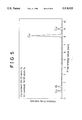
  • FIG. 5 is a chart illustrating results of an energy-dispersed type fluorescent X-ray analysis for a spherical body in the first example of the deformed ultra fine grain;
  • FIG. 6 is a chart illustrating results of an energy-dispersed type fluorescent X-ray analysis for a tail-like projection in the first example of the deformed ultra fine grain
  • FIG. 7 is a photomicrograph showing a second example of a deformed ultra fine grain
  • FIG. 8 is a chart illustrating results of an energy-dispersed type fluorescent X-ray analysis for a spherical body in the second example of the deformed ultra fine grain.
  • FIG. 9 is a chart illustrating results of an energy-dispersed type fluorescent X-ray analysis for a tail-like projection in the second example of the deformed ultra fine grain.
  • a deformed (heteromorphic) ultra-fine grain 1 is formed into a composite type comprising a spherical body 2 of a metal, and a tail-like projection 3 made of a ceramic and projecting from a surface of the spherical body 2.
  • the tail-like projection 3 is substantially conical in shape.
  • the spherical body 2 has a grain size D in a range represented by D ⁇ 100 nm, and the tail-like projection 3 has a projecting length L in a range represented by L ⁇ 200 nm.
  • the deformed ultra-fine grain 1 has the tail-like projection 3 integrally formed thereon, so that the tail-like projection 3 exhibits a separation effect (spacing effect) on adjacent deformed ultra-fine grains 1, thereby avoiding the aggregation of the deformed ultra-fine grains 1 to provide an extremely good dispersion property.
  • a process which comprises the steps of: melting a metal blank by plasma arc in a controlled atmosphere including a gas contributing to the formation of a ceramic, thereby forming a large number of spherical metal droplets by the clustering of evaporated particles; and precipitating and growing a ceramic by a reaction of the metal element with the gas on the surfaces of the spherical metal droplets.
  • FIGS. 2A to 2E illustrate a mechanism of formation of the deformed ultra-fine grains 1 in such producing process.
  • the particles 6 cluster or congregate, i.e., collide, fuse and grow with each other to form spherical metal droplets 7 having a ultra-fine grain size or diameter equal to or less than about 100 nm.
  • the spherical metal droplet 7 serves to form the spherical body 2.
  • the spherical metal droplet 7 contains the metal element in excess of the content of the metal element in the spherical body 2 and hence, with the cooling of the spherical metal droplet 7, the excessive amount of the metal element is precipitated on the surface thereof to react with the gas G, thereby precipitating the ceramic 8 on the surface of the spherical metal droplet 7.
  • the ceramic 8 starts to precipitate and grow into a conical shape.
  • the precipitation and growth of the ceramic 8 is completed to form the tail-like projection 3.
  • the spherical metal droplet 7 is solidified to form the spherical body 2.
  • the spherical body 2 is made of Cu alloy (which will be referred to as an Al-solid solution Cu alloy hereinafter) resulting from incorporation of solid solution aluminum in an amount represented by 17 atom % ⁇ Al ⁇ 19 atom % i.e., in a saturated state, or an intermetallic compound Al 4 Cu 9 .
  • the tail-like projection 3 is comprised of AlN.
  • the deformed ultra-fine grain 1 having such materials, the migration of electrons is produced for the chemical bonding between the metal portion and the ceramic portion. This exerts a favorable influence on a catalytic reaction which enhances the acceptance and donation of electrons, and the deformed ultra-fine grains 1 do not tend to aggregate. Therefore, if the grains 1 are used as a catalyst element for conversion of an exhaust gas from an automobile engine, they exhibit an excellent catalytic activity.
  • the deformed ultra-fine grains 1 are also applicable to gas, temperature and moisture sensors and other sensors.
  • a blank comprising aluminum in a content within a range represented by 20 atom % ⁇ Al ⁇ 50 atom % and a balance of copper is used as the alloy blank 4, and nitrogen gas is used as the ceramic forming gas. If required, argon gas may be used along with the nitrogen gas.
  • an alloy blank 4 having an aluminum content in a range represented by 20 atom % ⁇ Al ⁇ 30 atom %, e.g., Cu 70 Al 30 (each of the numerical values is atom %) is used, a bulk of deformed ultra-fine grains 1 including a spherical body 2 of an Al-solid solution Cu alloy is produced.
  • some deformed ultra-fine grains 1 each including a spherical body 2 of an intermetallic compound Al 4 Cu 9 may be incorporated in a very small amount in the bulk in some cases.
  • an alloy blank 4 having an Al content in a range represented by 30 atom % ⁇ Al ⁇ 40 atom %, e.g., Cu 60 Al 40 is used, a bulk of a mixture of both deformed ultra-fine grains 1 each including a spherical body 2 of an Al-solid solution Cu alloy and deformed ultra-fine grains 1 each including a spherical body 2 of an intermetallic compound Al 4 Cu 9 is produced.
  • an alloy blank 4 having an Al content in a range represented by 40 atom % ⁇ Al ⁇ 50 %, e.g., Cu 50 Al 50 is used, a bulk of deformed ultra-fine grains 1 each including a spherical body 2 of an intermetallic compound Al 4 Cu 9 is produced.
  • some deformed ultra-fine grains 1 each including a spherical body 2 of an Al-solid solution Cu alloy may be incorporated in a very small amount in the bulk in some cases.
  • the production of the intermetallic compound Al 4 Cu 9 is started in a range represented by 30 atom % ⁇ Al ⁇ 40 atom %.
  • the content of aluminum in the alloy blank 4 is less than 20 atom %, ultra fine grains made of only the Al-solid solution Cu alloy are formed.
  • the content of aluminum the alloy blank 4 exceeds 50 atom %, ultra fine grains made of the intermetallic compound Al 4 Cu 9 are formed.
  • FIG. 3 illustrates an apparatus for use in the production of a bulk quantity of deformed ultra-fine grains 1.
  • This producing apparatus includes a main chamber 9, and a sub-chamber 10 mounted under the main chamber 9.
  • the chambers 9 and 10 communicate with each other through a duct 11 and a nozzle 12 mounted on the lower end of the duct 11.
  • a tungsten electrode 5 extending into the main chamber 9 and a copper hearth 13 within the main chamber 9 are connected to a power source 14.
  • a movable substrate 15 is disposed in the sub-chamber 10 below the nozzle 12.
  • the main chamber 9 is connected to a controlled-atmosphere gas supply source 16, while the sub-chamber 10 is connected to a vacuum pump 17.
  • a Cu 70 Al 30 alloy blank (each of the numerical values is an atom %) 4 was placed, in an amount of 30 to 50 g, onto the hearth 13.
  • the vacuum pump 17 was operated to evacuate the main chamber 9 and the sub-chamber 10, until the pressure within the chambers 9 and 10 reached 1 ⁇ 10 -4 Torrs. Then, the controlled-atmosphere gas supply source 16 was operated to supply argon and nitrogen gases into the main chamber 9. The argon and nitrogen gases in the main chamber 9 were permitted to flow through the duct 11 and the nozzle 12 into the sub-chamber 10 by the operation of the vacuum pump 17 and then flow out of the sub-chamber 10. The amount of argon and nitrogen gases supplied from the controlled-atmosphere gas supply source 16 was adjusted, such that the pressure within the main chamber 9 was brought into a steady state of 600 Torrs.
  • FIG. 4 is a photomicrograph (100,000 magnifications) of the deformed ultra-fine grain 1 produced by the above-described producing process using the Cu 70 Al 30 alloy blank 4 (each of the numerical values is an atom %), in which the spherical body 2 and the tail-like projection 3 are observed.
  • the grain size D of the spherical body 2 in these deformed ultra-fine grains 1 is in a range represented by 30 nm ⁇ D ⁇ 100 nm; the projecting length L of the tail-like projection 3 is in a range represented by 20 nm ⁇ L ⁇ 200 nm, and the surface area S of the entire grain including the spherical body 2 and the tail-like projection 3 is in a range represented by 3.0 ⁇ 10 -15 m 2 ⁇ S ⁇ 40 ⁇ 10 -15 m 2 .
  • FIGS. 5 and 6 show the results of an energy-dispersed type fluorescent X-ray analysis for the deformed ultra-fine grain 1, FIG. 5 corresponding to those for the spherical body 2, and FIG. 6 corresponding to those for the tail-like projection 3.
  • the spherical body 2 is an Al-solid solution Cu alloy comprising 83.02 atom % of copper and 16.98 atom % of aluminum.
  • the tail-like projection 3 includes Al and thus is AlN.
  • FIG. 7 is a photomicrograph (100,000 magnifications) of the deformed ultra-fine grain 1 produced in the above-described producing process using the Cu 50 Al 50 alloy blank 4 (each of the numerical values is an atom %), wherein the spherical body 2 and the tail-like projection 3 are observed.
  • the grain size D of the spherical body 2 in these deformed ultra-fine grains 1 is in a range represented by 20 nm ⁇ D ⁇ 80 nm; the projecting length L of the tail-like projection 3 is in a range represented by 20 nm ⁇ L ⁇ 200 nm, and the surface area S of the entire grain including the spherical body 2 and the tail-like projection 3 is in a range represented by 1.5 ⁇ 10 -15 m 2 ⁇ S ⁇ 30 ⁇ 10 -15 m 2 .
  • FIGS. 8 and 9 show the results of an energy-dispersed type fluorescent X-ray analysis for the deformed ultra-fine grain 1, FIG. 8 corresponding to those for the spherical body 2, and FIG. 9 corresponding to those for the tail-like projection 3.
  • the composition of the spherical body 2 comprises 69.70 atom % of copper and 30.30 atom % of aluminum.
  • the spherical body 2 is of an intermetallic compound Al 4 Cu 9 .
  • the tail-like projection 3 incudes Al and thus is AlN.
  • the preparation of the catalyst was carried out by incorporating the deformed ultra-fine grains 1, each including the spherical body 2 made of the intermetallic compound Al 4 Cu 9 into ⁇ -Al 2 O 3 grains, such that the amount of grains 1 incorporated became 10% by weight, mixing them sufficiently, forming the mixture of the grains into pellets, and sintering the formed pellets.
  • helium gas containing 2,000 ppm of NO was allowed to flow through a catalyst layer having 1 g of the catalyst supported thereon at a flow rate of 100 ml/min during a predetermined time under a condition of a reaction temperature of 500° C., and then the gas passed through the catalyst layer was analyzed by a gas chromatography to determine an invert ratio of NO.
  • catalysts were prepared using, as a catalyst element, a mixture of 90% by weight of ultra fine grains made of Al 4 Cu 9 having a grain size D in a range represented by 20 nm ⁇ D ⁇ 100 nm, and 10% by weight of ultra fine grains made of AlN having a grain size D in a range represented by 20 nm ⁇ D ⁇ 120 nm, and using single ultra fine grains made of the above-described intermetallic compound Al 4 Cu 9 as another catalyst element. Using these catalysts, a similar NOx conversion test was carried out.
  • Table 1 shows the results of the NOx conversion test using these catalysts.
  • the catalyst prepared by using the deformed ultra-fine grains 1 as the catalyst element exhibits an excellent catalytic activity which is sustained for a long time.
  • the catalyst prepared by using the mixture of ultra-fine grains as the catalyst element with the catalyst prepared by using the single ultra-fine grains as the catalyst element, it was ascertained that their initial performances were substantially the same but after a lapse of 24 hours, there appeared a distinct difference between those two catalysts. This is considered to be due to the catalytic activity of the AlN ultra fine grains in the mixture of ultra fine grains and/or the suppression of the aggregation of the Al 4 Cu 9 ultra fine grains.

Landscapes

  • Chemical & Material Sciences (AREA)
  • Engineering & Computer Science (AREA)
  • Crystallography & Structural Chemistry (AREA)
  • Nanotechnology (AREA)
  • Materials Engineering (AREA)
  • Organic Chemistry (AREA)
  • Chemical Kinetics & Catalysis (AREA)
  • Powder Metallurgy (AREA)
  • Manufacture Of Metal Powder And Suspensions Thereof (AREA)

Abstract

A deformed ultra fine grain is comprised of a spherical body and a tail-like projection projecting from the surface of the spherical body. The tail-like projection exhibits a separating effect on the adjacent deformed ultra fine grains and therefore, aggregation of the ultra fine grains is avoided. Bulk quantities of the deformed ultra fine grains are produced by evaporating a metal by a plasma arc in a controlled atmosphere having a gas that combines with the material of the spherical body to form the tail-like projection.

Description

BACKGROUND OF THE INVENTION
1. Field of the Invention
The present invention relates to deformed ultra fine grains and processes for producing same in bulk.
2. Description of the Prior Art
There are various conventionally known types of ultra fine grains (for example, see Japanese Patent Application Laid-open Nos. 38505/90 and 294417/90).
However, all of the prior art ultra fine grains are spherical in shape and hence, they are liable to become aggregated and, if the ultra fine grains are used, for example, as a catalyst element for conversion of an exhaust gas from an automobile engine, a sufficient catalytic activity cannot be obtained.
SUMMARY OF THE INVENTION
Accordingly, it is an object of the present invention to provide a deformed ultra fine grain which is formed into a non-spherical shape and avoids aggregation.
To achieve the above object, according to the present invention, there is provided a deformed ultra fine grain comprising spherical body, and a tail-like projection extending from the surface of the spherical body.
With the above configuration, the tail-like projection exhibits a separating effect on the adjacent deformed ultra fine grains, thereby avoiding aggregation of the deformed ultra fine grains.
It is another object of the present invention to provide a producing process which can easily provide for producing bulk quantities of deformed ultra fine grains of the type described above.
To achieve the above objects, according to the present invention, there is provided a process for producing a bulk of deformed ultra fine grains each comprised of a spherical body of metal and a tail-like projection of ceramic projecting from a surface of the spherical body, comprising the steps of: melting a metal blank by plasma arc in a controlled atmosphere including a gas contributing to the formation of the ceramic, thereby forming a large number of spherical metal droplets by the clustering of evaporated particles; and precipitating and growing the ceramic by a reaction of the metal element with the gas on the surfaces of the spherical metal droplets.
With the above process, the mass production in bulk quantities of deformed ultra fine grains each comprised of the spherical body of the metal and the tail-like projection of the ceramic can be easily produced at a single melting step.
The above and other objects, features and advantages of the invention will become apparent from the following description of preferred embodiments, taken in conjunction with the accompanying drawings.
BRIEF DESCRIPTION OF THE DRAWINGS
FIG. 1 is a perspective view of a deformed ultra fine grain;
FIGS. 2A, 2B, 2C, 2D and 2E are diagrammatic illustrations for explaining a method of forming the deformed ultra fine grain of this invention;
FIG. 3 is a diagrammatic illustration of an apparatus for producing the deformed ultra fine grains in bulk quantities;
FIG. 4 is a photomicrograph showing a first example of a deformed ultra fine grain;
FIG. 5 is a chart illustrating results of an energy-dispersed type fluorescent X-ray analysis for a spherical body in the first example of the deformed ultra fine grain;
FIG. 6 is a chart illustrating results of an energy-dispersed type fluorescent X-ray analysis for a tail-like projection in the first example of the deformed ultra fine grain;
FIG. 7 is a photomicrograph showing a second example of a deformed ultra fine grain;
FIG. 8 is a chart illustrating results of an energy-dispersed type fluorescent X-ray analysis for a spherical body in the second example of the deformed ultra fine grain; and
FIG. 9 is a chart illustrating results of an energy-dispersed type fluorescent X-ray analysis for a tail-like projection in the second example of the deformed ultra fine grain.
DESCRIPTION OF THE PREFERRED EMBODIMENTS
Referring to FIG. 1, a deformed (heteromorphic) ultra-fine grain 1 is formed into a composite type comprising a spherical body 2 of a metal, and a tail-like projection 3 made of a ceramic and projecting from a surface of the spherical body 2. In the illustrated embodiment, the tail-like projection 3 is substantially conical in shape. The spherical body 2 has a grain size D in a range represented by D≦100 nm, and the tail-like projection 3 has a projecting length L in a range represented by L≦200 nm.
In this way, the deformed ultra-fine grain 1 has the tail-like projection 3 integrally formed thereon, so that the tail-like projection 3 exhibits a separation effect (spacing effect) on adjacent deformed ultra-fine grains 1, thereby avoiding the aggregation of the deformed ultra-fine grains 1 to provide an extremely good dispersion property.
In producing a bulk quantity of the deformed ultra-fine grains 1, a process is employed which comprises the steps of: melting a metal blank by plasma arc in a controlled atmosphere including a gas contributing to the formation of a ceramic, thereby forming a large number of spherical metal droplets by the clustering of evaporated particles; and precipitating and growing a ceramic by a reaction of the metal element with the gas on the surfaces of the spherical metal droplets.
FIGS. 2A to 2E illustrate a mechanism of formation of the deformed ultra-fine grains 1 in such producing process.
As shown in FIG. 2A, if an alloy blank 4 used as the metal blank is melted by a plasma arc in a controlled atmosphere including a ceramic forming gas G by use of an electrode 5, the gas G is dissociated (G+) into atoms by arc plasma and dissolved into the molten alloy blank 4, and then emitted out of the alloy blank 4 in the form of molecules (G). These steps of dissolution and emitting are repeated continually. During the emitting, a large number of particles 6 are actively evaporated from the alloy blank 4. In the particles 6, the concentration of the metal elements reacting with the gas G to form the ceramic is high.
As shown in FIG. 2B, the particles 6 cluster or congregate, i.e., collide, fuse and grow with each other to form spherical metal droplets 7 having a ultra-fine grain size or diameter equal to or less than about 100 nm.
As shown in FIG. 2C, the spherical metal droplet 7 serves to form the spherical body 2. The spherical metal droplet 7 contains the metal element in excess of the content of the metal element in the spherical body 2 and hence, with the cooling of the spherical metal droplet 7, the excessive amount of the metal element is precipitated on the surface thereof to react with the gas G, thereby precipitating the ceramic 8 on the surface of the spherical metal droplet 7.
As shown in FIG. 2D, the ceramic 8 starts to precipitate and grow into a conical shape.
As shown in FIG. 2E, the precipitation and growth of the ceramic 8 is completed to form the tail-like projection 3. The spherical metal droplet 7 is solidified to form the spherical body 2.
A particular example of this processing and invention now will be described.
The spherical body 2 is made of Cu alloy (which will be referred to as an Al-solid solution Cu alloy hereinafter) resulting from incorporation of solid solution aluminum in an amount represented by 17 atom % ≦Al≦19 atom % i.e., in a saturated state, or an intermetallic compound Al4 Cu9. The tail-like projection 3 is comprised of AlN.
In the deformed ultra-fine grain 1 having such materials, the migration of electrons is produced for the chemical bonding between the metal portion and the ceramic portion. This exerts a favorable influence on a catalytic reaction which enhances the acceptance and donation of electrons, and the deformed ultra-fine grains 1 do not tend to aggregate. Therefore, if the grains 1 are used as a catalyst element for conversion of an exhaust gas from an automobile engine, they exhibit an excellent catalytic activity. The deformed ultra-fine grains 1 are also applicable to gas, temperature and moisture sensors and other sensors.
In the production of a bulk quantity of the deformed ultra-fine grains 1, a blank comprising aluminum in a content within a range represented by 20 atom %≦Al≦50 atom % and a balance of copper is used as the alloy blank 4, and nitrogen gas is used as the ceramic forming gas. If required, argon gas may be used along with the nitrogen gas.
In this case, if an alloy blank 4 having an aluminum content in a range represented by 20 atom %≦Al≦30 atom %, e.g., Cu70 Al30 (each of the numerical values is atom %) is used, a bulk of deformed ultra-fine grains 1 including a spherical body 2 of an Al-solid solution Cu alloy is produced. However, some deformed ultra-fine grains 1 each including a spherical body 2 of an intermetallic compound Al4 Cu9 may be incorporated in a very small amount in the bulk in some cases.
If an alloy blank 4 having an Al content in a range represented by 30 atom %≦Al≦40 atom %, e.g., Cu60 Al40 is used, a bulk of a mixture of both deformed ultra-fine grains 1 each including a spherical body 2 of an Al-solid solution Cu alloy and deformed ultra-fine grains 1 each including a spherical body 2 of an intermetallic compound Al4 Cu9 is produced.
Further, if an alloy blank 4 having an Al content in a range represented by 40 atom %≦Al≦50 %, e.g., Cu50 Al50 is used, a bulk of deformed ultra-fine grains 1 each including a spherical body 2 of an intermetallic compound Al4 Cu9 is produced. However, some deformed ultra-fine grains 1 each including a spherical body 2 of an Al-solid solution Cu alloy may be incorporated in a very small amount in the bulk in some cases.
It is believed that the production of the intermetallic compound Al4 Cu9 is started in a range represented by 30 atom %≦Al≦40 atom %. When the content of aluminum in the alloy blank 4 is less than 20 atom %, ultra fine grains made of only the Al-solid solution Cu alloy are formed. On the other hand, if the content of aluminum the alloy blank 4 exceeds 50 atom %, ultra fine grains made of the intermetallic compound Al4 Cu9 are formed.
FIG. 3 illustrates an apparatus for use in the production of a bulk quantity of deformed ultra-fine grains 1. This producing apparatus includes a main chamber 9, and a sub-chamber 10 mounted under the main chamber 9. The chambers 9 and 10 communicate with each other through a duct 11 and a nozzle 12 mounted on the lower end of the duct 11. A tungsten electrode 5 extending into the main chamber 9 and a copper hearth 13 within the main chamber 9 are connected to a power source 14. A movable substrate 15 is disposed in the sub-chamber 10 below the nozzle 12. The main chamber 9 is connected to a controlled-atmosphere gas supply source 16, while the sub-chamber 10 is connected to a vacuum pump 17.
An example of the production of a bulk quantity of deformed ultra-fine grains 1 using the above-described producing apparatus now will be described.
(1) A Cu70 Al30 alloy blank (each of the numerical values is an atom %) 4 was placed, in an amount of 30 to 50 g, onto the hearth 13.
(2) The vacuum pump 17 was operated to evacuate the main chamber 9 and the sub-chamber 10, until the pressure within the chambers 9 and 10 reached 1×10⁻⁴ Torrs. Then, the controlled-atmosphere gas supply source 16 was operated to supply argon and nitrogen gases into the main chamber 9. The argon and nitrogen gases in the main chamber 9 were permitted to flow through the duct 11 and the nozzle 12 into the sub-chamber 10 by the operation of the vacuum pump 17 and then flow out of the sub-chamber 10. The amount of argon and nitrogen gases supplied from the controlled-atmosphere gas supply source 16 was adjusted, such that the pressure within the main chamber 9 was brought into a steady state of 600 Torrs.
(3) A voltage was applied between the tungsten electrode 5 and the hearth 13 to generate an arc discharge, thereby melting the alloy blank 4 by plasma arc under a condition of arc current of 100-300 A. This melting caused the clusters having a large aluminum content to be evaporated, whereby deformed ultra-fine grains 1 were formed in the presence of the nitrogen gas. The deformed ultra-fine grains 1 were drawn through the duct 11 and ejected by the nozzle 12 onto the substrate 15 and accumulated thereon, thereby providing a bulk quantity of the deformed ultra-fine grains 1.
In addition, using a Cu50 Al50 alloy blank (each of the numerical values is an atom %), another bulk of deformed ultra-fine grains 1 was produced under the same condition as described above.
FIG. 4 is a photomicrograph (100,000 magnifications) of the deformed ultra-fine grain 1 produced by the above-described producing process using the Cu70 Al30 alloy blank 4 (each of the numerical values is an atom %), in which the spherical body 2 and the tail-like projection 3 are observed. The grain size D of the spherical body 2 in these deformed ultra-fine grains 1 is in a range represented by 30 nm≦D≦100 nm; the projecting length L of the tail-like projection 3 is in a range represented by 20 nm≦L≦200 nm, and the surface area S of the entire grain including the spherical body 2 and the tail-like projection 3 is in a range represented by 3.0×10⁻¹⁵ m2 ≦S≦40×10-15 m2.
FIGS. 5 and 6 show the results of an energy-dispersed type fluorescent X-ray analysis for the deformed ultra-fine grain 1, FIG. 5 corresponding to those for the spherical body 2, and FIG. 6 corresponding to those for the tail-like projection 3. It has been ascertained from FIG. 5 that the spherical body 2 is an Al-solid solution Cu alloy comprising 83.02 atom % of copper and 16.98 atom % of aluminum. It has been also ascertained from FIG. 6 that the tail-like projection 3 includes Al and thus is AlN.
FIG. 7 is a photomicrograph (100,000 magnifications) of the deformed ultra-fine grain 1 produced in the above-described producing process using the Cu50 Al50 alloy blank 4 (each of the numerical values is an atom %), wherein the spherical body 2 and the tail-like projection 3 are observed. The grain size D of the spherical body 2 in these deformed ultra-fine grains 1 is in a range represented by 20 nm≦D≦80 nm; the projecting length L of the tail-like projection 3 is in a range represented by 20 nm≦L≦200 nm, and the surface area S of the entire grain including the spherical body 2 and the tail-like projection 3 is in a range represented by 1.5×10⁻¹⁵ m2 ≦S≦30×10-15 m2.
FIGS. 8 and 9 show the results of an energy-dispersed type fluorescent X-ray analysis for the deformed ultra-fine grain 1, FIG. 8 corresponding to those for the spherical body 2, and FIG. 9 corresponding to those for the tail-like projection 3. As apparent from FIG. 8, the composition of the spherical body 2 comprises 69.70 atom % of copper and 30.30 atom % of aluminum. Additionally, from results of an X-ray diffraction, it has been ascertained that the spherical body 2 is of an intermetallic compound Al4 Cu9. It has also been ascertained from FIG. 9 that the tail-like projection 3 incudes Al and thus is AlN.
An NOx conversion test, which will be described below, was carried out for the deformed ultra-fine grain 1 in order to examine a function of the deformed ultra-fine grain 1 serving as a catalyst element for the conversion of the exhaust gas from an automobile engine.
The preparation of the catalyst was carried out by incorporating the deformed ultra-fine grains 1, each including the spherical body 2 made of the intermetallic compound Al4 Cu9 into γ-Al2 O3 grains, such that the amount of grains 1 incorporated became 10% by weight, mixing them sufficiently, forming the mixture of the grains into pellets, and sintering the formed pellets.
In the NOx conversion test, helium gas containing 2,000 ppm of NO was allowed to flow through a catalyst layer having 1 g of the catalyst supported thereon at a flow rate of 100 ml/min during a predetermined time under a condition of a reaction temperature of 500° C., and then the gas passed through the catalyst layer was analyzed by a gas chromatography to determine an invert ratio of NO.
For comparison, catalysts were prepared using, as a catalyst element, a mixture of 90% by weight of ultra fine grains made of Al4 Cu9 having a grain size D in a range represented by 20 nm≦D≦100 nm, and 10% by weight of ultra fine grains made of AlN having a grain size D in a range represented by 20 nm≦D≦120 nm, and using single ultra fine grains made of the above-described intermetallic compound Al4 Cu9 as another catalyst element. Using these catalysts, a similar NOx conversion test was carried out.
Table 1 shows the results of the NOx conversion test using these catalysts.
              TABLE 1                                                     
______________________________________                                    
             Invert ratio of NO (%)                                       
Catalyst element                                                          
               after 30 minutes                                           
                           after 24 hours                                 
______________________________________                                    
Deformed ultra-fine                                                       
               35.3        35.1                                           
grains                                                                    
Mixture of ultra-                                                         
               28.1        28.0                                           
fine grains                                                               
Single ultra-fine                                                         
               28.4        26.5                                           
grains                                                                    
______________________________________                                    
It can be seen from Table 1 that the catalyst prepared by using the deformed ultra-fine grains 1 as the catalyst element exhibits an excellent catalytic activity which is sustained for a long time. On the other hand, by a comparison of the catalyst prepared by using the mixture of ultra-fine grains as the catalyst element with the catalyst prepared by using the single ultra-fine grains as the catalyst element, it was ascertained that their initial performances were substantially the same but after a lapse of 24 hours, there appeared a distinct difference between those two catalysts. This is considered to be due to the catalytic activity of the AlN ultra fine grains in the mixture of ultra fine grains and/or the suppression of the aggregation of the Al4 Cu9 ultra fine grains.

Claims (24)

What is claimed is:
1. A deformed ultra fine grain comprising a spherical body, and a tail projection extending from a surface of the spherical body, said tail projection comprising a different material than that of said spherical body.
2. A deformed ultra fine grain according to claim 1, wherein said spherical body is of a metal.
3. A deformed ultra fine grain according to claim 1, wherein said tail projection is of a ceramic.
4. A deformed ultra fine grain comprising a spherical body, and a tail projection extending from a surface of the spherical body, wherein said spherical body is of a metal, and said tail projection is of a ceramic.
5. A deformed ultra fine grain comprising a spherical body of a Cu alloy with an aluminum solid solution incorporated therein in a range represented by 17 atom %≦Al≦19 atom %, and a tail projection of AlN extending from a surface of the spherical body.
6. A deformed ultra fine grain comprising a spherical body of intermetallic compound Al4 Cu9, and a tail projection of AlN extending from a surface of the spherical body.
7. A deformed ultra fine grain according to claims 1, 2, 3, 4, 5 or 6, wherein a grain size D of said spherical body is in a range represented by D≦100 nm, and a projecting length L of said tail projection is in a range represented by L≦200 nm.
8. A process for producing a bulk of deformed ultra fine grains with each comprised of a spherical body of a metal and a tail projection of a ceramic extending from a surface of a spherical body, comprising the steps of:
melting a metal blank by plasma arc in a controlled atmosphere including a gas contributing to the formation of said ceramic, thereby forming a large number of spherical metal droplets by clustering of evaporated particles; and precipitating and growing the ceramic by a reaction of the metal with said gas on a surface of the spherical metal droplets.
9. A process for producing a bulk of deformed ultra fine grains with each grain comprising at least one of a spherical body of Cu alloy with an aluminum solid solution incorporated therein in a range represented by 17 atom %≦Al≦19 atom % and a spherical body of intermetallic compound Al4 Cu9 and having a tail projection of AlN extending from a surface of the spherical body, said process comprising the steps of: melting an alloy blank consisting of aluminum in a range represented by 20 atom %≦Al≦50 atom % and a balance of copper by plasma arc in a controlled atmosphere including nitrogen gas, thereby forming a large number of spherical droplets by clustering of evaporated particles; and precipitating and growing AlN on surfaces of said spherical droplets.
10. A process for producing a bulk of deformed ultra fine grains comprising the steps of: melting a metal blank by plasma arc in a controlled atmosphere for evaporating a multiplicity of particles; causing said particles to cluster for thereby forming a large number of spherical metal droplets with each spherical metal droplet having a multiplicity of evaporated particles; and causing precipitating and growing of a ceramic tail projection on a surface substantially of each spherical metal droplet by a reaction of the metal in the spherical metal droplet with a gas in said controlled atmosphere to form a said deformed ultra fine grain.
11. A process according to claim 10, wherein, said spherical metal droplet is comprised of at least one of a Cu alloy with an aluminum solid solution incorporated therein in a range represented by 17 atom %≦Al≦19 atom % and an intermetallic compound Al4 Cu9.
12. A process according to claim 11 wherein, said gas is nitrogen, and said tail projection is formed of AlN.
13. A deformed ultra fine grain comprising a spherical body and a projection extending from the surface of the spherical body, wherein said spherical body is made of a metal, and said projection is made of a ceramic.
14. A deformed ultra fine grain comprising a spherical body of a Cu alloy with an aluminum solid solution incorporated therein in a range represented by 17 atom %≦Al≦19 atom %, and a projection of AlN extending from a surface of the spherical body.
15. A deformed ultra fine grain comprising a spherical body of intermetallic compound Al4 Cu9, and a projection of AlN extending from a surface of the spherical body.
16. A deformed ultra fine grain according to claims 1, 2, 3, 4, 5 or 6 wherein a grain size D of said spherical body is in a range represented by 20 nm≦D≦100 nm and a projecting length L of said tail projection is in a range represented by 20 nm≦L≦200 nm.
17. A process for producing a bulk of deformed ultra fine grains with each comprised of a spherical body of a metal and a projection of a ceramic extending from a surface of a spherical body, comprising the steps of:
melting a metal blank by plasma arc in a controlled atmosphere including a gas contributing to the formation of said ceramic, thereby forming a large number of spherical metal droplets by clustering of evaporated particles; and precipitating and growing the ceramic by a reaction of the metal with said gas on a surface of the spherical metal droplets.
18. A process for producing a bulk of deformed ultra fine grains with each grain comprising at least one of a spherical body of Cu alloy with an aluminum solid solution incorporated therein in a range represented by 17 atom %≦Al≦19 atom % and a spherical body of intermetallic compound Al4 Cu9 and having a projection of AlN extending from a surface of the spherical body, said process comprising the steps of:
melting an alloy blank consisting of aluminum in a range represented by 20 atom %≦Al≦50 atom % and a balance of copper by plasma arc in a controlled atmosphere including nitrogen gas, thereby forming a large number of spherical droplets by clustering of evaporated particles; and precipitating and growing AlN on surfaces of said spherical droplets.
19. A process for producing a bulk of deformed ultra fine grains comprising the steps of:
melting a metal blank by plasma arc in a controlled atmosphere for evaporating a multiplicity of particles; causing said particles to cluster for thereby forming a large number of spherical metal droplets with each spherical metal droplet having a multiplicity of evaporated particles; and causing precipitating and growing of a ceramic projection on a surface substantially of each spherical metal droplet by a reaction of the metal in the spherical metal droplet with a gas in said controlled atmosphere to form a said deformed ultra fine grain.
20. A process according to claim 19 wherein, said spherical metal droplet is comprised of at least one of a Cu alloy with an aluminum solid solution incorporated therein in a range represented by 17 atom %≦Al≦19 atom % and an intermetallic compound Al4 Cu9.
21. A process according to claim 20 wherein, said gas is nitrogen, and said projection is formed of AlN.
22. A catalyst material comprising a plurality of deformed ultra fine grains, said ultra fine deformed grains comprising a spherical body and a projection extending from the surface of the spherical body, and wherein said projection comprises a different material than that of said spherical body.
23. A catalyst material according to claim 22 wherein said spherical body is made of a metal, and said projection is made of ceramics.
24. A catalyst material according to claim 23, wherein said projection is a tail.
US08/209,148 1993-03-15 1994-03-10 Deformed ultra fine grains and process for producing same in bulk Expired - Fee Related US5518522A (en)

Applications Claiming Priority (2)

Application Number Priority Date Filing Date Title
JP5-080036 1993-03-15
JP5080036A JP2745372B2 (en) 1993-03-15 1993-03-15 Method for producing deformed ultrafine particles and aggregates thereof

Publications (1)

Publication Number Publication Date
US5518522A true US5518522A (en) 1996-05-21

Family

ID=13707034

Family Applications (1)

Application Number Title Priority Date Filing Date
US08/209,148 Expired - Fee Related US5518522A (en) 1993-03-15 1994-03-10 Deformed ultra fine grains and process for producing same in bulk

Country Status (3)

Country Link
US (1) US5518522A (en)
EP (1) EP0615803A1 (en)
JP (1) JP2745372B2 (en)

Families Citing this family (4)

* Cited by examiner, † Cited by third party
Publication number Priority date Publication date Assignee Title
CN1054781C (en) * 1995-03-11 2000-07-26 青岛化工学院 Manufacture of rare-earth transition metal ultramicron catalyst with nano size hydrogen storing egg-shell type
JP3277933B2 (en) * 2000-04-24 2002-04-22 セイコーエプソン株式会社 Magnet powder, method for producing bonded magnet, and bonded magnet
JP3277932B2 (en) * 2000-04-24 2002-04-22 セイコーエプソン株式会社 Magnet powder, method for producing bonded magnet, and bonded magnet
WO2025027852A1 (en) * 2023-08-03 2025-02-06 トヨタ自動車株式会社 Metal particles, method for producing metal particles, and dispersion containing metal particles

Citations (4)

* Cited by examiner, † Cited by third party
Publication number Priority date Publication date Assignee Title
US4756746A (en) * 1986-09-08 1988-07-12 Gte Products Corporation Process of producing fine spherical particles
US4780131A (en) * 1986-09-08 1988-10-25 Gte Products Corporation Process for producing spherical light metal based powder particles
JPH04280906A (en) * 1991-03-05 1992-10-06 Shigeo Nakagawa Manufacture of ultra-fine particle
DE4117141A1 (en) * 1991-05-25 1992-11-26 Wolfgang Seidler Spherical powder and granules prodn. - by atomising solid rod using plasma jet as former is fed into seal container

Patent Citations (4)

* Cited by examiner, † Cited by third party
Publication number Priority date Publication date Assignee Title
US4756746A (en) * 1986-09-08 1988-07-12 Gte Products Corporation Process of producing fine spherical particles
US4780131A (en) * 1986-09-08 1988-10-25 Gte Products Corporation Process for producing spherical light metal based powder particles
JPH04280906A (en) * 1991-03-05 1992-10-06 Shigeo Nakagawa Manufacture of ultra-fine particle
DE4117141A1 (en) * 1991-05-25 1992-11-26 Wolfgang Seidler Spherical powder and granules prodn. - by atomising solid rod using plasma jet as former is fed into seal container

Also Published As

Publication number Publication date
JPH06264101A (en) 1994-09-20
EP0615803A1 (en) 1994-09-21
JP2745372B2 (en) 1998-04-28

Similar Documents

Publication Publication Date Title
US5429657A (en) Method for making silver-palladium alloy powders by aerosol decomposition
EP0591881B1 (en) Method for making palladium and palladium oxide powders by aerosol decomposition
US4046712A (en) Catalysts sputtered on substantially nonporous low surface area particulate supports
CN1108214C (en) Method for preparation of golden powder by decomposing aerosol
US5861136A (en) Method for making copper I oxide powders by aerosol decomposition
US20020031465A1 (en) Production of carbon nanotube
EP0650791B1 (en) Fine particles of metals, alloys and metal compounds
CN1085143A (en) Decompose the method for making silver powder by aerosol
US7909908B2 (en) Method of improving the weatherability of copper powder
US5518522A (en) Deformed ultra fine grains and process for producing same in bulk
EP1018386A1 (en) Method for producing metal powder
JP2545913B2 (en) Ni-based alloy powder for forming amorphous sprayed coating with excellent corrosion resistance
US7618475B2 (en) Metal powder for electrically conductive paste and electrically conductive paste
US3475158A (en) Production of particulate,non-pyrophoric metals and product
US4810285A (en) Process for preparing spherical copper fine powder
CN101062524A (en) Nickel powder manufacturing method
KR940009339B1 (en) Method of manufacturing nikel powder
US5800638A (en) Ultrafine particle of quasi-crystalline aluminum alloy and process for producing aggregate thereof
CA2336863C (en) Method for preparing ultra fine nickel powder
CN1026039C (en) Alkali metal vapor dispenser
EP0721919A1 (en) Method for making copper (I) oxide powders by aerosol decomposition
CN1013352B (en) Manufacturing technique of supper-fine molybdenum powder
JPH06264103A (en) Method for producing ultrafine particles of oxidation-resistant intermetallic compound and aggregate thereof
EP0537501B1 (en) Manufacturing method of electronical components having conductive and non-conductive layers joined together
JPH10251703A (en) Superfine grain of gold-copper alloy with equilateral icosahedral structure, and its production

Legal Events

Date Code Title Description
AS Assignment

Owner name: MASUMOTO, TSUYOSHI

Free format text: ASSIGNMENT OF ASSIGNORS INTEREST;ASSIGNORS:MASUMOTO, TSUYOSHI;INOUE, AKIHISA;YAMAGUCHI, TADASHI;AND OTHERS;REEL/FRAME:007039/0481

Effective date: 19940418

Owner name: INOUE, AKIHISA

Free format text: ASSIGNMENT OF ASSIGNORS INTEREST;ASSIGNORS:MASUMOTO, TSUYOSHI;INOUE, AKIHISA;YAMAGUCHI, TADASHI;AND OTHERS;REEL/FRAME:007039/0481

Effective date: 19940418

Owner name: YOSHIDA KOGYO K.K.

Free format text: ASSIGNMENT OF ASSIGNORS INTEREST;ASSIGNORS:MASUMOTO, TSUYOSHI;INOUE, AKIHISA;YAMAGUCHI, TADASHI;AND OTHERS;REEL/FRAME:007039/0481

Effective date: 19940418

Owner name: HONDA GIKEN KOGYO KABUSHIKI

Free format text: ASSIGNMENT OF ASSIGNORS INTEREST;ASSIGNORS:MASUMOTO, TSUYOSHI;INOUE, AKIHISA;YAMAGUCHI, TADASHI;AND OTHERS;REEL/FRAME:007039/0481

Effective date: 19940418

AS Assignment

Owner name: YKK CORPORATION, JAPAN

Free format text: CHANGE OF NAME;ASSIGNOR:YOSHIDA KOGYO, K.K.;REEL/FRAME:007249/0216

Effective date: 19940801

REMI Maintenance fee reminder mailed
LAPS Lapse for failure to pay maintenance fees
FP Lapsed due to failure to pay maintenance fee

Effective date: 20000521

STCH Information on status: patent discontinuation

Free format text: PATENT EXPIRED DUE TO NONPAYMENT OF MAINTENANCE FEES UNDER 37 CFR 1.362