US5516959A - Highly selective n-olefin isomerization process using ZSM-35 - Google Patents
Highly selective n-olefin isomerization process using ZSM-35 Download PDFInfo
- Publication number
- US5516959A US5516959A US08/357,841 US35784194A US5516959A US 5516959 A US5516959 A US 5516959A US 35784194 A US35784194 A US 35784194A US 5516959 A US5516959 A US 5516959A
- Authority
- US
- United States
- Prior art keywords
- zsm
- conversion
- catalyst
- butene
- olefins
- Prior art date
- Legal status (The legal status is an assumption and is not a legal conclusion. Google has not performed a legal analysis and makes no representation as to the accuracy of the status listed.)
- Expired - Fee Related
Links
- 238000006317 isomerization reaction Methods 0.000 title claims abstract description 51
- 238000000034 method Methods 0.000 title claims abstract description 49
- 230000008569 process Effects 0.000 title abstract description 20
- VXNZUUAINFGPBY-UHFFFAOYSA-N 1-Butene Chemical class CCC=C VXNZUUAINFGPBY-UHFFFAOYSA-N 0.000 claims abstract description 136
- VYPSYNLAJGMNEJ-UHFFFAOYSA-N Silicium dioxide Chemical compound O=[Si]=O VYPSYNLAJGMNEJ-UHFFFAOYSA-N 0.000 claims abstract description 110
- 238000006243 chemical reaction Methods 0.000 claims abstract description 80
- 239000003054 catalyst Substances 0.000 claims abstract description 75
- 150000001336 alkenes Chemical class 0.000 claims abstract description 62
- 239000000377 silicon dioxide Substances 0.000 claims abstract description 50
- 239000011148 porous material Substances 0.000 claims abstract description 35
- 239000013078 crystal Substances 0.000 claims abstract description 26
- JRZJOMJEPLMPRA-UHFFFAOYSA-N olefin Natural products CCCCCCCC=C JRZJOMJEPLMPRA-UHFFFAOYSA-N 0.000 claims abstract description 25
- 229930195733 hydrocarbon Natural products 0.000 claims description 14
- YWAKXRMUMFPDSH-UHFFFAOYSA-N pentene Chemical class CCCC=C YWAKXRMUMFPDSH-UHFFFAOYSA-N 0.000 claims description 14
- 150000002430 hydrocarbons Chemical class 0.000 claims description 13
- 239000000463 material Substances 0.000 claims description 12
- 239000004215 Carbon black (E152) Substances 0.000 claims description 11
- OKTJSMMVPCPJKN-UHFFFAOYSA-N Carbon Chemical compound [C] OKTJSMMVPCPJKN-UHFFFAOYSA-N 0.000 claims description 9
- 229910052799 carbon Inorganic materials 0.000 claims description 6
- 239000011230 binding agent Substances 0.000 claims description 5
- 239000000203 mixture Substances 0.000 abstract description 31
- -1 e.g. Chemical class 0.000 abstract description 12
- 239000011159 matrix material Substances 0.000 abstract description 10
- 239000002131 composite material Substances 0.000 abstract description 5
- VQTUBCCKSQIDNK-UHFFFAOYSA-N Isobutene Chemical compound CC(C)=C VQTUBCCKSQIDNK-UHFFFAOYSA-N 0.000 description 70
- IJGRMHOSHXDMSA-UHFFFAOYSA-N Atomic nitrogen Chemical compound N#N IJGRMHOSHXDMSA-UHFFFAOYSA-N 0.000 description 30
- 239000000047 product Substances 0.000 description 28
- 239000010457 zeolite Substances 0.000 description 24
- 229910001657 ferrierite group Inorganic materials 0.000 description 20
- 229910021536 Zeolite Inorganic materials 0.000 description 19
- HNPSIPDUKPIQMN-UHFFFAOYSA-N dioxosilane;oxo(oxoalumanyloxy)alumane Chemical compound O=[Si]=O.O=[Al]O[Al]=O HNPSIPDUKPIQMN-UHFFFAOYSA-N 0.000 description 19
- BZLVMXJERCGZMT-UHFFFAOYSA-N Methyl tert-butyl ether Chemical compound COC(C)(C)C BZLVMXJERCGZMT-UHFFFAOYSA-N 0.000 description 16
- IAQRGUVFOMOMEM-UHFFFAOYSA-N butene Natural products CC=CC IAQRGUVFOMOMEM-UHFFFAOYSA-N 0.000 description 16
- RWRDLPDLKQPQOW-UHFFFAOYSA-N Pyrrolidine Chemical compound C1CCNC1 RWRDLPDLKQPQOW-UHFFFAOYSA-N 0.000 description 15
- 229910052757 nitrogen Inorganic materials 0.000 description 15
- 239000000243 solution Substances 0.000 description 14
- HEMHJVSKTPXQMS-UHFFFAOYSA-M Sodium hydroxide Chemical compound [OH-].[Na+] HEMHJVSKTPXQMS-UHFFFAOYSA-M 0.000 description 13
- 230000000694 effects Effects 0.000 description 13
- OKKJLVBELUTLKV-UHFFFAOYSA-N Methanol Chemical compound OC OKKJLVBELUTLKV-UHFFFAOYSA-N 0.000 description 12
- PNEYBMLMFCGWSK-UHFFFAOYSA-N aluminium oxide Inorganic materials [O-2].[O-2].[O-2].[Al+3].[Al+3] PNEYBMLMFCGWSK-UHFFFAOYSA-N 0.000 description 12
- XLYOFNOQVPJJNP-UHFFFAOYSA-N water Chemical compound O XLYOFNOQVPJJNP-UHFFFAOYSA-N 0.000 description 12
- 229910017897 NH4 NO3 Inorganic materials 0.000 description 11
- 230000001965 increasing effect Effects 0.000 description 11
- 230000032683 aging Effects 0.000 description 8
- 238000002360 preparation method Methods 0.000 description 8
- 238000006266 etherification reaction Methods 0.000 description 7
- 239000008188 pellet Substances 0.000 description 7
- QQONPFPTGQHPMA-UHFFFAOYSA-N propylene Natural products CC=C QQONPFPTGQHPMA-UHFFFAOYSA-N 0.000 description 7
- KAKZBPTYRLMSJV-UHFFFAOYSA-N Butadiene Chemical compound C=CC=C KAKZBPTYRLMSJV-UHFFFAOYSA-N 0.000 description 6
- 238000001354 calcination Methods 0.000 description 6
- TVMXDCGIABBOFY-UHFFFAOYSA-N octane Chemical compound CCCCCCCC TVMXDCGIABBOFY-UHFFFAOYSA-N 0.000 description 6
- HVZJRWJGKQPSFL-UHFFFAOYSA-N tert-Amyl methyl ether Chemical compound CCC(C)(C)OC HVZJRWJGKQPSFL-UHFFFAOYSA-N 0.000 description 6
- NUMQCACRALPSHD-UHFFFAOYSA-N tert-butyl ethyl ether Chemical compound CCOC(C)(C)C NUMQCACRALPSHD-UHFFFAOYSA-N 0.000 description 6
- 229910018404 Al2 O3 Inorganic materials 0.000 description 5
- MCMNRKCIXSYSNV-UHFFFAOYSA-N Zirconium dioxide Chemical compound O=[Zr]=O MCMNRKCIXSYSNV-UHFFFAOYSA-N 0.000 description 5
- 125000004817 pentamethylene group Chemical class [H]C([H])([*:2])C([H])([H])C([H])([H])C([H])([H])C([H])([H])[*:1] 0.000 description 5
- BKOOMYPCSUNDGP-UHFFFAOYSA-N 2-methylbut-2-ene Chemical compound CC=C(C)C BKOOMYPCSUNDGP-UHFFFAOYSA-N 0.000 description 4
- DIZPMCHEQGEION-UHFFFAOYSA-H aluminium sulfate (anhydrous) Chemical compound [Al+3].[Al+3].[O-]S([O-])(=O)=O.[O-]S([O-])(=O)=O.[O-]S([O-])(=O)=O DIZPMCHEQGEION-UHFFFAOYSA-H 0.000 description 4
- 230000003197 catalytic effect Effects 0.000 description 4
- 238000006555 catalytic reaction Methods 0.000 description 4
- 229910052681 coesite Inorganic materials 0.000 description 4
- 229910052906 cristobalite Inorganic materials 0.000 description 4
- 238000009826 distribution Methods 0.000 description 4
- 238000007580 dry-mixing Methods 0.000 description 4
- 125000004435 hydrogen atom Chemical group [H]* 0.000 description 4
- NNPPMTNAJDCUHE-UHFFFAOYSA-N isobutane Chemical compound CC(C)C NNPPMTNAJDCUHE-UHFFFAOYSA-N 0.000 description 4
- 238000002156 mixing Methods 0.000 description 4
- IJDNQMDRQITEOD-UHFFFAOYSA-N n-butane Chemical compound CCCC IJDNQMDRQITEOD-UHFFFAOYSA-N 0.000 description 4
- 230000009467 reduction Effects 0.000 description 4
- 238000003756 stirring Methods 0.000 description 4
- 229910052682 stishovite Inorganic materials 0.000 description 4
- 125000000383 tetramethylene group Chemical group [H]C([H])([*:1])C([H])([H])C([H])([H])C([H])([H])[*:2] 0.000 description 4
- 229910052905 tridymite Inorganic materials 0.000 description 4
- 238000003917 TEM image Methods 0.000 description 3
- GWEVSGVZZGPLCZ-UHFFFAOYSA-N Titan oxide Chemical compound O=[Ti]=O GWEVSGVZZGPLCZ-UHFFFAOYSA-N 0.000 description 3
- 230000002378 acidificating effect Effects 0.000 description 3
- 150000005215 alkyl ethers Chemical group 0.000 description 3
- 230000015572 biosynthetic process Effects 0.000 description 3
- 239000006227 byproduct Substances 0.000 description 3
- 150000001768 cations Chemical class 0.000 description 3
- 239000008119 colloidal silica Substances 0.000 description 3
- 238000005336 cracking Methods 0.000 description 3
- NLYAJNPCOHFWQQ-UHFFFAOYSA-N kaolin Chemical compound O.O.O=[Al]O[Si](=O)O[Si](=O)O[Al]=O NLYAJNPCOHFWQQ-UHFFFAOYSA-N 0.000 description 3
- 238000001000 micrograph Methods 0.000 description 3
- 150000002892 organic cations Chemical class 0.000 description 3
- 125000004805 propylene group Chemical group [H]C([H])([H])C([H])([*:1])C([H])([H])[*:2] 0.000 description 3
- 238000004626 scanning electron microscopy Methods 0.000 description 3
- 238000001350 scanning transmission electron microscopy Methods 0.000 description 3
- 238000004627 transmission electron microscopy Methods 0.000 description 3
- QMMOXUPEWRXHJS-HWKANZROSA-N (e)-pent-2-ene Chemical compound CC\C=C\C QMMOXUPEWRXHJS-HWKANZROSA-N 0.000 description 2
- QMMOXUPEWRXHJS-HYXAFXHYSA-N (z)-pent-2-ene Chemical compound CC\C=C/C QMMOXUPEWRXHJS-HYXAFXHYSA-N 0.000 description 2
- MHNNAWXXUZQSNM-UHFFFAOYSA-N 2-methylbut-1-ene Chemical compound CCC(C)=C MHNNAWXXUZQSNM-UHFFFAOYSA-N 0.000 description 2
- YHQXBTXEYZIYOV-UHFFFAOYSA-N 3-methylbut-1-ene Chemical compound CC(C)C=C YHQXBTXEYZIYOV-UHFFFAOYSA-N 0.000 description 2
- LFQSCWFLJHTTHZ-UHFFFAOYSA-N Ethanol Chemical compound CCO LFQSCWFLJHTTHZ-UHFFFAOYSA-N 0.000 description 2
- NQRYJNQNLNOLGT-UHFFFAOYSA-N Piperidine Chemical compound C1CCNCC1 NQRYJNQNLNOLGT-UHFFFAOYSA-N 0.000 description 2
- ATUOYWHBWRKTHZ-UHFFFAOYSA-N Propane Chemical compound CCC ATUOYWHBWRKTHZ-UHFFFAOYSA-N 0.000 description 2
- 238000002441 X-ray diffraction Methods 0.000 description 2
- 239000000654 additive Substances 0.000 description 2
- 235000012211 aluminium silicate Nutrition 0.000 description 2
- 238000009835 boiling Methods 0.000 description 2
- 238000004523 catalytic cracking Methods 0.000 description 2
- 150000001875 compounds Chemical class 0.000 description 2
- 238000002425 crystallisation Methods 0.000 description 2
- 230000008025 crystallization Effects 0.000 description 2
- 230000001186 cumulative effect Effects 0.000 description 2
- 239000008367 deionised water Substances 0.000 description 2
- 229910021641 deionized water Inorganic materials 0.000 description 2
- 238000007323 disproportionation reaction Methods 0.000 description 2
- 239000000446 fuel Substances 0.000 description 2
- 239000007789 gas Substances 0.000 description 2
- 239000000499 gel Substances 0.000 description 2
- 238000010438 heat treatment Methods 0.000 description 2
- 230000006872 improvement Effects 0.000 description 2
- 229910052500 inorganic mineral Inorganic materials 0.000 description 2
- 239000001282 iso-butane Substances 0.000 description 2
- 229910044991 metal oxide Inorganic materials 0.000 description 2
- 150000004706 metal oxides Chemical class 0.000 description 2
- VNWKTOKETHGBQD-UHFFFAOYSA-N methane Chemical compound C VNWKTOKETHGBQD-UHFFFAOYSA-N 0.000 description 2
- 239000011707 mineral Substances 0.000 description 2
- QMMOXUPEWRXHJS-UHFFFAOYSA-N pentene-2 Natural products CCC=CC QMMOXUPEWRXHJS-UHFFFAOYSA-N 0.000 description 2
- 239000011541 reaction mixture Substances 0.000 description 2
- 239000002002 slurry Substances 0.000 description 2
- 239000011734 sodium Substances 0.000 description 2
- 239000000126 substance Substances 0.000 description 2
- 238000003786 synthesis reaction Methods 0.000 description 2
- ABFDKXBSQCTIKH-UHFFFAOYSA-M 1-ethylpyridin-1-ium;bromide Chemical compound [Br-].CC[N+]1=CC=CC=C1 ABFDKXBSQCTIKH-UHFFFAOYSA-M 0.000 description 1
- 239000005995 Aluminium silicate Substances 0.000 description 1
- OTMSDBZUPAUEDD-UHFFFAOYSA-N Ethane Chemical compound CC OTMSDBZUPAUEDD-UHFFFAOYSA-N 0.000 description 1
- VGGSQFUCUMXWEO-UHFFFAOYSA-N Ethene Chemical compound C=C VGGSQFUCUMXWEO-UHFFFAOYSA-N 0.000 description 1
- 239000005977 Ethylene Substances 0.000 description 1
- UFHFLCQGNIYNRP-UHFFFAOYSA-N Hydrogen Chemical compound [H][H] UFHFLCQGNIYNRP-UHFFFAOYSA-N 0.000 description 1
- DGAQECJNVWCQMB-PUAWFVPOSA-M Ilexoside XXIX Chemical compound C[C@@H]1CC[C@@]2(CC[C@@]3(C(=CC[C@H]4[C@]3(CC[C@@H]5[C@@]4(CC[C@@H](C5(C)C)OS(=O)(=O)[O-])C)C)[C@@H]2[C@]1(C)O)C)C(=O)O[C@H]6[C@@H]([C@H]([C@@H]([C@H](O6)CO)O)O)O.[Na+] DGAQECJNVWCQMB-PUAWFVPOSA-M 0.000 description 1
- 239000002253 acid Substances 0.000 description 1
- 238000010306 acid treatment Methods 0.000 description 1
- 238000013019 agitation Methods 0.000 description 1
- 125000000217 alkyl group Chemical group 0.000 description 1
- 229910052782 aluminium Inorganic materials 0.000 description 1
- XAGFODPZIPBFFR-UHFFFAOYSA-N aluminium Chemical compound [Al] XAGFODPZIPBFFR-UHFFFAOYSA-N 0.000 description 1
- HPTYUNKZVDYXLP-UHFFFAOYSA-N aluminum;trihydroxy(trihydroxysilyloxy)silane;hydrate Chemical group O.[Al].[Al].O[Si](O)(O)O[Si](O)(O)O HPTYUNKZVDYXLP-UHFFFAOYSA-N 0.000 description 1
- QGZKDVFQNNGYKY-UHFFFAOYSA-O ammonium group Chemical group [NH4+] QGZKDVFQNNGYKY-UHFFFAOYSA-O 0.000 description 1
- 150000003863 ammonium salts Chemical class 0.000 description 1
- 230000009286 beneficial effect Effects 0.000 description 1
- LTPBRCUWZOMYOC-UHFFFAOYSA-N beryllium oxide Inorganic materials O=[Be] LTPBRCUWZOMYOC-UHFFFAOYSA-N 0.000 description 1
- 238000007385 chemical modification Methods 0.000 description 1
- IAQRGUVFOMOMEM-ARJAWSKDSA-N cis-but-2-ene Chemical compound C\C=C/C IAQRGUVFOMOMEM-ARJAWSKDSA-N 0.000 description 1
- 239000004927 clay Substances 0.000 description 1
- 239000000470 constituent Substances 0.000 description 1
- 238000001816 cooling Methods 0.000 description 1
- 238000006356 dehydrogenation reaction Methods 0.000 description 1
- 230000002939 deleterious effect Effects 0.000 description 1
- 238000011161 development Methods 0.000 description 1
- 230000018109 developmental process Effects 0.000 description 1
- GUJOJGAPFQRJSV-UHFFFAOYSA-N dialuminum;dioxosilane;oxygen(2-);hydrate Chemical compound O.[O-2].[O-2].[O-2].[Al+3].[Al+3].O=[Si]=O.O=[Si]=O.O=[Si]=O.O=[Si]=O GUJOJGAPFQRJSV-UHFFFAOYSA-N 0.000 description 1
- 229910001649 dickite Inorganic materials 0.000 description 1
- 238000010790 dilution Methods 0.000 description 1
- 239000012895 dilution Substances 0.000 description 1
- XNMQEEKYCVKGBD-UHFFFAOYSA-N dimethylacetylene Natural products CC#CC XNMQEEKYCVKGBD-UHFFFAOYSA-N 0.000 description 1
- 238000004821 distillation Methods 0.000 description 1
- 238000001035 drying Methods 0.000 description 1
- 239000003623 enhancer Substances 0.000 description 1
- 230000002708 enhancing effect Effects 0.000 description 1
- 238000001125 extrusion Methods 0.000 description 1
- 238000001914 filtration Methods 0.000 description 1
- 239000012467 final product Substances 0.000 description 1
- 238000009472 formulation Methods 0.000 description 1
- 229910052621 halloysite Inorganic materials 0.000 description 1
- 239000001257 hydrogen Substances 0.000 description 1
- 229910052739 hydrogen Inorganic materials 0.000 description 1
- 238000005984 hydrogenation reaction Methods 0.000 description 1
- 238000005470 impregnation Methods 0.000 description 1
- 229910010272 inorganic material Inorganic materials 0.000 description 1
- 239000011147 inorganic material Substances 0.000 description 1
- 229910052809 inorganic oxide Inorganic materials 0.000 description 1
- 229910052622 kaolinite Inorganic materials 0.000 description 1
- JCCNYMKQOSZNPW-UHFFFAOYSA-N loratadine Chemical compound C1CN(C(=O)OCC)CCC1=C1C2=NC=CC=C2CCC2=CC(Cl)=CC=C21 JCCNYMKQOSZNPW-UHFFFAOYSA-N 0.000 description 1
- 239000000395 magnesium oxide Substances 0.000 description 1
- CPLXHLVBOLITMK-UHFFFAOYSA-N magnesium oxide Inorganic materials [Mg]=O CPLXHLVBOLITMK-UHFFFAOYSA-N 0.000 description 1
- 238000004519 manufacturing process Methods 0.000 description 1
- 238000005259 measurement Methods 0.000 description 1
- 229910052751 metal Inorganic materials 0.000 description 1
- 239000002184 metal Substances 0.000 description 1
- 230000005012 migration Effects 0.000 description 1
- 238000013508 migration Methods 0.000 description 1
- 229910052901 montmorillonite Inorganic materials 0.000 description 1
- 239000003208 petroleum Substances 0.000 description 1
- 239000002244 precipitate Substances 0.000 description 1
- 238000012545 processing Methods 0.000 description 1
- 239000001294 propane Substances 0.000 description 1
- 229910052761 rare earth metal Inorganic materials 0.000 description 1
- 230000008929 regeneration Effects 0.000 description 1
- 238000011069 regeneration method Methods 0.000 description 1
- 229910052708 sodium Inorganic materials 0.000 description 1
- 239000007787 solid Substances 0.000 description 1
- IAQRGUVFOMOMEM-ONEGZZNKSA-N trans-but-2-ene Chemical compound C\C=C\C IAQRGUVFOMOMEM-ONEGZZNKSA-N 0.000 description 1
- 230000035899 viability Effects 0.000 description 1
- 238000005406 washing Methods 0.000 description 1
Images



Classifications
-
- B—PERFORMING OPERATIONS; TRANSPORTING
- B01—PHYSICAL OR CHEMICAL PROCESSES OR APPARATUS IN GENERAL
- B01J—CHEMICAL OR PHYSICAL PROCESSES, e.g. CATALYSIS OR COLLOID CHEMISTRY; THEIR RELEVANT APPARATUS
- B01J29/00—Catalysts comprising molecular sieves
- B01J29/04—Catalysts comprising molecular sieves having base-exchange properties, e.g. crystalline zeolites
- B01J29/06—Crystalline aluminosilicate zeolites; Isomorphous compounds thereof
- B01J29/70—Crystalline aluminosilicate zeolites; Isomorphous compounds thereof of types characterised by their specific structure not provided for in groups B01J29/08 - B01J29/65
- B01J29/7042—TON-type, e.g. Theta-1, ISI-1, KZ-2, NU-10 or ZSM-22
-
- B—PERFORMING OPERATIONS; TRANSPORTING
- B01—PHYSICAL OR CHEMICAL PROCESSES OR APPARATUS IN GENERAL
- B01J—CHEMICAL OR PHYSICAL PROCESSES, e.g. CATALYSIS OR COLLOID CHEMISTRY; THEIR RELEVANT APPARATUS
- B01J29/00—Catalysts comprising molecular sieves
- B01J29/04—Catalysts comprising molecular sieves having base-exchange properties, e.g. crystalline zeolites
- B01J29/06—Crystalline aluminosilicate zeolites; Isomorphous compounds thereof
- B01J29/65—Crystalline aluminosilicate zeolites; Isomorphous compounds thereof of the ferrierite type, e.g. types ZSM-21, ZSM-35 or ZSM-38, as exemplified by patent documents US4046859, US4016245 and US4046859, respectively
-
- B—PERFORMING OPERATIONS; TRANSPORTING
- B01—PHYSICAL OR CHEMICAL PROCESSES OR APPARATUS IN GENERAL
- B01J—CHEMICAL OR PHYSICAL PROCESSES, e.g. CATALYSIS OR COLLOID CHEMISTRY; THEIR RELEVANT APPARATUS
- B01J29/00—Catalysts comprising molecular sieves
- B01J29/04—Catalysts comprising molecular sieves having base-exchange properties, e.g. crystalline zeolites
- B01J29/06—Crystalline aluminosilicate zeolites; Isomorphous compounds thereof
- B01J29/70—Crystalline aluminosilicate zeolites; Isomorphous compounds thereof of types characterised by their specific structure not provided for in groups B01J29/08 - B01J29/65
- B01J29/7046—MTT-type, e.g. ZSM-23, KZ-1, ISI-4 or EU-13
-
- C—CHEMISTRY; METALLURGY
- C07—ORGANIC CHEMISTRY
- C07C—ACYCLIC OR CARBOCYCLIC COMPOUNDS
- C07C5/00—Preparation of hydrocarbons from hydrocarbons containing the same number of carbon atoms
- C07C5/22—Preparation of hydrocarbons from hydrocarbons containing the same number of carbon atoms by isomerisation
- C07C5/27—Rearrangement of carbon atoms in the hydrocarbon skeleton
- C07C5/2767—Changing the number of side-chains
- C07C5/277—Catalytic processes
- C07C5/2775—Catalytic processes with crystalline alumino-silicates, e.g. molecular sieves
-
- B—PERFORMING OPERATIONS; TRANSPORTING
- B01—PHYSICAL OR CHEMICAL PROCESSES OR APPARATUS IN GENERAL
- B01J—CHEMICAL OR PHYSICAL PROCESSES, e.g. CATALYSIS OR COLLOID CHEMISTRY; THEIR RELEVANT APPARATUS
- B01J2229/00—Aspects of molecular sieve catalysts not covered by B01J29/00
- B01J2229/10—After treatment, characterised by the effect to be obtained
- B01J2229/26—After treatment, characterised by the effect to be obtained to stabilize the total catalyst structure
-
- B—PERFORMING OPERATIONS; TRANSPORTING
- B01—PHYSICAL OR CHEMICAL PROCESSES OR APPARATUS IN GENERAL
- B01J—CHEMICAL OR PHYSICAL PROCESSES, e.g. CATALYSIS OR COLLOID CHEMISTRY; THEIR RELEVANT APPARATUS
- B01J2229/00—Aspects of molecular sieve catalysts not covered by B01J29/00
- B01J2229/30—After treatment, characterised by the means used
- B01J2229/42—Addition of matrix or binder particles
Definitions
- This invention relates to a method for the high level conversion of n-olefin-containing, e.g., n-butene-containing, hydrocarbon streams to iso-olefin-rich, e.g., isobutene-rich product streams under skeletal isomerization conditions which include temperatures of 100° to 750° C.
- the method uses a catalyst composition comprising ZSM-35, e.g., microcrystalline ZSM-35 having a crystal size whose largest dimension is no greater than 0.5 micron and whose ratio of its second largest dimension to said largest dimension ranges from 0.5 to 1.
- Enhanced catalyst cycle life is obtained when the ZSM-35 is composited with a silica-containing matrix which results in a large pore catalyst composite having a total pore volume of at least 0.6 cc/g or 300+ angstroms pore volume of at least 0.1 cc/g.
- shape-selective zeolite additives such as ZSM-5 to cracking catalysts, e.g., those used in fluidized catalytic cracking (FCC)
- FCC fluidized catalytic cracking
- increased amounts of olefins result, including n-butenes, creating a need for their conversion to higher value products such as isobutene which can be used to produce MTBE.
- the reaction of tertiary olefins with alkanol to produce alkyl tertiary alkyl ether is selective with respect to iso-olefins.
- Linear olefins are unreactive in the acid catalyzed reaction, even to the extent that it is known that the process can be utilized as a method to separate linear and iso-olefins.
- the typical feedstream of FCC C 4 or C 4 + crackate used to produce tertiary alkyl ethers in the prior art which contains normal butene and isobutene utilizes only the branched olefin in etherification. This situation presents an exigent challenge to workers in the field to discover a technically and economically practical means to utilize linear olefins, particularly normal butene, in the manufacture of tertiary alkyl ethers.
- European Patent 0026041 to Garwood discloses a process for the restructuring of olefins in contact with zeolite catalyst to produce iso-olefins, followed by the conversion of iso-olefins to MTBE and TAME.
- the restructuring conditions comprise temperature between 204° C. and 315° C. and pressure below-51 kPa.
- linear olefins can be restructured in contact with zeolite catalyst, including Theta-1 (ZSM-22) and ZSM-23, to produce branched olefins.
- the restructuring conditions comprise temperature between 200°-550° C., pressure between 100 and 5000 kPa and WHSV between 1 and 100.
- Selectivities to isobutene up to 91.2% are reported using a calcined Theta-1 tectometallosilicate at 400° C. and 30.6% 1-butene conversion.
- U.S. Pat. No. 4,922,048 to Harandi discloses the use of a wide variety of medium pore size zeolites, e.g., ZSM-5, ZSM-11, ZSM-12, ZSM-22, ZSM-23, ZSM-35 and ZSM-48, in low temperature (232°-385° C.) olefin interconversion of C 2 -C 6 olefins to products including tertiary C 4 -C 5 olefins and olefinic gasoline.
- medium zeolites e.g., ZSM-5, ZSM-11, ZSM-12, ZSM-22, ZSM-23, ZSM-35 and ZSM-48
- low temperature 232°-385° C.
- U.S. Pat. No. 4,886,925 to Harandi discloses low pressure high temperature conversion of light olefins to produce higher olefins rich in isoalkenes.
- the process converts C 2+ n-alkenes to a product comprising C 4 -C 6 alkenes rich in iso-alkenes, C 7+ olefinic gasoline boiling range hydrocarbons, and unconverted hydrocarbons over ZSM-5.
- the reference teaches further treatment of the alkene effluent with methanol in the presence of medium pore size zeolites such as ZSM-5, ZSM-11, ZSM-12, ZSM-35, ZSM-38 and ZSM-48.
- U.S. Pat. No. 4,996,386 to Hamilton, Jr. discloses concurrent isomerization and disproportionation of hydrocarbon olefins using a ferrierite/Mo/W/Al 2 O 3 catalyst.
- the catalyst exemplified produces fewer branched olefins than a comparable material free of ferrierite and the reference teaches that ferrierite-containing catalysts exhibit improved selectivity to linear olefins than conventionally prepared disproportionation catalysts.
- n-butenes to iso-butene are conducted at selectivities below 90%.
- operation at high temperatures >500° C.
- high feed dilution butene partial pressure, typically less than 5 psia (34.5 kPa)
- butene partial pressure typically less than 5 psia (34.5 kPa)
- selectivities of greater than 85%, 90%, 95% or even 99% are highly advantageous in commercial conversion of n-butenes to isobutene in order to avoid the need to separate out materials other than n-butene from the product stream.
- Such high selectivities will permit direct (cascading) or indirect introduction of the isomerizer effluent to an etherification zone where isobutene is reacted with alkanol to produce alkyl tert-butyl ether, e.g., MTBE.
- Unconverted n-butenes in the isomerizer effluent can be withdrawn either before the etherification zone or preferably, from the etherification zone effluent insofar as the etherification reaction utilizes only the isobutene component of the isomerizer stream.
- Unreacted n-butenes from the etherification zone effluent can be recycled to the isomerizer where they are converted to isobutene at high selectivity.
- the recycle stream contains not only unconverted linear olefins, e.g., n-butenes, but also by-products such as other olefins (e.g., propylene) or paraffins, they have to be removed from the recycle stream, such as by distillation or by taking a slip stream. These removal steps are expensive and can lead to considerable loss of not only the by-products but butenes as well. These losses are larger when the by-products formed are present in higher concentration. Thus, even small improvements in the isobutene selectivity during n-butene isomerization have a major effect on the commercial viability of the process.
- the present invention provides a method for conversion of linear olefins to corresponding iso-olefins of the same carbon number which comprises contacting a linear olefin-containing organic feedstock with a catalyst comprising ZSM-35, preferably microcrystalline ZSM-35, under skeletal isomerization conditions, including temperatures between about 100 and 750° C.
- a catalyst comprising ZSM-35, preferably microcrystalline ZSM-35, under skeletal isomerization conditions, including temperatures between about 100 and 750° C.
- Microcrystalline ZSM-35 can be described as having a crystal morphology whose largest dimension is no greater than 0.5 micron, and whose ratio of its second largest dimension to said largest dimension ranges from about 0.5 to 1.
- the present invention provides a method of enhanced cycle life where the ZSM-35 is composited with a silica-containing matrix under conditions which provide a composite having a total pore volume of at least 0.6 cc/g or 300+ angstroms pore volume of at least 0.1 cc/g.
- the high selectivity of ZSM-35 in the present invention results in large part from isomerization occurring without significant conversion to lighter and heavier molecules. This phenomenon, it is believed, is a consequence of the pore structure of ZSM-35 which promotes isomerization at a much faster rate than the reaction by which say, butene, is converted to lighter (mostly propylene) and heavier olefins (olefin interconversion reaction). Moreover, such isomerization takes place without significant cracking of the feed or hydrogenation or dehydrogenation effects resulting in the formation of, say, n-butane or butadiene.
- the present invention can be used to effect conversion of linear olefins to iso-olefins while resulting in less than 30%, 10%, 5% or even less than 1% by weight of converted product having lower or higher average carbon number.
- the present invention can provide enhanced overall yields of iso-olefin product from linear olefin-containing feeds by a highly selective conversion of linear olefins to corresponding iso-olefins of the same carbon number, e.g., n-butenes to isobutene, at enhanced linear olefin conversion levels.
- microcrystalline ZSM-35 results in not only a highly selective conversion of n-olefins to iso-olefins, but a conversion of n-olefin feed at significantly higher levels, over a broad temperature range, particularly at temperatures of less than about 500° C., 450° C. or even 400° C.
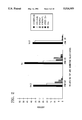
- FIG. 1 depicts the respective conversions and products obtained for ZSM-22, ZSM-23 and ZSM-35 in skeletal isomerization of 1-butene at 550° C.
- FIG. 2 depicts the respective conversions and products obtained for ZSM-22, ZSM-23 and ZSM-35 in skeletal isomerization of 1-butene at 400° C.
- FIG. 3 is a selectivity/conversion plot comparing the performance of ZSM-23 and ZSM-35.
- FIG. 4 depicts the conversions and products obtained for ZSM-35 in skeletal isomerization of 1-butene at high WHSV, low temperatures and high butene partial pressures.
- FIG. 5 is a transmission electron microscopy (TEM) micrograph of a microcrystalline ZSM-35 sample prepared in accordance with the procedure set out in Example 1.
- TEM transmission electron microscopy
- FIG. 6 is a transmission electron microscopy (TEM) micrograph of large crystal ZSM-35 of Example 12.
- FIG. 7 is a transmission electron microscopy (TEM) micrograph of large crystal synthetic ferrierite of Example 13.
- FIG. 8 depicts 1-butene conversion and iso-butene selectivity over temperature at 165 WHSV from Example 14.
- FIG. 9 depicts 1-butene conversion and iso-butene selectivity over temperature at 2 WHSV from Example 15.
- FIG. 10 depicts the low aging rate of microcrystalline ZSM-35 compared to large crystal synthetic ferrierite where n-butene conversion is plotted as a function of cumulative 1-butene throughput.
- FIG. 11 compares the aging rates of alumina-bound ZSM-35 catalyst from Example 16 and silica-bound ZSM-35 catalyst of enhanced pore volume from Example 17.
- FIG. 12 compares selectivity versus conversion in n-butene conversion for the alumina-bound catalyst of Example 16 and the silica-bound catalyst of enhanced pore volume from Example 17.
- FIG. 13 compares the effects of binder pore size on ZSM-35 aging in butene skeletal isomerization for the small pore silica-bound catalyst of Example 4, versus the large-pore silica-bound catalyst of Example 17.
- FIG. 14 compares selectivity versus conversion for the small pore silica-bound catalyst of Example 4, compared with the large-pore silica-bound catalyst of Example 17.
- the present invention provides a process which converts a linear olefin-containing hydrocarbon feedstream to an iso-olefin rich product at high levels of conversion and high iso-olefin selectivity over a catalyst comprising material having the structure of ZSM-35 and preferably having a crystal size whose largest dimension is no greater than 0.5 micron, preferably no greater than 0.25 micron, more preferably no greater than 0.15 micron, e.g., no greater than 0.1 micron, under skeletal isomerization conditions.
- the skeletal isomerization reaction of the present invention is carried out at temperatures between 100 and 750° C.; weight hourly space velocity based on linear olefin in the feed between 0.1 and 500 WHSV; and linear olefin partial pressure between 2 and 2000 kPa.
- the preferred conditions are temperatures between 150 and 600° C., more preferably between 200 and 550° C., WHSV between 0.5 and 400, more preferably between 1 and 100; and a linear olefin partial pressure between 10 and 500 kPa, more preferably between 20 and 200 kPa.
- the conversion of linear olefin, e.g., n-butene can be at least 20%, preferably at least 35% and more preferably at least 45%.
- the selectivity to iso-olefin, e.g., isobutene is at least 75%, preferably at least 85%, 90%, or even 95%.
- the present invention is especially suited to processes carried out at high linear olefin to iso-olefin selectivity, e.g, at least 60% at relatively low conversion temperatures and high linear olefin partial pressures.
- Such processes can maintain selectivities of at least 75, 85 or 95% at a conversion temperature less than or equal to: 550, 450, 400 or even 350° C., and linear olefin partial pressures above 2 psia (14 kPa), e.g., above 5 psia (34 kPa).
- Such processes can be carried out at an overall conversion of linear olefins of at least 30, 35, 40, or 45 wt % or higher.
- the present method is particularly effective when operating at lower temperatures, e.g., less than 450° C. and at relatively high WHSV, e.g., no less than 1, 5, or even 20. Under these conditions is observed a significant improvement in catalytic activity as evidenced by enhanced conversion of linear olefins when compared with methods utilizing large crystal ZSM-35 materials.
- Preferred feedstreams for use in the present invention include C 4 or C 4 + hydrocarbon feedstreams.
- Linear olefins suited to use in the present invention may be derived from a fresh feedstream, preferably comprising n-butenes and/or n-pentenes, or from the effluent of an iso-olefin etherification reactor which employs alkanol and C 4 or C 4 + hydrocarbon feedstock.
- Typical hydrocarbon feedstock materials for isomerization reactions according to the present invention include olefinic streams, such as cracking process light gas containing butene isomers in mixture with substantial amounts of paraffins including n-butane and isobutane.
- the C 4 components usually contain a major amount of unsaturated compounds, such as 10-40% isobutene, 20-55% linear butenes, and small amounts of butadiene.
- C 4 + heavier olefinic hydrocarbon streams may be used, e.g C 4 to C 10' preferably C 4 to C 6 olefinic hydrocarbon streams, e.g., light FCC gasoline.
- Feedstocks comprising at least 5 wt % n-butenes or n-pentenes can be used in the present method.
- ZSM-35 is more particularly described in U.S. Pat. No. 4,016,245, the entire contents of which are incorporated herein by reference.
- ZSM-35 is considered equivalent to its isotypes, which include ferrierite (P. A. Vaughan, Acta Cryst. 21, 983 (1966)); FU-9 (D. Seddon and T. V. Whittam, European Patent B-55,529, 1985); ISI-6 (N. Morimoto, K. Takatsu and M. Sugimoto, U.S. Pat. No. 4,578,259, 1986); monoclinic ferrierite (R. Gramlich-Meier, V. Gramlich and W. M. Meier, Am. Mineral. 70, 619 (1985)); NU-23 (T. V. Whittam, European Patent A-103,981, 1984); and Sr-D (R. M. Barrer and D. J. Marshall, J. Chem. Soc. 1964, 2296 (1964)).
- the catalyst comprises ZSM-35 in its hydrogen-exchanged form, HZSM-35.
- microcrystalline ZSM-35 has a morphology whose largest dimension is no greater than 0.5 micron, preferably no greater than 0.25 micron or even 0.1. Even more preferably such crystals can be described as falling within the range of 0.03 to 0.08 micron by 0.03 to 0.08 micron by ⁇ 0.05 micron.
- Microcrystalline ZSM-35 is made by control of the synthesis formulation and synthesis temperature, with lower temperature favoring smaller crystals.
- the zeolite catalyst used is preferably at least partly in the hydrogen form, e.g., HZSM-35, but other cations, e.g., rare earth cations, may also be present.
- the zeolites When the zeolites are prepared in the presence of organic cations, they may be quite inactive possibly because the intracrystalline free space is occupied by the organic cations from the forming solution.
- the zeolite may be activated by heating in an inert atmosphere to remove the organic cations e.g., by heating at over 500° C. for 1 hour or more.
- the hydrogen form can then be obtained by base exchange with ammonium salts followed by calcination e.g., at 500° C. in air.
- Other cations, e.g., metal cations can be introduced by conventional base exchange or impregnation techniques.
- the ZSM-35 may be incorporated in another material usually referred to as a matrix or binder.
- matrix materials include synthetic or naturally occurring substances as well as inorganic materials such as clay, silica and/or metal oxides. The latter may be either naturally occurring or in the form of gelatinous precipitates or gels including mixtures of silica and metal oxides.
- Naturally occurring clays which can be composited with the zeolite include those of the montmorillonite and kaolin families, which families include the subbentonites and the kaolins commonly known as Dixie, McNamee, Georgia and Florida clays or others in which the main mineral constituent is halloysite, kaolinite, dickite, nacrite or anauxite. Such clays can be used in the raw state as originally mined or initially subjected to calcination, acid treatment or chemical modification.
- the zeolites employed herein may be composited with a porous matrix material, such as silica, alumina, zirconia, titania, silica-alumina, silica-magnesia, silica-zirconia, silica-thoria, silica-beryllia, silica-titania as well as ternary compositions such as silica-alumina-thoria, silica-alumina-zirconia, silica-alumina-magnesia and silica-magnesia-zirconia.
- the matrix can be in the form of a cogel. A mixture of these components could also be used.
- silica may be preferred as the matrix material owing to its relative inertness for catalytic cracking reactions which are preferably minimized in the instant isomerization processes.
- silica-containing matrix containing a minor amount of aluminum may be employed.
- the relative proportions of finely divided ZSM-35 and inorganic oxide gel matrix vary widely with the zeolite content ranging from about 1 to about 90 percent by weight and more usually in the range of about 30 to about 80 percent by weight of the composite.
- a silica binder and controlling extrusion conditions by means such as moisture control to ensure increased pore volume results in a catalyst which ages more slowly under skeletal isomerization conditions, resulting in increased cycle length.
- Such conditions increase total pore volume to greater than 0.6 g/cc, or 300 + angstroms pore volume to greater than 0.1 cc/g.
- These increased pore volumes can be obtained by increasing moisture content of the extrudate.
- the resulting catalyst composite is of particular utility insofar as its use can result in increased cycle length without any significant loss of iso-olefin selectivity.
- the regeneration of spent zeolite catalyst used in the isomerization reaction is carried out oxidatively or hydrogenatively employing procedures known in the art.
- the catalyst of the present invention can be readily reactivated without significantly reducing selectivity for isobutene by exposing it to hydrogen for a suitable period, e.g., overnight.
- ZSM-35 preferably in the hydrogen form, should have an alpha value of at least 5, preferably at least 50 when used in the catalyst of the present invention.
- Alpha value, or alpha number, of a zeolite is a measure of zeolite acidic functionality and is more fully described together with details of its measurement in U.S. Pat. No. 4,016,218, J. Catalysis, 6, pp. 278-287 (1966) and J. Catalysis, 61, pp. 390-396 (1980).
- the experimental conditions cited in the latter reference are used for characterizing the catalysts described herein.
- the reaction mixture had the following composition, in mole ratios:
- the chemical composition of the product was, in weight percent:
- FIG. 5 is a TEM micrograph of the ZSM-35 thus prepared.
- the as-synthesized ZSM-35 of Example 1 was calcined in nitrogen for 3 hours at 538° C., then exchanged two times at room temperature with 1N NH 4 NO 3 solution to convert it to the ammonium form, dried at 120° C., and calcined in air for 6 hours at 538° C. to convert it to the hydrogen form.
- the zeolite was dry mixed with a precipitated silica, in proportion to give 65% ZSM-35/35% silica after calcination, formed into pellets, and calcined in air for 3 hours at 538° C.
- a catalyst was prepared by dry mixing the as-synthesized ZSM-35 of Example 1 with precipitated silica, in proportion to give, after calcination, 65% ZSM-35/35% silica in the catalyst.
- a solution containing 2% NaOH (based on solids) was added to the mix to create an extrudable mull, the mix was extruded to 1/16 inch (1.6 mm) diameter and dried at 120° C.
- the extrudate was exchanged two times with 1N NH 4 NO 3 solution at room temperature, rinsed with deionized water, dried at 120° C. and calcined in nitrogen for 3 hours at 538° C. It was again exchanged with 1N NH 4 NO 3 solution two times at room temperature, dried at 120° C., and calcined in air for 9 hours at 538° C.
- a catalyst was prepared by dry mixing the as-synthesized ZSM-35 of Example 1 with precipitated silica. Colloidal silica, in proportion to give 65% ZSM-35/35% silica after calcination, and water were added to the dry mix to obtain an extrudable mull.
- the mull was extruded to 1/16 inch (1.6 mm) diameter, dried at 120° C., calcined in nitrogen for three hours at 538° C., and then in air for 6 hours at 538° C.
- the extrudate was exchanged two times with 1N NH 4 NO 3 solution at room temperature, dried at 120° C. and calcined in air for 3 hours at 538° C.
- the total pore volume of this catalyst was 0.55 cc/g and 300 + angstrom pore volume was measured as 0.04 cc/g.
- ZSM-22 was prepared by charging 48.2 parts water to an autoclave followed by 5.0 parts KOH solution (45% by weight), 1.0 part aluminum sulfate (17.2% Al 2 O 3 ) and 0.45 parts seeds. After mixing thoroughly, 8.2 parts of Ultrasil VN3 precipitated silica (Degussa), then 3.6 parts of ethylpyridinium bromide (50% by weight) were added and mixed thoroughly. After aging the reaction mixture for 16 hours at 93° C. while stirring, the temperature was increased to 160° C. and maintained until crystallization was complete. The product was identified as ZSM-22 by X-ray diffraction. The slurry was filtered, washed and dried.
- a portion of the zeolite was calcined in flowing nitrogen for 3 hours at 538° C. and 3 hours in air at the same temperature.
- the cooled zeolite was exchanged with 1N NH 4 NO 3 (5 cc/g zeolite) at room temperature for one hour then washed with water. The exchange procedure was repeated and the catalyst dried at 120° C.
- the zeolite was then calcined in flowing air for 3 hours at 538° C., then blended 65 parts zeolite and 35 parts Ultrasil VN3 and pelleted. The pellets were sized 14/24 mesh and recalcined at 538° C. in flowing air for 3 hours.
- ZSM-23 was prepared by charging 85.5 parts water to an autoclave followed by 2.64 parts KOH solution (45% by weight), 1.0 part aluminum sulfate (17.2% Al 2 O 3 ) and 0.5 parts ZSM-23 seeds (100% basis). After mixing thoroughly, 14.5 parts of Ultrasil VN3 precipitated silica (Degussa), then 5.1 parts of pyrrolidine were added and mixed thoroughly. The autoclave was heated to 160° C. with stirring and maintained at these conditions until crystallization was complete The product was identified as ZSM-23 by X-ray diffraction. After flashing the pyrrolidine, the slurry was cooled, washed, filtered and dried.
- FIG. 1 graphically depicts the respective conversions and products obtained for ZSM-22, ZSM-23 and ZSM-35. Under these conditions selectivities of 83.5%, 88.2% and 95%, respectively, were obtained.
- FIG. 2 graphically depicts the respective conversions and products obtained for ZSM-22, ZSM-23 and ZSM-35. Under these conditions selectivities of 54.3%, 51.1% and 93.2%, respectively, were obtained. ZSM-35 maintains selectivity above 90% even at temperatures which significantly reduce selectivities for ZSM-22 and ZSM-23.
- FIG. 3 is a selectivity/conversion plot comparing the performance of the two catalysts. At 30 to 40% conversion, selectivity of ZSM-23 ranges between 30 and 80%. In contrast, selectivity of ZSM-35 ranges from 90 to 99%. Indeed, selectivity of ZSM-35 remains relatively flat at greater than 85% all the way from about 2 to 40% conversion.
- the ZSM-35-containing catalyst of Example 2 was used to process a 1-butene feed under four sets of skeletal isomerization conditions comprising two temperatures and two relatively low 1-butene partial pressures.
- the conditions and compositions of the product streams from Runs 1 to 4 are set out in Table 1 below. Selectivity for isobutene ranged from 93.2 to 99%.
- the ZSM-35-containing catalyst of Example 3 was used to process a 1-butene feed under four sets of skeletal isomerization conditions comprising two temperatures and two relatively low 1-butene partial pressures.
- the conditions and compositions of the product streams from Runs 1 to 4 are set out in Table 2 below.
- a comparison of Tables 1 and 2 shows that silica binding has no significant deleterious effect on performance between silica-bound ZSM-35 and ZSM-35/SiO 2 mix catalysts.
- FIG. 6 is a TEM micrograph of the large crystal ZSM-35 thus prepared.
- a synthetic ferrierite obtained from Tosoh had a silica to alumina molar ratio of 16.8/1, an alpha value of 81, and a surface area of 219 m 2/ g. Scanning electron microscopy and transmission electron microscopy indicate the synthetic ferrierite crystals have platelet morphology with a broad distribution of crystal sizes having the largest dimension of up to 1 to 2 microns.
- FIG. 7 is a TEM micrograph of the large crystal synthetic ferrierite thus prepared.
- the synthetic ferrierite was dry mixed with precipitated silica in a ratio to achieve 65% ferrierite/35% silica after processing.
- Water and sodium hydroxide (2 parts NaOH/35 parts silica) was added to obtain an extrudable mixture.
- the mix was extruded to 1/16 inch (1.6 mm) diameter pellets and dried at 100° C.
- the dried extrudate was treated twice with 1N NH 4 NO 3 for 1 hour at room temperature and washed with water. After drying at 100° C., the extrudate was calcined in nitrogen at 538° C. for 3 hours. Following cooling, the calcined material was exchanged twice with 1N NH 4 NO 3 for 1 hour and dried.
- the catalyst was then calcined for 6 hours at 538° C. in air.
- Example 4 The microcrystalline ZSM-35 of Example 4 and the large crystal ZSM-35 of Example 12 were used in 1-butene skeletal isomerization reactions carried out at 300, 400, 500 and 550° C., and at 165 WHSV, 30 psia.
- 1-Butene conversion and iso-butene selectivity over temperature are depicted in FIG. 8. Significantly higher n-butene conversions occur with microcrystalline ZSM-35 with no loss of isobutene selectivity.
- the synthetic ferrierite of Example 13 was used in 1-butene skeletal isomerization reactions carried out at 400° to 500° C., 66 WHSV, 24 psia, using a nitrogen/1-butene feed.
- the conditions of each run and the product composition is set out below in Table 3.
- conversion was near zero (0.34%). Conversion did not increase even when temperature was raised to 550° C. and WHSV reduced to 33. Conversion did increase to 50-60% when WHSV was cut to 2 as depicted in FIG. 9. However, selectivity was low (60-70%) and the catalyst aged rapidly.
- a catalyst was prepared by dry mixing the as-synthesized ZSM-35 of Example 1 with alumina (LaRoche Versal 250) such that the final product contained 65 parts ZSM-35 and 35 parts alumina. Sufficient water was added to obtain a mixture which was extruded to 1/16 inch (1.6 mm) diameter pellets then dried at 100° C. The extrudate was calcined in nitrogen at 538° C. for three hours, then exchanged twice with a 1N NH 4 NO 3 solution at room temperature, dried at 100° C. and calcined in air for 6 hours. The product had a pore volume of 0.86 cc/g and a 300 + angstrom pore volume of 0.46 cc/g.
- a catalyst was prepared by dry mixing the as-synthesized ZSM-35 of Example 1 with precipitated silica (UltrasilTM VNSP3 from Degussa). Colloidal silica, in proportion to give 65% ZSM-35/35% silica after calcination, and water were added to the dry mix to obtain an extrudable mixture. The mix was extruded to 1/16 inch (1.6 mm) diameter pellets, and dried at 100° C. The extrudate was calcined in nitrogen at 538° C. for three hours, then exchanged twice with a 1N NH 4 NO 3 solution at room temperature, dried at 100° C. and calcined in air for 7 hours. The product had a pore volume of 0.86 cc/g and a 300 + angstrom pore volume of 0.37 cc/g.
- precipitated silica UltrasilTM VNSP3 from Degussa
- Colloidal silica in proportion to give 65% ZSM-35/35% silic
- 1-Butene was subjected to skeletal isomerization conditions in the presence of alumina-bound ZSM-35 (Example 16), silica bound ZSM-35 of lower pore volume (Example 4), and silica bound ZSM-35 of enhanced pore volume (Example 17).
- the conditions comprised 33 1-butene WHSV on zeolite, 1/1 v/v butene/nitrogen feed, 30 psia, and 400° C. using catalysts comprising 65 wt% ZSM-35 sized to 14/24 mesh.
- FIG. 11 compares the effects of aging on n-butene conversion for the alumina-bound catalyst of Example 16, versus the silica-bound catalyst of Example 17, showing a reduction in activity from 46% to 23% n-butene conversion over about 7 days compared with a reduction in activity from 47% to 30% n-butene conversion over about 18 days, respectively.
- FIG. 12 compares the effects of n-butene conversion on isobutene selectivity for n-butene conversion for the alumina-bound catalyst of Example 16, versus the silica-bound catalyst of Example 17. The results show little variation in isobutene selectivity over a range of about 23 to 50% n-butene conversion between the two catalyst types.
- FIG. 12 compares the effects of n-butene conversion on isobutene selectivity for n-butene conversion for the alumina-bound catalyst of Example 16, versus the silica-bound catalyst of Example 17. The results show little variation in isobutene selectivity over a
- FIG. 13 compares the effects of aging for the silica-bound catalyst of Example 4, versus the silica-bound catalyst of Example 17, showing a reduction in activity from 48% to 28% n-butene conversion over about 12 days compared with a reduction in activity from 47% to 30% n-butene conversion over about 18 days, respectively.
- FIG. 14 compares the effects of reduced n-butene conversion (aging) on isobutene selectivity on n-butene conversion for the silica-bound catalyst of Example 4, versus the silica-bound catalyst of Example 17. The results show little variation in isobutene selectivity over a range of about 28 to 50% n-butene conversion between the two catalyst types.
Landscapes
- Chemical & Material Sciences (AREA)
- Organic Chemistry (AREA)
- Crystallography & Structural Chemistry (AREA)
- Chemical Kinetics & Catalysis (AREA)
- Engineering & Computer Science (AREA)
- Materials Engineering (AREA)
- Organic Low-Molecular-Weight Compounds And Preparation Thereof (AREA)
Abstract
A process is disclosed for the highly selective skeletal isomerization of linear olefin-containing organic feeds to iso-olefins at high levels of feed conversion wherein linear olefins, e.g., n-butenes, are contacted with catalyst comprising ZSM-35 under skeletal isomerization conditions which can include temperatures of 100 to 750 DEG C. The process uses a catalyst composition comprising ZSM-35, e.g., microcrystalline ZSM-35 having a crystal size whose largest dimension is no greater than 0.5 micron and whose ratio of its second largest dimension to said largest dimension ranges from 0.5 to 1. The process exhibits enhanced catalyst cycle life where the ZSM-35 is composited with a silica-containing matrix to provide a catalyst composite having a total pore volume greater than 0.6 cc/g or 300+ angstroms pore volume of greater than 0.1 cc/g.
Description
This is a continuation of application Ser. No. 07/962,637, filed on Oct. 16, 1992, now abandoned, which is a continuation-in-part of U.S. patent application Ser. No. 07/760,287, now abandoned, filed Sep. 16, 1991, the entire contents of which are incorporated herein by reference.
This invention relates to a method for the high level conversion of n-olefin-containing, e.g., n-butene-containing, hydrocarbon streams to iso-olefin-rich, e.g., isobutene-rich product streams under skeletal isomerization conditions which include temperatures of 100° to 750° C. The method uses a catalyst composition comprising ZSM-35, e.g., microcrystalline ZSM-35 having a crystal size whose largest dimension is no greater than 0.5 micron and whose ratio of its second largest dimension to said largest dimension ranges from 0.5 to 1. Enhanced catalyst cycle life is obtained when the ZSM-35 is composited with a silica-containing matrix which results in a large pore catalyst composite having a total pore volume of at least 0.6 cc/g or 300+ angstroms pore volume of at least 0.1 cc/g.
The demand for iso-alkenes has recently increased. For example, relatively large amounts of isobutene are required for reaction with methanol or ethanol over an acidic catalyst to produce methyl tert-butyl ether (MTBE) or ethyl tert-butyl ether (ETBE) which is useful as an octane enhancer for unleaded gasolines. Isoamylenes are required for reaction with methanol over an acidic catalyst to produce tert-amyl methyl ether (TAME). With passage of the Clean Air Act in the United States mandating increased gasoline oxygenate content, MTBE, ETBE and TAME have taken on new value as clean-air additives, even for lower octane gasolines. Lead phasedown of gasolines in Western Europe has further increased the demand for such oxygenates.
An article by J. D. Chase, et al., Oil and Gas Journal, Apr. 9, 1979, discusses the advantages one can achieve by using such materials to enhance gasoline octane. The blending octane values of MTBE when added to a typical unleaded gasoline base fuel are RON=118, MON=101, R+M/2=109. The blending octane values of TAME when added to a typical unleaded gasoline base fuel are RON=112, MON=99, R+M/2=106. Isobutene (or isobutylene) is in particularly high demand as it is reacted with methanol to produce MTBE.
The addition of shape-selective zeolite additives such as ZSM-5 to cracking catalysts, e.g., those used in fluidized catalytic cracking (FCC), is beneficial in producing gasoline boiling range product of increased octane rating. However, increased amounts of olefins result, including n-butenes, creating a need for their conversion to higher value products such as isobutene which can be used to produce MTBE.
Butene exists in four isomers: butene-1, cis-butene-2, its stereo-isomer trans-butene-2, and isobutene. Conversions between the butenes-2 is known as geometric isomerization, whereas that between butene-1 and the butenes-2 is known as position isomerization, double-bond migration, or hydrogen-shift isomerization. The aforementioned three isomers are not branched and are known collectively as normal or n-butenes. Conversion of the n-butenes to isobutene, which is a branched isomer, is widely known as skeletal isomerization.
The reaction of tertiary olefins with alkanol to produce alkyl tertiary alkyl ether is selective with respect to iso-olefins. Linear olefins are unreactive in the acid catalyzed reaction, even to the extent that it is known that the process can be utilized as a method to separate linear and iso-olefins. The typical feedstream of FCC C4 or C4 + crackate used to produce tertiary alkyl ethers in the prior art which contains normal butene and isobutene utilizes only the branched olefin in etherification. This situation presents an exigent challenge to workers in the field to discover a technically and economically practical means to utilize linear olefins, particularly normal butene, in the manufacture of tertiary alkyl ethers.
In recent years, a major development within the petroleum industry has been the discovery of the special catalytic capabilities of a family of zeolite catalysts based upon medium pore size shape selective metallosilicates. Discoveries have been made leading to a series of analogous processes drawn from the catalytic capability of zeolites in the restructuring of olefins.
European Patent 0026041 to Garwood, incorporated herein by reference, discloses a process for the restructuring of olefins in contact with zeolite catalyst to produce iso-olefins, followed by the conversion of iso-olefins to MTBE and TAME. The restructuring conditions comprise temperature between 204° C. and 315° C. and pressure below-51 kPa.
In European Patent 0247802 to Barri et al., it is taught that linear olefins can be restructured in contact with zeolite catalyst, including Theta-1 (ZSM-22) and ZSM-23, to produce branched olefins. The restructuring conditions comprise temperature between 200°-550° C., pressure between 100 and 5000 kPa and WHSV between 1 and 100. Selectivities to isobutene up to 91.2% are reported using a calcined Theta-1 tectometallosilicate at 400° C. and 30.6% 1-butene conversion.
U.S. Pat. No. 3,992,466 to Plank et al. teaches the use of ZSM-35 as a catalyst for hydrocarbon conversion reactions, including "isomerization of aromatics, paraffins and olefins."
U.S. Pat. No. 4,922,048 to Harandi discloses the use of a wide variety of medium pore size zeolites, e.g., ZSM-5, ZSM-11, ZSM-12, ZSM-22, ZSM-23, ZSM-35 and ZSM-48, in low temperature (232°-385° C.) olefin interconversion of C2 -C6 olefins to products including tertiary C4 -C5 olefins and olefinic gasoline.
U.S. Pat. No. 4,886,925 to Harandi discloses low pressure high temperature conversion of light olefins to produce higher olefins rich in isoalkenes. The process converts C2+ n-alkenes to a product comprising C4 -C6 alkenes rich in iso-alkenes, C7+ olefinic gasoline boiling range hydrocarbons, and unconverted hydrocarbons over ZSM-5. The reference teaches further treatment of the alkene effluent with methanol in the presence of medium pore size zeolites such as ZSM-5, ZSM-11, ZSM-12, ZSM-35, ZSM-38 and ZSM-48.
U.S. Pat. No. 4,996,386 to Hamilton, Jr. discloses concurrent isomerization and disproportionation of hydrocarbon olefins using a ferrierite/Mo/W/Al2 O3 catalyst. The catalyst exemplified produces fewer branched olefins than a comparable material free of ferrierite and the reference teaches that ferrierite-containing catalysts exhibit improved selectivity to linear olefins than conventionally prepared disproportionation catalysts.
All of the above references are incorporated herein by reference.
Despite the efforts exemplified in the above references, the skeletal isomerization of olefins e.g., to produce isobutene, has been hampered by relatively low conversion and/or selectivity to isobutene perhaps owing to the lability of these olefins. It is further known that skeletal isomerization becomes more difficult as hydrocarbons of lower molecular weight are used, requiring more severe operating conditions, e.g., higher temperatures and lower linear olefin partial pressures.
Generally, the conversion of n-butenes to iso-butene is conducted at selectivities below 90%. In order to obtain higher selectivities, operation at high temperatures (>500° C.) and with high feed dilution (butene partial pressure, typically less than 5 psia (34.5 kPa)) is generally required. Selectivities of greater than 85%, 90%, 95% or even 99% are highly advantageous in commercial conversion of n-butenes to isobutene in order to avoid the need to separate out materials other than n-butene from the product stream. Such high selectivities will permit direct (cascading) or indirect introduction of the isomerizer effluent to an etherification zone where isobutene is reacted with alkanol to produce alkyl tert-butyl ether, e.g., MTBE. Unconverted n-butenes in the isomerizer effluent can be withdrawn either before the etherification zone or preferably, from the etherification zone effluent insofar as the etherification reaction utilizes only the isobutene component of the isomerizer stream. Unreacted n-butenes from the etherification zone effluent can be recycled to the isomerizer where they are converted to isobutene at high selectivity. If the recycle stream contains not only unconverted linear olefins, e.g., n-butenes, but also by-products such as other olefins (e.g., propylene) or paraffins, they have to be removed from the recycle stream, such as by distillation or by taking a slip stream. These removal steps are expensive and can lead to considerable loss of not only the by-products but butenes as well. These losses are larger when the by-products formed are present in higher concentration. Thus, even small improvements in the isobutene selectivity during n-butene isomerization have a major effect on the commercial viability of the process. However, high selectivities in skeletal isomerization processes have generally required low linear olefin partial pressures and high temperatures which place substantial limitations on such processes. It would, therefore, be advantageous to provide a skeletal isomerization catalyst capable of maintaining relatively high selectivity at low temperatures and high linear olefin partial pressures.
Further enhancement of total yield of iso-olefin can be effected by enhancing overall conversion of the n-olefin-containing feedstream. With this object in mind, it would be advantageous to provide a skeletal isomerization catalyst capable of maintaining a high level of conversion as well as high iso-olefin selectivity, even at relatively low temperatures, e.g., no greater than 450° C. and high n-olefin space velocities, e.g., no less than 5, e.g., no less than 70.
The present invention provides a method for conversion of linear olefins to corresponding iso-olefins of the same carbon number which comprises contacting a linear olefin-containing organic feedstock with a catalyst comprising ZSM-35, preferably microcrystalline ZSM-35, under skeletal isomerization conditions, including temperatures between about 100 and 750° C. Microcrystalline ZSM-35 can be described as having a crystal morphology whose largest dimension is no greater than 0.5 micron, and whose ratio of its second largest dimension to said largest dimension ranges from about 0.5 to 1. In one aspect, the present invention provides a method of enhanced cycle life where the ZSM-35 is composited with a silica-containing matrix under conditions which provide a composite having a total pore volume of at least 0.6 cc/g or 300+ angstroms pore volume of at least 0.1 cc/g.
The high selectivity of ZSM-35 in the present invention results in large part from isomerization occurring without significant conversion to lighter and heavier molecules. This phenomenon, it is believed, is a consequence of the pore structure of ZSM-35 which promotes isomerization at a much faster rate than the reaction by which say, butene, is converted to lighter (mostly propylene) and heavier olefins (olefin interconversion reaction). Moreover, such isomerization takes place without significant cracking of the feed or hydrogenation or dehydrogenation effects resulting in the formation of, say, n-butane or butadiene. The present invention can be used to effect conversion of linear olefins to iso-olefins while resulting in less than 30%, 10%, 5% or even less than 1% by weight of converted product having lower or higher average carbon number.
In one aspect, the present invention can provide enhanced overall yields of iso-olefin product from linear olefin-containing feeds by a highly selective conversion of linear olefins to corresponding iso-olefins of the same carbon number, e.g., n-butenes to isobutene, at enhanced linear olefin conversion levels.
The present invention's utilization of microcrystalline ZSM-35 results in not only a highly selective conversion of n-olefins to iso-olefins, but a conversion of n-olefin feed at significantly higher levels, over a broad temperature range, particularly at temperatures of less than about 500° C., 450° C. or even 400° C.
FIG. 1 depicts the respective conversions and products obtained for ZSM-22, ZSM-23 and ZSM-35 in skeletal isomerization of 1-butene at 550° C.
FIG. 2 depicts the respective conversions and products obtained for ZSM-22, ZSM-23 and ZSM-35 in skeletal isomerization of 1-butene at 400° C.
FIG. 3 is a selectivity/conversion plot comparing the performance of ZSM-23 and ZSM-35.
FIG. 4 depicts the conversions and products obtained for ZSM-35 in skeletal isomerization of 1-butene at high WHSV, low temperatures and high butene partial pressures.
FIG. 5 is a transmission electron microscopy (TEM) micrograph of a microcrystalline ZSM-35 sample prepared in accordance with the procedure set out in Example 1.
FIG. 6 is a transmission electron microscopy (TEM) micrograph of large crystal ZSM-35 of Example 12.
FIG. 7 is a transmission electron microscopy (TEM) micrograph of large crystal synthetic ferrierite of Example 13.
FIG. 8 depicts 1-butene conversion and iso-butene selectivity over temperature at 165 WHSV from Example 14.
FIG. 9 depicts 1-butene conversion and iso-butene selectivity over temperature at 2 WHSV from Example 15.
FIG. 10 depicts the low aging rate of microcrystalline ZSM-35 compared to large crystal synthetic ferrierite where n-butene conversion is plotted as a function of cumulative 1-butene throughput.
FIG. 11 compares the aging rates of alumina-bound ZSM-35 catalyst from Example 16 and silica-bound ZSM-35 catalyst of enhanced pore volume from Example 17.
FIG. 12 compares selectivity versus conversion in n-butene conversion for the alumina-bound catalyst of Example 16 and the silica-bound catalyst of enhanced pore volume from Example 17.
FIG. 13 compares the effects of binder pore size on ZSM-35 aging in butene skeletal isomerization for the small pore silica-bound catalyst of Example 4, versus the large-pore silica-bound catalyst of Example 17.
FIG. 14 compares selectivity versus conversion for the small pore silica-bound catalyst of Example 4, compared with the large-pore silica-bound catalyst of Example 17.
The present invention provides a process which converts a linear olefin-containing hydrocarbon feedstream to an iso-olefin rich product at high levels of conversion and high iso-olefin selectivity over a catalyst comprising material having the structure of ZSM-35 and preferably having a crystal size whose largest dimension is no greater than 0.5 micron, preferably no greater than 0.25 micron, more preferably no greater than 0.15 micron, e.g., no greater than 0.1 micron, under skeletal isomerization conditions.
The skeletal isomerization reaction of the present invention is carried out at temperatures between 100 and 750° C.; weight hourly space velocity based on linear olefin in the feed between 0.1 and 500 WHSV; and linear olefin partial pressure between 2 and 2000 kPa. The preferred conditions are temperatures between 150 and 600° C., more preferably between 200 and 550° C., WHSV between 0.5 and 400, more preferably between 1 and 100; and a linear olefin partial pressure between 10 and 500 kPa, more preferably between 20 and 200 kPa. Under these conditions the conversion of linear olefin, e.g., n-butene, can be at least 20%, preferably at least 35% and more preferably at least 45%. The selectivity to iso-olefin, e.g., isobutene, is at least 75%, preferably at least 85%, 90%, or even 95%.
The present invention is especially suited to processes carried out at high linear olefin to iso-olefin selectivity, e.g, at least 60% at relatively low conversion temperatures and high linear olefin partial pressures. Such processes can maintain selectivities of at least 75, 85 or 95% at a conversion temperature less than or equal to: 550, 450, 400 or even 350° C., and linear olefin partial pressures above 2 psia (14 kPa), e.g., above 5 psia (34 kPa). Such processes can be carried out at an overall conversion of linear olefins of at least 30, 35, 40, or 45 wt % or higher. The present method is particularly effective when operating at lower temperatures, e.g., less than 450° C. and at relatively high WHSV, e.g., no less than 1, 5, or even 20. Under these conditions is observed a significant improvement in catalytic activity as evidenced by enhanced conversion of linear olefins when compared with methods utilizing large crystal ZSM-35 materials.
Preferred feedstreams for use in the present invention include C4 or C4 + hydrocarbon feedstreams. Linear olefins suited to use in the present invention may be derived from a fresh feedstream, preferably comprising n-butenes and/or n-pentenes, or from the effluent of an iso-olefin etherification reactor which employs alkanol and C4 or C4 + hydrocarbon feedstock. Typical hydrocarbon feedstock materials for isomerization reactions according to the present invention include olefinic streams, such as cracking process light gas containing butene isomers in mixture with substantial amounts of paraffins including n-butane and isobutane. The C4 components usually contain a major amount of unsaturated compounds, such as 10-40% isobutene, 20-55% linear butenes, and small amounts of butadiene. Also, C4 + heavier olefinic hydrocarbon streams may be used, e.g C4 to C10' preferably C4 to C6 olefinic hydrocarbon streams, e.g., light FCC gasoline. Feedstocks comprising at least 5 wt % n-butenes or n-pentenes can be used in the present method.
ZSM-35 is more particularly described in U.S. Pat. No. 4,016,245, the entire contents of which are incorporated herein by reference.
For present purposes, "ZSM-35" is considered equivalent to its isotypes, which include ferrierite (P. A. Vaughan, Acta Cryst. 21, 983 (1966)); FU-9 (D. Seddon and T. V. Whittam, European Patent B-55,529, 1985); ISI-6 (N. Morimoto, K. Takatsu and M. Sugimoto, U.S. Pat. No. 4,578,259, 1986); monoclinic ferrierite (R. Gramlich-Meier, V. Gramlich and W. M. Meier, Am. Mineral. 70, 619 (1985)); NU-23 (T. V. Whittam, European Patent A-103,981, 1984); and Sr-D (R. M. Barrer and D. J. Marshall, J. Chem. Soc. 1964, 2296 (1964)). Preferably the catalyst comprises ZSM-35 in its hydrogen-exchanged form, HZSM-35.
An example of a piperidine-derived ferrierite is more particularly described in U.S. Pat. No. 4,343,692, the entire contents of which are incorporated herein by reference other synthetic ferrierite preparations are described in U.S. Pat. Nos. 3,933,974; 3,966,883; 4,000,248; 4,017,590; and 4,251,499, the entire contents of all being incorporated herein by reference. Further descriptions of ferrierite are found in Bibby et al, "Composition and Catalytic Properties of Synthetic Ferrierite," Journal of Catalysis, 35, pages 256-272 (1974).
As noted above, microcrystalline ZSM-35 has a morphology whose largest dimension is no greater than 0.5 micron, preferably no greater than 0.25 micron or even 0.1. Even more preferably such crystals can be described as falling within the range of 0.03 to 0.08 micron by 0.03 to 0.08 micron by ≦0.05 micron.
Microcrystalline ZSM-35 is made by control of the synthesis formulation and synthesis temperature, with lower temperature favoring smaller crystals.
The zeolite catalyst used is preferably at least partly in the hydrogen form, e.g., HZSM-35, but other cations, e.g., rare earth cations, may also be present. When the zeolites are prepared in the presence of organic cations, they may be quite inactive possibly because the intracrystalline free space is occupied by the organic cations from the forming solution. The zeolite may be activated by heating in an inert atmosphere to remove the organic cations e.g., by heating at over 500° C. for 1 hour or more. The hydrogen form can then be obtained by base exchange with ammonium salts followed by calcination e.g., at 500° C. in air. Other cations, e.g., metal cations, can be introduced by conventional base exchange or impregnation techniques.
The ZSM-35 may be incorporated in another material usually referred to as a matrix or binder. Such matrix materials include synthetic or naturally occurring substances as well as inorganic materials such as clay, silica and/or metal oxides. The latter may be either naturally occurring or in the form of gelatinous precipitates or gels including mixtures of silica and metal oxides. Naturally occurring clays which can be composited with the zeolite include those of the montmorillonite and kaolin families, which families include the subbentonites and the kaolins commonly known as Dixie, McNamee, Georgia and Florida clays or others in which the main mineral constituent is halloysite, kaolinite, dickite, nacrite or anauxite. Such clays can be used in the raw state as originally mined or initially subjected to calcination, acid treatment or chemical modification.
In addition to the foregoing materials, the zeolites employed herein may be composited with a porous matrix material, such as silica, alumina, zirconia, titania, silica-alumina, silica-magnesia, silica-zirconia, silica-thoria, silica-beryllia, silica-titania as well as ternary compositions such as silica-alumina-thoria, silica-alumina-zirconia, silica-alumina-magnesia and silica-magnesia-zirconia. The matrix can be in the form of a cogel. A mixture of these components could also be used.
Of all the foregoing materials, silica may be preferred as the matrix material owing to its relative inertness for catalytic cracking reactions which are preferably minimized in the instant isomerization processes. Alternatively, silica-containing matrix containing a minor amount of aluminum may be employed. The relative proportions of finely divided ZSM-35 and inorganic oxide gel matrix vary widely with the zeolite content ranging from about 1 to about 90 percent by weight and more usually in the range of about 30 to about 80 percent by weight of the composite.
It is believed that using a silica binder and controlling extrusion conditions by means such as moisture control to ensure increased pore volume results in a catalyst which ages more slowly under skeletal isomerization conditions, resulting in increased cycle length. Such conditions increase total pore volume to greater than 0.6 g/cc, or 300+ angstroms pore volume to greater than 0.1 cc/g. These increased pore volumes can be obtained by increasing moisture content of the extrudate. The resulting catalyst composite is of particular utility insofar as its use can result in increased cycle length without any significant loss of iso-olefin selectivity.
The regeneration of spent zeolite catalyst used in the isomerization reaction is carried out oxidatively or hydrogenatively employing procedures known in the art. The catalyst of the present invention can be readily reactivated without significantly reducing selectivity for isobutene by exposing it to hydrogen for a suitable period, e.g., overnight.
In order to obtain desired linear olefin skeletal isomerization activity/selectivity, ZSM-35, preferably in the hydrogen form, should have an alpha value of at least 5, preferably at least 50 when used in the catalyst of the present invention. Alpha value, or alpha number, of a zeolite is a measure of zeolite acidic functionality and is more fully described together with details of its measurement in U.S. Pat. No. 4,016,218, J. Catalysis, 6, pp. 278-287 (1966) and J. Catalysis, 61, pp. 390-396 (1980). The experimental conditions cited in the latter reference are used for characterizing the catalysts described herein.
The examples which follow illustrate the invention without restricting it in any way.
Preparation of MicroCrystalline ZSM-35
1.18 parts of aluminum sulfate (17.2% Al2 O3) were added to a isolution containing 9.42 parts H2 O and 1.38 parts of 50% NaOH solution in an autoclave. 0.03 parts of ZSM-35 seeds and 3.20 parts of Hi-Sil precipitated silica were added with agitation, followed by 1.0 part of pyrrolidine.
The reaction mixture had the following composition, in mole ratios:
______________________________________
        SiO.sub.2 /Al.sub.2 O.sub.3
                21.5
        OH.sup.- /SiO.sub.2
                0.11
        H.sub.2 O/Al.sub.2 O.sub.3
                13.5
        R/Al.sub.2 O.sub.3
                6.45
______________________________________
where R=pyrrolidine. The mixture was crystallized at 105° C. for 74 hours with stirring. The ZSM-35 product was filtered, washed with deionized water, and dried at 120° C.
The chemical composition of the product was, in weight percent:
______________________________________
       SiO.sub.2 76.7
       Al.sub.2 O.sub.3
                 6.4
       Na        0.84
       C         7.26
       N         2.03
       Ash @ 1000° C.
                 85.5
______________________________________
with a silica/alumina ratio for the product, in moles, of 20.3/1.
Scanning electron microscopy and transmission electron microscopy indicate the ZSM-35 crystals have platelet morphology with a broad distribution of crystal sizes having the largest dimension of up to 0.05 to 0.1 micron. FIG. 5 is a TEM micrograph of the ZSM-35 thus prepared.
Preparation of HZSM-35/SiO2 Mix
The as-synthesized ZSM-35 of Example 1 was calcined in nitrogen for 3 hours at 538° C., then exchanged two times at room temperature with 1N NH4 NO3 solution to convert it to the ammonium form, dried at 120° C., and calcined in air for 6 hours at 538° C. to convert it to the hydrogen form. The zeolite was dry mixed with a precipitated silica, in proportion to give 65% ZSM-35/35% silica after calcination, formed into pellets, and calcined in air for 3 hours at 538° C.
Preparation of Silica-Bound HZSM-35
A catalyst was prepared by dry mixing the as-synthesized ZSM-35 of Example 1 with precipitated silica, in proportion to give, after calcination, 65% ZSM-35/35% silica in the catalyst. A solution containing 2% NaOH (based on solids) was added to the mix to create an extrudable mull, the mix was extruded to 1/16 inch (1.6 mm) diameter and dried at 120° C. The extrudate was exchanged two times with 1N NH4 NO3 solution at room temperature, rinsed with deionized water, dried at 120° C. and calcined in nitrogen for 3 hours at 538° C. It was again exchanged with 1N NH4 NO3 solution two times at room temperature, dried at 120° C., and calcined in air for 9 hours at 538° C.
Preparation of Silica-Bound HZSM-35
A catalyst was prepared by dry mixing the as-synthesized ZSM-35 of Example 1 with precipitated silica. Colloidal silica, in proportion to give 65% ZSM-35/35% silica after calcination, and water were added to the dry mix to obtain an extrudable mull. The mull was extruded to 1/16 inch (1.6 mm) diameter, dried at 120° C., calcined in nitrogen for three hours at 538° C., and then in air for 6 hours at 538° C. The extrudate was exchanged two times with 1N NH4 NO3 solution at room temperature, dried at 120° C. and calcined in air for 3 hours at 538° C. The total pore volume of this catalyst was 0.55 cc/g and 300+ angstrom pore volume was measured as 0.04 cc/g.
Isomerization of 1-Butene with ZSM-22, ZSM-23 and ZSM-35 at 550° C.
ZSM-22 was prepared by charging 48.2 parts water to an autoclave followed by 5.0 parts KOH solution (45% by weight), 1.0 part aluminum sulfate (17.2% Al2 O3) and 0.45 parts seeds. After mixing thoroughly, 8.2 parts of Ultrasil VN3 precipitated silica (Degussa), then 3.6 parts of ethylpyridinium bromide (50% by weight) were added and mixed thoroughly. After aging the reaction mixture for 16 hours at 93° C. while stirring, the temperature was increased to 160° C. and maintained until crystallization was complete. The product was identified as ZSM-22 by X-ray diffraction. The slurry was filtered, washed and dried. A portion of the zeolite was calcined in flowing nitrogen for 3 hours at 538° C. and 3 hours in air at the same temperature. The cooled zeolite was exchanged with 1N NH4 NO3 (5 cc/g zeolite) at room temperature for one hour then washed with water. The exchange procedure was repeated and the catalyst dried at 120° C. The zeolite was then calcined in flowing air for 3 hours at 538° C., then blended 65 parts zeolite and 35 parts Ultrasil VN3 and pelleted. The pellets were sized 14/24 mesh and recalcined at 538° C. in flowing air for 3 hours.
ZSM-23 was prepared by charging 85.5 parts water to an autoclave followed by 2.64 parts KOH solution (45% by weight), 1.0 part aluminum sulfate (17.2% Al2 O3) and 0.5 parts ZSM-23 seeds (100% basis). After mixing thoroughly, 14.5 parts of Ultrasil VN3 precipitated silica (Degussa), then 5.1 parts of pyrrolidine were added and mixed thoroughly. The autoclave was heated to 160° C. with stirring and maintained at these conditions until crystallization was complete The product was identified as ZSM-23 by X-ray diffraction. After flashing the pyrrolidine, the slurry was cooled, washed, filtered and dried. Eight parts of the dried ZSM-23 were combined with 1 part Ultrasil VN3 and 1 part Ludox colloidal silica (DuPont), mulled and extruded to form 1/16 inch pellets which were dried at 120° C. The pellets were then calcined in flowing nitrogen for 2 hours at 538° C. and 3 hours in air at the same temperature. The cooled catalyst was exchanged with 1N NH4 NO3 (5 cc/g catalyst) at room temperature for one hour then washed with water. The exchange procedure was repeated and the catalyst dried at 120° C. The exchanged extrudate was then calcined at 538° C. in flowing air for 3 hours.
The above-prepared ZSM-22 and ZSM-23, and ZSM-35 prepared in accordance with Example 3 above were used in butene skeletal isomerization reactions. The approximate experimental conditions were:
______________________________________ Temperature 550° C. Pressure 177 kPa 1-Butene WHSV 65 hr.sup.-1 N.sub.2 /Butene infeed 3 vol/vol ______________________________________
FIG. 1 graphically depicts the respective conversions and products obtained for ZSM-22, ZSM-23 and ZSM-35. Under these conditions selectivities of 83.5%, 88.2% and 95%, respectively, were obtained.
Isomerization of 1-Butene with ZSM-22, ZSM-23 and ZSM-35 at 400° C.
ZSM-22 and ZSM-23 prepared in accordance with Example 5, and ZSM-35 prepared in accordance with Example 3 above were used in butene skeletal isomerization reactions. The approximate experimental conditions were:
______________________________________Temperature 400° C. Pressure 177 kPa 1-Butene WHSV 65 hr.sup.-1 N.sub.2 /Butene infeed 3 vol/vol ______________________________________
FIG. 2 graphically depicts the respective conversions and products obtained for ZSM-22, ZSM-23 and ZSM-35. Under these conditions selectivities of 54.3%, 51.1% and 93.2%, respectively, were obtained. ZSM-35 maintains selectivity above 90% even at temperatures which significantly reduce selectivities for ZSM-22 and ZSM-23.
Isomerization of Butene With ZSM-23 and ZSM-35 at 400° C.
ZSM-22 and ZSM-23 prepared in accordance with Example 5, and ZSM-35 prepared in accordance with Example 3 above were used in 1-butene skeletal isomerization reactions at 400° C. and varying n-butene conversions over a wide range of process conditions. FIG. 3 is a selectivity/conversion plot comparing the performance of the two catalysts. At 30 to 40% conversion, selectivity of ZSM-23 ranges between 30 and 80%. In contrast, selectivity of ZSM-35 ranges from 90 to 99%. Indeed, selectivity of ZSM-35 remains relatively flat at greater than 85% all the way from about 2 to 40% conversion.
Isomerization of 1-Butene with HZSM-35/SiO2 Mix
The ZSM-35-containing catalyst of Example 2 was used to process a 1-butene feed under four sets of skeletal isomerization conditions comprising two temperatures and two relatively low 1-butene partial pressures. The conditions and compositions of the product streams from Runs 1 to 4 are set out in Table 1 below. Selectivity for isobutene ranged from 93.2 to 99%.
              TABLE 1
______________________________________
Butene Skeletal Isomerization Using ZSM-35/SiO.sub.2 Mix
Catalyst: ZSM-35/Silica Mixed (65/35), Silica/Alumina = 20,
Catalyst Alpha = 96
Run Number:      1      2        3    4
______________________________________
Feed: 1-Butene/Nitrogen
Feed 1-Butene WHSV:
                 76     75       21   21
Feed Nitrogen/1-Butene
                 3      3        10   10
(vol/vol)
Temperature (°C.)
                 400    550      400  550
Pressure (kPa    163    170      156  163
Hours On Stream  2      6        9    14.5
Composition of the Product Stream (%)
Normal Butenes   61.9   62.9     66.8 62.2
Isobutene        35.5   35.2     32.9 36.2
Propene          1.1    0.6      0.2  0.4
Pentenes         0.8    0.3      0    0
Other C.sub.5-   0.7    0.9      0.1  1.2
C.sub.6+         0      0.1      0    0
n-Butene Conversion (%)
                 38.1   37.1     33.2 37.8
Isobutene Selectivity (%)
                 93.2   95       99   95.6
______________________________________
Isomerization of 1-Butene with Silica-Bound ZSM-35
The ZSM-35-containing catalyst of Example 3 was used to process a 1-butene feed under four sets of skeletal isomerization conditions comprising two temperatures and two relatively low 1-butene partial pressures. The conditions and compositions of the product streams from Runs 1 to 4 are set out in Table 2 below. A comparison of Tables 1 and 2 shows that silica binding has no significant deleterious effect on performance between silica-bound ZSM-35 and ZSM-35/SiO2 mix catalysts.
              TABLE 2
______________________________________
Butene Skeletal Isomerization Using Silica-Bound ZSM-35
Run Number:      1      2        3    4
______________________________________
Feed: 1-Butene/Nitrogen
Feed 1-Butene WHSV:
                 65.9   65.5     18.4 18.5
Feed Nitrogen/1-Butene
                 3      3        10   10
(vol/vol)
Temperature (°C.)
                 400    550      400  550
Pressure (kPa)   161    171      158  165
Hours On Stream  2.5    6.5      9.5  14.5
Composition of the Product Stream (%)
Normal Butenes   65     63.3     64.5 63
Isobutene        32.8   34.8     35.1 36.0
Propene          0.84   0.6      0.2  0.48
Pentenes         0.65   0.25     0    0
Other C.sub.5-   0.62   0.94     0.2  0.55
C.sub.6+         0.1    0.13     0    0
n-Butene Conversion (%)
                 35     36.7     35.5 37
Isobutene Selectivity (%)
                 93.7   95       98.9 97.2
______________________________________
1-Butene Conversion at Low Temperature, High Pressure Conditions
1-Butene was converted over the HZSM-35 catalyst of Example 4 under the following conditions:
______________________________________Temperature 400°C. Pressure 200 kPa 1-Butene WHSV 20 to 65Total WHSV 40 to 130 N.sub.2 /Butene 1 (vol/vol) ______________________________________
The results of this conversion are depicted in FIG. 4 and show that ZSM-35, unlike ZSM-22 and ZSM-23, performs well, particularly respecting selectivity, even at high WHSV, low temperatures and high butene partial pressures.
1-Pentene Conversion over ZSM-35
1-Pentene was converted over the ZSM-35/SiO2 catalyst of Example 3 under the following conditions:
______________________________________Temperature 400°C. Pressure 200 kPa 1-Pentene WHSV 123 hr.sup.-1 Hours OnStream 10. ______________________________________
This conversion yielded the following product distribution (wt %):
______________________________________
Total C4-           1.7
2-methyl-1-butene   19.4
2-methyl-2-butene   51.5
3-methyl-1-butene   0.1
1-pentene           2.2
trans-2-pentene     14.9
cis-2-pentene       9.6
Total C6+           0.7
IC5═/NC5═ in product
                    2.66.
______________________________________
The above results indicate that linear pentene is converted to branched pentenes (to near equilibrium) over ZSM-35 with excellent selectivity.
Preparation of Large Crystal ZSM-35
0.14 parts of aluminum sulfate (17.2% Al2 O3) were added to a solution containing 6.5 parts water and 0.43 parts of 50% NaOH solution in a third autoclave. 0.74 parts of PPG Hi-Sil 233™ precipitated silica were added with 1.0 part of pyrrolidine. The mixture was crystallized at 175° C. for twenty four hours with stirring. The zeolite was recovered by filtration and washing, then calcined with nitrogen at 540° C. to decompose the organic, exchanged with 1N NH4 NO3 solution to remove sodium and finally calcined in air to remove residual organic. Scanning electron microscopy and transmission electron microscopy indicate the ZSM-35 crystals have platelet morphology with a broad distribution of crystal sizes having the largest dimension of up to 1 to 2 microns. FIG. 6 is a TEM micrograph of the large crystal ZSM-35 thus prepared.
Large Crystal Synthetic Ferrierite
A synthetic ferrierite obtained from Tosoh had a silica to alumina molar ratio of 16.8/1, an alpha value of 81, and a surface area of 219 m2/ g. Scanning electron microscopy and transmission electron microscopy indicate the synthetic ferrierite crystals have platelet morphology with a broad distribution of crystal sizes having the largest dimension of up to 1 to 2 microns. FIG. 7 is a TEM micrograph of the large crystal synthetic ferrierite thus prepared.
The synthetic ferrierite was dry mixed with precipitated silica in a ratio to achieve 65% ferrierite/35% silica after processing. Water and sodium hydroxide (2 parts NaOH/35 parts silica) was added to obtain an extrudable mixture. The mix was extruded to 1/16 inch (1.6 mm) diameter pellets and dried at 100° C. The dried extrudate was treated twice with 1N NH4 NO3 for 1 hour at room temperature and washed with water. After drying at 100° C., the extrudate was calcined in nitrogen at 538° C. for 3 hours. Following cooling, the calcined material was exchanged twice with 1N NH4 NO3 for 1 hour and dried. The catalyst was then calcined for 6 hours at 538° C. in air.
Isomerization of 1-Butene with Microcrystalline ZSM-35 and Large Crystal ZSM-35
The microcrystalline ZSM-35 of Example 4 and the large crystal ZSM-35 of Example 12 were used in 1-butene skeletal isomerization reactions carried out at 300, 400, 500 and 550° C., and at 165 WHSV, 30 psia. 1-Butene conversion and iso-butene selectivity over temperature are depicted in FIG. 8. Significantly higher n-butene conversions occur with microcrystalline ZSM-35 with no loss of isobutene selectivity.
Isomerization of 1-Butene with Large Crystal Synthetic Ferrierite
The synthetic ferrierite of Example 13 was used in 1-butene skeletal isomerization reactions carried out at 400° to 500° C., 66 WHSV, 24 psia, using a nitrogen/1-butene feed. The conditions of each run and the product composition is set out below in Table 3. At 400° C., conversion was near zero (0.34%). Conversion did not increase even when temperature was raised to 550° C. and WHSV reduced to 33. Conversion did increase to 50-60% when WHSV was cut to 2 as depicted in FIG. 9. However, selectivity was low (60-70%) and the catalyst aged rapidly. The rapid aging of the synthetic ferrierite becomes dramatically clear when n-butene conversion for this catalyst and small crystal ZSM-35 are plotted as a function of cumulative 1-butene throughput as in FIG. 10. Microcrystalline ZSM-35 ages approximately three orders of magnitude more slowly.
              TABLE 3
______________________________________
WHSV:        66       33       33     33
Temperature (C.):
             400      549      400    299
Pressure (PSIA):
             24       30       30     30
HOS:         19       23       26     28
N2/1-Butene in Feed:
             3        1        1      1
______________________________________
             % IN     % IN     % IN   % IN
COMPOUND     PROD     PROD     PROD   PROD
______________________________________
Methane      0.00     0.00     0.00   0.00
Ethane       0.00     0.00     0.00   0.00
Ethylene     0.00     0.04     0.00   0.00
Propane      0.00     0.00     0.00   0.00
Propylene    0.23     0.15     0.05   0.04
Isobutane    0.00     0.00     0.00   0.00
N-Butane     0.11     0.11     0.07   0.06
Trans-2-Butene
             44.53    38.14    45.10  49.94
1-Butene     23.14    30.16    22.84  17.66
Isobutylene  0.00     0.00     0.00   0.00
Cis-2-Butene 31.99    31.31    31.84  32.17
Butadiene    0.00     0.00     0.00   0.00
3-Methyl-1-Butene
             0.00     0.00     0.00   0.00
Trans-2-Pentene
             0.00     0.00     0.00   0.00
2-Methyl-2-Butene
             0.00     0.08     0.10   0.04
1-Pentene    0.00     0.00     0.00   0.00
2-Methyl-1-Butene
             0.00     0.00     0.00   0.00
Cis-2-Pentene
             0.00     0.00     0.00   0.00
Carbon 6+    0.00     0.00     0.00   0.10
Total Pentenes
             0.00     0.08     0.10   0.04
TAME Prec. Pentenes
             0.00     0.08     0.10   0.04
% Conversion 0.34     0.38     0.22   0.24
Sel. for Isobutene (%)
             0.00     0.00     0.00   0.00
______________________________________
Preparation of Alumina-Bound ZSM-35
A catalyst was prepared by dry mixing the as-synthesized ZSM-35 of Example 1 with alumina (LaRoche Versal 250) such that the final product contained 65 parts ZSM-35 and 35 parts alumina. Sufficient water was added to obtain a mixture which was extruded to 1/16 inch (1.6 mm) diameter pellets then dried at 100° C. The extrudate was calcined in nitrogen at 538° C. for three hours, then exchanged twice with a 1N NH4 NO3 solution at room temperature, dried at 100° C. and calcined in air for 6 hours. The product had a pore volume of 0.86 cc/g and a 300+ angstrom pore volume of 0.46 cc/g.
Preparation of Large-Pore Silica-Bound ZSM-35
A catalyst was prepared by dry mixing the as-synthesized ZSM-35 of Example 1 with precipitated silica (Ultrasil™ VNSP3 from Degussa). Colloidal silica, in proportion to give 65% ZSM-35/35% silica after calcination, and water were added to the dry mix to obtain an extrudable mixture. The mix was extruded to 1/16 inch (1.6 mm) diameter pellets, and dried at 100° C. The extrudate was calcined in nitrogen at 538° C. for three hours, then exchanged twice with a 1N NH4 NO3 solution at room temperature, dried at 100° C. and calcined in air for 7 hours. The product had a pore volume of 0.86 cc/g and a 300+ angstrom pore volume of 0.37 cc/g.
Skeletal Isomerization of 1-Butene with Catalyst Compositions of Examples 16, 4 and 17
1-Butene was subjected to skeletal isomerization conditions in the presence of alumina-bound ZSM-35 (Example 16), silica bound ZSM-35 of lower pore volume (Example 4), and silica bound ZSM-35 of enhanced pore volume (Example 17). The conditions comprised 33 1-butene WHSV on zeolite, 1/1 v/v butene/nitrogen feed, 30 psia, and 400° C. using catalysts comprising 65 wt% ZSM-35 sized to 14/24 mesh. FIG. 11 compares the effects of aging on n-butene conversion for the alumina-bound catalyst of Example 16, versus the silica-bound catalyst of Example 17, showing a reduction in activity from 46% to 23% n-butene conversion over about 7 days compared with a reduction in activity from 47% to 30% n-butene conversion over about 18 days, respectively. FIG. 12 compares the effects of n-butene conversion on isobutene selectivity for n-butene conversion for the alumina-bound catalyst of Example 16, versus the silica-bound catalyst of Example 17. The results show little variation in isobutene selectivity over a range of about 23 to 50% n-butene conversion between the two catalyst types. FIG. 13 compares the effects of aging for the silica-bound catalyst of Example 4, versus the silica-bound catalyst of Example 17, showing a reduction in activity from 48% to 28% n-butene conversion over about 12 days compared with a reduction in activity from 47% to 30% n-butene conversion over about 18 days, respectively. FIG. 14 compares the effects of reduced n-butene conversion (aging) on isobutene selectivity on n-butene conversion for the silica-bound catalyst of Example 4, versus the silica-bound catalyst of Example 17. The results show little variation in isobutene selectivity over a range of about 28 to 50% n-butene conversion between the two catalyst types.
While the instant invention has been described by specific examples and embodiments, there is no intent to limit the inventive concept except as set forth in the following claims.
Claims (16)
1. A method for conversion of linear olefins to corresponding iso-olefins of the same carbon number which comprises contacting a linear olefin-containing organic feedstock comprising C4 to C10 linear olefins with a catalyst comprising material having the structure of ZSM-35 under skeletal isomerization conditions, wherein said conversion is carried out at temperatures between about 100° and 750° C., weight hourly space velocities (WHSV) based on linear olefins in said feedstock between 0.1 and 500 WHSV, and linear olefin partial pressures between 2 and 2000 kPa, and said catalyst comprises a silica binder and has a pore volume of greater than 0.66 cc/g or 300+ angstroms pore volume of greater than 0.1 cc/g.
2. The method of claim 1 wherein said conversion is carried out at temperatures between about 150° and 600° C., weight hourly space velocities (WHSV) based on linear olefins in said feedstock between 0.5 and 400 WHSV, linear olefin partial pressures between 10 and 500 kPa, and conversion levels of at least 20 weight percent.
3. The method of claim 1 wherein said temperatures are between about 200° and 550° C., said weight hourly space velocities (WHSV) are between 1 and 100, said linear olefin partial pressure is between 20 and 200 kPa, and conversion levels of at least 30 weight percent.
4. A method for conversion of linear olefins to corresponding iso-olefins of the same carbon number which comprises contacting under skeletal isomerization conditions a linear olefin-containing organic feedstock comprising C4 to C10 linear olefins with a catalyst comprising a) material having the structure of ZSM-35 having a crystal size whose largest dimension is no greater than 0.5 micron, and whose ratio of its second largest dimension to said largest dimension ranges from 0.5 to 1.0, and b) a silica binder.
5. The method of claim 4 wherein said conversion is carried out at temperatures between about 100 and 750° C., weight hourly space velocities (WHSV) based on linear olefins in said feedstock between 0.1 and 500 WHSV, and linear olefin partial pressures between 2 and 2000 kPa, and wherein said ZSM-35 has a crystal size whose largest dimension is no greater than 0.25 micron.
6. The method of claim 4 wherein said conversion is at least 20 weight percent.
7. The method of claim 4 wherein said temperatures are no greater than 450° C.
8. The method of claim 4 wherein said WHSV is no less than 1.
9. The method of claim 4 wherein said largest dimension of said crystal size is no greater than 0.1 micron.
10. The method of claim 4 wherein said crystal size has the dimensions of 0.03 to 0.08 micron by 0.03 to 0.08 micron by <0.05 micron.
11. The method of claim 4 wherein said catalyst has a total pore volume greater than 0.6 cc/g or 300+ angstroms pore volume of greater than 0.1 cc/g.
12. The method of claim 4 wherein said organic feedstock comprises at least 5 wt % n-butenes.
13. The method of claim 4 wherein said feedstock comprises C4 to C6 linear olefins.
14. The method of claim 4 wherein said organic feedstock consists essentially of a C4 hydrocarbon stream.
15. The method of claim 4 wherein said organic feedstock consists essentially of a C4+ hydrocarbon stream.
16. The method of claim 4 wherein said organic feedstock comprises at least 5 wt % n-pentenes.
Priority Applications (1)
| Application Number | Priority Date | Filing Date | Title |
|---|---|---|---|
| US08/357,841 US5516959A (en) | 1991-09-16 | 1994-12-09 | Highly selective n-olefin isomerization process using ZSM-35 |
Applications Claiming Priority (3)
| Application Number | Priority Date | Filing Date | Title |
|---|---|---|---|
| US76028791A | 1991-09-16 | 1991-09-16 | |
| US96263792A | 1992-10-16 | 1992-10-16 | |
| US08/357,841 US5516959A (en) | 1991-09-16 | 1994-12-09 | Highly selective n-olefin isomerization process using ZSM-35 |
Related Parent Applications (1)
| Application Number | Title | Priority Date | Filing Date |
|---|---|---|---|
| US96263792A Continuation | 1991-09-16 | 1992-10-16 |
Publications (1)
| Publication Number | Publication Date |
|---|---|
| US5516959A true US5516959A (en) | 1996-05-14 |
Family
ID=27116801
Family Applications (1)
| Application Number | Title | Priority Date | Filing Date |
|---|---|---|---|
| US08/357,841 Expired - Fee Related US5516959A (en) | 1991-09-16 | 1994-12-09 | Highly selective n-olefin isomerization process using ZSM-35 |
Country Status (1)
| Country | Link |
|---|---|
| US (1) | US5516959A (en) |
Cited By (9)
| Publication number | Priority date | Publication date | Assignee | Title |
|---|---|---|---|---|
| US5874661A (en) * | 1993-06-14 | 1999-02-23 | Exxon Chemical Patents Inc. | Hydrocarbon treatment |
| US6136289A (en) * | 1997-07-31 | 2000-10-24 | Total Raffinage Distribution S.A. | Preparation process for ferrierrite zeolite and its uses as an isomerization catalyst of linear olefin in isoolefin or as a hydrocracking and hydroisomerization paraffin catalyst |
| US20030097030A1 (en) * | 2001-08-17 | 2003-05-22 | Peter Arnoldy | Process for producing branched olefins from linear olefin/paraffin feed |
| CN107805182A (en) * | 2016-09-08 | 2018-03-16 | 中国石油化工股份有限公司 | A kind of method that linear butylene isomerization prepares isobutene |
| CN111013640A (en) * | 2018-10-10 | 2020-04-17 | 中国石油化工股份有限公司 | Isomerization catalyst, preparation method and application thereof |
| US20220135499A1 (en) * | 2020-11-05 | 2022-05-05 | Lyondell Chemical Technology, L.P. | Olefin isomerization with small crystallite zeolite catalyst |
| US20220401934A1 (en) * | 2021-06-09 | 2022-12-22 | Lyondell Chemical Technology, L.P. | Method of improving isomerization catalyst lifetime |
| CN117509654A (en) * | 2023-10-23 | 2024-02-06 | 确成硅化学股份有限公司 | A new method for thermally insulating precipitated silica |
| CN117658164A (en) * | 2022-08-22 | 2024-03-08 | 中国石油天然气股份有限公司 | High crystallinity FER molecular sieve and its preparation method and application |
Citations (7)
| Publication number | Priority date | Publication date | Assignee | Title |
|---|---|---|---|---|
| GB612815A (en) * | 1944-07-19 | 1948-11-18 | Standard Oil Dev Co | Improvements in or relating to the stripping of deposited or adsorbed material from finely-divided solids |
| US3992466A (en) * | 1975-08-13 | 1976-11-16 | Mobil Oil Corporation | Hydrocarbon conversion |
| US4324940A (en) * | 1980-04-09 | 1982-04-13 | Mobil Oil Corporation | Shape selective acid catalyzed reactions of olefins over crystalline zeolites |
| US4697039A (en) * | 1985-09-13 | 1987-09-29 | Uop Inc. | Xylene producing process having staged catalytic conversion of ethylbenzene |
| US4967032A (en) * | 1989-09-05 | 1990-10-30 | Mobil Oil Corporation | Process for improving thermal stability of synthetic lubes |
| EP0501577A1 (en) * | 1991-02-26 | 1992-09-02 | Shell Internationale Researchmaatschappij B.V. | Process for the conversion of a feedstock comprising linear olefins |
| EP0523838A2 (en) * | 1991-06-05 | 1993-01-20 | Lyondell Petrochemical Company | Process for isomerizing linear olefins to isoolefins |
-
1994
- 1994-12-09 US US08/357,841 patent/US5516959A/en not_active Expired - Fee Related
Patent Citations (7)
| Publication number | Priority date | Publication date | Assignee | Title |
|---|---|---|---|---|
| GB612815A (en) * | 1944-07-19 | 1948-11-18 | Standard Oil Dev Co | Improvements in or relating to the stripping of deposited or adsorbed material from finely-divided solids |
| US3992466A (en) * | 1975-08-13 | 1976-11-16 | Mobil Oil Corporation | Hydrocarbon conversion |
| US4324940A (en) * | 1980-04-09 | 1982-04-13 | Mobil Oil Corporation | Shape selective acid catalyzed reactions of olefins over crystalline zeolites |
| US4697039A (en) * | 1985-09-13 | 1987-09-29 | Uop Inc. | Xylene producing process having staged catalytic conversion of ethylbenzene |
| US4967032A (en) * | 1989-09-05 | 1990-10-30 | Mobil Oil Corporation | Process for improving thermal stability of synthetic lubes |
| EP0501577A1 (en) * | 1991-02-26 | 1992-09-02 | Shell Internationale Researchmaatschappij B.V. | Process for the conversion of a feedstock comprising linear olefins |
| EP0523838A2 (en) * | 1991-06-05 | 1993-01-20 | Lyondell Petrochemical Company | Process for isomerizing linear olefins to isoolefins |
Cited By (15)
| Publication number | Priority date | Publication date | Assignee | Title |
|---|---|---|---|---|
| US5874661A (en) * | 1993-06-14 | 1999-02-23 | Exxon Chemical Patents Inc. | Hydrocarbon treatment |
| US6136289A (en) * | 1997-07-31 | 2000-10-24 | Total Raffinage Distribution S.A. | Preparation process for ferrierrite zeolite and its uses as an isomerization catalyst of linear olefin in isoolefin or as a hydrocracking and hydroisomerization paraffin catalyst |
| US20080242748A1 (en) * | 2001-08-17 | 2008-10-02 | Peter Arnoldy | Process for producing branched olefins from linear olefin/ paraffin feed |
| US7157613B2 (en) | 2001-08-17 | 2007-01-02 | Shell Oil Company | Process for producing branched olefins from linear olefin/paraffin feed |
| US20070021628A1 (en) * | 2001-08-17 | 2007-01-25 | Peter Arnoldy | Process for producing branched olefins from linear olefin/paraffin feed |
| US7414161B2 (en) | 2001-08-17 | 2008-08-19 | Shell Oil Company | Process for producing branched olefins from linear olefin/paraffin feed |
| US20030097030A1 (en) * | 2001-08-17 | 2003-05-22 | Peter Arnoldy | Process for producing branched olefins from linear olefin/paraffin feed |
| US7560605B2 (en) | 2001-08-17 | 2009-07-14 | Shell Oil Company | Process for producing branched olefins from linear olefin/paraffin feed |
| CN107805182A (en) * | 2016-09-08 | 2018-03-16 | 中国石油化工股份有限公司 | A kind of method that linear butylene isomerization prepares isobutene |
| CN107805182B (en) * | 2016-09-08 | 2021-05-11 | 中国石油化工股份有限公司 | Method for preparing isobutene through isomerization of linear butene |
| CN111013640A (en) * | 2018-10-10 | 2020-04-17 | 中国石油化工股份有限公司 | Isomerization catalyst, preparation method and application thereof |
| US20220135499A1 (en) * | 2020-11-05 | 2022-05-05 | Lyondell Chemical Technology, L.P. | Olefin isomerization with small crystallite zeolite catalyst |
| US20220401934A1 (en) * | 2021-06-09 | 2022-12-22 | Lyondell Chemical Technology, L.P. | Method of improving isomerization catalyst lifetime |
| CN117658164A (en) * | 2022-08-22 | 2024-03-08 | 中国石油天然气股份有限公司 | High crystallinity FER molecular sieve and its preparation method and application |
| CN117509654A (en) * | 2023-10-23 | 2024-02-06 | 确成硅化学股份有限公司 | A new method for thermally insulating precipitated silica |
Similar Documents
| Publication | Publication Date | Title |
|---|---|---|
| US5382743A (en) | Skeletal isomerization of n-pentenes using ZSM-35 in the presence of hydrogen | |
| AU667547B2 (en) | N-olefin skeletal isomerization process | |
| US5489726A (en) | Highly selective N-olefin isomerization process using multiple parallel reactors | |
| DE69229980T2 (en) | Process for the isomerization of linear olefins in isoolefins | |
| US5157194A (en) | Highly selective n-olefin isomerization process using microcrystalline ZSM-22 | |
| EP0664775B1 (en) | Olefin skeletal isomerization process using zsm-35 | |
| US5449851A (en) | Highly selective n-olefin isomerization process using ZSM-35 | |
| EP0968160B1 (en) | N-olefin skeletal isomerization process | |
| US5523511A (en) | Highly selective n-olefin isomerization process using low zeolite content ZSM-35 catalyst | |
| US5420360A (en) | Process for the conversion of C5 linear olefins to tertiary alkyl ethers | |
| US5475175A (en) | Process for the production of alkylate gasoline from FCC light aliphatics | |
| US5237121A (en) | Highly selective N-olefin isomerization process using microcrystalline ZSM-22 |
Legal Events
| Date | Code | Title | Description |
|---|---|---|---|
| FPAY | Fee payment |
Year of fee payment: 4 |
|
| REMI | Maintenance fee reminder mailed | ||
| LAPS | Lapse for failure to pay maintenance fees | ||
| FP | Lapsed due to failure to pay maintenance fee |
Effective date: 20040514 |
|
| STCH | Information on status: patent discontinuation |
Free format text: PATENT EXPIRED DUE TO NONPAYMENT OF MAINTENANCE FEES UNDER 37 CFR 1.362 |