US5471396A - Estimator of amplitude and frequency of a noisy-biased sinusoid from short bursts of samples - Google Patents
Estimator of amplitude and frequency of a noisy-biased sinusoid from short bursts of samples Download PDFInfo
- Publication number
- US5471396A US5471396A US08/410,643 US41064395A US5471396A US 5471396 A US5471396 A US 5471396A US 41064395 A US41064395 A US 41064395A US 5471396 A US5471396 A US 5471396A
- Authority
- US
- United States
- Prior art keywords
- signal
- amplitude
- frequency
- algebraic functions
- ratio
- Prior art date
- Legal status (The legal status is an assumption and is not a legal conclusion. Google has not performed a legal analysis and makes no representation as to the accuracy of the status listed.)
- Expired - Lifetime
Links
- 238000000034 method Methods 0.000 claims abstract description 52
- 230000006870 function Effects 0.000 claims abstract description 32
- 238000012884 algebraic function Methods 0.000 claims abstract description 29
- 230000003071 parasitic effect Effects 0.000 claims abstract description 6
- 238000012937 correction Methods 0.000 claims description 10
- 238000006243 chemical reaction Methods 0.000 claims description 3
- 230000036541 health Effects 0.000 abstract description 10
- 238000012544 monitoring process Methods 0.000 abstract description 4
- 238000005070 sampling Methods 0.000 description 19
- 208000030853 Asthma-Chronic Obstructive Pulmonary Disease Overlap Syndrome Diseases 0.000 description 13
- 239000011159 matrix material Substances 0.000 description 12
- 230000003111 delayed effect Effects 0.000 description 10
- 238000010586 diagram Methods 0.000 description 9
- 238000011156 evaluation Methods 0.000 description 9
- PWPJGUXAGUPAHP-UHFFFAOYSA-N lufenuron Chemical compound C1=C(Cl)C(OC(F)(F)C(C(F)(F)F)F)=CC(Cl)=C1NC(=O)NC(=O)C1=C(F)C=CC=C1F PWPJGUXAGUPAHP-UHFFFAOYSA-N 0.000 description 7
- 238000012545 processing Methods 0.000 description 7
- 230000000875 corresponding effect Effects 0.000 description 6
- 238000001914 filtration Methods 0.000 description 6
- 230000008569 process Effects 0.000 description 5
- 230000003466 anti-cipated effect Effects 0.000 description 3
- 239000003990 capacitor Substances 0.000 description 2
- 101100177155 Arabidopsis thaliana HAC1 gene Proteins 0.000 description 1
- 241000820057 Ithone Species 0.000 description 1
- 101100434170 Oryza sativa subsp. japonica ACR2.1 gene Proteins 0.000 description 1
- 101100434171 Oryza sativa subsp. japonica ACR2.2 gene Proteins 0.000 description 1
- 101150108015 STR6 gene Proteins 0.000 description 1
- 101100386054 Saccharomyces cerevisiae (strain ATCC 204508 / S288c) CYS3 gene Proteins 0.000 description 1
- 230000008859 change Effects 0.000 description 1
- 238000004590 computer program Methods 0.000 description 1
- 230000002596 correlated effect Effects 0.000 description 1
- 230000009189 diving Effects 0.000 description 1
- 230000005284 excitation Effects 0.000 description 1
- 230000007717 exclusion Effects 0.000 description 1
- 238000005259 measurement Methods 0.000 description 1
- 238000012986 modification Methods 0.000 description 1
- 230000004048 modification Effects 0.000 description 1
- 239000004065 semiconductor Substances 0.000 description 1
- 101150035983 str1 gene Proteins 0.000 description 1
- 238000012360 testing method Methods 0.000 description 1
Images


Classifications
-
- H—ELECTRICITY
- H04—ELECTRIC COMMUNICATION TECHNIQUE
- H04L—TRANSMISSION OF DIGITAL INFORMATION, e.g. TELEGRAPHIC COMMUNICATION
- H04L27/00—Modulated-carrier systems
- H04L27/32—Carrier systems characterised by combinations of two or more of the types covered by groups H04L27/02, H04L27/10, H04L27/18 or H04L27/26
- H04L27/34—Amplitude- and phase-modulated carrier systems, e.g. quadrature-amplitude modulated carrier systems
- H04L27/38—Demodulator circuits; Receiver circuits
-
- G—PHYSICS
- G01—MEASURING; TESTING
- G01C—MEASURING DISTANCES, LEVELS OR BEARINGS; SURVEYING; NAVIGATION; GYROSCOPIC INSTRUMENTS; PHOTOGRAMMETRY OR VIDEOGRAMMETRY
- G01C19/00—Gyroscopes; Turn-sensitive devices using vibrating masses; Turn-sensitive devices without moving masses; Measuring angular rate using gyroscopic effects
- G01C19/56—Turn-sensitive devices using vibrating masses, e.g. vibratory angular rate sensors based on Coriolis forces
-
- G—PHYSICS
- G01—MEASURING; TESTING
- G01R—MEASURING ELECTRIC VARIABLES; MEASURING MAGNETIC VARIABLES
- G01R19/00—Arrangements for measuring currents or voltages or for indicating presence or sign thereof
- G01R19/04—Measuring peak values or amplitude or envelope of AC or of pulses
-
- G—PHYSICS
- G01—MEASURING; TESTING
- G01R—MEASURING ELECTRIC VARIABLES; MEASURING MAGNETIC VARIABLES
- G01R19/00—Arrangements for measuring currents or voltages or for indicating presence or sign thereof
- G01R19/25—Arrangements for measuring currents or voltages or for indicating presence or sign thereof using digital measurement techniques
-
- G—PHYSICS
- G01—MEASURING; TESTING
- G01R—MEASURING ELECTRIC VARIABLES; MEASURING MAGNETIC VARIABLES
- G01R19/00—Arrangements for measuring currents or voltages or for indicating presence or sign thereof
- G01R19/25—Arrangements for measuring currents or voltages or for indicating presence or sign thereof using digital measurement techniques
- G01R19/2506—Arrangements for conditioning or analysing measured signals, e.g. for indicating peak values ; Details concerning sampling, digitizing or waveform capturing
-
- H—ELECTRICITY
- H04—ELECTRIC COMMUNICATION TECHNIQUE
- H04L—TRANSMISSION OF DIGITAL INFORMATION, e.g. TELEGRAPHIC COMMUNICATION
- H04L1/00—Arrangements for detecting or preventing errors in the information received
- H04L1/20—Arrangements for detecting or preventing errors in the information received using signal quality detector
Definitions
- the present invention relates generally to digital signal processing, and more particularly to signal processing for detecting the amplitude and frequency of a noisy, biased and sparsely-sampled sinusoidal signal.
- a known method of estimating the amplitude of a sampled sinusoidal signal is to compute a "root-mean square" (RMS) value, and then multiply the RMS value by the square root of two.
- RMS root-mean square
- a method of estimating the amplitude and frequency of a sinusoidal signal represented as sample values S 1 , S 2 , S 3 , S 4 at respective spaced instants in time includes the steps of: computing a triplet of differences x 1 , x 2 , x 3 , where x 1 is a difference between S 2 and S 1 , x 2 is a difference between S 3 and S 2 , and x 3 is a difference between S 4 and S 3 ; and computing an estimate (B) of the amplitude, and an estimate (f) of the frequency, of the sinusoidal signal from the triplet of differences.
- an indication of the estimate of the amplitude or frequency is computed as a ratio of algebraic functions of the differences x 1 , x 2 , x 3 .
- the amplitude for example, is computed as the square root of a first ratio of algebraic functions
- the frequency is computed as an arc-cosine function of a second ratio of algebraic functions.
- the ratio is evaluated by a division operation computed as a polynomial approximation, and the square root and the arc-cosine functions are also computed as polynomial approximations.
- the present invention provides a method of obtaining an indication of a characteristic of a signal represented as sample values (x 1 , x 2 , x 3 , . . . , x n ) at respective spaced instants in time.
- the method includes the steps computing a series of ratios of algebraic functions of triplets (x i , x i-1 , x 1-2 ) of neighboring ones of the sample values, and computing an average of the ratios to produce the indication of the signal characteristic.
- any ratio having a denominator value that has a magnitude less than a threshold value is excluded from the average of the ratios, so that the average will not be corrupted by any inaccurate result that could be obtained when diving by a relatively small number.
- the present invention provides a system for monitoring the health of a plurality of analog signals in an electronic circuit.
- the system includes an analog multiplexer for scanning the analog signals, an analog-to-digital converter for converting a selected analog signal to a series of digital values, a programmed data processor, and an output unit for indicating an error condition to an operator.
- the data processor is programmed to operate the analog multiplexer and to receive and process the series of digital values from the analog-to-digital converter.
- the data processor is programmed to determine an indication of amplitude and an indication of frequency of each of the analog signals by computing ratios of algebraic functions of at least four samples in the respective series of digital values for each of the analog signals, and to compare the indication of amplitude and the indication of frequency to limit values to indicate the error condition when one of the indications of amplitude and frequency falls outside of boundaries set by the limit values.
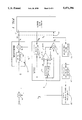
- FIG. 1 is a block diagram showing a first method of using the invention, wherein the amplitude and frequency of a sinusoidal signal is estimated in order to provide a predetermined correction for parasitic capacitance in a circuit;
- FIG. 2 is a block diagram showing a second method of using the invention, wherein a multiplexer scans a number of signals in a system, and the amplitude and frequency of each selected signal is estimated and compared to predetermined limits in order to monitor the health of the system;
- FIG. 3 is a first portion of a flow diagram showing the present invention implemented for continuously estimating the amplitude and frequency of a sampled sinusoidal signal
- FIG. 4 is a second portion of a flow diagram showing the present invention implemented for continuously estimating the amplitude an frequency of a sampled sinusoidal signal
- FIG. 5 is a third portion of a flow diagram showing the present invention implemented for continuously estimating the amplitude and frequency of a sampled sinusoidal signal.
- FIG. 6 is block diagram showing the present invention implemented for obtaining an estimate of amplitude and frequency from a block of samples of a sinusoidal signal.
- FIG. 1 a block diagram illustrating a first method of using the invention, wherein the amplitude and frequency of a sinusoidal signal is continuously estimated in order to provide a predetermined correction for parasitic capacitance in a circuit.
- FIG. 1 shows an angular rate sensor 10 excited by a sinusoidal drive signal v d at a frequency f o , and producing an output signal v do indicating the level of excitation of the sensor, and a signal v r including angular rate information.
- the angular rate information however, appears as a double-sideband suppressed-carrier signal, about a suppressed carrier at the frequency f o .
- Such an angular rate sensor is described, for example, in Fersht et al. U.S. Pat. No. 5,056,366 and Staudte U.S. Pat. No. Re. 32,931, herein incorporated by reference.
- the angular rate sensor 10 is excited by a driver circuit generally designated 11 so that the output signal v do has a predetermined amplitude.
- the signal v do is passed through a bandpass filter 12 to remove noise, and then the amplitude of the signal v do is detected by an amplitude detector 13.
- An integrating comparator 14, having an associated input resistor 15 and a feedback capacitor 16, compares the amplitude of the signal v do to a predetermined reference V R , to produce an automatic gain control voltage V AGC .
- the automatic gain control voltage V AGC controls the gain of a variable-gain amplifier 17 to produce the exciting drive signal V d .
- a demodulator circuit 18 To detect an angular rate signal ⁇ , a demodulator circuit 18 includes a balanced modulator 19 that is excited at the frequency f o .
- the balanced modulator 19 demodulates the signal v r to produce a base-band signal that is lowpass filtered by a lowpass filter 20 to produce the angular rate signal ⁇ .
- the detected angular rate signal ⁇ is a function of the amplitude of the drive signal v d .
- the variation in the detected angular rate signal ⁇ with respect to the amplitude of the drive signal vd is rather small, it is significant for some applications, and it is practical to remove the variation by employing the present invention to estimate the amplitude of the drive signal v d .
- the variation in the detected angular rate signal ⁇ with respect to the amplitude of the drive signal v d can be considered to be caused by a parasitic capacitance C p between nodes 19 and 20 in FIG. 1.
- the error ⁇ in the detected angular rate signal ⁇ is approximately:
- K is a predetermined constant
- A is the amplitude of the drive signal v d
- f o is the frequency of the drive signal.
- the constant K is on the order of 2 ⁇ C p Z in G, where C p is value of the parasitic capacitance, Z in is the impedance at the node 22, and G is the conversion gain of the demodulator 18.
- the error ⁇ is determined by estimating at least the amplitude A of the drive signal v d , as further described below.
- the frequency f o could also be estimated, but since the frequency f o is relatively constant in comparison to the amplitude A of the drive signal v d , the frequency f o need not be estimated, and instead could be assumed to be a fixed, nominal value.
- the amplitude and/or frequency of the drive signal v d is estimated by sampling the drive signal with an analog-to-digital converter 23, and processing the samples in an amplitude and frequency estimator 24. The amplitude and frequency estimator 24 will be further described below with reference to FIGS. 3 to 6.
- a correction signal generator 25 generates a correction signal ⁇ s , based on the estimated amplitude and/or frequency, and an adder unit 26 subtracts the correction signal C s from the angular rate signal ⁇ to produce a corrected angular rate signal ⁇ '.
- FIG. 2 there is shown a block diagram illustrating a second method of the invention, wherein an analog multiplexer 30 scans a number of signals S 1 , S 2 , S 3 , . . . , S n from a system 31, and the amplitude and frequency of each selected signal is estimated and compared to predetermined limits in order to monitor the health of the system.
- the system 31, for example, is an inertial measurement unit including three angular rate sensors as described above with reference to FIG. 1, each of the angular rate sensors have an associated driver circuit and detector circuit, and each of the angular rate sensors sense the angular rate of rotation about a respective one of three orthogonal axes.
- the signal S i could be the drive signal v d for the ith one of the angular rate sensors, and the amplitude and/or frequency estimate for each of the drive signals could also be used for correction of the angular rate signal ⁇ from each of the angular rate sensors.
- the multiplexer 30 selects the signal S j , and the selected signal is periodically sampled by an analog-to-digital converter 32 at a sampling rate f s set by a sampling clock generator 33.
- the values of the samples are received at an input port 34 of a data processor 35.
- the data processor is interrupted at the sampling rate f s to receive the values of the samples from the analog-to-digital converter 32.
- An amplitude and frequency estimator program B6 controls the data processor 35 to receive a block of the sampled values, and to estimate the amplitude A j and the frequency f j of the sampled signal S j .
- a health monitoring program 37 controls the data processor 35 to compare the amplitude and frequency estimates to respective predetermine limits to monitor the health of the system. When the estimated amplitude or frequency is found to be outside the bounds of the predetermined limits, the data processor 35 operates a display device 36 to display an error message to an operator (not shown). The health monitoring program 37 then controls the data processor to change a selection signal from an output port 39 so that the analog multiplexer 30 selects a different one of the signals S 1 , S 2 , S 3 , . . . , S n .
- the signals S 1 , S 2 , S 3 , . . . , S n each have a frequency of about 10 kilohertz, and the sampling rate is 42 kilohertz.
- the analog-to-digital converter is an Analog Devices part No. AD676 16-bit 100 kSPS sampling ADC which uses a switched-capacitor/charge redistribution architecture to achieve a 10 microsecond total conversion time.
- the data processor 35 is a Star Semiconductor SPROC programmable digital signal processing (DSP) integrated circuit which is designed for 24-bit arithmetic. In this system, the method of the present invention provides both amplitude and frequency estimates using a modest amount of computation and with errors on the order of parts per million.
- DSP Star Semiconductor SPROC programmable digital signal processing
- the sinusoidal signals are sparsely sampled.
- the amplitude and frequency estimation method of the present invention provides an accurate estimate of the amplitude and frequency of such a sparsely sampled sinusoidal signal.
- the method of the present invention can also provide amplitude and frequency estimates based on as few as four samples of a sparsely sampled signal, in the presence of a DC bias.
- the two neighboring samples x n+1 and x n-1 are:
- Equation 2 The function of frequency F is extracted from the three samples x n , x n+1 and x n-1 by adding Equations 3 and 4 together, and dividing the sum by Equation 2, to provide: ##EQU1##
- the amplitude A is extracted by subtracting the product of Equation 3 and Equation 4 from the square of Equation 2, to provide:
- Equation 8 A direct implementation of Equation 8 to solve for the amplitude A therefore requires four multiplies, 3 adds, and 1 divide.
- FIGS. 3, 4, and 5 there is shown a flow graph of a specific procedure implementing Equations 14 and 16 above.
- This flow graph represents the solution procedure in a form similar to the representation for a digital filter, and indeed the elements in FIGS. 3, 4, and 5 could be individual computational hardware elements. Alternatively, the functions represented by the elements in FIGS. 3, 4, and 5 could be performed by a programmed digital data processor.
- the sampled signal S i is delayed by one sample period T in a register 50 to produce the delayed sample S i-1 .
- a subtractor 51 subtracts the delayed sample S i-1 from the sample S i to produce a difference x i .
- the difference x i is delayed by a first sample period T in a second register 52 to provide a delayed difference x i-1 , and is delayed for a second sample period T in a third register 53 to produce a doubly-delayed difference x i-2 .
- the delayed difference x i-1 is scaled by a factor of two, as represented by a box 54, which could left-shift the delayed difference by one binary place.
- an adder 55 adds the difference x i to the doubly-delayed difference x i-2 .
- a subtractor 56 computes the difference (den i -num i ), and an adder 57 computes the sum (den 1 +num i ).
- a multiplier 58 squares the difference from the subtractor 56, and a multiplier 59 multiplies the square by the sum from the adder 57 to produce the denominator DEN i of Equation 16.
- a multiplier 60 computes the square of the delayed difference x i-1
- a multiplier 61 computes the cube of the delayed difference x i-1
- a multiplier 62 computes the product of the difference x i and the doubly-delayed difference x i-2 .
- a subtractor 63 computes the difference between the square from the multiplier 60 and the product from the multiplier 62.
- a multiplier 64 computes the product of the difference from the subtractor 63 and the cube from the multiplier 61. The product from the multiplier 64 is scaled by a factor of four as indicated in a box 65, which could represent a left-shift by two binary places, to produce the numerator NUM i of Equation 16.
- a divider 66 computes the quotient F i of Equation 13, and a divider 67 computes the quotient B i 2 of Equation 15.
- the division performed by the divider units 66, 67 preferably is a polynomial approximation as derived in Appendix I.
- the digital filter 81 is a non-recursive digital filter including a shift register storing the values B i-1 2 , B i-2 2 , and B i-3 2 and computing the sum of B i 2 and these three values and dividing the sum by four, by a right-shift by two binary places, to provide an average value B i 2 .
- the square root of this average value is computed by a computational unit 82.
- the computational unit 82 for example, performs a square root operation by a polynomial approximation as derived in Appendix II.
- the result of the square root operation is an estimate B i of the amplitude of the sampled sinusoidal signal. S.
- the division operation performed by the divider 76 in FIG. 3 may give an inaccurate result when the value of the denominator DEN i is approximately zero.
- the inaccurate values of B i 2 can be excluded so as not to be averaged by the digital filter 81.
- a digital multiplexer 83 selects either the value B i 2 from the division unit 67 in FIG. 3, or selects the previous average value computed by the digital filter 81.
- the previous average value computed by the digital filter 81 is obtained from a register 84, that is clocked at the sampling frequency f s .
- the value DEN i of the divisor for the division unit 67 is received by an absolute value unit 85 that determines the magnitude of the divisor value DENi.
- a comparator 86 compares this magnitude to a certain fraction of the average value of the divisor value.
- a digital filter 87 which may be similar to the digital filter 81, computes the average of the divisor value, and a shifter 88 right-shifts the average divisor value by N binary places to compute a predetermined fraction of the average of the divisor value.
- the value of N for example, is three.
- the quotient F i of Equation 13 is processed in a similar fashion to the processing of the quotient B i 2 as shown in FIG. 4, by a digital filter 91, a functional unit 92, a multiplexer 93, a register 94, an absolute value unit 95, a comparator 96, a digital filter 97, and a right-shifter 98, that are similar to the corresponding components 81 to 87 in FIG. 4.
- the functional unit 92 preferably computes this arc-cosine function as a polynomial approximation, as derived in Appendix III.
- FIG. 6 there is shown a flow diagram for the computations that are preferably performed for the system of FIG. 2 in the data processor 35.
- an amplitude estimate B and a frequency estimate f are obtained from 16 non-overlapping triplets of differences x 1 , x 2 , x 3 ; x 4 , x 5 , x 6 ; x 7 , x 8 , x 9 ; . . . ; x 46 , x 47 , x 48 .
- the triplets of differences are the results of difference computations 101, 102, 103, . . . 104, that are preferably performed by an interrupt program when the data processor 35 of FIG.
- a quotient B i 2 and F i for each of the triplets of differences are computed by ratio computations 105, 106, 107 . . . 108 that are performed at a rate of one-third of the sampling frequency f s .
- the 16 quotients B i 2 and the 16 quotients f i are accumulated in digital filtering 109 that can be performed at various times over about 48 sampling periods T corresponding to the differences x 1 to x 48 .
- the average values of the quotient B 2 and F result from the digital filtering.
- a square root function 110 computes the amplitude estimate B from the average value of the quotient B 2
- the frequency estimate f is computed by an arc-cosine function 111 from the average value of the quotient F.
- variable Q associated with the amplitude estimate B
- variable q associated with the frequency estimate f.
- the variables Q and q indicate, respectively, the number of the quotient values B i 2 and F i that were actually averaged together by the digital filter 109 instead of being excluded because their associated denominator value DEN i or den i , respectively, was relatively small.
- the digital filter 109 preferably rejects quotients when the value of DEN or den falls below a respective predetermined threshold value.
- the amplitude estimate B or the frequency estimate f should fall within certain predetermined limits, so that the threshold can be set at a certain fraction of the average value expected for any healthy signal.
- the threshold value is not critical and can be determined by simple trial and error for a particular system.
- MONITOR operates the analog multiplexer 30 of FIG. 2 to scan among three signals.
- the program MONITOR waits 30 microseconds for the analog-to-digital converter 32 to sample the new signal.
- the program MONITOR calls a routine called TESTSIG in order to test whether the amplitude and frequency of the selected signal are within predetermined limits. If not, the program MONITOR displays an error code provided by the TESTSIG routine, and then the program MONITOR selects another signal for processing.
- the TESTSIG routine initializes a number of variables used by a 42 kHz interrupt routine corresponding to the amplitude and frequency estimator program 36 of FIG. 2. After initializing these variables, the TESTSIG routine enables a 42 kHz interrupt so that the amplitude and frequency estimator program processes the signal samples from the analog-to-digital converter 32 in FIG. 2. The routine TESTSIG polls a variable NUMC to determine when the amplitude and frequency estimator program is finished. When NUMC is greater or equal to 16, then the amplitude and frequency estimator program 36 is finished.
- the TESTSIG routine then compares the variables Q and q to predetermined minimum limits QMIN and qmin, and also compares the amplitude estimate B and the frequency estimate f to respective predetermined minimum and maximum limits.
- An error indication is produced when any one of the variables Q, q, B, or f is outside of a boundary set by a respective one of the limits.
- the 42 kHz interrupt routine inputs one sample during each interrupt and classifies the sample as either case0, case1, case2, or case3.
- Case0 corresponds to the very first sample S1
- the other three cases correspond to one of the samples that permits the computation of either a first difference, a second difference, or a third difference, respectively, for each of the triplets of differences.
- the computations depicted in FIG. 3 are performed for the triplet to compute a quotient B i 2 and F i for the triplet.
- functions for computing the ratios, the square roots, and the arc-cosines by the polynomial approximations as derived in Appendices I, II, and III.
- Appendix IV is a computer program for evaluating the performance of various embodiments of the present invention.
Landscapes
- Engineering & Computer Science (AREA)
- General Physics & Mathematics (AREA)
- Physics & Mathematics (AREA)
- Signal Processing (AREA)
- Computer Networks & Wireless Communication (AREA)
- Radar, Positioning & Navigation (AREA)
- Power Engineering (AREA)
- Remote Sensing (AREA)
- Quality & Reliability (AREA)
- Measurement Of Resistance Or Impedance (AREA)
- Indication And Recording Devices For Special Purposes And Tariff Metering Devices (AREA)
- Analogue/Digital Conversion (AREA)
- Measuring Frequencies, Analyzing Spectra (AREA)
- Measurement Of Current Or Voltage (AREA)
Abstract
Description
ε=KAf.sub.o (Equation 1)
x.sub.n =A sin (ω.sub.o nT+φ) (Equation 2)
X.sub.n+1 =A sin (ω.sub.o nT+φ) cos (ω.sub.o T)+A cos (ω.sub.o nT+φ) sin (ω.sub.o T) (Equation 3)
X.sub.n-1 =A sin (ω.sub.o nT+ω) cos (ω.sub.o T)-A cos (ω.sub.o nT+ω) sin (ω.sub.o T) (Equation 4)
x.sup.2.sub.n -x.sub.n+1 x.sub.n-1 =A.sup.2 sin.sup.2 ω.sub.o T(Equation 6)
Y.sub.n =DC+B sin (ω.sub.o nT+ω) (Equation 9)
______________________________________
MONITOR   SELECT ← SELECT +1
          IF SELECT > 3 THEN SELECT ← 1
          OUTPUT SELECT
          WAIT 30 MICROSECONDS
          CALL TESTSIG
          IF ERROR > 0 THEN GOTO 10
          B(SELECT) ← SQRT(BS)
*** NOTE: K = 1/2πT
          f(SELECT) ← K*ACOS(F)
          RETURN
          DISPLAY(ERROR)
          RETURN
TESTSIG   ERROR ← 0
          CASE ← 0
          NUMC ← 0
          BS ← 0
          F ← 0
          Q ← 0
          q ← 0
          ENABLE 42 kHz INTERRUPT
110       IF NUMC < 16 THEN GOTO 110
          IF Q ≧ QMIN  THEN GOTO 120
          ERROR ← 1
          RETURN
120       BS ← BS/Q
          IF BS ≦ BSMAX THEN GOTO 130
          ERROR ← 2
          RETURN
130       IF BS ≧ BSMIN THEN GOTO 140
          ERROR ← 3
          RETURN
140       IF q ≧ qmin  THEN GOTO 150
          ERROR ← 4
          RETURN
          F ← F/q
150       F ≦ FMAX THEN GOTO 160
          ERROR ← 5
          RETURN
160       IF F ≧ FMIN  THEN RETURN
          ERROR ← 6
          RETURN
42KHZINT  INPUT SAMPLE
          IF CASE > 0   THEN GOTO 210
          S1 ← SAMPLE
          CASE ← 1
          RETURN
210       IF CASE > 1  THEN GOTO 220
          X1 ← S1 - SAMPLE
          S1 ← SAMPLE
          CASE ← 2
          RETURN
220       IF CASE > 2  THEN GOTO 230
          X2 ← S1 - SAMPLE
          S1 ← SAMPLE
          CASE ← 3
          RETURN
230       X3 ← S1 - SAMPLE
          S1 ← SAMPLE
          CASE ← 1
          num ← X1 + X3
          PRODX1X3 ← X1 * X3
          NUMC ← NUMC + 1
          IF NUMC ≧ 16  THEN GOTO 240
          CLEAR INTERRUPT MASK
          GOTO 250
240       DISABLE 42 KHZ INTERRUPT
250       SQX2 ← X2 * X2
          CUBX2 ← SQX2*X2
          den ← LEFT SHIFT X2 BY 1
          SUMnd ← num + den
          DEN ←  den - num
          DEN ← DEN*DEN
          DEN ← DEN*SUMnd
          NUM ← SQX2 - PRODX1X3
          NUM ← NUM*CUBX2
          LEFT SHIFT NUM BY 2
          IF den < denmin  THEN GOTO 260
          F ← F + RATIO(num,den)
          q ← q + 1
          IF DEN < DENMIN  THEN GOTO 270
          BS ← BS + RATIO(NUM,DEN)
          Q ← Q + 1
270       RETURN
FUNCTION  RATIO (T/U)
*** NOTE:
*** B0 =   0.8946079612
*** B1 =  -0.3153155446
*** B2 =   0.0547355413
*** B3 =  -0.0046808124
*** B4 =   0.0001578331
          RATIO ← U*B4
          RATIO ← RATIO + B3
          RATIO ← RATIO * U
          RATIO ← RATIO + B2
          RATIO ← RATIO * U
          RATIO ← RATIO + B1
          RATIO ← RATIO * U
          RATIO ← RATIO + B0
          RATIO ← RATIO * T
          RETURN
FUNCTION     SQRT(V)
*** NOTE:
*** A0 =   0.5439969897
*** A1 =   0.5490743518
*** A2 =  -0.0689262748
*** A3 =   0.0068873167
*** A4 =  -0.0003057122
          SQRT ← V * B4
          SQRT ← SQRT + B3
          SQRT ← SQRT * V
          SQRT ← SQRT + B2
          SQRT ← SQRT * V
          SQRT ← SQRT + B1
          SQRT ← SQRT * V
          SQRT ← SQRT + B0
          RETURN
FUNCTION  ACOS(w)
*** NOTE:
*** C0 =   0.0500000119
*** C1 =  -0.6684602499
*** C2 =  -0.1108554006
*** C3 =  -0.0580515265
          SQW ← W * W
          ACOS ← SQW * C3
          ACOS ← ACOS + C2
          ACOS ← ACOS * SQW
          ACOS ← ACOS + C1
          ACOS ← ACOS * W
          ACOS ← ACOS + C0
          RETURN
______________________________________
__________________________________________________________________________
APPENDIX I.
__________________________________________________________________________
MATHCAD (Trademark) PROGRAM
CHEBYCHEV APPROXIMATION FOR DIVISION
USING THE REMEZ-EXCHANGE ALGORITHM
QRSDIVIDE.MCD
We form the quotient x/y by evaluating 1/y and multiplying the
result by x. The objective of this program is to calculate the
"b" coefficients that provide the Chebychev solution to 1/y.
INITIALIZE
Y.sub.nom := 6                 Nominal value of the input
                               variable.
 ##STR1##
                                ##STR2##
Y.sub.max := Y.sub.nom + δY
                               Y.sub.max = 8 Maximum anticipated
                               input value.
Y.sub.min := Y.sub.nom - δY
                               Y.sub.min = 4 Minimum anticipated
                               input value.
B := 24                        Number of bits of coefficient
                               resolution.
N := 5                         Number of ocefficients in
                               data-fitting routine. (This
                               is determined by trial and
                               error.)
n := 0 . . . N                 Coefficeint index.
m := 0 . . . N                 The y-value index.
p := 0 . . . N - 1             The weighting-coefficient
                               ("b") index.
K := 1000                      Number of performance-
                               evaluation points.
k := 0 . . . K - 1             Performance-evaluation index.
PRINTCOLWIDTH := 10            PRNPRECISION := 10
ZERO := 0                      WRITEPRN(YA) := ZERO □
  m                            WRITE(COUNT) := 0 □
TYPE "PROCESS", COMMENT "WRITEPRN(YA)" & "WRITE(COUNT)", THEN
GOTO 125.
ITERATION := READ(COUNT) WRITE(COUNT) := 1 + ITERATION
                               YA := READPRN(YA)
 ##STR3##
                                ##STR4##
M.sub.m,n := if[n ≈ N, (-1).sup.m, Y.sub.m.sup.n
                               The Remez matrix.
 ##STR5##
                                ##STR6##
 ##STR7##
                                ##STR8##
v := M ·R  ε := v.sub.N
                               v is the solution vector; ε is
                               the error measure.
b.sub.p := 2.sup.-B. floor[0.5 + 2.sup.B. V.sub.p ]
                               The coefficient vector rounded
                               to B bits.
                               WRITE PRN(BCOEFF) := b
PERFORMANCE EVALUATION
 ##STR9##                      The approximating function.
ERROR := REF - AF              The performance error.
The plot of the error-extremal envelope bounded by ε':
ε' :=if[ε ≈ 0,max[(|ERROR|)],.ve
rtline.ε|] Another index i := 0 . . . 1
This is the error-extremal envelope plot:
EY.sub.k := if[k ≈ K - 1,0,if[ERROR.sub.k+1 ≧ ERROR.sub.k,.
epsilon.',-ε']]
This filter (MASK) is used to locate the frequencies
corresponding to all extremal error values plus the end points:
MASK.sub.k := if[k ≈ 0,1,if[k ≈ K - 1,1,if[EY.sub.k+1
≈ -EY.sub.k,1,0 ]]]
This is the actual frequency-filtering operation. The only
frequencies that get through are the end points plus those
where error extrema are located.
MATRIX.sub.k,0 := y.sub.k ·MASK.sub.k  MATRIX.sub.k,1 :=
|ERROR.sub.k | ·MASK.sub.k
Extract the frequencies where the N+1 largest end-point values
and extremal values are located, sort them, and write them into
memory:
MYE.sub.m,i := reverse(csort(MATRIX,1)).sub.m,i  SYE: = (csort(MYE,0))
|ε| = 5.42 10.sup.-5  WRITEPRN(YA)
:= SYE.sup.<0>
max [(|ERROR|)] - |ε| = 1.25
10.sup.-5                      A sanity check.
 ##STR10##
                                ##STR11##
Now plot the functions and the Max [(|ERROR|)] .multidot
                               .10.sup.6 = 66.7
error
List the extremal frequencies  The rounded coefficients:
(col 0), and the extremal value
magnitudes (col 1):
                               The hex coefficients:
 ##STR12##
                                ##STR13##
 ##STR14##
                                ##STR15##
END OF PROGRAM
__________________________________________________________________________
CHEBYCHEV APPROXIMATION FOR SQUARE ROOT
USING THE RSAW 8/4/93 MEZ-EXCHANGE ALGORITHM
QRSSQRT. MCD
The objective of this program is to calculate the "a"
coefficients that provide a Chebychev polynomial approximation to
the square root of y.
The Chebychev solution is the one that minimizes the maximum
error of the approximation fit. There are no "surprise points"
in the solution space.
INITIALIZE
Y.sub.nom := 2                 Nominal value of the output
                               variable.
δY := 0.1·Y.sub.nom
                               Tolerance on the output
                               variable.
X.sub.max :=[Y.sub.nom + δY].sup.2
                               x .sub.max = 4.84 Maximum
                               anticipated input value
X.sub.min :=[Y.sub.nom - δY].sup.2
                               x .sub.min = 3.24 Minimum
                               anticitpated input value
B :=24                         Number of bits of
                               coefficients resolution.
N := 5                         Number of coefficients in
                               data-fitting routine. (This
                               is determined by trial and
                               error.)
n := 0 . . . N                 Coefficient index.
m := 0 . . . N                 The y-value index.
p := 0 . . . N - 1             The weighting-coefficient
                               ("b") index.
K := 1000                      Number of performance-
                               evaluation points.
k := 0 . . . K - 1             Performance-evaluation index.
PRINTCOLWIDTH := 10            PRNPRECISION : = 10
ZERO := 0                      WRITEPRN(YA) : = ZERO □
  m                            WRITE(COUNT) : = 0 □
TYPE "PROCESS", COMMENT "WRITEPRN(XA)" & "WRITE(COUNT)", THEN GOTO
128.
SETUP
ITERATION := READ(COUNT) WRITE(COUNT) := 1 + ITERATION XA :=
READPRN (XA)
 ##STR16##
                                ##STR17##
M.sub.m,n := if[n ≈ N,(-1).sup.m,x.sub.m.sup.n ]
                               The Remez matrix.
 ##STR18##
                                ##STR19##
 ##STR20##
                                ##STR21##
v :=M.sup.-1 ·R  ε := v.sub.N
                               v is the solution vector; ε
                               is the error measure
a.sub.p := 2.sup.-B · floor[0.5 + 2.sup.B. V.sub.p ]
                               The coefficient vector
                               rounded to B bits.
                               WRITEPRN(ACOEFF) := a
PERFORMANCE EVALUATION
 ##STR22##
                                ##STR23##
ERROR := REF - AF              The performance error.
The plot of the error-extremal envelope bounded by ε' :
                               Another index: i :=0 . . . 1
ε' : if[ε ≈0,max[(|ERROR|)],.ver
tline.ε|]
This is the error-extremal envelope plot:
EX.sub.k := if[k ≈ K - 1,0 if[ERROR.sub.k+1 ≧ ERROR.sub.k,.
epsilon.',-ε']]
This filter (MASK) is used to locate the frequencies
corresponding to all extremal error values, plus the end points:
MASK.sub.k := if[k ≈ 0,1,if[k ≈ K - 1,1,if[EX.sub.k+1
≈ -EX.sub.k,1,0]]]
This is the actual frequency-filtering operation. The only
frequencies that get through are the end points plus those where
extremal are located.
MATRIX.sub.k,0 := x.sub.k · MASK.sub.k  MATRIX.sub.k,1
:=|ERROR.sub.k | · MASK.sub.k
Extract the frequencies where the N+1 largest end-point values
and extremal values are located, sort them, and write them into
memory.
MXE.sub.m,i := reverse (csort(MATRIX,1)).sub.m,i  SXE := (csort(MXE,0))
-6  <0>
|ε| = 1.1 10  WRITEPRN(XA) := SXE
max [(|ERROR|)] - |ε| = 3.41
10.sup.-7                      A sanity check.
 ##STR24##
                                ##STR25##
Now plot the functions and the Compute the peak error in
error                          ppm:
                               max[(|ERROR|)] ·
                               10.sup.6 = 1.44
List the extremal freqencies (col
                               The rounded coefficients
0), and the extremal values (col
                               are:
1):
 ##STR26##
                                ##STR27##
                               The hex coefficients:
 ##STR28##
                                ##STR29##
END OF PROGRAM
__________________________________________________________________________
__________________________________________________________________________
APPENDIX III.
__________________________________________________________________________
MATHCAD (Trademark) PROGRAM
CHEBYCHEV APPROXIMATION TO AN ARCCOSINE FUNCTION
QRSARCOSRMZ.MCD
The objective of this program is to calculate the "a"
coefficients that provide the Chebychev solution to the
polynomial approximation of arccos(x). The application is a
direct-reading frequency-deviation meter. We are going to
estimate δf/fo.
INITIALIZE
f.sub.s := 42000               The sampling frequency.
f.sub.o := 10000               The nominal frequency.
δf := 0.2·f.sub.o
                               Maximum deviation of the
                               variable to be estimated.
 ##STR30##
                                ##STR31##
 ##STR32##
                                ##STR33##
B := 24                        Number of bits of coefficient
                               resolution.
N := 4                         Number of coefficients in
                               data-fitting routine.
n := 0 . . . N                 Coefficient index.
m := 0 . . . N                 The x-value index.
p := 0 . . . N - 1             The weighting-coefficient
                               ("a") index.
K := 1000                      Number of performance-
                               evaluation points.
k := 0 . . . K - 1             Performance-evaluation index.
PRINTCOLWIDTH := 10            PRNPRECISION := 10
ZERO := 0                      WRITEPRN(YA) := ZERO□
  m                            WRITE(COUNT) := 0□
TYPE "PROCESS" COMMENT "WRITEPRN(YA)" & "WRITE(COUNT)",
THEN "GOTO 140".
SETUP
ITERATION := READ(COUNT)  WRITE(COUNT) := 1 + ITERATION
                               YA := READPRN(YA)
 ##STR34##
                                ##STR35##
M.sub.m,n := if[n ≈ N, (-1).sup.m,if[n ≈ 0,1,Y.sub.m.sup.2
·n-n ]]               The Remez matrix.
 ##STR36##
                                ##STR37##
 ##STR38##
                                ##STR39##
 ##STR40##
v := M.sup.-1 ·R  ε := v.sub.N
                               v is the solution vector; ε is
                               the error measure.
a.sub.p := 2.sup.-B ·floor[0.5 + 2.sup.b ·v.sub.p
                               The coefficient vector rounded
                               to B bits.
                               WRITEPRN(CCOEFF) := a
PERFORMANCE EVALUATION
b.sub.p := if[p ≈ 0,0,a.sub.p ]
 ##STR41##
                                ##STR42##
ERROR := REF - AF              The performance error.
The plot of the error-extremal envelope bounded by ε':
ε' := if[ε ≈ 0,max[(|ERROR|)],.v
ertline.ε|] Another index: i := 0 . . . 1
EY.sub.k := if[k ≈ K - 1,0,if[ERROR.sub.k+1 ≧ ERROR.sub.k,.
epsilon.',-ε']]
This filter (MASK) is used to locate the frequencies
corresponding to all extremal error values:
MASK.sub.k := if[k ≈ 0,1,if[k ≈ K - 1,1,if[EY.sub.k+1
≈ -EY.sub.k,1,0]]]
This is the actual filtering operation. The only frequencies
that get through are those where error extrema are located.
MATRIX.sub.k,0 := Y.sub.k · MASK.sub.k  MATRIX.sub.k,1 :=
|ERROR.sub.k |·MASK.sub.k
Extract the frquencies where the N+1 largest extremal values
are located, sort them, write them into memory, and list the
rounded coefficients:
MYE.sub.m,i := reverse(csort(MATRIX,1)).sub.m,i  SYE := (csort(MYE,0))
|ε| = 5.02 10.sup.-7
                               WRITEPRN(YA) := SYE.sup.<0>
max[(|ERROR|)] - |ε| = 1.58
10.sup.-8                      "Gut" insurance. (If you
                               can't feel good about the
                               solution, its probably
                               wrong!)
 ##STR43##
                                ##STR44##
Now plot the functions and the max[(|ERROR|)]  = 5.18
                               10.sup.-7
error
The extremal values:           The rounded coefficients:
 ##STR45##
                                ##STR46##
 ##STR47##
                                ##STR48##
END of PROGRAM
__________________________________________________________________________
__________________________________________________________________________
APPENDIX IV.
__________________________________________________________________________
MATHCAD (Trademark) PROGRAM
SIMPLE AND ROBUST QRS DRIVE-VOLTAGE
AMPLITUDE AND FREQUENCY ESTIMATION
QRSSINEAMPY.MCD
SUMMARY
This program introduces an algorithm that computes the peak
amplitude of the sparsely sampled noisy sinusoid riding on a dc
offset. The algorithm uses only adds, multiplies, and shifts
operating on sets of 4 contiguous samples. The inherent
computational error is on the order of 15 ppm. The algorithm
also estimates frequency; the inherent computational error is
within 2 or 3 hundredths of a Hertz. Naturally, high noise
levels degrade the performance.
SETUP AND DEFINITIONS
K := 128  k := 0 . . . K - 1
                       Source-signal index
L := K - 1
          1:= 0 . . . L - 1
                       Processed-signal index
M := L - 2
          m := 0 . . . M - 1
                       Signal-processing index
          n := 0 . . . M - 1
                       . . . and another one.
f.sub.s := 42000       Sampling frequency
 ##STR49##             Sampling period
A.sub.o := 2           A is the signal amplitude
                       (the nominal value is Ao;
                       we allow +/- 10%
                       variation)
A := A.sub.o ·(1 + (-0.1 + rnd(0.2)))
                       A = 1.937
f.sub.o := 10000       Nominal signal frequency.
f'.sub.o := f.sub.o ·(1 + 0.2·(rnd(2)
                       Signal frequency (Hz). A
                       +/- 20% variation is
                       allowed about the
                       nominal.
Ω := 2·II f'.sub.o
                       Signal frequency
                       (rad/sec)
.0. := rnd(2·II)  .0. = 5.266
                       A completely arbitrary
                       phase angle.
U.sub.k := A·sin(Ω·T·k
                       QRS voltage sinusoidal-
                       signal samples.
η.sub. k := 2·10.sup.-3 ·(rnd(2) - 1)
                       Now we generate some
                       noise . . .
DC := -1 + rnd(2)  DC = -0.421
                       . . . and a DC offset
                       (arbitrary) . . .
v := u + η DC      . . . and add them to the
                       signal in order to obtain
                       the noisy and biased
                       input voltage, v.
 ##STR50##
                        ##STR51##
DEFINE SOME FUNCTIONAL APPROXIMATIONS
We use Chebychev (minimax solutions) polynomial approximations to
the square root, division, and arccosine operations. The
polynomial coefficients have been rounded to 24 bits. These
coefficients are imported from the SQRT.MCD, DIVIDE·MCD, and
ARCOSRMZ.MCD programs.
a := READPRN(ACOEFF)  b := READPRN(BCOEFF)  i := 0 . . . last(a)
 ##STR52##
sqrt(x) := Σ.sub.i a.sub.i ·x.sup.i
sgn(y) := if(y ≧ 0,1,-1)
div(x,y) := sgn(y)·x·2
 ##STR53##
e.g., div(12,3) =  4.001
  sqrt(4) = 2  sqrt(div(12,3)) = 2
C: = READPRN(CCOEFF)  nfd = normalized frequency deviation.
 ##STR54##
THE PROCEDURE
Our first step is to eliminate the DC offset by taking the
difference between successive samples of the input signal. The
input signal to the differencing operator is v, the signal after
the differencing operator is x:
x.sub.1 := v.sub.1+1 - v.sub.1  The difference signal
 ##STR55##
Define;
NUM.sub.m := 4·x.sub.m+1.sup.3 ·[x.sub.m+1.sup.2 -
x.sub.m · x.sub.m+2 ]
DEN.sub.m := [[2·x.sub.m+1 ].sup.2 - [x.sub.m + x.sub.m+2
].sup.2 ] · [2·x.sub.m+1 - [x.sub.m + x.sub.m+2 ]]
num.sub.m := x.sub.m+2 + x.sub.m  den.sub.m := 2·x.sub.m+1
In order to avoid division problems that arise if the
denominators are too small, we define the "weeding-out"
functions, p and q:
p.sub.m := if[|DEN.sub.m | < 0.01·max[(.vertlin
e.DEN|)],0,1]
q.sub.m := if[|den.sub.m | < 0.01·max[(.vertlin
e.den|)],0,1]
Now we compute the estimate of the square of A over several sets
of samples, average those results, then take the square root:
 ##STR56##
and compute the amplitude-estimation error in ppm:
 ##STR57##
We similarly estimate the frequency (the actual value is f'o)
 ##STR58##
and determine the frequency-estimation error in Hertz:
ε f := f'.sub.0 - Eof  ε f = -0.226
We have been operating with a signal-to-noise ratio of SNR =
61.445 the phase angle is .0. = 5.266 the DC offset is DC = -0.421
the frequency is off nominal by f' - f = -62.865 and the
amplitude is off by A -A .sub.o = -0.063 o  o.
END OF PROGRAM
__________________________________________________________________________
Claims (26)
Priority Applications (1)
| Application Number | Priority Date | Filing Date | Title |
|---|---|---|---|
| US08/410,643 US5471396A (en) | 1993-08-12 | 1995-03-24 | Estimator of amplitude and frequency of a noisy-biased sinusoid from short bursts of samples |
Applications Claiming Priority (2)
| Application Number | Priority Date | Filing Date | Title |
|---|---|---|---|
| US10526593A | 1993-08-12 | 1993-08-12 | |
| US08/410,643 US5471396A (en) | 1993-08-12 | 1995-03-24 | Estimator of amplitude and frequency of a noisy-biased sinusoid from short bursts of samples |
Related Parent Applications (1)
| Application Number | Title | Priority Date | Filing Date |
|---|---|---|---|
| US10526593A Continuation | 1993-08-12 | 1993-08-12 |
Publications (1)
| Publication Number | Publication Date |
|---|---|
| US5471396A true US5471396A (en) | 1995-11-28 |
Family
ID=22304877
Family Applications (1)
| Application Number | Title | Priority Date | Filing Date |
|---|---|---|---|
| US08/410,643 Expired - Lifetime US5471396A (en) | 1993-08-12 | 1995-03-24 | Estimator of amplitude and frequency of a noisy-biased sinusoid from short bursts of samples |
Country Status (4)
| Country | Link |
|---|---|
| US (1) | US5471396A (en) |
| EP (1) | EP0638811B1 (en) |
| JP (1) | JPH0783964A (en) |
| DE (1) | DE69431778T2 (en) |
Cited By (14)
| Publication number | Priority date | Publication date | Assignee | Title |
|---|---|---|---|---|
| US5857165A (en) * | 1995-11-17 | 1999-01-05 | Dynetics, Inc. | Method and apparatus for communication with chaotic and other waveforms |
| US6026418A (en) * | 1996-10-28 | 2000-02-15 | Mcdonnell Douglas Corporation | Frequency measurement method and associated apparatus |
| US20030016879A1 (en) * | 2001-07-23 | 2003-01-23 | Micron Technology, Inc. | Suppression of ringing artifacts during image resizing |
| US6591230B1 (en) * | 1999-11-12 | 2003-07-08 | Texas Instruments Incorporated | Coprocessor for synthesizing signals based upon quadratic polynomial sinusoids |
| US6725169B2 (en) | 2002-03-07 | 2004-04-20 | Honeywell International Inc. | Methods and apparatus for automatic gain control |
| US6763063B1 (en) * | 2000-10-23 | 2004-07-13 | Telefonaktiebolaget Lm Ericsson (Publ) | Peak value estimation of sampled signal |
| US20050289519A1 (en) * | 2004-06-24 | 2005-12-29 | Apple Computer, Inc. | Fast approximation functions for image processing filters |
| DE102004039441A1 (en) * | 2004-08-13 | 2006-02-23 | Rohde & Schwarz Gmbh & Co. Kg | Method for determining the complex spectral lines of a signal |
| US20070098089A1 (en) * | 2005-10-28 | 2007-05-03 | Junsong Li | Performing blind scanning in a receiver |
| US20070192031A1 (en) * | 2006-02-14 | 2007-08-16 | Baker Hughes Incorporated | System and Method for Pump Noise Cancellation in Mud Pulse Telemetry |
| US20080097638A1 (en) * | 2004-08-06 | 2008-04-24 | S.A.G.I. - S.P.A. | Temperature control system for food items |
| US8573055B2 (en) | 2010-05-24 | 2013-11-05 | Denso Corporation | Angular velocity sensor |
| JP2015129640A (en) * | 2014-01-06 | 2015-07-16 | 横河電機株式会社 | Power measuring device |
| CN109582176A (en) * | 2018-11-30 | 2019-04-05 | 北京集创北方科技股份有限公司 | A kind of touch screen anti-noise method and device |
Families Citing this family (9)
| Publication number | Priority date | Publication date | Assignee | Title |
|---|---|---|---|---|
| US5763780A (en) * | 1997-02-18 | 1998-06-09 | Litton Systems, Inc. | Vibratory rotation sensor with multiplex electronics |
| US5892152A (en) * | 1997-07-29 | 1999-04-06 | Litton Systems, Inc. | Multiple vibratory rotation sensors with multiplexed electronics |
| KR100649792B1 (en) | 2003-06-30 | 2006-11-27 | 지멘스 악티엔게젤샤프트 | Turnover sensor with oscillating gyroscope |
| DE102008031609B4 (en) * | 2008-07-07 | 2010-06-02 | Albert-Ludwigs-Universität Freiburg | Measuring device with a microelectromechanical capacitive sensor |
| JP5549842B2 (en) * | 2009-09-15 | 2014-07-16 | 横河電機株式会社 | Coriolis flow meter and frequency measurement method |
| KR100979285B1 (en) * | 2009-12-07 | 2010-08-31 | 엘아이지넥스원 주식회사 | Method and apparatus for detecting pulse signal modulated by sinusoidal wave |
| CN104198811B (en) * | 2014-08-18 | 2017-02-01 | 广东电网公司电力科学研究院 | Method and device for measuring frequency of low frequency signal |
| CN113513969A (en) * | 2021-06-04 | 2021-10-19 | 南京航空航天大学 | Self-inductance type inductance displacement sensor excitation circuit |
| CN113341220B (en) * | 2021-08-05 | 2021-11-02 | 中国空气动力研究与发展中心设备设计与测试技术研究所 | Method for estimating frequency of noise-containing multi-frequency attenuation real signal |
Citations (5)
| Publication number | Priority date | Publication date | Assignee | Title |
|---|---|---|---|---|
| US4534043A (en) * | 1983-06-27 | 1985-08-06 | Racal Data Communications, Inc. | Test tone detector apparatus and method modem using same |
| US4802766A (en) * | 1986-12-23 | 1989-02-07 | Honeywell Inc. | Dither signal remover for a dithered ring laser angular rate sensor |
| USRE32931E (en) * | 1984-01-23 | 1989-05-30 | Piezoelectric Technology Investors, Inc. | Vibratory angular rate sensor system |
| US5056366A (en) * | 1989-12-26 | 1991-10-15 | Litton Systems, Inc. | Piezoelectric vibratory rate sensor |
| US5412472A (en) * | 1992-01-30 | 1995-05-02 | Japan Aviation Electronics Industry Limited | Optical-interference type angular velocity or rate sensor having an output of improved linearity |
Family Cites Families (6)
| Publication number | Priority date | Publication date | Assignee | Title |
|---|---|---|---|---|
| JPS57133362A (en) * | 1981-02-10 | 1982-08-18 | Mitsubishi Electric Corp | Frequency detector |
| FR2535462A1 (en) * | 1982-10-29 | 1984-05-04 | Labo Electronique Physique | DIGITAL CIRCUIT FOR MEASURING THE INSTANTANEOUS FREQUENCY OF A MODULATED OR NON-FREQUENCY SIGNAL, AND A TELEVISION OR RADIO RECEIVER EQUIPPED WITH SUCH A CIRCUIT |
| JPS618675A (en) * | 1984-06-22 | 1986-01-16 | Mitsubishi Electric Corp | Measuring device for quantity of electricity |
| US4672555A (en) * | 1984-10-18 | 1987-06-09 | Massachusetts Institute Of Technology | Digital ac monitor |
| JPH0737998B2 (en) * | 1988-11-16 | 1995-04-26 | 三菱電機株式会社 | Electricity detector |
| CH683721A5 (en) * | 1990-05-03 | 1994-04-29 | Landis & Gyr Business Support | Procedure for the determination of estimated values of the instantaneous values of parameters at least of a sinusoidal signal of constant frequency and of prior art. |
-
1994
- 1994-08-09 DE DE69431778T patent/DE69431778T2/en not_active Expired - Fee Related
- 1994-08-09 EP EP94112437A patent/EP0638811B1/en not_active Expired - Lifetime
- 1994-08-11 JP JP6188690A patent/JPH0783964A/en not_active Withdrawn
-
1995
- 1995-03-24 US US08/410,643 patent/US5471396A/en not_active Expired - Lifetime
Patent Citations (5)
| Publication number | Priority date | Publication date | Assignee | Title |
|---|---|---|---|---|
| US4534043A (en) * | 1983-06-27 | 1985-08-06 | Racal Data Communications, Inc. | Test tone detector apparatus and method modem using same |
| USRE32931E (en) * | 1984-01-23 | 1989-05-30 | Piezoelectric Technology Investors, Inc. | Vibratory angular rate sensor system |
| US4802766A (en) * | 1986-12-23 | 1989-02-07 | Honeywell Inc. | Dither signal remover for a dithered ring laser angular rate sensor |
| US5056366A (en) * | 1989-12-26 | 1991-10-15 | Litton Systems, Inc. | Piezoelectric vibratory rate sensor |
| US5412472A (en) * | 1992-01-30 | 1995-05-02 | Japan Aviation Electronics Industry Limited | Optical-interference type angular velocity or rate sensor having an output of improved linearity |
Non-Patent Citations (4)
| Title |
|---|
| Chi Tsong Chen, One Dimensional Digital Signal Processing, Marcel Dekker, Inc., New York, N.Y. (1979), pp. 206 215. * |
| Chi-Tsong Chen, One-Dimensional Digital Signal Processing, Marcel Dekker, Inc., New York, N.Y. (1979), pp. 206-215. |
| Rabiner and Gold, Theory and Application of Digital Signal Processing, Prentice Hall, Inc., Englewood Cliffs, N.J. (1975), pp. 136 140, 194 204. * |
| Rabiner and Gold, Theory and Application of Digital Signal Processing, Prentice-Hall, Inc., Englewood Cliffs, N.J. (1975), pp. 136-140, 194-204. |
Cited By (23)
| Publication number | Priority date | Publication date | Assignee | Title |
|---|---|---|---|---|
| US5857165A (en) * | 1995-11-17 | 1999-01-05 | Dynetics, Inc. | Method and apparatus for communication with chaotic and other waveforms |
| US6026418A (en) * | 1996-10-28 | 2000-02-15 | Mcdonnell Douglas Corporation | Frequency measurement method and associated apparatus |
| US6591230B1 (en) * | 1999-11-12 | 2003-07-08 | Texas Instruments Incorporated | Coprocessor for synthesizing signals based upon quadratic polynomial sinusoids |
| US6763063B1 (en) * | 2000-10-23 | 2004-07-13 | Telefonaktiebolaget Lm Ericsson (Publ) | Peak value estimation of sampled signal |
| US20060140506A1 (en) * | 2001-07-23 | 2006-06-29 | Micron Technology, Inc. | Suppression of ringing artifacts during image resizing |
| US7050649B2 (en) | 2001-07-23 | 2006-05-23 | Micron Technology, Inc. | Suppression of ringing artifacts during image resizing |
| US20060140505A1 (en) * | 2001-07-23 | 2006-06-29 | Micron Technology, Inc. | Suppression of ringing artifacts during image resizing |
| US20030016879A1 (en) * | 2001-07-23 | 2003-01-23 | Micron Technology, Inc. | Suppression of ringing artifacts during image resizing |
| US7245785B2 (en) | 2001-07-23 | 2007-07-17 | Micron Technology, Inc. | Suppression of ringing artifacts during image resizing |
| US7333674B2 (en) | 2001-07-23 | 2008-02-19 | Micron Technology, Inc. | Suppression of ringing artifacts during image resizing |
| US6725169B2 (en) | 2002-03-07 | 2004-04-20 | Honeywell International Inc. | Methods and apparatus for automatic gain control |
| US20050289519A1 (en) * | 2004-06-24 | 2005-12-29 | Apple Computer, Inc. | Fast approximation functions for image processing filters |
| US20080097638A1 (en) * | 2004-08-06 | 2008-04-24 | S.A.G.I. - S.P.A. | Temperature control system for food items |
| US7775709B2 (en) * | 2004-08-06 | 2010-08-17 | S.A.G.I. - S.P.A. | Temperature control system for food items |
| DE102004039441A1 (en) * | 2004-08-13 | 2006-02-23 | Rohde & Schwarz Gmbh & Co. Kg | Method for determining the complex spectral lines of a signal |
| US7684467B2 (en) * | 2005-10-28 | 2010-03-23 | Silicon Laboratories Inc. | Performing blind scanning in a receiver |
| US20070098089A1 (en) * | 2005-10-28 | 2007-05-03 | Junsong Li | Performing blind scanning in a receiver |
| US7577528B2 (en) * | 2006-02-14 | 2009-08-18 | Baker Hughes Incorporated | System and method for pump noise cancellation in mud pulse telemetry |
| US20070192031A1 (en) * | 2006-02-14 | 2007-08-16 | Baker Hughes Incorporated | System and Method for Pump Noise Cancellation in Mud Pulse Telemetry |
| US8573055B2 (en) | 2010-05-24 | 2013-11-05 | Denso Corporation | Angular velocity sensor |
| JP2015129640A (en) * | 2014-01-06 | 2015-07-16 | 横河電機株式会社 | Power measuring device |
| CN109582176A (en) * | 2018-11-30 | 2019-04-05 | 北京集创北方科技股份有限公司 | A kind of touch screen anti-noise method and device |
| CN109582176B (en) * | 2018-11-30 | 2021-12-24 | 北京集创北方科技股份有限公司 | Anti-noise method and device for touch screen |
Also Published As
| Publication number | Publication date |
|---|---|
| EP0638811A2 (en) | 1995-02-15 |
| DE69431778D1 (en) | 2003-01-09 |
| EP0638811A3 (en) | 1996-04-10 |
| EP0638811B1 (en) | 2002-11-27 |
| JPH0783964A (en) | 1995-03-31 |
| DE69431778T2 (en) | 2003-10-02 |
Similar Documents
| Publication | Publication Date | Title |
|---|---|---|
| US5471396A (en) | Estimator of amplitude and frequency of a noisy-biased sinusoid from short bursts of samples | |
| US11009520B2 (en) | Determination of machine rotational speed based on vibration spectral plots | |
| US7031873B2 (en) | Virtual RPM sensor | |
| JP3069346B1 (en) | Method and apparatus for measuring Laplace transform impedance | |
| US3937899A (en) | Tone detector using spectrum parameter estimation | |
| EP0008160B1 (en) | Programmable digital tone detector | |
| US6326909B1 (en) | Evaluation system for analog-digital or digital-analog converter | |
| US4700022A (en) | Method and apparatus for determining the coordinates of a contact point on a resistive type semianalog sensitive surface | |
| JP3050383B2 (en) | Digital evaluation of signal frequency and phase and apparatus for implementing the method | |
| US5559689A (en) | Harmonic content determination apparatus | |
| WO2001040810A1 (en) | Method and apparatus for measuring complex self-immittance of a general electrical element | |
| US20230027207A1 (en) | Determination of RPM Based on Vibration Spectral Plots and Speed Range | |
| US6820017B1 (en) | Method for determining the amplitude and phase angle of a measuring signal corresponding to a current or voltage of an electrical power supply network | |
| JP2865842B2 (en) | Digital signal weighting processor | |
| US4866260A (en) | Method and means for measuring the frequency of a periodic signal | |
| JP3608952B2 (en) | Impedance measuring apparatus and impedance measuring method | |
| JP3257769B2 (en) | AD converter evaluation device | |
| EP0972172B1 (en) | Circuit arrangement for deriving the measured variable from the signals of sensors of a flow meter | |
| US4750180A (en) | Error correcting method for a digital time series | |
| RU2242164C2 (en) | Method and device for determining electrocardiogram st-segment parameters significant from information content point of view | |
| JPH10160507A (en) | Peak detector | |
| US20030033096A1 (en) | Circuit arrangement for deriving the measured variable from the signals of sensors of a flow meter | |
| JP2005214932A5 (en) | ||
| JPH04505366A (en) | Method and apparatus for comparing two variable analog signals | |
| JP4572536B2 (en) | Sampling type measuring device |
Legal Events
| Date | Code | Title | Description |
|---|---|---|---|
| STCF | Information on status: patent grant |
Free format text: PATENTED CASE |
|
| FEPP | Fee payment procedure |
Free format text: PAYOR NUMBER ASSIGNED (ORIGINAL EVENT CODE: ASPN); ENTITY STATUS OF PATENT OWNER: LARGE ENTITY |
|
| AS | Assignment |
Owner name: CREDIT SUISSE FIRST BOSTON, NEW YORK Free format text: SECURITY INTEREST;ASSIGNORS:CONEXANT SYSTEMS, INC.;BROOKTREE CORPORATION;BROOKTREE WORLDWIDE SALES CORPORATION;AND OTHERS;REEL/FRAME:009719/0537 Effective date: 19981221 |
|
| FPAY | Fee payment |
Year of fee payment: 4 |
|
| AS | Assignment |
Owner name: CONEXANT SYSTEMS, INC., CALIFORNIA Free format text: ASSIGNMENT OF ASSIGNORS INTEREST;ASSIGNOR:ROCKWELL SCIENCE CENTER, LLC;REEL/FRAME:010415/0761 Effective date: 19981210 |
|
| AS | Assignment |
Owner name: BOEING COMPANY, THE, CALIFORNIA Free format text: MERGER;ASSIGNORS:ROCKWELL INTERNATIONAL CORPORATION;BOEING NORTH AMERICAN, INC.;REEL/FRAME:011164/0426;SIGNING DATES FROM 19961206 TO 19991230 |
|
| AS | Assignment |
Owner name: CONEXANT SYSTEMS, INC., CALIFORNIA Free format text: RELEASE OF SECURITY INTEREST;ASSIGNOR:CREDIT SUISSE FIRST BOSTON;REEL/FRAME:012252/0413 Effective date: 20011018 Owner name: BROOKTREE CORPORATION, CALIFORNIA Free format text: RELEASE OF SECURITY INTEREST;ASSIGNOR:CREDIT SUISSE FIRST BOSTON;REEL/FRAME:012252/0413 Effective date: 20011018 Owner name: BROOKTREE WORLDWIDE SALES CORPORATION, CALIFORNIA Free format text: RELEASE OF SECURITY INTEREST;ASSIGNOR:CREDIT SUISSE FIRST BOSTON;REEL/FRAME:012252/0413 Effective date: 20011018 Owner name: CONEXANT SYSTEMS WORLDWIDE, INC., CALIFORNIA Free format text: RELEASE OF SECURITY INTEREST;ASSIGNOR:CREDIT SUISSE FIRST BOSTON;REEL/FRAME:012252/0413 Effective date: 20011018 |
|
| FPAY | Fee payment |
Year of fee payment: 8 |
|
| AS | Assignment |
Owner name: BEI TECHNOLOGIES, INC., CALIFORNIA Free format text: ASSIGNMENT OF ASSIGNORS INTEREST;ASSIGNOR:BOEING COMPANY, THE;REEL/FRAME:014797/0375 Effective date: 20030822 Owner name: BOEING COMPANY, THE, ILLINOIS Free format text: MERGER;ASSIGNOR:BOEING NORTH AMERICAN, INC.;REEL/FRAME:014797/0363 Effective date: 19991230 Owner name: BOEING NORTH AMERICAN, INC., CALIFORNIA Free format text: MERGER;ASSIGNOR:ROCKWELL INTERNATIONAL CORPORATION;REEL/FRAME:014797/0395 Effective date: 19961206 |
|
| FPAY | Fee payment |
Year of fee payment: 12 |
|
| AS | Assignment |
Owner name: CUSTOM SENSORS & TECHNOLOGIES, INC., CALIFORNIA Free format text: CHANGE OF NAME;ASSIGNOR:BEI TECHNOLOGIES, INC.;REEL/FRAME:033579/0697 Effective date: 20060406 |