US5436317A - Method for preparing polyaniline - Google Patents
Method for preparing polyaniline Download PDFInfo
- Publication number
- US5436317A US5436317A US08/168,189 US16818993A US5436317A US 5436317 A US5436317 A US 5436317A US 16818993 A US16818993 A US 16818993A US 5436317 A US5436317 A US 5436317A
- Authority
- US
- United States
- Prior art keywords
- aniline
- oxidizing agent
- polyaniline
- added
- reaction mixture
- Prior art date
- Legal status (The legal status is an assumption and is not a legal conclusion. Google has not performed a legal analysis and makes no representation as to the accuracy of the status listed.)
- Expired - Fee Related
Links
- 229920000767 polyaniline Polymers 0.000 title claims abstract description 52
- 238000000034 method Methods 0.000 title claims abstract description 24
- PAYRUJLWNCNPSJ-UHFFFAOYSA-N Aniline Chemical compound NC1=CC=CC=C1 PAYRUJLWNCNPSJ-UHFFFAOYSA-N 0.000 claims abstract description 110
- 239000007800 oxidant agent Substances 0.000 claims abstract description 44
- 238000006116 polymerization reaction Methods 0.000 claims abstract description 29
- LFINSDKRYHNMRB-UHFFFAOYSA-N diazanium;oxido sulfate Chemical compound [NH4+].[NH4+].[O-]OS([O-])(=O)=O LFINSDKRYHNMRB-UHFFFAOYSA-N 0.000 claims description 12
- 238000004519 manufacturing process Methods 0.000 claims description 4
- 229910021578 Iron(III) chloride Inorganic materials 0.000 claims description 3
- 239000002253 acid Substances 0.000 claims description 3
- RBTARNINKXHZNM-UHFFFAOYSA-K iron trichloride Chemical compound Cl[Fe](Cl)Cl RBTARNINKXHZNM-UHFFFAOYSA-K 0.000 claims description 3
- 239000012286 potassium permanganate Substances 0.000 claims description 3
- 239000011541 reaction mixture Substances 0.000 claims 9
- 230000003247 decreasing effect Effects 0.000 claims 2
- 230000000379 polymerizing effect Effects 0.000 claims 1
- 229920000642 polymer Polymers 0.000 description 20
- 229920001940 conductive polymer Polymers 0.000 description 9
- LFQSCWFLJHTTHZ-UHFFFAOYSA-N Ethanol Chemical compound CCO LFQSCWFLJHTTHZ-UHFFFAOYSA-N 0.000 description 8
- QAOWNCQODCNURD-UHFFFAOYSA-N Sulfuric acid Chemical compound OS(O)(=O)=O QAOWNCQODCNURD-UHFFFAOYSA-N 0.000 description 8
- 239000004033 plastic Substances 0.000 description 8
- 229920003023 plastic Polymers 0.000 description 8
- 230000000694 effects Effects 0.000 description 7
- 239000000203 mixture Substances 0.000 description 7
- 230000007423 decrease Effects 0.000 description 6
- 239000000463 material Substances 0.000 description 5
- 239000002184 metal Substances 0.000 description 5
- 229910052751 metal Inorganic materials 0.000 description 5
- 230000015572 biosynthetic process Effects 0.000 description 4
- 238000006243 chemical reaction Methods 0.000 description 4
- 239000002019 doping agent Substances 0.000 description 4
- 229920000775 emeraldine polymer Polymers 0.000 description 4
- 150000002739 metals Chemical class 0.000 description 4
- 238000003786 synthesis reaction Methods 0.000 description 4
- XLYOFNOQVPJJNP-UHFFFAOYSA-N water Substances O XLYOFNOQVPJJNP-UHFFFAOYSA-N 0.000 description 4
- 230000000052 comparative effect Effects 0.000 description 3
- 239000002131 composite material Substances 0.000 description 3
- 239000000945 filler Substances 0.000 description 3
- 238000012545 processing Methods 0.000 description 3
- 239000000126 substance Substances 0.000 description 3
- WBIQQQGBSDOWNP-UHFFFAOYSA-N 2-dodecylbenzenesulfonic acid Chemical group CCCCCCCCCCCCC1=CC=CC=C1S(O)(=O)=O WBIQQQGBSDOWNP-UHFFFAOYSA-N 0.000 description 2
- NLXLAEXVIDQMFP-UHFFFAOYSA-N Ammonium chloride Substances [NH4+].[Cl-] NLXLAEXVIDQMFP-UHFFFAOYSA-N 0.000 description 2
- VHUUQVKOLVNVRT-UHFFFAOYSA-N Ammonium hydroxide Chemical compound [NH4+].[OH-] VHUUQVKOLVNVRT-UHFFFAOYSA-N 0.000 description 2
- 235000011114 ammonium hydroxide Nutrition 0.000 description 2
- 239000011231 conductive filler Substances 0.000 description 2
- 229940060296 dodecylbenzenesulfonic acid Drugs 0.000 description 2
- 238000002474 experimental method Methods 0.000 description 2
- 239000000835 fiber Substances 0.000 description 2
- 125000005842 heteroatom Chemical group 0.000 description 2
- 239000011159 matrix material Substances 0.000 description 2
- 238000010128 melt processing Methods 0.000 description 2
- 230000003647 oxidation Effects 0.000 description 2
- 238000007254 oxidation reaction Methods 0.000 description 2
- 239000002245 particle Substances 0.000 description 2
- 229920002959 polymer blend Polymers 0.000 description 2
- 230000001105 regulatory effect Effects 0.000 description 2
- 239000004065 semiconductor Substances 0.000 description 2
- 238000010129 solution processing Methods 0.000 description 2
- 125000001140 1,4-phenylene group Chemical group [H]C1=C([H])C([*:2])=C([H])C([H])=C1[*:1] 0.000 description 1
- DWJXWSIJKSXJJA-UHFFFAOYSA-N 4-n-[4-(4-aminoanilino)phenyl]benzene-1,4-diamine Chemical compound C1=CC(N)=CC=C1NC(C=C1)=CC=C1NC1=CC=C(N)C=C1 DWJXWSIJKSXJJA-UHFFFAOYSA-N 0.000 description 1
- LSNNMFCWUKXFEE-UHFFFAOYSA-M Bisulfite Chemical compound OS([O-])=O LSNNMFCWUKXFEE-UHFFFAOYSA-M 0.000 description 1
- OKTJSMMVPCPJKN-UHFFFAOYSA-N Carbon Chemical group [C] OKTJSMMVPCPJKN-UHFFFAOYSA-N 0.000 description 1
- 229920000049 Carbon (fiber) Polymers 0.000 description 1
- 239000000370 acceptor Substances 0.000 description 1
- 150000007513 acids Chemical class 0.000 description 1
- 230000002411 adverse Effects 0.000 description 1
- HSFWRNGVRCDJHI-UHFFFAOYSA-N alpha-acetylene Natural products C#C HSFWRNGVRCDJHI-UHFFFAOYSA-N 0.000 description 1
- 125000002490 anilino group Chemical group [H]N(*)C1=C([H])C([H])=C([H])C([H])=C1[H] 0.000 description 1
- 230000033228 biological regulation Effects 0.000 description 1
- 229910052799 carbon Inorganic materials 0.000 description 1
- 239000006229 carbon black Substances 0.000 description 1
- 239000004917 carbon fiber Substances 0.000 description 1
- 239000004020 conductor Substances 0.000 description 1
- 230000001276 controlling effect Effects 0.000 description 1
- 238000001816 cooling Methods 0.000 description 1
- 238000005260 corrosion Methods 0.000 description 1
- 230000007797 corrosion Effects 0.000 description 1
- 230000001419 dependent effect Effects 0.000 description 1
- 238000010438 heat treatment Methods 0.000 description 1
- 239000007970 homogeneous dispersion Substances 0.000 description 1
- 238000011835 investigation Methods 0.000 description 1
- 229920000763 leucoemeraldine polymer Polymers 0.000 description 1
- 239000007937 lozenge Substances 0.000 description 1
- 239000000155 melt Substances 0.000 description 1
- VNWKTOKETHGBQD-UHFFFAOYSA-N methane Chemical compound C VNWKTOKETHGBQD-UHFFFAOYSA-N 0.000 description 1
- 238000002156 mixing Methods 0.000 description 1
- 238000012986 modification Methods 0.000 description 1
- 230000004048 modification Effects 0.000 description 1
- 229910052757 nitrogen Inorganic materials 0.000 description 1
- 125000004433 nitrogen atom Chemical group N* 0.000 description 1
- 230000003287 optical effect Effects 0.000 description 1
- 229920000620 organic polymer Polymers 0.000 description 1
- 230000001590 oxidative effect Effects 0.000 description 1
- 230000003094 perturbing effect Effects 0.000 description 1
- 125000001997 phenyl group Chemical group [H]C1=C([H])C([H])=C(*)C([H])=C1[H] 0.000 description 1
- 229920001197 polyacetylene Polymers 0.000 description 1
- 229920000128 polypyrrole Polymers 0.000 description 1
- 229920000123 polythiophene Polymers 0.000 description 1
- 239000000843 powder Substances 0.000 description 1
- 238000002360 preparation method Methods 0.000 description 1
- 238000003672 processing method Methods 0.000 description 1
- -1 protoemeraldine Polymers 0.000 description 1
- 239000012429 reaction media Substances 0.000 description 1
- 150000003460 sulfonic acids Chemical class 0.000 description 1
- 229920001169 thermoplastic Polymers 0.000 description 1
- 229920005992 thermoplastic resin Polymers 0.000 description 1
- 229920001187 thermosetting polymer Polymers 0.000 description 1
Images


Classifications
-
- C—CHEMISTRY; METALLURGY
- C08—ORGANIC MACROMOLECULAR COMPOUNDS; THEIR PREPARATION OR CHEMICAL WORKING-UP; COMPOSITIONS BASED THEREON
- C08G—MACROMOLECULAR COMPOUNDS OBTAINED OTHERWISE THAN BY REACTIONS ONLY INVOLVING UNSATURATED CARBON-TO-CARBON BONDS
- C08G73/00—Macromolecular compounds obtained by reactions forming a linkage containing nitrogen with or without oxygen or carbon in the main chain of the macromolecule, not provided for in groups C08G12/00 - C08G71/00
- C08G73/02—Polyamines
- C08G73/026—Wholly aromatic polyamines
- C08G73/0266—Polyanilines or derivatives thereof
-
- H—ELECTRICITY
- H01—ELECTRIC ELEMENTS
- H01B—CABLES; CONDUCTORS; INSULATORS; SELECTION OF MATERIALS FOR THEIR CONDUCTIVE, INSULATING OR DIELECTRIC PROPERTIES
- H01B1/00—Conductors or conductive bodies characterised by the conductive materials; Selection of materials as conductors
- H01B1/06—Conductors or conductive bodies characterised by the conductive materials; Selection of materials as conductors mainly consisting of other non-metallic substances
- H01B1/12—Conductors or conductive bodies characterised by the conductive materials; Selection of materials as conductors mainly consisting of other non-metallic substances organic substances
- H01B1/124—Intrinsically conductive polymers
- H01B1/128—Intrinsically conductive polymers comprising six-membered aromatic rings in the main chain, e.g. polyanilines, polyphenylenes
Definitions
- the invention relates to a method of controlling, during polyaniline synthesis, the molecular weight of the emeraldine base form of polyaniline, which can be converted to a melt processable form of electrically conductive polyaniline.
- the invention can be used for producing a polyaniline having a desired molar mass, and consequently it is possible to produce a polyaniline polymer having a miscibility suitable, for example, for preparing polymer blends.
- Electrically conductive polymers are currently the subject to great interest worldwide. Metallic conductors and semiconductors can be replaced by these polymers in a variety of applications, such as batteries, transducers, switches, photocells, circuit boards, heating elements, antistatic protection (ESD), and electromagnetic protection (EMI).
- ESD antistatic protection
- EMI electromagnetic protection
- the advantages of electrically conductive polymers over metals include their light weight, their mechanical properties, their corrosion resistance, and lower costs of synthesis and cost of processing.
- Electrically conductive plastics can roughly be divided into two categories: filled conductive plastics, in which a conductive filler such as carbon black, carbon fiber, metal powder, etc., is added to a thermosetting or thermoplastic resin, and intrinsically conductive plastics, which are based on polymers made conductive by an oxidation or reduction (doping) process.
- filled conductive plastics in which a conductive filler such as carbon black, carbon fiber, metal powder, etc., is added to a thermosetting or thermoplastic resin
- intrinsically conductive plastics which are based on polymers made conductive by an oxidation or reduction (doping) process.
- Intrinsically conductive polymers can be produced from organic polymers having long chains made up of conjugated double bonds and heteroatoms.
- the polymers can be rendered electrically conductive by perturbing the ⁇ -electron and ⁇ -p-electron systems of the conjugated double bonds and heteroatoms by adding to the polymer certain doping agents which will act either as electron acceptors or electron donors. Thereby, electron holes or excess electrons are formed in the polymer chain, enabling electric current to travel along the conjugated chain.
- Intrinsically conductive polymers have the advantage in easy modification of the conductivity as a function of the doping time, which is especially evident within low conductivity ranges. By contrast, for certain filled conductive plastics low conductivities are difficult to achieve. Examples of currently known intrinsically conductive polymers include polyacetylene, poly-p-phenylene, polypyrrole, polythiophene and derivatives thereof, and polyaniline and derivatives thereof.
- melt processing is a versatile processing method, whereas solution processing is applicable mainly to the production of fibers and films but not for the production of thick shaped articles.
- solution processing is applicable mainly to the production of fibers and films but not for the production of thick shaped articles.
- processing and doping of most polymers which are intrinsically conductive involve problems with respect to handling, stability, homogeneity, etc., of the materials.
- An aniline polymer is composed of aniline units, the nitrogen atom of which is bonded to the carbon in the p-position of the phenyl ring of the next unit.
- Unsubstituted polyaniline may occur in a plurality of forms, including leucoemeraldine, protoemeraldine, emeraldine, nigraniline, and toluprotoemeraldine.
- Sulfonic acid or derivatives thereof are often used as doping agents for polyaniline.
- the polyaniline doping agent is dodecylbenzenesulfonic acid (DBSA), a derivative of sulfonic acid (cf., for example, patent publications WO-9010297 and U.S. Pat. No. 5,002,700).
- blend/composite materials comprising an intrinsically conductive polymer, a doping agent, and a thermoplastic polymer matrix which would give the blend/composite certain required mechanical properties.
- the method of the present invention it is possible to control, in a new and surprising manner, the molar mass, i.e. molecular weight, of polyaniline during polyaniline synthesis.
- the control of the molecular weight of polyaniline in connection with polymer synthesis is, according to this invention, characterized by that aniline and an oxidizing agent are added to a reaction medium separately, in a gradual manner.
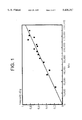
- FIG. 1 is a graphic representation of the ratio of the molecular weight M w of polyaniline to its viscosity ⁇ . The viscosity was measured in a 0.1% wt. polyaniline solution in 97% sulfuric acid and is expressed in dl/g.
- the oxidizing agent i.e. ammonium peroxysulfate, was added to the mixture during the course of 4 hours.
- FIG. 3 shows the viscosity as a function of the aniline feeding time; the experimental points indicated by squares describe the oxidizing agent to aniline molar ratio 1.25 and those indicated by a lozenge the molar ratio 1.15. It is observed, that a lower viscosity is obtained using a larger amount of oxidizing agent.
- the viscosity of polyaniline can be affected simply by modifying the conventional polymerization method according to which all the aniline to be polymerized, the protonic acid, and possibly also the oxidizing agent are introduced simultaneously into the reaction vessel and the mixture is allowed to polymerize for a desired period of time at a controlled temperature.
- the polymerization reaction itself is strongly exothermal, and therefore the polymerization temperature should be regulated by using appropriate cooling systems.
- the polymerization of aniline is thus carried out, so that the components participating in the polymerization reaction, i.e. the aniline monomer-HCl basic material and the oxidizing agent are introduced into the polymerization vessel gradually.
- the components participating in the polymerization reaction i.e. the aniline monomer-HCl basic material and the oxidizing agent are introduced into the polymerization vessel gradually.
- this is done by feeding the components through separate feeder pipes into the polymerization vessel, in which case it is possible to regulate the feeding speeds of the components separately.
- the regulation of feeding speeds of the components affects the molecular weight of the polyaniline formed.
- the preferred oxidizing agent generally used in the aniline polymerization according to the present invention is ammonium peroxysulfate.
- Oxidizing agents conventionally used in the production of polyaniline can be used in the present inventive method. Exemplary of such oxidizing agents are besides ammonium peroxysulfate, K 2 Cr 2 O 7 , KIO 3 , FeCl 3 , KMnO 4 , KBrO 3 , KClO 3 and H 2 O 2 .
- the molar ratio of oxidizing agent to aniline can be varied within a range of about 0.4-1.50, and most 1.00-1.50 but preferably it is about 1.15-1.25.
- the polymerization temperature in the method according to the invention may vary within a range of about -20 to +60 ° C. It has been observed, however, that a preferable temperature is about -10° to 25° C. and the most preferable approximately -5° to 5° C.
- the feeding times of aniline and oxidizing agent according to the method of the present invention may vary up to several hours. It has been observed, that a preferred feeding time is from a couple of hours to several hours, depending on the desired molar mass of polyaniline.
- a preferred feeding time is from a couple of hours to several hours, depending on the desired molar mass of polyaniline.
- the feeding time of aniline is changed, for example from about 2 to 4 hours, the feeding speed of the oxidizing agent being constant, the viscosity is almost cut in half. However, as the feeding time increases further, a corresponding decrease in viscosity will no longer occur.
- the oxidizing agent is also added during the course of several hours, preferably the feeding time is approximately 4 hours. The factor having the most significant effect, however, on the molar mass is the control of the feeding speed of aniline.
- the polymerization of aniline in this comparative example was carried out in a conventional manner by adding the oxidizing agent, ammonium peroxysulfate, into a reaction vessel containing a solution of aniline and 1.2M HCl.
- the ammonium peroxysulfate was added during 4 h the oxidizing agent to aniline ratio being 1.15.
- the polymerization temperature was maintained at 4° C.
- the solution was filtered and the polyaniline complex was washed with water and ethanol.
- the polyaniline complex was treated with a dilute (1%) ammonia solution, whereupon the emeraldine base form of polyaniline was obtained.
- the polymer was washed with water and ethanol and dried in vacuo at 60° C.
- the viscosity (dl/g) of the formed polyaniline was measured in a 0.1% wt. solution of 97% sulfuric acid.
- the viscosity of polyaniline was 0,86 dl/g.
- Aniline and oxidizing agent were fed into the polymerization vessel containing 1.2 M HCl solution from separate feed pipes; the oxidizing agent used was ammonium peroxysulfate at an oxidizing agent to aniline molar ratio of 1.15.
- the polymerization temperature was maintained at 4° C.
- the aniline was added during 2 h (Example 1), 4 h (Example 2), 6 h (Example 3), and the ammonium peroxysulfate during 4 h (Example 1), 4 h (Example 2) and 6 h (Example 3). After the polymerization was completed the solution was filtered and the polyaniline complex was washed with water and ethanol.
- the polyaniline complex was treated with a dilute (1%) ammonia solution, whereupon polyaniline of the emeraldine base form was obtained.
- the polymer was washed with water and ethanol and dried in vacuo at 60° C.
- the viscosity (dl/g) of the formed polyaniline was measured from a 0.1% wt. solution in 97% sulfuric acid. The results are shown in Table 1.
- Aniline polymerization was performed according to Examples 1-3, but the molar ratio of oxidizing agent to aniline was 1.25.
- the aniline was added during 0 h (Example 4, a comparative example), 2 h (Example 5), 4 h (Example 6) and the oxidizing agent during 4 h (Example 4), 2 h (Example 5) and 4 h (Example 6).
- the viscosity was measured as in Examples 1-3, and the results are shown in Table 2.
Landscapes
- Chemical & Material Sciences (AREA)
- Health & Medical Sciences (AREA)
- Chemical Kinetics & Catalysis (AREA)
- Medicinal Chemistry (AREA)
- Polymers & Plastics (AREA)
- Organic Chemistry (AREA)
- Physics & Mathematics (AREA)
- Spectroscopy & Molecular Physics (AREA)
- Macromolecular Compounds Obtained By Forming Nitrogen-Containing Linkages In General (AREA)
Abstract
A method for preparing a polyaniline having a desired molar mass. Control of the molar mass of the polyaniline is achieved in connection with an aniline polymerization reaction, by feeding aniline and an oxidizing agent participating in the polymerization reaction gradually into a polymerization vessel. By varying the feeding speeds of the aniline and the oxidizing agent, polyanilines having different molar masses are obtained.
Description
The invention relates to a method of controlling, during polyaniline synthesis, the molecular weight of the emeraldine base form of polyaniline, which can be converted to a melt processable form of electrically conductive polyaniline. The invention can be used for producing a polyaniline having a desired molar mass, and consequently it is possible to produce a polyaniline polymer having a miscibility suitable, for example, for preparing polymer blends.
Electrically conductive polymers are currently the subject to great interest worldwide. Metallic conductors and semiconductors can be replaced by these polymers in a variety of applications, such as batteries, transducers, switches, photocells, circuit boards, heating elements, antistatic protection (ESD), and electromagnetic protection (EMI). The advantages of electrically conductive polymers over metals include their light weight, their mechanical properties, their corrosion resistance, and lower costs of synthesis and cost of processing.
Electrically conductive plastics can roughly be divided into two categories: filled conductive plastics, in which a conductive filler such as carbon black, carbon fiber, metal powder, etc., is added to a thermosetting or thermoplastic resin, and intrinsically conductive plastics, which are based on polymers made conductive by an oxidation or reduction (doping) process.
The electrical conductivity of certain filled conductive plastics is dependent on the inter-particle contacts between the conductive filler particles. In general, approximately 10-50% wt. of a well dispersed filler is required to produce highly conductive plastics materials. However, such conductive plastics materials have certain disadvantages: their mechanical and some chemical properties are substantially degraded as the filler content increases and the polymer content decreases; their electrical conductivity is difficult to control, especially within the semiconductor regime; and stable and homogeneous dispersions of the fillers in the matrix plastic are often difficult to achieve.
Intrinsically conductive polymers can be produced from organic polymers having long chains made up of conjugated double bonds and heteroatoms. The polymers can be rendered electrically conductive by perturbing the π-electron and π-p-electron systems of the conjugated double bonds and heteroatoms by adding to the polymer certain doping agents which will act either as electron acceptors or electron donors. Thereby, electron holes or excess electrons are formed in the polymer chain, enabling electric current to travel along the conjugated chain.
Intrinsically conductive polymers have the advantage in easy modification of the conductivity as a function of the doping time, which is especially evident within low conductivity ranges. By contrast, for certain filled conductive plastics low conductivities are difficult to achieve. Examples of currently known intrinsically conductive polymers include polyacetylene, poly-p-phenylene, polypyrrole, polythiophene and derivatives thereof, and polyaniline and derivatives thereof.
There are two principal methods for processing conductive polymers into desired parts, fibers, films, etc.: melt processing and solution processing. Melt processing is a versatile processing method, whereas solution processing is applicable mainly to the production of fibers and films but not for the production of thick shaped articles. However, the processing and doping of most polymers which are intrinsically conductive involve problems with respect to handling, stability, homogeneity, etc., of the materials.
Polyaniline and derivatives thereof are technically and commercially promising intrinsically conductive polymers. An aniline polymer is composed of aniline units, the nitrogen atom of which is bonded to the carbon in the p-position of the phenyl ring of the next unit. Unsubstituted polyaniline may occur in a plurality of forms, including leucoemeraldine, protoemeraldine, emeraldine, nigraniline, and toluprotoemeraldine.
Sulfonic acid or derivatives thereof are often used as doping agents for polyaniline. Preferably, the polyaniline doping agent is dodecylbenzenesulfonic acid (DBSA), a derivative of sulfonic acid (cf., for example, patent publications WO-9010297 and U.S. Pat. No. 5,002,700).
In order to improve the electrical, optical and mechanical properties of conductive polymer blend/composites and thereby to expand their range of use, efforts have been made to develop blend/composite materials comprising an intrinsically conductive polymer, a doping agent, and a thermoplastic polymer matrix which would give the blend/composite certain required mechanical properties.
In the preparation of polymer blends, efficient blending of the components is essential for the attainment of a satisfactory end result. It is known that one factor having a decisive effect on miscibility is the molar masses of the polymers, i.e. polymers having a lower molar mass blend better with each other.
The effect of the polymerization conditions of chemical polymerization and, for example, the effect of the oxidizing agent to aniline ratio on the properties of polyaniline, such as its electrical conductivity, yield, elemental composition, and degree of oxidation, have been investigated and described in, for example, the following publications: Pron et al., Synthetic Metals 1988, Vol. 24, p. 193; Armes et al., Synthetic Metals 1988, Vol. 22, p. 283; Asturias et al., Synthetic Metals 1989, Vol. 29, E157. The effect of the conditions of chemical polymerization on the inherent viscosity of polyaniline, which correlates with the molecular weight of the polymer, have been investigated and explained by Yong Cao et al. in Polymer, 1989, 30, Dec. This article discusses, among other things, the effects of oxidizing agents and protonic acids, the aniline to oxidizing agent molar ratio, pH, polymerization temperature and polymerization time, particularly with respect to the viscosity and conductivity of the polymer. The polymerization of aniline according to the methods of this article was carried out in a conventional manner either by adding a solution of HCl and oxidizing agent (the oxidizing agent being, for example, (NH4)2 S2 O8, K2 Cr2 O7, KIO3, FeCl3. KMnO4, KBRO3, KClO3 and H2 O2 into a reaction vessel which containing aniline, or by adding the oxidizing agent into a reaction vessel which contained a solution of aniline and HCl. By varying the parameters mentioned above, polyanilines of different yields, viscosities and conductivities were obtained.
According to the method of the present invention it is possible to control, in a new and surprising manner, the molar mass, i.e. molecular weight, of polyaniline during polyaniline synthesis. The control of the molecular weight of polyaniline in connection with polymer synthesis is, according to this invention, characterized by that aniline and an oxidizing agent are added to a reaction medium separately, in a gradual manner.
These and other objects, features and many of the attendant advantages of the invention will be better understood upon reading of the following detailed description when considered in connection with the accompanying drawings wherein:
FIG. 1 is a graphic representation of the ratio of the molecular weight Mw of polyaniline to its viscosity η. The viscosity was measured in a 0.1% wt. polyaniline solution in 97% sulfuric acid and is expressed in dl/g.
FIG. 2 shows that as the feeding period of aniline increases the viscosity of the resulting polyaniline decreases, and a sharper turn towards a decrease is achieved as the feeding period increases from 2-4 hours (oxidant:aniline ratio=1.15). Indeed, the yield also decreases somewhat, but during the 2-4 hour feeding period range the decrease is quite small. The oxidizing agent, i.e. ammonium peroxysulfate, was added to the mixture during the course of 4 hours.
FIG. 3 shows the viscosity as a function of the aniline feeding time; the experimental points indicated by squares describe the oxidizing agent to aniline molar ratio 1.25 and those indicated by a lozenge the molar ratio 1.15. It is observed, that a lower viscosity is obtained using a larger amount of oxidizing agent.
The invention is described in greater detail in the following detailed description, including the Examples and Tables provided herein. However, the following detailed description must not be taken as limiting to the present invention, since it is intended only to illustrate certain preferred and exemplary embodiments of the present invention.
According to the present invention, it has now been observed, surprisingly, that the viscosity of polyaniline, and thereby its molecular weight, can be affected simply by modifying the conventional polymerization method according to which all the aniline to be polymerized, the protonic acid, and possibly also the oxidizing agent are introduced simultaneously into the reaction vessel and the mixture is allowed to polymerize for a desired period of time at a controlled temperature. The polymerization reaction itself is strongly exothermal, and therefore the polymerization temperature should be regulated by using appropriate cooling systems.
According to the present invention, the polymerization of aniline is thus carried out, so that the components participating in the polymerization reaction, i.e. the aniline monomer-HCl basic material and the oxidizing agent are introduced into the polymerization vessel gradually. In practice this is done by feeding the components through separate feeder pipes into the polymerization vessel, in which case it is possible to regulate the feeding speeds of the components separately. The regulation of feeding speeds of the components affects the molecular weight of the polyaniline formed.
The preferred oxidizing agent generally used in the aniline polymerization according to the present invention is ammonium peroxysulfate. Oxidizing agents conventionally used in the production of polyaniline can be used in the present inventive method. Exemplary of such oxidizing agents are besides ammonium peroxysulfate, K2 Cr2 O7, KIO3, FeCl3, KMnO4, KBrO3, KClO3 and H2 O2. The molar ratio of oxidizing agent to aniline can be varied within a range of about 0.4-1.50, and most 1.00-1.50 but preferably it is about 1.15-1.25. When the oxidizing agent to aniline ratio is 1.25, a viscosity on the average lower than with a ratio of 1.15 is obtained. An excessive amount of oxidizing agent will, as is known Andreatta et.al., Polymer 1989, spoil the aniline material. The polymerization temperature in the method according to the invention may vary within a range of about -20 to +60 ° C. It has been observed, however, that a preferable temperature is about -10° to 25° C. and the most preferable approximately -5° to 5° C.
As a result of the investigations carried out in connection with the present invention it has been demonstrated that there prevails a nearly linear relationship between the viscosity and the molecular weight of polyaniline. The viscosity (dl/g) is measured from a solution which contains 0.1% wt. polyaniline in 97% sulfuric acid. In the appended FIG. 1 this proportionality is shown graphically.
The feeding times of aniline and oxidizing agent according to the method of the present invention may vary up to several hours. It has been observed, that a preferred feeding time is from a couple of hours to several hours, depending on the desired molar mass of polyaniline. When the feeding time of aniline is changed, for example from about 2 to 4 hours, the feeding speed of the oxidizing agent being constant, the viscosity is almost cut in half. However, as the feeding time increases further, a corresponding decrease in viscosity will no longer occur. The oxidizing agent is also added during the course of several hours, preferably the feeding time is approximately 4 hours. The factor having the most significant effect, however, on the molar mass is the control of the feeding speed of aniline.
The polymerization of aniline in this comparative example was carried out in a conventional manner by adding the oxidizing agent, ammonium peroxysulfate, into a reaction vessel containing a solution of aniline and 1.2M HCl. The ammonium peroxysulfate was added during 4 h the oxidizing agent to aniline ratio being 1.15. The polymerization temperature was maintained at 4° C. After the polymerization was completed, the solution was filtered and the polyaniline complex was washed with water and ethanol. The polyaniline complex was treated with a dilute (1%) ammonia solution, whereupon the emeraldine base form of polyaniline was obtained. The polymer was washed with water and ethanol and dried in vacuo at 60° C. The viscosity (dl/g) of the formed polyaniline was measured in a 0.1% wt. solution of 97% sulfuric acid. The viscosity of polyaniline was 0,86 dl/g.
Examples 1-3
Aniline and oxidizing agent were fed into the polymerization vessel containing 1.2 M HCl solution from separate feed pipes; the oxidizing agent used was ammonium peroxysulfate at an oxidizing agent to aniline molar ratio of 1.15. The polymerization temperature was maintained at 4° C. The aniline was added during 2 h (Example 1), 4 h (Example 2), 6 h (Example 3), and the ammonium peroxysulfate during 4 h (Example 1), 4 h (Example 2) and 6 h (Example 3). After the polymerization was completed the solution was filtered and the polyaniline complex was washed with water and ethanol. The polyaniline complex was treated with a dilute (1%) ammonia solution, whereupon polyaniline of the emeraldine base form was obtained. The polymer was washed with water and ethanol and dried in vacuo at 60° C. The viscosity (dl/g) of the formed polyaniline was measured from a 0.1% wt. solution in 97% sulfuric acid. The results are shown in Table 1.
              TABLE 1
______________________________________
Viscosity of polyaniline as a function of
the feeding times of aniline and ammonium peroxysulfate,
the molar ratio of oxidizing agent to aniline being 1.15.
           t.sub.ANI    t.sub.APS
                               η.sub.PANI
Experiment (h)          (h)    (dl/g)
______________________________________
A          0            4      0,86
1          2            4      0.61
2          4            4      0.32
3          6            6      0.35
______________________________________
 Abbreviations used:
 t.sub.ANI = aniline feeding period
 t.sub.APS = ammonium peroxysulfate feeding period
 η.sub.PANI = polyaniline viscosity
Aniline polymerization was performed according to Examples 1-3, but the molar ratio of oxidizing agent to aniline was 1.25. The aniline was added during 0 h (Example 4, a comparative example), 2 h (Example 5), 4 h (Example 6) and the oxidizing agent during 4 h (Example 4), 2 h (Example 5) and 4 h (Example 6). The viscosity was measured as in Examples 1-3, and the results are shown in Table 2.
              TABLE 2
______________________________________
Viscosity of polyaniline as a function of
the feeding times of aniline and ammonium peroxysulfate,
the molar ratio of oxidizing agent to aniline being 1.25.
           t.sub.ANI    t.sub.APS
                               η.sub.PANI
Experiment (h)          (h)    (dl/g)
______________________________________
4          0            4      0.70
5          2            2      0.24
6          4            4      0.17
______________________________________
 Abbreviations used:
 t.sub.ANI = aniline feeding period
 t.sub.APS = ammonium peroxysulfate feeding period
 η.sub.PANI = polyaniline viscosity
It can clearly be seen from the examples and tables presented above and from the appended figures that during polymerization of aniline it is possible to control the molar mass of polyaniline by regulating the speeds at which the oxidizing agent used for the polymerization and the aniline are fed into the polymerization reactor. Especially by slowing down the feeding speed of aniline, a polyaniline having a lower viscosity and thereby a lower molar mass is obtained. The method is simple and it does not have significant adverse effects on the polymer yield or other properties of the polymer when the feeding periods involved are in the order of a few hours (e.g., up to about 6 hours).
Each of the publications and patents referred to hereinabove, are expressly incorporated herein by reference in their entirety.
Claims (13)
1. In a method for producing a polyaniline by polymerizing aniline in a reaction mixture in the presence of an oxidizing agent, the improvement comprising the step of:
adding the aniline and the oxidizing agent to the reaction mixture separately in a gradual manner at a temperature of about -20° C. to about 460° C. over a time period of up to about 6 hours, in a molar ratio of the added oxidizing agent to the added aniline of about 0.4 to 1.50.
2. The method according to claim 1, wherein the aniline and the oxidizing agent are added to the reaction mixture simultaneously.
3. The method according to claim 1, wherein the molar mass of the polyaniline produced is decreased by increasing the time period over which the aniline and the oxidizing agent are added to the reaction mixture, provided that the time period for the addition of the aniline is up to about 4 hours.
4. The method according to claim 1, wherein the time period over which the aniline and the oxidizing agent are added to the reaction mixture is up to about 4 hours.
5. The method according to claim 1, wherein the time period over which the aniline is added to the reaction mixture is about 2 to 4 hours.
6. The method according to claim 1, wherein the molar ratio of the oxidizing agent to the aniline added to the reaction mixture is within a range of about 1.00-1.50.
7. The method according to claim 1, wherein the molar ratio of the oxidizing agent to the aniline added to the reaction mixture is within a range of about 1.15-1.25.
8. The method according to claim 1, wherein the oxidizing agent used is ammonium peroxysulfate.
9. The method according to claim 1, wherein the aniline is polymerized in an acid solution to give the polyaniline.
10. The method according to claim 1, wherein the aniline is polymerized at a temperature which is within a range of about -10° C. to +25° C.
11. The method according to claim 1, wherein the polymerization occurs at a temperature of about -5° C. to 5° C.
12. The method according to claim 1, wherein as the time period over which the aniline is added to the reaction mixture is increased, over a time period of up to 4 hours, a polyaniline having a decreased molar mass is obtained.
13. The method of claim 1, wherein the oxidizing agent is selected from the group consisting of (NH4)2 S2 O8, K2 Cr2 O7, KIO3, FeCl3, KMnO4, KBrO3, KClO3 and H2 O2.
Applications Claiming Priority (2)
| Application Number | Priority Date | Filing Date | Title |
|---|---|---|---|
| FI925971 | 1992-12-31 | ||
| FI925971A FI93021C (en) | 1992-12-31 | 1992-12-31 | Process for polymerizing aniline by gradually adding aniline and oxidant |
Publications (1)
| Publication Number | Publication Date |
|---|---|
| US5436317A true US5436317A (en) | 1995-07-25 |
Family
ID=8536506
Family Applications (1)
| Application Number | Title | Priority Date | Filing Date |
|---|---|---|---|
| US08/168,189 Expired - Fee Related US5436317A (en) | 1992-12-31 | 1993-12-17 | Method for preparing polyaniline |
Country Status (5)
| Country | Link |
|---|---|
| US (1) | US5436317A (en) |
| EP (1) | EP0605877B1 (en) |
| JP (1) | JPH06234851A (en) |
| DE (1) | DE69325356T2 (en) |
| FI (1) | FI93021C (en) |
Cited By (10)
| Publication number | Priority date | Publication date | Assignee | Title |
|---|---|---|---|---|
| WO1998004514A1 (en) * | 1996-07-26 | 1998-02-05 | The Trustees Of The University Of Pennsylvania | Chiral polyanilines and the synthesis thereof |
| US5744431A (en) * | 1995-01-10 | 1998-04-28 | International Business Machines Corporation | Conductive lubricant for magnetic disk drives |
| US5792830A (en) * | 1996-12-09 | 1998-08-11 | The Dow Chemical Company | Process for preparing polyaniline |
| US5959072A (en) * | 1998-01-26 | 1999-09-28 | Conpoly Technology Co., Ltd. | Wastewater-recyclable process for producing a polyaniline resin powder |
| US5997770A (en) * | 1998-03-05 | 1999-12-07 | Conpoly Technology Co., Ltd. | Process for doping polyaniline powder |
| US6072027A (en) * | 1997-11-18 | 2000-06-06 | The Dow Chemical Company | Process for preparing an electrically conductive polymer |
| US6110563A (en) * | 1995-12-22 | 2000-08-29 | Nokia Mobile Phones, Ltd. | Method and arrangement for electromagnetically shielding an electronic means |
| US6303053B1 (en) | 1999-09-20 | 2001-10-16 | Honda Giken Kogyo Kabushiki Kaisha | Method for producing meta type polyaniline |
| US6509502B1 (en) | 2000-04-04 | 2003-01-21 | Matti Jussila | Method and apparatus for preparing polyaniline |
| US7628944B2 (en) | 2002-10-30 | 2009-12-08 | Santa Fe Science And Technology, Inc. | Spinning, doping, dedoping and redoping polyaniline fiber |
Families Citing this family (2)
| Publication number | Priority date | Publication date | Assignee | Title |
|---|---|---|---|---|
| AU2001252301A1 (en) * | 2000-04-04 | 2001-10-15 | Panipol Oy | A method and an apparatus for preparing polyaniline |
| CN100412109C (en) * | 2006-07-18 | 2008-08-20 | 重庆金固特化工新材料技术有限公司 | A synthetic device for industrial production of polyaniline |
Citations (6)
| Publication number | Priority date | Publication date | Assignee | Title |
|---|---|---|---|---|
| US4615829A (en) * | 1983-11-10 | 1986-10-07 | Nitto Electric Industrial Co., Ltd. | Electroconductive organic polymer and method for producing the same |
| US5002700A (en) * | 1988-08-30 | 1991-03-26 | Osaka Gas Company Limited | Permanently doped polyaniline and method thereof |
| WO1991011480A1 (en) * | 1990-01-30 | 1991-08-08 | Lockheed Corporation | Preparation of conductive polyaniline having controlled molecular weight |
| EP0497379A1 (en) * | 1991-02-01 | 1992-08-05 | Nitto Denko Corporation | Organic polymer solution |
| US5160457A (en) * | 1987-08-07 | 1992-11-03 | Allied-Signal Inc. | Thermally stable forms of electrically conductive polyaniline |
| US5324453A (en) * | 1992-08-07 | 1994-06-28 | Neste Oy | Electrically conducting polyaniline: method for emulsion polymerization |
-
1992
- 1992-12-31 FI FI925971A patent/FI93021C/en not_active IP Right Cessation
-
1993
- 1993-12-17 US US08/168,189 patent/US5436317A/en not_active Expired - Fee Related
- 1993-12-27 EP EP93120954A patent/EP0605877B1/en not_active Expired - Lifetime
- 1993-12-27 DE DE69325356T patent/DE69325356T2/en not_active Expired - Fee Related
- 1993-12-28 JP JP5337133A patent/JPH06234851A/en active Pending
Patent Citations (6)
| Publication number | Priority date | Publication date | Assignee | Title |
|---|---|---|---|---|
| US4615829A (en) * | 1983-11-10 | 1986-10-07 | Nitto Electric Industrial Co., Ltd. | Electroconductive organic polymer and method for producing the same |
| US5160457A (en) * | 1987-08-07 | 1992-11-03 | Allied-Signal Inc. | Thermally stable forms of electrically conductive polyaniline |
| US5002700A (en) * | 1988-08-30 | 1991-03-26 | Osaka Gas Company Limited | Permanently doped polyaniline and method thereof |
| WO1991011480A1 (en) * | 1990-01-30 | 1991-08-08 | Lockheed Corporation | Preparation of conductive polyaniline having controlled molecular weight |
| EP0497379A1 (en) * | 1991-02-01 | 1992-08-05 | Nitto Denko Corporation | Organic polymer solution |
| US5324453A (en) * | 1992-08-07 | 1994-06-28 | Neste Oy | Electrically conducting polyaniline: method for emulsion polymerization |
Non-Patent Citations (8)
| Title |
|---|
| A. Pron et al., The Effect of the Oxidation Conditions on the Chemical Polymerization of Polyaniline, Synthetic Metals, vol. 24, 1988, pp. 193 201. * |
| A. Pron et al., The Effect of the Oxidation Conditions on the Chemical Polymerization of Polyaniline, Synthetic Metals, vol. 24, 1988, pp. 193-201. |
| G. E. Asturias et al., The Oxidation State of "Emeraldine" Base, Synthetic Metals, vol. 29, 1989, pp. E157-E162. |
| G. E. Asturias et al., The Oxidation State of Emeraldine Base, Synthetic Metals, vol. 29, 1989, pp. E157 E162. * |
| S. P. Armes et al., Optimum Reaction Conditions for the Polymerization of Aniline in Aqueous Solution by Ammonium Persulphate, Synthetic Metals, vol. 22, 1988, pp. 385 393. * |
| S. P. Armes et al., Optimum Reaction Conditions for the Polymerization of Aniline in Aqueous Solution by Ammonium Persulphate, Synthetic Metals, vol. 22, 1988, pp. 385-393. |
| Y. Cao et al., Influence of chemical polymerization conditions on the properties of polyaniline, Polymer, vol. 30, Dec., 1989, pp. 2305 2311. * |
| Y. Cao et al., Influence of chemical polymerization conditions on the properties of polyaniline, Polymer, vol. 30, Dec., 1989, pp. 2305-2311. |
Cited By (14)
| Publication number | Priority date | Publication date | Assignee | Title |
|---|---|---|---|---|
| US5744431A (en) * | 1995-01-10 | 1998-04-28 | International Business Machines Corporation | Conductive lubricant for magnetic disk drives |
| US6110563A (en) * | 1995-12-22 | 2000-08-29 | Nokia Mobile Phones, Ltd. | Method and arrangement for electromagnetically shielding an electronic means |
| US6090985A (en) * | 1996-07-26 | 2000-07-18 | The Trustees Of The University Of Pennsylvania | Chiral polyanilines and the synthesis thereof |
| WO1998004514A1 (en) * | 1996-07-26 | 1998-02-05 | The Trustees Of The University Of Pennsylvania | Chiral polyanilines and the synthesis thereof |
| US5792830A (en) * | 1996-12-09 | 1998-08-11 | The Dow Chemical Company | Process for preparing polyaniline |
| US6072027A (en) * | 1997-11-18 | 2000-06-06 | The Dow Chemical Company | Process for preparing an electrically conductive polymer |
| US5959072A (en) * | 1998-01-26 | 1999-09-28 | Conpoly Technology Co., Ltd. | Wastewater-recyclable process for producing a polyaniline resin powder |
| US5997770A (en) * | 1998-03-05 | 1999-12-07 | Conpoly Technology Co., Ltd. | Process for doping polyaniline powder |
| US6303053B1 (en) | 1999-09-20 | 2001-10-16 | Honda Giken Kogyo Kabushiki Kaisha | Method for producing meta type polyaniline |
| US6509502B1 (en) | 2000-04-04 | 2003-01-21 | Matti Jussila | Method and apparatus for preparing polyaniline |
| US7628944B2 (en) | 2002-10-30 | 2009-12-08 | Santa Fe Science And Technology, Inc. | Spinning, doping, dedoping and redoping polyaniline fiber |
| US20100072428A1 (en) * | 2002-10-30 | 2010-03-25 | Santa Fe Science And Technology, Inc. | Spinning, doping, dedoping and redoping polyaniline fiber |
| US7897082B2 (en) | 2002-10-30 | 2011-03-01 | Santa Fe Science & Technology, Inc. | Spinning, doping, dedoping and redoping polyaniline fiber |
| US8425822B2 (en) | 2002-10-30 | 2013-04-23 | Santa Fe Science And Technology, Inc. | Spinning, doping, dedoping and redoping polyaniline fiber |
Also Published As
| Publication number | Publication date |
|---|---|
| JPH06234851A (en) | 1994-08-23 |
| FI925971L (en) | 1994-07-01 |
| DE69325356D1 (en) | 1999-07-22 |
| EP0605877A2 (en) | 1994-07-13 |
| FI93021C (en) | 1995-02-10 |
| FI925971A0 (en) | 1992-12-31 |
| FI93021B (en) | 1994-10-31 |
| EP0605877B1 (en) | 1999-06-16 |
| EP0605877A3 (en) | 1994-09-07 |
| DE69325356T2 (en) | 1999-10-14 |
Similar Documents
| Publication | Publication Date | Title |
|---|---|---|
| Österholm et al. | Emulsion polymerization of aniline | |
| EP0605877B1 (en) | Method for preparing polyaniline | |
| DE69330375T2 (en) | ELECTRICALLY CONDUCTIVE POLYANILINE: METHOD FOR EMULSION POLIMERISATION | |
| US5232631A (en) | Processible forms of electrically conductive polyaniline | |
| Shacklette et al. | Polyaniline blends in thermoplastics | |
| US5624605A (en) | Processible forms of electrically conductive polyaniline | |
| US5595689A (en) | Highly conductive polymer blends with intrinsically conductive polymers | |
| JP3017903B2 (en) | Conductive plastic material and method of manufacturing the same | |
| KR100295528B1 (en) | Oxidative/reductive methods of deaggregation of electrically conductive polymers and precursors thereof and methods of fabricating articles therewith | |
| Armes et al. | Synthesis and characterization of aqueous colloidal dispersions of poly (vinyl alcohol)/polyaniline particles | |
| DE69229727T2 (en) | THERMOPLASTIC CONDUCTIVE POLYMER MIXTURES BASED ON FIBRILLS OF DIFFICULT TO PROCESS POLYMERS | |
| EP0643397A1 (en) | Electrically conducting compositions | |
| JPH01503242A (en) | conductive plastic composite | |
| FI86880B (en) | ELLEDANDE PLASTKOMPOSIT, DESS ANVAENDNING OCH FRAMSTAELLNING. | |
| Abd Razak et al. | Polyaniline and their conductive polymer blends: A short review | |
| US4404126A (en) | Preparation of electrically conductive polymeric systems | |
| KR100212199B1 (en) | Electrical conductive resin and its preparation method | |
| Ajekwene et al. | Sodium salt of polyethylene-co-methacrylic acid ionomer/polyaniline binary blends for EMI shielding applications | |
| Jabnoor et al. | Synthesis, characterisation and AC conductivity study of PANI/α-Fe2O3 nanocomposites | |
| FI101078B (en) | Conductive polymer and process for making the same | |
| US5507977A (en) | Conducting plastic material and method of producing such material | |
| Passiniemi et al. | Electrically conducting polymer blends based on polyaniline | |
| KR20110054916A (en) | Manufacturing method of electrically conductive composite material using acicular polyaniline | |
| Saini et al. | Structural, spectral and thermal properties of bulky organic sulfonic acids doped polyanilines and antistatic performance of its melt blend | |
| CN102604215A (en) | Phase separation conductive high molecular composite material |
Legal Events
| Date | Code | Title | Description |
|---|---|---|---|
| AS | Assignment |
Owner name: NESTE OY, FINLAND Free format text: ASSIGNMENT OF ASSIGNORS INTEREST;ASSIGNORS:JARVINEN, HANNELE;LAAKSO, JUKKA;AUVINEN, IRMA;AND OTHERS;REEL/FRAME:006821/0609 Effective date: 19931124 |
|
| CC | Certificate of correction | ||
| FPAY | Fee payment |
Year of fee payment: 4 |
|
| REMI | Maintenance fee reminder mailed | ||
| LAPS | Lapse for failure to pay maintenance fees | ||
| STCH | Information on status: patent discontinuation |
Free format text: PATENT EXPIRED DUE TO NONPAYMENT OF MAINTENANCE FEES UNDER 37 CFR 1.362 |
|
| FP | Lapsed due to failure to pay maintenance fee |
Effective date: 20030725 |