US5393848A - Process for forming improved liquid crystalline polymer blends - Google Patents
Process for forming improved liquid crystalline polymer blends Download PDFInfo
- Publication number
- US5393848A US5393848A US08/017,948 US1794893A US5393848A US 5393848 A US5393848 A US 5393848A US 1794893 A US1794893 A US 1794893A US 5393848 A US5393848 A US 5393848A
- Authority
- US
- United States
- Prior art keywords
- liquid crystalline
- crystalline polymer
- preformed
- melt
- poly
- Prior art date
- Legal status (The legal status is an assumption and is not a legal conclusion. Google has not performed a legal analysis and makes no representation as to the accuracy of the status listed.)
- Expired - Lifetime
Links
- 229920000106 Liquid crystal polymer Polymers 0.000 title claims abstract description 71
- 239000000203 mixture Substances 0.000 title claims abstract description 57
- 238000000034 method Methods 0.000 title claims abstract description 40
- 230000008569 process Effects 0.000 title claims abstract description 10
- 239000000376 reactant Substances 0.000 claims abstract description 19
- 230000002051 biphasic effect Effects 0.000 claims abstract description 13
- 238000002156 mixing Methods 0.000 claims abstract description 3
- 229920000642 polymer Polymers 0.000 claims description 89
- 239000000178 monomer Substances 0.000 claims description 67
- FJKROLUGYXJWQN-UHFFFAOYSA-N 4-hydroxybenzoic acid Chemical compound OC(=O)C1=CC=C(O)C=C1 FJKROLUGYXJWQN-UHFFFAOYSA-N 0.000 claims description 62
- WFDIJRYMOXRFFG-UHFFFAOYSA-N Acetic anhydride Chemical compound CC(=O)OC(C)=O WFDIJRYMOXRFFG-UHFFFAOYSA-N 0.000 claims description 54
- QQVIHTHCMHWDBS-UHFFFAOYSA-N isophthalic acid Chemical compound OC(=O)C1=CC=CC(C(O)=O)=C1 QQVIHTHCMHWDBS-UHFFFAOYSA-N 0.000 claims description 48
- 125000003118 aryl group Chemical group 0.000 claims description 45
- 229920000728 polyester Polymers 0.000 claims description 43
- KKEYFWRCBNTPAC-UHFFFAOYSA-N Terephthalic acid Chemical compound OC(=O)C1=CC=C(C(O)=O)C=C1 KKEYFWRCBNTPAC-UHFFFAOYSA-N 0.000 claims description 34
- 229940090248 4-hydroxybenzoic acid Drugs 0.000 claims description 31
- 238000006116 polymerization reaction Methods 0.000 claims description 20
- 238000006243 chemical reaction Methods 0.000 claims description 17
- -1 p-aminophenoxy repeat Chemical group 0.000 claims description 14
- QTBSBXVTEAMEQO-UHFFFAOYSA-N Acetic acid Chemical group CC(O)=O QTBSBXVTEAMEQO-UHFFFAOYSA-N 0.000 claims description 13
- 238000010438 heat treatment Methods 0.000 claims description 13
- KAUQJMHLAFIZDU-UHFFFAOYSA-N 6-Hydroxy-2-naphthoic acid Chemical compound C1=C(O)C=CC2=CC(C(=O)O)=CC=C21 KAUQJMHLAFIZDU-UHFFFAOYSA-N 0.000 claims description 6
- 238000002844 melting Methods 0.000 claims description 6
- 230000008018 melting Effects 0.000 claims description 6
- ISWSIDIOOBJBQZ-UHFFFAOYSA-N phenol group Chemical group C1(=CC=CC=C1)O ISWSIDIOOBJBQZ-UHFFFAOYSA-N 0.000 claims description 5
- RXOHFPCZGPKIRD-UHFFFAOYSA-N naphthalene-2,6-dicarboxylic acid Chemical compound C1=C(C(O)=O)C=CC2=CC(C(=O)O)=CC=C21 RXOHFPCZGPKIRD-UHFFFAOYSA-N 0.000 claims description 4
- 229920001279 poly(ester amides) Polymers 0.000 claims description 4
- 125000001424 substituent group Chemical group 0.000 claims description 4
- MNZMMCVIXORAQL-UHFFFAOYSA-N naphthalene-2,6-diol Chemical compound C1=C(O)C=CC2=CC(O)=CC=C21 MNZMMCVIXORAQL-UHFFFAOYSA-N 0.000 claims description 3
- 125000001624 naphthyl group Chemical group 0.000 claims description 3
- 238000002360 preparation method Methods 0.000 claims description 3
- HBGGXOJOCNVPFY-UHFFFAOYSA-N diisononyl phthalate Chemical compound CC(C)CCCCCCOC(=O)C1=CC=CC=C1C(=O)OCCCCCCC(C)C HBGGXOJOCNVPFY-UHFFFAOYSA-N 0.000 claims 2
- 238000004519 manufacturing process Methods 0.000 claims 2
- 239000000155 melt Substances 0.000 abstract description 25
- 239000000047 product Substances 0.000 description 48
- QIGBRXMKCJKVMJ-UHFFFAOYSA-N Hydroquinone Chemical compound OC1=CC=C(O)C=C1 QIGBRXMKCJKVMJ-UHFFFAOYSA-N 0.000 description 35
- SCVFZCLFOSHCOH-UHFFFAOYSA-M potassium acetate Chemical compound [K+].CC([O-])=O SCVFZCLFOSHCOH-UHFFFAOYSA-M 0.000 description 32
- 238000012360 testing method Methods 0.000 description 24
- 239000004594 Masterbatch (MB) Substances 0.000 description 23
- IJGRMHOSHXDMSA-UHFFFAOYSA-N Atomic nitrogen Chemical compound N#N IJGRMHOSHXDMSA-UHFFFAOYSA-N 0.000 description 17
- 239000000835 fiber Substances 0.000 description 17
- 235000011056 potassium acetate Nutrition 0.000 description 16
- 239000011521 glass Substances 0.000 description 14
- BYEAHWXPCBROCE-UHFFFAOYSA-N 1,1,1,3,3,3-hexafluoropropan-2-ol Chemical compound FC(F)(F)C(O)C(F)(F)F BYEAHWXPCBROCE-UHFFFAOYSA-N 0.000 description 13
- XBNGYFFABRKICK-UHFFFAOYSA-N 2,3,4,5,6-pentafluorophenol Chemical compound OC1=C(F)C(F)=C(F)C(F)=C1F XBNGYFFABRKICK-UHFFFAOYSA-N 0.000 description 13
- 238000011065 in-situ storage Methods 0.000 description 13
- IZUPBVBPLAPZRR-UHFFFAOYSA-N pentachloro-phenol Natural products OC1=C(Cl)C(Cl)=C(Cl)C(Cl)=C1Cl IZUPBVBPLAPZRR-UHFFFAOYSA-N 0.000 description 13
- 239000007788 liquid Substances 0.000 description 11
- VCCBEIPGXKNHFW-UHFFFAOYSA-N biphenyl-4,4'-diol Chemical compound C1=CC(O)=CC=C1C1=CC=C(O)C=C1 VCCBEIPGXKNHFW-UHFFFAOYSA-N 0.000 description 10
- 239000003054 catalyst Substances 0.000 description 9
- 230000000052 comparative effect Effects 0.000 description 9
- 229920001577 copolymer Polymers 0.000 description 9
- 229910052757 nitrogen Inorganic materials 0.000 description 9
- 125000004432 carbon atom Chemical group C* 0.000 description 6
- 230000015572 biosynthetic process Effects 0.000 description 5
- 238000002347 injection Methods 0.000 description 5
- 239000007924 injection Substances 0.000 description 5
- 238000010128 melt processing Methods 0.000 description 5
- 238000000399 optical microscopy Methods 0.000 description 5
- 239000012783 reinforcing fiber Substances 0.000 description 5
- VYPSYNLAJGMNEJ-UHFFFAOYSA-N silicon dioxide Inorganic materials O=[Si]=O VYPSYNLAJGMNEJ-UHFFFAOYSA-N 0.000 description 5
- 239000007787 solid Substances 0.000 description 5
- 125000000217 alkyl group Chemical group 0.000 description 4
- 239000003365 glass fiber Substances 0.000 description 4
- 125000001997 phenyl group Chemical group [H]C1=C([H])C([H])=C(*)C([H])=C1[H] 0.000 description 4
- 238000010926 purge Methods 0.000 description 4
- GHMLBKRAJCXXBS-UHFFFAOYSA-N resorcinol Chemical compound OC1=CC=CC(O)=C1 GHMLBKRAJCXXBS-UHFFFAOYSA-N 0.000 description 4
- GDBUZIKSJGRBJP-UHFFFAOYSA-N 4-acetoxy benzoic acid Chemical compound CC(=O)OC1=CC=C(C(O)=O)C=C1 GDBUZIKSJGRBJP-UHFFFAOYSA-N 0.000 description 3
- OFOBLEOULBTSOW-UHFFFAOYSA-N Malonic acid Chemical compound OC(=O)CC(O)=O OFOBLEOULBTSOW-UHFFFAOYSA-N 0.000 description 3
- 150000001242 acetic acid derivatives Chemical class 0.000 description 3
- 125000001931 aliphatic group Chemical group 0.000 description 3
- 125000000687 hydroquinonyl group Chemical group C1(O)=C(C=C(O)C=C1)* 0.000 description 3
- 125000002887 hydroxy group Chemical group [H]O* 0.000 description 3
- 239000000463 material Substances 0.000 description 3
- 238000005259 measurement Methods 0.000 description 3
- 238000000465 moulding Methods 0.000 description 3
- 238000006467 substitution reaction Methods 0.000 description 3
- AKOGNYJNGMLDOA-UHFFFAOYSA-N (4-acetyloxyphenyl) acetate Chemical compound CC(=O)OC1=CC=C(OC(C)=O)C=C1 AKOGNYJNGMLDOA-UHFFFAOYSA-N 0.000 description 2
- WKBOTKDWSSQWDR-UHFFFAOYSA-N Bromine atom Chemical compound [Br] WKBOTKDWSSQWDR-UHFFFAOYSA-N 0.000 description 2
- FERIUCNNQQJTOY-UHFFFAOYSA-N Butyric acid Chemical compound CCCC(O)=O FERIUCNNQQJTOY-UHFFFAOYSA-N 0.000 description 2
- 229920000049 Carbon (fiber) Polymers 0.000 description 2
- ZAMOUSCENKQFHK-UHFFFAOYSA-N Chlorine atom Chemical compound [Cl] ZAMOUSCENKQFHK-UHFFFAOYSA-N 0.000 description 2
- RTZKZFJDLAIYFH-UHFFFAOYSA-N Diethyl ether Chemical compound CCOCC RTZKZFJDLAIYFH-UHFFFAOYSA-N 0.000 description 2
- PXGOKWXKJXAPGV-UHFFFAOYSA-N Fluorine Chemical compound FF PXGOKWXKJXAPGV-UHFFFAOYSA-N 0.000 description 2
- 230000021736 acetylation Effects 0.000 description 2
- 238000006640 acetylation reaction Methods 0.000 description 2
- 239000002253 acid Substances 0.000 description 2
- 125000003545 alkoxy group Chemical group 0.000 description 2
- PNEYBMLMFCGWSK-UHFFFAOYSA-N aluminium oxide Inorganic materials [O-2].[O-2].[O-2].[Al+3].[Al+3] PNEYBMLMFCGWSK-UHFFFAOYSA-N 0.000 description 2
- GDTBXPJZTBHREO-UHFFFAOYSA-N bromine Substances BrBr GDTBXPJZTBHREO-UHFFFAOYSA-N 0.000 description 2
- 229910052794 bromium Inorganic materials 0.000 description 2
- 239000006227 byproduct Substances 0.000 description 2
- 239000004917 carbon fiber Substances 0.000 description 2
- 239000000460 chlorine Substances 0.000 description 2
- 229910052801 chlorine Inorganic materials 0.000 description 2
- 150000001875 compounds Chemical class 0.000 description 2
- 238000002425 crystallisation Methods 0.000 description 2
- 230000008025 crystallization Effects 0.000 description 2
- 238000000113 differential scanning calorimetry Methods 0.000 description 2
- XBDQKXXYIPTUBI-UHFFFAOYSA-N dimethylselenoniopropionate Natural products CCC(O)=O XBDQKXXYIPTUBI-UHFFFAOYSA-N 0.000 description 2
- 239000000945 filler Substances 0.000 description 2
- 229910052731 fluorine Inorganic materials 0.000 description 2
- 239000011737 fluorine Substances 0.000 description 2
- 229910052736 halogen Inorganic materials 0.000 description 2
- 150000002367 halogens Chemical class 0.000 description 2
- 125000004435 hydrogen atom Chemical group [H]* 0.000 description 2
- KQNPFQTWMSNSAP-UHFFFAOYSA-N isobutyric acid Chemical compound CC(C)C(O)=O KQNPFQTWMSNSAP-UHFFFAOYSA-N 0.000 description 2
- 230000003287 optical effect Effects 0.000 description 2
- 238000001907 polarising light microscopy Methods 0.000 description 2
- 238000012667 polymer degradation Methods 0.000 description 2
- 238000010791 quenching Methods 0.000 description 2
- 230000000171 quenching effect Effects 0.000 description 2
- 238000000518 rheometry Methods 0.000 description 2
- 239000004576 sand Substances 0.000 description 2
- 238000005809 transesterification reaction Methods 0.000 description 2
- 239000010456 wollastonite Substances 0.000 description 2
- 229910052882 wollastonite Inorganic materials 0.000 description 2
- NJKVZDOEWYNQIO-UHFFFAOYSA-N 2-chlorobenzene-1,3-dicarboxylic acid Chemical compound OC(=O)C1=CC=CC(C(O)=O)=C1Cl NJKVZDOEWYNQIO-UHFFFAOYSA-N 0.000 description 1
- ZPXGNBIFHQKREO-UHFFFAOYSA-N 2-chloroterephthalic acid Chemical compound OC(=O)C1=CC=C(C(O)=O)C(Cl)=C1 ZPXGNBIFHQKREO-UHFFFAOYSA-N 0.000 description 1
- SGRVMTDADJLWDP-UHFFFAOYSA-N 2-phenylbenzene-1,3-dicarboxylic acid Chemical compound OC(=O)C1=CC=CC(C(O)=O)=C1C1=CC=CC=C1 SGRVMTDADJLWDP-UHFFFAOYSA-N 0.000 description 1
- VSZJLXSVGVDPMJ-UHFFFAOYSA-N 2-phenylterephthalic acid Chemical compound OC(=O)C1=CC=C(C(O)=O)C(C=2C=CC=CC=2)=C1 VSZJLXSVGVDPMJ-UHFFFAOYSA-N 0.000 description 1
- 229910000619 316 stainless steel Inorganic materials 0.000 description 1
- VPWNQTHUCYMVMZ-UHFFFAOYSA-N 4,4'-sulfonyldiphenol Chemical compound C1=CC(O)=CC=C1S(=O)(=O)C1=CC=C(O)C=C1 VPWNQTHUCYMVMZ-UHFFFAOYSA-N 0.000 description 1
- WVDRSXGPQWNUBN-UHFFFAOYSA-N 4-(4-carboxyphenoxy)benzoic acid Chemical compound C1=CC(C(=O)O)=CC=C1OC1=CC=C(C(O)=O)C=C1 WVDRSXGPQWNUBN-UHFFFAOYSA-N 0.000 description 1
- NEQFBGHQPUXOFH-UHFFFAOYSA-N 4-(4-carboxyphenyl)benzoic acid Chemical compound C1=CC(C(=O)O)=CC=C1C1=CC=C(C(O)=O)C=C1 NEQFBGHQPUXOFH-UHFFFAOYSA-N 0.000 description 1
- NZGQHKSLKRFZFL-UHFFFAOYSA-N 4-(4-hydroxyphenoxy)phenol Chemical compound C1=CC(O)=CC=C1OC1=CC=C(O)C=C1 NZGQHKSLKRFZFL-UHFFFAOYSA-N 0.000 description 1
- OKTJSMMVPCPJKN-UHFFFAOYSA-N Carbon Chemical compound [C] OKTJSMMVPCPJKN-UHFFFAOYSA-N 0.000 description 1
- 229920003043 Cellulose fiber Polymers 0.000 description 1
- 229920001634 Copolyester Polymers 0.000 description 1
- 229920000742 Cotton Polymers 0.000 description 1
- FYYHWMGAXLPEAU-UHFFFAOYSA-N Magnesium Chemical compound [Mg] FYYHWMGAXLPEAU-UHFFFAOYSA-N 0.000 description 1
- ZLMJMSJWJFRBEC-UHFFFAOYSA-N Potassium Chemical compound [K] ZLMJMSJWJFRBEC-UHFFFAOYSA-N 0.000 description 1
- 101100386054 Saccharomyces cerevisiae (strain ATCC 204508 / S288c) CYS3 gene Proteins 0.000 description 1
- 229910000831 Steel Inorganic materials 0.000 description 1
- RTAQQCXQSZGOHL-UHFFFAOYSA-N Titanium Chemical compound [Ti] RTAQQCXQSZGOHL-UHFFFAOYSA-N 0.000 description 1
- YKTSYUJCYHOUJP-UHFFFAOYSA-N [O--].[Al+3].[Al+3].[O-][Si]([O-])([O-])[O-] Chemical compound [O--].[Al+3].[Al+3].[O-][Si]([O-])([O-])[O-] YKTSYUJCYHOUJP-UHFFFAOYSA-N 0.000 description 1
- 125000002252 acyl group Chemical group 0.000 description 1
- VCNTUJWBXWAWEJ-UHFFFAOYSA-J aluminum;sodium;dicarbonate Chemical compound [Na+].[Al+3].[O-]C([O-])=O.[O-]C([O-])=O VCNTUJWBXWAWEJ-UHFFFAOYSA-J 0.000 description 1
- 239000012080 ambient air Substances 0.000 description 1
- 229910003481 amorphous carbon Inorganic materials 0.000 description 1
- 238000004458 analytical method Methods 0.000 description 1
- 230000002547 anomalous effect Effects 0.000 description 1
- 238000013459 approach Methods 0.000 description 1
- WPYMKLBDIGXBTP-UHFFFAOYSA-N benzoic acid Chemical group OC(=O)C1=CC=CC=C1 WPYMKLBDIGXBTP-UHFFFAOYSA-N 0.000 description 1
- 239000000378 calcium silicate Substances 0.000 description 1
- 229910052918 calcium silicate Inorganic materials 0.000 description 1
- OYACROKNLOSFPA-UHFFFAOYSA-N calcium;dioxido(oxo)silane Chemical compound [Ca+2].[O-][Si]([O-])=O OYACROKNLOSFPA-UHFFFAOYSA-N 0.000 description 1
- 150000001732 carboxylic acid derivatives Chemical group 0.000 description 1
- 230000008859 change Effects 0.000 description 1
- 238000001514 detection method Methods 0.000 description 1
- 239000006185 dispersion Substances 0.000 description 1
- 238000001493 electron microscopy Methods 0.000 description 1
- 238000005516 engineering process Methods 0.000 description 1
- 125000004185 ester group Chemical group 0.000 description 1
- 230000032050 esterification Effects 0.000 description 1
- 238000005886 esterification reaction Methods 0.000 description 1
- 150000002148 esters Chemical class 0.000 description 1
- 230000001747 exhibiting effect Effects 0.000 description 1
- 239000000499 gel Substances 0.000 description 1
- 230000009477 glass transition Effects 0.000 description 1
- 239000010439 graphite Substances 0.000 description 1
- 229910002804 graphite Inorganic materials 0.000 description 1
- 125000005843 halogen group Chemical group 0.000 description 1
- 238000009863 impact test Methods 0.000 description 1
- 238000001746 injection moulding Methods 0.000 description 1
- 230000003993 interaction Effects 0.000 description 1
- 229920002521 macromolecule Polymers 0.000 description 1
- 239000011777 magnesium Substances 0.000 description 1
- 229910052749 magnesium Inorganic materials 0.000 description 1
- 239000011159 matrix material Substances 0.000 description 1
- 239000010445 mica Substances 0.000 description 1
- 229910052618 mica group Inorganic materials 0.000 description 1
- 238000001000 micrograph Methods 0.000 description 1
- 239000011490 mineral wool Substances 0.000 description 1
- 230000004048 modification Effects 0.000 description 1
- 238000012986 modification Methods 0.000 description 1
- 230000000877 morphologic effect Effects 0.000 description 1
- 239000012299 nitrogen atmosphere Substances 0.000 description 1
- TWNQGVIAIRXVLR-UHFFFAOYSA-N oxo(oxoalumanyloxy)alumane Chemical compound O=[Al]O[Al]=O TWNQGVIAIRXVLR-UHFFFAOYSA-N 0.000 description 1
- AJCDFVKYMIUXCR-UHFFFAOYSA-N oxobarium;oxo(oxoferriooxy)iron Chemical compound [Ba]=O.O=[Fe]O[Fe]=O.O=[Fe]O[Fe]=O.O=[Fe]O[Fe]=O.O=[Fe]O[Fe]=O.O=[Fe]O[Fe]=O.O=[Fe]O[Fe]=O AJCDFVKYMIUXCR-UHFFFAOYSA-N 0.000 description 1
- 239000002245 particle Substances 0.000 description 1
- 150000002989 phenols Chemical class 0.000 description 1
- 238000002464 physical blending Methods 0.000 description 1
- 238000013031 physical testing Methods 0.000 description 1
- 229920002959 polymer blend Polymers 0.000 description 1
- 229920001343 polytetrafluoroethylene Polymers 0.000 description 1
- 239000004810 polytetrafluoroethylene Substances 0.000 description 1
- 239000011591 potassium Substances 0.000 description 1
- 229910052700 potassium Inorganic materials 0.000 description 1
- 238000012545 processing Methods 0.000 description 1
- 235000019260 propionic acid Nutrition 0.000 description 1
- 239000010453 quartz Substances 0.000 description 1
- IUVKMZGDUIUOCP-BTNSXGMBSA-N quinbolone Chemical compound O([C@H]1CC[C@H]2[C@H]3[C@@H]([C@]4(C=CC(=O)C=C4CC3)C)CC[C@@]21C)C1=CCCC1 IUVKMZGDUIUOCP-BTNSXGMBSA-N 0.000 description 1
- 229920005604 random copolymer Polymers 0.000 description 1
- 230000002787 reinforcement Effects 0.000 description 1
- 239000012744 reinforcing agent Substances 0.000 description 1
- 230000000717 retained effect Effects 0.000 description 1
- 239000000377 silicon dioxide Substances 0.000 description 1
- 239000000243 solution Substances 0.000 description 1
- 229910001220 stainless steel Inorganic materials 0.000 description 1
- 239000010935 stainless steel Substances 0.000 description 1
- 230000003068 static effect Effects 0.000 description 1
- 239000010959 steel Substances 0.000 description 1
- 238000003756 stirring Methods 0.000 description 1
- 101150035983 str1 gene Proteins 0.000 description 1
- 238000003786 synthesis reaction Methods 0.000 description 1
- 239000000454 talc Substances 0.000 description 1
- 229910052623 talc Inorganic materials 0.000 description 1
- 238000009864 tensile test Methods 0.000 description 1
- 239000010936 titanium Substances 0.000 description 1
- 229910052719 titanium Inorganic materials 0.000 description 1
- 150000004684 trihydrates Chemical class 0.000 description 1
- WFKWXMTUELFFGS-UHFFFAOYSA-N tungsten Chemical compound [W] WFKWXMTUELFFGS-UHFFFAOYSA-N 0.000 description 1
- 239000010937 tungsten Substances 0.000 description 1
- 229910052721 tungsten Inorganic materials 0.000 description 1
- 239000002023 wood Substances 0.000 description 1
- 238000002424 x-ray crystallography Methods 0.000 description 1
Images



Classifications
-
- C—CHEMISTRY; METALLURGY
- C09—DYES; PAINTS; POLISHES; NATURAL RESINS; ADHESIVES; COMPOSITIONS NOT OTHERWISE PROVIDED FOR; APPLICATIONS OF MATERIALS NOT OTHERWISE PROVIDED FOR
- C09K—MATERIALS FOR MISCELLANEOUS APPLICATIONS, NOT PROVIDED FOR ELSEWHERE
- C09K19/00—Liquid crystal materials
- C09K19/04—Liquid crystal materials characterised by the chemical structure of the liquid crystal components, e.g. by a specific unit
- C09K19/38—Polymers
- C09K19/3804—Polymers with mesogenic groups in the main chain
- C09K19/3809—Polyesters; Polyester derivatives, e.g. polyamides
-
- C—CHEMISTRY; METALLURGY
- C08—ORGANIC MACROMOLECULAR COMPOUNDS; THEIR PREPARATION OR CHEMICAL WORKING-UP; COMPOSITIONS BASED THEREON
- C08G—MACROMOLECULAR COMPOUNDS OBTAINED OTHERWISE THAN BY REACTIONS ONLY INVOLVING UNSATURATED CARBON-TO-CARBON BONDS
- C08G63/00—Macromolecular compounds obtained by reactions forming a carboxylic ester link in the main chain of the macromolecule
- C08G63/02—Polyesters derived from hydroxycarboxylic acids or from polycarboxylic acids and polyhydroxy compounds
- C08G63/60—Polyesters derived from hydroxycarboxylic acids or from polycarboxylic acids and polyhydroxy compounds derived from the reaction of a mixture of hydroxy carboxylic acids, polycarboxylic acids and polyhydroxy compounds
- C08G63/605—Polyesters derived from hydroxycarboxylic acids or from polycarboxylic acids and polyhydroxy compounds derived from the reaction of a mixture of hydroxy carboxylic acids, polycarboxylic acids and polyhydroxy compounds the hydroxy and carboxylic groups being bound to aromatic rings
-
- C—CHEMISTRY; METALLURGY
- C08—ORGANIC MACROMOLECULAR COMPOUNDS; THEIR PREPARATION OR CHEMICAL WORKING-UP; COMPOSITIONS BASED THEREON
- C08L—COMPOSITIONS OF MACROMOLECULAR COMPOUNDS
- C08L67/00—Compositions of polyesters obtained by reactions forming a carboxylic ester link in the main chain; Compositions of derivatives of such polymers
-
- C—CHEMISTRY; METALLURGY
- C08—ORGANIC MACROMOLECULAR COMPOUNDS; THEIR PREPARATION OR CHEMICAL WORKING-UP; COMPOSITIONS BASED THEREON
- C08L—COMPOSITIONS OF MACROMOLECULAR COMPOUNDS
- C08L77/00—Compositions of polyamides obtained by reactions forming a carboxylic amide link in the main chain; Compositions of derivatives of such polymers
- C08L77/12—Polyester-amides
Definitions
- Poly[co(4-oxybenzoate/phenyleneisophthalate)] is a previously known polymer which is disclosed in U.S. Pat. No. 3,637,595.
- such polymer is recognized to be difficult to form on a uniform and reliable basis.
- Such difficulty can be traced to its inherent structural morphology wherein the polymer when melted forms a biphasic melt.
- Some regions within the melt form an ordered anisotropic melt phase at a given temperature range and other regions form a nonordered isotropic melt phase.
- the nonuniformity of the product of the prior art also commonly has led to formation of three-dimensional molded articles having widely varying properties.
- a method is set forth for producing a liquid crystalline polymer blend.
- a preformed thermotropic liquid crystalline polymer in the melt phase is mixed with the reactants necessary to form a second liquid crystalline polymer at a temperature and for a time period sufficient for the reactants to combine, forming the second liquid crystalline polymer as a uniform blend with the preformed thermotropic liquid crystalline polymer.
- the method is advantageous as it yields a unique product.
- the second liquid crystalline polymer is biphasic, such as poly[co(4-oxybenzoate/1,4-phenyleneisophthalate)]
- the resulting blend has improved morphology, both in the melt and as a solid, compared with the same polymer made in the absence of the preformed thermotropic liquid crystalline polymer.
- This method also is particularly advantageous for polymers which are difficult or impossible to synthesize or process in the melt.
- the copolymer of 4,4'-biphenol, terephthalic acid and 4-hydroxybenzoic acid is readily synthesized and processed in the melt when it is made as part of a blend by the methods disclosed herein.
- samples of the product were prepared for analysis by thin sectioning using a glass knife microtome.
- the resulting thin sections were held between quartz cover slips and were examined by standard dynamic thermo-optical polarized light microscopy to observe morphological behavior at elevated temperatures.
- the polymeric sections were heated from room temperature at a rate of 20° C./minute to a maximum temperature of 420° C. followed by rapid quenching.
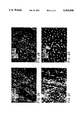
- the results were video taped and micrographs were obtained from the video tape at room temperature (A), 285° C. (B), 345° C. (C), and 395° C. (D).
- the magnification was 750X, and the poly[co(4-oxybenzoate/phenyleneisophthalate] contained 35 mole percent of p-oxybenzoyl units, 32.5 mole percent of 1,4-dioxyphenylene units, and 32.5 mole percent of isophthaloyl units in each instance.
- FIGS. 1A, 1B, 1C and 1D illustrate typical sections of Poly[co(4-oxybenzoate/phenyleneisophthalate)] formed in accordance with the prior art.
- Coarse crystalline and finer liquid crystalline domains are apparent in the temperature range of 285 (FIG. 1B) to 345° C. (FIG. 1C).
- FIG. 1B liquid crystalline domains are present in an isotropic melt.
- FIG. 1D the melt becomes mostly isotropic and is completely isotropic at 410° C.
- FIG. 2 illustrates typical sections of the product of the present invention wherein approximately 1 percent by weight of preformed poly[co(4-oxybenzoate/6-oxynaphthoate)] was intimately admixed with the poly[co(4-oxybenzoate/phenyleneisophthalate)] at the time of its formation.
- the preformed poly[co(4-oxybenzoate/6-oxynaphthoate)] was intimately admixed with an equal part by weight of poly[co4-oxybenzoate/oxybenzoate/phenyleneisophthalate)] at the time of its introduction into the reactor.
- Such intimate admixture was achieved by preliminarily forming the poly[co(4-oxybenzoate/phenyleneisophthalate)] in the presence of the preformed poly[co(4-oxybenzoate/6-oxynaphthoate)] to form a masterbatch. Approximately two parts by weight of this masterbatch were added to approximately 98 parts by weight of the monomers. A finer microstructure than illustrated in FIG. 1 now is apparent. At 345° C. (FIG. 2C) the texture is finer and has a less coarse crystalling structure.
- FIG. 3 illustrates typical sections of the product of the present invention similar to that illustrated in FIG. 2 with the exception that approximately 4 parts by weight of the masterbatch were added to approximately 96 parts by weight of the monomers, and approximately 2 percent by weight of the preformed poly[co(4-oxybenzoate/6-oxynaphthoate)] was intimately admixed with the poly[co(4-oxybenzoate/phenyleneisophthalate)] at the time of its formation.
- a further refinement of the microstructure than illustrated in FIG. 2 is apparent. Additionally, a finer dispersion is clear at 345° C. (FIG. 3C).
- FIG. 4 illustrates typical sections of the preformed poly[co(4-oxybenzoate/6-oxynaphthoate)]. Uniform liquid crystalline domains are apparent over the 285° to 395° C. temperature range (FIGS. 4B, 4C, and 4D).
- FIG. 5 illustrates typical sections of the product of the present invention similar to that illustrated in FIGS. 2 and 3 with the exception that approximately 10 parts by weight of the masterbatch were added to approximately 90 parts by weight of the monomers, and approximately 5 percent by weight of the preformed poly[co(4-oxybenzoate/6-oxynaphthoate)] was intimately admixed with the poly[co(4-oxybenzoate/phenyleneisophthalate)] at the time of its formation.
- a further refinement of the microstructure than illustrated in FIG. 3 is apparent.
- There is a liquid crystalline texture over the temperature range of 285° to 395° C. (FIGS. 5B, 5C, and 5D) which closely approaches that of the preformed polymer as shown in FIG. 4.
- thermotropic liquid crystalline polymer can be made by mixing, as for example by stirring, a preformed thermotropic liquid crystalline polymer with the reactants necessary for forming a second liquid crystalline polymer at a temperature at which the preformed thermotropic liquid crystalline polymer is in the melt phase and the reactants combine to form the second liquid crystalline polymer.
- the preformed thermotropic liquid crystalline polymer can be a blend of more than one liquid crystalline polymer.
- One component of that blend may optionally be the second liquid crystalline polymer, more of which is then made when the reactants polymerize.
- the method is particularly useful when the second liquid crystalline polymer is an aromatic polyester and the reactants are aromatic molecules, each having two reactive substituents which are alike or different and which can react to form aromatic polyester linkages.
- these reactive substituents are --OH; --OCOR, where R is an alkyl group having one to about six carbons; --COOH; COOAr, where Ar is an aromatic moiety having 6 to 14 carbon atoms; and mixtures thereof.
- the aromatic polyester-forming reactants may optionally be substituted with non-reactive substituents, such as lower alkyl groups and halogen atoms.
- the preferred process by which the second liquid crystalline polyester forms is melt acidolysis polymerization, wherein the aromatic phenolic groups have been converted to lower aliphatic acid esters; these phenolic ester groups react with aromatic acid groups during polymerization to yield aromatic polyester linkages and by-product lower aliphatic acid, such as acetic acid, propionic acid, or n- or isobutyric acid.
- the phenolic groups in the reactants have been converted to acetates, with by-product acetic acid forming during the polymerization.
- the melt acidolysis polymerization can be carried out using the free phenols in the presence of sufficient acetic anhydride to esterify the hydroxyl groups to acetates.
- the polymerization reaction is carried out in a temperature range in which the preformed thermotropic liquid crystalline polymer is in an anisotropic melt phase, typically at about 200° C. to about 400° C.
- the preformed thermotropic liquid crystalline polymer is provided in an amount such that it comprises about 0.5 to about 70% by weight of the in situ liquid crystalline blend, preferably about 2% to about 50% of the blend, and most preferably about 3% to about 10% of the blend.
- Any preformed thermotropic liquid crystalline polymer can be used, such as an aromatic polyester, aliphatic-aromatic polyester, poly(ester-amide), poly(ester-carbonate) or a mixture thereof.
- Aromatic polyesters are preferred, such as those that include one or more repeat units derived from 2-hydroxy-6-naphthoic acid, 2,6-dihydroxynaphthalene, 2,6-naphthalenedicarboxylic acid, 4-hydroxybenzoic acid, 1,4-hydroquinone, terephthalic acid, isophthalic acid and mixtures thereof.
- Poly[co(4-oxybenzoate/6-oxy-2-naphthoate)], the copolyester of 2-hydroxy-6-naphthoic acid and 4-hydroxybenzoic acid, is a preferred preformed thermotropic liquid crystalline polyester
- other liquid crystalline polyesters which are preferred for use as preformed polymers for making in situ blends include the polymer comprising 6-oxy-2-naphthoyl, terephthaloyl and 1,4-dioxyphenylene molecular repeat units; the polymer comprising 6-oxy-2-naphthoyl, 4-oxybenzoyl, 4,4'-dioxybiphenylene and terephthaloyl molecular repeat units; and the copolymer comprising 4-oxybenzoyl, terephthaloyl and 1,4-dioxy-2-phenylphenylene molecular repeat units.
- the in situ blends are particularly advantageous when the second liquid crystalline polymer is biphasic, wherein the biphasic melt has both a liquid crystalline anisotropic phase and an isotropic non-liquid crystalline phase.
- the biphasic liquid crystalline polymer is produced in situ from its monomers in the melt of a preformed thermotropic liquid crystalline polymer which has essentially one phase, the resulting blend has improved morphology, both as a solid and as a melt, and also has improved melt processability.
- Biphasic polymers are typically copolymers in which one of the polymers making up the copolymer is highly crystalline. Liquid crystalline copolymers of aromatic hydroxyacids (e.g.
- 4-hydroxybenzoic acid) copolymerized with the following groups of monomers are often biphasic: isophthalic acid and 1,4-hydroquinone; resorcinol and terephthalic acid; aliphatic diacids and 1,4-hydroquinone; terephthalic acid and aliphatic diols; terephthalic acid and 4,4'-biphenol; and isophthalic acid, terephthalic acid and 1,4-hydroquinone.
- a preferred in situ blend is the blend comprising a small amount of a thermotropic liquid crystalline polymer, such as poly[co(4-oxybenzoate/6-oxy-2-naphthoate)], and poly[co(4-oxybenzoate/1,4-phenylene isophthalate )] as the second liquid crystalline polymer, formed in situ from 4-hydroxybenzoic acid, 1,4-hydroquinone, and isophthalic acid or from derivatives of these (e.g. 4-acetoxybenzoic acid and 1,4-hydroquinone diacetate).
- a thermotropic liquid crystalline polymer such as poly[co(4-oxybenzoate/6-oxy-2-naphthoate)]
- poly[co(4-oxybenzoate/1,4-phenylene isophthalate )] as the second liquid crystalline polymer, formed in situ from 4-hydroxybenzoic acid, 1,4-hydroquinone, and isophthalic acid or from derivatives of these (e.g. 4-ace
- Poly[co(4-oxybenzoate/1,4-phenyleneisophthalate)] is biphasic, but the in situ blends with such liquid crystalline polymers as poly[co(4-oxybenzoate/6-oxy-2-naphthoate)] are mostly anisotropic. These blends are described in detail later.
- the present invention is also particularly useful for making blends of a preformed thermotropic liquid crystalline polymer which is readily processed in the melt with a second liquid crystalline polymer which is not melt processable, is difficult to process, or cannot readily be made by melt polymerization.
- An example of this embodiment is provided in Example 60, wherein the copolymer of 4,4'-biphenol, terephthalic acid and 4-hydroxybenzoic acid is synthesized from the phenolic esters by melt acidolysis polymerization in a melt of poly[co(4-oxybenzoate/6-oxy-2-naphthoate)].
- the copolymer of 4,4'-biphenol, terephthalic acid and 4-hydroxybenzoic acid when made in the absence of the preformed thermotropic liquid crystalline polymer, is typically so high melting (about 380° C.) that it is not readily synthesized or processed in the melt.
- the polymer may also be biphasic.
- the in situ blend with the preformed thermotropic liquid crystalline polymer is readily synthesized and processed in the melt phase.
- thermotropic liquid crystalline polymers In situ blends of poly[co(4-oxybenzoate/1,4-phenyleneisophthalate)] with preformed thermotropic liquid crystalline polymers are described and exemplified in detail below. Specific embodiments involving the synthesis of other liquid crystalline polymers as components of in situ blends are set forth in some of the later examples.
- Illustrative polymers that are made by the in situ method include polymers comprising the following sets of monomer units: 4-oxybenzoyl, 1,4-dioxyphenylene, isophthaloyl, 4,4'-dioxybiphenylene; 4-oxybenzoyl, 1,4-dioxyphenylene, isophthaloyl, terephthaloyl; and 4-oxybenzoyl, terephthaloyl, 4,4'-dioxybiphenylene.
- Appropriate monomers capable of forming poly[co(4-oxybenzoate/phenyleneisophthalate)] via a melt acidolysis reaction are provided in a stirred heated reaction zone together with a suitable amount of the molten preformed polymer which is capable of forming an anisotropic single phase melt as described hereafter.
- Typical reactants used to form the poly[co(4-oxybenzoate/phenyleneisophthalate)] are p-hydroxybenzoic acid, hydroquinone and isophthalic acid.
- Other ester- and amide-forming comonomers e.g., terephthalic acid, chloroterephthalic acid, chloroisophthalic acid, phenylterephthalic acid, phenylisophthalic acid, 2,6-naphthalene dicarboxylic acid, 4,4'-biphenyl dicarboxylic acid, 4,4'-diphenyl ether dicarboxylic acid, 4,4'-diphenyl sulfone dicarboxylic acid, 4,4'-biphenol, 4,4'-dihydroxy diphenyl ether, 4,4'-dihydroxy diphenyl sulfone, resorcinol, meta and/or para-hydroxy analine, 4-hydroxy-4'-carboxydiphenyl ether,
- the aromatic rings of the monomers optionally may include substitution of at least some of the hydrogen atoms present upon an aromatic ring selected from the group consisting of an alkyl group of 1 to 4 carbon atoms, an alkoxy group of 1 to 4 carbon atoms, halogen (e.g., fluorine, chlorine and bromine), phenyl (including substituted phenyl), and mixtures thereof.
- an aromatic ring selected from the group consisting of an alkyl group of 1 to 4 carbon atoms, an alkoxy group of 1 to 4 carbon atoms, halogen (e.g., fluorine, chlorine and bromine), phenyl (including substituted phenyl), and mixtures thereof.
- the reactants In order for the reactants to undergo the melt-acidolysis reaction it is essential that the reactive hydroxyl groups present thereon first be modified.
- the p-hydroxybenzoic acid and hydroquinone reactants may be initially provided in a modified form whereby the usual hydroxyl groups of the monomers are esterified (i.e., they are provided as lower acyl esters).
- Such lower acyl groups commonly have from about two to about four carbon atoms.
- the acetate esters of the organic monomer reactants are provided. Accordingly, particularly preferred reactants are p-acetoxybenzoic acid, isophthalic acid, and hydroquinone diacetate.
- the acetylation can be carried out in a separate vessel outside the reactor, or such acetylation preliminarily may be carried out in the same reactor through the addition of acetic anhydride prior to the commencement of the polymerization.
- Conventional esterification catalysts such as potassium acetate, may be utilized.
- the monomers are provided in the reaction zone in concentrations which yield a poly[co(4-oxybenzoate/phenyleneisophthalate) which contains approximately 25 to 50 (e.g., approximately 30 to 40) mole percent of recurring 4-oxybenzoate units.
- the end groups of the resulting poly[co(4-oxybenzoate/phenyleneisophthalate) will be influenced by the specific reaction conditions which are selected.
- the preformed polymer which is capable of forming an anisotropic single phase melt is provided in the reaction zone in a well-dispersed form in a concentration of approximately 0.5 to 15 (e.g., 1 to 8, and most preferably 3 to 6) percent by weight with its concentration being based upon the total concentration of monomers initially present in the reaction zone.
- Such preformed polymer preferably exhibits the single phase anisotropic melt at a temperature within the range of 280° to 340° C. It also preferably is capable of undergoing melt processing at a temperature as high as 340° C. in the absence of significant polymer degradation.
- the anisotropic character of the polymer melt may be confirmed by conventional polarized light techniques whereby crossed-polarizers are utilized.
- the anisotropic or ordered nature of the melt phase may conveniently be confirmed by the use of a Leitz polarizing microscope at a magnification of 400 to 750 ⁇ with the sample on a Leitz hot stage and under a nitrogen atmosphere.
- the amount of light transmitted changes when the sample is forced to flow; however, the sample is optically anisotropic even in the static state.
- typical melt-processable polymers do not transmit light in the melt to any substantial degree when examined under quiescent conditions and are isotropic in nature.
- the single phase nature of the melt may be confirmed by thermal optical microscopy, x-ray crystallography, electron microscopy, polarized light microscopy, differential scanning calorimetry, melt rheology, and other known techniques.
- polymers from which the preformed polymer may be selected include anisotropic melt-forming wholly aromatic polyesters, anisotropic melt-forming aliphatic-aromatic polyesters, anisotropic melt-forming poly(ester-amides), anisotropic melt-forming poly(ester-carbonates), and mixtures of these.
- the preformed polymer which is capable of forming an anisotropic single phase melt is a wholly aromatic polyester.
- the preformed polymer comprises not less than about 10 mole percent of recurring units which include a naphthalene moiety (e.g., a 6-oxy-2-naphthoyl moiety, 2,6-dioxynaphthalene moiety, and a 2,6-dicarboxynaphthalene moiety).
- the preformed polymer which is utilized preferably exhibits an inherent viscosity of at least 2.0 dl./g. (e.g., 2.0 to 10.0 dl./g/) when dissolved in a concentration of 0.1 percent by weight in equal parts by volume of pentafluorophenol and hexafluoroisopropanol at 25° C.
- the preformed polymers which are capable of forming an anisotropic single phase melt may be selected by those skilled in polymer technology from those known in the art. Preferred polymers which may serve in this role are disclosed in U.S. Pat. Nos. 4,161,470; 4,184,996; 4,256,624; 4,330,457; 4,371,660; and 4,473,682, which are herein incorporated by reference.
- the preformed polymer which is capable of forming an anisotropic single phase melt is poly[co(4-oxybenzoate/6-oxynaphthoate)].
- This wholly aromatic polyester is the subject matter of U.S. Pat. No. 4,161,470, and consists essentially of moieties I and II which may optionally include substitution of at least some of the hydrogen atoms present upon an aromatic ring selected from the group consisting of an alkyl group of 1 to 4 carbon atoms, an alkoxy group of 1 to 4 carbon atoms, halogen (e.g., fluorine, chlorine and bromine), phenyl (including substituted phenyl), and mixtures thereof wherein: ##STR1## and comprises approximately 10 to 90 mole percent of moiety I and approximately 10 to 90 mole percent of moiety II.
- the aromatic rings are substantially free of ring substitution.
- the poly[co(4-oxybenzoate/6-oxynaphthoate)] comprises approximately 20 to 40 mole percent of moiety I and approximately 60 to 80 mole percent of moiety II.
- the Poly[co(4-oxybenzoate/6-oxynaphthoate)] consists essentially of approximately 27 mole percent of recurring 6-oxy-2-naphthoyl moieties and approximately 73 mole percent of recurring 4-oxybenzoyl moieties.
- such polymer consists essentially of approximately 20 mole percent of recurring 6-oxy-2-naphthoyl moieties and approximately 80 mole percent of recurring 4-oxybenzoyl moieties.
- the poly[co(4-oxybenzoate/6-oxynaphthoate)] is capable of forming an anisotropic single phase melt at a temperature below approximately 340° C., and most preferably at a temperature below approximately 325° C. It also is particularly preferred that such preformed polymer exhibit an inherent viscosity of at least 4.0 dl./g. (e.g., approximately 5.0 to 7.5 dl./g.) when dissolved in a concentration of 0.1 percent by weight in equal parts by volume of pentafluorophenol and hexafluoroisopropanol at 25° C.
- the preformed polymer is formed in the presence of an approximately 0.25 to 4 percent molar excess of an aromatic dicarboxylic acid monomer and/or an esterified derivative thereof in accordance with the teachings of U.S. Pat. No. 4,539,386 which is herein incorporated by reference.
- the preferred aromatic dicarboxylic acid is terephthalic acid and the resulting polymer is substantially incapable of further chain growth upon heating.
- preformed polymer which is capable of forming an anisotropic single phase melt is preblended and intimately admixed with a quantity of preformed poly[co(4-oxybenzoate/phenyleneisophthalate)] at the time it is introduced into the stirred heated reaction zone.
- preblending may be accomplished by physical blending of the molten polymers or by preparing the poly[co(4-oxybenzoate/phenyleneisophthalate)] in the presence of the preformed polymer which is capable of forming an anisotropic single phase melt.
- melt-acidolysis polymerization in the stirred heated reaction zone it is preferred that a maximum temperature of no more than approximately 350° C. be achieved, and most preferably a maximum temperature of no more than approximately 340° C. This assures that the resulting poly[co(4-oxybenzoate/phenyleneisophthalate)] will not be subjected to any significant degree of polymer degradation.
- the process of the present invention has been found to be capable of forming poly[co(4-oxybenzoate/phenyleneisophthalate)] on a more reliable, more reproducible, and a more stable basis than the prior art. Processing difficulties normally associated with the biphasic nature of such polymer are substantially eliminated.
- the resulting product advantageously is found to exhibit anisotropic melt properties over a broader temperature range than when poly[co(4-oxybenzoate/phenyleneisophthalate)] is formed in accordance with the prior art. Also, the resulting novel composition of matter is capable of reliably undergoing melt processing to form quality three-dimensional articles.
- the product of the present invention may optionally incorporate approximately 1 to 50 percent by weight (preferably approximately 10 to 30 percent by weight), based upon the total weight of the polymers, of a solid filler and/or reinforcing agent.
- Representative filler materials include calcium silicate, silica, clays, talc, mica, polytetrafluoroethylene, graphite, alumina trihydrate, sodium aluminum carbonate, barium ferrite, wollastonite, etc.
- Representative reinforcing fibers include glass fibers, graphitic carbon fibers, amorphous carbon fibers, synthetic polymeric fibers, alumina fibers, aluminum silicate fibers, aluminum oxide fibers, titanium fibers, magnesium fibers, rock wool fibers, steel fibers, tungsten fibers, wollastonite fibers having an aspect ratio greater than 3 to 1, cotton, wood, cellulose fibers, etc.
- quality three-dimensional articles are formed upon melt processing which exhibit a heat deflection temperature at 264 psi of at least 200° C. (most preferably at least 220° C.), and a Notched Izod impact strength of at least 1.0 ft.-lb./in. (most preferably at least 1.5 ft.-lb./in)
- a cylindrical two liter round-bottomed glass reactor was provided which was equipped with a nitrogen inlet, a thermocouple, Vigreux column attached to a condenser and receiver, and a C-shaped 316 stainless steel mechanical stirrer.
- the reactor was immersed in a sand bath and provided with means to accurately control the temperature.
- 290.1 grams (2.1 moles) of p-hydroxybenzoic acid 218.0 grams (1.98 moles including 0.5 percent molar excess) of hydroquinone, and 324.0 grams (1.95 moles) of isophthalic acid which upon polymerization were capable of forming poly[co(4-oxybenzoate/phenyleneisophthalate)].
- preformed poly[co(4-oxybenzoate/6-oxynaphthoate)] while in solid particulate form were added to the reactor.
- Such preformed wholly aromatic polyester was formed in accordance with the teachings of U.S. Pat. No. 4,161,470 and was capable of forming an anisotropic single phase melt.
- the preformed polymer contained 73 mole percent of recurring 4-oxybenzoate units and 27 mole percent of recurring 6-oxynaphthoate units and exhibited an inherent viscosity of 7.0 dl./g. when dissolved in a concentration of 0.1 percent by weight in equal parts by volume of pentafluorophenol and hexafluoroisopropanol at 25° C.
- Such preformed polymer was present in the reactor in a concentration of 2.9 percent by weight based upon the total concentration of the three monomers which initially were present in the reaction zone. Additionally, 0.63 grams (75.5 parts per million) of potassium acetate catalyst were added to the reactor. The reactor was under a constant purge of nitrogen at a rate of approximately 30 to 40 c.c./minute while being charged. The reactor was next evacuated to approximately 1 to 2 mbar two times with the reduced pressure being broken with nitrogen each time.
- Acetic anhydride next was introduced into the reactor through an addition funnel in a quantity of 637.4 grams (6.15 moles including a 2.5 mole percent excess). Such acetic anhydride was of 98.5 mole percent purity and was added for the purpose of converting the p-hydroxybenzoic acid to 4-acetoxybenzoic acid and the hydroquinone to hydroquinone diacetate prior to the onset of polymerization.
- the acetic acid began distilling-off when the reactor was at 150° C. and at the end of heating stage No. 8 approximately 98 percent of the theoretical amount (687 ml.) had evolved.
- the resulting product was found to exhibit an inherent viscosity of 0.81 dl./g. when dissolved in a concentration of 0.1 percent by weight in equal parts by volume of pentafluorophenol and hexafluoroisopropanol at 25° C.
- the product also was found to exhibit the following properties as determined by standard differential scanning calorimetry at 20° C./min. heating rate:
- the melt viscosity of the product at 330° C. was 344 poise at a shear rate of 100 sec -1 and 112 poise at a shear rate of 1000 sec. -1 .
- the product when melted exhibited a homogeneous fine uniform microstructure by thermal-optical microscopy and this texture was retained after quenching at ambient temperature.
- Example 1 was substantially repeated with the exceptions indicated. More specifically, the molar ratios of the three monomers required to form the poly[co(4-oxybenzoate/phenyleneisophthalate)] were varied except in Example 2, and in some instances the polymerization heating schedule was varied. In Examples 5 to 8 Heating Stage Nos. 7 through 9 were carried out at 340° C. instead of 325° C. In Examples 9 to 16 Heating Stage Nos. 7 through 9 were carried out at a temperature of 330° C. instead of 325° C.
- the molar ratios of the monomers and the concentration of the preformed polymer which is capable of forming an anisotropic single phase melt are reported in Table I where Monomer A is p-hydroxybenzoic acid, Monomer B is hydroquinone, and Monomer C is isophthalic acid.
- the preformed Poly[co(4-oxybenzoate/6-oxynaphthoate)] is designated the "Preformed Polymer” and the concentration is expressed in weight percent based upon the total concentration of monomers initially present in the reactor. Properties of the resulting product also are reported in Table I.
- the melt viscosity measurements were made at 325° C. instead of 330° C.
- Example 15 the melt viscosity measurements were made at 340° C. instead of 330° C.
- Example 16 the melt viscosity measurements were made at 350° C. instead of 330° C.
- Example 2 was repeated two times in the absence of the preformed poly[co(4-oxybenzoate/6-oxynaphthoate)]. The identical runs were designated "Comparative X” and "Comparative Y". The properties of the resulting products are not readily reproducible and are reported in Table I. Also, properties of standard test bars formed while using barrel temperatures of 295° C. and 310° C. are reported in Table II. It will be noted that each of the comparative runs formed products having a relatively low inherent viscosity of 0.5 dl./g. Also, the glass fiber-reinforced comparative products following combination and molding exhibited substantially higher melt viscosities when compared to the values for Example 2.
- Example 1 was substantially repeated with the exceptions indicated. More specifically, the preformed polymer contained 77 mole percent of recurring 4-oxybenzoate units and 23 mole percent of recurring 6-oxynaphthoate units and exhibited an inherent viscosity of 6.8 dl./g. when dissolved in a concentration of 0.1 percent by weight in equal parts by volume of pentafluorophenol and hexafluoroisopropanol, in Examples 21 and 22 the molar ratios of the three monomers required to form the poly[co(4-oxybenzoate/phenyleneisophthalate)] were varied, and Heating Stage Nos. 7 to 9 were carried out at 330° C. instead of 325° C.
- the molar ratios of the monomers and the concentration of the preformed polymer which is capable of forming an anisotropic single phase melt are reported in Table III where Monomer A is p-hydroxybenzoic acid, Monomer B is hydroquinone, and Monomer C is isophthalic acid.
- the preformed poly[co(4-oxybenzoate/6-oxynaphthoate)] is designated the "Preformed Polymer” and its concentration is expressed in weight percent based upon the total concentration of monomers initially present in the reactor.
- Properties of the resulting product also are reported in Table III. Glass fiber-reinforced test specimens were injection molded as described with respect to Examples 2 to 16. The properties of the resulting test specimens are reported in Table IV.
- Example 1 was substantially repeated with the exceptions indicated. More specifically, the preformed polymer contained 80 mole percent of recurring 4-oxybenzoate units and 20 mole percent of recurring 6-oxynaphthoate units and Heating Stage Nos. 7 to 9 were carried out at 330° C. instead of 325° C. The preformed polymer was not sufficiently soluble to carry out the standard inherent viscosity determination. The concentrations of the preformed polymer which is capable of forming an anisotropic single phase melt are reported in Table V where Monomer A is p-hydroxybenzoic acid, Monomer B is hydroquinone, and Monomer C is isophthalic acid.
- the preformed poly[co(4-oxybenzoate/6-oxynaphthoate)] is designated the "Preformed Polymer” and its concentration is expressed in weight percent based upon the total concentration of monomers initially present in the reactor. Properties of the resulting product also are reported in Table V.
- Glass fiber-reinforced test specimens were injection molded as described with respect to Examples 2 to 16. When the glass fiber reinforced products of Examples 23 and 24 were combined, a Notched Izod impact strength of 1.27 ft.-lb./in., and a heat defection temperature of 217° C. were observed. When the glass fiber reinforced products of Examples 25 and 26 were combined, a Notched Izod impact strength of 0.92 ft.-lb./in., and heat defection temperature of 217° C. were observed.
- the preformed poly[co(4-oxybenzoate/6-oxynaphthoate)] was intimately admixed with preformed poly[co(4-oxybenzoate/phenyleneisophthalate)] at the time of its introduction into the reactor.
- Such intimate admixture was prepared by preliminarily forming the poly[co(4-oxybenzoate/phenyleneisophthalate)] in the presence of the preformed poly[co(4-oxybenzoate/6-oxynaphthoate)] in a manner similar to that previously described to form a uniform masterbatch or master blend of the two polymers.
- the masterbatch which was provided in the reactor consisted of equal parts by weight of preformed poly[co(4-oxybenzoate/6-oxynaphthoate)] and poly[co(4-oxybenzoate/phenyleneisophthalate)].
- the preformed poly[co(4-oxybenzoate/phenyleneisophthalate)] was formed of monomers which were supplied in the same relative molar concentrations as described in Example 1.
- the poly[co(4-oxybenzoate/6-oxynaphthoate)] contained 73 mole percent of recurring 4-oxybenzoate units and 27 mole percent of recurring 6-oxynaphthoate units.
- Example 31 and 32 the poly[co(4-oxybenzoate/6-oxynaphthoate)] contained 77 mole percent of recurring 4-oxybenzoate units and 23 mole percent of recurring 6-oxynaphthoate units.
- Example 33 and 34 the poly[co(4-oxybenzoate/6-oxynaphthoate)] contained 80 mole percent of recurring 4-oxybenzoate units and 20 mole percent of recurring 6-oxynaphthoate units. Heating Stage Nos. 7 to 9 were carried out at 330° C. for Examples 27 to 32, and at 340° C. for Examples 33 to 34.
- the resulting products were found via thermo-optical microscopic studies to exhibit an excellent uniform microstructure which was of an even finer nature than that achieved in the preceding examples wherein the preformed polymer when introduced into the reactor was not in the form of a master blend.
- the product of Examples 27 to 30 is illustrated in FIGS. 5A, 5B, 5C, and 5D.
- Table VI are reported the concentrations of the masterbatches which were introduced into the reactor expressed in weight percent based upon the total concentration of the monomers which initially are present in the reactor. Table VI also reports properties of the resulting products. Glass fiber-reinforced test specimens of the resulting products also were injection molded as described with respect to Examples 2 to 16. The test results for these test specimens are reported in Table VII.
- the preformed polymer contained 73 mole percent of recurring 4-oxybenzoate units and 27 mole percent of recurring 6-oxynaphthoate units and exhibited an inherent viscosity of 7.0 dl./g. when dissolved in a concentration of 0.1 percent by weight in equal parts by volume of pentafluorophenol and hexafluoroisopropanol at 25° C.
- Such preformed polymer was present in the reactor in a concentration of 4.7 percent by weight based upon the total concentration of the four monomers which initially were present in the reaction zone.
- test results were as follows:
- the preformed poly[co(4-oxybenzoate/6-oxynaphthoate)] contained 77 mole percent of recurring 4-oxybenzoate units and 23 mole percent of recurring 6-oxynaphthoate units and exhibited an inherent viscosity of 5.2 dl./g. when dissolved in a concentration of 0.1 percent by weight in equal parts by volume of pentafluorophenol and hexafluoroisopropanol at 25° C.
- the preformed poly[co(4-oxybenzoate/phenyleneisophthalate) was formed of monomers which were supplied in the same relative molar concentrations as described in Example 1. Properties of the resulting product are reported in Table IX. The properties of glass fiber-reinforced test specimens as described with respect to Examples 2 to 16 are reported in Table X.
- Example I was substantially repeated two times with the exceptions indicated wherein a different preformed polymer which is capable of forming an anisotropic single phase melt was substituted for the poly[co(4-oxybenzoate/6-oxynaphthoate)].
- Such preformed polymer was a poly(ester-amide) formed in accordance with the teachings of U.S. Pat. No. 4,330,457, and contained recurring 6-oxy-2-naphthoyl units, terephthaloyl units, and p-aminophenoxy units.
- Example 1 was substantially repeated with the exceptions indicated wherein a different preformed polymer which is capable of forming an anisotropic single phase melt was substituted for the poly[co(4-oxybenzoate/6-oxynaphthoate)].
- Such preformed polymer which was capable of forming an anisotropic single phase melt was a wholly aromatic polyester formed in accordance with U.S. Pat. No. 4,256,624, and contained recurring 6-oxy-2-naphthoyl units, terephthaloyl units, and 1,4-dioxyphenylene units.
- the molar ratios of these units were 60:20:20 respectively, and the wholly aromatic polyester exhibited an inherent viscosity of 2.8 dl./g.
- Example 42 to 45 to the reactor were added 321.5 grams (2.3275 grams) of p-hydroxybenzoic acid, 241.6 grams (2.1945 moles) of hydroquinone, 359.1 grams (2.16125 moles) of isophthalic acid, 0.07 gram of potassium acetate catalyst, and 710.1 grams of acetic anhydride.
- Examples 42 and 43 52.6 grams of the wholly aromatic polyester were added to the reactor which provided the preformed polymer in a concentration of 5.7 percent by weight based on the total concentration of monomers present.
- Examples 44 and 45 46.4 grams of the masterbatch were added to the reactor which provided the preformed polymer in a concentration of 2.5 percent by weight based on the total concentration of monomers present.
- Table XIII The properties of glass fiber-reinforced test specimens as described with respect to Examples 2 to 16 are reported in Table XIV.
- Example 1 was substantially repeated with the exceptions indicated wherein a different preformed polymer which is capable of forming an anisotropic single phase melt was substituted for the poly[co(4-oxybenzoate/6-oxynaphthoate)].
- Such preformed polymer was a wholly aromatic polyester formed in accordance with U.S. Pat. No. 4,473,682, and contained recurring 4-oxybenzoyl units, 6-oxy-2-naphthoyl units, 4,4'-dioxybiphenyl units, and terephthaloyl units.
- the molar ratios of these units were 50:10:20:20 respectively, and the wholly aromatic polyester exhibited an inherent viscosity of 4.3 dl./g. when dissolved in a concentration of 0.1 percent by weight of equal parts by volume of pentafluorophenol and hexafluoroisopropanol at 25° C.
- Example 46 into the reactor were placed 274.01 grams (1.995 moles) of p-hydroxybenzoic acid, 205.95 grams (1.8639 moles including a 0.2 mole percent excess) of hydroquinone, 306.04 grams (1.8525 moles) of isophthalic acid, 42 grams of the preformed wholly aromatic polyester, 0.06 gram of potassium acetate catalyst, and 608.1 grams of acetic anhydride.
- the preformed wholly aromatic polyester was provided in a concentration of 5.3 percent by weight based on the total concentration of the monomers present.
- Examples 48 and 49 into the reactor were placed 260.1 grams (1.89 moles) of p-hydroxybenzoic acid, 195.5 grams (1.7658 moles including an 0.2 mole excess) of hydroquinone, 290.5 grams (1.755 moles) of isophthalic acid, 80.7 grams of an intimate admixture of equal parts by weight of preformed poly[co(4-oxybenzoate/phenyleneisophthalate)] and the wholly aromatic polyester, 0.06 gram of potassium acetate catalyst, and 577.2 grams of acetic anhydride.
- Such intimate admixture was prepared by preliminarily forming the poly[co(4-oxybenzoate/phenyleneisophthalate)] in the presence of the preformed wholly aromatic polyester in a manner similar to that previously described to form a masterbatch.
- the monomers used for preparing the preformed poly[co(4-oxybenzoate/phenyleneisophthalate)] were supplied in the same relative molar concentrations as described in Example 1.
- the preformed wholly aromatic polyester capable of forming an anisotropic single phase melt was provided in a concentration of 5.4 percent by weight based on the total concentrations of the monomers present.
- Example 1 was substantially repeated with the exceptions indicated wherein a different preformed polymer which is capable of forming an anisotropic single phase melt was substituted for the poly[co(4-oxybenzoate/6-oxynaphthoate)].
- Such preformed polymer was a wholly aromatic polyester which contained recurring 4-oxybenzoyl units, 1,4-dioxy-2-phenyl phenylene units, and terephthaloyl units. The molar ratios of these units were 10:45:45 respectively, and the wholly aromatic polyester exhibited an inherent viscosity of 2.7 dl./g. when dissolved in a concentration of 0.1 percent by weight in equal parts by volume of pentafluorophenol and hexafluoroisopropanol at 25° C.
- Example 50 into the reactor were charged 367.4 grams (2.66 moles) of p-hydroxybenzoic acid, 273.6 grams (2.4852 moles including a 0.2 mole percent excess) of hydroquinone, 410.4 grams (2.47 moles) of isophthalic acid, 61.7 grams of preformed wholly aromatic polyester, 0.08 gram of potassium acetate catalyst, and 811.5 grams of acetic anhydride.
- the wholly aromatic polyester was provided in a concentration of 5.9 percent by weight based on the total concentration of the monomers present.
- Example 52 into the reactor were charged 348.1 grams (2.52 moles) of p-hydroxybenzoic acid, 259.2 grams (2.3544 moles including a 0.2 mole percent excess) of hydroquinone, 388.8 grams (2.34 moles) of isophthalic acid, 109.8 grams an intimate admixture of equal parts by weight of preformed poly[co(4-oxybenzoate/phenyleneisophthalate)] and the wholly aromatic polyester, 0.075 gram of potassium acetate catalyst, and 768.8 grams of acetic anhydride.
- Such intimate admixture was prepared by preliminarily forming the poly[co(4-oxybenzoate/phenyleneisophthalate)] in the presence of the preformed wholly aromatic polyester in a manner similar to that previously described to form a masterbatch.
- the monomers used for preparing the preformed poly[co(4-oxybenzoate/phenyleneisophthalate)] were supplied in the same relative molar concentrations as described in Example 1.
- the preformed wholly aromatic polyester capable of forming an anisotropic single phase melt was provided in a concentration 5.5 percent by weight based on the total concentration of the monomers present.
- Example 1 was substantially repeated with the exceptions indicated wherein the poly[co(4-oxybenzoate/6-oxynaphthoate)] was introduced in two different relatively low concentrations while intimately admixed with an equal part by weight of preformed poly[co(4-oxybenzoate/phenyleneisophthalate)].
- Such intimate admixtures were prepared by preliminarily forming the poly[co(4-oxybenzoate/phenyleneisophthalate)] in the presence of the preformed wholly aromatic polyester in a manner similar to that previously described to form a masterbatch.
- the monomers used when preparing the preformed poly[co(4-oxybenzoate/phenyleneisophthalate)] were supplied in the same molar concentrations as described in Example 1.
- Examples 54 and 55 into the reactor were charged 379.0 grams (2,744 moles) of p-hydroxybenzoic acid, 282.3 grams (2.56368 moles including a 0.2 mole percent excess) of hydroquinone, 423.3 grams (2,548 moles) of isophthalic acid, 20.3 grams of the masterbatch, 0,082 gram of potassium acetate, and 837.2 grams of acetic anhydride.
- the preformed poly[co(4-oxybenzoate/6-oxynaphthoate)] was provided in a concentration of 0.95 percent by weight based on the total concentration of the monomers present.
- the nature of the product is illustrated in FIGS. 2A, 2B, 2C, and 2D.
- Examples 56 and 57 into the reactor were charged 371.3 grams (2,688 moles) of p-hydroxybenzoic acid, 276.5 grams (2.51136 moles including a 0.2 mole percent excess) of hydroquinone, 414.7grams (2,496 moles) of isophthalic acid, 40.6 grams of the masterbatch, 0.08 gram of potassium acetate, and 820.0 grams of acetic anhydride.
- the preformed poly[co(4-oxybenzoate/6-oxynaphthoate)] was provided in a concentration of 1.9 percent by weight based on the total concentration of the monomers present.
- the nature of the product is illustrated in FIGS. 3A, 3B, 3C, and 3D.
- Example 1 was substantially repeated with the exceptions indicated wherein the preformed poly[co(4-oxybenzoate/6-oxynaphthoate)] was prepared in accordance with the teachings of U.S. Pat. No. 4,539,386. More specifically, when the preformed poly[co(4-oxybenzoate/6-oxynaphthoate)] was formed recurring terephthaloyl units derived from terephthalic acid were introduced in a concentration of 3 mole percent together with 78.5 mole percent of 4-oxybenzoyl units and 18.5 mole percent of 6-oxy-2-naphthoyl units. The preformed polymer was not sufficiently soluble to carry out the standard inherent viscosity determination. The prepolymer was substantially incapable of undergoing additional chain growth upon heating since the polymer chains were caused to terminate in carboxylic acid end groups during the course of its polymerization reaction.
- Example 58 into the reactor were charged 688.9 grams (4.9875 moles) of p-hydroxybenzoic acid, 513.1 grams (4.65975 moles including a 0.2 mole percent excess) of hydroquinone, 769.4 grams (4.63125 moles) of isophthalic acid, 97.3 grams of preformed poly[co(4-oxybenzoate/6-oxynaphthoate)] , 0.6 gram of potassium acetate, and 1521.6 grams of acetic acid.
- the poly[co(4-oxybenzoate/6-oxynaphthoate)] was provided in a concentration of 4.9 percent by weight based on the total concentration of monomers present.
- Example 59 the poly[co(4-oxybenzoate/6-oxynaphthoate)] was introduced while intimately admixed with an equal part by weight of preformed poly[co(4-oxybenzoate/phenyleneisophthalate)].
- Such intimate admixture was prepared by preliminarily forming the poly[co(4-oxybenzoate/phenyleneisophthalate)] in the presence of the preformed poly[co(4-oxybenzoate/6-oxynaphthoate)] in a manner similar to that previously described to form a masterbatch.
- the monomers used when preparing the preformed poly[co(4-oxybenzoate/phenyleneisophthalate)] were supplied in the same molar concentrations as described in Example 1.
- Example 59 into the reactor were charged 652.7 grams (4.725 moles) of p-hydroxybenzoic acid, 486.1 grams (4.4145 moles including 0.2 mole percent excess) of hydroquinone, 728.9 grams (4.3815 moles) of isophthalic acid, 187.4 grams of the masterbatch, 0.56 gram of potassium acetate, and 1441.5 grams of acetic anhydride.
- the poly[co(4-oxybenzoate/6-oxynaphthoate)] was provided in a concentration of 5.0 percent by weight based on the total concentration of monomers present.
- the system was de-aerated with three vacuum-nitrogen purge cycles before the addition of acetic anhydride (4.14 moles).
- the flask was then heated in a fluidized sand bath while purging with nitrogen.
- the system was heated to 125° C. over 50 minutes, to 140° C. over 40 minutes, to 150° C. over 20 minutes, to 200° C. over 45 minutes, to 210° C. over 5 minutes, to 220° C. over 6 minutes, to 280° C. over 50 minutes, to 320° C. over 80 minutes, to 350° C. over 20 minutes, to 360° C. over 10 minutes, and to 370° C., over 20 minutes. While maintaining the temperature at 370° C., the system was slowly evacuated (in 100 mbar increments).
- the reading of the torque indicator was noted at the beginning of this vacuum period. Under vacuum at 370° C. the viscosity of the polymer increased as reflected by the reading on the torque indicator (Cole Parmer Master Servodyne). When the increase in torque reached a predetermined level (change in torque, 70 mv) the vacuum was released while nitrogen was purged into the system. The system was taken down and the polymer was allowed to cool. The polymer plug was removed by breaking the flask, cut into pieces and then ground into small particles. The polymer had an I.V. (measured at 25° C.
- thermotropic liquid crystalline polymer A composition was made using about the same monomer ratios as were used in Example 60.
- the monomers that yield the preformed thermotropic liquid crystalline polymer were used rather than the polymer itself.
- 6-hydroxy-2-naphthoic acid (5 parts on a mole basis)
- 4-hydroxybenzoic acid 60 parts
- 4,4'-biphenol 17.5 parts
- terephthalic acid 17.5 parts
- potassium acetate enough to yield 60 ppm potassium in the final polymer
- acetic anhydride about 105 parts on a mole basis
Landscapes
- Chemical & Material Sciences (AREA)
- Organic Chemistry (AREA)
- Health & Medical Sciences (AREA)
- Chemical Kinetics & Catalysis (AREA)
- Medicinal Chemistry (AREA)
- Polymers & Plastics (AREA)
- Crystallography & Structural Chemistry (AREA)
- Engineering & Computer Science (AREA)
- Materials Engineering (AREA)
- Polyesters Or Polycarbonates (AREA)
Abstract
Description
______________________________________
                         Time at
Heating       Temperature
                         Temperature
Stage No.     in °C.
                         (minutes)
______________________________________
1              25         1
2             125        60
3             150        50
4             200        50
5             250        50
6             300        100
7             325        50
8             325        15
9             325        60
______________________________________
                                  TABLE I
__________________________________________________________________________
                                              Melt  Melt  Inherent
Example
       Monomer
             Monomer
                   Monomer
                         Preformed
                               Tm Hm Tg Tc Hc Viscosity
                                                    Viscosity
                                                          Viscosity
No.    A     B     C     Polymer
                               °C.
                                  J./g.
                                     °C.
                                        °C.
                                           J./g.
                                              100 sec..sup.-1
                                                    1000
                                                          dl./g.up.-1
__________________________________________________________________________
 2     35    32.5  32.5  2.9   307
                                  5.6
                                     128
                                        263
                                           -8.9
                                              426   146   0.89
 3     35    32.5  32.5  4.8   309
                                  4.7
                                     128
                                        266
                                           -7.1
                                              429   127   1.00
 4     35    32.5  32.5  4.8   310
                                  5.1
                                     129
                                        267
                                           -6.8
                                              384   120   0.96
 5     35    32.5  32.5  4.8   303
                                  7.7
                                     129
                                        262
                                           -7.6
                                              554   178   1.22
 6     35    32.5  32.5  4.8   302
                                  9.2
                                     128
                                        254
                                           -7.8
                                              601   191   1.18
 7     35    32.5  32.5  9.6   309
                                  5.9
                                     131
                                        259
                                           -6.8
                                              546   179   1.70
 8     35    32.5  32.5  9.6   304
                                  6.1
                                     131
                                        258
                                           -6.0
                                              591   198   1.73
 9     35    32.5  32.5  14.5  309
                                  6.2
                                     130
                                        261
                                           -5.5
                                              477   158   2.20
10     35    32.5  32.5  14.5  297
                                  5.6
                                     127
                                        242
                                           -4.0
                                              984   337   2.37
11     33    33.5  33.5  5.1   303
                                  9.8
                                     134
                                        266
                                           -7.9
                                              695   241   1.26
12     33    33.5  33.5  5.1   305
                                  9.8
                                     133
                                        267
                                           -8.0
                                              821   274   1.34
13     32    34    34    7.7   311
                                  8.3
                                     134
                                        266
                                           -7.6
                                              892   298   1.36
14     32    34    34    7.7   303
                                  6.8
                                     132
                                        258
                                           -8.0
                                              909   312   1.34
15     30    35    35    4.8   295
                                  16.0
                                     132
                                        259
                                           -9.2
                                              2286  733   0.91
16     30    35    35    4.8   296
                                  16.8
                                     132
                                        258
                                           -9.8
                                              2771  873   0.99
Comparative
       35    32.5  32.5  0     296
                                  7.5
                                     134
                                        250
                                           -7.1
                                              525   201   0.5
X                              309
Comparative
       35    32.5  32.5  0     289
                                  9.3
                                     131
                                        244
                                           -8.2
                                              452   174   0.5
Y                              302
__________________________________________________________________________
                                  TABLE II
__________________________________________________________________________
                                       Notched Izod
                                              Heat
       Tensile
             Tensile      Flexural
                                Flexural
                                       Impact Deflection
Example
       Strength ×
             Modulus ×
                    Elongation
                          Strength ×
                                Modulus ×
                                       Strength
                                              Temperature
Nos.   1,000 psi
             1,000,000 psi
                    Percent
                          1,000 psi
                                1,000,000 psi
                                       ft.-lb./in.
                                              in °C. @ 264
__________________________________________________________________________
                                              psi.
1 + 2  13.46 1.84   0.8   n.m.  n.m.   1.37   223
3 + 4  17.31 1.97   1.05  23.74 1.90   1.27   214
5 + 6  15.82 1.99   0.92  21.11 1.87   1.17   216
7 + 8  17.13 1.93   1.05  22.72 1.83   1.24   204
 9 + 10
       17.11 2.00   1.02  n.m.  n.m.   1.02   218
11 + 12
       19.10 2.01   1.16  23.8  1.82   1.00   226
13 + 14
       n.m.  n.m.   n.m.  n.m.  n.m.   0.94   218
15 + 16
       n.m.  n.m.   n.m.  n.m.  n.m.   0.94   222
Comparative
       15.1  1.90   1.00  21.20 2.00   1.00   232
X & Y
Molded at
295° C.
Comparative
       17.0  2.00   1.00  22.90 2.00   1.50   215
X & Y
Molded at
310° C.
__________________________________________________________________________
 n.m. =  not measured
                                  TABLE III
__________________________________________________________________________
                                             Melt  Melt  Inherent
Example
      Monomer
            Monomer
                  Monomer
                        Preformed
                              Tm Hm Tg Tc Hc Viscosity
                                                   Viscosity
                                                         Viscosity
No.   A     B     C     Polymer
                              °C.
                                 J./g.
                                    °C.
                                       °C.
                                          J./g.
                                             100 sec..sup.-1
                                                   1000
                                                         dl./g.up.-1
__________________________________________________________________________
17    35    32.5  32.5  2.9   302
                                 6.8
                                    133
                                       255
                                          -6.5
                                             686   233   1.2
18    35    32.5  32.5  2.9   304
                                 8.1
                                    132
                                       257
                                          -6.7
                                             648   221   1.22
19    35    32.5  32.5  5.0   309
                                 7.3
                                    133
                                       262
                                          -6.3
                                             668   242   1.28
20    35    32.5  32.5  5.0   300
                                 5.8
                                    133
                                       253
                                          -6.5
                                             625   230   1.36
21    40    30    30    2.9   310
                                 9.1
                                    127
                                       249
                                          -2.4
                                             457   157   1.51
                                       288
                                          -1.6
22    40    30    30    2.9   307
                                 8.5
                                    126
                                       246
                                          -2.4
                                             368   128   1.25
                                       287
                                          -1.2
__________________________________________________________________________
                                  TABLE IV
__________________________________________________________________________
                                       Notched Izod
                                              Heat
       Tensile
             Tensile      Flexural
                                Flexural
                                       Impact Deflection
Example
       Strength ×
             Modulus ×
                    Elongation
                          Strength ×
                                Modulus ×
                                       Strength
                                              Temperature
Nos.   1,000 psi
             1,000,000 psi
                    Percent
                          1,000 psi
                                1,000,000 psi
                                       ft.-lb./in.
                                              in °C. @ 264
__________________________________________________________________________
                                              psi.
17 + 18
       17.26 1.91   1.1   22.93 1.8    1.3    236
19 + 20
       n.m   n.m    n.m   n.m   n.m    1.21   223
21 + 22
       18.6  2.18   1.06  23.83 1.97   1.14   231
__________________________________________________________________________
 n.m. = not measured
                                  TABLE V
__________________________________________________________________________
                                              Melt  Melt  Inherent
Example
       Monomer
             Monomer
                   Monomer
                         Preformed
                               Tm Hm Tg Tc Hc Viscosity
                                                    Viscosity
                                                          Viscosity
No.    A     B     C     Polymer
                               °C.
                                  J./g.
                                     °C.
                                        °C.
                                           J./g.
                                              100 sec..sup.-1
                                                    1000
                                                          dl./g.up.-1
__________________________________________________________________________
23     35    32.5  32.5  5.3   307
                                  8.5
                                     133
                                        264
                                           -7.4
                                              531   198   0.89
24     35    32.5  32.5  5.3   309
                                  5.8
                                     132
                                        263
                                           -6.9
                                              460   173   0.85
25     35    32.5  32.5  9.4   308
                                  8.0
                                     129
                                        260
                                           -6.6
                                              505   167   n.s.
26     35    32.5  32.5  9.4   310
                                  8.9
                                     132
                                        267
                                           -6.6
                                              710   223   n.s.
__________________________________________________________________________
 n.s. = not soluble in equal parts of pentafluorophenol and
 hexafluoroisopropanol.
                                  TABLE VI
__________________________________________________________________________
            Preformed                   Melt  Melt Inherent
Example     Single Phase
                   Tm Hm Tg Tc Hc Viscosity
                                        Viscosity
                                              Viscosity
No.  Masterbatch
            Melt   °C.
                      J./g.
                         °C.
                            °C.
                               J./g.
                                  100 sec..sup.-1
                                        1000 sec..sup.-1
                                              dl./g.
__________________________________________________________________________
27   10.2   5.1    290
                      6.1
                         130
                            237
                               -5.5
                                  554   204   0.95
28   10.2   5.1    293
                      6.0
                         130
                            244
                               -5.6
                                  320   134   0.95
29   10.2   5.1    299
                      6.4
                         131
                            248
                               -5.7
                                  605   214   1.2
30   10.2   5.1    298
                      5.8
                         132
                            246
                               -5.2
                                  522   188   1.2
31   10.1   5.05   298
                      5.4
                         133
                            246
                               -5.9
                                  830   385   1.09
32   10.1   5.05   307
                      6.7
                         134
                            259
                               -5.8
                                  748   241   1.16
33   10.0   5.0    300
                      6.5
                         132
                            251
                               -6.0
                                  401   152   0.96
34   10.0   5.0    300
                      7.2
                         132
                            252
                               -5.5
                                  460   166   0.94
__________________________________________________________________________
                                  TABLE VII
__________________________________________________________________________
                                       Notched Izod
                                              Heat
       Tensile
             Tensile      Flexural
                                Flexural
                                       Impact Deflection
Example
       Strength ×
             Modulus×
                    Elongation
                          Strength×
                                Modulus×
                                       Strength
                                              Temperature
Nos.   1,000 psi
             1,000,000 psi
                    Percent
                          1,000 psi
                                1,000,000 psi
                                       ft.-lb./in.
                                              in °C. @ 264
__________________________________________________________________________
                                              psi.
27 + 28
       17.3  1.83   1.11  n.m.  n.m.   1.7    208
28 + 30
       18.7  1.86   1.26  24.38 1.89   1.3    231
31 + 32
       n.m.  n.m.   n.m.  n.m.  n.m.   1.3    214
30 + 34
       17.0  1.7    1.3   24.0  1.9    1.3    225
__________________________________________________________________________
 n.m. = not measured
                                  TABLE VIII
__________________________________________________________________________
                    Melt  Melt  Inherent
Example
     Tm Hm Tg Tc Hc Viscosity
                          Viscosity
                                Viscosity
No.  °C.
        J./g.
           °C.
              °C.
                 J./g.
                    100 sec..sup.-1
                          1000 sec..sup.-1
                                dl./g.
__________________________________________________________________________
35   275
        3.1
           133
              222
                 -4.2
                    687   232   1.41
36   275
        2.6
           134
              222
                 -3.8
                    530   183   1.47
37   275
        2.5
           136
              223
                 -3.2
                    796   263   1.48
__________________________________________________________________________
                                  TABLE IX
__________________________________________________________________________
            Preformed                   Melt  Melt Inherent
Example     Single Phase
                   Tm Hm Tg Tc Hc Viscosity
                                        Viscosity
                                              Viscosity
No.  Masterbatch
            Melt   °C.
                      J./g.
                         °C.
                            °C.
                               J./g.
                                  100 sec..sup.-1
                                        1000 sec..sup.-1
                                              dl./g.
__________________________________________________________________________
38   10.1   5.05   309
                      3.5
                         125
                            235
                               -1.9
                                  823   267   1.3
                            308
                               -0.9
39   10.1   5.05   310
                      4.9
                         125
                            237
                               -1.7
                                  869   301   1.4
                            303
                               -0.6
__________________________________________________________________________
                                  TABLE X
__________________________________________________________________________
                                       Notched Izod
                                              Heat
       Tensile
             Tensile      Flexural
                                Flexural
                                       Impact Deflection
Example
       Strength ×
             Modulus ×
                    Elongation
                          Strength ×
                                Modulus ×
                                       Strength
                                              Temperature
Nos.   1,000 psi
             1,000,000 psi
                    Percent
                          1,000 psi
                                1,000,000 psi
                                       ft.-lb./in.
                                              in °C. @ 264
__________________________________________________________________________
                                              psi.
38 + 39
       15.8  2.3    0.8   24.1  2.3    0.9    198
Molded at
295° C.
38 + 39
       16.7  2.4    0.8   26.3  2.3    1.1    207
Molded at
310° C.
__________________________________________________________________________
                                  TABLE XI
__________________________________________________________________________
     Preformed                   Melt  Melt Inherent
Example
     Single Phase
            Tm Hm Tg Tc Hc Viscosity
                                 Viscosity
                                       Viscosity
No.  Melt   °C.
               J./g.
                  °C.
                     °C.
                        J./g.
                           100 sec..sup.-1
                                 1000 sec..sup.-1
                                       dl./g.
__________________________________________________________________________
40   5.7    297
               3.3
                  137
                     226
                        -2.6
                           592   201   1.1
41   5.7    296
               3.7
                  135
                     230
                        -3.1
                           403   145   1.0
__________________________________________________________________________
                                  TABLE XII
__________________________________________________________________________
                                       Notched Izod
                                              Heat
       Tensile
             Tensile      Flexural
                                Flexural
                                       Impact Deflection
Example
       Strength ×
             Modulus ×
                    Elongation
                          Strength ×
                                Modulus ×
                                       Strength
                                              Temperature
Nos.   1,000 psi
             1,000,000 psi
                    Percent
                          1,000 psi
                                1,000,000 psi
                                       ft.-lb./in.
                                              in °C. @ 264
__________________________________________________________________________
                                              psi.
40 + 41
       16.1  1.7    1.2   24.6  1.8    1.1    187
Molded at
295° C.
40 + 41
       19.1  1.8    1.3   27.3  1.8    1.2    179
Molded at
310° C.
__________________________________________________________________________
                                  TABLE XIII
__________________________________________________________________________
            Preformed                   Melt  Melt Inherent
Example     Single Phase
                   Tm Hm Tg Tc Hc Viscosity
                                        Viscosity
                                              Viscosity
No.  Masterbatch
            Melt   °C.
                      J./g.
                         °C.
                            °C.
                               J./g.
                                  100 sec..sup.-1
                                        1000 sec..sup.-1
                                              dl./g.
__________________________________________________________________________
42   --     5.7    294
                      4.5
                         131
                            235
                               -4.9
                                  349   136   0.9
43   --     5.7    300
                      4.9
                         129
                            236
                               -5.5
                                  327   116   0.8
44   5.0    2.5    293
                      6.2
                         132
                            240
                               -5.7
                                  486   175   0.7
                   308
45   5.0    2.5    298
                      6.1
                         130
                            236
                               -7.2
                                  289   106   0.5
__________________________________________________________________________
                                  TABLE XIV
__________________________________________________________________________
                                       Notched Izod
                                              Heat
       Tensile
             Tensile      Flexural
                                Flexural
                                       Impact Deflection
Example
       Strength ×
             Modulus ×
                    Elongation
                          Strength ×
                                Modulus ×
                                       Strength
                                              Temperature
Nos.   1,000 psi
             1,000,000 psi
                    Percent
                          1,000 psi
                                1,000,000 psi
                                       ft.-lb./in.
                                              in °C. @ 264
__________________________________________________________________________
                                              psi.
42 + 43
       18.7  1.8    1.3   26.9  1.9    1.5    203
44 + 45
       18.5  1.9    1.2   24.1  1.9    1.5    206
__________________________________________________________________________
                                  TABLE XV
__________________________________________________________________________
            Preformed       Melt  Melt  Inherent
Example     Single Phase
                   Tm Tg Tc Viscosity
                                  Viscosity
                                        Viscosity
No.  Masterbatch
            Melt   °C.
                      °C.
                         °C.
                            100 sec..sup.-1
                                  1000 sec..sup.-1
                                        dl./g.
__________________________________________________________________________
46   --     5.3    273.9
                      116.8
                         250.1
                            424   150   1.17
47   --     5.3    277.0
                      116.6
                         250.3
                            519   182   1.16
48   10.8   5.4    274.1
                      117.0
                         247.9
                            426   149   0.9
49   10.8   5.4    271.9
                      117.1
                         247.3
                            393   141   0.86
__________________________________________________________________________
                                  TABLE XVI
__________________________________________________________________________
                                       Notched Izod
                                              Heat
       Tensile
             Tensile      Flexural
                                Flexural
                                       Impact Deflection
Example
       Strength ×
             Modulus ×
                    Elongation
                          Strength ×
                                Modulus ×
                                       Strength
                                              Temperature
Nos.   1,000 psi
             1,000,000 psi
                    Percent
                          1,000 psi
                                1,000,000 psi
                                       ft.-lb./in.
                                              in °C. @ 264
__________________________________________________________________________
                                              psi.
46 + 47
       15.9  1.8    1.0   22.3  1.8    1.1    227
Molded at
300° C.
46 + 47
       18.5  2.0    1.2   n.m.  n.m.   n.m.   225
Molded at
315° C.
48 + 49
       18.7  2.0    1.2   24.8  1.9    1.5    208
Molded at
300° C.
48 + 49
       20.7  2.1    1.3   25.8  1.9    1.6    206
Molded at
315° C.
__________________________________________________________________________
 n.m. = not measured
                                  TABLE XVII
__________________________________________________________________________
            Preformed       Melt  Melt  Inherent
Example     Single Phase
                   Tm Tg Tc Viscosity
                                  Viscosity
                                        Viscosity
No.  Masterbatch
            Melt   °C.
                      °C.
                         °C.
                            100 sec..sup.-1
                                  1000 sec..sup.-1
                                        dl./g.
__________________________________________________________________________
50   --     5.9    275
                      130
                         236.5
                            1988  748   0.79
                   286
51   --     5.9    270
                      125
                         237.4
                             970  411   0.69
                   283.6
52   11     5.5    281
                      131
                         241
                            4430  1281  0.86
                   304
53   11     5.5    279
                      131
                         241
                            2386  806   0.79
                   309
__________________________________________________________________________
                                  TABLE XVIII
__________________________________________________________________________
                                       Notched Izod
                                              Heat
       Tensile
             Tensile      Flexural
                                Flexural
                                       Impact Deflection
Example
       Strength ×
             Modulus ×
                    Elongation
                          Strength ×
                                Modulus ×
                                       Strength
                                              Temperature
Nos.   1,000 psi
             1,000,000 psi
                    Percent
                          1,000 psi
                                1,000,000 psi
                                       ft.-lb./in.
                                              in °C. @ 264
__________________________________________________________________________
                                              psi.
50 + 51
       n.m.  n.m.   n.m.  n.m.  n.m.   1.0    168
Molded at
300° C.
50 + 51
       17.7  2.1    0.9   n.m.  n.m.   1.1    171
Molded at
315° C.
52 + 53
       15.2  2.7    0.8   n.m.  n.m.   1.0    165
Molded at
300° C.
52 + 53
       18.1  2.2    1.0   22.9  2.0    1.0    190
Molded at
315° C.
__________________________________________________________________________
 n.m. = not measured
                                  TABLE XIX
__________________________________________________________________________
            Preformed       Melt  Melt  Inherent
Example     Single Phase
                   Tm Tg Tc Viscosity
                                  Viscosity
                                        Viscosity
No.  Masterbatch
            Melt   °C.
                      °C.
                         °C.
                            100 sec..sup.-1
                                  1000 sec..sup.-1
                                        dl./g.
__________________________________________________________________________
54   1.9    0.95   299
                      132
                         253
                            427   163   0.8
                   314
55   1.9    0.95   276
                      127
                         239
                            279   110   0.74
                   296
                   310
56   3.8    1.9    292
                      130
                         252
                            293   116   0.61
                   306
                   324
57   3.8    1.9    294
                      131
                         252
                            426   164   0.81
                   303
__________________________________________________________________________
                                  TABLE XX
__________________________________________________________________________
      Tensile
            Tensile      Notched Izod
                                 Heat Deflection
Example
      Strength ×
            Modulus ×
                   Elongation
                         Impact Strength
                                 Temperature
Nos.  1,000 psi
            1,000,000 psi
                   Percent
                         ft.-lb./in.
                                 in °C. @ 264 psi.
__________________________________________________________________________
54 + 55
      12.4  1.8    0.8   1.1     200
Molded at
300° C.
54 + 55
      16.9  2.0    1.0   1.2     200
Molded at
315° C.
56 + 57
      13.1  1.8    0.8   1.2     201
Molded at
300° C.
56 + 57
      17.3  2.0    1.0   1.3     215
Molded at
315° C.
__________________________________________________________________________
                                  TABLE XXI
__________________________________________________________________________
            Preformed                   Melt  Melt Inherent
Example     Single Phase
                   Tm Hm Tg Tc Hc Viscosity
                                        Viscosity
                                              Viscosity
No.  Masterbatch
            Melt   °C.
                      J./g.
                         °C.
                            °C.
                               J./g.
                                  100 sec..sup.-1
                                        1000 sec..sup.-1
                                              dl./g.
__________________________________________________________________________
58          4.9    297
                      7.6
                         127
                            242
                               -6.5
                                  785   253   0.8
                   315
59   10     5.0    300.5
                      5.8
                         128
                            249
6.2  549    192    0.8
__________________________________________________________________________
                                  TABLE XXII
__________________________________________________________________________
                                       Notched Izod
                                              Heat
       Tensile
             Tensile      Flexural
                                Flexural
                                       Impact Deflection
Example
       Strength ×
             Modulus ×
                    Elongation
                          Strength ×
                                Modulus ×
                                       Strength
                                              Temperature
Nos.   1,000 psi
             1,000,000 psi
                    Percent
                          1,000 psi
                                1,000,000 psi
                                       ft.-lb./in.
                                              in °C. @ 264
__________________________________________________________________________
                                              psi.
58     15.6  1.8    1.0   22.1  1.8    1.3    221
Molded at
300° C.
58     17.3  1.9    1.1   22.5  1.8    1.5    219
Molded at
310° C.
59     16.4  2.0    0.9   22.5  1.9    1.4    221
Molded at
300° C.
59     18.8  2.1    1.1   23.1  1.9    1.5    222
Molded at
310° C.
__________________________________________________________________________
              TABLE XXIII
______________________________________
                Example 60
                          Example 61
______________________________________
Melting Point, °C.
                  349-51      345-7
Process Range, °C.
                  330-40      320-30
Heat Deflection   257         251-8
Temperature @ 264
psi, °C.*
Melt Viscosity    346-555 @   265-272 @
(@ 1000 sec.sup.-1), poise
                  380° C.
                              345° C.
Tensile Strength, kpsi*
                  18.8-20.3   19.8-22.1
Tensile Modulus, Mpsi*
                  2.12-2.14   1.93-2.13
Elongation, %*    1.5-1.7     1.9-2.0
Flex Strength, kpsi*
                  26.1-27.4   26.2-26.9
Flex Modulus, Mpsi*
                  1.99-2.11   1.70
Notched Izod, ft-lb/in*
                  1.7-1.8     1.9-2.0
______________________________________
 *Measured on 30% glassfilled materials.
Claims (22)
Priority Applications (1)
| Application Number | Priority Date | Filing Date | Title |
|---|---|---|---|
| US08/017,948 US5393848A (en) | 1990-01-16 | 1993-02-12 | Process for forming improved liquid crystalline polymer blends |
Applications Claiming Priority (3)
| Application Number | Priority Date | Filing Date | Title |
|---|---|---|---|
| US46481190A | 1990-01-16 | 1990-01-16 | |
| US74630791A | 1991-08-14 | 1991-08-14 | |
| US08/017,948 US5393848A (en) | 1990-01-16 | 1993-02-12 | Process for forming improved liquid crystalline polymer blends |
Related Parent Applications (1)
| Application Number | Title | Priority Date | Filing Date |
|---|---|---|---|
| US74630791A Continuation | 1990-01-16 | 1991-08-14 |
Publications (1)
| Publication Number | Publication Date |
|---|---|
| US5393848A true US5393848A (en) | 1995-02-28 |
Family
ID=27041104
Family Applications (1)
| Application Number | Title | Priority Date | Filing Date |
|---|---|---|---|
| US08/017,948 Expired - Lifetime US5393848A (en) | 1990-01-16 | 1993-02-12 | Process for forming improved liquid crystalline polymer blends |
Country Status (1)
| Country | Link |
|---|---|
| US (1) | US5393848A (en) |
Cited By (6)
| Publication number | Priority date | Publication date | Assignee | Title |
|---|---|---|---|---|
| WO1999009149A1 (en) * | 1997-08-01 | 1999-02-25 | Massachusetts Institute Of Technology | Three-dimensional polymer matrices |
| US6194524B1 (en) * | 1996-04-11 | 2001-02-27 | Sumitomo Chemical Company, Limited | Thermoplastic resin composition |
| EP1113045A3 (en) * | 1999-12-30 | 2002-01-02 | Eastman Kodak Company | In-situ blending of polyesters with poly(ether imide) |
| EP1616894A1 (en) * | 2004-07-14 | 2006-01-18 | Kabushiki Kaisha Ueno Seiyaku Oyo Kenkyujo | Liquid-crystalline polyester resin and method for producing it |
| US20110184110A1 (en) * | 2008-09-26 | 2011-07-28 | University Of Ulster | Powder coating composition |
| WO2025198847A1 (en) * | 2024-03-20 | 2025-09-25 | Ticona Llc | Polymer composition containing a blend of liquid crystalline polymers |
Citations (32)
| Publication number | Priority date | Publication date | Assignee | Title |
|---|---|---|---|---|
| US3637595A (en) * | 1969-05-28 | 1972-01-25 | Steve G Cottis | P-oxybenzoyl copolyesters |
| US3845099A (en) * | 1970-08-24 | 1974-10-29 | Carborundum Co | Para phenoxy carbonyl phenyl ester of meta acetoxybenzoic acid |
| US4161470A (en) * | 1977-10-20 | 1979-07-17 | Celanese Corporation | Polyester of 6-hydroxy-2-naphthoic acid and para-hydroxy benzoic acid capable of readily undergoing melt processing |
| US4184996A (en) * | 1977-09-12 | 1980-01-22 | Celanese Corporation | Melt processable thermotropic wholly aromatic polyester |
| US4228218A (en) * | 1977-11-04 | 1980-10-14 | Motowo Takayanagi | Polymer composite material |
| US4256624A (en) * | 1979-07-02 | 1981-03-17 | Celanese Corporation | Polyester of 6-hydroxy-2-naphthoic acid, aromatic diol, and aromatic diacid capable of undergoing melt processing |
| US4267289A (en) * | 1980-07-03 | 1981-05-12 | Celanese Corporation | Blend of wholly aromatic polyesters |
| US4276397A (en) * | 1980-07-07 | 1981-06-30 | Celanese Corporation | Blend of polyarylene sulfide and wholly aromatic polyester |
| US4330457A (en) * | 1980-12-09 | 1982-05-18 | Celanese Corporation | Poly(ester-amide) capable of forming an anisotropic melt phase derived from 6-hydroxy-2-naphthoic acid, dicarboxylic acid, and aromatic monomer capable of forming an amide linkage |
| US4371660A (en) * | 1981-11-06 | 1983-02-01 | Celanese Corporation | Anisotropic melt phase forming poly(ester-carbonate) derived from 6-hydroxy-2-napthoic acid, aromatic diol, organic compound capable of forming a carbonate linkage, and, optionally, other aromatic hydroxy-acid and carbocyclic dicarboxylic acid |
| US4386186A (en) * | 1982-03-29 | 1983-05-31 | Union Carbide Corporation | Process for preparing polyarylates |
| US4386174A (en) * | 1979-11-30 | 1983-05-31 | Imperial Chemical Industries Limited | Compositions of melt-processable polymers having improved processability |
| US4408022A (en) * | 1981-12-15 | 1983-10-04 | Celanese Corporation | Blend of polyalkylene terephthalate and wholly aromatic polyester and process for producing the same |
| US4414365A (en) * | 1981-03-16 | 1983-11-08 | Sumitomo Chemical Company, Limited | Process for producing an aromatic polyester composition |
| US4429078A (en) * | 1980-11-07 | 1984-01-31 | Imperial Chemical Industries Plc | Anisotropic melt-forming polymer composition containing PTFE |
| US4442057A (en) * | 1980-05-30 | 1984-04-10 | Imperial Chemical Industries Limited | Melt spinning process |
| US4451611A (en) * | 1981-12-15 | 1984-05-29 | Celanese Corporation | Process for forming blend of polyalkylene terephthalate and wholly aromatic polyester which exhibits an anisotropic melt phase |
| US4460735A (en) * | 1980-07-03 | 1984-07-17 | Celanese Corporation | Blend of polycarbonate and wholly aromatic polyester |
| US4460736A (en) * | 1980-07-03 | 1984-07-17 | Celanese Corporation | Blend of sulfone polymer and wholly aromatic polyester |
| US4473682A (en) * | 1982-07-26 | 1984-09-25 | Celanese Corporation | Melt processable polyester capable of forming an anisotropic melt comprising a relatively low concentration of 6-oxy-2-naphthoyl moiety, 4-oxybenzoyl moiety, 4,4'-dioxybiphenyl moiety, and terephthaloyl moiety |
| US4489190A (en) * | 1980-06-11 | 1984-12-18 | Celanese Corporation | Blend of polyalkylene terephthalate and wholly aromatic polyester |
| US4539386A (en) * | 1983-07-27 | 1985-09-03 | Celanese Corporation | Process for forming thermally stable thermotropic liquid crystalline polyesters of predetermined chain length |
| US4563508A (en) * | 1984-05-18 | 1986-01-07 | Dart Industries, Inc. | Injection moldable aromatic polyesters compositions and method of preparation |
| US4567227A (en) * | 1984-11-13 | 1986-01-28 | Celanese Corporation | Blend of wholly aromatic polyester and poly(ester-amide) capable of exhibiting an anisotropic melt phase |
| EP0170067A2 (en) * | 1984-06-29 | 1986-02-05 | Amoco Corporation | Blends of a poly(aryl ether ketone) and a polyarylate |
| US4611025A (en) * | 1985-04-04 | 1986-09-09 | Akkapeddi Murali K | Process for the production of thermoplastic compositions containing thermotropic oligomers and compositions produced by such process |
| EP0249226A2 (en) * | 1986-06-13 | 1987-12-16 | Sumitomo Electric Industries Limited | Resin composite |
| WO1988000605A1 (en) * | 1986-07-21 | 1988-01-28 | Amoco Corporation | Blends containing liquid crystalline polyesters |
| US4725647A (en) * | 1981-08-27 | 1988-02-16 | Amoco Corporation | Process for preparing polyesters in the presence of a processing aid |
| EP0278066A2 (en) * | 1986-12-31 | 1988-08-17 | General Electric Company | Polyetherimide-liquid crystal polymer blends |
| US4778858A (en) * | 1987-03-05 | 1988-10-18 | The Goodyear Tire & Rubber Company | Preparation of thermoplastic resin composition by solid state polymerization |
| US5023284A (en) * | 1987-12-28 | 1991-06-11 | Ford Motor Company | Phosphate/epoxy stabilizer for extrudable polyester blends |
-
1993
- 1993-02-12 US US08/017,948 patent/US5393848A/en not_active Expired - Lifetime
Patent Citations (33)
| Publication number | Priority date | Publication date | Assignee | Title |
|---|---|---|---|---|
| US3637595A (en) * | 1969-05-28 | 1972-01-25 | Steve G Cottis | P-oxybenzoyl copolyesters |
| US3845099A (en) * | 1970-08-24 | 1974-10-29 | Carborundum Co | Para phenoxy carbonyl phenyl ester of meta acetoxybenzoic acid |
| US4184996A (en) * | 1977-09-12 | 1980-01-22 | Celanese Corporation | Melt processable thermotropic wholly aromatic polyester |
| US4161470A (en) * | 1977-10-20 | 1979-07-17 | Celanese Corporation | Polyester of 6-hydroxy-2-naphthoic acid and para-hydroxy benzoic acid capable of readily undergoing melt processing |
| US4228218A (en) * | 1977-11-04 | 1980-10-14 | Motowo Takayanagi | Polymer composite material |
| US4256624A (en) * | 1979-07-02 | 1981-03-17 | Celanese Corporation | Polyester of 6-hydroxy-2-naphthoic acid, aromatic diol, and aromatic diacid capable of undergoing melt processing |
| US4433083A (en) * | 1979-11-30 | 1984-02-21 | Imperial Chemical Industries Plc | Compositions of melt-processable polymers having improved processability |
| US4386174A (en) * | 1979-11-30 | 1983-05-31 | Imperial Chemical Industries Limited | Compositions of melt-processable polymers having improved processability |
| US4442057A (en) * | 1980-05-30 | 1984-04-10 | Imperial Chemical Industries Limited | Melt spinning process |
| US4489190A (en) * | 1980-06-11 | 1984-12-18 | Celanese Corporation | Blend of polyalkylene terephthalate and wholly aromatic polyester |
| US4460736A (en) * | 1980-07-03 | 1984-07-17 | Celanese Corporation | Blend of sulfone polymer and wholly aromatic polyester |
| US4460735A (en) * | 1980-07-03 | 1984-07-17 | Celanese Corporation | Blend of polycarbonate and wholly aromatic polyester |
| US4267289A (en) * | 1980-07-03 | 1981-05-12 | Celanese Corporation | Blend of wholly aromatic polyesters |
| US4276397A (en) * | 1980-07-07 | 1981-06-30 | Celanese Corporation | Blend of polyarylene sulfide and wholly aromatic polyester |
| US4429078A (en) * | 1980-11-07 | 1984-01-31 | Imperial Chemical Industries Plc | Anisotropic melt-forming polymer composition containing PTFE |
| US4330457A (en) * | 1980-12-09 | 1982-05-18 | Celanese Corporation | Poly(ester-amide) capable of forming an anisotropic melt phase derived from 6-hydroxy-2-naphthoic acid, dicarboxylic acid, and aromatic monomer capable of forming an amide linkage |
| US4414365A (en) * | 1981-03-16 | 1983-11-08 | Sumitomo Chemical Company, Limited | Process for producing an aromatic polyester composition |
| US4725647A (en) * | 1981-08-27 | 1988-02-16 | Amoco Corporation | Process for preparing polyesters in the presence of a processing aid |
| US4371660A (en) * | 1981-11-06 | 1983-02-01 | Celanese Corporation | Anisotropic melt phase forming poly(ester-carbonate) derived from 6-hydroxy-2-napthoic acid, aromatic diol, organic compound capable of forming a carbonate linkage, and, optionally, other aromatic hydroxy-acid and carbocyclic dicarboxylic acid |
| US4451611A (en) * | 1981-12-15 | 1984-05-29 | Celanese Corporation | Process for forming blend of polyalkylene terephthalate and wholly aromatic polyester which exhibits an anisotropic melt phase |
| US4408022A (en) * | 1981-12-15 | 1983-10-04 | Celanese Corporation | Blend of polyalkylene terephthalate and wholly aromatic polyester and process for producing the same |
| US4386186A (en) * | 1982-03-29 | 1983-05-31 | Union Carbide Corporation | Process for preparing polyarylates |
| US4473682A (en) * | 1982-07-26 | 1984-09-25 | Celanese Corporation | Melt processable polyester capable of forming an anisotropic melt comprising a relatively low concentration of 6-oxy-2-naphthoyl moiety, 4-oxybenzoyl moiety, 4,4'-dioxybiphenyl moiety, and terephthaloyl moiety |
| US4539386A (en) * | 1983-07-27 | 1985-09-03 | Celanese Corporation | Process for forming thermally stable thermotropic liquid crystalline polyesters of predetermined chain length |
| US4563508A (en) * | 1984-05-18 | 1986-01-07 | Dart Industries, Inc. | Injection moldable aromatic polyesters compositions and method of preparation |
| EP0170067A2 (en) * | 1984-06-29 | 1986-02-05 | Amoco Corporation | Blends of a poly(aryl ether ketone) and a polyarylate |
| US4567227A (en) * | 1984-11-13 | 1986-01-28 | Celanese Corporation | Blend of wholly aromatic polyester and poly(ester-amide) capable of exhibiting an anisotropic melt phase |
| US4611025A (en) * | 1985-04-04 | 1986-09-09 | Akkapeddi Murali K | Process for the production of thermoplastic compositions containing thermotropic oligomers and compositions produced by such process |
| EP0249226A2 (en) * | 1986-06-13 | 1987-12-16 | Sumitomo Electric Industries Limited | Resin composite |
| WO1988000605A1 (en) * | 1986-07-21 | 1988-01-28 | Amoco Corporation | Blends containing liquid crystalline polyesters |
| EP0278066A2 (en) * | 1986-12-31 | 1988-08-17 | General Electric Company | Polyetherimide-liquid crystal polymer blends |
| US4778858A (en) * | 1987-03-05 | 1988-10-18 | The Goodyear Tire & Rubber Company | Preparation of thermoplastic resin composition by solid state polymerization |
| US5023284A (en) * | 1987-12-28 | 1991-06-11 | Ford Motor Company | Phosphate/epoxy stabilizer for extrudable polyester blends |
Non-Patent Citations (8)
| Title |
|---|
| "Anomalous Temperature Dependence of Viscosity of Thermotropic Polyester," Journal of Rheology, 30(3), 585-599 (1986), Gabor Kiss. |
| "Scheme II--Neighboring Group Participation in the Ring-Opening Polymerization of 1,6-Anhydro-2-0-benzoyl-3,4-di-0-benzyl-Beta-D-glacto-pyranose" (1), Maromolecules 1988, 21, 543-545, K. Kobayashi, et al. |
| Anomalous Temperature Dependence of Viscosity of Thermotropic Polyester, Journal of Rheology, 30(3), 585 599 (1986), Gabor Kiss. * |
| Polyesters of Hydroxybenzoic Acids Journal of Applied Polymer Science, vol. II, Issue No. 5, pp. 198 202 (1959). * |
| Polyesters of Hydroxybenzoic Acids Journal of Applied Polymer Science, vol. II, Issue No. 5, pp. 198-202 (1959). |
| Scheme II Neighboring Group Participation in the Ring Opening Polymerization of 1,6 Anhydro 2 0 benzoyl 3,4 di 0 benzyl Beta D glacto pyranose (1), Maromolecules 1988, 21, 543 545, K. Kobayashi, et al. * |
| Synthesis and Structure of the P Hydroxybenzoic Acid Polymer Journal of Polymer Science, vol. 14, 2207 2224 (1976). * |
| Synthesis and Structure of the P-Hydroxybenzoic Acid Polymer Journal of Polymer Science, vol. 14, 2207-2224 (1976). |
Cited By (10)
| Publication number | Priority date | Publication date | Assignee | Title |
|---|---|---|---|---|
| US6194524B1 (en) * | 1996-04-11 | 2001-02-27 | Sumitomo Chemical Company, Limited | Thermoplastic resin composition |
| WO1999009149A1 (en) * | 1997-08-01 | 1999-02-25 | Massachusetts Institute Of Technology | Three-dimensional polymer matrices |
| US6471993B1 (en) | 1997-08-01 | 2002-10-29 | Massachusetts Institute Of Technology | Three-dimensional polymer matrices |
| EP1113045A3 (en) * | 1999-12-30 | 2002-01-02 | Eastman Kodak Company | In-situ blending of polyesters with poly(ether imide) |
| US6599991B1 (en) | 1999-12-30 | 2003-07-29 | Eastman Kodak Company | In-situ blending of polyesters with poly(ether imide) |
| EP1616894A1 (en) * | 2004-07-14 | 2006-01-18 | Kabushiki Kaisha Ueno Seiyaku Oyo Kenkyujo | Liquid-crystalline polyester resin and method for producing it |
| US20060036058A1 (en) * | 2004-07-14 | 2006-02-16 | Kabushiki Kaisha Ueno Seiyaku Oyo Kenkyujo | Liquid-crystalline polyester resin and method for producing it |
| US7304121B2 (en) | 2004-07-14 | 2007-12-04 | Kabushiki Kaisha Ueno Seiyaku Oyo Kenkyujo | Liquid-crystalline polyester resin and method for producing it |
| US20110184110A1 (en) * | 2008-09-26 | 2011-07-28 | University Of Ulster | Powder coating composition |
| WO2025198847A1 (en) * | 2024-03-20 | 2025-09-25 | Ticona Llc | Polymer composition containing a blend of liquid crystalline polymers |
Similar Documents
| Publication | Publication Date | Title |
|---|---|---|
| US4664972A (en) | Optically anisotropic melt forming aromatic copolyesters based on t-butylhydroquinone | |
| US4473682A (en) | Melt processable polyester capable of forming an anisotropic melt comprising a relatively low concentration of 6-oxy-2-naphthoyl moiety, 4-oxybenzoyl moiety, 4,4'-dioxybiphenyl moiety, and terephthaloyl moiety | |
| US4489190A (en) | Blend of polyalkylene terephthalate and wholly aromatic polyester | |
| US4746694A (en) | Melt processable polyester capable of forming an anisotropic melt comprising a relatively low concentration of 6-oxy-2-naphthoyl moiety, 4-oxybenzoyl moiety, 2,6-dioxynaphthalene moiety, and terephthaloyl moiety | |
| US4408022A (en) | Blend of polyalkylene terephthalate and wholly aromatic polyester and process for producing the same | |
| CA1301392C (en) | Resin composition which exhibits anistotropism when melted | |
| US4451611A (en) | Process for forming blend of polyalkylene terephthalate and wholly aromatic polyester which exhibits an anisotropic melt phase | |
| CA1163740A (en) | Blend of polycarbonate and wholly aromatic polyester | |
| EP0044177A2 (en) | Blend of sulfone polymer and wholly aromatic polyester | |
| WO1995033803A1 (en) | Thermotropic liquid crystalline poly(esteramides) | |
| EP0350222A2 (en) | Polyester resin exhibiting optical anisotropy in molten state and resin composition | |
| US5171823A (en) | Melt processable thermotropic wholly aromatic polyester containing 6-hydroxy-2-naphthoic acid moieties | |
| US4211689A (en) | Copolyesters of polybutylene terephthalate | |
| US5147967A (en) | High strength polymer of hydroquinone poly(iso-terephthalate) containing residues of p-hydroxybenzoic acid | |
| JPS5962630A (en) | Anisotropic melt-processable polyester containing relativelylow concentration 6-oxy-2-naphthoyl portion | |
| US5216091A (en) | High strength polymers and blends of hydroquinone poly(iso-terephthalates) containing residues of p-hydroxybenzoic acid | |
| US5731401A (en) | Process for the preparation of thermotropic aromatic polyesters directly from dialkyl aromatic esters | |
| US5071942A (en) | Melt processable thermotropic aromatic copolyesters | |
| KR920002619B1 (en) | Novel aromatic copolyesters and process for producing | |
| US4667011A (en) | Thermotropic aromatic polyesters having high mechanical properties and good processability, a process for their preparation, and their use for the production of mouldings, filaments, fibres and films | |
| JP2870025B2 (en) | Method for producing liquid crystal polyester | |
| WO1993004127A1 (en) | Process for forming improved liquid crystalline polymer blends | |
| EP0237358B1 (en) | Melt-moldable wholly aromatic polyester | |
| WO1990004003A1 (en) | HIGH STRENGTH POLYMERS AND BLENDS OF HYDROQUINONE POLY(ISO-TEREPHTHALATES) CONTAINING RESIDUES OF p-HYDROXYBENZOIC ACID | |
| US4983707A (en) | Copolyester from 1,6-bis(phenoxy)hexane-4,4'-dicarboxylate |
Legal Events
| Date | Code | Title | Description |
|---|---|---|---|
| FEPP | Fee payment procedure |
Free format text: PAYOR NUMBER ASSIGNED (ORIGINAL EVENT CODE: ASPN); ENTITY STATUS OF PATENT OWNER: LARGE ENTITY |
|
| STCF | Information on status: patent grant |
Free format text: PATENTED CASE |
|
| FEPP | Fee payment procedure |
Free format text: PAYOR NUMBER ASSIGNED (ORIGINAL EVENT CODE: ASPN); ENTITY STATUS OF PATENT OWNER: LARGE ENTITY |
|
| FPAY | Fee payment |
Year of fee payment: 4 |
|
| FPAY | Fee payment |
Year of fee payment: 8 |
|
| AS | Assignment |
Owner name: CNA HOLDINGS, INC., NEW JERSEY Free format text: CHANGE OF NAME;ASSIGNOR:HNA HOLDINGS, INC. (DE CORPORATION);REEL/FRAME:014515/0141 Effective date: 19990816 Owner name: HNA HOLDINGS, INC., DELAWARE Free format text: CHANGE OF NAME;ASSIGNOR:HOECHST CELANESE CORPORATION;REEL/FRAME:014506/0001 Effective date: 19980102 |
|
| AS | Assignment |
Owner name: DEUTSCHE BANK AG, NEW YORK BRANCH, NEW YORK Free format text: SECURITY AGREEMENT;ASSIGNOR:CNA HOLDINGS, INC.;REEL/FRAME:014601/0761 Effective date: 20040405 |
|
| AS | Assignment |
Owner name: DEUTSCHE BANK AG, NEW YORK BRANCH, NEW YORK Free format text: SECURITY INTEREST;ASSIGNOR:CNA HOLDINGS, INC. (F/K/A/ HOECHST CELANESE CORPORATION AND HNA HOLDINGS, INC.);REEL/FRAME:015394/0158 Effective date: 20041018 |
|
| FPAY | Fee payment |
Year of fee payment: 12 |
|
| AS | Assignment |
Owner name: DEUTSCHE BANK AG, NEW YORK BRANCH, AS COLLATERAL A Free format text: ASSIGNMENT OF SECURITY INTEREST IN CERTAIN PATENTS;ASSIGNOR:CNA HOLDINGS, INC.;REEL/FRAME:020710/0108 Effective date: 20070402 |