US5387895A - Control apparatus particularly adapted for handicapped persons - Google Patents
Control apparatus particularly adapted for handicapped persons Download PDFInfo
- Publication number
- US5387895A US5387895A US08/139,990 US13999093A US5387895A US 5387895 A US5387895 A US 5387895A US 13999093 A US13999093 A US 13999093A US 5387895 A US5387895 A US 5387895A
- Authority
- US
- United States
- Prior art keywords
- members
- dish shaped
- storing
- disposed
- digital code
- Prior art date
- Legal status (The legal status is an assumption and is not a legal conclusion. Google has not performed a legal analysis and makes no representation as to the accuracy of the status listed.)
- Expired - Fee Related
Links
- 239000004020 conductor Substances 0.000 claims abstract description 14
- 239000011810 insulating material Substances 0.000 claims description 2
- 229910001369 Brass Inorganic materials 0.000 description 11
- 239000010951 brass Substances 0.000 description 11
- 239000000463 material Substances 0.000 description 6
- 239000013013 elastic material Substances 0.000 description 2
- 230000013011 mating Effects 0.000 description 2
- 238000000034 method Methods 0.000 description 2
- 230000002093 peripheral effect Effects 0.000 description 2
- 210000000707 wrist Anatomy 0.000 description 2
- 238000003491 array Methods 0.000 description 1
- 239000003990 capacitor Substances 0.000 description 1
- 238000010276 construction Methods 0.000 description 1
- 238000009434 installation Methods 0.000 description 1
- 239000012212 insulator Substances 0.000 description 1
- 238000004519 manufacturing process Methods 0.000 description 1
- 239000012811 non-conductive material Substances 0.000 description 1
- 238000004886 process control Methods 0.000 description 1
- 239000012858 resilient material Substances 0.000 description 1
Images




Classifications
-
- G—PHYSICS
- G07—CHECKING-DEVICES
- G07C—TIME OR ATTENDANCE REGISTERS; REGISTERING OR INDICATING THE WORKING OF MACHINES; GENERATING RANDOM NUMBERS; VOTING OR LOTTERY APPARATUS; ARRANGEMENTS, SYSTEMS OR APPARATUS FOR CHECKING NOT PROVIDED FOR ELSEWHERE
- G07C9/00—Individual registration on entry or exit
- G07C9/00174—Electronically operated locks; Circuits therefor; Nonmechanical keys therefor, e.g. passive or active electrical keys or other data carriers without mechanical keys
- G07C9/00944—Details of construction or manufacture
-
- G—PHYSICS
- G07—CHECKING-DEVICES
- G07C—TIME OR ATTENDANCE REGISTERS; REGISTERING OR INDICATING THE WORKING OF MACHINES; GENERATING RANDOM NUMBERS; VOTING OR LOTTERY APPARATUS; ARRANGEMENTS, SYSTEMS OR APPARATUS FOR CHECKING NOT PROVIDED FOR ELSEWHERE
- G07C9/00—Individual registration on entry or exit
- G07C9/00174—Electronically operated locks; Circuits therefor; Nonmechanical keys therefor, e.g. passive or active electrical keys or other data carriers without mechanical keys
- G07C2009/00753—Electronically operated locks; Circuits therefor; Nonmechanical keys therefor, e.g. passive or active electrical keys or other data carriers without mechanical keys operated by active electrical keys
- G07C2009/00761—Electronically operated locks; Circuits therefor; Nonmechanical keys therefor, e.g. passive or active electrical keys or other data carriers without mechanical keys operated by active electrical keys with data transmission performed by connected means, e.g. mechanical contacts, plugs, connectors
-
- G—PHYSICS
- G07—CHECKING-DEVICES
- G07C—TIME OR ATTENDANCE REGISTERS; REGISTERING OR INDICATING THE WORKING OF MACHINES; GENERATING RANDOM NUMBERS; VOTING OR LOTTERY APPARATUS; ARRANGEMENTS, SYSTEMS OR APPARATUS FOR CHECKING NOT PROVIDED FOR ELSEWHERE
- G07C9/00—Individual registration on entry or exit
- G07C9/00174—Electronically operated locks; Circuits therefor; Nonmechanical keys therefor, e.g. passive or active electrical keys or other data carriers without mechanical keys
- G07C2009/00968—Electronically operated locks; Circuits therefor; Nonmechanical keys therefor, e.g. passive or active electrical keys or other data carriers without mechanical keys shape of the data carrier
-
- Y—GENERAL TAGGING OF NEW TECHNOLOGICAL DEVELOPMENTS; GENERAL TAGGING OF CROSS-SECTIONAL TECHNOLOGIES SPANNING OVER SEVERAL SECTIONS OF THE IPC; TECHNICAL SUBJECTS COVERED BY FORMER USPC CROSS-REFERENCE ART COLLECTIONS [XRACs] AND DIGESTS
- Y10—TECHNICAL SUBJECTS COVERED BY FORMER USPC
- Y10T—TECHNICAL SUBJECTS COVERED BY FORMER US CLASSIFICATION
- Y10T70/00—Locks
- Y10T70/70—Operating mechanism
- Y10T70/7441—Key
- Y10T70/778—Operating elements
- Y10T70/7791—Keys
- Y10T70/7842—Single shank or stem
- Y10T70/7847—Round rigid
- Y10T70/7853—Tubular
-
- Y—GENERAL TAGGING OF NEW TECHNOLOGICAL DEVELOPMENTS; GENERAL TAGGING OF CROSS-SECTIONAL TECHNOLOGIES SPANNING OVER SEVERAL SECTIONS OF THE IPC; TECHNICAL SUBJECTS COVERED BY FORMER USPC CROSS-REFERENCE ART COLLECTIONS [XRACs] AND DIGESTS
- Y10—TECHNICAL SUBJECTS COVERED BY FORMER USPC
- Y10T—TECHNICAL SUBJECTS COVERED BY FORMER US CLASSIFICATION
- Y10T70/00—Locks
- Y10T70/70—Operating mechanism
- Y10T70/7441—Key
- Y10T70/778—Operating elements
- Y10T70/7791—Keys
- Y10T70/7904—Magnetic features
Definitions
- the invention relates to control apparatus and particularly to apparatus of this type that is particularly adapted to use by physically handicapped persons. While the invention will be described in terms of apparatus for unlocking the door of a building, it will be understood that the invention has application to exterior and interior building doors as well as other locking apparatus on cabinets, trunks, computer security devices, and just about any where that locks are customarily used.
- the device does not even have to be a lock.
- the apparatus in accordance with the invention may be coupled to an elevator control system so that the elevator will come to a specific floor to receive a person and then automatically take the occupant to a specific floor.
- the access to the destination floor may even be limited to those having such an electronic key.
- the same apparatus may also be used to operate apparatus as varied as a missile launcher, a valve in a process control system or a wide variety of other applications. The scope of applications is limited only by ones imagination.
- the prior art includes a variety of locking apparatus that use digital techniques. For example, magnetic stripes on cards are often used to operate hotel room locks. Such locks may be easily reprogrammed for new room occupants.
- Still another object of the invention is to provide apparatus that will be easy to assemble.
- control apparatus which includes means for storing a first digital code, means for storing a second digital code, and means for comparing the first and second digital codes, the means for comparing including first and second generally dish shaped members that are dimensioned and configured for nesting relationship.
- the dish shaped members are each rotationally symmetrical.
- One of said dish shaped members may include a plurality of steps on the face thereof.
- At least one of the first and second dish shaped members may include a plurality of steps on the face thereof.
- the other of said first and second dish shaped members may include a plurality of steps on the face thereof.
- At least one of the dish shaped members includes a plurality of generally planar members.
- the plurality of generally planar members may be alternately conductive and insulating materials.
- Conductive springs may be disposed in contact with respective conductive generally planar members.
- At least some of the generally planar members include bores therein for receiving the springs.
- the other of the dish shaped members includes a plurality of elongated contacts and means for mounting the plurality of elongated contacts with respective generally planar members in the one dish shaped member.
- Each of the elongated contacts may be spring biased axially.
- the apparatus will often include means for conducting disposed respectively in contact with the conductive generally planar members.
- Some of the generally planar members may have tab portions for connection thereto.
- the other of the dish shaped members may include a plurality of elongated contacts that are resiliently mounted.
- the elongated contacts may have an axial portion thereof disposed for engagement with one of the generally planar members.
- each of the axial portions has depending axial portions.
- One form of the invention includes means for storing a first digital code; means for storing a second digital code; and means for comparing the first and second digital codes.
- the means for comparing includes first and second members in which the means for storing a first digital code and the means for storing a second digital code are respectively disposed in first and second members and the second member receives all electrical power for the operation thereof from the first member.
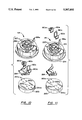
- FIG. 1 is a partially schematic drawing illustrating the overall system in accordance with one form of the invention.
- FIG. 2 is a partially schematic exploded view of the key module shown in FIG. 1.
- FIG. 3 is a partially schematic view to an enlarged scale of the head of the key module shown in FIG. 2.
- FIG. 4 is a perspective view of the assembled key module shown in FIG. 2.
- FIG. 5 is a perspective view of the assembled key receptacle shown in FIG. 1.
- FIG. 6 is a partially schematic plan view of the key receptacle shown in FIG. 5.
- FIG. 7 is a partially schematic elevational view of the key receptacle shown in FIG. 5.
- FIG. 8 is an exploded view of the key receptacle shown in FIG. 5.
- FIG. 9 is a perspective view of the best mode key module.
- FIG. 10 is a partially schematic exploded view of the key module shown in FIG. 9.
- FIG. 11 is another partially schematic exploded view of the key module shown in FIG. 9.
- FIG. 12 is perspective view of the best mode key receptacle.
- FIG. 13 is an perspective view of the top of the housing of the key receptacle shown in FIG. 12.
- FIG. 14 is a perspective view of the stack of alternately insulating and conductive plates that are disposed in the key receptacle shown in FIG. 12.
- FIG. 15 is an exploded view of the key receptacle shown in FIG. 12.
- the control apparatus 8 includes a control module 10 that is connected by a cable 11 to a key receptacle 12.
- the control module 10 is mounted on an interior wall of the building or room secured by the apparatus 8.
- the key receptacle 12 is, in the preferred embodiment, generally dish shaped or concave.
- the key receptacle 12 ordinarily will be mounted on the outer portion of the door frame (not shown) of the door that is secured by the apparatus 8.
- the apparatus also includes a key module 14 that is dimensioned and configured for mating engagement with the key receptacle 12.
- the key module 14 is generally convex in the preferred form of the invention. The respective concave and convex shapes allow the user to engage the key receptacle 12 and key module 14 without the need for a specific relative angular orientation. Ordinarily the key module 14 is strapped on the wrist of the user. In other forms of the invention the key module 14 may be sewn on the clothing of the user or even secured in place with screws that engage an arm or leg prosthetic device on the user.
- the apparatus in accordance with the invention will operate an electric strike 16.
- Such devices are known in the art and typically constitute a stop that is movable by a solenoid between a first position that prevents the bolt or latch from moving away from a closed door position to an open door position.
- Some embodiments of the invention may also include an automatic door opener that is also coupled to the I/O port control 26.
- an automatic door opener that is also coupled to the I/O port control 26.
- many other devices may be operated by the present apparatus. For example, the device does not even have to be a lock. The scope of applications is limited only by ones imagination.
- the control module 10 in the preferred embodiment includes a Z-80 microprocessor 18.
- the Z-80 microprocessor 18 is fed a clock pulse provided by a clock 20 and is coupled to ROM 24 that has a unique numeric password stored therein.
- the ROM 24 has software stored therein and is also coupled to the Z-80 microprocessor 18.
- An I/O port control 26 is coupled to the electric strike 16.
- the I/O port control 26 may include means for producing-a signal strong enough to operate the electric strike 16 in response to a relatively low level signal from the Z-80 microprocessor 18.
- the Z-80 microprocessor 18 is also coupled to a data buffer 28 that isolates the Z-80 microprocessor 18 from external influences from outside the control module 10 except for those passing via the cable 11 and key receptacle 12.
- a power supply 31 for the module is connected to external power 32.
- Various resistors and capacitors may be provided to absorb spikes.
- RAM 22 is provided as a scratch pad for the Z-80 microprocessor 18.
- the Z-80 microprocessor 18 sends pulses to the key receptacle 12 through the data buffer 28. These pulses pass to the key module 14. In response to these pulses the counter (not shown) in the key module 14 increments the address to the next data bit stored in the PROM (not shown) disposed in the key module 14. The PROM then passes the next data bit of the password back to the Z-80 microprocessor 18 through the data buffer 28.
- the number of data bits passed determine the possible number of password combinations or passwords. For example, using 32 data bits 4.2 billion combinations can be realized. Those skilled in the art will recognize that the possible combinations are only limited by the number of data bits and that other forms of the apparatus may employ other storage techniques such as a serial PROM.
- the Z-80 microprocessor 18 compares the data in the PROM which is in the key module 14 to the data in the ROM 24. If the respective data are identical the electric strike 16 is operated by the Z-80 microprocessor 18.
- the key receptacle 12 and the key module 14 must have the capability of establishing four separate electrical power paths. More specifically, there are first and second paths for electrical power since it is preferable that no power be provided from within the key module 14. In other words it is preferable that the user not even have to carry a battery. Third and fourth paths are utilized respectively for a clock pulses and data.
- the apparatus may includes a PAL (programmable array logic). In each case the apparatus will compare data in the control module 10 to data in the key module 14.
- PAL programmable array logic
- the key receptacle 12 comprises an outer shell 30 having a recess 30a in which are disposed successive generally planar members. More specifically the respective planar members are a first layer 32 (a brass layer), a second layer 34 (an insulating layer), a third layer 36 (a brass layer), a fourth layer 38 (insulating layer), a fifth layer 40 (a brass layer), a sixth layer 42 (an insulating layer), a seventh layer 44 (a brass layer), spring retainer/wireway 46, and a locking member 50.
- the cable 11 extends into a groove 47 in the spring retainer/wireway 46.
- the insulating layers are plastic. All layers are approximately 0.016 inches thick in this form of the invention.
- springs 48 extend from the groove 47 to respectively the first layer 32, third layer 36, fifth layer 40 and seventh layer 44. In this manner electric continuity is maintained between respective conductors of the cable 11 and respectively the negative power, positive power, return data and clock pulses to the first layer 32, third layer 36, fifth layer 40 and seventh layer 44. As best seen in FIG. 8 one of the springs 48 extends from the groove 47 through the holes 44a, 42a, 40a, 38a, 36a and 34a in respectively seventh layer 44, sixth layer 42, fifth layer 40, fourth layer 38, third layer 36, and second layer 34 to make contact with the first layer 32.
- Insulators 46a, 46b, 46c are part of locking member 46 and prevent unintentional contact of respective springs 48 with conductive plates.
- another spring 48 extends from the groove 47 through holes 44b, 42b, 40b, and 38b in respectively seventh layer 44, sixth layer 42, fifth layer 40, fourth layer 38 to make contact with the third layer 36.
- each of the other two of the four springs 48 establishes continuity to another conductor in the cable 11 and respectively the fifth layer 40 and the seventh layer 44.
- the spring retainer/wireway 46 includes peripheral radially extending ribs that are dimensioned and configured to snap into grooves that are disposed on each of the four faces of the recess 30a. In this manner the spring retainer/wireway 46 is secured in place within the outer shell 30.
- the locking member 50 also is provided with peripheral ribs that are dimensioned and configured to snap into engagement with grooves 30c.
- Four stepped cross-section bores 30d are provided in the outer shell 30 to allow mounting. As noted above the mounting preferably is on the outside of the door frame in a typical installation.
- the centrally disposed apertures 32c, 34c, 36c, 38c, 40c, 42c, and 44c in respectively first layer 32, second layer 34, third layer 36, fourth layer 38, fifth layer 40, sixth layer 42 and seventh layer 44 are progressively of smaller diameter to produce a dish shaped or concave opening.
- the key module 14 includes a mounting plate 54 that is constructed with journals 54a to engage pins and a strap (not shown) as with the conventional wrist watch.
- the case 56 is provided with a plurality of steps 56a and a chamfer 56b to precisely mate with the key receptacle 12.
- the key module 14 is provided with four pins 60a, 60b, 60c, and 60d of differing lengths. These pins are spring biased by springs 62 to provide engagement with the brass layers in the key receptacle 12. As best seen in FIG. 3 the pins 60a-60d extend through the outer face of the case 56. In some forms of the invention the case 56 may carry a digital watch 70 in the center thereof.
- the shape of the case 56 is generally rotationally symmetrical and thus the angular orientation of the case 56 is immaterial for satisfactory operation.
- a circuit board 64 engages the springs 62.
- a closure member 65 secures the key module 14 together.
- the apparatus includes the key receptacle 112 and the key module 114 as shown in FIGS. 9-15.
- the key receptacle 112 comprises an outer shell 130 having a recess 130a in which are disposed successive generally planar members. More specifically the respective planar members are a first layer 132 (a brass layer), a second layer 134 (an insulating layer), a third layer 136 (a brass layer), a fourth layer 138 (insulating layer), a fifth layer 140 (a brass layer), a sixth layer 142 (an insulating layer), and a seventh layer 144 (a brass layer).
- Each brass layer 132, 136, 140, 144 is provided with a respective tang 132a, 136a, 138a, 140a that extend from the stack of planar members.
- the brass layers are 0.032" thick and the insulating layers are 0.010 thick.
- the tangs are disposed, in the preferred embodiment, extending radially from the stack of generally circular layers 132, 134, 136, 138, 140, 144.
- Each tang 132a, 136a, 138a, 140a is provided with a hole 152 for connection to the respective wires of the cable 11.
- an LED 154 is provided to display to the user that the device 16 being controlled has received a voltage signal.
- the LED 154 may indicate that a lock mechanism has been disengaged.
- the cable 11 may have five conductors instead of four as shown in FIG. 1.
- the fifth conductor in combination with a ground already present in the cable 11 in cooperation with circuitry in the control module 10 controls the LED 154.
- the shell 130 is carried on a base 157 and both are provided respective recesses 130c, 157c to accommodate the LED 154.
- the best mode key module 114 cooperates with the dish shaped or concave opening 130d in the outer shell 130 of the key receptacle 112.
- the key receptacle as in the embodiment described above has a domed shaped or convex head or case 156.
- the key module 14 includes a mounting plate 254.
- the case 156 is provided with a plurality of steps 156a to precisely mate with the key receptacle 112.
- the key module 114 is provided with four elongated conductors 160a, 160b, 160c, and 160d.
- the case 156 is preferably a molded shell into which four pairs of holes 257 are drilled. Each pair of holes 257 are disposed on a different level 156a of the head 156.
- Each of the conductors 160a is formed in the shape of a staple and inserted into one of the pairs of holes 257.
- the free ends of the staple shaped conductors 160a, 160b, 160c, and 160d are bent toward each other and soldered to conductors leading to respective pins of an EPROM 264.
- the EPROM 264 is disposed on the board 64 in the embodiment shown in FIG. 2. The best mode embodiment eliminates the necessity for the board 64 and provides the EPROM 264 potted inside the case 156.
- the EPROM 264 and the respective conductors 160a, 160b, 160c, and 160d are secured in place with a globule of elastic material 263 that will maintain elasticity even after curing.
- the elasticity is vital to allow the conductors 160a, 160b, 160c, and 160d to move in a manner that compensates for tolerance buildups in the mating key receptacle 112 and the key module 114.
- the elastic material functions to achieve the same purpose as the springs shown in FIG. 2. It will be understood that the material 263 surrounds the EPROM 264 and the wires leading therefrom in the final assembly.
- the holes in which the wires connecting the respective conductors 160a, 160b, 160c, and 160d to the pins of the EPROM 264 pass through the material 263 extend through respective holes 263a. It will be understood that the material will seal tightly around the wires.
- PLASTI DIP PLASTI DIP
- PDI Inc. Circle Pines, Minn.; United States of America.
- a common conventional application for this material is to coat the handles of pliers and screwdrivers.
- the material is plastic although other resilient materials non-conductive materials may be used.
Landscapes
- Engineering & Computer Science (AREA)
- Manufacturing & Machinery (AREA)
- Physics & Mathematics (AREA)
- General Physics & Mathematics (AREA)
- Lock And Its Accessories (AREA)
Abstract
A control apparatus which includes apparatus for storing a first digital code, apparatus for storing a second digital code, and apparatus for comparing the first and second digital codes, the apparatus for comparing including first and second generally dish shaped members that are dimensioned and configured for nesting relationship. In some forms of the invention the dish shaped members are each rotationally symmetrical. The first and second dish shaped members may each include a plurality of steps on the face thereof. At least one of the first and second dish shaped members includes a plurality of steps on the face thereof. The other of said first and second dish shaped members may includes a plurality of steps on the face thereof. The apparatus will often include means for conducting disposed respectively in contact with the conductive generally planar members. Some of the generally planar members may have tab portions for connection thereto. The other of the dish shaped members may include a plurality of elongated contacts that are resiliently mounted. The elongated contacts may have an axial portion thereof disposed for engagement with one of the generally planar members. In some forms of the invention each of the axial portions has depending axial portions. One form of the invention includes elongated conductors that have axial portions contacting the planar members. In one form of the invention the apparatus includes apparatus for storing a first digital code; apparatus for storing a second digital code; and apparatus for comparing the first and second digital codes. The apparatus for comparing includes first and second members in which the means for storing a first digital code and the means for storing a second digital code are respectively disposed in first and second members and the second member receives all electrical power for the operation thereof from the first member.
Description
This application is the national phase continuation application under 35 U.S.C.§371 of PCT application Ser. No. PCT/US93/01573 filed 22 February 1993 which was a continuation in part of U.S. patent application Ser. No. 07/839,177 filed 21 February 1992, now U.S. Pat. No. 5,281,945.
The invention relates to control apparatus and particularly to apparatus of this type that is particularly adapted to use by physically handicapped persons. While the invention will be described in terms of apparatus for unlocking the door of a building, it will be understood that the invention has application to exterior and interior building doors as well as other locking apparatus on cabinets, trunks, computer security devices, and just about any where that locks are customarily used.
In addition those skilled in the art will understand that many other devices may be operated by the present apparatus. For example, the device does not even have to be a lock. The apparatus in accordance with the invention may be coupled to an elevator control system so that the elevator will come to a specific floor to receive a person and then automatically take the occupant to a specific floor. The access to the destination floor may even be limited to those having such an electronic key. The same apparatus may also be used to operate apparatus as varied as a missile launcher, a valve in a process control system or a wide variety of other applications. The scope of applications is limited only by ones imagination.
The prior art includes a variety of locking apparatus that use digital techniques. For example, magnetic stripes on cards are often used to operate hotel room locks. Such locks may be easily reprogrammed for new room occupants.
It is an object of the invention to provide a construction that will be easy to operate by persons having motor skills that are less extensive than the motor skills of the average person.
It is another object of the invention to provide apparatus that will be very, very difficult for someone who does not possess a valid key module to deceive and thus gain entrance to the locked apparatus.
It is an object of the invention to provide apparatus which is inexpensive to manufacture.
Still another object of the invention is to provide apparatus that will be easy to assemble.
It has now been found that these and other objects of the invention may be attained in a control apparatus which includes means for storing a first digital code, means for storing a second digital code, and means for comparing the first and second digital codes, the means for comparing including first and second generally dish shaped members that are dimensioned and configured for nesting relationship.
In some forms of the invention the dish shaped members are each rotationally symmetrical. One of said dish shaped members may include a plurality of steps on the face thereof. At least one of the first and second dish shaped members may include a plurality of steps on the face thereof. The other of said first and second dish shaped members may include a plurality of steps on the face thereof.
In some forms of the invention at least one of the dish shaped members includes a plurality of generally planar members. The plurality of generally planar members may be alternately conductive and insulating materials. Conductive springs may be disposed in contact with respective conductive generally planar members.
In some forms of the invention at least some of the generally planar members include bores therein for receiving the springs. The other of the dish shaped members includes a plurality of elongated contacts and means for mounting the plurality of elongated contacts with respective generally planar members in the one dish shaped member. Each of the elongated contacts may be spring biased axially.
The apparatus will often include means for conducting disposed respectively in contact with the conductive generally planar members. Some of the generally planar members may have tab portions for connection thereto. The other of the dish shaped members may include a plurality of elongated contacts that are resiliently mounted. The elongated contacts may have an axial portion thereof disposed for engagement with one of the generally planar members. In some forms of the invention each of the axial portions has depending axial portions.
One form of the invention includes means for storing a first digital code; means for storing a second digital code; and means for comparing the first and second digital codes. The means for comparing includes first and second members in which the means for storing a first digital code and the means for storing a second digital code are respectively disposed in first and second members and the second member receives all electrical power for the operation thereof from the first member.
The invention will be better understood by reference to the accompanying drawing in which:
FIG. 1 is a partially schematic drawing illustrating the overall system in accordance with one form of the invention.
FIG. 2 is a partially schematic exploded view of the key module shown in FIG. 1.
FIG. 3 is a partially schematic view to an enlarged scale of the head of the key module shown in FIG. 2.
FIG. 4 is a perspective view of the assembled key module shown in FIG. 2.
FIG. 5 is a perspective view of the assembled key receptacle shown in FIG. 1.
FIG. 6 is a partially schematic plan view of the key receptacle shown in FIG. 5.
FIG. 7 is a partially schematic elevational view of the key receptacle shown in FIG. 5.
FIG. 8 is an exploded view of the key receptacle shown in FIG. 5.
FIG. 9 is a perspective view of the best mode key module.
FIG. 10 is a partially schematic exploded view of the key module shown in FIG. 9.
FIG. 11 is another partially schematic exploded view of the key module shown in FIG. 9.
FIG. 12 is perspective view of the best mode key receptacle.
FIG. 13 is an perspective view of the top of the housing of the key receptacle shown in FIG. 12.
FIG. 14 is a perspective view of the stack of alternately insulating and conductive plates that are disposed in the key receptacle shown in FIG. 12.
FIG. 15 is an exploded view of the key receptacle shown in FIG. 12.
Referring now to FIGS. 1-8 there is shown a schematic of one form of the control apparatus 8 in accordance with the invention. The control apparatus 8 includes a control module 10 that is connected by a cable 11 to a key receptacle 12. Ordinarily, the control module 10 is mounted on an interior wall of the building or room secured by the apparatus 8. The key receptacle 12 is, in the preferred embodiment, generally dish shaped or concave. The key receptacle 12 ordinarily will be mounted on the outer portion of the door frame (not shown) of the door that is secured by the apparatus 8.
The apparatus also includes a key module 14 that is dimensioned and configured for mating engagement with the key receptacle 12. The key module 14 is generally convex in the preferred form of the invention. The respective concave and convex shapes allow the user to engage the key receptacle 12 and key module 14 without the need for a specific relative angular orientation. Ordinarily the key module 14 is strapped on the wrist of the user. In other forms of the invention the key module 14 may be sewn on the clothing of the user or even secured in place with screws that engage an arm or leg prosthetic device on the user.
Although the respective dish shapes as shown in the drawings are preferred it will be understood that a plurality of contacts may even be arrayed in respective rectilinear arrays on respective keys and receptacles. This form of the invention will require the user to have greater motor skills than the illustrated embodiment.
For many applications the apparatus in accordance with the invention will operate an electric strike 16. Such devices are known in the art and typically constitute a stop that is movable by a solenoid between a first position that prevents the bolt or latch from moving away from a closed door position to an open door position. Some embodiments of the invention may also include an automatic door opener that is also coupled to the I/O port control 26. As noted above those skilled in the art will understand that many other devices may be operated by the present apparatus. For example, the device does not even have to be a lock. The scope of applications is limited only by ones imagination.
The control module 10 in the preferred embodiment includes a Z-80 microprocessor 18. The Z-80 microprocessor 18 is fed a clock pulse provided by a clock 20 and is coupled to ROM 24 that has a unique numeric password stored therein. The ROM 24 has software stored therein and is also coupled to the Z-80 microprocessor 18. An I/O port control 26 is coupled to the electric strike 16. The I/O port control 26 may include means for producing-a signal strong enough to operate the electric strike 16 in response to a relatively low level signal from the Z-80 microprocessor 18. The Z-80 microprocessor 18 is also coupled to a data buffer 28 that isolates the Z-80 microprocessor 18 from external influences from outside the control module 10 except for those passing via the cable 11 and key receptacle 12. A power supply 31 for the module is connected to external power 32. Various resistors and capacitors may be provided to absorb spikes. RAM 22 is provided as a scratch pad for the Z-80 microprocessor 18.
The Z-80 microprocessor 18 sends pulses to the key receptacle 12 through the data buffer 28. These pulses pass to the key module 14. In response to these pulses the counter (not shown) in the key module 14 increments the address to the next data bit stored in the PROM (not shown) disposed in the key module 14. The PROM then passes the next data bit of the password back to the Z-80 microprocessor 18 through the data buffer 28. The number of data bits passed determine the possible number of password combinations or passwords. For example, using 32 data bits 4.2 billion combinations can be realized. Those skilled in the art will recognize that the possible combinations are only limited by the number of data bits and that other forms of the apparatus may employ other storage techniques such as a serial PROM.
In operation the Z-80 microprocessor 18 compares the data in the PROM which is in the key module 14 to the data in the ROM 24. If the respective data are identical the electric strike 16 is operated by the Z-80 microprocessor 18.
In the preferred embodiment of the invention the key receptacle 12 and the key module 14 must have the capability of establishing four separate electrical power paths. More specifically, there are first and second paths for electrical power since it is preferable that no power be provided from within the key module 14. In other words it is preferable that the user not even have to carry a battery. Third and fourth paths are utilized respectively for a clock pulses and data.
In other forms of the invention the apparatus may includes a PAL (programmable array logic). In each case the apparatus will compare data in the control module 10 to data in the key module 14.
As best seen in FIGS. 5-8 the key receptacle 12 comprises an outer shell 30 having a recess 30a in which are disposed successive generally planar members. More specifically the respective planar members are a first layer 32 (a brass layer), a second layer 34 (an insulating layer), a third layer 36 (a brass layer), a fourth layer 38 (insulating layer), a fifth layer 40 (a brass layer), a sixth layer 42 (an insulating layer), a seventh layer 44 (a brass layer), spring retainer/wireway 46, and a locking member 50. The cable 11 extends into a groove 47 in the spring retainer/wireway 46. In the preferred embodiment the insulating layers are plastic. All layers are approximately 0.016 inches thick in this form of the invention. It will be understood that the greater the slope of the meshing faces the easier the alignment for the user. Conversely the less the slope the greater the compactness of the apparatus. Four springs 48 extend from the groove 47 to respectively the first layer 32, third layer 36, fifth layer 40 and seventh layer 44. In this manner electric continuity is maintained between respective conductors of the cable 11 and respectively the negative power, positive power, return data and clock pulses to the first layer 32, third layer 36, fifth layer 40 and seventh layer 44. As best seen in FIG. 8 one of the springs 48 extends from the groove 47 through the holes 44a, 42a, 40a, 38a, 36a and 34a in respectively seventh layer 44, sixth layer 42, fifth layer 40, fourth layer 38, third layer 36, and second layer 34 to make contact with the first layer 32. Insulators 46a, 46b, 46c are part of locking member 46 and prevent unintentional contact of respective springs 48 with conductive plates. Similarly, another spring 48 extends from the groove 47 through holes 44b, 42b, 40b, and 38b in respectively seventh layer 44, sixth layer 42, fifth layer 40, fourth layer 38 to make contact with the third layer 36.
In a similar manner each of the other two of the four springs 48 establishes continuity to another conductor in the cable 11 and respectively the fifth layer 40 and the seventh layer 44. The spring retainer/wireway 46 includes peripheral radially extending ribs that are dimensioned and configured to snap into grooves that are disposed on each of the four faces of the recess 30a. In this manner the spring retainer/wireway 46 is secured in place within the outer shell 30. The locking member 50 also is provided with peripheral ribs that are dimensioned and configured to snap into engagement with grooves 30c. Four stepped cross-section bores 30d are provided in the outer shell 30 to allow mounting. As noted above the mounting preferably is on the outside of the door frame in a typical installation.
As best seen in FIG. 8 the centrally disposed apertures 32c, 34c, 36c, 38c, 40c, 42c, and 44c in respectively first layer 32, second layer 34, third layer 36, fourth layer 38, fifth layer 40, sixth layer 42 and seventh layer 44 are progressively of smaller diameter to produce a dish shaped or concave opening.
Cooperating with the dish shaped or concave opening is a domed shaped or convex head or case 56 of the key module 14. The key module 14 includes a mounting plate 54 that is constructed with journals 54a to engage pins and a strap (not shown) as with the conventional wrist watch. The case 56 is provided with a plurality of steps 56a and a chamfer 56b to precisely mate with the key receptacle 12.
The key module 14 is provided with four pins 60a, 60b, 60c, and 60d of differing lengths. These pins are spring biased by springs 62 to provide engagement with the brass layers in the key receptacle 12. As best seen in FIG. 3 the pins 60a-60d extend through the outer face of the case 56. In some forms of the invention the case 56 may carry a digital watch 70 in the center thereof.
The shape of the case 56 is generally rotationally symmetrical and thus the angular orientation of the case 56 is immaterial for satisfactory operation. A circuit board 64 engages the springs 62. A closure member 65 secures the key module 14 together.
The best mode of the invention is as described above with exception that the apparatus includes the key receptacle 112 and the key module 114 as shown in FIGS. 9-15. As in the embodiment described above, there must be four separate electrical power paths between the key receptacle 112 and the key module 114. More specifically, there are first and second paths for electrical power since it is preferable that there is no battery or other power source that must be replaced or repaired disposed within the key module 114. Third and fourth paths are utilized respectively for a clock pulses and data.
As best seen in FIGS. 12-15 the key receptacle 112 comprises an outer shell 130 having a recess 130a in which are disposed successive generally planar members. More specifically the respective planar members are a first layer 132 (a brass layer), a second layer 134 (an insulating layer), a third layer 136 (a brass layer), a fourth layer 138 (insulating layer), a fifth layer 140 (a brass layer), a sixth layer 142 (an insulating layer), and a seventh layer 144 (a brass layer). Each brass layer 132, 136, 140, 144 is provided with a respective tang 132a, 136a, 138a, 140a that extend from the stack of planar members. In this embodiment the brass layers are 0.032" thick and the insulating layers are 0.010 thick. As best seen in FIG. 14 the tangs are disposed, in the preferred embodiment, extending radially from the stack of generally circular layers 132, 134, 136, 138, 140, 144. Each tang 132a, 136a, 138a, 140a is provided with a hole 152 for connection to the respective wires of the cable 11. In one embodiment an LED 154 is provided to display to the user that the device 16 being controlled has received a voltage signal. For example, the LED 154 may indicate that a lock mechanism has been disengaged. In such embodiments the cable 11 may have five conductors instead of four as shown in FIG. 1. The fifth conductor in combination with a ground already present in the cable 11 in cooperation with circuitry in the control module 10 controls the LED 154. The shell 130 is carried on a base 157 and both are provided respective recesses 130c, 157c to accommodate the LED 154.
As best seen in FIGS. 9-11 the best mode key module 114 cooperates with the dish shaped or concave opening 130d in the outer shell 130 of the key receptacle 112. The key receptacle as in the embodiment described above has a domed shaped or convex head or case 156. The key module 14 includes a mounting plate 254. The case 156 is provided with a plurality of steps 156a to precisely mate with the key receptacle 112.
The key module 114 is provided with four elongated conductors 160a, 160b, 160c, and 160d. The case 156 is preferably a molded shell into which four pairs of holes 257 are drilled. Each pair of holes 257 are disposed on a different level 156a of the head 156. Each of the conductors 160a is formed in the shape of a staple and inserted into one of the pairs of holes 257. The free ends of the staple shaped conductors 160a, 160b, 160c, and 160d are bent toward each other and soldered to conductors leading to respective pins of an EPROM 264. The EPROM 264 is disposed on the board 64 in the embodiment shown in FIG. 2. The best mode embodiment eliminates the necessity for the board 64 and provides the EPROM 264 potted inside the case 156.
Preferably the EPROM 264 and the respective conductors 160a, 160b, 160c, and 160d are secured in place with a globule of elastic material 263 that will maintain elasticity even after curing. The elasticity is vital to allow the conductors 160a, 160b, 160c, and 160d to move in a manner that compensates for tolerance buildups in the mating key receptacle 112 and the key module 114. It will be understood that the elastic material functions to achieve the same purpose as the springs shown in FIG. 2. It will be understood that the material 263 surrounds the EPROM 264 and the wires leading therefrom in the final assembly. More specifically, the holes in which the wires connecting the respective conductors 160a, 160b, 160c, and 160d to the pins of the EPROM 264 pass through the material 263 extend through respective holes 263a. It will be understood that the material will seal tightly around the wires.
One such material that has been found to be satisfactory is sold under the trademark PLASTI DIP by PDI Inc. of Circle Pines, Minn.; United States of America. A common conventional application for this material is to coat the handles of pliers and screwdrivers. The material is plastic although other resilient materials non-conductive materials may be used.
The invention has been described with reference to its illustrated preferred embodiment. Persons skilled in the art of such devices may upon exposure to the teachings herein, conceive other variations. Such variations are deemed to be encompassed by the disclosure, the invention being delimited only by the following claims.
Claims (18)
1. A control apparatus which comprises:
first and second dish shaped members;
means for storing a first digital code, said means for storing a first digital code being disposed in said first dish shaped member;
means for storing a second digital code, said means for storing a second digital code being disposed in said second dish shaped member;
means for comparing said first and second digital codes, said first and second generally dish shaped members being dimensioned and configured for mutually nesting relationship, said means for comparing being operative when said first and second members are disposed in nesting relationship.
2. The apparatus as described in claim 1 wherein:
said dish shaped members are each rotationally symmetrical.
3. The apparatus as described in claim 2 wherein:
said first dish shaped member has a first face and said second dish shaped member has a second face and said first and second dish shaped members are disposed in face abutting relationship when said first and second dish shaped members are disposed in nesting relationship, and one of said first and second faces includes a plurality of concentric steps.
4. The apparatus as described in claim 3 wherein:
the other of said first and second faces includes a plurality of concentric steps.
5. The apparatus as described in claim 4 wherein:
at least one of said dish shaped members includes a plurality of generally planar members.
6. The apparatus as described in claim 5 wherein:
said plurality of generally planar members are alternately conductive and insulating materials.
7. The apparatus as described in claim 6 wherein:
said apparatus includes conductive members disposed in contact with respective conductive generally planar members.
8. The apparatus as described in claim 7 wherein:
at least some of said generally planar members include bores therein for receiving said conductive members.
9. The apparatus as described in claim 8 wherein:
the other of said dish shaped members includes a plurality of elongated contacts and means for mounting said plurality of elongated contacts in contact with respective generally planar members in said one dish shaped member.
10. The apparatus as described in claim 9 wherein:
each of said elongated contacts is spring biased axially.
11. The apparatus as described in claim 5 wherein:
the other of said dish shaped members includes a plurality of elongated contacts and means for mounting said plurality of elongated contacts with respective generally planar members in said one dish shaped member.
12. The apparatus as described in claim 11 wherein:
each of said elongated contacts is spring biased axially.
13. The apparatus as described in claim 6 wherein:
said apparatus includes means for conducting disposed respectively in contact with said conductive generally planar members.
14. The apparatus as described in claim 7 wherein:
at least some of said generally planar members have tab portions for connection thereto.
15. The apparatus as described in claim 8 wherein:
the other of said dish shaped members includes a plurality of axially elongated contacts that are resiliently mounted.
16. The apparatus as described in claim 9 wherein:
each of said elongated contacts has an axial portion thereof disposed for engagement with one of said generally planar members.
17. The apparatus as described in claim 16 wherein:
each of said axial portions of said elongated contacts has depending axial portions.
18. A control apparatus which comprises:
a first member and a second member each having a dish shaped configuration;
first means for storing a first digital code in said first member;
second means for storing a second digital: code in said second member, said second member including a non-volatile memory chip for storing said second digital code, said chip requiring electrical power for operation thereof;
means for comparing said first and second digital codes, said means for comparing including first and second members in which said means for storing a first digital code and said means for storing a second digital code are respectively disposed, said second member receiving all electrical power for the operation thereof from said first member, said means for comparing being operative when said first and second members are disposed in nesting relationship.
Priority Applications (1)
| Application Number | Priority Date | Filing Date | Title |
|---|---|---|---|
| US08/139,990 US5387895A (en) | 1992-02-21 | 1993-10-21 | Control apparatus particularly adapted for handicapped persons |
Applications Claiming Priority (2)
| Application Number | Priority Date | Filing Date | Title |
|---|---|---|---|
| US07/839,177 US5281945A (en) | 1992-02-21 | 1992-02-21 | Control apparatus particularly adapted for handicapped persons |
| US08/139,990 US5387895A (en) | 1992-02-21 | 1993-10-21 | Control apparatus particularly adapted for handicapped persons |
Related Parent Applications (1)
| Application Number | Title | Priority Date | Filing Date |
|---|---|---|---|
| US07/839,177 Continuation US5281945A (en) | 1992-02-21 | 1992-02-21 | Control apparatus particularly adapted for handicapped persons |
Publications (1)
| Publication Number | Publication Date |
|---|---|
| US5387895A true US5387895A (en) | 1995-02-07 |
Family
ID=25279055
Family Applications (2)
| Application Number | Title | Priority Date | Filing Date |
|---|---|---|---|
| US07/839,177 Expired - Fee Related US5281945A (en) | 1992-02-21 | 1992-02-21 | Control apparatus particularly adapted for handicapped persons |
| US08/139,990 Expired - Fee Related US5387895A (en) | 1992-02-21 | 1993-10-21 | Control apparatus particularly adapted for handicapped persons |
Family Applications Before (1)
| Application Number | Title | Priority Date | Filing Date |
|---|---|---|---|
| US07/839,177 Expired - Fee Related US5281945A (en) | 1992-02-21 | 1992-02-21 | Control apparatus particularly adapted for handicapped persons |
Country Status (2)
| Country | Link |
|---|---|
| US (2) | US5281945A (en) |
| WO (1) | WO1993017373A1 (en) |
Families Citing this family (6)
| Publication number | Priority date | Publication date | Assignee | Title |
|---|---|---|---|---|
| US5281945A (en) * | 1992-02-21 | 1994-01-25 | Magicorp, Inc. | Control apparatus particularly adapted for handicapped persons |
| US5689985A (en) * | 1995-09-29 | 1997-11-25 | Schlage Lock Company | Electronic touch key providing a tactile pressure signal for an electronic lock |
| US6553800B2 (en) | 2000-01-19 | 2003-04-29 | Schlage Lock Company | Side bar plunger and solenoid cylinder locking mechanism |
| CA2331405A1 (en) | 2000-04-06 | 2001-10-06 | Schlage Lock Company | Electronic key assembly with spring loaded data pin and contact |
| US6591644B2 (en) | 2001-01-19 | 2003-07-15 | Schlage Lock Company | Ball bearing cylinder plug and key retention |
| KR20060102637A (en) * | 2005-03-24 | 2006-09-28 | 김갑식 | Electronic lock |
Citations (6)
| Publication number | Priority date | Publication date | Assignee | Title |
|---|---|---|---|---|
| US4022038A (en) * | 1976-02-20 | 1977-05-10 | Engineering Systems Corporation | Magnetically operated locking device and key |
| US4392134A (en) * | 1978-06-07 | 1983-07-05 | Sach-Systemtechnik Gmbh | Locking device with programmable key |
| US4838060A (en) * | 1988-05-12 | 1989-06-13 | Fort Lock Corporation | Tubular key and corresponding lock housing key entry construction |
| US5006842A (en) * | 1987-04-13 | 1991-04-09 | The Foxboro Company | Identity insert block for electronic modules |
| US5091771A (en) * | 1989-05-15 | 1992-02-25 | Dallas Semiconductor Corporation | Compact package for electronic module |
| US5281945A (en) * | 1992-02-21 | 1994-01-25 | Magicorp, Inc. | Control apparatus particularly adapted for handicapped persons |
Family Cites Families (2)
| Publication number | Priority date | Publication date | Assignee | Title |
|---|---|---|---|---|
| US3987345A (en) * | 1974-07-22 | 1976-10-19 | Makoto Kato | Input setting type programming relay |
| WO1981000478A1 (en) * | 1979-08-08 | 1981-02-19 | G Ward | Communication |
-
1992
- 1992-02-21 US US07/839,177 patent/US5281945A/en not_active Expired - Fee Related
-
1993
- 1993-02-22 WO PCT/US1993/001573 patent/WO1993017373A1/en not_active Ceased
- 1993-10-21 US US08/139,990 patent/US5387895A/en not_active Expired - Fee Related
Patent Citations (6)
| Publication number | Priority date | Publication date | Assignee | Title |
|---|---|---|---|---|
| US4022038A (en) * | 1976-02-20 | 1977-05-10 | Engineering Systems Corporation | Magnetically operated locking device and key |
| US4392134A (en) * | 1978-06-07 | 1983-07-05 | Sach-Systemtechnik Gmbh | Locking device with programmable key |
| US5006842A (en) * | 1987-04-13 | 1991-04-09 | The Foxboro Company | Identity insert block for electronic modules |
| US4838060A (en) * | 1988-05-12 | 1989-06-13 | Fort Lock Corporation | Tubular key and corresponding lock housing key entry construction |
| US5091771A (en) * | 1989-05-15 | 1992-02-25 | Dallas Semiconductor Corporation | Compact package for electronic module |
| US5281945A (en) * | 1992-02-21 | 1994-01-25 | Magicorp, Inc. | Control apparatus particularly adapted for handicapped persons |
Also Published As
| Publication number | Publication date |
|---|---|
| US5281945A (en) | 1994-01-25 |
| WO1993017373A1 (en) | 1993-09-02 |
Similar Documents
| Publication | Publication Date | Title |
|---|---|---|
| US5337588A (en) | Electronic lock and key system | |
| US5886644A (en) | Programmable digital electronic lock | |
| US4594637A (en) | Digital electronic lock system | |
| US5479800A (en) | Plastic lock | |
| US6116066A (en) | Electronic input and dial entry lock | |
| US5771722A (en) | Dual control mode lock system | |
| US7336150B2 (en) | Locker lock with master override and low power jump start | |
| US5423198A (en) | Dual control mode lock | |
| US6895792B2 (en) | Electronic locking system | |
| US7231791B2 (en) | Electric cylinder for actuating a door lock and a cylinder door lock | |
| EP0147377B1 (en) | A cylinder lock | |
| US5999095A (en) | Electronic security system | |
| US7212099B2 (en) | Intelligent lock that can set a key code by itself, a key which can be used for many locks and a setting tool thereof | |
| RU97105380A (en) | ELECTRONIC SECURITY SYSTEM | |
| US4399673A (en) | Lock device | |
| US5387895A (en) | Control apparatus particularly adapted for handicapped persons | |
| JPH03100286A (en) | Locking device | |
| US4390758A (en) | Key-actuated electrical lock | |
| WO1990015910A1 (en) | Electronic lock | |
| US4689977A (en) | Switch lock with two momentary positions | |
| GB2190700A (en) | Security system with key | |
| KR100406030B1 (en) | Locking system having wireless remote controller | |
| KR100380836B1 (en) | Locking System | |
| US5005884A (en) | Cylinder lock modified for use with a card reader unlocking mechanism | |
| GB2182975A (en) | A card-type combination lock |
Legal Events
| Date | Code | Title | Description |
|---|---|---|---|
| REMI | Maintenance fee reminder mailed | ||
| LAPS | Lapse for failure to pay maintenance fees | ||
| STCH | Information on status: patent discontinuation |
Free format text: PATENT EXPIRED DUE TO NONPAYMENT OF MAINTENANCE FEES UNDER 37 CFR 1.362 |
|
| FP | Lapsed due to failure to pay maintenance fee |
Effective date: 20030207 |