US5382734A - Thermal reforming of naphthenic and hydrodealkylation of aromatic feedstocks to produce benzene - Google Patents
Thermal reforming of naphthenic and hydrodealkylation of aromatic feedstocks to produce benzene Download PDFInfo
- Publication number
- US5382734A US5382734A US08/092,642 US9264293A US5382734A US 5382734 A US5382734 A US 5382734A US 9264293 A US9264293 A US 9264293A US 5382734 A US5382734 A US 5382734A
- Authority
- US
- United States
- Prior art keywords
- reactor
- thdcpd
- aromatic
- hydrogen
- feedstream
- Prior art date
- Legal status (The legal status is an assumption and is not a legal conclusion. Google has not performed a legal analysis and makes no representation as to the accuracy of the status listed.)
- Expired - Lifetime
Links
- UHOVQNZJYSORNB-UHFFFAOYSA-N Benzene Chemical compound C1=CC=CC=C1 UHOVQNZJYSORNB-UHFFFAOYSA-N 0.000 title claims abstract description 153
- 125000003118 aryl group Chemical group 0.000 title claims abstract description 38
- 238000002303 thermal reforming Methods 0.000 title claims description 6
- LPSXSORODABQKT-UHFFFAOYSA-N tetrahydrodicyclopentadiene Chemical compound C1C2CCC1C1C2CCC1 LPSXSORODABQKT-UHFFFAOYSA-N 0.000 claims abstract description 72
- 239000000463 material Substances 0.000 claims abstract description 51
- 238000006243 chemical reaction Methods 0.000 claims abstract description 35
- ZUOUZKKEUPVFJK-UHFFFAOYSA-N diphenyl Chemical compound C1=CC=CC=C1C1=CC=CC=C1 ZUOUZKKEUPVFJK-UHFFFAOYSA-N 0.000 claims abstract description 26
- 239000004305 biphenyl Substances 0.000 claims abstract description 13
- 235000010290 biphenyl Nutrition 0.000 claims abstract description 13
- 239000003849 aromatic solvent Substances 0.000 claims abstract description 11
- 150000001875 compounds Chemical class 0.000 claims abstract description 10
- 239000000203 mixture Substances 0.000 claims abstract description 10
- 239000002904 solvent Substances 0.000 claims abstract description 10
- 125000000217 alkyl group Chemical group 0.000 claims abstract 2
- 239000000047 product Substances 0.000 claims description 37
- 239000001257 hydrogen Substances 0.000 claims description 31
- 229910052739 hydrogen Inorganic materials 0.000 claims description 31
- UFHFLCQGNIYNRP-UHFFFAOYSA-N Hydrogen Chemical compound [H][H] UFHFLCQGNIYNRP-UHFFFAOYSA-N 0.000 claims description 30
- 238000000034 method Methods 0.000 claims description 21
- UFWIBTONFRDIAS-UHFFFAOYSA-N Naphthalene Chemical compound C1=CC=CC2=CC=CC=C21 UFWIBTONFRDIAS-UHFFFAOYSA-N 0.000 claims description 12
- 239000007788 liquid Substances 0.000 claims description 10
- 238000010791 quenching Methods 0.000 claims description 9
- 238000002407 reforming Methods 0.000 claims description 9
- 238000004821 distillation Methods 0.000 claims description 5
- 238000011084 recovery Methods 0.000 claims description 5
- -1 THDCPD compound Chemical class 0.000 claims description 3
- 150000001491 aromatic compounds Chemical class 0.000 claims description 3
- 239000006227 byproduct Substances 0.000 claims description 2
- 238000001816 cooling Methods 0.000 claims 3
- 238000004064 recycling Methods 0.000 claims 3
- 150000002431 hydrogen Chemical class 0.000 claims 2
- 125000003187 heptyl group Chemical group [H]C([*])([H])C([H])([H])C([H])([H])C([H])([H])C([H])([H])C([H])([H])C([H])([H])[H] 0.000 claims 1
- 239000011344 liquid material Substances 0.000 claims 1
- 238000010944 pre-mature reactiony Methods 0.000 claims 1
- 230000003197 catalytic effect Effects 0.000 abstract description 6
- 230000015572 biosynthetic process Effects 0.000 abstract description 5
- 239000004215 Carbon black (E152) Substances 0.000 abstract description 3
- 229930195733 hydrocarbon Natural products 0.000 abstract description 3
- 150000002430 hydrocarbons Chemical class 0.000 abstract description 3
- YXFVVABEGXRONW-UHFFFAOYSA-N Toluene Chemical compound CC1=CC=CC=C1 YXFVVABEGXRONW-UHFFFAOYSA-N 0.000 description 36
- 239000007789 gas Substances 0.000 description 12
- 239000006096 absorbing agent Substances 0.000 description 7
- 239000003381 stabilizer Substances 0.000 description 5
- VNWKTOKETHGBQD-UHFFFAOYSA-N methane Chemical compound C VNWKTOKETHGBQD-UHFFFAOYSA-N 0.000 description 4
- 238000005336 cracking Methods 0.000 description 3
- OTMSDBZUPAUEDD-UHFFFAOYSA-N Ethane Chemical compound CC OTMSDBZUPAUEDD-UHFFFAOYSA-N 0.000 description 2
- MWPLVEDNUUSJAV-UHFFFAOYSA-N anthracene Chemical compound C1=CC=CC2=CC3=CC=CC=C3C=C21 MWPLVEDNUUSJAV-UHFFFAOYSA-N 0.000 description 2
- 238000011021 bench scale process Methods 0.000 description 2
- 238000009826 distribution Methods 0.000 description 2
- 238000000197 pyrolysis Methods 0.000 description 2
- 238000005201 scrubbing Methods 0.000 description 2
- 239000007787 solid Substances 0.000 description 2
- XLYOFNOQVPJJNP-UHFFFAOYSA-N water Substances O XLYOFNOQVPJJNP-UHFFFAOYSA-N 0.000 description 2
- 150000004996 alkyl benzenes Chemical class 0.000 description 1
- 239000003054 catalyst Substances 0.000 description 1
- 239000012295 chemical reaction liquid Substances 0.000 description 1
- 239000004927 clay Substances 0.000 description 1
- 230000003247 decreasing effect Effects 0.000 description 1
- 230000001419 dependent effect Effects 0.000 description 1
- 238000005516 engineering process Methods 0.000 description 1
- 238000002474 experimental method Methods 0.000 description 1
- 238000002347 injection Methods 0.000 description 1
- 239000007924 injection Substances 0.000 description 1
- 238000004519 manufacturing process Methods 0.000 description 1
- 238000012986 modification Methods 0.000 description 1
- 230000004048 modification Effects 0.000 description 1
- 238000001556 precipitation Methods 0.000 description 1
- 238000011112 process operation Methods 0.000 description 1
- 238000012545 processing Methods 0.000 description 1
- 238000010926 purge Methods 0.000 description 1
- 238000007363 ring formation reaction Methods 0.000 description 1
- 238000000926 separation method Methods 0.000 description 1
- 238000012546 transfer Methods 0.000 description 1
- 238000009834 vaporization Methods 0.000 description 1
- 230000008016 vaporization Effects 0.000 description 1
Images




Classifications
-
- C—CHEMISTRY; METALLURGY
- C10—PETROLEUM, GAS OR COKE INDUSTRIES; TECHNICAL GASES CONTAINING CARBON MONOXIDE; FUELS; LUBRICANTS; PEAT
- C10G—CRACKING HYDROCARBON OILS; PRODUCTION OF LIQUID HYDROCARBON MIXTURES, e.g. BY DESTRUCTIVE HYDROGENATION, OLIGOMERISATION, POLYMERISATION; RECOVERY OF HYDROCARBON OILS FROM OIL-SHALE, OIL-SAND, OR GASES; REFINING MIXTURES MAINLY CONSISTING OF HYDROCARBONS; REFORMING OF NAPHTHA; MINERAL WAXES
- C10G35/00—Reforming naphtha
- C10G35/02—Thermal reforming
Definitions
- This invention pertains to thermally reforming a heavy naphthenic compound tetra-hydro-dicyclo-penta-diene (THDCPD) dissolved in a suitable solvent material to produce benzene product. It pertains particularly to such a process for thermal reforming feedstocks containing the naphthenic compound THDCPD together with alkyl aromatic materials and simultaneously hydrodealkylating the aromatic materials to produce mainly benzene, along with only minor amounts of heavy multi-ring aromatic materials and gas by-products.
- THDCPD tetra-hydro-dicyclo-penta-diene
- hydrocarbon feedstocks containing tetra-hydro-dicyclo-penta-diene (THDCPD) dissolved in alkyl aromatic fractions can be simultaneously thermally reformed and hydrodealkylated successfully in a plug flow type non-catalytic reactor to produce significant yields of benzene product by utilizing a critical range of thermal reaction conditions.
- THDCPD tetra-hydro-dicyclo-penta-diene
- This discovery advantageously permits processing heavy aromatic feedstocks containing the heavy naphthenic compound THDCPD, by utilizing existing hydrodealkylation process technology to produce additional benzene product without removing the naphthenic material from the feedstock. It is believed there is no prior art for reforming THDCPD to produce aromatics like benzene and toluene in a non-catalytic thermal reactor.
- This invention provides a process for thermally reforming the C 10 naphthenic material tetra-hydro-dicyclo-penta-diene (THDCPD) dissolved in a suitable solvent to produce benzene product.
- THDCPD tetra-hydro-dicyclo-penta-diene
- the solvent used can be either aromatic or non-aromatic in nature or mixtures thereof, but the economics of producing benzene makes an aromatic solvent preferable because the aromatics are readily converted along with THDCPD to produce mainly benzene product.
- the feedstock can be heavier fractions of pyrolysis gasoline or reformate containing THDCPD along with C 9 -C 10 mono-aromatic material, as it is demonstrated in this invention that any mono-aromatic material that is present in the feedstock is hydrodealkylated simultaneously along with the reforming of THDCPD to produce benzene as the principal product.
- any aromatics which may be present in the THDCPD containing feedstock should not be removed.
- the feedstock may contain 5-80wt % THDCPD, and is reacted with hydrogen at critical reaction conditions in a plug flow type non-catalytic reactor similar to known hydrodealkylation (HDA) processes.
- HDA hydrodealkylation
- the critical reaction conditions are 1100°-1350° F. temperature, 45014 650 psig reactor pressure, hydrogen partial pressure of 240-600 psig, and 10-50 sec. feedstream residence time in the reactor, which conditions are similar to those for an hydrodealkylation process for aromatic feedstocks.
- the resulting aromatic effluent material from the reactor can then be further processed as desired by using suitable separation and distillation steps to yield principally benzene product.
- the hydrogen supplied to the reactor is controlled so that the molar ratio of hydrogen to the feedstock containing THDCPD at the reactor inlet is maintained within a critical range of 5.0:1-12.0:1, so as to minimize naphthenic and aromatic ring cracking and the formation of condensed heavy aromatics in the reactor.
- the reactor should provide essentially plug flow conditions and have a length/internal diameter ratio between 10/1 and 30/1, and preferably is 15/1-25/1.
- the reactor temperature is maintained in the critical range of 1100°-1350° F., and preferably is 1160°-1300° F, while the reactor pressure is maintained at 450-650 psig and preferably at 500-600 psig.
- the hydrogen to feed molar ratio at the reactor inlet is preferably maintained in the range of 6.0:1-8.0:1 and the feedstream residence time is preferably 15-30 sec.
- the naphthenic material THDCPD along with an aromatic or non-aromatic solvent undergo essentially total hydroconversion under the plug flow reaction conditions, yielding predominantly lower carbon-content alkyl benzenes, with benzene being the major product.
- Specific reactor operating conditions and the product distribution at the reactor outlet are dependent upon the feedstock composition.
- ring cracking and heavy aromatics formation can undesirably reduce the ultimate benzene product yield, and may be disruptive to process operations by causing material precipitation and clogging of equipment.
- the reactor effluent material is subsequently distilled to separate the desired benzene product.
- the reactor temperature profile and the feedstock residence time or space velocity By properly adjusting the critical parameters of hydrogen-to-THDCPD or hydrogen-to-THDCPD plus aromatics mole ratio for the feedstock at the reactor inlet, the reactor temperature profile and the feedstock residence time or space velocity, the yield of aromatics and particularly benzene product is increased substantially and the aromatics loss due to condensed ring formation and ring cracking in the reactor is minimized.
- the feedstock For a typical feedstock of THDCPD dissolved in C 9 + mono-aromatics mixture, the feedstock is completely reformed and hydrodealkylated to C 8 and lighter compounds in a single reaction pass. There is no need to recycle back to the reactor any feed material, so that only the recovered intermediate fractions need be recycled to the reactor for further reaction and hydroconversion therein, so as to increase the yield of benzene product.
- the heavy aromatic materials formed in the reactor comprise naphthalene, biphenyl, and compounds heavier than biphenyl, and are typically 2-8 wt% of the feed depending on the fraction of THDCPD or the combined fraction of THDCPD and aromatics in the feed.
- biphenyl contained in the reactor effluent is preferably recycled back to the reactor and allowed to equilibrate with benzene, thus minimizing formation of new biphenyl and minimizing benzene yield loss, with heavy aromatic materials being removed from the system.
- Reaction liquids other than benzene are also recycled back to the reactor for further reaction to ultimately produce more benzene product.
- FIG. 1 shows a schematic flowsheet of a process for thermal reforming THDCPD dissolved in a suitable solvent to produce mainly benzene product according to the invention
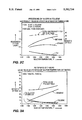
- FIGS. 2A, 2B, 2C, 3A, 3B, 3C, 4A, 4B and 4C are graphs showing yield results for benzene and other products formed at various reaction conditions from feedstocks containing THDCPD dissolved in predominantly aromatic solvent mixtures.
- a feedstream containing tetra-hydro-dicyclo-penta-diene (THDCPD) dissolved in an aromatic or non-aromatic solvent is reacted with hydrogen in a plug flow type non-catalytic reactor to yield mainly benzene product along with some toluene and other minor materials.
- the THDCPD is thermally reformed to aromatics, while simultaneously hydrodealkylating any aromatics which are present in the feedstock to produce benzene.
- the pressurized feedstream at 10 is mixed with hydrogen at 12, and the combined feedstream 14 is preheated to near reactor temperature by heat exchange against reactor effluent at 16 and in fired heater 18.
- the heated feedstream is passed through conduit 19 and introduced into thermal reactor 20.
- the reaction conditions are maintained within a critical range as follows:
- the reactor 20 is an elongated internally insulated chamber having length/internal diameter ratio between 10/1 and 30/1, and containing no catalyst and having no effective catalytic surfaces.
- the reactor is preferably operated at temperatures between 1160 and 1300° F. and at reactor pressures between 500 and 600 psig and at a hydrogen to feed mole ratio of 6.0-8.0.
- the reactor 20 is sized and feedstock flowrate is selected so that the residence time for the total feed material is preferably in the range of about 15-40 seconds.
- the temperature profile in the reactor 20 is controlled by injection of multiple gas quench streams 34, so that the reaction temperature does not exceed 1350° F. at any point within the reactor.
- the temperature increase across the reactor length should not exceed about 200° F. and preferably does not exceed 150° F.
- the reaction temperature is controlled so that essentially all of the THDCPD in the feed undergoes reforming and hydrodealkylation reactions to produce predominantly benzene product together with some toluene and minor materials.
- the reactor effluent stream 24 is quenched to about 1200° F. by a liquid quench stream 26 and then cooled as is further described herein below.
- the reactor effluent stream 24 is preferably cooled by heat exchange against the reactor feedstreams 14 in heat exchanger 16, and is also cooled in heat exchanger 25 against stabilizer tower feed stream 46. Effluent stream 24 is further cooled in exchanger 27 such as with air or water, before entering phase separator 28. From separator 28, a resulting vapor stream 30 is suitably compressed at 32, and portion 33 of the compressed vapor stream is used to quench the hydrodealkylation reactions in reactor 20 through the multiple gas quench streams 34 to control the temperature profile in the reactor, so as preferably to provide a substantially straight line temperature increase throughout the reactor length.
- another portion 36 of compressed vapor stream 33 passes to vent gas hydrogen absorber 38, and flows counter-current therein to a suitable scrubbing liquid provided at 40.
- the resulting scrubbed hydrogen gas leaves as vent stream 41.
- the remaining portion 37 of the vapor at 30 and liquid at 42 from absorber 38 are combined with the feedstream 14 and are recycled back to the reactor 20, so as to maintain the desired hydrogen-to-feed ratio at the reactor inlet.
- a portion of the liquid fraction withdrawn at 43 provides the quench stream 26 to the outlet of reactor 20.
- the net liquid at 44 from separator 28 is pressure-reduced at 45 and passes through heat exchanger 25 and conduit 46 to stabilizer distillation tower 50.
- Light hydrocarbon gases and any water present in the stream 46 to stabilizer tower 50 are removed overhead at 51.
- a portion 11 of the feedstream 10 may be used as lean oil to an absorber 54 to recover benzene from the stabilizer tower overhead vent stream 51. From the absorber 54, overhead gas stream 53 is removed, and rich oil stream 55 containing benzene leaving the absorber 54 is mixed with the reactor feedstream 14.
- the bottoms fraction 56 is withdrawn and passed to clay absorber tower 60, to remove traces of unsaturated compounds and color bodies.
- the effluent stream 62 passes to benzene recovery distillation tower 70 which is operated at near atmospheric pressure.
- a high purity benzene product having a yield at least 60 mole % of the THDCPD plus aromatic feed components is removed overhead at 72, and a heavier aromatics-containing bottoms material is withdrawn at 74.
- the aromatics-containing bottoms stream 74 is passed through a heater 76 to recycle tower 78, from which an alkylated aromatic mixture containing C 7 and C 8 aromatic products formed in the reactor 20 is removed overhead at 80, and may be recycled back to the feedstream 14.
- a net heavy aromatics bottoms material is withdrawn as a purge at 84.
- the scrubbing liquid stream 40 for the vent H 2 absorber 38 may either be an external toluene feed stream, or toluene recycled from the recycle tower overhead stream 80.
- a liquid sidestream 82 containing naphthalene and biphenyl is passed to second recycle tower 86 for further recovery of any mono-aromatics in overhead stream 88, as a recycle liquid.
- a sidestream 90 containing mainly naphthalene is withdrawn, and a bottoms stream containing mainly biphenyl is withdrawn at 92 and may be recycled back to the feedstream 14 so as to increase the overall yield of the benzene product.
- the criticality of the reaction conditions for this invention depends on the hydrogen-to-THDCPD plus aromatics mole ratio and reactor residence time for the feedstock, a reactor temperature profile being maintained within the desired 1100°-1300° F. temperature range and not exceeding 1350° F., operating pressure level of 450-650 psig, and the length/internal diameter ratio of 10/1-30/1 in the reactor 20.
- the feedstream at 19 from the heater furnace 18 need not be heated above about 1200° F., and thus comparatively little reaction will occur in the furnace 18 and transfer conduit 19. In this way, the hydroconversion reactions will occur primarily in the reactor 20 and the desired critical temperature profile can be maintained throughout the reaction chamber with the aid of thermocouples that are used to indicate and control temperature therein by the multiple gas quench streams 34.
- the reactor quench lines 34 shown diagrammatically in the FIG. 1, represent the introduction of controlled amounts of quench gas at various levels along the reactor length, under control of suitable thermocouples therein.
- Reaction conditions used were 1180°-1280° F. temperature, 600 psig reactor pressure, 25 second residence time, and hydrogen to THDCPD plus aromatic molar ratio of 6.5-7.0/1 at the reactor inlet.
- the experimental results using the THDCPD/toluene mixture are presented in FIGS. 2A-2C. These reaction results were then corrected for results obtained for similar reactions on toluene feed alone so as to obtain reaction results for conversion of the ⁇ THDCPD ⁇ feed material alone to benzene and other products.
- the results for reaction of THDCPD alone with high purity hydrogen and 1180°-1280° F. temperature are shown by FIGS. 3A-3C.
- ⁇ THDCPD ⁇ The loss of ⁇ THDCPD ⁇ to yield light gases like methane, ethane and C 3 + paraffins varies with the reactor temperature, as shown by FIG. 3B.
- heavy aromatic components like naphthalene, biphenyl and anthracene are also formed in the reactor and account for a maximum of about 8 wt % at high reactor temperatures, as shown by FIG. 3C.
- the THDCPD conversion was essentially complete.
Landscapes
- Chemical & Material Sciences (AREA)
- Oil, Petroleum & Natural Gas (AREA)
- Physics & Mathematics (AREA)
- Thermal Sciences (AREA)
- Engineering & Computer Science (AREA)
- Chemical Kinetics & Catalysis (AREA)
- General Chemical & Material Sciences (AREA)
- Organic Chemistry (AREA)
- Organic Low-Molecular-Weight Compounds And Preparation Thereof (AREA)
Abstract
Description
______________________________________
Reaction Temperature, °F.
                          1100-1350
Reactor Pressure, psig.   450-650
Molar Ratio of H.sub.2 /THDCPD plus Aromatics
                           5.0-12.0
at Reactor Inlet
Feed Residence Time in Reactor, sec.
                          10-50
______________________________________
Claims (11)
Priority Applications (1)
| Application Number | Priority Date | Filing Date | Title |
|---|---|---|---|
| US08/092,642 US5382734A (en) | 1993-07-16 | 1993-07-16 | Thermal reforming of naphthenic and hydrodealkylation of aromatic feedstocks to produce benzene |
Applications Claiming Priority (1)
| Application Number | Priority Date | Filing Date | Title |
|---|---|---|---|
| US08/092,642 US5382734A (en) | 1993-07-16 | 1993-07-16 | Thermal reforming of naphthenic and hydrodealkylation of aromatic feedstocks to produce benzene |
Publications (1)
| Publication Number | Publication Date |
|---|---|
| US5382734A true US5382734A (en) | 1995-01-17 |
Family
ID=22234306
Family Applications (1)
| Application Number | Title | Priority Date | Filing Date |
|---|---|---|---|
| US08/092,642 Expired - Lifetime US5382734A (en) | 1993-07-16 | 1993-07-16 | Thermal reforming of naphthenic and hydrodealkylation of aromatic feedstocks to produce benzene |
Country Status (1)
| Country | Link |
|---|---|
| US (1) | US5382734A (en) |
Cited By (6)
| Publication number | Priority date | Publication date | Assignee | Title |
|---|---|---|---|---|
| WO2004105504A3 (en) * | 2003-05-22 | 2006-03-23 | Mark D Finke Inc | Dietary supplements and methods of preparing and administering dietary supplements |
| US11149220B2 (en) | 2020-02-13 | 2021-10-19 | Saudi Arabian Oil Company | Process and system for hydrogenation, hydrocracking and catalytic conversion of aromatic complex bottoms |
| US11248173B2 (en) | 2020-02-13 | 2022-02-15 | Saudi Arabian Oil Company | Process and system for catalytic conversion of aromatic complex bottoms |
| US11268037B2 (en) | 2020-02-13 | 2022-03-08 | Saudi Arabian Oil Company | Process and system for hydrodearylation and hydrogenation of aromatic complex bottoms |
| US11279888B2 (en) | 2020-02-13 | 2022-03-22 | Saudi Arabian Oil Company | Process and system for hydrogenation of aromatic complex bottoms |
| US11591526B1 (en) | 2022-01-31 | 2023-02-28 | Saudi Arabian Oil Company | Methods of operating fluid catalytic cracking processes to increase coke production |
Citations (4)
| Publication number | Priority date | Publication date | Assignee | Title |
|---|---|---|---|---|
| US2780661A (en) * | 1951-08-15 | 1957-02-05 | Exxon Research Engineering Co | Reforming followed by hydrodealkylation |
| US3371126A (en) * | 1966-08-19 | 1968-02-27 | Universal Oil Prod Co | Hydrocarbon conversion process, naphtha to aromatics and town gas |
| US3404191A (en) * | 1966-12-27 | 1968-10-01 | Dow Chemical Co | Method of preparing aromatic hydrocarbons from cyclopentadiene compounds |
| US3517076A (en) * | 1966-02-14 | 1970-06-23 | Monsanto Co | Thermal hydrodealkylation of alkyl aromatic hydrocarbons |
-
1993
- 1993-07-16 US US08/092,642 patent/US5382734A/en not_active Expired - Lifetime
Patent Citations (4)
| Publication number | Priority date | Publication date | Assignee | Title |
|---|---|---|---|---|
| US2780661A (en) * | 1951-08-15 | 1957-02-05 | Exxon Research Engineering Co | Reforming followed by hydrodealkylation |
| US3517076A (en) * | 1966-02-14 | 1970-06-23 | Monsanto Co | Thermal hydrodealkylation of alkyl aromatic hydrocarbons |
| US3371126A (en) * | 1966-08-19 | 1968-02-27 | Universal Oil Prod Co | Hydrocarbon conversion process, naphtha to aromatics and town gas |
| US3404191A (en) * | 1966-12-27 | 1968-10-01 | Dow Chemical Co | Method of preparing aromatic hydrocarbons from cyclopentadiene compounds |
Cited By (6)
| Publication number | Priority date | Publication date | Assignee | Title |
|---|---|---|---|---|
| WO2004105504A3 (en) * | 2003-05-22 | 2006-03-23 | Mark D Finke Inc | Dietary supplements and methods of preparing and administering dietary supplements |
| US11149220B2 (en) | 2020-02-13 | 2021-10-19 | Saudi Arabian Oil Company | Process and system for hydrogenation, hydrocracking and catalytic conversion of aromatic complex bottoms |
| US11248173B2 (en) | 2020-02-13 | 2022-02-15 | Saudi Arabian Oil Company | Process and system for catalytic conversion of aromatic complex bottoms |
| US11268037B2 (en) | 2020-02-13 | 2022-03-08 | Saudi Arabian Oil Company | Process and system for hydrodearylation and hydrogenation of aromatic complex bottoms |
| US11279888B2 (en) | 2020-02-13 | 2022-03-22 | Saudi Arabian Oil Company | Process and system for hydrogenation of aromatic complex bottoms |
| US11591526B1 (en) | 2022-01-31 | 2023-02-28 | Saudi Arabian Oil Company | Methods of operating fluid catalytic cracking processes to increase coke production |
Similar Documents
| Publication | Publication Date | Title |
|---|---|---|
| EP1893726B1 (en) | Process for increasing production of light olefin hydrocarbon from hydrocarbon feedstock | |
| US4053388A (en) | Process for preparing aromatics from naphtha | |
| US9068125B2 (en) | Process for the recovery of pure aromatics from hydrocarbon fractions containing aromatics | |
| US4115467A (en) | Hydrocarbon conversion process | |
| US4229602A (en) | Dehydrocyclization process | |
| US6365792B1 (en) | Preparation of acetylene and synthesis gas | |
| US5015799A (en) | Oxidative coupling process for converting methane and/or natural gas to more transportable products | |
| US20120108877A1 (en) | Propane dehydrogenation process utilizing fluidized catalyst system | |
| US6153153A (en) | Exothermic reaction system | |
| GB2191214A (en) | Production of higher molecular weight hydrocarbons from methane | |
| US2780661A (en) | Reforming followed by hydrodealkylation | |
| US3409689A (en) | Dehydrogenation process | |
| US3193595A (en) | Hydrocarbon conversion | |
| US4113787A (en) | Aromatic hydrocarbon dehydrogenation process | |
| US4009218A (en) | Alkylaromatic hydrocarbon dehydrogenation process | |
| US3198846A (en) | Combination hydrodealkylation and desulfurization process | |
| US3291849A (en) | Hydrodealkylation | |
| US3607960A (en) | Thermal hydrodealkylation process | |
| US3193592A (en) | Manufacture of petroleum naphthalene | |
| US5689029A (en) | Process for the dehydrogenation of paraffinic hydrocarbons | |
| US3597489A (en) | Manufacture of naphthenic hydrocarbons by hydrogenation of the corresponding aromatic hydrocarbons | |
| JPS63196528A (en) | Manufacture of xylene by use of both isomerizing/transalkylating zone | |
| US3591651A (en) | Combination thermal hydrodealkylation diphenyl hydrogenation process | |
| US4338476A (en) | Alkylaromatic hydrocarbon dehydrogenation process | |
| US3188359A (en) | Non-catalytic dealkylation of alkyl substituted benzene-ring compounds |
Legal Events
| Date | Code | Title | Description |
|---|---|---|---|
| AS | Assignment |
Owner name: HRI, INC., NEW JERSEY Free format text: ASSIGNMENT OF ASSIGNORS INTEREST;ASSIGNORS:SARDAR, HASHIM;ABRAMS, LAWRENCE M.;REEL/FRAME:006628/0897 Effective date: 19930713 |
|
| STPP | Information on status: patent application and granting procedure in general |
Free format text: APPLICATION UNDERGOING PREEXAM PROCESSING |
|
| AS | Assignment |
Owner name: INSTITUT FRANCAIS DU PETROLE, FRANCE Free format text: ASSIGNMENT OF ASSIGNORS INTEREST;ASSIGNOR:HYDROCARBON RESEARCH, INC.;REEL/FRAME:007662/0308 Effective date: 19950131 |
|
| REMI | Maintenance fee reminder mailed | ||
| FEPP | Fee payment procedure |
Free format text: PAYOR NUMBER ASSIGNED (ORIGINAL EVENT CODE: ASPN); ENTITY STATUS OF PATENT OWNER: LARGE ENTITY |
|
| FPAY | Fee payment |
Year of fee payment: 4 |
|
| SULP | Surcharge for late payment | ||
| FPAY | Fee payment |
Year of fee payment: 8 |
|
| FPAY | Fee payment |
Year of fee payment: 12 |