US5374839A - Semiconductor memory device - Google Patents

Semiconductor memory device Download PDF

Info

Publication number
US5374839A
US5374839A US08/040,065 US4006593A US5374839A US 5374839 A US5374839 A US 5374839A US 4006593 A US4006593 A US 4006593A US 5374839 A US5374839 A US 5374839A
Authority
US
United States
Prior art keywords
region
type
memory
memory device
substrate
Prior art date
Legal status (The legal status is an assumption and is not a legal conclusion. Google has not performed a legal analysis and makes no representation as to the accuracy of the status listed.)
Expired - Lifetime
Application number
US08/040,065
Inventor
Jun-Young Jeon
Hoon Choi
Dong-Il Seo
Current Assignee (The listed assignees may be inaccurate. Google has not performed a legal analysis and makes no representation or warranty as to the accuracy of the list.)
Samsung Electronics Co Ltd
Original Assignee
Samsung Electronics Co Ltd
Priority date (The priority date is an assumption and is not a legal conclusion. Google has not performed a legal analysis and makes no representation as to the accuracy of the date listed.)
Filing date
Publication date
Application filed by Samsung Electronics Co Ltd filed Critical Samsung Electronics Co Ltd
Assigned to SAMSUNG ELECTRONICS CO., LTD. reassignment SAMSUNG ELECTRONICS CO., LTD. ASSIGNMENT OF ASSIGNORS INTEREST. Assignors: CHOI, HOON, JEON, JUN YOUNG, SEO, DONG
Application granted granted Critical
Publication of US5374839A publication Critical patent/US5374839A/en
Anticipated expiration legal-status Critical
Expired - Lifetime legal-status Critical Current

Links

Images

Classifications

    • GPHYSICS
    • G11INFORMATION STORAGE
    • G11CSTATIC STORES
    • G11C5/00Details of stores covered by group G11C11/00
    • G11C5/02Disposition of storage elements, e.g. in the form of a matrix array
    • G11C5/04Supports for storage elements, e.g. memory modules; Mounting or fixing of storage elements on such supports
    • HELECTRICITY
    • H10SEMICONDUCTOR DEVICES; ELECTRIC SOLID-STATE DEVICES NOT OTHERWISE PROVIDED FOR
    • H10BELECTRONIC MEMORY DEVICES
    • H10B12/00Dynamic random access memory [DRAM] devices
    • H10B12/01Manufacture or treatment
    • H10B12/09Manufacture or treatment with simultaneous manufacture of the peripheral circuit region and memory cells
    • HELECTRICITY
    • H10SEMICONDUCTOR DEVICES; ELECTRIC SOLID-STATE DEVICES NOT OTHERWISE PROVIDED FOR
    • H10BELECTRONIC MEMORY DEVICES
    • H10B12/00Dynamic random access memory [DRAM] devices
    • H10B12/50Peripheral circuit region structures

Definitions

  • the present invention relates generally to semiconductor memory devices, and more particularly, to a semiconductor memory device in which the peripheral circuits are constructed in such a manner as to minimize substrate current while also preventing the injection of hot electrons into the memory cells of the memory array thereof.
  • semiconductor memory devices include an array of memory cells which are at least partially surrounded by peripheral circuits, including sense amplifiers, address buffers and decoders, I/O circuitry, and the like, which function to enable data to be written into and read from a particularly addressed one(s) of the memory cells.
  • peripheral circuits are generally CMOS circuits which are configured to absorb hot electrons generated by the outermost/N-channel transistor thereof before they can reach the memory cells, thereby preventing the destruction of the data stored in the memory cells.
  • CMOS peripheral circuit which includes a CMOS peripheral circuit B which is essentially identical to the one shown in FIG. 2 of U.S. Pat. No. 4,497,043.
  • the semiconductor memory device includes a memory cell array A which is flanked by the CMOS peripheral circuit B.
  • Each individual memory cell Q1 of the memory cell array A includes a transfer gate 18 and a storage capacitor 26.
  • the peripheral circuit B includes a P-channel transistor Q3 formed in an N-type well 38 which is formed in a P-type semiconductor substrate 10, and an N-channel transistor Q2 formed directly in the substrate 10 outside of the P-channel transistor Q3.
  • a power supply voltage Vdd e.g., 5 volts, is applied to a highly concentrated N-type region 48 separately formed in the N-type well 38, and a negative substrate bias voltage Vbb is applied to the substrate 10.
  • the storage electrode 20 of the memory cell capacitor 26 is also connected to Vdd, to thereby form an inversion layer 24 beneath the dielectric layer 22 of the capacitor 26.
  • Binary data is represented by the presence or absence of an electron in the inversion layer 24, e.g., a "1" bit is represented by the presence of an electron in the inversion layer 24, and a "0" bit is represented by the absence of an electron in the inversion layer 24.
  • the gate electrode 14 of the transfer gate 18 of each memory cell Q1 constitutes an extension of a word (row) line which is connected to a voltage source WL which goes high during a memory read/write operation, to thereby form an inversion layer in the channel region between the source/drain electrode 16 and the inversion layer 24, beneath the gate insulation layer 14, in order to thereby transfer data into/from the accessed memory cell Q1 from/to the peripheral circuit B.
  • the transistors Q2 and Q3 of the peripheral circuit B are activated, which results in hot electrons 36 generated by the N-channel transistor Q2 being injected into the substrate 10. These hot electrons 36 are substantially absorbed or captured by the N-well 38, to thereby prevent these hot electrons 36 from reaching the memory cell Q1 to destroy the integrity of the data stored therein.
  • FIG. 2 there can be seen a block diagram depicting the general lay-out of the conventional memory device shown in FIG. 1, wherein the memory cell array A is completely surrounded by regions 50 which include the P-channel transistors Q3 of the peripheral circuit B, and regions 52 which include the N-channel transistors Q2 of the peripheral circuit B.
  • regions 50 which include the P-channel transistors Q3 of the peripheral circuit B
  • regions 52 which include the N-channel transistors Q2 of the peripheral circuit B.
  • the CMOS peripheral circuit of the above-described conventional memory device does function to prevent hot electrons from reaching the memory array, it suffers from the following drawback. More particularly, holes in the substrate 10 tend to combine with the injected hot electrons 36 to form electron-hole pairs which increase substrate current, which, in turn, disadvantageously decreases the threshold voltage of the memory cells Q1 of the memory cell array A, thereby lowering the noise immunity of the memory cells Q1 and lowering the electrical insulation between adjacent memory cells Q1 of the memory cell array A. Consequently, the integrity of the data stored in the memory cell array A is degraded.
  • the present invention encompasses a semiconductor memory device, e.g., a DRAM, which includes a P-type semiconductor substrate, a memory array each memory cell of which includes at least one N-channel MOS transistor, a CMOS peripheral circuit at least partially surrounding the memory array, the peripheral circuit including at least one P-channel MOS transistor formed in an N-type well region formed in the substrate, and at least one N-channel MOS transistor formed in the substrate outside of the N-type well region, and, a P-type minority carrier absorption semiconductor region formed in the substrate between the N-type well region and the memory array.
  • a semiconductor memory device e.g., a DRAM, which includes a P-type semiconductor substrate, a memory array each memory cell of which includes at least one N-channel MOS transistor, a CMOS peripheral circuit at least partially surrounding the memory array, the peripheral circuit including at least one P-channel MOS transistor formed in an N-type well region formed in the substrate, and at least one N-channel MOS transistor formed in the substrate outside of the N-
  • the minority carrier absorption semiconductor region is preferably connected to a source of negative voltage, e.g., the substrate bias voltage, and a separate N-type region formed in the N-type well region is preferably connected to a source of positive voltage, e.g., the power supply voltage, Vdd, of the memory device.
  • the N-type well region functions to absorb or capture hot electrons generated by the N-channel MOS transistor of the CMOS peripheral circuit, and the P-type minority carrier absorption semiconductor region functions to absorb or capture holes which would otherwise combine with the hot electrons to induce substrate current which could deleteriously lower the threshold voltage level of the memory cells of the memory array and thereby degrade the data storage integrity thereof.
  • the present invention encompasses a semiconductor memory device comprised of a plurality of memory arrays surrounded on three sides by a peripheral circuit like that described above, and a peripheral circuit arrangement disposed between adjacent ones of the memory arrays, outside of an additional minority carrier absorption semiconductor region which flanks the fourth side of each of the memory arrays.
  • the peripheral circuit arrangement preferably includes a first region which includes at least one P-channel MOS transistor formed in a first N-type well region, a second region which includes at least one P-channel MOS transistor formed in a second N-type well region, and a third region which includes at least one N-channel MOS transistor formed in the substrate between the first and second regions.
  • the first and second N-type well regions are preferably connected to a source of positive voltage,e.g., Vdd.
  • FIG. 1 is a schematic, cross-sectional view of the circuit structure of a conventional semiconductor memory device
  • FIG. 2 is a plan view, block diagram of the conventional semiconductor memory device depicted in FIG. 1;
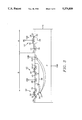
  • FIG. 3 is a schematic, cross-sectional view of the circuit structure of a semiconductor memory device constructed in accordance with a preferred embodiment of the present invention.
  • FIG. 4 is a plan view, block diagram of the semiconductor memory device depicted in FIG. 3.
  • the semiconductor memory device includes a memory cell array A which is flanked by a CMOS peripheral circuit B.
  • the construction of the memory cell array A and the CMOS peripheral circuit B are identical to that of the conventional semiconductor memory device depicted in FIG. 1 and described hereinabove, except that an additional P-type region or layer 403 is formed in the P-type substrate 10 between the N-type well 38 and the memory cell array A.
  • the P-type region 403 is preferably formed of a high concentration of P-type impurities.
  • the P-type region 403 is connected to a source of negative voltage, preferably, Vbb (i.e., the negative substrate bias voltage).
  • the holes 37 which would otherwise combine with the hot electrons to form electron-hole pairs, are absorbed or captured by the P-type region 403 impressed with the negative substrate bias voltage. Accordingly, the substrate current which would otherwise be caused by the electron-hole pairs is eliminated, thereby advantageously increasing the threshold voltage of the memory cells Q1 of the memory cell array A, and, in turn, enhancing the data storage integrity thereof.
  • the memory cell array A is divided into a plurality, illustratively shown as two, memory cell arrays 400 (sometimes referred to as memory blocks or sub-arrays), separated by a peripheral circuit portion comprised of regions 401 disposed on opposite sides of a region 402, wherein the regions 401 include at least one P-channel transistor formed in an N-well and the region 402 includes at least one N-channel transistor formed in the substrate 10.
  • each of the memory cell arrays 400 is at least partially surrounded by the P-type region 403 formed in the substrate 10 between the regions 401 and the memory cell arrays 400.
  • the memory cell arrays 400 are preferably surrounded on their other three sides by CMOS peripheral circuits having the structure shown in FIG. 3.

Landscapes

  • Engineering & Computer Science (AREA)
  • Manufacturing & Machinery (AREA)
  • Semiconductor Memories (AREA)
  • Metal-Oxide And Bipolar Metal-Oxide Semiconductor Integrated Circuits (AREA)

Abstract

A semiconductor memory device, e.g., a DRAM, which includes a P-type semiconductor substrate, a memory array each memory cell of which includes at least one N-channel MOS transistor, a CMOS peripheral circuit at least partially surrounding the memory array, the peripheral circuit including at least one P-channel MOS transistor formed in an N-type well region formed in the substrate, and at least one N-channel MOS transistor formed in the substrate outside of the N-type well region, and, a P-type minority carrier absorption semiconductor region formed in the substrate between the N-type well region and the memory array. The minority carrier absorption semiconductor region is preferably connected to a source of negative voltage, e.g., the substrate bias voltage, and a separate N-type region formed in the N-type well region is preferably connected to a source of positive voltage, e.g., the power supply voltage, Vdd, of the memory device. The N-type well region functions to absorb or capture hot electrons generated by the N-channel MOS transistor of the CMOS peripheral circuit, and the P-type minority carrier absorption semiconductor region functions to absorb or capture holes which would otherwise combine with the hot electrons to induce substrate current which could deleteriously lower the threshold voltage level of the memory cells of the memory array and thereby degrade the data storage integrity thereof.

Description

BACKGROUND OF THE INVENTION
The present invention relates generally to semiconductor memory devices, and more particularly, to a semiconductor memory device in which the peripheral circuits are constructed in such a manner as to minimize substrate current while also preventing the injection of hot electrons into the memory cells of the memory array thereof.
In general, semiconductor memory devices include an array of memory cells which are at least partially surrounded by peripheral circuits, including sense amplifiers, address buffers and decoders, I/O circuitry, and the like, which function to enable data to be written into and read from a particularly addressed one(s) of the memory cells. The peripheral circuits are generally CMOS circuits which are configured to absorb hot electrons generated by the outermost/N-channel transistor thereof before they can reach the memory cells, thereby preventing the destruction of the data stored in the memory cells.
With reference now to U.S. Pat. No. 4,497,043, the disclosure of which is incorporated herein by reference thereto, a conventional CMOS peripheral circuit will now be described. More particularly, with additional reference to FIG. 1, there can be seen a semiconductor memory device which includes a CMOS peripheral circuit B which is essentially identical to the one shown in FIG. 2 of U.S. Pat. No. 4,497,043. The semiconductor memory device includes a memory cell array A which is flanked by the CMOS peripheral circuit B. Each individual memory cell Q1 of the memory cell array A includes a transfer gate 18 and a storage capacitor 26. The peripheral circuit B includes a P-channel transistor Q3 formed in an N-type well 38 which is formed in a P-type semiconductor substrate 10, and an N-channel transistor Q2 formed directly in the substrate 10 outside of the P-channel transistor Q3. A power supply voltage Vdd, e.g., 5 volts, is applied to a highly concentrated N-type region 48 separately formed in the N-type well 38, and a negative substrate bias voltage Vbb is applied to the substrate 10.
The storage electrode 20 of the memory cell capacitor 26 is also connected to Vdd, to thereby form an inversion layer 24 beneath the dielectric layer 22 of the capacitor 26. Binary data is represented by the presence or absence of an electron in the inversion layer 24, e.g., a "1" bit is represented by the presence of an electron in the inversion layer 24, and a "0" bit is represented by the absence of an electron in the inversion layer 24. The gate electrode 14 of the transfer gate 18 of each memory cell Q1 constitutes an extension of a word (row) line which is connected to a voltage source WL which goes high during a memory read/write operation, to thereby form an inversion layer in the channel region between the source/drain electrode 16 and the inversion layer 24, beneath the gate insulation layer 14, in order to thereby transfer data into/from the accessed memory cell Q1 from/to the peripheral circuit B.
Further, during a memory read/write operation, the transistors Q2 and Q3 of the peripheral circuit B are activated, which results in hot electrons 36 generated by the N-channel transistor Q2 being injected into the substrate 10. These hot electrons 36 are substantially absorbed or captured by the N-well 38, to thereby prevent these hot electrons 36 from reaching the memory cell Q1 to destroy the integrity of the data stored therein.
With reference to FIG. 2, there can be seen a block diagram depicting the general lay-out of the conventional memory device shown in FIG. 1, wherein the memory cell array A is completely surrounded by regions 50 which include the P-channel transistors Q3 of the peripheral circuit B, and regions 52 which include the N-channel transistors Q2 of the peripheral circuit B. With reference to FIG. 2, it can be more easily visualized how the P-channel transistors Q3 serve to absorb minority carriers generated by the N-channel transistors Q2 to prevent them from reaching the memory cell array A.
Although the CMOS peripheral circuit of the above-described conventional memory device does function to prevent hot electrons from reaching the memory array, it suffers from the following drawback. More particularly, holes in the substrate 10 tend to combine with the injected hot electrons 36 to form electron-hole pairs which increase substrate current, which, in turn, disadvantageously decreases the threshold voltage of the memory cells Q1 of the memory cell array A, thereby lowering the noise immunity of the memory cells Q1 and lowering the electrical insulation between adjacent memory cells Q1 of the memory cell array A. Consequently, the integrity of the data stored in the memory cell array A is degraded.
Based upon the above and foregoing, it can be appreciated that there presently exists a need in the semiconductor art for a semiconductor memory device which eliminates the above-described shortcomings and disadvantages of the presently available semiconductor memory devices. The present invention fulfills this need.
SUMMARY OF THE INVENTION
In one of its aspects, the present invention encompasses a semiconductor memory device, e.g., a DRAM, which includes a P-type semiconductor substrate, a memory array each memory cell of which includes at least one N-channel MOS transistor, a CMOS peripheral circuit at least partially surrounding the memory array, the peripheral circuit including at least one P-channel MOS transistor formed in an N-type well region formed in the substrate, and at least one N-channel MOS transistor formed in the substrate outside of the N-type well region, and, a P-type minority carrier absorption semiconductor region formed in the substrate between the N-type well region and the memory array. The minority carrier absorption semiconductor region is preferably connected to a source of negative voltage, e.g., the substrate bias voltage, and a separate N-type region formed in the N-type well region is preferably connected to a source of positive voltage, e.g., the power supply voltage, Vdd, of the memory device. The N-type well region functions to absorb or capture hot electrons generated by the N-channel MOS transistor of the CMOS peripheral circuit, and the P-type minority carrier absorption semiconductor region functions to absorb or capture holes which would otherwise combine with the hot electrons to induce substrate current which could deleteriously lower the threshold voltage level of the memory cells of the memory array and thereby degrade the data storage integrity thereof.
In another of its aspects, the present invention encompasses a semiconductor memory device comprised of a plurality of memory arrays surrounded on three sides by a peripheral circuit like that described above, and a peripheral circuit arrangement disposed between adjacent ones of the memory arrays, outside of an additional minority carrier absorption semiconductor region which flanks the fourth side of each of the memory arrays. The peripheral circuit arrangement preferably includes a first region which includes at least one P-channel MOS transistor formed in a first N-type well region, a second region which includes at least one P-channel MOS transistor formed in a second N-type well region, and a third region which includes at least one N-channel MOS transistor formed in the substrate between the first and second regions. The first and second N-type well regions are preferably connected to a source of positive voltage,e.g., Vdd.
BRIEF DESCRIPTION OF THE DRAWINGS
These and various other features and advantages of the present invention will be readily understood with reference to the following detailed description taken in conjunction with the accompanying drawings, wherein like reference numerals designate like structural elements, and, in which:
FIG. 1 is a schematic, cross-sectional view of the circuit structure of a conventional semiconductor memory device;
FIG. 2 is a plan view, block diagram of the conventional semiconductor memory device depicted in FIG. 1;
FIG. 3 is a schematic, cross-sectional view of the circuit structure of a semiconductor memory device constructed in accordance with a preferred embodiment of the present invention; and,
FIG. 4 is a plan view, block diagram of the semiconductor memory device depicted in FIG. 3.
DETAILED DESCRIPTION OF THE INVENTION
With reference now to FIG. 3, a semiconductor memory device constructed in accordance with a preferred embodiment of the present invention will now be described. More particularly, the semiconductor memory device includes a memory cell array A which is flanked by a CMOS peripheral circuit B. The construction of the memory cell array A and the CMOS peripheral circuit B are identical to that of the conventional semiconductor memory device depicted in FIG. 1 and described hereinabove, except that an additional P-type region or layer 403 is formed in the P-type substrate 10 between the N-type well 38 and the memory cell array A. The P-type region 403 is preferably formed of a high concentration of P-type impurities. The P-type region 403 is connected to a source of negative voltage, preferably, Vbb (i.e., the negative substrate bias voltage).
During a memory read/write operation, in addition to the hot electrons 36 generated by the N-channel transistor Q2 being absorbed or captured by the N-type well 38, the holes 37, which would otherwise combine with the hot electrons to form electron-hole pairs, are absorbed or captured by the P-type region 403 impressed with the negative substrate bias voltage. Accordingly, the substrate current which would otherwise be caused by the electron-hole pairs is eliminated, thereby advantageously increasing the threshold voltage of the memory cells Q1 of the memory cell array A, and, in turn, enhancing the data storage integrity thereof.
With reference now to FIG. 4, another aspect of the present invention will now be described. More particularly, in accordance with this aspect of the present invention, the memory cell array A is divided into a plurality, illustratively shown as two, memory cell arrays 400 (sometimes referred to as memory blocks or sub-arrays), separated by a peripheral circuit portion comprised of regions 401 disposed on opposite sides of a region 402, wherein the regions 401 include at least one P-channel transistor formed in an N-well and the region 402 includes at least one N-channel transistor formed in the substrate 10. Further, in accordance with this aspect of the invention, each of the memory cell arrays 400 is at least partially surrounded by the P-type region 403 formed in the substrate 10 between the regions 401 and the memory cell arrays 400. Further, the memory cell arrays 400 are preferably surrounded on their other three sides by CMOS peripheral circuits having the structure shown in FIG. 3.
Although the present invention has been described in detail hereinabove, it should be clearly understood that many variations and/or modifications of the basic inventive concepts herein taught which may appear to those skilled in the pertinent art will still fall within the spirit and scope of the present invention as defined in the appended claims.

Claims (18)

What is claimed is:
1. A semiconductor memory device, comprising:
a P-type semiconductor substrate;
a memory array including a plurality of memory cells, each memory cell comprising at least one N-channel MOS transistor and at least one storage capacitor;
a CMOS peripheral circuit at least partially surrounding said memory array, said CMOS peripheral circuit including at least one P-channel MOS transistor formed in an N-type well region formed in said substrate, and at least one N-channel MOS transistor formed in said substrate outside said N-type well region, such that said N-type well region is interposed between said at least one N-channel MOS transistor and said memory array to thereby absorb hot electrons generated by said at least one N-channel MOS transistor; and,
a P-type region formed in said substrate between said N-type well region and said memory array to thereby absorb holes generated by said at least one N-channel MOS transistor.
2. The memory device as set forth in claim 1, wherein said P-type region is connected to a source of negative voltage.
3. The memory device as set forth in claim 2, further comprising an N-type region formed in said N-type well region and connected to a source of positive voltage.
4. The memory device as set forth in claim 3, wherein said negative voltage comprises a substrate bias voltage.
5. The memory device as set forth in claim 4, wherein said positive voltage comprises a power supply voltage for said memory device.
6. A semiconductor memory device, comprising:
a semiconductor substrate of first conductivity type;
a plurality of memory arrays formed in said substrate, each memory array comprising a matrix of memory cells, and each memory cell comprising a MOS storage capacitor and a MOS transistor having a channel of first conductivity type;
at least one CMOS peripheral circuit formed in said substrate and disposed proximate the periphery of one of said plurality of memory arrays; and,
a minority carrier absorption region of first conductivity type formed in said substrate surrounding at least one of said plurality of memory arrays, such that said minority carrier absorption region is interposed between said at least one of said plurality of memory arrays and said at least one CMOS peripheral circuit to thereby absorb holes generated by said at least one CMOS peripheral circuit.
7. The memory device as set forth in claim 6, wherein said first conductivity type is P-type and said first channel type is N-type.
8. The memory device as set forth in claim 6, wherein said minority carrier absorption region is connected to a source of negative voltage.
9. The memory device as set forth in claim 8, wherein said at least one CMOS peripheral circuit includes a a first N-type well region formed in said substrate adjacent to said minority carrier absorption region including at least one P-channel MOS transistor formed in said first N-type well region, and a second region including at least one N-channel MOS transistor, wherein said first region is disposed between said second region and said periphery of said at least one of said plurality of memory arrays.
10. The memory device as set forth in claim 9, further comprising a separate N-type region formed in said N-type well region, said separate N-type region being connected to a source of positive voltage.
11. The memory device as set forth in claim 10, wherein said substrate is connected to a negative substrate bias voltage, and said source of negative voltage comprises said substrate bias voltage.
12. The memory device as set forth in claim 6, wherein said minority carrier absorption region substantially surrounds said plurality of memory arrays.
13. The memory device as set forth in claim 6, wherein said at least one CMOS peripheral circuit includes a first peripheral circuit disposed between adjacent first and second ones of said plurality of memory arrays, said first peripheral circuit comprising:
first region, proximate said first one of said plurality of memory arrays, including a well region of second conductivity type, and at least one transistor having a channel of first conductivity type formed in said well region;
second region, proximate said second one of said plurality of memory arrays, including a well region of second conductivity type, and at least one transistor having a channel of first conductivity type formed in said well region; and,
third region, disposed between said first and second regions, including at least one transistor having a channel of second conductivity type.
14. The memory device as set forth in claim 13, wherein said at least one CMOS peripheral circuit includes a second peripheral circuit comprising:
a fourth region including a well region of second conductivity type, and at least one transistor having a channel of first conductivity type formed in said well region; and,
fifth region including at least one transistor having a channel of second conductivity type;
wherein said fourth region is disposed between said fifth region and said outer periphery of said at least one of said plurality of memory arrays.
15. The memory device as set forth in claim 14, wherein each one of said plurality of memory arrays is formed in a rectangular pattern having first, second, third, and fourth sides.
16. The memory device as set forth in claim 15, wherein said first peripheral circuit is disposed adjacent respective first sides of said first and second ones of said plurality of memory arrays, and wherein respective second peripheral circuits are disposed adjacent to each one said second, third, and fourth sides of said first and second ones of said plurality of memory arrays.
17. The memory device as set forth in claim 14, wherein at least one of said well regions in said first, second, and fourth regions is connected to a source of positive voltage, and wherein said minority carrier absorption region is connected to a source of negative voltage.
18. The memory device as set forth in claim 17, wherein said substrate is connected to said source of negative voltage.
US08/040,065 1992-10-31 1993-03-30 Semiconductor memory device Expired - Lifetime US5374839A (en)

Applications Claiming Priority (2)

Application Number Priority Date Filing Date Title
KR1019920020349A KR100258337B1 (en) 1992-10-31 1992-10-31 Semiconductor memory device
KR1992-20349 1992-10-31

Publications (1)

Publication Number Publication Date
US5374839A true US5374839A (en) 1994-12-20

Family

ID=19342264

Family Applications (1)

Application Number Title Priority Date Filing Date
US08/040,065 Expired - Lifetime US5374839A (en) 1992-10-31 1993-03-30 Semiconductor memory device

Country Status (2)

Country Link
US (1) US5374839A (en)
KR (1) KR100258337B1 (en)

Cited By (6)

* Cited by examiner, † Cited by third party
Publication number Priority date Publication date Assignee Title
US5600598A (en) * 1994-12-14 1997-02-04 Mosaid Technologies Incorporated Memory cell and wordline driver for embedded DRAM in ASIC process
US5719422A (en) * 1994-08-18 1998-02-17 Sun Microsystems, Inc. Low threshold voltage, high performance junction transistor
US5773863A (en) * 1994-08-18 1998-06-30 Sun Microsystems, Inc. Low power, high performance junction transistor
KR20000018511A (en) * 1998-09-02 2000-04-06 김영환 Layout method of bias voltage generator
US7705350B1 (en) * 2004-01-29 2010-04-27 David Kuei Fractional biasing of semiconductors
US9548401B2 (en) * 2014-11-20 2017-01-17 Samsung Electronics Co., Ltd. Semiconductor device

Citations (3)

* Cited by examiner, † Cited by third party
Publication number Priority date Publication date Assignee Title
US4647956A (en) * 1985-02-12 1987-03-03 Cypress Semiconductor Corp. Back biased CMOS device with means for eliminating latchup
JPH0247849A (en) * 1988-08-10 1990-02-16 Nec Corp Semiconductor device
US5060044A (en) * 1987-05-28 1991-10-22 Texas Instruments Incorporated Integrated bipolar-CMOS circuit isolation for providing different backgate and substrate bias

Patent Citations (3)

* Cited by examiner, † Cited by third party
Publication number Priority date Publication date Assignee Title
US4647956A (en) * 1985-02-12 1987-03-03 Cypress Semiconductor Corp. Back biased CMOS device with means for eliminating latchup
US5060044A (en) * 1987-05-28 1991-10-22 Texas Instruments Incorporated Integrated bipolar-CMOS circuit isolation for providing different backgate and substrate bias
JPH0247849A (en) * 1988-08-10 1990-02-16 Nec Corp Semiconductor device

Cited By (6)

* Cited by examiner, † Cited by third party
Publication number Priority date Publication date Assignee Title
US5719422A (en) * 1994-08-18 1998-02-17 Sun Microsystems, Inc. Low threshold voltage, high performance junction transistor
US5773863A (en) * 1994-08-18 1998-06-30 Sun Microsystems, Inc. Low power, high performance junction transistor
US5600598A (en) * 1994-12-14 1997-02-04 Mosaid Technologies Incorporated Memory cell and wordline driver for embedded DRAM in ASIC process
KR20000018511A (en) * 1998-09-02 2000-04-06 김영환 Layout method of bias voltage generator
US7705350B1 (en) * 2004-01-29 2010-04-27 David Kuei Fractional biasing of semiconductors
US9548401B2 (en) * 2014-11-20 2017-01-17 Samsung Electronics Co., Ltd. Semiconductor device

Also Published As

Publication number Publication date
KR100258337B1 (en) 2000-06-01
KR940010081A (en) 1994-05-24

Similar Documents

Publication Publication Date Title
US5338963A (en) Soft error immune CMOS static RAM cell
US7030436B2 (en) Embedded DRAM gain memory cell having MOS transistor body provided with a bi-polar transistor charge injecting means
USRE35613E (en) Dynamic random access memory with isolated well structure
KR950009815B1 (en) Vlsi semiconductor memory device having a tripole well structure
US6741492B2 (en) Semiconductor memory device
US6900503B2 (en) SRAM formed on SOI substrate
US5177586A (en) Cmos memory device with improved sense amplifier biasing
EP0908954A2 (en) Semiconductor memory device and manufacturing method thereof
US4677589A (en) Dynamic random access memory cell having a charge amplifier
US4497043A (en) Semiconductor memory device
US6169308B1 (en) Semiconductor memory device and manufacturing method thereof
US6737685B2 (en) Compact SRAM cell layout for implementing one-port or two-port operation
US4791611A (en) VLSI dynamic memory
US5374839A (en) Semiconductor memory device
US6661700B2 (en) Semiconductor memory device
US5022005A (en) Semiconductor memory device having plural biasing circuits for substrate
US6888741B2 (en) Secure and static 4T SRAM cells in EDRAM technology
US6825527B2 (en) Semiconductor memory device and manufacturing method
US5491654A (en) Static random access memory device having thin film transistor loads
US6930930B2 (en) Using isolated p-well transistor arrangements to avoid leakage caused by word line/bit line shorts
US7825471B2 (en) Semiconductor memory device including SRAM cell having well power potential supply region provided therein
EP0496360A2 (en) Semiconductor memory cell
US6097048A (en) Dynamic random access memory cell suitable for integration with semiconductor logic devices
JPH0773669A (en) Semiconductor device
JPS61212054A (en) Semiconductor integrated circuit device

Legal Events

Date Code Title Description
AS Assignment

Owner name: SAMSUNG ELECTRONICS CO., LTD., KOREA, REPUBLIC OF

Free format text: ASSIGNMENT OF ASSIGNORS INTEREST.;ASSIGNORS:JEON, JUN YOUNG;CHOI, HOON;SEO, DONG;REEL/FRAME:006503/0645

Effective date: 19930222

STPP Information on status: patent application and granting procedure in general

Free format text: APPLICATION UNDERGOING PREEXAM PROCESSING

FPAY Fee payment

Year of fee payment: 4

FEPP Fee payment procedure

Free format text: PAYOR NUMBER ASSIGNED (ORIGINAL EVENT CODE: ASPN); ENTITY STATUS OF PATENT OWNER: LARGE ENTITY

FPAY Fee payment

Year of fee payment: 8

FPAY Fee payment

Year of fee payment: 12