US5373191A - Semiconductor device and method of producing the same - Google Patents

Semiconductor device and method of producing the same Download PDF

Info

Publication number
US5373191A
US5373191A US07/998,856 US99885692A US5373191A US 5373191 A US5373191 A US 5373191A US 99885692 A US99885692 A US 99885692A US 5373191 A US5373191 A US 5373191A
Authority
US
United States
Prior art keywords
gate
layer
source
semiconductor
electrode
Prior art date
Legal status (The legal status is an assumption and is not a legal conclusion. Google has not performed a legal analysis and makes no representation as to the accuracy of the status listed.)
Expired - Lifetime
Application number
US07/998,856
Inventor
Toshiyuki Usagawa
Yoshinori Imamura
Hidekazu Okuhira
Shigeo Goto
Masayoshi Kobayashi
Shinichiro Takatani
Current Assignee (The listed assignees may be inaccurate. Google has not performed a legal analysis and makes no representation or warranty as to the accuracy of the list.)
Renesas Electronics Corp
Original Assignee
Hitachi Ltd
Priority date (The priority date is an assumption and is not a legal conclusion. Google has not performed a legal analysis and makes no representation as to the accuracy of the date listed.)
Filing date
Publication date
Priority claimed from JP61041768A external-priority patent/JP2758396B2/en
Priority claimed from JP61054624A external-priority patent/JP2588170B2/en
Application filed by Hitachi Ltd filed Critical Hitachi Ltd
Priority to US07/998,856 priority Critical patent/US5373191A/en
Application granted granted Critical
Publication of US5373191A publication Critical patent/US5373191A/en
Assigned to RENESAS TECHNOLOGY CORP. reassignment RENESAS TECHNOLOGY CORP. ASSIGNMENT OF ASSIGNORS INTEREST (SEE DOCUMENT FOR DETAILS). Assignors: HITACHI, LTD.
Assigned to RENESAS ELECTRONICS CORPORATION reassignment RENESAS ELECTRONICS CORPORATION MERGER (SEE DOCUMENT FOR DETAILS). Assignors: RENESAS TECHNOLOGY CORP.
Anticipated expiration legal-status Critical
Expired - Lifetime legal-status Critical Current

Links

Images

Classifications

    • H10W20/069
    • HELECTRICITY
    • H10SEMICONDUCTOR DEVICES; ELECTRIC SOLID-STATE DEVICES NOT OTHERWISE PROVIDED FOR
    • H10DINORGANIC ELECTRIC SEMICONDUCTOR DEVICES
    • H10D10/00Bipolar junction transistors [BJT]
    • H10D10/01Manufacture or treatment
    • H10D10/021Manufacture or treatment of heterojunction BJTs [HBT]
    • HELECTRICITY
    • H10SEMICONDUCTOR DEVICES; ELECTRIC SOLID-STATE DEVICES NOT OTHERWISE PROVIDED FOR
    • H10DINORGANIC ELECTRIC SEMICONDUCTOR DEVICES
    • H10D30/00Field-effect transistors [FET]
    • H10D30/01Manufacture or treatment
    • H10D30/015Manufacture or treatment of FETs having heterojunction interface channels or heterojunction gate electrodes, e.g. HEMT
    • HELECTRICITY
    • H10SEMICONDUCTOR DEVICES; ELECTRIC SOLID-STATE DEVICES NOT OTHERWISE PROVIDED FOR
    • H10DINORGANIC ELECTRIC SEMICONDUCTOR DEVICES
    • H10D30/00Field-effect transistors [FET]
    • H10D30/01Manufacture or treatment
    • H10D30/051Manufacture or treatment of FETs having PN junction gates
    • HELECTRICITY
    • H10SEMICONDUCTOR DEVICES; ELECTRIC SOLID-STATE DEVICES NOT OTHERWISE PROVIDED FOR
    • H10DINORGANIC ELECTRIC SEMICONDUCTOR DEVICES
    • H10D30/00Field-effect transistors [FET]
    • H10D30/01Manufacture or treatment
    • H10D30/061Manufacture or treatment of FETs having Schottky gates
    • H10D30/0612Manufacture or treatment of FETs having Schottky gates of lateral single-gate Schottky FETs
    • HELECTRICITY
    • H10SEMICONDUCTOR DEVICES; ELECTRIC SOLID-STATE DEVICES NOT OTHERWISE PROVIDED FOR
    • H10DINORGANIC ELECTRIC SEMICONDUCTOR DEVICES
    • H10D30/00Field-effect transistors [FET]
    • H10D30/01Manufacture or treatment
    • H10D30/061Manufacture or treatment of FETs having Schottky gates
    • H10D30/0612Manufacture or treatment of FETs having Schottky gates of lateral single-gate Schottky FETs
    • H10D30/0614Manufacture or treatment of FETs having Schottky gates of lateral single-gate Schottky FETs using processes wherein the final gate is made after the completion of the source and drain regions, e.g. gate-last processes using dummy gates
    • HELECTRICITY
    • H10SEMICONDUCTOR DEVICES; ELECTRIC SOLID-STATE DEVICES NOT OTHERWISE PROVIDED FOR
    • H10DINORGANIC ELECTRIC SEMICONDUCTOR DEVICES
    • H10D30/00Field-effect transistors [FET]
    • H10D30/80FETs having rectifying junction gate electrodes
    • H10D30/87FETs having Schottky gate electrodes, e.g. metal-semiconductor FETs [MESFET]
    • H10D30/877FETs having Schottky gate electrodes, e.g. metal-semiconductor FETs [MESFET] having recessed gate electrodes
    • HELECTRICITY
    • H10SEMICONDUCTOR DEVICES; ELECTRIC SOLID-STATE DEVICES NOT OTHERWISE PROVIDED FOR
    • H10DINORGANIC ELECTRIC SEMICONDUCTOR DEVICES
    • H10D62/00Semiconductor bodies, or regions thereof, of devices having potential barriers
    • H10D62/80Semiconductor bodies, or regions thereof, of devices having potential barriers characterised by the materials
    • H10D62/82Heterojunctions
    • H10D62/824Heterojunctions comprising only Group III-V materials heterojunctions, e.g. GaN/AlGaN heterojunctions
    • H10D64/0125
    • HELECTRICITY
    • H10SEMICONDUCTOR DEVICES; ELECTRIC SOLID-STATE DEVICES NOT OTHERWISE PROVIDED FOR
    • H10DINORGANIC ELECTRIC SEMICONDUCTOR DEVICES
    • H10D84/00Integrated devices formed in or on semiconductor substrates that comprise only semiconducting layers, e.g. on Si wafers or on GaAs-on-Si wafers
    • H10D84/01Manufacture or treatment
    • H10D84/0123Integrating together multiple components covered by H10D12/00 or H10D30/00, e.g. integrating multiple IGBTs
    • H10D84/0126Integrating together multiple components covered by H10D12/00 or H10D30/00, e.g. integrating multiple IGBTs the components including insulated gates, e.g. IGFETs
    • H10D84/0135Manufacturing their gate conductors
    • HELECTRICITY
    • H10SEMICONDUCTOR DEVICES; ELECTRIC SOLID-STATE DEVICES NOT OTHERWISE PROVIDED FOR
    • H10DINORGANIC ELECTRIC SEMICONDUCTOR DEVICES
    • H10D84/00Integrated devices formed in or on semiconductor substrates that comprise only semiconducting layers, e.g. on Si wafers or on GaAs-on-Si wafers
    • H10D84/01Manufacture or treatment
    • H10D84/02Manufacture or treatment characterised by using material-based technologies
    • H10D84/05Manufacture or treatment characterised by using material-based technologies using Group III-V technology
    • H10W20/40
    • HELECTRICITY
    • H10SEMICONDUCTOR DEVICES; ELECTRIC SOLID-STATE DEVICES NOT OTHERWISE PROVIDED FOR
    • H10DINORGANIC ELECTRIC SEMICONDUCTOR DEVICES
    • H10D62/00Semiconductor bodies, or regions thereof, of devices having potential barriers
    • H10D62/80Semiconductor bodies, or regions thereof, of devices having potential barriers characterised by the materials
    • H10D62/85Semiconductor bodies, or regions thereof, of devices having potential barriers characterised by the materials being Group III-V materials, e.g. GaAs
    • H10D62/852Semiconductor bodies, or regions thereof, of devices having potential barriers characterised by the materials being Group III-V materials, e.g. GaAs being Group III-V materials comprising three or more elements, e.g. AlGaN or InAsSbP
    • HELECTRICITY
    • H10SEMICONDUCTOR DEVICES; ELECTRIC SOLID-STATE DEVICES NOT OTHERWISE PROVIDED FOR
    • H10DINORGANIC ELECTRIC SEMICONDUCTOR DEVICES
    • H10D62/00Semiconductor bodies, or regions thereof, of devices having potential barriers
    • H10D62/80Semiconductor bodies, or regions thereof, of devices having potential barriers characterised by the materials
    • H10D62/85Semiconductor bodies, or regions thereof, of devices having potential barriers characterised by the materials being Group III-V materials, e.g. GaAs
    • H10D62/854Semiconductor bodies, or regions thereof, of devices having potential barriers characterised by the materials being Group III-V materials, e.g. GaAs further characterised by the dopants
    • HELECTRICITY
    • H10SEMICONDUCTOR DEVICES; ELECTRIC SOLID-STATE DEVICES NOT OTHERWISE PROVIDED FOR
    • H10DINORGANIC ELECTRIC SEMICONDUCTOR DEVICES
    • H10D84/00Integrated devices formed in or on semiconductor substrates that comprise only semiconducting layers, e.g. on Si wafers or on GaAs-on-Si wafers
    • H10D84/01Manufacture or treatment
    • H10D84/0123Integrating together multiple components covered by H10D12/00 or H10D30/00, e.g. integrating multiple IGBTs
    • H10D84/0126Integrating together multiple components covered by H10D12/00 or H10D30/00, e.g. integrating multiple IGBTs the components including insulated gates, e.g. IGFETs
    • H10D84/0144Manufacturing their gate insulating layers

Definitions

  • the present invention relates to a semiconductor device having a recessed electrode structure and, more particularly, to a field effect transistor having a recessed gate electrode structure and a method of producing the same.
  • FIG. 1 is a cross-sectional view of a selectively doped hetero junction FET as one example of the above-described conventional FETs.
  • the reference numeral 100 denotes a semi-insulating GaAs substrate, 11 an undoped GaAs layer, 12 an undoped AlGaAs layer (not intentionally containing any impurity, and in many cases, resulting in an n - -type layer having an impurity concentration of 10 15 cm -3 ) known as a spacer, the layer 12 generally having a film thickness e of about 60 ⁇ .
  • the numeral 13 denotes an n-type AlGaAs layer, and 14 an n-type GaAs layer.
  • the total film thickness d of the AlGaAs layers 12 and 13 is generally about 500 ⁇ .
  • the threshold voltage V th may be given in the main term as follows: ##EQU1##
  • ⁇ Bn represents the height of the Schottky barrier between the gate metal and the AlGaAs layer
  • ⁇ E c the size of discontinuity of the conduction band edge between the GaAs layer 11 and the AlGaAs layer 12, q the unit charge, and ⁇ the dielectric constant of AlGaAs.
  • a critical consideration in improvement of such FETs in performance lies in lowering the parasitic resistance R sg of the gap between the source 32 and the gate 30 and that between the source 34 and the gate 31.
  • the parasitic resistance R sg is generally represented as follows: ##EQU2##
  • L sg represents the distance between the source and the gate, w the width of the transistor, ⁇ c the contact resistance of the source electrode, and ⁇ s the carrier sheet resistance of the portion between the source and the gate.
  • the minimum source-gate distance L sg which can be obtained by the use of photolithography or electron beam lithography is generally about 0.5 to about 0.8 ⁇ m.
  • the sheet resistance ⁇ s is about 1 k ⁇ / ⁇ to 100 ⁇ / ⁇ . It is characteristic of FETs employing compound semiconductors to involve a considerably high sheet resistance ⁇ s (the sheet resistance of Si-MOSFETs is generally about 1 to about 5 ⁇ / ⁇ ). This is mainly because the upper limit of the carrier density in compound semiconductors is relatively low, i.e., 2 ⁇ 10 18 cm -3 .
  • GaAs MESFET Metal-Semiconductor Field Effect Transistor
  • GaAs gallium arsenide
  • 2 DEG two-dimensional electron gas
  • AlGaAs aluminum gallium arsenide
  • GaAs GaAs
  • FIG. 2 is a cross-sectional view of an FET of the type described above.
  • n + -type GaAs layer 15 (the doping level: 2 ⁇ 10 18 cm -3 ; the film thickness: about 2000 ⁇ ) is formed for the purpose of lowering the parasitic resistance between the source and the gate.
  • a gate electrode 30 is formed using a so-called recessed structure. Such recessed structure is generally formed using a chemical etching so as to have a depth of 3000 to 4000 ⁇ , and a gap which generally has a size of 0.1 to 0.2 ⁇ m and a sheet resistance of about 1 k ⁇ / ⁇ is formed between the n + -type GaAs layer 15 and the gate electrode 30 as shown in FIG. 2, which results in an increase in the parasitic resistance.
  • the reference numeral 9 denotes an n-type GaAs active layer, 32 a source electrode, 33 a drain electrode, and 35 an overhang portion of the gate metal 30 overhanging the n + -type GaAs layer 15.
  • the broken line below the n-type GaAs active layer represents the boundary between the substrate and the active layer.
  • FIGS. 3 and 4 are effective in lowering the parasitic resistance.
  • the gate metal 30 is in direct contact with the n + -type GaAs layer 15, and the source-gate breakdown voltage (the voltage at which a leakage current flows when the source and the gate are reverse-biased) is about 1.5 to about 3.0 V, which is far lower than a practical level, i.e., 7 to 10 V, disadvantageously.
  • the structure, in which the insulator 5 is formed between the gate metal 30 and the n + -type GaAs layer 15 in order to prevent deterioration of the source-gate breakdown voltage involves the problem that the gate metal 30 which overhangs the n + -type GaAs layer 15 (see a portion of the gate metal denoted by the reference numeral 35) substantially doubles the gate capacitance.
  • the sheet resistance ⁇ s between the source and the gate is about 100 ⁇ / ⁇ .
  • the contact resistance ⁇ c of the source electrode is about 0.2 ⁇ mm, and the lower limit thereof is given by the fact that the doping level of the n + -type GaAs layer which is in contact with the source and drain electrode metals is 2 ⁇ 10 18 cm -3 . If the sheet resistance ⁇ s is lowered to several ⁇ / ⁇ or less and the contact resistance ⁇ c is lowered to 0.02 ⁇ mm or less, it is possible to expect a great improvement in performance of the FETs.
  • the parasitic resistance is increased mainly because the distance L sg between the source and the gate is 0.5 ⁇ m or more and a portion of the semiconductor which defines the gap between the source and gate has a sheet resistance of about 100 ⁇ / ⁇ .
  • the present invention provides a semiconductor device in which an electrode metal which is directly connected to a predetermined one of the active semiconductor layers which constitute a semiconductor device such as a transistor is isolated through a side insulator layer from at least one of the other layers provided on the predetermined active layer, the electrode metal being formed in a cut portion, that is, a recess formed in said layer provided on the predetermined active layer. It is particularly preferable to form the electrode metal only inside said recess. Accordingly, this electrode metal may be regarded as a recessed electrode.
  • the above-described active semiconductor layers include, in practice, a channel layer of a field effect transistor, the emitter, base and collector of a bipolar transistor, etc.
  • Said other layers provided on the predetermined active layer must include at least one layer which is required to be isolated from the recessed electrode metal. More specifically, said other layers include, for example, a high impurity concentration semiconductor layer and another electrode metal layer.
  • the present invention is mainly directed to field effect transistors, but semiconductor devices according to the present invention are not necessarily limited thereto.
  • the recessed electrode defines a gate electrode metal.
  • Said other layers which are disposed on the active layer to which the electrode metal is directly connected and which are adjacent to the side insulator layer, include a high impurity concentration semiconductor layer and/or an electrode metal (hereinafter referred to as a "second electrode metal") other than the recessed electrode for the purpose of lowering the parasitic resistance or the sheet resistance.
  • a high impurity concentration semiconductor layer and/or an electrode metal (hereinafter referred to as a "second electrode metal") other than the recessed electrode for the purpose of lowering the parasitic resistance or the sheet resistance.
  • an electrode metal other than the recessed electrode is provided so as to be directly connected to the high impurity concentration semiconductor layer, this semiconductor layer acts to lower the contact resistance of the second electrode metal, advantageously.
  • the second electrode metal is defined by a source electrode metal or source and drain electrode metals.
  • the thickness of the side insulator layer is set at 100 to 3000 ⁇ , more preferably 100 to 1000 ⁇ .
  • a thickness less than this thickness range is unsatisfactory in the insulating performance of the insulator, whereas a thickness exceeding the thickness range increases the resistance between the recessed electrode metal and the second electrode metal, unfavorably.
  • Examples of insulators which may be employed in the present invention include insulating materials which are readily available in the form of a thin film, such as SiN, Si 3 N 4 , SiO 2 and amorphous Si. Air may also be employed as an insulator.
  • the above-described type of transistor generally employs a compound semiconductor such as a GaAs compound.
  • a semiconductor device is readily obtained by forming an electrode metal which is directly connected to one of the active semiconductor layers constituting a transistor, e.g., a gate electrode metal of a field effect transistor, in such a manner that the electrode metal is self-aligned with a recess portion.
  • a semiconductor device is readily obtained by, for example, a manufacturing method which comprises the steps of: i) successively forming layers for constituting a transistor on a substrate; ii) forming a recess for forming an electrode metal by a photoetching technique so that a predetermined active semiconductor layer to which a predetermined electrode metal is to be connected is exposed at the bottom of the recess; iii) providing an insulator film over the inner surface of the recess at such a temperature that a photoresist film employed in the photoetching in the step ii) is not deformed; iv) removing a portion of the insulator film provided in the step iii) which is disposed on the bottom inside the recess and a portion of the insulator film which is provided over the photoresist film to define a side insulator film; and v) forming an electrode metal within the recess using the photoresist film as a mask, and lifting off the metal deposited
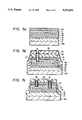
  • FIGS. 1 to 4 are cross-sectional views schematically illustrating conventional field effect transistors, respectively;
  • FIGS. 5a and 5b are cross-sectional views of one example of the field effect transistor according to the present invention, which illustrate steps in the process for producing the same;
  • FIG. 6a is a cross-sectional view illustrating another example of the field effect transistor according to the present invention.
  • FIG. 6b is a cross-sectional view illustrating still another example of the field effect transistor according to the present invention.
  • FIGS. 7a to 7c are cross-sectional views of a field effect transistor in accordance with one embodiment of the present invention, which show steps in the process for producing the same;
  • FIGS. 8a and 8b are cross-sectional views of a field effect transistor in accordance with one embodiment of the present invention, which show steps in the process for producing the same;
  • FIG. 9 is a cross-sectional view of a field effect transistor in accordance with one embodiment of the present invention, which shows one step in the process for producing the same;
  • FIG. 10 is a cross-sectional view of a field effect transistor in accordance with one embodiment of the present invention.
  • FIGS. 11a and 11b are cross-sectional views of a field effect transistor in accordance with one embodiment of the present invention, which show steps in the process for producing the same;
  • FIGS. 12a to 12c are cross-sectional views of a semiconductor device in accordance with one embodiment of the present invention, which show steps in the process for producing the same;
  • FIGS. 13a to 13c are cross-sectional views of a field effect transistor in accordance with one embodiment of the present invention, which show steps in the process for producing the same;
  • FIG. 14a to 14e are cross-sectional views of a field effect transistor in accordance with one embodiment of the present invention, which show steps in the process for producing the same;
  • FIG. 15 is a cross-sectional view of a field effect transistor in accordance with one embodiment of the present invention, which shows one step in the process for producing the same.
  • FIGS. 5a and 5b The cross-sectional structure of a field effect transistor (in a broad sense) according to the present invention is shown in FIGS. 5a and 5b.
  • a layer 1 which serves as an active layer of a transistor or which corresponds to such active layer is provided thereon with a high impurity concentration (approximately ranging from 2 ⁇ 10 18 cm -3 to 10 21 cm -3 ) semiconductor layer 2 for lowering the parasitic resistance.
  • source and drain electrode metals 10 are formed.
  • a gate electrode metal 30 is formed so as to be self-aligned with the source and drain electrode metals 10 by the use of a lift-off process, thus attaining the above-described object.
  • a photoresist 40 for forming a gate electrode is applied, and the insulator 20 and the source and drain electrode metals 10 and the high impurity concentration semiconductor layer 2 are then selectively removed by a dry etching or a chemical etching to expose a portion of the semiconductor layer 1 with which a gate electrode is to be brought into contact.
  • insulators 21 and 22 are deposited by the use of a low-temperature process (any process which has no effect, such as large deformation, on the photoresist 40) such as photo chemical vapor deposition.
  • the insulators 21 and 22 are formed on the side walls of a recess for forming a gate electrode. Then, the insulator 21 on the bottom 41 of the gate recess portion and the insulator 22 on the photoresist 40 are removed by a dry etching or other similar means, and after etching residues have been removed, a gate electrode metal 30 is deposited over the whole surface by evaporation as shown in FIG. 5b. Then, the metal 30 on the photoresist 40 is lifted off. At this time, the spacer for lift-off is defined by the photoresist 40 and the spacer insulator film 20.
  • the feature of the present invention resides in that, after the side insulator films 21 and 22 have been formed so as to cover the source and drain metals 10 and the gate photoresist 40 by a low-temperature process, the insulator films 21 and 22 are selectively removed by etching so that the side insulator film 21 is left, and a gate metal is deposited by evaporation and a gate is then formed by lift-off.
  • Isolation between the source (drain) metal 10 and the gate metal 30 is effected by the use of a single gate photoresist step and a low-temperature insulator film forming method and may also be achieved by other means. It is essential that the source (drain) metal 10 and the gate metal 30 be isolated from each other through the side insulator film 21 as shown in FIG. 5b, in the final finished state.
  • the above-described recessed electrode structure in which the distance between the source and the gate is reduced to the utmost extremity may be considered to be basically different from the conventional structures shown in FIGS. 1 to 4.
  • the conventional methods even when a recess electrode structure is formed by utilizing self-alignment or mask alignment, the lower limit of the distance L sg between the source and gate is on the level of 0.5 ⁇ m.
  • the reason why the above-described structure can be obtained is that it becomes possible to employ a low-temperature insulator forming method which enables an insulator to be formed with an excellent coverage and at relatively low temperatures on the order of room temperature.
  • the above-described formation of source and gate electrodes using a self-alignment type side insulator forming method enables the distance L sg between the source 10 and the gate 30 to be reduced to 0.15 ⁇ m or less.
  • the source electrode metal 10 is connected to the high impurity concentration layer 2. Therefore, when the impurity concentration of the high impurity concentration layer 2 is on the level of 10 20 cm -3 , the contact resistance ⁇ c can be lowered to 0.02 ⁇ mm or less.
  • the insulator 21 may be removed after the removal of the photoresist 40 in the state shown in FIG. 5b. In this case, it is necessary to form a passivation film after the removal of the insulator 21.
  • the distance L sg between the source and the gate can be controlled with considerably excellent controllability.
  • FIGS. 6a and 6b there are shown examples of the structure of a field effect transistor according to the present invention which is so designed that the disadvantages of the conventional field effect transistors shown in FIGS. 2 to 4 are overcome and the parasitic resistance is lowered without leading to any increase in the gate capacitance or deterioration of the source-gate breakdown voltage.
  • the illustrated structures are intended for GaAs MES FETs.
  • the structures shown in FIGS. 6a and 6b feature that an insulator is formed only on the side walls of the n + -type GaAs cap layer 15 and a gate metal is formed only inside a recessed structure.
  • the parasitic resistance between the n + -type GaAs layer 15 and the gate metal 30 is constituted only by the parasitic resistance of a gap which is determined by the film thickness (approximately 1000 ⁇ or less) of the side insulator film 21 and therefore extremely small, which means that there is no increase in the parasitic resistance. Since the gate metal 30 and the n + -type GaAs layer 15 are isolated from each other by the side insulator film 21, there is no deterioration of the source-gate breakdown voltage. In addition, since the gate metal 30 is formed only inside the recessed structure, there is also no increase in the source-gate capacitance. Such structure is obtained by forming the gate metal 30 in self-alignment with the recessed structure.
  • the reference numeral 5' denotes a surface protection film (an insulator film for passivation), 11 an undoped GaAs layer, 1 an active semiconductor layer, 32 a source electrode metal, 33 a drain electrode metal, and 100 a semi-insulating GaAs substrate.
  • FIGS. 7a to 7c are cross-sectional views showing steps in the process for producing a so-called selectively doped hetero junction FET employing a two-dimensional electron gas as a channel layer in accordance with this embodiment.
  • a p - -type (about 5 ⁇ 10 14 cm -3 ) GaAs layer 11 having a thickness of 1 ⁇ m is grown on a semi-insulating GaAs substrate 100 by the use of MBE (Molecular Beam Epitaxy). Subsequently, an n - -type undoped Al x Ga 1-x As (x being generally selected to be 0.3 or more) layer 12 having a thickness of 60 ⁇ is grown on the layer 11.
  • an undoped n - -type GaAs layer 19 having a thickness of 100 ⁇ is grown on the layer 18, and an n + -type Ge layer 2 which contains As at a concentration of 2 ⁇ 10 20 cm -3 and has a thickness of 300 ⁇ is grown on the layer 19.
  • this is moved to another chamber, where an Al layer 10 which is to define source and drain electrode metals is formed so as to have a thickness of 3000 ⁇ .
  • etching is carried out to isolate transistors from each other, and a CVD SiO 2 20 having a thickness of 4000 ⁇ is formed as a lift-off spacer for formation of a gate electrode metal.
  • a photoresist 40 for forming gates is applied and processed, and with this photoresist 40 employed as a mask, the SiO 2 20 is selectively removed by a dry etching to form a recess.
  • This recess is tapered in an inverted trapezoid shape by a wet etching so that lift-off process can readily be used.
  • the source and drain electrode metal layer 10 and the n + -type Ge layer 2 are selectively removed by the use of a dry etching. Thereafter, etching residues are removed by a chemical process. Insulators 21 and 22 of SiN each having a thickness of 1000 ⁇ are deposited at room temperature using photo chemical vapor deposition to obtain a structure such as that shown in FIG. 7b.
  • the insulators 21 and 22 are not necessarily limited to SiN, and SiO 2 , amorphous Si or the like may also be employed.
  • the insulators 21 and 22 may also be formed using ECR (Electron Cyclotron Resonance) plasma chemical vapor deposition.
  • the insulator 22 of SiN and the portion 41 of the insulator 21 deposited on the bottom of the recess are removed by the use of an anisotropic dry etching.
  • Al is then deposited by vacuum deposition so as to have a thickness of 6000 ⁇ and then lifted-off to provide a gate electrode 30 (see FIG. 7c).
  • the threshold voltage V th of the depletion type FET thus fabricated has experimentally been found to be -0.8 V.
  • photoresist and etching steps similar to those described above are carried out.
  • the process carried out in this case differs from the former process in that, in this process, the undoped GaAs layer 19 is also selectively removed by RIE (Reactive Ion etching) using a gas mixture of CCl 2 F 2 and He.
  • RIE reactive Ion etching
  • an enhancement type FET having a threshold voltage V th of about 0.1 V is obtained.
  • the gate metal 31 in this case is Al in the same manner as in the case of the depletion type FET (see FIG. 7c).
  • Source and drain electrodes may be formed by a conventional method in a such manner that, after the photoresist step, the SiO 2 20 is selectively removed, and each of the source and drain electrodes is formed so as to be connected to the source and drain metal 10.
  • Al is exemplarily employed as the source metal 10
  • n + -type Ge is exemplarily of the high impurity concentration layer 2
  • the present invention is applied to a low-noise and ultrahigh-frequency GaAs MESFET.
  • An undoped GaAs layer 11 (1 ⁇ m thick), a pair of GaAs/AlGaAs super lattice buffer layers 8 and 9 (5000 ⁇ thick), an undoped Al x Ga 1-x As (x: about 0.3) layer 18 (1000 ⁇ thick) and an n-type GaAs (the doping level: 5 ⁇ 10 17 cm -3 ) layer 1' (500 ⁇ thick) are successively formed on a semi-insulating GaAs substrate 100 by the use of the MOMBE (metal organic molecular beam epitaxy).
  • MOMBE metal organic molecular beam epitaxy
  • a high impurity concentration (containing As at a concentration of 2 ⁇ 10 20 cm -3 ) n + -type Ge layer 2' is formed, and a source and drain electrode metal layer 10 consisting of three layers, that is, Ti, Pt and Au, is formed so as to have a thickness of 3000 ⁇ . Further, CVD SiO 2 20 which serves as an insulator film for minimizing the fringing capacitance of the source-gate capacitance C gs is formed. Then, photolithography is carried out to form a gate portion.
  • the SiO 2 20, the source and drain electrode metal layer 10 consisting of Ti/Pt/Au layers and the n + -type Ge layer 2' are selectively removed by a dry etching to form a recess portion.
  • the gate recess portion is covered with Si 3 N 4 23 having a thickness of 100 nm by a conventional CVD as shown in FIG. 8a.
  • a gate electrode a combination of Mo and Au layers is deposited to a thickness of 8000 ⁇ by vacuum deposition and then subjected to a dry etching to form a gate electrode 30 as shown in FIG. 8b.
  • the above-described FET was experimentally produced and the characteristics thereof were measured. The results of measurement have found that it is possible to reduce the source-gate distance L sg to 0.15 ⁇ m and lower the ohmic contact resistance ⁇ c to 0.02 ⁇ mm.
  • the present invention is applied to a p-channel selectively doped hereto junction FET.
  • An n - -type (the doping level: about 10 14 cm -3 or less) GaAs layer 11' having a thickness of 1 ⁇ m is grown on a semi-insulating GaAs substrate 100 by the use of MO-MBE, and Al y Ga 1-y As (y: about 0.4) 60 containing Be at a concentration of 2 ⁇ 10 18 cm -3 is then formed to a thickness of 500 ⁇ .
  • a p + -type Ge layer 61 containing boron (B) at a concentration of 2 ⁇ 10 20 cm -3 is formed to a thickness of 3000 ⁇ , and this is moved to another ultrahigh vacuum chamber, where a Ti layer 62 having a thickness of 3000 ⁇ and an SiO 2 layer 20 as a spacer having a thickness of 4000 ⁇ are formed.
  • FIG. 10 shows an embodiment in which the present invention is applied to a complementary selectively doped hetero junction FET.
  • an n-channel FET (see the portion A in FIG. 10) has been formed in a manner similar to that in the case of the embodiment 1, an FET employing a two-dimensional hole gas as a carrier is formed as shown in the portion B of FIG. 10 by the use of a selective epitaxial growth method.
  • this embodiment employs an n - -type Al x Ga 1-x As layer 12 having a thickness of 30 ⁇ for the purpose of improving the hole mobility.
  • an undoped Al x Ga 1-x As layer 18 having a thickness of 150 ⁇ is formed.
  • an insulator layer 21 which is formed of SiN is formed over the side walls of the recess portion by photo chemical vapor deposition in order to prevent the source and drain electrodes 10, 62 and the gate electrodes 30, 30" from contacting each other, respectively.
  • FIGS. 11a and 11b show in combination an embodiment in which an n + -type GaAs layer is employed as a high impurity concentration semiconductor layer.
  • An O 2 -doped GaAs layer (semi-insulating) 11 having a thickness of 1 ⁇ m is formed on a semi-insulating GaAs substrate 100 by the use of MOCVD. Further, an Si-doped (4 ⁇ 10 17 cm -3 ) GaAs layer 1" having a thickness of 700 ⁇ and an Si-doped (2 ⁇ 10 18 cm -3 ) GaAs layer 2" having a thickness of 3000 ⁇ are successively formed, and an electrode metal layer 10" consisting of three layers of AuGe, Ni and Au is then deposited as shown in FIG.
  • FIGS. 12a to 12c show in combination an embodiment in which the electrode forming method according to the present invention is applied to formation of a base electrode of an HBT (Hetero-junction Bipolar Transistor).
  • An n + -type GaAs layer 101 containing Si at a concentration of 4 ⁇ 10 18 cm -3 and having a thickness of 5000 ⁇ is formed on a semi-insulating GaAs substrate 100 by the use of MBE, on which are successively formed n - -type GaAs 102 containing Si at a concentration of 5 ⁇ 10 14 cm -3 and having a thickness of 4000 ⁇ , p-type GaAs 103 (base layer) containing Be at a concentration of 2 ⁇ 10 18 cm -3 and having a thickness of 2000 ⁇ , n-type Al x Ga 1-x As (x: about 0.3) 104 containing Si at a concentration of 2 ⁇ 10 17 cm -3 and having a thickness of 4000 ⁇ and n-type GaAs 105 containing Si at a
  • a CVD SiO 2 film 200 is deposited as shown in FIG. 12a.
  • the step which is carried out to form a base electrode will next be explained with reference to FIGS. 12b and 12c.
  • the emitter electrode may be formed by the use of a conventional method, and the collector electrode may be formed by a method similar to that used to form the base electrode.
  • a photoresist 201 for forming a base electrode has been deposited to a thickness of 1.1 ⁇ m and properly processed, the SiO 2 200, the n-type GaAs 105 and the n-type AlGaAs 104 are selectively removed by the use of an anisotropic dry etching and a chemical etching.
  • SiN films 203 and 204 each having a thickness of 2000 ⁇ is formed as shown in FIG. 12b by photo chemical vapor deposition at a substrate temperature of 120° C.
  • the SiN film 204 on the side walls left the other SiN films 203 and 204 are removed by an anisotropic dry etching.
  • a base electrode metal 205 is deposited by evaporation, and unnecessary deposited metal is lifted off to form a base electrode as shown in FIG. 12c.
  • an alloy of Au and Zn is employed as the base electrode metal.
  • the electrode is formed into an ohmic electrode under the alloying conditions that a heat treatment is carried out at a temperature of 450° C. for two minutes.
  • the photo CVD SiN 204 left on the side walls as described above has inferior electrical insulating properties, it may be removed, after the formation of the electrode, by the use of hydrofluoric acid diluted to 1/100 and a new passivation film may be formed by the use of plasma chemical vapor deposition or the like.
  • the gap between the electrode formed and the semiconductor layer which is electrically isolated from the electrode by the insulator film is entirely filled with the insulator, the parasitic capacitance is increased disadvantageously. Accordingly, if the area between the electrode and the side insulator film is defined by an air gap, it is possible to suppress increase in the parasitic capacitance.
  • FIGS. 13a to 13c show in combination an embodiment in which the present invention is applied to formation of a GaAs MESFET by ion implantation.
  • An n-type GaAs region 71, n + -type source and drain regions 70, source and drain electrodes 32, 33 and a spacer insulator film 72 are successively formed, and a photoresist 73 for forming a gate is then formed as shown in FIG. 13a.
  • the insulator film 72 is etched to expose the n-type GaAs region 71, and SiN 22 having a thickness of 3000 ⁇ is then deposited by photo chemical vapor deposition at a substrate temperature of 120° C. (see FIG. 13b).
  • the reference numeral 74 denotes a semi-insulating GaAs substrate.
  • the side insulator film 22 is left and other portion of the SiN 22 is etched out using an anisotropic dry etching, and a gate electrode 30 is formed by lift-off. Since the deposition rate of the film 22 formed by photo chemical vapor deposition is relatively low (2 nm/minute to 10 nm/minute), the side insulator film 22 can be controlled with exceedingly excellent controllability.
  • the distance or diameter of the opening provided in the gate photoresist shown in FIG. 13a is 0.8 ⁇ m, while the film thickness of the SiN formed on the side wall portion by photo chemical vapor deposition is 3000 ⁇ , and the length of the finished gate (see FIG. 13c) is 0.4 ⁇ m.
  • the present invention is a process which is favorably suitable for formation of submicron FETs.
  • FIGS. 14a to 14e show essential steps in the process for producing a 2 DEG-FET employing a GaAs/AlGaAs hetero junction.
  • Undoped GaAs (generally of the p - -type and containing remaining acceptors at a concentration of 10 14 cm -3 ) 317 having a thickness of 1 ⁇ m is grown on a semi-insulating GaAs substrate 310 by the use of MBE (Molecular Beam Epitaxy). Then, undoped Al x Ga 1-x As 316 having a thickness of 60 ⁇ is formed. Al content x is generally selected to fall within a range from 0.3 to 0.4, and the film thickness is generally selected to be from 0 ⁇ to about 100 ⁇ . Then, Al y Ga 1-y As 315 containing Si at a concentration of 1 ⁇ 10 19 cm -3 and having a thickness of 50 ⁇ is formed.
  • Al content x is generally selected to be 0.23 but may be selected to fall within a range from 0.2 to 0.4 according to the purpose of application.
  • the thickness of the film 315 is generally selected to fall within a range from 10 ⁇ to 150 ⁇ . When the film 315 is exceedingly thin, it is common practice to employ Sn (tin) as an n-type dopant in place of Si and select a doping level of 5 ⁇ 10 19 cm -3 .
  • undoped Al x Ga 1-x As 314 having a thickness of 150 ⁇ is formed.
  • Al content x is generally selected to fall within a range from 0.3 to 0.4.
  • the thickness of the film 314 generally ranges from 50 ⁇ to 200 ⁇ .
  • n + -type GaAs 313 having a thickness of 1600 ⁇ is formed for the purpose of lowering the parasitic resistance between the source and the gate.
  • the doping level of Si is selected to be 1 ⁇ 10 19 cm -3 .
  • n + -type Ge or the like may be employed to lower the sheet resistance to several ⁇ / ⁇ or less. In the case of employing n + -type Ge (the doping level: 10 20 cm -3 ), the film thickness is only required to be on the order of 200 ⁇ to 300 ⁇ (see FIG. 14a).
  • source and drain electrodes 302 and 303 have been formed using a three-layer structure consisting of AuGe, Ni and Au layers by the lift-off method, an insulator film 305 is formed, and a photoresist 320 for forming a gate is then formed (see FIG. 14b).
  • the n + -type GaAs 313 is selectively removed by a reactive ion etching (RIE) using CCl 2 F 2 /He gas (a gas mixture of CCl 2 F 2 and He).
  • RIE reactive ion etching
  • Si 3 N 4 304 having a thickness of 1000 ⁇ is formed by the use of photo chemical vapor deposition.
  • the substrate temperature during the formation of Si 3 N 4 304 is 130° C., and it has experimentally been confirmed that no unfavorable phenomenon such as thermal deformation of the photoresist occurs at such substrate temperature (see FIG. 14c).
  • the thickness of the Si 3 N 4 film is generally selected to fall within a range from 100 ⁇ to 1000 ⁇ .
  • the Si 3 N 4 formed on the bottom of the recessed gate structure and the Si 3 N 4 formed on the photoresist are removed using a conventional dry etching. It is essential that the Si 3 N 4 formed on the side surfaces of the n + -type GaAs is left as it is.
  • Si 3 N 4 is formed by photo chemical vapor deposition
  • another method may also be employed, such as a method wherein SiO 2 is formed by microwave plasma chemical vapor deposition at a low temperature (about 150° C.), or a method wherein an SiO 2 target is sputtered by an electron beam to deposit SiO 2 .
  • a three-layer film 301 consisting of Ti, Pt and Au layers is deposited by evaporation as a gate metal (see FIG. 14d), and then subjected to lift-off process to obtain an FET having a desired configuration (see FIG. 14e).
  • an Al film or a two-layer film consisting of Mo/Au layers may also be employed in addition to the above-described three-layer film 301.
  • the 2DEG-FET having the above-described structure has its source-gate breakdown voltage improved from 1.5 V to about 10 V.
  • the maximum gate voltage which can be applied to the gate electrode has also been increased from 0.8 V to 2.9 V.
  • the present invention is also effective in the case of employing other hetero junctions, e.g., InP/InGaAs, GaAs/Ge, AlGaAs/InGaAs, etc.
  • the present invention is also effective in the case of employing a two-dimensional hole gas and in the case where an n-type impurity employed in the present invention is replaced by a p-type impurity such as Be or Mg.
  • FIG. 15 shows an embodiment in which the present invention is applied to a GaAs MESFET.
  • Undoped GaAs or undoped Al y Ga 1-y As (y: about 0.5) 317' having a thickness of 1 ⁇ m is formed on a semi-insulating GaAs substrate 310, and GaAs 319 containing Si at a concentration of 5 ⁇ 10 17 cm -3 and having a thickness of 500 ⁇ is then formed thereon. Further, undoped Al y Ga 1-y As 314' having a thickness of 50 ⁇ is formed, and n + -type Ge (the doping level: 10 20 cm -3 ) 313' having a thickness of 500 ⁇ is formed thereon.
  • the process for producing the FET is almost the same as that in the case of the embodiment 8.
  • This embodiment mainly differs from the embodiment 8 in that, since n + -type Ge is employed to form source and drain regions, Al is employed as an ohmic metal, and the n + -type Ge 313'0 and the AlGaAs 314' are formed by a dry etching using CF 4 .
  • the electrode formed within the recess is isolated from a high impurity concentration semiconductor layer and/or another electrode metal layer through a side insulator film. Accordingly, it is possible to reduce the distance between the electrode within the recess and the high impurity concentration semiconductor layer and/or the second electrode metal layer to 0.15 ⁇ m or less and to control the distance with considerably excellent controllability. Since the second electrode metal is provided on the high impurity concentration barrier semiconductor layer, the contact resistance ⁇ c of the second electrode metal can be lowered to 0.02 ⁇ mm or less. Thus, since the present invention enables minimization of the resistance between the source and gate of an FET, it is possible to realize great improvements in the transistor characteristics.
  • a side insulator film was formed between an n + -type cap layer and a gate metal in such a manner that the insulator film was disposed only on the inner side of the gate recess, and the gate metal was formed only inside the gate recess.

Landscapes

  • Junction Field-Effect Transistors (AREA)

Abstract

Source and drain electrode metals of a field effect transistor having a recessed gate electrode metal are directly connected to a high impurity concentration semiconductor layer which faces the gate electrode metal through an insulator film which defines the side wall of the recess. The source and drain electrode metals may be disposed so as to face the gate electrode metal through the side insulator film. With this arrangement, it is possible to lower the parasitic resistance between the gate electrode and another electrode of the field effect transistor, to lower the contact resistance between a semiconductor layer and the source and drain electrodes, to reduce the capacitance of the recess gate electrode and to increase the source-gate breakdown voltage, advantageously. The above-described arrangement is particularly suitable for a transistor employing a compound semiconductor, and can also be applied to semiconductor devices other than field effect transistors. Such semiconductor devices can readily be produced by forming a gate electrode metal with a self-alignment process using the lift-off method.

Description

This is a continuation of application Ser. No. 340,471 filed Apr. 19, 1989 and now U.S. Pat. No. 5,186,087, which is a continuation of application Ser. No. 017,551 filed Feb. 24, 1987, now abandoned.
BACKGROUND OF THE INVENTION
The present invention relates to a semiconductor device having a recessed electrode structure and, more particularly, to a field effect transistor having a recessed gate electrode structure and a method of producing the same.
With the recent development of superhigh precision crystal growth techniques such as the MBE (Molecular Beam Epitaxy) and the MOCVD (Metal Organic Chemical Vapor Deposition), realization of superhigh speed devices (e.g., that disclosed in the specification of Japanese Patent Laid-Open No. 132074/1980) utilizing a gallium arsenide (GaAs) and aluminum gallium arsenide (AlGaAs) hetero junction is under way. Since an excellent insulating material for a GaAs/AlGaAs hetero junction has not yet to be found, Schottky junctions formed by metals and compound semiconductors are employed to constitute gate structures for various kinds of field effect transistor (FET).
FIG. 1 is a cross-sectional view of a selectively doped hetero junction FET as one example of the above-described conventional FETs. In the figure, the reference numeral 100 denotes a semi-insulating GaAs substrate, 11 an undoped GaAs layer, 12 an undoped AlGaAs layer (not intentionally containing any impurity, and in many cases, resulting in an n- -type layer having an impurity concentration of 1015 cm-3) known as a spacer, the layer 12 generally having a film thickness e of about 60 Å. The numeral 13 denotes an n-type AlGaAs layer, and 14 an n-type GaAs layer. The total film thickness d of the AlGaAs layers 12 and 13 is generally about 500 Å. The numeral 31 denotes a gate metal of an enhancement type FET (the threshold voltage Vth : about 0.1 V), 30 a gate metal of a depletion type FET (the threshold voltage Vth : about -0.8 V; the gate voltage VG =0 V at which the channel is open). Representing the doping level of the n-type AlGaAs layer 13 by ND for simple calculation, the threshold voltage Vth may be given in the main term as follows: ##EQU1##
where φBn represents the height of the Schottky barrier between the gate metal and the AlGaAs layer, ΔEc the size of discontinuity of the conduction band edge between the GaAs layer 11 and the AlGaAs layer 12, q the unit charge, and ε the dielectric constant of AlGaAs. A critical consideration in improvement of such FETs in performance lies in lowering the parasitic resistance Rsg of the gap between the source 32 and the gate 30 and that between the source 34 and the gate 31. The parasitic resistance Rsg is generally represented as follows: ##EQU2##
where Lsg represents the distance between the source and the gate, w the width of the transistor, γc the contact resistance of the source electrode, and ρs the carrier sheet resistance of the portion between the source and the gate. The minimum source-gate distance Lsg which can be obtained by the use of photolithography or electron beam lithography is generally about 0.5 to about 0.8 μm. The sheet resistance ρs is about 1 kΩ/□ to 100 Ω/□. It is characteristic of FETs employing compound semiconductors to involve a considerably high sheet resistance ρs (the sheet resistance of Si-MOSFETs is generally about 1 to about 5 Ω/□). This is mainly because the upper limit of the carrier density in compound semiconductors is relatively low, i.e., 2×1018 cm-3.
On the other hand, there have been known one type of GaAs MESFET (Metal-Semiconductor Field Effect Transistor) employing compound semiconductors such as gallium arsenide (GaAs) and another type of FET employing as an active layer a two-dimensional electron gas (2 DEG) formed at the hetero junction interface between aluminum gallium arsenide (AlGaAs) and GaAs (such FETs being known as 2 DEG-FETs). These FETs are employed as low-noise high-frequency FETs. FIG. 2 is a cross-sectional view of an FET of the type described above. An n+ -type GaAs layer 15 (the doping level: 2×1018 cm-3 ; the film thickness: about 2000 Å) is formed for the purpose of lowering the parasitic resistance between the source and the gate. A gate electrode 30 is formed using a so-called recessed structure. Such recessed structure is generally formed using a chemical etching so as to have a depth of 3000 to 4000 Å, and a gap which generally has a size of 0.1 to 0.2 μm and a sheet resistance of about 1 kΩ/□ is formed between the n+ -type GaAs layer 15 and the gate electrode 30 as shown in FIG. 2, which results in an increase in the parasitic resistance.
In order to prevent such increase in the parasitic resistance, improved recessed structures have been proposed and carried out, such as that shown in FIG. 3 in which the gate metal 30 is self-aligned with the recess and that shown in FIG. 4 in which a side insulator film 5 is formed between the gate metal 30 and the n+ -type GaAs layer 15.
Low-noise high-frequency FETs of the type described above are described in, for example, "IEEE, ED 27 (1980), page 1029". In the above-described figures, the reference numeral 9 denotes an n-type GaAs active layer, 32 a source electrode, 33 a drain electrode, and 35 an overhang portion of the gate metal 30 overhanging the n+ -type GaAs layer 15. The broken line below the n-type GaAs active layer represents the boundary between the substrate and the active layer.
The prior arts shown in FIGS. 3 and 4 are effective in lowering the parasitic resistance. However, in the self-alignment process with respect to a recess such as that shown in FIG. 3, the gate metal 30 is in direct contact with the n+ -type GaAs layer 15, and the source-gate breakdown voltage (the voltage at which a leakage current flows when the source and the gate are reverse-biased) is about 1.5 to about 3.0 V, which is far lower than a practical level, i.e., 7 to 10 V, disadvantageously. On the other hand, the structure, in which the insulator 5 is formed between the gate metal 30 and the n+ -type GaAs layer 15 in order to prevent deterioration of the source-gate breakdown voltage, involves the problem that the gate metal 30 which overhangs the n+ -type GaAs layer 15 (see a portion of the gate metal denoted by the reference numeral 35) substantially doubles the gate capacitance.
In an FET having the structure shown in FIG. 2, even if the n+ -type GaAs layer 15 is formed thick, the sheet resistance ρs between the source and the gate is about 100 Ω/□.
The contact resistance γc of the source electrode is about 0.2 Ωmm, and the lower limit thereof is given by the fact that the doping level of the n+ -type GaAs layer which is in contact with the source and drain electrode metals is 2×1018 cm-3. If the sheet resistance ρs is lowered to several Ω/□ or less and the contact resistance γc is lowered to 0.02 Ωmm or less, it is possible to expect a great improvement in performance of the FETs.
In the above-described prior arts, the parasitic resistance is increased mainly because the distance Lsg between the source and the gate is 0.5 μm or more and a portion of the semiconductor which defines the gap between the source and gate has a sheet resistance of about 100 Ω/□.
SUMMARY OF THE INVENTION
It is an object of the present invention to provide a high-performance semiconductor device, particularly a semiconductor device employing a compound semiconductor and, more particularly, a field effect transistor employing a compound semiconductor, which is so designed that the parasitic resistance or sheet resistance between a recessed electrode and another or second electrode is considerably lowered and the contact resistance between the another or the second electrode and a semiconductor layer is lowered and further the capacitance of the recessed electrode is lowered and the source-gate breakdown voltage is increased, thereby overcoming the disadvantages of conventional semiconductor devices having recessed electrode structures.
It is another object of the present invention to provide a method which enables the above-described semiconductor device to be readily produced.
To these ends, the present invention provides a semiconductor device in which an electrode metal which is directly connected to a predetermined one of the active semiconductor layers which constitute a semiconductor device such as a transistor is isolated through a side insulator layer from at least one of the other layers provided on the predetermined active layer, the electrode metal being formed in a cut portion, that is, a recess formed in said layer provided on the predetermined active layer. It is particularly preferable to form the electrode metal only inside said recess. Accordingly, this electrode metal may be regarded as a recessed electrode. The above-described active semiconductor layers include, in practice, a channel layer of a field effect transistor, the emitter, base and collector of a bipolar transistor, etc. Said other layers provided on the predetermined active layer must include at least one layer which is required to be isolated from the recessed electrode metal. More specifically, said other layers include, for example, a high impurity concentration semiconductor layer and another electrode metal layer.
The present invention is mainly directed to field effect transistors, but semiconductor devices according to the present invention are not necessarily limited thereto. In the case of a field effect transistor, the recessed electrode defines a gate electrode metal.
Said other layers, which are disposed on the active layer to which the electrode metal is directly connected and which are adjacent to the side insulator layer, include a high impurity concentration semiconductor layer and/or an electrode metal (hereinafter referred to as a "second electrode metal") other than the recessed electrode for the purpose of lowering the parasitic resistance or the sheet resistance. If an electrode metal other than the recessed electrode is provided so as to be directly connected to the high impurity concentration semiconductor layer, this semiconductor layer acts to lower the contact resistance of the second electrode metal, advantageously. In the case of a field effect transistor, the second electrode metal is defined by a source electrode metal or source and drain electrode metals.
The thickness of the side insulator layer is set at 100 to 3000 Å, more preferably 100 to 1000 Å. A thickness less than this thickness range is unsatisfactory in the insulating performance of the insulator, whereas a thickness exceeding the thickness range increases the resistance between the recessed electrode metal and the second electrode metal, unfavorably. Examples of insulators which may be employed in the present invention include insulating materials which are readily available in the form of a thin film, such as SiN, Si3 N4, SiO2 and amorphous Si. Air may also be employed as an insulator.
The above-described type of transistor generally employs a compound semiconductor such as a GaAs compound.
A semiconductor device according to the present invention is readily obtained by forming an electrode metal which is directly connected to one of the active semiconductor layers constituting a transistor, e.g., a gate electrode metal of a field effect transistor, in such a manner that the electrode metal is self-aligned with a recess portion. More specifically, a semiconductor device according to the present invention is readily obtained by, for example, a manufacturing method which comprises the steps of: i) successively forming layers for constituting a transistor on a substrate; ii) forming a recess for forming an electrode metal by a photoetching technique so that a predetermined active semiconductor layer to which a predetermined electrode metal is to be connected is exposed at the bottom of the recess; iii) providing an insulator film over the inner surface of the recess at such a temperature that a photoresist film employed in the photoetching in the step ii) is not deformed; iv) removing a portion of the insulator film provided in the step iii) which is disposed on the bottom inside the recess and a portion of the insulator film which is provided over the photoresist film to define a side insulator film; and v) forming an electrode metal within the recess using the photoresist film as a mask, and lifting off the metal deposited on the mask. With this manufacturing method, the electrode metal can be formed within the recess by carrying out a photoresist step only once.
BRIEF DESCRIPTION OF THE DRAWINGS
FIGS. 1 to 4 are cross-sectional views schematically illustrating conventional field effect transistors, respectively;
FIGS. 5a and 5b are cross-sectional views of one example of the field effect transistor according to the present invention, which illustrate steps in the process for producing the same;
FIG. 6a is a cross-sectional view illustrating another example of the field effect transistor according to the present invention;
FIG. 6b is a cross-sectional view illustrating still another example of the field effect transistor according to the present invention;
FIGS. 7a to 7c are cross-sectional views of a field effect transistor in accordance with one embodiment of the present invention, which show steps in the process for producing the same;
FIGS. 8a and 8b are cross-sectional views of a field effect transistor in accordance with one embodiment of the present invention, which show steps in the process for producing the same;
FIG. 9 is a cross-sectional view of a field effect transistor in accordance with one embodiment of the present invention, which shows one step in the process for producing the same;
FIG. 10 is a cross-sectional view of a field effect transistor in accordance with one embodiment of the present invention;
FIGS. 11a and 11b are cross-sectional views of a field effect transistor in accordance with one embodiment of the present invention, which show steps in the process for producing the same;
FIGS. 12a to 12c are cross-sectional views of a semiconductor device in accordance with one embodiment of the present invention, which show steps in the process for producing the same;
FIGS. 13a to 13c are cross-sectional views of a field effect transistor in accordance with one embodiment of the present invention, which show steps in the process for producing the same;
FIG. 14a to 14e are cross-sectional views of a field effect transistor in accordance with one embodiment of the present invention, which show steps in the process for producing the same; and
FIG. 15 is a cross-sectional view of a field effect transistor in accordance with one embodiment of the present invention, which shows one step in the process for producing the same.
DESCRIPTION OF THE PREFERRED EMBODIMENTS
The outline of the present invention will first be explained practically with reference to the accompanying drawings.
The cross-sectional structure of a field effect transistor (in a broad sense) according to the present invention is shown in FIGS. 5a and 5b. A layer 1 which serves as an active layer of a transistor or which corresponds to such active layer is provided thereon with a high impurity concentration (approximately ranging from 2×1018 cm-3 to 1021 cm-3) semiconductor layer 2 for lowering the parasitic resistance. Further, source and drain electrode metals 10 are formed. A gate electrode metal 30 is formed so as to be self-aligned with the source and drain electrode metals 10 by the use of a lift-off process, thus attaining the above-described object. More specifically, after an insulator 20 for lift-off, e.g., CVD SiO2, has been formed over the whole surface, a photoresist 40 for forming a gate electrode is applied, and the insulator 20 and the source and drain electrode metals 10 and the high impurity concentration semiconductor layer 2 are then selectively removed by a dry etching or a chemical etching to expose a portion of the semiconductor layer 1 with which a gate electrode is to be brought into contact. Then, insulators 21 and 22 are deposited by the use of a low-temperature process (any process which has no effect, such as large deformation, on the photoresist 40) such as photo chemical vapor deposition. The point in this deposition is that the insulators 21 and 22 are formed on the side walls of a recess for forming a gate electrode. Then, the insulator 21 on the bottom 41 of the gate recess portion and the insulator 22 on the photoresist 40 are removed by a dry etching or other similar means, and after etching residues have been removed, a gate electrode metal 30 is deposited over the whole surface by evaporation as shown in FIG. 5b. Then, the metal 30 on the photoresist 40 is lifted off. At this time, the spacer for lift-off is defined by the photoresist 40 and the spacer insulator film 20. More specifically, the feature of the present invention resides in that, after the side insulator films 21 and 22 have been formed so as to cover the source and drain metals 10 and the gate photoresist 40 by a low-temperature process, the insulator films 21 and 22 are selectively removed by etching so that the side insulator film 21 is left, and a gate metal is deposited by evaporation and a gate is then formed by lift-off.
Isolation between the source (drain) metal 10 and the gate metal 30 is effected by the use of a single gate photoresist step and a low-temperature insulator film forming method and may also be achieved by other means. It is essential that the source (drain) metal 10 and the gate metal 30 be isolated from each other through the side insulator film 21 as shown in FIG. 5b, in the final finished state.
The above-described recessed electrode structure in which the distance between the source and the gate is reduced to the utmost extremity may be considered to be basically different from the conventional structures shown in FIGS. 1 to 4. With the conventional methods, even when a recess electrode structure is formed by utilizing self-alignment or mask alignment, the lower limit of the distance Lsg between the source and gate is on the level of 0.5 μm. The reason why the above-described structure can be obtained is that it becomes possible to employ a low-temperature insulator forming method which enables an insulator to be formed with an excellent coverage and at relatively low temperatures on the order of room temperature.
The above-described formation of source and gate electrodes using a self-alignment type side insulator forming method enables the distance Lsg between the source 10 and the gate 30 to be reduced to 0.15 μm or less. In this recessed electrode structure, the source electrode metal 10 is connected to the high impurity concentration layer 2. Therefore, when the impurity concentration of the high impurity concentration layer 2 is on the level of 1020 cm-3, the contact resistance γc can be lowered to 0.02 Ωmm or less.
Since the side insulator 21 is present for the purpose of isolating the source metal 10 and the gate metal 30 from each other, the insulator 21 may be removed after the removal of the photoresist 40 in the state shown in FIG. 5b. In this case, it is necessary to form a passivation film after the removal of the insulator 21.
If an extremely low deposition rate (about 30 Å/min) by photo chemical vapor deposition is utilized, the distance Lsg between the source and the gate can be controlled with considerably excellent controllability.
Referring next to FIGS. 6a and 6b, there are shown examples of the structure of a field effect transistor according to the present invention which is so designed that the disadvantages of the conventional field effect transistors shown in FIGS. 2 to 4 are overcome and the parasitic resistance is lowered without leading to any increase in the gate capacitance or deterioration of the source-gate breakdown voltage. The illustrated structures are intended for GaAs MES FETs. In contrast to the conventional structure shown in FIG. 4, the structures shown in FIGS. 6a and 6b feature that an insulator is formed only on the side walls of the n+ -type GaAs cap layer 15 and a gate metal is formed only inside a recessed structure. In such FET structure, the parasitic resistance between the n+ -type GaAs layer 15 and the gate metal 30 is constituted only by the parasitic resistance of a gap which is determined by the film thickness (approximately 1000 Å or less) of the side insulator film 21 and therefore extremely small, which means that there is no increase in the parasitic resistance. Since the gate metal 30 and the n+ -type GaAs layer 15 are isolated from each other by the side insulator film 21, there is no deterioration of the source-gate breakdown voltage. In addition, since the gate metal 30 is formed only inside the recessed structure, there is also no increase in the source-gate capacitance. Such structure is obtained by forming the gate metal 30 in self-alignment with the recessed structure.
In FIGS. 6a and 6b, the reference numeral 5' denotes a surface protection film (an insulator film for passivation), 11 an undoped GaAs layer, 1 an active semiconductor layer, 32 a source electrode metal, 33 a drain electrode metal, and 100 a semi-insulating GaAs substrate.
EMBODIMENT 1
FIGS. 7a to 7c are cross-sectional views showing steps in the process for producing a so-called selectively doped hetero junction FET employing a two-dimensional electron gas as a channel layer in accordance with this embodiment.
Referring to FIG. 7a, a p- -type (about 5×1014 cm-3) GaAs layer 11 having a thickness of 1 μm is grown on a semi-insulating GaAs substrate 100 by the use of MBE (Molecular Beam Epitaxy). Subsequently, an n- -type undoped Alx Ga1-x As (x being generally selected to be 0.3 or more) layer 12 having a thickness of 60 Å is grown on the layer 11. Then, an n-type Aly Ga1-y As (y being generally used in the range from 0.05 to 0.25) layer 13 which contains Si as an n-type impurity at a concentration of 2×1018 cm-3 and has a thickness of 150 Å is grown on the layer 12, and an undoped n- -type Alz Ga1-z As (z being generally selected to be about 0.3) layer 18 having a thickness of 100 Å is then grown as a separation layer. Further, an undoped n- -type GaAs layer 19 having a thickness of 100 Å is grown on the layer 18, and an n+ -type Ge layer 2 which contains As at a concentration of 2×1020 cm-3 and has a thickness of 300 Å is grown on the layer 19. Under an ultra-high vacuum, this is moved to another chamber, where an Al layer 10 which is to define source and drain electrode metals is formed so as to have a thickness of 3000 Å. Then, etching is carried out to isolate transistors from each other, and a CVD SiO 2 20 having a thickness of 4000 Å is formed as a lift-off spacer for formation of a gate electrode metal. Further, a photoresist 40 for forming gates is applied and processed, and with this photoresist 40 employed as a mask, the SiO 2 20 is selectively removed by a dry etching to form a recess. This recess is tapered in an inverted trapezoid shape by a wet etching so that lift-off process can readily be used. Then, the source and drain electrode metal layer 10 and the n+ -type Ge layer 2 are selectively removed by the use of a dry etching. Thereafter, etching residues are removed by a chemical process. Insulators 21 and 22 of SiN each having a thickness of 1000 Å are deposited at room temperature using photo chemical vapor deposition to obtain a structure such as that shown in FIG. 7b. In this case, the insulators 21 and 22 are not necessarily limited to SiN, and SiO2, amorphous Si or the like may also be employed. The insulators 21 and 22 may also be formed using ECR (Electron Cyclotron Resonance) plasma chemical vapor deposition.
Then, with the side insulator film 21 left, the insulator 22 of SiN and the portion 41 of the insulator 21 deposited on the bottom of the recess are removed by the use of an anisotropic dry etching. Al is then deposited by vacuum deposition so as to have a thickness of 6000 Å and then lifted-off to provide a gate electrode 30 (see FIG. 7c). The threshold voltage Vth of the depletion type FET thus fabricated has experimentally been found to be -0.8 V. Next, in order to form an enhancement type FET, photoresist and etching steps similar to those described above are carried out. The process carried out in this case differs from the former process in that, in this process, the undoped GaAs layer 19 is also selectively removed by RIE (Reactive Ion etching) using a gas mixture of CCl2 F2 and He. Thus, an enhancement type FET having a threshold voltage Vth of about 0.1 V is obtained. The gate metal 31 in this case is Al in the same manner as in the case of the depletion type FET (see FIG. 7c). Source and drain electrodes may be formed by a conventional method in a such manner that, after the photoresist step, the SiO 2 20 is selectively removed, and each of the source and drain electrodes is formed so as to be connected to the source and drain metal 10. Although in this embodiment Al is exemplarily employed as the source metal 10, it is possible to employ any metal which can be processed by a dry etching and brought into ohmic contact with the high impurity concentration layer 2, such as Au, Pt and Mo. Further, although n+ -type Ge is exemplarily of the high impurity concentration layer 2, this is not necessarily limitative and it is possible to employ any substance which can serve as a barrier semiconductor which is in ohmic contact with the source metal 10 and the active layers 18, 19, 13 and 12.
EMBODIMENT 2
In the embodiment shown in FIGS. 8a and 8b, the present invention is applied to a low-noise and ultrahigh-frequency GaAs MESFET. An undoped GaAs layer 11 (1 μm thick), a pair of GaAs/AlGaAs super lattice buffer layers 8 and 9 (5000 Å thick), an undoped Alx Ga1-x As (x: about 0.3) layer 18 (1000 Å thick) and an n-type GaAs (the doping level: 5×1017 cm-3) layer 1' (500 Å thick) are successively formed on a semi-insulating GaAs substrate 100 by the use of the MOMBE (metal organic molecular beam epitaxy). Then, a high impurity concentration (containing As at a concentration of 2×1020 cm-3) n+ -type Ge layer 2' is formed, and a source and drain electrode metal layer 10 consisting of three layers, that is, Ti, Pt and Au, is formed so as to have a thickness of 3000 Å. Further, CVD SiO 2 20 which serves as an insulator film for minimizing the fringing capacitance of the source-gate capacitance Cgs is formed. Then, photolithography is carried out to form a gate portion. More specifically, the SiO 2 20, the source and drain electrode metal layer 10 consisting of Ti/Pt/Au layers and the n+ -type Ge layer 2' are selectively removed by a dry etching to form a recess portion. Subsequently, the gate recess portion is covered with Si3 N4 23 having a thickness of 100 nm by a conventional CVD as shown in FIG. 8a. The Si3 N4 23 on the bottom of the gate portion and on the flat portion of the surface of the SiO.sub. 2 20 is removed by a dry etching, and as a gate electrode a combination of Mo and Au layers is deposited to a thickness of 8000 Å by vacuum deposition and then subjected to a dry etching to form a gate electrode 30 as shown in FIG. 8b. The above-described FET was experimentally produced and the characteristics thereof were measured. The results of measurement have found that it is possible to reduce the source-gate distance Lsg to 0.15 μm and lower the ohmic contact resistance γc to 0.02 Ωmm.
EMBODIMENT 3
In the embodiment shown in FIG. 9, the present invention is applied to a p-channel selectively doped hereto junction FET. An n- -type (the doping level: about 1014 cm-3 or less) GaAs layer 11' having a thickness of 1 μm is grown on a semi-insulating GaAs substrate 100 by the use of MO-MBE, and Aly Ga1-y As (y: about 0.4) 60 containing Be at a concentration of 2×1018 cm-3 is then formed to a thickness of 500 Å. Further, a p+ -type Ge layer 61 containing boron (B) at a concentration of 2×1020 cm-3 is formed to a thickness of 3000 Å, and this is moved to another ultrahigh vacuum chamber, where a Ti layer 62 having a thickness of 3000 Å and an SiO2 layer 20 as a spacer having a thickness of 4000 Å are formed.
Thereafter, a process similar to that in the embodiment 2 is carried out, and a gate metal is formed using a double layer of Mo and Au so as to be in Schottky contact with a p-type Aly Ga1-y As layer 60. The FET produced as described above has been confirmed that it is possible to reduce the source-gate distance and lower the contact resistance of the source electrode as in the case of the above-described embodiments.
EMBODIMENT 4
FIG. 10 shows an embodiment in which the present invention is applied to a complementary selectively doped hetero junction FET. After an n-channel FET (see the portion A in FIG. 10) has been formed in a manner similar to that in the case of the embodiment 1, an FET employing a two-dimensional hole gas as a carrier is formed as shown in the portion B of FIG. 10 by the use of a selective epitaxial growth method. Unlike the embodiment 3, this embodiment employs an n- -type Alx Ga1-x As layer 12 having a thickness of 30 Å for the purpose of improving the hole mobility. Further, in order to increase the dielectric strength of the Schottky junction, an undoped Alx Ga1-x As layer 18 having a thickness of 150 Å is formed. In both n- and p-channel FETs, an insulator layer 21 which is formed of SiN is formed over the side walls of the recess portion by photo chemical vapor deposition in order to prevent the source and drain electrodes 10, 62 and the gate electrodes 30, 30" from contacting each other, respectively.
EMBODIMENT 5
FIGS. 11a and 11b show in combination an embodiment in which an n+ -type GaAs layer is employed as a high impurity concentration semiconductor layer. An O2 -doped GaAs layer (semi-insulating) 11 having a thickness of 1 μm is formed on a semi-insulating GaAs substrate 100 by the use of MOCVD. Further, an Si-doped (4×1017 cm-3) GaAs layer 1" having a thickness of 700 Å and an Si-doped (2×1018 cm-3) GaAs layer 2" having a thickness of 3000 Å are successively formed, and an electrode metal layer 10" consisting of three layers of AuGe, Ni and Au is then deposited as shown in FIG. 11a by the use of a vacuum deposition. Thereafter, mesa etching is carried out to isolate elements from each other, and a gate electrode 30" is formed as shown in FIG. 11b by the use of Mo and Au in a manner similar to that in the case of the embodiment 1.
EMBODIMENT 6
FIGS. 12a to 12c show in combination an embodiment in which the electrode forming method according to the present invention is applied to formation of a base electrode of an HBT (Hetero-junction Bipolar Transistor). An n+ -type GaAs layer 101 containing Si at a concentration of 4×1018 cm-3 and having a thickness of 5000 Å is formed on a semi-insulating GaAs substrate 100 by the use of MBE, on which are successively formed n- -type GaAs 102 containing Si at a concentration of 5×1014 cm-3 and having a thickness of 4000 Å, p-type GaAs 103 (base layer) containing Be at a concentration of 2×1018 cm-3 and having a thickness of 2000 Å, n-type Alx Ga1-x As (x: about 0.3) 104 containing Si at a concentration of 2×1017 cm-3 and having a thickness of 4000 Å and n-type GaAs 105 containing Si at a concentration of 5×1018 cm-3 and having a thickness of 4000 Å. Thereafter, a CVD SiO2 film 200 is deposited as shown in FIG. 12a. The step which is carried out to form a base electrode will next be explained with reference to FIGS. 12b and 12c. The emitter electrode may be formed by the use of a conventional method, and the collector electrode may be formed by a method similar to that used to form the base electrode. After a photoresist 201 for forming a base electrode has been deposited to a thickness of 1.1 μm and properly processed, the SiO 2 200, the n-type GaAs 105 and the n-type AlGaAs 104 are selectively removed by the use of an anisotropic dry etching and a chemical etching. Then, SiN films 203 and 204 each having a thickness of 2000 Å is formed as shown in FIG. 12b by photo chemical vapor deposition at a substrate temperature of 120° C.
Subsequently, with the SiN film 204 on the side walls left, the other SiN films 203 and 204 are removed by an anisotropic dry etching. Then, a base electrode metal 205 is deposited by evaporation, and unnecessary deposited metal is lifted off to form a base electrode as shown in FIG. 12c. In this embodiment, an alloy of Au and Zn is employed as the base electrode metal. The electrode is formed into an ohmic electrode under the alloying conditions that a heat treatment is carried out at a temperature of 450° C. for two minutes.
Since the photo CVD SiN 204 left on the side walls as described above has inferior electrical insulating properties, it may be removed, after the formation of the electrode, by the use of hydrofluoric acid diluted to 1/100 and a new passivation film may be formed by the use of plasma chemical vapor deposition or the like. In the present invention, if the gap between the electrode formed and the semiconductor layer which is electrically isolated from the electrode by the insulator film is entirely filled with the insulator, the parasitic capacitance is increased disadvantageously. Accordingly, if the area between the electrode and the side insulator film is defined by an air gap, it is possible to suppress increase in the parasitic capacitance.
EMBODIMENT 7
FIGS. 13a to 13c show in combination an embodiment in which the present invention is applied to formation of a GaAs MESFET by ion implantation. An n-type GaAs region 71, n+ -type source and drain regions 70, source and drain electrodes 32, 33 and a spacer insulator film 72 are successively formed, and a photoresist 73 for forming a gate is then formed as shown in FIG. 13a. The insulator film 72 is etched to expose the n-type GaAs region 71, and SiN 22 having a thickness of 3000 Å is then deposited by photo chemical vapor deposition at a substrate temperature of 120° C. (see FIG. 13b). The reference numeral 74 denotes a semi-insulating GaAs substrate. The side insulator film 22 is left and other portion of the SiN 22 is etched out using an anisotropic dry etching, and a gate electrode 30 is formed by lift-off. Since the deposition rate of the film 22 formed by photo chemical vapor deposition is relatively low (2 nm/minute to 10 nm/minute), the side insulator film 22 can be controlled with exceedingly excellent controllability.
In this embodiment, the distance or diameter of the opening provided in the gate photoresist shown in FIG. 13a is 0.8 μm, while the film thickness of the SiN formed on the side wall portion by photo chemical vapor deposition is 3000 Å, and the length of the finished gate (see FIG. 13c) is 0.4 μm. Thus, the present invention is a process which is favorably suitable for formation of submicron FETs.
EMBODIMENT 8
FIGS. 14a to 14e show essential steps in the process for producing a 2 DEG-FET employing a GaAs/AlGaAs hetero junction.
Undoped GaAs (generally of the p- -type and containing remaining acceptors at a concentration of 1014 cm-3) 317 having a thickness of 1 μm is grown on a semi-insulating GaAs substrate 310 by the use of MBE (Molecular Beam Epitaxy). Then, undoped Alx Ga1-x As 316 having a thickness of 60 Å is formed. Al content x is generally selected to fall within a range from 0.3 to 0.4, and the film thickness is generally selected to be from 0 Å to about 100 Å. Then, Aly Ga1-y As 315 containing Si at a concentration of 1×1019 cm-3 and having a thickness of 50 Å is formed. Al content x is generally selected to be 0.23 but may be selected to fall within a range from 0.2 to 0.4 according to the purpose of application. The thickness of the film 315 is generally selected to fall within a range from 10 Å to 150 Å. When the film 315 is exceedingly thin, it is common practice to employ Sn (tin) as an n-type dopant in place of Si and select a doping level of 5×1019 cm-3.
Then, undoped Alx Ga1-x As 314 having a thickness of 150 Å is formed. Al content x is generally selected to fall within a range from 0.3 to 0.4. The thickness of the film 314 generally ranges from 50 Å to 200 Å. Finally, n+ -type GaAs 313 having a thickness of 1600 Å is formed for the purpose of lowering the parasitic resistance between the source and the gate. The doping level of Si is selected to be 1×1019 cm-3. To further lower the parasitic resistance, n+ -type Ge or the like may be employed to lower the sheet resistance to several Ω/□ or less. In the case of employing n+ -type Ge (the doping level: 1020 cm-3), the film thickness is only required to be on the order of 200 Å to 300 Å (see FIG. 14a).
After source and drain electrodes 302 and 303 have been formed using a three-layer structure consisting of AuGe, Ni and Au layers by the lift-off method, an insulator film 305 is formed, and a photoresist 320 for forming a gate is then formed (see FIG. 14b).
After the insulator film (generally CVD SiO2 ; the thickness: 3500 Å) 305 for passivation has been removed using a dry etching, the n+ -type GaAs 313 is selectively removed by a reactive ion etching (RIE) using CCl2 F2 /He gas (a gas mixture of CCl2 F2 and He). After a chemical treatment, Si3 N4 304 having a thickness of 1000 Å is formed by the use of photo chemical vapor deposition. The substrate temperature during the formation of Si3 N4 304 is 130° C., and it has experimentally been confirmed that no unfavorable phenomenon such as thermal deformation of the photoresist occurs at such substrate temperature (see FIG. 14c).
The thickness of the Si3 N4 film is generally selected to fall within a range from 100 Å to 1000 Å.
Then, the Si3 N4 formed on the bottom of the recessed gate structure and the Si3 N4 formed on the photoresist are removed using a conventional dry etching. It is essential that the Si3 N4 formed on the side surfaces of the n+ -type GaAs is left as it is.
Although in this embodiment Si3 N4 is formed by photo chemical vapor deposition, another method may also be employed, such as a method wherein SiO2 is formed by microwave plasma chemical vapor deposition at a low temperature (about 150° C.), or a method wherein an SiO2 target is sputtered by an electron beam to deposit SiO2.
Then, a three-layer film 301 consisting of Ti, Pt and Au layers is deposited by evaporation as a gate metal (see FIG. 14d), and then subjected to lift-off process to obtain an FET having a desired configuration (see FIG. 14e).
As a gate metal, an Al film or a two-layer film consisting of Mo/Au layers may also be employed in addition to the above-described three-layer film 301.
In contrast to the conventional FET shown in FIG. 3, the 2DEG-FET having the above-described structure has its source-gate breakdown voltage improved from 1.5 V to about 10 V. The maximum gate voltage which can be applied to the gate electrode has also been increased from 0.8 V to 2.9 V.
As compared with the gate structure with an overhang shown in FIG. 4, the gate structure in accordance with this embodiment enables improvements in the characteristics of the FET. More specifically, when the gate length Lg =1 μm and the gate width=10 μm, the source-gate capacitance can be lowered from 40 fF to 20 fF.
Although in this embodiment the 2DEG-FET employing a GaAs/AlGaAs hetero junction is exemplarily shown, the present invention is also effective in the case of employing other hetero junctions, e.g., InP/InGaAs, GaAs/Ge, AlGaAs/InGaAs, etc.
In addition, the present invention is also effective in the case of employing a two-dimensional hole gas and in the case where an n-type impurity employed in the present invention is replaced by a p-type impurity such as Be or Mg.
EMBODIMENT 9
FIG. 15 shows an embodiment in which the present invention is applied to a GaAs MESFET.
Undoped GaAs or undoped Aly Ga1-y As (y: about 0.5) 317' having a thickness of 1 μm is formed on a semi-insulating GaAs substrate 310, and GaAs 319 containing Si at a concentration of 5×1017 cm-3 and having a thickness of 500 Å is then formed thereon. Further, undoped Aly Ga1-y As 314' having a thickness of 50 Å is formed, and n+ -type Ge (the doping level: 1020 cm-3) 313' having a thickness of 500 Å is formed thereon.
The process for producing the FET is almost the same as that in the case of the embodiment 8. This embodiment mainly differs from the embodiment 8 in that, since n+ -type Ge is employed to form source and drain regions, Al is employed as an ohmic metal, and the n+ -type Ge 313'0 and the AlGaAs 314' are formed by a dry etching using CF4.
As has been described above, in the semiconductor device according to the present invention, the electrode formed within the recess is isolated from a high impurity concentration semiconductor layer and/or another electrode metal layer through a side insulator film. Accordingly, it is possible to reduce the distance between the electrode within the recess and the high impurity concentration semiconductor layer and/or the second electrode metal layer to 0.15 μm or less and to control the distance with considerably excellent controllability. Since the second electrode metal is provided on the high impurity concentration barrier semiconductor layer, the contact resistance γc of the second electrode metal can be lowered to 0.02 Ωmm or less. Thus, since the present invention enables minimization of the resistance between the source and gate of an FET, it is possible to realize great improvements in the transistor characteristics. In addition, formation of side walls of a recess gate by the use of a low-temperature process such as photo chemical vapor deposition which is carried out at a temperature within a range from room temperature to 100° C. can be completed by only one photoresist step, and there is no problem in regard to the fringing capacitance which would otherwise be caused by the overhang of the gate.
In a practical example of the recessed gate structure according to the present invention, a side insulator film was formed between an n+ -type cap layer and a gate metal in such a manner that the insulator film was disposed only on the inner side of the gate recess, and the gate metal was formed only inside the gate recess. With this arrangement: (1) it was possible to make the source-gate breakdown voltage one digit higher than that in the case of the conventional recessed gate structure; and (2) it was possible to halve the source-gate capacitance.
It should be noted that, throughout the drawings in this application, the same reference numerals denote the same portions.

Claims (5)

What is claimed is:
1. A semiconductor device having a plurality of layers comprising a metal electrode directly connected to one active layer of said semiconductor device and which is isolated from another layer provided on said one active layer through an air gap, said metal electrode being formed inside a cut portion in said another layer, and said air gap having a width, corresponding to a spacing distance between said metal electrode and said another layer, of less than 1000 Å but greater than or equal to 100 Å.
2. A semiconductor device according to claim 1, wherein said another layer is comprised of a low-resistivity semiconductor layer.
3. A semiconductor device comprising:
a plurality of vertically stacked semiconductor layers, wherein one of which includes a channel region;
a pair of electrodes electrically connected to said channel region; and
gate means for controlling current flowing in said channel region,
wherein another one of said semiconductor layers includes a pair of low-resistivity semiconductor cap regions which form a heterojunction with a different compound type semiconductor region corresponding to a still further one of said semiconductor layers, the cap regions are interposed between said channel region and the electrodes, respectively, and have formed therethrough said gate means which is comprised of a recessed gate structure so as to lower parasitic resistance between said gate means and the electrodes and which is dimensioned not to have a portion extending directly above said cap regions, and wherein said cap regions are respectively isolated from said gate means through an inorganic side wall insulator film disposed on side walls inside the recess, said inorganic side wall insulator film having a width less than 3000 Å but greater than or equal to 100 Å.
4. A semiconductor device according to claim 3, wherein said cap regions have a high dopant impurity concentration.
5. A semiconductor device according to claim 4, wherein each of said cap regions is of a thickness of about 1600 Å or more.
US07/998,856 1986-02-28 1992-12-30 Semiconductor device and method of producing the same Expired - Lifetime US5373191A (en)

Priority Applications (1)

Application Number Priority Date Filing Date Title
US07/998,856 US5373191A (en) 1986-02-28 1992-12-30 Semiconductor device and method of producing the same

Applications Claiming Priority (7)

Application Number Priority Date Filing Date Title
JP61041768A JP2758396B2 (en) 1986-02-28 1986-02-28 Semiconductor device
JP61-41768 1986-02-28
JP61054624A JP2588170B2 (en) 1986-03-14 1986-03-14 Method for manufacturing semiconductor device
JP61-54624 1986-03-14
US1755187A 1987-02-24 1987-02-24
US07/340,471 US5181087A (en) 1986-02-28 1989-04-19 Semiconductor device and method of producing the same
US07/998,856 US5373191A (en) 1986-02-28 1992-12-30 Semiconductor device and method of producing the same

Related Parent Applications (1)

Application Number Title Priority Date Filing Date
US07/340,471 Continuation US5181087A (en) 1986-02-28 1989-04-19 Semiconductor device and method of producing the same

Publications (1)

Publication Number Publication Date
US5373191A true US5373191A (en) 1994-12-13

Family

ID=27461104

Family Applications (2)

Application Number Title Priority Date Filing Date
US07/340,471 Expired - Lifetime US5181087A (en) 1986-02-28 1989-04-19 Semiconductor device and method of producing the same
US07/998,856 Expired - Lifetime US5373191A (en) 1986-02-28 1992-12-30 Semiconductor device and method of producing the same

Family Applications Before (1)

Application Number Title Priority Date Filing Date
US07/340,471 Expired - Lifetime US5181087A (en) 1986-02-28 1989-04-19 Semiconductor device and method of producing the same

Country Status (1)

Country Link
US (2) US5181087A (en)

Cited By (12)

* Cited by examiner, † Cited by third party
Publication number Priority date Publication date Assignee Title
US5804847A (en) * 1994-07-14 1998-09-08 The United States Of America As Represented By The Secretary Of The Air Force Backside illuminated FET optical receiver with gallium arsenide species
US6044255A (en) * 1997-03-26 2000-03-28 Mitsubishi Denki Kabushiki Kaisha Radio frequency circuit with integrated elements and method of manufacture
US6417035B2 (en) * 1997-06-11 2002-07-09 Nec Corporation Method for manufacturing a field effect transistor
US6828669B2 (en) * 2000-01-13 2004-12-07 Shinko Electric Industries Co., Ltd. Interconnection substrate having metal columns covered by a resin film, and manufacturing method thereof
WO2005101529A1 (en) * 2004-04-14 2005-10-27 Forschungszentrum Jülich GmbH Photodetector with voltage-independent spectral sensitivity
US6982441B2 (en) * 2001-01-10 2006-01-03 Fujitsu Quantum Devices Limited Semiconductor device with a super lattice buffer
US20070145497A1 (en) * 2005-12-27 2007-06-28 Young Suk Ko Semiconductor device
US7598131B1 (en) * 2001-12-06 2009-10-06 Hrl Laboratories, Llc High power-low noise microwave GaN heterojunction field effect transistor
US20100013053A1 (en) * 2008-07-18 2010-01-21 Sumitomo Electric Industries, Ltd. Method for manufacturing iii-v compound semiconductor substrate, method for manufacturing epitaxial wafer, iii-v compound semiconductor substrate, and epitaxial wafer
US20140035110A1 (en) * 2012-08-03 2014-02-06 Toyota Jidosha Kabushiki Kaisha Semiconductor device and manufacturing method of same
US9530708B1 (en) 2013-05-31 2016-12-27 Hrl Laboratories, Llc Flexible electronic circuit and method for manufacturing same
US10224407B2 (en) 2017-02-28 2019-03-05 Sandisk Technologies Llc High voltage field effect transistor with laterally extended gate dielectric and method of making thereof

Families Citing this family (18)

* Cited by examiner, † Cited by third party
Publication number Priority date Publication date Assignee Title
US5181087A (en) * 1986-02-28 1993-01-19 Hitachi, Ltd. Semiconductor device and method of producing the same
KR970000538B1 (en) * 1993-04-27 1997-01-13 엘지전자 주식회사 Method for manufacturing a field effect transistor having gate recess structure
GB2323707B (en) * 1994-02-18 1998-11-18 Mitsubishi Electric Corp Field effect transistor and method of fabricating field effect transistor
JP2687897B2 (en) * 1994-10-13 1997-12-08 日本電気株式会社 Field effect transistor and method for manufacturing the same
US6365925B2 (en) * 1997-09-12 2002-04-02 Sony Corporation Semiconductor device
EP1198006B1 (en) * 2000-10-10 2011-07-20 Sanyo Electric Co., Ltd. Compound semiconductor device
AU2003234157A1 (en) * 2002-04-23 2003-11-10 Astropower, Inc. Capping layer for crystallizing germanium, and substrate having thin crystallized germanium layer
JP4417202B2 (en) * 2004-08-19 2010-02-17 Necエレクトロニクス株式会社 Semiconductor device
ATE436092T1 (en) * 2004-09-01 2009-07-15 Cree Sweden Ab LATERAL FIELD EFFECT TRANSISTOR AND ITS MANUFACTURE WITH A SPACER LAYER ABOVE AND BELOW THE CHANNEL LAYER
US7709269B2 (en) 2006-01-17 2010-05-04 Cree, Inc. Methods of fabricating transistors including dielectrically-supported gate electrodes
US7592211B2 (en) * 2006-01-17 2009-09-22 Cree, Inc. Methods of fabricating transistors including supported gate electrodes
US7582518B2 (en) * 2006-11-14 2009-09-01 Northrop Grumman Space & Mission Systems Corp. High electron mobility transistor semiconductor device and fabrication method thereof
JP5685918B2 (en) * 2010-12-10 2015-03-18 富士通株式会社 Manufacturing method of semiconductor device
CN102315124A (en) * 2011-09-13 2012-01-11 中国电子科技集团公司第五十五研究所 Manufacturing method for nitride high electron mobility transistor with dual-cavity field plate structure
US9583589B1 (en) * 2015-10-14 2017-02-28 Northrop Grumman Systems Corporation Self-aligned double gate recess for semiconductor field effect transistors
US10658486B2 (en) * 2017-05-18 2020-05-19 Taiwan Semiconductor Manufacutring Co., Ltd. Mitigation of time dependent dielectric breakdown
FR3086797B1 (en) * 2018-09-27 2021-10-22 St Microelectronics Tours Sas ELECTRONIC CIRCUIT INCLUDING DIODES
WO2021106190A1 (en) 2019-11-29 2021-06-03 日本電信電話株式会社 Field effect transistor and method for producing same

Citations (12)

* Cited by examiner, † Cited by third party
Publication number Priority date Publication date Assignee Title
US4160984A (en) * 1977-11-14 1979-07-10 Hughes Aircraft Company Schottky-gate field-effect transistor and fabrication process therefor
US4426656A (en) * 1981-01-29 1984-01-17 Bell Telephone Laboratories, Incorporated GaAs FETs Having long-term stability
US4484207A (en) * 1980-03-04 1984-11-20 Zaidan Hojin Handotai Kenkyu Shinkokai Static induction transistor and semiconductor integrated circuit using hetero-junction
US4503600A (en) * 1982-02-22 1985-03-12 Tokyo Shibaura Denki Kabushiki Process for manufacturing a buried gate field effect transistor
JPS6199380A (en) * 1984-10-22 1986-05-17 Fujitsu Ltd Semiconductor device and manufacture thereof
US4593301A (en) * 1984-03-08 1986-06-03 Fujitsu Limited High electron mobility semiconductor device employing selectively doped heterojunction and dual, undoped spacer layers
US4618877A (en) * 1983-12-21 1986-10-21 Kabushiki Kaisha Toshiba Power semiconductor device with mesa type structure
US4712125A (en) * 1982-08-06 1987-12-08 International Business Machines Corporation Structure for contacting a narrow width PN junction region
US4739385A (en) * 1982-10-21 1988-04-19 American Telephone And Telegraph Company, At&T Bell Laboratories Modulation-doped photodetector
US4812886A (en) * 1987-02-09 1989-03-14 International Business Machines Corporation Multilayer contact apparatus and method
US4916498A (en) * 1985-09-15 1990-04-10 Trw Inc. High electron mobility power transistor
US5181087A (en) * 1986-02-28 1993-01-19 Hitachi, Ltd. Semiconductor device and method of producing the same

Patent Citations (12)

* Cited by examiner, † Cited by third party
Publication number Priority date Publication date Assignee Title
US4160984A (en) * 1977-11-14 1979-07-10 Hughes Aircraft Company Schottky-gate field-effect transistor and fabrication process therefor
US4484207A (en) * 1980-03-04 1984-11-20 Zaidan Hojin Handotai Kenkyu Shinkokai Static induction transistor and semiconductor integrated circuit using hetero-junction
US4426656A (en) * 1981-01-29 1984-01-17 Bell Telephone Laboratories, Incorporated GaAs FETs Having long-term stability
US4503600A (en) * 1982-02-22 1985-03-12 Tokyo Shibaura Denki Kabushiki Process for manufacturing a buried gate field effect transistor
US4712125A (en) * 1982-08-06 1987-12-08 International Business Machines Corporation Structure for contacting a narrow width PN junction region
US4739385A (en) * 1982-10-21 1988-04-19 American Telephone And Telegraph Company, At&T Bell Laboratories Modulation-doped photodetector
US4618877A (en) * 1983-12-21 1986-10-21 Kabushiki Kaisha Toshiba Power semiconductor device with mesa type structure
US4593301A (en) * 1984-03-08 1986-06-03 Fujitsu Limited High electron mobility semiconductor device employing selectively doped heterojunction and dual, undoped spacer layers
JPS6199380A (en) * 1984-10-22 1986-05-17 Fujitsu Ltd Semiconductor device and manufacture thereof
US4916498A (en) * 1985-09-15 1990-04-10 Trw Inc. High electron mobility power transistor
US5181087A (en) * 1986-02-28 1993-01-19 Hitachi, Ltd. Semiconductor device and method of producing the same
US4812886A (en) * 1987-02-09 1989-03-14 International Business Machines Corporation Multilayer contact apparatus and method

Non-Patent Citations (2)

* Cited by examiner, † Cited by third party
Title
IBM Technical Disclosure Bulletin, vol. 28, No. 3, Aug. 1985, pp. 916 917 Self Aligned Recessed Gate MESFET . *
IBM Technical Disclosure Bulletin, vol. 28, No. 3, Aug. 1985, pp. 916-917 "Self-Aligned Recessed Gate MESFET".

Cited By (14)

* Cited by examiner, † Cited by third party
Publication number Priority date Publication date Assignee Title
US5804847A (en) * 1994-07-14 1998-09-08 The United States Of America As Represented By The Secretary Of The Air Force Backside illuminated FET optical receiver with gallium arsenide species
US6044255A (en) * 1997-03-26 2000-03-28 Mitsubishi Denki Kabushiki Kaisha Radio frequency circuit with integrated elements and method of manufacture
US6417035B2 (en) * 1997-06-11 2002-07-09 Nec Corporation Method for manufacturing a field effect transistor
US6828669B2 (en) * 2000-01-13 2004-12-07 Shinko Electric Industries Co., Ltd. Interconnection substrate having metal columns covered by a resin film, and manufacturing method thereof
US6982441B2 (en) * 2001-01-10 2006-01-03 Fujitsu Quantum Devices Limited Semiconductor device with a super lattice buffer
US7598131B1 (en) * 2001-12-06 2009-10-06 Hrl Laboratories, Llc High power-low noise microwave GaN heterojunction field effect transistor
WO2005101529A1 (en) * 2004-04-14 2005-10-27 Forschungszentrum Jülich GmbH Photodetector with voltage-independent spectral sensitivity
US20070145497A1 (en) * 2005-12-27 2007-06-28 Young Suk Ko Semiconductor device
US20100013053A1 (en) * 2008-07-18 2010-01-21 Sumitomo Electric Industries, Ltd. Method for manufacturing iii-v compound semiconductor substrate, method for manufacturing epitaxial wafer, iii-v compound semiconductor substrate, and epitaxial wafer
US20140035110A1 (en) * 2012-08-03 2014-02-06 Toyota Jidosha Kabushiki Kaisha Semiconductor device and manufacturing method of same
US9293555B2 (en) * 2012-08-03 2016-03-22 Toyota Jidosha Kabushiki Kaisha Semiconductor device and manufacturing method of same
US9530708B1 (en) 2013-05-31 2016-12-27 Hrl Laboratories, Llc Flexible electronic circuit and method for manufacturing same
US10056340B1 (en) 2013-05-31 2018-08-21 Hrl Laboratories, Llc Flexible electronic circuit and method for manufacturing same
US10224407B2 (en) 2017-02-28 2019-03-05 Sandisk Technologies Llc High voltage field effect transistor with laterally extended gate dielectric and method of making thereof

Also Published As

Publication number Publication date
US5181087A (en) 1993-01-19

Similar Documents

Publication Publication Date Title
US5373191A (en) Semiconductor device and method of producing the same
US4617724A (en) Process for fabricating heterojunction bipolar transistor with low base resistance
US4961194A (en) Compound semiconductor device having nonalloyed ohmic contacts
US6271547B1 (en) Double recessed transistor with resistive layer
US4683487A (en) Heterojunction bipolar transistor
US4908325A (en) Method of making heterojunction transistors with wide band-gap stop etch layer
US6057567A (en) Integrated circuit and method
US4751195A (en) Method of manufacturing a heterojunction bipolar transistor
JP3376078B2 (en) High electron mobility transistor
JPS634955B2 (en)
JP4999246B2 (en) Collector-up heterojunction bipolar transistor and manufacturing method thereof
US5294566A (en) Method of producing a semiconductor integrated circuit device composed of a negative differential resistance element and a FET transistor
US5336626A (en) Method of manufacturing a MESFET with an epitaxial void
JP2000174260A (en) Semiconductor device
JPH10209434A (en) Heterojunction field effect transistor and method of manufacturing the same
US5648294A (en) Integrated circuit and method
US7144765B2 (en) Semiconductor device with Schottky electrode including lanthanum and boron, and manufacturing method thereof
US5686740A (en) Field effect transistor with recessed gate
US5381027A (en) Semiconductor device having a heterojunction and a two dimensional gas as an active layer
US5258631A (en) Semiconductor device having a two-dimensional electron gas as an active layer
KR100548047B1 (en) Field Effect Transistor
JP3874919B2 (en) Compound semiconductor device
US6570194B2 (en) Compound semiconductor field effect transistor with improved ohmic contact layer structure and method of forming the same
US5514606A (en) Method of fabricating high breakdown voltage FETs
US5274257A (en) Floating channel field effect transistor and a fabricating method thereof

Legal Events

Date Code Title Description
FEPP Fee payment procedure

Free format text: PAYOR NUMBER ASSIGNED (ORIGINAL EVENT CODE: ASPN); ENTITY STATUS OF PATENT OWNER: LARGE ENTITY

STCF Information on status: patent grant

Free format text: PATENTED CASE

FPAY Fee payment

Year of fee payment: 4

FPAY Fee payment

Year of fee payment: 8

FPAY Fee payment

Year of fee payment: 12

AS Assignment

Owner name: RENESAS TECHNOLOGY CORP., JAPAN

Free format text: ASSIGNMENT OF ASSIGNORS INTEREST;ASSIGNOR:HITACHI, LTD.;REEL/FRAME:020098/0527

Effective date: 20071025

AS Assignment

Owner name: RENESAS ELECTRONICS CORPORATION, JAPAN

Free format text: MERGER;ASSIGNOR:RENESAS TECHNOLOGY CORP.;REEL/FRAME:025008/0362

Effective date: 20100401