US5354376A - Flotation coating device for traveling webs - Google Patents

Flotation coating device for traveling webs Download PDF

Info

Publication number
US5354376A
US5354376A US08/137,957 US13795793A US5354376A US 5354376 A US5354376 A US 5354376A US 13795793 A US13795793 A US 13795793A US 5354376 A US5354376 A US 5354376A
Authority
US
United States
Prior art keywords
flotation
coating
coating device
accordance
loop
Prior art date
Legal status (The legal status is an assumption and is not a legal conclusion. Google has not performed a legal analysis and makes no representation as to the accuracy of the status listed.)
Expired - Lifetime
Application number
US08/137,957
Inventor
Cyrus K. Aidun
Current Assignee (The listed assignees may be inaccurate. Google has not performed a legal analysis and makes no representation or warranty as to the accuracy of the list.)
Georgia Tech Research Corp
Original Assignee
Institute of Paper Science and Technology Inc
Priority date (The priority date is an assumption and is not a legal conclusion. Google has not performed a legal analysis and makes no representation as to the accuracy of the date listed.)
Filing date
Publication date
Priority claimed from US07/881,512 external-priority patent/US5366551A/en
Application filed by Institute of Paper Science and Technology Inc filed Critical Institute of Paper Science and Technology Inc
Priority to US08/137,957 priority Critical patent/US5354376A/en
Assigned to INSTITUTE OF PAPER SCIENCE AND TECHNOLOGY reassignment INSTITUTE OF PAPER SCIENCE AND TECHNOLOGY ASSIGNMENT OF ASSIGNORS INTEREST (SEE DOCUMENT FOR DETAILS). Assignors: AIDUN , CYRUS K.
Priority to CA002123633A priority patent/CA2123633C/en
Priority to PCT/US1994/006256 priority patent/WO1995010366A1/en
Application granted granted Critical
Publication of US5354376A publication Critical patent/US5354376A/en
Assigned to GEORGIA TECH RESEARCH CORPORATION reassignment GEORGIA TECH RESEARCH CORPORATION ASSIGNMENT OF ASSIGNORS INTEREST (SEE DOCUMENT FOR DETAILS). Assignors: INSTITUTE OF PAPER SCIENCE AND TECHNOLOGY, INC.
Anticipated expiration legal-status Critical
Expired - Lifetime legal-status Critical Current

Links

Images

Classifications

    • DTEXTILES; PAPER
    • D21PAPER-MAKING; PRODUCTION OF CELLULOSE
    • D21HPULP COMPOSITIONS; PREPARATION THEREOF NOT COVERED BY SUBCLASSES D21C OR D21D; IMPREGNATING OR COATING OF PAPER; TREATMENT OF FINISHED PAPER NOT COVERED BY CLASS B31 OR SUBCLASS D21G; PAPER NOT OTHERWISE PROVIDED FOR
    • D21H23/00Processes or apparatus for adding material to the pulp or to the paper
    • D21H23/02Processes or apparatus for adding material to the pulp or to the paper characterised by the manner in which substances are added
    • D21H23/22Addition to the formed paper
    • D21H23/32Addition to the formed paper by contacting paper with an excess of material, e.g. from a reservoir or in a manner necessitating removal of applied excess material from the paper
    • D21H23/34Knife or blade type coaters
    • D21H23/36Knife or blade forming part of the fluid reservoir, e.g. puddle-type trailing blade or short-dwell coaters
    • BPERFORMING OPERATIONS; TRANSPORTING
    • B05SPRAYING OR ATOMISING IN GENERAL; APPLYING FLUENT MATERIALS TO SURFACES, IN GENERAL
    • B05CAPPARATUS FOR APPLYING FLUENT MATERIALS TO SURFACES, IN GENERAL
    • B05C3/00Apparatus in which the work is brought into contact with a bulk quantity of liquid or other fluent material
    • B05C3/18Apparatus in which the work is brought into contact with a bulk quantity of liquid or other fluent material only one side of the work coming into contact with the liquid or other fluent material

Definitions

  • the present invention relates generally to a coating device for uniform coating of a traveling web of material. More particularly, the present invention relates to a short-dwell coater which eliminates the captive pond associated with short dwell coaters and provides the coating material in the form of a flowing stream of coating material which flows in the same direction as the web movement.
  • LWC light weight coated
  • the short-dwell coater has enabled the paper maker to improve productivity while maintaining coated paper quality.
  • the term "short-dwell” refers to the relatively short period of time that the coating is in contact with a web of paper material before the excess is metered off by a trailing doctor blade.
  • prior art short-dwell coaters consist of a captive pond 21 just prior to the doctor blade 23. The pond is approximately 5 cm in length and is slightly pressurized to promote adhesion of the coating to the paper web 25.
  • the excess coating supplied to the sheet creates a backflow of coating 27. This coating backflow excludes to some extent the boundary layer of air entering with the sheet and eliminates skip coating.
  • the excess coating is channeled over an overflow baffle 29 and collected in a return pan before returning to tanks to be screened.
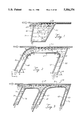
  • FIG. 1 is a schematic cross-sectional view of a prior art short-dwell coating device
  • FIG. 2 is a schematic cross-sectional view of an embodiment of a short-dwell coating device
  • FIG. 3 is a schematic cross-sectional view of another embodiment of the short-dwell coating device
  • FIG. 4 is a schematic cross-section of a further embodiment of the short-dwell coating device
  • FIGS. 5A, 5B, 5C and 5D are sketches of an embodiment of a blade coating apparatus having a moving applicator wall in accordance with the present invention
  • FIGS. 6A-6G illustrate flow characteristics for cases B1 to B7 of Table 2;
  • FIGS. 7A-7G illustrate pressure distribution along the substrate for cases B1 to B7 of Table 2;
  • FIGS. 8A-8G illustrate pressure distribution along the blade for cases B1 to B7 of Table 2;
  • FIGS. 9A-9E illustrate flow characteristics for cases C11 to C15 of Table 3;
  • FIGS. 10A-10E illustrate pressure distribution along the substrate for cases C11 to C15 of Table 3;
  • FIGS. 11A-11E illustrate pressure distribution along the blade for cases C11 to C15 of Table 3;
  • FIGS. 12A-12D illustrate flow characteristics for cases N1 to N4 of Table 4.
  • FIGS. 13A-13D illustrate pressure distribution along the substrate for cases N1 to N4 of Table 4.
  • FIGS. 14A-14D illustrate pressure distribution along the blade for cases N1 to N4 of Table 4.
  • FIGS. 15A-15E illustrate flow characteristics for cases NB31 to NB35 of Table 5.
  • FIGS. 16A-16E illustrate pressure distribution along the substrate for cases NB31 to NB35 of Table 5.
  • FIGS. 17A-17E illustrate pressure distribution along the blade for cases NB31 to NB35 of Table 5.
  • FIGS. 18A-18E illustrate flow characteristics for cases NB51 to NB55 of Table 6.
  • FIGS. 19A-19E illustrate pressure distribution along the substrate for cases NB51 to NB55 of Table 6;
  • FIGS. 20A-20E illustrate pressure distribution along the blade for cases NB51 to NB55 of Table 6;
  • FIGS. 21A-21C illustrate flow characteristics for cases NB61 to NB63 of Table 6;
  • FIGS. 22A-22C illustrate pressure distribution along the substrate for cases NB61 to NB63 of Table 6;
  • FIGS. 23A-23C illustrate pressure distribution along the blade for cases NB61 to NB63 of Table 6.
  • the present invention is directed to a coating device for application of coating material to the surface of a web or a flexible substrate.
  • the coating device contains a pressurized channel where a flowing stream of the coating liquid first comes into contact with the substrate.
  • the coating liquid enters the channel at the upstream side and wets the substrate as it flows in the same direction as the substrate.
  • a doctor element is positioned at the downstream side of the channel where the excess coating in the channel follows the contour of the boundary formed by the doctor element and leaves the channel.
  • the geometry of the streamlined boundaries of the coating device eliminate the formation of recirculating eddies or vortices.
  • the elimination of vortices eliminates flow instability due to centrifugal forces and removes harmful pressure fluctuations which could result in coat-weight nonuniformities.
  • the present invention is further directed toward the study of flow patterns in blade coating to develop high-speed coaters.
  • the walls of the applicator are considered rigid, i.e. they do not deform under the effect of hydrodynamic pressure and shear stress exerted by the flow on the boundaries.
  • One of the applicator walls is designed to be a floating or moving wall or belt. The effect of the floating applicator wall is that recirculating eddies and vortices are reduced.
  • the short-dwell coating device of the present invention consists of a continuous channel of coating material which passes through a coating chamber 51 which is in contact with a web 53 of material which is to be coated.
  • the coating device comprises straight and curvilinear wall sections.
  • the coating chamber has an upstream side and a downstream side with respect to movement of the web with the upstream side being to the left of FIG. 1.
  • the use of the terms "horizontal” and “vertical” are with respect to a horizontal orientation of the web.
  • the web is usually supported on a counter roll and has a slight curvature in the region of the coating chamber.
  • the coating device includes a doctor element 55 which is spaced from the web for defining the thickness of the coating on the web.
  • the doctor element 55 extends across the web transversely to the direction of the web motion.
  • the doctor element also forms a downstream boundary wall of the coating chamber 51 and extends downwardly for a further distance to define the downstream wall of an exit plenum 57.
  • An upstream boundary wall 59 defines the upstream side of the coating chamber 51.
  • the upstream boundary wall 59 extends downwardly for a further distance to define the upstream side of an entrance plenum 61.
  • the upstream boundary wall 59 terminates at its uppermost end in contact with the web 53.
  • the terminal end of the upstream boundary wall 59 preferably has a curvilinear shape so that the terminus of the upstream boundary wall 59 is substantially tangential to the web 53.
  • the upstream boundary wall 59 also extends across the web transversely to the direction of the web motion.
  • a continuous interior wall which also extends across the web transversely to the direction of web motion, has discrete sections, which in combination with the upstream boundary wall 59, the web 53 and the doctor element 55, define the entrance plenum 61, the coating chamber 51 and the exit plenum 57, respectively.
  • the first section 65 of the interior wall defines the downstream side of the entrance plenum 61.
  • the first interior wall section 65 is preferably substantially parallel to the upstream boundary wall 59.
  • the first interior wall section 65 preferably undergoes a curvilinear transition to a second interior wall section 67.
  • the second interior wall section 67 defines the bottom wall of the coating chamber 51.
  • the second interior wall section 67 proceeds to a third interior wall section 69, preferably through a curvilinear transition section.
  • the third interior wall section 69 defines the upstream side of the exit plenum 57.
  • Both the second interior wall section 67 and the third interior wall section 69 are preferably substantially parallel to the web and the doctor element 55, respectively.
  • the upstream boundary wall 59 preferably terminates in a curvilinear section which is substantially parallel to the curvilinear transition section between first interior wall section 65 and second interior wall section 67.
  • the terminal end of the upstream boundary wall 59 is also preferably biased against the web 53 to prevent any coating material from being forced between the terminal end of the upstream boundary wall and the web 53 and to prevent air from entering into the coating material.
  • the biasing may be accomplished through the use of any suitable means, such as by use of a spring or a flexible material.
  • a vacuum box 60 can be provided to further ensure that no air will become entrained in the coating material.
  • the vacuum box 60 is defined by the web 53, the upstream boundary wall and by walls 62 and 64 which extend across the web transversely to the direction of web motion. The outward ends of the vacuum box are capped and one of these ends is fitted to a vacuum source (not shown).
  • the walls forming the entrance plenum 61 may be vertical at a right angle to web 53.
  • the entrance plenum walls are preferably upwardly inclined in a direction toward the downstream side.
  • the angle A of inclination of the entrance plenum is preferably in the range of from about 10° to about 90°, most preferably about 45°.
  • the walls forming the exit plenum 57 may also be vertical, but are preferably inclined downwardly in a direction toward or away from the upstream side of the exit plenum.
  • the angle B of inclination of the exit plenum is preferably in the range of from about 20° to about 175°, most preferably about 63°.
  • various spatial nodes have been designated in the various walls of the coating device with the numbers 1 through 16. These nodes are identified in the table below with spatial displacements from node 1 in terms of X and Y coordinates. Curve points a through i have also been designated with X and Y coordinates.
  • a pre-coating chamber 71 is provided on the upstream side of the short-dwell coating device of the invention.
  • the downstream boundary wall of the pre-coating chamber is formed from the upstream boundary wall 59 of the coating device 10.
  • a downstream wall 73 is spaced from web 53 by a distance of from about 1 to about 5 mm to provide an overflow baffle for coating material to prevent entrance of air in the manner used by prior art short-dwell coaters.
  • the continuous interior wall 75 is used to define an entrance plenum 77, the pre-coating chamber 71 and an exit plenum 79 in the same fashion and with the same parameters as previously described for the coating device.
  • FIGS. 5A-5D The basic geometrical configuration a blade coating apparatus is shown in FIGS. 5A-5D.
  • the apparatus illustrated has stationary walls with the exception of the substrate which moves with a given speed.
  • the coating fluid is pumped into a channel that leads the fluid flow to the moving web.
  • the fluid flow considered is a steady, viscous free surface flow that is governed by the equations of momentum and mass conservation. Near the web the liquid accelerates through viscous drag while near the stationary wall it decelerates with a commensurate amount.
  • the system illustrated in FIG. 5A and more particularly in FIGS. 5B and 5C, is an extension of the coating apparatus previously discussed.
  • the applicator's interior wall 80 which comprises a floating belt or plate, represents a moving surface which is in a state of flotation typically either magnetically or via air pressure or lubricating fluid.
  • the moving parts in the device are the web (or substrate) as depicted and the floating flexible belt or interior wall 80 which rotates in the indicated direction over the flotation device 82, i.e., the shoe portion in the interior surface of the interior wall 80.
  • a thin air layer or lubricating fluid layer 84 is created between the floating flexible belt of the interior wall 80 and the flotation device 82.
  • the flotation device for levitation of the interior wall 80 can either be an air bar or thin air layer as already described, or a magnetic device or any other flotation means including lubricating fluids.
  • the floating belt can either move primarily by the shear or drag from the coating fluid itself and/or an external force may be utilized to control the floating device and the floating belt.
  • FIG. 5C illustrates that the flotation device 82 may be made to comprise an air bar wherein a high pressure air source is provided at 86 and narrow slots 88 are placed on the surface of the flotation device 82 such that air is forced through the slots 88 to keep the interior wall 80 in flotation over the thin air layer 84.
  • the flotation device 82 would typically be manufactured to have a porous surface.
  • Another mechanism for keeping the interior wall 80 in a flotation state is through magnetic force.
  • the belt should be metallic.
  • the flotation device 82 which would then comprise a shoe for housing the magnetic cells, the belt is kept in a flotation state as it rotates with the coating fluid. Since the flotation speed of the belt can be very high, the flotation system would prevent wear and tear of the belt and make the system practical for commercial applications.
  • the advantage of having the interior surface rotate with the liquid is that it prevents flow separation and recirculation inside the coating chamber, even at the low flow rates.
  • attached flow is desired and avoids problems of eddies associated with flow separation. Without the rotating inner surface, the recirculating eddies can be removed if the flow rate through the channel is sufficiently large. It is very important in coating systems, however, to minimize the flow rate and reduce the demand on the pumping facilities.
  • the flow of the coating fluid will be more stable and uniform in the above-described system.
  • the following extensive computational flow provides visual results which verify the advantage of maintaining attached flow of the coating fluid and thus preventing flow separation resulting in eddies.
  • the flotation discussed thus far may be achieved in two ways: (1) fluid fixed in a flotation device or shoe in some form as to levitate the belt such that the fluid acts as a lubricant controlling friction and speed which may be altered by changing pressure, viscosity or temperature of the fluid in the fixed shoe of the flotation device 82; alternatively (2) air between the floating service and the shoe may be used to keep the floating belt of the interior wall 80 suspended over the porous surface of the flotation device 82.
  • temperature sensitive viscous fluid would work well to control friction in the system.
  • fluids might include silicon or glycerine where viscosity is proportional to temperature.
  • Other fluids having molecules loosely oriented might also be advantageous where viscosity is proportional to an electromagnetic field which may be applied to alter viscosity.
  • Electromagnetic fields may also be applied to the approach using air for flotation to that the extent that an electromagnetic field may be used to exert force on the surface of the floating belt 82 to control its flotation and/or rotation.
  • the flotation belt of the applicator's interior wall 80 may comprise any flexible material including fabric, plastics or thin metallic sheets such as copper or aluminum.
  • the floating belt may be brought up to speed through drag that is exerted upon it by the coating fluid. This will have the effect of pumping additional fluid through the coating system and thus it may be desirable to add friction to maintain a desirable maximum speed for the belt at some fraction of the web rate.
  • the belt rate may be altered to be anything from about 10% to 90% of the web rate.
  • the fluid is accelerated by viscous drag near the web and by favorable pressure gradient along the blade face.
  • the flow decelerates and large recirculation zones, i.e. eddies can form as a result of flow instability.
  • the hydrodynamic characteristics of this coating system have an effect on the quality of the manufactured product. Aidun et al. (1991), and Benson et al. (1992) investigate with the help of flow visualization the behavior of flow in a lid driven cavity and describe a possible mechanism to time periodic flow in such a system.
  • the appearance of a time periodic flow can generate wet film thickness variations across the machine direction and/or longitudinal streaks.
  • the following relates to how flow recirculation can be avoided in the high speed blade coating system through design and process optimization.
  • the stress tensor can be written as
  • denotes the dynamic viscosity and ⁇ ij stands for the strain tensor.
  • ⁇ ij is defined by ##EQU2##
  • Equations (1) to (6) are non-dimensionalized with respect to a characteristic velocity U, and length L.
  • U is chosen to be the maximum inflow velocity (U.sub. ⁇ ) if the applicator has stationary walls, otherwise it is chosen to be the applicator wall velocity (U b ).
  • L is the width of the inlet channel, as illustrated in FIG. 5.
  • the non-dimensional equations to be solved in the present study are ##EQU3## corresponding to equations (1) to (6), respectively.
  • the non-dimensional unknowns are ##EQU4##
  • the non-dimensional independent variables are ##EQU5##
  • the non-dimensional body force due to gravity is ##EQU6##
  • the boundary conditions for the coating system are given by prescribing the inflow velocity distribution
  • denotes the height of the free surface above a horizontal reference plane and x i is the horizontal coordinate of a point on the free surface.
  • ⁇ / ⁇ x is equal to v/u in other words the fluid velocity at the gas-liquid interface is tangential to the free surface.
  • is a priori unknown.
  • the dynamic boundary condition on the free surface states that the stress is continuous across the gas-liquid interface
  • ⁇ n , ⁇ t are respectively the normal and tangential components of stress at the interface, ⁇ is the surface tension coefficient and H denotes the mean Gaussian curvature of the surface; p a stands for the ambient pressure.
  • the governing equations detailed in the previous section together with the prescribed boundary conditions are to be solved.
  • the solution involves two steps. In the first step, the governing equations are solved assuming a fixed shape for the free surface. In the second step, the limitation of fixed free surface is relaxed and the shape of the free surface is calculated. As the governing equations and boundary conditions are highly non-linear the solution is obtained via an iterative method.
  • the computation in the present study is based on the application of the FIDAP (1991) software package by Fluid Dynamics International, Inc., Evanston, Ill.
  • the discretization of the domain in space is carried out with the finite element method employing nine node isoparametric quadrilaterals. Over these elements the velocity is approximated with a continuous elementwise biquadratic function while the pressure is represented by a discontinuous elementwise linear function.
  • the obtained nonlinear algebraic system of equations is then solved with a strategy based on the application of successive substitutions and then the Newton-Raphson method.
  • Tables 2 through 4 show the input parameters for the numerical runs. Table 2 presents the computational experiments carried out assuming Newtonian fluid, while Tables 3 and 4 consider the non-Newtonian behavior of the fluid.
  • U p the maximum inflow velocity
  • U the characteristic velocity
  • L the width of the inlet channel
  • q the flowrate per unit width entering the applicator.
  • FIGS. 6A-6G respectively show the flow pattern corresponding to the runs B1 to B7.
  • a weak eddy appears at the second curve of the applicator wall in case of B2. This eddy gets stronger in the rest of the cases; B3 to B7. Parallel to the evolution of this eddy a second elongated eddy becomes distinguishable and the separation point moves closer to the first curve of the applicator wall.
  • a third small eddy is also noticeable located close to the blade, right under the first strong eddy.
  • the pressure distribution along the substrate is illustrated in FIGS. 7A-7G for these cases. In the case of B5, for example, near the strong eddy the pressure exerted by the fluid on the substrate experiences a slight drop.
  • FIGS. 8A-8G illustrate the pressure distribution along the blade. Right under the sharp edge of the blade the pressure reaches its maximum then it sharply drops and from there on slowly decreases. The pressure increases approximately forty times from case B1 to B7.
  • the eddies in general become stronger.
  • Three ways to suppress these eddies have been investigated. The first one corresponds to the gradual increase of fluid discharge per unit width entering the applicator.
  • the second way employs a modified geometry which results in the downstream motion of the separation point.
  • the last procedure is based on designing a moving applicator wall. In this case the combined effects from pumping, converging geometry and moving belt act to remove the eddies from the coating system.

Landscapes

  • Coating Apparatus (AREA)
  • Application Of Or Painting With Fluid Materials (AREA)

Abstract

A coating applicator for application of coating material to the surface of a web or a flexible substrate. The coating device contains a walled application chamber where a flowing stream of the coating liquid first comes into contact with the substrate. The coating liquid enters a channel of the application chamber at the upstream side and wets the substrate as it flows in the same direction as the substrate. A doctor element is positioned at the downstream side of the channel where the excess coating in the channel follows the contour of the boundary formed by the doctor element and leaves the channel. One of the applicator walls is designed to be a floating or moving wall or belt. The floating applicator wall and geometry of the streamlined boundaries of the coating device eliminates the formation of recirculating eddies or vortices. The elimination of vortices eliminates flow instability due to centrifugal forces and removes harmful pressure fluctuations which could result in coat-weight nonuniformities.

Description

CROSS-REFERENCE TO RELATED APPLICATION
This application is a continuation-in-part of application Ser. No. 881,512, filed May 12, 1992, which is a continuation-in-part of application Ser. No. 849,530 filed Mar. 11, 1992, now abandoned.
FIELD OF THE INVENTION
The present invention relates generally to a coating device for uniform coating of a traveling web of material. More particularly, the present invention relates to a short-dwell coater which eliminates the captive pond associated with short dwell coaters and provides the coating material in the form of a flowing stream of coating material which flows in the same direction as the web movement.
BACKGROUND OF THE INVENTION
One of the most significant changes in light weight coated (LWC) paper production is the use of the short-dwell coater. The short-dwell coater has enabled the paper maker to improve productivity while maintaining coated paper quality. The term "short-dwell" refers to the relatively short period of time that the coating is in contact with a web of paper material before the excess is metered off by a trailing doctor blade. As shown in FIG. 1, prior art short-dwell coaters consist of a captive pond 21 just prior to the doctor blade 23. The pond is approximately 5 cm in length and is slightly pressurized to promote adhesion of the coating to the paper web 25. The excess coating supplied to the sheet creates a backflow of coating 27. This coating backflow excludes to some extent the boundary layer of air entering with the sheet and eliminates skip coating. The excess coating is channeled over an overflow baffle 29 and collected in a return pan before returning to tanks to be screened.
While short-dwell coaters are extensively used in coating paper webs, such coaters suffer from a major problem. The flow in the coating chamber of the pond upstream of the doctor blade contains recirculating eddies or vortices which can result in coat-weight nonuniformities and wet streaks or striations in several ways. For example, these eddies can become unstable due to centrifugal forces and result in the generation of unsteady flow and rapidly fluctuating vortices, which deteriorate the coating uniformity and its quality. Also, the vortices tend to entrap small air bubbles which result in the buildup of relatively large air inclusions in the coating liquid which tend to accumulate in the core region of the eddies. Vortex fluctuations tend to force these air inclusions into the blade gap. This adversely affects the coating quality. Usually, the presence of air inclusions results in regions of lower coat weight which are 2-4 cm wide and about 10-100 cm long, known in the industry as "wet streaks". These problems are discussed in an article "Principles of Hydrodynamic Instability: Application in Coating Systems", C. K. Aidun, Tappi Journal, Vol. 74 , No. 3, March, 1991.
It would be desirable to provide a coating device which has the coating advantages of a short-dwell coater, but which did not have the problems associated with recirculating eddies or vortices and the entrapment of air pockets or air bubbles in the core of the vortices.
Accordingly, it is a principal object of the present invention to provide a vortex free short-dwell coating device.
These and other objects will become more apparent from the following description and the appended claims.
BRIEF DESCRIPTION OF THE DRAWINGS
FIG. 1 is a schematic cross-sectional view of a prior art short-dwell coating device;
FIG. 2 is a schematic cross-sectional view of an embodiment of a short-dwell coating device;
FIG. 3 is a schematic cross-sectional view of another embodiment of the short-dwell coating device;
FIG. 4 is a schematic cross-section of a further embodiment of the short-dwell coating device;
FIGS. 5A, 5B, 5C and 5D are sketches of an embodiment of a blade coating apparatus having a moving applicator wall in accordance with the present invention;
FIGS. 6A-6G illustrate flow characteristics for cases B1 to B7 of Table 2;
FIGS. 7A-7G illustrate pressure distribution along the substrate for cases B1 to B7 of Table 2;
FIGS. 8A-8G illustrate pressure distribution along the blade for cases B1 to B7 of Table 2;
FIGS. 9A-9E illustrate flow characteristics for cases C11 to C15 of Table 3;
FIGS. 10A-10E illustrate pressure distribution along the substrate for cases C11 to C15 of Table 3;
FIGS. 11A-11E illustrate pressure distribution along the blade for cases C11 to C15 of Table 3;
FIGS. 12A-12D illustrate flow characteristics for cases N1 to N4 of Table 4;
FIGS. 13A-13D illustrate pressure distribution along the substrate for cases N1 to N4 of Table 4.
FIGS. 14A-14D illustrate pressure distribution along the blade for cases N1 to N4 of Table 4.
FIGS. 15A-15E illustrate flow characteristics for cases NB31 to NB35 of Table 5.
FIGS. 16A-16E illustrate pressure distribution along the substrate for cases NB31 to NB35 of Table 5.
FIGS. 17A-17E illustrate pressure distribution along the blade for cases NB31 to NB35 of Table 5.
FIGS. 18A-18E illustrate flow characteristics for cases NB51 to NB55 of Table 6.
FIGS. 19A-19E illustrate pressure distribution along the substrate for cases NB51 to NB55 of Table 6;
FIGS. 20A-20E illustrate pressure distribution along the blade for cases NB51 to NB55 of Table 6;
FIGS. 21A-21C illustrate flow characteristics for cases NB61 to NB63 of Table 6;
FIGS. 22A-22C illustrate pressure distribution along the substrate for cases NB61 to NB63 of Table 6; and
FIGS. 23A-23C illustrate pressure distribution along the blade for cases NB61 to NB63 of Table 6.
SUMMARY OF THE INVENTION
The present invention is directed to a coating device for application of coating material to the surface of a web or a flexible substrate. The coating device contains a pressurized channel where a flowing stream of the coating liquid first comes into contact with the substrate. The coating liquid enters the channel at the upstream side and wets the substrate as it flows in the same direction as the substrate. A doctor element is positioned at the downstream side of the channel where the excess coating in the channel follows the contour of the boundary formed by the doctor element and leaves the channel. The geometry of the streamlined boundaries of the coating device eliminate the formation of recirculating eddies or vortices. The elimination of vortices eliminates flow instability due to centrifugal forces and removes harmful pressure fluctuations which could result in coat-weight nonuniformities. The elimination of recirculating eddies or vortices also removes the possibility of entrapping air pockets or air bubbles in the core of the vortices which could reach the blade gap and could result in coat-weight nonuniformities and wet streaks.
The present invention is further directed toward the study of flow patterns in blade coating to develop high-speed coaters. The walls of the applicator are considered rigid, i.e. they do not deform under the effect of hydrodynamic pressure and shear stress exerted by the flow on the boundaries. One of the applicator walls is designed to be a floating or moving wall or belt. The effect of the floating applicator wall is that recirculating eddies and vortices are reduced.
DETAILED DESCRIPTION OF THE PREFERRED EMBODIMENT
As shown in FIG. 2, the short-dwell coating device of the present invention consists of a continuous channel of coating material which passes through a coating chamber 51 which is in contact with a web 53 of material which is to be coated. The coating device comprises straight and curvilinear wall sections. For purposes of orientation and discussion, the coating chamber has an upstream side and a downstream side with respect to movement of the web with the upstream side being to the left of FIG. 1. The use of the terms "horizontal" and "vertical" are with respect to a horizontal orientation of the web. The web, however, is usually supported on a counter roll and has a slight curvature in the region of the coating chamber.
The coating device includes a doctor element 55 which is spaced from the web for defining the thickness of the coating on the web. The doctor element 55 extends across the web transversely to the direction of the web motion. The doctor element also forms a downstream boundary wall of the coating chamber 51 and extends downwardly for a further distance to define the downstream wall of an exit plenum 57.
An upstream boundary wall 59 defines the upstream side of the coating chamber 51. The upstream boundary wall 59 extends downwardly for a further distance to define the upstream side of an entrance plenum 61. The upstream boundary wall 59 terminates at its uppermost end in contact with the web 53. As shown in FIG. 2, the terminal end of the upstream boundary wall 59 preferably has a curvilinear shape so that the terminus of the upstream boundary wall 59 is substantially tangential to the web 53. The upstream boundary wall 59 also extends across the web transversely to the direction of the web motion.
A continuous interior wall which also extends across the web transversely to the direction of web motion, has discrete sections, which in combination with the upstream boundary wall 59, the web 53 and the doctor element 55, define the entrance plenum 61, the coating chamber 51 and the exit plenum 57, respectively. The first section 65 of the interior wall defines the downstream side of the entrance plenum 61. The first interior wall section 65 is preferably substantially parallel to the upstream boundary wall 59. The first interior wall section 65 preferably undergoes a curvilinear transition to a second interior wall section 67. The second interior wall section 67 defines the bottom wall of the coating chamber 51. The second interior wall section 67 proceeds to a third interior wall section 69, preferably through a curvilinear transition section. The third interior wall section 69 defines the upstream side of the exit plenum 57. Both the second interior wall section 67 and the third interior wall section 69 are preferably substantially parallel to the web and the doctor element 55, respectively.
The upstream boundary wall 59 preferably terminates in a curvilinear section which is substantially parallel to the curvilinear transition section between first interior wall section 65 and second interior wall section 67. The terminal end of the upstream boundary wall 59 is also preferably biased against the web 53 to prevent any coating material from being forced between the terminal end of the upstream boundary wall and the web 53 and to prevent air from entering into the coating material. The biasing may be accomplished through the use of any suitable means, such as by use of a spring or a flexible material.
As shown in FIG. 4, a vacuum box 60 can be provided to further ensure that no air will become entrained in the coating material. When a vacuum is established in vacuum box 60, the air pressure near the wetting line is reduced, thereby increasing the biasing effect on the boundary wall 59 and preventing any air inclusion at high speeds. The vacuum box 60 is defined by the web 53, the upstream boundary wall and by walls 62 and 64 which extend across the web transversely to the direction of web motion. The outward ends of the vacuum box are capped and one of these ends is fitted to a vacuum source (not shown).
The walls forming the entrance plenum 61 may be vertical at a right angle to web 53. The entrance plenum walls, however, are preferably upwardly inclined in a direction toward the downstream side. The angle A of inclination of the entrance plenum is preferably in the range of from about 10° to about 90°, most preferably about 45°. The walls forming the exit plenum 57 may also be vertical, but are preferably inclined downwardly in a direction toward or away from the upstream side of the exit plenum. The angle B of inclination of the exit plenum is preferably in the range of from about 20° to about 175°, most preferably about 63°.
As an example of construction of the coating device of the present invention, various spatial nodes have been designated in the various walls of the coating device with the numbers 1 through 16. These nodes are identified in the table below with spatial displacements from node 1 in terms of X and Y coordinates. Curve points a through i have also been designated with X and Y coordinates.
              TABLE 1                                                     
______________________________________                                    
                          Curve                                           
Node #  X(mm)    Y(mm)    Points X(mm)  Y(mm)                             
______________________________________                                    
1       0        0        a      32     32                                
2       3.536    -3.536   b      35     34                                
3       34       27       c      45     39                                
4       52       35       d      36     29                                
5       85       35       e      40     31.5                              
6       91       25       f      47     34                                
7       76.555   -4.7     g      88     34                                
8       81       -7       h      91     30                                
9       105      40       i      91.5   27                                
10      52       40                                                       
11      30       30                                                       
12      85       40                                                       
13      98       26                                                       
14      90       32                                                       
15      43       33                                                       
16      40       37                                                       
______________________________________                                    
In another embodiment of the invention, as shown in FIG. 3, a pre-coating chamber 71 is provided on the upstream side of the short-dwell coating device of the invention. The downstream boundary wall of the pre-coating chamber is formed from the upstream boundary wall 59 of the coating device 10. A downstream wall 73 is spaced from web 53 by a distance of from about 1 to about 5 mm to provide an overflow baffle for coating material to prevent entrance of air in the manner used by prior art short-dwell coaters. The continuous interior wall 75 is used to define an entrance plenum 77, the pre-coating chamber 71 and an exit plenum 79 in the same fashion and with the same parameters as previously described for the coating device.
The embodiment of the present invention utilizing a floating applicator wall and analysis thereof is set forth in detail in the discussion that follows.
The basic geometrical configuration a blade coating apparatus is shown in FIGS. 5A-5D. The apparatus illustrated has stationary walls with the exception of the substrate which moves with a given speed. The coating fluid is pumped into a channel that leads the fluid flow to the moving web. The fluid flow considered is a steady, viscous free surface flow that is governed by the equations of momentum and mass conservation. Near the web the liquid accelerates through viscous drag while near the stationary wall it decelerates with a commensurate amount.
The system illustrated in FIG. 5A and more particularly in FIGS. 5B and 5C, is an extension of the coating apparatus previously discussed. The difference, which is best appreciated in FIG. 5B, is that the applicator's interior wall 80, which comprises a floating belt or plate, represents a moving surface which is in a state of flotation typically either magnetically or via air pressure or lubricating fluid. The moving parts in the device are the web (or substrate) as depicted and the floating flexible belt or interior wall 80 which rotates in the indicated direction over the flotation device 82, i.e., the shoe portion in the interior surface of the interior wall 80. A thin air layer or lubricating fluid layer 84 is created between the floating flexible belt of the interior wall 80 and the flotation device 82. On the other side of the interior wall 80 the coating fluid moves in the same direction as the interior wall 80. Therefore, the interior wall 80 contacts the coating fluid at the outside surface and an air layer or lubricating liquid of any kind at the interior surface. The flotation device for levitation of the interior wall 80 can either be an air bar or thin air layer as already described, or a magnetic device or any other flotation means including lubricating fluids. The floating belt can either move primarily by the shear or drag from the coating fluid itself and/or an external force may be utilized to control the floating device and the floating belt.
FIG. 5C illustrates that the flotation device 82 may be made to comprise an air bar wherein a high pressure air source is provided at 86 and narrow slots 88 are placed on the surface of the flotation device 82 such that air is forced through the slots 88 to keep the interior wall 80 in flotation over the thin air layer 84. In such an air flotation system the flotation device 82 would typically be manufactured to have a porous surface.
Another mechanism for keeping the interior wall 80 in a flotation state is through magnetic force. In this case the belt should be metallic. By placing magnetic cells inside the flotation device 82 which would then comprise a shoe for housing the magnetic cells, the belt is kept in a flotation state as it rotates with the coating fluid. Since the flotation speed of the belt can be very high, the flotation system would prevent wear and tear of the belt and make the system practical for commercial applications.
The advantage of having the interior surface rotate with the liquid is that it prevents flow separation and recirculation inside the coating chamber, even at the low flow rates. As will be illustrated in Tables 2-6 following, attached flow is desired and avoids problems of eddies associated with flow separation. Without the rotating inner surface, the recirculating eddies can be removed if the flow rate through the channel is sufficiently large. It is very important in coating systems, however, to minimize the flow rate and reduce the demand on the pumping facilities. The flow of the coating fluid will be more stable and uniform in the above-described system. The following extensive computational flow provides visual results which verify the advantage of maintaining attached flow of the coating fluid and thus preventing flow separation resulting in eddies.
In sum, the flotation discussed thus far may be achieved in two ways: (1) fluid fixed in a flotation device or shoe in some form as to levitate the belt such that the fluid acts as a lubricant controlling friction and speed which may be altered by changing pressure, viscosity or temperature of the fluid in the fixed shoe of the flotation device 82; alternatively (2) air between the floating service and the shoe may be used to keep the floating belt of the interior wall 80 suspended over the porous surface of the flotation device 82.
In a fluid system, temperature sensitive viscous fluid would work well to control friction in the system. Such fluids might include silicon or glycerine where viscosity is proportional to temperature. Other fluids having molecules loosely oriented might also be advantageous where viscosity is proportional to an electromagnetic field which may be applied to alter viscosity. Electromagnetic fields may also be applied to the approach using air for flotation to that the extent that an electromagnetic field may be used to exert force on the surface of the floating belt 82 to control its flotation and/or rotation.
Materials which work well in the shoe portion of the flotation device 82 include stainless steel and aluminum; however, other metals or even rigid plastics may also work well. The flotation belt of the applicator's interior wall 80 may comprise any flexible material including fabric, plastics or thin metallic sheets such as copper or aluminum.
In operation, the floating belt may be brought up to speed through drag that is exerted upon it by the coating fluid. This will have the effect of pumping additional fluid through the coating system and thus it may be desirable to add friction to maintain a desirable maximum speed for the belt at some fraction of the web rate. By using friction, the belt rate may be altered to be anything from about 10% to 90% of the web rate.
As the liquid moves toward the applicator's blade, a part of it exits through the narrow gap between the blade and the substrate. The flow entering the gap between the blade and the substrate has a nearly Poiseuille flow distribution. This velocity distribution influences the coating thickness and is determined by the operating parameters. In the wedge-like region formed by the blade and the substrate the pressure sharply increases and has a maximum value near the stagnation point located right under the tip of the blade. The rest of the flow, which could not exit at the gap, is forced to change direction and accelerated by a favorable pressure gradient it leaves the system via another channel along the blade face. Far downstream from the blade the free surface coating fluid moves with uniform velocity together with the substrate. Near the blade tip the shape of the free surface is determined by the ambient pressure and the surface tension effects. The deformation of the blade is considered by e.g. Pranckh (1989).
In the above described coating system the fluid is accelerated by viscous drag near the web and by favorable pressure gradient along the blade face. In other parts of the flow domain the flow decelerates and large recirculation zones, i.e. eddies can form as a result of flow instability. The hydrodynamic characteristics of this coating system have an effect on the quality of the manufactured product. Aidun et al. (1991), and Benson et al. (1992) investigate with the help of flow visualization the behavior of flow in a lid driven cavity and describe a possible mechanism to time periodic flow in such a system. The appearance of a time periodic flow can generate wet film thickness variations across the machine direction and/or longitudinal streaks. The following relates to how flow recirculation can be avoided in the high speed blade coating system through design and process optimization.
GOVERNING EQUATIONS AND BOUNDARY CONDITIONS
With reference to the boundary conditions represented in FIG. 5A, the equations governing the motion of a viscous incompressible fluid are the fluid momentum and the continuity equations. These are, ##EQU1## respectively where i,j=1,2 for two-dimensional flow. ui or u is the velocity, ρ is the fluid density, σij is the stress tensor. t denotes time and for steady flow calculations ∂ui /∂t is equal to zero. ρ fi is the force due to gravity. In the present two-dimensional study u1 =u and u2 =v are the horizontal and vertical components of velocity, respectively.
The stress tensor can be written as
σ.sub.ij =-pδ.sub.ij +τ.sub.ij             (3)
where ρ is the pressure, τij is the deviatoric stress tensor and δij is the Kronecker delta. In the present study the constitutive relation has the following form
τ.sub.ij =2με.sub.ij                        (4)
In (4) μ denotes the dynamic viscosity and εij stands for the strain tensor. εij is defined by ##EQU2##
For Newtonian fluid μ is taken to be a constant. For non-Newtonian fluid μ is calculated with the help of the Carreau model;
μ=μ.sub.∞ +(μ.sub.o -μ∞)(1+K.sup.2 ε.sub.ij ε.sub.ij).sup.(n-1)/2                             (6)
In the above equation μo and μ.sub.∞ are the zero and infinite shear rate viscosities, respectively, and K is the time constant. In the case of n=1 the Carreau model gives the Newtonian viscosity, i.e. μ=μo.
Equations (1) to (6) are non-dimensionalized with respect to a characteristic velocity U, and length L. U is chosen to be the maximum inflow velocity (U.sub.ρ) if the applicator has stationary walls, otherwise it is chosen to be the applicator wall velocity (Ub). L is the width of the inlet channel, as illustrated in FIG. 5. The non-dimensional equations to be solved in the present study are ##EQU3## corresponding to equations (1) to (6), respectively. In the above equations the non-dimensional unknowns are ##EQU4## The non-dimensional independent variables are ##EQU5## The non-dimensional body force due to gravity is ##EQU6##
The important parameters in equations (7)-(12) are the Reynolds number Re (=μUL/ρ) and the non-dimensional time constant K* (=KU/L).
The boundary conditions for the coating system, illustrated on FIG. 5, are given by prescribing the inflow velocity distribution;
u.sub.i =U.sub.in on Γ.sub.1                         (16a)
the substrate velocity;
and the applicator wall velocity;
u.sub.i =U.sub.wi on Γ.sub.2                         (16b)
u.sub.i =U.sub.bi on Γ.sub.3                         (16c)
and
u.sub.i =o on Γ.sub.4                                (16d)
At the outflow channel of the applicator the normal component of the stress vector is assumed to be vanishing, i.e.
σ.sub.n =0 on Γ.sub.5                          (17)
On the free surface of the coating liquid the kinematic boundary condition is given as ##EQU7## where η denotes the height of the free surface above a horizontal reference plane and xi is the horizontal coordinate of a point on the free surface. For two-dimensional steady free surface flow ∂η/∂x is equal to v/u in other words the fluid velocity at the gas-liquid interface is tangential to the free surface. η is a priori unknown.
The dynamic boundary condition on the free surface states that the stress is continuous across the gas-liquid interface
σ.sub.n =2γH-p.sub.a                           (19a)
and
on η=η(x.sub.i,t)
σ.sub.t =0                                           (19b)
In (19a, 19b) σn, σt are respectively the normal and tangential components of stress at the interface, γ is the surface tension coefficient and H denotes the mean Gaussian curvature of the surface; pa stands for the ambient pressure.
Far away enough from the blade the liquid film is assumed to move as a plug flow together with the substrate (i.e. Ufilm =Uw and ∂η/∂x=0). The static contact line of the free surface is pinned at the sharp corner of the blade, thus its location is prescribed.
As with the governing equations, the boundary conditions are also non-dimensionalized. The non-dimensionalization of (19a) yields, ##EQU8## where H* (=HL) is the dimensionless Gaussian mean curvature and Ca (=μU/γ) is the capillary number.
For brevity, the asterisks indicating non-dimensional values will be dropped in the Figures and the text from here on.
SOLUTION PROCEDURE
The governing equations detailed in the previous section together with the prescribed boundary conditions are to be solved. The solution involves two steps. In the first step, the governing equations are solved assuming a fixed shape for the free surface. In the second step, the limitation of fixed free surface is relaxed and the shape of the free surface is calculated. As the governing equations and boundary conditions are highly non-linear the solution is obtained via an iterative method.
The computation in the present study is based on the application of the FIDAP (1991) software package by Fluid Dynamics International, Inc., Evanston, Ill. The discretization of the domain in space is carried out with the finite element method employing nine node isoparametric quadrilaterals. Over these elements the velocity is approximated with a continuous elementwise biquadratic function while the pressure is represented by a discontinuous elementwise linear function. The obtained nonlinear algebraic system of equations is then solved with a strategy based on the application of successive substitutions and then the Newton-Raphson method.
Further description of the numerical solution can be found in the FIDAP (1991) Users Manual.
NUMERICAL EXPERIMENTS
A) Applicator with stationary walls
Tables 2 through 4 show the input parameters for the numerical runs. Table 2 presents the computational experiments carried out assuming Newtonian fluid, while Tables 3 and 4 consider the non-Newtonian behavior of the fluid. In the second column Up, the maximum inflow velocity, is used as the characteristic velocity, i.e. U. It is assumed that the inflow velocity has a parabolic distribution. The characteristic length, L=Lin the width of the inlet channel, can be found in the third column. Furthermore Lgap denotes the width of the gap between the blade and the substrate and q is the flowrate per unit width entering the applicator.
                                  TABLE 2                                 
__________________________________________________________________________
INPUT PARAMETERS FOR THE SIMULATION OF NEWTONIAN FLOW                     
(S = Flow separation, A = Attached flow)                                  
               q =     γ                                            
                            μ ρ                                    
                                     Re = Ca =                            
                                              COMMENT                     
   U.sub.ρ                                                            
      L.sub.in                                                            
          L.sub.gap                                                       
               2U.sub.p L.sub.in /3                                       
                    U.sub.w                                               
                       surf.tens                                          
                            viscosity                                     
                                 density                                  
                                     U.sub.p L.sub.in ρ/μ          
                                          μU.sub.p /γ            
                                              ON THE                      
Run                                                                       
   m/s                                                                    
      m   m    l/s/m                                                      
                    m/s                                                   
                       kg/s.sup.2                                         
                            kg/(m s)                                      
                                 kg/m.sup.3                               
                                     --   --  RESULT                      
__________________________________________________________________________
B1 1.00                                                                   
      0.0025                                                              
          50 10.sup.-6                                                    
               1.667                                                      
                    1.0                                                   
                       0.05 1.00 1200                                     
                                     3.0  20.0                            
                                              A                           
B2 1.50                                                                   
      "   "    2.500                                                      
                    2.5                                                   
                       "    "    "   4.5  30.0                            
                                              A                           
B3 2.00                                                                   
      "   "    3.333                                                      
                    5.0                                                   
                       "    "    "   6.0  40.0                            
                                              S                           
B4 2.50                                                                   
      "   "    4.166                                                      
                    10.0                                                  
                       "    "    "   7.5  50.0                            
                                              S                           
B5 3.00                                                                   
      "   "    5.000                                                      
                    20.0                                                  
                       "    "    "   9.0  60.0                            
                                              S                           
B6 3.00                                                                   
      "   "    5.000                                                      
                    30.0                                                  
                       "    "    "   9.0  60.0                            
                                              S                           
B7 3.00                                                                   
      "   "    5.000                                                      
                    40.0                                                  
                       "    "    "   9.0  60.0                            
                                              S                           
__________________________________________________________________________
                                  TABLE 3                                 
__________________________________________________________________________
INPUT PARAMETERS FOR THE SIMULATION OF NON-NEWTONIAN FLOW (Carreau        
model)                                                                    
(S = Flow separation, A = Attached flow)                                  
               q =     γ                                            
                            μ.sub.∞                              
                                 μ.sub.o                               
                                         ρ  COMMENT                   
   U.sub.ρ                                                            
      L.sub.in                                                            
          L.sub.gap                                                       
               2U.sub.p L.sub.in /3                                       
                    U.sub.web                                             
                       surf.tens                                          
                            viscosity                                     
                                 viscosity                                
                                         density                          
                                                ON THE                    
Run                                                                       
   m/s                                                                    
      m   m    l/s/m                                                      
                    m/s                                                   
                       kg/s.sup.2                                         
                            kg/(m s)                                      
                                 kg/(m s)                                 
                                      K  kg/m.sup.3                       
                                             n  RESULT                    
__________________________________________________________________________
C1 3.0                                                                    
      0.0025                                                              
          50 10.sup.-6                                                    
               5.00 20.0                                                  
                       0.05 0.05 1.00 0.01                                
                                         1200                             
                                             0.65                         
                                                S                         
C2 "  "   "    "    30.0                                                  
                       "    "    "    "  "   "  S                         
C3 "  "   "    "    40.0                                                  
                       "    "    "    "  "   "  S                         
C11                                                                       
   5.0                                                                    
      0.0025                                                              
          50 10.sup.-6                                                    
               8.33 20.0                                                  
                       0.05 0.05 1.00 0.01                                
                                         1200                             
                                             0.65                         
                                                S                         
C12                                                                       
   8.0                                                                    
      "   "    13.33                                                      
                    "  "    "    "    "  "   "  S                         
C13                                                                       
   12.0                                                                   
      "   "    20.0 "  "    "    "    "  "   "  S                         
C14                                                                       
   16.0                                                                   
      "   "    26.67                                                      
                    "  "    "    "    "  "   "  A                         
C15                                                                       
   20.0                                                                   
      "   "    33.33                                                      
                    "  "    "    "    "  "   "  A                         
__________________________________________________________________________
                                  TABLE 4                                 
__________________________________________________________________________
INPUT PARAMETERS FOR THE SIMULATION OF NON-NEWTONIAN FLOW (Carreau        
model)                                                                    
(S = Flow separation, A = Attached flow)                                  
               q =     γ                                            
                            μ.sub.∞                              
                                 μ.sub.o                               
                                         ρ  COMMENT                   
   U.sub.ρ                                                            
      L.sub.in                                                            
          L.sub.gap                                                       
               2U.sub.p L.sub.in /3                                       
                    U.sub.web                                             
                       surf.tens                                          
                            viscosity                                     
                                 viscosity                                
                                         density                          
                                                ON THE                    
Run                                                                       
   m/s                                                                    
      m   m    l/s/m                                                      
                    m/s                                                   
                       kg/s.sup.2                                         
                            kg/(m s)                                      
                                 kg/(m s)                                 
                                      K  kg/m.sup.3                       
                                             n  RESULT                    
__________________________________________________________________________
N1 3.0                                                                    
      0.0025                                                              
          50 10.sup.-6                                                    
               5.0  10.0                                                  
                       0.05 0.05 1.00 0.01                                
                                         1200                             
                                             0.65                         
                                                A                         
N2 "  "   "    "    20.0                                                  
                       "    "    "    "  "   "  S                         
N3 "  "   "    "    30.0                                                  
                       "    "    "    "  "   "  S                         
N4 "  "   "    "    40.0                                                  
                       "    "    "    "  "   "  S                         
__________________________________________________________________________
In the first numerical experiments, shown in Table 2, the web velocity (Uweb) is gradually increased from 1 m/s to 40 m/s. At the same time the fluid discharge (q) is also increased. In FIGS. 6A-6G respectively show the flow pattern corresponding to the runs B1 to B7. A weak eddy appears at the second curve of the applicator wall in case of B2. This eddy gets stronger in the rest of the cases; B3 to B7. Parallel to the evolution of this eddy a second elongated eddy becomes distinguishable and the separation point moves closer to the first curve of the applicator wall. In cases of B6 and B7 a third small eddy is also noticeable located close to the blade, right under the first strong eddy. The pressure distribution along the substrate is illustrated in FIGS. 7A-7G for these cases. In the case of B5, for example, near the strong eddy the pressure exerted by the fluid on the substrate experiences a slight drop.
Under the blade the pressure distribution reaches its maximum then its minimum before the ambient pressure becomes dominant for the free surface flow. FIGS. 8A-8G illustrate the pressure distribution along the blade. Right under the sharp edge of the blade the pressure reaches its maximum then it sharply drops and from there on slowly decreases. The pressure increases approximately forty times from case B1 to B7.
Note that the Figures show p*U2 p*U2 values for the pressure distributions. These pressure values are the differences between the local pressure and the ambient pressure.
The numerical experiments denoted by C1, C2, C3 in Table 3 are investigating the same geometry as experiments B1 to B7 for the case of a non-Newtonian fluid. It is observed that the three eddies described earlier again appear and in fact they are stronger for the non-Newtonian case. This is the result of the reduction in viscosity due to large velocity gradients (see eq. (6) of the Carreau model). To see when the eddies disappear for the case of Uweb =20 m/s the discharge q is gradually increased in the runs C11 to C15. FIGS. 9A-9E illustrates the change in the streamline pattern for these cases.
In the case of run C13 there is only one weak eddy attached to the second curve of the applicator wall, in other words the discharge has to be increased from 5 l/s/m to approximately 20 l/s/m in order to suppress the eddies. It is also interesting to see how the pressure distribution along the substrate and the blade are modified with the increasing discharge as it is shown in FIGS. 10A-10E and 11A-11E, respectively. In case of C11 the pressure gradually increases downstream along the substrate and reaches a local maximum. This local maximum is followed by a local minimum from where the pressure rises to its maximum right under the sharp edge of the blade. Near the static contact line of the free surface the pressure has its minimum then its value adjusts to the ambient pressure. With increasing fluid discharge in the cases of C11 to C15 the local minimum and maximum in the pressure in front of the blade disappear. The pressure maximum increases approximately 60% from C11 to C13.
In order to suppress the eddies in the present coating system the experiments denoted by N1 to N4 in Table 4 employ a new geometry. In this new configuration the width of the channel under the substrate is reduced to the 2/3 of the width in the previously described experiments. The streamlines of the flow field for these cases are shown in FIGS. 12A-12D. It is seen that at Uw =10 m/s there is only one weak eddy near the second curve of the applicator wall. At Uweb =20 m/s the second elongated weak eddy appears and at Uweb =30 m/s all the above mentioned three eddies are observable in the system. The new geometry has an effect on the pressure distribution along the substrate as well, as presented in FIGS. 13A-13D. For example, in case of N4 there are two local minimums with a local maximum in between in front of the blade. On the blade, as shown in FIGS. 14A-14D, there is also a local minimum in pressure which is the effect of the formation of the third eddy located close to that point. It is important to see that the new geometry alone does not succeed at removing the eddies from the system.
B) Applicator with a moving wall
For cases N3 and N4 a further change in the coating system is investigated. One of the applicator walls is designed to be a moving belt. Table 5 shows the cases as the belt speed Ub is gradually increased from 1 m/s to 5 m/s, while the discharge is kept constant, q=5 l/s/m. In the following cases Ub is chosen to be the characteristic velocity, U. The effect of the moving belt is that the second elongated eddy gets shorter and the separation point on the applicator wall moves downstream. FIGS. 15A-15E illustrates the flow pattern for these cases. In case of NB34 and NB35 a fourth eddy becomes more distinguishable, as shown in FIGS. 15A-15E. FIGS. 16A-16E and 17A-17E present the pressure distribution for theses cases along the substrate and the blade, respectively.
                                  TABLE 5                                 
__________________________________________________________________________
INPUT PARAMETERS FOR THE SIMULATION OF NON-NEWTONIAN FLOW (Carreau        
model)                                                                    
(S = Flow separation)                                                     
                       γ                                            
                            μ.sub.∞                              
                                 μ.sub.o                               
                                         ρ  COMMENT                   
    U.sub.b                                                               
       L.sub.in                                                           
           L.sub.gap                                                      
                q   U.sub.web                                             
                       surf.tens                                          
                            viscosity                                     
                                 viscosity                                
                                         density                          
                                                ON THE                    
Run m/s                                                                   
       m   m    l/s/m                                                     
                    m/s                                                   
                       kg/s.sup.2                                         
                            kg/(m s)                                      
                                 kg/(m s)                                 
                                      K  kg/m.sup.3                       
                                             n  RESULT                    
__________________________________________________________________________
NB31                                                                      
    1.0                                                                   
       0.0025                                                             
           50 10.sup.-6                                                   
                5.00                                                      
                    30.0                                                  
                       0.05 0.05 1.00 0.01                                
                                         1200                             
                                             0.65                         
                                                S                         
NB32                                                                      
    2.0                                                                   
       "   "    "   "  "    "    "    "  "   "  S                         
NB33                                                                      
    3.0                                                                   
       "   "    "   "  "    "    "    "  "   "  S                         
NB34                                                                      
    4.0                                                                   
       "   "    "   "  "    "    "    "  "   "  S                         
NB35                                                                      
    5.0                                                                   
       "   "    "   "  "    "    "    "  "   "  S                         
NB41                                                                      
    1.0                                                                   
       0.0025                                                             
           50 10.sup.-6                                                   
                5.00                                                      
                    40.0                                                  
                       0.05 0.05 1.00 0.01                                
                                         1200                             
                                             0.65                         
                                                S                         
NB42                                                                      
    3.0                                                                   
       "   "    "   "  "    "    "    "  "   "  S                         
NB43                                                                      
    5.0                                                                   
       "   "    "   "  "    "    "    "  "   "  S                         
__________________________________________________________________________
                                  TABLE 6                                 
__________________________________________________________________________
INPUT PARAMETERS FOR THE SIMULATION OF NON-NEWTONIAN FLOW (Carreau        
model)                                                                    
(S = Flow separation, A = Attached flow)                                  
                 q            γ                                     
                                   μ.sub.∞                       
                                        μ.sub.o                        
                                                 ρ  COMMENT           
    U.sub.b                                                               
        L.sub.in                                                          
            L.sub.gap                                                     
                 pumped                                                   
                      Σq                                            
                          U.sub.web                                       
                              surf.tens                                   
                                   viscosity                              
                                        viscosity                         
                                                 density                  
                                                        ON THE            
Run m/s m   m    l/s/m                                                    
                      l/s/m                                               
                          m/s kg/s.sup.2                                  
                                   kg/m s)                                
                                        kg/(m s)                          
                                             K   kg/m.sup.3               
                                                     n  RESULT            
__________________________________________________________________________
NB51                                                                      
    5.0 0.0025                                                            
            50 10.sup.-6                                                  
                 0.0  6.25                                                
                          30.0                                            
                              0.05 0.05 1.00 0.01                         
                                                 1200                     
                                                     0.65                 
                                                        S                 
NB52                                                                      
    5.0 "   "    2.5  8.75                                                
                          "   "    "    "    "   "   "  S                 
NB53                                                                      
    5.0 "   "    5.0  11.25                                               
                          "   "    "    "    "   "   "  S                 
NB54                                                                      
    10.0                                                                  
        "   "    5.0  17.50                                               
                          "   "    "    "    "   "   "  S                 
NB55                                                                      
    15.0                                                                  
        "   "    5.0  17.50                                               
                          "   "    "    "    "   "   "  A                 
NB61                                                                      
    5.0 0.0025                                                            
            50 10.sup.-6                                                  
                 5.0  11.25                                               
                          40.0                                            
                              0.05 0.05 1.00 0.01                         
                                                 1200                     
                                                     0.65                 
                                                        S                 
NB62                                                                      
    10.0                                                                  
        "   "    5.0  17.50                                               
                          "   "    "    "    "   "   "  A                 
NB63                                                                      
    15.0                                                                  
        "   "    5.0  23.75                                               
                          "   "    "    "    "   "   "  A                 
__________________________________________________________________________
Table 6 gives the parameters for the numerical runs where the fluid discharge is allowed to increase via pumping and letting the moving belt drag liquid with it. Two cases are investigated with respect to the web velocity. Column 5 in Table 6 shows how much liquid is pumped into the system while column 6 gives the total flowrate entering the applicator. As a result of the combined effects from pumping and the motion of the applicator wall the eddies vanish as shown in FIGS. 18A-18E for Uweb =30 m/s and in FIGS. 21A-21C for Uweb =40 m/s. FIGS. 19A-19E and 20A-20E illustrate the pressure distribution along the substrate and the blade, respectfully, for Uweb =30 m/s. FIGS. 22A-22C and 23A-23C present these pressure distributions for Uweb =40 m/s. In both cases the pressure increases approximately 10-20% while the eddies disappear from the system.
In the present blade coating system with increasing web/substrate speed the eddies in general become stronger. Three ways to suppress these eddies have been investigated. The first one corresponds to the gradual increase of fluid discharge per unit width entering the applicator. The second way employs a modified geometry which results in the downstream motion of the separation point. The last procedure is based on designing a moving applicator wall. In this case the combined effects from pumping, converging geometry and moving belt act to remove the eddies from the coating system.
While various aspects of the invention have been described with particularity, various modifications and alterations to the flotation coating device can be made without departing from the scope of the invention as defined in the appended claims.
APPENDIX
List of Symbols
u and ui fluid velocity
u,v,w fluid velocity components
t time
Xi Cartesian coordinate
ρ fluid density
fi component of the Gravitational acceleration
p pressure
Pa ambient pressure
ij stress tensor
n normal component of the stress vector
t tangential component of the stress vector
τij deviatoric stress tensor
δij Kronecker delta
εij shear rate tensor
μ dynamic viscosity
μ.sub.∞ infinite shear rate viscosity (Carreau model)
μo zero shear rate viscosity (Carreau model)
n power in the Carreau model
K time constant (Carreau model)
* superscript denoting non-dimensional quantity
U characteristic velocity scale
Up maximum velocity at the inlet if the inflow has a parabolic velocity distribution
L characteristic length
Lin width of the inflow channel
Lgap width of the gap between the blade and the substrate
Re=ρUL/μ Reynolds number
Ca=μU/γ capillary number
Uin inflow velocity distribution
Uw substrate velocity
Ub applicator wall velocity boundary of the domain of computation
η height of the free surface
γ surface tension coefficient
H Gaussian mean curvature of the free surface
q flowrate per unit width entering the applicator
Claims (18)

What is claimed is:
1. A flotation coating device for coating a traveling web of material comprising:
a coating composition application chamber having upstream and downstream side walls and an interior bottom wall, said upstream side wall and said interior bottom wall defining an entrance plenum therebetween for receiving a flowing coating composition and said downstream side wall and said interior bottom wall defining an exit plenum therebetween for discharge of said flowing coating composition;
means for guiding a traveling web of material over received flowing composition and said interior bottom wall thereunder; and
flotation means for levitating said interior bottom wall allowing said interior bottom wall to move in the same direction as the received flowing composition.
2. A flotation coating device for coating a traveling web of material comprising:
a coating composition application chamber comprising upstream and downstream side-walls and a loop of material having an outer surface positioned therebetween supporting a flowing coating composition, said upstream sidewall and said loop of material defining an entrance plenum for receiving said coating composition and said downstream side wall and said loop of material defining an exit plenum for discharge of said coating composition;
means for guiding a traveling web of material over the surface of said loop positioning received coating composition therebetween; and
means for suspending said loop in a flotation state providing substantially free movement of said loop about an axis substantially traverse to the direction of movement of the received coating composition allowing said outer surface of said loop to move in the same direction as the received and this charged coating composition.
3. A flotation coating device in accordance with claim 2 further comprising a shoe about which said loop is suspended.
4. A flotation coating device in accordance with claim 3 wherein the outer surface of said shoe is similar in form as said loop.
5. A flotation coating device in accordance with claim 3 wherein said suspending means comprise a fluid positioned between the inner surface of said loop and the outer surface of said shoe.
6. A flotation coating device in accordance with claim 5 wherein said fluid includes air.
7. A flotation coating device in accordance with claim 5 wherein said fluid includes a liquid.
8. A flotation coating device in accordance with claim 7 wherein said liquid has viscosity associated therewith, said viscosity causing friction between said loop and said liquid.
9. A flotation coating device in accordance with claim 8 wherein the viscosity of said liquid may be manipulated externally.
10. A flotation coating device in accordance with claim 9 wherein the viscosity of said liquid is manipulated by varying the temperature of said liquid.
11. A flotation coating device in accordance with claim 9 wherein the viscosity of said liquid is manipulated by changing the pressure on said liquid.
12. A flotation coating device in accordance with claim 9 wherein the viscosity of said liquid is manipulated by the presence or absence of an electromagnetic field.
13. A flotation coating device in accordance with claim 2 further comprising means for controlling the movement of said loop.
14. A flotation coating device in accordance with claim 2 wherein said free movement of said loop is proportional to and limited to some fraction of the movement of said flowing coating composition from the entrance plenum to the exit plenum.
15. A flotation coating device in accordance with claim 2 wherein said loop comprises a flexible material.
16. A flotation coating device in accordance with claim 15 wherein said flexible material comprises a thin metallic foil.
17. A flotation coating device in accordance with claim 3 wherein said shoe comprises a porous material.
18. A flotation coating device in accordance with claim 3 wherein said shoe comprises a metallic material.
US08/137,957 1992-03-11 1993-10-15 Flotation coating device for traveling webs Expired - Lifetime US5354376A (en)

Priority Applications (3)

Application Number Priority Date Filing Date Title
US08/137,957 US5354376A (en) 1992-03-11 1993-10-15 Flotation coating device for traveling webs
CA002123633A CA2123633C (en) 1993-10-15 1994-05-16 Flotation coating device for travelling webs
PCT/US1994/006256 WO1995010366A1 (en) 1993-10-15 1994-06-03 Floatation coating device for traveling webs

Applications Claiming Priority (3)

Application Number Priority Date Filing Date Title
US84953092A 1992-03-11 1992-03-11
US07/881,512 US5366551A (en) 1992-03-11 1992-05-12 Coating device for traveling webs
US08/137,957 US5354376A (en) 1992-03-11 1993-10-15 Flotation coating device for traveling webs

Related Parent Applications (1)

Application Number Title Priority Date Filing Date
US07/881,512 Continuation-In-Part US5366551A (en) 1992-03-11 1992-05-12 Coating device for traveling webs

Publications (1)

Publication Number Publication Date
US5354376A true US5354376A (en) 1994-10-11

Family

ID=22479794

Family Applications (1)

Application Number Title Priority Date Filing Date
US08/137,957 Expired - Lifetime US5354376A (en) 1992-03-11 1993-10-15 Flotation coating device for traveling webs

Country Status (3)

Country Link
US (1) US5354376A (en)
CA (1) CA2123633C (en)
WO (1) WO1995010366A1 (en)

Cited By (5)

* Cited by examiner, † Cited by third party
Publication number Priority date Publication date Assignee Title
WO1998006504A1 (en) 1996-08-16 1998-02-19 Institute Of Paper Science & Technology, Inc. Vortex-free coating device for traveling webs
US5824369A (en) * 1996-06-24 1998-10-20 Beloit Technologies, Inc. Method and apparatus for coating a traveling paper web
US6143369A (en) * 1996-01-12 2000-11-07 Matsushita Electric Works, Ltd. Process of impregnating substrate and impregnated substrate
US6748349B1 (en) * 1999-05-07 2004-06-08 The United States Of America As Represented By The Administrator Of The National Aeronautics And Space Administration Generalized fluid system simulation program
CN113723018A (en) * 2021-07-28 2021-11-30 广东省科学院智能制造研究所 Fluid-solid coupling calculation method and device for air-floatation air knife design

Citations (19)

* Cited by examiner, † Cited by third party
Publication number Priority date Publication date Assignee Title
US3083685A (en) * 1960-06-27 1963-04-02 Air Reduction Paper coating apparatus
US3113884A (en) * 1958-10-16 1963-12-10 Various Assignees Coating means and method
US3418970A (en) * 1964-11-02 1968-12-31 Black Clawson Co Paper coating apparatus
US3690917A (en) * 1970-02-03 1972-09-12 Agfa Gevaert Ag Suction system and process for coating arrangements avoiding the transmission of pressure differences to the coating operation
US4102299A (en) * 1974-10-16 1978-07-25 Inventing S.A. Apparatus for applying a coating composition onto a moving web
US4250211A (en) * 1978-05-31 1981-02-10 Consolidated Papers, Inc. Paper coating method and apparatus
US4369731A (en) * 1981-09-02 1983-01-25 Consolidated Papers, Inc. Coating apparatus having an internal leveling blade
US4387663A (en) * 1981-10-07 1983-06-14 Beloit Corporation Blade type fountain coater metering device
US4452833A (en) * 1982-02-08 1984-06-05 Consolidated Papers, Inc. Paper coating method
US4643127A (en) * 1983-10-20 1987-02-17 J. M. Voith Gmbh Coating device for uniform web coating
US4688516A (en) * 1984-01-07 1987-08-25 Jagenberg Ag Device for coating webs of material traveling over a backing roll to a controlled thickness
US4834018A (en) * 1984-10-19 1989-05-30 J. M. Voith, Gmbh Device for coating traveling material webs
US4836134A (en) * 1987-03-24 1989-06-06 Jagenberg Altiengesellschaft Device for coating a web of material
US4839201A (en) * 1987-12-03 1989-06-13 Valmet Paper Machinery Inc. Method and apparatus for applying coating liquid to a moving base
US4858553A (en) * 1986-07-25 1989-08-22 Valmet Paper Machinery Inc. Short-dwell coater
US4873939A (en) * 1986-11-14 1989-10-17 Valmet Paper Machinery Inc. Short-dwell coater for coating a web with coating mix
US4920913A (en) * 1987-08-01 1990-05-01 Jagenberg Aktiengesellschaft Device for coating a web of material
US4945855A (en) * 1984-05-11 1990-08-07 Valmet Paper Machinery Inc. Coater
US5173120A (en) * 1990-01-05 1992-12-22 Mitsubishi Jukogyo Kabushiki Kaisha Coating apparatus having a partitioned coating chamber

Family Cites Families (1)

* Cited by examiner, † Cited by third party
Publication number Priority date Publication date Assignee Title
US5133996A (en) * 1991-10-29 1992-07-28 Beloit Corporation Method and apparatus for coating a web

Patent Citations (19)

* Cited by examiner, † Cited by third party
Publication number Priority date Publication date Assignee Title
US3113884A (en) * 1958-10-16 1963-12-10 Various Assignees Coating means and method
US3083685A (en) * 1960-06-27 1963-04-02 Air Reduction Paper coating apparatus
US3418970A (en) * 1964-11-02 1968-12-31 Black Clawson Co Paper coating apparatus
US3690917A (en) * 1970-02-03 1972-09-12 Agfa Gevaert Ag Suction system and process for coating arrangements avoiding the transmission of pressure differences to the coating operation
US4102299A (en) * 1974-10-16 1978-07-25 Inventing S.A. Apparatus for applying a coating composition onto a moving web
US4250211A (en) * 1978-05-31 1981-02-10 Consolidated Papers, Inc. Paper coating method and apparatus
US4369731A (en) * 1981-09-02 1983-01-25 Consolidated Papers, Inc. Coating apparatus having an internal leveling blade
US4387663A (en) * 1981-10-07 1983-06-14 Beloit Corporation Blade type fountain coater metering device
US4452833A (en) * 1982-02-08 1984-06-05 Consolidated Papers, Inc. Paper coating method
US4643127A (en) * 1983-10-20 1987-02-17 J. M. Voith Gmbh Coating device for uniform web coating
US4688516A (en) * 1984-01-07 1987-08-25 Jagenberg Ag Device for coating webs of material traveling over a backing roll to a controlled thickness
US4945855A (en) * 1984-05-11 1990-08-07 Valmet Paper Machinery Inc. Coater
US4834018A (en) * 1984-10-19 1989-05-30 J. M. Voith, Gmbh Device for coating traveling material webs
US4858553A (en) * 1986-07-25 1989-08-22 Valmet Paper Machinery Inc. Short-dwell coater
US4873939A (en) * 1986-11-14 1989-10-17 Valmet Paper Machinery Inc. Short-dwell coater for coating a web with coating mix
US4836134A (en) * 1987-03-24 1989-06-06 Jagenberg Altiengesellschaft Device for coating a web of material
US4920913A (en) * 1987-08-01 1990-05-01 Jagenberg Aktiengesellschaft Device for coating a web of material
US4839201A (en) * 1987-12-03 1989-06-13 Valmet Paper Machinery Inc. Method and apparatus for applying coating liquid to a moving base
US5173120A (en) * 1990-01-05 1992-12-22 Mitsubishi Jukogyo Kabushiki Kaisha Coating apparatus having a partitioned coating chamber

Non-Patent Citations (20)

* Cited by examiner, † Cited by third party
Title
C. K. Aidun, N. G. Triantafillopoulos and J. D. Benson "Global stability of a lid-driven cavity with throughflow: Flow visualization studies," Phys. Fluids A vol. 3, No. 9, American Institute of Physics, pp. 2081-2091, Sep. 1991.
C. K. Aidun, N. G. Triantafillopoulos and J. D. Benson Global stability of a lid driven cavity with throughflow: Flow visualization studies, Phys. Fluids A vol. 3, No. 9, American Institute of Physics, pp. 2081 2091, Sep. 1991. *
Cyrus K. Aidun, "Principles of Hydrodynamic Instability: Application on Coating Systems; Part 1. Background," reprinted from Tappi Journal, vol. 74, No. 2, pp. 213-219, Feb. 1991.
Cyrus K. Aidun, "Principles of Hydrodynamic Instability: Application on Coating Systems; Part 2. Examples of flow instability," reprinted from Tappi Journal, vol. 74, No. 3, pp. 213-220, Mar. 1991.
Cyrus K. Aidun, "Principles of Hydrodynamic Instability: Application on Coating Systems; Part 3. A generalized view of instability and bifurcation," reprinted from Tappi Journal, vol. 74, No. 4, pp. 209-213, Apr. 1991.
Cyrus K. Aidun, Principles of Hydrodynamic Instability: Application on Coating Systems; Part 1. Background, reprinted from Tappi Journal, vol. 74, No. 2, pp. 213 219, Feb. 1991. *
Cyrus K. Aidun, Principles of Hydrodynamic Instability: Application on Coating Systems; Part 2. Examples of flow instability, reprinted from Tappi Journal, vol. 74, No. 3, pp. 213 220, Mar. 1991. *
Cyrus K. Aidun, Principles of Hydrodynamic Instability: Application on Coating Systems; Part 3. A generalized view of instability and bifurcation, reprinted from Tappi Journal, vol. 74, No. 4, pp. 209 213, Apr. 1991. *
E. W. Wight, "Modern Coating Application and Blade Metering Systems," from TAPPI Seminar Notes, 1986 Blade Coating, pp. 105-108.
E. W. Wight, Modern Coating Application and Blade Metering Systems, from TAPPI Seminar Notes, 1986 Blade Coating, pp. 105 108. *
F. R. Pranckh and L. E. Scriven, "Elastohydrodynamics of Blade Coating," AIChE Journal, vol. 36, No. 4, pp. 587-597, Apr. 1990, (best copy).
F. R. Pranckh and L. E. Scriven, Elastohydrodynamics of Blade Coating, AIChE Journal, vol. 36, No. 4, pp. 587 597, Apr. 1990, (best copy). *
Herbert Sommer, "Applicating Systems for Coating ULWC and MFP Papers," from TAPPI Proceedings, 1988 Coating Conference, pp. 131-137.
Herbert Sommer, Applicating Systems for Coating ULWC and MFP Papers, from TAPPI Proceedings, 1988 Coating Conference, pp. 131 137. *
J. D. Benson and C. K. Aidun, "Transition to unsteady nonperiodic state in a through-flow lid-driven cavity", Phys. Fluids A, (Brief Communications) vol. 4, No. 10, American Institute of Physics, pp. 2316-2319, Oct. 1992.
J. D. Benson and C. K. Aidun, Transition to unsteady nonperiodic state in a through flow lid driven cavity , Phys. Fluids A, (Brief Communications) vol. 4, No. 10, American Institute of Physics, pp. 2316 2319, Oct. 1992. *
N. G. Triantafillopoulos and C. K. Aidun, "Relationship between flow instability in short-dwell ponds and cross directional coat weight nonuniformities,"reprinted from Tappi Journal, vol. 73, No. 6, pp. 127-136, Jun. 1990.
N. G. Triantafillopoulos and C. K. Aidun, Relationship between flow instability in short dwell ponds and cross directional coat weight nonuniformities, reprinted from Tappi Journal, vol. 73, No. 6, pp. 127 136, Jun. 1990. *
Rudolf Beisswanger and Dr. Ing. Hans Peter Sollinger, Coating Paper and Board, Practical Experience with the SDTA and LDTA, from TAPPI Seminar Notes, 1986 Blade Coating, pp. 137 142. *
Rudolf Beisswanger and Dr. Ing. Hans-Peter Sollinger, "Coating Paper and Board, Practical Experience with the SDTA and LDTA," from TAPPI Seminar Notes, 1986 Blade Coating, pp. 137-142.

Cited By (7)

* Cited by examiner, † Cited by third party
Publication number Priority date Publication date Assignee Title
US6143369A (en) * 1996-01-12 2000-11-07 Matsushita Electric Works, Ltd. Process of impregnating substrate and impregnated substrate
US5824369A (en) * 1996-06-24 1998-10-20 Beloit Technologies, Inc. Method and apparatus for coating a traveling paper web
WO1998006504A1 (en) 1996-08-16 1998-02-19 Institute Of Paper Science & Technology, Inc. Vortex-free coating device for traveling webs
US5820674A (en) * 1996-08-16 1998-10-13 Institute Of Paper Science And Technology, Inc. Vortex-free coating device for traveling webs
EP0918571A4 (en) * 1996-08-16 2004-07-28 Paper Science & Tech Inst Inc SPINEL-FREE COATING DEVICE FOR RUNNING RAILWAYS
US6748349B1 (en) * 1999-05-07 2004-06-08 The United States Of America As Represented By The Administrator Of The National Aeronautics And Space Administration Generalized fluid system simulation program
CN113723018A (en) * 2021-07-28 2021-11-30 广东省科学院智能制造研究所 Fluid-solid coupling calculation method and device for air-floatation air knife design

Also Published As

Publication number Publication date
CA2123633C (en) 2005-05-10
WO1995010366A1 (en) 1995-04-20
CA2123633A1 (en) 1995-04-16

Similar Documents

Publication Publication Date Title
Coyle et al. The fluid dynamics of reverse roll coating
US5525376A (en) Multiple layer coating method
Benkreira et al. Classification and analyses of coating flows
US5354376A (en) Flotation coating device for traveling webs
Sathyanath et al. Liquid film entrainment during dip coating on a saturated porous substrate
Coyle Knife and roll coating
Coyle et al. Reverse roll coating of non‐Newtonian liquids
WO1996011069A1 (en) Tension ascension knife coating method
Yeganehdoust et al. Experimental and numerical analysis of shear-driven droplet coalescence on surfaces with various wettabilities
Chang et al. Comparison of vertical and horizontal slot die coatings
Yokoya et al. Swirling flow effect in submerged entry nozzle on bulk flow in high throughput slab continuous casting mold
EP0563308B1 (en) Improvements in or relating to coating
US5820674A (en) Vortex-free coating device for traveling webs
US5366551A (en) Coating device for traveling webs
EP0603087B1 (en) Curtain coating method and apparatus
DE69403810D1 (en) DIMENSIONING A COATING CONTAINER WITH A MAGNETIC WIPER OF METALLURGICAL MATERIALS COATED WITH LIQUID METAL
Kibar Experimental and numerical investigation of liquid jet impingement on superhydrophobic and hydrophobic convex surfaces
Lad et al. Effects of the geometric orientations of the nozzle exit on the breakup of free liquid jet
KR102666663B1 (en) Wide Slot Die and How Wide Slot Die Work
Isaksson et al. Numerical simulation of blade coating with short dwell and roll application coaters
Schweizer Specific Properties of Curtain Coating
WO1998006504A9 (en) Vortex-free coating device for traveling webs
Schweizer Dynamic Wetting and Hydrodynamic Assist
JP5605098B2 (en) Curtain coating apparatus and curtain coating method
Nigam et al. Liquid flow over a rotating dip coater

Legal Events

Date Code Title Description
AS Assignment

Owner name: INSTITUTE OF PAPER SCIENCE AND TECHNOLOGY, GEORGIA

Free format text: ASSIGNMENT OF ASSIGNORS INTEREST;ASSIGNOR:AIDUN , CYRUS K.;REEL/FRAME:006731/0037

Effective date: 19931011

CC Certificate of correction
FEPP Fee payment procedure

Free format text: PAT HLDR NO LONGER CLAIMS SMALL ENT STAT AS NONPROFIT ORG (ORIGINAL EVENT CODE: LSM3); ENTITY STATUS OF PATENT OWNER: LARGE ENTITY

FPAY Fee payment

Year of fee payment: 4

FEPP Fee payment procedure

Free format text: PAYOR NUMBER ASSIGNED (ORIGINAL EVENT CODE: ASPN); ENTITY STATUS OF PATENT OWNER: LARGE ENTITY

STCF Information on status: patent grant

Free format text: PATENTED CASE

CC Certificate of correction
FEPP Fee payment procedure

Free format text: PAYER NUMBER DE-ASSIGNED (ORIGINAL EVENT CODE: RMPN); ENTITY STATUS OF PATENT OWNER: LARGE ENTITY

Free format text: PAYOR NUMBER ASSIGNED (ORIGINAL EVENT CODE: ASPN); ENTITY STATUS OF PATENT OWNER: LARGE ENTITY

FPAY Fee payment

Year of fee payment: 8

AS Assignment

Owner name: GEORGIA TECH RESEARCH CORPORATION, GEORGIA

Free format text: ASSIGNMENT OF ASSIGNORS INTEREST;ASSIGNOR:INSTITUTE OF PAPER SCIENCE AND TECHNOLOGY, INC.;REEL/FRAME:015355/0685

Effective date: 20041105

FPAY Fee payment

Year of fee payment: 12